<?xml version="1.0" encoding="ISO-8859-1"?><article xmlns:mml="http://www.w3.org/1998/Math/MathML" xmlns:xlink="http://www.w3.org/1999/xlink" xmlns:xsi="http://www.w3.org/2001/XMLSchema-instance">
<front>
<journal-meta>
<journal-id>1027-2852</journal-id>
<journal-title><![CDATA[Biotecnología Aplicada]]></journal-title>
<abbrev-journal-title><![CDATA[Biotecnol Apl]]></abbrev-journal-title>
<issn>1027-2852</issn>
<publisher>
<publisher-name><![CDATA[Editorial Elfos Scientiae]]></publisher-name>
</publisher>
</journal-meta>
<article-meta>
<article-id>S1027-28522013000300002</article-id>
<title-group>
<article-title xml:lang="en"><![CDATA[Identification of genes with altered expression levels in contrasting rice cultivars exposed to salt stress treatments]]></article-title>
<article-title xml:lang="es"><![CDATA[Identificación de genes con niveles de expresión alterados en cultivos contrastantes de arroz expuestos a estrés salino]]></article-title>
</title-group>
<contrib-group>
<contrib contrib-type="author">
<name>
<surname><![CDATA[Rodríguez]]></surname>
<given-names><![CDATA[Mayra]]></given-names>
</name>
<xref ref-type="aff" rid="A01"/>
</contrib>
<contrib contrib-type="author">
<name>
<surname><![CDATA[González]]></surname>
<given-names><![CDATA[María C]]></given-names>
</name>
<xref ref-type="aff" rid="A02"/>
</contrib>
<contrib contrib-type="author">
<name>
<surname><![CDATA[Cristo]]></surname>
<given-names><![CDATA[Elizabeth]]></given-names>
</name>
<xref ref-type="aff" rid="A02"/>
</contrib>
<contrib contrib-type="author">
<name>
<surname><![CDATA[Oliva]]></surname>
<given-names><![CDATA[Osvaldo]]></given-names>
</name>
<xref ref-type="aff" rid="A01"/>
</contrib>
<contrib contrib-type="author">
<name>
<surname><![CDATA[Pujol]]></surname>
<given-names><![CDATA[Merardo]]></given-names>
</name>
<xref ref-type="aff" rid="A01"/>
</contrib>
<contrib contrib-type="author">
<name>
<surname><![CDATA[Borrás-Hidalgo]]></surname>
<given-names><![CDATA[Orlando]]></given-names>
</name>
<xref ref-type="aff" rid="A01"/>
</contrib>
</contrib-group>
<aff id="A02">
<institution><![CDATA[,Instituto Nacional de Ciencias Agrícolas, INCA  ]]></institution>
<addr-line><![CDATA[San José de las Lajas ]]></addr-line>
<country>Cuba</country>
</aff>
<aff id="A01">
<institution><![CDATA[,Centro de Ingeniería Genética y Biotecnología, CIGB  ]]></institution>
<addr-line><![CDATA[La Habana ]]></addr-line>
<country>Cuba</country>
</aff>
<pub-date pub-type="pub">
<day>00</day>
<month>09</month>
<year>2013</year>
</pub-date>
<pub-date pub-type="epub">
<day>00</day>
<month>09</month>
<year>2013</year>
</pub-date>
<volume>30</volume>
<numero>3</numero>
<fpage>178</fpage>
<lpage>181</lpage>
<copyright-statement/>
<copyright-year/>
<self-uri xlink:href="http://scielo.sld.cu/scielo.php?script=sci_arttext&amp;pid=S1027-28522013000300002&amp;lng=en&amp;nrm=iso"></self-uri><self-uri xlink:href="http://scielo.sld.cu/scielo.php?script=sci_abstract&amp;pid=S1027-28522013000300002&amp;lng=en&amp;nrm=iso"></self-uri><self-uri xlink:href="http://scielo.sld.cu/scielo.php?script=sci_pdf&amp;pid=S1027-28522013000300002&amp;lng=en&amp;nrm=iso"></self-uri><abstract abstract-type="short" xml:lang="en"><p><![CDATA[Soil salinization causes negative effects on plant productivity and poses an increasingly serious threat to the sustainability of agriculture. Improving salt and drought tolerance is one of the most difficult tasks for cereal breeders. A breeding program using somaclonal variation through biotechnological techniques has been used in rice to improve drought and salinity tolerance for increasing agricultural productivity in affected regions. The gene expression of the genes coding for cyclin-dependent kinase C, calcium-dependent protein kinase 7, protein phosphatase, the 7TM-Mlo protein, as well as the expressing sequence tags (EST) EX452034 and EX451286 was determined in rice salt-tolerant somaclone under salt stress conditions. These results show the role of those genes in the salt tolerance performance in rice.]]></p></abstract>
<abstract abstract-type="short" xml:lang="es"><p><![CDATA[La salinización del suelo provoca efectos negativos en la productividad de las plantas y constituye una amenaza cada vez más grave para la sostenibilidad de la agricultura. Una de las tareas más difíciles para los mejoradores de cereales es aumentar la tolerancia a la salinidad y a la sequía. Durante el programa de mejoramiento del arroz para obtener variedades tolerantes a la salinidad y a la sequía y aumentar su productividad agrícola en las regiones afectadas, se han usado técnicas biotecnológicas empleando la variación somaclonal. Bajo condiciones de salinidad se determinó la expresión de los genes que codifican para la quinasa C dependiente de ciclina, proteína quinasa-7 dependiente de calcio, proteína fosfatasa, la proteína 7TM-Mlo y las secuencias expresadas EX452034 y EX451286 en un somaclón de arroz. Los resultados revelaron la participación de estos genes del arroz en la tolerancia a la salinidad.]]></p></abstract>
<kwd-group>
<kwd lng="en"><![CDATA[Oryza sativa]]></kwd>
<kwd lng="en"><![CDATA[salt stress]]></kwd>
<kwd lng="en"><![CDATA[cyclin-dependent kinase C]]></kwd>
<kwd lng="en"><![CDATA[calcium-dependent kinase 7]]></kwd>
<kwd lng="en"><![CDATA[phosphatase]]></kwd>
<kwd lng="en"><![CDATA[seven transmembrane mlo]]></kwd>
<kwd lng="es"><![CDATA[Oryza sativa]]></kwd>
<kwd lng="es"><![CDATA[estrés salino]]></kwd>
<kwd lng="es"><![CDATA[quinasa C dependiente de ciclina]]></kwd>
<kwd lng="es"><![CDATA[proteína quinasa-7 dependiente de calcio]]></kwd>
<kwd lng="es"><![CDATA[proteína de transmembrana 7-Mlo]]></kwd>
<kwd lng="es"><![CDATA[fosfatasa]]></kwd>
</kwd-group>
</article-meta>
</front><body><![CDATA[ <DIV class="Sect"   >     <P   align="right" ><font size="2" color="#000000" face="Verdana, Arial, Helvetica, sans-serif"><b>RESEARCH</b></font></P >    <P   align="right" >&nbsp;</P ><FONT size="+1" color="#000000">     <P   > </P >    <P   ><font size="4" face="Verdana, Arial, Helvetica, sans-serif"><b>Identification  of genes with altered expression levels in contrasting rice cultivars exposed  to salt stress treatments</b></font></P >    <P   >&nbsp;</P >    <P   ><font size="3" face="Verdana, Arial, Helvetica, sans-serif"><b>Identificaci&oacute;n  de genes con niveles de expresi&oacute;n alterados en cultivos contrastantes de  arroz expuestos a estr&eacute;s salino</b></font></P >    <P   > </P >    <P   > </P >    <P   >&nbsp;</P >    ]]></body>
<body><![CDATA[<P   >&nbsp;</P >    <P   ><font size="2" face="Verdana, Arial, Helvetica, sans-serif"><b>Mayra Rodr&iacute;guez<sup>1</sup>,  Mar&iacute;a C Gonz&aacute;lez<sup>2</sup>, Elizabeth Cristo<sup>2</sup>, Osvaldo  Oliva<sup>1</sup>, Merardo Pujol<sup>1</sup>, Orlando Borr&aacute;s-Hidalgo<sup>1</sup></b></font></P ><FONT size="+1"><FONT size="+1"><FONT size="+1"><FONT size="+1"><FONT size="+1">      <P   ><font size="2" face="Verdana, Arial, Helvetica, sans-serif"><Sup>1</Sup> Centro  de Ingenier&iacute;a Gen&eacute;tica y Biotecnolog&iacute;a, CIGB. Ave. 31 e/  158 y 190, Cubanac&aacute;n, Playa, CP 11600, La Habana, Cuba.     <br> <Sup>2</Sup>  Instituto Nacional de Ciencias Agr&iacute;colas, INCA. San Jos&eacute; de las  Lajas, Mayabeque, CP 10600, Cuba.</font></P >    <P   >&nbsp;</P >    <P   >&nbsp;</P ></font></font></font></font></font></font> <hr> <FONT size="+1" color="#000000"><FONT size="+1"><FONT size="+1"><FONT size="+1"><FONT size="+1"><FONT size="+1">      <P   ><font size="2" face="Verdana, Arial, Helvetica, sans-serif"><B>ABSTRACT</b></font></P >    <P   ><font size="2" face="Verdana, Arial, Helvetica, sans-serif">Soil salinization  causes negative effects on plant productivity and poses an increasingly serious  threat to the sustainability of agriculture. Improving salt and drought tolerance  is one of the most difficult tasks for cereal breeders. A breeding program using  somaclonal variation through biotechnological techniques has been used in rice  to improve drought and salinity tolerance for increasing agricultural productivity  in affected regions. The gene expression of the genes coding for cyclin-dependent  kinase C, calcium-dependent protein kinase 7, protein phosphatase, the 7TM-Mlo  protein, as well as the expressing sequence tags (EST) EX452034 and EX451286 was  determined in rice salt-tolerant somaclone under salt stress conditions. These  results show the role of those genes in the salt tolerance performance in rice.  </font></P ><FONT size="+1"><FONT size="+1"><FONT size="+1"><FONT size="+1"><FONT size="+1">    <P   ><font size="2" face="Verdana, Arial, Helvetica, sans-serif"><B>Keywords:</B>  <i>Oryza sativa</i>, salt stress, cyclin-dependent kinase C, calcium-dependent  kinase 7, phosphatase, seven transmembrane mlo. </font></P ></font></font></font></font></font></font></font></font></font></font></font>  <hr> <FONT size="+1" color="#000000"><FONT size="+1"><FONT size="+1"><FONT size="+1"><FONT size="+1"><FONT size="+1"><FONT size="+1"><FONT size="+1"><FONT size="+1"><FONT size="+1"><FONT size="+1">      <P   ><font size="2" face="Verdana, Arial, Helvetica, sans-serif"><B>RESUMEN </b></font></P >    ]]></body>
<body><![CDATA[<P   ><font size="2" face="Verdana, Arial, Helvetica, sans-serif">La salinizaci&oacute;n  del suelo provoca efectos negativos en la productividad de las plantas y constituye  una amenaza cada vez m&aacute;s grave para la sostenibilidad de la agricultura.  Una de las tareas m&aacute;s dif&iacute;ciles para los mejoradores de cereales  es aumentar la tolerancia a la salinidad y a la sequ&iacute;a. Durante el programa  de mejoramiento del arroz para obtener variedades tolerantes a la salinidad y  a la sequ&iacute;a y aumentar su productividad agr&iacute;cola en las regiones  afectadas, se han usado t&eacute;cnicas biotecnol&oacute;gicas empleando la variaci&oacute;n  somaclonal. Bajo condiciones de salinidad se determin&oacute; la expresi&oacute;n  de los genes que codifican para la quinasa C dependiente de ciclina, prote&iacute;na  quinasa-7 dependiente de calcio, prote&iacute;na fosfatasa, la prote&iacute;na  7TM-Mlo y las secuencias expresadas EX452034 y EX451286 en un somacl&oacute;n  de arroz. Los resultados revelaron la participaci&oacute;n de estos genes del  arroz en la tolerancia a la salinidad. </font></P >    <P   ><font size="2" face="Verdana, Arial, Helvetica, sans-serif"><B>Palabras clave:</B>  <i>Oryza sativa</i>, estr&eacute;s salino, quinasa C dependiente de ciclina, prote&iacute;na  quinasa-7 dependiente de calcio, </font><font size="+1" color="#000000"><font size="+1"><font size="+1"><font size="+1"><font size="+1"><font size="+1"><font size="+1"><font size="+1"><font size="+1"><font size="+1"><font size="+1"><font size="2" face="Verdana, Arial, Helvetica, sans-serif">fosfatasa,</font></font></font></font></font></font></font></font></font></font></font></font><font size="2" face="Verdana, Arial, Helvetica, sans-serif">  prote&iacute;na de transmembrana 7-Mlo.</font></P ></font></font></font></font></font></font></font></font></font></font></font>  <hr> <FONT size="+1" color="#000000"><FONT size="+1"><FONT size="+1"><FONT size="+1"><FONT size="+1"><FONT size="+1"><FONT size="+1"><FONT size="+1"><FONT size="+1"><FONT size="+1"><FONT size="+1">      <P   >&nbsp;</P >    <P   >&nbsp;</P >    <P   > </P >    <P   ><font size="3" face="Verdana, Arial, Helvetica, sans-serif"><B>INTRODUCTION </b></font></P >    <P   align="justify" ><font size="2" color="#000000" face="Verdana, Arial, Helvetica, sans-serif">Rice  (<i>Oryza sativa</i> L.) is one of the most important crops in the world and it  provides the main resource of energy for more than half of the world population.  Rice is planted on about one tenth of the earth&rsquo;s arable land and is the  single largest source of food energy to half of humanity. Salt contamination of  the soil is a particular problem in areas with insufficient rain or poor drainage  and currently affects almost 20 % of the cultivated and nearly half of the irrigated  land worldwide [1]. Cuba, which has an agricultural area of about 7.08 million  hectares, has more than a million affected by salinity, and 1.5 million have potential  problems of salinization; 55 % of arable soils are classified as saline in the  eastern provinces [2]. Plant responses to salt and water stress have much in common.  Salinity reduces the ability of plants to take up water. Increasing salt contents  in soil water declines the osmotic potential difference and this quickly causes  reductions in growth rate,along with a suite of metabolic changes identical to  those caused by water stress [3].</font></P ></font></font></font></font></font></font></font></font></font></font></font>      <p   align="justify" ><font size="2" color="#000000" face="Verdana, Arial, Helvetica, sans-serif">Plant  adaptation to environmental stresses is controlled by cascades of molecular networks.  They activate stress-responsive mechanisms to reestablish homeostasis and to protect  and repair damaged proteins and membranes. In contrast to plant resistance to  biotic stresses, which is mostly dependent on monogenic traits, the genetically  complex responses to abiotic stresses are multigenic and thus more difficult to  control and engineer [4]. It is known that the plant stress response is characteristic  of highly complex and often integrated signaling pathways. Many drought-inducible  genes are also induced by salt stress, which suggests the existence of similar  mechanisms of stress responses. Genes induced during drought-stress conditions  are thought to function not only in protecting cells from water deficit by the  production of important metabolic proteins but also in the regulation of genes  for signal transduction in the drought stress response [5]. </font></p >    <p   align="justify" ><font size="2" color="#000000" face="Verdana, Arial, Helvetica, sans-serif">One  of the primary aims of ongoing investigations in the area of rice genomics is  to understand gene function and regulatory networks. As well as breeding more  stress tolerant varieties of crops, it is important to understand the genetic  and molecular basis of the stress response. To this end, the expression of drought  inducible genes previously identified by cDNA-AFLP [6] was analyzed in rice under  salt stress. In the present work, we determined the gene expression of the encoded  genes from rice for<i> O. sativa</i> cyclin-dependent kinase C (OsCDKC), calcium-dependent  protein kinase 7 (OsCDPK-7), protein phosphatase (OsPP), 7 transmembrane-Mlo (7TM-Mlo)  protein, as well as the expressing sequence tags (EST) EX452034 and EX451286 under  salt stress conditions in rice genotypes Amistad-82 (A-82) and INCA LP-7 (LP-7)  which develop contrasting salt-stress performances. The Cuban rice variety A-82  has good agronomical traits, however, it is highly susceptible to salt and drought  stresses. A-82 has been used as progenitor in biotechnological techniques through  somaclonal variation to develop tolerant genotypes to salt and/or drought stresses  [7]. LP-7 was obtained from A-82 and is highly tolerant to salinity and good resistance  to agronomical traits. </font></p >    <p   align="justify" ><font size="2" color="#000000" face="Verdana, Arial, Helvetica, sans-serif">Abiotic  stress negatively affects plant growth. Often the reduction in plant size can  be attributed to a reduction in cell number, although in many cases, cell growth  is also affected. Post proliferative cell enlargement is modulated in response  to stress by the plant growth hormone gibberellin. Reduction in cell number has  been attributed to inhibition of cyclin-dependent kinase (CDK) activity [8]. Plant  growth is a result of cell division and subsequent cell expansion. Cell division  is mainly restricted to meristems and is regulated both spatially and temporally  in response to growth regulators and environmental signals. The basic regulatory  mechanism of the cell cycle is conserved in all higher eukaryotes and consists  of a specific family of Ser/Thr kinases, the CDKs. Primarily, CDK activation requires  binding with a group of regulatory proteins, the cyclins [9]. Cyclin-dependent  kinases are a large family of serine/threonine protein kinases with an important  role in ensuring cells progression in an orderly fashion over the different stages  of cell division [10]. </font></p >    ]]></body>
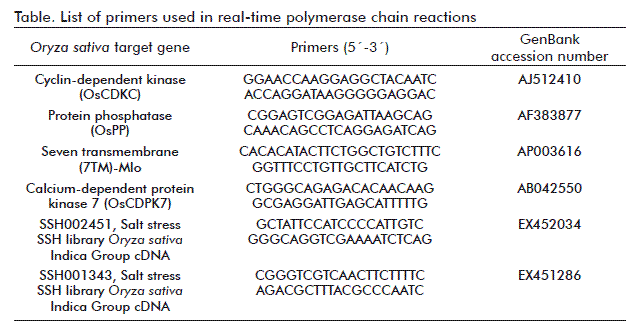
<body><![CDATA[<p   align="justify" ><font size="2" color="#000000" face="Verdana, Arial, Helvetica, sans-serif">Calcium-dependent  protein kinases (CDPKs) are encoded by multigene family and are involved in signal  transduction as important sensors of Ca<sup>2+</sup> influx in plants in response  to stress. The expression levels of CDPKs genes are spatially and temporally controlled  throughout development. In addition, a subset of CDPK genes responds to external  stimuli [11]. Transient increases in cytosolic Ca<sup>2+</sup> are perceived by  various Ca binding proteins. In the case of abiotic stress signaling, evidences  suggest that CDPKs sensors are major players in coupling this universal inorganic  signal to specific protein phosphorylation cascades. It seems that calcium signaling  is crucial for salt tolerance in plants [1]. On the other hand protein phosphatases  (PP) participate in signal transduction cascades necessary for cell cycling, development,  and disease resistance [12]. </font></p >    <p   align="justify" ><font size="2" color="#000000" face="Verdana, Arial, Helvetica, sans-serif">The  Mlo (mildew resistance locus o) proteins belong to a family of seven transmembrane  (7TM) domain proteins located in the plasma membrane. Transcripts for at least  half of the six Mlo proteins detected by microarray were induced by NaCl-treatment.  These are 7TM proteins with features similar to G-protein coupled receptors, and  some members of this gene family have been reported to be abiotic stress responsive  [13]. </font></p >    <p   align="justify" ><font size="2" color="#000000" face="Verdana, Arial, Helvetica, sans-serif">Here  we report the first study addressing gene expression of the <i>O. sativa</i> proteins  Cyclin dependent kinase (OsCDKC), protein phosphatase (<i>OsPP), </i>calcium-dependent  protein kinase 7 <i>(</i>OsCDPK7)<i>, </i>EST EX452034 and EX451286, and the 7TM-Mlo  protein, under salt stress conditions using a somaclonal cultivar (LP-7) as salt-tolerant  rice cultivar. The results allowed us to suggest that the phenotypic variation  related with salt tolerance observed in the somaclone is caused by genomic changes.  After further confirmatory gene functional experiments, not only we could confirm  the changes produced by somaclonal variation but also recommend the use of these  genes in breeding programs as either molecular markers or breeding tools through  genetic modified rice. </font></p >    <p   align="justify" >&nbsp;</p >    <p   align="justify" > </p >    <p   ><font size="3"><b><font color="#000000" face="Verdana, Arial, Helvetica, sans-serif">MATERIALS  AND METHODS </font></b></font></p >    <p   ><font size="2" color="#000000" face="Verdana, Arial, Helvetica, sans-serif"><b>Salt  stress treatment in a greenhouse conditions </b></font></p >    <p   align="justify" ><font size="2" color="#000000" face="Verdana, Arial, Helvetica, sans-serif">Seeds  from A-82 and LP-7 were germinated in a greenhouse on floating trays with a mixture  of floor-organic matter in a relationship 3:1. Trays were immersed in big rectangle  basins containing half-strength Hoagland nutrient solution under outdoor conditions:  natural illumination and average day/night temperature of 31 &ordm;C/26 &ordm;C.  Nutrient solution was changed every 7 d. After 4 weeks of growth, rice plants  were subjected to salt stress by adding NaCl to 150 mM final concentration. Samples  of leaves of 5 seedlings were pooled and collected at 0, 7 and 10 days after treatment  onset and then frozen in liquid nitrogen and stored at -70 C for further RNA extraction.  </font></p >    <p   ><font size="2" color="#000000" face="Verdana, Arial, Helvetica, sans-serif"><b>Quantitative  real-time polymerase chain reaction </b></font></p >    <p   align="justify" ><font size="2" color="#000000" face="Verdana, Arial, Helvetica, sans-serif">Total  RNA (10 mg) was extracted using a commercially available kit using the RNeasy  kit (Qiagen, Germany). The integrity of the RNA was checked on agarose gels. The  cDNA was synthesized using an oligo(dT) primer and the Super-Script III reverse  transcriptase kit (Invitrogen, USA) according to the manufacturer&rsquo;s instructions.  Quantitative real-time polymerase chain reaction (qRT-PCR) was conducted using  a Rotor-Gene 3000 PCR machine (Corbett Life Science, Australia) with the QuantiTect  SYBR Green PCR kit (Qiagen, Germany). Rice homologies of nucleotide sequences  from a selected group of genes were BLAST searched in the NCBI database. Specific  primers for OsCDKC, OsCDPK7, OsPP, 7TM-<i>mlo</i>, as well as the EST EX452034  and EX451286 were designed for qRT-PCR with the Primer3 software, version 2000  (<a href="/img/revistas/bta/v30n3/t0102313.gif">Table</a>) [14]. The PCR  mixture (Roche Diagnostics, Switzerland) consisted of 0.75 U <i>Tth</i> DNA polymerase,  <i>Tth</i> DNA polymerase buffer, 4 mM of MgCl<sub>2</sub>, 0.4 &micro;M of each  primer (one primer set used per assay), 0.2 mM each of dATP, dCTP, dGTP, and dTTP,  SYBR Green I diluted 1:10 000 and 4 &micro;L sample. The total volume was 20 &micro;L.  Each amplification started with a denaturation step of 15 min at 95 &ordm;C, followed  by 40 cycles of 15 s denaturation at 94 &ordm;C, 30 s annealing at 56 &ordm;C  and elongation for 30 s at 72 &ordm;C. Each measurement had 3 replicates of the  cDNA samples. Actin was used as endogenous gene of reference (<a href="/img/revistas/bta/v30n3/t0102313.gif">Table</a>)  forward primer: 5&acute;-GACCCAGATCATGTTTGAGACC-3&acute;; reverse primer: 5&acute;-ATCACCAGAGTCCAACACAATACC-3&acute;).  The C value of each gene was normalized with the value of actin to obtain the  value of &Delta;C. Values of &Delta;&Delta;C relative to control was used to calculate  relative gene expression following the procedure described in the relative quantification  using the comparative C method in the User Bulletin #2, ABI Prism 7700 Sequence  Detection System (Applied Biosystems, Inc., USA). </font></p >    
]]></body>
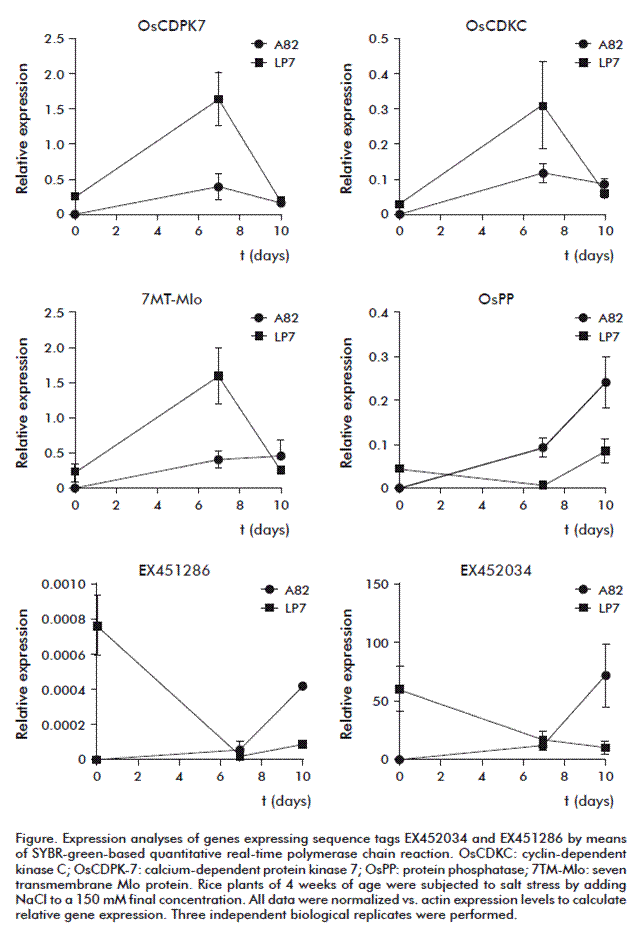
<body><![CDATA[<p   align="justify" >&nbsp;</p >    <p   align="justify" > </p >    <p   ><font size="3" color="#000000" face="Verdana, Arial, Helvetica, sans-serif"><b>RESULTS  AND DISCUSSION </b></font></p >    <p   align="justify" ><font size="2" color="#000000" face="Verdana, Arial, Helvetica, sans-serif">Salt  stress treatment under greenhouse conditions showed the remarkable differences  in the behavior of the salt-susceptible variety A-82 and the salt-tolerant somaclone  LP-7 under 150 mM NaCl solution. It is well supported by literature that plant  growth is greatly affected by environmental abiotic stresses, such as drought  and high salinity. The somaclone LP-7 showed high tolerance to salinity in greenhouses  condition (not shown). </font></p >    <p   align="justify" ><font size="2" color="#000000" face="Verdana, Arial, Helvetica, sans-serif">To  analyze the expression of some drought stress-up regulated genes under salinity  stress conditions we used the above mentioned genotypes because of their contrasting  salt-stress behavior. We identified the corresponding genes in rice by searching  each TDF against all the sequences in the non-redundant databases using the BlastN  algorithms (National Center for Biotechnology Information, USA). The expression  of the genes OsCDPK7, OsCDKC, OsPP, 7TM-<i>mlo</i>, EST EX452034 and EST EX451286  were quantified by qRT-PCR (<a href="/img/revistas/bta/v30n3/f0102313.gif">Figure</a>).  </font></p >    
<p   align="justify" ><font size="2" color="#000000" face="Verdana, Arial, Helvetica, sans-serif">OsCDPK7,  OsCDKC and 7TM-<i>mlo</i> genes from the cultivar LP-7 increased their relative  expression until day seven after salt stress, followed by a silencing of the gene  expression at 10 days, when the expression values dropped down to almost baseline.  In the variety A-82, the increase of expression at day seven was lower than in  somaclone LP-7, followed by a decrease after 10 days except for the 7TM-<i>mlo</i>  gene expression, which had a little increase. These results suggested that OsCDKC,  7TM-<i>mlo</i> and OsCDPK7 genes are involved in the tolerance response to salinity  in the salt-tolerant rice somaclone LP-7. </font></p >    <p   align="justify" ><font size="2" color="#000000" face="Verdana, Arial, Helvetica, sans-serif">The  first detectable response to sodium stress is a rise in the cytosolic-free calcium  concentration. This calcium signal serves as a second messenger that turns on  the machinery for sodium export and potassium/sodium discrimination. Calmodulins  (CaM) and CDPKs belong to the major families of calcium-binding proteins. There  is an interaction between the CaM and Mlo proteins. Rice Mlo proteins contain  a CaM-binding domain in a region of the carboxy-terminal cytoplasmic tail that  is relatively conserved in sequence among the Mlo family members. Mlo proteins  have a broad involvement in cell death protection and in responses to biotic and  abiotic stresses [15]. The 7TM-Mlo protein was induced both in a drought-tolerant  rice variety during osmotic stress [6] as well as under salinity conditions in  a salt-tolerant rice somaclone. Our results support the hypothesis that induction  of 7TM-Mlo proteins increases their interaction with CaM activating the signaling  cascade in which calcium is a messenger molecule. </font></p >    <p   align="justify" ><font size="2" color="#000000" face="Verdana, Arial, Helvetica, sans-serif">According  to these results, the salt-tolerant somaclone showed an induction of OsCDPK7 after  salt stress treatment, suggesting a function in the salt stress signaling pathways.  CDPKs have a characteristic structure in which an N-terminal serine/threonine  protein kinase domain is fused to a carboxyterminal CaM-like domain containing  EF-hand calcium-binding sites. Therefore, CDPKs do not depend on the interaction  with exogenous CaM but can be activated directly by Ca<sup>2+ </sup>binding certain  CDPK signaling pathways [16]. </font></p >    <p   align="justify" ><font size="2" color="#000000" face="Verdana, Arial, Helvetica, sans-serif">Different  members of the CDK have diverse roles in cell cycle progression and in regulating  gene expression [17]. A CDKC type from rice (CDKC1) was proposed to be involved  in developmental events as well as in the plant salt stress response mechanism  through an ABA-signaling pathway. Elevated NaCl also triggered increased expression  of CDKC1 in cell suspensions. This suggested that CDKC1 expression might be a  primary response to salt stress and could participate in the transcriptional regulation  of salt-induced genes for the induction of defense and/or tolerance in a saline  environment [18]. Although the molecular interactions that link the cell cycle  machinery to perception of stress are not fully understood, recent studies indicated  the involvement of CDKs in the plant stress response machinery. CDKs are core  cell cycle regulators but their activity has been implicated in additional diverse  cellular processes [8]. </font></p >    <p   align="justify" ><font size="2" color="#000000" face="Verdana, Arial, Helvetica, sans-serif">The  OsPP gene showed a gradually increase of expression until day 10 under salinity  conditions in the susceptible variety. However, a little increase of the expression  from 7 to 10 day was observed in the somaclone LP-7 but this remained lower when  compared to the variety A-82. Studies using phosphatase inhibitors have indicated  a role for phosphatases in stress signaling, where the activation and inactivation  of kinases is regulated by phosphorylation and dephosphorylation events, respectively  [12]. </font></p >    ]]></body>
<body><![CDATA[<p   align="justify" ><font size="2" color="#000000" face="Verdana, Arial, Helvetica, sans-serif">The  expression under salinity conditions of the studied EST (EX452034 and EX451286)  was similar. We found in the somaclone LP-7 a decreased expression of both genes  from a higher initial point to almost cero after 10 days, showing silencing of  these genes. Otherwise, an increase of its expression during 10 days of salt treatment  was observed in the variety A-82, showing an induction after 7 days of salt stress.  It has been reported that EST EX452034 and EX451286 were differentially expressed  under osmotic and salt stress in rice [19]. This behavior corresponded with the  variety A-82; however, in the tolerant genotype LP-7 a down regulation of both  ESTs was observed.</font></p >    <p   align="justify" ><font size="2" color="#000000" face="Verdana, Arial, Helvetica, sans-serif">Noteworthy,  expression profiling has become an important tool to investigate how an organism  responds to environmental changes. Plants have the ability to alter their gene  expression patterns in response to environmental changes such as temperature,  water availability or the presence of deleterious levels of ions. Sometimes these  transcriptional changes are successful adaptations leading to tolerance while  at other times the plant ultimately fails to adapt to the new environment and  is considered to be sensitive to that condition [20]. In this sense, expression  profiling can define both tolerant and sensitive responses. These profiles of  plant response to environmental extreme conditions are expected to lead to identify  regulators that will be useful in biotechnological approaches to improve stress  tolerance as well as to new tools for studying regulatory genetic circuitry in  plants under different types of stress. </font></p >    <p   align="justify" ><font size="2" color="#000000" face="Verdana, Arial, Helvetica, sans-serif">All  together, the genomic differences between susceptible- and tolerant-rice genotypes  were evidenced, by the differential expression of the genes coding for OsCDKC,  OsCDPK7, OsPP, 7TM-Mlo protein, as well as the ESTs EX452034 and EX451286 under  salt stress conditions in rice genotypes with contrasting salt-stress performance.  These results show the role of OsCDKC, OsCDPK7 and 7TM-<i>mlo</i> genes in the  salt tolerance performance in rice and allow us to suggest their function in the  primary response to salt stress as targets of stress responsive signaling cascades.  Therefore, we recommend the use of these genes in breeding programs as either  molecular markers or for breeding through genetically-modified rice. The functions  of stress-inducible genes not only to understand the molecular mechanisms of stress  tolerance and the responses of higher plants, but also to improve the stress tolerance  of crops by gene manipulation must be also considered</font><FONT size="+1" color="#000000"><FONT size="+1"><FONT size="+1"><FONT size="+1"><FONT size="+1"><FONT size="+1"><FONT size="+1"><FONT size="+1"><FONT size="+1"><FONT size="+1"><FONT size="+1"></font></font></font></font></font></font></font></font></font></font></font><font size="2" face="Verdana, Arial, Helvetica, sans-serif">.  </font></p ><FONT size="+1" color="#000000"><FONT size="+1"><FONT size="+1"><FONT size="+1"><FONT size="+1"><FONT size="+1"><FONT size="+1"><FONT size="+1"><FONT size="+1"><FONT size="+1"><FONT size="+1"><FONT size="+1"><FONT size="+1"><FONT size="+1"><FONT size="+1"><FONT size="+1"><FONT size="+1"><FONT size="+1"><FONT size="+1"><FONT size="+1"><FONT size="+1"><FONT size="+1"><FONT size="+1"><FONT size="+1"><FONT size="+1"><FONT size="+1"><FONT size="+1"><FONT size="+1"><FONT size="+1"><FONT size="+1">      <P   align="justify" >&nbsp;</P >    <P   align="justify" > </P >    <P   align="justify" ><font size="3" face="Verdana, Arial, Helvetica, sans-serif"><B>REFERENCES </b></font></P >    <P   align="justify" ><font size="2" face="Verdana, Arial, Helvetica, sans-serif">1. Xiong L, Schumaker  KS, Zhu JK. Cell signaling during cold, drought, and salt stress. Plant Cell.  2002;14 Suppl:S165-83.    <br> </font></P >    <!-- ref --><P   align="justify" ><font size="2" face="Verdana, Arial, Helvetica, sans-serif">2. Gonz&aacute;lez  LM, Ram&iacute;rez R. Los suelos salinos y su utilizaci&oacute;n en la producci&oacute;n  agr&iacute;cola. Alimentaria. 2002;339:103-7.    <br> </font></P >    ]]></body>
<body><![CDATA[<!-- ref --><P   align="justify" ><font size="2" face="Verdana, Arial, Helvetica, sans-serif">3. Munns R. Comparative  physiology of salt and water stress. Plant Cell Environ. 2002;25(2):239-50.    <br>  </font></P >    <!-- ref --><P   align="justify" ><font size="2" face="Verdana, Arial, Helvetica, sans-serif">4. Wang W, Vinocur  B, Altman A. Plant responses to drought, salinity and extreme temperatures: towards  genetic engineering for stress tolerance. Planta. 2003;218(1):1-14.    <br> </font></P >    <!-- ref --><P   align="justify" ><font size="2" face="Verdana, Arial, Helvetica, sans-serif">5. Shinozaki K, Yamaguchi-Shinozaki  K, Seki M. Regulatory network of gene expression in the drought and cold stress  responses. Curr Opin Plant Biol. 2003;6(5):410-7.    <br> </font></P >    <!-- ref --><P   align="justify" ><font size="2" face="Verdana, Arial, Helvetica, sans-serif">6. Rodr&iacute;guez  M, Canales E, Borroto CJ, Carmona E, L&oacute;pez J, Pujol M, et al. Identification  of genes induced upon water-deficit stress in a drought-tolerant rice cultivar.  J Plant Physiol. 2006;163(5):577-84.    <br> </font></P >    <!-- ref --><P   align="justify" ><font size="2" face="Verdana, Arial, Helvetica, sans-serif">7. Gonz&aacute;lez  MC, P&eacute;rez N, Cristo E, Rodr&iacute;guez M, Borr&aacute;s O. Development  of salinity tolerant-rice varieties using biotechnological nuclear techniques.  In: Shu QY, editor. Induced plant mutations in the genomics era. Rome: Food and  Agriculture Organization of the United Nations (FAO). 2009; p. 138-40.    <br> </font></P >    ]]></body>
<body><![CDATA[<!-- ref --><P   align="justify" ><font size="2" face="Verdana, Arial, Helvetica, sans-serif">8. Kitsios G, Doonan  JH. Cyclin dependent protein kinases and stress responses in plants. Plant Signal  Behav. 2011;6(2):204-9.    <br> </font></P >    <!-- ref --><P   align="justify" ><font size="2" face="Verdana, Arial, Helvetica, sans-serif">9. Stals H, Inze  D. When plant cells decide to divide. Trends Plant Sci. 2001;6(8):359-64.    <br>  </font></P >    <!-- ref --><P   align="justify" ><font size="2" face="Verdana, Arial, Helvetica, sans-serif">10. John PC, Mews  M, Moore R. Cyclin/Cdk complexes: their involvement in cell cycle progression  and mitotic division. Protoplasma. 2001;216(3-4):119-42.    <br> </font></P >    <!-- ref --><P   align="justify" ><font size="2" face="Verdana, Arial, Helvetica, sans-serif">11. Serrano R, Gaxiola  R, Rios G, Forment J, Vicente O, Ros R. Salt stress proteins identified by a functional  approach in yeast. Monatshefte fur Chemie. 2003;134(11):1445-64.    <br> </font></P >    <!-- ref --><P   align="justify" ><font size="2" face="Verdana, Arial, Helvetica, sans-serif">12. Takahashi K,  Isobe M, Muto S. An increase in cytosolic calcium ion concentration precedes hypo-osmotic  shock-induced activation of protein kinases in tobacco suspension culture cells.  FEBS Lett. 1997;401(2-3):202-6.    <br> </font></P >    ]]></body>
<body><![CDATA[<!-- ref --><P   align="justify" ><font size="2" face="Verdana, Arial, Helvetica, sans-serif">13. Jiang Y, Deyholos  MK. Comprehensive transcriptional profiling of NaCl-stressed Arabidopsis roots  reveals novel classes of responsive genes. BMC Plant Biol. 2006;6:25.    <br> </font></P >    <!-- ref --><P   align="justify" ><font size="2" face="Verdana, Arial, Helvetica, sans-serif">14. Rozen S, Skaletsky  HJ. Primer3 on the WWW for general users and for biologist programmers. Methods  Mol Biol. 2000;132:365-86.    <br> </font></P >    <!-- ref --><P   align="justify" ><font size="2" face="Verdana, Arial, Helvetica, sans-serif">15. Kim MC, Panstruga  R, Elliot C, Muller J, Devoto A, Yoon HW, et al. Calmodulin interacts with Mlo  protein to regulate defense against mildew in barley. Nature. 2002;416(6879):447-50.    <br>  </font></P >    <!-- ref --><P   align="justify" ><font size="2" face="Verdana, Arial, Helvetica, sans-serif">16. Cheng SH, Willmann  MR, Chen HC, Sheen J. Calcium signalling through protein kinases. The Arabidopsis  calcium dependent protein kinase gene family. Plant Physiol. 2002;129(2):469-85.    <br>  </font></P >    <!-- ref --><P   align="justify" ><font size="2" face="Verdana, Arial, Helvetica, sans-serif">17. West G, Inze  D, Beemster GT. Cell cycle modulation in the response of the primary root of Arabidopsis  to salt stress. Plant Physiol. 2004;135(2):1050-8.    <br> </font></P >    ]]></body>
<body><![CDATA[<!-- ref --><P   align="justify" ><font size="2" face="Verdana, Arial, Helvetica, sans-serif">18. Huang YW, Tsay  WS, Chen CC, Lin CW, Huang HJ. Increased expression of the rice C-type cyclin-dependent  protein kinase gene, Orysa;CDKC;1, in response to salt stress. Plant Physiol Biochem.  2008;46(1):71-81.    <br> </font></P >    <!-- ref --><P   align="justify" ><font size="2" face="Verdana, Arial, Helvetica, sans-serif">19. EX449804. SSH00339  Osmotic stress SSH library Oryza sativa Japonica Group cDNA, mRNA sequence [Internet].  Winden: MetaLife AG. c2013 [cited 2013 Jan 18]. Available from: <a href="http://www.metalife.com/Genbank/157650170" target="_blank">http://www.metalife.com/Genbank/157650170</a>.    <br>  </font></P >    <!-- ref --><P   align="justify" ><font size="2" face="Verdana, Arial, Helvetica, sans-serif">20. Hazen SP, Wu  Y, Kreps JA. Gene expression profiling of plant responses to abiotic stress. Funct  Integr Genomics. 2003;3(3):105-11.     </font><FONT size="+1"><FONT color="#0000FF"><FONT color="#000000"><FONT color="#0000FF"><FONT color="#000000"><FONT color="#0000FF"><FONT color="#000000">  </font></font></font></font></font></font></font></P ><FONT size="+1"><FONT color="#0000FF"><FONT color="#000000"><FONT color="#0000FF"><FONT color="#000000"><FONT color="#0000FF"><FONT color="#000000">      <P   align="justify" >&nbsp;</P >    <P   align="justify" >&nbsp;</P >    <P   align="justify" > </P >    <P   align="justify" ><font size="2" face="Verdana, Arial, Helvetica, sans-serif">Received in January,  2013.     ]]></body>
<body><![CDATA[<br> Accepted in March, 2013. </font></P >    <P   align="justify" >&nbsp;</P >    <P   align="justify" >&nbsp;</P >    <P   align="justify" > </P >    <P   align="justify" > </P >    <P   align="justify" ><i><font size="+1" color="#000000"><font size="2" face="Verdana, Arial, Helvetica, sans-serif">Mayra  Rodr&iacute;guez</font></font></i><font size="2" face="Verdana, Arial, Helvetica, sans-serif">.  </font><font size="+1" color="#000000"><font size="+1"><font size="+1"><font size="+1"><font size="+1"><font size="+1"><font size="2" face="Verdana, Arial, Helvetica, sans-serif">Centro  de Ingenier&iacute;a Gen&eacute;tica y Biotecnolog&iacute;a, CIGB. Ave. 31 e/  158 y 190, Cubanac&aacute;n, Playa, CP 11600, La Habana, Cuba</font></font></font></font></font></font></font><font size="2" face="Verdana, Arial, Helvetica, sans-serif">.  E-mail:<FONT color="#0000FF"><FONT color="#0017E4"> <a href="mailto:mayra.rodriguez@cigb.edu.cu">mayra.rodriguez@cigb.edu.cu</a>.  </font></font></font></P ></font></font></font></font></font></font></font></font></font></font></font></font></font></font></font></font></font></font></font></font></font></font></font></font></font></font></font></font></font></font></font></font></font></font></font></font></font></DIV >      ]]></body><back>
<ref-list>
<ref id="B1">
<label>1</label><nlm-citation citation-type="journal">
<person-group person-group-type="author">
<name>
<surname><![CDATA[Xiong]]></surname>
<given-names><![CDATA[L]]></given-names>
</name>
<name>
<surname><![CDATA[Schumaker]]></surname>
<given-names><![CDATA[KS]]></given-names>
</name>
<name>
<surname><![CDATA[Zhu]]></surname>
<given-names><![CDATA[JK]]></given-names>
</name>
</person-group>
<article-title xml:lang="en"><![CDATA[Cell signaling during cold, drought, and salt stress]]></article-title>
<source><![CDATA[Plant Cell]]></source>
<year>2002</year>
<volume>14S165-83</volume>
<numero>^s:</numero>
<issue>^s:</issue>
<supplement>:</supplement>
</nlm-citation>
</ref>
<ref id="B2">
<label>2</label><nlm-citation citation-type="journal">
<person-group person-group-type="author">
<name>
<surname><![CDATA[González]]></surname>
<given-names><![CDATA[LM]]></given-names>
</name>
<name>
<surname><![CDATA[Ramírez]]></surname>
<given-names><![CDATA[R]]></given-names>
</name>
</person-group>
<article-title xml:lang="es"><![CDATA[Los suelos salinos y su utilización en la producción agrícola]]></article-title>
<source><![CDATA[Alimentaria]]></source>
<year>2002</year>
<volume>339</volume>
<page-range>103-7</page-range></nlm-citation>
</ref>
<ref id="B3">
<label>3</label><nlm-citation citation-type="journal">
<person-group person-group-type="author">
<name>
<surname><![CDATA[Munns]]></surname>
<given-names><![CDATA[R]]></given-names>
</name>
</person-group>
<article-title xml:lang="en"><![CDATA[Comparative physiology of salt and water stress]]></article-title>
<source><![CDATA[Plant Cell Environ]]></source>
<year>2002</year>
<volume>25</volume>
<numero>2</numero>
<issue>2</issue>
<page-range>239-50</page-range></nlm-citation>
</ref>
<ref id="B4">
<label>4</label><nlm-citation citation-type="journal">
<person-group person-group-type="author">
<name>
<surname><![CDATA[Wang]]></surname>
<given-names><![CDATA[W]]></given-names>
</name>
<name>
<surname><![CDATA[Vinocur]]></surname>
<given-names><![CDATA[B]]></given-names>
</name>
<name>
<surname><![CDATA[Altman]]></surname>
<given-names><![CDATA[A]]></given-names>
</name>
</person-group>
<article-title xml:lang="en"><![CDATA[Plant responses to drought, salinity and extreme temperatures: towards genetic engineering for stress tolerance]]></article-title>
<source><![CDATA[Planta]]></source>
<year>2003</year>
<volume>218</volume>
<numero>1</numero>
<issue>1</issue>
<page-range>1-14</page-range></nlm-citation>
</ref>
<ref id="B5">
<label>5</label><nlm-citation citation-type="journal">
<person-group person-group-type="author">
<name>
<surname><![CDATA[Shinozaki]]></surname>
<given-names><![CDATA[K]]></given-names>
</name>
<name>
<surname><![CDATA[Yamaguchi-Shinozaki]]></surname>
<given-names><![CDATA[K]]></given-names>
</name>
<name>
<surname><![CDATA[Seki]]></surname>
<given-names><![CDATA[M]]></given-names>
</name>
</person-group>
<article-title xml:lang="en"><![CDATA[Regulatory network of gene expression in the drought and cold stress responses]]></article-title>
<source><![CDATA[Curr Opin Plant Biol]]></source>
<year>2003</year>
<volume>6</volume>
<numero>5</numero>
<issue>5</issue>
<page-range>410-7</page-range></nlm-citation>
</ref>
<ref id="B6">
<label>6</label><nlm-citation citation-type="journal">
<person-group person-group-type="author">
<name>
<surname><![CDATA[Rodríguez]]></surname>
<given-names><![CDATA[M]]></given-names>
</name>
<name>
<surname><![CDATA[Canales]]></surname>
<given-names><![CDATA[E]]></given-names>
</name>
<name>
<surname><![CDATA[Borroto]]></surname>
<given-names><![CDATA[CJ]]></given-names>
</name>
<name>
<surname><![CDATA[Carmona]]></surname>
<given-names><![CDATA[E]]></given-names>
</name>
<name>
<surname><![CDATA[López]]></surname>
<given-names><![CDATA[J]]></given-names>
</name>
<name>
<surname><![CDATA[Pujol]]></surname>
<given-names><![CDATA[M]]></given-names>
</name>
</person-group>
<article-title xml:lang="en"><![CDATA[Identification of genes induced upon water-deficit stress in a drought-tolerant rice cultivar]]></article-title>
<source><![CDATA[J Plant Physiol]]></source>
<year>2006</year>
<volume>163</volume>
<numero>5</numero>
<issue>5</issue>
<page-range>577-84</page-range></nlm-citation>
</ref>
<ref id="B7">
<label>7</label><nlm-citation citation-type="book">
<person-group person-group-type="author">
<name>
<surname><![CDATA[González]]></surname>
<given-names><![CDATA[MC]]></given-names>
</name>
<name>
<surname><![CDATA[Pérez]]></surname>
<given-names><![CDATA[N]]></given-names>
</name>
<name>
<surname><![CDATA[Cristo]]></surname>
<given-names><![CDATA[E]]></given-names>
</name>
<name>
<surname><![CDATA[Rodríguez]]></surname>
<given-names><![CDATA[M]]></given-names>
</name>
<name>
<surname><![CDATA[Borrás]]></surname>
<given-names><![CDATA[O]]></given-names>
</name>
</person-group>
<article-title xml:lang="en"><![CDATA[Development of salinity tolerant-rice varieties using biotechnological nuclear techniques]]></article-title>
<person-group person-group-type="editor">
<name>
<surname><![CDATA[Shu]]></surname>
<given-names><![CDATA[QY]]></given-names>
</name>
</person-group>
<source><![CDATA[Induced plant mutations in the genomics era]]></source>
<year>2009</year>
<page-range>138-40</page-range><publisher-loc><![CDATA[Rome ]]></publisher-loc>
<publisher-name><![CDATA[Food and Agriculture Organization of the United Nations (FAO)]]></publisher-name>
</nlm-citation>
</ref>
<ref id="B8">
<label>8</label><nlm-citation citation-type="journal">
<person-group person-group-type="author">
<name>
<surname><![CDATA[Kitsios]]></surname>
<given-names><![CDATA[G]]></given-names>
</name>
<name>
<surname><![CDATA[Doonan]]></surname>
<given-names><![CDATA[JH]]></given-names>
</name>
</person-group>
<article-title xml:lang="en"><![CDATA[Cyclin dependent protein kinases and stress responses in plants]]></article-title>
<source><![CDATA[Plant Signal Behav]]></source>
<year>2011</year>
<volume>6</volume>
<numero>2</numero>
<issue>2</issue>
<page-range>204-9</page-range></nlm-citation>
</ref>
<ref id="B9">
<label>9</label><nlm-citation citation-type="journal">
<person-group person-group-type="author">
<name>
<surname><![CDATA[Stals]]></surname>
<given-names><![CDATA[H]]></given-names>
</name>
<name>
<surname><![CDATA[Inze]]></surname>
<given-names><![CDATA[D]]></given-names>
</name>
</person-group>
<article-title xml:lang="en"><![CDATA[When plant cells decide to divide]]></article-title>
<source><![CDATA[Trends Plant Sci]]></source>
<year>2001</year>
<volume>6</volume>
<numero>8</numero>
<issue>8</issue>
<page-range>359-64</page-range></nlm-citation>
</ref>
<ref id="B10">
<label>10</label><nlm-citation citation-type="journal">
<person-group person-group-type="author">
<name>
<surname><![CDATA[John]]></surname>
<given-names><![CDATA[PC]]></given-names>
</name>
<name>
<surname><![CDATA[Mews]]></surname>
<given-names><![CDATA[M]]></given-names>
</name>
<name>
<surname><![CDATA[Moore]]></surname>
<given-names><![CDATA[R]]></given-names>
</name>
</person-group>
<article-title xml:lang="en"><![CDATA[Cyclin/Cdk complexes: their involvement in cell cycle progression and mitotic division]]></article-title>
<source><![CDATA[Protoplasma]]></source>
<year>2001</year>
<volume>216</volume>
<numero>3-4</numero>
<issue>3-4</issue>
<page-range>119-42</page-range></nlm-citation>
</ref>
<ref id="B11">
<label>11</label><nlm-citation citation-type="journal">
<person-group person-group-type="author">
<name>
<surname><![CDATA[Serrano]]></surname>
<given-names><![CDATA[R]]></given-names>
</name>
<name>
<surname><![CDATA[Gaxiola]]></surname>
<given-names><![CDATA[R]]></given-names>
</name>
<name>
<surname><![CDATA[Rios]]></surname>
<given-names><![CDATA[G]]></given-names>
</name>
<name>
<surname><![CDATA[Forment]]></surname>
<given-names><![CDATA[J]]></given-names>
</name>
<name>
<surname><![CDATA[Vicente]]></surname>
<given-names><![CDATA[O]]></given-names>
</name>
<name>
<surname><![CDATA[Ros]]></surname>
<given-names><![CDATA[R]]></given-names>
</name>
</person-group>
<article-title xml:lang="en"><![CDATA[Salt stress proteins identified by a functional approach in yeast]]></article-title>
<source><![CDATA[Monatshefte fur Chemie]]></source>
<year>2003</year>
<volume>134</volume>
<numero>11</numero>
<issue>11</issue>
<page-range>1445-64</page-range></nlm-citation>
</ref>
<ref id="B12">
<label>12</label><nlm-citation citation-type="journal">
<person-group person-group-type="author">
<name>
<surname><![CDATA[Takahashi]]></surname>
<given-names><![CDATA[K]]></given-names>
</name>
<name>
<surname><![CDATA[Isobe]]></surname>
<given-names><![CDATA[M]]></given-names>
</name>
<name>
<surname><![CDATA[Muto]]></surname>
<given-names><![CDATA[S]]></given-names>
</name>
</person-group>
<article-title xml:lang="en"><![CDATA[An increase in cytosolic calcium ion concentration precedes hypo-osmotic shock-induced activation of protein kinases in tobacco suspension culture cells]]></article-title>
<source><![CDATA[FEBS Lett]]></source>
<year>1997</year>
<volume>401</volume>
<numero>2-3</numero>
<issue>2-3</issue>
<page-range>202-6</page-range></nlm-citation>
</ref>
<ref id="B13">
<label>13</label><nlm-citation citation-type="journal">
<person-group person-group-type="author">
<name>
<surname><![CDATA[Jiang]]></surname>
<given-names><![CDATA[Y]]></given-names>
</name>
<name>
<surname><![CDATA[Deyholos]]></surname>
<given-names><![CDATA[MK]]></given-names>
</name>
</person-group>
<article-title xml:lang="en"><![CDATA[Comprehensive transcriptional profiling of NaCl-stressed Arabidopsis roots reveals novel classes of responsive genes]]></article-title>
<source><![CDATA[BMC Plant Biol]]></source>
<year>2006</year>
<volume>6</volume>
<page-range>25</page-range></nlm-citation>
</ref>
<ref id="B14">
<label>14</label><nlm-citation citation-type="journal">
<person-group person-group-type="author">
<name>
<surname><![CDATA[Rozen]]></surname>
<given-names><![CDATA[S]]></given-names>
</name>
<name>
<surname><![CDATA[Skaletsky]]></surname>
<given-names><![CDATA[HJ]]></given-names>
</name>
</person-group>
<article-title xml:lang="en"><![CDATA[Primer3 on the WWW for general users and for biologist programmers]]></article-title>
<source><![CDATA[Methods Mol Biol]]></source>
<year>2000</year>
<volume>132</volume>
<page-range>365-86</page-range></nlm-citation>
</ref>
<ref id="B15">
<label>15</label><nlm-citation citation-type="journal">
<person-group person-group-type="author">
<name>
<surname><![CDATA[Kim]]></surname>
<given-names><![CDATA[MC]]></given-names>
</name>
<name>
<surname><![CDATA[Panstruga]]></surname>
<given-names><![CDATA[R]]></given-names>
</name>
<name>
<surname><![CDATA[Elliot]]></surname>
<given-names><![CDATA[C]]></given-names>
</name>
<name>
<surname><![CDATA[Muller]]></surname>
<given-names><![CDATA[J]]></given-names>
</name>
<name>
<surname><![CDATA[Devoto]]></surname>
<given-names><![CDATA[A]]></given-names>
</name>
<name>
<surname><![CDATA[Yoon]]></surname>
<given-names><![CDATA[HW]]></given-names>
</name>
</person-group>
<article-title xml:lang="en"><![CDATA[Calmodulin interacts with Mlo protein to regulate defense against mildew in barley]]></article-title>
<source><![CDATA[Nature]]></source>
<year>2002</year>
<volume>416</volume>
<numero>6879</numero>
<issue>6879</issue>
<page-range>447-50</page-range></nlm-citation>
</ref>
<ref id="B16">
<label>16</label><nlm-citation citation-type="journal">
<person-group person-group-type="author">
<name>
<surname><![CDATA[Cheng]]></surname>
<given-names><![CDATA[SH]]></given-names>
</name>
<name>
<surname><![CDATA[Willmann]]></surname>
<given-names><![CDATA[MR]]></given-names>
</name>
<name>
<surname><![CDATA[Chen]]></surname>
<given-names><![CDATA[HC]]></given-names>
</name>
<name>
<surname><![CDATA[Sheen]]></surname>
<given-names><![CDATA[J]]></given-names>
</name>
</person-group>
<article-title xml:lang="en"><![CDATA[Calcium signalling through protein kinases. The Arabidopsis calcium dependent protein kinase gene family]]></article-title>
<source><![CDATA[Plant Physiol]]></source>
<year>2002</year>
<volume>129</volume>
<numero>2</numero>
<issue>2</issue>
<page-range>469-85</page-range></nlm-citation>
</ref>
<ref id="B17">
<label>17</label><nlm-citation citation-type="journal">
<person-group person-group-type="author">
<name>
<surname><![CDATA[West]]></surname>
<given-names><![CDATA[G]]></given-names>
</name>
<name>
<surname><![CDATA[Inze]]></surname>
<given-names><![CDATA[D]]></given-names>
</name>
<name>
<surname><![CDATA[Beemster]]></surname>
<given-names><![CDATA[GT]]></given-names>
</name>
</person-group>
<article-title xml:lang="en"><![CDATA[Cell cycle modulation in the response of the primary root of Arabidopsis to salt stress]]></article-title>
<source><![CDATA[Plant Physiol]]></source>
<year>2004</year>
<volume>135</volume>
<numero>2</numero>
<issue>2</issue>
<page-range>1050-8</page-range></nlm-citation>
</ref>
<ref id="B18">
<label>18</label><nlm-citation citation-type="journal">
<person-group person-group-type="author">
<name>
<surname><![CDATA[Huang]]></surname>
<given-names><![CDATA[YW]]></given-names>
</name>
<name>
<surname><![CDATA[Tsay]]></surname>
<given-names><![CDATA[WS]]></given-names>
</name>
<name>
<surname><![CDATA[Chen]]></surname>
<given-names><![CDATA[CC]]></given-names>
</name>
<name>
<surname><![CDATA[Lin]]></surname>
<given-names><![CDATA[CW]]></given-names>
</name>
<name>
<surname><![CDATA[Huang]]></surname>
<given-names><![CDATA[HJ]]></given-names>
</name>
</person-group>
<article-title xml:lang="en"><![CDATA[Increased expression of the rice C-type cyclin-dependent protein kinase gene, Orysa;CDKC;1, in response to salt stress]]></article-title>
<source><![CDATA[Plant Physiol Biochem]]></source>
<year>2008</year>
<volume>46</volume>
<numero>1</numero>
<issue>1</issue>
<page-range>71-81</page-range></nlm-citation>
</ref>
<ref id="B19">
<label>19</label><nlm-citation citation-type="book">
<source><![CDATA[EX449804. SSH00339 Osmotic stress SSH library Oryza sativa Japonica Group cDNA, mRNA sequence]]></source>
<year>c201</year>
<month>3</month>
<publisher-loc><![CDATA[Winden ]]></publisher-loc>
<publisher-name><![CDATA[MetaLife AG]]></publisher-name>
</nlm-citation>
</ref>
<ref id="B20">
<label>20</label><nlm-citation citation-type="journal">
<person-group person-group-type="author">
<name>
<surname><![CDATA[Hazen]]></surname>
<given-names><![CDATA[SP]]></given-names>
</name>
<name>
<surname><![CDATA[Wu]]></surname>
<given-names><![CDATA[Y]]></given-names>
</name>
<name>
<surname><![CDATA[Kreps]]></surname>
<given-names><![CDATA[JA]]></given-names>
</name>
</person-group>
<article-title xml:lang="en"><![CDATA[Gene expression profiling of plant responses to abiotic stress]]></article-title>
<source><![CDATA[Funct Integr Genomics]]></source>
<year>2003</year>
<volume>3</volume>
<numero>3</numero>
<issue>3</issue>
<page-range>105-11</page-range></nlm-citation>
</ref>
</ref-list>
</back>
</article>