<?xml version="1.0" encoding="ISO-8859-1"?><article xmlns:mml="http://www.w3.org/1998/Math/MathML" xmlns:xlink="http://www.w3.org/1999/xlink" xmlns:xsi="http://www.w3.org/2001/XMLSchema-instance">
<front>
<journal-meta>
<journal-id>1027-2852</journal-id>
<journal-title><![CDATA[Biotecnología Aplicada]]></journal-title>
<abbrev-journal-title><![CDATA[Biotecnol Apl]]></abbrev-journal-title>
<issn>1027-2852</issn>
<publisher>
<publisher-name><![CDATA[Editorial Elfos Scientiae]]></publisher-name>
</publisher>
</journal-meta>
<article-meta>
<article-id>S1027-28522013000300003</article-id>
<title-group>
<article-title xml:lang="en"><![CDATA[Formulation development of a recombinant Streptokinase suppository for hemorrhoids treatment]]></article-title>
<article-title xml:lang="es"><![CDATA[Desarrollo de una formulación en supositorio con estreptoquinasa recombinante para el tratamiento de las hemorroides]]></article-title>
</title-group>
<contrib-group>
<contrib contrib-type="author">
<name>
<surname><![CDATA[Aguilera]]></surname>
<given-names><![CDATA[Ana]]></given-names>
</name>
<xref ref-type="aff" rid="A01"/>
</contrib>
<contrib contrib-type="author">
<name>
<surname><![CDATA[Bermudez]]></surname>
<given-names><![CDATA[Yilian]]></given-names>
</name>
<xref ref-type="aff" rid="A01"/>
</contrib>
<contrib contrib-type="author">
<name>
<surname><![CDATA[Martínez]]></surname>
<given-names><![CDATA[Eduardo]]></given-names>
</name>
<xref ref-type="aff" rid="A01"/>
</contrib>
<contrib contrib-type="author">
<name>
<surname><![CDATA[Marrero]]></surname>
<given-names><![CDATA[María A]]></given-names>
</name>
<xref ref-type="aff" rid="A02"/>
</contrib>
<contrib contrib-type="author">
<name>
<surname><![CDATA[Muñoz]]></surname>
<given-names><![CDATA[Lazara]]></given-names>
</name>
<xref ref-type="aff" rid="A01"/>
</contrib>
<contrib contrib-type="author">
<name>
<surname><![CDATA[Páez]]></surname>
<given-names><![CDATA[Rolando]]></given-names>
</name>
<xref ref-type="aff" rid="A01"/>
</contrib>
<contrib contrib-type="author">
<name>
<surname><![CDATA[Tamargo]]></surname>
<given-names><![CDATA[Beatriz]]></given-names>
</name>
<xref ref-type="aff" rid="A03"/>
</contrib>
<contrib contrib-type="author">
<name>
<surname><![CDATA[Hernández]]></surname>
<given-names><![CDATA[Luciano F]]></given-names>
</name>
<xref ref-type="aff" rid="A01"/>
</contrib>
<contrib contrib-type="author">
<name>
<surname><![CDATA[García]]></surname>
<given-names><![CDATA[Oscar]]></given-names>
</name>
<xref ref-type="aff" rid="A04"/>
</contrib>
</contrib-group>
<aff id="A02">
<institution><![CDATA[,Centro Nacional Coordinador de Ensayos Clínicos, Cencec  ]]></institution>
<addr-line><![CDATA[La Habana ]]></addr-line>
<country>Cuba</country>
</aff>
<aff id="A03">
<institution><![CDATA[,Universidad de La Habana Instituto de Farmacia y Alimentos ]]></institution>
<addr-line><![CDATA[La Habana ]]></addr-line>
<country>Cuba</country>
</aff>
<aff id="A04">
<institution><![CDATA[,Laboratorio Farmacéutico Roberto Escudero  ]]></institution>
<addr-line><![CDATA[La Habana ]]></addr-line>
<country>Cuba</country>
</aff>
<aff id="A01">
<institution><![CDATA[,Centro de Ingeniería Genética y Biotecnología, CIGB Departamento de Desarrollo de Formulaciones ]]></institution>
<addr-line><![CDATA[La Habana ]]></addr-line>
<country>Cuba</country>
</aff>
<pub-date pub-type="pub">
<day>00</day>
<month>09</month>
<year>2013</year>
</pub-date>
<pub-date pub-type="epub">
<day>00</day>
<month>09</month>
<year>2013</year>
</pub-date>
<volume>30</volume>
<numero>3</numero>
<fpage>182</fpage>
<lpage>186</lpage>
<copyright-statement/>
<copyright-year/>
<self-uri xlink:href="http://scielo.sld.cu/scielo.php?script=sci_arttext&amp;pid=S1027-28522013000300003&amp;lng=en&amp;nrm=iso"></self-uri><self-uri xlink:href="http://scielo.sld.cu/scielo.php?script=sci_abstract&amp;pid=S1027-28522013000300003&amp;lng=en&amp;nrm=iso"></self-uri><self-uri xlink:href="http://scielo.sld.cu/scielo.php?script=sci_pdf&amp;pid=S1027-28522013000300003&amp;lng=en&amp;nrm=iso"></self-uri><abstract abstract-type="short" xml:lang="en"><p><![CDATA[Recombinant Streptokinase (rSK) is a protein of bacterial origin currently used in the treatment of acute myocardial infarction. Its thrombolytic and anti-inflammatory action makes it attractive for the treatment of hemorrhoids. In this work the influence of absorption enhancer, preservative and emulsifiers on rSK stability was accessed by determining its biological activity under stress conditions. According to the results obtained, were selected as excipients for the formulation: Sodium salicylate as enhancer and anti-inflammatory agent, thimerosal as preservative, Span 60 as emulsifier and Witepsol W25 as suppository base and 100 000 IU per gram of suppository for stability study. Afterwards, three lots at pilot scale were manufactured, packed in aluminum blister shell and stored at 5 ± 3 ºC. Immediately after preparation, the samples were evaluated at months 0, 3, 6, 9, 12 and 18 having into account the physical, chemical and biological properties. The stability study demonstrated that the formulation containing rSK as active pharmaceutical ingredient was stable during 18 months under refrigerated conditions.]]></p></abstract>
<abstract abstract-type="short" xml:lang="es"><p><![CDATA[La estreptoquinasa recombinante (SKr) es una proteína de origen bacteriano que se utiliza para el tratamiento del infarto agudo de miocardio. Su acción trombolítica y antinflamatoria la hace atractiva para el tratamiento de las hemorroides. Se evaluó la influencia de promotores de la absorción, preservantes y tensoactivos sobre la estabilidad de la SKr, mediante la determinación de su actividad biológica bajo condiciones de estrés. De acuerdo con los resultados, se seleccionaron el salicilato de sodio como promotor de la absorción y agente antinflamatorio, el tiomersal como preservante, el Span 60 como tensoactivo y el Witepsol W25 como base del supositorio, y 100 000 UI de SKr por gramo de supositorio para el estudio de la estabilidad. Posteriormente se prepararon tres lotes a escala piloto y se almacenaron en blíster de aluminio a 5 ± 3 °C. Inmediatamente después de la preparación, se evaluaron las muestras a los 0; 3; 6; 9; 12 y 18 meses, teniendo en cuenta las propiedades físicas, químicas y biológicas. El estudio de estabilidad demostró que la formulación en forma de supositorio es estable durante 18 meses bajo condiciones de refrigeración.]]></p></abstract>
<kwd-group>
<kwd lng="en"><![CDATA[streptokinase]]></kwd>
<kwd lng="en"><![CDATA[suppository]]></kwd>
<kwd lng="en"><![CDATA[hemorrhoids]]></kwd>
<kwd lng="en"><![CDATA[formulations development]]></kwd>
<kwd lng="en"><![CDATA[rectal administration]]></kwd>
<kwd lng="en"><![CDATA[thrombolytic]]></kwd>
<kwd lng="en"><![CDATA[long term stability]]></kwd>
<kwd lng="es"><![CDATA[estreptoquinasa]]></kwd>
<kwd lng="es"><![CDATA[supositorio]]></kwd>
<kwd lng="es"><![CDATA[hemorroide]]></kwd>
<kwd lng="es"><![CDATA[desarrollo de formulaciones]]></kwd>
<kwd lng="es"><![CDATA[administración rectal]]></kwd>
<kwd lng="es"><![CDATA[trombolítico]]></kwd>
<kwd lng="es"><![CDATA[estabilidad en tiempo real]]></kwd>
</kwd-group>
</article-meta>
</front><body><![CDATA[ <DIV class="Sect"   >     <P   align="right" ><font size="2" color="#000000" face="Verdana, Arial, Helvetica, sans-serif"><b>RESEARCH</b></font></P >    <P   align="right" >&nbsp;</P ><FONT size="+1" color="#000000">     <P   > </P >    <P   ><b><font size="4" face="Verdana, Arial, Helvetica, sans-serif">Formulation development  of a recombinant Streptokinase suppository for hemorrhoids treatment</font></b></P >    <P   >&nbsp;</P >    <P   ><font size="3" face="Verdana, Arial, Helvetica, sans-serif"><b>Desarrollo de  una formulaci&oacute;n en supositorio con estreptoquinasa recombinante para el  tratamiento de las hemorroides</b></font></P >    <P   > </P >    <P   > </P >    <P   >&nbsp;</P >    ]]></body>
<body><![CDATA[<P   >&nbsp;</P >    <P   ><font size="2" face="Verdana, Arial, Helvetica, sans-serif"><b>Ana Aguilera<sup>1</sup>,  Yilian Bermudez<sup>1</sup>, Eduardo Mart&iacute;nez<sup>1</sup>, Mar&iacute;a  A Marrero<sup>2</sup>, Lazara Mu&ntilde;oz<sup>1</sup>, Rolando P&aacute;ez<sup>1</sup>,  Beatriz Tamargo<sup>3</sup>, Luciano F Hern&aacute;ndez<sup>1</sup>, Oscar Garc&iacute;a<sup>4</sup></b></font></P ><FONT size="+1"><FONT size="+1"><FONT size="+1"><FONT size="+1"><FONT size="+1">      <P   ><font size="2" face="Verdana, Arial, Helvetica, sans-serif"><Sup>1</Sup> Departamento  de Desarrollo de Formulaciones, Centro de Ingenier&iacute;a Gen&eacute;tica y  Biotecnolog&iacute;a, CIGB. Ave. 31 e/ 158 y 190, Cubanac&aacute;n, Playa, CP  11600, La Habana, Cuba.     <br> <Sup>2</Sup> Centro Nacional Coordinador de Ensayos  Cl&iacute;nicos, Cencec, La Habana, Cuba.    <br> <Sup>3</Sup> Instituto de Farmacia  y Alimentos, Universidad de La Habana, La Habana, Cuba.    <br> <sup>4</sup> Laboratorio  Farmac&eacute;utico Roberto Escudero, La Habana, Cuba.</font></P >    <P   >&nbsp;</P >    <P   >&nbsp;</P ></font></font></font></font></font></font> <hr> <FONT size="+1" color="#000000"><FONT size="+1"><FONT size="+1"><FONT size="+1"><FONT size="+1"><FONT size="+1">      <P   ><font size="2" face="Verdana, Arial, Helvetica, sans-serif"><B>ABSTRACT</b></font></P >    <P   ><font size="2" face="Verdana, Arial, Helvetica, sans-serif">Recombinant Streptokinase  (rSK) is a protein of bacterial origin currently used in the treatment of acute  myocardial infarction. Its thrombolytic and anti-inflammatory action makes it  attractive for the treatment of hemorrhoids. In this work the influence of absorption  enhancer, preservative and emulsifiers on rSK stability was accessed by determining  its biological activity under stress conditions. According to the results obtained,  were selected as excipients for the formulation: Sodium salicylate as enhancer  and anti-inflammatory agent, thimerosal as preservative, Span 60 as emulsifier  and Witepsol W25 as suppository base and 100 000 IU per gram of suppository for  stability study. Afterwards, three lots at pilot scale were manufactured, packed  in aluminum blister shell and stored at 5 &plusmn; 3 &ordm;C. Immediately after  preparation, the samples were evaluated at months 0, 3, 6, 9, 12 and 18 having  into account the physical, chemical and biological properties. The stability study  demonstrated that the formulation containing rSK as active pharmaceutical ingredient  was stable during 18 months under refrigerated conditions. </font></P ><FONT size="+1"><FONT size="+1"><FONT size="+1"><FONT size="+1"><FONT size="+1">    ]]></body>
<body><![CDATA[<P   ><font size="2" face="Verdana, Arial, Helvetica, sans-serif"><B>Keywords:</B>  streptokinase, suppository, hemorrhoids, formulations development, rectal administration,  thrombolytic, long term stability. </font></P ></font></font></font></font></font></font></font></font></font></font></font>  <hr> <FONT size="+1" color="#000000"><FONT size="+1"><FONT size="+1"><FONT size="+1"><FONT size="+1"><FONT size="+1"><FONT size="+1"><FONT size="+1"><FONT size="+1"><FONT size="+1"><FONT size="+1">      <P   ><font size="2" face="Verdana, Arial, Helvetica, sans-serif"><B>RESUMEN </b></font></P >    <P   ><font size="2" face="Verdana, Arial, Helvetica, sans-serif">La estreptoquinasa  recombinante (SKr) es una prote&iacute;na de origen bacteriano que se utiliza  para el tratamiento del infarto agudo de miocardio. Su acci&oacute;n trombol&iacute;tica  y antinflamatoria la hace atractiva para el tratamiento de las hemorroides. Se  evalu&oacute; la influencia de promotores de la absorci&oacute;n, preservantes  y tensoactivos sobre la estabilidad de la SKr, mediante la determinaci&oacute;n  de su actividad biol&oacute;gica bajo condiciones de estr&eacute;s. De acuerdo  con los resultados, se seleccionaron el salicilato de sodio como promotor de la  absorci&oacute;n y agente antinflamatorio, el tiomersal como preservante, el Span  60 como tensoactivo y el Witepsol W25 como base del supositorio, y 100 000 UI  de SKr por gramo de supositorio para el estudio de la estabilidad. Posteriormente  se prepararon tres lotes a escala piloto y se almacenaron en bl&iacute;ster de  aluminio a 5 &plusmn; 3 &deg;C. Inmediatamente despu&eacute;s de la preparaci&oacute;n,  se evaluaron las muestras a los 0; 3; 6; 9; 12 y 18 meses, teniendo en cuenta  las propiedades f&iacute;sicas, qu&iacute;micas y biol&oacute;gicas. El estudio  de estabilidad demostr&oacute; que la formulaci&oacute;n en forma de supositorio  es estable durante 18 meses bajo condiciones de refrigeraci&oacute;n. </font></P >    <P   ><font size="2" face="Verdana, Arial, Helvetica, sans-serif"><B>Palabras clave:</B>  estreptoquinasa, supositorio, hemorroide, desarrollo de formulaciones, administraci&oacute;n  rectal, trombol&iacute;tico, estabilidad en tiempo real. </font></P ></font></font></font></font></font></font></font></font></font></font></font>  <hr> <FONT size="+1" color="#000000"><FONT size="+1"><FONT size="+1"><FONT size="+1"><FONT size="+1"><FONT size="+1"><FONT size="+1"><FONT size="+1"><FONT size="+1"><FONT size="+1"><FONT size="+1">      <P   >&nbsp;</P >    <P   >&nbsp;</P >    <P   > </P >    <P   ><font size="3" face="Verdana, Arial, Helvetica, sans-serif"><B>INTRODUCTION </b></font></P ></font></font></font></font></font></font></font></font></font></font></font>      <div class="Sect"   >     <p   ><font size="2" face="Verdana, Arial, Helvetica, sans-serif" color="#000000">The  delivery of therapeutics and proteins remains a priority for many pharmaceutical  companies, being a huge challenge the need to find non-parenteral routes for their  administration [1, 2]. The rectal route is one of them. The rectum has been an  accepted site for drug delivery, and used for systemic and local action with potential  for the delivery of peptides. Many studies have been focused in the bioavailability  of a variety of peptides such as calcitonin [3], insulin [4, 5], Beta interferon  [6] and also Streptokinase [9] among others. </font></p >    ]]></body>
<body><![CDATA[<p   ><font face="Verdana, Arial, Helvetica, sans-serif" size="2" color="#000000">Streptokinase  is a high molecular weight protein which nowadays is used for the treatment of  acute myocardial infarction, deep vein thrombosis, permanent vascular access thrombosis  and other diseases with thrombotic origin. In this sense, it is presented in different  pharmaceutical forms like lyophilized for parenteral use [6, 7]. It has also been  used for mucosal administration, in orally administered pills VARIDASE&reg;, for  edema relief of inflammatory process [8]. It has also been reported its rectal  administration with the main objective of systemic action for the treatment of  hematoma re-absorption or just for comparing its concentration in the blood after  rectal and oral administration [9]. However, its local administration at the rectum  remained to be studied. </font></p >    <p   ><font face="Verdana, Arial, Helvetica, sans-serif" size="2" color="#000000">Rectal  Streptokinase administration using a suppository formulation is possible in order  to achieve the elimination of the thrombus in hemorroidal disease, with the consequent  decrease of the inflammation and pain in the affected zone, without systemic thrombolytic  effects. Hemorroids treatments are often divided between non-operative management,  office procedures and surgical management. Topical agents using astringents, analgesics,  and steroids help on providing relief in an acute setting, but there is no evidence  showing their benefit for prevention or long-term treatment of hemorrhoidal disease  [10]. The use of rSK in hemorrhoidal disease could allow solving the pathology  locally, in a neither painful nor invasive ways. Additionally, it would not require  specialized personnel or equipment for its application and it makes possible the  treatment of the acute hemorrhoidal disease in a non-surgical way, avoiding the  inconvenient inherent to this kind of treatment. Thus, the purpose of our study  was to develop a formulation and to determine the biological, physical-chemical  stability of streptokinase in a suppository formulation during 18 months in order  to verify de viability of the product. </font></p >    <p   >&nbsp;</p >    <p   > </p >    <p   ><font size="3"><b><font face="Verdana, Arial, Helvetica, sans-serif" color="#000000">MATERIALS  AND METHODS </font></b></font></p >    <p   ><font size="2" face="Verdana, Arial, Helvetica, sans-serif" color="#000000"><b>Materials  </b> </font></p >    <p   ><font face="Verdana, Arial, Helvetica, sans-serif" size="2" color="#000000">Recombinant  Streptokinase was obtained from the Center of Genetic Engineering and Biotechnology  (CIGB, Havana, Cuba). Ethylendiamine tetraacetic acid salt dehydrate (EDTA) was  purchased from Merck (Darmstadt, Germany). Benzalkonium chloride, thime-rosal,  Tween-20, Tween-80, Span 20, Span 60 were obtained from Merck-Schuchardt, Hohenbrunn,  Germany. Suppository base (Witepsol W25) was provided by Sasol (Witten, Germany).  Methyl paraben, propyl paraben, sodium salicylate and sodium deoxycholate were  obtained from Sigma-Aldrich (USA). </font></p >    <p   ><font face="Verdana, Arial, Helvetica, sans-serif" size="2" color="#000000"><b>Excipient  selection for a rSK suppository formulation </b></font></p >    <p   ><font face="Verdana, Arial, Helvetica, sans-serif" size="2" color="#000000"><i><b>Selection  of the absorption enhancer </b></i></font></p >    <p   ><font face="Verdana, Arial, Helvetica, sans-serif" size="2" color="#000000">rSK  was diluted at 100 000 IU/mL and mixed with three different enhancers: Sodium  salicylate, sodium deoxycholate and EDTA, each at 0.5 %. The biological activity  was tested 0, 3, 7 and 15 days later. During the study the solutions were stored  at 37 &plusmn; 2 &ordm;C. </font></p >    ]]></body>
<body><![CDATA[<p   ><font face="Verdana, Arial, Helvetica, sans-serif" size="2" color="#000000"><i><b>Selection  of the preservative </b></i></font></p >    <p   ><font face="Verdana, Arial, Helvetica, sans-serif" size="2" color="#000000">rSK  was diluted at 100 000 IU/mL and the solution was mixed with different preservatives:  0.01 % Benzalkonium chloride, 0.18 % methyl paraben, 0.02 % propyl paraben or  0.001 % thimerosal) and stored at 28 &plusmn; 3 &ordm;C. Biological activity and  organoleptic characteristics were tested 0, 3, 7 and 30 days later. </font></p >    <p   ><font face="Verdana, Arial, Helvetica, sans-serif" size="2" color="#000000"><b>Selection  of the emulsifiers</b> </font></p >    <p   ><font face="Verdana, Arial, Helvetica, sans-serif" size="2" color="#000000">The  following non ionic tensoactives were used to elaborate suppository formulations:  (Tween-20, Tween-80, Span 20 and Span 60 at 1, 2, 4 %). Then, the physical characteristics  were evaluated. </font></p >    <p   ><font face="Verdana, Arial, Helvetica, sans-serif" size="2" color="#000000"><b>Suppository  preparation </b></font></p >    <p   ><font face="Verdana, Arial, Helvetica, sans-serif" size="2" color="#000000">Three  consecutive, independent batches of suppository formulations were produced to  investigate their long term stability. Suppositories were prepared, by melting  the suppository base in a water bath at 54 &ordm;C. Thimerosal at 0.001 % and  sodium salicylate at 0.5 % were added continuously at constant stirring until  a homogenous dispersion was reached. The dispersion was cooled down up to 36 &ordm;C  and, subsequently, rSK (100 000 IU/g of suppository) was incorporated with constant  agitation. The mixture was then spilled in cold suppository molds of 2 g. Suppositories  were left to solidify and the excess was removed until final ejection. Then they  were refrigerated at 5 &plusmn; 3 &ordm;C and periodically analyzed. </font></p >    <p   ><font face="Verdana, Arial, Helvetica, sans-serif" size="2" color="#000000"><b>Drug  extraction </b></font></p >    <p   ><font face="Verdana, Arial, Helvetica, sans-serif" size="2" color="#000000">The  content of Streptokinase in a suppository was extracted after one unit was melted  in 4 mL of water at 37 &ordm;C. The dilution was mixed for 1 minute in a Vortex-type  mixer and then centrifuged at 8000 rcf for 2 minutes. The solutions were stored  at 5 &plusmn; 3 &ordm;C until its analysis. </font></p >    <p   ><font face="Verdana, Arial, Helvetica, sans-serif" size="2" color="#000000"><b>Determination  of Recombinant Streptokinase by substrate chromogenic </b></font></p >    <p   ><font face="Verdana, Arial, Helvetica, sans-serif" size="2" color="#000000">This  test is based on the formation of an activating complex mol/mol between the Streptokinase  and the plasminogen, that is capable of activating the free plasminogen in the  plasma or plasmin. It is measured quantitatively for the liberation of a colored  molecule that is directly proportional to the units of Streptokin-ase used [11].  </font></p >    ]]></body>
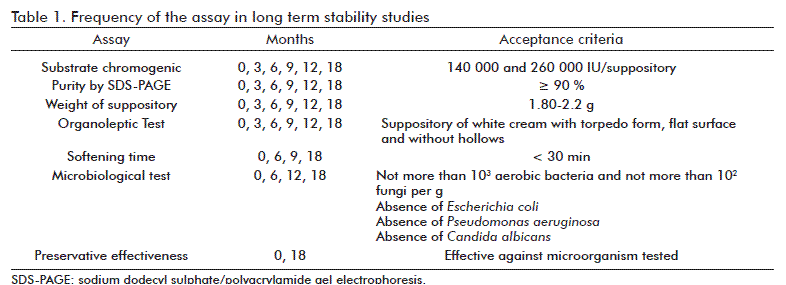
<body><![CDATA[<p   ><font face="Verdana, Arial, Helvetica, sans-serif" size="2" color="#000000"><b>SDS-PAGE  analysis </b></font></p >    <p   ><font face="Verdana, Arial, Helvetica, sans-serif" size="2" color="#000000">The  samples were analyzed by SDS/PAGE as described by Laemmli [12]. The gels were  scanned and densitometrically analyzed after Coomassie blue staining. A reference  standard of rSK provided by the Quality Control Division of CIGB was used as the  positive control. </font></p >    <p   ><font face="Verdana, Arial, Helvetica, sans-serif" size="2" color="#000000"><b>Other  determinations to suppository stability </b></font></p >    <p   ><font face="Verdana, Arial, Helvetica, sans-serif" size="2" color="#000000">Softening  time, weight, organoleptic characteristics, microbiological tests were all determined  in compliance with acceptance levels criteria (USP) [13]. </font></p >    <p   ><font face="Verdana, Arial, Helvetica, sans-serif" size="2" color="#000000"><b>Long  term stability studies </b></font></p >    <p   ><font face="Verdana, Arial, Helvetica, sans-serif" size="2" color="#000000">Suppositories  with the best excipient formulation were assessed for rSK stability after storage  at 5 &plusmn; 3 &deg;C. Suppositories were tested for weight, organoleptic properties,  softening time, microbiology, and preservative effectiveness (<a href="/img/revistas/bta/v30n3/t0103313.gif">Table  1</a>), and also for biological activity and purity. </font></p >    
<p   ><font face="Verdana, Arial, Helvetica, sans-serif" size="2" color="#000000">The  long-term stability assay was designed in agreement with the principles of the  International Conference on Harmonisation guideline &ldquo;Q1A Stability Testing  of New Drug Substances and Products&rdquo; to propose a retest period or shelf  life in a registration application (<a href="/img/revistas/bta/v30n3/t0103313.gif">Table  1</a>) [14]. The results were compared using a two-tailed ANOVA with replication,  after a comparison of the homogeneity of variance (Bartlett&rsquo;s test) [15].  </font></p >    
<p   >&nbsp;</p >    <p   > </p >    <p   ><font size="3" face="Verdana, Arial, Helvetica, sans-serif" color="#000000"><b>RESULTS  AND DISCUSSION </b></font></p >    ]]></body>
<body><![CDATA[<p   ><font face="Verdana, Arial, Helvetica, sans-serif" size="2" color="#000000">The  preformulation strategy plays a vital role to obtain a proper and stable formulation  dosage form. It involves the application of biopharmaceutical principles to the  physicochemical parameters of the drug. This approach helps the formulator to  reduce preparing unnecessary formulations, leading to reduced costs and time effectiveness.  In order to obtain a safe and efficacious suppository formulation, different excipients  were evaluated. </font></p >    <p   ><font face="Verdana, Arial, Helvetica, sans-serif" size="2" color="#000000"><b>Influence  of the absorption enhancers over the biological activity of rSK </b></font></p >    <p   ><font face="Verdana, Arial, Helvetica, sans-serif" size="2" color="#000000">The  passage of drug molecules through the skin could be an important and rather troublesome  stage in percutaneous drug delivery. Most molecules penetrate through skin via  intercellular microroute and, therefore, require disrupting or bypassing its molecular  structure [16]. Chemical substances temporarily diminishing the barrier of the  skin and known as accelerants or absorption promoters can enhance drug flux. Many  classes of chemical permeation enhancers have been used including sulfoxides,  fatty acids, surfactants, chelating agents and others [17]. </font></p >    <p   ><font face="Verdana, Arial, Helvetica, sans-serif" size="2" color="#000000">In  this study, the effects of different promoter enhancers (sodium deoxycholate,  sodium salicylate and EDTA) on rSK biological activity were evaluated. According  to the values obtained in the biological activity of the rSK diluted with the  absorption enhancers tested, the protein was stable for 15 days at 37 &ordm;C.  </font></p >    <p   ><font face="Verdana, Arial, Helvetica, sans-serif" size="2" color="#000000">No  statistical differences were obtained during that time or when the biological  activity was compared to different absorption promoters (p &gt; 0.05) (<a href="/img/revistas/bta/v30n3/f0103313.gif">Figure  1</a>). </font></p >    
<p   ><font face="Verdana, Arial, Helvetica, sans-serif" size="2" color="#000000">Some  studies have reported that bile salts and its derivates as sodium deoxycholate  affect the intestinal glycocalyx structure and decrease gastric and intestinal  mucous. A transcellular absorption enhancing effect is suggested by the phospholipid  disordering action of unconjugated and conjugated bile salts. Furthermore, the  paracellular absorption-promoting effect is suggested to be intermediated by binding  of Ca2+ [18]. However, the use of sodium deoxycholate as enhancer was eliminated  from the study, because it is reported certain damage caused by bile salts on  the mucosa and the possible carcinogenic effects of its rectal administration  [19]. </font></p >    <p   ><font face="Verdana, Arial, Helvetica, sans-serif" size="2" color="#000000">Sodium  salicylate and EDTA were selected in this study, because they are chelating agents  that form complexes with calcium and magnesium ions present between intestinal  epithelial cells and ultimately lead to the opening of tight junctions, and thereby  increase permeability for exogenous substances [18]. </font></p >    <p   ><font face="Verdana, Arial, Helvetica, sans-serif" size="2" color="#000000">Due  to the good stability of rSK formulated with sodium salicylate and EDTA as enhancers,  they were used in an animal model of hemorrhoidal thrombosis. One suppository  containing 100 000 IU/g rSK was administered to rabbits, the best results obtained  with the rSK formulation with sodium salicylate, and the inflammatory process  was reversed in the anal region [20]. Another advantage found in a previous study  of sodium salicylate is that it induces urokinase-type plasminogen activator (uPA)  production by activating its promoter [21]. According to these results, sodium  salicylate was selected as enhancer to develop the suppository formulation. </font></p >    <p   ><font face="Verdana, Arial, Helvetica, sans-serif" size="2" color="#000000"><b>Influence  of the antimicrobial preservative over biological activity of rSK and evaluation  of organoleptic characteristics of the suppository </b></font></p >    <p   ><font face="Verdana, Arial, Helvetica, sans-serif" size="2" color="#000000">The  effects of methyl and propyl parabens, benzalkonium chloride and thimerosal on  rSK and suppository formulation were evaluated. Methyl and propyl parabens are  stable and non-volatile compounds used as antimicrobial preservatives in foods,  drugs and cosmetics for over 50 years. Acute toxicity studies in animals indicated  that they are relatively non-toxic. Their mechanism of action may be linked to  mitochondrial failure depending on the induction of membrane permeability transition,  accompanied by the mitochondrial depolarization and depletion of cellular ATP  through uncoupling of oxidative phosphorylation [22]. According to their characteristics,  they were evaluated to formulate a suppository with rSK. </font></p >    ]]></body>
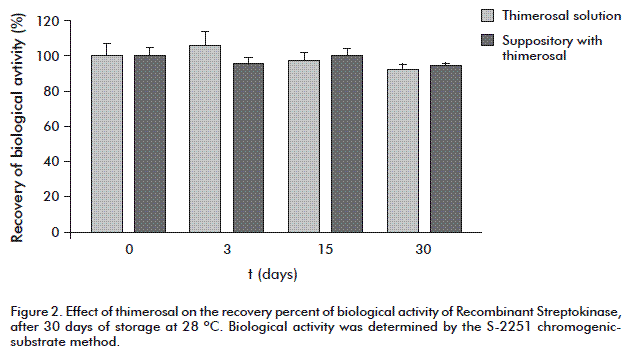
<body><![CDATA[<p   ><font face="Verdana, Arial, Helvetica, sans-serif" size="2" color="#000000">Methyl  paraben and propyl paraben have low solubility in water at room temperature. This  implies that temperature must be increased above 90 &ordm;C to dissolve them [23].  At that temperature, the biological activity of proteins decreases because of  its degradation or denaturation. Hence, the protein was added after dissolving  the parabens. Suppository formulated by this procedure resulted in undesired organoleptic  characteristics for the formulation due to phase separation. </font></p >    <p   ><font face="Verdana, Arial, Helvetica, sans-serif" size="2" color="#000000">Another  antimicrobial preservative used was<b> </b>benzalkonium chloride.<b> </b>For different  formulations, it is the preservative of choice and the American College of Toxicology  had concluded that benzalkonium chloride can be safely used as an antimicrobial  agent at concentrations up to 0.1 % [24]. A white precipitate was detected when  it was added to the aqueous phase containing rSK. According to literature this  precipitation could be due to incompatibilities with the protein [25]. </font></p >    <p   ><font face="Verdana, Arial, Helvetica, sans-serif" size="2" color="#000000">Then  benzalkonium chloride, methylparaben and propylparaben were rejected from the  study because of incompatibilities with rSK or suppositories. </font></p >    <p   ><font face="Verdana, Arial, Helvetica, sans-serif" size="2" color="#000000">The  other preservative, thimerosal, is an organomercurial preservative broadly used  in the microbial preservation. At concentrations of 0.001 to 0.01 % it has shown  great effectiveness against a wide spectrum of microorganisms in immunoglobulin  preparations, skin antigens test, nasal and ophthalmic preparations and hepatitis  B vaccines [26]. To elaborate the suppository, thimerosal was dissolved without  difficulty in the rSK solution, showing appropriate organoleptic characteristics.  Also, the rSK biological activity was evaluated in solution and in the suppository,  with no statistically significant differences (p &gt; 0.05) for 15 days (<a href="/img/revistas/bta/v30n3/f0203313.gif">Figure  2</a>). </font></p >    
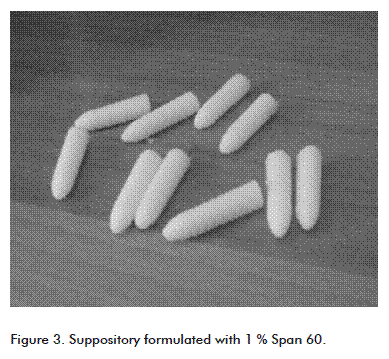
<p   ><font face="Verdana, Arial, Helvetica, sans-serif" size="2" color="#000000"><b>Influence  of emulsifiers on the physical properties of the suppository </b></font></p >    <p   ><font face="Verdana, Arial, Helvetica, sans-serif" size="2" color="#000000">Emulsifiers  derived from natural sources like non-ionic surfactants are expected to be safer  than the synthetic ones. They are less toxic compared to ionic surface-active  agents. The high and low hydrophilic and lipophilic balance (HLB), and subsequent  hydrophilicity or hydrophobicity of surfactants are required for the immediate  formation of oil-in-water (o/w) or water-in-oil (w/o) droplets, respectively,  and/or rapid spreading of the formulation in the aqueous or oil environments,  providing a good dispersing/self-emulsifying performance [27]. </font></p >    <p   ><font face="Verdana, Arial, Helvetica, sans-serif" size="2" color="#000000">The  emulsifiers tested to formulate the rSK suppository were: Tween-20, Tween-80,  Span 20 and Span 60 at 1, 2 and 4 % all of them. All of these surfactants, being  non-ionic, are much less damaging to the skin than other classes and could allow  better permeation of rSK [28, 29]. </font></p >    <p   ><font face="Verdana, Arial, Helvetica, sans-serif" size="2" color="#000000">When  preparing the suppository formulation by adding Tween-20 or Tween-80, the preparation  showed a flocky aspect and suppositories didn&rsquo;t get the torpedo shape. The  high HLB is necessary for the formation of o/w droplets of the formulation but  the oleaginous phase in the suppository is bigger than the aqueous phase and with  emulsifiers with low HLB better results were obtained. </font></p >    <p   ><font face="Verdana, Arial, Helvetica, sans-serif" size="2" color="#000000">After  formulated, suppositories using Span 20 and Span 60, best results were obtained  with Span 60 at 1 %, favoring the emulsion corresponding with appropriate physical  characteristics. Neither fluky aspect nor cavities were observed (<a href="#fig3">Figure  3</a>). The final formulation selected for the stability study was 100 000 IU/g  of rSK, 0.5 % sodium salicylate, 0.001 % thimerosal, 1 % Span 60 and Witepsol  W25 up to 100 %. </font></p >    <p align="center"   ><img src="/img/revistas/bta/v30n3/f0303313.gif" width="387" height="357"><a name="fig3"></a></p >    
]]></body>
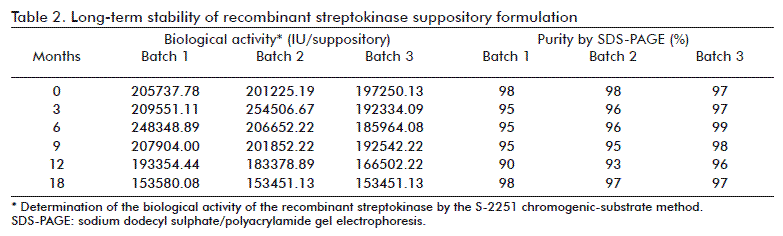
<body><![CDATA[<p   ><font face="Verdana, Arial, Helvetica, sans-serif" size="2" color="#000000"><b>Stability  studies for long term of rSK suppository</b> </font></p >    <p   ><font face="Verdana, Arial, Helvetica, sans-serif" size="2" color="#000000">The  aforementioned results obtained during the preformulation screening of the candidate  stabilizing excipients allowed us to expect a long shelf life for this formulation.  It has been recognized that these types of preformulation studies can only generally  provide the basis for starting long term stability studies, but they may fail  to reflect or predict the desired behavior of proteins. Three independent and  consecutive batches were manufactured using rSK at 100 000 IU/g by suppository  and real time stability studies at the purpose storage condition (5 &plusmn; 3  &ordm;C) were undertaken (<a href="/img/revistas/bta/v30n3/t0203313.gif">Table  2</a>). </font></p >    
<p   ><font face="Verdana, Arial, Helvetica, sans-serif" size="2" color="#000000">Prepared  suppositories were randomly selected, visually inspected, cut longitudinally and  their surfaces were examined with naked eye. The initial examination of the formulation  indicated no physical change, such as color, odor, and the surface was flat and  without cavities. Also determination of weight uniformity was measured and no  suppositories were deviated from average weight by more than 10 % of established  weight. </font></p >    <p   ><font face="Verdana, Arial, Helvetica, sans-serif" size="2" color="#000000">The  release of the active ingredient from the vehicle is related to the melting point  of the vehicle and the solubility of the drug in the vehicle. Some studies have  indicated that the release of drug is higher from bases with low melting range  than from those of comparatively higher melting range [30]. In rSK suppository  the time taken to melt them was measured when immersed in a water bath and maintained  at a constant temperature of 37 &plusmn; 0.5 &ordm;C and it was no longer than  30 minutes in all suppositories tested, which complied with the limits established  [31]. </font></p >    <p   ><font face="Verdana, Arial, Helvetica, sans-serif" size="2" color="#000000">The  current formulation was stable for 18 months at 5 &plusmn; 3 &ordm;C (<a href="/img/revistas/bta/v30n3/t0203313.gif">Table  2</a>). During this storage the biological activity of the active ingredient varied  from 209 551 to 153 451 IU/suppository remaining between 70 and 130 % of its nominal  value. The acceptance limit was high due to the variation of the method, no statistical  difference was obtained between lots (p &gt; 0.05). </font></p >    
<p   ><font face="Verdana, Arial, Helvetica, sans-serif" size="2" color="#000000">The  purity of rSK as determined by SDS/PAGE remained above 90 %. Other studies have  described the good stability of rSK conserved at 5 &plusmn; 3 &ordm;C in freeze-dried  formulation [32] but there were no report on the stability of rSK in suppository  form. In the period evaluated, no degradation was observed by this method. </font></p >    <p   ><font face="Verdana, Arial, Helvetica, sans-serif" size="2" color="#000000">The  manufacture and packaging ensured microbial quality of the formulation during  the time (no more than 103 aerobic bacteria and no more than 102 fungi per gram,  and <i>Escherichia coli</i>, <i>Pseudomonas aeruginosa</i> and <i>Candida albicans</i>  were absent), and the effectiveness of the chosen preservative was demonstrated  at 0 and 18 months. </font></p >    <p   ><font face="Verdana, Arial, Helvetica, sans-serif" size="2" color="#000000">All  the evaluated parameters were found within the limits established. rSK is one  of the most characterized and evaluated thrombolytic agents in clinical trials,  and a common prescription in heart attack [33]. A clinical trial in acute hemorrhoidal  disease was carried out with the rSK suppository formulation obtained in this  work. The result showed that it was safe and tolerable, and complete recovery  was achieved in most of the patients (90 %) [34]. </font></p >    <p   >&nbsp;</p >    <p   > </p >    ]]></body>
<body><![CDATA[<p   ><font size="3"><b><font face="Verdana, Arial, Helvetica, sans-serif" color="#000000">CONCLUSIONS  </font></b></font></p >    <p   ><font size="2" face="Verdana, Arial, Helvetica, sans-serif" color="#000000">A  suppository with rSK as active pharmaceutical ingredient was developed. The excipients  were selected according to the compatibility with rSK and the best quality properties  of the suppository. Excipients included sodium salicylate as enhancer and anti-inflammatory  agent, thimerosal as preservative, Span 60 as emulsifier and Witepsol W25 as base.  This formulation was biologically, chemically, physically and microbiologically  stable when stored for 18 months between 2 and 8 &deg;C. </font></p ></div ><FONT size="+1" color="#000000"><FONT size="+1"><FONT size="+1"><FONT size="+1"><FONT size="+1"><FONT size="+1"><FONT size="+1"><FONT size="+1"><FONT size="+1"><FONT size="+1"><FONT size="+1"><FONT size="+1"><FONT size="+1"><FONT size="+1"><FONT size="+1"><FONT size="+1"><FONT size="+1"><FONT size="+1"><FONT size="+1"><FONT size="+1"><FONT size="+1"><FONT size="+1"><FONT size="+1"><FONT size="+1"><FONT size="+1"><FONT size="+1"><FONT size="+1"><FONT size="+1"><FONT size="+1"><FONT size="+1">      <P   align="justify" >&nbsp;</P >    <P   align="justify" >&nbsp;</P >    <P   align="justify" > </P >    <P   align="justify" ><font size="3" face="Verdana, Arial, Helvetica, sans-serif"><B>REFERENCES </b></font></P >    <!-- ref --><P   align="justify" ><font size="2" face="Verdana, Arial, Helvetica, sans-serif">1. Leader B, Baca  QJ, Golan DE. Protein therapeutics: a summary and pharmacological classification.  Nat Rev Drug Discov. 2008;7:21-39.    </font></P >    <P   align="justify" ><font size="2" face="Verdana, Arial, Helvetica, sans-serif">2. Jitendra P, Sharma  K, Sumedha B, and Arunabha B. Noninvasive routes of proteins and peptides drug  delivery. Indian J Pharm Sci. 2011;73(4):367-75.    <br> </font></P >    ]]></body>
<body><![CDATA[<!-- ref --><P   align="justify" ><font size="2" face="Verdana, Arial, Helvetica, sans-serif">3. Chin CM, Gutierrez  M, Still JG, Kosutic G. Pharmacokinetics of modified oral calcitonin product in  healthy volunteers. Pharmacotherapy. 2004;24(8):994-1001.    <br> </font></P >    <!-- ref --><P   align="justify" ><font size="2" face="Verdana, Arial, Helvetica, sans-serif">4. Goto T, Morishita  M, Nishimura K, Nakanishi M, Kato A, Ehara J, et al. Novel mucosal insulin delivery  systems based on fusogenic liposomes. Pharm Res. 2006;23:384-91.    <br> </font></P >    <!-- ref --><P   align="justify" ><font size="2" face="Verdana, Arial, Helvetica, sans-serif">5. Jitendra J, Shivendra  KD, Yusuf AJ. A buccal drug delivery system. Int J Pharm Res Sci. 2013;2(2):513-31.    <br>  </font></P >    <!-- ref --><P   align="justify" ><font size="2" face="Verdana, Arial, Helvetica, sans-serif">6. Polman C, Barkhof  F, Kappos L, Pozzilli C, Sandbrink R, Dahlke F, et al. Oral interferon beta-1a  in relapsing-remitting multiple sclerosis: a double-blind randomized study. Mult  Scler. 2003;9(4):342-8.    <br> </font></P >    <!-- ref --><P   align="justify" ><font size="2" face="Verdana, Arial, Helvetica, sans-serif">7. Sikri NA, Bardia  A. History of streptokinase use in acute myocardial infarction. Tex Heart Inst  J. 2007;34(3):318-27.    <br> </font></P >    ]]></body>
<body><![CDATA[<!-- ref --><P   align="justify" ><font size="2" face="Verdana, Arial, Helvetica, sans-serif">8. Rosenstein E.  Specialty Pharmaceutical Dictionary. 41th ed. Distrito Federal: PLM de M&eacute;xico  S.A. de C.V.; 1995.    <br> </font></P >    <!-- ref --><P   align="justify" ><font size="2" face="Verdana, Arial, Helvetica, sans-serif">9. Oliven A, Gidron  E. Orally and rectally administered Streptokinase. Investigation of its absorption  and activity. Pharmacology. 1981;22:135-8.    <br> </font></P >    <!-- ref --><P   align="justify" ><font size="2" face="Verdana, Arial, Helvetica, sans-serif">10. S&aacute;nchez  C, Chinn BT. Hemorroids. Clin Colon Rectal Surg. 2011;24(1):5-13.    <br> </font></P >    <!-- ref --><P   align="justify" ><font size="2" face="Verdana, Arial, Helvetica, sans-serif">11. Hern&aacute;ndez  L, Rodr&iacute;guez P , Castro A, Serrano R, Rodriguez MP, Rubiera M, et al. Determination  of streptokinase activity by quantitative assay. Biotecnol Apl. 1990;7:153-60.    </font></P >    <P   align="justify" ><font size="2" face="Verdana, Arial, Helvetica, sans-serif">12. Laemmli UK. Cleavage  of structural proteins during the assembly of the head of bacteriophage T4. Nature.  1970;227:680-85.</font></P >    <!-- ref --><P   align="justify" ><font size="2" face="Verdana, Arial, Helvetica, sans-serif">13. The United States  Pharmacopeia, 30th, and The National Formulary, 25th ed. Rockville, MD: The United  States Pharmacopeial Convention; 2007.    <br> </font></P >    <!-- ref --><P   align="justify" ><font size="2" face="Verdana, Arial, Helvetica, sans-serif">14. International  conference on harmonization of technical requirements for registration of pharmaceuticals  for human use ICH harmonized tripartite guideline evaluation for stability data  Q1E current step 4 version dated 6 February. 2003. Available from: <a href="http://www.ich.org/fileadmin/Public_Web_Site/ICH_Products/Guidelines/Quality/Q1E/Step4/Q1E_Guideline.pdf" target="_blank">http://www.ich.org/fileadmin/Public_Web_Site/ICH_Products/Guidelines/Quality/Q1E/Step4/Q1E_Guideline.pdf</a>.    <br> </font></P >    <!-- ref --><P   align="justify" ><font size="2" face="Verdana, Arial, Helvetica, sans-serif">15. Sigarroa A. Biometr&iacute;a  y dise&ntilde;o experimental. La Habana: Pueblo y Educaci&oacute;n; 1985.    <br>  </font></P >    <P   align="justify" ><font size="2" face="Verdana, Arial, Helvetica, sans-serif">16. Shembale Al,  Borole DK and Lohiya RT. Useful permeation enhancers for transdermal drug delivery.  Int J Pharm Res Dev. 2010;2:1-6.    <br> </font></P >    <!-- ref --><P   align="justify" ><font size="2" face="Verdana, Arial, Helvetica, sans-serif">17. Pathan IB, Setty  CM. Chemical penetration enhancers for transdermal drug delivery system. Trop  J Pharm Res. 2009;8(2):173-9.    <br> </font></P >    <!-- ref --><P   align="justify" ><font size="2" face="Verdana, Arial, Helvetica, sans-serif">18. Fihn BM, Jodal  M. Permeability of the proximal and distal rat colon crypt and surface epithelium  to hydrophilic molecules. Pflugers Arch. 2001;441:656-62.    <br> </font></P >    <!-- ref --><P   align="justify" ><font size="2" face="Verdana, Arial, Helvetica, sans-serif">19. Sayani AP, Chien  YW. Systemic delivery of peptides and proteins across absorptive mucosae. Crit  Rev Ther Drug Carrier Syst. 1996;13(1-2):85-184.    <br> </font></P >    <P   align="justify" ><font size="2" face="Verdana, Arial, Helvetica, sans-serif">20. Marrero MA, Aguilera  A, Gonzalez L, Martinez E, Torrez B, Cosme K, et al, inventors; Center for Genetic  Engineering and Biotechnology, assignee. Formulations for the rectal administration  of thrombolytically-active agents. United States Patent US 20070166298. 2003 Dec  22.    <br> </font></P >    <!-- ref --><P   align="justify" ><font size="2" face="Verdana, Arial, Helvetica, sans-serif">21. Matuli M, Brdar  B. Induction of urokinase-type plasminogen Activator. Food Technol Biotechnol.  2001;39:5-11.    <br> </font></P >    <!-- ref --><P   align="justify" ><font size="2" face="Verdana, Arial, Helvetica, sans-serif">22. Sonia MG, Burdocka  GA, Taylorb SL, Greenbergc NA. Safety assessment of propyl paraben: a review of  the published literature. Food Chem Toxicol. 2001;6:513-32.    <br> </font></P >    <!-- ref --><P   align="justify" ><font size="2" face="Verdana, Arial, Helvetica, sans-serif">23. Tukker J. Rectal  and vaginal drug delivery. In: Aulton ME, editor. Pharmaceutics, the science of  dosage form design. Edinburgh: Churchill Livingstone. 2009; p. 534-43.    <br> </font></P >    <!-- ref --><P   align="justify" ><font size="2" face="Verdana, Arial, Helvetica, sans-serif">24. Marple B, Roland  P, Benninger M. Safety review of benzalkonium chloride used as a preservative  in intranasal solutions: an overview of conflicting data and opinions. Otolaryngol  Head Neck Surg. 2004;130(1):131-41.    <br> </font></P >    <!-- ref --><P   align="justify" ><font size="2" face="Verdana, Arial, Helvetica, sans-serif">25. Eierman HJ. Cosmetic  product preservation: safety and regulatory issues. In: Kabara JJ, editor. Cosmetic  and Drug preservation: principles and practice. New York: Marcel Dekker. 1984;  p. 559-69.    <br> </font></P >    <!-- ref --><P   align="justify" ><font size="2" face="Verdana, Arial, Helvetica, sans-serif">26. Orenstein WA,  Paulson JA, Brady MT, Cooper LZ, Seib K. Global vaccination recommendations and  thimerosal. Pediatrics. 2013;131(1):149 -51.    <br> </font></P >    <P   align="justify" ><font size="2" face="Verdana, Arial, Helvetica, sans-serif">27. Wadhwa J, Nair  A, Kumria R. Emulsion forming drug delivery system for lipophilic drugs. Acta  Pol Pharm. 2012;69(2):179-91.    <br> </font></P >    <!-- ref --><P   align="justify" ><font size="2" face="Verdana, Arial, Helvetica, sans-serif">28. Akhtar N, Rehman  MV, Khan HS, Rasool F. Permeation enhancing effect of Polysorbate 20 and 80 on  the in-vitro percutaneous absorption of L-Ascorbic acid. Trop J Pharm Res. 2011;101(3):281-8.    <br>  </font></P >    <!-- ref --><P   align="justify" ><font size="2" face="Verdana, Arial, Helvetica, sans-serif">29. Samita S, Kumar  HSL, Aggarwal G. Surfactants as skin permeation enhancers for transdermal drug  delivery. Int J Nat Prod Sci. 2012;1(Special issue):10.    <br> </font></P >    <!-- ref --><P   align="justify" ><font size="2" face="Verdana, Arial, Helvetica, sans-serif">30. El-Majri M, Sharma  R. Formulation and evaluation of piroxicam suppositories. Int J Drug Deliv. 2010;2:108-12.    <br>  </font></P >    <!-- ref --><P   align="justify" ><font size="2" face="Verdana, Arial, Helvetica, sans-serif">31. British Pharmacopeia  2004. London: British Pharmacopoeia Comission Office; 2004.    <br> </font></P >    <!-- ref --><P   align="justify" ><font size="2" face="Verdana, Arial, Helvetica, sans-serif">32. Lopez M, Ruiz  LL, Reyes M. Stabilization of a freeze-dried recombinant streptokinase formulation  without serum albumin. J Clin Pharm Ther. 2004:29:367-73.    <br> </font></P >    <!-- ref --><P   align="justify" ><font size="2" face="Verdana, Arial, Helvetica, sans-serif">33. Hern&aacute;ndez  L, Marrero MA. Estreptoquinasa: a prop&oacute;sito de un agente trombol&iacute;tico  patentado en Cuba. Biotecnol Apl. 2005;22(1):182-90.    <br> </font></P >    <!-- ref --><P   align="justify" ><font size="2" face="Verdana, Arial, Helvetica, sans-serif">34. Quintero L, Hern&aacute;ndez-Bernal  F, Acelia M, L&oacute;pez M, Barcelona S, Ibargoll&iacute;n R, et.al. Initial  evidence of safety and clinical effect of recombinant streptokinase suppository  in acute hemorrhoidal disease. Open, proof-of-concept, pilot trial. Biotecnol  Apl. 2010;27:277-280.     </font></P ><FONT size="+1">     <P   align="justify" >&nbsp;</P ><FONT color="#0000FF"><FONT color="#000000"><FONT color="#0000FF"><FONT color="#000000"><FONT color="#0000FF"><FONT color="#000000">      <P   align="justify" >&nbsp;</P >    <P   align="justify" > </P >    <P   align="justify" ><font size="2" face="Verdana, Arial, Helvetica, sans-serif">Received in January,  2013.     <br> Accepted in March, 2013. </font></P >    <P   align="justify" >&nbsp;</P >    <P   align="justify" >&nbsp;</P >    ]]></body>
<body><![CDATA[<P   align="justify" > </P >    <P   align="justify" > </P >    <P   align="justify" ><font size="+1" color="#000000"><font size="2" face="Verdana, Arial, Helvetica, sans-serif"><i>Ana  Aguilera</i></font></font><font size="2" face="Verdana, Arial, Helvetica, sans-serif">.  Departamento de Desarrollo de Formulaciones, Centro de Ingenier&iacute;a Gen&eacute;tica  y Biotecnolog&iacute;a, CIGB. Ave. 31 e/ 158 y 190, Cubanac&aacute;n, Playa, CP  11600, La Habana, Cuba. E-mail: <a href="mailto:ana.aguilera@cigb.edu.cu">ana.aguilera@cigb.edu.cu</a>.</font></P ></font></font></font></font></font></font></font></font></font></font></font></font></font></font></font></font></font></font></font></font></font></font></font></font></font></font></font></font></font></font></font></font></font></font></font></font></font></DIV >      ]]></body><back>
<ref-list>
<ref id="B1">
<label>1</label><nlm-citation citation-type="journal">
<person-group person-group-type="author">
<name>
<surname><![CDATA[Leader]]></surname>
<given-names><![CDATA[B]]></given-names>
</name>
<name>
<surname><![CDATA[Baca]]></surname>
<given-names><![CDATA[QJ]]></given-names>
</name>
<name>
<surname><![CDATA[Golan]]></surname>
<given-names><![CDATA[DE]]></given-names>
</name>
</person-group>
<article-title xml:lang="en"><![CDATA[Protein therapeutics: a summary and pharmacological classification]]></article-title>
<source><![CDATA[Nat Rev Drug Discov]]></source>
<year>2008</year>
<volume>7</volume>
<page-range>21-39</page-range></nlm-citation>
</ref>
<ref id="B2">
<label>2</label><nlm-citation citation-type="journal">
<person-group person-group-type="author">
<name>
<surname><![CDATA[Jitendra]]></surname>
<given-names><![CDATA[P]]></given-names>
</name>
<name>
<surname><![CDATA[Sharma]]></surname>
<given-names><![CDATA[K]]></given-names>
</name>
<name>
<surname><![CDATA[Sumedha]]></surname>
<given-names><![CDATA[B]]></given-names>
</name>
<name>
<surname><![CDATA[Arunabha]]></surname>
<given-names><![CDATA[B]]></given-names>
</name>
</person-group>
<article-title xml:lang="en"><![CDATA[Noninvasive routes of proteins and peptides drug delivery]]></article-title>
<source><![CDATA[Indian J Pharm Sci]]></source>
<year>2011</year>
<volume>73</volume>
<numero>4</numero>
<issue>4</issue>
<page-range>367-75</page-range></nlm-citation>
</ref>
<ref id="B3">
<label>3</label><nlm-citation citation-type="journal">
<person-group person-group-type="author">
<name>
<surname><![CDATA[Chin]]></surname>
<given-names><![CDATA[CM]]></given-names>
</name>
<name>
<surname><![CDATA[Gutierrez]]></surname>
<given-names><![CDATA[M]]></given-names>
</name>
<name>
<surname><![CDATA[Still]]></surname>
<given-names><![CDATA[JG]]></given-names>
</name>
<name>
<surname><![CDATA[Kosutic]]></surname>
<given-names><![CDATA[G]]></given-names>
</name>
</person-group>
<article-title xml:lang="en"><![CDATA[Pharmacokinetics of modified oral calcitonin product in healthy volunteers]]></article-title>
<source><![CDATA[Pharmacotherapy]]></source>
<year>2004</year>
<volume>24</volume>
<numero>8</numero>
<issue>8</issue>
<page-range>994-1001</page-range></nlm-citation>
</ref>
<ref id="B4">
<label>4</label><nlm-citation citation-type="journal">
<person-group person-group-type="author">
<name>
<surname><![CDATA[Goto]]></surname>
<given-names><![CDATA[T]]></given-names>
</name>
<name>
<surname><![CDATA[Morishita]]></surname>
<given-names><![CDATA[M]]></given-names>
</name>
<name>
<surname><![CDATA[Nishimura]]></surname>
<given-names><![CDATA[K]]></given-names>
</name>
<name>
<surname><![CDATA[Nakanishi]]></surname>
<given-names><![CDATA[M]]></given-names>
</name>
<name>
<surname><![CDATA[Kato]]></surname>
<given-names><![CDATA[A]]></given-names>
</name>
<name>
<surname><![CDATA[Ehara]]></surname>
<given-names><![CDATA[J]]></given-names>
</name>
</person-group>
<article-title xml:lang="en"><![CDATA[Novel mucosal insulin delivery systems based on fusogenic liposomes]]></article-title>
<source><![CDATA[Pharm Res]]></source>
<year>2006</year>
<volume>23</volume>
<page-range>384-91</page-range></nlm-citation>
</ref>
<ref id="B5">
<label>5</label><nlm-citation citation-type="journal">
<person-group person-group-type="author">
<name>
<surname><![CDATA[Jitendra]]></surname>
<given-names><![CDATA[J]]></given-names>
</name>
<name>
<surname><![CDATA[Shivendra]]></surname>
<given-names><![CDATA[KD]]></given-names>
</name>
<name>
<surname><![CDATA[Yusuf]]></surname>
<given-names><![CDATA[AJ]]></given-names>
</name>
</person-group>
<article-title xml:lang="en"><![CDATA[A buccal drug delivery system]]></article-title>
<source><![CDATA[Int J Pharm Res Sci]]></source>
<year>2013</year>
<volume>2</volume>
<numero>2</numero>
<issue>2</issue>
<page-range>513-31</page-range></nlm-citation>
</ref>
<ref id="B6">
<label>6</label><nlm-citation citation-type="journal">
<person-group person-group-type="author">
<name>
<surname><![CDATA[Polman]]></surname>
<given-names><![CDATA[C]]></given-names>
</name>
<name>
<surname><![CDATA[Barkhof]]></surname>
<given-names><![CDATA[F]]></given-names>
</name>
<name>
<surname><![CDATA[Kappos]]></surname>
<given-names><![CDATA[L]]></given-names>
</name>
<name>
<surname><![CDATA[Pozzilli]]></surname>
<given-names><![CDATA[C]]></given-names>
</name>
<name>
<surname><![CDATA[Sandbrink]]></surname>
<given-names><![CDATA[R]]></given-names>
</name>
<name>
<surname><![CDATA[Dahlke]]></surname>
<given-names><![CDATA[F]]></given-names>
</name>
</person-group>
<article-title xml:lang="en"><![CDATA[Oral interferon beta-1a in relapsing-remitting multiple sclerosis: a double-blind randomized study]]></article-title>
<source><![CDATA[Mult Scler]]></source>
<year>2003</year>
<volume>9</volume>
<numero>4</numero>
<issue>4</issue>
<page-range>342-8</page-range></nlm-citation>
</ref>
<ref id="B7">
<label>7</label><nlm-citation citation-type="journal">
<person-group person-group-type="author">
<name>
<surname><![CDATA[Sikri]]></surname>
<given-names><![CDATA[NA]]></given-names>
</name>
<name>
<surname><![CDATA[Bardia]]></surname>
<given-names><![CDATA[A]]></given-names>
</name>
</person-group>
<article-title xml:lang="en"><![CDATA[History of streptokinase use in acute myocardial infarction]]></article-title>
<source><![CDATA[Tex Heart Inst J]]></source>
<year>2007</year>
<volume>34</volume>
<numero>3</numero>
<issue>3</issue>
<page-range>318-27</page-range></nlm-citation>
</ref>
<ref id="B8">
<label>8</label><nlm-citation citation-type="book">
<person-group person-group-type="author">
<name>
<surname><![CDATA[Rosenstein]]></surname>
<given-names><![CDATA[E]]></given-names>
</name>
</person-group>
<source><![CDATA[Specialty Pharmaceutical Dictionary]]></source>
<year>1995</year>
<edition>41</edition>
<publisher-loc><![CDATA[Distrito Federal ]]></publisher-loc>
<publisher-name><![CDATA[PLM de México S.A. de C.V.]]></publisher-name>
</nlm-citation>
</ref>
<ref id="B9">
<label>9</label><nlm-citation citation-type="journal">
<person-group person-group-type="author">
<name>
<surname><![CDATA[Oliven]]></surname>
<given-names><![CDATA[A]]></given-names>
</name>
<name>
<surname><![CDATA[Gidron]]></surname>
<given-names><![CDATA[E]]></given-names>
</name>
</person-group>
<article-title xml:lang="en"><![CDATA[Orally and rectally administered Streptokinase. Investigation of its absorption and activity]]></article-title>
<source><![CDATA[Pharmacology]]></source>
<year>1981</year>
<volume>22</volume>
<page-range>135-8</page-range></nlm-citation>
</ref>
<ref id="B10">
<label>10</label><nlm-citation citation-type="journal">
<person-group person-group-type="author">
<name>
<surname><![CDATA[Sánchez]]></surname>
<given-names><![CDATA[C]]></given-names>
</name>
<name>
<surname><![CDATA[Chinn]]></surname>
<given-names><![CDATA[BT]]></given-names>
</name>
</person-group>
<article-title xml:lang="en"><![CDATA[Hemorroids]]></article-title>
<source><![CDATA[Clin Colon Rectal Surg]]></source>
<year>2011</year>
<volume>24</volume>
<numero>1</numero>
<issue>1</issue>
<page-range>5-13</page-range></nlm-citation>
</ref>
<ref id="B11">
<label>11</label><nlm-citation citation-type="journal">
<person-group person-group-type="author">
<name>
<surname><![CDATA[Hernández]]></surname>
<given-names><![CDATA[L]]></given-names>
</name>
<name>
<surname><![CDATA[Rodríguez]]></surname>
<given-names><![CDATA[P]]></given-names>
</name>
<name>
<surname><![CDATA[Castro]]></surname>
<given-names><![CDATA[A]]></given-names>
</name>
<name>
<surname><![CDATA[Serrano]]></surname>
<given-names><![CDATA[R]]></given-names>
</name>
<name>
<surname><![CDATA[Rodriguez]]></surname>
<given-names><![CDATA[MP]]></given-names>
</name>
<name>
<surname><![CDATA[Rubiera]]></surname>
<given-names><![CDATA[M]]></given-names>
</name>
</person-group>
<article-title xml:lang="en"><![CDATA[Determination of streptokinase activity by quantitative assay]]></article-title>
<source><![CDATA[Biotecnol Apl]]></source>
<year>1990</year>
<volume>7</volume>
<page-range>153-60</page-range></nlm-citation>
</ref>
<ref id="B12">
<label>12</label><nlm-citation citation-type="journal">
<person-group person-group-type="author">
<name>
<surname><![CDATA[Laemmli]]></surname>
<given-names><![CDATA[UK]]></given-names>
</name>
</person-group>
<article-title xml:lang="en"><![CDATA[Cleavage of structural proteins during the assembly of the head of bacteriophage T4]]></article-title>
<source><![CDATA[Nature]]></source>
<year>1970</year>
<volume>227</volume>
<page-range>680-685</page-range></nlm-citation>
</ref>
<ref id="B13">
<label>13</label><nlm-citation citation-type="book">
<source><![CDATA[The United States Pharmacopeia, 30th, and The National Formulary, 25th ed]]></source>
<year>2007</year>
<publisher-loc><![CDATA[Rockville, MD ]]></publisher-loc>
<publisher-name><![CDATA[The United States Pharmacopeial Convention]]></publisher-name>
</nlm-citation>
</ref>
<ref id="B14">
<label>14</label><nlm-citation citation-type="">
<source><![CDATA[International conference on harmonization of technical requirements for registration of pharmaceuticals for human use ICH harmonized tripartite guideline evaluation for stability data Q1E current step 4 version dated 6 February]]></source>
<year>2003</year>
</nlm-citation>
</ref>
<ref id="B15">
<label>15</label><nlm-citation citation-type="book">
<person-group person-group-type="author">
<name>
<surname><![CDATA[Sigarroa]]></surname>
<given-names><![CDATA[A]]></given-names>
</name>
</person-group>
<source><![CDATA[Biometría y diseño experimental]]></source>
<year>1985</year>
<publisher-loc><![CDATA[La Habana ]]></publisher-loc>
<publisher-name><![CDATA[Pueblo y Educación]]></publisher-name>
</nlm-citation>
</ref>
<ref id="B16">
<label>16</label><nlm-citation citation-type="journal">
<person-group person-group-type="author">
<name>
<surname><![CDATA[Shembale]]></surname>
<given-names><![CDATA[Al]]></given-names>
</name>
<name>
<surname><![CDATA[Borole]]></surname>
<given-names><![CDATA[DK]]></given-names>
</name>
<name>
<surname><![CDATA[Lohiya]]></surname>
<given-names><![CDATA[RT]]></given-names>
</name>
</person-group>
<article-title xml:lang="en"><![CDATA[Useful permeation enhancers for transdermal drug delivery]]></article-title>
<source><![CDATA[Int J Pharm Res Dev]]></source>
<year>2010</year>
<volume>2</volume>
<page-range>1-6</page-range></nlm-citation>
</ref>
<ref id="B17">
<label>17</label><nlm-citation citation-type="journal">
<person-group person-group-type="author">
<name>
<surname><![CDATA[Pathan]]></surname>
<given-names><![CDATA[IB]]></given-names>
</name>
<name>
<surname><![CDATA[Setty]]></surname>
<given-names><![CDATA[CM]]></given-names>
</name>
</person-group>
<article-title xml:lang="en"><![CDATA[Chemical penetration enhancers for transdermal drug delivery system]]></article-title>
<source><![CDATA[Trop J Pharm Res]]></source>
<year>2009</year>
<volume>8</volume>
<numero>2</numero>
<issue>2</issue>
<page-range>173-9</page-range></nlm-citation>
</ref>
<ref id="B18">
<label>18</label><nlm-citation citation-type="journal">
<person-group person-group-type="author">
<name>
<surname><![CDATA[Fihn]]></surname>
<given-names><![CDATA[BM]]></given-names>
</name>
<name>
<surname><![CDATA[Jodal]]></surname>
<given-names><![CDATA[M]]></given-names>
</name>
</person-group>
<article-title xml:lang="en"><![CDATA[Permeability of the proximal and distal rat colon crypt and surface epithelium to hydrophilic molecules]]></article-title>
<source><![CDATA[Pflugers Arch]]></source>
<year>2001</year>
<volume>441</volume>
<page-range>656-62</page-range></nlm-citation>
</ref>
<ref id="B19">
<label>19</label><nlm-citation citation-type="journal">
<person-group person-group-type="author">
<name>
<surname><![CDATA[Sayani]]></surname>
<given-names><![CDATA[AP]]></given-names>
</name>
<name>
<surname><![CDATA[Chien]]></surname>
<given-names><![CDATA[YW]]></given-names>
</name>
</person-group>
<article-title xml:lang="en"><![CDATA[Systemic delivery of peptides and proteins across absorptive mucosae]]></article-title>
<source><![CDATA[Crit Rev Ther Drug Carrier Syst]]></source>
<year>1996</year>
<volume>13</volume>
<numero>1-2</numero>
<issue>1-2</issue>
<page-range>85-184</page-range></nlm-citation>
</ref>
<ref id="B20">
<label>20</label><nlm-citation citation-type="">
<person-group person-group-type="author">
<name>
<surname><![CDATA[Marrero]]></surname>
<given-names><![CDATA[MA]]></given-names>
</name>
<name>
<surname><![CDATA[Aguilera]]></surname>
<given-names><![CDATA[A]]></given-names>
</name>
<name>
<surname><![CDATA[Gonzalez]]></surname>
<given-names><![CDATA[L]]></given-names>
</name>
<name>
<surname><![CDATA[Martinez]]></surname>
<given-names><![CDATA[E]]></given-names>
</name>
<name>
<surname><![CDATA[Torrez]]></surname>
<given-names><![CDATA[B]]></given-names>
</name>
<name>
<surname><![CDATA[Cosme]]></surname>
<given-names><![CDATA[K]]></given-names>
</name>
</person-group>
<source><![CDATA[Formulations for the rectal administration of thrombolytically-active agents]]></source>
<year></year>
</nlm-citation>
</ref>
<ref id="B21">
<label>21</label><nlm-citation citation-type="journal">
<person-group person-group-type="author">
<name>
<surname><![CDATA[Matuli]]></surname>
<given-names><![CDATA[M]]></given-names>
</name>
<name>
<surname><![CDATA[Brdar]]></surname>
<given-names><![CDATA[B]]></given-names>
</name>
</person-group>
<article-title xml:lang="en"><![CDATA[Induction of urokinase-type plasminogen Activator]]></article-title>
<source><![CDATA[Food Technol Biotechnol]]></source>
<year>2001</year>
<volume>39</volume>
<page-range>5-11</page-range></nlm-citation>
</ref>
<ref id="B22">
<label>22</label><nlm-citation citation-type="journal">
<person-group person-group-type="author">
<name>
<surname><![CDATA[Sonia]]></surname>
<given-names><![CDATA[MG]]></given-names>
</name>
<name>
<surname><![CDATA[Burdocka]]></surname>
<given-names><![CDATA[GA]]></given-names>
</name>
<name>
<surname><![CDATA[Taylorb]]></surname>
<given-names><![CDATA[SL]]></given-names>
</name>
<name>
<surname><![CDATA[Greenbergc]]></surname>
<given-names><![CDATA[NA]]></given-names>
</name>
</person-group>
<article-title xml:lang="en"><![CDATA[Safety assessment of propyl paraben: a review of the published literature]]></article-title>
<source><![CDATA[Food Chem Toxicol]]></source>
<year>2001</year>
<volume>6</volume>
<page-range>513-32</page-range></nlm-citation>
</ref>
<ref id="B23">
<label>23</label><nlm-citation citation-type="book">
<person-group person-group-type="author">
<name>
<surname><![CDATA[Tukker]]></surname>
<given-names><![CDATA[J]]></given-names>
</name>
</person-group>
<article-title xml:lang="en"><![CDATA[Rectal and vaginal drug delivery]]></article-title>
<person-group person-group-type="editor">
<name>
<surname><![CDATA[Aulton]]></surname>
<given-names><![CDATA[ME]]></given-names>
</name>
</person-group>
<source><![CDATA[Pharmaceutics, the science of dosage form design]]></source>
<year>2009</year>
<page-range>534-43</page-range><publisher-loc><![CDATA[Edinburgh ]]></publisher-loc>
<publisher-name><![CDATA[Churchill Livingstone]]></publisher-name>
</nlm-citation>
</ref>
<ref id="B24">
<label>24</label><nlm-citation citation-type="journal">
<person-group person-group-type="author">
<name>
<surname><![CDATA[Marple]]></surname>
<given-names><![CDATA[B]]></given-names>
</name>
<name>
<surname><![CDATA[Roland]]></surname>
<given-names><![CDATA[P]]></given-names>
</name>
<name>
<surname><![CDATA[Benninger]]></surname>
<given-names><![CDATA[M]]></given-names>
</name>
</person-group>
<article-title xml:lang="en"><![CDATA[Safety review of benzalkonium chloride used as a preservative in intranasal solutions: an overview of conflicting data and opinions]]></article-title>
<source><![CDATA[Otolaryngol Head Neck Surg]]></source>
<year>2004</year>
<volume>130</volume>
<numero>1</numero>
<issue>1</issue>
<page-range>131-41</page-range></nlm-citation>
</ref>
<ref id="B25">
<label>25</label><nlm-citation citation-type="book">
<person-group person-group-type="author">
<name>
<surname><![CDATA[Eierman]]></surname>
<given-names><![CDATA[HJ]]></given-names>
</name>
</person-group>
<article-title xml:lang="en"><![CDATA[Cosmetic product preservation: safety and regulatory issues]]></article-title>
<person-group person-group-type="editor">
<name>
<surname><![CDATA[Kabara]]></surname>
<given-names><![CDATA[JJ]]></given-names>
</name>
</person-group>
<source><![CDATA[Cosmetic and Drug preservation: principles and practice]]></source>
<year>1984</year>
<page-range>559-69</page-range><publisher-loc><![CDATA[New York ]]></publisher-loc>
<publisher-name><![CDATA[Marcel Dekker]]></publisher-name>
</nlm-citation>
</ref>
<ref id="B26">
<label>26</label><nlm-citation citation-type="journal">
<person-group person-group-type="author">
<name>
<surname><![CDATA[Orenstein]]></surname>
<given-names><![CDATA[WA]]></given-names>
</name>
<name>
<surname><![CDATA[Paulson]]></surname>
<given-names><![CDATA[JA]]></given-names>
</name>
<name>
<surname><![CDATA[Brady]]></surname>
<given-names><![CDATA[MT]]></given-names>
</name>
<name>
<surname><![CDATA[Cooper]]></surname>
<given-names><![CDATA[LZ]]></given-names>
</name>
<name>
<surname><![CDATA[Seib]]></surname>
<given-names><![CDATA[K]]></given-names>
</name>
</person-group>
<article-title xml:lang="en"><![CDATA[Global vaccination recommendations and thimerosal]]></article-title>
<source><![CDATA[Pediatrics]]></source>
<year>2013</year>
<volume>131</volume>
<numero>1</numero>
<issue>1</issue>
<page-range>149-51</page-range></nlm-citation>
</ref>
<ref id="B27">
<label>27</label><nlm-citation citation-type="journal">
<person-group person-group-type="author">
<name>
<surname><![CDATA[Wadhwa]]></surname>
<given-names><![CDATA[J]]></given-names>
</name>
<name>
<surname><![CDATA[Nair]]></surname>
<given-names><![CDATA[A]]></given-names>
</name>
<name>
<surname><![CDATA[Kumria]]></surname>
<given-names><![CDATA[R]]></given-names>
</name>
</person-group>
<article-title xml:lang="en"><![CDATA[Emulsion forming drug delivery system for lipophilic drugs]]></article-title>
<source><![CDATA[Acta Pol Pharm]]></source>
<year>2012</year>
<volume>69</volume>
<numero>2</numero>
<issue>2</issue>
<page-range>179-191</page-range></nlm-citation>
</ref>
<ref id="B28">
<label>28</label><nlm-citation citation-type="journal">
<person-group person-group-type="author">
<name>
<surname><![CDATA[Akhtar]]></surname>
<given-names><![CDATA[N]]></given-names>
</name>
<name>
<surname><![CDATA[Rehman]]></surname>
<given-names><![CDATA[MV]]></given-names>
</name>
<name>
<surname><![CDATA[Khan]]></surname>
<given-names><![CDATA[HS]]></given-names>
</name>
<name>
<surname><![CDATA[Rasool]]></surname>
<given-names><![CDATA[F]]></given-names>
</name>
</person-group>
<article-title xml:lang="en"><![CDATA[Permeation enhancing effect of Polysorbate 20 and 80 on the in-vitro percutaneous absorption of L-Ascorbic acid]]></article-title>
<source><![CDATA[Trop J Pharm Res]]></source>
<year>2011</year>
<volume>101</volume>
<numero>3</numero>
<issue>3</issue>
<page-range>281-8</page-range></nlm-citation>
</ref>
<ref id="B29">
<label>29</label><nlm-citation citation-type="journal">
<person-group person-group-type="author">
<name>
<surname><![CDATA[Samita]]></surname>
<given-names><![CDATA[S]]></given-names>
</name>
<name>
<surname><![CDATA[Kumar]]></surname>
<given-names><![CDATA[HSL]]></given-names>
</name>
<name>
<surname><![CDATA[Aggarwal]]></surname>
<given-names><![CDATA[G]]></given-names>
</name>
</person-group>
<article-title xml:lang="en"><![CDATA[Surfactants as skin permeation enhancers for transdermal drug delivery]]></article-title>
<source><![CDATA[Int J Nat Prod Sci]]></source>
<year>2012</year>
<volume>1</volume>
<numero>Special issue</numero>
<issue>Special issue</issue>
<page-range>10</page-range></nlm-citation>
</ref>
<ref id="B30">
<label>30</label><nlm-citation citation-type="journal">
<person-group person-group-type="author">
<name>
<surname><![CDATA[El-Majri]]></surname>
<given-names><![CDATA[M]]></given-names>
</name>
<name>
<surname><![CDATA[Sharma]]></surname>
<given-names><![CDATA[R]]></given-names>
</name>
</person-group>
<article-title xml:lang="en"><![CDATA[Formulation and evaluation of piroxicam suppositories]]></article-title>
<source><![CDATA[Int J Drug Deliv]]></source>
<year>2010</year>
<volume>2</volume>
<page-range>108-12</page-range></nlm-citation>
</ref>
<ref id="B31">
<label>31</label><nlm-citation citation-type="book">
<source><![CDATA[British Pharmacopeia 2004]]></source>
<year>2004</year>
<publisher-loc><![CDATA[London ]]></publisher-loc>
<publisher-name><![CDATA[British Pharmacopoeia Comission Office]]></publisher-name>
</nlm-citation>
</ref>
<ref id="B32">
<label>32</label><nlm-citation citation-type="journal">
<person-group person-group-type="author">
<name>
<surname><![CDATA[Lopez]]></surname>
<given-names><![CDATA[M]]></given-names>
</name>
<name>
<surname><![CDATA[Ruiz]]></surname>
<given-names><![CDATA[LL]]></given-names>
</name>
<name>
<surname><![CDATA[Reyes]]></surname>
<given-names><![CDATA[M]]></given-names>
</name>
</person-group>
<article-title xml:lang="en"><![CDATA[Stabilization of a freeze-dried recombinant streptokinase formulation without serum albumin]]></article-title>
<source><![CDATA[J Clin Pharm Ther]]></source>
<year>2004</year>
<volume>29</volume>
<page-range>367-73</page-range></nlm-citation>
</ref>
<ref id="B33">
<label>33</label><nlm-citation citation-type="journal">
<person-group person-group-type="author">
<name>
<surname><![CDATA[Hernández]]></surname>
<given-names><![CDATA[L]]></given-names>
</name>
<name>
<surname><![CDATA[Marrero]]></surname>
<given-names><![CDATA[MA]]></given-names>
</name>
</person-group>
<article-title xml:lang="es"><![CDATA[Estreptoquinasa: a propósito de un agente trombolítico patentado en Cuba]]></article-title>
<source><![CDATA[Biotecnol Apl]]></source>
<year>2005</year>
<volume>22</volume>
<numero>1</numero>
<issue>1</issue>
<page-range>182-90</page-range></nlm-citation>
</ref>
<ref id="B34">
<label>34</label><nlm-citation citation-type="journal">
<person-group person-group-type="author">
<name>
<surname><![CDATA[Quintero]]></surname>
<given-names><![CDATA[L]]></given-names>
</name>
<name>
<surname><![CDATA[Hernández-Bernal]]></surname>
<given-names><![CDATA[F]]></given-names>
</name>
<name>
<surname><![CDATA[Acelia]]></surname>
<given-names><![CDATA[M]]></given-names>
</name>
<name>
<surname><![CDATA[López]]></surname>
<given-names><![CDATA[M]]></given-names>
</name>
<name>
<surname><![CDATA[Barcelona]]></surname>
<given-names><![CDATA[S]]></given-names>
</name>
<name>
<surname><![CDATA[Ibargollín]]></surname>
<given-names><![CDATA[R]]></given-names>
</name>
</person-group>
<article-title xml:lang="en"><![CDATA[Initial evidence of safety and clinical effect of recombinant streptokinase suppository in acute hemorrhoidal disease. Open, proof-of-concept, pilot trial]]></article-title>
<source><![CDATA[Biotecnol Apl]]></source>
<year>2010</year>
<volume>27</volume>
<page-range>277-280</page-range></nlm-citation>
</ref>
</ref-list>
</back>
</article>