<?xml version="1.0" encoding="ISO-8859-1"?><article xmlns:mml="http://www.w3.org/1998/Math/MathML" xmlns:xlink="http://www.w3.org/1999/xlink" xmlns:xsi="http://www.w3.org/2001/XMLSchema-instance">
<front>
<journal-meta>
<journal-id>1027-2852</journal-id>
<journal-title><![CDATA[Biotecnología Aplicada]]></journal-title>
<abbrev-journal-title><![CDATA[Biotecnol Apl]]></abbrev-journal-title>
<issn>1027-2852</issn>
<publisher>
<publisher-name><![CDATA[Editorial Elfos Scientiae]]></publisher-name>
</publisher>
</journal-meta>
<article-meta>
<article-id>S1027-28522013000300005</article-id>
<title-group>
<article-title xml:lang="en"><![CDATA[Molecular and biochemical characterization of tomato (Solanum lycopersicum L.) plants cv. Micro-Tom under lead (Pb)-induced stress]]></article-title>
<article-title xml:lang="es"><![CDATA[Caracterización molecular y bioquímica de plantas de tomate (Solanum lycopersicum L.) cv. Micro-Tom sometidas a estrés inducido por plomo (Pb)]]></article-title>
</title-group>
<contrib-group>
<contrib contrib-type="author">
<name>
<surname><![CDATA[Pérez]]></surname>
<given-names><![CDATA[Sandra]]></given-names>
</name>
<xref ref-type="aff" rid="A01"/>
</contrib>
<contrib contrib-type="author">
<name>
<surname><![CDATA[Ahmed]]></surname>
<given-names><![CDATA[Ahmed I S]]></given-names>
</name>
<xref ref-type="aff" rid="A02"/>
</contrib>
<contrib contrib-type="author">
<name>
<surname><![CDATA[Cabezas]]></surname>
<given-names><![CDATA[Daniel]]></given-names>
</name>
<xref ref-type="aff" rid="A01"/>
</contrib>
</contrib-group>
<aff id="A02">
<institution><![CDATA[,Desert Research Center Plant Protection Department Plant Pathology Unit]]></institution>
<addr-line><![CDATA[Cairo ]]></addr-line>
<country>Egypt</country>
</aff>
<aff id="A01">
<institution><![CDATA[,Universidad Agraria de La Habana Fructuoso Rodríguez Pérez Departamento de Biología y Sanidad Vegetal ]]></institution>
<addr-line><![CDATA[San José de las Lajas ]]></addr-line>
<country>Cuba</country>
</aff>
<pub-date pub-type="pub">
<day>00</day>
<month>09</month>
<year>2013</year>
</pub-date>
<pub-date pub-type="epub">
<day>00</day>
<month>09</month>
<year>2013</year>
</pub-date>
<volume>30</volume>
<numero>3</numero>
<fpage>194</fpage>
<lpage>198</lpage>
<copyright-statement/>
<copyright-year/>
<self-uri xlink:href="http://scielo.sld.cu/scielo.php?script=sci_arttext&amp;pid=S1027-28522013000300005&amp;lng=en&amp;nrm=iso"></self-uri><self-uri xlink:href="http://scielo.sld.cu/scielo.php?script=sci_abstract&amp;pid=S1027-28522013000300005&amp;lng=en&amp;nrm=iso"></self-uri><self-uri xlink:href="http://scielo.sld.cu/scielo.php?script=sci_pdf&amp;pid=S1027-28522013000300005&amp;lng=en&amp;nrm=iso"></self-uri><abstract abstract-type="short" xml:lang="en"><p><![CDATA[Two different Pb concentrations (5 and 10 mg/kg of PbAc2) were used to study the response of Solanum lycopersicum L. cv. Micro-Tom (MT) plants in two vegetative growth phases. Two genes that have been previously reported to be heavy metal inducible genes (superoxide dismutase, SOD, EC 1.15.1.1; and isoflavone reductase, IFR; EC 1.6.4.2) and another one putatively interesting in this field (transcriptionally controlled tumor protein, TCTP) were selected for an expression study using a real time PCR technique. In the first growth phase (germination to flowering) TCTP was repressed at 10 mg/kg and in the control, SOD expression was low at both concentrations (5 and 10 mg/kg of PbAc2) and IFR was higher at 10 mg/kg PbAc2. In the second phase (flowering to fructification) three genes were expressed in both concentrations but in the case of TCTP and SOD the expression was higher at 5 mg/kg of PbAc2. SOD and Glutathione reductase (GR; EC 1.6.4.2) were selected for a biochemical study together with the determination of protein concentration using spectrophotometer. SOD was higher at 10 mg/kg PbAc2 showing significant difference with control, and GR had the same behavior but had significant differences with the other two treatments while total proteins were higher for the control showing significant differences at 10 mg/kg of PbAc2. This research suggests that Pb toxicity leads to the induction of key enzymes of antioxidant defense system in tomato plants.]]></p></abstract>
<abstract abstract-type="short" xml:lang="es"><p><![CDATA[Se estudió la respuesta de plantas de tomate Solanum lycopersicum L. cv. Micro-Tom (MT) sometidas a estrés inducido por plomo (5 y 10 mg/kg de PbAc2) y en las fases de desarrollo vegetativo germinación-floración y floración-fructificación. Se determinaron los niveles de expresión en estas condiciones de los genes inducidos por metales pesados superóxido dismutasa (SOD; EC 1.15.1.1) e isoflavona reductasa (IFR; EC 1.6.4.2), y otro de potencial interés en este campo (proteína tumoral controlada durante la transcripción-TCTP). En la primera fase, la TCTP fue reprimida en el grupo control y a la máxima concentración empleada de PbAc2, la expresión de la SOD fue baja en las dos concentraciones y la IFR fue mayor a 10 mg/kg. En la segunda fase, los tres genes se expresaron en las dos concentraciones, la TCTP y la SOD a mayores niveles en 5 mg/kg de PbAc2. Se determinó por densidad óptica la actividad específica de SOD y de la glutatión reductasa (GR; EC 1.6.4.2), junto con la concentración de proteínas totales. Ambas enzimas antioxidantes mostraron mayor actividad específica a 10 mg/kg de PbAc2, con diferencias estadísticamente significativas con respecto al tratamiento control, y la GR también mostró diferencias estadísticamente significativas con respecto al tratamiento con 5 mg/kg. La concentración de proteínas totales fue mayor en el grupo control, y estadísticamente significativa con respecto a la del tratamiento con 10 mg/kg. Esta investigación sugiere que la toxicidad por plomo provoca la inducción de enzimas antioxidantes claves del sistema de defensa en las plantas de tomate.]]></p></abstract>
<kwd-group>
<kwd lng="en"><![CDATA[tomato]]></kwd>
<kwd lng="en"><![CDATA[heavy metals]]></kwd>
<kwd lng="en"><![CDATA[expression study]]></kwd>
<kwd lng="en"><![CDATA[molecular mechanism]]></kwd>
<kwd lng="en"><![CDATA[abiotic stress]]></kwd>
<kwd lng="en"><![CDATA[lead]]></kwd>
<kwd lng="es"><![CDATA[tomate]]></kwd>
<kwd lng="es"><![CDATA[metales pesados]]></kwd>
<kwd lng="es"><![CDATA[estudio de expresión]]></kwd>
<kwd lng="es"><![CDATA[mecanismo molecular]]></kwd>
<kwd lng="es"><![CDATA[estrés abiótico]]></kwd>
<kwd lng="es"><![CDATA[plomo]]></kwd>
</kwd-group>
</article-meta>
</front><body><![CDATA[ <DIV class="Sect"   >     <P   align="right" ><font size="2" color="#000000" face="Verdana, Arial, Helvetica, sans-serif"><b>RESEARCH</b></font></P >    <P   align="right" >&nbsp;</P ><FONT size="+1" color="#000000">     <P   > </P >    <P   ><font size="4" face="Verdana, Arial, Helvetica, sans-serif"><b>Molecular and  biochemical characterization of tomato (<i>Solanum lycopersicum</i> L.) plants  cv. Micro-Tom under lead (Pb)-induced stress</b></font></P >    <P   >&nbsp;</P >    <P   ><font size="3" face="Verdana, Arial, Helvetica, sans-serif"><b>Caracterizaci&oacute;n  molecular y bioqu&iacute;mica de plantas de tomate (<i>Solanum lycopersicum</i>  L.) cv. Micro-Tom sometidas a estr&eacute;s inducido por plomo (Pb)</b></font></P >    <P   > </P >    <P   > </P >    <P   >&nbsp;</P >    ]]></body>
<body><![CDATA[<P   >&nbsp;</P >    <P   ><font size="2" face="Verdana, Arial, Helvetica, sans-serif"><b>Sandra P&eacute;rez<sup>1</sup>,  Ahmed I S Ahmed<sup>2</sup>, Daniel Cabezas<sup>1</sup></b></font></P ><FONT size="+1"><FONT size="+1"><FONT size="+1"><FONT size="+1"><FONT size="+1">      <P   ><font size="2" face="Verdana, Arial, Helvetica, sans-serif"><Sup>1</Sup> </font><font size="+1" color="#000000"><font size="+1"><font size="+1"><font size="+1"><font size="+1"><font size="+1"><font size="+1"><font size="+1"><font size="+1"><font size="+1"><font size="+1"><font size="+1"><font size="+1"><font size="+1"><font size="+1"><font size="+1"><font size="+1"><font size="+1"><font size="+1"><font size="+1"><font size="+1"><font size="+1"><font size="+1"><font size="+1"><font size="+1"><font size="+1"><font size="+1"><font size="+1"><font size="+1"><font size="+1"><font size="+1"><font color="#0000FF"><font color="#000000"><font color="#0000FF"><font color="#000000"><font color="#0000FF"><font color="#000000"><font size="2" face="Verdana, Arial, Helvetica, sans-serif">Departamento  de Biolog&iacute;a y Sanidad Vegetal, Universidad Agraria de La Habana Fructuoso  Rodr&iacute;guez P&eacute;rez. Carretera Tapaste, Km 22 &frac12;, San Jos&eacute;  de las Lajas, Mayabeque, Cuba</font></font></font></font></font></font></font></font></font></font></font></font></font></font></font></font></font></font></font></font></font></font></font></font></font></font></font></font></font></font></font></font></font></font></font></font></font></font><font size="2" face="Verdana, Arial, Helvetica, sans-serif">.      <br> <Sup>2</Sup> Plant Pathology Unit, Plant Protection Department, Desert Research  Center, Cairo, Egypt.</font></P >    <P   >&nbsp;</P >    <P   >&nbsp;</P ></font></font></font></font></font></font> <hr> <FONT size="+1" color="#000000"><FONT size="+1"><FONT size="+1"><FONT size="+1"><FONT size="+1"><FONT size="+1">      <P   ><font size="2" face="Verdana, Arial, Helvetica, sans-serif"><B>ABSTRACT</b></font></P >    <P   ><font size="2" face="Verdana, Arial, Helvetica, sans-serif">Two different Pb  concentrations (5 and 10 mg/kg of PbAc<sub>2</sub>) were used to study the response  of <i>Solanum lycopersicum</i> L. cv. Micro-Tom (MT) plants in two vegetative  growth phases. Two genes that have been previously reported to be heavy metal  inducible genes (superoxide dismutase, SOD, EC 1.15.1.1; and isoflavone reductase,  IFR; EC 1.6.4.2) and another one putatively interesting in this field (transcriptionally  controlled tumor protein, TCTP) were selected for an expression study using a  real time PCR technique. In the first growth phase (germination to flowering)  TCTP was repressed at 10 mg/kg and in the control, SOD expression was low at both  concentrations (5 and 10 mg/kg of PbAc<sub>2</sub>) and IFR was higher at 10 mg/kg  PbAc<sub>2</sub>. In the second phase (flowering to fructification) three genes  were expressed in both concentrations but in the case of TCTP and SOD the expression  was higher at 5 mg/kg of PbAc<sub>2</sub>. SOD and Glutathione reductase (GR;  EC 1.6.4.2) were selected for a biochemical study together with the determination  of protein concentration using spectrophotometer. SOD was higher at 10 mg/kg PbAc<sub>2</sub>  showing significant difference with control, and GR had the same behavior but  had significant differences with the other two treatments while total proteins  were higher for the control showing significant differences at 10 mg/kg of PbAc<sub>2</sub>.  This research suggests that Pb toxicity leads to the induction of key enzymes  of antioxidant defense system in tomato plants. </font></P ><FONT size="+1"><FONT size="+1"><FONT size="+1"><FONT size="+1"><FONT size="+1">    <P   ><font size="2" face="Verdana, Arial, Helvetica, sans-serif"><B>Keywords:</B>  tomato, heavy metals, expression study, molecular mechanism, abiotic stress, lead.  </font></P ></font></font></font></font></font></font></font></font></font></font></font>  <hr> <FONT size="+1" color="#000000"><FONT size="+1"><FONT size="+1"><FONT size="+1"><FONT size="+1"><FONT size="+1"><FONT size="+1"><FONT size="+1"><FONT size="+1"><FONT size="+1"><FONT size="+1">      <P   ><font size="2" face="Verdana, Arial, Helvetica, sans-serif"><B>RESUMEN </b></font></P >    ]]></body>
<body><![CDATA[<P   ><font size="2" face="Verdana, Arial, Helvetica, sans-serif">Se estudi&oacute;  la respuesta de plantas de tomate <i>Solanum lycopersicum</i> L. cv. Micro-Tom  (MT) sometidas a estr&eacute;s inducido por plomo (5 y 10 mg/kg de PbAc<sub>2</sub>)  y en las fases de desarrollo vegetativo germinaci&oacute;n-floraci&oacute;n y  floraci&oacute;n-fructificaci&oacute;n. Se determinaron los niveles de expresi&oacute;n  en estas condiciones de los genes inducidos por metales pesados super&oacute;xido  dismutasa (SOD; EC 1.15.1.1) e isoflavona reductasa (IFR; EC 1.6.4.2), y otro  de potencial inter&eacute;s en este campo (prote&iacute;na tumoral controlada  durante la transcripci&oacute;n-TCTP). En la primera fase, la TCTP fue reprimida  en el grupo control y a la m&aacute;xima concentraci&oacute;n empleada de PbAc<sub>2</sub>,  la expresi&oacute;n de la SOD fue baja en las dos concentraciones y la IFR fue  mayor a 10 mg/kg. En la segunda fase, los tres genes se expresaron en las dos  concentraciones, la TCTP y la SOD a mayores niveles en 5 mg/kg de PbAc<sub>2</sub>.  Se determin&oacute; por densidad &oacute;ptica la actividad espec&iacute;fica  de SOD y de la glutati&oacute;n reductasa (GR; EC 1.6.4.2), junto con la concentraci&oacute;n  de prote&iacute;nas totales. Ambas enzimas antioxidantes mostraron mayor actividad  espec&iacute;fica a 10 mg/kg de PbAc<sub>2</sub>, con diferencias estad&iacute;sticamente  significativas con respecto al tratamiento control, y la GR tambi&eacute;n mostr&oacute;  diferencias estad&iacute;sticamente significativas con respecto al tratamiento  con 5 mg/kg. La concentraci&oacute;n de prote&iacute;nas totales fue mayor en  el grupo control, y estad&iacute;sticamente significativa con respecto a la del  tratamiento con 10 mg/kg. Esta investigaci&oacute;n sugiere que la toxicidad por  plomo provoca la inducci&oacute;n de enzimas antioxidantes claves del sistema  de defensa en las plantas de tomate. </font></P >    <P   ><font size="2" face="Verdana, Arial, Helvetica, sans-serif"><B>Palabras clave:</B>  tomate, metales pesados, estudio de expresi&oacute;n, mecanismo molecular, estr&eacute;s  abi&oacute;tico, plomo. </font></P ></font></font></font></font></font></font></font></font></font></font></font>  <hr> <FONT size="+1" color="#000000"><FONT size="+1"><FONT size="+1"><FONT size="+1"><FONT size="+1"><FONT size="+1"><FONT size="+1"><FONT size="+1"><FONT size="+1"><FONT size="+1"><FONT size="+1">      <P   >&nbsp;</P >    <P   >&nbsp;</P >    <P   > </P >    <P   ><font size="3" face="Verdana, Arial, Helvetica, sans-serif"><B>INTRODUCTION </b></font></P ></font></font></font></font></font></font></font></font></font></font></font>      <p   ><font size="2" color="#000000" face="Verdana, Arial, Helvetica, sans-serif">The  <i>Solanaceae</i> family includes several species of agronomic importance, such  as tomato (<i>Solanum lycopersicum </i>L.), potato (<i>Solanum tuberosum </i>L.),  and tobacco (<i>Nicotiana tabacum </i>L.). Tomato is one of the most important  vegetable crops worldwide, with a total production of around 141 million tons  on a cultivated area of around 5 million hectares. This crop represents also one  of the major products of the food industry worldwide [1]. Additionally, tomato  is an important plant model to numerous studies of genetics [2], biochemistry  [3], morphology and anatomy [4], mutagenesis [5], and others. </font></p >    <p   ><font size="2" face="Verdana, Arial, Helvetica, sans-serif" color="#000000">Particularly,  tomato has been used in numerous studies as a hyper accumulator plant to decontaminate  soils with high metal concentration [6, 7], as one of the approximately 400 plant  species from at least 45 plant families that have been reported to hyperaccumulate  metals [8]. The high concentration of metal in soil is a severe detrimental factor  among those causing abiotic stresses which affect crop production [9, 10]. One  of the most common heavy metal contaminants in the environment is lead (Pb), widely  spread by activities such as mining, smelting, and dumping of municipal sewage  wastes which have polluted extensive areas throughout the world [11]. Pb is not  an essential element in the metabolic processes in plants or animals, and it can  accumulate to levels enough to become toxic or lethal to living organisms [10].  </font></p >    <p   ><font size="2" face="Verdana, Arial, Helvetica, sans-serif" color="#000000">Studies  carried out in plants have shown that Pb is mainly absorbed in soil, affecting  mineral nutrient absorption, growth and metabolic processes such as photosynthesis,  respiration, and cell division in germinating seeds of various plant species [12].  Excessive stress by heavy metals, including Pb, causes oxidative damage, but some  reactive oxygen species (ROS) can participate in signal transduction pathways  [13]. </font></p >    <p   ><font size="2" face="Verdana, Arial, Helvetica, sans-serif" color="#000000">To  get more knowledge of the effect of Pb in vegetable crops, as one of the first  links in the food chain, the expression profiles of three genes involved in Pb-stress  in tomato (using the model cultivar Micro-Tom [14]) were analyzed: superoxide  dismutase (SOD), the transcriptionally-controlled tumor protein (TCTP) and the  isoflavone reductase (IFR). </font></p >    ]]></body>
<body><![CDATA[<p   >&nbsp;</p >    <p   > </p >    <p   ><font size="3" face="Verdana, Arial, Helvetica, sans-serif" color="#000000"><b>MATERIALS  AND METHODS </b></font></p >    <p   ><font size="2" face="Verdana, Arial, Helvetica, sans-serif" color="#000000"><b>Plant  material </b></font></p >    <p   ><font size="2" face="Verdana, Arial, Helvetica, sans-serif" color="#000000">The  Micro-Tom cultivar of tomato (<i>S. lycopersicum</i>) was kindly provided by Dr  A Levy (Weizmann Institute of Science, Rehovot, Israel). Seeds were sown in boxes  containing a mixture of commercial pot mix (Basaplant&reg;, S&atilde;o Paulo,  Brazil) and vermiculite (1:1 v/v), and supplemented with 1 g of NPK (Nitrogen:Phosphorus:Potassium,  10:10:10 v/v) and 4 g of lime per liter of mixture. After the first true leaves  appeared, seedlings were transplanted to 1-L pots filled with sand. One control  and two different Pb treatments (5 and 10 mg of PbAc<sub>2</sub>/kg of soil, respectively)  with three replicates each were established. The Pb solutions were applied to  tomato plants twice a week. Leaves were collected in tomato flowering and fructification,  and stored at -80 &ordm;C for further analysis. </font></p >    <p   ><font size="2" face="Verdana, Arial, Helvetica, sans-serif" color="#000000"><b>Molecular  procedures </b> </font></p >    <p   ><font size="2" face="Verdana, Arial, Helvetica, sans-serif" color="#000000"><i><b>Total  RNA isolation </b> </i></font></p >    <p   ><font size="2" face="Verdana, Arial, Helvetica, sans-serif" color="#000000">Total  RNA was extracted using the InviTrap&reg; Plant RNA Mini Kit. The RNA concentration  was determined using a Nano-Drop Spectrophotometer prior a complementary DNA (cDNA)  experiment. </font></p >    <p   ><font size="2" face="Verdana, Arial, Helvetica, sans-serif" color="#000000"><i><b>cDNA  first strand synthesis </b></i></font></p >    <p   ><font size="2" face="Verdana, Arial, Helvetica, sans-serif" color="#000000">The  first strand of cDNA was synthesized using a SuperScriptTM first strand synthesis  system (Invitrogen Life Technologies, USA). A polymerase chain reaction (PCR)  of three sequential steps of one cycle each was performed at 42 &ordm;C for 5  min, 50 &ordm;C for 50 min and another at 70 &ordm;C for 15 min, respectively.  </font></p >    ]]></body>
<body><![CDATA[<p   ><font size="2" face="Verdana, Arial, Helvetica, sans-serif" color="#000000"><b>Analysis  of the expression levels by real time-PCR </b></font></p >    <p   ><font size="2" face="Verdana, Arial, Helvetica, sans-serif" color="#000000">The  differential expression of genes coding for proteins widely involved in stress  response (SOD and IFR) and a metal metabolism enzyme (TCTP) was analyzed using  real time-PCR (RT-PCR). The primers were designed using Primer Express 2.00 (Applied  Biosystems software), based on sequences retrieved from the National Center of  Biotechnology Information (NCBI) database. In the case of TCTP gene, it was selected  from a cDNA tobacco library [15], its role starting to be reported as relevant  in metal metabolism. </font></p >    <p   ><font size="2" face="Verdana, Arial, Helvetica, sans-serif" color="#000000">RT-PCR  was performed using a Platinum&reg; SYBR&reg; Green qPCR Super MIX-UDG (Invitrogen),  with 48-wells plates and the standard cycling program. Amplification comprised  one cycle at 95 &ordm;C for 15 min, 40 cycles at 95 &ordm;C for 15 min, 60 &ordm;C  for 60 min, followed by one cycle at 95 &ordm;C for 15 min and 60 &ordm;C for  60 min. Data was analyzed by comparative quantification CT (&Delta;&Delta;CT)  with the StepOne software. </font></p >    <p   ><font size="2" face="Verdana, Arial, Helvetica, sans-serif" color="#000000"><b>Biochemical  procedures</b> </font></p >    <p   ><font size="2" face="Verdana, Arial, Helvetica, sans-serif" color="#000000"><i><b>Enzyme  extraction and assays </b></i></font></p >    <p   ><font size="2" face="Verdana, Arial, Helvetica, sans-serif" color="#000000">The  following steps were carried out at 4 &ordm;C otherwise stated. Tomato (<i>S.  lycopersicum</i>) samples were homogenized (2:1 buffer volume:fresh weight) in  a mortar with pestle with 100 mM potassium phosphate buffer (pH 7.5) containing  1 mM ethylenediamine tetraacetic acid (EDTA), 3 mM DL-dithiothreitol and 5 % (w/v)  insoluble PVPP. The homogenate was centrifuged at 10 000 &times; <i>g</i> for  30 min and the supernatant was kept stored in separate aliquots at -80 &ordm;C,  prior to glutathion reductase (GR) and SOD analyses. Total GR activity was determined  in a spectrophotometer as described by Azevedo [16]. The rate of reduction oxidized  glutathione (GSSG) was followed by monitoring the increase in absorbance at 412  nm for 2 min [9]. GR activity is expressed as &micro;mol/min per milligram of  protein. SOD activity was measured by optical density at 560 nm [17], based on  the inhibition of the photochemical reduction of nitroblue tetrazolium (NBT).  One unit of enzyme activity was defined as the amount of SOD required for 50 %  inhibition of NBT reduction. </font></p >    <p   ><font size="2" face="Verdana, Arial, Helvetica, sans-serif" color="#000000"><i><b>Determination  of protein concentration </b></i></font></p >    <p   ><font size="2" face="Verdana, Arial, Helvetica, sans-serif" color="#000000">Protein  concentration was determined by the Bradford&rsquo;s method [18] using bovine  albumin serum (BSA). </font></p >    <p   ><font size="2" face="Verdana, Arial, Helvetica, sans-serif" color="#000000"><b>Statistics  </b></font></p >    <p   ><font size="2" face="Verdana, Arial, Helvetica, sans-serif" color="#000000">Data  variability and validity of the results were confirmed by applying the Duncan&rsquo;s  test at a confidence interval of 95 %. </font></p >    ]]></body>
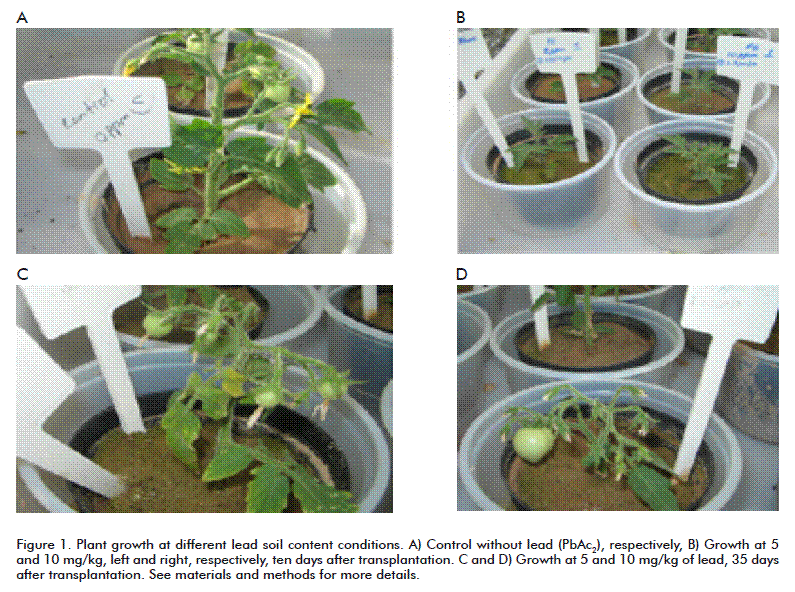
<body><![CDATA[<p   >&nbsp;</p >    <p   > </p >    <p   ><font size="3" color="#000000"><b><font face="Verdana, Arial, Helvetica, sans-serif">RESULTS  AND DISCUSSION </font></b></font></p >    <p   ><font size="2" face="Verdana, Arial, Helvetica, sans-serif" color="#000000">Growth  reduction was observed in tomato plants of cv Micro-Tom under Pb-stress (<a href="/img/revistas/bta/v30n3/f0105313.gif">Figure  1</a>). Chlorosis and necrotic lesions appeared after 35 days of growth, indicating  altered mineral nutrient absorption and photosynthesis. </font></p >    
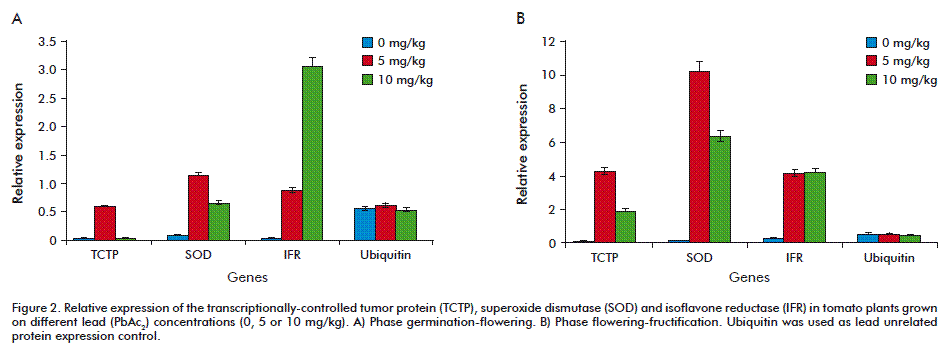
<p   ><font size="2" face="Verdana, Arial, Helvetica, sans-serif" color="#000000">Tomato  plants under Pb-stress for 35 days at the highest concentration of 10 mg/kg showed  lost almost all the leaves, with reduction in growth length. Similar results have  been reported by studies in <i>Brassica juncea </i>L. [19], <i>Zea mays</i> [20],  <i>S. lycopersicum </i>[21], <i>Phaseolus vulgaris</i> and <i>Lens culinaris</i>  [22], also reporting delayed development, low quality harvests and decreased yields  [23]. </font></p >    <p   ><font size="2" face="Verdana, Arial, Helvetica, sans-serif" color="#000000">The  response to heavy metal stress involves a complicated signal transduction network  that is activated by sensing the heavy metal, followed by the synthesis of stress-related  proteins and signaling molecules, which ultimately activate transcription of specific  metal-responsive genes to counteract the stress [24]. The relevant signal transduction  pathways include hormones, ROS signaling, and the activation of some stress-related  genes. Different signaling pathways may be used to respond to different heavy  metals [25]. </font></p >    <p   ><font size="2" face="Verdana, Arial, Helvetica, sans-serif" color="#000000">Stress  at cellular level results in excessive production of ROS, causing lipid peroxidation  and damage to several enzymes. On the other hand, cells mechanism can modulate  stress responses by antioxidant enzymes such as SOD, GR, Catalase (CAT) and Ascorbate  peroxidase (Asc) [26]. </font></p >    <p   ><font size="2" face="Verdana, Arial, Helvetica, sans-serif" color="#000000">SOD,  TCTP and IFR genes were studied to know their behavior at molecular and biochemical  level in tomato plants cv. Micro-Tom under Pb stress. The three genes (SOD, TCTP  and IFR) showed different expression profiles under the tested concentrations  and depending on the collection phase (<a href="/img/revistas/bta/v30n3/f0205313.gif">Figure  2</a>). Ubiquitin was used as control gene due to its basal stable expression,  as commonly used in different crops, with the ubiquitin-conjugating enzyme and  elongation factor-1 regarded as the most stable based on their transcriptional  profiles in <i>Oryza sativa</i> and <i>Pennisetum ciliare </i>[27, 28]. </font></p >    
<p   ><font size="2" face="Verdana, Arial, Helvetica, sans-serif" color="#000000">In  the case of TCTP, it showed low expression at 5 mg/kg of PbAc<sub>2</sub>, which  was repressed at 10 mg/kg of PbAc<sub>2</sub> during the germination and flowering  phase (first phase), while showing low expression at both concentrations during  flowering-fructification (second phase) (<a href="/img/revistas/bta/v30n3/f0205313.gif">Figure  2</a>). This could be related to a downregulation on TCTP expression by Pb [29-31].  It is also in agreement with previous results [32] showing that the developmental  phase influences TCTP expression levels, together with the cell/tissue type and  the stress conditions the plants are subjected to [33, 34]. This is irrespective  of the ubiquitous distribution of TCTP in all the eukaryotic organisms, in more  than 500 tissues and cell types, and the numerous experimental settings and biological  systems tested. It has been established that TCTP levels are highly regulated  in response to a wide range of extracellular signals and cellular conditions.  Typically, growth signals [35] have been reported to rapidly induce TCTP synthesis.  That&rsquo;s why TCTP induction may be repressed at reduced plant growth (<a href="/img/revistas/bta/v30n3/f0105313.gif">Figure  1C and D</a>). </font></p >    
<p   ><font size="2" face="Verdana, Arial, Helvetica, sans-serif" color="#000000">There  are some contradictory reports as those of Schmidt <i>et al</i>. [36] who found  that some heavy metals in plants up-regulate TCTP under various cells stress conditions,  and by Gnanasekar and Ramaswamy [37] showing that TCTP plays some antioxidant  functions. </font></p >    ]]></body>
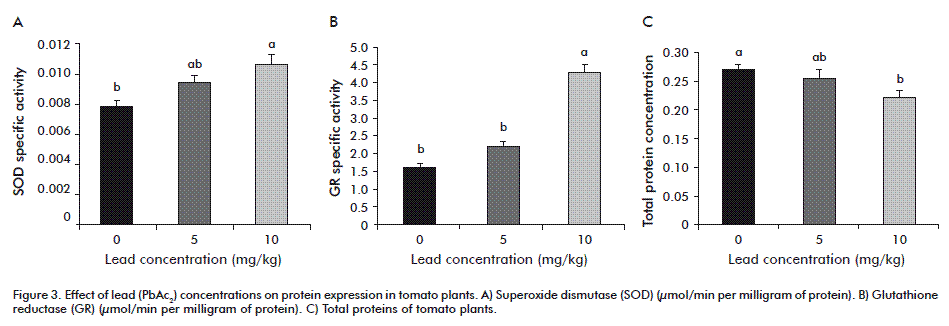
<body><![CDATA[<p   ><font size="2" face="Verdana, Arial, Helvetica, sans-serif" color="#000000">In  most of the cases up-regulation of cell growth-related genes is presumed to be  involved in metal stress signaling response [38], but in our study TCTP in relation  with heavy metal induced stress is not as highly expressed as it would be expected,  and it is down-regulated, showing a relationship with plant growth. There is limited  information about plant TCTPs so this study is one of the first studies involving  TCTPs in plants related to Pb induced stress. </font></p >    <p   ><font size="2" face="Verdana, Arial, Helvetica, sans-serif" color="#000000">Adaptation  of plants to several types of stresses depends upon a complex cellular sign system  where ROS, salicylates, cellulose, chitin oligomers can intervene [39, 40]. These  species (ROS) can react with cellular components (lipids, proteins, nucleic acids)  and cause lipid peroxidation, membrane damage and inactivation of enzymes. Plants  have evolved a complex array of mechanisms to maintain low ROS level and avoid  the detrimental effects of excessively high ROS concentrations. This antioxidant  network includes numerous soluble (ascorbate, glutathione) and membrane compounds  (tocopherol) as well as enzymes involved in ROS scavenging (SOD, CAT, Asc) [41].  </font></p >    <p   ><font size="2" face="Verdana, Arial, Helvetica, sans-serif" color="#000000">SOD  expression was lower in the first phase for both Pb treatments and higher in the  second phase, specifically at 5 mg/kg of PbAc<sub>2</sub>. A possible explanation  for this is the increased production of superoxide radicals due to the rise in  ROS production by Pb toxicity. The higher expression of SOD at 5 mg/kg of PbAc<sub>2</sub>  in the second phase, as for other induced enzymes, may be caused by the possible  temporal expression of SOD, mainly transitional. However, this response also may  be a consequence of SOD-related transcriptional activity genes. So, in our study,  SOD expression was higher at the lower heavy metal concentration, which is in  agree with results of Jomov&aacute; and Morovi&#269; [42] who found that lower  concentrations of Pb (100, 200 mg/L) in <i>Lupinus luteus</i> L. induced a strong  increase of SOD activity, but further elevation on its concentration (300, 400,  500 mg/kg) had the inverse effect. A lower expression at 10 mg/kg of PbAc<sub>2</sub>  may suggest that higher concentrations could damage plants, which is suggested  by the fact that the growth of plants at this concentration was affected. Similar  results were obtained in <i>Arabidopsis</i> [43], where the expression of four  genes encoding superoxidase enzymes were induced in response to Pb treatment,  suggesting that Pb, like other heavy metals ions, activate specific responses  to the plant antioxidant defense system. The expression of SOD at both Pb concentrations  used in this research indicates that it may be involved in the antioxidative process  under Pb induced stresses, since SOD is considered to be a crucial component in  biological defense against oxidative stress [44]. </font></p >    <p   ><font size="2" face="Verdana, Arial, Helvetica, sans-serif" color="#000000">The  induction of IFR was higher at 10 mg/kg of PbAc<sub>2</sub> in the first phase,  and, in the second phase (flowering and fructification), its expression was similar  for both concentrations tested. A higher expression of IFR at 10 mg/kg of PbAc<sub>2</sub>  at germination-flowering phase is probably due to the adaptation of plants to  a new environment (sand) with an application of a toxic metal on this phase. At  this point tomato plant may produce lignin which functions and distribution suggest  that lignins are a group of the earliest forms of defense mechanism and they are  an important aromatic secondary metabolites produced in the phenylpropanoid pathway  [45].<b> </b>With respect to IFR expression it was higher at 10 mg/kg of PbAc<sub>2</sub>  in the first phase and in the second was similar at both tested concentrations.  Similar results with cadmium in <i>Linum usitatissimum</i> L. showed that higher  concentration (50 and 100 mM) of this heavy metal induced IFR expression [46].  </font></p >    <p   ><font size="2" face="Verdana, Arial, Helvetica, sans-serif" color="#000000">The  biochemical analysis showed differences between SOD (&micro;mol/min per milligram  of protein FW), GR (&micro;mol/min per milligram of protein FW) and total proteins  (<a href="/img/revistas/bta/v30n3/f0305313.gif">Figure 3</a>). </font></p >    
<p   ><font size="2" face="Verdana, Arial, Helvetica, sans-serif" color="#000000">During  the experimental period, the content of SOD was higher at 10 mg/kg of PbAc<sub>2</sub>  with significant differences with respect to the control and 5 mg/kg of PbAc<sub>2</sub>.  This is also corroborated by the fact that plant growth at this concentration  was really affected. Plants exposed to Pb stress also show rapid and temporary  drops in growth rate and activate antioxidant defense system by producing ROS,  which alters gene expression and enzyme activity patterns of SOD. </font></p >    <p   ><font size="2" face="Verdana, Arial, Helvetica, sans-serif" color="#000000">Similar  results were found in tomato plants under cadmium induced stress [47] and, as  the results obtained in this research, suggested that SOD activity might play  a crucial role in the response of tomato plants to metallic stress [48]. Accumulation  of SOD, indicating the oxidative stress, is related to the maintenance of the  overall defense system. The activation of SOD could be useful to reduce O<sub>2</sub><b>  </b>accumulation, decrease of hydrogen peroxide and alleviate Pb stress [49].  </font></p >    <p   ><font size="2" face="Verdana, Arial, Helvetica, sans-serif" color="#000000">GR  content was higher also at 10 mg/kg of PbAc<sub>2</sub>, with significant differences  with respect to the other two treatments. This enzyme is part of the defenses  system against oxidative stress. GRs are indispensable components of ascorbate-glutathione  pathway, required to scavenge H<sub>2</sub>O<sub>2</sub> produced mainly in chloroplasts  and other cell organelles and to maintain the redox state of the cell [50]. Glutathione  reductase catalyzes the NADPH-dependent GSSG to reduced GSH that is involved in  the redox regulation of the cell cycle and has often been considered to play an  important role in defense of plants and other organisms against oxidative stress  [51]. </font></p >    <p   ><font size="2" face="Verdana, Arial, Helvetica, sans-serif" color="#000000">This  results show increased GR activity in Pb treated tomato plants, which suggests  possible involvement of GR in regenerating GSH under Pb toxicity conditions to  increase GSH/GSSG ratio and the total glutathione pool. Similar to our results,  induction in GR activity has been reported in leaves of tomato plants under cadmium  induced stress [47] and in rice seedling under Pb induced stress [52]. Total proteins  were higher in the absence of PbAc<sub>2</sub> (control), which means there could  be degraded with the other two concentrations used. </font></p >    <p   ><font size="2" face="Verdana, Arial, Helvetica, sans-serif" color="#000000">Production  of ROS takes place in cell under normal conditions, however adverse environmental  conditions that interrupt cellular homeostasis could produce oxidative damage  to proteins, DNA and to the lipids [53]. This could explain why total proteins  decreased at higher concentrations of Pb. </font></p >    ]]></body>
<body><![CDATA[<p   ><font size="2" face="Verdana, Arial, Helvetica, sans-serif" color="#000000">An  important role in plants adaptation and surviving under stress conditions is played  by antioxidants enzymes in oxidative stress tolerance [50]. </font></p >    <p   ><font size="2" face="Verdana, Arial, Helvetica, sans-serif" color="#000000">In  summary, the present research suggests that Pb toxicity <i>in situ</i> leads to  production of lipid peroxides and induces some of the key enzymes of antioxidant  defense system in tomato plants. Induction in the activities of antioxidative  enzymes is a general strategy adopted by plants to overcome oxidative stress due  to the imposition of environmental stresses. </font></p >    <p   >&nbsp;</p >    <p   > </p >    <p   ><font size="3" face="Verdana, Arial, Helvetica, sans-serif" color="#000000"><b>ACKNOWLEDGEMENTS  </b></font></p >    <p   ><font size="2" face="Verdana, Arial, Helvetica, sans-serif" color="#000000">We  are grateful to The Academy of Sciences for Developing Word (TWAS) and CNPq for  providing the opportunity to do this research at Sao Paulo University/Agricultural  School Luiz de Queiros, Brazil</font><font size="2" face="Verdana, Arial, Helvetica, sans-serif">.  </font></p ><FONT size="+1" color="#000000"><FONT size="+1"><FONT size="+1"><FONT size="+1"><FONT size="+1"><FONT size="+1"><FONT size="+1"><FONT size="+1"><FONT size="+1"><FONT size="+1"><FONT size="+1"><FONT size="+1"><FONT size="+1"><FONT size="+1"><FONT size="+1"><FONT size="+1"><FONT size="+1"><FONT size="+1"><FONT size="+1"><FONT size="+1"><FONT size="+1"><FONT size="+1"><FONT size="+1"><FONT size="+1"><FONT size="+1"><FONT size="+1"><FONT size="+1"><FONT size="+1"><FONT size="+1"><FONT size="+1">      <P   align="justify" >&nbsp;</P >    <P   align="justify" > </P >    <P   align="justify" ><font size="3" face="Verdana, Arial, Helvetica, sans-serif"><B>REFERENCES </b></font></P >    <P   align="justify" ><font size="2" face="Verdana, Arial, Helvetica, sans-serif">1. FAOSTAT. The statistics  division of the FAO. Roma: FAO. c2012 [cited 2013 Jan 15]. Available from: <a href="http://faostat.fao.org" target="_blank">http://faostat.fao.org</a>.      ]]></body>
<body><![CDATA[<br> </font></P >    <!-- ref --><P   align="justify" ><font size="2" face="Verdana, Arial, Helvetica, sans-serif">2. Butelli E, Titta  L, Giorgio M, Mock HP, Matros A, Peterek S, et al. Enrichment of tomato fruit  with health-promoting anthocyanins by expression of select transcription factors.  Nat Biotechnol. 2008;26(11):1301-08.    <br> </font></P >    <!-- ref --><P   align="justify" ><font size="2" face="Verdana, Arial, Helvetica, sans-serif">3. Grat&atilde;o  PL, Monteiro CC, Carvalho RF, Tezotto T, Piotto FA, Peres LEP, et al. Biochemical  dissection of diageotropica and Never ripe tomato mutants to Cd-stressful conditions.  Plant Physiol Biochem. 2012;56:79-96.    <br> </font></P >    <!-- ref --><P   align="justify" ><font size="2" face="Verdana, Arial, Helvetica, sans-serif">4. Grat&atilde;o  PL, Monteiro CC, Rossi ML, Martinelli AP, Peres LEP, Medici LO, et al. Differential  ultrastructural changes in tomato hormonal mutants exposed to cadmium. Environ  Exp Bot. 2009;67(2):387-94.    <br> </font></P >    <!-- ref --><P   align="justify" ><font size="2" face="Verdana, Arial, Helvetica, sans-serif">5. Pino-Nunes LE,  Figueira de O AV, Tulmann-Neto A, Zs&ouml;g&ouml;n A, Piotto FA, Silva JA, et  al. Induced mutagenesis and natural genetic variation in tomato 'Micro-Tom'.</font><font size="2" face="Verdana, Arial, Helvetica, sans-serif">  Acta Hort (ISHS). 2009;821:63-72.    <br> </font></P >    <!-- ref --><P   align="justify" ><font size="2" face="Verdana, Arial, Helvetica, sans-serif">6. Kumar N, Soni  H, Kumar RN, Bhatt I. Hyperaccumulation and mobility of heavy metals in vegetable  crops in India. J Agr Environ. 2009;10:29-38.    <br> </font></P >    <!-- ref --><P   align="justify" ><font size="2" face="Verdana, Arial, Helvetica, sans-serif">7. He LY, Chen ZJ,  Ren GD, Zhang YF, Qian M, Sheng XF. Increased cadmium and lead uptake of a cadmium  hyperaccumulator tomato by cadmium-resistant bacteria. Ecotoxicol Environ Saf.  2009;72(5):1343-8.    <br> </font></P >    <!-- ref --><P   align="justify" ><font size="2" face="Verdana, Arial, Helvetica, sans-serif">8. Al-Qurainy F.  Toxicity of heavy metals and their molecular detection on Phaseolus vulgaris (L.).  Aust J Basic Appl Sci. 2009;3(3):3025-35.    <br> </font></P >    <!-- ref --><P   align="justify" ><font size="2" face="Verdana, Arial, Helvetica, sans-serif">9. Gomes-Junior RA,  Moldes CA, Delite FS, Pompeu GB, Grat&atilde;o PL, Mazzafera P, et al. Antioxidant  metabolism of coffee cell suspension cultures in response to cadmium. Chemosphere.  2006;65(8):1330-7.    <br> </font></P >    <!-- ref --><P   align="justify" ><font size="2" face="Verdana, Arial, Helvetica, sans-serif">10. Chen F, Wang  F, Wu F, Mao W, Zhang G, Zhou M. Modulation of exogenous glutathione in antioxidant  defense system against Cd stress in the two barley genotypes differing in Cd tolerance.  Plant Physiol Biochem. 2010;48(8):663-72.    <br> </font></P >    <!-- ref --><P   align="justify" ><font size="2" face="Verdana, Arial, Helvetica, sans-serif">11. Cui YS, Wang  QR, Dong YT, Li HF, Christie P. Enhanced uptake of soil Pb and Zn by Indian mustard  and winter wheat following combined soil application of elemental sulphur and  EDTA. Plant Soil. 2004;261(1-2):181-8.    <br> </font></P >    <!-- ref --><P   align="justify" ><font size="2" face="Verdana, Arial, Helvetica, sans-serif">12. Sharma P, Dubey  RS. Lead toxicity in plants. Braz J Plant Physiol. 2005;17(1):35-52.    <br> </font></P >    <!-- ref --><P   align="justify" ><font size="2" face="Verdana, Arial, Helvetica, sans-serif">13. Mittler R. Oxidative  stress, antioxidants and stress tolerance. Trends Plant Sci. 2002;7(9):405-10.    <br>  </font></P >    <!-- ref --><P   align="justify" ><font size="2" face="Verdana, Arial, Helvetica, sans-serif">14. Meissner R, Jacobson  Y, Melamed S, Levyatuv S, Shalev G, Ashri A, et al. A new model system for tomato  genetics. Plant J. 1997;12(6):1465-72.    <br> </font></P >    <!-- ref --><P   align="justify" ><font size="2" face="Verdana, Arial, Helvetica, sans-serif">15. P&eacute;rez  SP, Cabezas DM, Haitao D. Large-scale identification of ESTs from Nicotiana tabacum  L. by normalized cDNA library sequencing. Beitrage zur Tabakforschung Int. 2006;22(2):114-24.    <br>  </font></P >    <!-- ref --><P   align="justify" ><font size="2" face="Verdana, Arial, Helvetica, sans-serif">16. Azevedo R, Alas  R, Smith R, Lea P. Response of antioxidant enzymes to transfer from elevated carbon  dioxide to air and ozone fumigation, in the leaves and roots of wild-type and  a catalase-deficient mutant of barley. Physiol Plant. 1998;104(2):280-92.    <br>  </font></P >    <!-- ref --><P   align="justify" ><font size="2" face="Verdana, Arial, Helvetica, sans-serif">17. Beyer WF, Fridovich  I. Assaying for superoxide dismutase activity: some large consequences of minor  changes in conditions. Anal Biochem. 1987;161(2):559-66.    <br> </font></P >    <!-- ref --><P   align="justify" ><font size="2" face="Verdana, Arial, Helvetica, sans-serif">18. Bradford MM.  A rapid and sensitive method for the quantitation of microgram quantities of protein  utilizing the principle of protein dye binding. Anal Biochem. 1976;72:248-54.    <br>  </font></P >    <!-- ref --><P   align="justify" ><font size="2" face="Verdana, Arial, Helvetica, sans-serif">19. John R, Ahmad  P, Gadgil K, Sharma S. Heavy metal toxicity: Effect on plant growth, biochemical  parameters and metal accumulation by Brassica juncea L. Int J Plant Prod. 2009;3(3):65-76.    <br>  </font></P >    <!-- ref --><P   align="justify" ><font size="2" face="Verdana, Arial, Helvetica, sans-serif">20. &Ccedil;imrin  KM, Turan M, Kapur B. Effect of elemental sulphur on heavy metals solubility and  remediation by plants in calcareous soils. Fresenius Environ Bull. 2007;16(9a):1113-20.    <br>  </font></P >    <!-- ref --><P   align="justify" ><font size="2" face="Verdana, Arial, Helvetica, sans-serif">21. Akinci IE, Akinci  S, Yilmaz K. Response of tomato (Solanum lycopersicum L.) to lead toxicity: Growth,  element uptake, chlorophyll and water content. Afr J Agri Res. 2010;5(6):416-23.    <br>  </font></P >    <!-- ref --><P   align="justify" ><font size="2" face="Verdana, Arial, Helvetica, sans-serif">22. Haider S, Kanwal  S, Uddin F, Azmat R. Phytotoxicity of Pb II. Changes in chlorophyll absorption  spectrum due to toxic metal Pb stress on Phaseolus mungo and Lens culinaris. Pakistan  J Biol Sci. 2006;9(11):2062-8.    <br> </font></P >    <!-- ref --><P   align="justify" ><font size="2" face="Verdana, Arial, Helvetica, sans-serif">23. Begum A. Cultivation  of tomato plants (Lycopersicum esculentum) using Municipal Solid Waste Compost.  Int Soc Environ Bot. 2010;16(2):850-63.    <br> </font></P >    <!-- ref --><P   align="justify" ><font size="2" face="Verdana, Arial, Helvetica, sans-serif">24. Maksymiec W.  Signaling responses in plants to heavy metal stress. Acta Physiol Plant. 2007;29(3):177-87.    <br>  </font></P >    <P   align="justify" ><font size="2" face="Verdana, Arial, Helvetica, sans-serif">25. DalCorso G, Farinati  S, Furini A. Regulatory networks of cadmium stress in plants. Plant Signal Behavior.  2010;5(6):663-7.    <br> </font></P >    <!-- ref --><P   align="justify" ><font size="2" face="Verdana, Arial, Helvetica, sans-serif">26. Grat&atilde;o  PL, Monteiro CC, Peres LEP, Azevedo RA. The Isolation of Antioxidant Enzymes from  Mature Tomato (cv. Micro-Tom). Plant Hort Sci. 2008;43:1608-10.    <br> </font></P >    <!-- ref --><P   align="justify" ><font size="2" face="Verdana, Arial, Helvetica, sans-serif">27. Jain M, Nijhawan  A, Tyagi AK, Khurana JP. Validation of housekeeping genes as internal control  for studying gene expression in rice by quantitative real-time PCR. Biochem Biophys  Res Commun. 2006;345(2):646-51.    <br> </font></P >    <!-- ref --><P   align="justify" ><font size="2" face="Verdana, Arial, Helvetica, sans-serif">28. Singh M, Burson  B, Finlayson S. Isolation of candidate genes for apomictic development in buffelgrass  (Pennisetum ciliare). Plant Mol Biol. 2007;64(6):673-82.    <br> </font></P >    <!-- ref --><P   align="justify" ><font size="2" face="Verdana, Arial, Helvetica, sans-serif">29. Azc&oacute;n-Bieto  J, Tal&oacute;n M. Fundamentos de Fisiolog&iacute;a Vegetal. 2nd ed. Madrid: McGraw-Hill  Interamericana; 2008.    <br> </font></P >    <!-- ref --><P   align="justify" ><font size="2" face="Verdana, Arial, Helvetica, sans-serif">30. Kawaguchi E,  Gyokusen K, Saito A. Appearance of partially wilted shoots in a Pinus thunbergii  inoculated with Bursaphelenchus xylophilus and its influence on the growth of  the tree. Bull Kyushu Univ For. 1999;80:41-9.    <br> </font></P >    <!-- ref --><P   align="justify" ><font size="2" face="Verdana, Arial, Helvetica, sans-serif">31. Berkowitz O,  Jost R, Pollmann S, Masle J. Characterization of TCTP, the Translationally Controlled  Tumor Protein, from Arabidopsis thaliana. Plant Cell. 2008;20(12):3430-47.    <br>  </font></P >    <!-- ref --><P   align="justify" ><font size="2" face="Verdana, Arial, Helvetica, sans-serif">32. Rao KV, Chen  L, Gnanasekar M, Ramaswamy K. Cloning and characterization of a calcium-binding,  histamine-releasing protein from Schistosoma mansoni. J Biol Chem. 2002;277(34):31207-13.    <br>  </font></P >    <!-- ref --><P   align="justify" ><font size="2" face="Verdana, Arial, Helvetica, sans-serif">33. Thiele H, Berger  M, Skalweit A, Thiele BJ. Expression of the gene and processed pseudogenes encoding  the human and rabbit translationally controlled tumour protein (TCTP). Eur J Biochem.  2000;267(17):5473-81.    <br> </font></P >    <!-- ref --><P   align="justify" ><font size="2" face="Verdana, Arial, Helvetica, sans-serif">34. Bommer UA, Thiele  BJ. The translationally controlled tumour protein (TCTP). Int J Biochem Cell Biol.  2004;36(3):379-85.    <br> </font></P >    <!-- ref --><P   align="justify" ><font size="2" face="Verdana, Arial, Helvetica, sans-serif">35. Bommer, UA, Heng  C, Perrin A, Dash P, Lobov S, Elia A, et al. Roles of the transnationally controlled  tumor protein (TCTP) and the double stranded RNA-dependent protein kinase, PKR,  in cellular stress response. Oncogene. 2010;29(5):763-73.    <br> </font></P >    <!-- ref --><P   align="justify" ><font size="2" face="Verdana, Arial, Helvetica, sans-serif">36. Schmidt I, Fahling  M, Nafz B, Skalweit A, Thiele BJ. Induction of translationally controlled tumor  protein (TCTP) by transcriptional and post-transcriptional mechanisms. FEBS J.  2007;274(20):5416-24.    <br> </font></P >    <!-- ref --><P   align="justify" ><font size="2" face="Verdana, Arial, Helvetica, sans-serif">37. Gnanasekar M,  Ramaswamy K. Translationally controlled tumor protein of Brugia malayi fuctions  as an antioxidant protein. Parasitol Res. 2007;101(6):1533-40.    <br> </font></P >    <!-- ref --><P   align="justify" ><font size="2" face="Verdana, Arial, Helvetica, sans-serif">38. Ermolayev V,  Weschke W, Manteuffel R. Comparison of Al induced gene expression in sensitive  and tolerant soybean cultivars. J Exp Bot. 2003;54(393):2745-56.    <br> </font></P >    <!-- ref --><P   align="justify" ><font size="2" face="Verdana, Arial, Helvetica, sans-serif">39. Buchel AS, Brederode  FT, Bol JF, Linthorst HJ. Mutation of GT-1 binding sites in the PR-1a promoter  influences the level of inducible gene expression in vivo. Plant Mol Biol. 1999;40(3):387-96.    <br>  </font></P >    <!-- ref --><P   align="justify" ><font size="2" face="Verdana, Arial, Helvetica, sans-serif">40. Knoester M, Pieterse  CM, Bol JF, Van Loon LC. Systemic resistance in Arabidopsis induced by rhizobacteria  requires ethylene-dependent signaling at the site of application. Mol Plant Microbe  Int. 1999;12(8):720-7.    <br> </font></P >    <P   align="justify" ><font size="2" face="Verdana, Arial, Helvetica, sans-serif">41. Ruci?iska-Sobkowiak  R. Oxidative stress in plants exposed to heavy metals. Postepy Biochem. 2010;56(2):191-200.    ]]></body>
<body><![CDATA[<br>  </font></P >    <!-- ref --><P   align="justify" ><font size="2" face="Verdana, Arial, Helvetica, sans-serif">42. Jomov&aacute;  K, Morovic M. Effect of heavy metal treatment on molecular changes in root tips  of Lupinus luteus L. Czech J Food Sci. 2009;27(Special issue):386-9.    <br> </font></P >    <!-- ref --><P   align="justify" ><font size="2" face="Verdana, Arial, Helvetica, sans-serif">43. Liu T, Liu S,  Guan H, Ma L, Chen Zh, Gu H, et al. Transcriptional profiling of Arabidopsis seedlings  in response to heavy metal lead (Pb). Environ Exp Bot. 2009;67:377-86.    <br> </font></P >    <!-- ref --><P   align="justify" ><font size="2" face="Verdana, Arial, Helvetica, sans-serif">44. Abu-Romman S,  Shatnawi M. Isolation and expression analysis of chloroplastic copper/zinc superoxide  dismutase gene in barley. S Afr J Bot. 2010;77(2):328-34.    <br> </font></P >    <!-- ref --><P   align="justify" ><font size="2" face="Verdana, Arial, Helvetica, sans-serif">45. Fran&ccedil;a  SC, Roberto PG, Marins MA, Puga RD, Rodriguez A, Pereira JO. Biosynthesis of secondary  metabolites in sugarcane. Genet Mol Biol. 2001;24(1-4):243-50.    <br> </font></P >    <!-- ref --><P   align="justify" ><font size="2" face="Verdana, Arial, Helvetica, sans-serif">46. Hradilov&aacute;  J, Rehulka P, Rehulkov&aacute; H, Vrbov&aacute; M, Griga M, Brzobohat&yacute;  B. Comparative analysis of proteomic changes in contrasting flax cultivars upon  cadmium exposure. Electrophoresis. 2010;31(2):421-31.    <br> </font></P >    <!-- ref --><P   align="justify" ><font size="2" face="Verdana, Arial, Helvetica, sans-serif">47. Ammar WB, Nouairi  I, Zarrouk M, Ghorbel MH, Jemal F. Antioxidative response to cadmium in roots  and leaves of tomato plants. Biol Plantarum. 2008;52(4):727-31.    <br> </font></P >    <!-- ref --><P   align="justify" ><font size="2" face="Verdana, Arial, Helvetica, sans-serif">48. Alsher RG, Erturk  N, Heath LS. Role of superoxide dismutases (SODs) in controlling oxidative stress  in plants. J Exp Bot. 2002;53(372):1331-41.    <br> </font></P >    <!-- ref --><P   align="justify" ><font size="2" face="Verdana, Arial, Helvetica, sans-serif">49. Wang C, Wang  X, Tian Y, Xue Y, Xu X, Sui Y, et al. Oxidative stress and potential biomarkers  in tomato seedlings subjected to soil lead contamination. Ecotoxicol Environ Saf.  2008;71(3):685-91.    <br> </font></P >    <!-- ref --><P   align="justify" ><font size="2" face="Verdana, Arial, Helvetica, sans-serif">50. Malecka A, Jarmuszkiewicz  W, Tomaszewska B. Antioxidative defense to lead stress in subcellular compartments  of pea root cells. Acta Biochim Polon. 2001;48(3):687-98.    <br> </font></P >    <!-- ref --><P   align="justify" ><font size="2" face="Verdana, Arial, Helvetica, sans-serif">51. Sanchez-Fernandez  R, Fricker M, Corben LB, White NS, Sheard N, Leaver CJ, et al. Cell proliferation  and hair tip growth in the Arabidopsis root are under mechanistically different  forms of redox control. Proc Natl Acad Sci USA. 1997;94(6):2745-50.    <br> </font></P >    <!-- ref --><P   align="justify" ><font size="2" face="Verdana, Arial, Helvetica, sans-serif">52. Verma Sh, Dubey  R. Lead toxicity induces lipid peroxidation and alters the activities of antioxidant  enzymes in growing rice plants. Plant Sci. 2003;164(4):645-55.    <br> </font></P >    <!-- ref --><P   align="justify" ><font size="2" face="Verdana, Arial, Helvetica, sans-serif">53. Pitzschke A,  Fornazi C, Hirt H. Reactive oxygen species signalling in plants. Antioxid Redox  Signal. 2006;8(9-10):1757-64.     </font><FONT size="+1"><FONT color="#0000FF"><FONT color="#000000"><FONT color="#0000FF"><FONT color="#000000"><FONT color="#0000FF"><FONT color="#000000">  </font></font></font></font></font></font></font></P ><FONT size="+1"><FONT color="#0000FF"><FONT color="#000000"><FONT color="#0000FF"><FONT color="#000000"><FONT color="#0000FF"><FONT color="#000000">      <P   align="justify" >&nbsp;</P >    <P   align="justify" >&nbsp;</P >    <P   align="justify" > </P >    <P   align="justify" ><font size="2" face="Verdana, Arial, Helvetica, sans-serif">Received in March,  2013.     <br> Accepted in May, 2013. </font></P >    ]]></body>
<body><![CDATA[<P   align="justify" >&nbsp;</P >    <P   align="justify" >&nbsp;</P >    <P   align="justify" > </P >    <P   align="justify" > </P >    <P   align="justify" ><font size="2" face="Verdana, Arial, Helvetica, sans-serif"><i>Sandra P&eacute;rez</i>.  Departamento de Biolog&iacute;a y Sanidad Vegetal, Universidad Agraria de La Habana  Fructuoso Rodr&iacute;guez P&eacute;rez. Carretera Tapaste, Km 22 &frac12;, San  Jos&eacute; de las Lajas, Mayabeque, Cuba. E-mail: <a href="mailto:sandra05@isch.edu.cu">sandra05@isch.edu.cu</a><FONT color="#0000FF"><FONT color="#0017E4">.  </font></font></font></P ></font></font></font></font></font></font></font></font></font></font></font></font></font></font></font></font></font></font></font></font></font></font></font></font></font></font></font></font></font></font></font></font></font></font></font></font></font></DIV >      ]]></body><back>
<ref-list>
<ref id="B1">
<label>1</label><nlm-citation citation-type="book">
<collab>FAO</collab>
<source><![CDATA[FAOSTAT. The statistics division of the FAO]]></source>
<year>c201</year>
<month>2</month>
<publisher-loc><![CDATA[Roma ]]></publisher-loc>
<publisher-name><![CDATA[FAO]]></publisher-name>
</nlm-citation>
</ref>
<ref id="B2">
<label>2</label><nlm-citation citation-type="journal">
<person-group person-group-type="author">
<name>
<surname><![CDATA[Butelli]]></surname>
<given-names><![CDATA[E]]></given-names>
</name>
<name>
<surname><![CDATA[Titta]]></surname>
<given-names><![CDATA[L]]></given-names>
</name>
<name>
<surname><![CDATA[Giorgio]]></surname>
<given-names><![CDATA[M]]></given-names>
</name>
<name>
<surname><![CDATA[Mock]]></surname>
<given-names><![CDATA[HP]]></given-names>
</name>
<name>
<surname><![CDATA[Matros]]></surname>
<given-names><![CDATA[A]]></given-names>
</name>
<name>
<surname><![CDATA[Peterek]]></surname>
<given-names><![CDATA[S]]></given-names>
</name>
</person-group>
<article-title xml:lang="en"><![CDATA[Enrichment of tomato fruit with health-promoting anthocyanins by expression of select transcription factors]]></article-title>
<source><![CDATA[Nat Biotechnol]]></source>
<year>2008</year>
<volume>26</volume>
<numero>11</numero>
<issue>11</issue>
<page-range>1301-08</page-range></nlm-citation>
</ref>
<ref id="B3">
<label>3</label><nlm-citation citation-type="journal">
<person-group person-group-type="author">
<name>
<surname><![CDATA[Gratão]]></surname>
<given-names><![CDATA[PL]]></given-names>
</name>
<name>
<surname><![CDATA[Monteiro]]></surname>
<given-names><![CDATA[CC]]></given-names>
</name>
<name>
<surname><![CDATA[Carvalho]]></surname>
<given-names><![CDATA[RF]]></given-names>
</name>
<name>
<surname><![CDATA[Tezotto]]></surname>
<given-names><![CDATA[T]]></given-names>
</name>
<name>
<surname><![CDATA[Piotto]]></surname>
<given-names><![CDATA[FA]]></given-names>
</name>
<name>
<surname><![CDATA[Peres]]></surname>
<given-names><![CDATA[LEP]]></given-names>
</name>
</person-group>
<article-title xml:lang="en"><![CDATA[Biochemical dissection of diageotropica and Never ripe tomato mutants to Cd-stressful conditions]]></article-title>
<source><![CDATA[Plant Physiol Biochem]]></source>
<year>2012</year>
<volume>56</volume>
<page-range>79-96</page-range></nlm-citation>
</ref>
<ref id="B4">
<label>4</label><nlm-citation citation-type="journal">
<person-group person-group-type="author">
<name>
<surname><![CDATA[Gratão]]></surname>
<given-names><![CDATA[PL]]></given-names>
</name>
<name>
<surname><![CDATA[Monteiro]]></surname>
<given-names><![CDATA[CC]]></given-names>
</name>
<name>
<surname><![CDATA[Rossi]]></surname>
<given-names><![CDATA[ML]]></given-names>
</name>
<name>
<surname><![CDATA[Martinelli]]></surname>
<given-names><![CDATA[AP]]></given-names>
</name>
<name>
<surname><![CDATA[Peres]]></surname>
<given-names><![CDATA[LEP]]></given-names>
</name>
<name>
<surname><![CDATA[Medici]]></surname>
<given-names><![CDATA[LO]]></given-names>
</name>
</person-group>
<article-title xml:lang="en"><![CDATA[Differential ultrastructural changes in tomato hormonal mutants exposed to cadmium]]></article-title>
<source><![CDATA[Environ Exp Bot]]></source>
<year>2009</year>
<volume>67</volume>
<numero>2</numero>
<issue>2</issue>
<page-range>387-94</page-range></nlm-citation>
</ref>
<ref id="B5">
<label>5</label><nlm-citation citation-type="journal">
<person-group person-group-type="author">
<name>
<surname><![CDATA[Pino-Nunes]]></surname>
<given-names><![CDATA[LE]]></given-names>
</name>
<name>
<surname><![CDATA[Figueira de O]]></surname>
<given-names><![CDATA[AV]]></given-names>
</name>
<name>
<surname><![CDATA[Tulmann-Neto]]></surname>
<given-names><![CDATA[A]]></given-names>
</name>
<name>
<surname><![CDATA[Zsögön]]></surname>
<given-names><![CDATA[A]]></given-names>
</name>
<name>
<surname><![CDATA[Piotto]]></surname>
<given-names><![CDATA[FA]]></given-names>
</name>
<name>
<surname><![CDATA[Silva]]></surname>
<given-names><![CDATA[JA]]></given-names>
</name>
</person-group>
<article-title xml:lang="en"><![CDATA[Induced mutagenesis and natural genetic variation in tomato 'Micro-Tom']]></article-title>
<source><![CDATA[Acta Hort (ISHS)]]></source>
<year>2009</year>
<volume>821</volume>
<page-range>63-72</page-range></nlm-citation>
</ref>
<ref id="B6">
<label>6</label><nlm-citation citation-type="journal">
<person-group person-group-type="author">
<name>
<surname><![CDATA[Kumar]]></surname>
<given-names><![CDATA[N]]></given-names>
</name>
<name>
<surname><![CDATA[Soni]]></surname>
<given-names><![CDATA[H]]></given-names>
</name>
<name>
<surname><![CDATA[Kumar]]></surname>
<given-names><![CDATA[RN]]></given-names>
</name>
<name>
<surname><![CDATA[Bhatt]]></surname>
<given-names><![CDATA[I]]></given-names>
</name>
</person-group>
<article-title xml:lang="en"><![CDATA[Hyperaccumulation and mobility of heavy metals in vegetable crops in India]]></article-title>
<source><![CDATA[J Agr Environ]]></source>
<year>2009</year>
<volume>10</volume>
<page-range>29-38</page-range></nlm-citation>
</ref>
<ref id="B7">
<label>7</label><nlm-citation citation-type="journal">
<person-group person-group-type="author">
<name>
<surname><![CDATA[He]]></surname>
<given-names><![CDATA[LY]]></given-names>
</name>
<name>
<surname><![CDATA[Chen]]></surname>
<given-names><![CDATA[ZJ]]></given-names>
</name>
<name>
<surname><![CDATA[Ren]]></surname>
<given-names><![CDATA[GD]]></given-names>
</name>
<name>
<surname><![CDATA[Zhang]]></surname>
<given-names><![CDATA[YF]]></given-names>
</name>
<name>
<surname><![CDATA[Qian]]></surname>
<given-names><![CDATA[M]]></given-names>
</name>
<name>
<surname><![CDATA[Sheng]]></surname>
<given-names><![CDATA[XF]]></given-names>
</name>
</person-group>
<article-title xml:lang="en"><![CDATA[Increased cadmium and lead uptake of a cadmium hyperaccumulator tomato by cadmium-resistant bacteria]]></article-title>
<source><![CDATA[Ecotoxicol Environ Saf]]></source>
<year>2009</year>
<volume>72</volume>
<numero>5</numero>
<issue>5</issue>
<page-range>1343-8</page-range></nlm-citation>
</ref>
<ref id="B8">
<label>8</label><nlm-citation citation-type="journal">
<person-group person-group-type="author">
<name>
<surname><![CDATA[Al-Qurainy]]></surname>
<given-names><![CDATA[F]]></given-names>
</name>
</person-group>
<article-title xml:lang="en"><![CDATA[Toxicity of heavy metals and their molecular detection on Phaseolus vulgaris (L.)]]></article-title>
<source><![CDATA[Aust J Basic Appl Sci]]></source>
<year>2009</year>
<volume>3</volume>
<numero>3</numero>
<issue>3</issue>
<page-range>3025-35</page-range></nlm-citation>
</ref>
<ref id="B9">
<label>9</label><nlm-citation citation-type="journal">
<person-group person-group-type="author">
<name>
<surname><![CDATA[Gomes-Junior]]></surname>
<given-names><![CDATA[RA]]></given-names>
</name>
<name>
<surname><![CDATA[Moldes]]></surname>
<given-names><![CDATA[CA]]></given-names>
</name>
<name>
<surname><![CDATA[Delite]]></surname>
<given-names><![CDATA[FS]]></given-names>
</name>
<name>
<surname><![CDATA[Pompeu]]></surname>
<given-names><![CDATA[GB]]></given-names>
</name>
<name>
<surname><![CDATA[Gratão]]></surname>
<given-names><![CDATA[PL]]></given-names>
</name>
<name>
<surname><![CDATA[Mazzafera]]></surname>
<given-names><![CDATA[P]]></given-names>
</name>
</person-group>
<article-title xml:lang="en"><![CDATA[Antioxidant metabolism of coffee cell suspension cultures in response to cadmium]]></article-title>
<source><![CDATA[Chemosphere]]></source>
<year>2006</year>
<volume>65</volume>
<numero>8</numero>
<issue>8</issue>
<page-range>1330-7</page-range></nlm-citation>
</ref>
<ref id="B10">
<label>10</label><nlm-citation citation-type="journal">
<person-group person-group-type="author">
<name>
<surname><![CDATA[Chen]]></surname>
<given-names><![CDATA[F]]></given-names>
</name>
<name>
<surname><![CDATA[Wang]]></surname>
<given-names><![CDATA[F]]></given-names>
</name>
<name>
<surname><![CDATA[Wu]]></surname>
<given-names><![CDATA[F]]></given-names>
</name>
<name>
<surname><![CDATA[Mao]]></surname>
<given-names><![CDATA[W]]></given-names>
</name>
<name>
<surname><![CDATA[Zhang]]></surname>
<given-names><![CDATA[G]]></given-names>
</name>
<name>
<surname><![CDATA[Zhou]]></surname>
<given-names><![CDATA[M]]></given-names>
</name>
</person-group>
<article-title xml:lang="en"><![CDATA[Modulation of exogenous glutathione in antioxidant defense system against Cd stress in the two barley genotypes differing in Cd tolerance]]></article-title>
<source><![CDATA[Plant Physiol Biochem]]></source>
<year>2010</year>
<volume>48</volume>
<numero>8</numero>
<issue>8</issue>
<page-range>663-72</page-range></nlm-citation>
</ref>
<ref id="B11">
<label>11</label><nlm-citation citation-type="journal">
<person-group person-group-type="author">
<name>
<surname><![CDATA[Cui]]></surname>
<given-names><![CDATA[YS]]></given-names>
</name>
<name>
<surname><![CDATA[Wang]]></surname>
<given-names><![CDATA[QR]]></given-names>
</name>
<name>
<surname><![CDATA[Dong]]></surname>
<given-names><![CDATA[YT]]></given-names>
</name>
<name>
<surname><![CDATA[Li]]></surname>
<given-names><![CDATA[HF]]></given-names>
</name>
<name>
<surname><![CDATA[Christie]]></surname>
<given-names><![CDATA[P]]></given-names>
</name>
</person-group>
<article-title xml:lang="en"><![CDATA[Enhanced uptake of soil Pb and Zn by Indian mustard and winter wheat following combined soil application of elemental sulphur and EDTA]]></article-title>
<source><![CDATA[Plant Soil]]></source>
<year>2004</year>
<volume>261</volume>
<numero>1-2</numero>
<issue>1-2</issue>
<page-range>181-8</page-range></nlm-citation>
</ref>
<ref id="B12">
<label>12</label><nlm-citation citation-type="journal">
<person-group person-group-type="author">
<name>
<surname><![CDATA[Sharma]]></surname>
<given-names><![CDATA[P]]></given-names>
</name>
<name>
<surname><![CDATA[Dubey]]></surname>
<given-names><![CDATA[RS]]></given-names>
</name>
</person-group>
<article-title xml:lang="en"><![CDATA[Lead toxicity in plants]]></article-title>
<source><![CDATA[Braz J Plant Physiol]]></source>
<year>2005</year>
<volume>17</volume>
<numero>1</numero>
<issue>1</issue>
<page-range>35-52</page-range></nlm-citation>
</ref>
<ref id="B13">
<label>13</label><nlm-citation citation-type="journal">
<person-group person-group-type="author">
<name>
<surname><![CDATA[Mittler]]></surname>
<given-names><![CDATA[R]]></given-names>
</name>
</person-group>
<article-title xml:lang="en"><![CDATA[Oxidative stress, antioxidants and stress tolerance]]></article-title>
<source><![CDATA[Trends Plant Sci]]></source>
<year>2002</year>
<volume>7</volume>
<numero>9</numero>
<issue>9</issue>
<page-range>405-10</page-range></nlm-citation>
</ref>
<ref id="B14">
<label>14</label><nlm-citation citation-type="journal">
<person-group person-group-type="author">
<name>
<surname><![CDATA[Meissner]]></surname>
<given-names><![CDATA[R]]></given-names>
</name>
<name>
<surname><![CDATA[Jacobson]]></surname>
<given-names><![CDATA[Y]]></given-names>
</name>
<name>
<surname><![CDATA[Melamed]]></surname>
<given-names><![CDATA[S]]></given-names>
</name>
<name>
<surname><![CDATA[Levyatuv]]></surname>
<given-names><![CDATA[S]]></given-names>
</name>
<name>
<surname><![CDATA[Shalev]]></surname>
<given-names><![CDATA[G]]></given-names>
</name>
<name>
<surname><![CDATA[Ashri]]></surname>
<given-names><![CDATA[A]]></given-names>
</name>
</person-group>
<article-title xml:lang="en"><![CDATA[A new model system for tomato genetics]]></article-title>
<source><![CDATA[Plant J]]></source>
<year>1997</year>
<volume>12</volume>
<numero>6</numero>
<issue>6</issue>
<page-range>1465-72</page-range></nlm-citation>
</ref>
<ref id="B15">
<label>15</label><nlm-citation citation-type="journal">
<person-group person-group-type="author">
<name>
<surname><![CDATA[Pérez]]></surname>
<given-names><![CDATA[SP]]></given-names>
</name>
<name>
<surname><![CDATA[Cabezas]]></surname>
<given-names><![CDATA[DM]]></given-names>
</name>
<name>
<surname><![CDATA[Haitao]]></surname>
<given-names><![CDATA[D]]></given-names>
</name>
</person-group>
<article-title xml:lang="en"><![CDATA[Large-scale identification of ESTs from Nicotiana tabacum L. by normalized cDNA library sequencing]]></article-title>
<source><![CDATA[Beitrage zur Tabakforschung Int]]></source>
<year>2006</year>
<volume>22</volume>
<numero>2</numero>
<issue>2</issue>
<page-range>114-24</page-range></nlm-citation>
</ref>
<ref id="B16">
<label>16</label><nlm-citation citation-type="journal">
<person-group person-group-type="author">
<name>
<surname><![CDATA[Azevedo]]></surname>
<given-names><![CDATA[R]]></given-names>
</name>
<name>
<surname><![CDATA[Alas]]></surname>
<given-names><![CDATA[R]]></given-names>
</name>
<name>
<surname><![CDATA[Smith]]></surname>
<given-names><![CDATA[R]]></given-names>
</name>
<name>
<surname><![CDATA[Lea]]></surname>
<given-names><![CDATA[P]]></given-names>
</name>
</person-group>
<article-title xml:lang="en"><![CDATA[Response of antioxidant enzymes to transfer from elevated carbon dioxide to air and ozone fumigation, in the leaves and roots of wild-type and a catalase-deficient mutant of barley]]></article-title>
<source><![CDATA[Physiol Plant]]></source>
<year>1998</year>
<volume>104</volume>
<numero>2</numero>
<issue>2</issue>
<page-range>280-92</page-range></nlm-citation>
</ref>
<ref id="B17">
<label>17</label><nlm-citation citation-type="journal">
<person-group person-group-type="author">
<name>
<surname><![CDATA[Beyer]]></surname>
<given-names><![CDATA[WF]]></given-names>
</name>
<name>
<surname><![CDATA[Fridovich]]></surname>
<given-names><![CDATA[I]]></given-names>
</name>
</person-group>
<article-title xml:lang="en"><![CDATA[Assaying for superoxide dismutase activity: some large consequences of minor changes in conditions]]></article-title>
<source><![CDATA[Anal Biochem]]></source>
<year>1987</year>
<volume>161</volume>
<numero>2</numero>
<issue>2</issue>
<page-range>559-66</page-range></nlm-citation>
</ref>
<ref id="B18">
<label>18</label><nlm-citation citation-type="journal">
<person-group person-group-type="author">
<name>
<surname><![CDATA[Bradford]]></surname>
<given-names><![CDATA[MM]]></given-names>
</name>
</person-group>
<article-title xml:lang="en"><![CDATA[A rapid and sensitive method for the quantitation of microgram quantities of protein utilizing the principle of protein dye binding]]></article-title>
<source><![CDATA[Anal Biochem]]></source>
<year>1976</year>
<volume>72</volume>
<page-range>248-54</page-range></nlm-citation>
</ref>
<ref id="B19">
<label>19</label><nlm-citation citation-type="journal">
<person-group person-group-type="author">
<name>
<surname><![CDATA[John]]></surname>
<given-names><![CDATA[R]]></given-names>
</name>
<name>
<surname><![CDATA[Ahmad]]></surname>
<given-names><![CDATA[P]]></given-names>
</name>
<name>
<surname><![CDATA[Gadgil]]></surname>
<given-names><![CDATA[K]]></given-names>
</name>
<name>
<surname><![CDATA[Sharma]]></surname>
<given-names><![CDATA[S]]></given-names>
</name>
</person-group>
<article-title xml:lang="en"><![CDATA[Heavy metal toxicity: Effect on plant growth, biochemical parameters and metal accumulation by Brassica juncea L]]></article-title>
<source><![CDATA[Int J Plant Prod]]></source>
<year>2009</year>
<volume>3</volume>
<numero>3</numero>
<issue>3</issue>
<page-range>65-76</page-range></nlm-citation>
</ref>
<ref id="B20">
<label>20</label><nlm-citation citation-type="journal">
<person-group person-group-type="author">
<name>
<surname><![CDATA[Çimrin]]></surname>
<given-names><![CDATA[KM]]></given-names>
</name>
<name>
<surname><![CDATA[Turan]]></surname>
<given-names><![CDATA[M]]></given-names>
</name>
<name>
<surname><![CDATA[Kapur]]></surname>
<given-names><![CDATA[B]]></given-names>
</name>
</person-group>
<article-title xml:lang="en"><![CDATA[Effect of elemental sulphur on heavy metals solubility and remediation by plants in calcareous soils]]></article-title>
<source><![CDATA[Fresenius Environ Bull]]></source>
<year>2007</year>
<volume>16</volume>
<numero>9a</numero>
<issue>9a</issue>
<page-range>1113-20</page-range></nlm-citation>
</ref>
<ref id="B21">
<label>21</label><nlm-citation citation-type="journal">
<person-group person-group-type="author">
<name>
<surname><![CDATA[Akinci]]></surname>
<given-names><![CDATA[IE]]></given-names>
</name>
<name>
<surname><![CDATA[Akinci]]></surname>
<given-names><![CDATA[S]]></given-names>
</name>
<name>
<surname><![CDATA[Yilmaz]]></surname>
<given-names><![CDATA[K]]></given-names>
</name>
</person-group>
<article-title xml:lang="en"><![CDATA[Response of tomato (Solanum lycopersicum L.) to lead toxicity: Growth, element uptake, chlorophyll and water content]]></article-title>
<source><![CDATA[Afr J Agri Res]]></source>
<year>2010</year>
<volume>5</volume>
<numero>6</numero>
<issue>6</issue>
<page-range>416-23</page-range></nlm-citation>
</ref>
<ref id="B22">
<label>22</label><nlm-citation citation-type="journal">
<person-group person-group-type="author">
<name>
<surname><![CDATA[Haider]]></surname>
<given-names><![CDATA[S]]></given-names>
</name>
<name>
<surname><![CDATA[Kanwal]]></surname>
<given-names><![CDATA[S]]></given-names>
</name>
<name>
<surname><![CDATA[Uddin]]></surname>
<given-names><![CDATA[F]]></given-names>
</name>
<name>
<surname><![CDATA[Azmat]]></surname>
<given-names><![CDATA[R]]></given-names>
</name>
</person-group>
<article-title xml:lang="en"><![CDATA[Phytotoxicity of Pb II: Changes in chlorophyll absorption spectrum due to toxic metal Pb stress on Phaseolus mungo and Lens culinaris]]></article-title>
<source><![CDATA[Pakistan J Biol Sci]]></source>
<year>2006</year>
<volume>9</volume>
<numero>11</numero>
<issue>11</issue>
<page-range>2062-8</page-range></nlm-citation>
</ref>
<ref id="B23">
<label>23</label><nlm-citation citation-type="journal">
<person-group person-group-type="author">
<name>
<surname><![CDATA[Begum]]></surname>
<given-names><![CDATA[A]]></given-names>
</name>
</person-group>
<article-title xml:lang="en"><![CDATA[Cultivation of tomato plants (Lycopersicum esculentum) using Municipal Solid Waste Compost]]></article-title>
<source><![CDATA[Int Soc Environ Bot]]></source>
<year>2010</year>
<volume>16</volume>
<numero>2</numero>
<issue>2</issue>
<page-range>850-63</page-range></nlm-citation>
</ref>
<ref id="B24">
<label>24</label><nlm-citation citation-type="journal">
<person-group person-group-type="author">
<name>
<surname><![CDATA[Maksymiec]]></surname>
<given-names><![CDATA[W]]></given-names>
</name>
</person-group>
<article-title xml:lang="en"><![CDATA[Signaling responses in plants to heavy metal stress]]></article-title>
<source><![CDATA[Acta Physiol Plant]]></source>
<year>2007</year>
<volume>29</volume>
<numero>3</numero>
<issue>3</issue>
<page-range>177-87</page-range></nlm-citation>
</ref>
<ref id="B25">
<label>25</label><nlm-citation citation-type="journal">
<person-group person-group-type="author">
<name>
<surname><![CDATA[DalCorso]]></surname>
<given-names><![CDATA[G]]></given-names>
</name>
<name>
<surname><![CDATA[Farinati]]></surname>
<given-names><![CDATA[S]]></given-names>
</name>
<name>
<surname><![CDATA[Furini]]></surname>
<given-names><![CDATA[A]]></given-names>
</name>
</person-group>
<article-title xml:lang="en"><![CDATA[Regulatory networks of cadmium stress in plants]]></article-title>
<source><![CDATA[Plant Signal Behavior]]></source>
<year>2010</year>
<volume>5663-7</volume>
<numero>6</numero>
<issue>6</issue>
</nlm-citation>
</ref>
<ref id="B26">
<label>26</label><nlm-citation citation-type="journal">
<person-group person-group-type="author">
<name>
<surname><![CDATA[Gratão]]></surname>
<given-names><![CDATA[PL]]></given-names>
</name>
<name>
<surname><![CDATA[Monteiro]]></surname>
<given-names><![CDATA[CC]]></given-names>
</name>
<name>
<surname><![CDATA[Peres]]></surname>
<given-names><![CDATA[LEP]]></given-names>
</name>
<name>
<surname><![CDATA[Azevedo]]></surname>
<given-names><![CDATA[RA]]></given-names>
</name>
</person-group>
<article-title xml:lang="en"><![CDATA[The Isolation of Antioxidant Enzymes from Mature Tomato (cv. Micro-Tom)]]></article-title>
<source><![CDATA[Plant Hort Sci]]></source>
<year>2008</year>
<volume>43</volume>
<page-range>1608-10</page-range></nlm-citation>
</ref>
<ref id="B27">
<label>27</label><nlm-citation citation-type="journal">
<person-group person-group-type="author">
<name>
<surname><![CDATA[Jain]]></surname>
<given-names><![CDATA[M]]></given-names>
</name>
<name>
<surname><![CDATA[Nijhawan]]></surname>
<given-names><![CDATA[A]]></given-names>
</name>
<name>
<surname><![CDATA[Tyagi]]></surname>
<given-names><![CDATA[AK]]></given-names>
</name>
<name>
<surname><![CDATA[Khurana]]></surname>
<given-names><![CDATA[JP]]></given-names>
</name>
</person-group>
<article-title xml:lang="en"><![CDATA[Validation of housekeeping genes as internal control for studying gene expression in rice by quantitative real-time PCR]]></article-title>
<source><![CDATA[Biochem Biophys Res Commun]]></source>
<year>2006</year>
<volume>345</volume>
<numero>2</numero>
<issue>2</issue>
<page-range>646-51</page-range></nlm-citation>
</ref>
<ref id="B28">
<label>28</label><nlm-citation citation-type="journal">
<person-group person-group-type="author">
<name>
<surname><![CDATA[Singh]]></surname>
<given-names><![CDATA[M]]></given-names>
</name>
<name>
<surname><![CDATA[Burson]]></surname>
<given-names><![CDATA[B]]></given-names>
</name>
<name>
<surname><![CDATA[Finlayson]]></surname>
<given-names><![CDATA[S]]></given-names>
</name>
</person-group>
<article-title xml:lang="en"><![CDATA[Isolation of candidate genes for apomictic development in buffelgrass (Pennisetum ciliare)]]></article-title>
<source><![CDATA[Plant Mol Biol]]></source>
<year>2007</year>
<volume>64</volume>
<numero>6</numero>
<issue>6</issue>
<page-range>673-82</page-range></nlm-citation>
</ref>
<ref id="B29">
<label>29</label><nlm-citation citation-type="book">
<person-group person-group-type="author">
<name>
<surname><![CDATA[Azcón-Bieto]]></surname>
<given-names><![CDATA[J]]></given-names>
</name>
<name>
<surname><![CDATA[Talón]]></surname>
<given-names><![CDATA[M]]></given-names>
</name>
</person-group>
<source><![CDATA[Fundamentos de Fisiología Vegetal]]></source>
<year>2008</year>
<edition>2</edition>
<publisher-loc><![CDATA[Madrid ]]></publisher-loc>
<publisher-name><![CDATA[McGraw-Hill Interamericana]]></publisher-name>
</nlm-citation>
</ref>
<ref id="B30">
<label>30</label><nlm-citation citation-type="journal">
<person-group person-group-type="author">
<name>
<surname><![CDATA[Kawaguchi]]></surname>
<given-names><![CDATA[E]]></given-names>
</name>
<name>
<surname><![CDATA[Gyokusen]]></surname>
<given-names><![CDATA[K]]></given-names>
</name>
<name>
<surname><![CDATA[Saito]]></surname>
<given-names><![CDATA[A]]></given-names>
</name>
</person-group>
<article-title xml:lang="en"><![CDATA[Appearance of partially wilted shoots in a Pinus thunbergii inoculated with Bursaphelenchus xylophilus and its influence on the growth of the tree]]></article-title>
<source><![CDATA[Bull Kyushu Univ For]]></source>
<year>1999</year>
<volume>80</volume>
<page-range>41-9</page-range></nlm-citation>
</ref>
<ref id="B31">
<label>31</label><nlm-citation citation-type="journal">
<person-group person-group-type="author">
<name>
<surname><![CDATA[Berkowitz]]></surname>
<given-names><![CDATA[O]]></given-names>
</name>
<name>
<surname><![CDATA[Jost]]></surname>
<given-names><![CDATA[R]]></given-names>
</name>
<name>
<surname><![CDATA[Pollmann]]></surname>
<given-names><![CDATA[S]]></given-names>
</name>
<name>
<surname><![CDATA[Masle]]></surname>
<given-names><![CDATA[J]]></given-names>
</name>
</person-group>
<article-title xml:lang="en"><![CDATA[Characterization of TCTP, the Translationally Controlled Tumor Protein, from Arabidopsis thaliana]]></article-title>
<source><![CDATA[Plant Cell]]></source>
<year>2008</year>
<volume>20</volume>
<numero>12</numero>
<issue>12</issue>
<page-range>3430-47</page-range></nlm-citation>
</ref>
<ref id="B32">
<label>32</label><nlm-citation citation-type="journal">
<person-group person-group-type="author">
<name>
<surname><![CDATA[Rao]]></surname>
<given-names><![CDATA[KV]]></given-names>
</name>
<name>
<surname><![CDATA[Chen]]></surname>
<given-names><![CDATA[L]]></given-names>
</name>
<name>
<surname><![CDATA[Gnanasekar]]></surname>
<given-names><![CDATA[M]]></given-names>
</name>
<name>
<surname><![CDATA[Ramaswamy]]></surname>
<given-names><![CDATA[K]]></given-names>
</name>
</person-group>
<article-title xml:lang="en"><![CDATA[Cloning and characterization of a calcium-binding, histamine-releasing protein from Schistosoma mansoni]]></article-title>
<source><![CDATA[J Biol Chem]]></source>
<year>2002</year>
<volume>277</volume>
<numero>34</numero>
<issue>34</issue>
<page-range>31207-13</page-range></nlm-citation>
</ref>
<ref id="B33">
<label>33</label><nlm-citation citation-type="journal">
<person-group person-group-type="author">
<name>
<surname><![CDATA[Thiele]]></surname>
<given-names><![CDATA[H]]></given-names>
</name>
<name>
<surname><![CDATA[Berger]]></surname>
<given-names><![CDATA[M]]></given-names>
</name>
<name>
<surname><![CDATA[Skalweit]]></surname>
<given-names><![CDATA[A]]></given-names>
</name>
<name>
<surname><![CDATA[Thiele]]></surname>
<given-names><![CDATA[BJ]]></given-names>
</name>
</person-group>
<article-title xml:lang="en"><![CDATA[Expression of the gene and processed pseudogenes encoding the human and rabbit translationally controlled tumour protein (TCTP)]]></article-title>
<source><![CDATA[Eur J Biochem]]></source>
<year>2000</year>
<volume>267</volume>
<numero>17</numero>
<issue>17</issue>
<page-range>5473-81</page-range></nlm-citation>
</ref>
<ref id="B34">
<label>34</label><nlm-citation citation-type="journal">
<person-group person-group-type="author">
<name>
<surname><![CDATA[Bommer]]></surname>
<given-names><![CDATA[UA]]></given-names>
</name>
<name>
<surname><![CDATA[Thiele]]></surname>
<given-names><![CDATA[BJ]]></given-names>
</name>
</person-group>
<article-title xml:lang="en"><![CDATA[The translationally controlled tumour protein (TCTP)]]></article-title>
<source><![CDATA[Int J Biochem Cell Biol]]></source>
<year>2004</year>
<volume>36</volume>
<numero>3</numero>
<issue>3</issue>
<page-range>379-85</page-range></nlm-citation>
</ref>
<ref id="B35">
<label>35</label><nlm-citation citation-type="journal">
<person-group person-group-type="author">
<name>
<surname><![CDATA[Bommer]]></surname>
<given-names><![CDATA[UA]]></given-names>
</name>
<name>
<surname><![CDATA[Heng]]></surname>
<given-names><![CDATA[C]]></given-names>
</name>
<name>
<surname><![CDATA[Perrin]]></surname>
<given-names><![CDATA[A]]></given-names>
</name>
<name>
<surname><![CDATA[Dash]]></surname>
<given-names><![CDATA[P]]></given-names>
</name>
<name>
<surname><![CDATA[Lobov]]></surname>
<given-names><![CDATA[S]]></given-names>
</name>
<name>
<surname><![CDATA[Elia]]></surname>
<given-names><![CDATA[A]]></given-names>
</name>
</person-group>
<article-title xml:lang="en"><![CDATA[Roles of the transnationally controlled tumor protein (TCTP) and the double stranded RNA-dependent protein kinase, PKR, in cellular stress response]]></article-title>
<source><![CDATA[Oncogene]]></source>
<year>2010</year>
<volume>29</volume>
<numero>5</numero>
<issue>5</issue>
<page-range>763-73</page-range></nlm-citation>
</ref>
<ref id="B36">
<label>36</label><nlm-citation citation-type="journal">
<person-group person-group-type="author">
<name>
<surname><![CDATA[Schmidt]]></surname>
<given-names><![CDATA[I]]></given-names>
</name>
<name>
<surname><![CDATA[Fahling]]></surname>
<given-names><![CDATA[M]]></given-names>
</name>
<name>
<surname><![CDATA[Nafz]]></surname>
<given-names><![CDATA[B]]></given-names>
</name>
<name>
<surname><![CDATA[Skalweit]]></surname>
<given-names><![CDATA[A]]></given-names>
</name>
<name>
<surname><![CDATA[Thiele]]></surname>
<given-names><![CDATA[BJ]]></given-names>
</name>
</person-group>
<article-title xml:lang="en"><![CDATA[Induction of translationally controlled tumor protein (TCTP) by transcriptional and post-transcriptional mechanisms]]></article-title>
<source><![CDATA[FEBS J]]></source>
<year>2007</year>
<volume>274</volume>
<numero>20</numero>
<issue>20</issue>
<page-range>5416-24</page-range></nlm-citation>
</ref>
<ref id="B37">
<label>37</label><nlm-citation citation-type="journal">
<person-group person-group-type="author">
<name>
<surname><![CDATA[Gnanasekar]]></surname>
<given-names><![CDATA[M]]></given-names>
</name>
<name>
<surname><![CDATA[Ramaswamy]]></surname>
<given-names><![CDATA[K]]></given-names>
</name>
</person-group>
<article-title xml:lang="en"><![CDATA[Translationally controlled tumor protein of Brugia malayi fuctions as an antioxidant protein]]></article-title>
<source><![CDATA[Parasitol Res]]></source>
<year>2007</year>
<volume>101</volume>
<numero>6</numero>
<issue>6</issue>
<page-range>1533-40</page-range></nlm-citation>
</ref>
<ref id="B38">
<label>38</label><nlm-citation citation-type="journal">
<person-group person-group-type="author">
<name>
<surname><![CDATA[Ermolayev]]></surname>
<given-names><![CDATA[V]]></given-names>
</name>
<name>
<surname><![CDATA[Weschke]]></surname>
<given-names><![CDATA[W]]></given-names>
</name>
<name>
<surname><![CDATA[Manteuffel]]></surname>
<given-names><![CDATA[R]]></given-names>
</name>
</person-group>
<article-title xml:lang="en"><![CDATA[Comparison of Al induced gene expression in sensitive and tolerant soybean cultivars]]></article-title>
<source><![CDATA[J Exp Bot]]></source>
<year>2003</year>
<volume>54</volume>
<numero>393</numero>
<issue>393</issue>
<page-range>2745-56</page-range></nlm-citation>
</ref>
<ref id="B39">
<label>39</label><nlm-citation citation-type="journal">
<person-group person-group-type="author">
<name>
<surname><![CDATA[Buchel]]></surname>
<given-names><![CDATA[AS]]></given-names>
</name>
<name>
<surname><![CDATA[Brederode]]></surname>
<given-names><![CDATA[FT]]></given-names>
</name>
<name>
<surname><![CDATA[Bol]]></surname>
<given-names><![CDATA[JF]]></given-names>
</name>
<name>
<surname><![CDATA[Linthorst]]></surname>
<given-names><![CDATA[HJ]]></given-names>
</name>
</person-group>
<article-title xml:lang="en"><![CDATA[Mutation of GT-1 binding sites in the PR-1a promoter influences the level of inducible gene expression in vivo]]></article-title>
<source><![CDATA[Plant Mol Biol]]></source>
<year>1999</year>
<volume>40</volume>
<numero>3</numero>
<issue>3</issue>
<page-range>387-96</page-range></nlm-citation>
</ref>
<ref id="B40">
<label>40</label><nlm-citation citation-type="journal">
<person-group person-group-type="author">
<name>
<surname><![CDATA[Knoester]]></surname>
<given-names><![CDATA[M]]></given-names>
</name>
<name>
<surname><![CDATA[Pieterse]]></surname>
<given-names><![CDATA[CM]]></given-names>
</name>
<name>
<surname><![CDATA[Bol]]></surname>
<given-names><![CDATA[JF]]></given-names>
</name>
<name>
<surname><![CDATA[Van Loon]]></surname>
<given-names><![CDATA[LC]]></given-names>
</name>
</person-group>
<article-title xml:lang="en"><![CDATA[Systemic resistance in Arabidopsis induced by rhizobacteria requires ethylene-dependent signaling at the site of application]]></article-title>
<source><![CDATA[Mol Plant Microbe Int]]></source>
<year>1999</year>
<volume>12</volume>
<numero>8</numero>
<issue>8</issue>
<page-range>720-7</page-range></nlm-citation>
</ref>
<ref id="B41">
<label>41</label><nlm-citation citation-type="journal">
<person-group person-group-type="author">
<name>
<surname><![CDATA[Ruciniska-Sobkowiak]]></surname>
<given-names><![CDATA[R]]></given-names>
</name>
</person-group>
<article-title xml:lang="en"><![CDATA[Oxidative stress in plants exposed to heavy metals]]></article-title>
<source><![CDATA[Postepy Biochem]]></source>
<year>2010</year>
<volume>56</volume>
<numero>2</numero>
<issue>2</issue>
<page-range>191-200</page-range></nlm-citation>
</ref>
<ref id="B42">
<label>42</label><nlm-citation citation-type="journal">
<person-group person-group-type="author">
<name>
<surname><![CDATA[Jomová]]></surname>
<given-names><![CDATA[K]]></given-names>
</name>
<name>
<surname><![CDATA[Morovic]]></surname>
<given-names><![CDATA[M]]></given-names>
</name>
</person-group>
<article-title xml:lang="en"><![CDATA[Effect of heavy metal treatment on molecular changes in root tips of Lupinus luteus L]]></article-title>
<source><![CDATA[Czech J Food Sci]]></source>
<year>2009</year>
<volume>27</volume>
<numero>Specialissue</numero>
<issue>Specialissue</issue>
<page-range>386-9</page-range></nlm-citation>
</ref>
<ref id="B43">
<label>43</label><nlm-citation citation-type="journal">
<person-group person-group-type="author">
<name>
<surname><![CDATA[Liu]]></surname>
<given-names><![CDATA[T]]></given-names>
</name>
<name>
<surname><![CDATA[Liu]]></surname>
<given-names><![CDATA[S]]></given-names>
</name>
<name>
<surname><![CDATA[Guan]]></surname>
<given-names><![CDATA[H]]></given-names>
</name>
<name>
<surname><![CDATA[Ma]]></surname>
<given-names><![CDATA[L]]></given-names>
</name>
<name>
<surname><![CDATA[Chen]]></surname>
<given-names><![CDATA[Zh]]></given-names>
</name>
<name>
<surname><![CDATA[Gu]]></surname>
<given-names><![CDATA[H]]></given-names>
</name>
</person-group>
<article-title xml:lang="en"><![CDATA[Transcriptional profiling of Arabidopsis seedlings in response to heavy metal lead (Pb)]]></article-title>
<source><![CDATA[Environ Exp Bot]]></source>
<year>2009</year>
<volume>67</volume>
<page-range>377-86</page-range></nlm-citation>
</ref>
<ref id="B44">
<label>44</label><nlm-citation citation-type="journal">
<person-group person-group-type="author">
<name>
<surname><![CDATA[Abu-Romman]]></surname>
<given-names><![CDATA[S]]></given-names>
</name>
<name>
<surname><![CDATA[Shatnawi]]></surname>
<given-names><![CDATA[M]]></given-names>
</name>
</person-group>
<article-title xml:lang="en"><![CDATA[Isolation and expression analysis of chloroplastic copper/zinc superoxide dismutase gene in barley]]></article-title>
<source><![CDATA[S Afr J Bot]]></source>
<year>2010</year>
<volume>77</volume>
<numero>2</numero>
<issue>2</issue>
<page-range>328-34</page-range></nlm-citation>
</ref>
<ref id="B45">
<label>45</label><nlm-citation citation-type="journal">
<person-group person-group-type="author">
<name>
<surname><![CDATA[França]]></surname>
<given-names><![CDATA[SC]]></given-names>
</name>
<name>
<surname><![CDATA[Roberto]]></surname>
<given-names><![CDATA[PG]]></given-names>
</name>
<name>
<surname><![CDATA[Marins]]></surname>
<given-names><![CDATA[MA]]></given-names>
</name>
<name>
<surname><![CDATA[Puga]]></surname>
<given-names><![CDATA[RD]]></given-names>
</name>
<name>
<surname><![CDATA[Rodriguez]]></surname>
<given-names><![CDATA[A]]></given-names>
</name>
<name>
<surname><![CDATA[Pereira]]></surname>
<given-names><![CDATA[JO]]></given-names>
</name>
</person-group>
<article-title xml:lang="en"><![CDATA[Biosynthesis of secondary metabolites in sugarcane]]></article-title>
<source><![CDATA[Genet Mol Biol]]></source>
<year>2001</year>
<volume>24</volume>
<numero>1-4</numero>
<issue>1-4</issue>
<page-range>243-50</page-range></nlm-citation>
</ref>
<ref id="B46">
<label>46</label><nlm-citation citation-type="journal">
<person-group person-group-type="author">
<name>
<surname><![CDATA[Hradilová]]></surname>
<given-names><![CDATA[J]]></given-names>
</name>
<name>
<surname><![CDATA[Rehulka]]></surname>
<given-names><![CDATA[P]]></given-names>
</name>
<name>
<surname><![CDATA[Rehulková]]></surname>
<given-names><![CDATA[H]]></given-names>
</name>
<name>
<surname><![CDATA[Vrbová]]></surname>
<given-names><![CDATA[M]]></given-names>
</name>
<name>
<surname><![CDATA[Griga]]></surname>
<given-names><![CDATA[M]]></given-names>
</name>
<name>
<surname><![CDATA[Brzobohatý]]></surname>
<given-names><![CDATA[B]]></given-names>
</name>
</person-group>
<article-title xml:lang="en"><![CDATA[Comparative analysis of proteomic changes in contrasting flax cultivars upon cadmium exposure]]></article-title>
<source><![CDATA[Electrophoresis]]></source>
<year>2010</year>
<volume>31</volume>
<numero>2</numero>
<issue>2</issue>
<page-range>421-31</page-range></nlm-citation>
</ref>
<ref id="B47">
<label>47</label><nlm-citation citation-type="journal">
<person-group person-group-type="author">
<name>
<surname><![CDATA[Ammar]]></surname>
<given-names><![CDATA[WB]]></given-names>
</name>
<name>
<surname><![CDATA[Nouairi]]></surname>
<given-names><![CDATA[I]]></given-names>
</name>
<name>
<surname><![CDATA[Zarrouk]]></surname>
<given-names><![CDATA[M]]></given-names>
</name>
<name>
<surname><![CDATA[Ghorbel]]></surname>
<given-names><![CDATA[MH]]></given-names>
</name>
<name>
<surname><![CDATA[Jemal]]></surname>
<given-names><![CDATA[F]]></given-names>
</name>
</person-group>
<article-title xml:lang="en"><![CDATA[Antioxidative response to cadmium in roots and leaves of tomato plants]]></article-title>
<source><![CDATA[Biol Plantarum]]></source>
<year>2008</year>
<volume>52</volume>
<numero>4</numero>
<issue>4</issue>
<page-range>727-31</page-range></nlm-citation>
</ref>
<ref id="B48">
<label>48</label><nlm-citation citation-type="journal">
<person-group person-group-type="author">
<name>
<surname><![CDATA[Alsher]]></surname>
<given-names><![CDATA[RG]]></given-names>
</name>
<name>
<surname><![CDATA[Erturk]]></surname>
<given-names><![CDATA[N]]></given-names>
</name>
<name>
<surname><![CDATA[Heath]]></surname>
<given-names><![CDATA[LS]]></given-names>
</name>
</person-group>
<article-title xml:lang="en"><![CDATA[Role of superoxide dismutases (SODs) in controlling oxidative stress in plants]]></article-title>
<source><![CDATA[J Exp Bot]]></source>
<year>2002</year>
<volume>53</volume>
<numero>372</numero>
<issue>372</issue>
<page-range>1331-41</page-range></nlm-citation>
</ref>
<ref id="B49">
<label>49</label><nlm-citation citation-type="journal">
<person-group person-group-type="author">
<name>
<surname><![CDATA[Wang]]></surname>
<given-names><![CDATA[C]]></given-names>
</name>
<name>
<surname><![CDATA[Wang]]></surname>
<given-names><![CDATA[X]]></given-names>
</name>
<name>
<surname><![CDATA[Tian]]></surname>
<given-names><![CDATA[Y]]></given-names>
</name>
<name>
<surname><![CDATA[Xue]]></surname>
<given-names><![CDATA[Y]]></given-names>
</name>
<name>
<surname><![CDATA[Xu]]></surname>
<given-names><![CDATA[X]]></given-names>
</name>
<name>
<surname><![CDATA[Sui]]></surname>
<given-names><![CDATA[Y]]></given-names>
</name>
</person-group>
<article-title xml:lang="en"><![CDATA[Oxidative stress and potential biomarkers in tomato seedlings subjected to soil lead contamination]]></article-title>
<source><![CDATA[Ecotoxicol Environ Saf]]></source>
<year>2008</year>
<volume>71</volume>
<numero>3</numero>
<issue>3</issue>
<page-range>685-91</page-range></nlm-citation>
</ref>
<ref id="B50">
<label>50</label><nlm-citation citation-type="journal">
<person-group person-group-type="author">
<name>
<surname><![CDATA[Malecka]]></surname>
<given-names><![CDATA[A]]></given-names>
</name>
<name>
<surname><![CDATA[Jarmuszkiewicz]]></surname>
<given-names><![CDATA[W]]></given-names>
</name>
<name>
<surname><![CDATA[Tomaszewska]]></surname>
<given-names><![CDATA[B]]></given-names>
</name>
</person-group>
<article-title xml:lang="en"><![CDATA[Antioxidative defense to lead stress in subcellular compartments of pea root cells]]></article-title>
<source><![CDATA[Acta Biochim Polon]]></source>
<year>2001</year>
<volume>48</volume>
<numero>3</numero>
<issue>3</issue>
<page-range>687-98</page-range></nlm-citation>
</ref>
<ref id="B51">
<label>51</label><nlm-citation citation-type="journal">
<person-group person-group-type="author">
<name>
<surname><![CDATA[Sanchez-Fernandez]]></surname>
<given-names><![CDATA[R]]></given-names>
</name>
<name>
<surname><![CDATA[Fricker]]></surname>
<given-names><![CDATA[M]]></given-names>
</name>
<name>
<surname><![CDATA[Corben]]></surname>
<given-names><![CDATA[LB]]></given-names>
</name>
<name>
<surname><![CDATA[White]]></surname>
<given-names><![CDATA[NS]]></given-names>
</name>
<name>
<surname><![CDATA[Sheard]]></surname>
<given-names><![CDATA[N]]></given-names>
</name>
<name>
<surname><![CDATA[Leaver]]></surname>
<given-names><![CDATA[CJ]]></given-names>
</name>
</person-group>
<article-title xml:lang="en"><![CDATA[Cell proliferation and hair tip growth in the Arabidopsis root are under mechanistically different forms of redox control]]></article-title>
<source><![CDATA[Proc Natl Acad Sci USA]]></source>
<year>1997</year>
<volume>94</volume>
<numero>6</numero>
<issue>6</issue>
<page-range>2745-50</page-range></nlm-citation>
</ref>
<ref id="B52">
<label>52</label><nlm-citation citation-type="journal">
<person-group person-group-type="author">
<name>
<surname><![CDATA[Verma]]></surname>
<given-names><![CDATA[Sh]]></given-names>
</name>
<name>
<surname><![CDATA[Dubey]]></surname>
<given-names><![CDATA[R]]></given-names>
</name>
</person-group>
<article-title xml:lang="en"><![CDATA[Lead toxicity induces lipid peroxidation and alters the activities of antioxidant enzymes in growing rice plants]]></article-title>
<source><![CDATA[Plant Sci]]></source>
<year>2003</year>
<volume>164</volume>
<numero>4</numero>
<issue>4</issue>
<page-range>645-55</page-range></nlm-citation>
</ref>
<ref id="B53">
<label>53</label><nlm-citation citation-type="journal">
<person-group person-group-type="author">
<name>
<surname><![CDATA[Pitzschke]]></surname>
<given-names><![CDATA[A]]></given-names>
</name>
<name>
<surname><![CDATA[Fornazi]]></surname>
<given-names><![CDATA[C]]></given-names>
</name>
<name>
<surname><![CDATA[Hirt]]></surname>
<given-names><![CDATA[H]]></given-names>
</name>
</person-group>
<article-title xml:lang="en"><![CDATA[Reactive oxygen species signalling in plants]]></article-title>
<source><![CDATA[Antioxid Redox Signal]]></source>
<year>2006</year>
<volume>8</volume>
<numero>9-10</numero>
<issue>9-10</issue>
<page-range>1757-64</page-range></nlm-citation>
</ref>
</ref-list>
</back>
</article>