<?xml version="1.0" encoding="ISO-8859-1"?><article xmlns:mml="http://www.w3.org/1998/Math/MathML" xmlns:xlink="http://www.w3.org/1999/xlink" xmlns:xsi="http://www.w3.org/2001/XMLSchema-instance">
<front>
<journal-meta>
<journal-id>1027-2852</journal-id>
<journal-title><![CDATA[Biotecnología Aplicada]]></journal-title>
<abbrev-journal-title><![CDATA[Biotecnol Apl]]></abbrev-journal-title>
<issn>1027-2852</issn>
<publisher>
<publisher-name><![CDATA[Editorial Elfos Scientiae]]></publisher-name>
</publisher>
</journal-meta>
<article-meta>
<article-id>S1027-28522013000300008</article-id>
<title-group>
<article-title xml:lang="en"><![CDATA[Molecular mechanisms involved in the inhibition of tumor cells proliferation exposed to elevated concentrations of the epidermal growth factor]]></article-title>
<article-title xml:lang="es"><![CDATA[Mecanismos moleculares que participan en la inhibición de la proliferación de células tumorales expuestas a concentraciones elevadas del Factor de Crecimiento Epidérmico]]></article-title>
</title-group>
<contrib-group>
<contrib contrib-type="author">
<name>
<surname><![CDATA[Guillén]]></surname>
<given-names><![CDATA[Isabel A]]></given-names>
</name>
<xref ref-type="aff" rid="A01"/>
</contrib>
<contrib contrib-type="author">
<name>
<surname><![CDATA[Berlanga]]></surname>
<given-names><![CDATA[Jorge]]></given-names>
</name>
<xref ref-type="aff" rid="A01"/>
</contrib>
<contrib contrib-type="author">
<name>
<surname><![CDATA[Camacho]]></surname>
<given-names><![CDATA[Hanlet]]></given-names>
</name>
<xref ref-type="aff" rid="A01"/>
</contrib>
<contrib contrib-type="author">
<name>
<surname><![CDATA[Fernández-de-Cossio]]></surname>
<given-names><![CDATA[María E]]></given-names>
</name>
<xref ref-type="aff" rid="A01"/>
</contrib>
<contrib contrib-type="author">
<name>
<surname><![CDATA[Pérez]]></surname>
<given-names><![CDATA[Lincidio]]></given-names>
</name>
<xref ref-type="aff" rid="A01"/>
</contrib>
<contrib contrib-type="author">
<name>
<surname><![CDATA[Novoa]]></surname>
<given-names><![CDATA[Lidia I]]></given-names>
</name>
<xref ref-type="aff" rid="A01"/>
</contrib>
<contrib contrib-type="author">
<name>
<surname><![CDATA[Palenzuela]]></surname>
<given-names><![CDATA[Daniel O]]></given-names>
</name>
<xref ref-type="aff" rid="A01"/>
</contrib>
<contrib contrib-type="author">
<name>
<surname><![CDATA[Díaz]]></surname>
<given-names><![CDATA[Tamara]]></given-names>
</name>
<xref ref-type="aff" rid="A01"/>
</contrib>
<contrib contrib-type="author">
<name>
<surname><![CDATA[Guillén]]></surname>
<given-names><![CDATA[Gerardo E]]></given-names>
</name>
<xref ref-type="aff" rid="A01"/>
</contrib>
<contrib contrib-type="author">
<name>
<surname><![CDATA[Herrera]]></surname>
<given-names><![CDATA[Luis]]></given-names>
</name>
<xref ref-type="aff" rid="A01"/>
</contrib>
<contrib contrib-type="author">
<name>
<surname><![CDATA[Cosme]]></surname>
<given-names><![CDATA[Karelia]]></given-names>
</name>
<xref ref-type="aff" rid="A01"/>
</contrib>
<contrib contrib-type="author">
<name>
<surname><![CDATA[Gorovaya]]></surname>
<given-names><![CDATA[Laritza]]></given-names>
</name>
<xref ref-type="aff" rid="A01"/>
</contrib>
<contrib contrib-type="author">
<name>
<surname><![CDATA[Mendoza]]></surname>
<given-names><![CDATA[Osmani]]></given-names>
</name>
<xref ref-type="aff" rid="A01"/>
</contrib>
<contrib contrib-type="author">
<name>
<surname><![CDATA[Fernández]]></surname>
<given-names><![CDATA[Julio R]]></given-names>
</name>
<xref ref-type="aff" rid="A01"/>
</contrib>
<contrib contrib-type="author">
<name>
<surname><![CDATA[Ancizar]]></surname>
<given-names><![CDATA[Julio A]]></given-names>
</name>
<xref ref-type="aff" rid="A01"/>
</contrib>
<contrib contrib-type="author">
<name>
<surname><![CDATA[Suarez]]></surname>
<given-names><![CDATA[Jose]]></given-names>
</name>
<xref ref-type="aff" rid="A01"/>
</contrib>
<contrib contrib-type="author">
<name>
<surname><![CDATA[Tuero]]></surname>
<given-names><![CDATA[Ángela D]]></given-names>
</name>
<xref ref-type="aff" rid="A01"/>
</contrib>
<contrib contrib-type="author">
<name>
<surname><![CDATA[Ochagavía]]></surname>
<given-names><![CDATA[María E]]></given-names>
</name>
<xref ref-type="aff" rid="A01"/>
</contrib>
<contrib contrib-type="author">
<name>
<surname><![CDATA[Roca]]></surname>
<given-names><![CDATA[Juan]]></given-names>
</name>
<xref ref-type="aff" rid="A01"/>
</contrib>
<contrib contrib-type="author">
<name>
<surname><![CDATA[Gavilondo]]></surname>
<given-names><![CDATA[Jorge]]></given-names>
</name>
<xref ref-type="aff" rid="A01"/>
</contrib>
<contrib contrib-type="author">
<name>
<surname><![CDATA[García del Barco]]></surname>
<given-names><![CDATA[Diana]]></given-names>
</name>
<xref ref-type="aff" rid="A01"/>
</contrib>
<contrib contrib-type="author">
<name>
<surname><![CDATA[Martín]]></surname>
<given-names><![CDATA[Jorge]]></given-names>
</name>
<xref ref-type="aff" rid="A01"/>
</contrib>
</contrib-group>
<aff id="A01">
<institution><![CDATA[,Centro de Ingeniería Genética y Biotecnología, CIGB  ]]></institution>
<addr-line><![CDATA[La Habana ]]></addr-line>
<country>Cuba</country>
</aff>
<pub-date pub-type="pub">
<day>00</day>
<month>09</month>
<year>2013</year>
</pub-date>
<pub-date pub-type="epub">
<day>00</day>
<month>09</month>
<year>2013</year>
</pub-date>
<volume>30</volume>
<numero>3</numero>
<fpage>223</fpage>
<lpage>227</lpage>
<copyright-statement/>
<copyright-year/>
<self-uri xlink:href="http://scielo.sld.cu/scielo.php?script=sci_arttext&amp;pid=S1027-28522013000300008&amp;lng=en&amp;nrm=iso"></self-uri><self-uri xlink:href="http://scielo.sld.cu/scielo.php?script=sci_abstract&amp;pid=S1027-28522013000300008&amp;lng=en&amp;nrm=iso"></self-uri><self-uri xlink:href="http://scielo.sld.cu/scielo.php?script=sci_pdf&amp;pid=S1027-28522013000300008&amp;lng=en&amp;nrm=iso"></self-uri><abstract abstract-type="short" xml:lang="en"><p><![CDATA[The EGF promotes inhibition of cell proliferation in vitro and in vivo models depending on its concentration, application schema and the type of tumor cells on which it acts. Our research hypothesis was based on the fact that the EGF varies the expression of genes involved in a negative regulation of tumor cell lines proliferation carrying high levels of its receptor (EGFR). Our objectives were, to obtain information about the effect of EGF on tumor cell proliferation in vitro and in vivo models and, know the gene expression patterns of a group of genes involved in cancer signaling pathways and EGFR. The results showed that EGF at nanomolar concentrations inhibits the tumor cells proliferation bearing high levels of EGFR and, promotes the survival of treated animals, establishing a direct relationship between the inhibition of cell proliferation, high concentrations of EGF and, high amount of EGFR in the cells. The differential gene expression profile showed a variation in a group of genes which exert a powerful control over the cell cycle progression, gene transcription and apoptosis. It was concluded that the inhibition of tumor cell proliferation by the action of EGF is due to activation of molecular mechanisms controlling cell cycle progression. This work won the Annual Award of the Cuban Academy of Sciences in 2012.]]></p></abstract>
<abstract abstract-type="short" xml:lang="es"><p><![CDATA[El factor de crecimiento epidérmico (FCE) promueve la inhibición de la proliferación celular en modelos in vitro e in vivo en dependencia de su concentración, el esquema de aplicación y el tipo de células tumorales sobre las que actúa. Nuestra hipótesis de investigación se basó en que el FCE varía la expresión de los genes involucrados en la regulación negativa de la proliferación de líneas celulares de origen tumoral que portan altas concentraciones de su receptor (RFCE). Los objetivos fueron obtener información acerca del efecto del FCE en la proliferación de células tumorales en modelos in vitro e in vivo, y conocer los patrones de expresión génica de un grupo de genes involucrados en las vías de señalización del cáncer y el FCE. Los resultados mostraron que el FCE a concentraciones nanomolares inhibe la proliferación de células de origen tumoral que poseen elevados niveles de RFCE, favorece la sobrevida de los animales tratados, y reduce el índice mitótico de las células del tumor, por lo que se establece una relación entre la inhibición de la proliferación celular, las altas concentraciones de FCE y la elevada cantidad de RFCE en las células. La expresión diferencial de genes reveló la variación en la expresión de genes que ejercen un control potente sobre la progresión del ciclo celular, la transcripción génica y la apoptosis. Se concluyó que la inhibición de la proliferación de las células tumorales por la acción del FCE se debe a la activación de mecanismos moleculares de control de la progresión del ciclo celular. Este trabajo recibió el Premio Anual de la Academia de Ciencias de Cuba en 2012.]]></p></abstract>
<kwd-group>
<kwd lng="en"><![CDATA[epidermal growth factor]]></kwd>
<kwd lng="en"><![CDATA[cancer]]></kwd>
<kwd lng="en"><![CDATA[gene expression]]></kwd>
<kwd lng="en"><![CDATA[animal model]]></kwd>
<kwd lng="es"><![CDATA[factor de crecimiento epidérmico]]></kwd>
<kwd lng="es"><![CDATA[cáncer]]></kwd>
<kwd lng="es"><![CDATA[expresión de genes]]></kwd>
<kwd lng="es"><![CDATA[modelo animal]]></kwd>
</kwd-group>
</article-meta>
</front><body><![CDATA[ <DIV class="Sect"   >     <P   align="right" ><font size="2" color="#000000" face="Verdana, Arial, Helvetica, sans-serif"><b>REPORT</b></font></P >    <P   align="right" >&nbsp;</P ><FONT size="+1" color="#000000">     <P   > </P >    <P   ><font size="4" face="Verdana, Arial, Helvetica, sans-serif"><b>Molecular mechanisms  involved in the inhibition of tumor cells proliferation exposed to elevated concentrations  of the epidermal growth factor</b></font></P >    <P   >&nbsp;</P >    <P   ><font size="3" face="Verdana, Arial, Helvetica, sans-serif"><b>Mecanismos moleculares  que participan en la inhibici&oacute;n de la proliferaci&oacute;n de c&eacute;lulas  tumorales expuestas a concentraciones elevadas del Factor de Crecimiento Epid&eacute;rmico</b></font></P >    <P   > </P >    <P   > </P >    <P   >&nbsp;</P >    ]]></body>
<body><![CDATA[<P   >&nbsp;</P >    <P   ><font size="2" face="Verdana, Arial, Helvetica, sans-serif"><b>Isabel A Guill&eacute;n,  Jorge Berlanga, Hanlet Camacho, Mar&iacute;a E Fern&aacute;ndez-de-Cossio, Lincidio  P&eacute;rez, Lidia I Novoa, Daniel O Palenzuela, Tamara D&iacute;az, Gerardo  E Guill&eacute;n, Luis Herrera, Karelia Cosme, Laritza Gorovaya, Osmani Mendoza,  Julio R Fern&aacute;ndez, Julio A Ancizar, Jose Suarez, &Aacute;ngela D Tuero,  Mar&iacute;a E Ochagav&iacute;a, Juan Roca, Jorge Gavilondo, Diana Garc&iacute;a  del Barco, Jorge Mart&iacute;n</b></font></P ><FONT size="+1"><FONT size="+1"><FONT size="+1"><FONT size="+1"><FONT size="+1">      <P   ><font size="+1" color="#000000"><font size="+1"><font size="+1"><font size="+1"><font size="+1"><font size="+1"><font size="2" face="Verdana, Arial, Helvetica, sans-serif">Centro  de Ingenier&iacute;a Gen&eacute;tica y Biotecnolog&iacute;a, CIGB. Ave. 31 e/  158 y 190, Cubanac&aacute;n, Playa, CP 11600, La Habana, Cuba</font></font></font></font></font></font></font><font size="2" face="Verdana, Arial, Helvetica, sans-serif">.</font></P >    <P   >&nbsp;</P >    <P   >&nbsp;</P ></font></font></font></font></font></font> <hr> <FONT size="+1" color="#000000"><FONT size="+1"><FONT size="+1"><FONT size="+1"><FONT size="+1"><FONT size="+1">      <P   ><font size="2" face="Verdana, Arial, Helvetica, sans-serif"><B>ABSTRACT</b></font></P >    <P   ><font size="2" face="Verdana, Arial, Helvetica, sans-serif">The EGF promotes  inhibition of cell proliferation <i>in vitro</i> and <i>in vivo</i> models depending  on its concentration, application schema and the type of tumor cells on which  it acts. Our research hypothesis was based on the fact that the EGF varies the  expression of genes involved in a negative regulation of tumor cell lines proliferation  carrying high levels of its receptor (EGFR). Our objectives were, to obtain information  about the effect of EGF on tumor cell proliferation <i>in vitro</i> and <i>in  vivo</i> models and, know the gene expression patterns of a group of genes involved  in cancer signaling pathways and EGFR. The results showed that EGF at nanomolar  concentrations inhibits the tumor cells proliferation bearing high levels of EGFR  and, promotes the survival of treated animals, establishing a direct relationship  between the inhibition of cell proliferation, high concentrations of EGF and,  high amount of EGFR in the cells. The differential gene expression profile showed  a variation in a group of genes which exert a powerful control over the cell cycle  progression, gene transcription and apoptosis. It was concluded that the inhibition  of tumor cell proliferation by the action of EGF is due to activation of molecular  mechanisms controlling cell cycle progression. This work won the Annual Award  of the Cuban Academy of Sciences in 2012. </font></P ><FONT size="+1"><FONT size="+1"><FONT size="+1"><FONT size="+1"><FONT size="+1">    <P   ><font size="2" face="Verdana, Arial, Helvetica, sans-serif"><B>Keywords:</B>  epidermal growth factor, cancer, gene expression, animal model. </font></P ></font></font></font></font></font></font></font></font></font></font></font>  <hr> <FONT size="+1" color="#000000"><FONT size="+1"><FONT size="+1"><FONT size="+1"><FONT size="+1"><FONT size="+1"><FONT size="+1"><FONT size="+1"><FONT size="+1"><FONT size="+1"><FONT size="+1">      <P   ><font size="2" face="Verdana, Arial, Helvetica, sans-serif"><B>RESUMEN </b></font></P >    <P   ><font size="2" face="Verdana, Arial, Helvetica, sans-serif">El factor de crecimiento  epid&eacute;rmico (FCE) promueve la inhibici&oacute;n de la proliferaci&oacute;n  celular en modelos <i>in vitro</i> e <i>in vivo</i> en dependencia de su concentraci&oacute;n,  el esquema de aplicaci&oacute;n y el tipo de c&eacute;lulas tumorales sobre las  que act&uacute;a. Nuestra hip&oacute;tesis de investigaci&oacute;n se bas&oacute;  en que el FCE var&iacute;a la expresi&oacute;n de los genes involucrados en la  regulaci&oacute;n negativa de la proliferaci&oacute;n de l&iacute;neas celulares  de origen tumoral que portan altas concentraciones de su receptor (RFCE). Los  objetivos fueron obtener informaci&oacute;n acerca del efecto del FCE en la proliferaci&oacute;n  de c&eacute;lulas tumorales en modelos <i>in vitro</i> e <i>in vivo</i>, y conocer  los patrones de expresi&oacute;n g&eacute;nica de un grupo de genes involucrados  en las v&iacute;as de se&ntilde;alizaci&oacute;n del c&aacute;ncer y el FCE. Los  resultados mostraron que el FCE a concentraciones nanomolares inhibe la proliferaci&oacute;n  de c&eacute;lulas de origen tumoral que poseen elevados niveles de RFCE, favorece  la sobrevida de los animales tratados, y reduce el &iacute;ndice mit&oacute;tico  de las c&eacute;lulas del tumor, por lo que se establece una relaci&oacute;n entre  la inhibici&oacute;n de la proliferaci&oacute;n celular, las altas concentraciones  de FCE y la elevada cantidad de RFCE en las c&eacute;lulas. La expresi&oacute;n  diferencial de genes revel&oacute; la variaci&oacute;n en la expresi&oacute;n  de genes que ejercen un control potente sobre la progresi&oacute;n del ciclo celular,  la transcripci&oacute;n g&eacute;nica y la apoptosis. Se concluy&oacute; que la  inhibici&oacute;n de la proliferaci&oacute;n de las c&eacute;lulas tumorales por  la acci&oacute;n del FCE se debe a la activaci&oacute;n de mecanismos moleculares  de control de la progresi&oacute;n del ciclo celular. Este trabajo recibi&oacute;  el Premio Anual de la Academia de Ciencias de Cuba en 2012. </font></P >    ]]></body>
<body><![CDATA[<P   ><font size="2" face="Verdana, Arial, Helvetica, sans-serif"><B>Palabras clave:</B>  factor de crecimiento epid&eacute;rmico, c&aacute;ncer, expresi&oacute;n de genes,  modelo animal. </font></P ></font></font></font></font></font></font></font></font></font></font></font>  <hr> <FONT size="+1" color="#000000"><FONT size="+1"><FONT size="+1"><FONT size="+1"><FONT size="+1"><FONT size="+1"><FONT size="+1"><FONT size="+1"><FONT size="+1"><FONT size="+1"><FONT size="+1">      <P   >&nbsp;</P >    <P   >&nbsp;</P >    <P   > </P >    <P   ><font size="3" face="Verdana, Arial, Helvetica, sans-serif"><B>INTRODUCTION </b></font></P >    <P   align="justify" ><font size="2" color="#000000" face="Verdana, Arial, Helvetica, sans-serif">Epidermal  growth factor (EGF) is a 6 kDa polypeptide that binds to its receptor (EGFR),  a tyrosine kinase that activates transduction signals promoting the transcription  of genes involved in growth and proliferation of different cell types. The exogenous  administration of supraphysiological concentrations of EGF triggers reparative  and cytoprotective effects which lead to cell survival and the repair of internal  and external organs [1]. EGF and its receptor have also been implicated in human  malignancies because of the interconnection of wound healing and the development  of tumors favored by the dynamic interaction of a variety of cell types to promote  cell proliferation and survival. Recent evidence from animal models suggests that  EGF does not initiate cell transformation, and its role in carcinogenesis is only  as a promoting agent, acting as an epigenetic factor when cells are prone to malignancy  [2]. It has been observed that depending on EGF concentrations, the application  schema and type of cells on which it acts can inhibit or promote cell growth,  showing a biphasic action on tumor cell lines of epithelial origin. For example,  picomolar concentrations (3-100 pM) of EGF promote tumor cell proliferation, and  nanomolar concentrations (0.1-10 nM) cause its inhibition [3-7]. </font></P ></font></font></font></font></font></font></font></font></font></font></font>      <div class="Sect"   >     <p   ><font size="2" color="#000000" face="Verdana, Arial, Helvetica, sans-serif">This  paradox suggests that the high availability of EGFR in cells and high EGF concentrations  produces a negative cooperation between the EGFR dimerized receptors, supporting  the formation of a low affinity receptor for the ligand, and activating signaling  pathways that have a negative effect on cell proliferation [8]. </font></p >    <p   ><font size="2" color="#000000" face="Verdana, Arial, Helvetica, sans-serif">Taking  all these into account, we set out to find genes involved in the negative regulation  of the proliferation of tumor cell lines carrying high concentrations of EGFR  by exposing them to nanomolar concentrations of the ligand (EGF). For this purpose,  we developed the following objectives: to obtain information about the effect  of EGF on the proliferation and development of tumor cells in models <i>in vitro</i>  and <i>in vivo</i>; and, to know the gene expression patterns of a selected group  of genes related to the signaling cancer pathways and EGF. </font></p >    <p   >&nbsp;</p >    ]]></body>
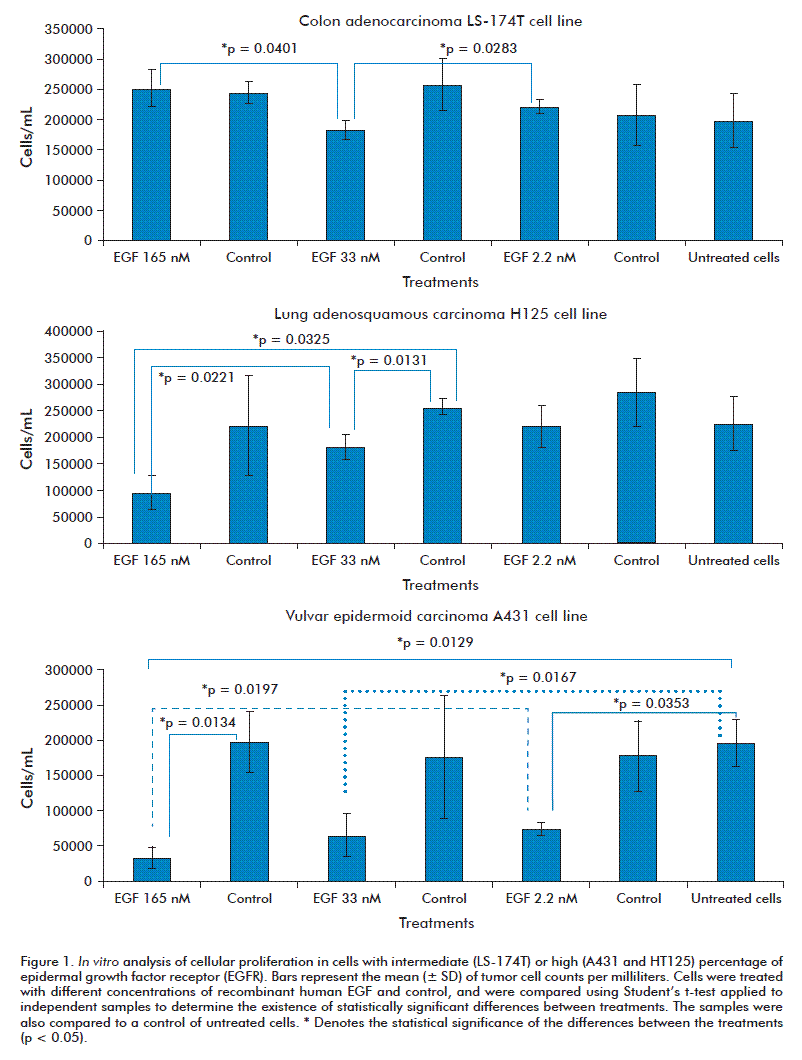
<body><![CDATA[<p   > </p >    <p   ><font size="3" color="#000000" face="Verdana, Arial, Helvetica, sans-serif"><b>MATERIALS  AND METHODS </b></font></p >    <p   ><font size="2" color="#000000" face="Verdana, Arial, Helvetica, sans-serif">We  used six cancer cell lines (K562, MCF-7, U1906, LS-174T, H125 and A431) with different  concentrations of EGFR. These cell lines were exposed for 72 h to the ligand effect  (EGF). An animal model was obtained in nude mice xenografts with the cell line  A431 over-expressing the levels of EGFR. The animals were treated subcutaneously  in the dorsal region, near to the tumor with 1 &micro;g/kg of EGF. The real time  polymerase chain reaction (RT-PCR) technique was used to explore the differential  expression of 44 genes involved in EGF signaling pathway and cancer in cells treated  with EGF and controls, in <i>in vitro</i> and <i>in vivo</i> models. The quantitative  RT-PCR data analysis was performed by RT-Cycler CapitalBio series analysis software,  version 2.001 (CapitalBio Co., Ltd., Beijing, China). Relative quantification  of gene expression was performed using the software REST 2009 v2.0.13 (Qiagen  GmbH, Germany). The LingReg software (version 11.3, 2009, Amsterdam, Netherlands)  was used to estimate the efficiency of PCR and, the geNorm software was used for  the selection of more stable reference genes [9]. </font></p >    <p   >&nbsp;</p >    <p   > </p >    <p   ><font size="3" color="#000000" face="Verdana, Arial, Helvetica, sans-serif"><b>RESULTS  AND DISCUSSION </b></font></p >    <p   ><font size="2" color="#000000" face="Verdana, Arial, Helvetica, sans-serif">EGF  at concentrations of 2.2, 33 and 165 nM does not favor the proliferation of tumor  cells. Interestingly was observed that EGF inhibited the proliferation of tumor  cells over-expressing the growth factor receptor (EGFR), such as H125 (lung adenosquamous  carcinoma cell line) and A431 (epidermoid carcinoma of the vulva cell line). According  to these results, there is a direct relationship between the inhibition of cell  proliferation, the exposition of cancer cells to high concentrations of exogenous  EGF and, the high amount of endogenous EGFR in cells (<a href="/img/revistas/bta/v30n3/f0108313.gif">Figure  1</a>). </font></p >    
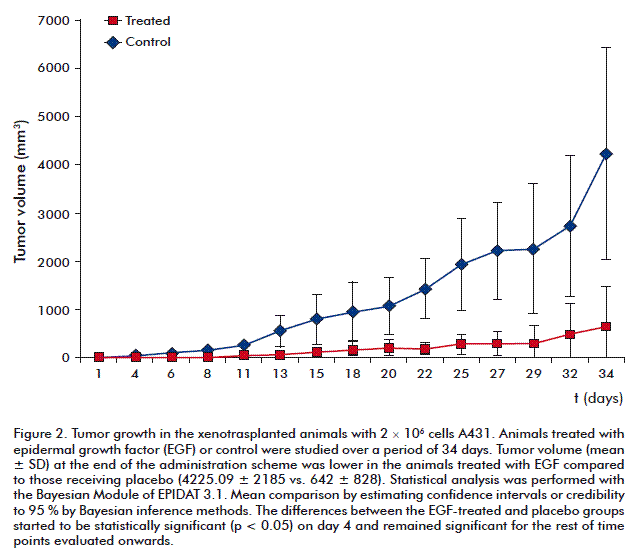
<p   ><font size="2" color="#000000" face="Verdana, Arial, Helvetica, sans-serif">We  observed an inhibition of tumor growth in the<i> in vivo</i> model of nude mice  xenografted with the A431 cell line and treated with EGF for 5 weeks (<a href="/img/revistas/bta/v30n3/f0208313.gif">Figure  2</a>), there was obtained a decrease in the mitotic index of tumor cells, which  is a critical parameter in the prevention and control of cancer [10]. Since EGF  may provide protective effects against the aggressiveness and invasiveness of  certain types of tumors, it was observed in the <i>in vivo</i> study a significant  increase in survival of the animals inoculated with 3 &times; 10<sup>6</sup> A431  cells and treated with EGF in comparison with the untreated animals [10]. The  EGF favored the survival of animals, perhaps by providing protective properties  against tumor aggressiveness and invasiveness. As proposed by Amagase <i>et al</i>.  in 1990, EGF plays an important role in preventing metastasis of certain malignancies,  thus prolonging the survival time of xenotransplanted athymic animals [11]. </font></p >    
<p   ><font size="2" color="#000000" face="Verdana, Arial, Helvetica, sans-serif">The  differential gene expression analysis in <i>in vivo </i>and <i>in vitro</i> studies  revealed the over-expression of genes that directly and potently regulate cell  cycle progression and apoptosis. This was detected by analyzing the differential  gene expression profile in the tumors and cell lines. </font></p >    <p   ><font size="2" color="#000000" face="Verdana, Arial, Helvetica, sans-serif">For  the cell line H125, 21 genes varied significantly their expression, with 27 in  A431. However, in the U1906 cell line, only 3 genes varied its expression. This  shows a correspondence between the magnitude of the gene expression variability  and the observed phenotype. </font></p >    ]]></body>
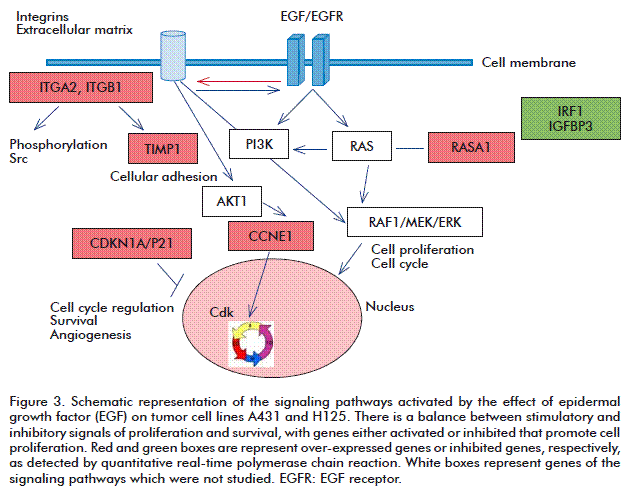
<body><![CDATA[<p   ><font size="2" color="#000000" face="Verdana, Arial, Helvetica, sans-serif">In  the A431 and H125 cell lines, similar genes were over-expressed and inhibited;  among them having a fold change above 2 (FC &ge; 2): ITGA2, CDKN1A/P21, CCNE1,  TIMP1, RASA1, ITGB1, IRF1, and IGFBP3. Most of them are part of the EGF/EGFR signaling  cascade, which regulates cell cycle progression and apoptosis. </font></p >    <p   ><font size="2" color="#000000" face="Verdana, Arial, Helvetica, sans-serif">A  scheme of the identified molecular interactions showing the most relevant genes  in gene expression analysis is shown in <a href="/img/revistas/bta/v30n3/f0308313.gif">Figure  3</a>. As can be observed there were genes with FC &gt; 1.5, with statistically  significant differences between treated and control cells of A431 and H125 tumor  cell lines. </font></p >    
<p   ><font size="2" color="#000000" face="Verdana, Arial, Helvetica, sans-serif">Also,  a specific group of genes for each cell line were involved in the process of cell  proliferation inhibition. In the cell line A431, the activation of the transcription  factor STAT1 induces the expression of genes involved in apoptosis and in the  inhibition of the TP53 gene, which carries a gain-of-function mutation favoring  cell tumorigenicity. Furthermore, in the H125 cell line was observed the over-expression  of pro-apoptotic genes, such as caspases 8 and 9. </font></p >    <p   ><font size="2" color="#000000" face="Verdana, Arial, Helvetica, sans-serif">In  general, the molecular mechanisms involved in the inhibition of tumor cell proliferation  in both scenarios (<i>in vivo</i> and <i>in vitro</i>), were directed by the variation  in the expression of genes that control cell cycle progression, such as the cyclin-dependent  kinase inhibitor CDKN1A, and cyclin-dependent kinase 4 (Cdk4). The way in which  these genes changed its expression may justify the phenotypic effect mediated  by the action of EGF in tumor cells. </font></p >    <p   ><font size="2" color="#000000" face="Verdana, Arial, Helvetica, sans-serif">As  already mentioned, the gene expression for the tumor suppressor gene TP53 varied  similarly in the A431 in studies <i>in vivo</i> and <i>in vitro</i>. The TP53  protein controls the cell cycle progression to repair the damage in the genome.  In the A431 cell line, TP53 gene has a point mutation p.Arg<sup>273His</sup>,  which is a change at the arginine residue 273 to histidine. This is a gain-of-function  type I mutation (type I missense mutation), which affects the binding sites of  the p53 protein to the DNA. Therefore, the G1/S checkpoint in the cell cycle does  not function properly to repair the genetic damage [12]. This causes a genomic  instability and malignant progression of cells. Among the phenotypic effects of  the mutated TP53 on the cells are: increased cell proliferation, increased growth  density and induction of antiapoptotic activity [13]. </font></p >    <p   ><font size="2" color="#000000" face="Verdana, Arial, Helvetica, sans-serif">The  inhibition of the mutated TP53 gene expression in the A431 cell line treated with  EGF may be associated to a decrease in tumorigenicity of the mutated protein.  A decrease in the levels of this protein may allow the cell to recover somewhat  the regulation of cell cycle progression at the G1-S transition, by decreasing  Cdk4 levels. We observed a possible link between the effect of EGF and the inhibition  of two important cell cycle regulators, the TP53 and Cdk4, and its implications  in the inhibition of cell cycle progression from G1 to S phase, thereby, decreasing  tumor growth. These results suggest that EGF promotes similar mechanisms in both  biological scenarios (<i>in vivo</i> and <i>in vitro</i>) in the A431 cell line,  resulting in an inhibition of cell proliferation. </font></p >    <p   ><font size="2" color="#000000" face="Verdana, Arial, Helvetica, sans-serif">Caspase  9 is another gene in the regulatory cascade of EGF on tumor cells bearing high  levels of EGFR. This gene is a member of the aspartic acid protease-cysteine family.  The sequential activation of caspases plays a central role in cellular apoptosis,  so that the action of EGF on restoring antitumor cell biological pathways may  also be taking place through activation of the caspase pathway. The activation  of caspases 8 and 9 were also detected in the H125 cell line treated with EGF.  This is another regulatory pathway activated in cancer models <i>in vivo</i> and  <i>in vitro</i> treated with the EGF. The <i>in vivo</i> scenario promotes transient  recovery of the cellular tumor suppressor ability, by reducing gene expression  levels of Cdk4 and TP53, and increasing caspase 9 levels. The <i>in vitro</i>  models revealed a group of genes that varies in a similar fashion in the A431  and H125 cell lines, which inhibited the EGF-mediated proliferation. </font></p >    <p   ><font size="2" color="#000000" face="Verdana, Arial, Helvetica, sans-serif">All  these genes are involved in the signaling cascade of EGF/EGFR and cancer. It is  relevant the activation by EGF of the expression of integrins like ITGA2 and ITGB1  (<a href="/img/revistas/bta/v30n3/f0308313.gif">Figure 3</a>), which in turn  activates the signaling cascade through EGFR. These signals may induce the expression  of integrins, a family of transmembrane glycoprotein receptors that mediate cell-cell  and cell-matrix interactions, playing a fundamental role in cellular events such  as proliferation, differentiation and apoptosis. It is also known that the over-expression  of the beta1 integrin inhibits cell proliferation through the activation of the  cyclin dependent kinase inhibitor p21. Integrin over-expression can reduce cell  adhesion and can inactivate the phosphoinositide 3 kinase (PI3K) [14]. </font></p >    
<p   ><font size="2" color="#000000" face="Verdana, Arial, Helvetica, sans-serif">The  protein encoded by the p21 gene is the cyclin dependent kinase inhibitor 1A (CDKN1A),  which regulates the cell cycle S phase progression. The P21 expression is regulated  by the tumor suppressor gene TP53. It has also shown to be regulated by other  genes such as the integrins, through its effect on the PI3K/AKT1 pathway of the  EGFR signaling cascade. </font></p >    <p   ><font size="2" color="#000000" face="Verdana, Arial, Helvetica, sans-serif">The  STAT1 transcription factor is another interesting gene, which, as has been reported  by other groups, is activated in the A431 cell line [15]. Its activation is associated  with a decrease in cell proliferation and increased apoptosis, and is further  required to inhibit the proto-oncogene MYC, which directs cell proliferation through  the over-expression of cyclins and gene expression inhibition of p21. In the A431  cell line, the expression of MYC was inhibited, and, therefore, it must favor  the cell proliferation inhibition observed in these cells. </font></p >    ]]></body>
<body><![CDATA[<p   ><font size="2" color="#000000" face="Verdana, Arial, Helvetica, sans-serif">On  the other hand, the TIMP1 gene is a metalloprotease inhibitor that was over-expressed  in A431 and H125 cell lines. This factor forms complexes with matrix metalloproteinases  (MMP) and irreversibly inactivates collagenase. MMPs belong to the extracellular  matrix (ECM) which activates the integrins. It is known that there must be a balance  between the levels of proteases and their inhibitors to form a correct ECM, which  is a component of the granulation tissue, a key component of wound healing and  tissue regeneration. Moreover, one of the key events in malignant tumor development  is the degradation of the ECM, which at the time is essential for angiogenesis  and the formation of blood vessels from preexisting blood networks. </font></p >    <p   ><font size="2" color="#000000" face="Verdana, Arial, Helvetica, sans-serif">Another  interesting gene was RASA1, showing increased expression in both, the A431 and  H125 cell lines. The RASA1 protein is a negative regulator of the RAS/MAPK signaling  pathway, which transmits signals from outside the cell into the nucleus. The signaling  pathway through RAS/MAPK directs important functions such as cell growth and division.  When RASA1 is mutated, there is a path of deregulation through RAS/MAPK pathway,  which promotes uncontrolled proliferation and cancer development. </font></p >    <p   ><font size="2" color="#000000" face="Verdana, Arial, Helvetica, sans-serif">In  this scenario, not everything is an antiproliferative and pro-apoptotic stage,  as has been arising from the explanation for the inhibition seen in cell proliferation  and tumor growth, promoted by genes such as: TIMP1, p21, Cdk4, ITGA2, ITGB, TP53,  MYC, RASA1 and caspases 8 and 9. There was also a group of genes that varied their  expression, which participate in cell proliferation promotion. This is the case  of the over-expression of the CCNE1 gene, a member of the cyclins family, which  positively regulates the G1/S transition. </font></p >    <p   ><font size="2" color="#000000" face="Verdana, Arial, Helvetica, sans-serif">In  a complex scenario such as the EGF/EGFR signaling cascade, it is significant that  the cell promotes activation of powerful regulatory mechanisms. Those mechanisms  maintain the control over the oncogenic effects that can trigger and support uncontrolled  cell proliferation and cancer development. </font></p >    <p   ><font size="2" color="#000000" face="Verdana, Arial, Helvetica, sans-serif">Recent  reports suggest that EGF induces more changes in cell proliferation and death  in A431 cancer cells than the anticancer drugs cetuximab or gefitinib [16]. Cell  arrest and death events produced by EGF appear to remain for periods longer than  those caused by some conventional antitumor drugs. This is important to continue  unraveling the complex molecular mechanisms of EGF in cell proliferation inhibition  in cancer cells. </font></p >    <p   >&nbsp;</p >    <p   ><font size="2" color="#000000" face="Verdana, Arial, Helvetica, sans-serif"><b><font size="3">CONCLUSIONS  </font> </b></font></p >    <p   ><font size="2" color="#000000" face="Verdana, Arial, Helvetica, sans-serif">This  is the first study in Cuba exploring the mechanism of action of EGF using the  RT-PCR technique to quantify the differential gene expression profile of 44 genes  involved in cancer pathways and the EGF/EGFR signaling. It is also the first time  that the inhibitory effect of EGF on cell proliferation is related to the gene  expression levels of the mutant TP53p.Arg<sup>273His</sup> and the inhibition  of cell proliferation in an<i> in vivo</i> and <i>in vitro</i> model using the  vulva cancer cell line A431. </font></p >    <p   ><font size="2" color="#000000" face="Verdana, Arial, Helvetica, sans-serif">The  antiproliferative effects of EGF were mediated by changes detected in the expression  of genes which regulate cell cycle progression, apoptosis and transcription. They  included the effect of the gene dependent kinases inhibitor (CDKN1A) which regulates  cell cycle progression, and the caspase 8 and 9, and the transcription factor  STAT1 genes. </font></p >    <p   ><font size="2" color="#000000" face="Verdana, Arial, Helvetica, sans-serif">There  is a functional convergence between EGFR expression levels in cells and the signaling  through integrins, thus favoring the over-expression of the cell cycle inhibitor  gene CDKN1A/P21. It was also observed that EGF at a 2.2 nM concentration significantly  promotes survival of treated animals when placed subcutaneously near to the tumor  generated in nude mice xenografted with the A431 cell line</font><font size="2" face="Verdana, Arial, Helvetica, sans-serif">.  </font></p ></div ><FONT size="+1" color="#000000"><FONT size="+1"><FONT size="+1"><FONT size="+1"><FONT size="+1"><FONT size="+1"><FONT size="+1"><FONT size="+1"><FONT size="+1"><FONT size="+1"><FONT size="+1"><FONT size="+1"><FONT size="+1"><FONT size="+1"><FONT size="+1"><FONT size="+1"><FONT size="+1"><FONT size="+1"><FONT size="+1"><FONT size="+1"><FONT size="+1"><FONT size="+1"><FONT size="+1"><FONT size="+1"><FONT size="+1"><FONT size="+1"><FONT size="+1"><FONT size="+1"><FONT size="+1"><FONT size="+1">      ]]></body>
<body><![CDATA[<P   align="justify" >&nbsp;</P >    <P   align="justify" > </P >    <P   align="justify" ><font size="3" face="Verdana, Arial, Helvetica, sans-serif"><B>REFERENCES </b></font></P >    <!-- ref --><P   align="justify" ><font size="2" face="Verdana, Arial, Helvetica, sans-serif">1. Cross M, Dexter  TM. Growth factors in development, transformation, and tumorigenesis. Cell. 1991;64(2):271-80.    <br> </font></P >    <!-- ref --><P   align="justify" ><font size="2" face="Verdana, Arial, Helvetica, sans-serif">2. Berlanga J, &Aacute;lvarez  S, De la Fuente J, L&oacute;pez P. Considerations on the transforming potential  of the epidermal growth factor. Biotecnol Apl. 1998;15(2):65-9.    <br> </font></P >    <!-- ref --><P   align="justify" ><font size="2" face="Verdana, Arial, Helvetica, sans-serif">3. Barnes DW. Epidermal  growth factor inhibits growth of A431 human epidermoid carcinoma in serum-free  cell culture. J Cell Biol. 1982;93:1-4.    <br> </font></P >    <P   align="justify" ><font size="2" face="Verdana, Arial, Helvetica, sans-serif">4. Kawamoto T, Sato  JD, Le A, Polikoff J, Sato GH and Mendelsohn J. Growth stimulation of A431 cells  by epidermal growth factor: identification of high-affinity receptors for epidermal  growth factor by an anti-receptor monoclonal antibody. Proc Natl Acad Sci USA.  1983;80:1337-41.     ]]></body>
<body><![CDATA[<br> </font></P >    <!-- ref --><P   align="justify" ><font size="2" face="Verdana, Arial, Helvetica, sans-serif">5. Kawamoto T, Mendelsohn  J, Le A, Sato GH, Lazar CS, Gill GN. Relation of epidermal growth factor receptor  concentration to growth of human epidermoid carcinoma A431 cells. J Biol Chem.  1984;259:7761-6.    <br> </font></P >    <!-- ref --><P   align="justify" ><font size="2" face="Verdana, Arial, Helvetica, sans-serif">6. Fan Z, Lu Y, Wu  X, DeBlasio A, Koff A, Mendelsohn J. Prolonged induction of p21cip1/WAF1/CDK2/PCNA  complex by epidermal growth factor receptor activation mediates ligand-induced  A431 cell growth inhibition. J Cell Biochem. 1995;131:235-24.    <br> </font></P >    <!-- ref --><P   align="justify" ><font size="2" face="Verdana, Arial, Helvetica, sans-serif">7. Choi J, Moon SY,  Hong JP, Song Jy, Oh KT, Lee SW. Epidermal growth factor induces cell death in  the absence of overexpressed epidermal growth factor receptor and erbb2 in various  human cancer cell lines. Cancer Invest. 2010;28:505-14.    <br> </font></P >    <!-- ref --><P   align="justify" ><font size="2" face="Verdana, Arial, Helvetica, sans-serif">8. Defize LHK, Boonstra  J, Meisenhelder J, Kruijer W, Tertoolen LGJ, Tilly BC. Signal transduction by  epidermal growth factor occurs through the subclass of high affinity receptors.  J Cell Biol. 1989;109:2495-507.    <br> </font></P >    <!-- ref --><P   align="justify" ><font size="2" face="Verdana, Arial, Helvetica, sans-serif">9. Vandesompele J,  De Preter K, Pattyn F, Poppe B, Van Roy N, De Paepe A, et al. Accurate normalization  of real-time quantitative RT-PCR data by geometric averaging of multiple internal  control genes. Genome Biol. 2002;3(7):RESEARCH0034.    <br> </font></P >    <!-- ref --><P   align="justify" ><font size="2" face="Verdana, Arial, Helvetica, sans-serif">10. Guill&eacute;n  IA, Camacho H, Fern&aacute;ndez ME, Palenzuela DO, P&eacute;rez L, Ochagavia ME,  et al. Effect of human epidermal growth factor on the tumor cell line A431: in  vivo analysis of tumor growth inhibition and gene expression. Biotecnol Apl. 2012;29:155-61.    <br>  </font></P >    <!-- ref --><P   align="justify" ><font size="2" face="Verdana, Arial, Helvetica, sans-serif">11. Amagase H, Tamura  K, Okuhira M, Kakimoto M, Amano H, Hashimoto K, et al. Epidermal growth factor  prolongs survival time of tumor-bearing mice. Jpn J Cancer. Res. 1990;81(5):495-500.    <br>  </font></P >    <!-- ref --><P   align="justify" ><font size="2" face="Verdana, Arial, Helvetica, sans-serif">12. Williams AC,  Miller JC, Collard TJ, Bracey TS, Cosulich S, Paraskeva C. Mutant p53 is not fully  dominant over endogenous wild type p53 in a colorectal adenoma cell line as demonstrated  by induction of MDM2 protein and retention of a p53 dependent G1 arrest after  gamma irradiation. Oncogene. 1995;11(1):141-9.    <br> </font></P >    <!-- ref --><P   align="justify" ><font size="2" face="Verdana, Arial, Helvetica, sans-serif">13. Prasad KA, Church  JG. EGF effects on p53 in MDA-468 human breast cancer cells: implications for  G1 arrest. Cell Prolif. 1997;30(2):81-94.    <br> </font></P >    <!-- ref --><P   align="justify" ><font size="2" face="Verdana, Arial, Helvetica, sans-serif">14. Banno A, Ginsberg  MH. Integrin activation. Biochem Soc Trans. 2008;36(Pt 2):229-34.    <br> </font></P >    <!-- ref --><P   align="justify" ><font size="2" face="Verdana, Arial, Helvetica, sans-serif">15. Gulli LF, Palmer  KC, Chen YQ, Reddy KB. Epidermal growth factor-induced apoptosis in A431 cells  can be reversed by reducing the tyrosine kinase activity. Cell Growth Differ.  1996;7(2):173-8.    <br> </font></P >    <!-- ref --><P   align="justify" ><font size="2" face="Verdana, Arial, Helvetica, sans-serif">16. Song JY, Lee  SW, Hong JP, Chang SE, Choe H, Choi J. Epidermal growth factor competes with EGF  receptor inhibitors to induce cell death in EGFR-overexpressing tumor cells. Cancer  Lett. 2009;283(2):135-42</font><font size="2" face="Verdana,     Arial, Helvetica, sans-serif">.  </font></P ><FONT size="+1"><FONT color="#0000FF"><FONT color="#000000"><FONT color="#0000FF"><FONT color="#000000"><FONT color="#0000FF"><FONT color="#000000">      <P   align="justify" >&nbsp;</P >    <P   align="justify" >&nbsp;</P ></font><font size="+1" color="#000000"><font size="2" face="Verdana, Arial, Helvetica, sans-serif"><i>Isabel  A Guill&eacute;n</i></font></font><font size="2" face="Verdana, Arial, Helvetica, sans-serif">.  </font><font size="+1" color="#000000"><font size="+1"><font size="+1"><font size="+1"><font size="+1"><font size="+1"><font size="+1" color="#000000"><font size="+1"><font size="+1"><font size="+1"><font size="+1"><font size="+1"><font size="2" face="Verdana, Arial, Helvetica, sans-serif">Centro  de Ingenier&iacute;a Gen&eacute;tica y Biotecnolog&iacute;a, CIGB. Ave. 31 e/  158 y 190, Cubanac&aacute;n, Playa, CP 11600, La Habana, Cuba. E-mail: <a href="mailto:isabel.guillen@cigb.edu.cu">isabel.guillen@cigb.edu.cu</a>.</font></font></font></font></font></font></font></font></font></font></font></font></font></font></font></font></font></font></font></font></font></font></font></font></font></font></font></font></font></font></font></font></font></font></font></font></font></font></font></font></font></font></font></font></font></font></font></font></font></DIV >      ]]></body><back>
<ref-list>
<ref id="B1">
<label>1</label><nlm-citation citation-type="journal">
<person-group person-group-type="author">
<name>
<surname><![CDATA[Cross]]></surname>
<given-names><![CDATA[M]]></given-names>
</name>
<name>
<surname><![CDATA[Dexter]]></surname>
<given-names><![CDATA[TM]]></given-names>
</name>
</person-group>
<article-title xml:lang="en"><![CDATA[Growth factors in development, transformation, and tumorigenesis]]></article-title>
<source><![CDATA[Cell]]></source>
<year>1991</year>
<volume>64</volume>
<numero>2</numero>
<issue>2</issue>
<page-range>271-80</page-range></nlm-citation>
</ref>
<ref id="B2">
<label>2</label><nlm-citation citation-type="journal">
<person-group person-group-type="author">
<name>
<surname><![CDATA[Berlanga]]></surname>
<given-names><![CDATA[J]]></given-names>
</name>
<name>
<surname><![CDATA[Álvarez]]></surname>
<given-names><![CDATA[S]]></given-names>
</name>
<name>
<surname><![CDATA[De la Fuente]]></surname>
<given-names><![CDATA[J]]></given-names>
</name>
<name>
<surname><![CDATA[López]]></surname>
<given-names><![CDATA[P]]></given-names>
</name>
</person-group>
<article-title xml:lang="en"><![CDATA[Considerations on the transforming potential of the epidermal growth factor]]></article-title>
<source><![CDATA[Biotecnol Apl]]></source>
<year>1998</year>
<volume>15</volume>
<numero>2</numero>
<issue>2</issue>
<page-range>65-9</page-range></nlm-citation>
</ref>
<ref id="B3">
<label>3</label><nlm-citation citation-type="journal">
<person-group person-group-type="author">
<name>
<surname><![CDATA[Barnes]]></surname>
<given-names><![CDATA[DW]]></given-names>
</name>
</person-group>
<article-title xml:lang="en"><![CDATA[Epidermal growth factor inhibits growth of A431 human epidermoid carcinoma in serum-free cell culture]]></article-title>
<source><![CDATA[J Cell Biol]]></source>
<year>1982</year>
<volume>93</volume>
<page-range>1-4</page-range></nlm-citation>
</ref>
<ref id="B4">
<label>4</label><nlm-citation citation-type="journal">
<person-group person-group-type="author">
<name>
<surname><![CDATA[Kawamoto]]></surname>
<given-names><![CDATA[T]]></given-names>
</name>
<name>
<surname><![CDATA[Sato]]></surname>
<given-names><![CDATA[JD]]></given-names>
</name>
<name>
<surname><![CDATA[Le]]></surname>
<given-names><![CDATA[A]]></given-names>
</name>
<name>
<surname><![CDATA[Polikoff]]></surname>
<given-names><![CDATA[J]]></given-names>
</name>
<name>
<surname><![CDATA[Sato]]></surname>
<given-names><![CDATA[GH]]></given-names>
</name>
<name>
<surname><![CDATA[Mendelsohn]]></surname>
<given-names><![CDATA[J]]></given-names>
</name>
</person-group>
<article-title xml:lang="en"><![CDATA[Growth stimulation of A431 cells by epidermal growth factor: identification of high-affinity receptors for epidermal growth factor by an anti-receptor monoclonal antibody]]></article-title>
<source><![CDATA[Proc Natl Acad Sci USA]]></source>
<year>1983</year>
<volume>80</volume>
<page-range>1337-41</page-range></nlm-citation>
</ref>
<ref id="B5">
<label>5</label><nlm-citation citation-type="journal">
<person-group person-group-type="author">
<name>
<surname><![CDATA[Kawamoto]]></surname>
<given-names><![CDATA[T]]></given-names>
</name>
<name>
<surname><![CDATA[Mendelsohn]]></surname>
<given-names><![CDATA[J]]></given-names>
</name>
<name>
<surname><![CDATA[Le]]></surname>
<given-names><![CDATA[A]]></given-names>
</name>
<name>
<surname><![CDATA[Sato]]></surname>
<given-names><![CDATA[GH]]></given-names>
</name>
<name>
<surname><![CDATA[Lazar]]></surname>
<given-names><![CDATA[CS]]></given-names>
</name>
<name>
<surname><![CDATA[Gill]]></surname>
<given-names><![CDATA[GN]]></given-names>
</name>
</person-group>
<article-title xml:lang="en"><![CDATA[Relation of epidermal growth factor receptor concentration to growth of human epidermoid carcinoma A431 cells]]></article-title>
<source><![CDATA[J Biol Chem]]></source>
<year>1984</year>
<volume>259</volume>
<page-range>7761-6</page-range></nlm-citation>
</ref>
<ref id="B6">
<label>6</label><nlm-citation citation-type="journal">
<person-group person-group-type="author">
<name>
<surname><![CDATA[Fan]]></surname>
<given-names><![CDATA[Z]]></given-names>
</name>
<name>
<surname><![CDATA[Lu]]></surname>
<given-names><![CDATA[Y]]></given-names>
</name>
<name>
<surname><![CDATA[Wu]]></surname>
<given-names><![CDATA[X]]></given-names>
</name>
<name>
<surname><![CDATA[DeBlasio]]></surname>
<given-names><![CDATA[A]]></given-names>
</name>
<name>
<surname><![CDATA[Koff]]></surname>
<given-names><![CDATA[A]]></given-names>
</name>
<name>
<surname><![CDATA[Mendelsohn]]></surname>
<given-names><![CDATA[J]]></given-names>
</name>
</person-group>
<article-title xml:lang="en"><![CDATA[Prolonged induction of p21cip1/WAF1/CDK2/PCNA complex by epidermal growth factor receptor activation mediates ligand-induced A431 cell growth inhibition]]></article-title>
<source><![CDATA[J Cell Biochem]]></source>
<year>1995</year>
<volume>131</volume>
<page-range>235-24</page-range></nlm-citation>
</ref>
<ref id="B7">
<label>7</label><nlm-citation citation-type="journal">
<person-group person-group-type="author">
<name>
<surname><![CDATA[Choi]]></surname>
<given-names><![CDATA[J]]></given-names>
</name>
<name>
<surname><![CDATA[Moon]]></surname>
<given-names><![CDATA[SY]]></given-names>
</name>
<name>
<surname><![CDATA[Hong]]></surname>
<given-names><![CDATA[JP]]></given-names>
</name>
<name>
<surname><![CDATA[Song]]></surname>
<given-names><![CDATA[Jy]]></given-names>
</name>
<name>
<surname><![CDATA[Oh]]></surname>
<given-names><![CDATA[KT]]></given-names>
</name>
<name>
<surname><![CDATA[Lee]]></surname>
<given-names><![CDATA[SW]]></given-names>
</name>
</person-group>
<article-title xml:lang="en"><![CDATA[Epidermal growth factor induces cell death in the absence of overexpressed epidermal growth factor receptor and erbb2 in various human cancer cell lines]]></article-title>
<source><![CDATA[Cancer Invest]]></source>
<year>2010</year>
<volume>28</volume>
<page-range>505-14</page-range></nlm-citation>
</ref>
<ref id="B8">
<label>8</label><nlm-citation citation-type="journal">
<person-group person-group-type="author">
<name>
<surname><![CDATA[Defize]]></surname>
<given-names><![CDATA[LHK]]></given-names>
</name>
<name>
<surname><![CDATA[Boonstra]]></surname>
<given-names><![CDATA[J]]></given-names>
</name>
<name>
<surname><![CDATA[Meisenhelder]]></surname>
<given-names><![CDATA[J]]></given-names>
</name>
<name>
<surname><![CDATA[Kruijer]]></surname>
<given-names><![CDATA[W]]></given-names>
</name>
<name>
<surname><![CDATA[Tertoolen]]></surname>
<given-names><![CDATA[LGJ]]></given-names>
</name>
<name>
<surname><![CDATA[Tilly]]></surname>
<given-names><![CDATA[BC]]></given-names>
</name>
</person-group>
<article-title xml:lang="en"><![CDATA[Signal transduction by epidermal growth factor occurs through the subclass of high affinity receptors]]></article-title>
<source><![CDATA[J Cell Biol]]></source>
<year>1989</year>
<volume>109</volume>
<page-range>2495-507</page-range></nlm-citation>
</ref>
<ref id="B9">
<label>9</label><nlm-citation citation-type="journal">
<person-group person-group-type="author">
<name>
<surname><![CDATA[Vandesompele]]></surname>
<given-names><![CDATA[J]]></given-names>
</name>
<name>
<surname><![CDATA[De Preter]]></surname>
<given-names><![CDATA[K]]></given-names>
</name>
<name>
<surname><![CDATA[Pattyn]]></surname>
<given-names><![CDATA[F]]></given-names>
</name>
<name>
<surname><![CDATA[Poppe]]></surname>
<given-names><![CDATA[B]]></given-names>
</name>
<name>
<surname><![CDATA[Van Roy]]></surname>
<given-names><![CDATA[N]]></given-names>
</name>
<name>
<surname><![CDATA[De Paepe]]></surname>
<given-names><![CDATA[A]]></given-names>
</name>
</person-group>
<article-title xml:lang="en"><![CDATA[Accurate normalization of real-time quantitative RT-PCR data by geometric averaging of multiple internal control genes]]></article-title>
<source><![CDATA[Genome Biol]]></source>
<year>2002</year>
<volume>3</volume>
<numero>7</numero>
<issue>7</issue>
<page-range>RESEARCH0034</page-range></nlm-citation>
</ref>
<ref id="B10">
<label>10</label><nlm-citation citation-type="journal">
<person-group person-group-type="author">
<name>
<surname><![CDATA[Guillén]]></surname>
<given-names><![CDATA[IA]]></given-names>
</name>
<name>
<surname><![CDATA[Camacho]]></surname>
<given-names><![CDATA[H]]></given-names>
</name>
<name>
<surname><![CDATA[Fernández]]></surname>
<given-names><![CDATA[ME]]></given-names>
</name>
<name>
<surname><![CDATA[Palenzuela]]></surname>
<given-names><![CDATA[DO]]></given-names>
</name>
<name>
<surname><![CDATA[Pérez]]></surname>
<given-names><![CDATA[L]]></given-names>
</name>
<name>
<surname><![CDATA[Ochagavia]]></surname>
<given-names><![CDATA[ME]]></given-names>
</name>
</person-group>
<article-title xml:lang="en"><![CDATA[Effect of human epidermal growth factor on the tumor cell line A431: in vivo analysis of tumor growth inhibition and gene expression]]></article-title>
<source><![CDATA[Biotecnol Apl]]></source>
<year>2012</year>
<volume>29</volume>
<page-range>155-61</page-range></nlm-citation>
</ref>
<ref id="B11">
<label>11</label><nlm-citation citation-type="journal">
<person-group person-group-type="author">
<name>
<surname><![CDATA[Amagase]]></surname>
<given-names><![CDATA[H]]></given-names>
</name>
<name>
<surname><![CDATA[Tamura]]></surname>
<given-names><![CDATA[K]]></given-names>
</name>
<name>
<surname><![CDATA[Okuhira]]></surname>
<given-names><![CDATA[M]]></given-names>
</name>
<name>
<surname><![CDATA[Kakimoto]]></surname>
<given-names><![CDATA[M]]></given-names>
</name>
<name>
<surname><![CDATA[Amano]]></surname>
<given-names><![CDATA[H]]></given-names>
</name>
<name>
<surname><![CDATA[Hashimoto]]></surname>
<given-names><![CDATA[K]]></given-names>
</name>
</person-group>
<article-title xml:lang="en"><![CDATA[Epidermal growth factor prolongs survival time of tumor-bearing mice]]></article-title>
<source><![CDATA[Jpn J Cancer Res]]></source>
<year>1990</year>
<volume>81</volume>
<numero>5</numero>
<issue>5</issue>
<page-range>495-500</page-range></nlm-citation>
</ref>
<ref id="B12">
<label>12</label><nlm-citation citation-type="journal">
<person-group person-group-type="author">
<name>
<surname><![CDATA[Williams]]></surname>
<given-names><![CDATA[AC]]></given-names>
</name>
<name>
<surname><![CDATA[Miller]]></surname>
<given-names><![CDATA[JC]]></given-names>
</name>
<name>
<surname><![CDATA[Collard]]></surname>
<given-names><![CDATA[TJ]]></given-names>
</name>
<name>
<surname><![CDATA[Bracey]]></surname>
<given-names><![CDATA[TS]]></given-names>
</name>
<name>
<surname><![CDATA[Cosulich]]></surname>
<given-names><![CDATA[S]]></given-names>
</name>
<name>
<surname><![CDATA[Paraskeva]]></surname>
<given-names><![CDATA[C]]></given-names>
</name>
</person-group>
<article-title xml:lang="en"><![CDATA[Mutant p53 is not fully dominant over endogenous wild type p53 in a colorectal adenoma cell line as demonstrated by induction of MDM2 protein and retention of a p53 dependent G1 arrest after gamma irradiation]]></article-title>
<source><![CDATA[Oncogene]]></source>
<year>1995</year>
<volume>11</volume>
<numero>1</numero>
<issue>1</issue>
<page-range>141-9</page-range></nlm-citation>
</ref>
<ref id="B13">
<label>13</label><nlm-citation citation-type="journal">
<person-group person-group-type="author">
<name>
<surname><![CDATA[Prasad]]></surname>
<given-names><![CDATA[KA]]></given-names>
</name>
<name>
<surname><![CDATA[Church]]></surname>
<given-names><![CDATA[JG]]></given-names>
</name>
</person-group>
<article-title xml:lang="en"><![CDATA[EGF effects on p53 in MDA-468 human breast cancer cells: implications for G1 arrest]]></article-title>
<source><![CDATA[Cell Prolif]]></source>
<year>1997</year>
<volume>30</volume>
<numero>2</numero>
<issue>2</issue>
<page-range>81-94</page-range></nlm-citation>
</ref>
<ref id="B14">
<label>14</label><nlm-citation citation-type="journal">
<person-group person-group-type="author">
<name>
<surname><![CDATA[Banno]]></surname>
<given-names><![CDATA[A]]></given-names>
</name>
<name>
<surname><![CDATA[Ginsberg]]></surname>
<given-names><![CDATA[MH]]></given-names>
</name>
</person-group>
<article-title xml:lang="en"><![CDATA[Integrin activation]]></article-title>
<source><![CDATA[Biochem Soc Trans]]></source>
<year>2008</year>
<volume>36</volume>
<numero>2</numero>
<issue>2</issue>
<page-range>229-34</page-range></nlm-citation>
</ref>
<ref id="B15">
<label>15</label><nlm-citation citation-type="journal">
<person-group person-group-type="author">
<name>
<surname><![CDATA[Gulli]]></surname>
<given-names><![CDATA[LF]]></given-names>
</name>
<name>
<surname><![CDATA[Palmer]]></surname>
<given-names><![CDATA[KC]]></given-names>
</name>
<name>
<surname><![CDATA[Chen]]></surname>
<given-names><![CDATA[YQ]]></given-names>
</name>
<name>
<surname><![CDATA[Reddy]]></surname>
<given-names><![CDATA[KB]]></given-names>
</name>
</person-group>
<article-title xml:lang="en"><![CDATA[Epidermal growth factor-induced apoptosis in A431 cells can be reversed by reducing the tyrosine kinase activity]]></article-title>
<source><![CDATA[Cell Growth Differ]]></source>
<year>1996</year>
<volume>7</volume>
<numero>2</numero>
<issue>2</issue>
<page-range>173-8</page-range></nlm-citation>
</ref>
<ref id="B16">
<label>16</label><nlm-citation citation-type="journal">
<person-group person-group-type="author">
<name>
<surname><![CDATA[Song]]></surname>
<given-names><![CDATA[JY]]></given-names>
</name>
<name>
<surname><![CDATA[Lee]]></surname>
<given-names><![CDATA[SW]]></given-names>
</name>
<name>
<surname><![CDATA[Hong]]></surname>
<given-names><![CDATA[JP]]></given-names>
</name>
<name>
<surname><![CDATA[Chang]]></surname>
<given-names><![CDATA[SE]]></given-names>
</name>
<name>
<surname><![CDATA[Choe]]></surname>
<given-names><![CDATA[H]]></given-names>
</name>
<name>
<surname><![CDATA[Choi]]></surname>
<given-names><![CDATA[J]]></given-names>
</name>
</person-group>
<article-title xml:lang="en"><![CDATA[Epidermal growth factor competes with EGF receptor inhibitors to induce cell death in EGFR-overexpressing tumor cells]]></article-title>
<source><![CDATA[Cancer Lett]]></source>
<year>2009</year>
<volume>283</volume>
<numero>2</numero>
<issue>2</issue>
<page-range>135-42</page-range></nlm-citation>
</ref>
</ref-list>
</back>
</article>