<?xml version="1.0" encoding="ISO-8859-1"?><article xmlns:mml="http://www.w3.org/1998/Math/MathML" xmlns:xlink="http://www.w3.org/1999/xlink" xmlns:xsi="http://www.w3.org/2001/XMLSchema-instance">
<front>
<journal-meta>
<journal-id>1027-2852</journal-id>
<journal-title><![CDATA[Biotecnología Aplicada]]></journal-title>
<abbrev-journal-title><![CDATA[Biotecnol Apl]]></abbrev-journal-title>
<issn>1027-2852</issn>
<publisher>
<publisher-name><![CDATA[Editorial Elfos Scientiae]]></publisher-name>
</publisher>
</journal-meta>
<article-meta>
<article-id>S1027-28522013000300009</article-id>
<title-group>
<article-title xml:lang="en"><![CDATA[Phylogenetic and molecular characterization of coronavirus affecting species of bovine and birds in Cuba]]></article-title>
<article-title xml:lang="es"><![CDATA[Caracterización filogenética y molecular de Coronavirus que afectan a especies de bovinos y aves en Cuba]]></article-title>
</title-group>
<contrib-group>
<contrib contrib-type="author">
<name>
<surname><![CDATA[Acevedo]]></surname>
<given-names><![CDATA[Ana M]]></given-names>
</name>
<xref ref-type="aff" rid="A01"/>
</contrib>
<contrib contrib-type="author">
<name>
<surname><![CDATA[Martínez]]></surname>
<given-names><![CDATA[Nadia]]></given-names>
</name>
<xref ref-type="aff" rid="A01"/>
</contrib>
<contrib contrib-type="author">
<name>
<surname><![CDATA[Brandão]]></surname>
<given-names><![CDATA[Paulo]]></given-names>
</name>
<xref ref-type="aff" rid="A02"/>
</contrib>
<contrib contrib-type="author">
<name>
<surname><![CDATA[Perera]]></surname>
<given-names><![CDATA[Carmen L]]></given-names>
</name>
<xref ref-type="aff" rid="A01"/>
</contrib>
<contrib contrib-type="author">
<name>
<surname><![CDATA[Frías]]></surname>
<given-names><![CDATA[María T]]></given-names>
</name>
<xref ref-type="aff" rid="A01"/>
</contrib>
<contrib contrib-type="author">
<name>
<surname><![CDATA[Barrera]]></surname>
<given-names><![CDATA[Maritza]]></given-names>
</name>
<xref ref-type="aff" rid="A01"/>
</contrib>
<contrib contrib-type="author">
<name>
<surname><![CDATA[Pérez]]></surname>
<given-names><![CDATA[Lester J]]></given-names>
</name>
<xref ref-type="aff" rid="A01"/>
</contrib>
</contrib-group>
<aff id="A02">
<institution><![CDATA[,University of São Paulo College of Veterinary Medicine Department of Preventive Veterinary Medicine and Animal Health]]></institution>
<addr-line><![CDATA[São Paulo ]]></addr-line>
<country>Brazil</country>
</aff>
<aff id="A01">
<institution><![CDATA[,Centro Nacional de Sanidad Agropecuaria, Censa Dirección de Microbiología Grupo de Virología Animal]]></institution>
<addr-line><![CDATA[San José de las Lajas ]]></addr-line>
<country>Cuba</country>
</aff>
<pub-date pub-type="pub">
<day>00</day>
<month>09</month>
<year>2013</year>
</pub-date>
<pub-date pub-type="epub">
<day>00</day>
<month>09</month>
<year>2013</year>
</pub-date>
<volume>30</volume>
<numero>3</numero>
<fpage>228</fpage>
<lpage>231</lpage>
<copyright-statement/>
<copyright-year/>
<self-uri xlink:href="http://scielo.sld.cu/scielo.php?script=sci_arttext&amp;pid=S1027-28522013000300009&amp;lng=en&amp;nrm=iso"></self-uri><self-uri xlink:href="http://scielo.sld.cu/scielo.php?script=sci_abstract&amp;pid=S1027-28522013000300009&amp;lng=en&amp;nrm=iso"></self-uri><self-uri xlink:href="http://scielo.sld.cu/scielo.php?script=sci_pdf&amp;pid=S1027-28522013000300009&amp;lng=en&amp;nrm=iso"></self-uri><abstract abstract-type="short" xml:lang="en"><p><![CDATA[Avian infectious bronchitis virus (IBV) and bovine coronavirus (BCoV) are pathogens of veterinary importance that affect birds and bovine in Cuba; however, molecular characteristics and genetic diversity of these viruses are unknown. This study was aimed at determining the molecular characteristics and genetic diversity of both agents, based in the spike S gene. A molecular analysis was carried out from field strains of BCoV collected between 2009 and 2011 and phylogenetic studies were conducted using partial or complete S gene sequences as phylogenetic markers. Besides, studies of phylogenetic inference were carried out in S1 region of recent isolates of IBV. All Cuban bovine coronavirus sequences were located in a single cluster supported by 100 % bootstrap and 1.00 posterior probability values. The Cuban BCoV sequences were also clustered with the USA BCoV strains corresponding to the GenBank accession numbers EF424621 and EF424623, suggesting a common origin for these viruses. This phylogenetic cluster was also the only group of sequences in which no recombination events were detected. Of the 45 amino acid changes found in the Cuban strains, four were unique. On the other hand, two putative genotypes genetically different to the Massachusetts genotype H120 strain used in the Cuban vaccination program were found in the flocks assessed. In addition, a potential nephropathogenic IBV isolate was found by first time in Cuba. This research won the 2012 Award of the Cuban National Academy of Sciences.]]></p></abstract>
<abstract abstract-type="short" xml:lang="es"><p><![CDATA[El virus de la bronquitis infecciosa aviar (IBV) y el coronavirus bovino (BCoV) son agentes patógenos de importancia veterinaria porque afectan a las aves y al ganado bovino en Cuba. Como se desconocen sus características moleculares y diversidad genética, el objetivo de esta investigación fue determinarlas en ambos agentes, a partir del gen de la espícula S. Se analizaron cepas de campo de BCoV, recolectadas entre los años 2009 y 2011, y se compararon filogenéticamente según varios marcadores del gen S. Además se hicieron estudios de inferencia filogenética en una región de S1 de aislados recientes del IBV. Todas las cepas de BCoV cubanas se localizaron en un mismo grupo filogenético con un soporte estadístico del 100 % y valor de probabilidad posterior 1.00. Las secuencias de coronavirus bovino cubanas se agruparon con cepas de BCoV de EE.UU. con números de acceso en el GenBank de EF424621 y EF424623, que sugiere un origen común para estos virus. Este grupo filogenético fue el único en cuyas secuencias no se detectaron eventos de recombinación. De los 45 cambios de aminoácidos en las cepas cubanas, cuatro fueron únicos. En las granjas evaluadas se detectaron dos posibles genotipos genéticamente diferentes al genotipo Massachusetts de la cepa H120 usada en el programa de vacunación cubano. Además, se halló un potencial aislado de IBV nefropatogénico encontrado por primera vez en Cuba. Este trabajo mereció el Premio Anual de la Academia de Ciencias de Cuba del año 2012.]]></p></abstract>
<kwd-group>
<kwd lng="en"><![CDATA[avian infectious bronchitis virus]]></kwd>
<kwd lng="en"><![CDATA[bovine coronavirus]]></kwd>
<kwd lng="en"><![CDATA[phylogenetic and molecular characterization]]></kwd>
<kwd lng="es"><![CDATA[virus de la bronquitis infecciosa aviar]]></kwd>
<kwd lng="es"><![CDATA[coronavirus bovino]]></kwd>
<kwd lng="es"><![CDATA[caracterización filogenética y molecular]]></kwd>
</kwd-group>
</article-meta>
</front><body><![CDATA[ <DIV class="Sect"   >     <P   align="right" ><font size="2" color="#000000" face="Verdana, Arial, Helvetica, sans-serif"><b>REPORT</b></font></P >    <P   align="right" >&nbsp;</P ><FONT size="+1" color="#000000">     <P   > </P >    <P   ><font size="4" face="Verdana, Arial, Helvetica, sans-serif"><b>Phylogenetic and  molecular characterization of coronavirus affecting species of bovine and birds  in Cuba</b></font></P >    <P   >&nbsp;</P >    <P   ><font size="3" face="Verdana, Arial, Helvetica, sans-serif"><b>Caracterizaci&oacute;n  filogen&eacute;tica y molecular de Coronavirus que afectan a especies de bovinos  y aves en Cuba</b></font></P >    <P   > </P >    <P   > </P >    <P   >&nbsp;</P >    ]]></body>
<body><![CDATA[<P   >&nbsp;</P >    <P   ><font size="2" face="Verdana, Arial, Helvetica, sans-serif"><b>Ana M Acevedo<sup>1</sup>,  Nadia Mart&iacute;nez<sup>1</sup>, Paulo Brand&atilde;o<sup>2</sup>, Carmen L  Perera<sup>1</sup>, Mar&iacute;a T Fr&iacute;as<sup>1</sup>, Maritza Barrera<sup>1</sup>,  Lester J P&eacute;rez<sup>1</sup></b></font></P ><FONT size="+1"><FONT size="+1"><FONT size="+1"><FONT size="+1"><FONT size="+1">      <P   ><font size="2" face="Verdana, Arial, Helvetica, sans-serif"><Sup>1</Sup> Grupo  de Virolog&iacute;a Animal, Direcci&oacute;n de Microbiolog&iacute;a, Centro Nacional  de Sanidad Agropecuaria, Censa. AP 10, San Jos&eacute; de las Lajas, Mayabeque,  Cuba.     <br> <Sup>2</Sup> Department of Preventive Veterinary Medicine and Animal  Health, College of Veterinary Medicine, University of S&atilde;o Paulo, S&atilde;o  Paulo, Brazil.</font></P >    <P   >&nbsp;</P >    <P   >&nbsp;</P ></font></font></font></font></font></font> <hr> <FONT size="+1" color="#000000"><FONT size="+1"><FONT size="+1"><FONT size="+1"><FONT size="+1"><FONT size="+1">      <P   ><font size="2" face="Verdana, Arial, Helvetica, sans-serif"><B>ABSTRACT</b></font></P >    <P   ><font size="2" face="Verdana, Arial, Helvetica, sans-serif">Avian infectious  bronchitis virus (IBV) and bovine coronavirus (BCoV) are pathogens of veterinary  importance that affect birds and bovine in Cuba; however, molecular characteristics  and genetic diversity of these viruses are unknown. This study was aimed at determining  the molecular characteristics and genetic diversity of both agents, based in the  spike S gene. A molecular analysis was carried out from field strains of BCoV  collected between 2009 and 2011 and phylogenetic studies were conducted using  partial or complete S gene sequences as phylogenetic markers. Besides, studies  of phylogenetic inference were carried out in S1 region of recent isolates of  IBV. All Cuban bovine coronavirus sequences were located in a single cluster supported  by 100 % bootstrap and 1.00 posterior probability values. The Cuban BCoV sequences  were also clustered with the USA BCoV strains corresponding to the GenBank accession  numbers EF424621 and EF424623, suggesting a common origin for these viruses. This  phylogenetic cluster was also the only group of sequences in which no recombination  events were detected. Of the 45 amino acid changes found in the Cuban strains,  four were unique. On the other hand, two putative genotypes genetically different  to the Massachusetts genotype H120 strain used in the Cuban vaccination program  were found in the flocks assessed. In addition, a potential nephropathogenic IBV  isolate was found by first time in Cuba. This research won the 2012 Award of the  Cuban National Academy of Sciences. </font></P ><FONT size="+1"><FONT size="+1"><FONT size="+1"><FONT size="+1"><FONT size="+1">    <P   ><font size="2" face="Verdana, Arial, Helvetica, sans-serif"><B>Keywords:</B>  avian infectious bronchitis virus, bovine coronavirus, phylogenetic and molecular  characterization. </font></P ></font></font></font></font></font></font></font></font></font></font></font>  <hr> <FONT size="+1" color="#000000"><FONT size="+1"><FONT size="+1"><FONT size="+1"><FONT size="+1"><FONT size="+1"><FONT size="+1"><FONT size="+1"><FONT size="+1"><FONT size="+1"><FONT size="+1">      <P   ><font size="2" face="Verdana, Arial, Helvetica, sans-serif"><B>RESUMEN </b></font></P >    ]]></body>
<body><![CDATA[<P   ><font size="2" face="Verdana, Arial, Helvetica, sans-serif">El virus de la bronquitis  infecciosa aviar (IBV) y el coronavirus bovino (BCoV) son agentes pat&oacute;genos  de importancia veterinaria porque afectan a las aves y al ganado bovino en Cuba.  Como se desconocen sus caracter&iacute;sticas moleculares y diversidad gen&eacute;tica,  el objetivo de esta investigaci&oacute;n fue determinarlas en ambos agentes, a  partir del gen de la esp&iacute;cula S. Se analizaron cepas de campo de BCoV,  recolectadas entre los a&ntilde;os 2009 y 2011, y se compararon filogen&eacute;ticamente  seg&uacute;n varios marcadores del gen S. Adem&aacute;s se hicieron estudios de  inferencia filogen&eacute;tica en una regi&oacute;n de S1 de aislados recientes  del IBV. Todas las cepas de BCoV cubanas se localizaron en un mismo grupo filogen&eacute;tico  con un soporte estad&iacute;stico del 100 % y valor de probabilidad posterior  1.00. Las secuencias de coronavirus bovino cubanas se agruparon con cepas de BCoV  de EE.UU. con n&uacute;meros de acceso en el GenBank de EF424621 y EF424623, que  sugiere un origen com&uacute;n para estos virus. Este grupo filogen&eacute;tico  fue el &uacute;nico en cuyas secuencias no se detectaron eventos de recombinaci&oacute;n.  De los 45 cambios de amino&aacute;cidos en las cepas cubanas, cuatro fueron &uacute;nicos.  En las granjas evaluadas se detectaron dos posibles genotipos gen&eacute;ticamente  diferentes al genotipo Massachusetts de la cepa H120 usada en el programa de vacunaci&oacute;n  cubano. Adem&aacute;s, se hall&oacute; un potencial aislado de IBV nefropatog&eacute;nico  encontrado por primera vez en Cuba. Este trabajo mereci&oacute; el Premio Anual  de la Academia de Ciencias de Cuba del a&ntilde;o 2012. </font></P >    <P   ><font size="2" face="Verdana, Arial, Helvetica, sans-serif"><B>Palabras clave:</B>  virus de la bronquitis infecciosa aviar, coronavirus bovino, caracterizaci&oacute;n  filogen&eacute;tica y molecular. </font></P ></font></font></font></font></font></font></font></font></font></font></font>  <hr> <FONT size="+1" color="#000000"><FONT size="+1"><FONT size="+1"><FONT size="+1"><FONT size="+1"><FONT size="+1"><FONT size="+1"><FONT size="+1"><FONT size="+1"><FONT size="+1"><FONT size="+1">      <P   >&nbsp;</P >    <P   >&nbsp;</P >    <P   > </P >    <P   ><font size="3" face="Verdana, Arial, Helvetica, sans-serif"><B>INTRODUCTION </b></font></P ></font></font></font></font></font></font></font></font></font></font></font>      <div class="Sect"   >     <p   ><font size="2" color="#000000" face="Verdana, Arial, Helvetica, sans-serif">The  <i>Coronavirus</i> family has been studied for more than 50 years like virus that  infect different species of animals, including the human. Several of these viruses,  as the bovine coronavirus (BCoV) and infectious bronchitis virus (IBV), are of  veterinary importance due to the respiratory and gastrointestinal disorders that  they produce in domestic animals and the continuous emergency of new species [1],  groups [2] or variants. </font></p >    <p   ><font size="2" color="#000000" face="Verdana, Arial, Helvetica, sans-serif">In  the case of IBV the continuous emergency and dissemination of different geno/serotypes  have committed in the world the control of the disease caused by this agent. Several  reports have showed the continuous emergency of new variants caused by the evolution  of field strains [3-4] or recombination events between heterologous strains classified  in different genetic groups [5]. Therefore, identifying the diversity and molecular  characteristics of the geno/serotypes that circulate in the populations is an  indispensable task for controlling them. On the other hand, a better understanding  of the molecular bases of BCoV evolution, tropism and virulence have been continuously  demanded from the scientific community due to its economic relevance for cattle  industry and its biological and antigenic similarities with another Betacoronavirus  as the human coronavirus OC43 (HCoV OC43). Additionally, the BCoV shares biological  pathogenic and pneumoenteric properties with species of Coronavirus related with  the SARS (SARS-CoVs) [6]. </font></p >    <p   ><font size="2" color="#000000" face="Verdana, Arial, Helvetica, sans-serif">In  order to fulfill its primary objectives on behalf of its mission to &ldquo;Preserve  the animal and human health&rdquo;, the Center for animal Health (Censa, Cuba)  required to incorporate all the genetic and molecular information on animal emergent  pathogens. In this sense, it follows the purpose of developing diagnostic assays  to detect the escape of new strains, tracing their origin and dissemination and  to determine their potential virulence and pathogenicity. This research won the  2012 Award of the Cuban National Academy of Sciences. </font></p >    ]]></body>
<body><![CDATA[<p   ><font size="2" color="#000000" face="Verdana, Arial, Helvetica, sans-serif">The  objectives of present work were: To determine the genetic diversity and the phylogenetic  relationships among infectious bronchitis virus (IBV) isolates associated with  respiratory disease from Cuban chicken flocks based on partial S1 phylogenetic  marker; and to compare the amino acidic identities of the spike gene vaccine virus  and the isolates circulating in the poultry farms of Cuba. </font></p >    <p   ><font size="2" color="#000000" face="Verdana, Arial, Helvetica, sans-serif">Additionally,  regarding Bovine coronavirus (BCoV), the studies were intended to determine the  genetic diversity and the phylogenetic relationships among di-fferent isolates  of BCoV associated with similar diseases to WD and respiratory in the bovine livestock  in Cuba. Also to establish the presence of markers related with tropism, pathogenicity  and host range. </font></p >    <p   >&nbsp;</p >    <p   ><font size="2" color="#000000" face="Verdana, Arial, Helvetica, sans-serif"><b><font size="3">RESULTS  </font> </b></font></p >    <p   ><font size="2" face="Verdana, Arial, Helvetica, sans-serif"><b><font color="#000000">Molecular  genetic diversity of infectious bronchitis virus in Cuba </font></b></font></p >    <p   ><font size="2" color="#000000" face="Verdana, Arial, Helvetica, sans-serif">Avian  infectious bronchitis (IB) is a highly contagious viral disease of poultry characterized  by respiratory signs, nephritis and reduced egg production [7]. This disease is  caused by IBV, a member of the genus Gamma coronavirus, family <i>Coronaviridae</i>,  order Nidovirales [8] which is considered a major pathogen in poultry production  [9]. </font></p >    <p   ><font size="2" color="#000000" face="Verdana, Arial, Helvetica, sans-serif">It  has been reported that the S1 gene sequence comparison is a good predictor of  cross-protection between different geno/serotypes of the virus in vaccinated populations  [10]. Therefore, the knowledge of the sequences of this gene as well as the phylogenetic  analysis of isolates that circulates in the populations of each country is an  indispensable task of the diagnosis laboratories in order to face the control  of this agent. </font></p >    <p   ><font size="2" color="#000000" face="Verdana, Arial, Helvetica, sans-serif">The  current work constitutes the first genetic study of IBV in Cuba. Previous studies  based on cross-neutralization showed the Mass genotype as the genotype that circulated  in the Cuban chicken flocks [11]. The genetic analysis and the phylogenetic relationships  among recent IBV Cuban isolates and reference IBV strains suggested that different  variants of the virus are circulating among chicken flocks (<a href="/img/revistas/bta/v30n3/f0109313.gif">Figure  1</a>). </font></p >    
<p   ><font size="2" color="#000000" face="Verdana, Arial, Helvetica, sans-serif">It  was interesting the low degree of amino acid identity values found among the Mass  genotype and two Cuban IBV recent isolates: Cuba/LaHabana/CB6/2009 and Cuba/La  Habana/CB19/2009. This indicated a possible evasion to the host immune response  due to a poor effectiveness of the vaccine based on the H120 strain, from the  Mass genotype, applied in Cuban poultry flocks, against field isolates (<a href="/img/revistas/bta/v30n3/t0109313.gif">Table</a>).  </font></p >    
<p   ><font size="2" color="#000000" face="Verdana, Arial, Helvetica, sans-serif">Besides,  the fact that the isolate Cuba/La Habana/CB19/2009 showed a close relationship  with the nephropathogenic isolate B1648 could suggest that this Cuban isolate  might be a nephropathogenic IBV isolate established in the field. </font></p >    ]]></body>
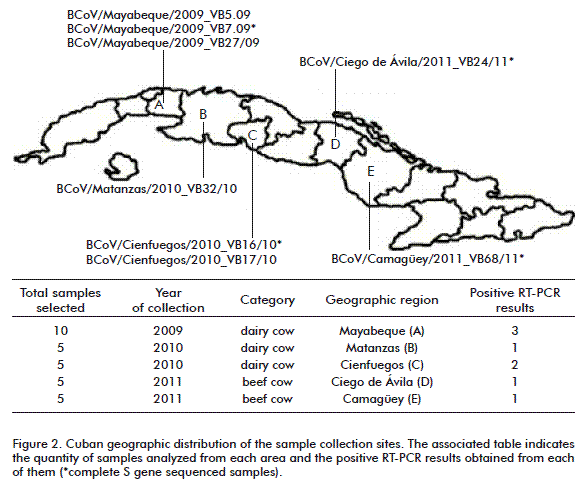
<body><![CDATA[<p   ><font size="2" color="#000000" face="Verdana, Arial, Helvetica, sans-serif"><b>Genetic  diversity and the possible origin of BCoV field strains in different regions of  Cuba </b></font></p >    <p   ><font size="2" color="#000000" face="Verdana, Arial, Helvetica, sans-serif">BCoV  was first identified in association with diarrhoea in newborn calves [12] and  later associated with winter dysentery (WD) in adult cattle [13] and respiratory  tract infections in calves and feedlot cattle [14]. Although the affected animals  rarely die, coronavirus infection causes dramatic reductions in milk production  in dairy herds and loss of body condition in both calves and adults [15], resulting  in severe economic losses. Thus, BCoV is currently considered an important pathogen  that causes enteric disease, often in combination with clinical respiratory signs.  </font></p >    <p   ><font size="2" color="#000000" face="Verdana, Arial, Helvetica, sans-serif">The  S glycoprotein is important for viral entry and pathogenesis, forms large petal-shaped  spikes on the surface of the virion and is cleaved into S1 (N-terminus) and S2  (C terminus) subunits [16]. The S1 is the globular subunit and is responsible  for virus binding to host-cell receptors [17], the induction of neutralizing antibody  expression [18] and haemagglutinating activity [19]. Its sequences are variable,  and mutations in this region have been associated with changes in antigenicity  and viral pathogenicity [20]. In Cuba, the presence of BCoV was first reported  in 2006 [21], and sporadic outbreaks have continued to occur. </font></p >    <p   ><font size="2" color="#000000" face="Verdana, Arial, Helvetica, sans-serif">To  study the genetic diversity and the phylogenetic relationships among different  isolates of BCoV, a total of 30 samples collected between 2009 and 2011 (<a href="/img/revistas/bta/v30n3/f0209313.gif">Figure  2</a>) were used for amplification by PCR and direct sequencing of S gene partial  or total. The comparison of sequences and phylogenetic studies were carried out  with the employment of partial or complete sequences of S gene as phylogenetic  markers. All Cuban BCoV strains were located in a same cluster, supported by 100  % bootstrap values and 1.00 posterior probability values. The Cuban BCoV strains  were located in the same cluster as the USA BCoV strains EF424621 and EF424623,  suggesting a common origin. </font></p >    
<p   ><font size="2" color="#000000" face="Verdana, Arial, Helvetica, sans-serif">This  phylogenetic cluster was also the only group of sequences in which no recombination  events were detected. Of the 45 amino acid changes found in the Cuban strains,  in comparison with the reference strain Mebus, four were unique. </font></p >    <p   ><font size="2" color="#000000" face="Verdana, Arial, Helvetica, sans-serif">Several  of the changes found have been reported as markers of enteric tropism and respiratory,  markers of virulence. From the unique changes found in the Cuban field strains,  one of them was located in the heptad-repeat linked to higher efficiency in the  viral replication as well as in a jump of host. </font></p >    <p   ><font size="2" color="#000000" face="Verdana, Arial, Helvetica, sans-serif">The  fact that the rate of homologous recombination between coronavirus is very high  [22] makes difficult the phylogenetic analysis, due to the problems of inference  that carry coupled this type of elements (mosaics of recombination) for the relationships  of kindred [23]. Nevertheless, the Cuban BCoV strains are clustered with the USA  BCoV strains, and this cluster was the only one to contain strains with a non-recombinant  origin, indicating an epidemiological link between Cuban and USA BCoVs. Considering  the insular condition of the country, the fact that BCoV is only transmitted by  direct contact between animals and that the first evidence of BCoV infection in  Cuba was obtained in 2004 [21] suggests that a USA BCoV strain(s) is the most  likely origin of the Cuban BCoV strains. </font></p >    <p   ><font size="2" color="#000000" face="Verdana, Arial, Helvetica, sans-serif">Noteworthy,  the group of sequences nearer to Cuban strains was isolated from wild ruminant  in captivity [24, 25]. Therefore, the relationship between USA and the Cuban BCoV  strains not only is restricted to the possible movement of cattle, but also results  from possible movements of wild ruminant in captivity. However, the lack of additional  information on movements of bovine and wild ruminant for captivity in zoological  or natural parks, does not permit a categorical confirmation of this origin. Nevertheless,  the certainty reached in the last years for the phylogenetic analysis [26] allows  us to assume that the most probable origin for the introduction of the BCoV to  Cuba was from strains of USA. </font></p >    <p   ><font size="2" color="#000000" face="Verdana, Arial, Helvetica, sans-serif">On  the other hand, the molecular characterization carried out in the present work  could explain the severity of the clinical signs that were presented during the  outbreaks of the disease in the country. The findings of point mutations as &quot;molecular  signatures&quot; in the sequences of S protein of the Cuban strains offer relevant  information not only to the national scientific community but to the coronavirology  in the world, in the search of discoveries relating the gene sequences to viral  phenotypes. Given the complexity of these agents, the fact of having a mechanism  of replication by RNA nested subgenomics and a genomic RNA of great size suggests  the necessity of analyzing and studying other genes of interest comparatively  for a better understanding. </font></p >    <p   ><font size="2" color="#000000" face="Verdana, Arial, Helvetica, sans-serif">This  study provides a good approach to the diversity of the BCoV strain circulating  among Cuban herds. The putative origin of these strains and the molecular characteristics  of the S protein supports the successful infections by this agent and the development  of clinical disease that result in significant economic losses for the country.  </font></p >    ]]></body>
<body><![CDATA[<p   >&nbsp;</p >    <p   > </p >    <p   ><font size="3" face="Verdana, Arial, Helvetica, sans-serif"><b><font color="#000000">CONCLUSIONS  </font></b></font></p >    <p   ><font size="2" color="#000000" face="Verdana, Arial, Helvetica, sans-serif">The  genetic diversity of IBV isolates is high given the low identity of sequences  and the emergency of possible new genotypes in Cuba. The genetic diversity of  the BCoV field strains studied in the different regions of Cuba is low based on  their high sequence identity and their location in a unique cluster. The possible  origin of the BCoV Cuban strains can be defined from USA strains that circulated  during 2003 in wild ruminant, after their introduction in a simple independent  event. Moreover, the presence of virulence markers and respiratory tropism in  the Cuban sequences are in agreement with the clinical signs observed in the field.  </font></p >    <p   ><font size="2" color="#000000" face="Verdana, Arial, Helvetica, sans-serif">Futures  lines of development could be directed to perform a vaccination-challenge assay  to know the efficacy of vaccine strain against the recent isolates Cuba/La Habana/CB6/2009  and Cuba/La Habana/CB19/2009. Also to perform experimental studies to evaluate  the pathogenicity of isolates Cuba/La Habana/CB19/2009 and Cuba LaHabana/CB6/2009.  The molecular characteristics and phylogenetic relationships in other genes (HE,  M, E) of the BCoV strains and isolates studied need to be determined and their  possible dual tropism elucidated. The prevalence of infection by these agents  in the studied Cuban regions will be highly valuable. </font></p >    <p   >&nbsp;</p >    <p   > </p >    <p   ><font size="3" face="Verdana, Arial, Helvetica, sans-serif"><b><font color="#000000">ACKNOWLEDGMENTS</font></b></font><font size="2" face="Verdana, Arial, Helvetica, sans-serif"><b><font color="#000000">  </font></b></font></p >    <p   ><font size="2" color="#000000" face="Verdana, Arial, Helvetica, sans-serif">We  are grateful to Manuel Colas from the Avian Research and Diagnosis Laboratory  (LIDA), Institute of Poultry Research, Cuba, and also to Sibele Souza and Sheila  Oliveira from the Department of Preventive Veterinary Medicine and Animal Health,  College of Veterinary Medicine, University of S&atilde;o Paulo, for the collaboration  in the development of this work</font><font size="2" face="Verdana, Arial, Helvetica, sans-serif">.  </font></p ></div ><FONT size="+1" color="#000000"><FONT size="+1"><FONT size="+1"><FONT size="+1"><FONT size="+1"><FONT size="+1"><FONT size="+1"><FONT size="+1"><FONT size="+1"><FONT size="+1"><FONT size="+1"><FONT size="+1"><FONT size="+1"><FONT size="+1"><FONT size="+1"><FONT size="+1"><FONT size="+1"><FONT size="+1"><FONT size="+1"><FONT size="+1"><FONT size="+1"><FONT size="+1"><FONT size="+1"><FONT size="+1"><FONT size="+1"><FONT size="+1"><FONT size="+1"><FONT size="+1"><FONT size="+1"><FONT size="+1">      <P   align="justify" >&nbsp;</P >    ]]></body>
<body><![CDATA[<P   align="justify" > </P >    <P   align="justify" ><font size="3" face="Verdana, Arial, Helvetica, sans-serif"><B>REFERENCES </b></font></P >    <!-- ref --><P   align="justify" ><font size="2" face="Verdana, Arial, Helvetica, sans-serif">1. Jackwood MW, Boynton  TO, Hilt DA, McKinley ET, Kissinger JC, Paterson AH, et al. Emergence of a group  3 coronavirus through recombination. Virology. 2010;398(1):98-108.    <br> </font></P >    <!-- ref --><P   align="justify" ><font size="2" face="Verdana, Arial, Helvetica, sans-serif">2. Wood MK, Ladman  BA, Preskenis A, Pope CR, Bautista DA, Gelb J Jr. Massachusetts Live Vaccination  Protects Against a Novel Infectious Bronchitis Virus S1 Genotype DMV/5642/06.  Avian Dis. 2009;53:119-23.    <br> </font></P >    <!-- ref --><P   align="justify" ><font size="2" face="Verdana, Arial, Helvetica, sans-serif">3. Dolz R, Pujols  J, Ord&oacute;&ntilde;ez G, Porta R, Maj&oacute; N. Molecular epidemiology and  evolution of avian infectious bronchitis virus in Spain over a fourteen-year period.  Virology. 2008;374:50-9.    <br> </font></P >    <!-- ref --><P   align="justify" ><font size="2" face="Verdana, Arial, Helvetica, sans-serif">4. Mahmooda ZH, Sleman  RR, Uthman AU. Isolation and molecular characterization of Sul/01/09 avian infectious  bronchitis virus, indicates the emergence of a new genotype in the Middle East.  Vet Microbiol. 2011;150:21-7.    <br> </font></P >    ]]></body>
<body><![CDATA[<!-- ref --><P   align="justify" ><font size="2" face="Verdana, Arial, Helvetica, sans-serif">5. Lim TH, Lee HJ,  Lee DH, Lee YN, Park JK, Youn HN, et al. An emerging recombinant cluster of nephropathogenic  strains of avian infectious bronchitis virus in Korea. Infect Genet Evol. 2011;11(3):678-85.    <br>  </font></P >    <!-- ref --><P   align="justify" ><font size="2" face="Verdana, Arial, Helvetica, sans-serif">6. Zhang X, Hasoksuz  M, Spiro D, Halpin R, Wang S, Vlasova A, et al. Quasispecies of bovine enteric  and respiratory coronaviruses based on complete genome sequences and genetic changes  after tissue culture adaptation. Virology. 2007;363:1-10.    </font></P >    <!-- ref --><P   align="justify" ><font size="2" face="Verdana, Arial, Helvetica, sans-serif">7. Cavanagh D, Naqi  SA. Infectious bronchitis. In: </font><font size="+1" color="#000000"><font size="+1"><font size="+1"><font size="+1"><font size="+1"><font size="+1"><font size="+1"><font size="+1"><font size="+1"><font size="+1"><font size="+1"><font size="+1"><font size="+1"><font size="+1"><font size="+1"><font size="+1"><font size="+1"><font size="+1"><font size="+1"><font size="+1"><font size="+1"><font size="+1"><font size="+1"><font size="+1"><font size="+1"><font size="+1"><font size="+1"><font size="+1"><font size="+1"><font size="+1"><font size="2" face="Verdana, Arial, Helvetica, sans-serif">Saif  YM, Barnes HJ, Glisson JR, Fadly AM, McDougald LR, Swayne DE, editors. </font></font></font></font></font></font></font></font></font></font></font></font></font></font></font></font></font></font></font></font></font></font></font></font></font></font></font></font></font></font></font><font size="2" face="Verdana, Arial, Helvetica, sans-serif">Diseases  of Poultry, 11th ed. Ames, Iowa: Iowa State Press; 2003. p. 101-19.    <br> </font></P >    <!-- ref --><P   align="justify" ><font size="2" face="Verdana, Arial, Helvetica, sans-serif">8. ICTV Virus Taxonomy:  2009 Release. [cited 2010 Aug 1]. Available from: <a href="http://ictvonline.org/virusTaxonomy.asp?version=2009" target="_blank">http://ictvonline.org/virusTaxonomy.asp?version=2009</a>.    <br>  </font></P >    <!-- ref --><P   align="justify" ><font size="2" face="Verdana, Arial, Helvetica, sans-serif">9. OIE. Avian infectious  bronchitis [Chapter 2.3.2] (BI). In: Manual of diagnostic tests and vaccines for  terrestrial animals. 6th ed. Paris: Office International des Epizooties; 2008.  p. 443-55.    <br> </font></P >    ]]></body>
<body><![CDATA[<!-- ref --><P   align="justify" ><font size="2" face="Verdana, Arial, Helvetica, sans-serif">10. Ladman BS, Loupos  AB, Gelb J Jr. Infectious bronchitis virus S1 gene sequence comparison is a better  predictor of challenge of immunity in chickens than serotyping by virus neutralization.  Avian Pathol. 2006;35:127-33.    <br> </font></P >    <!-- ref --><P   align="justify" ><font size="2" face="Verdana, Arial, Helvetica, sans-serif">11. Guilarte O. Identificaci&oacute;n  de los niveles de anticuerpos contra el virus de la bronquitis infecciosa y el  virus de Newcastle en aves afectadas con la enfermedad respiratoria cr&oacute;nica.  Rev Cub Ciencia Av&iacute;c. 1985;12:15-26.    <br> </font></P >    <!-- ref --><P   align="justify" ><font size="2" face="Verdana, Arial, Helvetica, sans-serif">12. Mebus CA, Stair  EL, Rhodes MB, Twiehaus MJ. Neonatal calf diarrhea: propagation, attenuation,  and characteristics of a coronavirus like agent. Am J Vet Res. 1973;34:145-50.    <br>  </font></P >    <!-- ref --><P   align="justify" ><font size="2" face="Verdana, Arial, Helvetica, sans-serif">13. Saif LJ, Brock  KV, Redman DR, Kohler EM. Winter dysentery in dairy herds: electron microscopic  and serological evidence for an association with coronavirus infection. Vet Rec.  1991;128:447-9.    <br> </font></P >    <!-- ref --><P   align="justify" ><font size="2" face="Verdana, Arial, Helvetica, sans-serif">14. Storz J, Purdy  W, Lin X, Burrell M, Truax RE, Briggs RE, et al. Isolation of respiratory bovine  coronavirus, other cytocidal viruses, and Pasteurella spp. from cattle involved  in two natural outbreaks of shipping fever. J Am Vet Med Assoc. 2000;216:1599-604.    <br>  </font></P >    ]]></body>
<body><![CDATA[<!-- ref --><P   align="justify" ><font size="2" face="Verdana, Arial, Helvetica, sans-serif">15. Saif LJ, Redman  DR, Brock KV, Kohler EM, Heckert RA. Winter dysentery in adult dairy cattle: detection  of coronavirus in the faeces. Vet Rec. 1998;123:300-1.    <br> </font></P >    <!-- ref --><P   align="justify" ><font size="2" face="Verdana, Arial, Helvetica, sans-serif">16. Abraham S, Kienzle  TE, Lapps W, Brian DA. Deduced sequence of the bovine coronavirus spike protein  and identification of the internal proteolytic cleavage site. Virology. 1990;176:296-301.    <br>  </font></P >    <!-- ref --><P   align="justify" ><font size="2" face="Verdana, Arial, Helvetica, sans-serif">17. Kubo H, Yamada  YK, Taguchi F. Localization of neutralizing epitopes and the receptor-binding  site within the aminoterminal 330 amino acids of the murine coronavirus spike  protein. J Virol. 1994;68:5403-10.    <br> </font></P >    <!-- ref --><P   align="justify" ><font size="2" face="Verdana, Arial, Helvetica, sans-serif">18. Yoo D, Deregt  D. A single amino acid change within antigenic domain II of the spike protein  of bovine coronavirus confers resistance to virus neutralization. Clin Diagn Lab  Immunol. 2001;8:297-302.    <br> </font></P >    <!-- ref --><P   align="justify" ><font size="2" face="Verdana, Arial, Helvetica, sans-serif">19. Schultze B, Gross  HJ, Brossmer R, Herrler G. The S protein of bovine coronavirus is a hemagglutinin  recognizing 9-Oacetylated sialic acid as a receptor determinant. J Virol. 1991;65:6232-7.    <br>  </font></P >    ]]></body>
<body><![CDATA[<!-- ref --><P   align="justify" ><font size="2" face="Verdana, Arial, Helvetica, sans-serif">20. Ballesteros ML,  Sanchez CM, Enjuanes L. Two amino acid changes at the N-terminus of transmissible  gastroenteritis coronavirus spike protein result in the loss of enteric tropism.  Virology. 1997;227:378-88.    <br> </font></P >    <!-- ref --><P   align="justify" ><font size="2" face="Verdana, Arial, Helvetica, sans-serif">21. Barrera M, Rodr&iacute;guez  E, Bentancourt A, Fr&iacute;as MT, Brand&atilde;o PE. First report in Cuba of  bovine coronavirus detection in a winter dysentery outbreak. Span J Agric Res.  2006;4:221-4.    <br> </font></P >    <!-- ref --><P   align="justify" ><font size="2" face="Verdana, Arial, Helvetica, sans-serif">22. Lai MMC, Cavanagh  D. The molecular biology of coronaviruses. Adv Virus Res. 1997;48:1-100.    <br> </font></P >    <!-- ref --><P   align="justify" ><font size="2" face="Verdana, Arial, Helvetica, sans-serif">23. Olvera A, Busquets  N, Cortey M, de Deus N, Ganges L, Nunez JI, et al. Applying phylogenetic analysis  to viral livestock diseases: moving beyond molecular typing. Vet J. 2010;184(2):130-7.    <br>  </font></P >    <!-- ref --><P   align="justify" ><font size="2" face="Verdana, Arial, Helvetica, sans-serif">24. Alekseev KP,  Vlasova AN, Jung K, Hasoksuz M, Zhang X, Halpin R, et al. Bovine-like coronaviruses  isolated from four species of captive wild ruminants are homologous to bovine  coronaviruses, based on complete genomic sequences. J Virol. 2008;82:12422-31.    <br>  </font></P >    ]]></body>
<body><![CDATA[<!-- ref --><P   align="justify" ><font size="2" face="Verdana, Arial, Helvetica, sans-serif">25. Hasoksuz M, Sreevatsan  S, Cho KO, Hoet AE, Saif LJ. Molecular analysis of the S1 subunit of the spike  glycoprotein of respiratory and enteric bovine coronavirus isolates. Virus Res.  2002;84:101-9.    <br> </font></P >    <!-- ref --><P   align="justify" ><font size="2" face="Verdana, Arial, Helvetica, sans-serif">26. K&uuml;hnert  D, Wu CH, Drummond AJ. Phylogenetic and epidemic modeling of rapidly evolving  infectious diseases. Infect Genet Evol. 2011;11(8):1825-41.     </font></P ><FONT size="+1"><FONT color="#0000FF"><FONT color="#000000"><FONT color="#0000FF"><FONT color="#000000"><FONT color="#0000FF"><FONT color="#000000">      <P   align="justify" >&nbsp;</P >    <P   align="justify" >&nbsp;</P >    <P   align="justify" > </P >    <P   align="justify" ><font size="+1" color="#000000"><font size="2" face="Verdana, Arial, Helvetica, sans-serif"><i>Ana  M Acevedo</i></font></font><font size="2" face="Verdana, Arial, Helvetica, sans-serif">.  </font><font size="+1" color="#000000"><font size="+1"><font size="+1"><font size="+1"><font size="+1"><font size="+1"><font size="2" face="Verdana, Arial, Helvetica, sans-serif">Grupo  de Virolog&iacute;a Animal, Direcci&oacute;n de Microbiolog&iacute;a, Centro Nacional  de Sanidad Agropecuaria, CENSA. AP 10, San Jos&eacute; de las Lajas, Mayabeque,  Cuba</font></font></font></font></font></font></font><font size="2" face="Verdana, Arial, Helvetica, sans-serif">.  E-mail: <a href="mailto:lesterjosue@censa.edu.cu">lesterjosue@censa.edu.cu</a><FONT color="#0000FF"><FONT color="#0017E4">.  </font></font></font></P ></font></font></font></font></font></font></font></font></font></font></font></font></font></font></font></font></font></font></font></font></font></font></font></font></font></font></font></font></font></font></font></font></font></font></font></font></font></DIV >      ]]></body><back>
<ref-list>
<ref id="B1">
<label>1</label><nlm-citation citation-type="journal">
<person-group person-group-type="author">
<name>
<surname><![CDATA[Jackwood]]></surname>
<given-names><![CDATA[MW]]></given-names>
</name>
<name>
<surname><![CDATA[Boynton]]></surname>
<given-names><![CDATA[TO]]></given-names>
</name>
<name>
<surname><![CDATA[Hilt]]></surname>
<given-names><![CDATA[DA]]></given-names>
</name>
<name>
<surname><![CDATA[McKinley]]></surname>
<given-names><![CDATA[ET]]></given-names>
</name>
<name>
<surname><![CDATA[Kissinger]]></surname>
<given-names><![CDATA[JC]]></given-names>
</name>
<name>
<surname><![CDATA[Paterson]]></surname>
<given-names><![CDATA[AH]]></given-names>
</name>
</person-group>
<article-title xml:lang="en"><![CDATA[Emergence of a group 3 coronavirus through recombination]]></article-title>
<source><![CDATA[Virology]]></source>
<year>2010</year>
<volume>398</volume>
<numero>1</numero>
<issue>1</issue>
<page-range>98-108</page-range></nlm-citation>
</ref>
<ref id="B2">
<label>2</label><nlm-citation citation-type="journal">
<person-group person-group-type="author">
<name>
<surname><![CDATA[Wood]]></surname>
<given-names><![CDATA[MK]]></given-names>
</name>
<name>
<surname><![CDATA[Ladman]]></surname>
<given-names><![CDATA[BA]]></given-names>
</name>
<name>
<surname><![CDATA[Preskenis]]></surname>
<given-names><![CDATA[A]]></given-names>
</name>
<name>
<surname><![CDATA[Pope]]></surname>
<given-names><![CDATA[CR]]></given-names>
</name>
<name>
<surname><![CDATA[Bautista]]></surname>
<given-names><![CDATA[DA]]></given-names>
</name>
<name>
<surname><![CDATA[Gelb]]></surname>
<given-names><![CDATA[J Jr]]></given-names>
</name>
</person-group>
<article-title xml:lang="en"><![CDATA[Massachusetts Live Vaccination Protects Against a Novel Infectious Bronchitis Virus S1 Genotype DMV/5642/06]]></article-title>
<source><![CDATA[Avian Dis]]></source>
<year>2009</year>
<volume>53</volume>
<page-range>119-23</page-range></nlm-citation>
</ref>
<ref id="B3">
<label>3</label><nlm-citation citation-type="journal">
<person-group person-group-type="author">
<name>
<surname><![CDATA[Dolz]]></surname>
<given-names><![CDATA[R]]></given-names>
</name>
<name>
<surname><![CDATA[Pujols]]></surname>
<given-names><![CDATA[J]]></given-names>
</name>
<name>
<surname><![CDATA[Ordóñez]]></surname>
<given-names><![CDATA[G]]></given-names>
</name>
<name>
<surname><![CDATA[Porta]]></surname>
<given-names><![CDATA[R]]></given-names>
</name>
<name>
<surname><![CDATA[Majó]]></surname>
<given-names><![CDATA[N]]></given-names>
</name>
</person-group>
<article-title xml:lang="en"><![CDATA[Molecular epidemiology and evolution of avian infectious bronchitis virus in Spain over a fourteen-year period]]></article-title>
<source><![CDATA[Virology]]></source>
<year>2008</year>
<volume>374</volume>
<page-range>50-9</page-range></nlm-citation>
</ref>
<ref id="B4">
<label>4</label><nlm-citation citation-type="journal">
<person-group person-group-type="author">
<name>
<surname><![CDATA[Mahmooda]]></surname>
<given-names><![CDATA[ZH]]></given-names>
</name>
<name>
<surname><![CDATA[Sleman]]></surname>
<given-names><![CDATA[RR]]></given-names>
</name>
<name>
<surname><![CDATA[Uthman]]></surname>
<given-names><![CDATA[AU]]></given-names>
</name>
</person-group>
<article-title xml:lang="en"><![CDATA[Isolation and molecular characterization of Sul/01/09 avian infectious bronchitis virus, indicates the emergence of a new genotype in the Middle East]]></article-title>
<source><![CDATA[Vet Microbiol]]></source>
<year>2011</year>
<volume>150</volume>
<page-range>21-7</page-range></nlm-citation>
</ref>
<ref id="B5">
<label>5</label><nlm-citation citation-type="journal">
<person-group person-group-type="author">
<name>
<surname><![CDATA[Lim]]></surname>
<given-names><![CDATA[TH]]></given-names>
</name>
<name>
<surname><![CDATA[Lee]]></surname>
<given-names><![CDATA[HJ]]></given-names>
</name>
<name>
<surname><![CDATA[Lee]]></surname>
<given-names><![CDATA[DH]]></given-names>
</name>
<name>
<surname><![CDATA[Lee]]></surname>
<given-names><![CDATA[YN]]></given-names>
</name>
<name>
<surname><![CDATA[Park]]></surname>
<given-names><![CDATA[JK]]></given-names>
</name>
<name>
<surname><![CDATA[Youn]]></surname>
<given-names><![CDATA[HN]]></given-names>
</name>
</person-group>
<article-title xml:lang="en"><![CDATA[An emerging recombinant cluster of nephropathogenic strains of avian infectious bronchitis virus in Korea]]></article-title>
<source><![CDATA[Infect Genet Evol]]></source>
<year>2011</year>
<volume>11</volume>
<numero>3</numero>
<issue>3</issue>
<page-range>678-85</page-range></nlm-citation>
</ref>
<ref id="B6">
<label>6</label><nlm-citation citation-type="journal">
<person-group person-group-type="author">
<name>
<surname><![CDATA[Zhang]]></surname>
<given-names><![CDATA[X]]></given-names>
</name>
<name>
<surname><![CDATA[Hasoksuz]]></surname>
<given-names><![CDATA[M]]></given-names>
</name>
<name>
<surname><![CDATA[Spiro]]></surname>
<given-names><![CDATA[D]]></given-names>
</name>
<name>
<surname><![CDATA[Halpin]]></surname>
<given-names><![CDATA[R]]></given-names>
</name>
<name>
<surname><![CDATA[Wang]]></surname>
<given-names><![CDATA[S]]></given-names>
</name>
<name>
<surname><![CDATA[Vlasova]]></surname>
<given-names><![CDATA[A]]></given-names>
</name>
</person-group>
<article-title xml:lang="en"><![CDATA[Quasispecies of bovine enteric and respiratory coronaviruses based on complete genome sequences and genetic changes after tissue culture adaptation]]></article-title>
<source><![CDATA[Virology]]></source>
<year>2007</year>
<volume>363</volume>
<page-range>1-10</page-range></nlm-citation>
</ref>
<ref id="B7">
<label>7</label><nlm-citation citation-type="book">
<person-group person-group-type="author">
<name>
<surname><![CDATA[Cavanagh]]></surname>
<given-names><![CDATA[D]]></given-names>
</name>
<name>
<surname><![CDATA[Naqi]]></surname>
<given-names><![CDATA[SA]]></given-names>
</name>
</person-group>
<article-title xml:lang="en"><![CDATA[Infectious bronchitis]]></article-title>
<person-group person-group-type="editor">
<name>
<surname><![CDATA[Saif]]></surname>
<given-names><![CDATA[YM]]></given-names>
</name>
<name>
<surname><![CDATA[Barnes]]></surname>
<given-names><![CDATA[HJ]]></given-names>
</name>
<name>
<surname><![CDATA[Glisson]]></surname>
<given-names><![CDATA[JR]]></given-names>
</name>
<name>
<surname><![CDATA[Fadly]]></surname>
<given-names><![CDATA[AM]]></given-names>
</name>
<name>
<surname><![CDATA[McDougald]]></surname>
<given-names><![CDATA[LR]]></given-names>
</name>
<name>
<surname><![CDATA[Swayne]]></surname>
<given-names><![CDATA[DE]]></given-names>
</name>
</person-group>
<source><![CDATA[Diseases of Poultry]]></source>
<year>2003</year>
<edition>11</edition>
<page-range>101-19</page-range><publisher-loc><![CDATA[Ames, Iowa ]]></publisher-loc>
<publisher-name><![CDATA[Iowa State Press]]></publisher-name>
</nlm-citation>
</ref>
<ref id="B8">
<label>8</label><nlm-citation citation-type="">
<source><![CDATA[ICTV Virus Taxonomy: 2009 Release]]></source>
<year>2010</year>
<month> A</month>
<day>ug</day>
</nlm-citation>
</ref>
<ref id="B9">
<label>9</label><nlm-citation citation-type="book">
<collab>OIE</collab>
<article-title xml:lang="en"><![CDATA[Avian infectious bronchitis (Chapter 2.3.2) (BI)]]></article-title>
<source><![CDATA[Manual of diagnostic tests and vaccines for terrestrial animals]]></source>
<year>2008</year>
<edition>6</edition>
<page-range>443-55</page-range><publisher-loc><![CDATA[Paris ]]></publisher-loc>
<publisher-name><![CDATA[Office International des Epizooties]]></publisher-name>
</nlm-citation>
</ref>
<ref id="B10">
<label>10</label><nlm-citation citation-type="journal">
<person-group person-group-type="author">
<name>
<surname><![CDATA[Ladman]]></surname>
<given-names><![CDATA[BS]]></given-names>
</name>
<name>
<surname><![CDATA[Loupos]]></surname>
<given-names><![CDATA[AB]]></given-names>
</name>
<name>
<surname><![CDATA[Gelb]]></surname>
<given-names><![CDATA[J Jr]]></given-names>
</name>
</person-group>
<article-title xml:lang="en"><![CDATA[Infectious bronchitis virus S1 gene sequence comparison is a better predictor of challenge of immunity in chickens than serotyping by virus neutralization]]></article-title>
<source><![CDATA[Avian Pathol]]></source>
<year>2006</year>
<volume>35</volume>
<page-range>127-33</page-range></nlm-citation>
</ref>
<ref id="B11">
<label>11</label><nlm-citation citation-type="journal">
<person-group person-group-type="author">
<name>
<surname><![CDATA[Guilarte]]></surname>
<given-names><![CDATA[O]]></given-names>
</name>
</person-group>
<article-title xml:lang="es"><![CDATA[Identificación de los niveles de anticuerpos contra el virus de la bronquitis infecciosa y el virus de Newcastle en aves afectadas con la enfermedad respiratoria crónica]]></article-title>
<source><![CDATA[Rev Cub Ciencia Avíc]]></source>
<year>1985</year>
<volume>12</volume>
<page-range>15-26</page-range></nlm-citation>
</ref>
<ref id="B12">
<label>12</label><nlm-citation citation-type="journal">
<person-group person-group-type="author">
<name>
<surname><![CDATA[Mebus]]></surname>
<given-names><![CDATA[CA]]></given-names>
</name>
<name>
<surname><![CDATA[Stair]]></surname>
<given-names><![CDATA[EL]]></given-names>
</name>
<name>
<surname><![CDATA[Rhodes]]></surname>
<given-names><![CDATA[MB]]></given-names>
</name>
<name>
<surname><![CDATA[Twiehaus]]></surname>
<given-names><![CDATA[MJ]]></given-names>
</name>
</person-group>
<article-title xml:lang="en"><![CDATA[Neonatal calf diarrhea: propagation, attenuation, and characteristics of a coronavirus like agent]]></article-title>
<source><![CDATA[Am J Vet Res]]></source>
<year>1973</year>
<volume>34</volume>
<page-range>145-50</page-range></nlm-citation>
</ref>
<ref id="B13">
<label>13</label><nlm-citation citation-type="journal">
<person-group person-group-type="author">
<name>
<surname><![CDATA[Saif]]></surname>
<given-names><![CDATA[LJ]]></given-names>
</name>
<name>
<surname><![CDATA[Brock]]></surname>
<given-names><![CDATA[KV]]></given-names>
</name>
<name>
<surname><![CDATA[Redman]]></surname>
<given-names><![CDATA[DR]]></given-names>
</name>
<name>
<surname><![CDATA[Kohler]]></surname>
<given-names><![CDATA[EM]]></given-names>
</name>
</person-group>
<article-title xml:lang="en"><![CDATA[Winter dysentery in dairy herds: electron microscopic and serological evidence for an association with coronavirus infection]]></article-title>
<source><![CDATA[Vet Rec]]></source>
<year>1991</year>
<volume>128</volume>
<page-range>447-9</page-range></nlm-citation>
</ref>
<ref id="B14">
<label>14</label><nlm-citation citation-type="journal">
<person-group person-group-type="author">
<name>
<surname><![CDATA[Storz]]></surname>
<given-names><![CDATA[J]]></given-names>
</name>
<name>
<surname><![CDATA[Purdy]]></surname>
<given-names><![CDATA[W]]></given-names>
</name>
<name>
<surname><![CDATA[Lin]]></surname>
<given-names><![CDATA[X]]></given-names>
</name>
<name>
<surname><![CDATA[Burrell]]></surname>
<given-names><![CDATA[M]]></given-names>
</name>
<name>
<surname><![CDATA[Truax]]></surname>
<given-names><![CDATA[RE]]></given-names>
</name>
<name>
<surname><![CDATA[Briggs]]></surname>
<given-names><![CDATA[RE]]></given-names>
</name>
</person-group>
<article-title xml:lang="en"><![CDATA[Isolation of respiratory bovine coronavirus, other cytocidal viruses, and Pasteurella spp. from cattle involved in two natural outbreaks of shipping fever]]></article-title>
<source><![CDATA[J Am Vet Med Assoc]]></source>
<year>2000</year>
<volume>216</volume>
<page-range>1599-604</page-range></nlm-citation>
</ref>
<ref id="B15">
<label>15</label><nlm-citation citation-type="journal">
<person-group person-group-type="author">
<name>
<surname><![CDATA[Saif]]></surname>
<given-names><![CDATA[LJ]]></given-names>
</name>
<name>
<surname><![CDATA[Redman]]></surname>
<given-names><![CDATA[DR]]></given-names>
</name>
<name>
<surname><![CDATA[Brock]]></surname>
<given-names><![CDATA[KV]]></given-names>
</name>
<name>
<surname><![CDATA[Kohler]]></surname>
<given-names><![CDATA[EM]]></given-names>
</name>
<name>
<surname><![CDATA[Heckert]]></surname>
<given-names><![CDATA[RA]]></given-names>
</name>
</person-group>
<article-title xml:lang="en"><![CDATA[Winter dysentery in adult dairy cattle: detection of coronavirus in the faeces]]></article-title>
<source><![CDATA[Vet Rec]]></source>
<year>1998</year>
<volume>123</volume>
<page-range>300-1</page-range></nlm-citation>
</ref>
<ref id="B16">
<label>16</label><nlm-citation citation-type="journal">
<person-group person-group-type="author">
<name>
<surname><![CDATA[Abraham]]></surname>
<given-names><![CDATA[S]]></given-names>
</name>
<name>
<surname><![CDATA[Kienzle]]></surname>
<given-names><![CDATA[TE]]></given-names>
</name>
<name>
<surname><![CDATA[Lapps]]></surname>
<given-names><![CDATA[W]]></given-names>
</name>
<name>
<surname><![CDATA[Brian]]></surname>
<given-names><![CDATA[DA]]></given-names>
</name>
</person-group>
<article-title xml:lang="en"><![CDATA[Deduced sequence of the bovine coronavirus spike protein and identification of the internal proteolytic cleavage site]]></article-title>
<source><![CDATA[Virology]]></source>
<year>1990</year>
<volume>176</volume>
<page-range>296-301</page-range></nlm-citation>
</ref>
<ref id="B17">
<label>17</label><nlm-citation citation-type="journal">
<person-group person-group-type="author">
<name>
<surname><![CDATA[Kubo]]></surname>
<given-names><![CDATA[H]]></given-names>
</name>
<name>
<surname><![CDATA[Yamada]]></surname>
<given-names><![CDATA[YK]]></given-names>
</name>
<name>
<surname><![CDATA[Taguchi]]></surname>
<given-names><![CDATA[F]]></given-names>
</name>
</person-group>
<article-title xml:lang="en"><![CDATA[Localization of neutralizing epitopes and the receptor-binding site within the aminoterminal 330 amino acids of the murine coronavirus spike protein]]></article-title>
<source><![CDATA[J Virol]]></source>
<year>1994</year>
<volume>68</volume>
<page-range>5403-10</page-range></nlm-citation>
</ref>
<ref id="B18">
<label>18</label><nlm-citation citation-type="journal">
<person-group person-group-type="author">
<name>
<surname><![CDATA[Yoo]]></surname>
<given-names><![CDATA[D]]></given-names>
</name>
<name>
<surname><![CDATA[Deregt]]></surname>
<given-names><![CDATA[D]]></given-names>
</name>
</person-group>
<article-title xml:lang="en"><![CDATA[A single amino acid change within antigenic domain II of the spike protein of bovine coronavirus confers resistance to virus neutralization]]></article-title>
<source><![CDATA[Clin Diagn Lab Immunol]]></source>
<year>2001</year>
<volume>8</volume>
<page-range>297-302</page-range></nlm-citation>
</ref>
<ref id="B19">
<label>19</label><nlm-citation citation-type="journal">
<person-group person-group-type="author">
<name>
<surname><![CDATA[Schultze]]></surname>
<given-names><![CDATA[B]]></given-names>
</name>
<name>
<surname><![CDATA[Gross]]></surname>
<given-names><![CDATA[HJ]]></given-names>
</name>
<name>
<surname><![CDATA[Brossmer]]></surname>
<given-names><![CDATA[R]]></given-names>
</name>
<name>
<surname><![CDATA[Herrler]]></surname>
<given-names><![CDATA[G]]></given-names>
</name>
</person-group>
<article-title xml:lang="en"><![CDATA[The S protein of bovine coronavirus is a hemagglutinin recognizing 9-Oacetylated sialic acid as a receptor determinant]]></article-title>
<source><![CDATA[J Virol]]></source>
<year>1991</year>
<volume>65</volume>
<page-range>6232-7</page-range></nlm-citation>
</ref>
<ref id="B20">
<label>20</label><nlm-citation citation-type="journal">
<person-group person-group-type="author">
<name>
<surname><![CDATA[Ballesteros]]></surname>
<given-names><![CDATA[ML]]></given-names>
</name>
<name>
<surname><![CDATA[Sanchez]]></surname>
<given-names><![CDATA[CM]]></given-names>
</name>
<name>
<surname><![CDATA[Enjuanes]]></surname>
<given-names><![CDATA[L]]></given-names>
</name>
</person-group>
<article-title xml:lang="en"><![CDATA[Two amino acid changes at the N-terminus of transmissible gastroenteritis coronavirus spike protein result in the loss of enteric tropism]]></article-title>
<source><![CDATA[Virology]]></source>
<year>1997</year>
<volume>227</volume>
<page-range>378-88</page-range></nlm-citation>
</ref>
<ref id="B21">
<label>21</label><nlm-citation citation-type="journal">
<person-group person-group-type="author">
<name>
<surname><![CDATA[Barrera]]></surname>
<given-names><![CDATA[M]]></given-names>
</name>
<name>
<surname><![CDATA[Rodríguez]]></surname>
<given-names><![CDATA[E]]></given-names>
</name>
<name>
<surname><![CDATA[Bentancourt]]></surname>
<given-names><![CDATA[A]]></given-names>
</name>
<name>
<surname><![CDATA[Frías]]></surname>
<given-names><![CDATA[MT]]></given-names>
</name>
<name>
<surname><![CDATA[Brandão]]></surname>
<given-names><![CDATA[PE]]></given-names>
</name>
</person-group>
<article-title xml:lang="en"><![CDATA[First report in Cuba of bovine coronavirus detection in a winter dysentery outbreak]]></article-title>
<source><![CDATA[Span J Agric Res]]></source>
<year>2006</year>
<volume>4</volume>
<page-range>221-4</page-range></nlm-citation>
</ref>
<ref id="B22">
<label>22</label><nlm-citation citation-type="journal">
<person-group person-group-type="author">
<name>
<surname><![CDATA[Lai]]></surname>
<given-names><![CDATA[MMC]]></given-names>
</name>
<name>
<surname><![CDATA[Cavanagh]]></surname>
<given-names><![CDATA[D]]></given-names>
</name>
</person-group>
<article-title xml:lang="en"><![CDATA[The molecular biology of coronaviruses]]></article-title>
<source><![CDATA[Adv Virus Res]]></source>
<year>1997</year>
<volume>48</volume>
<page-range>1-100</page-range></nlm-citation>
</ref>
<ref id="B23">
<label>23</label><nlm-citation citation-type="journal">
<person-group person-group-type="author">
<name>
<surname><![CDATA[Olvera]]></surname>
<given-names><![CDATA[A]]></given-names>
</name>
<name>
<surname><![CDATA[Busquets]]></surname>
<given-names><![CDATA[N]]></given-names>
</name>
<name>
<surname><![CDATA[Cortey]]></surname>
<given-names><![CDATA[M]]></given-names>
</name>
<name>
<surname><![CDATA[de Deus]]></surname>
<given-names><![CDATA[N]]></given-names>
</name>
<name>
<surname><![CDATA[Ganges]]></surname>
<given-names><![CDATA[L]]></given-names>
</name>
<name>
<surname><![CDATA[Nunez]]></surname>
<given-names><![CDATA[JI]]></given-names>
</name>
</person-group>
<article-title xml:lang="en"><![CDATA[Applying phylogenetic analysis to viral livestock diseases: moving beyond molecular typing]]></article-title>
<source><![CDATA[Vet J]]></source>
<year>2010</year>
<volume>184</volume>
<numero>2</numero>
<issue>2</issue>
<page-range>130-7</page-range></nlm-citation>
</ref>
<ref id="B24">
<label>24</label><nlm-citation citation-type="journal">
<person-group person-group-type="author">
<name>
<surname><![CDATA[Alekseev]]></surname>
<given-names><![CDATA[KP]]></given-names>
</name>
<name>
<surname><![CDATA[Vlasova]]></surname>
<given-names><![CDATA[AN]]></given-names>
</name>
<name>
<surname><![CDATA[Jung]]></surname>
<given-names><![CDATA[K]]></given-names>
</name>
<name>
<surname><![CDATA[Hasoksuz]]></surname>
<given-names><![CDATA[M]]></given-names>
</name>
<name>
<surname><![CDATA[Zhang]]></surname>
<given-names><![CDATA[X]]></given-names>
</name>
<name>
<surname><![CDATA[Halpin]]></surname>
<given-names><![CDATA[R]]></given-names>
</name>
</person-group>
<article-title xml:lang="en"><![CDATA[Bovine-like coronaviruses isolated from four species of captive wild ruminants are homologous to bovine coronaviruses, based on complete genomic sequences]]></article-title>
<source><![CDATA[J Virol]]></source>
<year>2008</year>
<volume>82</volume>
<page-range>12422-31</page-range></nlm-citation>
</ref>
<ref id="B25">
<label>25</label><nlm-citation citation-type="journal">
<person-group person-group-type="author">
<name>
<surname><![CDATA[Hasoksuz]]></surname>
<given-names><![CDATA[M]]></given-names>
</name>
<name>
<surname><![CDATA[Sreevatsan]]></surname>
<given-names><![CDATA[S]]></given-names>
</name>
<name>
<surname><![CDATA[Cho]]></surname>
<given-names><![CDATA[KO]]></given-names>
</name>
<name>
<surname><![CDATA[Hoet]]></surname>
<given-names><![CDATA[AE]]></given-names>
</name>
<name>
<surname><![CDATA[Saif]]></surname>
<given-names><![CDATA[LJ]]></given-names>
</name>
</person-group>
<article-title xml:lang="en"><![CDATA[Molecular analysis of the S1 subunit of the spike glycoprotein of respiratory and enteric bovine coronavirus isolates]]></article-title>
<source><![CDATA[Virus Res]]></source>
<year>2002</year>
<volume>84</volume>
<page-range>101-9</page-range></nlm-citation>
</ref>
<ref id="B26">
<label>26</label><nlm-citation citation-type="journal">
<person-group person-group-type="author">
<name>
<surname><![CDATA[Kühnert]]></surname>
<given-names><![CDATA[D]]></given-names>
</name>
<name>
<surname><![CDATA[Wu]]></surname>
<given-names><![CDATA[CH]]></given-names>
</name>
<name>
<surname><![CDATA[Drummond]]></surname>
<given-names><![CDATA[AJ]]></given-names>
</name>
</person-group>
<article-title xml:lang="en"><![CDATA[Phylogenetic and epidemic modeling of rapidly evolving infectious diseases]]></article-title>
<source><![CDATA[Infect Genet Evol]]></source>
<year>2011</year>
<volume>11</volume>
<numero>8</numero>
<issue>8</issue>
<page-range>1825-41</page-range></nlm-citation>
</ref>
</ref-list>
</back>
</article>