<?xml version="1.0" encoding="ISO-8859-1"?><article xmlns:mml="http://www.w3.org/1998/Math/MathML" xmlns:xlink="http://www.w3.org/1999/xlink" xmlns:xsi="http://www.w3.org/2001/XMLSchema-instance">
<front>
<journal-meta>
<journal-id>1027-2852</journal-id>
<journal-title><![CDATA[Biotecnología Aplicada]]></journal-title>
<abbrev-journal-title><![CDATA[Biotecnol Apl]]></abbrev-journal-title>
<issn>1027-2852</issn>
<publisher>
<publisher-name><![CDATA[Editorial Elfos Scientiae]]></publisher-name>
</publisher>
</journal-meta>
<article-meta>
<article-id>S1027-28522013000400001</article-id>
<title-group>
<article-title xml:lang="en"><![CDATA[Inorganic compounds as vaccine adjuvants]]></article-title>
<article-title xml:lang="es"><![CDATA[Compuestos inorgánicos como adyuvantes de vacunas]]></article-title>
</title-group>
<contrib-group>
<contrib contrib-type="author">
<name>
<surname><![CDATA[Paneque-Quevedo]]></surname>
<given-names><![CDATA[Armando A]]></given-names>
</name>
<xref ref-type="aff" rid="A01"/>
</contrib>
</contrib-group>
<aff id="A01">
<institution><![CDATA[,Centro de Química Biomolecular, CQB Dirección de Producción ]]></institution>
<addr-line><![CDATA[La Habana ]]></addr-line>
<country>Cuba</country>
</aff>
<pub-date pub-type="pub">
<day>00</day>
<month>12</month>
<year>2013</year>
</pub-date>
<pub-date pub-type="epub">
<day>00</day>
<month>12</month>
<year>2013</year>
</pub-date>
<volume>30</volume>
<numero>4</numero>
<fpage>250</fpage>
<lpage>256</lpage>
<copyright-statement/>
<copyright-year/>
<self-uri xlink:href="http://scielo.sld.cu/scielo.php?script=sci_arttext&amp;pid=S1027-28522013000400001&amp;lng=en&amp;nrm=iso"></self-uri><self-uri xlink:href="http://scielo.sld.cu/scielo.php?script=sci_abstract&amp;pid=S1027-28522013000400001&amp;lng=en&amp;nrm=iso"></self-uri><self-uri xlink:href="http://scielo.sld.cu/scielo.php?script=sci_pdf&amp;pid=S1027-28522013000400001&amp;lng=en&amp;nrm=iso"></self-uri><abstract abstract-type="short" xml:lang="en"><p><![CDATA[The adjuvant capacity of minerals was first discovered in 1926, when a suspension of diphtheria toxoid precipitated with potassium aluminum sulfate was found to be significantly more immunogenic than the same suspension in the absence of this compound. Although a large number of inorganic salts have since been evaluated for this purpose, only alum, phosphate and aluminum hydroxide, and aluminum sulfate hydroxyphosphate have been approved in humans, and calcium phosphate is included in some vaccines manufactured in Europe. In the past, lack of awareness of the fact that the adjuvant properties of inorganic salts are highly dependent on nuances of their production processes that directly affect the depot and presenting effects attributed to adjuvants has led to the rejection of many compounds with potentially better adjuvant properties than traditional aluminum salts. However, the application of recent advances in nanotechnology and the combination of different adjuvants have led to the emergence and evaluation of a large number of new alternatives. The present review describes the most frequently cited inorganic adjuvants, examining their potential for the development of more potent vaccines than the current crop of products using aluminum-based compounds.]]></p></abstract>
<abstract abstract-type="short" xml:lang="es"><p><![CDATA[Compuestos inorgánicos como adyuvantes de vacunas. La propiedad adyuvante de los minerales fue descubierta en 1926, al observarse que una suspensión de toxoide diftérico precipitado con sulfato doble de aluminio y potasio proveía de una inmunogenicidad notablemente superior al toxoide sin adyuvante. Desde entonces se han evaluado numerosas sales inorgánicas como adyuvantes de vacunas y las únicas aprobadas para su uso en seres humanos son el sulfato doble de aluminio y potasio, el fosfato e hidróxido de aluminio y el sulfato de hidroxifosfato de aluminio. El fosfato de calcio se ha utilizado en algunas vacunas europeas. Las propiedades adyuvantes de las sales inorgánicas son muy dependientes del proceso de obtención e inciden sobre los efectos depósito y presentador atribuidos a estas. La no observancia de ello ha conducido al rechazo de muchas sales con mejores propiedades adyuvantes que las tradicionales sales de aluminio. La aplicación de los últimos avances de la nanotecnología y la alternativa de combinar adyuvantes han motivado la síntesis y evaluación de nuevos adyuvantes. En esta revisión se describen los adyuvantes inorgánicos citados con mayor frecuencia y sus potencialidades para el desarrollo de vacunas más eficaces que las que poseen sales de aluminio como adyuvantes.]]></p></abstract>
<kwd-group>
<kwd lng="en"><![CDATA[inorganic adjuvants]]></kwd>
<kwd lng="en"><![CDATA[aluminum salts]]></kwd>
<kwd lng="en"><![CDATA[alum]]></kwd>
<kwd lng="en"><![CDATA[vaccine]]></kwd>
<kwd lng="es"><![CDATA[adyuvantes inorgánicos]]></kwd>
<kwd lng="es"><![CDATA[sales de aluminio]]></kwd>
<kwd lng="es"><![CDATA[alúmina]]></kwd>
<kwd lng="es"><![CDATA[vacuna]]></kwd>
</kwd-group>
</article-meta>
</front><body><![CDATA[ <DIV class="Sect"   >        <P   align="right" ><font size="2" color="#000000" face="Verdana, Arial, Helvetica, sans-serif"><b>REVIEW</b>      </font></P >       <P   align="right" >&nbsp;</P >   <FONT size="+1" color="#000000">        <P   > </P >       <P   ><font size="4"><b><font face="Verdana, Arial, Helvetica, sans-serif">Inorganic      compounds as vaccine adjuvants</font></b></font></P >       <P   >&nbsp;</P >       <P   > </P >       <P   ><font size="3"><b><font face="Verdana, Arial, Helvetica, sans-serif">Compuestos      inorg&aacute;nicos como adyuvantes de vacunas </font></b></font></P >       <P   >&nbsp;</P >       <P   >&nbsp;</P >       ]]></body>
<body><![CDATA[<P   > </P >       <P   > </P >       <P   ><b><font size="2" face="Verdana, Arial, Helvetica, sans-serif">Armando A Paneque-Quevedo      </font></b></P >       <P   ><font size="2" face="Verdana, Arial, Helvetica, sans-serif">Direcci&oacute;n      de Producci&oacute;n, Centro de Qu&iacute;mica Biomolecular, CQB. Calle 200      y Ave. 21, Atabey, Playa, La Habana, Cuba. </font></P >       <P   >&nbsp;</P >       <P   >&nbsp;</P >   </font>   <hr>   <FONT size="+1" color="#000000">       <P   > </P >       <P   ><font size="2" face="Verdana, Arial, Helvetica, sans-serif"><B>ABSTRACT </b></font></P >   <FONT size="+1">        <P   ><font size="2" face="Verdana, Arial, Helvetica, sans-serif">The adjuvant capacity      of minerals was first discovered in 1926, when a suspension of diphtheria      toxoid precipitated with potassium aluminum sulfate was found to be significantly      more immunogenic than the same suspension in the absence of this compound.      Although a large number of inorganic salts have since been evaluated for this      purpose, only alum, phosphate and aluminum hydroxide, and aluminum sulfate      hydroxyphosphate have been approved in humans, and calcium phosphate is included      in some vaccines manufactured in Europe. In the past, lack of awareness of      the fact that the adjuvant properties of inorganic salts are highly dependent      on nuances of their production processes that directly affect the depot and      presenting effects attributed to adjuvants has led to the rejection of many      compounds with potentially better adjuvant properties than traditional aluminum      salts. However, the application of recent advances in nanotechnology and the      combination of different adjuvants have led to the emergence and evaluation      of a large number of new alternatives. The present review describes the most      frequently cited inorganic adjuvants, examining their potential for the development      of more potent vaccines than the current crop of products using aluminum-based      compounds. </font></P >       <P   ><font size="2" face="Verdana, Arial, Helvetica, sans-serif"><B>Keywords:</B>      inorganic adjuvants, aluminum salts, alum, vaccine. </font></P >   </font></font>    <hr>   <FONT size="+1" color="#000000"><FONT size="+1">       ]]></body>
<body><![CDATA[<P   > </P >       <P   ><font size="2" face="Verdana, Arial, Helvetica, sans-serif"><B>RESUMEN </b></font></P >       <P   ><font size="2" face="Verdana, Arial, Helvetica, sans-serif">Compuestos inorg&aacute;nicos      como adyuvantes de vacunas. La propiedad adyuvante de los minerales fue descubierta      en 1926, al observarse que una suspensi&oacute;n de toxoide dift&eacute;rico      precipitado con sulfato doble de aluminio y potasio prove&iacute;a de una      inmunogenicidad notablemente superior al toxoide sin adyuvante. Desde entonces      se han evaluado numerosas sales inorg&aacute;nicas como adyuvantes de vacunas      y las &uacute;nicas aprobadas para su uso en seres humanos son el sulfato      doble de aluminio y potasio, el fosfato e hidr&oacute;xido de aluminio y el      sulfato de hidroxifosfato de aluminio. El fosfato de calcio se ha utilizado      en algunas vacunas europeas. Las propiedades adyuvantes de las sales inorg&aacute;nicas      son muy dependientes del proceso de obtenci&oacute;n e inciden sobre los efectos      dep&oacute;sito y presentador atribuidos a estas. La no observancia de ello      ha conducido al rechazo de muchas sales con mejores propiedades adyuvantes      que las tradicionales sales de aluminio. La aplicaci&oacute;n de los &uacute;ltimos      avances de la nanotecnolog&iacute;a y la alternativa de combinar adyuvantes      han motivado la s&iacute;ntesis y evaluaci&oacute;n de nuevos adyuvantes.      En esta revisi&oacute;n se describen los adyuvantes inorg&aacute;nicos citados      con mayor frecuencia y sus potencialidades para el desarrollo de vacunas m&aacute;s      eficaces que las que poseen sales de aluminio como adyuvantes. </font></P >       <P   ><font size="2" face="Verdana, Arial, Helvetica, sans-serif"><b>Palabras clave:      </b>adyuvantes inorg&aacute;nicos, sales de aluminio, al&uacute;mina, vacuna.      </font></P >   </font></font>    <hr>   <FONT size="+1" color="#000000"><FONT size="+1">       <P   >&nbsp;</P >       <P   >&nbsp;</P >       <P   > </P >       <P   > </P >       <P   ><font size="3" face="Verdana, Arial, Helvetica, sans-serif"><B>INTRODUCTION </b></font></P >   <FONT size="+1">        <P   align="justify" ><font size="2" face="Verdana, Arial, Helvetica, sans-serif">Minerals are not      only the basic constituents of the earth&rsquo;s crust, but are important      components of fertilizers, chemicals and paints, receiving intensive use in      industries such as the manufacture of paper and cosmetics. They also have      numerous applications in medicine, employed directly as active pharmaceutical      ingredients, additives in antacid formulations and nutritional supplements;      or excipients, carriers and encapsulating agents in novel formulations. Minerals      are also used as adjuvants in the formulation of vaccines [1-3].      </font></P >   <FONT size="+1"><FONT size="+1"><FONT size="+1">        ]]></body>
<body><![CDATA[<P   align="justify" ><font size="2" face="Verdana, Arial, Helvetica, sans-serif">Vaccination still      represents one of the most effective and safe medical interventions. From      the moment of its initial discovery, it became the golden standard for disease      prevention, and is regarded as the most important public health achievement      in the history of humankind [4]. Vaccines are known to induce a      longer and more potent immune response when an adjuvant is included in their      chemical makeup [5-8]. </font></P >   <FONT size="+1"><FONT size="+1"><FONT size="+1"><FONT size="+1">        <P   align="justify" ><font size="2" face="Verdana, Arial, Helvetica, sans-serif">Adjuvants are substances      that, when combined with an antigen, potentiate the immune response against      the latter. Not surprisingly, therefore, the inclusion of adjuvants is one      of the best strategies for increasing vaccine efficacy. The word &lsquo;adjuvant&rsquo;      comes from the Latin <I>adjuvare, </I>that is, &lsquo;to help, to assist&rsquo;      [7, 8]. The adjuvant character of minerals was first discovered by Gleny <I>et      al.</I> in 1926, who noticed that a suspension of diphtheria toxoid precipitated      with aluminum and potassium sulphate (alum) was notably more immunogenic than      the same suspension in the absence of this mineral [9]. </font></P >       <P   align="justify" ><font size="2" face="Verdana, Arial, Helvetica, sans-serif">In general, modern      reviews of the state of the art in adjuvant technology tend to focus on either      immunostimulating molecules (saponins-QS21, CpG oligonucleotides, lipopolysaccharides,      monophosphoryl lipid A, cytokines), lipid-based structures (liposomes, virosomes,      <I>cochleates</I>) or particulates (virus-like poloxamer particles), touching      on the subject of traditional aluminum salts-based adjuvants only succinctly      [4, 5]. </font></P >       <P   align="justify" ><font size="2" face="Verdana, Arial, Helvetica, sans-serif">In addition, the      number of publications in this field focusing on other inorganic compounds      has dwindled, giving the false impression that the potential applications      of solid inorganic adjuvants have already been thoroughly explored, and that      the time and resources of the scientific community would be better spent based      on mechanistically different adjuvants, such as those acting as danger signals      for the immune system. However, experience has shown that a one-size-fits-all      adjuvant producing an optimal response to every antigen simply does not exist,      otherwise very potent and promising alternatives have eventually been discarded      due to issues with their stability, toxicity or production costs [10-12].      </font></P >       <P   align="justify" ><font size="2" face="Verdana, Arial, Helvetica, sans-serif">A detailed analysis      of the starting materials and procedures used to obtain the constituent minerals      of inorganic adjuvants suggests that it is possible, simply by accurately      controlling manufacturing conditions and carefully modifying their physico-chemical      properties, to obtain mineral adjuvants far superior to traditional aluminum      salts-based variants, either alone or in combination with other compounds.      </font></P >       <P   align="justify" ><font size="2" face="Verdana, Arial, Helvetica, sans-serif">In this review, a      comprehensive compendium is presented on the available information concerning      solid inorganic compounds used as adjuvants in vaccines currently used in      humans, in veterinary medicine or in biomedical research, where they are widely      applied for the preparation of specific polyclonal antisera. Closer attention      was paid to the structural characteristics of the most important inorganic      adjuvants, as the amount of available information in the literature about      the latter tends to be much larger. Other compounds of this type, which have      failed to reach the stage of clinical application, are not discussed in detail,      summarizing instead the results from existing studies. </font></P >       <P   align="justify" >&nbsp;</P >       <P   align="justify" > </P >       <P   ><font size="3" face="Verdana, Arial, Helvetica, sans-serif"><B>MECHANISM OF ACTION      </b></font></P >   <FONT size="+1">        <P   align="justify" ><font size="2" face="Verdana, Arial, Helvetica, sans-serif">Many vaccine adjuvants      form depots at the injection site from which the antigen is released slowly,      thereby sustaining antigen exposure to the immune system for a longer time      and, in consequence, eliciting a stronger response. </font></P >   <FONT size="+1">        ]]></body>
<body><![CDATA[<P   align="justify" ><font size="2" face="Verdana, Arial, Helvetica, sans-serif">For a long time,      the prevailing view was that this was the sole or principal mechanism of action      of immunological adjuvants [13-16]. Today, however, it is known that vaccine      adjuvants act through many different and not mutually exclusive mechanisms      including, in addition to physical persistence, the stimulation of inflammatory      processes and cytokine release, more efficient antigen delivery to antigen-presenting      cells (thanks to their particulate structure and a size smaller than 10 &micro;m),      the stimulation of immunocompetent cells through complement activation, the      induction of eosinophilia at the injection site, and macrophage activation<Sup>      </Sup>[8]. </font></P >   <FONT size="+1"><FONT size="+1">        <P   align="justify" ><font size="2" face="Verdana, Arial, Helvetica, sans-serif">In 2008 several research      teams working in the field of vaccine adjuvants proposed that the activation      of the inflammasome, a protein complex performing different roles in innate      immune responses [5], was another mechanism of action for adjuvants. Inflammasome      activation is thought to be triggered by the particulate nature of antigen-adjuvant      complexes, rather than their exact chemical composition [17, 18].</font></P >       <P   align="justify" >&nbsp;</P >       <P   ><font size="2" face="Verdana, Arial, Helvetica, sans-serif"><B><font size="3">LIMITATIONS      </font></b></font></P >   <FONT size="+1">        <P   align="justify" ><font size="2" face="Verdana, Arial, Helvetica, sans-serif">The limitations of      inorganic adjuvants include local adverse reactions such as inflammation,      granulomas, abscesses and the induction of immune responses biased towards      the production of immunoglobulin E (IgE), which is associated with allergic      processes. They are also not the most potent inducers of antibody responses,      and are not effective for the induction of the T-helper cell type 1 (Th1)-biased      immune responses mediated by cytotoxic T-cell lymphocytes, which are deemed      essential to provide protection against intracellular parasites [19-26]. </font></P >   <FONT size="+1">        <P   align="justify" ><font size="2" face="Verdana, Arial, Helvetica, sans-serif">In general, the crystalline      structure of inorganic adjuvants changes when temperature decreases. It has      been postulated that during solvent freezing and crystallization, colloidal      adjuvant particles congeal into regions denominated &lsquo;freezing concentrates&rsquo;      where they are brought into close contact and repulsive inter-particle forces      are overcome, originating a system of coagulated or flocculated particles      from which reversion to the original suspension is impossible [27]. This irreversible      deterioration of the structure of adjuvant gels negatively impacts the physical      stability of vaccines and, consequently, their potency [28], accounting for      the fact that it is impossible to produce lyophilized vaccines when employing      inorganic adjuvants. In addition, this phenomenon explains why these vaccines      cannot be stored at temperatures close to 0 &deg;C. </font></P >       <P   align="justify" >&nbsp;</P >       <P   ><font size="2" face="Verdana, Arial, Helvetica, sans-serif"><B><font size="3">ADSORPTION      </font></b></font></P >   <FONT size="+1">        <P   align="justify" ><font size="2" face="Verdana, Arial, Helvetica, sans-serif">The larger and better      immune responses made possible by the use of inorganic adjuvants depend on      the structure, properties and mechanisms of adsorption of the latter. Among      the main mechanisms postulated to explain the adsorption of antigens to inorganic      adjuvants are electrostatic interactions, ligand exchange and hydrophobic      interactions. In some systems, van der Waals forces as well as hydrogen bonding      are also thought to play an important role in this process [29-31]. </font></P >   <FONT size="+1">        <P   align="justify" ><font size="2" face="Verdana, Arial, Helvetica, sans-serif">Mean particle size,      morphology and surface charge have the largest impact on the adsorption of      antigens to inorganic adjuvants. Adjuvants with an isoelectric point above      physiological pH become positively charged at that pH, and will readily adsorb      negatively charged antigens. Conversely, those with isoelectric points below      physiological pH will adsorb positively charged antigens at that pH, so van      der Waals forces and hydrophobic interactions will predominate whenever the      isoelectric points of the antigen and adjuvant are similar. Quantitatively,      adsorption will depend on the chemical makeup and concentration of the antigen,      the presence of salts or ions such as those provided by commonly used buffers,      and the pH of the resulting solution [32, 33]. </font></P >       ]]></body>
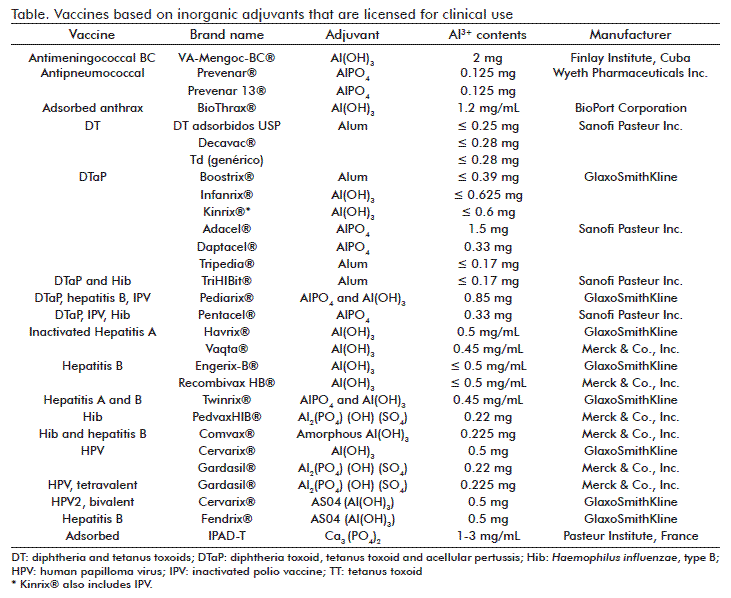
<body><![CDATA[<P   align="justify" ><font size="2" face="Verdana, Arial, Helvetica, sans-serif">Moreover, recent      results have suggested that the process of adsorption may induce structural      changes in the antigen that might increase its susceptibility to many host      proteases involved in the generation of immune responses, favoring its presentation      by professional antigen-presenting cells [34, 35]. </font></P >       <P   align="justify" >&nbsp;</P >       <P   ><font size="2" face="Verdana, Arial, Helvetica, sans-serif"><B><font size="3">INORGANIC      COMPOUNDS USED AS ADJUVANTS </font></b></font></P >   <FONT size="+1"><B>        <P   ><font size="2" face="Verdana, Arial, Helvetica, sans-serif">Aluminum salts </font></P >   </B>        <P   align="justify" ><font size="2" face="Verdana, Arial, Helvetica, sans-serif">Aluminum salts represent      the most popular and ubiquitous class of vaccine adjuvant. Indeed, potassium      aluminum sulphate (KAl(SO<Sub>4</Sub>)<Sub>2 </Sub>&times; 12 H<Sub>2</Sub>O),      whose characteristics are very similar to those of aluminum phosphate, was      employed to obtain tetanus and diphtheria toxoid aluminates, thereby becoming      the very first adjuvant to be used in human vaccines [36]. </font></P >   <FONT size="+1"><FONT size="+1"><FONT size="+1"><FONT size="+1"><FONT size="+1"><FONT size="+1"><FONT size="+1">        <P   align="justify" ><font size="2" face="Verdana, Arial, Helvetica, sans-serif">Aluminum hydroxide      and phosphate, and later aluminum hydroxyphosphate sulfate, are the only aluminum-based      adjuvants currently approved for manufacturing vaccines licensed for clinical      use. The amount of aluminum per dose is restricted to no more than 0.85 mg      in the USA, although European regulatory agencies have increased this limit      to 1.25 mg since 1981. The <a href="/img/revistas/bta/v30n4/t0101413.gif">table</a> summarizes      available vaccines currently licensed for use in humans that employ inorganic      adjuvants [37]. </font></P >       
<P   align="justify" ><font size="2" face="Verdana, Arial, Helvetica, sans-serif">Stanley Hem <I>et      al.</I> studied the physico-chemical characteristics of aluminum hydroxide      and phosphate, demonstrating that aluminum hydroxide, under the conditions      employed for its application as adjuvant, is a crystalline solid [38-41].      Its structure corresponds to that of aluminum oxide hydroxide (AlO(OH)), a      mineral known as boehmite that organizes into fibers with an average primary      particle size of 4.5 &times; 2.2 &times; 10 nm. Thanks to this structural      organization, aluminum hydroxide exhibits a large surface-mass ratio and a      high capacity for adsorbing antigens. It has an isoelectric point that ranges      from 9 to 11, and is marketed under the <I>Alhydrogel </I>trade name [38-41].      </font></P >       <P   align="justify" ><font size="2" face="Verdana, Arial, Helvetica, sans-serif">AlPO<Sub>4</Sub>      is an amorphous, non-stoichiometric solid of variable OH-PO<Sub>4</Sub> ratio      whose chemical formula is Al(OH)<Sub>m</Sub>(PO<Sub>4</Sub>)<Sub>n</Sub>.      It organizes into plates or sheets, and its average primary particle size      is approximately 50 nm. Its isoelectric point ranges from 5 to 7, and is marketed      under the <I>Adju-Phos</I> trade name [42]. </font></P >   <FONT size="+1"><FONT size="+1"><FONT size="+1"><FONT size="+1"><FONT size="+1"><FONT size="+1"><FONT size="+1"><FONT size="+1"><FONT size="+1"><FONT size="+1">        <P   align="justify" ><font size="2" face="Verdana, Arial, Helvetica, sans-serif">In these complexes,      the aquo ion Al<Sup>3+</Sup> occupies tetrahedral and octahedral positions.      The net surface charge of these two adjuvants impacts the way antigen adsorption      takes place and the rate of antigen release after injection and exposure to      the physiological medium, whose pH is close to neutral [41]. In solution,      both adjuvants form porous aggregates with diameters ranging from 1 to 10      nm. </font></P >   <FONT size="+1"><FONT size="+1">        <P   align="justify" ><font size="2" face="Verdana, Arial, Helvetica, sans-serif">Aluminum hydroxide      and aluminum phosphate exhibit different rates of solubilization, both <I>in      vitro </I>and <I>in vivo,</I> into the interstitial fluid. While dissolution      of the phosphate salt is relatively fast, the <I>in vitro </I>solubility of      the hydroxide is poor, a finding that explains the prolonged persistence of      this compound <I>in vivo.</I> The solubilization of these salts is favored      in the presence of plasmatic, citric, lactic or malic acids, among others.      According to the available data, 51 % of the injected aluminum phosphate is      solubilized during the first month post-administration; a figure that drops      to only 17 % in the case of aluminum hydroxide [42]. </font></P >       ]]></body>
<body><![CDATA[<P   ><font size="2" face="Verdana, Arial, Helvetica, sans-serif"><B><I>Amorphous hydroxyphosphate      sulfate </I></b></font></P >       <P   align="justify" ><font size="2" face="Verdana, Arial, Helvetica, sans-serif">Aluminum hydroxyphosphate      sulfate (Al<Sub>2</Sub>(PO<Sub>4</Sub>) (OH) (SO<Sub>4</Sub>)) is a compound      manufactured by Merck with a structure similar to that of aluminum phosphate,      but clearly dissimilar properties. It is an amorphous lattice with an isoelectric      point close to 7, which has been employed in a vaccine against Human Papillomavirus.      The binding capacity of aluminum hydroxyphosphate sulfate for virus-like particles      (VLP), and their subsequent stabilization, is larger than that of other aluminum      salts [43]. </font></P >   <FONT size="+1"><FONT size="+1"><FONT size="+1"><FONT size="+1"><FONT size="+1"><FONT size="+1">        <P   ><font size="2" face="Verdana, Arial, Helvetica, sans-serif"><B><I>Aluminum chloride      </I></b></font></P >       <P   align="justify" ><font size="2" face="Verdana, Arial, Helvetica, sans-serif">Aluminum chloride      is an amphoteric compound that readily dissolves into water, forming aluminum      hydroxide. It was used as an adjuvant for the production of antisera for cobra      venom [44, 45]. </font></P >       <P   ><font size="2" face="Verdana, Arial, Helvetica, sans-serif"><B><I>Aluminum hydroxycarbonate      </I></b></font></P >       <P   align="justify" ><font size="2" face="Verdana, Arial, Helvetica, sans-serif">Aluminum hydroxycarbonate      (Alum HC) forms through the pairing of a carbonate anion to an aluminum cation      in an aluminum hydroxide gel. This compound has been used extensively as an      antacid. A comparison of the adjuvant effect of aluminum hydroxycarbonate      against that of 24 different adjuvants for eliciting a humoral immune response      against Human Immunodeficiency Virus type 2 (HIV-2) in mice demonstrated that      this compound, as all other aluminum-based adjuvants, is able to potentiate      the induction of an antibody response against the gp120 antigen [46]. </font></P >       <P   ><font size="2" face="Verdana, Arial, Helvetica, sans-serif"><B><I>Aluminum silicate      </I></b></font></P >       <P   align="justify" ><font size="2" face="Verdana, Arial, Helvetica, sans-serif">In nature, aluminum      silicates (Al<Sub>2</Sub>SiO<Sub>5</Sub>) are found only as hydrates. They      have found extensive application in the pharmaceutical industry and in dentistry.      A 1 % gel of bentonite, a form of aluminum silicate, has been the preferred      formulation in vaccine adjuvant studies describing this compound. A study      examining its potency for the induction of IgE responses in experimental animals      and the production of IgG1 antibody found that it exhibited a behavior similar      to that of alum [47]. Bentonite has also been used at 2 % in a study comparing      the potency of four adjuvants for raising anti-rabies antibodies in horses      [48]. </font></P >   <FONT size="+1"><FONT size="+1"><FONT size="+1"><FONT size="+1">        <P   align="justify" ><font size="2" face="Verdana, Arial, Helvetica, sans-serif">A more recent study      in sheep demonstrated that a vaccine against enterotoxaemia adsorbed in bentonite      was a more economical alternative to the vaccine ad-sorbed into alum, with      no loss of vaccine efficacy [49]. </font></P >       <P   ><font size="2" face="Verdana, Arial, Helvetica, sans-serif"><B><I>Manufacturing      methods for aluminum salts </I></b></font></P >       ]]></body>
<body><![CDATA[<P   align="justify" ><font size="2" face="Verdana, Arial, Helvetica, sans-serif">Aluminum oxides and      hydroxides are generally prepared through the addition of NaOH or NH<Sub>3</Sub>      solutions to a solution containing an aluminum salt (AlCl<Sub>3</Sub>, KAl(SO<Sub>4</Sub>)<Sub>2      </Sub>&times; 12H<Sub>2</Sub>O). Other aluminum-based adjuvant salts are prepared      similarly, the only difference being the simultaneous addition of a phosphate      (Na<Sub>2</Sub>HPO<Sub>4</Sub>, NaH<Sub>2</Sub>PO<Sub>4</Sub>), bicarbonate      or sulfate salt. The properties of the resulting gel (<I>i.e.</I>, surface      area and charge, chemical composition, structure) are significantly influenced      by the details of the manufacturing process, including factors, such as pH,      temperature, concentration and chemical engineering variables (reactor geometry      and rate of mixing). Quality specifications for aluminum-based gels used as      adjuvants usually list parameters such as the contents of aluminum and some      other ions (nitrates, sodium, chlorides, and sulfates), sterility, viscosity,      sedimentation rate, adsorption capacity and isoelectric point, among others      [50]. </font></P >   <FONT size="+1"><FONT size="+1"><FONT size="+1"><FONT size="+1"><FONT size="+1"><FONT size="+1"><FONT size="+1"><FONT size="+1"><FONT size="+1"><FONT size="+1"><FONT size="+1"><FONT size="+1"><FONT size="+1"><FONT size="+1"><FONT size="+1"><FONT size="+1"><FONT size="+1"><FONT size="+1">        <P   align="justify" ><font size="2" face="Verdana, Arial, Helvetica, sans-serif">A number of amorphous      hydrated structures, all in multiple equilibria with different aluminum species,      are formed during the production of these gels. For instance, in aqueous solutions      below pH 3, aluminum exists as a complex aquo ion [Al(H<Sub>2</Sub>O)<Sub>6</Sub>]<Sup>3+</Sup>,      usually written simply as Al<Sup>3+</Sup>. At slightly higher pH the [Al(H<Sub>2</Sub>O)<Sub>6</Sub>]<Sup>3+</Sup>      ion undergoes successive deprotonations, forming the [Al(H<Sub>2</Sub>O)<Sub>5</Sub>(OH)]<Sup>2+</Sup>      ion and a number of hydrocomplexes [51, 52]. At pH close to 7, Al(OH)<Sub>3</Sub>      begins to precipitate, and finally, at basic pH, Al(OH)<Sub>3 </Sub>is solubilized      again, forming the aluminate ion [Al(OH)<Sub>4</Sub>]. </font></P >   <FONT size="+1"><FONT size="+1"><FONT size="+1"><FONT size="+1"><FONT size="+1"><FONT size="+1"><FONT size="+1"><FONT size="+1"><FONT size="+1"><FONT size="+1"><FONT size="+1"><FONT size="+1"><FONT size="+1"><FONT size="+1"><FONT size="+1"><FONT size="+1"><FONT size="+1"><FONT size="+1"><FONT size="+1"><FONT size="+1"><FONT size="+1"><FONT size="+1"><FONT size="+1"><FONT size="+1"><FONT size="+1"><FONT size="+1"><B>        <P   ><font size="2" face="Verdana, Arial, Helvetica, sans-serif">Calcium salts </font></P >   <FONT size="+1">        <P   ><font size="2" face="Verdana, Arial, Helvetica, sans-serif"><I>Calcium phosphate      </I></font></P >   </font></B>        <P   align="justify" ><font size="2" face="Verdana, Arial, Helvetica, sans-serif">Calcium phosphate      was originally examined as an alternative to aluminum-based adjuvants by Prof.      Edgar H Relyveld, working at the Pasteur Institute. It has since been used      as an adjuvant in vaccines against diphtheria, tetanus, whooping cough, poliomyelitis,      tuberculosis, yellow fever, measles and hepatitis B, also forming part of      immunotherapeutic preparations against a number of allergens [53-55]. </font></P >   <FONT size="+1"><FONT size="+1">        <P   align="justify" ><font size="2" face="Verdana, Arial, Helvetica, sans-serif">Although the properties      of calcium salts are similar to those of aluminum, the former exhibit a number      of potential advantages. To begin with, calcium is a normal constituent of      the human body and is, therefore, well tolerated; its capacity for adsorbing      antigens is excellent, and antigen release proceeds only slowly; lastly, it      stimulates the induction of IgG but not IgE antibodies, decreasing the possibility      of long-term side effects that are usually detectable only in expensive large      scale post-marketing trials. However, there have been sporadic cases of neurological      reactions after the administration of <I>Bordetella pertussis</I> vaccines      adsorbed with this adjuvant, and the World Health Organization, together with      the European Pharmacopoeia, has therefore recommended an upper safety limit      of 1.3 mg of calcium/dose [56]. </font></P >       <P   align="justify" ><font size="2" face="Verdana, Arial, Helvetica, sans-serif">The empirical formula      of calcium phosphate as employed in adjuvants is approximated by Ca<Sub>3</Sub>(PO<Sub>4</Sub>)<Sub>2</Sub>.<Sub>      </Sub>X-ray diffraction, infrared spectroscopy and thermal analysis, among      other techniques, have shown that commercially available calcium phosphate      is a non-stoichiometric hydroxyapatite: Ca<Sub>10-x</Sub>(HPO<Sub>4</Sub>)<Sub>x      </Sub>(PO<Sub>4</Sub>)<Sub>6-x</Sub> (OH)<Sub>2-x</Sub> (where <I>x</I> ranges      from 0 to 2). Surface charge depends on pH, and its isoelectric point is 5.5.      Calcium phosphate, therefore, is negatively charged at physiological pH, and      adsorbs positively charged antigens through electrostatic interactions. This      adjuvant can also adsorb phosphorylated antigens through ligand exchange via      surface hydroxyls [57]. </font></P >   <FONT size="+1"><FONT size="+1"><FONT size="+1"><FONT size="+1"><FONT size="+1"><FONT size="+1"><FONT size="+1"><FONT size="+1"><FONT size="+1"><FONT size="+1"><FONT size="+1"><FONT size="+1"><FONT size="+1"><FONT size="+1"><FONT size="+1"><FONT size="+1"><FONT size="+1"><FONT size="+1"><FONT size="+1"><FONT size="+1">        <P   align="justify" ><font size="2" face="Verdana, Arial, Helvetica, sans-serif">The adjuvant properties      of calcium phosphate are strongly dependent on precipitation conditions, in      a manner very similar to that described above for aluminum salts. Precipitates      produced through the rapid mixing of two reactants adsorb 100 % of diphtheria      toxoid, but those produced by slow addition only adsorb 58 % of the same dose;      a phenomenon caused by molar Ca/P ratios that can vary from 1.35 to 1.83 depending      on mixing rate [58]. </font></P >       <P   align="justify" ><font size="2" face="Verdana, Arial, Helvetica, sans-serif">Recently, calcium      phosphate nanoparticles have been synthesized that show better physicochemical      characteristics and performance than traditional preparations [59]. These      nanoparticles, which produce less inflammatory reactions at the injection      site, higher IgG2a titers and lower IgE titers than aluminum-based adjuvants,      are regarded as a good alternative for immunization schemes involving viral      antigens, and have already been applied in studies employing the intranasal      route to elicit mucosal immune responses in animal models [59-62]. Nano-structured      calcium phosphate is, therefore, a good example of how it is possible to develop      far superior adjuvants by simply modifying the size and morphology of existing      compounds. </font></P >       <P   ><font size="2" face="Verdana, Arial, Helvetica, sans-serif"><B><I>Calcium alginate      </I></b></font></P >       ]]></body>
<body><![CDATA[<P   align="justify" ><font size="2" face="Verdana, Arial, Helvetica, sans-serif">Calcium alginate      is prepared from sodium alginate, which polymerizes in the presence of the      former and forms depots where the antigen is adsorbed. The adjuvant effect      of this preparation has been studied in mice, where it has been used in the      production of antisera for <I>Bothrops asper </I>venom and in a number of      assays involving antibacterial and antiviral vaccines. When used for experimental      typhoid vaccines, it has been proven better at eliciting a humoral response      than conventional adjuvants [63]. It should be noted, however, that calcium      alginate is less potent as a vaccine adjuvant than Freund&rsquo;s, and has      been shown to be unable to increase the immune response against diphtheria      toxoid [64, 65]. </font></P >       <P   ><font size="2" face="Verdana, Arial, Helvetica, sans-serif"><B><I>Calcium chloride      </I></b></font></P >       <P   align="justify" ><font size="2" face="Verdana, Arial, Helvetica, sans-serif">Calcium chloride      mixed with liposomes (forming cylindrically shaped cochleates) has been evaluated      in intranasal vaccines used to stimulate mucosal immune response in animal      models [66]. Also, it has recently been shown to have a good adjuvant effect      when included in the AMVAD (<I>archaeal lipid mucosal vaccine adjuvant and      delivery</I>) formulation, an intranasal formulation based on archaebacterial      lipids that can promote a long-lasting systemic immune response in mice [67].      </font></P >       <P   ><font size="2" face="Verdana, Arial, Helvetica, sans-serif"><B>Magnesium compounds      </b></font></P >   <FONT size="+1">        <P   align="justify" ><font size="2" face="Verdana, Arial, Helvetica, sans-serif">Crystalline magnesium      hydroxide has been employed in a mixture at equal proportions with amorphous      aluminum hydroxycarbonate, sold under the registered trade mark of Imject      Alum&reg;. It has been shown to be an effective adjuvant in mice, but has      not been examined yet in clinical trials [68, 69]. </font></P >   <FONT size="+1">        <P   align="justify" ><font size="2" face="Verdana, Arial, Helvetica, sans-serif">Another magnesium      salt whose adjuvant effect has been studied is the penta-hydrate of magnesium      hydroxycarbonate. In mice, the latter performed better than aluminum hydroxide      for the induction of specific anti-TT antibodies [70]. </font></P >       <P   ><font size="2" face="Verdana, Arial, Helvetica, sans-serif"><B>Iron salts </b></font></P >   <FONT size="+1"><B>        <P   ><font size="2" face="Verdana, Arial, Helvetica, sans-serif"><I>Iron phosphate      </I></font></P >   </B>        <P   align="justify" ><font size="2" face="Verdana, Arial, Helvetica, sans-serif">Iron phosphate is      an amorphous compound with an average particle size ranging from 0.01 to 300      &mu;m. Studies in mice have shown that it is tolerated as well as aluminum      hydroxide. Iron phosphate is an effective adjuvant for the induction of IgG1      antibodies, but is not better for this purpose than aluminum hydroxide (it      is better, however, than iron hydroxide). The amount of iron per dose is limited      by regulatory agencies to 0.2-1.4 mg per dose [71]. </font></P >   <FONT size="+1">        <P   ><font size="2" face="Verdana, Arial, Helvetica, sans-serif"><B><I>Colloidal iron      </I></b></font></P >       ]]></body>
<body><![CDATA[<P   align="justify" ><font size="2" face="Verdana, Arial, Helvetica, sans-serif">Colloidal iron is      actually a mixture of iron (III) hydroxide and oxide, with varying stoichiometry      and hydration levels. Its particle size ranges from 1 to 500 nm, and its adjuvant      capacity is similar to that of aluminum hydroxide, but advantageously effective      at stimulating the induction of cytotoxic T-lymphocytes. In experimental animals      (mice), colloidal iron has been shown to increase the immunogenicity of TT      and inactivated Tick-Borne Encephalitis Virus. Adsorption-wise, this type      of colloid performs better than pure iron hydroxide gels, binding a wider      range of proteins [72, 73]. </font></P >       <P   ><font size="2" face="Verdana, Arial, Helvetica, sans-serif"><B><I>Carbonyl iron      </I></b></font></P >       <P   align="justify" ><font size="2" face="Verdana, Arial, Helvetica, sans-serif">This compound forms      spherical particles that have exhibited a potent adjuvant effect for the induction      of allergic encephalomyelitis in rats. A similar adjuvant effect is exhibited      by kaolin, but not other metallic iron suspensions such as iron oxide or iron-dextran.      Carbonyl iron might become a useful tool for research into adjuvant mechanisms      and cellular immunology due to its magnetic properties and ease of detection      [74]. </font></P >       <P   align="justify" ><font size="2" face="Verdana, Arial, Helvetica, sans-serif">Compared to other      alternatives, the iron-based adjuvants described above are handicapped by      their smaller surface area/mass ratios, and therefore smaller adsorption capacities.      In addition, these compounds exhibit slower absorption rates <I>in vivo</I>.      </font></P >       <P   ><font size="2" face="Verdana, Arial, Helvetica, sans-serif"><B>Zinc compounds      </b></font></P >   <FONT size="+1"><B>        <P   ><font size="2" face="Verdana, Arial, Helvetica, sans-serif"><I>Zinc oxide </I></font></P >   </B>        <P   align="justify" ><font size="2" face="Verdana, Arial, Helvetica, sans-serif">The adjuvant effect      of zinc oxide has been studied in mice, where it stimulates Th2-type responses.      According to the available data, zinc oxide is a safer alternative to aluminum      hydroxide, as it is more potent, less toxic, and induces IgE in lower proportions      [75, 76]. </font></P >   <FONT size="+1">        <P   ><font size="2" face="Verdana, Arial, Helvetica, sans-serif"><B><I>Zinc sulfate      </I></b></font></P >       <P   align="justify" ><font size="2" face="Verdana, Arial, Helvetica, sans-serif">Zinc sulfate has      been used as adjuvant in formulations intended for topical use [77]. It was      also studied in a clinical trial describing its effect on the immune response      to a recombinant hepatitis B vaccine in the elderly, although this research      has failed to detect a significant effect of this compound on antibody generation      for this target population [78]. </font></P >       <P   ><font size="2" face="Verdana, Arial, Helvetica, sans-serif"><B><I>Zinc hydroxide      </I></b></font></P >       ]]></body>
<body><![CDATA[<P   align="justify" ><font size="2" face="Verdana, Arial, Helvetica, sans-serif">It is well known      that zinc hydroxide is an effective protein and antigen sorbent. Not surprisingly,      then, this compound has been shown to stimulate both cellular and humoral      immune responses in mice and pigs. Adding lecithin increases the adjuvant      effect and improves local tolerance for zinc hydroxide-based vaccines [78].      </font></P >       <P   align="justify" ><font size="2" face="Verdana, Arial, Helvetica, sans-serif">The adjuvanticity      of zinc hydroxide in combination with calcium hydroxide, lecithin and hydrogenated      poly-alfa-olefin is better than that of the individual components of this      mixture. </font></P >       <P   align="justify" ><font size="2" face="Verdana, Arial, Helvetica, sans-serif">Other studies have      shown the effect of zinc chloride and acetate, with negative results. Not      only their adjuvanticity is not detectable, but also local tolerance to their      administration is low [78]. </font></P >       <P   ><font size="2" face="Verdana, Arial, Helvetica, sans-serif"><B>Manganese chloride      </b></font></P >   <FONT size="+1">        <P   align="justify" ><font size="2" face="Verdana, Arial, Helvetica, sans-serif">Manganese chloride      has been tried in mice as an adjuvant, and found to stimulate the activity      of natural killer cells (NK). It acts similarly to more complex compounds      that induce the synthesis of interferons [79-81]. </font></P >   <FONT size="+1"><FONT size="+1">        <P   ><font size="2" face="Verdana, Arial, Helvetica, sans-serif"><B>Zirconium salts      </b></font></P >   <FONT size="+1">        <P   align="justify" ><font size="2" face="Verdana, Arial, Helvetica, sans-serif">Adjuvanticity studies      have been performed for several zirconium salts and combinations thereof:      zirconium and sodium lactate, zirconium lactate and aluminum, zirconium oxychloride,      zirconium and aluminum glyci- nate and zirconium hydroxide. These compounds      have been found to stimulate the immune response, producing larger titers      of IgM antibodies in mice. Although the existing literature provides no further      details, it is argued that these adjuvants induce a prolonged, more sustained      production of antibodies. </font></P >   <FONT size="+1">        <P   align="justify" ><font size="2" face="Verdana, Arial, Helvetica, sans-serif">In pigs, there is      a direct relation between the extent of chronic inflammation induced by zirconium-based      adjuvants (with the exception of zirconium hydroxide, (Zr(OH)<Sub>4</Sub>)      and activation of the complement cascade [16, 82]. </font></P >   <FONT size="+1"><FONT size="+1">        <P   ><font size="2" face="Verdana, Arial, Helvetica, sans-serif"><B>Cerium nitrate      </b></font></P >   <FONT size="+1">        <P   align="justify" ><font size="2" face="Verdana, Arial, Helvetica, sans-serif">There are several      different forms of cerium nitrate (Ce(NO<Sub>3</Sub>)<Sub>4</Sub>), although      most medical applications of this salt employ its hexa-hydrate (Ce(NO<Sub>3</Sub>)<Sub>3</Sub>      &times; 6H<Sub>2</Sub>O). Currently, cerium nitrate is used as adjuvant in      silver sulfadiazine creams. There is some data describing the <I>in vitro      </I>evaluation of the protein adsorption capacity of cerium oxide and its      uptake by lung adenocarcinoma cells [83]. </font></P >   <FONT size="+1"><FONT size="+1"><FONT size="+1"><FONT size="+1"><FONT size="+1"><FONT size="+1"><FONT size="+1"><FONT size="+1"><FONT size="+1"><FONT size="+1"><FONT size="+1">        ]]></body>
<body><![CDATA[<P   ><font size="2" face="Verdana, Arial, Helvetica, sans-serif"><B>Beryllium salts      </b></font></P >   <FONT size="+1">        <P   align="justify" ><font size="2" face="Verdana, Arial, Helvetica, sans-serif">A study in mice susceptible      to infection by <I>Leishmania </I>spp. demonstrated that beryllium sulfate      promoted significantly the production of interferon gamma (IFN-&gamma;). This      compound was shown to synergize with interleukin 12 (IL-12), stimulating the      production of Th1 cytokines; these findings have led to the examination of      the adjuvanticity of beryllium salts [84]. Beryllium oxide (Be(OH)<Sub>2</Sub>)      has been used as an adjuvant in animal experimentation [85]. </font></P >   <FONT size="+1"><FONT size="+1"><FONT size="+1"><B>        <P   ><font size="2" face="Verdana, Arial, Helvetica, sans-serif">Oxides </font></P >   <FONT size="+1">        <P   ><font size="2" face="Verdana, Arial, Helvetica, sans-serif"><I>Aerosil </I></font></P >   </font></B>        <P   align="justify" ><font size="2" face="Verdana, Arial, Helvetica, sans-serif">Aerosil 200 is a      formulation based on highly dispersed 11 % (w/v) silicon dioxide that has      found ample use as an auxiliary substance in pharmaceutical and cosmetic applications,      due to its hydrophilicity. A similar formulation by the name of aerosil R972      is a hydrophobic dispersion of 1 % (w/v) silicon dioxide employed for the      manufacture of pills from hygroscopic powders or granules [46]. The adjuvanticity      of both formulations was evaluated in mice using inactivated HIV-2 antigens,      finding that both were able to stimulate the production of antibodies against      the gp120 glycoprotein. </font></P >   <FONT size="+1"><FONT size="+1">        <P   ><font size="2" face="Verdana, Arial, Helvetica, sans-serif"><B>Other oxides </b></font></P >   <FONT size="+1">        <P   align="justify" ><font size="2" face="Verdana, Arial, Helvetica, sans-serif">The adjuvanticity      of silica, (SiO<Sub>2</Sub>), talcum powder (Mg<Sub>3</Sub>Si<Sub>4</Sub>O<Sub>10</Sub>(OH)<Sub>2</Sub>),      aluminum oxide (Al<Sub>2</Sub>O<Sub>3</Sub>), tin oxide (SnO<Sub>2</Sub>),      zirconium oxide (ZrO<Sub>2</Sub>), hematite (Fe<Sub>2</Sub>O<Sub>3</Sub>)      and magnetite (Fe<Sub>3</Sub>O<Sub>4</Sub>) was evaluated in rats using ovalbumin      as model antigen [86]. That study found that aluminum oxide, hematite and      magnetite showed moderate adjuvanticity, but found tin and zirconium oxides      to be very poor adjuvants. No link was detected between the hydrophobicity      and hydrophilicity of these oxides and the magnitude of the resulting adjuvant      effect. </font></P >       <P   align="justify" >&nbsp;</P >   <FONT size="+1"><FONT size="+1"><FONT size="+1"><FONT size="+1"><FONT size="+1"><FONT size="+1"><FONT size="+1"><FONT size="+1"><FONT size="+1"><FONT size="+1"><FONT size="+1"><FONT size="+1"><FONT size="+1"><FONT size="+1"><FONT size="+1"><FONT size="+1"><FONT size="+1"><FONT size="+1"><FONT size="+1"><FONT size="+1"><FONT size="+1"><FONT size="+1"><FONT size="+1"><FONT size="+1"><FONT size="+1"><FONT size="+1"><FONT size="+1">        <P   ><font size="2" face="Verdana, Arial, Helvetica, sans-serif"><B><font size="3">ADJUVANT      MIXTURES </font> </b></font></P >   <FONT size="+1"><B>        <P   ><font size="2" face="Verdana, Arial, Helvetica, sans-serif">Algamulin </font></P >   </B>        ]]></body>
<body><![CDATA[<P   align="justify" ><font size="2" face="Verdana, Arial, Helvetica, sans-serif">Taking advantage      of the fact that gamma inulin, a natural algal polysaccharide, is a potent      activator of the alternative complement pathway, Cooper <I>et al.</I> [87]      combined aluminum hydroxide with gamma inulin. This combination, christened      as &lsquo;algamulin&rsquo;, has been found to provide an adjuvant effect when      combined with commercially available antigens such as diphtheria and tetanus      toxoids, respiratory syncytial virus and protein E7 from the human papilloma      virus [87]. </font></P >   <FONT size="+1">        <P   ><font size="2" face="Verdana, Arial, Helvetica, sans-serif"><B>AS04 </b></font></P >       <P   align="justify" ><font size="2" face="Verdana, Arial, Helvetica, sans-serif">AS04 (for Adjuvant      system 04) is one of the very few examples of a novel, groundbreaking adjuvant      that has actually been licensed for inclusion into prophylactic human vaccines.      This compound is a combination of two different adjuvants with mutually complementary      profiles: the time-tested aluminum hydroxide and monophosphoryl lipid A (MPL).      This last is a purified, detoxified lipopolysaccharide from <I>Salmonella      minnesota</I> that retains its affinity for Toll-like receptor 4 (TLR-4).      AS04 is used in a commercially available Hepatitis B vaccine (marketed as      Fendrix&reg;) that is indicated preferentially for patients under hemodialysis      and in immunosuppressive situations, and in a vaccine against the human papilloma      virus (marketed as Cervarix&reg;) [88]. </font></P >       <P   ><font size="2" face="Verdana, Arial, Helvetica, sans-serif"><B>Imject Alum&reg;      </b></font></P >       <P   align="justify" ><font size="2" face="Verdana, Arial, Helvetica, sans-serif">Aluminum hydroxide-magnesium      hydroxide, marketed under the Imject Alum&reg; (Pierce Biotechnology, USA),      is a 1:1 mixture of amorphous aluminum hydroxycarbonate with crystalline magnesium      hydroxide that is very similar to Maalox&reg;, a well-known antacid. This      combination has only been used in studies involving experimental animals,      but is reported as very effective. Its mechanism of action is based on the      activation of inflammasome NLRP3 [89]. </font></P >       <P   align="justify" ><font size="2" face="Verdana, Arial, Helvetica, sans-serif">Noteworthy, adjuvant      combinations represent a cost-efficient, quick solution whenever an adjuvant      that can simultaneously stimulate a prolonged and intense antibody-based Th2      response and a potent Th1 response (fundamental for the protection against      viruses and intracellular bacteria) is not available. Also, in addition to      guaranteeing the intensity and quality of the induced response, these mixtures      offer the possibility of including a homing molecule that may direct these      responses to a specific immune response compartment. </font></P >       <P   align="justify" >&nbsp;</P >       <P   ><font size="2" face="Verdana, Arial, Helvetica, sans-serif"><B><font size="3">CONCLUDING      REMARKS </font> </b></font></P >   <FONT size="+1">        <P   align="justify" ><font size="2" face="Verdana, Arial, Helvetica, sans-serif">Most inorganic adjuvants      are employed as gels despite the previous availability of water-soluble divalent      and trivalent metal salts of proven adjuvanticity, such as calcium gluconate,      manganese gluconate, manganese glycerophosphate, aluminum acetate and aluminum      salicylate [90]. The quality of these gels changes according to the manufacturer,      hence, their adjuvant effect is sometimes far from optimum. This situation      has pushed vaccine manufacturers into a search for alternatives of their own      [91]. </font></P >   <FONT size="+1">        <P   align="justify" ><font size="2" face="Verdana, Arial, Helvetica, sans-serif">Most studies examining      the adjuvanticity of inorganic compounds have used commercially available      salts without paying due consideration to physico-chemical properties such      as polymorphisms, solubility constants, lattice energies, bonding (whether      covalent or ionic), medium pH, oxidation status, particle size and antigen      adsorption capacity, which impact directly the <I>depot </I>and <I>presentation      </I>effects commonly attributed to adjuvants. Consequently, many research      groups have rejected or ignored compounds that can potentially perform better      as adjuvants than traditional aluminum salts [92]. </font></P >       ]]></body>
<body><![CDATA[<P   align="justify" ><font size="2" face="Verdana, Arial, Helvetica, sans-serif">Research in this      field has focused not only on obtaining new adjuvants, but on developing new      formulations from existing compounds. Nanotechnology offers the promise of      inorganic salts whose properties can be shaped at a nanometric scale, potentially      increasing their surface area and, thereby, favoring antigen absorption and      intake by antigen-presenting cells (especially dendritic cells). The particulate      nature of viruses and bacteria is mimicked much more efficiently by nanometer-sized      aggregates, as exemplified by calcium phosphate and aluminum oxide nanoparticles.      </font></P >       <P   align="justify" ><font size="2" face="Verdana, Arial, Helvetica, sans-serif">Studying, obtaining      and evaluating new polymorphic forms from safe and well-known aluminum and      calcium compounds is an additional research avenue that will yield new structural,      morphological and chemical data for re-evaluating existing adjuvants such      as zinc and iron salts. </font></P >       <P   align="justify" ><font size="2" face="Verdana, Arial, Helvetica, sans-serif">Currently, there      is a trend towards the use of adjuvant mixtures, often combining compounds      whose properties are mutually complementary as illustrated by the paradigmatic      example of AS04. It should be stressed, however, that we are only scratching      the sur-face of the world of potential applications offered by mixtures of      inorganic adjuvants or the synthesis of artificial minerals with the exact      chemical makeup required for increasing vaccine potency while keeping side      effects to a minimum. A good starting point for the quest towards the ideal      inorganic adjuvant would be the preparation of a compound mixing zinc hydroxide      (Zn(OH)<Sub>2</Sub>, a known Th1 promoter) with more traditional Th2-promoting      calcium and aluminum salts. </font></P >   <FONT size="+1"><FONT size="+1">        <P   align="justify" ><font size="2" face="Verdana, Arial, Helvetica, sans-serif">In closing, it must      be remarked that the application of inorganic compounds as vaccine adjuvants      remains a lively and growing research field. The application of the latest      advances in nanotechnology, together with the appearance of adjuvant combinations      or the preparation of nanostructured compounds using salts or ions stimulating      both the humoral and cellular arms of the immune system through different      vaccination routes, will no doubt eventually yield compounds overcoming the      limitations of current vaccine technology. </font></P >       <P   align="justify" >&nbsp;</P >       <P   align="justify" ></P >       <P   align="justify" > </P >       <P   ><font size="3"><b><font face="Verdana, Arial, Helvetica, sans-serif">REFERENCES      </font></b></font></P >       <!-- ref --><P   align="justify" ><font size="2" face="Verdana, Arial, Helvetica, sans-serif">1. Chang L. Industrial      mineralogy: materials, processes, and uses. New Jersey: Prentice-Hall; 2001.          </font></P >   <FONT size="+1">        ]]></body>
<body><![CDATA[<!-- ref --><P   align="justify" ><font size="2" face="Verdana, Arial, Helvetica, sans-serif">2. Carretero MI,      Pozo M. Clay and non-clay minerals in the pharmaceutical and cosmetic industries.      Part II. Active ingredients. Appl Clay Sci. 2010;47:171-81.     </font></P >       <!-- ref --><P   align="justify" ><font size="2" face="Verdana, Arial, Helvetica, sans-serif">3. Reinke CM, Breitkreutz      J, Leuenberger H. Aluminium in over-the-counter drugs risks outweigh benefits?      Drug Safety. 2003;26(14):1011-25.     </font></P >       <!-- ref --><P   align="justify" ><font size="2" face="Verdana, Arial, Helvetica, sans-serif">4. Harandi AM, Gwyn      D, Olesen OF. Vaccine adjuvants: scientific challenges and strategic initiatives.      Expert Rev Vaccines. 2009;8(3):293-8.     </font></P >       <!-- ref --><P   align="justify" ><font size="2" face="Verdana, Arial, Helvetica, sans-serif">5. De Gregorio E,      Tritto E, Rappuoli R. Alum adjuvanticity: Unraveling a century old mystery.      Eur J Immunol. 2008;38:2068-71.     </font></P >       <P   align="justify" ><font size="2" face="Verdana, Arial, Helvetica, sans-serif">6. Singh M, O&rsquo;Hagan      DT. Recent advances in vaccine adjuvants. Pharm Res. 2002;19(6):715-28. </font></P >       <!-- ref --><P   align="justify" ><font size="2" face="Verdana, Arial, Helvetica, sans-serif">7. Clements CJ, Griffiths      E. The global impact of vaccines containing aluminium adjuvants. Vaccine.      2002;20:24-33.     </font></P >       <!-- ref --><P   align="justify" ><font size="2" face="Verdana, Arial, Helvetica, sans-serif">8. Gupta RK. Aluminium      compounds as vaccine adjuvants. Adv Drug Deliv Rev. 1998;32:155-72.     </font></P >       <!-- ref --><P   align="justify" ><font size="2" face="Verdana, Arial, Helvetica, sans-serif">9. Marrack P, McKee      AS, Munks MW. Towards an understanding of the adjuvant action of aluminium.      Nat Rev Immunol. 2009;9:287-93.     </font></P >       <!-- ref --><P   align="justify" ><font size="2" face="Verdana, Arial, Helvetica, sans-serif">10. Lahiri A, Das      P, Chakravortty D. Engagement of TLR signaling as adjuvant: Towards smarter      vaccine and beyond. Vaccine. 2008;26:6777-83.     </font></P >       <!-- ref --><P   align="justify" ><font size="2" face="Verdana, Arial, Helvetica, sans-serif">11. Kawai T, Akira      S. The roles of TLRs, RLRs and NLRs in pathogen recognition. Int Immunol.      2009;21(4):317-37.     </font></P >       <!-- ref --><P   align="justify" ><font size="2" face="Verdana, Arial, Helvetica, sans-serif">12. Tagliabue A,      Rappuoli R. Vaccine adjuvants: the dream becomes real. Hum Vaccine. 2008;4(5):347-9.          </font></P >       <!-- ref --><P   align="justify" ><font size="2" face="Verdana, Arial, Helvetica, sans-serif">13. Lindblad EB.      Aluminium adjuvants-in retrospect and prospect. Vaccine. 2004;22:3658-68.          </font></P >       <!-- ref --><P   align="justify" ><font size="2" face="Verdana, Arial, Helvetica, sans-serif">14. Glenny AT, Buttle      GAH, Stevens MF. Rate of disappearance of diphtheria toxoid injected into      rabbits and guinea-pigs: toxoid precipitated with alum. J Pathol. 1931;34:267-75.          </font></P >       <!-- ref --><P   align="justify" ><font size="2" face="Verdana, Arial, Helvetica, sans-serif">15. Holt LB. Developments      in diphtheria prophylaxis. London: William Heinemann, Ltd.; 1950.     </font></P >       <!-- ref --><P   align="justify" ><font size="2" face="Verdana, Arial, Helvetica, sans-serif">16. Ramanathan VD,      Badenoch-Jones P, Turk JL. Complement activation by aluminium and zirconium      compounds. Immunology. 1979;37:881-8.     </font></P >       <!-- ref --><P   align="justify" ><font size="2" face="Verdana, Arial, Helvetica, sans-serif">17. Harris J, Sharp      FA, Lavelle Ed. C. The role of inflammasomes in the immunostimulatory effects      of particulate vaccine adjuvants. Eur J Immunol. 2010;40:595-653.     </font></P >       <!-- ref --><P   align="justify" ><font size="2" face="Verdana, Arial, Helvetica, sans-serif">18. Shar AF, Ruane      D, Claass B, Creagh E, Harris J, <I>et al</I>. Uptake of particulate vaccine      adjuvants by dendritic cells activates the NALP3 inflammasome. Proc Natl Acad      Sci USA. 2009;106(3):870-5.     </font></P >       <!-- ref --><P   align="justify" ><font size="2" face="Verdana, Arial, Helvetica, sans-serif">19. Esch HH. Mechanisms      of stimulation of the immune response by aluminum adjuvants. Vaccine. 2002;20:S34-S39.          </font></P >       <!-- ref --><P   align="justify" ><font size="2" face="Verdana, Arial, Helvetica, sans-serif">20. Davenport FM,      Hennessy AV, Askin FB. Lack of adjuvant effect of AlPO4 on purified influenza      virus hemagglutinins in man. J Immunol. 1968;100(5):1139-40.     </font></P >       <!-- ref --><P   align="justify" ><font size="2" face="Verdana, Arial, Helvetica, sans-serif">21. Cvjetanovic B,      Uemura K. The present status of field and laboratory studies of typhoid and      paratyphoid vaccines. Bull WHO. 1965;32:29-36.     </font></P >       <!-- ref --><P   align="justify" ><font size="2" face="Verdana, Arial, Helvetica, sans-serif">22. Francis MJ, Fry      CM, Rowlands DJ, Bittle JL, Houghten RA, Lerner RA, <I>et al</I>. Immune response      to uncoupled peptides of foot-and-mouth disease virus. Immunology. 1987;61:1-6.          </font></P >       <!-- ref --><P   align="justify" ><font size="2" face="Verdana, Arial, Helvetica, sans-serif">23. Bomford R. Aluminium      salts: perspectives in their use as adjuvants. In: Gregoriadis G, Allison      AC, Poste G, editors. Immunological adjuvants and vaccines. New York: Plenum      Publishing Corp.; 1989. p. 35-41.     </font></P >       <!-- ref --><P   align="justify" ><font size="2" face="Verdana, Arial, Helvetica, sans-serif">24. Francis MJ, Fry      CM, Rowlands DJ, Brown F, Bittle JL, Houghten RA, <I>et al</I>. Immunological      priming with synthetic peptides of foot-and-mouth disease virus. J Gen Virol.      1985;66:2347-54.     </font></P >       <!-- ref --><P   align="justify" ><font size="2" face="Verdana, Arial, Helvetica, sans-serif">25. Lew AM, Anders      RF, Edwards SJ, Langford CJ. Comparison of antibody avidity and titre elicited      by peptide as a protein conjugate or as expressed in vaccinia. Immunology.      1988;65(2):311-4.     </font></P >       <!-- ref --><P   align="justify" ><font size="2" face="Verdana, Arial, Helvetica, sans-serif">26. Geerligs HJ,      Weijer WJ, Welling GW, Welling-Wester S. The influence of different adjuvants      on the immune response to a synthetic peptide comprising amino acid residues      9-21 of herpes simplex virus Type 1. J Immunol Methods. 1989;124(1):95-102.          </font></P >       <!-- ref --><P   align="justify" ><font size="2" face="Verdana, Arial, Helvetica, sans-serif">27. Tripathy T, Ranjan      D . Flocculation: A New Way to Treat the Waste Water. J Phys Sci. 2006;10:93-127.          </font></P >       <!-- ref --><P   align="justify" ><font size="2" face="Verdana, Arial, Helvetica, sans-serif">28. World Health      Organization. Temperature sensitivity of vaccines. WHO/IVB/06.10. Geneva:      World Health Organization; 2006.     </font></P >       <!-- ref --><P   align="justify" ><font size="2" face="Verdana, Arial, Helvetica, sans-serif">29. Rinella JV, White      JL, Hem SL. Effect of pH on the Elution of Model Antigens from Aluminum-Containing      Adjuvants. J Colloid Interface Sci. 1995;205(1):161-5.     </font></P >       <!-- ref --><P   align="justify" ><font size="2" face="Verdana, Arial, Helvetica, sans-serif">30. Al-Shakhshir      R, Regnier F, White JL, Hem SL. Effect of protein adsorption on the surface      charge characteristics of aluminium-containing adjuvants. Vaccine. 1994;12(5):472-4.          </font></P >       <!-- ref --><P   align="justify" ><font size="2" face="Verdana, Arial, Helvetica, sans-serif">31. Al-Shakhshir      R, Lee AL, White JL, Hem SL. Interactions in Model Vaccines Composed of Mixtures      of Aluminum-Containing Adjuvants. J Colloid Interface Sci. 1995;169:197-203.          </font></P >       <!-- ref --><P   align="justify" ><font size="2" face="Verdana, Arial, Helvetica, sans-serif">32. Seeber SJ, White      JL, Hem SL. Predicting the adsorption of proteins by aluminium-containing      adjuvants. Vaccine. 1991;9(3):201-3.     </font></P >       <!-- ref --><P   align="justify" ><font size="2" face="Verdana, Arial, Helvetica, sans-serif">33. Clapp T, Siebert      P, Chen D, Braun LJ. Vaccines with Aluminum-Containing Adjuvants: Optimizing      Vaccine Efficacy and Thermal Stability. J Pharm Sci. 2011;100(2):388-401.          </font></P >       <!-- ref --><P   align="justify" ><font size="2" face="Verdana, Arial, Helvetica, sans-serif">34. Peek JL, Russell      Middaugh C, Berkland C. Nanotechnology in vaccine delivery. Adv Drug Deliv      Rev. 2008;60:915-28.     </font></P >       <!-- ref --><P   align="justify" ><font size="2" face="Verdana, Arial, Helvetica, sans-serif">35. Jones LS, Peek      LJ, Power J, Markham A, Yazzie B, Middaugh R. Effects of Adsorption to Aluminium      Salt Adjuvants on the Structure and Stability of Model Protein Antigens. J      Biol Chem. 2005;280(14):13406-14.     </font></P >       <!-- ref --><P   align="justify" ><font size="2" face="Verdana, Arial, Helvetica, sans-serif">36. Lindblad EB.      Aluminium compounds for use in vaccines. Immunol Cell Biol. 2004;82:497-505.          </font></P >       <!-- ref --><P   align="justify" ><font size="2" face="Verdana, Arial, Helvetica, sans-serif">37. Baylor NW, Egan      W, Richman P. Aluminum salts in vaccines-US perspective. Vaccine. 2002;20:S18-S23.          </font></P >       <!-- ref --><P   align="justify" ><font size="2" face="Verdana, Arial, Helvetica, sans-serif">38. Clausi A, Cummiskey      J, Merkley S, Carpenter J, Braun LJ, Randolph TW. Influence of particle size      and antigen binding on effectiveness of aluminum salt adjuvants in a model      lysozyme vaccine. J Pharm Sci. 2008;97(12):5252-62.     </font></P >       <!-- ref --><P   align="justify" ><font size="2" face="Verdana, Arial, Helvetica, sans-serif">39. Shirodkar S,      Hutchinson RL, Perry DL, White JL, Hem SL. Aluminum compounds used as adjuvants      in vaccines. Pharm Res. 1990;7(12):1282-8.     </font></P >       <!-- ref --><P   align="justify" ><font size="2" face="Verdana, Arial, Helvetica, sans-serif">40. Burrell LS, Johnston      CT, Schulze D, Klein J, White JL, Hem SL. Aluminum phosphate adjuvants prepared      by precipitation at constant pH. Part I: composition and structure. Vaccine.      2001;19:275-81.     </font></P >       <!-- ref --><P   align="justify" ><font size="2" face="Verdana, Arial, Helvetica, sans-serif">41. Burrell LS, Johnston      CT, Schulze D, Klein J, White JL, Hem SL. Aluminum phosphate adjuvants prepared      by precipitation at constant pH. Part II: physicochemical properties. Vaccine.      2001;19:282-7.     </font></P >       <!-- ref --><P   align="justify" ><font size="2" face="Verdana, Arial, Helvetica, sans-serif">42. Hem SL. Elimination      of aluminum adjuvants. Vaccine. 2002;20:S40-S43.     </font></P >       <!-- ref --><P   align="justify" ><font size="2" face="Verdana, Arial, Helvetica, sans-serif">43. Caulfield MJ,      Shi L, Wang S, Wang B, Tobery TW, Henryck Mach, <I>et al</I>. Effect of Alternative      Aluminum Adjuvants on the Absorption and Immunogenicity of HPV16 L1 VLPs in      Mice. Hum Vaccines 2007;3(4):139-46.     </font></P >       <!-- ref --><P   align="justify" ><font size="2" face="Verdana, Arial, Helvetica, sans-serif">44. Kawamura Y, Sawai      Y. Study on Indian Cobra Venom toxoid. Snake. 1989;21:6-8.     </font></P >       <!-- ref --><P   align="justify" ><font size="2" face="Verdana, Arial, Helvetica, sans-serif">45. Kawamura Y, Sawai      Y. Study on the immunogenicity of purified toxoid of Siamese Cobra (Naja Naja      kaouthia) Venom. Snake. 1989;21:81-4.     </font></P >       <!-- ref --><P   align="justify" ><font size="2" face="Verdana, Arial, Helvetica, sans-serif">46. Stieneker F,      Kersten G, van Bloois L, Crommelin DJ, Hem SL, L&ouml;wer J, <I>et al</I>.      Comparison of 24 different adjuvants for inactivated HIV-2 split whole virus      as antigen in mice. Induction of titres of binding antibodies and toxicity      of the formulations. Vaccine. 1995;13(1):45-53.     </font></P >       <!-- ref --><P   align="justify" ><font size="2" face="Verdana, Arial, Helvetica, sans-serif">47. Fujimaki H, Ozawa      M, Imai T, Kubota K, Watanabe N. Adjuvant effects of aluminum silicate on      IgE and IgG1 antibody production in mice. Int Arch Allergy Appl Immunol. 1984;75(4):351-6.          </font></P >       <!-- ref --><P   align="justify" ><font size="2" face="Verdana, Arial, Helvetica, sans-serif">48. Arora S, Sharma      S, Goel SK, Singh US. Effect of different adjuvants in equines for the production      of equine rabies immunoglobulin. Natl Med J India. 2005;18(6):289-92.     </font></P >       <!-- ref --><P   align="justify" ><font size="2" face="Verdana, Arial, Helvetica, sans-serif">49. Basavalingappa      BS, Krishnamurthy GV, Suryanarayana VVS, Byregowda SM, Isloor S, Mayanna A,      <I>et al</I>. Immune response of sheep to bentonite clay and alum adjuvanted      enterotoxaemia vaccines. Indian J Animal Sci. 2008;78(4):339-41.     </font></P >       <!-- ref --><P   align="justify" ><font size="2" face="Verdana, Arial, Helvetica, sans-serif">50. Matheis W, Zott      A, Schwanig M. The role of the adsorption process for production and control      combined adsorbed vaccines. Vaccine. 2002;20:67-73.     </font></P >       <!-- ref --><P   align="justify" ><font size="2" face="Verdana, Arial, Helvetica, sans-serif">51. De Oliveira EC,      Moita JM, Fujiwara FY. Aluminum Polyphosphate Thermoreversible Gels: A Study      by 31P and 27Al NMR Spectroscopy. J Colloid Interface Sci. 1995;176(2):388-96.          </font></P >       <!-- ref --><P   align="justify" ><font size="2" face="Verdana, Arial, Helvetica, sans-serif">52. Teagarden DL,      Kozlowski JF, White JL, Hem SL. Aluminum chlorohydrate I: Structure studies.      J Pharm Sci. 1981;70(7):758-61.     </font></P >       <P   align="justify" ><font size="2" face="Verdana, Arial, Helvetica, sans-serif">53. Coursaget P,      Yvonnet B, Relyveld EH, Barres JL, Diop-Mar I, Chiron PJ. Simultaneous administration      of diphtheria-tetanus-pertussis-polio and hepatitis B vaccines in a simplified      immunisalion programme: immune response to diphtheria toxoid, tetanus toxoid,      pertussis and hepatitis B surface antigens. Infect Immun. 1986;51(3)784-7.      </font></P >       <!-- ref --><P   align="justify" ><font size="2" face="Verdana, Arial, Helvetica, sans-serif">54. Relyveld EH.      A history of toxoids. In: Plotkin SA, Fantini B, editors. Vaccinia, vaccination,      vaccinology. New York: Elsevier; 1996. p. 95.     </font></P >       <!-- ref --><P   align="justify" ><font size="2" face="Verdana, Arial, Helvetica, sans-serif">55. Relyveld EH,      Hi-Nocq E, Raynaud M. Etude de la vaccination antidiphterique de sujets allergiques,      avec une anatoxine pure adsorbee sur phosphate de calcium. Bull World Health      Org. 1964;30:321-5.     </font></P >       <!-- ref --><P   align="justify" ><font size="2" face="Verdana, Arial, Helvetica, sans-serif">56. Gupta RK, Siber      GR. Comparison of adjuvant activities of aluminium phosphate, calcium phosphate      and stearyl tyrosine for tetanus toxoid. Biologicals. 1994;22(1):53-63.     </font></P >       <!-- ref --><P   align="justify" ><font size="2" face="Verdana, Arial, Helvetica, sans-serif">57. Jiang D, Premachandra      GS, Johnston C, Hem SL. Structure and adsorption properties of commercial      calcium phosphate adjuvant. Vaccine. 2004;23:693-8.     </font></P >       ]]></body>
<body><![CDATA[<!-- ref --><P   align="justify" ><font size="2" face="Verdana, Arial, Helvetica, sans-serif">58. Relyveld EH.      Preparation and use of calcium phosphate adsorbed vaccines. Dev Biol Stand.      1986;65:131-6.     </font></P >       <!-- ref --><P   align="justify" ><font size="2" face="Verdana, Arial, Helvetica, sans-serif">59. He Q, Mitchell      AR, Johnson SL, Wagner-Bartak C, Morcol T, Bell SJD. Calcium phosphate nanoparticle      adjuvant. Clin Diagn Lab Immunol. 2000;7(6):899-903.     </font></P >       <!-- ref --><P   align="justify" ><font size="2" face="Verdana, Arial, Helvetica, sans-serif">60. Abd el-Razek      NEE, Shoman SA, Mohamed AF. Nanocapsulated Rift Valley Fever vaccine candidates      and relative immunological and histopathological reactivity in out bred Swiss      mice. J Vaccines Vaccin. 2011;2:115.     </font></P >       <!-- ref --><P   align="justify" ><font size="2" face="Verdana, Arial, Helvetica, sans-serif">61. He Q, Mitchell      A, Morcol T, Bell SJ. Calcium phosphate nanoparticles induce mucosal immunity      and protection against herpes simplex virus type 2. Clin Diagn Lab Immunol.      2002;9(5):1021-4.     </font></P >       <P   align="justify" ><font size="2" face="Verdana, Arial, Helvetica, sans-serif">62. Contorni M, Singh      M, Derek O&rsquo;Hagan D, inventors; Novartis, assignee. Compositions with      antigens adsorbed to calcium phosphate. United States patent US 20090035326.      2009 Feb 5. </font></P >       <!-- ref --><P   align="justify" ><font size="2" face="Verdana, Arial, Helvetica, sans-serif">63. Sterne M, Trim      G. Enhancement of the potency of typhoid vaccines with calcium alginate. J      Med Microbiol. 1970;3(4):649-54.     </font></P >       <!-- ref --><P   align="justify" ><font size="2" face="Verdana, Arial, Helvetica, sans-serif">64. Shapiro A, Modai      Y, Kohn A. Efficacies of vaccines containing alginate adjuvant. J Appl Microbiol.      1967;30(2):304-11.     </font></P >       <!-- ref --><P   align="justify" ><font size="2" face="Verdana, Arial, Helvetica, sans-serif">65. Kohn A, Helering      I, Ben-Efraim S. Adjuvant properties of alginate in bacterial, viral and protein      vaccines. Int Arch Allergy Appl Immunol. 1969;36(1-2):156-62.     </font></P >       <!-- ref --><P   align="justify" ><font size="2" face="Verdana, Arial, Helvetica, sans-serif">66. Mannino RJ, Canki      M, Feketeova E, Scolpino AJ, Wang Z, Zhang F, et al. Targeting immune response      induction with cochleate and liposome-based vaccines. Adv Drug Deliv Rev.      1998;32(3):273-87.     </font></P >       <!-- ref --><P   align="justify" ><font size="2" face="Verdana, Arial, Helvetica, sans-serif">67. Patel GB, Zhou      H, Ponce A, Chen W. Mucosal and systemic immune responses by intranasal immunization      using archaeal lipid-adjuvanted vaccines. Vaccine. 2007;25(51):8622-36.     </font></P >       <!-- ref --><P   align="justify" ><font size="2" face="Verdana, Arial, Helvetica, sans-serif">68. Lambrecht BN,      Kool M, Willart M, Hammad H. Mechanism of action of clinically approved adjuvants.      Curr Opin Immunol. 2009;21:23-9.     </font></P >       <!-- ref --><P   align="justify" ><font size="2" face="Verdana, Arial, Helvetica, sans-serif">69. Munks MW, McKee      AS, Macleod MK, Powell RL, Degen JL, Reisdorph NA, <I>et al</I>. Aluminum      adjuvants elicit fibrin-dependent extracellular traps <I>in vivo</I>. Blood.      2010;116(24):5191-9.     </font></P >       <P   align="justify" ><font size="2" face="Verdana, Arial, Helvetica, sans-serif">70. Kristensen N,      Uldal J, Aasmul-Olsen S, Lund L, inventors; ALK-Abello A/S, assignee. Parenteral      vaccine formulations and uses thereof. United States patent US 7785611 B2.      2010 Aug 31. </font></P >       <P   align="justify" ><font size="2" face="Verdana, Arial, Helvetica, sans-serif">71. Sauzeat E, inventor;      Sanofi Pasteur S.A., assignee. Vaccine composition comprising iron phosphate      as vaccine adjuvant. United States patent US 06927235. 2005 Aug 9. </font></P >       <P   align="justify" ><font size="2" face="Verdana, Arial, Helvetica, sans-serif">72. Eibl J, Leibl      H, Mannhalter J, inventors; Tempo G, assignee. Adjuvant based on colloidal      iron compounds. United States patent US 5895653. 1999 Apr 20. </font></P >       <!-- ref --><P   align="justify" ><font size="2" face="Verdana, Arial, Helvetica, sans-serif">73. Leibl H, Tomasits      R, Br&uuml;hl P, Kerschbaum A, Eibl MM, Mannhalter JW. Humoral and cellular      immunity induced by antigens adjuvanted with colloidal iron hydroxide. Vaccine.      1999;17(9-10):1017-23.     </font></P >       <!-- ref --><P   align="justify" ><font size="2" face="Verdana, Arial, Helvetica, sans-serif">74. Levine S, Sowinski      R.Carbonyl iron: a new adjuvant for experimental autoimmune diseases. J Immunol.      1970;105(6):1530-5.     </font></P >       ]]></body>
<body><![CDATA[<!-- ref --><P   align="justify" ><font size="2" face="Verdana, Arial, Helvetica, sans-serif">75. Matsumura M,      Nagata M, Nakamura K, Kawai M, Baba T, Yamaki K, <I>et al</I>. Adjuvant effect      of cinc oxide on Th2 but not Th1 immune responses in mice. Immunopharmacol      Immunotoxicol. 2010;32(1):56-62.     </font></P >       <!-- ref --><P   align="justify" ><font size="2" face="Verdana, Arial, Helvetica, sans-serif">76. Li T. Zinc hydroxide      as a new vaccine adjuvant enhance the humoral immune response of HAV antigen      [Master Dissertation]. Beijing: Peking Union Medical College; 2008.     </font></P >       <!-- ref --><P   align="justify" ><font size="2" face="Verdana, Arial, Helvetica, sans-serif">77. Torvi J, Dambal      SS, Indumati V. Effect of adjuvant oral zinc sulphate therapy in psoriasis      patients. Int J Med Res. 2010;1(2):106-10.     </font></P >       <P   align="justify" ><font size="2" face="Verdana, Arial, Helvetica, sans-serif">78. Dieter B, inventor;      Behringwerke Aktiengesellschaft, assignee. Solutions containing antigen and      cinc hydroxide or iron hydroxide as an adjuvant and processes for preparing      such solutions. United States patent US 5252327. 1993 Oct 12. </font></P >       <!-- ref --><P   align="justify" ><font size="2" face="Verdana, Arial, Helvetica, sans-serif">79. Rogers RR, Garner      RJ, Riddle MM, Luebke RW, Smialowicz RJ. Augmentation of murine natural killer      cell activity by manganese chloride. Toxicol Appl Pharmacol. 1983;70(1):7-17.          </font></P >       <!-- ref --><P   align="justify" ><font size="2" face="Verdana, Arial, Helvetica, sans-serif">80. Smialowicz RJ,      Luebke RW, Rogers RR, Riddle MM, Rowe DG. Manganese chloride enhances natural      cell-mediated immune effector cell function: Effects on macrophages. Immunopharmacology.      1985;9(1):1-11.     </font></P >       <!-- ref --><P   align="justify" ><font size="2" face="Verdana, Arial, Helvetica, sans-serif">81. Smialowicz RJ,      Rogers RR, Riddle MM, Luebke RW, Rowe DG, Garner RJ. Manganese chloride enhances      murine cell-mediated cytotoxicity: effects on natural killer cells. J Immunopharmacol.      1984;6(1-2):1-23.     </font></P >       <!-- ref --><P   align="justify" ><font size="2" face="Verdana, Arial, Helvetica, sans-serif">82. Shima S, Morita      K, Tachikawa S, Ito T, Kurita H, Yoshida T, <I>et al</I>. IgM Antibody Production      in Mice Intraperitoneally Injected with Zirconium Oxychloride. Br J Ind Med.      1987;44(9):633-7.     </font></P >       <!-- ref --><P   align="justify" ><font size="2" face="Verdana, Arial, Helvetica, sans-serif">83. Patil S, Sandberg      A, Heckert E, Self W, Seal S. Protein adsorption and cellular uptake of cerium      oxide nanoparticles as a function of zeta potential. Biomaterials. 2007;28(31):4600-7.          </font></P >       <!-- ref --><P   align="justify" ><font size="2" face="Verdana, Arial, Helvetica, sans-serif">84. Lee JY, Atochina      O, King B, Taylor L, Elloso M, Scott P, <I>et al</I>. Beryllium, an adjuvant      that promotes gamma interferon production. Infect Immun. 2000;68(7):4032-9.          </font></P >       <!-- ref --><P   align="justify" ><font size="2" face="Verdana, Arial, Helvetica, sans-serif">85. Hall JG. Studies      on the adjuvant action of beryllitnn. IV. The preparation of beryllitnn containing      macromolecules that induce immunoblast responses <I>in vivo</I>. Immunology.      1988;64:345-51.     </font></P >       <!-- ref --><P   align="justify" ><font size="2" face="Verdana, Arial, Helvetica, sans-serif">86. Naim JO, van      Oss CJ, Wu W, Giese RF, Nickerson PA. Mechanisms of adjuvancy: I-Metal oxides      as adjuvants. Vaccine. 1997;15(11):1183-93.     </font></P >       <!-- ref --><P   align="justify" ><font size="2" face="Verdana, Arial, Helvetica, sans-serif">87. Cooper PD. Vaccine      adjuvants based on gamma inulin. Pharm Biotechnol. 1995;6:559-80.     </font></P >       <!-- ref --><P   align="justify" ><font size="2" face="Verdana, Arial, Helvetica, sans-serif">88. Didierlaurent      AM, Morel S, Lockman L, Giannini SL, Bisteau M, Carlsen H, <I>et al</I>. AS04,      an aluminum salt- and TLR4 agonist-based adjuvant system, induces a transient      localized innate immune response leading to enhanced adaptive immunity. J      Immunol. 2009;183(10):6186-97.     </font></P >       <P   align="justify" ><font size="2" face="Verdana, Arial, Helvetica, sans-serif">89. Li H, Willingham      SB, Ting JP, Re F. Cutting Edge: Inflammasome activation by Alum and Alum&rsquo;s      adjuvant effect are mediated by NLRP3. J Immunol. 2008;181(1):17-21. </font></P >       <P   align="justify" ><font size="2" face="Verdana, Arial, Helvetica, sans-serif">90. Aucouturier J,      Ganne V, Trouve G, inventors; Societe d&rsquo;Exploitation de Produits pour      les Industries Chimiques, assignee. Vaccine composition of surfactants as      adjuvant of immunity. United States patent US 7422748. 2008 Sep. 9. </font></P >       <P   align="justify" ><font size="2" face="Verdana, Arial, Helvetica, sans-serif">91. Paneque A. El      uso de las sales de aluminio como adyuvantes. IV International Symposium on      Chemistry, 2010 Jun 1-4, Santa Clara, Cuba. </font></P >       ]]></body>
<body><![CDATA[<P   align="justify" ><font size="2" face="Verdana, Arial, Helvetica, sans-serif">92. Paneque A. Compuestos      inorg&aacute;nicos como adyuvantes. 8th International Congress on Chemistry,      Chemical Engineering and Biochemistry, 2012 Oct 9-12, La Habana, Cuba. </font></P >       <P   align="justify" >&nbsp;</P >       <P   align="justify" >&nbsp;</P >       <P   > </P >   <FONT size="+1">        <P   > </P >       <P   ><font size="2" face="Verdana, Arial, Helvetica, sans-serif">Received in June,      2012.     <br>     Accepted in April, 2013. </font></P >       <P   >&nbsp;</P >       <P   >&nbsp;</P >       <P   > </P >       ]]></body>
<body><![CDATA[<P   > </P >       <P   ><font size="2" face="Verdana, Arial, Helvetica, sans-serif"><i>Armando A Paneque-Quevedo</i>.      Direcci&oacute;n de Producci&oacute;n, Centro de Qu&iacute;mica Biomolecular,      CQB. Calle 200 y Ave. 21, Atabey, Playa, La Habana, Cuba. E-mail: <a href="mailto:armando.paneque@cqb.cu">armando.paneque@cqb.cu</a>,      <a href="mailto:armandopaneque@infomed.sld.cu">armandopaneque@infomed.sld.cu</a>,      <a href="mailto:panecu@yahoo.com">panecu@yahoo.com</a>. </font></P >   </font></font></font></font></font></font></font></font></font></font></font></font></font></font></font></font></font></font></font></font></font></font></font></font></font></font></font></font></font></font></font></font></font></font></font></font></font></font></font></font></font></font></font></font></font></font></font></font></font></font></font></font></font></font></font></font></font></font></font></font></font></font></font></font></font></font></font></font></font></font></font></font></font></font></font></font></font></font></font></font></font></font></font></font></font></font></font></font></font></font></font></font></font></font></font></font></font></font></font></font></font></font></font></font></font></font></font></font></font></font></font></font></font></font></font></font></font></font></font></font></font></font></font></font></font></font></font></font></font></font></font></font></font></font></font></font></font></font></font></font></font></font></font></font></font></font></font></font></font></font></font></font></font></font></font></font></font></font></font></font></font></font></font></font></font></font></font></font></font></font></font></font></font></font></font></font></font></font></font></font></font></DIV >      ]]></body><back>
<ref-list>
<ref id="B1">
<label>1</label><nlm-citation citation-type="book">
<person-group person-group-type="author">
<name>
<surname><![CDATA[Chang]]></surname>
<given-names><![CDATA[L]]></given-names>
</name>
</person-group>
<source><![CDATA[Industrial mineralogy: materials, processes, and uses]]></source>
<year>2001</year>
<publisher-loc><![CDATA[New Jersey ]]></publisher-loc>
<publisher-name><![CDATA[Prentice-Hall]]></publisher-name>
</nlm-citation>
</ref>
<ref id="B2">
<label>2</label><nlm-citation citation-type="journal">
<person-group person-group-type="author">
<name>
<surname><![CDATA[Carretero]]></surname>
<given-names><![CDATA[MI]]></given-names>
</name>
<name>
<surname><![CDATA[Pozo]]></surname>
<given-names><![CDATA[M]]></given-names>
</name>
</person-group>
<article-title xml:lang="en"><![CDATA[Clay and non-clay minerals in the pharmaceutical and cosmetic industries. Part II. Active ingredients]]></article-title>
<source><![CDATA[Appl Clay Sci]]></source>
<year>2010</year>
<volume>47</volume>
<page-range>171-81</page-range></nlm-citation>
</ref>
<ref id="B3">
<label>3</label><nlm-citation citation-type="journal">
<person-group person-group-type="author">
<name>
<surname><![CDATA[Reinke]]></surname>
<given-names><![CDATA[CM]]></given-names>
</name>
<name>
<surname><![CDATA[Breitkreutz]]></surname>
<given-names><![CDATA[J]]></given-names>
</name>
<name>
<surname><![CDATA[Leuenberger]]></surname>
<given-names><![CDATA[H]]></given-names>
</name>
</person-group>
<article-title xml:lang="en"><![CDATA[Aluminium in over-the-counter drugs risks outweigh benefits?]]></article-title>
<source><![CDATA[Drug Safety]]></source>
<year>2003</year>
<volume>26</volume>
<numero>14</numero>
<issue>14</issue>
<page-range>1011-25</page-range></nlm-citation>
</ref>
<ref id="B4">
<label>4</label><nlm-citation citation-type="journal">
<person-group person-group-type="author">
<name>
<surname><![CDATA[Harandi]]></surname>
<given-names><![CDATA[AM]]></given-names>
</name>
<name>
<surname><![CDATA[Gwyn]]></surname>
<given-names><![CDATA[D]]></given-names>
</name>
<name>
<surname><![CDATA[Olesen]]></surname>
<given-names><![CDATA[OF]]></given-names>
</name>
</person-group>
<article-title xml:lang="en"><![CDATA[Vaccine adjuvants: scientific challenges and strategic initiatives]]></article-title>
<source><![CDATA[Expert Rev Vaccines]]></source>
<year>2009</year>
<volume>8</volume>
<numero>3</numero>
<issue>3</issue>
<page-range>293-8</page-range></nlm-citation>
</ref>
<ref id="B5">
<label>5</label><nlm-citation citation-type="journal">
<person-group person-group-type="author">
<name>
<surname><![CDATA[De Gregorio]]></surname>
<given-names><![CDATA[E]]></given-names>
</name>
<name>
<surname><![CDATA[Tritto]]></surname>
<given-names><![CDATA[E]]></given-names>
</name>
<name>
<surname><![CDATA[Rappuoli]]></surname>
<given-names><![CDATA[R]]></given-names>
</name>
</person-group>
<article-title xml:lang="en"><![CDATA[Alum adjuvanticity: Unraveling a century old mystery]]></article-title>
<source><![CDATA[Eur J Immunol]]></source>
<year>2008</year>
<volume>38</volume>
<page-range>2068-71</page-range></nlm-citation>
</ref>
<ref id="B6">
<label>6</label><nlm-citation citation-type="journal">
<person-group person-group-type="author">
<name>
<surname><![CDATA[Singh]]></surname>
<given-names><![CDATA[M]]></given-names>
</name>
<name>
<surname><![CDATA[O'Hagan]]></surname>
<given-names><![CDATA[DT]]></given-names>
</name>
</person-group>
<article-title xml:lang="en"><![CDATA[Recent advances in vaccine adjuvants]]></article-title>
<source><![CDATA[Pharm Res]]></source>
<year>2002</year>
<volume>19</volume>
<numero>6</numero>
<issue>6</issue>
<page-range>715-28</page-range></nlm-citation>
</ref>
<ref id="B7">
<label>7</label><nlm-citation citation-type="journal">
<person-group person-group-type="author">
<name>
<surname><![CDATA[Clements]]></surname>
<given-names><![CDATA[CJ]]></given-names>
</name>
<name>
<surname><![CDATA[Griffiths]]></surname>
<given-names><![CDATA[E]]></given-names>
</name>
</person-group>
<article-title xml:lang="en"><![CDATA[The global impact of vaccines containing aluminium adjuvants]]></article-title>
<source><![CDATA[Vaccine]]></source>
<year>2002</year>
<volume>20</volume>
<page-range>24-33</page-range></nlm-citation>
</ref>
<ref id="B8">
<label>8</label><nlm-citation citation-type="journal">
<person-group person-group-type="author">
<name>
<surname><![CDATA[Gupta]]></surname>
<given-names><![CDATA[RK]]></given-names>
</name>
</person-group>
<article-title xml:lang="en"><![CDATA[Aluminium compounds as vaccine adjuvants]]></article-title>
<source><![CDATA[Adv Drug Deliv Rev]]></source>
<year>1998</year>
<volume>32</volume>
<page-range>155-72</page-range></nlm-citation>
</ref>
<ref id="B9">
<label>9</label><nlm-citation citation-type="journal">
<person-group person-group-type="author">
<name>
<surname><![CDATA[Marrack]]></surname>
<given-names><![CDATA[P]]></given-names>
</name>
<name>
<surname><![CDATA[McKee]]></surname>
<given-names><![CDATA[AS]]></given-names>
</name>
<name>
<surname><![CDATA[Munks]]></surname>
<given-names><![CDATA[MW]]></given-names>
</name>
</person-group>
<article-title xml:lang="en"><![CDATA[Towards an understanding of the adjuvant action of aluminium]]></article-title>
<source><![CDATA[Nat Rev Immunol]]></source>
<year>2009</year>
<volume>9</volume>
<page-range>287-93</page-range></nlm-citation>
</ref>
<ref id="B10">
<label>10</label><nlm-citation citation-type="journal">
<person-group person-group-type="author">
<name>
<surname><![CDATA[Lahiri]]></surname>
<given-names><![CDATA[A]]></given-names>
</name>
<name>
<surname><![CDATA[Das]]></surname>
<given-names><![CDATA[P]]></given-names>
</name>
<name>
<surname><![CDATA[Chakravortty]]></surname>
<given-names><![CDATA[D]]></given-names>
</name>
</person-group>
<article-title xml:lang="en"><![CDATA[Engagement of TLR signaling as adjuvant: Towards smarter vaccine and beyond]]></article-title>
<source><![CDATA[Vaccine]]></source>
<year>2008</year>
<volume>26</volume>
<page-range>6777-83</page-range></nlm-citation>
</ref>
<ref id="B11">
<label>11</label><nlm-citation citation-type="journal">
<person-group person-group-type="author">
<name>
<surname><![CDATA[Kawai]]></surname>
<given-names><![CDATA[T]]></given-names>
</name>
<name>
<surname><![CDATA[Akira]]></surname>
<given-names><![CDATA[S]]></given-names>
</name>
</person-group>
<article-title xml:lang="en"><![CDATA[The roles of TLRs, RLRs and NLRs in pathogen recognition]]></article-title>
<source><![CDATA[Int Immunol]]></source>
<year>2009</year>
<volume>21</volume>
<numero>4</numero>
<issue>4</issue>
<page-range>317-37</page-range></nlm-citation>
</ref>
<ref id="B12">
<label>12</label><nlm-citation citation-type="journal">
<person-group person-group-type="author">
<name>
<surname><![CDATA[Tagliabue]]></surname>
<given-names><![CDATA[A]]></given-names>
</name>
<name>
<surname><![CDATA[Rappuoli]]></surname>
<given-names><![CDATA[R]]></given-names>
</name>
</person-group>
<article-title xml:lang="en"><![CDATA[Vaccine adjuvants: the dream becomes real]]></article-title>
<source><![CDATA[Hum Vaccine]]></source>
<year>2008</year>
<volume>4</volume>
<numero>5</numero>
<issue>5</issue>
<page-range>347-9</page-range></nlm-citation>
</ref>
<ref id="B13">
<label>13</label><nlm-citation citation-type="journal">
<person-group person-group-type="author">
<name>
<surname><![CDATA[Lindblad]]></surname>
<given-names><![CDATA[EB]]></given-names>
</name>
</person-group>
<article-title xml:lang="en"><![CDATA[Aluminium adjuvants-in retrospect and prospect]]></article-title>
<source><![CDATA[Vaccine]]></source>
<year>2004</year>
<volume>22</volume>
<page-range>3658-68</page-range></nlm-citation>
</ref>
<ref id="B14">
<label>14</label><nlm-citation citation-type="journal">
<person-group person-group-type="author">
<name>
<surname><![CDATA[Glenny]]></surname>
<given-names><![CDATA[AT]]></given-names>
</name>
<name>
<surname><![CDATA[Buttle]]></surname>
<given-names><![CDATA[GAH]]></given-names>
</name>
<name>
<surname><![CDATA[Stevens]]></surname>
<given-names><![CDATA[MF]]></given-names>
</name>
</person-group>
<article-title xml:lang="en"><![CDATA[Rate of disappearance of diphtheria toxoid injected into rabbits and guinea-pigs: toxoid precipitated with alum]]></article-title>
<source><![CDATA[J Pathol]]></source>
<year>1931</year>
<volume>34</volume>
<page-range>267-75</page-range></nlm-citation>
</ref>
<ref id="B15">
<label>15</label><nlm-citation citation-type="book">
<person-group person-group-type="author">
<name>
<surname><![CDATA[Holt]]></surname>
<given-names><![CDATA[LB]]></given-names>
</name>
</person-group>
<source><![CDATA[Developments in diphtheria prophylaxis]]></source>
<year>1950</year>
<publisher-loc><![CDATA[London ]]></publisher-loc>
<publisher-name><![CDATA[William Heinemann, Ltd.]]></publisher-name>
</nlm-citation>
</ref>
<ref id="B16">
<label>16</label><nlm-citation citation-type="journal">
<person-group person-group-type="author">
<name>
<surname><![CDATA[Ramanathan]]></surname>
<given-names><![CDATA[VD]]></given-names>
</name>
<name>
<surname><![CDATA[Badenoch-Jones]]></surname>
<given-names><![CDATA[P]]></given-names>
</name>
<name>
<surname><![CDATA[Turk]]></surname>
<given-names><![CDATA[JL]]></given-names>
</name>
</person-group>
<article-title xml:lang="en"><![CDATA[Complement activation by aluminium and zirconium compounds]]></article-title>
<source><![CDATA[Immunology]]></source>
<year>1979</year>
<volume>37</volume>
<page-range>881-8</page-range></nlm-citation>
</ref>
<ref id="B17">
<label>17</label><nlm-citation citation-type="journal">
<person-group person-group-type="author">
<name>
<surname><![CDATA[Harris]]></surname>
<given-names><![CDATA[J]]></given-names>
</name>
<name>
<surname><![CDATA[Sharp]]></surname>
<given-names><![CDATA[FA]]></given-names>
</name>
<name>
<surname><![CDATA[Lavelle Ed]]></surname>
<given-names><![CDATA[C]]></given-names>
</name>
</person-group>
<article-title xml:lang="en"><![CDATA[The role of inflammasomes in the immunostimulatory effects of particulate vaccine adjuvants]]></article-title>
<source><![CDATA[Eur J Immunol]]></source>
<year>2010</year>
<volume>40</volume>
<page-range>595-653</page-range></nlm-citation>
</ref>
<ref id="B18">
<label>18</label><nlm-citation citation-type="journal">
<person-group person-group-type="author">
<name>
<surname><![CDATA[Shar]]></surname>
<given-names><![CDATA[AF]]></given-names>
</name>
<name>
<surname><![CDATA[Ruane]]></surname>
<given-names><![CDATA[D]]></given-names>
</name>
<name>
<surname><![CDATA[Claass]]></surname>
<given-names><![CDATA[B]]></given-names>
</name>
<name>
<surname><![CDATA[Creagh]]></surname>
<given-names><![CDATA[E]]></given-names>
</name>
<name>
<surname><![CDATA[Harris]]></surname>
<given-names><![CDATA[J]]></given-names>
</name>
</person-group>
<article-title xml:lang="en"><![CDATA[Uptake of particulate vaccine adjuvants by dendritic cells activates the NALP3 inflammasome]]></article-title>
<source><![CDATA[Proc Natl Acad Sci USA]]></source>
<year>2009</year>
<volume>106</volume>
<numero>3</numero>
<issue>3</issue>
<page-range>870-5</page-range></nlm-citation>
</ref>
<ref id="B19">
<label>19</label><nlm-citation citation-type="journal">
<person-group person-group-type="author">
<name>
<surname><![CDATA[Esch]]></surname>
<given-names><![CDATA[HH]]></given-names>
</name>
</person-group>
<article-title xml:lang="en"><![CDATA[Mechanisms of stimulation of the immune response by aluminum adjuvants]]></article-title>
<source><![CDATA[Vaccine]]></source>
<year>2002</year>
<volume>20</volume>
<page-range>S34-S39</page-range></nlm-citation>
</ref>
<ref id="B20">
<label>20</label><nlm-citation citation-type="journal">
<person-group person-group-type="author">
<name>
<surname><![CDATA[Davenport]]></surname>
<given-names><![CDATA[FM]]></given-names>
</name>
<name>
<surname><![CDATA[Hennessy]]></surname>
<given-names><![CDATA[AV]]></given-names>
</name>
<name>
<surname><![CDATA[Askin]]></surname>
<given-names><![CDATA[FB]]></given-names>
</name>
</person-group>
<article-title xml:lang="en"><![CDATA[Lack of adjuvant effect of AlPO4 on purified influenza virus hemagglutinins in man]]></article-title>
<source><![CDATA[J Immunol]]></source>
<year>1968</year>
<volume>100</volume>
<numero>5</numero>
<issue>5</issue>
<page-range>1139-40</page-range></nlm-citation>
</ref>
<ref id="B21">
<label>21</label><nlm-citation citation-type="journal">
<person-group person-group-type="author">
<name>
<surname><![CDATA[Cvjetanovic]]></surname>
<given-names><![CDATA[B]]></given-names>
</name>
<name>
<surname><![CDATA[Uemura]]></surname>
<given-names><![CDATA[K]]></given-names>
</name>
</person-group>
<article-title xml:lang="en"><![CDATA[The present status of field and laboratory studies of typhoid and paratyphoid vaccines]]></article-title>
<source><![CDATA[Bull WHO]]></source>
<year>1965</year>
<volume>32</volume>
<page-range>29-36</page-range></nlm-citation>
</ref>
<ref id="B22">
<label>22</label><nlm-citation citation-type="journal">
<person-group person-group-type="author">
<name>
<surname><![CDATA[Francis]]></surname>
<given-names><![CDATA[MJ]]></given-names>
</name>
<name>
<surname><![CDATA[Fry]]></surname>
<given-names><![CDATA[CM]]></given-names>
</name>
<name>
<surname><![CDATA[Rowlands]]></surname>
<given-names><![CDATA[DJ]]></given-names>
</name>
<name>
<surname><![CDATA[Bittle]]></surname>
<given-names><![CDATA[JL]]></given-names>
</name>
<name>
<surname><![CDATA[Houghten]]></surname>
<given-names><![CDATA[RA]]></given-names>
</name>
<name>
<surname><![CDATA[Lerner]]></surname>
<given-names><![CDATA[RA]]></given-names>
</name>
</person-group>
<article-title xml:lang="en"><![CDATA[Immune response to uncoupled peptides of foot-and-mouth disease virus]]></article-title>
<source><![CDATA[Immunology]]></source>
<year>1987</year>
<volume>61</volume>
<page-range>1-6</page-range></nlm-citation>
</ref>
<ref id="B23">
<label>23</label><nlm-citation citation-type="book">
<person-group person-group-type="author">
<name>
<surname><![CDATA[Bomford]]></surname>
<given-names><![CDATA[R]]></given-names>
</name>
</person-group>
<article-title xml:lang="en"><![CDATA[Aluminium salts: perspectives in their use as adjuvants]]></article-title>
<person-group person-group-type="editor">
<name>
<surname><![CDATA[Gregoriadis]]></surname>
<given-names><![CDATA[G]]></given-names>
</name>
<name>
<surname><![CDATA[Allison]]></surname>
<given-names><![CDATA[AC]]></given-names>
</name>
<name>
<surname><![CDATA[Poste]]></surname>
<given-names><![CDATA[G]]></given-names>
</name>
</person-group>
<source><![CDATA[Immunological adjuvants and vaccines]]></source>
<year>1989</year>
<page-range>35-41</page-range><publisher-loc><![CDATA[New York ]]></publisher-loc>
<publisher-name><![CDATA[Plenum Publishing Corp.]]></publisher-name>
</nlm-citation>
</ref>
<ref id="B24">
<label>24</label><nlm-citation citation-type="journal">
<person-group person-group-type="author">
<name>
<surname><![CDATA[Francis]]></surname>
<given-names><![CDATA[MJ]]></given-names>
</name>
<name>
<surname><![CDATA[Fry]]></surname>
<given-names><![CDATA[CM]]></given-names>
</name>
<name>
<surname><![CDATA[Rowlands]]></surname>
<given-names><![CDATA[DJ]]></given-names>
</name>
<name>
<surname><![CDATA[Brown]]></surname>
<given-names><![CDATA[F]]></given-names>
</name>
<name>
<surname><![CDATA[Bittle]]></surname>
<given-names><![CDATA[JL]]></given-names>
</name>
<name>
<surname><![CDATA[Houghten]]></surname>
<given-names><![CDATA[RA]]></given-names>
</name>
</person-group>
<article-title xml:lang="en"><![CDATA[Immunological priming with synthetic peptides of foot-and-mouth disease virus]]></article-title>
<source><![CDATA[J Gen Virol]]></source>
<year>1985</year>
<volume>66</volume>
<page-range>2347-54</page-range></nlm-citation>
</ref>
<ref id="B25">
<label>25</label><nlm-citation citation-type="journal">
<person-group person-group-type="author">
<name>
<surname><![CDATA[Lew]]></surname>
<given-names><![CDATA[AM]]></given-names>
</name>
<name>
<surname><![CDATA[Anders]]></surname>
<given-names><![CDATA[RF]]></given-names>
</name>
<name>
<surname><![CDATA[Edwards]]></surname>
<given-names><![CDATA[SJ]]></given-names>
</name>
<name>
<surname><![CDATA[Langford]]></surname>
<given-names><![CDATA[CJ]]></given-names>
</name>
</person-group>
<article-title xml:lang="en"><![CDATA[Comparison of antibody avidity and titre elicited by peptide as a protein conjugate or as expressed in vaccinia]]></article-title>
<source><![CDATA[Immunology]]></source>
<year>1988</year>
<volume>65</volume>
<numero>2</numero>
<issue>2</issue>
<page-range>311-4</page-range></nlm-citation>
</ref>
<ref id="B26">
<label>26</label><nlm-citation citation-type="journal">
<person-group person-group-type="author">
<name>
<surname><![CDATA[Geerligs]]></surname>
<given-names><![CDATA[HJ]]></given-names>
</name>
<name>
<surname><![CDATA[Weijer]]></surname>
<given-names><![CDATA[WJ]]></given-names>
</name>
<name>
<surname><![CDATA[Welling]]></surname>
<given-names><![CDATA[GW]]></given-names>
</name>
<name>
<surname><![CDATA[Welling-Wester]]></surname>
<given-names><![CDATA[S]]></given-names>
</name>
</person-group>
<article-title xml:lang="en"><![CDATA[The influence of different adjuvants on the immune response to a synthetic peptide comprising amino acid residues 9-21 of herpes simplex virus Type 1]]></article-title>
<source><![CDATA[J Immunol Methods]]></source>
<year>1989</year>
<volume>124</volume>
<numero>1</numero>
<issue>1</issue>
<page-range>95-102</page-range></nlm-citation>
</ref>
<ref id="B27">
<label>27</label><nlm-citation citation-type="journal">
<person-group person-group-type="author">
<name>
<surname><![CDATA[Tripathy]]></surname>
<given-names><![CDATA[T]]></given-names>
</name>
<name>
<surname><![CDATA[Ranjan]]></surname>
<given-names><![CDATA[D]]></given-names>
</name>
</person-group>
<article-title xml:lang="en"><![CDATA[Flocculation: A New Way to Treat the Waste Water]]></article-title>
<source><![CDATA[J Phys Sci]]></source>
<year>2006</year>
<volume>10</volume>
<page-range>93-127</page-range></nlm-citation>
</ref>
<ref id="B28">
<label>28</label><nlm-citation citation-type="book">
<collab>World Health Organization</collab>
<source><![CDATA[Temperature sensitivity of vaccines. WHO/IVB/06.10]]></source>
<year>2006</year>
<publisher-loc><![CDATA[Geneva ]]></publisher-loc>
<publisher-name><![CDATA[World Health Organization]]></publisher-name>
</nlm-citation>
</ref>
<ref id="B29">
<label>29</label><nlm-citation citation-type="journal">
<person-group person-group-type="author">
<name>
<surname><![CDATA[Rinella]]></surname>
<given-names><![CDATA[JV]]></given-names>
</name>
<name>
<surname><![CDATA[White]]></surname>
<given-names><![CDATA[JL]]></given-names>
</name>
<name>
<surname><![CDATA[Hem]]></surname>
<given-names><![CDATA[SL]]></given-names>
</name>
</person-group>
<article-title xml:lang="en"><![CDATA[Effect of pH on the Elution of Model Antigens from Aluminum-Containing Adjuvants]]></article-title>
<source><![CDATA[J Colloid Interface Sci]]></source>
<year>1995</year>
<volume>205</volume>
<numero>1</numero>
<issue>1</issue>
<page-range>161-5</page-range></nlm-citation>
</ref>
<ref id="B30">
<label>30</label><nlm-citation citation-type="journal">
<person-group person-group-type="author">
<name>
<surname><![CDATA[Al-Shakhshir]]></surname>
<given-names><![CDATA[R]]></given-names>
</name>
<name>
<surname><![CDATA[Regnier]]></surname>
<given-names><![CDATA[F]]></given-names>
</name>
<name>
<surname><![CDATA[White]]></surname>
<given-names><![CDATA[JL]]></given-names>
</name>
<name>
<surname><![CDATA[Hem]]></surname>
<given-names><![CDATA[SL]]></given-names>
</name>
</person-group>
<article-title xml:lang="en"><![CDATA[Effect of protein adsorption on the surface charge characteristics of aluminium-containing adjuvants]]></article-title>
<source><![CDATA[Vaccine]]></source>
<year>1994</year>
<volume>12</volume>
<numero>5</numero>
<issue>5</issue>
<page-range>472-4</page-range></nlm-citation>
</ref>
<ref id="B31">
<label>31</label><nlm-citation citation-type="journal">
<person-group person-group-type="author">
<name>
<surname><![CDATA[Al-Shakhshir]]></surname>
<given-names><![CDATA[R]]></given-names>
</name>
<name>
<surname><![CDATA[Lee]]></surname>
<given-names><![CDATA[AL]]></given-names>
</name>
<name>
<surname><![CDATA[White]]></surname>
<given-names><![CDATA[JL]]></given-names>
</name>
<name>
<surname><![CDATA[Hem]]></surname>
<given-names><![CDATA[SL]]></given-names>
</name>
</person-group>
<article-title xml:lang="en"><![CDATA[Interactions in Model Vaccines Composed of Mixtures of Aluminum-Containing Adjuvants]]></article-title>
<source><![CDATA[J Colloid Interface Sci]]></source>
<year>1995</year>
<volume>169</volume>
<page-range>197-203</page-range></nlm-citation>
</ref>
<ref id="B32">
<label>32</label><nlm-citation citation-type="journal">
<person-group person-group-type="author">
<name>
<surname><![CDATA[Seeber]]></surname>
<given-names><![CDATA[SJ]]></given-names>
</name>
<name>
<surname><![CDATA[White]]></surname>
<given-names><![CDATA[JL]]></given-names>
</name>
<name>
<surname><![CDATA[Hem]]></surname>
<given-names><![CDATA[SL]]></given-names>
</name>
</person-group>
<article-title xml:lang="en"><![CDATA[Predicting the adsorption of proteins by aluminium-containing adjuvants]]></article-title>
<source><![CDATA[Vaccine]]></source>
<year>1991</year>
<volume>9</volume>
<numero>3</numero>
<issue>3</issue>
<page-range>201-3</page-range></nlm-citation>
</ref>
<ref id="B33">
<label>33</label><nlm-citation citation-type="journal">
<person-group person-group-type="author">
<name>
<surname><![CDATA[Clapp]]></surname>
<given-names><![CDATA[T]]></given-names>
</name>
<name>
<surname><![CDATA[Siebert]]></surname>
<given-names><![CDATA[P]]></given-names>
</name>
<name>
<surname><![CDATA[Chen]]></surname>
<given-names><![CDATA[D]]></given-names>
</name>
<name>
<surname><![CDATA[Braun]]></surname>
<given-names><![CDATA[LJ]]></given-names>
</name>
</person-group>
<article-title xml:lang="en"><![CDATA[Vaccines with Aluminum-Containing Adjuvants: Optimizing Vaccine Efficacy and Thermal Stability]]></article-title>
<source><![CDATA[J Pharm Sci]]></source>
<year>2011</year>
<volume>100</volume>
<numero>2</numero>
<issue>2</issue>
<page-range>388-401</page-range></nlm-citation>
</ref>
<ref id="B34">
<label>34</label><nlm-citation citation-type="journal">
<person-group person-group-type="author">
<name>
<surname><![CDATA[Peek]]></surname>
<given-names><![CDATA[JL]]></given-names>
</name>
<name>
<surname><![CDATA[Russell Middaugh]]></surname>
<given-names><![CDATA[C]]></given-names>
</name>
<name>
<surname><![CDATA[Berkland]]></surname>
<given-names><![CDATA[C]]></given-names>
</name>
</person-group>
<article-title xml:lang="en"><![CDATA[Nanotechnology in vaccine delivery]]></article-title>
<source><![CDATA[Adv Drug Deliv Rev]]></source>
<year>2008</year>
<volume>60</volume>
<page-range>915-28</page-range></nlm-citation>
</ref>
<ref id="B35">
<label>35</label><nlm-citation citation-type="journal">
<person-group person-group-type="author">
<name>
<surname><![CDATA[Jones]]></surname>
<given-names><![CDATA[LS]]></given-names>
</name>
<name>
<surname><![CDATA[Peek]]></surname>
<given-names><![CDATA[LJ]]></given-names>
</name>
<name>
<surname><![CDATA[Power]]></surname>
<given-names><![CDATA[J]]></given-names>
</name>
<name>
<surname><![CDATA[Markham]]></surname>
<given-names><![CDATA[A]]></given-names>
</name>
<name>
<surname><![CDATA[Yazzie]]></surname>
<given-names><![CDATA[B]]></given-names>
</name>
<name>
<surname><![CDATA[Middaugh]]></surname>
<given-names><![CDATA[R]]></given-names>
</name>
</person-group>
<article-title xml:lang="en"><![CDATA[Effects of Adsorption to Aluminium Salt Adjuvants on the Structure and Stability of Model Protein Antigens]]></article-title>
<source><![CDATA[J Biol Chem]]></source>
<year>2005</year>
<volume>280</volume>
<numero>14</numero>
<issue>14</issue>
<page-range>13406-14</page-range></nlm-citation>
</ref>
<ref id="B36">
<label>36</label><nlm-citation citation-type="journal">
<person-group person-group-type="author">
<name>
<surname><![CDATA[Lindblad]]></surname>
<given-names><![CDATA[EB]]></given-names>
</name>
</person-group>
<article-title xml:lang="en"><![CDATA[Aluminium compounds for use in vaccines]]></article-title>
<source><![CDATA[Immunol Cell Biol]]></source>
<year>2004</year>
<volume>82</volume>
<page-range>497-505</page-range></nlm-citation>
</ref>
<ref id="B37">
<label>37</label><nlm-citation citation-type="journal">
<person-group person-group-type="author">
<name>
<surname><![CDATA[Baylor]]></surname>
<given-names><![CDATA[NW]]></given-names>
</name>
<name>
<surname><![CDATA[Egan]]></surname>
<given-names><![CDATA[W]]></given-names>
</name>
<name>
<surname><![CDATA[Richman]]></surname>
<given-names><![CDATA[P]]></given-names>
</name>
</person-group>
<article-title xml:lang="en"><![CDATA[Aluminum salts in vaccines-US perspective]]></article-title>
<source><![CDATA[Vaccine]]></source>
<year>2002</year>
<volume>20</volume>
<page-range>S18-S23</page-range></nlm-citation>
</ref>
<ref id="B38">
<label>38</label><nlm-citation citation-type="journal">
<person-group person-group-type="author">
<name>
<surname><![CDATA[Clausi]]></surname>
<given-names><![CDATA[A]]></given-names>
</name>
<name>
<surname><![CDATA[Cummiskey]]></surname>
<given-names><![CDATA[J]]></given-names>
</name>
<name>
<surname><![CDATA[Merkley]]></surname>
<given-names><![CDATA[S]]></given-names>
</name>
<name>
<surname><![CDATA[Carpenter]]></surname>
<given-names><![CDATA[J]]></given-names>
</name>
<name>
<surname><![CDATA[Braun]]></surname>
<given-names><![CDATA[LJ]]></given-names>
</name>
<name>
<surname><![CDATA[Randolph]]></surname>
<given-names><![CDATA[TW]]></given-names>
</name>
</person-group>
<article-title xml:lang="en"><![CDATA[Influence of particle size and antigen binding on effectiveness of aluminum salt adjuvants in a model lysozyme vaccine]]></article-title>
<source><![CDATA[J Pharm Sci]]></source>
<year>2008</year>
<volume>97</volume>
<numero>12</numero>
<issue>12</issue>
<page-range>5252-62</page-range></nlm-citation>
</ref>
<ref id="B39">
<label>39</label><nlm-citation citation-type="journal">
<person-group person-group-type="author">
<name>
<surname><![CDATA[Shirodkar]]></surname>
<given-names><![CDATA[S]]></given-names>
</name>
<name>
<surname><![CDATA[Hutchinson]]></surname>
<given-names><![CDATA[RL]]></given-names>
</name>
<name>
<surname><![CDATA[Perry]]></surname>
<given-names><![CDATA[DL]]></given-names>
</name>
<name>
<surname><![CDATA[White]]></surname>
<given-names><![CDATA[JL]]></given-names>
</name>
<name>
<surname><![CDATA[Hem]]></surname>
<given-names><![CDATA[SL]]></given-names>
</name>
</person-group>
<article-title xml:lang="en"><![CDATA[Aluminum compounds used as adjuvants in vaccines]]></article-title>
<source><![CDATA[Pharm Res]]></source>
<year>1990</year>
<volume>7</volume>
<numero>12</numero>
<issue>12</issue>
<page-range>1282-8</page-range></nlm-citation>
</ref>
<ref id="B40">
<label>40</label><nlm-citation citation-type="journal">
<person-group person-group-type="author">
<name>
<surname><![CDATA[Burrell]]></surname>
<given-names><![CDATA[LS]]></given-names>
</name>
<name>
<surname><![CDATA[Johnston]]></surname>
<given-names><![CDATA[CT]]></given-names>
</name>
<name>
<surname><![CDATA[Schulze]]></surname>
<given-names><![CDATA[D]]></given-names>
</name>
<name>
<surname><![CDATA[Klein]]></surname>
<given-names><![CDATA[J]]></given-names>
</name>
<name>
<surname><![CDATA[White]]></surname>
<given-names><![CDATA[JL]]></given-names>
</name>
<name>
<surname><![CDATA[Hem]]></surname>
<given-names><![CDATA[SL]]></given-names>
</name>
</person-group>
<article-title xml:lang="en"><![CDATA[Aluminum phosphate adjuvants prepared by precipitation at constant pH. Part I: composition and structure]]></article-title>
<source><![CDATA[Vaccine]]></source>
<year>2001</year>
<volume>19</volume>
<page-range>275-81</page-range></nlm-citation>
</ref>
<ref id="B41">
<label>41</label><nlm-citation citation-type="journal">
<person-group person-group-type="author">
<name>
<surname><![CDATA[Burrell]]></surname>
<given-names><![CDATA[LS]]></given-names>
</name>
<name>
<surname><![CDATA[Johnston]]></surname>
<given-names><![CDATA[CT]]></given-names>
</name>
<name>
<surname><![CDATA[Schulze]]></surname>
<given-names><![CDATA[D]]></given-names>
</name>
<name>
<surname><![CDATA[Klein]]></surname>
<given-names><![CDATA[J]]></given-names>
</name>
<name>
<surname><![CDATA[White]]></surname>
<given-names><![CDATA[JL]]></given-names>
</name>
<name>
<surname><![CDATA[Hem]]></surname>
<given-names><![CDATA[SL]]></given-names>
</name>
</person-group>
<article-title xml:lang="en"><![CDATA[Aluminum phosphate adjuvants prepared by precipitation at constant pH. Part II: physicochemical properties]]></article-title>
<source><![CDATA[Vaccine]]></source>
<year>2001</year>
<volume>19</volume>
<page-range>282-7</page-range></nlm-citation>
</ref>
<ref id="B42">
<label>42</label><nlm-citation citation-type="journal">
<person-group person-group-type="author">
<name>
<surname><![CDATA[Hem]]></surname>
<given-names><![CDATA[SL]]></given-names>
</name>
</person-group>
<article-title xml:lang="en"><![CDATA[Elimination of aluminum adjuvants]]></article-title>
<source><![CDATA[Vaccine]]></source>
<year>2002</year>
<volume>20</volume>
<page-range>S40-S43</page-range></nlm-citation>
</ref>
<ref id="B43">
<label>43</label><nlm-citation citation-type="journal">
<person-group person-group-type="author">
<name>
<surname><![CDATA[Caulfield]]></surname>
<given-names><![CDATA[MJ]]></given-names>
</name>
<name>
<surname><![CDATA[Shi]]></surname>
<given-names><![CDATA[L]]></given-names>
</name>
<name>
<surname><![CDATA[Wang]]></surname>
<given-names><![CDATA[S]]></given-names>
</name>
<name>
<surname><![CDATA[Wang]]></surname>
<given-names><![CDATA[B]]></given-names>
</name>
<name>
<surname><![CDATA[Tobery]]></surname>
<given-names><![CDATA[TW]]></given-names>
</name>
<name>
<surname><![CDATA[Henryck]]></surname>
<given-names><![CDATA[Mach]]></given-names>
</name>
</person-group>
<article-title xml:lang="en"><![CDATA[Effect of Alternative Aluminum Adjuvants on the Absorption and Immunogenicity of HPV16 L1 VLPs in Mice]]></article-title>
<source><![CDATA[Hum Vaccines]]></source>
<year>2007</year>
<volume>3</volume>
<numero>4</numero>
<issue>4</issue>
<page-range>139-46</page-range></nlm-citation>
</ref>
<ref id="B44">
<label>44</label><nlm-citation citation-type="journal">
<person-group person-group-type="author">
<name>
<surname><![CDATA[Kawamura]]></surname>
<given-names><![CDATA[Y]]></given-names>
</name>
<name>
<surname><![CDATA[Sawai]]></surname>
<given-names><![CDATA[Y]]></given-names>
</name>
</person-group>
<article-title xml:lang="en"><![CDATA[Study on Indian Cobra Venom toxoid]]></article-title>
<source><![CDATA[Snake]]></source>
<year>1989</year>
<volume>21</volume>
<page-range>6-8</page-range></nlm-citation>
</ref>
<ref id="B45">
<label>45</label><nlm-citation citation-type="journal">
<person-group person-group-type="author">
<name>
<surname><![CDATA[Kawamura]]></surname>
<given-names><![CDATA[Y]]></given-names>
</name>
<name>
<surname><![CDATA[Sawai]]></surname>
<given-names><![CDATA[Y]]></given-names>
</name>
</person-group>
<article-title xml:lang="en"><![CDATA[Study on the immunogenicity of purified toxoid of Siamese Cobra (Naja Naja kaouthia) Venom]]></article-title>
<source><![CDATA[Snake]]></source>
<year>1989</year>
<volume>21</volume>
<page-range>81-4</page-range></nlm-citation>
</ref>
<ref id="B46">
<label>46</label><nlm-citation citation-type="journal">
<person-group person-group-type="author">
<name>
<surname><![CDATA[Stieneker]]></surname>
<given-names><![CDATA[F]]></given-names>
</name>
<name>
<surname><![CDATA[Kersten]]></surname>
<given-names><![CDATA[G]]></given-names>
</name>
<name>
<surname><![CDATA[van Bloois]]></surname>
<given-names><![CDATA[L]]></given-names>
</name>
<name>
<surname><![CDATA[Crommelin]]></surname>
<given-names><![CDATA[DJ]]></given-names>
</name>
<name>
<surname><![CDATA[Hem]]></surname>
<given-names><![CDATA[SL]]></given-names>
</name>
<name>
<surname><![CDATA[Löwer]]></surname>
<given-names><![CDATA[J]]></given-names>
</name>
</person-group>
<article-title xml:lang="en"><![CDATA[Comparison of 24 different adjuvants for inactivated HIV-2 split whole virus as antigen in mice. Induction of titres of binding antibodies and toxicity of the formulations]]></article-title>
<source><![CDATA[Vaccine]]></source>
<year>1995</year>
<volume>13</volume>
<numero>1</numero>
<issue>1</issue>
<page-range>45-53</page-range></nlm-citation>
</ref>
<ref id="B47">
<label>47</label><nlm-citation citation-type="journal">
<person-group person-group-type="author">
<name>
<surname><![CDATA[Fujimaki]]></surname>
<given-names><![CDATA[H]]></given-names>
</name>
<name>
<surname><![CDATA[Ozawa]]></surname>
<given-names><![CDATA[M]]></given-names>
</name>
<name>
<surname><![CDATA[Imai]]></surname>
<given-names><![CDATA[T]]></given-names>
</name>
<name>
<surname><![CDATA[Kubota]]></surname>
<given-names><![CDATA[K]]></given-names>
</name>
<name>
<surname><![CDATA[Watanabe]]></surname>
<given-names><![CDATA[N]]></given-names>
</name>
</person-group>
<article-title xml:lang="en"><![CDATA[Adjuvant effects of aluminum silicate on IgE and IgG1 antibody production in mice]]></article-title>
<source><![CDATA[Int Arch Allergy Appl Immunol]]></source>
<year>1984</year>
<volume>75</volume>
<numero>4</numero>
<issue>4</issue>
<page-range>351-6</page-range></nlm-citation>
</ref>
<ref id="B48">
<label>48</label><nlm-citation citation-type="journal">
<person-group person-group-type="author">
<name>
<surname><![CDATA[Arora]]></surname>
<given-names><![CDATA[S]]></given-names>
</name>
<name>
<surname><![CDATA[Sharma]]></surname>
<given-names><![CDATA[S]]></given-names>
</name>
<name>
<surname><![CDATA[Goel]]></surname>
<given-names><![CDATA[SK]]></given-names>
</name>
<name>
<surname><![CDATA[Singh]]></surname>
<given-names><![CDATA[US]]></given-names>
</name>
</person-group>
<article-title xml:lang="en"><![CDATA[Effect of different adjuvants in equines for the production of equine rabies immunoglobulin]]></article-title>
<source><![CDATA[Natl Med J India]]></source>
<year>2005</year>
<volume>18</volume>
<numero>6</numero>
<issue>6</issue>
<page-range>289-92</page-range></nlm-citation>
</ref>
<ref id="B49">
<label>49</label><nlm-citation citation-type="journal">
<person-group person-group-type="author">
<name>
<surname><![CDATA[Basavalingappa]]></surname>
<given-names><![CDATA[BS]]></given-names>
</name>
<name>
<surname><![CDATA[Krishnamurthy]]></surname>
<given-names><![CDATA[GV]]></given-names>
</name>
<name>
<surname><![CDATA[Suryanarayana]]></surname>
<given-names><![CDATA[VVS]]></given-names>
</name>
<name>
<surname><![CDATA[Byregowda]]></surname>
<given-names><![CDATA[SM]]></given-names>
</name>
<name>
<surname><![CDATA[Isloor]]></surname>
<given-names><![CDATA[S]]></given-names>
</name>
<name>
<surname><![CDATA[Mayanna]]></surname>
<given-names><![CDATA[A]]></given-names>
</name>
</person-group>
<article-title xml:lang="en"><![CDATA[Immune response of sheep to bentonite clay and alum adjuvanted enterotoxaemia vaccines]]></article-title>
<source><![CDATA[Indian J Animal Sci]]></source>
<year>2008</year>
<volume>78</volume>
<numero>4</numero>
<issue>4</issue>
<page-range>339-41</page-range></nlm-citation>
</ref>
<ref id="B50">
<label>50</label><nlm-citation citation-type="journal">
<person-group person-group-type="author">
<name>
<surname><![CDATA[Matheis]]></surname>
<given-names><![CDATA[W]]></given-names>
</name>
<name>
<surname><![CDATA[Zott]]></surname>
<given-names><![CDATA[A]]></given-names>
</name>
<name>
<surname><![CDATA[Schwanig]]></surname>
<given-names><![CDATA[M]]></given-names>
</name>
</person-group>
<article-title xml:lang="en"><![CDATA[The role of the adsorption process for production and control combined adsorbed vaccines]]></article-title>
<source><![CDATA[Vaccine]]></source>
<year>2002</year>
<volume>20</volume>
<page-range>67-73</page-range></nlm-citation>
</ref>
<ref id="B51">
<label>51</label><nlm-citation citation-type="journal">
<person-group person-group-type="author">
<name>
<surname><![CDATA[De Oliveira]]></surname>
<given-names><![CDATA[EC]]></given-names>
</name>
<name>
<surname><![CDATA[Moita]]></surname>
<given-names><![CDATA[JM]]></given-names>
</name>
<name>
<surname><![CDATA[Fujiwara]]></surname>
<given-names><![CDATA[FY]]></given-names>
</name>
</person-group>
<article-title xml:lang="en"><![CDATA[Aluminum Polyphosphate Thermoreversible Gels: A Study by 31P and 27Al NMR Spectroscopy]]></article-title>
<source><![CDATA[J Colloid Interface Sci]]></source>
<year>1995</year>
<volume>176</volume>
<numero>2</numero>
<issue>2</issue>
<page-range>388-96</page-range></nlm-citation>
</ref>
<ref id="B52">
<label>52</label><nlm-citation citation-type="journal">
<person-group person-group-type="author">
<name>
<surname><![CDATA[Teagarden]]></surname>
<given-names><![CDATA[DL]]></given-names>
</name>
<name>
<surname><![CDATA[Kozlowski]]></surname>
<given-names><![CDATA[JF]]></given-names>
</name>
<name>
<surname><![CDATA[White]]></surname>
<given-names><![CDATA[JL]]></given-names>
</name>
<name>
<surname><![CDATA[Hem]]></surname>
<given-names><![CDATA[SL]]></given-names>
</name>
</person-group>
<article-title xml:lang="en"><![CDATA[Aluminum chlorohydrate I: Structure studies]]></article-title>
<source><![CDATA[J Pharm Sci]]></source>
<year>1981</year>
<volume>70</volume>
<numero>7</numero>
<issue>7</issue>
<page-range>758-61</page-range></nlm-citation>
</ref>
<ref id="B53">
<label>53</label><nlm-citation citation-type="journal">
<person-group person-group-type="author">
<name>
<surname><![CDATA[Coursaget]]></surname>
<given-names><![CDATA[P]]></given-names>
</name>
<name>
<surname><![CDATA[Yvonnet]]></surname>
<given-names><![CDATA[B]]></given-names>
</name>
<name>
<surname><![CDATA[Relyveld]]></surname>
<given-names><![CDATA[EH]]></given-names>
</name>
<name>
<surname><![CDATA[Barres]]></surname>
<given-names><![CDATA[JL]]></given-names>
</name>
<name>
<surname><![CDATA[Diop-Mar]]></surname>
<given-names><![CDATA[I]]></given-names>
</name>
<name>
<surname><![CDATA[Chiron]]></surname>
<given-names><![CDATA[PJ]]></given-names>
</name>
</person-group>
<article-title xml:lang="en"><![CDATA[Simultaneous administration of diphtheria-tetanus-pertussis-polio and hepatitis B vaccines in a simplified immunisalion programme: immune response to diphtheria toxoid, tetanus toxoid, pertussis and hepatitis B surface antigens]]></article-title>
<source><![CDATA[Infect Immun]]></source>
<year>1986</year>
<volume>51784-7</volume>
<numero>3</numero>
<issue>3</issue>
</nlm-citation>
</ref>
<ref id="B54">
<label>54</label><nlm-citation citation-type="book">
<person-group person-group-type="author">
<name>
<surname><![CDATA[Relyveld]]></surname>
<given-names><![CDATA[EH]]></given-names>
</name>
</person-group>
<article-title xml:lang="en"><![CDATA[A history of toxoids]]></article-title>
<person-group person-group-type="editor">
<name>
<surname><![CDATA[Plotkin]]></surname>
<given-names><![CDATA[SA]]></given-names>
</name>
<name>
<surname><![CDATA[Fantini]]></surname>
<given-names><![CDATA[B]]></given-names>
</name>
</person-group>
<source><![CDATA[Vaccinia, vaccination, vaccinology]]></source>
<year>1996</year>
<page-range>95</page-range><publisher-loc><![CDATA[New York ]]></publisher-loc>
<publisher-name><![CDATA[Elsevier]]></publisher-name>
</nlm-citation>
</ref>
<ref id="B55">
<label>55</label><nlm-citation citation-type="journal">
<person-group person-group-type="author">
<name>
<surname><![CDATA[Relyveld]]></surname>
<given-names><![CDATA[EH]]></given-names>
</name>
<name>
<surname><![CDATA[Hi-Nocq]]></surname>
<given-names><![CDATA[E]]></given-names>
</name>
<name>
<surname><![CDATA[Raynaud]]></surname>
<given-names><![CDATA[M]]></given-names>
</name>
</person-group>
<article-title xml:lang="en"><![CDATA[Etude de la vaccination antidiphterique de sujets allergiques, avec une anatoxine pure adsorbee sur phosphate de calcium]]></article-title>
<source><![CDATA[Bull World Health Org]]></source>
<year>1964</year>
<volume>30</volume>
<page-range>321-5</page-range></nlm-citation>
</ref>
<ref id="B56">
<label>56</label><nlm-citation citation-type="journal">
<person-group person-group-type="author">
<name>
<surname><![CDATA[Gupta]]></surname>
<given-names><![CDATA[RK]]></given-names>
</name>
<name>
<surname><![CDATA[Siber]]></surname>
<given-names><![CDATA[GR]]></given-names>
</name>
</person-group>
<article-title xml:lang="en"><![CDATA[Comparison of adjuvant activities of aluminium phosphate, calcium phosphate and stearyl tyrosine for tetanus toxoid]]></article-title>
<source><![CDATA[Biologicals]]></source>
<year>1994</year>
<volume>22</volume>
<numero>1</numero>
<issue>1</issue>
<page-range>53-63</page-range></nlm-citation>
</ref>
<ref id="B57">
<label>57</label><nlm-citation citation-type="journal">
<person-group person-group-type="author">
<name>
<surname><![CDATA[Jiang]]></surname>
<given-names><![CDATA[D]]></given-names>
</name>
<name>
<surname><![CDATA[Premachandra]]></surname>
<given-names><![CDATA[GS]]></given-names>
</name>
<name>
<surname><![CDATA[Johnston]]></surname>
<given-names><![CDATA[C]]></given-names>
</name>
<name>
<surname><![CDATA[Hem]]></surname>
<given-names><![CDATA[SL]]></given-names>
</name>
</person-group>
<article-title xml:lang="en"><![CDATA[Structure and adsorption properties of commercial calcium phosphate adjuvant]]></article-title>
<source><![CDATA[Vaccine]]></source>
<year>2004</year>
<volume>23</volume>
<page-range>693-8</page-range></nlm-citation>
</ref>
<ref id="B58">
<label>58</label><nlm-citation citation-type="journal">
<person-group person-group-type="author">
<name>
<surname><![CDATA[Relyveld]]></surname>
<given-names><![CDATA[EH]]></given-names>
</name>
</person-group>
<article-title xml:lang="en"><![CDATA[Preparation and use of calcium phosphate adsorbed vaccines]]></article-title>
<source><![CDATA[Dev Biol Stand]]></source>
<year>1986</year>
<volume>65</volume>
<page-range>131-6</page-range></nlm-citation>
</ref>
<ref id="B59">
<label>59</label><nlm-citation citation-type="journal">
<person-group person-group-type="author">
<name>
<surname><![CDATA[He]]></surname>
<given-names><![CDATA[Q]]></given-names>
</name>
<name>
<surname><![CDATA[Mitchell]]></surname>
<given-names><![CDATA[AR]]></given-names>
</name>
<name>
<surname><![CDATA[Johnson]]></surname>
<given-names><![CDATA[SL]]></given-names>
</name>
<name>
<surname><![CDATA[Wagner-Bartak]]></surname>
<given-names><![CDATA[C]]></given-names>
</name>
<name>
<surname><![CDATA[Morcol]]></surname>
<given-names><![CDATA[T]]></given-names>
</name>
<name>
<surname><![CDATA[Bell]]></surname>
<given-names><![CDATA[SJD]]></given-names>
</name>
</person-group>
<article-title xml:lang="en"><![CDATA[Calcium phosphate nanoparticle adjuvant]]></article-title>
<source><![CDATA[Clin Diagn Lab Immunol]]></source>
<year>2000</year>
<volume>7</volume>
<numero>6</numero>
<issue>6</issue>
<page-range>899-903</page-range></nlm-citation>
</ref>
<ref id="B60">
<label>60</label><nlm-citation citation-type="journal">
<person-group person-group-type="author">
<name>
<surname><![CDATA[Abd el-Razek]]></surname>
<given-names><![CDATA[NEE]]></given-names>
</name>
<name>
<surname><![CDATA[Shoman]]></surname>
<given-names><![CDATA[SA]]></given-names>
</name>
<name>
<surname><![CDATA[Mohamed]]></surname>
<given-names><![CDATA[AF]]></given-names>
</name>
</person-group>
<article-title xml:lang="en"><![CDATA[Nanocapsulated Rift Valley Fever vaccine candidates and relative immunological and histopathological reactivity in out bred Swiss mice]]></article-title>
<source><![CDATA[J Vaccines Vaccin]]></source>
<year>2011</year>
<volume>2</volume>
<page-range>115</page-range></nlm-citation>
</ref>
<ref id="B61">
<label>61</label><nlm-citation citation-type="journal">
<person-group person-group-type="author">
<name>
<surname><![CDATA[He]]></surname>
<given-names><![CDATA[Q]]></given-names>
</name>
<name>
<surname><![CDATA[Mitchell]]></surname>
<given-names><![CDATA[A]]></given-names>
</name>
<name>
<surname><![CDATA[Morcol]]></surname>
<given-names><![CDATA[T]]></given-names>
</name>
<name>
<surname><![CDATA[Bell]]></surname>
<given-names><![CDATA[SJ]]></given-names>
</name>
</person-group>
<article-title xml:lang="en"><![CDATA[Calcium phosphate nanoparticles induce mucosal immunity and protection against herpes simplex virus type 2]]></article-title>
<source><![CDATA[Clin Diagn Lab Immunol]]></source>
<year>2002</year>
<volume>9</volume>
<numero>5</numero>
<issue>5</issue>
<page-range>1021-4</page-range></nlm-citation>
</ref>
<ref id="B62">
<label>62</label><nlm-citation citation-type="">
<person-group person-group-type="author">
<name>
<surname><![CDATA[Contorni]]></surname>
<given-names><![CDATA[M]]></given-names>
</name>
<name>
<surname><![CDATA[Singh]]></surname>
<given-names><![CDATA[M]]></given-names>
</name>
<name>
<surname><![CDATA[Derek O'Hagan]]></surname>
<given-names><![CDATA[D]]></given-names>
</name>
</person-group>
<source><![CDATA[Compositions with antigens adsorbed to calcium phosphate]]></source>
<year></year>
</nlm-citation>
</ref>
<ref id="B63">
<label>63</label><nlm-citation citation-type="journal">
<person-group person-group-type="author">
<name>
<surname><![CDATA[Sterne]]></surname>
<given-names><![CDATA[M]]></given-names>
</name>
<name>
<surname><![CDATA[Trim]]></surname>
<given-names><![CDATA[G]]></given-names>
</name>
</person-group>
<article-title xml:lang="en"><![CDATA[Enhancement of the potency of typhoid vaccines with calcium alginate]]></article-title>
<source><![CDATA[J Med Microbiol]]></source>
<year>1970</year>
<volume>3</volume>
<numero>4</numero>
<issue>4</issue>
<page-range>649-54</page-range></nlm-citation>
</ref>
<ref id="B64">
<label>64</label><nlm-citation citation-type="journal">
<person-group person-group-type="author">
<name>
<surname><![CDATA[Shapiro]]></surname>
<given-names><![CDATA[A]]></given-names>
</name>
<name>
<surname><![CDATA[Modai]]></surname>
<given-names><![CDATA[Y]]></given-names>
</name>
<name>
<surname><![CDATA[Kohn]]></surname>
<given-names><![CDATA[A]]></given-names>
</name>
</person-group>
<article-title xml:lang="en"><![CDATA[Efficacies of vaccines containing alginate adjuvant]]></article-title>
<source><![CDATA[J Appl Microbiol]]></source>
<year>1967</year>
<volume>30</volume>
<numero>2</numero>
<issue>2</issue>
<page-range>304-11</page-range></nlm-citation>
</ref>
<ref id="B65">
<label>65</label><nlm-citation citation-type="journal">
<person-group person-group-type="author">
<name>
<surname><![CDATA[Kohn]]></surname>
<given-names><![CDATA[A]]></given-names>
</name>
<name>
<surname><![CDATA[Helering]]></surname>
<given-names><![CDATA[I]]></given-names>
</name>
<name>
<surname><![CDATA[Ben-Efraim]]></surname>
<given-names><![CDATA[S]]></given-names>
</name>
</person-group>
<article-title xml:lang="en"><![CDATA[Adjuvant properties of alginate in bacterial, viral and protein vaccines]]></article-title>
<source><![CDATA[Int Arch Allergy Appl Immunol]]></source>
<year>1969</year>
<volume>36</volume>
<numero>1-2</numero>
<issue>1-2</issue>
<page-range>156-62</page-range></nlm-citation>
</ref>
<ref id="B66">
<label>66</label><nlm-citation citation-type="journal">
<person-group person-group-type="author">
<name>
<surname><![CDATA[Mannino]]></surname>
<given-names><![CDATA[RJ]]></given-names>
</name>
<name>
<surname><![CDATA[Canki]]></surname>
<given-names><![CDATA[M]]></given-names>
</name>
<name>
<surname><![CDATA[Feketeova]]></surname>
<given-names><![CDATA[E]]></given-names>
</name>
<name>
<surname><![CDATA[Scolpino]]></surname>
<given-names><![CDATA[AJ]]></given-names>
</name>
<name>
<surname><![CDATA[Wang]]></surname>
<given-names><![CDATA[Z]]></given-names>
</name>
<name>
<surname><![CDATA[Zhang]]></surname>
<given-names><![CDATA[F]]></given-names>
</name>
</person-group>
<article-title xml:lang="en"><![CDATA[Targeting immune response induction with cochleate and liposome-based vaccines]]></article-title>
<source><![CDATA[Adv Drug Deliv Rev]]></source>
<year>1998</year>
<volume>32</volume>
<numero>3</numero>
<issue>3</issue>
<page-range>273-87</page-range></nlm-citation>
</ref>
<ref id="B67">
<label>67</label><nlm-citation citation-type="journal">
<person-group person-group-type="author">
<name>
<surname><![CDATA[Patel]]></surname>
<given-names><![CDATA[GB]]></given-names>
</name>
<name>
<surname><![CDATA[Zhou]]></surname>
<given-names><![CDATA[H]]></given-names>
</name>
<name>
<surname><![CDATA[Ponce]]></surname>
<given-names><![CDATA[A]]></given-names>
</name>
<name>
<surname><![CDATA[Chen]]></surname>
<given-names><![CDATA[W]]></given-names>
</name>
</person-group>
<article-title xml:lang="en"><![CDATA[Mucosal and systemic immune responses by intranasal immunization using archaeal lipid-adjuvanted vaccines]]></article-title>
<source><![CDATA[Vaccine]]></source>
<year>2007</year>
<volume>25</volume>
<numero>51</numero>
<issue>51</issue>
<page-range>8622-36</page-range></nlm-citation>
</ref>
<ref id="B68">
<label>68</label><nlm-citation citation-type="journal">
<person-group person-group-type="author">
<name>
<surname><![CDATA[Lambrecht]]></surname>
<given-names><![CDATA[BN]]></given-names>
</name>
<name>
<surname><![CDATA[Kool]]></surname>
<given-names><![CDATA[M]]></given-names>
</name>
<name>
<surname><![CDATA[Willart]]></surname>
<given-names><![CDATA[M]]></given-names>
</name>
<name>
<surname><![CDATA[Hammad]]></surname>
<given-names><![CDATA[H]]></given-names>
</name>
</person-group>
<article-title xml:lang="en"><![CDATA[Mechanism of action of clinically approved adjuvants]]></article-title>
<source><![CDATA[Curr Opin Immunol]]></source>
<year>2009</year>
<volume>21</volume>
<page-range>23-9</page-range></nlm-citation>
</ref>
<ref id="B69">
<label>69</label><nlm-citation citation-type="journal">
<person-group person-group-type="author">
<name>
<surname><![CDATA[Munks]]></surname>
<given-names><![CDATA[MW]]></given-names>
</name>
<name>
<surname><![CDATA[McKee]]></surname>
<given-names><![CDATA[AS]]></given-names>
</name>
<name>
<surname><![CDATA[Macleod]]></surname>
<given-names><![CDATA[MK]]></given-names>
</name>
<name>
<surname><![CDATA[Powell]]></surname>
<given-names><![CDATA[RL]]></given-names>
</name>
<name>
<surname><![CDATA[Degen]]></surname>
<given-names><![CDATA[JL]]></given-names>
</name>
<name>
<surname><![CDATA[Reisdorph]]></surname>
<given-names><![CDATA[NA]]></given-names>
</name>
</person-group>
<article-title xml:lang="en"><![CDATA[Aluminum adjuvants elicit fibrin-dependent extracellular traps in vivo]]></article-title>
<source><![CDATA[Blood]]></source>
<year>2010</year>
<volume>116</volume>
<numero>24</numero>
<issue>24</issue>
<page-range>5191-9</page-range></nlm-citation>
</ref>
<ref id="B70">
<label>70</label><nlm-citation citation-type="">
<person-group person-group-type="author">
<name>
<surname><![CDATA[Kristensen]]></surname>
<given-names><![CDATA[N]]></given-names>
</name>
<name>
<surname><![CDATA[Uldal]]></surname>
<given-names><![CDATA[J]]></given-names>
</name>
<name>
<surname><![CDATA[Aasmul-Olsen]]></surname>
<given-names><![CDATA[S]]></given-names>
</name>
<name>
<surname><![CDATA[Lund]]></surname>
<given-names><![CDATA[L]]></given-names>
</name>
</person-group>
<source><![CDATA[Parenteral vaccine formulations and uses thereof]]></source>
<year></year>
</nlm-citation>
</ref>
<ref id="B71">
<label>71</label><nlm-citation citation-type="">
<person-group person-group-type="author">
<name>
<surname><![CDATA[Sauzeat]]></surname>
<given-names><![CDATA[E]]></given-names>
</name>
</person-group>
<source><![CDATA[Vaccine composition comprising iron phosphate as vaccine adjuvant]]></source>
<year></year>
</nlm-citation>
</ref>
<ref id="B72">
<label>72</label><nlm-citation citation-type="">
<person-group person-group-type="author">
<name>
<surname><![CDATA[Eibl]]></surname>
<given-names><![CDATA[J]]></given-names>
</name>
<name>
<surname><![CDATA[Leibl]]></surname>
<given-names><![CDATA[H]]></given-names>
</name>
<name>
<surname><![CDATA[Mannhalter]]></surname>
<given-names><![CDATA[J]]></given-names>
</name>
</person-group>
<source><![CDATA[Adjuvant based on colloidal iron compounds]]></source>
<year></year>
</nlm-citation>
</ref>
<ref id="B73">
<label>73</label><nlm-citation citation-type="journal">
<person-group person-group-type="author">
<name>
<surname><![CDATA[Leibl]]></surname>
<given-names><![CDATA[H]]></given-names>
</name>
<name>
<surname><![CDATA[Tomasits]]></surname>
<given-names><![CDATA[R]]></given-names>
</name>
<name>
<surname><![CDATA[Brühl]]></surname>
<given-names><![CDATA[P]]></given-names>
</name>
<name>
<surname><![CDATA[Kerschbaum]]></surname>
<given-names><![CDATA[A]]></given-names>
</name>
<name>
<surname><![CDATA[Eibl]]></surname>
<given-names><![CDATA[MM]]></given-names>
</name>
<name>
<surname><![CDATA[Mannhalter]]></surname>
<given-names><![CDATA[JW]]></given-names>
</name>
</person-group>
<article-title xml:lang="en"><![CDATA[Humoral and cellular immunity induced by antigens adjuvanted with colloidal iron hydroxide]]></article-title>
<source><![CDATA[Vaccine]]></source>
<year>1999</year>
<volume>17</volume>
<numero>9-10</numero>
<issue>9-10</issue>
<page-range>1017-23</page-range></nlm-citation>
</ref>
<ref id="B74">
<label>74</label><nlm-citation citation-type="journal">
<person-group person-group-type="author">
<name>
<surname><![CDATA[Levine]]></surname>
<given-names><![CDATA[S]]></given-names>
</name>
<name>
<surname><![CDATA[Sowinski]]></surname>
<given-names><![CDATA[R]]></given-names>
</name>
</person-group>
<article-title xml:lang="en"><![CDATA[Carbonyl iron: a new adjuvant for experimental autoimmune diseases]]></article-title>
<source><![CDATA[J Immunol]]></source>
<year>1970</year>
<volume>105</volume>
<numero>6</numero>
<issue>6</issue>
<page-range>1530-5</page-range></nlm-citation>
</ref>
<ref id="B75">
<label>75</label><nlm-citation citation-type="journal">
<person-group person-group-type="author">
<name>
<surname><![CDATA[Matsumura]]></surname>
<given-names><![CDATA[M]]></given-names>
</name>
<name>
<surname><![CDATA[Nagata]]></surname>
<given-names><![CDATA[M]]></given-names>
</name>
<name>
<surname><![CDATA[Nakamura]]></surname>
<given-names><![CDATA[K]]></given-names>
</name>
<name>
<surname><![CDATA[Kawai]]></surname>
<given-names><![CDATA[M]]></given-names>
</name>
<name>
<surname><![CDATA[Baba]]></surname>
<given-names><![CDATA[T]]></given-names>
</name>
<name>
<surname><![CDATA[Yamaki]]></surname>
<given-names><![CDATA[K]]></given-names>
</name>
</person-group>
<article-title xml:lang="en"><![CDATA[Adjuvant effect of cinc oxide on Th2 but not Th1 immune responses in mice]]></article-title>
<source><![CDATA[Immunopharmacol Immunotoxicol]]></source>
<year>2010</year>
<volume>32</volume>
<numero>1</numero>
<issue>1</issue>
<page-range>56-62</page-range></nlm-citation>
</ref>
<ref id="B76">
<label>76</label><nlm-citation citation-type="">
<person-group person-group-type="author">
<name>
<surname><![CDATA[Li]]></surname>
<given-names><![CDATA[T]]></given-names>
</name>
</person-group>
<source><![CDATA[Zinc hydroxide as a new vaccine adjuvant enhance the humoral immune response of HAV antigen]]></source>
<year></year>
</nlm-citation>
</ref>
<ref id="B77">
<label>77</label><nlm-citation citation-type="journal">
<person-group person-group-type="author">
<name>
<surname><![CDATA[Torvi]]></surname>
<given-names><![CDATA[J]]></given-names>
</name>
<name>
<surname><![CDATA[Dambal]]></surname>
<given-names><![CDATA[SS]]></given-names>
</name>
<name>
<surname><![CDATA[Indumati]]></surname>
<given-names><![CDATA[V]]></given-names>
</name>
</person-group>
<article-title xml:lang="en"><![CDATA[Effect of adjuvant oral zinc sulphate therapy in psoriasis patients]]></article-title>
<source><![CDATA[Int J Med Res]]></source>
<year>2010</year>
<volume>1</volume>
<numero>2</numero>
<issue>2</issue>
<page-range>106-10</page-range></nlm-citation>
</ref>
<ref id="B78">
<label>78</label><nlm-citation citation-type="">
<person-group person-group-type="author">
<name>
<surname><![CDATA[Dieter]]></surname>
<given-names><![CDATA[B]]></given-names>
</name>
</person-group>
<source><![CDATA[Solutions containing antigen and cinc hydroxide or iron hydroxide as an adjuvant and processes for preparing such solutions]]></source>
<year></year>
</nlm-citation>
</ref>
<ref id="B79">
<label>79</label><nlm-citation citation-type="journal">
<person-group person-group-type="author">
<name>
<surname><![CDATA[Rogers]]></surname>
<given-names><![CDATA[RR]]></given-names>
</name>
<name>
<surname><![CDATA[Garner]]></surname>
<given-names><![CDATA[RJ]]></given-names>
</name>
<name>
<surname><![CDATA[Riddle]]></surname>
<given-names><![CDATA[MM]]></given-names>
</name>
<name>
<surname><![CDATA[Luebke]]></surname>
<given-names><![CDATA[RW]]></given-names>
</name>
<name>
<surname><![CDATA[Smialowicz]]></surname>
<given-names><![CDATA[RJ]]></given-names>
</name>
</person-group>
<article-title xml:lang="en"><![CDATA[Augmentation of murine natural killer cell activity by manganese chloride]]></article-title>
<source><![CDATA[Toxicol Appl Pharmacol]]></source>
<year>1983</year>
<volume>70</volume>
<numero>1</numero>
<issue>1</issue>
<page-range>7-17</page-range></nlm-citation>
</ref>
<ref id="B80">
<label>80</label><nlm-citation citation-type="journal">
<person-group person-group-type="author">
<name>
<surname><![CDATA[Smialowicz]]></surname>
<given-names><![CDATA[RJ]]></given-names>
</name>
<name>
<surname><![CDATA[Luebke]]></surname>
<given-names><![CDATA[RW]]></given-names>
</name>
<name>
<surname><![CDATA[Rogers]]></surname>
<given-names><![CDATA[RR]]></given-names>
</name>
<name>
<surname><![CDATA[Riddle]]></surname>
<given-names><![CDATA[MM]]></given-names>
</name>
<name>
<surname><![CDATA[Rowe]]></surname>
<given-names><![CDATA[DG]]></given-names>
</name>
</person-group>
<article-title xml:lang="en"><![CDATA[Manganese chloride enhances natural cell-mediated immune effector cell function: Effects on macrophages]]></article-title>
<source><![CDATA[Immunopharmacology]]></source>
<year>1985</year>
<volume>9</volume>
<numero>1</numero>
<issue>1</issue>
<page-range>1-11</page-range></nlm-citation>
</ref>
<ref id="B81">
<label>81</label><nlm-citation citation-type="journal">
<person-group person-group-type="author">
<name>
<surname><![CDATA[Smialowicz]]></surname>
<given-names><![CDATA[RJ]]></given-names>
</name>
<name>
<surname><![CDATA[Rogers]]></surname>
<given-names><![CDATA[RR]]></given-names>
</name>
<name>
<surname><![CDATA[Riddle]]></surname>
<given-names><![CDATA[MM]]></given-names>
</name>
<name>
<surname><![CDATA[Luebke]]></surname>
<given-names><![CDATA[RW]]></given-names>
</name>
<name>
<surname><![CDATA[Rowe]]></surname>
<given-names><![CDATA[DG]]></given-names>
</name>
<name>
<surname><![CDATA[Garner]]></surname>
<given-names><![CDATA[RJ]]></given-names>
</name>
</person-group>
<article-title xml:lang="en"><![CDATA[Manganese chloride enhances murine cell-mediated cytotoxicity: effects on natural killer cells]]></article-title>
<source><![CDATA[J Immunopharmacol]]></source>
<year>1984</year>
<volume>6</volume>
<numero>1-2</numero>
<issue>1-2</issue>
<page-range>1-23</page-range></nlm-citation>
</ref>
<ref id="B82">
<label>82</label><nlm-citation citation-type="journal">
<person-group person-group-type="author">
<name>
<surname><![CDATA[Shima]]></surname>
<given-names><![CDATA[S]]></given-names>
</name>
<name>
<surname><![CDATA[Morita]]></surname>
<given-names><![CDATA[K]]></given-names>
</name>
<name>
<surname><![CDATA[Tachikawa]]></surname>
<given-names><![CDATA[S]]></given-names>
</name>
<name>
<surname><![CDATA[Ito]]></surname>
<given-names><![CDATA[T]]></given-names>
</name>
<name>
<surname><![CDATA[Kurita]]></surname>
<given-names><![CDATA[H]]></given-names>
</name>
<name>
<surname><![CDATA[Yoshida]]></surname>
<given-names><![CDATA[T]]></given-names>
</name>
</person-group>
<article-title xml:lang="en"><![CDATA[IgM Antibody Production in Mice Intraperitoneally Injected with Zirconium Oxychloride]]></article-title>
<source><![CDATA[Br J Ind Med]]></source>
<year>1987</year>
<volume>44</volume>
<numero>9</numero>
<issue>9</issue>
<page-range>633-7</page-range></nlm-citation>
</ref>
<ref id="B83">
<label>83</label><nlm-citation citation-type="journal">
<person-group person-group-type="author">
<name>
<surname><![CDATA[Patil]]></surname>
<given-names><![CDATA[S]]></given-names>
</name>
<name>
<surname><![CDATA[Sandberg]]></surname>
<given-names><![CDATA[A]]></given-names>
</name>
<name>
<surname><![CDATA[Heckert]]></surname>
<given-names><![CDATA[E]]></given-names>
</name>
<name>
<surname><![CDATA[Self]]></surname>
<given-names><![CDATA[W]]></given-names>
</name>
<name>
<surname><![CDATA[Seal]]></surname>
<given-names><![CDATA[S]]></given-names>
</name>
</person-group>
<article-title xml:lang="en"><![CDATA[Protein adsorption and cellular uptake of cerium oxide nanoparticles as a function of zeta potential]]></article-title>
<source><![CDATA[Biomaterials]]></source>
<year>2007</year>
<volume>28</volume>
<numero>31</numero>
<issue>31</issue>
<page-range>4600-7</page-range></nlm-citation>
</ref>
<ref id="B84">
<label>84</label><nlm-citation citation-type="journal">
<person-group person-group-type="author">
<name>
<surname><![CDATA[Lee]]></surname>
<given-names><![CDATA[JY]]></given-names>
</name>
<name>
<surname><![CDATA[Atochina]]></surname>
<given-names><![CDATA[O]]></given-names>
</name>
<name>
<surname><![CDATA[King]]></surname>
<given-names><![CDATA[B]]></given-names>
</name>
<name>
<surname><![CDATA[Taylor]]></surname>
<given-names><![CDATA[L]]></given-names>
</name>
<name>
<surname><![CDATA[Elloso]]></surname>
<given-names><![CDATA[M]]></given-names>
</name>
<name>
<surname><![CDATA[Scott]]></surname>
<given-names><![CDATA[P]]></given-names>
</name>
</person-group>
<article-title xml:lang="en"><![CDATA[Beryllium, an adjuvant that promotes gamma interferon production]]></article-title>
<source><![CDATA[Infect Immun]]></source>
<year>2000</year>
<volume>68</volume>
<numero>7</numero>
<issue>7</issue>
<page-range>4032-9</page-range></nlm-citation>
</ref>
<ref id="B85">
<label>85</label><nlm-citation citation-type="journal">
<person-group person-group-type="author">
<name>
<surname><![CDATA[Hall]]></surname>
<given-names><![CDATA[JG]]></given-names>
</name>
</person-group>
<article-title xml:lang="en"><![CDATA[Studies on the adjuvant action of beryllitnn. IV. The preparation of beryllitnn containing macromolecules that induce immunoblast responses in vivo]]></article-title>
<source><![CDATA[Immunology]]></source>
<year>1988</year>
<volume>64</volume>
<page-range>345-51</page-range></nlm-citation>
</ref>
<ref id="B86">
<label>86</label><nlm-citation citation-type="journal">
<person-group person-group-type="author">
<name>
<surname><![CDATA[Naim]]></surname>
<given-names><![CDATA[JO]]></given-names>
</name>
<name>
<surname><![CDATA[van Oss]]></surname>
<given-names><![CDATA[CJ]]></given-names>
</name>
<name>
<surname><![CDATA[Wu]]></surname>
<given-names><![CDATA[W]]></given-names>
</name>
<name>
<surname><![CDATA[Giese]]></surname>
<given-names><![CDATA[RF]]></given-names>
</name>
<name>
<surname><![CDATA[Nickerson]]></surname>
<given-names><![CDATA[PA]]></given-names>
</name>
</person-group>
<article-title xml:lang="en"><![CDATA[Mechanisms of adjuvancy: I-Metal oxides as adjuvants]]></article-title>
<source><![CDATA[Vaccine]]></source>
<year>1997</year>
<volume>15</volume>
<numero>11</numero>
<issue>11</issue>
<page-range>1183-93</page-range></nlm-citation>
</ref>
<ref id="B87">
<label>87</label><nlm-citation citation-type="journal">
<person-group person-group-type="author">
<name>
<surname><![CDATA[Cooper]]></surname>
<given-names><![CDATA[PD]]></given-names>
</name>
</person-group>
<article-title xml:lang="en"><![CDATA[Vaccine adjuvants based on gamma inulin]]></article-title>
<source><![CDATA[Pharm Biotechnol]]></source>
<year>1995</year>
<volume>6</volume>
<page-range>559-80</page-range></nlm-citation>
</ref>
<ref id="B88">
<label>88</label><nlm-citation citation-type="journal">
<person-group person-group-type="author">
<name>
<surname><![CDATA[Didierlaurent]]></surname>
<given-names><![CDATA[AM]]></given-names>
</name>
<name>
<surname><![CDATA[Morel]]></surname>
<given-names><![CDATA[S]]></given-names>
</name>
<name>
<surname><![CDATA[Lockman]]></surname>
<given-names><![CDATA[L]]></given-names>
</name>
<name>
<surname><![CDATA[Giannini]]></surname>
<given-names><![CDATA[SL]]></given-names>
</name>
<name>
<surname><![CDATA[Bisteau]]></surname>
<given-names><![CDATA[M]]></given-names>
</name>
<name>
<surname><![CDATA[Carlsen]]></surname>
<given-names><![CDATA[H]]></given-names>
</name>
</person-group>
<article-title xml:lang="en"><![CDATA[AS04, an aluminum salt- and TLR4 agonist-based adjuvant system, induces a transient localized innate immune response leading to enhanced adaptive immunity]]></article-title>
<source><![CDATA[J Immunol]]></source>
<year>2009</year>
<volume>183</volume>
<numero>10</numero>
<issue>10</issue>
<page-range>6186-97</page-range></nlm-citation>
</ref>
<ref id="B89">
<label>89</label><nlm-citation citation-type="journal">
<person-group person-group-type="author">
<name>
<surname><![CDATA[Li]]></surname>
<given-names><![CDATA[H]]></given-names>
</name>
<name>
<surname><![CDATA[Willingham]]></surname>
<given-names><![CDATA[SB]]></given-names>
</name>
<name>
<surname><![CDATA[Ting]]></surname>
<given-names><![CDATA[JP]]></given-names>
</name>
<name>
<surname><![CDATA[Re]]></surname>
<given-names><![CDATA[F]]></given-names>
</name>
</person-group>
<article-title xml:lang="en"><![CDATA[Cutting Edge: Inflammasome activation by Alum and Alum's adjuvant effect are mediated by NLRP3]]></article-title>
<source><![CDATA[J Immunol]]></source>
<year>2008</year>
<volume>181</volume>
<numero>1</numero>
<issue>1</issue>
<page-range>17-21</page-range></nlm-citation>
</ref>
<ref id="B90">
<label>90</label><nlm-citation citation-type="">
<person-group person-group-type="author">
<name>
<surname><![CDATA[Aucouturier]]></surname>
<given-names><![CDATA[J]]></given-names>
</name>
<name>
<surname><![CDATA[Ganne]]></surname>
<given-names><![CDATA[V]]></given-names>
</name>
<name>
<surname><![CDATA[Trouve]]></surname>
<given-names><![CDATA[G]]></given-names>
</name>
</person-group>
<source><![CDATA[Vaccine composition of surfactants as adjuvant of immunity]]></source>
<year></year>
</nlm-citation>
</ref>
<ref id="B91">
<label>91</label><nlm-citation citation-type="confpro">
<person-group person-group-type="author">
<name>
<surname><![CDATA[Paneque]]></surname>
<given-names><![CDATA[A]]></given-names>
</name>
</person-group>
<source><![CDATA[El uso de las sales de aluminio como adyuvantes]]></source>
<year>2010</year>
<month> J</month>
<day>un</day>
<conf-name><![CDATA[ IV International Symposium on Chemistry]]></conf-name>
<conf-loc>Santa Clara </conf-loc>
</nlm-citation>
</ref>
<ref id="B92">
<label>92</label><nlm-citation citation-type="confpro">
<person-group person-group-type="author">
<name>
<surname><![CDATA[Paneque]]></surname>
<given-names><![CDATA[A]]></given-names>
</name>
</person-group>
<source><![CDATA[Compuestos inorgánicos como adyuvantes]]></source>
<year>2012</year>
<month> O</month>
<day>ct</day>
<conf-name><![CDATA[ 8th International Congress on Chemistry, Chemical Engineering and Biochemistry]]></conf-name>
<conf-loc>La Habana </conf-loc>
</nlm-citation>
</ref>
</ref-list>
</back>
</article>