<?xml version="1.0" encoding="ISO-8859-1"?><article xmlns:mml="http://www.w3.org/1998/Math/MathML" xmlns:xlink="http://www.w3.org/1999/xlink" xmlns:xsi="http://www.w3.org/2001/XMLSchema-instance">
<front>
<journal-meta>
<journal-id>1027-2852</journal-id>
<journal-title><![CDATA[Biotecnología Aplicada]]></journal-title>
<abbrev-journal-title><![CDATA[Biotecnol Apl]]></abbrev-journal-title>
<issn>1027-2852</issn>
<publisher>
<publisher-name><![CDATA[Editorial Elfos Scientiae]]></publisher-name>
</publisher>
</journal-meta>
<article-meta>
<article-id>S1027-28522013000400003</article-id>
<title-group>
<article-title xml:lang="en"><![CDATA[Plant regeneration of plantain 'Barraganete' from somatic embryos using a temporary immersion system]]></article-title>
<article-title xml:lang="es"><![CDATA[Regeneración de plantas de plátano 'Barraganate' a partir de embriones somáticos mediante el uso de un sistema de inmersión temporal]]></article-title>
</title-group>
<contrib-group>
<contrib contrib-type="author">
<name>
<surname><![CDATA[Korneva]]></surname>
<given-names><![CDATA[Sofía]]></given-names>
</name>
<xref ref-type="aff" rid="A01"/>
</contrib>
<contrib contrib-type="author">
<name>
<surname><![CDATA[Flores]]></surname>
<given-names><![CDATA[José]]></given-names>
</name>
<xref ref-type="aff" rid="A01"/>
</contrib>
<contrib contrib-type="author">
<name>
<surname><![CDATA[Santos]]></surname>
<given-names><![CDATA[Efrén]]></given-names>
</name>
<xref ref-type="aff" rid="A01"/>
</contrib>
<contrib contrib-type="author">
<name>
<surname><![CDATA[Piña]]></surname>
<given-names><![CDATA[Fernando]]></given-names>
</name>
<xref ref-type="aff" rid="A01"/>
</contrib>
<contrib contrib-type="author">
<name>
<surname><![CDATA[Mendoza]]></surname>
<given-names><![CDATA[Joffre]]></given-names>
</name>
<xref ref-type="aff" rid="A01"/>
</contrib>
</contrib-group>
<aff id="A01">
<institution><![CDATA[,Centro de Investigaciones Biotecnológicas de Ecuador, CIBE Escuela Superior Politécnica de Litoral ]]></institution>
<addr-line><![CDATA[Guayaquil ]]></addr-line>
<country>Ecuador</country>
</aff>
<pub-date pub-type="pub">
<day>00</day>
<month>12</month>
<year>2013</year>
</pub-date>
<pub-date pub-type="epub">
<day>00</day>
<month>12</month>
<year>2013</year>
</pub-date>
<volume>30</volume>
<numero>4</numero>
<fpage>267</fpage>
<lpage>270</lpage>
<copyright-statement/>
<copyright-year/>
<self-uri xlink:href="http://scielo.sld.cu/scielo.php?script=sci_arttext&amp;pid=S1027-28522013000400003&amp;lng=en&amp;nrm=iso"></self-uri><self-uri xlink:href="http://scielo.sld.cu/scielo.php?script=sci_abstract&amp;pid=S1027-28522013000400003&amp;lng=en&amp;nrm=iso"></self-uri><self-uri xlink:href="http://scielo.sld.cu/scielo.php?script=sci_pdf&amp;pid=S1027-28522013000400003&amp;lng=en&amp;nrm=iso"></self-uri><abstract abstract-type="short" xml:lang="en"><p><![CDATA[Banana and plantain (Musa spp.) are highly-demanded fruits at the international level. In vitro propagation of plantain in solid medium by using apical meristems, as initial explants, is a very slow method that is always accompanied by high phenolization of culture medium, which leads to poor shooting or death of cultured tissue. This paper reports the successful regeneration (84.5 %) of 'Barraganete' plantain (AAB) plants from somatic embryos, obtained from embryogenic cell suspensions and using a temporary immersion system. The low percentage (1.55 %) of somaclonal variation in plants grown under greenhouse conditions indicates that this method could be used for commercial propagation. However, regenerated plants should be monitored for a longer period to rule out the possibility of somaclonal variation in adult plants.]]></p></abstract>
<abstract abstract-type="short" xml:lang="es"><p><![CDATA[Los bananos (Musa spp.) producen frutos de gran demanda en el mercado internacional. La propagación in vitro de plátano, utilizando el medio de cultivo sólido y los meristemos apicales como los explantes iniciales, es un método lento y siempre está acompañado por una alta fenolización, tanto de los explantes como de los medios de cultivo o la muerte de los brotes. En esta investigación se obtuvieron los embriones somáticos de plátano de la variedad 'Barraganete' (AAB) en las suspensiones celulares. El 84.5 % de estos se regeneraron en plantas mediante el uso de biorreactores de inmersión temporal, utilizando el medio de cultivo líquido. El bajo porcentaje de variación somaclonal (1.55 %) en las plantas evaluadas permitió pensar que el método empleado puede ser utilizado para la propagación comercial de plátano, aunque es necesario seguir el estudio de la variación somaclonal en las plantas adultas.]]></p></abstract>
<kwd-group>
<kwd lng="en"><![CDATA[plantain]]></kwd>
<kwd lng="en"><![CDATA[in vitro propagation]]></kwd>
<kwd lng="en"><![CDATA[cell suspensions]]></kwd>
<kwd lng="en"><![CDATA[somatic embryos]]></kwd>
<kwd lng="en"><![CDATA[temporary immersion system]]></kwd>
<kwd lng="es"><![CDATA[plátanos]]></kwd>
<kwd lng="es"><![CDATA[propagación in vitro]]></kwd>
<kwd lng="es"><![CDATA[suspensiones celulares]]></kwd>
<kwd lng="es"><![CDATA[embriones somáticos]]></kwd>
<kwd lng="es"><![CDATA[sistema de inmersión temporal]]></kwd>
</kwd-group>
</article-meta>
</front><body><![CDATA[ <DIV class="Sect"   >     <P   align="right" ><font size="2" color="#000000" face="Verdana, Arial, Helvetica, sans-serif"><b>RESEARCH  </b> </font></P >    <P   align="right" >&nbsp;</P ><FONT size="+1" color="#000000">     <P   > </P >    <P   ><font size="4" face="Verdana, Arial, Helvetica, sans-serif"><b>Plant regeneration  of plantain &lsquo;Barraganete&rsquo; from somatic embryos using a temporary immersion  system </b></font></P >    <P   >&nbsp;</P >    <P   > </P >    <P   ><b><font size="3" face="Verdana, Arial, Helvetica, sans-serif">Regeneraci&oacute;n  de plantas de pl&aacute;tano &lsquo;Barraganate&rsquo; a partir de embriones som&aacute;ticos  mediante el uso de un sistema de inmersi&oacute;n temporal</font></b></P >    <P   >&nbsp;</P >    <P   >&nbsp;</P >    ]]></body>
<body><![CDATA[<P   > </P >    <P   > </P >    <P   ><b><font size="2" face="Verdana, Arial, Helvetica, sans-serif">Sof&iacute;a Korneva,  Jos&eacute; Flores, Efr&eacute;n Santos, Fernando Pi&ntilde;a, Joffre Mendoza  </font></b></P >    <P   ><font size="2" face="Verdana, Arial, Helvetica, sans-serif">Escuela Superior  Polit&eacute;cnica de Litoral, Centro de Investigaciones Biotecnol&oacute;gicas  de Ecuador, CIBE. Campus Gustavo Galindo, Prosperina Km 30.5, V&iacute;a Perimetral,  Guayaquil, Ecuador.</font></P ></font>     <p>&nbsp;</p>    <p>&nbsp;</p><hr> <FONT size="+1" color="#000000"> <font size="2" face="Verdana, Arial, Helvetica, sans-serif"><B>ABSTRACT  </b></font><FONT size="+1">     <P   ><font size="2" face="Verdana, Arial, Helvetica, sans-serif">Banana and plantain  (<I>Musa</I> spp.) are highly-demanded fruits at the international level. <I>In  vitro</I> propagation of plantain in solid medium by using apical meristems, as  initial explants, is a very slow method that is always accompanied by high phenolization  of culture medium, which leads to poor shooting or death of cultured tissue. This  paper reports the successful regeneration (84.5 %) of &lsquo;Barraganete&rsquo;  plantain (AAB) plants from somatic embryos, obtained from embryogenic cell suspensions  and using a temporary immersion system. The low percentage (1.55 %) of somaclonal  variation in plants grown under greenhouse conditions indicates that this method  could be used for commercial propagation. However, regenerated plants should be  monitored for a longer period to rule out the possibility of somaclonal variation  in adult plants. </font></P >    <P   ><font size="2" face="Verdana, Arial, Helvetica, sans-serif"><B>Keywords:</b>  plantain, <I>in vitro</I> propagation, cell suspensions, somatic embryos, temporary  immersion system.</font></P ></font></font> <hr> <FONT size="+1" color="#000000"><FONT size="+1">     <P   ><font size="2" face="Verdana, Arial, Helvetica, sans-serif"><B>RESUMEN<I> </I></b></font></P ><FONT size="+1"><FONT size="+1">     <P   ><font size="2" face="Verdana, Arial, Helvetica, sans-serif">Los bananos (<I>Musa</I>  spp.) producen frutos de gran demanda en el mercado internacional. La propagaci&oacute;n  <I>in vitro</I> de pl&aacute;tano, utilizando el medio de cultivo s&oacute;lido  y los meristemos apicales como los explantes iniciales, es un m&eacute;todo lento  y siempre est&aacute; acompa&ntilde;ado por una alta fenolizaci&oacute;n, tanto  de los explantes como de los medios de cultivo o la muerte de los brotes. En esta  investigaci&oacute;n se obtuvieron los embriones som&aacute;ticos de pl&aacute;tano  de la variedad &lsquo;Barraganete&rsquo; (AAB) en las suspensiones celulares.  El 84.5 % de estos se regeneraron en plantas mediante el uso de biorreactores  de inmersi&oacute;n temporal, utilizando el medio de cultivo l&iacute;quido. El  bajo porcentaje de variaci&oacute;n somaclonal (1.55 %) en las plantas evaluadas  permiti&oacute; pensar que el m&eacute;todo empleado puede ser utilizado para  la propagaci&oacute;n comercial de pl&aacute;tano, aunque es necesario seguir  el estudio de la variaci&oacute;n somaclonal en las plantas adultas. </font></P >    ]]></body>
<body><![CDATA[<P   ><font size="2" face="Verdana, Arial, Helvetica, sans-serif"><B>Palabras clave:</B>  pl&aacute;tanos, propagaci&oacute;n <I>in vitro</I>, suspensiones celulares, embriones  som&aacute;ticos, sistema de inmersi&oacute;n temporal. </font></P ></font></font></font></font> <hr>     <p>&nbsp;</p>    <p>&nbsp;</p>    <p><font size="3" face="Verdana, Arial, Helvetica, sans-serif"><B>INTRODUCTION  </b></font></p>   <FONT size="+1" color="#000000"><FONT size="+1"><FONT size="+1"><FONT size="+1"><FONT size="+1">       <P   align="justify" ><font size="2" face="Verdana, Arial, Helvetica, sans-serif">Banana and plantain      (<I>Musa</I> spp.) are highly demanded fruits of immense economic importance      for countries that produce them. The estimated area planted with banana and      plantain worldwide reaches 10 million ha for an approximate production of      84 million tons of fruits, which only over 10 % is exported worldwide. The      main banana producing countries are: India, Brasil, Colombia, Indonesia, Filipinas      and China. In Ecuador, over 12 % of the population works in the production      and marketing of this fruits and contributes to about 28 % of total exports      producing (1.9 billions of US dollars in 2010 and 2.2 billions in 2011 that      is 32 % of world trade in bananas) [1-3]. </font></P >   <FONT size="+1">        <P   align="justify" ><font size="2" face="Verdana, Arial, Helvetica, sans-serif">Currently, Ecuador      reports a total of 144 981 ha planted with plantain. The main cultivated varieties      are &lsquo;Dominico&rsquo;, which is used for local consumption and &lsquo;Barraganete&rsquo;      which is mostly exported. It is estimated that about 90 000 tons of this cultivar      are exported annually [4, 5]. The fast <I>in vitro</I> multiplication of plants      of different species has contributed enormously to the development of agriculture      [6]. But there have been limitations, since multiplication of different varieties      of plantains by tissue culture, using apical meristems of selected plants,      has always been accompanied by high phenolization of initial explants and      culture medium. This has led to a poor and slow shooting or death of tissue-cultured      plants [7]. </font></P >       <P   align="justify" ><font size="2" face="Verdana, Arial, Helvetica, sans-serif">To overcome these,      high rates of shooting have been observed in propagation of <I>Musa</I> spp.      in liquid medium using the meristems of vitroplantlets as initial explants      and a temporary immersion system (TIS) [8, 9]. The use of somatic embryos      obtained from cell suspensions of <I>Musa</I> spp. and their regeneration      into plants in liquid medium, using permanent agitation or the bioreactors      of TIS have been reported in the international literature [10-12]. However,      neoformation of somatic embryos in plants of the Ecuadorean plantain &lsquo;Barraganete&rsquo;      using the mentioned system has not yet been reported. </font></P >       <P   align="justify" ><font size="2" face="Verdana, Arial, Helvetica, sans-serif">In Ecuador, this      is the first report of the development of embryogenic cell suspensions of      <I>Musa</I> spp. capable to produce somatic embryos and regenerate them into      plants. This system and the ability to raise large-scale plant production      could help Ecuador to restore rapidly the plantain or banana plantations lost      due to intensive rain or crop age. </font></P >       <P   align="justify" ><font size="2" face="Verdana, Arial, Helvetica, sans-serif">The objective of      this study was to obtain somatic embryos of &lsquo;Barraganete&rsquo; plantain      from embryogenic cell suspensions and regenerate them into plants using TIS.      </font></P >       <P   align="justify" >&nbsp;</P >       ]]></body>
<body><![CDATA[<P   align="justify" > </P >       <P   ><font size="3" face="Verdana, Arial, Helvetica, sans-serif"><B>MATERIALS AND      METHODS</b></font><font size="2" face="Verdana, Arial, Helvetica, sans-serif"><B>      </b></font></P >   <FONT size="+1"><B>        <P   ><font size="2" face="Verdana, Arial, Helvetica, sans-serif">Obtainment of embryogenic      callus </font></P >   </B>        <P   align="justify" ><font size="2" face="Verdana, Arial, Helvetica, sans-serif">The vitroplantlets      of &lsquo;Barraganete&rsquo; plantain were used as initial biological material      to obtain embryogenic calli from multimeristems in proliferation or scalps      [7, 13, 14]. </font></P >   <FONT size="+1">        <P   align="justify" ><font size="2" face="Verdana, Arial, Helvetica, sans-serif">For the generation      of a higher number of embryogenic calli, necessary for the establishment of      cell suspensions, obtained calli were multiplied by dividing them into small      fragments and growing in the modified Murashige and Scoog medium (MS) in the      presence of auxins 2,4 D-diclorophenoxyacetic acid (2,4 D) and naphthalene      acetic acid (NAA) [15]. </font></P >       <P   ><font size="2" face="Verdana, Arial, Helvetica, sans-serif"><B>Establishment      of cell suspensions </b></font></P >       <P   align="justify" ><font size="2" face="Verdana, Arial, Helvetica, sans-serif">In order to obtain      cell suspensions, 100 mg of embryogenic calli were placed into an Erlenmeyer      flask with 10 mL of MS liquid medium in the presence of 1 mg/L of 2, 4 D [16].      This culture was maintained under a regime of continuous agitation in a rotating      orbital shaker at 90 rpm, and the old medium replaced every 10-14 days with      fresh liquid medium used for calli disaggregation [17-19]. </font></P >       <P   ><font size="2" face="Verdana, Arial, Helvetica, sans-serif"><B>Obtainment and      germination of somatic embryos </b></font></P >       <P   align="justify" ><font size="2" face="Verdana, Arial, Helvetica, sans-serif">For the induction      of embryos from plantain cell suspensions, 1 mL of cells (0.15 mL settled      cells) was placed on the surface of solid modified MS medium [13]. Two months      later, to induce rapid germination, the subculture of obtained embryos was      performed into MS modified culture medium in the presence of 6-furfurylaminopurine      (1 mg/L) and absence of 6-benzylaminopurine (BAP), to induce rapid germination      [20]. </font></P >       <P   ><font size="2" face="Verdana, Arial, Helvetica, sans-serif"><B>Conversion of      &lsquo;Barraganete&rsquo; somatic embryos into plants </b></font></P >       ]]></body>
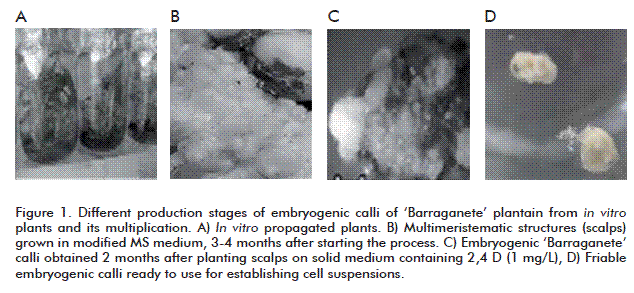
<body><![CDATA[<P   align="justify" ><font size="2" face="Verdana, Arial, Helvetica, sans-serif">One month later,      the content of one Petri dish was placed into a TIS bioreactor. Embryos were      immersed in 200 mL of liquid MS modified culture medium [16] during 1 min      every 12 h until shooting of the embryos [21-24]. Obtained shoots, at 1 to      6 cm in height, were separated from the total biological material present      in the bioreactor and recultured in solid medium for size homogenization before      transplanting to the greenhouse. Shoots shorter than 1 cm and embryos at different      developmental stages were returned to the bioreactor for further regeneration      of plants. Later on, at greenhouse level, somaclonal variation in plants was      done by visual assessments. </font></P >       <P   align="justify" >&nbsp;</P >       <P   ><font size="2" face="Verdana, Arial, Helvetica, sans-serif"><B><font size="3">RESULTS      </font></b></font></P >   <FONT size="+1"><B>        <P   ><font size="2" face="Verdana, Arial, Helvetica, sans-serif">Obtainment of embryogenic      calli from scalps </font></P >   </B>        <P   align="justify" ><font size="2" face="Verdana, Arial, Helvetica, sans-serif">The first indication      of the presence of multimeristem structures (scalps) of plantain &lsquo;Barraganete&rsquo;      was observed 3-4 months after the vitroplantlets meristematic domes were planted      in the TDZ and P4 induction culture medium [7, 13]. Two months later, after      reculturing the scalps in the medium with 2,4 D, the presence of calli with      different colors and consistency was observed: friable white-bone, some white      with strong consistency and others. The phenolized calli were observed after      placing fragments of scalps with 3-4 proliferating multimeristems in the culture      medium in the presence of 2,4 D. The friable part of calli cultured for 2      months, for further multiplication in the presence of the NAA, allowed to      increase the volume by 4-5 times and were later used for development of embryogenic      cell suspensions (<a href="/img/revistas/bta/v30n4/f0103413.gif">Figure      1</a>). </font></P >   <FONT size="+1">        
<P   ><font size="2" face="Verdana, Arial, Helvetica, sans-serif"><B>Establishment      of embryogenic cell suspensions of &lsquo;Barraganete&rsquo; and embryos formation      </b></font></P >       <P   align="justify" ><font size="2" face="Verdana, Arial, Helvetica, sans-serif">After placing the      friable callus in liquid medium, different types of cells were observed under      the microscope (40&times;), including the individual embryogenic ones and      clustered cells. Eight to ten weeks later, a established cell suspension was      obtained showing the presence of more than 80 % of the embryogenic cells,      small and round (<a href="/img/revistas/bta/v30n4/f0203413.gif">Figure      2A and B</a>), as described by C&ocirc;t&eacute; [25]. After subculturing      the cells, for 2-3 months on solid medium in the absence of phytohormones,      the embryonic structures of whitish color were observed and in different developing      stages (globular, heart among others). Subculturing of these structures in      the culture medium lacking BAP led to germination of embryos (<a href="/img/revistas/bta/v30n4/f0203413.gif">Figure      2C and D</a>). </font></P >       
<P   ><font size="2" face="Verdana, Arial, Helvetica, sans-serif"><B>Regeneration of      &lsquo;Barraganete&rsquo; somatic embryos into plants using TIS </b></font></P >       <P   align="justify" ><font size="2" face="Verdana, Arial, Helvetica, sans-serif">After 2-3 days of      placing the formed embryos into the bioreactor, containing the liquid MS modified      culture medium, the phenolization of some structures was observed. However,      the culture was not affected seriously although the transparency of the medium      changed to purple, apparently due to the stress of the biological material      caused by the hormonal content of the fresh culture medium used. The plantain      shoots (578) developed in the TIS bioreactors (<a href="/img/revistas/bta/v30n4/f0303413.gif">Figure      3A</a>) that were larger than 1 cm in height and subcultured to solid medium      for homogenization after four weeks were transplanted to the greenhouse. The      rest of the evaluated embryos at different developmental stages (globular,      heart, torpedo) and shoots shorter than 1 cm in height were returned to the      bioreactor for further development and 4-5 weeks later, the second harvest      of the vitroplantlets (280) was performed for further experiments. </font></P >       
<P   ><font size="2" face="Verdana, Arial, Helvetica, sans-serif"><B>Culture of &lsquo;Barraganete&rsquo;      plants in the greenhouse and evaluation of somaclonal variation </b></font></P >       ]]></body>
<body><![CDATA[<P   align="justify" ><font size="2" face="Verdana, Arial, Helvetica, sans-serif">In total, the 858      vitroplantlets were obtained from 1015 somatic embryos (84.5 %) using TIS.      Only the first harvest of 578 vitroplantlets<I> </I>was planted in the greenhouse      and successfully developed into plants with a low mortality rate (10.1 %)      (<a href="/img/revistas/bta/v30n4/f0303413.gif">Figure 3B and C</a>).      In the phases 1 and 2, the detected somaclonal variation by visual assessment      (off type) in plants grown in the greenhouse for 3 months was also low (1.55      %). </font></P >       
<P   align="justify" >&nbsp;</P >       <P   align="justify" > </P >       <P   ><font size="3" face="Verdana, Arial, Helvetica, sans-serif"><B>DISCUSSION </b></font></P >   <FONT size="+1">        <P   align="justify" ><font size="2" face="Verdana, Arial, Helvetica, sans-serif">From 1 mL of embryogenic      cell suspension (with 0.15 mL of pelleted cells) of plantain &lsquo;Barraganete&rsquo;      a total of 1015 embryos were obtained. After 4 months of culture, 858 plants      were regenerated using the TIS. The conversion capacity of embryos into plants      was 84.5 %. It was much higher than the one obtained by G&oacute;mez <I>et      al</I>. [11], of only 295 embryos of Pelipita variety (genotype ABB) with      a low percentage of regeneration into plants and obtained from 50 mL of cell      suspensions applying continuous agitation of embryos in liquid medium. However,      comparable results were obtained by other authors using TIS (RITA&reg;) [12,      24]. </font></P >   <FONT size="+1">        <P   align="justify" ><font size="2" face="Verdana, Arial, Helvetica, sans-serif">According to the      results obtained in our study, from 20 mL of established embryogenic cell      suspensions of plantain (2-3 mL of precipitated cells), we could obtain 17      000-20 000 vitroplantlets by using a TIS system. </font></P >       <P   align="justify" ><font size="2" face="Verdana, Arial, Helvetica, sans-serif">In all the processes      described above, the most time consuming stages were devoted to obtain the      proliferating multimeristems (scalps), the development and the multiplication      of calli required for embryogenic cell suspensions. </font></P >       <P   align="justify" ><font size="2" face="Verdana, Arial, Helvetica, sans-serif">Although the process      for obtaining plantain embryogenic cell suspensions requires expertise and      adequate conditions, once established the embryogenic callus and cell suspensions,      a large amount of plantain plants could be obtained, even more than if they      were obtained by applying conventional <I>in vitro</I> propagation methods      using apical meristems explanted from corms, where culture medium phenolization      and low proliferation rate of shoots occur (0.85-0.90 for each donor plant      after 6-8 weeks of culture) [7]. </font></P >       <P   align="justify" ><font size="2" face="Verdana, Arial, Helvetica, sans-serif">However, a drastic      decrease in time (from 10-14 months to 4-6 months) of the mentioned process      could be obtained if apical meristems of <I>in vitro</I> plantlets were used      to obtain embryogenic cell suspensions by planting those directly in liquid      medium, without passing through the obtention of calli on the solid culture      medium [20]. </font></P >       <P   align="justify" ><font size="2" face="Verdana, Arial, Helvetica, sans-serif">Although somatic      embryogenesis in banana and plantain is well established and standard techniques      are available, obtainment of somatic embryos is complex and not yet a common      procedure. This is mainly due to a low embryogenic response of banana tissues      and plantain, the long periods required to obtain embryogenic cell suspensions,      the risk of somaclonal variation and the occurrence of contamination of cell      suspensions [25, 26]. </font></P >       ]]></body>
<body><![CDATA[<P   align="justify" ><font size="2" face="Verdana, Arial, Helvetica, sans-serif">For these reasons,      the development of embryogenic cell suspensions of the &lsquo;Barraganete&rsquo;      plantain following conversion into plants of somatic embryos through the use      of the TIS is very important for mass production of crops in countries like      Ecuador, which has an important participation in fruit exports and domestic      consumption. The semi-automated process of <I>in vitro</I> propagation is      needed to reduce costs in the plant propagation industry [22]. </font></P >       <P   align="justify" ><font size="2" face="Verdana, Arial, Helvetica, sans-serif">In summary, the embryogenic      cell suspensions of the plantain &lsquo;Barraganete&rsquo; were established      and somatic embryos were obtained. Using TIS it was possible to convert somatic      embryos into plants at a high percentage of regeneration (84.5 %). This method      is more efficient than the conventional one using fast propagation <I>in vitro</I>      through organogenesis. Finally, the low percentage of somaclonal variation      in plants grown in the greenhouse (1.55 %) suggests that this method could      be used for commercial propagation. </font></P >       <P   align="justify" ><font size="2" face="Verdana, Arial, Helvetica, sans-serif">Further improvement      of the methodology may involve the use of apical meristems of plantlets for      faster development of embryogenic cell suspensions. Somaclonal variation in      plants obtained by the method described must be followed in the field. </font></P >       <P   align="justify" >&nbsp;</P >       <P   align="justify" > </P >       <P   align="justify" ><font size="3" face="Verdana, Arial, Helvetica, sans-serif"><B>REFERENCES </b></font></P >   <B>        <P   align="justify" ></P >   </B>        <!-- ref --><P   align="justify" ><font size="2" face="Verdana, Arial, Helvetica, sans-serif">1. Frison EA, Sharrock      S. The economic, social and nutritional importance of banana in the World.      Proceedings of International symposium on bananas and food security held in      Cameroon, Douala, 10-14 November, 1998. In: Picq C, Four&eacute; E, Frison      EA, editors. Banana and food security. Montpellier: INIBAP; 1999. p. 21-35.          </font></P >   <FONT size="+1">        <!-- ref --><P   align="justify" ><font size="2" face="Verdana, Arial, Helvetica, sans-serif">2. PROECUADOR. An&aacute;lisis      sectorial de banano 2011. [cited 2013 Jan 13]. Available from: <FONT color="#0031FF"><a href="http://www.proecuador.gob.ec" target="_blank">http://www.proecuador.gob.ec      </a> </font></font></P >   <FONT color="#0031FF"><FONT color="#000000">        <P   align="justify" ><font size="2" face="Verdana, Arial, Helvetica, sans-serif">3. Luna L. La producci&oacute;n      y exportaci&oacute;n bananera del Ecuador. L&eacute;elo, por favor. 2008 </font><font size="+1" color="#000000"><font size="+1"><font size="+1"><font size="+1"><font size="+1"><font size="+1"><font size="+1"><font size="+1"><font size="+1"><font size="+1"><font size="+1"><font size="+1"><font size="+1"><font color="#0031FF"><font color="#000000"><font color="#0031FF"><font color="#000000"><font size="2" face="Verdana, Arial, Helvetica, sans-serif">[cited      2013 Jan 13]</font></font></font></font></font></font></font></font></font></font></font></font></font></font></font></font></font></font><font size="2" face="Verdana, Arial, Helvetica, sans-serif">;23.      Disponible en: <a href="http://www.colegiodeeconomistas.org.ec/documentos/LEELO%20LLO%20023.doc" target="_blank" 	>http://www.colegiodeeconomistas.org.ec/documentos/LEELO%20LLO%20023.doc</a>.      </font></P >       <!-- ref --><P   align="justify" ><font size="2" face="Verdana, Arial, Helvetica, sans-serif">4. Tazan L. El cultivo      de pl&aacute;tanos en Ecuador. Ministerio de Agricultura y Ganader&iacute;a.      Subsecretar&iacute;a Regional del Litoral, Sur y Gal&aacute;pagos. Guayaquil:      Editorial Ra&iacute;ces; 2003.     </font></P >       <!-- ref --><P   align="justify" ><font size="2" face="Verdana, Arial, Helvetica, sans-serif">5. AEBE. Historia      del banano y el mapa bananero del Ecuador. 2009 [cited 2013 Jan 13]. Available      from: <FONT color="#0031FF"><a href="http://www.aebe.com.ec" target="_blank">http://www.aebe.com.ec      </a></font></font></P >   <FONT color="#0031FF"><FONT color="#000000">        <P   align="justify" ><font size="2" face="Verdana, Arial, Helvetica, sans-serif">6. Izquierdo W. Manejo      y gesti&oacute;n de la Biotecnolog&iacute;a Agr&iacute;cola apropiada para      peque&ntilde;os productores: estudio del caso Ecuador. Santiago de Chile:      RedBio-FAO; 2002. </font></P >       <P   align="justify" ><font size="2" face="Verdana, Arial, Helvetica, sans-serif">7. Ortega N, Korneva      S, Ruiz O, Santos E, Peralta E. Obtenci&oacute;n de multimeristemos y callos      de diferentes variedades de banano y pl&aacute;tano (<I>Musa</I> spp.) a partir      de &ldquo;meristemos apicales&rdquo; y &ldquo;scalps&rdquo;. Rev Tecnol ESPOLRTE.      2010;23(1):99-104. </font></P >       <!-- ref --><P   align="justify" ><font size="2" face="Verdana, Arial, Helvetica, sans-serif">8. Arag&oacute;n      CE, Escalona M, Rodr&iacute;guez R, Ca&ntilde;al MJ, Capote I, Pina D. Effect      of sucrose, light and carbon dioxide on plantain micropropagation in temporary      immersion bioreactors in vitro. In Vitro Cell Dev Biol Plant. 2010;46(1):89-94.          </font></P >       <P   align="justify" ><font size="2" face="Verdana, Arial, Helvetica, sans-serif">9. Cejas I, Capote      I, Escalona M, Noceda C, Rodr&iacute;guez R, Ca&ntilde;al M, <I>et al.</I>      Protocolo para la proliferaci&oacute;n del pl&aacute;tano (<I>Musa</I> AAB)      clon Cemsa &frac34; en bioreactores de Inmersi&oacute;n Temporal. Memorias      XVI Reuni&oacute;n Internacional ACORBAT; 2004 Sept 26-Oct 1, Oaxaca, M&eacute;xico.      </font></P >       <!-- ref --><P   align="justify" ><font size="2" face="Verdana, Arial, Helvetica, sans-serif">10. Novak FJ, Afza      R, Van Duren M, Perea-Dallos M, Conger BV, Xiaolang T. Somatic embryogenesis      and plant regeneration in suspension culture of dessert (AA and AAA) and cooking      (ABB) bananas (<I>Musa</I> spp.). Nat Biotechnol. 1989;7:145-58.     </font></P >       <!-- ref --><P   align="justify" ><font size="2" face="Verdana, Arial, Helvetica, sans-serif">11. G&oacute;mez      R, Freire M, Del Sol L. Desarrollo de la embriog&eacute;nesis som&aacute;tica      a partir del cultivo de c&eacute;lulas en suspensi&oacute;n de pl&aacute;tano      y banano. Centro Agr&iacute;cola. 1994;21(1);69-75.     </font></P >       <!-- ref --><P   align="justify" ><font size="2" face="Verdana, Arial, Helvetica, sans-serif">12. Aguilar A, Ortiz      J, Sandoval J. Embriog&eacute;nesis som&aacute;tica en pl&aacute;tanos y bananos:      perspectivas y limitaciones. Serie T&eacute;cnica. Bolet&iacute;n T&eacute;cnico      (CRI). San Jos&eacute;: CATIE; 2008.     </font></P >       <P   align="justify" ><font size="2" face="Verdana, Arial, Helvetica, sans-serif">13. Panis B, Thinh      NT. Cryopreservation of Musa germplasm. INIBAP Technical Guidelines No 5.      In: Escalant JV, Sharrock S, editors. 2d ed. Montpellier: International network      for the improvement of banana and plantain (INIBAP); 2001. </font></P >       <P   align="justify" ><font size="2" face="Verdana, Arial, Helvetica, sans-serif">14. Panis B. Cryopreservation      of <I>Musa</I> Germplasm. Technical Guidelines No 9. In: Engelman F, Benson      E, editors. 2nd ed. Montpellier: Bioversity International CTA; 2009. </font></P >       <!-- ref --><P   align="justify" ><font size="2" face="Verdana, Arial, Helvetica, sans-serif">15. Murashige T,      Skoog F. A revised medium for rapid growth and bioassays with tobacco tissue      culture. Physiol Plant.1962;15(3):473-97.     </font></P >       <!-- ref --><P   align="justify" ><font size="2" face="Verdana, Arial, Helvetica, sans-serif">16. D&iacute;az E,      Korneva S, Maribona RH, Ancheta O. Morfog&eacute;nesis de las suspensiones      celulares de ca&ntilde;a de az&uacute;car. Biotecnol Apl. 1991;8:59-62.     </font></P >       <!-- ref --><P   align="justify" ><font size="2" face="Verdana, Arial, Helvetica, sans-serif">17. Strosse H, Domergue      R, Panis B, Escalant JV, C&ocirc;te F. Suspensiones de c&eacute;lulas embriog&eacute;nicas      de banana y pl&aacute;tano. Gu&iacute;as T&eacute;cnicas INIBAP. 2003;8(8):5-31.          </font></P >       <P   align="justify" ><font size="2" face="Verdana, Arial, Helvetica, sans-serif">18. Korneva de Maribona      S. Crioconservaci&oacute;n (-196 &ordm;C) de las suspensiones celulares embriog&eacute;nicas      de banano William y su posterior neo formaci&oacute;n en plantas [abstract].      In: REDBIO: VI Encuentro Latinoamericano y del Caribe de Biotecnolog&iacute;a      Agr&iacute;cola. Oct 22-26; Secci&oacute;n Frutales No.753. Vi&ntilde;a del      Mar, Valpara&iacute;so, Chile: Redbio; 2007. p. 56-7. </font></P >       <P   align="justify" ><font face="Verdana, Arial, Helvetica, sans-serif" size="2">19. </font><font size="+1" color="#000000"><font size="+1"><font size="+1"><font size="+1"><font size="+1"><font size="+1"><font size="+1"><font size="+1"><font size="+1"><font size="+1"><font size="+1"><font size="+1"><font size="+1"><font color="#0031FF"><font color="#000000"><font color="#0031FF"><font color="#000000"><font color="#0031FF"><font color="#000000"><font size="2" face="Verdana, Arial, Helvetica, sans-serif">Korneva      de Maribona S, Mendoza J. Establecimiento de las suspensiones celulares embriog&eacute;nicas      y neo formaci&oacute;n en plantas de variedad diploide Calcutta-4 resistente      a Sigatoka Negra. Memorias del XIII Congreso Internacional de ACORBAT; 2008      Nov 10-14; [CD], c&oacute;digo No. 94, Guayaquil, Ecuador.</font></font></font></font></font></font></font></font></font></font></font></font></font></font></font></font></font></font></font></font><FONT color="#000000">      </font></P >   </font><FONT color="#000000">        <P   align="justify" ><font size="2" face="Verdana, Arial, Helvetica, sans-serif">20</font><font size="2" face="Verdana, Arial, Helvetica, sans-serif">.      Korneva de Maribona S, Mendoza J. Crioconservaci&oacute;n de suspensiones      celulares de 2 variedades de <I>Musa</I> spp (AA y AAA) con diferente resistencia      a Sigatoka Negra y su posterior neo formaci&oacute;n en plantas. In: Memorias      del XIII Internacional Congreso ACORBAT; 2008 Nov 10-14; CD del Congreso,      c&oacute;d. No 77. Guayaquil, Ecuador.<I> </I> </font></P >       <P   align="justify" ><font size="2" face="Verdana, Arial, Helvetica, sans-serif">21. Korneva S, Ortega      N, Santos E, Peralta E. Obtenci&oacute;n de suspensiones celulares embriog&eacute;nicas      de <I>Musa </I>spp. utilizando diferentes explantes de la planta. Memorias      del XIX Congreso Internacional ACORBAT; 2010 Oct 8-12; Medell&iacute;n, Colombia.      </font></P >       <!-- ref --><P   align="justify" ><font size="2" face="Verdana, Arial, Helvetica, sans-serif">22. Colmenares M,      Gim&eacute;nez C. Multiplica-ci&oacute;n <I>in vitro</I> de <I>Musa </I>spp.      mediante sistema de inmersi&oacute;n temporal. Rev Fac Agron. 2003;20(4):468-77.          </font></P >       <!-- ref --><P   align="justify" ><font size="2" face="Verdana, Arial, Helvetica, sans-serif">23. Solano W. Efecto      de las caracter&iacute;sticas de cultivo en suspensi&oacute;n celular y en      biorreactores con inmersi&oacute;n temporal sobre la propagaci&oacute;n masiva      de <I>Coffea arabica</I> por embriog&eacute;nesis som&aacute;tica. Tesis de      Licenciatura en Ingenier&iacute;a de Agronom&iacute;a con &eacute;nfasis en      fitotecnia. Turrialba, Universidad de Costa Rica; 2001.     </font></P >       <!-- ref --><P   align="justify" ><font size="2" face="Verdana, Arial, Helvetica, sans-serif">24. Etienne H, Decchamp      E, </font><font size="+1" color="#000000"><font size="+1"><font size="+1"><font size="+1"><font size="+1"><font size="+1"><font size="+1"><font size="+1"><font size="+1"><font size="+1"><font size="+1"><font size="+1"><font size="+1"><font color="#0031FF"><font color="#000000"><font color="#0031FF"><font color="#000000"><font size="2" face="Verdana, Arial, Helvetica, sans-serif">Barry-Etienne</font></font></font></font></font></font></font></font></font></font></font></font></font></font></font></font></font></font><font size="2" face="Verdana, Arial, Helvetica, sans-serif">      D, Bertrant B. Bioreactor in coffee micropropagation. Braz J Plant Physiol.      2006;18(1):45-54.     </font></P >       <!-- ref --><P   align="justify" ><font size="2" face="Verdana, Arial, Helvetica, sans-serif">25. C&ocirc;te FX,      Domergue S, Montarson J, Schwendiman, Teisson C, Escalant JV. Embryogenic      cell suspensions from the male flower of Musa AAA cv. Grand nain. Physiol      Plant. 1996;97(2):285-90.     </font></P >       <!-- ref --><P   align="justify" ><font size="2" face="Verdana, Arial, Helvetica, sans-serif">26. Flores J. Regeneraci&oacute;n      de plantas de caf&eacute; (<I>Coffea canephora</I>) var. Robusta por embriog&eacute;nesis      som&aacute;tica a partir de segmentos de hojas, utilizando Biorreactores de      Inmersi&oacute;n Temporal. Tesis de Maestr&iacute;a. Ecuador, Guayaquil, ESPOL;      2012.     </font></P >       <P   align="justify" ><font size="2" face="Verdana, Arial, Helvetica, sans-serif">27. Basail M. Empleo      del Sistema de Inmersi&oacute;n Temporal para la multiplicaci&oacute;n del      clon de pl&aacute;tano vianda &lsquo;INIVIT PV06-30&rsquo;(AAB) y su generalizaci&oacute;n      en las biof&aacute;bricas. 2011 [cited 2013 Jan 13]; Available from: <FONT color="#0031FF"><a href="http://bva.fao.cu" target="_blank">http://bva.fao.cu</a>      </font></font></P >   <FONT color="#0031FF"><FONT color="#000000">        <P   align="justify" ><font size="2" face="Verdana, Arial, Helvetica, sans-serif">28. Basail M, Medero      V, Otero E, Torres M, Cabrera M, L&oacute;pez J, <I>et al</I>. Multiplicaci&oacute;n      <I>in vitro</I> de &lsquo;FHIA-25&rsquo; (<I>Musa</I> spp., AAB) en Sistema      de Inmersi&oacute;n Temporal. Biotecnol Veg. 2011;11(1):27-31.</font></P >       <P   align="justify" >&nbsp;</P >       ]]></body>
<body><![CDATA[<P   align="justify" >&nbsp;</P >       <P   align="justify" > </P >       <P   align="justify" > </P >       <P   ><font size="2" face="Verdana, Arial, Helvetica, sans-serif">Received in January,      2013.     <br>     Accepted in May, 2013. </font></P >       <P   >&nbsp;</P >       <P   >&nbsp;</P >       <P   align="justify" > </P >       <P   align="justify" > </P >       <P   ><i><font size="2" face="Verdana, Arial, Helvetica, sans-serif">Sof&iacute;a Korneva</font></i><font size="2" face="Verdana, Arial, Helvetica, sans-serif">.      Escuela Superior Polit&eacute;cnica de Litoral, Centro de Investigaciones      Biotecnol&oacute;gicas de Ecuador, CIBE. Campus Gustavo Galindo, Prosperina      Km 30.5, V&iacute;a Perimetral, Guayaquil, Ecuador. E-mail: <a href="mailto:skorneva@espol.edu.ec">skorneva@espol.edu.ec</a>.      </font></P >   </font></font></font></font></font></font></font></font></font></font></font></font></font></font></font></font></font></font></font></DIV >     ]]></body>
<body><![CDATA[ ]]></body><back>
<ref-list>
<ref id="B1">
<label>1</label><nlm-citation citation-type="book">
<person-group person-group-type="author">
<name>
<surname><![CDATA[Frison]]></surname>
<given-names><![CDATA[EA]]></given-names>
</name>
<name>
<surname><![CDATA[Sharrock]]></surname>
<given-names><![CDATA[S]]></given-names>
</name>
</person-group>
<article-title xml:lang="en"><![CDATA[The economic, social and nutritional importance of banana in the World. Proceedings of International symposium on bananas and food security held in Cameroon, Douala, 10-14 November, 1998]]></article-title>
<person-group person-group-type="editor">
<name>
<surname><![CDATA[Picq]]></surname>
<given-names><![CDATA[C]]></given-names>
</name>
<name>
<surname><![CDATA[Fouré]]></surname>
<given-names><![CDATA[E]]></given-names>
</name>
<name>
<surname><![CDATA[Frison]]></surname>
<given-names><![CDATA[EA]]></given-names>
</name>
</person-group>
<source><![CDATA[Banana and food security]]></source>
<year>1999</year>
<page-range>21-35</page-range><publisher-loc><![CDATA[Montpellier ]]></publisher-loc>
<publisher-name><![CDATA[INIBAP]]></publisher-name>
</nlm-citation>
</ref>
<ref id="B2">
<label>2</label><nlm-citation citation-type="">
<collab>PROECUADOR</collab>
<source><![CDATA[Análisis sectorial de banano 2011]]></source>
<year></year>
</nlm-citation>
</ref>
<ref id="B3">
<label>3</label><nlm-citation citation-type="journal">
<person-group person-group-type="author">
<name>
<surname><![CDATA[Luna]]></surname>
<given-names><![CDATA[L]]></given-names>
</name>
</person-group>
<article-title xml:lang="es"><![CDATA[La producción y exportación bananera del Ecuador]]></article-title>
<source><![CDATA[Léelo, por favor]]></source>
<year>2008</year>
<volume>23</volume>
</nlm-citation>
</ref>
<ref id="B4">
<label>4</label><nlm-citation citation-type="book">
<person-group person-group-type="author">
<name>
<surname><![CDATA[Tazan]]></surname>
<given-names><![CDATA[L]]></given-names>
</name>
</person-group>
<source><![CDATA[El cultivo de plátanos en Ecuador. Ministerio de Agricultura y Ganadería. Subsecretaría Regional del Litoral, Sur y Galápagos]]></source>
<year>2003</year>
<publisher-loc><![CDATA[Guayaquil ]]></publisher-loc>
<publisher-name><![CDATA[Editorial Raíces]]></publisher-name>
</nlm-citation>
</ref>
<ref id="B5">
<label>5</label><nlm-citation citation-type="">
<collab>AEBE</collab>
<source><![CDATA[Historia del banano y el mapa bananero del Ecuador]]></source>
<year>2009</year>
</nlm-citation>
</ref>
<ref id="B6">
<label>6</label><nlm-citation citation-type="book">
<person-group person-group-type="author">
<name>
<surname><![CDATA[Izquierdo]]></surname>
<given-names><![CDATA[W]]></given-names>
</name>
</person-group>
<source><![CDATA[[vtitle][title language=es]Manejo y gestión de la Biotecnología Agrícola apropiada para pequeños productores: estudio del caso Ecuador]]></source>
<year>2002</year>
<publisher-loc><![CDATA[Santiago de Chile ]]></publisher-loc>
<publisher-name><![CDATA[RedBio-FAO]]></publisher-name>
</nlm-citation>
</ref>
<ref id="B7">
<label>7</label><nlm-citation citation-type="journal">
<person-group person-group-type="author">
<name>
<surname><![CDATA[Ortega]]></surname>
<given-names><![CDATA[N]]></given-names>
</name>
<name>
<surname><![CDATA[Korneva]]></surname>
<given-names><![CDATA[S]]></given-names>
</name>
<name>
<surname><![CDATA[Ruiz]]></surname>
<given-names><![CDATA[O]]></given-names>
</name>
<name>
<surname><![CDATA[Santos]]></surname>
<given-names><![CDATA[E]]></given-names>
</name>
<name>
<surname><![CDATA[Peralta]]></surname>
<given-names><![CDATA[E]]></given-names>
</name>
</person-group>
<article-title xml:lang="es"><![CDATA[Obtención de multimeristemos y callos de diferentes variedades de banano y plátano (Musa spp.) a partir de "meristemos apicales" y "scalps"]]></article-title>
<source><![CDATA[Rev Tecnol ESPOLRTE]]></source>
<year>2010</year>
<volume>23</volume>
<numero>1</numero>
<issue>1</issue>
<page-range>99-104</page-range></nlm-citation>
</ref>
<ref id="B8">
<label>8</label><nlm-citation citation-type="journal">
<person-group person-group-type="author">
<name>
<surname><![CDATA[Aragón]]></surname>
<given-names><![CDATA[CE]]></given-names>
</name>
<name>
<surname><![CDATA[Escalona]]></surname>
<given-names><![CDATA[M]]></given-names>
</name>
<name>
<surname><![CDATA[Rodríguez]]></surname>
<given-names><![CDATA[R]]></given-names>
</name>
<name>
<surname><![CDATA[Cañal]]></surname>
<given-names><![CDATA[MJ]]></given-names>
</name>
<name>
<surname><![CDATA[Capote]]></surname>
<given-names><![CDATA[I]]></given-names>
</name>
<name>
<surname><![CDATA[Pina]]></surname>
<given-names><![CDATA[D]]></given-names>
</name>
</person-group>
<article-title xml:lang="en"><![CDATA[Effect of sucrose, light and carbon dioxide on plantain micropropagation in temporary immersion bioreactors in vitro]]></article-title>
<source><![CDATA[In Vitro Cell Dev Biol Plant]]></source>
<year>2010</year>
<volume>46</volume>
<numero>1</numero>
<issue>1</issue>
<page-range>89-94</page-range></nlm-citation>
</ref>
<ref id="B9">
<label>9</label><nlm-citation citation-type="confpro">
<person-group person-group-type="author">
<name>
<surname><![CDATA[Cejas]]></surname>
<given-names><![CDATA[I]]></given-names>
</name>
<name>
<surname><![CDATA[Capote]]></surname>
<given-names><![CDATA[I]]></given-names>
</name>
<name>
<surname><![CDATA[Escalona]]></surname>
<given-names><![CDATA[M]]></given-names>
</name>
<name>
<surname><![CDATA[Noceda]]></surname>
<given-names><![CDATA[C]]></given-names>
</name>
<name>
<surname><![CDATA[Rodríguez]]></surname>
<given-names><![CDATA[R]]></given-names>
</name>
<name>
<surname><![CDATA[Cañal]]></surname>
<given-names><![CDATA[M]]></given-names>
</name>
</person-group>
<source><![CDATA[Protocolo para la proliferación del plátano (Musa AAB) clon Cemsa ¾ en bioreactores de Inmersión Temporal]]></source>
<year>2004</year>
<month> S</month>
<day>ep</day>
<conf-name><![CDATA[ Memorias XVI Reunión Internacional ACORBAT]]></conf-name>
<conf-loc>Oaxaca </conf-loc>
</nlm-citation>
</ref>
<ref id="B10">
<label>10</label><nlm-citation citation-type="journal">
<person-group person-group-type="author">
<name>
<surname><![CDATA[Novak]]></surname>
<given-names><![CDATA[FJ]]></given-names>
</name>
<name>
<surname><![CDATA[Afza]]></surname>
<given-names><![CDATA[R]]></given-names>
</name>
<name>
<surname><![CDATA[Van Duren]]></surname>
<given-names><![CDATA[M]]></given-names>
</name>
<name>
<surname><![CDATA[Perea-Dallos]]></surname>
<given-names><![CDATA[M]]></given-names>
</name>
<name>
<surname><![CDATA[Conger]]></surname>
<given-names><![CDATA[BV]]></given-names>
</name>
<name>
<surname><![CDATA[Xiaolang]]></surname>
<given-names><![CDATA[T]]></given-names>
</name>
</person-group>
<article-title xml:lang="en"><![CDATA[Somatic embryogenesis and plant regeneration in suspension culture of dessert (AA and AAA) and cooking (ABB) bananas (Musa spp.)]]></article-title>
<source><![CDATA[Nat Biotechnol]]></source>
<year>1989</year>
<volume>7</volume>
<page-range>145-58</page-range></nlm-citation>
</ref>
<ref id="B11">
<label>11</label><nlm-citation citation-type="journal">
<person-group person-group-type="author">
<name>
<surname><![CDATA[Gómez]]></surname>
<given-names><![CDATA[R]]></given-names>
</name>
<name>
<surname><![CDATA[Freire]]></surname>
<given-names><![CDATA[M]]></given-names>
</name>
<name>
<surname><![CDATA[Del Sol]]></surname>
<given-names><![CDATA[L]]></given-names>
</name>
</person-group>
<article-title xml:lang="es"><![CDATA[Desarrollo de la embriogénesis somática a partir del cultivo de células en suspensión de plátano y banano]]></article-title>
<source><![CDATA[Centro Agrícola]]></source>
<year>1994</year>
<volume>21</volume>
<numero>1</numero>
<issue>1</issue>
<page-range>69-75</page-range></nlm-citation>
</ref>
<ref id="B12">
<label>12</label><nlm-citation citation-type="book">
<person-group person-group-type="author">
<name>
<surname><![CDATA[Aguilar]]></surname>
<given-names><![CDATA[A]]></given-names>
</name>
<name>
<surname><![CDATA[Ortiz]]></surname>
<given-names><![CDATA[J]]></given-names>
</name>
<name>
<surname><![CDATA[Sandoval]]></surname>
<given-names><![CDATA[J]]></given-names>
</name>
</person-group>
<source><![CDATA[Embriogénesis somática en plátanos y bananos: perspectivas y limitaciones. Serie Técnica. Boletín Técnico (CRI)]]></source>
<year>2008</year>
<publisher-loc><![CDATA[San José ]]></publisher-loc>
<publisher-name><![CDATA[CATIE]]></publisher-name>
</nlm-citation>
</ref>
<ref id="B13">
<label>13</label><nlm-citation citation-type="book">
<person-group person-group-type="author">
<name>
<surname><![CDATA[Panis]]></surname>
<given-names><![CDATA[B]]></given-names>
</name>
<name>
<surname><![CDATA[Thinh]]></surname>
<given-names><![CDATA[NT]]></given-names>
</name>
</person-group>
<article-title xml:lang="en"><![CDATA[Cryopreservation of Musa germplasm]]></article-title>
<person-group person-group-type="editor">
<name>
<surname><![CDATA[Escalant]]></surname>
<given-names><![CDATA[JV]]></given-names>
</name>
<name>
<surname><![CDATA[Sharrock]]></surname>
<given-names><![CDATA[S]]></given-names>
</name>
</person-group>
<source><![CDATA[INIBAP Technical Guidelines No 5]]></source>
<year>2001</year>
<edition>2</edition>
<publisher-loc><![CDATA[Montpellier ]]></publisher-loc>
<publisher-name><![CDATA[International network for the improvement of banana and plantain (INIBAP)]]></publisher-name>
</nlm-citation>
</ref>
<ref id="B14">
<label>14</label><nlm-citation citation-type="book">
<person-group person-group-type="author">
<name>
<surname><![CDATA[Panis]]></surname>
<given-names><![CDATA[B]]></given-names>
</name>
</person-group>
<article-title xml:lang="en"><![CDATA[Cryopreservation of Musa Germplasm]]></article-title>
<person-group person-group-type="editor">
<name>
<surname><![CDATA[Engelman]]></surname>
<given-names><![CDATA[F]]></given-names>
</name>
<name>
<surname><![CDATA[Benson]]></surname>
<given-names><![CDATA[E]]></given-names>
</name>
</person-group>
<source><![CDATA[Technical Guidelines No 9]]></source>
<year>2009</year>
<edition>2</edition>
<publisher-loc><![CDATA[Montpellier ]]></publisher-loc>
<publisher-name><![CDATA[Bioversity International CTA]]></publisher-name>
</nlm-citation>
</ref>
<ref id="B15">
<label>15</label><nlm-citation citation-type="journal">
<person-group person-group-type="author">
<name>
<surname><![CDATA[Murashige]]></surname>
<given-names><![CDATA[T]]></given-names>
</name>
<name>
<surname><![CDATA[Skoog]]></surname>
<given-names><![CDATA[F]]></given-names>
</name>
</person-group>
<article-title xml:lang="en"><![CDATA[A revised medium for rapid growth and bioassays with tobacco tissue culture]]></article-title>
<source><![CDATA[Physiol Plant]]></source>
<year>1962</year>
<volume>15</volume>
<numero>3</numero>
<issue>3</issue>
<page-range>473-97</page-range></nlm-citation>
</ref>
<ref id="B16">
<label>16</label><nlm-citation citation-type="journal">
<person-group person-group-type="author">
<name>
<surname><![CDATA[Díaz]]></surname>
<given-names><![CDATA[E]]></given-names>
</name>
<name>
<surname><![CDATA[Korneva]]></surname>
<given-names><![CDATA[S]]></given-names>
</name>
<name>
<surname><![CDATA[Maribona]]></surname>
<given-names><![CDATA[RH]]></given-names>
</name>
<name>
<surname><![CDATA[Ancheta]]></surname>
<given-names><![CDATA[O]]></given-names>
</name>
</person-group>
<article-title xml:lang="es"><![CDATA[Morfogénesis de las suspensiones celulares de caña de azúcar]]></article-title>
<source><![CDATA[Biotecnol Apl]]></source>
<year>1991</year>
<volume>8</volume>
<page-range>59-62</page-range></nlm-citation>
</ref>
<ref id="B17">
<label>17</label><nlm-citation citation-type="journal">
<person-group person-group-type="author">
<name>
<surname><![CDATA[Strosse]]></surname>
<given-names><![CDATA[H]]></given-names>
</name>
<name>
<surname><![CDATA[Domergue]]></surname>
<given-names><![CDATA[R]]></given-names>
</name>
<name>
<surname><![CDATA[Panis]]></surname>
<given-names><![CDATA[B]]></given-names>
</name>
<name>
<surname><![CDATA[Escalant]]></surname>
<given-names><![CDATA[JV]]></given-names>
</name>
<name>
<surname><![CDATA[Côte]]></surname>
<given-names><![CDATA[F]]></given-names>
</name>
</person-group>
<article-title xml:lang="es"><![CDATA[Suspensiones de células embriogénicas de banana y plátano]]></article-title>
<source><![CDATA[Guías Técnicas INIBAP]]></source>
<year>2003</year>
<volume>8</volume>
<numero>8</numero>
<issue>8</issue>
<page-range>5-31</page-range></nlm-citation>
</ref>
<ref id="B18">
<label>18</label><nlm-citation citation-type="confpro">
<person-group person-group-type="author">
<name>
<surname><![CDATA[Korneva de Maribona]]></surname>
<given-names><![CDATA[S]]></given-names>
</name>
</person-group>
<article-title xml:lang="es"><![CDATA[[vtitle][title language=es]Crioconservación (-196 ºC) de las suspensiones celulares embriogénicas de banano William y su posterior neo formación en plantas (abstract)]]></article-title>
<collab>REDBIO</collab>
<source><![CDATA[]]></source>
<year>2007</year>
<conf-name><![CDATA[ VI Encuentro Latinoamericano y del Caribe de Biotecnología Agrícola, Oct 22-26; Sección Frutales No.753. Redbio]]></conf-name>
<conf-loc>Valparaíso </conf-loc>
<page-range>56-7</page-range></nlm-citation>
</ref>
<ref id="B19">
<label>19</label><nlm-citation citation-type="confpro">
<person-group person-group-type="author">
<name>
<surname><![CDATA[Korneva de Maribona]]></surname>
<given-names><![CDATA[S]]></given-names>
</name>
<name>
<surname><![CDATA[Mendoza]]></surname>
<given-names><![CDATA[J]]></given-names>
</name>
</person-group>
<source><![CDATA[Establecimiento de las suspensiones celulares embriogénicas y neo formación en plantas de variedad diploide Calcutta-4 resistente a Sigatoka Negra]]></source>
<year>2008</year>
<month> N</month>
<day>ov</day>
<conf-name><![CDATA[ Memorias del XIII Congreso Internacional de ACORBAT]]></conf-name>
<conf-loc>Guayaquil </conf-loc>
</nlm-citation>
</ref>
<ref id="B20">
<label>20</label><nlm-citation citation-type="confpro">
<person-group person-group-type="author">
<name>
<surname><![CDATA[Korneva de Maribona]]></surname>
<given-names><![CDATA[S]]></given-names>
</name>
<name>
<surname><![CDATA[Mendoza]]></surname>
<given-names><![CDATA[J]]></given-names>
</name>
</person-group>
<source><![CDATA[Crioconservación de suspensiones celulares de 2 variedades de Musa spp (AA y AAA) con diferente resistencia a Sigatoka Negra y su posterior neo formación en plantas]]></source>
<year>2008</year>
<month> N</month>
<day>ov</day>
<conf-name><![CDATA[ Memorias del XIII Internacional Congreso ACORBAT]]></conf-name>
<conf-loc>Guayaquil </conf-loc>
</nlm-citation>
</ref>
<ref id="B21">
<label>21</label><nlm-citation citation-type="confpro">
<person-group person-group-type="author">
<name>
<surname><![CDATA[Korneva]]></surname>
<given-names><![CDATA[S]]></given-names>
</name>
<name>
<surname><![CDATA[Ortega]]></surname>
<given-names><![CDATA[N]]></given-names>
</name>
<name>
<surname><![CDATA[Santos]]></surname>
<given-names><![CDATA[E]]></given-names>
</name>
<name>
<surname><![CDATA[Peralta]]></surname>
<given-names><![CDATA[E]]></given-names>
</name>
</person-group>
<source><![CDATA[Obtención de suspensiones celulares embriogénicas de Musa spp. utilizando diferentes explantes de la planta]]></source>
<year>2010</year>
<month> O</month>
<day>ct</day>
<conf-name><![CDATA[ Memorias del XIX Congreso Internacional ACORBAT]]></conf-name>
<conf-loc>Medellín </conf-loc>
</nlm-citation>
</ref>
<ref id="B22">
<label>22</label><nlm-citation citation-type="journal">
<person-group person-group-type="author">
<name>
<surname><![CDATA[Colmenares]]></surname>
<given-names><![CDATA[M]]></given-names>
</name>
<name>
<surname><![CDATA[Giménez]]></surname>
<given-names><![CDATA[C]]></given-names>
</name>
</person-group>
<article-title xml:lang="es"><![CDATA[Multiplicación in vitro de Musa spp. mediante sistema de inmersión temporal]]></article-title>
<source><![CDATA[Rev Fac Agron]]></source>
<year>2003</year>
<volume>20</volume>
<numero>4</numero>
<issue>4</issue>
<page-range>468-77</page-range></nlm-citation>
</ref>
<ref id="B23">
<label>23</label><nlm-citation citation-type="">
<person-group person-group-type="author">
<name>
<surname><![CDATA[Solano]]></surname>
<given-names><![CDATA[W]]></given-names>
</name>
</person-group>
<source><![CDATA[Efecto de las características de cultivo en suspensión celular y en biorreactores con inmersión temporal sobre la propagación masiva de Coffea arabica por embriogénesis somática]]></source>
<year></year>
</nlm-citation>
</ref>
<ref id="B24">
<label>24</label><nlm-citation citation-type="journal">
<person-group person-group-type="author">
<name>
<surname><![CDATA[Etienne]]></surname>
<given-names><![CDATA[H]]></given-names>
</name>
<name>
<surname><![CDATA[Decchamp]]></surname>
<given-names><![CDATA[E]]></given-names>
</name>
<name>
<surname><![CDATA[Barry-Etienne]]></surname>
<given-names><![CDATA[D]]></given-names>
</name>
<name>
<surname><![CDATA[Bertrant]]></surname>
<given-names><![CDATA[B]]></given-names>
</name>
</person-group>
<article-title xml:lang="en"><![CDATA[Bioreactor in coffee micropropagation]]></article-title>
<source><![CDATA[Braz J Plant Physiol]]></source>
<year>2006</year>
<volume>18</volume>
<numero>1</numero>
<issue>1</issue>
<page-range>45-54</page-range></nlm-citation>
</ref>
<ref id="B25">
<label>25</label><nlm-citation citation-type="journal">
<person-group person-group-type="author">
<name>
<surname><![CDATA[Côte]]></surname>
<given-names><![CDATA[FX]]></given-names>
</name>
<name>
<surname><![CDATA[Domergue]]></surname>
<given-names><![CDATA[S]]></given-names>
</name>
<name>
<surname><![CDATA[Montarson]]></surname>
<given-names><![CDATA[J]]></given-names>
</name>
<name>
<surname><![CDATA[Schwendiman]]></surname>
</name>
<name>
<surname><![CDATA[Teisson]]></surname>
<given-names><![CDATA[C]]></given-names>
</name>
<name>
<surname><![CDATA[Escalant]]></surname>
<given-names><![CDATA[JV]]></given-names>
</name>
</person-group>
<article-title xml:lang="en"><![CDATA[Embryogenic cell suspensions from the male flower of Musa AAA cv. Grand nain]]></article-title>
<source><![CDATA[Physiol Plant]]></source>
<year>1996</year>
<volume>97</volume>
<numero>2</numero>
<issue>2</issue>
<page-range>285-90</page-range></nlm-citation>
</ref>
<ref id="B26">
<label>26</label><nlm-citation citation-type="">
<person-group person-group-type="author">
<name>
<surname><![CDATA[Flores]]></surname>
<given-names><![CDATA[J]]></given-names>
</name>
</person-group>
<source><![CDATA[Regeneración de plantas de café (Coffea canephora) var. Robusta por embriogénesis somática a partir de segmentos de hojas, utilizando Biorreactores de Inmersión Temporal]]></source>
<year></year>
</nlm-citation>
</ref>
<ref id="B27">
<label>27</label><nlm-citation citation-type="">
<person-group person-group-type="author">
<name>
<surname><![CDATA[Basail]]></surname>
<given-names><![CDATA[M]]></given-names>
</name>
</person-group>
<source><![CDATA[Empleo del Sistema de Inmersión Temporal para la multiplicación del clon de plátano vianda 'INIVIT PV06-30'(AAB) y su generalización en las biofábricas]]></source>
<year>2011</year>
</nlm-citation>
</ref>
<ref id="B28">
<label>28</label><nlm-citation citation-type="journal">
<person-group person-group-type="author">
<name>
<surname><![CDATA[Basail]]></surname>
<given-names><![CDATA[M]]></given-names>
</name>
<name>
<surname><![CDATA[Medero]]></surname>
<given-names><![CDATA[V]]></given-names>
</name>
<name>
<surname><![CDATA[Otero]]></surname>
<given-names><![CDATA[E]]></given-names>
</name>
<name>
<surname><![CDATA[Torres]]></surname>
<given-names><![CDATA[M]]></given-names>
</name>
<name>
<surname><![CDATA[Cabrera]]></surname>
<given-names><![CDATA[M]]></given-names>
</name>
<name>
<surname><![CDATA[López]]></surname>
<given-names><![CDATA[J]]></given-names>
</name>
</person-group>
<article-title xml:lang="es"><![CDATA[Multiplicación in vitro de 'FHIA-25' (Musa spp., AAB) en Sistema de Inmersión Temporal]]></article-title>
<source><![CDATA[Biotecnol Veg]]></source>
<year>2011</year>
<volume>11</volume>
<numero>1</numero>
<issue>1</issue>
<page-range>27-31</page-range></nlm-citation>
</ref>
</ref-list>
</back>
</article>