<?xml version="1.0" encoding="ISO-8859-1"?><article xmlns:mml="http://www.w3.org/1998/Math/MathML" xmlns:xlink="http://www.w3.org/1999/xlink" xmlns:xsi="http://www.w3.org/2001/XMLSchema-instance">
<front>
<journal-meta>
<journal-id>1027-2852</journal-id>
<journal-title><![CDATA[Biotecnología Aplicada]]></journal-title>
<abbrev-journal-title><![CDATA[Biotecnol Apl]]></abbrev-journal-title>
<issn>1027-2852</issn>
<publisher>
<publisher-name><![CDATA[Editorial Elfos Scientiae]]></publisher-name>
</publisher>
</journal-meta>
<article-meta>
<article-id>S1027-28522013000400006</article-id>
<title-group>
<article-title xml:lang="en"><![CDATA[Economic-financial management modeling for biotechnology enterprises in Cuba]]></article-title>
<article-title xml:lang="es"><![CDATA[Modelación económico-financiera de la gestión para empresas biotecnológicas en Cuba]]></article-title>
</title-group>
<contrib-group>
<contrib contrib-type="author">
<name>
<surname><![CDATA[Castillo]]></surname>
<given-names><![CDATA[Adolfo]]></given-names>
</name>
<xref ref-type="aff" rid="A01"/>
</contrib>
<contrib contrib-type="author">
<name>
<surname><![CDATA[Caballero]]></surname>
<given-names><![CDATA[Idania]]></given-names>
</name>
<xref ref-type="aff" rid="A02"/>
</contrib>
<contrib contrib-type="author">
<name>
<surname><![CDATA[Triana]]></surname>
<given-names><![CDATA[Juan]]></given-names>
</name>
<xref ref-type="aff" rid="A03"/>
</contrib>
</contrib-group>
<aff id="A02">
<institution><![CDATA[,Centro de Inmunología Molecular, CIM Departamento de Gestión del Conocimiento ]]></institution>
<addr-line><![CDATA[La Habana ]]></addr-line>
<country>Cuba</country>
</aff>
<aff id="A03">
<institution><![CDATA[,Centro de Estudios de la Economía Cubana  ]]></institution>
<addr-line><![CDATA[La Habana ]]></addr-line>
<country>Cuba</country>
</aff>
<aff id="A01">
<institution><![CDATA[,Centro de Inmunología Molecular, CIM Dirección de Desarrollo de Procesos ]]></institution>
<addr-line><![CDATA[La Habana ]]></addr-line>
<country>Cuba</country>
</aff>
<pub-date pub-type="pub">
<day>00</day>
<month>12</month>
<year>2013</year>
</pub-date>
<pub-date pub-type="epub">
<day>00</day>
<month>12</month>
<year>2013</year>
</pub-date>
<volume>30</volume>
<numero>4</numero>
<fpage>290</fpage>
<lpage>298</lpage>
<copyright-statement/>
<copyright-year/>
<self-uri xlink:href="http://scielo.sld.cu/scielo.php?script=sci_arttext&amp;pid=S1027-28522013000400006&amp;lng=en&amp;nrm=iso"></self-uri><self-uri xlink:href="http://scielo.sld.cu/scielo.php?script=sci_abstract&amp;pid=S1027-28522013000400006&amp;lng=en&amp;nrm=iso"></self-uri><self-uri xlink:href="http://scielo.sld.cu/scielo.php?script=sci_pdf&amp;pid=S1027-28522013000400006&amp;lng=en&amp;nrm=iso"></self-uri><abstract abstract-type="short" xml:lang="en"><p><![CDATA[Valorization of knowledge generated by the fast advance of science and its marketing has led to the so-called "knowledge-based economy" and as a consequence high-technology (HiTech) companies have emerged. Those based in Biotechnology have some specific features compared to other HiTech sectors. This paper provides a model to structure the economic management of HiTech Biotechnology organizations in Cuba, considering the national economy and the experience accumulated by several institutions from the Scientific Biotech Pole in Western Havana. The model is based on some concepts and proposals, and it addresses key elements, such as: insurance of adequate funding levels for R&D activities and technology replacement, flexible import and export management, the ability to get into very competitive markets and preservation of a highly qualified workforce. It also demonstrates the feasibility to establish this kind of enterprises in the context and regulations already existing in a non-capitalist environment, in the middle of the update of Cuban economy.]]></p></abstract>
<abstract abstract-type="short" xml:lang="es"><p><![CDATA[El valor del conocimiento y su uso como mercancía, resultantes del acelerado avance de la ciencia, han originado el concepto economía del conocimiento y, como consecuencia, las empresas de alta tecnología (AT). Las del sector biotecnológico poseen características peculiares con respecto a otros ramos de AT. En tal sentido, se ofrecen conceptos necesarios y se propone un modelo de gestión económica para este tipo de empresas en Cuba, partiendo de la experiencia de varias instituciones del Polo Científico de la biotecnología. Este modelo persigue garantizar niveles de financiamiento adecuados para las actividades de investigación y desarrollo, la reposición de tecnologías, la flexibilidad en la gestión comercializadora, la capacidad de penetración en mercados cotizados y la preservación de una fuerza laboral altamente calificada, entre otros elementos claves. Se demuestra además la posibilidad de implementar este tipo de empresas en Cuba, pese a las regulaciones actuales de su economía, y en concordancia con el proceso de actualización de su modelo económico.]]></p></abstract>
<kwd-group>
<kwd lng="en"><![CDATA[biotechnology management]]></kwd>
<kwd lng="en"><![CDATA[economy]]></kwd>
<kwd lng="en"><![CDATA[knowledge]]></kwd>
<kwd lng="en"><![CDATA[high technology]]></kwd>
<kwd lng="en"><![CDATA[enterprise]]></kwd>
<kwd lng="en"><![CDATA[Cuba]]></kwd>
<kwd lng="es"><![CDATA[biotecnología]]></kwd>
<kwd lng="es"><![CDATA[gestión]]></kwd>
<kwd lng="es"><![CDATA[economía]]></kwd>
<kwd lng="es"><![CDATA[conocimiento]]></kwd>
<kwd lng="es"><![CDATA[alta tecnología]]></kwd>
<kwd lng="es"><![CDATA[empresa]]></kwd>
<kwd lng="es"><![CDATA[Cuba]]></kwd>
</kwd-group>
</article-meta>
</front><body><![CDATA[ <DIV class="Sect"   >     <P   align="right" ><font size="2" color="#000000" face="Verdana, Arial, Helvetica, sans-serif"><b>FOCUS  </b> </font></P >    <P   align="right" >&nbsp;</P ><FONT size="+1" color="#000000">     <P   > </P >    <P   ><b><font size="4" face="Verdana, Arial, Helvetica, sans-serif">Economic-financial  management modeling for biotechnology enterprises in Cuba</font></b><font size="2" face="Verdana, Arial, Helvetica, sans-serif">  </font></P >    <P   >&nbsp;</P >    <P   > </P >    <P   ><b><font size="3" face="Verdana, Arial, Helvetica, sans-serif">Modelaci&oacute;n  econ&oacute;mico-financiera de la gesti&oacute;n para empresas biotecnol&oacute;gicas  en Cuba </font></b></P >    <P   >&nbsp;</P >    <P   >&nbsp;</P >    ]]></body>
<body><![CDATA[<P   > </P >    <P   ><b><font size="2" face="Verdana, Arial, Helvetica, sans-serif">Adolfo Castillo<Sup>1</Sup>,  Idania Caballero<Sup>2</Sup>, Juan Triana<Sup>3</Sup></font></b></P ><FONT size="+1"><FONT size="+1"><FONT size="+1"><FONT size="+1"><FONT size="+1"><FONT size="+1">      <P   ><font size="2" face="Verdana, Arial, Helvetica, sans-serif"><Sup>1</Sup> Direcci&oacute;n  de Desarrollo de Procesos Centro de Inmunolog&iacute;a Molecular, CIM. Calle 216  y 15, Atabey, Playa, La Habana 11600, Cuba.     <br> </font><font size="2" face="Verdana, Arial, Helvetica, sans-serif"><Sup>2</Sup>  Departamento de Gesti&oacute;n del Conocimiento, CIM. La Habana, Cuba.     <br> </font><font size="2" face="Verdana, Arial, Helvetica, sans-serif"><Sup>3</Sup>  Centro de Estudios de la Econom&iacute;a Cubana. Ave. 41 y 9na. No. 707, Miramar,  Playa, La Habana, Cuba. </font></P >    <P   >&nbsp;</P >    <P   >&nbsp;</P ></font></font></font></font></font></font></font> <hr> <FONT size="+1" color="#000000"><FONT size="+1"><FONT size="+1"><FONT size="+1"><FONT size="+1"><FONT size="+1"><FONT size="+1">      <P   ><font size="2" face="Verdana, Arial, Helvetica, sans-serif"><B>ABSTRACT </b></font></P ><FONT size="+1"><FONT size="+1"><FONT size="+1"><FONT size="+1"><FONT size="+1"><FONT size="+1"><FONT size="+1">      <P   ><font size="2" face="Verdana, Arial, Helvetica, sans-serif">Valorization of knowledge  generated by the fast advance of science and its marketing has led to the so-called  &ldquo;knowledge-based economy&rdquo; and as a consequence high-technology (HiTech)  companies have emerged. Those based in Biotechnology have some specific features  compared to other HiTech sectors. This paper provides a model to structure the  economic management of HiTech Biotechnology organizations in Cuba, considering  the national economy and the experience accumulated by several institutions from  the Scientific Biotech Pole in Western Havana. The model is based on some concepts  and proposals, and it addresses key elements, such as: insurance of adequate funding  levels for R&amp;D activities and technology replacement, flexible import and  export management, the ability to get into very competitive markets and preservation  of a highly qualified workforce. It also demonstrates the feasibility to establish  this kind of enterprises in the context and regulations already existing in a  non-capitalist environment, in the middle of the update of Cuban economy. </font></P >    <P   ><font size="2" face="Verdana, Arial, Helvetica, sans-serif"><b>Keywords: </b>biotechnology  management, economy, knowledge, high technology, enterprise, Cuba. </font></P ></font></font></font></font></font></font></font></font></font></font></font></font></font></font>  <hr> <FONT size="+1" color="#000000"><FONT size="+1"><FONT size="+1"><FONT size="+1"><FONT size="+1"><FONT size="+1"><FONT size="+1"><FONT size="+1"><FONT size="+1"><FONT size="+1"><FONT size="+1"><FONT size="+1"><FONT size="+1"><FONT size="+1">      ]]></body>
<body><![CDATA[<P   ><font size="2" face="Verdana, Arial, Helvetica, sans-serif"><B>RESUMEN </b></font></P ><FONT size="+1"><FONT size="+1">     <P   ><font size="2" face="Verdana, Arial, Helvetica, sans-serif">El valor del conocimiento  y su uso como mercanc&iacute;a, resultantes del acelerado avance de la ciencia,  han originado el concepto econom&iacute;a del conocimiento y, como consecuencia,  las empresas de alta tecnolog&iacute;a (AT). Las del sector biotecnol&oacute;gico  poseen caracter&iacute;sticas peculiares con respecto a otros ramos de AT. En  tal sentido, se ofrecen conceptos necesarios y se propone un modelo de gesti&oacute;n  econ&oacute;mica para este tipo de empresas en Cuba, partiendo de la experiencia  de varias instituciones del Polo Cient&iacute;fico de la biotecnolog&iacute;a.  Este modelo persigue garantizar niveles de financiamiento adecuados para las actividades  de investigaci&oacute;n y desarrollo, la reposici&oacute;n de tecnolog&iacute;as,  la flexibilidad en la gesti&oacute;n comercializadora, la capacidad de penetraci&oacute;n  en mercados cotizados y la preservaci&oacute;n de una fuerza laboral altamente  calificada, entre otros elementos claves. Se demuestra adem&aacute;s la posibilidad  de implementar este tipo de empresas en Cuba, pese a las regulaciones actuales  de su econom&iacute;a, y en concordancia con el proceso de actualizaci&oacute;n  de su modelo econ&oacute;mico. </font></P >    <P   ><font size="2" face="Verdana, Arial, Helvetica, sans-serif"><b>Palabras clave:</b>  biotecnolog&iacute;a, gesti&oacute;n, econom&iacute;a, conocimiento, alta tecnolog&iacute;a,  empresa, Cuba. </font></P ></font></font></font></font></font></font></font></font></font></font></font></font></font></font></font></font>  <hr> <FONT size="+1" color="#000000"><FONT size="+1"><FONT size="+1"><FONT size="+1"><FONT size="+1"><FONT size="+1"><FONT size="+1"><FONT size="+1"><FONT size="+1"><FONT size="+1"><FONT size="+1"><FONT size="+1"><FONT size="+1"><FONT size="+1"><FONT size="+1"><FONT size="+1">      <P   >&nbsp;</P >    <P   >&nbsp;</P >    <P   > </P ><FONT size="+1">     <P   > </P >    <P   ><font size="3" face="Verdana, Arial, Helvetica, sans-serif"><B>INTRODUCTION </b></font></P >    <P   align="justify" ><font size="2" face="Verdana, Arial, Helvetica, sans-serif">High technology (HiTech)  enterprises have gained space in the international economy, mainly in developed  countries, since only 25-30 years ago. In principle, this category comprises those  companies having as key attribute the major component of cost and price of the  product, mostly determined by the value of the knowledge invested in the research  &amp; development (R&amp;D) phases, production and marketing activities. Sectors  usually including this kind of companies are renewable sources of energy, computer  equipment and components, new materials, nanotechnology, information technologies  (IT; including software) and communications, and biotechnology [1, 2]. </font></P ><FONT size="+1">     <P   align="justify" ><font size="2" face="Verdana, Arial, Helvetica, sans-serif">In biotechnology,  and mainly in the field of human health which is commonly known as the biopharmaceutical  (biopharma) sector, HiTech enterprises share very particular characteristics.  The most remarkable are: long production cycles, high costs and a significant  drop in yields during R&amp;D phases, highly complex manufacturing processes with  long cash-to-cash cycles, very demanding regulatory levels and very dynamic quality  control environment, quite aggressive intellectual property policies with relatively  short product lifecycles, dependence on highly specialized and motivated staffs.  Let us review in brief these properties for better comprehension and further proposal  of a model for the Cuban HiTech biotechnology enterprises. </font></P >    ]]></body>
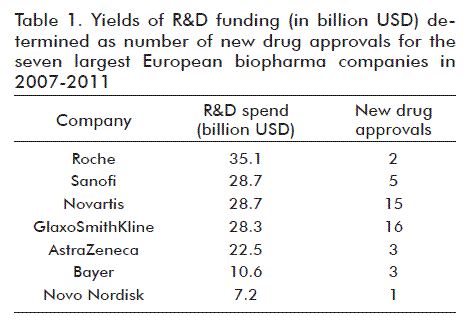
<body><![CDATA[<P   align="justify" >&nbsp;</P >    <P   align="justify" > </P >    <P   ><font size="3" face="Verdana, Arial, Helvetica, sans-serif"><B>MAIN PROPERTIES  OF HITECH BIOPHARMA COMPANIES </b></font></P ><FONT size="+1">     <P   ><font size="2" face="Verdana, Arial, Helvetica, sans-serif"><b>Long cycle of  product development from discovery to market launch </b></font></P ><FONT size="+1">     <P   align="justify" ><font size="2" face="Verdana, Arial, Helvetica, sans-serif">For new drugs, the  time for development is much longer than in other complex industries such as aerospace  and electronics. It takes 8-12 years for biopharmaceuticals to transit from discovery  through clinical development stages to regulatory approval and market launch.  It has been reported that only clinical development stages of a biopharmaceutical  product could last 92-98 months (7-8 years), with an average of 20 months for  Phase I, 30 months for Phase II and 33 months for Phase III , and the phase of  approval could last 13-16 months [3, 4]. </font></P >    <P   ><font size="2" face="Verdana, Arial, Helvetica, sans-serif"><b>Costs of R&amp;D  </b> </font></P >    <P   align="justify" ><font size="2" face="Verdana, Arial, Helvetica, sans-serif">In biopharma, R&amp;D  are extremely expensive, facing the challenge of long product development cycles  and the uncertainty of future returns of the investment. Today, six of the top-ten  US companies in overall expenditure on R&amp;D activity operate in the biopharma  sector [5]. The typical R&amp;D budget of a multinational biopharma company consumes  15-20 % of gross revenues, compared to approximately 4-5 % for aerospace, telecommunications  and electronics industries [6]. In this way, the present R&amp;D expenditure per  new molecular entity is estimated by some authors at 1.2 billions of US dollars  (USD), representing 1.5 times the 802 million USD in 2000 and more than 8 times  the 138 million USD in 1975 [2, 5]. Nevertheless, a more accurate estimate could  be the total average R&amp;D expenditure of a company per product launched. Using  this measure in the period 1997-2011, the cost of any new drug brought into the  market for the world top 12 biopharma companies ranged 3.7-11.8 billion USD [7].  <a href="#tab1">Table 1</a> shows the average values for the six biggest European  biopharma companies for the period 2007-2011. </font></P >    <P   align="center" ><img src="/img/revistas/bta/v30n4/t0106413.gif" width="467" height="325"><a name="tab1"></a></P >    
<P   align="justify" ><font size="2" face="Verdana, Arial, Helvetica, sans-serif">Moreover, clinical  trials activities require the highest proportion of R&amp;D budget in biopharma  (65 %) to generate the safety and efficacy data needed for regulatory approval,  but add little or nothing to new scientific or technological advances. Preclinical  research of one biotech product is more expensive than a traditional pharmaceutical  (615 vs. 439 million USD) [3]. Additionally, the late-stage R&amp;D spending pattern  became even more asymmetric when a drug fails in late stage development, where  there is little to nothing to be saved from failure. </font></P ><FONT size="+1"><FONT size="+1">     <P   ><font size="2" face="Verdana, Arial, Helvetica, sans-serif"><b>Productivity in  biotechnology R&amp;D </b></font></P >    ]]></body>
<body><![CDATA[<P   align="justify" ><font size="2" face="Verdana, Arial, Helvetica, sans-serif">In the last years,  biotech R&amp;D productivity became lower compared to 1980&rsquo;s-90&rsquo;s  decades, controversially with the high level of funds spent, as shown by the 2011  Deutsche Bank report when looking at the seven largest European drug makers [8]  (<a href="#tab1">Table 1</a>). Despite the high level of funding for R&amp;D,  only two companies reached more than one drug approval per year in average. </font></P >    <P   align="justify" ><font size="2" face="Verdana, Arial, Helvetica, sans-serif">Other studies have  determined that the transition probabilities of a biotechnology product from Phase  I to II is around 84 %, from Phase II to III is 56 % and from Phase III to Approval  is 64 %. These results render an approximate 30 % overall clinical approval success  rate for a biotech product, higher than the 22 % rate ob-served for pharmaceutical  non-biotech products [3, 9]. </font></P >    <P   ><font size="2" face="Verdana, Arial, Helvetica, sans-serif"><b>Cash-to-cash cycle  </b> </font></P >    <P   align="justify" ><font size="2" face="Verdana, Arial, Helvetica, sans-serif">This is a measure  of how long it takes to a product to move through the supply chain. In biopharma  it is usually 3-fold that of any other industry and is dominated by supply chains  and quality release times (both for goods and drug products). In some cases, these  periods comprise over 90 % of the overall time to produce a batch of material.  This fact ties up hundreds of million USD in inventory [10]. Any measure to reduce  these times will have a significant effect over the costs and overall process  yields. </font></P >    <P   ><font size="2" face="Verdana, Arial, Helvetica, sans-serif"><b>Technologies and  manufacturing processes </b></font></P >    <P   align="justify" ><font size="2" face="Verdana, Arial, Helvetica, sans-serif">In such companies,  the technologies and manufacturing processes are far complex and based on manipulating  living organisms. In many cases, this fact renders processes unique and specific  for each product and makes that value added to the product, through the knowledge  generated during development and manufacturing stages which is also very high,  even comparable with that brought at the R&amp;D stages. </font></P >    <P   ><font size="2" face="Verdana, Arial, Helvetica, sans-serif"><b>Degree of quality  regulations </b></font></P >    <P   align="justify" ><font size="2" face="Verdana, Arial, Helvetica, sans-serif">Quality standards  for HiTech companies are very high, predetermined by the same competition for  innovation and differentiation [11]. They are pretty dynamic and evolve with the  advance of science and technology, particularly for new drugs, but also with new  approaches applied to existing products. Properties such as aggregation, concentration,  and potency continuously increase in importance along with the flow of advancements  in pharmacokinetics, physiology, and precision measurement. Therapeutic proteins,  as vaccines and monoclonal antibodies, are good examples of this fact. For many  new products, especially in biotechnology, new quality standards tend to set technological  limits sometimes unreachable by older methods. This imposes a high technological  turnover and increases the investment required to improve analytical and production  infrastructures. </font></P >    <P   ><font size="2" face="Verdana, Arial, Helvetica, sans-serif"><b>Product life cycle  </b> </font></P >    <P   align="justify" ><font size="2" face="Verdana, Arial, Helvetica, sans-serif">In Biopharma this  is relatively short. Once a biopharmaceutical makes its way into the market, it  takes 7 to 10 years before patent expiration. For example, a new model of commercial  aircraft could be in exploitation almost 35 years after launch, with several line  extensions and only the manufacturing company competing for market share. But  a typical drug will lose 80-90 % of its sales due to generic competition within  six months of patent expiration in the US [6]. This fact renders the biopharmaceutical  sector more dependent on intellectual property policies and strategies than other  HiTech industries, with a significant role for proprietary and undisclosed technologies  (<I>know how</I>). </font></P >    ]]></body>
<body><![CDATA[<P   ><font size="2" face="Verdana, Arial, Helvetica, sans-serif"><b>Production-derived  knowledge </b></font></P >    <P   align="justify" ><font size="2" face="Verdana, Arial, Helvetica, sans-serif">Thereon, it may be  considered that the knowledge generated at the different stages of production  and which allows transforming raw materials (<I>e.g.</I>, cells, substances, energy,  etc.) into the desired product, constitutes a mean of production itself. Knowledge  integrates as part of the entire productive capacity that is needed to produce  both consumables and additional capital goods. </font></P >    <P   align="justify" ><font size="2" face="Verdana, Arial, Helvetica, sans-serif">Mechanisms have been  generated within the capitalism to privatize the knowledge, mainly through intellectual  property regulations. But, tacit knowledge is inherent to people itself and nothing  prevents that it could be transmitted by individuals of a company to another,  recombining by the phenomenon of labor force flow, due to best offers of work  conditions or remuneration. Thus, HiTech enterprises workers will increase their  qualifications, with the accumulation of new knowledge, already generated by them  or previously assimilated there. This process supports the trend to continuously  increase their value in the labor market. </font></P >    <P   ><font size="2" face="Verdana, Arial, Helvetica, sans-serif"><b>Highly qualified  and motivated personnel </b></font></P >    <P   align="justify" ><font size="2" face="Verdana, Arial, Helvetica, sans-serif">All previous facts  establish for biotechnology companies, and in general for HiTech enterprises,  the need to maintain a highly motivated, creative and qualified personnel in the  activity of innovation. This is required, not only for the stages of basic research,  but also in the stages of development, manufacturing, marketing, and quality control,  including areas such as business, information and human capital management, among  others. </font></P >    <P   align="justify" ><font size="2" face="Verdana, Arial, Helvetica, sans-serif">The most direct consequence  of this phenomenon is that the costs in workforce for this type of companies,  usually constitute more than 50 % of the total production costs. As reference  we can mention that the US biopharmaceutical sector comprises around 650 000 employees,  with an average annual salary exceeding 95 000 USD [6]. According to the results  of a study performed in several European countries, the Hays Consulting company  concluded that the biopharma sector, as any other, pay special attention to salary  policies, which is well above the average, with over 95 000 &euro; and 71 000  &euro; per year base salary compensation in senior and intermediate posts, respectively  [12]. For this reason, the management of human capital and its related knowledge  acquire a new dimension at the biopharma sector, to guarantee maximum stability  and an efficient exploitation [13]. </font></P >    <P   align="justify" ><font size="2" face="Verdana, Arial, Helvetica, sans-serif">According to the  8<Sup>th</Sup> Annual Report and Survey of Biopharmaceutical Manufacturing Capacity  and Production carried out by BioPlan Associates in 2012, the main factor creating  manufacturing capacity constraints was the inability to hire new experienced technical  and production staff [14]. It also identified that staff acquisition was the biggest  budget growth area in biotech companies, increasing 3.5 % compared to 2011. The  most difficult job positions to fill were development professionals, especially  process engineers and up- and down-stream process development specialists. </font></P >    <P   align="justify" >&nbsp;</P ><FONT size="+1"><FONT size="+1">     <P   align="justify" > </P >    <P   ><font size="3" face="Verdana, Arial, Helvetica, sans-serif"><B>THE EMERGENCE  OF HITECH STATE-OWNED ENTERPRISES IN THE CUBAN BIOTECHNOLOGY SECTOR </b></font></P ><FONT size="+1">     ]]></body>
<body><![CDATA[<P   align="justify" ><font size="2" face="Verdana, Arial, Helvetica, sans-serif">The premises for  the development of the Cuban biotechnology industry were created after the revolutionary  triumph of 1959, led by the political vision of our Commander in Chief Fidel Castro  Ruz [15]. The main factors that have been decisive for the development of these  institutions include: the sustained educational work and improvements in public  health reached after the Cuban Revolution until now, the priority given to the  development of scientific and technical activity with a vision of linking them  to the economy, the creation of scientific poles throughout the country, and particularly  the Western Havana Scientific Pole for biotechnology, and the political will to  invest in the development of these institutions for the purpose of completing  the research-manufacturing-marketing cycle. These regardless the economic difficulties  that arose after the US embargo in 1962 and the special period from 1990 on. The  experience in our country for more than two decades is unique, and without any  doubt, successful [16-18]. </font></P ><FONT size="+1">     <P   align="justify" ><font size="2" face="Verdana, Arial, Helvetica, sans-serif">Cuban biotechnology  institutions are research and production organizations owned by the State that  connect science with economics, generating positive cash flows and high productivity  levels. These facts support collaborative relationships, with an optimized use  of resources and potentialities of each institution, instead a competitive and  excluding environment. </font></P >    <P   align="justify" ><font size="2" face="Verdana, Arial, Helvetica, sans-serif">The sector shows  a tangible and growing impact on social niches and the production of consumer  goods, especially in the health and education systems, but can also establish  productive chains with other sectors of the economy (construction, chemicals,  electronics, IT, mechanical, etc.). </font></P >    <P   align="justify" ><font size="2" face="Verdana, Arial, Helvetica, sans-serif">As was mentioned  above, biopharmaceuticals usually have a short life cycle, implying medium term  development activity for new products to guarantee a broad pipeline, which could  be combined with the short-term commercial operations. Therefore, these companies  are based on innovative products, with highly internalized R&amp;D activity that  is funded as part of the expenses associated with income levels (variable costs),  and in some cases managed as investment at risk. </font></P >    <P   align="justify" ><font size="2" face="Verdana, Arial, Helvetica, sans-serif">In contrast to leading  developed countries, this kind of enterprise in Cuba is mainly oriented toward  the foreign market, <I>i.e.</I> export-oriented, with capacity to direct and manage  the export activity. This forces these companies to comply with external quality  standards and market regulations, and to be capable of answering variable requirements  to remain competitive. </font></P >    <P   align="justify" ><font size="2" face="Verdana, Arial, Helvetica, sans-serif">At the same time,  R&amp;D, production and marketing in these organizations have a high technological  level, showing increased rates of equipment replacement and investments in new  capabilities. </font></P >    <P   align="justify" ><font size="2" face="Verdana, Arial, Helvetica, sans-serif">Furthermore, the  Cuban biotechnology organizations employ highly qualified workforce, which requires  high levels of creativity and motivation, as in other HiTech industries. This  human capital should be preserved even under adverse market situations, implying  a high proportion of labor costs compared to traditional companies. </font></P >    <P   align="justify" ><font size="2" face="Verdana, Arial, Helvetica, sans-serif">In summary, the Cuban  biotechnology sector is basically a new type of research-manufacturing organization,  owning at the same time general traits that distinguish all socialist states&rsquo;  enterprises, as well as those of the world&rsquo;s biopharma sector. </font></P >    <P   align="justify" >&nbsp;</P >    <P   align="justify" > </P >    ]]></body>
<body><![CDATA[<P   ><font size="3" face="Verdana, Arial, Helvetica, sans-serif"><B>AN ECONOMICAL  MODEL FOR THE CUBAN BIOTECHNOLOGY ENTERPRISES </b></font></P ><FONT size="+1">     <P   align="justify" ><font size="2" face="Verdana, Arial, Helvetica, sans-serif">From the general  considerations outlined above, a model of economic management can be proposed  for this new type of HiTech institution within the national economic scenario,  the Cuban HiTech biotechnology enterprise [15, 19]. </font></P ><FONT size="+1">     <P   align="justify" ><font size="2" face="Verdana, Arial, Helvetica, sans-serif">In order to fit the  general requirements established for such an advanced enterprise system in Cuba  (<I>i.e.</I>, profitability, reliable accounting, positive results in internal  controls, and others), these companies must have low cost of goods per revenue  (<I>e.g.</I>, lower than 0.5) and high productivity as performance threshold.  Productivity was calculated as the relationship between net incomes (also defined  as Gross Added Value, VAB) and average number of employees. A productivity threshold  value was set to 50 000 monetary units (UM)/employee at the present CUC/CUP exchange  rate (1:1). This number is five-fold the value for the national average and almost  twice the value obtained for sectors with the best performance in the country  (<I>i.e.</I>, communications and financing, insurance, real estate and business  services) [20]. </font></P >    <P   align="justify" ><font size="2" face="Verdana, Arial, Helvetica, sans-serif">Also these organizations  should have full cycle operation, including scientific research, development of  new products, production processes of high complexity and quality levels, with  a projects&rsquo; portfolio and innovative products at various R&amp;D stages.  They should be also supported by adequate intellectual property exploitation and  show a sustained export performance to various destinations markets, not only  able to finance their expenditures but also to provide utilities. It was considered  that such institutions should account for a highly skilled workforce, above 60  % of the staff having high academic, scientific or technical qualification degrees.  </font></P >    <P   align="justify" ><font size="2" face="Verdana, Arial, Helvetica, sans-serif">A system approach  was used, considering as integral elements of the model the data input (variables  and parameters, policies and assumptions), its processing (relations between components)  and presentation of results (output variables). These improve effectiveness in  developing financial models. The approach comprised a structural analysis, according  to which it seeks to find a result (output or endogenous variables) by applying  mathematical operations to relations (processes) that occur between the elementary  variables (input or exogenous variables). Using such an approach, a linear economic  model was developed, that consists in a series of outputs expressed in terms of  intermediate and outcome variables that are used to analyze a business situation,  which can be generalized in the following expression: y<Sub>1</Sub> = f (x<Sub>1</Sub>,  x<Sub>2</Sub>, x<Sub>3</Sub>, ... . x<Sub>n</Sub>). </font></P ><FONT size="+1"><FONT size="+1"><FONT size="+1"><FONT size="+1"><FONT size="+1"><FONT size="+1"><FONT size="+1"><FONT size="+1"><FONT size="+1"><FONT size="+1">      <P       align="justify"     ><font size="2" face="Verdana, Arial, Helvetica, sans-serif">In the model, some      fees and percentages are defined as exogenous variables. Their values are only      proposals, obtained in some cases from the current national legislation, international      ]]></body>
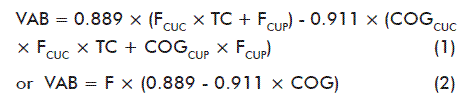
<body><![CDATA[practice or national experience gained during several years of work of this kind      of organization. Appendixes 1 and 2 describe the parameters considered as exogenous      variables for the model (input, <A HREF="#a1">Appendix 1</A></font><FONT SIZE="+1" COLOR="#000000"><FONT SIZE="+1"><FONT SIZE="+1"><FONT SIZE="+1"><FONT SIZE="+1"><FONT SIZE="+1"><FONT SIZE="+1"><FONT SIZE="+1"><FONT SIZE="+1"><FONT SIZE="+1"><FONT SIZE="+1"><FONT SIZE="+1"><FONT SIZE="+1"><FONT SIZE="+1"><FONT SIZE="+1"><FONT SIZE="+1"><FONT SIZE="+1"><FONT SIZE="+1"><FONT SIZE="+1"><FONT SIZE="+1"><FONT SIZE="+1"><FONT SIZE="+1"><FONT SIZE="+1"><FONT SIZE="+1"><FONT SIZE="+1"><FONT SIZE="+1"><FONT SIZE="+1"><FONT SIZE="+1"><FONT SIZE="+1"><FONT SIZE="+1"><FONT SIZE="+1"><FONT SIZE="+1"><FONT SIZE="+1"><FONT SIZE="+1"><FONT SIZE="+1"><FONT SIZE="+1"><FONT SIZE="+1"><FONT SIZE="+1"><FONT SIZE="+1"><FONT SIZE="+1"><FONT SIZE="+1"><FONT SIZE="+1"><FONT SIZE="+1"><FONT SIZE="+1"><FONT SIZE="+1"><FONT SIZE="+1"><FONT SIZE="+1"><FONT SIZE="+1"><FONT SIZE="+1"><FONT SIZE="+1"><FONT SIZE="+1"><FONT SIZE="+1"><FONT SIZE="+1"><FONT SIZE="+1"><FONT SIZE="+1"><FONT COLOR="#0000FF"><FONT SIZE="+1" COLOR="#000000"><FONT SIZE="+1"><FONT SIZE="+1"><FONT SIZE="+1"><FONT SIZE="+1"><B><FONT SIZE="+1" COLOR="#000000"><FONT SIZE="+1"><FONT SIZE="+1"><FONT SIZE="+1"><FONT SIZE="+1"><FONT SIZE="+1"><FONT SIZE="+1"><FONT SIZE="+1"><FONT SIZE="+1"><FONT SIZE="+1"><FONT SIZE="+1"><FONT SIZE="+1"><FONT SIZE="+1"><FONT SIZE="+1"><FONT SIZE="+1"><FONT SIZE="+1"><FONT SIZE="+1"><FONT SIZE="+1"><FONT SIZE="+1"><FONT SIZE="+1"><FONT SIZE="+1"><FONT SIZE="+1"><FONT SIZE="+1"><FONT SIZE="+1"><FONT SIZE="+1"><FONT SIZE="+1"><FONT SIZE="+1"><FONT SIZE="+1"><FONT SIZE="+1"><FONT SIZE="+1"><FONT SIZE="+1"><FONT SIZE="+1"><FONT SIZE="+1"><FONT SIZE="+1"><FONT SIZE="+1"><FONT SIZE="+1"><FONT SIZE="+1"><FONT SIZE="+1"><FONT SIZE="+1"><FONT SIZE="+1"><FONT SIZE="+1"><FONT SIZE="+1"><FONT SIZE="+1"><FONT SIZE="+1"><FONT SIZE="+1"><FONT SIZE="+1"><FONT SIZE="+1"><FONT SIZE="+1"><FONT SIZE="+1"><FONT SIZE="+1"><FONT SIZE="+1"><FONT SIZE="+1"><FONT SIZE="+1"><FONT SIZE="+1"><FONT SIZE="+1"><FONT COLOR="#0000FF"><FONT SIZE="+1" COLOR="#000000"><FONT SIZE="+1"><FONT SIZE="+1"><FONT SIZE="+1"><FONT SIZE="+1"><FONT SIZE="+1"><FONT SIZE="+1"><FONT SIZE="+1"><FONT SIZE="+1"><FONT SIZE="+1"><FONT SIZE="+1"><FONT SIZE="+1"><FONT SIZE="+1"><FONT SIZE="+1"><FONT SIZE="+1"><FONT SIZE="+1"><FONT SIZE="+1"><FONT SIZE="+1"><FONT SIZE="+1"><FONT SIZE="+1"><FONT SIZE="+1"><FONT SIZE="+1"><FONT SIZE="+1"><FONT SIZE="+1"><FONT SIZE="+1"><FONT SIZE="+1"><FONT SIZE="+1"><FONT SIZE="+1"><FONT SIZE="+1"><FONT SIZE="+1"><FONT SIZE="+1"><FONT SIZE="+1"><FONT SIZE="+1"><FONT SIZE="+1"><FONT SIZE="+1"><FONT SIZE="+1"><FONT SIZE="+1"><FONT SIZE="+1"><FONT SIZE="+1"><FONT SIZE="+1"><FONT COLOR="#D70000"><FONT SIZE="+1"><FONT SIZE="3"><B><FONT COLOR="#000000" FACE="Verdana, Arial, Helvetica, sans-serif"><A NAME="a1r"></A></FONT></B></FONT></FONT></FONT></FONT></FONT></FONT></FONT></FONT></FONT></FONT></FONT></FONT></FONT></FONT></FONT></FONT></FONT></FONT></FONT></FONT></FONT></FONT></FONT></FONT></FONT></FONT></FONT></FONT></FONT></FONT></FONT></FONT></FONT></FONT></FONT></FONT></FONT></FONT></FONT></FONT></FONT></FONT></FONT></FONT></FONT></FONT></FONT></FONT></FONT></FONT></FONT></FONT></FONT></FONT></FONT></FONT></FONT></FONT></FONT></FONT></FONT></FONT></FONT></FONT></FONT></FONT></FONT></FONT></FONT></FONT></FONT></FONT></FONT></FONT></FONT></FONT></FONT></FONT></FONT></FONT></FONT></FONT></FONT></FONT></FONT></FONT></FONT></FONT></FONT></FONT></FONT></FONT></FONT></FONT></FONT></FONT></FONT></FONT></FONT></B></FONT></FONT></FONT></FONT></FONT></FONT></FONT></FONT></FONT></FONT></FONT></FONT></FONT></FONT></FONT></FONT></FONT></FONT></FONT></FONT></FONT></FONT></FONT></FONT></FONT></FONT></FONT></FONT></FONT></FONT></FONT></FONT></FONT></FONT></FONT></FONT></FONT></FONT></FONT></FONT></FONT></FONT></FONT></FONT></FONT></FONT></FONT></FONT></FONT></FONT></FONT></FONT></FONT></FONT></FONT></FONT></FONT></FONT></FONT></FONT></FONT><font size="2" face="Verdana, Arial, Helvetica, sans-serif">)      and all the linear relationships and endogenous variables (output, <A HREF="#a2">Appendix      2</A></font><FONT SIZE="+1" COLOR="#000000"><FONT SIZE="+1"><FONT SIZE="+1"><FONT SIZE="+1"><FONT SIZE="+1"><FONT SIZE="+1"><FONT SIZE="+1"><FONT SIZE="+1"><FONT SIZE="+1"><FONT SIZE="+1"><FONT SIZE="+1"><FONT SIZE="+1"><FONT SIZE="+1"><FONT SIZE="+1"><FONT SIZE="+1"><FONT SIZE="+1"><FONT SIZE="+1"><FONT SIZE="+1"><FONT SIZE="+1"><FONT SIZE="+1"><FONT SIZE="+1"><FONT SIZE="+1"><FONT SIZE="+1"><FONT SIZE="+1"><FONT SIZE="+1"><FONT SIZE="+1"><FONT SIZE="+1"><FONT SIZE="+1"><FONT SIZE="+1"><FONT SIZE="+1"><FONT SIZE="+1"><FONT SIZE="+1"><FONT SIZE="+1"><FONT SIZE="+1"><FONT SIZE="+1"><FONT SIZE="+1"><FONT SIZE="+1"><FONT SIZE="+1"><FONT SIZE="+1" COLOR="#000000"><FONT SIZE="+1"><FONT SIZE="+1"><FONT SIZE="+1"><FONT SIZE="+1"><FONT SIZE="+1"><FONT SIZE="+1"><FONT SIZE="+1"><FONT SIZE="+1"><FONT SIZE="+1"><FONT SIZE="+1"><FONT SIZE="+1"><FONT SIZE="+1"><FONT SIZE="+1"><FONT SIZE="+1"><FONT SIZE="+1"><FONT SIZE="+1"><FONT SIZE="+1"><FONT SIZE="+1"><FONT SIZE="+1"><FONT SIZE="+1"><FONT SIZE="+1"><FONT SIZE="+1"><FONT SIZE="+1"><FONT SIZE="+1"><FONT SIZE="+1"><FONT SIZE="+1"><FONT SIZE="+1"><FONT SIZE="+1"><FONT SIZE="+1"><FONT SIZE="+1"><FONT SIZE="+1"><FONT SIZE="+1"><FONT SIZE="+1"><FONT SIZE="+1"><FONT SIZE="+1"><FONT SIZE="+1"><FONT SIZE="+1"><FONT SIZE="+1"><FONT SIZE="+1"><FONT SIZE="+1"><FONT SIZE="+1"><FONT SIZE="+1"><FONT SIZE="+1"><FONT SIZE="+1"><FONT SIZE="+1"><FONT SIZE="+1"><FONT SIZE="+1"><FONT SIZE="+1"><FONT SIZE="+1"><FONT SIZE="+1"><FONT SIZE="+1"><FONT SIZE="+1"><FONT SIZE="+1"><FONT SIZE="+1"><FONT COLOR="#0000FF"><FONT SIZE="+1" COLOR="#000000"><FONT SIZE="+1"><FONT SIZE="+1"><FONT SIZE="+1"><FONT SIZE="+1"><B><FONT SIZE="+1" COLOR="#000000"><FONT SIZE="+1"><FONT SIZE="+1"><FONT SIZE="+1"><FONT SIZE="+1"><FONT SIZE="+1"><FONT SIZE="+1"><FONT SIZE="+1"><FONT SIZE="+1"><FONT SIZE="+1"><FONT SIZE="+1"><FONT SIZE="+1"><FONT SIZE="+1"><FONT SIZE="+1"><FONT SIZE="+1"><FONT SIZE="+1"><FONT SIZE="+1"><FONT SIZE="+1"><FONT SIZE="+1"><FONT SIZE="+1"><FONT SIZE="+1"><FONT SIZE="+1"><FONT SIZE="+1"><FONT SIZE="+1"><FONT SIZE="+1"><FONT SIZE="+1"><FONT SIZE="+1"><FONT SIZE="+1"><FONT SIZE="+1"><FONT SIZE="+1"><FONT SIZE="+1"><FONT SIZE="+1"><FONT SIZE="+1"><FONT SIZE="+1"><FONT SIZE="+1"><FONT SIZE="+1"><FONT SIZE="+1"><FONT SIZE="+1"><FONT SIZE="+1"><FONT SIZE="+1"><FONT SIZE="+1"><FONT SIZE="+1"><FONT SIZE="+1"><FONT SIZE="+1"><FONT SIZE="+1"><FONT SIZE="+1"><FONT SIZE="+1"><FONT SIZE="+1"><FONT SIZE="+1"><FONT SIZE="+1"><FONT SIZE="+1"><FONT SIZE="+1"><FONT SIZE="+1"><FONT SIZE="+1"><FONT SIZE="+1"><FONT COLOR="#0000FF"><FONT SIZE="+1" COLOR="#000000"><FONT SIZE="+1"><FONT SIZE="+1"><FONT SIZE="+1"><FONT SIZE="+1"><FONT SIZE="+1"><FONT SIZE="+1"><FONT SIZE="+1"><FONT SIZE="+1"><FONT SIZE="+1"><FONT SIZE="+1"><FONT SIZE="+1"><FONT SIZE="+1"><FONT SIZE="+1"><FONT SIZE="+1"><FONT SIZE="+1"><FONT SIZE="+1"><FONT SIZE="+1"><FONT SIZE="+1"><FONT SIZE="+1"><FONT SIZE="+1"><FONT SIZE="+1"><FONT SIZE="+1"><FONT SIZE="+1"><FONT SIZE="+1"><FONT SIZE="+1"><FONT SIZE="+1"><FONT SIZE="+1"><FONT SIZE="+1"><FONT SIZE="+1"><FONT SIZE="+1"><FONT SIZE="+1"><FONT SIZE="+1"><FONT SIZE="+1"><FONT SIZE="+1"><FONT SIZE="+1"><FONT SIZE="+1"><FONT SIZE="+1"><FONT SIZE="+1"><FONT SIZE="+1"><FONT COLOR="#D70000"><FONT SIZE="+1"><FONT SIZE="3"><B><FONT COLOR="#000000" FACE="Verdana, Arial, Helvetica, sans-serif"><A NAME="a2r"></A></FONT></B></FONT></FONT></FONT></FONT></FONT></FONT></FONT></FONT></FONT></FONT></FONT></FONT></FONT></FONT></FONT></FONT></FONT></FONT></FONT></FONT></FONT></FONT></FONT></FONT></FONT></FONT></FONT></FONT></FONT></FONT></FONT></FONT></FONT></FONT></FONT></FONT></FONT></FONT></FONT></FONT></FONT></FONT></FONT></FONT></FONT></FONT></FONT></FONT></FONT></FONT></FONT></FONT></FONT></FONT></FONT></FONT></FONT></FONT></FONT></FONT></FONT></FONT></FONT></FONT></FONT></FONT></FONT></FONT></FONT></FONT></FONT></FONT></FONT></FONT></FONT></FONT></FONT></FONT></FONT></FONT></FONT></FONT></FONT></FONT></FONT></FONT></FONT></FONT></FONT></FONT></FONT></FONT></FONT></FONT></FONT></FONT></FONT></FONT></FONT></B></FONT></FONT></FONT></FONT></FONT></FONT></FONT></FONT></FONT></FONT></FONT></FONT></FONT></FONT></FONT></FONT></FONT></FONT></FONT></FONT></FONT></FONT></FONT></FONT></FONT></FONT></FONT></FONT></FONT></FONT></FONT></FONT></FONT></FONT></FONT></FONT></FONT></FONT></FONT></FONT></FONT></FONT></FONT></FONT></FONT></FONT></FONT></FONT></FONT></FONT></FONT></FONT></FONT></FONT></FONT></FONT></FONT></FONT></FONT></FONT></FONT></FONT></FONT></FONT></FONT></FONT></FONT></FONT></FONT></FONT></FONT></FONT></FONT></FONT></FONT></FONT></FONT></FONT></FONT></FONT></FONT></FONT></FONT></FONT></FONT></FONT></FONT></FONT></FONT></FONT></FONT></FONT></FONT></FONT></FONT></FONT></FONT></FONT></FONT><font size="2" face="Verdana, Arial, Helvetica, sans-serif">).      </font></P     >    <P   align="justify" ><font size="2" face="Verdana, Arial, Helvetica, sans-serif">Taking into account  these relationships and once the taxes values were defined (see appendixes), it  is possible to obtain the following fundamental analytical relationship between  net income (VAB) and exogenous variables: overall income (F), income by exports  (F<Sub>CUC</Sub>; measured in Cuban convertible currency, CUC), income by domestic  sales (F<Sub>CUP</Sub>; in Cuban pesos, CUP), costs of goods (COG) and exchange  rate (TC): </font></P >    <P   align="center" ><img src="/img/revistas/bta/v30n4/fr0106413.gif" width="467" height="97"></P ><FONT size="+1"><FONT size="+1"><FONT size="+1"><FONT size="+1">     
<P   align="justify" ></P >    ]]></body>
<body><![CDATA[<P   align="justify" ></P >    <P   align="justify" ></P >    <P   align="justify" > </P >    <P   align="justify" ><font size="2" face="Verdana, Arial, Helvetica, sans-serif">Several tax contributions  are considered according to what was stated in the Cuban Act 113 of the Tax System  [21]. related to, and 10 % of Taxes the <I>Territorial tribute for local development  (IMTT)Use oflabor force (IMFT) </I>and<I> Contribution for</I> <I>social assurance</I>  <I>(CSA)</I> should be defined every year, and were deduced for the present model  as 5 % of revenues and 12wage funds respectively. </font></P >    <P   align="justify" ><font size="2" face="Verdana, Arial, Helvetica, sans-serif">Under present exchange  rate conditions (1 CUC = 1 USD = 1 CUP), the companies with the greatest export  don&rsquo;t have any benefit in terms of their expenditure budgets and salary  funds with respect to enterprises that conduct most of their turnover in local  currency. One possible solution to eliminate or mitigate these limitations is  to gradually devalue </font></P >    <P   align="justify" ><font size="2" face="Verdana, Arial, Helvetica, sans-serif">Different alternatives  can be implemented for budget allocation of operating expenses in foreign currencies.  One of them is to allocate a budget in CUC (or directly in some foreign currency)  as planned by model&rsquo;s calculations for these activities. This allows companies  to request the purchase foreign exchange to the bank to carry out required imports  and payments for services. Another way is to establish unique accounts in CUP  from the exchange rate adopted for these companies, and exceptionally allow these  companies to request bank purchase of foreign exchange for their expenses according  to the approved plans taking a CUP conversion rate, similar to the system implemented  already for tourism [22]. </font></P >    <P   ><font size="2" face="Verdana, Arial, Helvetica, sans-serif"><b>Operating expenses  </b> </font></P >    <P   align="justify" ><font size="2" face="Verdana, Arial, Helvetica, sans-serif">The <I>Expenses for  expanded reproduction</I> (GCP)<B><I> </I></B>are deducted from the total annual  revenue (F) according to the planned growth rate and index of cost per revenue  planned for the coming year (including purchases of raw materials, energy costs,  received services related to production such as water and sewer, community, communications,  etc). </font></P >    <P   align="justify" ><font size="2" face="Verdana, Arial, Helvetica, sans-serif">Also from the revenues  is created the necessary fund for <I>inward investments</I> (GIM), comprising  up to 5 % of revenues. This is intended to guarantee the technological renewal  and redundancy in agreement with market demands (modernization and retrofit),  taking into account the rapidly-evolving standards of quality and technological  obsolescence, implying a high depreciation rate for the equipment. , <I>e.g.</I>,  ). In agreement with provisions ofAct 113of the Cuban Tax System [21], it should  be considered for GIM: depreciation and amortization, conservation and maintenanceof  machinery and equipmentand other assetsinvolvedin obtainingthe utility(thecapital  repairof an asset</font></P >    <P   align="justify" ><font size="2" face="Verdana, Arial, Helvetica, sans-serif">The model includes  an internal fund for <I>overall and administrative expenses</I> (GGA), up to 10  % of operating expenses. According to the Cuban Tax System [22], these expenses  could be distribution and sales, general and administrative, operating, financial,  for the creation of mandatory provisions, travel at home or abroad, when necessary,  and directly attributable to the business of the institution, the cost of advertising  and publicity as related to its corporate purpose or business, the amounts paid  for the lease of goods needed for the activity or to establish technical provisions,  working capital, and representation expenses. </font></P >    ]]></body>
<body><![CDATA[<P   align="justify" ><font size="2" face="Verdana, Arial, Helvetica, sans-serif">A percentage of revenues  (GID; 5-10 %) is allocated for <I>R&amp;D activity</I>. Like marketing expenses,  but unlike capital expenditures, these expenses are usually subtracted directly  from revenues every year in the international practice of HiTech companies. Therefore,  accountants treat R&amp;D spend as an expense rather than an investment, though  there is continuous debate over whether this is the correct classification. Even  the salaries of researchers and personnel involved in R&amp;D activities are generally  regarded as expenses in the R&amp;D category. In our model, this was considered  a<I> venture fund for advanced R&amp;D</I> projects, of potential high social  impact, mainly oriented to clinical stage of innovative and &ldquo;me-too&rdquo;  product development, optimization of the production process, development and assimilation  of new technological platforms (analytical, production), in which the rate and  time of return can be already defined. In addition to the usual operating expenses,  this fund includes the expenses to purchase the equipment and technology specific  for R&amp;D, international collaboration, payments for research and development  services, intellectual property assurance, and similar. </font></P >    <P   ><font size="2" face="Verdana, Arial, Helvetica, sans-serif"><b>Profits<I> </I></b></font></P >    <P   align="justify" ><font size="2" face="Verdana, Arial, Helvetica, sans-serif">From the obtained  <I>profits (U)</I>, a fund is created (up to 20 %) which is managed by the enterprise  for <I>middle to long term, higher risk projects (FINID)</I>, mostly basic research,  new therapeutic concepts and target identification, among others. It should be  considered also to provide funding to external research institutions, including  academic groups, which collaborate to address projects of interest for the company.  </font></P >    <P   align="justify" ><font size="2" face="Verdana, Arial, Helvetica, sans-serif"><I>A tax over profits  (IMU)</I> is also provided in agreement with the Tax System Act [21]. In this  case, a 35 % is considered, as the maximum value established. </font></P >    <P   align="justify" ><font size="2" face="Verdana, Arial, Helvetica, sans-serif">A provision for the  establishment of respective funds to <I>reserves and insurance</I> <I>(FAP)</I>  and for the creation and operation of the <I>High Level Management Entrepreneurial  Organization</I> (OSDE) BioCubaFarma is also deducted from profits. This would  create a level of protection against unforeseen changes in the market and the  long R&amp;D cycles, preserving the workforce. Additionally, it will make possible  to allocate funds to finance educational institutions of interest for the sector,  given its contribution to the development of human resources, such as vocational  senior high schools, technological schools and universities in related specialties.  It would also allow implementing centralized investments and financing, external  to the sector&rsquo;s institutions in the research lines of interest. Among these,  the possible use of <I>profits obtained by</I> <I>surpassing the sales plan and  cost savings</I> as a fund intended for investment, development and stimulation  of workers was assessed by improving working and life conditions. </font></P >    <P   align="justify" ><font size="2" face="Verdana, Arial, Helvetica, sans-serif">Noteworthy, the structure  of expenses proposed in this model links R&amp;D and internal investments directly  to the enterprise overall turnover. Moreover, it allows total cost and operating  expenses to decrease mainly by lowering production-related and overall expenses,  and avoiding the natural trend to carry out this goal by scarifying funds for  R&amp;D and internal investments, which put at risk the long-term strategy. At  the same time, this structure guarantees the enterprise financial support for  those projects with higher risk from its profits, increased funding level for  those projects at most advanced development stages and with more potential for  social and economic impact. </font></P >    <P   align="justify" ><font size="2" face="Verdana, Arial, Helvetica, sans-serif">Every budget mentioned  above can be formed in CUP; however, the company should be able to exchange part  of it in foreign currency for external operations. The maximum amount allowed  for such money exchange is taken proportional to the ratio between revenues in  foreign and local currency generated by the enterprise. </font></P >    <P   align="justify" ><font size="2" face="Verdana, Arial, Helvetica, sans-serif">The ability to manage  these funds as the company requires will allow better planning, with enhanced  efficiency, dynamism and flexibility for enterprise performance and its responsiveness  to market demands. </font></P >    <P   ><font size="2" face="Verdana, Arial, Helvetica, sans-serif"><b>Workers remuneration  </b> </font></P >    <P   align="justify" ><font size="2" face="Verdana, Arial, Helvetica, sans-serif">The <I>fund of basic  salary (FOS) </I>is formed from overall revenues<B><I>,</I></B> which is considered  as part of the total costs (as labor costs) and will be a predetermined percentage  of net income VAB (15-30 %). In this way, the basic salary of employees is correlated  with the effi-ciency of results (cost to productivity ratio). </font></P >    ]]></body>
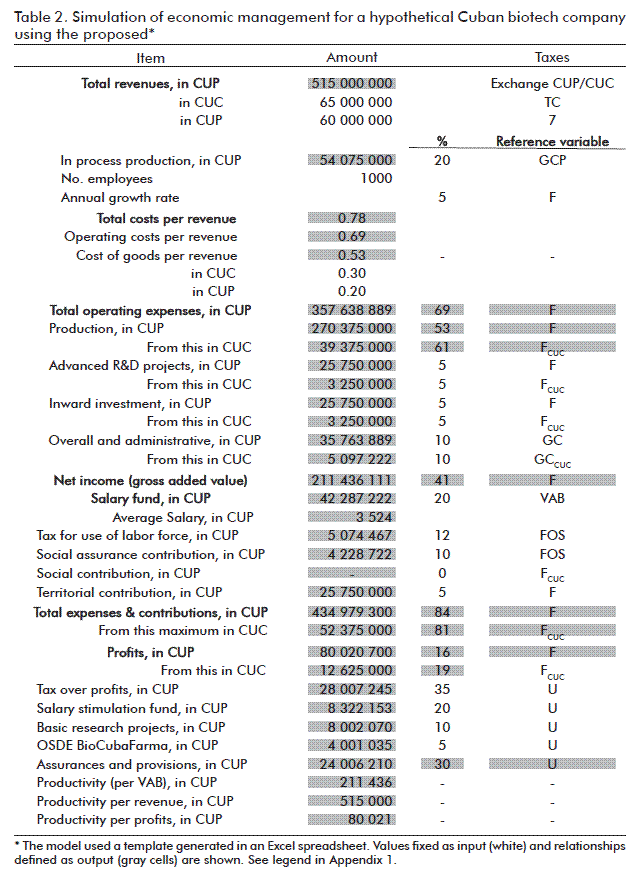
<body><![CDATA[<P   align="justify" ><font size="2" face="Verdana, Arial, Helvetica, sans-serif">Also from a percentage  of profits (15-30 %),<B> </B>a fund <I>for salary stimulation (FES)</I> is created  to complement the basic wage fund. This incentive package links worker incomes  with maintenance or increase of efficiency levels, expressed as low relative costs  and utilization of potential savings. Moreover, it increases profits, giving major  stimulations to those companies with the highest export turnover. </font></P >    <P   align="justify" ><font size="2" face="Verdana, Arial, Helvetica, sans-serif">The implementation  of payment systems for the distribution of these funds must be determined by internal  regulations of the company, previously consulted and approved by the OSDE BioCubaFarma,  enhancing those aspects that enterprise managers consider of highest priority,  after agreement with workers and giving freedom to the companies for approval  staff draw. Labor force remuneration systems should be designed based on the concept  of establishing job post profiles and adjusted to the specificities of these companies.  </font></P >    <P   ><font size="2" face="Verdana, Arial, Helvetica, sans-serif"><b>Implementing the  model </b></font></P >    <P   align="justify" ><font size="2" face="Verdana, Arial, Helvetica, sans-serif">In order to illustrate  a practical application of the proposed model and to analyze the results, an exchange  rate of CUC to CUP (TC) value equal to 7 was used, taking into account that this  value is in the range (6 to 9) that has been employed for other economic sectors  [22]. For this case, the new threshold value of productivity equivalent to that  established previously with TC = 1 using equation 1 can be calculated. It would  now be 200 000 CUP, instead of 50 000 CUP. As reference for international exchange  rate the equivalence between the Cuban Convertible peso (CUC) and US dollar is  considered as 1 (1 CUC = 1 USD). </font></P >    <P   align="justify" ><font size="2" face="Verdana, Arial, Helvetica, sans-serif">It is advisable not  to use very high exchange rates, which could create temporary economic imbalances,  especially in the absence of sufficient market space to facilitate the equilibrium  of prices. The introduction of such exchange rate is considered only for export  enterprises, keeping the sales for domestic market of these companies at 1 for  TC. This because of the fact that, during the initial period of model implementation,  a higher exchange rate will not fit for most institutions allocating their products  or services in the national market. For this reason, it is advisable to avoid  the rise of prices in the internal relationships of our model enterprise by including  non-exporting and budgeted institutions. </font></P >    <P   align="justify" ><font size="2" face="Verdana, Arial, Helvetica, sans-serif">A simulation at conditions  explained in the previous section is shown in <a href="/img/revistas/bta/v30n4/t0206413.gif">table  2</a> for a study case of a national biotechnology company with a work force (FT)  of 1000 employees, annual revenues of 65 million CUC (F<Sub>CUC</Sub>) and 60  million CUP (F<Sub>CUP</Sub>), a cost of goods sold per revenue (COG) of 0.3 and  0.2 in CUC and CUP, respectively, and an annual growth rate (TCA) of 5 %. Also  we assumed for the calculation of the net income (VAB) a produced, but not commercialized,  value of 20 % of their production costs in product not yet billed. </font></P ><FONT size="+1"><FONT size="+1"><FONT size="+1"><FONT size="+1">     
<P   align="justify" ><font size="2" face="Verdana, Arial, Helvetica, sans-serif">As observed in <a href="/img/revistas/bta/v30n4/t0206413.gif">table  2</a>, high productivity values are achieved, both calculated from net income  (more than 211 000 CUP per employee) as from the profits generated. Moreover,  the company shows a total cost per revenue of 0.78 (that includes all current  production, R&amp;D, general and administrative and small inward investment plus  basic salary fund). </font></P >    
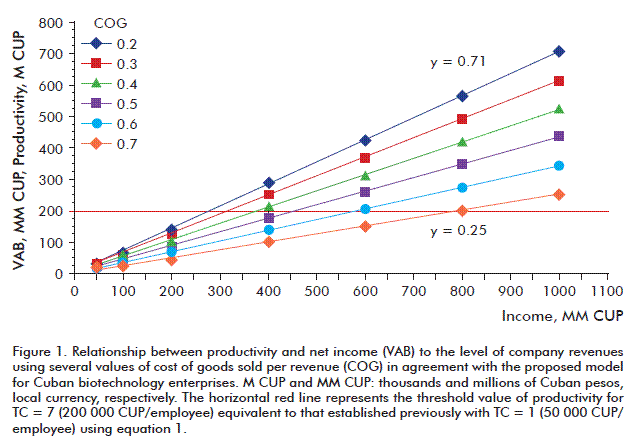
<P   align="justify" ><font size="2" face="Verdana, Arial, Helvetica, sans-serif">The defined respective  tax for each item was established as upper limit for expenses in foreign currency,  of about 5 % of income in foreign currency (F<Sub>CUC</Sub>) for R&amp;D fund  (GID) and inward investments fund (GIM) respectively, 10 % of total expenses for  overall and administrative expenses (GGA) and 10 % of profits for discovery stage  R&amp;D projects fund (FINID). Under these conditions, amounts that guarantee  an adequate level of funding for these activities were obtained: 3.25 million  CUC for GID, 1.26 million CUC for FINID, 3.25 million CUC for GIM and 5.09 million  CUC for GGA, that represents 83 % of income in that currency (F<Sub>CUC</Sub>).  Profits reached 16 % of total revenues and the maximum of total salary remuneration  (FOS + FES) was 24 % of productivity value. </font></P ><FONT size="+1"><FONT size="+1"><FONT size="+1"><FONT size="+1">     <P   align="justify" ><font size="2" face="Verdana, Arial, Helvetica, sans-serif">From the relationship  expressed in equation 1 and shown in <a href="/img/revistas/bta/v30n4/f0106413.gif">figure  1</a> we can conclude that the modeled company has great strength on its performance,  supported by the wide range of costs of goods and revenue levels allowed without  productivity flaws. The value of net income and productivity threshold is shown.  The conditions that guarantee costs of goods per revenue and income values above  threshold can be also determined. </font></P >    
<P   align="justify" ><font size="2" face="Verdana, Arial, Helvetica, sans-serif">Even with relatively  high costs of goods per revenue for these kinds of enterprises (up to 0.7) it  is possible to maintain the productivity above the threshold if the revenues reach  over 800 millions CUP (that is, 100 million CUC from export and 100 million CUP  from the domestic market). It should be also remarked that for revenues figures  below 300 million CUP it is not feasible to reach the threshold values of net  income and productivity for any value of costs of goods per revenue (COG) over  0.2. The slopes obtained from the linear fit of lines for different values of  costs of goods sold per revenue stand for the fraction of each monetary unit received  as income that goes to the net income (<a href="/img/revistas/bta/v30n4/f0106413.gif">Figure  1</a>). </font></P >    
]]></body>
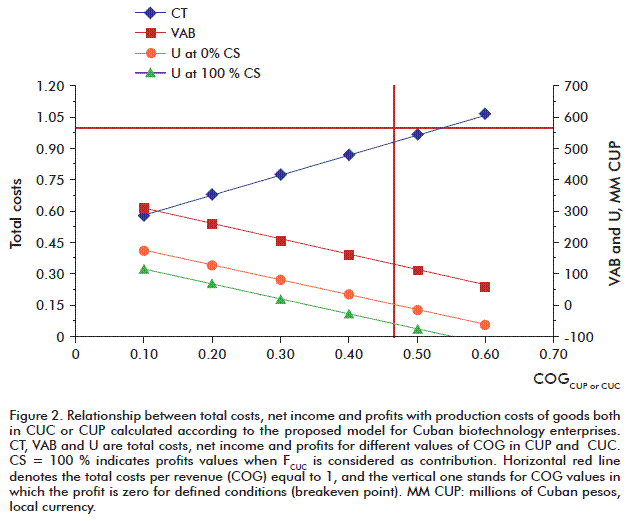
<body><![CDATA[<P   align="justify" ><font size="2" face="Verdana, Arial, Helvetica, sans-serif"><a href="/img/revistas/bta/v30n4/f0206413.gif">Figure  2</a> shows that both the net income, as profit, and total costs per revenue have  the same behavior when varying the costs of goods sold per revenues both in CUC  and CUP. Obviously, the costs of goods sold per revenue inversely correlate to  the net income and profit. It can be seen that the breakeven point is achieved  still with high values of net income (130 million CUP), at costs of goods per  revenue (COG) of 0.46 (both in CUP or CUC) and operative production costs (COP)  lower than 1. As a result, we can say that these companies have a high strength  in terms of earnings, having a wide operating margin over production costs and  revenue levels in both currencies, without falling into losses. </font></P >    
<P   align="justify" ><font size="2" face="Verdana, Arial, Helvetica, sans-serif">Values of net income  related to revenue (VAB/F) obtained under modeled conditions (20-40 %) perform  among the best, compared to those reported for such kind of companies worldwide.  For example, in 2012, this value was 23.2 % for Amgen, 19.2 % for GlaxoSmithKline,  14.8 % for Novartis and 14 % for Merck and Co. [23]. </font></P >    <P   align="justify" ><font size="2" face="Verdana, Arial, Helvetica, sans-serif">The use of an exchange  rate greater than 1 introduces some risk of an increase of product prices that  these companies supply to domestic market (inflation). This effect on the National  Public Health System, the main user for biopharma companies in Cuba, can be avoided  by accounting the revenues from domestic market (FCUP) as a non-operating expense  and social contribution. This will help also to solve the contradiction between  the need to establish reference prices for the domestic market in line with the  international market prices (and maximize export earnings), and the logical need  that the acquisition of these products by the budgeted institutions in the country  does not overload the state budget. Assuming a social contribution equal to the  amount of total revenues from the national market, equivalent to subsidize the  consumption of the national health system, profits decrease down to 4 % of total  revenues. From <a href="/img/revistas/bta/v30n4/f0206413.gif">figure 2</a>  it can be observed that profits become null at operative costs of production (COP)  values as low as 0.35 (in CUC or CUP). This effect could be partially damped if  applying differentiated tax policy as allowed in Tax Act 113 [21]. Also by decreasing  the tax over profit (down to 10 %) and increasing the fractions devoted to salary  stimulation and basic research funding, up to 40 % each for the analyzed example,  while decreasing the contributions to the OSDE BioCubaFarma and formation of reserve  funds.</font>    
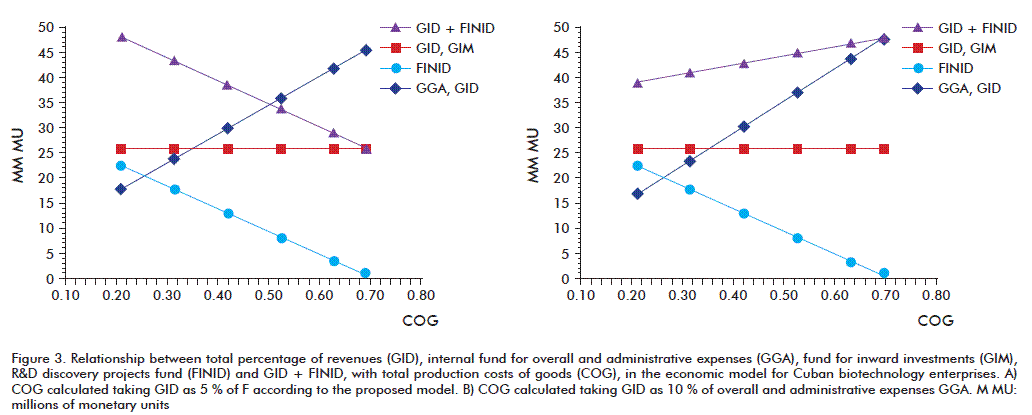
<br> </P ><FONT size="+1"><FONT size="+1">     <P   align="justify" ><font size="2" face="Verdana, Arial, Helvetica, sans-serif"><a href="/img/revistas/bta/v30n4/f0306413.gif">Figure  3</a> compares the behavior of different variables of the model (GID, GIM, GGA,  FINID and GID + FINID) at different values of the total COG for the constant values  of revenues in CUC and CUP established in <a href="/img/revistas/bta/v30n4/t0206413.gif">table  2</a>. </font></P >    
<P   align="justify" ><font size="2" face="Verdana, Arial, Helvetica, sans-serif">In both cases, funding  levels are obtained for inward investment fund (GIM) independently from the value  of COG, while overall and administrative expenses (GGA) increase and funding levels  for basic projects decrease equivalent to profit reduction. Nevertheless, R&amp;D  fund for advanced projects (GID) and the total research and development funding  (GIM + FINID) decrease with the increase of costs of goods per revenue (COG) for  conditions shown in <a href="/img/revistas/bta/v30n4/f0306413.gif">figure  3A</a>. But, paradoxically these funds increase in the case represented in <a href="/img/revistas/bta/v30n4/f0306413.gif">figure  3B</a>. </font></P >    
<P   align="justify" ><font size="2" face="Verdana, Arial, Helvetica, sans-serif">As mentioned before,  the model provides funds for basic salary (FOS) from 20 % of net income (VAB)  and for stimulation wage (FES) from 20 % of profit. </font></P >    <P   align="justify" ><font size="2" face="Verdana, Arial, Helvetica, sans-serif">The full salary compensation  fund (FST) is proportional to the net income and profits; in other words, proportional  to turnover and efficiency. <a href="/img/revistas/bta/v30n4/f0406413.gif">Figure  4</a> shows the decrease of basic and stimulation salary funds, proportional to  the increase of the overall COG, because of reduced net income and profit. </font></P >    
<P   align="justify" ><font size="2" face="Verdana, Arial, Helvetica, sans-serif">Obviously, the stimulation  fund (FES) is null when COG reach 0.46, because no profit is obtained. This <a href="/img/revistas/bta/v30n4/f0406413.gif">figure</a>  also represents the relationship between the total average wage (FST) vs. productivity  with the increase of COG, with a maximum value of 0.25 at a 0.1 COG and then decreases  with the increase of these costs. As expected, the largest amounts of total salary  fund (FST) are obtained with a decrease in COG, mainly at the expense of higher  values of net income that imply higher rates of productivity and operative fund  for basic salary (FOS). </font></P >    
<P   align="justify" ><font size="2" face="Verdana, Arial, Helvetica, sans-serif">Average base salary  increases proportionally with revenue levels, and the rate of this increase is  related to the values of costs of goods sold per revenue, being greater as these  are reduced. </font></P >    ]]></body>
<body><![CDATA[<P   align="justify" ><font size="2" face="Verdana, Arial, Helvetica, sans-serif">These wage levels  would ensure the basic needs of the staff of such companies, leveraging the social  status of these workers, who are among the most productive forces of the country,  with other existing sectors of our society nowadays. </font></P >    <P   align="justify" >&nbsp;</P >    <P   align="justify" > </P >    <P   ><font size="3" face="Verdana, Arial, Helvetica, sans-serif"><B>CONCLUDING REMARKS  </b></font></P ><FONT size="+1">     <P   align="justify" ><font size="2" face="Verdana, Arial, Helvetica, sans-serif">The rapid advance  of science and technology has led to new realities, both in the economic sphere,  as in social relationships. These phenomena have led the so called &ldquo;knowledge-based  economy&rdquo; and the companies that have emerged as a result have been classified  as HiTech, and the biopharmaceutical industry is included among them. This phenomenon  has also led to the appearance of new production relationships and highly skilled  productive forces, partially owners of knowledge necessary for production of high  technology goods or services and whose value is superior to their similar in other  types of business and industry. </font></P ><FONT size="+1">     <P   align="justify" ><font size="2" face="Verdana, Arial, Helvetica, sans-serif">Moreover, although  it has begun to draw some level of historical experience of socialist enterprise  models, we can say that there is little record of the establishment and successful  operation of high-tech enterprises of socialist economies, not to mention the  underdeveloped countries. </font></P >    <P   align="justify" ><font size="2" face="Verdana, Arial, Helvetica, sans-serif">Cuba is consolidating  its biopharmaceutical industry, by grouping several HiTech biopharma enterprises,  given the favorable conditions created by the Revolution and the political vision  of our Commander in Chief Fidel Castro Ruz. Until present day, the experience  has shown their potential for success, creating institutions with characteristics  such as high R&amp;D level, major export capacity, high indicators of productivity  and profits, and a highly qualified and motivated workforce. These enterprises  face in their design and management the same challenges of all socialist state  owned enterprises together with requirements of the &ldquo;knowledge-based economy&rdquo;.  </font></P >    <P   align="justify" ><font size="2" face="Verdana, Arial, Helvetica, sans-serif">The financial and  economic management model proposed in this paper for such enterprises promotes  a high level of innovation, supported by a powerful scientific and technical research  (both internal and external), market-oriented activity, high level of investment  in technology and expansion of capabilities to meet markets&rsquo; demands. It  also boosts and supports successful compliance with the constantly evolving quality  standards and the high cost of labor force, to ensure the maximum stability and  performance required to be competitive in the international arena. </font></P >    <P   align="justify" ><font size="2" face="Verdana, Arial, Helvetica, sans-serif">The R&amp;D funding  scheme proposed in this model allows to reach the average value of international  standards for this kind of enterprises, (<I>i.e.</I>, 10-20 %) of revenue devoted  to R&amp;D activity in a remarkably different scenario of social retribution and  quite different economical balances. </font></P >    <P   align="justify" >&nbsp;</P >    ]]></body>
<body><![CDATA[<P   align="justify" > </P >    <P   align="justify" ><b><font size="3" face="Verdana, Arial, Helvetica, sans-serif">REFERENCES </font></b></P >    <P   align="justify" > </P >    <!-- ref --><P   align="justify" ><font size="2" face="Verdana, Arial, Helvetica, sans-serif">1. Lage A. The knowledge  economy and socialism: Is there an opportunity for development? Rev Cuba Socialista.  2006;41:25-43.     </font></P ><FONT size="+1">     <!-- ref --><P   align="justify" ><font size="2" face="Verdana, Arial, Helvetica, sans-serif">2. Triana J. Looking  the present, thinking on the future. In: Economy and Management: Advances in Research,  Report from the Center of Studies of Cuban Economy; 2004 April, La Habana, Cuba:  CEEC; 2004. p. 3-12.     </font></P >    <!-- ref --><P   align="justify" ><font size="2" face="Verdana, Arial, Helvetica, sans-serif">3. Di Massi JA, Grabowski  HG. The cost of Biopharmaceutical R&amp;D: Is Biotech different? Manage Decis  Econ. 2007;2:469-79.     </font></P >    <!-- ref --><P   align="justify" ><font size="2" face="Verdana, Arial, Helvetica, sans-serif">4. Reichert JM. Trends  in development and approval times for new therapeutics in the United States. Nat  Rev Drug Discov. 2003;2:695-702.     </font></P >    <!-- ref --><P   align="justify" ><font size="2" face="Verdana, Arial, Helvetica, sans-serif">5. Frazier K. Will  Washington find the cure for cancer. Wall Street J. 2011 Jul 13.     </font></P >    <P   align="justify" ><font size="2" face="Verdana, Arial, Helvetica, sans-serif">6. Kureishi A. Tectonic  Transformations: The Future of Biopharmaceuticals in Asia. Quintiles White Paper;  2012 [cited 2013 Aug 18]. Available from: <a href="http://www.quintiles.com/information-library/white-papers/" target="_blank">http://www.quintiles.com/information-library/white-papers/</a>.  </font></P >    <!-- ref --><P   align="justify" ><font size="2" face="Verdana, Arial, Helvetica, sans-serif">7. Herper M. The  truly staggering cost of inventing new drugs. Forbes. 2012 February 22 [cited  2013 Aug 18]. Available from: <a href="http://www.forbes.com/sites/matthewherper/2012/02/10/the-truly-staggering-cost-of-inventing-new-drugs/" target="_blank">http://www.forbes.com/sites/matthewherper/2012/02/10/the-truly-staggering-cost-of-inventing-new-drugs/</a>.      </font></P >    <!-- ref --><P   align="justify" ><font size="2" face="Verdana, Arial, Helvetica, sans-serif">8. Parkes R, Race  T, Clark M. R&amp;D productivity: Delivering sufficient value to support post-cliff  growth [Report]. Deutsche Bank AG; 2011.     </font></P >    <!-- ref --><P   align="justify" ><font size="2" face="Verdana, Arial, Helvetica, sans-serif">9. DiMassi JA. Risk  in new drug development: approval success rates for investigational drugs. Clin  Pharmacol Ther. 2001;69(5):297-307.     </font></P >    ]]></body>
<body><![CDATA[<!-- ref --><P   align="justify" ><font size="2" face="Verdana, Arial, Helvetica, sans-serif">10. Shah N. Pharmaceutical  supply chains: key issues and strategies for optimization. Comp Chem Eng. 2003;28(6):929-41.      </font></P >    <!-- ref --><P   align="justify" ><font size="2" face="Verdana, Arial, Helvetica, sans-serif">11. Quality by design  in Biomanufacturing [White paper]. Berkeley: BioG; 2011 [cited 2012 Aug 18]. Available  from: <a href="http://www.BIO-G.com" target="_blank">http://www.BIO-G.com</a>.      </font></P >    <!-- ref --><P   align="justify" ><font size="2" face="Verdana, Arial, Helvetica, sans-serif">12. Hays Salary Guide  2009. Madrid: Hays Group, Spain; 2009 [cited 2013 Aug 18]. Available from: <a href="http://00rrhh.blogspot.com/2009/01/hays-presenta-la-guia-salarial-2009.html" target="_blank">http://00rrhh.blogspot.com/2009/01/hays-presenta-la-guia-salarial-2009.html</a>.      </font></P >    <!-- ref --><P   align="justify" ><font size="2" face="Verdana, Arial, Helvetica, sans-serif">13. Herrera L, Negr&iacute;n  S, Vald&eacute;s RA. The scientific hub of biotechnology as a knowledge network.  Rev Nueva Empresa. 2010;6(1):39-44.     </font></P >    <!-- ref --><P   align="justify" ><font size="2" face="Verdana, Arial, Helvetica, sans-serif">14. Langer E. Hiring  in Biopharma: Where are the jobs going next? Life Sci Lead. 2012 Sept [cited 2013  Aug 18]. Available from: <a href="http://www.lifescienceleader.com" target="_blank" 	>http://www.lifescienceleader.com</a>.     </font></P >    ]]></body>
<body><![CDATA[<!-- ref --><P   align="justify" ><font size="2" face="Verdana, Arial, Helvetica, sans-serif">15. Triana J. Sharing  knowledge to growth: consulting and macroeconomic growth. In: Economy and Management:  Advances in Research. Report from the Center of Studies of Cuban Economy (CEEC);  2004 April, La Habana, Cuba; Havana: CEEC; 2004. p. 2-22.     </font></P >    <!-- ref --><P   align="justify" ><font size="2" face="Verdana, Arial, Helvetica, sans-serif">16. Lage A. The Knowledge  economy and Socialism: Reflections from the experience of Cuban biotechnology.  Rev Cuba Socialista. 2004;30:2-10.     </font></P >    <P   align="justify" ><font size="2" face="Verdana, Arial, Helvetica, sans-serif">17. Lage A. Biotechnology,  Science and Production: &ldquo;unexplored area&rdquo; of building socialism in  Cuba. Marx ahora. 2009;27:76-95. </font></P >    <P   align="justify" ><font size="2" face="Verdana, Arial, Helvetica, sans-serif">18. Cuba&rsquo;s  biotech boom [editorial]. Nature. 2009;457:130. </font></P >    <!-- ref --><P   align="justify" ><font size="2" face="Verdana, Arial, Helvetica, sans-serif">19. Lage A. Biotechnology  and the New Economy: Creating and valuing intangibles. Biotecnol Apl. 2000;17:55-61.      </font></P >    <!-- ref --><P   align="justify" ><font size="2" face="Verdana, Arial, Helvetica, sans-serif">20. D&iacute;az I.  The Cuban state enterprise: where productivity is hiding. In: Scientific Meeting  from the Center for Studies of Cuban Economy, 2012 July, La Habana, Cuba; Havana:  CEEC; 2012. p. 1-35.     </font></P >    ]]></body>
<body><![CDATA[<!-- ref --><P   align="justify" ><font size="2" face="Verdana, Arial, Helvetica, sans-serif">21. Consejo de Estado  de la Rep&uacute;blica de Cuba. Law 113 of Tax System. Gaceta Oficial de la Rep&uacute;blica  de Cuba (Edici&oacute;n Ordinaria). 2012;(53):1-97.     </font></P >    <!-- ref --><P   align="justify" ><font size="2" face="Verdana, Arial, Helvetica, sans-serif">22. Ministerio de  Finanzas y Precios. Resoluci&oacute;n No. 09/2013. Gaceta Oficial de la Rep&uacute;blica  de Cuba (Edici&oacute;n Extraordinaria). 2013;2:3-4.     </font></P >    <!-- ref --><P   align="justify" ><font size="2" face="Verdana, Arial, Helvetica, sans-serif">23. YChart: The Financial  Terminal of the Web [Internet]. c2013 [cited 2013 Aug 18]. Available from: <FONT color="#0000FF"><a href="http://ycharts.com/companies/AMGN" target="_blank">http://ycharts.com/companies/AMGN</a>  </font></font></P >    <P   align="justify" >&nbsp;</P >    <P   align="justify" >&nbsp;</P ><FONT color="#0000FF">     <P   align="justify" > </P ><FONT size="+1" color="#000000">     <P   > </P ><FONT size="+1">     <P   ><font size="2" face="Verdana, Arial, Helvetica, sans-serif">Received in March,  2013.    ]]></body>
<body><![CDATA[<br> </font><font size="2" face="Verdana, Arial, Helvetica, sans-serif">Accepted  in August, 2013. </font></P >    <P   >&nbsp;</P >    <P   >&nbsp;</P >    <P   > </P >    <P   > </P >    <P   ><font size="2" face="Verdana, Arial, Helvetica, sans-serif"><i>Adolfo Castillo</i>.  Direcci&oacute;n de Desarrollo de Procesos Centro de Inmunolog&iacute;a Molecular,  CIM. Calle 216 y 15, Atabey, Playa, La Habana 11600, Cuba. E-mail: <a href="mailto:adolfo@cim.sld.cu">adolfo@cim.sld.cu</a>.  </font></P ></font></font></font></font></font></font></font></font></font></font></font></font></font></font></font></font></font></font></font></font></font></font></font></font></font></font></font></font></font></font></font></font></font></font></font></font></font></font></font></font></font></font></font></font></font></font></font></font></font></font></font></font></font></font></font></font></font></font>  <hr> <FONT size="+1" color="#000000"><FONT size="+1"><FONT size="+1"><FONT size="+1"><FONT size="+1"><FONT size="+1"><FONT size="+1"><FONT size="+1"><FONT size="+1"><FONT size="+1"><FONT size="+1"><FONT size="+1"><FONT size="+1"><FONT size="+1"><FONT size="+1"><FONT size="+1"><FONT size="+1"><FONT size="+1"><FONT size="+1"><FONT size="+1"><FONT size="+1"><FONT size="+1"><FONT size="+1"><FONT size="+1"><FONT size="+1"><FONT size="+1"><FONT size="+1"><FONT size="+1"><FONT size="+1"><FONT size="+1"><FONT size="+1"><FONT size="+1"><FONT size="+1"><FONT size="+1"><FONT size="+1"><FONT size="+1"><FONT size="+1"><FONT size="+1"><FONT size="+1"><FONT size="+1"><FONT size="+1"><FONT size="+1"><FONT size="+1"><FONT size="+1"><FONT size="+1"><FONT size="+1"><FONT size="+1"><FONT size="+1"><FONT size="+1"><FONT size="+1"><FONT size="+1"><FONT size="+1"><FONT size="+1"><FONT size="+1"><FONT size="+1"><FONT color="#0000FF"><FONT size="+1" color="#000000"><FONT size="+1">      <P align="right"   ><font size="2" face="Verdana, Arial, Helvetica, sans-serif"><B>SUPPLEMENTARY  MATERIAL </b></font></P ><FONT size="+1"><FONT size="+1">     <P   align="right" >&nbsp;</P ><FONT size="+1">     <P   align="justify" ></P >    <P   align="justify" > </P >    ]]></body>
<body><![CDATA[<P   align="justify" ><b><FONT SIZE="+1" COLOR="#000000"><FONT SIZE="+1"><FONT SIZE="+1"><FONT SIZE="+1"><FONT SIZE="+1"><FONT SIZE="+1"><FONT SIZE="+1"><FONT SIZE="+1"><FONT SIZE="+1"><FONT SIZE="+1"><FONT SIZE="+1"><FONT SIZE="+1"><FONT SIZE="+1"><FONT SIZE="+1"><FONT SIZE="+1"><FONT SIZE="+1"><FONT SIZE="+1"><FONT SIZE="+1"><FONT SIZE="+1"><FONT SIZE="+1"><FONT SIZE="+1"><FONT SIZE="+1"><FONT SIZE="+1"><FONT SIZE="+1"><FONT SIZE="+1"><FONT SIZE="+1"><FONT SIZE="+1"><FONT SIZE="+1"><FONT SIZE="+1"><FONT SIZE="+1"><FONT SIZE="+1"><FONT SIZE="+1"><FONT SIZE="+1"><FONT SIZE="+1"><FONT SIZE="+1"><FONT SIZE="+1"><FONT SIZE="+1"><FONT SIZE="+1"><FONT SIZE="+1"><FONT SIZE="+1"><FONT SIZE="+1"><FONT SIZE="+1"><FONT SIZE="+1"><FONT SIZE="+1"><FONT SIZE="+1"><FONT SIZE="+1"><FONT SIZE="+1"><FONT SIZE="+1"><FONT SIZE="+1"><FONT SIZE="+1"><FONT SIZE="+1"><FONT SIZE="+1"><FONT SIZE="+1"><FONT SIZE="+1"><FONT SIZE="+1"><FONT COLOR="#0000FF"><FONT SIZE="+1" COLOR="#000000"><FONT SIZE="+1"><FONT SIZE="+1"><FONT SIZE="+1"><FONT SIZE="+1"><FONT SIZE="+1"><FONT SIZE="+1"><FONT SIZE="+1"><FONT SIZE="+1"><FONT SIZE="+1"><FONT SIZE="+1"><FONT SIZE="+1"><FONT SIZE="+1"><FONT SIZE="+1"><FONT SIZE="+1"><FONT SIZE="+1"><FONT SIZE="+1"><FONT SIZE="+1"><FONT SIZE="+1"><FONT SIZE="+1"><FONT SIZE="+1"><FONT SIZE="+1"><FONT SIZE="+1"><FONT SIZE="+1"><FONT SIZE="+1"><FONT SIZE="+1"><FONT SIZE="+1"><FONT SIZE="+1"><FONT SIZE="+1"><FONT SIZE="+1"><FONT SIZE="+1"><FONT SIZE="+1"><FONT SIZE="+1"><FONT SIZE="+1"><FONT SIZE="+1"><FONT SIZE="+1"><FONT SIZE="+1"><FONT SIZE="+1"><FONT SIZE="+1"><FONT SIZE="+1"><FONT COLOR="#D70000"><FONT SIZE="+1"><FONT SIZE="3"><B><FONT COLOR="#000000" FACE="Verdana, Arial, Helvetica, sans-serif"><A NAME="a1"></A></FONT></B></FONT></FONT></FONT></FONT></FONT></FONT></FONT></FONT></FONT></FONT></FONT></FONT></FONT></FONT></FONT></FONT></FONT></FONT></FONT></FONT></FONT></FONT></FONT></FONT></FONT></FONT></FONT></FONT></FONT></FONT></FONT></FONT></FONT></FONT></FONT></FONT></FONT></FONT></FONT></FONT></FONT></FONT></FONT></FONT></FONT></FONT></FONT></FONT></FONT></FONT></FONT></FONT></FONT></FONT></FONT></FONT></FONT></FONT></FONT></FONT></FONT></FONT></FONT></FONT></FONT></FONT></FONT></FONT></FONT></FONT></FONT></FONT></FONT></FONT></FONT></FONT></FONT></FONT></FONT></FONT></FONT></FONT></FONT></FONT></FONT></FONT></FONT></FONT></FONT></FONT></FONT></FONT></FONT></FONT></FONT></FONT></FONT></FONT></FONT><font size="3" face="Verdana, Arial, Helvetica, sans-serif"><A HREF="#a1r">Appendix  1</A>: Exogenous variables (input) defined in the model </font></b></P >    <P   align="justify" ><font size="2" face="Verdana, Arial, Helvetica, sans-serif">F<Sub>CUC</Sub>:  Income by export (Cuban convertible currency, CUC) </font></P ><FONT size="+1"><FONT size="+1"><FONT size="+1">     <P   align="justify" ><font size="2" face="Verdana, Arial, Helvetica, sans-serif">F<Sub>CUP</Sub>:  Income by domestic sales (Cuban pesos, CUP) </font></P ><FONT size="+1"><FONT size="+1">     <P   align="justify" ><font size="2" face="Verdana, Arial, Helvetica, sans-serif">TC: CUC to CUP exchange  rate </font></P >    <P   align="justify" ><font size="2" face="Verdana, Arial, Helvetica, sans-serif">TCA: Annual growth  rate (%) </font></P >    <P   align="justify" ><font size="2" face="Verdana, Arial, Helvetica, sans-serif">FT: Number of employees  </font></P >    <P   align="justify" ><font size="2" face="Verdana, Arial, Helvetica, sans-serif">COG<Sub>CUC</Sub>:  Costs of goods per revenue in CUC </font></P ><FONT size="+1"><FONT size="+1">     <P   align="justify" ><font size="2" face="Verdana, Arial, Helvetica, sans-serif">COG<Sub>CUP</Sub>:  Costs of goods per revenue in CUP </font></P ><FONT size="+1"><FONT size="+1">     <P   align="justify" ><font size="2" face="Verdana, Arial, Helvetica, sans-serif">T<Sub>TVP</Sub>:  Rate of produced value (%) </font></P ><FONT size="+1"><FONT size="+1">     <P   align="justify" ><font size="2" face="Verdana, Arial, Helvetica, sans-serif">T<Sub>GID</Sub>:  Rate of R&amp;D expenses for advanced projects (%) </font></P ><FONT size="+1"><FONT size="+1">     ]]></body>
<body><![CDATA[<P   align="justify" ><font size="2" face="Verdana, Arial, Helvetica, sans-serif">T<Sub>GA</Sub>: Rate  of overall and administrative expenses (%) </font></P ><FONT size="+1"><FONT size="+1">     <P   align="justify" ><font size="2" face="Verdana, Arial, Helvetica, sans-serif">TG<Sub>IM</Sub>:  Rate of inward investments (%) </font></P ><FONT size="+1"><FONT size="+1">     <P   align="justify" ><font size="2" face="Verdana, Arial, Helvetica, sans-serif">T<Sub>FOS</Sub>:  Rate of operative salary fund (%) </font></P ><FONT size="+1"><FONT size="+1">     <P   align="justify" ><font size="2" face="Verdana, Arial, Helvetica, sans-serif">T<Sub>IMU</Sub>:  Rate of tax over profits (%) </font></P ><FONT size="+1"><FONT size="+1">     <P   align="justify" ><font size="2" face="Verdana, Arial, Helvetica, sans-serif">T<Sub>IMTT</Sub>:  Rate of territorial contribution (%) </font></P ><FONT size="+1"><FONT size="+1">     <P   align="justify" ><font size="2" face="Verdana, Arial, Helvetica, sans-serif">T<Sub>CSA</Sub>:  Rate for social security contribution (%) </font></P ><FONT size="+1"><FONT size="+1">     <P   align="justify" ><font size="2" face="Verdana, Arial, Helvetica, sans-serif">T<Sub>IMFT</Sub>:  Rate for use of labor force (%) </font></P ><FONT size="+1"><FONT size="+1">     <P   align="justify" ><font size="2" face="Verdana, Arial, Helvetica, sans-serif">T<Sub>FES</Sub>:  Rate for salary stimulation fund (%) </font></P ><FONT size="+1"><FONT size="+1">     <P   align="justify" ><font size="2" face="Verdana, Arial, Helvetica, sans-serif">T<Sub>FINID</Sub>:  Rate for R&amp;D discovery projects fund (%) </font></P ><FONT size="+1"><FONT size="+1">     <P   align="justify" ><font size="2" face="Verdana, Arial, Helvetica, sans-serif">T<Sub>FAP</Sub>:  Rate for assurance and provisions (%) </font></P ><FONT size="+1"><FONT size="+1">     ]]></body>
<body><![CDATA[<P   align="justify" ><font size="2" face="Verdana, Arial, Helvetica, sans-serif">T<Sub>OSDE</Sub>:  Rate for contribution to OSDE (%) </font></P ><FONT size="+1"><FONT size="+1">     <P   align="justify" ><font size="2" face="Verdana, Arial, Helvetica, sans-serif">OSDE: High Level  Management Entrepreneurial Organization BioCubaFarma </font></P >    <P   align="justify" >&nbsp;</P ><FONT color="#D70000">     <P   align="justify" > </P ><FONT size="+1">     <P   align="justify" ><font size="3"><b><font color="#000000" face="Verdana, Arial, Helvetica, sans-serif"><A NAME="a2"></A><A HREF="#a2r">Appendix  2</A>. Endogenous (output) variables and linear relationships defined and used  in the model </font></b></font></P ><FONT size="+1" color="#000000">     <P   align="justify" ><font size="2" face="Verdana, Arial, Helvetica, sans-serif">Total revenue: F  = F<Sub>CUC</Sub> &times; TC + F<Sub><Sub>CUP </Sub></Sub></font></P ><FONT size="+1"><FONT size="+1"><FONT size="+1"><FONT size="+1"><FONT size="+1">      <P   align="justify" ><font size="2" face="Verdana, Arial, Helvetica, sans-serif">Operating production  expenses: GCP = (COG<Sub>CUC</Sub> + COG<Sub>CUP</Sub>) &times; (TC &times; F<Sub>CUC</Sub>  + F<Sub>CUP</Sub>) &times; (1 + TCA) </font></P ><FONT size="+1"><FONT size="+1"><FONT size="+1"><FONT size="+1"><FONT size="+1"><FONT size="+1"><FONT size="+1"><FONT size="+1">      <P   align="justify" ><font size="2" face="Verdana, Arial, Helvetica, sans-serif">Production expenses  in foreign currency: GCP<Sub>CUC</Sub> = COG<Sub>CUC</Sub> &times; (F<Sub>CUC</Sub>  + F<Sub>CUP</Sub>) &times; (1 + TCA) </font></P ><FONT size="+1"><FONT size="+1"><FONT size="+1"><FONT size="+1"><FONT size="+1"><FONT size="+1"><FONT size="+1"><FONT size="+1">      <P   align="justify" ><font size="2" face="Verdana, Arial, Helvetica, sans-serif">In process production  value: VP = GCP &times; TVP </font></P >    <P   align="justify" ><font size="2" face="Verdana, Arial, Helvetica, sans-serif">R&amp;D expenses  advanced projects: GID = T<Sub>GID &times;</Sub> F </font></P ><FONT size="+1"><FONT size="+1">     ]]></body>
<body><![CDATA[<P   align="justify" ><font size="2" face="Verdana, Arial, Helvetica, sans-serif">Inward investment:  GIM = T<Sub>IM</Sub> &times; F </font></P ><FONT size="+1"><FONT size="+1">     <P   align="justify" ><font size="2" face="Verdana, Arial, Helvetica, sans-serif">Overall and administratives:  GGA = (GCP + GID + GIM) &times; (T<Sub>GA</Sub> / (1 &ndash; T<Sub>GA</Sub>))  </font></P ><FONT size="+1"><FONT size="+1"><FONT size="+1"><FONT size="+1">     <P   align="justify" ><font size="2" face="Verdana, Arial, Helvetica, sans-serif">Total operating expenses:  GC = GCP + GID + GGA + GIM </font></P >    <P   align="justify" ><font size="2" face="Verdana, Arial, Helvetica, sans-serif">Net income (Gross  added value): VAB = F &ndash; GCP &ndash; GID &ndash; GGA &ndash; GIM + VP </font></P >    <P   align="justify" ><font size="2" face="Verdana, Arial, Helvetica, sans-serif">Operating salary  fund: FOS = VAB &times; T<Sub><Sub>FOS </Sub></Sub></font></P ><FONT size="+1"><FONT size="+1">     <P   align="justify" ><font size="2" face="Verdana, Arial, Helvetica, sans-serif">Average salary: SM  = (FOS / FT) / 12 </font></P >    <P   align="justify" ><font size="2" face="Verdana, Arial, Helvetica, sans-serif">Cost of goods per  revenue: COG = GCP / F </font></P >    <P   align="justify" ><font size="2" face="Verdana, Arial, Helvetica, sans-serif">Operating costs per  revenue: COP = GC / F </font></P >    <P   align="justify" ><font size="2" face="Verdana, Arial, Helvetica, sans-serif">Total costs per revenue:  CT = (GC + FOS) / F </font></P >    <P   align="justify" ><font size="2" face="Verdana, Arial, Helvetica, sans-serif">Tax for use of labor  force: IMFT = FOS &times; T<Sub><Sub>IMFT </Sub></Sub></font></P ><FONT size="+1"><FONT size="+1">     ]]></body>
<body><![CDATA[<P   align="justify" ><font size="2" face="Verdana, Arial, Helvetica, sans-serif">Social security contribution:  CSA = T<Sub>CSA</Sub> &times; FOS </font></P ><FONT size="+1"><FONT size="+1">     <P   align="justify" ><font size="2" face="Verdana, Arial, Helvetica, sans-serif">Territorial contribution:  IMTT = F &times; T<Sub><Sub>IMTT </Sub></Sub></font></P ><FONT size="+1"><FONT size="+1">     <P   align="justify" ><font size="2" face="Verdana, Arial, Helvetica, sans-serif">Social contribution:  CS = F<Sub>CUP</Sub> &times; T<Sub><Sub>CS </Sub></Sub></font></P ><FONT size="+1"><FONT size="+1"><FONT size="+1"><FONT size="+1">     <P   align="justify" ><font size="2" face="Verdana, Arial, Helvetica, sans-serif">Total Expenses &amp;  Contributions: GT = GC + FOS + IMFT + CSA + CS + IMTT </font></P >    <P   align="justify" ><font size="2" face="Verdana, Arial, Helvetica, sans-serif">Total Expenses in  foreign currency: GCP<Sub>CUC</Sub> + (T<Sub>ID</Sub> + T<Sub>GA</Sub> + T<Sub>IM</Sub>)  &times; F<Sub><Sub>CUC </Sub></Sub></font></P ><FONT size="+1"><FONT size="+1"><FONT size="+1"><FONT size="+1"><FONT size="+1"><FONT size="+1"><FONT size="+1"><FONT size="+1"><FONT size="+1"><FONT size="+1">      <P   align="justify" ><font size="2" face="Verdana, Arial, Helvetica, sans-serif">Profit: U = F &ndash;  GT </font></P >    <P   align="justify" ><font size="2" face="Verdana, Arial, Helvetica, sans-serif">Tax over profits:  IMU = U &times; T<Sub><Sub>IMU </Sub></Sub></font></P ><FONT size="+1"><FONT size="+1">     <P   align="justify" ><font size="2" face="Verdana, Arial, Helvetica, sans-serif">Salary stimulation  fund: FES = U &times; T<Sub>FES</Sub> &times; F<Sub>CUC</Sub> / (F<Sub>CUC</Sub>  + F<Sub>CUP</Sub>) </font></P ><FONT size="+1"><FONT size="+1"><FONT size="+1"><FONT size="+1"><FONT size="+1"><FONT size="+1"><FONT size="+1"><FONT size="+1">      <P   align="justify" ><font size="2" face="Verdana, Arial, Helvetica, sans-serif">R&amp;D discovery  projects: FINID = U &times; T<Sub><Sub>FINID </Sub></Sub></font></P ><FONT size="+1"><FONT size="+1">     <P   align="justify" ><font size="2" face="Verdana, Arial, Helvetica, sans-serif">Contribution to OSDE  BioCubaFarma: OSDE = U &times; T<Sub><Sub>OSDE </Sub></Sub></font></P ><FONT size="+1"><FONT size="+1">     ]]></body>
<body><![CDATA[<P   align="justify" ><font size="2" face="Verdana, Arial, Helvetica, sans-serif">Assurances and provisions:  FAP = U &times; T<Sub><Sub>FAP </Sub></Sub></font></P ><FONT size="+1"><FONT size="+1">     <P   align="justify" ><font size="2" face="Verdana, Arial, Helvetica, sans-serif">Productivity (per  VAB): P = VAB / FT </font></P >    <P   align="justify" ><font size="2" face="Verdana, Arial, Helvetica, sans-serif">Productivity per  revenue: P<Sub>F</Sub> = F / FT </font></P ><FONT size="+1"><FONT size="+1">     <P   align="justify" ><font size="2" face="Verdana, Arial, Helvetica, sans-serif">Productivity per  profits: P<Sub>P</Sub> = U / FT </font></P ><FONT size="+1"><FONT size="+1">     <P   ><font size="2" face="Verdana, Arial, Helvetica, sans-serif">Total fund of salary:  FST = FOS + FES </font></P ></font></font></font></font></font></font></font></font></font></font></font></font></font></font></font></font></font></font></font></font></font></font></font></font></font></font></font></font></font></font></font></font></font></font></font></font></font></font></font></font></font></font></font></font></font></font></font></font></font></font></font></font></font></font></font></font></font></font></font></font></font></font></font></font></font></font></font></font></font></font></font></font></font></font></font></font></font></font></font></font></font></font></font></font></font></font></font></font></font></font></font></font></font></font></font></font></font></font></font></font></font></font></font></font></font></font></font></font></font></font></font></font></font></font></font></font></font></font></font></font></font></font></font></font></font></font></font></font></font></font></font></font></font></font></font></font></font></font></font></font></font></font></font></font></font></font></font></font></font></font></font></font></font></font></font></font></font></font></font></font></font></font></font></font></font></font></font></font></font></font></DIV >      ]]></body><back>
<ref-list>
<ref id="B1">
<label>1</label><nlm-citation citation-type="journal">
<person-group person-group-type="author">
<name>
<surname><![CDATA[Lage]]></surname>
<given-names><![CDATA[A]]></given-names>
</name>
</person-group>
<article-title xml:lang="en"><![CDATA[The knowledge economy and socialism: Is there an opportunity for development?]]></article-title>
<source><![CDATA[Rev Cuba Socialista]]></source>
<year>2006</year>
<volume>41</volume>
<page-range>25-43</page-range></nlm-citation>
</ref>
<ref id="B2">
<label>2</label><nlm-citation citation-type="book">
<person-group person-group-type="author">
<name>
<surname><![CDATA[Triana]]></surname>
<given-names><![CDATA[J]]></given-names>
</name>
</person-group>
<article-title xml:lang="en"><![CDATA[Looking the present, thinking on the future]]></article-title>
<source><![CDATA[Economy and Management: Advances in Research, Report from the Center of Studies of Cuban Economy; 2004 April]]></source>
<year>2004</year>
<page-range>3-12</page-range><publisher-loc><![CDATA[La Habana ]]></publisher-loc>
<publisher-name><![CDATA[CEEC]]></publisher-name>
</nlm-citation>
</ref>
<ref id="B3">
<label>3</label><nlm-citation citation-type="journal">
<person-group person-group-type="author">
<name>
<surname><![CDATA[Di Massi]]></surname>
<given-names><![CDATA[JA]]></given-names>
</name>
<name>
<surname><![CDATA[Grabowski]]></surname>
<given-names><![CDATA[HG]]></given-names>
</name>
</person-group>
<article-title xml:lang="en"><![CDATA[The cost of Biopharmaceutical R&D: Is Biotech different?]]></article-title>
<source><![CDATA[Manage Decis Econ]]></source>
<year>2007</year>
<volume>2</volume>
<page-range>469-79</page-range></nlm-citation>
</ref>
<ref id="B4">
<label>4</label><nlm-citation citation-type="journal">
<person-group person-group-type="author">
<name>
<surname><![CDATA[Reichert]]></surname>
<given-names><![CDATA[JM]]></given-names>
</name>
</person-group>
<article-title xml:lang="en"><![CDATA[Trends in development and approval times for new therapeutics in the United States]]></article-title>
<source><![CDATA[Nat Rev Drug Discov]]></source>
<year>2003</year>
<volume>2</volume>
<page-range>695-702</page-range></nlm-citation>
</ref>
<ref id="B5">
<label>5</label><nlm-citation citation-type="journal">
<person-group person-group-type="author">
<name>
<surname><![CDATA[Frazier]]></surname>
<given-names><![CDATA[K]]></given-names>
</name>
</person-group>
<article-title xml:lang="en"><![CDATA[Will Washington find the cure for cancer]]></article-title>
<source><![CDATA[Wall Street J]]></source>
<year>2011</year>
<month> J</month>
<day>ul</day>
</nlm-citation>
</ref>
<ref id="B6">
<label>6</label><nlm-citation citation-type="">
<person-group person-group-type="author">
<name>
<surname><![CDATA[Kureishi]]></surname>
<given-names><![CDATA[A]]></given-names>
</name>
</person-group>
<source><![CDATA[Tectonic Transformations: The Future of Biopharmaceuticals in Asia. Quintiles White Paper]]></source>
<year>2012</year>
</nlm-citation>
</ref>
<ref id="B7">
<label>7</label><nlm-citation citation-type="journal">
<person-group person-group-type="author">
<name>
<surname><![CDATA[Herper]]></surname>
<given-names><![CDATA[M]]></given-names>
</name>
</person-group>
<article-title xml:lang="en"><![CDATA[The truly staggering cost of inventing new drugs]]></article-title>
<source><![CDATA[Forbes]]></source>
<year>2012</year>
<month> F</month>
<day>eb</day>
</nlm-citation>
</ref>
<ref id="B8">
<label>8</label><nlm-citation citation-type="book">
<person-group person-group-type="author">
<name>
<surname><![CDATA[Parkes]]></surname>
<given-names><![CDATA[R]]></given-names>
</name>
<name>
<surname><![CDATA[Race]]></surname>
<given-names><![CDATA[T]]></given-names>
</name>
<name>
<surname><![CDATA[Clark]]></surname>
<given-names><![CDATA[M]]></given-names>
</name>
</person-group>
<source><![CDATA[R&D productivity: Delivering sufficient value to support post-cliff growth]]></source>
<year>2011</year>
<publisher-name><![CDATA[Deutsche Bank AG]]></publisher-name>
</nlm-citation>
</ref>
<ref id="B9">
<label>9</label><nlm-citation citation-type="journal">
<person-group person-group-type="author">
<name>
<surname><![CDATA[DiMassi]]></surname>
<given-names><![CDATA[JA]]></given-names>
</name>
</person-group>
<article-title xml:lang="en"><![CDATA[Risk in new drug development: approval success rates for investigational drugs]]></article-title>
<source><![CDATA[Clin Pharmacol Ther]]></source>
<year>2001</year>
<volume>69</volume>
<numero>5</numero>
<issue>5</issue>
<page-range>297-307</page-range></nlm-citation>
</ref>
<ref id="B10">
<label>10</label><nlm-citation citation-type="journal">
<person-group person-group-type="author">
<name>
<surname><![CDATA[Shah]]></surname>
<given-names><![CDATA[N]]></given-names>
</name>
</person-group>
<article-title xml:lang="en"><![CDATA[Pharmaceutical supply chains: key issues and strategies for optimization]]></article-title>
<source><![CDATA[Comp Chem Eng]]></source>
<year>2003</year>
<volume>28</volume>
<numero>6</numero>
<issue>6</issue>
<page-range>929-41</page-range></nlm-citation>
</ref>
<ref id="B11">
<label>11</label><nlm-citation citation-type="book">
<source><![CDATA[Quality by design in Biomanufacturing (White paper)]]></source>
<year>2011</year>
<publisher-loc><![CDATA[Berkeley ]]></publisher-loc>
<publisher-name><![CDATA[BioG]]></publisher-name>
</nlm-citation>
</ref>
<ref id="B12">
<label>12</label><nlm-citation citation-type="book">
<source><![CDATA[Hays Salary Guide 2009]]></source>
<year>2009</year>
<publisher-loc><![CDATA[Madrid ]]></publisher-loc>
<publisher-name><![CDATA[Hays Group, Spain]]></publisher-name>
</nlm-citation>
</ref>
<ref id="B13">
<label>13</label><nlm-citation citation-type="journal">
<person-group person-group-type="author">
<name>
<surname><![CDATA[Herrera]]></surname>
<given-names><![CDATA[L]]></given-names>
</name>
<name>
<surname><![CDATA[Negrín]]></surname>
<given-names><![CDATA[S]]></given-names>
</name>
<name>
<surname><![CDATA[Valdés]]></surname>
<given-names><![CDATA[RA]]></given-names>
</name>
</person-group>
<article-title xml:lang="en"><![CDATA[The scientific hub of biotechnology as a knowledge network]]></article-title>
<source><![CDATA[Rev Nueva Empresa]]></source>
<year>2010</year>
<volume>6</volume>
<numero>1</numero>
<issue>1</issue>
<page-range>39-44</page-range></nlm-citation>
</ref>
<ref id="B14">
<label>14</label><nlm-citation citation-type="journal">
<person-group person-group-type="author">
<name>
<surname><![CDATA[Langer]]></surname>
<given-names><![CDATA[E]]></given-names>
</name>
</person-group>
<article-title xml:lang="en"><![CDATA[Hiring in Biopharma: Where are the jobs going next?]]></article-title>
<source><![CDATA[Life Sci Lead]]></source>
<year>2012</year>
<month> S</month>
<day>ep</day>
</nlm-citation>
</ref>
<ref id="B15">
<label>15</label><nlm-citation citation-type="book">
<person-group person-group-type="author">
<name>
<surname><![CDATA[Triana]]></surname>
<given-names><![CDATA[J]]></given-names>
</name>
</person-group>
<article-title xml:lang="en"><![CDATA[Sharing knowledge to growth: consulting and macroeconomic growth]]></article-title>
<source><![CDATA[Economy and Management: Advances in Research. Report from the Center of Studies of Cuban Economy (CEEC); 2004 April, La Habana, Cuba]]></source>
<year>2004</year>
<page-range>2-22</page-range><publisher-loc><![CDATA[Havana ]]></publisher-loc>
<publisher-name><![CDATA[CEEC]]></publisher-name>
</nlm-citation>
</ref>
<ref id="B16">
<label>16</label><nlm-citation citation-type="journal">
<person-group person-group-type="author">
<name>
<surname><![CDATA[Lage]]></surname>
<given-names><![CDATA[A]]></given-names>
</name>
</person-group>
<article-title xml:lang="en"><![CDATA[The Knowledge economy and Socialism: Reflections from the experience of Cuban biotechnology]]></article-title>
<source><![CDATA[Rev Cuba Socialista]]></source>
<year>2004</year>
<volume>30</volume>
<page-range>2-10</page-range></nlm-citation>
</ref>
<ref id="B17">
<label>17</label><nlm-citation citation-type="journal">
<person-group person-group-type="author">
<name>
<surname><![CDATA[Lage]]></surname>
<given-names><![CDATA[A]]></given-names>
</name>
</person-group>
<article-title xml:lang="en"><![CDATA[Biotechnology, Science and Production: "unexplored area" of building socialism in Cuba]]></article-title>
<source><![CDATA[Marx ahora]]></source>
<year>2009</year>
<volume>27</volume>
<page-range>76-95</page-range></nlm-citation>
</ref>
<ref id="B18">
<label>18</label><nlm-citation citation-type="journal">
<article-title xml:lang="en"><![CDATA[Cuba's biotech boom]]></article-title>
<source><![CDATA[Nature]]></source>
<year>2009</year>
<volume>457</volume>
<page-range>130</page-range></nlm-citation>
</ref>
<ref id="B19">
<label>19</label><nlm-citation citation-type="journal">
<person-group person-group-type="author">
<name>
<surname><![CDATA[Lage]]></surname>
<given-names><![CDATA[A]]></given-names>
</name>
</person-group>
<article-title xml:lang="en"><![CDATA[Biotechnology and the New Economy: Creating and valuing intangibles]]></article-title>
<source><![CDATA[Biotecnol Apl]]></source>
<year>2000</year>
<volume>17</volume>
<page-range>55-61</page-range></nlm-citation>
</ref>
<ref id="B20">
<label>20</label><nlm-citation citation-type="book">
<person-group person-group-type="author">
<name>
<surname><![CDATA[Díaz]]></surname>
<given-names><![CDATA[I]]></given-names>
</name>
</person-group>
<article-title xml:lang="en"><![CDATA[The Cuban state enterprise: where productivity is hiding]]></article-title>
<source><![CDATA[Scientific Meeting from the Center for Studies of Cuban Economy, 2012 July, La Habana, Cuba]]></source>
<year>2012</year>
<page-range>1-35</page-range><publisher-loc><![CDATA[Havana ]]></publisher-loc>
<publisher-name><![CDATA[CEEC]]></publisher-name>
</nlm-citation>
</ref>
<ref id="B21">
<label>21</label><nlm-citation citation-type="journal">
<collab>Consejo de Estado de la República de Cuba</collab>
<article-title xml:lang="en"><![CDATA[Law 113 of Tax System]]></article-title>
<source><![CDATA[Gaceta Oficial de la República de Cuba (Edición Ordinaria)]]></source>
<year>2012</year>
<numero>53</numero>
<issue>53</issue>
<page-range>1-97</page-range></nlm-citation>
</ref>
<ref id="B22">
<label>22</label><nlm-citation citation-type="journal">
<collab>Ministerio de Finanzas y Precios</collab>
<article-title xml:lang="es"><![CDATA[Resolución No. 09/2013]]></article-title>
<source><![CDATA[Gaceta Oficial de la República de Cuba (Edición Extraordinaria)]]></source>
<year>2013</year>
<volume>2</volume>
<page-range>3-4</page-range></nlm-citation>
</ref>
<ref id="B23">
<label>23</label><nlm-citation citation-type="">
<source><![CDATA[YChart: The Financial Terminal of the Web]]></source>
<year>2013</year>
</nlm-citation>
</ref>
</ref-list>
</back>
</article>