<?xml version="1.0" encoding="ISO-8859-1"?><article xmlns:mml="http://www.w3.org/1998/Math/MathML" xmlns:xlink="http://www.w3.org/1999/xlink" xmlns:xsi="http://www.w3.org/2001/XMLSchema-instance">
<front>
<journal-meta>
<journal-id>1027-2852</journal-id>
<journal-title><![CDATA[Biotecnología Aplicada]]></journal-title>
<abbrev-journal-title><![CDATA[Biotecnol Apl]]></abbrev-journal-title>
<issn>1027-2852</issn>
<publisher>
<publisher-name><![CDATA[Editorial Elfos Scientiae]]></publisher-name>
</publisher>
</journal-meta>
<article-meta>
<article-id>S1027-28522014000100001</article-id>
<title-group>
<article-title xml:lang="en"><![CDATA[Uses of immunoglobulin A in the control of the infectious diseases]]></article-title>
<article-title xml:lang="en"><![CDATA[Usos de la Inmunoglobulina A en el control de las enfermedades infecciosas]]></article-title>
</title-group>
<contrib-group>
<contrib contrib-type="author">
<name>
<surname><![CDATA[Alvarez]]></surname>
<given-names><![CDATA[Nadine]]></given-names>
</name>
<xref ref-type="aff" rid="A01"/>
</contrib>
<contrib contrib-type="author">
<name>
<surname><![CDATA[Sarmiento]]></surname>
<given-names><![CDATA[María E]]></given-names>
</name>
<xref ref-type="aff" rid="A01"/>
</contrib>
<contrib contrib-type="author">
<name>
<surname><![CDATA[Mohd-Nor]]></surname>
<given-names><![CDATA[Norazmi]]></given-names>
</name>
<xref ref-type="aff" rid="A02"/>
</contrib>
<contrib contrib-type="author">
<name>
<surname><![CDATA[Acosta]]></surname>
<given-names><![CDATA[Armando]]></given-names>
</name>
<xref ref-type="aff" rid="A01"/>
</contrib>
</contrib-group>
<aff id="A02">
<institution><![CDATA[,University Sains Malaysia School of Health Sciences ]]></institution>
<addr-line><![CDATA[ ]]></addr-line>
<country>Malaysia</country>
</aff>
<aff id="A01">
<institution><![CDATA[,Instituto Finlay Vicepresidencia de Investigaciones y Desarrollo ]]></institution>
<addr-line><![CDATA[La Habana ]]></addr-line>
<country>Cuba</country>
</aff>
<pub-date pub-type="pub">
<day>00</day>
<month>03</month>
<year>2014</year>
</pub-date>
<pub-date pub-type="epub">
<day>00</day>
<month>03</month>
<year>2014</year>
</pub-date>
<volume>31</volume>
<numero>1</numero>
<fpage>1</fpage>
<lpage>6</lpage>
<copyright-statement/>
<copyright-year/>
<self-uri xlink:href="http://scielo.sld.cu/scielo.php?script=sci_arttext&amp;pid=S1027-28522014000100001&amp;lng=en&amp;nrm=iso"></self-uri><self-uri xlink:href="http://scielo.sld.cu/scielo.php?script=sci_abstract&amp;pid=S1027-28522014000100001&amp;lng=en&amp;nrm=iso"></self-uri><self-uri xlink:href="http://scielo.sld.cu/scielo.php?script=sci_pdf&amp;pid=S1027-28522014000100001&amp;lng=en&amp;nrm=iso"></self-uri><abstract abstract-type="short" xml:lang="en"><p><![CDATA[The main door of entrance for most of pathogens is the mucosal route. As known, one of the main immunological elements at this level is the immunoglobulins and within them, immunoglobulin A (IgA) is the most abundant. Its role in the protection against different pathogens has been demonstrated from observations in experimental models and humans, where its effect was evaluated from the prophylactic and therapeutic points of view. However, there are still many infectious diseases for which the role of IgA has not been studied so far and this field remains open for future research and potential applications to diseases for which there are no efficient methods of control. Here we focus on accumulative evidences of the uses of IgA in the control of infectious diseases, derived from experimental observations in animal models and humans. The main source of information was derived from papers published related with the subject, included in Pubmed and Google Scholar databases.]]></p></abstract>
<abstract abstract-type="short" xml:lang="es"><p><![CDATA[La principal puerta de entrada de la mayoría de los microrganismos patógenos es la vía mucosal. Uno de los principales protagonistas inmunológicos en este nivel son las inmunoglobulinas, y entre ellas, prevalece la inmunoglobulina A (IgA). Su función en la protección contra varios patógenos se ha demostrado a partir de la evaluación de sus efectos profiláctico y terapéutico en modelos experimentales y en seres humanos. Sin embargo, aún existen muchas enfermedades infecciosas para las cuales no se ha estudiado la función de la IgA. Por tanto, el campo de aplicaciones de esta inmunoglobulina en enfermedades para las que no existen eficientes métodos de control, permanece abierto a futuras investigaciones. Este artículo trata acerca de las evidencias acumuladas sobre el uso de la IgA para el control de las enfermedades infecciosas, a partir de observaciones experimentales en modelos animales y seres humanos. La información se obtuvo tras la consulta de artículos científicos sobre la temática indizados en las bases de datos Pubmed y Google Académico.]]></p></abstract>
<kwd-group>
<kwd lng="en"><![CDATA[immunoglobulin A]]></kwd>
<kwd lng="en"><![CDATA[secretory IgA]]></kwd>
<kwd lng="en"><![CDATA[infectious diseases]]></kwd>
<kwd lng="en"><![CDATA[prophylaxis]]></kwd>
<kwd lng="en"><![CDATA[treatment]]></kwd>
<kwd lng="es"><![CDATA[immunoglobulina A]]></kwd>
<kwd lng="es"><![CDATA[IgA secretora]]></kwd>
<kwd lng="es"><![CDATA[enfermedades infecciosas]]></kwd>
<kwd lng="es"><![CDATA[profilaxis]]></kwd>
<kwd lng="es"><![CDATA[tratamiento]]></kwd>
</kwd-group>
</article-meta>
</front><body><![CDATA[ <DIV class="Sect"   >        <P   align="right" ><font size="2" color="#000000" face="Verdana, Arial, Helvetica, sans-serif"><b>REVIEW</b>      </font></P >       <P   align="right" >&nbsp;</P >   <FONT size="+1" color="#000000">        <P   > </P >       <P   ><font size="4"><b><font face="Verdana, Arial, Helvetica, sans-serif">Uses of      immunoglobulin A in the control of the infectious diseases </font></b></font></P >       <P   >&nbsp;</P >       <P   > </P >       <P   ><font size="3" face="Verdana, Arial, Helvetica, sans-serif"><b>Usos de la Inmunoglobulina      A en el control de las enfermedades infecciosas </b></font></P >       <P   >&nbsp;</P >       <P   >&nbsp;</P >       ]]></body>
<body><![CDATA[<P   > </P >       <P   > </P >       <P   ><font size="2" face="Verdana, Arial, Helvetica, sans-serif"><b>Nadine Alvarez<Sup>1</Sup>,      Mar&iacute;a E Sarmiento<Sup>1</Sup>, Norazmi Mohd-Nor<Sup>2</Sup>, Armando      Acosta<Sup>1</Sup></b></font><FONT size="+1"><FONT size="+1"><FONT size="+1"><FONT size="+1"><FONT size="+1"><FONT size="+1"><FONT size="+1"><FONT size="+1"></font></font></font></font></font></font></font></font></P >   <FONT size="+1"><FONT size="+1"><FONT size="+1"><FONT size="+1"><FONT size="+1"><FONT size="+1"><FONT size="+1"><FONT size="+1">       <P   ><font size="2" face="Verdana, Arial, Helvetica, sans-serif"><Sup>1</Sup> Vicepresidencia      de Investigaciones y Desarrollo, Instituto Finlay. Ave. 27 No. 19805, La Lisa,      PO Box 16017, CP11600, La Habana, Cuba.    <br>     </font><font size="2" face="Verdana, Arial, Helvetica, sans-serif"><Sup>2</Sup>      School of Health Sciences, University Sains Malaysia. 16150 Kubang Kerian,      Kelantan, Malaysia. </font></P >       <P   >&nbsp;</P >       <P   >&nbsp;</P >   <FONT size="+1"><FONT size="+1"><FONT size="+1"><FONT size="+1">        <P   > </P >   </font></font></font></font></font></font></font></font></font></font></font></font></font>    <hr>   <FONT size="+1" color="#000000"><FONT size="+1"><FONT size="+1"><FONT size="+1"><FONT size="+1"><FONT size="+1"><FONT size="+1"><FONT size="+1"><FONT size="+1"><FONT size="+1"><FONT size="+1"><FONT size="+1"><FONT size="+1">    <b><font size="2" face="Verdana, Arial, Helvetica, sans-serif">ABSTRACT </font></b>        <P   align="justify" ><font size="2" face="Verdana, Arial, Helvetica, sans-serif">The main door of      entrance for most of pathogens is the mucosal route. As known, one of the      main immunological elements at this level is the immunoglobulins and within      them, immunoglobulin A (IgA) is the most abundant. Its role in the protection      against different pathogens has been demonstrated from observations in experimental      models and humans, where its effect was evaluated from the prophylactic and      therapeutic points of view. However, there are still many infectious diseases      for which the role of IgA has not been studied so far and this field remains      open for future research and potential applications to diseases for which      there are no efficient methods of control. Here we focus on accumulative evidences      of the uses of IgA in the control of infectious diseases, derived from experimental      observations in animal models and humans. The main source of information was      derived from papers published related with the subject, included in Pubmed      and Google Scholar databases. </font></P >   <FONT size="+1">        <P   ><font size="2" face="Verdana, Arial, Helvetica, sans-serif"><b>Keywords:</b>      immunoglobulin A, secretory IgA, infectious diseases, prophylaxis, treatment.      </font></P >   </font></font></font></font></font></font></font></font></font></font></font></font></font></font>    <hr>   <FONT size="+1" color="#000000"><FONT size="+1"><FONT size="+1"><FONT size="+1"><FONT size="+1"><FONT size="+1"><FONT size="+1"><FONT size="+1"><FONT size="+1"><FONT size="+1"><FONT size="+1"><FONT size="+1"><FONT size="+1"><FONT size="+1">       ]]></body>
<body><![CDATA[<P   ><b><font size="2" face="Verdana, Arial, Helvetica, sans-serif">RESUMEN </font></b></P >   <FONT size="+1">     <P   align="justify" ><font size="2" face="Verdana, Arial, Helvetica, sans-serif">La principal puerta      de entrada de la mayor&iacute;a de los microrganismos pat&oacute;genos es      la v&iacute;a mucosal. Uno de los principales protagonistas inmunol&oacute;gicos      en este nivel son las inmunoglobulinas, y entre ellas, prevalece la inmunoglobulina      A (IgA). Su funci&oacute;n en la protecci&oacute;n contra varios pat&oacute;genos      se ha demostrado a partir de la evaluaci&oacute;n de sus efectos profil&aacute;ctico      y terap&eacute;utico en modelos experimentales y en seres humanos. Sin embargo,      a&uacute;n existen muchas enfermedades infecciosas para las cuales no se ha      estudiado la funci&oacute;n de la IgA. Por tanto, el campo de aplicaciones      de esta inmunoglobulina en enfermedades para las que no existen eficientes      m&eacute;todos de control, permanece abierto a futuras investigaciones. Este      art&iacute;culo trata acerca de las evidencias acumuladas sobre el uso de      la IgA para el control de las enfermedades infecciosas, a partir de observaciones      experimentales en modelos animales y seres humanos. La informaci&oacute;n      se obtuvo tras la consulta de art&iacute;culos cient&iacute;ficos sobre la      tem&aacute;tica indizados en las bases de datos Pubmed y Google Acad&eacute;mico.      </font></P >   <FONT size="+1">        <P   align="justify" ><font size="2" face="Verdana, Arial, Helvetica, sans-serif"><b>Palabras clave:</b><I>      </I>immunoglobulina A, IgA secretora, enfermedades infecciosas, profilaxis,      tratamiento. </font></P >   </font></font></font></font></font></font></font></font></font></font></font></font></font></font></font></font>    <hr>   <FONT size="+1" color="#000000"><FONT size="+1"><FONT size="+1"><FONT size="+1"><FONT size="+1"><FONT size="+1"><FONT size="+1"><FONT size="+1"><FONT size="+1"><FONT size="+1"><FONT size="+1"><FONT size="+1"><FONT size="+1"><FONT size="+1"><FONT size="+1"><FONT size="+1">        <P   align="justify" >&nbsp;</P >       <P   align="justify" >&nbsp;</P >       <P   > </P >   <FONT size="+1">        <P   ><b><font size="3" face="Verdana, Arial, Helvetica, sans-serif">INTRODUCTION </font></b></P >       <P   align="justify" ><font size="2" face="Verdana, Arial, Helvetica, sans-serif">Mucosal surfaces      cover 400 m<Sup>2</Sup> and one of their principal functions is to protect      internal tissues from external influences, as inhaled and ingested antigens      or pathogens, and maintaining homeostasis with the commensal microbiota [1].      The mucosal surface is the primary site of most infections and, therefore,      the place of the initial immune defense. Mucosal secretory immunoglobulin      A (S-IgA) is a relevant immunological barrier against pathogens that infect      epithelial surfaces, with a broad cross-protection against different microorganisms      [2]. Genetic sequence analysis and functional comparisons have shown that      IgA is present in all mammals and birds [3]. </font></P >   <FONT size="+1"><FONT size="+1"><FONT size="+1">        <P   align="justify" ><font size="2" face="Verdana, Arial, Helvetica, sans-serif">The structure and      functions of IgA, as well as their implications for the protection of mucosal      surfaces have been previously reviewed [4-6]. Here we will focus on accumulative      evidences of the uses of IgA in the control of infectious diseases, derived      from experimental observations in animal models and humans. The main source      of information was derived from papers published related with the subject,      included in Pubmed and Google Scholar databases. </font></P >       <P   align="justify" >&nbsp;</P >       ]]></body>
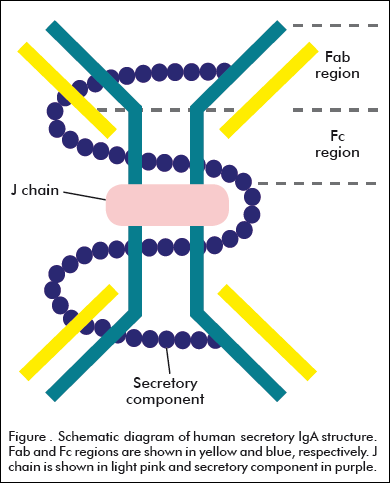
<body><![CDATA[<P   > </P >   <FONT size="+1">        <P   ><font size="3"><b><font face="Verdana, Arial, Helvetica, sans-serif">IgA STRUCTURE      </font></b></font></P >       <P   align="justify" ><font size="2" face="Verdana, Arial, Helvetica, sans-serif">IgA exists in three      monomeric variants (IgA1, IgA2m1 and IgA2m2), as dimeric form in serum (IgA1d)      and S-IgA in external secretions and bile [7]. The most significant difference      between the two isotypes of monomeric IgA lies in the presence of a region      with 13 additional aminoacid residues present in the IgA1 isotype, containing      carbohydrates attached to oxygen groups in this region [8]. The basic monomer      of IgA is arranged into two identical Fab regions which bind antigen, linked      through the hinge region to the Fc fragment. In dimeric IgA (dIgA), Fc regions      of two monomers are linked end to end through disulfide bridges to the J chain      [5] (<a href="#fig1">Figure</a>). The J chain itself is an extremely highly      conserved polypeptide believed to adopt either a single &beta;-barrel-like      domain [5] or a two-domain structure, forming covalent links to the tailpiece      through some Cys residues in dIgA [9]. </font></P >       <P   align="center" ><img src="/img/revistas/bta/v31n1/f0101114.gif" width="388" height="481"><a name="fig1"></a></P >   <FONT size="+1">        
<P   align="justify" ><font size="2" face="Verdana, Arial, Helvetica, sans-serif">The trans-epithelial      transport of IgA onto the mucosal surfaces modifies its structure. This transport      is mediated by the polymeric Ig receptor (pIgR), a receptor expressed basolaterally      on glandular and mucosal epithelial cells that binds to IgA [10]. On binding,      both receptor and ligand are internalized and transcytosed through a system      of vesicular compartments to the apical plasma membrane. At this point, the      extracellular portion of pIgR is proteolitically cleaved to form the secretory      component (SC), which is covalently bound to polymeric IgA (pIgA) forming      the S-IgA [11] (<a href="#fig1">Figure</a>). SC has an important role protecting      S-IgA of proteolitic cleavage. </font></P >       <P   align="justify" >&nbsp;</P >       <P   align="justify" > </P >       <P   ><font size="3"><b><font face="Verdana, Arial, Helvetica, sans-serif">IgA IMMUNOPHYSIOLOGY      </font></b></font></P >   <FONT size="+1">        <P   align="justify" ><font size="2" face="Verdana, Arial, Helvetica, sans-serif">In the context of      infection, S-IgA contributes to the protection of the mucosal-epithelium barrier      by two primary protective functions. The first one, known as immune exclusion,      is active in the epithelial stromal side where IgA can made complexes with      the antigens. These immunocomplexes can be taken up by phagocytic cells, absorbed      in the vascular system or transported through the epithelium into the lumen,      using the pathway mediated by pIgR [12]. Thus, the antigens that cross the      epithelial barrier can be clarified back into the lumen and transported forming      immunocomplexes with IgA. This feature of the IgA immune elimination allows      the maintenance of mucosal tissues free of immune antigen excess. The second      function is based on intracellular neutralization [13]. During pIgR mediated      transport, the pIgA can bind to <I>de novo</I> synthesized viral proteins      within epithelial cells, preventing virion assembly and neutralizing viral      replication [14]. Thus, it may interfere with the Ags ability (including viruses,      bacteria, bacterial toxins and enzymes) to adhere and penetrate the mucosa.      </font></P >   <FONT size="+1">        <P   align="justify" ><font size="2" face="Verdana, Arial, Helvetica, sans-serif">In its secretory      form, with the exception of vaginal fluids [15], IgA is the main immunoglobulin      found in mucous secretions, including tears, saliva, colostrum and secretions      from the genitourinary and gastrointestinal tracts, prostate and respiratory      epithelium, and it is also found in small amounts in blood [16]. Additionally,      S-IgA plays an important role in the oral homeostasis, by interacting with      different microorganisms that affect the oral cavity [17]. The most abundant      Ig in saliva, as in other human secretions, is dimeric S-lgA, produced by      plasma cells located in the salivary glands. The proportion of subclass of      IgA varies between the different mucosal sites. IgA1 represents 80-90 % of      the total IgA in nasal and male genital secretions in contrast with saliva      where it represents the 60 %. In colonic and female genital secretions, IgA2      is the most abundant subclass (60 %) [8]. S-IgA in the gut comes from two      sources. Approximately 75 % is produced by B2 lymphocytes in organized germinal      centers of mucosal lymphoid tissues such as Peyer&rsquo;s patches, by a T      lymphocyte-dependent mechanism [8]. The remaining 25 % of the S-IgA is produced      by B1 lymphocytes that develop in the peritoneal cavity and are distributed      diffusely in the intestinal lamina propria. This S-IgA may represent a primitive      T lymphocyte independent source of IgA recognizing commensal bacteria [8].      </font></P >       ]]></body>
<body><![CDATA[<P   align="justify" ><font size="2" face="Verdana, Arial, Helvetica, sans-serif">Additionally, IgA      is transported through the hepatobiliary pathway [7]. In certain animals (rats,      mice, rabbits), pIgA is efficiently cleared by the liver and transported into      bile by a receptor-mediated vesicular pathway across hepatocytes. In the rat      hepatocyte, SC is synthesized as a transmembrane glycoprotein and is expressed      preferentially on the sinusoidal plasma membrane. Circulating pIgA that binds      to SC is internalized into endocytic vesicles and transported across the hepatocyte      to the bile canalicular membrane, where pIgA is released into bile as a soluble      complex with a portion of the SC, the complex being S-IgA. In some other animals      (dog, guinea pig, and sheep) as well as humans, biliary epithelial cells,      not hepatocytes, express SC and perform the transcytosis and secretion of      pIgA into bile. The major biological functions ascribed to the secretion of      IgA into bile are enhancement of immunological defense of the biliary and      upper intestinal tracts and the clearance of harmful antigens from the circulation      as IgA-antigen complexes [7]. </font></P >       <P   align="justify" ><font size="2" face="Verdana, Arial, Helvetica, sans-serif">SC, as an integral      part of the IgA molecule, stabilizes its structure making it more resistant      to the action of proteases [18]. Similarly, SC glycosylated residues enhance      the anchoring of the mucosal S-IgA [19], which can potentiate the protective      ability of this immunoglobulin against several pathogens that invade mucosal      surfaces. </font></P >       <P   align="justify" >&nbsp;</P >       <P   > </P >   <FONT size="+1">        <P   ><b><font size="3" face="Verdana, Arial, Helvetica, sans-serif">EVIDENCES ON THE      ROLES OF IgA AGAINST INFECTIOUS DISEASES </font></b></P >       <P   ><font size="2" face="Verdana, Arial, Helvetica, sans-serif"><b>Animal studies      </b></font></P >   <FONT size="+1">        <P   align="justify" ><font size="2" face="Verdana, Arial, Helvetica, sans-serif">The protective effect      of IgA has been evaluated against infection with several microorganisms. For      example, Ruggeri <I>et al.</I> developed a library of IgA monoclonal antibodies      (mAbs) against different proteins of rhesus rotavirus [20]. As a result, they      identified an IgA monoclonal antibody (IgA VP8 mAb) which protected newborn      mice against diarrhea upon oral challenge with rotavirus, and neutralized      the virus <I>in vitro</I> in the apical side of the filter-grown Madin-Darby      canine kidney cells expressing the pIgR [20]. Nevertheless, other studies      in developing countries indicated that rotavirus specific serum IgA levels      are not an optimal correlate of protection following vaccination [21]. </font></P >       <P   align="justify" ><font size="2" face="Verdana, Arial, Helvetica, sans-serif">In another study,      using an <I>in vitro</I> model, the effect of antibodies in the bovine colostrums      (IgA and IgG1) was evaluated as pretreatment of necrotizing enterocolitis      (NEC), an important disease in infants with low birth weight [22]. These authors      reported that specific IgA and IgG1 antibodies against enterobacteria were      present in bovine colostrums and also observed a marked reduction in the adhesion      of different enterobacterial species to colon-derived HT-29 cells. More recently,      Boullier <I>et al.</I> demonstrated that anti-<I>Shigella</I> lipopolysaccharide      (LPS) S-IgA prevented <I>Shigella</I>-induced inflammation responsible for      the destruction of the intestinal barrier, mainly due to both immune exclusion      and neutralization of translocated bacteria [23]. </font></P >       <P   align="justify" ><font size="2" face="Verdana, Arial, Helvetica, sans-serif">Besides, Perryman      <I>et al.</I> studied the roles of IgA during the infection of the mucosal      pathogen <I>Cryptosporidium parvum</I> in mice [24]. They obtained dimeric      S-IgA mAbs from hybridomas against the P23 antigen of <I>C. parvum</I>, which      contains epitopes sensitive to neutralization, and evaluated its prophylactic      and therapeutic efficacy. The authors concluded that IgA mAbs directed against      the P23 antigen may be useful in passive immunization against infection by      <I>C. parvum</I> [25], because the number of intestinal parasites was reduced      when the mAbs were administered in a prophylactic scenario and the intestinal      infection was reduced with the therapeutic administration of such mAbs. </font></P >       <P   align="justify" ><font size="2" face="Verdana, Arial, Helvetica, sans-serif">Another group immunized      male Mongolian gerbils (an animal model for amebiasis) by intranasal route      with a vaccine based on Gal-lectin of the protozoan parasite <i>Entamoeba      histolytica</i> and CpG-motif-containing oligodeoxynucleotides (CpG-ODN) as      potent inducer of T helper type 1 immune responses [26]. Gal-lectin is a protein      involved in the virulence and adhesion of <i>E. histolytica</i> to cause enteric      amoebic colitis and abscesses of the liver in humans, and activates immune      system cells. Sera from animals vaccinated with this formulation had detectable      anti Gal-lectin IgG and IgA titers by immunoblotting, which were able to block      parasite adhesion to target cells in vitro [26].</font>     ]]></body>
<body><![CDATA[<br>   </P >       <P   align="justify" ><font size="2" face="Verdana, Arial, Helvetica, sans-serif">It has been also      reported protection against enterotoxigenic <I>Escherichia coli</I> in weaned      pigs fed with <I>Arabidopsis thaliana</I> seeds containing recombinant secretory      IgA devoided of ligth chains containing the variable region of a llama heavy      chain [27]. </font></P >       <P   align="justify" ><font size="2" face="Verdana, Arial, Helvetica, sans-serif">In another report,      human polymeric IgA obtained from plasma associated with recombinant and colostrum      derived SC, maintaining biochemical and functional characteristics, showing      inhibitory activity upon colonization cytotoxity to human cell lines [28].      </font></P >       <P   align="justify" ><font size="2" face="Verdana, Arial, Helvetica, sans-serif">The role of IgA in      protection against infection with human immunodeficiency virus (HIV) have      been evaluated with recombinant IgA containing the variable region of IgG1      b12, a potent broadly neutralizing anti-gp 120 antibody which have been shown      to protect macaques against vaginal simian/HIV challenge [28-31]. Using different      variants of recombinant IgA containing the b12 variable region, the protection      against HIV have been reported in cell lines, humanized mice and monkeys [29-32].      </font></P >       <P   align="justify" ><font size="2" face="Verdana, Arial, Helvetica, sans-serif">Several other studies      had focused in the evaluation of the role of IgA in the protection against      tuberculosis (TB). <I>Mycobacterium tuberculosis</I> (Mtb) infects by the      aerogenic route and specific S-IgA could have a prominent role in the protection      against the infection. Taking into consideration these antecedents the study      of the protective role of S-IgA in protection against TB has a paramount importance      by its potential application in the development of improved vaccines and new      immunotherapeutic tools. </font></P >       <P   align="justify" ><font size="2" face="Verdana, Arial, Helvetica, sans-serif">Currently, TB treatment      is far from ideal because it requires the combination of multiple drugs, which      needs to be administered by prolonged periods of time [33]. This means that      a high percentage of patients often abandon the treatment which contributes      to the appearance of multidrug-resistant strains. Vaccination with <i>Mycobacterium      bovis</i> BCG is currently the only alternative to prevent tuberculosis. Nevertheless,      this vaccine has the significant disadvantage that it only protects against      severe forms of the disease in childhood. It has been shown that in endemic      countries this vaccine does not protect against the adult pulmonary form,      which is the most common manifestation of disease and responsible for its      transmission [33].</font>    <br>   </P >       <P   align="justify" ><font size="2" face="Verdana, Arial, Helvetica, sans-serif">Among the first studies      in this line of research,<B> </B>a mouse monoclonal IgA against 16 kDa protein      of Mtb was evaluated <I>ex vivo</I> demonstrating its binding to the galectin-3/Mac-2      lectin from mouse macrophage cell lines [34]. Gal-3 is accumulating only in      those phagosomes that contained live Mtb, through the binding to phosphatidylinositol      mannosides (PIM) and appeared to influence the clearance of late infection      [34]. IgA antibodies recognizing mycobacterial surface components, as the      one used in this study, could thus give an additional targeting opportunity      to influence the course of the intracellular infection. Based on their preliminary      data showing IgA binding more prominently to intracellular rather than the      surface Gal-3 of the J774 macrophages, these authors suggested that it is      possible that IgA-coated particles may be endocytosed via some other IgA receptor      on the cell surface. Subsequently, once inside the cell, the IgA immune complexes      may be targeted for Gal-3 mediated sequestration to phagosomes. Williams <I>et      al.</I> reported that the same IgA mAb directed against the &alpha;-crystallin      protein of Mtb when administered intranasally is protective against early      TB infection in mice, by an isotype and epitope specific mechanism [35]. However,      this effect was not significant after 9 days post-infection. Based on this,      the same group further investigated the possibility of extending this protective      effect by inoculating IFN-&gamma; 3 days before and 2 and 7 days after infection      with Mtb by aerosol [36]. Indeed, this new treatment extended the passive      protection conferred by IgA, which was evidenced as reduced infection and      granulomatous lung infiltration by 4 weeks, compared to independent administration      of IgA or IFN-&gamma; [36]. </font></P >       <P   align="justify" ><font size="2" face="Verdana, Arial, Helvetica, sans-serif">Our group studied      the protective activity of two mAbs directed against Acr and PstS-1 proteins      of<I> </I>Mtb, TBA 61 and TBA84 respectively, using an intratracheal model      of pulmonary infection with Mtb H37Rv [37]. The study revealed a significant      reduction in bacterial load and morphometric and histopathological changes      in lungs of mice treated 21 days post-infection with TBA61, compared to those      receiving TBA84 and control groups. </font></P >       <P   align="justify" ><font size="2" face="Verdana, Arial, Helvetica, sans-serif">Balu <I>et al.</I>      evaluated the properties of a new monoclonal IgA1 clone constructed using      a single chain variable fragment (2E9IgA1), selected from an antibody phage      library [6]. The intranasal co-inoculation of 2E9IgA1 with recombinant murine      IFN-&gamma; significantly inhibited lung infection in transgenic mice for      human CD89 but not in the control group. This supported the assumption that      CD89 binding is required for passive protection conferred by IgA. Previously,      the same group had postulated that the IgA mAb administered by intranasal      route induces pro-inflammatory cell responses, which may have enhanced protection      by promoting apoptosis of macrophages infected with mycobacteria [38]. The      potential role of CD89 receptor in the protective mechanism mediated by IgA      is also supported by reports using therapeutic human monoclonal IgA antibodies      against tumor antigens in C89 transgenic mice [39]. In that study, IgA monoclonal      antibodies demonstrated a superior tumoricidal activity, compared to monoclonal      antibodies of the IgG isotype with the same combining site. </font></P >       ]]></body>
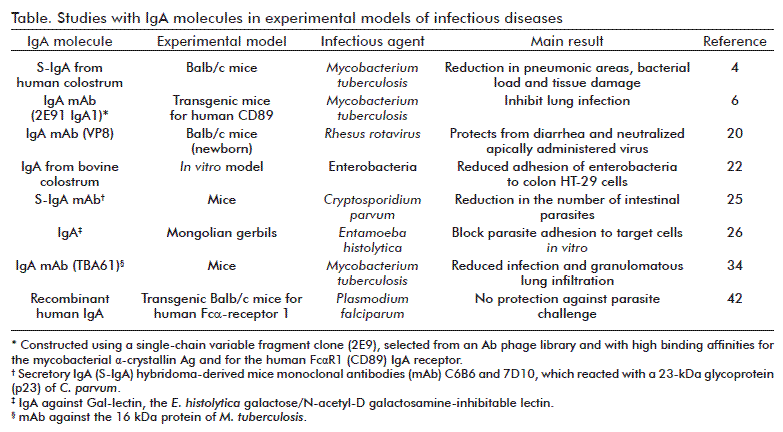
<body><![CDATA[<P   align="justify" ><font size="2" face="Verdana, Arial, Helvetica, sans-serif">Recently, we evaluated      the effect of S-IgA obtained from human colostrum, administered by intranasal      route to Balb/c mice, against infection with Mtb H37Rv, [4]. The results showed      a reduction in pneumonic areas in mice that received S-IgA before challenge      with mycobacteria. However, this protective effect was more evident when IgA      was administered together with the mycobacteria, after pre-incubation with      the microorganism, which was evidenced by a reduction in bacterial load and      tissue damage in lungs, as well as increased production of iNOS, compared      to the group receiving the IgA alone and with the control group [4]. These      results were the first evidence of prophylactic effect of S-IgA derived from      human colostrum against infection with Mtb. However, future research is required      to determine whether S-IgA from human colostrum also has therapeutic effect      related to infection with Mtb. </font></P >       <P   align="justify" ><font size="2" face="Verdana, Arial, Helvetica, sans-serif">The role of IgA was      also evaluated in the protection against intranasal infection with <I>M. bovis</I>      BCG, using IgA deficient and wild type non-targeted littermate mice [40].      The animals were immunized with the mycobacterium surface antigen PstS-1 formulated      with cholera toxin. The results demonstrated that IgA deficient mice were      more susceptible to BCG infection compared to wild type mice, revealed by      the higher bacterial load in lungs and broncho-alveolar lavage. Besides, IgA      deficient mice showed a reduction in the IFN-&gamma; and TNF-&alpha; level      in lungs after the analysis of the cytokine response. </font></P >       <P   align="justify" ><font size="2" face="Verdana, Arial, Helvetica, sans-serif">The results obtained      related with the protective effect against mycobacteria in mice of murine      and human S-IgA suggest that clinical applications of specific S-IgA in the      control of human tuberculosis could be feasible. One possibility is to use      S-IgA for infection prophylaxis on high risk groups, such as HIV infected      individuals at risk of Mtb infection. Another important application could      be as a therapeutic element combined with the conventional therapy, to shorten      the treatment period, possibly decreasing the dose of the drugs and the related      treatment side effects, thus favoring the compliance and lowering the risk      of generation of drug resistant strains. The uses of S-IgA as adjunt in the      treatment of Multidrug Resistant (MDR) strains as well as in the treatment      of latent tuberculosis are exciting possibilities that deserves further insight.      Based on the results of protection with S-IgA in mice, our group is currently      exploring the possibility to develop experimental vaccine candidates able      to elicit potent IgA responses to Mtb epitopes and antigens in the respiratory      tract. </font></P >       <P   align="justify" ><font size="2" face="Verdana, Arial, Helvetica, sans-serif">There are also studies      evaluating IgA production and its role in protection in transgenic animals.      Transgenic mice lines (BCBA, C57BL/6 CBA/J) were generated containing the      complete murine pIgR gene under lactogenic control of a milk gene promoter,      rather than under immunological control [41]. Mice over-expressing the pIgR      protein in mammary gland epithelial cells, 60- and 270-fold above normal pIgR      protein levels, showed 1.5- and 2-fold higher total IgA levels in milk, respectively,      compared to the IgA levels in the milk of non-transgenic mice. The authors      referred that this result indicates that the amount of pIgR produced was indeed      a limiting factor in the transport of dIgA into the milk under normal non-inflammatory      circumstances. Later, they explored the mechanism by which IgA can mediate      a protective effect against malaria, using recombinant human IgA specific      for the C-terminal 19 kDa region of <I>Plasmodium falciparum </I>merozoite      surface protein 1 and transgenic Balb/c mice for the human Fc&alpha; receptor      (Fc&alpha;R1/CD89) [42]. In this study, the human IgA failed to protect against      parasite challenge <I>in vivo</I> in transgenic mice, suggesting that this      antibody class does not play a major role in control of infection. However,      these authors did not exclude the possibility that protective capacity is      compromised in this model due to a rapid clearance and inappropriate bio-distribution      of IgA and differences in Fc&alpha;R1 expression profile, between humans and      transgenic mice [42]. Some of the results discussed in this section are summarized      in the <a href="/img/revistas/bta/v31n1/t0101114.gif">table</a>. </font></P >       
<P   align="justify" ><font size="2" face="Verdana, Arial, Helvetica, sans-serif"><B>Observations in      humans </b></font></P >   <FONT size="+1">        <P   align="justify" ><font size="2" face="Verdana, Arial, Helvetica, sans-serif">Some individuals      with specific IgA deficiency show susceptibility to different infections.      The most common are gastrointestinal infections such as <I>Giardia lamblia</I>,      <I>Campylobacter</I>, <I>Clostridium</I>, <I>Salmonella</I> and rotavirus      [8]. Commonly IgA deficiency is associated with an increased incidence of      autoimmune diseases, in general related to gastrointestinal tract, as in the      case of celiac disease [43]. Furthermore, healthy contacts of leprosy patients      having high levels of S-IgA in saliva develop clinical symptoms of the disease      at a low frequency and a high percentage of them develop protective immunity      [44]. </font></P >   <FONT size="+1">        <P   align="justify" ><font size="2" face="Verdana, Arial, Helvetica, sans-serif">Taking into account      these elements, and the accumulated experimental evidence, the protective      and therapeutic potential of IgA have been evaluated in humans. One example      of the clinical evaluation of formulations based on IgA against infections      that affect humans is the case of S-IgA obtained from plants. Production of      antibodies in plants through genetic engineering has as main advantages the      low cost of production and the absence of pathogenic viruses or bacteria to      humans, causing unneeded pathogen removal steps during purification [45].      The development of S-IgA Guy&rsquo;s 13 plantibody technology began with the      study of Ma <I>et al.</I> [46]. These authors sexually crossed four transgenic      tobacco plants, expressing heavy and light chains of IgA, the J chain and      SC respectively. The product CaroRx, an IgA/G chimeric secretory antibody      produced in plants already completed its phase II clinical trial. Preliminary      clinical studies with this antibody indicate that plant-derived IgA prevents      oral colonization by <I>Streptococcus mutans</I> through passive immunization      of mucosal surfaces by topical application, specifically by binding to the      major adhesin SA I/II of the bacteria. They reported that by this mechanism,      the antibody leads to replacement of this pathogen by endogenous harmless      flora. </font></P >       <P   align="justify" ><font size="2" face="Verdana, Arial, Helvetica, sans-serif">Additionally, there      are evidences that specific S-IgA contribute to the efficacy of a live attenuated      influenza vaccine, as concluded from randomized, placebo-controlled clinical      trials in young children [47]. </font></P >       <P   align="justify" ><font size="2" face="Verdana, Arial, Helvetica, sans-serif">Several studies support      the use of antibodies from colostrums for the treatment of some infections.      That is the case of effective treatment of rotavirus-induced diarrhea in children      using antibodies derived from colostrums of immunized cows [48]. However,      this treatment only based on colostrums is not practical because the source      is limited and for this reason some years ago was assessed another alternative      to address the antibody-based therapy. This new method uses probiotic bacteria      taking advantage of its ability to survive into the intestinal tract, its      production of antimicrobial compounds and stimulation of the mucosal immune      response leading to increased levels of S-IgA [49]. </font></P >       <P   align="justify" ><font size="2" face="Verdana, Arial, Helvetica, sans-serif">Other applications      of bovine colostrum antibodies in different infections were comprehensively      reviewed by Weiner <I>et al.</I> [50]. Moreover, a study conducted in healthy      volunteers showed that the use of a mouthwash containing milk-derived antibodies      against <I>S. mutans</I> reduced the amount of bacteria, which form small      colonies [51]. </font></P >       ]]></body>
<body><![CDATA[<P   align="justify" ><font size="2" face="Verdana, Arial, Helvetica, sans-serif">Interestingly, studies      designed to assess the role of IgA in protection against <I>Helicobacter pylori</I>      infection have shown conflicting results. Some studies evidence the influence      of IgA limiting <I>H. pylori</I> colonization in children, showing protection      against this microorganism in infants consuming breast milk [52]. Otherwise,      another group provided contradictory results of protection against that pathogen      in mice deficient of mature B cells [46]. In this case, therapeutic immunization      stimulates an immune response, which reduces <I>H. pylori</I> by an antibody      independent mechanism [53]. </font></P >       <P   align="justify" ><font size="2" face="Verdana, Arial, Helvetica, sans-serif">The influence of      IgA on protection against <I>Vibrio cholerae</I> infection has also been evaluated      in several studies. One of the most recent demonstrated that levels of serum      IgA specific to three <I>V. cholerae</I> antigens &#150;the B subunit of cholera      toxin, LPS, and TcpA, the major component of the toxin co-regulated pilus&#150;      predicted protection in household contacts of patients infected with <I>V.      cholerae</I> O1. Circulating IgA antibodies to TcpA were also associated with      protection from <I>V. cholerae</I> O139 infection [54]. </font></P >       <P   align="justify" ><font size="2" face="Verdana, Arial, Helvetica, sans-serif">On the other hand,      Crooks <I>et al.</I> evaluated the effect of bovine colostrum supplementation      on salivary IgA in distance runners [55], tacking as hypothesis that nutritional      supplements may improve mucosal immunity and could be beneficial to athletes      who are at increased risk of upper respiratory tract infection. They consumed      a supplement of either bovine colostrum or placebo as negative control for      12 weeks. The results demonstrated increased IgA levels in saliva among a      cohort of athletes following colostrum supplementation. Also in 2006, the      efficacy and tolerability of colostrums in preventing recurrent episodes of      infections of the upper respiratory tract and diarrhea in children was assessed      [56]. As result, bovine colostrums were highly effective, not only in the      prophylactic treatment of recurrent upper respiratory tract infections and      diarrhea, but also to reduce hospitalization episodes caused by these conditions.      It was previously reported that IgA is the major mediator of resistance against      viral infections of the respiratory mucosa [57] and the concentration of IgA      in saliva is increased after 2 weeks of consumption of bovine colostrum [58].      </font></P >       <P   align="justify" ><font size="2" face="Verdana, Arial, Helvetica, sans-serif">Human IgA has been      also used to develop a product, IgAbulin, which was evaluated in previous      studies as nasal treatment, with the aim of preventing infection of the upper      respiratory tract in athletes. In one study, athletes did not develop apparent      infection after 17 days of treatment twice daily with IgAbulin [59]. Instead,      other results showed no significant reduction in respiratory tract infection      after treatment with nose drops of the product [60]. Besides, two studies      evaluating the effect of this product as intranasal passive immunization in      children against respiratory tract infections [61, 62] showed that the prophylactic      nasal effect with antibody is practical and effective. </font></P >       <P   align="justify" ><font size="2" face="Verdana, Arial, Helvetica, sans-serif">In another development,      there was obtained a murine monoclonal IgA (HNK20) against the F glycoprotein      of the respiratory syncytial virus (RSV), specifically developed for passive      intranasal immunization [63]. When administered intranasally and daily to      healthy adults and children, and to children at high risk of infection, there      were no reports of adverse effects on small-scale treatments [63]. The prophylactic      effect was evaluated in adult volunteers challenged intranasally with the      wild strain of RSV subgroup A, 1 hour after receiving the first dose of mAb.      During the acute phase of infection (5-8 days after challenge), mean daily      virus shedding was lower in subjects treated with HNK20 than those receiving      placebo. </font></P >       <P   align="justify" ><font size="2" face="Verdana, Arial, Helvetica, sans-serif">According to its      physiological role, the more obvious potential use of IgA is at mucosal level      as a prophylactic and potentially therapeutic tool against infectious agents      that penetrates or establishes infections in mucosal tissues. It remains to      be demonstrated in future studies the superiority of IgA administration over      the use of IgG by mucosal route. In our experience, similar results have been      obtained with the use of human IgG and IgA formulations in models of mycobacterial      infection, particularly in the prophylaxis of progressive tuberculosis in      mice [64, 65, 4]. </font></P >       <P   align="justify" ><font size="2" face="Verdana, Arial, Helvetica, sans-serif">Up to now, the main      limitation for the generalized evaluation and use of IgA is the lack of adequate      natural sources for large scale production. This is being solved with the      use of new production methods for recombinant and plasma derived IgA of intact      functional capacity, which offers a promisory outlook of future clinical application      [27-32, 39]. Another aspect to be taken into account is the possibility of      adverse reactions to the administration of IgA in individuals with congenital      deficits of this immunoglobulin Another aspect to be taken into account is      the possibility of adverse reactions to the administration of IgA in individuals      with congenital deficits of this immunoglobulin </font></P >       <P   align="justify" ><font size="2" face="Verdana, Arial, Helvetica, sans-serif">Despite the epidemiological      and experimental evidences of the role of IgA in protection against infections      and the successful attempts to use it in the prophylaxis and treatment of      infectious diseases, its potential as treatment against the wide range of      mucosal infections should be further assessed. </font></P >       <P   align="justify" >&nbsp;</P >       <P   align="justify" > </P >       ]]></body>
<body><![CDATA[<P   ><b><font size="3" face="Verdana, Arial, Helvetica, sans-serif">CONCLUSIONS </font></b></P >   <FONT size="+1">        <P   align="justify" ><font size="2" face="Verdana, Arial, Helvetica, sans-serif">To date, several      groups have demonstrated the involvement of IgA in the prophylaxis and treatment      of various infectious diseases in animals and humans. Hence, there is an increasing      interest to unravel the function of this immunoglobulin for the control of      a wide number of disorders, some of them neglected, and also in autoimmune      diseases. In this sense, the potential of IgA should be explored in the future,      particularly in poor infection control scenarios. The availability of methods      for production of humanized therapeutic antibodies which are available in      the field of cancer makes us envisage the future use of S-IgA, as a real alternative      for the treatment and prevention of infectious diseases. </font></P >       <P   align="justify" >&nbsp;</P >   <FONT size="+1">        <P   align="justify" > </P >       <P   ><font size="3" face="Verdana, Arial, Helvetica, sans-serif"><B>ACKNOWLEDGEMENTS      </b></font></P >   <FONT size="+1">        <P   align="justify" ><font size="2" face="Verdana, Arial, Helvetica, sans-serif">This work was jointly      supported by the Ministry of Higher Education, Malaysia LRGS Grant (203.PSK.6722001).      </font></P >       <P   align="justify" >&nbsp;</P >   <FONT size="+1">        <P   align="justify" > </P >       <P   ><font size="3" face="Verdana, Arial, Helvetica, sans-serif"><B>REFERENCES</b></font><font size="2" face="Verdana, Arial, Helvetica, sans-serif"><B>      </b></font></P >   <FONT size="+1">        <!-- ref --><P   ><font size="2" face="Verdana, Arial, Helvetica, sans-serif">1. Pamer EG. Immune      responses to commensal and environmental microbes. Nat Immunol. 2007;8(11):1173-8.          </font></P >   <FONT size="+1">        <P   ><font size="2" face="Verdana, Arial, Helvetica, sans-serif">2. Corthesy B. Multi-faceted      functions of secretory IgA at mucosal surfaces. Front Immunol. 2013;4:18.      </font></P >       <!-- ref --><P   ><font size="2" face="Verdana, Arial, Helvetica, sans-serif">3. Kawamura S, Saitou      N, Ueda S. Concerted evolution of the primate immunoglobulin alpha-gene through      gene conversion. J Biol Chem. 1992;267(11):7359-67.     </font></P >       <P   ><font size="2" face="Verdana, Arial, Helvetica, sans-serif">4. Alvarez N, Otero      O, Camacho F, Borrero R, Tirado Y, Puig A, <I>et al.</I> Passive administration      of purified secretory IgA from human colostrum induces protection against      <i>Mycobacterium tuberculosis</i> in a murine model of progressive pulmonary      infection. BMC Immunol. 2013;14 Suppl 1:S3. </font></P >       <!-- ref --><P   ><font size="2" face="Verdana, Arial, Helvetica, sans-serif">5. Woof JM, Russell      MW. Structure and function relationships in IgA. Mucosal Immunol. 2011;4(6):590-7.          </font></P >       <!-- ref --><P   ><font size="2" face="Verdana, Arial, Helvetica, sans-serif">6. Balu S, Reljic      R, Lewis MJ, Pleass RJ, McIntosh R, van Kooten C, <I>et al.</I> A novel human      IgA monoclonal antibody protects against tuberculosis. J Immunol. 2011;186(5):3113-9.          </font></P >       <!-- ref --><P   ><font size="2" face="Verdana, Arial, Helvetica, sans-serif">7. Brown WR, Kloppel      TM. The liver and IgA: immunological, cell biological and clinical implications.      Hepatology. 1989;9(5):763-84.     </font></P >       <!-- ref --><P   ><font size="2" face="Verdana, Arial, Helvetica, sans-serif">8. Macpherson AJ,      Gatto D, Sainsbury E, Harriman GR, Hengartner H, Zinkernagel RM. A primitive      T cell-independent mechanism of intestinal mucosal IgA responses to commensal      bacteria. Science. 2000;288(5474):2222-6.     </font></P >       <!-- ref --><P   ><font size="2" face="Verdana, Arial, Helvetica, sans-serif">9. Johansen FE, Braathen      R, Brandtzaeg P. The J chain is essential for polymeric Ig receptor-mediated      epithelial transport of IgA. J Immunol. 2001;167(9):5185-92.     </font></P >       <P   ><font size="2" face="Verdana, Arial, Helvetica, sans-serif">10. Wieland WH, Orzaez      D, Lammers A, Parmentier HK, Verstegen MW, Schots A. A functional polymeric      immunoglobulin receptor in chicken (<i>Gallus gallus</i>) indicates ancient      role of secretory IgA in mucosal immunity. Biochem J. 2004;380(Pt 3):669-76.      </font></P >       <P   ><font size="2" face="Verdana, Arial, Helvetica, sans-serif">11. Kaetzel CS, Mostov      K. Immunoglobulin transport and the polymeric immunoglobulin receptor. In:      Mestecky J, Lamm ME, Strober W, Bienenstock J, McGhee JR, Mayer L, editors.      Mucosal Immunology. 3rd ed. Amsterdam: Elsevier/Academic Press; 2005. p. 211-50.      </font></P >       <!-- ref --><P   ><font size="2" face="Verdana, Arial, Helvetica, sans-serif">12. Robinson JK,      Blanchard TG, Levine AD, Emancipator SN, Lamm ME. A mucosal IgA-mediated excretory      immune system in vivo. J Immunol. 2001;166(6):3688-92.     </font></P >       <!-- ref --><P   ><font size="2" face="Verdana, Arial, Helvetica, sans-serif">13. Strugnell RA,      Wijburg OL. The role of secretory antibodies in infection immunity. Nat Rev      Microbiol. 2010;8(9):656-67.     </font></P >       <!-- ref --><P   ><font size="2" face="Verdana, Arial, Helvetica, sans-serif">14. Yan H, Lamm ME,      Bjorling E, Huang YT. Multiple functions of immunoglobulin A in mucosal defense      against viruses: an in vitro measles virus model. J Virol. 2002;76(21):10972-9.          </font></P >       <!-- ref --><P   ><font size="2" face="Verdana, Arial, Helvetica, sans-serif">15. Wright PF. Inductive/effector      mechanisms for humoral immunity at mucosal sites. Am J Reprod Immunol. 2011;65(3):248-52.          </font></P >       <!-- ref --><P   ><font size="2" face="Verdana, Arial, Helvetica, sans-serif">16. Junqueira LC,      Carneiro J. Basic Histology. 10th ed. New York: McGraw-Hill; 2003.     </font></P >       <!-- ref --><P   ><font size="2" face="Verdana, Arial, Helvetica, sans-serif">17. Rashkova M, Baleva      M, Toneva N, Jegova G. Secretory immunoglobulin A (S-IgA) and periodontal      status in children with diseases and conditions influencing the oral environment.      J IMAB Annu Proc. 2009:36-40.     </font></P >       <P   ><font size="2" face="Verdana, Arial, Helvetica, sans-serif">18. Crottet P, Corthesy      B. Secretory component delays the conversion of secretory IgA into antigen-binding      competent F(ab&rsquo;)2: a possible implication for mucosal defense. J Immunol.      1998;161(10):5445-53. </font></P >       ]]></body>
<body><![CDATA[<!-- ref --><P   ><font size="2" face="Verdana, Arial, Helvetica, sans-serif">19. Phalipon A, Cardona      A, Kraehenbuhl JP, Edelman L, Sansonetti PJ, Corthesy B. Secretory component:      a new role in secretory IgA-mediated immune exclusion in vivo. Immunity. 2002;17(1):107-15.          </font></P >       <!-- ref --><P   ><font size="2" face="Verdana, Arial, Helvetica, sans-serif">20. Ruggeri FM, Johansen      K, Basile G, Kraehenbuhl JP, Svensson L. Antirotavirus immunoglobulin A neutralizes      virus in vitro after transcytosis through epithelial cells and protects infant      mice from diarrhea. J Virol. 1998;72(4):2708-14.     </font></P >       <!-- ref --><P   ><font size="2" face="Verdana, Arial, Helvetica, sans-serif">21. Angel J, Franco      MA, Greenberg HB. Rotavirus immune responses and correlates of protection.      Curr Opin Virol. 2012;2(4):419-25.     </font></P >       <!-- ref --><P   ><font size="2" face="Verdana, Arial, Helvetica, sans-serif">22. Brooks HJ, McConnell      MA, Corbett J, Buchan GS, Fitzpatrick CE, Broadbent RS. Potential prophylactic      value of bovine colostrum in necrotizing enterocolitis in neonates: an in      vitro study on bacterial attachment, antibody levels and cytokine production.      FEMS Immunol Med Microbiol. 2006;48(3):347-54.     </font></P >       <!-- ref --><P   ><font size="2" face="Verdana, Arial, Helvetica, sans-serif">23. Boullier S, Tanguy      M, Kadaoui KA, Caubet C, Sansonetti P, Corthesy B, <I>et al.</I> Secretory      IgA-mediated neutralization of <i>Shigella flexneri</i> prevents intestinal      tissue destruction by down-regulating inflammatory circuits. J Immunol. 2009;183(9):5879-85.          </font></P >       ]]></body>
<body><![CDATA[<!-- ref --><P   ><font size="2" face="Verdana, Arial, Helvetica, sans-serif">24. Perryman LE,      Jasmer DP, Riggs MW, Bohnet SG, McGuire TC, Arrowood MJ. A cloned gene of      <i>Cryptosporidium parvum</i> encodes neutralization-sensitive epitopes. Mol      Biochem Parasitol. 1996;80(2):137-47.     </font></P >       <!-- ref --><P   ><font size="2" face="Verdana, Arial, Helvetica, sans-serif">25. Enriquez FJ,      Riggs MW. Role of immunoglobulin A monoclonal antibodies against P23 in controlling      murine <i>Cryptosporidium parvum</i> infection. Infect Immun. 1998;66(9):4469-73.          </font></P >       <!-- ref --><P   ><font size="2" face="Verdana, Arial, Helvetica, sans-serif">26. Ivory CP, Chadee      K. Intranasal immunization with Gal-inhibitable lectin plus an adjuvant of      CpG oligodeoxynucleotides protects against <i>Entamoeba histolytica</i> challenge.      Infect Immun. 2007;75(10):4917-22.     </font></P >       <!-- ref --><P   ><font size="2" face="Verdana, Arial, Helvetica, sans-serif">27. Virdi V, Coddens      A, De Buck S, Millet S, Goddeeris BM, Cox E, <I>et al.</I> Orally fed seeds      producing designer IgAs protect weaned piglets against enterotoxigenic <i>Escherichia      coli</i> infection. Proc Natl Acad Sci USA. 2013;110(29):11809-14.     </font></P >       <!-- ref --><P   ><font size="2" face="Verdana, Arial, Helvetica, sans-serif">28. Longet S, Miled      S, Lotscher M, Miescher SM, Zuercher AW, Corthesy B. Human plasma-derived      polymeric IgA and IgM antibodies associate with secretory component to yield      biologically active secretory-like antibodies. J Biol Chem. 2013;288(6):4085-94.          </font></P >       ]]></body>
<body><![CDATA[<!-- ref --><P   ><font size="2" face="Verdana, Arial, Helvetica, sans-serif">29. Mantis NJ, Palaia      J, Hessell AJ, Mehta S, Zhu Z, Corthesy B, <I>et al.</I> Inhibition of HIV-1      infectivity and epithelial cell transfer by human monoclonal IgG and IgA antibodies      carrying the b12 V region. J Immunol. 2007;179(5):3144-52.     </font></P >       <!-- ref --><P   ><font size="2" face="Verdana, Arial, Helvetica, sans-serif">30. Moldt B, Saye-Francisco      K, Schultz N, Burton DR, Hessell AJ. Simplifying the synthesis of SIgA: Combination      of dIgA and rhSC using affinity chromatography. Methods. 2014;65(1):127-32.          </font></P >       <P   ><font size="2" face="Verdana, Arial, Helvetica, sans-serif">31. Watkins JD, Sholukh      AM, Mukhtar MM, Siddappa NB, Lakhashe SK, Kim M, <I>et al.</I> Anti-HIV IgA      isotypes: differential virion capture and inhibition of transcytosis are linked      to prevention of mucosal R5 SHIV transmission. AIDS. 2013;27(9):F13-20. </font></P >       <!-- ref --><P   ><font size="2" face="Verdana, Arial, Helvetica, sans-serif">32. Hur EM, Patel      SN, Shimizu S, Rao DS, Gnanapragasam PN, An DS, <I>et al.</I> Inhibitory effect      of HIV-specific neutralizing IgA on mucosal transmission of HIV in humanized      mice. Blood. 2012;120(23):4571-82.     </font></P >       <P   ><font size="2" face="Verdana, Arial, Helvetica, sans-serif">33. World Health      Organization. Global Tuberculosis Report 2012. 2012 [cited 2013 Aug 18]. Available      from: <a href="http://apps.who.int/iris/bitstream/10665/75938/1/9789241564502_eng.pdf" target="_blank">http://apps.who.int/iris/bitstream/10665/75938/1/9789241564502_eng.pdf</a>      </font></P >       <!-- ref --><P   ><font size="2" face="Verdana, Arial, Helvetica, sans-serif">34. Reljic R, Crawford      C, Challacombe S, Ivanyi J. Mouse monoclonal IgA binds to the galectin-3/Mac-2      lectin from mouse macrophage cell lines. Immunol Lett. 2004;93(1):51-6.     </font></P >       ]]></body>
<body><![CDATA[<!-- ref --><P   ><font size="2" face="Verdana, Arial, Helvetica, sans-serif">35. Williams A, Reljic      R, Naylor I, Clark SO, Falero-Diaz G, Singh M, <I>et al.</I> Passive protection      with immunoglobulin A antibodies against tuberculous early infection of the      lungs. Immunology. 2004;111(3):328-33.     </font></P >       <!-- ref --><P   ><font size="2" face="Verdana, Arial, Helvetica, sans-serif">36. Reljic R, Clark      SO, Williams A, Falero-Diaz G, Singh M, Challacombe S, <I>et al.</I> Intranasal      IFNgamma extends passive IgA antibody protection of mice against Mycobacterium      tuberculosis lung infection. Clin Exp Immunol. 2006;143(3):467-73.     </font></P >       <!-- ref --><P   ><font size="2" face="Verdana, Arial, Helvetica, sans-serif">37. Lopez Y, Yero      D, Falero-Diaz G, Olivares N, Sarmiento ME, Sifontes S, <I>et al.</I> Induction      of a protective response with an IgA monoclonal antibody against Mycobacterium      tuberculosis 16kDa protein in a model of progressive pulmonary infection.      Int J Med Microbiol. 2009;299(6):447-52.     </font></P >       <!-- ref --><P   ><font size="2" face="Verdana, Arial, Helvetica, sans-serif">38. Reljic R, Williams      A, Ivanyi J. Mucosal immunotherapy of tuberculosis: is there a value in passive      IgA? Tuberculosis (Edinb). 2006;86(3-4):179-90.     </font></P >       <!-- ref --><P   ><font size="2" face="Verdana, Arial, Helvetica, sans-serif">39. Boross P, Lohse      S, Nederend M, Jansen JH, van Tetering G, Dechant M, <I>et al.</I> IgA EGFR      antibodies mediate tumour killing in vivo. EMBO Mol Med. 2013;5(8):1213-26.          </font></P >       ]]></body>
<body><![CDATA[<!-- ref --><P   ><font size="2" face="Verdana, Arial, Helvetica, sans-serif">40. Rodriguez A,      Tjarnlund A, Ivanji J, Singh M, Garcia I, Williams A, <I>et al.</I> Role of      IgA in the defense against respiratory infections IgA deficient mice exhibited      increased susceptibility to intranasal infection with <i>Mycobacterium bovis</i>      BCG. Vaccine. 2005;23(20):2565-72.     </font></P >       <!-- ref --><P   ><font size="2" face="Verdana, Arial, Helvetica, sans-serif">41. De Groot N, Van      Kuik-Romeijn P, Lee SH, De Boer HA. Increased immunoglobulin A levels in milk      by over-expressing the murine polymeric immunoglobulin receptor gene in the      mammary gland epithelial cells of transgenic mice. Immunology. 2000;101(2):218-24.          </font></P >       <!-- ref --><P   ><font size="2" face="Verdana, Arial, Helvetica, sans-serif">42. Shi J, McIntosh      RS, Adame-Gallegos J, Dehal PK, van Egmond M, van de Winkel J, <I>et al.</I>      The generation and evaluation of recombinant human IgA specific for Plasmodium      falciparum merozoite surface protein 1-19 (PfMSP1 19). BMC Biotechnol. 2011;11:77.          </font></P >       <!-- ref --><P   ><font size="2" face="Verdana, Arial, Helvetica, sans-serif">43. Robins G, Howdle      PD. Advances in celiac disease. Curr Opin Gastroenterol. 2005;21(2):152-61.          </font></P >       <P   ><font size="2" face="Verdana, Arial, Helvetica, sans-serif">44. Ramaprasad P,      Fernando A, Madhale S, Rao JR, Edward VK, Samson PD, <I>et al.</I> Transmission      and protection in leprosy: indications of the role of mucosal immunity. Leprosy      Rev. 1997;68(4):301-15. </font></P >       <P   ><font size="2" face="Verdana, Arial, Helvetica, sans-serif">45. Wycoff KL. Secretory      IgA antibodies from plants. Curr Pharm Des. 2005;11(19):2429-37. </font></P >       ]]></body>
<body><![CDATA[<!-- ref --><P   ><font size="2" face="Verdana, Arial, Helvetica, sans-serif">46. Ma JK, Hikmat      BY, Wycoff K, Vine ND, Chargelegue D, Yu L, <I>et al.</I> Characterization      of a recombinant plant monoclonal secretory antibody and preventive immunotherapy      in humans. Nat Med. 1998;4(5):601-6.     </font></P >       <!-- ref --><P   ><font size="2" face="Verdana, Arial, Helvetica, sans-serif">47. Ambrose CS, Wu      X, Jones T, Mallory RM. The role of nasal IgA in children vaccinated with      live attenuated influenza vaccine. Vaccine. 2012;30(48):6794-801.     </font></P >       <!-- ref --><P   ><font size="2" face="Verdana, Arial, Helvetica, sans-serif">48. Harris JB, LaRocque      RC, Chowdhury F, Khan AI, Logvinenko T, Faruque AS, <I>et al.</I> Susceptibility      to Vibrio cholerae infection in a cohort of household contacts of patients      with cholera in Bangladesh. PLoS Negl Trop Dis. 2008;2(4):e221 </font></P >       <!-- ref --><P   ><font size="2" face="Verdana, Arial, Helvetica, sans-serif">49. Sarker SA, Casswall      TH, Mahalanabis D, Alam NH, Albert MJ, Brussow H, <I>et al.</I> Successful      treatment of rotavirus diarrhea in children with immunoglobulin from immunized      bovine colostrum. Pediatr Infect Dis J. 1998;17(12):1149-54.     </font></P >       <!-- ref --><P   ><font size="2" face="Verdana, Arial, Helvetica, sans-serif">50. Weiner C, Pan      Q, Hurtig M, Boren T, Bostwick E, Hammarstrom L. Passive immunity against      human pathogens using bovine antibodies. Clin Exp Immunol. 1999;116(2):193-205.          </font></P >       <!-- ref --><P   ><font size="2" face="Verdana, Arial, Helvetica, sans-serif">51. Zhang Z, Xiang      Y, Li N, Wang B, Ai H, Wang X, <I>et al.</I> Protective effects of Lactobacillus      rhamnosus GG against human rotavirus-induced diarrhoea in a neonatal mouse      model. Pathog Dis. 2013;67(3):184-91.     </font></P >       <!-- ref --><P   ><font size="2" face="Verdana, Arial, Helvetica, sans-serif">52. Filler SJ, Gregory      RL, Michalek SM, Katz J, McGhee JR. Effect of immune bovine milk on Streptococcus      mutans in human dental plaque. Arch Oral Biol. 1991;36(1):41-7.     </font></P >       <!-- ref --><P   ><font size="2" face="Verdana, Arial, Helvetica, sans-serif">53. Thomas JE, Austin      S, Dale A, McClean P, Harding M, Coward WA, <I>et al.</I> Protection by human      milk IgA against <i>Helicobacter pylori</i> infection in infancy. Lancet.      1993;342(8863):121.     </font></P >       <!-- ref --><P   ><font size="2" face="Verdana, Arial, Helvetica, sans-serif">54. Ermak TH, Giannasca      PJ, Nichols R, Myers GA, Nedrud J, Weltzin R, <I>et al.</I> Immunization of      mice with urease vaccine affords protection against <i>Helicobacter pylori</i>      infection in the absence of antibodies and is mediated by MHC class II-restricted      responses. J Exp Med. 1998;188(12):2277-88.     </font></P >       <!-- ref --><P   ><font size="2" face="Verdana, Arial, Helvetica, sans-serif">55. Crooks CV, Wall      CR, Cross ML, Rutherfurd-Markwick KJ. The effect of bovine colostrum supplementation      on salivary IgA in distance runners. Int J Sport Nutr Exerc Metab. 2006;16(1):47-64.          </font></P >       <!-- ref --><P   ><font size="2" face="Verdana, Arial, Helvetica, sans-serif">56. Patel K, Rana      R. Pedimune in recurrent respiratory infection and diarrhoea -the Indian experience-      the pride study. Indian J Pediatr. 2006;73(7):585-91.     </font></P >       <P   ><font size="2" face="Verdana, Arial, Helvetica, sans-serif">57. Murphy BR. Mucosal      immunity to viruses. In: Ogra PL, Mestecky J, Lamm ME, Strober W, McGhee JR,      Bienenstock J, editors. Handbook of Mucosal Immunology. New York: Academic      Press. 1994; p. 333-43. </font></P >       <!-- ref --><P   ><font size="2" face="Verdana, Arial, Helvetica, sans-serif">58. Mero A, Kahkonen      J, Nykanen T, Parviainen T, Jokinen I, Takala T, <I>et al.</I> IGF-I, IgA,      and IgG responses to bovine colostrum supplementation during training. J Appl      Physiol (1985). 2002;93(2):732-9.     </font></P >       <!-- ref --><P   ><font size="2" face="Verdana, Arial, Helvetica, sans-serif">59. Hemmingsson P,      Hammarstrom L. Nasal administration of immunoglobulin as effective prophylaxis      against infections in elite cross-country skiers. Scand J Infect Dis. 1993;25(6):783-5.          </font></P >       <!-- ref --><P   ><font size="2" face="Verdana, Arial, Helvetica, sans-serif">60. Lindberg K, Berglund      B. Effect of treatment with nasal IgA on the incidence of infectious disease      in world-class canoeists. Int J Sports Med. 1996;17(3):235-8.     </font></P >       <!-- ref --><P   ><font size="2" face="Verdana, Arial, Helvetica, sans-serif">61. Giraudi V, Riganti      C, Torales MR, Sedola H, Gaddi E. Upper respiratory infections in children:      response to endorsal administration of IgA. Int J Pediatr Otorhinolaryngol.      1997;39:103-10.     </font></P >       ]]></body>
<body><![CDATA[<!-- ref --><P   ><font size="2" face="Verdana, Arial, Helvetica, sans-serif">62. Heikkinen T,      Ruohola A, Ruuskanen O, Waris M, Uhari M, Hammarstrom L. Intranasally administered      immunoglobulin for the prevention of rhinitis in children. Pediatr Infect      Dis J. 1998;17(5):367-72.     </font></P >       <!-- ref --><P   ><font size="2" face="Verdana, Arial, Helvetica, sans-serif">63. Weltzin R, Hsu      SA, Mittler ES, Georgakopoulos K, Monath TP. Intranasal monoclonal immunoglobulin      A against respiratory syncytial virus protects against upper and lower respiratory      tract infections in mice. Antimicrob Agents Chemother. 1994;38(12):2785-91.          </font></P >       <!-- ref --><P   ><font size="2" face="Verdana, Arial, Helvetica, sans-serif">64. Olivares N, Leon      A, Lopez Y, Puig A, Cadiz A, Falero G, <I>et al.</I> The effect of the administration      of human gamma globulins in a model of BCG infection in mice. Tuberculosis      (Edinb). 2006;86(3-4):268-72.     </font></P >       <!-- ref --><P   ><font size="2" face="Verdana, Arial, Helvetica, sans-serif">65. Olivares N, Puig      A, Aguilar D, Moya A, Cadiz A, Otero O, <I>et al.</I> Prophylactic effect      of administration of human gamma globulins in a mouse model of tuberculosis.      Tuberculosis (Edinb). 2009;89(3):218-20.     </font></P >       <!-- ref --><P   ><font size="2" face="Verdana, Arial, Helvetica, sans-serif">66. Rachid R, Bonilla      FA. The role of anti-IgA antibodies in causing adverse reactions to gamma      globulin infusion in immunodeficient patients: a comprehensive review of the      literature. J Allergy Clin Immunol. 2012;129(3):628-34.     </font></P >       ]]></body>
<body><![CDATA[<P   >&nbsp;</P >       <P   >&nbsp;</P >       <P   > </P >       <P   > </P >       <P   ><font size="2" face="Verdana, Arial, Helvetica, sans-serif">Received in September,      2013.     <br>     </font><font size="2" face="Verdana, Arial, Helvetica, sans-serif">Accepted      in January, 2014. </font></P >       <P   >&nbsp;</P >       <P   >&nbsp;</P >   <FONT size="+1">        <P   > </P >       <P   > </P >       ]]></body>
<body><![CDATA[<P   ><font size="2" face="Verdana, Arial, Helvetica, sans-serif"><i>Nadine Alvarez</i>.      Vicepresidencia de Investigaciones y Desarrollo, Instituto Finlay. Ave. 27      No. 19805, La Lisa, PO Box 16017, CP 11600, La Habana, Cuba. E-mail: <A href="mailto:nalvarez@finlay.edu.cu">      <U><U><FONT color="#0000FF">nalvarez@finlay.edu.cu</font></U></U></A><FONT color="#0000FF"><FONT color="#000000">.      </font></font></font></P >   </font></font></font></font></font></font></font></font></font></font></font></font></font></font></font></font></font></font></font></font></font></font></font></font></font></font></font></font></font></font></font></font></font></font></font></DIV >      ]]></body><back>
<ref-list>
<ref id="B1">
<label>1</label><nlm-citation citation-type="journal">
<person-group person-group-type="author">
<name>
<surname><![CDATA[Pamer]]></surname>
<given-names><![CDATA[EG]]></given-names>
</name>
</person-group>
<article-title xml:lang="en"><![CDATA[Immune responses to commensal and environmental microbes]]></article-title>
<source><![CDATA[Nat Immunol]]></source>
<year>2007</year>
<volume>8</volume>
<numero>11</numero>
<issue>11</issue>
<page-range>1173-8</page-range></nlm-citation>
</ref>
<ref id="B2">
<label>2</label><nlm-citation citation-type="journal">
<person-group person-group-type="author">
<name>
<surname><![CDATA[Corthesy]]></surname>
<given-names><![CDATA[B]]></given-names>
</name>
</person-group>
<article-title xml:lang="en"><![CDATA[Multi-faceted functions of secretory IgA at mucosal surfaces]]></article-title>
<source><![CDATA[Front Immunol]]></source>
<year>2013</year>
<volume>4</volume>
<page-range>185</page-range></nlm-citation>
</ref>
<ref id="B3">
<label>3</label><nlm-citation citation-type="journal">
<person-group person-group-type="author">
<name>
<surname><![CDATA[Kawamura]]></surname>
<given-names><![CDATA[S]]></given-names>
</name>
<name>
<surname><![CDATA[Saitou]]></surname>
<given-names><![CDATA[N]]></given-names>
</name>
<name>
<surname><![CDATA[Ueda]]></surname>
<given-names><![CDATA[S]]></given-names>
</name>
</person-group>
<article-title xml:lang="en"><![CDATA[Concerted evolution of the primate immunoglobulin alpha-gene through gene conversion]]></article-title>
<source><![CDATA[J Biol Chem]]></source>
<year>1992</year>
<volume>267</volume>
<numero>11</numero>
<issue>11</issue>
<page-range>7359-67</page-range></nlm-citation>
</ref>
<ref id="B4">
<label>4</label><nlm-citation citation-type="journal">
<person-group person-group-type="author">
<name>
<surname><![CDATA[Alvarez]]></surname>
<given-names><![CDATA[N]]></given-names>
</name>
<name>
<surname><![CDATA[Otero]]></surname>
<given-names><![CDATA[O]]></given-names>
</name>
<name>
<surname><![CDATA[Camacho]]></surname>
<given-names><![CDATA[F]]></given-names>
</name>
<name>
<surname><![CDATA[Borrero]]></surname>
<given-names><![CDATA[R]]></given-names>
</name>
<name>
<surname><![CDATA[Tirado]]></surname>
<given-names><![CDATA[Y]]></given-names>
</name>
<name>
<surname><![CDATA[Puig]]></surname>
<given-names><![CDATA[A]]></given-names>
</name>
</person-group>
<article-title xml:lang="en"><![CDATA[Passive administration of purified secretory IgA from human colostrum induces protection against Mycobacterium tuberculosis in a murine model of progressive pulmonary infection]]></article-title>
<source><![CDATA[BMC Immunol]]></source>
<year>2013</year>
<volume>14</volume>
<numero>^s1</numero>
<issue>^s1</issue>
<supplement>1</supplement>
<page-range>3</page-range></nlm-citation>
</ref>
<ref id="B5">
<label>5</label><nlm-citation citation-type="journal">
<person-group person-group-type="author">
<name>
<surname><![CDATA[Woof]]></surname>
<given-names><![CDATA[JM]]></given-names>
</name>
<name>
<surname><![CDATA[Russell]]></surname>
<given-names><![CDATA[MW]]></given-names>
</name>
</person-group>
<article-title xml:lang="en"><![CDATA[Structure and function relationships in IgA]]></article-title>
<source><![CDATA[Mucosal Immunol]]></source>
<year>2011</year>
<volume>4</volume>
<numero>6</numero>
<issue>6</issue>
<page-range>590-7</page-range></nlm-citation>
</ref>
<ref id="B6">
<label>6</label><nlm-citation citation-type="journal">
<person-group person-group-type="author">
<name>
<surname><![CDATA[Balu]]></surname>
<given-names><![CDATA[S]]></given-names>
</name>
<name>
<surname><![CDATA[Reljic]]></surname>
<given-names><![CDATA[R]]></given-names>
</name>
<name>
<surname><![CDATA[Lewis]]></surname>
<given-names><![CDATA[MJ]]></given-names>
</name>
<name>
<surname><![CDATA[Pleass]]></surname>
<given-names><![CDATA[RJ]]></given-names>
</name>
<name>
<surname><![CDATA[McIntosh]]></surname>
<given-names><![CDATA[R]]></given-names>
</name>
<name>
<surname><![CDATA[van Kooten]]></surname>
<given-names><![CDATA[C]]></given-names>
</name>
</person-group>
<article-title xml:lang="en"><![CDATA[A novel human IgA monoclonal antibody protects against tuberculosis]]></article-title>
<source><![CDATA[J Immunol]]></source>
<year>2011</year>
<volume>186</volume>
<numero>5</numero>
<issue>5</issue>
<page-range>3113-9</page-range></nlm-citation>
</ref>
<ref id="B7">
<label>7</label><nlm-citation citation-type="journal">
<person-group person-group-type="author">
<name>
<surname><![CDATA[Brown]]></surname>
<given-names><![CDATA[WR]]></given-names>
</name>
<name>
<surname><![CDATA[Kloppel]]></surname>
<given-names><![CDATA[TM]]></given-names>
</name>
</person-group>
<article-title xml:lang="en"><![CDATA[The liver and IgA: immunological, cell biological and clinical implications]]></article-title>
<source><![CDATA[Hepatology]]></source>
<year>1989</year>
<volume>9</volume>
<numero>5</numero>
<issue>5</issue>
<page-range>763-84</page-range></nlm-citation>
</ref>
<ref id="B8">
<label>8</label><nlm-citation citation-type="journal">
<person-group person-group-type="author">
<name>
<surname><![CDATA[Macpherson]]></surname>
<given-names><![CDATA[AJ]]></given-names>
</name>
<name>
<surname><![CDATA[Gatto]]></surname>
<given-names><![CDATA[D]]></given-names>
</name>
<name>
<surname><![CDATA[Sainsbury]]></surname>
<given-names><![CDATA[E]]></given-names>
</name>
<name>
<surname><![CDATA[Harriman]]></surname>
<given-names><![CDATA[GR]]></given-names>
</name>
<name>
<surname><![CDATA[Hengartner]]></surname>
<given-names><![CDATA[H]]></given-names>
</name>
<name>
<surname><![CDATA[Zinkernagel]]></surname>
<given-names><![CDATA[RM]]></given-names>
</name>
</person-group>
<article-title xml:lang="en"><![CDATA[A primitive T cell-independent mechanism of intestinal mucosal IgA responses to commensal bacteria]]></article-title>
<source><![CDATA[Science]]></source>
<year>2000</year>
<volume>288</volume>
<numero>5474</numero>
<issue>5474</issue>
<page-range>2222-6</page-range></nlm-citation>
</ref>
<ref id="B9">
<label>9</label><nlm-citation citation-type="journal">
<person-group person-group-type="author">
<name>
<surname><![CDATA[Johansen]]></surname>
<given-names><![CDATA[FE]]></given-names>
</name>
<name>
<surname><![CDATA[Braathen]]></surname>
<given-names><![CDATA[R]]></given-names>
</name>
<name>
<surname><![CDATA[Brandtzaeg]]></surname>
<given-names><![CDATA[P]]></given-names>
</name>
</person-group>
<article-title xml:lang="en"><![CDATA[The J chain is essential for polymeric Ig receptor-mediated epithelial transport of IgA]]></article-title>
<source><![CDATA[J Immunol]]></source>
<year>2001</year>
<volume>167</volume>
<numero>9</numero>
<issue>9</issue>
<page-range>5185-92</page-range></nlm-citation>
</ref>
<ref id="B10">
<label>10</label><nlm-citation citation-type="journal">
<person-group person-group-type="author">
<name>
<surname><![CDATA[Wieland]]></surname>
<given-names><![CDATA[WH]]></given-names>
</name>
<name>
<surname><![CDATA[Orzaez]]></surname>
<given-names><![CDATA[D]]></given-names>
</name>
<name>
<surname><![CDATA[Lammers]]></surname>
<given-names><![CDATA[A]]></given-names>
</name>
<name>
<surname><![CDATA[Parmentier]]></surname>
<given-names><![CDATA[HK]]></given-names>
</name>
<name>
<surname><![CDATA[Verstegen]]></surname>
<given-names><![CDATA[MW]]></given-names>
</name>
<name>
<surname><![CDATA[Schots]]></surname>
<given-names><![CDATA[A]]></given-names>
</name>
</person-group>
<article-title xml:lang="en"><![CDATA[A functional polymeric immunoglobulin receptor in chicken (Gallus gallus) indicates ancient role of secretory IgA in mucosal immunity]]></article-title>
<source><![CDATA[Biochem J]]></source>
<year>2004</year>
<volume>380</volume>
<numero>669 Pt 3</numero>
<issue>669 Pt 3</issue>
<page-range>76</page-range></nlm-citation>
</ref>
<ref id="B11">
<label>11</label><nlm-citation citation-type="book">
<person-group person-group-type="author">
<name>
<surname><![CDATA[Kaetzel]]></surname>
<given-names><![CDATA[CS]]></given-names>
</name>
<name>
<surname><![CDATA[Mostov]]></surname>
<given-names><![CDATA[K]]></given-names>
</name>
</person-group>
<article-title xml:lang="en"><![CDATA[Immunoglobulin transport and the polymeric immunoglobulin receptor]]></article-title>
<person-group person-group-type="editor">
<name>
<surname><![CDATA[Mestecky]]></surname>
<given-names><![CDATA[J]]></given-names>
</name>
<name>
<surname><![CDATA[Lamm]]></surname>
<given-names><![CDATA[ME]]></given-names>
</name>
<name>
<surname><![CDATA[Strober]]></surname>
<given-names><![CDATA[W]]></given-names>
</name>
<name>
<surname><![CDATA[Bienenstock]]></surname>
<given-names><![CDATA[J]]></given-names>
</name>
<name>
<surname><![CDATA[McGhee]]></surname>
<given-names><![CDATA[JR]]></given-names>
</name>
<name>
<surname><![CDATA[Mayer]]></surname>
<given-names><![CDATA[L]]></given-names>
</name>
</person-group>
<source><![CDATA[Mucosal Immunology]]></source>
<year>2005</year>
<edition>3</edition>
<page-range>211-50</page-range><publisher-loc><![CDATA[Amsterdam ]]></publisher-loc>
<publisher-name><![CDATA[Elsevier/Academic Press]]></publisher-name>
</nlm-citation>
</ref>
<ref id="B12">
<label>12</label><nlm-citation citation-type="journal">
<person-group person-group-type="author">
<name>
<surname><![CDATA[Robinson]]></surname>
<given-names><![CDATA[JK]]></given-names>
</name>
<name>
<surname><![CDATA[Blanchard]]></surname>
<given-names><![CDATA[TG]]></given-names>
</name>
<name>
<surname><![CDATA[Levine]]></surname>
<given-names><![CDATA[AD]]></given-names>
</name>
<name>
<surname><![CDATA[Emancipator]]></surname>
<given-names><![CDATA[SN]]></given-names>
</name>
<name>
<surname><![CDATA[Lamm]]></surname>
<given-names><![CDATA[ME]]></given-names>
</name>
</person-group>
<article-title xml:lang="en"><![CDATA[A mucosal IgA-mediated excretory immune system in vivo]]></article-title>
<source><![CDATA[J Immunol]]></source>
<year>2001</year>
<volume>166</volume>
<numero>6</numero>
<issue>6</issue>
<page-range>3688-92</page-range></nlm-citation>
</ref>
<ref id="B13">
<label>13</label><nlm-citation citation-type="journal">
<person-group person-group-type="author">
<name>
<surname><![CDATA[Strugnell]]></surname>
<given-names><![CDATA[RA]]></given-names>
</name>
<name>
<surname><![CDATA[Wijburg]]></surname>
<given-names><![CDATA[OL]]></given-names>
</name>
</person-group>
<article-title xml:lang="en"><![CDATA[The role of secretory antibodies in infection immunity]]></article-title>
<source><![CDATA[Nat Rev Microbiol]]></source>
<year>2010</year>
<volume>8</volume>
<numero>9</numero>
<issue>9</issue>
<page-range>656-67</page-range></nlm-citation>
</ref>
<ref id="B14">
<label>14</label><nlm-citation citation-type="journal">
<person-group person-group-type="author">
<name>
<surname><![CDATA[Yan]]></surname>
<given-names><![CDATA[H]]></given-names>
</name>
<name>
<surname><![CDATA[Lamm]]></surname>
<given-names><![CDATA[ME]]></given-names>
</name>
<name>
<surname><![CDATA[Bjorling]]></surname>
<given-names><![CDATA[E]]></given-names>
</name>
<name>
<surname><![CDATA[Huang]]></surname>
<given-names><![CDATA[YT]]></given-names>
</name>
</person-group>
<article-title xml:lang="en"><![CDATA[Multiple functions of immunoglobulin A in mucosal defense against viruses: an in vitro measles virus model]]></article-title>
<source><![CDATA[J Virol]]></source>
<year>2002</year>
<volume>76</volume>
<numero>21</numero>
<issue>21</issue>
<page-range>10972-9</page-range></nlm-citation>
</ref>
<ref id="B15">
<label>15</label><nlm-citation citation-type="journal">
<person-group person-group-type="author">
<name>
<surname><![CDATA[Wright]]></surname>
<given-names><![CDATA[PF]]></given-names>
</name>
</person-group>
<article-title xml:lang="en"><![CDATA[Inductive/effector mechanisms for humoral immunity at mucosal sites]]></article-title>
<source><![CDATA[Am J Reprod Immunol]]></source>
<year>2011</year>
<volume>65</volume>
<numero>3</numero>
<issue>3</issue>
<page-range>248-52</page-range></nlm-citation>
</ref>
<ref id="B16">
<label>16</label><nlm-citation citation-type="book">
<person-group person-group-type="author">
<name>
<surname><![CDATA[Junqueira]]></surname>
<given-names><![CDATA[LC]]></given-names>
</name>
<name>
<surname><![CDATA[Carneiro]]></surname>
<given-names><![CDATA[J]]></given-names>
</name>
</person-group>
<source><![CDATA[Basic Histology]]></source>
<year>2003</year>
<edition>10</edition>
<publisher-loc><![CDATA[New York ]]></publisher-loc>
<publisher-name><![CDATA[McGraw-Hill]]></publisher-name>
</nlm-citation>
</ref>
<ref id="B17">
<label>17</label><nlm-citation citation-type="journal">
<person-group person-group-type="author">
<name>
<surname><![CDATA[Rashkova]]></surname>
<given-names><![CDATA[M]]></given-names>
</name>
<name>
<surname><![CDATA[Baleva]]></surname>
<given-names><![CDATA[M]]></given-names>
</name>
<name>
<surname><![CDATA[Toneva]]></surname>
<given-names><![CDATA[N]]></given-names>
</name>
<name>
<surname><![CDATA[Jegova]]></surname>
<given-names><![CDATA[G]]></given-names>
</name>
</person-group>
<article-title xml:lang="en"><![CDATA[Secretory immunoglobulin A (S-IgA) and periodontal status in children with diseases and conditions influencing the oral environment]]></article-title>
<source><![CDATA[J IMAB-Annu Proc]]></source>
<year>2009</year>
<page-range>36-40</page-range></nlm-citation>
</ref>
<ref id="B18">
<label>18</label><nlm-citation citation-type="journal">
<person-group person-group-type="author">
<name>
<surname><![CDATA[Crottet]]></surname>
<given-names><![CDATA[P]]></given-names>
</name>
<name>
<surname><![CDATA[Corthesy]]></surname>
<given-names><![CDATA[B]]></given-names>
</name>
</person-group>
<article-title xml:lang="en"><![CDATA[Secretory component delays the conversion of secretory IgA into antigen-binding competent F(ab')2: a possible implication for mucosal defense]]></article-title>
<source><![CDATA[J Immunol]]></source>
<year>1998</year>
<volume>161</volume>
<numero>10</numero>
<issue>10</issue>
<page-range>5445-53</page-range></nlm-citation>
</ref>
<ref id="B19">
<label>19</label><nlm-citation citation-type="journal">
<person-group person-group-type="author">
<name>
<surname><![CDATA[Phalipon]]></surname>
<given-names><![CDATA[A]]></given-names>
</name>
<name>
<surname><![CDATA[Cardona]]></surname>
<given-names><![CDATA[A]]></given-names>
</name>
<name>
<surname><![CDATA[Kraehenbuhl]]></surname>
<given-names><![CDATA[JP]]></given-names>
</name>
<name>
<surname><![CDATA[Edelman]]></surname>
<given-names><![CDATA[L]]></given-names>
</name>
<name>
<surname><![CDATA[Sansonetti]]></surname>
<given-names><![CDATA[PJ]]></given-names>
</name>
<name>
<surname><![CDATA[Corthesy]]></surname>
<given-names><![CDATA[B]]></given-names>
</name>
</person-group>
<article-title xml:lang="en"><![CDATA[Secretory component: a new role in secretory IgA-mediated immune exclusion in vivo]]></article-title>
<source><![CDATA[Immunity]]></source>
<year>2002</year>
<volume>17</volume>
<numero>1</numero>
<issue>1</issue>
<page-range>107-15</page-range></nlm-citation>
</ref>
<ref id="B20">
<label>20</label><nlm-citation citation-type="journal">
<person-group person-group-type="author">
<name>
<surname><![CDATA[Ruggeri]]></surname>
<given-names><![CDATA[FM]]></given-names>
</name>
<name>
<surname><![CDATA[Johansen]]></surname>
<given-names><![CDATA[K]]></given-names>
</name>
<name>
<surname><![CDATA[Basile]]></surname>
<given-names><![CDATA[G]]></given-names>
</name>
<name>
<surname><![CDATA[Kraehenbuhl]]></surname>
<given-names><![CDATA[JP]]></given-names>
</name>
<name>
<surname><![CDATA[Svensson]]></surname>
<given-names><![CDATA[L]]></given-names>
</name>
</person-group>
<article-title xml:lang="en"><![CDATA[Antirotavirus immunoglobulin A neutralizes virus in vitro after transcytosis through epithelial cells and protects infant mice from diarrhea]]></article-title>
<source><![CDATA[J Virol]]></source>
<year>1998</year>
<volume>72</volume>
<numero>4</numero>
<issue>4</issue>
<page-range>2708-14</page-range></nlm-citation>
</ref>
<ref id="B21">
<label>21</label><nlm-citation citation-type="journal">
<person-group person-group-type="author">
<name>
<surname><![CDATA[Angel]]></surname>
<given-names><![CDATA[J]]></given-names>
</name>
<name>
<surname><![CDATA[Franco]]></surname>
<given-names><![CDATA[MA]]></given-names>
</name>
<name>
<surname><![CDATA[Greenberg]]></surname>
<given-names><![CDATA[HB]]></given-names>
</name>
</person-group>
<article-title xml:lang="en"><![CDATA[Rotavirus immune responses and correlates of protection]]></article-title>
<source><![CDATA[Curr Opin Virol]]></source>
<year>2012</year>
<volume>2</volume>
<numero>4</numero>
<issue>4</issue>
<page-range>419-25</page-range></nlm-citation>
</ref>
<ref id="B22">
<label>22</label><nlm-citation citation-type="journal">
<person-group person-group-type="author">
<name>
<surname><![CDATA[Brooks]]></surname>
<given-names><![CDATA[HJ]]></given-names>
</name>
<name>
<surname><![CDATA[McConnell]]></surname>
<given-names><![CDATA[MA]]></given-names>
</name>
<name>
<surname><![CDATA[Corbett]]></surname>
<given-names><![CDATA[J]]></given-names>
</name>
<name>
<surname><![CDATA[Buchan]]></surname>
<given-names><![CDATA[GS]]></given-names>
</name>
<name>
<surname><![CDATA[Fitzpatrick]]></surname>
<given-names><![CDATA[CE]]></given-names>
</name>
<name>
<surname><![CDATA[Broadbent]]></surname>
<given-names><![CDATA[RS]]></given-names>
</name>
</person-group>
<article-title xml:lang="en"><![CDATA[Potential prophylactic value of bovine colostrum in necrotizing enterocolitis in neonates: an in vitro study on bacterial attachment, antibody levels and cytokine production]]></article-title>
<source><![CDATA[FEMS Immunol Med Microbiol]]></source>
<year>2006</year>
<volume>48</volume>
<numero>3</numero>
<issue>3</issue>
<page-range>347-54</page-range></nlm-citation>
</ref>
<ref id="B23">
<label>23</label><nlm-citation citation-type="journal">
<person-group person-group-type="author">
<name>
<surname><![CDATA[Boullier]]></surname>
<given-names><![CDATA[S]]></given-names>
</name>
<name>
<surname><![CDATA[Tanguy]]></surname>
<given-names><![CDATA[M]]></given-names>
</name>
<name>
<surname><![CDATA[Kadaoui]]></surname>
<given-names><![CDATA[KA]]></given-names>
</name>
<name>
<surname><![CDATA[Caubet]]></surname>
<given-names><![CDATA[C]]></given-names>
</name>
<name>
<surname><![CDATA[Sansonetti]]></surname>
<given-names><![CDATA[P]]></given-names>
</name>
<name>
<surname><![CDATA[Corthesy]]></surname>
<given-names><![CDATA[B]]></given-names>
</name>
</person-group>
<article-title xml:lang="en"><![CDATA[Secretory IgA-mediated neutralization of Shigella flexneri prevents intestinal tissue destruction by down-regulating inflammatory circuits]]></article-title>
<source><![CDATA[J Immunol]]></source>
<year>2009</year>
<volume>183</volume>
<numero>9</numero>
<issue>9</issue>
<page-range>5879-85</page-range></nlm-citation>
</ref>
<ref id="B24">
<label>24</label><nlm-citation citation-type="journal">
<person-group person-group-type="author">
<name>
<surname><![CDATA[Perryman]]></surname>
<given-names><![CDATA[LE]]></given-names>
</name>
<name>
<surname><![CDATA[Jasmer]]></surname>
<given-names><![CDATA[DP]]></given-names>
</name>
<name>
<surname><![CDATA[Riggs]]></surname>
<given-names><![CDATA[MW]]></given-names>
</name>
<name>
<surname><![CDATA[Bohnet]]></surname>
<given-names><![CDATA[SG]]></given-names>
</name>
<name>
<surname><![CDATA[McGuire]]></surname>
<given-names><![CDATA[TC]]></given-names>
</name>
<name>
<surname><![CDATA[Arrowood]]></surname>
<given-names><![CDATA[MJ]]></given-names>
</name>
</person-group>
<article-title xml:lang="en"><![CDATA[A cloned gene of Cryptosporidium parvum encodes neutralization-sensitive epitopes]]></article-title>
<source><![CDATA[Mol Biochem Parasitol]]></source>
<year>1996</year>
<volume>80</volume>
<numero>2</numero>
<issue>2</issue>
<page-range>137-47</page-range></nlm-citation>
</ref>
<ref id="B25">
<label>25</label><nlm-citation citation-type="journal">
<person-group person-group-type="author">
<name>
<surname><![CDATA[Enriquez]]></surname>
<given-names><![CDATA[FJ]]></given-names>
</name>
<name>
<surname><![CDATA[Riggs]]></surname>
<given-names><![CDATA[MW]]></given-names>
</name>
</person-group>
<article-title xml:lang="en"><![CDATA[Role of immunoglobulin A monoclonal antibodies against P23 in controlling murine Cryptosporidium parvum infection]]></article-title>
<source><![CDATA[Infect Immun]]></source>
<year>1998</year>
<volume>66</volume>
<numero>9</numero>
<issue>9</issue>
<page-range>4469-73</page-range></nlm-citation>
</ref>
<ref id="B26">
<label>26</label><nlm-citation citation-type="journal">
<person-group person-group-type="author">
<name>
<surname><![CDATA[Ivory]]></surname>
<given-names><![CDATA[CP]]></given-names>
</name>
<name>
<surname><![CDATA[Chadee]]></surname>
<given-names><![CDATA[K]]></given-names>
</name>
</person-group>
<article-title xml:lang="en"><![CDATA[Intranasal immunization with Gal-inhibitable lectin plus an adjuvant of CpG oligodeoxynucleotides protects against Entamoeba histolytica challenge]]></article-title>
<source><![CDATA[Infect Immun]]></source>
<year>2007</year>
<volume>75</volume>
<numero>10</numero>
<issue>10</issue>
<page-range>4917-22</page-range></nlm-citation>
</ref>
<ref id="B27">
<label>27</label><nlm-citation citation-type="journal">
<person-group person-group-type="author">
<name>
<surname><![CDATA[Virdi]]></surname>
<given-names><![CDATA[V]]></given-names>
</name>
<name>
<surname><![CDATA[Coddens]]></surname>
<given-names><![CDATA[A]]></given-names>
</name>
<name>
<surname><![CDATA[De Buck]]></surname>
<given-names><![CDATA[S]]></given-names>
</name>
<name>
<surname><![CDATA[Millet]]></surname>
<given-names><![CDATA[S]]></given-names>
</name>
<name>
<surname><![CDATA[Goddeeris]]></surname>
<given-names><![CDATA[BM]]></given-names>
</name>
<name>
<surname><![CDATA[Cox]]></surname>
<given-names><![CDATA[E]]></given-names>
</name>
</person-group>
<article-title xml:lang="en"><![CDATA[Orally fed seeds producing designer IgAs protect weaned piglets against enterotoxigenic Escherichia coli infection]]></article-title>
<source><![CDATA[Proc Natl Acad Sci USA]]></source>
<year>2013</year>
<volume>110</volume>
<numero>29</numero>
<issue>29</issue>
<page-range>11809-14</page-range></nlm-citation>
</ref>
<ref id="B28">
<label>28</label><nlm-citation citation-type="journal">
<person-group person-group-type="author">
<name>
<surname><![CDATA[Longet]]></surname>
<given-names><![CDATA[S]]></given-names>
</name>
<name>
<surname><![CDATA[Miled]]></surname>
<given-names><![CDATA[S]]></given-names>
</name>
<name>
<surname><![CDATA[Lotscher]]></surname>
<given-names><![CDATA[M]]></given-names>
</name>
<name>
<surname><![CDATA[Miescher]]></surname>
<given-names><![CDATA[SM]]></given-names>
</name>
<name>
<surname><![CDATA[Zuercher]]></surname>
<given-names><![CDATA[AW]]></given-names>
</name>
<name>
<surname><![CDATA[Corthesy]]></surname>
<given-names><![CDATA[B]]></given-names>
</name>
</person-group>
<article-title xml:lang="en"><![CDATA[Human plasma-derived polymeric IgA and IgM antibodies associate with secretory component to yield biologically active secretory-like antibodies]]></article-title>
<source><![CDATA[J Biol Chem]]></source>
<year>2013</year>
<volume>288</volume>
<numero>6</numero>
<issue>6</issue>
<page-range>4085-94</page-range></nlm-citation>
</ref>
<ref id="B29">
<label>29</label><nlm-citation citation-type="journal">
<person-group person-group-type="author">
<name>
<surname><![CDATA[Mantis]]></surname>
<given-names><![CDATA[NJ]]></given-names>
</name>
<name>
<surname><![CDATA[Palaia]]></surname>
<given-names><![CDATA[J]]></given-names>
</name>
<name>
<surname><![CDATA[Hessell]]></surname>
<given-names><![CDATA[AJ]]></given-names>
</name>
<name>
<surname><![CDATA[Mehta]]></surname>
<given-names><![CDATA[S]]></given-names>
</name>
<name>
<surname><![CDATA[Zhu]]></surname>
<given-names><![CDATA[Z]]></given-names>
</name>
<name>
<surname><![CDATA[Corthesy]]></surname>
<given-names><![CDATA[B]]></given-names>
</name>
</person-group>
<article-title xml:lang="en"><![CDATA[Inhibition of HIV-1 infectivity and epithelial cell transfer by human monoclonal IgG and IgA antibodies carrying the b12 V region]]></article-title>
<source><![CDATA[J Immunol]]></source>
<year>2007</year>
<volume>179</volume>
<numero>5</numero>
<issue>5</issue>
<page-range>3144-52</page-range></nlm-citation>
</ref>
<ref id="B30">
<label>30</label><nlm-citation citation-type="journal">
<person-group person-group-type="author">
<name>
<surname><![CDATA[Moldt]]></surname>
<given-names><![CDATA[B]]></given-names>
</name>
<name>
<surname><![CDATA[Saye-Francisco]]></surname>
<given-names><![CDATA[K]]></given-names>
</name>
<name>
<surname><![CDATA[Schultz]]></surname>
<given-names><![CDATA[N]]></given-names>
</name>
<name>
<surname><![CDATA[Burton]]></surname>
<given-names><![CDATA[DR]]></given-names>
</name>
<name>
<surname><![CDATA[Hessell]]></surname>
<given-names><![CDATA[AJ]]></given-names>
</name>
</person-group>
<article-title xml:lang="en"><![CDATA[Simplifying the synthesis of SIgA: Combination of dIgA and rhSC using affinity chromatography]]></article-title>
<source><![CDATA[Methods]]></source>
<year>2014</year>
<volume>65</volume>
<numero>1</numero>
<issue>1</issue>
<page-range>127-32</page-range></nlm-citation>
</ref>
<ref id="B31">
<label>31</label><nlm-citation citation-type="journal">
<person-group person-group-type="author">
<name>
<surname><![CDATA[Watkins]]></surname>
<given-names><![CDATA[JD]]></given-names>
</name>
<name>
<surname><![CDATA[Sholukh]]></surname>
<given-names><![CDATA[AM]]></given-names>
</name>
<name>
<surname><![CDATA[Mukhtar]]></surname>
<given-names><![CDATA[MM]]></given-names>
</name>
<name>
<surname><![CDATA[Siddappa]]></surname>
<given-names><![CDATA[NB]]></given-names>
</name>
<name>
<surname><![CDATA[Lakhashe]]></surname>
<given-names><![CDATA[SK]]></given-names>
</name>
<name>
<surname><![CDATA[Kim]]></surname>
<given-names><![CDATA[M]]></given-names>
</name>
</person-group>
<article-title xml:lang="en"><![CDATA[Anti-HIV IgA isotypes: differential virion capture and inhibition of transcytosis are linked to prevention of mucosal R5 SHIV transmission]]></article-title>
<source><![CDATA[AIDS]]></source>
<year>2013</year>
<volume>27</volume>
<numero>9</numero>
<issue>9</issue>
<page-range>13-20</page-range></nlm-citation>
</ref>
<ref id="B32">
<label>32</label><nlm-citation citation-type="journal">
<person-group person-group-type="author">
<name>
<surname><![CDATA[Hur]]></surname>
<given-names><![CDATA[EM]]></given-names>
</name>
<name>
<surname><![CDATA[Patel]]></surname>
<given-names><![CDATA[SN]]></given-names>
</name>
<name>
<surname><![CDATA[Shimizu]]></surname>
<given-names><![CDATA[S]]></given-names>
</name>
<name>
<surname><![CDATA[Rao]]></surname>
<given-names><![CDATA[DS]]></given-names>
</name>
<name>
<surname><![CDATA[Gnanapragasam]]></surname>
<given-names><![CDATA[PN]]></given-names>
</name>
<name>
<surname><![CDATA[An]]></surname>
<given-names><![CDATA[DS]]></given-names>
</name>
</person-group>
<article-title xml:lang="en"><![CDATA[Inhibitory effect of HIV-specific neutralizing IgA on mucosal transmission of HIV in humanized mice]]></article-title>
<source><![CDATA[Blood]]></source>
<year>2012</year>
<volume>120</volume>
<numero>23</numero>
<issue>23</issue>
<page-range>4571-82</page-range></nlm-citation>
</ref>
<ref id="B33">
<label>33</label><nlm-citation citation-type="">
<collab>World Health Organization</collab>
<source><![CDATA[Global Tuberculosis Report 2012]]></source>
<year>2012</year>
</nlm-citation>
</ref>
<ref id="B34">
<label>34</label><nlm-citation citation-type="journal">
<person-group person-group-type="author">
<name>
<surname><![CDATA[Reljic]]></surname>
<given-names><![CDATA[R]]></given-names>
</name>
<name>
<surname><![CDATA[Crawford]]></surname>
<given-names><![CDATA[C]]></given-names>
</name>
<name>
<surname><![CDATA[Challacombe]]></surname>
<given-names><![CDATA[S]]></given-names>
</name>
<name>
<surname><![CDATA[Ivanyi]]></surname>
<given-names><![CDATA[J]]></given-names>
</name>
</person-group>
<article-title xml:lang="en"><![CDATA[Mouse monoclonal IgA binds to the galectin-3/Mac-2 lectin from mouse macrophage cell lines]]></article-title>
<source><![CDATA[Immunol Lett]]></source>
<year>2004</year>
<volume>93</volume>
<numero>1</numero>
<issue>1</issue>
<page-range>51-6</page-range></nlm-citation>
</ref>
<ref id="B35">
<label>35</label><nlm-citation citation-type="journal">
<person-group person-group-type="author">
<name>
<surname><![CDATA[Williams]]></surname>
<given-names><![CDATA[A]]></given-names>
</name>
<name>
<surname><![CDATA[Reljic]]></surname>
<given-names><![CDATA[R]]></given-names>
</name>
<name>
<surname><![CDATA[Naylor]]></surname>
<given-names><![CDATA[I]]></given-names>
</name>
<name>
<surname><![CDATA[Clark]]></surname>
<given-names><![CDATA[SO]]></given-names>
</name>
<name>
<surname><![CDATA[Falero-Diaz]]></surname>
<given-names><![CDATA[G]]></given-names>
</name>
<name>
<surname><![CDATA[Singh]]></surname>
<given-names><![CDATA[M]]></given-names>
</name>
</person-group>
<article-title xml:lang="en"><![CDATA[Passive protection with immunoglobulin A antibodies against tuberculous early infection of the lungs]]></article-title>
<source><![CDATA[Immunology]]></source>
<year>2004</year>
<volume>111</volume>
<numero>3</numero>
<issue>3</issue>
<page-range>328-33</page-range></nlm-citation>
</ref>
<ref id="B36">
<label>36</label><nlm-citation citation-type="journal">
<person-group person-group-type="author">
<name>
<surname><![CDATA[Reljic]]></surname>
<given-names><![CDATA[R]]></given-names>
</name>
<name>
<surname><![CDATA[Clark]]></surname>
<given-names><![CDATA[SO]]></given-names>
</name>
<name>
<surname><![CDATA[Williams]]></surname>
<given-names><![CDATA[A]]></given-names>
</name>
<name>
<surname><![CDATA[Falero-Diaz]]></surname>
<given-names><![CDATA[G]]></given-names>
</name>
<name>
<surname><![CDATA[Singh]]></surname>
<given-names><![CDATA[M]]></given-names>
</name>
<name>
<surname><![CDATA[Challacombe]]></surname>
<given-names><![CDATA[S]]></given-names>
</name>
</person-group>
<article-title xml:lang="en"><![CDATA[Intranasal IFNgamma extends passive IgA antibody protection of mice against Mycobacterium tuberculosis lung infection]]></article-title>
<source><![CDATA[Clin Exp Immunol]]></source>
<year>2006</year>
<volume>143</volume>
<numero>3</numero>
<issue>3</issue>
<page-range>467-73</page-range></nlm-citation>
</ref>
<ref id="B37">
<label>37</label><nlm-citation citation-type="journal">
<person-group person-group-type="author">
<name>
<surname><![CDATA[Lopez]]></surname>
<given-names><![CDATA[Y]]></given-names>
</name>
<name>
<surname><![CDATA[Yero]]></surname>
<given-names><![CDATA[D]]></given-names>
</name>
<name>
<surname><![CDATA[Falero-Diaz]]></surname>
<given-names><![CDATA[G]]></given-names>
</name>
<name>
<surname><![CDATA[Olivares]]></surname>
<given-names><![CDATA[N]]></given-names>
</name>
<name>
<surname><![CDATA[Sarmiento]]></surname>
<given-names><![CDATA[ME]]></given-names>
</name>
<name>
<surname><![CDATA[Sifontes]]></surname>
<given-names><![CDATA[S]]></given-names>
</name>
</person-group>
<article-title xml:lang="en"><![CDATA[Induction of a protective response with an IgA monoclonal antibody against Mycobacterium tuberculosis 16kDa protein in a model of progressive pulmonary infection]]></article-title>
<source><![CDATA[Int J Med Microbiol]]></source>
<year>2009</year>
<volume>299</volume>
<numero>6</numero>
<issue>6</issue>
<page-range>447-52</page-range></nlm-citation>
</ref>
<ref id="B38">
<label>38</label><nlm-citation citation-type="journal">
<person-group person-group-type="author">
<name>
<surname><![CDATA[Reljic]]></surname>
<given-names><![CDATA[R]]></given-names>
</name>
<name>
<surname><![CDATA[Williams]]></surname>
<given-names><![CDATA[A]]></given-names>
</name>
<name>
<surname><![CDATA[Ivanyi]]></surname>
<given-names><![CDATA[J]]></given-names>
</name>
</person-group>
<article-title xml:lang="en"><![CDATA[Mucosal immunotherapy of tuberculosis: is there a value in passive IgA?]]></article-title>
<source><![CDATA[Tuberculosis (Edinb)]]></source>
<year>2006</year>
<volume>86</volume>
<numero>3</numero>
<issue>3</issue>
<page-range>4):179-90</page-range></nlm-citation>
</ref>
<ref id="B39">
<label>39</label><nlm-citation citation-type="journal">
<person-group person-group-type="author">
<name>
<surname><![CDATA[Boross]]></surname>
<given-names><![CDATA[P]]></given-names>
</name>
<name>
<surname><![CDATA[Lohse]]></surname>
<given-names><![CDATA[S]]></given-names>
</name>
<name>
<surname><![CDATA[Nederend]]></surname>
<given-names><![CDATA[M]]></given-names>
</name>
<name>
<surname><![CDATA[Jansen]]></surname>
<given-names><![CDATA[JH]]></given-names>
</name>
<name>
<surname><![CDATA[van Tetering]]></surname>
<given-names><![CDATA[G]]></given-names>
</name>
<name>
<surname><![CDATA[Dechant]]></surname>
<given-names><![CDATA[M]]></given-names>
</name>
</person-group>
<article-title xml:lang="en"><![CDATA[IgA EGFR antibodies mediate tumour killing in vivo]]></article-title>
<source><![CDATA[EMBO Mol Med]]></source>
<year>2013</year>
<volume>5</volume>
<numero>8</numero>
<issue>8</issue>
<page-range>1213-26</page-range></nlm-citation>
</ref>
<ref id="B40">
<label>40</label><nlm-citation citation-type="journal">
<person-group person-group-type="author">
<name>
<surname><![CDATA[Rodriguez]]></surname>
<given-names><![CDATA[A]]></given-names>
</name>
<name>
<surname><![CDATA[Tjarnlund]]></surname>
<given-names><![CDATA[A]]></given-names>
</name>
<name>
<surname><![CDATA[Ivanji]]></surname>
<given-names><![CDATA[J]]></given-names>
</name>
<name>
<surname><![CDATA[Singh]]></surname>
<given-names><![CDATA[M]]></given-names>
</name>
<name>
<surname><![CDATA[Garcia]]></surname>
<given-names><![CDATA[I]]></given-names>
</name>
<name>
<surname><![CDATA[Williams]]></surname>
<given-names><![CDATA[A]]></given-names>
</name>
</person-group>
<article-title xml:lang="en"><![CDATA[Role of IgA in the defense against respiratory infections IgA deficient mice exhibited increased susceptibility to intranasal infection with Mycobacterium bovis BCG]]></article-title>
<source><![CDATA[Vaccine]]></source>
<year>2005</year>
<volume>23</volume>
<numero>20</numero>
<issue>20</issue>
<page-range>2565-72</page-range></nlm-citation>
</ref>
<ref id="B41">
<label>41</label><nlm-citation citation-type="journal">
<person-group person-group-type="author">
<name>
<surname><![CDATA[De Groot]]></surname>
<given-names><![CDATA[N]]></given-names>
</name>
<name>
<surname><![CDATA[Van Kuik-Romeijn]]></surname>
<given-names><![CDATA[P]]></given-names>
</name>
<name>
<surname><![CDATA[Lee]]></surname>
<given-names><![CDATA[SH]]></given-names>
</name>
<name>
<surname><![CDATA[De Boer]]></surname>
<given-names><![CDATA[HA]]></given-names>
</name>
</person-group>
<article-title xml:lang="en"><![CDATA[Increased immunoglobulin A levels in milk by over-expressing the murine polymeric immunoglobulin receptor gene in the mammary gland epithelial cells of transgenic mice]]></article-title>
<source><![CDATA[Immunology]]></source>
<year>2000</year>
<volume>101</volume>
<numero>2</numero>
<issue>2</issue>
<page-range>218-24</page-range></nlm-citation>
</ref>
<ref id="B42">
<label>42</label><nlm-citation citation-type="journal">
<person-group person-group-type="author">
<name>
<surname><![CDATA[Shi]]></surname>
<given-names><![CDATA[J]]></given-names>
</name>
<name>
<surname><![CDATA[McIntosh]]></surname>
<given-names><![CDATA[RS]]></given-names>
</name>
<name>
<surname><![CDATA[Adame-Gallegos]]></surname>
<given-names><![CDATA[J]]></given-names>
</name>
<name>
<surname><![CDATA[Dehal]]></surname>
<given-names><![CDATA[PK]]></given-names>
</name>
<name>
<surname><![CDATA[van Egmond]]></surname>
<given-names><![CDATA[M]]></given-names>
</name>
<name>
<surname><![CDATA[van de Winkel]]></surname>
<given-names><![CDATA[J]]></given-names>
</name>
</person-group>
<article-title xml:lang="en"><![CDATA[The generation and evaluation of recombinant human IgA specific for Plasmodium falciparum merozoite surface protein 1-19 (PfMSP1 19)]]></article-title>
<source><![CDATA[BMC Biotechnol]]></source>
<year>2011</year>
<volume>11</volume>
<page-range>77</page-range></nlm-citation>
</ref>
<ref id="B43">
<label>43</label><nlm-citation citation-type="journal">
<person-group person-group-type="author">
<name>
<surname><![CDATA[Robins]]></surname>
<given-names><![CDATA[G]]></given-names>
</name>
<name>
<surname><![CDATA[Howdle]]></surname>
<given-names><![CDATA[PD]]></given-names>
</name>
</person-group>
<article-title xml:lang="en"><![CDATA[Advances in celiac disease]]></article-title>
<source><![CDATA[Curr Opin Gastroenterol]]></source>
<year>2005</year>
<volume>21</volume>
<numero>2</numero>
<issue>2</issue>
<page-range>152-61</page-range></nlm-citation>
</ref>
<ref id="B44">
<label>44</label><nlm-citation citation-type="journal">
<person-group person-group-type="author">
<name>
<surname><![CDATA[Ramaprasad]]></surname>
<given-names><![CDATA[P]]></given-names>
</name>
<name>
<surname><![CDATA[Fernando]]></surname>
<given-names><![CDATA[A]]></given-names>
</name>
<name>
<surname><![CDATA[Madhale]]></surname>
<given-names><![CDATA[S]]></given-names>
</name>
<name>
<surname><![CDATA[Rao]]></surname>
<given-names><![CDATA[JR]]></given-names>
</name>
<name>
<surname><![CDATA[Edward]]></surname>
<given-names><![CDATA[VK]]></given-names>
</name>
<name>
<surname><![CDATA[Samson]]></surname>
<given-names><![CDATA[PD]]></given-names>
</name>
</person-group>
<article-title xml:lang="en"><![CDATA[Transmission and protection in leprosy: indications of the role of mucosal immunity]]></article-title>
<source><![CDATA[Lepr Rev]]></source>
<year>1997</year>
<volume>68</volume>
<numero>4</numero>
<issue>4</issue>
<page-range>301-15</page-range></nlm-citation>
</ref>
<ref id="B45">
<label>45</label><nlm-citation citation-type="journal">
<person-group person-group-type="author">
<name>
<surname><![CDATA[Wycoff]]></surname>
<given-names><![CDATA[KL]]></given-names>
</name>
</person-group>
<article-title xml:lang="en"><![CDATA[Secretory IgA antibodies from plants]]></article-title>
<source><![CDATA[Curr Pharm Design]]></source>
<year>2005</year>
<volume>11</volume>
<numero>19</numero>
<issue>19</issue>
<page-range>2429-37</page-range></nlm-citation>
</ref>
<ref id="B46">
<label>46</label><nlm-citation citation-type="journal">
<person-group person-group-type="author">
<name>
<surname><![CDATA[Ma]]></surname>
<given-names><![CDATA[JK]]></given-names>
</name>
<name>
<surname><![CDATA[Hikmat]]></surname>
<given-names><![CDATA[BY]]></given-names>
</name>
<name>
<surname><![CDATA[Wycoff]]></surname>
<given-names><![CDATA[K]]></given-names>
</name>
<name>
<surname><![CDATA[Vine]]></surname>
<given-names><![CDATA[ND]]></given-names>
</name>
<name>
<surname><![CDATA[Chargelegue]]></surname>
<given-names><![CDATA[D]]></given-names>
</name>
<name>
<surname><![CDATA[Yu]]></surname>
<given-names><![CDATA[L]]></given-names>
</name>
</person-group>
<article-title xml:lang="en"><![CDATA[Characterization of a recombinant plant monoclonal secretory antibody and preventive immunotherapy in humans]]></article-title>
<source><![CDATA[Nat Med]]></source>
<year>1998</year>
<volume>4</volume>
<numero>5</numero>
<issue>5</issue>
<page-range>601-6</page-range></nlm-citation>
</ref>
<ref id="B47">
<label>47</label><nlm-citation citation-type="journal">
<person-group person-group-type="author">
<name>
<surname><![CDATA[Ambrose]]></surname>
<given-names><![CDATA[CS]]></given-names>
</name>
<name>
<surname><![CDATA[Wu]]></surname>
<given-names><![CDATA[X]]></given-names>
</name>
<name>
<surname><![CDATA[Jones]]></surname>
<given-names><![CDATA[T]]></given-names>
</name>
<name>
<surname><![CDATA[Mallory]]></surname>
<given-names><![CDATA[RM]]></given-names>
</name>
</person-group>
<article-title xml:lang="en"><![CDATA[The role of nasal IgA in children vaccinated with live attenuated influenza vaccine]]></article-title>
<source><![CDATA[Vaccine]]></source>
<year>2012</year>
<volume>30</volume>
<numero>48</numero>
<issue>48</issue>
<page-range>6794-801</page-range></nlm-citation>
</ref>
<ref id="B48">
<label>48</label><nlm-citation citation-type="journal">
<person-group person-group-type="author">
<name>
<surname><![CDATA[Harris]]></surname>
<given-names><![CDATA[JB]]></given-names>
</name>
<name>
<surname><![CDATA[LaRocque]]></surname>
<given-names><![CDATA[RC]]></given-names>
</name>
<name>
<surname><![CDATA[Chowdhury]]></surname>
<given-names><![CDATA[F]]></given-names>
</name>
<name>
<surname><![CDATA[Khan]]></surname>
<given-names><![CDATA[AI]]></given-names>
</name>
<name>
<surname><![CDATA[Logvinenko]]></surname>
<given-names><![CDATA[T]]></given-names>
</name>
<name>
<surname><![CDATA[Faruque]]></surname>
<given-names><![CDATA[AS]]></given-names>
</name>
</person-group>
<article-title xml:lang="en"><![CDATA[Susceptibility to Vibrio cholerae infection in a cohort of household contacts of patients with cholera in Bangladesh]]></article-title>
<source><![CDATA[PLoS Negl Trop Dis]]></source>
<year>2008</year>
<volume>2</volume>
<numero>4</numero>
<issue>4</issue>
<page-range>e221</page-range></nlm-citation>
</ref>
<ref id="B49">
<label>49</label><nlm-citation citation-type="journal">
<person-group person-group-type="author">
<name>
<surname><![CDATA[Sarker]]></surname>
<given-names><![CDATA[SA]]></given-names>
</name>
<name>
<surname><![CDATA[Casswall]]></surname>
<given-names><![CDATA[TH]]></given-names>
</name>
<name>
<surname><![CDATA[Mahalanabis]]></surname>
<given-names><![CDATA[D]]></given-names>
</name>
<name>
<surname><![CDATA[Alam]]></surname>
<given-names><![CDATA[NH]]></given-names>
</name>
<name>
<surname><![CDATA[Albert]]></surname>
<given-names><![CDATA[MJ]]></given-names>
</name>
<name>
<surname><![CDATA[Brussow]]></surname>
<given-names><![CDATA[H]]></given-names>
</name>
</person-group>
<article-title xml:lang="en"><![CDATA[Successful treatment of rotavirus diarrhea in children with immunoglobulin from immunized bovine colostrum]]></article-title>
<source><![CDATA[Pediatr Infect Dis J]]></source>
<year>1998</year>
<volume>17</volume>
<numero>12</numero>
<issue>12</issue>
<page-range>1149-54</page-range></nlm-citation>
</ref>
<ref id="B50">
<label>50</label><nlm-citation citation-type="journal">
<person-group person-group-type="author">
<name>
<surname><![CDATA[Weiner]]></surname>
<given-names><![CDATA[C]]></given-names>
</name>
<name>
<surname><![CDATA[Pan]]></surname>
<given-names><![CDATA[Q]]></given-names>
</name>
<name>
<surname><![CDATA[Hurtig]]></surname>
<given-names><![CDATA[M]]></given-names>
</name>
<name>
<surname><![CDATA[Boren]]></surname>
<given-names><![CDATA[T]]></given-names>
</name>
<name>
<surname><![CDATA[Bostwick]]></surname>
<given-names><![CDATA[E]]></given-names>
</name>
<name>
<surname><![CDATA[Hammarstrom]]></surname>
<given-names><![CDATA[L]]></given-names>
</name>
</person-group>
<article-title xml:lang="en"><![CDATA[Passive immunity against human pathogens using bovine antibodies]]></article-title>
<source><![CDATA[Clin Exp Immunol]]></source>
<year>1999</year>
<volume>116</volume>
<numero>2</numero>
<issue>2</issue>
<page-range>193-205</page-range></nlm-citation>
</ref>
<ref id="B51">
<label>51</label><nlm-citation citation-type="journal">
<person-group person-group-type="author">
<name>
<surname><![CDATA[Zhang]]></surname>
<given-names><![CDATA[Z]]></given-names>
</name>
<name>
<surname><![CDATA[Xiang]]></surname>
<given-names><![CDATA[Y]]></given-names>
</name>
<name>
<surname><![CDATA[Li]]></surname>
<given-names><![CDATA[N]]></given-names>
</name>
<name>
<surname><![CDATA[Wang]]></surname>
<given-names><![CDATA[B]]></given-names>
</name>
<name>
<surname><![CDATA[Ai]]></surname>
<given-names><![CDATA[H]]></given-names>
</name>
<name>
<surname><![CDATA[Wang]]></surname>
<given-names><![CDATA[X]]></given-names>
</name>
</person-group>
<article-title xml:lang="en"><![CDATA[Protective effects of Lactobacillus rhamnosus GG against human rotavirus-induced diarrhoea in a neonatal mouse model]]></article-title>
<source><![CDATA[Pathog Dis]]></source>
<year>2013</year>
<volume>67</volume>
<numero>3</numero>
<issue>3</issue>
<page-range>184-91</page-range></nlm-citation>
</ref>
<ref id="B52">
<label>52</label><nlm-citation citation-type="journal">
<person-group person-group-type="author">
<name>
<surname><![CDATA[Filler]]></surname>
<given-names><![CDATA[SJ]]></given-names>
</name>
<name>
<surname><![CDATA[Gregory]]></surname>
<given-names><![CDATA[RL]]></given-names>
</name>
<name>
<surname><![CDATA[Michalek]]></surname>
<given-names><![CDATA[SM]]></given-names>
</name>
<name>
<surname><![CDATA[Katz]]></surname>
<given-names><![CDATA[J]]></given-names>
</name>
<name>
<surname><![CDATA[McGhee]]></surname>
<given-names><![CDATA[JR]]></given-names>
</name>
</person-group>
<article-title xml:lang="en"><![CDATA[Effect of immune bovine milk on Streptococcus mutans in human dental plaque]]></article-title>
<source><![CDATA[Arch Oral Biol]]></source>
<year>1991</year>
<volume>36</volume>
<numero>1</numero>
<issue>1</issue>
<page-range>41-7</page-range></nlm-citation>
</ref>
<ref id="B53">
<label>53</label><nlm-citation citation-type="journal">
<person-group person-group-type="author">
<name>
<surname><![CDATA[Thomas]]></surname>
<given-names><![CDATA[JE]]></given-names>
</name>
<name>
<surname><![CDATA[Austin]]></surname>
<given-names><![CDATA[S]]></given-names>
</name>
<name>
<surname><![CDATA[Dale]]></surname>
<given-names><![CDATA[A]]></given-names>
</name>
<name>
<surname><![CDATA[McClean]]></surname>
<given-names><![CDATA[P]]></given-names>
</name>
<name>
<surname><![CDATA[Harding]]></surname>
<given-names><![CDATA[M]]></given-names>
</name>
<name>
<surname><![CDATA[Coward]]></surname>
<given-names><![CDATA[WA]]></given-names>
</name>
</person-group>
<article-title xml:lang="en"><![CDATA[Protection by human milk IgA against Helicobacter pylori infection in infancy]]></article-title>
<source><![CDATA[Lancet]]></source>
<year>1993</year>
<volume>342</volume>
<numero>8863</numero>
<issue>8863</issue>
<page-range>121</page-range></nlm-citation>
</ref>
<ref id="B54">
<label>54</label><nlm-citation citation-type="journal">
<person-group person-group-type="author">
<name>
<surname><![CDATA[Ermak]]></surname>
<given-names><![CDATA[TH]]></given-names>
</name>
<name>
<surname><![CDATA[Giannasca]]></surname>
<given-names><![CDATA[PJ]]></given-names>
</name>
<name>
<surname><![CDATA[Nichols]]></surname>
<given-names><![CDATA[R]]></given-names>
</name>
<name>
<surname><![CDATA[Myers]]></surname>
<given-names><![CDATA[GA]]></given-names>
</name>
<name>
<surname><![CDATA[Nedrud]]></surname>
<given-names><![CDATA[J]]></given-names>
</name>
<name>
<surname><![CDATA[Weltzin]]></surname>
<given-names><![CDATA[R]]></given-names>
</name>
</person-group>
<article-title xml:lang="en"><![CDATA[Immunization of mice with urease vaccine affords protection against Helicobacter pylori infection in the absence of antibodies and is mediated by MHC class II-restricted responses]]></article-title>
<source><![CDATA[J Exp Med]]></source>
<year>1998</year>
<volume>188</volume>
<numero>12</numero>
<issue>12</issue>
<page-range>2277-88</page-range></nlm-citation>
</ref>
<ref id="B55">
<label>55</label><nlm-citation citation-type="journal">
<person-group person-group-type="author">
<name>
<surname><![CDATA[Crooks]]></surname>
<given-names><![CDATA[CV]]></given-names>
</name>
<name>
<surname><![CDATA[Wall]]></surname>
<given-names><![CDATA[CR]]></given-names>
</name>
<name>
<surname><![CDATA[Cross]]></surname>
<given-names><![CDATA[ML]]></given-names>
</name>
<name>
<surname><![CDATA[Rutherfurd-Markwick]]></surname>
<given-names><![CDATA[KJ]]></given-names>
</name>
</person-group>
<article-title xml:lang="en"><![CDATA[The effect of bovine colostrum supplementation on salivary IgA in distance runners]]></article-title>
<source><![CDATA[Int J Sport Nutr Exerc Metab]]></source>
<year>2006</year>
<volume>16</volume>
<numero>1</numero>
<issue>1</issue>
<page-range>47-64</page-range></nlm-citation>
</ref>
<ref id="B56">
<label>56</label><nlm-citation citation-type="journal">
<person-group person-group-type="author">
<name>
<surname><![CDATA[Patel]]></surname>
<given-names><![CDATA[K]]></given-names>
</name>
<name>
<surname><![CDATA[Rana]]></surname>
<given-names><![CDATA[R]]></given-names>
</name>
</person-group>
<article-title xml:lang="en"><![CDATA[Pedimune in recurrent respiratory infection and diarrhoea--the Indian experience--the pride study]]></article-title>
<source><![CDATA[Indian J Pediatr]]></source>
<year>2006</year>
<volume>73</volume>
<numero>7</numero>
<issue>7</issue>
<page-range>585-91</page-range></nlm-citation>
</ref>
<ref id="B57">
<label>57</label><nlm-citation citation-type="book">
<person-group person-group-type="author">
<name>
<surname><![CDATA[Murphy]]></surname>
<given-names><![CDATA[BR]]></given-names>
</name>
</person-group>
<article-title xml:lang="en"><![CDATA[Mucosal immunity to viruses]]></article-title>
<person-group person-group-type="editor">
<name>
<surname><![CDATA[Ogra]]></surname>
<given-names><![CDATA[PL]]></given-names>
</name>
<name>
<surname><![CDATA[Mestecky]]></surname>
<given-names><![CDATA[J]]></given-names>
</name>
<name>
<surname><![CDATA[Lamm]]></surname>
<given-names><![CDATA[ME]]></given-names>
</name>
<name>
<surname><![CDATA[Strober]]></surname>
<given-names><![CDATA[W]]></given-names>
</name>
<name>
<surname><![CDATA[McGhee]]></surname>
<given-names><![CDATA[JR]]></given-names>
</name>
<name>
<surname><![CDATA[Bienenstock]]></surname>
<given-names><![CDATA[J]]></given-names>
</name>
</person-group>
<source><![CDATA[Handbook of Mucosal Immunology]]></source>
<year>1994</year>
<page-range>333-43</page-range><publisher-loc><![CDATA[New York ]]></publisher-loc>
<publisher-name><![CDATA[Academic Press]]></publisher-name>
</nlm-citation>
</ref>
<ref id="B58">
<label>58</label><nlm-citation citation-type="journal">
<person-group person-group-type="author">
<name>
<surname><![CDATA[Mero]]></surname>
<given-names><![CDATA[A]]></given-names>
</name>
<name>
<surname><![CDATA[Kahkonen]]></surname>
<given-names><![CDATA[J]]></given-names>
</name>
<name>
<surname><![CDATA[Nykanen]]></surname>
<given-names><![CDATA[T]]></given-names>
</name>
<name>
<surname><![CDATA[Parviainen]]></surname>
<given-names><![CDATA[T]]></given-names>
</name>
<name>
<surname><![CDATA[Jokinen]]></surname>
<given-names><![CDATA[I]]></given-names>
</name>
<name>
<surname><![CDATA[Takala]]></surname>
<given-names><![CDATA[T]]></given-names>
</name>
</person-group>
<article-title xml:lang="en"><![CDATA[IGF-I, IgA, and IgG responses to bovine colostrum supplementation during training]]></article-title>
<source><![CDATA[J Appl Physiol (1985)]]></source>
<year>2002</year>
<volume>93</volume>
<numero>2</numero>
<issue>2</issue>
<page-range>732-9</page-range></nlm-citation>
</ref>
<ref id="B59">
<label>59</label><nlm-citation citation-type="journal">
<person-group person-group-type="author">
<name>
<surname><![CDATA[Hemmingsson]]></surname>
<given-names><![CDATA[P]]></given-names>
</name>
<name>
<surname><![CDATA[Hammarstrom]]></surname>
<given-names><![CDATA[L]]></given-names>
</name>
</person-group>
<article-title xml:lang="en"><![CDATA[Nasal administration of immunoglobulin as effective prophylaxis against infections in elite cross-country skiers]]></article-title>
<source><![CDATA[Scand J Infect Dis]]></source>
<year>1993</year>
<volume>25</volume>
<numero>6</numero>
<issue>6</issue>
<page-range>783-5</page-range></nlm-citation>
</ref>
<ref id="B60">
<label>60</label><nlm-citation citation-type="journal">
<person-group person-group-type="author">
<name>
<surname><![CDATA[Lindberg]]></surname>
<given-names><![CDATA[K]]></given-names>
</name>
<name>
<surname><![CDATA[Berglund]]></surname>
<given-names><![CDATA[B]]></given-names>
</name>
</person-group>
<article-title xml:lang="en"><![CDATA[Effect of treatment with nasal IgA on the incidence of infectious disease in world-class canoeists]]></article-title>
<source><![CDATA[Int J Sports Med]]></source>
<year>1996</year>
<volume>17</volume>
<numero>3</numero>
<issue>3</issue>
<page-range>235-8</page-range></nlm-citation>
</ref>
<ref id="B61">
<label>61</label><nlm-citation citation-type="journal">
<person-group person-group-type="author">
<name>
<surname><![CDATA[Giraudi]]></surname>
<given-names><![CDATA[V]]></given-names>
</name>
<name>
<surname><![CDATA[Riganti]]></surname>
<given-names><![CDATA[C]]></given-names>
</name>
<name>
<surname><![CDATA[Torales]]></surname>
<given-names><![CDATA[MR]]></given-names>
</name>
<name>
<surname><![CDATA[Sedola]]></surname>
<given-names><![CDATA[H]]></given-names>
</name>
<name>
<surname><![CDATA[Gaddi]]></surname>
<given-names><![CDATA[E]]></given-names>
</name>
</person-group>
<article-title xml:lang="en"><![CDATA[Upper respiratory infections in children: response to endorsal administration of IgA]]></article-title>
<source><![CDATA[Int J Pediatr Otorhinolaryngol]]></source>
<year>1997</year>
<volume>39</volume>
<page-range>103-10</page-range></nlm-citation>
</ref>
<ref id="B62">
<label>62</label><nlm-citation citation-type="journal">
<person-group person-group-type="author">
<name>
<surname><![CDATA[Heikkinen]]></surname>
<given-names><![CDATA[T]]></given-names>
</name>
<name>
<surname><![CDATA[Ruohola]]></surname>
<given-names><![CDATA[A]]></given-names>
</name>
<name>
<surname><![CDATA[Ruuskanen]]></surname>
<given-names><![CDATA[O]]></given-names>
</name>
<name>
<surname><![CDATA[Waris]]></surname>
<given-names><![CDATA[M]]></given-names>
</name>
<name>
<surname><![CDATA[Uhari]]></surname>
<given-names><![CDATA[M]]></given-names>
</name>
<name>
<surname><![CDATA[Hammarstrom]]></surname>
<given-names><![CDATA[L]]></given-names>
</name>
</person-group>
<article-title xml:lang="en"><![CDATA[Intranasally administered immunoglobulin for the prevention of rhinitis in children]]></article-title>
<source><![CDATA[Pediatr Infect Dis J]]></source>
<year>1998</year>
<volume>17</volume>
<numero>5</numero>
<issue>5</issue>
<page-range>367-72</page-range></nlm-citation>
</ref>
<ref id="B63">
<label>63</label><nlm-citation citation-type="journal">
<person-group person-group-type="author">
<name>
<surname><![CDATA[Weltzin]]></surname>
<given-names><![CDATA[R]]></given-names>
</name>
<name>
<surname><![CDATA[Hsu]]></surname>
<given-names><![CDATA[SA]]></given-names>
</name>
<name>
<surname><![CDATA[Mittler]]></surname>
<given-names><![CDATA[ES]]></given-names>
</name>
<name>
<surname><![CDATA[Georgakopoulos]]></surname>
<given-names><![CDATA[K]]></given-names>
</name>
<name>
<surname><![CDATA[Monath]]></surname>
<given-names><![CDATA[TP]]></given-names>
</name>
</person-group>
<article-title xml:lang="en"><![CDATA[Intranasal monoclonal immunoglobulin A against respiratory syncytial virus protects against upper and lower respiratory tract infections in mice]]></article-title>
<source><![CDATA[Antimicrob Agents Chemother]]></source>
<year>1994</year>
<volume>38</volume>
<numero>12</numero>
<issue>12</issue>
<page-range>2785-91</page-range></nlm-citation>
</ref>
<ref id="B64">
<label>64</label><nlm-citation citation-type="journal">
<person-group person-group-type="author">
<name>
<surname><![CDATA[Olivares]]></surname>
<given-names><![CDATA[N]]></given-names>
</name>
<name>
<surname><![CDATA[Leon]]></surname>
<given-names><![CDATA[A]]></given-names>
</name>
<name>
<surname><![CDATA[Lopez]]></surname>
<given-names><![CDATA[Y]]></given-names>
</name>
<name>
<surname><![CDATA[Puig]]></surname>
<given-names><![CDATA[A]]></given-names>
</name>
<name>
<surname><![CDATA[Cadiz]]></surname>
<given-names><![CDATA[A]]></given-names>
</name>
<name>
<surname><![CDATA[Falero]]></surname>
<given-names><![CDATA[G]]></given-names>
</name>
</person-group>
<article-title xml:lang="en"><![CDATA[The effect of the administration of human gamma globulins in a model of BCG infection in mice]]></article-title>
<source><![CDATA[Tuberculosis (Edinb)]]></source>
<year>2006</year>
<volume>86</volume>
<numero>3</numero>
<issue>3</issue>
<page-range>4):268-72</page-range></nlm-citation>
</ref>
<ref id="B65">
<label>65</label><nlm-citation citation-type="journal">
<person-group person-group-type="author">
<name>
<surname><![CDATA[Olivares]]></surname>
<given-names><![CDATA[N]]></given-names>
</name>
<name>
<surname><![CDATA[Puig]]></surname>
<given-names><![CDATA[A]]></given-names>
</name>
<name>
<surname><![CDATA[Aguilar]]></surname>
<given-names><![CDATA[D]]></given-names>
</name>
<name>
<surname><![CDATA[Moya]]></surname>
<given-names><![CDATA[A]]></given-names>
</name>
<name>
<surname><![CDATA[Cadiz]]></surname>
<given-names><![CDATA[A]]></given-names>
</name>
<name>
<surname><![CDATA[Otero]]></surname>
<given-names><![CDATA[O]]></given-names>
</name>
</person-group>
<article-title xml:lang="en"><![CDATA[Prophylactic effect of administration of human gamma globulins in a mouse model of tuberculosis]]></article-title>
<source><![CDATA[Tuberculosis (Edinb)]]></source>
<year>2009</year>
<volume>89</volume>
<numero>3</numero>
<issue>3</issue>
<page-range>218-20</page-range></nlm-citation>
</ref>
<ref id="B66">
<label>66</label><nlm-citation citation-type="journal">
<person-group person-group-type="author">
<name>
<surname><![CDATA[Rachid]]></surname>
<given-names><![CDATA[R]]></given-names>
</name>
<name>
<surname><![CDATA[Bonilla]]></surname>
<given-names><![CDATA[FA]]></given-names>
</name>
</person-group>
<article-title xml:lang="en"><![CDATA[The role of anti-IgA antibodies in causing adverse reactions to gamma globulin infusion in immunodeficient patients: a comprehensive review of the literature]]></article-title>
<source><![CDATA[J Allergy Clin Immunol]]></source>
<year>2012</year>
<volume>129</volume>
<numero>3</numero>
<issue>3</issue>
<page-range>628-34</page-range></nlm-citation>
</ref>
</ref-list>
</back>
</article>