<?xml version="1.0" encoding="ISO-8859-1"?><article xmlns:mml="http://www.w3.org/1998/Math/MathML" xmlns:xlink="http://www.w3.org/1999/xlink" xmlns:xsi="http://www.w3.org/2001/XMLSchema-instance">
<front>
<journal-meta>
<journal-id>1027-2852</journal-id>
<journal-title><![CDATA[Biotecnología Aplicada]]></journal-title>
<abbrev-journal-title><![CDATA[Biotecnol Apl]]></abbrev-journal-title>
<issn>1027-2852</issn>
<publisher>
<publisher-name><![CDATA[Editorial Elfos Scientiae]]></publisher-name>
</publisher>
</journal-meta>
<article-meta>
<article-id>S1027-28522014000100003</article-id>
<title-group>
<article-title xml:lang="en"><![CDATA[Genetic stability of micropropagated banana plants (Musa spp.) with non-traditional growth regulators]]></article-title>
<article-title xml:lang="en"><![CDATA[Estabilidad genética de las plantas de banano (Musa spp.) micropropagadas con reguladores del crecimiento no tradicionales]]></article-title>
</title-group>
<contrib-group>
<contrib contrib-type="author">
<name>
<surname><![CDATA[Izquierdo]]></surname>
<given-names><![CDATA[Humberto]]></given-names>
</name>
<xref ref-type="aff" rid="A01"/>
</contrib>
<contrib contrib-type="author">
<name>
<surname><![CDATA[González]]></surname>
<given-names><![CDATA[María C]]></given-names>
</name>
<xref ref-type="aff" rid="A01"/>
</contrib>
<contrib contrib-type="author">
<name>
<surname><![CDATA[Núñez]]></surname>
<given-names><![CDATA[Miriam de la C]]></given-names>
</name>
<xref ref-type="aff" rid="A01"/>
</contrib>
</contrib-group>
<aff id="A01">
<institution><![CDATA[,Instituto Nacional de Ciencias Agrícolas, Inca  ]]></institution>
<addr-line><![CDATA[San José de las Lajas ]]></addr-line>
<country>Cuba</country>
</aff>
<pub-date pub-type="pub">
<day>00</day>
<month>03</month>
<year>2014</year>
</pub-date>
<pub-date pub-type="epub">
<day>00</day>
<month>03</month>
<year>2014</year>
</pub-date>
<volume>31</volume>
<numero>1</numero>
<fpage>23</fpage>
<lpage>27</lpage>
<copyright-statement/>
<copyright-year/>
<self-uri xlink:href="http://scielo.sld.cu/scielo.php?script=sci_arttext&amp;pid=S1027-28522014000100003&amp;lng=en&amp;nrm=iso"></self-uri><self-uri xlink:href="http://scielo.sld.cu/scielo.php?script=sci_abstract&amp;pid=S1027-28522014000100003&amp;lng=en&amp;nrm=iso"></self-uri><self-uri xlink:href="http://scielo.sld.cu/scielo.php?script=sci_pdf&amp;pid=S1027-28522014000100003&amp;lng=en&amp;nrm=iso"></self-uri><abstract abstract-type="short" xml:lang="en"><p><![CDATA[Cytogenetic and molecular markers (isozymes and DNA) techniques are very important to monitor the genetic stability of the material obtained by in vitro culture, because in many occasions the micropropagated plants usually produce non-normal regenerating plants or somaclonal variants of the origin cultivars. The aim of this work was to evaluate the genetic stability of banana (Musa spp.) plants of the 'FHIA-18' (AAAB) clone obtained in vitro. The cytogenetic, isoenzymatic and RAPD analyses were carried out in plants at the late acclimatization phase and in vitro propagated with brassinosteroids analogues (Biobras-6-ABr) or oligogalacturonides mixture with polymerization grade between 9 and 16 (Pectimorf-mOLG). Plants cultured in vitro without ABr or mOLG treatment, but either under indolebutyric acid (IBA), indole acetic acid (IAA) or 6-bencyl aminopurine (6-BAP), were used as controls, and field-grown mother plants of this cultivar. Two additional treatments were also used, one applied to plants cultured in vitro under ABr during all the developmental phases, and the other one under mOLG. The results showed that the ABr and mOLG did not induce genetic variability in the regenerants obtained, remaining constant the chromosomes number of the specie (2n = 4x = 44). Twenty-nine bands were obtained with the isozymes and twenty-seven with RAPD, all monomorphic.]]></p></abstract>
<abstract abstract-type="short" xml:lang="es"><p><![CDATA[Las técnicas citogenéticas y de marcadores moleculares (isoenzimas y ADN) son útiles para verificar la estabilidad genética de material obtenido por cultivo in vitro, pues en muchas ocasiones en las plantas micropropagadas brotan regenerantes anormales o variantes somaclonales de las variedades de origen. El objetivo de esta investigación fue evaluar la estabilidad genética de plantas de banano (Musa spp.) clon 'FHIA-18' (AAAB) obtenidas in vitro. Se cometieron análisis citogenéticos, isoenzimáticos y técnicas de amplificación aleatoria del ADN polimórfico (RAPD), luego de la fase de aclimatización de plantas propagadas in vitro, con un análogo de brasinoesteroides (Biobras-6-ABr) o una mezcla de oligogalacturónidos, cuyo grado de polimerización estaba entre 9 y 16 (Pectimorf-mOLG). Como control se emplearon plantas del cultivo in vitro que no tenían ABr ni mOLG; pero que contenían ácido 3-indolbutírico (AIB), ácido 3-indolacético (AIA) o 6-bencilaminopurina (6- BAP), y plantas madre de esta variedad provenientes del campo. También se emplearon dos tratamientos adicionales: en uno, las plantas procedían del cultivo in vitro con el ABr en todas sus fases, y en el otro, se empleó la mOLG. Los resultados mostraron que estos tratamientos no indujeron variabilidad genética en los regenerantes, ya que el número de cromosomas de la especie se mantuvo constante (2n = 4x = 44). Con las isoenzimas se obtuvieron 29 bandas y con los RAPD, 27 bandas; todas monomórficas.]]></p></abstract>
<kwd-group>
<kwd lng="en"><![CDATA[acclimatization]]></kwd>
<kwd lng="en"><![CDATA[banana]]></kwd>
<kwd lng="en"><![CDATA[genetic stability]]></kwd>
<kwd lng="en"><![CDATA[growth regulators]]></kwd>
<kwd lng="es"><![CDATA[aclimatización]]></kwd>
<kwd lng="es"><![CDATA[banano]]></kwd>
<kwd lng="es"><![CDATA[estabilidad genética]]></kwd>
<kwd lng="es"><![CDATA[reguladores del crecimiento]]></kwd>
</kwd-group>
</article-meta>
</front><body><![CDATA[ <DIV class="Sect"   >        <P   align="right" ><font size="2" color="#000000" face="Verdana, Arial, Helvetica, sans-serif"><b>RESEARCH      </b></font></P >       <P   align="right" >&nbsp;</P >   <FONT size="+1" color="#000000">        <P   > </P >       <P   ><font size="2" face="Verdana, Arial, Helvetica, sans-serif"><b><font size="4">Genetic      stability of micropropagated banana plants (<i>Musa</i> spp.) with non-traditional      growth regulators </font></b></font></P >       <P   >&nbsp;</P >       <P   > </P >       <P   ><font size="2" face="Verdana, Arial, Helvetica, sans-serif"><b><font size="3">Estabilidad      gen&eacute;tica de las plantas de banano (<i>Musa</i> spp.) micropropagadas      con reguladores del crecimiento no tradicionales </font></b></font></P >       <P   >&nbsp;</P >       <P   >&nbsp;</P >       ]]></body>
<body><![CDATA[<P   > </P >       <P   > </P >       <P   ><b><font size="2" face="Verdana, Arial, Helvetica, sans-serif">Humberto Izquierdo,      Mar&iacute;a C Gonz&aacute;lez, Miriam de la C N&uacute;&ntilde;ez </font></b></P >       <P   ><font size="2" face="Verdana, Arial, Helvetica, sans-serif">Instituto Nacional      de Ciencias Agr&iacute;colas, Inca. Carretera a Tapaste, Km 3&frac12;. San      Jos&eacute; de las Lajas, CP 32700, Mayabeque, Cuba. </font></P >       <P   >&nbsp;</P >       <P   >&nbsp;</P >   </font>   <hr>   <FONT size="+1" color="#000000">        <P   ><b><font size="2" face="Verdana, Arial, Helvetica, sans-serif">ABSTRACT </font></b></P >   <FONT size="+1">        <P   align="justify" ><font size="2" face="Verdana, Arial, Helvetica, sans-serif">Cytogenetic and molecular      markers (isozymes and DNA) techniques are very important to monitor the genetic      stability of the material obtained by <I>in vitro</I> culture, because in      many occasions the micropropagated plants usually produce non-normal regenerating      plants or somaclonal variants of the origin cultivars. The aim of this work      was to evaluate the genetic stability of banana (<I>Musa</I> spp.) plants      of the &lsquo;FHIA-18&rsquo; (AAAB) clone obtained <I>in vitro</I>. The cytogenetic,      isoenzymatic and RAPD analyses were carried out in plants at the late acclimatization      phase and <I>in vitro</I> propagated with brassinosteroids analogues (Biobras-6-ABr)      or oligogalacturonides mixture with polymerization grade between 9 and 16      (Pectimorf-mOLG). Plants cultured in vitro without ABr or mOLG treatment,      but either under indolebutyric acid (IBA), indole acetic acid (IAA) or 6-bencyl      aminopurine (6-BAP), were used as controls, and field-grown mother plants      of this cultivar. Two additional treatments were also used, one applied to      plants cultured <I>in vitro</I> under ABr during all the developmental phases,      and the other one under mOLG. The results showed that the ABr and mOLG did      not induce genetic variability in the regenerants obtained, remaining constant      the chromosomes number of the specie (2n = 4x = 44). Twenty-nine bands were      obtained with the isozymes and twenty-seven with RAPD, all monomorphic. </font></P >       <P   ><font size="2" face="Verdana, Arial, Helvetica, sans-serif"><b>Keywords: </b>acclimatization,      banana, genetic stability, growth regulators. </font></P >   </font></font>   <hr>   <FONT size="+1" color="#000000"><FONT size="+1">        <P   > </P >       ]]></body>
<body><![CDATA[<P   ><font size="2" face="Verdana, Arial, Helvetica, sans-serif"><b>RESUMEN </b></font></P >       <P   align="justify" ><font size="2" face="Verdana, Arial, Helvetica, sans-serif">Las t&eacute;cnicas      citogen&eacute;ticas y de marcadores moleculares (isoenzimas y ADN) son &uacute;tiles      para verificar la estabilidad gen&eacute;tica de material obtenido por cultivo      <I>in vitro</I>, pues en muchas ocasiones en las plantas micropropagadas brotan      regenerantes anormales o variantes somaclonales de las variedades de origen.      El objetivo de esta investigaci&oacute;n fue evaluar la estabilidad gen&eacute;tica      de plantas de banano (<I>Musa</I> spp.) clon &lsquo;FHIA-18&rsquo; (AAAB)      obtenidas <I>in vitro</I>. Se cometieron an&aacute;lisis citogen&eacute;ticos,      isoenzim&aacute;ticos y t&eacute;cnicas de amplificaci&oacute;n aleatoria      del ADN polim&oacute;rfico (RAPD), luego de la fase de aclimatizaci&oacute;n      de plantas propagadas <I>in vitro</I>, con un an&aacute;logo de brasinoesteroides      (Biobras-6-ABr) o una mezcla de oligogalactur&oacute;nidos, cuyo grado de      polimerizaci&oacute;n estaba entre 9 y 16 (Pectimorf-mOLG). Como control se      emplearon plantas del cultivo <I>in vitro</I> que no ten&iacute;an ABr ni      mOLG; pero que conten&iacute;an &aacute;cido 3-indolbut&iacute;rico (AIB),      &aacute;cido 3-indolac&eacute;tico (AIA) o 6-bencilaminopurina (6- BAP), y      plantas madre de esta variedad provenientes del campo. Tambi&eacute;n se emplearon      dos tratamientos adicionales: en uno, las plantas proced&iacute;an del cultivo      <I>in vitro</I> con el ABr en todas sus fases, y en el otro, se emple&oacute;      la mOLG. Los resultados mostraron que estos tratamientos no indujeron variabilidad      gen&eacute;tica en los regenerantes, ya que el n&uacute;mero de cromosomas      de la especie se mantuvo constante (2n = 4x = 44). Con las isoenzimas se obtuvieron      29 bandas y con los RAPD, 27 bandas; todas monom&oacute;rficas. </font></P >       <P   ><font size="2" face="Verdana, Arial, Helvetica, sans-serif"><b>Palabras clave:      </b>aclimatizaci&oacute;n, banano, estabilidad gen&eacute;tica, reguladores      del crecimiento. </font></P >   </font></font>   <hr>   <FONT size="+1" color="#000000"><FONT size="+1">        <P   > </P >       <P   >&nbsp;</P >       <P   >&nbsp;</P >       <P   ><font size="2" face="Verdana, Arial, Helvetica, sans-serif"><b><font size="3">INTRODUCTION      </font></b></font></P >       <P   align="justify" ><font size="2" face="Verdana, Arial, Helvetica, sans-serif">Organogenesis is      one of the plants regeneration methods using <I>in vitro</I> culture. It is      widely used in micropropagation, genetic transformation and plants development      studies [1]. In the last decade of the last century a great progress was made      in the field of plant genetics, molecular biology, cell cycle and signal transduction      of cytokinins and auxins [1, 2]. There were also advances in the knowledge      of morphological and physiological aspects of<I> in vitro</I> organogenesis      and also in the molecular mechanisms governing this response. Besides, the      relationships between auxins cytokinins and other growth promoting substances      like brassinosteroids and their analogues, as well as oligogalacturonides,      are being actively although slowly investigated [2-5]. </font></P >       <P   align="justify" ><font size="2" face="Verdana, Arial, Helvetica, sans-serif">Occasionally, the      growth regulators incorporated into the plant culture medium promote genetic      or epigenetic changes. In this regard, the synthetic auxin known as 2,4-dichlorophenoxyacetic      acid (2,4-D) is often employed for callus induction. Nevertheless, 2,4-D is      the main responsible for genetic and epigenetic variation [6] in some tissues,      so it is not recommended in plants massive micropropagation protocols. Alternative      like the use of cytokinins such as zeatin, kinetin and 6-benzylaminopurine      (6-BAP) may also promote chromosomal aberrations at high concentrations in      the culture media [7, 8]. </font></P >       <P   align="justify" ><font size="2" face="Verdana, Arial, Helvetica, sans-serif">Therefore, brassinosteroid      analogues (ABr) and the oligogalacturonides mixture (MOGs) can be used as      substitutes of auxins and cytokinins in several biotechnological processes      [9, 10]. These non-traditional growth regulators are conveniently used in      different micropropagation steps of banana and plantain (<I>Musa</I> spp.).      It has also been reported that Biobras (6-ABr) attenuated the stress to high      temperatures in banana &lsquo;FHIA-18&rsquo; during the acclimatization phase      [11] and favored root formation <I>in vitro</I> during the rooting stage of      Banana &lsquo;FHIA-21 &lsquo;[12]. Moreover, the Pectimorf (mOLG) reduced      the output time of the &lsquo;Sobrino&rsquo; plantain clone explants during      its <I>in vitro</I> establishment [13]. </font></P >       ]]></body>
<body><![CDATA[<P   align="justify" ><font size="2" face="Verdana, Arial, Helvetica, sans-serif">The <I>ex vitro</I>      growth of plants<I> </I>obtained by somatic organogenesis or embryogenesis      results from treatments applied at the <I>in vitro</I> propagation stage [14,      15]. However, regeneration of many plant species is not usually yet an efficient      process. </font></P >       <P   align="justify" ><font size="2" face="Verdana, Arial, Helvetica, sans-serif">The application of      ABR and its analogues or mOLG stimulate several plant growth processes in      <I>ex vitro</I> conditions, and reduce the abiotic stress induced <I>in vitro      </I>by different culture techniques [10, 11, 16]. It has been reported [15]      that the success of acclimatization in plantain and banana (<I>Musa</I> spp.)      depends on plants transition from heterotrophic or mixotrophic conditions      (mixture of autotrophic to heterotrophic) to autotrophy, a process related      to the reserves obtained during <I>in vitro</I> culture. </font></P >       <P   align="justify" ><font size="2" face="Verdana, Arial, Helvetica, sans-serif">Identification of      genetic variability in plants obtained <I>in vitro</I> by morphological markers,      although the most accepted technique, is not the only one employed due to      its slowness. Hence, cytogenetic [17], isozyme [18] and molecular methods      such as random amplification of polymorphic DNA (RAPD) [19] have become more      effective and are widely used to assess the genetic stability of the regenerants.      Additionally, they are commonly used in combination to evaluate the genetic      variability of several crops including plantain and banana (<I>Musa</I> spp.)      [19, 20], mandarin (<I>Citrus reshsni</I> Hort. Ex Tan) [21], sweet potato      (<I>Ipomoea batatas</I> L.) [22] and pineapple (<I>Ananas comosus</I> [Lindley]      Coppens and Leal) var. Bracteatus [23], among others. </font></P >       <P   align="justify" ><font size="2" face="Verdana, Arial, Helvetica, sans-serif">Since the possible      impact of using nontraditional growth regulators (ABr and mOLG) at all stages      of the <I>in vitro</I> plant propagation and in further <I>ex vitro</I> cultivation      remains to be elucidated, this study was aimed at evaluating the genetic stability      of banana plants (<I>Musa</I> spp.) cultivar &lsquo;FHIA-18&rsquo; (AAAB)      obtained by micropropagation <I>in vitro</I> when exposed to these nontraditional      growth regulators<I>,</I> by combining cytogenetic, isozyme and molecular      techniques. </font></P >       <P   align="justify" >&nbsp;</P >       <P   > </P >       <P   ><font size="3"><b><font face="Verdana, Arial, Helvetica, sans-serif">MATERIALS      AND METHODS </font></b></font></P >       <P   ><font size="2" face="Verdana, Arial, Helvetica, sans-serif"><b>Banana plants      varieties, farming techniques and treatments </b></font></P >       <P   align="justify" ><font size="2" face="Verdana, Arial, Helvetica, sans-serif">For these experiments,      45-days-old banana plants of the FHIA-18&rsquo; (AAAB) variety coming from      the acclimation stage were used. These plants were first <I>in vitro </I>propagated      at various concentrations of three traditional growth regulators (3-indole      butyric acid, AIB; 3-indoleacetic acid, AIA and 6-BAP) or the nontraditional      brassinosteroid analogue ABr or a mOLG of </font><font size="+1" color="#000000"><font size="+1"><font size="2" face="Verdana, Arial, Helvetica, sans-serif">&alpha;</font></font></font><font size="2" face="Verdana, Arial, Helvetica, sans-serif">-1,4-oligogalacturonides      (Pectimorf-mOLG). Nontraditional growth regulators were only applied during      the acclimatization phase. </font></P >       <P   align="justify" ><font size="2" face="Verdana, Arial, Helvetica, sans-serif">The ABr formulation      contains as active ingredients the brassinosteroid spirostanic analogue 25(R)-2</font><font size="+1" color="#000000"><font size="+1"><font size="+1" color="#000000"><font size="+1"><font size="2" face="Verdana, Arial, Helvetica, sans-serif">&alpha;</font></font></font></font></font><font size="2" face="Verdana, Arial, Helvetica, sans-serif">3</font><font size="+1" color="#000000"><font size="+1"><font size="+1" color="#000000"><font size="+1"><font size="2" face="Verdana, Arial, Helvetica, sans-serif">&alpha;</font></font></font></font></font><font size="2" face="Verdana, Arial, Helvetica, sans-serif">-dihydroxy-5</font><font size="+1" color="#000000"><font size="+1"><font size="+1" color="#000000"><font size="+1"><font size="2" face="Verdana, Arial, Helvetica, sans-serif">&alpha;</font></font></font></font></font><font size="2" face="Verdana, Arial, Helvetica, sans-serif">-spirostan-6-one,      known as 6-ABr (Center for Natural Products Research, School of Chemistry,      University of Havana, Cuba). The general formula of this compound is C<Sub>27</Sub>O<Sub>5</Sub>H<Sub>42</Sub>,      with molar mass of 446.606 g/mol. The mixture known as Pectimorf-mOLG with      polymerization degree between 9 and 16, was obtained in the Oligosaccharines      Laboratory (Department of Plant Physiology and Biochemistry, National Institute      of Agricultural Sciences, Cuba). It was generated from pectin contained in      bark of Persian lime (<I>Citrus latifolia</I> Tan) fruits with an average      molar mass of 2042 g/mol. </font></P >   <FONT size="+1"><FONT size="+1"><FONT size="+1"><FONT size="+1"><FONT size="+1"><FONT size="+1">        ]]></body>
<body><![CDATA[<P   align="justify" ><font size="2" face="Verdana, Arial, Helvetica, sans-serif">The following treatments      were performed during <I>in vitro</I> culture: Control (setting: 0.015 mmol/L      AIB + 17.77 mmol/L 6-BAP; multiplication: 3.71 mmol/L AIA + 17.77 mmol/L 6-BAP      and rooting: 7.42 mmol/L AIA); ABr (setting: 17.77 mmol/L 6-BAP + 0.02-0.01      mmol/L ABr, multiplication: 17.77 mmol/L 6-BAP + 0.1-0.2 mmol/L ABr and rooting:      0.1 mmol/L ABr) and mOLG (setting: 0.015 mmol/L AIB + 0.47 mmol/L mOLG; multiplication:      17.77 mmol/L 6-BAP + 0.47-2.35 mmol/L mOLG and rooting: 2.35-4.70 mmol/L mOLG).      </font></P >       <P   align="justify" ><font size="2" face="Verdana, Arial, Helvetica, sans-serif">For culture media      preparation, the previously described salts were used [24], supplemented with      0.30 mmol/L thiamine, 15 mmol/L myoinositol, 87.642 mmol/L sucrose and 6.5      g/L agar as a gelling agent (establishment and <I>in vitro</I> multiplication      phases). </font></P >       <P   align="justify" ><font size="2" face="Verdana, Arial, Helvetica, sans-serif">In the <I>ex vitro      </I>acclimatization phase, the following treatments were evaluated: T<Sub>1</Sub>,      mother plants from the field, vigorous and without visible symptoms of viral,      fungal or bacterial diseases (as controls); T<Sub>2</Sub>, plants from <I>in      vitro</I> culture (obtained with AIB, AIA and 6-BAP), the roots of the plantlets      were immersed in 0.1 % Ridomil (commercial product Ridomil MZ 72 %, with both,      systemic and contact action); T<Sub>3</Sub>, plants obtained <I>in vitro</I>      with ABr; and T<Sub>4</Sub>, plants obtained in vitro with mOLG. The first      treatment was not included in the plants cytogenetic study. </font></P >   <FONT size="+1"><FONT size="+1"><FONT size="+1"><FONT size="+1"><FONT size="+1"><FONT size="+1"><FONT size="+1"><FONT size="+1">        <P   align="justify" ><font size="2" face="Verdana, Arial, Helvetica, sans-serif">Before planting,      the roots of plants treated with ABr and mOLG were immersed in 0.2 &micro;mol/L      ABr and 0.47 &micro;mol/L mOLG solutions in T<Sub>3</Sub> and T<Sub>4</Sub>,      respectively, and 15 days after planting, plants were sprayed with 2 mL of      the same concentrations of these growth regulators per vitroplant. </font></P >   <FONT size="+1"><FONT size="+1"><FONT size="+1"><FONT size="+1">        <P   align="justify" ><font size="2" face="Verdana, Arial, Helvetica, sans-serif">Planting was done      on a 70 alveoli (dimensions: 5 &times; 5 &times; 5 cm; 125 cm<Sup>3</Sup>)      polystyrene seed trays containing a substrate made by volume mixture 75 %      organic material (decomposed cachaza) plus 25 % of red ferralitic compacted      soil. Trays were then transferred to green houses covered with a 30 % mesh      polypropylene (photosynthetic photon flux density of 600 &mu;mol/m<Sup>2</Sup>s),      under semi-controlled conditions. Irrigation was done by microaspersion, using      a Microjet</font><font size="+1" color="#000000"><font size="+1"><font size="+1"><font size="+1" color="#201D1E"><font size="+1" color="#000000"><font size="+1" color="#201D1E"><font size="+1" color="#000000"><font size="+1"><font size="+1"><font size="+1"><font size="+1"><font size="+1"><font size="+1"><font size="+1"><font size="+1"><font size="+1"><font size="+1"><font size="+1"><font size="+1"><font size="2" color="#201D1E" face="Verdana, Arial, Helvetica, sans-serif">&reg;</font></font></font></font></font></font></font></font></font></font></font></font></font></font></font></font></font></font></font></font><font face="Verdana, Arial, Helvetica, sans-serif" size="2">      </font><font face="Verdana, Arial, Helvetica, sans-serif" size="2">system      (2 kg/cm<Sup>2</Sup> and 120 L/h flow rate) with a frequency of 4 watering      daily for 2 min each during the first 7 days (control) to achieve a 90 % relative      humidity. </font></P >   <FONT size="+1"><FONT size="+1"><FONT size="+1"><FONT size="+1"><FONT size="+1"><FONT size="+1">        <P   ><font size="2" face="Verdana, Arial, Helvetica, sans-serif"><b>Radicular cytogenetic      analysis </b></font></P >       <P   align="justify" ><font size="2" face="Verdana, Arial, Helvetica, sans-serif">Roots karyotyping      was done from 1 cm-long root tips. These were randomly selected at the beginning      (day 0) and at the end (45 days) of the acclimatization phase, as described      by Roman and Rodriguez Nodals [25]. </font></P >       <P   align="justify" ><font size="2" face="Verdana, Arial, Helvetica, sans-serif">Five plants were      randomly selected. Chromosomes from 25 cells per plant for each treatment      were counted with the use of an optical microscope (Olympus, Japan) with an      attached camera (Canon, Japan). The best metaphases were photographed with      a 1000&times; magnification. </font></P >       <P   ><font size="2" face="Verdana, Arial, Helvetica, sans-serif"><b>Isoenzymic analysis      </b> </font></P >       <P   align="justify" ><font size="2" face="Verdana, Arial, Helvetica, sans-serif">Extracts preparation      for the electrophoretic analysis of carbonic anhydrase (CA), esterases (Est),      peroxidases (POX), and polyphenol oxidases (PPO) isozymes was performed according      to Roman [26]. Leaves (5 g) were macerated in liquid nitrogen using 0.1 M      sodium bicarbonate, pH 7.2, as the extraction buffer. </font></P >       ]]></body>
<body><![CDATA[<P   align="justify" ><font size="2" face="Verdana, Arial, Helvetica, sans-serif">Samples were then      centrifuged at 6000 rpm for 15 min, at 4 &deg;C in a refrigerated Eppendorf      centrifuge 5804 R (Eppendorf, Germany). Subsequently, supernatants were filtered      through double gauze and were finally packed in 1.5 microcentrifuge tubes      mL and stored at -20 &deg;C until use. </font></P >       <P   align="justify" ><font size="2" face="Verdana, Arial, Helvetica, sans-serif">Electrophoretic runs      for isozyme systems were performed in a discontinuous polyacrylamide gel system      [27]. For this purpose, a 10 % Tris-HCl 1.5 M, pH 8.8, separator gel, and      a 4 % stacking gel buffer at 0.125 M Tris-HCl, pH 6.8, were used. </font></P >       <P   align="justify" ><font size="2" face="Verdana, Arial, Helvetica, sans-serif">The electrophoresis      running buffer was 0.025 M Tris, 0.019 M glycine, pH 8.3. The run time was      determined by the displacement of the Kolrhauch band to about 6 cm from the      starting electrophoresis point. The electrophoresis device was a SE 260 Mini-Vertical      (Hoefer &reg;, Pharmacia Biotech, Germany) at a constant current Intensity      of 20 mA per electrophoresis run. On each run, extract samples were applied      at 15 &micro;L per well. </font></P >       <P   align="justify" ><font size="2" face="Verdana, Arial, Helvetica, sans-serif">Once the electrophoretic      separation concluded, phytochemical stains were performed specific for each      of the evaluated isozyme systems: CA (EC 4.2.1.1) [28], Est (EC 3.1.1.1) [29],      POX (EC 1.11.1.7) [30] and PPO (EC 1.10.3.1) [31]. </font></P >       <P   ><font size="2" face="Verdana, Arial, Helvetica, sans-serif"><b>RAPD molecular      analysis </b> </font></P >       <P   align="justify" ><font size="2" face="Verdana, Arial, Helvetica, sans-serif">The RAPD technique      was performed on plant material from five randomly selected treatments. The      last leaf of each plant was used at the end of the acclimatization phase,      selected by measuring from the base of the pseudostem, and the cigar leaf      of field plants with no visible disease symptoms. DNA extraction was performed      according to Dellaporta <I>et al.</I> [32]. </font></P >       <P   align="justify" ><font size="2" face="Verdana, Arial, Helvetica, sans-serif">DNA quality was determined      by 0.8 % agarose gel electrophoresis in TBE 1&acute; buffer (45 mM Tris-Borate,      1 mM EDTA, pH 7.0), stained with ethidium bromide (5 mg/mL) and observed in      a transilluminator (Bioblock Scientific, France). Final DNA concentration      was estimated by measuring the optical density at 260 nm in an Ultrasepec      Plus Spectrophotometer (Pharmacia LKB, England) spectrometer. The amplification      reaction was carried out in 25 mL as final volume containing: 10 mM Tris-      HCl (pH 8.3), 50 mM KCl, 2 mM MgCl<Sub>2</Sub> , 0.001 % gelatin, 100 &micro;M      each dNTP, 5 pmoles of primer (Kits OPA and OPF, Operon Technologies Inc.,      Alameda, California), 50 ng of genomic DNA and 1 U of Taq DNA polymerase (Promega).      Six arbitrary primers were used: OPA-04 (5'-AATCGGGCTG-3'), OPA-10 (5'-GTGATCGCAG-3'),      OPA-11 (5'-CAATCGCCGT-3'), OPA-13 (5 '-GGCTGCAGAA-3'), OPF-04 (5'-GGTGATCAGG-3')      and OPF-13 (5'-GGCTGCAGAA-3') [20, 33]. </font></P >   <FONT size="+1"><FONT size="+1">        <P   align="justify" ><font size="2" face="Verdana, Arial, Helvetica, sans-serif">DNA was amplified      using a Progene (Techne, USA) thermocycler programmed for 45 cycles of 1 min      at 94 &deg;C , folowed by 1 min at 36 &deg;C and 2 min at 72 &deg;C , and      one cycle of 10 min at 72 &deg;C. PCR products were electrophoresed in 1.5      % agarose gels in TBE 1X buffer, further stained with ethidium bromide (5      mg/mL) and visualized in UV transilluminator (Bioblock Scientific , France).      </font></P >       <P   align="justify" ><font size="2" face="Verdana, Arial, Helvetica, sans-serif">Resulting PCR amplified      bands from donor plants and those coming from <I>in vitro </I>culture plants      were binary evaluated for their presence (1) or absence (0). Results were      expressed in percentage of monomorphic bands. </font></P >       <P   align="justify" >&nbsp;</P >       ]]></body>
<body><![CDATA[<P   align="justify" > </P >       <P   align="justify" ><font size="3"><b><font face="Verdana, Arial, Helvetica, sans-serif">RESULTS      AND DISCUSSION </font></b></font></P >       <P   ><font size="2" face="Verdana, Arial, Helvetica, sans-serif"><b>Radicular cytogenetic      analysis </b></font></P >       <P   align="justify" ><font size="2" face="Verdana, Arial, Helvetica, sans-serif">It was verified during      the karyotyping studies that the use of ABr and mOLG kept constant chromosome      number: 2n = 4x = 44, in all micropropagation stages of banana clone &lsquo;FHIA-18&rsquo;      (AAAB) (<a href="/img/revistas/bta/v31n1/f0103114.gif">Figure 1</a>). </font></P >       
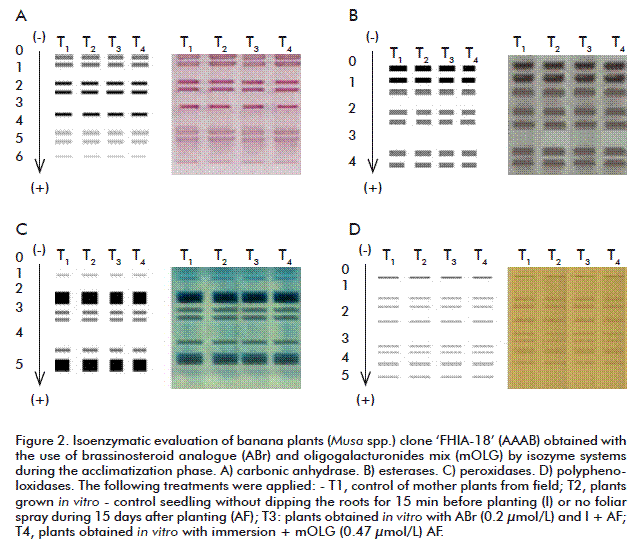
<P   align="justify" ><font size="2" face="Verdana, Arial, Helvetica, sans-serif">Ploidy variations      are not usually evident for more than 20<I> in vitro</I> cultivation cycles      for two years by combined cytogenetic and flow cytometry studies. This was      evidenced when the number of chromosomes (22) remained constant in banana      varieties &lsquo;Kluai Sa&rsquo; (AA) and &lsquo;Leb Mue Nang Kluai&rsquo;      (AA) [34]. </font></P >       <P   align="justify" ><font size="2" face="Verdana, Arial, Helvetica, sans-serif">Chromosomal changes      have been observed in <I>Fragaria</I> spp. cultured<I> in vitro</I>, especially      in plants from callus and<I> in vitro</I> cells maintained under long term      storage [35]. Variations in the ploidy level of <I>in vitro</I> culture may      result from the relationship between the genetic constitution of the cultured      species and culture medium composition [36]. </font></P >       <P   align="justify" ><font size="2" face="Verdana, Arial, Helvetica, sans-serif">After using the growth      regulators mOLG and ABr in all micropropagation stages, no chromosomal mosaics      were detected, either 2n = 2x = 22 chromosomes (diploid) or 2n = 3x = 33 chromosomes      (triploid). These chromosomal mosaics have been described in the accelerated      micropropagation clones of <I>Musa</I> spp. [37] and cause genetic instability.      </font></P >       <P   ><font size="2" face="Verdana, Arial, Helvetica, sans-serif"><b>Isoenzyme analysis      </b> </font></P >       <P   align="justify" ><font size="2" face="Verdana, Arial, Helvetica, sans-serif">The isoenzyme study      for the evaluated systems using ABr or mOLG showed monomorphic patterns and      did not induce any variations relative to the control plants, suggesting that      these growth regulators did not influence the genetic stability of micropropagated      materials (<a href="/img/revistas/bta/v31n1/f0203114.gif">Figure 2</a>). </font></P >       
<P   align="justify" ><font size="2" face="Verdana, Arial, Helvetica, sans-serif">In the CA and PPO      systems, eight bands were visualized each. There were six bands for the POX      system (bands of the second and sixth genetic system were thicker), and seven      in the PPO system. These bands are characteristic of the clone &lsquo;FHIA-18&rsquo;      (AAAB), genus<I> Musa</I>, characteristics of plants predominantly with an      <I>acuminata </I>genome [26]. </font></P >       ]]></body>
<body><![CDATA[<P   align="justify" ><font size="2" face="Verdana, Arial, Helvetica, sans-serif">Additionally, Est      and PPO isozymes are among the most commonly used for plant species characterization,      since they display a high degree of reproducibility and polymorphism, particularly      in <I>Musa</I> spp. genus cultivars. However, in this study no polymorphism      was observed in isozyme systems. </font></P >       <P   align="justify" ><font size="2" face="Verdana, Arial, Helvetica, sans-serif">Other authors found      complete stability in potato plants (<I>Solanum tuberosum </I>L.) with the      POX CA and acid phosphatase isozyme systems [18], obtained from callus and      cultured at different concentrations of the brassinosteroids analogues ABr-6      MH-5-6 and Pectimorf-mOLG. </font></P >       <P   align="justify" ><font size="2" face="Verdana, Arial, Helvetica, sans-serif">The results obtained      for the isozyme systems (CA, Est, POX and PPO) for banana (<I>Musa</I> spp.)      clone &lsquo;FHIA-18&rsquo; showed no genetic variability, since the 29 analyzed      bands were monomorphic, corroborating its correct use to determine the genetic      variability and stability on this genus, as some authors have recommended      [26]. Furthermore, the results of the cytogenetic study were corroborated.      </font></P >       <P   ><font size="2" face="Verdana, Arial, Helvetica, sans-serif"><b>Molecular analysis      using RAPD </b></font></P >       <P   align="justify" ><font size="2" face="Verdana, Arial, Helvetica, sans-serif">From the two analyzed      kits, four primers were selected based on the quantity, quality and reproducibility      of the amplified bands. The most informative were the OPA-10 and OPF-13 that      amplified eight bands each, followed by OPA-04 with seven and OPA-11 with      four amplified bands. </font></P >       <P   align="justify" ><font size="2" face="Verdana, Arial, Helvetica, sans-serif">These four arbitrary      sequence primers amplified 27 bands ranging about 7 bands per primer. All      bands matched perfectly with the DNA of the field donor plant previously cultured      <I>in vitro</I>, and for all the &lsquo;FHIA-18&rsquo; hybrid regenerants      obtained after treatment with growth regulators (ABr and mOLG) at all micropropagation      stages. The detected bands were 100 % monomorphic, indicating that the use      of ABR and the mOLG in all micropropagation phases caused no variation in      the hardened plants of this banana genotype. </font></P >       <P   align="justify" ><font size="2" face="Verdana, Arial, Helvetica, sans-serif">Molecular studies      with RAPD in <I>Musa</I> spp. are currently used for variety identification,      genetic mapping of useful clones and location of genes conferring resistance      to major diseases that affect these crops [19, 33]. In this research, RAPD      was used to detect <I>Musa</I> spp. somaclonal variants caused by tissue culture.      Other groups (for example, Harirah and Khalid [38]) have obtained monomorphic      profiles, so concluded that the micropropagation of <I>Musa acuminata</I>      cv. Berangan from male flowers did not cause somaclonal variation. </font></P >       <P   align="justify" ><font size="2" face="Verdana, Arial, Helvetica, sans-serif">The combination of      two molecular techniques to study variations generated by <I>in vitro</I>      culture techniques, allow the evaluation of a greater percentage of genomic      loci. In this regard, some researchers have described the use of RAPD markers      and intersimple sequence repeats (ISSR) to examine genetic variation in plants      of banana (<I>Musa</I> spp. var. &lsquo;Nanjanagudu Rasabale&rsquo; AA) micropropagated      for 10 years [20]. They obtained uniform band patterns, and samples were devoid      of polymorphic bands in spite that morphologically different plants were included.      </font></P >       <P   align="justify" ><font size="2" face="Verdana, Arial, Helvetica, sans-serif">However, other authors      have found a high polymorphism in regenerants from <I>in vitro</I> culture      with the single use of RAPD in <I>Musa</I> spp. [19]. Also, a high percentage      of monomorphism or complete genetic stability has also been described on crops      such as <I>Ipomoea batatas</I> (L.) Lam. clone &lsquo;INIVIT B 93-1&rsquo;      [22], <I>Ananas comosus</I> var. &lsquo;Bracteatus&rsquo; (Lindley) Coppens      and Leal [23], and <I>Centaurea ultreiae </I>Silva Pando [39]. Also with this      technique, a high rate of polymorphism (93.19 %) in medicinal plants has been      reported [40]. </font></P >       <P   align="justify" ><font size="2" face="Verdana, Arial, Helvetica, sans-serif">Results with RAPD      molecular markers for the analyzed primer combinations indicated no intra-      or inter-population genetic variation in the four studied populations of &lsquo;FHIA-18&rsquo;      banana plants, regardless its origin (mother plants from the field, cultured      <I>in vitro</I> with AIB, AIA and 6-BAP, or generated <I>in vitro</I> and      treated <I>ex vitro</I> with ABr or mOLG, respectively). </font></P >       ]]></body>
<body><![CDATA[<P   align="justify" >&nbsp;</P >       <P   align="justify" > </P >       <P   align="justify" ><font size="3"><b><font face="Verdana, Arial, Helvetica, sans-serif">CONCLUSIONS      </font></b></font></P >       <P   align="justify" ><font size="2" face="Verdana, Arial, Helvetica, sans-serif">The genetic stability      of banana (<I>Musa</I> spp.) &lsquo;FHIA-18&rsquo; was corroborated in regenerant      clones after using ABr and mOLG during the <I>in vitro</I> and <I>ex vitro</I>      plant propagation. It was confirmed that the chromosome number of the specie      remained constant and they were stable, as determined by the cytogenetic,      isozymes and RAPD techniques. This was verified by the identical band patterns      displayed by progenitor plants, and those obtained by both, plants grown <I>in      vitro</I> with traditional or modern growth regulators. The study validated      the use of ABr and mOLG for micropropagation in this clone. </font></P >       <P   align="justify" >&nbsp;</P >       <P   align="justify" > </P >       <P   align="justify" ><font size="3"><b><font face="Verdana, Arial, Helvetica, sans-serif">REFERENCES      </font></b></font></P >       <!-- ref --><P   align="justify" ><font size="2" face="Verdana, Arial, Helvetica, sans-serif">1. Zhang S, Lemaux      PG. Molecular analysis of in vitro shoot organogenesis. Crit Rev Plant Sci.      2004;23(4):325-35.     </font></P >   <FONT size="+1">        <!-- ref --><P   align="justify" ><font size="2" face="Verdana, Arial, Helvetica, sans-serif">2. Perilli S, Moubayidin      L, Sabatini S. The molecular basis of cytokinin function. Curr Opin Plant      Biol. 2010;13(1):21-6.     </font></P >       <!-- ref --><P   align="justify" ><font size="2" face="Verdana, Arial, Helvetica, sans-serif">3. Benkov&aacute;      E, Hej&aacute;tko J. Hormone interactions at the root apical meristem. Plant      Mol Biol. 2009;69(4):383-96.     </font></P >       <!-- ref --><P   align="justify" ><font size="2" face="Verdana, Arial, Helvetica, sans-serif">4. Gonz&aacute;lez-Garc&iacute;a      MP, Vilarrasa-Blasi J, Zhiponova M, Divol F, Mora-Garc&iacute;a S, Russinova      E, <I>et al.</I> Brassinosteroids control meristem size by promoting cell      cycle progression in Arabidopsis roots. Development. 2011;138(5):849-59.     </font></P >       <!-- ref --><P   align="justify" ><font size="2" face="Verdana, Arial, Helvetica, sans-serif">5. Creelman RA, Mullet      JE. Oligosaccharins, brassinolides, and jasmonates: nontraditional regulators      of plant growth, development, and gene expression. Plant Cell. 1997;9(7):1211-23.          </font></P >       <P   align="justify" ><font size="2" face="Verdana, Arial, Helvetica, sans-serif">6. Von Arnold S.      Somatic embryogenesis. In: George EF, Hall MA, De Klerk GJ, editors. Plant      Propagation by Tissue Culture. 3rd Ed. The Netherlands: Kluwer Academic Publishers;      2008. p. 335-54. </font></P >       <P   align="justify" ><font size="2" face="Verdana, Arial, Helvetica, sans-serif">7. Orbovi&#263; V,      Calovi&#263; M, Viloria Z, Nielsen B, Gmitter FG Jr, Castle WS, <I>et al.</I>      Analysis of genetic variability in various tissue culture-derived lemon plant      populations using RAPD and flow cytometry. Euphytica. 2008;161(3):329-35.      </font></P >       <!-- ref --><P   align="justify" ><font size="2" face="Verdana, Arial, Helvetica, sans-serif">8. Riseman A, Chennareddy      S. Genotypic variation in the micropropagation of Sri Lankan Exacum hybrids.      J Am Soc Hort Sci. 2004;129(5):698-703.     </font></P >       <!-- ref --><P   align="justify" ><font size="2" face="Verdana, Arial, Helvetica, sans-serif">9. Garc&iacute;a      D, Marrero MT, Cuba M, N&uacute;&ntilde;ez M. Efecto cualitativo de an&aacute;logos      de brasinoesteroides como sustitutos hormonales en la callog&eacute;nesis      de caf&eacute; (Coffea canephora variedad Robusta). Cultivos Tropicales. 1997;18(2):44-6.          </font></P >       <!-- ref --><P   align="justify" ><font size="2" face="Verdana, Arial, Helvetica, sans-serif">10. Montes S, Aldaz      JP, Cevallos M, Cabrera JC, L&oacute;pez M. Uso del biorregulador Pectimorf      en la propagaci&oacute;n acelerada del Anthurium cubense. Cultivos Tropicales.      2000;21(3):29-31.     </font></P >       <!-- ref --><P   align="justify" ><font size="2" face="Verdana, Arial, Helvetica, sans-serif">11. Gonz&aacute;lez-Olmedo      JL, C&oacute;rdova A, Arag&oacute;n CE, Pina D, Rivas M, Rodr&iacute;guez      R. Effect of an analogue of brassinosteroid on FHIA-18 plantlets exposed to      thermal stress. InfoMusa. 2005;14(1):18-20.     </font></P >       <P   align="justify" ><font size="2" face="Verdana, Arial, Helvetica, sans-serif">12. Jim&eacute;nez      FA, Ram&iacute;rez D, Agramonte D. Use of Biobras-6 in micropropagation of      &lsquo;FHIA-21&rsquo;. InfoMusa. 2004;13(1):4-6. </font></P >       <!-- ref --><P   align="justify" ><font size="2" face="Verdana, Arial, Helvetica, sans-serif">13. D&iacute;az BR,      H&eacute;ctor E, Torres A, Caba&ntilde;as M, Garc&eacute;s N, Izquierdo H,      <I>et al.</I> Empleo de productos bioactivos cubanos como sustitutos de los      reguladores del crecimiento en la propagaci&oacute;n del pl&aacute;tano macho      (AAB). I. Fase de establecimiento in vitro. Alimentaria. 2004;51(359):103-7.          </font></P >       ]]></body>
<body><![CDATA[<!-- ref --><P   align="justify" ><font size="2" face="Verdana, Arial, Helvetica, sans-serif">14. H&ouml;gberg      KA, Bozhkov PV, Gr&ouml;nroos R, von Arnold S. Critical factors affecting      ex vitro performance of somatic embryo plants of <I>Picea abies</I>. Scand      J Forest Res. 2001;16(4):295-304.     </font></P >       <!-- ref --><P   align="justify" ><font size="2" face="Verdana, Arial, Helvetica, sans-serif">15. Arag&oacute;n      CE, Escalona M, Capote I, Pina D, Cejas I, <I>et al.</I> Photosynthesis and      carbon metabolism in plantain (<I>Musa</I> AAB) growing in temporary immersion      bioreactor (TIB) and during ex vitro acclimatization. In Vitro Cell Dev Biol      Plant. 2005;41(4):550-4.     </font></P >       <!-- ref --><P   align="justify" ><font size="2" face="Verdana, Arial, Helvetica, sans-serif">16. Bajguz A, Hayat      S. Effects of brassinosteroids on the plant responses to environmental stresses.      Plant Physiol Biochem. 2009;47(1):1-8.     </font></P >       <P   align="justify" ><font size="2" face="Verdana, Arial, Helvetica, sans-serif">17. Xiqu&eacute;s      X. Caracterizaci&oacute;n citogen&eacute;tica de la variabilidad en plantas.      In: Cornide MT, editor. Marcadores Moleculares. Nuevos horizontes en la gen&eacute;tica      y selecci&oacute;n de las plantas. La Habana: Editorial F&eacute;lix Varela;      2002. p. 67-91. </font></P >       <!-- ref --><P   align="justify" ><font size="2" face="Verdana, Arial, Helvetica, sans-serif">18. Lara RM, Florido      M, Plana D, Mor&eacute; O, Gonz&aacute;lez ME, &Aacute;lvarez M, <I>et al.</I>      Isoenzymatic analisys for detecting in vitro variability and/or stability      of economically important crops. Cultivos Tropicales. 2003;24(3):39-47.     </font></P >       <P   align="justify" ><font size="2" face="Verdana, Arial, Helvetica, sans-serif">19. Mart&iacute;n      KP, Pachathundikandi SK, Zhang CL, Slater A, Madassery J. RAPD analysis of      a variant of banana (<I>Musa</I> sp.) cv. &lsquo;Grande naine&rsquo; and its      propagation via shoot tip culture. In Vitro Cell Dev Biol Plant. 2006;42(2):188-92.      </font></P >       ]]></body>
<body><![CDATA[<!-- ref --><P   align="justify" ><font size="2" face="Verdana, Arial, Helvetica, sans-serif">20. Venkatachalam      L, Sreedhar RV, Bhagyalakshmi N. Genetic analyses of micropropagated and regenerated      plantlets of banana as assessed by RAPD and ISSR markers. In Vitro Cell Dev      Biol Plant. 2007;43(3):267-74.     </font></P >       <P   align="justify" ><font size="2" face="Verdana, Arial, Helvetica, sans-serif">21. Hern&aacute;ndez      RM, Lara RM, Diosdado E, Cabrera JC, Gonz&aacute;lez C, Vald&eacute;s M, <I>et      al.</I> Evaluaci&oacute;n de la actividad del Pectimorf en la embriog&eacute;nesis      som&aacute;tica de la mandarina &lsquo;Cleopatra&rsquo; (<I>Citrus reshni</I>      Hort. ex Tan.) mediante marcadores isoenzim&aacute;ticos. Cultivos Tropicales.      2007;28(4):25-31. </font></P >       <!-- ref --><P   align="justify" ><font size="2" face="Verdana, Arial, Helvetica, sans-serif">22. Gonz&aacute;lez      O, Fern&aacute;ndez A, Fraga Y, Pino B, Hern&aacute;ndez MM, Silva JJ. Evaluaci&oacute;n      de la estabilidad gen&eacute;tica mediante marcadores RAPD en plantas de Ipomoea      batatas. Cultivos Tropicales. 2007;28(2):39-43.     </font></P >       <P   align="justify" ><font size="2" face="Verdana, Arial, Helvetica, sans-serif">23. Santos MD, Buso      GC, Torres AC. Evaluation of genetic variability in micropropagated propagules      of ornamental pineapple (<I>Ananas comosus</I> var. &lsquo;Bracteatus&rsquo;      (Lindley) Coppens and Leal] using RAPD markers. Gen Mol Res. 2008;7(4):1097-105.      </font></P >       <!-- ref --><P   align="justify" ><font size="2" face="Verdana, Arial, Helvetica, sans-serif">24. Murashige T,      Skoog F. A revised medium for rapid growth and bioassays with tobacco tissue      cultures. Physiol Plant. 1962;15(3):473-97.     </font></P >       <!-- ref --><P   align="justify" ><font size="2" face="Verdana, Arial, Helvetica, sans-serif">25. Rom&aacute;n      MI, Rodr&iacute;guez Nodals A. Estudios citogen&eacute;ticos e implicaciones      taxon&oacute;micas en ocho cultivares de pl&aacute;tano (<I>Musa</I> spp.).      Cienc T&eacute;c Agric Viandas Tro-picales. 1986;7(1):7-14.     </font></P >       ]]></body>
<body><![CDATA[<P   align="justify" ><font size="2" face="Verdana, Arial, Helvetica, sans-serif">26. Rom&aacute;n      MI. Estudio de la diversidad gen&eacute;tica en accesiones de bananos y pl&aacute;tanos      (<I>Musa</I> spp.) en Cuba. Tesis presentada en opci&oacute;n al T&iacute;tulo      de Doctor en Ciencias Biol&oacute;gicas [dissertation]. La Habana: Facultad      de Biolog&iacute;a, Universidad de La Habana; 2004. </font></P >       <!-- ref --><P   align="justify" ><font size="2" face="Verdana, Arial, Helvetica, sans-serif">27. Ornstein L. Disc      electrophoresis I. Background and Theory. Ann NY Acad Sci. 1964;121:321-49.          </font></P >       <!-- ref --><P   align="justify" ><font size="2" face="Verdana, Arial, Helvetica, sans-serif">28. Brewer GJ, Singh      CF. An introduction to isoenzyme techniques. New York: Academic Press; 1970.          </font></P >       <!-- ref --><P   align="justify" ><font size="2" face="Verdana, Arial, Helvetica, sans-serif">29. Gonz&aacute;lez      C, Gonz&aacute;lez JA. Estudio de patrones para la lima Persa III. Caracterizaci&oacute;n      isoenzim&aacute;tica. Rev Cienc T&eacute;cnica Agric. 1981;4(2):102-8.     </font></P >       <P   align="justify" ><font size="2" face="Verdana, Arial, Helvetica, sans-serif">30. Iglesias L. Estudio      de la variabilidad morfoagron&oacute;mica-bioqu&iacute;mica en soya (Glycine      <I>max</I> Merrill). [dissertation]. Tesis de Doctorado. La Habana: Universidad      Agraria de La Habana Fructuoso Rodr&iacute;guez; 1986. </font></P >       <!-- ref --><P   align="justify" ><font size="2" face="Verdana, Arial, Helvetica, sans-serif">31. Guedes MEM, Rodr&iacute;guez      CJ Jr. Disc electrophoresis patterns of phenoloxidase from leaves of coffee      cultivars. Portugaliae Acta Biol Serie A. 1974;13:169-78.     </font></P >       ]]></body>
<body><![CDATA[<!-- ref --><P   align="justify" ><font size="2" face="Verdana, Arial, Helvetica, sans-serif">32. Dellaporta SL,      Wood J, Hicks JB. A plant DNA minipreparation: Version II. Plant Mol Biol      Rep. 1983;1(4):19-21.     </font></P >       <!-- ref --><P   align="justify" ><font size="2" face="Verdana, Arial, Helvetica, sans-serif">33. Zambrano AY,      Mart&iacute;nez G, Guti&eacute;rrez Z, Manzanilla E, Vicente-Villard&oacute;n      JL, Demey JR. Marcador RAPD asociado a la resistencia a <I>Fusarium oxysporum</I>      en Musa. Interciencia. 2007;32(11):775-9.     </font></P >       <P   align="justify" ><font size="2" face="Verdana, Arial, Helvetica, sans-serif">34. Srangsam A, Kanchanapoom      K. Establishment of in vitro culture of <I>Musa</I> AA group &lsquo;Kluai      Sa&rsquo; and <I>Musa</I> AA group &lsquo;Kluai Leb Mue Nang&rsquo; and the      analysis of ploidy stability. ScienceAsia. 2007;33(4):437-42. </font></P >       <!-- ref --><P   align="justify" ><font size="2" face="Verdana, Arial, Helvetica, sans-serif">35. Hao YJ, Deng      XX. Cytological and molecular evaluation of strawberry plants recovered from      in vitro conservation by slow-growth. J Hort Sci Biotechnol. 2005;80(5):588-92.          </font></P >       <!-- ref --><P   align="justify" ><font size="2" face="Verdana, Arial, Helvetica, sans-serif">36. Bublyk EN, Adonin      VI, Kunakh VA. Cytogenetic variability of cell lines of <I>Ungernia victoris</I>      grown on nutrient media of different compositions. Cytol Genet. 2008;42(1):23-9.          </font></P >       <!-- ref --><P   align="justify" ><font size="2" face="Verdana, Arial, Helvetica, sans-serif">37. Zaffari GR, Peres      LEP, Suzuki RM, Kerbauy GB. Plantas micropropagadas anormales de bananos:      niveles end&oacute;genos de auxina, citoquininas e IAA-oxidasa. MusaRama.      2001;14(2):12.     </font></P >       <!-- ref --><P   align="justify" ><font size="2" face="Verdana, Arial, Helvetica, sans-serif">38. Harirah AA, Khalid      N. Direct regeneration and RAPD Assessment of male inflorescence derived plants      of <I>Musa acuminata</I> cv. Berangan. Asia Pac J Mol Biol Biotechnol. 2006;14(1):11-7.          </font></P >       <!-- ref --><P   align="justify" ><font size="2" face="Verdana, Arial, Helvetica, sans-serif">39. Mall&oacute;n      R, Rodr&iacute;guez-Oubi&ntilde;a J, Gonz&aacute;lez ML. In vitro propagation      of the endangered plant <I>Centaurea ultreiae</I>: assessment of genetic stability      by cytological studies, flow cytometry and RAPD analysis. Plant Cell Tiss      Organ Cult. 2010;101(1):31-9.     </font></P >       <!-- ref --><P   align="justify" ><font size="2" face="Verdana, Arial, Helvetica, sans-serif">40. Tiwari KL, Jadhav      SK, Kumar A. Random amplified polymorphic DNA (RAPD) molecular marker based      genetic relationship study of medicinal plants collected from tribal region      of Chhattisgarh, India. Res J Biotech. 2011;6(3):63-6.     </font></P >       <P   align="justify" >&nbsp;</P >       <P   align="justify" >&nbsp;</P >   <FONT size="+1">        <P   align="justify" > </P >       ]]></body>
<body><![CDATA[<P   align="justify" > </P >       <P   align="justify" ><font size="2" face="Verdana, Arial, Helvetica, sans-serif">Received in June,      2013.     <br>     </font><font size="2" face="Verdana, Arial, Helvetica, sans-serif">Accepted      in October, 2013. </font></P >       <P   > </P >       <P   > </P >       <P   >&nbsp;</P >       <P   >&nbsp;</P >       <P   ><font size="2" face="Verdana, Arial, Helvetica, sans-serif"><i>Humberto Izquierdo</i>.      Instituto Nacional de Ciencias Agr&iacute;colas, Inca. Carretera a Tapaste,      Km 3&frac12;. San Jos&eacute; de las Lajas, CP 32700, Mayabeque, Cuba. E-mail:      <A href="mailto:hioviedo@inca.edu.cu"> <U><U><FONT color="#0000FF">hioviedo@inca.edu.cu</font></U></U></A><FONT color="#0000FF"><FONT color="#000000">.      </font></font></font></P >   </font></font></font></font></font></font></font></font></font></font></font></font></font></font></font></font></font></font></font></font></font></font></font></font></font></font></font></font></font></font></DIV >      ]]></body><back>
<ref-list>
<ref id="B1">
<label>1</label><nlm-citation citation-type="journal">
<person-group person-group-type="author">
<name>
<surname><![CDATA[Zhang]]></surname>
<given-names><![CDATA[S]]></given-names>
</name>
<name>
<surname><![CDATA[Lemaux]]></surname>
<given-names><![CDATA[PG]]></given-names>
</name>
</person-group>
<article-title xml:lang="en"><![CDATA[Molecular analysis of in vitro shoot organogenesis]]></article-title>
<source><![CDATA[Crit Rev Plant Sci]]></source>
<year>2004</year>
<volume>23</volume>
<numero>4</numero>
<issue>4</issue>
<page-range>325-35</page-range></nlm-citation>
</ref>
<ref id="B2">
<label>2</label><nlm-citation citation-type="journal">
<person-group person-group-type="author">
<name>
<surname><![CDATA[Perilli]]></surname>
<given-names><![CDATA[S]]></given-names>
</name>
<name>
<surname><![CDATA[Moubayidin]]></surname>
<given-names><![CDATA[L]]></given-names>
</name>
<name>
<surname><![CDATA[Sabatini]]></surname>
<given-names><![CDATA[S]]></given-names>
</name>
</person-group>
<article-title xml:lang="en"><![CDATA[The molecular basis of cytokinin function]]></article-title>
<source><![CDATA[Curr Opin Plant Biol]]></source>
<year>2010</year>
<volume>13</volume>
<numero>1</numero>
<issue>1</issue>
<page-range>21-6</page-range></nlm-citation>
</ref>
<ref id="B3">
<label>3</label><nlm-citation citation-type="journal">
<person-group person-group-type="author">
<name>
<surname><![CDATA[Benková]]></surname>
<given-names><![CDATA[E]]></given-names>
</name>
<name>
<surname><![CDATA[Hejátko]]></surname>
<given-names><![CDATA[J]]></given-names>
</name>
</person-group>
<article-title xml:lang="en"><![CDATA[Hormone interactions at the root apical meristem]]></article-title>
<source><![CDATA[Plant Mol Biol]]></source>
<year>2009</year>
<volume>69</volume>
<numero>4</numero>
<issue>4</issue>
<page-range>383-96</page-range></nlm-citation>
</ref>
<ref id="B4">
<label>4</label><nlm-citation citation-type="journal">
<person-group person-group-type="author">
<name>
<surname><![CDATA[González-García]]></surname>
<given-names><![CDATA[MP]]></given-names>
</name>
<name>
<surname><![CDATA[Vilarrasa-Blasi]]></surname>
<given-names><![CDATA[J]]></given-names>
</name>
<name>
<surname><![CDATA[Zhiponova]]></surname>
<given-names><![CDATA[M]]></given-names>
</name>
<name>
<surname><![CDATA[Divol]]></surname>
<given-names><![CDATA[F]]></given-names>
</name>
<name>
<surname><![CDATA[Mora-García]]></surname>
<given-names><![CDATA[S]]></given-names>
</name>
<name>
<surname><![CDATA[Russinova]]></surname>
<given-names><![CDATA[E]]></given-names>
</name>
</person-group>
<article-title xml:lang="en"><![CDATA[Brassinosteroids control meristem size by promoting cell cycle progression in Arabidopsis roots]]></article-title>
<source><![CDATA[Development]]></source>
<year>2011</year>
<volume>138</volume>
<numero>5</numero>
<issue>5</issue>
<page-range>849-59</page-range></nlm-citation>
</ref>
<ref id="B5">
<label>5</label><nlm-citation citation-type="journal">
<person-group person-group-type="author">
<name>
<surname><![CDATA[Creelman]]></surname>
<given-names><![CDATA[RA]]></given-names>
</name>
<name>
<surname><![CDATA[Mullet]]></surname>
<given-names><![CDATA[JE]]></given-names>
</name>
</person-group>
<article-title xml:lang="en"><![CDATA[Oligosaccharins, brassinolides, and jasmonates: nontraditional regulators of plant growth, development, and gene expression]]></article-title>
<source><![CDATA[Plant Cell]]></source>
<year>1997</year>
<volume>9</volume>
<numero>7</numero>
<issue>7</issue>
<page-range>1211-23</page-range></nlm-citation>
</ref>
<ref id="B6">
<label>6</label><nlm-citation citation-type="book">
<person-group person-group-type="author">
<name>
<surname><![CDATA[Von Arnold]]></surname>
<given-names><![CDATA[S]]></given-names>
</name>
</person-group>
<article-title xml:lang="en"><![CDATA[Somatic embryogenesis]]></article-title>
<person-group person-group-type="editor">
<name>
<surname><![CDATA[George]]></surname>
<given-names><![CDATA[EF]]></given-names>
</name>
<name>
<surname><![CDATA[Hall]]></surname>
<given-names><![CDATA[MA]]></given-names>
</name>
<name>
<surname><![CDATA[De Klerk]]></surname>
<given-names><![CDATA[GJ]]></given-names>
</name>
</person-group>
<source><![CDATA[Plant Propagation by Tissue Culture]]></source>
<year>2008</year>
<edition>3</edition>
<page-range>335-54</page-range><publisher-loc><![CDATA[The Netherlands ]]></publisher-loc>
<publisher-name><![CDATA[Kluwer Academic Publishers]]></publisher-name>
</nlm-citation>
</ref>
<ref id="B7">
<label>7</label><nlm-citation citation-type="journal">
<person-group person-group-type="author">
<name>
<surname><![CDATA[Orbovic]]></surname>
<given-names><![CDATA[V]]></given-names>
</name>
<name>
<surname><![CDATA[Calovic]]></surname>
<given-names><![CDATA[M]]></given-names>
</name>
<name>
<surname><![CDATA[Viloria]]></surname>
<given-names><![CDATA[Z]]></given-names>
</name>
<name>
<surname><![CDATA[Nielsen]]></surname>
<given-names><![CDATA[B]]></given-names>
</name>
<name>
<surname><![CDATA[Gmitter]]></surname>
<given-names><![CDATA[FG Jr]]></given-names>
</name>
<name>
<surname><![CDATA[Castle]]></surname>
<given-names><![CDATA[WS]]></given-names>
</name>
</person-group>
<article-title xml:lang="en"><![CDATA[Analysis of genetic variability in various tissue culture-derived lemon plant populations using RAPD and flow cytometry]]></article-title>
<source><![CDATA[Euphytica]]></source>
<year>2008</year>
<volume>161</volume>
<numero>3</numero>
<issue>3</issue>
<page-range>329-35</page-range></nlm-citation>
</ref>
<ref id="B8">
<label>8</label><nlm-citation citation-type="journal">
<person-group person-group-type="author">
<name>
<surname><![CDATA[Riseman]]></surname>
<given-names><![CDATA[A]]></given-names>
</name>
<name>
<surname><![CDATA[Chennareddy]]></surname>
<given-names><![CDATA[S]]></given-names>
</name>
</person-group>
<article-title xml:lang="en"><![CDATA[Genotypic variation in the micropropagation of Sri Lankan Exacum hybrids]]></article-title>
<source><![CDATA[J Am Soc Hort Sci]]></source>
<year>2004</year>
<volume>129</volume>
<numero>5</numero>
<issue>5</issue>
<page-range>698-703</page-range></nlm-citation>
</ref>
<ref id="B9">
<label>9</label><nlm-citation citation-type="journal">
<person-group person-group-type="author">
<name>
<surname><![CDATA[García]]></surname>
<given-names><![CDATA[D]]></given-names>
</name>
<name>
<surname><![CDATA[Marrero]]></surname>
<given-names><![CDATA[MT]]></given-names>
</name>
<name>
<surname><![CDATA[Cuba]]></surname>
<given-names><![CDATA[M]]></given-names>
</name>
<name>
<surname><![CDATA[Núñez]]></surname>
<given-names><![CDATA[M]]></given-names>
</name>
</person-group>
<article-title xml:lang="es"><![CDATA[Efecto cualitativo de análogos de brasinoesteroides como sustitutos hormonales en la callogénesis de café (Coffea canephora variedad Robusta)]]></article-title>
<source><![CDATA[Cultivos Tropicales]]></source>
<year>1997</year>
<volume>18</volume>
<numero>2</numero>
<issue>2</issue>
<page-range>44-6</page-range></nlm-citation>
</ref>
<ref id="B10">
<label>10</label><nlm-citation citation-type="journal">
<person-group person-group-type="author">
<name>
<surname><![CDATA[Montes]]></surname>
<given-names><![CDATA[S]]></given-names>
</name>
<name>
<surname><![CDATA[Aldaz]]></surname>
<given-names><![CDATA[JP]]></given-names>
</name>
<name>
<surname><![CDATA[Cevallos]]></surname>
<given-names><![CDATA[M]]></given-names>
</name>
<name>
<surname><![CDATA[Cabrera]]></surname>
<given-names><![CDATA[JC]]></given-names>
</name>
<name>
<surname><![CDATA[López]]></surname>
<given-names><![CDATA[M]]></given-names>
</name>
</person-group>
<article-title xml:lang="es"><![CDATA[Uso del biorregulador Pectimorf en la propagación acelerada del Anthurium cubense]]></article-title>
<source><![CDATA[Cultivos Tropicales]]></source>
<year>2000</year>
<volume>21</volume>
<numero>3</numero>
<issue>3</issue>
<page-range>29-31</page-range></nlm-citation>
</ref>
<ref id="B11">
<label>11</label><nlm-citation citation-type="journal">
<person-group person-group-type="author">
<name>
<surname><![CDATA[González-Olmedo]]></surname>
<given-names><![CDATA[JL]]></given-names>
</name>
<name>
<surname><![CDATA[Córdova]]></surname>
<given-names><![CDATA[A]]></given-names>
</name>
<name>
<surname><![CDATA[Aragón]]></surname>
<given-names><![CDATA[CE]]></given-names>
</name>
<name>
<surname><![CDATA[Pina]]></surname>
<given-names><![CDATA[D]]></given-names>
</name>
<name>
<surname><![CDATA[Rivas]]></surname>
<given-names><![CDATA[M]]></given-names>
</name>
<name>
<surname><![CDATA[Rodríguez]]></surname>
<given-names><![CDATA[R]]></given-names>
</name>
</person-group>
<article-title xml:lang="en"><![CDATA[Effect of an analogue of brassinosteroid on FHIA-18 plantlets exposed to thermal stress]]></article-title>
<source><![CDATA[InfoMusa]]></source>
<year>2005</year>
<volume>14</volume>
<numero>1</numero>
<issue>1</issue>
<page-range>18-20</page-range></nlm-citation>
</ref>
<ref id="B12">
<label>12</label><nlm-citation citation-type="journal">
<person-group person-group-type="author">
<name>
<surname><![CDATA[Jiménez]]></surname>
<given-names><![CDATA[FA]]></given-names>
</name>
<name>
<surname><![CDATA[Ramírez]]></surname>
<given-names><![CDATA[D]]></given-names>
</name>
<name>
<surname><![CDATA[Agramonte]]></surname>
<given-names><![CDATA[D]]></given-names>
</name>
</person-group>
<article-title xml:lang="en"><![CDATA[Use of Biobras-6 in micropropagation of 'FHIA-21']]></article-title>
<source><![CDATA[InfoMusa]]></source>
<year>2004</year>
<volume>13</volume>
<numero>1</numero>
<issue>1</issue>
<page-range>4-6</page-range></nlm-citation>
</ref>
<ref id="B13">
<label>13</label><nlm-citation citation-type="journal">
<person-group person-group-type="author">
<name>
<surname><![CDATA[Díaz]]></surname>
<given-names><![CDATA[BR]]></given-names>
</name>
<name>
<surname><![CDATA[Héctor]]></surname>
<given-names><![CDATA[E]]></given-names>
</name>
<name>
<surname><![CDATA[Torres]]></surname>
<given-names><![CDATA[A]]></given-names>
</name>
<name>
<surname><![CDATA[Cabañas]]></surname>
<given-names><![CDATA[M]]></given-names>
</name>
<name>
<surname><![CDATA[Garcés]]></surname>
<given-names><![CDATA[N]]></given-names>
</name>
<name>
<surname><![CDATA[Izquierdo]]></surname>
<given-names><![CDATA[H]]></given-names>
</name>
</person-group>
<article-title xml:lang="es"><![CDATA[Empleo de productos bioactivos cubanos como sustitutos de los reguladores del crecimiento en la propagación del plátano macho (AAB). I. Fase de establecimiento in vitro]]></article-title>
<source><![CDATA[Alimentaria]]></source>
<year>2004</year>
<volume>51</volume>
<numero>359</numero>
<issue>359</issue>
<page-range>103-7</page-range></nlm-citation>
</ref>
<ref id="B14">
<label>14</label><nlm-citation citation-type="journal">
<person-group person-group-type="author">
<name>
<surname><![CDATA[Högberg]]></surname>
<given-names><![CDATA[KA]]></given-names>
</name>
<name>
<surname><![CDATA[Bozhkov]]></surname>
<given-names><![CDATA[PV]]></given-names>
</name>
<name>
<surname><![CDATA[Grönroos]]></surname>
<given-names><![CDATA[R]]></given-names>
</name>
<name>
<surname><![CDATA[von Arnold]]></surname>
<given-names><![CDATA[S]]></given-names>
</name>
</person-group>
<article-title xml:lang="en"><![CDATA[Critical factors affecting ex vitro performance of somatic embryo plants of Picea abies]]></article-title>
<source><![CDATA[Scand J Forest Res]]></source>
<year>2001</year>
<volume>16</volume>
<numero>4</numero>
<issue>4</issue>
<page-range>295-304</page-range></nlm-citation>
</ref>
<ref id="B15">
<label>15</label><nlm-citation citation-type="journal">
<person-group person-group-type="author">
<name>
<surname><![CDATA[Aragón]]></surname>
<given-names><![CDATA[CE]]></given-names>
</name>
<name>
<surname><![CDATA[Escalona]]></surname>
<given-names><![CDATA[M]]></given-names>
</name>
<name>
<surname><![CDATA[Capote]]></surname>
<given-names><![CDATA[I]]></given-names>
</name>
<name>
<surname><![CDATA[Pina]]></surname>
<given-names><![CDATA[D]]></given-names>
</name>
<name>
<surname><![CDATA[Cejas]]></surname>
<given-names><![CDATA[I]]></given-names>
</name>
</person-group>
<article-title xml:lang="en"><![CDATA[Photosynthesis and carbon metabolism in plantain (Musa AAB) growing in temporary immersion bioreactor (TIB) and during ex vitro acclimatization]]></article-title>
<source><![CDATA[In Vitro Cell Dev Biol Plant]]></source>
<year>2005</year>
<volume>41</volume>
<numero>4</numero>
<issue>4</issue>
<page-range>550-4</page-range></nlm-citation>
</ref>
<ref id="B16">
<label>16</label><nlm-citation citation-type="journal">
<person-group person-group-type="author">
<name>
<surname><![CDATA[Bajguz]]></surname>
<given-names><![CDATA[A]]></given-names>
</name>
<name>
<surname><![CDATA[Hayat]]></surname>
<given-names><![CDATA[S]]></given-names>
</name>
</person-group>
<article-title xml:lang="en"><![CDATA[Effects of brassinosteroids on the plant responses to environmental stresses]]></article-title>
<source><![CDATA[Plant Physiol Biochem]]></source>
<year>2009</year>
<volume>47</volume>
<numero>1</numero>
<issue>1</issue>
<page-range>1-8</page-range></nlm-citation>
</ref>
<ref id="B17">
<label>17</label><nlm-citation citation-type="book">
<person-group person-group-type="author">
<name>
<surname><![CDATA[Xiqués]]></surname>
<given-names><![CDATA[X]]></given-names>
</name>
</person-group>
<article-title xml:lang="es"><![CDATA[Caracterización citogenética de la variabilidad en plantas]]></article-title>
<person-group person-group-type="editor">
<name>
<surname><![CDATA[Cornide]]></surname>
<given-names><![CDATA[MT]]></given-names>
</name>
</person-group>
<source><![CDATA[Marcadores Moleculares. Nuevos horizontes en la genética y selección de las plantas]]></source>
<year>2002</year>
<page-range>67-91</page-range><publisher-loc><![CDATA[La Habana ]]></publisher-loc>
<publisher-name><![CDATA[Editorial Félix Varela]]></publisher-name>
</nlm-citation>
</ref>
<ref id="B18">
<label>18</label><nlm-citation citation-type="journal">
<person-group person-group-type="author">
<name>
<surname><![CDATA[Lara]]></surname>
<given-names><![CDATA[RM]]></given-names>
</name>
<name>
<surname><![CDATA[Florido]]></surname>
<given-names><![CDATA[M]]></given-names>
</name>
<name>
<surname><![CDATA[Plana]]></surname>
<given-names><![CDATA[D]]></given-names>
</name>
<name>
<surname><![CDATA[Moré]]></surname>
<given-names><![CDATA[O]]></given-names>
</name>
<name>
<surname><![CDATA[González]]></surname>
<given-names><![CDATA[ME]]></given-names>
</name>
<name>
<surname><![CDATA[Álvarez]]></surname>
<given-names><![CDATA[M]]></given-names>
</name>
</person-group>
<article-title xml:lang="en"><![CDATA[Isoenzymatic analisys for detecting in vitro variability and/or stability of economically important crops]]></article-title>
<source><![CDATA[Cultivos Tropicales]]></source>
<year>2003</year>
<volume>24</volume>
<numero>3</numero>
<issue>3</issue>
<page-range>39-47</page-range></nlm-citation>
</ref>
<ref id="B19">
<label>19</label><nlm-citation citation-type="journal">
<person-group person-group-type="author">
<name>
<surname><![CDATA[Martín]]></surname>
<given-names><![CDATA[KP]]></given-names>
</name>
<name>
<surname><![CDATA[Pachathundikandi]]></surname>
<given-names><![CDATA[SK]]></given-names>
</name>
<name>
<surname><![CDATA[Zhang]]></surname>
<given-names><![CDATA[CL]]></given-names>
</name>
<name>
<surname><![CDATA[Slater]]></surname>
<given-names><![CDATA[A]]></given-names>
</name>
<name>
<surname><![CDATA[Madassery]]></surname>
<given-names><![CDATA[J]]></given-names>
</name>
</person-group>
<article-title xml:lang="en"><![CDATA[RAPD analysis of a variant of banana (Musa sp.) cv. 'Grande naine' and its propagation via shoot tip culture]]></article-title>
<source><![CDATA[In Vitro Cell Dev Biol Plant]]></source>
<year>2006</year>
<volume>42</volume>
<numero>2</numero>
<issue>2</issue>
<page-range>188-92</page-range></nlm-citation>
</ref>
<ref id="B20">
<label>20</label><nlm-citation citation-type="journal">
<person-group person-group-type="author">
<name>
<surname><![CDATA[Venkatachalam]]></surname>
<given-names><![CDATA[L]]></given-names>
</name>
<name>
<surname><![CDATA[Sreedhar]]></surname>
<given-names><![CDATA[RV]]></given-names>
</name>
<name>
<surname><![CDATA[Bhagyalakshmi]]></surname>
<given-names><![CDATA[N]]></given-names>
</name>
</person-group>
<article-title xml:lang="en"><![CDATA[Genetic analyses of micropropagated and regenerated plantlets of banana as assessed by RAPD and ISSR markers]]></article-title>
<source><![CDATA[In Vitro Cell Dev Biol Plant]]></source>
<year>2007</year>
<volume>43</volume>
<numero>3</numero>
<issue>3</issue>
<page-range>267-74</page-range></nlm-citation>
</ref>
<ref id="B21">
<label>21</label><nlm-citation citation-type="journal">
<person-group person-group-type="author">
<name>
<surname><![CDATA[Hernández]]></surname>
<given-names><![CDATA[RM]]></given-names>
</name>
<name>
<surname><![CDATA[Lara]]></surname>
<given-names><![CDATA[RM]]></given-names>
</name>
<name>
<surname><![CDATA[Diosdado]]></surname>
<given-names><![CDATA[E]]></given-names>
</name>
<name>
<surname><![CDATA[Cabrera]]></surname>
<given-names><![CDATA[JC]]></given-names>
</name>
<name>
<surname><![CDATA[González]]></surname>
<given-names><![CDATA[C]]></given-names>
</name>
<name>
<surname><![CDATA[Valdés]]></surname>
<given-names><![CDATA[M]]></given-names>
</name>
</person-group>
<article-title xml:lang="en"><![CDATA[Evaluación de la actividad del Pectimorf en la embriogénesis somática de la mandarina 'Cleopatra' (Citrus reshni Hort. ex Tan.) mediante marcadores isoenzimáticos]]></article-title>
<source><![CDATA[Cultivos Tropicales]]></source>
<year>2007</year>
<volume>28</volume>
<numero>4</numero>
<issue>4</issue>
<page-range>25-31</page-range></nlm-citation>
</ref>
<ref id="B22">
<label>22</label><nlm-citation citation-type="journal">
<person-group person-group-type="author">
<name>
<surname><![CDATA[González]]></surname>
<given-names><![CDATA[O]]></given-names>
</name>
<name>
<surname><![CDATA[Fernández]]></surname>
<given-names><![CDATA[A]]></given-names>
</name>
<name>
<surname><![CDATA[Fraga]]></surname>
<given-names><![CDATA[Y]]></given-names>
</name>
<name>
<surname><![CDATA[Pino]]></surname>
<given-names><![CDATA[B]]></given-names>
</name>
<name>
<surname><![CDATA[Hernández]]></surname>
<given-names><![CDATA[MM]]></given-names>
</name>
<name>
<surname><![CDATA[Silva]]></surname>
<given-names><![CDATA[JJ]]></given-names>
</name>
</person-group>
<article-title xml:lang="en"><![CDATA[Evaluación de la estabilidad genética mediante marcadores RAPD en plantas de Ipomoea batatas]]></article-title>
<source><![CDATA[Cultivos Tropicales]]></source>
<year>2007</year>
<volume>28</volume>
<numero>2</numero>
<issue>2</issue>
<page-range>39-43</page-range></nlm-citation>
</ref>
<ref id="B23">
<label>23</label><nlm-citation citation-type="journal">
<person-group person-group-type="author">
<name>
<surname><![CDATA[Santos]]></surname>
<given-names><![CDATA[MD]]></given-names>
</name>
<name>
<surname><![CDATA[Buso]]></surname>
<given-names><![CDATA[GC]]></given-names>
</name>
<name>
<surname><![CDATA[Torres]]></surname>
<given-names><![CDATA[AC]]></given-names>
</name>
</person-group>
<article-title xml:lang="en"><![CDATA[Evaluation of genetic variability in micropropagated propagules of ornamental pineapple (Ananas comosus var. 'Bracteatus' (Lindley) Coppens and Leal) using RAPD markers]]></article-title>
<source><![CDATA[Gen Mol Res]]></source>
<year>2008</year>
<volume>7</volume>
<numero>4</numero>
<issue>4</issue>
<page-range>1097-105</page-range></nlm-citation>
</ref>
<ref id="B24">
<label>24</label><nlm-citation citation-type="journal">
<person-group person-group-type="author">
<name>
<surname><![CDATA[Murashige]]></surname>
<given-names><![CDATA[T]]></given-names>
</name>
<name>
<surname><![CDATA[Skoog]]></surname>
<given-names><![CDATA[F]]></given-names>
</name>
</person-group>
<article-title xml:lang="en"><![CDATA[A revised medium for rapid growth and bioassays with tobacco tissue cultures]]></article-title>
<source><![CDATA[Physiol Plant]]></source>
<year>1962</year>
<volume>15</volume>
<numero>3</numero>
<issue>3</issue>
<page-range>473-97</page-range></nlm-citation>
</ref>
<ref id="B25">
<label>25</label><nlm-citation citation-type="journal">
<person-group person-group-type="author">
<name>
<surname><![CDATA[Román]]></surname>
<given-names><![CDATA[MI]]></given-names>
</name>
<name>
<surname><![CDATA[Rodríguez Nodals]]></surname>
<given-names><![CDATA[A]]></given-names>
</name>
</person-group>
<article-title xml:lang="es"><![CDATA[Estudios citogenéticos e implicaciones taxonómicas en ocho cultivares de plátano (Musa spp.)]]></article-title>
<source><![CDATA[Cienc Téc Agric Viandas Tropicales]]></source>
<year>1986</year>
<volume>7</volume>
<numero>1</numero>
<issue>1</issue>
<page-range>7-14</page-range></nlm-citation>
</ref>
<ref id="B26">
<label>26</label><nlm-citation citation-type="">
<person-group person-group-type="author">
<name>
<surname><![CDATA[Román]]></surname>
<given-names><![CDATA[MI]]></given-names>
</name>
</person-group>
<source><![CDATA[Estudio de la diversidad genética en accesiones de bananos y plátanos (Musa spp.) en Cuba]]></source>
<year></year>
</nlm-citation>
</ref>
<ref id="B27">
<label>27</label><nlm-citation citation-type="journal">
<person-group person-group-type="author">
<name>
<surname><![CDATA[Ornstein]]></surname>
<given-names><![CDATA[L]]></given-names>
</name>
</person-group>
<article-title xml:lang="en"><![CDATA[Disc electrophoresis I. Background and Theory]]></article-title>
<source><![CDATA[Ann NY Acad Sci]]></source>
<year>1964</year>
<volume>121</volume>
<page-range>321-49</page-range></nlm-citation>
</ref>
<ref id="B28">
<label>28</label><nlm-citation citation-type="book">
<person-group person-group-type="author">
<name>
<surname><![CDATA[Brewer]]></surname>
<given-names><![CDATA[GJ]]></given-names>
</name>
<name>
<surname><![CDATA[Singh]]></surname>
<given-names><![CDATA[CF]]></given-names>
</name>
</person-group>
<source><![CDATA[An introduction to isoenzyme techniques]]></source>
<year>1970</year>
<publisher-loc><![CDATA[New York ]]></publisher-loc>
<publisher-name><![CDATA[Academic Press]]></publisher-name>
</nlm-citation>
</ref>
<ref id="B29">
<label>29</label><nlm-citation citation-type="journal">
<person-group person-group-type="author">
<name>
<surname><![CDATA[González]]></surname>
<given-names><![CDATA[C]]></given-names>
</name>
<name>
<surname><![CDATA[González]]></surname>
<given-names><![CDATA[JA]]></given-names>
</name>
</person-group>
<article-title xml:lang="es"><![CDATA[Estudio de patrones para la lima Persa III. Caracterización isoenzimática]]></article-title>
<source><![CDATA[Rev Cienc Técnica Agric]]></source>
<year>1981</year>
<volume>4</volume>
<numero>2</numero>
<issue>2</issue>
<page-range>102-8</page-range></nlm-citation>
</ref>
<ref id="B30">
<label>30</label><nlm-citation citation-type="">
<person-group person-group-type="author">
<name>
<surname><![CDATA[Iglesias]]></surname>
<given-names><![CDATA[L]]></given-names>
</name>
</person-group>
<source><![CDATA[Estudio de la variabilidad morfoagronómica-bioquímica en soya (Glycine max Merrill)]]></source>
<year></year>
</nlm-citation>
</ref>
<ref id="B31">
<label>31</label><nlm-citation citation-type="journal">
<person-group person-group-type="author">
<name>
<surname><![CDATA[Guedes]]></surname>
<given-names><![CDATA[MEM]]></given-names>
</name>
<name>
<surname><![CDATA[Rodríguez]]></surname>
<given-names><![CDATA[CJ Jr]]></given-names>
</name>
</person-group>
<article-title xml:lang="en"><![CDATA[Disc electrophoresis patterns of phenoloxidase from leaves of coffee cultivars]]></article-title>
<source><![CDATA[Portugaliae Acta Biol Serie A]]></source>
<year>1974</year>
<volume>13</volume>
<page-range>169-78</page-range></nlm-citation>
</ref>
<ref id="B32">
<label>32</label><nlm-citation citation-type="journal">
<person-group person-group-type="author">
<name>
<surname><![CDATA[Dellaporta]]></surname>
<given-names><![CDATA[SL]]></given-names>
</name>
<name>
<surname><![CDATA[Wood]]></surname>
<given-names><![CDATA[J]]></given-names>
</name>
<name>
<surname><![CDATA[Hicks]]></surname>
<given-names><![CDATA[JB]]></given-names>
</name>
</person-group>
<article-title xml:lang="en"><![CDATA[A plant DNA minipreparation: Version II]]></article-title>
<source><![CDATA[Plant Mol Biol Rep]]></source>
<year>1983</year>
<volume>1</volume>
<numero>4</numero>
<issue>4</issue>
<page-range>19-21</page-range></nlm-citation>
</ref>
<ref id="B33">
<label>33</label><nlm-citation citation-type="journal">
<person-group person-group-type="author">
<name>
<surname><![CDATA[Zambrano]]></surname>
<given-names><![CDATA[AY]]></given-names>
</name>
<name>
<surname><![CDATA[Martínez]]></surname>
<given-names><![CDATA[G]]></given-names>
</name>
<name>
<surname><![CDATA[Gutiérrez]]></surname>
<given-names><![CDATA[Z]]></given-names>
</name>
<name>
<surname><![CDATA[Manzanilla]]></surname>
<given-names><![CDATA[E]]></given-names>
</name>
<name>
<surname><![CDATA[Vicente-Villardón]]></surname>
<given-names><![CDATA[JL]]></given-names>
</name>
<name>
<surname><![CDATA[Demey]]></surname>
<given-names><![CDATA[JR]]></given-names>
</name>
</person-group>
<article-title xml:lang="en"><![CDATA[Marcador RAPD asociado a la resistencia a Fusarium oxysporum en Musa]]></article-title>
<source><![CDATA[Interciencia]]></source>
<year>2007</year>
<volume>32</volume>
<numero>11</numero>
<issue>11</issue>
<page-range>775-9</page-range></nlm-citation>
</ref>
<ref id="B34">
<label>34</label><nlm-citation citation-type="journal">
<person-group person-group-type="author">
<name>
<surname><![CDATA[Srangsam]]></surname>
<given-names><![CDATA[A]]></given-names>
</name>
<name>
<surname><![CDATA[Kanchanapoom]]></surname>
<given-names><![CDATA[K]]></given-names>
</name>
</person-group>
<article-title xml:lang="en"><![CDATA[Establishment of in vitro culture of Musa AA group 'Kluai Sa' and Musa AA group 'Kluai Leb Mue Nang' and the analysis of ploidy stability]]></article-title>
<source><![CDATA[ScienceAsia]]></source>
<year>2007</year>
<volume>33</volume>
<numero>4</numero>
<issue>4</issue>
<page-range>437-42</page-range></nlm-citation>
</ref>
<ref id="B35">
<label>35</label><nlm-citation citation-type="journal">
<person-group person-group-type="author">
<name>
<surname><![CDATA[Hao]]></surname>
<given-names><![CDATA[YJ]]></given-names>
</name>
<name>
<surname><![CDATA[Deng]]></surname>
<given-names><![CDATA[XX]]></given-names>
</name>
</person-group>
<article-title xml:lang="en"><![CDATA[Cytological and molecular evaluation of strawberry plants recovered from in vitro conservation by slow-growth]]></article-title>
<source><![CDATA[J Hort Sci Biotechnol]]></source>
<year>2005</year>
<volume>80</volume>
<numero>5</numero>
<issue>5</issue>
<page-range>588-92</page-range></nlm-citation>
</ref>
<ref id="B36">
<label>36</label><nlm-citation citation-type="journal">
<person-group person-group-type="author">
<name>
<surname><![CDATA[Bublyk]]></surname>
<given-names><![CDATA[EN]]></given-names>
</name>
<name>
<surname><![CDATA[Adonin]]></surname>
<given-names><![CDATA[VI]]></given-names>
</name>
<name>
<surname><![CDATA[Kunakh]]></surname>
<given-names><![CDATA[VA]]></given-names>
</name>
</person-group>
<article-title xml:lang="en"><![CDATA[Cytogenetic variability of cell lines of Ungernia victoris grown on nutrient media of different compositions]]></article-title>
<source><![CDATA[Cytol Genet]]></source>
<year>2008</year>
<volume>42</volume>
<numero>1</numero>
<issue>1</issue>
<page-range>23-9</page-range></nlm-citation>
</ref>
<ref id="B37">
<label>37</label><nlm-citation citation-type="journal">
<person-group person-group-type="author">
<name>
<surname><![CDATA[Zaffari]]></surname>
<given-names><![CDATA[GR]]></given-names>
</name>
<name>
<surname><![CDATA[Peres]]></surname>
<given-names><![CDATA[LEP]]></given-names>
</name>
<name>
<surname><![CDATA[Suzuki]]></surname>
<given-names><![CDATA[RM]]></given-names>
</name>
<name>
<surname><![CDATA[Kerbauy]]></surname>
<given-names><![CDATA[GB]]></given-names>
</name>
</person-group>
<article-title xml:lang="en"><![CDATA[Plantas micropropagadas anormales de bananos: niveles endógenos de auxina, citoquininas e IAA-oxidasa]]></article-title>
<source><![CDATA[MusaRama]]></source>
<year>2001</year>
<volume>14</volume>
<numero>2</numero>
<issue>2</issue>
<page-range>12</page-range></nlm-citation>
</ref>
<ref id="B38">
<label>38</label><nlm-citation citation-type="journal">
<person-group person-group-type="author">
<name>
<surname><![CDATA[Harirah]]></surname>
<given-names><![CDATA[AA]]></given-names>
</name>
<name>
<surname><![CDATA[Khalid]]></surname>
<given-names><![CDATA[N]]></given-names>
</name>
</person-group>
<article-title xml:lang="en"><![CDATA[Direct regeneration and RAPD Assessment of male inflorescence derived plants of Musa acuminata cv. Berangan]]></article-title>
<source><![CDATA[Asia Pac J Mol Biol Biotechnol]]></source>
<year>2006</year>
<volume>14</volume>
<numero>1</numero>
<issue>1</issue>
<page-range>11-7</page-range></nlm-citation>
</ref>
<ref id="B39">
<label>39</label><nlm-citation citation-type="journal">
<person-group person-group-type="author">
<name>
<surname><![CDATA[Mallón]]></surname>
<given-names><![CDATA[R]]></given-names>
</name>
<name>
<surname><![CDATA[Rodríguez-Oubiña]]></surname>
<given-names><![CDATA[J]]></given-names>
</name>
<name>
<surname><![CDATA[González]]></surname>
<given-names><![CDATA[ML]]></given-names>
</name>
</person-group>
<article-title xml:lang="en"><![CDATA[In vitro propagation of the endangered plant Centaurea ultreiae: assessment of genetic stability by cytological studies, flow cytometry and RAPD analysis]]></article-title>
<source><![CDATA[Plant Cell Tiss Organ Cult]]></source>
<year>2010</year>
<volume>101</volume>
<numero>1</numero>
<issue>1</issue>
<page-range>31-9</page-range></nlm-citation>
</ref>
<ref id="B40">
<label>40</label><nlm-citation citation-type="journal">
<person-group person-group-type="author">
<name>
<surname><![CDATA[Tiwari]]></surname>
<given-names><![CDATA[KL]]></given-names>
</name>
<name>
<surname><![CDATA[Jadhav]]></surname>
<given-names><![CDATA[SK]]></given-names>
</name>
<name>
<surname><![CDATA[Kumar]]></surname>
<given-names><![CDATA[A]]></given-names>
</name>
</person-group>
<article-title xml:lang="en"><![CDATA[Random amplified polymorphic DNA (RAPD) molecular marker based genetic relationship study of medicinal plants collected from tribal region of Chhattisgarh, India]]></article-title>
<source><![CDATA[Res J Biotech]]></source>
<year>2011</year>
<volume>6</volume>
<numero>3</numero>
<issue>3</issue>
<page-range>63-6</page-range></nlm-citation>
</ref>
</ref-list>
</back>
</article>