<?xml version="1.0" encoding="ISO-8859-1"?><article xmlns:mml="http://www.w3.org/1998/Math/MathML" xmlns:xlink="http://www.w3.org/1999/xlink" xmlns:xsi="http://www.w3.org/2001/XMLSchema-instance">
<front>
<journal-meta>
<journal-id>1027-2852</journal-id>
<journal-title><![CDATA[Biotecnología Aplicada]]></journal-title>
<abbrev-journal-title><![CDATA[Biotecnol Apl]]></abbrev-journal-title>
<issn>1027-2852</issn>
<publisher>
<publisher-name><![CDATA[Editorial Elfos Scientiae]]></publisher-name>
</publisher>
</journal-meta>
<article-meta>
<article-id>S1027-28522014000100004</article-id>
<title-group>
<article-title xml:lang="en"><![CDATA[Yield improvement of the sea lice MY32/Cr novel antigen production and IgM immune response characterization in Oreochromis niloticus as a model]]></article-title>
<article-title xml:lang="en"><![CDATA[Rendimiento incrementado del nuevo antígeno MY32/Cr del piojo de mar y caracterización de la respuesta inmune de IgM en Oreochromis niloticus]]></article-title>
</title-group>
<contrib-group>
<contrib contrib-type="author">
<name>
<surname><![CDATA[Basabe]]></surname>
<given-names><![CDATA[Liliana]]></given-names>
</name>
<xref ref-type="aff" rid="A01"/>
</contrib>
<contrib contrib-type="author">
<name>
<surname><![CDATA[Carpio]]></surname>
<given-names><![CDATA[Yamila]]></given-names>
</name>
<xref ref-type="aff" rid="A01"/>
</contrib>
<contrib contrib-type="author">
<name>
<surname><![CDATA[Gonzalez]]></surname>
<given-names><![CDATA[Diamilé]]></given-names>
</name>
<xref ref-type="aff" rid="A02"/>
</contrib>
<contrib contrib-type="author">
<name>
<surname><![CDATA[Morales]]></surname>
<given-names><![CDATA[Antonio]]></given-names>
</name>
<xref ref-type="aff" rid="A01"/>
</contrib>
<contrib contrib-type="author">
<name>
<surname><![CDATA[Estrada]]></surname>
<given-names><![CDATA[Mario P]]></given-names>
</name>
<xref ref-type="aff" rid="A01"/>
</contrib>
</contrib-group>
<aff id="A02">
<institution><![CDATA[,CIGB Dirección de Desarrollo Tecnológico ]]></institution>
<addr-line><![CDATA[La Habana ]]></addr-line>
<country>Cuba</country>
</aff>
<aff id="A01">
<institution><![CDATA[,Centro de Ingeniería Genética y Biotecnología, CIGB Dirección de Investigaciones Agropecuarias Departamento de Biotecnología Animal]]></institution>
<addr-line><![CDATA[La Habana ]]></addr-line>
<country>Cuba</country>
</aff>
<pub-date pub-type="pub">
<day>00</day>
<month>03</month>
<year>2014</year>
</pub-date>
<pub-date pub-type="epub">
<day>00</day>
<month>03</month>
<year>2014</year>
</pub-date>
<volume>31</volume>
<numero>1</numero>
<fpage>28</fpage>
<lpage>32</lpage>
<copyright-statement/>
<copyright-year/>
<self-uri xlink:href="http://scielo.sld.cu/scielo.php?script=sci_arttext&amp;pid=S1027-28522014000100004&amp;lng=en&amp;nrm=iso"></self-uri><self-uri xlink:href="http://scielo.sld.cu/scielo.php?script=sci_abstract&amp;pid=S1027-28522014000100004&amp;lng=en&amp;nrm=iso"></self-uri><self-uri xlink:href="http://scielo.sld.cu/scielo.php?script=sci_pdf&amp;pid=S1027-28522014000100004&amp;lng=en&amp;nrm=iso"></self-uri><abstract abstract-type="short" xml:lang="en"><p><![CDATA[Sea lice cause over 300 million &euro; annual losses in salmon aquaculture-leading countries and most treatments consist of chemicals, with their limitations regarding the generation of parasite resistance, environmental damage and high costs. Researches about fish vaccines against sea lice as a method for controlling parasites have been accomplished; however there is no commercial vaccine available up to date against this pest. It could be due to an insufficient immunological and protective response of the selected antigen or to the lack of appropriate/suitable process for its production with commercial perspectives. Previously, the gene coding for the akirin protein of Caligus rogercresseyi (MY32/Cr) was cloned. It was produced recombinant in Escherichia coli and it showed 57 % of protection in a vaccination-challenge experiment against sea lice infestation in salmon. In the present study, the MY32/Cr yield was improved up to four fold in fermentation process by testing different culture media. It was also studied the effect of this novel antigen, for a potential vaccine, on humoral immune response of tilapia (Oreochromis niloticus). It was observed that the immunization with MY32/Cr elicited a statistically significant IgM antibody response after a double injection of the recombinant protein. The process obtained is a suitable method, an essential tool as a first step to produce this recombinant antigen at commercial scale. The results suggest that the MY32/Cr protein may be used as a target to be tested in salmon, for developing of a vaccine to control sea lice infestations in fish; and that the administration of a single booster dose could be useful to improve antibody response.]]></p></abstract>
<abstract abstract-type="short" xml:lang="es"><p><![CDATA[Las pérdidas anuales provocadas por el piojo de mar en los países líderes en la acuicultura salmonera superan los 300 millones de euros. La mayoría de los tratamientos emplean compuestos químicos, con sus limitaciones de generación de resistencia en los parásitos, el potencial daño al medioambiente y sus altos costos. A pesar de los estudios en peces sobre vacunas contra esta plaga como un posible método de control, no existe actualmente ninguna vacuna comercial. Esto pudiera deberse a que los candidatos estudiados no han mostrado un respuesta inmunológica y protectora suficiente, o a la carencia de un proceso apropiado para su producción con perspectivas comerciales. Previamente, se clonó el gen que codifica para la proteína akirin de Caligus rogercresseyi (MY32/Cr). Esta se produjo de forma recombinante en Escherichia coli, y mostró un 57 % de protección contra la infestación por piojo de mar en un estudio de vacunación-reto en salmón. En el presente trabajo se mejoró la productividad de MY32/Cr hasta cuatro veces mediante procesos de fermentación empleando diferentes medios de cultivo. También se estudió el efecto de este nuevo antígeno como preparado vacunal sobre la respuesta inmune humoral en tilapia (Oreochromis niloticus). La inmunización provocó una respuesta de anticuerpos IgM estadísticamente significativa después de la reinmunización con MY32/Cr. El proceso obtenido constituye un método eficiente como premisa esencial para la producción de este antígeno recombinante a escala comercial. Los resultados sugieren que la proteína MY32/Cr podría ser empleada como antígeno blanco para evaluaciones en salmón, con vistas a desarrollar una vacuna para el control de las infestaciones por piojo de mar en peces. La administración de una dosis de reinmunización resultaría útil para mejorar la respuesta inmune mediada por anticuerpos.]]></p></abstract>
<kwd-group>
<kwd lng="en"><![CDATA[fish]]></kwd>
<kwd lng="en"><![CDATA[heterologous expression]]></kwd>
<kwd lng="en"><![CDATA[IgM]]></kwd>
<kwd lng="en"><![CDATA[immunization]]></kwd>
<kwd lng="en"><![CDATA[MY32]]></kwd>
<kwd lng="en"><![CDATA[sea lice]]></kwd>
<kwd lng="es"><![CDATA[peces]]></kwd>
<kwd lng="es"><![CDATA[expresión heteróloga]]></kwd>
<kwd lng="es"><![CDATA[IgM]]></kwd>
<kwd lng="es"><![CDATA[inmunización]]></kwd>
<kwd lng="es"><![CDATA[MY32]]></kwd>
<kwd lng="es"><![CDATA[piojo de mar]]></kwd>
</kwd-group>
</article-meta>
</front><body><![CDATA[ <DIV class="Sect"   >        <P   align="right" ><font size="2" color="#000000" face="Verdana, Arial, Helvetica, sans-serif"><b>RESEARCH      </b> </font></P >       <P   align="right" >&nbsp;</P >   <FONT size="+1" color="#000000">        <P   > </P >       <P   ><font size="2" face="Verdana, Arial, Helvetica, sans-serif"><b><font size="4">Yield      improvement of the sea lice MY32/Cr novel antigen production and IgM immune      response characterization in <I>Oreochromis niloticus</I> as a model </font></b></font></P >       <P   >&nbsp;</P >       <P   > </P >       <P   ><b><font size="3" face="Verdana, Arial, Helvetica, sans-serif">Rendimiento incrementado      del nuevo ant&iacute;geno MY32/<i>Cr</i> del piojo de mar y caracterizaci&oacute;n      de la respuesta inmune de IgM en <I>Oreochromis niloticus</I> </font></b></P >       <P   >&nbsp;</P >       <P   >&nbsp;</P >       ]]></body>
<body><![CDATA[<P   > </P >       <P   ><b><font size="2" face="Verdana, Arial, Helvetica, sans-serif">Liliana Basabe<Sup>1</Sup>,      Yamila Carpio<Sup>1</Sup>, Diamil&eacute; Gonzalez<Sup>2</Sup>, Antonio Morales<Sup>1</Sup>,      Mario P Estrada<Sup>1</Sup></font></b></P >       <P   ><font size="2" face="Verdana, Arial, Helvetica, sans-serif"><Sup>1</Sup> Departamento      de Biotecnolog&iacute;a Animal, Direcci&oacute;n de Investigaciones Agropecuarias,      Centro de Ingenier&iacute;a Gen&eacute;tica y Biotecnolog&iacute;a, CIGB.      Ave. 31 e/ 158 y 190, Cubanac&aacute;n, Playa, CP 11600, La Habana, Cuba.          <br>     <Sup>2</Sup> Direcci&oacute;n de Desarrollo Tecnol&oacute;gico, CIGB. La Habana,      Cuba. </font></P >   <FONT size="+1"><FONT size="+1"><FONT size="+1"><FONT size="+1"><FONT size="+1"><FONT size="+1"><FONT size="+1"><FONT size="+1"><FONT size="+1"><FONT size="+1">     <P   >&nbsp;</P >       <P   >&nbsp;</P >   <FONT size="+1"><FONT size="+1"></font></font></font></font></font></font></font></font></font></font></font></font></font>    <hr>   <FONT size="+1" color="#000000"><FONT size="+1"><FONT size="+1"><FONT size="+1"><FONT size="+1"><FONT size="+1"><FONT size="+1"><FONT size="+1"><FONT size="+1"><FONT size="+1"><FONT size="+1"><FONT size="+1"><FONT size="+1"><FONT size="+1"><FONT size="+1">        <P   > </P >       <P   ><font size="2" face="Verdana, Arial, Helvetica, sans-serif"><b>ABSTRACT<I> </I></b></font></P >   <FONT size="+1">        <P   align="justify" ><font size="2" face="Verdana, Arial, Helvetica, sans-serif">Sea lice cause over      300 million &euro; annual losses in salmon aquaculture-leading countries and      most treatments consist of chemicals, with their limitations regarding the      generation of parasite resistance, environmental damage and high costs. Researches      about fish vaccines against sea lice as a method for controlling parasites      have been accomplished; however there is no commercial vaccine available up      to date against this pest. It could be due to an insufficient immunological      and protective response of the selected antigen or to the lack of appropriate/suitable      process for its production with commercial perspectives. Previously, the gene      coding for the akirin protein of<B><I> </I></B><I>Caligus rogercresseyi</I><B><I>      </I></B>(MY32/<I>Cr</I>) was cloned. It was produced recombinant in<B><I>      </I></B><I>Escherichia coli</I><B><I> </I></B>and it showed 57 % of protection      in a vaccination-challenge experiment against sea lice infestation in salmon.      In the present study, the MY32/<I>Cr</I> yield was improved up to four fold      in fermentation process by testing different culture media. It was also studied      the effect of this novel antigen, for a potential vaccine, on humoral immune      response of tilapia <B><I>(</I></B><I>Oreochromis niloticus</I><B><I>). </I></B>It      was observed that the immunization with MY32<B><I>/</I></B><I>Cr</I><B><I>      </I></B>elicited a statistically significant IgM antibody response after a      double injection of the recombinant protein. The process obtained is a suitable      method, an essential tool as a first step to produce this recombinant antigen      at commercial scale. The results suggest that the MY32<B><I>/</I></B><I>Cr</I><B><I>      </I></B>protein may be used as a target to be tested in salmon, for developing      of a vaccine to control sea lice infestations in fish; and that the administration      of a single booster dose could be useful to improve antibody response. </font></P >       <P   ><font size="2" face="Verdana, Arial, Helvetica, sans-serif"><b>Keywords: </b>fish,      heterologous expression, IgM, immunization, MY32, sea lice. </font></P >   </font></font></font></font></font></font></font></font></font></font></font></font></font></font></font></font>    <hr>   <FONT size="+1" color="#000000"><FONT size="+1"><FONT size="+1"><FONT size="+1"><FONT size="+1"><FONT size="+1"><FONT size="+1"><FONT size="+1"><FONT size="+1"><FONT size="+1"><FONT size="+1"><FONT size="+1"><FONT size="+1"><FONT size="+1"><FONT size="+1"><FONT size="+1"><B>        ]]></body>
<body><![CDATA[<P   ></P >   </B> <FONT size="+1">        <P   ><font size="2" face="Verdana, Arial, Helvetica, sans-serif"><b>RESUMEN </b></font></P >       <P   align="justify" ><font size="2" face="Verdana, Arial, Helvetica, sans-serif">Las p&eacute;rdidas      anuales provocadas por el piojo de mar en los pa&iacute;ses l&iacute;deres      en la acuicultura salmonera superan los 300 millones de euros. La mayor&iacute;a      de los tratamientos emplean compuestos qu&iacute;micos, con sus limitaciones      de generaci&oacute;n de resistencia en los par&aacute;sitos, el potencial      da&ntilde;o al medioambiente y sus altos costos. A pesar de los estudios en      peces sobre vacunas contra esta plaga como un posible m&eacute;todo de control,      no existe actualmente ninguna vacuna comercial. Esto pudiera deberse a que      los candidatos estudiados no han mostrado un respuesta inmunol&oacute;gica      y protectora suficiente, o a la carencia de un proceso apropiado para su producci&oacute;n      con perspectivas comerciales. Previamente, se clon&oacute; el gen que codifica      para la prote&iacute;na akirin de <I>Caligus rogercresseyi</I> (MY32/<I>Cr</I>).      Esta se produjo de forma recombinante en <I>Escherichia coli</I>, y mostr&oacute;      un 57 % de protecci&oacute;n contra la infestaci&oacute;n por piojo de mar      en un estudio de vacunaci&oacute;n-reto en salm&oacute;n. En el presente trabajo      se mejor&oacute; la productividad de MY32/<I>Cr</I> hasta cuatro veces mediante      procesos de fermentaci&oacute;n empleando diferentes medios de cultivo. Tambi&eacute;n      se estudi&oacute; el efecto de este nuevo ant&iacute;geno como preparado vacunal      sobre la respuesta inmune humoral en tilapia (<I>Oreochromis niloticus</I>).      La inmunizaci&oacute;n provoc&oacute; una respuesta de anticuerpos IgM estad&iacute;sticamente      significativa despu&eacute;s de la reinmunizaci&oacute;n con MY32/<I>Cr</I>.      El proceso obtenido constituye un m&eacute;todo eficiente como premisa esencial      para la producci&oacute;n de este ant&iacute;geno recombinante a escala comercial.      Los resultados sugieren que la prote&iacute;na MY32/<I>Cr</I> podr&iacute;a      ser empleada como ant&iacute;geno blanco para evaluaciones en salm&oacute;n,      con vistas a desarrollar una vacuna para el control de las infestaciones por      piojo de mar en peces. La administraci&oacute;n de una dosis de reinmunizaci&oacute;n      resultar&iacute;a &uacute;til para mejorar la respuesta inmune mediada por      anticuerpos. </font></P >   <FONT size="+1">        <P   ><font size="2" face="Verdana, Arial, Helvetica, sans-serif"><b>Palabras clave:</b>      peces, expresi&oacute;n heter&oacute;loga, IgM, inmunizaci&oacute;n, MY32,      piojo de mar. </font></P >   </font></font></font></font></font></font></font></font></font></font></font></font></font></font></font></font></font></font>    <hr>       <p>&nbsp;</p>       <p>&nbsp;</p>       <p><FONT size="+1" color="#000000"><FONT size="+1"><FONT size="+1"><FONT size="+1"><FONT size="+1"><FONT size="+1"><FONT size="+1"><FONT size="+1"><FONT size="+1"><FONT size="+1"><FONT size="+1"><FONT size="+1"><FONT size="+1"><FONT size="+1"><FONT size="+1"><FONT size="+1"><FONT size="+1"><FONT size="+1">      </font></font></font></font></font></font></font></font></font></font></font></font></font></font></font></font></font></font></p>   <FONT size="+1" color="#000000"><FONT size="+1"><FONT size="+1"><FONT size="+1"><FONT size="+1"><FONT size="+1"><FONT size="+1"><FONT size="+1"><FONT size="+1"><FONT size="+1"><FONT size="+1"><FONT size="+1"><FONT size="+1"><FONT size="+1"><FONT size="+1"><FONT size="+1"><FONT size="+1"><FONT size="+1">        <P   > </P >   <FONT size="+1">        <P   ><font size="3"><b><font face="Verdana, Arial, Helvetica, sans-serif">INTRODUCTION      </font></b></font></P >       <P   align="justify" ><font size="2" face="Verdana, Arial, Helvetica, sans-serif">Sea lice are the      major pest in the salmon industry causing annual losses over 300 million &euro;      [1]. However there is no commercial vaccine available up to date against sea      lice. Akirins are among the potential targets for vaccines candidates&rsquo;      development against this pest. </font></P >   <FONT size="+1">        ]]></body>
<body><![CDATA[<P   align="justify" ><font size="2" face="Verdana, Arial, Helvetica, sans-serif">Akirins affect the      expression of signal transduction and innate immune response genes in vertebrates      and invertebrates [2]. Recently, the gene encoding the akirin from <I>Caligus      rogercresseyi</I> (<I>my32</I>) was cloned to produce the recombinant protein      (MY32/<I>Cr</I>) in <I>Escherichia coli</I> [3]. Experiments with recombinant      akirins have shown some effects for vaccination and/or antigen-specific antibodies      on several arthropod vectors control including sea lice [3, 4]. These results      have encouraged the design of a cost effective process to produce the recombinant      MY32/<I>Cr</I> for the development of a vaccine against sea lice. </font></P >       <P   align="justify" ><font size="2" face="Verdana, Arial, Helvetica, sans-serif">The fermentation      processes including a glucose batch phase followed by induction with isopropyl      &beta;-D-1-thiogalactopyranoside (IPTG) have been used to produce recombinant      proteins in <I>E. coli</I> [5, 6]. However, they are time consuming and IPTG      increases large scale production costs (can achieve up to 94 % of the culture      medium cost). It has been previously demonstrated that the productivity of      <I>E. coli </I>fermentation processes can be enhanced by using lactose as      inductor by an auto-induction process [7]. </font></P >       <P   align="justify" ><font size="2" face="Verdana, Arial, Helvetica, sans-serif">On the other hand,      an increase of serum IgM levels in teleost fish after immunization with several      antigens has been referred [8, 9], but not always the IgM production has been      protective. Nevertheless, some challenge experiments have demonstrated that      the increase in IgM antibodies titers correlates with successful survival      rates [10, 11]. </font></P >       <P   align="justify" ><font size="2" face="Verdana, Arial, Helvetica, sans-serif">Taking into account      these facts, this work was aimed at improving production yields of the MY32/<I>Cr</I>      recombinant protein, expressed in <I>E. coli</I>, by testing different fermentation      culture media. The effect of the number of protein doses administrated on      the IgM antibody response was also studied in <I>Oreochromis niloticus</I>      as a model due to its advantages. IgM antibodies are produced by this other      teleost fish as part of its acquired specific immunity, as in salmon. Moreover,      <I>O. niloticus</I> is a fast growing fish, environmentally tolerant, disease      and stress resistant, has a very low mortality, develops immune response relatively      fast compared to salmon and has been used previously as animal model for different      studies [12].</font></P >       <P   align="justify" >&nbsp;</P >       <P   align="justify" > </P >       <P   align="justify" ><b><font size="3" face="Verdana, Arial, Helvetica, sans-serif">MATERIALS AND      METHODS </font></b></P >       <P   ><font size="2" face="Verdana, Arial, Helvetica, sans-serif"><b>Bacterial strain      </b> </font></P >       <P   align="justify" ><font size="2" face="Verdana, Arial, Helvetica, sans-serif">The strain used in      this study (BL21(DE3)-my32/<I>Cr</I>) was obtained from the transformation      of the BL21(DE3) <I>E. coli</I> strain with the plasmid pET28a-my32 carrying      the <I>my32</I> gene from <I>Caligus rogercresseyi</I> [3]. </font></P >       <P   ><font size="2" face="Verdana, Arial, Helvetica, sans-serif"><b>Fermentation processes      </b> </font></P >       ]]></body>
<body><![CDATA[<P   align="justify" ><font size="2" face="Verdana, Arial, Helvetica, sans-serif">Shake flasks containing      50 mL of medium inoculated with 50 &micro;L from 20 % glycerol stocks of BL21(DE3)-<I>my32</I>/<I>Cr</I>      [3] were used as inoculums for fermentation processes. Luria Bertani-Kanamycin      (LBK) or non-inducible media were used to prepare the inoculums. The non-inducible      medium was composed of: 20 mL of the 50&times;M medium per liter (177.5 g/L      Na<Sub>2</Sub>HPO<Sub>4</Sub>, 170 g/L KH<Sub>2</Sub>PO<Sub>4</Sub>, 133.75      g/L NH<Sub>4</Sub>Cl, 80.5 g/L Na<Sub>2</Sub>SO<Sub>4</Sub>); 0.5 % (w/v)      glucose; 0.25 % (w/v) L-aspartic acid; 0.492 g/L MgSO<Sub>4</Sub></font><font size="+1" color="#000000"><font size="+1"><font size="+1"><font size="+1"><font size="+1"><font size="+1"><font size="+1"><font size="+1"><font size="+1"><font size="+1"><font size="+1"><font size="+1"><font size="+1"><font size="+1"><font size="+1"><font size="+1"><font size="+1"><font size="+1"><font size="+1"><font size="+1"><font size="+1"><font size="+1"><font size="+1"><font size="+1"><font size="+1"><font size="+1"><font size="+1"><font size="+1"><font size="+1"><font size="+1"><font size="+1"><font size="+1"><font size="+1"><font size="+1"><font size="+1"><font size="+1"><font size="+1"><font size="+1"><font size="+1"><font size="+1"><font size="+1"><font size="+1"><font size="2" face="Verdana, Arial, Helvetica, sans-serif">&times;</font></font></font></font></font></font></font></font></font></font></font></font></font></font></font></font></font></font></font></font></font></font></font></font></font></font></font></font></font></font></font></font></font></font></font></font></font></font></font></font></font></font></font><font size="2" face="Verdana, Arial, Helvetica, sans-serif">7H<Sub>2</Sub>O      and 0.1 mM FeCl<Sub>3</Sub>-CaCl<Sub>2</Sub>. </font></P >   <FONT size="+1"><FONT size="+1"><FONT size="+1"><FONT size="+1"><FONT size="+1"><FONT size="+1"><FONT size="+1"><FONT size="+1"><FONT size="+1"><FONT size="+1"><FONT size="+1"><FONT size="+1"><FONT size="+1"><FONT size="+1"><FONT size="+1"><FONT size="+1"><FONT size="+1"><FONT size="+1"><FONT size="+1"><FONT size="+1"><FONT size="+1"><FONT size="+1">        <P   align="justify" ><font size="2" face="Verdana, Arial, Helvetica, sans-serif">Three medium compositions      were tested for studying protein yield: 1) LBK; 2) complex medium I (CM I;      1 g/L NaCl/, 6 g/L NaH<Sub>2</Sub>PO<Sub>4</Sub>, 3 g/L K<Sub>2</Sub>HPO<Sub>4</Sub>,      1 g/L NH<Sub>4</Sub>Cl, 0.246 g/L MgSO<Sub>4</Sub>&times;7H<Sub>2</Sub>O,      0.01 g/L CaCl<Sub>2</Sub>, 0.01 g/L glucose, 10 g/L yeast extract, 100 &micro;g/mL      kanamycin) and 3) complex medium II (CM II), modified from Studier [7]: 20      mL of the 50&times;M medium per liter, 20 mL of the 5052 50&times; medium      per liter (250 mL/L glycerol 98 %, 25 g/L glucose, 100 g/L &alpha;-lactose      monohydrate), 0.492 g/L MgSO<Sub>4</Sub>&times;7H<Sub>2</Sub>O, 0.1 mM FeCl<Sub>3</Sub>-CaCl<Sub>2</Sub>,      10 g/L tryptone, 5 g/L yeast extract, 5 g/L NaCl, 100 &micro;g/mL kanamycin.      IPTG (1 mM; Promega, USA) was used to induce protein expression for LBK and      CM I media. Lactose was used as inductor by an auto-inducing procedure for      CM II medium. </font></P >   <FONT size="+1"><FONT size="+1"><FONT size="+1"><FONT size="+1"><FONT size="+1"><FONT size="+1"><FONT size="+1"><FONT size="+1"><FONT size="+1"><FONT size="+1"><FONT size="+1"><FONT size="+1"><FONT size="+1"><FONT size="+1"><FONT size="+1"><FONT size="+1"><FONT size="+1"><FONT size="+1"><FONT size="+1"><FONT size="+1"><FONT size="+1"><FONT size="+1"><FONT size="+1"><FONT size="+1">        <P   align="justify" ><font size="2" face="Verdana, Arial, Helvetica, sans-serif">Reagents employed      to prepare culture media was supplied by AppliChem (Germany), except when      specified. For LBK and CM I media, inoculums were grown on LBK medium. Cultures      were grown until maximum specific growth rate as it was determined by a growth      kinetics study performed previously; at that point, expression was induced      by IPTG addition. Growth kinetics was checked by measuring optical density      (600 nm) at different time points. </font></P >       <P   align="justify" ><font size="2" face="Verdana, Arial, Helvetica, sans-serif">All cultures were      performed in a 2-L BIOSTAT Plus bioreactor (Sartorius, Germany) containing      1 L of culture, to determine the influence of different culture conditions      on the MY32/Cr yield, at 37 &ordm;C and 600 rpm agitation. Aeration was set      at 1 vvm. pH was adjusted to 7.0 &plusmn; 0.1 in all processes by the addition      of 20 % (w/v) NaOH or 10 % (v/v) H<sub>3</sub>PO<sub>4</sub>; except when      saline medium II was employed, in which pH was not controlled. Foam formation      was avoided by adding Antifoam Glanapon DG 158 (Bussetti, Austria). After      fermentation, the recombinant protein was purified as previously described      [3].</font>    <br>   </P >       <P   ><font size="2" face="Verdana, Arial, Helvetica, sans-serif"><b>Recombinant protein      characterization by SDS-PAGE, Western blot and protein quantification </b></font></P >       <P   align="justify" ><font size="2" face="Verdana, Arial, Helvetica, sans-serif">Protein expression      was checked by SDS-PAGE (15 %) under reducing conditions and Western blot.      The MY32/<I>Cr</I> protein was recognized with a specific MY32/<I>Cr</I> rabbit      antiserum [3]. The blot was then developed with DAB (3,3&prime;-diaminobenzidine;      Sigma, USA) in the presence of H<Sub>2</Sub>O<Sub>2</Sub> (Sigma, USA). For      protein quantification, the MY32/Cr expression level (%) was determined by      densitometry analysis from SDS-PAGE, using 1DManager program (TDI, Spain).      Total protein concentration was determined by using the BCA<Sup>TM</Sup> Protein      Assay Kit (Pierce, USA). </font></P >   <FONT size="+1"><FONT size="+1"><FONT size="+1"><FONT size="+1"><FONT size="+1"><FONT size="+1">        <P   ><font size="2" face="Verdana, Arial, Helvetica, sans-serif"><b>Tilapia vaccination      </b> </font></P >       <P   align="justify" ><font size="2" face="Verdana, Arial, Helvetica, sans-serif">Tilapias (<I>Oreochromis</I>      <I>niloticus</I>) of average weight 80 g were distributed into three experimental      groups (n = 5) and acclimatized in 400 L tanks one week prior to the experiment.      Fishes were fed <I>ad</I> <I>libitum</I> with a basal diet (Cenpalab, Cuba)      twice a day. The water temperature was maintained at 25-26 &deg;C. Fish were      immunized by intraperitoneal injection of 150 &micro;L of the immunogen according      to the experimental group. Fish in group I (control group) were immunized      on day one with phosphate buffering saline solution (PBS 1&times;, pH 7.4).      In groups II and III, fish were immunized on day one with 1 &micro;g of the      purified protein/g of body weight (gbw). On day 19 (500 degrees days) animals      from group III received a booster with 1 &micro;g/gbw. All vaccine preparations      and the PBS 1&times; solution used for the control group were adjuvanted with      Montanide 888 (50:50 v/v; SEPPIC, France). To detect specific IgM in serum,      an ELISA was performed 28 days after the first immunization, using ELISA plates      F96 (Nunc, Denmark). The plates were coated with 100 &mu;L of purified antigen      MY32/<I>Cr</I> (5 &micro;g/mL) per well, formulated in sodium carbonate buffer      (1.59 g/L Na<Sub>2</Sub>CO<Sub>3</Sub>, 2.93 g/L NaHCO<Sub>3</Sub>; pH 9.6).      Serial dilutions of serum samples (100 &mu;L/well; two replicates per dilution)      were added to the plates, and reconstituted anti-<I>O. niloticus</I> IgMAb      conjugated to horseradish peroxidase (C4-HRP, Aquatic Diagnostics, Ltd.) was      further added according to manufacturer instructions for detection. Reactions      were developed with 3,3&rsquo;,5,5&rsquo;-Tetramethylbenzidine (TMB). Endpoint      titers were established as the reciprocal of the last dilution yielding an      optical density (OD) higher than the mean OD of the pre-immune serum plus      three times the standard deviation of pre-immune serum OD replica [13]. </font></P >   <FONT size="+1"><FONT size="+1"><FONT size="+1"><FONT size="+1"><FONT size="+1"><FONT size="+1">        <P   ><font size="2" face="Verdana, Arial, Helvetica, sans-serif"><b>Statistical analysis      </b> </font></P >       ]]></body>
<body><![CDATA[<P   align="justify" ><font size="2" face="Verdana, Arial, Helvetica, sans-serif">The statistical analyses      were done using the GraphPad Prism statistical software, version 4.00.255      (GraphPad Software Inc., San Diego, California, USA). Previous to statistical      analysis, a log2 transformation of the data was performed. They were further      analyzed by one-way analysis of variance (ANOVA), followed by multiple comparisons      by the Bonferroni test. Mean values were considered significantly different      at p &lt; 0.001. </font></P >       <P   align="justify" >&nbsp;</P >       <P   align="justify" > </P >   <B>        <P   align="justify" ><font size="3" face="Verdana, Arial, Helvetica, sans-serif">RESULTS AND DISCUSSION      </font><font size="2" face="Verdana, Arial, Helvetica, sans-serif"> </font></P >   </B>        <P   ><font size="2" face="Verdana, Arial, Helvetica, sans-serif"><b>Yield improvement      of MY32/<I>Cr</I> production in bioreactor </b></font></P >       <P   align="justify" ><font size="2" face="Verdana, Arial, Helvetica, sans-serif">Recombinant MY32/Cr      has been previously produced in <I>E. coli</I> using a standard IPTG induction      protocol in 300 mL of LBK in shake flaks [3]. That study showed that the MY32/<I>Cr</I>      protein yielded up to 50 mg/L on shake flasks, not feasible to develop a large      scale fish vaccine production to meet the amount of market demands. Based      on those results, improved conditions were established for culture in 1-L      bioreactors, regarding medium composition and inductor. </font></P >       <P   align="justify" ><font size="2" face="Verdana, Arial, Helvetica, sans-serif">Expression studies      were performed using three culture media (LBK, CM I and CM II) employing IPTG      or lactose as inductor. The expression kinetics shown by processes employing      LBK o CM I culture media were the same observed for shake flask cultures (data      not shown). The recombinant protein expression was detected 1 h after the      addition of the inductor, and maximum expression was obtained 5 h after induction.      When CM II (modified auto-induction medium containing glucose, glycerol and      lactose [7]) was used, the expression of MY32/<I>Cr </I>was observed after      5 h since the beginning of the process, and maximum levels of expression were      detected after 7 h (<a href="#fig1">Figure 1A</a>). </font></P >       <P   align="center" ><img src="/img/revistas/bta/v31n1/f0104114.gif" width="423" height="1026"><a name="fig1"></a></P >       
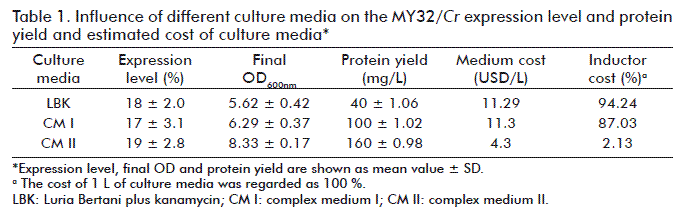
<P   align="justify" ><font size="2" face="Verdana, Arial, Helvetica, sans-serif">The identity of the      expressed MY32/<I>Cr</I> protein was demonstrated by Western blot using a      rabbit polyclonal antibody against MY32/<I>Cr </I>(<a href="#fig1">Figure      1B</a>). Cellular location studies, in fermentation and shake flask cultures,      showed that the recombinant protein is produced intracellularly as inclusion      bodies (data not shown). </font></P >       <P   align="justify" ><font size="2" face="Verdana, Arial, Helvetica, sans-serif">Culture medium composition      did not affect protein expression levels, which was comparable in all cases.      As shown in <a href="/img/revistas/bta/v31n1/t0104114.gif">table 1</a>,      for all tested media MY32/<I>Cr</I> yielded approximately 20 % of the total      cellular protein. It is advantageous that in the medium using lactose as inductor,      the expression level was comparable to the media using IPTG as inductor, which      is more expensive and can account for up to 94 % of the culture medium cost      (<a href="/img/revistas/bta/v31n1/t0104114.gif">Table 1</a>). </font></P >       
]]></body>
<body><![CDATA[<P   align="justify" ><font size="2" face="Verdana, Arial, Helvetica, sans-serif">The growth to high      densities is desirable for maximizing the yield and efficiency of producing      target proteins [7]. The OD values reached by the BL21 (DE3)-pET8a-<I>my32</I>/<I>Cr</I>      strain were different in the tested media (<a href="/img/revistas/bta/v31n1/t0104114.gif">Table      1</a>, <a href="#fig1">Figure 1C</a>). As shown, CM II (complex medium containing      glucose, glycerol and lactose which allows auto-induction) supported the highest      final OD compared to LBK or CM I media, representing a notable influence of      medium composition on final OD for the BL21(DE3) <i>E. coli</i> strain expressing      MY32/<i>Cr</i> proteinn [14]. </font></P >       
<P   align="justify" ><font size="2" face="Verdana, Arial, Helvetica, sans-serif">Similar results have      been obtained by other authors for the expression of several proteins employing      auto-induction media. It has been reported that auto-inducible cultures attain      higher cell densities when saturated, in contrast to that using IPTG as inductor,      for which final ODs are not usually higher than five initial OD units, and      attaining high final cell densities when using this type of medium [15, 16].<B>      </B>Auto-induction is based on the function of the <I>lac </I>operon regulatory      elements in mixtures of glucose, glycerol and lactose under diauxic growth      conditions [17]. During the initial growth period, glucose is preferentially      used as a carbon source and protein expression is low, due to catabolic repression      of alternative carbon utilization pathways [18, 19] and binding interactions      between <I>lac </I>repressors (LacI) and <I>lac </I>operators (<I>lacO</I>).      As glucose is depleted, catabolite repression is relieved, which leads to      a shift in cellular metabolism toward the import and consumption of lactose      and glycerol. Lactose import results in the production of allolactose from      lactose by a promiscuous reaction of &beta;-galactosidase. Allolactose then      acts as the physiological inducer of the <I>lac </I>operon. This supports      the achievement of final high culture densities when auto-induction medium      is employed, as achieved in this study, because of the advantage of the auto-induction      method providing the transition from the un-induced to the induced state under      metabolic control of the own host [7, 14]. </font></P >       <P   align="justify" ><font size="2" face="Verdana, Arial, Helvetica, sans-serif">Moreover, protein      yields were dependent on culture medium composition and induction method.      The highest was obtained with CM II medium, which was increased from that      of CM I in more than 50 % (<a href="/img/revistas/bta/v31n1/t0104114.gif">Table      1</a>) and quadrupled that obtained with LBK medium, and also in shake flask      culture. It has been reported the influence of medium composition not only      on final OD, but also on protein yields in fermentation processes [15, 20].      The highest final OD values obtained with CM II made possible to obtain the      highest biomass, and therefore, the highest yield, also considering that the      protein is produced intracellularly. This in spite of the protein expression      levels did not vary among the tested culture media. Increased yields of recombinant      protein production, in the same order as MY32/<I>Cr</I>, have been recently      reported with auto-induced medium for <I>Arenicola marina</I> globin chains      (RecB2 and B2-GST), which were expressed at a yield of up to 105 mg/L of <I>E.      coli </I>culture [21], for <I>Bacillus halodurans</I> &beta;-glucosidase expressed      in <I>E. coli </I>(468 mg/L) [22] and the green fluorescent protein (GFP),      glutathione S-transferase-tagged GFP and other proteins (250 mg/L) [23]. </font></P >       
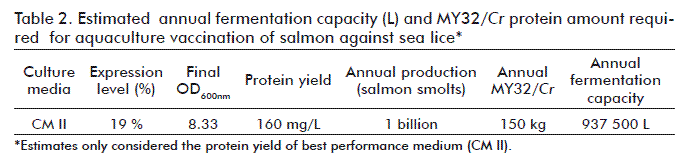
<P   align="justify" ><font size="2" face="Verdana, Arial, Helvetica, sans-serif">The results obtained      in this work showed that the use of auto-induction medium for expression provided      the best results regarding OD and yield. It has been demonstrated that the      auto-induction method has a good performance regarding cell mass recovered      and yield at 37 &deg;C for eGFP, luciferase and tobacco etch virus NIa proteinase      [15, 16], and performed better than IPTG induction method [22]. </font></P >       <P   align="justify" ><font size="2" face="Verdana, Arial, Helvetica, sans-serif">Based on results      obtained with the best performance medium in this study, and considering estimates      of the annual world smolt salmon production, a tentative amount of MY32/<I>Cr      </I>protein that should be produced annually for salmon vaccination against      sea lice in aquaculture is presented in <a href="/img/revistas/bta/v31n1/t0204114.gif">table      2</a>. According to that data, up to approximately 150 kg of MY32/<I>Cr</I>      protein are required to meet annual demands for this antigen for salmon vaccination.      </font></P >       
<P   ><font size="2" face="Verdana, Arial, Helvetica, sans-serif"><b>Characterization      of anti-MY32/<i>Cr</i> IgM immune responses in <I>O. niloticus</I> </b></font></P >       <P   align="justify" ><font size="2" face="Verdana, Arial, Helvetica, sans-serif">Antibodies in the      cutaneous mucus and skin of teleosts play a critical role in the protective      immune response against infection. Fish are the most ancient bony vertebrates      which contain immunoglobulins. However, they lack many isoforms which are      present in mammals. Several Igs has been described recently in fish. Among      them, IgM is the main Ig present in teleosts, appearing in different forms      with a structural flexibility which is thought may compensate for a lack of      diversity, shown to be functionally involved in protective immunity in fish      [24, 25]. </font></P >       <P   align="justify" ><font size="2" face="Verdana, Arial, Helvetica, sans-serif">Considering this,      the immunogenicity of the MY32/<I>Cr</I> protein, obtained in the improved      fermentation processes established in this study, was determined by studying      its ability to induce IgM immune responses in <I>O. niloticus</I>. Results      showed that the intraperitoneal administration of MY32/<I>Cr</I> protein induced      specific anti-MY32/<I>Cr</I> IgM antibodies (<a href="#fig2">Figure 2</a>).</font></P >       <P   align="center" ><img src="/img/revistas/bta/v31n1/f0204114.gif" width="413" height="515"><a name="fig2"></a></P >       
<P   align="justify" ><font size="2" face="Verdana, Arial, Helvetica, sans-serif">Several authors have      reported the significant increase of specific IgM titers after immunization      for different antigens in <I>Ictalurus punctatus</I>, <I>Salmo salar</I> and      <I>O. niloticus</I> [8, 11]. Group III, receiving a booster dose, showed IgM      antibody titers higher than those of the group receiving a single dose (group      II) and the control group (p<I> </I>&lt; 0.001) (<a href="#fig2">Figure 2</a>).      In this sense, Khushiramani <I>et al</I>. [9] showed that a booster dose of      the ompTS antigen further increased the specific antibody production in immunization      schemes, as compared to the response in animals receiving a single dose. Nevertheless,      when these authors applied three booster doses, the fish showed lower titers,      below those obtained in our work, which demonstrates that is not obvious that      a single booster dose, as we performed, has to be highly immunogenic in all      cases for this antigen. Furthermore, after 28 days, when several booster doses      had been injected, IgM titers did not reach those attained by our team. </font></P >       ]]></body>
<body><![CDATA[<P   align="justify" ><font size="2" face="Verdana, Arial, Helvetica, sans-serif">Moreover, in that      study, no challenge experiment was reported supporting any correlation of      booster application or antibody responses with challenge results. In our case,      previous vaccination challenge trials performed in salmon with this recombinant      protein using a single booster demonstrated to be successful (57 % of inhibition      of sea lice infestation) [3]. Nevertheless, further immunological experiments      in salmon are needed to corroborate this outcome. In fish, vaccines are normally      administered early in the production cycle and, under ideal conditions, can      provide protection throughout the growing cycle. </font></P >       <P   align="justify" ><font size="2" face="Verdana, Arial, Helvetica, sans-serif">Revaccination strategies      are also possible in marine finfish culture, and may provide a valuable method      for reducing disease risk in long-lived, batch-spawning animals [26]. Re-vaccination      is not a common practice for aquaculture vaccines for practical and economic      reasons, but it is necessary when the primary immune response is weak and      there is a high probability of re-infected fish. Also when the levels of immunity      have decreased and the fish are environmentally challenged, such as during      the seawater phase of salmon culture. </font></P >       <P   align="justify" ><font size="2" face="Verdana, Arial, Helvetica, sans-serif">Noteworthy, there      could be the possibility to provide a vaccine formulation able to increase      IgM titers with a single re-immunization, as part of a set of factors to face      sea lice infestations in the fish seawater growth phase. The results obtained      in this work suggest that the increase of specific IgM titers when administering      the MY32/<I>Cr</I> protein with a single booster could cooperate with fish      protection against sea lice, but further experiments in salmon are needed      to corroborate this outcome. </font></P >       <P   align="justify" ><font size="2" face="Verdana, Arial, Helvetica, sans-serif">In summary, the expression      level of MY32/<I>Cr</I> was not affected when it was expressed in different      culture media, while using the CM II medium increased MY32/<I>Cr</I> yields      up to four-fold those obtained in LBK medium in fermentation. One hundred      and fifty kilograms was the estimated volume production of MY32/<I>Cr </I>protein      to meet the annual demands for salmon vaccination. And the recombinant MY32/<I>Cr</I>      obtained under the best performance fermentation conditions was highly immunogenic      and induced IgM antibodies titers almost four-fold higher when administered      twice (booster dose) than the single dose vaccination. </font></P >       <P   >&nbsp;</P >   <FONT size="+1"><B>        <P   ><font size="3" face="Verdana, Arial, Helvetica, sans-serif">ACKNOWLEDGEMENTS      </font></P >   </B>        <P   align="justify" ><font size="2" face="Verdana, Arial, Helvetica, sans-serif">We would like to      thank Raudel Sosa, Regla Margarita Somoza and Joana Gonz&aacute;lez for their      useful and kind collaboration. This work was supported by a Research Project      from Center for Genetic Engineering and Biotechnology. </font></P >       <P   align="justify" >&nbsp;</P >   <FONT size="+1">        <P   align="justify" > </P >       <P   align="justify" > </P >       ]]></body>
<body><![CDATA[<P   align="justify" ><font size="3"><b><font face="Verdana, Arial, Helvetica, sans-serif">REFERENCES      </font></b></font></P >       <!-- ref --><P   align="justify" ><font size="2" face="Verdana, Arial, Helvetica, sans-serif">1. Costello MJ. The      global economic cost of sea lice to the salmonid farming industry. J Fish      Dis. 2009;32(1):115-8.     </font></P >   <FONT size="+1">        <!-- ref --><P   align="justify" ><font size="2" face="Verdana, Arial, Helvetica, sans-serif">2. Goto A, Matsushita      K, Gesellchen V, El Chamy L, Kuttenkeuler D, Takeuchi O, <I>et al</I>. Akirins      are highly conserved nuclear proteins required for NF-kB dependent gene expression      in drosophila and mice. Nat Immunol. 2008;9(1):97-104.     </font></P >       <!-- ref --><P   align="justify" ><font size="2" face="Verdana, Arial, Helvetica, sans-serif">3. Carpio Y, Basabe      L, Acosta J, Rodr&iacute;guez A, Mendoza A, Lispergerb A, <I>et al</I>. Novel      gene isolated from <I>Caligus rogercresseyi</I>: A promising target for vaccine      development against sea lice. Vaccine. 2011;29(15): 2810-20.     </font></P >       <!-- ref --><P   align="justify" ><font size="2" face="Verdana, Arial, Helvetica, sans-serif">4. Manzano-Rom&aacute;n      R, D&iacute;az-Mart&iacute;n V, Oleaga A, Siles-Lucas M, P&eacute;rez-S&aacute;nchez      R. Subolesin/akirin orthologs from <I>Ornithodoros</I> spp. soft ticks: cloning,      RNAi gene silencing and protective effect of the recombinant proteins. Vet      Parasitol. 2012;185(2-4):248-59.     </font></P >       <!-- ref --><P   align="justify" ><font size="2" face="Verdana, Arial, Helvetica, sans-serif">5. Volont&egrave;      F, Piubelli L, Pollegioni L. Optimizing HIV-1 protease production in <I>Escherichia      coli</I> as fusion protein. Microb Cell Fact. 2011;10:53.     </font></P >       <!-- ref --><P   align="justify" ><font size="2" face="Verdana, Arial, Helvetica, sans-serif">6. Hortsch R, Weuster-Botz      D. Growth and recombinant protein expression with <I>Escherichia coli</I>      in different batch cultivation media. Appl Microbiol Biotechnol. 2011;90(1):69-76.          </font></P >       <!-- ref --><P   align="justify" ><font size="2" face="Verdana, Arial, Helvetica, sans-serif">7. Studier FW. Protein      production by auto-induction in high-density shaking cultures. Prot Expr Purif.      2005;41(1):207-34.     </font></P >       <!-- ref --><P   align="justify" ><font size="2" face="Verdana, Arial, Helvetica, sans-serif">8. Wilhelm V, Soza      C, Mart&iacute;nez R, Rosemblatt M, Burzio LO, Valenzuela PD. Production and      immune response of recombinant Hsp60 and Hsp70 from the salmon pathogen <I>Piscirickettsia      salmonis</I>. Biol Res. 2005;38:69-82.     </font></P >       <P   align="justify" ><font size="2" face="Verdana, Arial, Helvetica, sans-serif">9. Khushiramani R,      Girisha SK, Karunasagar I. Cloning and expression of an outer membrane protein      ompTS of <I>Aeromonas hydrophila</I> and study of immunogenicity in fish.      Protein Exp Purif. 2007;51(2):303-7. </font></P >       <!-- ref --><P   align="justify" ><font size="2" face="Verdana, Arial, Helvetica, sans-serif">10. Wang X, Dickerson      HW. Surface immobilization antigen of the parasitic ciliate <I>Ichthyophthirius      multifiliis</I> elicits protective immunity in channel catfish (<I>Ictalurus      punctatus</I>). Clin Diagnos Lab Immunol. 2002;9(1):176-81.     </font></P >       ]]></body>
<body><![CDATA[<!-- ref --><P   align="justify" ><font size="2" face="Verdana, Arial, Helvetica, sans-serif">11. Xu DH, Klesius      PH, Shoemaker CA. Protective immunity of Nile tilapia against <I>Ichthyophthirius      multifiliis</I> post-immunization with live theronts and sonicated trophonts.      Fish Shellfish Immunol. 2008;25(1-2):124-7.     </font></P >       <!-- ref --><P   align="justify" ><font size="2" face="Verdana, Arial, Helvetica, sans-serif">12. Chuang WL, Sun      B. Anti-stress effects of <i>Glycine tomentella</i> Hayata in tilapia: Inhibiting      COX-2 expression and enhancing EPA synthesis in erythrocyte membrane and fish      growth. Agric Food Chem. 2011;59(17):9532-41.     </font></P >       <P   align="justify" ><font size="2" face="Verdana, Arial, Helvetica, sans-serif">13. Ochoa<B> </B>RF.      Guide for immunoenzimatic technique standarization for vaccine trials. In:      Ochoa RF. Methodological bases for antibody evaluation in vaccine clinical      trials by immunoenzimatic techniques. 2nd Ed. La Habana: Finlay Ediciones;      2008. p. 31-45. </font></P >       <!-- ref --><P   align="justify" ><font size="2" face="Verdana, Arial, Helvetica, sans-serif">14. Sreenath HK,      Bingman CA, Buchan BW <I>et al</I>. Protocols for production of selenomethionine-labeled      proteins in 2-L polyethylene terephthalate bottles using auto-induction medium.      Protein Exp Purif. 2005;40(2):256-67.     </font></P >       <!-- ref --><P   align="justify" ><font size="2" face="Verdana, Arial, Helvetica, sans-serif">15. Blommel PG, Becker      KJ, Duvnjak P, Fox BG. Enhanced bacterial protein expression during auto-induction      obtained by alteration of Lac repressor dosage and medium composition. Biotechnol      Prog. 2007;23(3):585-98.     </font></P >       <!-- ref --><P   align="justify" ><font size="2" face="Verdana, Arial, Helvetica, sans-serif">16. Blommel PG, Fox      BG. A combined approach to improving large-scale production of tobacco etch      virus protease. Protein Exp Purif. 2007;55(1):53-68.     </font></P >       <!-- ref --><P   align="justify" ><font size="2" face="Verdana, Arial, Helvetica, sans-serif">17. Jacob F, Monod      J. Genetic regulatory mechanisms in the synthesis of proteins. J Mol Biol.      1961;3:318-56.     </font></P >       <!-- ref --><P   align="justify" ><font size="2" face="Verdana, Arial, Helvetica, sans-serif">18. Inada T, Kimata      K, Aiba H. Mechanism responsible for glucose-lactose diauxie in <I>Escherichia      coli</I>: challenge to the cAMP model. Genes Cells. 1996;1(3):293-301.     </font></P >       <!-- ref --><P   align="justify" ><font size="2" face="Verdana, Arial, Helvetica, sans-serif">19. Hogema BM, Arents      JC, Bader R, Postma PW. Autoregulation of Lactose uptake through the lacY      permease by enzyme IIAGlc of the PTS in <I>Escherichia coli</I> K-12. Mol      Microbiol. 1999;31(6):1825-33.     </font></P >       <!-- ref --><P   align="justify" ><font size="2" face="Verdana, Arial, Helvetica, sans-serif">20. Berger C, Montag      C, Berndt S, Huster D. Optimization of <I>Escherichia coli</I> cultivation      methods for high yield neuropeptide Y receptor type 2 production. Protein      Expr Purif. 2011;76(1):25-35.     </font></P >       <!-- ref --><P   align="justify" ><font size="2" face="Verdana, Arial, Helvetica, sans-serif">21. Harnois T, Rousselot      M, Rogniaux H, Zal F. High-level Production of recombinant <I>Arenicola marina</I>      globin chains in <I>Escherichia coli</I>: A new generation of blood substitute.      Artif Cells Blood Substit Immobil Biotechnol. 2009; 37(3):106-16.     </font></P >       <!-- ref --><P   align="justify" ><font size="2" face="Verdana, Arial, Helvetica, sans-serif">22. Naz S, Ikram      N, Rajoka MI, Sadaf S, Akhtar MW. Enhanced production and characterization      of a beta-glucosidase from <I>Bacillus halodurans </I>expressed in <I>Escherichia      coli</I>. Biochemistry (Mosc). 2010;75(4):513-25.     </font></P >       <!-- ref --><P   align="justify" ><font size="2" face="Verdana, Arial, Helvetica, sans-serif">23. Li Z, Kessler      W, van den Heuvel J, Rinas U. Simple defined autoinduction medium for high-level      recombinant protein production using T7-based <I>Escherichia coli</I> expression      systems. Appl Microbiol Biotechnol. 2011;91(4):1203-13.     </font></P >       <P   align="justify" ><font size="2" face="Verdana, Arial, Helvetica, sans-serif">24. Solem ST, Stenvik      J. Antibody repertoire development in teleosts&ndash;a review with emphasis      on salmonids and <I>Gadus morhua</I> L. Dev Comp Immunol. 2006;30(1-2):57-76.      </font></P >       <!-- ref --><P   align="justify" ><font size="2" face="Verdana, Arial, Helvetica, sans-serif">25. Zapata A, Amemiya      CT. Phylogeny of lower vertebrates and their immunological structures. Curr      Top Microbiol Immunol. 2000; 248:67-107.     </font></P >       <!-- ref --><P   align="justify" ><font size="2" face="Verdana, Arial, Helvetica, sans-serif">26. Bricknell IR,      Bron JE, Bowden TJ. Diseases of gadoid fish in cultivation: a review. J Mar      Sci. 2006;63(2):253-66.     </font></P >   <FONT size="+1">        ]]></body>
<body><![CDATA[<P   align="justify" > </P >       <P   align="justify" > </P >       <P   align="justify" >&nbsp;</P >       <P   align="justify" >&nbsp;</P >       <P   align="justify" ><font size="2" face="Verdana, Arial, Helvetica, sans-serif">Received in March,      2013.    <br>     </font><font size="2" face="Verdana, Arial, Helvetica, sans-serif">Accepted      in June, 2013. </font></P >       <P   align="justify" >&nbsp;</P >       <P   align="justify" >&nbsp;</P >       <P   align="justify" > </P >       <P   > </P >       ]]></body>
<body><![CDATA[<P   ><font size="2" face="Verdana, Arial, Helvetica, sans-serif"><i>Mario P Estrada</i>.      </font><font size="+1" color="#000000"><font size="2" face="Verdana, Arial, Helvetica, sans-serif">Departamento      de Biotecnolog&iacute;a Animal, Direcci&oacute;n de Investigaciones Agropecuarias,      Centro de Ingenier&iacute;a Gen&eacute;tica y Biotecnolog&iacute;a, CIGB</font></font><font size="2" face="Verdana, Arial, Helvetica, sans-serif">.      Ave. 31 e/ 158 y 190, Cubanac&aacute;n, Playa, CP 11600, La Habana, Cuba.      E-mail: <A href="mailto:mario.pablo@cigb.edu.cu"> <U><U><FONT color="#0000FF">mario.pablo@cigb.edu.cu</font></U></U></A><FONT color="#0000FF"><FONT color="#000000">.      </font></font></font></P >   </font></font></font></font></font></font></font></font></font></font></font></font></font></font></font></font></font></font></font></font></font></font></font></font></font></font></font></font></font></font></font></font></font></font></font></font></font></font></font></font></font></font></font></font></font></font></font></font></font></font></font></font></font></font></font></font></font></font></font></font></font></font></font></font></font></font></font></font></font></font></font></font></font></font></font></font></font></font></font></font></font></font></DIV >      ]]></body><back>
<ref-list>
<ref id="B1">
<label>1</label><nlm-citation citation-type="journal">
<person-group person-group-type="author">
<name>
<surname><![CDATA[Costello]]></surname>
<given-names><![CDATA[MJ]]></given-names>
</name>
</person-group>
<article-title xml:lang="en"><![CDATA[The global economic cost of sea lice to the salmonid farming industry]]></article-title>
<source><![CDATA[J Fish Dis]]></source>
<year>2009</year>
<volume>32</volume>
<numero>1</numero>
<issue>1</issue>
<page-range>115-8</page-range></nlm-citation>
</ref>
<ref id="B2">
<label>2</label><nlm-citation citation-type="journal">
<person-group person-group-type="author">
<name>
<surname><![CDATA[Goto]]></surname>
<given-names><![CDATA[A]]></given-names>
</name>
<name>
<surname><![CDATA[Matsushita]]></surname>
<given-names><![CDATA[K]]></given-names>
</name>
<name>
<surname><![CDATA[Gesellchen]]></surname>
<given-names><![CDATA[V]]></given-names>
</name>
<name>
<surname><![CDATA[El Chamy]]></surname>
<given-names><![CDATA[L]]></given-names>
</name>
<name>
<surname><![CDATA[Kuttenkeuler]]></surname>
<given-names><![CDATA[D]]></given-names>
</name>
<name>
<surname><![CDATA[Takeuchi]]></surname>
<given-names><![CDATA[O]]></given-names>
</name>
</person-group>
<article-title xml:lang="en"><![CDATA[Akirins are highly conserved nuclear proteins required for NF-kB dependent gene expression in drosophila and mice]]></article-title>
<source><![CDATA[Nat Immunol]]></source>
<year>2008</year>
<volume>9</volume>
<numero>1</numero>
<issue>1</issue>
<page-range>97-104</page-range></nlm-citation>
</ref>
<ref id="B3">
<label>3</label><nlm-citation citation-type="journal">
<person-group person-group-type="author">
<name>
<surname><![CDATA[Carpio]]></surname>
<given-names><![CDATA[Y]]></given-names>
</name>
<name>
<surname><![CDATA[Basabe]]></surname>
<given-names><![CDATA[L]]></given-names>
</name>
<name>
<surname><![CDATA[Acosta]]></surname>
<given-names><![CDATA[J]]></given-names>
</name>
<name>
<surname><![CDATA[Rodríguez]]></surname>
<given-names><![CDATA[A]]></given-names>
</name>
<name>
<surname><![CDATA[Mendoza]]></surname>
<given-names><![CDATA[A]]></given-names>
</name>
<name>
<surname><![CDATA[Lispergerb]]></surname>
<given-names><![CDATA[A]]></given-names>
</name>
</person-group>
<article-title xml:lang="en"><![CDATA[Novel gene isolated from Caligus rogercresseyi: A promising target for vaccine development against sea lice]]></article-title>
<source><![CDATA[Vaccine]]></source>
<year>2011</year>
<volume>29</volume>
<numero>15</numero>
<issue>15</issue>
<page-range>2810-20</page-range></nlm-citation>
</ref>
<ref id="B4">
<label>4</label><nlm-citation citation-type="journal">
<person-group person-group-type="author">
<name>
<surname><![CDATA[Manzano-Román]]></surname>
<given-names><![CDATA[R]]></given-names>
</name>
<name>
<surname><![CDATA[Díaz-Martín]]></surname>
<given-names><![CDATA[V]]></given-names>
</name>
<name>
<surname><![CDATA[Oleaga]]></surname>
<given-names><![CDATA[A]]></given-names>
</name>
<name>
<surname><![CDATA[Siles-Lucas]]></surname>
<given-names><![CDATA[M]]></given-names>
</name>
<name>
<surname><![CDATA[Pérez-Sánchez]]></surname>
<given-names><![CDATA[R]]></given-names>
</name>
</person-group>
<article-title xml:lang="en"><![CDATA[Subolesin/akirin orthologs from Ornithodoros spp. soft ticks: cloning, RNAi gene silencing and protective effect of the recombinant proteins]]></article-title>
<source><![CDATA[Vet Parasitol]]></source>
<year>2012</year>
<volume>185</volume>
<numero>2-4</numero>
<issue>2-4</issue>
<page-range>248-59</page-range></nlm-citation>
</ref>
<ref id="B5">
<label>5</label><nlm-citation citation-type="journal">
<person-group person-group-type="author">
<name>
<surname><![CDATA[Volontè]]></surname>
<given-names><![CDATA[F]]></given-names>
</name>
<name>
<surname><![CDATA[Piubelli]]></surname>
<given-names><![CDATA[L]]></given-names>
</name>
<name>
<surname><![CDATA[Pollegioni]]></surname>
<given-names><![CDATA[L]]></given-names>
</name>
</person-group>
<article-title xml:lang="en"><![CDATA[Optimizing HIV-1 protease production in Escherichia coli as fusion protein]]></article-title>
<source><![CDATA[Microb Cell Fact]]></source>
<year>2011</year>
<volume>10</volume>
<page-range>53</page-range></nlm-citation>
</ref>
<ref id="B6">
<label>6</label><nlm-citation citation-type="journal">
<person-group person-group-type="author">
<name>
<surname><![CDATA[Hortsch]]></surname>
<given-names><![CDATA[R]]></given-names>
</name>
<name>
<surname><![CDATA[Weuster-Botz]]></surname>
<given-names><![CDATA[D]]></given-names>
</name>
</person-group>
<article-title xml:lang="en"><![CDATA[Growth and recombinant protein expression with Escherichia coli in different batch cultivation media]]></article-title>
<source><![CDATA[Appl Microbiol Biotechnol]]></source>
<year>2011</year>
<volume>90</volume>
<numero>1</numero>
<issue>1</issue>
<page-range>69-76</page-range></nlm-citation>
</ref>
<ref id="B7">
<label>7</label><nlm-citation citation-type="journal">
<person-group person-group-type="author">
<name>
<surname><![CDATA[Studier]]></surname>
<given-names><![CDATA[FW]]></given-names>
</name>
</person-group>
<article-title xml:lang="en"><![CDATA[Protein production by auto-induction in high-density shaking cultures]]></article-title>
<source><![CDATA[Prot Expr Purif]]></source>
<year>2005</year>
<volume>41</volume>
<numero>1</numero>
<issue>1</issue>
<page-range>207-34</page-range></nlm-citation>
</ref>
<ref id="B8">
<label>8</label><nlm-citation citation-type="journal">
<person-group person-group-type="author">
<name>
<surname><![CDATA[Wilhelm]]></surname>
<given-names><![CDATA[V]]></given-names>
</name>
<name>
<surname><![CDATA[Soza]]></surname>
<given-names><![CDATA[C]]></given-names>
</name>
<name>
<surname><![CDATA[Martínez]]></surname>
<given-names><![CDATA[R]]></given-names>
</name>
<name>
<surname><![CDATA[Rosemblatt]]></surname>
<given-names><![CDATA[M]]></given-names>
</name>
<name>
<surname><![CDATA[Burzio]]></surname>
<given-names><![CDATA[LO]]></given-names>
</name>
<name>
<surname><![CDATA[Valenzuela]]></surname>
<given-names><![CDATA[PD]]></given-names>
</name>
</person-group>
<article-title xml:lang="en"><![CDATA[Production and immune response of recombinant Hsp60 and Hsp70 from the salmon pathogen Piscirickettsia salmonis]]></article-title>
<source><![CDATA[Biol Res]]></source>
<year>2005</year>
<volume>38</volume>
<page-range>69-82</page-range></nlm-citation>
</ref>
<ref id="B9">
<label>9</label><nlm-citation citation-type="journal">
<person-group person-group-type="author">
<name>
<surname><![CDATA[Khushiramani]]></surname>
<given-names><![CDATA[R]]></given-names>
</name>
<name>
<surname><![CDATA[Girisha]]></surname>
<given-names><![CDATA[SK]]></given-names>
</name>
<name>
<surname><![CDATA[Karunasagar]]></surname>
<given-names><![CDATA[I]]></given-names>
</name>
<name>
<surname><![CDATA[Karunasagar]]></surname>
<given-names><![CDATA[I]]></given-names>
</name>
</person-group>
<article-title xml:lang="en"><![CDATA[Cloning and expression of an outer membrane protein ompTS of Aeromonas hydrophila and study of immunogenicity in fish]]></article-title>
<source><![CDATA[Protein Exp Purif]]></source>
<year>2007</year>
<volume>51</volume>
<numero>2</numero>
<issue>2</issue>
<page-range>303-7</page-range></nlm-citation>
</ref>
<ref id="B10">
<label>10</label><nlm-citation citation-type="journal">
<person-group person-group-type="author">
<name>
<surname><![CDATA[Wang]]></surname>
<given-names><![CDATA[X]]></given-names>
</name>
<name>
<surname><![CDATA[Dickerson]]></surname>
<given-names><![CDATA[HW]]></given-names>
</name>
</person-group>
<article-title xml:lang="en"><![CDATA[Surface immobilization antigen of the parasitic ciliate Ichthyophthirius multifiliis elicits protective immunity in channel catfish (Ictalurus punctatus)]]></article-title>
<source><![CDATA[Clin Diagnos Lab Immunol]]></source>
<year>2002</year>
<volume>9</volume>
<numero>1</numero>
<issue>1</issue>
<page-range>176-81</page-range></nlm-citation>
</ref>
<ref id="B11">
<label>11</label><nlm-citation citation-type="journal">
<person-group person-group-type="author">
<name>
<surname><![CDATA[Xu]]></surname>
<given-names><![CDATA[DH]]></given-names>
</name>
<name>
<surname><![CDATA[Klesius]]></surname>
<given-names><![CDATA[PH]]></given-names>
</name>
<name>
<surname><![CDATA[Shoemaker]]></surname>
<given-names><![CDATA[CA]]></given-names>
</name>
</person-group>
<article-title xml:lang="en"><![CDATA[Protective immunity of Nile tilapia against Ichthyophthirius multifiliis post-immunization with live theronts and sonicated trophonts]]></article-title>
<source><![CDATA[Fish Shellfish Immunol]]></source>
<year>2008</year>
<volume>25</volume>
<numero>1-2</numero>
<issue>1-2</issue>
<page-range>124-7</page-range></nlm-citation>
</ref>
<ref id="B12">
<label>12</label><nlm-citation citation-type="journal">
<person-group person-group-type="author">
<name>
<surname><![CDATA[Chuang]]></surname>
<given-names><![CDATA[WLSun B]]></given-names>
</name>
</person-group>
<article-title xml:lang="en"><![CDATA[Anti-stress effects of Glycine tomentella Hayata in tilapia: Inhibiting COX-2 expression and enhancing EPA synthesis in erythrocyte membrane and fish growth]]></article-title>
<source><![CDATA[Agric Food Chem]]></source>
<year>2011</year>
<volume>59</volume>
<numero>17</numero>
<issue>17</issue>
<page-range>9532-41</page-range></nlm-citation>
</ref>
<ref id="B13">
<label>13</label><nlm-citation citation-type="book">
<person-group person-group-type="author">
<name>
<surname><![CDATA[Ochoa]]></surname>
<given-names><![CDATA[RF]]></given-names>
</name>
</person-group>
<article-title xml:lang="en"><![CDATA[Guide for immunoenzimatic technique standarization for vaccine trials]]></article-title>
<person-group person-group-type="editor">
<name>
<surname><![CDATA[Ochoa]]></surname>
<given-names><![CDATA[RF]]></given-names>
</name>
</person-group>
<source><![CDATA[Methodological bases for antibody evaluation in vaccine clinical trials by immunoenzimatic techniques]]></source>
<year>2008</year>
<edition>2</edition>
<page-range>31-45</page-range><publisher-loc><![CDATA[La Habana ]]></publisher-loc>
<publisher-name><![CDATA[Finlay Ediciones]]></publisher-name>
</nlm-citation>
</ref>
<ref id="B14">
<label>14</label><nlm-citation citation-type="journal">
<person-group person-group-type="author">
<name>
<surname><![CDATA[Sreenath]]></surname>
<given-names><![CDATA[HK]]></given-names>
</name>
<name>
<surname><![CDATA[Bingman]]></surname>
<given-names><![CDATA[CA]]></given-names>
</name>
<name>
<surname><![CDATA[Buchan]]></surname>
<given-names><![CDATA[BW]]></given-names>
</name>
</person-group>
<article-title xml:lang="en"><![CDATA[Protocols for production of selenomethionine-labeled proteins in 2-L polyethylene terephthalate bottles using auto-induction medium]]></article-title>
<source><![CDATA[Protein Exp Purif]]></source>
<year>2005</year>
<volume>40</volume>
<numero>2</numero>
<issue>2</issue>
<page-range>256-67</page-range></nlm-citation>
</ref>
<ref id="B15">
<label>15</label><nlm-citation citation-type="journal">
<person-group person-group-type="author">
<name>
<surname><![CDATA[Blommel]]></surname>
<given-names><![CDATA[PG]]></given-names>
</name>
<name>
<surname><![CDATA[Becker]]></surname>
<given-names><![CDATA[KJ]]></given-names>
</name>
<name>
<surname><![CDATA[Duvnjak]]></surname>
<given-names><![CDATA[P]]></given-names>
</name>
<name>
<surname><![CDATA[Fox]]></surname>
<given-names><![CDATA[BG]]></given-names>
</name>
</person-group>
<article-title xml:lang="en"><![CDATA[Enhanced bacterial protein expression during auto-induction obtained by alteration of Lac repressor dosage and medium composition]]></article-title>
<source><![CDATA[Biotechnol Prog]]></source>
<year>2007</year>
<volume>23</volume>
<numero>3</numero>
<issue>3</issue>
<page-range>585-98</page-range></nlm-citation>
</ref>
<ref id="B16">
<label>16</label><nlm-citation citation-type="journal">
<person-group person-group-type="author">
<name>
<surname><![CDATA[Blommel]]></surname>
<given-names><![CDATA[PG]]></given-names>
</name>
<name>
<surname><![CDATA[Fox]]></surname>
<given-names><![CDATA[BG]]></given-names>
</name>
</person-group>
<article-title xml:lang="en"><![CDATA[A combined approach to improving large-scale production of tobacco etch virus protease]]></article-title>
<source><![CDATA[Protein Exp Purif]]></source>
<year>2007</year>
<volume>55</volume>
<numero>1</numero>
<issue>1</issue>
<page-range>53-68</page-range></nlm-citation>
</ref>
<ref id="B17">
<label>17</label><nlm-citation citation-type="journal">
<person-group person-group-type="author">
<name>
<surname><![CDATA[Jacob]]></surname>
<given-names><![CDATA[F]]></given-names>
</name>
<name>
<surname><![CDATA[Monod]]></surname>
<given-names><![CDATA[J]]></given-names>
</name>
</person-group>
<article-title xml:lang="en"><![CDATA[Genetic regulatory mechanisms in the synthesis of proteins]]></article-title>
<source><![CDATA[J Mol Biol]]></source>
<year>1961</year>
<volume>3</volume>
<page-range>318-56</page-range></nlm-citation>
</ref>
<ref id="B18">
<label>18</label><nlm-citation citation-type="journal">
<person-group person-group-type="author">
<name>
<surname><![CDATA[Inada]]></surname>
<given-names><![CDATA[T]]></given-names>
</name>
<name>
<surname><![CDATA[Kimata]]></surname>
<given-names><![CDATA[K]]></given-names>
</name>
<name>
<surname><![CDATA[Aiba]]></surname>
<given-names><![CDATA[H]]></given-names>
</name>
</person-group>
<article-title xml:lang="en"><![CDATA[Mechanism responsible for glucose-lactose diauxie in Escherichia coli: challenge to the cAMP model]]></article-title>
<source><![CDATA[Genes Cells]]></source>
<year>1996</year>
<volume>1</volume>
<numero>3</numero>
<issue>3</issue>
<page-range>293-301</page-range></nlm-citation>
</ref>
<ref id="B19">
<label>19</label><nlm-citation citation-type="journal">
<person-group person-group-type="author">
<name>
<surname><![CDATA[Hogema]]></surname>
<given-names><![CDATA[BM]]></given-names>
</name>
<name>
<surname><![CDATA[Arents]]></surname>
<given-names><![CDATA[JC]]></given-names>
</name>
<name>
<surname><![CDATA[Bader]]></surname>
<given-names><![CDATA[R]]></given-names>
</name>
<name>
<surname><![CDATA[Postma]]></surname>
<given-names><![CDATA[PW]]></given-names>
</name>
</person-group>
<article-title xml:lang="en"><![CDATA[Autoregulation of Lactose uptake through the lacY permease by enzyme IIAGlc of the PTS in Escherichia coli K-12]]></article-title>
<source><![CDATA[Mol Microbiol]]></source>
<year>1999</year>
<volume>31</volume>
<numero>6</numero>
<issue>6</issue>
<page-range>1825-33</page-range></nlm-citation>
</ref>
<ref id="B20">
<label>20</label><nlm-citation citation-type="journal">
<person-group person-group-type="author">
<name>
<surname><![CDATA[Berger]]></surname>
<given-names><![CDATA[C]]></given-names>
</name>
<name>
<surname><![CDATA[Montag]]></surname>
<given-names><![CDATA[C]]></given-names>
</name>
<name>
<surname><![CDATA[Berndt]]></surname>
<given-names><![CDATA[S]]></given-names>
</name>
<name>
<surname><![CDATA[Huster]]></surname>
<given-names><![CDATA[D]]></given-names>
</name>
</person-group>
<article-title xml:lang="en"><![CDATA[Optimization of Escherichia coli cultivation methods for high yield neuropeptide Y receptor type 2 production]]></article-title>
<source><![CDATA[Protein Expr Purif]]></source>
<year>2011</year>
<volume>76</volume>
<numero>1</numero>
<issue>1</issue>
<page-range>25-35</page-range></nlm-citation>
</ref>
<ref id="B21">
<label>21</label><nlm-citation citation-type="journal">
<person-group person-group-type="author">
<name>
<surname><![CDATA[Harnois]]></surname>
<given-names><![CDATA[T]]></given-names>
</name>
<name>
<surname><![CDATA[Rousselot]]></surname>
<given-names><![CDATA[M]]></given-names>
</name>
<name>
<surname><![CDATA[Rogniaux]]></surname>
<given-names><![CDATA[H]]></given-names>
</name>
<name>
<surname><![CDATA[Zal]]></surname>
<given-names><![CDATA[F]]></given-names>
</name>
</person-group>
<article-title xml:lang="en"><![CDATA[High-level Production of recombinant Arenicola marina globin chains in Escherichia coli: A new generation of blood substitute]]></article-title>
<source><![CDATA[Artif Cells Blood Substit Immobil Biotechnol]]></source>
<year>2009</year>
<volume>37</volume>
<numero>3</numero>
<issue>3</issue>
<page-range>106-16</page-range></nlm-citation>
</ref>
<ref id="B22">
<label>22</label><nlm-citation citation-type="journal">
<person-group person-group-type="author">
<name>
<surname><![CDATA[Naz]]></surname>
<given-names><![CDATA[S]]></given-names>
</name>
<name>
<surname><![CDATA[Ikram]]></surname>
<given-names><![CDATA[N]]></given-names>
</name>
<name>
<surname><![CDATA[Rajoka]]></surname>
<given-names><![CDATA[MI]]></given-names>
</name>
<name>
<surname><![CDATA[Sadaf]]></surname>
<given-names><![CDATA[S]]></given-names>
</name>
<name>
<surname><![CDATA[Akhtar]]></surname>
<given-names><![CDATA[MW]]></given-names>
</name>
</person-group>
<article-title xml:lang="en"><![CDATA[Enhanced production and characterization of a beta-glucosidase from Bacillus halodurans expressed in Escherichia coli]]></article-title>
<source><![CDATA[Biochemistry (Mosc)]]></source>
<year>2010</year>
<volume>75</volume>
<numero>4</numero>
<issue>4</issue>
<page-range>513-25</page-range></nlm-citation>
</ref>
<ref id="B23">
<label>23</label><nlm-citation citation-type="journal">
<person-group person-group-type="author">
<name>
<surname><![CDATA[Li]]></surname>
<given-names><![CDATA[Z]]></given-names>
</name>
<name>
<surname><![CDATA[Kessler]]></surname>
<given-names><![CDATA[W]]></given-names>
</name>
<name>
<surname><![CDATA[van den Heuvel]]></surname>
<given-names><![CDATA[J]]></given-names>
</name>
<name>
<surname><![CDATA[Rinas]]></surname>
<given-names><![CDATA[U]]></given-names>
</name>
</person-group>
<article-title xml:lang="en"><![CDATA[Simple defined autoinduction medium for high-level recombinant protein production using T7-based Escherichia coli expression systems]]></article-title>
<source><![CDATA[Appl Microbiol Biotechnol]]></source>
<year>2011</year>
<volume>91</volume>
<numero>4</numero>
<issue>4</issue>
<page-range>1203-13</page-range></nlm-citation>
</ref>
<ref id="B24">
<label>24</label><nlm-citation citation-type="journal">
<person-group person-group-type="author">
<name>
<surname><![CDATA[Solem]]></surname>
<given-names><![CDATA[ST]]></given-names>
</name>
<name>
<surname><![CDATA[Stenvik]]></surname>
<given-names><![CDATA[J]]></given-names>
</name>
</person-group>
<article-title xml:lang="en"><![CDATA[Antibody repertoire development in teleosts-a review with emphasis on salmonids and Gadus morhua L]]></article-title>
<source><![CDATA[Dev Comp Immunol]]></source>
<year>2006</year>
<volume>30</volume>
<numero>1-2</numero>
<issue>1-2</issue>
<page-range>57-76</page-range></nlm-citation>
</ref>
<ref id="B25">
<label>25</label><nlm-citation citation-type="journal">
<person-group person-group-type="author">
<name>
<surname><![CDATA[Zapata]]></surname>
<given-names><![CDATA[A]]></given-names>
</name>
<name>
<surname><![CDATA[Amemiya]]></surname>
<given-names><![CDATA[CT]]></given-names>
</name>
</person-group>
<article-title xml:lang="en"><![CDATA[Phylogeny of lower vertebrates and their immunological structures]]></article-title>
<source><![CDATA[Curr Top Microbiol Immunol]]></source>
<year>2000</year>
<volume>248</volume>
<page-range>67-107</page-range></nlm-citation>
</ref>
<ref id="B26">
<label>26</label><nlm-citation citation-type="journal">
<person-group person-group-type="author">
<name>
<surname><![CDATA[Bricknell]]></surname>
<given-names><![CDATA[IR]]></given-names>
</name>
<name>
<surname><![CDATA[Bron]]></surname>
<given-names><![CDATA[JE]]></given-names>
</name>
<name>
<surname><![CDATA[Bowden]]></surname>
<given-names><![CDATA[TJ]]></given-names>
</name>
</person-group>
<article-title xml:lang="en"><![CDATA[Diseases of gadoid fish in cultivation: a review]]></article-title>
<source><![CDATA[J Mar Sci]]></source>
<year>2006</year>
<volume>63</volume>
<numero>2</numero>
<issue>2</issue>
<page-range>253-66</page-range></nlm-citation>
</ref>
</ref-list>
</back>
</article>