<?xml version="1.0" encoding="ISO-8859-1"?><article xmlns:mml="http://www.w3.org/1998/Math/MathML" xmlns:xlink="http://www.w3.org/1999/xlink" xmlns:xsi="http://www.w3.org/2001/XMLSchema-instance">
<front>
<journal-meta>
<journal-id>1027-2852</journal-id>
<journal-title><![CDATA[Biotecnología Aplicada]]></journal-title>
<abbrev-journal-title><![CDATA[Biotecnol Apl]]></abbrev-journal-title>
<issn>1027-2852</issn>
<publisher>
<publisher-name><![CDATA[Editorial Elfos Scientiae]]></publisher-name>
</publisher>
</journal-meta>
<article-meta>
<article-id>S1027-28522014000200001</article-id>
<title-group>
<article-title xml:lang="en"><![CDATA[MicroRNAs as biomarkers and therapeutic targets in cancer]]></article-title>
<article-title xml:lang="es"><![CDATA[Los microARN como biomarcadores y blancos terapéuticos en cáncer]]></article-title>
</title-group>
<contrib-group>
<contrib contrib-type="author">
<name>
<surname><![CDATA[Moro-Soria]]></surname>
<given-names><![CDATA[Alejandro]]></given-names>
</name>
<xref ref-type="aff" rid="A01"/>
</contrib>
</contrib-group>
<aff id="A01">
<institution><![CDATA[,Instituto Nacional de Oncología y Radiobiología, INOR  ]]></institution>
<addr-line><![CDATA[La Habana ]]></addr-line>
<country>Cuba</country>
</aff>
<pub-date pub-type="pub">
<day>00</day>
<month>06</month>
<year>2014</year>
</pub-date>
<pub-date pub-type="epub">
<day>00</day>
<month>06</month>
<year>2014</year>
</pub-date>
<volume>31</volume>
<numero>2</numero>
<fpage>87</fpage>
<lpage>92</lpage>
<copyright-statement/>
<copyright-year/>
<self-uri xlink:href="http://scielo.sld.cu/scielo.php?script=sci_arttext&amp;pid=S1027-28522014000200001&amp;lng=en&amp;nrm=iso"></self-uri><self-uri xlink:href="http://scielo.sld.cu/scielo.php?script=sci_abstract&amp;pid=S1027-28522014000200001&amp;lng=en&amp;nrm=iso"></self-uri><self-uri xlink:href="http://scielo.sld.cu/scielo.php?script=sci_pdf&amp;pid=S1027-28522014000200001&amp;lng=en&amp;nrm=iso"></self-uri><abstract abstract-type="short" xml:lang="en"><p><![CDATA[Malignant tumors rank as the first cause of death mortality and potentially lost years of life in Cuba and many other countries where millions of people die each year because of cancer. Therefore, the diagnosis and treatment of cancer is a health issue worldwide. Malignant tumors are traditionally classified and treated according to clinical and pathological variables which are currently insufficient to reflect each patient&#146;s molecular features. Consequently, there is a need to find new individual biomarkers and therapeutic targets that could complement current clinical-pathological variables and become a guide for diagnosis, prognosis and treatment. Advances in understanding the biology of cancer as well as the development of more powerful gene analysis tools create new clinical perspectives to find such biomarkers and targets. MicroRNAs (miRNAs) belong to a class of non-coding RNA with post-transcription regulation of gene expression. Their expression is aberrant in cancer where they could function either as oncogenes or tumor suppressors, being used as diagnostic, prognostic or predictive biomarkers and therapeutic targets. Since, research on miRNA is a key issue for oncologists and researchers, in this review we provide a description of their biogenesis, mechanism of action and recent findings, supporting their use in cancer, either as biomarkers or therapeutic targets.]]></p></abstract>
<abstract abstract-type="short" xml:lang="es"><p><![CDATA[Los tumores malignos son la primera causa de muerte temprana de millones de personas en Cuba y otros países, por lo que el diagnóstico y tratamiento del cáncer es un problema de salud mundial. Tradicionalmente, estos tumores se clasifican y tratan según variables clínico-patológicas un tanto imprecisas todavía, pues no reflejan las particularidades moleculares de cada paciente. En este sentido, es preciso encontrar otros biomarcadores individuales y blancos terapéuticos que complementen esas variables y guíen el diagnóstico de los pacientes, su pronóstico y tratamiento. Los avances en el conocimiento de la biología del cáncer y el desarrollo de herramientas para los análisis genómicos, constituyen perspectivas clínicas para el descubrimiento de estos biomarcadores. Los microARN (miARN) son un tipo de ARN no codificante que provocan la regulación postranscripcional de la expresión génica. Su expresión en el cáncer está alterada, y podrían funcionar como oncogenes o supresores de tumores, por lo que se utilizan como biomarcadores diagnósticos, pronósticos, predictivos y blancos terapéuticos. Teniendo en cuenta la importancia de este tema para oncólogos e investigadores, se describen la biogénesis de los miARN, su mecanismo de acción y los avances en el estudio como biomarcadores o dianas terapéuticas en el cáncer.]]></p></abstract>
<kwd-group>
<kwd lng="en"><![CDATA[miRNA]]></kwd>
<kwd lng="en"><![CDATA[biomarkers]]></kwd>
<kwd lng="en"><![CDATA[cancer]]></kwd>
<kwd lng="en"><![CDATA[therapeutic molecular targets]]></kwd>
<kwd lng="en"><![CDATA[personalized oncology]]></kwd>
<kwd lng="es"><![CDATA[miARN]]></kwd>
<kwd lng="es"><![CDATA[biomarcadores]]></kwd>
<kwd lng="es"><![CDATA[cáncer]]></kwd>
<kwd lng="es"><![CDATA[blancos moleculares terapéuticos]]></kwd>
<kwd lng="es"><![CDATA[oncología personalizada]]></kwd>
</kwd-group>
</article-meta>
</front><body><![CDATA[ <DIV class="Sect"   >        <P align="right"   ><font size="2" color="#000000" face="Verdana, Arial, Helvetica, sans-serif"><b>REVIEW</b>      </font></P >       <P align="right"   >&nbsp;</P >   <FONT size="+1" color="#000000">        <P   > </P >       <P   ><font size="4"><b><font face="Verdana, Arial, Helvetica, sans-serif">MicroRNAs      as biomarkers and therapeutic targets in cancer </font></b></font></P >       <P   >&nbsp;</P >       <P   ><font size="3" face="Verdana, Arial, Helvetica, sans-serif"><b>Los microARN como      biomarcadores y blancos terap&eacute;uticos en c&aacute;ncer </b></font></P >   <FONT size="+1">        <P   > </P >   <FONT size="+1">        <P   >&nbsp;</P >       <P   >&nbsp;</P >       ]]></body>
<body><![CDATA[<P   ><font face="Verdana, Arial, Helvetica, sans-serif" size="2"><b>Alejandro Moro-Soria      </b> </font></P >       <P   ><font face="Verdana, Arial, Helvetica, sans-serif" size="2">Instituto Nacional      de Oncolog&iacute;a y Radiobiolog&iacute;a, INOR. Calle 29 y F, CP 10400,      Plaza de la Revoluci&oacute;n, La Habana, Cuba. </font></P >   </font></font></font>       <p>&nbsp;</p>       <p>&nbsp;</p>   <hr>   <FONT size="+1" color="#000000"><FONT size="+1"><FONT size="+1">       <P   ><b><font face="Verdana, Arial, Helvetica, sans-serif" size="2">ABSTRACT </font></b></P >   <FONT color="#0462C1"><FONT color="#000000">     <P   ><font size="2" face="Verdana, Arial, Helvetica, sans-serif">Malignant tumors      rank as the first cause of death mortality and potentially lost years of life      in Cuba and many other countries where millions of people die each year because      of cancer. Therefore, the diagnosis and treatment of cancer is a health issue      worldwide. Malignant tumors are traditionally classified and treated according      to clinical and pathological variables which are currently insufficient to      reflect each patient&rsquo;s molecular features. Consequently, there is a      need to find new individual biomarkers and therapeutic targets that could      complement current clinical-pathological variables and become a guide for      diagnosis, prognosis and treatment. Advances in understanding the biology      of cancer as well as the development of more powerful gene analysis tools      create new clinical perspectives to find such biomarkers and targets. MicroRNAs      (miRNAs) belong to a class of non-coding RNA with post-transcription regulation      of gene expression. Their expression is aberrant in cancer where they could      function either as oncogenes or tumor suppressors, being used as diagnostic,      prognostic or predictive biomarkers and therapeutic targets. Since, research      on miRNA is a key issue for oncologists and researchers, in this review we      provide a description of their biogenesis, mechanism of action and recent      findings, supporting their use in cancer, either as biomarkers or therapeutic      targets. </font></P >   <FONT size="+1">        <P   ><font face="Verdana, Arial, Helvetica, sans-serif" size="2"><b>Keywords:</b>      miRNA, biomarkers, cancer, therapeutic molecular targets, personalized oncology.      </font></P >   </font></font></font></font></font></font>    <hr>   <FONT size="+1" color="#000000"><FONT size="+1"><FONT size="+1"><FONT color="#0462C1"><FONT color="#000000"><FONT size="+1">       <P   ><b><font face="Verdana, Arial, Helvetica, sans-serif" size="2">RESUMEN </font></b></P >   <B>     <P   > </P >   </B>        <P   ><font face="Verdana, Arial, Helvetica, sans-serif" size="2">Los tumores malignos      son la primera causa de muerte temprana de millones de personas en Cuba y      otros pa&iacute;ses, por lo que el diagn&oacute;stico y tratamiento del c&aacute;ncer      es un problema de salud mundial. Tradicionalmente, estos tumores se clasifican      y tratan seg&uacute;n variables cl&iacute;nico-patol&oacute;gicas un tanto      imprecisas todav&iacute;a, pues no reflejan las particularidades moleculares      de cada paciente. En este sentido, es preciso encontrar otros biomarcadores      individuales y blancos terap&eacute;uticos que complementen esas variables      y gu&iacute;en el diagn&oacute;stico de los pacientes, su pron&oacute;stico      y tratamiento. Los avances en el conocimiento de la biolog&iacute;a del c&aacute;ncer      y el desarrollo de herramientas para los an&aacute;lisis gen&oacute;micos,      constituyen perspectivas cl&iacute;nicas para el descubrimiento de estos biomarcadores.      Los microARN (miARN) son un tipo de ARN no codificante que provocan la regulaci&oacute;n      postranscripcional de la expresi&oacute;n g&eacute;nica. Su expresi&oacute;n      en el c&aacute;ncer est&aacute; alterada, y podr&iacute;an funcionar como      oncogenes o supresores de tumores, por lo que se utilizan como biomarcadores      diagn&oacute;sticos, pron&oacute;sticos, predictivos y blancos terap&eacute;uticos.      Teniendo en cuenta la importancia de este tema para onc&oacute;logos e investigadores,      se describen la biog&eacute;nesis de los miARN, su mecanismo de acci&oacute;n      y los avances en el estudio como biomarcadores o dianas terap&eacute;uticas      en el c&aacute;ncer. </font></P >       ]]></body>
<body><![CDATA[<P   ><font face="Verdana, Arial, Helvetica, sans-serif" size="2"><b>Palabras clave:</b>      miARN, biomarcadores, c&aacute;ncer, blancos moleculares terap&eacute;uticos,      oncolog&iacute;a personalizada. </font></P >   </font></font></font></font></font></font>    <hr>       <p>&nbsp;</p>       <p>&nbsp;</p>       <p><b><font size="3" face="Verdana, Arial, Helvetica, sans-serif">INTRODUCTION</font></b></p>   <FONT size="+1" color="#000000"><FONT size="+1"><FONT size="+1"><FONT color="#0462C1"><FONT color="#000000"><FONT size="+1"><FONT size="+1">        <P   ><font size="2" face="Verdana, Arial, Helvetica, sans-serif">The ideal biomarker      must be specific for the disease of interest, available by non-invasive techniques      and detected by methods that are not too costly. Those biomarkers, which may      distinguish the molecular bases of variations in tumor evolution and the </font><FONT size="+1"></font><font face="Verdana, Arial, Helvetica, sans-serif" size="2">clinical      response to treatments, are of great medical value [1]. According to the database      of GLOBOCAN, from the International Agency for Research on Cancer (IARC),      cancer is a growing health problem; its incidence has increased from 12.7      million in 2008 to 14.1 million in 2012, and mortality has increased from      7.6 million to 8.2 million [2]. In 2012, malignant tumors in Cuba were the      first cause of death (22 532 deaths), exceeding those due to cardiovascular      diseases (22 234 deaths), and the first cause of potentially lost years of      life (18.2 years) [3]. This shows the importance of finding new biomarkers      for the early detection and characterization of tumors, as in the use of the      RNA molecules for this purpose. </font></P >   <FONT size="+1">        <P   ><font face="Verdana, Arial, Helvetica, sans-serif" size="2">In the last twenty      years, new types of RNA have been characterized through their gene expression      regulating functions and variable size. These include: 1) siRNA (small interference      RNA) of 20-25 nucleotides, related to the defense of the body against viral      infections; 2) RNA associated to Piwi (piRNA) of 25-30 nucleotides, that operates      in association with the Piwi subfamily of Argonaute proteins, and are essential      for the development of germ cells; 3) microRNA (miRNA) of 20 to 25 nucleotides      that are related to the repression or degradation of the messenger RNA (mRNA)      in several species; and 4) long non-coding RNA (LncRNA), of variable size,      from 70 to several thousand nucleotides, which participate in several cellular      processes, including maturation of the mRNA and the biogenesis of the ribosomes      [4]. The miRNAs are of particular interest due to their relevance in cancer      studies. </font></P >       <P   ><font face="Verdana, Arial, Helvetica, sans-serif" size="2">The control of genetic      expression by miRNAs occurs in all tumor cells. These cells frequently have      an alteration of the expression profile of miRNAs, and recent evidence indicates      that these alterations may have diagnostic, prognostic and predictive value      for cancer [5]. In recent years, there have been advancements in the progression      mechanisms and development of therapeutic strategies to prevent the dissemination      of cancer throughout the body. This made it possible to increase the percentage      of patients with a 5 year survival after diagnostics. However, metastasis      is the main cause of death of these patients. It is therefore essential to      identify metastasis mediators, which can be used as biomarkers or therapeutic      targets. This information would be a useful tool for better clinical decision      making in cancer, thus adjusting the treatments to the molecular specificities      of each patient. In this context, the miRNAs represent a new class of potential      biomarkers and therapeutic targets. </font></P >       <P   ><font face="Verdana, Arial, Helvetica, sans-serif" size="2">In this paper, we      give examples of the functions of the miRNAs as possible biomarkers for the      diagnostic of lung cancer, the prognosis of breast cancer, and as predictive      biomarkers in colon cancer, since these three locations are the main causes      of death worldwide and in Cuba. Their potential as therapeutic targets is      also shown, including their advantages as circulating biomarkers, and the      limitations of their use. Finally, we offer an analysis of their current situation      and the perspectives of working with them. </font></P >       <P   >&nbsp;</P >       <P   ><font size="2" face="Verdana, Arial, Helvetica, sans-serif"><B><font size="3">DISCOVERY      AND GENOMIC STRUCTURE</font></B></font></P >   <FONT size="+1">        ]]></body>
<body><![CDATA[<P   ><font size="2" face="Verdana, Arial, Helvetica, sans-serif">The first miRNAs      discovered were the lin-4 (derived from <I>abnormal lineage) </I>and let-7      (derived from <I>lethal</I>), in the worm <I>Caenorhabditis elegans</I>, led      by Ambros and Ruvkun&#8223;s groups in 1993 and in 2000, respectively [6,      7]. They found that these were atypical RNA, because they were produced as      a strand of 22 (lin-4) or 21 (let-7) nucleotides (nt); they were derived from      precursors of 70 nucleotides (nt) with the stem-loop structure, and their      functions were of antisense repressors of mRNA translation, coding for the      proteins needed for the development of <I>C. elegans </I>in the correct sequence.      </font></P >   <FONT size="+1">        <P   ><font face="Verdana, Arial, Helvetica, sans-serif" size="2">When they were described,      lin-4 and let-7 seemed to be exclusive for <I>C. elegans</I>, a rareness,      since no other small RNA had been described with a regulating function in      any species. Two discoveries, however, changed this perception. The first      one was that the RNA of let-7 is phylogenetically preserved, in size and sequence,      in all bilaterally symmetric animals [8]; and the second finding was that      the small size antisense RNA, of approximately 22 nt (called siRNA) were essential      for the RNA interference (RNAi) process [9]. </font></P >       <P   ><font face="Verdana, Arial, Helvetica, sans-serif" size="2">RNAi is a genetically      preserved surveillance mechanism that may degrade the mRNA, as a response      to the presence of double strand RNA, corresponding to the target mRNA. The      lin-4 and let-7 are not siRNA, since their action does not need the degradation      of their target mRNA; but the ubiquity of the siRNA suggested that small size      RNAs such as lin-4 and let-7 are quite stable in the eukaryotic environment,      in which they remain for a relatively long period. In fact, the lin-4 and      let-7 RNA, of approximately 22 nt, are processed by means of their precursors,      in the stem-loop form, by the same Dicer enzyme generating the siRNA with      a size of approximately 22 nt from double strand RNA, a mechanism that is      explained later on. Considering that the Dicer enzyme is also widely distributed,      it was presumed that molecules similar to lin-4 and let-7 may be found in      other organisms besides <I>C. elegans</I>. This hypothesis was confirmed in      2001, which led to three papers published in the same issue of <I>Science,      </I>describing more than 100 miRNAs in several metazoan cells [10-12]. These      papers had a strong impact, since a new path in genetic regulation was opened      on incorporating miRNA. </font></P >       <P   ><font face="Verdana, Arial, Helvetica, sans-serif" size="2">It is now known that      the eukaryotic cells have siRNA or at least the cellular machinery necessary      to produce them, with the exception of the <I>Saccharomyces cerevisiae</I>      yeast. The miRNAs basically operate in multicellular organisms, since they      were also identified in the unicellular algae <I>Chlamydomonas reinhardtii      </I>[13]. And although it was not so surprising, in 2004, it was confirmed      that some viruses contained miRNAs [14]. This demonstrated that they could      be of great importance for the regulation of the transition from the latency      to the replication and lysis stages; and they can even act in the attenuation      of the immune response of the host against viral infection. </font></P >       <P   ><font face="Verdana, Arial, Helvetica, sans-serif" size="2">Most of the miRNAs      characterized are located in the intergenic space, or in the opposite direction      to neighboring genes. Therefore, it was thought that they were transcribed      as independent units [15]. However, in some cases the miRNA is transcribed      together with the neighboring gene. This indicates that the expression of      the miRNA and of the protein-coding neighboring genes may be associated [16].      </font></P >       <P   ><font face="Verdana, Arial, Helvetica, sans-serif" size="2">The large scale genomic      analyses of the miRNAs show that most of them form clusters or groups of genes;      they are polycistronic and are coexpressed with neighboring miRNAs [17]. It      was also demonstrated that these clusters of miRNA cooperate and coordinate      their functions, thereby being more efficient in the regulation of genes [18,      19] and their related proteins [20]. The hypothesis is that the grouped miRNAs      are functionally related, because their target is the same gene or perhaps      several genes, but </font></P >       <P   ><font face="Verdana, Arial, Helvetica, sans-serif" size="2">they encode related      proteins [21]. There is evidence supporting this hypothesis. For example,      for a cell to proliferate and invade other tissues, it has to avoid the control      mechanisms such as cellular arrest and apoptosis. It was demonstrated that      miRNAs 15a and 16, which form a cluster in chromosome region 13q14 (frequently      eliminated in several neoplasia), act as suppressors of prostate cancer tumors,      because they have the <I>bcl</I>-2 genes, of the cyclin D1 and <I>wnt3A </I>as      their target. These genes codify proteins that inhibit apoptosis, promote      cellular proliferation and invasion, respectively. In advanced prostate cancer      the concentrations of miR15a and miR16-1 are very low, while those of Bcl-2,      cyclin D1 and Wnt3A are high [22]. </font></P >       <P   >&nbsp;</P >       <P   ><font size="2" face="Verdana, Arial, Helvetica, sans-serif"><B><font size="3">NOMENCLATURE</font></B>      </font></P >   <FONT size="+1">        <P   ><font size="2" face="Verdana, Arial, Helvetica, sans-serif">The adoption of a      system to identify miRNAs facilitated their study, together with the implementation      of a miRNA database or registry [23]. The miRNA names are assigned following      experts guidelines, which state that new miRNAs must be experimentally verified      by cloning or through expression and function evidences [24]. The name starts      with the mir- prefix followed by the number of its sequential identification.      For instance, mir-100 preceded mir-101. The prefix mir- identifying the precursor      miRNA is changed to miR (capital letter) to indicate the mature form of the      molecule. When two miRNAs are almost-identical but differing in just one or      two nucleotides, a lower case letter is added after the number, i.e., miR-123a      is almost identical to miR-123b. </font></P >   <FONT size="+1">        ]]></body>
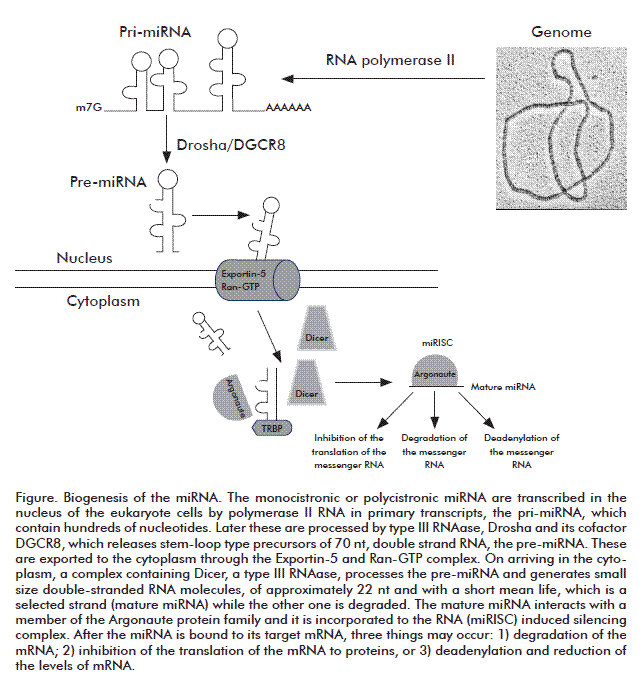
<body><![CDATA[<P   ><font face="Verdana, Arial, Helvetica, sans-serif" size="2">Moreover, those miRNAs      located in different genomic regions but producing an identical mature miRNA      are denoted by an additional hyphen at the end, followed by a sequential number.      For example, mir-194-1 and mir-194-2 produce identical mature mRNAs, miR-194.      Their genes are in different genome locations, though. The species are further      indicated by a three-letter prefix, <I>i.e.</I>, the hsa-miR-100 is the one-hundredth      miRNA isolated in humans (<I>Homo sapiens</I>), while the mmu-miR-100 is the      one-hundredth identified in mouse (<I>Mus musculus</I>). </font></P >       <P   ><font face="Verdana, Arial, Helvetica, sans-serif" size="2">The miRNA numbering      is sequential, so, if the last discovered miRNA was miR-789 in mice, the next      name published will be miR-790 regardless the species where it was discovered.      If a sequence is submitted for a new miRNA identified in <I>Gallus gallus      </I>but identical to that of the human miR-121, it will be named miR-121,      with the prefix gga-121 different from the has-121 one. </font></P >       <P   ><font face="Verdana, Arial, Helvetica, sans-serif" size="2">If two different      miRNAs are originated in opposite arms of the same precursor (or pre-mir),      they will be denoted by the suffixes -3p or -5p. In those cases of known expression      levels, an asterisk is added at the end of the name of the miRNA displaying      the lowest expression level, compared to that in the other arm of the same      precursor. For example, miR-234 and miR-234* share the same precursor, mir-234;      but it is found at higher concentrations within the cell.</font></P >       <P   >&nbsp;</P >       <P   ><font size="2" face="Verdana, Arial, Helvetica, sans-serif"><B><font size="3">BIOGENESIS</font></B>      </font></P >   <FONT size="+1">        <P   ><font size="2" face="Verdana, Arial, Helvetica, sans-serif">The general mechanism      of biogenesis of the miRNA is described in the <a href="/img/revistas/bta/v31n2/f0101214.gif">figure</a>.      These are transcribed as part of the major primary transcripts (pri-miRNA),      generated by the action of RNA polymerase II [25]. As in the other RNA polymerase      II transcripts, the pri-miRNAs have their 5&acute; and 3&acute; ends modified      with CAP and a polyA tail, respectively [26]. These pri-miRNAs form a stem-loop      structure recognized by a multiprotein system with two main components, the      Drosha enzyme and the DGCR8 protein (<I>Di George syndrome critical region      gene </I>8), capable of binding to double-stranded RNA. In this recognizing      mechanism, DCGR8 is bound to the base of the stem-loop structure, thereby      guiding the Drosha enzyme that is a type III RNAase, which has the catalytic      activity of the complex [27]. Drosha cuts the double strand at the stem, at      an approximate distance of 11 nt above the base and generates 3&acute; ends      with overhangs of 2 nt. This cut releases an RNA molecule, with the stem-loop      form, of approximately 70 to 100 nt, which constitutes the precursor (pre-miRNA)      and it is recognized by the nuclear receptor Exportin-5, and is exported from      the nucleus to the cytoplasm [28]. After its arrival at the cytosol, the pre-miRNA      is again processed by a type III RNAase, Dicer [29]. The PAZ dominion of this      enzyme is bound to the 3&acute; end with the 2 nt overhang of the pre-miRNA      (substrate), by which means the substrate is in the appropriate position for      cutting, resulting in a double-stranded miRNA of 22 nt with 2 ntoverhangs      at the 3&acute; ends [30]. One of the strands, the leading strand or mature      miRNA, is transferred to a protein named Argonaute and a complex is formed      called miRISC (miRNA induced silencing complex), while the other one is degraded.      In mammals, the complex formed contains mature miRNA, the Dicer enzyme, the      Argonaute protein and another protein that binds to double stranded RNA, TRBP      [31]. In general, the miRNA strand, having less stability in base-pairing      at its 5&acute; end, is the guide strand or mature miRNA [32]. </font></P >       
<P   >&nbsp;</P >   <FONT size="+1">        <P   ><font size="2" face="Verdana, Arial, Helvetica, sans-serif"><B><font size="3">MECHANISM      OF ACTION</font></B></font></P >   <FONT size="+1">        <P   ><font size="2" face="Verdana, Arial, Helvetica, sans-serif">After the formation      of the RISC complex, it is bound to the 3&acute; untranslated region (3&acute;-UTR)      of the mRNA, although it can also be bound to the 5&acute; untranslated region      (5&acute;-UTR) and the promoter region. The sequence in the miRNA that recognizes      the 3&acute;-UTR of the mRNA is known as the &ldquo;seed region&rdquo; and      it is located at the 5&acute; region of the miRNA, of nucleotide 2 to 7 [33].      After the miRNA is bound to its mRNA target, there may be a degradation of      the mRNA, or the inhibition of the translation of mRNA to proteins, or the      deadenylation and reduction of the levels of mRNA [34]. </font></P >       <P   >&nbsp;</P >   <FONT size="+1">        ]]></body>
<body><![CDATA[<P   ><font size="2" face="Verdana, Arial, Helvetica, sans-serif"><B><font size="3">THE      miRNAs AS BIOMARKERS IN CANCER</font></B></font></P >   <FONT size="+1">        <P   > </P >   <FONT size="+1">        <P   ><font face="Verdana, Arial, Helvetica, sans-serif" size="2">The early diagnosis      of a primary tumor improves the prognosis and response to treatment. Since      there is no system that can be used to screen lung cancer in its early stages      within the population, it is mostly diagnosed at advanced stages. The first      evidence of an aberrant expression of the miRNAs in lung cancer was reported      in 2006, when a group of them was identified, which were expressed differently      in the tumor tissue compared to healthy tissues [35]. This opened the possibility      of their use as biomarkers of this type of cancer. Recent studies demonstrated      that the increase in the expression of the miR-21 was significantly different      in the sputum of patients with lung cancer compared to healthy persons, with      a sensitivity of 70 % and a specificity of 100 % [36]. In experiments with      rats it was also found that the exposure to cigarette smoke modified the levels      of expression of the miRNA [37], indicating that the changes in the levels      of the miRNA can be used as biomarkers for cancer diagnosis in smokers. </font></P >       <P   ><font face="Verdana, Arial, Helvetica, sans-serif" size="2">The ten miRNAs with      aberrant expressions in tumor tissues, which can be used to confirm the diagnostic      of lung cancer through computerized tomography, and very valuable in discriminating      neoplastic from healthy tissues are: let-7, miR- 21, -200b, -210, -219-1,      -324, which are (induced); and miR-30a, -126, -45 and -486, which are (repressed)      [38]. To develop therapies for specific targets, tumors must be classified      as: non-small-cell lung cancers (NSCLC), the adenocarcinoma histological subtypes      (ADC) and the squamous cell carcinomas (SCC). This, however, is not easy to      do, especially if the biopsy is small or the tumors are hardly differentiated.      In this sense, two miRNA, miR-21 and -205 were successfully used to distinguish      ADC from SCC [39]. A characteristic expression pattern of five miRNA (miR-      25, -34c-5p, -191, let-7e and -34a) used for this differentiation was also      described [40]. It is also necessary to distinguish the primary tumors from      the metastases. The overexpression of miR-182 was detected in primary tumors,      while miR-126 was expressed in high concentrations in the metastases [41].      </font></P >       <P   ><font face="Verdana, Arial, Helvetica, sans-serif" size="2">The main cause of      death of patients with breast cancer is due to the complications derived from      the metastases [42]. In recent years, a group of studies were carried out      to identify and characterize the very complex cellular events that rule the      process of metastasis. The miRNAs affect cellular adherence, migration, invasion,      motility and angiogenesis [43]. Those associated to the metastasis process      are called metastamirs. The first metastamir was described by Robert Weinberg      and his group, who found that miR-10b starts the invasion and the metastasis      process in breast cancer [44]. The first metastasis suppressor metastamir      was described by Joan Massagu&eacute; and his group [45], revealing that miR-335      suppresses metastasis and migration through its action on the SOX4 transcriptional      factor, found in stem cells and on the tenascin C protein, which forms part      of the extracellular matrix. </font></P >       <P   ><font face="Verdana, Arial, Helvetica, sans-serif" size="2">Metastamirs are used      in breast cancer as prognostic biomarkers. For example, in a microarray study      of miRNA, the expression of 249 miRNA was quantified in 299 breast tumors      (185 were positive to the estrogen receptor, RE+; 114 negative, RE-). The      miRNAs -7, -128a, -210 and -516-3p were related to the aggressiveness of the      tumor in RE+ tumors and negative nodules, while miR-210 was associated to      an early relapse in patients with RE- and negative nodules [46]. In breast      cancer it was observed that miRNA 27 and those of the 17-92 family (miR-17,      -18a, -19a, -19b, -20a and -92) negatively regulate the concentrations of      the transcriptional factors of the ZBTB family, and that these concentrations      are significantly associated to survival [47, 48]. </font></P >       <P   ><font face="Verdana, Arial, Helvetica, sans-serif" size="2">The survival of 466      patients with invasive ductal carcinoma (IDC), the most frequently diagnosed      histological subtype, was recently carried out through the integration of      the expressions of mRNA, miRNA and methylated DNA [49]. In the analysis of      this integrated genetic pattern, it was found that 37 mRNA and 7 miRNA, within      the clinical and pathological subclasses, are associated to general survival      and that their prognostic value is higher than other commercially available      genetic patterns for the stratification of patients with breast cancer, such      as Mammaprint&reg; and Oncotype Dx&reg;. </font></P >   <FONT size="+1"><FONT size="+1"><FONT size="+1"><FONT size="+1">        <P   ><font face="Verdana, Arial, Helvetica, sans-serif" size="2">The progress in the      knowledge of the altered signaling routes in colorectal cancer (CRC), laid      the foundations for the application of therapies with specific targets. For      example the cetuximab monoclonal antibody against the epidermal growth factor      receptor (EGFR) is used as a monotherapy against the CRC [50], or it is combined      with chemotherapy [51]. It was recently known that patients with mutations      in the K-ras gene (approximately 38 %) are resistant to the anti-EGFR therapy      [52]. This therapy is therefore restricted to the subgroup of patients with      CRC not having the K-ras gene mutation, although this is not an effective      treatment for all of them and it would be necessary to find new markers. It      was recently described that the miRNA let-7 [53], miR-143 [54] and miR-18a      [55], with reduced concentrations in CRC, have K-ras as one of their target      genes. In this sense, the predictive ability of 18 miRNA (several of which      have the K-ras as their target) in 32 patients with metastatic CRC (CRCm)      treated with cetuximab and chemotherapy, was evaluated. The increase in the      expression of miR-200 and the decrease in that of miR-143, were associated      with a longer period of time in which the patients with the mutated K-ras      gene were free from progression. There was no correlation between the expression      of the miRNA with the K-ras gene as the target, and the time that the patients      with non-mutated K-ras were free from progression. Therefore, the inhibition      of the expression of the K-ras gene by the miRNA is only relevant in the context      where there are high levels of K-ras; <I>i.e</I>., when there are activator      mutations [56]. </font></P >       <P   ><font face="Verdana, Arial, Helvetica, sans-serif" size="2">In a study of the      expression profiles of miRNAs in 99 patients with CRCm, 33 of them with non-mutated      K-ras/BRAF genes, to predict those having a favorable response with cetuximab      and a longer survival, it was found that patients with the progressive disease      had an overexpression of miR-31 and an inhibition of miR-592. Patients were      also grouped on the basis of the miRNAs expression profile and significant      differences between groups were found. The patients with short survival had      the miRNAs of the let-7 family, the miR-140-5p overexpressed and the miR-1224-5p      inhibited [57]. </font></P >       <P   ><font face="Verdana, Arial, Helvetica, sans-serif" size="2">The standard treatment      for those with locally advanced CRC (approximately one third of all patients      with CRC), are the neoadjuvant radiochemotherapies with capecitabine or 5-fluorouracil,      and later surgical resection. Unfortunately, a large percentage of these tumors      do not respond to the neoadjuvants and patients have high probabilities of      having tumor relapses. </font></P >       ]]></body>
<body><![CDATA[<P   ><font face="Verdana, Arial, Helvetica, sans-serif" size="2">In a recent study,      the profiles of the miRNAs were analyzed in 20 patients with tumors classified      as sensitive or resistant to that therapeutic variant. The levels of expression      of eight miRNAs were significantly different between both groups. The miRNAs      -215, -190b and -29b2* were overexpressed in patients with resistant tumors,      while the let-7e, miR-196b, -450a, -450b-5p and -99a* were overexpressed in      sensitive tumors. The levels of expression of these miRNA enabled the classification      of nine patients (out of 10) as non-responders, and the same number as responders.      It was concluded that the miRNA form part of the response mechanism of the      cancer cells of the rectum to radiochemotherapy, and therefore, they are considered      to have an important potential as predictive markers in patients diagnosed      with this neoplasia [58].</font></P >       <P   >&nbsp;</P >       <P   ><font size="2" face="Verdana, Arial, Helvetica, sans-serif"><B><font size="3">THE      miRNAs AS THERAPEUTIC TARGETS IN CANCER</font></B></font></P >   <FONT size="+1">        <P   ><font size="2" face="Verdana, Arial, Helvetica, sans-serif">The miRNAs have two      characteristics that make them attractive as therapeutic targets for cancer.      One of them is that they regulate several metabolic pathways: the complexity      and heterogeneity of cancer suggests that the only way to develop a successful      treatment is considering multiple genes simultaneously as targets. The second      one is that there are microRNAs that are aberrantly overexpressed in cancer      and they are known as oncomirs. Therefore, it may be easier and economically      more attractive to develop drugs against the miRNA, which would be potentially      useful to treat malignant tumors in several localizations. The inhibition      of the miRNA may be achieved by antisense oligonucleotides or antagomir [59,      60] or competitive inhibitors called miRNA &ldquo;sponges&rdquo; [61]. These      contain several binding sites to the miRNA, whether in a non-codified transcript      or in the 3&acute;-UTR of a reporter gene, and they have advantages in relation      to the antagomir. </font></P >   <FONT size="+1">        <P   ><font face="Verdana, Arial, Helvetica, sans-serif" size="2">First of all, the      antagomirs depend, for their effectiveness, on an extensive complementarity      zone with the miRNA target [62]. Therefore, to neutralize several miRNAs a      mixture containing antagomirs that are complementary to these miRNAs must      be prepared, while if an mRNA containing multiple binding sites (typically      4 to 10 sites) to the miRNA of interest is introduced into the cell, it will      specifically inhibit all the miRNAs having a complementary sequence to these      binding sites. </font></P >       <P   ><font face="Verdana, Arial, Helvetica, sans-serif" size="2">In the second place,      many cells are resistant to the introduction of the antagomirs, while the      genetic construction containing the sponge can be introduced in the cell through      several types of vectors. Thirdly, the antagomirs must be periodically administered      at high concentrations to inhibit the expression of the target miRNA; while      the expression of the genetic construct of the sponge in germ cells of transgenic      animals would make it possible for the miRNA of interest to be inhibited for      the entire life span of the animal [63]. However, although the inhibition      technology of the miRNA sponge has advantages in experimentation with biological      models, the inhibition using antagomirs is considered to be more attractive      and has a greater potential from the therapeutic viewpoint. In fact, the first      molecule targeting a miRNA in human beings, for the treatment of hepatitis      produced by the hepatitis C virus (HCV), was Miravirsen [64] (originally called      SPC3649 [65]; Santaris Pharma A/S). It is an antagomir against miR-122, a      positive regulator of the replication of HCV and a tumor suppressor in liver      carcinoma. </font></P >       <P   ><font face="Verdana, Arial, Helvetica, sans-serif" size="2">In 2005, it was demonstrated      that the miR-122 has two seed sites, which interact with the 5&acute;-UTR      region of the RNA of the HCV, and produce the increase of viral RNA in infected      liver cells. This evidence indicates that the miR-122 is an important factor      in the host and a potential target for the treatment of infections due to      the HCV; this is relevant considering there are approximately 170 million      persons in the world infected with HCV and it is the main cause of liver failure      [66]. The idea of developing an antiviral therapy, based on miR-122 as the      target, was attractive because of the limitations of the current treatments      for the infections due to HCV. Besides its importance as the first anti-miRNA      drug, there are another two attractive characteristics of Miravirsen. This      antagomir was used to demonstrate that on modulating a miRNA with this type      of molecule, the genes downstream the miRNA are also regulated. Furthermore,      Miravirsen is a molecule with a chemical structure having a modification to      increase its stability, affinity and specificity. Such modification consists      of closing the ribose ring through a methylene bridge, which connects the      oxygen at position 2 with the carbon at position 4, producing a locked nucleic      acid (LNA). The LNAs are nucleotides with a high hybridization capacity and      affinity for the single stranded RNA [67]. Therefore, the miRNAs modified      with LNA, such as Miravirsen, offer encouraging perspectives for clinical      practice. </font></P >       <P   ><font face="Verdana, Arial, Helvetica, sans-serif" size="2">At present, the biotechnology      companies are developing miRNA or antagomir mimetics, and strategies for their      systemic administration in cancer treatment and other diseases [64]. Taking      into account the strong relationship between the miRNA and the deregulation      of the malignant processes, a faster approval for the use of therapeutic strategies      based on its modulation in monotherapies or combined with radio-, chemo-,      or immunotherapies, are foreseen.</font></P >       <P   >&nbsp;</P >       <P   ><font size="2" face="Verdana, Arial, Helvetica, sans-serif"><B><font size="3">CIRCULATING      miRNAs</font> </B></font></P >   <FONT size="+1">        ]]></body>
<body><![CDATA[<P   ><font size="2" face="Verdana, Arial, Helvetica, sans-serif">The description of      the circulating miRNA meant the discovery of new mediators of the genetic      expression. Although most of them are found and function inside the cell,      the circulating miRNAs can also be found outside cells: in fluids such as      plasma, saliva, amniotic fluid, urine and others [68]. Their composition and      concentrations are related to several diseases, and they can therefore be      used as biomarkers, measured through pathways that are hardly invasive, to      assess and keep watch over the physiological state of the body. It is important      to highlight that these miRNAs may be found in large amounts in extracellular      fluids, and may be very stable, even under conditions of extreme temperature,      pH and storage. Their composition in the plasma is identical in all persons,      not depending on sex or age, so they are considered to be good clinical biomarkers      [69]. It is not well defined, however, how their action is exerted. It has      been said that they could be signal mediators, allowing the tumor cells to      &bdquo;communicate&#8223; with the non-transformed cells from the microenvironment,      which is crucial in malignant progression. Therefore, the molecules that transport      any type of information to the microenvironment, such as cytokines, chemokines      and growth factors, are bound to circulating miRNAs [70]. </font></P >       <P   >&nbsp;</P >   <FONT size="+1">        <P   ><font size="2" face="Verdana, Arial, Helvetica, sans-serif"><B><font size="3">LIMITATIONS      IN THE USE OF miRNAs AS BIOMARKERS</font></B></font></P >   <FONT size="+1">        <P   ><font size="2" face="Verdana, Arial, Helvetica, sans-serif">The introduction      of new biomarkers in clinical practice is limited because of insufficient      sensitivity, specificity and stability of the potential markers. </font></P >   <FONT size="+1">        <P   ><font face="Verdana, Arial, Helvetica, sans-serif" size="2">Although miRNAs are      considered biomarkers with a great potential, they also have certain limitations,      such as their specificity. The miR-21 is high, not only in patients with pancreas      cancer, but also in those with diffuse large B-cell lymphoma [71]. Another      important aspect is how to obtain it, since no homogeneity is found in the      protocols for their isolation and characterization, the starting material      (whether it is plasma, serum, tissue or paraffin blocks), and the characteristics      of the patients included in the studies. There is evidence that erythrocytes      are an important source of circulating miRNAs and that hemolysis can alter      up to 50 % the levels of a certain miRNA, as a biomarker in the plasma. Therefore,      one must be very rigorous when interpreting the results of the mediation of      the circulating miRNA associated with cancer, to figure out if they are really      related to the malignant process and not to an event that is a consequence      of cellular lysis. Another aspect that must be standardized is the quantification      of the miRNAs. There is no consensus on which molecule to use as the gene      for normalization: whether it is a miRNA that does not vary, another RNA molecule      or another gene. </font></P >       <P   >&nbsp;</P >       <P   ><font size="2" face="Verdana, Arial, Helvetica, sans-serif"><B><font size="3">FINAL      COMMENTS</font></B></font></P >   <FONT size="+1">        <P   ><font size="2" face="Verdana, Arial, Helvetica, sans-serif">In the last two decades,      there has been a significant progress in the identification and characterization      of genetic and epigenetic causes of cancer, in the assessment of possible      biomarkers, and in the development of drugs against new targets, which had      an impact on the relatively insufficient increase of survival time of oncological      patients after their diagnosis. A greater in-depth knowledge of cancer biology      may help identify other alterations that, by causing or contributing to malignancy,      may be used as new biomarkers or molecular targets and continue increasing      survival time of the patients. In this sense, it was recently found that the      miRNAs are essential molecules with important functions in the control of      several physiological and pathological processes (including cancer), with      a differentially modulated expression in healthy tissues or in those undergoing      a pathological process not associated to malignancy, and correlated to clinical-pathological      characteristics. </font></P >   <FONT size="+1">        <P   ><font face="Verdana, Arial, Helvetica, sans-serif" size="2">The high stability      of the miRNAs in tissues and body fluids, and the possibility of being quantified,      although they are found in small amounts, are advantages for diagnosis, prognosis,      and stratification of patients, with the aim of increasing the objective responses      to antineoplastic treatments. For example, the miR<I>Inform</I>&reg; Pancreas      LDT (Asuragen&reg; Inc) system [72] is already on the market; it was developed      after the analysis of the differential expression of the miR-196a and the      miR-217 [73, 74]. Through a biopsy, this system makes it possible to discriminate      chronic pancreatitis from pancreatic adenocarcinoma. Furthermore, the ability      of each miRNA to modulate the expression of multiple mRNA at the same time      is also attractive, since it enables, for example, to re-establish functionality      of a complete suppressor route that had been affected, in contrast to other      strategies that would only allow to modulate the expression of a gene but      not involve the entire route. This feature makes them very attractive as therapeutic      targets themselves, or to decrease the resistance of other treatments; these      are aspects under intense study by academic researchers or the industry. </font></P >   <FONT size="+1"><FONT size="+1"><FONT size="+1"><FONT size="+1">        <P   ><font face="Verdana, Arial, Helvetica, sans-serif" size="2">In the next 2 to      5 years an increase in the systems based on miRNAs approved by the regulating      agencies is foreseen. They may be introduced in routine clinical practice      to increase the sensitivity and specificity of the diagnostic and prognostic      tests, which may offer new opportunities for better personalized treatments.      </font></P >       ]]></body>
<body><![CDATA[<P   >&nbsp;</P >   </font></font></font></font></font></font></font></font></font></font></font></font></font></font></font></font></font></font></font></font></font></font></font></font></font></font></font></font></font></font></font></font></font></font>       <p   > </p >       <p   ><font size="3" color="#000000"><b><font face="Verdana, Arial, Helvetica, sans-serif">REFERENCES</font></b></font></p >       <!-- ref --><p   ><font face="Verdana, Arial, Helvetica, sans-serif" size="2">1. Biomarkers Definitions      Working Group. Biomarkers and surrogate endpoints: preferred definitions and      conceptual framework. Clinical Pharmacol Ther. 2001;69(3):89-95.    </font></p >       <p   ><font face="Verdana, Arial, Helvetica, sans-serif" size="2">2. Ferlay J, Soerjomataram      I, Ervik M, Dikshit R, Eser S, Mathers C, et al. GLOBOCAN 2012 v1.0, Cancer      Incidence and Mortality Worldwide: IARC CancerBase No. 11 [Internet]. Lyon,      France: International Agency for Research on Cancer. c2013 [cited 2013 Oct      17]. Available from: <a href="http://globocan.iarc.fr" target="_"blank">http://globocan.iarc.fr</a>.</font></p >       <p   ><font face="Verdana, Arial, Helvetica, sans-serif" size="2">3. Ministerio de      Salud P&uacute;blica. Anuario Estad&iacute;stico de Salud, Cuba, 2012 [Internet].      Habana: Direcci&oacute;n Nacional de Registros M&eacute;dicos y Estad&iacute;sticas      de Salud, Minsap; 2013 [cited 2013 Oct 17]. Available from: <a href="http://files.sld.cu/dne/files/2013/04/anuario_2012.pdf" target="_blank">http://files.sld.cu/dne/files/2013/04/anuario_2012.pdf</a>.</font></p >       <!-- ref --><p   ><font face="Verdana, Arial, Helvetica, sans-serif" size="2">4. Wang J, Li LC.      Small RNA and its application in andrology and urology. Transl Androl Urol.      2012;1(1):33-43.    </font></p >       <!-- ref --><p   ><font face="Verdana, Arial, Helvetica, sans-serif" size="2">5. Lujambio A, Lowe      SW. The microcosmos of cancer. Nature. 2012;482(7385):347-55.    </font></p >       <!-- ref --><p   ><font face="Verdana, Arial, Helvetica, sans-serif" size="2">6. Lee RC, Feinbaum      RL, Ambros V. The C. elegans heterochronic gene lin-4 encodes small RNAs with      antisense complementarity to lin-14. Cell. 1993;75(5):843-54.    </font></p >       <!-- ref --><p   ><font face="Verdana, Arial, Helvetica, sans-serif" size="2">7. Reinhart BJ, Slack      FJ, Basson M, Pasquinelli AE, Bettinger JC, Rougvie AE, et al. The 21-nucleotide      let-7 RNA regulates developmental timing in Caenorhabditis elegans. Nature.      2000;403(6772):901-6.    </font></p >       <!-- ref --><p   ><font face="Verdana, Arial, Helvetica, sans-serif" size="2">8. Pasquinelli AE,      Reinhart BJ, Slack F, Martindale MQ, Kuroda MI, Maller B, et al. Conservation      of the sequence and temporal expression of let-7 heterochronic regulatory      RNA. Nature. 2000;408(6808):86-9.    </font></p >       <!-- ref --><p   ><font face="Verdana, Arial, Helvetica, sans-serif" size="2">9. Sharp PA. RNA      interference--2001. Genes Dev. 2001;15(5):485-90.    </font></p >       <!-- ref --><p   ><font face="Verdana, Arial, Helvetica, sans-serif" size="2">10. Lagos-Quintana      M, Rauhut R, Lendeckel W, Tuschl T. Identification of novel genes coding for      small expressed RNAs. Science. 2001;294(5543):853-8.    </font></p >       <!-- ref --><p   ><font face="Verdana, Arial, Helvetica, sans-serif" size="2">11. Lau NC, Lim LP,      Weinstein EG, Bartel DP. An abundant class of tiny RNAs with probable regulatory      roles in Caenorhabditis elegans. Science. 2001;294(5543):858-62.    `</font></p >       <!-- ref --><p   ><font face="Verdana, Arial, Helvetica, sans-serif" size="2">12. Lee RC, Ambros      V. An extensive class of small RNAs in Caenorhabditis elegans. Science. 2001;294(5543):862-4.    </font></p >       <!-- ref --><p   ><font face="Verdana, Arial, Helvetica, sans-serif" size="2">13. Grosshans H,      Filipowicz W. Molecular biology: the expanding world of small RNAs. Nature.      2008;451(7177):414-6.    </font></p >       <p   ><font face="Verdana, Arial, Helvetica, sans-serif" size="2">14. Pfeffer S, Zavolan      M, Grasser FA, Chien M, Russo JJ, Ju J, et al. Identification of virus-encoded      microRNAs. Science. 2004;304(5671):734-6.</font></p >       <!-- ref --><p   ><font face="Verdana, Arial, Helvetica, sans-serif" size="2">15. Gromak N. Intronic      microRNAs: a crossroad in gene regulation. Biochem Soc Trans. 2012;40(4):759-61.    </font></p >       ]]></body>
<body><![CDATA[<!-- ref --><p   ><font face="Verdana, Arial, Helvetica, sans-serif" size="2">16. Wang J, Xiang      G, Zhang K, Zhou Y. Expression signatures of intragenic miRNAs and their corresponding      host genes in myeloid leukemia cells. Biotechnol Lett. 2012;34(11):2007-15.    </font></p >       <!-- ref --><p   ><font face="Verdana, Arial, Helvetica, sans-serif" size="2">17. Sun J, Gao B,      Zhou M, Wang ZZ, Zhang F, Deng JE, et al. Comparative genomic analysis reveals      evolutionary characteristics and patterns of microRNA clusters in vertebrates.      Gene. 2013;512(2):383-91.    </font></p >       <!-- ref --><p   ><font face="Verdana, Arial, Helvetica, sans-serif" size="2">18. Zhang Y, Zhang      R, Su B. Diversity and evolution of MicroRNA gene clusters. Sci China C Life      Sci. 2009;52(3):261-6.    </font></p >       <!-- ref --><p   ><font face="Verdana, Arial, Helvetica, sans-serif" size="2">19. Chhabra R, Dubey      R, Saini N. Cooperative and individualistic functions of the microRNAs in      the miR-23a~27a~24-2 cluster and its implication in human diseases. Mol Cancer.      2010;9:232.    </font></p >       <!-- ref --><p   ><font face="Verdana, Arial, Helvetica, sans-serif" size="2">20. Yuan X, Liu C,      Yang P, He S, Liao Q, Kang S, et al. Clustered microRNAs' coordination in      regulating protein-protein interaction network. BMC Syst Biol. 2009;3:65.    </font></p >       ]]></body>
<body><![CDATA[<!-- ref --><p   ><font face="Verdana, Arial, Helvetica, sans-serif" size="2">21. Yu J, Wang F,      Yang GH, Wang FL, Ma YN, Du ZW, et al. Human microRNA clusters: genomic organization      and expression profile in leukemia cell lines. Biochem Biophys Res Commun.      2006;349(1):59-68.    </font></p >       <!-- ref --><p   ><font face="Verdana, Arial, Helvetica, sans-serif" size="2">22. Bonci D, Coppola      V, Musumeci M, Addario A, Giuffrida R, Memeo L, et al. The miR-15a-miR-16-1      cluster controls prostate cancer by targeting multiple oncogenic activities.      Nature medicine. 2008;14(11):1271-7.    </font></p >       <p   ><font face="Verdana, Arial, Helvetica, sans-serif" size="2">23. Griffiths-Jones      S. The microRNA Registry. Nucleic Acids Res. 2004;32(Database issue):D109-11.</font></p >       <!-- ref --><p   ><font face="Verdana, Arial, Helvetica, sans-serif" size="2">24. Ambros V, Bartel      B, Bartel DP, Burge CB, Carrington JC, Chen X, et al. A uniform system for      microRNA annotation. RNA. 2003;9(3):277-9.    </font></p >       <!-- ref --><p   ><font face="Verdana, Arial, Helvetica, sans-serif" size="2">25. Lee Y, Kim M,      Han J, Yeom KH, Lee S, Baek SH, et al. MicroRNA genes are transcribed by RNA      polymerase II. EMBO J. 2004;23(20):4051-60.    </font></p >       <!-- ref --><p   ><font face="Verdana, Arial, Helvetica, sans-serif" size="2">26. Cai X, Hagedorn      CH, Cullen BR. Human microRNAs are processed from capped, polyadenylated transcripts      that can also function as mRNAs. RNA. 2004;10(12):1957-66.    </font></p >       <!-- ref --><p   ><font face="Verdana, Arial, Helvetica, sans-serif" size="2">27. Han J, Lee Y,      Yeom KH, Nam JW, Heo I, Rhee JK, et al. Molecular basis for the recognition      of primary microRNAs by the Drosha-DGCR8 complex. Cell. 2006;125(5):887-901.    </font></p >       <!-- ref --><p   ><font face="Verdana, Arial, Helvetica, sans-serif" size="2">28. Yi R, Qin Y,      Macara IG, Cullen BR. Exportin-5 mediates the nuclear export of pre-microRNAs      and short hairpin RNAs. Genes Dev. 2003;17(24):3011-6.    </font></p >       <!-- ref --><p   ><font face="Verdana, Arial, Helvetica, sans-serif" size="2">29. Grishok A, Pasquinelli      AE, Conte D, Li N, Parrish S, Ha I, et al. Genes and mechanisms related to      RNA interference regulate expression of the small temporal RNAs that control      C. elegans developmental timing. Cell. 2001;106(1):23-34.    </font></p >       <!-- ref --><p   ><font face="Verdana, Arial, Helvetica, sans-serif" size="2">30. Bartel DP. MicroRNAs:      target recognition and regulatory functions. Cell. 2009;136(2):215-33.    </font></p >       <!-- ref --><p   ><font face="Verdana, Arial, Helvetica, sans-serif" size="2">31. Gregory RI, Chendrimada      TP, Cooch N, Shiekhattar R. Human RISC couples microRNA biogenesis and posttranscriptional      gene silencing. Cell. 2005;123(4):631-40.    </font></p >       <!-- ref --><p   ><font face="Verdana, Arial, Helvetica, sans-serif" size="2">32. Schwarz DS, Hutvagner      G, Du T, Xu Z, Aronin N, Zamore PD. Asymmetry in the assembly of the RNAi      enzyme complex. Cell. 2003;115(2):199-208.    </font></p >       <p   ><font face="Verdana, Arial, Helvetica, sans-serif" size="2">33. Brennecke J,      Stark A, Russell RB, Cohen SM. Principles of microRNA-target recognition.      PLoS Biol. 2005;3(3):e85.</font></p >       <!-- ref --><p   ><font face="Verdana, Arial, Helvetica, sans-serif" size="2">34. Treiber T, Treiber      N, Meister G. Regulation of microRNA biogenesis and function. Thromb Haemost.      2012;107(4):605-10.    </font></p >       <!-- ref --><p   ><font face="Verdana, Arial, Helvetica, sans-serif" size="2">35. Volinia S, Calin      GA, Liu CG, Ambs S, Cimmino A, Petrocca F, et al. A microRNA expression signature      of human solid tumors defines cancer gene targets. Proc Natl Acad Sci USA.      2006;103(7):2257-61.    </font></p >       <!-- ref --><p   ><font face="Verdana, Arial, Helvetica, sans-serif" size="2">36. Wang Q, Wang      S, Wang H, Li P, Ma Z. MicroRNAs: novel biomarkers for lung cancer diagnosis,      prediction and treatment. Exp Biol Med (Maywood). 2012;237(3):227-35.    </font></p >       ]]></body>
<body><![CDATA[<!-- ref --><p   ><font face="Verdana, Arial, Helvetica, sans-serif" size="2">37. Izzotti A, Calin      GA, Arrigo P, Steele VE, Croce CM, De Flora S. Downregulation of microRNA      expression in the lungs of rats exposed to cigarette smoke. FASEB J. 2009;23(3):806-12.    </font></p >       <!-- ref --><p   ><font face="Verdana, Arial, Helvetica, sans-serif" size="2">38. Boeri M, Verri      C, Conte D, Roz L, Modena P, Facchinetti F, et al. MicroRNA signatures in      tissues and plasma predict development and prognosis of computed tomography      detected lung cancer. Proc Natl Acad Sci USA. 2011;108(9):3713-8.    </font></p >       <!-- ref --><p   ><font face="Verdana, Arial, Helvetica, sans-serif" size="2">39. Lebanony D, Benjamin      H, Gilad S, Ezagouri M, Dov A, Ashkenazi K, et al. Diagnostic assay based      on hsa-miR-205 expression distinguishes squamous from nonsquamous non-small-cell      lung carcinoma. J Clin Oncol. 2009;27(12):2030-7.    </font></p >       <!-- ref --><p   ><font face="Verdana, Arial, Helvetica, sans-serif" size="2">40. Landi MT, Zhao      Y, Rotunno M, Koshiol J, Liu H, Bergen AW, et al. MicroRNA expression differentiates      histology and predicts survival of lung cancer. Clin Cancer Res. 2010;16(2):430-41.    </font></p >       <!-- ref --><p   ><font face="Verdana, Arial, Helvetica, sans-serif" size="2">41. Barshack I, Lithwick-Yanai      G, Afek A, Rosenblatt K, Tabibian-Keissar H, Zepeniuk M, et al. MicroRNA expression      differentiates between primary lung tumors and metastases to the lung. Pathol      Res Pract. 2010;206(8):578-84.    </font></p >       ]]></body>
<body><![CDATA[<!-- ref --><p   ><font face="Verdana, Arial, Helvetica, sans-serif" size="2">42. Jemal A, Siegel      R, Xu J, Ward E. Cancer statistics, 2010. CA Cancer J Clin. 2010;60(5):277-300.    </font></p >       <!-- ref --><p   ><font face="Verdana, Arial, Helvetica, sans-serif" size="2">43. Dumont N, Tlsty      TD. Reflections on miR-ing effects in metastasis. Cancer Cell. 2009;16(1):3-4.    </font></p >       <!-- ref --><p   ><font face="Verdana, Arial, Helvetica, sans-serif" size="2">44. Ma L, Teruya-Feldstein      J, Weinberg RA. Tumour invasion and metastasis initiated by microRNA-10b in      breast cancer. Nature. 2007;449(7163):682-8.    </font></p >       <!-- ref --><p   ><font face="Verdana, Arial, Helvetica, sans-serif" size="2">45. Tavazoie SF,      Alarcon C, Oskarsson T, Padua D, Wang Q, Bos PD, et al. Endogenous human microRNAs      that suppress breast cancer metastasis. Nature. 2008;451(7175):147-52.    </font></p >       <!-- ref --><p   ><font face="Verdana, Arial, Helvetica, sans-serif" size="2">46. Foekens JA, Sieuwerts      AM, Smid M, Look MP, de Weerd V, Boersma AW, et al. Four miRNAs associated      with aggressiveness of lymph node-negative, estrogen receptor-positive human      breast cancer. Proc Natl Acad Sci USA. 2008;105(35):13021-6.    </font></p >       ]]></body>
<body><![CDATA[<!-- ref --><p   ><font face="Verdana, Arial, Helvetica, sans-serif" size="2">47. Kim K, Chadalapaka      G, Lee SO, Yamada D, Sastre-Garau X, Defossez PA, et al. Identification of      oncogenic microRNA-17-92/ZBTB4/specificity protein axis in breast cancer.      Oncogene. 2012;31(8):1034-44.    </font></p >       <p   ><font face="Verdana, Arial, Helvetica, sans-serif" size="2">48. Tang W, Zhu J,      Su S, Wu W, Liu Q, Su F, et al. MiR-27 as a prognostic marker for breast cancer      progression and patient survival. PLoS One. 2012;7(12):e51702. </font></p >       <!-- ref --><p   ><font face="Verdana, Arial, Helvetica, sans-serif" size="2">49. Volinia S, Croce      CM. Prognostic microRNA/mRNA signature from the integrated analysis of patients      with invasive breast cancer. Proc Natl Acad Sci USA. 2013;110(18):7413-7.    </font></p >       <!-- ref --><p   ><font face="Verdana, Arial, Helvetica, sans-serif" size="2">50. Karapetis CS,      Khambata-Ford S, Jonker DJ, O'Callaghan CJ, Tu D, Tebbutt NC, et al. K-ras      mutations and benefit from cetuximab in advanced colorectal cancer. N Engl      J Med. 2008;359(17):1757-65.    </font></p >       <!-- ref --><p   ><font face="Verdana, Arial, Helvetica, sans-serif" size="2">51. Van Cutsem E,      Kohne CH, Hitre E, Zaluski J, Chang Chien CR, Makhson A, et al. Cetuximab      and chemotherapy as initial treatment for metastatic colorectal cancer. N      Engl J Med. 2009;360(14):1408-17.    </font></p >       <!-- ref --><p   ><font face="Verdana, Arial, Helvetica, sans-serif" size="2">52. Lievre A, Bachet      JB, Boige V, Cayre A, Le Corre D, Buc E, et al. KRAS mutations as an independent      prognostic factor in patients with advanced colorectal cancer treated with      cetuximab. J Clin Oncol. 2008;26(3):374-9.    </font></p >       <!-- ref --><p   ><font face="Verdana, Arial, Helvetica, sans-serif" size="2">53. Johnson SM, Grosshans      H, Shingara J, Byrom M, Jarvis R, Cheng A, et al. RAS is regulated by the      let-7 microRNA family. Cell. 2005;120(5):635-47.    </font></p >       <!-- ref --><p   ><font face="Verdana, Arial, Helvetica, sans-serif" size="2">54. Chen X, Guo X,      Zhang H, Xiang Y, Chen J, Yin Y, et al. Role of miR-143 targeting KRAS in      colorectal tumorigenesis. Oncogene. 2009;28(10):1385-92.    </font></p >       <!-- ref --><p   ><font face="Verdana, Arial, Helvetica, sans-serif" size="2">55. Tsang WP, Kwok      TT. The miR-18a* microRNA functions as a potential tumor suppressor by targeting      on K-Ras. Carcinogenesis. 2009;30(6):953-9.    </font></p >       <!-- ref --><p   ><font face="Verdana, Arial, Helvetica, sans-serif" size="2">56. Mekenkamp LJ,      Tol J, Dijkstra JR, de Krijger I, Vink-Borger ME, van Vliet S, et al. Beyond      KRAS mutation status: influence of KRAS copy number status and microRNAs on      clinical outcome to cetuximab in metastatic colorectal cancer patients. BMC      Cancer. 2012;12:292.    </font></p >       <!-- ref --><p   ><font face="Verdana, Arial, Helvetica, sans-serif" size="2">57. Mosakhani N,      Lahti L, Borze I, Karjalainen-Lindsberg ML, Sundstrom J, Ristamaki R, et al.      MicroRNA profiling predicts survival in anti-EGFR treated chemorefractory      metastatic colorectal cancer patients with wild-type KRAS and BRAF. Cancer      Genet. 2012;205(11):545-51.    </font></p >       <!-- ref --><p   ><font face="Verdana, Arial, Helvetica, sans-serif" size="2">58. Svoboda M, Sana      J, Fabian P, Kocakova I, Gombosova J, Nekvindova J, et al. MicroRNA expression      profile associated with response to neoadjuvant chemoradiotherapy in locally      advanced rectal cancer patients. Radiat Oncol. 2012;7:195.    </font></p >       <!-- ref --><p   ><font face="Verdana, Arial, Helvetica, sans-serif" size="2">59. Krutzfeldt J,      Rajewsky N, Braich R, Rajeev KG, Tuschl T, Manoharan M, et al. Silencing of      microRNAs in vivo with 'antagomirs'. Nature. 2005;438(7068):685-9.    </font></p >       <!-- ref --><p   ><font face="Verdana, Arial, Helvetica, sans-serif" size="2">60. Garzon R, Marcucci      G, Croce CM. Targeting microRNAs in cancer: rationale, strategies and challenges.      Nat Rev Drug Discov. 2010;9(10):775-89.    </font></p >       <!-- ref --><p   ><font face="Verdana, Arial, Helvetica, sans-serif" size="2">61. Ebert MS, Neilson      JR, Sharp PA. MicroRNA sponges: competitive inhibitors of small RNAs in mammalian      cells. Nat Methods. 2007;4(9):721-6.    </font></p >       <!-- ref --><p   ><font face="Verdana, Arial, Helvetica, sans-serif" size="2">62. Esau CC. Inhibition      of microRNA with antisense oligonucleotides. Methods. 2008;44(1):55-60.    </font></p >       <!-- ref --><p   ><font face="Verdana, Arial, Helvetica, sans-serif" size="2">63. Ebert MS, Sharp      PA. MicroRNA sponges: progress and possibilities. RNA. 2010;16(11):2043-50.    </font></p >       <!-- ref --><p   ><font face="Verdana, Arial, Helvetica, sans-serif" size="2">64. Pereira DM, Rodrigues      PM, Borralho PM, Rodrigues CM. Delivering the promise of miRNA cancer therapeutics.      Drug Discov Today. 2013;18(5-6):282-9.    </font></p >       <!-- ref --><p   ><font face="Verdana, Arial, Helvetica, sans-serif" size="2">65. Branch AD, Rice      CM. Antisense gets a grip on miR-122 in chimpanzees. Science Translational      Medicine. 2010;2(13).    </font></p >       <!-- ref --><p   ><font face="Verdana, Arial, Helvetica, sans-serif" size="2">66. Jopling CL, Yi      M, Lancaster AM, Lemon SM, Sarnow P. Modulation of hepatitis C virus RNA abundance      by a liver-specific MicroRNA. Science. 2005;309(5740):1577-81.    </font></p >       <!-- ref --><p   ><font face="Verdana, Arial, Helvetica, sans-serif" size="2">67. Vester B, Wengel      J. LNA (locked nucleic acid): high-affinity targeting of complementary RNA      and DNA. Biochemistry. 2004;43(42):13233-41.    </font></p >       <!-- ref --><p   ><font face="Verdana, Arial, Helvetica, sans-serif" size="2">68. Weber JA, Baxter      DH, Zhang S, Huang DY, Huang KH, Lee MJ, et al. The microRNA spectrum in 12      body fluids. Clin Chem. 2010;56(11):1733-41.    </font></p >       <!-- ref --><p   ><font face="Verdana, Arial, Helvetica, sans-serif" size="2">69. Turchinovich      A, Weiz L, Langheinz A, Burwinkel B. Characterization of extracellular circulating      microRNA. Nucleic Acids Res. 2011;39(16):7223-33.    </font></p >       <!-- ref --><p   ><font face="Verdana, Arial, Helvetica, sans-serif" size="2">70. Allegra A, Alonci      A, Campo S, Penna G, Petrungaro A, Gerace D, et al. Circulating microRNAs:      new biomarkers in diagnosis, prognosis and treatment of cancer (review). Int      J Oncol. 2012;41(6):1897-912.    </font></p >       <!-- ref --><p   ><font face="Verdana, Arial, Helvetica, sans-serif" size="2">71. Gu L, Song G,      Chen L, Nie Z, He B, Pan Y, et al. Inhibition of miR-21 induces biological      and behavioral alterations in diffuse large B-cell lymphoma. Acta Haematol.      2013;130(2):87-94.    </font></p >       <p   ><font face="Verdana, Arial, Helvetica, sans-serif" size="2">72. miRInform Pancreas      [Internet]. Austin, TX: Asuragen Inc. c2013 [2013 Oct 17]. Available from:      <a href="http://asuragen.com/products-and-services/clinical-lab/mirinform-pancreas/" target="_blank">http://asuragen.com/products-and-services/clinical-lab/mirinform-pancreas/</a>.</font></p >       ]]></body>
<body><![CDATA[<!-- ref --><p   ><font face="Verdana, Arial, Helvetica, sans-serif" size="2">73. Szafranska AE,      Davison TS, John J, Cannon T, Sipos B, Maghnouj A, et al. MicroRNA expression      alterations are linked to tumorigenesis and non-neoplastic processes in pancreatic      ductal adenocarcinoma. Oncogene. 2007;26(30):4442-52.    </font></p >       <!-- ref --><p   ><font face="Verdana, Arial, Helvetica, sans-serif" size="2">74. Szafranska AE,      Doleshal M, Edmunds HS, Gordon S, Luttges J, Munding JB, et al. Analysis of      microRNAs in pancreatic fine-needle aspirates can classify benign and malignant      tissues. Clin Chem. 2008;54(10):1716-24.    </font>    <br>   </p >       <p   >&nbsp;</p >       <p   >&nbsp;</p >   <FONT size="+1" color="#000000"><FONT size="+1"><FONT size="+1"><FONT color="#0462C1"><FONT color="#000000"><FONT size="+1"><FONT size="+1"><FONT size="+1"><FONT size="+1"><FONT size="+1"><FONT size="+1"><FONT size="+1"><FONT size="+1"><FONT size="+1"><FONT size="+1"><FONT size="+1"><FONT size="+1"><FONT size="+1"><FONT size="+1"><FONT size="+1"><FONT size="+1"><FONT size="+1"><FONT size="+1"><FONT size="+1"><FONT size="+1"><FONT size="+1"><FONT size="+1"><FONT size="+1"><FONT size="+1"><FONT size="+1"><FONT size="+1"><FONT size="+1"><FONT size="+1"><FONT size="+1">       <P   > </P >       <P   ><font face="Verdana, Arial, Helvetica, sans-serif" size="2">Received in October,      2013.     <br>     </font><font face="Verdana, Arial, Helvetica, sans-serif" size="2">Accepted      in March, 2014. </font></P >       ]]></body>
<body><![CDATA[<P   >&nbsp;</P >       <P   >&nbsp;</P >   </font></font></font></font></font></font></font></font></font></font></font></font></font></font></font></font></font></font></font></font></font></font></font></font></font></font></font></font></font></font></font></font></font></font>     <p><font face="Verdana, Arial, Helvetica, sans-serif" size="2" color="#000000"><i>Alejandro      Moro-Soria</i>. Instituto Nacional de Oncolog&iacute;a y Radiobiolog&iacute;a,      INOR. Calle 29 y F, CP 10400, Plaza de la Revoluci&oacute;n, La Habana, Cuba.      E-mail: </font><font face="Verdana, Arial, Helvetica, sans-serif" size="2" color="#000000"><a href="mailto:alexmoro@infomed.sld.cu">alexmoro@infomed.sld.cu</a>      </font></p>   </DIV >      ]]></body><back>
<ref-list>
<ref id="B1">
<label>1</label><nlm-citation citation-type="journal">
<collab>Biomarkers Definitions Working Group</collab>
<article-title xml:lang="en"><![CDATA[Biomarkers and surrogate endpoints: preferred definitions and conceptual framework]]></article-title>
<source><![CDATA[Clinical Pharmacol Ther]]></source>
<year>2001</year>
<volume>69</volume>
<numero>3</numero>
<issue>3</issue>
<page-range>89-95</page-range></nlm-citation>
</ref>
<ref id="B2">
<label>2</label><nlm-citation citation-type="book">
<person-group person-group-type="author">
<name>
<surname><![CDATA[Ferlay]]></surname>
<given-names><![CDATA[J]]></given-names>
</name>
<name>
<surname><![CDATA[Soerjomataram]]></surname>
<given-names><![CDATA[I]]></given-names>
</name>
<name>
<surname><![CDATA[Ervik]]></surname>
<given-names><![CDATA[M]]></given-names>
</name>
<name>
<surname><![CDATA[Dikshit]]></surname>
<given-names><![CDATA[R]]></given-names>
</name>
<name>
<surname><![CDATA[Eser]]></surname>
<given-names><![CDATA[S]]></given-names>
</name>
<name>
<surname><![CDATA[Mathers]]></surname>
<given-names><![CDATA[C]]></given-names>
</name>
</person-group>
<source><![CDATA[GLOBOCAN 2012 v1.0, Cancer Incidence and Mortality Worldwide: IARC CancerBase No. 11]]></source>
<year>2013</year>
<publisher-loc><![CDATA[Lyon ]]></publisher-loc>
<publisher-name><![CDATA[International Agency for Research on Cancer]]></publisher-name>
</nlm-citation>
</ref>
<ref id="B3">
<label>3</label><nlm-citation citation-type="book">
<collab>Ministerio de Salud Pública</collab>
<source><![CDATA[Anuario Estadístico de Salud, Cuba, 2012]]></source>
<year>2013</year>
<publisher-loc><![CDATA[Habana ]]></publisher-loc>
<publisher-name><![CDATA[Dirección Nacional de Registros Médicos y Estadísticas de Salud, Minsap]]></publisher-name>
</nlm-citation>
</ref>
<ref id="B4">
<label>4</label><nlm-citation citation-type="journal">
<person-group person-group-type="author">
<name>
<surname><![CDATA[Wang]]></surname>
<given-names><![CDATA[J]]></given-names>
</name>
<name>
<surname><![CDATA[Li]]></surname>
<given-names><![CDATA[LC]]></given-names>
</name>
</person-group>
<article-title xml:lang="en"><![CDATA[Small RNA and its application in andrology and urology]]></article-title>
<source><![CDATA[Transl Androl Urol]]></source>
<year>2012</year>
<volume>1</volume>
<numero>1</numero>
<issue>1</issue>
<page-range>33-43</page-range></nlm-citation>
</ref>
<ref id="B5">
<label>5</label><nlm-citation citation-type="journal">
<person-group person-group-type="author">
<name>
<surname><![CDATA[Lujambio]]></surname>
<given-names><![CDATA[A]]></given-names>
</name>
<name>
<surname><![CDATA[Lowe]]></surname>
<given-names><![CDATA[SW]]></given-names>
</name>
</person-group>
<article-title xml:lang="en"><![CDATA[The microcosmos of cancer]]></article-title>
<source><![CDATA[Nature]]></source>
<year>2012</year>
<volume>482</volume>
<numero>7385</numero>
<issue>7385</issue>
<page-range>347-55</page-range></nlm-citation>
</ref>
<ref id="B6">
<label>6</label><nlm-citation citation-type="journal">
<person-group person-group-type="author">
<name>
<surname><![CDATA[Lee]]></surname>
<given-names><![CDATA[RC]]></given-names>
</name>
<name>
<surname><![CDATA[Feinbaum]]></surname>
<given-names><![CDATA[RL]]></given-names>
</name>
<name>
<surname><![CDATA[Ambros]]></surname>
<given-names><![CDATA[V]]></given-names>
</name>
</person-group>
<article-title xml:lang="en"><![CDATA[The C. elegans heterochronic gene lin-4 encodes small RNAs with antisense complementarity to lin-14]]></article-title>
<source><![CDATA[Cell]]></source>
<year>1993</year>
<volume>75</volume>
<numero>5</numero>
<issue>5</issue>
<page-range>843-54</page-range></nlm-citation>
</ref>
<ref id="B7">
<label>7</label><nlm-citation citation-type="journal">
<person-group person-group-type="author">
<name>
<surname><![CDATA[Reinhart]]></surname>
<given-names><![CDATA[BJ]]></given-names>
</name>
<name>
<surname><![CDATA[Slack]]></surname>
<given-names><![CDATA[FJ]]></given-names>
</name>
<name>
<surname><![CDATA[Basson]]></surname>
<given-names><![CDATA[M]]></given-names>
</name>
<name>
<surname><![CDATA[Pasquinelli]]></surname>
<given-names><![CDATA[AE]]></given-names>
</name>
<name>
<surname><![CDATA[Bettinger]]></surname>
<given-names><![CDATA[JC]]></given-names>
</name>
<name>
<surname><![CDATA[Rougvie]]></surname>
<given-names><![CDATA[AE]]></given-names>
</name>
</person-group>
<article-title xml:lang="en"><![CDATA[The 21-nucleotide let-7 RNA regulates developmental timing in Caenorhabditis elegans]]></article-title>
<source><![CDATA[Nature]]></source>
<year>2000</year>
<volume>403</volume>
<numero>6772</numero>
<issue>6772</issue>
<page-range>901-6</page-range></nlm-citation>
</ref>
<ref id="B8">
<label>8</label><nlm-citation citation-type="journal">
<person-group person-group-type="author">
<name>
<surname><![CDATA[Pasquinelli]]></surname>
<given-names><![CDATA[AE]]></given-names>
</name>
<name>
<surname><![CDATA[Reinhart]]></surname>
<given-names><![CDATA[BJ]]></given-names>
</name>
<name>
<surname><![CDATA[Slack]]></surname>
<given-names><![CDATA[F]]></given-names>
</name>
<name>
<surname><![CDATA[Martindale]]></surname>
<given-names><![CDATA[MQ]]></given-names>
</name>
<name>
<surname><![CDATA[Kuroda]]></surname>
<given-names><![CDATA[MI]]></given-names>
</name>
<name>
<surname><![CDATA[Maller]]></surname>
<given-names><![CDATA[B]]></given-names>
</name>
</person-group>
<article-title xml:lang="en"><![CDATA[Conservation of the sequence and temporal expression of let-7 heterochronic regulatory RNA]]></article-title>
<source><![CDATA[Nature]]></source>
<year>2000</year>
<volume>408</volume>
<numero>6808</numero>
<issue>6808</issue>
<page-range>86-9</page-range></nlm-citation>
</ref>
<ref id="B9">
<label>9</label><nlm-citation citation-type="journal">
<person-group person-group-type="author">
<name>
<surname><![CDATA[Sharp]]></surname>
<given-names><![CDATA[PA]]></given-names>
</name>
</person-group>
<article-title xml:lang="en"><![CDATA[RNA interference--2001]]></article-title>
<source><![CDATA[Genes Dev]]></source>
<year>2001</year>
<volume>15</volume>
<numero>5</numero>
<issue>5</issue>
<page-range>485-90</page-range></nlm-citation>
</ref>
<ref id="B10">
<label>10</label><nlm-citation citation-type="journal">
<person-group person-group-type="author">
<name>
<surname><![CDATA[Lagos-Quintana]]></surname>
<given-names><![CDATA[M]]></given-names>
</name>
<name>
<surname><![CDATA[Rauhut]]></surname>
<given-names><![CDATA[R]]></given-names>
</name>
<name>
<surname><![CDATA[Lendeckel]]></surname>
<given-names><![CDATA[W]]></given-names>
</name>
<name>
<surname><![CDATA[Tuschl]]></surname>
<given-names><![CDATA[T]]></given-names>
</name>
</person-group>
<article-title xml:lang="en"><![CDATA[Identification of novel genes coding for small expressed RNAs]]></article-title>
<source><![CDATA[Science]]></source>
<year>2001</year>
<volume>294</volume>
<numero>5543</numero>
<issue>5543</issue>
<page-range>853-8</page-range></nlm-citation>
</ref>
<ref id="B11">
<label>11</label><nlm-citation citation-type="journal">
<person-group person-group-type="author">
<name>
<surname><![CDATA[Lau]]></surname>
<given-names><![CDATA[NC]]></given-names>
</name>
<name>
<surname><![CDATA[Lim]]></surname>
<given-names><![CDATA[LP]]></given-names>
</name>
<name>
<surname><![CDATA[Weinstein]]></surname>
<given-names><![CDATA[EG]]></given-names>
</name>
<name>
<surname><![CDATA[Bartel]]></surname>
<given-names><![CDATA[DP]]></given-names>
</name>
</person-group>
<article-title xml:lang="en"><![CDATA[An abundant class of tiny RNAs with probable regulatory roles in Caenorhabditis elegans]]></article-title>
<source><![CDATA[Science]]></source>
<year>2001</year>
<volume>294</volume>
<numero>5543</numero>
<issue>5543</issue>
<page-range>858-62</page-range></nlm-citation>
</ref>
<ref id="B12">
<label>12</label><nlm-citation citation-type="journal">
<person-group person-group-type="author">
<name>
<surname><![CDATA[Lee]]></surname>
<given-names><![CDATA[RC]]></given-names>
</name>
<name>
<surname><![CDATA[Ambros]]></surname>
<given-names><![CDATA[V]]></given-names>
</name>
</person-group>
<article-title xml:lang="en"><![CDATA[An extensive class of small RNAs in Caenorhabditis elegans]]></article-title>
<source><![CDATA[Science]]></source>
<year>2001</year>
<volume>294</volume>
<numero>5543</numero>
<issue>5543</issue>
<page-range>862-4</page-range></nlm-citation>
</ref>
<ref id="B13">
<label>13</label><nlm-citation citation-type="journal">
<person-group person-group-type="author">
<name>
<surname><![CDATA[Grosshans]]></surname>
<given-names><![CDATA[H]]></given-names>
</name>
<name>
<surname><![CDATA[Filipowicz]]></surname>
<given-names><![CDATA[W]]></given-names>
</name>
</person-group>
<article-title xml:lang="en"><![CDATA[Molecular biology: the expanding world of small RNAs]]></article-title>
<source><![CDATA[Nature]]></source>
<year>2008</year>
<volume>451</volume>
<numero>7177</numero>
<issue>7177</issue>
<page-range>414-6</page-range></nlm-citation>
</ref>
<ref id="B14">
<label>14</label><nlm-citation citation-type="journal">
<person-group person-group-type="author">
<name>
<surname><![CDATA[Pfeffer]]></surname>
<given-names><![CDATA[S]]></given-names>
</name>
<name>
<surname><![CDATA[Zavolan]]></surname>
<given-names><![CDATA[M]]></given-names>
</name>
<name>
<surname><![CDATA[Grasser]]></surname>
<given-names><![CDATA[FA]]></given-names>
</name>
<name>
<surname><![CDATA[Chien]]></surname>
<given-names><![CDATA[M]]></given-names>
</name>
<name>
<surname><![CDATA[Russo]]></surname>
<given-names><![CDATA[JJ]]></given-names>
</name>
<name>
<surname><![CDATA[Ju]]></surname>
<given-names><![CDATA[J]]></given-names>
</name>
</person-group>
<article-title xml:lang="en"><![CDATA[Identification of virus-encoded microRNAs]]></article-title>
<source><![CDATA[Science]]></source>
<year>2004</year>
<volume>304</volume>
<numero>5671</numero>
<issue>5671</issue>
<page-range>734-6</page-range></nlm-citation>
</ref>
<ref id="B15">
<label>15</label><nlm-citation citation-type="journal">
<person-group person-group-type="author">
<name>
<surname><![CDATA[Gromak]]></surname>
<given-names><![CDATA[N]]></given-names>
</name>
</person-group>
<article-title xml:lang="en"><![CDATA[Intronic microRNAs: a crossroad in gene regulation]]></article-title>
<source><![CDATA[Biochem Soc Trans]]></source>
<year>2012</year>
<volume>40</volume>
<numero>4</numero>
<issue>4</issue>
<page-range>759-61</page-range></nlm-citation>
</ref>
<ref id="B16">
<label>16</label><nlm-citation citation-type="journal">
<person-group person-group-type="author">
<name>
<surname><![CDATA[Wang]]></surname>
<given-names><![CDATA[J]]></given-names>
</name>
<name>
<surname><![CDATA[Xiang]]></surname>
<given-names><![CDATA[G]]></given-names>
</name>
<name>
<surname><![CDATA[Zhang]]></surname>
<given-names><![CDATA[K]]></given-names>
</name>
<name>
<surname><![CDATA[Zhou]]></surname>
<given-names><![CDATA[Y]]></given-names>
</name>
</person-group>
<article-title xml:lang="en"><![CDATA[Expression signatures of intragenic miRNAs and their corresponding host genes in myeloid leukemia cells]]></article-title>
<source><![CDATA[Biotechnol Lett]]></source>
<year>2012</year>
<volume>34</volume>
<numero>11</numero>
<issue>11</issue>
<page-range>2007-15</page-range></nlm-citation>
</ref>
<ref id="B17">
<label>17</label><nlm-citation citation-type="journal">
<person-group person-group-type="author">
<name>
<surname><![CDATA[Sun]]></surname>
<given-names><![CDATA[J]]></given-names>
</name>
<name>
<surname><![CDATA[Gao]]></surname>
<given-names><![CDATA[B]]></given-names>
</name>
<name>
<surname><![CDATA[Zhou]]></surname>
<given-names><![CDATA[M]]></given-names>
</name>
<name>
<surname><![CDATA[Wang]]></surname>
<given-names><![CDATA[ZZ]]></given-names>
</name>
<name>
<surname><![CDATA[Zhang]]></surname>
<given-names><![CDATA[F]]></given-names>
</name>
<name>
<surname><![CDATA[Deng]]></surname>
<given-names><![CDATA[JE]]></given-names>
</name>
</person-group>
<article-title xml:lang="en"><![CDATA[Comparative genomic analysis reveals evolutionary characteristics and patterns of microRNA clusters in vertebrates]]></article-title>
<source><![CDATA[Gene]]></source>
<year>2013</year>
<volume>512</volume>
<numero>2</numero>
<issue>2</issue>
<page-range>383-91</page-range></nlm-citation>
</ref>
<ref id="B18">
<label>18</label><nlm-citation citation-type="journal">
<person-group person-group-type="author">
<name>
<surname><![CDATA[Zhang]]></surname>
<given-names><![CDATA[Y]]></given-names>
</name>
<name>
<surname><![CDATA[Zhang]]></surname>
<given-names><![CDATA[R]]></given-names>
</name>
<name>
<surname><![CDATA[Su]]></surname>
<given-names><![CDATA[B]]></given-names>
</name>
</person-group>
<article-title xml:lang="en"><![CDATA[Diversity and evolution of MicroRNA gene clusters]]></article-title>
<source><![CDATA[Sci China C Life Sci]]></source>
<year>2009</year>
<volume>52</volume>
<numero>3</numero>
<issue>3</issue>
<page-range>261-6</page-range></nlm-citation>
</ref>
<ref id="B19">
<label>19</label><nlm-citation citation-type="journal">
<person-group person-group-type="author">
<name>
<surname><![CDATA[Chhabra]]></surname>
<given-names><![CDATA[R]]></given-names>
</name>
<name>
<surname><![CDATA[Dubey]]></surname>
<given-names><![CDATA[R]]></given-names>
</name>
<name>
<surname><![CDATA[Saini]]></surname>
<given-names><![CDATA[N]]></given-names>
</name>
</person-group>
<article-title xml:lang="en"><![CDATA[Cooperative and individualistic functions of the microRNAs in the miR-23a~27a~24-2 cluster and its implication in human diseases]]></article-title>
<source><![CDATA[Mol Cancer]]></source>
<year>2010</year>
<volume>9</volume>
<page-range>232</page-range></nlm-citation>
</ref>
<ref id="B20">
<label>20</label><nlm-citation citation-type="journal">
<person-group person-group-type="author">
<name>
<surname><![CDATA[Yuan]]></surname>
<given-names><![CDATA[X]]></given-names>
</name>
<name>
<surname><![CDATA[Liu]]></surname>
<given-names><![CDATA[C]]></given-names>
</name>
<name>
<surname><![CDATA[Yang]]></surname>
<given-names><![CDATA[P]]></given-names>
</name>
<name>
<surname><![CDATA[He]]></surname>
<given-names><![CDATA[S]]></given-names>
</name>
<name>
<surname><![CDATA[Liao]]></surname>
<given-names><![CDATA[Q]]></given-names>
</name>
<name>
<surname><![CDATA[Kang]]></surname>
<given-names><![CDATA[S]]></given-names>
</name>
</person-group>
<article-title xml:lang="en"><![CDATA[Clustered microRNAs' coordination in regulating protein-protein interaction network]]></article-title>
<source><![CDATA[BMC Syst Biol]]></source>
<year>2009</year>
<volume>3</volume>
<page-range>65</page-range></nlm-citation>
</ref>
<ref id="B21">
<label>21</label><nlm-citation citation-type="journal">
<person-group person-group-type="author">
<name>
<surname><![CDATA[Yu]]></surname>
<given-names><![CDATA[J]]></given-names>
</name>
<name>
<surname><![CDATA[Wang]]></surname>
<given-names><![CDATA[F]]></given-names>
</name>
<name>
<surname><![CDATA[Yang]]></surname>
<given-names><![CDATA[GH]]></given-names>
</name>
<name>
<surname><![CDATA[Wang]]></surname>
<given-names><![CDATA[FL]]></given-names>
</name>
<name>
<surname><![CDATA[Ma]]></surname>
<given-names><![CDATA[YN]]></given-names>
</name>
<name>
<surname><![CDATA[Du]]></surname>
<given-names><![CDATA[ZW]]></given-names>
</name>
</person-group>
<article-title xml:lang="en"><![CDATA[Human microRNA clusters: genomic organization and expression profile in leukemia cell lines]]></article-title>
<source><![CDATA[Biochem Biophys Res Commun]]></source>
<year>2006</year>
<volume>349</volume>
<numero>1</numero>
<issue>1</issue>
<page-range>59-68</page-range></nlm-citation>
</ref>
<ref id="B22">
<label>22</label><nlm-citation citation-type="journal">
<person-group person-group-type="author">
<name>
<surname><![CDATA[Bonci]]></surname>
<given-names><![CDATA[D]]></given-names>
</name>
<name>
<surname><![CDATA[Coppola]]></surname>
<given-names><![CDATA[V]]></given-names>
</name>
<name>
<surname><![CDATA[Musumeci]]></surname>
<given-names><![CDATA[M]]></given-names>
</name>
<name>
<surname><![CDATA[Addario]]></surname>
<given-names><![CDATA[A]]></given-names>
</name>
<name>
<surname><![CDATA[Giuffrida]]></surname>
<given-names><![CDATA[R]]></given-names>
</name>
<name>
<surname><![CDATA[Memeo]]></surname>
<given-names><![CDATA[L]]></given-names>
</name>
</person-group>
<article-title xml:lang="en"><![CDATA[The miR-15a-miR-16-1 cluster controls prostate cancer by targeting multiple oncogenic activities]]></article-title>
<source><![CDATA[Nature medicine]]></source>
<year>2008</year>
<volume>14</volume>
<numero>11</numero>
<issue>11</issue>
<page-range>1271-7</page-range></nlm-citation>
</ref>
<ref id="B23">
<label>23</label><nlm-citation citation-type="journal">
<person-group person-group-type="author">
<name>
<surname><![CDATA[Griffiths-Jones]]></surname>
<given-names><![CDATA[S]]></given-names>
</name>
</person-group>
<article-title xml:lang="en"><![CDATA[The microRNA Registry]]></article-title>
<source><![CDATA[Nucleic Acids Res]]></source>
<year>2004</year>
<volume>32</volume>
<numero>109</numero>
<issue>109</issue>
<page-range>11</page-range></nlm-citation>
</ref>
<ref id="B24">
<label>24</label><nlm-citation citation-type="journal">
<person-group person-group-type="author">
<name>
<surname><![CDATA[Ambros]]></surname>
<given-names><![CDATA[V]]></given-names>
</name>
<name>
<surname><![CDATA[Bartel]]></surname>
<given-names><![CDATA[B]]></given-names>
</name>
<name>
<surname><![CDATA[Bartel]]></surname>
<given-names><![CDATA[DP]]></given-names>
</name>
<name>
<surname><![CDATA[Burge]]></surname>
<given-names><![CDATA[CB]]></given-names>
</name>
<name>
<surname><![CDATA[Carrington]]></surname>
<given-names><![CDATA[JC]]></given-names>
</name>
<name>
<surname><![CDATA[Chen]]></surname>
<given-names><![CDATA[X]]></given-names>
</name>
</person-group>
<article-title xml:lang="en"><![CDATA[A uniform system for microRNA annotation]]></article-title>
<source><![CDATA[RNA]]></source>
<year>2003</year>
<volume>9</volume>
<numero>3</numero>
<issue>3</issue>
<page-range>277-9</page-range></nlm-citation>
</ref>
<ref id="B25">
<label>25</label><nlm-citation citation-type="journal">
<person-group person-group-type="author">
<name>
<surname><![CDATA[Lee]]></surname>
<given-names><![CDATA[Y]]></given-names>
</name>
<name>
<surname><![CDATA[Kim]]></surname>
<given-names><![CDATA[M]]></given-names>
</name>
<name>
<surname><![CDATA[Han]]></surname>
<given-names><![CDATA[J]]></given-names>
</name>
<name>
<surname><![CDATA[Yeom]]></surname>
<given-names><![CDATA[KH]]></given-names>
</name>
<name>
<surname><![CDATA[Lee]]></surname>
<given-names><![CDATA[S]]></given-names>
</name>
<name>
<surname><![CDATA[Baek]]></surname>
<given-names><![CDATA[SH]]></given-names>
</name>
</person-group>
<article-title xml:lang="en"><![CDATA[MicroRNA genes are transcribed by RNA polymerase II]]></article-title>
<source><![CDATA[EMBO J]]></source>
<year>2004</year>
<volume>23</volume>
<numero>20</numero>
<issue>20</issue>
<page-range>4051-60</page-range></nlm-citation>
</ref>
<ref id="B26">
<label>26</label><nlm-citation citation-type="journal">
<person-group person-group-type="author">
<name>
<surname><![CDATA[Cai]]></surname>
<given-names><![CDATA[X]]></given-names>
</name>
<name>
<surname><![CDATA[Hagedorn]]></surname>
<given-names><![CDATA[CH]]></given-names>
</name>
<name>
<surname><![CDATA[Cullen]]></surname>
<given-names><![CDATA[BR]]></given-names>
</name>
</person-group>
<article-title xml:lang="en"><![CDATA[Human microRNAs are processed from capped, polyadenylated transcripts that can also function as mRNAs]]></article-title>
<source><![CDATA[RNA]]></source>
<year>2004</year>
<volume>10</volume>
<numero>12</numero>
<issue>12</issue>
<page-range>1957-66</page-range></nlm-citation>
</ref>
<ref id="B27">
<label>27</label><nlm-citation citation-type="journal">
<person-group person-group-type="author">
<name>
<surname><![CDATA[Han]]></surname>
<given-names><![CDATA[J]]></given-names>
</name>
<name>
<surname><![CDATA[Lee]]></surname>
<given-names><![CDATA[Y]]></given-names>
</name>
<name>
<surname><![CDATA[Yeom]]></surname>
<given-names><![CDATA[KH]]></given-names>
</name>
<name>
<surname><![CDATA[Nam]]></surname>
<given-names><![CDATA[JW]]></given-names>
</name>
<name>
<surname><![CDATA[Heo]]></surname>
<given-names><![CDATA[I]]></given-names>
</name>
<name>
<surname><![CDATA[Rhee]]></surname>
<given-names><![CDATA[JK]]></given-names>
</name>
</person-group>
<article-title xml:lang="en"><![CDATA[Molecular basis for the recognition of primary microRNAs by the Drosha-DGCR8 complex]]></article-title>
<source><![CDATA[Cell]]></source>
<year>2006</year>
<volume>125</volume>
<numero>5</numero>
<issue>5</issue>
<page-range>887-901</page-range></nlm-citation>
</ref>
<ref id="B28">
<label>28</label><nlm-citation citation-type="journal">
<person-group person-group-type="author">
<name>
<surname><![CDATA[Yi]]></surname>
<given-names><![CDATA[R]]></given-names>
</name>
<name>
<surname><![CDATA[Qin]]></surname>
<given-names><![CDATA[Y]]></given-names>
</name>
<name>
<surname><![CDATA[Macara]]></surname>
<given-names><![CDATA[IG]]></given-names>
</name>
<name>
<surname><![CDATA[Cullen]]></surname>
<given-names><![CDATA[BR]]></given-names>
</name>
</person-group>
<article-title xml:lang="en"><![CDATA[Exportin-5 mediates the nuclear export of pre-microRNAs and short hairpin RNAs]]></article-title>
<source><![CDATA[Genes Dev]]></source>
<year>2003</year>
<volume>17</volume>
<numero>24</numero>
<issue>24</issue>
<page-range>3011-6</page-range></nlm-citation>
</ref>
<ref id="B29">
<label>29</label><nlm-citation citation-type="journal">
<person-group person-group-type="author">
<name>
<surname><![CDATA[Grishok]]></surname>
<given-names><![CDATA[A]]></given-names>
</name>
<name>
<surname><![CDATA[Pasquinelli]]></surname>
<given-names><![CDATA[AE]]></given-names>
</name>
<name>
<surname><![CDATA[Conte]]></surname>
<given-names><![CDATA[D]]></given-names>
</name>
<name>
<surname><![CDATA[Li]]></surname>
<given-names><![CDATA[N]]></given-names>
</name>
<name>
<surname><![CDATA[Parrish]]></surname>
<given-names><![CDATA[S]]></given-names>
</name>
<name>
<surname><![CDATA[Ha]]></surname>
<given-names><![CDATA[I]]></given-names>
</name>
</person-group>
<article-title xml:lang="en"><![CDATA[Genes and mechanisms related to RNA interference regulate expression of the small temporal RNAs that control C. elegans developmental timing]]></article-title>
<source><![CDATA[Cell]]></source>
<year>2001</year>
<volume>106</volume>
<numero>1</numero>
<issue>1</issue>
<page-range>23-34</page-range></nlm-citation>
</ref>
<ref id="B30">
<label>30</label><nlm-citation citation-type="journal">
<person-group person-group-type="author">
<name>
<surname><![CDATA[Bartel]]></surname>
<given-names><![CDATA[DP]]></given-names>
</name>
</person-group>
<article-title xml:lang="en"><![CDATA[MicroRNAs: target recognition and regulatory functions]]></article-title>
<source><![CDATA[Cell]]></source>
<year>2009</year>
<volume>136</volume>
<numero>2</numero>
<issue>2</issue>
<page-range>215-33</page-range></nlm-citation>
</ref>
<ref id="B31">
<label>31</label><nlm-citation citation-type="journal">
<person-group person-group-type="author">
<name>
<surname><![CDATA[Gregory]]></surname>
<given-names><![CDATA[RI]]></given-names>
</name>
<name>
<surname><![CDATA[Chendrimada]]></surname>
<given-names><![CDATA[TP]]></given-names>
</name>
<name>
<surname><![CDATA[Cooch]]></surname>
<given-names><![CDATA[N]]></given-names>
</name>
<name>
<surname><![CDATA[Shiekhattar]]></surname>
<given-names><![CDATA[R]]></given-names>
</name>
</person-group>
<article-title xml:lang="en"><![CDATA[Human RISC couples microRNA biogenesis and posttranscriptional gene silencing]]></article-title>
<source><![CDATA[Cell]]></source>
<year>2005</year>
<volume>123</volume>
<numero>4</numero>
<issue>4</issue>
<page-range>631-40</page-range></nlm-citation>
</ref>
<ref id="B32">
<label>32</label><nlm-citation citation-type="journal">
<person-group person-group-type="author">
<name>
<surname><![CDATA[Schwarz]]></surname>
<given-names><![CDATA[DS]]></given-names>
</name>
<name>
<surname><![CDATA[Hutvagner]]></surname>
<given-names><![CDATA[G]]></given-names>
</name>
<name>
<surname><![CDATA[Du]]></surname>
<given-names><![CDATA[T]]></given-names>
</name>
<name>
<surname><![CDATA[Xu]]></surname>
<given-names><![CDATA[Z]]></given-names>
</name>
<name>
<surname><![CDATA[Aronin]]></surname>
<given-names><![CDATA[N]]></given-names>
</name>
<name>
<surname><![CDATA[Zamore]]></surname>
<given-names><![CDATA[PD]]></given-names>
</name>
</person-group>
<article-title xml:lang="en"><![CDATA[Asymmetry in the assembly of the RNAi enzyme complex]]></article-title>
<source><![CDATA[Cell]]></source>
<year>2003</year>
<volume>115</volume>
<numero>2</numero>
<issue>2</issue>
<page-range>199-208</page-range></nlm-citation>
</ref>
<ref id="B33">
<label>33</label><nlm-citation citation-type="journal">
<person-group person-group-type="author">
<name>
<surname><![CDATA[Brennecke]]></surname>
<given-names><![CDATA[J]]></given-names>
</name>
<name>
<surname><![CDATA[Stark]]></surname>
<given-names><![CDATA[A]]></given-names>
</name>
<name>
<surname><![CDATA[Russell]]></surname>
<given-names><![CDATA[RB]]></given-names>
</name>
<name>
<surname><![CDATA[Cohen]]></surname>
<given-names><![CDATA[SM]]></given-names>
</name>
</person-group>
<article-title xml:lang="en"><![CDATA[Principles of microRNA-target recognition]]></article-title>
<source><![CDATA[PLoS Biol]]></source>
<year>2005</year>
<volume>3</volume>
<numero>3</numero>
<issue>3</issue>
<page-range>85</page-range></nlm-citation>
</ref>
<ref id="B34">
<label>34</label><nlm-citation citation-type="journal">
<person-group person-group-type="author">
<name>
<surname><![CDATA[Treiber]]></surname>
<given-names><![CDATA[T]]></given-names>
</name>
<name>
<surname><![CDATA[Treiber]]></surname>
<given-names><![CDATA[N]]></given-names>
</name>
<name>
<surname><![CDATA[Meister]]></surname>
<given-names><![CDATA[G]]></given-names>
</name>
</person-group>
<article-title xml:lang="en"><![CDATA[Regulation of microRNA biogenesis and function]]></article-title>
<source><![CDATA[Thromb Haemost]]></source>
<year>2012</year>
<volume>107</volume>
<numero>4</numero>
<issue>4</issue>
<page-range>605-10</page-range></nlm-citation>
</ref>
<ref id="B35">
<label>35</label><nlm-citation citation-type="journal">
<person-group person-group-type="author">
<name>
<surname><![CDATA[Volinia]]></surname>
<given-names><![CDATA[S]]></given-names>
</name>
<name>
<surname><![CDATA[Calin]]></surname>
<given-names><![CDATA[GA]]></given-names>
</name>
<name>
<surname><![CDATA[Liu]]></surname>
<given-names><![CDATA[CG]]></given-names>
</name>
<name>
<surname><![CDATA[Ambs]]></surname>
<given-names><![CDATA[S]]></given-names>
</name>
<name>
<surname><![CDATA[Cimmino]]></surname>
<given-names><![CDATA[A]]></given-names>
</name>
<name>
<surname><![CDATA[Petrocca]]></surname>
<given-names><![CDATA[F]]></given-names>
</name>
</person-group>
<article-title xml:lang="en"><![CDATA[A microRNA expression signature of human solid tumors defines cancer gene targets]]></article-title>
<source><![CDATA[Proc Natl Acad Sci USA]]></source>
<year>2006</year>
<volume>103</volume>
<numero>7</numero>
<issue>7</issue>
<page-range>2257-61</page-range></nlm-citation>
</ref>
<ref id="B36">
<label>36</label><nlm-citation citation-type="journal">
<person-group person-group-type="author">
<name>
<surname><![CDATA[Wang]]></surname>
<given-names><![CDATA[Q]]></given-names>
</name>
<name>
<surname><![CDATA[Wang]]></surname>
<given-names><![CDATA[S]]></given-names>
</name>
<name>
<surname><![CDATA[Wang]]></surname>
<given-names><![CDATA[H]]></given-names>
</name>
<name>
<surname><![CDATA[Li]]></surname>
<given-names><![CDATA[P]]></given-names>
</name>
<name>
<surname><![CDATA[Ma]]></surname>
<given-names><![CDATA[Z]]></given-names>
</name>
</person-group>
<article-title xml:lang="en"><![CDATA[MicroRNAs: novel biomarkers for lung cancer diagnosis, prediction and treatment]]></article-title>
<source><![CDATA[Exp Biol Med (Maywood)]]></source>
<year>2012</year>
<volume>237</volume>
<numero>3</numero>
<issue>3</issue>
<page-range>227-35</page-range></nlm-citation>
</ref>
<ref id="B37">
<label>37</label><nlm-citation citation-type="journal">
<person-group person-group-type="author">
<name>
<surname><![CDATA[Izzotti]]></surname>
<given-names><![CDATA[A]]></given-names>
</name>
<name>
<surname><![CDATA[Calin]]></surname>
<given-names><![CDATA[GA]]></given-names>
</name>
<name>
<surname><![CDATA[Arrigo]]></surname>
<given-names><![CDATA[P]]></given-names>
</name>
<name>
<surname><![CDATA[Steele]]></surname>
<given-names><![CDATA[VE]]></given-names>
</name>
<name>
<surname><![CDATA[Croce]]></surname>
<given-names><![CDATA[CM]]></given-names>
</name>
<name>
<surname><![CDATA[De Flora]]></surname>
<given-names><![CDATA[S]]></given-names>
</name>
</person-group>
<article-title xml:lang="en"><![CDATA[Downregulation of microRNA expression in the lungs of rats exposed to cigarette smoke]]></article-title>
<source><![CDATA[FASEB J]]></source>
<year>2009</year>
<volume>23</volume>
<numero>3</numero>
<issue>3</issue>
<page-range>806-12</page-range></nlm-citation>
</ref>
<ref id="B38">
<label>38</label><nlm-citation citation-type="journal">
<person-group person-group-type="author">
<name>
<surname><![CDATA[Boeri]]></surname>
<given-names><![CDATA[M]]></given-names>
</name>
<name>
<surname><![CDATA[Verri]]></surname>
<given-names><![CDATA[C]]></given-names>
</name>
<name>
<surname><![CDATA[Conte]]></surname>
<given-names><![CDATA[D]]></given-names>
</name>
<name>
<surname><![CDATA[Roz]]></surname>
<given-names><![CDATA[L]]></given-names>
</name>
<name>
<surname><![CDATA[Modena]]></surname>
<given-names><![CDATA[P]]></given-names>
</name>
<name>
<surname><![CDATA[Facchinetti]]></surname>
<given-names><![CDATA[F]]></given-names>
</name>
</person-group>
<article-title xml:lang="en"><![CDATA[MicroRNA signatures in tissues and plasma predict development and prognosis of computed tomography detected lung cancer]]></article-title>
<source><![CDATA[Proc Natl Acad Sci USA]]></source>
<year>2011</year>
<volume>108</volume>
<numero>9</numero>
<issue>9</issue>
<page-range>3713-8</page-range></nlm-citation>
</ref>
<ref id="B39">
<label>39</label><nlm-citation citation-type="journal">
<person-group person-group-type="author">
<name>
<surname><![CDATA[Lebanony]]></surname>
<given-names><![CDATA[D]]></given-names>
</name>
<name>
<surname><![CDATA[Benjamin]]></surname>
<given-names><![CDATA[H]]></given-names>
</name>
<name>
<surname><![CDATA[Gilad]]></surname>
<given-names><![CDATA[S]]></given-names>
</name>
<name>
<surname><![CDATA[Ezagouri]]></surname>
<given-names><![CDATA[M]]></given-names>
</name>
<name>
<surname><![CDATA[Dov]]></surname>
<given-names><![CDATA[A]]></given-names>
</name>
<name>
<surname><![CDATA[Ashkenazi]]></surname>
<given-names><![CDATA[K]]></given-names>
</name>
</person-group>
<article-title xml:lang="en"><![CDATA[Diagnostic assay based on hsa-miR-205 expression distinguishes squamous from nonsquamous non-small-cell lung carcinoma]]></article-title>
<source><![CDATA[J Clin Oncol]]></source>
<year>2009</year>
<volume>27</volume>
<numero>12</numero>
<issue>12</issue>
<page-range>2030-7</page-range></nlm-citation>
</ref>
<ref id="B40">
<label>40</label><nlm-citation citation-type="journal">
<person-group person-group-type="author">
<name>
<surname><![CDATA[Landi]]></surname>
<given-names><![CDATA[MT]]></given-names>
</name>
<name>
<surname><![CDATA[Zhao]]></surname>
<given-names><![CDATA[Y]]></given-names>
</name>
<name>
<surname><![CDATA[Rotunno]]></surname>
<given-names><![CDATA[M]]></given-names>
</name>
<name>
<surname><![CDATA[Koshiol]]></surname>
<given-names><![CDATA[J]]></given-names>
</name>
<name>
<surname><![CDATA[Liu]]></surname>
<given-names><![CDATA[H]]></given-names>
</name>
<name>
<surname><![CDATA[Bergen]]></surname>
<given-names><![CDATA[AW]]></given-names>
</name>
</person-group>
<article-title xml:lang="en"><![CDATA[MicroRNA expression differentiates histology and predicts survival of lung cancer]]></article-title>
<source><![CDATA[Clin Cancer Res]]></source>
<year>2010</year>
<volume>16</volume>
<numero>2</numero>
<issue>2</issue>
<page-range>430-41</page-range></nlm-citation>
</ref>
<ref id="B41">
<label>41</label><nlm-citation citation-type="journal">
<person-group person-group-type="author">
<name>
<surname><![CDATA[Barshack]]></surname>
<given-names><![CDATA[I]]></given-names>
</name>
<name>
<surname><![CDATA[Lithwick-Yanai]]></surname>
<given-names><![CDATA[G]]></given-names>
</name>
<name>
<surname><![CDATA[Afek]]></surname>
<given-names><![CDATA[A]]></given-names>
</name>
<name>
<surname><![CDATA[Rosenblatt]]></surname>
<given-names><![CDATA[K]]></given-names>
</name>
<name>
<surname><![CDATA[Tabibian-Keissar]]></surname>
<given-names><![CDATA[H]]></given-names>
</name>
<name>
<surname><![CDATA[Zepeniuk]]></surname>
<given-names><![CDATA[M]]></given-names>
</name>
</person-group>
<article-title xml:lang="en"><![CDATA[MicroRNA expression differentiates between primary lung tumors and metastases to the lung]]></article-title>
<source><![CDATA[Pathol Res Pract]]></source>
<year>2010</year>
<volume>206</volume>
<numero>8</numero>
<issue>8</issue>
<page-range>578-84</page-range></nlm-citation>
</ref>
<ref id="B42">
<label>42</label><nlm-citation citation-type="journal">
<person-group person-group-type="author">
<name>
<surname><![CDATA[Jemal]]></surname>
<given-names><![CDATA[A]]></given-names>
</name>
<name>
<surname><![CDATA[Siegel]]></surname>
<given-names><![CDATA[R]]></given-names>
</name>
<name>
<surname><![CDATA[Xu]]></surname>
<given-names><![CDATA[J]]></given-names>
</name>
<name>
<surname><![CDATA[Ward]]></surname>
<given-names><![CDATA[E]]></given-names>
</name>
</person-group>
<article-title xml:lang="en"><![CDATA[Cancer statistics, 2010]]></article-title>
<source><![CDATA[CA Cancer J Clin]]></source>
<year>2010</year>
<volume>60</volume>
<numero>5</numero>
<issue>5</issue>
<page-range>277-300</page-range></nlm-citation>
</ref>
<ref id="B43">
<label>43</label><nlm-citation citation-type="journal">
<person-group person-group-type="author">
<name>
<surname><![CDATA[Dumont]]></surname>
<given-names><![CDATA[N]]></given-names>
</name>
<name>
<surname><![CDATA[Tlsty]]></surname>
<given-names><![CDATA[TD]]></given-names>
</name>
</person-group>
<article-title xml:lang="en"><![CDATA[Reflections on miR-ing effects in metastasis]]></article-title>
<source><![CDATA[Cancer Cell]]></source>
<year>2009</year>
<volume>16</volume>
<numero>1</numero>
<issue>1</issue>
<page-range>3-4</page-range></nlm-citation>
</ref>
<ref id="B44">
<label>44</label><nlm-citation citation-type="journal">
<person-group person-group-type="author">
<name>
<surname><![CDATA[Ma]]></surname>
<given-names><![CDATA[L]]></given-names>
</name>
<name>
<surname><![CDATA[Teruya-Feldstein]]></surname>
<given-names><![CDATA[J]]></given-names>
</name>
<name>
<surname><![CDATA[Weinberg]]></surname>
<given-names><![CDATA[RA]]></given-names>
</name>
</person-group>
<article-title xml:lang="en"><![CDATA[Tumour invasion and metastasis initiated by microRNA-10b in breast cancer]]></article-title>
<source><![CDATA[Nature]]></source>
<year>2007</year>
<volume>449</volume>
<numero>7163</numero>
<issue>7163</issue>
<page-range>682-8</page-range></nlm-citation>
</ref>
<ref id="B45">
<label>45</label><nlm-citation citation-type="journal">
<person-group person-group-type="author">
<name>
<surname><![CDATA[Tavazoie]]></surname>
<given-names><![CDATA[SF]]></given-names>
</name>
<name>
<surname><![CDATA[Alarcon]]></surname>
<given-names><![CDATA[C]]></given-names>
</name>
<name>
<surname><![CDATA[Oskarsson]]></surname>
<given-names><![CDATA[T]]></given-names>
</name>
<name>
<surname><![CDATA[Padua]]></surname>
<given-names><![CDATA[D]]></given-names>
</name>
<name>
<surname><![CDATA[Wang]]></surname>
<given-names><![CDATA[Q]]></given-names>
</name>
<name>
<surname><![CDATA[Bos]]></surname>
<given-names><![CDATA[PD]]></given-names>
</name>
</person-group>
<article-title xml:lang="en"><![CDATA[Endogenous human microRNAs that suppress breast cancer metastasis]]></article-title>
<source><![CDATA[Nature]]></source>
<year>2008</year>
<volume>451</volume>
<numero>7175</numero>
<issue>7175</issue>
<page-range>147-52</page-range></nlm-citation>
</ref>
<ref id="B46">
<label>46</label><nlm-citation citation-type="journal">
<person-group person-group-type="author">
<name>
<surname><![CDATA[Foekens]]></surname>
<given-names><![CDATA[JA]]></given-names>
</name>
<name>
<surname><![CDATA[Sieuwerts]]></surname>
<given-names><![CDATA[AM]]></given-names>
</name>
<name>
<surname><![CDATA[Smid]]></surname>
<given-names><![CDATA[M]]></given-names>
</name>
<name>
<surname><![CDATA[Look]]></surname>
<given-names><![CDATA[MP]]></given-names>
</name>
<name>
<surname><![CDATA[de Weerd]]></surname>
<given-names><![CDATA[V]]></given-names>
</name>
<name>
<surname><![CDATA[Boersma]]></surname>
<given-names><![CDATA[AW]]></given-names>
</name>
</person-group>
<article-title xml:lang="en"><![CDATA[Four miRNAs associated with aggressiveness of lymph node-negative, estrogen receptor-positive human breast cancer]]></article-title>
<source><![CDATA[Proc Natl Acad Sci USA]]></source>
<year>2008</year>
<volume>105</volume>
<numero>35</numero>
<issue>35</issue>
<page-range>13021-6</page-range></nlm-citation>
</ref>
<ref id="B47">
<label>47</label><nlm-citation citation-type="journal">
<person-group person-group-type="author">
<name>
<surname><![CDATA[Kim]]></surname>
<given-names><![CDATA[K]]></given-names>
</name>
<name>
<surname><![CDATA[Chadalapaka]]></surname>
<given-names><![CDATA[G]]></given-names>
</name>
<name>
<surname><![CDATA[Lee]]></surname>
<given-names><![CDATA[SO]]></given-names>
</name>
<name>
<surname><![CDATA[Yamada]]></surname>
<given-names><![CDATA[D]]></given-names>
</name>
<name>
<surname><![CDATA[Sastre-Garau]]></surname>
<given-names><![CDATA[X]]></given-names>
</name>
<name>
<surname><![CDATA[Defossez]]></surname>
<given-names><![CDATA[PA]]></given-names>
</name>
</person-group>
<article-title xml:lang="en"><![CDATA[Identification of oncogenic microRNA-17-92/ZBTB4/specificity protein axis in breast cancer]]></article-title>
<source><![CDATA[Oncogene]]></source>
<year>2012</year>
<volume>31</volume>
<numero>8</numero>
<issue>8</issue>
<page-range>1034-44</page-range></nlm-citation>
</ref>
<ref id="B48">
<label>48</label><nlm-citation citation-type="journal">
<person-group person-group-type="author">
<name>
<surname><![CDATA[Tang]]></surname>
<given-names><![CDATA[W]]></given-names>
</name>
<name>
<surname><![CDATA[Zhu]]></surname>
<given-names><![CDATA[J]]></given-names>
</name>
<name>
<surname><![CDATA[Su]]></surname>
<given-names><![CDATA[S]]></given-names>
</name>
<name>
<surname><![CDATA[Wu]]></surname>
<given-names><![CDATA[W]]></given-names>
</name>
<name>
<surname><![CDATA[Liu]]></surname>
<given-names><![CDATA[Q]]></given-names>
</name>
<name>
<surname><![CDATA[Su]]></surname>
<given-names><![CDATA[F]]></given-names>
</name>
</person-group>
<article-title xml:lang="en"><![CDATA[MiR-27 as a prognostic marker for breast cancer progression and patient survival]]></article-title>
<source><![CDATA[PLoS One]]></source>
<year>2012</year>
<volume>7</volume>
<numero>12</numero>
<issue>12</issue>
<page-range>51702</page-range></nlm-citation>
</ref>
<ref id="B49">
<label>49</label><nlm-citation citation-type="journal">
<person-group person-group-type="author">
<name>
<surname><![CDATA[Volinia]]></surname>
<given-names><![CDATA[S]]></given-names>
</name>
<name>
<surname><![CDATA[Croce]]></surname>
<given-names><![CDATA[CM]]></given-names>
</name>
</person-group>
<article-title xml:lang="en"><![CDATA[Prognostic microRNA/mRNA signature from the integrated analysis of patients with invasive breast cancer]]></article-title>
<source><![CDATA[Proc Natl Acad Sci USA]]></source>
<year>2013</year>
<volume>110</volume>
<numero>18</numero>
<issue>18</issue>
<page-range>7413-7</page-range></nlm-citation>
</ref>
<ref id="B50">
<label>50</label><nlm-citation citation-type="journal">
<person-group person-group-type="author">
<name>
<surname><![CDATA[Karapetis]]></surname>
<given-names><![CDATA[CS]]></given-names>
</name>
<name>
<surname><![CDATA[Khambata-Ford]]></surname>
<given-names><![CDATA[S]]></given-names>
</name>
<name>
<surname><![CDATA[Jonker]]></surname>
<given-names><![CDATA[DJ]]></given-names>
</name>
<name>
<surname><![CDATA[O'Callaghan]]></surname>
<given-names><![CDATA[CJ]]></given-names>
</name>
<name>
<surname><![CDATA[Tu]]></surname>
<given-names><![CDATA[D]]></given-names>
</name>
<name>
<surname><![CDATA[Tebbutt]]></surname>
<given-names><![CDATA[NC]]></given-names>
</name>
</person-group>
<article-title xml:lang="en"><![CDATA[K-ras mutations and benefit from cetuximab in advanced colorectal cancer]]></article-title>
<source><![CDATA[N Engl J Med]]></source>
<year>2008</year>
<volume>359</volume>
<numero>17</numero>
<issue>17</issue>
<page-range>1757-65</page-range></nlm-citation>
</ref>
<ref id="B51">
<label>51</label><nlm-citation citation-type="journal">
<person-group person-group-type="author">
<name>
<surname><![CDATA[Van Cutsem]]></surname>
<given-names><![CDATA[E]]></given-names>
</name>
<name>
<surname><![CDATA[Kohne]]></surname>
<given-names><![CDATA[CH]]></given-names>
</name>
<name>
<surname><![CDATA[Hitre]]></surname>
<given-names><![CDATA[E]]></given-names>
</name>
<name>
<surname><![CDATA[Zaluski]]></surname>
<given-names><![CDATA[J]]></given-names>
</name>
<name>
<surname><![CDATA[Chang Chien]]></surname>
<given-names><![CDATA[CR]]></given-names>
</name>
<name>
<surname><![CDATA[Makhson]]></surname>
<given-names><![CDATA[A]]></given-names>
</name>
</person-group>
<article-title xml:lang="en"><![CDATA[Cetuximab and chemotherapy as initial treatment for metastatic colorectal cancer]]></article-title>
<source><![CDATA[N Engl J Med]]></source>
<year>2009</year>
<volume>360</volume>
<numero>14</numero>
<issue>14</issue>
<page-range>1408-17</page-range></nlm-citation>
</ref>
<ref id="B52">
<label>52</label><nlm-citation citation-type="journal">
<person-group person-group-type="author">
<name>
<surname><![CDATA[Lievre]]></surname>
<given-names><![CDATA[A]]></given-names>
</name>
<name>
<surname><![CDATA[Bachet]]></surname>
<given-names><![CDATA[JB]]></given-names>
</name>
<name>
<surname><![CDATA[Boige]]></surname>
<given-names><![CDATA[V]]></given-names>
</name>
<name>
<surname><![CDATA[Cayre]]></surname>
<given-names><![CDATA[A]]></given-names>
</name>
<name>
<surname><![CDATA[Le Corre]]></surname>
<given-names><![CDATA[D]]></given-names>
</name>
<name>
<surname><![CDATA[Buc]]></surname>
<given-names><![CDATA[E]]></given-names>
</name>
</person-group>
<article-title xml:lang="en"><![CDATA[KRAS mutations as an independent prognostic factor in patients with advanced colorectal cancer treated with cetuximab]]></article-title>
<source><![CDATA[J Clin Oncol]]></source>
<year>2008</year>
<volume>26</volume>
<numero>3</numero>
<issue>3</issue>
<page-range>374-9</page-range></nlm-citation>
</ref>
<ref id="B53">
<label>53</label><nlm-citation citation-type="journal">
<person-group person-group-type="author">
<name>
<surname><![CDATA[Johnson]]></surname>
<given-names><![CDATA[SM]]></given-names>
</name>
<name>
<surname><![CDATA[Grosshans]]></surname>
<given-names><![CDATA[H]]></given-names>
</name>
<name>
<surname><![CDATA[Shingara]]></surname>
<given-names><![CDATA[J]]></given-names>
</name>
<name>
<surname><![CDATA[Byrom]]></surname>
<given-names><![CDATA[M]]></given-names>
</name>
<name>
<surname><![CDATA[Jarvis]]></surname>
<given-names><![CDATA[R]]></given-names>
</name>
<name>
<surname><![CDATA[Cheng]]></surname>
<given-names><![CDATA[A]]></given-names>
</name>
</person-group>
<article-title xml:lang="en"><![CDATA[RAS is regulated by the let-7 microRNA family]]></article-title>
<source><![CDATA[Cell]]></source>
<year>2005</year>
<volume>120</volume>
<numero>5</numero>
<issue>5</issue>
<page-range>635-47</page-range></nlm-citation>
</ref>
<ref id="B54">
<label>54</label><nlm-citation citation-type="journal">
<person-group person-group-type="author">
<name>
<surname><![CDATA[Chen]]></surname>
<given-names><![CDATA[X]]></given-names>
</name>
<name>
<surname><![CDATA[Guo]]></surname>
<given-names><![CDATA[X]]></given-names>
</name>
<name>
<surname><![CDATA[Zhang]]></surname>
<given-names><![CDATA[H]]></given-names>
</name>
<name>
<surname><![CDATA[Xiang]]></surname>
<given-names><![CDATA[Y]]></given-names>
</name>
<name>
<surname><![CDATA[Chen]]></surname>
<given-names><![CDATA[J]]></given-names>
</name>
<name>
<surname><![CDATA[Yin]]></surname>
<given-names><![CDATA[Y]]></given-names>
</name>
</person-group>
<article-title xml:lang="en"><![CDATA[Role of miR-143 targeting KRAS in colorectal tumorigenesis]]></article-title>
<source><![CDATA[Oncogene]]></source>
<year>2009</year>
<volume>28</volume>
<numero>10</numero>
<issue>10</issue>
<page-range>1385-92</page-range></nlm-citation>
</ref>
<ref id="B55">
<label>55</label><nlm-citation citation-type="journal">
<person-group person-group-type="author">
<name>
<surname><![CDATA[Tsang]]></surname>
<given-names><![CDATA[WP]]></given-names>
</name>
<name>
<surname><![CDATA[Kwok]]></surname>
<given-names><![CDATA[TT]]></given-names>
</name>
</person-group>
<article-title xml:lang="en"><![CDATA[The miR-18a* microRNA functions as a potential tumor suppressor by targeting on K-Ras]]></article-title>
<source><![CDATA[Carcinogenesis]]></source>
<year>2009</year>
<volume>30</volume>
<numero>6</numero>
<issue>6</issue>
<page-range>953-9</page-range></nlm-citation>
</ref>
<ref id="B56">
<label>56</label><nlm-citation citation-type="journal">
<person-group person-group-type="author">
<name>
<surname><![CDATA[Mekenkamp]]></surname>
<given-names><![CDATA[LJ]]></given-names>
</name>
<name>
<surname><![CDATA[Tol]]></surname>
<given-names><![CDATA[J]]></given-names>
</name>
<name>
<surname><![CDATA[Dijkstra Jr]]></surname>
<given-names><![CDATA[de Krijger I]]></given-names>
</name>
<name>
<surname><![CDATA[Vink-Borger]]></surname>
<given-names><![CDATA[ME]]></given-names>
</name>
<name>
<surname><![CDATA[van Vliet]]></surname>
<given-names><![CDATA[S]]></given-names>
</name>
</person-group>
<article-title xml:lang="en"><![CDATA[Beyond KRAS mutation status: influence of KRAS copy number status and microRNAs on clinical outcome to cetuximab in metastatic colorectal cancer patients]]></article-title>
<source><![CDATA[BMC Cancer]]></source>
<year>2012</year>
<volume>12</volume>
<page-range>292</page-range></nlm-citation>
</ref>
<ref id="B57">
<label>57</label><nlm-citation citation-type="journal">
<person-group person-group-type="author">
<name>
<surname><![CDATA[Mosakhani]]></surname>
<given-names><![CDATA[N]]></given-names>
</name>
<name>
<surname><![CDATA[Lahti]]></surname>
<given-names><![CDATA[L]]></given-names>
</name>
<name>
<surname><![CDATA[Borze]]></surname>
<given-names><![CDATA[I]]></given-names>
</name>
<name>
<surname><![CDATA[Karjalainen-Lindsberg]]></surname>
<given-names><![CDATA[ML]]></given-names>
</name>
<name>
<surname><![CDATA[Sundstrom]]></surname>
<given-names><![CDATA[J]]></given-names>
</name>
<name>
<surname><![CDATA[Ristamaki]]></surname>
<given-names><![CDATA[R]]></given-names>
</name>
</person-group>
<article-title xml:lang="en"><![CDATA[MicroRNA profiling predicts survival in anti-EGFR treated chemorefractory metastatic colorectal cancer patients with wild-type KRAS and BRAF]]></article-title>
<source><![CDATA[Cancer Genet]]></source>
<year>2012</year>
<volume>205</volume>
<numero>11</numero>
<issue>11</issue>
<page-range>545-51</page-range></nlm-citation>
</ref>
<ref id="B58">
<label>58</label><nlm-citation citation-type="journal">
<person-group person-group-type="author">
<name>
<surname><![CDATA[Svoboda]]></surname>
<given-names><![CDATA[M]]></given-names>
</name>
<name>
<surname><![CDATA[Sana]]></surname>
<given-names><![CDATA[J]]></given-names>
</name>
<name>
<surname><![CDATA[Fabian]]></surname>
<given-names><![CDATA[P]]></given-names>
</name>
<name>
<surname><![CDATA[Kocakova]]></surname>
<given-names><![CDATA[I]]></given-names>
</name>
<name>
<surname><![CDATA[Gombosova]]></surname>
<given-names><![CDATA[J]]></given-names>
</name>
<name>
<surname><![CDATA[Nekvindova]]></surname>
<given-names><![CDATA[J]]></given-names>
</name>
</person-group>
<article-title xml:lang="en"><![CDATA[MicroRNA expression profile associated with response to neoadjuvant chemoradiotherapy in locally advanced rectal cancer patients]]></article-title>
<source><![CDATA[Radiat Oncol]]></source>
<year>2012</year>
<volume>7</volume>
<page-range>195</page-range></nlm-citation>
</ref>
<ref id="B59">
<label>59</label><nlm-citation citation-type="journal">
<person-group person-group-type="author">
<name>
<surname><![CDATA[Krutzfeldt]]></surname>
<given-names><![CDATA[J]]></given-names>
</name>
<name>
<surname><![CDATA[Rajewsky]]></surname>
<given-names><![CDATA[N]]></given-names>
</name>
<name>
<surname><![CDATA[Braich]]></surname>
<given-names><![CDATA[R]]></given-names>
</name>
<name>
<surname><![CDATA[Rajeev]]></surname>
<given-names><![CDATA[KG]]></given-names>
</name>
<name>
<surname><![CDATA[Tuschl]]></surname>
<given-names><![CDATA[T]]></given-names>
</name>
<name>
<surname><![CDATA[Manoharan]]></surname>
<given-names><![CDATA[M]]></given-names>
</name>
</person-group>
<article-title xml:lang="en"><![CDATA[Silencing of microRNAs in vivo with 'antagomirs']]></article-title>
<source><![CDATA[Nature]]></source>
<year>2005</year>
<volume>438</volume>
<numero>7068</numero>
<issue>7068</issue>
<page-range>685-9</page-range></nlm-citation>
</ref>
<ref id="B60">
<label>60</label><nlm-citation citation-type="journal">
<person-group person-group-type="author">
<name>
<surname><![CDATA[Garzon]]></surname>
<given-names><![CDATA[R]]></given-names>
</name>
<name>
<surname><![CDATA[Marcucci]]></surname>
<given-names><![CDATA[G]]></given-names>
</name>
<name>
<surname><![CDATA[Croce]]></surname>
<given-names><![CDATA[CM]]></given-names>
</name>
</person-group>
<article-title xml:lang="en"><![CDATA[Targeting microRNAs in cancer: rationale, strategies and challenges]]></article-title>
<source><![CDATA[Nat Rev Drug Discov]]></source>
<year>2010</year>
<volume>9</volume>
<numero>10</numero>
<issue>10</issue>
<page-range>775-89</page-range></nlm-citation>
</ref>
<ref id="B61">
<label>61</label><nlm-citation citation-type="journal">
<person-group person-group-type="author">
<name>
<surname><![CDATA[Ebert]]></surname>
<given-names><![CDATA[MS]]></given-names>
</name>
<name>
<surname><![CDATA[Neilson]]></surname>
<given-names><![CDATA[JR]]></given-names>
</name>
<name>
<surname><![CDATA[Sharp]]></surname>
<given-names><![CDATA[PA]]></given-names>
</name>
</person-group>
<article-title xml:lang="en"><![CDATA[MicroRNA sponges: competitive inhibitors of small RNAs in mammalian cells]]></article-title>
<source><![CDATA[Nat Methods]]></source>
<year>2007</year>
<volume>4</volume>
<numero>9</numero>
<issue>9</issue>
<page-range>721-6</page-range></nlm-citation>
</ref>
<ref id="B62">
<label>62</label><nlm-citation citation-type="journal">
<person-group person-group-type="author">
<name>
<surname><![CDATA[Esau]]></surname>
<given-names><![CDATA[CC]]></given-names>
</name>
</person-group>
<article-title xml:lang="en"><![CDATA[Inhibition of microRNA with antisense oligonucleotides]]></article-title>
<source><![CDATA[Methods]]></source>
<year>2008</year>
<volume>44</volume>
<numero>1</numero>
<issue>1</issue>
<page-range>55-60</page-range></nlm-citation>
</ref>
<ref id="B63">
<label>63</label><nlm-citation citation-type="journal">
<person-group person-group-type="author">
<name>
<surname><![CDATA[Ebert]]></surname>
<given-names><![CDATA[MS]]></given-names>
</name>
<name>
<surname><![CDATA[Sharp]]></surname>
<given-names><![CDATA[PA]]></given-names>
</name>
</person-group>
<article-title xml:lang="en"><![CDATA[MicroRNA sponges: progress and possibilities]]></article-title>
<source><![CDATA[RNA]]></source>
<year>2010</year>
<volume>16</volume>
<numero>11</numero>
<issue>11</issue>
<page-range>2043-50</page-range></nlm-citation>
</ref>
<ref id="B64">
<label>64</label><nlm-citation citation-type="journal">
<person-group person-group-type="author">
<name>
<surname><![CDATA[Pereira]]></surname>
<given-names><![CDATA[DM]]></given-names>
</name>
<name>
<surname><![CDATA[Rodrigues]]></surname>
<given-names><![CDATA[PM]]></given-names>
</name>
<name>
<surname><![CDATA[Borralho]]></surname>
<given-names><![CDATA[PM]]></given-names>
</name>
<name>
<surname><![CDATA[Rodrigues]]></surname>
<given-names><![CDATA[CM]]></given-names>
</name>
</person-group>
<article-title xml:lang="en"><![CDATA[Delivering the promise of miRNA cancer therapeutics]]></article-title>
<source><![CDATA[Drug Discov Today]]></source>
<year>2013</year>
<volume>18</volume>
<numero>5</numero>
<issue>5</issue>
<page-range>6):282-9</page-range></nlm-citation>
</ref>
<ref id="B65">
<label>65</label><nlm-citation citation-type="journal">
<person-group person-group-type="author">
<name>
<surname><![CDATA[Branch]]></surname>
<given-names><![CDATA[AD]]></given-names>
</name>
<name>
<surname><![CDATA[Rice]]></surname>
<given-names><![CDATA[CM]]></given-names>
</name>
</person-group>
<article-title xml:lang="en"><![CDATA[Antisense gets a grip on miR-122 in chimpanzees]]></article-title>
<source><![CDATA[Science Translational Medicine]]></source>
<year>2010</year>
<volume>2</volume>
<numero>13</numero>
<issue>13</issue>
<page-range>()</page-range></nlm-citation>
</ref>
<ref id="B66">
<label>66</label><nlm-citation citation-type="journal">
<person-group person-group-type="author">
<name>
<surname><![CDATA[Jopling]]></surname>
<given-names><![CDATA[CL]]></given-names>
</name>
<name>
<surname><![CDATA[Yi]]></surname>
<given-names><![CDATA[M]]></given-names>
</name>
<name>
<surname><![CDATA[Lancaster]]></surname>
<given-names><![CDATA[AM]]></given-names>
</name>
<name>
<surname><![CDATA[Lemon]]></surname>
<given-names><![CDATA[SM]]></given-names>
</name>
<name>
<surname><![CDATA[Sarnow]]></surname>
<given-names><![CDATA[P]]></given-names>
</name>
</person-group>
<article-title xml:lang="en"><![CDATA[Modulation of hepatitis C virus RNA abundance by a liver-specific MicroRNA]]></article-title>
<source><![CDATA[Science]]></source>
<year>2005</year>
<volume>309</volume>
<numero>5740</numero>
<issue>5740</issue>
<page-range>1577-81</page-range></nlm-citation>
</ref>
<ref id="B67">
<label>67</label><nlm-citation citation-type="journal">
<person-group person-group-type="author">
<name>
<surname><![CDATA[Vester]]></surname>
<given-names><![CDATA[B]]></given-names>
</name>
<name>
<surname><![CDATA[Wengel]]></surname>
<given-names><![CDATA[J]]></given-names>
</name>
</person-group>
<article-title xml:lang="en"><![CDATA[LNA (locked nucleic acid): high-affinity targeting of complementary RNA and DNA]]></article-title>
<source><![CDATA[Biochemistry]]></source>
<year>2004</year>
<volume>43</volume>
<numero>42</numero>
<issue>42</issue>
<page-range>13233-41</page-range></nlm-citation>
</ref>
<ref id="B68">
<label>68</label><nlm-citation citation-type="journal">
<person-group person-group-type="author">
<name>
<surname><![CDATA[Weber]]></surname>
<given-names><![CDATA[JA]]></given-names>
</name>
<name>
<surname><![CDATA[Baxter]]></surname>
<given-names><![CDATA[DH]]></given-names>
</name>
<name>
<surname><![CDATA[Zhang]]></surname>
<given-names><![CDATA[S]]></given-names>
</name>
<name>
<surname><![CDATA[Huang]]></surname>
<given-names><![CDATA[DY]]></given-names>
</name>
<name>
<surname><![CDATA[Huang]]></surname>
<given-names><![CDATA[KH]]></given-names>
</name>
<name>
<surname><![CDATA[Lee]]></surname>
<given-names><![CDATA[MJ]]></given-names>
</name>
</person-group>
<article-title xml:lang="en"><![CDATA[The microRNA spectrum in 12 body fluids]]></article-title>
<source><![CDATA[Clin Chem]]></source>
<year>2010</year>
<volume>56</volume>
<numero>11</numero>
<issue>11</issue>
<page-range>1733-41</page-range></nlm-citation>
</ref>
<ref id="B69">
<label>69</label><nlm-citation citation-type="journal">
<person-group person-group-type="author">
<name>
<surname><![CDATA[Turchinovich]]></surname>
<given-names><![CDATA[A]]></given-names>
</name>
<name>
<surname><![CDATA[Weiz]]></surname>
<given-names><![CDATA[L]]></given-names>
</name>
<name>
<surname><![CDATA[Langheinz]]></surname>
<given-names><![CDATA[A]]></given-names>
</name>
<name>
<surname><![CDATA[Burwinkel]]></surname>
<given-names><![CDATA[B]]></given-names>
</name>
</person-group>
<article-title xml:lang="en"><![CDATA[Characterization of extracellular circulating microRNA]]></article-title>
<source><![CDATA[Nucleic Acids Res]]></source>
<year>2011</year>
<volume>39</volume>
<numero>16</numero>
<issue>16</issue>
<page-range>7223-33</page-range></nlm-citation>
</ref>
<ref id="B70">
<label>70</label><nlm-citation citation-type="journal">
<person-group person-group-type="author">
<name>
<surname><![CDATA[Allegra]]></surname>
<given-names><![CDATA[A]]></given-names>
</name>
<name>
<surname><![CDATA[Alonci]]></surname>
<given-names><![CDATA[A]]></given-names>
</name>
<name>
<surname><![CDATA[Campo]]></surname>
<given-names><![CDATA[S]]></given-names>
</name>
<name>
<surname><![CDATA[Penna]]></surname>
<given-names><![CDATA[G]]></given-names>
</name>
<name>
<surname><![CDATA[Petrungaro]]></surname>
<given-names><![CDATA[A]]></given-names>
</name>
<name>
<surname><![CDATA[Gerace]]></surname>
<given-names><![CDATA[D]]></given-names>
</name>
</person-group>
<article-title xml:lang="en"><![CDATA[Circulating microRNAs: new biomarkers in diagnosis, prognosis and treatment of cancer (review)]]></article-title>
<source><![CDATA[Int J Oncol]]></source>
<year>2012</year>
<volume>41</volume>
<numero>6</numero>
<issue>6</issue>
<page-range>1897-912</page-range></nlm-citation>
</ref>
<ref id="B71">
<label>71</label><nlm-citation citation-type="journal">
<person-group person-group-type="author">
<name>
<surname><![CDATA[Gu]]></surname>
<given-names><![CDATA[L]]></given-names>
</name>
<name>
<surname><![CDATA[Song]]></surname>
<given-names><![CDATA[G]]></given-names>
</name>
<name>
<surname><![CDATA[Chen]]></surname>
<given-names><![CDATA[L]]></given-names>
</name>
<name>
<surname><![CDATA[Nie]]></surname>
<given-names><![CDATA[Z]]></given-names>
</name>
<name>
<surname><![CDATA[He]]></surname>
<given-names><![CDATA[B]]></given-names>
</name>
<name>
<surname><![CDATA[Pan]]></surname>
<given-names><![CDATA[Y]]></given-names>
</name>
</person-group>
<article-title xml:lang="en"><![CDATA[Inhibition of miR-21 induces biological and behavioral alterations in diffuse large B-cell lymphoma]]></article-title>
<source><![CDATA[Acta Haematol]]></source>
<year>2013</year>
<volume>130</volume>
<numero>2</numero>
<issue>2</issue>
<page-range>87-94</page-range></nlm-citation>
</ref>
<ref id="B72">
<label>72</label><nlm-citation citation-type="book">
<source><![CDATA[miRInform® Pancreas]]></source>
<year>2013</year>
<publisher-loc><![CDATA[Austin ]]></publisher-loc>
<publisher-name><![CDATA[Asuragen® Inc.]]></publisher-name>
</nlm-citation>
</ref>
<ref id="B73">
<label>73</label><nlm-citation citation-type="journal">
<person-group person-group-type="author">
<name>
<surname><![CDATA[Szafranska]]></surname>
<given-names><![CDATA[AE]]></given-names>
</name>
<name>
<surname><![CDATA[Davison]]></surname>
<given-names><![CDATA[TS]]></given-names>
</name>
<name>
<surname><![CDATA[John]]></surname>
<given-names><![CDATA[J]]></given-names>
</name>
<name>
<surname><![CDATA[Cannon]]></surname>
<given-names><![CDATA[T]]></given-names>
</name>
<name>
<surname><![CDATA[Sipos]]></surname>
<given-names><![CDATA[B]]></given-names>
</name>
<name>
<surname><![CDATA[Maghnouj]]></surname>
<given-names><![CDATA[A]]></given-names>
</name>
</person-group>
<article-title xml:lang="en"><![CDATA[MicroRNA expression alterations are linked to tumorigenesis and non-neoplastic processes in pancreatic ductal adenocarcinoma]]></article-title>
<source><![CDATA[Oncogene]]></source>
<year>2007</year>
<volume>26</volume>
<numero>30</numero>
<issue>30</issue>
<page-range>4442-52</page-range></nlm-citation>
</ref>
<ref id="B74">
<label>74</label><nlm-citation citation-type="journal">
<person-group person-group-type="author">
<name>
<surname><![CDATA[Szafranska]]></surname>
<given-names><![CDATA[AE]]></given-names>
</name>
<name>
<surname><![CDATA[Doleshal]]></surname>
<given-names><![CDATA[M]]></given-names>
</name>
<name>
<surname><![CDATA[Edmunds]]></surname>
<given-names><![CDATA[HS]]></given-names>
</name>
<name>
<surname><![CDATA[Gordon]]></surname>
<given-names><![CDATA[S]]></given-names>
</name>
<name>
<surname><![CDATA[Luttges]]></surname>
<given-names><![CDATA[J]]></given-names>
</name>
<name>
<surname><![CDATA[Munding]]></surname>
<given-names><![CDATA[JB]]></given-names>
</name>
</person-group>
<article-title xml:lang="en"><![CDATA[Analysis of microRNAs in pancreatic fine-needle aspirates can classify benign and malignant tissues]]></article-title>
<source><![CDATA[Clin Chem]]></source>
<year>2008</year>
<volume>54</volume>
<numero>10</numero>
<issue>10</issue>
<page-range>1716-24</page-range></nlm-citation>
</ref>
</ref-list>
</back>
</article>