<?xml version="1.0" encoding="ISO-8859-1"?><article xmlns:mml="http://www.w3.org/1998/Math/MathML" xmlns:xlink="http://www.w3.org/1999/xlink" xmlns:xsi="http://www.w3.org/2001/XMLSchema-instance">
<front>
<journal-meta>
<journal-id>1027-2852</journal-id>
<journal-title><![CDATA[Biotecnología Aplicada]]></journal-title>
<abbrev-journal-title><![CDATA[Biotecnol Apl]]></abbrev-journal-title>
<issn>1027-2852</issn>
<publisher>
<publisher-name><![CDATA[Editorial Elfos Scientiae]]></publisher-name>
</publisher>
</journal-meta>
<article-meta>
<article-id>S1027-28522014000200002</article-id>
<title-group>
<article-title xml:lang="en"><![CDATA[Dipeptidyl peptidase IV and its implication in cancer]]></article-title>
<article-title xml:lang="es"><![CDATA[Dipeptidil peptidasa IV y su implicación en el cáncer]]></article-title>
</title-group>
<contrib-group>
<contrib contrib-type="author">
<name>
<surname><![CDATA[Arrebola]]></surname>
<given-names><![CDATA[Yarini M]]></given-names>
</name>
<xref ref-type="aff" rid="A01"/>
</contrib>
<contrib contrib-type="author">
<name>
<surname><![CDATA[Gómez]]></surname>
<given-names><![CDATA[Hansel]]></given-names>
</name>
<xref ref-type="aff" rid="A02"/>
</contrib>
<contrib contrib-type="author">
<name>
<surname><![CDATA[Valiente]]></surname>
<given-names><![CDATA[Pedro A]]></given-names>
</name>
<xref ref-type="aff" rid="A03"/>
</contrib>
<contrib contrib-type="author">
<name>
<surname><![CDATA[de los A Chávez]]></surname>
<given-names><![CDATA[Maria]]></given-names>
</name>
<xref ref-type="aff" rid="A03"/>
</contrib>
<contrib contrib-type="author">
<name>
<surname><![CDATA[Pascual]]></surname>
<given-names><![CDATA[Isel]]></given-names>
</name>
<xref ref-type="aff" rid="A03"/>
</contrib>
</contrib-group>
<aff id="A01">
<institution><![CDATA[,Instituto Nacional de Gastroenterología  ]]></institution>
<addr-line><![CDATA[La Habana ]]></addr-line>
<country>Cuba</country>
</aff>
<aff id="A02">
<institution><![CDATA[,Universidad Autónoma de Barcelona Departamento de Química ]]></institution>
<addr-line><![CDATA[ ]]></addr-line>
</aff>
<aff id="A03">
<institution><![CDATA[,Universidad de La Habana Facultad de Biología Centro de Estudios de Proteínas (CEP]]></institution>
<addr-line><![CDATA[La Habana ]]></addr-line>
<country>Cuba</country>
</aff>
<pub-date pub-type="pub">
<day>00</day>
<month>06</month>
<year>2014</year>
</pub-date>
<pub-date pub-type="epub">
<day>00</day>
<month>06</month>
<year>2014</year>
</pub-date>
<volume>31</volume>
<numero>2</numero>
<fpage>102</fpage>
<lpage>110</lpage>
<copyright-statement/>
<copyright-year/>
<self-uri xlink:href="http://scielo.sld.cu/scielo.php?script=sci_arttext&amp;pid=S1027-28522014000200002&amp;lng=en&amp;nrm=iso"></self-uri><self-uri xlink:href="http://scielo.sld.cu/scielo.php?script=sci_abstract&amp;pid=S1027-28522014000200002&amp;lng=en&amp;nrm=iso"></self-uri><self-uri xlink:href="http://scielo.sld.cu/scielo.php?script=sci_pdf&amp;pid=S1027-28522014000200002&amp;lng=en&amp;nrm=iso"></self-uri><abstract abstract-type="short" xml:lang="en"><p><![CDATA[Dipeptidyl peptidase IV (DPP-IV, EC 3.4.14.5), also known as CD26, is a serine aminopeptidase that preferentially cleaves Xaa-Pro or Xaa-Ala dipeptides from the N-terminus of oligopeptides and processes regulatory peptides in vivo, leading to their biological activation or inactivation. The enzyme is a homodimer and each subunit is formed by a aß-hydrolase domain and a ß-propeller domain, involved in the enzymatic activity and its interaction with other proteins. It has an important role in multiple physiological functions, including the regulation of glucose metabolism being one of the current targets for the treatment of type II diabetes mellitus. This enzyme also regulates immune system responses mediated by CD4+ T lymphocytes, and recently has been identified a high/low DPP-IV activity regarding physiological levels, in pathologies like thyroid, ovarian, lung, skin, prostate cancers and central nervous system tumors. For these reasons, this enzyme evolves as a new target of attention for the development of more efficient diagnostics being considering as molecular markers for some pathologies and a target for the development of new therapeutic assessments in cancer. Current research interests are focused on depth in the structure-function relation for this enzyme, as a key point for the development of new therapies in pathologies involving DPP-IV activity or its interaction with other proteins.]]></p></abstract>
<abstract abstract-type="short" xml:lang="es"><p><![CDATA[La dipeptidil peptidasa IV (DPP-IV, EC 3.4.14.5), también conocida como CD26, es una aminopeptidasa de tipo serino con preferencia de corte por la secuencia Xaa-Pro o Xaa-Ala, presente en el extremo amino de los oligopéptidos, que procesa péptidos regulatorios in vivo, y provoca su activación e inactivación. Es un homodímero y cada subunidad consiste en dos dominios: aß-hidrolasa y propela-ß, implicados en su función enzimática y su interacción con otras proteínas. Esta enzima interviene en varios procesos fisiológicos relacionados con el metabolismo de la glucosa, por lo que es uno de los blancos para el tratamiento de la diabetes mellitus tipo 2. Además regula la respuesta inmune mediada por linfocitos CD4+, y recientemente se identificó una alteración de su actividad (elevada o muy baja), en relación con sus niveles fisiológicos normales, en varios tipos de cáncer: de tiroides, ovario, pulmón, piel, próstata, tumores del sistema nervioso central, entre otros. Por tales razones y por considerarse un potencial marcador molecular de varias enfermedades, constituye un foco de atención para el diagnóstico del cáncer y el desarrollo de terapias para combatirlo. Muchos son los estudios encaminados a una mayor comprensión de su relación estructura-función como base para el diseño de tratamientos a aquellas enfermedades en cuyo mecanismo molecular interviene la DPP-IV o interactúa con otras proteínas.]]></p></abstract>
<kwd-group>
<kwd lng="en"><![CDATA[dipeptidyl peptidase IV]]></kwd>
<kwd lng="en"><![CDATA[serine peptidases]]></kwd>
<kwd lng="en"><![CDATA[cancer]]></kwd>
<kwd lng="es"><![CDATA[dipeptidil peptidasa IV]]></kwd>
<kwd lng="es"><![CDATA[peptidasas serino]]></kwd>
<kwd lng="es"><![CDATA[cáncer]]></kwd>
</kwd-group>
</article-meta>
</front><body><![CDATA[ <DIV class="Sect"   >        <P align="right"   ><font size="2" color="#000000" face="Verdana, Arial, Helvetica, sans-serif"><b>REVIEW</b>      </font></P >       <P align="right"   >&nbsp;</P >   <FONT size="+1" color="#000000">        <P   ><font face="Verdana, Arial, Helvetica, sans-serif" size="4"><b>Dipeptidyl peptidase      IV and its implication in cancer </b></font></P >       <P   >&nbsp;</P >       <P   ><font face="Verdana, Arial, Helvetica, sans-serif" size="3"><b>Dipeptidil peptidasa      IV y su implicaci&oacute;n en el c&aacute;ncer </b></font></P >       <P   >&nbsp;</P >       <P   >&nbsp;</P >       <P   > </P >       <P   ><font size="2" face="Verdana, Arial, Helvetica, sans-serif"><b>Yarini M Arrebola<sup>1,      2</sup>, Hansel G&oacute;mez<sup>3</sup>, Pedro A Valiente-Flores<sup>2</sup>,      Maria de los A Ch&aacute;vez<sup>2</sup>, Isel Pascual<sup>2</sup></b> </font></P >   <FONT size="+1"><FONT size="+1"><FONT size="+1"><FONT size="+1"><FONT size="+1"><FONT size="+1"><FONT size="+1"><FONT size="+1"><FONT size="+1"><FONT size="+1">        ]]></body>
<body><![CDATA[<P   > </P >   <FONT size="+1">        <P   ><font size="2" face="Verdana, Arial, Helvetica, sans-serif"><sup>1</sup> Instituto      Nacional de Gastroenterolog&iacute;a. Calle 25 e/ H e I, Vedado, Plaza de      la Revoluci&oacute;n, CP 10400, La Habana, Cuba.</font><FONT size="+1"><FONT size="+1"></font></font>    <br>     <font size="2" face="Verdana, Arial, Helvetica, sans-serif"><sup>2</sup> Centro      de Estudios de Prote&iacute;nas (CEP), Facultad de Biolog&iacute;a, Universidad      de La Habana, UH. Calle 25 No. 455, Vedado, CP 10400, La Habana, Cuba. </font>    <br>     <font size="2" face="Verdana, Arial, Helvetica, sans-serif"><sup>3</sup> Departamento      de Qu&iacute;mica, Universidad Aut&oacute;noma de Barcelona, 08193 Bellaterra,      Barcelona, Espa&ntilde;a. </font></P >       <P   >&nbsp;</P >       <P   >&nbsp;</P >   <FONT size="+1"><FONT size="+1"><FONT size="+1"><FONT size="+1"><FONT size="+1"><FONT size="+1">        <P   > </P >   </font></font></font></font></font></font></font></font></font></font></font></font></font></font></font></font></font></font>   <hr>   <FONT size="+1" color="#000000"><FONT size="+1"><FONT size="+1"><FONT size="+1"><FONT size="+1"><FONT size="+1"><FONT size="+1"><FONT size="+1"><FONT size="+1"><FONT size="+1"><FONT size="+1"><FONT size="+1"><FONT size="+1"><FONT size="+1"><FONT size="+1"><FONT size="+1"><FONT size="+1"><FONT size="+1">        <P   ><font face="Verdana, Arial, Helvetica, sans-serif" size="2"><b>ABSTRACT </b></font></P >       <P   ><font face="Verdana, Arial, Helvetica, sans-serif" size="2">Dipeptidyl peptidase      IV (DPP-IV, EC 3.4.14.5), also known as CD26, is a serine aminopeptidase that      preferentially cleaves Xaa-Pro or Xaa-Ala dipeptides from the N-terminus of      oligopeptides and processes regulatory peptides in vivo, leading to their      biological activation or inactivation. The ezyme is a homodimer and each subunit      is formed by a </font><font size="+1" color="#000000"><font size="+1"><font size="+1"><font size="+1"><font size="+1"><font size="+1"><font size="+1"><font size="+1"><font size="+1"><font size="+1"><font size="+1"><font size="+1"><font size="+1"><font size="+1"><font size="+1"><font size="+1"><font size="+1"><font size="+1"><font size="+1"><font size="+1"><font size="+1"><font size="+1"><font size="+1"><font size="+1"><font size="+1"><font size="+1"><font size="+1"><font size="+1"><font size="+1"><font size="+1"><font size="+1"><font size="+1"><font size="+1"><font size="+1"><font size="+1"><font size="+1"><font size="+1"><font size="+1"><font size="+1"><font size="+1"><font size="+1"><font size="+1"><font size="+1"><font size="+1"><font size="+1"><font size="+1"><font size="+1"><font size="+1"><font size="+1"><font size="+1"><font size="+1"><font size="+1"><font size="+1"><font face="Verdana, Arial, Helvetica, sans-serif" size="2">&alpha;&beta;</font></font></font></font></font></font></font></font></font></font></font></font></font></font></font></font></font></font></font></font></font></font></font></font></font></font></font></font></font></font></font></font></font></font></font></font></font></font></font></font></font></font></font></font></font></font></font></font></font></font></font></font></font></font><font face="Verdana, Arial, Helvetica, sans-serif" size="2">-hydrolase      domain and a </font><font size="+1" color="#000000"><font size="+1"><font size="+1"><font size="+1"><font size="+1"><font size="+1"><font size="+1"><font size="+1"><font size="+1"><font size="+1"><font size="+1"><font size="+1"><font size="+1"><font size="+1"><font size="+1"><font size="+1"><font size="+1"><font size="+1"><font size="+1"><font size="+1"><font size="+1"><font size="+1"><font size="+1"><font size="+1"><font size="+1"><font size="+1"><font size="+1"><font size="+1"><font size="+1"><font size="+1"><font size="+1"><font size="+1"><font size="+1"><font size="+1"><font size="+1"><font size="+1"><font size="+1"><font size="+1"><font size="+1"><font size="+1"><font size="+1"><font size="+1"><font size="+1"><font size="+1"><font size="+1"><font size="+1"><font size="+1"><font size="+1"><font size="+1"><font size="+1"><font size="+1"><font size="+1"><font size="+1"><font face="Verdana, Arial, Helvetica, sans-serif" size="2">&beta;</font></font></font></font></font></font></font></font></font></font></font></font></font></font></font></font></font></font></font></font></font></font></font></font></font></font></font></font></font></font></font></font></font></font></font></font></font></font></font></font></font></font></font></font></font></font></font></font></font></font></font></font></font></font><font face="Verdana, Arial, Helvetica, sans-serif" size="2">-propeller      domain, involved in the enzymatic activity and its interaction with other      proteins. It has an important role in multiple physiological functions, including      the regulation of glucose metabolism being one of the current targets for      the treatment of type II diabetes mellitus. This enzyme also regulates immune      system responses mediated by CD4+ T lymphocytes, and recently has been identified      a high/low DPP-IV activity regarding physiological levels, in pathologies      like thyroid, ovarian, lung, skin, prostate cancers and central nervous system      tumors. For these reasons, this enzyme evolves as a new target of attention      for the development of more efficient diagnostics being considering as molecular      markers for some pathologies and a target for the development of new therapeutic      assessments in cancer. Current research interests are focused on depth in      the structure-function relation for this enzyme, as a key point for the development      of new therapies in pathologies involving DPP-IV activity or its interaction      with other proteins. </font></P >       <P   ><font face="Verdana, Arial, Helvetica, sans-serif" size="2"><b>Keywords:</b>      dipeptidyl peptidase IV, serine peptidases, cancer. </font></P >   </font></font></font></font></font></font></font></font></font></font></font></font></font></font></font></font></font></font>    <hr>   <FONT size="+1" color="#000000"><FONT size="+1"><FONT size="+1"><FONT size="+1"><FONT size="+1"><FONT size="+1"><FONT size="+1"><FONT size="+1"><FONT size="+1"><FONT size="+1"><FONT size="+1"><FONT size="+1"><FONT size="+1"><FONT size="+1"><FONT size="+1"><FONT size="+1"><FONT size="+1"><FONT size="+1">        ]]></body>
<body><![CDATA[<P   > </P >       <P   ><b><font face="Verdana, Arial, Helvetica, sans-serif" size="2">RESUMEN</font></b><font face="Verdana, Arial, Helvetica, sans-serif" size="2">      </font></P >       <P   ><font face="Verdana, Arial, Helvetica, sans-serif" size="2">La dipeptidil peptidasa      IV (DPP-IV, EC 3.4.14.5), tambi&eacute;n conocida como CD26, es una aminopeptidasa      de tipo serino con preferencia de corte por la secuencia Xaa-Pro o Xaa-Ala,      presente en el extremo amino de los oligop&eacute;ptidos, que procesa p&eacute;ptidos      regulatorios <I>in vivo, </I>y provoca su activaci&oacute;n e inactivaci&oacute;n.      Es un homod&iacute;mero y cada subunidad consiste en dos dominios: &alpha;&beta;-hidrolasa      y propela-&beta;, implicados en su funci&oacute;n enzim&aacute;tica y su interacci&oacute;n      con otras prote&iacute;nas. Esta enzima interviene en varios procesos fisiol&oacute;gicos      relacionados con el metabolismo de la glucosa, por lo que es uno de los blancos      para el tratamiento de la diabetes mellitus tipo 2. Adem&aacute;s regula la      respuesta inmune mediada por linfocitos CD4+, y recientemente se identific&oacute;      una alteraci&oacute;n de su actividad (elevada o muy baja), en relaci&oacute;n      con sus niveles fisiol&oacute;gicos normales, en varios tipos de c&aacute;ncer:      de tiroides, ovario, pulm&oacute;n, piel, pr&oacute;stata, tumores del sistema      nervioso central, entre otros. Por tales razones y por considerarse un potencial      marcador molecular de varias enfermedades, constituye un foco de atenci&oacute;n      para el diagn&oacute;stico del c&aacute;ncer y el desarrollo de terapias para      combatirlo. Muchos son los estudios encaminados a una mayor comprensi&oacute;n      de su relaci&oacute;n estructura-funci&oacute;n como base para el dise&ntilde;o      de tratamientos a aquellas enfermedades en cuyo mecanismo molecular interviene      la DPP-IV o interact&uacute;a con otras prote&iacute;nas. </font></P >       <P   ><font face="Verdana, Arial, Helvetica, sans-serif" size="2"><b>Palabras clave:</b>      dipeptidil peptidasa IV, peptidasas serino, c&aacute;ncer. </font></P >   </font></font></font></font></font></font></font></font></font></font></font></font></font></font></font></font></font></font>   <hr>       <p>&nbsp;</p>       <p>&nbsp;</p>       <p> <font size="3" face="Verdana, Arial, Helvetica, sans-serif"><b>INTRODUCTION</b></font><FONT size="+1" color="#000000"><FONT size="+1"><FONT size="+1"><FONT size="+1"><FONT size="+1"><FONT size="+1"><FONT size="+1"><FONT size="+1"><FONT size="+1"><FONT size="+1"><FONT size="+1"><FONT size="+1"><FONT size="+1"><FONT size="+1"><FONT size="+1"><FONT size="+1"><FONT size="+1"><FONT size="+1"><FONT size="+1"><FONT size="+1">      </font></font></font></font></font></font></font></font></font></font></font></font></font></font></font></font></font></font></font></font></p>   <FONT size="+1" color="#000000"><FONT size="+1"><FONT size="+1"><FONT size="+1"><FONT size="+1"><FONT size="+1"><FONT size="+1"><FONT size="+1"><FONT size="+1"><FONT size="+1"><FONT size="+1"><FONT size="+1"><FONT size="+1"><FONT size="+1"><FONT size="+1"><FONT size="+1"><FONT size="+1"><FONT size="+1"><FONT size="+1"><FONT size="+1">    <P   ><font size="2" face="Verdana, Arial, Helvetica, sans-serif">Proteases are involved      in a myriad of physiological cellular processes, including growth, differentiation,      nutrition, protein turnover, migration and diapedesis, fertilization and zygote      implantation, programmed cell death, and others. They also mediate </font></P >   <FONT size="+1">        <P   ><font face="Verdana, Arial, Helvetica, sans-serif" size="2">physiopathological      events such as: cancer, neurodegenerative, respiratory and cardiovascular      disorders, parasitic infestations, and viral and fungal infections. Hence,      the proteases systems have to be tightly controlled by effective metabolic      mechanisms, with proteases inhibitors as one of the key mechanisms. Inhibitors      are widely distributed throughout all the biological kingdoms, and they are      responsible for halting inadequate proteolysis and its tuning. Under normal      conditions, they guarantee partial proteolysis as a physiological event. Moreover,      since proteases are crucial mediators in the replication and infectivity of      several pathogens in man, plants and animals, the development of specific      and efficacious inhibitors for potential therapeutic application has emerged      as an active research field [1-3]. They have been found as effective therapeutic      tools in cancer, the human immunodeficiency syndrome (AIDS), inflammation,      cardiovascular and respiratory diseases, Alzheimer&rsquo;s disease, and type      2 diabetes mellitus [1-3]. </font></P >       <P   ><font face="Verdana, Arial, Helvetica, sans-serif" size="2">Particularly, the      serin proteases (SP) comprise the best characterized family of proteases due      to exhaustive studies conducted in the last 50 years with kinetic, chemical,      physical and genetic techniques. A remarkable example is dipeptidyl peptidase      IV (DPP-IV, EC 3.4.14.5), also known as complement differentiation protein      26 (CD26), a SP belonging to the prolyl-oligopeptidases with a cell surface      expression pattern. It bears a wide anatomic distribution, with its highest      specific activity in the kidney [4]. Besides, a soluble isoform is present      in several body fluids [5]. </font></P >       ]]></body>
<body><![CDATA[<P   ><font face="Verdana, Arial, Helvetica, sans-serif" size="2">DPP-IV selectively      removes the aminoterminal dipeptide from peptides having proline or alanine      in the second position. Various cytokines, growth factors and some neuropeptides      bear this structural motif, what contributes to their respective biological      activities and their protection against unspecific proteolysis [4]. Additionally,      there are two peptide hormones naturally targeted by DPP-IV as substrates      which are determinant in mammalian metabolism: the glucagon-like peptide type      1 (GLP-1) and the glucose dependent insulinotropic peptide (GIP). This makes      DPP-IV a new target for therapeutic intervention in type 2 diabetes mellitus.      </font></P >       <P   ><font face="Verdana, Arial, Helvetica, sans-serif" size="2">DPP-IV can also interact      with several other proteins, such as adenosine deaminase (ADA), the gp120      protein of the human immunodeficiency virus (HIV), fibronectin, collagen,      the chemokine receptor CXCR4 and the CD45 tyrosine phosphatase [6]. This last      enzyme also bears several functions aside its enzymatic activity (EA), some      related diseases like cancer. </font></P >       <P   ><font face="Verdana, Arial, Helvetica, sans-serif" size="2">Consequently, DPP-IV      has raised a considerable interest in the scientific community: there are      a climbing number of publications every year describing its multiple functions,      in fields so varied as endocrinology and neuroendocrinology, immunology and      oncology [6]. </font></P >       <P   >&nbsp;</P >       <P   ><font size="3" face="Verdana, Arial, Helvetica, sans-serif"><b>GENERAL PROPERTIES      OF DPP-IV</b></font></P >   <FONT size="+1">        <P   ><font size="2" face="Verdana, Arial, Helvetica, sans-serif"><b>Anatomical distribution,      chromosomic location and gene regulation </b></font></P >   <FONT size="+1">        <P   ><font face="Verdana, Arial, Helvetica, sans-serif" size="2">Few proteases have      been described which may be able to escind the post-proline peptide bond,      particularly if that residue is located in the second aminoterminal position      of the polypeptidic sequence. The posproline aminopeptidase family comprises      six proteins of the dipeptidyl peptidase (DP) family: DPP-IV, the fibroblasts      activation protein (FAP), DPP-8, DPP-9, the dipeptidyl peptidase-like protein      6 (DPL-1; also known as DPP-6) and the inactive dipeptidyl peptidase 10 (DPL-2;      also known as DPP-10) [6, 7]. </font></P >       <P   ><font face="Verdana, Arial, Helvetica, sans-serif" size="2">DPP-IV (EC 3.4.14.5)      was initially described as glycilproline naftylamidase, by Hopsu-Havu and      Glenner [8] in a commercial preparation of acylase I from rat liver, and further      denominated DPP-IV or posproline dipeptidyl peptidase [9]. It was subsequently      isolated from various mammalian tissues, in bacteria and plants [10-14]. This      aminopeptidase is identical to the CD26 molecule, a surface marker in b and      T lymphocytes, and also a protein binding ADA. Moreover, DPP-IV exists as      a cell surface protein and is characterized by its ubiquity, being found in      humans in epithelial cells in the liver, intestines and kidneys. A soluble      form is also found in body fluids, and its expression is regulated in B and      T lymphocytes [15]. The highest specific enzymatic activity of this protease      is found in the seminal fluid [6, 16, 17] and the kidney [6, 18]. </font></P >       <P   ><font face="Verdana, Arial, Helvetica, sans-serif" size="2">Its human gene is      located in the large arm in chromosome 2 (2q24.3), spanning approximately      70 kb and including 16 exons of 45 bp-1.5 kb in length [19], containing domains      and transcription factor binding sites for constitutive genes [20]. In spite      of the single mRNA identified for DPP-IV [21], a significant heterogeneity      has been found in the protein once expressed, possibly caused by postranscriptional      modifications [22]. </font></P >       <P   ><font face="Verdana, Arial, Helvetica, sans-serif" size="2">DPP-IV is expressed      as a highly glycosylated, type II integral membrane protein [6, 23, 24]. Its      natural dimeric and soluble form is present in the seminal fluid, saliva and      bile, and derives from the cell surface CD26 molecule, starting from the S39      residue [25, 26]. The release mechanism is unknown, although it has been assumed      as being proteolytic [27]. Its serum levels in healthy adults reach approximately      22 nmol/min &middot; mL of <I>p</I>-nitroaniline, equivalent to 7 &micro;g/mL      [18]. </font></P >   <FONT size="+1"><FONT size="+1">        ]]></body>
<body><![CDATA[<P   ><font face="Verdana, Arial, Helvetica, sans-serif" size="2"><b>Molecular structure      of DPP-IV </b></font></P >       <P   ><font face="Verdana, Arial, Helvetica, sans-serif" size="2">This protein is normally      found as a homodimer of 220-290 kDa molecular weight [18, 28, 29], also forming      tetramers of around 900 kDa. Each monomer consists of two domains, a &alpha;&beta;-hydrolase      (residues 39-51 and 501-766) and a &beta;-propeller domain (residues 59-497)      (<a href="/img/revistas/bta/v31n2/f0102214.gif">Figure 1A</a>). There are nine N-glycosilation sites,      most of them located in the &beta;-propeller domain, near to dimerization      surface. It has been proposed that glycosylation shield the enzyme from extracellular      proteolysis [18]. Human and porcine enzymes are similar in size (766 amino      acids) with an 88 % homology and share functional properties such as: stability      against pH and temperature changes, and susceptibility to peptidases and divalent      ions, what makes porcine DPP-IV an adequate surrogate model when the human      enzyme is not available due to ethical or economic reasons [30]. Some of the      properties of the human and porcine DPP-IV have been recently described for      the rat counterpart, indicative of a highly conserved structure-function relationship      of this enzyme in mammals [31]. </font></P >       
<P   ><font face="Verdana, Arial, Helvetica, sans-serif" size="2"><b>Tridimensional      structure </b> </font></P >       <P   ><font face="Verdana, Arial, Helvetica, sans-serif" size="2">The elucidation of      the tridimensional structure of DPP-IV, based on obtaining crystals for structure      characterization studies, was fostered by the growing interest in designing      inhibitors specific for this enzyme [28, 30, 31]. </font></P >       <P   ><font face="Verdana, Arial, Helvetica, sans-serif" size="2"><I><b>DPP-IV active      site </b></I></font></P >       <P   ><font face="Verdana, Arial, Helvetica, sans-serif" size="2">The catalytic domain      of DPP-IV is formed by a &beta;-sheet of 8 strands flanked by 12 &alpha;-helixes,      a structural motif known as &alpha;&beta;-hydrolase domain [32]. The active      site can be accessed through a lateral gap of approximately 15 &Aring; through      the cavity where it is located [33]. For this reason, only unfold peptides      and partially unfold protein fragment can reach it. Hydrolysis products are      released through the tunnel formed by the &beta;-propeller domain (<a href="/img/revistas/bta/v31n2/f0102214.gif">Figure      1B</a>). </font></P >       
<P   ><font face="Verdana, Arial, Helvetica, sans-serif" size="2">The catalytic triad      (S<sup>630</sup>, D<sup>708</sup> and H<sup>740</sup>) located in the interphase      between the &alpha;&beta;-hydrolase and &beta;-propeller domains (<a href="/img/revistas/bta/v31n2/f0102214.gif">Figure      1 C</a>). Residue Y<sup>547</sup>, outside this triad, is also essential for      the enzyme&rsquo;s activity and seems to stabilize the reaction intermediary      tetrahedral oxyanion [31]. There are two glutamate residues in the catalytic      pocket (E<sup>205</sup> and E<sup>206</sup>) contributing to align the peptidic      substrate to the binding site, through salt bridges with the aminoterminus      of the peptide to be excised. These residues just make room for two amino      acids, what determines the dipeptidyl aminopeptidase nature of the enzyme.      Data obtained from mutations of E<sup>205</sup> and E<sup>206</sup> residues      allowed to establish its relevance for the enzyme catalytic activity [34,      35]. Furthermore, its presence is a molecular fingerprint of the DPP-IV family      of proteins. </font></P >   <FONT size="+1"><FONT size="+1"><FONT size="+1"><FONT size="+1"><FONT size="+1"><FONT size="+1"><FONT size="+1"><FONT size="+1"><FONT size="+1"><FONT size="+1"><FONT size="+1"><FONT size="+1"><FONT size="+1"><FONT size="+1"><FONT size="+1"><FONT size="+1">        
<P   ><font face="Verdana, Arial, Helvetica, sans-serif" size="2">The second aminoterminal      residue in the substrate can only be a small sidechain amino acid, such as      proline, alanine or glycine, the only ones that could fit in the narrow hydrophobic      pocket S1 of DPP-IV formed by residues V<sup>711</sup>, V<sup>656</sup>, Y<sup>662</sup>,      Y<sup>666</sup>, W<sup>659</sup> and Y<sup>631</sup> [31]. This further determines      the substrate specificity of the enzyme. </font></P >   <FONT size="+1"><FONT size="+1"><FONT size="+1"><FONT size="+1"><FONT size="+1"><FONT size="+1"><FONT size="+1"><FONT size="+1"><FONT size="+1"><FONT size="+1"><FONT size="+1"><FONT size="+1">        <P   ><font face="Verdana, Arial, Helvetica, sans-serif" size="2">Homodimerization      is a requisite for the catalytic activity of DPP-IV. That process involves      the &alpha;&beta;-hydrolase domain [35] and the bulge of the fourth sheet      of the &beta;-propeller. A point mutation near the C-terminus of the protein,      for example H<sup>750</sup> to E, is enough to halt the enzyme dimerization      [36]. </font></P >   <FONT size="+1"><FONT size="+1">        <P   ><font size="+1" color="#000000"><font size="+1"><font size="+1"><font size="+1"><font size="+1"><font size="+1"><font size="+1"><font size="+1"><font size="+1"><font size="+1"><font size="+1"><font size="+1"><font size="+1"><font size="+1"><font size="+1"><font size="+1"><font size="+1"><font size="+1"><font size="+1"><font size="+1"><font size="+1"><font size="+1"><font size="+1"><font size="+1"><font size="+1"><font size="+1"><font size="+1"><font size="+1"><font size="+1"><font size="+1"><font size="+1"><font size="+1"><font size="+1"><font size="+1"><font size="+1"><font size="+1"><font size="+1"><font size="+1"><font size="+1"><font size="+1"><font size="+1"><font size="+1"><font size="+1"><font size="+1"><font size="+1"><font size="+1"><font size="+1"><font size="+1"><font size="+1"><font size="+1"><font size="+1"><font size="+1"><font size="+1"><font face="Verdana, Arial, Helvetica, sans-serif" size="2"><i><b>&beta;</b></i></font></font></font></font></font></font></font></font></font></font></font></font></font></font></font></font></font></font></font></font></font></font></font></font></font></font></font></font></font></font></font></font></font></font></font></font></font></font></font></font></font></font></font></font></font></font></font></font></font></font></font></font></font></font><b><font face="Verdana, Arial, Helvetica, sans-serif" size="2"><I>-propeller      domain of DPP-IV </I></font></b></P >       ]]></body>
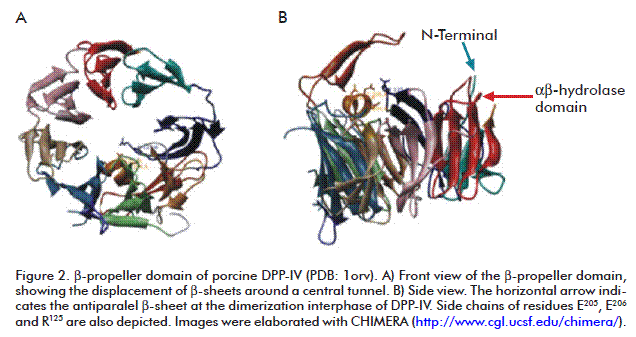
<body><![CDATA[<P   ><font face="Verdana, Arial, Helvetica, sans-serif" size="2">The &beta;-propeller      domains are formed by four to eight &beta;-sheets of 30-50 amino acids each,      organized in four antiparalel strands [37]. Those &beta;-sheets are radially      displaced from a central tunnel of approximately 30-45 &Aring;, forming a      highly simmetric structure. This type of domain was firstly described for      the influenza virus neuraminidase [37], which bears six &beta;-sheets. Afterwards,      other enzymes were described carrying this domain, such as: the methylamine      dehydrogenase [38] and the galactose oxidase [39], both with seven &beta;-sheets,      and the methanol dehydrogenase [40] with eight. The number of proteins identified      as carrying this domain has considerably grown since 1998, the properties      of their supramolecular structures been subsequently described by Murzin [41],      F&uuml;l&ouml;p and Jones [42], Paoli [43], and Jawad and Paoli [44]. </font></P >       <P   ><font face="Verdana, Arial, Helvetica, sans-serif" size="2">&beta;-propellers      commonly serve as scaffolds for protein-protein interactions [42, 45] and      also mediate in the catalytic activity of the enzymes carrying them [46, 47].      Particularly, some of those enzymes are related to the pathogenesis in some      diseases, as in cancer, Alzheimer&rsquo;s disease, Huntington disease, arthritis,      familial hypercholesterolemia, rethinitis pigmentosa, arterial hypertension      and also infections [48]. </font></P >       <P   ><font face="Verdana, Arial, Helvetica, sans-serif" size="2">The structure of      DPP-IV is unique by having a &beta;-propeller domain of eight &beta;-sheets,      compared to the other two leucocyte surface molecules carrying a &beta;-propeller      domain, of seven &beta;-sheets each: CD100 [49] and the integrin &alpha; chain      [50]. Its domain is distinctively disorganized among those described and the      eight &beta;-sheets are displaced forming a 30-45 &Aring; in diameter cavity      [5]. Since DPP-IV is a type II integral membrane protein, this structural      domain is exposed to the extracellular milieu, its structure influencing the      interaction of the molecule with other molecules such as ADA, HIV gp120, fibronectin      (FN) and collagen [23]. </font></P >       <P   ><font face="Verdana, Arial, Helvetica, sans-serif" size="2">One depicting element      in the DPP-IV &beta;-propeller domain is an antiparalel &beta;-sheet which      inserts between strands 1 and 2 of the second &beta;-sheet of the enzyme.      That antiparalel &beta;-sheet contains the R<sup>125</sup> residue, which      forms a salt bridge with E<sup>205</sup>. This last residue locates at the      C-terminal turn of the W<sup>201</sup>-E<sup>205</sup> &alpha;-helix which      intrudes between &beta;-sheets three and four in the &beta;-propeller domain.      Another antiparalel &beta;-sheet is located between strands 3 and 4 in the      fourth &beta;-sheet, comprising residues D<sup>230</sup>-N<sup>263</sup>.      This antiparalel &beta;-sheet is essential for the dimerization interphase      and is also involved in the substrate binding process [31] (<a href="/img/revistas/bta/v31n2/f0202214.gif">Figure      2</a>). </font></P >   <FONT size="+1"><FONT size="+1"><FONT size="+1"><FONT size="+1"><FONT size="+1"><FONT size="+1"><FONT size="+1"><FONT size="+1"><FONT size="+1"><FONT size="+1"><FONT size="+1"><FONT size="+1">        
<P   ><font face="Verdana, Arial, Helvetica, sans-serif" size="2">Residue R<sup>125</sup>      establishes contacts with both substrates and inhibitors, and is a common      target for the design of molecules inhibiting the enzyme activity [18, 28,      31, 32, 51-53]. This residue is highly conserved in DPP-IV structure throughout      species, from bacteria to humans. At the same time, the sequence motif of      the &alpha;-helix bearing the E<sup>205</sup> residue (D-W-X-Y-E-E<sup>205</sup>-E-X)      is conserved in the entire DPP-IV gene family [54].</font></P >       <P   >&nbsp;</P >   <FONT size="+1"><FONT size="+1"><FONT size="+1"><FONT size="+1"><FONT size="+1"><FONT size="+1">        <P   ><font size="2" face="Verdana, Arial, Helvetica, sans-serif"><B><font size="3">DPP-IV      and cancer</font></B> </font></P >   <FONT size="+1">        <P   ><font size="2" face="Verdana, Arial, Helvetica, sans-serif">The progressive loss      of cellular and molecular regulatory mechanisms that occurs during carcinogenesis      promotes alterations on key cellular processes, which ultimately determine      the raise of malignant phenotypes displaying: autonomous cell growth, irresponsiveness      to growth inhibitory signals, cell death evasion, unlimited replicative potential,      sustained angiogenesis, tissue invasion and metastasis [55]. Most of these      alterations are related to abnormal cell signaling circuits, with overexpressed      or constitutively expressed oncogenes, or tumor suppressor genes with null      or decreased expression. Particularly, most of those circuits are triggered      by molecules secreted by the tumor or its microenvironment. In this context,      the auto, para and yuxtacrine regulations determined by growth factors, cytokines,      hormones and peptide signals are determinant for the altered abovementioned      processes, with the abundance of these ligands depending on the extracellular      proteolytic rate which is essential for tumor evolution [56]. </font></P >   <FONT size="+1">        <P   ><font face="Verdana, Arial, Helvetica, sans-serif" size="2">It is known that      DPP-IV participates in peptide-mediated growth regulation and differentiation      and in the regulation of extracellular matrix interactions [6]. The regulation      of the DPP-IV-mediated proteolysis could have marked effects on the availability      of growth promoting or inhibitory factors in a given microenvironment [6,      56, 57]. Therefore, the loss or lack of DPP-IV expression, and its expression      or that of its ligands in the tumor neighboring cells which can be crucial      for the progression and metastasis events in several tumor types. The evidences      of such events are multifactorial, and their interpretations depend on the      properties of the carcinogenesis affected tissues (<a href="/img/revistas/bta/v31n2/t0102214.gif">Table</a>).      </font></P >       
<P   ><font face="Verdana, Arial, Helvetica, sans-serif" size="2">DPP-IV expression      is decreased in several cancers: melanoma [58], lung [60-62] and prostate      [63, 79, 80] cancers, and in serum of oral [81] and colorectal cancers [82,      83]. It has also seen as progressively decreasing during endometrial adenocarcinoma      [69]. The opposite effect has been shown in other cancer types, such as: primary      lung tumors [59], prostate [63], ovarian carcinoma [70], thyroid carcinoma      [64], dermal basal cell carcinoma [71], esophageal adenocarcinoma [72], B-cells      chronic leukemia [73, 74] and certain types of T cell cancers (T-cell lymphoblastic      lymphoma, anaplastic large cell lymphomas and T-cell acute lymphoblastic leukemia)      [6, 75]. </font></P >       ]]></body>
<body><![CDATA[<P   ><font face="Verdana, Arial, Helvetica, sans-serif" size="2">It has been further      demonstrated the involvement of DPP-IV in the interaction with extracellular      matrix components in cancer cells. Its binding to type II plasminogen (Pg      2) on the surface of the 1-LN prostate cancer cell line lead to increased      intracellular Ca<sup>2+</sup> concentrations, with downstream activation of      a transduction pathway ultimately resulting in increased cytosolic pH. That      pathway may be triggered by phospholipase C activation which promotes the      synthesis of inositol 3,4,5-triphosphate, a well-known inducer of endoplasmic      reticulum Ca<sup>2+</sup> release [84]. Moreover, it is possible that Pg 2      may regulate pH though its association to the NHE family Na<sup>+</sup>/H<sup>+</sup>      exchanger (NH3E) previously bound to DPP-IV. These evidences suggest that      the DPP-IV-Pg2 may regulate simultaneously Ca<sup>2+</sup>, Na<sup>+</sup>      and H<sup>+</sup> concentrations required for tumor proliferation and invasion      [84]. </font></P >   <FONT size="+1"><FONT size="+1"><FONT size="+1"><FONT size="+1"><FONT size="+1"><FONT size="+1"><FONT size="+1"><FONT size="+1"><FONT size="+1"><FONT size="+1">        <P   ><font face="Verdana, Arial, Helvetica, sans-serif" size="2">The binding of DPP-IV      to a subset of extracellular matrix proteins is probably mediated by the &beta;-propeller      domain [85]. It was shown the affinity of DPP-IV for type I collagen and FN.      So far, the most significant interaction between DPP-IV and FN seems to be      that reported during the colonization of the lung by blood-derived cancer      cells. Cheng <I>et al.</I> [86] demonstrated that the vascular arrest of metastatic      cells in the lung was mediated by the adhesion of DPP-IV to the FN in the      surface of cancerous cells. The FN gene is overexpressed in cells able to      colonize the lung derived from several cancers in humans, rats and mice. Such      metastatic behavior relies on the ability of FN to randomly and dispersedly      self-polymerize on the surface of numerous lung cancer cell types [87], and      to assemble into long, fibrilar strands. This event occurs by the exposure      of FN consensus recognition sequences to the DPP-IV molecules present in the      endothelia [86]. It has been demonstrated that interaction depends on SP activity      [86]. By the contrary, DPP-IV displays a weak binding activity to plasma soluble      FN, suggesting that polymerized FN acquires a conformation different from      that of plasma FN [86]. </font></P >       <P   ><font face="Verdana, Arial, Helvetica, sans-serif" size="2">Several findings      have confirmed the involvement of DPP-IV and polyFN in lung metastasis: 1)      a soluble peptide mimicking the extracellular region of DPP-IV was able to      suppress the adhesion of DPP-IV to breast metastatic cells in lung, preventing      colonization; 2) the abundance of polyFN in lung metastatic cells, demonstrated      in human rat and mice cancers, and also in mice and human melanoma cell lines      able to colonize this organ; 3) the polyFN expression in rhabdomyosarcoma      clones correlates with lung metastasis [88]. Still remains to be elucidated      if the vascular compromise in lung metastasis is solely mediated by the DPP-IV      to polyFN interaction or their complexation with other adhesion molecules,      such as: proteoglycans, CD44 or heparin sulphate [86]. </font></P >       <P   ><font face="Verdana, Arial, Helvetica, sans-serif" size="2">Binding experiments      with a peptide bearing the FN-III repeat 14 sequence (peptide FN-III14) and      the native DPP-IV showed that it was able to compete for the binding of polyFN      to DPP-IV in the MTF-7 cell line, deriving in profound antimetastatic effects      in lung due to 50 % decrease in adhesion and a reduced number of colonies      and their size. Such a behavior was similar to that obtained through blocking      the DPP-IV extracellular domain by a specific antibody [86]. Another peptide      bearing the FN-III14 sequence (22-mer peptide) was described as inducing antimetastasis      effects in spleen and liver colonization in T cell lymphoma [89]. </font></P >       <P   ><font face="Verdana, Arial, Helvetica, sans-serif" size="2"><b>DPP-IV in melanoma</b>      </font></P >       <P   ><font face="Verdana, Arial, Helvetica, sans-serif" size="2">In melanoma, DPP-IV      is expressed in melanocytes both <I>in vitro</I> and <I>in vivo</I>, but not      by the melanoma itself. Its loss of expression seems to occur at a very early      stage during melanocyte transformation into melanoma. Wesley <I>et al.</I>      [58] demonstrated that DPP-IV-transfected melanoma cells displayed no tumorigenicity      or anchorage-independent growth, this last relying on DPP-IV enzyme activity.      Additionally, the protein re-expression led to the reacquisition of growth      dependency on exogenously provided growth factors [6, 58]. </font></P >       <P   ><font face="Verdana, Arial, Helvetica, sans-serif" size="2"><b>DPP-IV in lung      cancer </b> </font></P >       <P   ><font face="Verdana, Arial, Helvetica, sans-serif" size="2">Lung cancer development      relies on the confluence of different growth factors, such as: neuropeptide      Y (NPY) and substance P, DPP-IV substrates both. The excision and subsequent      inactivation of NPY abbrogate its growth promoting effects [6, 90, 91]. This      suggests that the loss of the DPP-IV proteolytic activity would promote growth      in certain lung tumor cells, even without confirmation of DPP-IV acting through      the regulation of other processes or signaling pathways independent of its      enzyme activity, or mediated by other surface molecules as PAF, which stromal      abundance correlates with increased tumor cell survival [61]. </font></P >       <P   ><font face="Verdana, Arial, Helvetica, sans-serif" size="2">Although certain      lung carcinomas express DPP-IV, that is not the case in large, small-large      and small cell carcinomas, with null or marginal expression [60]. In non-small      lung cell carcinoma, such lack occurs both at mRNA and protein expression      levels (decreasing its activity to less than 40 pM/min/&micro;g of protein)      [61], due to frequent losses of chromosome 2q which bears the DPP-IV <I>loci</I>      [92-94]. </font></P >       <P   ><font face="Verdana, Arial, Helvetica, sans-serif" size="2">Wesley <I>et al.</I>      [61] have proven that the human non-small cell lung cancer cell lines H28,      H226, H441, SK-LUC-8, SK-LUC-17, SK-LUC-13, SK-LUC-9 and SW-900 show diminished      DPP-IV expression. The restitution of DPP-IV in the line SK-LUC-8, particularly      attractive by its undetectable expression of the enzyme, significantly reverted      the malign phenotype, independent of the enzyme activity: morphological changes      <I>in vitro</I> (long and slightly dendritic cells, adopting cylindric or      flat epithelial shape), inhibition of growth in culture (with a lag for the      entry in the logarithm phase), inhibition of anchoring-dependent growth (a      decreased ability, 50-70 %, to form colonies in soft agar), reduced <I>in      vitro</I> migration and cell confluence (probably due to the appearance of      density inhibition at a confluence higher than 50 %). This was also related      to the increased expression of <I>p21</I>, a drastic cell cycle arrest on      G1 and apoptosis induction (possibly by the inactivation of unknown peptides).      Simultaneously, there was a high expression of CD44 and PAF, cell surface      proteins associated to suppressed growth and metastasis [95, 96]. The subsequent      implantation of these cells on athymic mice allowed to corroborate tumor growth      as expected, compared to the control which was grafted with tumor cells from      the same cell line but untransfected with DPP-IV [61]. </font></P >       ]]></body>
<body><![CDATA[<P   ><font face="Verdana, Arial, Helvetica, sans-serif" size="2">Recently, the marginal      expression of DPP-IV in A549 (lung adenocarcinoma) and SK-MES-1 (squamous      cells carcinoma) cell lines was corroborated; nevertheless, certain variations      arose from the history of the carcinogenic process. A549 exhibited an 8-10      times decrease in the overall DPP-IV activity, with a 93 % surface relative      activity. This indicates a fast externalization of the recently synthesized      protein (probably due to preserved secretory activities inherent to alveolar      type II pneumocytes, the original cell type for this cell line). </font></P >       <P   ><font face="Verdana, Arial, Helvetica, sans-serif" size="2">The whole proteolytic      activity of DPP-IV on SK-MES-1 decreased, following a granular intracellular      deposition pattern with a 35 % surface relative activity, consistent with      the low secretory potential of the cell line. These observations suggest that      the distribution of the enzyme during carcinogenesis correlates with alterations      that may originate in the intracellular membrane trafficking system [62].      </font></P >       <P   ><font face="Verdana, Arial, Helvetica, sans-serif" size="2"><b>DPP-IV in ovarian      cancer </b></font></P >       <P   ><font face="Verdana, Arial, Helvetica, sans-serif" size="2">The presence of DPP-IV      in ovarian cancer and its involvement in tumor adhesion to the mesothelium      was demonstrated by Kikkawa <I>et al.</I> [70]. They showed that the SKOV-3      cells attached more efficiently to mesothelial cells when the DPP-IV expression      was restituted. A marked increase in the adhesion to immobilized FN and collagen      was also detected. </font></P >       <P   ><font face="Verdana, Arial, Helvetica, sans-serif" size="2">The mesothelium adhesion      effect was shown to be dose-dependent <I>in vitro</I>, compared to soluble      FN. That suggests that DPP-IV is a key protein in the tumor cell adhesion      to the mesothelium, proliferation and invasion. Ovarian carcinoma and the      peritoneal mesothelium where this tumor spreads out, also express DPP-IV,      and high amounts of soluble FN and the fibroconnectin of the extracellular      matrix are normally found in ascites and the malignant serum. This leads to      assume that DPP-IV captures high amounts of FN from these fluids. As a result,      carcinoma cells would develop an easy adhesion capacity to either endothelium      or mesothelium, once displaying fibroconectin in amounts enough to bind the      DPP-IV molecules on these two layers [70].<I> </I></font></P >       <P   ><font face="Verdana, Arial, Helvetica, sans-serif" size="2">Nude mice inoculated      with SKOV-3 tumor cells reconstituted with DPP-IV showed lower peritoneal      dissemination of the tumor cells and longer survival than those receiving      the non-reconstituted cell line [97]. Although the causes for such a phenomenon      were not completely understood, it would be speculated that the high levels      of DPP-IV would promote a tight cell-to-cell adhesion, which may limit the      ability of the carcinoma cells to detach from the tumor and spread away from      it. Nevertheless, when they detach, the DPP-IV expressed by the tumor and      the mesothelium facilitate the invasion into the peritoneum [70]. </font></P >       <P   ><font face="Verdana, Arial, Helvetica, sans-serif" size="2">It could be predicted      at least with low probability that the sustained and increased activity of      the enzyme could influence indirectly that event, in spite of its innaparent      involvement in cell adhesion [70]. </font></P >       <P   ><font face="Verdana, Arial, Helvetica, sans-serif" size="2"><b>DPP-IV in prostate      cancer </b></font></P >       <P   ><font face="Verdana, Arial, Helvetica, sans-serif" size="2">The benign prostate      cancer progresses to a fatal hormone refractory stage through a process considered      to be mediated by the overexpression of peptidic growth factors which trigger      alternative mitogenic signals [98-102]. Under normal physiological conditions,      DPP-IV participates in cell growth regulation and differentiation by regulating      those growth factors [103, 104] (e.g., the factor 1-derived stromal chemokine      [63]). </font></P >       <P   ><font face="Verdana, Arial, Helvetica, sans-serif" size="2">Other evidences suggest      that prostate cancer metastasis is associated to the loss of DPP-IV (above      50 % in most of the cases) [63, 79] and the increase in the basic fibroblast      growth factor activity (bFGF), this last a potent mitogen and pro-angiogenic      factor [98-102, 105] expressed as two isoforms, one cytoplasmic of low molecular      weight and another one of high molecular weight in the cell nucleus. bFGF      transduces through the extracellular signal-regulated mitogen-activated protein      kinase (MAPK)-kinase (ERK1/2) pathway, promoting cell cancer progression and      migration [106, 107]. Besides, ERK1/2 activation by bFGF during cell migration      and angiogenesis increases the production of urokinase-type collagen activator      (uPA), an SP catalyzing the conversion of plasminogen in plasmin, and further      promoting metastasis through the destruction of the extracellular matrix [108,      109]. </font></P >       ]]></body>
<body><![CDATA[<P   ><font face="Verdana, Arial, Helvetica, sans-serif" size="2">It has been proven      that DPP-IV restitution in the DU-145 cell line blocks the nuclear translocation      of bFGF and the expression of both isoforms, abroggating the stimulation through      the MAP-ERK1/2 pathways. This leads to a decrease in uPA mRNA levels, the      acquisition of flat and cube-like cell shapes, the loss of contact and anchoring-dependent      growth and tumor migration [80]. </font></P >       <P   ><font face="Verdana, Arial, Helvetica, sans-serif" size="2">Although the mechanism      by which DPP-IV affects bFGF production remains to be elucidated, it is speculated      that in a normal cell, DPP-IV excises its aminoterminal region, causing its      confinement within the nucleus. That excision could be the first step for      bFGF degradation [80]. Similarly, a direct association may occur with bFGF,      that interferes its postranscriptional modification such as methylation of      the aminoterminal region, which is required for its nuclear confinement [110-112].      </font></P >       <P   ><font face="Verdana, Arial, Helvetica, sans-serif" size="2">The expression of      DPP-IV in DU-145 cells also stimulated transcription of the P27 gene, an inhibitor      of cyclin-dependent kinases, halting the cell cycle at the G2-M transition      and increasing apoptosis from 24 to 34 % [61]. </font></P >       <P   ><font face="Verdana, Arial, Helvetica, sans-serif" size="2"><b>DPP-IV and thyroid      gland: neoplasias, papillary and follicular carcinomas </b></font></P >       <P   ><font face="Verdana, Arial, Helvetica, sans-serif" size="2">Thyroid and follicle      carcinomas are highly positive to DPP-IV screening, in contrast to benign      neoplasias which are markedly negative [64, 67]. Furthermore, DPP-IV expression      increases during benign adenoma progression to malignancy, demonstrated by      its higher expression in follicle adenoma displaying incomplete capsule invasion      compared to that without capsular invasion [65]. The expression of the enzyme      is so distinctive at both stages that it is currently considered that DPP-IV      levels are the most effective fingerprint to discriminate between follicle      carcinoma and follicle adenoma, even more precise that canonical variables      such as the patient age, lesion size, its ultrasound image and serum tiroglobulin      levels [68]. </font></P >       <P   ><font face="Verdana, Arial, Helvetica, sans-serif" size="2"><b>DPP-IV and keratinocyte      tumorization </b></font></P >       <P   ><font face="Verdana, Arial, Helvetica, sans-serif" size="2">Experiments in InvEE      transgenic mice, bearing keratinocytes with constitutively activated MAP kinase      1 (MEK-1), evidenced the upregulation of DPP-IV in epithelial tumor keratinocytes,      particularly notorious at the edge of intercellular contact. Noteworthy, although      dermal fibroblasts associated to tissue damage also shown upregulated DPP-IV      expression, it was downregulated in the tumor stroma. It was demonstrated      that such activity was stimulated by Ca2+-induced intercellular adhesion,      and the upregulation of the enzyme in dermal fibroblasts was promoted by addition      of interleukine-1&alpha; (IL-1&alpha;). DPP-IV inhibition reduced tumor growth,      and tumor incidence or its delayed appearance in healthy individuals was decreased      by blocking IL-1&alpha; activity [113]. </font></P >   <FONT size="+1"><FONT size="+1">        <P   ><font face="Verdana, Arial, Helvetica, sans-serif" size="2"><b>DPP-IV and neural      tissue: gliomas, meningiomas and neuroblastomas </b></font></P >       <P   ><font face="Verdana, Arial, Helvetica, sans-serif" size="2">Healthy human brain      tissues display a DPP-IV activity mostly considered as mediated by DPP8 and      DPP9. Otherwise, in gliomas, the most significant tumor type in the central      nervous system with more than 50 % of the tumors, this enzyme activity has      been correlated with decreased DPP8 and DPP9 activity, and a spike in DPP-IV      and PAF expression, in parenchymal and vascularized areas. At the same time,      a high expression of CXCR4, receptor for the stroma-derived factor (SDF-1&alpha;),      was also found [76]. SDF-1&alpha; is one of the endogenous substrates of DPP-IV,      and its active form the main chemokine mediating glioma survival [114]. Once      excised, SDF-1&alpha; loses its chemotactic properties and could even act      as CXCR4 antagonist [115]. The marked CXCR4 upregulation seen in glioma would      seem to compensate DPP-IV overexpression, suggesting a potential cross-regulation      between both molecules [76]. </font></P >       <P   ><font face="Verdana, Arial, Helvetica, sans-serif" size="2">It was found that      WHO type I and atypical type II meningiomas express DPP-IV at very low levels,      in detriment of increased DPP8 and DPP9 activities. The differential DPP-IV      expression in meningiomas and gliomas could reside in their embryonic origin      and, paradoxically, could be one of the underlying causes for the lowest aggressiveness      of mningiomas compared to gliomas. In fact, meningiomas express normal levels      of CXCR4, in agreement with the decrease DPP-IV expression [77]. Thus, the      putative &lsquo;compensatory effect&rsquo; does not seem to be activated due      to insufficient DPP-IV activity, a mechanism that is present in glioma through      the SDF-1&alpha; activation pathway. </font></P >       ]]></body>
<body><![CDATA[<P   ><font face="Verdana, Arial, Helvetica, sans-serif" size="2">Several human neuroblastoma      cell lines show notoriously low DPP-IV expression. The re-expression of the      enzyme <I>in vitro</I> leads to the loss of the malignant phenotype: neuron-like      or flat epithelium morphology, inhibition of proliferation, caspase-activated      apoptosis, decreased Akt phosphorilation and MMP9 activity (known effectors      of the SDF-1&alpha;-CXCR4 activation pathway) and decreased cell migration.      The low proliferation seems to be caused by the induction of differentiation      as evidenced by morphological changes. The loss of migration activity may      be related to the simultaneous contribution of morphology recovery and the      under-regulation of MMP9, this last a proangiogenic factor displaying gelatinase      activity on the extracellular matrix [78]. </font></P >       <P   ><font face="Verdana, Arial, Helvetica, sans-serif" size="2"><b>DPP-IV, GLP-1      and cancer </b></font></P >       <P   ><font face="Verdana, Arial, Helvetica, sans-serif" size="2">The presence of the      GLP-1 factor was demonstrated in the human pancreatic carcinoma Hs-7766T and      human pancreatic duct adenocarcinoma CAPAN-1, CFPAC-1 and PL45 cell lines.      Nevertheless, there are differences in the stimulation, mediated either through      ERK1/2 activation or AMPc induction [114]. Since transduction pathways triggered      by ERK1/2 and, to a lower extent those of AMPc, are relevant in events such      as mitosis, meiosis and carcinogenesis, GLP-1 peptide mimetics or DPP-IV inhibitors      could exert oncogenic effects [116]. Based on the lack of detection of GLP-1      receptors in 21 human pancreatic adenocarcinomas, Korner <I>et al</I>. [117]      suggested that GLP-1 expression could be restricted to certain cell lines      and, therefore, could be irrelevant in humans. Moreover, exantine, a GLP-1      analogue, neither modulated the growth of pancreatic cancer cells which expressed      the receptor, nor rescued them from drug-induced death. Furthermore, the sustained      exantine-mediated activation of the receptor did not stimulate tumor growth      or progression in rats [118]. These observations suggested that the hypothetical      appearance of prostate cancer by administering DPP-IV inhibitors or GLP-1      mimetics could be caused by collateral pancreatitis [116], a condition favored      by underlying diseases such as type II diabetes and obesity [119]. In fact,      pancreatitis incidence in patients treated with GLP-1 receptor agonists does      not differ with that found in populations suffering from type II diabetes      [120, 121]. Similarly, studies in rats and monkeys indicated that the induction      of pancreatitis through the stimulation of the GLP-1 receptor seems to be      quite improbable [122]. </font></P >       <P   ><font face="Verdana, Arial, Helvetica, sans-serif" size="2">Preclinical studies      have shown an increased incidence of thyroid C-cell tumors in rodents treated      with GLP-1 analogues. Nevertheless, the GLP-1 receptor expression in this      cell type is highly dependent on the species, implying that observations in      rodents are not necessarily relevant in human [117] due to a differential      expression 22-times higher in rodents [123, 124]. Besides, it was shown that      rats are more susceptible to develop thyroid C-cell neoplasias, quite rare      in humans [125]. </font></P >       <P   ><font face="Verdana, Arial, Helvetica, sans-serif" size="2">The rise in GLP-1      concentrations seems to originate more probably from premalignant lesions      stimulation rather than the induction of new lesions [117], both in pancreas      and the thyroid, based on the short duration of the studies and the evidences      gathered so far. In contrast, it is believed that GLP-1 receptor activation      could inhibit tumor growth in two very common cancer types: colon and breast      cancers [117]. </font></P >       <P   ><font face="Verdana, Arial, Helvetica, sans-serif" size="2">In the case of colon      cancer, the CT26 murine colon cancer cell line expresses a functional GLP-1      receptor. Its exposure to exentanide <I>in vitro</I> leads to morphological      changes, inhibits proliferation and colony formation in solid agar and induces      apoptosis. These effects were confirmed <I>in vivo </I>in<I> </I>CT26 cells      implanted in mice, even when this did not affect tumor weight [126]. </font></P >       <P   ><font face="Verdana, Arial, Helvetica, sans-serif" size="2">Ligumsky <I>et al.,</I>      [127] demonstrated in vitro that exentanide significantly reduced the number      of colonies formed by the cell lines MCF-1 and MDA-MB-231, positive and negative      to estrogen receptors, respectively. The non-cancer HB-2 cell line remained      unaffected. A significant exentanide dose-dependent tumor reduction was seen      in mice implanted with MDA-MB-231 cells, when the drug was administered by      the intraperitoneal route [128]. </font></P >       <P   >&nbsp;</P >       <P   ><font size="3" face="Verdana, Arial, Helvetica, sans-serif"><b>CONCLUSIONS </b></font></P >   <FONT size="+1">        <P   ><font size="2" face="Verdana, Arial, Helvetica, sans-serif">Currently, DPP-IV      gets the attention of the international scientific community, due to its peculiarly      complex tridimensional structure. This feature determines DPP-IV molecular      and functional properties, and its role in both the physiological and pathological      processes mediated by its enzyme activity or its interaction with other proteins.      It is implicated in mammalian homeostasis maintenance and, significantly,      in the molecular mechanisms of multiple diseases, particularly cancer and      immunological disorders, where it is found to have altered expression or misbalanced      activity. A better comprehension on the role of DPP-IV in those disease-related      processes would make it a very attractive target to design and develop more      effective therapeutic strategies. </font></P >       ]]></body>
<body><![CDATA[<P   >&nbsp;</P >   <FONT size="+1">        <P   ><font size="3" face="Verdana, Arial, Helvetica, sans-serif"><b>ACKNOWLEDGEMENTS      </b> </font></P >   <FONT size="+1">        <P   ><font size="2" face="Verdana, Arial, Helvetica, sans-serif">The authors thanks      the Project 3276/3 of the International Foundation for Science (IFS), together      with the Chemical Weapons Prohibition Organization, for the financial support.      </font></P >       <P   >&nbsp;</P >   <FONT size="+1">        <P   > </P >       <P   ><b><font face="Verdana, Arial, Helvetica, sans-serif" size="3">REFERENCES</font></b><font face="Verdana, Arial, Helvetica, sans-serif" size="2">      </font></P >       <P   > </P >       <P   > </P >   </font></font></font></font></font></font></font></font></font></font></font></font></font></font></font></font></font></font></font></font></font></font></font></font></font></font></font></font></font></font></font></font></font></font></font></font></font></font></font></font></font></font></font></font></font></font></font></font></font></font></font></font></font></font></font></font></font></font></font></font></font></font></font></font></font></font></font></font></font></font></font></font></font></font></font></font></font></font></font></font></font></font></font></font></font></font></font></font></font></font></font>        <p><font face="Verdana, Arial, Helvetica, sans-serif" size="2">1. Turk B. Targeting      proteases: successes, failures and future prospects. Nat Rev Drug Discov.      2006;5(9):785-99.</font></p>       <!-- ref --><p><font face="Verdana, Arial, Helvetica, sans-serif" size="2">2. Leung D, Abbenante      G, Fairlie DP. Protease inhibitors: current status and future prospects. J      Med Chem. 2000;43(3):305-41.    </font></p>       <!-- ref --><p><font face="Verdana, Arial, Helvetica, sans-serif" size="2">3. Abbenante      G, Fairlie DP. Protease inhibitors in the clinic. Med Chem. 2005;1(1):71-104.    </font></p>       <!-- ref --><p><font face="Verdana, Arial, Helvetica, sans-serif" size="2">4. Itou M, Kawaguchi      T, Taniguchi E, Sata M. Dipeptidyl peptidase-4: a key player in chronic liver      disease. World J Gastroenterol. 2013;19(15):2298-306.    </font></p>       <!-- ref --><p><font face="Verdana, Arial, Helvetica, sans-serif" size="2">5. Gorrell MD,      Wang XM, Park J, Ajami K, Yu DM, Knott H, <i>et al</i>. Structure and function      in dipeptidyl peptidase IV and related proteins. Adv Exp Med Biol. 2006;575:45-54.    </font></p>       <!-- ref --><p><font face="Verdana, Arial, Helvetica, sans-serif" size="2">6. Yu DM, Yao      TW, Chowdhury S, Nadvi NA, Osborne B, Church WB, <i>et al</i>. The dipeptidyl      peptidase IV family in cancer and cell biology. FEBS J. 2010;277(5):1126-44.    </font></p>       <p><font face="Verdana, Arial, Helvetica, sans-serif" size="2">7. Leiting B,      Pryor KD, Wu JK, Marsilio F, Patel RA, Craik CS, et al. Catalytic properties      and inhibition of proline-specific dipeptidyl peptidases II, IV and VII. Biochem      J. 2003;371(Pt 2):525-32.</font></p>       ]]></body>
<body><![CDATA[<!-- ref --><p><font face="Verdana, Arial, Helvetica, sans-serif" size="2">8. Hopsu-Havu      VK, Glenner GG. A new dipeptide naphthylamidase hydrolyzing glycyl-prolyl-beta-naphthylamide.      Histochemie. 1966;7(3):197-201.    </font></p>       <!-- ref --><p><font face="Verdana, Arial, Helvetica, sans-serif" size="2">9. Palmieri FE,      Ward PE. Dipeptidyl(amino)peptidase IV and post proline cleaving enzyme in      cultured endothelial and smooth muscle cells. Adv Exp Med Biol. 1989;247A:305-11.    </font></p>       <!-- ref --><p><font face="Verdana, Arial, Helvetica, sans-serif" size="2">10. Hu CX, Huang      H, Zhang L, Huang Y, Shen ZF, Cheng KD, et al. A new screening method based      on yeast-expressed human dipeptidyl peptidase IV and discovery of novel inhibitors.      Biotechnol Lett. 2009;31(7):979-84.     </font></p>       <!-- ref --><p><font face="Verdana, Arial, Helvetica, sans-serif" size="2">11. Durinx C,      Lambeir AM, Bosmans E, Falmagne JB, Berghmans R, Haemers A, et al. Molecular      characterization of dipeptidyl peptidase activity in serum: soluble CD26/dipeptidyl      peptidase IV is responsible for the release of X-Pro dipeptides. Eur J Biochem.      2000;267(17):5608-13.    </font></p>       <!-- ref --><p><font face="Verdana, Arial, Helvetica, sans-serif" size="2">12. Stano J,      Kovacs P, Kakoniova D, Kirilova ND, Komov VP. Activity of dipeptidyl peptidase      IV in gingseng callus culture. Biologia. 1994;49:353-7.    </font></p>       ]]></body>
<body><![CDATA[<!-- ref --><p><font face="Verdana, Arial, Helvetica, sans-serif" size="2">13. Koreeda Y,      Hayakawa M, Ikemi T, Abiko Y. Isolation and characterisation of dipeptidyl      peptidase IV from Prevotella loescheii ATCC 15930. Arch Oral Biol. 2001;46(8):759-66.    </font></p>       <!-- ref --><p><font face="Verdana, Arial, Helvetica, sans-serif" size="2">14. Davy A, Thomsen      KK, Juliano MA, Alves LC, Svendsen I, Simpson DJ. Purification and characterization      of barley dipeptidyl peptidase IV. Plant Physiol. 2000;122(2):425-32.    </font></p>       <!-- ref --><p><font face="Verdana, Arial, Helvetica, sans-serif" size="2">15. Bauvois B,      Djavaheri-Mergny M, Rouillard D, Dumont J, Wietzerbin J. Regulation of CD26/DPPIV      gene expression by interferons and retinoic acid in tumor B cells. Oncogene.      2000;19(2):265-72.    </font></p>       <!-- ref --><p><font face="Verdana, Arial, Helvetica, sans-serif" size="2">16. de Meester      I, Vanhoof G, Lambeir AM, Scharpe S. Use of immobilized adenosine deaminase      (EC 3.5.4.4) for the rapid purification of native human CD26/dipeptidyl peptidase      IV (EC 3.4.14.5). J Immunol Methods. 1996;189(1):99-105.    </font></p>       <!-- ref --><p><font face="Verdana, Arial, Helvetica, sans-serif" size="2">17. Wilson MJ,      Ruhland AR, Pryor JL, Ercole C, Sinha AA, Hensleigh H, et al. Prostate specific      origin of dipeptidylpeptidase IV (CD-26) in human seminal plasma. J Urol.      1998;160(5):1905-9.    </font></p>       ]]></body>
<body><![CDATA[<!-- ref --><p><font face="Verdana, Arial, Helvetica, sans-serif" size="2">18. Engel M,      Hoffmann T, Wagner L, Wermann M, Heiser U, Kiefersauer R, et al. The crystal      structure of dipeptidyl peptidase IV (CD26) reveals its functional regulation      and enzymatic mechanism. Proc Natl Acad Sci USA. 2003;100(9):5063-8.    </font></p>       <!-- ref --><p><font face="Verdana, Arial, Helvetica, sans-serif" size="2">19. Abbott CA,      Baker E, Sutherland GR, McCaughan GW. Genomic organization, exact localization,      and tissue expression of the human CD26 (dipeptidyl peptidase IV) gene. Immunogenetics.      1994;40(5):331-8.    </font></p>       <p><font face="Verdana, Arial, Helvetica, sans-serif" size="2">20. Bohm SK,      Gum JR, Jr., Erickson RH, Hicks JW, Kim YS. Human dipeptidyl peptidase IV      gene promoter: tissue-specific regulation from a TATA-less GC-rich sequence      characteristic of a housekeeping gene promoter. Biochem J. 1995;311 ( Pt 3):835-43.</font></p>       <!-- ref --><p><font face="Verdana, Arial, Helvetica, sans-serif" size="2">21. Hong WJ,      Petell JK, Swank D, Sanford J, Hixson DC, Doyle D. Expression of dipeptidyl      peptidase IV in rat tissues is mainly regulated at the mRNA levels. Exp Cell      Res. 1989;182(1):256-66.    </font></p>       <!-- ref --><p><font face="Verdana, Arial, Helvetica, sans-serif" size="2">22. Kahne T,      Kroning H, Thiel U, Ulmer AJ, Flad HD, Ansorge S. Alterations in structure      and cellular localization of molecular forms of DP IV/CD26 during T cell activation.      Cell Immunol. 1996;170(1):63-70.    </font></p>       <!-- ref --><p><font face="Verdana, Arial, Helvetica, sans-serif" size="2">23. Gorrell MD.      Dipeptidyl peptidase IV and related enzymes in cell biology and liver disorders.      Clin Sci (Lond). 2005;108(4):277-92.    </font></p>       <!-- ref --><p><font face="Verdana, Arial, Helvetica, sans-serif" size="2">24. Yu DM, Ajami      K, Gall MG, Park J, Lee CS, Evans KA, et al. The in vivo expression of dipeptidyl      peptidases 8 and 9. J Histochem Cytochem. 2009;57(11):1025-40.    </font></p>       <!-- ref --><p><font face="Verdana, Arial, Helvetica, sans-serif" size="2">25. Lee KN, Jackson      KW, Christiansen VJ, Chung KH, McKee PA. A novel plasma proteinase potentiates      alpha2-antiplasmin inhibition of fibrin digestion. Blood. 2004;103(10):3783-8.    </font></p>       <!-- ref --><p><font face="Verdana, Arial, Helvetica, sans-serif" size="2">26. Ajami K,      Abbott CA, McCaughan GW, Gorrell MD. Dipeptidyl peptidase 9 has two forms,      a broad tissue distribution, cytoplasmic localization and DPIV-like peptidase      activity. Biochim Biophys Acta. 2004;1679(1):18-28.    </font></p>       <!-- ref --><p><font face="Verdana, Arial, Helvetica, sans-serif" size="2">27. Delacour      D, Gouyer V, Leteurtre E, Ait-Slimane T, Drobecq H, Lenoir C, et al. 1-benzyl-2-acetamido-2-deoxy-alpha-D-galactopyranoside      blocks the apical biosynthetic pathway in polarized HT-29 cells. J Biol Chem.      2003;278(39):37799-809.    </font></p>       <!-- ref --><p><font face="Verdana, Arial, Helvetica, sans-serif" size="2">28. Rasmussen      HB, Branner S, Wiberg FC, Wagtmann N. Crystal structure of human dipeptidyl      peptidase IV/CD26 in complex with a substrate analog. Nat Struct Biol. 2003;10(1):19-25.          </font></p>       <!-- ref --><p><font face="Verdana, Arial, Helvetica, sans-serif" size="2">29. Duke-Cohan      JS, Morimoto C, Rocker JA, Schlossman SF. Serum high molecular weight dipeptidyl      peptidase IV (CD26) is similar to a novel antigen DPPT-L released from activated      T cells. J Immunol. 1996;156(5):1714-21.    </font></p>       <!-- ref --><p><font face="Verdana, Arial, Helvetica, sans-serif" size="2">30. Pascual I,      Gomez H, Pons T, Chappe M, Vargas MA, Valdes G, et al. Effect of divalent      cations on the porcine kidney cortex membrane-bound form of dipeptidyl peptidase      IV. Int J Biochem Cell Biol. 2011;43(3):363-71.    </font></p>       <!-- ref --><p><font face="Verdana, Arial, Helvetica, sans-serif" size="2">31. Gomez H,      Chappe M, Valiente PA, Pons T, Chavez Mde L, Charli JL, et al. Effect of zinc      and calcium ions on the rat kidney membrane-bound form of dipeptidyl peptidase      IV. J Biosci. 2013;38(3):461-9.    </font></p>       <!-- ref --><p><font face="Verdana, Arial, Helvetica, sans-serif" size="2">32. Thoma R,      Loffler B, Stihle M, Huber W, Ruf A, Hennig M. Structural basis of proline-specific      exopeptidase activity as observed in human dipeptidyl peptidase-IV. Structure.      2003;11(8):947-59.    </font></p>       <!-- ref --><p><font face="Verdana, Arial, Helvetica, sans-serif" size="2">33. Aertgeerts      K, Ye S, Tennant MG, Kraus ML, Rogers J, Sang BC, et al. Crystal structure      of human dipeptidyl peptidase IV in complex with a decapeptide reveals details      on substrate specificity and tetrahedral intermediate formation. Protein Sci.      2004;13(2):412-21.    </font></p>       <!-- ref --><p><font face="Verdana, Arial, Helvetica, sans-serif" size="2">34. Abbott CA,      McCaughan GW, Gorrell MD. Two highly conserved glutamic acid residues in the      predicted beta propeller domain of dipeptidyl peptidase IV are required for      its enzyme activity. FEBS Lett. 1999;458(3):278-84.    </font></p>       <!-- ref --><p><font face="Verdana, Arial, Helvetica, sans-serif" size="2">35. Ajami K,      Abbott CA, Obradovic M, Gysbers V, Kahne T, McCaughan GW, et al. Structural      requirements for catalysis, expression, and dimerization in the CD26/DPIV      gene family. Biochemistry. 2003;42(3):694-701.    </font></p>       <!-- ref --><p><font face="Verdana, Arial, Helvetica, sans-serif" size="2">36. Chien CH,      Huang LH, Chou CY, Chen YS, Han YS, Chang GG, et al. One site mutation disrupts      dimer formation in human DPP-IV proteins. J Biol Chem. 2004;279(50):52338-45.    </font></p>       <!-- ref --><p><font face="Verdana, Arial, Helvetica, sans-serif" size="2">37. Varghese      JN, Laver WG, Colman PM. Structure of the influenza virus glycoprotein antigen      neuraminidase at 2.9 A resolution. Nature. 1983;303(5912):35-40.    </font></p>       <!-- ref --><p><font face="Verdana, Arial, Helvetica, sans-serif" size="2">38. Vellieux      FM, Huitema F, Groendijk H, Kalk KH, Jzn JF, Jongejan JA, et al. Structure      of quinoprotein methylamine dehydrogenase at 2.25 A resolution. EMBO J. 1989;8(8):2171-8.    </font></p>       <!-- ref --><p><font face="Verdana, Arial, Helvetica, sans-serif" size="2">39. Ito N, Phillips      SE, Stevens C, Ogel ZB, McPherson MJ, Keen JN, et al. Novel thioether bond      revealed by a 1.7 A crystal structure of galactose oxidase. Nature. 1991;350(6313):87-90.    </font></p>       <!-- ref --><p><font face="Verdana, Arial, Helvetica, sans-serif" size="2">40. Xia ZX, Dai      WW, Xiong JP, Hao ZP, Davidson VL, White S, et al. The three-dimensional structures      of methanol dehydrogenase from two methylotrophic bacteria at 2.6-A resolution.      J Biol Chem. 1992;267(31):22289-97.    </font></p>       <!-- ref --><p><font face="Verdana, Arial, Helvetica, sans-serif" size="2">41. Murzin AG.      Structural principles for the propeller assembly of beta-sheets: the preference      for seven-fold symmetry. Proteins. 1992;14(2):191-201.    </font></p>       <p><font face="Verdana, Arial, Helvetica, sans-serif" size="2">42. F&uuml;l&ouml;p      V, Jones DT. Beta propellers: structural rigidity and functional diversity.      Curr Opin Struct Biol. 1999;9(6):715-21.</font></p>       <!-- ref --><p><font face="Verdana, Arial, Helvetica, sans-serif" size="2">43. Paoli M.      Protein folds propelled by diversity. Prog Biophys Mol Biol. 2001;76(1-2):103-30.    </font></p>       ]]></body>
<body><![CDATA[<!-- ref --><p><font face="Verdana, Arial, Helvetica, sans-serif" size="2">44. Jawad Z,      Paoli M. Novel sequences propel familiar folds. Structure. 2002;10(4):447-54.    </font></p>       <!-- ref --><p><font face="Verdana, Arial, Helvetica, sans-serif" size="2">45. Adams J,      Kelso R, Cooley L. The kelch repeat superfamily of proteins: propellers of      cell function. Trends Cell Biol. 2000;10(1):17-24.    </font></p>       <!-- ref --><p><font face="Verdana, Arial, Helvetica, sans-serif" size="2">46. Russell RB,      Sasieni PD, Sternberg MJ. Supersites within superfolds. Binding site similarity      in the absence of homology. J Mol Biol. 1998;282(4):903-18.    </font></p>       <!-- ref --><p><font face="Verdana, Arial, Helvetica, sans-serif" size="2">47. Todd AE,      Orengo CA, Thornton JM. Evolution of function in protein superfamilies, from      a structural perspective. J Mol Biol. 2001;307(4):1113-43.    </font></p>       <!-- ref --><p><font face="Verdana, Arial, Helvetica, sans-serif" size="2">48. Pons T, Gomez      R, Chinea G, Valencia A. Beta-propellers: associated functions and their role      in human diseases. Curr Med Chem. 2003;10(6):505-24.    </font></p>       ]]></body>
<body><![CDATA[<!-- ref --><p><font face="Verdana, Arial, Helvetica, sans-serif" size="2">49. Love CA,      Harlos K, Mavaddat N, Davis SJ, Stuart DI, Jones EY, et al. The ligand-binding      face of the semaphorins revealed by the high-resolution crystal structure      of SEMA4D. Nat Struct Biol. 2003;10(10):843-8.    </font></p>       <!-- ref --><p><font face="Verdana, Arial, Helvetica, sans-serif" size="2">50. Xiong JP,      Stehle T, Diefenbach B, Zhang R, Dunker R, Scott DL, et al. Crystal structure      of the extracellular segment of integrin alpha Vbeta3. Science. 2001;294(5541):339-45.    </font></p>       <!-- ref --><p><font face="Verdana, Arial, Helvetica, sans-serif" size="2">51. Hiramatsu      H, Yamamoto A, Kyono K, Higashiyama Y, Fukushima C, Shima H, et al. The crystal      structure of human dipeptidyl peptidase IV (DPPIV) complex with diprotin A.      Biol Chem. 2004;385(6):561-4.    </font></p>       <p><font face="Verdana, Arial, Helvetica, sans-serif" size="2">52. Oefner C,      D'Arcy A, Mac Sweeney A, Pierau S, Gardiner R, Dale GE. High-resolution structure      of human apo dipeptidyl peptidase IV/CD26 and its complex with 1-[([2-[(5-iodopyridin-2-yl)amino]-ethyl]amino)-acetyl]-2-cyano-(S)-pyrrolidine.      Acta Crystallogr D Biol Crystallogr. 2003;59(Pt 7):1206-12.</font></p>       <!-- ref --><p><font face="Verdana, Arial, Helvetica, sans-serif" size="2">53. Weihofen      WA, Liu J, Reutter W, Saenger W, Fan H. Crystal structure of CD26/dipeptidyl-peptidase      IV in complex with adenosine deaminase reveals a highly amphiphilic interface.      J Biol Chem. 2004;279(41):43330-5.    </font></p>       <p><font face="Verdana, Arial, Helvetica, sans-serif" size="2">54. Abbott CA,      Gorrell MD. The family of CD26/DPP-IV and related ectopeptidases. In: Langner      J, Ansorge S, editors. Ectopeptidases. CD13/aminopeptidase N and CD26/dipeptidylpeptidase      IV in medicine and biology. New York: Kluwer Academic / Plenum Publishers;      2002. p. 171-95.</font></p>       ]]></body>
<body><![CDATA[<!-- ref --><p><font face="Verdana, Arial, Helvetica, sans-serif" size="2">55. Hanahan D,      Weinberg RA. The hallmarks of cancer. Cell. 2000;100(1):57-70.    </font></p>       <!-- ref --><p><font face="Verdana, Arial, Helvetica, sans-serif" size="2">56. Carl-McGrath      S, Lendeckel U, Ebert M, Rocken C. Ectopeptidases in tumour biology: a review.      Histol Histopathol. 2006;21(12):1339-53.    </font></p>       <!-- ref --><p><font face="Verdana, Arial, Helvetica, sans-serif" size="2">57. Iwata S,      Morimoto C. CD26/dipeptidyl peptidase IV in context. The different roles of      a multifunctional ectoenzyme in malignant transformation. J Exp Med. 1999;190(3):301-6.    </font></p>       <!-- ref --><p><font face="Verdana, Arial, Helvetica, sans-serif" size="2">58. Wesley UV,      Albino AP, Tiwari S, Houghton AN. A role for dipeptidyl peptidase IV in suppressing      the malignant phenotype of melanocytic cells. J Exp Med. 1999;190(3):311-22.    </font></p>       <!-- ref --><p><font face="Verdana, Arial, Helvetica, sans-serif" size="2">59. Sedo A, Krepela      E, Kasafirek E. Dipeptidyl peptidase IV, prolyl endopeptidase and cathepsin      B activities in primary human lung tumors and lung parenchyma. J Cancer Res      Clin Oncol. 1991;117(3):249-53.    </font></p>       ]]></body>
<body><![CDATA[<!-- ref --><p><font face="Verdana, Arial, Helvetica, sans-serif" size="2">60. Asada Y,      Aratake Y, Kotani T, Marutsuka K, Araki Y, Ohtaki S, et al. Expression of      dipeptidyl aminopeptidase IV activity in human lung carcinoma. Histopathology.      1993;23(3):265-70.    </font></p>       <!-- ref --><p><font face="Verdana, Arial, Helvetica, sans-serif" size="2">61. Wesley UV,      Tiwari S, Houghton AN. Role for dipeptidyl peptidase IV in tumor suppression      of human non small cell lung carcinoma cells. Int J Cancer. 2004;109(6):855-66.    </font></p>       <!-- ref --><p><font face="Verdana, Arial, Helvetica, sans-serif" size="2">62. Dimitrova      M, Ivanov I, Todorova R, Stefanova N, Moskova-Doumanova V, Topouzova-Hristova      T, et al. Comparison of the activity levels and localization of dipeptidyl      peptidase IV in normal and tumor human lung cells. Tissue Cell. 2012;44(2):74-9.    </font></p>       <!-- ref --><p><font face="Verdana, Arial, Helvetica, sans-serif" size="2">63. Bogenrieder      T, Finstad CL, Freeman RH, Papandreou CN, Scher HI, Albino AP, et al. Expression      and localization of aminopeptidase A, aminopeptidase N, and dipeptidyl peptidase      IV in benign and malignant human prostate tissue. Prostate. 1997;33(4):225-32.    </font></p>       <!-- ref --><p><font face="Verdana, Arial, Helvetica, sans-serif" size="2">64. Frohlich      E, Maier E, Wahl R. Interspecies differences in membrane-associated protease      activities of thyrocytes and their relevance for thyroid cancer studies. J      Exp Clin Cancer Res. 2012;31:45.    </font></p>       ]]></body>
<body><![CDATA[<!-- ref --><p><font face="Verdana, Arial, Helvetica, sans-serif" size="2">65. Kotani T,      Asada Y, Aratake Y, Umeki K, Yamamoto I, Tokudome R, et al. Diagnostic usefulness      of dipeptidyl aminopeptidase IV monoclonal antibody in paraffin-embedded thyroid      follicular tumours. J Pathol. 1992;168(1):41-5.    </font></p>       <!-- ref --><p><font face="Verdana, Arial, Helvetica, sans-serif" size="2">66. Tanaka T,      Umeki K, Yamamoto I, Sakamoto F, Noguchi S, Ohtaki S. CD26 (dipeptidyl peptidase      IV/DPP IV) as a novel molecular marker for differentiated thyroid carcinoma.      Int J Cancer. 1995;64(5):326-31.    </font></p>       <!-- ref --><p><font face="Verdana, Arial, Helvetica, sans-serif" size="2">67. Tang AC,      Raphael SJ, Lampe HB, Matthews TW, Becks GP. Expression of dipeptidyl aminopeptidase      IV activity in thyroid tumours: a possible marker of thyroid malignancy. J      Otolaryngol. 1996;25(1):14-9.    </font></p>       <!-- ref --><p><font face="Verdana, Arial, Helvetica, sans-serif" size="2">68. Maruta J,      Hashimoto H, Yamashita H, Yamashita H, Noguchi S. Diagnostic applicability      of dipeptidyl aminopeptidase IV activity in cytological samples for differentiating      follicular thyroid carcinoma from follicular adenoma. Arch Surg. 2004;139(1):83-8.    </font></p>       <!-- ref --><p><font face="Verdana, Arial, Helvetica, sans-serif" size="2">69. Khin EE,      Kikkawa F, Ino K, Kajiyama H, Suzuki T, Shibata K, et al. Dipeptidyl peptidase      IV expression in endometrial endometrioid adenocarcinoma and its inverse correlation      with tumor grade. Am J Obstet Gynecol. 2003;188(3):670-6.    </font></p>       ]]></body>
<body><![CDATA[<!-- ref --><p><font face="Verdana, Arial, Helvetica, sans-serif" size="2">70. Kikkawa F,      Kajiyama H, Ino K, Shibata K, Mizutani S. Increased adhesion potency of ovarian      carcinoma cells to mesothelial cells by overexpression of dipeptidyl peptidase      IV. Int J Cancer. 2003;105(6):779-83.    </font></p>       <!-- ref --><p><font face="Verdana, Arial, Helvetica, sans-serif" size="2">71. Pro B, Dang      NH. CD26/dipeptidyl peptidase IV and its role in cancer. Histol Histopathol.      2004;19(4):1345-51.    </font></p>       <!-- ref --><p><font face="Verdana, Arial, Helvetica, sans-serif" size="2">72. Goscinski      MA, Suo ZH, Nesland JM, Florenes VA, Giercksky KE. Dipeptidyl peptidase IV      expression in cancer and stromal cells of human esophageal squamous cell carcinomas,      adenocarcinomas and squamous cell carcinoma cell lines. APMIS. 2008;116(9):823-31.    </font></p>       <!-- ref --><p><font face="Verdana, Arial, Helvetica, sans-serif" size="2">73. Bauvois B,      De Meester I, Dumont J, Rouillard D, Zhao HX, Bosmans E. Constitutive expression      of CD26/dipeptidylpeptidase IV on peripheral blood B lymphocytes of patients      with B chronic lymphocytic leukaemia. Br J Cancer. 1999;79(7-8):1042-8.    </font></p>       <!-- ref --><p><font face="Verdana, Arial, Helvetica, sans-serif" size="2">74. Cro L, Morabito      F, Zucal N, Fabris S, Lionetti M, Cutrona G, et al. CD26 expression in mature      B-cell neoplasia: its possible role as a new prognostic marker in B-CLL. Hematol      Oncol. 2009;27(3):140-7.    </font></p>       ]]></body>
<body><![CDATA[<!-- ref --><p><font face="Verdana, Arial, Helvetica, sans-serif" size="2">75. Havre PA,      Dang LH, Ohnuma K, Iwata S, Morimoto C, Dang NH. CD26 expression on T-anaplastic      large cell lymphoma (ALCL) line Karpas 299 is associated with increased expression      of versican and MT1-MMP and enhanced adhesion. BMC cancer. 2013;13:517.    </font></p>       <!-- ref --><p><font face="Verdana, Arial, Helvetica, sans-serif" size="2">76. Stremenova      J, Krepela E, Mares V, Trim J, Dbaly V, Marek J, et al. Expression and enzymatic      activity of dipeptidyl peptidase-IV in human astrocytic tumours are associated      with tumour grade. Int J Oncol. 2007;31(4):785-92.    </font></p>       <!-- ref --><p><font face="Verdana, Arial, Helvetica, sans-serif" size="2">77. Stremenova      J, Mares V, Lisa V, Hilser M, Krepela E, Vanickova Z, et al. Expression of      dipeptidyl peptidase-IV activity and/or structure homologs in human meningiomas.      Int J Oncol. 2010;36(2):351-8.    </font></p>       <!-- ref --><p><font face="Verdana, Arial, Helvetica, sans-serif" size="2">78. Arscott WT,      LaBauve AE, May V, Wesley UV. Suppression of neuroblastoma growth by dipeptidyl      peptidase IV: relevance of chemokine regulation and caspase activation. Oncogene.      2009;28(4):479-91.    </font></p>       <!-- ref --><p><font face="Verdana, Arial, Helvetica, sans-serif" size="2">79. Dinjens WN,      Ten Kate J, Kirch JA, Tanke HJ, Van der Linden EP, Van den Ingh HF, et al.      Adenosine deaminase complexing protein (ADCP) expression and metastatic potential      in prostatic adenocarcinomas. J Pathol. 1990;160(3):195-201.    </font></p>       ]]></body>
<body><![CDATA[<!-- ref --><p><font face="Verdana, Arial, Helvetica, sans-serif" size="2">80. Wesley UV,      McGroarty M, Homoyouni A. Dipeptidyl peptidase inhibits malignant phenotype      of prostate cancer cells by blocking basic fibroblast growth factor signaling      pathway. Cancer Res. 2005;65(4):1325-34.    </font></p>       <!-- ref --><p><font face="Verdana, Arial, Helvetica, sans-serif" size="2">81. Urade M,      Komatsu M, Yamaoka M, Fukasawa K, Harada M, Mima T, et al. Serum dipeptidyl      peptidase activities as a possible marker of oral cancer. Cancer. 1989;64(6):1274-80.    </font></p>       <!-- ref --><p><font face="Verdana, Arial, Helvetica, sans-serif" size="2">82. de la Haba-Rodriguez      J, Macho A, Calzado MA, Blazquez MV, Gomez MA, Munoz EE, et al. Soluble dipeptidyl      peptidase IV (CD-26) in serum of patients with colorectal carcinoma. Neoplasma.      2002;49(5):307-11.    </font></p>       <!-- ref --><p><font face="Verdana, Arial, Helvetica, sans-serif" size="2">83. Cordero OJ,      Imbernon M, Chiara LD, Martinez-Zorzano VS, Ayude D, de la Cadena MP, et al.      Potential of soluble CD26 as a serum marker for colorectal cancer detection.      World J Clin Oncol. 2011;2(6):245-61.    </font></p>       <!-- ref --><p><font face="Verdana, Arial, Helvetica, sans-serif" size="2">84. Gonzalez-Gronow      M, Misra UK, Gawdi G, Pizzo SV. Association of plasminogen with dipeptidyl      peptidase IV and Na+/H+ exchanger isoform NHE3 regulates invasion of human      1-LN prostate tumor cells. J Biol Chem. 2005;280(29):27173-8.     </font></p>       ]]></body>
<body><![CDATA[<!-- ref --><p><font face="Verdana, Arial, Helvetica, sans-serif" size="2">85. Gorrell MD,      Gysbers V, McCaughan GW. CD26: a multifunctional integral membrane and secreted      protein of activated lymphocytes. Scand J Immunol. 2001;54(3):249-64.    </font></p>       <!-- ref --><p><font face="Verdana, Arial, Helvetica, sans-serif" size="2">86. Cheng HC,      Abdel-Ghany M, Pauli BU. A novel consensus motif in fibronectin mediates dipeptidyl      peptidase IV adhesion and metastasis. J Biol Chem. 2003;278(27):24600-7.    </font></p>       <!-- ref --><p><font face="Verdana, Arial, Helvetica, sans-serif" size="2">87. Cheng HC,      Abdel-Ghany M, Elble RC, Pauli BU. Lung endothelial dipeptidyl peptidase IV      promotes adhesion and metastasis of rat breast cancer cells via tumor cell      surface-associated fibronectin. J Biol Chem. 1998;273(37):24207-15.    </font></p>       <!-- ref --><p><font face="Verdana, Arial, Helvetica, sans-serif" size="2">88. Korach S,      Poupon MF, Du Villard JA, Becker M. Differential adhesiveness of rhabdomyosarcoma-derived      cloned metastatic cell lines to vascular endothelial monolayers. Cancer Res.      1986;46(7):3624-9.    </font></p>       <!-- ref --><p><font face="Verdana, Arial, Helvetica, sans-serif" size="2">89. Kato Y, Saijo      N. Developed new agents for lung cancer. Nihon Geka Gakkai zasshi. 2002;103(2):218-23.    </font></p>       ]]></body>
<body><![CDATA[<!-- ref --><p><font face="Verdana, Arial, Helvetica, sans-serif" size="2">90. Mentlein      R, Dahms P, Grandt D, Kruger R. Proteolytic processing of neuropeptide Y and      peptide YY by dipeptidyl peptidase IV. Regul Pept. 1993;49(2):133-44.    </font></p>       <!-- ref --><p><font face="Verdana, Arial, Helvetica, sans-serif" size="2">91. Ghersi G,      Chen W, Lee EW, Zukowska Z. Critical role of dipeptidyl peptidase IV in neuropeptide      Y-mediated endothelial cell migration in response to wounding. Peptides. 2001;22(3):453-8.    </font></p>       <!-- ref --><p><font face="Verdana, Arial, Helvetica, sans-serif" size="2">92. Mathew S,      Morrison ME, Murty VV, Houghton AN, Chaganti RS. Assignment of the DPP4 gene      encoding adenosine deaminase binding protein (CD26/dipeptidylpeptidase IV)      to 2q23. Genomics. 1994;22(1):211-2.    </font></p>       <!-- ref --><p><font face="Verdana, Arial, Helvetica, sans-serif" size="2">93. Otsuka T,      Kohno T, Mori M, Noguchi M, Hirohashi S, Yokota J. Deletion mapping of chromosome      2 in human lung carcinoma. Genes Chromosomes Cancer. 1996;16(2):113-9.    </font></p>       <!-- ref --><p><font face="Verdana, Arial, Helvetica, sans-serif" size="2">94. Shiseki M,      Kohno T, Nishikawa R, Sameshima Y, Mizoguchi H, Yokota J. Frequent allelic      losses on chromosomes 2q, 18q, and 22q in advanced non-small cell lung carcinoma.      Cancer Res. 1994;54(21):5643-8.    </font></p>       ]]></body>
<body><![CDATA[<!-- ref --><p><font face="Verdana, Arial, Helvetica, sans-serif" size="2">95. Morrison      H, Sherman LS, Legg J, Banine F, Isacke C, Haipek CA, et al. The NF2 tumor      suppressor gene product, merlin, mediates contact inhibition of growth through      interactions with CD44. Genes Dev. 2001;15(8):968-80.    </font></p>       <!-- ref --><p><font face="Verdana, Arial, Helvetica, sans-serif" size="2">96. Yan P, Muhlethaler      A, Bourloud KB, Beck MN, Gross N. Hypermethylation-mediated regulation of      CD44 gene expression in human neuroblastoma. Genes Chromosomes Cancer. 2003;36(2):129-38.    </font></p>       <!-- ref --><p><font face="Verdana, Arial, Helvetica, sans-serif" size="2">97. Kajiyama      H, Kikkawa F, Maeda O, Suzuki T, Ino K, Mizutani S. Increased expression of      dipeptidyl peptidase IV in human mesothelial cells by malignant ascites from      ovarian carcinoma patients. Oncology. 2002;63(2):158-65.    </font></p>       <!-- ref --><p><font face="Verdana, Arial, Helvetica, sans-serif" size="2">98. Ware JL.      Growth factor network disruption in prostate cancer progression. Cancer Metastasis      Rev. 1998;17(4):443-7.    </font></p>       <!-- ref --><p><font face="Verdana, Arial, Helvetica, sans-serif" size="2">99. Giri D, Ropiquet      F, Ittmann M. Alterations in expression of basic fibroblast growth factor      (FGF) 2 and its receptor FGFR-1 in human prostate cancer. Clin Cancer Res.      1999;5(5):1063-71.    </font></p>       ]]></body>
<body><![CDATA[<!-- ref --><p><font face="Verdana, Arial, Helvetica, sans-serif" size="2">100. Dow JK,      deVere White RW. Fibroblast growth factor 2: its structure and property, paracrine      function, tumor angiogenesis, and prostate-related mitogenic and oncogenic      functions. Urology. 2000;55(6):800-6.    </font></p>       <!-- ref --><p><font face="Verdana, Arial, Helvetica, sans-serif" size="2">101. Feldman      BJ, Feldman D. The development of androgen-independent prostate cancer. Nat      Rev Cancer. 2001;1(1):34-45.    </font></p>       <!-- ref --><p><font face="Verdana, Arial, Helvetica, sans-serif" size="2">102. Isaacs JT,      Isaacs WB. Androgen receptor outwits prostate cancer drugs. Nat Med. 2004;10(1):26-7.    </font></p>       <!-- ref --><p><font face="Verdana, Arial, Helvetica, sans-serif" size="2">103. Boonacker      E, Van Noorden CJ. The multifunctional or moonlighting protein CD26/DPPIV.      Eur J Cell Biol. 2003;82(2):53-73.    </font></p>       <!-- ref --><p><font face="Verdana, Arial, Helvetica, sans-serif" size="2">104. Proost P,      Struyf S, Schols D, Opdenakker G, Sozzani S, Allavena P, et al. Truncation      of macrophage-derived chemokine by CD26/ dipeptidyl-peptidase IV beyond its      predicted cleavage site affects chemotactic activity and CC chemokine receptor      4 interaction. J Biol Chem. 1999;274(7):3988-93.    </font></p>       ]]></body>
<body><![CDATA[<!-- ref --><p><font face="Verdana, Arial, Helvetica, sans-serif" size="2">105. Nakamoto      T, Chang CS, Li AK, Chodak GW. Basic fibroblast growth factor in human prostate      cancer cells. Cancer Res. 1992;52(3):571-7.    </font></p>       <p><font face="Verdana, Arial, Helvetica, sans-serif" size="2">106. Gioeli D,      Mandell JW, Petroni GR, Frierson HF, Jr., Weber MJ. Activation of mitogen-activated      protein kinase associated with prostate cancer progression. Cancer Res. 1999;59(2):279-84.</font></p>       <!-- ref --><p><font face="Verdana, Arial, Helvetica, sans-serif" size="2">107. Pintucci      G, Moscatelli D, Saponara F, Biernacki PR, Baumann FG, Bizekis C, et al. Lack      of ERK activation and cell migration in FGF-2-deficient endothelial cells.      FASEB J. 2002;16(6):598-600.    </font></p>       <p><font face="Verdana, Arial, Helvetica, sans-serif" size="2">108. Giuliani      R, Bastaki M, Coltrini D, Presta M. Role of endothelial cell extracellular      signal-regulated kinase1/2 in urokinase-type plasminogen activator upregulation      and in vitro angiogenesis by fibroblast growth factor-2. J Cell Sci. 1999;112      (Pt 15):2597-606.</font></p>       <!-- ref --><p><font face="Verdana, Arial, Helvetica, sans-serif" size="2">109. Rabbani      SA, Mazar AP. The role of the plasminogen activation system in angiogenesis      and metastasis. Surg Oncol Clin N Am. 2001;10(2):393-415.    </font></p>       <!-- ref --><p><font face="Verdana, Arial, Helvetica, sans-serif" size="2">110. Bugler B,      Amalric F, Prats H. Alternative initiation of translation determines cytoplasmic      or nuclear localization of basic fibroblast growth factor. Mol Cell Biol.      1991;11(1):573-7.    </font></p>       ]]></body>
<body><![CDATA[<!-- ref --><p><font face="Verdana, Arial, Helvetica, sans-serif" size="2">111. Bikfalvi      A, Klein S, Pintucci G, Rifkin DB. Biological roles of fibroblast growth factor-2.      Endocr Rev. 1997;18(1):26-45.    </font></p>       <!-- ref --><p><font face="Verdana, Arial, Helvetica, sans-serif" size="2">112. Delrieu      I. The high molecular weight isoforms of basic fibroblast growth factor (FGF-2):      an insight into an intracrine mechanism. FEBS Lett. 2000;468(1):6-10.    </font></p>       <!-- ref --><p><font face="Verdana, Arial, Helvetica, sans-serif" size="2">113. Arwert EN,      Mentink RA, Driskell RR, Hoste E, Goldie SJ, Quist S, et al. Upregulation      of CD26 expression in epithelial cells and stromal cells during wound-induced      skin tumour formation. Oncogene. 2012;31(8):992-1000.    </font></p>       <!-- ref --><p><font face="Verdana, Arial, Helvetica, sans-serif" size="2">114. Ehtesham      M, Winston JA, Kabos P, Thompson RC. CXCR4 expression mediates glioma cell      invasiveness. Oncogene. 2006;25(19):2801-6.    </font></p>       <p><font face="Verdana, Arial, Helvetica, sans-serif" size="2">115. Christopherson      KW, 2nd, Hangoc G, Broxmeyer HE. Cell surface peptidase CD26/dipeptidylpeptidase      IV regulates CXCL12/stromal cell-derived factor-1 alpha-mediated chemotaxis      of human cord blood CD34+ progenitor cells. J Immunol. 2002;169(12):7000-8.</font></p>       <p><font face="Verdana, Arial, Helvetica, sans-serif" size="2">116. Vangoitsenhoven      R, Mathieu C, Van der Schueren B. GLP1 and cancer: friend or foe? Endocr Relat      Cancer. 2012;19(5):F77-88.</font></p>       ]]></body>
<body><![CDATA[<!-- ref --><p><font face="Verdana, Arial, Helvetica, sans-serif" size="2">117. Korner M,      Stockli M, Waser B, Reubi JC. GLP-1 receptor expression in human tumors and      human normal tissues: potential for in vivo targeting. J Nucl Med. 2007;48(5):736-43.    </font></p>       <!-- ref --><p><font face="Verdana, Arial, Helvetica, sans-serif" size="2">118. Koehler      JA, Drucker DJ. Activation of glucagon-like peptide-1 receptor signaling does      not modify the growth or apoptosis of human pancreatic cancer cells. Diabetes.      2006;55(5):1369-79.    </font></p>       <!-- ref --><p><font face="Verdana, Arial, Helvetica, sans-serif" size="2">119. Girman CJ,      Kou TD, Cai B, Alexander CM, O'Neill EA, Williams-Herman DE, et al. Patients      with type 2 diabetes mellitus have higher risk for acute pancreatitis compared      with those without diabetes. Diabetes Obes Metab. 2010;12(9):766-71.    </font></p>       <!-- ref --><p><font face="Verdana, Arial, Helvetica, sans-serif" size="2">120. Garg R,      Chen W, Pendergrass M. Acute pancreatitis in type 2 diabetes treated with      exenatide or sitagliptin: a retrospective observational pharmacy claims analysis.      Diabetes Care. 2010;33(11):2349-54.    </font></p>       <!-- ref --><p><font face="Verdana, Arial, Helvetica, sans-serif" size="2">121. Dore DD,      Bloomgren GL, Wenten M, Hoffman C, Clifford CR, Quinn SG, et al. A cohort      study of acute pancreatitis in relation to exenatide use. Diabetes Obes Metab.      2011;13(6):559-66.    </font></p>       ]]></body>
<body><![CDATA[<!-- ref --><p><font face="Verdana, Arial, Helvetica, sans-serif" size="2">122. Nyborg NC,      Molck AM, Madsen LW, Knudsen LB. The human GLP-1 analog liraglutide and the      pancreas: evidence for the absence of structural pancreatic changes in three      species. Diabetes. 2012;61(5):1243-9.    </font></p>       <!-- ref --><p><font face="Verdana, Arial, Helvetica, sans-serif" size="2">123. Bjerre Knudsen      L, Madsen LW, Andersen S, Almholt K, de Boer AS, Drucker DJ, et al. Glucagon-like      Peptide-1 receptor agonists activate rodent thyroid C-cells causing calcitonin      release and C-cell proliferation. Endocrinology. 2010;151(4):1473-86.    </font></p>       <!-- ref --><p><font face="Verdana, Arial, Helvetica, sans-serif" size="2">124. Waser B,      Beetschen K, Pellegata NS, Reubi JC. Incretin receptors in non-neoplastic      and neoplastic thyroid C cells in rodents and humans: relevance for incretin-based      diabetes therapy. Neuroendocrinology. 2011;94(4):291-301.    </font></p>       <!-- ref --><p><font face="Verdana, Arial, Helvetica, sans-serif" size="2">125. Roman S,      Lin R, Sosa JA. Prognosis of medullary thyroid carcinoma: demographic, clinical,      and pathologic predictors of survival in 1252 cases. Cancer. 2006;107(9):2134-42.    </font></p>       <!-- ref --><p><font face="Verdana, Arial, Helvetica, sans-serif" size="2">126. Koehler      JA, Kain T, Drucker DJ. Glucagon-like peptide-1 receptor activation inhibits      growth and augments apoptosis in murine CT26 colon cancer cells. Endocrinology.      2011;152(9):3362-72.    </font></p>       ]]></body>
<body><![CDATA[<!-- ref --><p><font face="Verdana, Arial, Helvetica, sans-serif" size="2">127. Ligumsky      H, Wolf I, Israeli S, Haimsohn M, Ferber S, Karasik A, et al. The peptide-hormone      glucagon-like peptide-1 activates cAMP and inhibits growth of breast cancer      cells. Breast Cancer Res Treat. 2012;132(2):449-61.    </font></p>       <!-- ref --><p><font face="Verdana, Arial, Helvetica, sans-serif" size="2">128. Xia Z, Dickens      M, Raingeaud J, Davis RJ, Greenberg ME. Opposing effects of ERK and JNK-p38      MAP kinases on apoptosis. Science. 1995;270(5240):1326-31.    </font>     <br>   </p>       <p>&nbsp;</p>       <p>&nbsp;</p>       <p><font face="Verdana, Arial, Helvetica, sans-serif" size="2">Received in September,      2013.    <br>     Accepted in April, 2014.</font></p>       <p>&nbsp;</p>       ]]></body>
<body><![CDATA[<p>&nbsp;</p>       <p><font size="+1" color="#000000"><font size="+1"><font size="+1"><font size="+1"><font size="+1"><font size="+1"><font size="+1"><font size="+1"><font size="+1"><font size="+1"><font size="+1"><font size="+1"><font size="+1" color="#000000"><font size="2" face="Verdana, Arial, Helvetica, sans-serif"><i>Isel      Pascual</i></font></font>. <font size="2" face="Verdana, Arial, Helvetica, sans-serif">Centro      de Estudios de Prote&iacute;nas (CEP), Facultad de Biolog&iacute;a, Universidad      de La Habana, UH. Calle 25 No. 455, Vedado, CP 10400, La Habana, Cuba. E-mail:      <a href="mailto:isel@fbio.uh.cu">isel@fbio.uh.cu</a>; <a href="mailto:iselpascual@yahoo.es">iselpascual@yahoo.es</a>.      </font></font></font></font></font></font></font></font></font></font></font></font></font></p> </DIV >      ]]></body><back>
<ref-list>
<ref id="B1">
<label>1</label><nlm-citation citation-type="journal">
<person-group person-group-type="author">
<name>
<surname><![CDATA[Turk]]></surname>
<given-names><![CDATA[B]]></given-names>
</name>
</person-group>
<article-title xml:lang="en"><![CDATA[Targeting proteases: successes, failures and future prospects]]></article-title>
<source><![CDATA[Nature reviews Drug discovery]]></source>
<year>2006</year>
<volume>5</volume>
<numero>9</numero>
<issue>9</issue>
<page-range>785-99</page-range></nlm-citation>
</ref>
<ref id="B2">
<label>2</label><nlm-citation citation-type="journal">
<person-group person-group-type="author">
<name>
<surname><![CDATA[Leung]]></surname>
<given-names><![CDATA[D]]></given-names>
</name>
<name>
<surname><![CDATA[Abbenante]]></surname>
<given-names><![CDATA[G]]></given-names>
</name>
<name>
<surname><![CDATA[Fairlie]]></surname>
<given-names><![CDATA[DP]]></given-names>
</name>
</person-group>
<article-title xml:lang="en"><![CDATA[Protease inhibitors: current status and future prospects]]></article-title>
<source><![CDATA[J Med Chem]]></source>
<year>2000</year>
<volume>43</volume>
<numero>3</numero>
<issue>3</issue>
<page-range>305-41</page-range></nlm-citation>
</ref>
<ref id="B3">
<label>3</label><nlm-citation citation-type="journal">
<person-group person-group-type="author">
<name>
<surname><![CDATA[Abbenante]]></surname>
<given-names><![CDATA[G]]></given-names>
</name>
<name>
<surname><![CDATA[Fairlie]]></surname>
<given-names><![CDATA[DP]]></given-names>
</name>
</person-group>
<article-title xml:lang="en"><![CDATA[Protease inhibitors in the clinic]]></article-title>
<source><![CDATA[Med Chem]]></source>
<year>2005</year>
<volume>1</volume>
<numero>1</numero>
<issue>1</issue>
<page-range>71-104</page-range></nlm-citation>
</ref>
<ref id="B4">
<label>4</label><nlm-citation citation-type="journal">
<person-group person-group-type="author">
<name>
<surname><![CDATA[Itou]]></surname>
<given-names><![CDATA[M]]></given-names>
</name>
<name>
<surname><![CDATA[Kawaguchi]]></surname>
<given-names><![CDATA[T]]></given-names>
</name>
<name>
<surname><![CDATA[Taniguchi]]></surname>
<given-names><![CDATA[E]]></given-names>
</name>
<name>
<surname><![CDATA[Sata]]></surname>
<given-names><![CDATA[M]]></given-names>
</name>
</person-group>
<article-title xml:lang="en"><![CDATA[Dipeptidyl peptidase-4: a key player in chronic liver disease]]></article-title>
<source><![CDATA[World J Gastroenterol]]></source>
<year>2013</year>
<volume>19</volume>
<numero>15</numero>
<issue>15</issue>
<page-range>2298-306</page-range></nlm-citation>
</ref>
<ref id="B5">
<label>5</label><nlm-citation citation-type="journal">
<person-group person-group-type="author">
<name>
<surname><![CDATA[Gorrell]]></surname>
<given-names><![CDATA[MD]]></given-names>
</name>
<name>
<surname><![CDATA[Wang]]></surname>
<given-names><![CDATA[XM]]></given-names>
</name>
<name>
<surname><![CDATA[Park]]></surname>
<given-names><![CDATA[J]]></given-names>
</name>
<name>
<surname><![CDATA[Ajami]]></surname>
<given-names><![CDATA[K]]></given-names>
</name>
<name>
<surname><![CDATA[Yu]]></surname>
<given-names><![CDATA[DM]]></given-names>
</name>
<name>
<surname><![CDATA[Knott]]></surname>
<given-names><![CDATA[H]]></given-names>
</name>
</person-group>
<article-title xml:lang="en"><![CDATA[Structure and function in dipeptidyl peptidase IV and related proteins]]></article-title>
<source><![CDATA[Adv Exp Med Biol]]></source>
<year>2006</year>
<volume>575</volume>
<page-range>45-54</page-range></nlm-citation>
</ref>
<ref id="B6">
<label>6</label><nlm-citation citation-type="journal">
<person-group person-group-type="author">
<name>
<surname><![CDATA[Yu]]></surname>
<given-names><![CDATA[DM]]></given-names>
</name>
<name>
<surname><![CDATA[Yao]]></surname>
<given-names><![CDATA[TW]]></given-names>
</name>
<name>
<surname><![CDATA[Chowdhury]]></surname>
<given-names><![CDATA[S]]></given-names>
</name>
<name>
<surname><![CDATA[Nadvi]]></surname>
<given-names><![CDATA[NA]]></given-names>
</name>
<name>
<surname><![CDATA[Osborne]]></surname>
<given-names><![CDATA[B]]></given-names>
</name>
<name>
<surname><![CDATA[Church]]></surname>
<given-names><![CDATA[WB]]></given-names>
</name>
</person-group>
<article-title xml:lang="en"><![CDATA[The dipeptidyl peptidase IV family in cancer and cell biology]]></article-title>
<source><![CDATA[FEBS J]]></source>
<year>2010</year>
<volume>277</volume>
<numero>5</numero>
<issue>5</issue>
<page-range>1126-44</page-range></nlm-citation>
</ref>
<ref id="B7">
<label>7</label><nlm-citation citation-type="journal">
<person-group person-group-type="author">
<name>
<surname><![CDATA[Leiting]]></surname>
<given-names><![CDATA[B]]></given-names>
</name>
<name>
<surname><![CDATA[Pryor]]></surname>
<given-names><![CDATA[KD]]></given-names>
</name>
<name>
<surname><![CDATA[Wu]]></surname>
<given-names><![CDATA[JK]]></given-names>
</name>
<name>
<surname><![CDATA[Marsilio]]></surname>
<given-names><![CDATA[F]]></given-names>
</name>
<name>
<surname><![CDATA[Patel]]></surname>
<given-names><![CDATA[RA]]></given-names>
</name>
<name>
<surname><![CDATA[Craik]]></surname>
<given-names><![CDATA[CS]]></given-names>
</name>
</person-group>
<article-title xml:lang="en"><![CDATA[Catalytic properties and inhibition of proline-specific dipeptidyl peptidases II, IV and VII]]></article-title>
<source><![CDATA[Biochem J]]></source>
<year>2003</year>
<volume>371</volume>
<numero>525 Pt 2</numero>
<issue>525 Pt 2</issue>
<page-range>32</page-range></nlm-citation>
</ref>
<ref id="B8">
<label>8</label><nlm-citation citation-type="journal">
<person-group person-group-type="author">
<name>
<surname><![CDATA[Hopsu-Havu]]></surname>
<given-names><![CDATA[VK]]></given-names>
</name>
<name>
<surname><![CDATA[Glenner]]></surname>
<given-names><![CDATA[GG]]></given-names>
</name>
</person-group>
<article-title xml:lang="en"><![CDATA[A new dipeptide naphthylamidase hydrolyzing glycyl-prolyl-beta-naphthylamide]]></article-title>
<source><![CDATA[Histochemie]]></source>
<year>1966</year>
<volume>7</volume>
<numero>3</numero>
<issue>3</issue>
<page-range>197-201</page-range></nlm-citation>
</ref>
<ref id="B9">
<label>9</label><nlm-citation citation-type="journal">
<person-group person-group-type="author">
<name>
<surname><![CDATA[Palmieri]]></surname>
<given-names><![CDATA[FE]]></given-names>
</name>
<name>
<surname><![CDATA[Ward]]></surname>
<given-names><![CDATA[PE]]></given-names>
</name>
</person-group>
<article-title xml:lang="en"><![CDATA[Dipeptidyl(amino)peptidase IV and post proline cleaving enzyme in cultured endothelial and smooth muscle cells]]></article-title>
<source><![CDATA[Adv Exp Med Biol]]></source>
<year>1989</year>
<volume>247A</volume>
<page-range>305-11</page-range></nlm-citation>
</ref>
<ref id="B10">
<label>10</label><nlm-citation citation-type="journal">
<person-group person-group-type="author">
<name>
<surname><![CDATA[Hu]]></surname>
<given-names><![CDATA[CX]]></given-names>
</name>
<name>
<surname><![CDATA[Huang]]></surname>
<given-names><![CDATA[H]]></given-names>
</name>
<name>
<surname><![CDATA[Zhang]]></surname>
<given-names><![CDATA[L]]></given-names>
</name>
<name>
<surname><![CDATA[Huang]]></surname>
<given-names><![CDATA[Y]]></given-names>
</name>
<name>
<surname><![CDATA[Shen]]></surname>
<given-names><![CDATA[ZF]]></given-names>
</name>
<name>
<surname><![CDATA[Cheng]]></surname>
<given-names><![CDATA[KD]]></given-names>
</name>
</person-group>
<article-title xml:lang="en"><![CDATA[A new screening method based on yeast-expressed human dipeptidyl peptidase IV and discovery of novel inhibitors]]></article-title>
<source><![CDATA[Biotechnol Lett]]></source>
<year>2009</year>
<volume>31</volume>
<numero>7</numero>
<issue>7</issue>
<page-range>979-84</page-range></nlm-citation>
</ref>
<ref id="B11">
<label>11</label><nlm-citation citation-type="journal">
<person-group person-group-type="author">
<name>
<surname><![CDATA[Durinx]]></surname>
<given-names><![CDATA[C]]></given-names>
</name>
<name>
<surname><![CDATA[Lambeir]]></surname>
<given-names><![CDATA[AM]]></given-names>
</name>
<name>
<surname><![CDATA[Bosmans]]></surname>
<given-names><![CDATA[E]]></given-names>
</name>
<name>
<surname><![CDATA[Falmagne]]></surname>
<given-names><![CDATA[JB]]></given-names>
</name>
<name>
<surname><![CDATA[Berghmans]]></surname>
<given-names><![CDATA[R]]></given-names>
</name>
<name>
<surname><![CDATA[Haemers]]></surname>
<given-names><![CDATA[A]]></given-names>
</name>
</person-group>
<article-title xml:lang="en"><![CDATA[Molecular characterization of dipeptidyl peptidase activity in serum: soluble CD26/dipeptidyl peptidase IV is responsible for the release of X-Pro dipeptides]]></article-title>
<source><![CDATA[Eur J Biochem]]></source>
<year>2000</year>
<volume>267</volume>
<numero>17</numero>
<issue>17</issue>
<page-range>5608-13</page-range></nlm-citation>
</ref>
<ref id="B12">
<label>12</label><nlm-citation citation-type="journal">
<person-group person-group-type="author">
<name>
<surname><![CDATA[Stano]]></surname>
<given-names><![CDATA[J]]></given-names>
</name>
<name>
<surname><![CDATA[Kovacs]]></surname>
<given-names><![CDATA[P]]></given-names>
</name>
<name>
<surname><![CDATA[Kakoniova]]></surname>
<given-names><![CDATA[D]]></given-names>
</name>
<name>
<surname><![CDATA[Kirilova]]></surname>
<given-names><![CDATA[ND]]></given-names>
</name>
<name>
<surname><![CDATA[Komov]]></surname>
<given-names><![CDATA[VP]]></given-names>
</name>
</person-group>
<article-title xml:lang="en"><![CDATA[Activity of dipeptidyl peptidase IV in gingseng callus culture]]></article-title>
<source><![CDATA[Biologia]]></source>
<year>1994</year>
<volume>49</volume>
<page-range>353-7</page-range></nlm-citation>
</ref>
<ref id="B13">
<label>13</label><nlm-citation citation-type="journal">
<person-group person-group-type="author">
<name>
<surname><![CDATA[Koreeda]]></surname>
<given-names><![CDATA[Y]]></given-names>
</name>
<name>
<surname><![CDATA[Hayakawa]]></surname>
<given-names><![CDATA[M]]></given-names>
</name>
<name>
<surname><![CDATA[Ikemi]]></surname>
<given-names><![CDATA[T]]></given-names>
</name>
<name>
<surname><![CDATA[Abiko]]></surname>
<given-names><![CDATA[Y]]></given-names>
</name>
</person-group>
<article-title xml:lang="en"><![CDATA[Isolation and characterisation of dipeptidyl peptidase IV from Prevotella loescheii ATCC 15930]]></article-title>
<source><![CDATA[Arch Oral Biol]]></source>
<year>2001</year>
<volume>46</volume>
<numero>8</numero>
<issue>8</issue>
<page-range>759-66</page-range></nlm-citation>
</ref>
<ref id="B14">
<label>14</label><nlm-citation citation-type="journal">
<person-group person-group-type="author">
<name>
<surname><![CDATA[Davy]]></surname>
<given-names><![CDATA[A]]></given-names>
</name>
<name>
<surname><![CDATA[Thomsen]]></surname>
<given-names><![CDATA[KK]]></given-names>
</name>
<name>
<surname><![CDATA[Juliano]]></surname>
<given-names><![CDATA[MA]]></given-names>
</name>
<name>
<surname><![CDATA[Alves]]></surname>
<given-names><![CDATA[LC]]></given-names>
</name>
<name>
<surname><![CDATA[Svendsen]]></surname>
<given-names><![CDATA[I]]></given-names>
</name>
<name>
<surname><![CDATA[Simpson]]></surname>
<given-names><![CDATA[DJ]]></given-names>
</name>
</person-group>
<article-title xml:lang="en"><![CDATA[Purification and characterization of barley dipeptidyl peptidase IV]]></article-title>
<source><![CDATA[Plant Physiol]]></source>
<year>2000</year>
<volume>122</volume>
<numero>2</numero>
<issue>2</issue>
<page-range>425-32</page-range></nlm-citation>
</ref>
<ref id="B15">
<label>15</label><nlm-citation citation-type="journal">
<person-group person-group-type="author">
<name>
<surname><![CDATA[Bauvois]]></surname>
<given-names><![CDATA[B]]></given-names>
</name>
<name>
<surname><![CDATA[Djavaheri-Mergny]]></surname>
<given-names><![CDATA[M]]></given-names>
</name>
<name>
<surname><![CDATA[Rouillard]]></surname>
<given-names><![CDATA[D]]></given-names>
</name>
<name>
<surname><![CDATA[Dumont]]></surname>
<given-names><![CDATA[J]]></given-names>
</name>
<name>
<surname><![CDATA[Wietzerbin]]></surname>
<given-names><![CDATA[J]]></given-names>
</name>
</person-group>
<article-title xml:lang="en"><![CDATA[Regulation of CD26/DPPIV gene expression by interferons and retinoic acid in tumor B cells]]></article-title>
<source><![CDATA[Oncogene]]></source>
<year>2000</year>
<volume>19</volume>
<numero>2</numero>
<issue>2</issue>
<page-range>265-72</page-range></nlm-citation>
</ref>
<ref id="B16">
<label>16</label><nlm-citation citation-type="journal">
<person-group person-group-type="author">
<name>
<surname><![CDATA[de Meester]]></surname>
<given-names><![CDATA[I]]></given-names>
</name>
<name>
<surname><![CDATA[Vanhoof]]></surname>
<given-names><![CDATA[G]]></given-names>
</name>
<name>
<surname><![CDATA[Lambeir]]></surname>
<given-names><![CDATA[AM]]></given-names>
</name>
<name>
<surname><![CDATA[Scharpe]]></surname>
<given-names><![CDATA[S]]></given-names>
</name>
</person-group>
<article-title xml:lang="en"><![CDATA[Use of immobilized adenosine deaminase (EC 3.5.4.4) for the rapid purification of native human CD26/dipeptidyl peptidase IV (EC 3.4.14.5)]]></article-title>
<source><![CDATA[J Immunol Methods]]></source>
<year>1996</year>
<volume>189</volume>
<numero>1</numero>
<issue>1</issue>
<page-range>99-105</page-range></nlm-citation>
</ref>
<ref id="B17">
<label>17</label><nlm-citation citation-type="journal">
<person-group person-group-type="author">
<name>
<surname><![CDATA[Wilson]]></surname>
<given-names><![CDATA[MJ]]></given-names>
</name>
<name>
<surname><![CDATA[Ruhland]]></surname>
<given-names><![CDATA[AR]]></given-names>
</name>
<name>
<surname><![CDATA[Pryor]]></surname>
<given-names><![CDATA[JL]]></given-names>
</name>
<name>
<surname><![CDATA[Ercole]]></surname>
<given-names><![CDATA[C]]></given-names>
</name>
<name>
<surname><![CDATA[Sinha]]></surname>
<given-names><![CDATA[AA]]></given-names>
</name>
<name>
<surname><![CDATA[Hensleigh]]></surname>
<given-names><![CDATA[H]]></given-names>
</name>
</person-group>
<article-title xml:lang="en"><![CDATA[Prostate specific origin of dipeptidylpeptidase IV (CD-26) in human seminal plasma]]></article-title>
<source><![CDATA[J Urol]]></source>
<year>1998</year>
<volume>160</volume>
<numero>5</numero>
<issue>5</issue>
<page-range>1905-9</page-range></nlm-citation>
</ref>
<ref id="B18">
<label>18</label><nlm-citation citation-type="journal">
<person-group person-group-type="author">
<name>
<surname><![CDATA[Engel]]></surname>
<given-names><![CDATA[M]]></given-names>
</name>
<name>
<surname><![CDATA[Hoffmann]]></surname>
<given-names><![CDATA[T]]></given-names>
</name>
<name>
<surname><![CDATA[Wagner]]></surname>
<given-names><![CDATA[L]]></given-names>
</name>
<name>
<surname><![CDATA[Wermann]]></surname>
<given-names><![CDATA[M]]></given-names>
</name>
<name>
<surname><![CDATA[Heiser]]></surname>
<given-names><![CDATA[U]]></given-names>
</name>
<name>
<surname><![CDATA[Kiefersauer]]></surname>
<given-names><![CDATA[R]]></given-names>
</name>
</person-group>
<article-title xml:lang="en"><![CDATA[The crystal structure of dipeptidyl peptidase IV (CD26) reveals its functional regulation and enzymatic mechanism]]></article-title>
<source><![CDATA[Proc Natl Acad Sci USA]]></source>
<year>2003</year>
<volume>100</volume>
<numero>9</numero>
<issue>9</issue>
<page-range>5063-8</page-range></nlm-citation>
</ref>
<ref id="B19">
<label>19</label><nlm-citation citation-type="journal">
<person-group person-group-type="author">
<name>
<surname><![CDATA[Abbott]]></surname>
<given-names><![CDATA[CA]]></given-names>
</name>
<name>
<surname><![CDATA[Baker]]></surname>
<given-names><![CDATA[E]]></given-names>
</name>
<name>
<surname><![CDATA[Sutherland]]></surname>
<given-names><![CDATA[GR]]></given-names>
</name>
<name>
<surname><![CDATA[McCaughan]]></surname>
<given-names><![CDATA[GW]]></given-names>
</name>
</person-group>
<article-title xml:lang="en"><![CDATA[Genomic organization, exact localization, and tissue expression of the human CD26 (dipeptidyl peptidase IV) gene]]></article-title>
<source><![CDATA[Immunogenetics]]></source>
<year>1994</year>
<volume>40</volume>
<numero>5</numero>
<issue>5</issue>
<page-range>331-8</page-range></nlm-citation>
</ref>
<ref id="B20">
<label>20</label><nlm-citation citation-type="journal">
<person-group person-group-type="author">
<name>
<surname><![CDATA[Bohm]]></surname>
<given-names><![CDATA[SK]]></given-names>
</name>
<name>
<surname><![CDATA[Gum Jr]]></surname>
<given-names><![CDATA[Jr]]></given-names>
</name>
<name>
<surname><![CDATA[Erickson]]></surname>
<given-names><![CDATA[RH]]></given-names>
</name>
<name>
<surname><![CDATA[Hicks]]></surname>
<given-names><![CDATA[JW]]></given-names>
</name>
<name>
<surname><![CDATA[Kim]]></surname>
<given-names><![CDATA[YS]]></given-names>
</name>
</person-group>
<article-title xml:lang="en"><![CDATA[Human dipeptidyl peptidase IV gene promoter: tissue-specific regulation from a TATA-less GC-rich sequence characteristic of a housekeeping gene promoter]]></article-title>
<source><![CDATA[Biochem J]]></source>
<year>1995</year>
<volume>311</volume>
<numero>835 Pt 3</numero>
<issue>835 Pt 3</issue>
<page-range>43</page-range></nlm-citation>
</ref>
<ref id="B21">
<label>21</label><nlm-citation citation-type="journal">
<person-group person-group-type="author">
<name>
<surname><![CDATA[Hong]]></surname>
<given-names><![CDATA[WJ]]></given-names>
</name>
<name>
<surname><![CDATA[Petell]]></surname>
<given-names><![CDATA[JK]]></given-names>
</name>
<name>
<surname><![CDATA[Swank]]></surname>
<given-names><![CDATA[D]]></given-names>
</name>
<name>
<surname><![CDATA[Sanford]]></surname>
<given-names><![CDATA[J]]></given-names>
</name>
<name>
<surname><![CDATA[Hixson]]></surname>
<given-names><![CDATA[DC]]></given-names>
</name>
<name>
<surname><![CDATA[Doyle]]></surname>
<given-names><![CDATA[D]]></given-names>
</name>
</person-group>
<article-title xml:lang="en"><![CDATA[Expression of dipeptidyl peptidase IV in rat tissues is mainly regulated at the mRNA levels]]></article-title>
<source><![CDATA[Exp Cell Res]]></source>
<year>1989</year>
<volume>182</volume>
<numero>1</numero>
<issue>1</issue>
<page-range>256-66</page-range></nlm-citation>
</ref>
<ref id="B22">
<label>22</label><nlm-citation citation-type="journal">
<person-group person-group-type="author">
<name>
<surname><![CDATA[Kahne]]></surname>
<given-names><![CDATA[T]]></given-names>
</name>
<name>
<surname><![CDATA[Kroning]]></surname>
<given-names><![CDATA[H]]></given-names>
</name>
<name>
<surname><![CDATA[Thiel]]></surname>
<given-names><![CDATA[U]]></given-names>
</name>
<name>
<surname><![CDATA[Ulmer]]></surname>
<given-names><![CDATA[AJ]]></given-names>
</name>
<name>
<surname><![CDATA[Flad]]></surname>
<given-names><![CDATA[HD]]></given-names>
</name>
<name>
<surname><![CDATA[Ansorge]]></surname>
<given-names><![CDATA[S]]></given-names>
</name>
</person-group>
<article-title xml:lang="en"><![CDATA[Alterations in structure and cellular localization of molecular forms of DP IV/CD26 during T cell activation]]></article-title>
<source><![CDATA[Cell Immunol]]></source>
<year>1996</year>
<volume>170</volume>
<numero>1</numero>
<issue>1</issue>
<page-range>63-70</page-range></nlm-citation>
</ref>
<ref id="B23">
<label>23</label><nlm-citation citation-type="journal">
<person-group person-group-type="author">
<name>
<surname><![CDATA[Gorrell]]></surname>
<given-names><![CDATA[MD]]></given-names>
</name>
</person-group>
<article-title xml:lang="en"><![CDATA[Dipeptidyl peptidase IV and related enzymes in cell biology and liver disorders]]></article-title>
<source><![CDATA[Clin Sci (Lond)]]></source>
<year>2005</year>
<volume>108</volume>
<numero>4</numero>
<issue>4</issue>
<page-range>277-92</page-range></nlm-citation>
</ref>
<ref id="B24">
<label>24</label><nlm-citation citation-type="journal">
<person-group person-group-type="author">
<name>
<surname><![CDATA[Yu]]></surname>
<given-names><![CDATA[DM]]></given-names>
</name>
<name>
<surname><![CDATA[Ajami]]></surname>
<given-names><![CDATA[K]]></given-names>
</name>
<name>
<surname><![CDATA[Gall]]></surname>
<given-names><![CDATA[MG]]></given-names>
</name>
<name>
<surname><![CDATA[Park]]></surname>
<given-names><![CDATA[J]]></given-names>
</name>
<name>
<surname><![CDATA[Lee]]></surname>
<given-names><![CDATA[CS]]></given-names>
</name>
<name>
<surname><![CDATA[Evans]]></surname>
<given-names><![CDATA[KA]]></given-names>
</name>
</person-group>
<article-title xml:lang="en"><![CDATA[The in vivo expression of dipeptidyl peptidases 8 and 9]]></article-title>
<source><![CDATA[J Histochem Cytochem]]></source>
<year>2009</year>
<volume>57</volume>
<numero>11</numero>
<issue>11</issue>
<page-range>1025-40</page-range></nlm-citation>
</ref>
<ref id="B25">
<label>25</label><nlm-citation citation-type="journal">
<person-group person-group-type="author">
<name>
<surname><![CDATA[Lee]]></surname>
<given-names><![CDATA[KN]]></given-names>
</name>
<name>
<surname><![CDATA[Jackson]]></surname>
<given-names><![CDATA[KW]]></given-names>
</name>
<name>
<surname><![CDATA[Christiansen]]></surname>
<given-names><![CDATA[VJ]]></given-names>
</name>
<name>
<surname><![CDATA[Chung]]></surname>
<given-names><![CDATA[KH]]></given-names>
</name>
<name>
<surname><![CDATA[McKee]]></surname>
<given-names><![CDATA[PA]]></given-names>
</name>
</person-group>
<article-title xml:lang="en"><![CDATA[A novel plasma proteinase potentiates alpha2-antiplasmin inhibition of fibrin digestion]]></article-title>
<source><![CDATA[Blood]]></source>
<year>2004</year>
<volume>103</volume>
<numero>10</numero>
<issue>10</issue>
<page-range>3783-8</page-range></nlm-citation>
</ref>
<ref id="B26">
<label>26</label><nlm-citation citation-type="journal">
<person-group person-group-type="author">
<name>
<surname><![CDATA[Ajami]]></surname>
<given-names><![CDATA[K]]></given-names>
</name>
<name>
<surname><![CDATA[Abbott]]></surname>
<given-names><![CDATA[CA]]></given-names>
</name>
<name>
<surname><![CDATA[McCaughan]]></surname>
<given-names><![CDATA[GW]]></given-names>
</name>
<name>
<surname><![CDATA[Gorrell]]></surname>
<given-names><![CDATA[MD]]></given-names>
</name>
</person-group>
<article-title xml:lang="en"><![CDATA[Dipeptidyl peptidase 9 has two forms, a broad tissue distribution, cytoplasmic localization and DPIV-like peptidase activity]]></article-title>
<source><![CDATA[Biochim Biophys Acta]]></source>
<year>2004</year>
<volume>1679</volume>
<numero>1</numero>
<issue>1</issue>
<page-range>18-28</page-range></nlm-citation>
</ref>
<ref id="B27">
<label>27</label><nlm-citation citation-type="journal">
<person-group person-group-type="author">
<name>
<surname><![CDATA[Delacour]]></surname>
<given-names><![CDATA[D]]></given-names>
</name>
<name>
<surname><![CDATA[Gouyer]]></surname>
<given-names><![CDATA[V]]></given-names>
</name>
<name>
<surname><![CDATA[Leteurtre]]></surname>
<given-names><![CDATA[E]]></given-names>
</name>
<name>
<surname><![CDATA[Ait-Slimane]]></surname>
<given-names><![CDATA[T]]></given-names>
</name>
<name>
<surname><![CDATA[Drobecq]]></surname>
<given-names><![CDATA[H]]></given-names>
</name>
<name>
<surname><![CDATA[Lenoir]]></surname>
<given-names><![CDATA[C]]></given-names>
</name>
</person-group>
<article-title xml:lang="en"><![CDATA[1-benzyl-2-acetamido-2-deoxy-alpha-D-galactopyranoside blocks the apical biosynthetic pathway in polarized HT-29 cells]]></article-title>
<source><![CDATA[J Biol Chem]]></source>
<year>2003</year>
<volume>278</volume>
<numero>39</numero>
<issue>39</issue>
<page-range>37799-809</page-range></nlm-citation>
</ref>
<ref id="B28">
<label>28</label><nlm-citation citation-type="journal">
<person-group person-group-type="author">
<name>
<surname><![CDATA[Rasmussen]]></surname>
<given-names><![CDATA[HB]]></given-names>
</name>
<name>
<surname><![CDATA[Branner]]></surname>
<given-names><![CDATA[S]]></given-names>
</name>
<name>
<surname><![CDATA[Wiberg]]></surname>
<given-names><![CDATA[FC]]></given-names>
</name>
<name>
<surname><![CDATA[Wagtmann]]></surname>
<given-names><![CDATA[N]]></given-names>
</name>
</person-group>
<article-title xml:lang="en"><![CDATA[Crystal structure of human dipeptidyl peptidase IV/CD26 in complex with a substrate analog]]></article-title>
<source><![CDATA[Nat Struct Biol]]></source>
<year>2003</year>
<volume>10</volume>
<numero>1</numero>
<issue>1</issue>
<page-range>19-25</page-range></nlm-citation>
</ref>
<ref id="B29">
<label>29</label><nlm-citation citation-type="journal">
<person-group person-group-type="author">
<name>
<surname><![CDATA[Duke-Cohan]]></surname>
<given-names><![CDATA[JS]]></given-names>
</name>
<name>
<surname><![CDATA[Morimoto]]></surname>
<given-names><![CDATA[C]]></given-names>
</name>
<name>
<surname><![CDATA[Rocker]]></surname>
<given-names><![CDATA[JA]]></given-names>
</name>
<name>
<surname><![CDATA[Schlossman]]></surname>
<given-names><![CDATA[SF]]></given-names>
</name>
</person-group>
<article-title xml:lang="en"><![CDATA[Serum high molecular weight dipeptidyl peptidase IV (CD26) is similar to a novel antigen DPPT-L released from activated T cells]]></article-title>
<source><![CDATA[J Immunol]]></source>
<year>1996</year>
<volume>156</volume>
<numero>5</numero>
<issue>5</issue>
<page-range>1714-21</page-range></nlm-citation>
</ref>
<ref id="B30">
<label>30</label><nlm-citation citation-type="journal">
<person-group person-group-type="author">
<name>
<surname><![CDATA[Pascual]]></surname>
<given-names><![CDATA[I]]></given-names>
</name>
<name>
<surname><![CDATA[Gomez]]></surname>
<given-names><![CDATA[H]]></given-names>
</name>
<name>
<surname><![CDATA[Pons]]></surname>
<given-names><![CDATA[T]]></given-names>
</name>
<name>
<surname><![CDATA[Chappe]]></surname>
<given-names><![CDATA[M]]></given-names>
</name>
<name>
<surname><![CDATA[Vargas]]></surname>
<given-names><![CDATA[MA]]></given-names>
</name>
<name>
<surname><![CDATA[Valdes]]></surname>
<given-names><![CDATA[G]]></given-names>
</name>
</person-group>
<article-title xml:lang="en"><![CDATA[Effect of divalent cations on the porcine kidney cortex membrane-bound form of dipeptidyl peptidase IV]]></article-title>
<source><![CDATA[Int J Biochem Cell Biol]]></source>
<year>2011</year>
<volume>43</volume>
<numero>3</numero>
<issue>3</issue>
<page-range>363-71</page-range></nlm-citation>
</ref>
<ref id="B31">
<label>31</label><nlm-citation citation-type="journal">
<person-group person-group-type="author">
<name>
<surname><![CDATA[Gomez]]></surname>
<given-names><![CDATA[H]]></given-names>
</name>
<name>
<surname><![CDATA[Chappe]]></surname>
<given-names><![CDATA[M]]></given-names>
</name>
<name>
<surname><![CDATA[Valiente]]></surname>
<given-names><![CDATA[PA]]></given-names>
</name>
<name>
<surname><![CDATA[Pons]]></surname>
<given-names><![CDATA[T]]></given-names>
</name>
<name>
<surname><![CDATA[Chavez Mde]]></surname>
<given-names><![CDATA[L]]></given-names>
</name>
<name>
<surname><![CDATA[Charli]]></surname>
<given-names><![CDATA[JL]]></given-names>
</name>
</person-group>
<article-title xml:lang="en"><![CDATA[Effect of zinc and calcium ions on the rat kidney membrane-bound form of dipeptidyl peptidase IV]]></article-title>
<source><![CDATA[J Biosci]]></source>
<year>2013</year>
<volume>38</volume>
<numero>3</numero>
<issue>3</issue>
<page-range>461-9</page-range></nlm-citation>
</ref>
<ref id="B32">
<label>32</label><nlm-citation citation-type="journal">
<person-group person-group-type="author">
<name>
<surname><![CDATA[Thoma]]></surname>
<given-names><![CDATA[R]]></given-names>
</name>
<name>
<surname><![CDATA[Loffler]]></surname>
<given-names><![CDATA[B]]></given-names>
</name>
<name>
<surname><![CDATA[Stihle]]></surname>
<given-names><![CDATA[M]]></given-names>
</name>
<name>
<surname><![CDATA[Huber]]></surname>
<given-names><![CDATA[W]]></given-names>
</name>
<name>
<surname><![CDATA[Ruf]]></surname>
<given-names><![CDATA[A]]></given-names>
</name>
<name>
<surname><![CDATA[Hennig]]></surname>
<given-names><![CDATA[M]]></given-names>
</name>
</person-group>
<article-title xml:lang="en"><![CDATA[Structural basis of proline-specific exopeptidase activity as observed in human dipeptidyl peptidase-IV]]></article-title>
<source><![CDATA[Structure]]></source>
<year>2003</year>
<volume>11</volume>
<numero>8</numero>
<issue>8</issue>
<page-range>947-59</page-range></nlm-citation>
</ref>
<ref id="B33">
<label>33</label><nlm-citation citation-type="journal">
<person-group person-group-type="author">
<name>
<surname><![CDATA[Aertgeerts]]></surname>
<given-names><![CDATA[K]]></given-names>
</name>
<name>
<surname><![CDATA[Ye]]></surname>
<given-names><![CDATA[S]]></given-names>
</name>
<name>
<surname><![CDATA[Tennant]]></surname>
<given-names><![CDATA[MG]]></given-names>
</name>
<name>
<surname><![CDATA[Kraus]]></surname>
<given-names><![CDATA[ML]]></given-names>
</name>
<name>
<surname><![CDATA[Rogers]]></surname>
<given-names><![CDATA[J]]></given-names>
</name>
<name>
<surname><![CDATA[Sang]]></surname>
<given-names><![CDATA[BC]]></given-names>
</name>
</person-group>
<article-title xml:lang="en"><![CDATA[Crystal structure of human dipeptidyl peptidase IV in complex with a decapeptide reveals details on substrate specificity and tetrahedral intermediate formation]]></article-title>
<source><![CDATA[Protein Sci]]></source>
<year>2004</year>
<volume>13</volume>
<numero>2</numero>
<issue>2</issue>
<page-range>412-21</page-range></nlm-citation>
</ref>
<ref id="B34">
<label>34</label><nlm-citation citation-type="journal">
<person-group person-group-type="author">
<name>
<surname><![CDATA[Abbott]]></surname>
<given-names><![CDATA[CA]]></given-names>
</name>
<name>
<surname><![CDATA[McCaughan]]></surname>
<given-names><![CDATA[GW]]></given-names>
</name>
<name>
<surname><![CDATA[Gorrell]]></surname>
<given-names><![CDATA[MD]]></given-names>
</name>
</person-group>
<article-title xml:lang="en"><![CDATA[Two highly conserved glutamic acid residues in the predicted beta propeller domain of dipeptidyl peptidase IV are required for its enzyme activity]]></article-title>
<source><![CDATA[FEBS Lett]]></source>
<year>1999</year>
<volume>458</volume>
<numero>3</numero>
<issue>3</issue>
<page-range>278-84</page-range></nlm-citation>
</ref>
<ref id="B35">
<label>35</label><nlm-citation citation-type="journal">
<person-group person-group-type="author">
<name>
<surname><![CDATA[Ajami]]></surname>
<given-names><![CDATA[K]]></given-names>
</name>
<name>
<surname><![CDATA[Abbott]]></surname>
<given-names><![CDATA[CA]]></given-names>
</name>
<name>
<surname><![CDATA[Obradovic]]></surname>
<given-names><![CDATA[M]]></given-names>
</name>
<name>
<surname><![CDATA[Gysbers]]></surname>
<given-names><![CDATA[V]]></given-names>
</name>
<name>
<surname><![CDATA[Kahne]]></surname>
<given-names><![CDATA[T]]></given-names>
</name>
<name>
<surname><![CDATA[McCaughan]]></surname>
<given-names><![CDATA[GW]]></given-names>
</name>
</person-group>
<article-title xml:lang="en"><![CDATA[Structural requirements for catalysis, expression, and dimerization in the CD26/DPIV gene family]]></article-title>
<source><![CDATA[Biochemistry]]></source>
<year>2003</year>
<volume>42</volume>
<numero>3</numero>
<issue>3</issue>
<page-range>694-701</page-range></nlm-citation>
</ref>
<ref id="B36">
<label>36</label><nlm-citation citation-type="journal">
<person-group person-group-type="author">
<name>
<surname><![CDATA[Chien]]></surname>
<given-names><![CDATA[CH]]></given-names>
</name>
<name>
<surname><![CDATA[Huang]]></surname>
<given-names><![CDATA[LH]]></given-names>
</name>
<name>
<surname><![CDATA[Chou]]></surname>
<given-names><![CDATA[CY]]></given-names>
</name>
<name>
<surname><![CDATA[Chen]]></surname>
<given-names><![CDATA[YS]]></given-names>
</name>
<name>
<surname><![CDATA[Han]]></surname>
<given-names><![CDATA[YS]]></given-names>
</name>
<name>
<surname><![CDATA[Chang]]></surname>
<given-names><![CDATA[GG]]></given-names>
</name>
</person-group>
<article-title xml:lang="en"><![CDATA[One site mutation disrupts dimer formation in human DPP-IV proteins]]></article-title>
<source><![CDATA[J Biol Chem]]></source>
<year>2004</year>
<volume>279</volume>
<numero>50</numero>
<issue>50</issue>
<page-range>52338-45</page-range></nlm-citation>
</ref>
<ref id="B37">
<label>37</label><nlm-citation citation-type="journal">
<person-group person-group-type="author">
<name>
<surname><![CDATA[Varghese]]></surname>
<given-names><![CDATA[JN]]></given-names>
</name>
<name>
<surname><![CDATA[Laver]]></surname>
<given-names><![CDATA[WG]]></given-names>
</name>
<name>
<surname><![CDATA[Colman]]></surname>
<given-names><![CDATA[PM]]></given-names>
</name>
</person-group>
<article-title xml:lang="en"><![CDATA[Structure of the influenza virus glycoprotein antigen neuraminidase at 2.9 A resolution]]></article-title>
<source><![CDATA[Nature]]></source>
<year>1983</year>
<volume>303</volume>
<numero>5912</numero>
<issue>5912</issue>
<page-range>35-40</page-range></nlm-citation>
</ref>
<ref id="B38">
<label>38</label><nlm-citation citation-type="journal">
<person-group person-group-type="author">
<name>
<surname><![CDATA[Vellieux]]></surname>
<given-names><![CDATA[FM]]></given-names>
</name>
<name>
<surname><![CDATA[Huitema]]></surname>
<given-names><![CDATA[F]]></given-names>
</name>
<name>
<surname><![CDATA[Groendijk]]></surname>
<given-names><![CDATA[H]]></given-names>
</name>
<name>
<surname><![CDATA[Kalk]]></surname>
<given-names><![CDATA[KH]]></given-names>
</name>
<name>
<surname><![CDATA[Jzn]]></surname>
<given-names><![CDATA[JF]]></given-names>
</name>
<name>
<surname><![CDATA[Jongejan]]></surname>
<given-names><![CDATA[JA]]></given-names>
</name>
</person-group>
<article-title xml:lang="en"><![CDATA[Structure of quinoprotein methylamine dehydrogenase at 2.25 A resolution]]></article-title>
<source><![CDATA[EMBO J]]></source>
<year>1989</year>
<volume>8</volume>
<numero>8</numero>
<issue>8</issue>
<page-range>2171-8</page-range></nlm-citation>
</ref>
<ref id="B39">
<label>39</label><nlm-citation citation-type="journal">
<person-group person-group-type="author">
<name>
<surname><![CDATA[Ito]]></surname>
<given-names><![CDATA[N]]></given-names>
</name>
<name>
<surname><![CDATA[Phillips]]></surname>
<given-names><![CDATA[SE]]></given-names>
</name>
<name>
<surname><![CDATA[Stevens]]></surname>
<given-names><![CDATA[C]]></given-names>
</name>
<name>
<surname><![CDATA[Ogel]]></surname>
<given-names><![CDATA[ZB]]></given-names>
</name>
<name>
<surname><![CDATA[McPherson]]></surname>
<given-names><![CDATA[MJ]]></given-names>
</name>
<name>
<surname><![CDATA[Keen]]></surname>
<given-names><![CDATA[JN]]></given-names>
</name>
</person-group>
<article-title xml:lang="en"><![CDATA[Novel thioether bond revealed by a 1.7 A crystal structure of galactose oxidase]]></article-title>
<source><![CDATA[Nature]]></source>
<year>1991</year>
<volume>350</volume>
<numero>6313</numero>
<issue>6313</issue>
<page-range>87-90</page-range></nlm-citation>
</ref>
<ref id="B40">
<label>40</label><nlm-citation citation-type="journal">
<person-group person-group-type="author">
<name>
<surname><![CDATA[Xia]]></surname>
<given-names><![CDATA[ZX]]></given-names>
</name>
<name>
<surname><![CDATA[Dai]]></surname>
<given-names><![CDATA[WW]]></given-names>
</name>
<name>
<surname><![CDATA[Xiong]]></surname>
<given-names><![CDATA[JP]]></given-names>
</name>
<name>
<surname><![CDATA[Hao]]></surname>
<given-names><![CDATA[ZP]]></given-names>
</name>
<name>
<surname><![CDATA[Davidson]]></surname>
<given-names><![CDATA[VL]]></given-names>
</name>
<name>
<surname><![CDATA[White]]></surname>
<given-names><![CDATA[S]]></given-names>
</name>
</person-group>
<article-title xml:lang="en"><![CDATA[The three-dimensional structures of methanol dehydrogenase from two methylotrophic bacteria at 2.6-A resolution]]></article-title>
<source><![CDATA[J Biol Chem]]></source>
<year>1992</year>
<volume>267</volume>
<numero>31</numero>
<issue>31</issue>
<page-range>22289-97</page-range></nlm-citation>
</ref>
<ref id="B41">
<label>41</label><nlm-citation citation-type="journal">
<person-group person-group-type="author">
<name>
<surname><![CDATA[Murzin]]></surname>
<given-names><![CDATA[AG]]></given-names>
</name>
</person-group>
<article-title xml:lang="en"><![CDATA[Structural principles for the propeller assembly of beta-sheets: the preference for seven-fold symmetry]]></article-title>
<source><![CDATA[Proteins]]></source>
<year>1992</year>
<volume>14</volume>
<numero>2</numero>
<issue>2</issue>
<page-range>191-201</page-range></nlm-citation>
</ref>
<ref id="B42">
<label>42</label><nlm-citation citation-type="journal">
<person-group person-group-type="author">
<name>
<surname><![CDATA[FÃ1/4lÃ¶p]]></surname>
<given-names><![CDATA[V]]></given-names>
</name>
<name>
<surname><![CDATA[Jones]]></surname>
<given-names><![CDATA[DT]]></given-names>
</name>
</person-group>
<article-title xml:lang="en"><![CDATA[Beta propellers: structural rigidity and functional diversity]]></article-title>
<source><![CDATA[Curr Opin Struct Biol]]></source>
<year>1999</year>
<volume>9</volume>
<numero>6</numero>
<issue>6</issue>
<page-range>715-21</page-range></nlm-citation>
</ref>
<ref id="B43">
<label>43</label><nlm-citation citation-type="journal">
<person-group person-group-type="author">
<name>
<surname><![CDATA[Paoli]]></surname>
<given-names><![CDATA[M]]></given-names>
</name>
</person-group>
<article-title xml:lang="en"><![CDATA[Protein folds propelled by diversity]]></article-title>
<source><![CDATA[Prog Biophys Mol Biol]]></source>
<year>2001</year>
<volume>76</volume>
<numero>1</numero>
<issue>1</issue>
<page-range>2):103-30</page-range></nlm-citation>
</ref>
<ref id="B44">
<label>44</label><nlm-citation citation-type="journal">
<person-group person-group-type="author">
<name>
<surname><![CDATA[Jawad]]></surname>
<given-names><![CDATA[Z]]></given-names>
</name>
<name>
<surname><![CDATA[Paoli]]></surname>
<given-names><![CDATA[M]]></given-names>
</name>
</person-group>
<article-title xml:lang="en"><![CDATA[Novel sequences propel familiar folds]]></article-title>
<source><![CDATA[Structure]]></source>
<year>2002</year>
<volume>10</volume>
<numero>4</numero>
<issue>4</issue>
<page-range>447-54</page-range></nlm-citation>
</ref>
<ref id="B45">
<label>45</label><nlm-citation citation-type="journal">
<person-group person-group-type="author">
<name>
<surname><![CDATA[Adams]]></surname>
<given-names><![CDATA[J]]></given-names>
</name>
<name>
<surname><![CDATA[Kelso]]></surname>
<given-names><![CDATA[R]]></given-names>
</name>
<name>
<surname><![CDATA[Cooley]]></surname>
<given-names><![CDATA[L]]></given-names>
</name>
</person-group>
<article-title xml:lang="en"><![CDATA[The kelch repeat superfamily of proteins: propellers of cell function]]></article-title>
<source><![CDATA[Trends Cell Biol]]></source>
<year>2000</year>
<volume>10</volume>
<numero>1</numero>
<issue>1</issue>
<page-range>17-24</page-range></nlm-citation>
</ref>
<ref id="B46">
<label>46</label><nlm-citation citation-type="journal">
<person-group person-group-type="author">
<name>
<surname><![CDATA[Russell]]></surname>
<given-names><![CDATA[RB]]></given-names>
</name>
<name>
<surname><![CDATA[Sasieni]]></surname>
<given-names><![CDATA[PD]]></given-names>
</name>
<name>
<surname><![CDATA[Sternberg]]></surname>
<given-names><![CDATA[MJ]]></given-names>
</name>
</person-group>
<article-title xml:lang="en"><![CDATA[Supersites within superfolds. Binding site similarity in the absence of homology]]></article-title>
<source><![CDATA[J Mol Biol]]></source>
<year>1998</year>
<volume>282</volume>
<numero>4</numero>
<issue>4</issue>
<page-range>903-18</page-range></nlm-citation>
</ref>
<ref id="B47">
<label>47</label><nlm-citation citation-type="journal">
<person-group person-group-type="author">
<name>
<surname><![CDATA[Todd]]></surname>
<given-names><![CDATA[AE]]></given-names>
</name>
<name>
<surname><![CDATA[Orengo]]></surname>
<given-names><![CDATA[CA]]></given-names>
</name>
<name>
<surname><![CDATA[Thornton]]></surname>
<given-names><![CDATA[JM]]></given-names>
</name>
</person-group>
<article-title xml:lang="en"><![CDATA[Evolution of function in protein superfamilies, from a structural perspective]]></article-title>
<source><![CDATA[J Mol Biol]]></source>
<year>2001</year>
<volume>307</volume>
<numero>4</numero>
<issue>4</issue>
<page-range>1113-43</page-range></nlm-citation>
</ref>
<ref id="B48">
<label>48</label><nlm-citation citation-type="journal">
<person-group person-group-type="author">
<name>
<surname><![CDATA[Pons]]></surname>
<given-names><![CDATA[T]]></given-names>
</name>
<name>
<surname><![CDATA[Gomez]]></surname>
<given-names><![CDATA[R]]></given-names>
</name>
<name>
<surname><![CDATA[Chinea]]></surname>
<given-names><![CDATA[G]]></given-names>
</name>
<name>
<surname><![CDATA[Valencia]]></surname>
<given-names><![CDATA[A]]></given-names>
</name>
</person-group>
<article-title xml:lang="en"><![CDATA[Beta-propellers: associated functions and their role in human diseases]]></article-title>
<source><![CDATA[Curr Med Chem]]></source>
<year>2003</year>
<volume>10</volume>
<numero>6</numero>
<issue>6</issue>
<page-range>505-24</page-range></nlm-citation>
</ref>
<ref id="B49">
<label>49</label><nlm-citation citation-type="journal">
<person-group person-group-type="author">
<name>
<surname><![CDATA[Love]]></surname>
<given-names><![CDATA[CA]]></given-names>
</name>
<name>
<surname><![CDATA[Harlos]]></surname>
<given-names><![CDATA[K]]></given-names>
</name>
<name>
<surname><![CDATA[Mavaddat]]></surname>
<given-names><![CDATA[N]]></given-names>
</name>
<name>
<surname><![CDATA[Davis]]></surname>
<given-names><![CDATA[SJ]]></given-names>
</name>
<name>
<surname><![CDATA[Stuart]]></surname>
<given-names><![CDATA[DI]]></given-names>
</name>
<name>
<surname><![CDATA[Jones]]></surname>
<given-names><![CDATA[EY]]></given-names>
</name>
</person-group>
<article-title xml:lang="en"><![CDATA[The ligand-binding face of the semaphorins revealed by the high-resolution crystal structure of SEMA4D]]></article-title>
<source><![CDATA[Nat Struct Biol]]></source>
<year>2003</year>
<volume>10</volume>
<numero>10</numero>
<issue>10</issue>
<page-range>843-8</page-range></nlm-citation>
</ref>
<ref id="B50">
<label>50</label><nlm-citation citation-type="journal">
<person-group person-group-type="author">
<name>
<surname><![CDATA[Xiong]]></surname>
<given-names><![CDATA[JP]]></given-names>
</name>
<name>
<surname><![CDATA[Stehle]]></surname>
<given-names><![CDATA[T]]></given-names>
</name>
<name>
<surname><![CDATA[Diefenbach]]></surname>
<given-names><![CDATA[B]]></given-names>
</name>
<name>
<surname><![CDATA[Zhang]]></surname>
<given-names><![CDATA[R]]></given-names>
</name>
<name>
<surname><![CDATA[Dunker]]></surname>
<given-names><![CDATA[R]]></given-names>
</name>
<name>
<surname><![CDATA[Scott]]></surname>
<given-names><![CDATA[DL]]></given-names>
</name>
</person-group>
<article-title xml:lang="en"><![CDATA[Crystal structure of the extracellular segment of integrin alpha Vbeta3]]></article-title>
<source><![CDATA[Science]]></source>
<year>2001</year>
<volume>294</volume>
<numero>5541</numero>
<issue>5541</issue>
<page-range>339-45</page-range></nlm-citation>
</ref>
<ref id="B51">
<label>51</label><nlm-citation citation-type="journal">
<person-group person-group-type="author">
<name>
<surname><![CDATA[Hiramatsu]]></surname>
<given-names><![CDATA[H]]></given-names>
</name>
<name>
<surname><![CDATA[Yamamoto]]></surname>
<given-names><![CDATA[A]]></given-names>
</name>
<name>
<surname><![CDATA[Kyono]]></surname>
<given-names><![CDATA[K]]></given-names>
</name>
<name>
<surname><![CDATA[Higashiyama]]></surname>
<given-names><![CDATA[Y]]></given-names>
</name>
<name>
<surname><![CDATA[Fukushima]]></surname>
<given-names><![CDATA[C]]></given-names>
</name>
<name>
<surname><![CDATA[Shima]]></surname>
<given-names><![CDATA[H]]></given-names>
</name>
</person-group>
<article-title xml:lang="en"><![CDATA[The crystal structure of human dipeptidyl peptidase IV (DPPIV) complex with diprotin A]]></article-title>
<source><![CDATA[Biol Chem]]></source>
<year>2004</year>
<volume>385</volume>
<numero>6</numero>
<issue>6</issue>
<page-range>561-4</page-range></nlm-citation>
</ref>
<ref id="B52">
<label>52</label><nlm-citation citation-type="journal">
<person-group person-group-type="author">
<name>
<surname><![CDATA[Oefner]]></surname>
<given-names><![CDATA[C]]></given-names>
</name>
<name>
<surname><![CDATA[D'Arcy]]></surname>
<given-names><![CDATA[A]]></given-names>
</name>
<name>
<surname><![CDATA[Mac Sweeney]]></surname>
<given-names><![CDATA[A]]></given-names>
</name>
<name>
<surname><![CDATA[Pierau]]></surname>
<given-names><![CDATA[S]]></given-names>
</name>
<name>
<surname><![CDATA[Gardiner]]></surname>
<given-names><![CDATA[R]]></given-names>
</name>
<name>
<surname><![CDATA[Dale]]></surname>
<given-names><![CDATA[GE]]></given-names>
</name>
</person-group>
<article-title xml:lang="en"><![CDATA[High-resolution structure of human apo dipeptidyl peptidase IV/CD26 and its complex with 1-(((2-((5-iodopyridin-2-yl)amino)-ethyl)amino)-acetyl)-2-cyano-(S)-pyrrolidine]]></article-title>
<source><![CDATA[Acta Crystallogr D Biol Crystallogr]]></source>
<year>2003</year>
<volume>59</volume>
<numero>1206 Pt 7</numero>
<issue>1206 Pt 7</issue>
<page-range>12</page-range></nlm-citation>
</ref>
<ref id="B53">
<label>53</label><nlm-citation citation-type="journal">
<person-group person-group-type="author">
<name>
<surname><![CDATA[Weihofen]]></surname>
<given-names><![CDATA[WA]]></given-names>
</name>
<name>
<surname><![CDATA[Liu]]></surname>
<given-names><![CDATA[J]]></given-names>
</name>
<name>
<surname><![CDATA[Reutter]]></surname>
<given-names><![CDATA[W]]></given-names>
</name>
<name>
<surname><![CDATA[Saenger]]></surname>
<given-names><![CDATA[W]]></given-names>
</name>
<name>
<surname><![CDATA[Fan]]></surname>
<given-names><![CDATA[H]]></given-names>
</name>
</person-group>
<article-title xml:lang="en"><![CDATA[Crystal structure of CD26/dipeptidyl-peptidase IV in complex with adenosine deaminase reveals a highly amphiphilic interface]]></article-title>
<source><![CDATA[J Biol Chem]]></source>
<year>2004</year>
<volume>279</volume>
<numero>41</numero>
<issue>41</issue>
<page-range>43330-5</page-range></nlm-citation>
</ref>
<ref id="B54">
<label>54</label><nlm-citation citation-type="book">
<person-group person-group-type="author">
<name>
<surname><![CDATA[Abbott]]></surname>
<given-names><![CDATA[CA]]></given-names>
</name>
<name>
<surname><![CDATA[Gorrell]]></surname>
<given-names><![CDATA[MD]]></given-names>
</name>
</person-group>
<article-title xml:lang="en"><![CDATA[The family of CD26/DPP-IV and related ectopeptidases]]></article-title>
<person-group person-group-type="editor">
<name>
<surname><![CDATA[Langner]]></surname>
<given-names><![CDATA[J]]></given-names>
</name>
<name>
<surname><![CDATA[Ansorge]]></surname>
<given-names><![CDATA[S]]></given-names>
</name>
</person-group>
<source><![CDATA[Ectopeptidases. CD13/aminopeptidase N and CD26/dipeptidylpeptidase IV in medicine and biology]]></source>
<year>2002</year>
<page-range>171-95</page-range><publisher-loc><![CDATA[New York ]]></publisher-loc>
<publisher-name><![CDATA[Kluwer Academic / Plenum Publishers]]></publisher-name>
</nlm-citation>
</ref>
<ref id="B55">
<label>55</label><nlm-citation citation-type="journal">
<person-group person-group-type="author">
<name>
<surname><![CDATA[Hanahan]]></surname>
<given-names><![CDATA[D]]></given-names>
</name>
<name>
<surname><![CDATA[Weinberg]]></surname>
<given-names><![CDATA[RA]]></given-names>
</name>
</person-group>
<article-title xml:lang="en"><![CDATA[The hallmarks of cancer]]></article-title>
<source><![CDATA[Cell]]></source>
<year>2000</year>
<volume>100</volume>
<numero>1</numero>
<issue>1</issue>
<page-range>57-70</page-range></nlm-citation>
</ref>
<ref id="B56">
<label>56</label><nlm-citation citation-type="journal">
<person-group person-group-type="author">
<name>
<surname><![CDATA[Carl-McGrath]]></surname>
<given-names><![CDATA[S]]></given-names>
</name>
<name>
<surname><![CDATA[Lendeckel]]></surname>
<given-names><![CDATA[U]]></given-names>
</name>
<name>
<surname><![CDATA[Ebert]]></surname>
<given-names><![CDATA[M]]></given-names>
</name>
<name>
<surname><![CDATA[Rocken]]></surname>
<given-names><![CDATA[C]]></given-names>
</name>
</person-group>
<article-title xml:lang="en"><![CDATA[Ectopeptidases in tumour biology: a review]]></article-title>
<source><![CDATA[Histol Histopathol]]></source>
<year>2006</year>
<volume>21</volume>
<numero>12</numero>
<issue>12</issue>
<page-range>1339-53</page-range></nlm-citation>
</ref>
<ref id="B57">
<label>57</label><nlm-citation citation-type="journal">
<person-group person-group-type="author">
<name>
<surname><![CDATA[Iwata]]></surname>
<given-names><![CDATA[S]]></given-names>
</name>
<name>
<surname><![CDATA[Morimoto]]></surname>
<given-names><![CDATA[C]]></given-names>
</name>
</person-group>
<article-title xml:lang="en"><![CDATA[CD26/dipeptidyl peptidase IV in context. The different roles of a multifunctional ectoenzyme in malignant transformation]]></article-title>
<source><![CDATA[J Exp Med]]></source>
<year>1999</year>
<volume>190</volume>
<numero>3</numero>
<issue>3</issue>
<page-range>301-6</page-range></nlm-citation>
</ref>
<ref id="B58">
<label>58</label><nlm-citation citation-type="journal">
<person-group person-group-type="author">
<name>
<surname><![CDATA[Wesley]]></surname>
<given-names><![CDATA[UV]]></given-names>
</name>
<name>
<surname><![CDATA[Albino]]></surname>
<given-names><![CDATA[AP]]></given-names>
</name>
<name>
<surname><![CDATA[Tiwari]]></surname>
<given-names><![CDATA[S]]></given-names>
</name>
<name>
<surname><![CDATA[Houghton]]></surname>
<given-names><![CDATA[AN]]></given-names>
</name>
</person-group>
<article-title xml:lang="en"><![CDATA[A role for dipeptidyl peptidase IV in suppressing the malignant phenotype of melanocytic cells]]></article-title>
<source><![CDATA[J Exp Med]]></source>
<year>1999</year>
<volume>190</volume>
<numero>3</numero>
<issue>3</issue>
<page-range>311-22</page-range></nlm-citation>
</ref>
<ref id="B59">
<label>59</label><nlm-citation citation-type="journal">
<person-group person-group-type="author">
<name>
<surname><![CDATA[Sedo]]></surname>
<given-names><![CDATA[A]]></given-names>
</name>
<name>
<surname><![CDATA[Krepela]]></surname>
<given-names><![CDATA[E]]></given-names>
</name>
<name>
<surname><![CDATA[Kasafirek]]></surname>
<given-names><![CDATA[E]]></given-names>
</name>
</person-group>
<article-title xml:lang="en"><![CDATA[Dipeptidyl peptidase IV, prolyl endopeptidase and cathepsin B activities in primary human lung tumors and lung parenchyma]]></article-title>
<source><![CDATA[J Cancer Res Clin Oncol]]></source>
<year>1991</year>
<volume>117</volume>
<numero>3</numero>
<issue>3</issue>
<page-range>249-53</page-range></nlm-citation>
</ref>
<ref id="B60">
<label>60</label><nlm-citation citation-type="journal">
<person-group person-group-type="author">
<name>
<surname><![CDATA[Asada]]></surname>
<given-names><![CDATA[Y]]></given-names>
</name>
<name>
<surname><![CDATA[Aratake]]></surname>
<given-names><![CDATA[Y]]></given-names>
</name>
<name>
<surname><![CDATA[Kotani]]></surname>
<given-names><![CDATA[T]]></given-names>
</name>
<name>
<surname><![CDATA[Marutsuka]]></surname>
<given-names><![CDATA[K]]></given-names>
</name>
<name>
<surname><![CDATA[Araki]]></surname>
<given-names><![CDATA[Y]]></given-names>
</name>
<name>
<surname><![CDATA[Ohtaki]]></surname>
<given-names><![CDATA[S]]></given-names>
</name>
</person-group>
<article-title xml:lang="en"><![CDATA[Expression of dipeptidyl aminopeptidase IV activity in human lung carcinoma]]></article-title>
<source><![CDATA[Histopathology]]></source>
<year>1993</year>
<volume>23</volume>
<numero>3</numero>
<issue>3</issue>
<page-range>265-70</page-range></nlm-citation>
</ref>
<ref id="B61">
<label>61</label><nlm-citation citation-type="journal">
<person-group person-group-type="author">
<name>
<surname><![CDATA[Wesley]]></surname>
<given-names><![CDATA[UV]]></given-names>
</name>
<name>
<surname><![CDATA[Tiwari]]></surname>
<given-names><![CDATA[S]]></given-names>
</name>
<name>
<surname><![CDATA[Houghton]]></surname>
<given-names><![CDATA[AN]]></given-names>
</name>
</person-group>
<article-title xml:lang="en"><![CDATA[Role for dipeptidyl peptidase IV in tumor suppression of human non small cell lung carcinoma cells]]></article-title>
<source><![CDATA[Int J Cancer]]></source>
<year>2004</year>
<volume>109</volume>
<numero>6</numero>
<issue>6</issue>
<page-range>855-66</page-range></nlm-citation>
</ref>
<ref id="B62">
<label>62</label><nlm-citation citation-type="journal">
<person-group person-group-type="author">
<name>
<surname><![CDATA[Dimitrova]]></surname>
<given-names><![CDATA[M]]></given-names>
</name>
<name>
<surname><![CDATA[Ivanov]]></surname>
<given-names><![CDATA[I]]></given-names>
</name>
<name>
<surname><![CDATA[Todorova]]></surname>
<given-names><![CDATA[R]]></given-names>
</name>
<name>
<surname><![CDATA[Stefanova]]></surname>
<given-names><![CDATA[N]]></given-names>
</name>
<name>
<surname><![CDATA[Moskova-Doumanova]]></surname>
<given-names><![CDATA[V]]></given-names>
</name>
<name>
<surname><![CDATA[Topouzova-Hristova]]></surname>
<given-names><![CDATA[T]]></given-names>
</name>
</person-group>
<article-title xml:lang="en"><![CDATA[Comparison of the activity levels and localization of dipeptidyl peptidase IV in normal and tumor human lung cells]]></article-title>
<source><![CDATA[Tissue Cell]]></source>
<year>2012</year>
<volume>44</volume>
<numero>2</numero>
<issue>2</issue>
<page-range>74-9</page-range></nlm-citation>
</ref>
<ref id="B63">
<label>63</label><nlm-citation citation-type="journal">
<person-group person-group-type="author">
<name>
<surname><![CDATA[Bogenrieder]]></surname>
<given-names><![CDATA[T]]></given-names>
</name>
<name>
<surname><![CDATA[Finstad]]></surname>
<given-names><![CDATA[CL]]></given-names>
</name>
<name>
<surname><![CDATA[Freeman]]></surname>
<given-names><![CDATA[RH]]></given-names>
</name>
<name>
<surname><![CDATA[Papandreou]]></surname>
<given-names><![CDATA[CN]]></given-names>
</name>
<name>
<surname><![CDATA[Scher]]></surname>
<given-names><![CDATA[HI]]></given-names>
</name>
<name>
<surname><![CDATA[Albino]]></surname>
<given-names><![CDATA[AP]]></given-names>
</name>
</person-group>
<article-title xml:lang="en"><![CDATA[Expression and localization of aminopeptidase A, aminopeptidase N, and dipeptidyl peptidase IV in benign and malignant human prostate tissue]]></article-title>
<source><![CDATA[Prostate]]></source>
<year>1997</year>
<volume>33</volume>
<numero>4</numero>
<issue>4</issue>
<page-range>225-32</page-range></nlm-citation>
</ref>
<ref id="B64">
<label>64</label><nlm-citation citation-type="journal">
<person-group person-group-type="author">
<name>
<surname><![CDATA[Frohlich]]></surname>
<given-names><![CDATA[E]]></given-names>
</name>
<name>
<surname><![CDATA[Maier]]></surname>
<given-names><![CDATA[E]]></given-names>
</name>
<name>
<surname><![CDATA[Wahl]]></surname>
<given-names><![CDATA[R]]></given-names>
</name>
</person-group>
<article-title xml:lang="en"><![CDATA[Interspecies differences in membrane-associated protease activities of thyrocytes and their relevance for thyroid cancer studies]]></article-title>
<source><![CDATA[J Exp Clin Cancer Res]]></source>
<year>2012</year>
<volume>31</volume>
<page-range>45</page-range></nlm-citation>
</ref>
<ref id="B65">
<label>65</label><nlm-citation citation-type="journal">
<person-group person-group-type="author">
<name>
<surname><![CDATA[Kotani]]></surname>
<given-names><![CDATA[T]]></given-names>
</name>
<name>
<surname><![CDATA[Asada]]></surname>
<given-names><![CDATA[Y]]></given-names>
</name>
<name>
<surname><![CDATA[Aratake]]></surname>
<given-names><![CDATA[Y]]></given-names>
</name>
<name>
<surname><![CDATA[Umeki]]></surname>
<given-names><![CDATA[K]]></given-names>
</name>
<name>
<surname><![CDATA[Yamamoto]]></surname>
<given-names><![CDATA[I]]></given-names>
</name>
<name>
<surname><![CDATA[Tokudome]]></surname>
<given-names><![CDATA[R]]></given-names>
</name>
</person-group>
<article-title xml:lang="en"><![CDATA[Diagnostic usefulness of dipeptidyl aminopeptidase IV monoclonal antibody in paraffin-embedded thyroid follicular tumours]]></article-title>
<source><![CDATA[J Pathol]]></source>
<year>1992</year>
<volume>168</volume>
<numero>1</numero>
<issue>1</issue>
<page-range>41-5</page-range></nlm-citation>
</ref>
<ref id="B66">
<label>66</label><nlm-citation citation-type="journal">
<person-group person-group-type="author">
<name>
<surname><![CDATA[Tanaka]]></surname>
<given-names><![CDATA[T]]></given-names>
</name>
<name>
<surname><![CDATA[Umeki]]></surname>
<given-names><![CDATA[K]]></given-names>
</name>
<name>
<surname><![CDATA[Yamamoto]]></surname>
<given-names><![CDATA[I]]></given-names>
</name>
<name>
<surname><![CDATA[Sakamoto]]></surname>
<given-names><![CDATA[F]]></given-names>
</name>
<name>
<surname><![CDATA[Noguchi]]></surname>
<given-names><![CDATA[S]]></given-names>
</name>
<name>
<surname><![CDATA[Ohtaki]]></surname>
<given-names><![CDATA[S]]></given-names>
</name>
</person-group>
<article-title xml:lang="en"><![CDATA[CD26 (dipeptidyl peptidase IV/DPP IV) as a novel molecular marker for differentiated thyroid carcinoma]]></article-title>
<source><![CDATA[Int J Cancer]]></source>
<year>1995</year>
<volume>64</volume>
<numero>5</numero>
<issue>5</issue>
<page-range>326-31</page-range></nlm-citation>
</ref>
<ref id="B67">
<label>67</label><nlm-citation citation-type="journal">
<person-group person-group-type="author">
<name>
<surname><![CDATA[Tang]]></surname>
<given-names><![CDATA[AC]]></given-names>
</name>
<name>
<surname><![CDATA[Raphael]]></surname>
<given-names><![CDATA[SJ]]></given-names>
</name>
<name>
<surname><![CDATA[Lampe]]></surname>
<given-names><![CDATA[HB]]></given-names>
</name>
<name>
<surname><![CDATA[Matthews]]></surname>
<given-names><![CDATA[TW]]></given-names>
</name>
<name>
<surname><![CDATA[Becks]]></surname>
<given-names><![CDATA[GP]]></given-names>
</name>
</person-group>
<article-title xml:lang="en"><![CDATA[Expression of dipeptidyl aminopeptidase IV activity in thyroid tumours: a possible marker of thyroid malignancy]]></article-title>
<source><![CDATA[J Otolaryngol]]></source>
<year>1996</year>
<volume>25</volume>
<numero>1</numero>
<issue>1</issue>
<page-range>14-9</page-range></nlm-citation>
</ref>
<ref id="B68">
<label>68</label><nlm-citation citation-type="journal">
<person-group person-group-type="author">
<name>
<surname><![CDATA[Maruta]]></surname>
<given-names><![CDATA[J]]></given-names>
</name>
<name>
<surname><![CDATA[Hashimoto]]></surname>
<given-names><![CDATA[H]]></given-names>
</name>
<name>
<surname><![CDATA[Yamashita]]></surname>
<given-names><![CDATA[H]]></given-names>
</name>
<name>
<surname><![CDATA[Yamashita]]></surname>
<given-names><![CDATA[H]]></given-names>
</name>
<name>
<surname><![CDATA[Noguchi]]></surname>
<given-names><![CDATA[S]]></given-names>
</name>
</person-group>
<article-title xml:lang="en"><![CDATA[Diagnostic applicability of dipeptidyl aminopeptidase IV activity in cytological samples for differentiating follicular thyroid carcinoma from follicular adenoma]]></article-title>
<source><![CDATA[Arch Surg]]></source>
<year>2004</year>
<volume>139</volume>
<numero>1</numero>
<issue>1</issue>
<page-range>83-8</page-range></nlm-citation>
</ref>
<ref id="B69">
<label>69</label><nlm-citation citation-type="journal">
<person-group person-group-type="author">
<name>
<surname><![CDATA[Khin]]></surname>
<given-names><![CDATA[EE]]></given-names>
</name>
<name>
<surname><![CDATA[Kikkawa]]></surname>
<given-names><![CDATA[F]]></given-names>
</name>
<name>
<surname><![CDATA[Ino]]></surname>
<given-names><![CDATA[K]]></given-names>
</name>
<name>
<surname><![CDATA[Kajiyama]]></surname>
<given-names><![CDATA[H]]></given-names>
</name>
<name>
<surname><![CDATA[Suzuki]]></surname>
<given-names><![CDATA[T]]></given-names>
</name>
<name>
<surname><![CDATA[Shibata]]></surname>
<given-names><![CDATA[K]]></given-names>
</name>
</person-group>
<article-title xml:lang="en"><![CDATA[Dipeptidyl peptidase IV expression in endometrial endometrioid adenocarcinoma and its inverse correlation with tumor grade]]></article-title>
<source><![CDATA[Am J Obstet Gynecol]]></source>
<year>2003</year>
<volume>188</volume>
<numero>3</numero>
<issue>3</issue>
<page-range>670-6</page-range></nlm-citation>
</ref>
<ref id="B70">
<label>70</label><nlm-citation citation-type="journal">
<person-group person-group-type="author">
<name>
<surname><![CDATA[Kikkawa]]></surname>
<given-names><![CDATA[F]]></given-names>
</name>
<name>
<surname><![CDATA[Kajiyama]]></surname>
<given-names><![CDATA[H]]></given-names>
</name>
<name>
<surname><![CDATA[Ino]]></surname>
<given-names><![CDATA[K]]></given-names>
</name>
<name>
<surname><![CDATA[Shibata]]></surname>
<given-names><![CDATA[K]]></given-names>
</name>
<name>
<surname><![CDATA[Mizutani]]></surname>
<given-names><![CDATA[S]]></given-names>
</name>
</person-group>
<article-title xml:lang="en"><![CDATA[Increased adhesion potency of ovarian carcinoma cells to mesothelial cells by overexpression of dipeptidyl peptidase IV]]></article-title>
<source><![CDATA[Int J Cancer]]></source>
<year>2003</year>
<volume>105</volume>
<numero>6</numero>
<issue>6</issue>
<page-range>779-83</page-range></nlm-citation>
</ref>
<ref id="B71">
<label>71</label><nlm-citation citation-type="journal">
<person-group person-group-type="author">
<name>
<surname><![CDATA[Pro]]></surname>
<given-names><![CDATA[B]]></given-names>
</name>
<name>
<surname><![CDATA[Dang]]></surname>
<given-names><![CDATA[NH]]></given-names>
</name>
</person-group>
<article-title xml:lang="en"><![CDATA[CD26/dipeptidyl peptidase IV and its role in cancer]]></article-title>
<source><![CDATA[Histol Histopathol]]></source>
<year>2004</year>
<volume>19</volume>
<numero>4</numero>
<issue>4</issue>
<page-range>1345-51</page-range></nlm-citation>
</ref>
<ref id="B72">
<label>72</label><nlm-citation citation-type="journal">
<person-group person-group-type="author">
<name>
<surname><![CDATA[Goscinski]]></surname>
<given-names><![CDATA[MA]]></given-names>
</name>
<name>
<surname><![CDATA[Suo]]></surname>
<given-names><![CDATA[ZH]]></given-names>
</name>
<name>
<surname><![CDATA[Nesland]]></surname>
<given-names><![CDATA[JM]]></given-names>
</name>
<name>
<surname><![CDATA[Florenes]]></surname>
<given-names><![CDATA[VA]]></given-names>
</name>
<name>
<surname><![CDATA[Giercksky]]></surname>
<given-names><![CDATA[KE]]></given-names>
</name>
</person-group>
<article-title xml:lang="en"><![CDATA[Dipeptidyl peptidase IV expression in cancer and stromal cells of human esophageal squamous cell carcinomas, adenocarcinomas and squamous cell carcinoma cell lines]]></article-title>
<source><![CDATA[APMIS]]></source>
<year>2008</year>
<volume>116</volume>
<numero>9</numero>
<issue>9</issue>
<page-range>823-31</page-range></nlm-citation>
</ref>
<ref id="B73">
<label>73</label><nlm-citation citation-type="journal">
<person-group person-group-type="author">
<name>
<surname><![CDATA[Bauvois]]></surname>
<given-names><![CDATA[B]]></given-names>
</name>
<name>
<surname><![CDATA[De Meester]]></surname>
<given-names><![CDATA[I]]></given-names>
</name>
<name>
<surname><![CDATA[Dumont]]></surname>
<given-names><![CDATA[J]]></given-names>
</name>
<name>
<surname><![CDATA[Rouillard]]></surname>
<given-names><![CDATA[D]]></given-names>
</name>
<name>
<surname><![CDATA[Zhao]]></surname>
<given-names><![CDATA[HX]]></given-names>
</name>
<name>
<surname><![CDATA[Bosmans]]></surname>
<given-names><![CDATA[E]]></given-names>
</name>
</person-group>
<article-title xml:lang="en"><![CDATA[Constitutive expression of CD26/dipeptidylpeptidase IV on peripheral blood B lymphocytes of patients with B chronic lymphocytic leukaemia]]></article-title>
<source><![CDATA[Br J Cancer]]></source>
<year>1999</year>
<volume>79</volume>
<numero>7</numero>
<issue>7</issue>
<page-range>8):1042-8</page-range></nlm-citation>
</ref>
<ref id="B74">
<label>74</label><nlm-citation citation-type="journal">
<person-group person-group-type="author">
<name>
<surname><![CDATA[Cro]]></surname>
<given-names><![CDATA[L]]></given-names>
</name>
<name>
<surname><![CDATA[Morabito]]></surname>
<given-names><![CDATA[F]]></given-names>
</name>
<name>
<surname><![CDATA[Zucal]]></surname>
<given-names><![CDATA[N]]></given-names>
</name>
<name>
<surname><![CDATA[Fabris]]></surname>
<given-names><![CDATA[S]]></given-names>
</name>
<name>
<surname><![CDATA[Lionetti]]></surname>
<given-names><![CDATA[M]]></given-names>
</name>
<name>
<surname><![CDATA[Cutrona]]></surname>
<given-names><![CDATA[G]]></given-names>
</name>
</person-group>
<article-title xml:lang="en"><![CDATA[CD26 expression in mature B-cell neoplasia: its possible role as a new prognostic marker in B-CLL]]></article-title>
<source><![CDATA[Hematol Oncol]]></source>
<year>2009</year>
<volume>27</volume>
<numero>3</numero>
<issue>3</issue>
<page-range>140-7</page-range></nlm-citation>
</ref>
<ref id="B75">
<label>75</label><nlm-citation citation-type="journal">
<person-group person-group-type="author">
<name>
<surname><![CDATA[Havre]]></surname>
<given-names><![CDATA[PA]]></given-names>
</name>
<name>
<surname><![CDATA[Dang]]></surname>
<given-names><![CDATA[LH]]></given-names>
</name>
<name>
<surname><![CDATA[Ohnuma]]></surname>
<given-names><![CDATA[K]]></given-names>
</name>
<name>
<surname><![CDATA[Iwata]]></surname>
<given-names><![CDATA[S]]></given-names>
</name>
<name>
<surname><![CDATA[Morimoto]]></surname>
<given-names><![CDATA[C]]></given-names>
</name>
<name>
<surname><![CDATA[Dang]]></surname>
<given-names><![CDATA[NH]]></given-names>
</name>
</person-group>
<article-title xml:lang="en"><![CDATA[CD26 expression on T-anaplastic large cell lymphoma (ALCL) line Karpas 299 is associated with increased expression of versican and MT1-MMP and enhanced adhesion]]></article-title>
<source><![CDATA[BMC cancer]]></source>
<year>2013</year>
<volume>13</volume>
<page-range>517</page-range></nlm-citation>
</ref>
<ref id="B76">
<label>76</label><nlm-citation citation-type="journal">
<person-group person-group-type="author">
<name>
<surname><![CDATA[Stremenova]]></surname>
<given-names><![CDATA[J]]></given-names>
</name>
<name>
<surname><![CDATA[Krepela]]></surname>
<given-names><![CDATA[E]]></given-names>
</name>
<name>
<surname><![CDATA[Mares]]></surname>
<given-names><![CDATA[V]]></given-names>
</name>
<name>
<surname><![CDATA[Trim]]></surname>
<given-names><![CDATA[J]]></given-names>
</name>
<name>
<surname><![CDATA[Dbaly]]></surname>
<given-names><![CDATA[V]]></given-names>
</name>
<name>
<surname><![CDATA[Marek]]></surname>
<given-names><![CDATA[J]]></given-names>
</name>
</person-group>
<article-title xml:lang="en"><![CDATA[Expression and enzymatic activity of dipeptidyl peptidase-IV in human astrocytic tumours are associated with tumour grade]]></article-title>
<source><![CDATA[Int J Oncol]]></source>
<year>2007</year>
<volume>31</volume>
<numero>4</numero>
<issue>4</issue>
<page-range>785-92</page-range></nlm-citation>
</ref>
<ref id="B77">
<label>77</label><nlm-citation citation-type="journal">
<person-group person-group-type="author">
<name>
<surname><![CDATA[Stremenova]]></surname>
<given-names><![CDATA[J]]></given-names>
</name>
<name>
<surname><![CDATA[Mares]]></surname>
<given-names><![CDATA[V]]></given-names>
</name>
<name>
<surname><![CDATA[Lisa]]></surname>
<given-names><![CDATA[V]]></given-names>
</name>
<name>
<surname><![CDATA[Hilser]]></surname>
<given-names><![CDATA[M]]></given-names>
</name>
<name>
<surname><![CDATA[Krepela]]></surname>
<given-names><![CDATA[E]]></given-names>
</name>
<name>
<surname><![CDATA[Vanickova]]></surname>
<given-names><![CDATA[Z]]></given-names>
</name>
</person-group>
<article-title xml:lang="en"><![CDATA[Expression of dipeptidyl peptidase-IV activity and/or structure homologs in human meningiomas]]></article-title>
<source><![CDATA[Int J Oncol]]></source>
<year>2010</year>
<volume>36</volume>
<numero>2</numero>
<issue>2</issue>
<page-range>351-8</page-range></nlm-citation>
</ref>
<ref id="B78">
<label>78</label><nlm-citation citation-type="journal">
<person-group person-group-type="author">
<name>
<surname><![CDATA[Arscott]]></surname>
<given-names><![CDATA[WT]]></given-names>
</name>
<name>
<surname><![CDATA[LaBauve]]></surname>
<given-names><![CDATA[AE]]></given-names>
</name>
<name>
<surname><![CDATA[May]]></surname>
<given-names><![CDATA[V]]></given-names>
</name>
<name>
<surname><![CDATA[Wesley]]></surname>
<given-names><![CDATA[UV]]></given-names>
</name>
</person-group>
<article-title xml:lang="en"><![CDATA[Suppression of neuroblastoma growth by dipeptidyl peptidase IV: relevance of chemokine regulation and caspase activation]]></article-title>
<source><![CDATA[Oncogene]]></source>
<year>2009</year>
<volume>28</volume>
<numero>4</numero>
<issue>4</issue>
<page-range>479-91</page-range></nlm-citation>
</ref>
<ref id="B79">
<label>79</label><nlm-citation citation-type="journal">
<person-group person-group-type="author">
<name>
<surname><![CDATA[Dinjens]]></surname>
<given-names><![CDATA[WN]]></given-names>
</name>
<name>
<surname><![CDATA[Ten Kate]]></surname>
<given-names><![CDATA[J]]></given-names>
</name>
<name>
<surname><![CDATA[Kirch]]></surname>
<given-names><![CDATA[JA]]></given-names>
</name>
<name>
<surname><![CDATA[Tanke]]></surname>
<given-names><![CDATA[HJ]]></given-names>
</name>
<name>
<surname><![CDATA[Van der Linden]]></surname>
<given-names><![CDATA[EP]]></given-names>
</name>
<name>
<surname><![CDATA[Van den Ingh]]></surname>
<given-names><![CDATA[HF]]></given-names>
</name>
</person-group>
<article-title xml:lang="en"><![CDATA[Adenosine deaminase complexing protein (ADCP) expression and metastatic potential in prostatic adenocarcinomas]]></article-title>
<source><![CDATA[J Pathol]]></source>
<year>1990</year>
<volume>160</volume>
<numero>3</numero>
<issue>3</issue>
<page-range>195-201</page-range></nlm-citation>
</ref>
<ref id="B80">
<label>80</label><nlm-citation citation-type="journal">
<person-group person-group-type="author">
<name>
<surname><![CDATA[Wesley]]></surname>
<given-names><![CDATA[UV]]></given-names>
</name>
<name>
<surname><![CDATA[McGroarty]]></surname>
<given-names><![CDATA[M]]></given-names>
</name>
<name>
<surname><![CDATA[Homoyouni]]></surname>
<given-names><![CDATA[A]]></given-names>
</name>
</person-group>
<article-title xml:lang="en"><![CDATA[Dipeptidyl peptidase inhibits malignant phenotype of prostate cancer cells by blocking basic fibroblast growth factor signaling pathway]]></article-title>
<source><![CDATA[Cancer Res]]></source>
<year>2005</year>
<volume>65</volume>
<numero>4</numero>
<issue>4</issue>
<page-range>1325-34</page-range></nlm-citation>
</ref>
<ref id="B81">
<label>81</label><nlm-citation citation-type="journal">
<person-group person-group-type="author">
<name>
<surname><![CDATA[Urade]]></surname>
<given-names><![CDATA[M]]></given-names>
</name>
<name>
<surname><![CDATA[Komatsu]]></surname>
<given-names><![CDATA[M]]></given-names>
</name>
<name>
<surname><![CDATA[Yamaoka]]></surname>
<given-names><![CDATA[M]]></given-names>
</name>
<name>
<surname><![CDATA[Fukasawa]]></surname>
<given-names><![CDATA[K]]></given-names>
</name>
<name>
<surname><![CDATA[Harada]]></surname>
<given-names><![CDATA[M]]></given-names>
</name>
<name>
<surname><![CDATA[Mima]]></surname>
<given-names><![CDATA[T]]></given-names>
</name>
</person-group>
<article-title xml:lang="en"><![CDATA[Serum dipeptidyl peptidase activities as a possible marker of oral cancer]]></article-title>
<source><![CDATA[Cancer]]></source>
<year>1989</year>
<volume>64</volume>
<numero>6</numero>
<issue>6</issue>
<page-range>1274-80</page-range></nlm-citation>
</ref>
<ref id="B82">
<label>82</label><nlm-citation citation-type="journal">
<person-group person-group-type="author">
<name>
<surname><![CDATA[de la Haba-Rodriguez]]></surname>
<given-names><![CDATA[J]]></given-names>
</name>
<name>
<surname><![CDATA[Macho]]></surname>
<given-names><![CDATA[A]]></given-names>
</name>
<name>
<surname><![CDATA[Calzado]]></surname>
<given-names><![CDATA[MA]]></given-names>
</name>
<name>
<surname><![CDATA[Blazquez]]></surname>
<given-names><![CDATA[MV]]></given-names>
</name>
<name>
<surname><![CDATA[Gomez]]></surname>
<given-names><![CDATA[MA]]></given-names>
</name>
<name>
<surname><![CDATA[Munoz]]></surname>
<given-names><![CDATA[EE]]></given-names>
</name>
</person-group>
<article-title xml:lang="en"><![CDATA[Soluble dipeptidyl peptidase IV (CD-26) in serum of patients with colorectal carcinoma]]></article-title>
<source><![CDATA[Neoplasma]]></source>
<year>2002</year>
<volume>49</volume>
<numero>5</numero>
<issue>5</issue>
<page-range>307-11</page-range></nlm-citation>
</ref>
<ref id="B83">
<label>83</label><nlm-citation citation-type="journal">
<person-group person-group-type="author">
<name>
<surname><![CDATA[Cordero]]></surname>
<given-names><![CDATA[OJ]]></given-names>
</name>
<name>
<surname><![CDATA[Imbernon]]></surname>
<given-names><![CDATA[M]]></given-names>
</name>
<name>
<surname><![CDATA[Chiara]]></surname>
<given-names><![CDATA[LD]]></given-names>
</name>
<name>
<surname><![CDATA[Martinez-Zorzano]]></surname>
<given-names><![CDATA[VS]]></given-names>
</name>
<name>
<surname><![CDATA[Ayude]]></surname>
<given-names><![CDATA[D]]></given-names>
</name>
<name>
<surname><![CDATA[de la Cadena]]></surname>
<given-names><![CDATA[MP]]></given-names>
</name>
</person-group>
<article-title xml:lang="en"><![CDATA[Potential of soluble CD26 as a serum marker for colorectal cancer detection]]></article-title>
<source><![CDATA[World J Clin Oncol]]></source>
<year>2011</year>
<volume>2</volume>
<numero>6</numero>
<issue>6</issue>
<page-range>245-61</page-range></nlm-citation>
</ref>
<ref id="B84">
<label>84</label><nlm-citation citation-type="journal">
<person-group person-group-type="author">
<name>
<surname><![CDATA[Gonzalez-Gronow]]></surname>
<given-names><![CDATA[M]]></given-names>
</name>
<name>
<surname><![CDATA[Misra]]></surname>
<given-names><![CDATA[UK]]></given-names>
</name>
<name>
<surname><![CDATA[Gawdi]]></surname>
<given-names><![CDATA[G]]></given-names>
</name>
<name>
<surname><![CDATA[Pizzo]]></surname>
<given-names><![CDATA[SV]]></given-names>
</name>
</person-group>
<article-title xml:lang="en"><![CDATA[Association of plasminogen with dipeptidyl peptidase IV and Na+/H+ exchanger isoform NHE3 regulates invasion of human 1-LN prostate tumor cells]]></article-title>
<source><![CDATA[J Biol Chem]]></source>
<year>2005</year>
<volume>280</volume>
<numero>29</numero>
<issue>29</issue>
<page-range>27173-8</page-range></nlm-citation>
</ref>
<ref id="B85">
<label>85</label><nlm-citation citation-type="journal">
<person-group person-group-type="author">
<name>
<surname><![CDATA[Gorrell]]></surname>
<given-names><![CDATA[MD]]></given-names>
</name>
<name>
<surname><![CDATA[Gysbers]]></surname>
<given-names><![CDATA[V]]></given-names>
</name>
<name>
<surname><![CDATA[McCaughan]]></surname>
<given-names><![CDATA[GW]]></given-names>
</name>
</person-group>
<article-title xml:lang="en"><![CDATA[CD26: a multifunctional integral membrane and secreted protein of activated lymphocytes]]></article-title>
<source><![CDATA[Scand J Immunol]]></source>
<year>2001</year>
<volume>54</volume>
<numero>3</numero>
<issue>3</issue>
<page-range>249-64</page-range></nlm-citation>
</ref>
<ref id="B86">
<label>86</label><nlm-citation citation-type="journal">
<person-group person-group-type="author">
<name>
<surname><![CDATA[Cheng]]></surname>
<given-names><![CDATA[HC]]></given-names>
</name>
<name>
<surname><![CDATA[Abdel-Ghany]]></surname>
<given-names><![CDATA[M]]></given-names>
</name>
<name>
<surname><![CDATA[Pauli]]></surname>
<given-names><![CDATA[BU]]></given-names>
</name>
</person-group>
<article-title xml:lang="en"><![CDATA[A novel consensus motif in fibronectin mediates dipeptidyl peptidase IV adhesion and metastasis]]></article-title>
<source><![CDATA[J Biol Chem]]></source>
<year>2003</year>
<volume>278</volume>
<numero>27</numero>
<issue>27</issue>
<page-range>24600-7</page-range></nlm-citation>
</ref>
<ref id="B87">
<label>87</label><nlm-citation citation-type="journal">
<person-group person-group-type="author">
<name>
<surname><![CDATA[Cheng]]></surname>
<given-names><![CDATA[HC]]></given-names>
</name>
<name>
<surname><![CDATA[Abdel-Ghany]]></surname>
<given-names><![CDATA[M]]></given-names>
</name>
<name>
<surname><![CDATA[Elble]]></surname>
<given-names><![CDATA[RC]]></given-names>
</name>
<name>
<surname><![CDATA[Pauli]]></surname>
<given-names><![CDATA[BU]]></given-names>
</name>
</person-group>
<article-title xml:lang="en"><![CDATA[Lung endothelial dipeptidyl peptidase IV promotes adhesion and metastasis of rat breast cancer cells via tumor cell surface-associated fibronectin]]></article-title>
<source><![CDATA[J Biol Chem]]></source>
<year>1998</year>
<volume>273</volume>
<numero>37</numero>
<issue>37</issue>
<page-range>24207-15</page-range></nlm-citation>
</ref>
<ref id="B88">
<label>88</label><nlm-citation citation-type="journal">
<person-group person-group-type="author">
<name>
<surname><![CDATA[Korach]]></surname>
<given-names><![CDATA[S]]></given-names>
</name>
<name>
<surname><![CDATA[Poupon]]></surname>
<given-names><![CDATA[MF]]></given-names>
</name>
<name>
<surname><![CDATA[Du Villard]]></surname>
<given-names><![CDATA[JA]]></given-names>
</name>
<name>
<surname><![CDATA[Becker]]></surname>
<given-names><![CDATA[M]]></given-names>
</name>
</person-group>
<article-title xml:lang="en"><![CDATA[Differential adhesiveness of rhabdomyosarcoma-derived cloned metastatic cell lines to vascular endothelial monolayers]]></article-title>
<source><![CDATA[Cancer Res]]></source>
<year>1986</year>
<volume>46</volume>
<numero>7</numero>
<issue>7</issue>
<page-range>3624-9</page-range></nlm-citation>
</ref>
<ref id="B89">
<label>89</label><nlm-citation citation-type="journal">
<person-group person-group-type="author">
<name>
<surname><![CDATA[Kato]]></surname>
<given-names><![CDATA[Y]]></given-names>
</name>
<name>
<surname><![CDATA[Saijo]]></surname>
<given-names><![CDATA[N]]></given-names>
</name>
</person-group>
<article-title xml:lang="en"><![CDATA[Developed new agents for lung cancer]]></article-title>
<source><![CDATA[Nihon Geka Gakkai zasshi]]></source>
<year>2002</year>
<volume>103</volume>
<numero>2</numero>
<issue>2</issue>
<page-range>218-23</page-range></nlm-citation>
</ref>
<ref id="B90">
<label>90</label><nlm-citation citation-type="journal">
<person-group person-group-type="author">
<name>
<surname><![CDATA[Mentlein]]></surname>
<given-names><![CDATA[R]]></given-names>
</name>
<name>
<surname><![CDATA[Dahms]]></surname>
<given-names><![CDATA[P]]></given-names>
</name>
<name>
<surname><![CDATA[Grandt]]></surname>
<given-names><![CDATA[D]]></given-names>
</name>
<name>
<surname><![CDATA[Kruger]]></surname>
<given-names><![CDATA[R]]></given-names>
</name>
</person-group>
<article-title xml:lang="en"><![CDATA[Proteolytic processing of neuropeptide Y and peptide YY by dipeptidyl peptidase IV]]></article-title>
<source><![CDATA[Regul Pept]]></source>
<year>1993</year>
<volume>49</volume>
<numero>2</numero>
<issue>2</issue>
<page-range>133-44</page-range></nlm-citation>
</ref>
<ref id="B91">
<label>91</label><nlm-citation citation-type="journal">
<person-group person-group-type="author">
<name>
<surname><![CDATA[Ghersi]]></surname>
<given-names><![CDATA[G]]></given-names>
</name>
<name>
<surname><![CDATA[Chen]]></surname>
<given-names><![CDATA[W]]></given-names>
</name>
<name>
<surname><![CDATA[Lee]]></surname>
<given-names><![CDATA[EW]]></given-names>
</name>
<name>
<surname><![CDATA[Zukowska]]></surname>
<given-names><![CDATA[Z]]></given-names>
</name>
</person-group>
<article-title xml:lang="en"><![CDATA[Critical role of dipeptidyl peptidase IV in neuropeptide Y-mediated endothelial cell migration in response to wounding]]></article-title>
<source><![CDATA[Peptides]]></source>
<year>2001</year>
<volume>22</volume>
<numero>3</numero>
<issue>3</issue>
<page-range>453-8</page-range></nlm-citation>
</ref>
<ref id="B92">
<label>92</label><nlm-citation citation-type="journal">
<person-group person-group-type="author">
<name>
<surname><![CDATA[Mathew]]></surname>
<given-names><![CDATA[S]]></given-names>
</name>
<name>
<surname><![CDATA[Morrison]]></surname>
<given-names><![CDATA[ME]]></given-names>
</name>
<name>
<surname><![CDATA[Murty]]></surname>
<given-names><![CDATA[VV]]></given-names>
</name>
<name>
<surname><![CDATA[Houghton]]></surname>
<given-names><![CDATA[AN]]></given-names>
</name>
<name>
<surname><![CDATA[Chaganti]]></surname>
<given-names><![CDATA[RS]]></given-names>
</name>
</person-group>
<article-title xml:lang="en"><![CDATA[Assignment of the DPP4 gene encoding adenosine deaminase binding protein (CD26/dipeptidylpeptidase IV) to 2q23]]></article-title>
<source><![CDATA[Genomics]]></source>
<year>1994</year>
<volume>22</volume>
<numero>1</numero>
<issue>1</issue>
<page-range>211-2</page-range></nlm-citation>
</ref>
<ref id="B93">
<label>93</label><nlm-citation citation-type="journal">
<person-group person-group-type="author">
<name>
<surname><![CDATA[Otsuka]]></surname>
<given-names><![CDATA[T]]></given-names>
</name>
<name>
<surname><![CDATA[Kohno]]></surname>
<given-names><![CDATA[T]]></given-names>
</name>
<name>
<surname><![CDATA[Mori]]></surname>
<given-names><![CDATA[M]]></given-names>
</name>
<name>
<surname><![CDATA[Noguchi]]></surname>
<given-names><![CDATA[M]]></given-names>
</name>
<name>
<surname><![CDATA[Hirohashi]]></surname>
<given-names><![CDATA[S]]></given-names>
</name>
<name>
<surname><![CDATA[Yokota]]></surname>
<given-names><![CDATA[J]]></given-names>
</name>
</person-group>
<article-title xml:lang="en"><![CDATA[Deletion mapping of chromosome 2 in human lung carcinoma]]></article-title>
<source><![CDATA[Genes Chromosomes Cancer]]></source>
<year>1996</year>
<volume>16</volume>
<numero>2</numero>
<issue>2</issue>
<page-range>113-9</page-range></nlm-citation>
</ref>
<ref id="B94">
<label>94</label><nlm-citation citation-type="journal">
<person-group person-group-type="author">
<name>
<surname><![CDATA[Shiseki]]></surname>
<given-names><![CDATA[M]]></given-names>
</name>
<name>
<surname><![CDATA[Kohno]]></surname>
<given-names><![CDATA[T]]></given-names>
</name>
<name>
<surname><![CDATA[Nishikawa]]></surname>
<given-names><![CDATA[R]]></given-names>
</name>
<name>
<surname><![CDATA[Sameshima]]></surname>
<given-names><![CDATA[Y]]></given-names>
</name>
<name>
<surname><![CDATA[Mizoguchi]]></surname>
<given-names><![CDATA[H]]></given-names>
</name>
<name>
<surname><![CDATA[Yokota]]></surname>
<given-names><![CDATA[J]]></given-names>
</name>
</person-group>
<article-title xml:lang="en"><![CDATA[Frequent allelic losses on chromosomes 2q, 18q, and 22q in advanced non-small cell lung carcinoma]]></article-title>
<source><![CDATA[Cancer Res]]></source>
<year>1994</year>
<volume>54</volume>
<numero>21</numero>
<issue>21</issue>
<page-range>5643-8</page-range></nlm-citation>
</ref>
<ref id="B95">
<label>95</label><nlm-citation citation-type="journal">
<person-group person-group-type="author">
<name>
<surname><![CDATA[Morrison]]></surname>
<given-names><![CDATA[H]]></given-names>
</name>
<name>
<surname><![CDATA[Sherman]]></surname>
<given-names><![CDATA[LS]]></given-names>
</name>
<name>
<surname><![CDATA[Legg]]></surname>
<given-names><![CDATA[J]]></given-names>
</name>
<name>
<surname><![CDATA[Banine]]></surname>
<given-names><![CDATA[F]]></given-names>
</name>
<name>
<surname><![CDATA[Isacke]]></surname>
<given-names><![CDATA[C]]></given-names>
</name>
<name>
<surname><![CDATA[Haipek]]></surname>
<given-names><![CDATA[CA]]></given-names>
</name>
</person-group>
<article-title xml:lang="en"><![CDATA[The NF2 tumor suppressor gene product, merlin, mediates contact inhibition of growth through interactions with CD44]]></article-title>
<source><![CDATA[Genes Dev]]></source>
<year>2001</year>
<volume>15</volume>
<numero>8</numero>
<issue>8</issue>
<page-range>968-80</page-range></nlm-citation>
</ref>
<ref id="B96">
<label>96</label><nlm-citation citation-type="journal">
<person-group person-group-type="author">
<name>
<surname><![CDATA[Yan]]></surname>
<given-names><![CDATA[P]]></given-names>
</name>
<name>
<surname><![CDATA[Muhlethaler]]></surname>
<given-names><![CDATA[A]]></given-names>
</name>
<name>
<surname><![CDATA[Bourloud]]></surname>
<given-names><![CDATA[KB]]></given-names>
</name>
<name>
<surname><![CDATA[Beck]]></surname>
<given-names><![CDATA[MN]]></given-names>
</name>
<name>
<surname><![CDATA[Gross]]></surname>
<given-names><![CDATA[N]]></given-names>
</name>
</person-group>
<article-title xml:lang="en"><![CDATA[Hypermethylation-mediated regulation of CD44 gene expression in human neuroblastoma]]></article-title>
<source><![CDATA[Genes Chromosomes Cancer]]></source>
<year>2003</year>
<volume>36</volume>
<numero>2</numero>
<issue>2</issue>
<page-range>129-38</page-range></nlm-citation>
</ref>
<ref id="B97">
<label>97</label><nlm-citation citation-type="journal">
<person-group person-group-type="author">
<name>
<surname><![CDATA[Kajiyama]]></surname>
<given-names><![CDATA[H]]></given-names>
</name>
<name>
<surname><![CDATA[Kikkawa]]></surname>
<given-names><![CDATA[F]]></given-names>
</name>
<name>
<surname><![CDATA[Maeda]]></surname>
<given-names><![CDATA[O]]></given-names>
</name>
<name>
<surname><![CDATA[Suzuki]]></surname>
<given-names><![CDATA[T]]></given-names>
</name>
<name>
<surname><![CDATA[Ino]]></surname>
<given-names><![CDATA[K]]></given-names>
</name>
<name>
<surname><![CDATA[Mizutani]]></surname>
<given-names><![CDATA[S]]></given-names>
</name>
</person-group>
<article-title xml:lang="en"><![CDATA[Increased expression of dipeptidyl peptidase IV in human mesothelial cells by malignant ascites from ovarian carcinoma patients]]></article-title>
<source><![CDATA[Oncology]]></source>
<year>2002</year>
<volume>63</volume>
<numero>2</numero>
<issue>2</issue>
<page-range>158-65</page-range></nlm-citation>
</ref>
<ref id="B98">
<label>98</label><nlm-citation citation-type="journal">
<person-group person-group-type="author">
<name>
<surname><![CDATA[Ware]]></surname>
<given-names><![CDATA[JL]]></given-names>
</name>
</person-group>
<article-title xml:lang="en"><![CDATA[Growth factor network disruption in prostate cancer progression]]></article-title>
<source><![CDATA[Cancer Metastasis Rev]]></source>
<year>1998</year>
<volume>17</volume>
<numero>4</numero>
<issue>4</issue>
<page-range>443-7</page-range></nlm-citation>
</ref>
<ref id="B99">
<label>99</label><nlm-citation citation-type="journal">
<person-group person-group-type="author">
<name>
<surname><![CDATA[Giri]]></surname>
<given-names><![CDATA[D]]></given-names>
</name>
<name>
<surname><![CDATA[Ropiquet]]></surname>
<given-names><![CDATA[F]]></given-names>
</name>
<name>
<surname><![CDATA[Ittmann]]></surname>
<given-names><![CDATA[M]]></given-names>
</name>
</person-group>
<article-title xml:lang="en"><![CDATA[Alterations in expression of basic fibroblast growth factor (FGF) 2 and its receptor FGFR-1 in human prostate cancer]]></article-title>
<source><![CDATA[Clin Cancer Res]]></source>
<year>1999</year>
<volume>5</volume>
<numero>5</numero>
<issue>5</issue>
<page-range>1063-71</page-range></nlm-citation>
</ref>
<ref id="B100">
<label>100</label><nlm-citation citation-type="journal">
<person-group person-group-type="author">
<name>
<surname><![CDATA[Dow]]></surname>
<given-names><![CDATA[JK]]></given-names>
</name>
<name>
<surname><![CDATA[deVere White]]></surname>
<given-names><![CDATA[RW]]></given-names>
</name>
</person-group>
<article-title xml:lang="en"><![CDATA[Fibroblast growth factor 2: its structure and property, paracrine function, tumor angiogenesis, and prostate-related mitogenic and oncogenic functions]]></article-title>
<source><![CDATA[Urology]]></source>
<year>2000</year>
<volume>55</volume>
<numero>6</numero>
<issue>6</issue>
<page-range>800-6</page-range></nlm-citation>
</ref>
<ref id="B101">
<label>101</label><nlm-citation citation-type="journal">
<person-group person-group-type="author">
<name>
<surname><![CDATA[Feldman]]></surname>
<given-names><![CDATA[BJ]]></given-names>
</name>
<name>
<surname><![CDATA[Feldman]]></surname>
<given-names><![CDATA[D]]></given-names>
</name>
</person-group>
<article-title xml:lang="en"><![CDATA[The development of androgen-independent prostate cancer]]></article-title>
<source><![CDATA[Nat Rev Cancer]]></source>
<year>2001</year>
<volume>1</volume>
<numero>1</numero>
<issue>1</issue>
<page-range>34-45</page-range></nlm-citation>
</ref>
<ref id="B102">
<label>102</label><nlm-citation citation-type="journal">
<person-group person-group-type="author">
<name>
<surname><![CDATA[Isaacs]]></surname>
<given-names><![CDATA[JT]]></given-names>
</name>
<name>
<surname><![CDATA[Isaacs]]></surname>
<given-names><![CDATA[WB]]></given-names>
</name>
</person-group>
<article-title xml:lang="en"><![CDATA[Androgen receptor outwits prostate cancer drugs]]></article-title>
<source><![CDATA[Nat Med]]></source>
<year>2004</year>
<volume>10</volume>
<numero>1</numero>
<issue>1</issue>
<page-range>26-7</page-range></nlm-citation>
</ref>
<ref id="B103">
<label>103</label><nlm-citation citation-type="journal">
<person-group person-group-type="author">
<name>
<surname><![CDATA[Boonacker]]></surname>
<given-names><![CDATA[E]]></given-names>
</name>
<name>
<surname><![CDATA[Van Noorden]]></surname>
<given-names><![CDATA[CJ]]></given-names>
</name>
</person-group>
<article-title xml:lang="en"><![CDATA[The multifunctional or moonlighting protein CD26/DPPIV]]></article-title>
<source><![CDATA[Eur J Cell Biol]]></source>
<year>2003</year>
<volume>82</volume>
<numero>2</numero>
<issue>2</issue>
<page-range>53-73</page-range></nlm-citation>
</ref>
<ref id="B104">
<label>104</label><nlm-citation citation-type="journal">
<person-group person-group-type="author">
<name>
<surname><![CDATA[Proost]]></surname>
<given-names><![CDATA[P]]></given-names>
</name>
<name>
<surname><![CDATA[Struyf]]></surname>
<given-names><![CDATA[S]]></given-names>
</name>
<name>
<surname><![CDATA[Schols]]></surname>
<given-names><![CDATA[D]]></given-names>
</name>
<name>
<surname><![CDATA[Opdenakker]]></surname>
<given-names><![CDATA[G]]></given-names>
</name>
<name>
<surname><![CDATA[Sozzani]]></surname>
<given-names><![CDATA[S]]></given-names>
</name>
<name>
<surname><![CDATA[Allavena]]></surname>
<given-names><![CDATA[P]]></given-names>
</name>
</person-group>
<article-title xml:lang="en"><![CDATA[Truncation of macrophage-derived chemokine by CD26/ dipeptidyl-peptidase IV beyond its predicted cleavage site affects chemotactic activity and CC chemokine receptor 4 interaction]]></article-title>
<source><![CDATA[J Biol Chem]]></source>
<year>1999</year>
<volume>274</volume>
<numero>7</numero>
<issue>7</issue>
<page-range>3988-93</page-range></nlm-citation>
</ref>
<ref id="B105">
<label>105</label><nlm-citation citation-type="journal">
<person-group person-group-type="author">
<name>
<surname><![CDATA[Nakamoto]]></surname>
<given-names><![CDATA[T]]></given-names>
</name>
<name>
<surname><![CDATA[Chang]]></surname>
<given-names><![CDATA[CS]]></given-names>
</name>
<name>
<surname><![CDATA[Li]]></surname>
<given-names><![CDATA[AK]]></given-names>
</name>
<name>
<surname><![CDATA[Chodak]]></surname>
<given-names><![CDATA[GW]]></given-names>
</name>
</person-group>
<article-title xml:lang="en"><![CDATA[Basic fibroblast growth factor in human prostate cancer cells]]></article-title>
<source><![CDATA[Cancer Res]]></source>
<year>1992</year>
<volume>52</volume>
<numero>3</numero>
<issue>3</issue>
<page-range>571-7</page-range></nlm-citation>
</ref>
<ref id="B106">
<label>106</label><nlm-citation citation-type="journal">
<person-group person-group-type="author">
<name>
<surname><![CDATA[Gioeli]]></surname>
<given-names><![CDATA[D]]></given-names>
</name>
<name>
<surname><![CDATA[Mandell]]></surname>
<given-names><![CDATA[JW]]></given-names>
</name>
<name>
<surname><![CDATA[Petroni]]></surname>
<given-names><![CDATA[GR]]></given-names>
</name>
<name>
<surname><![CDATA[Frierson]]></surname>
<given-names><![CDATA[HF]]></given-names>
</name>
<name>
<surname><![CDATA[Weber]]></surname>
<given-names><![CDATA[MJ]]></given-names>
</name>
</person-group>
<article-title xml:lang="en"><![CDATA[Activation of mitogen-activated protein kinase associated with prostate cancer progression]]></article-title>
<source><![CDATA[Cancer Res]]></source>
<year>1999</year>
<volume>59</volume>
<numero>2</numero>
<issue>2</issue>
<page-range>279-84</page-range></nlm-citation>
</ref>
<ref id="B107">
<label>107</label><nlm-citation citation-type="journal">
<person-group person-group-type="author">
<name>
<surname><![CDATA[Pintucci]]></surname>
<given-names><![CDATA[G]]></given-names>
</name>
<name>
<surname><![CDATA[Moscatelli]]></surname>
<given-names><![CDATA[D]]></given-names>
</name>
<name>
<surname><![CDATA[Saponara]]></surname>
<given-names><![CDATA[F]]></given-names>
</name>
<name>
<surname><![CDATA[Biernacki]]></surname>
<given-names><![CDATA[PR]]></given-names>
</name>
<name>
<surname><![CDATA[Baumann]]></surname>
<given-names><![CDATA[FG]]></given-names>
</name>
<name>
<surname><![CDATA[Bizekis]]></surname>
<given-names><![CDATA[C]]></given-names>
</name>
</person-group>
<article-title xml:lang="en"><![CDATA[Lack of ERK activation and cell migration in FGF-2-deficient endothelial cells]]></article-title>
<source><![CDATA[FASEB J]]></source>
<year>2002</year>
<volume>16</volume>
<numero>6</numero>
<issue>6</issue>
<page-range>598-600</page-range></nlm-citation>
</ref>
<ref id="B108">
<label>108</label><nlm-citation citation-type="journal">
<person-group person-group-type="author">
<name>
<surname><![CDATA[Giuliani]]></surname>
<given-names><![CDATA[R]]></given-names>
</name>
<name>
<surname><![CDATA[Bastaki]]></surname>
<given-names><![CDATA[M]]></given-names>
</name>
<name>
<surname><![CDATA[Coltrini]]></surname>
<given-names><![CDATA[D]]></given-names>
</name>
<name>
<surname><![CDATA[Presta]]></surname>
<given-names><![CDATA[M]]></given-names>
</name>
</person-group>
<article-title xml:lang="es"><![CDATA[Role of endothelial cell extracellular signal-regulated kinase1/2 in urokinase-type plasminogen activator upregulation and in vitro angiogenesis by fibroblast growth factor-2]]></article-title>
<source><![CDATA[J Cell Sci]]></source>
<year>1999</year>
<volume>112</volume>
<numero>2597 Pt 15</numero>
<issue>2597 Pt 15</issue>
<page-range>606</page-range></nlm-citation>
</ref>
<ref id="B109">
<label>109</label><nlm-citation citation-type="journal">
<person-group person-group-type="author">
<name>
<surname><![CDATA[Rabbani]]></surname>
<given-names><![CDATA[SA]]></given-names>
</name>
<name>
<surname><![CDATA[Mazar]]></surname>
<given-names><![CDATA[AP]]></given-names>
</name>
</person-group>
<article-title xml:lang="en"><![CDATA[The role of the plasminogen activation system in angiogenesis and metastasis]]></article-title>
<source><![CDATA[Surg Oncol Clin N Am]]></source>
<year>2001</year>
<volume>10</volume>
<numero>2</numero>
<issue>2</issue>
<page-range>393-415</page-range></nlm-citation>
</ref>
<ref id="B110">
<label>110</label><nlm-citation citation-type="journal">
<person-group person-group-type="author">
<name>
<surname><![CDATA[Bugler]]></surname>
<given-names><![CDATA[B]]></given-names>
</name>
<name>
<surname><![CDATA[Amalric]]></surname>
<given-names><![CDATA[F]]></given-names>
</name>
<name>
<surname><![CDATA[Prats]]></surname>
<given-names><![CDATA[H]]></given-names>
</name>
</person-group>
<article-title xml:lang="en"><![CDATA[Alternative initiation of translation determines cytoplasmic or nuclear localization of basic fibroblast growth factor]]></article-title>
<source><![CDATA[Mol Cell Biol]]></source>
<year>1991</year>
<volume>11</volume>
<numero>1</numero>
<issue>1</issue>
<page-range>573-7</page-range></nlm-citation>
</ref>
<ref id="B111">
<label>111</label><nlm-citation citation-type="journal">
<person-group person-group-type="author">
<name>
<surname><![CDATA[Bikfalvi]]></surname>
<given-names><![CDATA[A]]></given-names>
</name>
<name>
<surname><![CDATA[Klein]]></surname>
<given-names><![CDATA[S]]></given-names>
</name>
<name>
<surname><![CDATA[Pintucci]]></surname>
<given-names><![CDATA[G]]></given-names>
</name>
<name>
<surname><![CDATA[Rifkin]]></surname>
<given-names><![CDATA[DB]]></given-names>
</name>
</person-group>
<article-title xml:lang="en"><![CDATA[Biological roles of fibroblast growth factor-2]]></article-title>
<source><![CDATA[Endocr Rev]]></source>
<year>1997</year>
<volume>18</volume>
<numero>1</numero>
<issue>1</issue>
<page-range>26-45</page-range></nlm-citation>
</ref>
<ref id="B112">
<label>112</label><nlm-citation citation-type="journal">
<person-group person-group-type="author">
<name>
<surname><![CDATA[Delrieu]]></surname>
<given-names><![CDATA[I]]></given-names>
</name>
</person-group>
<article-title xml:lang="en"><![CDATA[The high molecular weight isoforms of basic fibroblast growth factor (FGF-2): an insight into an intracrine mechanism]]></article-title>
<source><![CDATA[FEBS Lett]]></source>
<year>2000</year>
<volume>468</volume>
<numero>1</numero>
<issue>1</issue>
<page-range>6-10</page-range></nlm-citation>
</ref>
<ref id="B113">
<label>113</label><nlm-citation citation-type="journal">
<person-group person-group-type="author">
<name>
<surname><![CDATA[Arwert]]></surname>
<given-names><![CDATA[EN]]></given-names>
</name>
<name>
<surname><![CDATA[Mentink]]></surname>
<given-names><![CDATA[RA]]></given-names>
</name>
<name>
<surname><![CDATA[Driskell]]></surname>
<given-names><![CDATA[RR]]></given-names>
</name>
<name>
<surname><![CDATA[Hoste]]></surname>
<given-names><![CDATA[E]]></given-names>
</name>
<name>
<surname><![CDATA[Goldie]]></surname>
<given-names><![CDATA[SJ]]></given-names>
</name>
<name>
<surname><![CDATA[Quist]]></surname>
<given-names><![CDATA[S]]></given-names>
</name>
</person-group>
<article-title xml:lang="en"><![CDATA[Upregulation of CD26 expression in epithelial cells and stromal cells during wound-induced skin tumour formation]]></article-title>
<source><![CDATA[Oncogene]]></source>
<year>2012</year>
<volume>31</volume>
<numero>8</numero>
<issue>8</issue>
<page-range>992-1000</page-range></nlm-citation>
</ref>
<ref id="B114">
<label>114</label><nlm-citation citation-type="journal">
<person-group person-group-type="author">
<name>
<surname><![CDATA[Ehtesham]]></surname>
<given-names><![CDATA[M]]></given-names>
</name>
<name>
<surname><![CDATA[Winston]]></surname>
<given-names><![CDATA[JA]]></given-names>
</name>
<name>
<surname><![CDATA[Kabos]]></surname>
<given-names><![CDATA[P]]></given-names>
</name>
<name>
<surname><![CDATA[Thompson]]></surname>
<given-names><![CDATA[RC]]></given-names>
</name>
</person-group>
<article-title xml:lang="en"><![CDATA[CXCR4 expression mediates glioma cell invasiveness]]></article-title>
<source><![CDATA[Oncogene]]></source>
<year>2006</year>
<volume>25</volume>
<numero>19</numero>
<issue>19</issue>
<page-range>2801-6</page-range></nlm-citation>
</ref>
<ref id="B115">
<label>115</label><nlm-citation citation-type="journal">
<person-group person-group-type="author">
<name>
<surname><![CDATA[Christopherson]]></surname>
<given-names><![CDATA[KW]]></given-names>
</name>
<name>
<surname><![CDATA[Hangoc]]></surname>
<given-names><![CDATA[G]]></given-names>
</name>
<name>
<surname><![CDATA[Broxmeyer]]></surname>
<given-names><![CDATA[HE]]></given-names>
</name>
</person-group>
<article-title xml:lang="en"><![CDATA[Cell surface peptidase CD26/dipeptidylpeptidase IV regulates CXCL12/stromal cell-derived factor-1 alpha-mediated chemotaxis of human cord blood CD34+ progenitor cells]]></article-title>
<source><![CDATA[J Immunol]]></source>
<year>2002</year>
<volume>169</volume>
<numero>12</numero>
<issue>12</issue>
<page-range>7000-8</page-range></nlm-citation>
</ref>
<ref id="B116">
<label>116</label><nlm-citation citation-type="journal">
<person-group person-group-type="author">
<name>
<surname><![CDATA[Vangoitsenhoven]]></surname>
<given-names><![CDATA[R]]></given-names>
</name>
<name>
<surname><![CDATA[Mathieu]]></surname>
<given-names><![CDATA[C]]></given-names>
</name>
<name>
<surname><![CDATA[Van der Schueren]]></surname>
<given-names><![CDATA[B]]></given-names>
</name>
</person-group>
<article-title xml:lang="en"><![CDATA[GLP1 and cancer: friend or foe?]]></article-title>
<source><![CDATA[Endocr Relat Cancer]]></source>
<year>2012</year>
<volume>19</volume>
<numero>5</numero>
<issue>5</issue>
<page-range>77-88</page-range></nlm-citation>
</ref>
<ref id="B117">
<label>117</label><nlm-citation citation-type="journal">
<person-group person-group-type="author">
<name>
<surname><![CDATA[Korner]]></surname>
<given-names><![CDATA[M]]></given-names>
</name>
<name>
<surname><![CDATA[Stockli]]></surname>
<given-names><![CDATA[M]]></given-names>
</name>
<name>
<surname><![CDATA[Waser]]></surname>
<given-names><![CDATA[B]]></given-names>
</name>
<name>
<surname><![CDATA[Reubi]]></surname>
<given-names><![CDATA[JC]]></given-names>
</name>
</person-group>
<article-title xml:lang="en"><![CDATA[GLP-1 receptor expression in human tumors and human normal tissues: potential for in vivo targeting]]></article-title>
<source><![CDATA[J Nucl Med]]></source>
<year>2007</year>
<volume>48</volume>
<numero>5</numero>
<issue>5</issue>
<page-range>736-43</page-range></nlm-citation>
</ref>
<ref id="B118">
<label>118</label><nlm-citation citation-type="journal">
<person-group person-group-type="author">
<name>
<surname><![CDATA[Koehler]]></surname>
<given-names><![CDATA[JA]]></given-names>
</name>
<name>
<surname><![CDATA[Drucker]]></surname>
<given-names><![CDATA[DJ]]></given-names>
</name>
</person-group>
<article-title xml:lang="en"><![CDATA[Activation of glucagon-like peptide-1 receptor signaling does not modify the growth or apoptosis of human pancreatic cancer cells]]></article-title>
<source><![CDATA[Diabetes]]></source>
<year>2006</year>
<volume>55</volume>
<numero>5</numero>
<issue>5</issue>
<page-range>1369-79</page-range></nlm-citation>
</ref>
<ref id="B119">
<label>119</label><nlm-citation citation-type="journal">
<person-group person-group-type="author">
<name>
<surname><![CDATA[Girman]]></surname>
<given-names><![CDATA[CJ]]></given-names>
</name>
<name>
<surname><![CDATA[Kou]]></surname>
<given-names><![CDATA[TD]]></given-names>
</name>
<name>
<surname><![CDATA[Cai]]></surname>
<given-names><![CDATA[B]]></given-names>
</name>
<name>
<surname><![CDATA[Alexander]]></surname>
<given-names><![CDATA[CM]]></given-names>
</name>
<name>
<surname><![CDATA[O'Neill]]></surname>
<given-names><![CDATA[EA]]></given-names>
</name>
<name>
<surname><![CDATA[Williams-Herman]]></surname>
<given-names><![CDATA[DE]]></given-names>
</name>
</person-group>
<article-title xml:lang="en"><![CDATA[Patients with type 2 diabetes mellitus have higher risk for acute pancreatitis compared with those without diabetes]]></article-title>
<source><![CDATA[Diabetes Obes Metab]]></source>
<year>2010</year>
<volume>12</volume>
<numero>9</numero>
<issue>9</issue>
<page-range>766-71</page-range></nlm-citation>
</ref>
<ref id="B120">
<label>120</label><nlm-citation citation-type="journal">
<person-group person-group-type="author">
<name>
<surname><![CDATA[Garg]]></surname>
<given-names><![CDATA[R]]></given-names>
</name>
<name>
<surname><![CDATA[Chen]]></surname>
<given-names><![CDATA[W]]></given-names>
</name>
<name>
<surname><![CDATA[Pendergrass]]></surname>
<given-names><![CDATA[M]]></given-names>
</name>
</person-group>
<article-title xml:lang="en"><![CDATA[Acute pancreatitis in type 2 diabetes treated with exenatide or sitagliptin: a retrospective observational pharmacy claims analysis]]></article-title>
<source><![CDATA[Diabetes Care]]></source>
<year>2010</year>
<volume>33</volume>
<numero>11</numero>
<issue>11</issue>
<page-range>2349-54</page-range></nlm-citation>
</ref>
<ref id="B121">
<label>121</label><nlm-citation citation-type="journal">
<person-group person-group-type="author">
<name>
<surname><![CDATA[Dore]]></surname>
<given-names><![CDATA[DD]]></given-names>
</name>
<name>
<surname><![CDATA[Bloomgren]]></surname>
<given-names><![CDATA[GL]]></given-names>
</name>
<name>
<surname><![CDATA[Wenten]]></surname>
<given-names><![CDATA[M]]></given-names>
</name>
<name>
<surname><![CDATA[Hoffman]]></surname>
<given-names><![CDATA[C]]></given-names>
</name>
<name>
<surname><![CDATA[Clifford]]></surname>
<given-names><![CDATA[CR]]></given-names>
</name>
<name>
<surname><![CDATA[Quinn]]></surname>
<given-names><![CDATA[SG]]></given-names>
</name>
</person-group>
<article-title xml:lang="en"><![CDATA[A cohort study of acute pancreatitis in relation to exenatide use]]></article-title>
<source><![CDATA[Diabetes Obes Metab]]></source>
<year>2011</year>
<volume>13</volume>
<numero>6</numero>
<issue>6</issue>
<page-range>559-66</page-range></nlm-citation>
</ref>
<ref id="B122">
<label>122</label><nlm-citation citation-type="journal">
<person-group person-group-type="author">
<name>
<surname><![CDATA[Nyborg]]></surname>
<given-names><![CDATA[NC]]></given-names>
</name>
<name>
<surname><![CDATA[Molck]]></surname>
<given-names><![CDATA[AM]]></given-names>
</name>
<name>
<surname><![CDATA[Madsen]]></surname>
<given-names><![CDATA[LW]]></given-names>
</name>
<name>
<surname><![CDATA[Knudsen]]></surname>
<given-names><![CDATA[LB]]></given-names>
</name>
</person-group>
<article-title xml:lang="en"><![CDATA[The human GLP-1 analog liraglutide and the pancreas: evidence for the absence of structural pancreatic changes in three species]]></article-title>
<source><![CDATA[Diabetes]]></source>
<year>2012</year>
<volume>61</volume>
<numero>5</numero>
<issue>5</issue>
<page-range>1243-9</page-range></nlm-citation>
</ref>
<ref id="B123">
<label>123</label><nlm-citation citation-type="journal">
<person-group person-group-type="author">
<name>
<surname><![CDATA[Bjerre Knudsen]]></surname>
<given-names><![CDATA[L]]></given-names>
</name>
<name>
<surname><![CDATA[Madsen]]></surname>
<given-names><![CDATA[LW]]></given-names>
</name>
<name>
<surname><![CDATA[Andersen]]></surname>
<given-names><![CDATA[S]]></given-names>
</name>
<name>
<surname><![CDATA[Almholt]]></surname>
<given-names><![CDATA[K]]></given-names>
</name>
<name>
<surname><![CDATA[de Boer]]></surname>
<given-names><![CDATA[AS]]></given-names>
</name>
<name>
<surname><![CDATA[Drucker]]></surname>
<given-names><![CDATA[DJ]]></given-names>
</name>
</person-group>
<article-title xml:lang="en"><![CDATA[Glucagon-like Peptide-1 receptor agonists activate rodent thyroid C-cells causing calcitonin release and C-cell proliferation]]></article-title>
<source><![CDATA[Endocrinology]]></source>
<year>2010</year>
<volume>151</volume>
<numero>4</numero>
<issue>4</issue>
<page-range>1473-86</page-range></nlm-citation>
</ref>
<ref id="B124">
<label>124</label><nlm-citation citation-type="journal">
<person-group person-group-type="author">
<name>
<surname><![CDATA[Waser]]></surname>
<given-names><![CDATA[B]]></given-names>
</name>
<name>
<surname><![CDATA[Beetschen]]></surname>
<given-names><![CDATA[K]]></given-names>
</name>
<name>
<surname><![CDATA[Pellegata]]></surname>
<given-names><![CDATA[NS]]></given-names>
</name>
<name>
<surname><![CDATA[Reubi]]></surname>
<given-names><![CDATA[JC]]></given-names>
</name>
</person-group>
<article-title xml:lang="en"><![CDATA[Incretin receptors in non-neoplastic and neoplastic thyroid C cells in rodents and humans: relevance for incretin-based diabetes therapy]]></article-title>
<source><![CDATA[Neuroendocrinology]]></source>
<year>2011</year>
<volume>94</volume>
<numero>4</numero>
<issue>4</issue>
<page-range>291-301</page-range></nlm-citation>
</ref>
<ref id="B125">
<label>125</label><nlm-citation citation-type="journal">
<person-group person-group-type="author">
<name>
<surname><![CDATA[Roman]]></surname>
<given-names><![CDATA[S]]></given-names>
</name>
<name>
<surname><![CDATA[Lin]]></surname>
<given-names><![CDATA[R]]></given-names>
</name>
<name>
<surname><![CDATA[Sosa]]></surname>
<given-names><![CDATA[JA]]></given-names>
</name>
</person-group>
<article-title xml:lang="en"><![CDATA[Prognosis of medullary thyroid carcinoma: demographic, clinical, and pathologic predictors of survival in 1252 cases]]></article-title>
<source><![CDATA[Cancer]]></source>
<year>2006</year>
<volume>107</volume>
<numero>9</numero>
<issue>9</issue>
<page-range>2134-42</page-range></nlm-citation>
</ref>
<ref id="B126">
<label>126</label><nlm-citation citation-type="journal">
<person-group person-group-type="author">
<name>
<surname><![CDATA[Koehler]]></surname>
<given-names><![CDATA[JA]]></given-names>
</name>
<name>
<surname><![CDATA[Kain]]></surname>
<given-names><![CDATA[T]]></given-names>
</name>
<name>
<surname><![CDATA[Drucker]]></surname>
<given-names><![CDATA[DJ]]></given-names>
</name>
</person-group>
<article-title xml:lang="en"><![CDATA[Glucagon-like peptide-1 receptor activation inhibits growth and augments apoptosis in murine CT26 colon cancer cells]]></article-title>
<source><![CDATA[Endocrinology]]></source>
<year>2011</year>
<volume>152</volume>
<numero>9</numero>
<issue>9</issue>
<page-range>3362-72</page-range></nlm-citation>
</ref>
<ref id="B127">
<label>127</label><nlm-citation citation-type="journal">
<person-group person-group-type="author">
<name>
<surname><![CDATA[Ligumsky]]></surname>
<given-names><![CDATA[H]]></given-names>
</name>
<name>
<surname><![CDATA[Wolf]]></surname>
<given-names><![CDATA[I]]></given-names>
</name>
<name>
<surname><![CDATA[Israeli]]></surname>
<given-names><![CDATA[S]]></given-names>
</name>
<name>
<surname><![CDATA[Haimsohn]]></surname>
<given-names><![CDATA[M]]></given-names>
</name>
<name>
<surname><![CDATA[Ferber]]></surname>
<given-names><![CDATA[S]]></given-names>
</name>
<name>
<surname><![CDATA[Karasik]]></surname>
<given-names><![CDATA[A]]></given-names>
</name>
</person-group>
<article-title xml:lang="en"><![CDATA[The peptide-hormone glucagon-like peptide-1 activates cAMP and inhibits growth of breast cancer cells]]></article-title>
<source><![CDATA[Breast Cancer Res Treat]]></source>
<year>2012</year>
<volume>132</volume>
<numero>2</numero>
<issue>2</issue>
<page-range>449-61</page-range></nlm-citation>
</ref>
<ref id="B128">
<label>128</label><nlm-citation citation-type="journal">
<person-group person-group-type="author">
<name>
<surname><![CDATA[Xia]]></surname>
<given-names><![CDATA[Z]]></given-names>
</name>
<name>
<surname><![CDATA[Dickens]]></surname>
<given-names><![CDATA[M]]></given-names>
</name>
<name>
<surname><![CDATA[Raingeaud]]></surname>
<given-names><![CDATA[J]]></given-names>
</name>
<name>
<surname><![CDATA[Davis]]></surname>
<given-names><![CDATA[RJ]]></given-names>
</name>
<name>
<surname><![CDATA[Greenberg]]></surname>
<given-names><![CDATA[ME]]></given-names>
</name>
</person-group>
<article-title xml:lang="en"><![CDATA[Opposing effects of ERK and JNK-p38 MAP kinases on apoptosis]]></article-title>
<source><![CDATA[Science]]></source>
<year>1995</year>
<volume>270</volume>
<numero>5240</numero>
<issue>5240</issue>
<page-range>1326-31</page-range></nlm-citation>
</ref>
</ref-list>
</back>
</article>