<?xml version="1.0" encoding="ISO-8859-1"?><article xmlns:mml="http://www.w3.org/1998/Math/MathML" xmlns:xlink="http://www.w3.org/1999/xlink" xmlns:xsi="http://www.w3.org/2001/XMLSchema-instance">
<front>
<journal-meta>
<journal-id>1027-2852</journal-id>
<journal-title><![CDATA[Biotecnología Aplicada]]></journal-title>
<abbrev-journal-title><![CDATA[Biotecnol Apl]]></abbrev-journal-title>
<issn>1027-2852</issn>
<publisher>
<publisher-name><![CDATA[Editorial Elfos Scientiae]]></publisher-name>
</publisher>
</journal-meta>
<article-meta>
<article-id>S1027-28522014000200003</article-id>
<title-group>
<article-title xml:lang="en"><![CDATA[Production of a liquid Bradyrhizobium japonicum inoculant with high impact on the mechanized sowing of soybean in Cuba]]></article-title>
<article-title xml:lang="es"><![CDATA[Producción de un inoculante líquido de Bradyrhizobium japonicum con alto impacto en la siembra mecanizada de la soya en Cuba]]></article-title>
</title-group>
<contrib-group>
<contrib contrib-type="author">
<name>
<surname><![CDATA[Menéndez]]></surname>
<given-names><![CDATA[Carmen]]></given-names>
</name>
<xref ref-type="aff" rid="A01"/>
</contrib>
<contrib contrib-type="author">
<name>
<surname><![CDATA[Trujillo]]></surname>
<given-names><![CDATA[Luis E]]></given-names>
</name>
<xref ref-type="aff" rid="A01"/>
</contrib>
<contrib contrib-type="author">
<name>
<surname><![CDATA[Ramírez]]></surname>
<given-names><![CDATA[Ricardo]]></given-names>
</name>
<xref ref-type="aff" rid="A01"/>
</contrib>
<contrib contrib-type="author">
<name>
<surname><![CDATA[González-Peña]]></surname>
<given-names><![CDATA[Dianevys]]></given-names>
</name>
<xref ref-type="aff" rid="A02"/>
</contrib>
<contrib contrib-type="author">
<name>
<surname><![CDATA[Espinosa]]></surname>
<given-names><![CDATA[Davel]]></given-names>
</name>
<xref ref-type="aff" rid="A03"/>
</contrib>
<contrib contrib-type="author">
<name>
<surname><![CDATA[Enriquez]]></surname>
<given-names><![CDATA[Gil A]]></given-names>
</name>
<xref ref-type="aff" rid="A01"/>
</contrib>
<contrib contrib-type="author">
<name>
<surname><![CDATA[Hernández]]></surname>
<given-names><![CDATA[Lázaro]]></given-names>
</name>
<xref ref-type="aff" rid="A01"/>
</contrib>
</contrib-group>
<aff id="A02">
<institution><![CDATA[,Instituto Nacional de Ciencias Agrícolas, INCA  ]]></institution>
<addr-line><![CDATA[San José de las Lajas ]]></addr-line>
<country>Cuba</country>
</aff>
<aff id="A03">
<institution><![CDATA[,Unión Agropecuaria Militar Cubasoy  ]]></institution>
<addr-line><![CDATA[Coralina ]]></addr-line>
<country>Cuba</country>
</aff>
<aff id="A01">
<institution><![CDATA[,Centro de Ingeniería Genética y Biotecnología, CIGB  ]]></institution>
<addr-line><![CDATA[La Habana ]]></addr-line>
<country>Cuba</country>
</aff>
<pub-date pub-type="pub">
<day>00</day>
<month>06</month>
<year>2014</year>
</pub-date>
<pub-date pub-type="epub">
<day>00</day>
<month>06</month>
<year>2014</year>
</pub-date>
<volume>31</volume>
<numero>2</numero>
<fpage>116</fpage>
<lpage>120</lpage>
<copyright-statement/>
<copyright-year/>
<self-uri xlink:href="http://scielo.sld.cu/scielo.php?script=sci_arttext&amp;pid=S1027-28522014000200003&amp;lng=en&amp;nrm=iso"></self-uri><self-uri xlink:href="http://scielo.sld.cu/scielo.php?script=sci_abstract&amp;pid=S1027-28522014000200003&amp;lng=en&amp;nrm=iso"></self-uri><self-uri xlink:href="http://scielo.sld.cu/scielo.php?script=sci_pdf&amp;pid=S1027-28522014000200003&amp;lng=en&amp;nrm=iso"></self-uri><abstract abstract-type="short" xml:lang="en"><p><![CDATA[Symbiotic nitrogen fixation is critical for high soybean (Glycine max L. Merril) yields with protection to the environment. This paper describes a procedure for massive production of Bradyrhizobium japonicum in an orbital multi-platform shaker and the use of the bacterial culture for seed inoculation in soybean areas under mechanized sowing. The B. japonicum strain was selected based on its highly efficient symbiotic interaction with major soybean varieties cropped in Cuba. Optimization of the growth medium and the use of serial and scaled inoculations allowed maintaining the cultures in continuous logarithmic phase while increasing its volume 100-fold in 7 days. The final culture having average cell viability of 5 × 10¹⁰ c.f.u./mL and high exopolysaccharides content does not require additives and can be stably stored for at least 8 months at 4 ºC. Soybean seeds were sprayed with the inoculant at equivalent dose of 150 mL/ha and sowed mechanically in production fields of Ciego de Avila province during the campaigns 2010-2013. The plants showed abundant nodulation and a proper nutritional state during the whole cycle. The bacterium strain was reisolated from root nodules of inoculated plants and its identity was confirmed by phenotype characterization. The high-cell density liquid inoculant rich in polysaccharides produced in this work is compatible with mechanized seed sowing, favors the bacterium survival in soil, and promotes the establishment of an efficient symbiotic interaction with the host plant.]]></p></abstract>
<abstract abstract-type="short" xml:lang="es"><p><![CDATA[La fijación simbiótica del nitrógeno es un proceso clave en la obtención de altos rendimientos en el cultivo de la soya (Glycine max L. Merril) con protección del medio ambiente. Se describe una metodología para la producción masiva de una cepa de Bradyrhizobium japonicum de alta eficiencia simbiótica, en una zaranda orbital de plataformas múltiples, y el empleo del cultivo bacteriano como bioinoculante para variedades de soya bajo condiciones de siembra mecanizada en Cuba. La optimización del medio de crecimiento y el establecimiento de un sistema de inoculaciones seriadas y escaladas permitieron mantener el cultivo en continua fase logarítmica e incrementar su volumen 100 veces en 7 días. El cultivo final con viabilidad promedio de 5 × 10¹⁰ u.f.c./mL y alto contenido de exopolisacáridos no requiere aditivos y se mantiene estable en conservación a 4 ºC durante al menos 8 meses. La aplicación del inoculante a las semillas fue a dosis equivalente de 150 mL/ha durante las campañas de 2010-2013 en la empresa Cubasoy, de la provincia Ciego de Ávila. Las plantas de campo inoculadas mostraron nodulación abundante en la zona del cuello de la raíz y mantuvieron un estado nutricional adecuado durante todo el ciclo vegetal. La bacteria reaislada de nódulos de raíces en plantaciones al azar mostró el mismo fenotipo de la cepa inoculada, lo que confirma la efectividad de la inoculación. El inoculante líquido obtenido es técnicamente compatible con el empleo de las máquinas sembradoras, favorece la supervivencia de la bacteria en el suelo y su simbiosis eficiente con la planta hospedera.]]></p></abstract>
<kwd-group>
<kwd lng="en"><![CDATA[Bradyrhizobium japonicum]]></kwd>
<kwd lng="en"><![CDATA[soybean]]></kwd>
<kwd lng="en"><![CDATA[Glycine max L.]]></kwd>
<kwd lng="en"><![CDATA[nitrogen fixation]]></kwd>
<kwd lng="en"><![CDATA[inoculant]]></kwd>
<kwd lng="es"><![CDATA[Bradyrhizobium japonicum]]></kwd>
<kwd lng="es"><![CDATA[soya]]></kwd>
<kwd lng="es"><![CDATA[Glycine max L.]]></kwd>
<kwd lng="es"><![CDATA[fijación de nitrógeno]]></kwd>
<kwd lng="es"><![CDATA[inoculante]]></kwd>
</kwd-group>
</article-meta>
</front><body><![CDATA[ <DIV class="Sect"   >        <P align="right"   ><font size="2" color="#000000" face="Verdana, Arial, Helvetica, sans-serif"><b>RESEARCH</b>      </font></P >       <P align="right"   >&nbsp;</P >   <FONT size="+1" color="#000000">        <P   ><font face="Verdana, Arial, Helvetica, sans-serif" size="2"><b><font size="4">Production      of a liquid <I>Bradyrhizobium japonicum</I> inoculant with high impact on      the mechanized sowing of soybean in Cuba </font></b></font></P >       <P   >&nbsp;</P >       <P   ><font face="Verdana, Arial, Helvetica, sans-serif" size="2"><b><font size="3">Producci&oacute;n      de un inoculante l&iacute;quido de <I>Bradyrhizobium japonicum</I> con alto      impacto en la siembra mecanizada de la soya en Cuba </font></b></font></P >       <P   >&nbsp;</P >       <P   >&nbsp;</P >       <P   ><font size="2" face="Verdana, Arial, Helvetica, sans-serif"><b>Carmen Men&eacute;ndez<sup>1</sup>,      Luis E Trujillo<sup>1</sup>, Ricardo Ram&iacute;rez<sup>1</sup>, Dianevys      Gonz&aacute;lez-Pe&ntilde;a<sup>2</sup>, Davel Espinosa<sup>3</sup>, Gil A      Enriquez<sup>1</sup>, L&aacute;zaro Hern&aacute;ndez<sup>1</sup> </b></font></P >   <FONT size="+1"><FONT size="+1"><FONT size="+1"><FONT size="+1"><FONT size="+1"><FONT size="+1"><FONT size="+1"><FONT size="+1"><FONT size="+1"><FONT size="+1"><FONT size="+1"><FONT size="+1"><FONT size="+1"><FONT size="+1"><FONT size="+1"><FONT size="+1">        <P   ><font size="2" face="Verdana, Arial, Helvetica, sans-serif"><sup>1</sup> Centro      de Ingenier&iacute;a Gen&eacute;tica y Biotecnolog&iacute;a, CIGB. Ave. 31      e/ 158 y 190, Cubanac&aacute;n, Playa, CP 11600, La Habana, Cuba. </font><FONT size="+1"><FONT size="+1"></font></font>    ]]></body>
<body><![CDATA[<br>     <font size="2" face="Verdana, Arial, Helvetica, sans-serif"><sup>2</sup> Instituto      Nacional de Ciencias Agr&iacute;colas, INCA. Carretera a Tapaste, Km 3&frac12;,      San Jos&eacute; de las Lajas, CP 32700, Mayabeque, Cuba. </font>    <br>     <font size="2" face="Verdana, Arial, Helvetica, sans-serif"><sup>3</sup> Uni&oacute;n      Agropecuaria Militar Cubasoy. Carretera Venezuela, Km 12, Coralina, Ciego      de &Aacute;vila, Cuba. </font></P >       <P   >&nbsp;</P >       <P   >&nbsp;</P >   <FONT size="+1"><FONT size="+1"><FONT size="+1"><FONT size="+1"><FONT size="+1"><FONT size="+1">        <P   > </P >   </font></font></font></font></font></font></font></font></font></font></font></font></font></font></font></font></font></font></font></font></font></font></font>   <hr>   <FONT size="+1" color="#000000"><FONT size="+1"><FONT size="+1"><FONT size="+1"><FONT size="+1"><FONT size="+1"><FONT size="+1"><FONT size="+1"><FONT size="+1"><FONT size="+1"><FONT size="+1"><FONT size="+1"><FONT size="+1"><FONT size="+1"><FONT size="+1"><FONT size="+1"><FONT size="+1"><FONT size="+1"><FONT size="+1"><FONT size="+1"><FONT size="+1"><FONT size="+1"><FONT size="+1">    <FONT size="+1">        <P   ><font size="2" face="Verdana, Arial, Helvetica, sans-serif"><B>ABSTRACT </b></font></P >   <FONT size="+1">        <P   ><font face="Verdana, Arial, Helvetica, sans-serif" size="2">Symbiotic nitrogen      fixation is critical for high soybean (<I>Glycine max</I> L. <I>Merril</I>)      yields with protection to the environment. This paper describes a procedure      for massive production of <I>Bradyrhizobium japonicum</I> in an orbital multi-platform      shaker and the use of the bacterial culture for seed inoculation in soybean      areas under mechanized sowing. The <I>B. japonicum</I> strain was selected      based on its highly efficient symbiotic interaction with major soybean varieties      cropped in Cuba. Optimization of the growth medium and the use of serial and      scaled inoculations allowed maintaining the cultures in continuous logarithmic      phase while increasing its volume 100-fold in 7 days. The final culture having      average cell viability of 5 &times; 10<sup>10</sup> c.f.u./mL and high exopolysaccharides      content does not require additives and can be stably stored for at least 8      months at 4 &ordm;C. Soybean seeds were sprayed with the inoculant at equivalent      dose of 150 mL/ha and sowed mechanically in production fields of Ciego de      Avila province during the campaigns 2010-2013. The plants showed abundant      nodulation and a proper nutritional state during the whole cycle. The bacterium      strain was reisolated from root nodules of inoculated plants and its identity      was confirmed by phenotype characterization. The high-cell density liquid      inoculant rich in polysaccharides produced in this work is compatible with      mechanized seed sowing, favors the bacterium survival in soil, and promotes      the establishment of an efficient symbiotic interaction with the host plant.      </font></P >   <FONT size="+1"><FONT size="+1">        <P   ><font face="Verdana, Arial, Helvetica, sans-serif" size="2"><b>Keywords:</b>      <I>Bradyrhizobium japonicum</I>, soybean, <I>Glycine max </I>L., nitrogen      fixation, inoculant. </font></P >   </font></font></font></font></font></font></font></font></font></font></font></font></font></font></font></font></font></font></font></font></font></font></font></font></font></font></font>    <hr>   <FONT size="+1" color="#000000"><FONT size="+1"><FONT size="+1"><FONT size="+1"><FONT size="+1"><FONT size="+1"><FONT size="+1"><FONT size="+1"><FONT size="+1"><FONT size="+1"><FONT size="+1"><FONT size="+1"><FONT size="+1"><FONT size="+1"><FONT size="+1"><FONT size="+1"><FONT size="+1"><FONT size="+1"><FONT size="+1"><FONT size="+1"><FONT size="+1"><FONT size="+1"><FONT size="+1"><FONT size="+1"><FONT size="+1"><FONT size="+1"><FONT size="+1">        <P   ><font size="2" face="Verdana, Arial, Helvetica, sans-serif"><B>RESUMEN </b></font></P >   <FONT size="+1"><FONT size="+1">        <P   ><font face="Verdana, Arial, Helvetica, sans-serif" size="2">La fijaci&oacute;n      simbi&oacute;tica del nitr&oacute;geno es un proceso clave en la obtenci&oacute;n      de altos rendimientos en el cultivo de la soya (<I>Glycine max</I> L. Merril)      con protecci&oacute;n del medio ambiente. Se describe una metodolog&iacute;a      para la producci&oacute;n masiva de una cepa de <I>Bradyrhizobium japonicum</I>      de alta eficiencia simbi&oacute;tica, en una zaranda orbital de plataformas      m&uacute;ltiples, y el empleo del cultivo bacteriano como bioinoculante para      variedades de soya bajo condiciones de siembra mecanizada en Cuba. La optimizaci&oacute;n      del medio de crecimiento y el establecimiento de un sistema de inoculaciones      seriadas y escaladas permitieron mantener el cultivo en continua fase logar&iacute;tmica      e incrementar su volumen 100 veces en 7 d&iacute;as. El cultivo final con      viabilidad promedio de 5 &times; 10<sup>10</sup> u.f.c./mL y alto contenido      de exopolisac&aacute;ridos no requiere aditivos y se mantiene estable en conservaci&oacute;n      a 4 &ordm;C durante al menos 8 meses. La aplicaci&oacute;n del inoculante      a las semillas fue a dosis equivalente de 150 mL/ha durante las campa&ntilde;as      de 2010-2013 en la empresa Cubasoy, de la provincia Ciego de &Aacute;vila.      Las plantas de campo inoculadas mostraron nodulaci&oacute;n abundante en la      zona del cuello de la ra&iacute;z y mantuvieron un estado nutricional adecuado      durante todo el ciclo vegetal. La bacteria reaislada de n&oacute;dulos de      ra&iacute;ces en plantaciones al azar mostr&oacute; el mismo fenotipo de la      cepa inoculada, lo que confirma la efectividad de la inoculaci&oacute;n. El      inoculante l&iacute;quido obtenido es t&eacute;cnicamente compatible con el      empleo de las m&aacute;quinas sembradoras, favorece la supervivencia de la      bacteria en el suelo y su simbiosis eficiente con la planta hospedera. </font></P >   <FONT size="+1"><FONT size="+1">        ]]></body>
<body><![CDATA[<P   ><font face="Verdana, Arial, Helvetica, sans-serif" size="2"><b>Palabras clave:</b>      <I>Bradyrhizobium japonicum</I>, soya, <I>Glycine max </I>L., fijaci&oacute;n      de nitr&oacute;geno, inoculante. </font></P >   </font></font></font></font></font></font></font></font></font></font></font></font></font></font></font></font></font></font></font></font></font></font></font></font></font></font></font></font></font></font></font>    <hr>       <p>&nbsp;</p>       <p>&nbsp;</p>       <p> <font size="2"><b><font size="3" face="Verdana, Arial, Helvetica, sans-serif">INTRODUCTION</font></b></font><FONT size="+1" color="#000000"><FONT size="+1"><FONT size="+1"><FONT size="+1"><FONT size="+1"><FONT size="+1"><FONT size="+1"><FONT size="+1"><FONT size="+1"><FONT size="+1"><FONT size="+1"><FONT size="+1"><FONT size="+1"><FONT size="+1"><FONT size="+1"><FONT size="+1"><FONT size="+1"><FONT size="+1"><FONT size="+1"><FONT size="+1"><FONT size="+1"><FONT size="+1"><FONT size="+1"><FONT size="+1"><FONT size="+1"><FONT size="+1"><FONT size="+1"><FONT size="+1"><FONT size="+1"><FONT size="+1"><FONT size="+1"><FONT size="+1">      </font></font></font></font></font></font></font></font></font></font></font></font></font></font></font></font></font></font></font></font></font></font></font></font></font></font></font></font></font></font></font></font></p>   <FONT size="+1" color="#000000"><FONT size="+1"><FONT size="+1"><FONT size="+1"><FONT size="+1"><FONT size="+1"><FONT size="+1"><FONT size="+1"><FONT size="+1"><FONT size="+1"><FONT size="+1"><FONT size="+1"><FONT size="+1"><FONT size="+1"><FONT size="+1"><FONT size="+1"><FONT size="+1"><FONT size="+1"><FONT size="+1"><FONT size="+1"><FONT size="+1"><FONT size="+1"><FONT size="+1"><FONT size="+1"><FONT size="+1"><FONT size="+1"><FONT size="+1"><FONT size="+1"><FONT size="+1"><FONT size="+1"><FONT size="+1"><FONT size="+1">        <P   ><font size="2" face="Verdana, Arial, Helvetica, sans-serif">Soybean (<I>Glycine      max</I> L. Merril) is a high nutritional value legume, its beans containing      up to 30 % of proteins. They provide all the essential amino acids but not      methionine. This deficiency can be compensated by diet combinations with cereals      as recommended in classical dietary procedures [1]. Soybean is also used as      protein supplement for animal feed. In the last years, the world soybean production      surpassed 250 million tons, led by US, Brazil, Argentina, China, India, Paraguay      and Canada [2]. In Cuba, soybean production recently arose as an economical      policy priority, in order to substitute grain import, with a remarkable raise      in the number of areas destined to soybean crops and the introduction of mechanized      sowing. </font></P >   <FONT size="+1">        <P   ><font face="Verdana, Arial, Helvetica, sans-serif" size="2">It has been estimated      that the soybean plant requires up to 80 kg of assimilable nitrogen to produce      a ton of grain, accounting for 240 kg/ha in average. Nitrate or ammonium becomes      available in soil by organic nitrogen mineralization, chemical fertilization,      and biological nitrogen fixation. The latter process is essential for nitrogen      incorporation to the biosphere. The conversion of atmospheric nitrogen into      ammonium conducted by microorganisms bearing the enzyme nitrogenase is an      intrinsic non-contaminating process that prevents soil impoverishment [3].      At the same time, high concentrations of nitrate or ammonium in soil inhibit      the nitrogen biological fixation. </font></P >       <P   ><font face="Verdana, Arial, Helvetica, sans-serif" size="2">The specific interaction      between rhizobia and legume plants results in the most efficient form of biological      nitrogen fixation, known as symbiotic nitrogen fixation, accounting for 60-80      % of total fixed nitrogen in nature. The rhizobium-host plant interaction      leads to the formation of nodules, specialized structures generally found      in roots, providing an ideal microenvironment to reduce gaseous nitrogen to      ammonium. In this symbiotic interaction, the plant provides the carbon source      for bacterial growth in exchange of the fixed nitrogen. </font></P >       <P   ><font face="Verdana, Arial, Helvetica, sans-serif" size="2">The soil bacterium      B<I>radyrhizobium japonicum</I> establishes symbiotic nitrogen fixation specifically      with soybean [4]. This bacillus-shaped Gram-negative species produces abundant      exopolysaccharides which display specific functions as carbon source and protective      barriers at the initial colonization steps during the bacterium-host plant      interactions, increasing bacterial survival in the soil under adverse conditions.      Two other <I>Bradyrhizobium</I> species, <I>B. elkanii </I>and <I>B. liaoningense</I>      are capable to nodulate soybean [5]. <I>B. japonicum</I> shows a slow growth      in culture and has been extensively used to produce liquid and solid bioinoculants      for application in seeds before sowing [6]. Solid inoculants are composed      of irradiated peat or other support that contains the culture broth and, once      applied to seeds, favors bacterial survival in soil. That is why seeds pelleting      with solid products is the inoculation method of choice for manual sowing.      However, the use solid inoculants tend to cause mechanical failures in sowing      machines. Instead, seeds are recommended to be treated with liquid inoculants      that guarantee high bacteria levels in soil. </font></P >       <P   ><font face="Verdana, Arial, Helvetica, sans-serif" size="2">For that purpose,      we describe a method for large scale production of high cell-density cultures      of <I>B. japonicum</I> under optimized shaking conditions. The liquid inoculant      enriched of natural exopolysaccharides and free of microbial contaminants      was stable at 4 &ordm;C for at least 8 months. It was effectively used for      extensive mechanized sowing of soybean in four production campaigns from 2010      to 2013, in production fields of Ciego de &Aacute;vila province, Cuba. </font></P >       <P   >&nbsp;</P >       ]]></body>
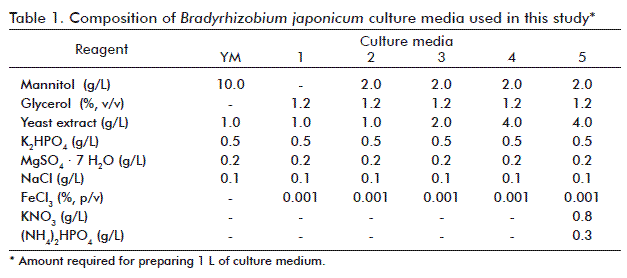
<body><![CDATA[<P   ><font size="2" face="Verdana, Arial, Helvetica, sans-serif"><B><font size="3">Materials      and methods </font></B></font></P >   <FONT size="+1">        <P   ><font size="2" face="Verdana, Arial, Helvetica, sans-serif"><I><b>Bradyrhizobium      </b></I><b>strains and soybean cultivars </b></font></P >   <FONT size="+1">        <P   ><font face="Verdana, Arial, Helvetica, sans-serif" size="2"><I>Bradyrhizobium      japonicum</I> strains Semia 5079 and Semia 5080 and <I>B. elkanii </I>strain      ICA 8001 [5] were used for comparisons on the efficiency of symbiotic interaction      with soybean cultivars IncaSoy-36 [7], Conquista [8] and CubaSoy-23 [9], under      greenhouse conditions. The strain Semia 5080 was used for massive production      of the inoculant. </font></P >       <P   ><font face="Verdana, Arial, Helvetica, sans-serif" size="2"><b>Culture media      </b></font></P >       <P   ><font face="Verdana, Arial, Helvetica, sans-serif" size="2">Five culture medium      variants were generated from the commercial broth YM (10 g/L mannitol, 1 g/L      yeast extract, 0.5 g/L K<sub>2</sub>HPO<sub>4</sub>, 0.2 g/L MgSO<sub>4</sub>      &middot; 7 H<sub>2</sub>O, 0.1 g/L NaCl) (<a href="/img/revistas/bta/v31n2/t0103214.gif">Table 1</a>)      [10]. The starting pH was adjusted to 6.8 and kept unbuffered during bacterial      growth. The medium generating the highest biomass yield was named YMG and      further used for massive inoculant production. </font></P >   <FONT size="+1"><FONT size="+1"><FONT size="+1"><FONT size="+1"><FONT size="+1"><FONT size="+1"><FONT size="+1"><FONT size="+1"><FONT size="+1">        
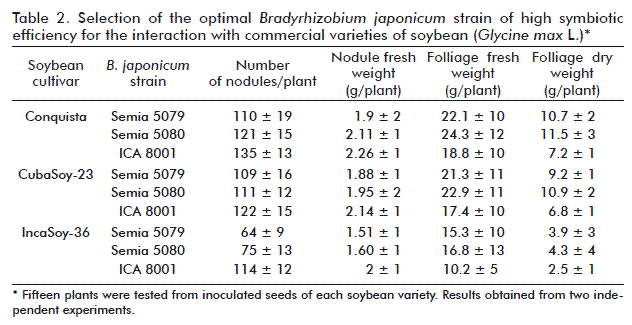
<P   ><font face="Verdana, Arial, Helvetica, sans-serif" size="2"><b>Bacteroid isolation      from nodules </b></font></P >       <P   ><font face="Verdana, Arial, Helvetica, sans-serif" size="2">Plant roots inoculated      and grown under greenhouse or field conditions were washed with distilled      water and air-dried at room temperature. Bacteroids were isolated from active      nodules (inner red pigmentation) at the root crown from flowering plants.      Nodules were manually collected, submerged in 70 % ethanol for 5 min for superficial      decontamination and transversally sliced with a sterile scalpel under a vertical      flow air cabinet. Bacteroids were collected from the central area of the nodules      with a sterile loop and seeded in Petri dishes containing solid YM medium,      supplemented or not with 100 mg/L carbenicillin and the colorant Congo red      (0.25 %, w/v). Whitish mucoid colonies characteristics of <I>Bradyrhizobium</I>      appeared after culturing for 10 days at 28 &ordm;C. </font></P >       <P   ><font face="Verdana, Arial, Helvetica, sans-serif" size="2"><b>Selection of <I>Bradyrhizobium</I>      strain and establishing the primary cell bank </b></font></P >       <P   ><font face="Verdana, Arial, Helvetica, sans-serif" size="2">Experiments evaluating      the efficiency of the symbiotic interaction between three <I>Bradyrhizobium</I>      strains and three soybean cultivars were run on zeolite substrate without      nitrogen fertilization under greenhouse conditions. One week after seed germination,      plantlets were inoculated with 1 mL of bacterial culture diluted at 2 &times;10<sup>6</sup>      viable cells/pot. Plants were collected at flowering and symbiosis efficiency      indicators were quantified (<a href="/img/revistas/bta/v31n2/t0203214.gif">Table 2</a>). </font></P >   <FONT size="+1"><FONT size="+1">        
<P   ><font face="Verdana, Arial, Helvetica, sans-serif" size="2">For preparation of      the primary cell bank (PCB), <I>B. japonicum</I> strain Semia 5080 was recovered      from a root nodule of a previously inoculated soybean plant cv. CubaSoy-23      grown until flowering stage under greenhouse conditions. A single colony was      obtained from a bacteroid isolated from a root nodule of a CubaSoy-23 soybean      flowering plant previously inoculated with a pure bacterial culture and grown      under greenhouse conditions. The colony was inoculated to a preculture containing      5 mL of liquid YM medium, and further incubated at 28 &ordm;C for 3 d under      roller shaking. This culture was used as inoculums for 300-mL YM medium cultures      and incubated at 28 &ordm;C under shaking until reaching logarithmic growth      The homogeneously pure culture, as evidenced by Gram-staining, was centrifuged      and cells collected, washed with sterile YMG medium and further resuspended      in cold YMG medium supplemented with 30 % glycerol (v/v), dispersed in cryopreservation      vials on ice and stored at &ndash;70 &ordm;C until use. The PCB showed a cell      viability of 10<sup>7</sup> c.f.u./mL and was free of microbial contaminants,      receiving the approval certification by the Quality Control Unit of the Center      for Genetic Engineering and Biotechnology (CIGB), in Habana, Cuba. </font></P >   <FONT size="+1"><FONT size="+1"><FONT size="+1">        ]]></body>
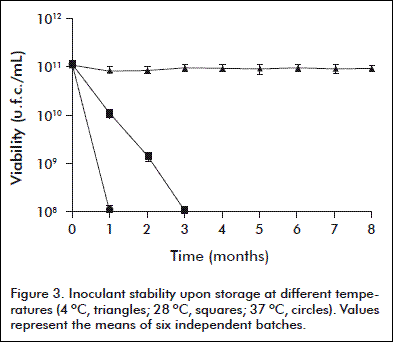
<body><![CDATA[<P   ><font face="Verdana, Arial, Helvetica, sans-serif" size="2"><b>Inoculant production,      quality control and stability under preservation </b></font></P >       <P   ><font face="Verdana, Arial, Helvetica, sans-serif" size="2">Single colonies were      obtained from 1/10<sup>6</sup> and 1/10<sup>7</sup> dilutions from a PCB aliquot      of the <I>B. japonicum </I>strain Semia 5080, plated on YMG medium supplemented      with 100 mg/L carbenicillin and the colorant Congo red (0.25 %, w/v). After      10-d incubation at 28 &ordm;C, the colonies were not red stained and showed      the mucoid phenotype indicative of exopolysaccharides production. The primary      inoculums were prepared in 5 mL YM cultures from single bacterial colonies,      grown at 28 &ordm;C for 3 d under roller shaking. These cultures were subsequently      used to prepare the secondary inoculums, by inoculating 15 mL to Erlenmeyer      flasks containing 150 mL of YMG medium, and cultures were further incubated      at 28 &ordm;C for 3 d in an orbital shaker. The final large scale culture      was established by inoculating 300 mL of the secondary inoculums into Erlenmeyers      containg 3 L of YMG medium, which were incubated at 28 &ordm;C for 4 d and      under 150 rpm agitation. Each final culture was tested for microbial purity      by Gram-staining and optical microscopy. The final homogeneous cultures showing      the characteristic appearance of homogeneous <I>B. japonicum</I> Gram-negative      bacilli were pooled in 5-L batches, stored in plastic barrels and preserved      at 4 &ordm;C until commercialization. Batches were tested for purity by the      streak plate method in plates containing culture medium stained with Congo      red and devoid of antibiotics. Viability was determined by the serial dilution      method [10] and colonies were counted in Petri dishes filled with YM medium      supplemented with 100 mg/L carbenicillin (not inhibiting <I>B. japonicum</I>      Semia 5080) and Congo red staining (0.25 %, w/v). Batches of the liquid inoculant      were efficacy tested by spraying it to seeds at soybean field doses, which      were subsequently sowed in zeolite-containing pots. Plants were grown for      30 days under greenhouse conditions without nitrogen fertilization, and nodulation      was corroborated in roots at that time. </font></P >   <FONT size="+1"><FONT size="+1"><FONT size="+1"><FONT size="+1">        <P   ><font face="Verdana, Arial, Helvetica, sans-serif" size="2">The inoculant stability      was assessed during storage at 4, 28 y 37 &ordm;C for 8 months. Six batches      were evaluated for viability and purity for each temperature, in 1 mL monthly-collected      samples. </font></P >       <P   ><font face="Verdana, Arial, Helvetica, sans-serif" size="2"><b>Seed inoculation      under field conditions by mechanized sowing </b></font></P >       <P   ><font face="Verdana, Arial, Helvetica, sans-serif" size="2">Certified seeds of      the soybean cultivars tested were sprayed with the inoculant at the equivalent      dose of 150 mL/ha, before mechanized sowing in ferralitic soils at the areas      of the Cubasoy Enterprise, in Ciego de &Aacute;vila province, in Cuba, in      the production campaigns 2010-2013. Prior to seed sowing, the soil was fertilized      with the macronutrients nitrogen, phosphorous and potassium at respective      doses of 50, 60 and 45 kg/ha. No urea was applied during plant cultivation.      The effectiveness of the inoculation was determined by evaluating nodulation      (root nodule distribution, number, size and internal color) and the absence      of symptoms revealing plant nutritional deficiency. </font></P >       <P   >&nbsp;</P >       <P   ><font size="2" face="Verdana, Arial, Helvetica, sans-serif"><B><font size="3">RESULTS      AND DISCUSSION</font></B></font></P >   <FONT size="+1">        <P   ><font size="2" face="Verdana, Arial, Helvetica, sans-serif"><b>Selection of a      <I>B. japonicum </I>strain of high symbiotic efficiency with major soybean      (<I>Glycine max </I>L.) cultivars in Cuba </b></font></P >   <FONT size="+1">        <P   ><font face="Verdana, Arial, Helvetica, sans-serif" size="2">The symbiotic efficiency      of three commercial strains of <I>Bradyrhizobium</I> was tested in interaction      with three soybean cultivars (IncaSoy-36, Conquista, CubaSoy-23) grown in      zeolite substrate without nitrogen fertilization under greenhouse conditions.      All the treatments induced abundant nodulation regardless the differences      in plant foliar mass (<a href="/img/revistas/bta/v31n2/t0203214.gif">Table 2</a>). The inoculation      of strain ICA 8001 <i>B. elkanii</i> induced the highest number of nodules      for the three soybean cultivars, with no significant differences in the average      fresh weight of the nodules. The highest foliar mass was detected for strain      Semia 5080, this strain being selected for bioinoculant production. In all      the cases, nodules were widely distributed at the root crown area (<a href="/img/revistas/bta/v31n2/f0103214.gif">Figures      1A and 1B</a>) and showed the internal red color (<a href="/img/revistas/bta/v31n2/f0103214.gif">Figure      1C</a>) characteristic of the protein leghemoglobin, whose presence indicates      the efficient occurrence of the nitrogen fixation process. Plants inoculated      kept intense green during the experiment. </font></P >       
<P   ><font face="Verdana, Arial, Helvetica, sans-serif" size="2"><b>Establishing a      cost-affordable growth medium for culturing <I>B. japonicum</I> at high cellular      densities </b> </font></P >       ]]></body>
<body><![CDATA[<P   ><font face="Verdana, Arial, Helvetica, sans-serif" size="2">The YM commercial      broth is widely used to culture <I>Rhizobium</I> and <I>Bradyrhizobium</I>      species at laboratory scale. Nevertheless, the use of mannitol as the sole      carbon source makes extremely expensive the large scale production of inoculants.      The growth of the <I>B. japonicum</I> Semia 5080 strain in YM medium was compared      to that in other five culture media (<a href="/img/revistas/bta/v31n2/t0303214.gif">Table 3</a>).      The replacement of mannitol by glycerol as carbon source in medium 1 notably      reduced polysaccharide production in culture. Exopolysaccharides are primary      components of the biofilm that protects bacteria from desiccation in soil,      functions as reserve energy source, and mediates rhyzobial interaction with      the host plant [11]. An efficient exopolysaccharide production is also important      to increase the culture viscosity which favors the adhesion of <I>B. japonicum</I>      to seeds upon inoculation [12, 13]. The combination of 2 g/L mannitol with      1.2 % glycerol in culture media 2 to 5 reduced their costs without compromising      exopolysaccharide production, as compared to the YM control medium. The further      increase of the yeast extract content in media 4 and 5, whose consumption      </font></P >       
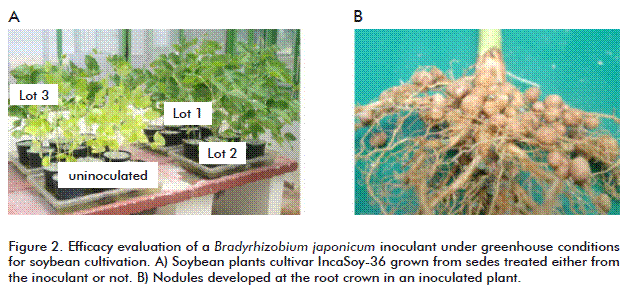
<P   ><font face="Verdana, Arial, Helvetica, sans-serif" size="2">generates ammonia,      allowed the bacterium growth to occur at optimal neutral pH values [10]. The      ultimate addition of nitrogen salts in medium 5 further contributed to increase      the cellular density up to 17.2 g of wet biomass per liter of culture, achieving      viable counts above 5 &times; 10<sup>9</sup> c.f.u./mL. These results and      the low cost of raw materials (0.67 USD/L) led us to select medium five, named      YMG, for the inoculant production. </font></P >   <FONT size="+1"><FONT size="+1">        <P   ><font face="Verdana, Arial, Helvetica, sans-serif" size="2"><b>Batch production      of high cell density cultures of <I>B. japonicum</I> in an orbital multi-platform      shaker </b></font></P >       <P   ><font face="Verdana, Arial, Helvetica, sans-serif" size="2">Opposed to species      of the genus <I>Rhizobium</I> species, <I>B. japonicum</I> displays a slow      growth in culture [4] that makes challenging its large scale production at      batch scale. A system was established comprising two 1/10 serial dilutions,      which allowed to maintain bacterial growth steadily at logarithmic phase in      YMG medium and to achieve a high average viability (5 &times;10<sup>10</sup>      c.f.u./mL) in the final culture. The entire culturing process from colony      inoculation to the harvest of the final bacterial culture lasted 10 days.      Nevertheless, the batch culture in the shaker took only 7 days the culture      volume was increased 100-fold in comparison to initial precultures. We overlapped      in time the growth phases of the secondary inoculums and the final culture      in the multiplatform orbital shaker allowing the production of two inoculant      batches in a week. </font></P >   <FONT size="+1"><FONT size="+1">        <P   ><font face="Verdana, Arial, Helvetica, sans-serif" size="2">The quality standards      established for the inoculants commercialization were the absence of microbial      contaminants and the achievement of cellular densities of at least 5 &times;      10<sup>9</sup> c.f.u./mL. This cell viability allows to administer 6 &times;      10<sup>6</sup> viable bacteria per seed, according to the field application      dose of 150 mL/ha. Homogeneous Gram-negative bacilli populations were observed      under the microscope consistent with <I>Bradyrhizobium</I> morphology in all      the growth phases in batch cultures. The lack of microbial contaminants was      then confirmed by plating inoculants batch samples on solid YM medium supplemented      with Congo red and devoid of antibiotics. In that medium, <I>B. japonicum      </I>forms whitish mucous colonies that do not absorb the colorant. The use      of the fast Gram-staining method followed by microscopic observations of secondary      inoculums allowed minimizing the rejection rate of final cultures to less      than 2 % due to bacterial contamination. The results of efficacy testing of      three batches of the inoculant evaluated under greenhouse conditions are shown      in <a href="/img/revistas/bta/v31n2/f0203214.gif">figure 2</a>. </font></P >   <FONT size="+1"><FONT size="+1"><FONT size="+1"><FONT size="+1">        
<P   ><font face="Verdana, Arial, Helvetica, sans-serif" size="2">Inoculated plants      developed intense green vigorous foliage during the experiment, compared to      the untreated controls (<a href="/img/revistas/bta/v31n2/f0203214.gif">Figure 2A</a>), as well as      abundant nodules in the root crown (<a href="/img/revistas/bta/v31n2/f0203214.gif">Figure 2B</a>).      </font></P >       
<P   ><font face="Verdana, Arial, Helvetica, sans-serif" size="2"><b>Preservation of      the liquid inoculant </b></font></P >       <P   ><font face="Verdana, Arial, Helvetica, sans-serif" size="2">The stability of      the inoculant during storage at 4, 28 and 37 &ordm;C for 8 months is shown      in <a href="#fig3">figure 3</a>. The refrigerated preservation did not decrease      significantly the viability of the inoculant. Otherwise, viable counts were      lower than the specified standard limit (5 &times; 10<sup>9</sup> c.f.u./mL)      when stored at 28 and 37 &ordm; C for one and two months, respectively. </font></P >       <P align="center"   ><img src="/img/revistas/bta/v31n2/f0303214.gif" width="391" height="340"><a name="fig3"></a></P >   <FONT size="+1"><FONT size="+1"><FONT size="+1">        
<P   ><font face="Verdana, Arial, Helvetica, sans-serif" size="2"><b>Efficiency of      inoculant application in soybean fields under mechanized sowing conditions      </b></font></P >       ]]></body>
<body><![CDATA[<P   ><font face="Verdana, Arial, Helvetica, sans-serif" size="2">Soybean is mechanically      sowed in the Ciego de &Aacute;vila province, in Cuba, which makes impossible      the use of peat-based traditional solid inoculants. For this reason, liquid      inoculant batches produced as described in this work were used for seeds treatment      at dose of 150 mL/ha in the production campaigns 2010-2013, resulting in a      yearly average consumption of 800, 570, 900 and 1030 L. Soybean plants at      flowering phase were sampled each campaign and evidenced abundant nodules      with nitrogen-fixing activity (internal red color), mainly located at the      root crown (<a href="/img/revistas/bta/v31n2/f0403214.gif">Figure 4A</a>). Plantations showed an excellent      nutritional state with vigorous and intense green foliage. Phenotype characterization      studies of the bacterium isolated from nodules of randomly selected plants      corroborated the identity of the inoculated <I>Bradyrhizobium </I>strain.      The identity criteria used were: resistance to 100 mg/L carbenicillin and      rifampicin 100 mg/L, production of whitish mucous colonies on solid YM medium      supplemented with Congo red (<a href="/img/revistas/bta/v31n2/f0403214.gif">Figure 4B</a>) and no      acidification of YM medium supplemented with the pH indicator bromotimol blue      (<a href="/img/revistas/bta/v31n2/f0403214.gif">Figure 4C</a>). </font></P >       
<P   ><font face="Verdana, Arial, Helvetica, sans-serif" size="2">The high cellular      density liquid inoculants rich in polysaccharides was technically compatible      with the use of sowing machines, allowed the survival of bacteria in soil      and promoted the establishment of an efficient symbiotic interaction with      three major soybean varieties cropped in Cuba. Under the non-inhibitory concentrations      of chemical nitrogen in soil, the symbiotic process provided enough amounts      of fixed nitrogen for the proper plant development, contributing to the photosynthesis      and aiding to reach high yields of grains. The foliar residues of soybean      crops returned part of the fixed nitrogen to the soil, with collateral benefits      for the gramineous rotation crops, mainly maize. </font></P >       <P   ><font face="Verdana, Arial, Helvetica, sans-serif" size="2">In summary, a batch      production system was established to obtain a liquid inoculant of <I>B. japonicum</I>,      of high cellular density and rich in exopolysaccharides. The inoculant was      stable for at least 8 months under refrigerated storage at 4 &ordm;C. The      technological scale up is simple and requires neither large facilities nor      expensive equipment. Seed inoculation in the field was compatible with the      use of sowing machines, promoted abundant nodulation in plants and they developed      and a proper nutritional state during the whole cultivation cycle. The substitution      of chemical nitrogen fertilizers by the inoculant reduces the costs of the      national soybean production and also contributes to protect the environment.      </font></P >       <P   >&nbsp;</P >   </font></font></font></font></font></font></font></font></font></font></font></font></font></font></font></font></font></font></font></font></font></font></font></font></font></font></font></font></font></font></font></font></font></font></font></font></font></font></font></font></font></font></font></font></font></font></font></font></font></font></font></font></font></font></font></font></font></font></font></font></font></font></font></font></font></font>        <p   ><font size="+1" color="#000000"><b><font face="Verdana, Arial, Helvetica, sans-serif" size="3">REFERENCES      </font></b></font></p >       <p   ><font face="Verdana, Arial, Helvetica, sans-serif" size="2">1. Producci&oacute;n      de determinados productos b&aacute;sicos agr&iacute;colas, Grupo I (2004).      In: FAO. Anuario estad&iacute;stico de la FAO. 2005-2006. Roma: FAO; 2004.      p. 79-82.</font></p >       <!-- ref --><p   ><font face="Verdana, Arial, Helvetica, sans-serif" size="2">2. Clive J. ISAAA      Brief 42. Global Status of Commercialized Biotech/GM Crops: 2010. New York:      International Service for de Acquisition of Agri-Biotech Applications (ISAAA);      2010.    </font></p >       <!-- ref --><p   ><font face="Verdana, Arial, Helvetica, sans-serif" size="2">3. Singh MS. Effect      of Bradyrhizobium inoculation on growth, nodulation and yield attributes of      soybean - A Review. Agric Rev. 2005;26(4):305-8.    </font></p >       ]]></body>
<body><![CDATA[<p   ><font face="Verdana, Arial, Helvetica, sans-serif" size="2">4. Appelbaum, E.      The Rhizobium/Bradyrhizobium-legume symbiosis. In: Gresshoff PM, editor. The      molecular biology of symbiotic nitrogen fixation. Boca Raton: CRC Press; 1989.      p. 131-58 </font></p >       <!-- ref --><p   ><font face="Verdana, Arial, Helvetica, sans-serif" size="2">5. Hollis AB, Kloos      WE, Elkan GE. DNA:DNA hybridization studies of Rhizobium japonicum and related      Rhizobiacea. J Gen Microbiol. 1981;123(2):215-22.    </font></p >       <!-- ref --><p   ><font face="Verdana, Arial, Helvetica, sans-serif" size="2">6. Alberton O, Kaschuk      G, Hungria M. Sampling effects on the assessment of genetic diversity of rhizobia      associated with soybean and common bean. Soil Biol Biochem. 2006;38(6):1298-307.    </font></p >       <!-- ref --><p   ><font face="Verdana, Arial, Helvetica, sans-serif" size="2">7. Soto N., Ferreira      A, Delgado C, Enr&iacute;quez GA,. Regeneraci&oacute;n in vitro de plantas      de soya de la variedad cubana IncaSoy-36. Biotecnol Apl. 2013;30(1):29-33.    </font></p >       <!-- ref --><p   ><font face="Verdana, Arial, Helvetica, sans-serif" size="2">8. Romero A, Pe&ntilde;a      L, Gonz&aacute;lez M, Gonz&aacute;lez M. Evaluaci&oacute;n de cultivares de      soya (Glycine max) en las condiciones edafoclim&aacute;ticas del municipio      Majibacoa, Las Tunas. Innov Tecnol. 2013;19:1-9.    </font></p >       <!-- ref --><p   ><font face="Verdana, Arial, Helvetica, sans-serif" size="2">9. D&iacute;az MF,      Padilla C, Torres V, Gonz&aacute;lez A, Curbelo F. Caracterizaci&oacute;n      bromofol&oacute;gica de variedades de soya (Glycine max) en producci&oacute;n      de forrajes, forrajes integrales y granos de siembras de verano. Rev Cubana      Cienc Agr&iacute;c. 2003;37(3):311-7.    </font></p >       <!-- ref --><p   ><font face="Verdana, Arial, Helvetica, sans-serif" size="2">10. Somasegaran P,      Hoben HJ. Handbook for rhizobia. Methods in legume-Rhizobium technology. New      York: Springer-Verlag New York, Inc.; 1994.    </font></p >       <!-- ref --><p   ><font face="Verdana, Arial, Helvetica, sans-serif" size="2">11. Subba Rao NS.      Soil microorganisms and plant growth. New Delhi: Oxford and IBH Publishing      Co.; 1977.    </font></p >       <!-- ref --><p   ><font face="Verdana, Arial, Helvetica, sans-serif" size="2">12. Louch HA, Miller      KJ. Synthesis of a low-molecular-weight form of exopolysaccharide by Bradyrhizobium      japonicum USDA 110. Appl Environ Microbiol. 2001;67(2):1011-4.    </font></p >       <!-- ref --><p   ><font face="Verdana, Arial, Helvetica, sans-serif" size="2">13. Maurice S, Beauclair      P, Giraud J, Sommer G, Hartmann A. Survival and change in physiological state      of Bradyrhizobium japonicum in soybean (Glycine max L. Merril) liquid inoculants      after long-term storage. World J Microbiol Biotech. 2001;17(6):635-43.    </font></p >       <p   >&nbsp;</p >       ]]></body>
<body><![CDATA[<p   >&nbsp;</p >       <p   >&nbsp;</p >   <FONT size="+1" color="#000000"><FONT size="+1"><FONT size="+1"><FONT size="+1"><FONT size="+1"><FONT size="+1"><FONT size="+1"><FONT size="+1"><FONT size="+1"><FONT size="+1"><FONT size="+1"><FONT size="+1"><FONT size="+1"><FONT size="+1"><FONT size="+1"><FONT size="+1"><FONT size="+1"><FONT size="+1"><FONT size="+1"><FONT size="+1"><FONT size="+1"><FONT size="+1"><FONT size="+1"><FONT size="+1"><FONT size="+1"><FONT size="+1"><FONT size="+1"><FONT size="+1"><FONT size="+1"><FONT size="+1"><FONT size="+1"><FONT size="+1"><FONT size="+1"><FONT size="+1"><FONT size="+1"><FONT size="+1"><FONT size="+1"><FONT size="+1"><FONT size="+1"><FONT size="+1"><FONT size="+1"><FONT size="+1"><FONT size="+1"><FONT size="+1"><FONT size="+1"><FONT size="+1"><FONT size="+1"><FONT size="+1"><FONT size="+1"><FONT size="+1"><FONT size="+1"><FONT size="+1"><FONT size="+1"><FONT size="+1"><FONT size="+1"><FONT size="+1"><FONT size="+1"><FONT size="+1"><FONT size="+1"><FONT size="+1"><FONT size="+1"><FONT size="+1"><FONT size="+1"><FONT size="+1"><FONT size="+1"><FONT size="+1">       <P   > </P >       <P   ><font face="Verdana, Arial, Helvetica, sans-serif" size="2">Received in December,      2013.    <br>     Accepted in March, 2014. </font></P >       <P   >&nbsp;</P >       <P   >&nbsp;</P >   </font></font></font></font></font></font></font></font></font></font></font></font></font></font></font></font></font></font></font></font></font></font></font></font></font></font></font></font></font></font></font></font></font></font></font></font></font></font></font></font></font></font></font></font></font></font></font></font></font></font></font></font></font></font></font></font></font></font></font></font></font></font></font></font></font></font>     <p><font size="2" face="Verdana, Arial, Helvetica, sans-serif"><i>Carmen Men&eacute;ndez-Rodr&iacute;guez</i>.</font>      <font size="+1" color="#000000"><font size="+1"><font size="+1"><font size="+1"><font size="+1"><font size="+1"><font size="+1"><font size="+1"><font size="+1"><font size="+1"><font size="+1"><font size="+1"><font size="+1"><font size="+1"><font size="+1"><font size="+1"><font size="+1"><font size="2" face="Verdana, Arial, Helvetica, sans-serif">Centro      de Ingenier&iacute;a Gen&eacute;tica y Biotecnolog&iacute;a, CIGB. Ave. 31      e/ 158 y 190, Cubanac&aacute;n, Playa, CP 11600, La Habana, Cuba. E-mail:      <a href="mailto:carmen.menendez@cigb.edu.cu">carmen.menendez@cigb.edu.cu</a>.      </font></font></font></font></font></font></font></font></font></font></font></font></font></font></font></font></font></font></p> </DIV >      ]]></body><back>
<ref-list>
<ref id="B1">
<label>1</label><nlm-citation citation-type="book">
<article-title xml:lang="es"><![CDATA[Producción de determinados productos básicos agrícolas, Grupo I (2004)]]></article-title>
<collab>FAO</collab>
<source><![CDATA[Anuario estadístico de la FAO. 2005-2006]]></source>
<year>2004</year>
<page-range>79-82</page-range><publisher-loc><![CDATA[Roma ]]></publisher-loc>
<publisher-name><![CDATA[FAO]]></publisher-name>
</nlm-citation>
</ref>
<ref id="B2">
<label>2</label><nlm-citation citation-type="book">
<person-group person-group-type="author">
<name>
<surname><![CDATA[Clive]]></surname>
<given-names><![CDATA[J]]></given-names>
</name>
</person-group>
<source><![CDATA[ISAAA Brief 42. Global Status of Commercialized Biotech/GM Crops: 2010]]></source>
<year>2010</year>
<publisher-loc><![CDATA[New York ]]></publisher-loc>
<publisher-name><![CDATA[International Service for de Acquisition of Agri-Biotech Applications (ISAAA)]]></publisher-name>
</nlm-citation>
</ref>
<ref id="B3">
<label>3</label><nlm-citation citation-type="journal">
<person-group person-group-type="author">
<name>
<surname><![CDATA[Singh]]></surname>
<given-names><![CDATA[MS]]></given-names>
</name>
</person-group>
<article-title xml:lang="en"><![CDATA[Effect of Bradyrhizobium inoculation on growth, nodulation and yield attributes of soybean - A Review]]></article-title>
<source><![CDATA[Agric Rev]]></source>
<year>2005</year>
<volume>26</volume>
<numero>4</numero>
<issue>4</issue>
<page-range>305-8</page-range></nlm-citation>
</ref>
<ref id="B4">
<label>4</label><nlm-citation citation-type="book">
<person-group person-group-type="author">
<name>
<surname><![CDATA[Appelbaum]]></surname>
<given-names><![CDATA[E]]></given-names>
</name>
</person-group>
<article-title xml:lang="en"><![CDATA[The Rhizobium/Bradyrhizobium-legume symbiosis]]></article-title>
<person-group person-group-type="editor">
<name>
<surname><![CDATA[Gresshoff]]></surname>
<given-names><![CDATA[PM]]></given-names>
</name>
</person-group>
<source><![CDATA[The molecular biology of symbiotic nitrogen fixation]]></source>
<year>1989</year>
<page-range>131-58</page-range><publisher-loc><![CDATA[Boca Raton ]]></publisher-loc>
<publisher-name><![CDATA[CRC Press]]></publisher-name>
</nlm-citation>
</ref>
<ref id="B5">
<label>5</label><nlm-citation citation-type="journal">
<person-group person-group-type="author">
<name>
<surname><![CDATA[Hollis]]></surname>
<given-names><![CDATA[AB]]></given-names>
</name>
<name>
<surname><![CDATA[Kloos]]></surname>
<given-names><![CDATA[WE]]></given-names>
</name>
<name>
<surname><![CDATA[Elkan]]></surname>
<given-names><![CDATA[GE]]></given-names>
</name>
</person-group>
<article-title xml:lang="en"><![CDATA[DNA:DNA hybridization studies of Rhizobium japonicum and related Rhizobiacea]]></article-title>
<source><![CDATA[J Gen Microbiol]]></source>
<year>1981</year>
<volume>123</volume>
<numero>2</numero>
<issue>2</issue>
<page-range>215-22</page-range></nlm-citation>
</ref>
<ref id="B6">
<label>6</label><nlm-citation citation-type="journal">
<person-group person-group-type="author">
<name>
<surname><![CDATA[Alberton]]></surname>
<given-names><![CDATA[O]]></given-names>
</name>
<name>
<surname><![CDATA[Kaschuk]]></surname>
<given-names><![CDATA[G]]></given-names>
</name>
<name>
<surname><![CDATA[Hungria]]></surname>
<given-names><![CDATA[M]]></given-names>
</name>
</person-group>
<article-title xml:lang="en"><![CDATA[Sampling effects on the assessment of genetic diversity of rhizobia associated with soybean and common bean]]></article-title>
<source><![CDATA[Soil Biol Biochem]]></source>
<year>2006</year>
<volume>38</volume>
<numero>6</numero>
<issue>6</issue>
<page-range>1298-307</page-range></nlm-citation>
</ref>
<ref id="B7">
<label>7</label><nlm-citation citation-type="journal">
<person-group person-group-type="author">
<name>
<surname><![CDATA[Soto]]></surname>
<given-names><![CDATA[N]]></given-names>
</name>
<name>
<surname><![CDATA[Ferreira]]></surname>
<given-names><![CDATA[A]]></given-names>
</name>
<name>
<surname><![CDATA[Delgado]]></surname>
<given-names><![CDATA[C]]></given-names>
</name>
<name>
<surname><![CDATA[Enríquez]]></surname>
<given-names><![CDATA[GA]]></given-names>
</name>
</person-group>
<article-title xml:lang="es"><![CDATA[Regeneración in vitro de plantas de soya de la variedad cubana IncaSoy-36]]></article-title>
<source><![CDATA[Biotecnol Apl]]></source>
<year>2013</year>
<volume>30</volume>
<numero>1</numero>
<issue>1</issue>
<page-range>29-33</page-range></nlm-citation>
</ref>
<ref id="B8">
<label>8</label><nlm-citation citation-type="journal">
<person-group person-group-type="author">
<name>
<surname><![CDATA[Romero]]></surname>
<given-names><![CDATA[A]]></given-names>
</name>
<name>
<surname><![CDATA[Peña]]></surname>
<given-names><![CDATA[L]]></given-names>
</name>
<name>
<surname><![CDATA[González]]></surname>
<given-names><![CDATA[M]]></given-names>
</name>
<name>
<surname><![CDATA[González]]></surname>
<given-names><![CDATA[M]]></given-names>
</name>
</person-group>
<article-title xml:lang="es"><![CDATA[Evaluación de cultivares de soya (Glycine max) en las condiciones edafoclimáticas del municipio Majibacoa, Las Tunas]]></article-title>
<source><![CDATA[Innov Tecnol]]></source>
<year>2013</year>
<volume>19</volume>
<page-range>1-9</page-range></nlm-citation>
</ref>
<ref id="B9">
<label>9</label><nlm-citation citation-type="journal">
<person-group person-group-type="author">
<name>
<surname><![CDATA[Díaz]]></surname>
<given-names><![CDATA[MF]]></given-names>
</name>
<name>
<surname><![CDATA[Padilla]]></surname>
<given-names><![CDATA[C]]></given-names>
</name>
<name>
<surname><![CDATA[Torres]]></surname>
<given-names><![CDATA[V]]></given-names>
</name>
<name>
<surname><![CDATA[González]]></surname>
<given-names><![CDATA[A]]></given-names>
</name>
<name>
<surname><![CDATA[Curbelo]]></surname>
<given-names><![CDATA[F]]></given-names>
</name>
</person-group>
<article-title xml:lang="es"><![CDATA[Caracterización bromofológica de variedades de soya (Glycine max) en producción de forrajes, forrajes integrales y granos de siembras de verano]]></article-title>
<source><![CDATA[Rev Cubana Cienc Agríc]]></source>
<year>2003</year>
<volume>37</volume>
<numero>3</numero>
<issue>3</issue>
<page-range>311-7</page-range></nlm-citation>
</ref>
<ref id="B10">
<label>10</label><nlm-citation citation-type="book">
<person-group person-group-type="author">
<name>
<surname><![CDATA[Somasegaran]]></surname>
<given-names><![CDATA[P]]></given-names>
</name>
<name>
<surname><![CDATA[Hoben]]></surname>
<given-names><![CDATA[HJ]]></given-names>
</name>
</person-group>
<source><![CDATA[Handbook for rhizobia. Methods in legume-Rhizobium technology]]></source>
<year>1994</year>
<publisher-loc><![CDATA[New York ]]></publisher-loc>
<publisher-name><![CDATA[Springer-Verlag New York, Inc]]></publisher-name>
</nlm-citation>
</ref>
<ref id="B11">
<label>11</label><nlm-citation citation-type="book">
<person-group person-group-type="author">
<name>
<surname><![CDATA[Subba Rao]]></surname>
<given-names><![CDATA[NS]]></given-names>
</name>
</person-group>
<source><![CDATA[Soil microorganisms and plant growth]]></source>
<year>1977</year>
<publisher-loc><![CDATA[New Delhi ]]></publisher-loc>
<publisher-name><![CDATA[Oxford and IBH Publishing Co]]></publisher-name>
</nlm-citation>
</ref>
<ref id="B12">
<label>12</label><nlm-citation citation-type="journal">
<person-group person-group-type="author">
<name>
<surname><![CDATA[Louch]]></surname>
<given-names><![CDATA[HA]]></given-names>
</name>
<name>
<surname><![CDATA[Miller]]></surname>
<given-names><![CDATA[KJ]]></given-names>
</name>
</person-group>
<article-title xml:lang="en"><![CDATA[Synthesis of a low-molecular-weight form of exopolysaccharide by Bradyrhizobium japonicum USDA 110]]></article-title>
<source><![CDATA[Appl Environ Microbiol]]></source>
<year>2001</year>
<volume>67</volume>
<numero>2</numero>
<issue>2</issue>
<page-range>1011-4</page-range></nlm-citation>
</ref>
<ref id="B13">
<label>13</label><nlm-citation citation-type="journal">
<person-group person-group-type="author">
<name>
<surname><![CDATA[Maurice]]></surname>
<given-names><![CDATA[S]]></given-names>
</name>
<name>
<surname><![CDATA[Beauclair]]></surname>
<given-names><![CDATA[P]]></given-names>
</name>
<name>
<surname><![CDATA[Giraud]]></surname>
<given-names><![CDATA[J]]></given-names>
</name>
<name>
<surname><![CDATA[Sommer]]></surname>
<given-names><![CDATA[G]]></given-names>
</name>
<name>
<surname><![CDATA[Hartmann]]></surname>
<given-names><![CDATA[A]]></given-names>
</name>
</person-group>
<article-title xml:lang="en"><![CDATA[Survival and change in physiological state of Bradyrhizobium japonicum in soybean (Glycine max L. Merril) liquid inoculants after long-term storage]]></article-title>
<source><![CDATA[World J Microbiol Biotech]]></source>
<year>2001</year>
<volume>17</volume>
<numero>6</numero>
<issue>6</issue>
<page-range>635-43</page-range></nlm-citation>
</ref>
</ref-list>
</back>
</article>
