<?xml version="1.0" encoding="ISO-8859-1"?><article xmlns:mml="http://www.w3.org/1998/Math/MathML" xmlns:xlink="http://www.w3.org/1999/xlink" xmlns:xsi="http://www.w3.org/2001/XMLSchema-instance">
<front>
<journal-meta>
<journal-id>1027-2852</journal-id>
<journal-title><![CDATA[Biotecnología Aplicada]]></journal-title>
<abbrev-journal-title><![CDATA[Biotecnol Apl]]></abbrev-journal-title>
<issn>1027-2852</issn>
<publisher>
<publisher-name><![CDATA[Editorial Elfos Scientiae]]></publisher-name>
</publisher>
</journal-meta>
<article-meta>
<article-id>S1027-28522014000200004</article-id>
<title-group>
<article-title xml:lang="en"><![CDATA[In vitro modeling of the environmental performance of attenuated strains of Vibrio cholerae O139]]></article-title>
<article-title xml:lang="es"><![CDATA[Modelación in vitro del comportamiento ambiental de cepas atenuadas de Vibrio cholerae O139]]></article-title>
</title-group>
<contrib-group>
<contrib contrib-type="author">
<name>
<surname><![CDATA[Ledón]]></surname>
<given-names><![CDATA[Talena]]></given-names>
</name>
<xref ref-type="aff" rid="A01"/>
</contrib>
<contrib contrib-type="author">
<name>
<surname><![CDATA[Hernández]]></surname>
<given-names><![CDATA[Daneylis D]]></given-names>
</name>
<xref ref-type="aff" rid="A01"/>
</contrib>
<contrib contrib-type="author">
<name>
<surname><![CDATA[Marrero]]></surname>
<given-names><![CDATA[Karen]]></given-names>
</name>
<xref ref-type="aff" rid="A01"/>
</contrib>
<contrib contrib-type="author">
<name>
<surname><![CDATA[Fando]]></surname>
<given-names><![CDATA[Rafael]]></given-names>
</name>
<xref ref-type="aff" rid="A01"/>
</contrib>
</contrib-group>
<aff id="A01">
<institution><![CDATA[,Centro Nacional de Investigaciones Científicas, CNIC Dirección de Enfermedades Infecciosas Departamento de Biología Molecular]]></institution>
<addr-line><![CDATA[La Habana ]]></addr-line>
<country>Cuba</country>
</aff>
<pub-date pub-type="pub">
<day>00</day>
<month>06</month>
<year>2014</year>
</pub-date>
<pub-date pub-type="epub">
<day>00</day>
<month>06</month>
<year>2014</year>
</pub-date>
<volume>31</volume>
<numero>2</numero>
<fpage>129</fpage>
<lpage>135</lpage>
<copyright-statement/>
<copyright-year/>
<self-uri xlink:href="http://scielo.sld.cu/scielo.php?script=sci_arttext&amp;pid=S1027-28522014000200004&amp;lng=en&amp;nrm=iso"></self-uri><self-uri xlink:href="http://scielo.sld.cu/scielo.php?script=sci_abstract&amp;pid=S1027-28522014000200004&amp;lng=en&amp;nrm=iso"></self-uri><self-uri xlink:href="http://scielo.sld.cu/scielo.php?script=sci_pdf&amp;pid=S1027-28522014000200004&amp;lng=en&amp;nrm=iso"></self-uri><abstract abstract-type="short" xml:lang="en"><p><![CDATA[Vibrio cholerae, serogroups O1 and O139, is the causative agent of cholera diarrheal disease. Much of the research aimed to develop oral cholera vaccines is directed to the production of live attenuated strains, such as the V. cholerae O139 TLP01 and TLP05 strains. These two strains lack CTXfprophage genes and do not produce the hemagglutinin protease, a relevant pathogenesis factor, and the mannose-sensitive hemagglutinin fimbria, which could play an important role in the environmental behavior. In this work, different in vitro models were used to study the potential environmental performance of these two strains. Their ability to produce different types of biofilms, to acquire rugose phenotype and to resist different environmental stress conditions such as the presence of chlorine, detergents or high salt concentrations, were assessed. Significantly, the TLP01 and TLP05 strains displayed characteristics that limit their in vitro survival under different stress conditions, with respect to controls and wild-type strains. Such behavior under harsh environmental settings may limit their survival and act for their containment while using them as active ingredients for the development of a cholera vaccine candidate.]]></p></abstract>
<abstract abstract-type="short" xml:lang="es"><p><![CDATA[El cólera es una enfermedad diarreica producida por la infección con la bacteria Vibrio cholerae de los serogrupos O1 y O139. Muchas de las investigaciones para el desarrollo de vacunas orales contra esta enfermedad se dedican a la producción de cepas vivas atenuadas. TLP01 y TLP05 son cepas atenuadas del serogrupo O139, que carecen de los genes del profago CTXf; además, no producen la hemaglutinina proteasa, importante factor de la patogénesis; ni la fimbria hemaglutinina sensible a manosa, la cual pudiera ser importante en el comportamiento de las cepas vacunales en el ambiente. En este artículo se describe el posible comportamiento ambiental de estas cepas, a partir del estudio in vitro de sus propiedades para producir varios tipos de biopelículas, de adquirir el fenotipo rugoso y de resistir varias condiciones de estrés ambiental, como la presencia de hipoclorito de sodio, de detergentes o altas concentraciones salinas. Los resultados evidencian que las cepas TLP01 y TLP05 poseen características que limitan su supervivencia in vitro frente a distintas condiciones de estrés, con respecto a cepas controles y salvajes. En el entorno ambiental, estas características pudieran limitar su supervivencia y actuar como elementos de contención del agente biológico que se use como ingrediente farmacéutico activo del candidato vacunal.]]></p></abstract>
<kwd-group>
<kwd lng="en"><![CDATA[cholera vaccine]]></kwd>
<kwd lng="en"><![CDATA[Vibrio cholerae O139]]></kwd>
<kwd lng="en"><![CDATA[attenuated strains]]></kwd>
<kwd lng="en"><![CDATA[environmental persistence]]></kwd>
<kwd lng="es"><![CDATA[vacuna de cólera]]></kwd>
<kwd lng="es"><![CDATA[Vibrio cholerae O139]]></kwd>
<kwd lng="es"><![CDATA[cepas atenuadas]]></kwd>
<kwd lng="es"><![CDATA[persistencia ambiental]]></kwd>
</kwd-group>
</article-meta>
</front><body><![CDATA[ <DIV class="Sect"   >        <P align="right"   ><font size="2" color="#000000" face="Verdana, Arial, Helvetica, sans-serif"><b>RESEARCH</b></font></P >       <P align="right"   >&nbsp;</P >       <P align="left"   ><FONT size="+1" color="#000000"> </font><font size="4" face="Verdana, Arial, Helvetica, sans-serif"><b>In      vitro modeling of the environmental performance of attenuated strains of <I>Vibrio      cholerae</I> O139 </b></font></P >   <FONT size="+1" color="#000000">     <P   >&nbsp;</P >       <P   ><font size="2" face="Verdana, Arial, Helvetica, sans-serif"><b><font size="3">Modelaci&oacute;n<I>      in vitro</I> del comportamiento ambiental de cepas atenuadas de <I>Vibrio      cholerae</I> O139 </font></b></font></P >       <P   >&nbsp;</P >       <P   >&nbsp;</P >   <FONT size="+1">        <P   > </P >   <FONT size="+1">        <P   ><b><font size="2" face="Verdana, Arial, Helvetica, sans-serif">Talena Led&oacute;n,      Daneylis D Hern&aacute;ndez, Karen Marrero, Rafael Fando </font></b></P >   <FONT size="+1">        ]]></body>
<body><![CDATA[<P   ><font size="2" face="Verdana, Arial, Helvetica, sans-serif">Departamento de Biolog&iacute;a      Molecular, Direcci&oacute;n de Enfermedades Infecciosas, Centro Nacional de      Investigaciones Cient&iacute;ficas, CNIC. Ave. 25 y 158, CP 10600, Playa,      La Habana, Cuba. </font></P >   </font></font></font></font>       <p>&nbsp;</p>       <p>&nbsp;</p>   <hr>   <FONT size="+1" color="#000000"><FONT size="+1"><FONT size="+1"><FONT size="+1"><FONT color="#0462C1"><FONT color="#000000">        <P   > </P >   <FONT size="+1">        <P   ><b><font size="2" face="Verdana, Arial, Helvetica, sans-serif">ABSTRACT</font></b><font size="2" face="Verdana, Arial, Helvetica, sans-serif">      </font></P >       <P   ><font size="2" face="Verdana, Arial, Helvetica, sans-serif"><I>Vibrio cholerae</I>,      serogroups O1 and O139, is the causative agent of cholera diarrheal disease.      Much of the research aimed to develop oral cholera vaccines is directed to      the production of live attenuated strains, such as the <I>V. cholerae</I>      O139 TLP01 and TLP05 strains. These two strains lack CTX</font><font size="+1" color="#000000"><font size="+1"><font size="+1"><font size="+1"><font color="#0462C1"><font color="#000000"><font size="+1"><font size="+1"><font size="+1"><font size="+1"><font size="+1"><font size="+1"><font size="2" face="Verdana, Arial, Helvetica, sans-serif"></font><font size="+1" color="#000000"><font size="+1"><font size="+1"><font size="+1"><font color="#0462C1"><font color="#000000"><font size="+1"><font size="+1"><font size="+1"><font size="+1"><font size="+1"><font size="+1"><font size="+1"><font size="+1"><font size="+1"><font size="+1"><font size="+1"><font size="+1"><font size="+1"><font size="+1"><font size="+1"><font size="+1"><font size="+1"><font size="+1"><font size="+1"><font size="+1"><font size="+1"><font size="+1"><font size="+1"><font size="+1"><font size="+1"><font size="+1"><font size="+1"><font size="+1"><font size="+1"><font size="+1"><font size="+1"><font size="+1"><font size="+1"><font size="+1"><font size="+1"><font size="+1"><font size="+1"><font size="+1"><font size="+1"><font size="+1"><font size="+1"><font size="+1"><font size="+1"><font size="+1"><font size="+1"><font size="+1"><font size="2" face="Verdana, Arial, Helvetica, sans-serif">&phi;</font></font></font></font></font></font></font></font></font></font></font></font></font></font></font></font></font></font></font></font></font></font></font></font></font></font></font></font></font></font></font></font></font></font></font></font></font></font></font></font></font></font></font></font></font></font></font></font></font></font></font></font></font></font></font></font></font></font></font></font></font></font></font></font></font><font size="2" face="Verdana, Arial, Helvetica, sans-serif">prophage      genes and do not produce the hemagglutinin protease, a relevant pathogenesis      factor, and the mannose-sensitive hemagglutinin fimbria, which could play      an important role in the environmental behavior. In this work, different in      vitro models were used to study the potential environmental performance of      these two strains. Their ability to produce different types of biofilms, to      acquire rugose phenotype and to resist different environmental stress conditions      such as the presence of chlorine, detergents or high salt concentrations,      were assessed. Significantly, the TLP01 and TLP05 strains displayed characteristics      that limit their in vitro survival under different stress conditions, with      respect to controls and wild-type strains. Such behavior under harsh environmental      settings may limit their survival and act for their containment while using      them as active ingredients for the development of a cholera vaccine candidate.      </font></P >       <P   ><font size="2" face="Verdana, Arial, Helvetica, sans-serif"><b>Keywords:</b>      cholera vaccine,<I> Vibrio cholerae</I> O139, attenuated strains, environmental      persistence. </font></P >   </font></font></font></font></font></font></font>   <hr>   <FONT size="+1" color="#000000"><FONT size="+1"><FONT size="+1"><FONT size="+1"><FONT color="#0462C1"><FONT color="#000000"><FONT size="+1">        <P   ><b><font size="2" face="Verdana, Arial, Helvetica, sans-serif">RESUMEN </font></b></P >   <FONT size="+1"><FONT size="+1">        <P   ><font size="2" face="Verdana, Arial, Helvetica, sans-serif">El c&oacute;lera      es una enfermedad diarreica producida por la infecci&oacute;n con la bacteria      <I>Vibrio cholerae</I> de los serogrupos O1 y O139. Muchas de las investigaciones      para el desarrollo de vacunas orales contra esta enfermedad se dedican a la      producci&oacute;n de cepas vivas atenuadas. TLP01 y TLP05 son cepas atenuadas      del serogrupo O139, que carecen de los genes del profago CTX</font><font size="+1" color="#000000"><font size="+1"><font size="+1"><font size="+1"><font color="#0462C1"><font color="#000000"><font size="+1"><font size="+1"><font size="+1"><font size="+1"><font size="+1"><font size="+1"><font size="2" face="Verdana, Arial, Helvetica, sans-serif"></font><font size="+1" color="#000000"><font size="+1"><font size="+1"><font size="+1"><font color="#0462C1"><font color="#000000"><font size="+1"><font size="+1"><font size="+1"><font size="+1"><font size="+1"><font size="+1"><font size="+1"><font size="+1"><font size="+1"><font size="+1"><font size="+1"><font size="+1"><font size="+1"><font size="+1"><font size="+1"><font size="+1"><font size="+1"><font size="+1"><font size="+1"><font size="+1"><font size="+1"><font size="+1"><font size="+1"><font size="+1"><font size="+1"><font size="+1"><font size="+1"><font size="+1"><font size="+1"><font size="+1"><font size="+1"><font size="+1"><font size="+1"><font size="+1"><font size="+1"><font size="+1"><font size="+1"><font size="+1"><font size="+1"><font size="+1"><font size="+1"><font size="+1"><font size="+1"><font size="+1"><font size="+1"><font size="+1"><font size="2" face="Verdana, Arial, Helvetica, sans-serif">&phi;</font></font></font></font></font></font></font></font></font></font></font></font></font></font></font></font></font></font></font></font></font></font></font></font></font></font></font></font></font></font></font></font></font></font></font></font></font></font></font></font></font></font></font></font></font></font></font></font></font></font></font></font></font></font></font></font></font></font></font></font></font></font></font></font></font><font size="2" face="Verdana, Arial, Helvetica, sans-serif">;      adem&aacute;s, no producen la hemaglutinina proteasa, importante factor de      la patog&eacute;nesis; ni la fimbria hemaglutinina sensible a manosa, la cual      pudiera ser importante en el comportamiento de las cepas vacunales en el ambiente.      En este art&iacute;culo se describe el posible comportamiento ambiental de      estas cepas, a partir del estudio <I>in vitro</I> de sus propiedades para      producir varios tipos de biopel&iacute;culas, de adquirir el fenotipo rugoso      y de resistir varias condiciones de estr&eacute;s ambiental, como la presencia      de hipoclorito de sodio, de detergentes o altas concentraciones salinas. Los      resultados evidencian que las cepas TLP01 y TLP05 poseen caracter&iacute;sticas      que limitan su supervivencia <I>in vitro</I> frente a distintas condiciones      de estr&eacute;s, con respecto a cepas controles y salvajes. En el entorno      ambiental, estas caracter&iacute;sticas pudieran limitar su supervivencia      y actuar como elementos de contenci&oacute;n del agente biol&oacute;gico que      se use como ingrediente farmac&eacute;utico activo del candidato vacunal.      </font></P >       <P   ><font size="2" face="Verdana, Arial, Helvetica, sans-serif"><b>Palabras clave:</b>      vacuna de c&oacute;lera, <I>Vibrio cholerae</I> O139, cepas atenuadas, persistencia      ambiental. </font></P >   </font></font></font></font></font></font></font></font></font>   <hr>       ]]></body>
<body><![CDATA[<p>&nbsp;</p>       <p>&nbsp;</p>       <p> <font size="3"><b><font face="Verdana, Arial, Helvetica, sans-serif">INTRODUCTION</font></b></font><FONT size="+1" color="#000000"><FONT size="+1"><FONT size="+1"><FONT size="+1"><FONT color="#0462C1"><FONT color="#000000"><FONT size="+1"><FONT size="+1"><FONT size="+1"><FONT size="+1"><FONT size="+1">      </font></font></font></font></font></font></font></font></font></font></font></p>   <FONT size="+1" color="#000000"><FONT size="+1"><FONT size="+1"><FONT size="+1"><FONT color="#0462C1"><FONT color="#000000"><FONT size="+1"><FONT size="+1"><FONT size="+1"><FONT size="+1"><FONT size="+1">        <P   ><font size="2" face="Verdana, Arial, Helvetica, sans-serif">Cholera is a diarrheic      disease caused by the infection of the <I>Vibrio cholerae </I>bacterium.<I>      S</I>ymptoms are produced by its toxin, known as cholera toxin (CT), which      is secreted in the small intestine. Only <I>V. cholerae </I>serogroups O1      and O139 display epidemic potential, with no crossprotection against both      serogroups due to differences in their somatic components [1]. </font></P >   <FONT size="+1">        <P   ><font size="2" face="Verdana, Arial, Helvetica, sans-serif">The disease is characterized      by sudden outbreaks of fast spread, with health systems commonly collapsing      when facing the outbreaks, particularly in underdeveloped countries. Prevention      measures are recommended, such as guaranteeing drinking water sources and      their permanent sanitation, real challenges under economic constraints [2].      Therefore, a successful vaccine has been considered advantageous for prevention.      One of the leading strategies in the field of cholera vaccination is focused      on obtaining a live-attenuated <I>V. cholera</I> strain, which could be administered      by the oral route to stimulate the mucosal immune system in a </font><font size="2" face="Verdana, Arial, Helvetica, sans-serif">fashion      similar to that of wild-type bacterial strains. This could lead to the development      of promising vaccine candidates able to mimic the events of the natural infection      [3]. </font></P >       <P      ><font size="2" face="Verdana, Arial, Helvetica, sans-serif">The use of that vaccine          strategy implies concerns on the reacquisition by engineered strains of toxin          genes from wild-type strains. In fact, the CT coding genes are carried by          the CTX</font><font size="+1" color="#000000"><font size="+1"><font size="+1"><font size="+1"><font color="#0462C1"><font color="#000000"><font size="+1"><font size="+1"><font size="+1"><font size="+1"><font size="+1"><font size="+1"><font size="+1"><font size="+1"><font size="+1"><font size="+1"><font size="+1"><font size="+1"><font size="+1"><font size="+1"><font size="+1"><font size="+1"><font size="+1"><font size="+1"><font size="+1"><font size="+1"><font size="+1"><font size="+1"><font size="+1"><font size="+1"><font size="+1"><font size="+1"><font size="+1"><font size="+1"><font size="+1"><font size="+1"><font size="+1"><font size="+1"><font size="+1"><font size="+1"><font size="+1"><font size="+1"><font size="+1"><font size="+1"><font size="+1"><font size="+1"><font size="+1"><font size="+1"><font size="+1"><font size="+1"><font size="+1"><font size="+1"><font size="2" face="Verdana, Arial, Helvetica, sans-serif">&phi;</font></font></font></font></font></font></font></font></font></font></font></font></font></font></font></font></font></font></font></font></font></font></font></font></font></font></font></font></font></font></font></font></font></font></font></font></font></font></font></font></font></font></font></font></font></font></font></font></font></font></font></font></font><font size="2" face="Verdana, Arial, Helvetica, sans-serif">filamentous      ]]></body>
<body><![CDATA[    phage genome [4]. In this sense, the probabilities for virulence reversion          by phage infection would be limited mainly to conditions promoting bacterial          expression of the phage receptor, mainly at the intestines. There are other          vibriophages: VGJ</font><font size="+1" color="#000000"><font size="+1"><font size="+1"><font size="+1"><font color="#0462C1"><font color="#000000"><font size="+1"><font size="+1"><font size="+1"><font size="+1"><font size="+1"><font size="+1"><font size="+1" color="#000000"><font size="+1"><font size="+1"><font size="+1"><font color="#0462C1"><font color="#000000"><font size="+1"><font size="+1"><font size="+1"><font size="+1"><font size="+1"><font size="+1"><font size="+1"><font size="+1"><font size="+1"><font size="+1"><font size="+1"><font size="+1"><font size="+1"><font size="+1"><font size="+1"><font size="+1"><font size="+1"><font size="+1"><font size="+1"><font size="+1"><font size="+1"><font size="+1"><font size="+1"><font size="+1"><font size="+1"><font size="+1"><font size="+1"><font size="+1"><font size="+1"><font size="+1"><font size="+1"><font size="+1"><font size="+1"><font size="+1"><font size="+1"><font size="+1"><font size="+1"><font size="+1"><font size="+1"><font size="+1"><font size="+1"><font size="+1"><font size="+1"><font size="+1"><font size="+1"><font size="+1"><font size="2" face="Verdana, Arial, Helvetica, sans-serif">&phi;</font></font></font></font></font></font></font></font></font></font></font></font></font></font></font></font></font></font></font></font></font></font></font></font></font></font></font></font></font></font></font></font></font></font></font></font></font></font></font></font></font></font></font></font></font></font></font></font></font></font></font></font></font></font></font></font></font></font></font></font></font></font></font></font></font><font size="2" face="Verdana, Arial, Helvetica, sans-serif">,          VEJ</font><font size="+1" color="#000000"><font size="+1"><font size="+1"><font size="+1"><font color="#0462C1"><font color="#000000"><font size="+1"><font size="+1"><font size="+1"><font size="+1"><font size="+1"><font size="+1"><font size="+1" color="#000000"><font size="+1"><font size="+1"><font size="+1"><font color="#0462C1"><font color="#000000"><font size="+1"><font size="+1"><font size="+1"><font size="+1"><font size="+1"><font size="+1"><font size="+1"><font size="+1"><font size="+1"><font size="+1"><font size="+1"><font size="+1"><font size="+1"><font size="+1"><font size="+1"><font size="+1"><font size="+1"><font size="+1"><font size="+1"><font size="+1"><font size="+1"><font size="+1"><font size="+1"><font size="+1"><font size="+1"><font size="+1"><font size="+1"><font size="+1"><font size="+1"><font size="+1"><font size="+1"><font size="+1"><font size="+1"><font size="+1"><font size="+1"><font size="+1"><font size="+1"><font size="+1"><font size="+1"><font size="+1"><font size="+1"><font size="+1"><font size="+1"><font size="+1"><font size="+1"><font size="+1"><font size="2" face="Verdana, Arial, Helvetica, sans-serif">&phi;</font></font></font></font></font></font></font></font></font></font></font></font></font></font></font></font></font></font></font></font></font></font></font></font></font></font></font></font></font></font></font></font></font></font></font></font></font></font></font></font></font></font></font></font></font></font></font></font></font></font></font></font></font></font></font></font></font></font></font></font></font></font></font></font></font><font size="2" face="Verdana, Arial, Helvetica, sans-serif">,          KSF-</font><font size="+1" color="#000000"><font size="+1"><font size="+1"><font size="+1"><font color="#0462C1"><font color="#000000"><font size="+1"><font size="+1"><font size="+1"><font size="+1"><font size="+1"><font size="+1"><font size="+1" color="#000000"><font size="+1"><font size="+1"><font size="+1"><font color="#0462C1"><font color="#000000"><font size="+1"><font size="+1"><font size="+1"><font size="+1"><font size="+1"><font size="+1"><font size="+1"><font size="+1"><font size="+1"><font size="+1"><font size="+1"><font size="+1"><font size="+1"><font size="+1"><font size="+1"><font size="+1"><font size="+1"><font size="+1"><font size="+1"><font size="+1"><font size="+1"><font size="+1"><font size="+1"><font size="+1"><font size="+1"><font size="+1"><font size="+1"><font size="+1"><font size="+1"><font size="+1"><font size="+1"><font size="+1"><font size="+1"><font size="+1"><font size="+1"><font size="+1"><font size="+1"><font size="+1"><font size="+1"><font size="+1"><font size="+1"><font size="+1"><font size="+1"><font size="+1"><font size="+1"><font size="+1"><font size="2" face="Verdana, Arial, Helvetica, sans-serif">&phi;</font></font></font></font></font></font></font></font></font></font></font></font></font></font></font></font></font></font></font></font></font></font></font></font></font></font></font></font></font></font></font></font></font></font></font></font></font></font></font></font></font></font></font></font></font></font></font></font></font></font></font></font></font></font></font></font></font></font></font></font></font></font></font></font></font><font size="2" face="Verdana, Arial, Helvetica, sans-serif">,          VSK, VSKK and fs2, which could display advantages over CTX</font><font size="+1" color="#000000"><font size="+1"><font size="+1"><font size="+1"><font color="#0462C1"><font color="#000000"><font size="+1"><font size="+1"><font size="+1"><font size="+1"><font size="+1"><font size="+1"><font size="+1" color="#000000"><font size="+1"><font size="+1"><font size="+1"><font color="#0462C1"><font color="#000000"><font size="+1"><font size="+1"><font size="+1"><font size="+1"><font size="+1"><font size="+1"><font size="+1"><font size="+1"><font size="+1"><font size="+1"><font size="+1"><font size="+1"><font size="+1"><font size="+1"><font size="+1"><font size="+1"><font size="+1"><font size="+1"><font size="+1"><font size="+1"><font size="+1"><font size="+1"><font size="+1"><font size="+1"><font size="+1"><font size="+1"><font size="+1"><font size="+1"><font size="+1"><font size="+1"><font size="+1"><font size="+1"><font size="+1"><font size="+1"><font size="+1"><font size="+1"><font size="+1"><font size="+1"><font size="+1"><font size="+1"><font size="+1"><font size="+1"><font size="+1"><font size="+1"><font size="+1"><font size="+1"><font size="2" face="Verdana, Arial, Helvetica, sans-serif">&phi;</font></font></font></font></font></font></font></font></font></font></font></font></font></font></font></font></font></font></font></font></font></font></font></font></font></font></font></font></font></font></font></font></font></font></font></font></font></font></font></font></font></font></font></font></font></font></font></font></font></font></font></font></font></font></font></font></font></font></font></font></font></font></font></font></font><font size="2" face="Verdana, Arial, Helvetica, sans-serif">to          transmit the CT coding genes between strains in the natural ecosystems [5-7].          These phages use the mannose-sensitive hemagglutinin fimbria, which is expressed          in watery environments and may be involved in the transmission of the toxin      ]]></body>
<body><![CDATA[    genes by hybrid CTX&#61542; phages through a specialized transduction mechanism.          </font></P     >     <P   ><font size="2" face="Verdana, Arial, Helvetica, sans-serif">In this line of development      for vaccine purposes, two live-attenuated <I>V. cholerae</I> strains were      recently obtained at the National Center for Scientific Research (CNIC), in      Cuba, based on serogroup O139 and named TLP01 and TLP05. They were generated      by deletion of CTX</font><font size="+1" color="#000000"><font size="+1"><font size="+1"><font size="+1"><font color="#0462C1"><font color="#000000"><font size="+1"><font size="+1"><font size="+1"><font size="+1"><font size="+1"><font size="+1"><font size="+1"><font size="+1"><font size="+1"><font size="+1"><font size="+1"><font size="+1"><font size="+1"><font size="+1"><font size="+1"><font size="+1"><font size="+1"><font size="+1"><font size="+1"><font size="+1"><font size="+1"><font size="+1"><font size="+1"><font size="+1"><font size="+1"><font size="+1"><font size="+1"><font size="+1"><font size="+1"><font size="+1"><font size="+1"><font size="+1"><font size="+1"><font size="+1"><font size="+1"><font size="+1"><font size="+1"><font size="+1"><font size="+1"><font size="+1"><font size="+1"><font size="+1"><font size="+1"><font size="+1"><font size="+1"><font size="+1" color="#000000"><font size="+1"><font size="+1"><font size="+1"><font color="#0462C1"><font color="#000000"><font size="+1"><font size="+1"><font size="+1"><font size="+1"><font size="+1"><font size="+1"><font size="+1" color="#000000"><font size="+1"><font size="+1"><font size="+1"><font color="#0462C1"><font color="#000000"><font size="+1"><font size="+1"><font size="+1"><font size="+1"><font size="+1"><font size="+1"><font size="+1"><font size="+1"><font size="+1"><font size="+1"><font size="+1"><font size="+1"><font size="+1"><font size="+1"><font size="+1"><font size="+1"><font size="+1"><font size="+1"><font size="+1"><font size="+1"><font size="+1"><font size="+1"><font size="+1"><font size="+1"><font size="+1"><font size="+1"><font size="+1"><font size="+1"><font size="+1"><font size="+1"><font size="+1"><font size="+1"><font size="+1"><font size="+1"><font size="+1"><font size="+1"><font size="+1"><font size="+1"><font size="+1"><font size="+1"><font size="+1"><font size="+1"><font size="+1"><font size="+1"><font size="+1"><font size="+1"><font size="2" face="Verdana, Arial, Helvetica, sans-serif">&phi;</font></font></font></font></font></font></font></font></font></font></font></font></font></font></font></font></font></font></font></font></font></font></font></font></font></font></font></font></font></font></font></font></font></font></font></font></font></font></font></font></font></font></font></font></font></font></font></font></font></font></font></font></font></font></font></font></font></font></font></font></font></font></font></font></font></font></font></font></font></font></font></font></font></font></font></font></font></font></font></font></font></font></font></font></font></font></font></font></font></font></font></font></font></font></font></font></font></font></font></font></font></font></font></font></font></font></font></font></font></font></font></font></font></font></font></font><font face="Verdana, Arial, Helvetica, sans-serif" size="2">      prophage and CT <I>ctxAB</I> genes, followed by the replacement of the <I>hapA</I>      gene encoding for the protease hemagglutinin by an inactivated version. This      last bears an inserted DNA fragment coding for the endoglucanase A from the      bacterium <I>Clostridium thermocellum</I>, used for easy selection of the      engineered strains. Additionally, the <I>mshA</I> gene was replaced by a mutated      allele to prevent the production of the MSHA fimbria. This aborts the infection      by the CT gene-carrying hybrid phages using fimbria as receptor and reduces      the probabilities for CT genes reacquisition through this mechanism [8]. </font></P >       <P   ><font size="2" face="Verdana, Arial, Helvetica, sans-serif">As evidenced so far,      the incidence of cholera outbreaks is closely related to environmental and      ecological factors which are subsequently controlled by large-scale climate      changes [9, 10]. Microorganism persistence fundamentally depends on its ability      to adapt and develop survival strategies, among them: biofilm formation, rugose      phenotype acquisition or reaching the viable non-culturable state [11]. In      fact, <I>V. cholerae</I> commonly grow forming biofilms on either biotic or      abiotic surfaces [12]. Those biofilms provide a microenvironment probably      favoring microorganism survival and persistence for long interepidemic periods,      by supporting the establishment of positive metabolic transactions with other      bacterial community members. Besides, biofilms confer protection against several      stressing and predatory environmental agents [13]. </font></P >       <P   ><font size="2" face="Verdana, Arial, Helvetica, sans-serif"><I>V. cholerae </I>biofilm      formation depends on the synthesis of an exopolysaccharide (EPS) coded by      a set of genes located in the <I>vps</I> polysaccharide operon. Strains O1      El Tor and O139 additionally depend on flagellar motility for biofilm production,      and O1 El Tor strains further require the production of the MSHA fimbria [14,      15]. The acquisition of the rugose phenotype is also included among the attributes      needed to produce biofilms [16]. </font></P >       <P   ><font size="2" face="Verdana, Arial, Helvetica, sans-serif">There are also reports      on <I>V. cholerae</I> development of other types of biofilms, independent      of <I>vps</I> genes, in a seawater model. They required Ca<sup>2+</sup> ions      instead of the <I>vps </I>genes monosacharides [17]. </font></P >   <FONT size="+1"><FONT size="+1">        <P   ><font size="2" face="Verdana, Arial, Helvetica, sans-serif">However, if the abovementioned      TLP01 and TLP05 strains of <I>V. cholerae</I> serogroup O139 would be used      as active pharmaceutical ingredients for vaccine development, it is expected      that vaccinees will excrete these strains in the feces. Therefore, it would      be necessary to evaluate or to model the environmental impact of their release.      </font></P >       <P   ><font size="2" face="Verdana, Arial, Helvetica, sans-serif">For that purpose,      this work was aimed to model the environmental performance of the <I>V. cholerae</I>      TLP01 and TLP05 vaccine strains. Their abilities to produce different types      of biofilms, to acquire the rugose phenotype and persist under stressing environmental      conditions (sodium hypochlorite, detergents or high salt concentrations) were      evaluated <I>in vitro</I>. </font></P >       <P   >&nbsp;</P >       ]]></body>
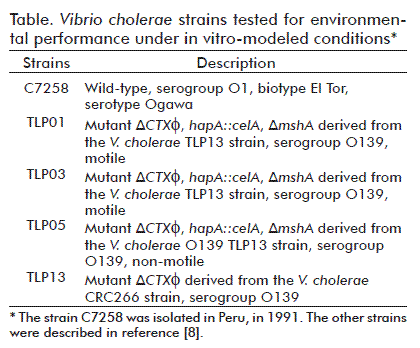
<body><![CDATA[<P   ><font size="2" face="Verdana, Arial, Helvetica, sans-serif"><B><font size="3">MATERIALS      AND METHODS</font></B></font></P >   <FONT size="+1">        <P   ><font size="2" face="Verdana, Arial, Helvetica, sans-serif"><b>Materials </b></font></P >   <FONT size="+1">        <P   ><font size="2" face="Verdana, Arial, Helvetica, sans-serif"><I><b>Strains </b></I></font></P >       <P   ><font size="2" face="Verdana, Arial, Helvetica, sans-serif">The <I>V. cholerae</I>      strains used in this study were: C7258, wild-type; TLP01 and TLP05, mutant      strains to the <I>mshA</I> gene; TLP03, an isogenic strain; and TLP13 atoxigenic      parental strain (<a href="#tab1">Table</a>). The last two strains were used      as assay controls. </font></P >       <P align="center"   ><img src="/img/revistas/bta/v31n2/t0104214.gif" width="418" height="346"><a name="tab1"></a></P >       
<P   ><font size="2" face="Verdana, Arial, Helvetica, sans-serif"><I><b>Culture media      </b> </I></font></P >       <P   ><font size="2" face="Verdana, Arial, Helvetica, sans-serif">The culture media      were TSB (17 g/L tryptone, 3 g/L peptone, 2.5 g/L K<sub>2</sub>HPO<sub>4</sub>,      5 g/L NaCl) supplemented at 0.4 % glucose; simulated seawater (27.3 g/L NaCl,      13.6 g/L Mg<sub>2</sub>SO<sub>4</sub>, 1.5 g/L CaCl<sub>2</sub>, 0.8 g/L KCl,      0.3 g/L NaHCO<sub>3</sub>, 0.005 g/L Na<sub>2</sub>B<sub>4</sub>O<sub>7</sub>,      0.001 g/L LiCl), adjusted to pH 7.0 and supplemented with casein hydrolysate      at 1 %; and peptone alkaline water (10 g/L peptone, 10 g/L NaCl; pH 8.5).      </font></P >   <FONT size="+1"><FONT size="+1"><FONT size="+1"><FONT size="+1"><FONT size="+1"><FONT size="+1"><FONT size="+1"><FONT size="+1"><FONT size="+1"><FONT size="+1"><FONT size="+1"><FONT size="+1"><FONT size="+1"><FONT size="+1"><FONT size="+1"><FONT size="+1"><FONT size="+1"><FONT size="+1">        <P   ><font size="2" face="Verdana, Arial, Helvetica, sans-serif"><b>Methods </b></font></P >       <P   ><font size="2" face="Verdana, Arial, Helvetica, sans-serif"><I><b>Assessment      of biofilm formation ability </b></I></font></P >       <P   ><font size="2" face="Verdana, Arial, Helvetica, sans-serif">The ability of <I>V.      cholera</I> strains to produce biofilms was assessed in TSB medium supplemented      with glucose and simulated seawater [17]. The assay was conducted in 96-well      polystyrene plates, starting from a 1:100 dilution of fresh cultures at exponential      phase with similar optical densities at 600 nm (OD<sub>600n</sub>m). This      avoided the presence of autoinducers in the inoculums which may interfere      in biofilm formation. Wells containing uninoculated culture media were used      as baseline controls [18]. The strains TLP01, TLP03, TLP05 and TLP13 were      tested, and the experiments were run in triplicate. The plates were incubated      at 37 </font><font size="+1" color="#000000"><font size="+1"><font size="+1"><font size="+1"><font color="#0462C1"><font color="#000000"><font size="+1"><font size="+1"><font size="+1"><font size="+1"><font size="+1"><font size="+1"><font size="+1"><font size="+1"><font size="+1"><font size="+1"><font size="+1"><font size="+1"><font size="+1"><font size="+1"><font size="+1"><font size="+1"><font size="+1"><font size="+1"><font size="+1"><font size="+1"><font size="+1"><font size="+1"><font size="+1"><font size="+1"><font size="+1"><font size="+1"><font size="+1"><font size="+1"><font size="+1"><font size="+1"><font size="+1"><font size="+1"><font size="+1"><font size="+1"><font size="+1"><font size="+1"><font size="+1"><font size="+1"><font size="+1"><font size="+1"><font size="+1"><font size="+1"><font size="2" face="Verdana, Arial, Helvetica, sans-serif">&ordm;C</font></font></font></font></font></font></font></font></font></font></font></font></font></font></font></font></font></font></font></font></font></font></font></font></font></font></font></font></font></font></font></font></font></font></font></font></font></font></font></font></font></font></font></font></font></font></font></font></font>      <font size="2" face="Verdana, Arial, Helvetica, sans-serif">for 24, 48 or      72 h, and culture homogeneity was checked at each time point by determining      OD600nm in a microplate reader (Multiscan, Finland). After three successive      washes in phosphate-buffered saline (PBS; 137 mM NaCl, 9.58 mM Na<sub>2</sub>HPO<sub>4</sub>,      2.68 mM KCl, 1.47 mM KH<sub>2</sub>PO<sub>4</sub>; pH 7.2), plates were stained      with 1 % safranin solution (prepared in 33 % acetic acid), and biofilm OD490nm      of biofilms was measured in the same microplate reader. </font></P >   <FONT size="+1"><FONT size="+1"><FONT size="+1"><FONT size="+1"><FONT size="+1"><FONT size="+1"><FONT size="+1"><FONT size="+1"><FONT size="+1"><FONT size="+1"><FONT size="+1"><FONT size="+1"><FONT size="+1"><FONT size="+1">        ]]></body>
<body><![CDATA[<P   ><font size="2" face="Verdana, Arial, Helvetica, sans-serif"><I><b>Induction of      the rugose phenotype </b></I></font></P >       <P   ><font size="2" face="Verdana, Arial, Helvetica, sans-serif">Alkaline peptone      water 5-mL samples were inoculated with 5 &micro;L of fresh cultures of strains      TLP01, TLP05 or TLP13, and incubated at 37 </font><font size="+1" color="#000000"><font size="+1"><font size="+1"><font size="+1"><font color="#0462C1"><font color="#000000"><font size="+1"><font size="+1"><font size="+1"><font size="+1"><font size="+1"><font size="+1"><font size="+1"><font size="+1"><font size="+1"><font size="+1"><font size="+1"><font size="+1"><font size="+1"><font size="+1"><font size="+1"><font size="+1"><font size="+1"><font size="+1"><font size="+1"><font size="+1"><font size="+1"><font size="+1"><font size="+1"><font size="+1"><font size="+1"><font size="+1"><font size="+1"><font size="+1"><font size="+1"><font size="+1"><font size="+1"><font size="+1"><font size="+1"><font size="+1"><font size="+1"><font size="+1"><font size="+1"><font size="+1"><font size="+1"><font size="+1"><font size="+1"><font size="+1"><font size="2" face="Verdana, Arial, Helvetica, sans-serif">&ordm;C</font></font></font></font></font></font></font></font></font></font></font></font></font></font></font></font></font></font></font></font></font></font></font></font></font></font></font></font></font></font></font></font></font></font></font></font></font></font></font></font></font></font></font></font></font></font></font></font></font>      <font size="2" face="Verdana, Arial, Helvetica, sans-serif">for 30 days. Serial      dilutions were made on preset time points and strains were plated in LB-agar      medium (10 g/L tryptone; 10 g/L NaCl; 5 g/L yeast extract, pH 7.0, plus 15      g/L bacto agar). Strain morphology was observed and classified as rugose or      flat, also describing any other variation if present [19]. </font></P >       <P   ><font size="2" face="Verdana, Arial, Helvetica, sans-serif"><I><b>Assessment      of strain sensitivity to stressing agents </b></I></font></P >       <P   ><font size="2" face="Verdana, Arial, Helvetica, sans-serif">The sensitivity of      strains TLP01, TLP05 and TLP13 was tested under stressing environmental conditions,      comprising the presence of sodium hypochlorite, sodium dodecyl sulfate (SDS)      and high salt concentration. </font></P >       <P   ><font size="2" face="Verdana, Arial, Helvetica, sans-serif">Sensitivity to sodium      hypochlorite </font></P >       <P   ><font size="2" face="Verdana, Arial, Helvetica, sans-serif">The survival of <I>V.      cholerae</I> strains TLP01 and TLP13 to sodium hypochlorite concentrations      was tested under conditions favoring or not biofilm formation [19]. First,      strains were grown in capped borosilicate flasks filled with 3 mL of TSB medium      supplemented at 0.4 % glucose, and incubated at 30 &ordm;C for 24 h. Subsequently,      planktonic cultures of each strain were checked for homogeneity in a spectrophotometer      for OD630nm. The planktonic content was discarded and aggregated cells were      resuspended in 5 mL of PBS. Biofilms were disaggregated by adding 1 g of glass      pearls to each flask followed by vortexing. Samples were taken for microcounting      by serial dilutions, prior to the addition of the stressing agent. Then, NaOCl      was added up to 2 ppm and incubated for 1, 5, 10, 20 or 30 min. Subsequently,      the stressing agent was inactivated on the given samples by adding sodium      thiosulfate at 0.015 %, viable cells were counted, and adequate amounts of      each dilution plated in LB and further incubated at 37 &ordm;C for 20-22 h.      </font></P >   <FONT size="+1"><FONT size="+1">        <P   ><font size="2" face="Verdana, Arial, Helvetica, sans-serif">Strains were also      cultured under shaking to avoid biofilm formation, in test tubes filled with      TSB medium supplemented with glucose at 0.4 %, at 37 &ordm;C for 4 h. Approximately      10<sup>7</sup> colony-forming units (c.f.u.) of each culture were subjected      to the action of the previously mentioned NaOCl concentrations and their sensitivity      to the agent was assessed as previously described. </font></P >   <FONT size="+1"><FONT size="+1">        <P   ><font size="2" face="Verdana, Arial, Helvetica, sans-serif">Sensitivity to SDS      </font></P >       <P   ><font size="2" face="Verdana, Arial, Helvetica, sans-serif">Strains TLP01, TLP05      and TLP13 were tested for sensitivity to sodium dodecyl sulfate (SDS), starting      from cultures in a 24-well polystyrene plate containing TSB medium supplemented      with glucose at 0.4 %, which were inoculated from 1:100 dilutions. A well      containing uninoculated culture medium was used as baseline control. SDS 0.05,      0.1, 0.25, 0.5 and 1 % concentrations were tested [20]. The growth of each      strain in the absence of the agent was also tested. The plate was read every      2 h at 630 nm. The experiment was done in duplicate. </font></P >       <P   ><font size="2" face="Verdana, Arial, Helvetica, sans-serif">Sensitivity to NaCl      concentrations </font></P >       ]]></body>
<body><![CDATA[<P   ><font size="2" face="Verdana, Arial, Helvetica, sans-serif">For strains C7258,      TLP01, TLP05 and TLP13, two colonies were isolated and TLP13, and further      grown with agitation for 6 h. Afterwards, 1 mL of each bacterial culture was      centrifuged and cells were resuspended in 1 mL of TSB medium supplemented      at 2.5 M NaCl. After incubation for 0, 15, 30 and 60 min, 100 &micro;L were      taken for microcounting from each test sample. Serial dilutions were made      from each and plated on LB medium, being further incubated at 37 &ordm;C for      20-22 h. The results were analyzed by adjusting the fractions of bacteria      surviving to salt stress to a curve, according to the Weibull model (a statistic      distribution model of inactivation time points) [21]: </font></P >       <P align="center"   ><img src="/img/revistas/bta/v31n2/fr0104214.gif" width="283" height="111"></P >   </font></font></font></font></font></font></font></font></font></font></font></font></font></font></font></font></font></font></font></font></font></font></font></font></font></font></font></font></font></font></font></font></font></font></font></font></font></font></font></font></font></font></font></font></font></font></font></font></font></font></font></font>        
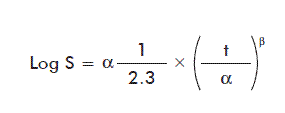
<P align="center"   ></P >   <FONT size="+1" color="#000000"><FONT size="+1"><FONT size="+1"><FONT size="+1"><FONT color="#0462C1"><FONT color="#000000"><FONT size="+1"><FONT size="+1"><FONT size="+1"><FONT size="+1"><FONT size="+1"><FONT size="+1"><FONT size="+1"><FONT size="+1"><FONT size="+1"><FONT size="+1"><FONT size="+1"><FONT size="+1"><FONT size="+1"><FONT size="+1"><FONT size="+1"><FONT size="+1"><FONT size="+1"><FONT size="+1"><FONT size="+1"><FONT size="+1"><FONT size="+1"><FONT size="+1"><FONT size="+1"><FONT size="+1"><FONT size="+1"><FONT size="+1"><FONT size="+1"><FONT size="+1"><FONT size="+1"><FONT size="+1"><FONT size="+1"><FONT size="+1"><FONT size="+1"><FONT size="+1"><FONT size="+1"><FONT size="+1"><FONT size="+1"><FONT size="+1"><FONT size="+1"><FONT size="+1"><FONT size="+1"><FONT size="+1"><FONT size="+1"><FONT size="+1"><FONT size="+1"><FONT size="+1">        <P   > </P >       <P   ><font size="2" face="Verdana, Arial, Helvetica, sans-serif">Where: </font></P >       <P   ><font size="2" face="Verdana, Arial, Helvetica, sans-serif">S: fraction of viable      bacteria at each time point, in respect to the amount at the start of the      experiment; calculated following the expression: </font></P >       <P align="center"   ><img src="/img/revistas/bta/v31n2/fr0204214.gif" width="159" height="62"></P >       
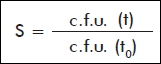
<P   ><font size="2" face="Verdana, Arial, Helvetica, sans-serif">t: the period that      the system is under the stress tested (salt stress); </font></P >       <P   ><font size="2" face="Verdana, Arial, Helvetica, sans-serif">&alpha;: scale parameter;      depends on the evaluated component (osmolarity); </font></P >       <P   ><font size="+1" color="#000000"><font size="+1"><font size="+1"><font size="+1"><font size="+1"><font size="+1"><font size="+1"><font size="+1"><font size="+1"><font size="+1"><font size="+1"><font size="+1"><font size="+1"><font size="+1"><font size="+1"><font size="+1"><font size="+1"><font size="+1"><font size="+1" color="#000000"><font size="+1"><font size="+1"><font size="+1"><font size="+1"><font size="+1"><font size="+1"><font size="+1"><font size="+1"><font size="+1"><font size="+1"><font size="+1"><font size="+1"><font size="+1"><font size="+1"><font size="+1"><font size="+1"><font size="+1"><font size="+1"><font size="+1"><font size="+1"><font size="+1"><font size="+1"><font size="+1"><font size="+1"><font size="+1"><font size="+1"><font size="+1"><font size="+1"><font size="+1"><font size="+1"><font size="+1"><font size="+1"><font size="+1"><font size="+1"><font size="+1"><font size="+1"><font size="+1"><font size="+1"><font size="+1"><font size="+1"><font size="+1"><font size="+1"><font size="+1"><font size="+1"><font size="+1"><font size="+1"><font size="+1"><font size="+1"><font size="+1"><font size="+1"><font size="+1"><font size="+1"><font face="Verdana, Arial, Helvetica, sans-serif" size="2">&beta;</font></font></font></font></font></font></font></font></font></font></font></font></font></font></font></font></font></font></font></font></font></font></font></font></font></font></font></font></font></font></font></font></font></font></font></font></font></font></font></font></font></font></font></font></font></font></font></font></font></font></font></font></font></font></font></font></font></font></font></font></font></font></font></font></font></font></font></font></font></font></font></font><font size="2" face="Verdana, Arial, Helvetica, sans-serif">:      shape parameter; related to the curve shape and the resistance ability to      the stress applied (salt stress). </font></P >       ]]></body>
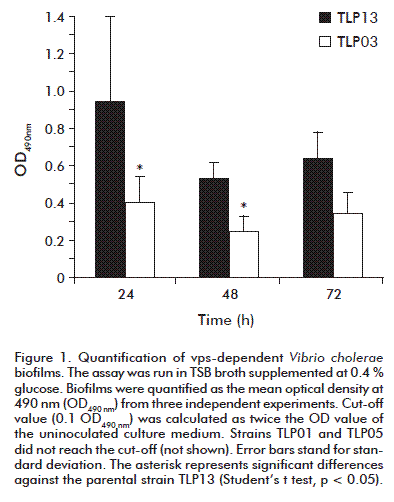
<body><![CDATA[<P   ><font size="2" face="Verdana, Arial, Helvetica, sans-serif"><i><b>Statistical      analysis </b></i> </font></P >       <P   ><font size="2" face="Verdana, Arial, Helvetica, sans-serif">Data were statistically      analyzed with the Prisma for Windows statistical package, version 4.0. The      statistical significance was set to 0.05 % for all the comparisons. Means      were compared by the Student&rsquo;s t test as indicated for each case in      the Results and discussion section. </font></P >       <P   >&nbsp;</P >       <P   ><font size="2" face="Verdana, Arial, Helvetica, sans-serif"><B><font size="3">RESULTS      AND DISCUSSION </font> </B></font></P >   <FONT size="+1">        <P   ><font size="2" face="Verdana, Arial, Helvetica, sans-serif"><b>Biofilm formation      ability </b></font></P >   <FONT size="+1">        <P   ><font size="2" face="Verdana, Arial, Helvetica, sans-serif">The ability of <I>V.      cholerae</I> TLP strains to form biofilms was assessed, under conditions promoting      them or not depending on EPS production (<I>vps</I>-dependent or <I>vps</I>-independent      biofilms). Studies were run in rich medium and simulated seawater, respectively.      The ability was inferred from the quantification of the EPS produced by each      strain, due to the tight relationship between these processes [14, 15]. </font></P >       <P   ><font size="2" face="Verdana, Arial, Helvetica, sans-serif">In the absence of      EPS, bacteria only formed a monolayer on the culture surface [14]. Similarly,      in the presence of any other mutation blocking biofilm formation, the strain      produces undetectable EPS amounts, according to the test method used. </font></P >       <P   ><font size="2" face="Verdana, Arial, Helvetica, sans-serif"><b>Quantification      of <I>vps-</I>dependent biofilms </b></font></P >       <P   ><font size="2" face="Verdana, Arial, Helvetica, sans-serif"><I>V. cholerae</I>      forms dense biofilms composed of bacterial columns surrounded by water channels      in rich culture media such as LB or TSB [15]. These media provide the ideal      conditions <I>in vitro</I> to promote <I>vps</I>-dependent biofilm production.      </font></P >       <P   ><font size="2" face="Verdana, Arial, Helvetica, sans-serif">In TSB medium supplemented      with glucose, only the TLP03 and TLP13 strains produced detectable EPS amounts      within the first 24 h, supporting the assumption that they do produce biofilms.      A halo was detected in the air-liquid interphase, characteristic of those      tridimensional structures. Nevertheless, strains TLP01 and TLP05 did not produced      detectable EPS (<a href="#fig1">Figure 1</a>). Such evidences indicate that,      even when strains TLP03 and TLP13 generate biofilms under the conditions tested,      this ability was significantly reduced for TLP03 (an <I>mshA</I> mutant) compared      to the atoxigenic parental strain TLP13, at least after 24 and 48 h of culture      (Student&rsquo;s t test, p = 0.018 and p = 0.0134, respectively). The absence      of biofilms for the TLP05 strain could be related to its non-motile phenotype.      This strain carries a random mutation unrelated to its engineering process      which abrogates motility, although its flagellum was present as corroborated      by electron microscopy [8]. Flagellar movement influences biofilm formation      in <I>V. cholerae</I> O139, as reported by Watnick <I>et al</I>. [15]. This      process is particularly relevant at starting the monolayer. </font></P >       ]]></body>
<body><![CDATA[<P align="center"   ><img src="/img/revistas/bta/v31n2/f0104214.gif" width="392" height="500"><a name="fig1"></a></P >       
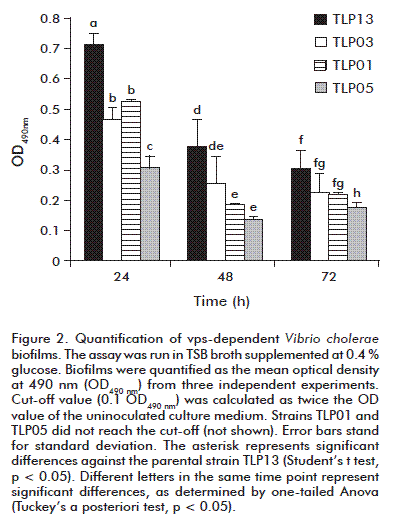
<P   ><font size="2" face="Verdana, Arial, Helvetica, sans-serif">The results indicated      that a spontaneous mutation had to occur in the TLP01 mutant interfering on      the formation of these structures. It is unrelated to the <I>mshA </I>mutation,      since the evidences suggest that the isogenic TLP03 mutant could establish      the tridimensional polysaccharide structure. </font></P >       <P   ><font size="2" face="Verdana, Arial, Helvetica, sans-serif"><b>Quantification      of <I>vps-</I>independent biofilms </b></font></P >       <P   ><font size="2" face="Verdana, Arial, Helvetica, sans-serif">In seawater,<I> V.      cholerae</I> forms calcium-dependent biofilms instead on <I>vps</I> genes.      This element directly mediates cell-to-cell or cell-surface interactions in      bacterial biofilms [17]. Hence, a seawater model obtained in the laboratory      [17] was chosen to quantify <I>vps</I>-independent biofilm production. As      established from readouts at 600 nm, strains TLP01, TLP03, TLP05 and TLP13      similarly produced biofilms under the tested culture conditions (<a href="#fig2">Figure      2</a>). </font></P >       <P align="center"   ><img src="/img/revistas/bta/v31n2/f0204214.gif" width="391" height="525"><a name="fig2"></a></P >       
<P   ><font size="2" face="Verdana, Arial, Helvetica, sans-serif">In contrast to TSB      medium results, all the strains were able to produce biofilms in seawater.      There are reports describing that MSHA is required but unessential for the      calcium-dependent biofilm formation and that <I>mshA</I> mutants establish      weaker cell-to-cell interactions and thinner biofilms [17]. Our results are      in agreement with those reported, since <I>mshA</I> mutants showed reduced      biofilm formation compared to the parental TLP13 strain (<a href="#fig2">Figure      2</a>). </font></P >       <P   ><font size="2" face="Verdana, Arial, Helvetica, sans-serif">Regarding motility,      under sugar deficitary conditions and in the presence of calcium, the flagellum      could become a signal inducing biofilm formation. According to Kierek and      Watnick [17], the flagellum is also required to structure calcium-dependent      structures, but with an effect not as relevant as in the case of the equivalent      mutation for <I>vps</I>-dependent biofilms. The results obtained for the TLP05      strain also confirms those previous reports. During the experiment, TLP05      generated biofilms at levels below those of the TLP01 and TLP03 mutants, at      least after 24 h (One-tailed Anova, p &lt; 0.05; Tuckey&rsquo;s <I>a posteriori</I>      test, p &lt; 0.05). Hence, the TLP05 strain could be less prone to produce      biofilms due to the <I>mshA</I> gene mutation and its non-motile phenotype.      </font></P >       <P   ><font size="2" face="Verdana, Arial, Helvetica, sans-serif">These results indicate      that TLP01 and TLP05 strains produce <I>vps</I>-independent biofilms; though,      at levels below those of the parental strain. Accordingly, under the studied      conditions, these two mutants do not bear any phenotype-related competitive      advantage for environmental persistence. This type of biofilms requires millimolar      calcium concentrations, absent in fluvial environments but found in seawater      [22]. Such calcium dependence determines that <I>vps</I>-independent biofilms      could be more relevant in marine ecosystems than in lacustrine and briny ones.      </font></P >       <P   ><font size="2" face="Verdana, Arial, Helvetica, sans-serif">On the other hand,      biofilm formation is required to reach the viable non-culturable state [11].      In this sense, the inability of the TLP01 and TLP05 mutants to produce biofilms      could lead to their decreased survival and make them disadvantageous in natural      environments which are far more complex than conditions modeled in this study.      Thus, a different behavior cannot be ruled out in natural environments, although      such non-biofilm producer phenotype could be a containment element contributing      to the biosafety of the live-attenuated vaccines having those strains as active      pharmaceutical ingredients. Other experiments must be run, including competition      assays with wild strains, in order to evaluate other types of interactions      in a scenario closer to the natural environments. </font></P >       <P   ><font size="2" face="Verdana, Arial, Helvetica, sans-serif"><b>Induction of the      rugose phenotype </b></font></P >       ]]></body>
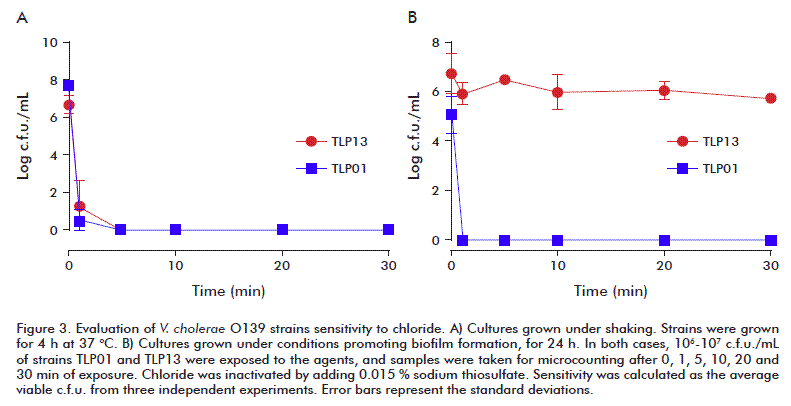
<body><![CDATA[<P   ><font size="2" face="Verdana, Arial, Helvetica, sans-serif">The <I>V. cholera</I>      rugose phenotype is a bacterial survival and environmental persistence mechanism.      This morphological change makes it highly resistant to agents as chlorine,      hydrogen peroxide and other oxidative or osmotic stresses [19]. Previous studies      demonstrated that the rugose phenotype is related to EPS production, which      promotes biofilms structuring [16]. Keeping this in mind, the development      of rugose phenotype was evaluated for TLP01 and TLP05 mutants compared to      the TLP13 parental strain, by incubation in alkaline peptone water at 37 &ordm;C      for 30 days. It was shown that the atoxigenic parental strain TLP13 started      the rugose phenotype on day 8. Meanwhile, from day 13 on, the TLP01 strain      developed opaque colonies with a corolla in the center but not the typical      rugose phenotype. The TLP05 mutant kept the flat phenotype during the entire      experiment. </font></P >       <P   ><font size="2" face="Verdana, Arial, Helvetica, sans-serif">These results confirmed      that TLP01 and TLP05 had lost the ability to develop rugose colonies and,      therefore, biofilms <I>in vitro</I>, this ability intact in its parental TLP13      strain. These two phenotypes depend on EPS production, indicating that TLP01      and TLP05 mutants have their <I>vps</I>-dependent EPS production mechanism      affected at certain point not engineered during their genetic construction.      Such a dysfunction would explain both, their inability to develop the rugose      phenotype and the tridimensional structuring of biofilms. </font></P >       <P   ><font size="2" face="Verdana, Arial, Helvetica, sans-serif">Those properties      would make TLP01 and TLP05 more vulnerable to environmental stressing conditions,      affecting their persistence in aquatic ecosystems where nutrients are far      restricted and resistance mechanisms required. Nevertheless, the relevance      of EPS for environmental persistence is debatable since there are no reports      on rugose isolates from environmental niches. </font></P >       <P   ><font size="2" face="Verdana, Arial, Helvetica, sans-serif"><b>Assessment of      strain sensitivity to stressing agents </b></font></P >       <P   ><font size="2" face="Verdana, Arial, Helvetica, sans-serif"><I><b>Sensitivity      to chloride</b> </I></font></P >       <P   ><font size="2" face="Verdana, Arial, Helvetica, sans-serif">Sodium hypochlorite      is a first-choice disinfectant for drinking water regardless its instability,      being used at concentrations ranging 2-5 ppm. It has been reported to induce      the rugose phenotype in <I>V. cholerae</I>, as for other agents. This also      supports the environmental disadvantage of TLP01 and TLP05 compared to other      natural strains. At the same time, biofilm formation arises as another resistance      mechanism, with the agent inactivated after getting into contact with polysaccharide      structures. Therefore, resistance to chloride was studied in the TLP01 and      TLP13 strains which produce or not biofilms. The experiment was run under      conditions favoring or not biofilm formation (planktonic or shaked cultures,      respectively), by exposure of 10<sup>6</sup>-10<sup>7</sup> c.f.u./mL to 2      ppm for 1, 5, 10, 20 and 30 min, and surviving c.f.u. were counted. </font></P >   <FONT size="+1"><FONT size="+1"><FONT size="+1"><FONT size="+1">        <P   ><font size="2" face="Verdana, Arial, Helvetica, sans-serif">Strains grown under      shaking had increased chloride sensitivity (<a href="/img/revistas/bta/v31n2/f0304214.gif">Figure      3A</a>), with no viable cells after 5 min of exposure. It has been described      that chloride is a stress agent for <I>V. cholerae</I> [19]. The planktonic      culture characterized by free cells in the medium provides no protection against      the agent, as evidenced in the experiment. On the contrary, the atoxigenic      parental strain TLP13 was highly resistant when biofilms were present, with      steady viable cell counts over time (<a href="/img/revistas/bta/v31n2/f0304214.gif">Figure 3B</a>).      There were about 10<sup>7</sup> c.f.u./mL after a 30-min exposure, opposed      to the lack of viable cells at any time for the TLP01 strain (<a href="/img/revistas/bta/v31n2/f0304214.gif">Figure      3B</a>). These results were in agreement with those of cultures under shaking.      </font></P >   <FONT size="+1"><FONT size="+1">        
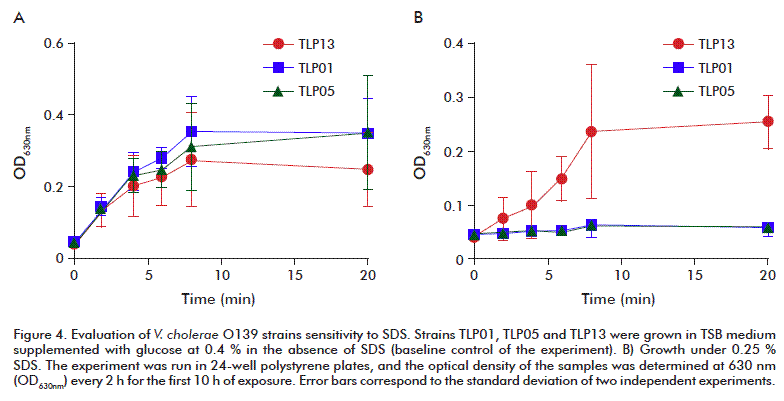
<P   ><font size="2" face="Verdana, Arial, Helvetica, sans-serif">Our findings confirm      the relevance of TLP13 biofilms in chloride inactivation and allow to foresee      the relevance these structures would play in <I>V. cholerae </I>survival and      persistence. In spite of the environmental disadvantage of strains TLP01 and      TLP05, their coexistence with other strains able to produce such structures      could mitigate their limitations. </font></P >       <P   ><font size="2" face="Verdana, Arial, Helvetica, sans-serif"><I><b>Sensitivity      to SDS </b></I></font></P >       <P   ><font size="2" face="Verdana, Arial, Helvetica, sans-serif">The sensitivity of      <I>V. cholerae</I> to SDS at concentrations ranging 0.05-1.0 % was investigated.      The typical performance of strains TLP01, TLP05 and TLP13 in TSB medium supplemented      with glucose at 0.4 % in the absence of SDS was set as reference condition      for the experiment (<a href="/img/revistas/bta/v31n2/f0404214.gif">Figure 4A</a>). There were no differences      in the growth rate among the three strains, as evidenced by spectrophotometric      determinations at 630 nm. </font></P >       
]]></body>
<body><![CDATA[<P   ><font size="2" face="Verdana, Arial, Helvetica, sans-serif">When SDS was tested,      at 0.05 % cultures grew similarly for all the strains, with no significant      delays. The stressing effect of SDS manifested at 0.1 % concentrations although      growth was not completely inhibited. The growth of mutant strains TLP01 and      TLP05 stopped at 0.25 %, with strain TLP13 still growing under those conditions      and only stopped at 1.0 % SDS (<a href="/img/revistas/bta/v31n2/f0404214.gif">Figure 4B</a>). These      results indicate that the SDS minimal inhibitory concentration is four times      lower for TLP01 and TLP05 than that of the parental TLP13. </font></P >       
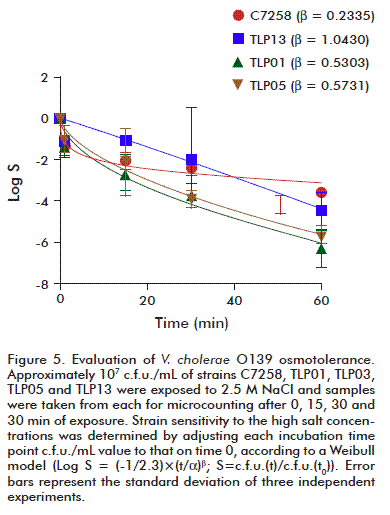
<P   ><font size="2" face="Verdana, Arial, Helvetica, sans-serif">As most of gram-negative      bacteria do, <I>V. chole-rae</I> regulates the diffusion rate of small molecules      through its external membrane by modulating the synthesis of external membrane      porins, specifically OmpT and OmpU [23]. In response to bile salts, the transcriptional      regulator ToxR positively induces the expression of <I>OmpU</I>, while suppressing      that of <I>ompT</I>. The production of OmpT is associated to the increase      in bacterial bile sensitivity [20, 24], while the OmpU production has been      implicated in resistance to antimicrobial peptides, organic acids and anionic      bile detergents and SDS [25]. Altogether, these results allow predicting the      performance of the strains tested, in the presence of other agents of similar      nature such as antibiotics and other types of detergents. </font></P >       <P   ><font size="2" face="Verdana, Arial, Helvetica, sans-serif">It has been previously      described a major OmpU band in the SDS-PAGE electrophoretic pattern of external      membrane proteins of the TLP13 wild type strain [26]. This pattern is characteristic      of strains carrying the <I>toxR</I> wild-type allele. On the contrary, the      <I>toxR</I> mutants only produce OmpT. Curiously, the TLP01 and TLP05 mutants      show detectable levels of both proteins, indicative of an intermediate phenotype      probably caused by a mutation [26]. According to the results of Provenzano      and Klose [24], the reduced resistance to detergents as SDS in these two mutant      strains may be related to a lower expression of the OmpU porin. Otherwise,      the effect that other mutations could exert in these vaccine strains cannot      be ruled out. </font></P >       <P   ><font size="2" face="Verdana, Arial, Helvetica, sans-serif"><I><b>Osmotolerance      </b> </I></font></P >       <P   ><font size="2" face="Verdana, Arial, Helvetica, sans-serif">High salinity is      among the harsh physicochemical conditions that could affect the environmental      performance of <I>V. cholerae</I> [27]. Hence, a test was run to evaluate      the effect of high NaCl concentrations on the outcome of the TLP01, TLP05      and TLP13 strains. The wild-type C7258 strain was used as control. Approximately      10<sup>7</sup> c.f.u./mL of each strain was subjected to the effect of the      stressing agent. Results were analyzed by adjusting bacterial fractions, which      survived after 15, 30 or 60 min of exposure to NaCl, to a curve according      to the Weibull model. That model has been successfully used to evaluate tolerance      of different microorganism&rsquo;s populations against stressing agents [21].      Results are summarized in <a href="#fig5">figure 5</a>. Viable cell counts      declined over time for all the strains, with TLP01 and TLP05 c.f.u. counts      two orders below those of the wild strain, very significant for the study.      </font></P >       <P align="center"   ><img src="/img/revistas/bta/v31n2/f0504214.gif" width="388" height="513"><a name="fig5"></a></P >   <FONT size="+1"><FONT size="+1">        
<P   ><font size="2" face="Verdana, Arial, Helvetica, sans-serif">The </font><font size="+1" color="#000000"><font size="+1"><font size="+1"><font size="+1"><font size="+1"><font size="+1"><font size="+1"><font size="+1"><font size="+1"><font size="+1"><font size="+1"><font size="+1"><font size="+1"><font size="+1"><font size="+1"><font size="+1"><font size="+1"><font size="+1"><font size="+1" color="#000000"><font size="+1"><font size="+1"><font size="+1"><font size="+1"><font size="+1"><font size="+1"><font size="+1"><font size="+1"><font size="+1"><font size="+1"><font size="+1"><font size="+1"><font size="+1"><font size="+1"><font size="+1"><font size="+1"><font size="+1"><font size="+1"><font size="+1"><font size="+1"><font size="+1"><font size="+1"><font size="+1"><font size="+1"><font size="+1"><font size="+1"><font size="+1"><font size="+1"><font size="+1"><font size="+1"><font size="+1"><font size="+1"><font size="+1"><font size="+1"><font size="+1"><font size="+1"><font size="+1"><font size="+1"><font size="+1"><font size="+1"><font size="+1"><font size="+1"><font size="+1"><font size="+1"><font size="+1"><font size="+1"><font size="+1"><font size="+1"><font size="+1"><font size="+1"><font size="+1"><font size="+1"><font face="Verdana, Arial, Helvetica, sans-serif" size="2">&beta;</font></font></font></font></font></font></font></font></font></font></font></font></font></font></font></font></font></font></font></font></font></font></font></font></font></font></font></font></font></font></font></font></font></font></font></font></font></font></font></font></font></font></font></font></font></font></font></font></font></font></font></font></font></font></font></font></font></font></font></font></font></font></font></font></font></font></font></font></font></font></font></font><font size="2" face="Verdana, Arial, Helvetica, sans-serif">      constant values for each strain curves were compared by the Fisher&rsquo;s      test. As shown by comparing the control strain C7258 results to those of the      other strains, it displayed a higher resistance to salinity (p &lt; 0.05).      The concave shape of its curve, influenced by its </font><font size="+1" color="#000000"><font size="+1"><font size="+1"><font size="+1"><font size="+1"><font size="+1"><font size="+1"><font size="+1"><font size="+1"><font size="+1"><font size="+1"><font size="+1"><font size="+1"><font size="+1"><font size="+1"><font size="+1"><font size="+1"><font size="+1"><font size="+1" color="#000000"><font size="+1"><font size="+1"><font size="+1"><font size="+1"><font size="+1"><font size="+1"><font size="+1"><font size="+1"><font size="+1"><font size="+1"><font size="+1"><font size="+1"><font size="+1"><font size="+1"><font size="+1"><font size="+1"><font size="+1"><font size="+1"><font size="+1"><font size="+1"><font size="+1"><font size="+1"><font size="+1"><font size="+1"><font size="+1"><font size="+1"><font size="+1"><font size="+1"><font size="+1"><font size="+1"><font size="+1"><font size="+1"><font size="+1"><font size="+1"><font size="+1"><font size="+1"><font size="+1"><font size="+1"><font size="+1"><font size="+1"><font size="+1"><font size="+1"><font size="+1"><font size="+1"><font size="+1"><font size="+1"><font size="+1"><font size="+1"><font size="+1"><font size="+1"><font size="+1"><font size="+1"><font face="Verdana, Arial, Helvetica, sans-serif" size="2">&beta;</font></font></font></font></font></font></font></font></font></font></font></font></font></font></font></font></font></font></font></font></font></font></font></font></font></font></font></font></font></font></font></font></font></font></font></font></font></font></font></font></font></font></font></font></font></font></font></font></font></font></font></font></font></font></font></font></font></font></font></font></font></font></font></font></font></font></font></font></font></font></font></font><font face="Verdana, Arial, Helvetica, sans-serif" size="2">      value, could allow us to infer that C7258 cells have the ability to adapt      to high salt concentrations, an effect absent for the other strains tested.      There were no significant differences in the performance of the atoxigenic      TLP01, TLP05 and TLP13 strains. </font></P >       <P   ><font size="2" face="Verdana, Arial, Helvetica, sans-serif">These results point      towards osmoadaptation properties of the candidate vaccine strains, compared      to a non-engineered strain. In this sense, TLP01 and TLP05 appear to be less      tolerant to salt stress than the wild-type strain C7258. This is relevant      considering than once released to the environment, they would be disfavored      in respect to the natural toxigenic strains. At the same time, their reduced      osmotolerance equally contributes to its biosafety when used as live-attenuated      vaccines. Since there were no significant differences in the performance of      TLP01 and TLP05 compared to TLP13 under the assayed conditions, this could      indicate an intrinsic property of the two strains, or be related to a single      collateral unexpected mutation, which appeared during the initial CTX&phi;      genes deletion event. In spite of being fortuitous, the resulting effect provides      a positive property to these mutants which may contribute to limit their environmental      survival. </font></P >       <P   ><font size="2" face="Verdana, Arial, Helvetica, sans-serif">Noteworthy, <I>V.      cholerae</I> is one of the few <I>Vibrio</I> species successfully performing      under low osmolarity conditions, always in the presence of sodium, in spite      of its optimal salinity ranging 5-25 g/L. It could also grow in dissolved      organic material at salinity concentrations near 45 g/L. Therefore, this bacterium      adapts well to freshwater and briny waters in endemic areas. The periodical      intrusion of salt water seems to increase <I>Vibrio</I> survival in those      environments, but in certain areas and for given periods the increase in salinity      tends to reduce the viable cell counts [9]. In this sense, the strains acquiring      the viable non-culturable state should be also considered. This last aspect      remains to be evaluated in vaccine strains. </font></P >       <P   >&nbsp;</P >       ]]></body>
<body><![CDATA[<P   ><font size="2" face="Verdana, Arial, Helvetica, sans-serif"><b><font size="3">CONCLUSIONS      </font></b></font></P >   <FONT size="+1">        <P   ><font size="2" face="Verdana, Arial, Helvetica, sans-serif">Here we demonstrate      that strains TLP01 and TLP05 had limitations in the mechanisms that regulate      biofilm and EPS formation <I>in vitro</I>, osmotolerance and susceptibility      to detergents. The impact of these properties under other experimental conditions      near those of the natural ecosystems should be further studied, in spite of      these mechanisms being expected to influence the vibrios environmental performance      to certain extent. The results indicate that these two strains have properties      which limit their behavior <I>in vitro</I>. And such properties could act      as containment for the biological agent used as active pharmaceutical ingredient      for a vaccine candidate. </font></P >   <FONT size="+1">        <P   ><font size="2" face="Verdana, Arial, Helvetica, sans-serif">The <I>mshA</I> gene      mutation also reduces the possibility to reacquire toxin genes in watery environments.      The potential environmental persistence limitations coming from the results      presented will contribute to increase vaccine biosafety. In this sense, a      poor environmental performance could reduce the impact that the reacquisition      of the toxin genes would have during human infection or for the environment.      It seems to be quite improbable that these two strains could achieve bacterial      population levels under competitive scenarios, enough to significantly contribute      to disseminate the <I>ctxAB</I> genes or to affect humans. </font></P >       <P   >&nbsp;</P >   </font></font></font></font></font></font></font></font></font></font></font></font></font></font></font></font></font></font></font></font></font></font></font></font></font></font></font></font></font></font></font></font></font></font></font></font></font></font></font></font></font></font></font></font></font></font></font></font></font></font></font></font></font></font></font></font></font></font></font></font></font></font></font></font>        <p   > </p >       <p   ><font size="3" color="#000000"><b><font face="Verdana, Arial, Helvetica, sans-serif">REFERENCES</font></b></font></p >       <!-- ref --><p   ><font size="2" face="Verdana, Arial, Helvetica, sans-serif">1. Faruque SM, Chowdhury      N, Kamruzzaman M, Ahmad QS, Faruque AS, Salam MA, et al. Reemergence of epidemic      Vibrio cholerae O139, Bangladesh. Emerg Infect Dis. 2003;9(9):1116-22.    </font></p >       <!-- ref --><p   ><font size="2" face="Verdana, Arial, Helvetica, sans-serif">2. Bishop AL, Camilli      A. Vibrio cholerae: lessons for mucosal vaccine design. Expert Rev Vaccines.      2011;10(1):79-94.    </font></p >       ]]></body>
<body><![CDATA[<!-- ref --><p   ><font size="2" face="Verdana, Arial, Helvetica, sans-serif">3. Lopez AL, Clemens      JD, Deen J, Jodar L. Cholera vaccines for the developing world. Hum Vaccin.      2008;4(2):165-9.    </font></p >       <!-- ref --><p   ><font size="2" face="Verdana, Arial, Helvetica, sans-serif">4. Waldor MK, Mekalanos      JJ. Lysogenic conversion by a filamentous phage encoding cholera toxin. Science.      1996;272(5270):1910-4.    </font></p >       <!-- ref --><p   ><font size="2" face="Verdana, Arial, Helvetica, sans-serif">5. Campos J, Martinez      E, Marrero K, Silva Y, Rodriguez BL, Suzarte E, et al. Novel type of specialized      transduction for CTX phi or its satellite phage RS1 mediated by filamentous      phage VGJ phi in Vibrio cholerae. J Bacteriol. 2003;185(24):7231-40.    </font></p >       <p   ><font size="2" face="Verdana, Arial, Helvetica, sans-serif">6. Campos J, Martinez      E, Izquierdo Y, Fando R. VEJphi, a novel filamentous phage of Vibrio cholerae      able to transduce the cholera toxin genes. Microbiology. 2010;156(Pt 1):108-15.</font></p >       <!-- ref --><p   ><font size="2" face="Verdana, Arial, Helvetica, sans-serif">7. Das B, Bischerour      J, Barre FX. Molecular mechanism of acquisition of the cholera toxin genes.      Indian J Med Res. 2011;133:195-200.    </font></p >       <!-- ref --><p   ><font size="2" face="Verdana, Arial, Helvetica, sans-serif">8. Ledon T, Ferran      B, Perez C, Suzarte E, Vichi J, Marrero K, et al. TLP01, an mshA mutant of      Vibrio cholerae O139 as vaccine candidate against cholera. Microbes Infect.      2012;14(11):968-78.    </font></p >       <!-- ref --><p   ><font size="2" face="Verdana, Arial, Helvetica, sans-serif">9. Lipp EK, Huq A,      Colwell RR. Effects of global climate on infectious disease: the cholera model.      Clin Microbiol Rev. 2002;15(4):757-70.    </font></p >       <!-- ref --><p   ><font size="2" face="Verdana, Arial, Helvetica, sans-serif">10. Huq A, Sack RB,      Nizam A, Longini IM, Nair GB, Ali A, et al. Critical factors influencing the      occurrence of Vibrio cholerae in the environment of Bangladesh. Appl Environ      Microbiol. 2005;71(8):4645-54.    </font></p >       <!-- ref --><p   ><font size="2" face="Verdana, Arial, Helvetica, sans-serif">11. Kamruzzaman M,      Udden SM, Cameron DE, Calderwood SB, Nair GB, Mekalanos JJ, et al. Quorum-regulated      biofilms enhance the development of conditionally viable, environmental Vibrio      cholerae. Proc Natl Acad Sci USA. 2010;107(4):1588-93.    </font></p >       <!-- ref --><p   ><font size="2" face="Verdana, Arial, Helvetica, sans-serif">12. Chiavelli DA,      Marsh JW, Taylor RK. The mannose-sensitive hemagglutinin of Vibrio cholerae      promotes adherence to zooplankton. Appl Environ Microbiol. 2001;67(7):3220-5.    </font></p >       <!-- ref --><p   ><font size="2" face="Verdana, Arial, Helvetica, sans-serif">13. Reidl J, Klose      KE. Vibrio cholerae and cholera: out of the water and into the host. FEMS      Microbiol Rev. 2002;26(2):125-39.    </font></p >       <!-- ref --><p   ><font size="2" face="Verdana, Arial, Helvetica, sans-serif">14. Watnick PI, Kolter      R. Steps in the development of a Vibrio cholerae El Tor biofilm. Mol Microbiol.      1999;34(3):586-95.    </font></p >       <!-- ref --><p   ><font size="2" face="Verdana, Arial, Helvetica, sans-serif">15. Watnick PI, Lauriano      CM, Klose KE, Croal L, Kolter R. The absence of a flagellum leads to altered      colony morphology, biofilm development and virulence in Vibrio cholerae O139.      Mol Microbiol. 2001;39(2):223-35.    </font></p >       <!-- ref --><p   ><font size="2" face="Verdana, Arial, Helvetica, sans-serif">16. Yildiz FH, Schoolnik      GK. Vibrio cholerae O1 El Tor: identification of a gene cluster required for      the rugose colony type, exopolysaccharide production, chlorine resistance,      and biofilm formation. Proc Natl Acad Sci USA. 1999;96(7):4028-33.    </font></p >       <!-- ref --><p   ><font size="2" face="Verdana, Arial, Helvetica, sans-serif">17. Kierek K, Watnick      PI. The Vibrio cholerae O139 O-antigen polysaccharide is essential for Ca2+-dependent      biofilm development in sea water. Proc Natl Acad Sci USA. 2003;100(24):14357-62.    </font></p >       <!-- ref --><p   ><font size="2" face="Verdana, Arial, Helvetica, sans-serif">18. Yildiz FH, Dolganov      NA, Schoolnik GK. VpsR, a member of the response regulators of the two-component      regulatory systems, is required for expression of vps biosynthesis genes and      EPS(ETr)-associated phenotypes in Vibrio cholerae O1 El Tor. J Bacteriol.      2001;183(5):1716-26.    </font></p >       <!-- ref --><p   ><font size="2" face="Verdana, Arial, Helvetica, sans-serif">19. Wai SN, Mizunoe      Y, Takade A, Kawabata SI, Yoshida SI. Vibrio cholerae O1 strain TSI-4 produces      the exopolysaccharide materials that determine colony morphology, stress resistance,      and biofilm formation. Appl Environ Microbiol. 1998;64(10):3648-55.    </font></p >       <!-- ref --><p   ><font size="2" face="Verdana, Arial, Helvetica, sans-serif">20. Provenzano D,      Klose KE. Altered expression of the ToxR-regulated porins OmpU and OmpT diminishes      Vibrio cholerae bile resistance, virulence factor expression, and intestinal      colonization. Proc Natl Acad Sci USA. 2000;97(18):10220-4.    </font></p >       <!-- ref --><p   ><font size="2" face="Verdana, Arial, Helvetica, sans-serif">21. Van Boekel MAJS.      On the use of the Weibull model to describe thermal inactivation of microbial      vegetative cells. J Food Microbiol. 2002;74(1-2):139-59.    </font></p >       <!-- ref --><p   ><font size="2" face="Verdana, Arial, Helvetica, sans-serif">22. Lizarraga-Partida      ML, Mendez-Gomez E, Rivas-Montano AM, Vargas-Hernandez E, Portillo-Lopez A,      Gonzalez-Ramirez AR, et al. Association of Vibrio cholerae with plankton in      coastal areas of Mexico. Environ Microbiol. 2009;11(1):201-8.    </font></p >       <!-- ref --><p   ><font size="2" face="Verdana, Arial, Helvetica, sans-serif">23. Sperandio V,      Bailey C, Giron JA, DiRita VJ, Silveira WD, Vettore AL, et al. Cloning and      characterization of the gene encoding the OmpU outer membrane protein of Vibrio      cholerae. Infect Immun. 1996;64(12):5406-9.    </font></p >       <!-- ref --><p   ><font size="2" face="Verdana, Arial, Helvetica, sans-serif">24. Provenzano D,      Lauriano CM, Klose KE. Characterization of the role of the ToxR-modulated      outer membrane porins OmpU and OmpT in Vibrio cholerae virulence. J Bacteriol.      2001;183(12):3652-62.    </font></p >       <!-- ref --><p   ><font size="2" face="Verdana, Arial, Helvetica, sans-serif">25. Bina XR, Provenzano      D, Nguyen N, Bina JE. Vibrio cholerae RND family efflux systems are required      for antimicrobial resistance, optimal virulence factor production, and colonization      of the infant mouse small intestine. Infect Immun. 2008;76(8):3595-605.    </font></p >       <!-- ref --><p   ><font size="2" face="Verdana, Arial, Helvetica, sans-serif">26. Led&oacute;n      T, Ferran B, Fando R. Estudio de la funcionalidad de ToxR en cepas atenuadas      de Vibrio cholerae O139. Rev CENIC Cienc Biol. 2011;42(1):25-28.     </font></p >       <!-- ref --><p   ><font size="2" face="Verdana, Arial, Helvetica, sans-serif">27. Castaneda Chavez      Mdel R, Pardio Sedas V, Orrantia Borunda E, Lango Reynoso F. Influence of      water temperature and salinity on seasonal occurrences of Vibrio cholerae      and enteric bacteria in oyster-producing areas of Veracruz, Mexico. Mar Pollut      Bull. 2005;50(12):1641-8.    </font></p >       <p   >&nbsp;</p >       ]]></body>
<body><![CDATA[<p   >&nbsp;</p >   <FONT size="+1" color="#000000"><FONT size="+1"><FONT size="+1"><FONT size="+1"><FONT color="#0462C1"><FONT color="#000000"><FONT size="+1"><FONT size="+1"><FONT size="+1"><FONT size="+1"><FONT size="+1"><FONT size="+1"><FONT size="+1"><FONT size="+1"><FONT size="+1"><FONT size="+1"><FONT size="+1"><FONT size="+1"><FONT size="+1"><FONT size="+1"><FONT size="+1"><FONT size="+1"><FONT size="+1"><FONT size="+1"><FONT size="+1"><FONT size="+1"><FONT size="+1"><FONT size="+1"><FONT size="+1"><FONT size="+1"><FONT size="+1"><FONT size="+1"><FONT size="+1"><FONT size="+1"><FONT size="+1"><FONT size="+1"><FONT size="+1"><FONT size="+1"><FONT size="+1"><FONT size="+1"><FONT size="+1"><FONT size="+1"><FONT size="+1"><FONT size="+1"><FONT size="+1"><FONT size="+1"><FONT size="+1"><FONT size="+1"><FONT size="+1"><FONT size="+1"><FONT size="+1"><FONT size="+1"><FONT size="+1"><FONT size="+1"><FONT size="+1"><FONT size="+1"><FONT size="+1"><FONT size="+1"><FONT size="+1"><FONT size="+1"><FONT size="+1"><FONT size="+1"><FONT size="+1"><FONT size="+1">       <P   > </P >       <P   ><font size="2" face="Verdana, Arial, Helvetica, sans-serif">Received in September,      2013.     <br>     Accepted in April, 2014. </font></P >       <P   >&nbsp;</P >       <P   >&nbsp;</P >       <P   > </P >       <P   > </P >       <P   > </P >       <P   > </P >       ]]></body>
<body><![CDATA[<P   > </P >       <P   > </P >       <P   > </P >       <P   > </P >       <P   > </P >       <P   > </P >       <P   > </P >   <FONT size="+1">        <P   > </P >   </font></font></font></font></font></font></font></font></font></font></font></font></font></font></font></font></font></font></font></font></font></font></font></font></font></font></font></font></font></font></font></font></font></font></font></font></font></font></font></font></font></font></font></font></font></font></font></font></font></font></font></font></font></font></font></font></font></font></font></font></font></font></font></font></font>        <p><font size="+1" color="#000000"><font size="+1"><font size="+1"><font size="2" face="Verdana, Arial, Helvetica, sans-serif"><i>Talena      Led&oacute;n</i></font></font></font></font>. <font size="+1" color="#000000"><font size="+1"><font size="+1"><font size="+1"><font size="2" face="Verdana, Arial, Helvetica, sans-serif">Departamento      de Biolog&iacute;a Molecular, Direcci&oacute;n de Enfermedades Infecciosas,      Centro Nacional de Investigaciones Cient&iacute;ficas, CNIC. Ave. 25 y 158,      CP 10600, Playa, La Habana, Cuba.</font></font></font></font></font> <font size="2" face="Verdana, Arial, Helvetica, sans-serif">E-mail:      </font><font size="+1" color="#000000"><font size="+1"><font size="+1"><font size="+1"><font size="2" face="Verdana, Arial, Helvetica, sans-serif"><a href="mailto:talena.ledon@cnic.edu.cu"><font color="#0462C1">talena.ledon@cnic.edu.cu</font></a>.      </font></font></font></font></font></p>   </DIV >      ]]></body><back>
<ref-list>
<ref id="B1">
<label>1</label><nlm-citation citation-type="journal">
<person-group person-group-type="author">
<name>
<surname><![CDATA[Faruque]]></surname>
<given-names><![CDATA[SM]]></given-names>
</name>
<name>
<surname><![CDATA[Chowdhury]]></surname>
<given-names><![CDATA[N]]></given-names>
</name>
<name>
<surname><![CDATA[Kamruzzaman]]></surname>
<given-names><![CDATA[M]]></given-names>
</name>
<name>
<surname><![CDATA[Ahmad]]></surname>
<given-names><![CDATA[QS]]></given-names>
</name>
<name>
<surname><![CDATA[Faruque]]></surname>
<given-names><![CDATA[AS]]></given-names>
</name>
<name>
<surname><![CDATA[Salam]]></surname>
<given-names><![CDATA[MA]]></given-names>
</name>
</person-group>
<article-title xml:lang="en"><![CDATA[Reemergence of epidemic Vibrio cholerae O139, Bangladesh]]></article-title>
<source><![CDATA[Emerg Infect Dis]]></source>
<year>2003</year>
<volume>9</volume>
<numero>9</numero>
<issue>9</issue>
<page-range>1116-22</page-range></nlm-citation>
</ref>
<ref id="B2">
<label>2</label><nlm-citation citation-type="journal">
<person-group person-group-type="author">
<name>
<surname><![CDATA[Bishop]]></surname>
<given-names><![CDATA[AL]]></given-names>
</name>
<name>
<surname><![CDATA[Camilli]]></surname>
<given-names><![CDATA[A]]></given-names>
</name>
</person-group>
<article-title xml:lang="en"><![CDATA[Vibrio cholerae: lessons for mucosal vaccine design]]></article-title>
<source><![CDATA[Expert Rev Vaccines]]></source>
<year>2011</year>
<volume>10</volume>
<numero>1</numero>
<issue>1</issue>
<page-range>79-94</page-range></nlm-citation>
</ref>
<ref id="B3">
<label>3</label><nlm-citation citation-type="journal">
<person-group person-group-type="author">
<name>
<surname><![CDATA[Lopez]]></surname>
<given-names><![CDATA[AL]]></given-names>
</name>
<name>
<surname><![CDATA[Clemens]]></surname>
<given-names><![CDATA[JD]]></given-names>
</name>
<name>
<surname><![CDATA[Deen]]></surname>
<given-names><![CDATA[J]]></given-names>
</name>
<name>
<surname><![CDATA[Jodar]]></surname>
<given-names><![CDATA[L]]></given-names>
</name>
</person-group>
<article-title xml:lang="en"><![CDATA[Cholera vaccines for the developing world]]></article-title>
<source><![CDATA[Hum Vaccin]]></source>
<year>2008</year>
<volume>4</volume>
<numero>2</numero>
<issue>2</issue>
<page-range>165-9</page-range></nlm-citation>
</ref>
<ref id="B4">
<label>4</label><nlm-citation citation-type="journal">
<person-group person-group-type="author">
<name>
<surname><![CDATA[Waldor]]></surname>
<given-names><![CDATA[MK]]></given-names>
</name>
<name>
<surname><![CDATA[Mekalanos]]></surname>
<given-names><![CDATA[JJ]]></given-names>
</name>
</person-group>
<article-title xml:lang="en"><![CDATA[Lysogenic conversion by a filamentous phage encoding cholera toxin]]></article-title>
<source><![CDATA[Science]]></source>
<year>1996</year>
<volume>272</volume>
<numero>5270</numero>
<issue>5270</issue>
<page-range>1910-4</page-range></nlm-citation>
</ref>
<ref id="B5">
<label>5</label><nlm-citation citation-type="journal">
<person-group person-group-type="author">
<name>
<surname><![CDATA[Campos]]></surname>
<given-names><![CDATA[J]]></given-names>
</name>
<name>
<surname><![CDATA[Martinez]]></surname>
<given-names><![CDATA[E]]></given-names>
</name>
<name>
<surname><![CDATA[Marrero]]></surname>
<given-names><![CDATA[K]]></given-names>
</name>
<name>
<surname><![CDATA[Silva]]></surname>
<given-names><![CDATA[Y]]></given-names>
</name>
<name>
<surname><![CDATA[Rodriguez]]></surname>
<given-names><![CDATA[BL]]></given-names>
</name>
<name>
<surname><![CDATA[Suzarte]]></surname>
<given-names><![CDATA[E]]></given-names>
</name>
</person-group>
<article-title xml:lang="en"><![CDATA[Novel type of specialized transduction for CTX phi or its satellite phage RS1 mediated by filamentous phage VGJ phi in Vibrio cholerae]]></article-title>
<source><![CDATA[J Bacteriol]]></source>
<year>2003</year>
<volume>185</volume>
<numero>24</numero>
<issue>24</issue>
<page-range>7231-40</page-range></nlm-citation>
</ref>
<ref id="B6">
<label>6</label><nlm-citation citation-type="journal">
<person-group person-group-type="author">
<name>
<surname><![CDATA[Campos]]></surname>
<given-names><![CDATA[J]]></given-names>
</name>
<name>
<surname><![CDATA[Martinez]]></surname>
<given-names><![CDATA[E]]></given-names>
</name>
<name>
<surname><![CDATA[Izquierdo]]></surname>
<given-names><![CDATA[Y]]></given-names>
</name>
<name>
<surname><![CDATA[Fando]]></surname>
<given-names><![CDATA[R]]></given-names>
</name>
</person-group>
<article-title xml:lang="en"><![CDATA[VEJphi, a novel filamentous phage of Vibrio cholerae able to transduce the cholera toxin genes]]></article-title>
<source><![CDATA[Microbiology]]></source>
<year>2010</year>
<volume>156</volume>
<numero>108 Pt 1</numero>
<issue>108 Pt 1</issue>
<page-range>15</page-range></nlm-citation>
</ref>
<ref id="B7">
<label>7</label><nlm-citation citation-type="journal">
<person-group person-group-type="author">
<name>
<surname><![CDATA[Das]]></surname>
<given-names><![CDATA[B]]></given-names>
</name>
<name>
<surname><![CDATA[Bischerour]]></surname>
<given-names><![CDATA[J]]></given-names>
</name>
<name>
<surname><![CDATA[Barre]]></surname>
<given-names><![CDATA[FX]]></given-names>
</name>
</person-group>
<article-title xml:lang="en"><![CDATA[Molecular mechanism of acquisition of the cholera toxin genes]]></article-title>
<source><![CDATA[Indian J Med Res]]></source>
<year>2011</year>
<volume>133</volume>
<page-range>195-200</page-range></nlm-citation>
</ref>
<ref id="B8">
<label>8</label><nlm-citation citation-type="journal">
<person-group person-group-type="author">
<name>
<surname><![CDATA[Ledon]]></surname>
<given-names><![CDATA[T]]></given-names>
</name>
<name>
<surname><![CDATA[Ferran]]></surname>
<given-names><![CDATA[B]]></given-names>
</name>
<name>
<surname><![CDATA[Perez]]></surname>
<given-names><![CDATA[C]]></given-names>
</name>
<name>
<surname><![CDATA[Suzarte]]></surname>
<given-names><![CDATA[E]]></given-names>
</name>
<name>
<surname><![CDATA[Vichi]]></surname>
<given-names><![CDATA[J]]></given-names>
</name>
<name>
<surname><![CDATA[Marrero]]></surname>
<given-names><![CDATA[K]]></given-names>
</name>
</person-group>
<article-title xml:lang="en"><![CDATA[TLP01, an mshA mutant of Vibrio cholerae O139 as vaccine candidate against cholera]]></article-title>
<source><![CDATA[Microbes Infect]]></source>
<year>2012</year>
<volume>14</volume>
<numero>11</numero>
<issue>11</issue>
<page-range>968-78</page-range></nlm-citation>
</ref>
<ref id="B9">
<label>9</label><nlm-citation citation-type="journal">
<person-group person-group-type="author">
<name>
<surname><![CDATA[Lipp]]></surname>
<given-names><![CDATA[EK]]></given-names>
</name>
<name>
<surname><![CDATA[Huq]]></surname>
<given-names><![CDATA[A]]></given-names>
</name>
<name>
<surname><![CDATA[Colwell]]></surname>
<given-names><![CDATA[RR]]></given-names>
</name>
</person-group>
<article-title xml:lang="en"><![CDATA[Effects of global climate on infectious disease: the cholera model]]></article-title>
<source><![CDATA[Clin Microbiol Rev]]></source>
<year>2002</year>
<volume>15</volume>
<numero>4</numero>
<issue>4</issue>
<page-range>757-70</page-range></nlm-citation>
</ref>
<ref id="B10">
<label>10</label><nlm-citation citation-type="journal">
<person-group person-group-type="author">
<name>
<surname><![CDATA[Huq]]></surname>
<given-names><![CDATA[A]]></given-names>
</name>
<name>
<surname><![CDATA[Sack]]></surname>
<given-names><![CDATA[RB]]></given-names>
</name>
<name>
<surname><![CDATA[Nizam]]></surname>
<given-names><![CDATA[A]]></given-names>
</name>
<name>
<surname><![CDATA[Longini]]></surname>
<given-names><![CDATA[IM]]></given-names>
</name>
<name>
<surname><![CDATA[Nair]]></surname>
<given-names><![CDATA[GB]]></given-names>
</name>
<name>
<surname><![CDATA[Ali]]></surname>
<given-names><![CDATA[A]]></given-names>
</name>
</person-group>
<article-title xml:lang="en"><![CDATA[Critical factors influencing the occurrence of Vibrio cholerae in the environment of Bangladesh]]></article-title>
<source><![CDATA[Appl Environ Microbiol]]></source>
<year>2005</year>
<volume>71</volume>
<numero>8</numero>
<issue>8</issue>
<page-range>4645-54</page-range></nlm-citation>
</ref>
<ref id="B11">
<label>11</label><nlm-citation citation-type="journal">
<person-group person-group-type="author">
<name>
<surname><![CDATA[Kamruzzaman]]></surname>
<given-names><![CDATA[M]]></given-names>
</name>
<name>
<surname><![CDATA[Udden]]></surname>
<given-names><![CDATA[SM]]></given-names>
</name>
<name>
<surname><![CDATA[Cameron]]></surname>
<given-names><![CDATA[DE]]></given-names>
</name>
<name>
<surname><![CDATA[Calderwood]]></surname>
<given-names><![CDATA[SB]]></given-names>
</name>
<name>
<surname><![CDATA[Nair]]></surname>
<given-names><![CDATA[GB]]></given-names>
</name>
<name>
<surname><![CDATA[Mekalanos]]></surname>
<given-names><![CDATA[JJ]]></given-names>
</name>
</person-group>
<article-title xml:lang="en"><![CDATA[Quorum-regulated biofilms enhance the development of conditionally viable, environmental Vibrio cholerae]]></article-title>
<source><![CDATA[Proc Natl Acad Sci USA]]></source>
<year>2010</year>
<volume>107</volume>
<numero>4</numero>
<issue>4</issue>
<page-range>1588-93</page-range></nlm-citation>
</ref>
<ref id="B12">
<label>12</label><nlm-citation citation-type="journal">
<person-group person-group-type="author">
<name>
<surname><![CDATA[Chiavelli]]></surname>
<given-names><![CDATA[DA]]></given-names>
</name>
<name>
<surname><![CDATA[Marsh]]></surname>
<given-names><![CDATA[JW]]></given-names>
</name>
<name>
<surname><![CDATA[Taylor]]></surname>
<given-names><![CDATA[RK]]></given-names>
</name>
</person-group>
<article-title xml:lang="en"><![CDATA[The mannose-sensitive hemagglutinin of Vibrio cholerae promotes adherence to zooplankton]]></article-title>
<source><![CDATA[Appl Environ Microbiol]]></source>
<year>2001</year>
<volume>67</volume>
<numero>7</numero>
<issue>7</issue>
<page-range>3220-5</page-range></nlm-citation>
</ref>
<ref id="B13">
<label>13</label><nlm-citation citation-type="journal">
<person-group person-group-type="author">
<name>
<surname><![CDATA[Reidl]]></surname>
<given-names><![CDATA[J]]></given-names>
</name>
<name>
<surname><![CDATA[Klose]]></surname>
<given-names><![CDATA[KE]]></given-names>
</name>
</person-group>
<article-title xml:lang="en"><![CDATA[Vibrio cholerae and cholera: out of the water and into the host]]></article-title>
<source><![CDATA[FEMS Microbiol Rev]]></source>
<year>2002</year>
<volume>26</volume>
<numero>2</numero>
<issue>2</issue>
<page-range>125-39</page-range></nlm-citation>
</ref>
<ref id="B14">
<label>14</label><nlm-citation citation-type="journal">
<person-group person-group-type="author">
<name>
<surname><![CDATA[Watnick]]></surname>
<given-names><![CDATA[PI]]></given-names>
</name>
<name>
<surname><![CDATA[Kolter]]></surname>
<given-names><![CDATA[R]]></given-names>
</name>
</person-group>
<article-title xml:lang="en"><![CDATA[Steps in the development of a Vibrio cholerae El Tor biofilm]]></article-title>
<source><![CDATA[Mol Microbiol]]></source>
<year>1999</year>
<volume>34</volume>
<numero>3</numero>
<issue>3</issue>
<page-range>586-95</page-range></nlm-citation>
</ref>
<ref id="B15">
<label>15</label><nlm-citation citation-type="journal">
<person-group person-group-type="author">
<name>
<surname><![CDATA[Watnick]]></surname>
<given-names><![CDATA[PI]]></given-names>
</name>
<name>
<surname><![CDATA[Lauriano]]></surname>
<given-names><![CDATA[CM]]></given-names>
</name>
<name>
<surname><![CDATA[Klose]]></surname>
<given-names><![CDATA[KE]]></given-names>
</name>
<name>
<surname><![CDATA[Croal]]></surname>
<given-names><![CDATA[L]]></given-names>
</name>
<name>
<surname><![CDATA[Kolter]]></surname>
<given-names><![CDATA[R]]></given-names>
</name>
</person-group>
<article-title xml:lang="en"><![CDATA[The absence of a flagellum leads to altered colony morphology, biofilm development and virulence in Vibrio cholerae O139]]></article-title>
<source><![CDATA[Mol Microbiol]]></source>
<year>2001</year>
<volume>39</volume>
<numero>2</numero>
<issue>2</issue>
<page-range>223-35</page-range></nlm-citation>
</ref>
<ref id="B16">
<label>16</label><nlm-citation citation-type="journal">
<person-group person-group-type="author">
<name>
<surname><![CDATA[Yildiz]]></surname>
<given-names><![CDATA[FH]]></given-names>
</name>
<name>
<surname><![CDATA[Schoolnik]]></surname>
<given-names><![CDATA[GK]]></given-names>
</name>
</person-group>
<article-title xml:lang="en"><![CDATA[Vibrio cholerae O1 El Tor: identification of a gene cluster required for the rugose colony type, exopolysaccharide production, chlorine resistance, and biofilm formation]]></article-title>
<source><![CDATA[Proc Natl Acad Sci USA]]></source>
<year>1999</year>
<volume>96</volume>
<numero>7</numero>
<issue>7</issue>
<page-range>4028-33</page-range></nlm-citation>
</ref>
<ref id="B17">
<label>17</label><nlm-citation citation-type="journal">
<person-group person-group-type="author">
<name>
<surname><![CDATA[Kierek]]></surname>
<given-names><![CDATA[K]]></given-names>
</name>
<name>
<surname><![CDATA[Watnick]]></surname>
<given-names><![CDATA[PI]]></given-names>
</name>
</person-group>
<article-title xml:lang="en"><![CDATA[The Vibrio cholerae O139 O-antigen polysaccharide is essential for Ca2+-dependent biofilm development in sea water]]></article-title>
<source><![CDATA[Proc Natl Acad Sci USA]]></source>
<year>2003</year>
<volume>100</volume>
<numero>24</numero>
<issue>24</issue>
<page-range>14357-62</page-range></nlm-citation>
</ref>
<ref id="B18">
<label>18</label><nlm-citation citation-type="journal">
<person-group person-group-type="author">
<name>
<surname><![CDATA[Yildiz]]></surname>
<given-names><![CDATA[FH]]></given-names>
</name>
<name>
<surname><![CDATA[Dolganov]]></surname>
<given-names><![CDATA[NA]]></given-names>
</name>
<name>
<surname><![CDATA[Schoolnik]]></surname>
<given-names><![CDATA[GK]]></given-names>
</name>
</person-group>
<article-title xml:lang="en"><![CDATA[VpsR, a member of the response regulators of the two-component regulatory systems, is required for expression of vps biosynthesis genes and EPS(ETr)-associated phenotypes in Vibrio cholerae O1 El Tor]]></article-title>
<source><![CDATA[J Bacteriol]]></source>
<year>2001</year>
<volume>183</volume>
<numero>5</numero>
<issue>5</issue>
<page-range>1716-26</page-range></nlm-citation>
</ref>
<ref id="B19">
<label>19</label><nlm-citation citation-type="journal">
<person-group person-group-type="author">
<name>
<surname><![CDATA[Wai]]></surname>
<given-names><![CDATA[SN]]></given-names>
</name>
<name>
<surname><![CDATA[Mizunoe]]></surname>
<given-names><![CDATA[Y]]></given-names>
</name>
<name>
<surname><![CDATA[Takade]]></surname>
<given-names><![CDATA[A]]></given-names>
</name>
<name>
<surname><![CDATA[Kawabata]]></surname>
<given-names><![CDATA[SI]]></given-names>
</name>
<name>
<surname><![CDATA[Yoshida]]></surname>
<given-names><![CDATA[SI]]></given-names>
</name>
</person-group>
<article-title xml:lang="en"><![CDATA[Vibrio cholerae O1 strain TSI-4 produces the exopolysaccharide materials that determine colony morphology, stress resistance, and biofilm formation]]></article-title>
<source><![CDATA[Appl Environ Microbiol]]></source>
<year>1998</year>
<volume>64</volume>
<numero>10</numero>
<issue>10</issue>
<page-range>3648-55</page-range></nlm-citation>
</ref>
<ref id="B20">
<label>20</label><nlm-citation citation-type="journal">
<person-group person-group-type="author">
<name>
<surname><![CDATA[Provenzano]]></surname>
<given-names><![CDATA[D]]></given-names>
</name>
<name>
<surname><![CDATA[Klose]]></surname>
<given-names><![CDATA[KE]]></given-names>
</name>
</person-group>
<article-title xml:lang="en"><![CDATA[Altered expression of the ToxR-regulated porins OmpU and OmpT diminishes Vibrio cholerae bile resistance, virulence factor expression, and intestinal colonization]]></article-title>
<source><![CDATA[Proc Natl Acad Sci USA]]></source>
<year>2000</year>
<volume>97</volume>
<numero>18</numero>
<issue>18</issue>
<page-range>10220-4</page-range></nlm-citation>
</ref>
<ref id="B21">
<label>21</label><nlm-citation citation-type="journal">
<person-group person-group-type="author">
<name>
<surname><![CDATA[Van Boekel]]></surname>
<given-names><![CDATA[MAJS]]></given-names>
</name>
</person-group>
<article-title xml:lang="en"><![CDATA[On the use of the Weibull model to describe thermal inactivation of microbial vegetative cells]]></article-title>
<source><![CDATA[J Food Microbiol]]></source>
<year>2002</year>
<volume>74</volume>
<numero>1</numero>
<issue>1</issue>
<page-range>2):139-59</page-range></nlm-citation>
</ref>
<ref id="B22">
<label>22</label><nlm-citation citation-type="journal">
<person-group person-group-type="author">
<name>
<surname><![CDATA[Lizarraga-Partida]]></surname>
<given-names><![CDATA[ML]]></given-names>
</name>
<name>
<surname><![CDATA[Mendez-Gomez]]></surname>
<given-names><![CDATA[E]]></given-names>
</name>
<name>
<surname><![CDATA[Rivas-Montano]]></surname>
<given-names><![CDATA[AM]]></given-names>
</name>
<name>
<surname><![CDATA[Vargas-Hernandez]]></surname>
<given-names><![CDATA[E]]></given-names>
</name>
<name>
<surname><![CDATA[Portillo-Lopez]]></surname>
<given-names><![CDATA[A]]></given-names>
</name>
<name>
<surname><![CDATA[Gonzalez-Ramirez]]></surname>
<given-names><![CDATA[AR]]></given-names>
</name>
</person-group>
<article-title xml:lang="en"><![CDATA[Association of Vibrio cholerae with plankton in coastal areas of Mexico]]></article-title>
<source><![CDATA[Environ Microbiol]]></source>
<year>2009</year>
<volume>11</volume>
<numero>1</numero>
<issue>1</issue>
<page-range>201-8</page-range></nlm-citation>
</ref>
<ref id="B23">
<label>23</label><nlm-citation citation-type="journal">
<person-group person-group-type="author">
<name>
<surname><![CDATA[Sperandio]]></surname>
<given-names><![CDATA[V]]></given-names>
</name>
<name>
<surname><![CDATA[Bailey]]></surname>
<given-names><![CDATA[C]]></given-names>
</name>
<name>
<surname><![CDATA[Giron]]></surname>
<given-names><![CDATA[JA]]></given-names>
</name>
<name>
<surname><![CDATA[DiRita]]></surname>
<given-names><![CDATA[VJ]]></given-names>
</name>
<name>
<surname><![CDATA[Silveira]]></surname>
<given-names><![CDATA[WD]]></given-names>
</name>
<name>
<surname><![CDATA[Vettore]]></surname>
<given-names><![CDATA[AL]]></given-names>
</name>
</person-group>
<article-title xml:lang="en"><![CDATA[Cloning and characterization of the gene encoding the OmpU outer membrane protein of Vibrio cholerae]]></article-title>
<source><![CDATA[Infect Immun]]></source>
<year>1996</year>
<volume>64</volume>
<numero>12</numero>
<issue>12</issue>
<page-range>5406-9</page-range></nlm-citation>
</ref>
<ref id="B24">
<label>24</label><nlm-citation citation-type="journal">
<person-group person-group-type="author">
<name>
<surname><![CDATA[Provenzano]]></surname>
<given-names><![CDATA[D]]></given-names>
</name>
<name>
<surname><![CDATA[Lauriano]]></surname>
<given-names><![CDATA[CM]]></given-names>
</name>
<name>
<surname><![CDATA[Klose]]></surname>
<given-names><![CDATA[KE]]></given-names>
</name>
</person-group>
<article-title xml:lang="en"><![CDATA[Characterization of the role of the ToxR-modulated outer membrane porins OmpU and OmpT in Vibrio cholerae virulence]]></article-title>
<source><![CDATA[J Bacteriol]]></source>
<year>2001</year>
<volume>183</volume>
<numero>12</numero>
<issue>12</issue>
<page-range>3652-62</page-range></nlm-citation>
</ref>
<ref id="B25">
<label>25</label><nlm-citation citation-type="journal">
<person-group person-group-type="author">
<name>
<surname><![CDATA[Bina]]></surname>
<given-names><![CDATA[XR]]></given-names>
</name>
<name>
<surname><![CDATA[Provenzano]]></surname>
<given-names><![CDATA[D]]></given-names>
</name>
<name>
<surname><![CDATA[Nguyen]]></surname>
<given-names><![CDATA[N]]></given-names>
</name>
<name>
<surname><![CDATA[Bina]]></surname>
<given-names><![CDATA[JE]]></given-names>
</name>
</person-group>
<article-title xml:lang="en"><![CDATA[Vibrio cholerae RND family efflux systems are required for antimicrobial resistance, optimal virulence factor production, and colonization of the infant mouse small intestine]]></article-title>
<source><![CDATA[Infect Immun]]></source>
<year>2008</year>
<volume>76</volume>
<numero>8</numero>
<issue>8</issue>
<page-range>3595-605</page-range></nlm-citation>
</ref>
<ref id="B26">
<label>26</label><nlm-citation citation-type="journal">
<person-group person-group-type="author">
<name>
<surname><![CDATA[Ledón]]></surname>
<given-names><![CDATA[T]]></given-names>
</name>
<name>
<surname><![CDATA[Ferran]]></surname>
<given-names><![CDATA[B]]></given-names>
</name>
<name>
<surname><![CDATA[Fando]]></surname>
<given-names><![CDATA[R]]></given-names>
</name>
</person-group>
<article-title xml:lang="es"><![CDATA[Estudio de la funcionalidad de ToxR en cepas atenuadas de Vibrio cholerae O139]]></article-title>
<source><![CDATA[Rev CENIC Cienc Biol]]></source>
<year>2011</year>
<volume>42</volume>
<numero>1</numero>
<issue>1</issue>
<page-range>25-28</page-range></nlm-citation>
</ref>
<ref id="B27">
<label>27</label><nlm-citation citation-type="journal">
<person-group person-group-type="author">
<name>
<surname><![CDATA[Castaneda Chavez Mdel]]></surname>
<given-names><![CDATA[R]]></given-names>
</name>
<name>
<surname><![CDATA[Pardio Sedas]]></surname>
<given-names><![CDATA[V]]></given-names>
</name>
<name>
<surname><![CDATA[Orrantia Borunda]]></surname>
<given-names><![CDATA[E]]></given-names>
</name>
<name>
<surname><![CDATA[Lango Reynoso]]></surname>
<given-names><![CDATA[F]]></given-names>
</name>
</person-group>
<article-title xml:lang="en"><![CDATA[Influence of water temperature and salinity on seasonal occurrences of Vibrio cholerae and enteric bacteria in oyster-producing areas of Veracruz, Mexico]]></article-title>
<source><![CDATA[Mar Pollut Bull]]></source>
<year>2005</year>
<volume>50</volume>
<numero>12</numero>
<issue>12</issue>
<page-range>1641-8</page-range></nlm-citation>
</ref>
</ref-list>
</back>
</article>