<?xml version="1.0" encoding="ISO-8859-1"?><article xmlns:mml="http://www.w3.org/1998/Math/MathML" xmlns:xlink="http://www.w3.org/1999/xlink" xmlns:xsi="http://www.w3.org/2001/XMLSchema-instance">
<front>
<journal-meta>
<journal-id>1027-2852</journal-id>
<journal-title><![CDATA[Biotecnología Aplicada]]></journal-title>
<abbrev-journal-title><![CDATA[Biotecnol Apl]]></abbrev-journal-title>
<issn>1027-2852</issn>
<publisher>
<publisher-name><![CDATA[Editorial Elfos Scientiae]]></publisher-name>
</publisher>
</journal-meta>
<article-meta>
<article-id>S1027-28522014000200005</article-id>
<title-group>
<article-title xml:lang="en"><![CDATA[DNA damage and repair capacity in patients with neurofibromatosis type 1]]></article-title>
<article-title xml:lang="es"><![CDATA[ADN dañado y capacidad de reparación en pacientes con neurofibromatosis tipo 1]]></article-title>
</title-group>
<contrib-group>
<contrib contrib-type="author">
<name>
<surname><![CDATA[Gutierrez]]></surname>
<given-names><![CDATA[Reinaldo]]></given-names>
</name>
<xref ref-type="aff" rid="A01"/>
</contrib>
<contrib contrib-type="author">
<name>
<surname><![CDATA[Pupo]]></surname>
<given-names><![CDATA[Judith]]></given-names>
</name>
<xref ref-type="aff" rid="A01"/>
</contrib>
<contrib contrib-type="author">
<name>
<surname><![CDATA[Riverón]]></surname>
<given-names><![CDATA[Gretel]]></given-names>
</name>
<xref ref-type="aff" rid="A01"/>
</contrib>
<contrib contrib-type="author">
<name>
<surname><![CDATA[González]]></surname>
<given-names><![CDATA[Ana M]]></given-names>
</name>
<xref ref-type="aff" rid="A02"/>
</contrib>
<contrib contrib-type="author">
<name>
<surname><![CDATA[Pandolfi]]></surname>
<given-names><![CDATA[Anamarys]]></given-names>
</name>
<xref ref-type="aff" rid="A01"/>
</contrib>
<contrib contrib-type="author">
<name>
<surname><![CDATA[de Armas]]></surname>
<given-names><![CDATA[Aimara]]></given-names>
</name>
<xref ref-type="aff" rid="A01"/>
</contrib>
<contrib contrib-type="author">
<name>
<surname><![CDATA[Cásido]]></surname>
<given-names><![CDATA[Mildrey]]></given-names>
</name>
<xref ref-type="aff" rid="A01"/>
</contrib>
<contrib contrib-type="author">
<name>
<surname><![CDATA[Rojas]]></surname>
<given-names><![CDATA[Iris]]></given-names>
</name>
<xref ref-type="aff" rid="A01"/>
</contrib>
</contrib-group>
<aff id="A02">
<institution><![CDATA[,Centro Provincial de Genética  ]]></institution>
<addr-line><![CDATA[Holguín ]]></addr-line>
<country>Cuba</country>
</aff>
<aff id="A01">
<institution><![CDATA[,Centro Nacional de Genética Médica, CNGM  ]]></institution>
<addr-line><![CDATA[La Habana ]]></addr-line>
<country>Cuba</country>
</aff>
<pub-date pub-type="pub">
<day>00</day>
<month>06</month>
<year>2014</year>
</pub-date>
<pub-date pub-type="epub">
<day>00</day>
<month>06</month>
<year>2014</year>
</pub-date>
<volume>31</volume>
<numero>2</numero>
<fpage>136</fpage>
<lpage>140</lpage>
<copyright-statement/>
<copyright-year/>
<self-uri xlink:href="http://scielo.sld.cu/scielo.php?script=sci_arttext&amp;pid=S1027-28522014000200005&amp;lng=en&amp;nrm=iso"></self-uri><self-uri xlink:href="http://scielo.sld.cu/scielo.php?script=sci_abstract&amp;pid=S1027-28522014000200005&amp;lng=en&amp;nrm=iso"></self-uri><self-uri xlink:href="http://scielo.sld.cu/scielo.php?script=sci_pdf&amp;pid=S1027-28522014000200005&amp;lng=en&amp;nrm=iso"></self-uri><abstract abstract-type="short" xml:lang="en"><p><![CDATA[Neurofibromatosis type 1 (NF1) is an autosomal dominant disorder which displays considerable inter- and intra-familial variability in phenotypic expression. NF1 is characterized particularly by café-au-lait spots and fibromatous tumors of the skin. In this study, the comet assay was used to evaluate levels of basal single strand breaks, H2O2 oxidation-induced DNA damage, and repair capacity in lymphocytes of NF1 patients compared to healthy control subjects. No significant differences in DNA damage were observed between controls and patients (p &gt; 0.05), but DNA repair capacity was significantly slower in NF1 patients (p < 0.05). It suggests less efficient DNA repair capacity may be associated with NF1 disease. Using this assay we could identify individuals with poor repair capacity who would be good candidates for intensive follow-up and screening.]]></p></abstract>
<abstract abstract-type="short" xml:lang="es"><p><![CDATA[La neurofibromatosis tipo 1 (NF1) es una enfermedad autosómica dominante que muestra una gran variabilidad inter e intrafamiliar en la expresión fenotípica. Se caracteriza sobre todo por manchas de color café con leche y tumores fibromatosos de la piel. En este estudio, se utilizó el ensayo de cometa para evaluar los niveles basales de roturas de simple cadena, la oxidación inducida por H2O2 en el ADN, y la capacidad de reparación en los linfocitos de los pacientes con NF1 en comparación con sujetos sanos. No se observaron diferencias significativas en el daño de ADN entre los controles y los pacientes (p &gt; 0.05), pero la capacidad de reparación del ADN fue significativamente más lenta en los pacientes con NF1 (p < 0.05). Esto sugiere que la capacidad de reparación del ADN menos eficiente puede estar asociada con el desarrollo y evolución de la enfermedad. Con la utilización de este ensayo podríamos identificar a los individuos con la capacidad de reparación disminuida, los cuales serían buenos candidatos para un seguimiento intensivo.]]></p></abstract>
<kwd-group>
<kwd lng="en"><![CDATA[DNA repair]]></kwd>
<kwd lng="en"><![CDATA[neurofibromatosis]]></kwd>
<kwd lng="en"><![CDATA[peripheral blood lymphocytes]]></kwd>
<kwd lng="en"><![CDATA[comet assay]]></kwd>
<kwd lng="en"><![CDATA[oxidative damage]]></kwd>
<kwd lng="es"><![CDATA[reparación del ADN]]></kwd>
<kwd lng="es"><![CDATA[neurofibromatosis]]></kwd>
<kwd lng="es"><![CDATA[linfocitos de sangre periférica]]></kwd>
<kwd lng="es"><![CDATA[ensayo cometa]]></kwd>
<kwd lng="es"><![CDATA[daño oxidativo]]></kwd>
</kwd-group>
</article-meta>
</front><body><![CDATA[ <DIV class="Sect"   >        <P align="right"   ><font size="2" color="#000000" face="Verdana, Arial, Helvetica, sans-serif"><b>RESEARCH</b>      </font></P >       <P align="right"   >&nbsp;</P >   <FONT size="+1" color="#000000">        <P   > </P >       <P   ><font size="4"><b><font face="Verdana, Arial, Helvetica, sans-serif">DNA damage      and repair capacity in patients with neurofibromatosis type 1 </font></b></font></P >       <P   >&nbsp;</P >       <P   ><font size="2" face="Verdana, Arial, Helvetica, sans-serif"><b><font size="3">ADN      da&ntilde;ado y capacidad de reparaci&oacute;n en pacientes con neurofibromatosis      tipo 1 </font> </b></font></P >       <P   >&nbsp;</P >       <P   >&nbsp;</P >   <FONT size="+1">        <P   > </P >   <FONT size="+1">        ]]></body>
<body><![CDATA[<P   ><b><font size="2" face="Verdana, Arial, Helvetica, sans-serif">Reinaldo Gutierrez<sup>1</sup>,      Judith Pupo<sup>1</sup>, Gretel River&oacute;n<sup>1</sup>, Ana M Gonz&aacute;lez<sup>2</sup>,      Anamarys Pandolfi<sup>1</sup>, Aimara de Armas<sup>1</sup>, Mildrey C&aacute;sido<sup>1</sup>,      Iris Rojas<sup>1</sup> </font></b></P >   <FONT size="+1"><FONT size="+1"><FONT size="+1"><FONT size="+1"><FONT size="+1"><FONT size="+1"><FONT size="+1"><FONT size="+1"><FONT size="+1"><FONT size="+1"><FONT size="+1"><FONT size="+1"><FONT size="+1"><FONT size="+1"><FONT size="+1"><FONT size="+1"><FONT size="+1">        <P   ><font size="2" face="Verdana, Arial, Helvetica, sans-serif"><sup><sup>1</sup></sup>      Centro Nacional de Gen&eacute;tica M&eacute;dica, CNGM. Calle 146 No. 3102.      Playa, CP 10600, La Habana, Cuba.    <br>     <sup> 2</sup> Centro Provincial de Gen&eacute;tica, Holgu&iacute;n, Cuba.      </font></P >   <FONT size="+1"><FONT size="+1"><FONT size="+1"><FONT size="+1">        <P   >&nbsp;</P >       <P   >&nbsp;</P >   <FONT color="#0462C1"><FONT color="#000000"> </font></font></font></font></font></font></font></font></font></font></font></font></font></font></font></font></font></font></font></font></font></font></font></font></font></font>    <hr>   <FONT size="+1" color="#000000"><FONT size="+1"><FONT size="+1"><FONT size="+1"><FONT size="+1"><FONT size="+1"><FONT size="+1"><FONT size="+1"><FONT size="+1"><FONT size="+1"><FONT size="+1"><FONT size="+1"><FONT size="+1"><FONT size="+1"><FONT size="+1"><FONT size="+1"><FONT size="+1"><FONT size="+1"><FONT size="+1"><FONT size="+1"><FONT size="+1"><FONT size="+1"><FONT size="+1"><FONT size="+1"><FONT color="#0462C1"><FONT color="#000000">        <P   > </P >       <P   ><font size="2" face="Verdana, Arial, Helvetica, sans-serif"><B>ABSTRACT </b></font></P >       <P   ><font size="2" face="Verdana, Arial, Helvetica, sans-serif">Neurofibromatosis      type 1 (NF1) is an autosomal dominant disorder which displays considerable      inter- and intra-familial variability in phenotypic expression. NF1 is characterized      particularly by <I>caf&eacute;-au-lait</I> spots and fibromatous tumors of      the skin. In this study, the comet assay was used to evaluate levels of basal      single strand breaks, H<sub>2</sub>O<sub>2</sub> oxidation-induced DNA damage,      and repair capacity in lymphocytes of NF1 patients compared to healthy control      subjects. No significant differences in DNA damage were observed between controls      and patients (p &gt; 0.05), but DNA repair capacity was significantly slower      in NF1 patients (p &lt; 0.05). It suggests less efficient DNA repair capacity      may be associated with NF1 disease. Using this assay we could identify individuals      with poor repair capacity who would be good candidates for intensive follow-up      and screening. </font></P >   <FONT size="+1"><FONT size="+1"><FONT size="+1"><FONT size="+1">        <P   ><font size="2" face="Verdana, Arial, Helvetica, sans-serif"><b>Keywords:</b>      DNA repair, neurofibromatosis, peripheral blood lymphocytes, comet assay,      oxidative damage. </font></P >   </font></font></font></font></font></font></font></font></font></font></font></font></font></font></font></font></font></font></font></font></font></font></font></font></font></font></font></font></font></font>   <hr>   <FONT size="+1" color="#000000"><FONT size="+1"><FONT size="+1"><FONT size="+1"><FONT size="+1"><FONT size="+1"><FONT size="+1"><FONT size="+1"><FONT size="+1"><FONT size="+1"><FONT size="+1"><FONT size="+1"><FONT size="+1"><FONT size="+1"><FONT size="+1"><FONT size="+1"><FONT size="+1"><FONT size="+1"><FONT size="+1"><FONT size="+1"><FONT size="+1"><FONT size="+1"><FONT size="+1"><FONT size="+1"><FONT color="#0462C1"><FONT color="#000000"><FONT size="+1"><FONT size="+1"><FONT size="+1"><FONT size="+1">        <P   > </P >       ]]></body>
<body><![CDATA[<P   ><font size="2" face="Verdana, Arial, Helvetica, sans-serif"><B>RESUMEN </b></font></P >       <P   ><font size="2" face="Verdana, Arial, Helvetica, sans-serif">La neurofibromatosis      tipo 1 (NF1) es una enfermedad autos&oacute;mica dominante que muestra una      gran variabilidad inter e intrafamiliar en la expresi&oacute;n fenot&iacute;pica.      Se caracteriza sobre todo por manchas de color caf&eacute; con leche y tumores      fibromatosos de la piel. En este estudio, se utiliz&oacute; el ensayo de cometa      para evaluar los niveles basales de roturas de simple cadena, la oxidaci&oacute;n      inducida por H<sub>2</sub>O<sub>2</sub> en el ADN, y la capacidad de reparaci&oacute;n      en los linfocitos de los pacientes con NF1 en comparaci&oacute;n con sujetos      sanos. No se observaron diferencias significativas en el da&ntilde;o de ADN      entre los controles y los pacientes (p &gt; 0.05), pero la capacidad de reparaci&oacute;n      del ADN fue significativamente m&aacute;s lenta en los pacientes con NF1 (p      &lt; 0.05). Esto sugiere que la capacidad de reparaci&oacute;n del ADN menos      eficiente puede estar asociada con el desarrollo y evoluci&oacute;n de la      enfermedad. Con la utilizaci&oacute;n de este ensayo podr&iacute;amos identificar      a los individuos con la capacidad de reparaci&oacute;n disminuida, los cuales      ser&iacute;an buenos candidatos para un seguimiento intensivo. </font></P >   <FONT size="+1"><FONT size="+1"><FONT size="+1"><FONT size="+1">        <P   ><font size="2" face="Verdana, Arial, Helvetica, sans-serif"><b>Palabras clave:</b>      reparaci&oacute;n del ADN, neurofibromatosis, linfocitos de sangre perif&eacute;rica,      ensayo cometa, da&ntilde;o oxidativo.</font></P >   </font></font></font></font></font></font></font></font></font></font></font></font></font></font></font></font></font></font></font></font></font></font></font></font></font></font></font></font></font></font></font></font></font></font>    <hr>       <p>&nbsp;</p>       <p>&nbsp;</p>       <p> <font size="3" face="Verdana, Arial, Helvetica, sans-serif"><b>INTRODUCTION</b></font><FONT size="+1" color="#000000"><FONT size="+1"><FONT size="+1"><FONT size="+1"><FONT size="+1"><FONT size="+1"><FONT size="+1"><FONT size="+1"><FONT size="+1"><FONT size="+1"><FONT size="+1"><FONT size="+1"><FONT size="+1"><FONT size="+1"><FONT size="+1"><FONT size="+1"><FONT size="+1"><FONT size="+1"><FONT size="+1"><FONT size="+1"><FONT size="+1"><FONT size="+1"><FONT size="+1"><FONT size="+1"><FONT color="#0462C1"><FONT color="#000000"><FONT size="+1"><FONT size="+1"><FONT size="+1"><FONT size="+1"><FONT size="+1"><FONT size="+1"><FONT size="+1"><FONT size="+1"><FONT size="+1">      </font></font></font></font></font></font></font></font></font></font></font></font></font></font></font></font></font></font></font></font></font></font></font></font></font></font></font></font></font></font></font></font></font></font></font></p>   <FONT size="+1" color="#000000"><FONT size="+1"><FONT size="+1"><FONT size="+1"><FONT size="+1"><FONT size="+1"><FONT size="+1"><FONT size="+1"><FONT size="+1"><FONT size="+1"><FONT size="+1"><FONT size="+1"><FONT size="+1"><FONT size="+1"><FONT size="+1"><FONT size="+1"><FONT size="+1"><FONT size="+1"><FONT size="+1"><FONT size="+1"><FONT size="+1"><FONT size="+1"><FONT size="+1"><FONT size="+1"><FONT color="#0462C1"><FONT color="#000000"><FONT size="+1"><FONT size="+1"><FONT size="+1"><FONT size="+1"><FONT size="+1"><FONT size="+1"><FONT size="+1"><FONT size="+1"><FONT size="+1">        <P   ><font size="2" face="Verdana, Arial, Helvetica, sans-serif">Neurofibromatosis      type 1 (NF1, OMIM# 162200) is a common autosomal dominant disorder affecting      one in 3500 individuals. It is caused by deletion or point mutation of <I>NF1</I>,      a tumor suppressor gene mapping to the chromosomal region 17q11.2. About half      of the NF1 cases are caused by <I>de novo</I> mutations [1-3]. </font></P >   <FONT size="+1">        <P   ><font size="2" face="Verdana, Arial, Helvetica, sans-serif">The main clinical      features of the disease are caf&eacute;-au-lait spots, freckling of the axillary      or inguinal region, iris Lisch nodules, and cutaneous neurofibromas, the incidence      and the number of which differ appreciably from one patient to another [4].      Approximately one third of NF1 patients have plexiform neurofibromas which      between 10-15 % of them transform into Malignant Peripheral Nerve Sheath Tumours      (MPNSTs) [5]. However, NF1 is notable for its extreme phenotypic variability      both inter- and intra- familial. Allelic heterogeneity of the NF1 gene may      be one of the factors explaining the great clinical variability of the disease.      Diverse mutations have been reported in NF1, but no genotype-phenotype relationships      have been established except that large deletions encompassing the whole NF1      gene and its flanking chromosomal regions tend to be found in those with a      more severe expression The main clinical features of the disease are caf&eacute;-au-lait      spots, freckling of the axillary or inguinal region, iris Lisch nodules, and      cutaneous neurofibromas, the incidence and the number of which differ appreciably      from one patient to another [4]. Approximately one third of NF1 patients have      plexiform neurofibromas which between 10-15 % of them transform into Malignant      Peripheral Nerve Sheath Tumours (MPNSTs) [5]. However, NF1 is notable for      its extreme phenotypic variability both inter- and intra- familial. Allelic      heterogeneity of the NF1 gene may be one of the factors explaining the great      clinical variability of the disease. Diverse mutations have been reported      in NF1, but no genotype-phenotype relationships have been established except      that large deletions encompassing the whole NF1 gene and its flanking chromosomal      regions tend to be found in those with a more severe expression. </font></P >       <P   ><font size="2" face="Verdana, Arial, Helvetica, sans-serif">The ability to repair      DNA damage is strongly associated with risk of cancer and other diseases such      as neurodegenerative inflammatory disorders. Repair of DNA damage plays an      essential role in cell survival and the maintenance of genomic stability [9].      Allelic variations in genes involved in DNA repair pathways can alter an individual&rsquo;s      ability to repair DNA damage, resulting in increased sensitivity to exogenous      and endogenous agents and greater susceptibility to mutations and genetic      instability [10]. In consequence, this would center attention on factors involved      in DNA repair as possible modifiers of the NF1 phenotype, with detection of      such phenotypic modifiers having potential prognostic value. </font></P >       <P   ><font size="2" face="Verdana, Arial, Helvetica, sans-serif">Particularly, DNA      damage induced by reactive oxygen species (ROS) may lead to single- or double-strand      breaks, point and frame-shift mutations and larger-scale chromosomal abnormalities      [11]. Molecular oxygen reaction products induce point mutations, deletions      and gene amplification and rearrangement in mammalian cells, which may result      in proto-oncogene activation and/or tumor suppressor gene inactivation [12].      Among more than 30 different products of modified DNA by oxidative stress,      8-oxo-7,8-dihydroguanine ( 8-oxoGua) is the most studied mutagenic lesion.      This lesion induces an increased frequency of spontaneous G:C or T:A transversion      mutations. The oxidative DNA lesion 8-oxoguanine is recognized by the specialized      repair enzyme 8-oxoguanine DNA glycosylase (hOGG1). This enzyme can be used      as specific tool for identification of oxidized guanine bases, as it reveals      these lesions as single strand breaks that can be detected using the single      cell gel electrophoresis or comet assay [13-15]. </font></P >       ]]></body>
<body><![CDATA[<P   ><font size="2" face="Verdana, Arial, Helvetica, sans-serif">Various biomarkers      have been used to determine cellular DNA damage in NF1; cytogenetic measurements      include chromosomal aberrations, micronuclei and sister chromatid exchanges      [16, 17]. Additionally, the comet assay technique is recognized among the      most rapid, simple and sensitive methods available for measuring DNA strand      breaks with a small number of cells [18, 19]. The alkaline comet assay resolves      break frequencies up to a few thousand per cell, so the distances between      breaks are in the order of 10<sup>9</sup> Da. To examine 8-OhdG levels by      this technique, DNAs can be incubated with hOGG1, a commercial endonuclease      that generates additional breaks at sites containing 8-oxo-dGua, and by comparing      the DNA migration in enzyme-treated and -untreated slides, quantitation can      easily be made [20, 21]. </font></P >       <P   >&nbsp;</P >   <FONT size="+1"><FONT size="+1">        <P   ><font size="3" face="Verdana, Arial, Helvetica, sans-serif"><b>MATERIALS AND      METHODS</b></font></P >   <FONT size="+1">        <P   ><font size="2" face="Verdana, Arial, Helvetica, sans-serif"><b>Study subjects</b>      </font></P >   <FONT size="+1">        <P   ><font size="2" face="Verdana, Arial, Helvetica, sans-serif">Thirty NF1 patients      were enrolled (15 men and 15 women; age as mean &plusmn; SD: 24.9 &plusmn;      8.2 years). All the subjects were diagnosed to have NF1 based on standard      diagnostic criteria at the Juan Manuel M&aacute;rquez Pediatric Hospital and      Hermanos Ameijeiras Clinical Hospital, both in Havana, Cuba. Medical histories      were obtained and physical examinations were performed to all the NF1 individuals      enrolled. The control group comprised 30 healthy subjects (10 men and 20 women;      age: 35.2 &plusmn; 8.8 years) from Havana. Exclusion criteria for all subjects      were chemotherapy or radiotherapy, infections, and blood transfusion in the      previous month. After agreement and signing the informed consent, all participants      donated 5 mL of venous blood and completed a questionnaire that provided detailed      information on occupational exposures, family history of cancer, medications,      reproductive history, and past treatments for noncancer conditions. There      were no age and gender restrictions for study eligibility. All the controls      and patients were non-smokers. </font></P >       <P   ><font size="2" face="Verdana, Arial, Helvetica, sans-serif">The laboratory and      questionnaire data were coded, entered and verified; neither the laboratory      nor the data entry personnel had knowledge of the subjects&rsquo; case-control      status. Written informed and educated consent was obtained from each patient      or healthy volunteers and from parents of all children before entering into      this patient-control study. This study was conducted according to the guidelines      laid down in the Declaration of Helsinki [22] and approved by the ethics committee      of the National Centre of Medical Genetics, Havana, Cuba. </font></P >       <P   ><font size="2" face="Verdana, Arial, Helvetica, sans-serif"><b>Peripheral blood      lymphocyte isolation </b></font></P >       <P   ><font size="2" face="Verdana, Arial, Helvetica, sans-serif">Heparinized blood      samples from the NF1 patients and control subjects were protected from light,      put on ice, and processed within 4 h of collection in the Oxidative Stress      Laboratory at the National Centre of Medical Genetics, Havana, Cuba. Lymphocytes      were isolated using standard Ficoll-Histopaque method. Briefly, 5 mL of whole      blood from each subject was layered over 5 mL of Histopaque-1077 (Sigma Aldrich      Co., St. Louis, MO) at 4 &ordm;C and centrifuged at 1500 rpm for 30 min. The      mononuclear cells were removed from the interphase, washed twice with cold      (4 &ordm;C) phosphate buffered saline (PBS), pH 7.2, and centrifuged at 1500      rpm for 10-15 min. Cells were re-suspended in 1 mL of cold PBS. Manual cell      counts and the cell membrane integrity were determined by Trypan Blue solution      0.4 % and the cell suspension was adjusted with PBS to 1 &times; 10<sup>6</sup>      cells/mL. </font></P >   <FONT size="+1"><FONT size="+1"><FONT size="+1"><FONT size="+1"><FONT size="+1"><FONT size="+1">        <P   ><font size="2" face="Verdana, Arial, Helvetica, sans-serif"><b>DNA damage assessment</b>      </font></P >       <P   ><font size="2" face="Verdana, Arial, Helvetica, sans-serif">Constitutive or endogenous      DNA damage as pre-existing single strand breaks was assessed by the comet      assay<I> </I>[20] with some modifications. Two slides per each patient and      control and two gels per slide (<I>i.e.</I>, four gels per patient and control)      were </font></P >       ]]></body>
<body><![CDATA[<P   ><font size="2" face="Verdana, Arial, Helvetica, sans-serif">prepared. Briefly,      50 &micro;L of each cell suspension (estimated to contain approximately 1000      cells) were added to 75 &micro;L of 1 % low melting point agarose solution      made in PBS buffer at 37 &ordm;C), gently mixed, and the mixture was immobilized      on a microscope slides which had previously received a layer of 0.5 % low      melting point agarose. When the gel had set, the slides were placed in freshly      prepared ice-cold lysis solution (2.5 M NaCl, 100 mM EDTA, 10 mM Tris-HCl,      and 1 % Triton X-100 with 10 % DMSO, pH 10) to remove cell proteins, leaving      DNA as &lsquo;nucleoids&rsquo;. To allow for DNA denaturation and unwinding      and the exposure of the alkali-labile sites, slides were kept for 25 min in      a horizontal electrophoresis chamber without power that was filled with freshly      prepared alkali buffer (0.3 M NaOH and 10 mM<I> </I>EDTA at pH &gt; 13.0)      at 4 &deg;C. After the unwinding, DNA was electrophoresed at 0.8 V/cm and      300 mA for 25 min; all these steps were carried out in subdued light. Finally,      the slides were washed three times in neutralizing buffer (0.4 M Tris, pH      7.5) to remove alkali and detergents, and were stained using a silver staining      protocol [19]. Slides were: a) fixed for 10 min in a solution containing 15      % trichloroacetic acid, 5 % zinc sulphate heptahydrate, and 5 % glycerol;      b) washed three times with deionized water; c) placed back-to-back in a horizontal      staining jar; d) stained for 35 min in dark conditions with shaker using 75      mL of freshly prepared stain solution composed by 34 mL of vigorously mixed      stock solution B (0.1 % ammonium nitrate, 0.1 % silver nitrate, 2.5 % tungstosilicic      acid, 0.15 % formaldehyde, v/v) and 66 mL of stock solution A (5 % sodium      carbonate); e) washed three times with deionized water; f) immersed 5 min      in a stop solution (acetic acid 1 %); and g) slides were air-dried. </font></P >   <FONT size="+1"><FONT size="+1">        <P   ><font size="2" face="Verdana, Arial, Helvetica, sans-serif"><b>Induced DNA damage      and repair </b></font></P >       <P   ><font size="2" face="Verdana, Arial, Helvetica, sans-serif">A modification of      the basic alkaline comet assay was introduced to test the cells&rsquo; response      and their capacity to repair after a controlled <I>in vitro</I> oxidative      challenge. This was induced by exposure to 200 &micro;mol/L hydrogen peroxide      (H<sub>2</sub>O<sub>2</sub>, made up in PBS), for 5 min at 4 &ordm;C. Some      of the challenged cells were washed and then embedded in agarose and run through      the comet assay as described above, to measure its resistance to challenge,      while some of the challenged cells were used to assess DNA repair. This last      was done by resuspending the washed cells in RPMI 1640 medium containing 20      % fetal calf serum, and incubating the cells at 37 &ordm;C for 90 min, which      were further placed on ice to stop DNA repair, and embedded in agarose and      the comet assay run. The efficacy of DNA repair was taken as the relative      difference between DNA damage immediately after challenge and after 90 min      of repair. </font></P >   <FONT size="+1"><FONT size="+1"><FONT size="+1"><FONT size="+1"><FONT size="+1"><FONT size="+1">        <P   ><font size="2" face="Verdana, Arial, Helvetica, sans-serif"><b>DNA repair enzyme      treatment </b></font></P >       <P   ><font size="2" face="Verdana, Arial, Helvetica, sans-serif">In order to examine      basal levels of oxidation-induced damage in DNA, nucleoids embedded in agarose      were incubated with 50 &micro;L hOGG1 in buffer (20 mM Tris-HCl, 1 mM EDTA,      1 mM dithiothreitol, 100 &micro;g/mL bovine serum albumin) at 0.08 U per gel,      for 45 min at 37 &ordm;C. hOGG1 is an endonuclease that recognizes lesions      8-oxo-dGuo and creates single strand breaks at those sites [23]. For each      gel treated with hOGG1 there was a gel incubated in parallel, but with buffer      alone. The number of DNA oxidation-induced lesions was expressed as the difference      between the enzyme- and the buffer- treated gels. </font></P >       <P   ><font size="2" face="Verdana, Arial, Helvetica, sans-serif"><b>Scoring of DNA      damage </b> </font></P >       <P   ><font size="2" face="Verdana, Arial, Helvetica, sans-serif">For the aim of evaluating      the degree of damage, comet images were scored visually using an optical microscope.      Slides were in duplicates for each subject&rsquo;s sample in all versions      of the comet assay used. Two hundred cells (100 cells from each slide replicate)      were scored using arbitrary units of damage according to the intensity and      length of the comet tail. A 0-4 scale was used, with 0 indicating no damage      (all DNA within the nucleoid head and no migration of DNA into the gel) through      4 representing maximal damage. The scores for the 50 nucleoids scored on each      gel were summed into a damage index, ranging from 0 (all cells with no damage)      to 400 (all cells with maximal damage). The number of comets in each category      was counted and average DNA damage in the case of strand breaks was expressed      as arbitrary units, which is related to the percentage of DNA in the tail.      Slides were analyzed under blind conditions. </font></P >       <P   ><font size="2" face="Verdana, Arial, Helvetica, sans-serif">To assess sensitivity      to H<sub>2</sub>O<sub>2</sub>, the induced damage (IND) was calculated as      the damage score in the H<sub>2</sub>O<sub>2</sub>-stressed cells and the      damage score of cells from the same subject but without H<sub>2</sub>O<sub>2</sub>      exposure. The repair capacity was calculated as the percentage of H<sub>2</sub>O<sub>2</sub>-induced      DNA damage remaining after 90 min repair time of stressed cells % RD in relation      to the induced damage in cells immediately after exposure to H<sub>2</sub>O<sub>2</sub>      [24, 25]. </font></P >   <FONT size="+1"><FONT size="+1"><FONT size="+1"><FONT size="+1"><FONT size="+1"><FONT size="+1"><FONT size="+1"><FONT size="+1"><FONT size="+1"><FONT size="+1"><FONT size="+1"><FONT size="+1"><FONT size="+1"><FONT size="+1"><FONT size="+1"><FONT size="+1"><FONT size="+1"><FONT size="+1"><FONT size="+1"><FONT size="+1">        <P   ><font size="2" face="Verdana, Arial, Helvetica, sans-serif"><b>Statistical analysis      </b> </font></P >       <P   ><font size="2" face="Verdana, Arial, Helvetica, sans-serif">The values of the      comet assay were expressed as mean <I>&plusmn; </I>standard error of the mean.      The statistical analyses were performed by the nonparametric Mann-Whitney      U-test, since data showed no normal distribution. A p value lower than 0.05      was considered as significant. All the analyses were performed using the Statistica&reg;      software version 8 (StatSoft Inc.). </font></P >       ]]></body>
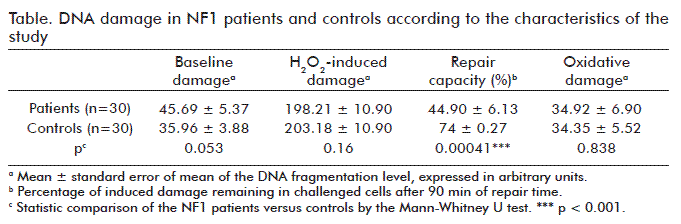
<body><![CDATA[<P   >&nbsp;</P >       <P   ><font size="3" face="Verdana, Arial, Helvetica, sans-serif"><b>RESULTS AND DISCUSSION</b></font></P >   <FONT size="+1">        <P   ><font size="2" face="Verdana, Arial, Helvetica, sans-serif">Our study was performed      in the course of a multicenter study in Havana about DNA damage in patients      with genetic deficiency in tumors suppressor genes. In this study, DNA damage      and repair testing was offered to children showing no severe clinical features      characteristic of the disease who fulfilled the internationally established      minimum clinical criteria in NF1 disease. NF1 group had approximately 25 %      higher baseline DNA damage than the control subjects, though this fell just      short of statistical significance (p = 0.053), while the hOGG1-sensitive sites      were very similar in the two groups. The controls had similar mean H<sub>2</sub>O<sub>2</sub>-induced      DNA damage compared with cases (198.21 &plusmn; 9.94 versus 203.18 &plusmn;      10.90; p &gt; 0.05) (<a href="/img/revistas/bta/v31n2/t0105214.gif">Table</a>). The DNA repair percentage      of residual DNA damage among cases and controls are summarized in the <a href="/img/revistas/bta/v31n2/t0105214.gif">table</a>.      Comparing cases and controls revealed a high significant percentage of residual      DNA damage in the controls (74 &plusmn; 0.27 versus 45.21 &plusmn; 6.13; p      = 0.00041), thus reflecting efficient repair capacity compared to the cases.      </font></P >   <FONT size="+1"><FONT size="+1"><FONT size="+1"><FONT size="+1"><FONT size="+1">        
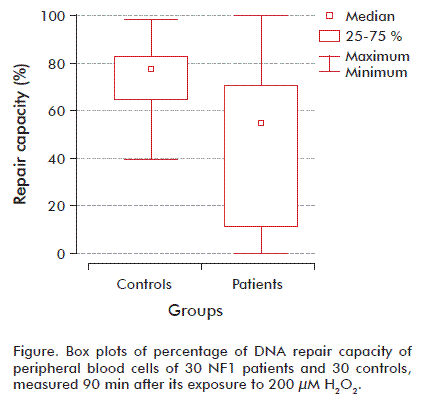
<P   ><font size="2" face="Verdana, Arial, Helvetica, sans-serif">We dichotomized the      repair DNA by first percentile and third percentile of controls using the      25th percentile of the controls as the cutoff point. Patients with results      within the 25 to 75 % range of controls were considered to show a &lsquo;normal&rsquo;      cellular repair to H<sub>2</sub>O<sub>2</sub> exposition. Among the NF1 cases,      approximately 71 % fell into the poor repair category (less than 25 % repair      of induced damage after incubation), and none of the NF1 showed repair higher      than 75 % of the induced damage. However, healthy subjects had a more effective      repair capacity, with 76 % showing repair above 75 % of the induced damage      at the 90 min incubation (<a href="#fig1">Figure</a>). </font></P >       <P align="center"   ><img src="/img/revistas/bta/v31n2/f0105214.gif" width="419" height="404"><a name="fig1"></a></P >   <FONT size="+1"><FONT size="+1"><FONT size="+1"><FONT size="+1">        
<P   ><font size="2" face="Verdana, Arial, Helvetica, sans-serif">A large number of      Mendelian inheritance genetic disorders display considerable inter- and intra-familial      variability in phenotypic expression. It is now increasingly apparent that      genetic modifiers, distinct from the disease locus itself, have a considerable      role to play in phenotypic variance. </font></P >       <P   ><font size="2" face="Verdana, Arial, Helvetica, sans-serif">In that sense, DNA      repair, a major mechanism for maintaining genome integrity and preventing      mutations, has evolved into specific DNA repair pathways to repair different      types of DNA damage, and to maintain genomic integrity. In the human genome      more than 130 genes have been found to be involved in these DNA repair systems      [9, 10]. Thus, before launching expensive and time-consuming genetics studies      to identify these genetic modifiers, it is important to make sure that they      really exist and that environmental factors or other do not suffice to explain      this phenotypic variability. The idea that each neurofibroma would result      from an independent somatic mutation event, regardless its origin from the      same or different patient, was examined by Wiest <I>et al</I>. [26]. They      performed a mutational screen of 33 neurofibromas from a mother and her daughter,      both with NF1. Tumors from those two patients exhibited a high percentage      of small mutations, and the authors proposed that functional variants of DNA      repair genes modulate the frequency of second hits of the NF1 gene. Additional      support for a role of DNA repair genes as modifiers in NF1 comes from the      observation that mutations in DNA mismatch repair (MMR) genes, in the homozygous      state, predispose individuals to NF1 [27, 28]. </font></P >       <P   ><font size="2" face="Verdana, Arial, Helvetica, sans-serif">Several children      identified as harboring homozygous germline MLH1 or MSH2 mutations, with consequent      deficiencies in DNA mismatch repair, developed hematological malignancies      at an early age, and exhibited clinical features of <I>de novo</I> NF1 [30-32].      Inactivation of the NF1 gene in MMR-deficient cells may be an early critical      step in malignant progression [31]. In Nf1+/&minus; mice, Gutmann and colleagues      [32] found that a deficiency in MMR (Mlh1&minus;/&minus;) significantly accelerated      myeloid leukemogenesis, with concomitant microsatellite instability and loss      of neurofibromin expression in the tumors analyzed. </font></P >       <P   ><font size="2" face="Verdana, Arial, Helvetica, sans-serif">On the other hand,      germline gene alterations play a significant role during malignant transformation      of progenitor glial cells. In glioma patients have been demonstrated that      germline p53 mutations are frequent in patients with multifocal glioma, gliomas      and another primary malignancy [33]. Similarly, germline mutations in DNA      repair genes <I>BRCA-1</I> and <I>BRCA-2 </I>significantly increase the risk      of developing multifocal glioblastoma [34]. Some studies suggest that reduced      expression of MMR genes is frequent in human gliomas, and aberrant expression      of more than one MMR gene may be associated with an increased risk of second      primary malignancies in glioma patients [35]. Several studies that examined      both spontaneous and induced chromosome instability in lymphocyte cultures      suggested that chromosome instability can be detected in the peripheral blood      lymphocytes of glioma patients and it may be a marker for identifying individuals      at risk [36]. </font></P >       <P   ><font size="2" face="Verdana, Arial, Helvetica, sans-serif">Another factor identified      as involved is poly (ADP-ribose) polymerase-1 (PARP-1), an enzyme involved      in DNA repair regulation. PARP-1 interaction with NF-&kappa;B has been identified      as a major factor regulating macrophage and microglial activation. PARP-1      gene deficiency prevents the morphological changes associated with microglial      activation, and suppresses microglia release of proteases [37]. Thus, the      inhibition of microglia activation is able to reduce optic glioma proliferation      in NF1 patients and influences the clinical variability of NF1 phenotype.      </font></P >       ]]></body>
<body><![CDATA[<P   ><font size="2" face="Verdana, Arial, Helvetica, sans-serif">In addition to genotypes,      functional phenotypic assays which integrate the different pathways provide      useful tools to explore the role of DNA repair in inter-individual variability      clinic. Methodologies for measuring DNA damage differ between laboratories      and depend upon the DNA-damaging agent used, DNA repair kinetics, the endpoint      measured and ways to measure the endpoint (quantitatively or qualitatively).      In this sense, the alkaline comet assay protocol used in this study was adequate      to detect significant differences in single strand breaks between NF1 patients      and controls. </font></P >       <P   ><font size="2" face="Verdana, Arial, Helvetica, sans-serif">The alkaline comet      assay tested was designed to provide the most comprehensive picture of the      DNA damage induced, quantifying the cellular capacity to repair the observed      lesions by showing the disappearance of damaged sites and the genome restoration.      The assay was used to assess oxidative, baseline, H<sub>2</sub>O<sub>2</sub>-induced      DNA damage and repair capacity of DNA and its related genetic instability      in NF1 patients&rsquo; peripheral blood lymphocytes. H<sub>2</sub>O<sub>2</sub>      is a well-established genotoxic factor that can be used to evaluate the efficiency      of DNA repair pathways as well as being used to assess resistance of cells      to oxidant challenge. Exposure to hydrogen peroxide may result in DNA base      damage and/or single- and double-strand breaks (SSBs and DSBs, respectively)      due to the direct action or generation of free radicals [20]. Base modification      and SSBs are repaired primarily by base excision repair (BER) [21, 38]. The      majority of DSBs are repaired by nonhomologous end-joining (NHEJ) and homologous      recombination repair (HRR) [39]. </font></P >   <FONT size="+1"><FONT size="+1"><FONT size="+1"><FONT size="+1"><FONT size="+1"><FONT size="+1"><FONT size="+1"><FONT size="+1">        <P   ><font size="2" face="Verdana, Arial, Helvetica, sans-serif">The use of peripheral      blood lymphocytes was used based on the assumption that the DNA repair capacity      of an individual is a genetic predisposition measurable in various cell types.      Furthermore, this cellular population is easy to acquire from a blood draw      and its measurements can serve as surrogates for other target tissues. This      notion is supported by the results of studies on relatives and twins showing      heritable repair phenotypes [40, 41]. </font></P >       <P   ><font size="2" face="Verdana, Arial, Helvetica, sans-serif">Our main result was      that the peripheral blood lymphocytes from case patients with NF1 showed decreased      repair of damaged DNA than those from control subjects. We did not observe      any difference between media baseline and oxidative endogenous level of DNA      damage in lymphocytes of NF1 patients and subjects controls. These findings      were consistent with other studies showing similar levels of constitutive      DNA damage in the form of spontaneous chromosomal aberrations and sister chromatid      exchanges (SCEs) in neurofibroma-derived cells and in normal skin fibroblasts,      melanocytes, and peripheral blood lymphocytes among NF1 patients and controls      [16, 17]. </font></P >       <P   ><font size="2" face="Verdana, Arial, Helvetica, sans-serif">To the best of our      knowledge, this is the first report on the assessment of endogenous damage,      oxidized, induced, and unrepaired DNA damage in NF1 patients with the use      of the comet assay. Further studies of genetic linkage and association are      underway to identify the specific genetic variants associated with variable      expression in NF1. Understanding the genetic mechanisms that control phenotypic      expression in NF1 will provide further insight into the fundamental disease      processes. All these raise the possibility that repair gene(s) playing a role      in the pathogenesis of NF1 might be directly or indirectly implicated in pathways      contributing to the control of genomic integrity. </font></P >       <P   ><font size="2" face="Verdana, Arial, Helvetica, sans-serif">Additionally, our      results suggest that DNA repair kinetics measured by the comet assay may serve      to identify the presence of genetic modifiers and would offer clues to the      molecular pathogenesis of NF1. This hypothesis requires verification by long-term      monitoring of the study patients and by correlates between DNA repair capacity      and disease progression or severity. An altered expression of non-linked repair      genes may eventually support more precise predictions of specific clinical      features and complications of NF1 that could possibly lead to new therapeutic      approaches. </font></P >       <P   ><font size="2" face="Verdana, Arial, Helvetica, sans-serif">In summary, no differences      were found in the endogenous, oxidative and induced DNA damage by H<sub>2</sub>O<sub>2</sub>      between NF1 patients and healthy controls by using the comet assay. Nevertheless,      there was a significant difference in repair kinetics in leukocytes of NF1      patients compared to the control group. Moreover, knowing that most of the      patients involved in this study were children and that the frequency of more      serious complications tends to increase with age, it would be important to      carry on intensive follow-up and screening to all the patients, to see if      they develop severe clinical events or not and to determine its relationship      to their DNA repair capacity. </font></P >       <P   >&nbsp;</P >       <P   >&nbsp;</P >   <FONT size="+1"><FONT size="+1"><FONT size="+1"><FONT size="+1">        <P   ><font size="2" face="Verdana, Arial, Helvetica, sans-serif"><B><font size="3">ACKNOWLEDGEMENTS</font></B>      </font></P >   <FONT size="+1">        ]]></body>
<body><![CDATA[<P   ><font size="2" face="Verdana, Arial, Helvetica, sans-serif">We want to thank      Professor Iris Benzie from the Hong Kong Polytechnic University for review      and criticism of the manuscript. We are grateful to the Cuban Ministry of      Public Health for their financial support. We thank all the clinicians, patients      and their families for their help. </font></P >       <P   >&nbsp;</P >   </font></font></font></font></font></font></font></font></font></font></font></font></font></font></font></font></font></font></font></font></font></font></font></font></font></font></font></font></font></font></font></font></font></font></font></font></font></font></font></font></font></font></font></font></font></font></font></font></font></font></font></font></font></font></font></font></font></font></font></font></font></font></font></font></font></font></font></font></font></font></font></font></font></font></font></font></font></font></font></font></font></font></font></font></font></font></font></font></font></font></font></font></font></font></font></font></font>        <p><FONT size="+1" color="#000000"><FONT size="+1"><FONT size="+1"><FONT size="+1"><FONT size="+1"><FONT size="+1"><FONT size="+1"><FONT size="+1"><FONT size="+1"><FONT size="+1"><FONT size="+1"><FONT size="+1"><FONT size="+1"><FONT size="+1"><FONT size="+1"><FONT size="+1"><FONT size="+1"><FONT size="+1"><FONT size="+1"><FONT size="+1"><FONT size="+1"><FONT size="+1"><FONT size="+1"><FONT size="+1"><FONT color="#0462C1"><FONT color="#000000"><FONT size="+1"><FONT size="+1"><FONT size="+1"><FONT size="+1"><FONT size="+1"><FONT size="+1"><FONT size="+1"><FONT size="+1"><FONT size="+1"><FONT size="+1"><FONT size="+1"><FONT size="+1"><FONT size="+1"><FONT size="+1"><FONT size="+1"><FONT size="+1"><FONT size="+1"><FONT size="+1"><FONT size="+1"><FONT size="+1"><FONT size="+1"><FONT size="+1"><FONT size="+1"><FONT size="+1"><FONT size="+1"><FONT size="+1"><FONT size="+1"><FONT size="+1"><FONT size="+1"><FONT size="+1"><FONT size="+1"><FONT size="+1"><FONT size="+1"><FONT size="+1"><FONT size="+1"><FONT size="+1"><FONT size="+1"><FONT size="+1"><FONT size="+1"><FONT size="+1"><FONT size="+1"><FONT size="+1"><FONT size="+1"><FONT size="+1"><FONT size="+1"><FONT size="+1"><FONT size="+1"><FONT size="+1"><FONT size="+1"><FONT size="+1"><FONT size="+1"><FONT size="+1"><FONT size="+1"><FONT size="+1"><FONT size="+1"><FONT size="+1"><FONT size="+1"><FONT size="+1"><FONT size="+1"><FONT size="+1"><FONT size="+1"><FONT size="+1"><FONT size="+1"><FONT size="+1"><FONT size="+1"><FONT size="+1"><FONT size="+1"><FONT size="+1"><FONT size="+1"><FONT size="+1"><font size="+1" color="#000000"><font size="+1"><font size="+1"><font size="+1"><font size="+1"><font size="+1"><font size="+1"><font size="+1"><font size="+1"><font size="+1"><font size="+1"><font size="+1"><font size="+1"><font size="+1"><font size="+1"><font size="+1"><font size="+1"><font size="+1"><font size="+1"><font size="+1"><font size="+1"><font size="+1"><font size="+1"><font size="+1"><font color="#0462C1"><font color="#000000"><font size="+1"><font size="+1"><font size="+1"><font size="+1"><font size="+1"><font size="+1"><font size="+1"><font size="+1"><font size="+1"><font size="+1"><font size="+1"><font size="+1"><font size="+1"><font size="+1"><font size="+1"><font size="+1"><font size="+1"><font size="+1"><font size="+1"><font size="+1"><font size="+1"><font size="+1"><font size="+1"><font size="+1"><font size="+1"><font size="+1"><font size="+1"><font size="+1"><font size="+1"><font size="+1"><font size="+1"><font size="+1"><font size="+1"><font size="+1"><font size="+1"><font size="+1"><font size="+1"><font size="+1"><font size="+1"><font size="+1"><font size="+1"><font size="+1"><font size="+1"><font size="+1"><font size="+1"><font size="+1"><font size="+1"><font size="+1"><font size="+1"><font size="+1"><font size="+1"><font size="+1"><font size="+1"><font size="+1"><font size="+1"><font size="+1"><font size="+1"><font size="+1"><font size="+1"><font size="+1"><font size="+1"><font size="+1"><font size="+1"><font size="+1"><font size="+1"><font size="+1"><font size="+1"><font size="+1"><font size="+1"><font size="+1"><font size="+1"><font size="+1"><font size="3"><b><font face="Verdana, Arial, Helvetica, sans-serif">REFERENCES</font></b></font></font></font></font></font></font></font></font></font></font></font></font></font></font></font></font></font></font></font></font></font></font></font></font></font></font></font></font></font></font></font></font></font></font></font></font></font></font></font></font></font></font></font></font></font></font></font></font></font></font></font></font></font></font></font></font></font></font></font></font></font></font></font></font></font></font></font></font></font></font></font></font></font></font></font></font></font></font></font></font></font></font></font></font></font></font></font></font></font></font></font></font></font></font></font></font></font></font></font></font></font></font></font></font></font></font></font></font></font></font></font></font></font></font></font></font></font></font></font></font></font></font></font></font></font></font></font></font></font></font></font></font></font></font></font></font></font></font></font></font></font></font></font></font></font></font></font></font></font></font></font></font></font></font></font></font></font></font></font></font></font></font></font></font></font></font></font></font></font></font></font></font></font></font></font></font></font></font></font></font></font></font></font></font></font></font></font></font></font></font></font></font></font></font></font></p>       <!-- ref --><p><font face="Verdana, Arial, Helvetica, sans-serif" size="2">1. Friedman JM.      Epidemiology of neurofibromatosis type 1. Am J Med Genet. 1999;89(1):1-6.    </font></p>       <!-- ref --><p><font face="Verdana, Arial, Helvetica, sans-serif" size="2">2. Cawthon RM,      Weiss R, Xu GF, Viskochil D, Culver M, Stevens J, et al. A major segment of      the neurofibromatosis type 1 gene: cDNA sequence, genomic structure, and point      mutations. Cell. 1990;62(1):193-201.    </font></p>       <!-- ref --><p><font face="Verdana, Arial, Helvetica, sans-serif" size="2">3. Wallace MR,      Marchuk DA, Andersen LB, Letcher R, Odeh HM, Saulino AM, et al. Type 1 neurofibromatosis      gene: identification of a large transcript disrupted in three NF1 patients.      Science. 1990;249(4965):181-6.    </font></p>       <!-- ref --><p><font face="Verdana, Arial, Helvetica, sans-serif" size="2">4. Ferner RE,      Huson SM, Thomas N, Moss C, Willshaw H, Evans DG, et al. Guidelines for the      diagnosis and management of individuals with neurofibromatosis 1. J Med Genet.      2007;44(2):81-8.    </font></p>       <p><font face="Verdana, Arial, Helvetica, sans-serif" size="2">5. Upadhyaya      M, Spurlock G, Monem B, Thomas N, Friedrich RE, Kluwe L, et al. Germline and      somatic NF1 gene mutations in plexiform neurofibromas. Hum Mutat. 2008;29(8):E103-11.</font></p>       <!-- ref --><p><font face="Verdana, Arial, Helvetica, sans-serif" size="2">6. Easton DF,      Ponder MA, Huson SM, Ponder BA. An analysis of variation in expression of      neurofibromatosis (NF) type 1 (NF1): evidence for modifying genes. Am J Hum      Genet. 1993;53(2):305-13.    </font></p>       <!-- ref --><p><font face="Verdana, Arial, Helvetica, sans-serif" size="2">7. Szudek J,      Joe H, Friedman JM. Analysis of intrafamilial phenotypic variation in neurofibromatosis      1 (NF1). Genet Epidemiol. 2002;23(2):150-64.    </font></p>       <!-- ref --><p><font face="Verdana, Arial, Helvetica, sans-serif" size="2">8. Sabbagh A,      Pasmant E, Laurendeau I, Parfait B, Barbarot S, Guillot B, et al. Unravelling      the genetic basis of variable clinical expression in neurofibromatosis 1.      Hum Mol Genet. 2009;18(15):2768-78.    </font></p>       <!-- ref --><p><font face="Verdana, Arial, Helvetica, sans-serif" size="2">9. Jackson SP,      Bartek J. The DNA-damage response in human biology and disease. Nature. 2009;461(7267):1071-8.    </font></p>       ]]></body>
<body><![CDATA[<!-- ref --><p><font face="Verdana, Arial, Helvetica, sans-serif" size="2">10. Altieri F,      Grillo C, Maceroni M, Chichiarelli S. DNA damage and repair: from molecular      mechanisms to health implications. Antioxid Redox Signal. 2008;10(5):891-937.    </font></p>       <!-- ref --><p><font face="Verdana, Arial, Helvetica, sans-serif" size="2">11. Hazra TK,      Das A, Das S, Choudhury S, Kow YW, Roy R. Oxidative DNA damage repair in mammalian      cells: a new perspective. DNA Repair (Amst). 2007;6(4):470-80.    </font></p>       <!-- ref --><p><font face="Verdana, Arial, Helvetica, sans-serif" size="2">12. Cooke MS,      Evans MD, Dizdaroglu M, Lunec J. Oxidative DNA damage: mechanisms, mutation,      and disease. FASEB J. 2003;17(10):1195-214.    </font></p>       <!-- ref --><p><font face="Verdana, Arial, Helvetica, sans-serif" size="2">13. Paz-Elizur      T, Krupsky M, Elinger D, Schechtman E, Livneh Z. Repair of the oxidative DNA      damage 8-oxoguanine as a biomarker for lung cancer risk. Cancer Biomark. 2005;1(2-3):201-5.    </font></p>       <!-- ref --><p><font face="Verdana, Arial, Helvetica, sans-serif" size="2">14. Paz-Elizur      T, Elinger D, Leitner-Dagan Y, Blumenstein S, Krupsky M, Berrebi A, et al.      Development of an enzymatic DNA repair assay for molecular epidemiology studies:      distribution of OGG activity in healthy individuals. DNA Repair (Amst). 2007;6(1):45-60.    </font></p>       ]]></body>
<body><![CDATA[<!-- ref --><p><font face="Verdana, Arial, Helvetica, sans-serif" size="2">15. Tice RR,      Agurell E, Anderson D, Burlinson B, Hartmann A, Kobayashi H, et al. Single      cell gel/comet assay: guidelines for in vitro and in vivo genetic toxicology      testing. Environ Mol Mutagen. 2000;35(3):206-21.    </font></p>       <!-- ref --><p><font face="Verdana, Arial, Helvetica, sans-serif" size="2">16. Schwenn MR,      Weichselbaum RR, Little JB. Investigation of the cytotoxic effects of DNA      damaging agents on neurofibromatosis cells. Mutat Res. 1985;142(1-2):55-8.    </font></p>       <!-- ref --><p><font face="Verdana, Arial, Helvetica, sans-serif" size="2">17. Troilo P,      Strong LC, Little JB, Nichols WW. Spontaneous and induced levels of chromosomal      aberration and sister-chromatid exchange in neurofibromatosis: no evidence      of chromosomal hypersensitivity. Mutat Res. 1992;283(4):237-42.    </font></p>       <!-- ref --><p><font face="Verdana, Arial, Helvetica, sans-serif" size="2">18. Singh NP,      McCoy MT, Tice RR, Schneider EL. A simple technique for quantitation of low      levels of DNA damage in individual cells. Exp Cell Res. 1988;175(1):184-91.    </font></p>       <!-- ref --><p><font face="Verdana, Arial, Helvetica, sans-serif" size="2">19. Nadin SB,      Vargas-Roig LM, Ciocca DR. A silver staining method for single-cell gel assay.      J Histochem Cytochem. 2001;49(9):1183-6.    </font></p>       ]]></body>
<body><![CDATA[<!-- ref --><p><font face="Verdana, Arial, Helvetica, sans-serif" size="2">20. Collins AR.      Measuring oxidative damage to DNA and its repair with the comet assay. Biochim      Biophys Acta. 2014;1840(2):794-800.    </font></p>       <!-- ref --><p><font face="Verdana, Arial, Helvetica, sans-serif" size="2">21. Collins AR,      Gaivao I. DNA base excision repair as a biomarker in molecular epidemiology      studies. Mol Aspects Med. 2007;28(3-4):307-22.    </font></p>       <p><font face="Verdana, Arial, Helvetica, sans-serif" size="2">22. WMA Declaration      of Helsinki - Ethical Principles for Medical Research Involving Human Subjects      [Internet]. Ferney-Voltaire: World Medical Association, Inc.; 2013 [cited      2013 Oct 17]. Available from: <a href="http://www.wma.net/en/30publications/10policies/b3/" target="_blank">http://www.wma.net/en/30publications/10policies/b3/</a>.</font></p>       <!-- ref --><p><font face="Verdana, Arial, Helvetica, sans-serif" size="2">23. Smith CC,      O'Donovan MR, Martin EA. hOGG1 recognizes oxidative damage using the comet      assay with greater specificity than FPG or ENDOIII. Mutagenesis. 2006;21(3):185-90.    </font></p>       <!-- ref --><p><font face="Verdana, Arial, Helvetica, sans-serif" size="2">24. Forchhammer      L, Brauner EV, Folkmann JK, Danielsen PH, Nielsen C, Jensen A, et al. Variation      in assessment of oxidatively damaged DNA in mononuclear blood cells by the      comet assay with visual scoring. Mutagenesis. 2008;23(3):223-31.    </font></p>       <!-- ref --><p><font face="Verdana, Arial, Helvetica, sans-serif" size="2">25. Orlow I,      Park BJ, Mujumdar U, Patel H, Siu-Lau P, Clas BA, et al. DNA damage and repair      capacity in patients with lung cancer: prediction of multiple primary tumors.      J Clin Oncol. 2008;26(21):3560-6.    </font></p>       <!-- ref --><p><font face="Verdana, Arial, Helvetica, sans-serif" size="2">26. Wiest V,      Eisenbarth I, Schmegner C, Krone W, Assum G. Somatic NF1 mutation spectra      in a family with neurofibromatosis type 1: toward a theory of genetic modifiers.      Hum Mutat. 2003;22(6):423-7.    </font></p>       <!-- ref --><p><font face="Verdana, Arial, Helvetica, sans-serif" size="2">27. Wang Q, Montmain      G, Ruano E, Upadhyaya M, Dudley S, Liskay RM, et al. Neurofibromatosis type      1 gene as a mutational target in a mismatch repair-deficient cell type. Human      genetics. 2003;112(2):117-23.     </font></p>       <!-- ref --><p><font face="Verdana, Arial, Helvetica, sans-serif" size="2">28. Alotaibi      H, Ricciardone MD, Ozturk M. Homozygosity at variant MLH1 can lead to secondary      mutation in NF1, neurofibromatosis type I and early onset leukemia. Mutat      Res. 2008;637(1-2):209-14.    </font></p>       <!-- ref --><p><font face="Verdana, Arial, Helvetica, sans-serif" size="2">29. Berwick M,      Vineis P. Markers of DNA repair and susceptibility to cancer in humans: an      epidemiologic review. J Natl Cancer Inst. 2000;92(11):874-97.    </font></p>       <!-- ref --><p><font face="Verdana, Arial, Helvetica, sans-serif" size="2">30. Kruger S,      Kinzel M, Walldorf C, Gottschling S, Bier A, Tinschert S, et al. Homozygous      PMS2 germline mutations in two families with early-onset haematological malignancy,      brain tumours, HNPCC-associated tumours, and signs of neurofibromatosis type      1. Eur J Hum Genet. 2008;16(1):62-72.    </font></p>       <!-- ref --><p><font face="Verdana, Arial, Helvetica, sans-serif" size="2">31. Sabbagh A,      Pasmant E, Laurendeau I, Parfait B, Barbarot S, Guillot B, et al. Unravelling      the genetic basis of variable clinical expression in neurofibromatosis 1.      Hum Mol Genet. 2009;18(15):2768-78.    </font></p>       <!-- ref --><p><font face="Verdana, Arial, Helvetica, sans-serif" size="2">32. Gutmann DH,      Winkeler E, Kabbarah O, Hedrick N, Dudley S, Goodfellow PJ, et al. Mlh1 deficiency      accelerates myeloid leukemogenesis in neurofibromatosis 1 (Nf1) heterozygous      mice. Oncogene. 2003;22(29):4581-5.    </font></p>       <!-- ref --><p><font face="Verdana, Arial, Helvetica, sans-serif" size="2">33. Paunu N,      Syrjakoski K, Sankila R, Simola KO, Helen P, Niemela M, et al. Analysis of      p53 tumor suppressor gene in families with multiple glioma patients. J Neurooncol.      2001;55(3):159-65.     </font></p>       <!-- ref --><p><font face="Verdana, Arial, Helvetica, sans-serif" size="2">34. Elmariah      SB, Huse J, Mason B, Leroux P, Lustig RA. Multicentric glioblastoma multiforme      in a patient with BRCA-1 invasive breast cancer. Breast J. 2006;12(5):470-4.    </font></p>       <!-- ref --><p><font face="Verdana, Arial, Helvetica, sans-serif" size="2">35. Kruger S,      Kinzel M, Walldorf C, Gottschling S, Bier A, Tinschert S, et al. Homozygous      PMS2 germline mutations in two families with early-onset haematological malignancy,      brain tumours, HNPCC-associated tumours, and signs of neurofibromatosis type      1. Eur J Hum Genet. 2008;16(1):62-72.    </font></p>       <!-- ref --><p><font face="Verdana, Arial, Helvetica, sans-serif" size="2">36. El-Zein R,      Bondy ML, Wang LE, de Andrade M, Sigurdson AJ, Bruner JM, et al. Increased      chromosomal instability in peripheral lymphocytes and risk of human gliomas.      Carcinogenesis. 1999;20(5):811-5.    </font></p>       <!-- ref --><p><font face="Verdana, Arial, Helvetica, sans-serif" size="2">37. Rosado MM,      Bennici E, Novelli F, Pioli C. Beyond DNA repair, the immunological role of      PARP-1 and its siblings. Immunology. 2013;139(4):428-37.    </font></p>       <!-- ref --><p><font face="Verdana, Arial, Helvetica, sans-serif" size="2">38. El-Zein RA,      Monroy CM, Cortes A, Spitz MR, Greisinger A, Etzel CJ. Rapid method for determination      of DNA repair capacity in human peripheral blood lymphocytes amongst smokers.      BMC Cancer. 2010;10:439.    </font></p>       <!-- ref --><p><font face="Verdana, Arial, Helvetica, sans-serif" size="2">39. Parshad R,      Sanford KK. Radiation-induced chromatid breaks and deficient DNA repair in      cancer predisposition. Crit Rev Oncol Hematol. 2001;37(2):87-96.    </font></p>       <!-- ref --><p><font face="Verdana, Arial, Helvetica, sans-serif" size="2">40. Surowy H,      Rinckleb A, Luedeke M, Stuber M, Wecker A, Varga D, et al. Heritability of      baseline and induced micronucleus frequencies. Mutagenesis. 2011;26(1):111-7.    </font></p>       <!-- ref --><p><font face="Verdana, Arial, Helvetica, sans-serif" size="2">41. Lin J, Swan      GE, Shields PG, Benowitz NL, Gu J, Amos CI, et al. Mutagen sensitivity and      genetic variants in nucleotide excision repair pathway: genotype-phenotype      correlation. Cancer Epidemiol Biomarkers Prev. 2007;16(10):2065-71.    </font></p>       <p>&nbsp;</p>       <p>&nbsp;</p>       <p><font size="2" face="Verdana, Arial, Helvetica, sans-serif">Received in August,      2013.    <br>     Accepted in April, 2014.</font></p>   <FONT size="+1" color="#000000"><FONT size="+1"><FONT size="+1"><FONT size="+1"><FONT size="+1"><FONT size="+1"><FONT size="+1"><FONT size="+1"><FONT size="+1"><FONT size="+1"><FONT size="+1"><FONT size="+1"><FONT size="+1"><FONT size="+1"><FONT size="+1"><FONT size="+1"><FONT size="+1"><FONT size="+1"><FONT size="+1"><FONT size="+1"><FONT size="+1"><FONT size="+1"><FONT size="+1"><FONT size="+1"><FONT color="#0462C1"><FONT color="#000000"><FONT size="+1"><FONT size="+1"><FONT size="+1"><FONT size="+1"><FONT size="+1"><FONT size="+1"><FONT size="+1"><FONT size="+1"><FONT size="+1"><FONT size="+1"><FONT size="+1"><FONT size="+1"><FONT size="+1"><FONT size="+1"><FONT size="+1"><FONT size="+1"><FONT size="+1"><FONT size="+1"><FONT size="+1"><FONT size="+1"><FONT size="+1"><FONT size="+1"><FONT size="+1"><FONT size="+1"><FONT size="+1"><FONT size="+1"><FONT size="+1"><FONT size="+1"><FONT size="+1"><FONT size="+1"><FONT size="+1"><FONT size="+1"><FONT size="+1"><FONT size="+1"><FONT size="+1"><FONT size="+1"><FONT size="+1"><FONT size="+1"><FONT size="+1"><FONT size="+1"><FONT size="+1"><FONT size="+1"><FONT size="+1"><FONT size="+1"><FONT size="+1"><FONT size="+1"><FONT size="+1"><FONT size="+1"><FONT size="+1"><FONT size="+1"><FONT size="+1"><FONT size="+1"><FONT size="+1"><FONT size="+1"><FONT size="+1"><FONT size="+1"><FONT size="+1"><FONT size="+1"><FONT size="+1"><FONT size="+1"><FONT size="+1"><FONT size="+1"><FONT size="+1"><FONT size="+1"><FONT size="+1"><FONT size="+1"><FONT size="+1"><FONT size="+1"><FONT size="+1"><FONT size="+1"><FONT size="+1"><FONT size="+1">     <P   >&nbsp;</P >       <P   >&nbsp;</P >       <P   ><font size="+1" color="#000000"><font size="+1"><font size="+1"><font size="2" face="Verdana, Arial, Helvetica, sans-serif"><i>Reinaldo      Gutierrez</i></font></font></font></font>. <font size="+1" color="#000000"><font size="+1"><font size="+1"><font size="+1"><font size="+1"><font size="+1"><font size="+1"><font size="+1"><font size="+1"><font size="+1"><font size="+1"><font size="+1"><font size="+1"><font size="+1"><font size="+1"><font size="+1"><font size="+1"><font size="+1"><font size="+1"><font size="+1"><font size="2" face="Verdana, Arial, Helvetica, sans-serif">Centro      Nacional de Gen&eacute;tica M&eacute;dica, CNGM. Calle 146 No. 3102. Playa,      CP 10600, La Habana, Cuba.</font></font></font></font></font></font></font></font></font></font></font></font></font></font></font></font></font></font></font></font></font>      <font size="2" face="Verdana, Arial, Helvetica, sans-serif">E-mail: <a href="mailto:rey@infomed.sld.cu">rey@infomed.sld.cu</a>.</font></P >   </font></font></font></font></font></font></font></font></font></font></font></font></font></font></font></font></font></font></font></font></font></font></font></font></font></font></font></font></font></font></font></font></font></font></font></font></font></font></font></font></font></font></font></font></font></font></font></font></font></font></font></font></font></font></font></font></font></font></font></font></font></font></font></font></font></font></font></font></font></font></font></font></font></font></font></font></font></font></font></font></font></font></font></font></font></font></font></font></font></font></font></font></font></font></font></font></font></font></DIV >     ]]></body>
<body><![CDATA[ ]]></body><back>
<ref-list>
<ref id="B1">
<label>1</label><nlm-citation citation-type="journal">
<person-group person-group-type="author">
<name>
<surname><![CDATA[Friedman]]></surname>
<given-names><![CDATA[JM]]></given-names>
</name>
</person-group>
<article-title xml:lang="en"><![CDATA[Epidemiology of neurofibromatosis type 1]]></article-title>
<source><![CDATA[Am J Med Genet]]></source>
<year>1999</year>
<volume>89</volume>
<numero>1</numero>
<issue>1</issue>
<page-range>1-6</page-range></nlm-citation>
</ref>
<ref id="B2">
<label>2</label><nlm-citation citation-type="journal">
<person-group person-group-type="author">
<name>
<surname><![CDATA[Cawthon]]></surname>
<given-names><![CDATA[RM]]></given-names>
</name>
<name>
<surname><![CDATA[Weiss]]></surname>
<given-names><![CDATA[R]]></given-names>
</name>
<name>
<surname><![CDATA[Xu]]></surname>
<given-names><![CDATA[GF]]></given-names>
</name>
<name>
<surname><![CDATA[Viskochil]]></surname>
<given-names><![CDATA[D]]></given-names>
</name>
<name>
<surname><![CDATA[Culver]]></surname>
<given-names><![CDATA[M]]></given-names>
</name>
<name>
<surname><![CDATA[Stevens]]></surname>
<given-names><![CDATA[J]]></given-names>
</name>
</person-group>
<article-title xml:lang="en"><![CDATA[A major segment of the neurofibromatosis type 1 gene: cDNA sequence, genomic structure, and point mutations]]></article-title>
<source><![CDATA[Cell]]></source>
<year>1990</year>
<volume>62</volume>
<numero>1</numero>
<issue>1</issue>
<page-range>193-201</page-range></nlm-citation>
</ref>
<ref id="B3">
<label>3</label><nlm-citation citation-type="journal">
<person-group person-group-type="author">
<name>
<surname><![CDATA[Wallace]]></surname>
<given-names><![CDATA[MR]]></given-names>
</name>
<name>
<surname><![CDATA[Marchuk]]></surname>
<given-names><![CDATA[DA]]></given-names>
</name>
<name>
<surname><![CDATA[Andersen]]></surname>
<given-names><![CDATA[LB]]></given-names>
</name>
<name>
<surname><![CDATA[Letcher]]></surname>
<given-names><![CDATA[R]]></given-names>
</name>
<name>
<surname><![CDATA[Odeh]]></surname>
<given-names><![CDATA[HM]]></given-names>
</name>
<name>
<surname><![CDATA[Saulino]]></surname>
<given-names><![CDATA[AM]]></given-names>
</name>
</person-group>
<article-title xml:lang="en"><![CDATA[Type 1 neurofibromatosis gene: identification of a large transcript disrupted in three NF1 patients]]></article-title>
<source><![CDATA[Science]]></source>
<year>1990</year>
<volume>249</volume>
<numero>4965</numero>
<issue>4965</issue>
<page-range>181-6</page-range></nlm-citation>
</ref>
<ref id="B4">
<label>4</label><nlm-citation citation-type="journal">
<person-group person-group-type="author">
<name>
<surname><![CDATA[Ferner]]></surname>
<given-names><![CDATA[RE]]></given-names>
</name>
<name>
<surname><![CDATA[Huson]]></surname>
<given-names><![CDATA[SM]]></given-names>
</name>
<name>
<surname><![CDATA[Thomas]]></surname>
<given-names><![CDATA[N]]></given-names>
</name>
<name>
<surname><![CDATA[Moss]]></surname>
<given-names><![CDATA[C]]></given-names>
</name>
<name>
<surname><![CDATA[Willshaw]]></surname>
<given-names><![CDATA[H]]></given-names>
</name>
<name>
<surname><![CDATA[Evans]]></surname>
<given-names><![CDATA[DG]]></given-names>
</name>
</person-group>
<article-title xml:lang="en"><![CDATA[Guidelines for the diagnosis and management of individuals with neurofibromatosis 1]]></article-title>
<source><![CDATA[J Med Genet]]></source>
<year>2007</year>
<volume>44</volume>
<numero>2</numero>
<issue>2</issue>
<page-range>81-8</page-range></nlm-citation>
</ref>
<ref id="B5">
<label>5</label><nlm-citation citation-type="journal">
<person-group person-group-type="author">
<name>
<surname><![CDATA[Upadhyaya]]></surname>
<given-names><![CDATA[M]]></given-names>
</name>
<name>
<surname><![CDATA[Spurlock]]></surname>
<given-names><![CDATA[G]]></given-names>
</name>
<name>
<surname><![CDATA[Monem]]></surname>
<given-names><![CDATA[B]]></given-names>
</name>
<name>
<surname><![CDATA[Thomas]]></surname>
<given-names><![CDATA[N]]></given-names>
</name>
<name>
<surname><![CDATA[Friedrich]]></surname>
<given-names><![CDATA[RE]]></given-names>
</name>
<name>
<surname><![CDATA[Kluwe]]></surname>
<given-names><![CDATA[L]]></given-names>
</name>
</person-group>
<article-title xml:lang="en"><![CDATA[Germline and somatic NF1 gene mutations in plexiform neurofibromas]]></article-title>
<source><![CDATA[Hum Mutat]]></source>
<year>2008</year>
<volume>29</volume>
<numero>8</numero>
<issue>8</issue>
<page-range>103-11</page-range></nlm-citation>
</ref>
<ref id="B6">
<label>6</label><nlm-citation citation-type="journal">
<person-group person-group-type="author">
<name>
<surname><![CDATA[Easton]]></surname>
<given-names><![CDATA[DF]]></given-names>
</name>
<name>
<surname><![CDATA[Ponder]]></surname>
<given-names><![CDATA[MA]]></given-names>
</name>
<name>
<surname><![CDATA[Huson]]></surname>
<given-names><![CDATA[SM]]></given-names>
</name>
<name>
<surname><![CDATA[Ponder]]></surname>
<given-names><![CDATA[BA]]></given-names>
</name>
</person-group>
<article-title xml:lang="en"><![CDATA[An analysis of variation in expression of neurofibromatosis (NF) type 1 (NF1): evidence for modifying genes]]></article-title>
<source><![CDATA[Am J Hum Genet]]></source>
<year>1993</year>
<volume>53</volume>
<numero>2</numero>
<issue>2</issue>
<page-range>305-13</page-range></nlm-citation>
</ref>
<ref id="B7">
<label>7</label><nlm-citation citation-type="journal">
<person-group person-group-type="author">
<name>
<surname><![CDATA[Szudek]]></surname>
<given-names><![CDATA[J]]></given-names>
</name>
<name>
<surname><![CDATA[Joe]]></surname>
<given-names><![CDATA[H]]></given-names>
</name>
<name>
<surname><![CDATA[Friedman]]></surname>
<given-names><![CDATA[JM]]></given-names>
</name>
</person-group>
<article-title xml:lang="en"><![CDATA[Analysis of intrafamilial phenotypic variation in neurofibromatosis 1 (NF1)]]></article-title>
<source><![CDATA[Genet Epidemiol]]></source>
<year>2002</year>
<volume>23</volume>
<numero>2</numero>
<issue>2</issue>
<page-range>150-64</page-range></nlm-citation>
</ref>
<ref id="B8">
<label>8</label><nlm-citation citation-type="journal">
<person-group person-group-type="author">
<name>
<surname><![CDATA[Sabbagh]]></surname>
<given-names><![CDATA[A]]></given-names>
</name>
<name>
<surname><![CDATA[Pasmant]]></surname>
<given-names><![CDATA[E]]></given-names>
</name>
<name>
<surname><![CDATA[Laurendeau]]></surname>
<given-names><![CDATA[I]]></given-names>
</name>
<name>
<surname><![CDATA[Parfait]]></surname>
<given-names><![CDATA[B]]></given-names>
</name>
<name>
<surname><![CDATA[Barbarot]]></surname>
<given-names><![CDATA[S]]></given-names>
</name>
<name>
<surname><![CDATA[Guillot]]></surname>
<given-names><![CDATA[B]]></given-names>
</name>
</person-group>
<article-title xml:lang="en"><![CDATA[Unravelling the genetic basis of variable clinical expression in neurofibromatosis 1]]></article-title>
<source><![CDATA[Hum Mol Genet]]></source>
<year>2009</year>
<volume>18</volume>
<numero>15</numero>
<issue>15</issue>
<page-range>2768-78</page-range></nlm-citation>
</ref>
<ref id="B9">
<label>9</label><nlm-citation citation-type="journal">
<person-group person-group-type="author">
<name>
<surname><![CDATA[Jackson]]></surname>
<given-names><![CDATA[SP]]></given-names>
</name>
<name>
<surname><![CDATA[Bartek]]></surname>
<given-names><![CDATA[J]]></given-names>
</name>
</person-group>
<article-title xml:lang="en"><![CDATA[The DNA-damage response in human biology and disease]]></article-title>
<source><![CDATA[Nature]]></source>
<year>2009</year>
<volume>461</volume>
<numero>7267</numero>
<issue>7267</issue>
<page-range>1071-8</page-range></nlm-citation>
</ref>
<ref id="B10">
<label>10</label><nlm-citation citation-type="journal">
<person-group person-group-type="author">
<name>
<surname><![CDATA[Altieri]]></surname>
<given-names><![CDATA[F]]></given-names>
</name>
<name>
<surname><![CDATA[Grillo]]></surname>
<given-names><![CDATA[C]]></given-names>
</name>
<name>
<surname><![CDATA[Maceroni]]></surname>
<given-names><![CDATA[M]]></given-names>
</name>
<name>
<surname><![CDATA[Chichiarelli]]></surname>
<given-names><![CDATA[S]]></given-names>
</name>
</person-group>
<article-title xml:lang="en"><![CDATA[DNA damage and repair: from molecular mechanisms to health implications]]></article-title>
<source><![CDATA[Antioxid Redox Signal]]></source>
<year>2008</year>
<volume>10</volume>
<numero>5</numero>
<issue>5</issue>
<page-range>891-937</page-range></nlm-citation>
</ref>
<ref id="B11">
<label>11</label><nlm-citation citation-type="journal">
<person-group person-group-type="author">
<name>
<surname><![CDATA[Hazra]]></surname>
<given-names><![CDATA[TK]]></given-names>
</name>
<name>
<surname><![CDATA[Das]]></surname>
<given-names><![CDATA[A]]></given-names>
</name>
<name>
<surname><![CDATA[Das]]></surname>
<given-names><![CDATA[S]]></given-names>
</name>
<name>
<surname><![CDATA[Choudhury]]></surname>
<given-names><![CDATA[S]]></given-names>
</name>
<name>
<surname><![CDATA[Kow]]></surname>
<given-names><![CDATA[YW]]></given-names>
</name>
<name>
<surname><![CDATA[Roy]]></surname>
<given-names><![CDATA[R]]></given-names>
</name>
</person-group>
<article-title xml:lang="en"><![CDATA[Oxidative DNA damage repair in mammalian cells: a new perspective]]></article-title>
<source><![CDATA[DNA Repair (Amst)]]></source>
<year>2007</year>
<volume>6</volume>
<numero>4</numero>
<issue>4</issue>
<page-range>470-80</page-range></nlm-citation>
</ref>
<ref id="B12">
<label>12</label><nlm-citation citation-type="journal">
<person-group person-group-type="author">
<name>
<surname><![CDATA[Cooke]]></surname>
<given-names><![CDATA[MS]]></given-names>
</name>
<name>
<surname><![CDATA[Evans]]></surname>
<given-names><![CDATA[MD]]></given-names>
</name>
<name>
<surname><![CDATA[Dizdaroglu]]></surname>
<given-names><![CDATA[M]]></given-names>
</name>
<name>
<surname><![CDATA[Lunec]]></surname>
<given-names><![CDATA[J]]></given-names>
</name>
</person-group>
<article-title xml:lang="en"><![CDATA[Oxidative DNA damage: mechanisms, mutation, and disease]]></article-title>
<source><![CDATA[FASEB J]]></source>
<year>2003</year>
<volume>17</volume>
<numero>10</numero>
<issue>10</issue>
<page-range>1195-214</page-range></nlm-citation>
</ref>
<ref id="B13">
<label>13</label><nlm-citation citation-type="journal">
<person-group person-group-type="author">
<name>
<surname><![CDATA[Paz-Elizur]]></surname>
<given-names><![CDATA[T]]></given-names>
</name>
<name>
<surname><![CDATA[Krupsky]]></surname>
<given-names><![CDATA[M]]></given-names>
</name>
<name>
<surname><![CDATA[Elinger]]></surname>
<given-names><![CDATA[D]]></given-names>
</name>
<name>
<surname><![CDATA[Schechtman]]></surname>
<given-names><![CDATA[E]]></given-names>
</name>
<name>
<surname><![CDATA[Livneh]]></surname>
<given-names><![CDATA[Z]]></given-names>
</name>
</person-group>
<article-title xml:lang="en"><![CDATA[Repair of the oxidative DNA damage 8-oxoguanine as a biomarker for lung cancer risk]]></article-title>
<source><![CDATA[Cancer Biomark]]></source>
<year>2005</year>
<volume>1</volume>
<numero>2</numero>
<issue>2</issue>
<page-range>3):201-5</page-range></nlm-citation>
</ref>
<ref id="B14">
<label>14</label><nlm-citation citation-type="journal">
<person-group person-group-type="author">
<name>
<surname><![CDATA[Paz-Elizur]]></surname>
<given-names><![CDATA[T]]></given-names>
</name>
<name>
<surname><![CDATA[Elinger]]></surname>
<given-names><![CDATA[D]]></given-names>
</name>
<name>
<surname><![CDATA[Leitner-Dagan]]></surname>
<given-names><![CDATA[Y]]></given-names>
</name>
<name>
<surname><![CDATA[Blumenstein]]></surname>
<given-names><![CDATA[S]]></given-names>
</name>
<name>
<surname><![CDATA[Krupsky]]></surname>
<given-names><![CDATA[M]]></given-names>
</name>
<name>
<surname><![CDATA[Berrebi]]></surname>
<given-names><![CDATA[A]]></given-names>
</name>
</person-group>
<article-title xml:lang="en"><![CDATA[Development of an enzymatic DNA repair assay for molecular epidemiology studies: distribution of OGG activity in healthy individuals]]></article-title>
<source><![CDATA[DNA Repair (Amst)]]></source>
<year>2007</year>
<volume>6</volume>
<numero>1</numero>
<issue>1</issue>
<page-range>45-60</page-range></nlm-citation>
</ref>
<ref id="B15">
<label>15</label><nlm-citation citation-type="journal">
<person-group person-group-type="author">
<name>
<surname><![CDATA[Tice]]></surname>
<given-names><![CDATA[RR]]></given-names>
</name>
<name>
<surname><![CDATA[Agurell]]></surname>
<given-names><![CDATA[E]]></given-names>
</name>
<name>
<surname><![CDATA[Anderson]]></surname>
<given-names><![CDATA[D]]></given-names>
</name>
<name>
<surname><![CDATA[Burlinson]]></surname>
<given-names><![CDATA[B]]></given-names>
</name>
<name>
<surname><![CDATA[Hartmann]]></surname>
<given-names><![CDATA[A]]></given-names>
</name>
<name>
<surname><![CDATA[Kobayashi]]></surname>
<given-names><![CDATA[H]]></given-names>
</name>
</person-group>
<article-title xml:lang="en"><![CDATA[Single cell gel/comet assay: guidelines for in vitro and in vivo genetic toxicology testing]]></article-title>
<source><![CDATA[Environ Mol Mutagen]]></source>
<year>2000</year>
<volume>35</volume>
<numero>3</numero>
<issue>3</issue>
<page-range>206-21</page-range></nlm-citation>
</ref>
<ref id="B16">
<label>16</label><nlm-citation citation-type="journal">
<person-group person-group-type="author">
<name>
<surname><![CDATA[Schwenn]]></surname>
<given-names><![CDATA[MR]]></given-names>
</name>
<name>
<surname><![CDATA[Weichselbaum]]></surname>
<given-names><![CDATA[RR]]></given-names>
</name>
<name>
<surname><![CDATA[Little]]></surname>
<given-names><![CDATA[JB]]></given-names>
</name>
</person-group>
<article-title xml:lang="en"><![CDATA[Investigation of the cytotoxic effects of DNA damaging agents on neurofibromatosis cells]]></article-title>
<source><![CDATA[Mutat Res]]></source>
<year>1985</year>
<volume>142</volume>
<numero>1</numero>
<issue>1</issue>
<page-range>2):55-8</page-range></nlm-citation>
</ref>
<ref id="B17">
<label>17</label><nlm-citation citation-type="journal">
<person-group person-group-type="author">
<name>
<surname><![CDATA[Troilo]]></surname>
<given-names><![CDATA[P]]></given-names>
</name>
<name>
<surname><![CDATA[Strong]]></surname>
<given-names><![CDATA[LC]]></given-names>
</name>
<name>
<surname><![CDATA[Little]]></surname>
<given-names><![CDATA[JB]]></given-names>
</name>
<name>
<surname><![CDATA[Nichols]]></surname>
<given-names><![CDATA[WW]]></given-names>
</name>
</person-group>
<article-title xml:lang="en"><![CDATA[Spontaneous and induced levels of chromosomal aberration and sister-chromatid exchange in neurofibromatosis: no evidence of chromosomal hypersensitivity]]></article-title>
<source><![CDATA[Mutat Res]]></source>
<year>1992</year>
<volume>283</volume>
<numero>4</numero>
<issue>4</issue>
<page-range>237-42</page-range></nlm-citation>
</ref>
<ref id="B18">
<label>18</label><nlm-citation citation-type="journal">
<person-group person-group-type="author">
<name>
<surname><![CDATA[Singh]]></surname>
<given-names><![CDATA[NP]]></given-names>
</name>
<name>
<surname><![CDATA[McCoy]]></surname>
<given-names><![CDATA[MT]]></given-names>
</name>
<name>
<surname><![CDATA[Tice]]></surname>
<given-names><![CDATA[RR]]></given-names>
</name>
<name>
<surname><![CDATA[Schneider]]></surname>
<given-names><![CDATA[EL]]></given-names>
</name>
</person-group>
<article-title xml:lang="en"><![CDATA[A simple technique for quantitation of low levels of DNA damage in individual cells]]></article-title>
<source><![CDATA[Exp Cell Res]]></source>
<year>1988</year>
<volume>175</volume>
<numero>1</numero>
<issue>1</issue>
<page-range>184-91</page-range></nlm-citation>
</ref>
<ref id="B19">
<label>19</label><nlm-citation citation-type="journal">
<person-group person-group-type="author">
<name>
<surname><![CDATA[Nadin]]></surname>
<given-names><![CDATA[SB]]></given-names>
</name>
<name>
<surname><![CDATA[Vargas-Roig]]></surname>
<given-names><![CDATA[LM]]></given-names>
</name>
<name>
<surname><![CDATA[Ciocca]]></surname>
<given-names><![CDATA[DR]]></given-names>
</name>
</person-group>
<article-title xml:lang="en"><![CDATA[A silver staining method for single-cell gel assay]]></article-title>
<source><![CDATA[J Histochem Cytochem]]></source>
<year>2001</year>
<volume>49</volume>
<numero>9</numero>
<issue>9</issue>
<page-range>1183-6</page-range></nlm-citation>
</ref>
<ref id="B20">
<label>20</label><nlm-citation citation-type="journal">
<person-group person-group-type="author">
<name>
<surname><![CDATA[Collins]]></surname>
<given-names><![CDATA[AR]]></given-names>
</name>
</person-group>
<article-title xml:lang="en"><![CDATA[Measuring oxidative damage to DNA and its repair with the comet assay]]></article-title>
<source><![CDATA[Biochim Biophys Acta]]></source>
<year>2014</year>
<volume>1840</volume>
<numero>2</numero>
<issue>2</issue>
<page-range>794-800</page-range></nlm-citation>
</ref>
<ref id="B21">
<label>21</label><nlm-citation citation-type="journal">
<person-group person-group-type="author">
<name>
<surname><![CDATA[Collins]]></surname>
<given-names><![CDATA[AR]]></given-names>
</name>
<name>
<surname><![CDATA[Gaivao]]></surname>
<given-names><![CDATA[I]]></given-names>
</name>
</person-group>
<article-title xml:lang="en"><![CDATA[DNA base excision repair as a biomarker in molecular epidemiology studies]]></article-title>
<source><![CDATA[Mol Aspects Med]]></source>
<year>2007</year>
<volume>28</volume>
<numero>3</numero>
<issue>3</issue>
<page-range>4):307-22</page-range></nlm-citation>
</ref>
<ref id="B22">
<label>22</label><nlm-citation citation-type="book">
<source><![CDATA[WMA Declaration of Helsinki - Ethical Principles for Medical Research Involving Human Subjects]]></source>
<year>2013</year>
<publisher-loc><![CDATA[Ferney-Voltaire ]]></publisher-loc>
<publisher-name><![CDATA[World Medical Association, Inc.]]></publisher-name>
</nlm-citation>
</ref>
<ref id="B23">
<label>23</label><nlm-citation citation-type="journal">
<person-group person-group-type="author">
<name>
<surname><![CDATA[Smith]]></surname>
<given-names><![CDATA[CC]]></given-names>
</name>
<name>
<surname><![CDATA[O'Donovan]]></surname>
<given-names><![CDATA[MR]]></given-names>
</name>
<name>
<surname><![CDATA[Martin]]></surname>
<given-names><![CDATA[EA]]></given-names>
</name>
</person-group>
<article-title xml:lang="en"><![CDATA[hOGG1 recognizes oxidative damage using the comet assay with greater specificity than FPG or ENDOIII]]></article-title>
<source><![CDATA[Mutagenesis]]></source>
<year>2006</year>
<volume>21</volume>
<numero>3</numero>
<issue>3</issue>
<page-range>185-90</page-range></nlm-citation>
</ref>
<ref id="B24">
<label>24</label><nlm-citation citation-type="journal">
<person-group person-group-type="author">
<name>
<surname><![CDATA[Forchhammer]]></surname>
<given-names><![CDATA[L]]></given-names>
</name>
<name>
<surname><![CDATA[Brauner]]></surname>
<given-names><![CDATA[EV]]></given-names>
</name>
<name>
<surname><![CDATA[Folkmann]]></surname>
<given-names><![CDATA[JK]]></given-names>
</name>
<name>
<surname><![CDATA[Danielsen]]></surname>
<given-names><![CDATA[PH]]></given-names>
</name>
<name>
<surname><![CDATA[Nielsen]]></surname>
<given-names><![CDATA[C]]></given-names>
</name>
<name>
<surname><![CDATA[Jensen]]></surname>
<given-names><![CDATA[A]]></given-names>
</name>
</person-group>
<article-title xml:lang="en"><![CDATA[Variation in assessment of oxidatively damaged DNA in mononuclear blood cells by the comet assay with visual scoring]]></article-title>
<source><![CDATA[Mutagenesis]]></source>
<year>2008</year>
<volume>23</volume>
<numero>3</numero>
<issue>3</issue>
<page-range>223-31</page-range></nlm-citation>
</ref>
<ref id="B25">
<label>25</label><nlm-citation citation-type="journal">
<person-group person-group-type="author">
<name>
<surname><![CDATA[Orlow]]></surname>
<given-names><![CDATA[I]]></given-names>
</name>
<name>
<surname><![CDATA[Park]]></surname>
<given-names><![CDATA[BJ]]></given-names>
</name>
<name>
<surname><![CDATA[Mujumdar]]></surname>
<given-names><![CDATA[U]]></given-names>
</name>
<name>
<surname><![CDATA[Patel]]></surname>
<given-names><![CDATA[H]]></given-names>
</name>
<name>
<surname><![CDATA[Siu-Lau]]></surname>
<given-names><![CDATA[P]]></given-names>
</name>
<name>
<surname><![CDATA[Clas]]></surname>
<given-names><![CDATA[BA]]></given-names>
</name>
</person-group>
<article-title xml:lang="en"><![CDATA[DNA damage and repair capacity in patients with lung cancer: prediction of multiple primary tumors]]></article-title>
<source><![CDATA[J Clin Oncol]]></source>
<year>2008</year>
<volume>26</volume>
<numero>21</numero>
<issue>21</issue>
<page-range>3560-6</page-range></nlm-citation>
</ref>
<ref id="B26">
<label>26</label><nlm-citation citation-type="journal">
<person-group person-group-type="author">
<name>
<surname><![CDATA[Wiest]]></surname>
<given-names><![CDATA[V]]></given-names>
</name>
<name>
<surname><![CDATA[Eisenbarth]]></surname>
<given-names><![CDATA[I]]></given-names>
</name>
<name>
<surname><![CDATA[Schmegner]]></surname>
<given-names><![CDATA[C]]></given-names>
</name>
<name>
<surname><![CDATA[Krone]]></surname>
<given-names><![CDATA[W]]></given-names>
</name>
<name>
<surname><![CDATA[Assum]]></surname>
<given-names><![CDATA[G]]></given-names>
</name>
</person-group>
<article-title xml:lang="en"><![CDATA[Somatic NF1 mutation spectra in a family with neurofibromatosis type 1: toward a theory of genetic modifiers]]></article-title>
<source><![CDATA[Hum Mutat]]></source>
<year>2003</year>
<volume>22</volume>
<numero>6</numero>
<issue>6</issue>
<page-range>423-7</page-range></nlm-citation>
</ref>
<ref id="B27">
<label>27</label><nlm-citation citation-type="journal">
<person-group person-group-type="author">
<name>
<surname><![CDATA[Wang]]></surname>
<given-names><![CDATA[Q]]></given-names>
</name>
<name>
<surname><![CDATA[Montmain]]></surname>
<given-names><![CDATA[G]]></given-names>
</name>
<name>
<surname><![CDATA[Ruano]]></surname>
<given-names><![CDATA[E]]></given-names>
</name>
<name>
<surname><![CDATA[Upadhyaya]]></surname>
<given-names><![CDATA[M]]></given-names>
</name>
<name>
<surname><![CDATA[Dudley]]></surname>
<given-names><![CDATA[S]]></given-names>
</name>
<name>
<surname><![CDATA[Liskay]]></surname>
<given-names><![CDATA[RM]]></given-names>
</name>
</person-group>
<article-title xml:lang="en"><![CDATA[Neurofibromatosis type 1 gene as a mutational target in a mismatch repair-deficient cell type]]></article-title>
<source><![CDATA[Human genetics]]></source>
<year>2003</year>
<volume>112</volume>
<numero>2</numero>
<issue>2</issue>
<page-range>117-23</page-range></nlm-citation>
</ref>
<ref id="B28">
<label>28</label><nlm-citation citation-type="journal">
<person-group person-group-type="author">
<name>
<surname><![CDATA[Alotaibi]]></surname>
<given-names><![CDATA[H]]></given-names>
</name>
<name>
<surname><![CDATA[Ricciardone]]></surname>
<given-names><![CDATA[MD]]></given-names>
</name>
<name>
<surname><![CDATA[Ozturk]]></surname>
<given-names><![CDATA[M]]></given-names>
</name>
</person-group>
<article-title xml:lang="en"><![CDATA[Homozygosity at variant MLH1 can lead to secondary mutation in NF1, neurofibromatosis type I and early onset leukemia]]></article-title>
<source><![CDATA[Mutat Res]]></source>
<year>2008</year>
<volume>637</volume>
<numero>1</numero>
<issue>1</issue>
<page-range>2):209-14</page-range></nlm-citation>
</ref>
<ref id="B29">
<label>29</label><nlm-citation citation-type="journal">
<person-group person-group-type="author">
<name>
<surname><![CDATA[Berwick]]></surname>
<given-names><![CDATA[M]]></given-names>
</name>
<name>
<surname><![CDATA[Vineis]]></surname>
<given-names><![CDATA[P]]></given-names>
</name>
</person-group>
<article-title xml:lang="en"><![CDATA[Markers of DNA repair and susceptibility to cancer in humans: an epidemiologic review]]></article-title>
<source><![CDATA[J Natl Cancer Inst]]></source>
<year>2000</year>
<volume>92</volume>
<numero>11</numero>
<issue>11</issue>
<page-range>874-97</page-range></nlm-citation>
</ref>
<ref id="B30">
<label>30</label><nlm-citation citation-type="journal">
<person-group person-group-type="author">
<name>
<surname><![CDATA[Kruger]]></surname>
<given-names><![CDATA[S]]></given-names>
</name>
<name>
<surname><![CDATA[Kinzel]]></surname>
<given-names><![CDATA[M]]></given-names>
</name>
<name>
<surname><![CDATA[Walldorf]]></surname>
<given-names><![CDATA[C]]></given-names>
</name>
<name>
<surname><![CDATA[Gottschling]]></surname>
<given-names><![CDATA[S]]></given-names>
</name>
<name>
<surname><![CDATA[Bier]]></surname>
<given-names><![CDATA[A]]></given-names>
</name>
<name>
<surname><![CDATA[Tinschert]]></surname>
<given-names><![CDATA[S]]></given-names>
</name>
</person-group>
<article-title xml:lang="en"><![CDATA[Homozygous PMS2 germline mutations in two families with early-onset haematological malignancy, brain tumours, HNPCC-associated tumours, and signs of neurofibromatosis type 1]]></article-title>
<source><![CDATA[Eur J Hum Genet]]></source>
<year>2008</year>
<volume>16</volume>
<numero>1</numero>
<issue>1</issue>
<page-range>62-72</page-range></nlm-citation>
</ref>
<ref id="B31">
<label>31</label><nlm-citation citation-type="journal">
<person-group person-group-type="author">
<name>
<surname><![CDATA[Sabbagh]]></surname>
<given-names><![CDATA[A]]></given-names>
</name>
<name>
<surname><![CDATA[Pasmant]]></surname>
<given-names><![CDATA[E]]></given-names>
</name>
<name>
<surname><![CDATA[Laurendeau]]></surname>
<given-names><![CDATA[I]]></given-names>
</name>
<name>
<surname><![CDATA[Parfait]]></surname>
<given-names><![CDATA[B]]></given-names>
</name>
<name>
<surname><![CDATA[Barbarot]]></surname>
<given-names><![CDATA[S]]></given-names>
</name>
<name>
<surname><![CDATA[Guillot]]></surname>
<given-names><![CDATA[B]]></given-names>
</name>
</person-group>
<article-title xml:lang="en"><![CDATA[Unravelling the genetic basis of variable clinical expression in neurofibromatosis 1]]></article-title>
<source><![CDATA[Hum Mol Genet]]></source>
<year>2009</year>
<volume>18</volume>
<numero>15</numero>
<issue>15</issue>
<page-range>2768-78</page-range></nlm-citation>
</ref>
<ref id="B32">
<label>32</label><nlm-citation citation-type="journal">
<person-group person-group-type="author">
<name>
<surname><![CDATA[Gutmann]]></surname>
<given-names><![CDATA[DH]]></given-names>
</name>
<name>
<surname><![CDATA[Winkeler]]></surname>
<given-names><![CDATA[E]]></given-names>
</name>
<name>
<surname><![CDATA[Kabbarah]]></surname>
<given-names><![CDATA[O]]></given-names>
</name>
<name>
<surname><![CDATA[Hedrick]]></surname>
<given-names><![CDATA[N]]></given-names>
</name>
<name>
<surname><![CDATA[Dudley]]></surname>
<given-names><![CDATA[S]]></given-names>
</name>
<name>
<surname><![CDATA[Goodfellow]]></surname>
<given-names><![CDATA[PJ]]></given-names>
</name>
</person-group>
<article-title xml:lang="en"><![CDATA[Mlh1 deficiency accelerates myeloid leukemogenesis in neurofibromatosis 1 (Nf1) heterozygous mice]]></article-title>
<source><![CDATA[Oncogene]]></source>
<year>2003</year>
<volume>22</volume>
<numero>29</numero>
<issue>29</issue>
<page-range>4581-5</page-range></nlm-citation>
</ref>
<ref id="B33">
<label>33</label><nlm-citation citation-type="journal">
<person-group person-group-type="author">
<name>
<surname><![CDATA[Paunu]]></surname>
<given-names><![CDATA[N]]></given-names>
</name>
<name>
<surname><![CDATA[Syrjakoski]]></surname>
<given-names><![CDATA[K]]></given-names>
</name>
<name>
<surname><![CDATA[Sankila]]></surname>
<given-names><![CDATA[R]]></given-names>
</name>
<name>
<surname><![CDATA[Simola]]></surname>
<given-names><![CDATA[KO]]></given-names>
</name>
<name>
<surname><![CDATA[Helen]]></surname>
<given-names><![CDATA[P]]></given-names>
</name>
<name>
<surname><![CDATA[Niemela]]></surname>
<given-names><![CDATA[M]]></given-names>
</name>
</person-group>
<article-title xml:lang="en"><![CDATA[Analysis of p53 tumor suppressor gene in families with multiple glioma patients]]></article-title>
<source><![CDATA[J Neurooncol]]></source>
<year>2001</year>
<volume>55</volume>
<numero>3</numero>
<issue>3</issue>
<page-range>159-65</page-range></nlm-citation>
</ref>
<ref id="B34">
<label>34</label><nlm-citation citation-type="journal">
<person-group person-group-type="author">
<name>
<surname><![CDATA[Elmariah]]></surname>
<given-names><![CDATA[SB]]></given-names>
</name>
<name>
<surname><![CDATA[Huse]]></surname>
<given-names><![CDATA[J]]></given-names>
</name>
<name>
<surname><![CDATA[Mason]]></surname>
<given-names><![CDATA[B]]></given-names>
</name>
<name>
<surname><![CDATA[Leroux]]></surname>
<given-names><![CDATA[P]]></given-names>
</name>
<name>
<surname><![CDATA[Lustig]]></surname>
<given-names><![CDATA[RA]]></given-names>
</name>
</person-group>
<article-title xml:lang="en"><![CDATA[Multicentric glioblastoma multiforme in a patient with BRCA-1 invasive breast cancer]]></article-title>
<source><![CDATA[Breast J]]></source>
<year>2006</year>
<volume>12</volume>
<numero>5</numero>
<issue>5</issue>
<page-range>470-4</page-range></nlm-citation>
</ref>
<ref id="B35">
<label>35</label><nlm-citation citation-type="journal">
<person-group person-group-type="author">
<name>
<surname><![CDATA[Kruger]]></surname>
<given-names><![CDATA[S]]></given-names>
</name>
<name>
<surname><![CDATA[Kinzel]]></surname>
<given-names><![CDATA[M]]></given-names>
</name>
<name>
<surname><![CDATA[Walldorf]]></surname>
<given-names><![CDATA[C]]></given-names>
</name>
<name>
<surname><![CDATA[Gottschling]]></surname>
<given-names><![CDATA[S]]></given-names>
</name>
<name>
<surname><![CDATA[Bier]]></surname>
<given-names><![CDATA[A]]></given-names>
</name>
<name>
<surname><![CDATA[Tinschert]]></surname>
<given-names><![CDATA[S]]></given-names>
</name>
</person-group>
<article-title xml:lang="en"><![CDATA[Homozygous PMS2 germline mutations in two families with early-onset haematological malignancy, brain tumours, HNPCC-associated tumours, and signs of neurofibromatosis type 1]]></article-title>
<source><![CDATA[Eur J Hum Genet]]></source>
<year>2008</year>
<volume>16</volume>
<numero>1</numero>
<issue>1</issue>
<page-range>62-72</page-range></nlm-citation>
</ref>
<ref id="B36">
<label>36</label><nlm-citation citation-type="journal">
<person-group person-group-type="author">
<name>
<surname><![CDATA[El-Zein]]></surname>
<given-names><![CDATA[R]]></given-names>
</name>
<name>
<surname><![CDATA[Bondy]]></surname>
<given-names><![CDATA[ML]]></given-names>
</name>
<name>
<surname><![CDATA[Wang]]></surname>
<given-names><![CDATA[LE]]></given-names>
</name>
<name>
<surname><![CDATA[de Andrade]]></surname>
<given-names><![CDATA[M]]></given-names>
</name>
<name>
<surname><![CDATA[Sigurdson]]></surname>
<given-names><![CDATA[AJ]]></given-names>
</name>
<name>
<surname><![CDATA[Bruner]]></surname>
<given-names><![CDATA[JM]]></given-names>
</name>
</person-group>
<article-title xml:lang="en"><![CDATA[Increased chromosomal instability in peripheral lymphocytes and risk of human gliomas]]></article-title>
<source><![CDATA[Carcinogenesis]]></source>
<year>1999</year>
<volume>20</volume>
<numero>5</numero>
<issue>5</issue>
<page-range>811-5</page-range></nlm-citation>
</ref>
<ref id="B37">
<label>37</label><nlm-citation citation-type="journal">
<person-group person-group-type="author">
<name>
<surname><![CDATA[Rosado]]></surname>
<given-names><![CDATA[MM]]></given-names>
</name>
<name>
<surname><![CDATA[Bennici]]></surname>
<given-names><![CDATA[E]]></given-names>
</name>
<name>
<surname><![CDATA[Novelli]]></surname>
<given-names><![CDATA[F]]></given-names>
</name>
<name>
<surname><![CDATA[Pioli]]></surname>
<given-names><![CDATA[C]]></given-names>
</name>
</person-group>
<article-title xml:lang="en"><![CDATA[Beyond DNA repair, the immunological role of PARP-1 and its siblings]]></article-title>
<source><![CDATA[Immunology]]></source>
<year>2013</year>
<volume>139</volume>
<numero>4</numero>
<issue>4</issue>
<page-range>428-37</page-range></nlm-citation>
</ref>
<ref id="B38">
<label>38</label><nlm-citation citation-type="journal">
<person-group person-group-type="author">
<name>
<surname><![CDATA[El-Zein]]></surname>
<given-names><![CDATA[RA]]></given-names>
</name>
<name>
<surname><![CDATA[Monroy]]></surname>
<given-names><![CDATA[CM]]></given-names>
</name>
<name>
<surname><![CDATA[Cortes]]></surname>
<given-names><![CDATA[A]]></given-names>
</name>
<name>
<surname><![CDATA[Spitz]]></surname>
<given-names><![CDATA[MR]]></given-names>
</name>
<name>
<surname><![CDATA[Greisinger]]></surname>
<given-names><![CDATA[A]]></given-names>
</name>
<name>
<surname><![CDATA[Etzel]]></surname>
<given-names><![CDATA[CJ]]></given-names>
</name>
</person-group>
<article-title xml:lang="en"><![CDATA[Rapid method for determination of DNA repair capacity in human peripheral blood lymphocytes amongst smokers]]></article-title>
<source><![CDATA[BMC Cancer]]></source>
<year>2010</year>
<volume>10</volume>
<page-range>439</page-range></nlm-citation>
</ref>
<ref id="B39">
<label>39</label><nlm-citation citation-type="journal">
<person-group person-group-type="author">
<name>
<surname><![CDATA[Parshad]]></surname>
<given-names><![CDATA[R]]></given-names>
</name>
<name>
<surname><![CDATA[Sanford]]></surname>
<given-names><![CDATA[KK]]></given-names>
</name>
</person-group>
<article-title xml:lang="en"><![CDATA[Radiation-induced chromatid breaks and deficient DNA repair in cancer predisposition]]></article-title>
<source><![CDATA[Crit Rev Oncol Hematol]]></source>
<year>2001</year>
<volume>37</volume>
<numero>2</numero>
<issue>2</issue>
<page-range>87-96</page-range></nlm-citation>
</ref>
<ref id="B40">
<label>40</label><nlm-citation citation-type="journal">
<person-group person-group-type="author">
<name>
<surname><![CDATA[Surowy]]></surname>
<given-names><![CDATA[H]]></given-names>
</name>
<name>
<surname><![CDATA[Rinckleb]]></surname>
<given-names><![CDATA[A]]></given-names>
</name>
<name>
<surname><![CDATA[Luedeke]]></surname>
<given-names><![CDATA[M]]></given-names>
</name>
<name>
<surname><![CDATA[Stuber]]></surname>
<given-names><![CDATA[M]]></given-names>
</name>
<name>
<surname><![CDATA[Wecker]]></surname>
<given-names><![CDATA[A]]></given-names>
</name>
<name>
<surname><![CDATA[Varga]]></surname>
<given-names><![CDATA[D]]></given-names>
</name>
</person-group>
<article-title xml:lang="en"><![CDATA[Heritability of baseline and induced micronucleus frequencies]]></article-title>
<source><![CDATA[Mutagenesis]]></source>
<year>2011</year>
<volume>26</volume>
<numero>1</numero>
<issue>1</issue>
<page-range>111-7</page-range></nlm-citation>
</ref>
<ref id="B41">
<label>41</label><nlm-citation citation-type="journal">
<person-group person-group-type="author">
<name>
<surname><![CDATA[Lin]]></surname>
<given-names><![CDATA[J]]></given-names>
</name>
<name>
<surname><![CDATA[Swan]]></surname>
<given-names><![CDATA[GE]]></given-names>
</name>
<name>
<surname><![CDATA[Shields]]></surname>
<given-names><![CDATA[PG]]></given-names>
</name>
<name>
<surname><![CDATA[Benowitz]]></surname>
<given-names><![CDATA[NL]]></given-names>
</name>
<name>
<surname><![CDATA[Gu]]></surname>
<given-names><![CDATA[J]]></given-names>
</name>
<name>
<surname><![CDATA[Amos]]></surname>
<given-names><![CDATA[CI]]></given-names>
</name>
</person-group>
<article-title xml:lang="en"><![CDATA[Mutagen sensitivity and genetic variants in nucleotide excision repair pathway: genotype-phenotype correlation]]></article-title>
<source><![CDATA[Cancer Epidemiol Biomarkers Prev]]></source>
<year>2007</year>
<volume>16</volume>
<numero>10</numero>
<issue>10</issue>
<page-range>2065-71</page-range></nlm-citation>
</ref>
</ref-list>
</back>
</article>
