<?xml version="1.0" encoding="ISO-8859-1"?><article xmlns:mml="http://www.w3.org/1998/Math/MathML" xmlns:xlink="http://www.w3.org/1999/xlink" xmlns:xsi="http://www.w3.org/2001/XMLSchema-instance">
<front>
<journal-meta>
<journal-id>1027-2852</journal-id>
<journal-title><![CDATA[Biotecnología Aplicada]]></journal-title>
<abbrev-journal-title><![CDATA[Biotecnol Apl]]></abbrev-journal-title>
<issn>1027-2852</issn>
<publisher>
<publisher-name><![CDATA[Editorial Elfos Scientiae]]></publisher-name>
</publisher>
</journal-meta>
<article-meta>
<article-id>S1027-28522014000200006</article-id>
<title-group>
<article-title xml:lang="en"><![CDATA[Determination of HIV-1 viral load on dried blood spot specimens]]></article-title>
<article-title xml:lang="es"><![CDATA[Determinación de la carga viral del VIH-1 en muestras de sangre seca en papel de filtro]]></article-title>
</title-group>
<contrib-group>
<contrib contrib-type="author">
<name>
<surname><![CDATA[Ruiz]]></surname>
<given-names><![CDATA[Nancy M]]></given-names>
</name>
<xref ref-type="aff" rid="A01"/>
</contrib>
<contrib contrib-type="author">
<name>
<surname><![CDATA[Pérez]]></surname>
<given-names><![CDATA[María T]]></given-names>
</name>
<xref ref-type="aff" rid="A02"/>
</contrib>
<contrib contrib-type="author">
<name>
<surname><![CDATA[Díaz]]></surname>
<given-names><![CDATA[Héctor M]]></given-names>
</name>
<xref ref-type="aff" rid="A03"/>
</contrib>
<contrib contrib-type="author">
<name>
<surname><![CDATA[Izquierdo]]></surname>
<given-names><![CDATA[Maricela]]></given-names>
</name>
<xref ref-type="aff" rid="A04"/>
</contrib>
<contrib contrib-type="author">
<name>
<surname><![CDATA[Blanco]]></surname>
<given-names><![CDATA[Madeline]]></given-names>
</name>
<xref ref-type="aff" rid="A01"/>
</contrib>
<contrib contrib-type="author">
<name>
<surname><![CDATA[Machado]]></surname>
<given-names><![CDATA[Liuber Y]]></given-names>
</name>
<xref ref-type="aff" rid="A01"/>
</contrib>
<contrib contrib-type="author">
<name>
<surname><![CDATA[Silva]]></surname>
<given-names><![CDATA[Eladio]]></given-names>
</name>
<xref ref-type="aff" rid="A04"/>
</contrib>
</contrib-group>
<aff id="A02">
<institution><![CDATA[,Lisida Subdirección Gestión de la Calidad ]]></institution>
<addr-line><![CDATA[ ]]></addr-line>
<country>Cuba</country>
</aff>
<aff id="A03">
<institution><![CDATA[,Lisida Laboratorio de Diagnóstico ]]></institution>
<addr-line><![CDATA[ ]]></addr-line>
<country>Cuba</country>
</aff>
<aff id="A04">
<institution><![CDATA[,Lisida Departamento de Fitopatología Departamento de Fitopatología]]></institution>
<addr-line><![CDATA[ ]]></addr-line>
<country>Cuba</country>
</aff>
<aff id="A01">
<institution><![CDATA[,Laboratorio de Investigaciones del Sida, Lisida Laboratorio de Biología Molecular ]]></institution>
<addr-line><![CDATA[ ]]></addr-line>
<country>Cuba</country>
</aff>
<pub-date pub-type="pub">
<day>00</day>
<month>06</month>
<year>2014</year>
</pub-date>
<pub-date pub-type="epub">
<day>00</day>
<month>06</month>
<year>2014</year>
</pub-date>
<volume>31</volume>
<numero>2</numero>
<fpage>146</fpage>
<lpage>149</lpage>
<copyright-statement/>
<copyright-year/>
<self-uri xlink:href="http://scielo.sld.cu/scielo.php?script=sci_arttext&amp;pid=S1027-28522014000200006&amp;lng=en&amp;nrm=iso"></self-uri><self-uri xlink:href="http://scielo.sld.cu/scielo.php?script=sci_abstract&amp;pid=S1027-28522014000200006&amp;lng=en&amp;nrm=iso"></self-uri><self-uri xlink:href="http://scielo.sld.cu/scielo.php?script=sci_pdf&amp;pid=S1027-28522014000200006&amp;lng=en&amp;nrm=iso"></self-uri><abstract abstract-type="short" xml:lang="en"><p><![CDATA[Dried blood spot specimens on filter paper were evaluated to determine the viral load of the human immunodeficiency virus type 1 (HIV-1), through the Cobas(r)Ampliprep/Cobas(r)Taqman(r) HIV-1 test. RNA levels were quantified in pairs of plasma and dry blood spot specimens on filter paper from persons infected with HIV-1. The Pearson linear correlation coefficient was calculated as well as the agreement by the Bland-Altman method. Studies on precision, linearity and analytical sensitivity of the assay were also carried out. The linear regression model was used to predict the value of the viral load in the plasma. There was a high correlation in viral load measurements in the plasma and dried blood spot specimens, in 39 out of the 43 sample pairs studied (r = 0.964, p < 0.0001). Detection rate was 90.7 % and the test behaved linearly between 134 and 420 000 copies/mL of viral RNA, showing good precision. No statistically significant differences were observed between the means of the true and predicted values of viral load in the plasma, with a 95 % confidence level. These results support the use of dried blood spots on filter paper for viral load determination with the Cobas(r)Ampliprep/Cobas(r)Taqman(r) HIV-1 Test. Authors recommend the validation of the model proposed with a larger number of samples.]]></p></abstract>
<abstract abstract-type="short" xml:lang="es"><p><![CDATA[Para la determinación de la carga viral del virus de la inmunodeficiencia humana tipo 1 (HIV-1), se evaluaron muestras de sangre seca en papel de filtro, mediante la prueba Cobas(r)Ampliprep/Cobas(r)Taqman(r) HIV-1. Se cuantificó el ARN en pares de muestras plasma-sangre seca en papel de filtro, provenientes de personas infectadas con el HIV-1. Se calculó el coeficiente de correlación lineal de Pearson y la concordancia mediante el método de Bland y Altman. Se estudiaron la precisión y la linealidad, y se determinó la sensibilidad analítica del ensayo. El modelo producto de la regresión lineal se utilizó para pronosticar el valor de la carga viral en el plasma. Hubo una elevada correlación entre las mediciones de la carga viral en el plasma y la sangre seca en papel de filtro, en 39 de los 43 pares de muestras estudiados (r = 0.964, p < 0.0001). La tasa de detección fue del 90.7 %. Se apreció un comportamiento lineal entre 134 y 420 000 copies/mL de ARN viral, con precisión satisfactoria. Se demostró que no existen diferencias estadísticamente significativas entre las medias de los valores de carga viral pronosticados y reales en el plasma, mediante un nivel de confianza del 95 %. Tales resultados apoyan el empleo de muestras de sangre seca en papel de filtro, para la determinación de la carga viral del HIV, mediante la prueba Cobas(r)Ampliprep/Cobas(r) Taqman(r) HIV-1. Se recomienda validar el modelo propuesto con un número más amplio de muestras.]]></p></abstract>
<kwd-group>
<kwd lng="en"><![CDATA[HIV-1]]></kwd>
<kwd lng="en"><![CDATA[RNA]]></kwd>
<kwd lng="en"><![CDATA[viral load]]></kwd>
<kwd lng="en"><![CDATA[dried blood spots]]></kwd>
<kwd lng="en"><![CDATA[CAP/CTM HIV-1 Test]]></kwd>
<kwd lng="es"><![CDATA[VIH-1]]></kwd>
<kwd lng="es"><![CDATA[ARN]]></kwd>
<kwd lng="es"><![CDATA[carga viral]]></kwd>
<kwd lng="es"><![CDATA[sangre seca en papel de filtro]]></kwd>
<kwd lng="es"><![CDATA[CAP/CTM HIV-1 Test]]></kwd>
</kwd-group>
</article-meta>
</front><body><![CDATA[ <DIV class="Sect"   >        <P align="right"   ><font size="2" color="#000000" face="Verdana, Arial, Helvetica, sans-serif"><b>TECHNIQUE</b>      </font></P >       <P align="right"   >&nbsp;</P >   <FONT size="+1" color="#000000">        <P   ><font face="Verdana, Arial, Helvetica, sans-serif" size="4"><b>Determination      of HIV-1 viral load on dried blood spot specimens </b></font></P >       <P   >&nbsp;</P >       <P   ><font size="3" face="Verdana, Arial, Helvetica, sans-serif"><b>Determinaci&oacute;n      de la carga viral del VIH-1 en muestras de sangre seca en papel de filtro      </b> </font></P >       <P   >&nbsp;</P >       <P   >&nbsp;</P >   <FONT size="+1">        <P   > </P >       <P   ><b><font face="Verdana, Arial, Helvetica, sans-serif" size="2">Nancy M Ruiz<SUP>1</sup>,      Mar&iacute;a T P&eacute;rez<SUP>2</sup>, H&eacute;ctor M D&iacute;az<sup>3</sup>,      Maricela Izquierdo<sup>4</sup>, Madeline Blanco<sup>1</sup>, Liuber Y Machado<sup>1</sup>,      Eladio Silva<sup>4</sup> </font></b></P >   <FONT size="+1"><FONT size="+1"><FONT size="+1"><FONT size="+1"><FONT size="+1"><FONT size="+1"><FONT size="+1"><FONT size="+1"><FONT size="+1"><FONT size="+1"><FONT size="+1"><FONT size="+1"><FONT size="+1"><FONT size="+1"><FONT size="+1"><FONT size="+1"><FONT size="+1"><FONT size="+1">        ]]></body>
<body><![CDATA[<P   ><font size="2" face="Verdana, Arial, Helvetica, sans-serif"><sup>1</sup> Laboratorio      de Biolog&iacute;a Molecular, Laboratorio de Investigaciones del Sida, Lisida.      Carretera de Jamaica y Autopista Nacional, San Jos&eacute; de las Lajas, CP      32700, Mayabeque, Cuba. </font><FONT size="+1"><FONT size="+1"></font></font>    <br>     <font size="2" face="Verdana, Arial, Helvetica, sans-serif"><sup>2</sup> Subdirecci&oacute;n      Gesti&oacute;n de la Calidad. Lisida, Cuba. </font>    <br>     <font size="2" face="Verdana, Arial, Helvetica, sans-serif"><sup>3</sup> Laboratorio      de Diagn&oacute;stico. Lisida, Cuba. </font>    <br>     <font size="2" face="Verdana, Arial, Helvetica, sans-serif"><sup>4</sup> Subdirecci&oacute;n      General. Lisida, Cuba.</font></P >       <P   >&nbsp;</P >       <P   >&nbsp;</P >   </font></font></font></font></font></font></font></font></font></font></font></font></font></font></font></font></font></font></font></font>   <hr>   <FONT size="+1" color="#000000"><FONT size="+1"><FONT size="+1"><FONT size="+1"><FONT size="+1"><FONT size="+1"><FONT size="+1"><FONT size="+1"><FONT size="+1"><FONT size="+1"><FONT size="+1"><FONT size="+1"><FONT size="+1"><FONT size="+1"><FONT size="+1"><FONT size="+1"><FONT size="+1"><FONT size="+1"><FONT size="+1"><FONT size="+1">       <P   ><b><font face="Verdana, Arial, Helvetica, sans-serif" size="2">ABSTRACT </font></b></P >   <FONT size="+1"><FONT size="+1"><FONT size="+1"><FONT size="+1"><FONT size="+1"><FONT size="+1"><FONT size="+1"><FONT size="+1"><FONT color="#0000FF"><FONT color="#000000">     <P   ><font face="Verdana, Arial, Helvetica, sans-serif" size="2">Dried blood spot      specimens on filter paper were evaluated to determine the viral load of the      human immunodeficiency virus type 1 (HIV-1), through the Cobas&reg;Ampliprep/Cobas&reg;Taqman&reg;      HIV-1 test. RNA levels were quantified in pairs of plasma and dry blood spot      specimens on filter paper from persons infected with HIV-1. The Pearson linear      correlation coefficient was calculated as well as the agreement by the Bland-Altman      method. Studies on precision, linearity and analytical sensitivity of the      assay were also carried out. The linear regression model was used to predict      the value of the viral load in the plasma. There was a high correlation in      viral load measurements in the plasma and dried blood spot specimens, in 39      out of the 43 sample pairs studied (r = 0.964, p &lt; 0.0001). Detection rate      was 90.7 % and the test behaved linearly between 134 and 420 000 copies/mL      of viral RNA, showing good precision. No statistically significant differences      were observed between the means of the true and predicted values of viral      load in the plasma, with a 95 % confidence level. These results support the      use of dried blood spots on filter paper for viral load determination with      the Cobas&reg;Ampliprep/Cobas&reg;Taqman&reg; HIV-1 Test. Authors recommend      the validation of the model proposed with a larger number of samples. </font></P >       <P   ><font face="Verdana, Arial, Helvetica, sans-serif" size="2"><b>Keywords:</b>      HIV-1, RNA, viral load, dried blood spots, CAP/CTM HIV-1 Test. </font></P >   </font></font></font></font></font></font></font></font></font></font></font></font></font></font></font></font></font></font></font></font></font></font></font></font></font></font></font></font></font></font>    <hr>   <FONT size="+1" color="#000000"><FONT size="+1"><FONT size="+1"><FONT size="+1"><FONT size="+1"><FONT size="+1"><FONT size="+1"><FONT size="+1"><FONT size="+1"><FONT size="+1"><FONT size="+1"><FONT size="+1"><FONT size="+1"><FONT size="+1"><FONT size="+1"><FONT size="+1"><FONT size="+1"><FONT size="+1"><FONT size="+1"><FONT size="+1"><FONT size="+1"><FONT size="+1"><FONT size="+1"><FONT size="+1"><FONT size="+1"><FONT size="+1"><FONT size="+1"><FONT size="+1"><FONT color="#0000FF"><FONT color="#000000">       <P   > </P >       ]]></body>
<body><![CDATA[<P   ><b><font face="Verdana, Arial, Helvetica, sans-serif" size="2">RESUMEN</font></b><font face="Verdana, Arial, Helvetica, sans-serif" size="2">      </font></P >   <FONT color="#0018E4">        <P   ><font color="#000000" face="Verdana, Arial, Helvetica, sans-serif" size="2">Para      la determinaci&oacute;n de la carga viral del virus de la inmunodeficiencia      humana tipo 1 (HIV-1), se evaluaron muestras de sangre seca en papel de filtro,      mediante la prueba Cobas&reg;Ampliprep/Cobas&reg;Taqman&reg; HIV-1. Se cuantific&oacute;      el ARN en pares de muestras plasma-sangre seca en papel de filtro, provenientes      de personas infectadas con el HIV-1. Se calcul&oacute; el coeficiente de correlaci&oacute;n      lineal de Pearson y la concordancia mediante el m&eacute;todo de Bland y Altman.      Se estudiaron la precisi&oacute;n y la linealidad, y se determin&oacute; la      sensibilidad anal&iacute;tica del ensayo. El modelo producto de la regresi&oacute;n      lineal se utiliz&oacute; para pronosticar el valor de la carga viral en el      plasma. Hubo una elevada correlaci&oacute;n entre las mediciones de la carga      viral en el plasma y la sangre seca en papel de filtro, en 39 de los 43 pares      de muestras estudiados (r = 0.964, p &lt; 0.0001). La tasa de detecci&oacute;n      fue del 90.7 %. Se apreci&oacute; un comportamiento lineal entre 134 y 420      000 copies/mL de ARN viral, con precisi&oacute;n satisfactoria. Se demostr&oacute;      que no existen diferencias estad&iacute;sticamente significativas entre las      medias de los valores de carga viral pronosticados y reales en el plasma,      mediante un nivel de confianza del 95 %. Tales resultados apoyan el empleo      de muestras de sangre seca en papel de filtro, para la determinaci&oacute;n      de la carga viral del HIV, mediante la prueba Cobas&reg;Ampliprep/Cobas&reg;      Taqman&reg; HIV-1. Se recomienda validar el modelo propuesto con un n&uacute;mero      m&aacute;s amplio de muestras. </font></P >   <FONT color="#000000">        <P   ><font face="Verdana, Arial, Helvetica, sans-serif" size="2"><b>Palabras clave:</b>      VIH-1, ARN, carga viral, sangre seca en papel de filtro, CAP/CTM HIV-1 Test.      </font></P >   </font></font></font></font></font></font></font></font></font></font></font></font></font></font></font></font></font></font></font></font></font></font></font></font></font></font></font></font></font></font></font></font>    <hr>   <FONT size="+1" color="#000000"><FONT size="+1"><FONT size="+1"><FONT size="+1"><FONT size="+1"><FONT size="+1"><FONT size="+1"><FONT size="+1"><FONT size="+1"><FONT size="+1"><FONT size="+1"><FONT size="+1"><FONT size="+1"><FONT size="+1"><FONT size="+1"><FONT size="+1"><FONT size="+1"><FONT size="+1"><FONT size="+1"><FONT size="+1"><FONT size="+1"><FONT size="+1"><FONT size="+1"><FONT size="+1"><FONT size="+1"><FONT size="+1"><FONT size="+1"><FONT size="+1"><FONT color="#0000FF"><FONT color="#000000"><FONT color="#0018E4"><FONT color="#000000">        <P   >&nbsp;</P >       <P   >&nbsp;</P >       <P   ><font size="3"><b><font face="Verdana, Arial, Helvetica, sans-serif">INTRODUCTION</font></b></font></P >   <FONT size="+1"><FONT color="#0018E4">        <P   ><font size="2" color="#000000" face="Verdana, Arial, Helvetica, sans-serif">The      quantitative determination of RNA or viral load (VL) of human immunodeficiency      virus type 1 (HIV-1) in the plasma, is an essential tool to assess the risk      of the progress of the infection toward the acquired immunodeficiency syndrome      (AIDS), and the effectiveness of the anti-retroviral therapy in patients [1].      </font></P >   <FONT size="+1" color="#000000">        <P   ><font face="Verdana, Arial, Helvetica, sans-serif" size="2">Commercial assays      available today to determine VL are the outcome of advances in research, mainly      focused on increasing the sensitivity, precision, dynamic ranges and identification      of the genetic variants of a virus characterized by its high mutation rate      [2, 3]. These trials operate on technologies such as real time polymerase      chain reaction (RT-PCR), which has enabled the automation of the systems,      reducing human error and increasing working efficiency [4]. </font></P >       <P   ><font face="Verdana, Arial, Helvetica, sans-serif" size="2">Although the ideal      specimen for VL quantification of HIV-1 is the plasma, certain researchers      have tested dried blood spots specimens (DBS) on filter paper using different      commercial kits or standardized laboratory methods, because of its economic      and technical advantages. DBS has shown its usefulness, above all in locations      lacking the costly infrastructure used for regular trials [5-9]. </font></P >       <P   ><font face="Verdana, Arial, Helvetica, sans-serif" size="2">In Cuba, as part      of the decentralized medical care medical care of people living with HIV/AIDS,      several laboratories have been set up to facilitate the patients&rsquo; access      to VL determinations. A test from Roche Molecular Systems, which has been      validated for human plasma specimens, is used for this purpose. However, specimen      processing and transportation for the assay is hindered in rural and mountainous      areas. </font></P >       ]]></body>
<body><![CDATA[<P   ><font face="Verdana, Arial, Helvetica, sans-serif" size="2">This test has not      been well assessed with DBS, but this sample type has advantages that makes      it attractive. They include its stability, in spite of high temperature, and      ease of transportation, by which specimens can even be sent through the postal      system. Therefore, we decided to evaluate DBS with the Cobas&reg; Ampliprep/Cobas&reg;      Taqman&reg; HIV-1 test, version 2.0 (Roche Molecular Systems, Inc., New Jersey,      USA), as an alternative to simplify specimen processing and transfer for VL      determination in specialized laboratories. </font></P >       <P   >&nbsp;</P >       <P   ><font size="2" face="Verdana, Arial, Helvetica, sans-serif"><B><font size="3">MATERIALS      AND METHODS</font></B> </font></P >   <FONT size="+1">        <P   ><font size="2" face="Verdana, Arial, Helvetica, sans-serif"><b>Ethics </b></font></P >   <FONT size="+1">        <P   ><font face="Verdana, Arial, Helvetica, sans-serif" size="2">Procedures followed      the ethical standards of the Ministry of Public Health (MINSAP), and of the      Ministry of Science, Technology and Environment (CITMA), of the Republic of      Cuba, which take into account the principles of the Helsinki Declaration for      medical research in humans [10]. An informed consent was obtained from each      patient participating in the study before taking the blood sample, and their      identity remained confidential. </font></P >       <P   ><font face="Verdana, Arial, Helvetica, sans-serif" size="2"><b>Patients and specimens,      blood processing, HIV-1 RNA quantification</b> </font></P >       <P   ><font face="Verdana, Arial, Helvetica, sans-serif" size="2">Forty-three specimens      of total blood were obtained from persons infected with HIV-1, using ethylene-diamine-tetra      acetic acid (EDTA) as the anticoagulant, to study the correlation between      VL in the plasma and in the DBS. The samples were taken regardless of the      infective genetic variant of the subjects in the study and whether or not      they were under anti-retroviral treatment. Drops of 50 &micro;L of blood were      applied on cards of filter paper 903 (Whatman, Madstone, United Kingdom),      which had been labeled to identify each patient. The remaining blood plasma      was separated by centrifugation at 1600 &times; <I>g </I>for 20 min, in a      centrifuge model 3K15 (Sigma, USA); it was dispensed in aliquots of 1.5 mL      in sterile polypropylene test tubes and frozen at -15 &ordm;C. The cards with      the blood spots were left to dry at room temperature (approximately 24 &ordm;C)      for 16 to 18 h. They were later placed in individual plastic bags containing      desiccants and stored at 2-8 &ordm;C until their analysis. Both the plasma      and the DBS cards were preserved until they were used. </font></P >       <P   ><font face="Verdana, Arial, Helvetica, sans-serif" size="2">To evaluate linearity,      precision and the sensitivity of the trial with DBS we also obtained total      blood, using EDTA as the anti-coagulant, from a patient with a plasma VL of      4.2 &times; 10<sup>5</sup> copies/mL. Serial dilutions were prepared on a      basis of 5, from 1:5 to 1:15 625, for which O negative blood (O-) from a donor      who was seronegative to HIV, as well as to the Hepatitis C and Hepatitis B      viruses, was used as a diluent. The product of each dilution was applied in      drops of 50 &micro;L on filter paper cards, and the same procedure described      above was used for drying and preservation. Linearity was assessed by three      trials. The VL was quantified in the pure DBS specimen and in the six serial      dilutions prepared from it. Three replicates of all concentrations used were      tested, and the trials were performed on different days, so that the results      could be used to analyze precision and determine sensitivity. </font></P >   <FONT size="+1"><FONT size="+1">        <P   ><font face="Verdana, Arial, Helvetica, sans-serif" size="2">For DBS specimen      processing two spots were cut (equivalent to 100 &micro;L), from the filter      paper card, and they were then cut again into smaller fragments and placed      in a sterile polypropylene test tube. A total of 1.2 mL of the regulating      solution Tris-EDTA (Tris-HCl 1.0 mol/L, pH 8.0; EDTA 0.1 mol/L) were added      for blood elution for 2 h, at 2-8 &ordm;C. Later, 1 mL was recovered from      the content of the test tube, for its analysis. </font></P >       <P   ><font face="Verdana, Arial, Helvetica, sans-serif" size="2">The Cobas&reg;Ampliprep/Cobas&reg;Taqman&reg;      HIV-1 Test, version 2.0 (Roche Molecular Systems, Inc., New Jersey, USA) was      used according to the manufacturer&rsquo;s indications. The only change was      the use of a sample of DBS by the described procedure. This test, targeted      on the gag and LTR regions of the genome of the HIV-1, for its amplification      and detection, and having a sensitivity of 20 copies/mL, was carried out on      the platform for the real time PCR Cobas&reg;Ampliprep/Cobas&reg;Taqman&reg;      48 (CAP/CTM 48) (Roche Molecular Systems, Inc., New Jersey, USA), and all      operations were performed from the data station of the device, using the Amplilink,      version 3.2 program. </font></P >       ]]></body>
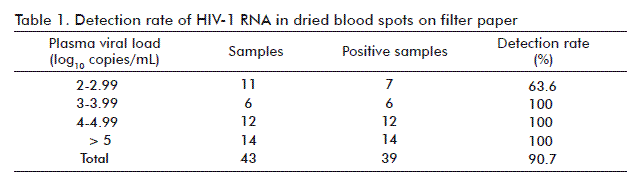
<body><![CDATA[<P   ><font face="Verdana, Arial, Helvetica, sans-serif" size="2"><b>Statistical processing      and interpretation of results </b></font></P >       <P   ><font face="Verdana, Arial, Helvetica, sans-serif" size="2">The values of VL      are transformed to log<sub>10</sub> for the calculations. With the values      of VL, we analyzed the regression in the plasma-DBS pairs using the InfoStat,      version 1.1 statistical program (C&oacute;rdoba, Argentina). The model from      the regression analysis </font><font face="Verdana, Arial, Helvetica, sans-serif" size="2">obtained      was used to predict the VL in the plasma through the result given by the DBS.      The values of the VL of the DBS specimens were thereby interpolated in the      x axis, and the resulting values from the y axis were the values predicted      from the VL of the plasma in these same samples. The means of the true and      predicted values of VL were compared by a Student's t test for independent      samples, with the Statgraphics Plus software for Windows, version 5.1 (Maryland,      USA). </font></P >   <FONT size="+1"><FONT size="+1">        <P   ><font face="Verdana, Arial, Helvetica, sans-serif" size="2">The correlation between      the results of both types of samples was evaluated through the Pearson linear      coefficient of correlation, and for their agreement the Bland-Altman method      was used [11]. Before this, the Shapiro-Wilk test was carried out, with the      statistical package R, version 3.0.1 (Statistics Department of the University      of Kentucky, USA) to know if the differences between the values of the VL      in the plasma-DBS pairs followed a normal distribution. </font></P >       <P   ><font face="Verdana, Arial, Helvetica, sans-serif" size="2">Finally, the regression      in the linearity study was analyzed, and the coefficients of variation were      calculated to evaluate the intra- and inter-assay precision. </font></P >       <P   >&nbsp;</P >       <P   ><font size="3" face="Verdana, Arial, Helvetica, sans-serif"><b>RESULTS AND DISCUSSION</b></font></P >   <FONT size="+1">        <P   ><font size="2" face="Verdana, Arial, Helvetica, sans-serif">The values of RNA      in the plasma of the 43 specimens studied were in the range of 40 to 2 450      000 copies/mL, with a mean of 10 000 copies/mL. No RNA was detected in four      specimens of DBS, for a total detection rate of 90.7 % (<a href="/img/revistas/bta/v31n2/t0106214.gif">Table      1</a>). The VL in the 39 samples of DBS with detected RNA averaged 2250 copies/mL      and ranged from 40 to 155 000 copies/mL. The VL in the plasma of four samples,      where the RNA was not detected in the DBS, was in the range of 40 to 216 copies/mL.      The viral RNA was quantified in 63.6 % of the spe-cimens showing levels of      VL in the plasma lower than 1000 copies/mL, when using DBS. This effect on      the sensitivity of the DBS specimen when viral levels are low has also been      found in other VL quantification tests [12-14]. Nonetheless, although the      virologic success of the antiretroviral therapy is measured by the VL reach-ing      undetectable levels, in clinical practice it is normal to make decisions when      the levels of viral RNA surpass 1000 copies/mL. Therefore, under our conditions,      the ineffectiveness of RNA quantification in 36.4 % of the DBS specimens with      less than 1000 copies/mL is irrelevant for the follow-up of these patients.      </font></P >   <FONT size="+1">        
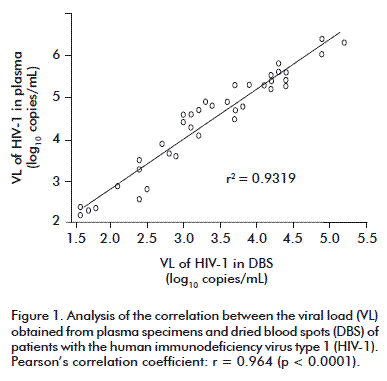
<P   ><font face="Verdana, Arial, Helvetica, sans-serif" size="2">In the 39 pairs of      samples where RNA was detected, we obtained a high correlation of the VL (r      = 0.964, p &lt; 0.0001) (<a href="#fig1">Figure 1</a>), as reported by other      groups [15-18]. </font></P >       <P align="center"   ><img src="/img/revistas/bta/v31n2/f0106214.gif" width="385" height="379"><a name="fig1"></a></P >       
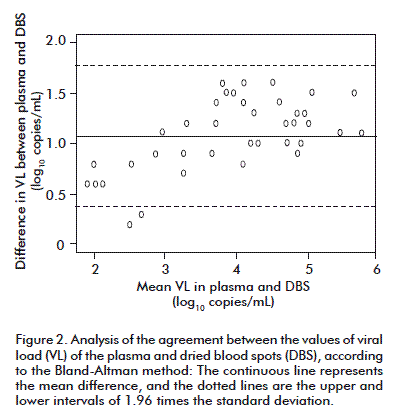
<P   ><font face="Verdana, Arial, Helvetica, sans-serif" size="2">The average difference      between the values of the VL obtained for both types of samples was of 1.07      log<sub>10</sub> copies/mL. Differences of 0.53 log<sub>10</sub> have been      reported between the results of the researchers using platforms and assays      that are similar to this study [17]. In another study there was an average      difference of 1.0 log<sub>10</sub>, by using the Cobas&reg; TaqMan&reg; instrument      and with an extraction procedure that differed from ours [14]. According to      the Bland-Altman model, the agreement limits were 0.378 (0.178-0.577) and      1.771 (1.571-1.969) log<sub>10</sub> copies/mL (mean &plusmn; 1.96 times the      standard deviation), respectively, and 94.8 % of the values were in that range.      This showed a high agreement between the values of the VL for both types of      samples (<a href="#fig2">Figure 2</a>). </font></P >       ]]></body>
<body><![CDATA[<P align="center"   ><img src="/img/revistas/bta/v31n2/f0206214.gif" width="391" height="415"><a name="fig2"></a></P >   <FONT size="+1"><FONT size="+1"><FONT size="+1"><FONT size="+1"><FONT size="+1"><FONT size="+1"><FONT size="+1"><FONT size="+1">        
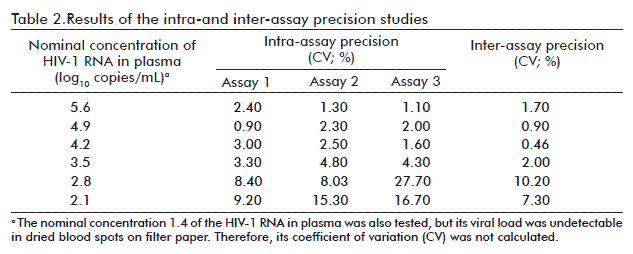
<P   ><font face="Verdana, Arial, Helvetica, sans-serif" size="2">The regression analysis      in the linearity evaluation with the sample of DBS, in the three assays, showed      regression values that were very close to 1, with an average of 0.98. This      value is very similar to that reported by the manufacturer of the test for      the plasma specimen (0.989). The detection of RNA in DBS was linear within      a wide dynamic range of 134-420 000 (2.1-5.6 log<sub>10</sub>) copies/mL.      The lower limit of detection (LLD) in this study was less than the LLD found      by other researchers in similar studies [19-21]. </font></P >   <FONT size="+1"><FONT size="+1">        <P   ><font face="Verdana, Arial, Helvetica, sans-serif" size="2">Since the input volume      and the type of sample influence the sensitivity of these tests, and in this      study we are testing a different type of sample and a volume lower than that      recommended by the manufacturer, the challenge is to know when a result with      DBS should be considered cautiously. This depends on a possible contradiction      with other factors and parameters analyzed in the patient in this study. Probably,      in specific cases, it may be necessary and advisable to analyze the VL in      the plasma. </font></P >       <P   ><font face="Verdana, Arial, Helvetica, sans-serif" size="2">At the same time,      the levels of VL that would indicate when important therapeutic decisions      must be made, such as the start of the treatment and a change in the therapeutic      regime, the latter being generally necessary because of the virological failure,      are quantified here using DBS, since the dynamic range shown by the test with      this type of sample is able to cover it. The levels of VL leading to these      decisions are when viral load is higher than 40 000 or 50 000 copies/mL, or      when the CD4 count is less than 350 cells/mm<sup>3</sup>, according to the      Cuban standards for comprehensive medical care for persons living with HIV/AIDS.      Several studies have demonstrated that the use of DBS is reliable for quantifying      levels of viremia that characterize these infection stages [12, 14, 19]. Moreover,      it is known that the VL is not the only parameter evaluated by specialized      clinical physicians when designing therapeutic strategies. </font></P >   <FONT size="+1"><FONT size="+1">        <P   ><font face="Verdana, Arial, Helvetica, sans-serif" size="2">The volume of DBS      used to quantify the VL has been variable [22]. Some authors using a volume      similar to that of this study obtained results showing less sensitivity [20,      21]. One explanation for this could be that the tests used (Abbott Real Time,      NucliSENSEasy Q HIV-1 and CAP/CTM HIV-1 Test; from several companies) do not      focus on the same region of the genome for the analysis; they differ in the      amplification principle, in the lower detection limit, and in the reagents      and methodologies used for the lysis [2]. </font></P >       <P   ><font face="Verdana, Arial, Helvetica, sans-serif" size="2"><a href="/img/revistas/bta/v31n2/t0206214.gif">Table      2</a> shows the results of the intra- and inter-assay precision tests. The      coefficients of variation obtained, which were less than 10 %, indicate that      the precision of the test with the DBS sample was satisfactory. However, in      the concentrations of 2.8 log<sub>10</sub> and 2.1 log<sub>10</sub> some of      the values are higher than 10 %; and although it has been stated that high      coefficients of variation, of over 20-30 %, are considered acceptable for      crude data [23], the effect may be largely due to incorrect handling, rather      than the type of specimen. </font></P >   <FONT size="+1"><FONT size="+1"><FONT size="+1"><FONT size="+1">        
<P   ><font face="Verdana, Arial, Helvetica, sans-serif" size="2">The linear regression      analysis in the correlation study resulted in the following equation: y =      1.18 x + 0.47. This was used as described in the Materials and Methods section.      The results of the comparison between the true and predicted values of the      VL, in the plasma of the samples studied, are shown in <a href="#fig3">figure      3</a>. It was demonstrated that there is no significant statistical difference      between the means of both values, for a confidence level of 95 %. Therefore,      this way of calculating the value of the viral load of HIV-1 in the plasma      of infected persons, could be effective if we consider that the model should      be validated with a larger number of samples.</font></P >       <P align="center"   ><img src="/img/revistas/bta/v31n2/f0306214.gif" width="386" height="382"><a name="fig3"></a></P >       
<P   >&nbsp;</P >       <P   ><font size="2" face="Verdana, Arial, Helvetica, sans-serif"><b><font size="3">CONCLUSIONS</font></b></font>    ]]></body>
<body><![CDATA[<br>   </P >   <FONT size="+1">        <P   ><font size="2" face="Verdana, Arial, Helvetica, sans-serif">Satisfactory results      were obtained in this studyafter quantifying the RNA from the HIV-1 through      DBS specimens with the Cobas&reg; Ampliprep/Cobas&reg; Taqman&reg; HIV-1 test,      version 2.0 (Roche Molecular Systems, Inc., New Jersey, USA), endorsing its      use. Although the universe of the study was not sufficiently large, these      results are encouraging, due to the possibilities of the use of this type      of specimen as a valid alternative. This may be beneficial for persons living      with HIV/AIDS who have to come from Cuban areas located far from the laboratories      for the analyses of their viral load. It is also useful for those people living      in areas where the conditions are inappropriate for blood processing, plasma      storage and its refrigerated transportation. After validating the model for      the prediction of the VL in the plasma through the use of DBS, it may be possible      to recommend the utilization of this type of sample in a reliable manner.      </font></P >       <P   >&nbsp;</P >   <FONT size="+1">        <P   ><font face="Verdana, Arial, Helvetica, sans-serif" size="3"><b>ACKNOWLEDGEMENTS</b></font></P >   <FONT size="+1">        <P   ><font size="2" face="Verdana, Arial, Helvetica, sans-serif">We would like to      thank Eng. Josefina de Calzadilla, MSc., from the Agrarian University of Havana;      Dr. Ileana Miranda, from the National Agricultural Health Center (CENSA by      its Spanish acronym) and Orlando Mart&iacute;nez, MSc. from the University      of Information Technology Sciences, for their valuable contribution to the      statistical analyses. </font></P >       <P   >&nbsp;</P >   <FONT size="+1">        <P   > </P >       <P   ><font size="3"><b><font face="Verdana, Arial, Helvetica, sans-serif">REFERENCES      </font></b></font></P >       <P   > </P >       <P   > </P >       ]]></body>
<body><![CDATA[<P   > </P >       <P   > </P >       <P   > </P >       <P   > </P >       <P   > </P >       <P   > </P >       <P   > </P >       <P   > </P >       <P   > </P >       <P   > </P >   <B>        ]]></body>
<body><![CDATA[<P   ></P >   </B></font></font></font></font></font></font></font></font></font></font></font></font></font></font></font></font></font></font></font></font></font></font></font></font></font></font></font></font></font></font></font></font></font></font></font></font></font></font></font></font></font></font></font></font></font></font></font></font></font></font></font></font></font></font></font></font></font></font></font></font></font></font></font>        <!-- ref --><p><font face="Verdana, Arial, Helvetica, sans-serif" size="2">1. Mellors JW,      Munoz A, Giorgi JV, Margolick JB, Tassoni CJ, Gupta P, et al. Plasma viral      load and CD4+ lymphocytes as prognostic markers of HIV-1 infection. Ann Intern      Med. 1997;126(12):946-54.    </font></p>       <p><font face="Verdana, Arial, Helvetica, sans-serif" size="2">2. Luft LM, Gill      MJ, Church DL. HIV-1 viral diversity and its implications for viral load testing:      review of current platforms. Int J Infect Dis. 2011;15(10):e661-70.</font></p>       <p><font face="Verdana, Arial, Helvetica, sans-serif" size="2">3. Cobb BR, Vaks      JE, Do T, Vilchez RA. Evolution in the sensitivity of quantitative HIV-1 viral      load tests. J Clin Virol. 2011;52 Suppl 1:S77-82.</font></p>       <!-- ref --><p><font face="Verdana, Arial, Helvetica, sans-serif" size="2">4. Espy MJ, Uhl      JR, Sloan LM, Buckwalter SP, Jones MF, Vetter EA, et al. Real-time PCR in      clinical microbiology: applications for routine laboratory testing. Clin Microbiol      Rev. 2006;19(1):165-256.    </font></p>       <!-- ref --><p><font face="Verdana, Arial, Helvetica, sans-serif" size="2">5. Fiscus SA,      Brambilla D, Grosso L, Schock J, Cronin M. Quantitation of human immunodeficiency      virus type 1 RNA in plasma by using blood dried on filter paper. J Clin Microbiol.      1998;36(1):258-60.    </font></p>       <!-- ref --><p><font face="Verdana, Arial, Helvetica, sans-serif" size="2">6. O'Shea S,      Mullen J, Corbett K, Chrystie I, Newell ML, Banatvala JE. Use of dried whole      blood spots for quantification of HIV-1 RNA. Aids. 1999;13(5):630-1.    </font></p>       <!-- ref --><p><font face="Verdana, Arial, Helvetica, sans-serif" size="2">7. Mwaba P, Cassol      S, Nunn A, Pilon R, Chintu C, Janes M, et al. Whole blood versus plasma spots      for measurement of HIV-1 viral load in HIV-infected African patients. Lancet.      2003;362(9401):2067-8.    </font></p>       <p><font face="Verdana, Arial, Helvetica, sans-serif" size="2">8. Ikomey GM,      Atashili J, Okomo-Assoumou MC, Mesembe M, Ndumbe PM. Dried blood spots versus      plasma for the quantification of HIV-1 RNA using the manual (PCR-ELISA) amplicor      monitor HIV-1 version 1.5 assay in Yaounde, Cameroon. J Int Assoc Physicians      AIDS Care (Chic). 2009;8(3):181-4.</font></p>       <p><font face="Verdana, Arial, Helvetica, sans-serif" size="2">9. Mehta N, Trzmielina      S, Nonyane BA, Eliot MN, Lin R, Foulkes AS, et al. Low-cost HIV-1 diagnosis      and quantification in dried blood spots by real time PCR. PloS One. 2009;4(6):e5819.</font></p>       <p><font face="Verdana, Arial, Helvetica, sans-serif" size="2">10. WMA Declaration      of Helsinki - Ethical Principles for Medical Research Involving Human Subjects      [Internet]. Ferney-Voltaire: World Medical Association, Inc.; 2013 [cited      2013 Oct 10]. Available from: <a href="http://www.wma.net/en/30publications/10policies/b3/" target="_blank">http://www.wma.net/en/30publications/10policies/b3/</a>.</font></p>       <!-- ref --><p><font face="Verdana, Arial, Helvetica, sans-serif" size="2">11. Bland JM,      Altman DG. Statistical methods for assessing agreement between two methods      of clinical measurement. Lancet. 1986;1(8476):307-10.    </font></p>       <!-- ref --><p><font face="Verdana, Arial, Helvetica, sans-serif" size="2">12. Johannessen      A, Garrido C, Zahonero N, Sandvik L, Naman E, Kivuyo SL, et al. Dried blood      spots perform well in viral load monitoring of patients who receive antiretroviral      treatment in rural Tanzania. Clin Infect Dis. 2009;49(6):976-81.    </font></p>       ]]></body>
<body><![CDATA[<!-- ref --><p><font face="Verdana, Arial, Helvetica, sans-serif" size="2">13. Marconi A,      Balestrieri M, Comastri G, Pulvirenti FR, Gennari W, Tagliazucchi S, et al.      Evaluation of the Abbott Real-Time HIV-1 quantitative assay with dried blood      spot specimens. Clin Microbiol Infect. 2009;15(1):93-7.    </font></p>       <!-- ref --><p><font face="Verdana, Arial, Helvetica, sans-serif" size="2">14. Andreotti      M, Pirillo M, Guidotti G, Ceffa S, Paturzo G, Germano P, et al. Correlation      between HIV-1 viral load quantification in plasma, dried blood spots, and      dried plasma spots using the Roche COBAS Taqman assay. J Clin Virol. 2010;47(1):4-7.    </font></p>       <!-- ref --><p><font face="Verdana, Arial, Helvetica, sans-serif" size="2">15. Alvarez-Munoz      MT, Zaragoza-Rodriguez S, Rojas-Montes O, Palacios-Saucedo G, Vazquez-Rosales      G, Gomez-Delgado A, et al. High correlation of human immunodeficiency virus      type-1 viral load measured in dried-blood spot samples and in plasma under      different storage conditions. Arch Med Res. 2005;36(4):382-6.    </font></p>       <!-- ref --><p><font face="Verdana, Arial, Helvetica, sans-serif" size="2">16. Reigadas      S, Schrive MH, Aurillac-Lavignolle V, Fleury HJ. Quantitation of HIV-1 RNA      in dried blood and plasma spots. J Virol Methods. 2009;161(1):177-80.    </font></p>       <p><font face="Verdana, Arial, Helvetica, sans-serif" size="2">17. Carmona S,      Seiverth B, Horsfield P, eSa B, Goerdes M, Stevens W. Evaluation of COBAS&reg;      AmpliPrep/ COBAS&reg; TaqMan&reg; HIV-1 v2.0 test on dried blood spots (DBS).      Abstract No. TULBPE031. 6th IAS Conference on HIV pathogenesis and treatment;      2011; Rome, Italy. Geneva: International AIDS Society; c2013 [cited 2013 Oct      10]. Available from: <a href="http://www.iasociety.org/Default.aspx?pageId=12&abstractId=200743912" target="_blank">http://www.iasociety.org/Default.aspx?pageId=12&amp;abstractId=200743912</a>.</font></p>       <!-- ref --><p><font face="Verdana, Arial, Helvetica, sans-serif" size="2">18. Ouma KN,      Basavaraju SV, Okonji JA, Williamson J, Thomas TK, Mills LA, et al. Evaluation      of quantification of HIV-1 RNA viral load in plasma and dried blood spots      by use of the semiautomated Cobas Amplicor assay and the fully automated Cobas      Ampliprep/TaqMan assay, version 2.0, in Kisumu, Kenya. J Clin Microbiol. 2013;51(4):1208-18.    </font></p>       <!-- ref --><p><font face="Verdana, Arial, Helvetica, sans-serif" size="2">19. Brambilla      D, Jennings C, Aldrovandi G, Bremer J, Comeau AM, Cassol SA, et al. Multicenter      evaluation of use of dried blood and plasma spot specimens in quantitative      assays for human immunodeficiency virus RNA: measurement, precision, and RNA      stability. J Clin Microbiol. 2003;41(5):1888-93.    </font></p>       <!-- ref --><p><font face="Verdana, Arial, Helvetica, sans-serif" size="2">20. Abravaya      K, Huang S, Erickson B, Mak W-B. The use of dried blood spots with the Abbott      RealTime HIV-1 viral load assay. Abstract No. CDB0034. AIDS 2008 - XVII International      AIDS Conference. 3-8 August 2008, Mexico City, Mexico. Geneva: International      AIDS Society; c2013 [cited 2013 Oct 10]. Available from: <a href="http://ias2007.org/Abstracts/A200718278.aspx" target="_blank">http://ias2007.org/Abstracts/A200718278.aspx</a>.    </font></p>       <!-- ref --><p><font face="Verdana, Arial, Helvetica, sans-serif" size="2">21. Kane CT,      Ndiaye HD, Diallo S, Ndiaye I, Wade AS, Diaw PA, et al. Quantitation of HIV-1      RNA in dried blood spots by the real-time NucliSENS EasyQ HIV-1 assay in Senegal.      J Virol Methods. 2008;148(1-2):291-5.    </font></p>       <!-- ref --><p><font face="Verdana, Arial, Helvetica, sans-serif" size="2">22. Hamers RL,      Smit PW, Stevens W, Schuurman R, Rinke de Wit TF. Dried fluid spots for HIV      type-1 viral load and resistance genotyping: a systematic review. Antivir      Ther. 2009;14(5):619-29.    </font></p>       <!-- ref --><p><font face="Verdana, Arial, Helvetica, sans-serif" size="2">23. Jacobson      RH. Validation of serological assays for diagnosis of infectious diseases.      Rev Sci Tech. 1998;17(2):469-526.    </font></p>       <p>&nbsp;</p>       <p>&nbsp;</p>       <p><font face="Verdana, Arial, Helvetica, sans-serif" size="2">Received in November,      2013.    <br>     Accepted in May, 2014.</font></p>       <p>&nbsp;</p>       <p>&nbsp;</p>       <p><font size="+1" color="#000000"><font size="+1"><font face="Verdana, Arial, Helvetica, sans-serif" size="2"><i>Nancy      M Ruiz</i></font></font></font>. <font size="+1" color="#000000"><font size="+1"><font size="+1"><font size="+1"><font size="+1"><font size="+1"><font size="+1"><font size="+1"><font size="+1"><font size="+1"><font size="+1"><font size="+1"><font size="+1"><font size="+1"><font size="+1"><font size="+1"><font size="+1"><font size="+1"><font size="+1"><font size="+1"><font size="2" face="Verdana, Arial, Helvetica, sans-serif">Laboratorio      de Biolog&iacute;a Molecular, Laboratorio de Investigaciones del Sida, Lisida.      Carretera de Jamaica y Autopista Nacional, San Jos&eacute; de las Lajas, CP      32700, Mayabeque, Cuba.</font></font></font></font></font></font></font></font></font></font></font></font></font></font></font></font></font></font></font></font></font>      <font size="2" face="Verdana, Arial, Helvetica, sans-serif">E-mail: </font><font size="+1" color="#000000"><font size="+1"><font size="+1"><font size="+1"><font size="+1"><font size="+1"><font size="+1"><font size="+1"><font size="+1"><font size="+1"><font size="+1"><font size="+1"><font size="+1"><font size="+1"><font size="+1"><font size="+1"><font size="+1"><font size="+1"><font size="+1"><font size="+1"><font size="+1"><font size="+1"><font size="+1"><font size="+1"><font size="+1"><font size="+1"><font size="+1"><font size="+1"><font face="Verdana, Arial, Helvetica, sans-serif" size="2"><a href="mailto:nruizg@infomed.sld.cu"><font color="#0000FF">nruizg@infomed.sld.cu</font></a></font><FONT color="#0000FF"><FONT color="#000000"><FONT color="#0018E4"><FONT color="#000000"><FONT size="+1"><FONT color="#0018E4"><FONT size="+1" color="#000000"><FONT size="+1"><FONT size="+1"><FONT size="+1"><FONT size="+1"><FONT size="+1"><FONT size="+1"><FONT size="+1"><FONT size="+1"><FONT size="+1"><FONT size="+1"><FONT size="+1"><FONT size="+1"><FONT size="+1"><FONT size="+1"><FONT size="+1"><FONT size="+1"><FONT size="+1"><FONT size="+1"><FONT size="+1"><FONT size="+1"><FONT size="+1"><FONT size="+1"><FONT size="+1"><FONT size="+1"><FONT size="+1"><FONT size="+1"><FONT size="+1"><FONT size="+1">      </font></font></font></font></font></font></font></font></font></font></font></font></font></font></font></font></font></font></font></font></font></font></font></font></font></font></font></font></font></font></font></font></font></font></font></font></font></font></font></font></font></font></font></font></font></font></font></font></font></font></font></font></font></font></font></font></font></font></font></font></font></font></font></p>   </DIV >      ]]></body><back>
<ref-list>
<ref id="B1">
<label>1</label><nlm-citation citation-type="journal">
<person-group person-group-type="author">
<name>
<surname><![CDATA[Mellors]]></surname>
<given-names><![CDATA[JW]]></given-names>
</name>
<name>
<surname><![CDATA[Munoz]]></surname>
<given-names><![CDATA[A]]></given-names>
</name>
<name>
<surname><![CDATA[Giorgi]]></surname>
<given-names><![CDATA[JV]]></given-names>
</name>
<name>
<surname><![CDATA[Margolick]]></surname>
<given-names><![CDATA[JB]]></given-names>
</name>
<name>
<surname><![CDATA[Tassoni]]></surname>
<given-names><![CDATA[CJ]]></given-names>
</name>
<name>
<surname><![CDATA[Gupta]]></surname>
<given-names><![CDATA[P]]></given-names>
</name>
</person-group>
<article-title xml:lang="en"><![CDATA[Plasma viral load and CD4+ lymphocytes as prognostic markers of HIV-1 infection]]></article-title>
<source><![CDATA[Ann Intern Med]]></source>
<year>1997</year>
<volume>126</volume>
<numero>12</numero>
<issue>12</issue>
<page-range>946-54</page-range></nlm-citation>
</ref>
<ref id="B2">
<label>2</label><nlm-citation citation-type="journal">
<person-group person-group-type="author">
<name>
<surname><![CDATA[Luft]]></surname>
<given-names><![CDATA[LM]]></given-names>
</name>
<name>
<surname><![CDATA[Gill]]></surname>
<given-names><![CDATA[MJ]]></given-names>
</name>
<name>
<surname><![CDATA[Church]]></surname>
<given-names><![CDATA[DL]]></given-names>
</name>
</person-group>
<article-title xml:lang="en"><![CDATA[HIV-1 viral diversity and its implications for viral load testing: review of current platforms]]></article-title>
<source><![CDATA[Int J Infect Dis]]></source>
<year>2011</year>
<volume>15</volume>
<numero>10</numero>
<issue>10</issue>
<page-range>661-70</page-range></nlm-citation>
</ref>
<ref id="B3">
<label>3</label><nlm-citation citation-type="journal">
<person-group person-group-type="author">
<name>
<surname><![CDATA[Cobb]]></surname>
<given-names><![CDATA[BR]]></given-names>
</name>
<name>
<surname><![CDATA[Vaks]]></surname>
<given-names><![CDATA[JE]]></given-names>
</name>
<name>
<surname><![CDATA[Do]]></surname>
<given-names><![CDATA[T]]></given-names>
</name>
<name>
<surname><![CDATA[Vilchez]]></surname>
<given-names><![CDATA[RA]]></given-names>
</name>
</person-group>
<article-title xml:lang="en"><![CDATA[Evolution in the sensitivity of quantitative HIV-1 viral load tests]]></article-title>
<source><![CDATA[J Clin Virol]]></source>
<year>2011</year>
<volume>52</volume>
<numero>^s1</numero>
<issue>^s1</issue>
<supplement>1</supplement>
<page-range>77-82</page-range></nlm-citation>
</ref>
<ref id="B4">
<label>4</label><nlm-citation citation-type="journal">
<person-group person-group-type="author">
<name>
<surname><![CDATA[Espy]]></surname>
<given-names><![CDATA[MJ]]></given-names>
</name>
<name>
<surname><![CDATA[Uhl]]></surname>
<given-names><![CDATA[JR]]></given-names>
</name>
<name>
<surname><![CDATA[Sloan]]></surname>
<given-names><![CDATA[LM]]></given-names>
</name>
<name>
<surname><![CDATA[Buckwalter]]></surname>
<given-names><![CDATA[SP]]></given-names>
</name>
<name>
<surname><![CDATA[Jones]]></surname>
<given-names><![CDATA[MF]]></given-names>
</name>
<name>
<surname><![CDATA[Vetter]]></surname>
<given-names><![CDATA[EA]]></given-names>
</name>
</person-group>
<article-title xml:lang="en"><![CDATA[Real-time PCR in clinical microbiology: applications for routine laboratory testing]]></article-title>
<source><![CDATA[Clin Microbiol Rev]]></source>
<year>2006</year>
<volume>19</volume>
<numero>1</numero>
<issue>1</issue>
<page-range>165-256</page-range></nlm-citation>
</ref>
<ref id="B5">
<label>5</label><nlm-citation citation-type="journal">
<person-group person-group-type="author">
<name>
<surname><![CDATA[Fiscus]]></surname>
<given-names><![CDATA[SA]]></given-names>
</name>
<name>
<surname><![CDATA[Brambilla]]></surname>
<given-names><![CDATA[D]]></given-names>
</name>
<name>
<surname><![CDATA[Grosso]]></surname>
<given-names><![CDATA[L]]></given-names>
</name>
<name>
<surname><![CDATA[Schock]]></surname>
<given-names><![CDATA[J]]></given-names>
</name>
<name>
<surname><![CDATA[Cronin]]></surname>
<given-names><![CDATA[M]]></given-names>
</name>
</person-group>
<article-title xml:lang="en"><![CDATA[Quantitation of human immunodeficiency virus type 1 RNA in plasma by using blood dried on filter paper]]></article-title>
<source><![CDATA[J Clin Microbiol]]></source>
<year>1998</year>
<volume>36</volume>
<numero>1</numero>
<issue>1</issue>
<page-range>258-60</page-range></nlm-citation>
</ref>
<ref id="B6">
<label>6</label><nlm-citation citation-type="journal">
<person-group person-group-type="author">
<name>
<surname><![CDATA[O'Shea]]></surname>
<given-names><![CDATA[S]]></given-names>
</name>
<name>
<surname><![CDATA[Mullen]]></surname>
<given-names><![CDATA[J]]></given-names>
</name>
<name>
<surname><![CDATA[Corbett]]></surname>
<given-names><![CDATA[K]]></given-names>
</name>
<name>
<surname><![CDATA[Chrystie]]></surname>
<given-names><![CDATA[I]]></given-names>
</name>
<name>
<surname><![CDATA[Newell]]></surname>
<given-names><![CDATA[ML]]></given-names>
</name>
<name>
<surname><![CDATA[Banatvala]]></surname>
<given-names><![CDATA[JE]]></given-names>
</name>
</person-group>
<article-title xml:lang="en"><![CDATA[Use of dried whole blood spots for quantification of HIV-1 RNA]]></article-title>
<source><![CDATA[AIDS]]></source>
<year>1999</year>
<volume>13</volume>
<numero>5</numero>
<issue>5</issue>
<page-range>630-1</page-range></nlm-citation>
</ref>
<ref id="B7">
<label>7</label><nlm-citation citation-type="journal">
<person-group person-group-type="author">
<name>
<surname><![CDATA[Mwaba]]></surname>
<given-names><![CDATA[P]]></given-names>
</name>
<name>
<surname><![CDATA[Cassol]]></surname>
<given-names><![CDATA[S]]></given-names>
</name>
<name>
<surname><![CDATA[Nunn]]></surname>
<given-names><![CDATA[A]]></given-names>
</name>
<name>
<surname><![CDATA[Pilon]]></surname>
<given-names><![CDATA[R]]></given-names>
</name>
<name>
<surname><![CDATA[Chintu]]></surname>
<given-names><![CDATA[C]]></given-names>
</name>
<name>
<surname><![CDATA[Janes]]></surname>
<given-names><![CDATA[M]]></given-names>
</name>
</person-group>
<article-title xml:lang="en"><![CDATA[Whole blood versus plasma spots for measurement of HIV-1 viral load in HIV-infected African patients]]></article-title>
<source><![CDATA[Lancet]]></source>
<year>2003</year>
<volume>362</volume>
<numero>9401</numero>
<issue>9401</issue>
<page-range>2067-8</page-range></nlm-citation>
</ref>
<ref id="B8">
<label>8</label><nlm-citation citation-type="journal">
<person-group person-group-type="author">
<name>
<surname><![CDATA[Ikomey]]></surname>
<given-names><![CDATA[GM]]></given-names>
</name>
<name>
<surname><![CDATA[Atashili]]></surname>
<given-names><![CDATA[J]]></given-names>
</name>
<name>
<surname><![CDATA[Okomo-Assoumou]]></surname>
<given-names><![CDATA[MC]]></given-names>
</name>
<name>
<surname><![CDATA[Mesembe]]></surname>
<given-names><![CDATA[M]]></given-names>
</name>
<name>
<surname><![CDATA[Ndumbe]]></surname>
<given-names><![CDATA[PM]]></given-names>
</name>
</person-group>
<article-title xml:lang="en"><![CDATA[Dried blood spots versus plasma for the quantification of HIV-1 RNA using the manual (PCR-ELISA) amplicor monitor HIV-1 version 1.5 assay in Yaounde, Cameroon]]></article-title>
<source><![CDATA[Journal of the International Association of Physicians in AIDS Care]]></source>
<year>2009</year>
<volume>8</volume>
<numero>3</numero>
<issue>3</issue>
<page-range>181-4</page-range></nlm-citation>
</ref>
<ref id="B9">
<label>9</label><nlm-citation citation-type="journal">
<person-group person-group-type="author">
<name>
<surname><![CDATA[Mehta]]></surname>
<given-names><![CDATA[N]]></given-names>
</name>
<name>
<surname><![CDATA[Trzmielina]]></surname>
<given-names><![CDATA[S]]></given-names>
</name>
<name>
<surname><![CDATA[Nonyane]]></surname>
<given-names><![CDATA[BA]]></given-names>
</name>
<name>
<surname><![CDATA[Eliot]]></surname>
<given-names><![CDATA[MN]]></given-names>
</name>
<name>
<surname><![CDATA[Lin]]></surname>
<given-names><![CDATA[R]]></given-names>
</name>
<name>
<surname><![CDATA[Foulkes]]></surname>
<given-names><![CDATA[AS]]></given-names>
</name>
</person-group>
<article-title xml:lang="en"><![CDATA[Low-cost HIV-1 diagnosis and quantification in dried blood spots by real time PCR]]></article-title>
<source><![CDATA[PLoS One]]></source>
<year>2009</year>
<volume>4</volume>
<numero>6</numero>
<issue>6</issue>
<page-range>5819</page-range></nlm-citation>
</ref>
<ref id="B10">
<label>10</label><nlm-citation citation-type="book">
<source><![CDATA[WMA Declaration of Helsinki - Ethical Principles for Medical Research Involving Human Subjects]]></source>
<year>2013</year>
<publisher-loc><![CDATA[Ferney-Voltaire ]]></publisher-loc>
<publisher-name><![CDATA[World Medical Association, Inc.]]></publisher-name>
</nlm-citation>
</ref>
<ref id="B11">
<label>11</label><nlm-citation citation-type="journal">
<person-group person-group-type="author">
<name>
<surname><![CDATA[Bland]]></surname>
<given-names><![CDATA[JM]]></given-names>
</name>
<name>
<surname><![CDATA[Altman]]></surname>
<given-names><![CDATA[DG]]></given-names>
</name>
</person-group>
<article-title xml:lang="en"><![CDATA[Statistical methods for assessing agreement between two methods of clinical measurement]]></article-title>
<source><![CDATA[Lancet]]></source>
<year>1986</year>
<volume>1</volume>
<numero>8476</numero>
<issue>8476</issue>
<page-range>307-10</page-range></nlm-citation>
</ref>
<ref id="B12">
<label>12</label><nlm-citation citation-type="journal">
<person-group person-group-type="author">
<name>
<surname><![CDATA[Johannessen]]></surname>
<given-names><![CDATA[A]]></given-names>
</name>
<name>
<surname><![CDATA[Garrido]]></surname>
<given-names><![CDATA[C]]></given-names>
</name>
<name>
<surname><![CDATA[Zahonero]]></surname>
<given-names><![CDATA[N]]></given-names>
</name>
<name>
<surname><![CDATA[Sandvik]]></surname>
<given-names><![CDATA[L]]></given-names>
</name>
<name>
<surname><![CDATA[Naman]]></surname>
<given-names><![CDATA[E]]></given-names>
</name>
<name>
<surname><![CDATA[Kivuyo]]></surname>
<given-names><![CDATA[SL]]></given-names>
</name>
</person-group>
<article-title xml:lang="en"><![CDATA[Dried blood spots perform well in viral load monitoring of patients who receive antiretroviral treatment in rural Tanzania]]></article-title>
<source><![CDATA[Clin Infect Dis]]></source>
<year>2009</year>
<volume>49</volume>
<numero>6</numero>
<issue>6</issue>
<page-range>976-81</page-range></nlm-citation>
</ref>
<ref id="B13">
<label>13</label><nlm-citation citation-type="journal">
<person-group person-group-type="author">
<name>
<surname><![CDATA[Marconi]]></surname>
<given-names><![CDATA[A]]></given-names>
</name>
<name>
<surname><![CDATA[Balestrieri]]></surname>
<given-names><![CDATA[M]]></given-names>
</name>
<name>
<surname><![CDATA[Comastri]]></surname>
<given-names><![CDATA[G]]></given-names>
</name>
<name>
<surname><![CDATA[Pulvirenti]]></surname>
<given-names><![CDATA[FR]]></given-names>
</name>
<name>
<surname><![CDATA[Gennari]]></surname>
<given-names><![CDATA[W]]></given-names>
</name>
<name>
<surname><![CDATA[Tagliazucchi]]></surname>
<given-names><![CDATA[S]]></given-names>
</name>
</person-group>
<article-title xml:lang="en"><![CDATA[Evaluation of the Abbott Real-Time HIV-1 quantitative assay with dried blood spot specimens]]></article-title>
<source><![CDATA[Clin Microbiol Infect]]></source>
<year>2009</year>
<volume>15</volume>
<numero>1</numero>
<issue>1</issue>
<page-range>93-7</page-range></nlm-citation>
</ref>
<ref id="B14">
<label>14</label><nlm-citation citation-type="journal">
<person-group person-group-type="author">
<name>
<surname><![CDATA[Andreotti]]></surname>
<given-names><![CDATA[M]]></given-names>
</name>
<name>
<surname><![CDATA[Pirillo]]></surname>
<given-names><![CDATA[M]]></given-names>
</name>
<name>
<surname><![CDATA[Guidotti]]></surname>
<given-names><![CDATA[G]]></given-names>
</name>
<name>
<surname><![CDATA[Ceffa]]></surname>
<given-names><![CDATA[S]]></given-names>
</name>
<name>
<surname><![CDATA[Paturzo]]></surname>
<given-names><![CDATA[G]]></given-names>
</name>
<name>
<surname><![CDATA[Germano]]></surname>
<given-names><![CDATA[P]]></given-names>
</name>
</person-group>
<article-title xml:lang="en"><![CDATA[Correlation between HIV-1 viral load quantification in plasma, dried blood spots, and dried plasma spots using the Roche COBAS Taqman assay]]></article-title>
<source><![CDATA[J Clin Virol]]></source>
<year>2010</year>
<volume>47</volume>
<numero>1</numero>
<issue>1</issue>
<page-range>4-7</page-range></nlm-citation>
</ref>
<ref id="B15">
<label>15</label><nlm-citation citation-type="journal">
<person-group person-group-type="author">
<name>
<surname><![CDATA[Alvarez-Munoz]]></surname>
<given-names><![CDATA[MT]]></given-names>
</name>
<name>
<surname><![CDATA[Zaragoza-Rodriguez]]></surname>
<given-names><![CDATA[S]]></given-names>
</name>
<name>
<surname><![CDATA[Rojas-Montes]]></surname>
<given-names><![CDATA[O]]></given-names>
</name>
<name>
<surname><![CDATA[Palacios-Saucedo]]></surname>
<given-names><![CDATA[G]]></given-names>
</name>
<name>
<surname><![CDATA[Vazquez-Rosales]]></surname>
<given-names><![CDATA[G]]></given-names>
</name>
<name>
<surname><![CDATA[Gomez-Delgado]]></surname>
<given-names><![CDATA[A]]></given-names>
</name>
</person-group>
<article-title xml:lang="en"><![CDATA[High correlation of human immunodeficiency virus type-1 viral load measured in dried-blood spot samples and in plasma under different storage conditions]]></article-title>
<source><![CDATA[Arch Med Res]]></source>
<year>2005</year>
<volume>36</volume>
<numero>4</numero>
<issue>4</issue>
<page-range>382-6</page-range></nlm-citation>
</ref>
<ref id="B16">
<label>16</label><nlm-citation citation-type="journal">
<person-group person-group-type="author">
<name>
<surname><![CDATA[Reigadas]]></surname>
<given-names><![CDATA[S]]></given-names>
</name>
<name>
<surname><![CDATA[Schrive]]></surname>
<given-names><![CDATA[MH]]></given-names>
</name>
<name>
<surname><![CDATA[Aurillac-Lavignolle]]></surname>
<given-names><![CDATA[V]]></given-names>
</name>
<name>
<surname><![CDATA[Fleury]]></surname>
<given-names><![CDATA[HJ]]></given-names>
</name>
</person-group>
<article-title xml:lang="en"><![CDATA[Quantitation of HIV-1 RNA in dried blood and plasma spots]]></article-title>
<source><![CDATA[J Virol Methods]]></source>
<year>2009</year>
<volume>161</volume>
<numero>1</numero>
<issue>1</issue>
<page-range>177-80</page-range></nlm-citation>
</ref>
<ref id="B17">
<label>17</label><nlm-citation citation-type="book">
<person-group person-group-type="author">
<name>
<surname><![CDATA[Carmona]]></surname>
<given-names><![CDATA[S]]></given-names>
</name>
<name>
<surname><![CDATA[Seiverth]]></surname>
<given-names><![CDATA[B]]></given-names>
</name>
<name>
<surname><![CDATA[Horsfield]]></surname>
<given-names><![CDATA[P]]></given-names>
</name>
<name>
<surname><![CDATA[eSa]]></surname>
<given-names><![CDATA[B]]></given-names>
</name>
<name>
<surname><![CDATA[Goerdes]]></surname>
<given-names><![CDATA[M]]></given-names>
</name>
<name>
<surname><![CDATA[Stevens]]></surname>
<given-names><![CDATA[W]]></given-names>
</name>
</person-group>
<source><![CDATA[Evaluation of COBAS(r) AmpliPrep/ COBAS(r) TaqMan(r) HIV-1 v2.0 test on dried blood spots (DBS). Abstract No. TULBPE031. 6th IAS Conference on HIV pathogenesis and treatment; 2011; Rome, Italy]]></source>
<year>2013</year>
<publisher-loc><![CDATA[Geneva ]]></publisher-loc>
<publisher-name><![CDATA[International AIDS Society]]></publisher-name>
</nlm-citation>
</ref>
<ref id="B18">
<label>18</label><nlm-citation citation-type="journal">
<person-group person-group-type="author">
<name>
<surname><![CDATA[Ouma]]></surname>
<given-names><![CDATA[KN]]></given-names>
</name>
<name>
<surname><![CDATA[Basavaraju]]></surname>
<given-names><![CDATA[SV]]></given-names>
</name>
<name>
<surname><![CDATA[Okonji]]></surname>
<given-names><![CDATA[JA]]></given-names>
</name>
<name>
<surname><![CDATA[Williamson]]></surname>
<given-names><![CDATA[J]]></given-names>
</name>
<name>
<surname><![CDATA[Thomas]]></surname>
<given-names><![CDATA[TK]]></given-names>
</name>
<name>
<surname><![CDATA[Mills]]></surname>
<given-names><![CDATA[LA]]></given-names>
</name>
</person-group>
<article-title xml:lang="en"><![CDATA[Evaluation of quantification of HIV-1 RNA viral load in plasma and dried blood spots by use of the semiautomated Cobas Amplicor assay and the fully automated Cobas Ampliprep/TaqMan assay, version 2.0, in Kisumu, Kenya]]></article-title>
<source><![CDATA[J Clin Microbiol]]></source>
<year>2013</year>
<volume>51</volume>
<numero>4</numero>
<issue>4</issue>
<page-range>1208-18</page-range></nlm-citation>
</ref>
<ref id="B19">
<label>19</label><nlm-citation citation-type="journal">
<person-group person-group-type="author">
<name>
<surname><![CDATA[Brambilla]]></surname>
<given-names><![CDATA[D]]></given-names>
</name>
<name>
<surname><![CDATA[Jennings]]></surname>
<given-names><![CDATA[C]]></given-names>
</name>
<name>
<surname><![CDATA[Aldrovandi]]></surname>
<given-names><![CDATA[G]]></given-names>
</name>
<name>
<surname><![CDATA[Bremer]]></surname>
<given-names><![CDATA[J]]></given-names>
</name>
<name>
<surname><![CDATA[Comeau]]></surname>
<given-names><![CDATA[AM]]></given-names>
</name>
<name>
<surname><![CDATA[Cassol]]></surname>
<given-names><![CDATA[SA]]></given-names>
</name>
</person-group>
<article-title xml:lang="en"><![CDATA[Multicenter evaluation of use of dried blood and plasma spot specimens in quantitative assays for human immunodeficiency virus RNA: measurement, precision, and RNA stability]]></article-title>
<source><![CDATA[J Clin Microbiol]]></source>
<year>2003</year>
<volume>41</volume>
<numero>5</numero>
<issue>5</issue>
<page-range>1888-93</page-range></nlm-citation>
</ref>
<ref id="B20">
<label>20</label><nlm-citation citation-type="book">
<person-group person-group-type="author">
<name>
<surname><![CDATA[Abravaya]]></surname>
<given-names><![CDATA[K]]></given-names>
</name>
<name>
<surname><![CDATA[Huang]]></surname>
<given-names><![CDATA[S]]></given-names>
</name>
<name>
<surname><![CDATA[Erickson]]></surname>
<given-names><![CDATA[B]]></given-names>
</name>
<name>
<surname><![CDATA[Mak]]></surname>
<given-names><![CDATA[W-B]]></given-names>
</name>
</person-group>
<source><![CDATA[The use of dried blood spots with the Abbott RealTime HIV-1 viral load assay. Abstract No. CDB0034. AIDS 2008 - XVII International AIDS Conference. 3-8 August 2008, Mexico City, Mexico]]></source>
<year>2013</year>
<publisher-loc><![CDATA[Geneva ]]></publisher-loc>
<publisher-name><![CDATA[International AIDS Society]]></publisher-name>
</nlm-citation>
</ref>
<ref id="B21">
<label>21</label><nlm-citation citation-type="journal">
<person-group person-group-type="author">
<name>
<surname><![CDATA[Kane]]></surname>
<given-names><![CDATA[CT]]></given-names>
</name>
<name>
<surname><![CDATA[Ndiaye]]></surname>
<given-names><![CDATA[HD]]></given-names>
</name>
<name>
<surname><![CDATA[Diallo]]></surname>
<given-names><![CDATA[S]]></given-names>
</name>
<name>
<surname><![CDATA[Ndiaye]]></surname>
<given-names><![CDATA[I]]></given-names>
</name>
<name>
<surname><![CDATA[Wade]]></surname>
<given-names><![CDATA[AS]]></given-names>
</name>
<name>
<surname><![CDATA[Diaw]]></surname>
<given-names><![CDATA[PA]]></given-names>
</name>
</person-group>
<article-title xml:lang="en"><![CDATA[Quantitation of HIV-1 RNA in dried blood spots by the real-time NucliSENS EasyQ HIV-1 assay in Senegal]]></article-title>
<source><![CDATA[J Virol Methods]]></source>
<year>2008</year>
<volume>148</volume>
<numero>1</numero>
<issue>1</issue>
<page-range>2):291-5</page-range></nlm-citation>
</ref>
<ref id="B22">
<label>22</label><nlm-citation citation-type="journal">
<person-group person-group-type="author">
<name>
<surname><![CDATA[Hamers]]></surname>
<given-names><![CDATA[RL]]></given-names>
</name>
<name>
<surname><![CDATA[Smit]]></surname>
<given-names><![CDATA[PW]]></given-names>
</name>
<name>
<surname><![CDATA[Stevens]]></surname>
<given-names><![CDATA[W]]></given-names>
</name>
<name>
<surname><![CDATA[Schuurman]]></surname>
<given-names><![CDATA[R]]></given-names>
</name>
<name>
<surname><![CDATA[Rinke de Wit]]></surname>
<given-names><![CDATA[TF]]></given-names>
</name>
</person-group>
<article-title xml:lang="en"><![CDATA[Dried fluid spots for HIV type-1 viral load and resistance genotyping: a systematic review]]></article-title>
<source><![CDATA[Antivir Ther]]></source>
<year>2009</year>
<volume>14</volume>
<numero>5</numero>
<issue>5</issue>
<page-range>619-29</page-range></nlm-citation>
</ref>
<ref id="B23">
<label>23</label><nlm-citation citation-type="journal">
<person-group person-group-type="author">
<name>
<surname><![CDATA[Jacobson]]></surname>
<given-names><![CDATA[RH]]></given-names>
</name>
</person-group>
<article-title xml:lang="en"><![CDATA[Validation of serological assays for diagnosis of infectious diseases]]></article-title>
<source><![CDATA[Rev Sci Tech]]></source>
<year>1998</year>
<volume>17</volume>
<numero>2</numero>
<issue>2</issue>
<page-range>469-526</page-range></nlm-citation>
</ref>
</ref-list>
</back>
</article>