<?xml version="1.0" encoding="ISO-8859-1"?><article xmlns:mml="http://www.w3.org/1998/Math/MathML" xmlns:xlink="http://www.w3.org/1999/xlink" xmlns:xsi="http://www.w3.org/2001/XMLSchema-instance">
<front>
<journal-meta>
<journal-id>1027-2852</journal-id>
<journal-title><![CDATA[Biotecnología Aplicada]]></journal-title>
<abbrev-journal-title><![CDATA[Biotecnol Apl]]></abbrev-journal-title>
<issn>1027-2852</issn>
<publisher>
<publisher-name><![CDATA[Editorial Elfos Scientiae]]></publisher-name>
</publisher>
</journal-meta>
<article-meta>
<article-id>S1027-28522014000200008</article-id>
<title-group>
<article-title xml:lang="en"><![CDATA[Characterization of the vegetal growth promoting capacity of Tsukamurella paurometabola C-924 and the main mechanisms involved]]></article-title>
<article-title xml:lang="es"><![CDATA[Determinación de la capacidad promotora del crecimiento vegetal de Tsukamurella paurometabola C-924 y caracterización de los principales mecanismos involucrados en el proceso]]></article-title>
</title-group>
<contrib-group>
<contrib contrib-type="author">
<name>
<surname><![CDATA[Marín]]></surname>
<given-names><![CDATA[Marieta]]></given-names>
</name>
<xref ref-type="aff" rid="A01"/>
</contrib>
<contrib contrib-type="author">
<name>
<surname><![CDATA[Mena]]></surname>
<given-names><![CDATA[Jesus]]></given-names>
</name>
<xref ref-type="aff" rid="A02"/>
</contrib>
<contrib contrib-type="author">
<name>
<surname><![CDATA[Wong]]></surname>
<given-names><![CDATA[Idania]]></given-names>
</name>
<xref ref-type="aff" rid="A01"/>
</contrib>
<contrib contrib-type="author">
<name>
<surname><![CDATA[Morán]]></surname>
<given-names><![CDATA[Rolando]]></given-names>
</name>
<xref ref-type="aff" rid="A01"/>
</contrib>
<contrib contrib-type="author">
<name>
<surname><![CDATA[Franco]]></surname>
<given-names><![CDATA[Ramón]]></given-names>
</name>
<xref ref-type="aff" rid="A01"/>
</contrib>
<contrib contrib-type="author">
<name>
<surname><![CDATA[Rojas]]></surname>
<given-names><![CDATA[Marcia]]></given-names>
</name>
<xref ref-type="aff" rid="A01"/>
</contrib>
<contrib contrib-type="author">
<name>
<surname><![CDATA[Chavelis]]></surname>
<given-names><![CDATA[Pavel]]></given-names>
</name>
<xref ref-type="aff" rid="A01"/>
</contrib>
<contrib contrib-type="author">
<name>
<surname><![CDATA[García]]></surname>
<given-names><![CDATA[Graciela]]></given-names>
</name>
<xref ref-type="aff" rid="A01"/>
</contrib>
<contrib contrib-type="author">
<name>
<surname><![CDATA[Basulto]]></surname>
<given-names><![CDATA[Rosa]]></given-names>
</name>
<xref ref-type="aff" rid="A01"/>
</contrib>
<contrib contrib-type="author">
<name>
<surname><![CDATA[Hernández]]></surname>
<given-names><![CDATA[Armando]]></given-names>
</name>
<xref ref-type="aff" rid="A01"/>
</contrib>
<contrib contrib-type="author">
<name>
<surname><![CDATA[Pimentel]]></surname>
<given-names><![CDATA[Eulogio]]></given-names>
</name>
<xref ref-type="aff" rid="A01"/>
</contrib>
<contrib contrib-type="author">
<name>
<surname><![CDATA[Moreira]]></surname>
<given-names><![CDATA[Alain]]></given-names>
</name>
<xref ref-type="aff" rid="A01"/>
</contrib>
<contrib contrib-type="author">
<name>
<surname><![CDATA[González]]></surname>
<given-names><![CDATA[Sonia]]></given-names>
</name>
<xref ref-type="aff" rid="A03"/>
</contrib>
</contrib-group>
<aff id="A02">
<institution><![CDATA[,Centro de Ingeniería Genética y Biotecnología, CIGB Departamento de Registros y Regulaciones ]]></institution>
<addr-line><![CDATA[La Habana ]]></addr-line>
<country>Cuba</country>
</aff>
<aff id="A03">
<institution><![CDATA[,CIGB Departamento de Patentes ]]></institution>
<addr-line><![CDATA[La Habana ]]></addr-line>
<country>Cuba</country>
</aff>
<aff id="A01">
<institution><![CDATA[,Centro de Ingeniería Genética y Biotecnología, CIGB Laboratorio de Microbiología ]]></institution>
<addr-line><![CDATA[Camagüey ]]></addr-line>
<country>Cuba</country>
</aff>
<pub-date pub-type="pub">
<day>00</day>
<month>06</month>
<year>2014</year>
</pub-date>
<pub-date pub-type="epub">
<day>00</day>
<month>06</month>
<year>2014</year>
</pub-date>
<volume>31</volume>
<numero>2</numero>
<fpage>168</fpage>
<lpage>171</lpage>
<copyright-statement/>
<copyright-year/>
<self-uri xlink:href="http://scielo.sld.cu/scielo.php?script=sci_arttext&amp;pid=S1027-28522014000200008&amp;lng=en&amp;nrm=iso"></self-uri><self-uri xlink:href="http://scielo.sld.cu/scielo.php?script=sci_abstract&amp;pid=S1027-28522014000200008&amp;lng=en&amp;nrm=iso"></self-uri><self-uri xlink:href="http://scielo.sld.cu/scielo.php?script=sci_pdf&amp;pid=S1027-28522014000200008&amp;lng=en&amp;nrm=iso"></self-uri><abstract abstract-type="short" xml:lang="en"><p><![CDATA[The Tsukamurella paurometabola C-924 strain, previously isolated from banana rhizosphere as antagonist of phytoparasitic nematodes, was shown to display other beneficial effects in plants. This work was aimed at determining its growth-promoting activity, and characterizing the main mechanism involved in this process. It was confirmed that T. paurometabola C-924 displays growth-promoting activity in plants through various mechanisms. Therefore, under the tested conditions, T. paurometabola C-924 was able to release indoleacetic acid, solubilize phosphate, produce ammonia from organic matter and release lytic exoenzymes, which may protect plants during the attack of phytopathogens. Its compatibility with other soil microorganisms used as biofertilizers (Rhizobium leguminosarum, Pseudomonas fluorescens and Azotobacter chrococcum) was also tested, favoring the colonization process of mycorrhizogen fungi and stimulating the formation of arbuscular mycorrhizae. It was further determined that T. paurometabola C-924 stimulates the development of economically relevant crops, such as: beans, corn, banana and lettuce, by increasing height, structuring of the radicular system, foliage and dry weight. This was the very first report ever on the growth promoting activity of T. paurometabola, and also in the Tsukamurella genera, describing the processes involved. That strain bears potentialities for application as biofertilizer in different agricultural systems. This research granted the 2013 Award of the Cuban National Academy of Sciences.]]></p></abstract>
<abstract abstract-type="short" xml:lang="es"><p><![CDATA[La cepa Tsukamurella paurometabola C-924 aislada a partir de rizosfera de plátano como antagonista de nematodos fitoparásitos; en experimentos previos se observó que además de su actividad nematicida ejercía otros efectos sobre las plantas. El objetivo del trabajo fue determinar la capacidad promotora del crecimiento vegetal de T. paurometabola C-924 y caracterizar los principales mecanismos involucrados en el proceso. Se confirmó que la cepa posee actividad estimuladora sobre los cultivos a través de diferentes mecanismos de acción. Bajo las condiciones ensayadas produce ácido indolacético, es capaz de solubilizar fosfatos y produce amoniaco a partir de materia orgánica. Se comprobó que produce exoenzimas líticas que pueden proteger las plantas contra el ataque de patógenos. Se estudió su compatibilidad con otros microorganismos del suelo empleados como biofertilizantes (Rhizobium leguminosarum, Pseudomonas fluorescens y Azotobacter chrococcum) y se observó que favorece el proceso de colonización de hongos micorrizógenos, estimulando la formación de micorrizas arbusculares. Se determinó además que estimula el desarrollo de cultivos de interés económico como: frijol, maíz, plátano y lechuga. Se logró con su aplicación plantas de mayor altura, mayor desarrollo del sistema radical, mayor follaje y peso seco. Este trabajo informó por primera vez para la ciencia la actividad promotora del crecimiento vegetal para la especie T. paurometabola y los mecanismos involucrados en este proceso. T. paurometabola C-924 tiene potencialidades para su empleo como biofertilizante en diferentes sistemas agrícolas. Este trabajo mereció el Premio Anual de la Academia de Ciencias de Cuba para el año 2013.]]></p></abstract>
<kwd-group>
<kwd lng="en"><![CDATA[Tsukamurella]]></kwd>
<kwd lng="en"><![CDATA[plant grow promotion]]></kwd>
<kwd lng="en"><![CDATA[indoleacetic acid]]></kwd>
<kwd lng="en"><![CDATA[phosphate]]></kwd>
<kwd lng="en"><![CDATA[ammonia]]></kwd>
<kwd lng="en"><![CDATA[proteases]]></kwd>
<kwd lng="en"><![CDATA[mycorrhizae]]></kwd>
<kwd lng="es"><![CDATA[Tsukamurella]]></kwd>
<kwd lng="es"><![CDATA[promoción del crecimiento vegetal]]></kwd>
<kwd lng="es"><![CDATA[ácido indolacético]]></kwd>
<kwd lng="es"><![CDATA[fosfatos]]></kwd>
<kwd lng="es"><![CDATA[amoniaco]]></kwd>
<kwd lng="es"><![CDATA[proteasas]]></kwd>
<kwd lng="es"><![CDATA[micorrizas]]></kwd>
</kwd-group>
</article-meta>
</front><body><![CDATA[ <DIV class="Sect"   >        <P align="right"   ><font size="2" color="#000000" face="Verdana, Arial, Helvetica, sans-serif"><b>REPORT</b>      </font></P >       <P align="right"   >&nbsp;</P >   <FONT size="+1" color="#000000">        <P   ><font face="Verdana, Arial, Helvetica, sans-serif" size="2"><b><font size="4">Characterization      of the vegetal growth promoting capacity of <I>Tsukamurella paurometabola</I>      C-924 and the main mechanisms involved </font></b></font></P >       <P   >&nbsp;</P >       <P   ><font face="Verdana, Arial, Helvetica, sans-serif" size="2"><b><font size="3">Determinaci&oacute;n      de la capacidad promotora del crecimiento vegetal de <I>Tsukamurella paurometabola</I>      C-924 y caracterizaci&oacute;n de los principales mecanismos involucrados      en el proceso </font></b></font></P >       <P   >&nbsp;</P >       <P   >&nbsp;</P >       <P   > </P >       <P   ><b><font size="2" face="Verdana, Arial, Helvetica, sans-serif">Marieta Mar&iacute;n<sup>1</sup>,      Jesus Mena<sup>2</sup>, Idania Wong<sup>1</sup>, Rolando Mor&aacute;n<sup>1</sup>,      Ram&oacute;n Franco<sup>1</sup>, Marcia Rojas<sup>1</sup>, Pavel Chavelis<sup>1</sup>,      Graciela Garc&iacute;a<sup>1</sup>, Rosa Basulto<sup>1</sup>, Armando Hern&aacute;ndez<sup>1</sup>,      Eulogio Pimentel<sup>1</sup>, Alain Moreira<sup>1</sup>, Sonia Gonz&aacute;lez<sup>3</sup>      </font></b></P >   <FONT size="+1"><FONT size="+1"><FONT size="+1"><FONT size="+1"><FONT size="+1"><FONT size="+1"><FONT size="+1"><FONT size="+1"><FONT size="+1"><FONT size="+1"><FONT size="+1"><FONT size="+1"><FONT size="+1"><FONT size="+1"><FONT size="+1"><FONT size="+1"><FONT size="+1"><FONT size="+1"><FONT size="+1"><FONT size="+1"><FONT size="+1"><FONT size="+1"><FONT size="+1"><FONT size="+1"><FONT size="+1"><FONT size="+1"><FONT size="+1">        ]]></body>
<body><![CDATA[<P   ><font size="2" face="Verdana, Arial, Helvetica, sans-serif"><sup>1</sup> Laboratorio      de Microbiolog&iacute;a, Centro de Ingenier&iacute;a Gen&eacute;tica y Biotecnolog&iacute;a,      CIGB. Circunvalaci&oacute;n Norte y Ave. Finlay, CP 70100, Camag&uuml;ey,      Cuba.</font><FONT size="+1"><FONT size="+1"></font></font>    <br>     <font size="2" face="Verdana, Arial, Helvetica, sans-serif"><sup>2</sup> Departamento      de Registros y Regulaciones, Centro de Ingenier&iacute;a Gen&eacute;tica y      Biotecnolog&iacute;a, CIGB. Ave. 31 e/ 158 y 190, Cubanac&aacute;n, Playa,      CP 11600, La Habana, Cuba. </font>    <br>     <font size="2" face="Verdana, Arial, Helvetica, sans-serif"><sup>3</sup> Departamento      de Patentes, CIGB. La Habana, Cuba.</font></P >       <P   >&nbsp;</P >       <P   >&nbsp;</P >   </font></font></font></font></font></font></font></font></font></font></font></font></font></font></font></font></font></font></font></font></font></font></font></font></font></font></font></font> <hr>   <FONT size="+1" color="#000000"><FONT size="+1"><FONT size="+1"><FONT size="+1"><FONT size="+1"><FONT size="+1"><FONT size="+1"><FONT size="+1"><FONT size="+1"><FONT size="+1"><FONT size="+1"><FONT size="+1"><FONT size="+1"><FONT size="+1"><FONT size="+1"><FONT size="+1"><FONT size="+1"><FONT size="+1"><FONT size="+1"><FONT size="+1"><FONT size="+1"><FONT size="+1"><FONT size="+1"><FONT size="+1"><FONT size="+1"><FONT size="+1"><FONT size="+1"><FONT size="+1"><FONT size="+1"><FONT size="+1"><FONT size="+1"><FONT size="+1"><FONT size="+1"><FONT size="+1">        <P   ></P >   <FONT color="#0462C1"><FONT color="#000000">        <P   > </P >       <P   ><font face="Verdana, Arial, Helvetica, sans-serif" size="2"><B>ABSTRACT </b></font></P >       <P   ><font face="Verdana, Arial, Helvetica, sans-serif" size="2">The <I>Tsukamurella      paurometabola</I> C-924 strain, previously isolated from banana rhizosphere      as antagonist of phytoparasitic nematodes, was shown to display other beneficial      effects in plants. This work was aimed at determining its growth-promoting      activity, and characterizing the main mechanism involved in this process.      It was confirmed that <I>T. paurometabola</I> C-924 displays growth-promoting      activity in plants through various mechanisms. Therefore, under the tested      conditions, <I>T. paurometabola</I> C-924 was able to release indoleacetic      acid, solubilize phosphate, produce ammonia from organic matter and release      lytic exoenzymes, which may protect plants during the attack of phytopathogens.      Its compatibility with other soil microorganisms used as biofertilizers (<I>Rhizobium      leguminosarum</I>, <I>Pseudomonas fluorescens</I> and <I>Azotobacter chrococcum</I>)      was also tested, favoring the colonization process of mycorrhizogen fungi      and stimulating the formation of arbuscular mycorrhizae. It was further determined      that <I>T. paurometabola</I> C-924 stimulates the development of economically      relevant crops, such as: beans, corn, banana and lettuce, by increasing height,      structuring of the radicular system, foliage and dry weight. This was the      very first report ever on the growth promoting activity of <I>T. paurometabola</I>,      and also in the <I>Tsukamurella</I> genera, describing the processes involved.      That strain bears potentialities for application as biofertilizer in different      agricultural systems. This research granted the 2013 Award of the Cuban National      Academy of Sciences. </font></P >       <P   ><font face="Verdana, Arial, Helvetica, sans-serif" size="2"><b>Keywords:</b>      <I>Tsukamurella</I>, plant grow promotion, indoleacetic acid, phosphate, ammonia,      proteases, mycorrhizae. </font></P >   </font></font></font></font></font></font></font></font></font></font></font></font></font></font></font></font></font></font></font></font></font></font></font></font></font></font></font></font></font></font></font></font></font></font></font></font>   <hr>   <FONT size="+1" color="#000000"><FONT size="+1"><FONT size="+1"><FONT size="+1"><FONT size="+1"><FONT size="+1"><FONT size="+1"><FONT size="+1"><FONT size="+1"><FONT size="+1"><FONT size="+1"><FONT size="+1"><FONT size="+1"><FONT size="+1"><FONT size="+1"><FONT size="+1"><FONT size="+1"><FONT size="+1"><FONT size="+1"><FONT size="+1"><FONT size="+1"><FONT size="+1"><FONT size="+1"><FONT size="+1"><FONT size="+1"><FONT size="+1"><FONT size="+1"><FONT size="+1"><FONT size="+1"><FONT size="+1"><FONT size="+1"><FONT size="+1"><FONT size="+1"><FONT size="+1"><FONT color="#0462C1"><FONT color="#000000">        ]]></body>
<body><![CDATA[<P   > </P >       <P   ><font face="Verdana, Arial, Helvetica, sans-serif" size="2"><B>RESUMEN </b></font></P >       <P   ><font face="Verdana, Arial, Helvetica, sans-serif" size="2">La cepa<I> Tsukamurella      paurometabola </I>C-924 aislada a partir de rizosfera de pl&aacute;tano como      antagonista de nematodos fitopar&aacute;sitos; en experimentos previos se      observ&oacute; que adem&aacute;s de su actividad nematicida ejerc&iacute;a      otros efectos sobre las plantas. El objetivo del trabajo fue determinar la      capacidad promotora del crecimiento vegetal de <I>T. paurometabola </I>C-924      y caracterizar los principales mecanismos involucrados en el proceso. Se confirm&oacute;      que la cepa posee actividad estimuladora sobre los cultivos a trav&eacute;s      de diferentes mecanismos de acci&oacute;n. Bajo las condiciones ensayadas      produce &aacute;cido indolac&eacute;tico, es capaz de solubilizar fosfatos      y produce amoniaco a partir de materia org&aacute;nica. Se comprob&oacute;      que produce exoenzimas l&iacute;ticas que pueden proteger las plantas contra      el ataque de pat&oacute;genos. Se estudi&oacute; su compatibilidad con otros      microorganismos del suelo empleados como biofertilizantes (<I>Rhizobium leguminosarum,      Pseudomonas fluorescens y Azotobacter chrococcum</I>)<I> </I>y se observ&oacute;      que favorece el proceso de colonizaci&oacute;n de hongos micorriz&oacute;genos,      estimulando la formaci&oacute;n de micorrizas arbusculares. Se determin&oacute;      adem&aacute;s que estimula el desarrollo de cultivos de inter&eacute;s econ&oacute;mico      como: </font><font face="Verdana, Arial, Helvetica, sans-serif" size="2">frijol,      ma&iacute;z, pl&aacute;tano y lechuga. Se logr&oacute; con su aplicaci&oacute;n      plantas de mayor altura, mayor desarrollo del sistema radical, mayor follaje      y peso seco. Este trabajo inform&oacute; por primera vez para la ciencia la      actividad promotora del crecimiento vegetal para la especie <I>T. paurometabola      </I>y los mecanismos involucrados en este proceso. <I>T. paurometabola </I>C-924      tiene potencialidades para su empleo como biofertilizante en diferentes sistemas      agr&iacute;colas. Este trabajo mereci&oacute; el Premio Anual de la Academia      de Ciencias de Cuba para el a&ntilde;o 2013. </font></P >       <P   ><font face="Verdana, Arial, Helvetica, sans-serif" size="2"><b>Palabras clave:</b>      <I>Tsukamurella</I>, promoci&oacute;n del crecimiento vegetal, &aacute;cido      indolac&eacute;tico, fosfatos, amoniaco, proteasas, micorrizas. </font></P >   </font></font></font></font></font></font></font></font></font></font></font></font></font></font></font></font></font></font></font></font></font></font></font></font></font></font></font></font></font></font></font></font></font></font></font></font>   <hr>       <p>&nbsp;</p>       <p>&nbsp;</p>       <p> <b><font size="3" face="Verdana, Arial, Helvetica, sans-serif">INTRODUCTION</font></b><FONT size="+1" color="#000000"><FONT size="+1"><FONT size="+1"><FONT size="+1"><FONT size="+1"><FONT size="+1"><FONT size="+1"><FONT size="+1"><FONT size="+1"><FONT size="+1"><FONT size="+1"><FONT size="+1"><FONT size="+1"><FONT size="+1"><FONT size="+1"><FONT size="+1"><FONT size="+1"><FONT size="+1"><FONT size="+1"><FONT size="+1"><FONT size="+1"><FONT size="+1"><FONT size="+1"><FONT size="+1"><FONT size="+1"><FONT size="+1"><FONT size="+1"><FONT size="+1"><FONT size="+1"><FONT size="+1"><FONT size="+1"><FONT size="+1"><FONT size="+1"><FONT size="+1"><FONT color="#0462C1"><FONT color="#000000"><FONT size="+1">      </font></font></font></font></font></font></font></font></font></font></font></font></font></font></font></font></font></font></font></font></font></font></font></font></font></font></font></font></font></font></font></font></font></font></font></font></font></p>   <FONT size="+1" color="#000000"><FONT size="+1"><FONT size="+1"><FONT size="+1"><FONT size="+1"><FONT size="+1"><FONT size="+1"><FONT size="+1"><FONT size="+1"><FONT size="+1"><FONT size="+1"><FONT size="+1"><FONT size="+1"><FONT size="+1"><FONT size="+1"><FONT size="+1"><FONT size="+1"><FONT size="+1"><FONT size="+1"><FONT size="+1"><FONT size="+1"><FONT size="+1"><FONT size="+1"><FONT size="+1"><FONT size="+1"><FONT size="+1"><FONT size="+1"><FONT size="+1"><FONT size="+1"><FONT size="+1"><FONT size="+1"><FONT size="+1"><FONT size="+1"><FONT size="+1"><FONT color="#0462C1"><FONT color="#000000"><FONT size="+1">        <P   ><font size="2" face="Verdana, Arial, Helvetica, sans-serif">The increased concerns      on the use of agrochemicals due to its aggressiveness to the human health      and the environment have raised the interest to develop beneficial microorganisms,      to enhance crops health and increase production yields. In this context, several      soil microorganisms has shown to be potentially useful candidates, some of      them been already considered for different integral pest management practices      and yield improvement strategies [1]. </font></P >   <FONT size="+1">        <P   ><font face="Verdana, Arial, Helvetica, sans-serif" size="2">For such a purpose,      rhizospheric beneficial microorganisms are generally classified in two large      groups according to their best studied primary or beneficial effects on plants:      1) those directly promoting vegetal growth, and 2) the ones contributing to      crops productivity through pathogen control. Several works have unraveled      other relevant secondary effects these microbial groups may contribute for      agriculture. For example, the growth promoters have shown to display pathogen      control activity. Conversely, biological control agents have also shown certain      properties directly promoting vegetal growth [2]. </font></P >       <P   ><font face="Verdana, Arial, Helvetica, sans-serif" size="2">In this line of research,      the gram-positive <I>Tsukamurella paurometabola </I>strain<I> </I>C-924 was      isolated at the Center for Genetic Engineering and Biotechnology (CIGB), displaying      an efficacious control over plant nematodes and being used as the active ingredient      to develop the bionematicidal product HeberNem&reg; [3]. Noteworthy, detailed      observation of plant growth and development gave some clues that may indicate      this bacterium could also have plant growth-promoting activity even in the      absence of nematodes. </font></P >       ]]></body>
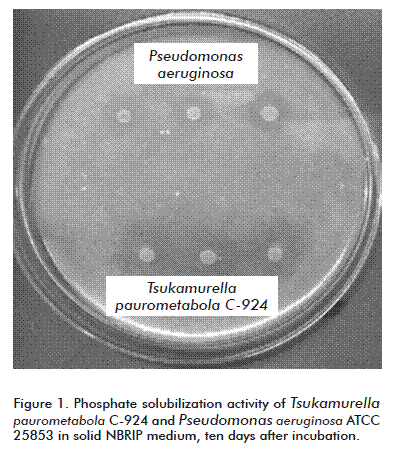
<body><![CDATA[<P   ><font face="Verdana, Arial, Helvetica, sans-serif" size="2">For that purpose,      a strategy was carried out to determine, if present, the vegetal growth promoting      activity of <I>T. paurometabola </I>C-924 and to get insight into the main      underlying mechanisms. This research granted the 2013 Award of the Cuban National      Academy of Sciences. </font></P >       <P   >&nbsp;</P >       <P   ><b><font face="Verdana, Arial, Helvetica, sans-serif" size="3">RESULTS AND DISCUSSION</font></b></P >   <FONT size="+1">        <P   ><font size="2" face="Verdana, Arial, Helvetica, sans-serif">Phytohormone production      is regarded as the major direct vegetal growth promoting mechanism used by      any bacterium to stimulate plant physiology. Particularly, the indoleacetic      acid (IAA) is the best characterized phytohormone of those produced by rizhobacteria,      which regulates key vegetal processes. Therefore, the production of IAA was      evaluated in cultures of <I>T.</I> <I>paurometabola </I>C-924 in Tryptone      soy broth (TSB). The bacterium was able to produce IAA at levels comparable      to those reported by other groups for bacterial strains well characterized      as vegetal growth promoters. Up to 8.06 mg/L IAA concentrations were produced      at stationary state [4], such levels previously reported by Mehnaz <I>et al.      </I>[5] for <I>Pseudomonas putida </I>CR7 and <I>Sphingobacterium canadense      </I>CR 11 isolates in corn. This is the very first report of such activity      for <I>T. paurometabola</I>, and also in the <I>Tsukamurella</I> genera. </font></P >   <FONT size="+1">        <P   ><font face="Verdana, Arial, Helvetica, sans-serif" size="2">Furthermore, phytorhormone      production is not the single mechanism by which a plant-growth-promoting rhizobacteria      (PGPR) can stimulate plants. Such direct effect can be also promoted by increasing      the availability of nutrients in the rhizosphere. Particular attention has      been put on phosphate solubilization from either organic or inorganic sources,      due to phosphate is usually found at very low concentrations in many cultivable      soils [1]. Seeking for evidence on this matter, the phosphate solubilizing      activity of <I>T. paurometabola </I>C-924 was analyzed in NBRIP solid and      liquid media. <I>Pseudomonas aeruginosa </I>ATCC 25922 was used as positive      control. After ten-day incubation at 30 &ordm;C, phosphate solubilization      halos were detected, surrounding the colonies of both microorganisms in solid      culture (<a href="#fig1">Figure 1</a>). Both strains also showed phosphate      solubilizing capacity in liquid cultures under the assayed conditions. Remarkably,      this activity was significantly higher for <I>T. paurometabola </I>C-924 compared      to that of <I>P. aeruginosa </I>ATCC 25922 after 5 days of culture [4]. </font></P >       <P align="center"   ><img src="/img/revistas/bta/v31n2/f0108214.gif" width="391" height="456"><a name="fig1"></a></P >       
<P   ><font face="Verdana, Arial, Helvetica, sans-serif" size="2">Moreover, it has      also been shown that bacterial phytohormones responsible for stimulating root      development would also be indirectly influencing a more efficient capacity      of the plant for phosphate extraction from the soil. That is the reason behind      the dual effect of the so-called &lsquo;biofertilizers&rsquo; by simultaneous      involvement in the direct solubilization of inorganic phosphorous and the      mineralization of the organic one together with the sustained stimulatory      effect on the plant root system, or even for mycorrhizal formation [6]. Since      that point of view, the phosphate solubilization capacity of the <I>T. paurometabola</I>      C-924 strain from an inorganic source together with its potential to produce      IAA, could generate a synergic positive effect on plant development. </font></P >       <P   ><font face="Verdana, Arial, Helvetica, sans-serif" size="2">Another of the plant      nutrients scarce in soil is nitrogen. Since the beginning of the twenty century,      one of the preferred agriculture fertilization techniques comprised the injection      of ammonia into soil. Significantly, it was found that <I>T. paurometabola      </I>C-924 was also a high ammonia producer when cultured in amino acids-rich      broth as TSB. This was caused by the oxidative deamidation process that occurs      during the metabolism of amino acids present in the medium. It is also a very      favorable event, because the ammonia produced by the strain becomes a nitrogen      source for plants when transformed to ammonium in the soil. </font></P >       <P   ><font face="Verdana, Arial, Helvetica, sans-serif" size="2">In a different scenario,      pathogenic microorganisms in the soil are one of the major factors limiting      agricultural yields and crop quality. The huge amounts of agrochemicals used      for its control and its associated damage to soil microbiota and to the functionality      of soil microbial ecosystems, has open opportunities to develop biological      control agents increasingly relevant for sustainable agriculture. A wide range      of microbial compounds have been identified as phytopathogen suppressors,      with the subsequent reduction of plant damage. Defense-related enzymes as      chitinases, peroxidases and lipases are among them [7]. </font></P >       <P   ><font face="Verdana, Arial, Helvetica, sans-serif" size="2">It has been characterized      the attack of microorganisms regarded as antagonists to pathogens by releasing      enzymes which hydrolyze the pathogens cell walls [8]. Some studies are contradictory,      the evidences suggesting a relevant role but not in all the cases. Nevertheless,      the production of lytic enzymes has been traditionally considered as a biological      control mechanism [2]. The reason backing up this assumption is that chitinases,      </font><font size="+1" color="#000000"><font size="+1"><font size="+1"><font size="+1"><font size="+1"><font size="+1"><font size="+1"><font size="+1"><font size="+1"><font size="+1"><font size="+1"><font size="+1"><font size="+1"><font size="+1"><font size="+1"><font size="+1"><font size="+1"><font size="+1"><font size="+1" color="#000000"><font size="+1"><font size="+1"><font size="+1"><font size="+1"><font size="+1"><font size="+1"><font size="+1"><font size="+1"><font size="+1"><font size="+1"><font size="+1"><font size="+1"><font size="+1"><font size="+1"><font size="+1"><font size="+1"><font size="+1"><font size="+1"><font size="+1"><font size="+1"><font size="+1"><font size="+1"><font size="+1"><font size="+1"><font size="+1"><font size="+1"><font size="+1"><font size="+1"><font size="+1"><font size="+1"><font size="+1"><font size="+1"><font size="+1"><font size="+1"><font size="+1"><font size="+1"><font size="+1"><font size="+1"><font size="+1"><font size="+1"><font size="+1"><font size="+1"><font size="+1"><font size="+1"><font size="+1"><font size="+1"><font size="+1"><font size="+1"><font size="+1"><font size="+1"><font size="+1"><font size="+1"><font face="Verdana, Arial, Helvetica, sans-serif" size="2">&beta;</font></font></font></font></font></font></font></font></font></font></font></font></font></font></font></font></font></font></font></font></font></font></font></font></font></font></font></font></font></font></font></font></font></font></font></font></font></font></font></font></font></font></font></font></font></font></font></font></font></font></font></font></font></font></font></font></font></font></font></font></font></font></font></font></font></font></font></font></font></font></font></font><font face="Verdana, Arial, Helvetica, sans-serif" size="2">-glucanases      and proteases can actually degrade the cell wall of pathogenic fungi and oomycetes.      Additionally, chitin and glycan oligomers released by such degradation process      could act as activators of the different plant defense mechanisms [9]. </font></P >       ]]></body>
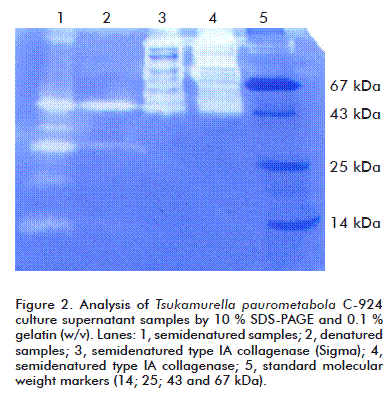
<body><![CDATA[<P   ><font face="Verdana, Arial, Helvetica, sans-serif" size="2">In this line of research,      it was determined that <I>T. paurometabola </I>C-924 secretes chitinases while      cultured in the presence of colloidal chitin. The mean hydrolysis halo diameter      in the wells inoculated with <I>T. paurometabola </I>C-924 culture supernatants      (6.2 mm) was significantly similar to the mean diameter seen in wells inoculated      with <I>Serratia marcescens </I>ATCC 13880 (6.6 mm) as a positive control.      </font></P >       <P   ><font face="Verdana, Arial, Helvetica, sans-serif" size="2">It was similarly      investigated the production of proteases by <I>T. paurometabola </I>C-924      in TSB; halos were detected in gelatin hydrolysis assays. Significantly, it      was possible to correlate the excretion of these proteins into the medium      as related to the microorganism cellular growth. The enzyme activity was corroborated,      and the proteases molecular weight characterized by electrophoresis of semi      and fully denatured samples of <I>T. paurometabola </I>C-924 culture supernatants.      Gelatin hydrolysis bands were detected in both types of samples near 43 kDa,      which matched with controls of collagenase IA (<a href="#fig2">Figure 2</a>).      Proteases are not relevant just for antagonist effect on microorganisms. They      also play a key role in the supply of nitrogen in a metabolic compatible form      for plants absorption and nutrition. In this sense, the proteases excreted      by <I>T. paurometabola </I>C-924 could further promote the growth of the crops      analyzed [4]. </font></P >       <P align="center"   ><img src="/img/revistas/bta/v31n2/f0208214.gif" width="386" height="397"><a name="fig2"></a></P >       
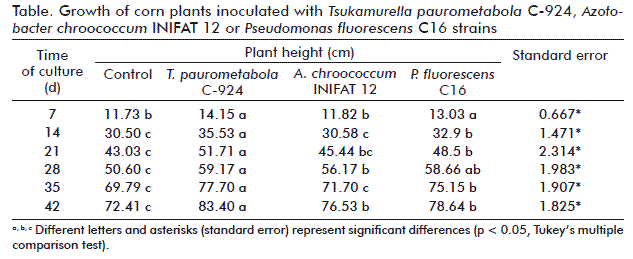
<P   ><font face="Verdana, Arial, Helvetica, sans-serif" size="2">The persistence of      <I>T. paurometabola </I>C-924 in the soils is paramount to exert all the effects      given above. Hence, it was studied, with the strain steadily persisting in      soil over time, with slight crop-dependent variations. In banana, the strain      was found during plantation at an approximate concentration of 10<sup>8</sup>      colony-forming units (c.f.u.) per gram of soil. After 30 days, its viability      was found closely the same, starting to decline afterwards to 10<sup>6</sup>      c.f.u./g at the end of the experiment. A different pattern was observed in      beans and corn, with 10<sup>7</sup> c.f.u./g of soil at plantation after the      second inoculation, which increased until day 14 up to approximately 10<sup>9</sup>      c.f.u./g of soil, further declining to near 10<sup>9</sup> c.f.u./g of soil      at the end of the study. This behavior may have been related to soil drainage      by irrigation, as well as to other biotic or abiotic factors influencing bacterial      survival in the inoculated soils. Noteworthy, it was demonstrated that this      strain is capable to persist once inoculated at populations and for periods      large enough to exert their plant growth-promoting effect </font></P >   <FONT size="+1"><FONT size="+1"><FONT size="+1"><FONT size="+1"><FONT size="+1"><FONT size="+1"><FONT size="+1"><FONT size="+1"><FONT size="+1"><FONT size="+1">        <P   ><font face="Verdana, Arial, Helvetica, sans-serif" size="2">Crop variety and      species also influence the effectiveness of biofertilizer strains for plant      growth. For this reason, experiments were run to corroborate the activity      of <I>T. paurometabola</I> C-924 in banana, and in economically relevant species      other than the original one (beans and corn). These are highly demanded crops      requiring harvest yield improvement and substitution of consumables such as      fertilizers. Interaction experiments in beans and corn showed that <I>T. paurometabola</I>      C-924 significantly stimulated seed germination after inoculation, compared      to non-inoculated controls. This effect could be derived from its ability      to produce IAA, which stimulates seed germination and general development      of plants, among other functions [10]. The inoculation with PGPRs producing      IAA was previously used to stimulate seed germination, accelerate root growth,      modify the radical system architecture and increase root biomass [11]. </font></P >       <P   ><font face="Verdana, Arial, Helvetica, sans-serif" size="2">In general, the inoculation      of soils with <I>T. paurometabola</I> C-924 significantly influenced the development      of crops under study. During its interaction with banana plants it significantly      raised the plant fresh weight. Similarly, endophytic <I>Rhizobium</I> strains      isolated from banana roots increased plant development in height and yields      [12]. </font></P >       <P   ><font face="Verdana, Arial, Helvetica, sans-serif" size="2">It was possible to      determine that the inoculation of soils with <I>T. paurometabola</I> C-924      significantly affected the nodulation process of <I>Rhizobium leguminosarum</I>      biovar <I>phaseoli </I>CFH, since higher nodule formation was seen in treatments      lacking <I>T. paurometabola</I> C-924, including the control. This fact suggested      the presence of native strains in the soil. On the other hand, <I>T. paurometabola</I>      C-924 releases large amounts of ammonia during the degradation of organic      matter. Those high levels of nitrogen in the soil could inhibit <I>R. leguminosarum</I>      nodule formation in the plant radicular system, by decreasing the plant needs      for that interaction to suffice its nitrogen requirements to grow. Nevertheless,      in our experiments, the changes in nodulation did not negatively impact plant      development. By the contrary, plants receiving <I>T. paurometabola</I> C-924      grew faster and developed more leaves than for the other treatments. This      is possibly due to the intrinsic limitations of the pot plantation system      used, which tends to restrict plant development to some extent. That is why,      it is recommended to step forward to field tests, to ascertain the effect      of this strain not only on phonological variants, but also on crop yields      under field conditions [12]. </font></P >       <P   ><font face="Verdana, Arial, Helvetica, sans-serif" size="2">Particularly in corn,      the inoculation of <I>T. paurometabola</I> C-294 improved plant development      attending to germination, height, stem diameter and number of leaves, compared      to the uninoculated control (<a href="/img/revistas/bta/v31n2/t0108214.gif">Table</a>)      [4]. Similar effects have been reported for <I>Azotobacter chroococcum</I>,      <I>Azospirillum brasilense</I>, <I>P. putida</I> and <I>Bacillus lentus </I>strains,      significantly promoting corn development and production yields [13]. There      were also reports for <I>Enterobacter cloacae</I> CR1, <I>Stenotrophomonas      maltophilia</I> CR3, <I>P. putida</I> CR7, <I>Sphingobacterium canadense</I>      CR11 and <I>Burkholderia phytofirmans</I> E24, all of them increasing the      stem length in corn plants cultured under greenhouse conditions [5]. </font></P >       
<P   ><font face="Verdana, Arial, Helvetica, sans-serif" size="2">Overall, the results      on the interaction of <I>T. paurometabola </I>C-924 with other plant growth      stimulating microorganisms did not show any antagonism with the PGPRs <I>Pseudomonas      fluorescens </I>C 16, <I>A. chroococcum </I>INIFAT 12 and <I>R. leguminosarum      </I>biovar <I>phaseoli </I>CFH. Similarly, crop inoculation with <I>T. paurometabola      </I>C-924 rendered similar or better results than those achieved with the      assayed strains [14]. </font></P >       <P   ><font face="Verdana, Arial, Helvetica, sans-serif" size="2">The internal colonization      of roots by mycorrhizogen fungi, together with water and nutrient supply,      significantly impacts plant physiology. When present, the changes promoted      by mycorrhization provide favorable conditions for plants to healthy grow      and develop, with higher plasticity in their adaptive responses against environmental      changes. In fact, mycorrhization increases their stress- and drought-tolerance      and make them more resistant to the attack of root-targeting pathogens. A      synergic interaction was found in experiments with arbuscular mycorrhizal      fungi, among <I>T. paurometabola</I> C-924, <I>Glomus clarum </I>and <I>Glomus      fasciculatum</I> in lettuce crops. Plants simultaneously treated with <I>T.      paurometabola </I>C-924 and both fungi strains showed a significantly improved      growth compared to independent treatments [15]. </font></P >       ]]></body>
<body><![CDATA[<P   >&nbsp;</P >       <P   ><font size="3"><b><font face="Verdana, Arial, Helvetica, sans-serif">RELEVANCE      OF THE STUDY</font></b></font></P >   <FONT size="+1">        <P   ><font size="2" face="Verdana, Arial, Helvetica, sans-serif">This was the first      report ever on the vegetal growth-promoting activity for the <I>T. paurometabola</I>      species, together with demonstration on its ability for phosphate solubilization      and to produce IAA, ammonia and lytic exoenzymes. These activities pave the      way for the use of <I>T. paurometabola</I> C-924 as vegetal stimulator in      the form of biofertilizer for different agricultural systems and expand the      spectrum of use of the HeberNem bionematicide. This scientific result was      the base for a patent granted in Cuba, the European Union, South Africa and      other countries. </font></P >       <P   >&nbsp;</P >   <FONT size="+1">        <P   ><font size="3" face="Verdana, Arial, Helvetica, sans-serif"><b>CONCLUSIONS</b></font></P >   <FONT size="+1">        <P   ><font face="Verdana, Arial, Helvetica, sans-serif" size="2"><I>T. paurometabola</I>      C-924 has the ability to produce IAA, to solubilize phosphates, excrete chitinases      and proteases, and to produce ammonia from amino acids, altogether enriching      the rizosphere with nutrients required for plant growth. This strain was capable      of stimulating germination and growth of banana, beans and corn crops under      greenhouse conditions, while stimulating the growth of arbuscular mycorrizae.      In summary, this bacterium certainly has vegetal growth-promoting activity,      besides its nematicidal effect, further expanding its spectrum of use as biofertilizer      in different systems of economically relevant crops. </font></P >       <P   >&nbsp;</P >   <FONT size="+1">        <P   ><font size="2" face="Verdana, Arial, Helvetica, sans-serif"><B><font size="3">ACKNOWLEDGEMENTS</font>      </B> </font></P >   <FONT size="+1">        <P   ><font face="Verdana, Arial, Helvetica, sans-serif" size="2">The authors are grateful      for the support provided by the Soil Experimental Station and the Province      Laboratory of Vegetal Health in Camag&uuml;ey, Cuba, while conducting this      research. </font></P >       <P   >&nbsp;</P >   <FONT size="+1">        ]]></body>
<body><![CDATA[<P   > </P >       <P   ><b><font face="Verdana, Arial, Helvetica, sans-serif" size="3">REFERENCES </font></b></P >       <!-- ref --><P   ><font size="2" face="Verdana, Arial, Helvetica, sans-serif">1. Compant S, Cl&eacute;ment      C, Sessitsch A. Plant growth-promoting bacteria in the rhizo- and endosphere      of plants: Their role, colonization, mechanisms involved and prospects for      utilization. Soil Biol Biochem. 2010;42(5):669-78.    </font></P >       <P   ><font size="2" face="Verdana, Arial, Helvetica, sans-serif">2. Siddiqui ZA. PGPR:      Prospective biocontrol agents of plant pathogens. In: Siddiqui ZA, editor.      PGPR: Biocontrol and Biofertilization. Dordrecht: Springer; 2006. p. 111-42.</font></P >       <P   ><font size="2" face="Verdana, Arial, Helvetica, sans-serif">3. Compte O, Leon      L, Mar&iacute;n M, Mena J, Pujol M, Hern&aacute;ndez AM, et al., inventors;      Mena J, Pimentel E, Hern&aacute;ndez AT, Veloz L, Mar&iacute;n M, Compte O,      et al, assignee. Pesticidal and Antiparasitic Compositions. United States      patent US 20040071663 A1. 2004 April 15.</font></P >       <!-- ref --><P   ><font size="2" face="Verdana, Arial, Helvetica, sans-serif">4. Mar&iacute;n M,      Wong I, Mena J, Mor&aacute;n R, Pimentel E, S&aacute;nchez I, et al. Zea mays      L. plant growth promotion by Tsukamurella paurometabola strain C-924. Biotecnol      Apl. 2013;30(2):105-10.     </font></P >       <!-- ref --><P   ><font size="2" face="Verdana, Arial, Helvetica, sans-serif">5. Mehnaz S, Kowalik      T, Reynolds B, Lazarovits G. Growth promoting effects of corn (Zea mays) bacterial      isolates under greenhouse and field conditions. Soil Biol Biochem. 2010;42(10):1848-56.          </font></P >       ]]></body>
<body><![CDATA[<!-- ref --><P   ><font size="2" face="Verdana, Arial, Helvetica, sans-serif">6. Mart&iacute;nez-Viveros      O, Jorquera MA, Crowley DE, Gajardo G, Mora ML. Mechanisms and practical considerations      involved in plant growth promotion by rhizobacteria. J Soil Sci Plant Nutr.      2010;10(3):293-319.    </font></P >       <!-- ref --><P   ><font size="2" face="Verdana, Arial, Helvetica, sans-serif">7. Myresiotis CK,      Karaoglanidis GS, Vryzas Z, Papadopoulou-Mourkidou E. Evaluation of plant-growth-promoting      rhizobacteria, acibenzolar-S-methyl and hymexazol for integrated control of      Fusarium crown and root rot on tomato. Pest Manag Sci. 2012;68(3):404-11.    </font></P >       <!-- ref --><P   ><font size="2" face="Verdana, Arial, Helvetica, sans-serif">8. Mendes R, Kruijt      M, de Bruijn I, Dekkers E, van der Voort M, Schneider JH, et al. Deciphering      the rhizosphere microbiome for disease-suppressive bacteria. Science. 2011;332(6033):1097-100.    </font></P >       <!-- ref --><P   ><font size="2" face="Verdana, Arial, Helvetica, sans-serif">9. Karthikeyan M,      Jayakumar V, Radhika K, Bhaskaran R, Velazhahan R, Alice D. Induction of resistance      in host against the infection of leaf blight pathogen (Alternaria palandui)      in onion (Allium cepa var aggregatum). Indian J Biochem Biophys. 2005;42(6):371-7.    </font></P >       <!-- ref --><P   ><font size="2" face="Verdana, Arial, Helvetica, sans-serif">10. Kovaleva LV,      Zakfiarova EV, Minkina YV, Voronkov AS. Effects of flavonols and phytohormones      on germination and growth of petunia male gametophyte. Allelopathy J. 2009;23(1):51-61.    </font></P >       ]]></body>
<body><![CDATA[<!-- ref --><P   ><font size="2" face="Verdana, Arial, Helvetica, sans-serif">11. Tsavkelova EA,      Cherdyntseva TA, Botina SG, Netrusov AI. Bacteria associated with orchid roots      and microbial production of auxin. Microbiol Res. 2007;162(1):69-76.    </font></P >       <!-- ref --><P   ><font size="2" face="Verdana, Arial, Helvetica, sans-serif">12. Mart&iacute;nez-Romero,      E. Diversity of Rhizobium-Phaseolus vulgaris symbiosis: overview and perspectives.      Plant Soil. 2003;252(1):11-23.    </font></P >       <!-- ref --><P   ><font size="2" face="Verdana, Arial, Helvetica, sans-serif">13. Yazdani M, Bahmanyar      MA, Pirdashti H, Esmaili MA. Effect of phosphate solubilization microorganisms      (PSM) and plant growth promoting rhizobacteria (PGPR) on yield and yield components      of corn (Zea mays L.). Proc World Acad Sci Engineer Technol. 2009;49:90-2.    </font></P >       <!-- ref --><P   ><font size="2" face="Verdana, Arial, Helvetica, sans-serif">14. Mar&iacute;n      M, Mena J, Chaveli P, Mor&aacute;n R, Pimentel E. Interacci&oacute;n de Tsukamurella      paurometabola C-924 con Rhizobium leguminosarum biovar phaseoli CFH en el      cultivo de frijol. Acta Agron&oacute;mica. 2013;62(1):52-8.    </font></P >       <!-- ref --><P   ><font size="2" face="Verdana, Arial, Helvetica, sans-serif">15. Mar&iacute;n      M, Mena J, Franco R, Pimentel E, S&aacute;nchez I. Effects of the bacterial-fungal      interaction between Tsukamurella paurometabola C-924 and Glomus fasciculatum      and Glomus clarum fungi on lettuce microrrizal colonization and foliar weight.      Biotecnol Apl. 2010;27(1):48-51.     </font></P >       ]]></body>
<body><![CDATA[<P   >&nbsp;</P >       <P   >&nbsp;</P >       <P   ><font size="2" face="Verdana, Arial, Helvetica, sans-serif">Received in December,      2013.    <br>     Accepted in March, 2014.</font></P >       <P   >&nbsp;</P >       <P   >&nbsp;</P >       <P   ><font size="+1" color="#000000"><font size="2" face="Verdana, Arial, Helvetica, sans-serif"><i>Marieta      Mar&iacute;n</i></font></font>. <font size="+1" color="#000000"><font size="+1"><font size="+1"><font size="+1"><font size="+1"><font size="+1"><font size="+1"><font size="+1"><font size="+1"><font size="+1"><font size="+1"><font size="+1"><font size="+1"><font size="+1"><font size="+1"><font size="+1"><font size="+1"><font size="+1"><font size="+1"><font size="+1"><font size="+1"><font size="+1"><font size="+1"><font size="+1"><font size="+1"><font size="+1"><font size="+1"><font size="+1"><font size="2" face="Verdana, Arial, Helvetica, sans-serif">Laboratorio      de Microbiolog&iacute;a, Centro de Ingenier&iacute;a Gen&eacute;tica y Biotecnolog&iacute;a,      CIGB. Circunvalaci&oacute;n Norte y Ave. Finlay, CP 70100, Camag&uuml;ey,      Cuba.</font></font></font></font></font></font></font></font></font></font></font></font></font></font></font></font></font></font></font></font></font></font></font></font></font></font></font></font></font>      <font face="Verdana, Arial, Helvetica, sans-serif" size="2">E-mail: <font color="#000000"><a href="mailto:marieta.marin@cigb.edu.cu">marieta.marin@cigb.edu.cu</a></font>.</font></P >   </font></font></font></font></font></font></font></font></font></font></font></font></font></font></font></font></font></font></font></font></font></font></font></font></font></font></font></font></font></font></font></font></font></font></font></font></font></font></font></font></font></font></font></font></font></font></font></font></font></font></font></font></font></font></font></font></DIV >      ]]></body><back>
<ref-list>
<ref id="B1">
<label>1</label><nlm-citation citation-type="journal">
<person-group person-group-type="author">
<name>
<surname><![CDATA[Compant]]></surname>
<given-names><![CDATA[S]]></given-names>
</name>
<name>
<surname><![CDATA[Clément]]></surname>
<given-names><![CDATA[C]]></given-names>
</name>
<name>
<surname><![CDATA[Sessitsch]]></surname>
<given-names><![CDATA[A]]></given-names>
</name>
</person-group>
<article-title xml:lang="en"><![CDATA[Plant growth-promoting bacteria in the rhizo- and endosphere of plants: Their role, colonization, mechanisms involved and prospects for utilization]]></article-title>
<source><![CDATA[Soil Biol Biochem]]></source>
<year>2010</year>
<volume>42</volume>
<numero>5</numero>
<issue>5</issue>
<page-range>669-78</page-range></nlm-citation>
</ref>
<ref id="B2">
<label>2</label><nlm-citation citation-type="book">
<person-group person-group-type="author">
<name>
<surname><![CDATA[Siddiqui]]></surname>
<given-names><![CDATA[ZA]]></given-names>
</name>
</person-group>
<article-title xml:lang="en"><![CDATA[PGPR: Prospective biocontrol agents of plant pathogens]]></article-title>
<person-group person-group-type="editor">
<name>
<surname><![CDATA[Siddiqui]]></surname>
<given-names><![CDATA[ZA]]></given-names>
</name>
</person-group>
<source><![CDATA[PGPR: Biocontrol and Biofertilization]]></source>
<year>2006</year>
<page-range>111-42</page-range><publisher-loc><![CDATA[Dordrecht ]]></publisher-loc>
<publisher-name><![CDATA[Springer]]></publisher-name>
</nlm-citation>
</ref>
<ref id="B3">
<label>3</label><nlm-citation citation-type="">
<person-group person-group-type="author">
<name>
<surname><![CDATA[Compte]]></surname>
<given-names><![CDATA[O]]></given-names>
</name>
<name>
<surname><![CDATA[Leon]]></surname>
<given-names><![CDATA[L]]></given-names>
</name>
<name>
<surname><![CDATA[Marín]]></surname>
<given-names><![CDATA[M]]></given-names>
</name>
<name>
<surname><![CDATA[Mena]]></surname>
<given-names><![CDATA[J]]></given-names>
</name>
<name>
<surname><![CDATA[Pujol]]></surname>
<given-names><![CDATA[M]]></given-names>
</name>
<name>
<surname><![CDATA[Hernández]]></surname>
<given-names><![CDATA[AM]]></given-names>
</name>
</person-group>
<source><![CDATA[Pesticidal and Antiparasitic Compositions]]></source>
<year></year>
</nlm-citation>
</ref>
<ref id="B4">
<label>4</label><nlm-citation citation-type="journal">
<person-group person-group-type="author">
<name>
<surname><![CDATA[Marín]]></surname>
<given-names><![CDATA[M]]></given-names>
</name>
<name>
<surname><![CDATA[Wong]]></surname>
<given-names><![CDATA[I]]></given-names>
</name>
<name>
<surname><![CDATA[Mena]]></surname>
<given-names><![CDATA[J]]></given-names>
</name>
<name>
<surname><![CDATA[Morán]]></surname>
<given-names><![CDATA[R]]></given-names>
</name>
<name>
<surname><![CDATA[Pimentel]]></surname>
<given-names><![CDATA[E]]></given-names>
</name>
<name>
<surname><![CDATA[Sánchez]]></surname>
<given-names><![CDATA[I]]></given-names>
</name>
</person-group>
<article-title xml:lang="en"><![CDATA[Zea mays L. plant growth promotion by Tsukamurella paurometabola strain C-924]]></article-title>
<source><![CDATA[Biotecnol Apl]]></source>
<year>2013</year>
<volume>30</volume>
<numero>2</numero>
<issue>2</issue>
<page-range>105-10</page-range></nlm-citation>
</ref>
<ref id="B5">
<label>5</label><nlm-citation citation-type="journal">
<person-group person-group-type="author">
<name>
<surname><![CDATA[Mehnaz]]></surname>
<given-names><![CDATA[S]]></given-names>
</name>
<name>
<surname><![CDATA[Kowalik]]></surname>
<given-names><![CDATA[T]]></given-names>
</name>
<name>
<surname><![CDATA[Reynolds]]></surname>
<given-names><![CDATA[B]]></given-names>
</name>
<name>
<surname><![CDATA[Lazarovits]]></surname>
<given-names><![CDATA[G]]></given-names>
</name>
</person-group>
<article-title xml:lang="en"><![CDATA[Growth promoting effects of corn (Zea mays) bacterial isolates under greenhouse and field conditions]]></article-title>
<source><![CDATA[Soil Biol Biochem]]></source>
<year>2010</year>
<volume>42</volume>
<numero>10</numero>
<issue>10</issue>
<page-range>1848-56</page-range></nlm-citation>
</ref>
<ref id="B6">
<label>6</label><nlm-citation citation-type="journal">
<person-group person-group-type="author">
<name>
<surname><![CDATA[Martínez-Viveros]]></surname>
<given-names><![CDATA[O]]></given-names>
</name>
<name>
<surname><![CDATA[Jorquera]]></surname>
<given-names><![CDATA[MA]]></given-names>
</name>
<name>
<surname><![CDATA[Crowley]]></surname>
<given-names><![CDATA[DE]]></given-names>
</name>
<name>
<surname><![CDATA[Gajardo]]></surname>
<given-names><![CDATA[G]]></given-names>
</name>
<name>
<surname><![CDATA[Mora]]></surname>
<given-names><![CDATA[ML]]></given-names>
</name>
</person-group>
<article-title xml:lang="en"><![CDATA[Mechanisms and practical considerations involved in plant growth promotion by rhizobacteria]]></article-title>
<source><![CDATA[J Soil Sci Plant Nutr]]></source>
<year>2010</year>
<volume>10</volume>
<numero>3</numero>
<issue>3</issue>
<page-range>293-319</page-range></nlm-citation>
</ref>
<ref id="B7">
<label>7</label><nlm-citation citation-type="journal">
<person-group person-group-type="author">
<name>
<surname><![CDATA[Myresiotis]]></surname>
<given-names><![CDATA[CK]]></given-names>
</name>
<name>
<surname><![CDATA[Karaoglanidis]]></surname>
<given-names><![CDATA[GS]]></given-names>
</name>
<name>
<surname><![CDATA[Vryzas]]></surname>
<given-names><![CDATA[Z]]></given-names>
</name>
<name>
<surname><![CDATA[Papadopoulou-Mourkidou]]></surname>
<given-names><![CDATA[E]]></given-names>
</name>
</person-group>
<article-title xml:lang="en"><![CDATA[Evaluation of plant-growth-promoting rhizobacteria, acibenzolar-S-methyl and hymexazol for integrated control of Fusarium crown and root rot on tomato]]></article-title>
<source><![CDATA[Pest Manag Sci]]></source>
<year>2012</year>
<volume>68</volume>
<numero>3</numero>
<issue>3</issue>
<page-range>404-11</page-range></nlm-citation>
</ref>
<ref id="B8">
<label>8</label><nlm-citation citation-type="journal">
<person-group person-group-type="author">
<name>
<surname><![CDATA[Mendes]]></surname>
<given-names><![CDATA[R]]></given-names>
</name>
<name>
<surname><![CDATA[Kruijt]]></surname>
<given-names><![CDATA[M]]></given-names>
</name>
<name>
<surname><![CDATA[de Bruijn]]></surname>
<given-names><![CDATA[I]]></given-names>
</name>
<name>
<surname><![CDATA[Dekkers]]></surname>
<given-names><![CDATA[E]]></given-names>
</name>
<name>
<surname><![CDATA[van der Voort]]></surname>
<given-names><![CDATA[M]]></given-names>
</name>
<name>
<surname><![CDATA[Schneider]]></surname>
<given-names><![CDATA[JH]]></given-names>
</name>
</person-group>
<article-title xml:lang="en"><![CDATA[Deciphering the rhizosphere microbiome for disease-suppressive bacteria]]></article-title>
<source><![CDATA[Science]]></source>
<year>2011</year>
<volume>332</volume>
<numero>6033</numero>
<issue>6033</issue>
<page-range>1097-100</page-range></nlm-citation>
</ref>
<ref id="B9">
<label>9</label><nlm-citation citation-type="journal">
<person-group person-group-type="author">
<name>
<surname><![CDATA[Karthikeyan]]></surname>
<given-names><![CDATA[M]]></given-names>
</name>
<name>
<surname><![CDATA[Jayakumar]]></surname>
<given-names><![CDATA[V]]></given-names>
</name>
<name>
<surname><![CDATA[Radhika]]></surname>
<given-names><![CDATA[K]]></given-names>
</name>
<name>
<surname><![CDATA[Bhaskaran]]></surname>
<given-names><![CDATA[R]]></given-names>
</name>
<name>
<surname><![CDATA[Velazhahan]]></surname>
<given-names><![CDATA[R]]></given-names>
</name>
<name>
<surname><![CDATA[Alice]]></surname>
<given-names><![CDATA[D]]></given-names>
</name>
</person-group>
<article-title xml:lang="en"><![CDATA[Induction of resistance in host against the infection of leaf blight pathogen (Alternaria palandui) in onion (Allium cepa var aggregatum)]]></article-title>
<source><![CDATA[Indian J Biochem Biophys]]></source>
<year>2005</year>
<volume>42</volume>
<numero>6</numero>
<issue>6</issue>
<page-range>371-7</page-range></nlm-citation>
</ref>
<ref id="B10">
<label>10</label><nlm-citation citation-type="journal">
<person-group person-group-type="author">
<name>
<surname><![CDATA[Kovaleva]]></surname>
<given-names><![CDATA[LV]]></given-names>
</name>
<name>
<surname><![CDATA[Zakfiarova]]></surname>
<given-names><![CDATA[EV]]></given-names>
</name>
<name>
<surname><![CDATA[Minkina]]></surname>
<given-names><![CDATA[YV]]></given-names>
</name>
<name>
<surname><![CDATA[Voronkov]]></surname>
<given-names><![CDATA[AS]]></given-names>
</name>
</person-group>
<article-title xml:lang="en"><![CDATA[Effects of flavonols and phytohormones on germination and growth of petunia male gametophyte]]></article-title>
<source><![CDATA[Allelopathy J]]></source>
<year>2009</year>
<volume>23</volume>
<numero>1</numero>
<issue>1</issue>
<page-range>51-61</page-range></nlm-citation>
</ref>
<ref id="B11">
<label>11</label><nlm-citation citation-type="journal">
<person-group person-group-type="author">
<name>
<surname><![CDATA[Tsavkelova]]></surname>
<given-names><![CDATA[EA]]></given-names>
</name>
<name>
<surname><![CDATA[Cherdyntseva]]></surname>
<given-names><![CDATA[TA]]></given-names>
</name>
<name>
<surname><![CDATA[Botina]]></surname>
<given-names><![CDATA[SG]]></given-names>
</name>
<name>
<surname><![CDATA[Netrusov]]></surname>
<given-names><![CDATA[AI]]></given-names>
</name>
</person-group>
<article-title xml:lang="en"><![CDATA[Bacteria associated with orchid roots and microbial production of auxin]]></article-title>
<source><![CDATA[Microbiol Res]]></source>
<year>2007</year>
<volume>162</volume>
<numero>1</numero>
<issue>1</issue>
<page-range>69-76</page-range></nlm-citation>
</ref>
<ref id="B12">
<label>12</label><nlm-citation citation-type="journal">
<person-group person-group-type="author">
<name>
<surname><![CDATA[Martínez-Romero]]></surname>
<given-names><![CDATA[E]]></given-names>
</name>
</person-group>
<article-title xml:lang="en"><![CDATA[Diversity of Rhizobium-Phaseolus vulgaris symbiosis: overview and perspectives]]></article-title>
<source><![CDATA[Plant Soil]]></source>
<year>2003</year>
<volume>252</volume>
<numero>1</numero>
<issue>1</issue>
<page-range>11-23</page-range></nlm-citation>
</ref>
<ref id="B13">
<label>13</label><nlm-citation citation-type="journal">
<person-group person-group-type="author">
<name>
<surname><![CDATA[Yazdani]]></surname>
<given-names><![CDATA[M]]></given-names>
</name>
<name>
<surname><![CDATA[Bahmanyar]]></surname>
<given-names><![CDATA[MA]]></given-names>
</name>
<name>
<surname><![CDATA[Pirdashti]]></surname>
<given-names><![CDATA[H]]></given-names>
</name>
<name>
<surname><![CDATA[Esmaili]]></surname>
<given-names><![CDATA[MA]]></given-names>
</name>
</person-group>
<article-title xml:lang="en"><![CDATA[Effect of phosphate solubilization microorganisms (PSM) and plant growth promoting rhizobacteria (PGPR) on yield and yield components of corn (Zea mays L.)]]></article-title>
<source><![CDATA[Proc World Acad Sci Engineer Technol]]></source>
<year>2009</year>
<volume>49</volume>
<page-range>90-2</page-range></nlm-citation>
</ref>
<ref id="B14">
<label>14</label><nlm-citation citation-type="journal">
<person-group person-group-type="author">
<name>
<surname><![CDATA[Marín]]></surname>
<given-names><![CDATA[M]]></given-names>
</name>
<name>
<surname><![CDATA[Mena]]></surname>
<given-names><![CDATA[J]]></given-names>
</name>
<name>
<surname><![CDATA[Chaveli]]></surname>
<given-names><![CDATA[P]]></given-names>
</name>
<name>
<surname><![CDATA[Morán]]></surname>
<given-names><![CDATA[R]]></given-names>
</name>
<name>
<surname><![CDATA[Pimentel]]></surname>
<given-names><![CDATA[E]]></given-names>
</name>
</person-group>
<article-title xml:lang="es"><![CDATA[Interacción de Tsukamurella paurometabola C-924 con Rhizobium leguminosarum biovar phaseoli CFH en el cultivo de frijol]]></article-title>
<source><![CDATA[Acta Agronómica]]></source>
<year>2013</year>
<volume>62</volume>
<numero>1</numero>
<issue>1</issue>
<page-range>52-8</page-range></nlm-citation>
</ref>
<ref id="B15">
<label>15</label><nlm-citation citation-type="journal">
<person-group person-group-type="author">
<name>
<surname><![CDATA[Marín]]></surname>
<given-names><![CDATA[M]]></given-names>
</name>
<name>
<surname><![CDATA[Mena]]></surname>
<given-names><![CDATA[J]]></given-names>
</name>
<name>
<surname><![CDATA[Franco]]></surname>
<given-names><![CDATA[R]]></given-names>
</name>
<name>
<surname><![CDATA[Pimentel]]></surname>
<given-names><![CDATA[E]]></given-names>
</name>
<name>
<surname><![CDATA[Sánchez]]></surname>
<given-names><![CDATA[I]]></given-names>
</name>
</person-group>
<article-title xml:lang="en"><![CDATA[Effects of the bacterial-fungal interaction between Tsukamurella paurometabola C-924 and Glomus fasciculatum and Glomus clarum fungi on lettuce microrrizal colonization and foliar weight]]></article-title>
<source><![CDATA[Biotecnol Apl]]></source>
<year>2010</year>
<volume>27</volume>
<numero>1</numero>
<issue>1</issue>
<page-range>48-51</page-range></nlm-citation>
</ref>
</ref-list>
</back>
</article>