<?xml version="1.0" encoding="ISO-8859-1"?><article xmlns:mml="http://www.w3.org/1998/Math/MathML" xmlns:xlink="http://www.w3.org/1999/xlink" xmlns:xsi="http://www.w3.org/2001/XMLSchema-instance">
<front>
<journal-meta>
<journal-id>1027-2852</journal-id>
<journal-title><![CDATA[Biotecnología Aplicada]]></journal-title>
<abbrev-journal-title><![CDATA[Biotecnol Apl]]></abbrev-journal-title>
<issn>1027-2852</issn>
<publisher>
<publisher-name><![CDATA[Editorial Elfos Scientiae]]></publisher-name>
</publisher>
</journal-meta>
<article-meta>
<article-id>S1027-28522014000300001</article-id>
<title-group>
<article-title xml:lang="en"><![CDATA[Evolutionary, physiological and biotechnological aspects of ferrochelatase and heme in higher plants]]></article-title>
<article-title xml:lang="es"><![CDATA[Aspectos evolutivos, fisiológicos y biotecnológicos de la ferroquelatasa y hemo en plantas superiores]]></article-title>
</title-group>
<contrib-group>
<contrib contrib-type="author">
<name>
<surname><![CDATA[Ortega-Rodés]]></surname>
<given-names><![CDATA[Patricia]]></given-names>
</name>
<xref ref-type="aff" rid="A01"/>
</contrib>
<contrib contrib-type="author">
<name>
<surname><![CDATA[Grimm]]></surname>
<given-names><![CDATA[Bernhard]]></given-names>
</name>
<xref ref-type="aff" rid="A02"/>
</contrib>
<contrib contrib-type="author">
<name>
<surname><![CDATA[Ortega]]></surname>
<given-names><![CDATA[Eduardo]]></given-names>
</name>
<xref ref-type="aff" rid="A01"/>
</contrib>
</contrib-group>
<aff id="A02">
<institution><![CDATA[,Humboldt University Institute of Biology/Plant Physiology ]]></institution>
<addr-line><![CDATA[Berlin ]]></addr-line>
<country>Germany</country>
</aff>
<aff id="A01">
<institution><![CDATA[,Universidad de La Habana Facultad de Biología Departamento de Biología Vegetal]]></institution>
<addr-line><![CDATA[La Habana ]]></addr-line>
<country>Cuba</country>
</aff>
<pub-date pub-type="pub">
<day>00</day>
<month>09</month>
<year>2014</year>
</pub-date>
<pub-date pub-type="epub">
<day>00</day>
<month>09</month>
<year>2014</year>
</pub-date>
<volume>31</volume>
<numero>3</numero>
<fpage>176</fpage>
<lpage>186</lpage>
<copyright-statement/>
<copyright-year/>
<self-uri xlink:href="http://scielo.sld.cu/scielo.php?script=sci_arttext&amp;pid=S1027-28522014000300001&amp;lng=en&amp;nrm=iso"></self-uri><self-uri xlink:href="http://scielo.sld.cu/scielo.php?script=sci_abstract&amp;pid=S1027-28522014000300001&amp;lng=en&amp;nrm=iso"></self-uri><self-uri xlink:href="http://scielo.sld.cu/scielo.php?script=sci_pdf&amp;pid=S1027-28522014000300001&amp;lng=en&amp;nrm=iso"></self-uri><abstract abstract-type="short" xml:lang="en"><p><![CDATA[Heme, is a cofactor for essential proteins, it is synthesized after the insertion of Fe2+ into protoporphyrin ring by the ferrochelatase (FC) enzyme. Although FC is well described, there are still major questions about the regulation of the heme biosynthetic pathway, and the localization of the enzyme in plants. This review provides a comprehensive survey of research on function and the metabolism of heme in plants including the unique properties of the plant heme metabolism. We will summarize the knowledge of the expression, reaction mechanism, localization and the phylogeny of FC. Increasing the heme iron content in plant foods is a biotechnological challenge to improve the dietary intake of iron in the population; it is known that heme-contained iron is absorbed 5-10 times higher than non-heme iron.]]></p></abstract>
<abstract abstract-type="short" xml:lang="es"><p><![CDATA[El grupo hemo, cofactor para proteínas esenciales, es sintetizado a partir de la inserción de Fe2+ en el anillo de protoporfirina por la enzima ferroquelatasa (FC). A pesar de que FC está bien caracterizada, existen aún incógnitas principales acerca de la regulación de la vía biosintética y la localización de la enzima en las plantas. Este artículo provee una revisión detallada acerca de las investigaciones sobre la función y el metabolismo del hemo en las plantas; incluye además información sobre las características únicas del metabolismo del hemo. Resumimos los conocimientos sobre la expresión, mecanismos de reacción, localización y filogenia de la FC. Incrementar el contenido de hierro hemo en los alimentos de origen vegetal es un gran reto biotecnológico para mejorar la ingesta de hierro en la población; el hierro hemo es de 5-10 veces más absorbido que el hierro no hemo. En esta revisión nosotros sugerimos modificaciones biotecnológicas potenciales en el metabolismo del hemo en las plantas para incrementar la capacidad de los cultivos de resistir los estreses biótico y abiótico y mejorar las cualidades nutricionales de las plantas como fuente de hierro para la dieta.]]></p></abstract>
<kwd-group>
<kwd lng="en"><![CDATA[tetrapyrrole]]></kwd>
<kwd lng="en"><![CDATA[iron]]></kwd>
<kwd lng="en"><![CDATA[evolution]]></kwd>
<kwd lng="en"><![CDATA[biotechnological plant improving]]></kwd>
<kwd lng="es"><![CDATA[tetrapirroles]]></kwd>
<kwd lng="es"><![CDATA[hierro]]></kwd>
<kwd lng="es"><![CDATA[evolución]]></kwd>
<kwd lng="es"><![CDATA[mejoramiento biotecnológico de plantas]]></kwd>
</kwd-group>
</article-meta>
</front><body><![CDATA[ <DIV class="Part"   >        <P align="right"   ><font size="2" color="#000000" face="Verdana, Arial, Helvetica, sans-serif"><b>REVIEW</b>      </font></P >       <P align="right"   >&nbsp;</P >   <FONT size="+1" color="#000000">        <P   ><font face="Verdana, Arial, Helvetica, sans-serif" size="4"><b>Evolutionary,      physiological and biotechnological aspects of ferrochelatase and heme in higher      plants </b></font></P >       <P   > </P >       <P   >&nbsp;</P >       <P   ><b><font face="Verdana, Arial, Helvetica, sans-serif" size="3">Aspectos evolutivos,      fisiol&oacute;gicos y biotecnol&oacute;gicos de la ferroquelatasa y hemo en      plantas superiores </font></b></P >       <P   > </P >       <P   >&nbsp;</P >       <P   >&nbsp;</P >       ]]></body>
<body><![CDATA[<P   ><font face="Verdana, Arial, Helvetica, sans-serif" size="2"><b>Patricia Ortega-Rod&eacute;s<sup>1</sup>,      Bernhard Grimm<sup>2</sup>, Eduardo Ortega<sup>1</sup> </b></font></P >   <FONT size="+1"><FONT size="+1"><FONT size="+1"><FONT size="+1"><FONT size="+1"><FONT size="+1">        <P   ><font size="2" face="Verdana, Arial, Helvetica, sans-serif"><sup>1</sup> Laboratorio      de Fisiolog&iacute;a Vegetal, Departamento de Biolog&iacute;a Vegetal, Facultad      de Biolog&iacute;a, Universidad de La Habana, La Habana, Cuba.    <br>     <sup> 2</sup> Institute of Biology/Plant Physiology, Humboldt University,      Philippstr.13, Building 12, 10115 Berlin, Germany. </font></P >       <P   >&nbsp;</P >       <P   >&nbsp;</P >   </font></font></font></font></font></font></font>   <hr>   <FONT size="+1" color="#000000"><FONT size="+1"><FONT size="+1"><FONT size="+1"><FONT size="+1"><FONT size="+1"><FONT size="+1">        <P   ><b><font face="Verdana, Arial, Helvetica, sans-serif" size="2">ABSTRACT </font></b></P >   <FONT size="+1"><FONT size="+1"><FONT size="+1"><FONT size="+1">        <P   ><font face="Verdana, Arial, Helvetica, sans-serif" size="2">Heme, is a cofactor      for essential proteins, it is synthesized after the insertion of Fe<sup>2+</sup>      into protoporphyrin ring by the ferrochelatase (FC) enzyme. Although FC is      well described, there are still major questions about the regulation of the      heme biosynthetic pathway, and the localization of the enzyme in plants. This      review provides a comprehensive survey of research on function and the metabolism      of heme in plants including the unique properties of the plant heme metabolism.      We will summarize the knowledge of the expression, reaction mechanism, localization      and the phylogeny of FC. Increasing the heme iron content in plant foods is      a biotechnological challenge to improve the dietary intake of iron in the      population; it is known that heme-contained iron is absorbed 5-10 times higher      than non-heme iron. In this review we suggest potential biotechnological modifications      of plant heme metabolism for increasing the capacity of crop plants to resist      abiotic and biotic stress, thus improving food and fodder plants as source      of dietary iron </font></P >   <FONT size="+1"><FONT size="+1">        <P   ><font face="Verdana, Arial, Helvetica, sans-serif" size="2"><b>Keywords:</b>      tetrapyrrole, iron, evolution, biotechnological plant improving.</font></P >   </font></font></font></font></font></font></font></font></font></font></font></font></font>   <hr>   <FONT size="+1" color="#000000"><FONT size="+1"><FONT size="+1"><FONT size="+1"><FONT size="+1"><FONT size="+1"><FONT size="+1"><FONT size="+1"><FONT size="+1"><FONT size="+1"><FONT size="+1"><FONT size="+1"><FONT size="+1">        <P   ><font size="2" face="Verdana, Arial, Helvetica, sans-serif"><b>RESUMEN</b></font></P >       <P   > </P >       ]]></body>
<body><![CDATA[<P   ><font face="Verdana, Arial, Helvetica, sans-serif" size="2">El grupo hemo, cofactor      para prote&iacute;nas esenciales, es sintetizado a partir de la inserci&oacute;n      de Fe<sup>2+</sup> en el anillo de protoporfirina por la enzima ferroquelatasa      (FC). A pesar de que FC est&aacute; bien caracterizada, existen a&uacute;n      inc&oacute;gnitas principales acerca de la regulaci&oacute;n de la v&iacute;a      biosint&eacute;tica y la localizaci&oacute;n de la enzima en las plantas.      Este art&iacute;culo provee una revisi&oacute;n detallada acerca de las investigaciones      sobre la funci&oacute;n y el metabolismo del hemo en las plantas; incluye      adem&aacute;s informaci&oacute;n sobre las caracter&iacute;sticas &uacute;nicas      del metabolismo del hemo. Resumimos los conocimientos sobre la expresi&oacute;n,      mecanismos de reacci&oacute;n, localizaci&oacute;n y filogenia de la FC. Incrementar      el contenido de hierro hemo en los alimentos de origen vegetal es un gran      reto biotecnol&oacute;gico para mejorar la ingesta de hierro en la poblaci&oacute;n;      el </font><FONT size="+1"><FONT size="+1"></font></font><font face="Verdana, Arial, Helvetica, sans-serif" size="2">hierro      hemo es de 5-10 veces m&aacute;s absorbido que el hierro no hemo. En esta      revisi&oacute;n nosotros sugerimos modificaciones biotecnol&oacute;gicas potenciales      en el metabolismo del hemo en las plantas para incrementar la capacidad de      los cultivos de resistir los estreses bi&oacute;tico y abi&oacute;tico y mejorar      las cualidades nutricionales de las plantas como fuente de hierro para la      dieta. </font></P >   <FONT size="+1"><FONT size="+1">        <P   ><font face="Verdana, Arial, Helvetica, sans-serif" size="2"><b>Palabras clave:</b>      tetrapirroles, hierro, evoluci&oacute;n, mejoramiento biotecnol&oacute;gico      de plantas.</font></P >   </font></font></font></font></font></font></font></font></font></font></font></font></font></font></font>   <hr>   <FONT size="+1" color="#000000"><FONT size="+1"><FONT size="+1"><FONT size="+1"><FONT size="+1"><FONT size="+1"><FONT size="+1"><FONT size="+1"><FONT size="+1"><FONT size="+1"><FONT size="+1"><FONT size="+1"><FONT size="+1"><FONT size="+1"><FONT size="+1">        <P   >&nbsp;</P >       <P   >&nbsp;</P >       <P   ><b><font face="Verdana, Arial, Helvetica, sans-serif" size="3">INTRODUCTION </font></b></P >       <P   ><font size="2" face="Verdana, Arial, Helvetica, sans-serif">During the past decades,      a significant increase of reports became evident on studies of successful      attempts to apply genetic engineering to multiple plant species, variants      and cultivars which highlight the potential to improve their yield, herbicide      resistance and stress resistance among others characteristics [1-5]. </font></P >   <FONT size="+1">        <P   ><font face="Verdana, Arial, Helvetica, sans-serif" size="2">Transgenic plants,      in which the tetrapyrrole biosynthetic pathway was genetically modified are      potentially useful for agricultural and horticultural applications [6]. None      of these studies with transformants included modified ferrochelatase (FC)      expression or attempts to improve heme production. </font></P >       <P   ><font face="Verdana, Arial, Helvetica, sans-serif" size="2">Here we outline a      few principles for the use of transgenic plants with modified heme biosynthesis.      Two aspects can be considered for this biotechnological approach to modify      plant heme synthesis: 1) plants as heme iron source in food and fodder production      2) heme and its role in stress defense. </font></P >       <P   ><font face="Verdana, Arial, Helvetica, sans-serif" size="2">Heme is an essential      molecule for all living organisms; it is the prosthetic group of several apoproteins,      including hemoglobin, cytochromes, which are involved in the electron transport      chains of photosynthesis and respiration, peroxidases, catalases, nitrite      reductase and nitric oxide synthase and many more. </font></P >       <P   ><font face="Verdana, Arial, Helvetica, sans-serif" size="2">Heme iron from animal      food is relatively soluble and is absorbed by specific receptors. Iron is      then released by the action of heme oxygenase (HO) and enters the labile cytosolic      iron pool as ferrous iron (Fe<sup>2+</sup>). Non-heme iron is more heterogeneous      and is often present as poorly soluble ferric iron (Fe<sup>3+</sup>) or as      iron tightly bound to chelators [7]. In human, the percentage of absorbed      heme-contained iron is 5-10-fold higher than non-heme iron. Although heme      represents only 10-15% of dietary iron in meat-eating populations, it may      account for nearly one-third of absorbed iron [8]. </font></P >   <FONT size="+1"><FONT size="+1"><FONT size="+1"><FONT size="+1">        ]]></body>
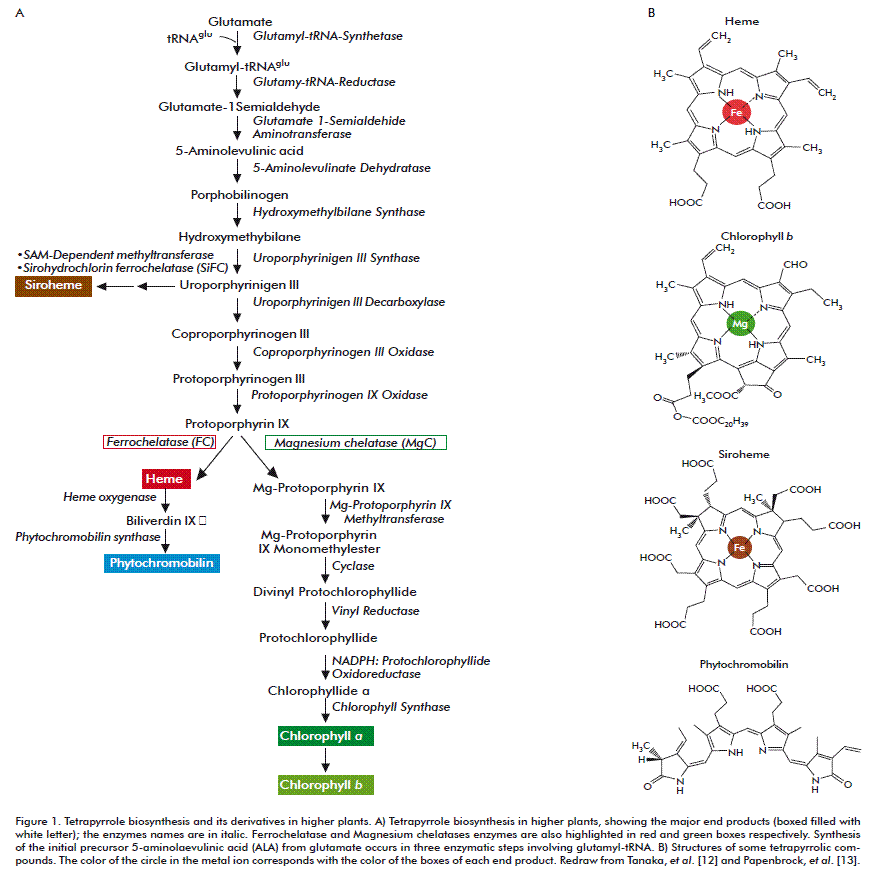
<body><![CDATA[<P   ><font face="Verdana, Arial, Helvetica, sans-serif" size="2">Heme is synthesized      in a universal way and those organisms, which are not able to synthesize heme      de novo, depend on heme supply, by dietary intake. Iron deficiency causes      an enormous problem in world&rsquo;s population, with approximately two billion      people suffering from anemia [9]. Plant food (especially staples like rice,      maize, wheat and beans) tend to be poor sources of dietary iron. Thus, significant      interest exists to generate crop varieties with elevated levels of bioavailable      iron [10]. </font></P >       <P   ><font face="Verdana, Arial, Helvetica, sans-serif" size="2">To date, transgenic      rice lines transformed with the soybean ferritin gene had higher iron and      zinc content in the grain even after polishing the seeds [11]. However, increasing      heme iron in the total iron content in staple food remains an important challenge.      </font></P >       <P   ><font face="Verdana, Arial, Helvetica, sans-serif" size="2">The importance of      engineered food and fodder plants with high heme content is not only because      of the need for higher iron content for nutrition, but also because heme content      can influence the yield and stress tolerance of crops, as we will discuss.      </font></P >       <P   >&nbsp;</P >       <P   ><font size="2" face="Verdana, Arial, Helvetica, sans-serif"><b><font size="3">REGULATION      OF HEME SYNTHESIS</font></b> </font></P >   <FONT size="+1">        <P   ><font size="2" face="Verdana, Arial, Helvetica, sans-serif">The metabolic pathway      of the synthesis of chlorophyll and heme in plants starts from glutamate to      form 5-aminolevulinic acid (ALA) (C5 pathway) (<a href="/img/revistas/bta/v31n3/f0101314.gif">Figure      1</a>). Eight molecules of ALA are assembled to form the tetrapyrrole skeleton.      At first, the linear tetrapyrrole molecule, hydroxymethylbilane is formed,      followed by an isomerization that produces the first cyclic tetrapyrrole,      uroporphyrinogen III. Uroporphyrinogen III can continue along one branch to      produce siroheme or towards the porphyrin branch in which the molecule is      decarboxylated and oxidized to form protoporphyrin IX (ProtoIX). In continuation      from ProtoIX, the pathway has two branches, one for the synthesis of chlorophyll      and another for the synthesis of heme [12, 13]. </font></P >   <FONT size="+1"><FONT color="#D70000">        
<P   ><font color="#000000" face="Verdana, Arial, Helvetica, sans-serif" size="2">The      insertion of divalent metal ions into a range of modified tetrapyrroles is      catalyzed by enzymes of the chelatase type. Magnesium chelatase (MgC; EC 6.6.1.1)      inserts Mg<sup>2+</sup> into ProtoIX generating Mg-ProtoIX as a precursor      for chlorophyll synthesis; ferrochelatase (FC; EC 4.99.1.1) and sirohydrochlorin      ferrochelatase (SiFC; EC 4.99.1.4) insert Fe<sup>2+</sup> into ProtoIX and      uroporphyrinogen III generating either protoheme (heme <I>b</I>) or, siroheme;      cobaltochelatase (CoC; EC 6.6.1.2) insert Co<sup>2+</sup> into hydrogenobyrinic      acid a,c-diamide leading with some additional reactions to cobalamin. </font></P >   <FONT color="#000000"><FONT size="+1"><FONT size="+1"><FONT size="+1"><FONT size="+1"><FONT size="+1"><FONT size="+1">        <P   ><font face="Verdana, Arial, Helvetica, sans-serif" size="2">The distribution      of ProtoIX for either heme or chlorophyll synthesis requires a tight pathway      control to direct the substrate for FC or MgC into the iron or magnesium branch      of tetrapyrrole biosynthesis [14]. FC exists as a monomer or homodimer without      cofactor requirement. MgC consists of three different subunits and requires      ATP as substrate and for activation. ATP inhibits FC activity [15]. MgC has      a <I>K</I><sub>m</sub> for deuteroporphyrin of 8 nM, which is three hundred      times lower than that of FC (2.4 &micro;M); however, it is not excluded that      MgC may compete with FC for the ProtoIX substrate [16, 17]. </font></P >   <FONT size="+1"><FONT size="+1">        <P   ><font face="Verdana, Arial, Helvetica, sans-serif" size="2">In plants, the requirement      of heme and chlorophyll depends among others on cell type, stage of development,      abiotic stress and light-dark cycle. A continuous supply of heme is needed      in all cells to supply heme for respiratory cytochromes and other essential      heme-proteins. Papenbrock, <I>et al</I>. [18] found in tobacco leaves about      40 nmol heme gFW<sup>-1</sup> compared with 1150 nmol chlorophyll g FW<sup>-1</sup>.      This indicates a strong regulatory demand in photosynthetic cells to direct      ProtoIX to MgC. Non-photosynthetic tissue such as roots exclusively synthesizes      heme; chlorophyll formation ultimately depends on the light in angiosperms      [19]. </font></P >   <FONT size="+1"><FONT size="+1"><FONT size="+1"><FONT size="+1">        <P   ><font face="Verdana, Arial, Helvetica, sans-serif" size="2">The activity of FC      oscillates during a 24 h day-night cycle in nearly a reverse amplitude than      the MgC activity [13]. This diurnal oscillation could be a consequence of      different supplies of ATP for the activity of each enzyme. In the light, when      ATP levels are high in chloroplasts, MgC activity is enhanced and FC activity      might be limited. </font></P >       ]]></body>
<body><![CDATA[<P   ><font face="Verdana, Arial, Helvetica, sans-serif" size="2">Another regulator      of the tetrapyrrole pathway is GUN4, which interacts with Mg-chelatase and      stimulates its activity by facilitating substrate binding and/or product release      and possibly the interaction of MgC with chloroplast membranes [20, 21]. </font></P >       <P   ><font face="Verdana, Arial, Helvetica, sans-serif" size="2">It is hypothesized      that pathway control of chlorophyll or heme synthesis in plants includes not      only the temporal regulation but also a spatial separation of the two enzymes      FC and MgC. If the enzymes are located in different subcompartments of chloroplasts,      they would not directly compete for the same pool of substrate. There is contradictory      evidence concerning the localization of these two enzymes in different parts      of chloroplasts. According to Matringe, <I>et al</I>. [16] the activity of      FC was associated only with thylakoid membranes of intact pea chloroplasts      and not detected in highly purified envelope membrane fractions. However,      Roper and Smith [22], localized Arabidopsis FC in the envelope, stroma and      thylakoids from peas (<I>Pisum sativum </I>L<I>.</I>). Suzuki, <I>et al</I>.      [23] did not detect FC in the stroma, but they showed a precursor FC import      to both thylakoid and envelope membranes using isolated pea chloroplast. The      localization of the subunits of Mg-chelatase (ChlH, ChlD, ChlI, ChlM) is particularly      difficult to indicate precisely. Spectral counting reveals that all four subunits      are found in the stroma, but that ChlH is also found in the envelope, whereas      ChlD is also present in thylakoids [24]. ChlH associates with the envelope      membrane at high (5 mM) Mg<sup><sup>2+</sup></sup> concentration, whereas      it is detected in the stroma at lower (1 mM) Mg<sup><sup>2+</sup></sup> concentration      [25]. All these results indicate that localization of both enzymes is still      not entirely elucidated and methodology for spatial characterization has to      be improved. If both enzymes can be detected in the same compartment, the      proposed idea about spatial separation of FC and MgC is obsolete. Then, other      mechanisms are necessary to control substrate channeling in the tetrapyrrole      biosynthesis pathway. </font></P >   <FONT size="+1"><FONT size="+1"><FONT size="+1"><FONT size="+1"><FONT size="+1"><FONT size="+1"><FONT size="+1"><FONT size="+1">        <P   ><font face="Verdana, Arial, Helvetica, sans-serif" size="2">A possible explanation      for the diverse ProtoIX accumulation in the FC and MgC antisense lines could      be the complex channeling mechanism of ProtoIX to the two chelatases. FC antisense      lines with lower FC activity accumulate ProtoIX [26], but the MgC antisense      lines [18] did not accumulate ProtoIX. Once the substrate is dedicated to      heme synthesis, it seems to be inaccessible for the MgC branch, even if both      enzymes are localized in the same organelle and in the same fraction. </font></P >       <P   ><font face="Verdana, Arial, Helvetica, sans-serif" size="2">Up to now we and      other research groups have analyzed the regulatory aspects of heme and chlorophyll      synthesis in the chloroplast only. However, in contrast to chlorophyll confined      to chloroplast, heme is widely distributed in all cellular compartments. Therefore,      it is challenging to clarify, how heme is shuffled into these subcellular      compartments and whether heme synthesis takes place also in plant mitochondria.      </font></P >       <P   >&nbsp;</P >       <P   > </P >       <P   ><font size="3" face="Verdana, Arial, Helvetica, sans-serif"><b>SUBCELLULAR LOCALIZATION      OF FERROCHELATASE IN PLANT TISSUES</b></font><font size="2" face="Verdana, Arial, Helvetica, sans-serif">      </font></P >   <FONT size="+1">        <P   ><font size="2" face="Verdana, Arial, Helvetica, sans-serif">Ferrochelatase is      a nuclear-encoded protein and is translocated to the subcellular site where      it accomplishes its functions. Proteins, like ferrochelatase, that are localized      in organelles require a transit peptide, presequence, signal peptide or any      recognition motif to be precisely targeted to the designated cellular compartment      [27, 28]. </font></P >   <FONT size="+1">        <P   ><font face="Verdana, Arial, Helvetica, sans-serif" size="2">Most reports on plant      heme synthesis address the plastid-localized pathway. Only a few publications      suggest that the last two steps of heme synthesis occur parallel in plant      plastids and mitochondria [29-31]. To date it is still not entirely proven      whether plant mitochondria have their own heme synthesis. The localization      of the two isoforms (FC I and FC II, only described for plants) of ferrochelatase      is an open question because of contradictory findings. All authors agree on      the localization of FC I and FC II within the plastids, but debate about the      presence of FC I in mitochondria. </font></P >       <P   ><font face="Verdana, Arial, Helvetica, sans-serif" size="2">Import experiments      of Arabidopsis FCs into isolated pea chloroplasts and mitochondria showed      that the <I>FC II</I> gene encodes a precursor, which is imported solely into      chloroplast but not into mitochondria. In contrast, FC I could be targeted      to chloroplast and mitochondria in organelle uptake experiments [31]. Similar      results were obtained with <I>Cucumis sativus</I> FCs using an <I>in vitro</I>      import technique of isolated pea organelles and it was demonstrated that FC      II (CsFeC2) was predominantly localized in thylakoid membranes as an intrinsic      protein, but a minor portion was also detected in envelope membranes; FC I      (CsFeC1) was imported into mitochondria and processed to a protein essentially      identical to that imported by chloroplasts [23]. In contrast, Lister, <I>et      al</I>. [32] found that none of <I>Arabidopsis thaliana</I> ferrochelatase      isoforms were imported into Arabidopsis mitochondria. </font></P >   <FONT size="+1"><FONT size="+1"><FONT size="+1"><FONT size="+1">        ]]></body>
<body><![CDATA[<P   ><font face="Verdana, Arial, Helvetica, sans-serif" size="2">Apparently, the body      of evidence is more unequivocal for protoporphyrinogen oxidase [33], the preceding      enzyme of FC. There are clear evidence for the translocation and activity      of PPO in plastids as well as in mitochondria [34]. PPO catalyzes the oxidation      from protoporphyrinogen IX to ProtoIX and was reported to exist in tobacco      in the isoforms I and II, which are located in chloroplasts and mitochondria,      respectively [35]. <I>Spinacia oleracea</I> PPO II has been reported to be      dual-targeted into mitochondria and plastids [36] and perform the oxidation      reaction of protoporphyrinogen IX in both organelles. In plastid, the ProtoIX      is channeled into MgC or FC branch. The successive use of ProtoIX produced      by PPO II by FC in mitochondria is still in question due to the non-conclusive      data about the presence of FC inside this organelle. The potential ability      of FC to perform dual targeting would allow completing the two-step heme synthesis      in mitochondria. Alternatively, an additional function of PPOII in mitochondria      has to be taken into account. </font></P >       <P   ><font face="Verdana, Arial, Helvetica, sans-serif" size="2">Many efforts have      been undertaken to prove detection of FC inside mitochondria but the experimental      evidences of localization remained debatable. Using transgenic lines expressing      fluorescent-tagged FC I Woodson, <I>et al</I>. [37] did not show experiments      that FC I is localized in mitochondria, but FC I was exclusively imported      into plastids. Other authors have also failed with their approaches to show      mitochondrial localization of FC I when plants were transformed with genes      encoding chimeric FC I-GFP. A reason for the outcome of these experiments      could possibly be a different expression level of FC inside plastid and mitochondria.      Singh, <I>et al</I>. [38] found about 110 fold more total ferrochelatase activity      in chloroplast than in the mitochondria of pea plants. It must also be noted      that a bona fide evidence for mitochondria-targeted FC I requires the isolation      of pure and intact mitochondria and a specific anti-FC-antibody. Only isolated      mitochondria could enable measurements of the low FC activity in mitochondria.      Moreover, any chloroplast contamination has to be excluded. It is proposed      that <I>FC I</I> overexpressing lines could contribute to the elucidation      of these challenging questions, when an excessive amount of FC may allow a      prediction which compartment benefits from the increasing heme-synthesizing      capacity. In addition, experiments with FCs isoforms from <I>Oriza sativa</I>      plants show that the FC II has a typical transit sequence (70 amino acids)      for plastid targeting, but isoform I has no apparent transit sequence [39].      </font></P >       <P   ><font face="Verdana, Arial, Helvetica, sans-serif" size="2">Emanuelsson, <I>et      al</I>. [40] developed the TargetP software that is able to discriminate between      proteins which are destined for the translocation into the mitochondrion,      the chloroplast, the secretory pathway, and other localizations using N-terminal      sequence information with a success rate of 85 % for plants. <a href="/img/revistas/bta/v31n3/t0101314.gif">Table      1</a> shows the scores for the mitochondrial/plastidal localization of some      ferrochelatase proteins, especially calculated for this review, using different      available software: TargetP [40]; MitoProtII [41]; iPSORT [42]; TargetLoc      [43]. </font></P >       
<P   ><font face="Verdana, Arial, Helvetica, sans-serif" size="2">We use as positive      controls for mitochondrial prediction FC proteins of human (<I>Homo sapiens</I>),<I>      </I>yeast (<I>Saccharomyces cerevisiae</I>)<I> </I>and red algae (<I>Cyanidioschyzon      merolae</I>) that have been previous demonstrated to be localized in mitochondria      [44-46]. Using TargetP and TargetLoc, the translocalization of the FC of some      plants (<I>Arabidopsis</I> sp., <I>Nicotiana tabacum</I>, <I>Oryza sativa</I>,<I>      Hordeum vulgaris</I>,<I> Cucumis sativus</I>,<I> Zea mays</I> and<I> Solanum      tuberosum</I>) was predicted to be mainly targeted to chloroplasts, but to      lesser extent to mitochondrion or secretory pathway, due to the fact that      the sequences contain a predicted chloroplast transit peptide. The very low      values obtained for mitochondrial targeting mean a low probability that the      protein is targeted into mitochondria. In the case of HvFC1, OsFc1 and ZmFC1the      values were similar for both organelles using TargetP; however using TargetLoc,      mitochondria localization obtained a higher score. </font></P >       <P   ><font face="Verdana, Arial, Helvetica, sans-serif" size="2">For some proteins,      MitoProt II and iPSORT confirmed the prediction of chloroplast targeting.      Using MitoProt II, the isoform FC2 of <I>Arabidopsis lyrata</I> (AlFC2) and      <I>Hordeum vulgaris</I> (HvFC2) was predicted to be targeted to mitochondria      with high probability values (0.9203 and 0.7025 respectively). Using the iPSORT      software, NtFc1, OsFc1, HvFC2 and OsFc2 were predicted to be target to mitochondria.      These results convincingly predict mitochondria localization for some FC proteins      that need to be demonstrated with other experimental methods. The results      obtained and shown in <a href="/img/revistas/bta/v31n3/t0101314.gif">table 1</a> indicate that among      higher plants, <I>Hordeum vulgaris, Oryza sativa</I>, and <I>Zea mays</I>      seem to be promising species for experimental proofs of ferrochelatase translocation      to both organelles. </font></P >       
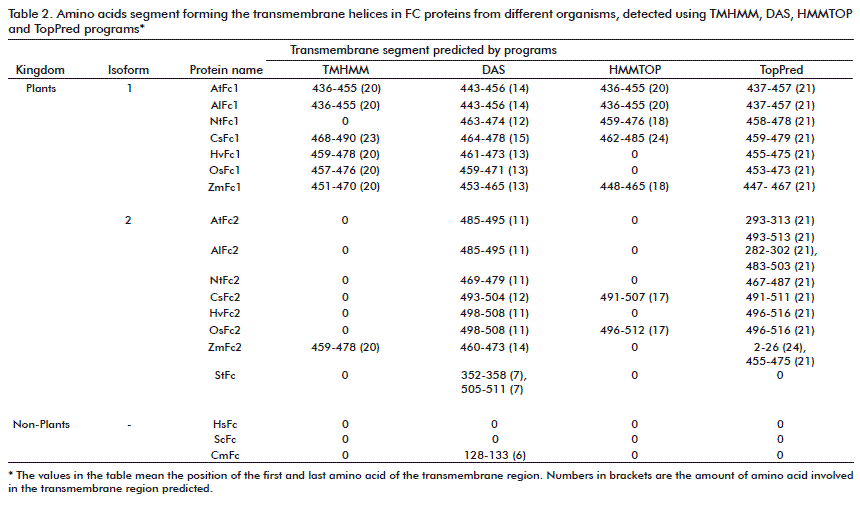
<P   ><font face="Verdana, Arial, Helvetica, sans-serif" size="2">Mitochondrial outer      membrane proteins are synthesized without a cleavable presequence, but contain      a peptide motif responsible for mitochondrial targeting and membrane integration      within the molecule: a transmembrane segment and N- or C-terminal flanking      segments [47]. Except for the <I>B. subtilis</I> enzyme, which is a soluble      protein [48], ferrochelatase has been reported to be a membrane-associated      protein in chloroplasts (located in the inner envelope membrane and the thylakoid      membrane) and in mitochondria (inner membrane) of Eukaryotes, or to be associated      with cytoplasmic membrane in prokaryotes [46, 49]. The use of different software      programs available in the ExPAsy Web (TMHMM [50], DAS [51], HMMTOP [52], TopPred      [53]) reveals in some cases the presence of transmembrane domains (TMD) in      C-terminal parts of the protein with maximum lengths of 24 amino acids (<a href="/img/revistas/bta/v31n3/t0201314.gif">Table      2</a>). The TMD is predicted for all 15 plant FCs tested when using the DAS      and TopPred software; however when using the TMHMM and HMMTOP software programs,      the TMD appears more commonly in the FC I isoform and only rarely in the FC      II isoform. </font></P >       
<P   ><font face="Verdana, Arial, Helvetica, sans-serif" size="2">FC II isoform from      plants as well as cyanobacterial and algal FC possess a carboxyl-terminal      Chl a/b-binding (CAB) domain which forms a putative transmembrane segment      containing a conserved Chl-binding motif [23, 54]. However, FC enzyme truncated      lacking the C-terminal domain in <I>Synechocystis</I> mutant is located almost      exclusively in the membrane fraction [55]. </font></P >       <P   ><font face="Verdana, Arial, Helvetica, sans-serif" size="2">Taken all together      we can assume that the plant FC is not an integral membrane protein, but it      is assumed to be associated with membranes. This is in agreement with previous      findings, when FC has been purified from membrane fractions and its activity      was enhanced with fatty acids [46]. The association of FC with the membrane      could be realized through its own transmembrane motif (as it was predicted      for some FC proteins using different software programs) or by non-ionic interaction      between FC and the membrane or by interaction with other membrane proteins.      In bovine heart mitochondria, FC is associated with Complex I, indicating      that ferrous ion is produced by NADH oxidation in Complex I and is then utilized      for heme synthesis by FC [56]. The association of the enzyme with the membrane      might be a requirement for heme synthesis due to the low solubility of the      substrate (ProtoIX) and the product of the reaction (heme) in aqueous solutions      at neutral pH [57]. </font></P >       <P   ><font face="Verdana, Arial, Helvetica, sans-serif" size="2">The localization      of PPO in plant mitochondria (as well as in plastids) [35, 36] and a possible      association with a putative plant mitochondrial FC would facilitate substrate      (ProtoIX) channeling. Thus, the accumulation of ProtoIX, potentially toxic,      is avoided and the production of heme for the mitochondrial heme proteins      like respiratory cytochromes occurs inside the mitochondria. Nevertheless,      up to now, we are aware on the basis of current data that we only speculate      about the fate of mitochondrial heme synthesis; more efforts should be made      to unravel the subcellular localization of heme synthesis in plants. </font></P >       <P   ><font face="Verdana, Arial, Helvetica, sans-serif" size="2">On the other hand      if there is no FC in the mitochondria, a heme export from chloroplast and      import into mitochondria is necessary to ensure the assembly of heme-binding      proteins assembly. Studies with developing chloroplasts from </font><font face="Verdana, Arial, Helvetica, sans-serif" size="2">greening      cucumber cotyledons have shown that these chloroplasts are capable of heme      efflux with a steady-state rate between 0.12 and 0.45 pmol heme&#8729;minute<sup>-1</sup>mg      plastid proteins<sup>-1</sup> [58]. Direct evidence of heme import into plant      mitochondria is still awaited; the relevant studies have not been published.      </font></P >       ]]></body>
<body><![CDATA[<P   >&nbsp;</P >   <FONT size="+1"><FONT size="+1"><FONT size="+1"><FONT size="+1">        <P   ><font size="2" face="Verdana, Arial, Helvetica, sans-serif"><b><font size="3">HEME      SIGNALING IN PLANTS </font></b></font></P >   <FONT size="+1">        <P   ><font size="2" face="Verdana, Arial, Helvetica, sans-serif">Because the majority      of proteins found in mitochondria and plastid are encoded by nuclear genes,      transcribed in the nucleus, translated in the cytoplasm, and then imported      into mitochondria or plastid [59, 60] the signaling between mitochondria/plastids      and the nucleus is required to maintain organellar biological functions [61,      62]. </font></P >   <FONT size="+1">        <P   ><font face="Verdana, Arial, Helvetica, sans-serif" size="2">Signaling between      organelles and the nucleus is bidirectional by an anterograde and retrograde      control. A number of mechanisms have been evolved to provide a direct control      of organellar gene expression by nuclear genes [63]. Anterograde signaling      originates in the nucleus and can be induced by environmental (e.g. light)      and developmental cues. In contrast, retrograde signaling originates within      the organelles and feeds back to alter the expression of nuclear genes that      encode organelle-localized proteins [14]. </font></P >       <P   ><font face="Verdana, Arial, Helvetica, sans-serif" size="2">Mense and Zhang [64],      Nott, <I>et al</I>. [65] have suggested that tetrapyrrole molecules, such      as Mg porphyrins and heme mediate plastid-to-nucleus or mitochondria-to-nucleus      retrograde signaling to coordinate nuclear gene expression in plants and animals,      respectively. Tetrapyrrole signaling could be a mechanism for coordinating      the cell cycles as well as fine-tuning the transcriptional control in various      processes [66]. However, some other results argue against the function of      tetrapyrrole as signaling molecule, especially Mg-ProtoIX and other chlorophyll      biosynthetic intermediates [67, 68]. </font></P >       <P   ><font face="Verdana, Arial, Helvetica, sans-serif" size="2">Some signal molecules      are necessary to control photosynthesis-associated nuclear gene (PhANGs) expression.      Transgenic Arabidopsis plants over-expressing plastid FC I show increased      PhANGs expression. A specific heme pool produced by FC I was proposed to be      involved in plastid-to-nucleus communication when heme is being exported from      healthy chloroplasts [37]. </font></P >       <P   ><font face="Verdana, Arial, Helvetica, sans-serif" size="2">As we have seen earlier,      heme is part of many important molecules for life; its role as signal and      its participation in regulatory mechanisms has an outstanding relevance. </font></P >       <P   ><font face="Verdana, Arial, Helvetica, sans-serif" size="2">As a product of the      mitochondria, heme is ideally suited to coordinate the expression of mitochondrial      and nuclear genes involved in the biogenesis of the mitochondrial respiratory      complexes [69]. However up to now there are not conclusive evidences about      the mitochondrial origin of heme found in plants. </font></P >       <P   >&nbsp;</P >       <P   > </P >       ]]></body>
<body><![CDATA[<P   ><font size="3"><b><font face="Verdana, Arial, Helvetica, sans-serif">HEME SYNTHESIS      IN TRANSGENIC PLANTS </font></b></font></P >   <FONT size="+1">        <P   ><font size="2" face="Verdana, Arial, Helvetica, sans-serif">As sessile organisms,      plants are generally always affected by external environmental signals and      have to react on these changes by modified gene expression to induce protective      mechanisms. For the application of gene transformation to modify the response      of plants to stresses it is important to identify the &ldquo;useful genes&rdquo;      responsible for better stress tolerance [70]. </font></P >   <FONT size="+1">        <P   ><font face="Verdana, Arial, Helvetica, sans-serif" size="2">Plants possess energy-associated      central network responsible for the survival under stress. This network is      more complex in plants than in animals, using primarily photosynthesis as      the energy donor under optimal growth conditions, or glycolysis, the tricarboxylic      acid (TCA) cycle, and amino acid catabolism upon exposure to stress [71].      Genes encoding most of the enzymes in chlorophyll and heme biosynthesis appeared      to be grouped in the same cluster, indicating that a tightly coordinated stress-induced      regulation of these multiple genes is required for efficient reduction in      the levels of chlorophyll and heme upon exposure to stress. Such a mechanism      may apparently protect plants from the accumulation of toxic reactive oxygen      species derived from unused tetrapyrroles. Because of the chemical properties      of tetrapyrroles as singlet-oxygen generators, it is tempting to speculate      that plants use tetrapyrrole molecules for the singlet-oxygen generation,      which may contribute to ROS-triggered defense or protective response. </font></P >       <P   ><font face="Verdana, Arial, Helvetica, sans-serif" size="2">It is reasonable      that in response to stress the heme content will be increased by <I>de novo</I>      heme synthesis for the completion of cytochrome <I>c </I>inside mitochondria      or the additional demand for heme-containing peroxidases. Pasqualini, <I>et      al</I>. [72] demonstrated that during the programmed cell death induced by      ozone, an early decrease of cytochrome <I>c</I> content occurred by its release      from the mitochondria. Additionally, the induction of <I>FC I</I> gene and      the increase in FC activity under different stress conditions occur, the presumably      by supplying heme for heme-proteins involved in the defense response [38,      73]. </font></P >       <P   ><font face="Verdana, Arial, Helvetica, sans-serif" size="2">It is proposed that      plants with modified capacity to synthesize more heme to avoid the feedback      control on ALA synthesis capacity would be able to respond to stress. This      type of plants would be a useful tool to exploit growth under adverse environment      limiting plant crops growths. </font></P >       <P   ><font face="Verdana, Arial, Helvetica, sans-serif" size="2">To obtain a transgenic      plant with elevated production of heme, it might be necessary to modify more      than one enzymatic step. For heme synthesis, FC needs ProtoIX and Fe<sup>2+</sup>.      The ProtoIX synthesis was discussed previously. The supply of Fe<sup>2+</sup>      to FC depends on different factors: the plant iron supply and metabolism;      the redox state in the cells; the activity of ferric reductase oxidase enzyme      (FRO), the iron transport through the organelle membranes and the iron sequestration      by chaperone molecules. </font></P >   <FONT size="+1"><FONT size="+1"><FONT size="+1"><FONT size="+1">        <P   ><font face="Verdana, Arial, Helvetica, sans-serif" size="2">Iron availability      is often low in soils. Non-grass plants have adopted to the so-called strategy      I, in which Fe(II) transport is coupled to a Fe(III)-chelate reduction step.      Grasses have developed strategy II with phytosiderophores (PS) as relevant      components, chelating Fe(III) [74]. Fe(III)-PS complexes are then taken up      into the root by a specific transporter. In maize, a transporter-Fe(III)-PS      complex is encoded by the <I>Yellow Stripe 1 </I>(<I>YS1</I>) gene [75]. Arabidopsis      Yellow Stripe 1-Like (AtYSL1) provides iron during seed filling in <I>Arabidopsis</I>      [76]. It could be an important step to modify plants used to produce food      seeds; the grains could be heme-iron rich. </font></P >       <P   ><font face="Verdana, Arial, Helvetica, sans-serif" size="2">Distribution of Fe      to the various plant organs involves long-distance transport through the sap      [76]. Once iron has entered the plant, both nicotianamine and citrate serve      as iron chelators. Increasing the expression of <I>nicotianamine synthase      </I></font><font face="Verdana, Arial, Helvetica, sans-serif" size="2">(<I>NAS</I>)      increased the level of bioavailable iron (3.0-fold) in mature rice seeds and      enabled mice after being fed with the transgenic rice seeds to recover rapidly      from anemia [77]. </font></P >       <P   ><font face="Verdana, Arial, Helvetica, sans-serif" size="2">There is very little      free Fe present in the cytosol [78]. It is usually assumed that Fe may pass      freely across the outer membrane of chloroplast and mitochondria via porins.      Permeases in chloroplasts (PIC1) were proposed to transport iron into the      organelle [79]. It is unknown whether Fe(II) or Fe(III) is transported by      PIC1 and whether a Fe(III) chelate reductase is required. </font></P >       <P   ><font face="Verdana, Arial, Helvetica, sans-serif" size="2">Studies in <I>Arabidopsis      </I>describe a member of the ferric reductase oxidase (FRO) which reduces      Fe<sup>3+</sup> to Fe<sup>2+</sup>; FROs may function at the organellar membranes.      FRO7 plays an essential role in iron delivery to chloroplasts [80]; FRO3 and      FRO8 localized in the mitochondria [81] contribute to mitochondrial iron homeostasis.      </font></P >   <FONT size="+1"><FONT size="+1"><FONT size="+1"><FONT size="+1">        ]]></body>
<body><![CDATA[<P   ><font face="Verdana, Arial, Helvetica, sans-serif" size="2">Ferrous iron is then      translocated across the inner membrane by plastid or mitochondria iron transporter.      Experiments using vesicles with isolated inner envelopes from pea chloroplast      indicate that Fe<sup>2+</sup> transport can take place bidirectionally by      the same transporter [82]. Mitochondrial iron transporters are conserved small      proteins that belong to the mitochondrial carrier family localized in the      mitochondrial inner membrane and are involved in solute transport into the      mitochondrial matrix [10]. The first mitochondria iron transporter (MIT) in      plants was described in rice by Bashir, <I>et al</I>. [83]. Rice<I> mit </I>knockdown      mutants exhibit a low growth phenotype, reduced chlorophyll concentration,      poor seed yield and reduced mitochondrial iron concentration. Total iron concentration      in this <I>mit </I>knockdown plants is elevated, indicating that iron is apparently      mis-localized [83]. The excess of cytosolic iron may be directed toward vacuoles      by the vacuolar iron transporter 1 (VIT1). The MIT plays an important role      in seed development and its expression level is positively regulated by iron      availability [10]. </font></P >   <FONT size="+1"><FONT size="+1">        <P   ><font face="Verdana, Arial, Helvetica, sans-serif" size="2">Once the Fe<sup><sup>2+</sup></sup>      is inside the mitochondrial matrix, it is received by an iron chaperone, frataxin      (FH). FH distributes this Fe to the Fe-S cluster assembly proteins and, possibly,      to the heme biosynthetic machinery [10] if the second heme synthesis inside      the mitochondria is also considered. </font></P >   <FONT size="+1"><FONT size="+1">        <P   ><font face="Verdana, Arial, Helvetica, sans-serif" size="2"><I>A. thaliana </I>frataxin-deficient      lines<I> (AtFH)</I> exhibit a decrease in total heme content in leaves and      flowers and alterations in several transcripts from the enzymes involved in      heme biosynthesis; the genetically modified <I>AtFC1</I> and <I>AtFC2 </I>expression      increased about 1.5-2 fold in leaves. Moreover these mutant plants also suffer      from a deficiency of catalase activity, indicating that AtFH, apart from its      role in protecting bioavailable iron within mitochondria and the assembly      of Fe-S groups, also plays a role in the production of heme groups and the      activity of heme-proteins in plants [84]. </font></P >       <P   ><font face="Verdana, Arial, Helvetica, sans-serif" size="2">Because iron reactivity      with organic ligands is very high, a good control for Fe content that includes      accounting for movement and compartmentalization inside the cell is necessary.      The ferritin protein stores iron in a non-toxic form and releases it when      needed for metabolic functions [85]; thus it serves to prevent oxidative damage      [86, 87]. Ferritins exhibit ferroxidase activity oxidizing Fe<sup>2+</sup>      and can accommodate up to 4500 Fe<sup>3+</sup> atoms per ferritin molecule      [88]. The molecular mechanism underlying the release of iron from ferritins      in plants is not described. Plant ferritins are localized mainly in plastids      but they can also be targeted to mitochondria [89]. </font></P >   <FONT size="+1"><FONT size="+1"><FONT size="+1"><FONT size="+1">        <P   ><font face="Verdana, Arial, Helvetica, sans-serif" size="2">Some authors have      found increased Fe content when the expression of ferritin is increased in      rice endosperm [11, 90]. In Arabidopsis it has been demonstrated that ferritins      do not constitute the major seed iron pool, and that the absence of ferritins      does not have an impact on germination or on proper development of the young      plant. Loss of ferritins in vegetative and reproductive organs does result      in sensitivity to excess of iron, as shown by reduced growth and large defects      in flower development [86]. </font></P >       <P   ><font face="Verdana, Arial, Helvetica, sans-serif" size="2">The ferritin content      increases in <I>Lemna minor</I> growing in<I> </I>water highly contaminated      with iron [91]. This small floating monocotyledoneous macrophyte is able to      grow and remove iron from iron rich neutral mine drainage and has a potential      use in iron phytoremediation. The high rate of iron removal, suggests that      the species could be particularly interesting for the decontamination of mine      discharges that are continuously produced, contaminating streams and the rivers      [92]. Modified plants with high capacity to produce ferritin, could improve      the Fe storage in vacuoles and thus avoid cytotoxicity making the Fe unavailable,      thus preventing oxidative stress, while allowing normal development and plant      growth. Plants which had been transformed with the high capacity to remove      iron from contaminating sources would have a potential field of application.      </font></P >       <P   ><font face="Verdana, Arial, Helvetica, sans-serif" size="2">Other genes, encoding      either iron transporter or iron translocation proteins are important for iron      homeostasis. Over-expression of rice Fe transporters OsIRT1 resulted in a      slight rise in Fe concentration in seeds [93]. Rice Fe-nicotianamine transporter      (OsYSL2) is important for Fe translocation, especially in the shoots and endosperm.      When OsYSL2 expression was driven by the sucrose transporter promoter, the      Fe concentration in the polished transformant was up to 4.4-fold higher compared      to the polished wild type seeds [94]. </font></P >       <P   ><font face="Verdana, Arial, Helvetica, sans-serif" size="2">Transgenic approaches,      like manipulation of the ferritin and the iron transporter content as well      as translocation of metals have been used to elevate Fe accumulations in cereal      grains. Any of these biotechnological modifications deal with a heme catabolism      and anabolism. A goal to improve plant iron content for animal and human feeding      implies that plants enhance their iron absorption and transport and that this      iron is ultimately inserted into the Proto IX ring, which is absorbed at higher      percentages than non-heme iron, at least in mammals. This process certainly      needs a finely fine-tuned control for which in turn is necessary to understand      the tetrapyrrole pathway in plants very well.</font></P >       <P   >&nbsp;</P >       <P   > </P >       ]]></body>
<body><![CDATA[<P   ><font size="3"><b><font face="Verdana, Arial, Helvetica, sans-serif">HEME AND      FERROCHELATASE IN THE EVOLUTIONARY PROCESS </font></b></font></P >   <FONT size="+1">        <P   ><font size="2" face="Verdana, Arial, Helvetica, sans-serif">In animals and fungi,      heme synthesis is separated in enzymatic steps located in the cytosol and      in mitochondria, but in plants more recent papers highlight that heme synthesis      most likely takes place only in chloroplasts. A potential mitochondrial heme      synthesis is still under discussion. The idea of a possible mitochondria localization      of plant FC is analyzed here taking into account the evolutionary origin of      plastids and mitochondria and the structural similarity of FC proteins of      photosynthetic and non-photosynthetic organisms. </font></P >   <FONT size="+1">        <P   ><font face="Verdana, Arial, Helvetica, sans-serif" size="2">The endosymbiotic      theory suggests the derivation of plastids and mitochondria of eukaryotic      cells from bacterial endosymbionts [95]. Mitochondria and plastids are proposed      to derive from descendants of &alpha;-proteobacterium- and cyanobacterium-like      progenitors, respectively. The heme biosynthesis in photosynthetic eukaryotes      depends solely upon nucleus-encoded proteins of mixed origin (cyanobacterial      and non-cyanobacterial) [63, 96]. This mix origin could explain a possible      heme pathway in plant mitochondria derived from &alpha;-proteobacterium origin.      </font></P >       <P   ><font face="Verdana, Arial, Helvetica, sans-serif" size="2">Some indications      for the existence of multiple heme biosynthetic pathways can be deduced from      analysis of the tetrapyrrole biosynthetic pathway in <I>Euglena gracilis</I>.      In this organism, ALA is synthesized in two different routes: from glutamate      like in higher plants, and via condensation of glycine and succinyl-CoA, as      it is found in animals. <I>Euglena </I>evolved from an organism which is derived      from a secondary endosymbiotic origin. Weeden [97] recognized that the endosymbiont      introduced novel pathways (for amino acid, heme, and starch syntheses) into      the host via endosymbiosis. </font></P >       <P   ><font face="Verdana, Arial, Helvetica, sans-serif" size="2">Engulfment of a cyanobacterial      ancestor and the subsequent restructuring to semiautonomous organelles within      the eukaryotic host initially led to the formation of four lineages with primary      plastids: the chlorophytes, embryophytes, rhodophytes and glaucophytes [98].      After primary symbiosis, the common ancestor of plants may have retained FC      in both mitochondria and plastids, at least during the first phase. However,      according to recent findings, in plants, FC has only been found in plastids,      but not in mitochondria. In contrast, in the unicellular red algae <I>Cyanidioschyzon      merolae</I>, FC has been detected only in the mitochondria and not in plastids.      Plastids in red algae and in green plants differ significantly from each other      (e.g. in structure and in the light harvesting mechanism) and allow reliably      to distinguish between the red and green plastid lineage [99]. It is suggested      that the different properties of these plastids would influence the capacity      to recognize the FC precursor. </font></P >       <P   ><font face="Verdana, Arial, Helvetica, sans-serif" size="2">During evolution,      the <I>FC</I> gene from the progenitors of the two organelles might be lost,      either the mitochondrial FC from green plants or the plastid FC from red algae      [45]. But not all descendents may have had the same fate. So, it might be      still sensible to continuously examine FC activity in plant mitochondria.      </font></P >       <P   ><font face="Verdana, Arial, Helvetica, sans-serif" size="2"><a href="/img/revistas/bta/v31n3/t0301314.gif">Table      3</a> shows all divisions of organisms belonging to the Viridiplantae harboring      FC sequences, which are published in NCBI data base. The classification was      performed according to Judd, <I>et al</I>. [100]. FC accessions have not been      published in NCBI data base for all genera, classes or divisions, yet. </font></P >       
<P   ><font face="Verdana, Arial, Helvetica, sans-serif" size="2">To date, one hundred      and thirty five FC protein sequences of Viridiplantae have been registered      on NCBI. Only a few of them have been published and characterized. Seed plants      are the group with the highest number (102) of sequences reported in 24 genera,      followed by green algae with 17 sequences in 8 genera, and Bryophytes and      Lycopodiophyta with 8 sequences each. Among the seed plants, the <I>Zea</I>      and <I>Oryza</I> genera have the highest number of reported sequences with      25 and 17, respectively, but some of them are identical. </font></P >       <P   ><font face="Verdana, Arial, Helvetica, sans-serif" size="2">Especially for this      review, a phylogenetic tree of FC proteins was constructed using amino acid      sequences from photosynthetic Eukaryotes, cyanobacteria, &alpha;- and &gamma;-proteobacteria,      fungi, animals, apicomplexa and Archaea. Among the complete FC sequences presented      in NCBI for Eukaryotic photosynthetic organism, we used 23 representatives      of red algae, green algae and land plants for preparing the phylogenetic tree.      The sequences were downloaded from GenBank [101]; accession numbers are given      in the figure caption (<a href="/img/revistas/bta/v31n3/f0201314.gif">Figure 2</a>). Sequences were      aligned using the ClustalX program [102]. Phylogenetic and molecular evolutionary      analyses were conducted with the help of the <I>MEGA</I> software version      5 [103]. The phylogenetic tree was constructed for this review using the maximum      likelihood (ML) method, WAG model and discrete Gamma (G) distribution in five      rate categories assuming that certain peptide motifs and amino acid residues      are evolutionarily invariable (I). </font></P >       
<P   ><font face="Verdana, Arial, Helvetica, sans-serif" size="2">Only one isoform      of FC has been reported in animals, fungi, bacteria and algae, but some plants      have two FC isoforms (I and II). An open question regarding the evolution      of heme synthesis is how plants evolved to possess two isoforms of FC. Here      we address and analyze two possible evolutionary reasons for the existence      of two FC isoforms in plants: 1) Both isoforms were acquired from the different      organelles (plastids or mitochondria dependent from the bacterial endosymbiont)      during the endosymbiotic event or 2) as a result of the gene duplication of      the FC gene acquired from the cyanobacterial ancestor. </font></P >       ]]></body>
<body><![CDATA[<P   ><font face="Verdana, Arial, Helvetica, sans-serif" size="2">Among the photosynthetic      organisms it is possible to distinguish in the phylogenetic tree, a common      ancestor of FCs in cyanobacteria and the plant clade with a bootstrap value      of 100. Both isoforms (I and II) of FC in plants are grouped separately from      other organisms with high bootstrap value (98). </font></P >       <P   ><font face="Verdana, Arial, Helvetica, sans-serif" size="2">According to the      phylogenetic tree, FC of non-photosynthetic organisms (No-Ph-FC) diverged      from photosynthetic organisms (Ph-FC). This divergence could be related to      a functional specialization of FC in photosynthetic and non-photosynthetic      organisms. If the evolutionary origin of FC I were derived from mitochondria      of the non-photosynthetic organism, FC I would appear closer to the groups      of non-photosynthetic organism in the tree. </font></P >       <P   ><font face="Verdana, Arial, Helvetica, sans-serif" size="2">But, the plant FC      I is phylogenetically more related to the plant FC II than to FC localized      in mitochondria from non-photosynthetic organisms, indicating that probably      both plant FC isoforms are derived from independent gene duplication. As was      discussed before about the possible localization of FC I in mitochondria,      it could be due to a secondary specialization associated to this organelle      and is not explained by a gene derived from the mitochondrial ancestor. Thus,      depicted from the phylogenetic tree, even if FC I is located in mitochondria,      the <I>FC I</I> gene is descendent from the cyanobacterial ancestor and its      gene product has an acquired function. </font></P >       <P   >&nbsp;</P >       <P   ><font size="3" face="Verdana, Arial, Helvetica, sans-serif"><b>CONCLUDING REMARKS      </b> </font></P >   <FONT size="+1">        <P   ><font size="2" face="Verdana, Arial, Helvetica, sans-serif">Improving mineral      nutrition through plant biotechnology may be a sustainable strategy to combat      deficiencies in human populations [104]. Improving plant iron content became      a major biotechnological challenge identified by the World Health Organization      [105]. Enhancing the heme iron in fodder plants may be a good strategy for      iron fortification. There are many potential biotechnological avenues to modify      tetrapyrrole biosynthesis in photosynthetic organisms; these new transgenic      plants could also contribute to elevated stress tolerance of plants or intracellular      accumulation of dietary iron for human and animals. </font></P >   <FONT size="+1">        <P   ><font face="Verdana, Arial, Helvetica, sans-serif" size="2">Higher plants, sessile      organisms, are highly affected by the environment and have few possibilities      to escape from abiotic and biotic stresses. Plants instead have evolved a      fine-tuned regulation of metabolism and a complex protection strategy. Two      gene copies of FC with its differential gene expression seem to be part of      this protective concept. As a consequence two pools of heme play different      roles including the regulatory role as a signal molecule for communication      between nucleus and organelles. We do not exclude the FC I as is also translocated      to plant mitochondria, although the more recent reports highlight its localization      in plastids. Three plant species (<I>Hordeum vulgaris</I>, <I>Oryza sativa</I>      and <I>Zea mays</I>)<I> </I>are<I> </I>good candidates to search for FC I      protein translocation to mitochondria. </font></P >       <P   >&nbsp;</P >       <P   ><font size="3" face="Verdana, Arial, Helvetica, sans-serif"><b>ACKNOWLEDGEMENTS      </b> </font></P >   <FONT size="+1">        <P   > </P >   <FONT size="+1" color="#D70000">        ]]></body>
<body><![CDATA[<P   ><font size="2" color="#000000" face="Verdana, Arial, Helvetica, sans-serif">Patricia      Ortega Rod&eacute;s and Eduardo Ortega Delgado express their gratitude to      Jennifer Hosek, Mike Zirkel and Virginia Waddick for helping with the English      language. </font></P >       <P   >&nbsp;</P >   <FONT size="+1" color="#000000">        <P   > </P >       <P   ><b><font face="Verdana, Arial, Helvetica, sans-serif" size="3">REFERENCES </font></b></P >       <!-- ref --><P   > <font size="2" face="Verdana, Arial, Helvetica, sans-serif">1. De Greef W, Delon      R, De Block M, Leemans J, Botterman J. Evaluation of herbicide resistance      in transgenic crops under field conditions. Nature Biotechnol. 1989;7:61-4.          </font></P >       <!-- ref --><P   ><font size="2" face="Verdana, Arial, Helvetica, sans-serif">2. Reguera M, Peleg      Z, Abdel-Tawab YM, Tumimbang EB, Delatorre CA, Blumwald E. Stress-induced      cytokinin synthesis increases drought tolerance through the coordinated regulation      of carbon and nitrogen assimilation in rice. Plant Physiol. 2013;163(4):1609-22.          </font></P >       <!-- ref --><P   ><font size="2" face="Verdana, Arial, Helvetica, sans-serif">3. Penna S. Building      stress tolerance through over-producing trehalose in transgenic plants. Trends      Plant Sci. 2003;8(8):355-7.     </font></P >       ]]></body>
<body><![CDATA[<!-- ref --><P   ><font size="2" face="Verdana, Arial, Helvetica, sans-serif">4. Garg AK, Kim JK,      Owens TG, Ranwala AP, Choi YD, Kochian LV, <I>et al</I>. Trehalose accumulation      in rice plants confers high tolerance levels to different abiotic stresses.      Proc Natl Acad Sci USA. 2002;99(25):15898-903.     </font></P >       <!-- ref --><P   ><font size="2" face="Verdana, Arial, Helvetica, sans-serif">5. Lermontova I,      Grimm B. Overexpression of plastidic protoporphyrinogen IX oxidase leads to      resistance to the diphenyl-ether herbicide acifluorfen. Plant Physiol. 2000;122(1):75-84.          </font></P >       <!-- ref --><P   ><font size="2" face="Verdana, Arial, Helvetica, sans-serif">6. Tanaka R, Tanaka      A. Tetrapyrrole biosynthesis in higher plants. Annu Rev Plant Biol. 2007;58:321-46.          </font></P >       <!-- ref --><P   ><font size="2" face="Verdana, Arial, Helvetica, sans-serif">7. Murgia I, Arosio      P, Tarantino D, Soave C. Biofortification for combating 'hidden hunger' for      iron. Trends Plant Sci. 2012;17(1):47-55.     </font></P >       <!-- ref --><P   ><font face="Verdana, Arial, Helvetica, sans-serif" size="2">8. Cook JD. Adaptation      in iron metabolism. Am J Clin Nutr. 1990;51:301-8.     </font></P >       ]]></body>
<body><![CDATA[<!-- ref --><P   ><font face="Verdana, Arial, Helvetica, sans-serif" size="2">9. Wu AC, Lesperance      L, Bernstein H. Screening for iron deficiency. Pediatr Rev. 2002;23(5):171-8.          </font></P >       <!-- ref --><P   ><font face="Verdana, Arial, Helvetica, sans-serif" size="2">10. Jain A, Connolly      EL. Mitochondrial iron transport and homeostasis in plants. Frontiers Plant      Sci. 2013;4:348.     </font></P >       <!-- ref --><P   ><font face="Verdana, Arial, Helvetica, sans-serif" size="2">11. Vasconcelos M,      Datta K, Oliva N, Khalekuzzaman M, Torrizo L, Krishnan S, <I>et al</I>. Enhanced      iron and zinc accumulation in transgenic rice with the ferritin gene. Plant      Sci. 2003;164(3):371-8.     </font></P >       <P   ><font face="Verdana, Arial, Helvetica, sans-serif" size="2">12. Tanaka R, Kobayashi      K, Masuda T. Tetrapyrrole metabolism in Arabidopsis thaliana. Arabidopsis      Book. 2011;9:e0145. </font></P >       <!-- ref --><P   ><font face="Verdana, Arial, Helvetica, sans-serif" size="2">13. Papenbrock J,      Mock HP, Kruse E, Grimm B. Expression studies in tetrapyrrole biosynthesis:      inverse maxima of magnesium chelatase and ferrochelatase activity during cyclic      photoperiods. Planta. 1999;208(2):264-73.     </font></P >       <!-- ref --><P   ><font face="Verdana, Arial, Helvetica, sans-serif" size="2">14. Papenbrock J,      Grimm B. Regulatory network of tetrapyrrole biosynthesis--studies of intracellular      signalling involved in metabolic and developmental control of plastids. Planta.      2001;213(5):667-81.     </font></P >       <P   ><font face="Verdana, Arial, Helvetica, sans-serif" size="2">15. Cornah JE, Roper      JM, Pal Singh D, Smith AG. Measurement of ferrochelatase activity using a      novel assay suggests that plastids are the major site of haem biosynthesis      in both photosynthetic and non-photosynthetic cells of pea (Pisum sativum      L.). Biochem J. 2002;362(Pt 2):423-32. </font></P >       <!-- ref --><P   ><font face="Verdana, Arial, Helvetica, sans-serif" size="2">16. Matringe M, Camadro      JM, Joyard J, Douce R. Localization of ferrochelatase activity within mature      pea chloroplasts. J Biol Chem. 1994;269(21):15010-5.     </font></P >       <!-- ref --><P   ><font face="Verdana, Arial, Helvetica, sans-serif" size="2">17. Guo R, Luo ML,      Weistein JD. Magnesium-chelatase from developing Pea leaves. Characterization      of a Soluble Extract from Chloroplasts and Resolution into Three Required      Protein Fractions. Plant Physiol. 1998;116(2):605-15.     </font></P >       <!-- ref --><P   ><font face="Verdana, Arial, Helvetica, sans-serif" size="2">18. Papenbrock J,      Pfundel E, Mock HP, Grimm B. Decreased and increased expression of the subunit      CHL I diminishes Mg chelatase activity and reduces chlorophyll synthesis in      transgenic tobacco plants. Plant J. 2000;22(2):155-64.     </font></P >       <!-- ref --><P   ><font face="Verdana, Arial, Helvetica, sans-serif" size="2">19. Mohanty S, Grimm      B, Tripathy BC. Light and dark modulation of chlorophyll biosynthetic genes      in response to temperature. Planta. 2006;224(3):692-9.     </font></P >       ]]></body>
<body><![CDATA[<!-- ref --><P   ><font face="Verdana, Arial, Helvetica, sans-serif" size="2">20. Adhikari ND,      Orler R, Chory J, Froehlich JE, Larkin RM. Porphyrins promote the association      of GENOMES UNCOUPLED 4 and a Mg-chelatase subunit with chloroplast membranes.      J Biol Chem. 2009;284(37):24783-96.     </font></P >       <!-- ref --><P   ><font face="Verdana, Arial, Helvetica, sans-serif" size="2">21. Larkin RM, Alonso      JM, Ecker JR, Chory J. GUN4, a regulator of chlorophyll synthesis and intracellular      signaling. Science. 2003;299(5608):902-6.     </font></P >       <!-- ref --><P   ><font face="Verdana, Arial, Helvetica, sans-serif" size="2">22. Roper JM, Smith      AG. Molecular localisation of ferrochelatase in higher plant chloroplasts.      Eur J Biochem. 1997;246(1):32-7.     </font></P >       <!-- ref --><P   ><font face="Verdana, Arial, Helvetica, sans-serif" size="2">23. Suzuki T, Masuda      T, Singh DP, Tan FC, Tsuchiya T, Shimada H, <I>et al</I>. Two types of ferrochelatase      in photosynthetic and nonphotosynthetic tissues of cucumber: their difference      in phylogeny, gene expression, and localization. J Biol Chem. 2002;227:4731-7.          </font></P >       <!-- ref --><P   ><font face="Verdana, Arial, Helvetica, sans-serif" size="2">24. Joyard J, Ferro      M, Masselon C, Seigneurin-Berny D, Salvi D, Garin J, <I>et al</I>. Chloroplast      proteomics and the compartmentation of plastidial isoprenoid biosynthetic      pathways. Mol Plant. 2009;2(6):1154-80.     </font></P >       ]]></body>
<body><![CDATA[<!-- ref --><P   ><font face="Verdana, Arial, Helvetica, sans-serif" size="2">25. Nakayama M, Masuda      T, Bando T, Yamagata H, Ohta H, Takamiya K. Cloning and expression of the      soybean chlH gene encoding a subunit of Mg-chelatase and localization of the      Mg2+ concentration-dependent ChlH protein within the chloroplast. Plant Cell      Physiol. 1998;39(3):275-84.     </font></P >       <!-- ref --><P   ><font face="Verdana, Arial, Helvetica, sans-serif" size="2">26. Papenbrock J,      Mishra S, Mock HP, Kruse E, Schmidt EK, Petersmann A, <I>et al</I>. Impaired      expression of the plastidic ferrochelatase by antisense RNA synthesis leads      to a necrotic phenotype of transformed tobacco plants. Plant J. 2001;28(1):41-50.          </font></P >       <!-- ref --><P   ><font face="Verdana, Arial, Helvetica, sans-serif" size="2">27. Schatz G, Dobberstein      B. Common principles of protein translocation across membranes. Science. 1996;271(5255):1519-26.          </font></P >       <!-- ref --><P   ><font face="Verdana, Arial, Helvetica, sans-serif" size="2">28. Rusch SL, Kendall      DA. Protein transport via amino-terminal targeting sequences: common themes      in diverse systems. Mol Membr Biol. 1995;12(4):295-307.     </font></P >       <!-- ref --><P   ><font face="Verdana, Arial, Helvetica, sans-serif" size="2">29. Smith AG, Santana      MA, Wallace-Cook AD, Roper JM, Labbe-Bois R. Isolation of a cDNA encoding      chloroplast ferrochelatase from Arabidopsis thaliana by functional complementation      of a yeast mutant. J Biol Chem. 1994;269(18):13405-13.     </font></P >       ]]></body>
<body><![CDATA[<!-- ref --><P   ><font face="Verdana, Arial, Helvetica, sans-serif" size="2">30. Chow KS, Singh      DP, Roper JM, Smith AG. A single precursor protein for ferrochelatase-I from      Arabidopsis is imported in vitro into both chloroplasts and mitochondria.      J Biol Chem. 1997;272(44):27565-71.     </font></P >       <!-- ref --><P   ><font face="Verdana, Arial, Helvetica, sans-serif" size="2">31. Chow KS, Singh      DP, Walker AR, Smith AG. Two different genes encode ferrochelatase in Arabidopsis:      mapping, expression and subcellular targeting of the precursor proteins. Plant      J. 1998;15(4):531-41.     </font></P >       <!-- ref --><P   ><font face="Verdana, Arial, Helvetica, sans-serif" size="2">32. Lister R, Chew      O, Rudhe C, Lee MN, Whelan J. Arabidopsis thaliana ferrochelatase-I and -II      are not imported into Arabidopsis mitochondria. FEBS Lett. 2001;506(3):291-5.          </font></P >       <!-- ref --><P   ><font face="Verdana, Arial, Helvetica, sans-serif" size="2">33. Dimitrijevic      L, Puppo A, Trinchant JC, Rigaud J. Ferrochelatase activities and heme contents      in purified mitochondria from soybean roots and root nodules. Plant Sci. 1989;134(5):642-4.          </font></P >       <!-- ref --><P   ><font face="Verdana, Arial, Helvetica, sans-serif" size="2">34. Jacobs JM, Jacobs      NJ. Oxidation of protoporphyrinogen to protoporphyrin, a step in chlorophyll      and haem biosynthesis Purification and partial characterization of the enzyme      from barley organelles. Biochemistry J. 1987;244(1):219-24.     </font></P >       ]]></body>
<body><![CDATA[<!-- ref --><P   ><font face="Verdana, Arial, Helvetica, sans-serif" size="2">35. Lermontova I,      Kruse E, Mock HP, Grimm B. Cloning and characterization of a plastidal and      a mitochondrial isoform of tobacco protoporphyrinogen IX oxidase. Proc Natl      Acad Sci USA. 1997;94(16):8895-900.     </font></P >       <!-- ref --><P   ><font face="Verdana, Arial, Helvetica, sans-serif" size="2">36. Watanabe N, Che      FS, Iwano M, Takayama S, Yoshida S, Isogai A. Dual targeting of spinach protoporphyrinogen      oxidase II to mitochondria and chloroplasts by alternative use of two in-frame      initiation codons. J Biol Chem. 2001;276(23):20474-81.     </font></P >       <!-- ref --><P   ><font face="Verdana, Arial, Helvetica, sans-serif" size="2">37. Woodson JD, Perez-Ruiz      JM, Chory J. Heme synthesis by plastid ferrochelatase I regulates nuclear      gene expression in plants. Curr Biol. 2011;21(10):897-903.     </font></P >       <!-- ref --><P   ><font face="Verdana, Arial, Helvetica, sans-serif" size="2">38. Singh DP, Cornah      JE, Hadingham S, Smith AG. Expression analysis of the two ferrochelatase genes      in Arabidopsis in different tissues and under stress conditions reveals their      different roles in haem biosynthesis. Plant Mol Biol. 2002;50(4-5):773-88.          </font></P >       <!-- ref --><P   ><font face="Verdana, Arial, Helvetica, sans-serif" size="2">39. Kang K, Lee K,      Park S, Lee S, Kim YS, Back K. Overexpression of rice ferrochelatase I and      II leads to increased susceptibility to oxyfluorfen herbicide in transgenic      rice. J Plant Biol. 2010;53(4):291-6.     </font></P >       ]]></body>
<body><![CDATA[<!-- ref --><P   ><font face="Verdana, Arial, Helvetica, sans-serif" size="2">40. Emanuelsson O,      Nielsen H, Brunak S, von Heijne G. Predicting subcellular localization of      proteins based on their N-terminal amino acid sequence. J Mol Biol. 2000;300(4):1005-16.          </font></P >       <!-- ref --><P   ><font face="Verdana, Arial, Helvetica, sans-serif" size="2">41. Claros MG, Vincens      P. Computational method to predict mitochondrially imported proteins and their      targeting sequences. Eur J Biochem. 1996;241(3):779-86.     </font></P >       <!-- ref --><P   ><font face="Verdana, Arial, Helvetica, sans-serif" size="2">42. Bannai H, Tamada      Y, Maruyama O, Nakai K, Miyano S. Extensive feature detection of N-terminal      protein sorting signals. Bioinformatics. 2002;18(2):298-305.     </font></P >       <!-- ref --><P   ><font face="Verdana, Arial, Helvetica, sans-serif" size="2">43. Hoglund A, Donnes      P, Blum T, Adolph HW, Kohlbacher O. MultiLoc: prediction of protein subcellular      localization using N-terminal targeting sequences, sequence motifs and amino      acid composition. Bioinformatics. 2006;22(10):1158-65.     </font></P >       <!-- ref --><P   ><font face="Verdana, Arial, Helvetica, sans-serif" size="2">44. Whitcombe DM,      Carter NP, Albertson DG, Smith SJ, Rhodes DA, Cox TM. Assignment of the human      ferrochelatase gene (FECH) and a locus for protoporphyria to chromosome 18q22.      Genomics. 1991;11(4):1152-4.     </font></P >       ]]></body>
<body><![CDATA[<!-- ref --><P   ><font face="Verdana, Arial, Helvetica, sans-serif" size="2">45. Watanabe S, Hanaoka      M, Ohba Y, Ono T, Ohnuma M, Yoshikawa H, <I>et al</I>. Mitochondrial localization      of ferrochelatase in a red alga Cyanidioschyzon merolae. Plant Cell Physiol.      2013;54(8):1289-95.     </font></P >       <!-- ref --><P   ><font face="Verdana, Arial, Helvetica, sans-serif" size="2">46. Camadro JM, Labbe      P. Purification and properties of ferrochelatase from the yeast <I>Saccharomyces      cerevisiae</I>. Evidence for a precursor form of the protein. J Biol Chem.      1988;263(24):11675-82.     </font></P >       <!-- ref --><P   ><font face="Verdana, Arial, Helvetica, sans-serif" size="2">47. Horie C, Suzuki      H, Sakaguchi M, Mihara K. Targeting and assembly of mitochondrial tail-anchored      protein Tom5 to the TOM complex depend on a signal distinct from that of tail-anchored      proteins dispersed in the membrane. J Biol Chem. 2003;278(42):41462-71.     </font></P >       <!-- ref --><P   ><font face="Verdana, Arial, Helvetica, sans-serif" size="2">48. Hansson M, Hederstedt      L. Purification and characterisation of a water-soluble ferrochelatase from      Bacillus subtilis. Eur J Biochem. 1994;220(1):201-8.     </font></P >       <!-- ref --><P   ><font face="Verdana, Arial, Helvetica, sans-serif" size="2">49. Ferreira GC,      Franco R, Lloyd SG, Moura I, Moura JJ, Huynh BH. Structure and function of      ferrochelatase. J Bioenerg Biomembr. 1995;27(2):221-9.     </font></P >       ]]></body>
<body><![CDATA[<!-- ref --><P   ><font face="Verdana, Arial, Helvetica, sans-serif" size="2">50. Krogh A, Larsson      B, von Heijne G, Sonnhammer EL. Predicting transmembrane protein topology      with a hidden Markov model: application to complete genomes. J Mol Biol. 2001;305(3):567-80.          </font></P >       <!-- ref --><P   ><font face="Verdana, Arial, Helvetica, sans-serif" size="2">51. Cserzo M, Eisenhaber      F, Eisenhaber B, Simon I. TM or not TM: transmembrane protein prediction with      low false positive rate using DAS-TMfilter. Bioinformatics. 2004;20(1):136-7.          </font></P >       <!-- ref --><P   ><font face="Verdana, Arial, Helvetica, sans-serif" size="2">52. Tusnady GE, Simon      I. The HMMTOP transmembrane topology prediction server. Bioinformatics. 2001;17(9):849-50.          </font></P >       <!-- ref --><P   ><font face="Verdana, Arial, Helvetica, sans-serif" size="2">53. Claros MG, von      Heijne G. TopPred II: an improved software for membrane protein structure      predictions. Comput Appl Biosci. 1994;10(6):685-6 </font></P >       <!-- ref --><P   ><font face="Verdana, Arial, Helvetica, sans-serif" size="2">54. Sobotka R, Tichy      M, Wilde A, Hunter CN. Functional assignments for the carboxyl-terminal domains      of the ferrochelatase from Synechocystis PCC 6803: the CAB domain plays a      regulatory role, and region II is essential for catalysis. Plant Physiol.      2011;155(4):1735-47.     </font></P >       <!-- ref --><P   ><font face="Verdana, Arial, Helvetica, sans-serif" size="2">55. Sobotka R, McLean      S, Zuberova M, Hunter CN, Tichy M. The C-terminal extension of ferrochelatase      is critical for enzyme activity and for functioning of the tetrapyrrole pathway      in Synechocystis strain PCC 6803. J Bacteriol. 2008;190(6):2086-95.     </font></P >       <!-- ref --><P   ><font face="Verdana, Arial, Helvetica, sans-serif" size="2">56. Taketani S, Tanaka-Yoshioka      A, Masaki R, Tashiro Y, Tokunaga R. Association of ferrochelatase with Complex      I in bovine heart mitochondria. Biochim Biophys Acta. 1986;883(2):277-83.          </font></P >       <!-- ref --><P   ><font face="Verdana, Arial, Helvetica, sans-serif" size="2">57. Al-Karadaghi      S, Hansson M, Nikonov S, Jonsson B, Hederstedt L. Crystal structure of ferrochelatase:      the terminal enzyme in heme biosynthesis. Structure. 1997;5(11):1501-10.     </font></P >       <!-- ref --><P   ><font face="Verdana, Arial, Helvetica, sans-serif" size="2">58. Thomas J, Weinstein      JD. Measurement of heme efflux and heme content in isolated developing chloroplasts.      Plant Physiol. 1990;94(3):1414-23.     </font></P >       <!-- ref --><P   ><font face="Verdana, Arial, Helvetica, sans-serif" size="2">59. Daley DO, Whelan      J. Why genes persist in organelle genomes. Genome Biol. 2005;6(5):110.     </font></P >       <!-- ref --><P   ><font face="Verdana, Arial, Helvetica, sans-serif" size="2">60. Sato S, Nakamura      Y, Kaneko T, Asamizu E, Tabata S. Complete structure of the chloroplast genome      of Arabidopsis thaliana. DNA Res. 1999;6(5):283-90.     </font></P >       <!-- ref --><P   ><font face="Verdana, Arial, Helvetica, sans-serif" size="2">61. Jung HS, Chory      J. Signaling between chloroplasts and the nucleus: can a systems biology approach      bring clarity to a complex and highly regulated pathway? Plant Physiology.      2010;152(2):453-9.     </font></P >       <!-- ref --><P   ><font face="Verdana, Arial, Helvetica, sans-serif" size="2">62. Millar AH, Whelan      J, Soole KL, Day DA. Organization and regulation of mitochondrial respiration      in plants. Annual Rev Plant Biol. 2011;62:79-104.     </font></P >       <!-- ref --><P   ><font face="Verdana, Arial, Helvetica, sans-serif" size="2">63. Kleine T, Maier      UG, Leister D. DNA transfer from organelles to the nucleus: the idiosyncratic      genetics of endosymbiosis. Annual Rev Plant Biol. 2009;60:115-38.     </font></P >       <!-- ref --><P   ><font face="Verdana, Arial, Helvetica, sans-serif" size="2">64. Mense SM, Zhang      L. Heme: a versatile signaling molecule controlling the activities of diverse      regulators ranging from transcription factors to MAP kinases. Cell Res. 2006;16(8):681-92.    </font></P >       <!-- ref --><P   ><font face="Verdana, Arial, Helvetica, sans-serif" size="2">65. Nott A, Jung      HS, Koussevitzky S, Chory J. Plastid-to-nucleus retrograde signaling. Annual      Rev Plant Biol. 2006;57:739-59.     </font></P >       <!-- ref --><P   ><font face="Verdana, Arial, Helvetica, sans-serif" size="2">66. Kobayashi Y,      Kanesaki Y, Tanaka A, Kuroiwa H, Kuroiwa T, Tanaka K. Tetrapyrrole signal      as a cell-cycle coordinator from organelle to nuclear DNA replication in plant      cells. Proc Natl Acad Sci USA. 2009;106(3):803-7.     </font></P >       <!-- ref --><P   ><font face="Verdana, Arial, Helvetica, sans-serif" size="2">67. Mochizuki N,      Tanaka R, Tanaka A, Masuda T, Nagatani A. The steady-state level of Mg-protoporphyrin      IX is not a determinant of plastid-to-nucleus signaling in Arabidopsis. Proc      Natl Acad Sci USA. 2008;105(39):15184-9.     </font></P >       <!-- ref --><P   ><font face="Verdana, Arial, Helvetica, sans-serif" size="2">68. Moulin M, McCormac      AC, Terry MJ, Smith AG. Tetrapyrrole profiling in Arabidopsis seedlings reveals      that retrograde plastid nuclear signaling is not due to Mg-protoporphyrin      IX accumulation. Proceedings of the National Academy of Sciences of the United      States of America. 2008;105(39):15178-83.     </font></P >       <!-- ref --><P   ><font face="Verdana, Arial, Helvetica, sans-serif" size="2">69. Padmanaban G,      Venkateswar V, Rangarajan PN. Haem as a multifunctional regulator. Trends      Biochem Sci. 1989;14(12):492-6.     </font></P >       <!-- ref --><P   ><font face="Verdana, Arial, Helvetica, sans-serif" size="2">70. Grover A, Pareek      A, Singla SL, Minhas D, Katiyar S, Ghawana S, <I>et al</I>. Engineering crops      for tolerance against abiotic stress through gene manipulation. Current Science.      1998;75(7):689-96.     </font></P >       <!-- ref --><P   ><font face="Verdana, Arial, Helvetica, sans-serif" size="2">71. Avin-Wittenberg      T, Tzin V, Angelovici R, Less H, Galili G. Deciphering energy-associated gene      networks operating in the response of Arabidopsis plants to stress and nutritional      cues. Plant J. 2012;70(6):954-66.     </font></P >       <!-- ref --><P   ><font face="Verdana, Arial, Helvetica, sans-serif" size="2">72. Pasqualini S,      Piccioni C, Reale L, Ederli L, Della Torre G, Ferranti F. Ozone-induced cell      death in tobacco cultivar Bel W3 plants. The role of programmed cell death      in lesion formation. Plant Physiol. 2003;133(3):1122-34.     </font></P >       <!-- ref --><P   ><font face="Verdana, Arial, Helvetica, sans-serif" size="2">73. Nagai S, Koide      M, Takahashi S, Kikuta A, Aono M, Sasaki-Sekimoto Y, <I>et al</I>. Induction      of isoforms of tetrapyrrole biosynthetic enzymes, AtHEMA2 and AtFC1, under      stress conditions and their physiological functions in Arabidopsis. Plant      Physiol. 2007;144(2):1039-51.     </font></P >       <P   ><font face="Verdana, Arial, Helvetica, sans-serif" size="2">74. Marschner H.      Mineral nutrition of higher plants. 2nd ed. London: Academic Press; 1995.      </font></P >       <!-- ref --><P   ><font face="Verdana, Arial, Helvetica, sans-serif" size="2">75. Curie C, Panaviene      Z, Loulergue C, Dellaporta SL, Briat JF, Walker EL. Maize yellow stripe1 encodes      a membrane protein directly involved in Fe(III) uptake. Nature. 2001;409(6818):346-9.          </font></P >       ]]></body>
<body><![CDATA[<!-- ref --><P   ><font face="Verdana, Arial, Helvetica, sans-serif" size="2">76. Le Jean M, Schikora      A, Mari S, Briat JF, Curie C. A loss-of-function mutation in AtYSL1 reveals      its role in iron and nicotianamine seed loading. Plant J. 2005;44(5):769-82.          </font></P >       <!-- ref --><P   ><font face="Verdana, Arial, Helvetica, sans-serif" size="2">77. Lee S, Kim YS,      Jeon US, Kim YK, Schjoerring JK, An G. Activation of Rice nicotianamine synthase      2 (OsNAS2) enhances iron availability for biofortification. Mol Cells. 2012;33(3):269-75.          </font></P >       <!-- ref --><P   ><font face="Verdana, Arial, Helvetica, sans-serif" size="2">78. Hider RC, Kong      X. Iron speciation in the cytosol: an overview. Dalton Trans. 2013;42(9):3220-9.          </font></P >       <!-- ref --><P   ><font face="Verdana, Arial, Helvetica, sans-serif" size="2">79. Duy D, Wanner      G, Meda AR, von Wiren N, Soll J, Philippar K. PIC1, an ancient permease in      Arabidopsis chloroplasts, mediates iron transport. Plant Cell. 2007;19(3):986-1006.          </font></P >       <!-- ref --><P   ><font face="Verdana, Arial, Helvetica, sans-serif" size="2">80. Jeong J, Cohu      C, Kerkeb L, Pilon M, Connolly EL, Guerinot ML. Chloroplast Fe(III) chelate      reductase activity is essential for seedling viability under iron limiting      conditions. Proc Natl Acad Sci USA. 2008;105(30):10619-24.     </font></P >       ]]></body>
<body><![CDATA[<!-- ref --><P   ><font face="Verdana, Arial, Helvetica, sans-serif" size="2">81. Jeong J, Connolly      EL. Iron uptake mechanisms in plants: Functions of the FRO family of ferric      reductases. Plant Sci. 2009;176(6):709-14.     </font></P >       <!-- ref --><P   ><font face="Verdana, Arial, Helvetica, sans-serif" size="2">82. Shingles R, North      M, McCarty RE. Ferrous ion transport across chloroplast inner envelope membranes.      Plant Physiol. 2002;128(3):1022-30.     </font></P >       <!-- ref --><P   ><font face="Verdana, Arial, Helvetica, sans-serif" size="2">83. Bashir K, Ishimaru      Y, Shimo H, Nagasaka S, Fujimoto M, Takanashi H, <I>et al</I>. The rice mitochondrial      iron transporter is essential for plant growth. Nature Commu. 2011;2:322.          </font></P >       <!-- ref --><P   ><font face="Verdana, Arial, Helvetica, sans-serif" size="2">84. Maliandi MV,      Busi MV, Turowski VR, Leaden L, Araya A, Gomez-Casati DF. The mitochondrial      protein frataxin is essential for heme biosynthesis in plants. FEBS J. 2011;278(3):470-81.          </font></P >       <!-- ref --><P   ><font face="Verdana, Arial, Helvetica, sans-serif" size="2">85. Briat JF. Roles      of ferritin in plants. J Plant Nutr. 1996;19(8-9):1331-42.     </font></P >       ]]></body>
<body><![CDATA[<!-- ref --><P   ><font face="Verdana, Arial, Helvetica, sans-serif" size="2">86. Ravet K, Touraine      B, Boucherez J, Briat JF, Gaymard F, Cellier F. Ferritins control interaction      between iron homeostasis and oxidative stress in Arabidopsis. Plant J. 2009;57:400-12.          </font></P >       <!-- ref --><P   ><font face="Verdana, Arial, Helvetica, sans-serif" size="2">87. Arosio P, Ingrassia      R, Cavadini P. Ferritins: a family of molecules for iron storage, antioxidation      and more. Biochim Biophys Acta. 2009;1790(7):589-99.     </font></P >       <!-- ref --><P   ><font face="Verdana, Arial, Helvetica, sans-serif" size="2">88. Harrison PM,      Arosio P. The ferritins: molecular properties, iron storage function and cellular      regulation. Biochim Biophys Acta. 1996;1275(3):161-203.     </font></P >       <!-- ref --><P   ><font face="Verdana, Arial, Helvetica, sans-serif" size="2">89. Tarantino D,      Casagrande F, Soave C, Murgia I. Knocking out of the mitochondrial AtFer4      ferritin does not alter response of Arabidopsis plants to abiotic stresses.      J Plant Physiol. 2010;167(6):453-60.     </font></P >       <!-- ref --><P   ><font face="Verdana, Arial, Helvetica, sans-serif" size="2">90. Goto F, Yoshihara      T, Shigemoto N, Toki S, Takaiwa F. Iron fortification of rice seed by the      soybean ferritin gene. Nature Biotechnol. 1999;17(3):282-6.     </font></P >       ]]></body>
<body><![CDATA[<!-- ref --><P   ><font face="Verdana, Arial, Helvetica, sans-serif" size="2">91. Kheir W, Ismail      G, El-Nour FA, Tawfik T, Hammad D. Assessment of the efficiency of duckweed      (Lemna gibba) in waste water treatment. International J Agric Biol. 2007;9(5):681-7.          </font></P >       <!-- ref --><P   ><font face="Verdana, Arial, Helvetica, sans-serif" size="2">92. Teixeira S, Vieira      MN, Espinha Marques J, Pereira R. Bioremediation of an iron-rich mine effluent      by Lemna minor. Int J Phytoremediation. 2014;16(7-12):1228-40.     </font></P >       <!-- ref --><P   ><font face="Verdana, Arial, Helvetica, sans-serif" size="2">93. Lee S, An G.      Over-expression of OsIRT1 leads to increased iron and zinc accumulations in      rice. Plant Cell Environ. 2009;32(4):408-16.     </font></P >       <!-- ref --><P   ><font face="Verdana, Arial, Helvetica, sans-serif" size="2">94. Ishimaru Y, Masuda      H, Bashir K, Inoue H, Tsukamoto T, Takahashi M, <I>et al</I>. Rice metal-nicotianamine      transporter, OsYSL2, is required for the long-distance transport of iron and      manganese. Plant J. 2010;62(3):379-90.     </font></P >       <!-- ref --><P   ><font face="Verdana, Arial, Helvetica, sans-serif" size="2">95. Margulis L. Symbiosis      and evolution. Sci Am. 1971;225:48-57.     </font></P >       ]]></body>
<body><![CDATA[<!-- ref --><P   ><font face="Verdana, Arial, Helvetica, sans-serif" size="2">96. Obornik M, Green      BR. Mosaic origin of the heme biosynthesis pathway in photosynthetic eukaryotes.      Mol Biol Evol. 2005;22(12):2343-53.     </font></P >       <!-- ref --><P   ><font face="Verdana, Arial, Helvetica, sans-serif" size="2">97. Weeden NF. Genetic      and biochemical implications of the endosymbiotic origin of the chloroplast.      J Mol Evol. 1981;17(3):133-9.     </font></P >       <!-- ref --><P   ><font face="Verdana, Arial, Helvetica, sans-serif" size="2">98. Gould SB, Waller      RF, McFadden GI. Plastid evolution. Annual Rev Plant Biol. 2008;59:491-517.          </font></P >       <!-- ref --><P   ><font face="Verdana, Arial, Helvetica, sans-serif" size="2">99. Keeling PJ. Diversity      and evolutionary history of plastids and their host. American Journal of Botany.      2004;91(10):1481-93.     </font></P >       <P   ><font face="Verdana, Arial, Helvetica, sans-serif" size="2">100. Judd WS, Campbell      CS, Kellogg EA, Stevens PF, Donoghue MJ. Plant systematics. A phylogenetic      approach. 3rd ed. Sunderland, Massachusetts: Sinauer Associates; 2008. </font></P >       <P   ><font face="Verdana, Arial, Helvetica, sans-serif" size="2">101. Benson DA, Karsch-Mizrachi      I, Lipman DJ, Ostell J, Sayers EW. GenBank. Nucleic Acids Res. 2011;39(Database      issue):D32-7. </font></P >       ]]></body>
<body><![CDATA[<!-- ref --><P   ><font face="Verdana, Arial, Helvetica, sans-serif" size="2">102. Thompson JD,      Gibson TJ, Plewniak F, Jeanmougin F, Higgins DG. The CLUSTAL_X windows interface:      flexible strategies for multiple sequence alignment aided by quality analysis      tools. Nucleic Acids Res. 1997;25(24):4876-82.     </font></P >       <!-- ref --><P   ><font face="Verdana, Arial, Helvetica, sans-serif" size="2">103. Tamura K, Peterson      D, Peterson N, Stecher G, Nei M, Kumar S. MEGA5: molecular evolutionary genetics      analysis using maximum likelihood, evolutionary distance, and maximum parsimony      methods. Mol Biol Evol. 2011;28(10):2731-9.     </font></P >       <!-- ref --><P   ><font face="Verdana, Arial, Helvetica, sans-serif" size="2">104. Zimmermann MB,      Hurrell RF. Improving iron, zinc and vitamin A nutrition through plant biotechnology.      Curr Opin Biotechnol. 2002;13(2):142-5.     </font></P >       <!-- ref --><P   ><font face="Verdana, Arial, Helvetica, sans-serif" size="2">105. Briat JF, Curie      C, Gaymard F. Iron utilization and metabolism in plants. Curr Opin Plant Biol.      2007;10:276-82.     </font><FONT size="+1"><FONT size="+1"> </font></font></P >   <FONT size="+1"><FONT size="+1">        <P   > </P >       <P   > </P >       ]]></body>
<body><![CDATA[<P   >&nbsp;</P >       <P   >&nbsp;</P >       <P   ><font face="Verdana, Arial, Helvetica, sans-serif" size="2">Received in April,      2014.    <br>     Accepted in July, 2014.</font></P >       <P   >&nbsp;</P >       <P   >&nbsp;</P >       <P   > </P >       <P   ><i><font size="2" face="Verdana, Arial, Helvetica, sans-serif">Eduardo Ortega</font></i><font size="2" face="Verdana, Arial, Helvetica, sans-serif">.      Laboratorio de Fisiolog&iacute;a Vegetal, Departamento de Biolog&iacute;a      Vegetal, Facultad de Biolog&iacute;a, Universidad de La Habana, La Habana,      Cuba. E-mail: <A href="mailto:eortega@fq.uh.cu"> <FONT color="#0000FF">eortega@fq.uh.cu</font></A><FONT color="#0000FF"><FONT color="#000000">.      </font></font></font></P >   <FONT size="+1"><FONT color="#0000FF"><FONT color="#000000"><FONT size="+1">        <P   > </P >       <P   > </P >   </font></font></font></font></font></font></font></font></font></font></font></font></font></font></font></font></font></font></font></font></font></font></font></font></font></font></font></font></font></font></font></font></font></font></font></font></font></font></font></font></font></font></font></font></font></font></font></font></font></font></font></font></font></font></font></font></font></font></font></font></font></font></font></font></font></font></font></font></font></font></font></font></font></font></font></font></font></font></font></font></font></font></font></font></font></font></font></DIV >     ]]></body>
<body><![CDATA[ ]]></body><back>
<ref-list>
<ref id="B1">
<label>1</label><nlm-citation citation-type="journal">
<person-group person-group-type="author">
<name>
<surname><![CDATA[De Greef]]></surname>
<given-names><![CDATA[W]]></given-names>
</name>
<name>
<surname><![CDATA[Delon]]></surname>
<given-names><![CDATA[R]]></given-names>
</name>
<name>
<surname><![CDATA[De Block]]></surname>
<given-names><![CDATA[M]]></given-names>
</name>
<name>
<surname><![CDATA[Leemans]]></surname>
<given-names><![CDATA[J]]></given-names>
</name>
<name>
<surname><![CDATA[Botterman]]></surname>
<given-names><![CDATA[J]]></given-names>
</name>
</person-group>
<article-title xml:lang="en"><![CDATA[Evaluation of herbicide resistance in transgenic crops under field conditions]]></article-title>
<source><![CDATA[Nature Biotechnol]]></source>
<year>1989</year>
<volume>7</volume>
<page-range>61-4</page-range></nlm-citation>
</ref>
<ref id="B2">
<label>2</label><nlm-citation citation-type="journal">
<person-group person-group-type="author">
<name>
<surname><![CDATA[Reguera]]></surname>
<given-names><![CDATA[M]]></given-names>
</name>
<name>
<surname><![CDATA[Peleg]]></surname>
<given-names><![CDATA[Z]]></given-names>
</name>
<name>
<surname><![CDATA[Abdel-Tawab]]></surname>
<given-names><![CDATA[YM]]></given-names>
</name>
<name>
<surname><![CDATA[Tumimbang]]></surname>
<given-names><![CDATA[EB]]></given-names>
</name>
<name>
<surname><![CDATA[Delatorre]]></surname>
<given-names><![CDATA[CA]]></given-names>
</name>
<name>
<surname><![CDATA[Blumwald]]></surname>
<given-names><![CDATA[E]]></given-names>
</name>
</person-group>
<article-title xml:lang="en"><![CDATA[Stress-induced cytokinin synthesis increases drought tolerance through the coordinated regulation of carbon and nitrogen assimilation in rice]]></article-title>
<source><![CDATA[Plant Physiol]]></source>
<year>2013</year>
<volume>163</volume>
<numero>4</numero>
<issue>4</issue>
<page-range>1609-22</page-range></nlm-citation>
</ref>
<ref id="B3">
<label>3</label><nlm-citation citation-type="journal">
<person-group person-group-type="author">
<name>
<surname><![CDATA[Penna]]></surname>
<given-names><![CDATA[S]]></given-names>
</name>
</person-group>
<article-title xml:lang="en"><![CDATA[Building stress tolerance through over-producing trehalose in transgenic plants]]></article-title>
<source><![CDATA[Trends Plant Sci]]></source>
<year>2003</year>
<volume>8</volume>
<numero>8</numero>
<issue>8</issue>
<page-range>355-7</page-range></nlm-citation>
</ref>
<ref id="B4">
<label>4</label><nlm-citation citation-type="journal">
<person-group person-group-type="author">
<name>
<surname><![CDATA[Garg]]></surname>
<given-names><![CDATA[AK]]></given-names>
</name>
<name>
<surname><![CDATA[Kim]]></surname>
<given-names><![CDATA[JK]]></given-names>
</name>
<name>
<surname><![CDATA[Owens]]></surname>
<given-names><![CDATA[TG]]></given-names>
</name>
<name>
<surname><![CDATA[Ranwala]]></surname>
<given-names><![CDATA[AP]]></given-names>
</name>
<name>
<surname><![CDATA[Choi]]></surname>
<given-names><![CDATA[YD]]></given-names>
</name>
<name>
<surname><![CDATA[Kochian]]></surname>
<given-names><![CDATA[LV]]></given-names>
</name>
</person-group>
<article-title xml:lang="en"><![CDATA[Trehalose accumulation in rice plants confers high tolerance levels to different abiotic stresses]]></article-title>
<source><![CDATA[Proc Natl Acad Sci USA]]></source>
<year>2002</year>
<volume>99</volume>
<numero>25</numero>
<issue>25</issue>
<page-range>15898-903</page-range></nlm-citation>
</ref>
<ref id="B5">
<label>5</label><nlm-citation citation-type="journal">
<person-group person-group-type="author">
<name>
<surname><![CDATA[Lermontova]]></surname>
<given-names><![CDATA[I]]></given-names>
</name>
<name>
<surname><![CDATA[Grimm]]></surname>
<given-names><![CDATA[B]]></given-names>
</name>
</person-group>
<article-title xml:lang="en"><![CDATA[Overexpression of plastidic protoporphyrinogen IX oxidase leads to resistance to the diphenyl-ether herbicide acifluorfen]]></article-title>
<source><![CDATA[Plant Physiol]]></source>
<year>2000</year>
<volume>122</volume>
<numero>1</numero>
<issue>1</issue>
<page-range>75-84</page-range></nlm-citation>
</ref>
<ref id="B6">
<label>6</label><nlm-citation citation-type="journal">
<person-group person-group-type="author">
<name>
<surname><![CDATA[Tanaka]]></surname>
<given-names><![CDATA[R]]></given-names>
</name>
<name>
<surname><![CDATA[Tanaka]]></surname>
<given-names><![CDATA[A]]></given-names>
</name>
</person-group>
<article-title xml:lang="en"><![CDATA[Tetrapyrrole biosynthesis in higher plants]]></article-title>
<source><![CDATA[Annu Rev Plant Biol]]></source>
<year>2007</year>
<volume>58</volume>
<page-range>321-46</page-range></nlm-citation>
</ref>
<ref id="B7">
<label>7</label><nlm-citation citation-type="journal">
<person-group person-group-type="author">
<name>
<surname><![CDATA[Murgia]]></surname>
<given-names><![CDATA[I]]></given-names>
</name>
<name>
<surname><![CDATA[Arosio]]></surname>
<given-names><![CDATA[P]]></given-names>
</name>
<name>
<surname><![CDATA[Tarantino]]></surname>
<given-names><![CDATA[D]]></given-names>
</name>
<name>
<surname><![CDATA[Soave]]></surname>
<given-names><![CDATA[C]]></given-names>
</name>
</person-group>
<article-title xml:lang="en"><![CDATA[Biofortification for combating 'hidden hunger' for iron]]></article-title>
<source><![CDATA[Trends Plant Sci]]></source>
<year>2012</year>
<volume>17</volume>
<numero>1</numero>
<issue>1</issue>
<page-range>47-55</page-range></nlm-citation>
</ref>
<ref id="B8">
<label>8</label><nlm-citation citation-type="journal">
<person-group person-group-type="author">
<name>
<surname><![CDATA[Cook]]></surname>
<given-names><![CDATA[JD]]></given-names>
</name>
</person-group>
<article-title xml:lang="en"><![CDATA[Adaptation in iron metabolism]]></article-title>
<source><![CDATA[Am J Clin Nutr]]></source>
<year>1990</year>
<volume>51</volume>
<page-range>301-8</page-range></nlm-citation>
</ref>
<ref id="B9">
<label>9</label><nlm-citation citation-type="journal">
<person-group person-group-type="author">
<name>
<surname><![CDATA[Wu]]></surname>
<given-names><![CDATA[AC]]></given-names>
</name>
<name>
<surname><![CDATA[Lesperance]]></surname>
<given-names><![CDATA[L]]></given-names>
</name>
<name>
<surname><![CDATA[Bernstein]]></surname>
<given-names><![CDATA[H]]></given-names>
</name>
</person-group>
<article-title xml:lang="en"><![CDATA[Screening for iron deficiency]]></article-title>
<source><![CDATA[Pediatr Rev]]></source>
<year>2002</year>
<volume>23</volume>
<numero>5</numero>
<issue>5</issue>
<page-range>171-8</page-range></nlm-citation>
</ref>
<ref id="B10">
<label>10</label><nlm-citation citation-type="journal">
<person-group person-group-type="author">
<name>
<surname><![CDATA[Jain]]></surname>
<given-names><![CDATA[A]]></given-names>
</name>
<name>
<surname><![CDATA[Connolly]]></surname>
<given-names><![CDATA[EL]]></given-names>
</name>
</person-group>
<article-title xml:lang="en"><![CDATA[Mitochondrial iron transport and homeostasis in plants]]></article-title>
<source><![CDATA[Frontiers Plant Sci]]></source>
<year>2013</year>
<volume>4</volume>
<page-range>348</page-range></nlm-citation>
</ref>
<ref id="B11">
<label>11</label><nlm-citation citation-type="journal">
<person-group person-group-type="author">
<name>
<surname><![CDATA[Vasconcelos]]></surname>
<given-names><![CDATA[M]]></given-names>
</name>
<name>
<surname><![CDATA[Datta]]></surname>
<given-names><![CDATA[K]]></given-names>
</name>
<name>
<surname><![CDATA[Oliva]]></surname>
<given-names><![CDATA[N]]></given-names>
</name>
<name>
<surname><![CDATA[Khalekuzzaman]]></surname>
<given-names><![CDATA[M]]></given-names>
</name>
<name>
<surname><![CDATA[Torrizo]]></surname>
<given-names><![CDATA[L]]></given-names>
</name>
<name>
<surname><![CDATA[Krishnan]]></surname>
<given-names><![CDATA[S]]></given-names>
</name>
</person-group>
<article-title xml:lang="en"><![CDATA[Enhanced iron and zinc accumulation in transgenic rice with the ferritin gene]]></article-title>
<source><![CDATA[Plant Sci]]></source>
<year>2003</year>
<volume>164</volume>
<numero>3</numero>
<issue>3</issue>
<page-range>371-8</page-range></nlm-citation>
</ref>
<ref id="B12">
<label>12</label><nlm-citation citation-type="journal">
<person-group person-group-type="author">
<name>
<surname><![CDATA[Tanaka]]></surname>
<given-names><![CDATA[R]]></given-names>
</name>
<name>
<surname><![CDATA[Kobayashi]]></surname>
<given-names><![CDATA[K]]></given-names>
</name>
<name>
<surname><![CDATA[Masuda]]></surname>
<given-names><![CDATA[T]]></given-names>
</name>
</person-group>
<article-title xml:lang="en"><![CDATA[Tetrapyrrole metabolism in Arabidopsis thaliana]]></article-title>
<source><![CDATA[Arabidopsis Book]]></source>
<year>2011</year>
<volume>9</volume>
<page-range>0145</page-range></nlm-citation>
</ref>
<ref id="B13">
<label>13</label><nlm-citation citation-type="journal">
<person-group person-group-type="author">
<name>
<surname><![CDATA[Papenbrock]]></surname>
<given-names><![CDATA[J]]></given-names>
</name>
<name>
<surname><![CDATA[Mock]]></surname>
<given-names><![CDATA[HP]]></given-names>
</name>
<name>
<surname><![CDATA[Kruse]]></surname>
<given-names><![CDATA[E]]></given-names>
</name>
<name>
<surname><![CDATA[Grimm]]></surname>
<given-names><![CDATA[B]]></given-names>
</name>
</person-group>
<article-title xml:lang="en"><![CDATA[Expression studies in tetrapyrrole biosynthesis: inverse maxima of magnesium chelatase and ferrochelatase activity during cyclic photoperiods]]></article-title>
<source><![CDATA[Planta]]></source>
<year>1999</year>
<volume>208</volume>
<numero>2</numero>
<issue>2</issue>
<page-range>264-73</page-range></nlm-citation>
</ref>
<ref id="B14">
<label>14</label><nlm-citation citation-type="journal">
<person-group person-group-type="author">
<name>
<surname><![CDATA[Papenbrock]]></surname>
<given-names><![CDATA[J]]></given-names>
</name>
<name>
<surname><![CDATA[Grimm]]></surname>
<given-names><![CDATA[B]]></given-names>
</name>
</person-group>
<article-title xml:lang="en"><![CDATA[Regulatory network of tetrapyrrole biosynthesis--studies of intracellular signalling involved in metabolic and developmental control of plastids]]></article-title>
<source><![CDATA[Planta]]></source>
<year>2001</year>
<volume>213</volume>
<numero>5</numero>
<issue>5</issue>
<page-range>667-81</page-range></nlm-citation>
</ref>
<ref id="B15">
<label>15</label><nlm-citation citation-type="journal">
<person-group person-group-type="author">
<name>
<surname><![CDATA[Cornah]]></surname>
<given-names><![CDATA[JE]]></given-names>
</name>
<name>
<surname><![CDATA[Roper]]></surname>
<given-names><![CDATA[JM]]></given-names>
</name>
<name>
<surname><![CDATA[Pal Singh]]></surname>
<given-names><![CDATA[D]]></given-names>
</name>
<name>
<surname><![CDATA[Smith]]></surname>
<given-names><![CDATA[AG]]></given-names>
</name>
</person-group>
<article-title xml:lang="en"><![CDATA[Measurement of ferrochelatase activity using a novel assay suggests that plastids are the major site of haem biosynthesis in both photosynthetic and non-photosynthetic cells of pea (Pisum sativum L.)]]></article-title>
<source><![CDATA[Biochem J]]></source>
<year>2002</year>
<volume>362</volume>
<numero>423 Pt 2</numero>
<issue>423 Pt 2</issue>
<page-range>32</page-range></nlm-citation>
</ref>
<ref id="B16">
<label>16</label><nlm-citation citation-type="journal">
<person-group person-group-type="author">
<name>
<surname><![CDATA[Matringe]]></surname>
<given-names><![CDATA[M]]></given-names>
</name>
<name>
<surname><![CDATA[Camadro]]></surname>
<given-names><![CDATA[JM]]></given-names>
</name>
<name>
<surname><![CDATA[Joyard]]></surname>
<given-names><![CDATA[J]]></given-names>
</name>
<name>
<surname><![CDATA[Douce]]></surname>
<given-names><![CDATA[R]]></given-names>
</name>
</person-group>
<article-title xml:lang="en"><![CDATA[Localization of ferrochelatase activity within mature pea chloroplasts]]></article-title>
<source><![CDATA[J Biol Chem]]></source>
<year>1994</year>
<volume>269</volume>
<numero>21</numero>
<issue>21</issue>
<page-range>15010-5</page-range></nlm-citation>
</ref>
<ref id="B17">
<label>17</label><nlm-citation citation-type="journal">
<person-group person-group-type="author">
<name>
<surname><![CDATA[Guo]]></surname>
<given-names><![CDATA[R]]></given-names>
</name>
<name>
<surname><![CDATA[Luo]]></surname>
<given-names><![CDATA[ML]]></given-names>
</name>
<name>
<surname><![CDATA[Weistein]]></surname>
<given-names><![CDATA[JD]]></given-names>
</name>
</person-group>
<article-title xml:lang="en"><![CDATA[Magnesium-chelatase from developing Pea leaves. Characterization of a Soluble Extract from Chloroplasts and Resolution into Three Required Protein Fractions]]></article-title>
<source><![CDATA[Plant Physiol]]></source>
<year>1998</year>
<volume>116</volume>
<numero>2</numero>
<issue>2</issue>
<page-range>605-15</page-range></nlm-citation>
</ref>
<ref id="B18">
<label>18</label><nlm-citation citation-type="journal">
<person-group person-group-type="author">
<name>
<surname><![CDATA[Papenbrock]]></surname>
<given-names><![CDATA[J]]></given-names>
</name>
<name>
<surname><![CDATA[Pfundel]]></surname>
<given-names><![CDATA[E]]></given-names>
</name>
<name>
<surname><![CDATA[Mock]]></surname>
<given-names><![CDATA[HP]]></given-names>
</name>
<name>
<surname><![CDATA[Grimm]]></surname>
<given-names><![CDATA[B]]></given-names>
</name>
</person-group>
<article-title xml:lang="en"><![CDATA[Decreased and increased expression of the subunit CHL I diminishes Mg chelatase activity and reduces chlorophyll synthesis in transgenic tobacco plants]]></article-title>
<source><![CDATA[Plant J]]></source>
<year>2000</year>
<volume>22</volume>
<numero>2</numero>
<issue>2</issue>
<page-range>155-64</page-range></nlm-citation>
</ref>
<ref id="B19">
<label>19</label><nlm-citation citation-type="journal">
<person-group person-group-type="author">
<name>
<surname><![CDATA[Mohanty]]></surname>
<given-names><![CDATA[S]]></given-names>
</name>
<name>
<surname><![CDATA[Grimm]]></surname>
<given-names><![CDATA[B]]></given-names>
</name>
<name>
<surname><![CDATA[Tripathy]]></surname>
<given-names><![CDATA[BC]]></given-names>
</name>
</person-group>
<article-title xml:lang="en"><![CDATA[Light and dark modulation of chlorophyll biosynthetic genes in response to temperature]]></article-title>
<source><![CDATA[Planta]]></source>
<year>2006</year>
<volume>224</volume>
<numero>3</numero>
<issue>3</issue>
<page-range>692-9</page-range></nlm-citation>
</ref>
<ref id="B20">
<label>20</label><nlm-citation citation-type="journal">
<person-group person-group-type="author">
<name>
<surname><![CDATA[Adhikari]]></surname>
<given-names><![CDATA[ND]]></given-names>
</name>
<name>
<surname><![CDATA[Orler]]></surname>
<given-names><![CDATA[R]]></given-names>
</name>
<name>
<surname><![CDATA[Chory]]></surname>
<given-names><![CDATA[J]]></given-names>
</name>
<name>
<surname><![CDATA[Froehlich]]></surname>
<given-names><![CDATA[JE]]></given-names>
</name>
<name>
<surname><![CDATA[Larkin]]></surname>
<given-names><![CDATA[RM]]></given-names>
</name>
</person-group>
<article-title xml:lang="en"><![CDATA[Porphyrins promote the association of GENOMES UNCOUPLED 4 and a Mg-chelatase subunit with chloroplast membranes]]></article-title>
<source><![CDATA[J Biol Chem]]></source>
<year>2009</year>
<volume>284</volume>
<numero>37</numero>
<issue>37</issue>
<page-range>24783-96</page-range></nlm-citation>
</ref>
<ref id="B21">
<label>21</label><nlm-citation citation-type="journal">
<person-group person-group-type="author">
<name>
<surname><![CDATA[Larkin]]></surname>
<given-names><![CDATA[RM]]></given-names>
</name>
<name>
<surname><![CDATA[Alonso]]></surname>
<given-names><![CDATA[JM]]></given-names>
</name>
<name>
<surname><![CDATA[Ecker]]></surname>
<given-names><![CDATA[JR]]></given-names>
</name>
<name>
<surname><![CDATA[Chory]]></surname>
<given-names><![CDATA[J]]></given-names>
</name>
</person-group>
<article-title xml:lang="en"><![CDATA[GUN4, a regulator of chlorophyll synthesis and intracellular signaling]]></article-title>
<source><![CDATA[Science]]></source>
<year>2003</year>
<volume>299</volume>
<numero>5608</numero>
<issue>5608</issue>
<page-range>902-6</page-range></nlm-citation>
</ref>
<ref id="B22">
<label>22</label><nlm-citation citation-type="journal">
<person-group person-group-type="author">
<name>
<surname><![CDATA[Roper]]></surname>
<given-names><![CDATA[JM]]></given-names>
</name>
<name>
<surname><![CDATA[Smith]]></surname>
<given-names><![CDATA[AG]]></given-names>
</name>
</person-group>
<article-title xml:lang="en"><![CDATA[Molecular localisation of ferrochelatase in higher plant chloroplasts]]></article-title>
<source><![CDATA[Eur J Biochem]]></source>
<year>1997</year>
<volume>246</volume>
<numero>1</numero>
<issue>1</issue>
<page-range>32-7</page-range></nlm-citation>
</ref>
<ref id="B23">
<label>23</label><nlm-citation citation-type="journal">
<person-group person-group-type="author">
<name>
<surname><![CDATA[Suzuki]]></surname>
<given-names><![CDATA[T]]></given-names>
</name>
<name>
<surname><![CDATA[Masuda]]></surname>
<given-names><![CDATA[T]]></given-names>
</name>
<name>
<surname><![CDATA[Singh]]></surname>
<given-names><![CDATA[DP]]></given-names>
</name>
<name>
<surname><![CDATA[Tan]]></surname>
<given-names><![CDATA[FC]]></given-names>
</name>
<name>
<surname><![CDATA[Tsuchiya]]></surname>
<given-names><![CDATA[T]]></given-names>
</name>
<name>
<surname><![CDATA[Shimada]]></surname>
<given-names><![CDATA[H]]></given-names>
</name>
</person-group>
<article-title xml:lang="en"><![CDATA[Two types of ferrochelatase in photosynthetic and nonphotosynthetic tissues of cucumber: their difference in phylogeny, gene expression, and localization]]></article-title>
<source><![CDATA[J Biol Chem]]></source>
<year>2002</year>
<volume>227</volume>
<page-range>4731-7</page-range></nlm-citation>
</ref>
<ref id="B24">
<label>24</label><nlm-citation citation-type="journal">
<person-group person-group-type="author">
<name>
<surname><![CDATA[Joyard]]></surname>
<given-names><![CDATA[J]]></given-names>
</name>
<name>
<surname><![CDATA[Ferro]]></surname>
<given-names><![CDATA[M]]></given-names>
</name>
<name>
<surname><![CDATA[Masselon]]></surname>
<given-names><![CDATA[C]]></given-names>
</name>
<name>
<surname><![CDATA[Seigneurin-Berny]]></surname>
<given-names><![CDATA[D]]></given-names>
</name>
<name>
<surname><![CDATA[Salvi]]></surname>
<given-names><![CDATA[D]]></given-names>
</name>
<name>
<surname><![CDATA[Garin]]></surname>
<given-names><![CDATA[J]]></given-names>
</name>
</person-group>
<article-title xml:lang="en"><![CDATA[Chloroplast proteomics and the compartmentation of plastidial isoprenoid biosynthetic pathways]]></article-title>
<source><![CDATA[Mol Plant]]></source>
<year>2009</year>
<volume>2</volume>
<numero>6</numero>
<issue>6</issue>
<page-range>1154-80</page-range></nlm-citation>
</ref>
<ref id="B25">
<label>25</label><nlm-citation citation-type="journal">
<person-group person-group-type="author">
<name>
<surname><![CDATA[Nakayama]]></surname>
<given-names><![CDATA[M]]></given-names>
</name>
<name>
<surname><![CDATA[Masuda]]></surname>
<given-names><![CDATA[T]]></given-names>
</name>
<name>
<surname><![CDATA[Bando]]></surname>
<given-names><![CDATA[T]]></given-names>
</name>
<name>
<surname><![CDATA[Yamagata]]></surname>
<given-names><![CDATA[H]]></given-names>
</name>
<name>
<surname><![CDATA[Ohta]]></surname>
<given-names><![CDATA[H]]></given-names>
</name>
<name>
<surname><![CDATA[Takamiya]]></surname>
<given-names><![CDATA[K]]></given-names>
</name>
</person-group>
<article-title xml:lang="en"><![CDATA[Cloning and expression of the soybean chlH gene encoding a subunit of Mg-chelatase and localization of the Mg2+ concentration-dependent ChlH protein within the chloroplast]]></article-title>
<source><![CDATA[Plant Cell Physiol]]></source>
<year>1998</year>
<volume>39</volume>
<numero>3</numero>
<issue>3</issue>
<page-range>275-84</page-range></nlm-citation>
</ref>
<ref id="B26">
<label>26</label><nlm-citation citation-type="journal">
<person-group person-group-type="author">
<name>
<surname><![CDATA[Papenbrock]]></surname>
<given-names><![CDATA[J]]></given-names>
</name>
<name>
<surname><![CDATA[Mishra]]></surname>
<given-names><![CDATA[S]]></given-names>
</name>
<name>
<surname><![CDATA[Mock]]></surname>
<given-names><![CDATA[HP]]></given-names>
</name>
<name>
<surname><![CDATA[Kruse]]></surname>
<given-names><![CDATA[E]]></given-names>
</name>
<name>
<surname><![CDATA[Schmidt]]></surname>
<given-names><![CDATA[EK]]></given-names>
</name>
<name>
<surname><![CDATA[Petersmann]]></surname>
<given-names><![CDATA[A]]></given-names>
</name>
</person-group>
<article-title xml:lang="en"><![CDATA[Impaired expression of the plastidic ferrochelatase by antisense RNA synthesis leads to a necrotic phenotype of transformed tobacco plants]]></article-title>
<source><![CDATA[Plant J]]></source>
<year>2001</year>
<volume>28</volume>
<numero>1</numero>
<issue>1</issue>
<page-range>41-50</page-range></nlm-citation>
</ref>
<ref id="B27">
<label>27</label><nlm-citation citation-type="journal">
<person-group person-group-type="author">
<name>
<surname><![CDATA[Schatz]]></surname>
<given-names><![CDATA[G]]></given-names>
</name>
<name>
<surname><![CDATA[Dobberstein]]></surname>
<given-names><![CDATA[B]]></given-names>
</name>
</person-group>
<article-title xml:lang="en"><![CDATA[Common principles of protein translocation across membranes]]></article-title>
<source><![CDATA[Science]]></source>
<year>1996</year>
<volume>271</volume>
<numero>5255</numero>
<issue>5255</issue>
<page-range>1519-26</page-range></nlm-citation>
</ref>
<ref id="B28">
<label>28</label><nlm-citation citation-type="journal">
<person-group person-group-type="author">
<name>
<surname><![CDATA[Rusch]]></surname>
<given-names><![CDATA[SL]]></given-names>
</name>
<name>
<surname><![CDATA[Kendall]]></surname>
<given-names><![CDATA[DA]]></given-names>
</name>
</person-group>
<article-title xml:lang="en"><![CDATA[Protein transport via amino-terminal targeting sequences: common themes in diverse systems]]></article-title>
<source><![CDATA[Mol Membr Biol]]></source>
<year>1995</year>
<volume>12</volume>
<numero>4</numero>
<issue>4</issue>
<page-range>295-307</page-range></nlm-citation>
</ref>
<ref id="B29">
<label>29</label><nlm-citation citation-type="journal">
<person-group person-group-type="author">
<name>
<surname><![CDATA[Smith]]></surname>
<given-names><![CDATA[AG]]></given-names>
</name>
<name>
<surname><![CDATA[Santana]]></surname>
<given-names><![CDATA[MA]]></given-names>
</name>
<name>
<surname><![CDATA[Wallace-Cook]]></surname>
<given-names><![CDATA[AD]]></given-names>
</name>
<name>
<surname><![CDATA[Roper]]></surname>
<given-names><![CDATA[JM]]></given-names>
</name>
<name>
<surname><![CDATA[Labbe-Bois]]></surname>
<given-names><![CDATA[R]]></given-names>
</name>
</person-group>
<article-title xml:lang="en"><![CDATA[Isolation of a cDNA encoding chloroplast ferrochelatase from Arabidopsis thaliana by functional complementation of a yeast mutant]]></article-title>
<source><![CDATA[J Biol Chem]]></source>
<year>1994</year>
<volume>269</volume>
<numero>18</numero>
<issue>18</issue>
<page-range>13405-13</page-range></nlm-citation>
</ref>
<ref id="B30">
<label>30</label><nlm-citation citation-type="journal">
<person-group person-group-type="author">
<name>
<surname><![CDATA[Chow]]></surname>
<given-names><![CDATA[KS]]></given-names>
</name>
<name>
<surname><![CDATA[Singh]]></surname>
<given-names><![CDATA[DP]]></given-names>
</name>
<name>
<surname><![CDATA[Roper]]></surname>
<given-names><![CDATA[JM]]></given-names>
</name>
<name>
<surname><![CDATA[Smith]]></surname>
<given-names><![CDATA[AG]]></given-names>
</name>
</person-group>
<article-title xml:lang="en"><![CDATA[A single precursor protein for ferrochelatase-I from Arabidopsis is imported in vitro into both chloroplasts and mitochondria]]></article-title>
<source><![CDATA[J Biol Chem]]></source>
<year>1997</year>
<volume>272</volume>
<numero>44</numero>
<issue>44</issue>
<page-range>27565-71</page-range></nlm-citation>
</ref>
<ref id="B31">
<label>31</label><nlm-citation citation-type="journal">
<person-group person-group-type="author">
<name>
<surname><![CDATA[Chow]]></surname>
<given-names><![CDATA[KS]]></given-names>
</name>
<name>
<surname><![CDATA[Singh]]></surname>
<given-names><![CDATA[DP]]></given-names>
</name>
<name>
<surname><![CDATA[Walker]]></surname>
<given-names><![CDATA[AR]]></given-names>
</name>
<name>
<surname><![CDATA[Smith]]></surname>
<given-names><![CDATA[AG]]></given-names>
</name>
</person-group>
<article-title xml:lang="en"><![CDATA[Two different genes encode ferrochelatase in Arabidopsis: mapping, expression and subcellular targeting of the precursor proteins]]></article-title>
<source><![CDATA[Plant J]]></source>
<year>1998</year>
<volume>15</volume>
<numero>4</numero>
<issue>4</issue>
<page-range>531-41</page-range></nlm-citation>
</ref>
<ref id="B32">
<label>32</label><nlm-citation citation-type="journal">
<person-group person-group-type="author">
<name>
<surname><![CDATA[Lister]]></surname>
<given-names><![CDATA[R]]></given-names>
</name>
<name>
<surname><![CDATA[Chew]]></surname>
<given-names><![CDATA[O]]></given-names>
</name>
<name>
<surname><![CDATA[Rudhe]]></surname>
<given-names><![CDATA[C]]></given-names>
</name>
<name>
<surname><![CDATA[Lee]]></surname>
<given-names><![CDATA[MN]]></given-names>
</name>
<name>
<surname><![CDATA[Whelan]]></surname>
<given-names><![CDATA[J]]></given-names>
</name>
</person-group>
<article-title xml:lang="en"><![CDATA[Arabidopsis thaliana ferrochelatase-I and -II are not imported into Arabidopsis mitochondria]]></article-title>
<source><![CDATA[FEBS Lett]]></source>
<year>2001</year>
<volume>506</volume>
<numero>3</numero>
<issue>3</issue>
<page-range>291-5</page-range></nlm-citation>
</ref>
<ref id="B33">
<label>33</label><nlm-citation citation-type="journal">
<person-group person-group-type="author">
<name>
<surname><![CDATA[Dimitrijevic]]></surname>
<given-names><![CDATA[L]]></given-names>
</name>
<name>
<surname><![CDATA[Puppo]]></surname>
<given-names><![CDATA[A]]></given-names>
</name>
<name>
<surname><![CDATA[Trinchant]]></surname>
<given-names><![CDATA[JC]]></given-names>
</name>
<name>
<surname><![CDATA[Rigaud]]></surname>
<given-names><![CDATA[J]]></given-names>
</name>
</person-group>
<article-title xml:lang="en"><![CDATA[Ferrochelatase activities and heme contents in purified mitochondria from soybean roots and root nodules]]></article-title>
<source><![CDATA[Plant Sci]]></source>
<year>1989</year>
<volume>134</volume>
<numero>5</numero>
<issue>5</issue>
<page-range>642-4</page-range></nlm-citation>
</ref>
<ref id="B34">
<label>34</label><nlm-citation citation-type="journal">
<person-group person-group-type="author">
<name>
<surname><![CDATA[Jacobs]]></surname>
<given-names><![CDATA[JM]]></given-names>
</name>
<name>
<surname><![CDATA[Jacobs]]></surname>
<given-names><![CDATA[NJ]]></given-names>
</name>
</person-group>
<article-title xml:lang="en"><![CDATA[Oxidation of protoporphyrinogen to protoporphyrin, a step in chlorophyll and haem biosynthesis Purification and partial characterization of the enzyme from barley organelles]]></article-title>
<source><![CDATA[Biochemistry J]]></source>
<year>1987</year>
<volume>244</volume>
<numero>1</numero>
<issue>1</issue>
<page-range>219-24</page-range></nlm-citation>
</ref>
<ref id="B35">
<label>35</label><nlm-citation citation-type="journal">
<person-group person-group-type="author">
<name>
<surname><![CDATA[Lermontova]]></surname>
<given-names><![CDATA[I]]></given-names>
</name>
<name>
<surname><![CDATA[Kruse]]></surname>
<given-names><![CDATA[E]]></given-names>
</name>
<name>
<surname><![CDATA[Mock]]></surname>
<given-names><![CDATA[HP]]></given-names>
</name>
<name>
<surname><![CDATA[Grimm]]></surname>
<given-names><![CDATA[B]]></given-names>
</name>
</person-group>
<article-title xml:lang="en"><![CDATA[Cloning and characterization of a plastidal and a mitochondrial isoform of tobacco protoporphyrinogen IX oxidase]]></article-title>
<source><![CDATA[Proc Natl Acad Sci USA]]></source>
<year>1997</year>
<volume>94</volume>
<numero>16</numero>
<issue>16</issue>
<page-range>8895-900</page-range></nlm-citation>
</ref>
<ref id="B36">
<label>36</label><nlm-citation citation-type="journal">
<person-group person-group-type="author">
<name>
<surname><![CDATA[Watanabe]]></surname>
<given-names><![CDATA[N]]></given-names>
</name>
<name>
<surname><![CDATA[Che]]></surname>
<given-names><![CDATA[FS]]></given-names>
</name>
<name>
<surname><![CDATA[Iwano]]></surname>
<given-names><![CDATA[M]]></given-names>
</name>
<name>
<surname><![CDATA[Takayama]]></surname>
<given-names><![CDATA[S]]></given-names>
</name>
<name>
<surname><![CDATA[Yoshida]]></surname>
<given-names><![CDATA[S]]></given-names>
</name>
<name>
<surname><![CDATA[Isogai]]></surname>
<given-names><![CDATA[A]]></given-names>
</name>
</person-group>
<article-title xml:lang="en"><![CDATA[Dual targeting of spinach protoporphyrinogen oxidase II to mitochondria and chloroplasts by alternative use of two in-frame initiation codons]]></article-title>
<source><![CDATA[J Biol Chem]]></source>
<year>2001</year>
<volume>276</volume>
<numero>23</numero>
<issue>23</issue>
<page-range>20474-81</page-range></nlm-citation>
</ref>
<ref id="B37">
<label>37</label><nlm-citation citation-type="journal">
<person-group person-group-type="author">
<name>
<surname><![CDATA[Woodson]]></surname>
<given-names><![CDATA[JD]]></given-names>
</name>
<name>
<surname><![CDATA[Perez-Ruiz]]></surname>
<given-names><![CDATA[JM]]></given-names>
</name>
<name>
<surname><![CDATA[Chory]]></surname>
<given-names><![CDATA[J]]></given-names>
</name>
</person-group>
<article-title xml:lang="en"><![CDATA[Heme synthesis by plastid ferrochelatase I regulates nuclear gene expression in plants]]></article-title>
<source><![CDATA[Curr Biol]]></source>
<year>2011</year>
<volume>21</volume>
<numero>10</numero>
<issue>10</issue>
<page-range>897-903</page-range></nlm-citation>
</ref>
<ref id="B38">
<label>38</label><nlm-citation citation-type="journal">
<person-group person-group-type="author">
<name>
<surname><![CDATA[Singh]]></surname>
<given-names><![CDATA[DP]]></given-names>
</name>
<name>
<surname><![CDATA[Cornah]]></surname>
<given-names><![CDATA[JE]]></given-names>
</name>
<name>
<surname><![CDATA[Hadingham]]></surname>
<given-names><![CDATA[S]]></given-names>
</name>
<name>
<surname><![CDATA[Smith]]></surname>
<given-names><![CDATA[AG]]></given-names>
</name>
</person-group>
<article-title xml:lang="en"><![CDATA[Expression analysis of the two ferrochelatase genes in Arabidopsis in different tissues and under stress conditions reveals their different roles in haem biosynthesis]]></article-title>
<source><![CDATA[Plant Mol Biol]]></source>
<year>2002</year>
<volume>50</volume>
<numero>4</numero>
<issue>4</issue>
<page-range>5):773-88</page-range></nlm-citation>
</ref>
<ref id="B39">
<label>39</label><nlm-citation citation-type="journal">
<person-group person-group-type="author">
<name>
<surname><![CDATA[Kang]]></surname>
<given-names><![CDATA[K]]></given-names>
</name>
<name>
<surname><![CDATA[Lee]]></surname>
<given-names><![CDATA[K]]></given-names>
</name>
<name>
<surname><![CDATA[Park]]></surname>
<given-names><![CDATA[S]]></given-names>
</name>
<name>
<surname><![CDATA[Lee]]></surname>
<given-names><![CDATA[S]]></given-names>
</name>
<name>
<surname><![CDATA[Kim]]></surname>
<given-names><![CDATA[YS]]></given-names>
</name>
<name>
<surname><![CDATA[Back]]></surname>
<given-names><![CDATA[K]]></given-names>
</name>
</person-group>
<article-title xml:lang="en"><![CDATA[Overexpression of rice ferrochelatase I and II leads to increased susceptibility to oxyfluorfen herbicide in transgenic rice]]></article-title>
<source><![CDATA[J Plant Biol]]></source>
<year>2010</year>
<volume>53</volume>
<numero>4</numero>
<issue>4</issue>
<page-range>291-6</page-range></nlm-citation>
</ref>
<ref id="B40">
<label>40</label><nlm-citation citation-type="journal">
<person-group person-group-type="author">
<name>
<surname><![CDATA[Emanuelsson]]></surname>
<given-names><![CDATA[O]]></given-names>
</name>
<name>
<surname><![CDATA[Nielsen]]></surname>
<given-names><![CDATA[H]]></given-names>
</name>
<name>
<surname><![CDATA[Brunak]]></surname>
<given-names><![CDATA[S]]></given-names>
</name>
<name>
<surname><![CDATA[von Heijne]]></surname>
<given-names><![CDATA[G]]></given-names>
</name>
</person-group>
<article-title xml:lang="en"><![CDATA[Predicting subcellular localization of proteins based on their N-terminal amino acid sequence]]></article-title>
<source><![CDATA[J Mol Biol]]></source>
<year>2000</year>
<volume>300</volume>
<numero>4</numero>
<issue>4</issue>
<page-range>1005-16</page-range></nlm-citation>
</ref>
<ref id="B41">
<label>41</label><nlm-citation citation-type="journal">
<person-group person-group-type="author">
<name>
<surname><![CDATA[Claros]]></surname>
<given-names><![CDATA[MG]]></given-names>
</name>
<name>
<surname><![CDATA[Vincens]]></surname>
<given-names><![CDATA[P]]></given-names>
</name>
</person-group>
<article-title xml:lang="en"><![CDATA[Computational method to predict mitochondrially imported proteins and their targeting sequences]]></article-title>
<source><![CDATA[Eur J Biochem]]></source>
<year>1996</year>
<volume>241</volume>
<numero>3</numero>
<issue>3</issue>
<page-range>779-86</page-range></nlm-citation>
</ref>
<ref id="B42">
<label>42</label><nlm-citation citation-type="journal">
<person-group person-group-type="author">
<name>
<surname><![CDATA[Bannai]]></surname>
<given-names><![CDATA[H]]></given-names>
</name>
<name>
<surname><![CDATA[Tamada]]></surname>
<given-names><![CDATA[Y]]></given-names>
</name>
<name>
<surname><![CDATA[Maruyama]]></surname>
<given-names><![CDATA[O]]></given-names>
</name>
<name>
<surname><![CDATA[Nakai]]></surname>
<given-names><![CDATA[K]]></given-names>
</name>
<name>
<surname><![CDATA[Miyano]]></surname>
<given-names><![CDATA[S]]></given-names>
</name>
</person-group>
<article-title xml:lang="en"><![CDATA[Extensive feature detection of N-terminal protein sorting signals]]></article-title>
<source><![CDATA[Bioinformatics]]></source>
<year>2002</year>
<volume>18</volume>
<numero>2</numero>
<issue>2</issue>
<page-range>298-305</page-range></nlm-citation>
</ref>
<ref id="B43">
<label>43</label><nlm-citation citation-type="journal">
<person-group person-group-type="author">
<name>
<surname><![CDATA[Hoglund]]></surname>
<given-names><![CDATA[A]]></given-names>
</name>
<name>
<surname><![CDATA[Donnes]]></surname>
<given-names><![CDATA[P]]></given-names>
</name>
<name>
<surname><![CDATA[Blum]]></surname>
<given-names><![CDATA[T]]></given-names>
</name>
<name>
<surname><![CDATA[Adolph]]></surname>
<given-names><![CDATA[HW]]></given-names>
</name>
<name>
<surname><![CDATA[Kohlbacher]]></surname>
<given-names><![CDATA[O]]></given-names>
</name>
</person-group>
<article-title xml:lang="en"><![CDATA[MultiLoc: prediction of protein subcellular localization using N-terminal targeting sequences, sequence motifs and amino acid composition]]></article-title>
<source><![CDATA[Bioinformatics]]></source>
<year>2006</year>
<volume>22</volume>
<numero>10</numero>
<issue>10</issue>
<page-range>1158-65</page-range></nlm-citation>
</ref>
<ref id="B44">
<label>44</label><nlm-citation citation-type="journal">
<person-group person-group-type="author">
<name>
<surname><![CDATA[Whitcombe]]></surname>
<given-names><![CDATA[DM]]></given-names>
</name>
<name>
<surname><![CDATA[Carter]]></surname>
<given-names><![CDATA[NP]]></given-names>
</name>
<name>
<surname><![CDATA[Albertson]]></surname>
<given-names><![CDATA[DG]]></given-names>
</name>
<name>
<surname><![CDATA[Smith]]></surname>
<given-names><![CDATA[SJ]]></given-names>
</name>
<name>
<surname><![CDATA[Rhodes]]></surname>
<given-names><![CDATA[DA]]></given-names>
</name>
<name>
<surname><![CDATA[Cox]]></surname>
<given-names><![CDATA[TM]]></given-names>
</name>
</person-group>
<article-title xml:lang="en"><![CDATA[Assignment of the human ferrochelatase gene (FECH) and a locus for protoporphyria to chromosome 18q22]]></article-title>
<source><![CDATA[Genomics]]></source>
<year>1991</year>
<volume>11</volume>
<numero>4</numero>
<issue>4</issue>
<page-range>1152-4</page-range></nlm-citation>
</ref>
<ref id="B45">
<label>45</label><nlm-citation citation-type="journal">
<person-group person-group-type="author">
<name>
<surname><![CDATA[Watanabe]]></surname>
<given-names><![CDATA[S]]></given-names>
</name>
<name>
<surname><![CDATA[Hanaoka]]></surname>
<given-names><![CDATA[M]]></given-names>
</name>
<name>
<surname><![CDATA[Ohba]]></surname>
<given-names><![CDATA[Y]]></given-names>
</name>
<name>
<surname><![CDATA[Ono]]></surname>
<given-names><![CDATA[T]]></given-names>
</name>
<name>
<surname><![CDATA[Ohnuma]]></surname>
<given-names><![CDATA[M]]></given-names>
</name>
<name>
<surname><![CDATA[Yoshikawa]]></surname>
<given-names><![CDATA[H]]></given-names>
</name>
</person-group>
<article-title xml:lang="en"><![CDATA[Mitochondrial localization of ferrochelatase in a red alga Cyanidioschyzon merolae]]></article-title>
<source><![CDATA[Plant Cell Physiol]]></source>
<year>2013</year>
<volume>54</volume>
<numero>8</numero>
<issue>8</issue>
<page-range>1289-95</page-range></nlm-citation>
</ref>
<ref id="B46">
<label>46</label><nlm-citation citation-type="journal">
<person-group person-group-type="author">
<name>
<surname><![CDATA[Camadro]]></surname>
<given-names><![CDATA[JM]]></given-names>
</name>
<name>
<surname><![CDATA[Labbe]]></surname>
<given-names><![CDATA[P]]></given-names>
</name>
</person-group>
<article-title xml:lang="en"><![CDATA[Purification and properties of ferrochelatase from the yeast Saccharomyces cerevisiae. Evidence for a precursor form of the protein]]></article-title>
<source><![CDATA[J Biol Chem]]></source>
<year>1988</year>
<volume>263</volume>
<numero>24</numero>
<issue>24</issue>
<page-range>11675-82</page-range></nlm-citation>
</ref>
<ref id="B47">
<label>47</label><nlm-citation citation-type="journal">
<person-group person-group-type="author">
<name>
<surname><![CDATA[Horie]]></surname>
<given-names><![CDATA[C]]></given-names>
</name>
<name>
<surname><![CDATA[Suzuki]]></surname>
<given-names><![CDATA[H]]></given-names>
</name>
<name>
<surname><![CDATA[Sakaguchi]]></surname>
<given-names><![CDATA[M]]></given-names>
</name>
<name>
<surname><![CDATA[Mihara]]></surname>
<given-names><![CDATA[K]]></given-names>
</name>
</person-group>
<article-title xml:lang="en"><![CDATA[Targeting and assembly of mitochondrial tail-anchored protein Tom5 to the TOM complex depend on a signal distinct from that of tail-anchored proteins dispersed in the membrane]]></article-title>
<source><![CDATA[J Biol Chem]]></source>
<year>2003</year>
<volume>278</volume>
<numero>42</numero>
<issue>42</issue>
<page-range>41462-71</page-range></nlm-citation>
</ref>
<ref id="B48">
<label>48</label><nlm-citation citation-type="journal">
<person-group person-group-type="author">
<name>
<surname><![CDATA[Hansson]]></surname>
<given-names><![CDATA[M]]></given-names>
</name>
<name>
<surname><![CDATA[Hederstedt]]></surname>
<given-names><![CDATA[L]]></given-names>
</name>
</person-group>
<article-title xml:lang="en"><![CDATA[Purification and characterisation of a water-soluble ferrochelatase from Bacillus subtilis]]></article-title>
<source><![CDATA[Eur J Biochem]]></source>
<year>1994</year>
<volume>220</volume>
<numero>1</numero>
<issue>1</issue>
<page-range>201-8</page-range></nlm-citation>
</ref>
<ref id="B49">
<label>49</label><nlm-citation citation-type="journal">
<person-group person-group-type="author">
<name>
<surname><![CDATA[Ferreira]]></surname>
<given-names><![CDATA[GC]]></given-names>
</name>
<name>
<surname><![CDATA[Franco]]></surname>
<given-names><![CDATA[R]]></given-names>
</name>
<name>
<surname><![CDATA[Lloyd]]></surname>
<given-names><![CDATA[SG]]></given-names>
</name>
<name>
<surname><![CDATA[Moura]]></surname>
<given-names><![CDATA[I]]></given-names>
</name>
<name>
<surname><![CDATA[Moura]]></surname>
<given-names><![CDATA[JJ]]></given-names>
</name>
<name>
<surname><![CDATA[Huynh]]></surname>
<given-names><![CDATA[BH]]></given-names>
</name>
</person-group>
<article-title xml:lang="en"><![CDATA[Structure and function of ferrochelatase]]></article-title>
<source><![CDATA[J Bioenerg Biomembr]]></source>
<year>1995</year>
<volume>27</volume>
<numero>2</numero>
<issue>2</issue>
<page-range>221-9</page-range></nlm-citation>
</ref>
<ref id="B50">
<label>50</label><nlm-citation citation-type="journal">
<person-group person-group-type="author">
<name>
<surname><![CDATA[Krogh]]></surname>
<given-names><![CDATA[A]]></given-names>
</name>
<name>
<surname><![CDATA[Larsson]]></surname>
<given-names><![CDATA[B]]></given-names>
</name>
<name>
<surname><![CDATA[von Heijne]]></surname>
<given-names><![CDATA[G]]></given-names>
</name>
<name>
<surname><![CDATA[Sonnhammer]]></surname>
<given-names><![CDATA[EL]]></given-names>
</name>
</person-group>
<article-title xml:lang="en"><![CDATA[Predicting transmembrane protein topology with a hidden Markov model: application to complete genomes]]></article-title>
<source><![CDATA[J Mol Biol]]></source>
<year>2001</year>
<volume>305</volume>
<numero>3</numero>
<issue>3</issue>
<page-range>567-80</page-range></nlm-citation>
</ref>
<ref id="B51">
<label>51</label><nlm-citation citation-type="journal">
<person-group person-group-type="author">
<name>
<surname><![CDATA[Cserzo]]></surname>
<given-names><![CDATA[M]]></given-names>
</name>
<name>
<surname><![CDATA[Eisenhaber]]></surname>
<given-names><![CDATA[F]]></given-names>
</name>
<name>
<surname><![CDATA[Eisenhaber]]></surname>
<given-names><![CDATA[B]]></given-names>
</name>
<name>
<surname><![CDATA[Simon]]></surname>
<given-names><![CDATA[I]]></given-names>
</name>
</person-group>
<article-title xml:lang="en"><![CDATA[TM or not TM: transmembrane protein prediction with low false positive rate using DAS-TMfilter]]></article-title>
<source><![CDATA[Bioinformatics]]></source>
<year>2004</year>
<volume>20</volume>
<numero>1</numero>
<issue>1</issue>
<page-range>136-7</page-range></nlm-citation>
</ref>
<ref id="B52">
<label>52</label><nlm-citation citation-type="journal">
<person-group person-group-type="author">
<name>
<surname><![CDATA[Tusnady]]></surname>
<given-names><![CDATA[GE]]></given-names>
</name>
<name>
<surname><![CDATA[Simon]]></surname>
<given-names><![CDATA[I]]></given-names>
</name>
</person-group>
<article-title xml:lang="en"><![CDATA[The HMMTOP transmembrane topology prediction server]]></article-title>
<source><![CDATA[Bioinformatics]]></source>
<year>2001</year>
<volume>17</volume>
<numero>9</numero>
<issue>9</issue>
<page-range>849-50</page-range></nlm-citation>
</ref>
<ref id="B53">
<label>53</label><nlm-citation citation-type="journal">
<person-group person-group-type="author">
<name>
<surname><![CDATA[Claros]]></surname>
<given-names><![CDATA[MG]]></given-names>
</name>
<name>
<surname><![CDATA[von Heijne]]></surname>
<given-names><![CDATA[G]]></given-names>
</name>
</person-group>
<article-title xml:lang="en"><![CDATA[TopPred II: an improved software for membrane protein structure predictions]]></article-title>
<source><![CDATA[Comput Appl Biosci]]></source>
<year>1994</year>
<volume>10</volume>
<numero>6</numero>
<issue>6</issue>
<page-range>685-6</page-range></nlm-citation>
</ref>
<ref id="B54">
<label>54</label><nlm-citation citation-type="journal">
<person-group person-group-type="author">
<name>
<surname><![CDATA[Sobotka]]></surname>
<given-names><![CDATA[R]]></given-names>
</name>
<name>
<surname><![CDATA[Tichy]]></surname>
<given-names><![CDATA[M]]></given-names>
</name>
<name>
<surname><![CDATA[Wilde]]></surname>
<given-names><![CDATA[A]]></given-names>
</name>
<name>
<surname><![CDATA[Hunter]]></surname>
<given-names><![CDATA[CN]]></given-names>
</name>
</person-group>
<article-title xml:lang="en"><![CDATA[Functional assignments for the carboxyl-terminal domains of the ferrochelatase from Synechocystis PCC 6803: the CAB domain plays a regulatory role, and region II is essential for catalysis]]></article-title>
<source><![CDATA[Plant Physiol]]></source>
<year>2011</year>
<volume>155</volume>
<numero>4</numero>
<issue>4</issue>
<page-range>1735-47</page-range></nlm-citation>
</ref>
<ref id="B55">
<label>55</label><nlm-citation citation-type="journal">
<person-group person-group-type="author">
<name>
<surname><![CDATA[Sobotka]]></surname>
<given-names><![CDATA[R]]></given-names>
</name>
<name>
<surname><![CDATA[McLean]]></surname>
<given-names><![CDATA[S]]></given-names>
</name>
<name>
<surname><![CDATA[Zuberova]]></surname>
<given-names><![CDATA[M]]></given-names>
</name>
<name>
<surname><![CDATA[Hunter]]></surname>
<given-names><![CDATA[CN]]></given-names>
</name>
<name>
<surname><![CDATA[Tichy]]></surname>
<given-names><![CDATA[M]]></given-names>
</name>
</person-group>
<article-title xml:lang="en"><![CDATA[The C-terminal extension of ferrochelatase is critical for enzyme activity and for functioning of the tetrapyrrole pathway in Synechocystis strain PCC 6803]]></article-title>
<source><![CDATA[J Bacteriol]]></source>
<year>2008</year>
<volume>190</volume>
<numero>6</numero>
<issue>6</issue>
<page-range>2086-95</page-range></nlm-citation>
</ref>
<ref id="B56">
<label>56</label><nlm-citation citation-type="journal">
<person-group person-group-type="author">
<name>
<surname><![CDATA[Taketani]]></surname>
<given-names><![CDATA[S]]></given-names>
</name>
<name>
<surname><![CDATA[Tanaka-Yoshioka]]></surname>
<given-names><![CDATA[A]]></given-names>
</name>
<name>
<surname><![CDATA[Masaki]]></surname>
<given-names><![CDATA[R]]></given-names>
</name>
<name>
<surname><![CDATA[Tashiro]]></surname>
<given-names><![CDATA[Y]]></given-names>
</name>
<name>
<surname><![CDATA[Tokunaga]]></surname>
<given-names><![CDATA[R]]></given-names>
</name>
</person-group>
<article-title xml:lang="en"><![CDATA[Association of ferrochelatase with Complex I in bovine heart mitochondria]]></article-title>
<source><![CDATA[Biochim Biophys Acta]]></source>
<year>1986</year>
<volume>883</volume>
<numero>2</numero>
<issue>2</issue>
<page-range>277-83</page-range></nlm-citation>
</ref>
<ref id="B57">
<label>57</label><nlm-citation citation-type="journal">
<person-group person-group-type="author">
<name>
<surname><![CDATA[Al-Karadaghi]]></surname>
<given-names><![CDATA[S]]></given-names>
</name>
<name>
<surname><![CDATA[Hansson]]></surname>
<given-names><![CDATA[M]]></given-names>
</name>
<name>
<surname><![CDATA[Nikonov]]></surname>
<given-names><![CDATA[S]]></given-names>
</name>
<name>
<surname><![CDATA[Jonsson]]></surname>
<given-names><![CDATA[B]]></given-names>
</name>
<name>
<surname><![CDATA[Hederstedt]]></surname>
<given-names><![CDATA[L]]></given-names>
</name>
</person-group>
<article-title xml:lang="en"><![CDATA[Crystal structure of ferrochelatase: the terminal enzyme in heme biosynthesis]]></article-title>
<source><![CDATA[Structure]]></source>
<year>1997</year>
<volume>5</volume>
<numero>11</numero>
<issue>11</issue>
<page-range>1501-10</page-range></nlm-citation>
</ref>
<ref id="B58">
<label>58</label><nlm-citation citation-type="journal">
<person-group person-group-type="author">
<name>
<surname><![CDATA[Thomas]]></surname>
<given-names><![CDATA[J]]></given-names>
</name>
<name>
<surname><![CDATA[Weinstein]]></surname>
<given-names><![CDATA[JD]]></given-names>
</name>
</person-group>
<article-title xml:lang="en"><![CDATA[Measurement of heme efflux and heme content in isolated developing chloroplasts]]></article-title>
<source><![CDATA[Plant Physiol]]></source>
<year>1990</year>
<volume>94</volume>
<numero>3</numero>
<issue>3</issue>
<page-range>1414-23</page-range></nlm-citation>
</ref>
<ref id="B59">
<label>59</label><nlm-citation citation-type="journal">
<person-group person-group-type="author">
<name>
<surname><![CDATA[Daley]]></surname>
<given-names><![CDATA[DO]]></given-names>
</name>
<name>
<surname><![CDATA[Whelan]]></surname>
<given-names><![CDATA[J]]></given-names>
</name>
</person-group>
<article-title xml:lang="en"><![CDATA[Why genes persist in organelle genomes]]></article-title>
<source><![CDATA[Genome Biol]]></source>
<year>2005</year>
<volume>6</volume>
<numero>5</numero>
<issue>5</issue>
<page-range>110</page-range></nlm-citation>
</ref>
<ref id="B60">
<label>60</label><nlm-citation citation-type="journal">
<person-group person-group-type="author">
<name>
<surname><![CDATA[Sato]]></surname>
<given-names><![CDATA[S]]></given-names>
</name>
<name>
<surname><![CDATA[Nakamura]]></surname>
<given-names><![CDATA[Y]]></given-names>
</name>
<name>
<surname><![CDATA[Kaneko]]></surname>
<given-names><![CDATA[T]]></given-names>
</name>
<name>
<surname><![CDATA[Asamizu]]></surname>
<given-names><![CDATA[E]]></given-names>
</name>
<name>
<surname><![CDATA[Tabata]]></surname>
<given-names><![CDATA[S]]></given-names>
</name>
</person-group>
<article-title xml:lang="en"><![CDATA[Complete structure of the chloroplast genome of Arabidopsis thaliana]]></article-title>
<source><![CDATA[DNA Res]]></source>
<year>1999</year>
<volume>6</volume>
<numero>5</numero>
<issue>5</issue>
<page-range>283-90</page-range></nlm-citation>
</ref>
<ref id="B61">
<label>61</label><nlm-citation citation-type="journal">
<person-group person-group-type="author">
<name>
<surname><![CDATA[Jung]]></surname>
<given-names><![CDATA[HS]]></given-names>
</name>
<name>
<surname><![CDATA[Chory]]></surname>
<given-names><![CDATA[J]]></given-names>
</name>
</person-group>
<article-title xml:lang="en"><![CDATA[Signaling between chloroplasts and the nucleus: can a systems biology approach bring clarity to a complex and highly regulated pathway?]]></article-title>
<source><![CDATA[Plant Physiology]]></source>
<year>2010</year>
<volume>152</volume>
<numero>2</numero>
<issue>2</issue>
<page-range>453-9</page-range></nlm-citation>
</ref>
<ref id="B62">
<label>62</label><nlm-citation citation-type="journal">
<person-group person-group-type="author">
<name>
<surname><![CDATA[Millar]]></surname>
<given-names><![CDATA[AH]]></given-names>
</name>
<name>
<surname><![CDATA[Whelan]]></surname>
<given-names><![CDATA[J]]></given-names>
</name>
<name>
<surname><![CDATA[Soole]]></surname>
<given-names><![CDATA[KL]]></given-names>
</name>
<name>
<surname><![CDATA[Day]]></surname>
<given-names><![CDATA[DA]]></given-names>
</name>
</person-group>
<article-title xml:lang="en"><![CDATA[Organization and regulation of mitochondrial respiration in plants]]></article-title>
<source><![CDATA[Annual Rev Plant Biol]]></source>
<year>2011</year>
<volume>62</volume>
<page-range>79-104</page-range></nlm-citation>
</ref>
<ref id="B63">
<label>63</label><nlm-citation citation-type="journal">
<person-group person-group-type="author">
<name>
<surname><![CDATA[Kleine]]></surname>
<given-names><![CDATA[T]]></given-names>
</name>
<name>
<surname><![CDATA[Maier]]></surname>
<given-names><![CDATA[UG]]></given-names>
</name>
<name>
<surname><![CDATA[Leister]]></surname>
<given-names><![CDATA[D]]></given-names>
</name>
</person-group>
<article-title xml:lang="en"><![CDATA[DNA transfer from organelles to the nucleus: the idiosyncratic genetics of endosymbiosis]]></article-title>
<source><![CDATA[Annual Rev Plant Biol]]></source>
<year>2009</year>
<volume>60</volume>
<page-range>115-38</page-range></nlm-citation>
</ref>
<ref id="B64">
<label>64</label><nlm-citation citation-type="journal">
<person-group person-group-type="author">
<name>
<surname><![CDATA[Mense]]></surname>
<given-names><![CDATA[SM]]></given-names>
</name>
<name>
<surname><![CDATA[Zhang]]></surname>
<given-names><![CDATA[L]]></given-names>
</name>
</person-group>
<article-title xml:lang="en"><![CDATA[Heme: a versatile signaling molecule controlling the activities of diverse regulators ranging from transcription factors to MAP kinases]]></article-title>
<source><![CDATA[Cell Res]]></source>
<year>2006</year>
<volume>16</volume>
<numero>8</numero>
<issue>8</issue>
<page-range>681-92</page-range></nlm-citation>
</ref>
<ref id="B65">
<label>65</label><nlm-citation citation-type="journal">
<person-group person-group-type="author">
<name>
<surname><![CDATA[Nott]]></surname>
<given-names><![CDATA[A]]></given-names>
</name>
<name>
<surname><![CDATA[Jung]]></surname>
<given-names><![CDATA[HS]]></given-names>
</name>
<name>
<surname><![CDATA[Koussevitzky]]></surname>
<given-names><![CDATA[S]]></given-names>
</name>
<name>
<surname><![CDATA[Chory]]></surname>
<given-names><![CDATA[J]]></given-names>
</name>
</person-group>
<article-title xml:lang="en"><![CDATA[Plastid-to-nucleus retrograde signaling]]></article-title>
<source><![CDATA[Annual Rev Plant Biol]]></source>
<year>2006</year>
<volume>57</volume>
<page-range>739-59</page-range></nlm-citation>
</ref>
<ref id="B66">
<label>66</label><nlm-citation citation-type="journal">
<person-group person-group-type="author">
<name>
<surname><![CDATA[Kobayashi]]></surname>
<given-names><![CDATA[Y]]></given-names>
</name>
<name>
<surname><![CDATA[Kanesaki]]></surname>
<given-names><![CDATA[Y]]></given-names>
</name>
<name>
<surname><![CDATA[Tanaka]]></surname>
<given-names><![CDATA[A]]></given-names>
</name>
<name>
<surname><![CDATA[Kuroiwa]]></surname>
<given-names><![CDATA[H]]></given-names>
</name>
<name>
<surname><![CDATA[Kuroiwa]]></surname>
<given-names><![CDATA[T]]></given-names>
</name>
<name>
<surname><![CDATA[Tanaka]]></surname>
<given-names><![CDATA[K]]></given-names>
</name>
</person-group>
<article-title xml:lang="en"><![CDATA[Tetrapyrrole signal as a cell-cycle coordinator from organelle to nuclear DNA replication in plant cells]]></article-title>
<source><![CDATA[Proc Natl Acad Sci USA]]></source>
<year>2009</year>
<volume>106</volume>
<numero>3</numero>
<issue>3</issue>
<page-range>803-7</page-range></nlm-citation>
</ref>
<ref id="B67">
<label>67</label><nlm-citation citation-type="journal">
<person-group person-group-type="author">
<name>
<surname><![CDATA[Mochizuki]]></surname>
<given-names><![CDATA[N]]></given-names>
</name>
<name>
<surname><![CDATA[Tanaka]]></surname>
<given-names><![CDATA[R]]></given-names>
</name>
<name>
<surname><![CDATA[Tanaka]]></surname>
<given-names><![CDATA[A]]></given-names>
</name>
<name>
<surname><![CDATA[Masuda]]></surname>
<given-names><![CDATA[T]]></given-names>
</name>
<name>
<surname><![CDATA[Nagatani]]></surname>
<given-names><![CDATA[A]]></given-names>
</name>
</person-group>
<article-title xml:lang="en"><![CDATA[The steady-state level of Mg-protoporphyrin IX is not a determinant of plastid-to-nucleus signaling in Arabidopsis]]></article-title>
<source><![CDATA[Proc Natl Acad Sci USA]]></source>
<year>2008</year>
<volume>105</volume>
<numero>39</numero>
<issue>39</issue>
<page-range>15184-9</page-range></nlm-citation>
</ref>
<ref id="B68">
<label>68</label><nlm-citation citation-type="journal">
<person-group person-group-type="author">
<name>
<surname><![CDATA[Moulin]]></surname>
<given-names><![CDATA[M]]></given-names>
</name>
<name>
<surname><![CDATA[McCormac]]></surname>
<given-names><![CDATA[AC]]></given-names>
</name>
<name>
<surname><![CDATA[Terry]]></surname>
<given-names><![CDATA[MJ]]></given-names>
</name>
<name>
<surname><![CDATA[Smith]]></surname>
<given-names><![CDATA[AG]]></given-names>
</name>
</person-group>
<article-title xml:lang="en"><![CDATA[Tetrapyrrole profiling in Arabidopsis seedlings reveals that retrograde plastid nuclear signaling is not due to Mg-protoporphyrin IX accumulation]]></article-title>
<source><![CDATA[Proceedings of the National Academy of Sciences of the United States of America]]></source>
<year>2008</year>
<volume>105</volume>
<numero>39</numero>
<issue>39</issue>
<page-range>15178-83</page-range></nlm-citation>
</ref>
<ref id="B69">
<label>69</label><nlm-citation citation-type="journal">
<person-group person-group-type="author">
<name>
<surname><![CDATA[Padmanaban]]></surname>
<given-names><![CDATA[G]]></given-names>
</name>
<name>
<surname><![CDATA[Venkateswar]]></surname>
<given-names><![CDATA[V]]></given-names>
</name>
<name>
<surname><![CDATA[Rangarajan]]></surname>
<given-names><![CDATA[PN]]></given-names>
</name>
</person-group>
<article-title xml:lang="en"><![CDATA[Haem as a multifunctional regulator]]></article-title>
<source><![CDATA[Trends Biochem Sci]]></source>
<year>1989</year>
<volume>14</volume>
<numero>12</numero>
<issue>12</issue>
<page-range>492-6</page-range></nlm-citation>
</ref>
<ref id="B70">
<label>70</label><nlm-citation citation-type="journal">
<person-group person-group-type="author">
<name>
<surname><![CDATA[Grover]]></surname>
<given-names><![CDATA[A]]></given-names>
</name>
<name>
<surname><![CDATA[Pareek]]></surname>
<given-names><![CDATA[A]]></given-names>
</name>
<name>
<surname><![CDATA[Singla]]></surname>
<given-names><![CDATA[SL]]></given-names>
</name>
<name>
<surname><![CDATA[Minhas]]></surname>
<given-names><![CDATA[D]]></given-names>
</name>
<name>
<surname><![CDATA[Katiyar]]></surname>
<given-names><![CDATA[S]]></given-names>
</name>
<name>
<surname><![CDATA[Ghawana]]></surname>
<given-names><![CDATA[S]]></given-names>
</name>
</person-group>
<article-title xml:lang="en"><![CDATA[Engineering crops for tolerance against abiotic stress through gene manipulation]]></article-title>
<source><![CDATA[Current Science]]></source>
<year>1998</year>
<volume>75</volume>
<numero>7</numero>
<issue>7</issue>
<page-range>689-96</page-range></nlm-citation>
</ref>
<ref id="B71">
<label>71</label><nlm-citation citation-type="journal">
<person-group person-group-type="author">
<name>
<surname><![CDATA[Avin-Wittenberg]]></surname>
<given-names><![CDATA[T]]></given-names>
</name>
<name>
<surname><![CDATA[Tzin]]></surname>
<given-names><![CDATA[V]]></given-names>
</name>
<name>
<surname><![CDATA[Angelovici]]></surname>
<given-names><![CDATA[R]]></given-names>
</name>
<name>
<surname><![CDATA[Less]]></surname>
<given-names><![CDATA[H]]></given-names>
</name>
<name>
<surname><![CDATA[Galili]]></surname>
<given-names><![CDATA[G]]></given-names>
</name>
</person-group>
<article-title xml:lang="en"><![CDATA[Deciphering energy-associated gene networks operating in the response of Arabidopsis plants to stress and nutritional cues]]></article-title>
<source><![CDATA[Plant J]]></source>
<year>2012</year>
<volume>70</volume>
<numero>6</numero>
<issue>6</issue>
<page-range>954-66</page-range></nlm-citation>
</ref>
<ref id="B72">
<label>72</label><nlm-citation citation-type="journal">
<person-group person-group-type="author">
<name>
<surname><![CDATA[Pasqualini]]></surname>
<given-names><![CDATA[S]]></given-names>
</name>
<name>
<surname><![CDATA[Piccioni]]></surname>
<given-names><![CDATA[C]]></given-names>
</name>
<name>
<surname><![CDATA[Reale]]></surname>
<given-names><![CDATA[L]]></given-names>
</name>
<name>
<surname><![CDATA[Ederli]]></surname>
<given-names><![CDATA[L]]></given-names>
</name>
<name>
<surname><![CDATA[Della Torre]]></surname>
<given-names><![CDATA[G]]></given-names>
</name>
<name>
<surname><![CDATA[Ferranti]]></surname>
<given-names><![CDATA[F]]></given-names>
</name>
</person-group>
<article-title xml:lang="en"><![CDATA[Ozone-induced cell death in tobacco cultivar Bel W3 plants. The role of programmed cell death in lesion formation]]></article-title>
<source><![CDATA[Plant Physiol]]></source>
<year>2003</year>
<volume>133</volume>
<numero>3</numero>
<issue>3</issue>
<page-range>1122-34</page-range></nlm-citation>
</ref>
<ref id="B73">
<label>73</label><nlm-citation citation-type="journal">
<person-group person-group-type="author">
<name>
<surname><![CDATA[Nagai]]></surname>
<given-names><![CDATA[S]]></given-names>
</name>
<name>
<surname><![CDATA[Koide]]></surname>
<given-names><![CDATA[M]]></given-names>
</name>
<name>
<surname><![CDATA[Takahashi]]></surname>
<given-names><![CDATA[S]]></given-names>
</name>
<name>
<surname><![CDATA[Kikuta]]></surname>
<given-names><![CDATA[A]]></given-names>
</name>
<name>
<surname><![CDATA[Aono]]></surname>
<given-names><![CDATA[M]]></given-names>
</name>
<name>
<surname><![CDATA[Sasaki-Sekimoto]]></surname>
<given-names><![CDATA[Y]]></given-names>
</name>
</person-group>
<article-title xml:lang="en"><![CDATA[Induction of isoforms of tetrapyrrole biosynthetic enzymes, AtHEMA2 and AtFC1, under stress conditions and their physiological functions in Arabidopsis]]></article-title>
<source><![CDATA[Plant Physiol]]></source>
<year>2007</year>
<volume>144</volume>
<numero>2</numero>
<issue>2</issue>
<page-range>1039-51</page-range></nlm-citation>
</ref>
<ref id="B74">
<label>74</label><nlm-citation citation-type="book">
<person-group person-group-type="author">
<name>
<surname><![CDATA[Marschner]]></surname>
<given-names><![CDATA[H]]></given-names>
</name>
</person-group>
<source><![CDATA[Mineral nutrition of higher plants]]></source>
<year>1995</year>
<edition>2</edition>
<publisher-loc><![CDATA[London ]]></publisher-loc>
<publisher-name><![CDATA[Academic Press]]></publisher-name>
</nlm-citation>
</ref>
<ref id="B75">
<label>75</label><nlm-citation citation-type="journal">
<person-group person-group-type="author">
<name>
<surname><![CDATA[Curie]]></surname>
<given-names><![CDATA[C]]></given-names>
</name>
<name>
<surname><![CDATA[Panaviene]]></surname>
<given-names><![CDATA[Z]]></given-names>
</name>
<name>
<surname><![CDATA[Loulergue]]></surname>
<given-names><![CDATA[C]]></given-names>
</name>
<name>
<surname><![CDATA[Dellaporta]]></surname>
<given-names><![CDATA[SL]]></given-names>
</name>
<name>
<surname><![CDATA[Briat]]></surname>
<given-names><![CDATA[JF]]></given-names>
</name>
<name>
<surname><![CDATA[Walker]]></surname>
<given-names><![CDATA[EL]]></given-names>
</name>
</person-group>
<article-title xml:lang="en"><![CDATA[Maize yellow stripe1 encodes a membrane protein directly involved in Fe(III) uptake]]></article-title>
<source><![CDATA[Nature]]></source>
<year>2001</year>
<volume>409</volume>
<numero>6818</numero>
<issue>6818</issue>
<page-range>346-9</page-range></nlm-citation>
</ref>
<ref id="B76">
<label>76</label><nlm-citation citation-type="journal">
<person-group person-group-type="author">
<name>
<surname><![CDATA[Le Jean]]></surname>
<given-names><![CDATA[M]]></given-names>
</name>
<name>
<surname><![CDATA[Schikora]]></surname>
<given-names><![CDATA[A]]></given-names>
</name>
<name>
<surname><![CDATA[Mari]]></surname>
<given-names><![CDATA[S]]></given-names>
</name>
<name>
<surname><![CDATA[Briat]]></surname>
<given-names><![CDATA[JF]]></given-names>
</name>
<name>
<surname><![CDATA[Curie]]></surname>
<given-names><![CDATA[C]]></given-names>
</name>
</person-group>
<article-title xml:lang="en"><![CDATA[A loss-of-function mutation in AtYSL1 reveals its role in iron and nicotianamine seed loading]]></article-title>
<source><![CDATA[Plant J]]></source>
<year>2005</year>
<volume>44</volume>
<numero>5</numero>
<issue>5</issue>
<page-range>769-82</page-range></nlm-citation>
</ref>
<ref id="B77">
<label>77</label><nlm-citation citation-type="journal">
<person-group person-group-type="author">
<name>
<surname><![CDATA[Lee]]></surname>
<given-names><![CDATA[S]]></given-names>
</name>
<name>
<surname><![CDATA[Kim]]></surname>
<given-names><![CDATA[YS]]></given-names>
</name>
<name>
<surname><![CDATA[Jeon]]></surname>
<given-names><![CDATA[US]]></given-names>
</name>
<name>
<surname><![CDATA[Kim]]></surname>
<given-names><![CDATA[YK]]></given-names>
</name>
<name>
<surname><![CDATA[Schjoerring]]></surname>
<given-names><![CDATA[JK]]></given-names>
</name>
<name>
<surname><![CDATA[An]]></surname>
<given-names><![CDATA[G]]></given-names>
</name>
</person-group>
<article-title xml:lang="en"><![CDATA[Activation of Rice nicotianamine synthase 2 (OsNAS2) enhances iron availability for biofortification]]></article-title>
<source><![CDATA[Mol Cells]]></source>
<year>2012</year>
<volume>33</volume>
<numero>3</numero>
<issue>3</issue>
<page-range>269-75</page-range></nlm-citation>
</ref>
<ref id="B78">
<label>78</label><nlm-citation citation-type="journal">
<person-group person-group-type="author">
<name>
<surname><![CDATA[Hider]]></surname>
<given-names><![CDATA[RC]]></given-names>
</name>
<name>
<surname><![CDATA[Kong]]></surname>
<given-names><![CDATA[X]]></given-names>
</name>
</person-group>
<article-title xml:lang="en"><![CDATA[Iron speciation in the cytosol: an overview]]></article-title>
<source><![CDATA[Dalton Trans]]></source>
<year>2013</year>
<volume>42</volume>
<numero>9</numero>
<issue>9</issue>
<page-range>3220-9</page-range></nlm-citation>
</ref>
<ref id="B79">
<label>79</label><nlm-citation citation-type="journal">
<person-group person-group-type="author">
<name>
<surname><![CDATA[Duy]]></surname>
<given-names><![CDATA[D]]></given-names>
</name>
<name>
<surname><![CDATA[Wanner]]></surname>
<given-names><![CDATA[G]]></given-names>
</name>
<name>
<surname><![CDATA[Meda]]></surname>
<given-names><![CDATA[AR]]></given-names>
</name>
<name>
<surname><![CDATA[von Wiren]]></surname>
<given-names><![CDATA[N]]></given-names>
</name>
<name>
<surname><![CDATA[Soll]]></surname>
<given-names><![CDATA[J]]></given-names>
</name>
<name>
<surname><![CDATA[Philippar]]></surname>
<given-names><![CDATA[K]]></given-names>
</name>
</person-group>
<article-title xml:lang="en"><![CDATA[PIC1, an ancient permease in Arabidopsis chloroplasts, mediates iron transport]]></article-title>
<source><![CDATA[Plant Cell]]></source>
<year>2007</year>
<volume>19</volume>
<numero>3</numero>
<issue>3</issue>
<page-range>986-1006</page-range></nlm-citation>
</ref>
<ref id="B80">
<label>80</label><nlm-citation citation-type="journal">
<person-group person-group-type="author">
<name>
<surname><![CDATA[Jeong]]></surname>
<given-names><![CDATA[J]]></given-names>
</name>
<name>
<surname><![CDATA[Cohu]]></surname>
<given-names><![CDATA[C]]></given-names>
</name>
<name>
<surname><![CDATA[Kerkeb]]></surname>
<given-names><![CDATA[L]]></given-names>
</name>
<name>
<surname><![CDATA[Pilon]]></surname>
<given-names><![CDATA[M]]></given-names>
</name>
<name>
<surname><![CDATA[Connolly]]></surname>
<given-names><![CDATA[EL]]></given-names>
</name>
<name>
<surname><![CDATA[Guerinot]]></surname>
<given-names><![CDATA[ML]]></given-names>
</name>
</person-group>
<article-title xml:lang="en"><![CDATA[Chloroplast Fe(III) chelate reductase activity is essential for seedling viability under iron limiting conditions]]></article-title>
<source><![CDATA[Proc Natl Acad Sci USA]]></source>
<year>2008</year>
<volume>105</volume>
<numero>30</numero>
<issue>30</issue>
<page-range>10619-24</page-range></nlm-citation>
</ref>
<ref id="B81">
<label>81</label><nlm-citation citation-type="journal">
<person-group person-group-type="author">
<name>
<surname><![CDATA[Jeong]]></surname>
<given-names><![CDATA[J]]></given-names>
</name>
<name>
<surname><![CDATA[Connolly]]></surname>
<given-names><![CDATA[EL]]></given-names>
</name>
</person-group>
<article-title xml:lang="en"><![CDATA[Iron uptake mechanisms in plants: Functions of the FRO family of ferric reductases]]></article-title>
<source><![CDATA[Plant Sci]]></source>
<year>2009</year>
<volume>176</volume>
<numero>6</numero>
<issue>6</issue>
<page-range>709-14</page-range></nlm-citation>
</ref>
<ref id="B82">
<label>82</label><nlm-citation citation-type="journal">
<person-group person-group-type="author">
<name>
<surname><![CDATA[Shingles]]></surname>
<given-names><![CDATA[R]]></given-names>
</name>
<name>
<surname><![CDATA[North]]></surname>
<given-names><![CDATA[M]]></given-names>
</name>
<name>
<surname><![CDATA[McCarty]]></surname>
<given-names><![CDATA[RE]]></given-names>
</name>
</person-group>
<article-title xml:lang="en"><![CDATA[Ferrous ion transport across chloroplast inner envelope membranes]]></article-title>
<source><![CDATA[Plant Physiol]]></source>
<year>2002</year>
<volume>128</volume>
<numero>3</numero>
<issue>3</issue>
<page-range>1022-30</page-range></nlm-citation>
</ref>
<ref id="B83">
<label>83</label><nlm-citation citation-type="journal">
<person-group person-group-type="author">
<name>
<surname><![CDATA[Bashir]]></surname>
<given-names><![CDATA[K]]></given-names>
</name>
<name>
<surname><![CDATA[Ishimaru]]></surname>
<given-names><![CDATA[Y]]></given-names>
</name>
<name>
<surname><![CDATA[Shimo]]></surname>
<given-names><![CDATA[H]]></given-names>
</name>
<name>
<surname><![CDATA[Nagasaka]]></surname>
<given-names><![CDATA[S]]></given-names>
</name>
<name>
<surname><![CDATA[Fujimoto]]></surname>
<given-names><![CDATA[M]]></given-names>
</name>
<name>
<surname><![CDATA[Takanashi]]></surname>
<given-names><![CDATA[H]]></given-names>
</name>
</person-group>
<article-title xml:lang="en"><![CDATA[The rice mitochondrial iron transporter is essential for plant growth]]></article-title>
<source><![CDATA[Nature Commu]]></source>
<year>2011</year>
<volume>2</volume>
<page-range>322</page-range></nlm-citation>
</ref>
<ref id="B84">
<label>84</label><nlm-citation citation-type="journal">
<person-group person-group-type="author">
<name>
<surname><![CDATA[Maliandi]]></surname>
<given-names><![CDATA[MV]]></given-names>
</name>
<name>
<surname><![CDATA[Busi]]></surname>
<given-names><![CDATA[MV]]></given-names>
</name>
<name>
<surname><![CDATA[Turowski]]></surname>
<given-names><![CDATA[VR]]></given-names>
</name>
<name>
<surname><![CDATA[Leaden]]></surname>
<given-names><![CDATA[L]]></given-names>
</name>
<name>
<surname><![CDATA[Araya]]></surname>
<given-names><![CDATA[A]]></given-names>
</name>
<name>
<surname><![CDATA[Gomez-Casati]]></surname>
<given-names><![CDATA[DF]]></given-names>
</name>
</person-group>
<article-title xml:lang="en"><![CDATA[The mitochondrial protein frataxin is essential for heme biosynthesis in plants]]></article-title>
<source><![CDATA[FEBS J]]></source>
<year>2011</year>
<volume>278</volume>
<numero>3</numero>
<issue>3</issue>
<page-range>470-81</page-range></nlm-citation>
</ref>
<ref id="B85">
<label>85</label><nlm-citation citation-type="journal">
<person-group person-group-type="author">
<name>
<surname><![CDATA[Briat]]></surname>
<given-names><![CDATA[JF]]></given-names>
</name>
</person-group>
<article-title xml:lang="en"><![CDATA[Roles of ferritin in plants]]></article-title>
<source><![CDATA[J Plant Nutr]]></source>
<year>1996</year>
<volume>19</volume>
<numero>8</numero>
<issue>8</issue>
<page-range>9):1331-42</page-range></nlm-citation>
</ref>
<ref id="B86">
<label>86</label><nlm-citation citation-type="journal">
<person-group person-group-type="author">
<name>
<surname><![CDATA[Ravet]]></surname>
<given-names><![CDATA[K]]></given-names>
</name>
<name>
<surname><![CDATA[Touraine]]></surname>
<given-names><![CDATA[B]]></given-names>
</name>
<name>
<surname><![CDATA[Boucherez]]></surname>
<given-names><![CDATA[J]]></given-names>
</name>
<name>
<surname><![CDATA[Briat]]></surname>
<given-names><![CDATA[JF]]></given-names>
</name>
<name>
<surname><![CDATA[Gaymard]]></surname>
<given-names><![CDATA[F]]></given-names>
</name>
<name>
<surname><![CDATA[Cellier]]></surname>
<given-names><![CDATA[F]]></given-names>
</name>
</person-group>
<article-title xml:lang="en"><![CDATA[Ferritins control interaction between iron homeostasis and oxidative stress in Arabidopsis]]></article-title>
<source><![CDATA[Plant J]]></source>
<year>2009</year>
<volume>57</volume>
<page-range>400-12</page-range></nlm-citation>
</ref>
<ref id="B87">
<label>87</label><nlm-citation citation-type="journal">
<person-group person-group-type="author">
<name>
<surname><![CDATA[Arosio]]></surname>
<given-names><![CDATA[P]]></given-names>
</name>
<name>
<surname><![CDATA[Ingrassia]]></surname>
<given-names><![CDATA[R]]></given-names>
</name>
<name>
<surname><![CDATA[Cavadini]]></surname>
<given-names><![CDATA[P]]></given-names>
</name>
</person-group>
<article-title xml:lang="en"><![CDATA[Ferritins: a family of molecules for iron storage, antioxidation and more]]></article-title>
<source><![CDATA[Biochim Biophys Acta]]></source>
<year>2009</year>
<volume>1790</volume>
<numero>7</numero>
<issue>7</issue>
<page-range>589-99</page-range></nlm-citation>
</ref>
<ref id="B88">
<label>88</label><nlm-citation citation-type="journal">
<person-group person-group-type="author">
<name>
<surname><![CDATA[Harrison]]></surname>
<given-names><![CDATA[PM]]></given-names>
</name>
<name>
<surname><![CDATA[Arosio]]></surname>
<given-names><![CDATA[P]]></given-names>
</name>
</person-group>
<article-title xml:lang="en"><![CDATA[The ferritins: molecular properties, iron storage function and cellular regulation]]></article-title>
<source><![CDATA[Biochim Biophys Acta]]></source>
<year>1996</year>
<volume>1275</volume>
<numero>3</numero>
<issue>3</issue>
<page-range>161-203</page-range></nlm-citation>
</ref>
<ref id="B89">
<label>89</label><nlm-citation citation-type="journal">
<person-group person-group-type="author">
<name>
<surname><![CDATA[Tarantino]]></surname>
<given-names><![CDATA[D]]></given-names>
</name>
<name>
<surname><![CDATA[Casagrande]]></surname>
<given-names><![CDATA[F]]></given-names>
</name>
<name>
<surname><![CDATA[Soave]]></surname>
<given-names><![CDATA[C]]></given-names>
</name>
<name>
<surname><![CDATA[Murgia]]></surname>
<given-names><![CDATA[I]]></given-names>
</name>
</person-group>
<article-title xml:lang="en"><![CDATA[Knocking out of the mitochondrial AtFer4 ferritin does not alter response of Arabidopsis plants to abiotic stresses]]></article-title>
<source><![CDATA[J Plant Physiol]]></source>
<year>2010</year>
<volume>167</volume>
<numero>6</numero>
<issue>6</issue>
<page-range>453-60</page-range></nlm-citation>
</ref>
<ref id="B90">
<label>90</label><nlm-citation citation-type="journal">
<person-group person-group-type="author">
<name>
<surname><![CDATA[Goto]]></surname>
<given-names><![CDATA[F]]></given-names>
</name>
<name>
<surname><![CDATA[Yoshihara]]></surname>
<given-names><![CDATA[T]]></given-names>
</name>
<name>
<surname><![CDATA[Shigemoto]]></surname>
<given-names><![CDATA[N]]></given-names>
</name>
<name>
<surname><![CDATA[Toki]]></surname>
<given-names><![CDATA[S]]></given-names>
</name>
<name>
<surname><![CDATA[Takaiwa]]></surname>
<given-names><![CDATA[F]]></given-names>
</name>
</person-group>
<article-title xml:lang="en"><![CDATA[Iron fortification of rice seed by the soybean ferritin gene]]></article-title>
<source><![CDATA[Nature Biotechnol]]></source>
<year>1999</year>
<volume>17</volume>
<numero>3</numero>
<issue>3</issue>
<page-range>282-6</page-range></nlm-citation>
</ref>
<ref id="B91">
<label>91</label><nlm-citation citation-type="journal">
<person-group person-group-type="author">
<name>
<surname><![CDATA[Kheir]]></surname>
<given-names><![CDATA[W]]></given-names>
</name>
<name>
<surname><![CDATA[Ismail]]></surname>
<given-names><![CDATA[G]]></given-names>
</name>
<name>
<surname><![CDATA[El-Nour]]></surname>
<given-names><![CDATA[FA]]></given-names>
</name>
<name>
<surname><![CDATA[Tawfik]]></surname>
<given-names><![CDATA[T]]></given-names>
</name>
<name>
<surname><![CDATA[Hammad]]></surname>
<given-names><![CDATA[D]]></given-names>
</name>
</person-group>
<article-title xml:lang="en"><![CDATA[Assessment of the efficiency of duckweed (Lemna gibba) in waste water treatment]]></article-title>
<source><![CDATA[International J Agric Biol]]></source>
<year>2007</year>
<volume>9</volume>
<numero>5</numero>
<issue>5</issue>
<page-range>681-7</page-range></nlm-citation>
</ref>
<ref id="B92">
<label>92</label><nlm-citation citation-type="journal">
<person-group person-group-type="author">
<name>
<surname><![CDATA[Teixeira]]></surname>
<given-names><![CDATA[S]]></given-names>
</name>
<name>
<surname><![CDATA[Vieira]]></surname>
<given-names><![CDATA[MN]]></given-names>
</name>
<name>
<surname><![CDATA[Espinha Marques]]></surname>
<given-names><![CDATA[J]]></given-names>
</name>
<name>
<surname><![CDATA[Pereira]]></surname>
<given-names><![CDATA[R]]></given-names>
</name>
</person-group>
<article-title xml:lang="en"><![CDATA[Bioremediation of an iron-rich mine effluent by Lemna minor]]></article-title>
<source><![CDATA[Int J Phytoremediation]]></source>
<year>2014</year>
<volume>16</volume>
<numero>7</numero>
<issue>7</issue>
<page-range>12):1228-40</page-range></nlm-citation>
</ref>
<ref id="B93">
<label>93</label><nlm-citation citation-type="journal">
<person-group person-group-type="author">
<name>
<surname><![CDATA[Lee]]></surname>
<given-names><![CDATA[S]]></given-names>
</name>
<name>
<surname><![CDATA[An]]></surname>
<given-names><![CDATA[G]]></given-names>
</name>
</person-group>
<article-title xml:lang="en"><![CDATA[Over-expression of OsIRT1 leads to increased iron and zinc accumulations in rice]]></article-title>
<source><![CDATA[Plant Cell Environ]]></source>
<year>2009</year>
<volume>32</volume>
<numero>4</numero>
<issue>4</issue>
<page-range>408-16</page-range></nlm-citation>
</ref>
<ref id="B94">
<label>94</label><nlm-citation citation-type="journal">
<person-group person-group-type="author">
<name>
<surname><![CDATA[Ishimaru]]></surname>
<given-names><![CDATA[Y]]></given-names>
</name>
<name>
<surname><![CDATA[Masuda]]></surname>
<given-names><![CDATA[H]]></given-names>
</name>
<name>
<surname><![CDATA[Bashir]]></surname>
<given-names><![CDATA[K]]></given-names>
</name>
<name>
<surname><![CDATA[Inoue]]></surname>
<given-names><![CDATA[H]]></given-names>
</name>
<name>
<surname><![CDATA[Tsukamoto]]></surname>
<given-names><![CDATA[T]]></given-names>
</name>
<name>
<surname><![CDATA[Takahashi]]></surname>
<given-names><![CDATA[M]]></given-names>
</name>
</person-group>
<article-title xml:lang="en"><![CDATA[Rice metal-nicotianamine transporter, OsYSL2, is required for the long-distance transport of iron and manganese]]></article-title>
<source><![CDATA[Plant J]]></source>
<year>2010</year>
<volume>62</volume>
<numero>3</numero>
<issue>3</issue>
<page-range>379-90</page-range></nlm-citation>
</ref>
<ref id="B95">
<label>95</label><nlm-citation citation-type="journal">
<person-group person-group-type="author">
<name>
<surname><![CDATA[Margulis]]></surname>
<given-names><![CDATA[L]]></given-names>
</name>
</person-group>
<article-title xml:lang="en"><![CDATA[Symbiosis and evolution]]></article-title>
<source><![CDATA[Sci Am]]></source>
<year>1971</year>
<volume>225</volume>
<page-range>48-57</page-range></nlm-citation>
</ref>
<ref id="B96">
<label>96</label><nlm-citation citation-type="journal">
<person-group person-group-type="author">
<name>
<surname><![CDATA[Obornik]]></surname>
<given-names><![CDATA[M]]></given-names>
</name>
<name>
<surname><![CDATA[Green]]></surname>
<given-names><![CDATA[BR]]></given-names>
</name>
</person-group>
<article-title xml:lang="en"><![CDATA[Mosaic origin of the heme biosynthesis pathway in photosynthetic eukaryotes]]></article-title>
<source><![CDATA[Mol Biol Evol]]></source>
<year>2005</year>
<volume>22</volume>
<numero>12</numero>
<issue>12</issue>
<page-range>2343-53</page-range></nlm-citation>
</ref>
<ref id="B97">
<label>97</label><nlm-citation citation-type="journal">
<person-group person-group-type="author">
<name>
<surname><![CDATA[Weeden]]></surname>
<given-names><![CDATA[NF]]></given-names>
</name>
</person-group>
<article-title xml:lang="en"><![CDATA[Genetic and biochemical implications of the endosymbiotic origin of the chloroplast]]></article-title>
<source><![CDATA[J Mol Evol]]></source>
<year>1981</year>
<volume>17</volume>
<numero>3</numero>
<issue>3</issue>
<page-range>133-9</page-range></nlm-citation>
</ref>
<ref id="B98">
<label>98</label><nlm-citation citation-type="journal">
<person-group person-group-type="author">
<name>
<surname><![CDATA[Gould]]></surname>
<given-names><![CDATA[SB]]></given-names>
</name>
<name>
<surname><![CDATA[Waller]]></surname>
<given-names><![CDATA[RF]]></given-names>
</name>
<name>
<surname><![CDATA[McFadden]]></surname>
<given-names><![CDATA[GI]]></given-names>
</name>
</person-group>
<article-title xml:lang="en"><![CDATA[Plastid evolution]]></article-title>
<source><![CDATA[Annual Rev Plant Biol]]></source>
<year>2008</year>
<volume>59</volume>
<page-range>491-517</page-range></nlm-citation>
</ref>
<ref id="B99">
<label>99</label><nlm-citation citation-type="journal">
<person-group person-group-type="author">
<name>
<surname><![CDATA[Keeling]]></surname>
<given-names><![CDATA[PJ]]></given-names>
</name>
</person-group>
<article-title xml:lang="en"><![CDATA[Diversity and evolutionary history of plastids and their host]]></article-title>
<source><![CDATA[American Journal of Botany]]></source>
<year>2004</year>
<volume>91</volume>
<numero>10</numero>
<issue>10</issue>
<page-range>1481-93</page-range></nlm-citation>
</ref>
<ref id="B100">
<label>100</label><nlm-citation citation-type="book">
<person-group person-group-type="author">
<name>
<surname><![CDATA[Judd]]></surname>
<given-names><![CDATA[WS]]></given-names>
</name>
<name>
<surname><![CDATA[Campbell]]></surname>
<given-names><![CDATA[CS]]></given-names>
</name>
<name>
<surname><![CDATA[Kellogg]]></surname>
<given-names><![CDATA[EA]]></given-names>
</name>
<name>
<surname><![CDATA[Stevens]]></surname>
<given-names><![CDATA[PF]]></given-names>
</name>
<name>
<surname><![CDATA[Donoghue]]></surname>
<given-names><![CDATA[MJ]]></given-names>
</name>
</person-group>
<source><![CDATA[Plant systematics. A phylogenetic approach]]></source>
<year>2008</year>
<edition>3</edition>
<publisher-loc><![CDATA[Sunderland, Massachusetts ]]></publisher-loc>
<publisher-name><![CDATA[Sinauer Associates]]></publisher-name>
</nlm-citation>
</ref>
<ref id="B101">
<label>101</label><nlm-citation citation-type="journal">
<person-group person-group-type="author">
<name>
<surname><![CDATA[Benson]]></surname>
<given-names><![CDATA[DA]]></given-names>
</name>
<name>
<surname><![CDATA[Karsch-Mizrachi]]></surname>
<given-names><![CDATA[I]]></given-names>
</name>
<name>
<surname><![CDATA[Lipman]]></surname>
<given-names><![CDATA[DJ]]></given-names>
</name>
<name>
<surname><![CDATA[Ostell]]></surname>
<given-names><![CDATA[J]]></given-names>
</name>
<name>
<surname><![CDATA[Sayers]]></surname>
<given-names><![CDATA[EW]]></given-names>
</name>
</person-group>
<article-title xml:lang="en"><![CDATA[GenBank]]></article-title>
<source><![CDATA[Nucleic Acids Res]]></source>
<year>2011</year>
<volume>39</volume>
<numero>32</numero>
<issue>32</issue>
<page-range>7</page-range></nlm-citation>
</ref>
<ref id="B102">
<label>102</label><nlm-citation citation-type="journal">
<person-group person-group-type="author">
<name>
<surname><![CDATA[Thompson]]></surname>
<given-names><![CDATA[JD]]></given-names>
</name>
<name>
<surname><![CDATA[Gibson]]></surname>
<given-names><![CDATA[TJ]]></given-names>
</name>
<name>
<surname><![CDATA[Plewniak]]></surname>
<given-names><![CDATA[F]]></given-names>
</name>
<name>
<surname><![CDATA[Jeanmougin]]></surname>
<given-names><![CDATA[F]]></given-names>
</name>
<name>
<surname><![CDATA[Higgins]]></surname>
<given-names><![CDATA[DG]]></given-names>
</name>
</person-group>
<article-title xml:lang="en"><![CDATA[The CLUSTAL_X windows interface: flexible strategies for multiple sequence alignment aided by quality analysis tools]]></article-title>
<source><![CDATA[Nucleic Acids Res]]></source>
<year>1997</year>
<volume>25</volume>
<numero>24</numero>
<issue>24</issue>
<page-range>4876-82</page-range></nlm-citation>
</ref>
<ref id="B103">
<label>103</label><nlm-citation citation-type="journal">
<person-group person-group-type="author">
<name>
<surname><![CDATA[Tamura]]></surname>
<given-names><![CDATA[K]]></given-names>
</name>
<name>
<surname><![CDATA[Peterson]]></surname>
<given-names><![CDATA[D]]></given-names>
</name>
<name>
<surname><![CDATA[Peterson]]></surname>
<given-names><![CDATA[N]]></given-names>
</name>
<name>
<surname><![CDATA[Stecher]]></surname>
<given-names><![CDATA[G]]></given-names>
</name>
<name>
<surname><![CDATA[Nei]]></surname>
<given-names><![CDATA[M]]></given-names>
</name>
<name>
<surname><![CDATA[Kumar]]></surname>
<given-names><![CDATA[S]]></given-names>
</name>
</person-group>
<article-title xml:lang="en"><![CDATA[MEGA5: molecular evolutionary genetics analysis using maximum likelihood, evolutionary distance, and maximum parsimony methods]]></article-title>
<source><![CDATA[Mol Biol Evol]]></source>
<year>2011</year>
<volume>28</volume>
<numero>10</numero>
<issue>10</issue>
<page-range>2731-9</page-range></nlm-citation>
</ref>
<ref id="B104">
<label>104</label><nlm-citation citation-type="journal">
<person-group person-group-type="author">
<name>
<surname><![CDATA[Zimmermann]]></surname>
<given-names><![CDATA[MB]]></given-names>
</name>
<name>
<surname><![CDATA[Hurrell]]></surname>
<given-names><![CDATA[RF]]></given-names>
</name>
</person-group>
<article-title xml:lang="en"><![CDATA[Improving iron, zinc and vitamin A nutrition through plant biotechnology]]></article-title>
<source><![CDATA[Curr Opin Biotechnol]]></source>
<year>2002</year>
<volume>13</volume>
<numero>2</numero>
<issue>2</issue>
<page-range>142-5</page-range></nlm-citation>
</ref>
<ref id="B105">
<label>105</label><nlm-citation citation-type="journal">
<person-group person-group-type="author">
<name>
<surname><![CDATA[Briat]]></surname>
<given-names><![CDATA[JF]]></given-names>
</name>
<name>
<surname><![CDATA[Curie]]></surname>
<given-names><![CDATA[C]]></given-names>
</name>
<name>
<surname><![CDATA[Gaymard]]></surname>
<given-names><![CDATA[F]]></given-names>
</name>
</person-group>
<article-title xml:lang="en"><![CDATA[Iron utilization and metabolism in plants]]></article-title>
<source><![CDATA[Curr Opin Plant Biol]]></source>
<year>2007</year>
<volume>10</volume>
<page-range>276-82</page-range></nlm-citation>
</ref>
</ref-list>
</back>
</article>