<?xml version="1.0" encoding="ISO-8859-1"?><article xmlns:mml="http://www.w3.org/1998/Math/MathML" xmlns:xlink="http://www.w3.org/1999/xlink" xmlns:xsi="http://www.w3.org/2001/XMLSchema-instance">
<front>
<journal-meta>
<journal-id>1027-2852</journal-id>
<journal-title><![CDATA[Biotecnología Aplicada]]></journal-title>
<abbrev-journal-title><![CDATA[Biotecnol Apl]]></abbrev-journal-title>
<issn>1027-2852</issn>
<publisher>
<publisher-name><![CDATA[Editorial Elfos Scientiae]]></publisher-name>
</publisher>
</journal-meta>
<article-meta>
<article-id>S1027-28522014000300002</article-id>
<title-group>
<article-title xml:lang="en"><![CDATA[Current trends and perspectives in veterinary vaccine production]]></article-title>
<article-title xml:lang="es"><![CDATA[Estado actual sobre la producción de vacunas veterinarias, tendencias y proyecciones]]></article-title>
</title-group>
<contrib-group>
<contrib contrib-type="author">
<name>
<surname><![CDATA[Domínguez]]></surname>
<given-names><![CDATA[Aníbal]]></given-names>
</name>
<xref ref-type="aff" rid="A01"/>
</contrib>
<contrib contrib-type="author">
<name>
<surname><![CDATA[Polanco]]></surname>
<given-names><![CDATA[Rafael]]></given-names>
</name>
<xref ref-type="aff" rid="A01"/>
</contrib>
<contrib contrib-type="author">
<name>
<surname><![CDATA[Cossío]]></surname>
<given-names><![CDATA[Gema]]></given-names>
</name>
<xref ref-type="aff" rid="A02"/>
</contrib>
<contrib contrib-type="author">
<name>
<surname><![CDATA[Morejón]]></surname>
<given-names><![CDATA[Yolanda]]></given-names>
</name>
<xref ref-type="aff" rid="A02"/>
</contrib>
<contrib contrib-type="author">
<name>
<surname><![CDATA[Riquenes]]></surname>
<given-names><![CDATA[Yanelis]]></given-names>
</name>
<xref ref-type="aff" rid="A01"/>
</contrib>
</contrib-group>
<aff id="A02">
<institution><![CDATA[,Instituto de Información Científica y Tecnológica, IDICT Dirección de Inteligencia Corporativa Consultoría BioMundi]]></institution>
<addr-line><![CDATA[La Habana ]]></addr-line>
<country>Cuba</country>
</aff>
<aff id="A01">
<institution><![CDATA[,Grupo Empresarial Labiofam Dirección de Investigación y Desarrollo ]]></institution>
<addr-line><![CDATA[La Habana ]]></addr-line>
<country>Cuba</country>
</aff>
<pub-date pub-type="pub">
<day>00</day>
<month>09</month>
<year>2014</year>
</pub-date>
<pub-date pub-type="epub">
<day>00</day>
<month>09</month>
<year>2014</year>
</pub-date>
<volume>31</volume>
<numero>3</numero>
<fpage>196</fpage>
<lpage>203</lpage>
<copyright-statement/>
<copyright-year/>
<self-uri xlink:href="http://scielo.sld.cu/scielo.php?script=sci_arttext&amp;pid=S1027-28522014000300002&amp;lng=en&amp;nrm=iso"></self-uri><self-uri xlink:href="http://scielo.sld.cu/scielo.php?script=sci_abstract&amp;pid=S1027-28522014000300002&amp;lng=en&amp;nrm=iso"></self-uri><self-uri xlink:href="http://scielo.sld.cu/scielo.php?script=sci_pdf&amp;pid=S1027-28522014000300002&amp;lng=en&amp;nrm=iso"></self-uri><abstract abstract-type="short" xml:lang="en"><p><![CDATA[The dynamism observed in the area of veterinary vaccinology needs to be monitored by the biopharmaceutical industry, thus, to anticipate to the possible changes and take actions that allow it to adapt to the future scenario. On this basis, a study was performed to assess the current status, trends, scientific and technological projections in the production of veterinary vaccines. To this end, a topic search was done on vaccines for poultry, cattle, pigs, rabbits, horses, fish and dogs, in the Scopus database from 2008 to 2012 and further contextualized to early 2014. It was found that veterinary vaccinology is a booming field, with the highest growth in the year 2011 with 18.05 % compared to 2008. As such, the US and China are leading this issue, having a major scientific interest in protein antigens, adjuvants and viral vaccines produced with conventional technologies. The most attended species are birds, pigs and cattle, the first species with 15.21 % of all publications. We conclude that the dominance of the classical vaccine production technologies will continue despite the advances in genetic engineering and biotechnology. Vaccines produced with modern technologies seem to be, at least for now, less affordable for the producer, and therefore impractical. Similarly, the next few years will be very important for the development and registration of new vaccines obtained by DIVA technology and their diagnostic systems.]]></p></abstract>
<abstract abstract-type="short" xml:lang="es"><p><![CDATA[El dinamismo observado en el área de la vacunología veterinaria requiere ser monitoreado por la industria biofarmacéutica, para de esta forma anticiparse a los posibles cambios y tomar acciones que le permita adaptarse al escenario futuro. Sobre esa base se realizó un estudio con el objetivo de evaluar el estado actual, tendencias y proyecciones científico-tecnológicas en la producción de vacunas veterinarias. A tal efecto se efectuó una búsqueda temática en la base de datos Scopus sobre vacunas destinadas a aves, bovinos, cerdos, conejos, equinos, peces y perros, limitada al periodo 2008-2012 y se contextualizó hasta principios de 2014. Se comprobó que la vacunología veterinaria es un campo temático en plena expansión, siendo el año 2011 el de mayor crecimiento con un 18.05 % con respecto al 2008. En tal sentido Estados Unidos y China lideran esta temática, existiendo un interés científico mayoritario por los antígenos proteicos, adyuvantes y vacunas virales producidas con tecnologías clásicas. Las especies más atendidas son las aves, porcinos y bovinos, sobresaliendo la primera especie con el 15.21 % de todas las publicaciones. Se concluye que continuara el dominio de las tecnologías clásicas de producción de vacunas a pesar de los adelantos en materia de ingeniería genética y biotecnología. Las vacunas producidas con tecnologías modernas parecen ser, al menos por ahora, poco asequibles algunos productores, y por tanto, poco prácticas.]]></p></abstract>
<kwd-group>
<kwd lng="en"><![CDATA[veterinary vaccines]]></kwd>
<kwd lng="en"><![CDATA[vaccination]]></kwd>
<kwd lng="en"><![CDATA[production technology]]></kwd>
<kwd lng="en"><![CDATA[adjuvant]]></kwd>
<kwd lng="es"><![CDATA[vacunas veterinarias]]></kwd>
<kwd lng="es"><![CDATA[vacunación]]></kwd>
<kwd lng="es"><![CDATA[tecnología de producción]]></kwd>
<kwd lng="es"><![CDATA[adyuvantes]]></kwd>
</kwd-group>
</article-meta>
</front><body><![CDATA[ <DIV class="Part"   >        <P align="right"   ><font size="2" color="#000000" face="Verdana, Arial, Helvetica, sans-serif"><b>REVIEW      </b> </font></P >       <P align="right"   >&nbsp;</P >   <FONT size="+1" color="#000000">        <P   ><font size="4" face="Verdana, Arial, Helvetica, sans-serif"><b>Current trends      and perspectives in veterinary vaccine production </b></font></P >       <P   >&nbsp;</P >       <P   ><b><font size="3" face="Verdana, Arial, Helvetica, sans-serif">Estado actual      sobre la producci&oacute;n de vacunas veterinarias, tendencias y proyecciones</font></b></P >       <P   >&nbsp;</P >       <P   >&nbsp;</P >       <P   ><font size="2" face="Verdana, Arial, Helvetica, sans-serif"><b>An&iacute;bal      Dom&iacute;nguez<sup>1</sup>, Rafael Polanco<sup>1</sup>, Gema Coss&iacute;o<sup>2</sup>,      Yolanda Morej&oacute;n<sup>2</sup>, Yanelis Riquenes<sup>1</sup> </b> </font></P >   <FONT size="+1"><FONT size="+1"><FONT size="+1"><FONT size="+1"><FONT size="+1"><FONT size="+1"><FONT size="+1"><FONT size="+1"><FONT size="+1"><FONT size="+1">        <P   > </P >   <FONT size="+1">        ]]></body>
<body><![CDATA[<P   ><font size="2" face="Verdana, Arial, Helvetica, sans-serif"><sup>1</sup> Direcci&oacute;n      de Investigaci&oacute;n y Desarrollo. Grupo Empresarial Labiofam. Avenida      Independencia km 16 &frac12;, Boyeros, La Habana, Cuba.     <br>     <sup>2</sup> Consultor&iacute;a BioMundi, Direcci&oacute;n de Inteligencia      Corporativa, Instituto de Informaci&oacute;n Cient&iacute;fica y Tecnol&oacute;gica,      IDICT, Ministerio de Ciencia, Tecnolog&iacute;a y Medio Ambiente, Citma. La      Habana, Cuba. </font></P >       <P   >&nbsp;</P >       <P   >&nbsp;</P >   <FONT size="+1"><FONT size="+1"><FONT size="+1"><FONT size="+1">        <P   > </P >   </font></font></font></font></font></font></font></font></font></font></font></font></font></font></font></font>   <hr>   <FONT size="+1" color="#000000"><FONT size="+1"><FONT size="+1"><FONT size="+1"><FONT size="+1"><FONT size="+1"><FONT size="+1"><FONT size="+1"><FONT size="+1"><FONT size="+1"><FONT size="+1"><FONT size="+1"><FONT size="+1"><FONT size="+1"><FONT size="+1"><FONT size="+1">       <P   ><font size="2" face="Verdana, Arial, Helvetica, sans-serif"><b>ABSTRACT</b> </font></P >   <FONT size="+1">        <P   ><font size="2" face="Verdana, Arial, Helvetica, sans-serif">The dynamism observed      in the area of veterinary vaccinology needs to be monitored by the biopharmaceutical      industry, thus, to anticipate to the possible changes and take actions that      allow it to adapt to the future scenario. On this basis, a study was performed      to assess the current status, trends, scientific and technological projections      in the production of veterinary vaccines. To this end, a topic search was      done on vaccines for poultry, cattle, pigs, rabbits, horses, fish and dogs,      in the Scopus database from 2008 to 2012 and further contextualized to early      2014. It was found that veterinary vaccinology is a booming field, with the      highest growth in the year 2011 with 18.05 % compared to 2008. As such, the      US and China are leading this issue, having a major scientific interest in      protein antigens, adjuvants and viral vaccines produced with conventional      technologies. The most attended species are birds, pigs and cattle, the first      species with 15.21 % of all publications. We conclude that the dominance of      the classical vaccine production technologies will continue despite the advances      in genetic engineering and biotechnology. Vaccines produced with modern technologies      seem to be, at least for now, less affordable for the producer, and therefore      impractical. Similarly, the next few years will be very important for the      development and registration of new vaccines obtained by DIVA technology and      their diagnostic systems. </font></P >   <FONT size="+1">        <P   ><font size="2" face="Verdana, Arial, Helvetica, sans-serif"><b>Keywords:</b>      veterinary vaccines, vaccination, production technology, adjuvant. </font></P >   </font></font></font></font></font></font></font></font></font></font></font></font></font></font></font></font></font></font>    <hr>   <FONT size="+1" color="#000000"><FONT size="+1"><FONT size="+1"><FONT size="+1"><FONT size="+1"><FONT size="+1"><FONT size="+1"><FONT size="+1"><FONT size="+1"><FONT size="+1"><FONT size="+1"><FONT size="+1"><FONT size="+1"><FONT size="+1"><FONT size="+1"><FONT size="+1"><FONT size="+1"><FONT size="+1">        <P   > </P >   <FONT size="+1">        <P   ><b><font size="2" face="Verdana, Arial, Helvetica, sans-serif">RESUMEN</font></b><font size="2" face="Verdana, Arial, Helvetica, sans-serif">      </font></P >       ]]></body>
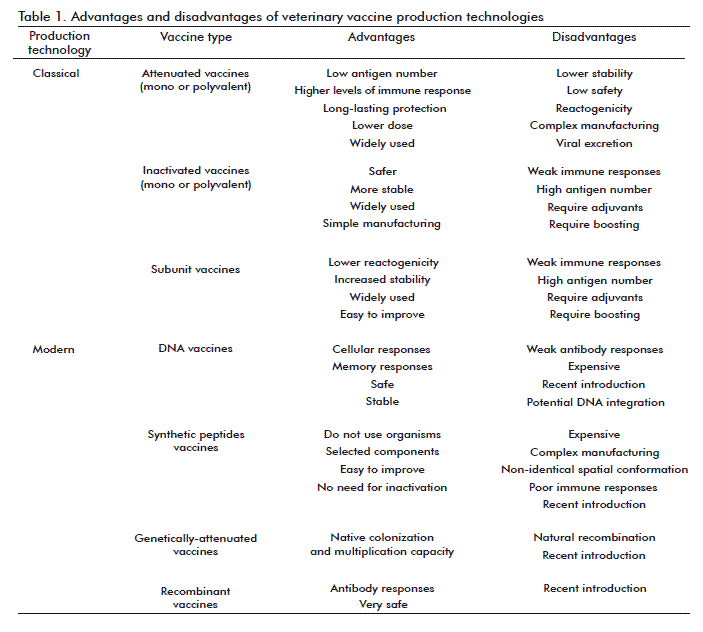
<body><![CDATA[<P   ><font size="2" face="Verdana, Arial, Helvetica, sans-serif">El dinamismo observado      en el &aacute;rea de la vacunolog&iacute;a veterinaria requiere ser monitoreado      por la industria biofarmac&eacute;utica, para de esta forma anticiparse a      los posibles cambios y tomar acciones que le permita adaptarse al escenario      futuro. Sobre esa base se realiz&oacute; un estudio con el objetivo de evaluar      el estado actual, tendencias y proyecciones cient&iacute;fico-tecnol&oacute;gicas      en la producci&oacute;n de vacunas veterinarias. A tal efecto se efectu&oacute;      una b&uacute;squeda tem&aacute;tica en la base de datos Scopus sobre vacunas      destinadas a aves, bovinos, cerdos, conejos, equinos, peces y perros, limitada      al periodo 2008-2012 y se contextualiz&oacute; hasta principios de 2014. Se      comprob&oacute; que la vacunolog&iacute;a veterinaria es un campo tem&aacute;tico      en plena expansi&oacute;n, siendo el a&ntilde;o 2011 el de mayor crecimiento      con un 18.05 % con respecto al 2008. En tal sentido Estados Unidos y China      lideran esta tem&aacute;tica, existiendo un inter&eacute;s cient&iacute;fico      mayoritario por los ant&iacute;genos proteicos, adyuvantes y vacunas virales      producidas con tecnolog&iacute;as cl&aacute;sicas. Las especies m&aacute;s      atendidas son las aves, porcinos y bovinos, sobresaliendo la primera especie      con el 15.21 % de todas las publicaciones. Se concluye que continuara el dominio      de las tecnolog&iacute;as cl&aacute;sicas de producci&oacute;n de vacunas      a pesar de los adelantos en materia de ingenier&iacute;a gen&eacute;tica y      biotecnolog&iacute;a. Las vacunas producidas con tecnolog&iacute;as modernas      parecen ser, al menos por ahora, poco asequibles algunos productores, y por      tanto, poco pr&aacute;cticas. De igual manera los pr&oacute;ximos a&ntilde;os      ser&aacute;n muy importantes para el desarrollo y el registro de nuevas vacunas      obtenidas por tecnolog&iacute;a DIVA y sus respectivos sistemas de diagn&oacute;stico      </font></P >   <FONT size="+1">        <P   ><font size="2" face="Verdana, Arial, Helvetica, sans-serif"><b>Palabras clave:</b>      vacunas veterinarias, vacunaci&oacute;n, tecnolog&iacute;a de producci&oacute;n,      adyuvantes.</font></P >   </font></font></font></font></font></font></font></font></font></font></font></font></font></font></font></font></font></font></font></font>   <hr>   <FONT size="+1" color="#000000"><FONT size="+1"><FONT size="+1"><FONT size="+1"><FONT size="+1"><FONT size="+1"><FONT size="+1"><FONT size="+1"><FONT size="+1"><FONT size="+1"><FONT size="+1"><FONT size="+1"><FONT size="+1"><FONT size="+1"><FONT size="+1"><FONT size="+1"><FONT size="+1"><FONT size="+1"><FONT size="+1"><FONT size="+1">        <P   >&nbsp;</P >       <P   >&nbsp;</P >       <P   ><b><font face="Verdana, Arial, Helvetica, sans-serif" size="3">INTRODUCTION </font></b></P >   <FONT size="+1"><FONT color="#0018E4">        <P   ><font size="2" color="#000000" face="Verdana, Arial, Helvetica, sans-serif">Veterinary      vaccines are biological preparations designed from infectious agents and aimed      at developing a protective immunological response against them in healthy      animals once administered. These formulations resemble the pathogen&rsquo;s      natural infection but do not develop the disease, mounting a protective, effective      and long-lasting immune response. From that moment on, the vaccinated organism      not only survives to a second contact with the agent, but also breaks the      transmission chain. For these reasons, vaccination has been considered one      of the most efficacious sanitary measures to prevent, control and eradicate      infectious diseases in domestic and wild-life animals, and one of the factors      available to face the increasing demand for food supplies and food dependency      [1]. </font></P >   <FONT size="+1" color="#000000">        <P   ><font size="2" face="Verdana, Arial, Helvetica, sans-serif">Nevertheless, the      epidemiological situation cannot be solved only through vaccination, but complementing      it with sanitary measures such as: outbreak containment, control of animal      transportation and biosafety measures, among others. </font></P >       <P   ><font size="2" face="Verdana, Arial, Helvetica, sans-serif">There are several      classification criteria for vaccines attending to its administration route,      composition, target biological agent, the technology for its production, and      others. Since the technological point of view, there are two main types: classical      vaccines and modern vaccines (<a href="/img/revistas/bta/v31n3/t0102314.gif">Table 1</a>) [2]. </font></P >       
<P   ><font size="2" face="Verdana, Arial, Helvetica, sans-serif">The &lsquo;One health&rsquo;      concept has made difficult to establish differences between human and veterinary      vaccines, as certainly are. Similarities arise from the shared properties      of the immune systems in both types of organisms: highly specific immune responses      and immunological memory. This convergence favors that most of the knowledge      and current results on human vaccines obtained in animal models could be subsequently      applied in veterinary vaccines manufacturing [3]. </font></P >       <P   ><font size="2" face="Verdana, Arial, Helvetica, sans-serif">The cost-benefit      balance both for the farmer and the industry arises as the paramount factor      determining the manufacture and practical use of veterinary vaccines compared      to vaccines designed for human use. It is so remarkable that makes irrelevant      considerations regarding the etiological agent to be controlled or the target      animal species to be protected. Therefore, it determines in the clinical practice      that vaccines with low production costs not only decrease zoosanitary complications,      and productivity and cost limitations, but also, and significantly, producers      can afford it [4]. </font></P >       ]]></body>
<body><![CDATA[<P   ><font size="2" face="Verdana, Arial, Helvetica, sans-serif">All these properties      have fostered the search for new knowledge on animal immunology, microbiology,      vaccine production technologies, together with the development of new animal      models for human diseases and the recent vertiginous increase on veterinary      vaccinology. However, such dynamism requires to be monitored by the veterinary      vaccines industry. In this work some of the trends observed in the scientific      literature for vaccine research, development and production worldwide in the      last five years are provided. </font></P >       <P   >&nbsp;</P >       <P   > </P >   <FONT size="+1">        <P   ><font size="3"><b><font face="Verdana, Arial, Helvetica, sans-serif">GLOBAL FOCUS      ON CURRENT DEVELOPMENTS</font></b><font face="Verdana, Arial, Helvetica, sans-serif">      </font></font><font size="2" face="Verdana, Arial, Helvetica, sans-serif">      </font></P >       <P   ><font size="2" face="Verdana, Arial, Helvetica, sans-serif">The most recent scientific      information flow has to be properly covered to identify the probable behavior      of the scientific field in short term (5-10 years). For that purpose, a topic      search was made in the Scopus database on vaccines about poultry, cattle,      swine, rabbit, horse, fish and dogs, from 2008 to 2012. The title, abstract      and keywords bibliographic fields were searched for the most relevant technological-      and infectious agent-specific terms. The search strategy included the most      common denominative terms for each species: poultry (bird, avian, pigeon,      poultry), cattle (cattle, calf, bovine, cow), pig (pig, hog, swine, porcine),      horse (horse, equine), fish (fish), dogs (dog, canine) and rabbits (rabbit).      </font></P >   <FONT size="+1">        <P   ><font size="2" face="Verdana, Arial, Helvetica, sans-serif">A detailed analysis      of the articles retrieved on vaccine production for these species, vaccine      technologies and specific pathogens supported the view on the novelty of the      information and the vertiginous expansion of the veterinary vaccine field      of research. In this sense, there was a steady increase in the articles published      from 2008 to 2012, representing an 18.05 % of increase in 2011 compared to      2008 for all the species, but in rabbits, which decreased in 2010 to its lowest      point (47.30 %). </font></P >       <P   ><font size="2" face="Verdana, Arial, Helvetica, sans-serif">It could be inferred      from the data that there was a disproportionate research attention worldwide      to the species under study (<a href="#fig1">Figure 1</a>). Approximately 34      % of the articles indexed in Scopus versed on poultry, pigs and cattle vaccines,      species comprising economically relevant animals, with 15.21 % of the articles      on poultry. </font></P >       <P align="center"   ><img src="/img/revistas/bta/v31n3/f0102314.gif" width="379" height="423"><a name="fig1"></a></P >       
<P   ><font size="2" face="Verdana, Arial, Helvetica, sans-serif">This behavior was      closely influenced by the morbimortality of some diseases during the period,      and by the relative relevance of some of these species for human consumption,      particularly meat and its derivatives (<a href="#fig2">Figure 2</a>). In this      regard, there were also some significant emergent zoonotic diseases of potential      human transmission. Poultry was an example of that scenario, where both factors      converged, providing the highest numbers of vaccine studies, particularly      in broiler chickens, laying hens, turkeys and ducks. </font></P >       <P align="center"   ><img src="/img/revistas/bta/v31n3/f0202314.gif" width="386" height="323"><a name="fig2"></a></P >       
]]></body>
<body><![CDATA[<P   ><font size="2" face="Verdana, Arial, Helvetica, sans-serif">Remarkably, poultry      accounted for up to 28 % of the worldwide meat supply for consumption, as      compared to swine and cattle (34 % and 20 %, respectively). Derivatives from      these animal species has to be also considered, such as whole milk (78 %)      and eggs (14 %). </font></P >       <P   ><font size="2" face="Verdana, Arial, Helvetica, sans-serif">These figures may      explain the fact that the leading countries of the meat and egg production      and export industry were the ones providing the largest scientific production      as determined. The main contribution for the seven species under study was      made by researchers from US and China universities, and articles on poultry,      swine and cattle vaccines predominated. Particularly in fish vaccines, China      got ahead of US, and both together with South Korea and India dominated this      area. This could be explained by the role of fish for traditional diet in      these countries and also its economic relevance. </font></P >       <P   ><font size="2" face="Verdana, Arial, Helvetica, sans-serif">Similarly, the production      on viral vaccines almost doubled that on bacterial vaccines, except for aquaculture.      This last could be explained by the fact that most bacteria pathogenic for      fish can be isolated both in salt and fresh water and display a wide host      range, including man. That is the case of <I>Edwardsiella tarda</I>, <I>Streptococcus      iniae</I>, <I>Aeromonas hydrophila</I>, <I>Lactococcus garvieae</I>, <I>Vibrio      harveyi</I> and <I>V. anguillarum</I>. Those bacteria are being targeted by      monovalent and bivalent vaccines under research or development, and mostly      but not exclusively by classical vaccine production technologies [5-8]. </font></P >       <P   ><font size="2" face="Verdana, Arial, Helvetica, sans-serif">The disproportionate      scientific production on viral versus bacterial veterinary vaccines can also      be related to the availability of therapeutic alternatives affordable to producers,      and to the numerous efforts on optimizing the use of antibacterial chemotherapy.      Undoubtedly, another factor influencing the higher production on viral veterinary      vaccines in this period was the numerous highly- or mildly-pathogenic isolates      of the influenza virus emerging since 2003 [9]. The fast geographic spread      of this virus isolates and their easiness to cross the interspecies barrier      provoked complex epidemiological situations in many countries in Asia, Europe,      Africa and the American continent. That </font><font size="2" face="Verdana, Arial, Helvetica, sans-serif">situation      consequently impacted with a 29 % increase in research and 15 % in publications      on veterinary vaccines against influenza. Noteworthy, the articles on influenza      related to humans, flying mammals, animals in captivity, wildlife birds (aquatic,      fresh water, marine, marshes, swamps, predatory, migratory or from urban areas),      were excluded from the current analysis. </font></P >       <P   ><font size="2" face="Verdana, Arial, Helvetica, sans-serif">The abovementioned      increase resulted from several factors, such as: the large number of susceptible      economically relevant species, the genetic instability of the infectious agent      (mainly genetic mutation and recombination), and the vaccination strategies      for disease control. Major topics comprised the use of antigens from several      subtypes to generate classic vaccines mostly, vaccine testing in target animals,      and vaccine adjuvant formulations [10]. </font></P >       <P   ><font size="2" face="Verdana, Arial, Helvetica, sans-serif">Either bacterial      or viral in origin, the infecto-contagious diseases targeted for the development      of preventive, effective and safe protection cause colossal losses and increase      restrictions to the international trade of animal meat, eggs and other derivatives      as leather. </font></P >       <P   ><font size="2" face="Verdana, Arial, Helvetica, sans-serif">Those agents have      in common: </font></P >   <DL   >      <DD   ><font size="2" face="Verdana, Arial, Helvetica, sans-serif">1. There are no treatments        available and, when an outbreak occurs, it is difficult to contain and costly        its eradication (sacrifice); </font></DD >     <DD   ><font size="2" face="Verdana, Arial, Helvetica, sans-serif">2. They decrease        productivity, animal growth and daily weight gain in susceptible animals;        </font></DD >     <DD   ><font size="2" face="Verdana, Arial, Helvetica, sans-serif">3. Cause reproductive        failures; </font></DD >     <DD   ><font size="2" face="Verdana, Arial, Helvetica, sans-serif">4. Induce high mortality;        </font></DD >     <DD   ><font size="2" face="Verdana, Arial, Helvetica, sans-serif">5. Increase production        costs, due to the high cost of resources for their screening, treatment        and control; </font></DD >     <DD   ><font size="2" face="Verdana, Arial, Helvetica, sans-serif">6. Strict international        restrictions are imposed to the trade of meat and derivatives immediately        upon diagnosis; and </font></DD >     <DD   ><font size="2" face="Verdana, Arial, Helvetica, sans-serif">7. They affect several        countries and species at a time, involving domestic, captive and wild species,        even man. </font></DD >   </DL >       <P   ><font size="2" face="Verdana, Arial, Helvetica, sans-serif">Co-occurrence analyses      of specific topic terms allowed to confirm that the field of veterinary vaccines      is composed of complex and highly interconnected knowledge clusters (<a href="/img/revistas/bta/v31n3/f0302314.gif">Figure      3</a>). Protein, virus and adjuvants were the key terms identified as central      topics. </font></P >       
<P   ><font size="2" face="Verdana, Arial, Helvetica, sans-serif">Their centrality,      together with their interconnections, indicated that much of the original      results published in the period 2008-2012 were mostly but not exclusively      on obtaining new protein and peptidic viral antigens by different methods,      the characterization of the generated immune responses in target species and      animal models (poultry, swine and bovine), and particularly viral vaccine      strains and new adjuvants. </font></P >       <P   ><font size="2" face="Verdana, Arial, Helvetica, sans-serif">In this last, there      was increased interest to find new and better adjuvants, cheaper, more stable      and safe, and able to stimulate both the humoral and cellular branches of      the immune response, to reduce the administered antigen dose and the number      of boosts required to develop a protective response. Another incentive fostering      the research in this area is the ability of these compounds to be included      as part of vaccine formulations to be delivered by mucosal route, particularly      against diseases transmitted by this route. </font></P >       ]]></body>
<body><![CDATA[<P   ><font size="2" face="Verdana, Arial, Helvetica, sans-serif">Montanide adjuvants      are among those being actively investigated during the period, in poultry,      pigs and bovines [11]. Nevertheless, its equivalence or superiority compared      to alum hydroxide gels still remains to be demonstrated in clinical practice,      together with its approval for commercial use. </font></P >       <P   ><font size="2" face="Verdana, Arial, Helvetica, sans-serif">All these suggest      that, first, classical technologies for vaccine production are well established      for veterinary vaccines research and development. Second, that there are huge      efforts ongoing to improve vaccine formulations elaborated with classical      technologies, to adapt them to the emergent epidemiological situations and      to favor their compliance with the ultimate goal of any vaccination against      an infectious disease: the long lasting resistance against infection. And      third, the entanglement of a coordinated international framework to keep vaccination      as the short- and long-term best choice for the control of infectious diseases.      </font></P >       <P   ><font size="2" face="Verdana, Arial, Helvetica, sans-serif">In the same direction,      a new technology was developed combining benefits from classic and modern      vaccine technologies: DIVA (differentiating infected from vaccinated animals).      There are few products available based on this technology, but they have demonstrated      to solve a remarkable issue of classical vaccines: the induction through vaccination      of a distinctive immune response different from that produced by the wild      strain in the target animal. DIVA also provides as additional advantage the      plasticity to build a vaccine by any of three possible strategies: </font></P >       <P   ><font size="2" face="Verdana, Arial, Helvetica, sans-serif">1. Negative marker      or deletion vaccine: based on the absence of specific antigen epitopes present      in the wild type virus. </font></P >       <P   ><font size="2" face="Verdana, Arial, Helvetica, sans-serif">2. Extrinsic positive      marker: by including in the vaccine an immunodominant epitope different from      that of the infectious agent. </font></P >       <P   ><font size="2" face="Verdana, Arial, Helvetica, sans-serif">3. Intrinsic positive      marker: by forming an epitope from the wild type virus that induces different      antibody patterns. </font></P >       <P   ><font size="2" face="Verdana, Arial, Helvetica, sans-serif">A particular advantage      of DIVA technology resides in the diagnostic test included with the vaccine,      of high specificity and sensitivity, and able to differentiate natural from      vaccine antibody responses in sera, plasma, mucosal secretions and milk samples.      This eliminates the urgent need of sacrificing large animal populations suspected      to be infected, provides an effective way for fast outbreak detection by massive      screening, and shortens the time required to declare the outbreak as controlled      and demonstrate the lack of infection [12]. All these reasons make of DIVA      technology a major unprecedented achievement in veterinary vaccinology of      profound ethical, environmental and social implications for the animal well-being      and global food safety. </font></P >       <P   ><font size="2" face="Verdana, Arial, Helvetica, sans-serif">Other differentiating      aspects of this technology in respect to classical and modern vaccine technologies      at the time of this work were: the absence of studies using it to prevent      bacterial diseases or targeting diseases in poultry, the easiness of using      the vaccine and its diagnostic test in countries where the target disease      is non-endemic, and the large pharmaceutical companies worldwide as the leaders      in research and development of this type of vaccines in detriment of research      institutes and universities (<a href="#tab2">Table 2</a>). Among the most      significant producers are: Merck Animal Health (USA), Bayer Schering AG (Germany),      Pfizer Animal Health (USA), Boehringer Ingelheim Animal Health GmbH (Germany)      and Merial Limited (USA). This differentiating aspect could be speeding up      the introduction of DIVA products in the clinical practice, both the vaccines      and the diagnostic tests. There is one exception, with the National Institute      for Agricultural Technology (INTA) in Argentina, a government institution      which owns the patent of the HVB-1gE labeled vaccine against the bovine herpesvirus      type 1, the etiological agent of the infectious bovine rhinotracheitis, the      infectious pustular vulvovaginitis and the infectious pustular balanoposthitis,      all of them affecting bovine at any age, either wild or domestic.</font></P >       <P align="center"   ><img src="/img/revistas/bta/v31n3/t0202314.gif" width="566" height="317"><a name="tab2"></a></P >       
<P   >&nbsp;</P >       ]]></body>
<body><![CDATA[<P   ><font size="2" face="Verdana, Arial, Helvetica, sans-serif"><b><font size="3">POULTRY      VIRAL VACCINES</font></b> </font></P >   <FONT size="+1">        <P   ><font size="2" face="Verdana, Arial, Helvetica, sans-serif">The broiler chicken      was the model receiving the major research focus, followed by laying hens      and turkeys. Similarly, most publications were about Marek&acute;s, Newcastle      and Gumboro diseases and the avian infectious bronchitis. Vaccines against      these diseases were produced by using classical technologies, which have been      essential for control programs and to prevent outbreaks worldwide. The vaccine      formulations were developed mostly to be orally administered, by injection      or <I>in ovo</I>. This last vaccination modality has several advantages, including      the development of an early immune response and supports the automation of      the vaccination campaign, decreasing the human error and also the need for      labor force [13-17]. </font></P >   <FONT size="+1">        <P   ><font size="2" face="Verdana, Arial, Helvetica, sans-serif">Otherwise, the weaknesses      of these vaccine formulations vary according to the model. Marek&rsquo;s disease      vaccines are produced by cell culture technologies, are expensive and require      careful handling and administration procedures, in spite of been efficacious      (95 % of protection) even in the presence of maternal antibodies, safe, stable      and inducing long lasting immunity. Another example, the Newcastle disease      vaccines produced by the live virus technology, could interfere with the action      of other vaccines against respiratory diseases, particularly those against      the infectious bronchitis. When these two vaccines are jointly administered,      they compete for the same receptors at the trachea, therefore, affecting the      development of immunity. This is very hard to solve in broiler chickens, due      to their shorter lifespan [14]. In the case of Gumboro disease, current vaccine      formulations based on the strain 2512 effectively protected the animals from      clinical symptoms, but they cause bursal damage due to viral replication in      the bursa of Fabricius [15, 16]. </font></P >       <P   ><font size="2" face="Verdana, Arial, Helvetica, sans-serif">The abomentioned      problems of classical vaccine technologies, together with their interferences      in diagnosis and the new developments in molecular biology techniques, fostered      new lines of research. Some of them comprised the genomics and proteomics      of emergent strains of variable degree of virulence, and new vaccination strategies.      There were also attempts to generate DNA vaccines, vector-based and genetically      attenuated vaccines, and vaccines encapsulated in nanoparticles, but still      having a long way to go until its approval by regulatory authorities [13,      14, 16-21]. Nevertheless, none of the new options has achieved the protection      conferred by conventional vaccines against the Marek&rsquo;s disease. By the      contrary, recombinant vaccines (for example, against Newcastle and Gumboro      diseases) seem to have overcome the disadvantages of classical vaccines and      have neither caused collateral damage nor interfered with other vaccines or      maternal antibodies [19, 20]. </font></P >       <P   >&nbsp;</P >       <P   ><font size="2" face="Verdana, Arial, Helvetica, sans-serif"><b><font size="3">PORCINE      VIRAL VACCINES</font></b> </font></P >   <FONT size="+1">        <P   ><font size="2" face="Verdana, Arial, Helvetica, sans-serif">Regarding porcine      vaccines, major efforts worldwide were intended to control the porcine reproductive      and respiratory syndrome, circoviruses and the classical swine fever, with      classical vaccine technologies as the most prominent for commercial vaccine      production. This type of vaccines has been recognized as a key factor for      the success over a decade of the control programs in swine industry worldwide      [22-25]. </font></P >   <FONT size="+1">        <P   ><font size="2" face="Verdana, Arial, Helvetica, sans-serif">Major inconveniences      of classical vaccines against swine viral diseases are technology-related.      A particular case comprises inactivated and live-attenuated vaccines available      against the porcine reproductive and respiratory syndrome virus. Inactivated      vaccines seem to be inadequate in pregnant animals and boars, in the last      due to the potential elimination of the vaccine virus through semen. Live-attenuated      viruses can persist after vaccination and could be transmitted to unvaccinated      animals, causing future outbreaks, as documented. Moreover, as the case of      live-attenuated vaccines against the classical swine fever, sick animals are      impossible to be serologically distinguished from the vaccinated animals,      the vaccine generates a teratogenic effect and the vaccine viral strain also      continue to circulate among the vaccinated swine population [26]. </font></P >       <P   ><font size="2" face="Verdana, Arial, Helvetica, sans-serif">Such limitations      have being exacerbated in recent years with the intensification of the swine      industry, with important changes in the virulence, clinical manifestations      and pathogenesis of many infectious agents. This complex situation has been      promoted by the pathogen&rsquo;s genetic variations, modifications in the      microbial ecology of production farms, the simultaneous occurrence of infections      and the outcome of atypical and unnoticed variants of the diseases [26]. In      this complex context there are ongoing efforts to develop molecular techniques      that would result in new generations of safer and more effective prophylactic      vaccines, able to be used in emergent vaccination campaigns. </font></P >       <P   ><font size="2" face="Verdana, Arial, Helvetica, sans-serif">This complex scenario      has been confronted by a set of strategies, particularly against the porcine      reproductive and respiratory syndrome, with promising preclinical satisfactory      results (immunogenicity and immunological protection) using a DNA vaccine      that expresses the gp3 and gp5 glycoproteins of the virus genotype I [27].      Regarding the control of classical swine fever in susceptible populations,      several candidates have been developed during the last 15 years against it.      They include: recombinant deletion chimeric vaccines, DNA vaccines, subunit      vaccines and vector-based, among others. Many of them did not comply with      the requirements of regulatory agencies upon its evaluation, in spite of inducing      potent immune responses. Most of the efforts continue targeting the E2 glycoprotein      as the main immunogen of this virus and a critical component of DIVA vaccines      [28-30]. </font></P >       ]]></body>
<body><![CDATA[<P   ><font size="2" face="Verdana, Arial, Helvetica, sans-serif">Circovirus vaccines      has been fueled-up by the successful experimental results using subunit vaccines      based on serotype 2 and chimeric vaccines formulated from the 1-2a serotype,      being intramuscularly and orally administered [31, 32]. In the case of the      porcine reproductive and respiratory syndrome, promising results were obtained      by using recombinant vaccines, DNA vaccines and subunit vaccines produced      in vegetables with the additional advantage of been administered by mucosal      route [33, 34]. In spite of such advances against this disease, the quest      for a better vaccine is still ongoing, as required to decrease the infection      by the PCV2 virus to undetectable levels once after interrupting vaccination.      </font></P >       <P   ><font size="2" face="Verdana, Arial, Helvetica, sans-serif">The Aujeszky&rsquo;s      disease vaccine is worth to be mentioned, due to the increasing number of      DIVA vaccines available in the market against this disease and because of      being among the first vaccines of this kind approved to be used in Europe.      This could have resulted from the virus capacity to infect several mammalian      species, including economically relevant ones (swine, bovine, rabbits), domestic      animals (dogs, cats) and wild species (wild boar, foxes, bisons). Most of      these vaccines were developed from the NIA-3 or Bartha-K61 strains, both of      them having the glycoprotein E gene deleted, supporting the generation of      a live-attenuated viral vaccine and protecting at the same time against the      clinical symptoms of the disease. This last considerably reduces the levels      of excreted virus, making the vaccine safer and differentiating vaccinated      from infected animals, all these aspects unachieved by live vaccines [35,      36]. </font></P >       <P   >&nbsp;</P >       <P   ><font size="2" face="Verdana, Arial, Helvetica, sans-serif"><b><font size="3">BOVINE      VIRAL VACCINES </font> </b> </font></P >   <FONT size="+1">        <P   ><font size="2" face="Verdana, Arial, Helvetica, sans-serif">The first depicting      element of vaccine research in this species is the high number of studies      on anti-tick vaccines. This exception comes from the role that hematophagous      parasite has as vector to transmit diseases such as babesiosis and anaplasmosis,      in addition to the direct weakening of the animals and its detrimental effects      on production and causing host animal death. Other factors influencing this      behavior were the high costs of chemical acaricides, their increased toxicity      for both the animal and the environment and problems during storage. The scientific      interest was mainly focused on finding and characterizing antigenic proteins      or cryptic antigens of the digestive tract of these insects, which could be      able to induce a protective, safe and lost lasting immune response in vaccinated      animals [37-39]. </font></P >   <FONT size="+1">        <P   ><font size="2" face="Verdana, Arial, Helvetica, sans-serif">Regarding the most      studied viruses, there was a significant attention worldwide to the foot and      mouth disease virus, the bovine viral diarrhea and the bluetongue disease      virus. There were recurrent statements on the effectiveness of inactivated      and live-attenuated vaccines in the different national control programs enforced      for the long-term containment of these diseases [40-45]. Nevertheless, current      vaccine formulations bear some weaknesses, such as the coexistence of several      viral strains of the foot and mouth disease virus (serotypes O, A, C, SAT      1, 2 and 3, Asia 1; comprising more than 60 strains) devoid of immune response      crossreactivity between them. This comes from the fact that most of those      strains comprise live-attenuated viruses which use is forbidden in the countries      where they are used, and there are technical limitations to differentially      detect infected from immunized animals. From 2008 to 2013, significant improvements      were achieved, particularly on the knowledge of viral structure and the development      of subunit, DNA and DIVA vaccines, based on SP and NSP proteins [46-50]. Once      again, DIVA was the most promising development in spite of some inconsistencies.      </font></P >       <P   ><font size="2" face="Verdana, Arial, Helvetica, sans-serif">The bovine diarrhea      virus was also investigated, mainly due to the lack of a standard vaccine      but with several commercial preparations available based on classical vaccine      technologies but with certain limitations. Besides the technically-associated      limitations, the live virus vaccine induces immunosuppression and is not recommended      to be administered to pregnant cattle to avoid persistent infections, particularly      in fetuses [51]. The use of non-structural compounds as part of inactivated      vaccines seems to be promising to solve such inconveniences [52]. </font></P >       <P   ><font size="2" face="Verdana, Arial, Helvetica, sans-serif">The live-attenuated      vaccines against bluetongue disease virus inconveniently cause embryo death      and reabsorption, fetal death and congenital malformations in the offspring.      Their use was rejected in many countries because they contain several serotypes      that could revert the vaccine viral strain phenotype to a virulent form and      facilitate its subsequent vector-borne transmission. That&rsquo;s why the      inactivated vaccines against this virus usually contain few serotypes, something      that limits their protective spectrum [53]. Such difficulties have fostered      the research on safer and more efficacious vaccines, able to induce crossreactive      immunity and having differential diagnostic capacity. Several prototypes were      developed, including recombinant vaccines, with potential wide-range crossreactivity      among serotypes, but remaining to be validated in the field [54]. </font></P >       <P   ><font size="2" face="Verdana, Arial, Helvetica, sans-serif">A key point comprises      reemergent diseases affecting these species and of growing interest for the      veterinary vaccinology community, as the bovine infectious rhinotraqueitis,      caused by the bovine herpesvirus type 1. In this sense, improved attenuated      vaccines were tested, as well as mono or polyvalent inactivated vaccines and      its administration by different routes [55]. Commercially available vaccines      against this virus based on conventional technologies are widely used in different      variants: live-modified or inactivated virus vaccines, either mono or polyvalent.      Its use depends on the capacity of the given vaccine to induce immunogenicity,      its efficacy to reduce clinical manifestations of the disease and, consequently,      the economic losses, even with an incomplete protection from infection. Additionally,      live-attenuated vaccines could induce abortion, and the lifespan persistence      of the vaccine strain in vaccinated animals could lead to potential reactivation      of latent virus after corticosteroid immunosuppression and, ultimately, to      infection. </font></P >       <P   ><font size="2" face="Verdana, Arial, Helvetica, sans-serif">Trying to solve those      limitations, new vaccine preparations were investigated using new antigens      such as glycoproteins D and E, combined with its delivery by different routes,      one of them a recombinant vaccine by mucosal route [56], DNA vaccines [57]      and DIVA. </font></P >       ]]></body>
<body><![CDATA[<P   ><font size="2" face="Verdana, Arial, Helvetica, sans-serif">Particularly on DIVA,      it is worth to mention that it has become one of the most resourceful techniques      for veterinary disease vaccination and eradication programs, with its associated      serological tests. In fact, there are several products using this technology      against the infectious bovine rhinotracheitis virus type 1 in the market,      some of them adjuvanted with aluminum hydroxide. The most widely accepted      strategy to generate DIVA vaccines against this disease worldwide includes      the deletion of the glycoprotein E gene, differentiating the naturally infected      animals which develop antibodies against this protein from the vaccinated      ones. The deletion also favors the generation of live-attenuated vaccines      that could be applied either to economically relevant or wild animals. Similarly,      the potential advantage for reexcretion through nasal secretions of the vaccine      strain after boosting provides it the additional advantage of establishing      herd immunity [58]. </font></P >       <P   ><font size="2" face="Verdana, Arial, Helvetica, sans-serif">Results demonstrated      a reduced viral excretion after boosting and the early induction of immunity      after vaccination by the intranasal route. Nevertheless, recent studies evidenced      that the nasal coinfection with a gE-negative vaccine </font><font size="2" face="Verdana, Arial, Helvetica, sans-serif">strain      and a wild-type strain could generate a recombinant viral progeny of lower      virulence <I>in vitro</I> compared to wild-type strains, but higher than that      of the parental strains <I>in vivo</I>. In this sense, it was confirmed that      recombination events could restore the natural virulence to the gE negative      vaccine strains and limit its application under field conditions or in areas      of widespread circulation of wild-type strains [59]. </font></P >       <P   ><font size="2" face="Verdana, Arial, Helvetica, sans-serif">The Rift Valley fever      disease is another example of the effectiveness of DIVA technology. This vector-borne      disease similarly affects ruminants and humans, its causative agent being      a class A, non-prioritized agent, and was classified as reemergent in Africa      and the Middle East [59]. Current inactivated and live-attenuated vaccines      obtained from the MP-12 strains and clone 13 inconveniently require up to      three boosts, induce abortions, congenital malformations, hepatotoxicity and      necrosis, in spite of been immunogenic and protective in vaccinated animals.      Such inconveniences have forced the research on new vaccine candidates that      could overcome those limitations or to provide alternatives [60, 61]. </font></P >       <P   ><font size="2" face="Verdana, Arial, Helvetica, sans-serif">Once again, DIVA      seems to be the most advanced and promising alternative, by the deletion of      genes coding for NSm and NSs proteins. The vaccine induced differentiating      immunity in rats and was shown to be innocuous in pregnant animals, what seems      to comply with the expected requirements. Nevertheless, such advances do not      represent the single solution to overcome limitations of classical vaccine      technologies. Intense work is ongoing to develop new formulations using water/oil      emulsions as adjuvants, vectored vaccines using Newcastle disease virus and      poxviruses bearing the Gc and Gn genes coding for structural glycoproteins,      and recombinant and subunit vaccines [62-65]. </font></P >       <P   >&nbsp;</P >       <P   ><font size="3" face="Verdana, Arial, Helvetica, sans-serif"><b>CONCLUSIONS </b></font></P >   <FONT size="+1">        <P   ><font size="2" face="Verdana, Arial, Helvetica, sans-serif">The detailed analysis      of the articles published from 2008 to 2012 indexed in Scopus provides an      overview of a renovated optimism of veterinary vaccines produced by classical      technologies, in spite of improvements in the field of genetic engineering      and biotechnology. The sanitary success achieved by classical technologies      vaccines guarantee their predominance in the market in the near future. Such      predictions are supported by their proved effectiveness and safety, low costs      for research and development, better cost-benefits ratios and the availability      of the production infrastructure required to face future technological needs      for adjuvants and vaccine antigens. </font></P >   <FONT size="+1">        <P   ><font size="2" face="Verdana, Arial, Helvetica, sans-serif">Moreover, the opportunities      provided by recombinant DNA techniques to generate new vaccines seems to be      either less affordable or practical than required by producers. This is motivated      by the high vaccination costs and the raise in standards to comply with regulatory      requirements for sanitary registration, due to their recent introduction.      </font></P >       <P   ><font size="2" face="Verdana, Arial, Helvetica, sans-serif">At the same time,      DIVA technology and its related diagnostic tests will face significant challenges      from development to registration. It is advantageous compared to other vaccine      production technologies not only by its ability to safely and effectively      control and prevent high incidence diseases, but also to avoid unnecessary      sacrifice of uninfected animals and to control the reemergence of diseases      declared as eradicated. </font></P >       <P   >&nbsp;</P >       ]]></body>
<body><![CDATA[<P   > </P >   <FONT size="+1" color="#D70000">        <P   ><b><font size="3" color="#000000" face="Verdana, Arial, Helvetica, sans-serif">ACKNOWLEDGEMENTS      </font></b></P >   <FONT size="+1" color="#000000">        <P   ><font size="2" face="Verdana, Arial, Helvetica, sans-serif">The authors thank      to Mar&iacute;a de los Reyes Berm&uacute;dez, from the Agriculture Virtual      Library of FAO Representation in Cuba, and to Omaida Maria Medina Alamo, specialist      from the Direction of Research and Development, Labiofam Enterpreneurial Group,      for their contributions to this work. Also to Ernesto Galb&aacute;n Rodr&iacute;guez,      from the Elfos Scientiae publisher, for the critical review of the manuscript.      </font></P >       <P   >&nbsp;</P >   <FONT size="+1">        <P   > </P >       <P   ><b><font size="3" face="Verdana, Arial, Helvetica, sans-serif">REFERENCES</font></b></P >       <!-- ref --><P   ><font size="2" face="Verdana, Arial, Helvetica, sans-serif">1. Pastoret PP. Role      of vaccination in animal health. Bull Acad Natl Med. 2012;196(3):589-90, 619-20.          </font></P >       <!-- ref --><P   ><font size="2" face="Verdana, Arial, Helvetica, sans-serif">2. L&oacute;pez M,      Mallorqu&iacute;n P, Pardo R, Vega M. Vacunas de nueva generaci&oacute;n.      Informe de vigilancia tecnol&oacute;gica. Madrid: Fundaci&oacute;n Espa&ntilde;ola      para el Desarrollo de la Investigaci&oacute;n en Gen&oacute;mica y Prote&oacute;mica/Fundaci&oacute;n      General de la Universidad Aut&oacute;noma de Madrid; 2004.     </font></P >       ]]></body>
<body><![CDATA[<!-- ref --><P   ><font size="2" face="Verdana, Arial, Helvetica, sans-serif">3. Williamson ED,      Duchars MG, Kohberger R. Predictive models and correlates of protection for      testing biodefence vaccines. Expert Rev Vaccines. 2010;9(5):527-37.     </font></P >       <!-- ref --><P   ><font size="2" face="Verdana, Arial, Helvetica, sans-serif">4. Lee NH, Lee JA,      Park SY, Song CS, Choi IS, Lee JB. A review of vaccine development and research      for industry animals in Korea. Clin Exp Vaccine Res. 2012;1(1):18-34.     </font></P >       <!-- ref --><P   ><font size="2" face="Verdana, Arial, Helvetica, sans-serif">5. Hu YH, Dang W,      Deng T, Sun L. Edwardsiella tarda DnaK: expression, activity, and the basis      for the construction of a bivalent live vaccine against E. tarda and Streptococcus      iniae. Fish Shellfish Immunol. 2012;32(4):616-20.     </font></P >       <!-- ref --><P   ><font size="2" face="Verdana, Arial, Helvetica, sans-serif">6. Bastardo A, Ravelo      C, Castro N, Calheiros J, Romalde JL. Effectiveness of bivalent vaccines against      <I>Aeromonas hydrophila</I> and <I>Lactococcus garvieae </I>infections in      rainbow trout <I>Oncorhynchus mykiss</I> (Walbaum). Fish Shellfish Immunol.      2012;32(5):756-61.     </font></P >       <!-- ref --><P   ><font size="2" face="Verdana, Arial, Helvetica, sans-serif">7. Hu YH, Deng T,      Sun BG, Sun L. Development and efficacy of an attenuated Vibrio harveyi vaccine      candidate with cross protectivity against <I>Vibrio alginolyticus</I>. Fish      Shellfish Immunol. 2012;32(6):1155-61.     </font></P >       ]]></body>
<body><![CDATA[<!-- ref --><P   ><font size="2" face="Verdana, Arial, Helvetica, sans-serif">8. Hamod MA, Nithin      MS, Shukur YN, Karunasagar I. Outer membrane protein K as a subunit vaccine      against <I>V. anguillarum</I>. Aquaculture. 2012;354-355:107-10.     </font></P >       <!-- ref --><P   ><font size="2" face="Verdana, Arial, Helvetica, sans-serif">9. Li Y, Shi J, Zhong      G, Deng G, Tian G, Ge J, <I>et al</I>. Continued evolution of H5N1 influenza      viruses in wild birds, domestic poultry, and humans in China from 2004 to      2009. J Virol. 2010;84(17):8389-97.     </font></P >       <!-- ref --><P   ><font size="2" face="Verdana, Arial, Helvetica, sans-serif">10. Luo DY, Xue CY,      Cao YC. Research progress and prospect of universal influenza vaccine. Bing      Du Xue Bao. 2013;29(6):646-50.     </font></P >       <!-- ref --><P   ><font size="2" face="Verdana, Arial, Helvetica, sans-serif">11. Parker R, Deville      S, Dupuis L, Bertrand F, Aucouturier J. Adjuvant formulation for veterinary      vaccines: Montanide&trade; Gel safety profile. Procedia Vaccinol. 2009;1(1):140-7.          </font></P >       <!-- ref --><P   ><font size="2" face="Verdana, Arial, Helvetica, sans-serif">12. von Rosen T,      Rangelova D, Nielsen J, Rasmussen TB, Uttenthal A. DIVA vaccine properties      of the live chimeric pestivirus strain CP7_E2gif. Vet Microbiol. 2014;170(3-4):224-31.          </font></P >       ]]></body>
<body><![CDATA[<!-- ref --><P   ><font size="2" face="Verdana, Arial, Helvetica, sans-serif">13. Biggs PM, Nair      V. The long view: 40 years of Marek's disease research and Avian Pathology.      Avian Pathol. 2012;41(1):3-9.     </font></P >       <!-- ref --><P   ><font size="2" face="Verdana, Arial, Helvetica, sans-serif">14. Alexander DJ,      Aldous EW, Fuller CM. The long view: a selective review of 40 years of Newcastle      disease research. Avian Pathol. 2012;41(4):329-35.     </font></P >       <!-- ref --><P   ><font size="2" face="Verdana, Arial, Helvetica, sans-serif">15. Le&oacute;n N,      Icochea E, Gonzalez R, Perales R. Nivel de protecci&oacute;n de una vacuna      intermedia contra la enfermedad de Gumboro en aves de postura. Rev Investig      Vet Per&uacute;. 2012;23(4):477-83.     </font></P >       <!-- ref --><P   ><font size="2" face="Verdana, Arial, Helvetica, sans-serif">16. Mahgoub HA, Bailey      M, Kaiser P. An overview of infectious bursal disease. Arch Virol. 2012;157(11):2047-57.          </font></P >       <!-- ref --><P   ><font size="2" face="Verdana, Arial, Helvetica, sans-serif">17. Cook JK, Jackwood      M, Jones RC. The long view: 40 years of infectious bronchitis research. Avian      Pathol. 2012;41(3):239-50.     </font></P >       ]]></body>
<body><![CDATA[<!-- ref --><P   ><font size="2" face="Verdana, Arial, Helvetica, sans-serif">18. Zhang X, Wu Y,      Huang Y, Liu X. Protection conferred by a recombinant Marek's disease virus      that expresses the spike protein from infectious bronchitis virus in specific      pathogen-free chicken. Virol J. 2012;9:85-91.     </font></P >       <P   ><font size="2" face="Verdana, Arial, Helvetica, sans-serif">19. Zhao K, Chen      G, Shi XM, Gao TT, Li W, Zhao Y, <I>et al</I>. Preparation and efficacy of      a live newcastle disease virus vaccine encapsulated in chitosan nanoparticles.      PLoS One. 2012;7(12):e53314. </font></P >       <!-- ref --><P   ><font size="2" face="Verdana, Arial, Helvetica, sans-serif">20. Perozo F, Villegas      P, Mav&aacute;rez Y, Fern&aacute;ndez R, Cruz J. Eficacia de un herpesvirus      de pavo recombinante expresando la prote&iacute;na vp2 del virus de la enfermedad      de Gumboro ante un desaf&iacute;o experimental. Rev Cient 2010;20(2):132-7.          </font></P >       <!-- ref --><P   ><font size="2" face="Verdana, Arial, Helvetica, sans-serif">21. Britton P, Armesto      M, Cavanagh D, Keep S. Modification of the avian coronavirus infectious bronchitis      virus for vaccine development. Bioeng Bugs. 2012;3(2):114-9.     </font></P >       <!-- ref --><P   ><font size="2" face="Verdana, Arial, Helvetica, sans-serif">22. Zhai SL, Chen      SN, Xu ZH, Tang MH, Wang FG, Li XJ, <I>et al</I>. Porcine circovirus type      2 in China: an update on and insights to its prevalence and control. Virol      J. 2014;11:88.     </font></P >       <!-- ref --><P   ><font size="2" face="Verdana, Arial, Helvetica, sans-serif">23. Yang K, Li W,      Niu H, Yan W, Liu X, Wang Y, <I>et al</I>. Efficacy of single dose of an inactivated      porcine circovirus type 2 (PCV2) whole-virus vaccine with oil adjuvant in      piglets. Acta Vet Scand. 2012;54:67.     </font></P >       <!-- ref --><P   ><font size="2" face="Verdana, Arial, Helvetica, sans-serif">24. Lee JA, Kwon      B, Osorio FA, Pattnaik AK, Lee NH, Lee SW, <I>et al</I>. Protective humoral      immune response induced by an inactivated porcine reproductive and respiratory      syndrome virus expressing the hypo-glycosylated glycoprotein 5. Vaccine. 2014;32(29):3617-22.          </font></P >       <!-- ref --><P   ><font size="2" face="Verdana, Arial, Helvetica, sans-serif">25. Dortmans JC,      Loeffen WL, Weerdmeester K, van der Poel WH, de Bruin MG. Efficacy of intradermally      administrated E2 subunit vaccines in reducing horizontal transmission of classical      swine fever virus. Vaccine. 2008;26(9):1235-42.     </font></P >       <!-- ref --><P   ><font size="2" face="Verdana, Arial, Helvetica, sans-serif">26. Blome S, Gabriel      C, Beer M. Possibilities and limitations in veterinary vaccine development      using the example of classical swine fever. Berl Munch Tierarztl Wochenschr.      2013;126(11-12):481-90.     </font></P >       <!-- ref --><P   ><font size="2" face="Verdana, Arial, Helvetica, sans-serif">27. Ren JQ, Sun WC,      Lu HJ, Wen SB, Jing J, Yan FL,<I> et al</I>. Construction and immunogenicity      of a DNA vaccine coexpressing GP3 and GP5 of genotype-I porcine reproductive      and respiratory syndrome virus. BMC Vet Res. 2014;10(1):128.     </font></P >       <!-- ref --><P   ><font size="2" face="Verdana, Arial, Helvetica, sans-serif">28. Wang C, Sun Y,      Qiu H. Progress in new-type vaccines against classical swine fever. Sheng      Wu Gong Cheng Xue Bao. 2013;29(7):880-90.     </font></P >       <!-- ref --><P   ><font size="2" face="Verdana, Arial, Helvetica, sans-serif">29. Beer M, Reimann      I, Hoffmann B, Depner K. Novel marker vaccines against classical swine fever.      Vaccine. 2007;25(30):5665-70.     </font></P >       <!-- ref --><P   ><font size="2" face="Verdana, Arial, Helvetica, sans-serif">30. Tignon M, Kulcsar      G, Haegeman A, Barna T, Fabian K, Levai R, <I>et al</I>. Classical swine fever:      comparison of oronasal immunisation with CP7E2alf marker and C-strain vaccines      in domestic pigs. Vet Microbiol. 2010;142(1-2):59-68.     </font></P >       <!-- ref --><P   ><font size="2" face="Verdana, Arial, Helvetica, sans-serif">31. Opriessnig T,      Gomes-Neto JC, Hemann M, Shen HG, Beach NM, Huang Y, <I>et al</I>. An experimental      live chimeric porcine circovirus 1-2a vaccine decreases porcine circovirus      2b viremia when administered intramuscularly or orally in a porcine circovirus      2b and porcine reproductive and respiratory syndrome virus dual-challenge      model. Microbiol Immunol. 2011;55(12):863-73.     </font></P >       <!-- ref --><P   ><font size="2" face="Verdana, Arial, Helvetica, sans-serif">32. Feng H, Blanco      G, Segales J, Sibila M. Can Porcine circovirus type 2 (PCV2) infection be      eradicated by mass vaccination? Vet Microbiol. 2014;172(1-2):92-9.     </font></P >       <!-- ref --><P   ><font size="2" face="Verdana, Arial, Helvetica, sans-serif">33. Huang YW, Meng      XJ. Novel strategies and approaches to develop the next generation of vaccines      against porcine reproductive and respiratory syndrome virus (PRRSV). Virus      Res. 2010;154(1-2):141-9.     </font></P >       <!-- ref --><P   ><font size="2" face="Verdana, Arial, Helvetica, sans-serif">34. Renukaradhya      GJ, Dwivedi V, Manickam C, Binjawadagi B, Benfield D. Mucosal vaccines to      prevent porcine reproductive and respiratory syndrome: a new perspective.      Anim Health Res Rev. 2012;13(1):21-37.     </font></P >       <!-- ref --><P   ><font size="2" face="Verdana, Arial, Helvetica, sans-serif">35. Wang CH, Yuan      J, Qin HY, Luo Y, Cong X, Li Y, <I>et al</I>. A novel gE-deleted pseudorabies      virus (PRV) provides rapid and complete protection from lethal challenge with      the PRV variant emerging in Bartha-K61-vaccinated swine population in China.      Vaccine. 2014;32(27):3379-85.     </font></P >       <!-- ref --><P   ><font size="2" face="Verdana, Arial, Helvetica, sans-serif">36. Kong H, Zhang      K, Liu Y, Shang Y, Wu B, Liu X. Attenuated live vaccine (Bartha-K16) caused      pseudorabies (Aujeszky's disease) in sheep. Vet Res Commun. 2013;37(4):329-32.          </font></P >       <!-- ref --><P   ><font size="2" face="Verdana, Arial, Helvetica, sans-serif">37. Almazan C, Moreno-Cantu      O, Moreno-Cid JA, Galindo RC, Canales M, Villar M, <I>et al</I>. Control of      tick infestations in cattle vaccinated with bacterial membranes containing      surface-exposed tick protective antigens. Vaccine. 2012;30(2):265-72.     </font></P >       <!-- ref --><P   ><font size="2" face="Verdana, Arial, Helvetica, sans-serif">38. Carreon D, de      la Lastra JM, Almazan C, Canales M, Ruiz-Fons F, Boadella M, <I>et al</I>.      Vaccination with BM86, subolesin and akirin protective antigens for the control      of tick infestations in white tailed deer and red deer. Vaccine. 2012;30(2):273-9.          </font></P >       <!-- ref --><P   ><font size="2" face="Verdana, Arial, Helvetica, sans-serif">39. Guerrero FD,      Miller RJ, Perez de Leon AA. Cattle tick vaccines: many candidate antigens,      but will a commercially viable product emerge? Int J Parasitol. 2012;42(5):421-7.          </font></P >       <!-- ref --><P   ><font size="2" face="Verdana, Arial, Helvetica, sans-serif">40. Nagendrakumar      SB, Srinivasan VA, Madhanmohan M, Yuvaraj S, Parida S, Di Nardo A, <I>et al</I>.      Evaluation of cross-protection between O1 Manisa and O1 Campos in cattle vaccinated      with foot-and-mouth disease virus vaccine incorporating different payloads      of inactivated O1 Manisa antigen. Vaccine. 2011;29(10):1906-12.     </font></P >       <!-- ref --><P   ><font size="2" face="Verdana, Arial, Helvetica, sans-serif">41. Gonzalez AM,      Arnaiz I, Yus E, Eiras C, Sanjuan M, Dieguez FJ. Evaluation of long-term antibody      responses to two inactivated bovine viral diarrhoea virus (BVDV) vaccines.      Vet J. 2014;199(3):424-8.     </font></P >       <!-- ref --><P   ><font size="2" face="Verdana, Arial, Helvetica, sans-serif">42. Charleston B.      Eradicating bovine viral diarrhoea virus. Vet Rec. 2013;172(25):659-60.     </font></P >       <!-- ref --><P   ><font size="2" face="Verdana, Arial, Helvetica, sans-serif">43. Zientara S, Sanchez-Vizcaino      JM. Control of bluetongue in Europe. Vet Microbiol. 2013;165(1-2):33-7.     </font></P >       <!-- ref --><P   ><font size="2" face="Verdana, Arial, Helvetica, sans-serif">44. Hasler B, Howe      KS, Di Labio E, Schwermer H, Stark KD. Economic evaluation of the surveillance      and intervention programme for bluetongue virus serotype 8 in Switzerland.      Prev Vet Med. 2012;103(2-3):93-111.     </font></P >       <!-- ref --><P   ><font size="2" face="Verdana, Arial, Helvetica, sans-serif">45. Batten CA, Edwards      L, Oura CA. Evaluation of the humoral immune responses in adult cattle and      sheep, 4 and 2.5 years post-vaccination with a bluetongue serotype 8 inactivated      vaccine. Vaccine. 2013;31(37):3783-5.     </font></P >       <!-- ref --><P   ><font size="2" face="Verdana, Arial, Helvetica, sans-serif">46. Jamal SM, Belsham      GJ. Foot-and-mouth disease: past, present and future. Vet Res. 2013;44:116.          </font></P >       <!-- ref --><P   ><font size="2" face="Verdana, Arial, Helvetica, sans-serif">47. Smith MT, Bennett      AM, Grubman MJ, Bundy BC. Foot-and-mouth disease: technical and political      challenges to eradication. Vaccine. 2014;32(31):3902-8.     </font></P >       <!-- ref --><P   ><font size="2" face="Verdana, Arial, Helvetica, sans-serif">48. Yang B, Yang      F, Wang SH, Zhang Y, Cao WJ, Yin H, <I>et al</I>. Advances in reverse genetics-based      vaccines of foot and mouth disease. Bing Du Xue Bao. 2014;30(2):213-20.     </font></P >       <!-- ref --><P   ><font size="2" face="Verdana, Arial, Helvetica, sans-serif">49. Fu Y, Cao Y,      Sun P, Bao H, Bai X, Li P, <I>et al</I>. Development of a dot immunoblot method      for differentiation of animals infected with foot-and-mouth disease virus      from vaccinated animals using non-structural proteins expressed prokaryotically.      J Virol Methods. 2011;171(1):234-40.     </font></P >       <!-- ref --><P   ><font size="2" face="Verdana, Arial, Helvetica, sans-serif">50. Uddowla S, Hollister      J, Pacheco JM, Rodriguez LL, Rieder E. A safe foot-and-mouth disease vaccine      platform with two negative markers for differentiating infected from vaccinated      animals. J Virol. 2012;86(21):11675-85.     </font></P >       <!-- ref --><P   ><font size="2" face="Verdana, Arial, Helvetica, sans-serif">51. Palomares RA,      Marley SM, Givens MD, Gallardo RA, Brock KV. Bovine viral diarrhea virus fetal      persistent infection after immunization with a contaminated modified-live      virus vaccine. Theriogenology. 2013;79(8):1184-95.     </font></P >       <!-- ref --><P   ><font size="2" face="Verdana, Arial, Helvetica, sans-serif">52. Alvarez M, Donate      J, Makoschey B. Antibody responses against non-structural protein 3 of bovine      viral diarrhoea virus in milk and serum samples from animals immunised with      an inactivated vaccine. Vet J. 2012;191(3):371-6.     </font></P >       <!-- ref --><P   ><font size="2" face="Verdana, Arial, Helvetica, sans-serif">53. Oura CA, Edwards      L, Batten CA. Evaluation of the humoral immune response in adult dairy cattle      three years after vaccination with a bluetongue serotype 8 inactivated vaccine.      Vaccine. 2012;30(2):112-5.     </font></P >       <!-- ref --><P   ><font size="2" face="Verdana, Arial, Helvetica, sans-serif">54. Calvo-Pinilla      E, Castillo-Olivares J, Jabbar T, Ortego J, de la Poza F, Marin-Lopez A. Recombinant      vaccines against bluetongue virus. Virus Res. 2014;182:78-86.     </font></P >       <!-- ref --><P   ><font size="2" face="Verdana, Arial, Helvetica, sans-serif">55. Biswas S, Bandyopadhyay      S, Dimri U, Patra PH. Bovine herpesvirus-1 (BHV-1) - a re-emerging concern      in livestock: a revisit to its biology, epidemiology, diagnosis, and prophylaxis.      Vet Q. 2013;33(2):68-81.     </font></P >       <!-- ref --><P   ><font size="2" face="Verdana, Arial, Helvetica, sans-serif">56. Kumar P, Ayalew      LE, Godson DL, Gaba A, Babiuk LA, Tikoo SK. Mucosal immunization of calves      with recombinant bovine adenovirus-3 coexpressing truncated form of bovine      herpesvirus-1 gD and bovine IL-6. Vaccine. 2014;32(26):3300-6.     </font></P >       <!-- ref --><P   ><font size="2" face="Verdana, Arial, Helvetica, sans-serif">57. Mackenzie-Dyck      S, Kovacs-Nolan J, Snider M, Babiuk LA, van Drunen Littel-van den Hurk S.      Inclusion of the bovine neutrophil Beta-defensin 3 with glycoprotein D of      bovine herpesvirus 1 in a DNA vaccine modulates immune responses of mice and      cattle. Clin Vaccine Immunol. 2014;21(4):463-77.     </font></P >       <!-- ref --><P   ><font size="2" face="Verdana, Arial, Helvetica, sans-serif">58. El-Kholy AA,      Rady DI, Abdou ER, Elseafy MM, Abdelrahman KA, Soliman H. Construction, characterization      and immunogenicity of a glycoprotein E negative bovine herpesvirus-1.1 Egyptian      strain &quot;Abu-Hammad&quot;. J Virol Methods. 2013;194(1-2):74-81.     </font></P >       <!-- ref --><P   ><font size="2" face="Verdana, Arial, Helvetica, sans-serif">59. Kortekaas J.      One Health approach to Rift Valley fever vaccine development. Antiviral Res.      2014;106:24-32.     </font></P >       <!-- ref --><P   ><font size="2" face="Verdana, Arial, Helvetica, sans-serif">60. Wilson WC, Bawa      B, Drolet BS, Lehiy C, Faburay B, Jasperson DC, <I>et al</I>. Evaluation of      lamb and calf responses to Rift Valley fever MP-12 vaccination. Vet Microbiol.      2014;172(1-2):44-50.     </font></P >       <!-- ref --><P   ><font size="2" face="Verdana, Arial, Helvetica, sans-serif">61. Indran SV, Ikegami      T. Novel approaches to develop Rift Valley fever vaccines. Front Cell Infect      Microbiol. 2012;2:131.     </font></P >       <!-- ref --><P   ><font size="2" face="Verdana, Arial, Helvetica, sans-serif">62. Bird BH, Maartens      LH, Campbell S, Erasmus BJ, Erickson BR, Dodd KA, <I>et al</I>. Rift Valley      fever virus vaccine lacking the NSs and NSm genes is safe, nonteratogenic,      and confers protection from viremia, pyrexia, and abortion following challenge      in adult and pregnant sheep. J Virol. 2011;85(24):12901-9.     </font></P >       <!-- ref --><P   ><font size="2" face="Verdana, Arial, Helvetica, sans-serif">63. Lihoradova O,      Ikegami T. Countermeasure development for Rift Valley fever: deletion, modification      or targeting of major virulence factor. Future Virol. 2014;9(1):27-39.     </font></P >       <!-- ref --><P   ><font size="2" face="Verdana, Arial, Helvetica, sans-serif">64. Kortekaas J,      Antonis AF, Kant J, Vloet RP, Vogel A, Oreshkova N, <I>et al</I>. Efficacy      of three candidate Rift Valley fever vaccines in sheep. Vaccine. 2012;30(23):3423-9.          </font></P >       <!-- ref --><P   ><font size="2" face="Verdana, Arial, Helvetica, sans-serif">65. Weingartl HM,      Nfon CK, Zhang S, Marszal P, Wilson WC, Morrill JC, <I>et al</I>. Efficacy      of a recombinant Rift Valley fever virus MP-12 with NSm deletion as a vaccine      candidate in sheep. Vaccine. 2014;32(20):2345-9.     </font></P >   <FONT size="+1"><FONT size="+1">        <P   > </P >       <P   >&nbsp;</P >       <P   >&nbsp;</P >       <P   ><font size="2" face="Verdana, Arial, Helvetica, sans-serif">Received in April,      2014.    <br>     Accepted in July, 2014. </font></P >       ]]></body>
<body><![CDATA[<P   > </P >   <FONT size="+1">        <P   >&nbsp;</P >       <P   >&nbsp;</P >       <P   ><font size="2" face="Verdana, Arial, Helvetica, sans-serif"><i>An&iacute;bal      Dom&iacute;nguez</i>. Direcci&oacute;n de Investigaci&oacute;n y Desarrollo.      Grupo Empresarial Labiofam. Avenida Independencia km 16 &frac12;, Boyeros,      La Habana, Cuba. E-mail: <A href="mailto:anibal.dominguez@labiofam.co.cu">      <FONT color="#0000FF">anibal.dominguez@labiofam.co.cu</font></A><FONT color="#0000FF">      <FONT color="#000000">, <A href="mailto:anibaldominguezodio1@gmail.com"> <FONT color="#0000FF">anibaldominguezodio1@gmail.com</font></A><FONT color="#0000FF"><FONT color="#000000">.      </font></font></font></font></font></P >   </font></font></font></font></font></font></font></font></font></font></font></font></font></font></font></font></font></font></font></font></font></font></font></font></font></font></font></font></font></font></font></font></font></font></font></font></font></font></font></DIV >      ]]></body><back>
<ref-list>
<ref id="B1">
<label>1</label><nlm-citation citation-type="journal">
<person-group person-group-type="author">
<name>
<surname><![CDATA[Pastoret]]></surname>
<given-names><![CDATA[PP]]></given-names>
</name>
</person-group>
<article-title xml:lang="en"><![CDATA[Role of vaccination in animal health]]></article-title>
<source><![CDATA[Bull Acad Natl Med]]></source>
<year>2012</year>
<volume>196</volume>
<numero>3</numero>
<issue>3</issue>
<page-range>589-90, 619-20</page-range></nlm-citation>
</ref>
<ref id="B2">
<label>2</label><nlm-citation citation-type="book">
<person-group person-group-type="author">
<name>
<surname><![CDATA[López]]></surname>
<given-names><![CDATA[M]]></given-names>
</name>
<name>
<surname><![CDATA[Mallorquín]]></surname>
<given-names><![CDATA[P]]></given-names>
</name>
<name>
<surname><![CDATA[Pardo]]></surname>
<given-names><![CDATA[R]]></given-names>
</name>
<name>
<surname><![CDATA[Vega]]></surname>
<given-names><![CDATA[M]]></given-names>
</name>
</person-group>
<source><![CDATA[Vacunas de nueva generación. Informe de vigilancia tecnológica]]></source>
<year>2004</year>
<publisher-loc><![CDATA[Madrid ]]></publisher-loc>
<publisher-name><![CDATA[Fundación Española para el Desarrollo de la Investigación en Genómica y Proteómica/Fundación General de la Universidad Autónoma de Madrid]]></publisher-name>
</nlm-citation>
</ref>
<ref id="B3">
<label>3</label><nlm-citation citation-type="journal">
<person-group person-group-type="author">
<name>
<surname><![CDATA[Williamson]]></surname>
<given-names><![CDATA[ED]]></given-names>
</name>
<name>
<surname><![CDATA[Duchars]]></surname>
<given-names><![CDATA[MG]]></given-names>
</name>
<name>
<surname><![CDATA[Kohberger]]></surname>
<given-names><![CDATA[R]]></given-names>
</name>
</person-group>
<article-title xml:lang="en"><![CDATA[Predictive models and correlates of protection for testing biodefence vaccines]]></article-title>
<source><![CDATA[Expert Rev Vaccines]]></source>
<year>2010</year>
<volume>9</volume>
<numero>5</numero>
<issue>5</issue>
<page-range>527-37</page-range></nlm-citation>
</ref>
<ref id="B4">
<label>4</label><nlm-citation citation-type="journal">
<person-group person-group-type="author">
<name>
<surname><![CDATA[Lee]]></surname>
<given-names><![CDATA[NH]]></given-names>
</name>
<name>
<surname><![CDATA[Lee]]></surname>
<given-names><![CDATA[JA]]></given-names>
</name>
<name>
<surname><![CDATA[Park]]></surname>
<given-names><![CDATA[SY]]></given-names>
</name>
<name>
<surname><![CDATA[Song]]></surname>
<given-names><![CDATA[CS]]></given-names>
</name>
<name>
<surname><![CDATA[Choi]]></surname>
<given-names><![CDATA[IS]]></given-names>
</name>
<name>
<surname><![CDATA[Lee]]></surname>
<given-names><![CDATA[JB]]></given-names>
</name>
</person-group>
<article-title xml:lang="en"><![CDATA[A review of vaccine development and research for industry animals in Korea]]></article-title>
<source><![CDATA[Clin Exp Vaccine Res]]></source>
<year>2012</year>
<volume>1</volume>
<numero>1</numero>
<issue>1</issue>
<page-range>18-34</page-range></nlm-citation>
</ref>
<ref id="B5">
<label>5</label><nlm-citation citation-type="journal">
<person-group person-group-type="author">
<name>
<surname><![CDATA[Hu]]></surname>
<given-names><![CDATA[YH]]></given-names>
</name>
<name>
<surname><![CDATA[Dang]]></surname>
<given-names><![CDATA[W]]></given-names>
</name>
<name>
<surname><![CDATA[Deng]]></surname>
<given-names><![CDATA[T]]></given-names>
</name>
<name>
<surname><![CDATA[Sun]]></surname>
<given-names><![CDATA[L]]></given-names>
</name>
</person-group>
<article-title xml:lang="en"><![CDATA[Edwardsiella tarda DnaK: expression, activity, and the basis for the construction of a bivalent live vaccine against E. tarda and Streptococcus iniae]]></article-title>
<source><![CDATA[Fish Shellfish Immunol]]></source>
<year>2012</year>
<volume>32</volume>
<numero>4</numero>
<issue>4</issue>
<page-range>616-20</page-range></nlm-citation>
</ref>
<ref id="B6">
<label>6</label><nlm-citation citation-type="journal">
<person-group person-group-type="author">
<name>
<surname><![CDATA[Bastardo]]></surname>
<given-names><![CDATA[A]]></given-names>
</name>
<name>
<surname><![CDATA[Ravelo]]></surname>
<given-names><![CDATA[C]]></given-names>
</name>
<name>
<surname><![CDATA[Castro]]></surname>
<given-names><![CDATA[N]]></given-names>
</name>
<name>
<surname><![CDATA[Calheiros]]></surname>
<given-names><![CDATA[J]]></given-names>
</name>
<name>
<surname><![CDATA[Romalde]]></surname>
<given-names><![CDATA[JL]]></given-names>
</name>
</person-group>
<article-title xml:lang="en"><![CDATA[Effectiveness of bivalent vaccines against Aeromonas hydrophila and Lactococcus garvieae infections in rainbow trout Oncorhynchus mykiss (Walbaum)]]></article-title>
<source><![CDATA[Fish Shellfish Immunol]]></source>
<year>2012</year>
<volume>32</volume>
<numero>5</numero>
<issue>5</issue>
<page-range>756-61</page-range></nlm-citation>
</ref>
<ref id="B7">
<label>7</label><nlm-citation citation-type="journal">
<person-group person-group-type="author">
<name>
<surname><![CDATA[Hu]]></surname>
<given-names><![CDATA[YH]]></given-names>
</name>
<name>
<surname><![CDATA[Deng]]></surname>
<given-names><![CDATA[T]]></given-names>
</name>
<name>
<surname><![CDATA[Sun]]></surname>
<given-names><![CDATA[BG]]></given-names>
</name>
<name>
<surname><![CDATA[Sun]]></surname>
<given-names><![CDATA[L]]></given-names>
</name>
</person-group>
<article-title xml:lang="en"><![CDATA[Development and efficacy of an attenuated Vibrio harveyi vaccine candidate with cross protectivity against Vibrio alginolyticus]]></article-title>
<source><![CDATA[Fish Shellfish Immunol]]></source>
<year>2012</year>
<volume>32</volume>
<numero>6</numero>
<issue>6</issue>
<page-range>1155-61</page-range></nlm-citation>
</ref>
<ref id="B8">
<label>8</label><nlm-citation citation-type="journal">
<person-group person-group-type="author">
<name>
<surname><![CDATA[Hamod]]></surname>
<given-names><![CDATA[MA]]></given-names>
</name>
<name>
<surname><![CDATA[Nithin]]></surname>
<given-names><![CDATA[MS]]></given-names>
</name>
<name>
<surname><![CDATA[Shukur]]></surname>
<given-names><![CDATA[YN]]></given-names>
</name>
<name>
<surname><![CDATA[Karunasagar]]></surname>
<given-names><![CDATA[I]]></given-names>
</name>
</person-group>
<article-title xml:lang="en"><![CDATA[Outer membrane protein K as a subunit vaccine against V. anguillarum]]></article-title>
<source><![CDATA[Aquaculture]]></source>
<year>2012</year>
<volume>354</volume>
<page-range>355:107-10</page-range></nlm-citation>
</ref>
<ref id="B9">
<label>9</label><nlm-citation citation-type="journal">
<person-group person-group-type="author">
<name>
<surname><![CDATA[Li]]></surname>
<given-names><![CDATA[Y]]></given-names>
</name>
<name>
<surname><![CDATA[Shi]]></surname>
<given-names><![CDATA[J]]></given-names>
</name>
<name>
<surname><![CDATA[Zhong]]></surname>
<given-names><![CDATA[G]]></given-names>
</name>
<name>
<surname><![CDATA[Deng]]></surname>
<given-names><![CDATA[G]]></given-names>
</name>
<name>
<surname><![CDATA[Tian]]></surname>
<given-names><![CDATA[G]]></given-names>
</name>
<name>
<surname><![CDATA[Ge]]></surname>
<given-names><![CDATA[J]]></given-names>
</name>
</person-group>
<article-title xml:lang="en"><![CDATA[Continued evolution of H5N1 influenza viruses in wild birds, domestic poultry, and humans in China from 2004 to 2009]]></article-title>
<source><![CDATA[J Virol]]></source>
<year>2010</year>
<volume>84</volume>
<numero>17</numero>
<issue>17</issue>
<page-range>8389-97</page-range></nlm-citation>
</ref>
<ref id="B10">
<label>10</label><nlm-citation citation-type="journal">
<person-group person-group-type="author">
<name>
<surname><![CDATA[Luo]]></surname>
<given-names><![CDATA[DY]]></given-names>
</name>
<name>
<surname><![CDATA[Xue]]></surname>
<given-names><![CDATA[CY]]></given-names>
</name>
<name>
<surname><![CDATA[Cao]]></surname>
<given-names><![CDATA[YC]]></given-names>
</name>
</person-group>
<article-title xml:lang="en"><![CDATA[Research progress and prospect of universal influenza vaccine]]></article-title>
<source><![CDATA[Bing Du Xue Bao]]></source>
<year>2013</year>
<volume>29</volume>
<numero>6</numero>
<issue>6</issue>
<page-range>646-50</page-range></nlm-citation>
</ref>
<ref id="B11">
<label>11</label><nlm-citation citation-type="journal">
<person-group person-group-type="author">
<name>
<surname><![CDATA[Parker]]></surname>
<given-names><![CDATA[R]]></given-names>
</name>
<name>
<surname><![CDATA[Deville]]></surname>
<given-names><![CDATA[S]]></given-names>
</name>
<name>
<surname><![CDATA[Dupuis]]></surname>
<given-names><![CDATA[L]]></given-names>
</name>
<name>
<surname><![CDATA[Bertrand]]></surname>
<given-names><![CDATA[F]]></given-names>
</name>
<name>
<surname><![CDATA[Aucouturier]]></surname>
<given-names><![CDATA[J]]></given-names>
</name>
</person-group>
<article-title xml:lang="en"><![CDATA[Adjuvant formulation for veterinary vaccines: Montanide&#153; Gel safety profile]]></article-title>
<source><![CDATA[Procedia Vaccinol]]></source>
<year>2009</year>
<volume>1</volume>
<numero>1</numero>
<issue>1</issue>
<page-range>140-7</page-range></nlm-citation>
</ref>
<ref id="B12">
<label>12</label><nlm-citation citation-type="journal">
<person-group person-group-type="author">
<name>
<surname><![CDATA[von Rosen]]></surname>
<given-names><![CDATA[T]]></given-names>
</name>
<name>
<surname><![CDATA[Rangelova]]></surname>
<given-names><![CDATA[D]]></given-names>
</name>
<name>
<surname><![CDATA[Nielsen]]></surname>
<given-names><![CDATA[J]]></given-names>
</name>
<name>
<surname><![CDATA[Rasmussen]]></surname>
<given-names><![CDATA[TB]]></given-names>
</name>
<name>
<surname><![CDATA[Uttenthal]]></surname>
<given-names><![CDATA[A]]></given-names>
</name>
</person-group>
<article-title xml:lang="en"><![CDATA[DIVA vaccine properties of the live chimeric pestivirus strain CP7_E2gif]]></article-title>
<source><![CDATA[Vet Microbiol]]></source>
<year>2014</year>
<volume>170</volume>
<numero>3</numero>
<issue>3</issue>
<page-range>4):224-31</page-range></nlm-citation>
</ref>
<ref id="B13">
<label>13</label><nlm-citation citation-type="journal">
<person-group person-group-type="author">
<name>
<surname><![CDATA[Biggs]]></surname>
<given-names><![CDATA[PM]]></given-names>
</name>
<name>
<surname><![CDATA[Nair]]></surname>
<given-names><![CDATA[V]]></given-names>
</name>
</person-group>
<article-title xml:lang="en"><![CDATA[The long view: 40 years of Marek's disease research and Avian Pathology]]></article-title>
<source><![CDATA[Avian Pathol]]></source>
<year>2012</year>
<volume>41</volume>
<numero>1</numero>
<issue>1</issue>
<page-range>3-9</page-range></nlm-citation>
</ref>
<ref id="B14">
<label>14</label><nlm-citation citation-type="journal">
<person-group person-group-type="author">
<name>
<surname><![CDATA[Alexander]]></surname>
<given-names><![CDATA[DJ]]></given-names>
</name>
<name>
<surname><![CDATA[Aldous]]></surname>
<given-names><![CDATA[EW]]></given-names>
</name>
<name>
<surname><![CDATA[Fuller]]></surname>
<given-names><![CDATA[CM]]></given-names>
</name>
</person-group>
<article-title xml:lang="en"><![CDATA[The long view: a selective review of 40 years of Newcastle disease research]]></article-title>
<source><![CDATA[Avian Pathol]]></source>
<year>2012</year>
<volume>41</volume>
<numero>4</numero>
<issue>4</issue>
<page-range>329-35</page-range></nlm-citation>
</ref>
<ref id="B15">
<label>15</label><nlm-citation citation-type="journal">
<person-group person-group-type="author">
<name>
<surname><![CDATA[León]]></surname>
<given-names><![CDATA[N]]></given-names>
</name>
<name>
<surname><![CDATA[Icochea]]></surname>
<given-names><![CDATA[E]]></given-names>
</name>
<name>
<surname><![CDATA[Gonzalez]]></surname>
<given-names><![CDATA[R]]></given-names>
</name>
<name>
<surname><![CDATA[Perales]]></surname>
<given-names><![CDATA[R]]></given-names>
</name>
</person-group>
<article-title xml:lang="es"><![CDATA[Nivel de protección de una vacuna intermedia contra la enfermedad de Gumboro en aves de postura]]></article-title>
<source><![CDATA[Rev Investig Vet Perú]]></source>
<year>2012</year>
<volume>23</volume>
<numero>4</numero>
<issue>4</issue>
<page-range>477-83</page-range></nlm-citation>
</ref>
<ref id="B16">
<label>16</label><nlm-citation citation-type="journal">
<person-group person-group-type="author">
<name>
<surname><![CDATA[Mahgoub]]></surname>
<given-names><![CDATA[HA]]></given-names>
</name>
<name>
<surname><![CDATA[Bailey]]></surname>
<given-names><![CDATA[M]]></given-names>
</name>
<name>
<surname><![CDATA[Kaiser]]></surname>
<given-names><![CDATA[P]]></given-names>
</name>
</person-group>
<article-title xml:lang="en"><![CDATA[An overview of infectious bursal disease]]></article-title>
<source><![CDATA[Arch Virol]]></source>
<year>2012</year>
<volume>157</volume>
<numero>11</numero>
<issue>11</issue>
<page-range>2047-57</page-range></nlm-citation>
</ref>
<ref id="B17">
<label>17</label><nlm-citation citation-type="journal">
<person-group person-group-type="author">
<name>
<surname><![CDATA[Cook]]></surname>
<given-names><![CDATA[JK]]></given-names>
</name>
<name>
<surname><![CDATA[Jackwood]]></surname>
<given-names><![CDATA[M]]></given-names>
</name>
<name>
<surname><![CDATA[Jones]]></surname>
<given-names><![CDATA[RC]]></given-names>
</name>
</person-group>
<article-title xml:lang="en"><![CDATA[The long view: 40 years of infectious bronchitis research]]></article-title>
<source><![CDATA[Avian Pathol]]></source>
<year>2012</year>
<volume>41</volume>
<numero>3</numero>
<issue>3</issue>
<page-range>239-50</page-range></nlm-citation>
</ref>
<ref id="B18">
<label>18</label><nlm-citation citation-type="journal">
<person-group person-group-type="author">
<name>
<surname><![CDATA[Zhang]]></surname>
<given-names><![CDATA[X]]></given-names>
</name>
<name>
<surname><![CDATA[Wu]]></surname>
<given-names><![CDATA[Y]]></given-names>
</name>
<name>
<surname><![CDATA[Huang]]></surname>
<given-names><![CDATA[Y]]></given-names>
</name>
<name>
<surname><![CDATA[Liu]]></surname>
<given-names><![CDATA[X]]></given-names>
</name>
</person-group>
<article-title xml:lang="en"><![CDATA[Protection conferred by a recombinant Marek's disease virus that expresses the spike protein from infectious bronchitis virus in specific pathogen-free chicken]]></article-title>
<source><![CDATA[Virol J]]></source>
<year>2012</year>
<volume>9</volume>
<page-range>85-91</page-range></nlm-citation>
</ref>
<ref id="B19">
<label>19</label><nlm-citation citation-type="journal">
<person-group person-group-type="author">
<name>
<surname><![CDATA[Zhao]]></surname>
<given-names><![CDATA[K]]></given-names>
</name>
<name>
<surname><![CDATA[Chen]]></surname>
<given-names><![CDATA[G]]></given-names>
</name>
<name>
<surname><![CDATA[Shi]]></surname>
<given-names><![CDATA[XM]]></given-names>
</name>
<name>
<surname><![CDATA[Gao]]></surname>
<given-names><![CDATA[TT]]></given-names>
</name>
<name>
<surname><![CDATA[Li]]></surname>
<given-names><![CDATA[W]]></given-names>
</name>
<name>
<surname><![CDATA[Zhao]]></surname>
<given-names><![CDATA[Y]]></given-names>
</name>
</person-group>
<article-title xml:lang="en"><![CDATA[Preparation and efficacy of a live newcastle disease virus vaccine encapsulated in chitosan nanoparticles]]></article-title>
<source><![CDATA[PLoS One]]></source>
<year>2012</year>
<volume>7</volume>
<numero>12</numero>
<issue>12</issue>
<page-range>53314</page-range></nlm-citation>
</ref>
<ref id="B20">
<label>20</label><nlm-citation citation-type="journal">
<person-group person-group-type="author">
<name>
<surname><![CDATA[Perozo]]></surname>
<given-names><![CDATA[F]]></given-names>
</name>
<name>
<surname><![CDATA[Villegas]]></surname>
<given-names><![CDATA[P]]></given-names>
</name>
<name>
<surname><![CDATA[Mavárez]]></surname>
<given-names><![CDATA[Y]]></given-names>
</name>
<name>
<surname><![CDATA[Fernández]]></surname>
<given-names><![CDATA[R]]></given-names>
</name>
<name>
<surname><![CDATA[Cruz]]></surname>
<given-names><![CDATA[J]]></given-names>
</name>
</person-group>
<article-title xml:lang="es"><![CDATA[Eficacia de un herpesvirus de pavo recombinante expresando la proteína vp2 del virus de la enfermedad de Gumboro ante un desafío experimental]]></article-title>
<source><![CDATA[Rev Cient]]></source>
<year>2010</year>
<volume>20</volume>
<numero>2</numero>
<issue>2</issue>
<page-range>132-7</page-range></nlm-citation>
</ref>
<ref id="B21">
<label>21</label><nlm-citation citation-type="journal">
<person-group person-group-type="author">
<name>
<surname><![CDATA[Britton]]></surname>
<given-names><![CDATA[P]]></given-names>
</name>
<name>
<surname><![CDATA[Armesto]]></surname>
<given-names><![CDATA[M]]></given-names>
</name>
<name>
<surname><![CDATA[Cavanagh]]></surname>
<given-names><![CDATA[D]]></given-names>
</name>
<name>
<surname><![CDATA[Keep]]></surname>
<given-names><![CDATA[S]]></given-names>
</name>
</person-group>
<article-title xml:lang="en"><![CDATA[Modification of the avian coronavirus infectious bronchitis virus for vaccine development]]></article-title>
<source><![CDATA[Bioeng Bugs]]></source>
<year>2012</year>
<volume>3</volume>
<numero>2</numero>
<issue>2</issue>
<page-range>114-9</page-range></nlm-citation>
</ref>
<ref id="B22">
<label>22</label><nlm-citation citation-type="journal">
<person-group person-group-type="author">
<name>
<surname><![CDATA[Zhai]]></surname>
<given-names><![CDATA[SL]]></given-names>
</name>
<name>
<surname><![CDATA[Chen]]></surname>
<given-names><![CDATA[SN]]></given-names>
</name>
<name>
<surname><![CDATA[Xu]]></surname>
<given-names><![CDATA[ZH]]></given-names>
</name>
<name>
<surname><![CDATA[Tang]]></surname>
<given-names><![CDATA[MH]]></given-names>
</name>
<name>
<surname><![CDATA[Wang]]></surname>
<given-names><![CDATA[FG]]></given-names>
</name>
<name>
<surname><![CDATA[Li]]></surname>
<given-names><![CDATA[XJ]]></given-names>
</name>
</person-group>
<article-title xml:lang="en"><![CDATA[Porcine circovirus type 2 in China: an update on and insights to its prevalence and control]]></article-title>
<source><![CDATA[Virol J]]></source>
<year>2014</year>
<volume>11</volume>
<page-range>88</page-range></nlm-citation>
</ref>
<ref id="B23">
<label>23</label><nlm-citation citation-type="journal">
<person-group person-group-type="author">
<name>
<surname><![CDATA[Yang]]></surname>
<given-names><![CDATA[K]]></given-names>
</name>
<name>
<surname><![CDATA[Li]]></surname>
<given-names><![CDATA[W]]></given-names>
</name>
<name>
<surname><![CDATA[Niu]]></surname>
<given-names><![CDATA[H]]></given-names>
</name>
<name>
<surname><![CDATA[Yan]]></surname>
<given-names><![CDATA[W]]></given-names>
</name>
<name>
<surname><![CDATA[Liu]]></surname>
<given-names><![CDATA[X]]></given-names>
</name>
<name>
<surname><![CDATA[Wang]]></surname>
<given-names><![CDATA[Y]]></given-names>
</name>
</person-group>
<article-title xml:lang="en"><![CDATA[Efficacy of single dose of an inactivated porcine circovirus type 2 (PCV2) whole-virus vaccine with oil adjuvant in piglets]]></article-title>
<source><![CDATA[Acta Vet Scand]]></source>
<year>2012</year>
<volume>54</volume>
<page-range>67</page-range></nlm-citation>
</ref>
<ref id="B24">
<label>24</label><nlm-citation citation-type="journal">
<person-group person-group-type="author">
<name>
<surname><![CDATA[Lee]]></surname>
<given-names><![CDATA[JA]]></given-names>
</name>
<name>
<surname><![CDATA[Kwon]]></surname>
<given-names><![CDATA[B]]></given-names>
</name>
<name>
<surname><![CDATA[Osorio]]></surname>
<given-names><![CDATA[FA]]></given-names>
</name>
<name>
<surname><![CDATA[Pattnaik]]></surname>
<given-names><![CDATA[AK]]></given-names>
</name>
<name>
<surname><![CDATA[Lee]]></surname>
<given-names><![CDATA[NH]]></given-names>
</name>
<name>
<surname><![CDATA[Lee]]></surname>
<given-names><![CDATA[SW]]></given-names>
</name>
</person-group>
<article-title xml:lang="en"><![CDATA[Protective humoral immune response induced by an inactivated porcine reproductive and respiratory syndrome virus expressing the hypo-glycosylated glycoprotein 5]]></article-title>
<source><![CDATA[Vaccine]]></source>
<year>2014</year>
<volume>32</volume>
<numero>29</numero>
<issue>29</issue>
<page-range>3617-22</page-range></nlm-citation>
</ref>
<ref id="B25">
<label>25</label><nlm-citation citation-type="journal">
<person-group person-group-type="author">
<name>
<surname><![CDATA[Dortmans]]></surname>
<given-names><![CDATA[JC]]></given-names>
</name>
<name>
<surname><![CDATA[Loeffen]]></surname>
<given-names><![CDATA[WL]]></given-names>
</name>
<name>
<surname><![CDATA[Weerdmeester]]></surname>
<given-names><![CDATA[K]]></given-names>
</name>
<name>
<surname><![CDATA[van der Poel]]></surname>
<given-names><![CDATA[WH]]></given-names>
</name>
<name>
<surname><![CDATA[de Bruin]]></surname>
<given-names><![CDATA[MG]]></given-names>
</name>
</person-group>
<article-title xml:lang="en"><![CDATA[Efficacy of intradermally administrated E2 subunit vaccines in reducing horizontal transmission of classical swine fever virus]]></article-title>
<source><![CDATA[Vaccine]]></source>
<year>2008</year>
<volume>26</volume>
<numero>9</numero>
<issue>9</issue>
<page-range>1235-42</page-range></nlm-citation>
</ref>
<ref id="B26">
<label>26</label><nlm-citation citation-type="journal">
<person-group person-group-type="author">
<name>
<surname><![CDATA[Blome]]></surname>
<given-names><![CDATA[S]]></given-names>
</name>
<name>
<surname><![CDATA[Gabriel]]></surname>
<given-names><![CDATA[C]]></given-names>
</name>
<name>
<surname><![CDATA[Beer]]></surname>
<given-names><![CDATA[M]]></given-names>
</name>
</person-group>
<article-title xml:lang="en"><![CDATA[Possibilities and limitations in veterinary vaccine development using the example of classical swine fever]]></article-title>
<source><![CDATA[Berl Munch Tierarztl Wochenschr]]></source>
<year>2013</year>
<volume>126</volume>
<numero>11</numero>
<issue>11</issue>
<page-range>12):481-90</page-range></nlm-citation>
</ref>
<ref id="B27">
<label>27</label><nlm-citation citation-type="journal">
<person-group person-group-type="author">
<name>
<surname><![CDATA[Ren]]></surname>
<given-names><![CDATA[JQ]]></given-names>
</name>
<name>
<surname><![CDATA[Sun]]></surname>
<given-names><![CDATA[WC]]></given-names>
</name>
<name>
<surname><![CDATA[Lu]]></surname>
<given-names><![CDATA[HJ]]></given-names>
</name>
<name>
<surname><![CDATA[Wen]]></surname>
<given-names><![CDATA[SB]]></given-names>
</name>
<name>
<surname><![CDATA[Jing]]></surname>
<given-names><![CDATA[J]]></given-names>
</name>
<name>
<surname><![CDATA[Yan]]></surname>
<given-names><![CDATA[FL]]></given-names>
</name>
</person-group>
<article-title xml:lang="en"><![CDATA[Construction and immunogenicity of a DNA vaccine coexpressing GP3 and GP5 of genotype-I porcine reproductive and respiratory syndrome virus]]></article-title>
<source><![CDATA[BMC Vet Res]]></source>
<year>2014</year>
<volume>10</volume>
<numero>1</numero>
<issue>1</issue>
<page-range>128</page-range></nlm-citation>
</ref>
<ref id="B28">
<label>28</label><nlm-citation citation-type="journal">
<person-group person-group-type="author">
<name>
<surname><![CDATA[Wang]]></surname>
<given-names><![CDATA[C]]></given-names>
</name>
<name>
<surname><![CDATA[Sun]]></surname>
<given-names><![CDATA[Y]]></given-names>
</name>
<name>
<surname><![CDATA[Qiu]]></surname>
<given-names><![CDATA[H]]></given-names>
</name>
</person-group>
<article-title xml:lang="en"><![CDATA[Progress in new-type vaccines against classical swine fever]]></article-title>
<source><![CDATA[Sheng Wu Gong Cheng Xue Bao]]></source>
<year>2013</year>
<volume>29</volume>
<numero>7</numero>
<issue>7</issue>
<page-range>880-90</page-range></nlm-citation>
</ref>
<ref id="B29">
<label>29</label><nlm-citation citation-type="journal">
<person-group person-group-type="author">
<name>
<surname><![CDATA[Beer]]></surname>
<given-names><![CDATA[M]]></given-names>
</name>
<name>
<surname><![CDATA[Reimann]]></surname>
<given-names><![CDATA[I]]></given-names>
</name>
<name>
<surname><![CDATA[Hoffmann]]></surname>
<given-names><![CDATA[B]]></given-names>
</name>
<name>
<surname><![CDATA[Depner]]></surname>
<given-names><![CDATA[K]]></given-names>
</name>
</person-group>
<article-title xml:lang="en"><![CDATA[Novel marker vaccines against classical swine fever]]></article-title>
<source><![CDATA[Vaccine]]></source>
<year>2007</year>
<volume>25</volume>
<numero>30</numero>
<issue>30</issue>
<page-range>5665-70</page-range></nlm-citation>
</ref>
<ref id="B30">
<label>30</label><nlm-citation citation-type="journal">
<person-group person-group-type="author">
<name>
<surname><![CDATA[Tignon]]></surname>
<given-names><![CDATA[M]]></given-names>
</name>
<name>
<surname><![CDATA[Kulcsar]]></surname>
<given-names><![CDATA[G]]></given-names>
</name>
<name>
<surname><![CDATA[Haegeman]]></surname>
<given-names><![CDATA[A]]></given-names>
</name>
<name>
<surname><![CDATA[Barna]]></surname>
<given-names><![CDATA[T]]></given-names>
</name>
<name>
<surname><![CDATA[Fabian]]></surname>
<given-names><![CDATA[K]]></given-names>
</name>
<name>
<surname><![CDATA[Levai]]></surname>
<given-names><![CDATA[R]]></given-names>
</name>
</person-group>
<article-title xml:lang="en"><![CDATA[Classical swine fever: comparison of oronasal immunisation with CP7E2alf marker and C-strain vaccines in domestic pigs]]></article-title>
<source><![CDATA[Vet Microbiol]]></source>
<year>2010</year>
<volume>142</volume>
<numero>1</numero>
<issue>1</issue>
<page-range>2):59-68</page-range></nlm-citation>
</ref>
<ref id="B31">
<label>31</label><nlm-citation citation-type="journal">
<person-group person-group-type="author">
<name>
<surname><![CDATA[Opriessnig]]></surname>
<given-names><![CDATA[T]]></given-names>
</name>
<name>
<surname><![CDATA[Gomes-Neto]]></surname>
<given-names><![CDATA[JC]]></given-names>
</name>
<name>
<surname><![CDATA[Hemann]]></surname>
<given-names><![CDATA[M]]></given-names>
</name>
<name>
<surname><![CDATA[Shen]]></surname>
<given-names><![CDATA[HG]]></given-names>
</name>
<name>
<surname><![CDATA[Beach]]></surname>
<given-names><![CDATA[NM]]></given-names>
</name>
<name>
<surname><![CDATA[Huang]]></surname>
<given-names><![CDATA[Y]]></given-names>
</name>
</person-group>
<article-title xml:lang="en"><![CDATA[An experimental live chimeric porcine circovirus 1-2a vaccine decreases porcine circovirus 2b viremia when administered intramuscularly or orally in a porcine circovirus 2b and porcine reproductive and respiratory syndrome virus dual-challenge model]]></article-title>
<source><![CDATA[Microbiol Immunol]]></source>
<year>2011</year>
<volume>55</volume>
<numero>12</numero>
<issue>12</issue>
<page-range>863-73</page-range></nlm-citation>
</ref>
<ref id="B32">
<label>32</label><nlm-citation citation-type="journal">
<person-group person-group-type="author">
<name>
<surname><![CDATA[Feng]]></surname>
<given-names><![CDATA[H]]></given-names>
</name>
<name>
<surname><![CDATA[Blanco]]></surname>
<given-names><![CDATA[G]]></given-names>
</name>
<name>
<surname><![CDATA[Segales]]></surname>
<given-names><![CDATA[J]]></given-names>
</name>
<name>
<surname><![CDATA[Sibila]]></surname>
<given-names><![CDATA[M]]></given-names>
</name>
</person-group>
<article-title xml:lang="en"><![CDATA[Can Porcine circovirus type 2 (PCV2) infection be eradicated by mass vaccination?]]></article-title>
<source><![CDATA[Vet Microbiol]]></source>
<year>2014</year>
<volume>172</volume>
<numero>1</numero>
<issue>1</issue>
<page-range>2):92-9</page-range></nlm-citation>
</ref>
<ref id="B33">
<label>33</label><nlm-citation citation-type="journal">
<person-group person-group-type="author">
<name>
<surname><![CDATA[Huang]]></surname>
<given-names><![CDATA[YW]]></given-names>
</name>
<name>
<surname><![CDATA[Meng]]></surname>
<given-names><![CDATA[XJ]]></given-names>
</name>
</person-group>
<article-title xml:lang="en"><![CDATA[Novel strategies and approaches to develop the next generation of vaccines against porcine reproductive and respiratory syndrome virus (PRRSV)]]></article-title>
<source><![CDATA[Virus Res]]></source>
<year>2010</year>
<volume>154</volume>
<numero>1</numero>
<issue>1</issue>
<page-range>2):141-9</page-range></nlm-citation>
</ref>
<ref id="B34">
<label>34</label><nlm-citation citation-type="journal">
<person-group person-group-type="author">
<name>
<surname><![CDATA[Renukaradhya]]></surname>
<given-names><![CDATA[GJ]]></given-names>
</name>
<name>
<surname><![CDATA[Dwivedi]]></surname>
<given-names><![CDATA[V]]></given-names>
</name>
<name>
<surname><![CDATA[Manickam]]></surname>
<given-names><![CDATA[C]]></given-names>
</name>
<name>
<surname><![CDATA[Binjawadagi]]></surname>
<given-names><![CDATA[B]]></given-names>
</name>
<name>
<surname><![CDATA[Benfield]]></surname>
<given-names><![CDATA[D]]></given-names>
</name>
</person-group>
<article-title xml:lang="en"><![CDATA[Mucosal vaccines to prevent porcine reproductive and respiratory syndrome: a new perspective]]></article-title>
<source><![CDATA[Anim Health Res Rev]]></source>
<year>2012</year>
<volume>13</volume>
<numero>1</numero>
<issue>1</issue>
<page-range>21-37</page-range></nlm-citation>
</ref>
<ref id="B35">
<label>35</label><nlm-citation citation-type="journal">
<person-group person-group-type="author">
<name>
<surname><![CDATA[Wang]]></surname>
<given-names><![CDATA[CH]]></given-names>
</name>
<name>
<surname><![CDATA[Yuan]]></surname>
<given-names><![CDATA[J]]></given-names>
</name>
<name>
<surname><![CDATA[Qin]]></surname>
<given-names><![CDATA[HY]]></given-names>
</name>
<name>
<surname><![CDATA[Luo]]></surname>
<given-names><![CDATA[Y]]></given-names>
</name>
<name>
<surname><![CDATA[Cong]]></surname>
<given-names><![CDATA[X]]></given-names>
</name>
<name>
<surname><![CDATA[Li]]></surname>
<given-names><![CDATA[Y]]></given-names>
</name>
</person-group>
<article-title xml:lang="es"><![CDATA[A novel gE-deleted pseudorabies virus (PRV) provides rapid and complete protection from lethal challenge with the PRV variant emerging in Bartha-K61-vaccinated swine population in China]]></article-title>
<source><![CDATA[Vaccine]]></source>
<year>2014</year>
<volume>32</volume>
<numero>27</numero>
<issue>27</issue>
<page-range>3379-85</page-range></nlm-citation>
</ref>
<ref id="B36">
<label>36</label><nlm-citation citation-type="journal">
<person-group person-group-type="author">
<name>
<surname><![CDATA[Kong]]></surname>
<given-names><![CDATA[H]]></given-names>
</name>
<name>
<surname><![CDATA[Zhang]]></surname>
<given-names><![CDATA[K]]></given-names>
</name>
<name>
<surname><![CDATA[Liu]]></surname>
<given-names><![CDATA[Y]]></given-names>
</name>
<name>
<surname><![CDATA[Shang]]></surname>
<given-names><![CDATA[Y]]></given-names>
</name>
<name>
<surname><![CDATA[Wu]]></surname>
<given-names><![CDATA[B]]></given-names>
</name>
<name>
<surname><![CDATA[Liu]]></surname>
<given-names><![CDATA[X]]></given-names>
</name>
</person-group>
<article-title xml:lang="en"><![CDATA[Attenuated live vaccine (Bartha-K16) caused pseudorabies (Aujeszky's disease) in sheep]]></article-title>
<source><![CDATA[Vet Res Commun]]></source>
<year>2013</year>
<volume>37</volume>
<numero>4</numero>
<issue>4</issue>
<page-range>329-32</page-range></nlm-citation>
</ref>
<ref id="B37">
<label>37</label><nlm-citation citation-type="journal">
<person-group person-group-type="author">
<name>
<surname><![CDATA[Almazan]]></surname>
<given-names><![CDATA[C]]></given-names>
</name>
<name>
<surname><![CDATA[Moreno-Cantu]]></surname>
<given-names><![CDATA[O]]></given-names>
</name>
<name>
<surname><![CDATA[Moreno-Cid]]></surname>
<given-names><![CDATA[JA]]></given-names>
</name>
<name>
<surname><![CDATA[Galindo]]></surname>
<given-names><![CDATA[RC]]></given-names>
</name>
<name>
<surname><![CDATA[Canales]]></surname>
<given-names><![CDATA[M]]></given-names>
</name>
<name>
<surname><![CDATA[Villar]]></surname>
<given-names><![CDATA[M]]></given-names>
</name>
</person-group>
<article-title xml:lang="en"><![CDATA[Control of tick infestations in cattle vaccinated with bacterial membranes containing surface-exposed tick protective antigens]]></article-title>
<source><![CDATA[Vaccine]]></source>
<year>2012</year>
<volume>30</volume>
<numero>2</numero>
<issue>2</issue>
<page-range>265-72</page-range></nlm-citation>
</ref>
<ref id="B38">
<label>38</label><nlm-citation citation-type="journal">
<person-group person-group-type="author">
<name>
<surname><![CDATA[Carreon]]></surname>
<given-names><![CDATA[D]]></given-names>
</name>
<name>
<surname><![CDATA[de la Lastra]]></surname>
<given-names><![CDATA[JM]]></given-names>
</name>
<name>
<surname><![CDATA[Almazan]]></surname>
<given-names><![CDATA[C]]></given-names>
</name>
<name>
<surname><![CDATA[Canales]]></surname>
<given-names><![CDATA[M]]></given-names>
</name>
<name>
<surname><![CDATA[Ruiz-Fons]]></surname>
<given-names><![CDATA[F]]></given-names>
</name>
<name>
<surname><![CDATA[Boadella]]></surname>
<given-names><![CDATA[M]]></given-names>
</name>
</person-group>
<article-title xml:lang="en"><![CDATA[Vaccination with BM86, subolesin and akirin protective antigens for the control of tick infestations in white tailed deer and red deer]]></article-title>
<source><![CDATA[Vaccine]]></source>
<year>2012</year>
<volume>30</volume>
<numero>2</numero>
<issue>2</issue>
<page-range>273-9</page-range></nlm-citation>
</ref>
<ref id="B39">
<label>39</label><nlm-citation citation-type="journal">
<person-group person-group-type="author">
<name>
<surname><![CDATA[Guerrero]]></surname>
<given-names><![CDATA[FD]]></given-names>
</name>
<name>
<surname><![CDATA[Miller]]></surname>
<given-names><![CDATA[RJ]]></given-names>
</name>
<name>
<surname><![CDATA[Perez de Leon]]></surname>
<given-names><![CDATA[AA]]></given-names>
</name>
</person-group>
<article-title xml:lang="en"><![CDATA[Cattle tick vaccines: many candidate antigens, but will a commercially viable product emerge?]]></article-title>
<source><![CDATA[Int J Parasitol]]></source>
<year>2012</year>
<volume>42</volume>
<numero>5</numero>
<issue>5</issue>
<page-range>421-7</page-range></nlm-citation>
</ref>
<ref id="B40">
<label>40</label><nlm-citation citation-type="journal">
<person-group person-group-type="author">
<name>
<surname><![CDATA[Nagendrakumar]]></surname>
<given-names><![CDATA[SB]]></given-names>
</name>
<name>
<surname><![CDATA[Srinivasan]]></surname>
<given-names><![CDATA[VA]]></given-names>
</name>
<name>
<surname><![CDATA[Madhanmohan]]></surname>
<given-names><![CDATA[M]]></given-names>
</name>
<name>
<surname><![CDATA[Yuvaraj]]></surname>
<given-names><![CDATA[S]]></given-names>
</name>
<name>
<surname><![CDATA[Parida]]></surname>
<given-names><![CDATA[S]]></given-names>
</name>
<name>
<surname><![CDATA[Di Nardo]]></surname>
<given-names><![CDATA[A]]></given-names>
</name>
</person-group>
<article-title xml:lang="en"><![CDATA[Evaluation of cross-protection between O1 Manisa and O1 Campos in cattle vaccinated with foot-and-mouth disease virus vaccine incorporating different payloads of inactivated O1 Manisa antigen]]></article-title>
<source><![CDATA[Vaccine]]></source>
<year>2011</year>
<volume>29</volume>
<numero>10</numero>
<issue>10</issue>
<page-range>1906-12</page-range></nlm-citation>
</ref>
<ref id="B41">
<label>41</label><nlm-citation citation-type="journal">
<person-group person-group-type="author">
<name>
<surname><![CDATA[Gonzalez]]></surname>
<given-names><![CDATA[AM]]></given-names>
</name>
<name>
<surname><![CDATA[Arnaiz]]></surname>
<given-names><![CDATA[I]]></given-names>
</name>
<name>
<surname><![CDATA[Yus]]></surname>
<given-names><![CDATA[E]]></given-names>
</name>
<name>
<surname><![CDATA[Eiras]]></surname>
<given-names><![CDATA[C]]></given-names>
</name>
<name>
<surname><![CDATA[Sanjuan]]></surname>
<given-names><![CDATA[M]]></given-names>
</name>
<name>
<surname><![CDATA[Dieguez]]></surname>
<given-names><![CDATA[FJ]]></given-names>
</name>
</person-group>
<article-title xml:lang="en"><![CDATA[Evaluation of long-term antibody responses to two inactivated bovine viral diarrhoea virus (BVDV) vaccines]]></article-title>
<source><![CDATA[Vet J]]></source>
<year>2014</year>
<volume>199</volume>
<numero>3</numero>
<issue>3</issue>
<page-range>424-8</page-range></nlm-citation>
</ref>
<ref id="B42">
<label>42</label><nlm-citation citation-type="journal">
<person-group person-group-type="author">
<name>
<surname><![CDATA[Charleston]]></surname>
<given-names><![CDATA[B]]></given-names>
</name>
</person-group>
<article-title xml:lang="en"><![CDATA[Eradicating bovine viral diarrhoea virus]]></article-title>
<source><![CDATA[Vet Rec]]></source>
<year>2013</year>
<volume>172</volume>
<numero>25</numero>
<issue>25</issue>
<page-range>659-60</page-range></nlm-citation>
</ref>
<ref id="B43">
<label>43</label><nlm-citation citation-type="journal">
<person-group person-group-type="author">
<name>
<surname><![CDATA[Zientara]]></surname>
<given-names><![CDATA[S]]></given-names>
</name>
<name>
<surname><![CDATA[Sanchez-Vizcaino]]></surname>
<given-names><![CDATA[JM]]></given-names>
</name>
</person-group>
<article-title xml:lang="en"><![CDATA[Control of bluetongue in Europe]]></article-title>
<source><![CDATA[Vet Microbiol]]></source>
<year>2013</year>
<volume>165</volume>
<numero>1</numero>
<issue>1</issue>
<page-range>2):33-7</page-range></nlm-citation>
</ref>
<ref id="B44">
<label>44</label><nlm-citation citation-type="journal">
<person-group person-group-type="author">
<name>
<surname><![CDATA[Hasler]]></surname>
<given-names><![CDATA[B]]></given-names>
</name>
<name>
<surname><![CDATA[Howe]]></surname>
<given-names><![CDATA[KS]]></given-names>
</name>
<name>
<surname><![CDATA[Di Labio]]></surname>
<given-names><![CDATA[E]]></given-names>
</name>
<name>
<surname><![CDATA[Schwermer]]></surname>
<given-names><![CDATA[H]]></given-names>
</name>
<name>
<surname><![CDATA[Stark]]></surname>
<given-names><![CDATA[KD]]></given-names>
</name>
</person-group>
<article-title xml:lang="en"><![CDATA[Economic evaluation of the surveillance and intervention programme for bluetongue virus serotype 8 in Switzerland]]></article-title>
<source><![CDATA[Prev Vet Med]]></source>
<year>2012</year>
<volume>103</volume>
<numero>2</numero>
<issue>2</issue>
<page-range>3):93-111</page-range></nlm-citation>
</ref>
<ref id="B45">
<label>45</label><nlm-citation citation-type="journal">
<person-group person-group-type="author">
<name>
<surname><![CDATA[Batten]]></surname>
<given-names><![CDATA[CA]]></given-names>
</name>
<name>
<surname><![CDATA[Edwards]]></surname>
<given-names><![CDATA[L]]></given-names>
</name>
<name>
<surname><![CDATA[Oura]]></surname>
<given-names><![CDATA[CA]]></given-names>
</name>
</person-group>
<article-title xml:lang="en"><![CDATA[Evaluation of the humoral immune responses in adult cattle and sheep, 4 and 2.5 years post-vaccination with a bluetongue serotype 8 inactivated vaccine]]></article-title>
<source><![CDATA[Vaccine]]></source>
<year>2013</year>
<volume>31</volume>
<numero>37</numero>
<issue>37</issue>
<page-range>3783-5</page-range></nlm-citation>
</ref>
<ref id="B46">
<label>46</label><nlm-citation citation-type="journal">
<person-group person-group-type="author">
<name>
<surname><![CDATA[Jamal]]></surname>
<given-names><![CDATA[SM]]></given-names>
</name>
<name>
<surname><![CDATA[Belsham]]></surname>
<given-names><![CDATA[GJ]]></given-names>
</name>
</person-group>
<article-title xml:lang="en"><![CDATA[Foot-and-mouth disease: past, present and future]]></article-title>
<source><![CDATA[Vet Res]]></source>
<year>2013</year>
<volume>44</volume>
<page-range>116</page-range></nlm-citation>
</ref>
<ref id="B47">
<label>47</label><nlm-citation citation-type="journal">
<person-group person-group-type="author">
<name>
<surname><![CDATA[Smith]]></surname>
<given-names><![CDATA[MT]]></given-names>
</name>
<name>
<surname><![CDATA[Bennett]]></surname>
<given-names><![CDATA[AM]]></given-names>
</name>
<name>
<surname><![CDATA[Grubman]]></surname>
<given-names><![CDATA[MJ]]></given-names>
</name>
<name>
<surname><![CDATA[Bundy]]></surname>
<given-names><![CDATA[BC]]></given-names>
</name>
</person-group>
<article-title xml:lang="en"><![CDATA[Foot-and-mouth disease: technical and political challenges to eradication]]></article-title>
<source><![CDATA[Vaccine]]></source>
<year>2014</year>
<volume>32</volume>
<numero>31</numero>
<issue>31</issue>
<page-range>3902-8</page-range></nlm-citation>
</ref>
<ref id="B48">
<label>48</label><nlm-citation citation-type="journal">
<person-group person-group-type="author">
<name>
<surname><![CDATA[Yang]]></surname>
<given-names><![CDATA[B]]></given-names>
</name>
<name>
<surname><![CDATA[Yang]]></surname>
<given-names><![CDATA[F]]></given-names>
</name>
<name>
<surname><![CDATA[Wang]]></surname>
<given-names><![CDATA[SH]]></given-names>
</name>
<name>
<surname><![CDATA[Zhang]]></surname>
<given-names><![CDATA[Y]]></given-names>
</name>
<name>
<surname><![CDATA[Cao]]></surname>
<given-names><![CDATA[WJ]]></given-names>
</name>
<name>
<surname><![CDATA[Yin]]></surname>
<given-names><![CDATA[H]]></given-names>
</name>
</person-group>
<article-title xml:lang="en"><![CDATA[Advances in reverse genetics-based vaccines of foot and mouth disease]]></article-title>
<source><![CDATA[Bing Du Xue Bao]]></source>
<year>2014</year>
<volume>30</volume>
<numero>2</numero>
<issue>2</issue>
<page-range>213-20</page-range></nlm-citation>
</ref>
<ref id="B49">
<label>49</label><nlm-citation citation-type="journal">
<person-group person-group-type="author">
<name>
<surname><![CDATA[Fu]]></surname>
<given-names><![CDATA[Y]]></given-names>
</name>
<name>
<surname><![CDATA[Cao]]></surname>
<given-names><![CDATA[Y]]></given-names>
</name>
<name>
<surname><![CDATA[Sun]]></surname>
<given-names><![CDATA[P]]></given-names>
</name>
<name>
<surname><![CDATA[Bao]]></surname>
<given-names><![CDATA[H]]></given-names>
</name>
<name>
<surname><![CDATA[Bai]]></surname>
<given-names><![CDATA[X]]></given-names>
</name>
<name>
<surname><![CDATA[Li]]></surname>
<given-names><![CDATA[P]]></given-names>
</name>
</person-group>
<article-title xml:lang="en"><![CDATA[Development of a dot immunoblot method for differentiation of animals infected with foot-and-mouth disease virus from vaccinated animals using non-structural proteins expressed prokaryotically]]></article-title>
<source><![CDATA[J Virol Methods]]></source>
<year>2011</year>
<volume>171</volume>
<numero>1</numero>
<issue>1</issue>
<page-range>234-40</page-range></nlm-citation>
</ref>
<ref id="B50">
<label>50</label><nlm-citation citation-type="journal">
<person-group person-group-type="author">
<name>
<surname><![CDATA[Uddowla]]></surname>
<given-names><![CDATA[S]]></given-names>
</name>
<name>
<surname><![CDATA[Hollister]]></surname>
<given-names><![CDATA[J]]></given-names>
</name>
<name>
<surname><![CDATA[Pacheco]]></surname>
<given-names><![CDATA[JM]]></given-names>
</name>
<name>
<surname><![CDATA[Rodriguez]]></surname>
<given-names><![CDATA[LL]]></given-names>
</name>
<name>
<surname><![CDATA[Rieder]]></surname>
<given-names><![CDATA[E]]></given-names>
</name>
</person-group>
<article-title xml:lang="en"><![CDATA[A safe foot-and-mouth disease vaccine platform with two negative markers for differentiating infected from vaccinated animals]]></article-title>
<source><![CDATA[J Virol]]></source>
<year>2012</year>
<volume>86</volume>
<numero>21</numero>
<issue>21</issue>
<page-range>11675-85</page-range></nlm-citation>
</ref>
<ref id="B51">
<label>51</label><nlm-citation citation-type="journal">
<person-group person-group-type="author">
<name>
<surname><![CDATA[Palomares]]></surname>
<given-names><![CDATA[RA]]></given-names>
</name>
<name>
<surname><![CDATA[Marley]]></surname>
<given-names><![CDATA[SM]]></given-names>
</name>
<name>
<surname><![CDATA[Givens]]></surname>
<given-names><![CDATA[MD]]></given-names>
</name>
<name>
<surname><![CDATA[Gallardo]]></surname>
<given-names><![CDATA[RA]]></given-names>
</name>
<name>
<surname><![CDATA[Brock]]></surname>
<given-names><![CDATA[KV]]></given-names>
</name>
</person-group>
<article-title xml:lang="en"><![CDATA[Bovine viral diarrhea virus fetal persistent infection after immunization with a contaminated modified-live virus vaccine]]></article-title>
<source><![CDATA[Theriogenology]]></source>
<year>2013</year>
<volume>79</volume>
<numero>8</numero>
<issue>8</issue>
<page-range>1184-95</page-range></nlm-citation>
</ref>
<ref id="B52">
<label>52</label><nlm-citation citation-type="journal">
<person-group person-group-type="author">
<name>
<surname><![CDATA[Alvarez]]></surname>
<given-names><![CDATA[M]]></given-names>
</name>
<name>
<surname><![CDATA[Donate]]></surname>
<given-names><![CDATA[J]]></given-names>
</name>
<name>
<surname><![CDATA[Makoschey]]></surname>
<given-names><![CDATA[B]]></given-names>
</name>
</person-group>
<article-title xml:lang="en"><![CDATA[Antibody responses against non-structural protein 3 of bovine viral diarrhoea virus in milk and serum samples from animals immunised with an inactivated vaccine]]></article-title>
<source><![CDATA[Vet J]]></source>
<year>2012</year>
<volume>191</volume>
<numero>3</numero>
<issue>3</issue>
<page-range>371-6</page-range></nlm-citation>
</ref>
<ref id="B53">
<label>53</label><nlm-citation citation-type="journal">
<person-group person-group-type="author">
<name>
<surname><![CDATA[Oura]]></surname>
<given-names><![CDATA[CA]]></given-names>
</name>
<name>
<surname><![CDATA[Edwards]]></surname>
<given-names><![CDATA[L]]></given-names>
</name>
<name>
<surname><![CDATA[Batten]]></surname>
<given-names><![CDATA[CA]]></given-names>
</name>
</person-group>
<article-title xml:lang="en"><![CDATA[Evaluation of the humoral immune response in adult dairy cattle three years after vaccination with a bluetongue serotype 8 inactivated vaccine]]></article-title>
<source><![CDATA[Vaccine]]></source>
<year>2012</year>
<volume>30</volume>
<numero>2</numero>
<issue>2</issue>
<page-range>112-5</page-range></nlm-citation>
</ref>
<ref id="B54">
<label>54</label><nlm-citation citation-type="journal">
<person-group person-group-type="author">
<name>
<surname><![CDATA[Calvo-Pinilla]]></surname>
<given-names><![CDATA[E]]></given-names>
</name>
<name>
<surname><![CDATA[Castillo-Olivares]]></surname>
<given-names><![CDATA[J]]></given-names>
</name>
<name>
<surname><![CDATA[Jabbar]]></surname>
<given-names><![CDATA[T]]></given-names>
</name>
<name>
<surname><![CDATA[Ortego]]></surname>
<given-names><![CDATA[J]]></given-names>
</name>
<name>
<surname><![CDATA[de la Poza]]></surname>
<given-names><![CDATA[F]]></given-names>
</name>
<name>
<surname><![CDATA[Marin-Lopez]]></surname>
<given-names><![CDATA[A]]></given-names>
</name>
</person-group>
<article-title xml:lang="en"><![CDATA[Recombinant vaccines against bluetongue virus]]></article-title>
<source><![CDATA[Virus Res]]></source>
<year>2014</year>
<volume>182</volume>
<page-range>78-86</page-range></nlm-citation>
</ref>
<ref id="B55">
<label>55</label><nlm-citation citation-type="journal">
<person-group person-group-type="author">
<name>
<surname><![CDATA[Biswas]]></surname>
<given-names><![CDATA[S]]></given-names>
</name>
<name>
<surname><![CDATA[Bandyopadhyay]]></surname>
<given-names><![CDATA[S]]></given-names>
</name>
<name>
<surname><![CDATA[Dimri]]></surname>
<given-names><![CDATA[U]]></given-names>
</name>
<name>
<surname><![CDATA[Patra]]></surname>
<given-names><![CDATA[PH]]></given-names>
</name>
</person-group>
<article-title xml:lang="en"><![CDATA[Bovine herpesvirus-1 (BHV-1) - a re-emerging concern in livestock: a revisit to its biology, epidemiology, diagnosis, and prophylaxis]]></article-title>
<source><![CDATA[Vet Q]]></source>
<year>2013</year>
<volume>33</volume>
<numero>2</numero>
<issue>2</issue>
<page-range>68-81</page-range></nlm-citation>
</ref>
<ref id="B56">
<label>56</label><nlm-citation citation-type="journal">
<person-group person-group-type="author">
<name>
<surname><![CDATA[Kumar]]></surname>
<given-names><![CDATA[P]]></given-names>
</name>
<name>
<surname><![CDATA[Ayalew]]></surname>
<given-names><![CDATA[LE]]></given-names>
</name>
<name>
<surname><![CDATA[Godson]]></surname>
<given-names><![CDATA[DL]]></given-names>
</name>
<name>
<surname><![CDATA[Gaba]]></surname>
<given-names><![CDATA[A]]></given-names>
</name>
<name>
<surname><![CDATA[Babiuk]]></surname>
<given-names><![CDATA[LA]]></given-names>
</name>
<name>
<surname><![CDATA[Tikoo]]></surname>
<given-names><![CDATA[SK]]></given-names>
</name>
</person-group>
<article-title xml:lang="en"><![CDATA[Mucosal immunization of calves with recombinant bovine adenovirus-3 coexpressing truncated form of bovine herpesvirus-1 gD and bovine IL-6]]></article-title>
<source><![CDATA[Vaccine]]></source>
<year>2014</year>
<volume>32</volume>
<numero>26</numero>
<issue>26</issue>
<page-range>3300-6</page-range></nlm-citation>
</ref>
<ref id="B57">
<label>57</label><nlm-citation citation-type="journal">
<person-group person-group-type="author">
<name>
<surname><![CDATA[Mackenzie-Dyck]]></surname>
<given-names><![CDATA[S]]></given-names>
</name>
<name>
<surname><![CDATA[Kovacs-Nolan]]></surname>
<given-names><![CDATA[J]]></given-names>
</name>
<name>
<surname><![CDATA[Snider]]></surname>
<given-names><![CDATA[M]]></given-names>
</name>
<name>
<surname><![CDATA[Babiuk]]></surname>
<given-names><![CDATA[LA]]></given-names>
</name>
<name>
<surname><![CDATA[van Drunen Littel-van den Hurk]]></surname>
<given-names><![CDATA[S]]></given-names>
</name>
</person-group>
<article-title xml:lang="en"><![CDATA[Inclusion of the bovine neutrophil Beta-defensin 3 with glycoprotein D of bovine herpesvirus 1 in a DNA vaccine modulates immune responses of mice and cattle]]></article-title>
<source><![CDATA[Clin Vaccine Immunol]]></source>
<year>2014</year>
<volume>21</volume>
<numero>4</numero>
<issue>4</issue>
<page-range>463-77</page-range></nlm-citation>
</ref>
<ref id="B58">
<label>58</label><nlm-citation citation-type="journal">
<person-group person-group-type="author">
<name>
<surname><![CDATA[El-Kholy]]></surname>
<given-names><![CDATA[AA]]></given-names>
</name>
<name>
<surname><![CDATA[Rady]]></surname>
<given-names><![CDATA[DI]]></given-names>
</name>
<name>
<surname><![CDATA[Abdou]]></surname>
<given-names><![CDATA[ER]]></given-names>
</name>
<name>
<surname><![CDATA[Elseafy]]></surname>
<given-names><![CDATA[MM]]></given-names>
</name>
<name>
<surname><![CDATA[Abdelrahman]]></surname>
<given-names><![CDATA[KA]]></given-names>
</name>
<name>
<surname><![CDATA[Soliman]]></surname>
<given-names><![CDATA[H]]></given-names>
</name>
</person-group>
<article-title xml:lang="en"><![CDATA[Construction, characterization and immunogenicity of a glycoprotein E negative bovine herpesvirus-1.1 Egyptian strain "Abu-Hammad"]]></article-title>
<source><![CDATA[J Virol Methods]]></source>
<year>2013</year>
<volume>194</volume>
<numero>1</numero>
<issue>1</issue>
<page-range>2):74-81</page-range></nlm-citation>
</ref>
<ref id="B59">
<label>59</label><nlm-citation citation-type="journal">
<person-group person-group-type="author">
<name>
<surname><![CDATA[Kortekaas]]></surname>
<given-names><![CDATA[J]]></given-names>
</name>
</person-group>
<article-title xml:lang="en"><![CDATA[One Health approach to Rift Valley fever vaccine development]]></article-title>
<source><![CDATA[Antiviral Res]]></source>
<year>2014</year>
<volume>106</volume>
<page-range>24-32</page-range></nlm-citation>
</ref>
<ref id="B60">
<label>60</label><nlm-citation citation-type="journal">
<person-group person-group-type="author">
<name>
<surname><![CDATA[Wilson]]></surname>
<given-names><![CDATA[WC]]></given-names>
</name>
<name>
<surname><![CDATA[Bawa]]></surname>
<given-names><![CDATA[B]]></given-names>
</name>
<name>
<surname><![CDATA[Drolet]]></surname>
<given-names><![CDATA[BS]]></given-names>
</name>
<name>
<surname><![CDATA[Lehiy]]></surname>
<given-names><![CDATA[C]]></given-names>
</name>
<name>
<surname><![CDATA[Faburay]]></surname>
<given-names><![CDATA[B]]></given-names>
</name>
<name>
<surname><![CDATA[Jasperson]]></surname>
<given-names><![CDATA[DC]]></given-names>
</name>
</person-group>
<article-title xml:lang="en"><![CDATA[Evaluation of lamb and calf responses to Rift Valley fever MP-12 vaccination]]></article-title>
<source><![CDATA[Vet Microbiol]]></source>
<year>2014</year>
<volume>172</volume>
<numero>1</numero>
<issue>1</issue>
<page-range>2):44-50</page-range></nlm-citation>
</ref>
<ref id="B61">
<label>61</label><nlm-citation citation-type="journal">
<person-group person-group-type="author">
<name>
<surname><![CDATA[Indran]]></surname>
<given-names><![CDATA[SV]]></given-names>
</name>
<name>
<surname><![CDATA[Ikegami]]></surname>
<given-names><![CDATA[T]]></given-names>
</name>
</person-group>
<article-title xml:lang="en"><![CDATA[Novel approaches to develop Rift Valley fever vaccines]]></article-title>
<source><![CDATA[Front Cell Infect Microbiol]]></source>
<year>2012</year>
<volume>2</volume>
<page-range>131</page-range></nlm-citation>
</ref>
<ref id="B62">
<label>62</label><nlm-citation citation-type="journal">
<person-group person-group-type="author">
<name>
<surname><![CDATA[Bird]]></surname>
<given-names><![CDATA[BH]]></given-names>
</name>
<name>
<surname><![CDATA[Maartens]]></surname>
<given-names><![CDATA[LH]]></given-names>
</name>
<name>
<surname><![CDATA[Campbell]]></surname>
<given-names><![CDATA[S]]></given-names>
</name>
<name>
<surname><![CDATA[Erasmus]]></surname>
<given-names><![CDATA[BJ]]></given-names>
</name>
<name>
<surname><![CDATA[Erickson]]></surname>
<given-names><![CDATA[BR]]></given-names>
</name>
<name>
<surname><![CDATA[Dodd]]></surname>
<given-names><![CDATA[KA]]></given-names>
</name>
</person-group>
<article-title xml:lang="en"><![CDATA[Rift Valley fever virus vaccine lacking the NSs and NSm genes is safe, nonteratogenic, and confers protection from viremia, pyrexia, and abortion following challenge in adult and pregnant sheep]]></article-title>
<source><![CDATA[J Virol]]></source>
<year>2011</year>
<volume>85</volume>
<numero>24</numero>
<issue>24</issue>
<page-range>12901-9</page-range></nlm-citation>
</ref>
<ref id="B63">
<label>63</label><nlm-citation citation-type="journal">
<person-group person-group-type="author">
<name>
<surname><![CDATA[Lihoradova]]></surname>
<given-names><![CDATA[O]]></given-names>
</name>
<name>
<surname><![CDATA[Ikegami]]></surname>
<given-names><![CDATA[T]]></given-names>
</name>
</person-group>
<article-title xml:lang="en"><![CDATA[Countermeasure development for Rift Valley fever: deletion, modification or targeting of major virulence factor]]></article-title>
<source><![CDATA[Future Virol]]></source>
<year>2014</year>
<volume>9</volume>
<numero>1</numero>
<issue>1</issue>
<page-range>27-39</page-range></nlm-citation>
</ref>
<ref id="B64">
<label>64</label><nlm-citation citation-type="journal">
<person-group person-group-type="author">
<name>
<surname><![CDATA[Kortekaas]]></surname>
<given-names><![CDATA[J]]></given-names>
</name>
<name>
<surname><![CDATA[Antonis]]></surname>
<given-names><![CDATA[AF]]></given-names>
</name>
<name>
<surname><![CDATA[Kant]]></surname>
<given-names><![CDATA[J]]></given-names>
</name>
<name>
<surname><![CDATA[Vloet]]></surname>
<given-names><![CDATA[RP]]></given-names>
</name>
<name>
<surname><![CDATA[Vogel]]></surname>
<given-names><![CDATA[A]]></given-names>
</name>
<name>
<surname><![CDATA[Oreshkova]]></surname>
<given-names><![CDATA[N]]></given-names>
</name>
</person-group>
<article-title xml:lang="en"><![CDATA[Efficacy of three candidate Rift Valley fever vaccines in sheep]]></article-title>
<source><![CDATA[Vaccine]]></source>
<year>2012</year>
<volume>30</volume>
<numero>23</numero>
<issue>23</issue>
<page-range>3423-9</page-range></nlm-citation>
</ref>
<ref id="B65">
<label>65</label><nlm-citation citation-type="journal">
<person-group person-group-type="author">
<name>
<surname><![CDATA[Weingartl]]></surname>
<given-names><![CDATA[HM]]></given-names>
</name>
<name>
<surname><![CDATA[Nfon]]></surname>
<given-names><![CDATA[CK]]></given-names>
</name>
<name>
<surname><![CDATA[Zhang]]></surname>
<given-names><![CDATA[S]]></given-names>
</name>
<name>
<surname><![CDATA[Marszal]]></surname>
<given-names><![CDATA[P]]></given-names>
</name>
<name>
<surname><![CDATA[Wilson]]></surname>
<given-names><![CDATA[WC]]></given-names>
</name>
<name>
<surname><![CDATA[Morrill]]></surname>
<given-names><![CDATA[JC]]></given-names>
</name>
</person-group>
<article-title xml:lang="en"><![CDATA[Efficacy of a recombinant Rift Valley fever virus MP-12 with NSm deletion as a vaccine candidate in sheep]]></article-title>
<source><![CDATA[Vaccine]]></source>
<year>2014</year>
<volume>32</volume>
<numero>20</numero>
<issue>20</issue>
<page-range>2345-9</page-range></nlm-citation>
</ref>
</ref-list>
</back>
</article>