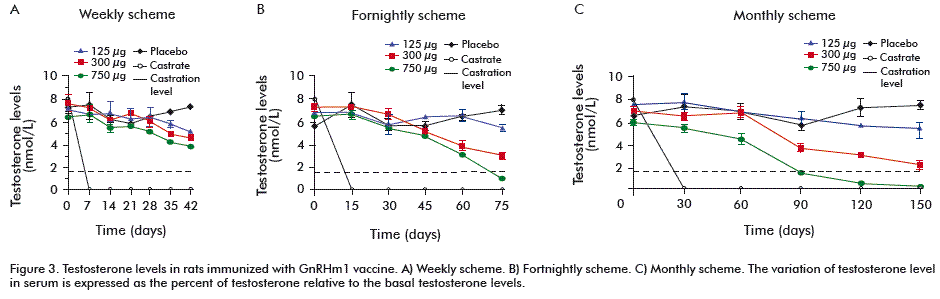
<?xml version="1.0" encoding="ISO-8859-1"?><article xmlns:mml="http://www.w3.org/1998/Math/MathML" xmlns:xlink="http://www.w3.org/1999/xlink" xmlns:xsi="http://www.w3.org/2001/XMLSchema-instance">
<front>
<journal-meta>
<journal-id>1027-2852</journal-id>
<journal-title><![CDATA[Biotecnología Aplicada]]></journal-title>
<abbrev-journal-title><![CDATA[Biotecnol Apl]]></abbrev-journal-title>
<issn>1027-2852</issn>
<publisher>
<publisher-name><![CDATA[Editorial Elfos Scientiae]]></publisher-name>
</publisher>
</journal-meta>
<article-meta>
<article-id>S1027-28522014000300005</article-id>
<title-group>
<article-title xml:lang="en"><![CDATA[Effect of a GnRH vaccine formulation on testosterone concentrations and reproduction in adult male rats]]></article-title>
<article-title xml:lang="es"><![CDATA[Efecto de una formulación vacunal basada en GnRH sobre la concentración de testosterona y la reproducción en ratas machos adultas]]></article-title>
</title-group>
<contrib-group>
<contrib contrib-type="author">
<name>
<surname><![CDATA[Fuentes]]></surname>
<given-names><![CDATA[Franklin]]></given-names>
</name>
<xref ref-type="aff" rid="A01"/>
</contrib>
<contrib contrib-type="author">
<name>
<surname><![CDATA[Junco]]></surname>
<given-names><![CDATA[Jesús]]></given-names>
</name>
<xref ref-type="aff" rid="A01"/>
</contrib>
<contrib contrib-type="author">
<name>
<surname><![CDATA[Calzada]]></surname>
<given-names><![CDATA[Lesvia]]></given-names>
</name>
<xref ref-type="aff" rid="A01"/>
</contrib>
<contrib contrib-type="author">
<name>
<surname><![CDATA[Lopez]]></surname>
<given-names><![CDATA[Yovisleydis]]></given-names>
</name>
<xref ref-type="aff" rid="A01"/>
</contrib>
<contrib contrib-type="author">
<name>
<surname><![CDATA[Pimentel]]></surname>
<given-names><![CDATA[Eulogio]]></given-names>
</name>
<xref ref-type="aff" rid="A01"/>
</contrib>
<contrib contrib-type="author">
<name>
<surname><![CDATA[Basulto Baker]]></surname>
<given-names><![CDATA[Roberto]]></given-names>
</name>
<xref ref-type="aff" rid="A01"/>
</contrib>
<contrib contrib-type="author">
<name>
<surname><![CDATA[Reyes Acosta]]></surname>
<given-names><![CDATA[Osvaldo]]></given-names>
</name>
<xref ref-type="aff" rid="A02"/>
</contrib>
<contrib contrib-type="author">
<name>
<surname><![CDATA[Garay-Pérez]]></surname>
<given-names><![CDATA[Hilda E]]></given-names>
</name>
<xref ref-type="aff" rid="A02"/>
</contrib>
<contrib contrib-type="author">
<name>
<surname><![CDATA[Guillén-Nieto]]></surname>
<given-names><![CDATA[Gerardo]]></given-names>
</name>
<xref ref-type="aff" rid="A02"/>
</contrib>
</contrib-group>
<aff id="A02">
<institution><![CDATA[,Centro de Ingeniería Genética y Biotecnología  ]]></institution>
<addr-line><![CDATA[La Habana ]]></addr-line>
<country>Cuba</country>
</aff>
<aff id="A01">
<institution><![CDATA[,Centro de Ingeniería Genética y Biotecnología de Camagüey  ]]></institution>
<addr-line><![CDATA[Camagüey ]]></addr-line>
<country>Cuba</country>
</aff>
<pub-date pub-type="pub">
<day>00</day>
<month>09</month>
<year>2014</year>
</pub-date>
<pub-date pub-type="epub">
<day>00</day>
<month>09</month>
<year>2014</year>
</pub-date>
<volume>31</volume>
<numero>3</numero>
<fpage>222</fpage>
<lpage>227</lpage>
<copyright-statement/>
<copyright-year/>
<self-uri xlink:href="http://scielo.sld.cu/scielo.php?script=sci_arttext&amp;pid=S1027-28522014000300005&amp;lng=en&amp;nrm=iso"></self-uri><self-uri xlink:href="http://scielo.sld.cu/scielo.php?script=sci_abstract&amp;pid=S1027-28522014000300005&amp;lng=en&amp;nrm=iso"></self-uri><self-uri xlink:href="http://scielo.sld.cu/scielo.php?script=sci_pdf&amp;pid=S1027-28522014000300005&amp;lng=en&amp;nrm=iso"></self-uri><abstract abstract-type="short" xml:lang="en"><p><![CDATA[In this study is described the effect of different doses of the gonadotropin releasing hormone (GnRH) mimetic peptide GnRHm1-TT, administered in three immunization schemes to define the most effective alternative combination for the treatment of prostate cancer. The design elements of the peptide immunogens are the GnRH-m1 linked to a T helper epitope of tetanus toxoid (TT) by chemical synthesis. Three doses of peptide GnRHm1-TT: 125, 300 and 750 µg were formulated in oil-based emulsions and tested in Copenhagen rats. Three immunization schemes (weekly, fortnightly and monthly) were used. As a result, the 750 µg dose generated a specific anti-GnRH antibody response in the fortnightly and monthly schemes, in contrast to 125 µg and 300 µg doses. The anti-GnRH seroconversion in the best responders corresponded with a decline, both in the testosterone levels down to castration and the size and weight of reproductive organs, an effect absent for the remaining doses of the three immunization schemes. The best variant corresponded to the 750 µg dose in a monthly regime. These findings demonstrated a marked immune-neutralization of the GnRH hormone for a subsequent immunological castration.]]></p></abstract>
<abstract abstract-type="short" xml:lang="es"><p><![CDATA[Se describe el efecto de diferentes dosis y esquemas de inmunización de un péptido mimético basado en la hormona liberadora de gonadotropina (GnRH), con el objetivo de definir la variante más efectiva en el tratamiento del cáncer de próstata. Este péptido utilizado como inmunógeno, se sintetiza mediante la unión del decapéptido GnRHm1 con un epitopo del toxoide tetánico (GnRHm1-TT), por síntesis química. Fueron utilizadas tres dosis de tratamiento: 125, 300 and 750 µg, formuladas como emulsión oleosa y se evaluaron tres esquemas de tratamiento en ratas Copenhagen: semanal, quincenal y mensual. Como resultado, la dosis experimental de 750 µg generó una mayor respuesta humoral específica anti-GnRH al ser comparado con las restantes dosis, utilizando los esquemas de inmunización quincenal y mensual, y los mejores resultados en el último. Los niveles de seroconversión anti-GnRH de los mejores respondedores se correspondieron con la reducción de niveles de testosterona hasta niveles de castración y a la reducción máxima del peso y la talla de los organos reproductores. Estos hallazgos demostraron que hubo una inmuno-neutralización marcada de la hormona GnRH con la consiguiente castración inmunológica.]]></p></abstract>
<kwd-group>
<kwd lng="en"><![CDATA[cancer vaccine]]></kwd>
<kwd lng="en"><![CDATA[GnRH]]></kwd>
<kwd lng="en"><![CDATA[rats]]></kwd>
<kwd lng="en"><![CDATA[castration]]></kwd>
<kwd lng="en"><![CDATA[testosterone]]></kwd>
<kwd lng="es"><![CDATA[vacuna contra cáncer]]></kwd>
<kwd lng="es"><![CDATA[GnRH]]></kwd>
<kwd lng="es"><![CDATA[ratas]]></kwd>
<kwd lng="es"><![CDATA[castración]]></kwd>
<kwd lng="es"><![CDATA[testosterona]]></kwd>
</kwd-group>
</article-meta>
</front><body><![CDATA[ <DIV class="Part"   >        <P align="right"   ><font size="2" color="#000000" face="Verdana, Arial, Helvetica, sans-serif"><b>RESEARCH</b>      </font></P >       <P align="right"   >&nbsp;</P >   <FONT size="+1" color="#000000">        <P   > </P >       <P   ><b><font face="Verdana, Arial, Helvetica, sans-serif" size="4">Effect of a GnRH      vaccine formulation on testosterone concentrations and reproduction in adult      male rats</font></b></P >       <P   >&nbsp;</P >       <P   > </P >       <P   ><b><font size="3" face="Verdana, Arial, Helvetica, sans-serif">Efecto de una      formulaci&oacute;n vacunal basada en GnRH sobre la concentraci&oacute;n de      testosterona y la reproducci&oacute;n en ratas machos adultas</font></b></P >       <P   >&nbsp;</P >       <P   >&nbsp;</P >   <FONT size="+1">        ]]></body>
<body><![CDATA[<P   > </P >       <P   ><font size="2" face="Verdana, Arial, Helvetica, sans-serif"><b>Franklin Fuentes<sup>1</sup>,      Jes&uacute;s Junco<sup>1</sup>, Lesvia Calzada<sup>1</sup>, Yovisleydis Lopez<sup>1</sup>,      Eulogio Pimentel<sup>1</sup>, Roberto Basulto Baker<sup>1</sup>, Osvaldo Reyes      Acosta<sup>2</sup>, Hilda E Garay-P&eacute;rez<sup>2</sup>, Gerardo Guill&eacute;n-Nieto<sup>2</sup>      </b></font></P >   <FONT size="+1"><FONT size="+1"><FONT size="+1"><FONT size="+1"><FONT size="+1"><FONT size="+1"><FONT size="+1"><FONT size="+1"><FONT size="+1"><FONT size="+1"><FONT size="+1"><FONT size="+1"><FONT size="+1"><FONT size="+1"><FONT size="+1"><FONT size="+1"><FONT size="+1"><FONT size="+1">        <P   > </P >   <FONT size="+1">        <P   ><font size="2" face="Verdana, Arial, Helvetica, sans-serif"><sup>1</sup> Centro      de Ingenier&iacute;a Gen&eacute;tica y Biotecnolog&iacute;a de Camag&uuml;ey.      Carretera Circunvalaci&oacute;n Norte Apdo Postal 387, Camag&uuml;ey, Cuba.</font><FONT size="+1"><FONT size="+1"></font></font>    <br>     <font size="2" face="Verdana, Arial, Helvetica, sans-serif"><sup>2</sup> Centro      de Ingenier&iacute;a Gen&eacute;tica y Biotecnolog&iacute;a. Ave 31 e/ 158      y 190, Cubanac&aacute;n, Playa. Apdo Postal 6072. CP. 10600, La Habana, Cuba.      </font></P >       <P   >&nbsp;</P >       <P   >&nbsp;</P >   <FONT size="+1"><FONT size="+1"><FONT size="+1"><FONT size="+1"> </font></font></font></font></font></font></font></font></font></font></font></font></font></font></font></font></font></font></font></font></font></font></font></font></font>   <hr>   <FONT size="+1" color="#000000"><FONT size="+1"><FONT size="+1"><FONT size="+1"><FONT size="+1"><FONT size="+1"><FONT size="+1"><FONT size="+1"><FONT size="+1"><FONT size="+1"><FONT size="+1"><FONT size="+1"><FONT size="+1"><FONT size="+1"><FONT size="+1"><FONT size="+1"><FONT size="+1"><FONT size="+1"><FONT size="+1"><FONT size="+1"><FONT size="+1"><FONT size="+1"><FONT size="+1"><FONT size="+1"><FONT size="+1">        <P   > </P >   <FONT size="+1">        <P   ><b><font face="Verdana, Arial, Helvetica, sans-serif" size="2">ABSTRACT </font></b></P >       <P   ><font size="2" face="Verdana, Arial, Helvetica, sans-serif">In this study is      described the effect of different doses of the gonadotropin releasing hormone      (GnRH) mimetic peptide GnRHm1-TT, administered in three immunization schemes      to define the most effective alternative combination for the treatment of      prostate cancer. The design elements of the peptide immunogens are the GnRH-m1      linked to a T helper epitope of tetanus toxoid (TT) by chemical synthesis.      Three doses of peptide GnRHm1-TT: 125, 300 and 750 &micro;g were formulated      in oil-based emulsions and tested in Copenhagen rats. Three immunization schemes      (weekly, fortnightly and monthly) were used. As a result, the 750 &micro;g      dose generated a specific anti-GnRH antibody response in the fortnightly and      monthly schemes, in contrast to 125 &micro;g and 300 &micro;g doses. The anti-GnRH      seroconversion in the best responders corresponded with a decline, both in      the testosterone levels down to castration and the size and weight of reproductive      organs, an effect absent for the remaining doses of the three immunization      schemes. The best variant corresponded to the 750 &micro;g dose in a monthly      regime. These findings demonstrated a marked immune-neutralization of the      GnRH hormone for a subsequent immunological castration. </font></P >   <FONT size="+1">        ]]></body>
<body><![CDATA[<P   ><font face="Verdana, Arial, Helvetica, sans-serif" size="2"><b>Keywords:</b>      cancer vaccine, GnRH, rats, castration, testosterone. </font></P >       <P   > </P >   <FONT size="+1"> </font></font></font></font></font></font></font></font></font></font></font></font></font></font></font></font></font></font></font></font></font></font></font></font></font></font></font></font>   <hr>   <FONT size="+1" color="#000000"><FONT size="+1"><FONT size="+1"><FONT size="+1"><FONT size="+1"><FONT size="+1"><FONT size="+1"><FONT size="+1"><FONT size="+1"><FONT size="+1"><FONT size="+1"><FONT size="+1"><FONT size="+1"><FONT size="+1"><FONT size="+1"><FONT size="+1"><FONT size="+1"><FONT size="+1"><FONT size="+1"><FONT size="+1"><FONT size="+1"><FONT size="+1"><FONT size="+1"><FONT size="+1"><FONT size="+1"><FONT size="+1"><FONT size="+1"><FONT size="+1">        <P   ><font face="Verdana, Arial, Helvetica, sans-serif" size="2"><b>RESUMEN</b> </font></P >       <P   ><font size="2" face="Verdana, Arial, Helvetica, sans-serif">Se describe el efecto      de diferentes dosis y esquemas de inmunizaci&oacute;n de un p&eacute;ptido      mim&eacute;tico basado en la hormona liberadora de gonadotropina (GnRH), con      el objetivo de definir la variante m&aacute;s efectiva en el tratamiento del      c&aacute;ncer de pr&oacute;stata. Este p&eacute;ptido utilizado como inmun&oacute;geno,      se sintetiza mediante la uni&oacute;n del decap&eacute;ptido GnRHm1 con un      epitopo del toxoide tet&aacute;nico (GnRHm1-TT), por s&iacute;ntesis qu&iacute;mica.      Fueron utilizadas tres dosis de tratamiento: 125, 300 and 750 &micro;g, formuladas      como emulsi&oacute;n oleosa y se evaluaron tres esquemas de tratamiento en      ratas Copenhagen: semanal, quincenal y mensual. Como resultado, la dosis experimental      de 750 &micro;g gener&oacute; una mayor respuesta humoral espec&iacute;fica      anti-GnRH al ser comparado con las restantes dosis, utilizando los esquemas      de inmunizaci&oacute;n quincenal y mensual, y los mejores resultados en el      &uacute;ltimo. Los niveles de seroconversi&oacute;n anti-GnRH de los mejores      respondedores se correspondieron con la reducci&oacute;n de niveles de testosterona      hasta niveles de castraci&oacute;n y a la reducci&oacute;n m&aacute;xima del      peso y la talla de los organos reproductores. Estos hallazgos demostraron      que hubo una inmuno-neutralizaci&oacute;n marcada de la hormona GnRH con la      consiguiente castraci&oacute;n inmunol&oacute;gica. </font></P >   <FONT size="+1">        <P   ><font face="Verdana, Arial, Helvetica, sans-serif" size="2"><b>Palabras clave:</b>      vacuna contra c&aacute;ncer, GnRH, ratas, castraci&oacute;n, testosterona.</font></P >   </font></font></font></font></font></font></font></font></font></font></font></font></font></font></font></font></font></font></font></font></font></font></font></font></font></font></font></font></font>   <hr>   <FONT size="+1" color="#000000"><FONT size="+1"><FONT size="+1"><FONT size="+1"><FONT size="+1"><FONT size="+1"><FONT size="+1"><FONT size="+1"><FONT size="+1"><FONT size="+1"><FONT size="+1"><FONT size="+1"><FONT size="+1"><FONT size="+1"><FONT size="+1"><FONT size="+1"><FONT size="+1"><FONT size="+1"><FONT size="+1"><FONT size="+1"><FONT size="+1"><FONT size="+1"><FONT size="+1"><FONT size="+1"><FONT size="+1"><FONT size="+1"><FONT size="+1"><FONT size="+1"><FONT size="+1">        <P   >&nbsp;</P >       <P   >&nbsp;</P >       <P   > </P >   <FONT size="+1">        <P   ><b><font face="Verdana, Arial, Helvetica, sans-serif" size="3">INTRODUCTION </font></b></P >   <FONT color="#0018E4">        <P   ><font size="2" color="#000000" face="Verdana, Arial, Helvetica, sans-serif">Several      treatment options exist for different stages of prostate cancer including      observation, prostatectomy, radiation therapy, chemotherapy, and hormone therapy.      Hormone therapy has evolved from the use of estrogens to gonadotropin-releasing      hormone (GnRH) agonists and GnRH antagonists. GnRH analogs are widely used      to block hypothalamic pituitary axis and therefore, represent the treatment      of choice for prostate cancer patients. GnRH receptors are expressed in prostate      cancer, even when the tumor has reached the castration resistant prostate      cancer stage, and are endowed with antitumor activity, supporting the notion      that they might be a molecular target for GnRH analog-based therapeutic strategies.      </font></P >   <FONT size="+1" color="#000000">        ]]></body>
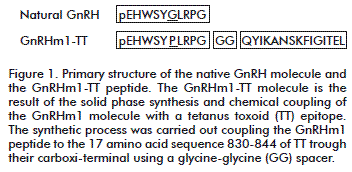
<body><![CDATA[<P   ><font face="Verdana, Arial, Helvetica, sans-serif" size="2">GnRH is a 10-amino      acids peptide hormone which is secreted by the hypothalamus and transported      by the hypothalamic hypophyseal portal system to the anterior pituitary. This      hypothalamic peptide hormone controls the synthesis and secretion of sex steroid      hormones (testosterone in males and estradiol and progesterone in females)      and thus controls the whole reproductive function [1-3]. Testosterone is considered      essential for the growth of prostate tumors. Within the prostate cells, testosterone      is converted into 5-&alpha;-dihydrotestosterone (DHT), by the action of the      5-&alpha; reductase enzyme. As an intracellular androgen, DHT is approximately      10 times more powerful than testosterone. The production of the primary circulating      androgen, testosterone, relies on the interplay of the hypothalamic-pituitary      axis and the testes. </font></P >       <P   ><font face="Verdana, Arial, Helvetica, sans-serif" size="2">GnRH-based vaccines      represent a promising anti-hormonal treatment alternative in prostate cancer,      because these can reduce serum testosterone to castration levels. In turn,      the ability to generate a memory immune response in vaccinated patients allows      them to be without medication for relatively long periods of time, which also      results in lower medication costs and marketing. This aspect gives vaccines      high added-value and great competitiveness in the market [5]. </font></P >       <P   ><font face="Verdana, Arial, Helvetica, sans-serif" size="2">An alternative approach      to the use of GnRH analogs is the immunization with the native or a mimetic      GnRH to induce anti-GnRH antibodies that may neutralize its biological activity,      resulting in castration effects similar to those of GnRH drug therapy. In      fact, immunization against GnRH has been shown to interrupt these biological      activities in male mice [7]. </font></P >       <P   ><font face="Verdana, Arial, Helvetica, sans-serif" size="2">GnRH immunogens have      been reported to cause suppression in testicular activity in bovine for a      long time [8, 9]. They can also be used to suppress reproductive functions      in swine, as was the case of the GnRH dimmer in tandem conjugated to ovoalbumin      (OVA) and emulsified in Specol [10]. This vaccine was highly immunogenic in      healthy animals, inducing high anti-GnRH antibody titers and resulting in      decreased testosterone levels, particularly significant in prostate and testicles      weight reduction in pigs, dogs, and rats [11]. </font></P >       <P   ><font face="Verdana, Arial, Helvetica, sans-serif" size="2">Futhermore, since      GnRH is a short peptide, immunoenhancing approaches have to be implemented      for successful vaccination. One the most common procedures to make a peptide      immunogenic is to couple it to a carrier protein molecule, such as: KLH, TT,      diphteria toxoid (DT), OVA, bovine and human serum albumin (BSA and HAS, respectively).      Moreover, the origin of the carrier protein could be relevant for the conjugate      immunogenicity levels, with heterologous proteins expected to result in conjugates      of stronger immune responses. In general, several heterologous proteins can      be used as carriers, but non-mammalian proteins tend to be highly immunogenic.      </font></P >       <P   ><font face="Verdana, Arial, Helvetica, sans-serif" size="2">Additionally, the      site of conjugation may determine the efficacy of the immunization [6]. The      conjugation process used for the peptide-carrier fusion has caused losses      during conjugation and made the goals [6]. Recently, multiple T-helper epitopes      were chemically bound to GnRH to improve the immunogenicity and the castration      levels in potential recipients [13]. It was shown that two immunizations with      the G6k-GnRH tandem-dimer-OVA conjugate in a suitable adjuvant such as CoVaccine<sup>&reg;</sup>      HT causes a rapid and complete reduction of serum testosterone levels in sexually      mature stallions [14]. It subsequently led to reduced sperm motility and affected      testis function, while no adverse reactions were observed after immunizations.      In a mouse model, it was demonstrated that anti-GnRH antibody responses can      be induced by a synthetic GnRH3-hinge-MVP peptide. Mice treated with GnRH3-hinge-MVP-hsp65      had a significantly prolonged survival and suppression of local tumor growth,      also showing reduced serum testosterone and luteinizing hormone levels (p      &lt; 0.05) [15]. </font></P >   <FONT size="+1"><FONT size="+1">        <P   ><font face="Verdana, Arial, Helvetica, sans-serif" size="2">The strategy was      to induce immunity to GnRH by altering the target molecule on a synthetic      peptide conjugated to TT immunogen (GnRHm1-TT) [16]. In this work, its immunogenic      capacity and its correlation with a reduction in testosterone levels in a      rat model was determined, using three doses and three immunization schemes.      Our results are relevant for future clinical trials in prostate cancer patients.      </font></P >       <P   >&nbsp;</P >       <P   ><font size="2" face="Verdana, Arial, Helvetica, sans-serif"><b><font size="3">MATERIALS      AND METHODS </font></b> </font></P >   <FONT size="+1">        <P   ><font size="2" face="Verdana, Arial, Helvetica, sans-serif"><b>Peptide synthesis      </b> </font></P >   <FONT size="+1">        ]]></body>
<body><![CDATA[<P   ><font face="Verdana, Arial, Helvetica, sans-serif" size="2">Peptides were synthesized      on a solid phase using the Fmoc/tBu chemistry on Fmoc-AM-MBHA resin. Removal      of the Fmoc group was carried out with 20 % of piperidine in Dimethylformamide,      and the Fmoc-amino acids were coupled with DIC/HOBt activation. Cleavage from      the resin and removal of side chain-protecting groups were accomplished by      treatment with TFA/H<sub>2</sub>O/TIS (96.5/2.5/1) for 2 h, and the peptides      were then precipitated with cold ether, dissolved in 40 % acetonitrile/water,      and lyophilized [17]. Peptides were purified by RP-HPLC and identified by      mass spectrometry (<a href="#fig1">Figure 1</a>). </font></P >       <P align="center"   ><img src="/img/revistas/bta/v31n3/f0105314.gif" width="350" height="170"><a name="fig1"></a></P >   <FONT size="+1"><FONT size="+1">        
<P   ><font face="Verdana, Arial, Helvetica, sans-serif" size="2"><b>Chromatography      </b></font></P >       <P   ><font face="Verdana, Arial, Helvetica, sans-serif" size="2">Peptides were analyzed      on an AKTA 100 (GE Healthcare USA, Piscataway, NJ, USA) HPLC system. Separation      was achieved in an RP-C18 column (4.6 &times; 150 mm<sup>2</sup>, 5 &mu;m)      (Vydac, Grace, Deerfield, IL, USA), sith solvents: A (0.1 % of TFA in water)      and B (0.05 % of TFA in acetonitrile). A linear gradient of 5-60 % of B for      35 min and a flow rate of 0.8 mL/min were used. Chromatograms were acquired      at 226 nm, using the software package Unicorn 4.11 (GE Healthcare USA) for      data processing of the RP-HPLC chromatograms. Peptides were purified on a      LaChrom (Merck </font><font face="Verdana, Arial, Helvetica, sans-serif" size="2">Hitachi,      Darmstadt, Germany) HPLC system, using an RP-C18 column (Vydac, 25 &times;      250 mm<sup>2</sup>, 25 &mu;m) and a linear gradient of 15-45 % of B for 50      min and a flow rate of 5 mL/min. Absorbance was monitored at 226 nm. </font></P >   <FONT size="+1"><FONT size="+1"><FONT size="+1"><FONT size="+1">        <P   ><font face="Verdana, Arial, Helvetica, sans-serif" size="2"><b>Animal models      </b></font></P >       <P   ><font face="Verdana, Arial, Helvetica, sans-serif" size="2">Seventy-seven male      Copenhagen rats of 8-9 weeks of age and females untreated for breeding were      used. The animals were kept under a controlled environment at 20 &ordm;C,      65 % mean humidity and a 14 h light/ 10 h dark photoperiod. Water and sterile      feed access was <I>ad libitum</I>. </font></P >       <P   ><font face="Verdana, Arial, Helvetica, sans-serif" size="2">The animals were      distributed at random in 11 experimental groups (7 rats each). Three doses      of the GnRHm1-TT peptide were used: 125, 300 and 750 &micro;g; and three schemes      for each dose (weekly, fortnightly and monthly). Additionally, a group of      castrated and placebo animals were used. </font></P >       <P   ><font face="Verdana, Arial, Helvetica, sans-serif" size="2"><b>Immunogen preparation,      immunization and mating </b></font></P >       <P   ><font face="Verdana, Arial, Helvetica, sans-serif" size="2">The GnRHm1-TT peptide      was resuspended in phosphate buffered saline (PBS; v/v) and added, drop-by-drop,      to the same volume of Montanide ISA 51 v/v. It was further shaked for 30 min      to prepare the emulsion. Emulsions were prepared just before immunization.      </font></P >       <P   ><font face="Verdana, Arial, Helvetica, sans-serif" size="2">Every scheme had      rounds of 4 immunizations. The immunogens (500 &micro;L) were administered      subcutaneously on 4 sites along the supraescapular area, on both sides of      the spine. The placebo animals were mated 4 weeks after the last vaccination      with adult Copenhagen female rats. On the contrary, the males from the weekly      scheme were mated after the last vaccination. The pairs (one per cage) stayed      together for 2 weeks. Then, treated and untreated males were removed and anesthetized      prior to sacrifice by cervical dislocation. The progenies from the pairs were      registered and weighed. </font></P >       ]]></body>
<body><![CDATA[<P   ><font face="Verdana, Arial, Helvetica, sans-serif" size="2"><b>Blood and serum      collection and animal weighing </b></font></P >       <P   ><font face="Verdana, Arial, Helvetica, sans-serif" size="2">Blood was collected      intraorbital puncture (500 &mu;L approx.) and the animals were weighed, in      all the schemes before each immunization, a week after the last immunization      and on the day of sacrifice. The blood was centrifuged at 3200 rpm for 30      min, and sera collected and stored at &ndash;20 &ordm;C until use. </font></P >       <P   ><font face="Verdana, Arial, Helvetica, sans-serif" size="2"><b>Anti-GnRH antibody      titer screening </b></font></P >       <P   ><font face="Verdana, Arial, Helvetica, sans-serif" size="2">The concentration      of circulating GnRH-specific antibodies was determined by enzyme-linked-immunosorbent      assay (ELISA). Solid-phase ELISA was performed using 96-well polystyrene plates      (High binding, Nunc), coated with 10 &mu;g/mL of natural GnRH peptide overnight      at 4 &ordm;C. Subsequently, plates were blocked with PBS (pH 7.4) supplemented      with bovine serum albumin (BSA, 2 % v/v; Sigma) for 60 min at 37 &ordm;C,      and further washed three times with PBS-Tween 20 at 0.05 %. Then, the diluted      serum samples were incubated 3 h at 37 &ordm;C. After the corresponding washes,      the anti-rat IgG-peroxidase conjugate was added to the working solution (1/8000)      and plates were incubated for 60 min at 37 &ordm;C. The reaction of anti-IgG      antibodies against the GnRHm1 peptide was detected by adding orthophenylendamine      (OPD) as chromogen and the H<sub>2</sub>O<sub>2</sub> substrate dissolved      in a proper buffer (dibasic sodium phosphate 0.02 M, pH 5) and incubated for      30 min at room temperature. Finally, the reaction was stopped by the addition      of 2.5 N sulphuric acid. The plates were read at 492 nm with the microtiter      plate reader (Multiscan, Labystem, Finland). Samples with absorbance values      greater than the cut off line (0.159) were considered positive. </font></P >   <FONT size="+1"><FONT size="+1"><FONT size="+1"><FONT size="+1">        <P   ><font face="Verdana, Arial, Helvetica, sans-serif" size="2">The immune response      kinetics was calculated from the mean anti-GnRH antibody seroconversion for      each experimental group. Sera were diluted 1/50, as the maximum absorbance      value. The cut off value of the test (0.159) was calculated from a set of      negative samples [18]. </font></P >       <P   ><font face="Verdana, Arial, Helvetica, sans-serif" size="2"><b>Testosterone determination      </b> </font></P >       <P   ><font face="Verdana, Arial, Helvetica, sans-serif" size="2">Testosterone levels      were determined using the commercial TESTO CT2 kit, (CIS Bio International      France). The sensitivity of the method, defined as the detectable concentration      equivalent to twice the standard deviation of the zero-binding value, was      aproximately 0.1 nmol/L, with a specificity of the test kit for testosterone      higher than 99 %. Determinations were done in duplicates, by plating 25 &mu;L      of each serum sample directly in the pre-coated tubes, followed by incubation      for 1 h at 37 &ordm;C. Finally, the tubes were washed with distilled water      and read in a gamma counter, with results expressed in nmol/L. </font></P >       <P   ><font face="Verdana, Arial, Helvetica, sans-serif" size="2"><b>Macroscopic evaluation      of reproductive organs </b></font></P >       <P   ><font face="Verdana, Arial, Helvetica, sans-serif" size="2">Animal testicles      and prostates were removed and weighed on an analytical balance (Sartorius)      and standardized against animals weights. </font></P >       <P   ><font face="Verdana, Arial, Helvetica, sans-serif" size="2"><b>Statistical analysis      </b> </font></P >       ]]></body>
<body><![CDATA[<P   ><font face="Verdana, Arial, Helvetica, sans-serif" size="2">A multifactorial      variance analysis was used, followed by a Duncan&rsquo;s multiple range test      (95 % confidence interval, p &gt; 0.05). </font></P >       <P   ><font face="Verdana, Arial, Helvetica, sans-serif" size="2">The F ratio was set      as 5.27844, calculated as the ratio between-groups estimate over the within-groups      estimate, with estimates coming from the ANOVA variance data table. A p value      lower than 0.05 was used for the F test, to fit the statistical differences      between the means of the three variables at a 95 % confidence interval, and      differences were determined by Multiple Range comparison test. </font></P >       <P   >&nbsp;</P >   <FONT color="#D70000">        <P   ><font size="2" color="#000000" face="Verdana, Arial, Helvetica, sans-serif"><b><font size="3">RESULTS      </font> </b> </font></P >   <FONT size="+1" color="#000000">        <P   ><font size="2" face="Verdana, Arial, Helvetica, sans-serif"><b>Anti-GnRH antibodies      seroconversion </b></font></P >   <FONT size="+1"><FONT color="#FF00FF">        <P   ><font color="#000000" face="Verdana, Arial, Helvetica, sans-serif" size="2">The      means of anti-GnRH antibodies seroconvertion against the peptides used for      immunization are shown in <a href="/img/revistas/bta/v31n3/f0205314.gif">figure 2</a>. The highest      seroconversion values (absorbance at 492 nm) were obtained in the experimental      group receiving 750 &micro;g of the GnRHm1-TT peptide monthly and fornightly;      whereas for the 300 &micro;g dose in the three schemes, seroconversion values      were discretely higher than the cut off line. </font></P >   <FONT color="#000000">        
<P   ><font face="Verdana, Arial, Helvetica, sans-serif" size="2"><b>Testosterone levels      </b> </font></P >   <FONT color="#FF00FF">        <P   ><font color="#000000" face="Verdana, Arial, Helvetica, sans-serif" size="2">Regarding      testosterone levels, it was observed that the 750 &micro;g dose of GnRH m1-TT      was the only one able to reduce testosterone values under castration levels      (1.7 nmol/L) in the fortnightly and monthly immunization schemes, with the      highest reduction in the monthly immunization scheme. Significant differences      were achieved with this dose compared to the 125 &mu;g (p = 0.0001), 300 &mu;g      (p = 0.0243) and placebo (p = 0.0013). Animals receiving 300 &micro;g of the      peptide only showed significant differences in testosterone levels in the      monthly scheme, compared to those immunized with 125 &micro;g (p = 0.021)      and placebo (p = 0.0443) (<a href="/img/revistas/bta/v31n3/f0305314.gif">Figure 3</a>), but never      reached castration levels. The immunization with 125 &micro;g of GnRH m1-TT      neither reduced testosterone levels below castration levels nor generated      statistically significant differences with those of the placebo group. </font></P >   <FONT color="#000000"><FONT color="#FFFF00">        
<P   ><font color="#000000" face="Verdana, Arial, Helvetica, sans-serif" size="2"><b>Crossings      </b> </font></P >   <FONT color="#000000">        <P   ><font face="Verdana, Arial, Helvetica, sans-serif" size="2">Fertility of immunized      males was tested 15 days after the last GnRHm1-TT injection. Parallel studies      were conducted with control males. The fertility data from pregnant rats are      shown in the <a href="/img/revistas/bta/v31n3/t0105314.gif">table</a>. In the 750 &mu;g dose groups      in fortnightly and monthly immunization schemes), 1 out of 7 males (14 %)      was fertile in both schemes. The rest of the experimental groups showed no      significant differences from controls. </font></P >       
]]></body>
<body><![CDATA[<P   ><font face="Verdana, Arial, Helvetica, sans-serif" size="2"><b>Post-mortem analysis      of organs </b></font></P >       <P   ><font face="Verdana, Arial, Helvetica, sans-serif" size="2">The relation between      testis and prostate weight and average GnRH binding percentage per animal      is shown in <a href="#fig4">figure 4</a>. Significant differences were achieved      for testicle weight between the dose and the immunization schemes used (p      = 0.0007 and p = 0.0046, respectively; multifactorial variance analysis).      Similar results were observed for prostate weight, with significant differences      between doses and immunization schemes (p = 0.0012 and p = 0.0316, respectively).      Testicle and prostate weight was significantly reduced only for the 750 &mu;g      dose compared to the placebo group, infact, highly significant for prostate      weight in all the schemes (Duncan&rsquo;s multiple range test). The 300 &mu;g      dose showed significant results only for prostate weight in the monthly scheme.</font></P >       <P align="center"   ><img src="/img/revistas/bta/v31n3/file:///H|/Marcaje%20Vol.%2031%20No.%203%20end/bta04314/f0404314.gif" width="344" height="414"><a name="fig4"></a></P >       
<P   >&nbsp;</P >       <P   ><font size="2" face="Verdana, Arial, Helvetica, sans-serif"><b><font size="3">DISCUSSION      </font></b></font></P >   <FONT size="+1"><FONT color="#0018E4">        <P   ><font size="2" color="#000000" face="Verdana, Arial, Helvetica, sans-serif">GnRH      is a peptide showing a fully conserved structure throughout mammalian species,      and serves as a homologous model for the human GnRH [4]. It normally joins      the receptor of the hypophysis and causes the release of gonadotropin, necessary      for testosterone production at the testicle level. This was the basis for      studying the immunogenic capacity of GnRHm1-TT and the correlation with reduced      testosterone levels in a rat model, which was determined by using three doses      and three immunization schemes. </font></P >   <FONT size="+1" color="#000000">        <P   ><font face="Verdana, Arial, Helvetica, sans-serif" size="2">The active immunization      against GnRH is one of the most prominent alternatives to surgical castration;      however, the results from the studies made in some species, like swine and      rats, have shown that the peptide antigen used which is similar to the endogenous      GnRH was poorly immunogenic, an effect related with the haptenic nature of      GnRH [19]. </font></P >       <P   ><font face="Verdana, Arial, Helvetica, sans-serif" size="2">The administration      of a GnRH-based formulation causes changes or damage in most of the organs      of the reproductive system of mammals, markedly reducing the levels of circulating      testosterone that leads to castration levels as the essential condition to      achieve formulation efficiency [20]. </font></P >       <P   ><font face="Verdana, Arial, Helvetica, sans-serif" size="2">Considering the natural      tolerance to GnRH due to its conservation in mammals, a GnRH analogue variant      was created with an aminoacid change of a glycine for a proline, and one T      helper epitope from TT to increase the GnRH immunogenic capacity [16]. The      different doses tested of the vaccine candidate in three different immunization      schemes showed the best anti-GnRH antibody seroconversion results when administering      750 &micro;g in a monthly scheme. In the groups receiving 125 &micro;g and      300 &micro;g doses antibody levels did not surpass the ELISA cut off line      either the scheme. The phenomenon observed in these lower doses seems to correspond      to the poor immunogenicity expected for an autologous, low molecular weight      molecule like GnRH. Although it has been altered and coupled to an immunogenic      carrier, it needs to be administered to attain antigen concentrations enough      to mount effective immune activation, as determined by Talwar [4]. Alternatively,      the low immunogenicity regarding all the doses in the weekly scheme seems      to be related to a low maturation of the immune response, due to the huge      antigenic load provided in terms of immunization frequency. Ultimately, the      natural hormone is immunoneutralized by the generated anti-GnRH antibodies.      </font></P >       <P   ><font face="Verdana, Arial, Helvetica, sans-serif" size="2">A direct correlation      was observed between the anti-GnRH antibody seroconversion achieved with the      750 &micro;g dose and the decrease in testosterone levels down to castration.      Nevertheless, a similar effect was seen in the fortnightly scheme using the      same dose, regardless the discrete anti-GnRH antibody seroconversion. In the      weekly scheme, testosterone levels remained steady for any of the doses tested,      in agreement with previous reports [4, 14, 20]. </font></P >       ]]></body>
<body><![CDATA[<P   ><font face="Verdana, Arial, Helvetica, sans-serif" size="2">Post-mortem analysis      of testicles and prostates of animals immunized with the 750 &micro;g dose      in the monthly scheme revealed a significant weight reduction of testicles      and prostates compared to those of the control animals. </font></P >       <P   ><font face="Verdana, Arial, Helvetica, sans-serif" size="2">Additionally, there      was a small, but significative decrease in prostate weight in the animals      receiving the 750 &micro;g and 300 &micro;g doses in the fortnightly scheme;      however, testicles weight did not varied the same [21]. No signs of biological      effects in gonads and accessory glands were observed in the weekly scheme.      </font></P >       <P   ><font face="Verdana, Arial, Helvetica, sans-serif" size="2">The weight decrease      and atrophy in testicles and prostate of the animals immunized with GnRH modified      variant suggest the entanglement of antibody-mediated GnRH neutralization,      which subsequently deplete gonadotrophic hormones (luteinizing hormone and      follicle-stimulating hormone) which play an important role in the normal development      of the genital apparatus [22]. When the reproductive capacity of the animals      in the different experimental groups was checked, the 750 &micro;g dose in      the fortnightly and monthly schemes induced an infertility process that may      be caused mainly by a reduction in testosterone levels as essential hormone      for spermatogenesis in males. These results greatly correlated with anti-GnRH      antibodies, animal&rsquo;s andrology and post-mortem analysis. It is suggested      that reproductive organ atrophy would have caused of animal infertility. </font></P >       <P   ><font face="Verdana, Arial, Helvetica, sans-serif" size="2">There can be concluded      that the best administration dose and immunization scheme combination is the      750 &micro;g dose administered in a monthly scheme. This is a relevant result,      considering it establishes the effective dose and immunization regime to develop      a therapeutic vaccine against human hormone-dependent neoplasia, like prostate      and breast cancer, of high incidence worldwide [23]. </font></P >       <P   ><font face="Verdana, Arial, Helvetica, sans-serif" size="2">This vaccine candidate      represents a promising anti-hormonal alternative in prostate cancer treatment.      In turn, the potential to generate a memory immune response in vaccinated      patients provides a therapeutic strategy without medications for relatively      long periods of time which would also result in lower medication and marketing      costs.</font></P >       <P   >&nbsp;</P >       <P   > </P >       <P   ><font size="3"><b><font face="Verdana, Arial, Helvetica, sans-serif">REFERENCES</font></b></font><font face="Verdana, Arial, Helvetica, sans-serif" size="2">      </font></P >       <!-- ref --><P   ><font size="2" face="Verdana, Arial, Helvetica, sans-serif">1. Garner LL, Campbell      GT, Blake CA. Luteinizing hormone (LH)-releasing hormone: chronic effects      on LH and follicle-stimulating hormone cells and secretion in adult male rats.      Endocrinology. 1990;126(2):992-1000.     </font></P >       ]]></body>
<body><![CDATA[<!-- ref --><P   ><font size="2" face="Verdana, Arial, Helvetica, sans-serif">2. Ghosh S, Jackson      DC. Antigenic and immunogenic properties of totally synthetic peptide-based      anti-fertility vaccines. Int Immunol. 1999;11(7):1103-10.     </font></P >       <!-- ref --><P   ><font size="2" face="Verdana, Arial, Helvetica, sans-serif">3. Jacobs E, Watson      SA, Michaeli D, Ellis IO, Robertson JF. Anti-gonadotrophin releasing hormone      antibodies inhibit the growth of MCF7 human breast cancer xenografts. Br J      Cancer. 1999;80(3-4):352-9.     </font></P >       <!-- ref --><P   ><font size="2" face="Verdana, Arial, Helvetica, sans-serif">4. Talwar GP. Vaccines      for control of fertility and hormone-dependent cancers. Immunol Cell Biol.      1997;75(2):184-9.     </font></P >       <!-- ref --><P   ><font size="2" face="Verdana, Arial, Helvetica, sans-serif">5. Trewartha D, Carter      K. Advances in prostate cancer treatment. Nat Rev Drug Discov. 2013;12(11):823-4.          </font></P >       <!-- ref --><P   ><font size="2" face="Verdana, Arial, Helvetica, sans-serif">6. Ladd A, Tsong      YY, Lok J, Thau RB. Active immunization against LHRH: I. Effects of conjugation      site and dose. Am J Reprod Immunol. 1990;22(1-2):56-63.     </font></P >       ]]></body>
<body><![CDATA[<!-- ref --><P   ><font size="2" face="Verdana, Arial, Helvetica, sans-serif">7. Javid A, Ganaie      M, Phil V, Shrivastava K. The effect of active immunization with gonadotropin      releasing hormone conjugate (GnRH-BSA) ongonadosomatic indices (GSI) and sperm      parameters in mice. Iranian J Reprod Med. 2008:6:119-23.     </font></P >       <!-- ref --><P   ><font size="2" face="Verdana, Arial, Helvetica, sans-serif">8. Cook RB, Popp      JD, Kastelic JP, Robbins S, Harland R. The effects of active immunization      against gnRH on testicular development, feedlot performance, and carcass characteristics      of beef bulls. J Animal Sci. 2000;78(11):2778-83.     </font></P >       <P   ><font size="2" face="Verdana, Arial, Helvetica, sans-serif">9. D&rsquo;Occhio      MJ, Aspden WJ, Trigg TE. Sustained testicular atrophy in bulls actively immunized      against GnRH: potential to control carcase characteristics. Anim Reprod Sci.      2001;66(1-2):47-58. </font></P >       <!-- ref --><P   ><font size="2" face="Verdana, Arial, Helvetica, sans-serif">10. Zeng XY, Turkstra      JA, van de Wiel DF, Guo DZ, Liu XY, Meloen RH, <I>et al</I>. Active immunization      against gonadotrophin-releasing hormone in Chinese male pigs. Reprod Domest      Anim. 2001;36(2):101-5.     </font></P >       <!-- ref --><P   ><font size="2" face="Verdana, Arial, Helvetica, sans-serif">11. Basulto R, Milanes      C, Rojas A, Fuentes F, Izquierdo N, Bertot JA. Effects of GnRH immunization      in the testicular structure and function of adults dogs. Biotecnol Apl. 2003;20:20-4.          </font></P >       <!-- ref --><P   ><font size="2" face="Verdana, Arial, Helvetica, sans-serif">12. Junco JA, Basalto      R, Fuentes F, Bover E, Reyes O, Pimentel E, <I>et al</I>. Gonadotrophin releasing      hormone-based vaccine, an effective candidate for prostate cancer and other      hormone-sensitive neoplasms. Adv Exp Med Biol. 2008;617:581-7.     </font></P >       <!-- ref --><P   ><font size="2" face="Verdana, Arial, Helvetica, sans-serif">13. Finstad CL, Wang      CY, Kowalski J, Zhang M, Li ML, Li XM, <I>et al</I>. Synthetic luteinizing      hormone releasing hormone (LHRH) vaccine for effective androgen deprivation      and its application to prostate cancer immunotherapy. Vaccine. 2004;22(9-10):1300-13.          </font></P >       <!-- ref --><P   ><font size="2" face="Verdana, Arial, Helvetica, sans-serif">14. Turkstra JA,      van der Meer FJ, Knaap J, Rottier PJ, Teerds KJ, Colenbrander B, <I>et al</I>.      Effects of GnRH immunization in sexually mature pony stallions. Anim Reprod      Sci. 2005;86(3-4):247-59.     </font></P >       <!-- ref --><P   ><font size="2" face="Verdana, Arial, Helvetica, sans-serif">15. Xu J, Zhu Z,      Wu J, Liu W, Shen X, Zhang Y, et al. Immunization with a recombinant GnRH      vaccine conjugated to heat shock protein 65 inhibits tumor growth in orthotopic      prostate cancer mouse model. Cancer Lett. 2008;259(2):240-50.     </font></P >       <P   ><font size="2" face="Verdana, Arial, Helvetica, sans-serif">16. Bringas R, Basulto      R, Reyes O, de La Fuente J. Vaccine for the reversible immunocastration of      mammals. Patent number: WO 9827111. 1998 Jun 25. </font></P >       <!-- ref --><P   ><font size="2" face="Verdana, Arial, Helvetica, sans-serif">17. Fields GB, Noble      RL. Solid phase peptide synthesis utilizing 9-fluorenylmethoxycarbonyl amino      acids. Int J Pept Protein Res. 1990;35(3):161-214.     </font></P >       ]]></body>
<body><![CDATA[<!-- ref --><P   ><font size="2" face="Verdana, Arial, Helvetica, sans-serif">18. Aguilar FF, Barranco      JJ, Fuentes EB, Aguilera LC, Saez YL, Santana MD, <I>et al</I>. Very small      size proteoliposomes (VSSP) and Montanide combination enhance the humoral      immune response in a GnRH based vaccine directed to prostate cancer. Vaccine.      2012;30(46):6595-9.     </font></P >       <!-- ref --><P   ><font size="2" face="Verdana, Arial, Helvetica, sans-serif">19. Oonk HB, Turkstra      JA, Schaaper WM, Erkens JH, Schuitemaker-de Weerd MH, van Nes A, <I>et al</I>.      New GnRH-like peptide construct to optimize efficient immunocastration of      male pigs by immunoneutralization of GnRH. Vaccine. 1998;16(11-12):1074-82.          </font></P >       <!-- ref --><P   ><font size="2" face="Verdana, Arial, Helvetica, sans-serif">20. Miller LA, Johns      BE, Elias DJ, Crane KA. Comparative efficacy of two immunocontraceptive vaccines.      Vaccine. 1997;15(17-18):1858-924.     </font></P >       <!-- ref --><P   ><font size="2" face="Verdana, Arial, Helvetica, sans-serif">21. Jayashankar R,      Chaudhuri MK, Singh O, Alam A, Talwar GP. Semisynthetic anti-LHRH vaccine      causing atrophy of the prostate. Prostate. 1989;14(1):3-117.     </font></P >       <!-- ref --><P   ><font size="2" face="Verdana, Arial, Helvetica, sans-serif">22. Jinshu X, Jingjing      L, Duan P, Zheng Z, Ding M, Jie W, <I>et al</I>. A synthetic gonadotropin-releasing      hormone (GnRH) vaccine for control of fertility and hormone dependent diseases      without any adjuvant. Vaccine. 2005;23(40):4834-43.     </font></P >       ]]></body>
<body><![CDATA[<P   ><font size="2" face="Verdana, Arial, Helvetica, sans-serif">23. Ornstein DK,      Dahut WL, Liotta LA, Emmert-Buck MR. Review of AACR meeting: new research      approaches in the prevention and cure of prostate cancer, 2-6 December 1998,      Indian Wells, CA. Biochim Biophys Acta. 1999;1424(1):R11-9. </font></P >       <P   >&nbsp;</P >       <P   >&nbsp;</P >   <FONT size="+1">        <P   > </P >   <FONT size="+1">        <P   ><font face="Verdana, Arial, Helvetica, sans-serif" size="2">Received in April,      2014.    <br>     </font><font face="Verdana, Arial, Helvetica, sans-serif" size="2">Accepted      in December, 2014. </font></P >       <P   >&nbsp;</P >       <P   >&nbsp;</P >       <P   ></P >       <P   > </P >       ]]></body>
<body><![CDATA[<P   ><font face="Verdana, Arial, Helvetica, sans-serif" size="2"><i>Franklin Fuentes</i>.      Centro de Ingenier&iacute;a Gen&eacute;tica y Biotecnolog&iacute;a de Camag&uuml;ey.      Carretera Circunvalaci&oacute;n Norte Apdo Postal 387, Camag&uuml;ey, Cuba.      E-mail: <A href="mailto:franklin.fuentes@cigb.edu.cu"> <FONT color="#0000FF">franklin.fuentes@cigb.edu.cu</font></A><FONT color="#0000FF"><FONT color="#000000">.      </font></font></font></P >   <FONT color="#0000FF"><FONT color="#000000">        <P   > </P >   </font></font></font></font></font></font></font></font></font></font></font></font></font></font></font></font></font></font></font></font></font></font></font></font></font></font></font></font></font></font></font></font></font></font></font></font></font></font></font></font></font></font></font></font></font></font></font></font></font></font></font></font></font></font></font></font></font></font></font></font></font></font></DIV >      ]]></body><back>
<ref-list>
<ref id="B1">
<label>1</label><nlm-citation citation-type="journal">
<person-group person-group-type="author">
<name>
<surname><![CDATA[Garner]]></surname>
<given-names><![CDATA[LL]]></given-names>
</name>
<name>
<surname><![CDATA[Campbell]]></surname>
<given-names><![CDATA[GT]]></given-names>
</name>
<name>
<surname><![CDATA[Blake]]></surname>
<given-names><![CDATA[CA]]></given-names>
</name>
</person-group>
<article-title xml:lang="en"><![CDATA[Luteinizing hormone (LH)-releasing hormone: chronic effects on LH and follicle-stimulating hormone cells and secretion in adult male rats]]></article-title>
<source><![CDATA[Endocrinology]]></source>
<year>1990</year>
<volume>126</volume>
<numero>2</numero>
<issue>2</issue>
<page-range>992-1000</page-range></nlm-citation>
</ref>
<ref id="B2">
<label>2</label><nlm-citation citation-type="journal">
<person-group person-group-type="author">
<name>
<surname><![CDATA[Ghosh]]></surname>
<given-names><![CDATA[S]]></given-names>
</name>
<name>
<surname><![CDATA[Jackson]]></surname>
<given-names><![CDATA[DC]]></given-names>
</name>
</person-group>
<article-title xml:lang="en"><![CDATA[Antigenic and immunogenic properties of totally synthetic peptide-based anti-fertility vaccines]]></article-title>
<source><![CDATA[Int Immunol]]></source>
<year>1999</year>
<volume>11</volume>
<numero>7</numero>
<issue>7</issue>
<page-range>1103-10</page-range></nlm-citation>
</ref>
<ref id="B3">
<label>3</label><nlm-citation citation-type="journal">
<person-group person-group-type="author">
<name>
<surname><![CDATA[Jacobs]]></surname>
<given-names><![CDATA[E]]></given-names>
</name>
<name>
<surname><![CDATA[Watson]]></surname>
<given-names><![CDATA[SA]]></given-names>
</name>
<name>
<surname><![CDATA[Michaeli]]></surname>
<given-names><![CDATA[D]]></given-names>
</name>
<name>
<surname><![CDATA[Ellis]]></surname>
<given-names><![CDATA[IO]]></given-names>
</name>
<name>
<surname><![CDATA[Robertson]]></surname>
<given-names><![CDATA[JF]]></given-names>
</name>
</person-group>
<article-title xml:lang="en"><![CDATA[Anti-gonadotrophin releasing hormone antibodies inhibit the growth of MCF7 human breast cancer xenografts]]></article-title>
<source><![CDATA[Br J Cancer]]></source>
<year>1999</year>
<volume>80</volume>
<numero>3</numero>
<issue>3</issue>
<page-range>4):352-9</page-range></nlm-citation>
</ref>
<ref id="B4">
<label>4</label><nlm-citation citation-type="journal">
<person-group person-group-type="author">
<name>
<surname><![CDATA[Talwar]]></surname>
<given-names><![CDATA[GP]]></given-names>
</name>
</person-group>
<article-title xml:lang="en"><![CDATA[Vaccines for control of fertility and hormone-dependent cancers]]></article-title>
<source><![CDATA[Immunol Cell Biol]]></source>
<year>1997</year>
<volume>75</volume>
<numero>2</numero>
<issue>2</issue>
<page-range>184-9</page-range></nlm-citation>
</ref>
<ref id="B5">
<label>5</label><nlm-citation citation-type="journal">
<person-group person-group-type="author">
<name>
<surname><![CDATA[Trewartha]]></surname>
<given-names><![CDATA[D]]></given-names>
</name>
<name>
<surname><![CDATA[Carter]]></surname>
<given-names><![CDATA[K]]></given-names>
</name>
</person-group>
<article-title xml:lang="en"><![CDATA[Advances in prostate cancer treatment]]></article-title>
<source><![CDATA[Nat Rev Drug Discov]]></source>
<year>2013</year>
<volume>12</volume>
<numero>11</numero>
<issue>11</issue>
<page-range>823-4</page-range></nlm-citation>
</ref>
<ref id="B6">
<label>6</label><nlm-citation citation-type="journal">
<person-group person-group-type="author">
<name>
<surname><![CDATA[Ladd]]></surname>
<given-names><![CDATA[A]]></given-names>
</name>
<name>
<surname><![CDATA[Tsong]]></surname>
<given-names><![CDATA[YY]]></given-names>
</name>
<name>
<surname><![CDATA[Lok]]></surname>
<given-names><![CDATA[J]]></given-names>
</name>
<name>
<surname><![CDATA[Thau]]></surname>
<given-names><![CDATA[RB]]></given-names>
</name>
</person-group>
<article-title xml:lang="en"><![CDATA[Active immunization against LHRH: I. Effects of conjugation site and dose]]></article-title>
<source><![CDATA[Am J Reprod Immunol]]></source>
<year>1990</year>
<volume>22</volume>
<numero>1</numero>
<issue>1</issue>
<page-range>2):56-63</page-range></nlm-citation>
</ref>
<ref id="B7">
<label>7</label><nlm-citation citation-type="journal">
<person-group person-group-type="author">
<name>
<surname><![CDATA[Javid]]></surname>
<given-names><![CDATA[A]]></given-names>
</name>
<name>
<surname><![CDATA[Ganaie]]></surname>
<given-names><![CDATA[M]]></given-names>
</name>
<name>
<surname><![CDATA[Phil]]></surname>
<given-names><![CDATA[V]]></given-names>
</name>
<name>
<surname><![CDATA[Shrivastava]]></surname>
<given-names><![CDATA[K]]></given-names>
</name>
</person-group>
<article-title xml:lang="en"><![CDATA[The effect of active immunization with gonadotropin releasing hormone conjugate (GnRH-BSA) ongonadosomatic indices (GSI) and sperm parameters in mice]]></article-title>
<source><![CDATA[Iranian J Reprod Med]]></source>
<year>2008</year>
<volume>6</volume>
<page-range>119-23</page-range></nlm-citation>
</ref>
<ref id="B8">
<label>8</label><nlm-citation citation-type="journal">
<person-group person-group-type="author">
<name>
<surname><![CDATA[Cook]]></surname>
<given-names><![CDATA[RB]]></given-names>
</name>
<name>
<surname><![CDATA[Popp]]></surname>
<given-names><![CDATA[JD]]></given-names>
</name>
<name>
<surname><![CDATA[Kastelic]]></surname>
<given-names><![CDATA[JP]]></given-names>
</name>
<name>
<surname><![CDATA[Robbins]]></surname>
<given-names><![CDATA[S]]></given-names>
</name>
<name>
<surname><![CDATA[Harland]]></surname>
<given-names><![CDATA[R]]></given-names>
</name>
</person-group>
<article-title xml:lang="en"><![CDATA[The effects of active immunization against gnRH on testicular development, feedlot performance, and carcass characteristics of beef bulls]]></article-title>
<source><![CDATA[J Animal Sci]]></source>
<year>2000</year>
<volume>78</volume>
<numero>11</numero>
<issue>11</issue>
<page-range>2778-83</page-range></nlm-citation>
</ref>
<ref id="B9">
<label>9</label><nlm-citation citation-type="journal">
<person-group person-group-type="author">
<name>
<surname><![CDATA[D'Occhio]]></surname>
<given-names><![CDATA[MJ]]></given-names>
</name>
<name>
<surname><![CDATA[Aspden]]></surname>
<given-names><![CDATA[WJ]]></given-names>
</name>
<name>
<surname><![CDATA[Trigg]]></surname>
<given-names><![CDATA[TE]]></given-names>
</name>
</person-group>
<article-title xml:lang="en"><![CDATA[Sustained testicular atrophy in bulls actively immunized against GnRH: potential to control carcase characteristics]]></article-title>
<source><![CDATA[Anim Reprod Sci]]></source>
<year>2001</year>
<volume>66</volume>
<numero>1</numero>
<issue>1</issue>
<page-range>2):47-58</page-range></nlm-citation>
</ref>
<ref id="B10">
<label>10</label><nlm-citation citation-type="journal">
<person-group person-group-type="author">
<name>
<surname><![CDATA[Zeng]]></surname>
<given-names><![CDATA[XY]]></given-names>
</name>
<name>
<surname><![CDATA[Turkstra]]></surname>
<given-names><![CDATA[JA]]></given-names>
</name>
<name>
<surname><![CDATA[van de Wiel]]></surname>
<given-names><![CDATA[DF]]></given-names>
</name>
<name>
<surname><![CDATA[Guo]]></surname>
<given-names><![CDATA[DZ]]></given-names>
</name>
<name>
<surname><![CDATA[Liu]]></surname>
<given-names><![CDATA[XY]]></given-names>
</name>
<name>
<surname><![CDATA[Meloen]]></surname>
<given-names><![CDATA[RH]]></given-names>
</name>
</person-group>
<article-title xml:lang="en"><![CDATA[Active immunization against gonadotrophin-releasing hormone in Chinese male pigs]]></article-title>
<source><![CDATA[Reprod Domest Anim]]></source>
<year>2001</year>
<volume>36</volume>
<numero>2</numero>
<issue>2</issue>
<page-range>101-5</page-range></nlm-citation>
</ref>
<ref id="B11">
<label>11</label><nlm-citation citation-type="journal">
<person-group person-group-type="author">
<name>
<surname><![CDATA[Basulto]]></surname>
<given-names><![CDATA[R]]></given-names>
</name>
<name>
<surname><![CDATA[Milanes]]></surname>
<given-names><![CDATA[C]]></given-names>
</name>
<name>
<surname><![CDATA[Rojas]]></surname>
<given-names><![CDATA[A]]></given-names>
</name>
<name>
<surname><![CDATA[Fuentes]]></surname>
<given-names><![CDATA[F]]></given-names>
</name>
<name>
<surname><![CDATA[Izquierdo]]></surname>
<given-names><![CDATA[N]]></given-names>
</name>
<name>
<surname><![CDATA[Bertot]]></surname>
<given-names><![CDATA[JA]]></given-names>
</name>
</person-group>
<article-title xml:lang="en"><![CDATA[Effects of GnRH immunization in the testicular structure and function of adults dogs]]></article-title>
<source><![CDATA[Biotecnol Apl]]></source>
<year>2003</year>
<volume>20</volume>
<page-range>20-4</page-range></nlm-citation>
</ref>
<ref id="B12">
<label>12</label><nlm-citation citation-type="journal">
<person-group person-group-type="author">
<name>
<surname><![CDATA[Junco]]></surname>
<given-names><![CDATA[JA]]></given-names>
</name>
<name>
<surname><![CDATA[Basalto]]></surname>
<given-names><![CDATA[R]]></given-names>
</name>
<name>
<surname><![CDATA[Fuentes]]></surname>
<given-names><![CDATA[F]]></given-names>
</name>
<name>
<surname><![CDATA[Bover]]></surname>
<given-names><![CDATA[E]]></given-names>
</name>
<name>
<surname><![CDATA[Reyes]]></surname>
<given-names><![CDATA[O]]></given-names>
</name>
<name>
<surname><![CDATA[Pimentel]]></surname>
<given-names><![CDATA[E]]></given-names>
</name>
</person-group>
<article-title xml:lang="en"><![CDATA[Gonadotrophin releasing hormone-based vaccine, an effective candidate for prostate cancer and other hormone-sensitive neoplasms]]></article-title>
<source><![CDATA[Adv Exp Med Biol]]></source>
<year>2008</year>
<volume>617</volume>
<page-range>581-7</page-range></nlm-citation>
</ref>
<ref id="B13">
<label>13</label><nlm-citation citation-type="journal">
<person-group person-group-type="author">
<name>
<surname><![CDATA[Finstad]]></surname>
<given-names><![CDATA[CL]]></given-names>
</name>
<name>
<surname><![CDATA[Wang]]></surname>
<given-names><![CDATA[CY]]></given-names>
</name>
<name>
<surname><![CDATA[Kowalski]]></surname>
<given-names><![CDATA[J]]></given-names>
</name>
<name>
<surname><![CDATA[Zhang]]></surname>
<given-names><![CDATA[M]]></given-names>
</name>
<name>
<surname><![CDATA[Li]]></surname>
<given-names><![CDATA[ML]]></given-names>
</name>
<name>
<surname><![CDATA[Li]]></surname>
<given-names><![CDATA[XM]]></given-names>
</name>
</person-group>
<article-title xml:lang="en"><![CDATA[Synthetic luteinizing hormone releasing hormone (LHRH) vaccine for effective androgen deprivation and its application to prostate cancer immunotherapy]]></article-title>
<source><![CDATA[Vaccine]]></source>
<year>2004</year>
<volume>22</volume>
<numero>9</numero>
<issue>9</issue>
<page-range>10):1300-13</page-range></nlm-citation>
</ref>
<ref id="B14">
<label>14</label><nlm-citation citation-type="journal">
<person-group person-group-type="author">
<name>
<surname><![CDATA[Turkstra]]></surname>
<given-names><![CDATA[JA]]></given-names>
</name>
<name>
<surname><![CDATA[van der Meer]]></surname>
<given-names><![CDATA[FJ]]></given-names>
</name>
<name>
<surname><![CDATA[Knaap]]></surname>
<given-names><![CDATA[J]]></given-names>
</name>
<name>
<surname><![CDATA[Rottier]]></surname>
<given-names><![CDATA[PJ]]></given-names>
</name>
<name>
<surname><![CDATA[Teerds]]></surname>
<given-names><![CDATA[KJ]]></given-names>
</name>
<name>
<surname><![CDATA[Colenbrander]]></surname>
<given-names><![CDATA[B]]></given-names>
</name>
</person-group>
<article-title xml:lang="en"><![CDATA[Effects of GnRH immunization in sexually mature pony stallions]]></article-title>
<source><![CDATA[Anim Reprod Sci]]></source>
<year>2005</year>
<volume>86</volume>
<numero>3</numero>
<issue>3</issue>
<page-range>4):247-59</page-range></nlm-citation>
</ref>
<ref id="B15">
<label>15</label><nlm-citation citation-type="journal">
<person-group person-group-type="author">
<name>
<surname><![CDATA[Xu]]></surname>
<given-names><![CDATA[J]]></given-names>
</name>
<name>
<surname><![CDATA[Zhu]]></surname>
<given-names><![CDATA[Z]]></given-names>
</name>
<name>
<surname><![CDATA[Wu]]></surname>
<given-names><![CDATA[J]]></given-names>
</name>
<name>
<surname><![CDATA[Liu]]></surname>
<given-names><![CDATA[W]]></given-names>
</name>
<name>
<surname><![CDATA[Shen]]></surname>
<given-names><![CDATA[X]]></given-names>
</name>
<name>
<surname><![CDATA[Zhang]]></surname>
<given-names><![CDATA[Y]]></given-names>
</name>
</person-group>
<article-title xml:lang="en"><![CDATA[Immunization with a recombinant GnRH vaccine conjugated to heat shock protein 65 inhibits tumor growth in orthotopic prostate cancer mouse model]]></article-title>
<source><![CDATA[Cancer Lett]]></source>
<year>2008</year>
<volume>259</volume>
<numero>2</numero>
<issue>2</issue>
<page-range>240-50</page-range></nlm-citation>
</ref>
<ref id="B16">
<label>16</label><nlm-citation citation-type="">
<person-group person-group-type="author">
<name>
<surname><![CDATA[Bringas]]></surname>
<given-names><![CDATA[R]]></given-names>
</name>
<name>
<surname><![CDATA[Basulto]]></surname>
<given-names><![CDATA[R]]></given-names>
</name>
<name>
<surname><![CDATA[Reyes]]></surname>
<given-names><![CDATA[O]]></given-names>
</name>
<name>
<surname><![CDATA[de La Fuente]]></surname>
<given-names><![CDATA[J]]></given-names>
</name>
</person-group>
<source><![CDATA[Vaccine for the reversible immunocastration of mammals]]></source>
<year></year>
</nlm-citation>
</ref>
<ref id="B17">
<label>17</label><nlm-citation citation-type="journal">
<person-group person-group-type="author">
<name>
<surname><![CDATA[Fields]]></surname>
<given-names><![CDATA[GB]]></given-names>
</name>
<name>
<surname><![CDATA[Noble]]></surname>
<given-names><![CDATA[RL]]></given-names>
</name>
</person-group>
<article-title xml:lang="en"><![CDATA[Solid phase peptide synthesis utilizing 9-fluorenylmethoxycarbonyl amino acids]]></article-title>
<source><![CDATA[Int J Pept Protein Res]]></source>
<year>1990</year>
<volume>35</volume>
<numero>3</numero>
<issue>3</issue>
<page-range>161-214</page-range></nlm-citation>
</ref>
<ref id="B18">
<label>18</label><nlm-citation citation-type="journal">
<person-group person-group-type="author">
<name>
<surname><![CDATA[Aguilar]]></surname>
<given-names><![CDATA[FF]]></given-names>
</name>
<name>
<surname><![CDATA[Barranco]]></surname>
<given-names><![CDATA[JJ]]></given-names>
</name>
<name>
<surname><![CDATA[Fuentes]]></surname>
<given-names><![CDATA[EB]]></given-names>
</name>
<name>
<surname><![CDATA[Aguilera]]></surname>
<given-names><![CDATA[LC]]></given-names>
</name>
<name>
<surname><![CDATA[Saez]]></surname>
<given-names><![CDATA[YL]]></given-names>
</name>
<name>
<surname><![CDATA[Santana]]></surname>
<given-names><![CDATA[MD]]></given-names>
</name>
</person-group>
<article-title xml:lang="en"><![CDATA[Very small size proteoliposomes (VSSP) and Montanide combination enhance the humoral immune response in a GnRH based vaccine directed to prostate cancer]]></article-title>
<source><![CDATA[Vaccine]]></source>
<year>2012</year>
<volume>30</volume>
<numero>46</numero>
<issue>46</issue>
<page-range>6595-9</page-range></nlm-citation>
</ref>
<ref id="B19">
<label>19</label><nlm-citation citation-type="journal">
<person-group person-group-type="author">
<name>
<surname><![CDATA[Oonk]]></surname>
<given-names><![CDATA[HB]]></given-names>
</name>
<name>
<surname><![CDATA[Turkstra]]></surname>
<given-names><![CDATA[JA]]></given-names>
</name>
<name>
<surname><![CDATA[Schaaper]]></surname>
<given-names><![CDATA[WM]]></given-names>
</name>
<name>
<surname><![CDATA[Erkens]]></surname>
<given-names><![CDATA[JH]]></given-names>
</name>
<name>
<surname><![CDATA[Schuitemaker-de Weerd]]></surname>
<given-names><![CDATA[MH]]></given-names>
</name>
<name>
<surname><![CDATA[van Nes]]></surname>
<given-names><![CDATA[A]]></given-names>
</name>
</person-group>
<article-title xml:lang="en"><![CDATA[New GnRH-like peptide construct to optimize efficient immunocastration of male pigs by immunoneutralization of GnRH]]></article-title>
<source><![CDATA[Vaccine]]></source>
<year>1998</year>
<volume>16</volume>
<numero>11</numero>
<issue>11</issue>
<page-range>12):1074-82</page-range></nlm-citation>
</ref>
<ref id="B20">
<label>20</label><nlm-citation citation-type="journal">
<person-group person-group-type="author">
<name>
<surname><![CDATA[Miller]]></surname>
<given-names><![CDATA[LA]]></given-names>
</name>
<name>
<surname><![CDATA[Johns]]></surname>
<given-names><![CDATA[BE]]></given-names>
</name>
<name>
<surname><![CDATA[Elias]]></surname>
<given-names><![CDATA[DJ]]></given-names>
</name>
<name>
<surname><![CDATA[Crane]]></surname>
<given-names><![CDATA[KA]]></given-names>
</name>
</person-group>
<article-title xml:lang="en"><![CDATA[Comparative efficacy of two immunocontraceptive vaccines]]></article-title>
<source><![CDATA[Vaccine]]></source>
<year>1997</year>
<volume>15</volume>
<numero>17</numero>
<issue>17</issue>
<page-range>18):1858-924</page-range></nlm-citation>
</ref>
<ref id="B21">
<label>21</label><nlm-citation citation-type="journal">
<person-group person-group-type="author">
<name>
<surname><![CDATA[Jayashankar]]></surname>
<given-names><![CDATA[R]]></given-names>
</name>
<name>
<surname><![CDATA[Chaudhuri]]></surname>
<given-names><![CDATA[MK]]></given-names>
</name>
<name>
<surname><![CDATA[Singh]]></surname>
<given-names><![CDATA[O]]></given-names>
</name>
<name>
<surname><![CDATA[Alam]]></surname>
<given-names><![CDATA[A]]></given-names>
</name>
<name>
<surname><![CDATA[Talwar]]></surname>
<given-names><![CDATA[GP]]></given-names>
</name>
</person-group>
<article-title xml:lang="en"><![CDATA[Semisynthetic anti-LHRH vaccine causing atrophy of the prostate]]></article-title>
<source><![CDATA[Prostate]]></source>
<year>1989</year>
<volume>14</volume>
<numero>1</numero>
<issue>1</issue>
<page-range>3-117</page-range></nlm-citation>
</ref>
<ref id="B22">
<label>22</label><nlm-citation citation-type="journal">
<person-group person-group-type="author">
<name>
<surname><![CDATA[Jinshu]]></surname>
<given-names><![CDATA[X]]></given-names>
</name>
<name>
<surname><![CDATA[Jingjing]]></surname>
<given-names><![CDATA[L]]></given-names>
</name>
<name>
<surname><![CDATA[Duan]]></surname>
<given-names><![CDATA[P]]></given-names>
</name>
<name>
<surname><![CDATA[Zheng]]></surname>
<given-names><![CDATA[Z]]></given-names>
</name>
<name>
<surname><![CDATA[Ding]]></surname>
<given-names><![CDATA[M]]></given-names>
</name>
<name>
<surname><![CDATA[Jie]]></surname>
<given-names><![CDATA[W]]></given-names>
</name>
</person-group>
<article-title xml:lang="en"><![CDATA[A synthetic gonadotropin-releasing hormone (GnRH) vaccine for control of fertility and hormone dependent diseases without any adjuvant]]></article-title>
<source><![CDATA[Vaccine]]></source>
<year>2005</year>
<volume>23</volume>
<numero>40</numero>
<issue>40</issue>
<page-range>4834-43</page-range></nlm-citation>
</ref>
<ref id="B23">
<label>23</label><nlm-citation citation-type="journal">
<person-group person-group-type="author">
<name>
<surname><![CDATA[Ornstein]]></surname>
<given-names><![CDATA[DK]]></given-names>
</name>
<name>
<surname><![CDATA[Dahut]]></surname>
<given-names><![CDATA[WL]]></given-names>
</name>
<name>
<surname><![CDATA[Liotta]]></surname>
<given-names><![CDATA[LA]]></given-names>
</name>
<name>
<surname><![CDATA[Emmert-Buck]]></surname>
<given-names><![CDATA[MR]]></given-names>
</name>
</person-group>
<article-title xml:lang="en"><![CDATA[Review of AACR meeting: new research approaches in the prevention and cure of prostate cancer, 2-6 December 1998, Indian Wells, CA]]></article-title>
<source><![CDATA[Biochim Biophys Acta]]></source>
<year>1999</year>
<volume>1424</volume>
<numero>1</numero>
<issue>1</issue>
<page-range>11-9</page-range></nlm-citation>
</ref>
</ref-list>
</back>
</article>