<?xml version="1.0" encoding="ISO-8859-1"?><article xmlns:mml="http://www.w3.org/1998/Math/MathML" xmlns:xlink="http://www.w3.org/1999/xlink" xmlns:xsi="http://www.w3.org/2001/XMLSchema-instance">
<front>
<journal-meta>
<journal-id>1027-2852</journal-id>
<journal-title><![CDATA[Biotecnología Aplicada]]></journal-title>
<abbrev-journal-title><![CDATA[Biotecnol Apl]]></abbrev-journal-title>
<issn>1027-2852</issn>
<publisher>
<publisher-name><![CDATA[Editorial Elfos Scientiae]]></publisher-name>
</publisher>
</journal-meta>
<article-meta>
<article-id>S1027-28522014000400003</article-id>
<title-group>
<article-title xml:lang="en"><![CDATA[High glucose burden inhibits EGFR/PI3K/AKT1/mTOR signaling pathway in cutaneous fibroblasts]]></article-title>
<article-title xml:lang="es"><![CDATA[Altas concentraciones de glucosa inhiben la cascada de señalización EGFR/PI3K/AKT1/mTOR en fibroblastos cutáneos]]></article-title>
</title-group>
<contrib-group>
<contrib contrib-type="author">
<name>
<surname><![CDATA[Mendoza-Marí]]></surname>
<given-names><![CDATA[Yssel]]></given-names>
</name>
<xref ref-type="aff" rid="A01"/>
</contrib>
<contrib contrib-type="author">
<name>
<surname><![CDATA[Garcia-Ojalvo]]></surname>
<given-names><![CDATA[Ariana]]></given-names>
</name>
<xref ref-type="aff" rid="A01"/>
</contrib>
<contrib contrib-type="author">
<name>
<surname><![CDATA[Fernández-Mayola]]></surname>
<given-names><![CDATA[Maday]]></given-names>
</name>
<xref ref-type="aff" rid="A01"/>
</contrib>
<contrib contrib-type="author">
<name>
<surname><![CDATA[Herrera-Martínez]]></surname>
<given-names><![CDATA[Luis]]></given-names>
</name>
<xref ref-type="aff" rid="A02"/>
</contrib>
<contrib contrib-type="author">
<name>
<surname><![CDATA[Berlanga-Acosta]]></surname>
<given-names><![CDATA[Jorge]]></given-names>
</name>
<xref ref-type="aff" rid="A01"/>
</contrib>
</contrib-group>
<aff id="A02">
<institution><![CDATA[,Center for Genetic Engineering and Biotechnology, CIGB General Direction ]]></institution>
<addr-line><![CDATA[La Habana ]]></addr-line>
<country>Cuba</country>
</aff>
<aff id="A01">
<institution><![CDATA[,Center for Genetic Engineering and Biotechnology, CIGB Direction of Biomedical Research Tissue Repair and Cyto-protection Laboratory]]></institution>
<addr-line><![CDATA[La Habana ]]></addr-line>
<country>Cuba</country>
</aff>
<pub-date pub-type="pub">
<day>00</day>
<month>12</month>
<year>2014</year>
</pub-date>
<pub-date pub-type="epub">
<day>00</day>
<month>12</month>
<year>2014</year>
</pub-date>
<volume>31</volume>
<numero>4</numero>
<fpage>285</fpage>
<lpage>290</lpage>
<copyright-statement/>
<copyright-year/>
<self-uri xlink:href="http://scielo.sld.cu/scielo.php?script=sci_arttext&amp;pid=S1027-28522014000400003&amp;lng=en&amp;nrm=iso"></self-uri><self-uri xlink:href="http://scielo.sld.cu/scielo.php?script=sci_abstract&amp;pid=S1027-28522014000400003&amp;lng=en&amp;nrm=iso"></self-uri><self-uri xlink:href="http://scielo.sld.cu/scielo.php?script=sci_pdf&amp;pid=S1027-28522014000400003&amp;lng=en&amp;nrm=iso"></self-uri><abstract abstract-type="short" xml:lang="en"><p><![CDATA[Diabetic healing failure is the clinical expression of countless molecular and cellular disorders having hyperglycemia as the proximal trigger. The fibroblast is a critical building-block cell type for the healing process. Under high glucose concentrations fibroblasts physiology is perturbed. The epidermal growth factor receptor (EGFR) signaling system is crucial for different healing events. We examined the effect of high glucose burden on healthy-donor' cutaneous fibroblasts proliferation, so as the EGFR autophosphorylation on a critical tyrosine residue, along with the activation of downstream signaling pathways proximal to cyclin D1 expression. Fibroblasts were cultured in 15 % FBS at either 5 (normal glucose) or 35 (high glucose) mM under standard culture conditions. Concurrent osmotic control was included. After 6 days of incubation under high glucose, doubling time was calculated. Cells suspensions were plated, fixed and immunolabelled with antibodies directed to phosphorylated forms of EGFR (Y1197), AKT1 (S473) and mTOR (S2448), and native forms of PI3K p85 alpha subunit and cyclin D1. The ratio of cells positive to the diaminobenzidine/peroxidase reaction was calculated and its intensity estimated according to published methodologies. High glucose concentration significantly increased doubling time 5-fold, as compared to cells grown in physiological conditions. Hyperglycemia reduced the constitutive EGFR autophosphorylation. Accordingly, PI3K was also significantly attenuated. Downstream switches AKT1 and mTOR were also affected and very significantly on the signal intensity. Cyclin D1 expression was completely abrogated due to high glucose burden. Collectively, these data suggest that high glucose exposure hinders fibroblasts proliferation by disrupting the EGFR/PI3K/AKT1/mTOR/Cyclin D1 axis.]]></p></abstract>
<abstract abstract-type="short" xml:lang="es"><p><![CDATA[La fisiología de los fibroblastos, esenciales para la cicatrización, se perturba ante altas concentraciones de glucosa. Se estudió el efecto de altas cargas de glucosa sobre la proliferación de fibroblastos cutáneos de donantes sanos a través de la cascada de señalización del factor de crecimiento epidérmico (EGFR): la autofosforilación del EGFR y la activación de intermediarios de la transducción hasta la ciclina D1. Los fibroblastos se cultivaron durante seis días en condiciones estándar con SFB al 15 %, y glucosa a 5 mM (glucosa normal) o 35 mM (glucosa alta). Se incluyó un control osmótico concurrente. Tras seis días se estimó el tiempo de duplicación. Las suspensiones celulares se sembraron, fijaron e inmunomarcaron con anticuerpos específicos contra las formas fosforiladas de EGFR (Y1197), AKT1 (S473) y mTOR (S2448), y las formas nativas de la subunidad p85 alfa de la PI3K y la ciclina D1. Se calculó la proporción de células positivas a la reacción de diaminobenzidina/peroxidasa, y su intensidad según procedimientos estándar. Las altas concentraciones de glucosa multiplicaron en 5 veces el tiempo de duplicación comparado con el de células cultivadas en condiciones fisiológicas. También redujo la autofosforilación constitutiva del EGFR, atenuó significativamente la subsiguiente fosforilación de PI3K y muy significativamente la de sus intermediarios de transducción AKT1 y mTOR. La expresión de la ciclina D1 se abolió ante las altas cargas de glucosa. Los resultados sugieren que la exposición a altas concentraciones de glucosa afecta la proliferación de los fibroblastos al perturbar el eje de transducción EGFR/PI3K/AKT1/mTOR/Ciclina D1.]]></p></abstract>
<kwd-group>
<kwd lng="en"><![CDATA[fibroblasts]]></kwd>
<kwd lng="en"><![CDATA[hyperglycemia]]></kwd>
<kwd lng="en"><![CDATA[diabetic ulcer]]></kwd>
<kwd lng="en"><![CDATA[signaling pathways]]></kwd>
<kwd lng="en"><![CDATA[EGFR]]></kwd>
<kwd lng="es"><![CDATA[fibroblastos]]></kwd>
<kwd lng="es"><![CDATA[hiperglucemia]]></kwd>
<kwd lng="es"><![CDATA[úlcera diabética]]></kwd>
<kwd lng="es"><![CDATA[cascadas de señalización]]></kwd>
<kwd lng="es"><![CDATA[EGFR]]></kwd>
</kwd-group>
</article-meta>
</front><body><![CDATA[ <DIV class="Sect"   >        <P align="right"   ><font size="2" color="#000000" face="Verdana, Arial, Helvetica, sans-serif"><b>RESEARCH</b>      </font></P >       <P   >&nbsp;</P >   <FONT size="+1" color="#000000">        <P   > </P >       <P   ><font color="#211E1F" face="Verdana, Arial, Helvetica, sans-serif" size="4"><B>High      glucose burden inhibits EGFR/PI3K/AKT1/mTOR signaling pathway in cutaneous      fibroblasts </b></font></P >       <P   >&nbsp;</P >   <FONT color="#211E1F"><B>        <P   > </P >       <P   ><font face="Verdana, Arial, Helvetica, sans-serif" size="3">Altas concentraciones      de glucosa inhiben la cascada de se&ntilde;alizaci&oacute;n EGFR/PI3K/AKT1/mTOR      en fibroblastos cut&aacute;neos </font></P >       <P   >&nbsp;</P >       <P   >&nbsp;</P >       ]]></body>
<body><![CDATA[<P   > </P >       <P   ></P >   </B> <FONT color="#000000">        <P   ><font color="#211E1F" face="Verdana, Arial, Helvetica, sans-serif" size="2"><b>Yssel      Mendoza-Mar&iacute;<sup>1</sup>, Ariana Garcia-Ojalvo<sup>1</sup>, Maday Fern&aacute;ndez-Mayola<sup>1</sup>,      Luis Herrera-Mart&iacute;nez<sup>2</sup>, Jorge Berlanga-Acosta<sup>1</sup>      </b></font></P >   <FONT color="#211E1F"><FONT size="+1"><FONT size="+1"><FONT size="+1"><FONT size="+1"><FONT size="+1"><FONT size="+1"><FONT size="+1"><FONT size="+1"><FONT size="+1"><FONT size="+1">        <P   > </P >       <P   ><font size="2" face="Verdana, Arial, Helvetica, sans-serif"><sup>1</sup> Tissue      Repair and Cyto-protection Laboratory, Direction of Biomedical Research. Center      for Genetic Engineering and Biotechnology, CIGB. Ave. 31 e/ 158 y 190, Cubanac&aacute;n,      Playa, CP 11600, La Habana, Cuba.     <br>     </font><font size="2" face="Verdana, Arial, Helvetica, sans-serif"><sup>2</sup>      General Direction. Center for Genetic Engineering and Biotechnology, CIGB.      La Habana, Cuba. </font></P >       <P   >&nbsp;</P >       <P   >&nbsp;</P >   <FONT size="+1"><FONT size="+1"><FONT size="+1"><FONT size="+1"> </font></font></font></font></font></font></font></font></font></font></font></font></font></font></font></font></font></font>   <hr>   <FONT size="+1" color="#000000"><FONT color="#211E1F"><FONT color="#000000"><FONT color="#211E1F"><FONT size="+1"><FONT size="+1"><FONT size="+1"><FONT size="+1"><FONT size="+1"><FONT size="+1"><FONT size="+1"><FONT size="+1"><FONT size="+1"><FONT size="+1"><FONT size="+1"><FONT size="+1"><FONT size="+1"><FONT size="+1">        <P   > </P >       <P   ><font face="Verdana, Arial, Helvetica, sans-serif" size="2"><B>ABSTRACT </b></font></P >       ]]></body>
<body><![CDATA[<P   ><font face="Verdana, Arial, Helvetica, sans-serif" size="2">Diabetic healing      failure is the clinical expression of countless molecular and cellular disorders      having hyperglycemia as the proximal trigger. The fibroblast is a critical      building-block cell type for the healing process. Under high glucose concentrations      fibroblasts physiology is perturbed. The epidermal growth factor receptor      (EGFR) signaling system is crucial for different healing events. We examined      the effect of high glucose burden on healthy-donor&rsquo; cutaneous fibroblasts      proliferation, so as the EGFR autophosphorylation on a critical tyrosine residue,      along with the activation of downstream signaling pathways proximal to cyclin      D1 expression. Fibroblasts were cultured in 15 % FBS at either 5 (normal glucose)      or 35 (high glucose) mM under standard culture conditions. Concurrent osmotic      control was included. After 6 days of incubation under high glucose, doubling      time was calculated. Cells suspensions were plated, fixed and immunolabelled      with antibodies directed to phosphorylated forms of EGFR (Y1197), AKT1 (S473)      and mTOR (S2448), and native forms of PI3K p85 alpha subunit and cyclin D1.      The ratio of cells positive to the diaminobenzidine/peroxidase reaction was      calculated and its intensity estimated according to published methodologies.      High glucose concentration significantly increased doubling time 5-</font><font face="Verdana, Arial, Helvetica, sans-serif" size="2">fold,      as compared to cells grown in physiological conditions. Hyperglycemia reduced      the constitutive EGFR autophosphorylation. Accordingly, PI3K was also significantly      attenuated. Downstream switches AKT1 and mTOR were also affected and very      significantly on the signal intensity. Cyclin D1 expression was completely      abrogated due to high glucose burden. Collectively, these data suggest that      high glucose exposure hinders fibroblasts proliferation by disrupting the      EGFR/PI3K/AKT1/mTOR/Cyclin D1 axis. </font></P >       <P   ><font face="Verdana, Arial, Helvetica, sans-serif" size="2"><B><I>Keywords</I>:</B>      fibroblasts, hyperglycemia, diabetic ulcer, signaling pathways, EGFR. </font></P >   </font></font></font></font></font></font></font></font></font></font></font></font></font></font></font></font></font></font>   <hr>   <FONT size="+1" color="#000000"><FONT color="#211E1F"><FONT color="#000000"><FONT color="#211E1F"><FONT size="+1"><FONT size="+1"><FONT size="+1"><FONT size="+1"><FONT size="+1"><FONT size="+1"><FONT size="+1"><FONT size="+1"><FONT size="+1"><FONT size="+1"><FONT size="+1"><FONT size="+1"><FONT size="+1"><FONT size="+1">        <P   > </P >       <P   ><font face="Verdana, Arial, Helvetica, sans-serif" size="2"><B>RESUMEN </b></font></P >       <P   ><font face="Verdana, Arial, Helvetica, sans-serif" size="2">La fisiolog&iacute;a      de los fibroblastos, esenciales para la cicatrizaci&oacute;n, se perturba      ante altas concentraciones de glucosa. Se estudi&oacute; el efecto de altas      cargas de glucosa sobre la proliferaci&oacute;n de fibroblastos cut&aacute;neos      de donantes sanos a trav&eacute;s de la cascada de se&ntilde;alizaci&oacute;n      del factor de crecimiento epid&eacute;rmico (EGFR): la autofosforilaci&oacute;n      del EGFR y la activaci&oacute;n de intermediarios de la transducci&oacute;n      hasta la ciclina D1. Los fibroblastos se cultivaron durante seis d&iacute;as      en condiciones est&aacute;ndar con SFB al 15 %, y glucosa a 5 mM (glucosa      normal) o 35 mM (glucosa alta). Se incluy&oacute; un control osm&oacute;tico      concurrente. Tras seis d&iacute;as se estim&oacute; el tiempo de duplicaci&oacute;n.      Las suspensiones celulares se sembraron, fijaron e inmunomarcaron con anticuerpos      espec&iacute;ficos contra las formas fosforiladas de EGFR (Y1197), AKT1 (S473)      y mTOR (S2448), y las formas nativas de la subunidad p85 alfa de la PI3K y      la ciclina D1. Se calcul&oacute; la proporci&oacute;n de c&eacute;lulas positivas      a la reacci&oacute;n de diaminobenzidina/peroxidasa, y su intensidad seg&uacute;n      procedimientos est&aacute;ndar. Las altas concentraciones de glucosa multiplicaron      en 5 veces el tiempo de duplicaci&oacute;n comparado con el de c&eacute;lulas      cultivadas en condiciones fisiol&oacute;gicas. Tambi&eacute;n redujo la autofosforilaci&oacute;n      constitutiva del EGFR, atenu&oacute; significativamente la subsiguiente fosforilaci&oacute;n      de PI3K y muy significativamente la de sus intermediarios de transducci&oacute;n      AKT1 y mTOR. La expresi&oacute;n de la ciclina D1 se aboli&oacute; ante las      altas cargas de glucosa. Los resultados sugieren que la exposici&oacute;n      a altas concentraciones de glucosa afecta la proliferaci&oacute;n de los fibroblastos      al perturbar el eje de transducci&oacute;n EGFR/PI3K/AKT1/mTOR/Ciclina D1.      </font></P >       <P   ><font face="Verdana, Arial, Helvetica, sans-serif" size="2"><B><I>Palabras clave</I>:</B>      fibroblastos, hiperglucemia, &uacute;lcera diab&eacute;tica, cascadas de se&ntilde;alizaci&oacute;n,      EGFR. </font></P >   </font></font></font></font></font></font></font></font></font></font></font></font></font></font></font></font></font></font>   <hr>   <FONT size="+1" color="#000000"><FONT color="#211E1F"><FONT color="#000000"><FONT color="#211E1F"><FONT size="+1"><FONT size="+1"><FONT size="+1"><FONT size="+1"><FONT size="+1"><FONT size="+1"><FONT size="+1"><FONT size="+1"><FONT size="+1"><FONT size="+1"><FONT size="+1"><FONT size="+1"><FONT size="+1"><FONT size="+1">        <P   > </P >       <P   > </P >   <FONT color="#000000">        <P   >&nbsp;</P >       <P   >&nbsp;</P >       ]]></body>
<body><![CDATA[<P   ><font color="#211E1F" face="Verdana, Arial, Helvetica, sans-serif" size="2"><B><font size="3">INTRODUCTION      </font> </b></font></P >   <FONT color="#211E1F">        <P   ><font face="Verdana, Arial, Helvetica, sans-serif" size="2">Diabetes mellitus      type 2 (DM2) represents a worldwide pandemic disease [1]. In this context,      wound healing failure is a significant complication of DM associated with      </font><font face="Verdana, Arial, Helvetica, sans-serif" size="2">increased      disability, morbidity and mortality due to lower limb ulcerations and the      likelihood of amputation [2-6]. Hyperglycemia and its derived biochemical      disturbances undermine the whole tissues&rsquo; functioning and structure,      orchestrating irreversible systemic complications from which the skin and      soft peripheral tissue cells do not escape [7]. Thus, diabetic wound healing      failure is the clinical gross expression of an outstanding array of subtle      molecular and cellular disorders [8]. </font></P >       <P   ><font face="Verdana, Arial, Helvetica, sans-serif" size="2">Fibroblasts are an      essential cell type for the wound healing process, by secreting, contracting      and remodeling the extracellular matrix (ECM). One of their main functions      is to secrete growth factors as vital messengers for mesenchymal and epithelial      communication, especially for establishing the emerging basement membrane      and the subsequent epithelial migration [9]. Consequently, any impediment      to fibroblast functioning is deterrent for normal wound healing and may lead      to wound chronification. </font></P >       <P   ><font face="Verdana, Arial, Helvetica, sans-serif" size="2">Under the high glucose      burden imposed by DM, fibroblasts appear perturbed and for many years, in      vitro models recreating &ldquo;clinical hyperglycemia&rdquo; have proved to      disrupt normal fibroblasts physiology and derange the secretion of extracellular      matrix ingredients. These experiments have suggested that acute and chronic      exposure to high glucose concentration is the proximal toxic trigger for cutaneous      fibroblasts&rsquo; demise [10-15]. Nevertheless, the molecular mechanisms      underlying the glucotoxicity-associated fibroblasts&rsquo; proliferation reluctance      and premature senescence have not been enlightened. </font></P >       <P   ><font face="Verdana, Arial, Helvetica, sans-serif" size="2">Additionally, interfering      epidermal growth factor receptor (EGFR) cascade acts as a restrictive factor      for normal tissue repair by reducing cell proliferation among other factors      [16]. Portero and co-workers successfully demonstrated that one of the advanced      glycation end-products (AGEs) precursors, and vastly represented in diabetic      patients circulation, abrogates EGFR tyrosine autophosphorylation and the      subsequent activation of diverse downstream signaling kinases [17]. These      findings encouraged us to examine the potential impact of a high glucose burden      on the EGFR and downstream-related kinases phosphorylation, using primarily      cultured human cutaneous fibroblasts. </font></P >       <P   ><font face="Verdana, Arial, Helvetica, sans-serif" size="2">Here we provide the      first evidences that the exposure to a high glucose burden reduces the autophosphorylation      ability of a catalytic tyrosine residue of the EGFR in dermal fibroblasts.      Accordingly, subsequent underphosphorylation on downstream signaling substrates      is detected along with an eventual suppression of cyclin D1 expression. These      evidences provide a theoretical frame to explain, at least in part, the cytotoxic      effects of high glucose on granulation tissue-productive cells. </font></P >       <P   >&nbsp;</P >       <P   > </P >       <P   ><font face="Verdana, Arial, Helvetica, sans-serif" size="3"><B>MATERIALS AND      METHODS </b></font></P >   <B>        <P   ><font face="Verdana, Arial, Helvetica, sans-serif" size="2">Ethics statement      </font></P >   </B>        ]]></body>
<body><![CDATA[<P   ><font face="Verdana, Arial, Helvetica, sans-serif" size="2">Pieces of human foreskin      were obtained from circumcision of a human infant, who underwent mandatory      surgical procedure at the Juan Manuel M&aacute;rquez Pediatrics Hospital,      Havana, Cuba. Written consent was obtained from the donor&rsquo;s parents      approving the use of child&rsquo;s removed tissue for experimentation. Protocols      were approved by the Ethics Committee of the Juan Manuel M&aacute;rquez Pediatric      Hospital. </font></P >       <P   ><font face="Verdana, Arial, Helvetica, sans-serif" size="2"><B>Cutaneous fibroblasts      culture </b></font></P >       <P   ><font face="Verdana, Arial, Helvetica, sans-serif" size="2">Tissue fragments      were placed immediately in serum-free Dulbecco&rsquo;s modified Eagles medium      (DMEM)/ Ham&rsquo;s F12 culture medium (1:1), and conserved at 4 &deg;C for      transport to the laboratory. The samples were subdivided into pieces of 1&ndash;2      mm<sup>3</sup>, orderly placed in 60 mm culture plates and incubated for 2      h at 37 &deg;C in 5 % CO<sub>2</sub> atmosphere. Subsequently, low glucose      (1 g/L, equivalent to 5.5 mM) DMEM supplemented with 30 % fetal bovine serum      (FBS), 1&times; antibiotic -antimycotic solution, 2 mM glutamine, was added      slowly to avoid tissue fragments detachment. Once fibroblasts sprouts started      to emerge from each explant, cells were fed every 4-5 days and maintained      in a humidified, 5 % CO<sub>2</sub> atmosphere at 37 &deg;C. The experiments      described here were conducted with cells from healthy infants of non-diabetic      parental background and under passages 3-5. </font></P >   <FONT size="+1"><FONT size="+1"><FONT size="+1"><FONT size="+1"><FONT size="+1"><FONT size="+1">        <P   ><font face="Verdana, Arial, Helvetica, sans-serif" size="2"><B>Hyperglycemia      stress </b></font></P >       <P   ><font face="Verdana, Arial, Helvetica, sans-serif" size="2">Three independent      and extemporaneous experiments were conducted under the same stressor conditions      with cells on passages 3-5. When reaching approximately 90 % confluence, cultures      were trypsinized and an homogeneous number of cells was plated in p60 dishes      with DMEM devoid of FBS for 48 h to synchronize cells&rsquo; cycle. Afterwards,      medium was replaced and replenished with 15 % FBS under the following culture      conditions: D-glucose at either 5 mM (normal glucose) or 35 mM (high glucose).      Concurrent osmotic control consisted in fibroblasts exposed to 35 mM glucose      as largely used [18]. After 6 days of &ldquo;chronic&rdquo; exposure to this      high glucose burden, cells were quantified according to Trypan blue dying      exclusion method and doubling time was calculated as described [19]. Cell      suspensions adjusted to 3000 cells/25 &mu;L were plated onto sterile silanized      slides (Dako, USA) in the same culture medium and incubated overnight for      another 24 h in moist chamber to ensure attachment. Afterwards, the slides      were washed in cold phosphate-buffered saline solution (pH 7.2; PBS), immersed      in ice cold acetone/methanol 1:1 (v/v) for 10 min and air-dried at room temperature.      </font></P >       <P   ><font face="Verdana, Arial, Helvetica, sans-serif" size="2"><B>Immunocytochemistry      </b></font></P >       <P   ><font face="Verdana, Arial, Helvetica, sans-serif" size="2">As the main goal      of this experiment was to learn on the effect of high glucose concentration      exposure on the EGFR and key signaling substrates, five antibodies were selected      to study their posttranslational modification (<a href="/img/revistas/bta/v31n4/t0103414.gif">Table</a>).      They were purchased from Abcam (USA) and used at a 1:100 dilution, in a commercial      antibody diluent solution (Abcam 64211). </font></P >       
<P   ><font face="Verdana, Arial, Helvetica, sans-serif" size="2">The immunocytochemistry      reaction was developed following the manufacturer&rsquo;s instructions of      a commercial anti-mouse &amp; anti-rabbit HRP/DAB detection kit (Abcam 64264).      Briefly, slides were washed in PBS for 15 min and cells permeabilized by immersion      in PBS-Tween (0.1 % Tween 20) for 2 min at room temperature, and washed </font><font face="Verdana, Arial, Helvetica, sans-serif" size="2">three      times for 5 min with PBS. Endogenous peroxidase was quenched with the Dako      Cytomation commercial peroxidase blocking solution for 15 min, and the slides      were washed again for 15 min in PBS. Unspecific binding of the antibodies      was neutralized using Abcam protein block for 25 min. Excessive blocking solution      was decanted prior to the incubation for 40 min with the primary antibody,      and the Di-aminobenzidine/peroxidase reaction was followed under the microscope.      The slides were washed in running tap water for 5 min and counterstained with      Mayer&rsquo;s Hematoxylin. </font></P >       <P   ><font face="Verdana, Arial, Helvetica, sans-serif" size="2"><B>Slides evaluation      </b></font></P >       <P   ><font face="Verdana, Arial, Helvetica, sans-serif" size="2">Photographs of four      to five non-overlapping areas of the plated cells were taken using a 40&times;      magnification, to provide a representative picture of the immunolabeling scenario.      Given the cell homogeneity of the experimental system, the absolute fibroblasts      count in one specific area was considered an objective denominator to normalize      the number of peroxidase immunostained cells. Labeled percentage of total      cells per 40&times; fields were averaged from 4-5 fields as described [20].      Furthermore, cell immunoreactivity was qualitatively graded using the scale      of Galkowska <I>et al</I>. [21] considering the following score system: 0,      no expression; 1-2, low; 3-4, mild; 5-6, high. The microphotographs were taken      and scored by two researchers (JBA and YMM) unaware of the treatment group,      through an artificial code introduced by an external investigator. </font></P >       ]]></body>
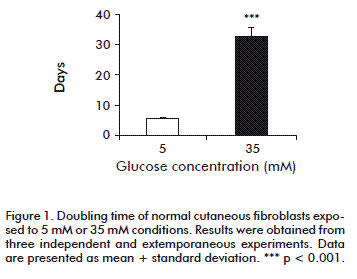
<body><![CDATA[<P   ><font face="Verdana, Arial, Helvetica, sans-serif" size="2"><B>Statistical analysis      </b></font></P >       <P   ><font face="Verdana, Arial, Helvetica, sans-serif" size="2">Data were processed      using GraphPad Prism, version 6.0 for Windows (GraphPad Software, La Jolla      California USA, <A href="http://www.graphpad.com/" target="_blank"> <FONT color="#0000FF">www.graphpad.com</font></A><FONT color="#0000FF"><FONT color="#211E1F">).      Results were expressed as mean &plusmn; standard deviation. Normal distribution      (D&rsquo;Agostino-Pearson omnibus) and variance homogeneity (Brown-Forsythe)      tests were performed. Once demonstrated the normality of the data, comparisons      between experimental groups were carried out using the two-tailed unpaired      Student&rsquo;s t test. In all cases, p-values lower than 0.05 were considered      statistically significant. </font></font></font></P >       <P   >&nbsp;</P >   <FONT color="#0000FF"><FONT color="#211E1F">        <P   ><font face="Verdana, Arial, Helvetica, sans-serif" size="2"><B><font size="3">RESULTS      AND DISCUSSION </font> </b></font></P >       <P   ><font face="Verdana, Arial, Helvetica, sans-serif" size="2">We calculated doubling      time as an expression of the proliferation rate. Under the present experimental      conditions, normal cutaneous fibroblasts exposed to 5 mM glucose exhibited      a doubling time of 5.71 &plusmn; 0.55 days. However, the high-glucose environment      increased doubling time to 32.15 &plusmn; 3.07 days (p &lt; 0.0001), regardless      the 15 % FBS supplementation (<a href="#fig1">Figure 1</a>). In contrast,      the presence of 35 mM glucose did not affect proliferation (not shown), indicating      that osmotic damage could be ruled out. </font></P >       <P align="center"   ><img src="/img/revistas/bta/v31n4/f0103414.gif" width="355" height="277"><a name="fig1"></a></P >       
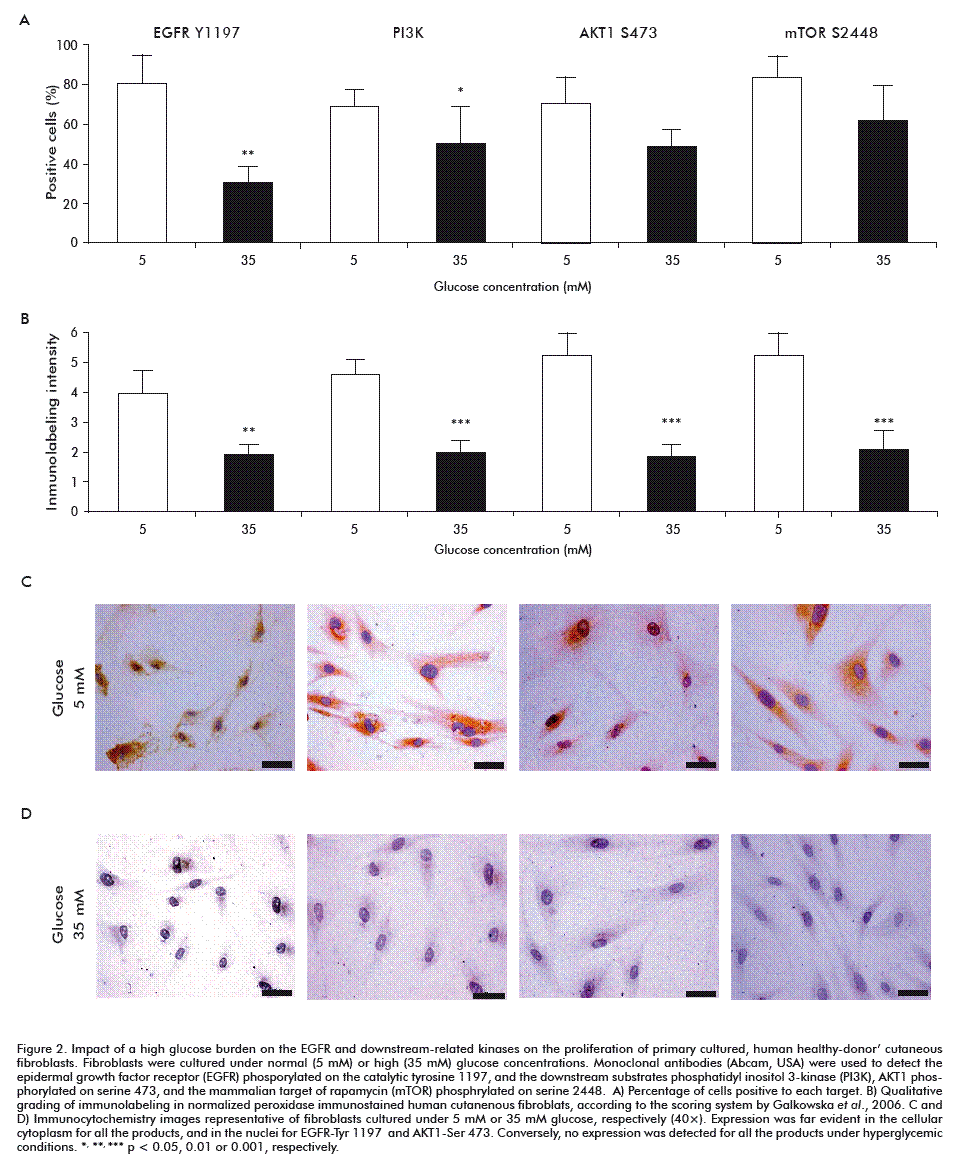
<P   ><font face="Verdana, Arial, Helvetica, sans-serif" size="2">This proliferative      delay appeared concomitant to a 50 % reduction in the percentage of EGFR positive      cells phosphorylated on tyrosine residue 1197 (<a href="/img/revistas/bta/v31n4/f0203414.gif">Figure      2</a>), as compared to cells incubated under normal glucose concentrations      (p = 0.004). The immunolabelling intensity was also significantly reduced      (p &lt; 0.0001) as a consequence of high glucose exposure. As demonstrated      in prior studies, high glucose levels are toxic for healthy donor-cutaneous      fibroblasts, by depressing critical pathways controlling cells&rsquo; survival,      metabolism and proliferation. The novelty of this study lies in the demonstration      that, </font><font face="Verdana, Arial, Helvetica, sans-serif" size="2">in      this type of cells, EGFR is likely a proximal target of high glucose concentrations,      reducing the autophosphorylation of its catalytic tyrosine residue tyrosine-1197,      which cause the attenuation of a signaling cascade that drives changes in      gene expression, especially in cell proliferation [22]. </font></P >       
<P   ><font face="Verdana, Arial, Helvetica, sans-serif" size="2">In line with this,      high glucose stress significantly reduced PI3K (p85 alpha subunit) expression      in terms of percentage of positively labeled cells (p = 0.02) and the associated      immunoreaction intensity (p &lt; 0.001) as referred to fibroblasts grown under      5 mM glucose (<a href="/img/revistas/bta/v31n4/f0203414.gif">Figure 2</a>). This finding may be interpreted      as resulting from the EGFR reduced autophosphorylation, since the PI3K p85      alpha subunit is an adaptor molecule that regulates the activity of the PI3K      catalytic p110 subunit by binding to phosphorylated receptor tyrosine kinases      (RTKs) through its SH2 domain and mediating the interaction between p110 and      the plasma membrane [23]. </font></P >       
<P   ><font face="Verdana, Arial, Helvetica, sans-serif" size="2">Downstream, the master      switch kinase AKT1 was also affected under a high glucose environment in relation      to normoglucose-cultured fibroblasts. Although no statistical differences      were detected (p = 0.11), there was a 20 % reduction in the percentage of      cells positive to the active isoform which is phosphorylated on serine 473.      However, the immunointensity reaction appeared significantly decreased to      less than 50 % (p &lt; 0.001; <a href="/img/revistas/bta/v31n4/f0203414.gif">Figure 2</a>). The serine/threonine      protein kinase AKT1 is a major signal transducer of the PI3K pathway in all      cells and tissues, and plays a pivotal role in the maintenance of cellular      processes [24]. AKT1 is involved in controlling cell proliferation and survival,      particularly by preventing apoptosis [25]. Although we found no statistical      significance for the percentage of cells expressing phosphorylation on AKT1-serine      473 residue, it was quantitatively and qualitatively reduced in fibroblasts      exposed to high glucose. This may stem from the upstream PI3K p85 expression      level. AKT1 full activation requires two phosphatidylinositol-3,4,5-triphosphate-dependent      phosphorylation events, while one of them relay on serine 473 [26, 27] for      which the complex of the mammalian target of rapamycin (mTOR-Rictor complex)      is critical [28]. </font></P >       
<P   ><font face="Verdana, Arial, Helvetica, sans-serif" size="2">We observed a similar      behavior in the immunoreaction identifying one of the active isoforms of mTOR      (specific phosphorylation on serine 2448). High glucose reduced the percentage      of positive cells in about 23 %, with no statistical significance (p = 0.21).      Moreover, the immunolabelling intensity score decreased to less than 50 %      (p = 0.001) as compared to normal glucose environment fibroblasts (<a href="/img/revistas/bta/v31n4/f0203414.gif">Figure      2</a>). mTOR is a serine/threonine kinase which plays a key role as regulator      of protein translation and sensor of nutrient status, thus controlling the      balance between cell growth and autophagy [29-32]. The fact that signaling      via mTOR and phosphorylation on serine 2448 is stimulated by growth factors      and attenuated following amino acids starvation [33, 34], suggests the full      disruption of this transduction axis from its proximal trigger; in this case,      the EGFR. Conclusively, these findings highlight how intricate, yet finely      regulated, the EGFR/PI3K/Akt/mTOR axis continuity is. </font></P >       
]]></body>
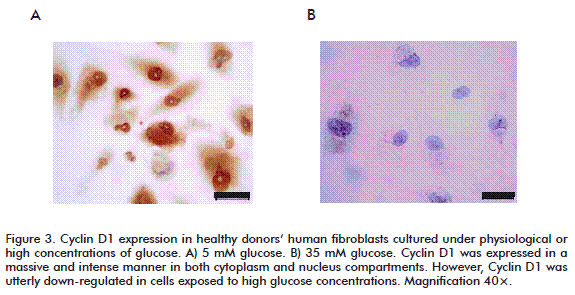
<body><![CDATA[<P   ><font face="Verdana, Arial, Helvetica, sans-serif" size="2">In addition, the      high glucose-mediated cytotoxicity ultimately led to a complete inhibition      of cyclin D1 expression (<a href="#fig3">Figure 3A</a>). This finding may      theoretically explain the proliferative arrest detected in such cells. In      contrast, under normal culture conditions, fibroblasts&rsquo; cyclin D1 was      found intensively and massively expressed in both nuclear and cytoplasmic      compartments (<a href="#fig3">Figure 3B</a>). Cyclin D1 responds to tyrosine      kinase-activated receptors by acting as a growth factor sensor [35-37]. In      chronic wounds, where growth factors are scarce or their titers are below      a threshold level, signals from the wound environment are not able to activate      the cell cycle machinery and no cyclin D1 is synthesized [20, 38]. </font></P >       <P align="center"   ><img src="/img/revistas/bta/v31n4/f0303414.gif" width="573" height="293"><a name="fig3"></a></P >       
<P   ><font face="Verdana, Arial, Helvetica, sans-serif" size="2">It has been previously      shown that high glucose exposure attenuates tyrosine-phosphorylation of EGFR      in embryonic rat fibroblasts expressing human insulin receptors [39]. In that      experimental system, the authors also detected an attenuation of PI3K kinase      activity, with no significant MAPK kinase activity variation between normal      and high glucose exposed cells. However, glucose burden did not affect proliferation      rate, since DNA content remained the same in all the experimental conditions.      </font></P >       <P   ><font face="Verdana, Arial, Helvetica, sans-serif" size="2">In our study, we      detected a clear cut effect of glucose burden on EGFR phosphorylation status,      specifically on Y1197 residue, and on PI3K expression levels. This significant      reduction was accompanied with a 5-fold lengthening in doubling time, distinctive      of a negative effect on the cell proliferation rate. Since our main goal was      to understand diabetic wound healing failure from a molecular point of view,      other key effectors were studied downstream in the EGFR signaling pathway.      We additionally observed that the exposure to high glucose affected the expression      of phosphorylated active intermediates, such as AKT1 (S473) and mTOR (s2448)      and the key cell cycle pro-moter cyclin D1. </font></P >       <P   ><font face="Verdana, Arial, Helvetica, sans-serif" size="2">There was demonstrated      in <I>in vitro </I>models that synthesis, proliferative and secreting capabilities      are reduced in diabetics&rsquo; cutaneous fibroblasts [40-44]. High glucose      concentration in the culture medium negatively impacted on the physiology      of normal fibroblasts, thus inhibiting proliferation and turning the cells      resistant to growth factors-stimulated mitogenesis [45-48]. Other groups reported      that high glucose reduced collagen synthesis in a dose-dependent manner [12,      49]; and that cell migration speed is reduced by nearly 40 %, associated to      a decrease in cell direc-tionality and to non-productive protrusive events      due to cells&rsquo; polarization failure [50]. </font></P >       <P   ><font face="Verdana, Arial, Helvetica, sans-serif" size="2">The mechanisms whereby      high glucose concentrations can impair fibroblasts physiology, including proliferative      capabilities, are not fully elucidated but had been associated to high L-lactate      production [10, 44, 51] and the generation of cytotoxic reactive oxygen species      [13, 14, 52]. We deem, however, that adducts formation between EGFR and AGEs      precursors could be relevant to explain our findings. Previous experiments      have proved significant AGEs accumulation in endothelial cells cultured for      7 days under glucose overload [53, 54] and that AGE modification of growth      factors drastically reduced the cells mitogenic activity by 70 % [55, 56].      Obviously, this </font><font face="Verdana, Arial, Helvetica, sans-serif" size="2">hypothesis      requires intracellular AGEs concentration measurements and their chemical      interaction with the EGFR in a time-window manner. </font></P >       <P   ><font face="Verdana, Arial, Helvetica, sans-serif" size="2">Taken together, our      data show that high glucose concentration can hinder fibroblasts&rsquo; EGFR      autophosphorylation and, consequently, deteriorate the activation of critical      downstream pathways that may lead to fibroblasts proliferation delay and wound      chronification. In a translational manner for clinical medicine, these findings      emphasize on the need of a strict metabolic control of the diabetic patient      affected by diabetic foot ulcers in order to facilitate the healing mechanism.      </font></P >       <P   >&nbsp;</P >       <P   ><font face="Verdana, Arial, Helvetica, sans-serif" size="2"><B><font size="3">CONFLICT      OF INTEREST STATEMENT </font></b></font></P >       <P   ><font face="Verdana, Arial, Helvetica, sans-serif" size="2">The authors declare      that there are no conflicts of interest. </font></P >       ]]></body>
<body><![CDATA[<P   >&nbsp;</P >       <P   > </P >       <P   ><font face="Verdana, Arial, Helvetica, sans-serif" size="3"><B>REFERENCES</b></font><font face="Verdana, Arial, Helvetica, sans-serif" size="2"><B>      </b></font></P >       <!-- ref --><P   ><font face="Verdana, Arial, Helvetica, sans-serif" size="2">1. International      Diabetes Federation. Global Diabetes Plan 2011-2021. 2011 [cited 2014 Oct      9]. Available from: <a href="http://www.idf.org/sites/default/files/Global_Diabetes_Plan_Final.pdf" target="_blank">http://www.idf.org/sites/default/files/Global_Diabetes_Plan_Final.pdf</a>.          </font></P >       <!-- ref --><P   ><font face="Verdana, Arial, Helvetica, sans-serif" size="2">2. Armstrong DG,      Wrobel J, Robbins JM. Guest Editorial: are diabetes-related wounds and amputations      worse than cancer? Int Wound J. 2007;4(4):286-7.     </font></P >       <P   ><font face="Verdana, Arial, Helvetica, sans-serif" size="2">3. Monteiro-Soares      M, Martins-Mendes D, Vaz-Carneiro A, Dinis-Ribeiro M. Lower limb amputation      following foot ulcers in patients with diabetes: classification systems&rsquo;      external validation and comparative analysis. Diabetes Metab Res Rev. 2014.      DOI: 10.1002/dmrr.2634. </font></P >       <!-- ref --><P   ><font face="Verdana, Arial, Helvetica, sans-serif" size="2">4. Jupiter DC, Thorud      JC, Buckley CJ, Shibuya N. The impact of foot ulceration and amputation on      mortality in diabetic patients. I: From ulceration to death, a systematic      review. Int Wound J. 2015. DOI: 10.1111/iwj.12404.     </font></P >       ]]></body>
<body><![CDATA[<!-- ref --><P   ><font face="Verdana, Arial, Helvetica, sans-serif" size="2">5. Pickwell K, Siersma      V, Kars M, Apelqvist J, Bakker K, Edmonds M, <I>et al</I>. Predictors of lower-extremity      amputation in patients with an infected diabetic foot ulcer. Diabetes Care.      2015;38(5):852-7.     </font></P >       <P   ><font face="Verdana, Arial, Helvetica, sans-serif" size="2">6. Zhan LX, Branco      BC, Armstrong DG, Mills JL, Sr. The Society for Vascular Surgery lower extremity      threatened limb classification system based on Wound, Ischemia, and foot Infection      (WIfI) correlates with risk of major amputation and time to wound healing.      J Vasc Surg. 2015;61(4):939-4. </font></P >       <!-- ref --><P   ><font face="Verdana, Arial, Helvetica, sans-serif" size="2">7. Armstrong DG,      Cohen K, Courric S, Bharara M, Marston W. Diabetic foot ulcers and vascular      insufficiency: our population has changed, but our methods have not. J Diabetes      Sci Technol. 2011;5(6):1591-5.     </font></P >       <!-- ref --><P   ><font face="Verdana, Arial, Helvetica, sans-serif" size="2">8. Berlanga-Acosta      J, Vald&eacute;s-P&eacute;rez C, Savigne-Gutierrez W, Mendoza Mar&iacute;      Y, Franco-P&eacute;rez N, Varga-Marchiran E, <I>et al</I>. Cellular and molecular      insights into the wound healing mechanism in diabetes. Biotecnol Apl. 2010;27(4):255-61.          </font></P >       <P   ><font face="Verdana, Arial, Helvetica, sans-serif" size="2">9. Berlanga-Acosta      J, Schultz GS, Lopez-Mola E, Guillen-Nieto G, Garcia-Siverio M, Herrera-Martinez      L. Glucose toxic effects on granulation tissue productive cells: the diabetics&rsquo;      impaired healing. Biomed Res Int. 2013;2013:256043. </font></P >       <!-- ref --><P   ><font face="Verdana, Arial, Helvetica, sans-serif" size="2">10. Hehenberger K,      Heilborn JD, Brismar K, Hansson A. Inhibited proliferation of fibroblasts      derived from chronic diabetic wounds and normal dermal fibroblasts treated      with high glucose is associated with increased formation of l-lactate. Wound      Repair Regen. 1998;6(2):135-41.     </font></P >       ]]></body>
<body><![CDATA[<!-- ref --><P   ><font face="Verdana, Arial, Helvetica, sans-serif" size="2">11. Yevdokimova NY.      High glucose-induced alterations of extracellular matrix of human skin fibroblasts      are not dependent on TSP-1-TGFbeta1 pathway. J Diabetes Complications. 2003;17(6):355-64.          </font></P >       <!-- ref --><P   ><font face="Verdana, Arial, Helvetica, sans-serif" size="2">12. Andreea SI, Marieta      C, Anca D. AGEs and glucose levels modulate type I and III procollagen mRNA      synthesis in dermal fibroblasts cells culture. Exp Diabetes Res. 2008;2008:473603.          </font></P >       <P   ><font face="Verdana, Arial, Helvetica, sans-serif" size="2">13. Lamers ML, Almeida      ME, Vicente-Manzanares M, Horwitz AF, Santos MF. High glucose-mediated oxidative      stress impairs cell migration. PLoS One. 2011;6(8):e22865. </font></P >       <!-- ref --><P   ><font face="Verdana, Arial, Helvetica, sans-serif" size="2">14. Yu P, Wang Z,      Sun X, Chen X, Zeng S, Chen L, <I>et al</I>. Hydrogen-rich medium protects      human skin fibroblasts from high glucose or mannitol induced oxidative damage.      Biochem Biophys Res Commun. 2011;409(2):350-5.     </font></P >       <P   ><font face="Verdana, Arial, Helvetica, sans-serif" size="2">15. Xuan YH, Huang      BB, Tian HS, Chi LS, Duan YM, Wang X, <I>et al</I>. High-glucose inhibits      human fibroblast cell migration in wound healing via repression of bFGF-regulating      JNK phosphorylation. PLoS One. 2014;9(9):e108182. </font></P >       <!-- ref --><P   ><font face="Verdana, Arial, Helvetica, sans-serif" size="2">16. Kusewitt DF,      Choi C, Newkirk KM, Leroy P, Li Y, Chavez MG, <I>et al</I>. Slug/Snai2 is      a downstream mediator of epidermal growth factor receptor-stimulated reepithelialization.      J Invest Dermatol. 2009;129(2):491-5.     </font></P >       ]]></body>
<body><![CDATA[<!-- ref --><P   ><font face="Verdana, Arial, Helvetica, sans-serif" size="2">17. Portero-Otin      M, Pamplona R, Bellmunt MJ, Ruiz MC, Prat J, Salvayre R, <I>et al</I>. Advanced      glycation end product precursors impair epidermal growth factor receptor signaling.      Diabetes. 2002;51(5):1535-42.     </font></P >       <!-- ref --><P   ><font face="Verdana, Arial, Helvetica, sans-serif" size="2">18. Doronzo G, Viretto      M, Russo I, Mattiello L, Anfossi G, Trovati M. Effects of high glucose on      vascular endothelial growth factor synthesis and secretion in aortic vascular      smooth muscle cells from obese and lean zucker rats. Int J Mol Sci. 2012;13(8):9478-88.          </font></P >       <!-- ref --><P   ><font face="Verdana, Arial, Helvetica, sans-serif" size="2">19. Roth V. Doubling      Time. 2006 [cited 2014 Oct 9]. Available from: <a href="http://www.doubling-time.com/compute.php" target="_blank">http://www.doubling-time.com/compute.php</a>.    </font></P >       <!-- ref --><P   ><font face="Verdana, Arial, Helvetica, sans-serif" size="2">20. Vande Berg JS,      Rose MA, Payne WG, Haywood-Reid PL, Robson MC. Significance of cell cycle      for wound stratification in clinical trials: analysis of a pressure ulcer      clinical trial utilizing cyclin D/cdk4. Wound Repair Regen. 2003;11(1):11-8.          </font></P >       <!-- ref --><P   ><font face="Verdana, Arial, Helvetica, sans-serif" size="2">21. Galkowska H,      Wojewodzka U, Olszewski WL. Chemokines, cytokines, and growth factors in keratinocytes      and dermal endothelial cells in the margin of chronic diabetic foot ulcers.      Wound Repair Regen. 2006;14(5):558-65.     </font></P >       ]]></body>
<body><![CDATA[<!-- ref --><P   ><font face="Verdana, Arial, Helvetica, sans-serif" size="2">22. Olayioye MA,      Neve RM, Lane HA, Hynes NE. The ErbB signaling network: receptor heterodimerization      in development and cancer. EMBO J. 2000;19(13):3159-67.     </font></P >       <!-- ref --><P   ><font face="Verdana, Arial, Helvetica, sans-serif" size="2">23. Arcaro A, Guerreiro      AS. The phosphoinositide 3-kinase pathway in human cancer: genetic alterations      and therapeutic implications. Curr Genomics. 2007;8(5):271-306.     </font></P >       <!-- ref --><P   ><font face="Verdana, Arial, Helvetica, sans-serif" size="2">24. Manning BD, Cantley      LC. AKT/PKB signaling: navigating downstream. Cell. 2007;129(7):1261-74.     </font></P >       <!-- ref --><P   ><font face="Verdana, Arial, Helvetica, sans-serif" size="2">25. Chin YR, Toker      A. Function of Akt/ PKB signaling to cell motility, invasion and the tumor      stroma in cancer. Cell Signal. 2009;21(4):470-6.     </font></P >       <!-- ref --><P   ><font face="Verdana, Arial, Helvetica, sans-serif" size="2">26. Partovian C,      Simons M. Regulation of protein kinase B/Akt activity and Ser473 phosphorylation      by protein kinase Calpha in endothelial cells. Cell Signal. 2004;16(8):951-7.          </font></P >       ]]></body>
<body><![CDATA[<P   ><font face="Verdana, Arial, Helvetica, sans-serif" size="2">27. Zhuo DX, Zhang      XW, Jin B, Zhang Z, Xie BS, Wu CL, <I>et al</I>. CSTP1, a novel protein phosphatase,      blocks cell cycle, promotes cell apoptosis, and suppresses tumor growth of      bladder cancer by directly dephosphorylating Akt at Ser473 site. PloS One.      2013;8(6):e65679. </font></P >       <!-- ref --><P   ><font face="Verdana, Arial, Helvetica, sans-serif" size="2">28. Hresko RC, Mueckler      M. mTOR.RICTOR is the Ser473 kinase for Akt/protein kinase B in 3T3-L1 adipocytes.      J Biol Chem. 2005;280(49):40406-16.     </font></P >       <!-- ref --><P   ><font face="Verdana, Arial, Helvetica, sans-serif" size="2">29. Kim DH, Sarbassov      DD, Ali SM, King JE, Latek RR, Erdjument-Bromage H, <I>et al</I>. mTOR interacts      with raptor to form a nutrient-sensitive complex that signals to the cell      growth machinery. Cell. 2002;110(2):163-75.     </font></P >       <!-- ref --><P   ><font face="Verdana, Arial, Helvetica, sans-serif" size="2">30. Sarbassov DD,      Guertin DA, Ali SM, Sabatini DM. Phosphorylation and regulation of Akt/PKB      by the rictor-mTOR complex. Science. 2005;307(5712):1098-101.     </font></P >       <!-- ref --><P   ><font face="Verdana, Arial, Helvetica, sans-serif" size="2">31. Porstmann T,      Santos CR, Griffiths B, Cully M, Wu M, Leevers S, <I>et al</I>. SREBP activity      is regulated by mTORC1 and contributes to Akt-dependent cell growth. Cell      Metab. 2008;8(3):224-36.     </font></P >       <!-- ref --><P   ><font face="Verdana, Arial, Helvetica, sans-serif" size="2">32. Ben-Sahra I,      Howell JJ, Asara JM, Manning BD. Stimulation of de novo pyrimidine synthesis      by growth signaling through mTOR and S6K1. Science. 2013;339(6125):1323-8.          </font></P >       <!-- ref --><P   ><font face="Verdana, Arial, Helvetica, sans-serif" size="2">33. Rosner M, Siegel      N, Valli A, Fuchs C, Hengstschlager M. mTOR phosphorylated at S2448 binds      to raptor and rictor. Amino Acids. 2010;38(1):223-8.     </font></P >       <!-- ref --><P   ><font face="Verdana, Arial, Helvetica, sans-serif" size="2">34. Sengupta S, Peterson      TR, Sabatini DM. Regulation of the mTOR complex 1 pathway by nutrients, growth      factors, and stress. Mol Cell. 2010;40(2):310-22.     </font></P >       <!-- ref --><P   ><font face="Verdana, Arial, Helvetica, sans-serif" size="2">35. Moriuchi A, Hirono      S, Ido A, Ochiai T, Nakama T, Uto H, <I>et al</I>. Additive and inhibitory      effects of simultaneous treatment with growth factors on DNA synthesis through      MAPK pathway and G1 cyclins in rat hepatocytes. Biochem Biophys Res Commun.      2001;280(1):368-73.     </font></P >       <P   ><font face="Verdana, Arial, Helvetica, sans-serif" size="2">36. Cao C, Huang      X, Han Y, Wan Y, Birnbaumer L, Feng GS, <I>et al</I>. Galpha(i1) and Galpha(i3)      are required for epidermal growth factor-mediated activation of the Akt-mTORC1      pathway. Sci Signal. 2009;2(68):ra17. </font></P >       <!-- ref --><P   ><font face="Verdana, Arial, Helvetica, sans-serif" size="2">37. Alam S, Pal A,      Kumar R, Dwivedi PD, Das M, Ansari KM. EGFR-mediated Akt and MAPKs signal      pathways play a crucial role in patulin-induced cell proliferation in primary      murine keratinocytes via modulation of Cyclin D1 and COX-2 expression. Mol      Carcinog. 2014;53(12):988-98.     </font></P >       ]]></body>
<body><![CDATA[<!-- ref --><P   ><font face="Verdana, Arial, Helvetica, sans-serif" size="2">38. Lee do H, Choi      KH, Cho JW, Kim SY, Kwon TR, Choi SY, <I>et al</I>. Recombinant growth factor      mixtures induce cell cycle progression and the upregulation of type I collagen      in human skin fibroblasts, resulting in the acceleration of wound healing      processes. Int J Mol Med. 2014;33(5):1147-52.     </font></P >       <!-- ref --><P   ><font face="Verdana, Arial, Helvetica, sans-serif" size="2">39. Obata T, Maegawa      H, Kashiwagi A, Pillay TS, Kikkawa R. High glucose-induced abnormal epidermal      growth factor signaling. J Biochem. 1998;123(5):813-20.     </font></P >       <!-- ref --><P   ><font face="Verdana, Arial, Helvetica, sans-serif" size="2">40. Rowe DW, Starman      BJ, Fujimoto WY, Williams RH. Abnormalities in proliferation and protein synthesis      in skin fibroblast cultures from patients with diabetes mellitus. Diabetes.      1977;26(4):284-90.     </font></P >       <!-- ref --><P   ><font face="Verdana, Arial, Helvetica, sans-serif" size="2">41. Loots MA, Lamme      EN, Mekkes JR, Bos JD, Middelkoop E. Cultured fibroblasts from chronic diabetic      wounds on the lower extremity (non-insulin-dependent diabetes mellitus) show      disturbed proliferation. Arch Dermatol Res. 1999;291(2-3):93-9.     </font></P >       <!-- ref --><P   ><font face="Verdana, Arial, Helvetica, sans-serif" size="2">42. Lerman OZ, Galiano      RD, Armour M, Levine JP, Gurtner GC. Cellular dysfunction in the diabetic      fibroblast: impairment in migration, vascular endothelial growth factor produc&not;tion,      and response to hypoxia. Am J Pathol. 2003;162(1):303-12.     </font></P >       ]]></body>
<body><![CDATA[<!-- ref --><P   ><font face="Verdana, Arial, Helvetica, sans-serif" size="2">43. Lobmann R, Pap      T, Ambrosch A, Waldmann K, Konig W, Lehnert H. Differential effects of PDGF-BB      on matrix metalloproteases and cytokine release in fibroblasts of Type 2 diabetic      patients and normal controls in vitro. J Diabetes Complications. 2006;20(2):105-12.          </font></P >       <!-- ref --><P   ><font face="Verdana, Arial, Helvetica, sans-serif" size="2">44. Moruzzi N, Del      Sole M, Fato R, Gerdes JM, Berggren PO, Bergamini C, <I>et al</I>. Short and      prolonged exposure to hyperglycaemia in human fibroblasts and endothelial      cells: metabolic and osmotic effects. Int J Biochem Cell Biol. 2014;53:66-76.          </font></P >       <!-- ref --><P   ><font face="Verdana, Arial, Helvetica, sans-serif" size="2">45. Sibbitt WL, Jr.,      Mills RG, Bigler CF, Eaton RP, Griffey RH, Vander Jagt DL. Glucose inhibition      of human fibroblast proliferation and response to growth factors is prevented      by inhibitors of aldose reductase. Mech Ageing Dev. 1989;47(3):265-79.     </font></P >       <!-- ref --><P   ><font face="Verdana, Arial, Helvetica, sans-serif" size="2">46. Hehenberger K,      Hansson A. High glucose-induced growth factor resistance in human fibroblasts      can be reversed by antioxidants and protein kinase C-inhibitors. Cell Biochem      Funct. 1997;15(3):197-201.     </font></P >       <!-- ref --><P   ><font face="Verdana, Arial, Helvetica, sans-serif" size="2">47. Cubbon RM, Ali      N, Sengupta A, Kearney MT. Insulin- and growth factor-resistance impairs vascular      regeneration in diabetes mellitus. Curr Vasc Pharmacol. 2012;10(3):271-84.          </font></P >       ]]></body>
<body><![CDATA[<!-- ref --><P   ><font face="Verdana, Arial, Helvetica, sans-serif" size="2">48. Tecilazich F,      Dinh TL, Veves A. Emerging drugs for the treatment of diabetic ulcers. Expert      Opin Emerg Drugs. 2013;18(2):207-17.     </font></P >       <!-- ref --><P   ><font face="Verdana, Arial, Helvetica, sans-serif" size="2">49. Trevisan R, Yip      J, Sarika L, Li LK, Viberti G. Enhanced collagen synthesis in cultured skin      fibroblasts from insulin-dependent diabetic patients with nephropathy. J Am      Soc Nephrol. 1997;8(7):1133-9.     </font></P >       <!-- ref --><P   ><font face="Verdana, Arial, Helvetica, sans-serif" size="2">50. Grazul-Bilska      AT, Luthra G, Reynolds LP, Bilski JJ, Johnson ML, Adbullah SA, <I>et al</I>.      Effects of basic fibroblast growth factor (FGF-2) on proliferation of human      skin fibroblasts in type II diabetes mellitus. Exp Clin Endocrinol Diabetes.      2002;110(4):176-81.     </font></P >       <!-- ref --><P   ><font face="Verdana, Arial, Helvetica, sans-serif" size="2">51. Hehenberger K,      Hansson A, Heilborn JD, Abdel-Halim SM, Ostensson CG, Brismar K. Impaired      proliferation and increased L-lactate production of dermal fibroblasts in      the GK-rat, a spontaneous model of non-insulin dependent diabetes mellitus.      Wound Repair Regen. 1999;7(1):65-71.     </font></P >       <!-- ref --><P   ><font face="Verdana, Arial, Helvetica, sans-serif" size="2">52. Tsai CH, Chiang      YC, Chen HT, Huang PH, Hsu HC, Tang CH. High glucose induces vascular endothelial      growth factor production in human synovial fibroblasts through reactive oxygen      species generation. Biochim Biophys Acta. 2013;1830(3):2649-58.     </font></P >       ]]></body>
<body><![CDATA[<!-- ref --><P   ><font face="Verdana, Arial, Helvetica, sans-serif" size="2">53. McPherson JD,      Shilton BH, Walton DJ. Role of fructose in glycation and cross-linking of      proteins. Biochemistry. 1988;27(6):1901-7.     </font></P >       <!-- ref --><P   ><font face="Verdana, Arial, Helvetica, sans-serif" size="2">54. Queisser MA,      Yao D, Geisler S, Hammes HP, Lochnit G, Schleicher ED, <I>et al</I>. Hyperglycemia      impairs proteasome function by methylglyoxal. Diabetes. 2010;59(3):670-8.          </font></P >       <!-- ref --><P   ><font face="Verdana, Arial, Helvetica, sans-serif" size="2">55. Giardino I, Edelstein      D, Brownlee M. Nonenzymatic glycosylation in vitro and in bovine endothelial      cells alters basic fibroblast growth factor activity. A model for intracellular      glycosylation in diabetes. J Clin Invest. 1994;94(1):110-7.     </font></P >       <P   ><font face="Verdana, Arial, Helvetica, sans-serif" size="2">56. Liu H, Yu S,      Zhang H, Xu J. Angiogenesis impairment in diabetes: role of methylglyoxal-induced      receptor for advanced glycation endproducts, autophagy and vascular endothelial      growth factor receptor 2. PloS One. 2012;7(10):e46720. </font></P >       <P   >&nbsp;</P >       <P   >&nbsp;</P >       <P   > </P >       ]]></body>
<body><![CDATA[<P   > </P >       <P   ><font face="Verdana, Arial, Helvetica, sans-serif" size="2">Received in October      2014.     <br>     Accepted in December 2014.</font></P >       <P   >&nbsp;</P >       <P   >&nbsp;</P >       <P   > </P >       <P   > </P >       <P   ><font face="Verdana, Arial, Helvetica, sans-serif" size="2"><i>Jorge Berlanga-Acosta</i>.      Tissue Repair and Cyto-protection Laboratory, Direction of Biomedical Research.      Center for Genetic Engineering and Biotechnology, CIGB. Ave. 31 e/ 158 y 190,      Cubanac&aacute;n, Playa, CP 11600, La Habana, Cuba. E-mail: <A href="mailto:jorge.berlanga@cigb.edu.cu">      <FONT color="#0000FF">jorge.berlanga@cigb.edu.cu</font></A><FONT color="#0000FF"><FONT color="#211E1F">.      </font></font></font></P >   </font></font></font></font></font></font></font></font></font></font></font></font></font></font></font></font></font></font></font></font></font></font></font></font></font></font></font></font></DIV >      ]]></body><back>
<ref-list>
<ref id="B1">
<label>1</label><nlm-citation citation-type="">
<collab>International Diabetes Federation</collab>
<source><![CDATA[Global Diabetes Plan 2011-2021]]></source>
<year>2011</year>
</nlm-citation>
</ref>
<ref id="B2">
<label>2</label><nlm-citation citation-type="journal">
<person-group person-group-type="author">
<name>
<surname><![CDATA[Armstrong]]></surname>
<given-names><![CDATA[DG]]></given-names>
</name>
<name>
<surname><![CDATA[Wrobel]]></surname>
<given-names><![CDATA[J]]></given-names>
</name>
<name>
<surname><![CDATA[Robbins]]></surname>
<given-names><![CDATA[JM]]></given-names>
</name>
</person-group>
<article-title xml:lang="en"><![CDATA[Guest Editorial: are diabetes-related wounds and amputations worse than cancer?]]></article-title>
<source><![CDATA[Int Wound J]]></source>
<year>2007</year>
<volume>4</volume>
<numero>4</numero>
<issue>4</issue>
<page-range>286-7</page-range></nlm-citation>
</ref>
<ref id="B3">
<label>3</label><nlm-citation citation-type="journal">
<person-group person-group-type="author">
<name>
<surname><![CDATA[Monteiro-Soares]]></surname>
<given-names><![CDATA[M]]></given-names>
</name>
<name>
<surname><![CDATA[Martins-Mendes]]></surname>
<given-names><![CDATA[D]]></given-names>
</name>
<name>
<surname><![CDATA[Vaz-Carneiro]]></surname>
<given-names><![CDATA[A]]></given-names>
</name>
<name>
<surname><![CDATA[Dinis-Ribeiro]]></surname>
<given-names><![CDATA[M]]></given-names>
</name>
</person-group>
<article-title xml:lang="en"><![CDATA[Lower limb amputation following foot ulcers in patients with diabetes: classification systems' external validation and comparative analysis]]></article-title>
<source><![CDATA[Diabetes Metab Res Rev]]></source>
<year>2014</year>
</nlm-citation>
</ref>
<ref id="B4">
<label>4</label><nlm-citation citation-type="journal">
<person-group person-group-type="author">
<name>
<surname><![CDATA[Jupiter]]></surname>
<given-names><![CDATA[DC]]></given-names>
</name>
<name>
<surname><![CDATA[Thorud]]></surname>
<given-names><![CDATA[JC]]></given-names>
</name>
<name>
<surname><![CDATA[Buckley]]></surname>
<given-names><![CDATA[CJ]]></given-names>
</name>
<name>
<surname><![CDATA[Shibuya]]></surname>
<given-names><![CDATA[N]]></given-names>
</name>
</person-group>
<article-title xml:lang="en"><![CDATA[The impact of foot ulceration and amputation on mortality in diabetic patients. I: From ulceration to death, a systematic review]]></article-title>
<source><![CDATA[Int Wound J]]></source>
<year>2015</year>
</nlm-citation>
</ref>
<ref id="B5">
<label>5</label><nlm-citation citation-type="journal">
<person-group person-group-type="author">
<name>
<surname><![CDATA[Pickwell]]></surname>
<given-names><![CDATA[K]]></given-names>
</name>
<name>
<surname><![CDATA[Siersma]]></surname>
<given-names><![CDATA[V]]></given-names>
</name>
<name>
<surname><![CDATA[Kars]]></surname>
<given-names><![CDATA[M]]></given-names>
</name>
<name>
<surname><![CDATA[Apelqvist]]></surname>
<given-names><![CDATA[J]]></given-names>
</name>
<name>
<surname><![CDATA[Bakker]]></surname>
<given-names><![CDATA[K]]></given-names>
</name>
<name>
<surname><![CDATA[Edmonds]]></surname>
<given-names><![CDATA[M]]></given-names>
</name>
</person-group>
<article-title xml:lang="en"><![CDATA[Predictors of lower-extremity amputation in patients with an infected diabetic foot ulcer]]></article-title>
<source><![CDATA[Diabetes Care]]></source>
<year>2015</year>
<volume>38</volume>
<numero>5</numero>
<issue>5</issue>
<page-range>852-7</page-range></nlm-citation>
</ref>
<ref id="B6">
<label>6</label><nlm-citation citation-type="journal">
<person-group person-group-type="author">
<name>
<surname><![CDATA[Zhan]]></surname>
<given-names><![CDATA[LX]]></given-names>
</name>
<name>
<surname><![CDATA[Branco]]></surname>
<given-names><![CDATA[BC]]></given-names>
</name>
<name>
<surname><![CDATA[Armstrong]]></surname>
<given-names><![CDATA[DG]]></given-names>
</name>
<name>
<surname><![CDATA[Mills]]></surname>
<given-names><![CDATA[JL]]></given-names>
</name>
</person-group>
<article-title xml:lang="en"><![CDATA[The Society for Vascular Surgery lower extremity threatened limb classification system based on Wound, Ischemia, and foot Infection (WIfI) correlates with risk of major amputation and time to wound healing]]></article-title>
<source><![CDATA[J Vasc Surg]]></source>
<year>2015</year>
<volume>61</volume>
<numero>4</numero>
<issue>4</issue>
<page-range>939-4</page-range></nlm-citation>
</ref>
<ref id="B7">
<label>7</label><nlm-citation citation-type="journal">
<person-group person-group-type="author">
<name>
<surname><![CDATA[Armstrong]]></surname>
<given-names><![CDATA[DG]]></given-names>
</name>
<name>
<surname><![CDATA[Cohen]]></surname>
<given-names><![CDATA[K]]></given-names>
</name>
<name>
<surname><![CDATA[Courric]]></surname>
<given-names><![CDATA[S]]></given-names>
</name>
<name>
<surname><![CDATA[Bharara]]></surname>
<given-names><![CDATA[M]]></given-names>
</name>
<name>
<surname><![CDATA[Marston]]></surname>
<given-names><![CDATA[W]]></given-names>
</name>
</person-group>
<article-title xml:lang="en"><![CDATA[Diabetic foot ulcers and vascular insufficiency: our population has changed, but our methods have not]]></article-title>
<source><![CDATA[J Diabetes Sci Technol]]></source>
<year>2011</year>
<volume>5</volume>
<numero>6</numero>
<issue>6</issue>
<page-range>1591-5</page-range></nlm-citation>
</ref>
<ref id="B8">
<label>8</label><nlm-citation citation-type="journal">
<person-group person-group-type="author">
<name>
<surname><![CDATA[Berlanga-Acosta]]></surname>
<given-names><![CDATA[J]]></given-names>
</name>
<name>
<surname><![CDATA[Valdés-Pérez]]></surname>
<given-names><![CDATA[C]]></given-names>
</name>
<name>
<surname><![CDATA[Savigne-Gutierrez]]></surname>
<given-names><![CDATA[W]]></given-names>
</name>
<name>
<surname><![CDATA[Mendoza Marí]]></surname>
<given-names><![CDATA[Y]]></given-names>
</name>
<name>
<surname><![CDATA[Franco-Pérez]]></surname>
<given-names><![CDATA[N]]></given-names>
</name>
<name>
<surname><![CDATA[Varga-Marchiran]]></surname>
<given-names><![CDATA[E]]></given-names>
</name>
</person-group>
<article-title xml:lang="en"><![CDATA[Cellular and molecular insights into the wound healing mechanism in diabetes]]></article-title>
<source><![CDATA[Biotecnol Apl]]></source>
<year>2010</year>
<volume>27</volume>
<numero>4</numero>
<issue>4</issue>
<page-range>255-61</page-range></nlm-citation>
</ref>
<ref id="B9">
<label>9</label><nlm-citation citation-type="journal">
<person-group person-group-type="author">
<name>
<surname><![CDATA[Berlanga-Acosta]]></surname>
<given-names><![CDATA[J]]></given-names>
</name>
<name>
<surname><![CDATA[Schultz]]></surname>
<given-names><![CDATA[GS]]></given-names>
</name>
<name>
<surname><![CDATA[Lopez-Mola]]></surname>
<given-names><![CDATA[E]]></given-names>
</name>
<name>
<surname><![CDATA[Guillen-Nieto]]></surname>
<given-names><![CDATA[G]]></given-names>
</name>
<name>
<surname><![CDATA[Garcia-Siverio]]></surname>
<given-names><![CDATA[M]]></given-names>
</name>
<name>
<surname><![CDATA[Herrera-Martinez]]></surname>
<given-names><![CDATA[L]]></given-names>
</name>
</person-group>
<article-title xml:lang="en"><![CDATA[Glucose toxic effects on granulation tissue productive cells: the diabetics' impaired healing]]></article-title>
<source><![CDATA[Biomed Res Int]]></source>
<year>2013</year>
<volume>2013</volume>
<page-range>256043</page-range></nlm-citation>
</ref>
<ref id="B10">
<label>10</label><nlm-citation citation-type="journal">
<person-group person-group-type="author">
<name>
<surname><![CDATA[Hehenberger]]></surname>
<given-names><![CDATA[K]]></given-names>
</name>
<name>
<surname><![CDATA[Heilborn]]></surname>
<given-names><![CDATA[JD]]></given-names>
</name>
<name>
<surname><![CDATA[Brismar]]></surname>
<given-names><![CDATA[K]]></given-names>
</name>
<name>
<surname><![CDATA[Hansson]]></surname>
<given-names><![CDATA[A]]></given-names>
</name>
</person-group>
<article-title xml:lang="en"><![CDATA[Inhibited proliferation of fibroblasts derived from chronic diabetic wounds and normal dermal fibroblasts treated with high glucose is associated with increased formation of l-lactate]]></article-title>
<source><![CDATA[Wound Repair Regen]]></source>
<year>1998</year>
<volume>6</volume>
<numero>2</numero>
<issue>2</issue>
<page-range>135-41</page-range></nlm-citation>
</ref>
<ref id="B11">
<label>11</label><nlm-citation citation-type="journal">
<person-group person-group-type="author">
<name>
<surname><![CDATA[Yevdokimova]]></surname>
<given-names><![CDATA[NY]]></given-names>
</name>
</person-group>
<article-title xml:lang="en"><![CDATA[High glucose-induced alterations of extracellular matrix of human skin fibroblasts are not dependent on TSP-1-TGFbeta1 pathway]]></article-title>
<source><![CDATA[J Diabetes Complications]]></source>
<year>2003</year>
<volume>17</volume>
<numero>6</numero>
<issue>6</issue>
<page-range>355-64</page-range></nlm-citation>
</ref>
<ref id="B12">
<label>12</label><nlm-citation citation-type="journal">
<person-group person-group-type="author">
<name>
<surname><![CDATA[Andreea]]></surname>
<given-names><![CDATA[SI]]></given-names>
</name>
<name>
<surname><![CDATA[Marieta]]></surname>
<given-names><![CDATA[C]]></given-names>
</name>
<name>
<surname><![CDATA[Anca]]></surname>
<given-names><![CDATA[D]]></given-names>
</name>
</person-group>
<article-title xml:lang="en"><![CDATA[AGEs and glucose levels modulate type I and III procollagen mRNA synthesis in dermal fibroblasts cells culture]]></article-title>
<source><![CDATA[Exp Diabetes Res]]></source>
<year>2008</year>
<volume>2008</volume>
<page-range>473603</page-range></nlm-citation>
</ref>
<ref id="B13">
<label>13</label><nlm-citation citation-type="journal">
<person-group person-group-type="author">
<name>
<surname><![CDATA[Lamers]]></surname>
<given-names><![CDATA[ML]]></given-names>
</name>
<name>
<surname><![CDATA[Almeida]]></surname>
<given-names><![CDATA[ME]]></given-names>
</name>
<name>
<surname><![CDATA[Vicente-Manzanares]]></surname>
<given-names><![CDATA[M]]></given-names>
</name>
<name>
<surname><![CDATA[Horwitz]]></surname>
<given-names><![CDATA[AF]]></given-names>
</name>
<name>
<surname><![CDATA[Santos]]></surname>
<given-names><![CDATA[MF]]></given-names>
</name>
</person-group>
<article-title xml:lang="en"><![CDATA[High glucose-mediated oxidative stress impairs cell migration]]></article-title>
<source><![CDATA[PloS One]]></source>
<year>2011</year>
<volume>6</volume>
<numero>8</numero>
<issue>8</issue>
<page-range>22865</page-range></nlm-citation>
</ref>
<ref id="B14">
<label>14</label><nlm-citation citation-type="journal">
<person-group person-group-type="author">
<name>
<surname><![CDATA[Yu]]></surname>
<given-names><![CDATA[P]]></given-names>
</name>
<name>
<surname><![CDATA[Wang]]></surname>
<given-names><![CDATA[Z]]></given-names>
</name>
<name>
<surname><![CDATA[Sun]]></surname>
<given-names><![CDATA[X]]></given-names>
</name>
<name>
<surname><![CDATA[Chen]]></surname>
<given-names><![CDATA[X]]></given-names>
</name>
<name>
<surname><![CDATA[Zeng]]></surname>
<given-names><![CDATA[S]]></given-names>
</name>
<name>
<surname><![CDATA[Chen]]></surname>
<given-names><![CDATA[L]]></given-names>
</name>
</person-group>
<article-title xml:lang="en"><![CDATA[Hydrogen-rich medium protects human skin fibroblasts from high glucose or mannitol induced oxidative damage]]></article-title>
<source><![CDATA[Biochem Biophys Res Commun]]></source>
<year>2011</year>
<volume>409</volume>
<numero>2</numero>
<issue>2</issue>
<page-range>350-5</page-range></nlm-citation>
</ref>
<ref id="B15">
<label>15</label><nlm-citation citation-type="journal">
<person-group person-group-type="author">
<name>
<surname><![CDATA[Xuan]]></surname>
<given-names><![CDATA[YH]]></given-names>
</name>
<name>
<surname><![CDATA[Huang]]></surname>
<given-names><![CDATA[BB]]></given-names>
</name>
<name>
<surname><![CDATA[Tian]]></surname>
<given-names><![CDATA[HS]]></given-names>
</name>
<name>
<surname><![CDATA[Chi]]></surname>
<given-names><![CDATA[LS]]></given-names>
</name>
<name>
<surname><![CDATA[Duan]]></surname>
<given-names><![CDATA[YM]]></given-names>
</name>
<name>
<surname><![CDATA[Wang]]></surname>
<given-names><![CDATA[X]]></given-names>
</name>
</person-group>
<article-title xml:lang="en"><![CDATA[High-glucose inhibits human fibroblast cell migration in wound healing via repression of bFGF-regulating JNK phosphorylation]]></article-title>
<source><![CDATA[PloS One]]></source>
<year>2014</year>
<volume>9</volume>
<numero>9</numero>
<issue>9</issue>
<page-range>108182</page-range></nlm-citation>
</ref>
<ref id="B16">
<label>16</label><nlm-citation citation-type="journal">
<person-group person-group-type="author">
<name>
<surname><![CDATA[Kusewitt]]></surname>
<given-names><![CDATA[DF]]></given-names>
</name>
<name>
<surname><![CDATA[Choi]]></surname>
<given-names><![CDATA[C]]></given-names>
</name>
<name>
<surname><![CDATA[Newkirk]]></surname>
<given-names><![CDATA[KM]]></given-names>
</name>
<name>
<surname><![CDATA[Leroy]]></surname>
<given-names><![CDATA[P]]></given-names>
</name>
<name>
<surname><![CDATA[Li]]></surname>
<given-names><![CDATA[Y]]></given-names>
</name>
<name>
<surname><![CDATA[Chavez]]></surname>
<given-names><![CDATA[MG]]></given-names>
</name>
</person-group>
<article-title xml:lang="en"><![CDATA[Slug/Snai2 is a downstream mediator of epidermal growth factor receptor-stimulated reepithelialization]]></article-title>
<source><![CDATA[J Invest Dermatol]]></source>
<year>2009</year>
<volume>129</volume>
<numero>2</numero>
<issue>2</issue>
<page-range>491-5</page-range></nlm-citation>
</ref>
<ref id="B17">
<label>17</label><nlm-citation citation-type="journal">
<person-group person-group-type="author">
<name>
<surname><![CDATA[Portero-Otin]]></surname>
<given-names><![CDATA[M]]></given-names>
</name>
<name>
<surname><![CDATA[Pamplona]]></surname>
<given-names><![CDATA[R]]></given-names>
</name>
<name>
<surname><![CDATA[Bellmunt]]></surname>
<given-names><![CDATA[MJ]]></given-names>
</name>
<name>
<surname><![CDATA[Ruiz]]></surname>
<given-names><![CDATA[MC]]></given-names>
</name>
<name>
<surname><![CDATA[Prat]]></surname>
<given-names><![CDATA[J]]></given-names>
</name>
<name>
<surname><![CDATA[Salvayre]]></surname>
<given-names><![CDATA[R]]></given-names>
</name>
</person-group>
<article-title xml:lang="en"><![CDATA[Advanced glycation end product precursors impair epidermal growth factor receptor signaling]]></article-title>
<source><![CDATA[Diabetes]]></source>
<year>2002</year>
<volume>51</volume>
<numero>5</numero>
<issue>5</issue>
<page-range>1535-42</page-range></nlm-citation>
</ref>
<ref id="B18">
<label>18</label><nlm-citation citation-type="journal">
<person-group person-group-type="author">
<name>
<surname><![CDATA[Doronzo]]></surname>
<given-names><![CDATA[G]]></given-names>
</name>
<name>
<surname><![CDATA[Viretto]]></surname>
<given-names><![CDATA[M]]></given-names>
</name>
<name>
<surname><![CDATA[Russo]]></surname>
<given-names><![CDATA[I]]></given-names>
</name>
<name>
<surname><![CDATA[Mattiello]]></surname>
<given-names><![CDATA[L]]></given-names>
</name>
<name>
<surname><![CDATA[Anfossi]]></surname>
<given-names><![CDATA[G]]></given-names>
</name>
<name>
<surname><![CDATA[Trovati]]></surname>
<given-names><![CDATA[M]]></given-names>
</name>
</person-group>
<article-title xml:lang="en"><![CDATA[Effects of high glucose on vascular endothelial growth factor synthesis and secretion in aortic vascular smooth muscle cells from obese and lean zucker rats]]></article-title>
<source><![CDATA[Int J Mol Sci]]></source>
<year>2012</year>
<volume>13</volume>
<numero>8</numero>
<issue>8</issue>
<page-range>9478-88</page-range></nlm-citation>
</ref>
<ref id="B19">
<label>19</label><nlm-citation citation-type="">
<person-group person-group-type="author">
<name>
<surname><![CDATA[Roth]]></surname>
<given-names><![CDATA[V]]></given-names>
</name>
</person-group>
<source><![CDATA[Doubling Time]]></source>
<year>2006</year>
</nlm-citation>
</ref>
<ref id="B20">
<label>20</label><nlm-citation citation-type="journal">
<person-group person-group-type="author">
<name>
<surname><![CDATA[Vande Berg]]></surname>
<given-names><![CDATA[JS]]></given-names>
</name>
<name>
<surname><![CDATA[Rose]]></surname>
<given-names><![CDATA[MA]]></given-names>
</name>
<name>
<surname><![CDATA[Payne]]></surname>
<given-names><![CDATA[WG]]></given-names>
</name>
<name>
<surname><![CDATA[Haywood-Reid]]></surname>
<given-names><![CDATA[PL]]></given-names>
</name>
<name>
<surname><![CDATA[Robson]]></surname>
<given-names><![CDATA[MC]]></given-names>
</name>
</person-group>
<article-title xml:lang="en"><![CDATA[Significance of cell cycle for wound stratification in clinical trials: analysis of a pressure ulcer clinical trial utilizing cyclin D/cdk4]]></article-title>
<source><![CDATA[Wound Repair Regen]]></source>
<year>2003</year>
<volume>11</volume>
<numero>1</numero>
<issue>1</issue>
<page-range>11-8</page-range></nlm-citation>
</ref>
<ref id="B21">
<label>21</label><nlm-citation citation-type="journal">
<person-group person-group-type="author">
<name>
<surname><![CDATA[Galkowska]]></surname>
<given-names><![CDATA[H]]></given-names>
</name>
<name>
<surname><![CDATA[Wojewodzka]]></surname>
<given-names><![CDATA[U]]></given-names>
</name>
<name>
<surname><![CDATA[Olszewski]]></surname>
<given-names><![CDATA[WL]]></given-names>
</name>
</person-group>
<article-title xml:lang="en"><![CDATA[Chemokines, cytokines, and growth factors in keratinocytes and dermal endothelial cells in the margin of chronic diabetic foot ulcers]]></article-title>
<source><![CDATA[Wound Repair Regen]]></source>
<year>2006</year>
<volume>14</volume>
<numero>5</numero>
<issue>5</issue>
<page-range>558-65</page-range></nlm-citation>
</ref>
<ref id="B22">
<label>22</label><nlm-citation citation-type="journal">
<person-group person-group-type="author">
<name>
<surname><![CDATA[Olayioye]]></surname>
<given-names><![CDATA[MA]]></given-names>
</name>
<name>
<surname><![CDATA[Neve]]></surname>
<given-names><![CDATA[RM]]></given-names>
</name>
<name>
<surname><![CDATA[Lane]]></surname>
<given-names><![CDATA[HA]]></given-names>
</name>
<name>
<surname><![CDATA[Hynes]]></surname>
<given-names><![CDATA[NE]]></given-names>
</name>
</person-group>
<article-title xml:lang="en"><![CDATA[The ErbB signaling network: receptor heterodimerization in development and cancer]]></article-title>
<source><![CDATA[EMBO J]]></source>
<year>2000</year>
<volume>19</volume>
<numero>13</numero>
<issue>13</issue>
<page-range>3159-67</page-range></nlm-citation>
</ref>
<ref id="B23">
<label>23</label><nlm-citation citation-type="journal">
<person-group person-group-type="author">
<name>
<surname><![CDATA[Arcaro]]></surname>
<given-names><![CDATA[A]]></given-names>
</name>
<name>
<surname><![CDATA[Guerreiro]]></surname>
<given-names><![CDATA[AS]]></given-names>
</name>
</person-group>
<article-title xml:lang="en"><![CDATA[The phosphoinositide 3-kinase pathway in human cancer: genetic alterations and therapeutic implications]]></article-title>
<source><![CDATA[Curr Genomics]]></source>
<year>2007</year>
<volume>8</volume>
<numero>5</numero>
<issue>5</issue>
<page-range>271-306</page-range></nlm-citation>
</ref>
<ref id="B24">
<label>24</label><nlm-citation citation-type="journal">
<person-group person-group-type="author">
<name>
<surname><![CDATA[Manning]]></surname>
<given-names><![CDATA[BD]]></given-names>
</name>
<name>
<surname><![CDATA[Cantley]]></surname>
<given-names><![CDATA[LC]]></given-names>
</name>
</person-group>
<article-title xml:lang="en"><![CDATA[AKT/PKB signaling: navigating downstream]]></article-title>
<source><![CDATA[Cell]]></source>
<year>2007</year>
<volume>129</volume>
<numero>7</numero>
<issue>7</issue>
<page-range>1261-74</page-range></nlm-citation>
</ref>
<ref id="B25">
<label>25</label><nlm-citation citation-type="journal">
<person-group person-group-type="author">
<name>
<surname><![CDATA[Chin]]></surname>
<given-names><![CDATA[YR]]></given-names>
</name>
<name>
<surname><![CDATA[Toker]]></surname>
<given-names><![CDATA[A]]></given-names>
</name>
</person-group>
<article-title xml:lang="en"><![CDATA[Function of Akt/PKB signaling to cell motility, invasion and the tumor stroma in cancer]]></article-title>
<source><![CDATA[Cell Signal]]></source>
<year>2009</year>
<volume>21</volume>
<numero>4</numero>
<issue>4</issue>
<page-range>470-6</page-range></nlm-citation>
</ref>
<ref id="B26">
<label>26</label><nlm-citation citation-type="journal">
<person-group person-group-type="author">
<name>
<surname><![CDATA[Partovian]]></surname>
<given-names><![CDATA[C]]></given-names>
</name>
<name>
<surname><![CDATA[Simons]]></surname>
<given-names><![CDATA[M]]></given-names>
</name>
</person-group>
<article-title xml:lang="es"><![CDATA[Regulation of protein kinase B/Akt activity and Ser473 phosphorylation by protein kinase Calpha in endothelial cells]]></article-title>
<source><![CDATA[Cell Signal]]></source>
<year>2004</year>
<volume>16</volume>
<numero>8</numero>
<issue>8</issue>
<page-range>951-7</page-range></nlm-citation>
</ref>
<ref id="B27">
<label>27</label><nlm-citation citation-type="journal">
<person-group person-group-type="author">
<name>
<surname><![CDATA[Zhuo]]></surname>
<given-names><![CDATA[DX]]></given-names>
</name>
<name>
<surname><![CDATA[Zhang]]></surname>
<given-names><![CDATA[XW]]></given-names>
</name>
<name>
<surname><![CDATA[Jin]]></surname>
<given-names><![CDATA[B]]></given-names>
</name>
<name>
<surname><![CDATA[Zhang]]></surname>
<given-names><![CDATA[Z]]></given-names>
</name>
<name>
<surname><![CDATA[Xie]]></surname>
<given-names><![CDATA[BS]]></given-names>
</name>
<name>
<surname><![CDATA[Wu]]></surname>
<given-names><![CDATA[CL]]></given-names>
</name>
</person-group>
<article-title xml:lang="en"><![CDATA[CSTP1, a novel protein phosphatase, blocks cell cycle, promotes cell apoptosis, and suppresses tumor growth of bladder cancer by directly dephosphorylating Akt at Ser473 site]]></article-title>
<source><![CDATA[PloS One]]></source>
<year>2013</year>
<volume>8</volume>
<numero>6</numero>
<issue>6</issue>
<page-range>65679</page-range></nlm-citation>
</ref>
<ref id="B28">
<label>28</label><nlm-citation citation-type="journal">
<person-group person-group-type="author">
<name>
<surname><![CDATA[Hresko]]></surname>
<given-names><![CDATA[RC]]></given-names>
</name>
<name>
<surname><![CDATA[Mueckler]]></surname>
<given-names><![CDATA[M]]></given-names>
</name>
</person-group>
<article-title xml:lang="en"><![CDATA[mTOR.RICTOR is the Ser473 kinase for Akt/protein kinase B in 3T3-L1 adipocytes]]></article-title>
<source><![CDATA[J Biol Chem]]></source>
<year>2005</year>
<volume>280</volume>
<numero>49</numero>
<issue>49</issue>
<page-range>40406-16</page-range></nlm-citation>
</ref>
<ref id="B29">
<label>29</label><nlm-citation citation-type="journal">
<person-group person-group-type="author">
<name>
<surname><![CDATA[Kim]]></surname>
<given-names><![CDATA[DH]]></given-names>
</name>
<name>
<surname><![CDATA[Sarbassov]]></surname>
<given-names><![CDATA[DD]]></given-names>
</name>
<name>
<surname><![CDATA[Ali]]></surname>
<given-names><![CDATA[SM]]></given-names>
</name>
<name>
<surname><![CDATA[King]]></surname>
<given-names><![CDATA[JE]]></given-names>
</name>
<name>
<surname><![CDATA[Latek]]></surname>
<given-names><![CDATA[RR]]></given-names>
</name>
<name>
<surname><![CDATA[Erdjument-Bromage]]></surname>
<given-names><![CDATA[H]]></given-names>
</name>
</person-group>
<article-title xml:lang="en"><![CDATA[mTOR interacts with raptor to form a nutrient-sensitive complex that signals to the cell growth machinery]]></article-title>
<source><![CDATA[Cell]]></source>
<year>2002</year>
<volume>110</volume>
<numero>2</numero>
<issue>2</issue>
<page-range>163-75</page-range></nlm-citation>
</ref>
<ref id="B30">
<label>30</label><nlm-citation citation-type="journal">
<person-group person-group-type="author">
<name>
<surname><![CDATA[Sarbassov]]></surname>
<given-names><![CDATA[DD]]></given-names>
</name>
<name>
<surname><![CDATA[Guertin]]></surname>
<given-names><![CDATA[DA]]></given-names>
</name>
<name>
<surname><![CDATA[Ali]]></surname>
<given-names><![CDATA[SM]]></given-names>
</name>
<name>
<surname><![CDATA[Sabatini]]></surname>
<given-names><![CDATA[DM]]></given-names>
</name>
</person-group>
<article-title xml:lang="en"><![CDATA[Phosphorylation and regulation of Akt/PKB by the rictor-mTOR complex]]></article-title>
<source><![CDATA[Science]]></source>
<year>2005</year>
<volume>307</volume>
<numero>5712</numero>
<issue>5712</issue>
<page-range>1098-101</page-range></nlm-citation>
</ref>
<ref id="B31">
<label>31</label><nlm-citation citation-type="journal">
<person-group person-group-type="author">
<name>
<surname><![CDATA[Porstmann]]></surname>
<given-names><![CDATA[T]]></given-names>
</name>
<name>
<surname><![CDATA[Santos]]></surname>
<given-names><![CDATA[CR]]></given-names>
</name>
<name>
<surname><![CDATA[Griffiths]]></surname>
<given-names><![CDATA[B]]></given-names>
</name>
<name>
<surname><![CDATA[Cully]]></surname>
<given-names><![CDATA[M]]></given-names>
</name>
<name>
<surname><![CDATA[Wu]]></surname>
<given-names><![CDATA[M]]></given-names>
</name>
<name>
<surname><![CDATA[Leevers]]></surname>
<given-names><![CDATA[S]]></given-names>
</name>
</person-group>
<article-title xml:lang="en"><![CDATA[SREBP activity is regulated by mTORC1 and contributes to Akt-dependent cell growth]]></article-title>
<source><![CDATA[Cell Metab]]></source>
<year>2008</year>
<volume>8</volume>
<numero>3</numero>
<issue>3</issue>
<page-range>224-36</page-range></nlm-citation>
</ref>
<ref id="B32">
<label>32</label><nlm-citation citation-type="journal">
<person-group person-group-type="author">
<name>
<surname><![CDATA[Ben-Sahra]]></surname>
<given-names><![CDATA[I]]></given-names>
</name>
<name>
<surname><![CDATA[Howell]]></surname>
<given-names><![CDATA[JJ]]></given-names>
</name>
<name>
<surname><![CDATA[Asara]]></surname>
<given-names><![CDATA[JM]]></given-names>
</name>
<name>
<surname><![CDATA[Manning]]></surname>
<given-names><![CDATA[BD]]></given-names>
</name>
</person-group>
<article-title xml:lang="en"><![CDATA[Stimulation of de novo pyrimidine synthesis by growth signaling through mTOR and S6K1]]></article-title>
<source><![CDATA[Science]]></source>
<year>2013</year>
<volume>339</volume>
<numero>6125</numero>
<issue>6125</issue>
<page-range>1323-8</page-range></nlm-citation>
</ref>
<ref id="B33">
<label>33</label><nlm-citation citation-type="journal">
<person-group person-group-type="author">
<name>
<surname><![CDATA[Rosner]]></surname>
<given-names><![CDATA[M]]></given-names>
</name>
<name>
<surname><![CDATA[Siegel]]></surname>
<given-names><![CDATA[N]]></given-names>
</name>
<name>
<surname><![CDATA[Valli]]></surname>
<given-names><![CDATA[A]]></given-names>
</name>
<name>
<surname><![CDATA[Fuchs]]></surname>
<given-names><![CDATA[C]]></given-names>
</name>
<name>
<surname><![CDATA[Hengstschlager]]></surname>
<given-names><![CDATA[M]]></given-names>
</name>
</person-group>
<article-title xml:lang="en"><![CDATA[mTOR phosphorylated at S2448 binds to raptor and rictor]]></article-title>
<source><![CDATA[Amino Acids]]></source>
<year>2010</year>
<volume>38</volume>
<numero>1</numero>
<issue>1</issue>
<page-range>223-8</page-range></nlm-citation>
</ref>
<ref id="B34">
<label>34</label><nlm-citation citation-type="journal">
<person-group person-group-type="author">
<name>
<surname><![CDATA[Sengupta]]></surname>
<given-names><![CDATA[S]]></given-names>
</name>
<name>
<surname><![CDATA[Peterson]]></surname>
<given-names><![CDATA[TR]]></given-names>
</name>
<name>
<surname><![CDATA[Sabatini]]></surname>
<given-names><![CDATA[DM]]></given-names>
</name>
</person-group>
<article-title xml:lang="en"><![CDATA[Regulation of the mTOR complex 1 pathway by nutrients, growth factors, and stress]]></article-title>
<source><![CDATA[Mol Cell]]></source>
<year>2010</year>
<volume>40</volume>
<numero>2</numero>
<issue>2</issue>
<page-range>310-22</page-range></nlm-citation>
</ref>
<ref id="B35">
<label>35</label><nlm-citation citation-type="journal">
<person-group person-group-type="author">
<name>
<surname><![CDATA[Moriuchi]]></surname>
<given-names><![CDATA[A]]></given-names>
</name>
<name>
<surname><![CDATA[Hirono]]></surname>
<given-names><![CDATA[S]]></given-names>
</name>
<name>
<surname><![CDATA[Ido]]></surname>
<given-names><![CDATA[A]]></given-names>
</name>
<name>
<surname><![CDATA[Ochiai]]></surname>
<given-names><![CDATA[T]]></given-names>
</name>
<name>
<surname><![CDATA[Nakama]]></surname>
<given-names><![CDATA[T]]></given-names>
</name>
<name>
<surname><![CDATA[Uto]]></surname>
<given-names><![CDATA[H]]></given-names>
</name>
</person-group>
<article-title xml:lang="en"><![CDATA[Additive and inhibitory effects of simultaneous treatment with growth factors on DNA synthesis through MAPK pathway and G1 cyclins in rat hepatocytes]]></article-title>
<source><![CDATA[Biochem Biophys Res Commun]]></source>
<year>2001</year>
<volume>280</volume>
<numero>1</numero>
<issue>1</issue>
<page-range>368-73</page-range></nlm-citation>
</ref>
<ref id="B36">
<label>36</label><nlm-citation citation-type="journal">
<person-group person-group-type="author">
<name>
<surname><![CDATA[Cao]]></surname>
<given-names><![CDATA[C]]></given-names>
</name>
<name>
<surname><![CDATA[Huang]]></surname>
<given-names><![CDATA[X]]></given-names>
</name>
<name>
<surname><![CDATA[Han]]></surname>
<given-names><![CDATA[Y]]></given-names>
</name>
<name>
<surname><![CDATA[Wan]]></surname>
<given-names><![CDATA[Y]]></given-names>
</name>
<name>
<surname><![CDATA[Birnbaumer]]></surname>
<given-names><![CDATA[L]]></given-names>
</name>
<name>
<surname><![CDATA[Feng]]></surname>
<given-names><![CDATA[GS]]></given-names>
</name>
</person-group>
<article-title xml:lang="en"><![CDATA[Galpha(i1) and Galpha(i3) are required for epidermal growth factor-mediated activation of the Akt-mTORC1 pathway]]></article-title>
<source><![CDATA[Sci Signal]]></source>
<year>2009</year>
<volume>2</volume>
<numero>68</numero>
<issue>68</issue>
<page-range>17</page-range></nlm-citation>
</ref>
<ref id="B37">
<label>37</label><nlm-citation citation-type="journal">
<person-group person-group-type="author">
<name>
<surname><![CDATA[Alam]]></surname>
<given-names><![CDATA[S]]></given-names>
</name>
<name>
<surname><![CDATA[Pal]]></surname>
<given-names><![CDATA[A]]></given-names>
</name>
<name>
<surname><![CDATA[Kumar]]></surname>
<given-names><![CDATA[R]]></given-names>
</name>
<name>
<surname><![CDATA[Dwivedi]]></surname>
<given-names><![CDATA[PD]]></given-names>
</name>
<name>
<surname><![CDATA[Das]]></surname>
<given-names><![CDATA[M]]></given-names>
</name>
<name>
<surname><![CDATA[Ansari]]></surname>
<given-names><![CDATA[KM]]></given-names>
</name>
</person-group>
<article-title xml:lang="en"><![CDATA[EGFR-mediated Akt and MAPKs signal pathways play a crucial role in patulin-induced cell proliferation in primary murine keratinocytes via modulation of Cyclin D1 and COX-2 expression]]></article-title>
<source><![CDATA[Mol Carcinog]]></source>
<year>2014</year>
<volume>53</volume>
<numero>12</numero>
<issue>12</issue>
<page-range>988-98</page-range></nlm-citation>
</ref>
<ref id="B38">
<label>38</label><nlm-citation citation-type="journal">
<person-group person-group-type="author">
<name>
<surname><![CDATA[Lee do]]></surname>
<given-names><![CDATA[H]]></given-names>
</name>
<name>
<surname><![CDATA[Choi]]></surname>
<given-names><![CDATA[KH]]></given-names>
</name>
<name>
<surname><![CDATA[Cho]]></surname>
<given-names><![CDATA[JW]]></given-names>
</name>
<name>
<surname><![CDATA[Kim]]></surname>
<given-names><![CDATA[SY]]></given-names>
</name>
<name>
<surname><![CDATA[Kwon]]></surname>
<given-names><![CDATA[TR]]></given-names>
</name>
<name>
<surname><![CDATA[Choi]]></surname>
<given-names><![CDATA[SY]]></given-names>
</name>
</person-group>
<article-title xml:lang="en"><![CDATA[Recombinant growth factor mixtures induce cell cycle progression and the upregulation of type I collagen in human skin fibroblasts, resulting in the acceleration of wound healing processes]]></article-title>
<source><![CDATA[Int J Mol Med]]></source>
<year>2014</year>
<volume>33</volume>
<numero>5</numero>
<issue>5</issue>
<page-range>1147-52</page-range></nlm-citation>
</ref>
<ref id="B39">
<label>39</label><nlm-citation citation-type="journal">
<person-group person-group-type="author">
<name>
<surname><![CDATA[Obata]]></surname>
<given-names><![CDATA[T]]></given-names>
</name>
<name>
<surname><![CDATA[Maegawa]]></surname>
<given-names><![CDATA[H]]></given-names>
</name>
<name>
<surname><![CDATA[Kashiwagi]]></surname>
<given-names><![CDATA[A]]></given-names>
</name>
<name>
<surname><![CDATA[Pillay]]></surname>
<given-names><![CDATA[TS]]></given-names>
</name>
<name>
<surname><![CDATA[Kikkawa]]></surname>
<given-names><![CDATA[R]]></given-names>
</name>
</person-group>
<article-title xml:lang="en"><![CDATA[High glucose-induced abnormal epidermal growth factor signaling]]></article-title>
<source><![CDATA[J Biochem]]></source>
<year>1998</year>
<volume>123</volume>
<numero>5</numero>
<issue>5</issue>
<page-range>813-20</page-range></nlm-citation>
</ref>
<ref id="B40">
<label>40</label><nlm-citation citation-type="journal">
<person-group person-group-type="author">
<name>
<surname><![CDATA[Rowe]]></surname>
<given-names><![CDATA[DW]]></given-names>
</name>
<name>
<surname><![CDATA[Starman]]></surname>
<given-names><![CDATA[BJ]]></given-names>
</name>
<name>
<surname><![CDATA[Fujimoto]]></surname>
<given-names><![CDATA[WY]]></given-names>
</name>
<name>
<surname><![CDATA[Williams]]></surname>
<given-names><![CDATA[RH]]></given-names>
</name>
</person-group>
<article-title xml:lang="en"><![CDATA[Abnormalities in proliferation and protein synthesis in skin fibroblast cultures from patients with diabetes mellitus]]></article-title>
<source><![CDATA[Diabetes]]></source>
<year>1977</year>
<volume>26</volume>
<numero>4</numero>
<issue>4</issue>
<page-range>284-90</page-range></nlm-citation>
</ref>
<ref id="B41">
<label>41</label><nlm-citation citation-type="journal">
<person-group person-group-type="author">
<name>
<surname><![CDATA[Loots]]></surname>
<given-names><![CDATA[MA]]></given-names>
</name>
<name>
<surname><![CDATA[Lamme]]></surname>
<given-names><![CDATA[EN]]></given-names>
</name>
<name>
<surname><![CDATA[Mekkes]]></surname>
<given-names><![CDATA[JR]]></given-names>
</name>
<name>
<surname><![CDATA[Bos]]></surname>
<given-names><![CDATA[JD]]></given-names>
</name>
<name>
<surname><![CDATA[Middelkoop]]></surname>
<given-names><![CDATA[E]]></given-names>
</name>
</person-group>
<article-title xml:lang="en"><![CDATA[Cultured fibroblasts from chronic diabetic wounds on the lower extremity (non-insulin-dependent diabetes mellitus) show disturbed proliferation]]></article-title>
<source><![CDATA[Arch Dermatol Res]]></source>
<year>1999</year>
<volume>291</volume>
<numero>2</numero>
<issue>2</issue>
<page-range>3):93-9</page-range></nlm-citation>
</ref>
<ref id="B42">
<label>42</label><nlm-citation citation-type="journal">
<person-group person-group-type="author">
<name>
<surname><![CDATA[Lerman]]></surname>
<given-names><![CDATA[OZ]]></given-names>
</name>
<name>
<surname><![CDATA[Galiano]]></surname>
<given-names><![CDATA[RD]]></given-names>
</name>
<name>
<surname><![CDATA[Armour]]></surname>
<given-names><![CDATA[M]]></given-names>
</name>
<name>
<surname><![CDATA[Levine]]></surname>
<given-names><![CDATA[JP]]></given-names>
</name>
<name>
<surname><![CDATA[Gurtner]]></surname>
<given-names><![CDATA[GC]]></given-names>
</name>
</person-group>
<article-title xml:lang="en"><![CDATA[Cellular dysfunction in the diabetic fibroblast: impairment in migration, vascular endothelial growth factor production, and response to hypoxia]]></article-title>
<source><![CDATA[Am J Pathol]]></source>
<year>2003</year>
<volume>162</volume>
<numero>1</numero>
<issue>1</issue>
<page-range>303-12</page-range></nlm-citation>
</ref>
<ref id="B43">
<label>43</label><nlm-citation citation-type="journal">
<person-group person-group-type="author">
<name>
<surname><![CDATA[Lobmann]]></surname>
<given-names><![CDATA[R]]></given-names>
</name>
<name>
<surname><![CDATA[Pap]]></surname>
<given-names><![CDATA[T]]></given-names>
</name>
<name>
<surname><![CDATA[Ambrosch]]></surname>
<given-names><![CDATA[A]]></given-names>
</name>
<name>
<surname><![CDATA[Waldmann]]></surname>
<given-names><![CDATA[K]]></given-names>
</name>
<name>
<surname><![CDATA[Konig]]></surname>
<given-names><![CDATA[W]]></given-names>
</name>
<name>
<surname><![CDATA[Lehnert]]></surname>
<given-names><![CDATA[H]]></given-names>
</name>
</person-group>
<article-title xml:lang="en"><![CDATA[Differential effects of PDGF-BB on matrix metalloproteases and cytokine release in fibroblasts of Type 2 diabetic patients and normal controls in vitro]]></article-title>
<source><![CDATA[J Diabetes Complications]]></source>
<year>2006</year>
<volume>20</volume>
<numero>2</numero>
<issue>2</issue>
<page-range>105-12</page-range></nlm-citation>
</ref>
<ref id="B44">
<label>44</label><nlm-citation citation-type="journal">
<person-group person-group-type="author">
<name>
<surname><![CDATA[Moruzzi]]></surname>
<given-names><![CDATA[N]]></given-names>
</name>
<name>
<surname><![CDATA[Del Sole]]></surname>
<given-names><![CDATA[M]]></given-names>
</name>
<name>
<surname><![CDATA[Fato]]></surname>
<given-names><![CDATA[R]]></given-names>
</name>
<name>
<surname><![CDATA[Gerdes]]></surname>
<given-names><![CDATA[JM]]></given-names>
</name>
<name>
<surname><![CDATA[Berggren]]></surname>
<given-names><![CDATA[PO]]></given-names>
</name>
<name>
<surname><![CDATA[Bergamini]]></surname>
<given-names><![CDATA[C]]></given-names>
</name>
</person-group>
<article-title xml:lang="en"><![CDATA[Short and prolonged exposure to hyperglycaemia in human fibroblasts and endothelial cells: metabolic and osmotic effects]]></article-title>
<source><![CDATA[Int J Biochem Cell Biol]]></source>
<year>2014</year>
<volume>53</volume>
<page-range>66-76</page-range></nlm-citation>
</ref>
<ref id="B45">
<label>45</label><nlm-citation citation-type="journal">
<person-group person-group-type="author">
<name>
<surname><![CDATA[Sibbitt]]></surname>
<given-names><![CDATA[WL Jr]]></given-names>
</name>
<name>
<surname><![CDATA[Mills]]></surname>
<given-names><![CDATA[RG]]></given-names>
</name>
<name>
<surname><![CDATA[Bigler]]></surname>
<given-names><![CDATA[CF]]></given-names>
</name>
<name>
<surname><![CDATA[Eaton]]></surname>
<given-names><![CDATA[RP]]></given-names>
</name>
<name>
<surname><![CDATA[Griffey]]></surname>
<given-names><![CDATA[RH]]></given-names>
</name>
<name>
<surname><![CDATA[Vander Jagt]]></surname>
<given-names><![CDATA[DL]]></given-names>
</name>
</person-group>
<article-title xml:lang="en"><![CDATA[Glucose inhibition of human fibroblast proliferation and response to growth factors is prevented by inhibitors of aldose reductase]]></article-title>
<source><![CDATA[Mech Ageing Dev]]></source>
<year>1989</year>
<volume>47</volume>
<numero>3</numero>
<issue>3</issue>
<page-range>265-79</page-range></nlm-citation>
</ref>
<ref id="B46">
<label>46</label><nlm-citation citation-type="journal">
<person-group person-group-type="author">
<name>
<surname><![CDATA[Hehenberger]]></surname>
<given-names><![CDATA[K]]></given-names>
</name>
<name>
<surname><![CDATA[Hansson]]></surname>
<given-names><![CDATA[A]]></given-names>
</name>
</person-group>
<article-title xml:lang="en"><![CDATA[High glucose-induced growth factor resistance in human fibroblasts can be reversed by antioxidants and protein kinase C-inhibitors]]></article-title>
<source><![CDATA[Cell Biochem Funct]]></source>
<year>1997</year>
<volume>15</volume>
<numero>3</numero>
<issue>3</issue>
<page-range>197-201</page-range></nlm-citation>
</ref>
<ref id="B47">
<label>47</label><nlm-citation citation-type="journal">
<person-group person-group-type="author">
<name>
<surname><![CDATA[Cubbon]]></surname>
<given-names><![CDATA[RM]]></given-names>
</name>
<name>
<surname><![CDATA[Ali]]></surname>
<given-names><![CDATA[N]]></given-names>
</name>
<name>
<surname><![CDATA[Sengupta]]></surname>
<given-names><![CDATA[A]]></given-names>
</name>
<name>
<surname><![CDATA[Kearney]]></surname>
<given-names><![CDATA[MT]]></given-names>
</name>
</person-group>
<article-title xml:lang="en"><![CDATA[Insulin- and growth factor-resistance impairs vascular regeneration in diabetes mellitus]]></article-title>
<source><![CDATA[Curr Vasc Pharmacol]]></source>
<year>2012</year>
<volume>10</volume>
<numero>3</numero>
<issue>3</issue>
<page-range>271-84</page-range></nlm-citation>
</ref>
<ref id="B48">
<label>48</label><nlm-citation citation-type="journal">
<person-group person-group-type="author">
<name>
<surname><![CDATA[Tecilazich]]></surname>
<given-names><![CDATA[F]]></given-names>
</name>
<name>
<surname><![CDATA[Dinh]]></surname>
<given-names><![CDATA[TL]]></given-names>
</name>
<name>
<surname><![CDATA[Veves]]></surname>
<given-names><![CDATA[A]]></given-names>
</name>
</person-group>
<article-title xml:lang="en"><![CDATA[Emerging drugs for the treatment of diabetic ulcers]]></article-title>
<source><![CDATA[Expert Opin Emerg Drugs]]></source>
<year>2013</year>
<volume>18</volume>
<numero>2</numero>
<issue>2</issue>
<page-range>207-17</page-range></nlm-citation>
</ref>
<ref id="B49">
<label>49</label><nlm-citation citation-type="journal">
<person-group person-group-type="author">
<name>
<surname><![CDATA[Trevisan]]></surname>
<given-names><![CDATA[R]]></given-names>
</name>
<name>
<surname><![CDATA[Yip]]></surname>
<given-names><![CDATA[J]]></given-names>
</name>
<name>
<surname><![CDATA[Sarika]]></surname>
<given-names><![CDATA[L]]></given-names>
</name>
<name>
<surname><![CDATA[Li]]></surname>
<given-names><![CDATA[LK]]></given-names>
</name>
<name>
<surname><![CDATA[Viberti]]></surname>
<given-names><![CDATA[G]]></given-names>
</name>
</person-group>
<article-title xml:lang="en"><![CDATA[Enhanced collagen synthesis in cultured skin fibroblasts from insulin-dependent diabetic patients with nephropathy]]></article-title>
<source><![CDATA[J Am Soc Nephrol]]></source>
<year>1997</year>
<volume>8</volume>
<numero>7</numero>
<issue>7</issue>
<page-range>1133-9</page-range></nlm-citation>
</ref>
<ref id="B50">
<label>50</label><nlm-citation citation-type="journal">
<person-group person-group-type="author">
<name>
<surname><![CDATA[Grazul-Bilska]]></surname>
<given-names><![CDATA[AT]]></given-names>
</name>
<name>
<surname><![CDATA[Luthra]]></surname>
<given-names><![CDATA[G]]></given-names>
</name>
<name>
<surname><![CDATA[Reynolds]]></surname>
<given-names><![CDATA[LP]]></given-names>
</name>
<name>
<surname><![CDATA[Bilski]]></surname>
<given-names><![CDATA[JJ]]></given-names>
</name>
<name>
<surname><![CDATA[Johnson]]></surname>
<given-names><![CDATA[ML]]></given-names>
</name>
<name>
<surname><![CDATA[Adbullah]]></surname>
<given-names><![CDATA[SA]]></given-names>
</name>
</person-group>
<article-title xml:lang="en"><![CDATA[Effects of basic fibroblast growth factor (FGF-2) on proliferation of human skin fibroblasts in type II diabetes mellitus]]></article-title>
<source><![CDATA[Exp Clin Endocrinol Diabetes]]></source>
<year>2002</year>
<volume>110</volume>
<numero>4</numero>
<issue>4</issue>
<page-range>176-81</page-range></nlm-citation>
</ref>
<ref id="B51">
<label>51</label><nlm-citation citation-type="journal">
<person-group person-group-type="author">
<name>
<surname><![CDATA[Hehenberger]]></surname>
<given-names><![CDATA[K]]></given-names>
</name>
<name>
<surname><![CDATA[Hansson]]></surname>
<given-names><![CDATA[A]]></given-names>
</name>
<name>
<surname><![CDATA[Heilborn]]></surname>
<given-names><![CDATA[JD]]></given-names>
</name>
<name>
<surname><![CDATA[Abdel-Halim]]></surname>
<given-names><![CDATA[SM]]></given-names>
</name>
<name>
<surname><![CDATA[Ostensson]]></surname>
<given-names><![CDATA[CG]]></given-names>
</name>
<name>
<surname><![CDATA[Brismar]]></surname>
<given-names><![CDATA[K]]></given-names>
</name>
</person-group>
<article-title xml:lang="en"><![CDATA[Impaired proliferation and increased L-lactate production of dermal fibroblasts in the GK-rat, a spontaneous model of non-insulin dependent diabetes mellitus]]></article-title>
<source><![CDATA[Wound Repair Regen]]></source>
<year>1999</year>
<volume>7</volume>
<numero>1</numero>
<issue>1</issue>
<page-range>65-71</page-range></nlm-citation>
</ref>
<ref id="B52">
<label>52</label><nlm-citation citation-type="journal">
<person-group person-group-type="author">
<name>
<surname><![CDATA[Tsai]]></surname>
<given-names><![CDATA[CH]]></given-names>
</name>
<name>
<surname><![CDATA[Chiang]]></surname>
<given-names><![CDATA[YC]]></given-names>
</name>
<name>
<surname><![CDATA[Chen]]></surname>
<given-names><![CDATA[HT]]></given-names>
</name>
<name>
<surname><![CDATA[Huang]]></surname>
<given-names><![CDATA[PH]]></given-names>
</name>
<name>
<surname><![CDATA[Hsu]]></surname>
<given-names><![CDATA[HC]]></given-names>
</name>
<name>
<surname><![CDATA[Tang]]></surname>
<given-names><![CDATA[CH]]></given-names>
</name>
</person-group>
<article-title xml:lang="en"><![CDATA[High glucose induces vascular endothelial growth factor production in human synovial fibroblasts through reactive oxygen species generation]]></article-title>
<source><![CDATA[Biochim Biophys Acta]]></source>
<year>2013</year>
<volume>1830</volume>
<numero>3</numero>
<issue>3</issue>
<page-range>2649-58</page-range></nlm-citation>
</ref>
<ref id="B53">
<label>53</label><nlm-citation citation-type="journal">
<person-group person-group-type="author">
<name>
<surname><![CDATA[McPherson]]></surname>
<given-names><![CDATA[JD]]></given-names>
</name>
<name>
<surname><![CDATA[Shilton]]></surname>
<given-names><![CDATA[BH]]></given-names>
</name>
<name>
<surname><![CDATA[Walton]]></surname>
<given-names><![CDATA[DJ]]></given-names>
</name>
</person-group>
<article-title xml:lang="en"><![CDATA[Role of fructose in glycation and cross-linking of proteins]]></article-title>
<source><![CDATA[Biochemistry]]></source>
<year>1988</year>
<volume>27</volume>
<numero>6</numero>
<issue>6</issue>
<page-range>1901-7</page-range></nlm-citation>
</ref>
<ref id="B54">
<label>54</label><nlm-citation citation-type="journal">
<person-group person-group-type="author">
<name>
<surname><![CDATA[Queisser]]></surname>
<given-names><![CDATA[MA]]></given-names>
</name>
<name>
<surname><![CDATA[Yao]]></surname>
<given-names><![CDATA[D]]></given-names>
</name>
<name>
<surname><![CDATA[Geisler]]></surname>
<given-names><![CDATA[S]]></given-names>
</name>
<name>
<surname><![CDATA[Hammes]]></surname>
<given-names><![CDATA[HP]]></given-names>
</name>
<name>
<surname><![CDATA[Lochnit]]></surname>
<given-names><![CDATA[G]]></given-names>
</name>
<name>
<surname><![CDATA[Schleicher]]></surname>
<given-names><![CDATA[ED]]></given-names>
</name>
</person-group>
<article-title xml:lang="en"><![CDATA[Hyperglycemia impairs proteasome function by methylglyoxal]]></article-title>
<source><![CDATA[Diabetes]]></source>
<year>2010</year>
<volume>59</volume>
<numero>3</numero>
<issue>3</issue>
<page-range>670-8</page-range></nlm-citation>
</ref>
<ref id="B55">
<label>55</label><nlm-citation citation-type="journal">
<person-group person-group-type="author">
<name>
<surname><![CDATA[Giardino]]></surname>
<given-names><![CDATA[I]]></given-names>
</name>
<name>
<surname><![CDATA[Edelstein]]></surname>
<given-names><![CDATA[D]]></given-names>
</name>
<name>
<surname><![CDATA[Brownlee]]></surname>
<given-names><![CDATA[M]]></given-names>
</name>
</person-group>
<article-title xml:lang="en"><![CDATA[Nonenzymatic glycosylation in vitro and in bovine endothelial cells alters basic fibroblast growth factor activity. A model for intracellular glycosylation in diabetes]]></article-title>
<source><![CDATA[J Clin Invest]]></source>
<year>1994</year>
<volume>94</volume>
<numero>1</numero>
<issue>1</issue>
<page-range>110-7</page-range></nlm-citation>
</ref>
<ref id="B56">
<label>56</label><nlm-citation citation-type="journal">
<person-group person-group-type="author">
<name>
<surname><![CDATA[Liu]]></surname>
<given-names><![CDATA[H]]></given-names>
</name>
<name>
<surname><![CDATA[Yu]]></surname>
<given-names><![CDATA[S]]></given-names>
</name>
<name>
<surname><![CDATA[Zhang]]></surname>
<given-names><![CDATA[H]]></given-names>
</name>
<name>
<surname><![CDATA[Xu]]></surname>
<given-names><![CDATA[J]]></given-names>
</name>
</person-group>
<article-title xml:lang="en"><![CDATA[Angiogenesis impairment in diabetes: role of methylglyoxal-induced receptor for advanced glycation endproducts, autophagy and vascular endothelial growth factor receptor 2]]></article-title>
<source><![CDATA[PloS One]]></source>
<year>2012</year>
<volume>7</volume>
<numero>10</numero>
<issue>10</issue>
<page-range>46720</page-range></nlm-citation>
</ref>
</ref-list>
</back>
</article>