<?xml version="1.0" encoding="ISO-8859-1"?><article xmlns:mml="http://www.w3.org/1998/Math/MathML" xmlns:xlink="http://www.w3.org/1999/xlink" xmlns:xsi="http://www.w3.org/2001/XMLSchema-instance">
<front>
<journal-meta>
<journal-id>1027-2852</journal-id>
<journal-title><![CDATA[Biotecnología Aplicada]]></journal-title>
<abbrev-journal-title><![CDATA[Biotecnol Apl]]></abbrev-journal-title>
<issn>1027-2852</issn>
<publisher>
<publisher-name><![CDATA[Editorial Elfos Scientiae]]></publisher-name>
</publisher>
</journal-meta>
<article-meta>
<article-id>S1027-28522015000200004</article-id>
<title-group>
<article-title xml:lang="en"><![CDATA[Molecular diagnosis of Fusarium spp. isolates associated to bud rot of Oil palm in Ecuador]]></article-title>
<article-title xml:lang="es"><![CDATA[Diagnóstico molecular de aislados de Fusarium spp, asociados con la pudrición del cogollo de la Palma aceitera]]></article-title>
</title-group>
<contrib-group>
<contrib contrib-type="author">
<name>
<surname><![CDATA[Rivas Figueroa]]></surname>
<given-names><![CDATA[Fernando]]></given-names>
</name>
<xref ref-type="aff" rid="A01"/>
</contrib>
<contrib contrib-type="author">
<name>
<surname><![CDATA[Herrera Isla]]></surname>
<given-names><![CDATA[Lidcay]]></given-names>
</name>
<xref ref-type="aff" rid="A02"/>
</contrib>
<contrib contrib-type="author">
<name>
<surname><![CDATA[Borrás Hidalgo]]></surname>
<given-names><![CDATA[Orlando]]></given-names>
</name>
<xref ref-type="aff" rid="A03"/>
</contrib>
</contrib-group>
<aff id="A02">
<institution><![CDATA[,Universidad Central Marta Abreu de Las Villas Facultad de Ciencias Agropecuarias ]]></institution>
<addr-line><![CDATA[Santa Clara ]]></addr-line>
<country>Cuba</country>
</aff>
<aff id="A03">
<institution><![CDATA[,Centro de Ingeniería Genética y Biotecnología  ]]></institution>
<addr-line><![CDATA[La Habana ]]></addr-line>
<country>Cuba</country>
</aff>
<aff id="A01">
<institution><![CDATA[,Escuela Superior Politécnica de Chimborazo Facultad de Recursos Naturales ]]></institution>
<addr-line><![CDATA[Riobamba ]]></addr-line>
<country>Ecuador</country>
</aff>
<pub-date pub-type="pub">
<day>00</day>
<month>06</month>
<year>2015</year>
</pub-date>
<pub-date pub-type="epub">
<day>00</day>
<month>06</month>
<year>2015</year>
</pub-date>
<volume>32</volume>
<numero>2</numero>
<fpage>2221</fpage>
<lpage>2223</lpage>
<copyright-statement/>
<copyright-year/>
<self-uri xlink:href="http://scielo.sld.cu/scielo.php?script=sci_arttext&amp;pid=S1027-28522015000200004&amp;lng=en&amp;nrm=iso"></self-uri><self-uri xlink:href="http://scielo.sld.cu/scielo.php?script=sci_abstract&amp;pid=S1027-28522015000200004&amp;lng=en&amp;nrm=iso"></self-uri><self-uri xlink:href="http://scielo.sld.cu/scielo.php?script=sci_pdf&amp;pid=S1027-28522015000200004&amp;lng=en&amp;nrm=iso"></self-uri><kwd-group>
<kwd lng="en"><![CDATA[bud rot]]></kwd>
<kwd lng="en"><![CDATA[Fusarium proliferatum]]></kwd>
<kwd lng="en"><![CDATA[oil palm]]></kwd>
<kwd lng="en"><![CDATA[ITS]]></kwd>
<kwd lng="es"><![CDATA[pudrición del cogollo]]></kwd>
<kwd lng="es"><![CDATA[Fusarium proliferatum]]></kwd>
<kwd lng="es"><![CDATA[palma aceitera]]></kwd>
<kwd lng="es"><![CDATA[ITS]]></kwd>
</kwd-group>
</article-meta>
</front><body><![CDATA[ <DIV class="Part"   >        <P align="right"   ><font size="2" face="Verdana, Arial, Helvetica, sans-serif"><b>RESEARCH</b></font></P >       <P   >&nbsp;</P >       <P   ><font size="2" color="#211E1F" face="Verdana, Arial, Helvetica, sans-serif"><B><font size="4">Molecular      diagnosis of</font><I><font size="4"> </font></I></B><font size="4"><I>Fusarium      </I><B><I>spp. </I>isolates associated to bud rot of Oil palm in Ecuador </b></font></font></P >       <P   >&nbsp;</P >   <FONT size="+1" color="#211E1F"><B>        <P   ></P >   </B> <FONT size="+1" color="#000000">        <P   ><font size="3" color="#211E1F" face="Verdana, Arial, Helvetica, sans-serif"><B>Diagn&oacute;stico      molecular de aislados de </B><I>Fusarium </I><B>spp, asociados con la pudrici&oacute;n      del cogollo de la Palma aceitera</B> </font></P >       <P   >&nbsp;</P >       <P   >&nbsp;</P >   <FONT size="+1" color="#211E1F"><FONT size="+1">        <P   ><font size="2" face="Verdana, Arial, Helvetica, sans-serif"><b>Fernando Rivas      </b></font><font size="+1" color="#211E1F"><font size="+1" color="#000000"><font size="+1" color="#211E1F"><font size="+1"><font size="2" face="Verdana, Arial, Helvetica, sans-serif"><b>Figueroa<SUP>1</sup></b></font></font></font></font></font><font size="2" face="Verdana, Arial, Helvetica, sans-serif"><b>,      Lidcay Herrera Isla<sup>2</sup>, Orlando Borr&aacute;s Hidalgo<sup>3</sup>      </b></font></P >   <FONT size="+1"><FONT size="+1"><FONT size="+1"><FONT size="+1"><FONT size="+1">        ]]></body>
<body><![CDATA[<P   ><font size="2" face="Verdana, Arial, Helvetica, sans-serif"><sup>1</sup> Facultad      de Recursos Naturales, Escuela Superior Polit&eacute;cnica de Chimborazo.      Panamericana Sur Km 1.5. Riobamba, Ecuador. C&oacute;digo Postal 060102, Ecuador.          <br>     <sup>2</sup> Facultad de Ciencias Agropecuarias, Universidad Central Marta      Abreu de Las Villas, Santa Clara, Cuba.    <br>     </font><font size="2" face="Verdana, Arial, Helvetica, sans-serif"><sup>3</sup>      Centro de Ingenier&iacute;a Gen&eacute;tica y Biotecnolog&iacute;a. Ave. 31      e/ 158 y 190, Cubanac&aacute;n, Playa, PO Box 6162, CP 10600, La Habana, Cuba.      </font></P >   <FONT size="+1"><FONT size="+1"><FONT size="+1"><FONT size="+1">        <P   >&nbsp;</P >       <P   >&nbsp;</P >   <FONT size="+1"><FONT size="+1"> </font></font></font></font></font></font></font></font></font></font></font></font></font></font></font>    <hr>   <FONT size="+1" color="#211E1F"><FONT size="+1" color="#000000"><FONT size="+1" color="#211E1F"><FONT size="+1"><FONT size="+1"><FONT size="+1"><FONT size="+1"><FONT size="+1"><FONT size="+1"><FONT size="+1"><FONT size="+1"><FONT size="+1"><FONT size="+1"><FONT size="+1"><FONT size="+1">       <P   ><font size="2" face="Verdana, Arial, Helvetica, sans-serif"><b>ABSTRACT </b></font></P >       <P   ><font size="2" face="Verdana, Arial, Helvetica, sans-serif">Oil palm (<I>Elaeis      guineensis </I>Jacq), is an important crop worldwide due to high oil production.      The disease named bud rot (BR) or complex BR is a morpho-physiological disorder,      causing the total destruction of commercial plantations and significant economic      losses in countries like: Panama, Colombia, Suriname, Ecuador and Brazil.      Complex BR is characterized by an initial yellowing, followed by necrosis      and rot of the spear (arrow shape), the disease affecting the bud and causing      plant death. The aim of this work was to molecularly characterize <I>Fusarium      </I>spp. infections as-sociated to the BR in oil palm in San Lorenzo (Esmeralda      Province, Ecuador), by using a molecular characterization technique. Fungal      isolates were identified by PCR-based assays and DNA sequencing of the ITS      region, also being characterized by morphological observations of cultures      in PDA medium. Molecular analysis identified <I>Fusarium proliferatum </I>(isolate      PASL 0712) and <I>Fusarium </I>sp. (isolate PASL 0112) associated with oil      palm BR in Ecuador. </font></P >       <P   ><font size="2" face="Verdana, Arial, Helvetica, sans-serif"><I><b>Keywords</b></I><b>:      </b>bud rot, <I>Fusarium proliferatum</I>, oil palm, ITS. </font></P >   </font></font></font></font></font></font></font></font></font></font></font></font></font></font></font>    <hr>   <FONT size="+1" color="#211E1F"><FONT size="+1" color="#000000"><FONT size="+1" color="#211E1F"><FONT size="+1"><FONT size="+1"><FONT size="+1"><FONT size="+1"><FONT size="+1"><FONT size="+1"><FONT size="+1"><FONT size="+1"><FONT size="+1"><FONT size="+1"><FONT size="+1"><FONT size="+1">       <P   ><font size="2" face="Verdana, Arial, Helvetica, sans-serif"><b>RESUMEN </b></font></P >       <P   ><font size="2" face="Verdana, Arial, Helvetica, sans-serif">La palma aceitera      (<I>Elaeis guineensis </I>Jacq), es un cultivo de gran importancia agr&iacute;cola      en todo el mundo, pues alcanza una elevada producci&oacute;n de aceite. La      enfermedad conocida como pudrici&oacute;n del cogollo (PC) o complejo PC en      <I>E. guineensis</I>, causa alteraciones morfo-fisiol&oacute;gicas que conllevan      a la destrucci&oacute;n total de las plantaciones y provoca p&eacute;rdidas      econ&oacute;micas en pa&iacute;ses como: Panam&aacute;, Colombia, Surinam,      Ecuador y Brasil. El complejo PC, se caracteriza por una coloraci&oacute;n      amarilla de las hojas m&aacute;s j&oacute;venes, seguida de una necrosis y      pudrici&oacute;n de la flecha (hoja sin abrir), la enfermedad puede descender      hacia el cogollo y provocar la muerte de la planta. Con el objetivo de determinar      los agentes biol&oacute;gicos asociados con los s&iacute;ntomas del complejo      PC, se realiz&oacute; la identificaci&oacute;n molecular de los aislamientos      obtenidos. Estos se caracterizaron mediante la t&eacute;cnica de PCR y secuenciaci&oacute;n      del ADN de la regi&oacute;n ITS, adem&aacute;s de las observaciones morfol&oacute;gicas      de cultivos en medio PDA. Se identific&oacute; a los aislamientos PASL 0712      como <I>Fusarium proliferatum </I>y PASL 0112 como <I>Fusarium oxysporum </I>species      complex, asociados al complejo PC en la palma aceitera en Ecuador. </font></P >       ]]></body>
<body><![CDATA[<P   ><font size="2" face="Verdana, Arial, Helvetica, sans-serif"><I><b>Palabras clave</b></I><b>:</b>      pudrici&oacute;n del cogollo, <I>Fusarium proliferatum</I>, palma aceitera,      ITS. </font></P >   </font></font></font></font></font></font></font></font></font></font></font></font></font></font></font>    <hr>       <p>&nbsp;</p>    <p><FONT size="+1" color="#211E1F"><FONT size="+1" color="#000000"><FONT size="+1" color="#211E1F"><FONT size="+1"><FONT size="+1"><FONT size="+1"><FONT size="+1"><FONT size="+1"><FONT size="+1"><FONT size="+1"><FONT size="+1"><FONT size="+1"><FONT size="+1"><FONT size="+1"><FONT size="+1">   </font></font></font></font></font></font></font></font></font></font></font></font></font></font></font></p><FONT size="+1" color="#211E1F"><FONT size="+1" color="#000000"><FONT size="+1" color="#211E1F"><FONT size="+1"><FONT size="+1"><FONT size="+1"><FONT size="+1"><FONT size="+1"><FONT size="+1"><FONT size="+1"><FONT size="+1"><FONT size="+1"><FONT size="+1"><FONT size="+1"><FONT size="+1">       <P   ></P >       <P   ></P >       <P   > </P >       <P   ><b><font size="3" face="Verdana, Arial, Helvetica, sans-serif">INTRODUCTION </font></b></P >       <P   ><font size="2" face="Verdana, Arial, Helvetica, sans-serif">Oil palm (<I>Elaeis      guineensis </I>Jacq) is an economically-relevant monocotyledonous crop due      to its high oil production [1], and particularly in Ecuador, where its plantations      extend for approximately 240 000 ha [2]. </font></P >       <P   ><font size="2" face="Verdana, Arial, Helvetica, sans-serif">The disease known      as bud rot (BR) or complex BR is a morpho-physiological disorder, causing      significant economic losses and the total destruction of commercial plantations      in Latin America, particularly in Panama, Colombia, Suriname, Ecuador and      Brazil [3]. Complex BR is characterized by chlorosis and yellowing of the      young fronds surrounding the bud [3, 4], followed by the rotting and gradual      desiccation of the spear at advanced disease stages, causing plant death.      </font></P >       <P   ><font size="2" face="Verdana, Arial, Helvetica, sans-serif">Currently, no primary      pathogens have been identified as the causative agent of BR-related symptoms      [3, 4], in spite of reports on pathogens affecting this species, such as:      <I>Fusarium bulbigenum </I>var. <I>tracheiphillum </I>(E. F. Smiith) Wr, </font><font size="2" face="Verdana, Arial, Helvetica, sans-serif"><I>F.      dimerum </I>Penzig, <I>F. oxysporum </I>f.sp. elaeidis Toovey, <I>Fusarium      solani </I>(Martius) Appel &amp; Wollenweber emend. Snyder &amp; Hansen, and      <I>Fusarium vasinfectum </I>Atk [5]. In fact, no fungi species have been molecularly      identified as causing RC in nursery conditions for the oil palm hybrid Coar&iacute;      &times; La M&eacute;. </font></P >       ]]></body>
<body><![CDATA[<P   ><font size="2" face="Verdana, Arial, Helvetica, sans-serif">For this purpose,      this work was aimed to identifying microorganisms associated to the symptoms      of the RC complex in <I>E. guineensis</I>, Coar&iacute; &times; La M&eacute;      hybrid) with the aid of molecular characterization procedures. </font></P >       <P   >&nbsp;</P >       <P   ><font size="2" face="Verdana, Arial, Helvetica, sans-serif"><b><font size="3">MATERIALS      AND METHODS </font></b> </font></P >       <P   ><font size="2" face="Verdana, Arial, Helvetica, sans-serif"><b>Fungi isolation      </b></font></P >       <P   ><font size="2" face="Verdana, Arial, Helvetica, sans-serif">Samples were taken      from 6-months-old plants of <I>E. guineensis </I>Coar&iacute; &times; La M&eacute;      hybrid plants cultivated under nursery conditions in facilities of the Palmeras      de Los Andes enterprise, and affected by the bud rot. For the isolation of      fungi present, samples of the bud and the spear were cut, washed with tap      water for a few minutes, further disinfected with 2 % sodium hypochlorite      for 10 min and washed again with sterile distilled water. </font></P >       <P   ><font size="2" face="Verdana, Arial, Helvetica, sans-serif">Subsequently, the      samples were dried in sterile filter paper into an air flow cabinet and cut      with a sterile scalpel. The sections of the infected vegetal material were      seeded in 2 % Agar-Water culture medium (Difco, cat. No. 281230) for mycelia      growth of the fungi isolates. Once mycelia were developed, a fragment was      transferred to 90-mm Petri dishes filled with Potato Dextrose Agar broth (PDA;      Scharlau, cat. 01-483). Monoconidia were isolated to obtain pure monospore      cultures, as described by Benson [6].</font></P >       <P   ><font size="2" face="Verdana, Arial, Helvetica, sans-serif"><b>Culture and morphological      characterization of isolated fungi </b></font></P >       <P   ><font size="2" face="Verdana, Arial, Helvetica, sans-serif">The pure fungi isolates      in culture were characterized, by morphology observation of the colonies obtained,      particularly their mycelial growth, color of the culture medium, presence      and shape of macro- and micro-conidia, chlamydospores and phialides, as previously      described [7-10]. </font></P >       <P   ><font size="2" face="Verdana, Arial, Helvetica, sans-serif"><b>Molecular identification      of fungi associated to the RC complex in the oil palm </b></font></P >       <P   ><font size="2" face="Verdana, Arial, Helvetica, sans-serif">For the molecular      identification of monosporic cultures of the PASL 0112 and PASL 0712 fungi      isolates, 20 &times; 100 mm Petri dishes (Anumbra) containing 10 mL of PDA      medium were seeded from fungi cultures, incubated for 15 days, and a mycelium      disc of 0.5 cm in diameter was taken for each isolate. </font></P >       ]]></body>
<body><![CDATA[<P   ><font size="2" face="Verdana, Arial, Helvetica, sans-serif">Afterwards, discs      were placed in 250-mL erlenmeyers (Boeko) containing 100 mL of liquid B5 medium      supplemented with 2 % sacarose (w/v/), and further incubated at 25 &ordm;C      for three weeks under agitation at 120 rpm in an orbital shaker. Then, mycelia      were collected by filtration and stored frozen at &ndash;20 &ordm;C until      use. </font></P >       <P   ><font size="2" face="Verdana, Arial, Helvetica, sans-serif">Total genomic DNA      was extracted with the Trizol DNA extraction kit (Sigma-Aldrich Co., USA)      following the manufacturer&rsquo;s instructions (Invitrogen). DNA concentration      was determined by measuring the absorbance at 260 nm in a spectrophotometer      (Ultrospec Plus Spectrophotometer Pharmacia, LKB) as described [10]. </font></P >       <P   ><font size="2" face="Verdana, Arial, Helvetica, sans-serif">The internally transcribed      spacer (ITS) rDNA sequences were amplified by using a PCR reaction mix in      a final volume of 25 &mu;L, containing: 10&times; PCR buffer 10 mM tris-HCl,      50 mM KCl, 1.5 mM MgCl<sub>2</sub>); 200 &mu;M dNTPs; 100 ng DNA; the specific      primers ITS4 5&acute;-TCCTCCGCTTATTGATATGC-3&acute;) and ITS5 (5&acute;-GGAAGTAAAAGTCGTAACAAGG-3&acute;)      [11], 10 &mu;M each and 1 U of Taq polymerase (Amplicen). Amplification was      made in a PTC-100 termocycler (M J Research, Inc.), under the following conditions:      initial denaturation at 94 &ordm;C for 30 s; a hybridization step at 55 &ordm;C      for 30 s and an extension at 72 &ordm;C for 1 min. A final extension step      was run at 72 &ordm;C for 7 min [12]. PCR band<FONT color="#000000">s of 587      bp for isolate PASL 0112 and 582 bp for PASL 0712 were obtaine<FONT color="#211E1F">d      (data not shown). </font></font></font></P >   <FONT size="+1"><FONT size="+1"><FONT color="#000000"><FONT color="#211E1F">        <P   ><font size="2" face="Verdana, Arial, Helvetica, sans-serif">The PCR amplification      products were purified with the QIAquick&reg; kit (Qiagen, Germany) following      the instructions of the manufacturer, and both strands each were sequenced      with primers ITS4 and ITS5 in an ABI Prism sequencer, model 377, version 2.1.1      (Applied Biosystems; Warrington, United Kingdom). The obtained sequences were      finally compared by a BLAST analysis against the GenBank&reg; database. </font></P >       <P   >&nbsp;</P >   <FONT size="+1"><FONT size="+1"><FONT size="+1"><FONT size="+1">        <P   ><font size="2" face="Verdana, Arial, Helvetica, sans-serif"><b><font size="3">RESULTS</font></b>      </font></P >       <P   ><font size="2" face="Verdana, Arial, Helvetica, sans-serif"><b>Culture and morphological      characterization of isolated fungi </b></font></P >       <P   ><font size="2" face="Verdana, Arial, Helvetica, sans-serif">Plants showed symptoms      of chlorosis, with necrotic sections in the leaflets surrounding the spear      (<a href="/img/revistas/bta/v32n2/f0104215.gif">Figure A</a>). The base of the root and the meristem      was light yellow, with necrosis in primary, secondary and tertiary roots (<a href="/img/revistas/bta/v32n2/f0104215.gif">Figure      B and C</a>). </font></P >       
<P   ><font size="2" face="Verdana, Arial, Helvetica, sans-serif">In the case of PASL      0112 isolate, a cottony mycelium of pale violet pigmentation was seen in culture      (<a href="/img/revistas/bta/v32n2/f0104215.gif">Figure D</a>), presenting long and straight macroconidia      (3-septate, 29.81 &times; 2.55 &mu;m), ovoid and ellipsoidal microconidia      (8.56 &mu;m &times; 2.77 &mu;m), short monophialides. Chlamydospores were      abundantly-smooth or verrucose, globose to subglobose, and single (7-11 &mu;m).      They were present in hyphae (either terminal or intercalary), in pairs, short      chains or occasionally in clumps (<a href="/img/revistas/bta/v32n2/f0104215.gif">Figure F</a>) [8,      9]. </font></P >   <FONT size="+1">        
<P   ><font size="2" face="Verdana, Arial, Helvetica, sans-serif">The colonies of the      PASL 0712 isolate developed abundant cottony mycelia, with pale orange pigmentation      in culture (<a href="/img/revistas/bta/v32n2/f0104215.gif">Figure E</a>). The morphological characterization      showed the presence of macroconidia long with parallel ventral and dorsal      walls and slender (3-septate, 30.78 &times; 2.55 &mu;m), the apical cell was      conical, slightly pointed and with a foot-shape at basal cell, 3-7 septate      (usually 5). Microconidia were ovoid with flattened base (7.24 &mu;m &times;      2.55 &mu;m), assembled forming short chains or false heads. Presence of mono-      and polyphialides. Chlamydospores were absent (<a href="/img/revistas/bta/v32n2/f0104215.gif">Figure      G</a>) [8, 9]. </font></P >   <FONT size="+1">        
]]></body>
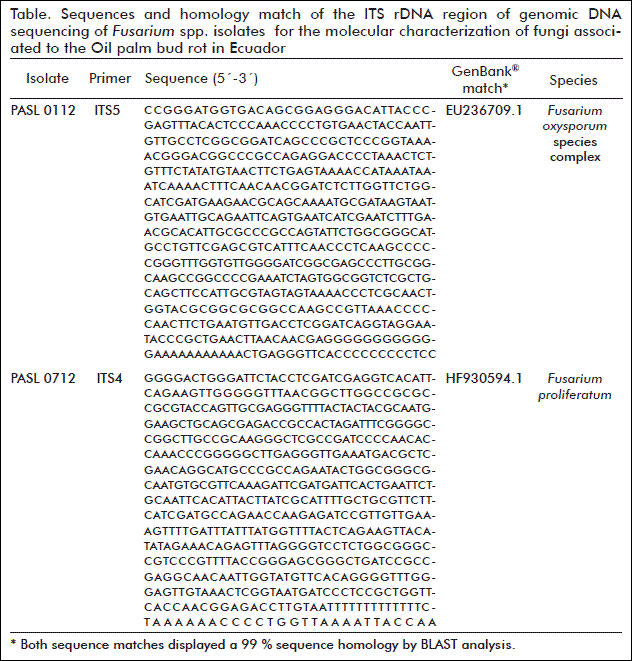
<body><![CDATA[<P   ><font size="2" face="Verdana, Arial, Helvetica, sans-serif"><b>Molecular identification      of fungi associated to the RC complex in the oil palm </b></font></P >       <P   ><font size="2" face="Verdana, Arial, Helvetica, sans-serif">The DNA sequence      of fragments amplified with primers specific for the ITS rDNA region of the      genomic DNA of <I>Fusarium </I>spp. were successfully matched with GenBank&reg;      database sequences. They corresponded to <I>Fusarium proliferatum </I>(Matsushima)      Nirenberg fungi for the isolate PASL 0712. But in the case of the PASL 0112      isolate, it was corroborated as corresponding to <I>Fusarium </I>spp., in      spite of the culture-morphology characterization (<a href="/img/revistas/bta/v32n2/t0104215.gif">Table</a>),      the match sequence in the database being species unspecific (<I>Fusarium oxysporum      </I>species complex). Both matches showed a 99 % of homology with sequences      deposited under GenBank&reg; accession numbers HF930594.1 (PASL 0712) and      EU236709.1 (PASL 0112) (<a href="/img/revistas/bta/v32n2/t0104215.gif">Table</a>). </font></P >       
<P   >&nbsp;</P >   <FONT size="+1"><FONT size="+1"><FONT size="+1"><FONT size="+1">        <P   ><font size="3" face="Verdana, Arial, Helvetica, sans-serif"><b>DISCUSSION </b></font></P >       <P   ><font size="2" face="Verdana, Arial, Helvetica, sans-serif">The identification      of <I>Fusarium </I>spp. species based solely on culture and morphological      criteria tends to be confusing, even for well-trained taxonomists, despite      their correspondence with previous descriptions [8, 9], as was the case for      the PASL 0712 and PASL 0112 isolates. </font></P >       <P   ><font size="2" face="Verdana, Arial, Helvetica, sans-serif">That&rsquo;s why      a genomic DNA characterization must be made to differentiate among the species      showing similar morphological parameters, as for <I>F. proliferatum </I>and      <I>Fusarium moniliforme </I>Sheldon emend. Snyder &amp; Hansen. In fact, <I>F.      proliferatum </I>have been mistakenly identified as <I>F. moniliforme </I>several      studies due to their high sequence homology, in addition to both species remaining      as almost undistinguishable in terms of their biological and morphological      parameters [13, 14]. </font></P >       <P   ><font size="2" face="Verdana, Arial, Helvetica, sans-serif">In this sense, the      ITS rDNA sequences were used for the molecular identification of the fungi      isolates obtained from oil palm bud rot samples [15]. This method it a fast      and reliable way to characterize both genus and species, due to the typical      distinct variability of ITS between species [15]. </font></P >       <P   ><font size="2" face="Verdana, Arial, Helvetica, sans-serif">Our results confirmed      the spear and bud necrosis disease in the oil palm Coari &times; La M&eacute;      hybrid as associated to the presence of <I>Fusarium </I>spp., corroborated      with molecular DNA amplification by PCR and sequence alignment of ITS sequences.      Both isolates showed 99 % of similarity with previously reported sequences      of this genus, in spite of isolate PASL 0112 species remaining to be further      established (<a href="/img/revistas/bta/v32n2/t0104215.gif">Table</a>). </font></P >       
<P   ><font size="2" face="Verdana, Arial, Helvetica, sans-serif">As far as we know,      this was the first report on the association of this <I>F. proliferatum </I>fungi      species as part of the fungi complex associated to the oil palm bud rot disease      affecting <I>E. guineensis </I>in Ecuador. </font></P >       <P   >&nbsp;</P >       ]]></body>
<body><![CDATA[<P   > </P >   <FONT size="+1">        <P   ><b><font size="3" face="Verdana, Arial, Helvetica, sans-serif">REFERENCES </font></b></P >       <!-- ref --><P   ><font size="2" face="Verdana, Arial, Helvetica, sans-serif">1. Ntsefong GN, Ebongue      GFN, Paul K, Martin BJ, Hermine NB, Gervais BE, et al. Control approaches      against vascular wilt disease of Elaeis guineensis Jacq. Caused by Fusarium      oxysporum f. sp. elaedis. J Biol Life Sci. 2012;3(1):160-72.     </font></P >   <FONT size="+1">        <P   ><font size="2" face="Verdana, Arial, Helvetica, sans-serif">2. ANCUPA. Estad&iacute;sticas      Nacionales de Palma Africana. 2010 [cited 2015 Jan 28]. Available from: <a href="http:///www.ancupa.com/index93d8.html?op-tion=com_content&view=article&id=73&Itemid=103.2010%20" target="_blank">http:///www.ancupa.com/index93d8.html?op-tion=com_content&amp;view=article&amp;id=73&amp;Itemid=103.2010      </a> </font></P >       <!-- ref --><P   ><font size="2" face="Verdana, Arial, Helvetica, sans-serif">3. De Franqueville      H. Oil Palm Bud Rot in Latin America. Expl Agric. 2003;39:225-40.     </font></P >       <!-- ref --><P   ><font size="2" face="Verdana, Arial, Helvetica, sans-serif">4. Chinchilla C.      The many faces of spear rots in oil palm: the need for an integrated management      approach. ASD Oil Palm Papers. 2008;(32):1-15.     </font></P >       <P   ><font size="2" face="Verdana, Arial, Helvetica, sans-serif">5. MacFarlane H,      editor. Review of Applied Mycology Plant. Compiled from World Literature on      Plant Pathology by Helen MacFarlane. Host-Pathogen Index.1922-1961. England:      Commonwealth Mycological Institute; 1968. </font></P >       ]]></body>
<body><![CDATA[<P   ><font size="2" face="Verdana, Arial, Helvetica, sans-serif">6. Benson JH. Microbiological      applications. Laboratory manual in general microbiology. 7th Ed. Pasadena:      McGraw-Hill Co.; 1998. </font></P >       <!-- ref --><P   ><font size="2" face="Verdana, Arial, Helvetica, sans-serif">7. Nelson PE, Toussoun      T, Cook RJ. Fusarium: Diseases, biology, and taxonomy. London: Pennsylvania      State University Press; 1981.     </font></P >       <P   ><font size="2" face="Verdana, Arial, Helvetica, sans-serif">8. Balmas V, Santori      A, Corazza L. Le specie di Fusarium pi&uacute; comuni in Italia. Suggerimenti      per il loro riconoscimento. Petria. 2000; 10(Suppl 1):1-7. </font></P >       <!-- ref --><P   ><font size="2" face="Verdana, Arial, Helvetica, sans-serif">9. Gerlach W, Nirenberg      H. The genus Fusarium a Pictorial Atlas. Berlin: Institut fur Mikrobiologie;      1982.     </font></P >       <P   ><font size="2" face="Verdana, Arial, Helvetica, sans-serif">10. Sambrook J, Fritsch      EF, Maniatis T. Molecular Cloning: A laboratory manual. 2nd Ed. Cold Spring      Harbor: Cold Spring Harbor Laboratory Press; 1989. </font></P >       <P   ><font size="2" face="Verdana, Arial, Helvetica, sans-serif">11. White TJ, Bruns      T, Lee SB, Taylor JW. Amplification and direct sequencing of fungal ribosomal      DNA genes for phylogenetics. In: Innis MA, Gelfand DH, Sninsky JJ, White TJ,      Ed. PCR Protocols a Guide to Methods and Applications. New York: Academic      Press. p. 315-22. </font></P >       <!-- ref --><P   ><font size="2" face="Verdana, Arial, Helvetica, sans-serif">12. Leslie JF, Summerell      BA. The Fusarium Laboratory Manual. Oxford: Blackwell Publishing; 2006.     </font></P >       ]]></body>
<body><![CDATA[<!-- ref --><P   ><font size="2" face="Verdana, Arial, Helvetica, sans-serif">13. Mishra PK, Fox      RT, Culham A. Development of a PCR-based assay for rapid and reliable identification      of pathogenic Fusaria. FEMS Microbiol Lett. 2003; 218(2): 329-32.     </font></P >       <!-- ref --><P   ><font size="2" face="Verdana, Arial, Helvetica, sans-serif">14. Hameed MA. Inflorescence      rot disease of date palm caused by Fusarium proliferatum in Southern Iraq.      Afr J Biotechnol. 2012;11(35):8616-21.     </font></P >       <!-- ref --><P   ><font size="2" face="Verdana, Arial, Helvetica, sans-serif">15. Oechsler RA,      Feilmeier MR, Ledee DR, Miller D, Diaz MR, Fini ME, et al. Utility of molecular      sequence analysis of the ITS rRNA region for identification of Fusarium spp.      from ocular sources. Invest Ophthalmol Vis Sci. 2009;50(5):2230-6.     </font></P >       <P   >&nbsp;</P >       <P   >&nbsp;</P >   <FONT size="+1">        <P   > </P >       <P   ><font size="2" face="Verdana, Arial, Helvetica, sans-serif">Received in January,      2015.     ]]></body>
<body><![CDATA[<br>     </font><font size="2" face="Verdana, Arial, Helvetica, sans-serif">Accepted      in July, 2015.<I> </I></font></P >   <FONT size="+1"><FONT size="+1">        <P   > </P >       <P   >&nbsp;</P >       <P   >&nbsp;</P >       <P   ><font size="2" face="Verdana, Arial, Helvetica, sans-serif"><i>Fernando Rivas      Figueroa</i>. <FONT color="#000000"> <FONT color="#211E1F">Facultad de Recursos      Naturales, Escuela Superior Polit&eacute;cnica de Chimborazo. Panamericana      Sur Km 1.5. Riobamba, Ecuador. C&oacute;digo Postal 060102, Ecuador. E-mail:      </font></font></font></P >   <FONT size="+1" color="#000000"><FONT size="+1" color="#211E1F"><FONT size="+1" color="#000000">        <P   ><font size="2" face="Verdana, Arial, Helvetica, sans-serif"><A href="mailto:fejorivas@espoch.edu.ec">      <FONT color="#0000FF">fejorivas@espoch.edu.ec</font></A><FONT color="#0000FF"><FONT color="#211E1F">.      </font></font></font></P >   <FONT size="+1" color="#0000FF"><FONT color="#211E1F">        <P   > </P >   </font></font></font></font></font></font></font></font></font></font></font></font></font></font></font></font></font></font></font></font></font></font></font></font></font></font></font></font></font></font></font></font></font></font></font></font></font></font></font></DIV >      ]]></body><back>
<ref-list>
<ref id="B1">
<label>1</label><nlm-citation citation-type="journal">
<person-group person-group-type="author">
<name>
<surname><![CDATA[Ntsefong]]></surname>
<given-names><![CDATA[GN]]></given-names>
</name>
<name>
<surname><![CDATA[Ebongue]]></surname>
<given-names><![CDATA[GFN]]></given-names>
</name>
<name>
<surname><![CDATA[Paul]]></surname>
<given-names><![CDATA[K]]></given-names>
</name>
<name>
<surname><![CDATA[Martin]]></surname>
<given-names><![CDATA[BJ]]></given-names>
</name>
<name>
<surname><![CDATA[Hermine]]></surname>
<given-names><![CDATA[NB]]></given-names>
</name>
<name>
<surname><![CDATA[Gervais]]></surname>
<given-names><![CDATA[BE]]></given-names>
</name>
</person-group>
<article-title xml:lang="en"><![CDATA[Control approaches against vascular wilt disease of Elaeis guineensis Jacq. Caused by Fusarium oxysporum f. sp. elaedis]]></article-title>
<source><![CDATA[J Biol Life Sci]]></source>
<year>2012</year>
<volume>3</volume>
<numero>1</numero>
<issue>1</issue>
<page-range>160-72</page-range></nlm-citation>
</ref>
<ref id="B2">
<label>2</label><nlm-citation citation-type="">
<collab>ANCUPA</collab>
<source><![CDATA[Estadísticas Nacionales de Palma Africana]]></source>
<year>2010</year>
</nlm-citation>
</ref>
<ref id="B3">
<label>3</label><nlm-citation citation-type="journal">
<person-group person-group-type="author">
<name>
<surname><![CDATA[De Franqueville]]></surname>
<given-names><![CDATA[H]]></given-names>
</name>
</person-group>
<article-title xml:lang="en"><![CDATA[Oil Palm Bud Rot in Latin America]]></article-title>
<source><![CDATA[Expl Agric]]></source>
<year>2003</year>
<volume>39</volume>
<page-range>225-40</page-range></nlm-citation>
</ref>
<ref id="B4">
<label>4</label><nlm-citation citation-type="journal">
<person-group person-group-type="author">
<name>
<surname><![CDATA[Chinchilla]]></surname>
<given-names><![CDATA[C]]></given-names>
</name>
</person-group>
<article-title xml:lang="en"><![CDATA[The many faces of spear rots in oil palm: the need for an integrated management approach]]></article-title>
<source><![CDATA[ASD Oil Palm Papers]]></source>
<year>2008</year>
<numero>32</numero>
<issue>32</issue>
<page-range>1-15</page-range></nlm-citation>
</ref>
<ref id="B5">
<label>5</label><nlm-citation citation-type="book">
<person-group person-group-type="author">
<name>
<surname><![CDATA[MacFarlane]]></surname>
<given-names><![CDATA[H]]></given-names>
</name>
</person-group>
<source><![CDATA[Review of Applied Mycology Plant. Compiled from World Literature on Plant Pathology by Helen MacFarlane. Host-Pathogen Index.1922-1961]]></source>
<year>1968</year>
<publisher-loc><![CDATA[England ]]></publisher-loc>
<publisher-name><![CDATA[Commonwealth Mycological Institute]]></publisher-name>
</nlm-citation>
</ref>
<ref id="B6">
<label>6</label><nlm-citation citation-type="book">
<person-group person-group-type="author">
<name>
<surname><![CDATA[Benson]]></surname>
<given-names><![CDATA[JH]]></given-names>
</name>
</person-group>
<source><![CDATA[Microbiological applications. Laboratory manual in general microbiology]]></source>
<year>1998</year>
<edition>7</edition>
<publisher-loc><![CDATA[Pasadena ]]></publisher-loc>
<publisher-name><![CDATA[McGraw-Hill Co]]></publisher-name>
</nlm-citation>
</ref>
<ref id="B7">
<label>7</label><nlm-citation citation-type="book">
<person-group person-group-type="author">
<name>
<surname><![CDATA[Nelson]]></surname>
<given-names><![CDATA[PE]]></given-names>
</name>
<name>
<surname><![CDATA[Toussoun]]></surname>
<given-names><![CDATA[T]]></given-names>
</name>
<name>
<surname><![CDATA[Cook]]></surname>
<given-names><![CDATA[RJ]]></given-names>
</name>
</person-group>
<source><![CDATA[Fusarium: Diseases, biology, and taxonomy]]></source>
<year>1981</year>
<publisher-loc><![CDATA[London ]]></publisher-loc>
<publisher-name><![CDATA[Pennsylvania State University Press]]></publisher-name>
</nlm-citation>
</ref>
<ref id="B8">
<label>8</label><nlm-citation citation-type="journal">
<person-group person-group-type="author">
<name>
<surname><![CDATA[Balmas]]></surname>
<given-names><![CDATA[V]]></given-names>
</name>
<name>
<surname><![CDATA[Santori]]></surname>
<given-names><![CDATA[A]]></given-names>
</name>
<name>
<surname><![CDATA[Corazza]]></surname>
<given-names><![CDATA[L]]></given-names>
</name>
</person-group>
<article-title xml:lang="it"><![CDATA[Le specie di Fusarium piú comuni in Italia. Suggerimenti per il loro riconoscimento]]></article-title>
<source><![CDATA[Petria]]></source>
<year>2000</year>
<volume>10</volume>
<numero>1</numero>
<issue>1</issue>
<page-range>1-7</page-range></nlm-citation>
</ref>
<ref id="B9">
<label>9</label><nlm-citation citation-type="book">
<person-group person-group-type="author">
<name>
<surname><![CDATA[Gerlach]]></surname>
<given-names><![CDATA[W]]></given-names>
</name>
<name>
<surname><![CDATA[Nirenberg]]></surname>
<given-names><![CDATA[H]]></given-names>
</name>
</person-group>
<source><![CDATA[The genus Fusarium a Pictorial Atlas]]></source>
<year>1982</year>
<publisher-loc><![CDATA[Berlin ]]></publisher-loc>
<publisher-name><![CDATA[Institut fur Mikrobiologie]]></publisher-name>
</nlm-citation>
</ref>
<ref id="B10">
<label>10</label><nlm-citation citation-type="book">
<person-group person-group-type="author">
<name>
<surname><![CDATA[Sambrook]]></surname>
<given-names><![CDATA[J]]></given-names>
</name>
<name>
<surname><![CDATA[Fritsch]]></surname>
<given-names><![CDATA[EF]]></given-names>
</name>
<name>
<surname><![CDATA[Maniatis]]></surname>
<given-names><![CDATA[T]]></given-names>
</name>
</person-group>
<source><![CDATA[Molecular Cloning: A laboratory manual]]></source>
<year>1989</year>
<edition>2</edition>
<publisher-loc><![CDATA[Cold Spring Harbor ]]></publisher-loc>
<publisher-name><![CDATA[Cold Spring Harbor Laboratory Press]]></publisher-name>
</nlm-citation>
</ref>
<ref id="B11">
<label>11</label><nlm-citation citation-type="book">
<person-group person-group-type="author">
<name>
<surname><![CDATA[White]]></surname>
<given-names><![CDATA[TJ]]></given-names>
</name>
<name>
<surname><![CDATA[Bruns]]></surname>
<given-names><![CDATA[T]]></given-names>
</name>
<name>
<surname><![CDATA[Lee]]></surname>
<given-names><![CDATA[SB]]></given-names>
</name>
<name>
<surname><![CDATA[Taylor]]></surname>
<given-names><![CDATA[JW]]></given-names>
</name>
</person-group>
<article-title xml:lang="en"><![CDATA[Amplification and direct sequencing of fungal ribosomal DNA genes for phylogenetics]]></article-title>
<person-group person-group-type="editor">
<name>
<surname><![CDATA[Innis]]></surname>
<given-names><![CDATA[MA]]></given-names>
</name>
<name>
<surname><![CDATA[Gelfand]]></surname>
<given-names><![CDATA[DH]]></given-names>
</name>
<name>
<surname><![CDATA[Sninsky]]></surname>
<given-names><![CDATA[JJ]]></given-names>
</name>
<name>
<surname><![CDATA[White]]></surname>
<given-names><![CDATA[TJ]]></given-names>
</name>
</person-group>
<source><![CDATA[[vtitle][ign][title language=en]Molecular Cloning: [stitle]A laboratory manual]]></source>
<year>1989</year>
<page-range>315-22</page-range><publisher-loc><![CDATA[New York ]]></publisher-loc>
<publisher-name><![CDATA[Cold Spring Harbor Laboratory Press]]></publisher-name>
</nlm-citation>
</ref>
<ref id="B12">
<label>12</label><nlm-citation citation-type="book">
<person-group person-group-type="author">
<name>
<surname><![CDATA[Leslie]]></surname>
<given-names><![CDATA[JF]]></given-names>
</name>
<name>
<surname><![CDATA[Summerell]]></surname>
<given-names><![CDATA[BA]]></given-names>
</name>
</person-group>
<source><![CDATA[The Fusarium Laboratory Manual]]></source>
<year>2006</year>
<publisher-loc><![CDATA[Oxford ]]></publisher-loc>
<publisher-name><![CDATA[Blackwell Publishing]]></publisher-name>
</nlm-citation>
</ref>
<ref id="B13">
<label>13</label><nlm-citation citation-type="journal">
<person-group person-group-type="author">
<name>
<surname><![CDATA[Mishra]]></surname>
<given-names><![CDATA[PK]]></given-names>
</name>
<name>
<surname><![CDATA[Fox]]></surname>
<given-names><![CDATA[RT]]></given-names>
</name>
<name>
<surname><![CDATA[Culham]]></surname>
<given-names><![CDATA[A]]></given-names>
</name>
</person-group>
<article-title xml:lang="en"><![CDATA[Development of a PCR-based assay for rapid and reliable identification of pathogenic Fusaria]]></article-title>
<source><![CDATA[FEMS Microbiol Lett]]></source>
<year>2003</year>
<volume>218</volume>
<numero>2</numero>
<issue>2</issue>
<page-range>329-32</page-range></nlm-citation>
</ref>
<ref id="B14">
<label>14</label><nlm-citation citation-type="journal">
<person-group person-group-type="author">
<name>
<surname><![CDATA[Hameed]]></surname>
<given-names><![CDATA[MA]]></given-names>
</name>
</person-group>
<article-title xml:lang="en"><![CDATA[Inflorescence rot disease of date palm caused by Fusarium proliferatum in Southern Iraq]]></article-title>
<source><![CDATA[Afr J Biotechnol]]></source>
<year>2012</year>
<volume>11</volume>
<numero>35</numero>
<issue>35</issue>
<page-range>8616-21</page-range></nlm-citation>
</ref>
<ref id="B15">
<label>15</label><nlm-citation citation-type="journal">
<person-group person-group-type="author">
<name>
<surname><![CDATA[Oechsler]]></surname>
<given-names><![CDATA[RA]]></given-names>
</name>
<name>
<surname><![CDATA[Feilmeier]]></surname>
<given-names><![CDATA[MR]]></given-names>
</name>
<name>
<surname><![CDATA[Ledee]]></surname>
<given-names><![CDATA[DR]]></given-names>
</name>
<name>
<surname><![CDATA[Miller]]></surname>
<given-names><![CDATA[D]]></given-names>
</name>
<name>
<surname><![CDATA[Diaz]]></surname>
<given-names><![CDATA[MR]]></given-names>
</name>
<name>
<surname><![CDATA[Fini]]></surname>
<given-names><![CDATA[ME]]></given-names>
</name>
</person-group>
<article-title xml:lang="en"><![CDATA[Utility of molecular sequence analysis of the ITS rRNA region for identification of Fusarium spp. from ocular sources]]></article-title>
<source><![CDATA[Invest Ophthalmol Vis Sci]]></source>
<year>2009</year>
<volume>50</volume>
<numero>5</numero>
<issue>5</issue>
<page-range>2230-6</page-range></nlm-citation>
</ref>
</ref-list>
</back>
</article>