<?xml version="1.0" encoding="ISO-8859-1"?><article xmlns:mml="http://www.w3.org/1998/Math/MathML" xmlns:xlink="http://www.w3.org/1999/xlink" xmlns:xsi="http://www.w3.org/2001/XMLSchema-instance">
<front>
<journal-meta>
<journal-id>1027-2852</journal-id>
<journal-title><![CDATA[Biotecnología Aplicada]]></journal-title>
<abbrev-journal-title><![CDATA[Biotecnol Apl]]></abbrev-journal-title>
<issn>1027-2852</issn>
<publisher>
<publisher-name><![CDATA[Editorial Elfos Scientiae]]></publisher-name>
</publisher>
</journal-meta>
<article-meta>
<article-id>S1027-28522015000200008</article-id>
<title-group>
<article-title xml:lang="en"><![CDATA[Protective capacity of vaccine candidates against dengue virus type 2 based on the capsid protein and the oligodeoxynucleotide 39M]]></article-title>
<article-title xml:lang="es"><![CDATA[Capacidad protectora de candidatos vacunales contra el virus dengue serotipo 2 basados en la proteína de la cápsida y el oligodesoxinucleótido 39M]]></article-title>
</title-group>
<contrib-group>
<contrib contrib-type="author">
<name>
<surname><![CDATA[Marcos]]></surname>
<given-names><![CDATA[Ernesto]]></given-names>
</name>
<xref ref-type="aff" rid="A01"/>
</contrib>
<contrib contrib-type="author">
<name>
<surname><![CDATA[Gil]]></surname>
<given-names><![CDATA[Lázaro]]></given-names>
</name>
<xref ref-type="aff" rid="A01"/>
</contrib>
<contrib contrib-type="author">
<name>
<surname><![CDATA[Hermida]]></surname>
<given-names><![CDATA[Lisset]]></given-names>
</name>
<xref ref-type="aff" rid="A01"/>
</contrib>
<contrib contrib-type="author">
<name>
<surname><![CDATA[Izquierdo]]></surname>
<given-names><![CDATA[Alienys]]></given-names>
</name>
<xref ref-type="aff" rid="A02"/>
</contrib>
<contrib contrib-type="author">
<name>
<surname><![CDATA[Guillén]]></surname>
<given-names><![CDATA[Gerardo]]></given-names>
</name>
<xref ref-type="aff" rid="A01"/>
</contrib>
<contrib contrib-type="author">
<name>
<surname><![CDATA[Guzmán]]></surname>
<given-names><![CDATA[María Guadalupe]]></given-names>
</name>
<xref ref-type="aff" rid="A02"/>
</contrib>
<contrib contrib-type="author">
<name>
<surname><![CDATA[Lazo]]></surname>
<given-names><![CDATA[Laura]]></given-names>
</name>
<xref ref-type="aff" rid="A01"/>
</contrib>
<contrib contrib-type="author">
<name>
<surname><![CDATA[Valdés]]></surname>
<given-names><![CDATA[Iris]]></given-names>
</name>
<xref ref-type="aff" rid="A01"/>
</contrib>
<contrib contrib-type="author">
<name>
<surname><![CDATA[Álvarez]]></surname>
<given-names><![CDATA[Mayling]]></given-names>
</name>
<xref ref-type="aff" rid="A02"/>
</contrib>
<contrib contrib-type="author">
<name>
<surname><![CDATA[Suzarte]]></surname>
<given-names><![CDATA[Edith]]></given-names>
</name>
<xref ref-type="aff" rid="A01"/>
</contrib>
<contrib contrib-type="author">
<name>
<surname><![CDATA[Ramírez]]></surname>
<given-names><![CDATA[Rosa]]></given-names>
</name>
<xref ref-type="aff" rid="A02"/>
</contrib>
<contrib contrib-type="author">
<name>
<surname><![CDATA[Castro]]></surname>
<given-names><![CDATA[Jorge]]></given-names>
</name>
<xref ref-type="aff" rid="A01"/>
</contrib>
<contrib contrib-type="author">
<name>
<surname><![CDATA[Pérez]]></surname>
<given-names><![CDATA[Yusleidi]]></given-names>
</name>
<xref ref-type="aff" rid="A01"/>
</contrib>
<contrib contrib-type="author">
<name>
<surname><![CDATA[Cobas]]></surname>
<given-names><![CDATA[Karem]]></given-names>
</name>
<xref ref-type="aff" rid="A01"/>
</contrib>
<contrib contrib-type="author">
<name>
<surname><![CDATA[Silva]]></surname>
<given-names><![CDATA[José Ángel]]></given-names>
</name>
<xref ref-type="aff" rid="A01"/>
</contrib>
<contrib contrib-type="author">
<name>
<surname><![CDATA[Romero]]></surname>
<given-names><![CDATA[Yaremis]]></given-names>
</name>
<xref ref-type="aff" rid="A01"/>
</contrib>
<contrib contrib-type="author">
<name>
<surname><![CDATA[Cosme]]></surname>
<given-names><![CDATA[Karelia]]></given-names>
</name>
<xref ref-type="aff" rid="A01"/>
</contrib>
<contrib contrib-type="author">
<name>
<surname><![CDATA[Brown]]></surname>
<given-names><![CDATA[Emma]]></given-names>
</name>
<xref ref-type="aff" rid="A01"/>
</contrib>
<contrib contrib-type="author">
<name>
<surname><![CDATA[Blanco]]></surname>
<given-names><![CDATA[Aracelys]]></given-names>
</name>
<xref ref-type="aff" rid="A01"/>
</contrib>
<contrib contrib-type="author">
<name>
<surname><![CDATA[Miranda]]></surname>
<given-names><![CDATA[Jamilet]]></given-names>
</name>
<xref ref-type="aff" rid="A01"/>
</contrib>
<contrib contrib-type="author">
<name>
<surname><![CDATA[Perera]]></surname>
<given-names><![CDATA[Yasser]]></given-names>
</name>
<xref ref-type="aff" rid="A01"/>
</contrib>
</contrib-group>
<aff id="A02">
<institution><![CDATA[,Tropical Medicine Institute Pedro Kourí, IPK  ]]></institution>
<addr-line><![CDATA[La Habana ]]></addr-line>
<country>Cuba</country>
</aff>
<aff id="A01">
<institution><![CDATA[,Centro de Ingeniería Genética y Biotecnología  ]]></institution>
<addr-line><![CDATA[La Habana ]]></addr-line>
<country>Cuba</country>
</aff>
<pub-date pub-type="pub">
<day>00</day>
<month>06</month>
<year>2015</year>
</pub-date>
<pub-date pub-type="epub">
<day>00</day>
<month>06</month>
<year>2015</year>
</pub-date>
<volume>32</volume>
<numero>2</numero>
<fpage>2501</fpage>
<lpage>2503</lpage>
<copyright-statement/>
<copyright-year/>
<self-uri xlink:href="http://scielo.sld.cu/scielo.php?script=sci_arttext&amp;pid=S1027-28522015000200008&amp;lng=en&amp;nrm=iso"></self-uri><self-uri xlink:href="http://scielo.sld.cu/scielo.php?script=sci_abstract&amp;pid=S1027-28522015000200008&amp;lng=en&amp;nrm=iso"></self-uri><self-uri xlink:href="http://scielo.sld.cu/scielo.php?script=sci_pdf&amp;pid=S1027-28522015000200008&amp;lng=en&amp;nrm=iso"></self-uri><kwd-group>
<kwd lng="en"><![CDATA[Dengue-2 virus]]></kwd>
<kwd lng="en"><![CDATA[capsid protein]]></kwd>
<kwd lng="en"><![CDATA[nonhuman primates]]></kwd>
<kwd lng="en"><![CDATA[protection]]></kwd>
<kwd lng="es"><![CDATA[virus Dengue 2]]></kwd>
<kwd lng="es"><![CDATA[proteína de la cápsida]]></kwd>
<kwd lng="es"><![CDATA[primates no humanos]]></kwd>
<kwd lng="es"><![CDATA[protección]]></kwd>
</kwd-group>
</article-meta>
</front><body><![CDATA[ <DIV class="Part"   >        <P align="right"   ><font size="2" face="Verdana, Arial, Helvetica, sans-serif"><b>REPORT</b></font></P >       <P   >&nbsp;</P >       <P   ><font size="2" color="#211E1F" face="Verdana, Arial, Helvetica, sans-serif"><B><font size="4">Protective      capacity of vaccine candidates against dengue virus type 2 based on the capsid      protein and the oligodeoxynucleotide 39M </font></b></font></P >       <P   >&nbsp;</P >   <FONT size="+1" color="#211E1F"><B>        <P   ></P >   </B> <FONT size="+1" color="#000000">       <P   ><font size="3" color="#211E1F" face="Verdana, Arial, Helvetica, sans-serif"><B>Capacidad      protectora de candidatos vacunales contra el virus dengue serotipo 2 basados      en la prote&iacute;na de la c&aacute;psida y el oligodesoxinucle&oacute;tido      39M </b></font></P >       <P   >&nbsp;</P >       <P   >&nbsp;</P >   <FONT size="+1" color="#211E1F">       <P   ></P >   <FONT size="+1" color="#000000">       ]]></body>
<body><![CDATA[<P   ><b><font size="2" color="#211E1F" face="Verdana, Arial, Helvetica, sans-serif">Ernesto      Marcos<SUP>1</sup>, L&aacute;zaro Gil<SUP>1</sup>, Lisset Hermida<SUP>1</sup>,      Alienys Izquierdo<SUP>2</sup>, Gerardo Guill&eacute;n<SUP>1</sup>, Mar&iacute;a      Guadalupe Guzm&aacute;n<SUP>2</sup>, Laura Lazo<SUP>1</sup>, Iris Vald&eacute;s<SUP>1</sup>,      Mayling &Aacute;lvarez<SUP>2</sup>, Edith Suzarte<SUP>1</sup>, Rosa Ram&iacute;rez<SUP>2</sup>,      Jorge Castro<SUP>1</sup>, Yusleidi P&eacute;rez<SUP>1</sup>, Karem Cobas<SUP>1</sup>,      Jos&eacute; &Aacute;ngel Silva<SUP>1</sup>, Yaremis Romero<SUP>1</sup>, Karelia      Cosme<SUP>1</sup>, Emma Brown<SUP>1</sup>, Aracelys Blanco<SUP>1</sup>, Jamilet      Miranda<SUP>1</sup>, Yasser Perera<SUP>1</sup> </font></b><font size="2" color="#211E1F" face="Verdana, Arial, Helvetica, sans-serif"></font></P >   <FONT size="+1" color="#211E1F"><FONT size="+1"><FONT size="+1"><FONT size="+1"><FONT size="+1"><FONT size="+1"><FONT size="+1"><FONT size="+1"><FONT size="+1"><FONT size="+1"><FONT size="+1"><FONT size="+1"><FONT size="+1"><FONT size="+1"><FONT size="+1"><FONT size="+1"><FONT size="+1"><FONT size="+1"><FONT size="+1"><FONT size="+1"><FONT size="+1"><FONT size="+1"><FONT size="+1"><FONT size="+1"><FONT size="+1"><FONT size="+1"><FONT size="+1"><FONT size="+1"><FONT size="+1"><FONT size="+1"><FONT size="+1"><FONT size="+1"><FONT size="+1"><FONT size="+1"><FONT size="+1"><FONT size="+1"><FONT size="+1"><FONT size="+1"><FONT size="+1"><FONT size="+1"><FONT size="+1"><FONT size="+1">        <P   ><font size="2" face="Verdana, Arial, Helvetica, sans-serif"><sup>1</sup> Centro      de Ingenier&iacute;a Gen&eacute;tica y Biotecnolog&iacute;a. Ave. 31 e/ 158      y 190, Cubanac&aacute;n, Playa, PO Box 6162, CP 10600, La Habana, Cuba.     <br>     </font><font size="2" face="Verdana, Arial, Helvetica, sans-serif"><sup>2</sup>      Tropical Medicine Institute Pedro Kour&iacute;, IPK. Autopista Novia del Mediod&iacute;a,      Km 6&frac12;, La Lisa, CP 11400, La Habana, Cuba. </font></P >   <FONT size="+1"><FONT size="+1">        <P   >&nbsp;</P >       <P   >&nbsp;</P >   </font></font></font></font></font></font></font></font></font></font></font></font></font></font></font></font></font></font></font></font></font></font></font></font></font></font></font></font></font></font></font></font></font></font></font></font></font></font></font></font></font></font></font></font></font></font></font></font>    <hr>   <FONT size="+1" color="#211E1F"><FONT size="+1" color="#000000"><FONT size="+1" color="#211E1F"><FONT size="+1" color="#000000"><FONT size="+1" color="#211E1F"><FONT size="+1"><FONT size="+1"><FONT size="+1"><FONT size="+1"><FONT size="+1"><FONT size="+1"><FONT size="+1"><FONT size="+1"><FONT size="+1"><FONT size="+1"><FONT size="+1"><FONT size="+1"><FONT size="+1"><FONT size="+1"><FONT size="+1"><FONT size="+1"><FONT size="+1"><FONT size="+1"><FONT size="+1"><FONT size="+1"><FONT size="+1"><FONT size="+1"><FONT size="+1"><FONT size="+1"><FONT size="+1"><FONT size="+1"><FONT size="+1"><FONT size="+1"><FONT size="+1"><FONT size="+1"><FONT size="+1"><FONT size="+1"><FONT size="+1"><FONT size="+1"><FONT size="+1"><FONT size="+1"><FONT size="+1"><FONT size="+1"><FONT size="+1"><FONT size="+1"><FONT size="+1"><FONT size="+1"><FONT size="+1"><FONT size="+1"><FONT size="+1">        <P   > </P >       <P   ><b><font size="2" face="Verdana, Arial, Helvetica, sans-serif">ABSTRACT </font></b></P >       <P   ><font size="2" face="Verdana, Arial, Helvetica, sans-serif">Vaccine formulations      of the chimeric DIIIC-2 protein with different ODNs displaying adjuvant capacity      were tested in mice against dengue virus serotype 2. DIIIC-2 comprises domain      III from the envelope protein fused to the N-terminal region of the capsid      protein. One of the ODNs, named ODN 39M, combines CpG motifs described as      immunostimulatory active in mice, monkeys and human cells. The ODN sequence      determined the immune response pattern generated, since ODN 39M was the only      ODN inducing a Th1 response similar to that induced by the viral infection      in mice. Hence, ODN 39M was aggregated with either the capsid protein of dengue-2      (C-2) or the DIIIC-2 protein, and both formulations were adjuvanted in alum.      Upon administration in two mice models and in non-human primates, both formulations      induced protection after the viral challenge. This was the first demonstration      of the protective capacity induced by the vaccine formulation 39M-DIIIC-2      in non-human primates and in transgenic mouse models which develop dengue-like      clinical symptoms. Moreover, viremia levels were reduced in non-human primates      with the 39M-C-2 formulation. This was the first evidence ever on the induction      of a functional immune response against dengue virus by vaccination in non-human      primates, regardless the presence of neutralizing antibodies. Moreover, this      was the first work describing protection in monkeys with a formulation that      is suitable for human use and combines recombinant proteins from dengue virus      with alum. This research granted the 2014 Award of the Cuban National Academy      of Sciences. </font></P >       <P   ><font size="2" face="Verdana, Arial, Helvetica, sans-serif"><I><b>Keywords</b></I><b>:</b>      Dengue-2 virus, capsid protein, nonhuman primates, protection. </font></P >   </font></font></font></font></font></font></font></font></font></font></font></font></font></font></font></font></font></font></font></font></font></font></font></font></font></font></font></font></font></font></font></font></font></font></font></font></font></font></font></font></font></font></font></font></font></font></font></font></font></font>    <hr>   <FONT size="+1" color="#211E1F"><FONT size="+1" color="#000000"><FONT size="+1" color="#211E1F"><FONT size="+1" color="#000000"><FONT size="+1" color="#211E1F"><FONT size="+1"><FONT size="+1"><FONT size="+1"><FONT size="+1"><FONT size="+1"><FONT size="+1"><FONT size="+1"><FONT size="+1"><FONT size="+1"><FONT size="+1"><FONT size="+1"><FONT size="+1"><FONT size="+1"><FONT size="+1"><FONT size="+1"><FONT size="+1"><FONT size="+1"><FONT size="+1"><FONT size="+1"><FONT size="+1"><FONT size="+1"><FONT size="+1"><FONT size="+1"><FONT size="+1"><FONT size="+1"><FONT size="+1"><FONT size="+1"><FONT size="+1"><FONT size="+1"><FONT size="+1"><FONT size="+1"><FONT size="+1"><FONT size="+1"><FONT size="+1"><FONT size="+1"><FONT size="+1"><FONT size="+1"><FONT size="+1"><FONT size="+1"><FONT size="+1"><FONT size="+1"><FONT size="+1"><FONT size="+1"><FONT size="+1"><FONT size="+1">       <P   ><font size="2" face="Verdana, Arial, Helvetica, sans-serif"><b>RESUMEN </b></font></P >       ]]></body>
<body><![CDATA[<P   ><font size="2" face="Verdana, Arial, Helvetica, sans-serif">Se evaluaron preparaciones      de la prote&iacute;na quim&eacute;rica DIIIC-2 con diferentes oligodesoxinucle&oacute;tidos      (ODN) con actividad adyuvante, contra el virus del dengue serotipo 2 en ratones.      DIIIC-2 comprende el dominio III de la envoltura del virus dengue serotipo      2 fusionado al extremo N-terminal de la prote&iacute;na de la c&aacute;psida      del mismo serotipo. Uno de los ODN, el 39M, combina en una misma mol&eacute;cula      regiones CpG descritas como inmunol&oacute;gicamente activas en c&eacute;lulas      de ratones, monos y seres humanos. La secuencia del ODN determin&oacute; el      patr&oacute;n de respuesta inmune generado, pues solo el ODN 39M indujo un      patr&oacute;n de respuesta Th1 semejante al que se induce tras la infecci&oacute;n      viral en ratones. Basado en este hallazgo, se seleccion&oacute; el ODN 39M      y se agreg&oacute; con las prote&iacute;nas DIIIC-2 y la de la c&aacute;psida      del dengue serotipo 2 (C-2), ambas formulaciones adyuvadas en al&uacute;mina.      Ambas formulaciones indujeron protecci&oacute;n frente al reto viral en dos      modelos animales de ratones y en primates no humanos. Fue la primera vez que      se demuestra la capacidad protectora de la preparaci&oacute;n 39M-DIIIC-2      tanto en ratones transg&eacute;nicos que desarrollan s&iacute;ntomas similares      al dengue como en primates no humanos. Adem&aacute;s, la reducci&oacute;n      de los niveles de viremia alcanzados en primates no humanos con la preparaci&oacute;n      39M-C-2 evidenci&oacute; por primera vez, en este modelo animal, la funcionalidad      de una respuesta inmune independiente de anticuerpos </font><font size="2" face="Verdana, Arial, Helvetica, sans-serif">neutralizantes      contra el virus dengue. Adem&aacute;s, este fue el primer reporte de protecci&oacute;n      en monos con una formulaci&oacute;n adecuada para ser administrada a seres      humanos, que combina a prote&iacute;nas recombinantes del virus dengue con      al&uacute;mina. Este trabajo mereci&oacute; el Premio Anual de la Academia      de Ciencias de Cuba para el a&ntilde;o 2014. </font></P >       <P   ><font size="2" face="Verdana, Arial, Helvetica, sans-serif"><I><b>Palabras clave</b></I><b>:</b>      virus Dengue 2, prote&iacute;na de la c&aacute;psida, primates no humanos,      protecci&oacute;n. </font></P >   </font></font></font></font></font></font></font></font></font></font></font></font></font></font></font></font></font></font></font></font></font></font></font></font></font></font></font></font></font></font></font></font></font></font></font></font></font></font></font></font></font></font></font></font></font></font></font></font></font></font>    <hr>   <FONT size="+1" color="#211E1F"><FONT size="+1" color="#000000"><FONT size="+1" color="#211E1F"><FONT size="+1" color="#000000"><FONT size="+1" color="#211E1F"><FONT size="+1"><FONT size="+1"><FONT size="+1"><FONT size="+1"><FONT size="+1"><FONT size="+1"><FONT size="+1"><FONT size="+1"><FONT size="+1"><FONT size="+1"><FONT size="+1"><FONT size="+1"><FONT size="+1"><FONT size="+1"><FONT size="+1"><FONT size="+1"><FONT size="+1"><FONT size="+1"><FONT size="+1"><FONT size="+1"><FONT size="+1"><FONT size="+1"><FONT size="+1"><FONT size="+1"><FONT size="+1"><FONT size="+1"><FONT size="+1"><FONT size="+1"><FONT size="+1"><FONT size="+1"><FONT size="+1"><FONT size="+1"><FONT size="+1"><FONT size="+1"><FONT size="+1"><FONT size="+1"><FONT size="+1"><FONT size="+1"><FONT size="+1"><FONT size="+1"><FONT size="+1"><FONT size="+1"><FONT size="+1"><FONT size="+1"><FONT size="+1">       <P   >&nbsp;</P >       <P   >&nbsp;</P >       <P   ><font size="3" face="Verdana, Arial, Helvetica, sans-serif"><b>INTRODUCTION </b></font></P >       <P   ><font size="2" face="Verdana, Arial, Helvetica, sans-serif">Dengue virus (DENV)      infection is a major emerging disease of tropical and subtropical countries,      transmitted by the bite of infected mosquitoes. Each of the four DENV serotypes      causes a spectrum of clinical symptoms ranging from mild fever to potentially      fatal manifestations of dengue shock syndrome. </font></P >       <P   ><font size="2" face="Verdana, Arial, Helvetica, sans-serif">Our group has developed      subunit vaccine candidates based on the capsid protein of DENV-2 (C-2) and      a fusion of this protein with the domain III of the envelope protein (E) of      the homologous serotype (DIIIC-2). The resulting recombinant proteins were      efficiently produced in <I>Escherichia coli </I>and then properly purified      and folded. When presented as a particulate aggregate, incorporating random      oligodeoxynucleotides of 45 bases (45b-ODNs), DIIIC-2 induced antiviral and      neutralizing antibodies, cell-mediated immunity (CMI) and significant protection      in mice [1]. </font></P >       <P   ><font size="2" face="Verdana, Arial, Helvetica, sans-serif">In the last years      a high number of ODNs with adjuvant capacity have been identified. In 2001,      Krug et al. identified the ODN 2216 (5&acute;-GGGGGACGATCGTCGGGGGG-3&acute;),      which has the capacity to induce IFN&alpha;/&beta;/&gamma; secretion in human      peripheral blood mononuclear cells (PBMC) and mice splenocytes [2]. Verthelyi      <I>et al</I>. identified the ODN K3 (5&acute;-ATCGACTCTCGAGCGTTCTC-3&acute;)      which showed the induction of proliferation of humans B cells and the stimulation      of IgM and IL-6 secretion [3]. In addition, the adjuvant capacity of the preparation      IC31, a combination of a polycationic peptide and the ODN1a (5&acute;-ICICICICICICICICICICICICIC-3&acute;)      has evaluated [4]. ODN1a (named PolyIC) is a synthetic ODN of 26 bases composed      by 13 copies of the dinucleotide Inosine/Cytosine (IC) joined by a phosphodiester      bond. The preparation IC31 was able to potentiate the specific cellular and      humoral immune response induced in mice by an ovalbumin peptide and murine      tyrosinase [4]. </font></P >       <P   ><font size="2" face="Verdana, Arial, Helvetica, sans-serif">Here we present results      on the adjuvant effect of a modified version of the ODN m2216, the ODN PolyIC      (without chemical modifications) and the 39M ODN, formed by the fusion of      the ODNs m2216 and K3, on the recombinant protein DIIIC-2. After the selection      of the most immunogenic variant in mice, its ability to induce a protective      response was evaluated in mice and monkeys for aggregates of DIIIC-2 with      C-2 and the selected ODNs. This research granted the 2014 Award of the Cuban      National Academy of Sciences. </font></P >       <P   >&nbsp;</P >       ]]></body>
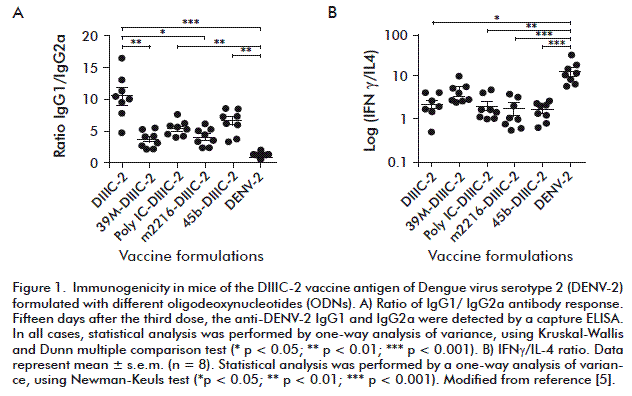
<body><![CDATA[<P   ><font size="3" face="Verdana, Arial, Helvetica, sans-serif"><b>RESULTS </b></font></P >       <P   ><font size="2" face="Verdana, Arial, Helvetica, sans-serif">The anti-DENV-2 immunoglobulin      (Ig)G1/IgG2a ratio was assessed in mice after the aggregation of the protein      with the three different ODNs (m2216, poly IC and 39M) (<a href="/img/revistas/bta/v32n2/f0108215.gif">Figure      1</a>). A group of animals receiving the non-aggregated DIIIC-2 was included      as a control (without ODNs). As additional controls, three groups were tested:      one received a DIIIC-2 protein aggregated with 45b ODN (45b-DIIIC-2), a placebo      formulation (negative control) and the last one was inoculated with 10<sup>5</sup>      plaque-forming units (p.f.u.) of infective DENV-2 (positive control). No statistical      differences were observed in the antibody responses among the groups of animals      inoculated with either of DIIIC-2 aggregates (p &gt; 0.05) (<a href="/img/revistas/bta/v32n2/f0108215.gif">Figure      1A</a>). However, only the IgG1/IgG2a ratios from the animals receiving 39M-DIIIC-2,      m2216-DIIIC-2 or infective DENV-2 (positive control) were statistically lower      than those observed in the group immunized with the non-aggregated DIIIC-2      (p &lt; 0.05). </font></P >       
<P   ><font size="2" face="Verdana, Arial, Helvetica, sans-serif">On the other hand,      culture supernatants from mock-treated or DENV-2-infected splenocytes from      immunized animals were tested by ELISA to measure the concentrations of IFN-&gamma;      and interleukin (IL)-4 (<a href="/img/revistas/bta/v32n2/f0108215.gif">Figure 1B</a>). The IFN-&gamma;/IL-4      ratios were higher in animals inoculated with 39M-DIIIC-2 or DENV-2, with      signi<FONT color="#000000">fi<FONT color="#211E1F">cant differences as compared      to the other groups (p &lt; 0.05). These results were in accordance with the      low ratios of IgG1/IgG2a observed in DIIIC-2 plus 39M and DENV-2 immunized      animals. </font></font></font></P >   <FONT color="#000000"><FONT color="#211E1F">        
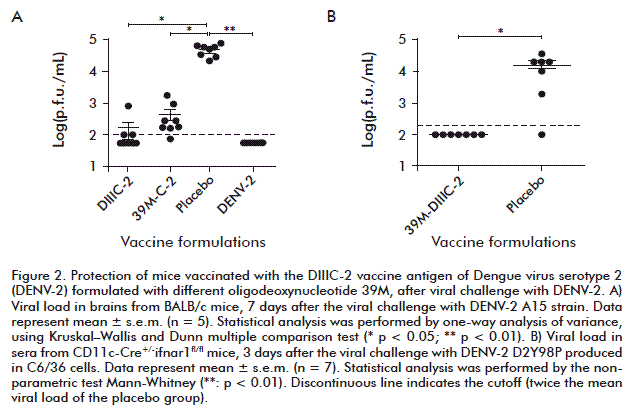
<P   ><font size="2" face="Verdana, Arial, Helvetica, sans-serif">Taking into account      these results a second experiment was performed to evaluate the protective      capacity induced by the protein aggregates containing the ODN 39M. Four groups      were included, the animals immunized with: 1) protein 39M-DIIIC-2; 2) C-2-39M;      3) placebo formulation (negative control); 4) infective DENV-2 (positive control).      </font></P >       <P   ><font size="2" face="Verdana, Arial, Helvetica, sans-serif">One month after the      last dose, protection was assessed using the mouse model of dengue encephalitis.      Animals were intracranially inoculated with 50 median lethal doses (LD<sub>50</sub>)      of the live, neuroadapted DENV-2 strain A15. Eight animals from each immunized      group were euthanized to measure viral load in the brain. As shown in <a href="/img/revistas/bta/v32n2/f0208215.gif">Figure      2A</a>, the </font><font size="2" face="Verdana, Arial, Helvetica, sans-serif">highest      viral titers (10<sup>4.5</sup> p.f.u./mL) were detected in the brain of animals      from the placebo group. No brain infection was observed in the positive control      group. </font></P >   <FONT size="+1"><FONT size="+1"><FONT size="+1"><FONT size="+1">        
<P   ><font size="2" face="Verdana, Arial, Helvetica, sans-serif">The statistical analysis      revealed signi<FONT color="#000000">fi<FONT color="#211E1F">cant differences      between the C-2 and DIIIC-2 immunized animals (p &lt; 0.05) or DENV-2 group      (p &lt; 0.01) as compared to placebo, respectively. </font></font></font></P >   <FONT color="#000000"><FONT color="#211E1F">        <P   ><font size="2" face="Verdana, Arial, Helvetica, sans-serif">Therefore, the protective      capacity of the formulation 39M-DIIIC-2 was evaluated in an immunocompromised      mouse model CD11c<sup>+</sup>-Cre<sup>+/-</sup>ifnar1<sup>fl/fl</sup>, where      after the inoculation of non-mouse-adapted dengue viral strains results in      systemic dengue infection (<a href="/img/revistas/bta/v32n2/f0208215.gif">Figure 2B</a>). Viral load      was highly significantly reduced in mice immunized (lower than 10<sup>2.3</sup>      p.f.u./mL; p &lt; 0.01) in respect to the placebo group (10<sup>4.2</sup>      p.f.u./ mL) was observed. </font></P >   <FONT size="+1"><FONT size="+1"><FONT size="+1"><FONT size="+1"><FONT size="+1"><FONT size="+1"><FONT size="+1"><FONT size="+1"><FONT size="+1"><FONT size="+1">        
<P   ><font size="2" face="Verdana, Arial, Helvetica, sans-serif">On the basis of the      preclinical studies in mice, the DIIIC-2 aggregates were evaluated in non-human      primates. Green monkeys were divided into three groups, receiving: 1) 39M-DIIIC-2      formulation; 2) 39M-C-2; 3) placebo (alum plus ODN 39M). Administrations were      performed once every 2 months for 6-months. </font></P >       <P   ><font size="2" face="Verdana, Arial, Helvetica, sans-serif">To assess the protective      ef<FONT color="#000000">fi<FONT color="#211E1F">cacy of the recombinant vaccine      candidate, all animals were challenged by subcutaneous inoculation of 10<sup><sup>3</sup></sup>      p.f.u. of DENV- 2. Serum samples were collected after challenge and viremia      was quanti<FONT color="#000000">fi<FONT color="#211E1F">ed using Vero cells.      All the placebo animals developed viremia with a mean duration of four days      and maximum viral titers of 10<sup><sup>2.5</sup></sup>, 10<sup><sup>1.4</sup></sup>      and 10<sup><sup>2.4</sup></sup> p.f.u./mL (Figure 6A in reference [5]). On      the contrary, two out of three animals in the group receiving DIIIC-2 plus      39M were totally protected, whereas the animal M2140 (partially protected)      developed a brief, low-level viremia (titer lower than 10 p.f.u./mL) that      lasted only 1 day (Figure 6B in reference [5]). </font></font></font></font></font></P >   <FONT color="#000000"><FONT color="#211E1F"><FONT size="+1"><FONT size="+1"><FONT color="#000000"><FONT color="#211E1F"><FONT size="+1"><FONT size="+1"><FONT size="+1"><FONT size="+1"><FONT size="+1"><FONT size="+1">        <P   ><font size="2" face="Verdana, Arial, Helvetica, sans-serif">In turn, variable      levels of viremia were detected in the group immunized with 39M-C-2 (Figure      3B in reference [6]). The animal M2072 had five days of viremia with a maximum      virus titer of 10<sup>1.9</sup> p.f.u./mL, whereas the monkey M2126 exhibited      three days of viremia with maximum virus titer of 10<sup>1.6</sup> p.f.u./      mL. The monkey M2048 was completely protected. Statistical analysis of mean      viremia using a nonparametric Mann-Whitney test showed high statistical differences      between this group and placebo (p = 0.0077). </font></P >       ]]></body>
<body><![CDATA[<P   >&nbsp;</P >   <FONT size="+1"><FONT size="+1"><FONT size="+1"><FONT size="+1">        <P   ><font size="2" face="Verdana, Arial, Helvetica, sans-serif"><b><font size="3">DISCUSSION      </font></b></font></P >       <P   ><font size="2" face="Verdana, Arial, Helvetica, sans-serif">In this study, we      immunized mice with formulations containing ODNs [2, 3] that had been previously      reported to have adjuvant capacity in mice, monkeys and human cells. In addition,      we evaluated the novel ODN 39M, which contains CpG motifs and has potential      immunostimulatory properties. </font></P >       <P   ><font size="2" face="Verdana, Arial, Helvetica, sans-serif">As expected, our      results revealed the influence of the ODN sequence on the immunogenicity of      DIIIC-2, as indicated by the subclass of IgG elicited and by the secretion      of IFN-&gamma; in mice. The addition of ODNs to the formulations shifted the      humoral immune responses toward a Th1 phenotype, despite using alum as adjuvant.      This effect was more pronounced with the formulations containing the ODNs      39M and m2216. In turn, immunization with the formulation containing the ODN      39M also induced a high-level secretion of IFN-&gamma; and resulted in the      highest IFN-&gamma;/IL-4 ratio. These findings indicate that the overall magnitude      of both, humoral and cellular immune responses is affected by the ODN used      for protein aggregation. </font></P >       <P   ><font size="2" face="Verdana, Arial, Helvetica, sans-serif">The protection assay      in BALB/c mice was then carried out with the 39M-DIIIC2 and 39M-C2 formulations.      In both cases, there was a significant reduction in virus titers in the brain      of challenged mice. The formulation 39M-DIIIC2 was also evaluated in an immunocompromised      mouse model CD11c<sup>+</sup>-Cre<sup>+/-</sup> ifnar1<sup>fl/fl</sup>. This      animal model has the disadvantage that use immunocompromised animals with      a limited capacity of develop an efficient immune response after the vaccination.      Noteworthy, the main advantage of this model is that it is possible to generate      a systemic infection in mice, with a non-neuroadapted dengue strain. There      was a significant reduction in virus titers in sera of challenged mice. </font></P >   <FONT size="+1"><FONT size="+1"><FONT size="+1"><FONT size="+1"><FONT size="+1"><FONT size="+1">        <P   ><font size="2" face="Verdana, Arial, Helvetica, sans-serif">The successful results      obtained in mice with 39M-DIIIC-2 and 39M-C-2 aggregates encouraged us to      conduct experiments in monkeys using these two formulations. The immunogenicity      of DIIIC-2 in monkeys was assessed by a protection assay. Two monkeys were      fully protected, whereas the third one only had a 1 day with low-titer viremia.      This was the first work describing protection with a formulation that is suitable      for human use and combines a recombinant protein from DENV with alum. In our      previous studies, protection was only provided by proteins emulsified in Freund&rsquo;s      adjuvant, whereas the formulations containing alum did not conferred protection      [7, 8]. This was also reported by Simmons <I>et al</I>. [9], showing no protection      in monkeys receiving the protein MBP-domain III formulated with alum. Conversely,      a promising subunit vaccine candidate based on the E protein and developed      by Hawaii Biotech provided solid protection when combined with ISCOMATRIX      and protein NS1 in a tetravalent formulation [10]. Nevertheless, when alum      was used without any other Th1-prone adjuvancity in a monovalent formulation,      none of the immunized monkeys was protected [10]. </font></P >       <P   ><font size="2" face="Verdana, Arial, Helvetica, sans-serif">The formulation 39M-C-2      induced a reduction of viral load after the viral challenge. Capsid protein      does not contain a high quantity of cell-mediated immunity (CMI) epitopes      for monkeys. In fact, a very recent study revealed in detail </font><font size="2" face="Verdana, Arial, Helvetica, sans-serif">that      the dengue capsid is not the most immunodominant region for CMI in humans,      since it contains one region immunologically identified by 4 % of responders      as compared to other viral antigens recognized by high magnitude T-cell responses      [11]. </font></P >       <P   ><font size="2" face="Verdana, Arial, Helvetica, sans-serif">Both, the capsid      protein and domain III from the envelope protein are serotype specific viral      fragments, so, this supports the development of a tetravalent vaccine formulation,      able to protect against the four dengue serotypes. </font></P >       <P   >&nbsp;</P >       <P   ><font size="2" color="#000000" face="Verdana, Arial, Helvetica, sans-serif"><b><font size="3">CONCLUSIONS      </font> </b> </font></P >   <FONT size="+1" color="#000000">        ]]></body>
<body><![CDATA[<P   ><font size="2" color="#211E1F" face="Verdana, Arial, Helvetica, sans-serif">The      experiments conducted in this work using mice and monkeys provide the proof      of concept of a subunit vaccine based on the capsid protein and the ODN 39M,      which is effective in both animal models using alum as adjuvant. Further studies      should carefully measure the duration of the functional immune response. This      issue should be addressed in upcoming experiments in non-human primates and      humans, using a tetravalent formulation. </font></P >       <P   >&nbsp;</P >   <FONT size="+1" color="#211E1F">        <P   > </P >       <P   ><b><font size="3" face="Verdana, Arial, Helvetica, sans-serif">REFERENCES </font></b></P >       <!-- ref --><P   ><font size="2" face="Verdana, Arial, Helvetica, sans-serif">1. Valdes I, Bernardo      L, Gil L, Pavon A, Lazo L, Lopez C, et al. A novel fusion protein domain III-capsid      from dengue-2, in a highly aggregated form, induces a functional immune response      and protection in mice. Virology 2009;394:249-58.     </font></P >   <FONT size="+1">        <!-- ref --><P   ><font size="2" face="Verdana, Arial, Helvetica, sans-serif">2. Krug A, Rothenfusser      S, Hornung V, Jahrsdorfer B, Blackwell S, Ballas ZK, et al. Identification      of CpG oligonucleotide sequences with high induction of IFN-alpha/ beta in      plasmacytoid dendritic cells. Eur J Immunol 2001;31:2154-63.     </font></P >       <!-- ref --><P   ><font size="2" face="Verdana, Arial, Helvetica, sans-serif">3. Verthelyi D, Ishii      KJ, Gursel M, Takeshita F, Klinman DM. Human peripheral blood cells differentially      recognize and respond to two distinct CPG motifs. J Immunol 2001;166:2372-7.          </font></P >       ]]></body>
<body><![CDATA[<!-- ref --><P   ><font size="2" face="Verdana, Arial, Helvetica, sans-serif">4. Schellack C, Prinz      K, Egyed A, Fritz JH, Wittmann B, Ginzler M, et al. IC31, a novel adjuvant      signaling via TLR9, induces potent cellular and humoral immune responses.      Vaccine 2006;24:5461-5472.     </font></P >       <!-- ref --><P   ><font size="2" face="Verdana, Arial, Helvetica, sans-serif">5. Gil L, Marcos      E, Izquierdo A, Lazo L, Valdes I, Ambala P, et al. The protein DIIIC-2, aggregated      with a specific oligodeoxynucleotide and adjuvanted in alum, protects mice      and monkeys against DENV- 2. Immunol Cell Biol. 2015;93(1):57-66.     </font></P >       <!-- ref --><P   ><font size="2" face="Verdana, Arial, Helvetica, sans-serif">6. Gil L, Izquierdo      A, Lazo L, Valdes I, Ambala P, Ochola L, et al. Capsid protein: evidences      about the partial protective role of neutralizing antibody-independent immunity      against dengue in monkeys. Virology. 2014;456-457:70-6.     </font></P >       <!-- ref --><P   ><font size="2" face="Verdana, Arial, Helvetica, sans-serif">7. Hermida L, Bernardo      L, Martin J, Alvarez M, Prado I, Lopez C, et al. A recombinant fusion protein      containing the domain III of the dengue-2 envelope protein is immunogenic      and protective in nonhuman primates. Vaccine 2006;24:3165-71.     </font></P >       <!-- ref --><P   ><font size="2" face="Verdana, Arial, Helvetica, sans-serif">8. Bernardo L, Izquierdo      A, Alvarez M, Rosario D, Prado I, Lopez C, et al. Immunogenicity and protective      efficacy of a recombinant fusion protein containing the domain III of the      dengue 1 envelope protein in non-human primates. Antiviral Res 2008;80:194-9.          </font></P >       ]]></body>
<body><![CDATA[<!-- ref --><P   ><font size="2" face="Verdana, Arial, Helvetica, sans-serif">9. Simmons M, Porter      KR, Hayes CG, Vaughn DW, Putnak R. Characterization of antibody responses      to combinations of a dengue virus type 2 DNA vaccine and two dengue virus      type 2 protein vaccines in rhesus macaques. J Virol 2006;80:9577- 85.     </font></P >       <!-- ref --><P   ><font size="2" face="Verdana, Arial, Helvetica, sans-serif">10. Clements DE,      Coller BA, Lieberman MM, Ogata S, Wang G, Harada KE, et al. Development of      a recombinant tetravalent dengue virus vaccine: immunogenicity and efficacy      studies in mice and monkeys. Vaccine 2010;28:2705-15.     </font></P >       <P   ><font size="2" face="Verdana, Arial, Helvetica, sans-serif">11. Weiskopf D, Angelo      MA, de Azeredo EL, Sidney J, Greenbaum JA, Fernando AN, et al. Comprehensive      analysis of dengue virus-specific responses supports an HLA-linked protective      role for CD8+ T cells. Proc Natl Acad Sci USA. 2013;110:E2046-53. </font></P >       <P   >&nbsp;</P >       <P   >&nbsp;</P >       <P   > </P >   <FONT size="+1">        <P   ><font size="2" face="Verdana, Arial, Helvetica, sans-serif">Received in January,      2015.     <br>     </font><font size="2" face="Verdana, Arial, Helvetica, sans-serif">Accepted      in May, 2015. </font></P >       ]]></body>
<body><![CDATA[<P   >&nbsp;</P >       <P   >&nbsp;</P >       <P   > </P >       <P   ><i><font size="2" face="Verdana, Arial, Helvetica, sans-serif">Ernesto Marcos</font></i><font size="2" face="Verdana, Arial, Helvetica, sans-serif">.      Centro de Ingenier&iacute;a Gen&eacute;tica y Biotecnolog&iacute;a. Ave. 31      e/ 158 y 190, Cubanac&aacute;n, Playa, PO Box 6162, CP 10600, La Habana, Cuba.      </font></P >   </font></font></font></font></font></font></font></font></font></font></font></font></font></font></font></font></font></font></font></font></font></font></font></font></font></font></font></font></font></font></font></font></font></font></font></font></font></font></font></font></font></font></font></font></font></font></font></font></font></font></font></font></font></font></font></font></font></font></font></font></font></font></font></font></font></font></font></font></font></font></font></font></font></font></font></font></font></font></font></font></font></font></font></font></font></font></font></font></font></font></font></font></font></font></DIV >      ]]></body><back>
<ref-list>
<ref id="B1">
<label>1</label><nlm-citation citation-type="journal">
<person-group person-group-type="author">
<name>
<surname><![CDATA[Valdes]]></surname>
<given-names><![CDATA[I]]></given-names>
</name>
<name>
<surname><![CDATA[Bernardo]]></surname>
<given-names><![CDATA[L]]></given-names>
</name>
<name>
<surname><![CDATA[Gil]]></surname>
<given-names><![CDATA[L]]></given-names>
</name>
<name>
<surname><![CDATA[Pavon]]></surname>
<given-names><![CDATA[A]]></given-names>
</name>
<name>
<surname><![CDATA[Lazo]]></surname>
<given-names><![CDATA[L]]></given-names>
</name>
<name>
<surname><![CDATA[Lopez]]></surname>
<given-names><![CDATA[C]]></given-names>
</name>
</person-group>
<article-title xml:lang="en"><![CDATA[A novel fusion protein domain III-capsid from dengue-2, in a highly aggregated form, induces a functional immune response and protection in mice]]></article-title>
<source><![CDATA[Virology]]></source>
<year>2009</year>
<volume>394</volume>
<page-range>249-58</page-range></nlm-citation>
</ref>
<ref id="B2">
<label>2</label><nlm-citation citation-type="journal">
<person-group person-group-type="author">
<name>
<surname><![CDATA[Krug]]></surname>
<given-names><![CDATA[A]]></given-names>
</name>
<name>
<surname><![CDATA[Rothenfusser]]></surname>
<given-names><![CDATA[S]]></given-names>
</name>
<name>
<surname><![CDATA[Hornung]]></surname>
<given-names><![CDATA[V]]></given-names>
</name>
<name>
<surname><![CDATA[Jahrsdorfer]]></surname>
<given-names><![CDATA[B]]></given-names>
</name>
<name>
<surname><![CDATA[Blackwell]]></surname>
<given-names><![CDATA[S]]></given-names>
</name>
<name>
<surname><![CDATA[Ballas]]></surname>
<given-names><![CDATA[ZK]]></given-names>
</name>
</person-group>
<article-title xml:lang="en"><![CDATA[Identification of CpG oligonucleotide sequences with high induction of IFN-alpha/ beta in plasmacytoid dendritic cells]]></article-title>
<source><![CDATA[Eur J Immunol]]></source>
<year>2001</year>
<volume>31</volume>
<page-range>2154-63</page-range></nlm-citation>
</ref>
<ref id="B3">
<label>3</label><nlm-citation citation-type="journal">
<person-group person-group-type="author">
<name>
<surname><![CDATA[Verthelyi]]></surname>
<given-names><![CDATA[D]]></given-names>
</name>
<name>
<surname><![CDATA[Ishii]]></surname>
<given-names><![CDATA[KJ]]></given-names>
</name>
<name>
<surname><![CDATA[Gursel]]></surname>
<given-names><![CDATA[M]]></given-names>
</name>
<name>
<surname><![CDATA[Takeshita]]></surname>
<given-names><![CDATA[F]]></given-names>
</name>
<name>
<surname><![CDATA[Klinman]]></surname>
<given-names><![CDATA[DM]]></given-names>
</name>
</person-group>
<article-title xml:lang="en"><![CDATA[Human peripheral blood cells differentially recognize and respond to two distinct CPG motifs]]></article-title>
<source><![CDATA[J Immunol]]></source>
<year>2001</year>
<volume>166</volume>
<page-range>2372-7</page-range></nlm-citation>
</ref>
<ref id="B4">
<label>4</label><nlm-citation citation-type="journal">
<person-group person-group-type="author">
<name>
<surname><![CDATA[Schellack]]></surname>
<given-names><![CDATA[C]]></given-names>
</name>
<name>
<surname><![CDATA[Prinz]]></surname>
<given-names><![CDATA[K]]></given-names>
</name>
<name>
<surname><![CDATA[Egyed]]></surname>
<given-names><![CDATA[A]]></given-names>
</name>
<name>
<surname><![CDATA[Fritz]]></surname>
<given-names><![CDATA[JH]]></given-names>
</name>
<name>
<surname><![CDATA[Wittmann]]></surname>
<given-names><![CDATA[B]]></given-names>
</name>
<name>
<surname><![CDATA[Ginzler]]></surname>
<given-names><![CDATA[M]]></given-names>
</name>
</person-group>
<article-title xml:lang="en"><![CDATA[IC31, a novel adjuvant signaling via TLR9, induces potent cellular and humoral immune responses]]></article-title>
<source><![CDATA[Vaccine]]></source>
<year>2006</year>
<volume>24</volume>
<page-range>5461-5472</page-range></nlm-citation>
</ref>
<ref id="B5">
<label>5</label><nlm-citation citation-type="journal">
<person-group person-group-type="author">
<name>
<surname><![CDATA[Gil]]></surname>
<given-names><![CDATA[L]]></given-names>
</name>
<name>
<surname><![CDATA[Marcos]]></surname>
<given-names><![CDATA[E]]></given-names>
</name>
<name>
<surname><![CDATA[Izquierdo]]></surname>
<given-names><![CDATA[A]]></given-names>
</name>
<name>
<surname><![CDATA[Lazo]]></surname>
<given-names><![CDATA[L]]></given-names>
</name>
<name>
<surname><![CDATA[Valdes]]></surname>
<given-names><![CDATA[I]]></given-names>
</name>
<name>
<surname><![CDATA[Ambala]]></surname>
<given-names><![CDATA[P]]></given-names>
</name>
</person-group>
<article-title xml:lang="en"><![CDATA[The protein DIIIC-2, aggregated with a specific oligodeoxynucleotide and adjuvanted in alum, protects mice and monkeys against DENV- 2]]></article-title>
<source><![CDATA[Immunol Cell Biol]]></source>
<year>2015</year>
<volume>93</volume>
<numero>1</numero>
<issue>1</issue>
<page-range>57-66</page-range></nlm-citation>
</ref>
<ref id="B6">
<label>6</label><nlm-citation citation-type="journal">
<person-group person-group-type="author">
<name>
<surname><![CDATA[Gil]]></surname>
<given-names><![CDATA[L]]></given-names>
</name>
<name>
<surname><![CDATA[Izquierdo]]></surname>
<given-names><![CDATA[A]]></given-names>
</name>
<name>
<surname><![CDATA[Lazo]]></surname>
<given-names><![CDATA[L]]></given-names>
</name>
<name>
<surname><![CDATA[Valdes]]></surname>
<given-names><![CDATA[I]]></given-names>
</name>
<name>
<surname><![CDATA[Ambala]]></surname>
<given-names><![CDATA[P]]></given-names>
</name>
<name>
<surname><![CDATA[Ochola]]></surname>
<given-names><![CDATA[L]]></given-names>
</name>
</person-group>
<article-title xml:lang="en"><![CDATA[Capsid protein: evidences about the partial protective role of neutralizing antibody-independent immunity against dengue in monkeys]]></article-title>
<source><![CDATA[Virology]]></source>
<year>2014</year>
<volume>456</volume>
<page-range>457:70-6</page-range></nlm-citation>
</ref>
<ref id="B7">
<label>7</label><nlm-citation citation-type="journal">
<person-group person-group-type="author">
<name>
<surname><![CDATA[Hermida]]></surname>
<given-names><![CDATA[L]]></given-names>
</name>
<name>
<surname><![CDATA[Bernardo]]></surname>
<given-names><![CDATA[L]]></given-names>
</name>
<name>
<surname><![CDATA[Martin]]></surname>
<given-names><![CDATA[J]]></given-names>
</name>
<name>
<surname><![CDATA[Alvarez]]></surname>
<given-names><![CDATA[M]]></given-names>
</name>
<name>
<surname><![CDATA[Prado]]></surname>
<given-names><![CDATA[I]]></given-names>
</name>
<name>
<surname><![CDATA[Lopez]]></surname>
<given-names><![CDATA[C]]></given-names>
</name>
</person-group>
<article-title xml:lang="en"><![CDATA[A recombinant fusion protein containing the domain III of the dengue-2 envelope protein is immunogenic and protective in nonhuman primates]]></article-title>
<source><![CDATA[Vaccine]]></source>
<year>2006</year>
<volume>24</volume>
<page-range>3165-71</page-range></nlm-citation>
</ref>
<ref id="B8">
<label>8</label><nlm-citation citation-type="journal">
<person-group person-group-type="author">
<name>
<surname><![CDATA[Bernardo]]></surname>
<given-names><![CDATA[L]]></given-names>
</name>
<name>
<surname><![CDATA[Izquierdo]]></surname>
<given-names><![CDATA[A]]></given-names>
</name>
<name>
<surname><![CDATA[Alvarez]]></surname>
<given-names><![CDATA[M]]></given-names>
</name>
<name>
<surname><![CDATA[Rosario]]></surname>
<given-names><![CDATA[D]]></given-names>
</name>
<name>
<surname><![CDATA[Prado]]></surname>
<given-names><![CDATA[I]]></given-names>
</name>
<name>
<surname><![CDATA[Lopez]]></surname>
<given-names><![CDATA[C]]></given-names>
</name>
</person-group>
<article-title xml:lang="en"><![CDATA[Immunogenicity and protective efficacy of a recombinant fusion protein containing the domain III of the dengue 1 envelope protein in non-human primates]]></article-title>
<source><![CDATA[Antiviral Res]]></source>
<year>2008</year>
<volume>80</volume>
<page-range>194-9</page-range></nlm-citation>
</ref>
<ref id="B9">
<label>9</label><nlm-citation citation-type="journal">
<person-group person-group-type="author">
<name>
<surname><![CDATA[Simmons]]></surname>
<given-names><![CDATA[M]]></given-names>
</name>
<name>
<surname><![CDATA[Porter]]></surname>
<given-names><![CDATA[KR]]></given-names>
</name>
<name>
<surname><![CDATA[Hayes]]></surname>
<given-names><![CDATA[CG]]></given-names>
</name>
<name>
<surname><![CDATA[Vaughn]]></surname>
<given-names><![CDATA[DW]]></given-names>
</name>
<name>
<surname><![CDATA[Putnak]]></surname>
<given-names><![CDATA[R]]></given-names>
</name>
</person-group>
<article-title xml:lang="en"><![CDATA[Characterization of antibody responses to combinations of a dengue virus type 2 DNA vaccine and two dengue virus type 2 protein vaccines in rhesus macaques]]></article-title>
<source><![CDATA[J Virol]]></source>
<year>2006</year>
<volume>80</volume>
<page-range>9577- 85</page-range></nlm-citation>
</ref>
<ref id="B10">
<label>10</label><nlm-citation citation-type="journal">
<person-group person-group-type="author">
<name>
<surname><![CDATA[Clements]]></surname>
<given-names><![CDATA[DE]]></given-names>
</name>
<name>
<surname><![CDATA[Coller]]></surname>
<given-names><![CDATA[BA]]></given-names>
</name>
<name>
<surname><![CDATA[Lieberman]]></surname>
<given-names><![CDATA[MM]]></given-names>
</name>
<name>
<surname><![CDATA[Ogata]]></surname>
<given-names><![CDATA[S]]></given-names>
</name>
<name>
<surname><![CDATA[Wang]]></surname>
<given-names><![CDATA[G]]></given-names>
</name>
<name>
<surname><![CDATA[Harada]]></surname>
<given-names><![CDATA[KE]]></given-names>
</name>
</person-group>
<article-title xml:lang="en"><![CDATA[Development of a recombinant tetravalent dengue virus vaccine: immunogenicity and efficacy studies in mice and monkeys]]></article-title>
<source><![CDATA[Vaccine]]></source>
<year>2010</year>
<volume>28</volume>
<page-range>2705-15</page-range></nlm-citation>
</ref>
<ref id="B11">
<label>11</label><nlm-citation citation-type="journal">
<person-group person-group-type="author">
<name>
<surname><![CDATA[Weiskopf]]></surname>
<given-names><![CDATA[D]]></given-names>
</name>
<name>
<surname><![CDATA[Angelo]]></surname>
<given-names><![CDATA[MA]]></given-names>
</name>
<name>
<surname><![CDATA[de Azeredo]]></surname>
<given-names><![CDATA[EL]]></given-names>
</name>
<name>
<surname><![CDATA[Sidney]]></surname>
<given-names><![CDATA[J]]></given-names>
</name>
<name>
<surname><![CDATA[Greenbaum]]></surname>
<given-names><![CDATA[JA]]></given-names>
</name>
<name>
<surname><![CDATA[Fernando]]></surname>
<given-names><![CDATA[AN]]></given-names>
</name>
</person-group>
<article-title xml:lang="en"><![CDATA[Comprehensive analysis of dengue virus-specific responses supports an HLA-linked protective role for CD8+ T cells]]></article-title>
<source><![CDATA[Proc Natl Acad Sci USA]]></source>
<year>2013</year>
<volume>110</volume>
<page-range>2046-53</page-range></nlm-citation>
</ref>
</ref-list>
</back>
</article>