<?xml version="1.0" encoding="ISO-8859-1"?><article xmlns:mml="http://www.w3.org/1998/Math/MathML" xmlns:xlink="http://www.w3.org/1999/xlink" xmlns:xsi="http://www.w3.org/2001/XMLSchema-instance">
<front>
<journal-meta>
<journal-id>1027-2852</journal-id>
<journal-title><![CDATA[Biotecnología Aplicada]]></journal-title>
<abbrev-journal-title><![CDATA[Biotecnol Apl]]></abbrev-journal-title>
<issn>1027-2852</issn>
<publisher>
<publisher-name><![CDATA[Editorial Elfos Scientiae]]></publisher-name>
</publisher>
</journal-meta>
<article-meta>
<article-id>S1027-28522015000300006</article-id>
<title-group>
<article-title xml:lang="en"><![CDATA[CIGB-552: A new penetrating peptide with antitumor action mediated by the increased levels of the COMMD1 protein in cancer cell lines]]></article-title>
<article-title xml:lang="es"><![CDATA[CIGB-552: nuevo péptido penetrador con acción antitumoral mediada por el aumento de los niveles de la proteína COMMD1 en líneas celulares de cáncer]]></article-title>
</title-group>
<contrib-group>
<contrib contrib-type="author">
<name>
<surname><![CDATA[Guerra-Vallespi]]></surname>
<given-names><![CDATA[M]]></given-names>
</name>
<xref ref-type="aff" rid="A01"/>
</contrib>
<contrib contrib-type="author">
<name>
<surname><![CDATA[Fernández-Massó]]></surname>
<given-names><![CDATA[JR]]></given-names>
</name>
<xref ref-type="aff" rid="A01"/>
</contrib>
<contrib contrib-type="author">
<name>
<surname><![CDATA[Oliva-Argüelles]]></surname>
<given-names><![CDATA[B]]></given-names>
</name>
<xref ref-type="aff" rid="A01"/>
</contrib>
<contrib contrib-type="author">
<name>
<surname><![CDATA[Reyes-Acosta]]></surname>
<given-names><![CDATA[O]]></given-names>
</name>
<xref ref-type="aff" rid="A01"/>
</contrib>
<contrib contrib-type="author">
<name>
<surname><![CDATA[Garay-Pérez]]></surname>
<given-names><![CDATA[HE]]></given-names>
</name>
<xref ref-type="aff" rid="A01"/>
</contrib>
<contrib contrib-type="author">
<name>
<surname><![CDATA[Delgado-Roche]]></surname>
<given-names><![CDATA[L]]></given-names>
</name>
<xref ref-type="aff" rid="A02"/>
</contrib>
<contrib contrib-type="author">
<name>
<surname><![CDATA[Cabrales-Rico]]></surname>
<given-names><![CDATA[A]]></given-names>
</name>
<xref ref-type="aff" rid="A01"/>
</contrib>
<contrib contrib-type="author">
<name>
<surname><![CDATA[Pimentel]]></surname>
<given-names><![CDATA[G]]></given-names>
</name>
<xref ref-type="aff" rid="A03"/>
</contrib>
<contrib contrib-type="author">
<name>
<surname><![CDATA[Garza]]></surname>
<given-names><![CDATA[J]]></given-names>
</name>
<xref ref-type="aff" rid="A03"/>
</contrib>
<contrib contrib-type="author">
<name>
<surname><![CDATA[Basaco]]></surname>
<given-names><![CDATA[T]]></given-names>
</name>
<xref ref-type="aff" rid="A03"/>
</contrib>
<contrib contrib-type="author">
<name>
<surname><![CDATA[Sánchez]]></surname>
<given-names><![CDATA[I]]></given-names>
</name>
<xref ref-type="aff" rid="A03"/>
</contrib>
<contrib contrib-type="author">
<name>
<surname><![CDATA[Calderón]]></surname>
<given-names><![CDATA[C]]></given-names>
</name>
<xref ref-type="aff" rid="A03"/>
</contrib>
<contrib contrib-type="author">
<name>
<surname><![CDATA[Rodríguez]]></surname>
<given-names><![CDATA[JC]]></given-names>
</name>
<xref ref-type="aff" rid="A03"/>
</contrib>
<contrib contrib-type="author">
<name>
<surname><![CDATA[Tejeda-Gómez]]></surname>
<given-names><![CDATA[Y]]></given-names>
</name>
<xref ref-type="aff" rid="A01"/>
</contrib>
<contrib contrib-type="author">
<name>
<surname><![CDATA[Mendoza-Fuentes]]></surname>
<given-names><![CDATA[O]]></given-names>
</name>
<xref ref-type="aff" rid="A01"/>
</contrib>
<contrib contrib-type="author">
<name>
<surname><![CDATA[Soria]]></surname>
<given-names><![CDATA[Y]]></given-names>
</name>
<xref ref-type="aff" rid="A01"/>
</contrib>
<contrib contrib-type="author">
<name>
<surname><![CDATA[Guillen-Pérez]]></surname>
<given-names><![CDATA[I]]></given-names>
</name>
<xref ref-type="aff" rid="A01"/>
</contrib>
<contrib contrib-type="author">
<name>
<surname><![CDATA[Palenzuela-Gardon]]></surname>
<given-names><![CDATA[D]]></given-names>
</name>
<xref ref-type="aff" rid="A01"/>
</contrib>
<contrib contrib-type="author">
<name>
<surname><![CDATA[Vázquez-Blomquist]]></surname>
<given-names><![CDATA[D]]></given-names>
</name>
<xref ref-type="aff" rid="A01"/>
</contrib>
<contrib contrib-type="author">
<name>
<surname><![CDATA[Musacchio-Lasa]]></surname>
<given-names><![CDATA[A]]></given-names>
</name>
<xref ref-type="aff" rid="A01"/>
</contrib>
<contrib contrib-type="author">
<name>
<surname><![CDATA[Astrada]]></surname>
<given-names><![CDATA[S]]></given-names>
</name>
<xref ref-type="aff" rid="A04"/>
</contrib>
<contrib contrib-type="author">
<name>
<surname><![CDATA[Bollati-Fogolín]]></surname>
<given-names><![CDATA[M]]></given-names>
</name>
<xref ref-type="aff" rid="A04"/>
</contrib>
<contrib contrib-type="author">
<name>
<surname><![CDATA[Novoa-Perez]]></surname>
<given-names><![CDATA[LI]]></given-names>
</name>
<xref ref-type="aff" rid="A01"/>
</contrib>
<contrib contrib-type="author">
<name>
<surname><![CDATA[Gómez-Rodríguez]]></surname>
<given-names><![CDATA[Y]]></given-names>
</name>
<xref ref-type="aff" rid="A01"/>
</contrib>
<contrib contrib-type="author">
<name>
<surname><![CDATA[Rivera-Markelova]]></surname>
<given-names><![CDATA[M]]></given-names>
</name>
<xref ref-type="aff" rid="A05"/>
</contrib>
<contrib contrib-type="author">
<name>
<surname><![CDATA[Fichtner]]></surname>
<given-names><![CDATA[I]]></given-names>
</name>
<xref ref-type="aff" rid="A05"/>
</contrib>
</contrib-group>
<aff id="A02">
<institution><![CDATA[,University of Havana Pharmacy and Food Sciences College Center of Studies for Research and Biological Evaluations]]></institution>
<addr-line><![CDATA[Havana ]]></addr-line>
<country>Cuba</country>
</aff>
<aff id="A03">
<institution><![CDATA[,Institute of Oncology and Radiobiology Department of Nuclear Medicine ]]></institution>
<addr-line><![CDATA[Havana ]]></addr-line>
<country>Cuba</country>
</aff>
<aff id="A04">
<institution><![CDATA[,Institut Pasteur of Montevideo Cell Biology Unit ]]></institution>
<addr-line><![CDATA[Montevideo ]]></addr-line>
<country>Uruguay</country>
</aff>
<aff id="A05">
<institution><![CDATA[,Berlin-Buch GmbH Experimental Pharmacology and Oncology ]]></institution>
<addr-line><![CDATA[Berlin ]]></addr-line>
<country>Germany</country>
</aff>
<aff id="A01">
<institution><![CDATA[,Centro de Ingeniería Genética y Biotecnología Dirección de Investigaciones Biomédicas ]]></institution>
<addr-line><![CDATA[La Habana ]]></addr-line>
<country>Cuba</country>
</aff>
<pub-date pub-type="pub">
<day>00</day>
<month>09</month>
<year>2015</year>
</pub-date>
<pub-date pub-type="epub">
<day>00</day>
<month>09</month>
<year>2015</year>
</pub-date>
<volume>32</volume>
<numero>3</numero>
<fpage>3501</fpage>
<lpage>3505</lpage>
<copyright-statement/>
<copyright-year/>
<self-uri xlink:href="http://scielo.sld.cu/scielo.php?script=sci_arttext&amp;pid=S1027-28522015000300006&amp;lng=en&amp;nrm=iso"></self-uri><self-uri xlink:href="http://scielo.sld.cu/scielo.php?script=sci_abstract&amp;pid=S1027-28522015000300006&amp;lng=en&amp;nrm=iso"></self-uri><self-uri xlink:href="http://scielo.sld.cu/scielo.php?script=sci_pdf&amp;pid=S1027-28522015000300006&amp;lng=en&amp;nrm=iso"></self-uri><kwd-group>
<kwd lng="en"><![CDATA[CIGB-552]]></kwd>
<kwd lng="en"><![CDATA[COMMD1]]></kwd>
<kwd lng="en"><![CDATA[cytotoxic peptide]]></kwd>
<kwd lng="en"><![CDATA[oxidative stress]]></kwd>
<kwd lng="en"><![CDATA[NF-&kappa;&beta;]]></kwd>
<kwd lng="en"><![CDATA[cancer animal models]]></kwd>
<kwd lng="es"><![CDATA[CIGB-552]]></kwd>
<kwd lng="es"><![CDATA[COMMD1]]></kwd>
<kwd lng="es"><![CDATA[péptido citotóxico]]></kwd>
<kwd lng="es"><![CDATA[estrés oxidativo]]></kwd>
<kwd lng="es"><![CDATA[NF-&kappa;&beta;]]></kwd>
<kwd lng="es"><![CDATA[modelos animales de cáncer]]></kwd>
</kwd-group>
</article-meta>
</front><body><![CDATA[ <DIV class="Part"   >        <P align="right"   ><font size="2" color="#000000" face="Verdana, Arial, Helvetica, sans-serif"><b>REPORT</b>      </font></P >       <P align="right"   >&nbsp;</P >   <FONT size="+1" color="#000000">        <P   > </P >   <FONT size="+1">       <P   ><font size="4" color="#211E1F" face="Verdana, Arial, Helvetica, sans-serif"><B>CIGB-552:      A new penetrating peptide with antitumor action mediated by the increased      levels of the COMMD1 protein in cancer cell lines</b></font><font size="2" color="#211E1F" face="Verdana, Arial, Helvetica, sans-serif"><B><I>      </I></b></font></P >       <P   >&nbsp;</P >   <FONT size="+1" color="#211E1F"><B>        <P   ></P >   </B> <FONT size="+1" color="#000000">       <P   ><font size="3" color="#211E1F" face="Verdana, Arial, Helvetica, sans-serif"><B>CIGB-552:      nuevo p&eacute;ptido penetrador con acci&oacute;n antitumoral mediada por      el aumento de los niveles de la prote&iacute;na COMMD1 en l&iacute;neas celulares      de c&aacute;ncer </b></font></P >       <P   >&nbsp;</P >       <P   >&nbsp;</P >   <FONT size="+1" color="#211E1F"><B>        ]]></body>
<body><![CDATA[<P   > </P >       <P   ></P >   </B> <FONT size="+1" color="#000000">        <P   ><font size="2" color="#211E1F" face="Verdana, Arial, Helvetica, sans-serif"><b>Guerra-Vallespi      M<sup>1</sup>, Fern&aacute;ndez-Mass&oacute; JR<sup>1</sup>, Oliva-Arg&uuml;elles      B<sup>1</sup>, Reyes-Acosta O<sup>1</sup>, Garay-P&eacute;rez HE<sup>1</sup>,      Delgado-Roche L<sup>2</sup>, Cabrales-Rico A<sup>1</sup>, Pimentel G<sup>3</sup>,      Garza J<sup>3</sup>, Basaco T<sup>3</sup>, S&aacute;nchez I<sup>3</sup>, Calder&oacute;n      C<sup>3</sup>, Rodr&iacute;guez JC<sup>3</sup>, Tejeda-G&oacute;mez Y<sup>1</sup>,      Mendoza-Fuentes O<sup>1</sup>, Soria Y<sup>1</sup>, Guillen-P&eacute;rez I<sup>1</sup>,      Palenzuela-Gardon D<sup>1</sup>, V&aacute;zquez-Blomquist D<sup>1</sup>, Musacchio-Lasa      A<sup>1</sup>, Astrada S<sup>4</sup>, Bollati-Fogol&iacute;n M<sup>4</sup>,      Novoa-Perez LI<sup>1</sup>, G&oacute;mez-Rodr&iacute;guez Y<sup>1</sup>, Rivera-Markelova      M<sup>5</sup>, Fichtner I<sup>5</sup> </b></font></P >   <FONT size="+1" color="#211E1F"><FONT size="+1"><FONT size="+1"><FONT size="+1"><FONT size="+1"><FONT size="+1"><FONT size="+1"><FONT size="+1"><FONT size="+1"><FONT size="+1"><FONT size="+1"><FONT size="+1"><FONT size="+1"><FONT size="+1"><FONT size="+1"><FONT size="+1"><FONT size="+1"><FONT size="+1"><FONT size="+1"><FONT size="+1"><FONT size="+1"><FONT size="+1"><FONT size="+1"><FONT size="+1"><FONT size="+1"><FONT size="+1"><FONT size="+1"><FONT size="+1"><FONT size="+1"><FONT size="+1"><FONT size="+1"><FONT size="+1"><FONT size="+1"><FONT size="+1"><FONT size="+1"><FONT size="+1"><FONT size="+1"><FONT size="+1"><FONT size="+1"><FONT size="+1"><FONT size="+1"><FONT size="+1"><FONT size="+1"><FONT size="+1"><FONT size="+1"><FONT size="+1"><FONT size="+1"><FONT size="+1"><FONT size="+1"><FONT size="+1"><FONT size="+1"><FONT size="+1">        <P   > </P >   <FONT size="+1" color="#000000">        <P   ><font size="2" color="#211E1F" face="Verdana, Arial, Helvetica, sans-serif"><sup>1</sup>      Direcci&oacute;n de Investigaciones Biom&eacute;dicas, Centro de Ingenier&iacute;a      Gen&eacute;tica y Biotecnolog&iacute;a, CIGB. Ave. 31 e/ 158 y 190, Cubanac&aacute;n,      Playa, CP 11600, La Habana, Cuba.     <br>     </font><font size="2" face="Verdana, Arial, Helvetica, sans-serif"><sup>2</sup>      Center of Studies for Research and Biological Evaluations, Pharmacy and Food      Sciences College, University of Havana, Havana, Cuba.     <br>     </font><font size="2" face="Verdana, Arial, Helvetica, sans-serif"><sup>3</sup>      Department of Nuclear Medicine, Institute of Oncology and Radiobiology. 29      and F Street, Vedado, Havana, Cuba.     <br>     </font><font size="2" face="Verdana, Arial, Helvetica, sans-serif"><sup>4</sup>      Cell Biology Unit, Institut Pasteur of Montevideo. Mataojo 2020, Montevideo,      11400, Uruguay.    <br>     </font><font size="2" face="Verdana, Arial, Helvetica, sans-serif"><sup>5</sup>      Experimental Pharmacology and Oncology, Berlin-Buch GmbH. Robert-R&ouml;ssle-Str.10,      D-13122, Berlin, Germany. </font></P >   <FONT size="+1" color="#211E1F"><FONT size="+1"><FONT size="+1"><FONT size="+1"><FONT size="+1"><FONT size="+1"><FONT size="+1"><FONT size="+1">        <P   >&nbsp;</P >       ]]></body>
<body><![CDATA[<P   >&nbsp;</P >   </font></font></font></font></font></font></font></font></font></font></font></font></font></font></font></font></font></font></font></font></font></font></font></font></font></font></font></font></font></font></font></font></font></font></font></font></font></font></font></font></font></font></font></font></font></font></font></font></font></font></font></font></font></font></font></font></font></font></font></font></font></font></font></font></font></font></font>    <hr>   <FONT size="+1" color="#000000"><FONT size="+1"><FONT size="+1" color="#211E1F"><FONT size="+1" color="#000000"><FONT size="+1" color="#211E1F"><FONT size="+1" color="#000000"><FONT size="+1" color="#211E1F"><FONT size="+1"><FONT size="+1"><FONT size="+1"><FONT size="+1"><FONT size="+1"><FONT size="+1"><FONT size="+1"><FONT size="+1"><FONT size="+1"><FONT size="+1"><FONT size="+1"><FONT size="+1"><FONT size="+1"><FONT size="+1"><FONT size="+1"><FONT size="+1"><FONT size="+1"><FONT size="+1"><FONT size="+1"><FONT size="+1"><FONT size="+1"><FONT size="+1"><FONT size="+1"><FONT size="+1"><FONT size="+1"><FONT size="+1"><FONT size="+1"><FONT size="+1"><FONT size="+1"><FONT size="+1"><FONT size="+1"><FONT size="+1"><FONT size="+1"><FONT size="+1"><FONT size="+1"><FONT size="+1"><FONT size="+1"><FONT size="+1"><FONT size="+1"><FONT size="+1"><FONT size="+1"><FONT size="+1"><FONT size="+1"><FONT size="+1"><FONT size="+1"><FONT size="+1"><FONT size="+1"><FONT size="+1"><FONT size="+1"><FONT size="+1"><FONT size="+1"><FONT size="+1" color="#000000"><FONT size="+1" color="#211E1F"><FONT size="+1"><FONT size="+1"><FONT size="+1"><FONT size="+1"><FONT size="+1"><FONT size="+1"><FONT size="+1"><FONT size="+1"><FONT size="+1">        <P   > </P >       <P   ><b><font size="2" face="Verdana, Arial, Helvetica, sans-serif">ABSTRACT </font></b></P >       <P   ><font size="2" face="Verdana, Arial, Helvetica, sans-serif">A second-generation      peptide CIGB-552, with cell-penetrating capacity, was developed by the modification      of the primary structure of the L-2 peptide. The molecular mechanism underlying      its cytotoxic activity remains partially unknown. In this study, it was shown      that CIGB-552 binds and increases the levels of COMMD1, a protein involved      in copper homeostasis, sodium transport, and the NF-kB signaling pathway.      We found that CIGB-552 induces ubiquitination of RelA and inhibits the antiapoptotic      activity regulated by NF-&kappa;&beta;, whereas the knockdown of COMMD1 blocks      this effect. We also found that CIGB-552 increases the levels of reactive      oxygen species (ROS), decreases the cellular antioxidant capacity and induces      the peroxidation of proteins and lipids in tumor cells. Altogether, our results      bring new insights into the mechanism of action of CIGB-552. Moreover, its      anti-tumoral effect was explored by subcutaneous administration in a therapeutic      schedule in syngeneic murine tumors and patient-derived xenograft models.      Outstandingly, a significant delay of tumor growth was observed after the      administration of CIGB-552 in these experimental settings. Our data reinforce      the perspectives of CIGB-552 for targeted therapy against cancer. This research      granted the 2014 Award of the Cuban National Academy of Sciences. </font></P >       <P   ><font size="2" face="Verdana, Arial, Helvetica, sans-serif"><I><b>Keywords</b></I><b>:</b>      CIGB-552, COMMD1, cytotoxic peptide, oxidative stress, NF-</font><font size="+1" color="#000000"><font size="+1"><font size="+1" color="#211E1F"><font size="+1" color="#000000"><font size="+1" color="#211E1F"><font size="+1" color="#000000"><font size="+1" color="#211E1F"><font size="+1"><font size="+1"><font size="+1"><font size="+1"><font size="+1"><font size="+1"><font size="+1"><font size="+1"><font size="+1"><font size="+1"><font size="+1"><font size="+1"><font size="+1"><font size="+1"><font size="+1"><font size="+1"><font size="+1"><font size="+1"><font size="+1"><font size="+1"><font size="+1"><font size="+1"><font size="+1"><font size="+1"><font size="+1"><font size="+1"><font size="+1"><font size="+1"><font size="+1"><font size="+1"><font size="+1"><font size="+1"><font size="+1"><font size="+1"><font size="+1"><font size="+1"><font size="+1"><font size="+1"><font size="+1"><font size="+1"><font size="+1"><font size="+1"><font size="+1"><font size="+1"><font size="+1"><font size="+1"><font size="+1"><font size="+1"><font size="+1"><font size="+1"><font size="+1"><font size="+1" color="#000000"><font size="+1" color="#211E1F"><font size="+1"><font size="+1"><font size="+1"><font size="+1"><font size="+1"><font size="+1"><font size="+1"><font size="+1"><font size="+1"><font size="2" face="Verdana, Arial, Helvetica, sans-serif">&kappa;&beta</font></font></font></font></font></font></font></font></font></font></font></font></font></font></font></font></font></font></font></font></font></font></font></font></font></font></font></font></font></font></font></font></font></font></font></font></font></font></font></font></font></font></font></font></font></font></font></font></font></font></font></font></font></font></font></font></font></font></font></font></font></font></font></font></font></font></font></font></font></font><font size="2" face="Verdana, Arial, Helvetica, sans-serif">,      cancer animal models.</font></P >   </font></font></font></font></font></font></font></font></font></font></font></font></font></font></font></font></font></font></font></font></font></font></font></font></font></font></font></font></font></font></font></font></font></font></font></font></font></font></font></font></font></font></font></font></font></font></font></font></font></font></font></font></font></font></font></font></font></font></font></font></font></font></font></font></font></font></font></font></font>    <hr>   <FONT size="+1" color="#000000"><FONT size="+1"><FONT size="+1" color="#211E1F"><FONT size="+1" color="#000000"><FONT size="+1" color="#211E1F"><FONT size="+1" color="#000000"><FONT size="+1" color="#211E1F"><FONT size="+1"><FONT size="+1"><FONT size="+1"><FONT size="+1"><FONT size="+1"><FONT size="+1"><FONT size="+1"><FONT size="+1"><FONT size="+1"><FONT size="+1"><FONT size="+1"><FONT size="+1"><FONT size="+1"><FONT size="+1"><FONT size="+1"><FONT size="+1"><FONT size="+1"><FONT size="+1"><FONT size="+1"><FONT size="+1"><FONT size="+1"><FONT size="+1"><FONT size="+1"><FONT size="+1"><FONT size="+1"><FONT size="+1"><FONT size="+1"><FONT size="+1"><FONT size="+1"><FONT size="+1"><FONT size="+1"><FONT size="+1"><FONT size="+1"><FONT size="+1"><FONT size="+1"><FONT size="+1"><FONT size="+1"><FONT size="+1"><FONT size="+1"><FONT size="+1"><FONT size="+1"><FONT size="+1"><FONT size="+1"><FONT size="+1"><FONT size="+1"><FONT size="+1"><FONT size="+1"><FONT size="+1"><FONT size="+1"><FONT size="+1"><FONT size="+1"><FONT size="+1" color="#000000"><FONT size="+1" color="#211E1F"><FONT size="+1"><FONT size="+1"><FONT size="+1"><FONT size="+1"><FONT size="+1"><FONT size="+1"><FONT size="+1"><FONT size="+1"><FONT size="+1">    <b><font size="2" face="Verdana, Arial, Helvetica, sans-serif">RESUMEN </font></b>        <P   > </P >   <FONT size="+1" color="#000000">        <P   ><font size="2" face="Verdana, Arial, Helvetica, sans-serif"> <FONT color="#211E1F">Se      desarroll&oacute; un p&eacute;ptido con capacidad penetradora en las c&eacute;lulas,      denominado CIGB-552, mediante la modificaci&oacute;n de la estructura primaria      del p&eacute;ptido L-2. Los mecanismos moleculares de su actividad citot&oacute;xica      han sido caracterizados parcialmente. En este estudio se demostr&oacute; que      el CIGB-552 incrementa los niveles de la prote&iacute;na COMMD1, involucrada      en la homeostasis celular del cobre, el transporte de sodio y en la ruta de      se&ntilde;alizaci&oacute;n de NF-</font><font size="+1" color="#000000"><font size="+1"><font size="+1" color="#211E1F"><font size="+1" color="#000000"><font size="+1" color="#211E1F"><font size="+1" color="#000000"><font size="+1" color="#211E1F"><font size="+1"><font size="+1"><font size="+1"><font size="+1"><font size="+1"><font size="+1"><font size="+1"><font size="+1"><font size="+1"><font size="+1"><font size="+1"><font size="+1"><font size="+1"><font size="+1"><font size="+1"><font size="+1"><font size="+1"><font size="+1"><font size="+1"><font size="+1"><font size="+1"><font size="+1"><font size="+1"><font size="+1"><font size="+1"><font size="+1"><font size="+1"><font size="+1"><font size="+1"><font size="+1"><font size="+1"><font size="+1"><font size="+1"><font size="+1"><font size="+1"><font size="+1"><font size="+1"><font size="+1"><font size="+1"><font size="+1"><font size="+1"><font size="+1"><font size="+1"><font size="+1"><font size="+1"><font size="+1"><font size="+1"><font size="+1"><font size="+1"><font size="+1"><font size="+1"><font size="+1" color="#000000"><font size="+1" color="#211E1F"><font size="+1"><font size="+1"><font size="+1"><font size="+1"><font size="+1"><font size="+1"><font size="+1"><font size="+1"><font size="+1"><font size="2" face="Verdana, Arial, Helvetica, sans-serif">&kappa;&beta</font></font></font></font></font></font></font></font></font></font></font></font></font></font></font></font></font></font></font></font></font></font></font></font></font></font></font></font></font></font></font></font></font></font></font></font></font></font></font></font></font></font></font></font></font></font></font></font></font></font></font></font></font></font></font></font></font></font></font></font></font></font></font></font></font></font></font></font></font></font><FONT color="#211E1F">.      Se hall&oacute; que el CIGB-552 induce la ubiquitinaci&oacute;n de RelA e      inhibe la actividad antiapopt&oacute;tica regulada por NF-</font><font size="+1" color="#000000"><font size="+1"><font size="+1" color="#211E1F"><font size="+1" color="#000000"><font size="+1" color="#211E1F"><font size="+1" color="#000000"><font size="+1" color="#211E1F"><font size="+1"><font size="+1"><font size="+1"><font size="+1"><font size="+1"><font size="+1"><font size="+1"><font size="+1"><font size="+1"><font size="+1"><font size="+1"><font size="+1"><font size="+1"><font size="+1"><font size="+1"><font size="+1"><font size="+1"><font size="+1"><font size="+1"><font size="+1"><font size="+1"><font size="+1"><font size="+1"><font size="+1"><font size="+1"><font size="+1"><font size="+1"><font size="+1"><font size="+1"><font size="+1"><font size="+1"><font size="+1"><font size="+1"><font size="+1"><font size="+1"><font size="+1"><font size="+1"><font size="+1"><font size="+1"><font size="+1"><font size="+1"><font size="+1"><font size="+1"><font size="+1"><font size="+1"><font size="+1"><font size="+1"><font size="+1"><font size="+1"><font size="+1"><font size="+1"><font size="+1" color="#000000"><font size="+1" color="#211E1F"><font size="+1"><font size="+1"><font size="+1"><font size="+1"><font size="+1"><font size="+1"><font size="+1"><font size="+1"><font size="+1"><font size="2" face="Verdana, Arial, Helvetica, sans-serif">&kappa;&beta</font></font></font></font></font></font></font></font></font></font></font></font></font></font></font></font></font></font></font></font></font></font></font></font></font></font></font></font></font></font></font></font></font></font></font></font></font></font></font></font></font></font></font></font></font></font></font></font></font></font></font></font></font></font></font></font></font></font></font></font></font></font></font></font></font></font></font></font></font></font><FONT color="#211E1F">,      mientras que la eliminaci&oacute;n de COMMD1 bloquea dicho efecto. Tambi&eacute;n      se encontr&oacute; que CIGB-552 incrementa los niveles de especies reactivas      de ox&iacute;geno (ERO), disminuye la capacidad antioxidante celular e induce      peroxidaci&oacute;n de prote&iacute;nas y l&iacute;pidos en las c&eacute;lulas      tumorales. De conjunto, nuestros resultados permitieron profundizar en el      mecanismo de acci&oacute;n del CIGB-552. Adem&aacute;s, se explor&oacute;      su efecto antitumoral, mediante la administraci&oacute;n subcut&aacute;nea      en un esquema terap&eacute;utico en el modelo de tumores sing&eacute;nicos      murinos y en el de xenotrasplante derivado de pacientes. De forma muy relevante,      se observ&oacute; una demora significativa en el crecimiento tumoral tras      la administraci&oacute;n del CIGB-552 en condiciones experimentales. Estos      resultados refuerzan las perspectivas del uso del p&eacute;ptido CIGB-552      en la terapia dirigida contra el c&aacute;ncer. Esta investigaci&oacute;n      mereci&oacute; el Premio de la Academia de Ciencias de Cuba en 2014. </font></font></P >   <FONT size="+1"><FONT size="+1" color="#211E1F">        <P   ><font size="2" face="Verdana, Arial, Helvetica, sans-serif"><I><b>Palabras clave</b></I><b>:</b>      CIGB-552, COMMD1, p&eacute;ptido citot&oacute;xico, estr&eacute;s oxidativo,      NF-</font><font size="+1" color="#000000"><font size="+1"><font size="+1" color="#211E1F"><font size="+1" color="#000000"><font size="+1" color="#211E1F"><font size="+1" color="#000000"><font size="+1" color="#211E1F"><font size="+1"><font size="+1"><font size="+1"><font size="+1"><font size="+1"><font size="+1"><font size="+1"><font size="+1"><font size="+1"><font size="+1"><font size="+1"><font size="+1"><font size="+1"><font size="+1"><font size="+1"><font size="+1"><font size="+1"><font size="+1"><font size="+1"><font size="+1"><font size="+1"><font size="+1"><font size="+1"><font size="+1"><font size="+1"><font size="+1"><font size="+1"><font size="+1"><font size="+1"><font size="+1"><font size="+1"><font size="+1"><font size="+1"><font size="+1"><font size="+1"><font size="+1"><font size="+1"><font size="+1"><font size="+1"><font size="+1"><font size="+1"><font size="+1"><font size="+1"><font size="+1"><font size="+1"><font size="+1"><font size="+1"><font size="+1"><font size="+1"><font size="+1"><font size="+1"><font size="+1" color="#000000"><font size="+1" color="#211E1F"><font size="+1"><font size="+1"><font size="+1"><font size="+1"><font size="+1"><font size="+1"><font size="+1"><font size="+1"><font size="+1"><font size="2" face="Verdana, Arial, Helvetica, sans-serif">&kappa;&beta</font></font></font></font></font></font></font></font></font></font></font></font></font></font></font></font></font></font></font></font></font></font></font></font></font></font></font></font></font></font></font></font></font></font></font></font></font></font></font></font></font></font></font></font></font></font></font></font></font></font></font></font></font></font></font></font></font></font></font></font></font></font></font></font></font></font></font></font></font></font><font size="2" face="Verdana, Arial, Helvetica, sans-serif">,      modelos animales de c&aacute;ncer. </font></P >   </font></font></font></font></font></font></font></font></font></font></font></font></font></font></font></font></font></font></font></font></font></font></font></font></font></font></font></font></font></font></font></font></font></font></font></font></font></font></font></font></font></font></font></font></font></font></font></font></font></font></font></font></font></font></font></font></font></font></font></font></font></font></font></font></font></font></font></font></font></font></font></font>    <hr>   <FONT size="+1" color="#000000"><FONT size="+1"><FONT size="+1" color="#211E1F"><FONT size="+1" color="#000000"><FONT size="+1" color="#211E1F"><FONT size="+1" color="#000000"><FONT size="+1" color="#211E1F"><FONT size="+1"><FONT size="+1"><FONT size="+1"><FONT size="+1"><FONT size="+1"><FONT size="+1"><FONT size="+1"><FONT size="+1"><FONT size="+1"><FONT size="+1"><FONT size="+1"><FONT size="+1"><FONT size="+1"><FONT size="+1"><FONT size="+1"><FONT size="+1"><FONT size="+1"><FONT size="+1"><FONT size="+1"><FONT size="+1"><FONT size="+1"><FONT size="+1"><FONT size="+1"><FONT size="+1"><FONT size="+1"><FONT size="+1"><FONT size="+1"><FONT size="+1"><FONT size="+1"><FONT size="+1"><FONT size="+1"><FONT size="+1"><FONT size="+1"><FONT size="+1"><FONT size="+1"><FONT size="+1"><FONT size="+1"><FONT size="+1"><FONT size="+1"><FONT size="+1"><FONT size="+1"><FONT size="+1"><FONT size="+1"><FONT size="+1"><FONT size="+1"><FONT size="+1"><FONT size="+1"><FONT size="+1"><FONT size="+1"><FONT size="+1"><FONT size="+1"><FONT size="+1" color="#000000"><FONT size="+1" color="#211E1F"><FONT size="+1"><FONT size="+1"><FONT size="+1"><FONT size="+1"><FONT size="+1"><FONT size="+1"><FONT size="+1"><FONT size="+1"><FONT size="+1"><FONT size="+1" color="#000000"><FONT size="+1"><FONT size="+1" color="#211E1F">        <P   > </P >       <P   >&nbsp;</P >       ]]></body>
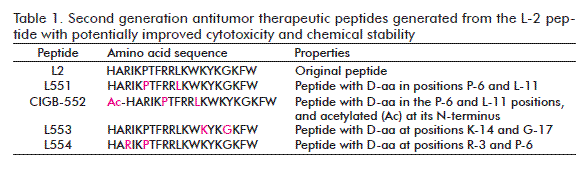
<body><![CDATA[<P   >&nbsp;</P >       <P   ><font size="3" face="Verdana, Arial, Helvetica, sans-serif"><b>INTRODUCTION </b></font></P >       <P   ><font size="2" face="Verdana, Arial, Helvetica, sans-serif">The development of      new, increasingly-selective and effective drugs against cancer, that minimize      toxicity and able to be used in combination with standard therapy is a challenge      today. Therapies directed against molecular targets important in survival,      proliferation and spread of tumor cells are revolutionizing the paradigm of      cancer treatment and will probably be used in most patients in the next ten      years [1]. </font></P >       <P   ><font size="2" face="Verdana, Arial, Helvetica, sans-serif">The Antimicrobial      Peptides (AMP), derived from plants and animals, are one of such potential      source of new antitumor agents. The cyclic peptide LALF<sub>31-52</sub>, derived      from horseshoe crab (<I>Limulus polyphemus</I>) LALF protein, was initially      identified by its ability to bind LPS and the inhibition of the coagulation      cascade mediated by the activation of endotoxins [2]. Studies published by      Vallespi e<I>t al</I>. identified that the linear variant, the LALF<sub>32-51</sub>      peptide, exhibited antiviral activity mediated by the induction of &alpha;      and &gamma; interferons. Furthermore, the effectiveness of the peptide was      demonstrated in murine models of bacteria-mediated sepsis [3, 4]. </font></P >   <FONT size="+1"><FONT size="+1">        <P   ><font size="2" face="Verdana, Arial, Helvetica, sans-serif">Based on the relationship      between the primary structure and the biological function of LALF<sub>32-51</sub>,      a chemical library of peptides was studied by alanine-scanning. The essential      amino acids conferring LPS-binding capacity in LALF<sub>31-52</sub> and determining      or influencing its cytotoxic activity were identified, leading to the design      of the L-2 peptide, devoid of LPS-binding activity and showing a stronger      cytotoxic effect than the original AMP LALF<sub>32-51</sub> peptide. Then,      a second generation peptide, named CIGB-552, was generated by replacing amino      acids at positions 6 and 12 for their respective D-amino acids in L-2, and      blocking its N-terminus by acylation, making it resistant to proteolytic degradation      [5, 6]. </font></P >   <FONT size="+1"><FONT size="+1"><FONT size="+1"><FONT size="+1"><FONT size="+1"><FONT size="+1">        <P   ><font size="2" face="Verdana, Arial, Helvetica, sans-serif">Subsequently, the      molecular basis of the CIGB- 552 peptide antitumor effect was established,      the COMMD1 protein being identified as a new molecular target in cancer therapy.      These results support the capacity of CIGB-552 to act against cancer cells      through apoptosis-mediated mechanisms and the inhibition of tumor angiogenesis.      From a practical point of view, the results of pharmacological and toxicological      studies provide evidences on the safety of CIGB-552 for its use in humans.      This research granted the 2014 Award of the Cuban National Academy of Sciences.</font></P >       <P   >&nbsp;</P >       <P   ><font size="3" face="Verdana, Arial, Helvetica, sans-serif"><b>RESULTS AND DISCUSSION      </b> </font></P >       <P   ><font size="2" face="Verdana, Arial, Helvetica, sans-serif"><b>Design of a family      of second-generation peptides and evaluation of its cytotoxic activity </b></font></P >       <P   ><font size="2" face="Verdana, Arial, Helvetica, sans-serif">The proteolytic stability      of natural peptides is a major limitation for its use as drug candidates.      Therefore, amino acids substitutions were performed introducing D-amino acids      (D-aa.) in specific positions in the original sequence of the L2 peptide,      as shown in <a href="/img/revistas/bta/v32n3/t0106315.gif">Table 1</a>.      In one case, the N-terminal end was further blocking by acetylation. </font></P >       
]]></body>
<body><![CDATA[<P   ><font size="2" face="Verdana, Arial, Helvetica, sans-serif">Subsequently, the      proliferative capacity of tumor cells from different origins was challenged      with different amount of the peptides. Cells were seeded into 96-well plates      and incubated with increasing amounts of the peptides. </font></P >       <P   ><font size="2" face="Verdana, Arial, Helvetica, sans-serif">Cytotoxicity was      estimated with Sulforhodamine B and IC<sub>50</sub> values were calculated      using the Calcusyn software (Biosoft&reg;, United Kingdom). As shown in <a href="/img/revistas/bta/v32n3/f0106315.gif">figure      1</a>, the CIGB-552 peptide displayed the best cytotoxic effect on tumor cell      lines as evidenced by the IC<sub>50</sub> values. This finding suggests that      the incorporation of unnatural amino acids in the sequence may have improved      the metabolic stability of the peptide. </font></P >   <FONT size="+1"><FONT size="+1"><FONT size="+1"><FONT size="+1">        
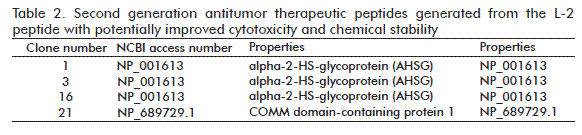
<P   ><font size="2" face="Verdana, Arial, Helvetica, sans-serif"><b>Identification      of proteins interacting with the CIGB-552 peptide </b></font></P >       <P   ><font size="2" face="Verdana, Arial, Helvetica, sans-serif">To identify proteins      that interact with CIGB-552 peptide, a yeast-two-hybrid assay was performed.      For that purpose, 38 positive clones were identified and sequenced. Similarity      analysis of the sequences of the clones evidenced an expected value with an      exponential lower than -25 (<a href="/img/revistas/bta/v32n3/t0206315.gif">Table      2</a>). </font></P >       
<P   ><font size="2" face="Verdana, Arial, Helvetica, sans-serif">Among the proteins      identified, alpha-2-HS-glycoprotein (AHGS) is produced abundantly in the liver      and is present in serum and in the extracellular matrix. High levels of expression      in liver explain the identification of three independent clones in the two      hybrid assay, since the cDNA library used was derived from a normal human      liver tissue (Clontech, USA). </font></P >       <P   ><font size="2" face="Verdana, Arial, Helvetica, sans-serif">The AHSG protein      is capable of binding to cytokines of the Transforming Growth Factor (TGF)      family, through a domain which has homology to the extracellular TGF-receptor      (TGFR) domain. In fact, it has been shown that high levels of expression of      AHSG contribute to the inhibition of tumor progression in different models      [7], this protein mainly located in the extracellular space. The need for      internalization of the CIGB-552 family of peptides to exert its effect makes      it unlikely that the antitumor mechanism could be mediated by the AHSG-TGFR      interaction [6]. The implications of that specific interaction should be properly      addressed in further experimental settings. </font></P >       <P   ><font size="2" face="Verdana, Arial, Helvetica, sans-serif">The second identified      interaction corresponded to the COMMD1 protein. COMMD1 is the prototype protein      of the COMMD protein family. The ten members of that family are highly conserved      and ubiquitously expressed in multicellular organisms [8], their biological      functions mostly unknown. COMMD1 function has been linked to copper homeostasis,      sodium transport, the signaling mediated by transcription factor NF-</font><font size="+1" color="#000000"><font size="+1"><font size="+1" color="#211E1F"><font size="+1" color="#000000"><font size="+1" color="#211E1F"><font size="+1" color="#000000"><font size="+1" color="#211E1F"><font size="+1"><font size="+1"><font size="+1"><font size="+1"><font size="+1"><font size="+1"><font size="+1"><font size="+1"><font size="+1"><font size="+1"><font size="+1"><font size="+1"><font size="+1"><font size="+1"><font size="+1"><font size="+1"><font size="+1"><font size="+1"><font size="+1"><font size="+1"><font size="+1"><font size="+1"><font size="+1"><font size="+1"><font size="+1"><font size="+1"><font size="+1"><font size="+1"><font size="+1"><font size="+1"><font size="+1"><font size="+1"><font size="+1"><font size="+1"><font size="+1"><font size="+1"><font size="+1"><font size="+1"><font size="+1"><font size="+1"><font size="+1"><font size="+1"><font size="+1"><font size="+1"><font size="+1"><font size="+1"><font size="+1"><font size="+1"><font size="+1"><font size="+1"><font size="+1"><font size="+1" color="#000000"><font size="+1" color="#211E1F"><font size="+1"><font size="+1"><font size="+1"><font size="+1"><font size="+1"><font size="+1"><font size="+1"><font size="+1"><font size="+1"><font size="2" face="Verdana, Arial, Helvetica, sans-serif">&kappa;&beta</font></font></font></font></font></font></font></font></font></font></font></font></font></font></font></font></font></font></font></font></font></font></font></font></font></font></font></font></font></font></font></font></font></font></font></font></font></font></font></font></font></font></font></font></font></font></font></font></font></font></font></font></font></font></font></font></font></font></font></font></font></font></font></font></font></font></font></font></font></font><font size="2" face="Verdana, Arial, Helvetica, sans-serif">      and the hypoxia-induced factor 1 (HIF-1), among others processes. In the case      of the COMMD1 protein, it inhibits the transcription factor NF-</font><font size="+1" color="#000000"><font size="+1"><font size="+1" color="#211E1F"><font size="+1" color="#000000"><font size="+1" color="#211E1F"><font size="+1" color="#000000"><font size="+1" color="#211E1F"><font size="+1"><font size="+1"><font size="+1"><font size="+1"><font size="+1"><font size="+1"><font size="+1"><font size="+1"><font size="+1"><font size="+1"><font size="+1"><font size="+1"><font size="+1"><font size="+1"><font size="+1"><font size="+1"><font size="+1"><font size="+1"><font size="+1"><font size="+1"><font size="+1"><font size="+1"><font size="+1"><font size="+1"><font size="+1"><font size="+1"><font size="+1"><font size="+1"><font size="+1"><font size="+1"><font size="+1"><font size="+1"><font size="+1"><font size="+1"><font size="+1"><font size="+1"><font size="+1"><font size="+1"><font size="+1"><font size="+1"><font size="+1"><font size="+1"><font size="+1"><font size="+1"><font size="+1"><font size="+1"><font size="+1"><font size="+1"><font size="+1"><font size="+1"><font size="+1"><font size="+1" color="#000000"><font size="+1" color="#211E1F"><font size="+1"><font size="+1"><font size="+1"><font size="+1"><font size="+1"><font size="+1"><font size="+1"><font size="+1"><font size="+1"><font size="2" face="Verdana, Arial, Helvetica, sans-serif">&kappa;&beta</font></font></font></font></font></font></font></font></font></font></font></font></font></font></font></font></font></font></font></font></font></font></font></font></font></font></font></font></font></font></font></font></font></font></font></font></font></font></font></font></font></font></font></font></font></font></font></font></font></font></font></font></font></font></font></font></font></font></font></font></font></font></font></font></font></font></font></font></font></font><font size="2" face="Verdana, Arial, Helvetica, sans-serif">,      an important element activating genes involved in resistance to apoptosis      in the cancer cells, stimulates oncogene activation, angiogenesis and cell      proliferation. COMMD1 also regulates HIF-1, this protein playing a key role      in cell survival in hypoxic tissue, a common feature of tumor [9]. In line      with our results, it was recently discovered that COMMD1 is expressed but      at very low levels in cancer cells, this also associated with more invasive      tumor types [10]. </font></P >       <P   ><font size="2" face="Verdana, Arial, Helvetica, sans-serif"><b>Identification      of pathways associated with the cytotoxic effect </b></font></P >       <P   ><font size="2" face="Verdana, Arial, Helvetica, sans-serif">Analysis of data      obtained from a microarray study, by comparing treated vs. untreated NCI-H460      cells at 0, 2, 4 and 8 h at the CIGB-552 IC<sub>50</sub> (25 &micro;M), identified      up to 349 differentially-expressed genes using the relative expression criteria      of the modular value of fold change (|FC| &ge; 1.5 and adjusted p values by      the Benjamini and Hochberg method [11] lower than 0.05. Bioinformatics analysis      of the experimental data revealed pathways modulated by CIGB-552 treatment      (<a href="/img/revistas/bta/v32n3/f0206315.gif">Figure 2</a>). </font></P >   <FONT size="+1"><FONT size="+1">        
<P   ><font size="2" face="Verdana, Arial, Helvetica, sans-serif">The pathway enrichment      in differentially-expressed genes in the cell line NCI-H460 treated with the      CIGB-552 peptide, identified pathways related with the immune system, which      comprise genes associated with the inflammatory response. These pathways correspond      to the previously described immunomodulatory action of the LALF<sub>32-51</sub>      peptide and are common to all AMPs [2, 3]. Surprisingly, the oxidative stress      response was found associated with the mechanism of cytotoxicity of the CIGB-552      peptide. This was unprecedented, in spite of the intense debate on the relationship      between cancer and oxidative stress [12]. The cellular oxidative damage has      been associated with carcinogenesis and apoptosis. Additionally, increased      levels of oxidative stress have been considered a successful strategy to induce      apoptosis in malignant cells [13, 14]. </font></P >   <FONT size="+1"><FONT size="+1">        ]]></body>
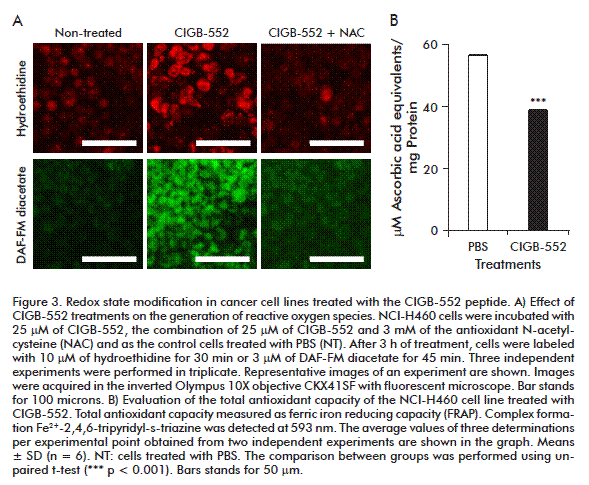
<body><![CDATA[<P   ><font size="2" face="Verdana, Arial, Helvetica, sans-serif">Moreover, other identified      pathways as those triggered by MAPK kinase and NF-</font><font size="+1" color="#000000"><font size="+1"><font size="+1" color="#211E1F"><font size="+1" color="#000000"><font size="+1" color="#211E1F"><font size="+1" color="#000000"><font size="+1" color="#211E1F"><font size="+1"><font size="+1"><font size="+1"><font size="+1"><font size="+1"><font size="+1"><font size="+1"><font size="+1"><font size="+1"><font size="+1"><font size="+1"><font size="+1"><font size="+1"><font size="+1"><font size="+1"><font size="+1"><font size="+1"><font size="+1"><font size="+1"><font size="+1"><font size="+1"><font size="+1"><font size="+1"><font size="+1"><font size="+1"><font size="+1"><font size="+1"><font size="+1"><font size="+1"><font size="+1"><font size="+1"><font size="+1"><font size="+1"><font size="+1"><font size="+1"><font size="+1"><font size="+1"><font size="+1"><font size="+1"><font size="+1"><font size="+1"><font size="+1"><font size="+1"><font size="+1"><font size="+1"><font size="+1"><font size="+1"><font size="+1"><font size="+1"><font size="+1"><font size="+1"><font size="+1" color="#000000"><font size="+1" color="#211E1F"><font size="+1"><font size="+1"><font size="+1"><font size="+1"><font size="+1"><font size="+1"><font size="+1"><font size="+1"><font size="+1"><font size="2" face="Verdana, Arial, Helvetica, sans-serif">&kappa;&beta</font></font></font></font></font></font></font></font></font></font></font></font></font></font></font></font></font></font></font></font></font></font></font></font></font></font></font></font></font></font></font></font></font></font></font></font></font></font></font></font></font></font></font></font></font></font></font></font></font></font></font></font></font></font></font></font></font></font></font></font></font></font></font></font></font></font></font></font></font></font><font size="2" face="Verdana, Arial, Helvetica, sans-serif">      signaling are also modulated by the oxidative stress. Overall, the results      allowed us to identify oxidative stress as a key mechanism mediating the activation      of multiple signaling pathways (MAPK, TP53, NF-</font><font size="+1" color="#000000"><font size="+1"><font size="+1" color="#211E1F"><font size="+1" color="#000000"><font size="+1" color="#211E1F"><font size="+1" color="#000000"><font size="+1" color="#211E1F"><font size="+1"><font size="+1"><font size="+1"><font size="+1"><font size="+1"><font size="+1"><font size="+1"><font size="+1"><font size="+1"><font size="+1"><font size="+1"><font size="+1"><font size="+1"><font size="+1"><font size="+1"><font size="+1"><font size="+1"><font size="+1"><font size="+1"><font size="+1"><font size="+1"><font size="+1"><font size="+1"><font size="+1"><font size="+1"><font size="+1"><font size="+1"><font size="+1"><font size="+1"><font size="+1"><font size="+1"><font size="+1"><font size="+1"><font size="+1"><font size="+1"><font size="+1"><font size="+1"><font size="+1"><font size="+1"><font size="+1"><font size="+1"><font size="+1"><font size="+1"><font size="+1"><font size="+1"><font size="+1"><font size="+1"><font size="+1"><font size="+1"><font size="+1"><font size="+1"><font size="+1" color="#000000"><font size="+1" color="#211E1F"><font size="+1"><font size="+1"><font size="+1"><font size="+1"><font size="+1"><font size="+1"><font size="+1"><font size="+1"><font size="+1"><font size="2" face="Verdana, Arial, Helvetica, sans-serif">&kappa;&beta</font></font></font></font></font></font></font></font></font></font></font></font></font></font></font></font></font></font></font></font></font></font></font></font></font></font></font></font></font></font></font></font></font></font></font></font></font></font></font></font></font></font></font></font></font></font></font></font></font></font></font></font></font></font></font></font></font></font></font></font></font></font></font></font></font></font></font></font></font></font><font size="2" face="Verdana, Arial, Helvetica, sans-serif">),      that explain the cytotoxicity of the CIGB-552 peptide. </font></P >       <P   ><font size="2" face="Verdana, Arial, Helvetica, sans-serif"><b>CIGB-552 accumulates      COMMD1 in human cancer cells and promotes ubiquitination and degradation of      the RelA subunit of NF-</b></font><b><font size="+1" color="#000000"><font size="+1"><font size="+1" color="#211E1F"><font size="+1" color="#000000"><font size="+1" color="#211E1F"><font size="+1" color="#000000"><font size="+1" color="#211E1F"><font size="+1"><font size="+1"><font size="+1"><font size="+1"><font size="+1"><font size="+1"><font size="+1"><font size="+1"><font size="+1"><font size="+1"><font size="+1"><font size="+1"><font size="+1"><font size="+1"><font size="+1"><font size="+1"><font size="+1"><font size="+1"><font size="+1"><font size="+1"><font size="+1"><font size="+1"><font size="+1"><font size="+1"><font size="+1"><font size="+1"><font size="+1"><font size="+1"><font size="+1"><font size="+1"><font size="+1"><font size="+1"><font size="+1"><font size="+1"><font size="+1"><font size="+1"><font size="+1"><font size="+1"><font size="+1"><font size="+1"><font size="+1"><font size="+1"><font size="+1"><font size="+1"><font size="+1"><font size="+1"><font size="+1"><font size="+1"><font size="+1"><font size="+1"><font size="+1"><font size="+1" color="#000000"><font size="+1" color="#211E1F"><font size="+1"><font size="+1"><font size="+1"><font size="+1"><font size="+1"><font size="+1"><font size="+1"><font size="+1"><font size="+1"><font size="2" face="Verdana, Arial, Helvetica, sans-serif">&kappa;&beta</font></font></font></font></font></font></font></font></font></font></font></font></font></font></font></font></font></font></font></font></font></font></font></font></font></font></font></font></font></font></font></font></font></font></font></font></font></font></font></font></font></font></font></font></font></font></font></font></font></font></font></font></font></font></font></font></font></font></font></font></font></font></font></font></font></font></font></font></font></font></b></P >       <P   ><font size="2" face="Verdana, Arial, Helvetica, sans-serif">Since COMMD1 was      identified as a protein that is associated with antitumor peptides, the role      of COMMD1 was studied in the mechanism of action of CIGB-552. First, COMMD1      expression in lysates of human cancer cells of different histological origin      was determined using Western blot analysis. These experiments revealed an      increase in COMMD1 levels after 5 h of treatment with the peptide. COMMD1      cellular accumulation was also identified by immunofluorescence in human cancer      cells [4]. Both cell lines tested, MCF7 and HT29, showed accumulation of COMMD1      after 5 h of treatment with the CIGB-552. </font></P >       <P   ><font size="2" face="Verdana, Arial, Helvetica, sans-serif">COMMD1 overexpression      accelerated the ubiquitination and degradation of RelA subunit of NF-</font><font size="+1" color="#000000"><font size="+1"><font size="+1" color="#211E1F"><font size="+1" color="#000000"><font size="+1" color="#211E1F"><font size="+1" color="#000000"><font size="+1" color="#211E1F"><font size="+1"><font size="+1"><font size="+1"><font size="+1"><font size="+1"><font size="+1"><font size="+1"><font size="+1"><font size="+1"><font size="+1"><font size="+1"><font size="+1"><font size="+1"><font size="+1"><font size="+1"><font size="+1"><font size="+1"><font size="+1"><font size="+1"><font size="+1"><font size="+1"><font size="+1"><font size="+1"><font size="+1"><font size="+1"><font size="+1"><font size="+1"><font size="+1"><font size="+1"><font size="+1"><font size="+1"><font size="+1"><font size="+1"><font size="+1"><font size="+1"><font size="+1"><font size="+1"><font size="+1"><font size="+1"><font size="+1"><font size="+1"><font size="+1"><font size="+1"><font size="+1"><font size="+1"><font size="+1"><font size="+1"><font size="+1"><font size="+1"><font size="+1"><font size="+1"><font size="+1" color="#000000"><font size="+1" color="#211E1F"><font size="+1"><font size="+1"><font size="+1"><font size="+1"><font size="+1"><font size="+1"><font size="+1"><font size="+1"><font size="+1"><font size="2" face="Verdana, Arial, Helvetica, sans-serif">&kappa;&beta</font></font></font></font></font></font></font></font></font></font></font></font></font></font></font></font></font></font></font></font></font></font></font></font></font></font></font></font></font></font></font></font></font></font></font></font></font></font></font></font></font></font></font></font></font></font></font></font></font></font></font></font></font></font></font></font></font></font></font></font></font></font></font></font></font></font></font></font></font></font><font size="2" face="Verdana, Arial, Helvetica, sans-serif">.      Given the above data, the effect of CIGB-552 levels of ubiquitinated RelA      was addressed. Immunoprecipitation of endogenous RelA was performed using      mouse anti-RelA, followed by Western Blot with an anti-ubiquitin antibody.      Increased amounts of ubiquitinated RelA in response to the peptide was found      as early as 2 h after treatment. Then, the possible induction of ubiquitination      by CIGB-552 and the subsequent degradation of RelA through a proteasome-dependent      process were evaluated through the effect of MG132 and CIGB-552 in the basal      levels of RelA. The treatment with CIGB-552 decreases the basal levels of      RelA. This result suggests that CIGB- 552 induces ubiquitination of RelA and      promotes its proteasomal degradation [4]. </font></P >       <P   ><font size="2" face="Verdana, Arial, Helvetica, sans-serif">The functional role      of COMMD1 accumulation in the antitumor activity of CIGB-552 was confirmed      by transduction of H460 cells with a retrovirus expressing a shRNA targeting      COMMD1. In this cell line, the cytotoxic activity of CIGB-552 decreased compared      to control cells, possibly with decreased ubiquitination and downstream degradation      of RelA [4]. </font></P >       <P   ><font size="2" face="Verdana, Arial, Helvetica, sans-serif"><b>The CIGB-552 alters      the redox state in H-460 cells </b></font></P >       <P   ><font size="2" face="Verdana, Arial, Helvetica, sans-serif">Since microarray      studies indicated that the CIGB-552 modulates the expression of oxidative      stress-related genes, the relevance of COMMD1 accumulation on the oxidative      stress balance was assessed by measuring the redox balance in NCI-H460 cells.      </font></P >       <P   ><font size="2" face="Verdana, Arial, Helvetica, sans-serif">We observed that      treatment with CIGB-552 caused an increase in the levels of reactive oxygen      species (ROS) O2<sup>&bull;&minus;</sup> and <sup>&bull;</sup>ON, which explains      the activation of genes involved in the process of oxidative stress response      observed in the experiments of differential gene expression. This is in agreement      with previous findings which describe COMMD1 as an interaction partner of      superoxide dismutase 1 (SOD1) [15]. Maturation and activation of SOD1 are      highly re-gulated processes requiring several posttranslational modifications,      with COMMD1 deteriorating the SOD1 activity by reducing the expression levels      of enzymatically-active homodimers in the process of SOD1 posttranslational      maturation. A relevant finding was the decrease in the total antioxidant capacity      by treating cells with CIGB-552. The increased ROS concentrations and the      overall decrease of total antioxidant capacity in cells after the treatment      at the IC<sub>50</sub> of CIGB-552 are shown in <a href="/img/revistas/bta/v32n3/f0306315.gif">Figure      3</a>. In summary, these results could explain the observed increase in the      oxidation of lipids and proteins and the reduction of the mitochondrial membrane      potential inducing the apoptosis as part of the cytotoxic mechanism. </font></P >   <FONT size="+1"><FONT size="+1"><FONT size="+1"><FONT size="+1"><FONT size="+1"><FONT size="+1">        
<P   ><font size="2" face="Verdana, Arial, Helvetica, sans-serif"><b>Synergistic effect      of the combination of CIGB-552 and standard chemotherapy </b></font></P >       <P   ><font size="2" face="Verdana, Arial, Helvetica, sans-serif">For this assay, tumor      cells lines HT-29 and H-125 were added with culture medium containing the      CIGB-552 peptide in a dose range from 9 to 300 &micro;M. The cytostatic 5-FU      and cisplatin were added to cell cultures at ten-fold and 1:10 dilutions of      their respective IC<sub>50</sub> as reported for each cell line. The effect      of concomitant treatment-cytostatic peptide was analyzed by the CalcuSyn computer      program for the study of drug combinations. </font></P >   <FONT size="+1"><FONT size="+1">        ]]></body>
<body><![CDATA[<P   ><font size="2" face="Verdana, Arial, Helvetica, sans-serif">As shown in <a href="/img/revistas/bta/v32n3/t0306315.gif">table      3</a>, the peptide-cytostatic combinations reduced the amount of cytostatic      required, given by the values shown in the Reduction Index (RI). These results      indicate that the peptide can be administered together with standard chemotherapy      to provide an effective treatment (the fraction of affected cells: 89-94 %)      with minor amounts of each standard drug. Combining 5-FU with CIGB-552 allows      a 20-fold reduction (RI) in the amount of 5-FU in the cell line HT-29 required.      For cisplatin, its combination with CIGB-552 allowed a 5-fold reduction in      the cytostatic concentration required to attain the effect in H-125 cells.      These results indicate that CIGB-552 can be ad-ministered in combination with      standard treatment for human colorectal and lung cancer (HT-29 and H-125 cell      lines, respectively), facilitating a reduction in the dose of cytostatic.      This may reduce the adverse effects associated with chemotherapy. </font></P >       
<P   ><font size="2" face="Verdana, Arial, Helvetica, sans-serif"><b>Efficacy of CIGB-552      in the therapy of solid tumors in mice </b></font></P >       <P   ><font size="2" face="Verdana, Arial, Helvetica, sans-serif">To evaluate the in      vivo antitumor activity of CIGB- 552, it was administered subcutaneously in      the murine model of tumor cells CT-26 in BALB/c mice. Both the tumor accumulation      of the <sup>131</sup>I-labeled CIGB- 552 and the inhibition of tumor growth      after treatment with CIGB-552 were evaluated. A human colon tumor xenograft      model in nude mice was also used to further evaluate the anticancer effect      of CIGB-552. </font></P >       <P   ><font size="2" face="Verdana, Arial, Helvetica, sans-serif">The results demonstrated      that two injections a week of CIGB-552 for 2 weeks elicited an antitumor activity      mediated by the inhibition of tumor growth (50 % inhibition). In addition,      the peptide reduces the density of blood vessels in the tumors [16]. Together,      these data prove that the second-generation peptide CIGB-552 is able to induce      a significant antitumor response after systemic delivery. </font></P >       <P   >&nbsp;</P >       <P   ><font size="2" face="Verdana, Arial, Helvetica, sans-serif"><b><font size="3">SCIENTIFIC      RELEVANCE OF THE STUDY</font></b></font></P >   <FONT size="+1">        <P   ><font size="2" face="Verdana, Arial, Helvetica, sans-serif">The study of the      differential gene expression identified the oxidative stress response among      the routes and biological processes being modulated by the CIGB-552 in the      lung cancer cell line NCI-H460. It was shown that the CIGB-552 causes the      increase of ROS, causing damage to mitochondria and increasing the oxidative      damage of lipids and proteins. Moreover, proteomic studies revealed that the      CIGB-552 interacts with COMMD1, the treatment with CIGB- 552 increasing the      expression of COMMD1 in cell lines which leads to apoptosis-mediated cell      death. Altogether, these findings provide the molecular basis to fully unravel      the cytotoxic mechanism of CIGB- 552 in cancer cells. </font></P >   <FONT size="+1">        <P   ><font size="2" face="Verdana, Arial, Helvetica, sans-serif">From a practical      point of view, the results of the pharmacological and toxicological studies      support the safety of CIGB-552 for use in humans. The preclinical studies      have demonstrated: 1) the antitumor effect of CIGB-552 in animal models of      lung and colon cancer; 2) the antiangiogenic activity; 3) the treatment tolerability      through the monitoring of body weight in treated mice; and 4) the accumulation      of the peptide in tumors, supporting the potential safety based on the bioavailability      of the CIGB-552 peptide in Phase I clinical trials in patients with solid      tumors. These results support the therapeutic possibilities of this new therapeutic      candidate for the treatment of cancer. Significantly, metabolic pathways activated      by CIGB-552 peptide makes it unique, constituting the first synthetic peptide      aimed at stabilizing COMMD1 as a way to downregulate NF-</font><font size="+1" color="#000000"><font size="+1"><font size="+1" color="#211E1F"><font size="+1" color="#000000"><font size="+1" color="#211E1F"><font size="+1" color="#000000"><font size="+1" color="#211E1F"><font size="+1"><font size="+1"><font size="+1"><font size="+1"><font size="+1"><font size="+1"><font size="+1"><font size="+1"><font size="+1"><font size="+1"><font size="+1"><font size="+1"><font size="+1"><font size="+1"><font size="+1"><font size="+1"><font size="+1"><font size="+1"><font size="+1"><font size="+1"><font size="+1"><font size="+1"><font size="+1"><font size="+1"><font size="+1"><font size="+1"><font size="+1"><font size="+1"><font size="+1"><font size="+1"><font size="+1"><font size="+1"><font size="+1"><font size="+1"><font size="+1"><font size="+1"><font size="+1"><font size="+1"><font size="+1"><font size="+1"><font size="+1"><font size="+1"><font size="+1"><font size="+1"><font size="+1"><font size="+1"><font size="+1"><font size="+1"><font size="+1"><font size="+1"><font size="+1"><font size="+1" color="#000000"><font size="+1" color="#211E1F"><font size="+1"><font size="+1"><font size="+1"><font size="+1"><font size="+1"><font size="+1"><font size="+1"><font size="+1"><font size="+1"><font size="2" face="Verdana, Arial, Helvetica, sans-serif">&kappa;&beta</font></font></font></font></font></font></font></font></font></font></font></font></font></font></font></font></font></font></font></font></font></font></font></font></font></font></font></font></font></font></font></font></font></font></font></font></font></font></font></font></font></font></font></font></font></font></font></font></font></font></font></font></font></font></font></font></font></font></font></font></font></font></font></font></font></font></font></font></font></font><font size="2" face="Verdana, Arial, Helvetica, sans-serif">      and ultimately lead to cancer cell cytotoxicity. </font></P >       <P   >&nbsp;</P >       <P   ><font size="3" face="Verdana, Arial, Helvetica, sans-serif"><b>ACKNOWLEDGEMENTS      </b> </font></P >       ]]></body>
<body><![CDATA[<P   ><font size="2" face="Verdana, Arial, Helvetica, sans-serif">The authors thank      to Gerardo Guill&eacute;n Nieto, Raimundo Ubieta Gomez, Amanda Colarte Gonzalez,      Tamara D&iacute;az Argud&iacute;n, H&eacute;ctor Santana Milian, H. Zarate,      Arielis Rodr&iacute;guez Ulloa, Leovaldo Alvarez, Ariel S&aacute;nchez Puente,      Yassel Ramos Gomez, Dayana Garc&iacute;a Lines, Luis Javier Gonz&aacute;lez,      Vladimir Besada Perez, T. N&uacute;&ntilde;ez, Isabel Apeztegu&iacute;a Rodr&iacute;guez,      Ever P&eacute;rez Hern&aacute;ndez, Reinier Acosta Mart&iacute;n, Antonio      Antequera Guevara, Juan Hern&aacute;ndez Pinero, Mercedes Arencibia Leyva,      Yamilet P&eacute;rez Chabas, Mariela Vazquez Castillo, Yamilka Rodriguez Barrera,      Yeny Cascaret N&aacute;poles, Regla Estrada Vazquez and Jos&eacute; A. Silva      Guirado, from the CIGB for their collaboration. </font></P >       <P   >&nbsp;</P >       <P   > </P >       <P   ><b><font size="3" face="Verdana, Arial, Helvetica, sans-serif">REFERENCES </font></b></P >       <!-- ref --><P   ><font size="2" face="Verdana, Arial, Helvetica, sans-serif">1. Luo J, Solimini      NL, Elledge SJ. Principles of cancer therapy: oncogene and non-oncogene addiction.      Cell. 2009;136(5):823-37.     </font></P >       <!-- ref --><P   ><font size="2" face="Verdana, Arial, Helvetica, sans-serif">2. Vallespi MG, Glaria      LA, Reyes O, Garay HE, Ferrero J, Arana MJ. A Limulus antilipopolysaccharide      factor-derived peptide exhibits a new immunological activity with potential      applicability in infectious diseases. Clin Diagn Lab Immunol. 2000;7(4):669-75.          </font></P >       <!-- ref --><P   ><font size="2" face="Verdana, Arial, Helvetica, sans-serif">3. Vallespi MG, Alvarez-Obregon      JC, Rodriguez-Alonso I, Montero T, Garay H, Reyes O, <i>et al</i>. A Limulus      anti-LPS factor-derived peptide modulates cytokine gene expression and promotes      resolution of bacterial acute infection in mice. Int Immunopharmacol. 2003;3(2):247-56.          </font></P >       ]]></body>
<body><![CDATA[<!-- ref --><P   ><font size="2" face="Verdana, Arial, Helvetica, sans-serif">4. Vallespi MG, Colas      M, Garay H, Reyes O, Arana MJ. Differential regulation of Th1/ Th2 in relevant      tissues for sepsis pathogenesis with a Limulus anti-LPS factor-derived peptide      increases survival in Gram-positive sepsis. Int Immunopharmacol. 2004;4(10-11):1343-51.          </font></P >       <!-- ref --><P   ><font size="2" face="Verdana, Arial, Helvetica, sans-serif">5. Fernandez Masso      JR, Oliva Arguelles B, Tejeda Y, Astrada S, Garay H, Reyes O, et al. The Antitumor      Peptide CIGB-552 Increases COMMD1 and Inhibits Growth of Human Lung Cancer      Cells. J Amino Acids. 2013;2013:251398.     </font></P >       <!-- ref --><P   ><font size="2" face="Verdana, Arial, Helvetica, sans-serif">6. Vallespi MG, Fernandez      JR, Torrens I, Garcia I, Garay H, Mendoza O, et al. Identification of a novel      antitumor peptide based on the screening of an Ala-library derived from the      LALF(32-51) region. J Pept Sci. 2010;16(1):40-7.     </font></P >       <!-- ref --><P   ><font size="2" face="Verdana, Arial, Helvetica, sans-serif">7. Mori K, Emoto      M, Inaba M. Fetuin-A: a multifunctional protein. Recent Pat Endocr Metab Immune      Drug Discov. 2011;5(2):124-46.     </font></P >       <P   ><font size="2" face="Verdana, Arial, Helvetica, sans-serif">8. Maine GN, Burstein.      COMMD proteins: COMMing to the scene. Cell Mol Life Sci. 2007;64(15):1997-2005.      </font></P >       <!-- ref --><P   ><font size="2" face="Verdana, Arial, Helvetica, sans-serif">9. Bartuzi P, Hofker      MH, van de Sluis B. Tuning NF-kappaB activity: a touch of COMMD proteins.      Biochim Biophys Acta. 2013;1832(12):2315-21.     </font></P >       <!-- ref --><P   ><font size="2" face="Verdana, Arial, Helvetica, sans-serif">10. van de Sluis      B, Mao X, Zhai Y, Groot AJ, Vermeulen JF, van der Wall E, <i>et al</i>. COMMD1      disrupts HIF-1alpha/beta dimerization and inhibits human tumor cell invasion.      J Clin Invest. 2010;120(6):2119-30.     </font></P >       <!-- ref --><P   ><font size="2" face="Verdana, Arial, Helvetica, sans-serif">11. Benjamini Y,      Hochberg Y. Controlling the False Discovery Rate: A Practical and Powerful      Approach to Multiple Testing. J Roy Soc. 1995;57(1):289-300.     </font></P >       <!-- ref --><P   ><font size="2" face="Verdana, Arial, Helvetica, sans-serif">12. Dayem AA, Choi      HY, Kim JH, Cho SG. Role of oxidative stress in stem, cancer, and cancer stem      cells. Cancers (Basel). 2010;2(2):859-84.     </font></P >       <!-- ref --><P   ><font size="2" face="Verdana, Arial, Helvetica, sans-serif">13. Gorrini C, Harris      IS, Mak TW. Modulation of oxidative stress as an anticancer strategy. Nat      Rev Drug Discov. 2013;12(12):931-47.     </font></P >       <!-- ref --><P   ><font size="2" face="Verdana, Arial, Helvetica, sans-serif">14. Verrax J, Taper      H, Buc Calderon P. Targeting cancer cells by an oxidant-based therapy. Curr      Mol Pharmacol. 2008;1(1):80-92.     </font></P >       <!-- ref --><P   ><font size="2" face="Verdana, Arial, Helvetica, sans-serif">15. Vonk WIM, Wijmenga      C, Berger R, van de Sluis B, Klomp LWJ. Cu,Zn superoxide dismutase maturation      and activity are regulated by COMMD1. J Biol Chem. 2010;285(37):28991-9000.          </font></P >       <!-- ref --><P   ><font size="2" face="Verdana, Arial, Helvetica, sans-serif">16. Vallespi MG,      Pimentel G, Cabrales-Rico A, Garza J, Oliva B, Mendoza O, <i>et al</i>. Antitumor      efficacy, pharmacokinetic and biodistribution studies of the anticancer peptide      CIGB-552 in mouse models. J Pept Sci. 2014;20(11):850-9.    </font></P >       <P   >&nbsp;</P >       <P   >&nbsp;</P >       <P   > </P >   <FONT size="+1">        <P   ><font size="2" face="Verdana, Arial, Helvetica, sans-serif">Received in August,      2015.     <br>     Accepted in September, 2015.</font></P >       ]]></body>
<body><![CDATA[<P   >&nbsp;</P >       <P   >&nbsp;</P >       <P   > </P >       <P   > </P >   <FONT size="+1">        <P   ><i><font size="2" color="#000000" face="Verdana, Arial, Helvetica, sans-serif">Maribel      Guerra-Vallespi</font></i><font size="2" color="#000000" face="Verdana, Arial, Helvetica, sans-serif">.      <FONT color="#211E1F">Direcci&oacute;n de Investigaciones Biom&eacute;dicas,      Centro de Ingenier&iacute;a Gen&eacute;tica y Biotecnolog&iacute;a, CIGB.      Ave. 31 e/ 158 y 190, Cubanac&aacute;n, Playa, CP 11600, La Habana, Cuba.      E-mail: <a href="mailto:%20maribel.guerra@cigb.edu.cu">maribel.guerra@cigb.edu.cu</a></font></font>.    </P >   <FONT size="+1" color="#000000"><FONT size="+1" color="#211E1F"></font></font></font></font></font></font></font></font></font></font></font></font></font></font></font></font></font></font></font></font></font></font></font></font></font></font></font></font></font></font></font></font></font></font></font></font></font></font></font></font></font></font></font></font></font></font></font></font></font></font></font></font></font></font></font></font></font></font></font></font></font></font></font></font></font></font></font></font></font></font></font></font></font></font></font></font></font></font></font></font></font></font></font></font></font></font></font></font></font></font></font></font></font></font></font></font></font></font></font></font></font></font></DIV >      ]]></body><back>
<ref-list>
<ref id="B1">
<label>1</label><nlm-citation citation-type="journal">
<person-group person-group-type="author">
<name>
<surname><![CDATA[Luo]]></surname>
<given-names><![CDATA[J]]></given-names>
</name>
<name>
<surname><![CDATA[Solimini]]></surname>
<given-names><![CDATA[NL]]></given-names>
</name>
<name>
<surname><![CDATA[Elledge]]></surname>
<given-names><![CDATA[SJ]]></given-names>
</name>
</person-group>
<article-title xml:lang="en"><![CDATA[Principles of cancer therapy: oncogene and non-oncogene addiction]]></article-title>
<source><![CDATA[Cell]]></source>
<year>2009</year>
<volume>136</volume>
<numero>5</numero>
<issue>5</issue>
<page-range>823-37</page-range></nlm-citation>
</ref>
<ref id="B2">
<label>2</label><nlm-citation citation-type="journal">
<person-group person-group-type="author">
<name>
<surname><![CDATA[Vallespi]]></surname>
<given-names><![CDATA[MG]]></given-names>
</name>
<name>
<surname><![CDATA[Glaria]]></surname>
<given-names><![CDATA[LA]]></given-names>
</name>
<name>
<surname><![CDATA[Reyes]]></surname>
<given-names><![CDATA[O]]></given-names>
</name>
<name>
<surname><![CDATA[Garay]]></surname>
<given-names><![CDATA[HE]]></given-names>
</name>
<name>
<surname><![CDATA[Ferrero]]></surname>
<given-names><![CDATA[J]]></given-names>
</name>
<name>
<surname><![CDATA[Arana]]></surname>
<given-names><![CDATA[MJ]]></given-names>
</name>
</person-group>
<article-title xml:lang="en"><![CDATA[A Limulus antilipopolysaccharide factor-derived peptide exhibits a new immunological activity with potential applicability in infectious diseases]]></article-title>
<source><![CDATA[Clin Diagn Lab Immunol]]></source>
<year>2000</year>
<volume>7</volume>
<numero>4</numero>
<issue>4</issue>
<page-range>669-75</page-range></nlm-citation>
</ref>
<ref id="B3">
<label>3</label><nlm-citation citation-type="journal">
<person-group person-group-type="author">
<name>
<surname><![CDATA[Vallespi]]></surname>
<given-names><![CDATA[MG]]></given-names>
</name>
<name>
<surname><![CDATA[Alvarez-Obregon]]></surname>
<given-names><![CDATA[JC]]></given-names>
</name>
<name>
<surname><![CDATA[Rodriguez-Alonso]]></surname>
<given-names><![CDATA[I]]></given-names>
</name>
<name>
<surname><![CDATA[Montero]]></surname>
<given-names><![CDATA[T]]></given-names>
</name>
<name>
<surname><![CDATA[Garay]]></surname>
<given-names><![CDATA[H]]></given-names>
</name>
<name>
<surname><![CDATA[Reyes]]></surname>
<given-names><![CDATA[O]]></given-names>
</name>
</person-group>
<article-title xml:lang="en"><![CDATA[A Limulus anti-LPS factor-derived peptide modulates cytokine gene expression and promotes resolution of bacterial acute infection in mice]]></article-title>
<source><![CDATA[Int Immunopharmacol]]></source>
<year>2003</year>
<volume>3</volume>
<numero>2</numero>
<issue>2</issue>
<page-range>247-56</page-range></nlm-citation>
</ref>
<ref id="B4">
<label>4</label><nlm-citation citation-type="journal">
<person-group person-group-type="author">
<name>
<surname><![CDATA[Vallespi]]></surname>
<given-names><![CDATA[MG]]></given-names>
</name>
<name>
<surname><![CDATA[Colas]]></surname>
<given-names><![CDATA[M]]></given-names>
</name>
<name>
<surname><![CDATA[Garay]]></surname>
<given-names><![CDATA[H]]></given-names>
</name>
<name>
<surname><![CDATA[Reyes]]></surname>
<given-names><![CDATA[O]]></given-names>
</name>
<name>
<surname><![CDATA[Arana]]></surname>
<given-names><![CDATA[MJ]]></given-names>
</name>
</person-group>
<article-title xml:lang="en"><![CDATA[Differential regulation of Th1/ Th2 in relevant tissues for sepsis pathogenesis with a Limulus anti-LPS factor-derived peptide increases survival in Gram-positive sepsis]]></article-title>
<source><![CDATA[Int Immunopharmacol]]></source>
<year>2004</year>
<volume>4</volume>
<numero>10-11</numero>
<issue>10-11</issue>
<page-range>1343-51</page-range></nlm-citation>
</ref>
<ref id="B5">
<label>5</label><nlm-citation citation-type="journal">
<person-group person-group-type="author">
<name>
<surname><![CDATA[Fernandez]]></surname>
<given-names><![CDATA[Masso Jr]]></given-names>
</name>
<name>
<surname><![CDATA[Oliva Arguelles]]></surname>
<given-names><![CDATA[B]]></given-names>
</name>
<name>
<surname><![CDATA[Tejeda]]></surname>
<given-names><![CDATA[Y]]></given-names>
</name>
<name>
<surname><![CDATA[Astrada]]></surname>
<given-names><![CDATA[S]]></given-names>
</name>
<name>
<surname><![CDATA[Garay]]></surname>
<given-names><![CDATA[H]]></given-names>
</name>
<name>
<surname><![CDATA[Reyes]]></surname>
<given-names><![CDATA[O]]></given-names>
</name>
</person-group>
<article-title xml:lang="en"><![CDATA[The Antitumor Peptide CIGB-552 Increases COMMD1 and Inhibits Growth of Human Lung Cancer Cells]]></article-title>
<source><![CDATA[J Amino Acids]]></source>
<year>2013</year>
<volume>2013</volume>
<page-range>251398</page-range></nlm-citation>
</ref>
<ref id="B6">
<label>6</label><nlm-citation citation-type="journal">
<person-group person-group-type="author">
<name>
<surname><![CDATA[Vallespi]]></surname>
<given-names><![CDATA[MG]]></given-names>
</name>
<name>
<surname><![CDATA[Fernandez]]></surname>
<given-names><![CDATA[JR]]></given-names>
</name>
<name>
<surname><![CDATA[Torrens]]></surname>
<given-names><![CDATA[I]]></given-names>
</name>
<name>
<surname><![CDATA[Garcia]]></surname>
<given-names><![CDATA[I]]></given-names>
</name>
<name>
<surname><![CDATA[Garay]]></surname>
<given-names><![CDATA[H]]></given-names>
</name>
<name>
<surname><![CDATA[Mendoza]]></surname>
<given-names><![CDATA[O]]></given-names>
</name>
</person-group>
<article-title xml:lang="en"><![CDATA[Identification of a novel antitumor peptide based on the screening of an Ala-library derived from the LALF(32-51) region]]></article-title>
<source><![CDATA[J Pept Sci]]></source>
<year>2010</year>
<volume>16</volume>
<numero>1</numero>
<issue>1</issue>
<page-range>40-7</page-range></nlm-citation>
</ref>
<ref id="B7">
<label>7</label><nlm-citation citation-type="journal">
<person-group person-group-type="author">
<name>
<surname><![CDATA[Mori]]></surname>
<given-names><![CDATA[K]]></given-names>
</name>
<name>
<surname><![CDATA[Emoto]]></surname>
<given-names><![CDATA[M]]></given-names>
</name>
<name>
<surname><![CDATA[Inaba]]></surname>
<given-names><![CDATA[M]]></given-names>
</name>
</person-group>
<article-title xml:lang="en"><![CDATA[Fetuin-A: a multifunctional protein]]></article-title>
<source><![CDATA[Recent Pat Endocr Metab Immune Drug Discov]]></source>
<year>2011</year>
<volume>5</volume>
<numero>2</numero>
<issue>2</issue>
<page-range>124-46</page-range></nlm-citation>
</ref>
<ref id="B8">
<label>8</label><nlm-citation citation-type="journal">
<person-group person-group-type="author">
<name>
<surname><![CDATA[Maine]]></surname>
<given-names><![CDATA[GN]]></given-names>
</name>
<name>
<surname><![CDATA[Burstein]]></surname>
<given-names><![CDATA[E]]></given-names>
</name>
</person-group>
<article-title xml:lang="en"><![CDATA[COMMD proteins: COMMing to the scene]]></article-title>
<source><![CDATA[Cell Mol Life Sci]]></source>
<year>2007</year>
<volume>64</volume>
<numero>15</numero>
<issue>15</issue>
<page-range>1997-2005</page-range></nlm-citation>
</ref>
<ref id="B9">
<label>9</label><nlm-citation citation-type="journal">
<person-group person-group-type="author">
<name>
<surname><![CDATA[Bartuzi]]></surname>
<given-names><![CDATA[P]]></given-names>
</name>
<name>
<surname><![CDATA[Hofker]]></surname>
<given-names><![CDATA[MH]]></given-names>
</name>
<name>
<surname><![CDATA[van de Sluis]]></surname>
<given-names><![CDATA[B]]></given-names>
</name>
</person-group>
<article-title xml:lang="en"><![CDATA[Tuning NF-kappaB activity: a touch of COMMD proteins]]></article-title>
<source><![CDATA[Biochim Biophys Acta]]></source>
<year>2013</year>
<volume>1832</volume>
<numero>12</numero>
<issue>12</issue>
<page-range>2315-21</page-range></nlm-citation>
</ref>
<ref id="B10">
<label>10</label><nlm-citation citation-type="journal">
<person-group person-group-type="author">
<name>
<surname><![CDATA[van de Sluis]]></surname>
<given-names><![CDATA[B]]></given-names>
</name>
<name>
<surname><![CDATA[Mao]]></surname>
<given-names><![CDATA[X]]></given-names>
</name>
<name>
<surname><![CDATA[Zhai]]></surname>
<given-names><![CDATA[Y]]></given-names>
</name>
<name>
<surname><![CDATA[Groot]]></surname>
<given-names><![CDATA[AJ]]></given-names>
</name>
<name>
<surname><![CDATA[Vermeulen]]></surname>
<given-names><![CDATA[JF]]></given-names>
</name>
<name>
<surname><![CDATA[van der Wall]]></surname>
<given-names><![CDATA[E]]></given-names>
</name>
</person-group>
<article-title xml:lang="en"><![CDATA[COMMD1 disrupts HIF-1alpha/beta dimerization and inhibits human tumor cell invasion]]></article-title>
<source><![CDATA[J Clin Invest]]></source>
<year>2010</year>
<volume>120</volume>
<numero>6</numero>
<issue>6</issue>
<page-range>2119-30</page-range></nlm-citation>
</ref>
<ref id="B11">
<label>11</label><nlm-citation citation-type="journal">
<person-group person-group-type="author">
<name>
<surname><![CDATA[Benjamini]]></surname>
<given-names><![CDATA[Y]]></given-names>
</name>
<name>
<surname><![CDATA[Hochberg]]></surname>
<given-names><![CDATA[Y]]></given-names>
</name>
</person-group>
<article-title xml:lang="en"><![CDATA[Controlling the False Discovery Rate: A Practical and Powerful Approach to Multiple Testing]]></article-title>
<source><![CDATA[J Roy Soc]]></source>
<year>1995</year>
<volume>57</volume>
<numero>1</numero>
<issue>1</issue>
<page-range>289-300</page-range></nlm-citation>
</ref>
<ref id="B12">
<label>12</label><nlm-citation citation-type="journal">
<person-group person-group-type="author">
<name>
<surname><![CDATA[Dayem]]></surname>
<given-names><![CDATA[AA]]></given-names>
</name>
<name>
<surname><![CDATA[Choi]]></surname>
<given-names><![CDATA[HY]]></given-names>
</name>
<name>
<surname><![CDATA[Kim]]></surname>
<given-names><![CDATA[JH]]></given-names>
</name>
<name>
<surname><![CDATA[Cho]]></surname>
<given-names><![CDATA[SG]]></given-names>
</name>
</person-group>
<article-title xml:lang="en"><![CDATA[Role of oxidative stress in stem, cancer, and cancer stem cells]]></article-title>
<source><![CDATA[Cancers (Basel)]]></source>
<year>2010</year>
<volume>2</volume>
<numero>2</numero>
<issue>2</issue>
<page-range>859-84</page-range></nlm-citation>
</ref>
<ref id="B13">
<label>13</label><nlm-citation citation-type="journal">
<person-group person-group-type="author">
<name>
<surname><![CDATA[Gorrini]]></surname>
<given-names><![CDATA[C]]></given-names>
</name>
<name>
<surname><![CDATA[Harris]]></surname>
<given-names><![CDATA[IS]]></given-names>
</name>
<name>
<surname><![CDATA[Mak]]></surname>
<given-names><![CDATA[TW]]></given-names>
</name>
</person-group>
<article-title xml:lang="en"><![CDATA[Modulation of oxidative stress as an anticancer strategy]]></article-title>
<source><![CDATA[Nat Rev Drug Discov]]></source>
<year>2013</year>
<volume>12</volume>
<numero>12</numero>
<issue>12</issue>
<page-range>931-47</page-range></nlm-citation>
</ref>
<ref id="B14">
<label>14</label><nlm-citation citation-type="journal">
<person-group person-group-type="author">
<name>
<surname><![CDATA[Verrax]]></surname>
<given-names><![CDATA[J]]></given-names>
</name>
<name>
<surname><![CDATA[Taper]]></surname>
<given-names><![CDATA[H]]></given-names>
</name>
<name>
<surname><![CDATA[Buc Calderon]]></surname>
<given-names><![CDATA[P]]></given-names>
</name>
</person-group>
<article-title xml:lang="en"><![CDATA[Targeting cancer cells by an oxidant-based therapy]]></article-title>
<source><![CDATA[Curr Mol Pharmacol]]></source>
<year>2008</year>
<volume>1</volume>
<numero>1</numero>
<issue>1</issue>
<page-range>80-92</page-range></nlm-citation>
</ref>
<ref id="B15">
<label>15</label><nlm-citation citation-type="journal">
<person-group person-group-type="author">
<name>
<surname><![CDATA[Vonk]]></surname>
<given-names><![CDATA[WIM]]></given-names>
</name>
<name>
<surname><![CDATA[Wijmenga]]></surname>
<given-names><![CDATA[C]]></given-names>
</name>
<name>
<surname><![CDATA[Berger]]></surname>
<given-names><![CDATA[R]]></given-names>
</name>
<name>
<surname><![CDATA[van de Sluis]]></surname>
<given-names><![CDATA[B]]></given-names>
</name>
<name>
<surname><![CDATA[Klomp]]></surname>
<given-names><![CDATA[LWJ]]></given-names>
</name>
</person-group>
<article-title xml:lang="en"><![CDATA[Cu,Zn superoxide dismutase maturation and activity are regulated by COMMD1]]></article-title>
<source><![CDATA[J Biol Chem]]></source>
<year>2010</year>
<volume>285</volume>
<numero>37</numero>
<issue>37</issue>
<page-range>28991-9000</page-range></nlm-citation>
</ref>
<ref id="B16">
<label>16</label><nlm-citation citation-type="journal">
<person-group person-group-type="author">
<name>
<surname><![CDATA[Vallespi]]></surname>
<given-names><![CDATA[MG]]></given-names>
</name>
<name>
<surname><![CDATA[Pimentel]]></surname>
<given-names><![CDATA[G]]></given-names>
</name>
<name>
<surname><![CDATA[Cabrales-Rico]]></surname>
<given-names><![CDATA[A]]></given-names>
</name>
<name>
<surname><![CDATA[Garza]]></surname>
<given-names><![CDATA[J]]></given-names>
</name>
<name>
<surname><![CDATA[Oliva]]></surname>
<given-names><![CDATA[B]]></given-names>
</name>
<name>
<surname><![CDATA[Mendoza]]></surname>
<given-names><![CDATA[O]]></given-names>
</name>
</person-group>
<article-title xml:lang="en"><![CDATA[Antitumor efficacy, pharmacokinetic and biodistribution studies of the anticancer peptide CIGB-552 in mouse models]]></article-title>
<source><![CDATA[J Pept Sci]]></source>
<year>2014</year>
<volume>20</volume>
<numero>11</numero>
<issue>11</issue>
<page-range>850-9</page-range></nlm-citation>
</ref>
</ref-list>
</back>
</article>