<?xml version="1.0" encoding="ISO-8859-1"?><article xmlns:mml="http://www.w3.org/1998/Math/MathML" xmlns:xlink="http://www.w3.org/1999/xlink" xmlns:xsi="http://www.w3.org/2001/XMLSchema-instance">
<front>
<journal-meta>
<journal-id>1027-2852</journal-id>
<journal-title><![CDATA[Biotecnología Aplicada]]></journal-title>
<abbrev-journal-title><![CDATA[Biotecnol Apl]]></abbrev-journal-title>
<issn>1027-2852</issn>
<publisher>
<publisher-name><![CDATA[Editorial Elfos Scientiae]]></publisher-name>
</publisher>
</journal-meta>
<article-meta>
<article-id>S1027-28522015000400006</article-id>
<title-group>
<article-title xml:lang="en"><![CDATA[Pre-formulation study of a pentavalent DTP-HB-Hib vaccine obtained in Ecuador]]></article-title>
<article-title xml:lang="es"><![CDATA[Estudio de preformulación de una vacuna pentavalente de DPT-HB-Hib producida en Ecuador]]></article-title>
</title-group>
<contrib-group>
<contrib contrib-type="author">
<name>
<surname><![CDATA[Expósito]]></surname>
<given-names><![CDATA[Néstor]]></given-names>
</name>
<xref ref-type="aff" rid="A01"/>
</contrib>
<contrib contrib-type="author">
<name>
<surname><![CDATA[Martínez]]></surname>
<given-names><![CDATA[Eduardo]]></given-names>
</name>
<xref ref-type="aff" rid="A01"/>
</contrib>
<contrib contrib-type="author">
<name>
<surname><![CDATA[Alvarez]]></surname>
<given-names><![CDATA[Gladys]]></given-names>
</name>
<xref ref-type="aff" rid="A02"/>
</contrib>
<contrib contrib-type="author">
<name>
<surname><![CDATA[Riera]]></surname>
<given-names><![CDATA[Virginia]]></given-names>
</name>
<xref ref-type="aff" rid="A02"/>
</contrib>
<contrib contrib-type="author">
<name>
<surname><![CDATA[Proaño]]></surname>
<given-names><![CDATA[Hugo]]></given-names>
</name>
<xref ref-type="aff" rid="A02"/>
</contrib>
<contrib contrib-type="author">
<name>
<surname><![CDATA[García]]></surname>
<given-names><![CDATA[Sara]]></given-names>
</name>
<xref ref-type="aff" rid="A02"/>
</contrib>
<contrib contrib-type="author">
<name>
<surname><![CDATA[Peralta]]></surname>
<given-names><![CDATA[Sara]]></given-names>
</name>
<xref ref-type="aff" rid="A02"/>
</contrib>
<contrib contrib-type="author">
<name>
<surname><![CDATA[Cevallos]]></surname>
<given-names><![CDATA[Diana]]></given-names>
</name>
<xref ref-type="aff" rid="A02"/>
</contrib>
<contrib contrib-type="author">
<name>
<surname><![CDATA[Villamar]]></surname>
<given-names><![CDATA[Patricia]]></given-names>
</name>
<xref ref-type="aff" rid="A02"/>
</contrib>
<contrib contrib-type="author">
<name>
<surname><![CDATA[Navas]]></surname>
<given-names><![CDATA[Jenny]]></given-names>
</name>
<xref ref-type="aff" rid="A02"/>
</contrib>
<contrib contrib-type="author">
<name>
<surname><![CDATA[Gencón]]></surname>
<given-names><![CDATA[Verónica]]></given-names>
</name>
<xref ref-type="aff" rid="A02"/>
</contrib>
<contrib contrib-type="author">
<name>
<surname><![CDATA[Prieto Correa]]></surname>
<given-names><![CDATA[Yayrí]]></given-names>
</name>
<xref ref-type="aff" rid="A01"/>
</contrib>
</contrib-group>
<aff id="A02">
<institution><![CDATA[,Empresa Pública de Fármacos, ENFARMA EP Producción de Biológicos ]]></institution>
<addr-line><![CDATA[Guayaquil ]]></addr-line>
<country>Ecuador</country>
</aff>
<aff id="A01">
<institution><![CDATA[,Centro de Ingeniería Genética y Biotecnología, CIGB Dirección de Desarrollo Tecnológico ]]></institution>
<addr-line><![CDATA[La Habana ]]></addr-line>
<country>Cuba</country>
</aff>
<pub-date pub-type="pub">
<day>00</day>
<month>12</month>
<year>2015</year>
</pub-date>
<pub-date pub-type="epub">
<day>00</day>
<month>12</month>
<year>2015</year>
</pub-date>
<volume>32</volume>
<numero>4</numero>
<fpage>4251</fpage>
<lpage>4261</lpage>
<copyright-statement/>
<copyright-year/>
<self-uri xlink:href="http://scielo.sld.cu/scielo.php?script=sci_arttext&amp;pid=S1027-28522015000400006&amp;lng=en&amp;nrm=iso"></self-uri><self-uri xlink:href="http://scielo.sld.cu/scielo.php?script=sci_abstract&amp;pid=S1027-28522015000400006&amp;lng=en&amp;nrm=iso"></self-uri><self-uri xlink:href="http://scielo.sld.cu/scielo.php?script=sci_pdf&amp;pid=S1027-28522015000400006&amp;lng=en&amp;nrm=iso"></self-uri><kwd-group>
<kwd lng="en"><![CDATA[pentavalent vaccine]]></kwd>
<kwd lng="en"><![CDATA[adsorption kinetics]]></kwd>
<kwd lng="en"><![CDATA[vaccine potency]]></kwd>
<kwd lng="en"><![CDATA[vaccine immunogenicity]]></kwd>
<kwd lng="en"><![CDATA[preformulation]]></kwd>
<kwd lng="es"><![CDATA[vacuna pentavalente]]></kwd>
<kwd lng="es"><![CDATA[cinética de adsorción]]></kwd>
<kwd lng="es"><![CDATA[potencia vacunal]]></kwd>
<kwd lng="es"><![CDATA[inmunogenicidad vacunal]]></kwd>
<kwd lng="es"><![CDATA[preformulación]]></kwd>
</kwd-group>
</article-meta>
</front><body><![CDATA[ <DIV class="Sect"   >        <P align="right"   ><font size="2" color="#000000" face="Verdana, Arial, Helvetica, sans-serif"><b>RESEARCH      </b> </font></P >       <P   >&nbsp;</P >   <FONT size="+1" color="#000000">        <P   > </P >       <P   > </P >   <FONT size="+1">        <P   ><font size="4" color="#211E1F" face="Verdana, Arial, Helvetica, sans-serif"><B>Pre-formulation      study of a pentavalent DTP-HB-Hib vaccine obtained in Ecuador </b></font></P >       <P   >&nbsp;</P >   <FONT size="+1" color="#211E1F"><B>        <P   ><font size="3" face="Verdana, Arial, Helvetica, sans-serif">Estudio de preformulaci&oacute;n      de una vacuna pentavalente de DPT-HB-Hib producida en Ecuador </font></P >       <P   >&nbsp;</P >       <P   >&nbsp;</P >   </B><FONT size="+1">        ]]></body>
<body><![CDATA[<P   ></P >   </font><FONT size="+1">        <P   > </P >   <FONT size="+1">        <P   ><b><font size="2" color="#211E1F" face="Verdana, Arial, Helvetica, sans-serif">N&eacute;stor      Exp&oacute;sito<sup>1</sup>, Eduardo Mart&iacute;nez<sup>1</sup>, Gladys Alvarez<sup>2</sup>,      Virginia Riera<sup>2</sup>, Hugo Proa&ntilde;o<sup>2</sup>, Sara Garc&iacute;a<sup>2</sup>,      Sara Peralta<sup>2</sup>, Diana Cevallos<sup>2</sup>, Patricia Villamar<sup>2</sup>,      Jenny Navas<sup>2</sup>, Ver&oacute;nica Genc&oacute;n<sup>2</sup>, Yayr&iacute;      Prieto Correa<sup>1</sup> </font></b><FONT size="+1" color="#211E1F"><FONT size="+1"><FONT size="+1"><FONT size="+1"><FONT size="+1"><FONT size="+1"><FONT size="+1"><FONT size="+1"><FONT size="+1"><FONT size="+1"><FONT size="+1"><FONT size="+1"><FONT size="+1"><FONT size="+1"><FONT size="+1"><FONT size="+1"><FONT size="+1"><FONT size="+1"><FONT size="+1"><FONT size="+1"><FONT size="+1"><FONT size="+1"><FONT size="+1"><FONT size="+1"></font></font></font></font></font></font></font></font></font></font></font></font></font></font></font></font></font></font></font></font></font></font></font></font></P >   <FONT size="+1" color="#211E1F"><FONT size="+1"><FONT size="+1"><FONT size="+1"><FONT size="+1"><FONT size="+1"><FONT size="+1"><FONT size="+1"><FONT size="+1"><FONT size="+1"><FONT size="+1"><FONT size="+1"><FONT size="+1"><FONT size="+1"><FONT size="+1"><FONT size="+1"><FONT size="+1"><FONT size="+1"><FONT size="+1"><FONT size="+1"><FONT size="+1"><FONT size="+1"><FONT size="+1"><FONT size="+1">        <P   > </P >   <FONT size="+1" color="#000000">        <P   > <font size="2" color="#211E1F" face="Verdana, Arial, Helvetica, sans-serif"><sup>1</sup>      Direcci&oacute;n de Desarrollo Tecnol&oacute;gico, Centro de Ingenier&iacute;a      Gen&eacute;tica y Biotecnolog&iacute;a, CIGB. Ave. 31 e/ 158 y 190, Cubanac&aacute;n,      Playa, CP 11600, La Habana, Cuba.    <br>     </font><font size="2" face="Verdana, Arial, Helvetica, sans-serif"><sup>2</sup>      Producci&oacute;n de Biol&oacute;gicos, Empresa P&uacute;blica de F&aacute;rmacos,      ENFARMA EP. Av. Juli&aacute;n Coronel 905 entre Esmeraldas y Jos&eacute; Mascote,      Guayaquil, Ecuador. </font></P >   <FONT size="+1" color="#211E1F"><FONT size="+1">        <P   >&nbsp;</P >       <P   >&nbsp;</P >   <FONT size="+1"><FONT size="+1">        <P   > </P >   </font></font></font></font></font></font></font></font></font></font></font></font></font></font></font></font></font></font></font></font></font></font></font></font></font></font></font></font></font></font></font></font></font></font>    <hr>   <FONT size="+1" color="#000000"><FONT size="+1"><FONT size="+1" color="#211E1F"><FONT size="+1"><FONT size="+1"><FONT size="+1" color="#211E1F"><FONT size="+1"><FONT size="+1"><FONT size="+1"><FONT size="+1"><FONT size="+1"><FONT size="+1"><FONT size="+1"><FONT size="+1"><FONT size="+1"><FONT size="+1"><FONT size="+1"><FONT size="+1"><FONT size="+1"><FONT size="+1"><FONT size="+1"><FONT size="+1"><FONT size="+1"><FONT size="+1"><FONT size="+1"><FONT size="+1"><FONT size="+1"><FONT size="+1"><FONT size="+1"><FONT size="+1" color="#000000"><FONT size="+1" color="#211E1F"><FONT size="+1"><FONT size="+1"><FONT size="+1">       <P   ><font size="2" face="Verdana, Arial, Helvetica, sans-serif"><b>ABSTRACT </b></font></P >       ]]></body>
<body><![CDATA[<P   ><font size="2" face="Verdana, Arial, Helvetica, sans-serif">WHO has proposed      the development of combined vaccines because of their advantages; in Latin      America certain projects were started to this end, although the development      of these vaccines is complex due to their technological challenges because      of the possible negative interactions between the antigens. The National Institute      of Hygiene of Ecuador asked for the collaboration of the CIGB to develop a      pentavalent vaccine (DPT-HB-Hib) in Ecuador with diphtherial and tetanus anatoxin,      whole cells of <I>Bordetella pertussis </I>(produced in Ecuador), recombinant      hepatitis B virus surface antigen and the synthetic polysaccharide (polirribosyl      ribitol phosphate, PRP) of <I>Haemophilus influenzae </I>conjugated to tetanus      anatoxin (PRP-T) produced at the CIGB. A pre-formulation study was carried      out; the adjuvant chosen was aluminum phosphate and the optimum absorption      time was of 2h30min for the diphtherial and tetanus anatoxins and the polyribosylribitol      phosphate conjugated to the tetanus anatoxin; 3h30min for the surface antigen      of the recombinant hepatitis B virus and 18 h for <I>B. pertussis</I>. Two      lots were formulated at a pilot scale with the defined technology and the      potencies and immunogenicity of the antigens were assessed, as well as their      identity and the percentage of adsorption, with satisfactory results. The      technology for the formulation of the pentavalent vaccine produced in Ecuador      was defined according to these results, which must later undergo stability      studies. This is one of the first studies in Latin America related to the      development of a pentavalent vaccine containing these antigens. </font></P >       <P   ><font size="2" face="Verdana, Arial, Helvetica, sans-serif"><I><b>Keywords:</b></I>      pentavalent vaccine, adsorption kinetics, vaccine potency, vaccine immunogenicity,      preformulation. </font></P >   </font></font></font></font></font></font></font></font></font></font></font></font></font></font></font></font></font></font></font></font></font></font></font></font></font></font></font></font></font></font></font></font></font></font>    <hr>   <FONT size="+1" color="#000000"><FONT size="+1"><FONT size="+1" color="#211E1F"><FONT size="+1"><FONT size="+1"><FONT size="+1" color="#211E1F"><FONT size="+1"><FONT size="+1"><FONT size="+1"><FONT size="+1"><FONT size="+1"><FONT size="+1"><FONT size="+1"><FONT size="+1"><FONT size="+1"><FONT size="+1"><FONT size="+1"><FONT size="+1"><FONT size="+1"><FONT size="+1"><FONT size="+1"><FONT size="+1"><FONT size="+1"><FONT size="+1"><FONT size="+1"><FONT size="+1"><FONT size="+1"><FONT size="+1"><FONT size="+1"><FONT size="+1" color="#000000"><FONT size="+1" color="#211E1F"><FONT size="+1"><FONT size="+1"><FONT size="+1">       <P   > </P >       <P   ><b><font size="2" face="Verdana, Arial, Helvetica, sans-serif">RESUMEN </font></b></P >       <P   ><font size="2" face="Verdana, Arial, Helvetica, sans-serif">La OMS ha propuesto      el desarrollo de vacunas combinadas por las ventajas que estas ofrecen y en      Am&eacute;rica Latina se han iniciado algunos proyectos. Sin embargo, su desarrollo      es complejo por los retos tecnol&oacute;gicos que implica y que en ocasiones      se evidencia en las interacciones negativas entre los ant&iacute;genos. En      este trabajo se desarroll&oacute; la preformulaci&oacute;n de una vacuna pentavalente      (DPT-HB-Hib) con los ant&iacute;genos que incluye las anatoxinas dift&eacute;rica      y tet&aacute;nica, c&eacute;lulas enteras de <I>Bordetella pertussis </I>producidas      en el INH, el ant&iacute;geno de superficie del virus de hepatitis B recombinante      y el polisac&aacute;rido sint&eacute;tico polirribosil ribitol fosfato de      <I>Haemophilus influenzae </I>conjugado a la </font><font size="2" face="Verdana, Arial, Helvetica, sans-serif">anatoxina      tet&aacute;nica (PRP-T) producidos en el CIGB. Se realiz&oacute; un estudio      de preformulaci&oacute;n en el que se defini&oacute; como adyuvante al fosfato      de aluminio, los tiempos &oacute;ptimos de adsorci&oacute;n de 2h30min para      las anatoxinas y PRP-T, 3h30min para el ant&iacute;geno de superficie del      virus de la hepatitis B recombinante y 18 h para <I>B. pertussis</I>. Con      la tecnolog&iacute;a definida, se formularon dos lotes a escala piloto, a      los que se evalu&oacute; la potencia y la inmunogenicidad de los ant&iacute;genos,      as&iacute; como sus identidades antig&eacute;nicas y el porcentaje de adsorci&oacute;n,      con resultados satisfactorios. Esto permiti&oacute; definir una tecnolog&iacute;a      para la formulaci&oacute;n de la vacuna pentavalente producida en Ecuador,      la cual deber&aacute; ser evaluada en estudios de estabilidad. Este es uno      de los primeros estudios en Am&eacute;rica Latina para el desarrollo de una      vacuna pentavalente que contiene estos ant&iacute;genos. </font></P >       <P   ><font size="2" face="Verdana, Arial, Helvetica, sans-serif"><I><b>Palabras clave:      </b></I>vacuna pentavalente, cin&eacute;tica de adsorci&oacute;n, potencia      vacunal, inmunogenicidad vacunal, preformulaci&oacute;n. </font></P >   </font></font></font></font></font></font></font></font></font></font></font></font></font></font></font></font></font></font></font></font></font></font></font></font></font></font></font></font></font></font></font></font></font></font>    <hr>       <p>&nbsp;</p>    <p><FONT size="+1" color="#000000"><FONT size="+1"><FONT size="+1" color="#211E1F"><FONT size="+1"><FONT size="+1"><FONT size="+1" color="#211E1F"><FONT size="+1"><FONT size="+1"><FONT size="+1"><FONT size="+1"><FONT size="+1"><FONT size="+1"><FONT size="+1"><FONT size="+1"><FONT size="+1"><FONT size="+1"><FONT size="+1"><FONT size="+1"><FONT size="+1"><FONT size="+1"><FONT size="+1"><FONT size="+1"><FONT size="+1"><FONT size="+1"><FONT size="+1"><FONT size="+1"><FONT size="+1"><FONT size="+1"><FONT size="+1"><FONT size="+1" color="#000000"><FONT size="+1" color="#211E1F"><FONT size="+1"><FONT size="+1"><FONT size="+1">   </font></font></font></font></font></font></font></font></font></font></font></font></font></font></font></font></font></font></font></font></font></font></font></font></font></font></font></font></font></font></font></font></font></font></p>   <FONT size="+1" color="#000000"><FONT size="+1"><FONT size="+1" color="#211E1F"><FONT size="+1"><FONT size="+1"><FONT size="+1" color="#211E1F"><FONT size="+1"><FONT size="+1"><FONT size="+1"><FONT size="+1"><FONT size="+1"><FONT size="+1"><FONT size="+1"><FONT size="+1"><FONT size="+1"><FONT size="+1"><FONT size="+1"><FONT size="+1"><FONT size="+1"><FONT size="+1"><FONT size="+1"><FONT size="+1"><FONT size="+1"><FONT size="+1"><FONT size="+1"><FONT size="+1"><FONT size="+1"><FONT size="+1"><FONT size="+1"><FONT size="+1" color="#000000"><FONT size="+1" color="#211E1F"><FONT size="+1"><FONT size="+1"><FONT size="+1">        <P   > </P >       <P   ><b><font size="3" face="Verdana, Arial, Helvetica, sans-serif">INTRODUCTION</font></b><font size="2" face="Verdana, Arial, Helvetica, sans-serif">      </font></P >       ]]></body>
<body><![CDATA[<P   ><font size="2" face="Verdana, Arial, Helvetica, sans-serif">The World Health      Organization (WHO) and the United Nations International Children&rsquo;s Fund      (UNICEF), through the program World Immunization Vision and Strategy (WIVS),      have established three main aims: immunize the largest number of persons against      more diseases; introduce several vaccines and recently available technologies      in the world; and carry out several decisive health interventions through      immunization [1]. </font></P >       <P   ><font size="2" face="Verdana, Arial, Helvetica, sans-serif">WHO currently recommends      immunization routines in children against a series of infectious diseases,      including diphtheria, tetanus, whooping cough, hepatitis B, poliomyelitis      and invasive infections produced by <I>Haemophilus influenzae </I>type b [2].      </font></P >       <P   ><font size="2" face="Verdana, Arial, Helvetica, sans-serif">The use of combined      vaccines arises as a hopeful alternative. This option is conceptually practical      and efficient, since it allows for the joint combination of several vaccines      that are administered at the same time and at the same anatomic site, thus      reducing the number of injections and simplifying the vaccination schedule      [3]. </font></P >       <P   ><font size="2" face="Verdana, Arial, Helvetica, sans-serif">The simplification      of the schedule would improve its compliance, both by the parents and health      professionals; there are other supplementary advantages, such as the decrease      in the number of doctor&rsquo;s appointments, improving transportation, storage      and the decrease in the number of syringes and needles for vaccination [4].      Hence, WHO recommends the application of this type of vaccine due to its advantages      [2, 5]. </font></P >       <P   ><font size="2" face="Verdana, Arial, Helvetica, sans-serif">The combined vaccines      and particularly the pentavalent DTP-HB-Hib vaccines used in different countries,      made it possible for vaccines such as hepatitis B (HB) and <I>H. influenzae      </I>type b (Hib) to be introduced in the national immunization programs without      increasing the number of injections; having as its base the triple DPT. </font></P >       <P   ><font size="2" face="Verdana, Arial, Helvetica, sans-serif">Most of the technologies      and the infrastructure needed to make these vaccines are located in industrialized      countries, although there are Third World countries that can develop and produce      this type of vaccine. Of course, this is a great challenge, since a combined      vaccine is not the result of the simple combination of two or more antigens.      It is a new vaccine and it, therefore, has to undergo regulatory inspections      and its approval for marketing [6]. Additionally, technical problems may come      up on combining the different antigens which may include chemical incompatibility      or immunological interference. These are difficult challenges since between      the antigens there may be interference resulting in the decrease of the potencies      of one or all of its components and a decrease in stability. The adjuvant      used, for example, can at least improve the response to one of the relevant      antigens, without significantly damaging the immune responses to any other      antigen of the vaccine [7-9]. </font></P >       <P   ><font size="2" face="Verdana, Arial, Helvetica, sans-serif">Most of the interference      observed in these vaccines are physical (maximum optimum potency temperature),      chemical between the different components (such as the adjuvants preservatives,      inactivating agents or stabilizers)[10], an incompatibility between the antigens      of the DTP vaccine and those of HB and Hib, the presence or absence of thimerosal      [11], the immunological and biological interference between dead bacteria      or attenuated viruses and other antigens [12]. </font></P >       <P   ><font size="2" face="Verdana, Arial, Helvetica, sans-serif">There are several      pentavalent vaccine manufacturers in the world that include antigens of the      diphtherial anatoxin (D), tetanus anatoxin (T), whole cells of <I>B. pertussis      </I>(P), the surface antigen of the recombinant hepatitis B virus (HBsAg)      and the polyribosylribitol phosphate conjugated to the tetanus anatoxin (PRP-T);      nonetheless, the supply of </font><font size="2" face="Verdana, Arial, Helvetica, sans-serif">these      vaccines does not cover world demand, which has increased and reached 177.3      million dosages of the pentavalent vaccine in the year 2013 according to the      reports of UNICEF [13]. </font></P >       <P   ><font size="2" face="Verdana, Arial, Helvetica, sans-serif">Another problem with      these vaccines is their shortage at certain times and regions, which is due      to many causes, thus provoking delays or modifications in the vaccination      programs, producing a deficient coverage and leading to the re-emergence of      diseases [14]. </font></P >       <P   ><font size="2" face="Verdana, Arial, Helvetica, sans-serif">This problem may,      however, be minimized when a country decides to take over the challenge of      the development and production of this vaccine so as to ensure its supply      and a greater population coverage; this is the case of Ecuador, which already      has the D, P and T antigens, through which since 1966 the National Institute      of Hygiene and Tropical Medicine Leopoldo Izquieta P&eacute;rez (INHMTLIP)      produces a triple DPT vaccine [15]. This DPT vaccine has been used for several      decades in the National Immunization Program of Ecuador, with good results      in the control of diphtheria, tetanus and whooping cough. Therefore, this      triple vaccine should be the best candidate to further generate a pentavalent      vaccine. </font></P >       ]]></body>
<body><![CDATA[<P   ><font size="2" face="Verdana, Arial, Helvetica, sans-serif">Taking advantage      of the experience acquired by Center for Genetic Engineering and Biotechnology      (CIGB) of Cuba since 1994 for the development and registration of combined      vaccines, this work was aimed to jointly generate a pentavalent vaccine specific      for the DPT antigens circulating in Ecuador, by further incorporating the      HB and PRP-T antigens. The CIGB has developed and registered combined vaccines,      among which are the bivalent HB-Hib, tetravalent DPT-HB, DPT-Hib, pentavalent      DPT-HB+Hib and completely liquid pentavalent DPT-HB-Hib vaccines. Therefore,      a joint pentavalent vaccine development project with Ecuadorian technology      was implemented, to preformulate and characterize a pentavalent DTP-HB-Hib      vaccine obtained in Ecuador, resulting from the implementation of a new Ecuadorean      productive matrix, specifically in the production of biological agents. </font></P >       <P   >&nbsp;</P >       <P   ><font size="2" face="Verdana, Arial, Helvetica, sans-serif"><B><font size="3">MATERIALS      AND METHODS </font></b></font></P >   <FONT size="+1"><B><FONT size="+1">        <P   ><font size="2" face="Verdana, Arial, Helvetica, sans-serif">Adjuvants </font></P >   </font></B>        <P   ><font size="2" face="Verdana, Arial, Helvetica, sans-serif">To perform the different      experiments we used the aluminum phosphate and aluminum hydroxide adjuvants      (Adju-Phos, and Alhydrogel, respectively from the Danish company Brenntag      Biosector Ltd.). </font></P >   <FONT size="+1">        <P   ><font size="2" face="Verdana, Arial, Helvetica, sans-serif"><B>Concentration      of the active pharmaceutical ingredients </b></font></P >       <P   ><font size="2" face="Verdana, Arial, Helvetica, sans-serif">In all experiments,      the T antigen was used at a concentration of 20 Lf/mL, D at 50 Lf/mL, HBsAg      at 20 &mu;g/mL, PRP-T at 20 &mu;g/mL and P at 32 opacity units (O.U.)/mL (1      opacity unit equals 10<sup>9</sup> cells), the dose used to immunize the infant      population in Ecuador corresponding to 0.5 mL. </font></P >   <FONT size="+1"><FONT size="+1">        <P   ><font size="2" face="Verdana, Arial, Helvetica, sans-serif"><B>Calculation of      the adsorption percentages </b></font></P >       <P   ><font size="2" face="Verdana, Arial, Helvetica, sans-serif">The adsorption percentage      of each antigen in the formulations was calculated by using the equation:      Adsorption (%) = (A &ndash; B &times; 100)/A; with A representing the amount      of antigen added and B the amount of antigen identified in the supernatant      of the vaccine by the specific method used for each antigen determination.      </font></P >       <P   ><font size="2" face="Verdana, Arial, Helvetica, sans-serif">The active pharmaceutical      ingredients (APIs) were obtained from two sources: the D, T and P antigens      from the INHMTLIP of the Ecuadorian Republic, and the HBsAg and the PRP-T      from the CIGB (Havana, Cuba). All preparations met the quality specifications.      </font></P >       ]]></body>
<body><![CDATA[<P   ><font size="2" face="Verdana, Arial, Helvetica, sans-serif"><B>Definition of      the adjuvant in the formulation </b></font></P >       <P   ><font size="2" face="Verdana, Arial, Helvetica, sans-serif">Each D, P and T antigen      were used to formulate two monovalent vaccine lots of 25 mL each; one lot      was formulated in aluminum hydroxide, and the other lot in aluminum phosphate,      so that each antigen was separately in contact with these two adjuvants. </font></P >       <P   ><font size="2" face="Verdana, Arial, Helvetica, sans-serif">The flasks having      3 % aluminum hydroxide gel and 2 % aluminum phosphate were dissolved to 1      % with 0.85 % saline solution, pH 6.6; they were sterilized at 121 &deg;C      for 15 min. </font></P >       <P   ><font size="2" face="Verdana, Arial, Helvetica, sans-serif">The inclusion of      the antigens in each flask was carried out by continuous dripping using a      Gilson P-5000 pipette. Each formulation remained under slow shaking for 1      h and the final volume was completed with 8 mM phosphate buffer saline (PBS)      while continuously shaking for 15 min, and later a visual observation was      made. The test was run in duplicates. </font></P >       <P   ><font size="2" face="Verdana, Arial, Helvetica, sans-serif">In the case of the      HBsAg and the PRP-T antigens, this experiment was not carried out since the      result was well documented and standardized from previous assays. </font></P >       <P   ><font size="2" face="Verdana, Arial, Helvetica, sans-serif"><B>Selection of the      buffer solution </b></font></P >       <P   ><font size="2" face="Verdana, Arial, Helvetica, sans-serif">The PBS was prepared      at a concentration of 8 mM, (NaCl, dihydrogen dihydrated sodium phosphate,      NaH<sub>2</sub>PO<sub>4</sub> &times; 2 H<sub>2</sub>O and hydrogen disodium      phosphate, Na<sub>2</sub>HPO<sub>4</sub>) which was added to adjust the final      volume of the vaccine, reaching a concentration of between 4 and 5 mM. This      procedure is used to formulate other Cuban combined vaccines such as Trivac      HB&reg; and Heberpenta-L&reg; with very good results in the control of pH      and the isotonicity of the vaccine. </font></P >   <FONT size="+1"><FONT size="+1"><FONT size="+1"><FONT size="+1"><FONT size="+1"><FONT size="+1"><FONT size="+1"><FONT size="+1"><FONT size="+1"><FONT size="+1">        <P   ><font size="2" face="Verdana, Arial, Helvetica, sans-serif">These two parameters      were very well controlled since this is a parenteral product, to avoid any      undesirable adverse events such as pain, reddening, and induration at the      application site. </font></P >       <P   ><font size="2" face="Verdana, Arial, Helvetica, sans-serif"><B>Adsorption kinetics      of the antigens on aluminum phosphate </b></font></P >       <P   ><font size="2" face="Verdana, Arial, Helvetica, sans-serif">Two lots of each      API of D, P, T, HBsAg and PRP-T were used in this assay, to define the time      needed to achieve the highest adsorption of each antigen on the aluminum phosphate      gel. Five formulation variants of 25 mL each were prepared for each lot of      API, except for P where we used 6 variants. This was carried out with 2 %      aluminum phosphate gel that was diluted to 1 % with 0.85 % saline solution      at pH 6.6; it was sterilized at 121 &deg;C for 15 min. The APIs were added      to reach the final concentration described above, while dripping with the      Gilson P-5000 pipette. The adsorption process was made at with slow shaking      at 200 rpm; the volume was later completed up to 25 mL with 8 mM PBS, and      a 1 mL sample was taken at each sampling period. </font></P >       ]]></body>
<body><![CDATA[<P   ><font size="2" face="Verdana, Arial, Helvetica, sans-serif">For the APIs of D,      T, HBsAg and PRP-T, the sampling periods were of 90, 150, 210, 270 and 330      min; while for the case of P these were at 3, 6, 9, 12, 18 and 24 h. </font></P >       <P   ><font size="2" face="Verdana, Arial, Helvetica, sans-serif"><B>Controls </b></font></P >       <P   ><font size="2" face="Verdana, Arial, Helvetica, sans-serif">Placebos made with      the same components as the above lots but without including APIs were used      as negative controls, where APIs&rsquo; volumes were substituted by 0.85 %      saline solution. </font></P >       <P   ><font size="2" face="Verdana, Arial, Helvetica, sans-serif">The positive controls      were prepared with the dilutions of each API with the 0.85 saline solution      until reaching the final concentration of the vaccine. </font></P >       <P   ><font size="2" face="Verdana, Arial, Helvetica, sans-serif"><B>Assay for the      determination of the antigen concentration in the supernatant of the vaccine      </b></font></P >       <P   ><font size="2" face="Verdana, Arial, Helvetica, sans-serif">The samples were      centrifuged (Hitachi SCT-15B, Tokyo, Japan) at 10 000 rpm for 5 min and 600      &mu;L of the supernatant were then taken. </font></P >       <P   ><font size="2" face="Verdana, Arial, Helvetica, sans-serif">The determination      of the optical density (O.D.) of each sample in the supernatant was made using      the absorbance test at 280 nm in a Genesys 10UV spectrophotometer (Thermo      Electron Corporation; Germany). </font></P >       <P   ><font size="2" face="Verdana, Arial, Helvetica, sans-serif">In the case of the      measurements of PRP-T, the pentose specific Orcinol method was used to quantify      this antigen, by dehydration of the D-ribose in a strongly acid medium and      the later formation of the derivative, which was stained through the oxidation      of this product with Orcinol in the presence of iron salts. Finally, the samples      were read to determine the absorbance at a wavelength of 670 nm in the Genesys      10UV spectrophotometer (Thermo Electron Corporation; Germany). </font></P >       <P   ><font size="2" face="Verdana, Arial, Helvetica, sans-serif">To determine the      cellular concentration of <I>B. pertussis </I>we used an opacity measuring      method, comparing the opacity of the sample against an international reference      standard recommended by WHO. Five different concentrations were prepared,      these were 30, 25, 20, 15, 10 and 5 O.U./mL with 0.85 % NaCl; as a negative      control we used 0.85 % NaCl. </font></P >       <P   ><font size="2" face="Verdana, Arial, Helvetica, sans-serif">After the established      sampling periods, 2 mL of the vaccine were taken; the samples were left standing      for 2 h; afterwards, and 1 mL was collected of each supernatant and compared      with the standards to define the concentrations in each sample [16]. </font></P >       ]]></body>
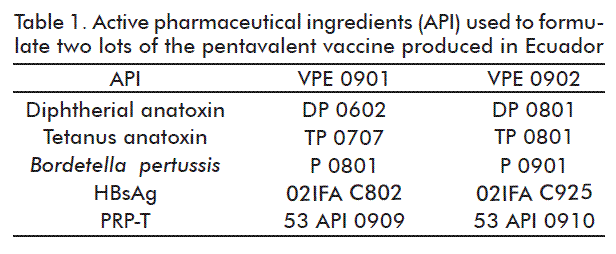
<body><![CDATA[<P   ><font size="2" face="Verdana, Arial, Helvetica, sans-serif"><B>Order of inclusion      of the antigens in the formulation </b></font></P >       <P   ><font size="2" face="Verdana, Arial, Helvetica, sans-serif">The antigens were      added in ascending order according to molecular weight to decrease the effect      of the steric impediment among them during their adsorption on the adjuvant      gel. </font></P >       <P   ><font size="2" face="Verdana, Arial, Helvetica, sans-serif">The total volume      of the gel was divided into two fractions; to one of them the following were      added in this order: diphtherial anatoxin with a molecular weight of 62 kDa,      and tetanus anatoxin with a molecular weight of 150 kDa. After the adsorption      processes of the anatoxins, the whole cells of <I>B. pertussis </I>were added,      with a size ranging 0.5-2.0 &mu;m [17]. </font></P >       <P   ><font size="2" face="Verdana, Arial, Helvetica, sans-serif">The HBsAg and the      PRP-T were adsorbed in the other fraction of the total volume of the aluminum      phosphate gel. </font></P >       <P   ><font size="2" face="Verdana, Arial, Helvetica, sans-serif">Both fractions were      mixed and the buffer solution of 8 mM PBS was added until completing the final      volume of the formulation, ensuring a final concentration of 4 to 5 mM PBS      in the vaccine. At the end, the thimerosal preservative was added. </font></P >       <P   ><font size="2" face="Verdana, Arial, Helvetica, sans-serif"><B>Formulation of      two lots of the pentavalent vaccine at the scale of 1.5 L </b></font></P >       <P   ><font size="2" face="Verdana, Arial, Helvetica, sans-serif">From the results      obtained, we established a formulation technology for the pentavalent vaccine      in Ecuador, which was assessed using physicochemical and biological trials      that would show whether there was any interaction between al the antigens      in the same formulation. Two lots of the pentavalent vaccine of DPT-HB-Hib      were formulated at a scale of 1.5 L, labeled VPE 0901 and VPE 0902 (<a href="/img/revistas/bta/v32n4/t0106415.gif">Table      1</a>). </font></P >       
<P   ><font size="2" face="Verdana, Arial, Helvetica, sans-serif">For the formulation      of the two lots of the pentavalent vaccine, the 2 % aluminum phosphate gel      was diluted to 1 % with 0.85 % saline solution, pH 6.6. The total volume of      the diluted gel was divided into two flasks (flask 1 and flask 2); they were      both sterilized at 121 &deg;C for 15 min. In flask 1, the sterile purified      diphtherial anatoxin was added at room temperature, mixing it in a magnetic      shaker (IKA, RCT Basic, Germany), at 200 rpm with slow shaking for 2 h and      30 min. After this time, we added the tetanus anatoxin while still shaking      for another 2 h and 30 min. Subsequently, the whole cells of <I>B. pertussis      </I>were added and slow shaking was maintained for 18 h. In flask number 2,      the PRP-T was added; the adsorption process occurred under magnetic shaking      (IKA, RCT Basic, Germany), at 200 rpm the shaking was slow for 6 h; later      the HBsAg was added and the adsorption process occurred during 18 h. Finally,      both flasks were mixed, the 8 mM PBS was added and later thimerosal was included.      </font></P >       <P   ><font size="2" face="Verdana, Arial, Helvetica, sans-serif"><B>Physicochemical      assays </b></font></P >   <B>        <P   ><font size="2" face="Verdana, Arial, Helvetica, sans-serif"><I>Organoleptic characteristics      </I></font></P >   </B>        ]]></body>
<body><![CDATA[<P   ><font size="2" face="Verdana, Arial, Helvetica, sans-serif">All the vials of      each lot of the final product were visually inspected to verify the behavior      of the sedimentation, as well as the color of the suspension. </font></P >       <P   ><font size="2" face="Verdana, Arial, Helvetica, sans-serif"><B><I>pH determination</I></B>      </font></P >       <P   ><font size="2" face="Verdana, Arial, Helvetica, sans-serif">This method was carried      out according to the requirements of the USP [18], using the equipment from      Mettler Toledo AG, Switzerland. </font></P >       <P   ><font size="2" face="Verdana, Arial, Helvetica, sans-serif"><B><I>Identification      of the diphtherial and tetanus anatoxins </I></b></font></P >       <P   ><font size="2" face="Verdana, Arial, Helvetica, sans-serif">For the identification      of the anatoxins we used the identification method of Ramon [19], consisting      of mixing, under permanent observation and constant temperature, variable      amounts of the anatoxin with constant amounts of the anti-toxin. The mixture      that first flocculated indicated the approximate amount of anatoxin found      in the sample [19, 20]. </font></P >       <P   ><font size="2" face="Verdana, Arial, Helvetica, sans-serif"><B><I>Identification      of the whole cells of </I>B. pertussis </b></font></P >       <P   ><font size="2" face="Verdana, Arial, Helvetica, sans-serif">A quantitative identification      method was used, starting with the specific sera against the 3 agglutinogens,      PTX, filamentous hemagglutinin and pertactin, which should be present in the      <I>B. pertussis </I>that was obtained in the </font><font size="2" face="Verdana, Arial, Helvetica, sans-serif">laboratory,      after the immunization of rabbits with the purified antigens. The samples      of the <I>B. pertussis </I>cells came from fractions of the two lots of the      pentavalent vaccine of which we took 50 &mu;L and mixed this with the specific      sera that were previously diluted to &frac14; in U-bottom Maxisorp plates      (Nunc, USA). The plates were incubated for 24 h at 37 &deg;C in a humid chamber.      The wells were considered to have positive results when there was an agglutination      reaction compared to a negative control where the serum was not added. </font></P >       <P   ><font size="2" face="Verdana, Arial, Helvetica, sans-serif"><B><I>Identification      of the HBsAg in the vaccine </I></b></font></P >       <P   ><font size="2" face="Verdana, Arial, Helvetica, sans-serif">In order to desorb      the HBsAg from the adjuvant, 5 mL of the tested vaccine were taken, 400 mM      PBS added and vortexed (IKA MS1, Germany) for 1 min. Later, 1 mL of the sample      was centrifuged (Sigma 204, Germany) at 3500 rpm for 5 min, and 200 &mu;L      of the supernatant were collected and carried out an ELISA by covering plates      with 100 &mu;L of goat polyclonal antibody against the HBsAg (006). The plates      were incubated for 15 min at 50 &deg;C; they were then washed with 0.05 %      PBS-Tween 20, three times. From the standard solution and from the vaccine,      200 &mu;L each were taken and diluted twice with PBS; the samples were applied      to the plate and incubated for 4 h at 37 &deg;C in a humid chamber. They were      washed as mentioned above and 100 &mu;L of the anti-goat peroxidase conjugate      (1/100) were added to the plate. They were incubated for 1 h at 50 &deg;C,      washed with 100 &mu;L of the citrate-phosphate buffer solution containing      the ortho-phenylendiamine substrate at 1 mg/mL and 30 % H<sub>2</sub>O<sub>2</sub>.      </font></P >   <FONT size="+1"><FONT size="+1"><FONT size="+1"><FONT size="+1">        <P   ><font size="2" face="Verdana, Arial, Helvetica, sans-serif">The reaction was      stopped by adding 50 &mu;L of the stop solution (2 M H<sub>2</sub>SO<sub>4</sub>),      and the plate was read at 492 nm in a Titertek Multiskan Plus plate reader      (Labsystems, Finland). The results were considered as positive if the HBsAg      was identified in the vaccine tested. </font></P >   <FONT size="+1"><FONT size="+1"><FONT size="+1"><FONT size="+1">        ]]></body>
<body><![CDATA[<P   ><font size="2" face="Verdana, Arial, Helvetica, sans-serif"><B><I>Identification      of the PRP-T in the vaccine </I></b></font></P >       <P   ><font size="2" face="Verdana, Arial, Helvetica, sans-serif">The qualitative method      for immune-identification by latex was used through a commercial set of reagents      Pastorex &reg; Meningitis (61716). In this determination, a drop of the well      homogenized vaccine was taken with a Pasteur pipette, further mixed with a      drop of the latex sensitized with rabbit monoclonal antibodies specifically      against the capsular polysaccharide of the <I>H. influenzae </I>type b bacterium.      The test was considered as positive if the sample agglutinated the positive      control equally. </font></P >       <P   ><font size="2" face="Verdana, Arial, Helvetica, sans-serif"><B><I>Adsorption      of the antigens in the vaccine</I> </b></font></P >       <P   ><font size="2" face="Verdana, Arial, Helvetica, sans-serif">The amounts of the      diphtherial and tetanus anatoxins were quantified by the Ramon method [19];      the valuation of the <I>B. pertussis </I>cellular concentration was determined      using the opacity meter method [16]. </font></P >       <P   ><font size="2" face="Verdana, Arial, Helvetica, sans-serif">HBsAg was quantified      by the ELISA method described above; for the determination of the PRP-T we      were not able to use the Orcinol method since the <I>B. pertussis </I>is a      source of ribose units, reporting higher values in the final result of the      measurement. Therefore, the value was assumed to be that determined in adsorption      assays for the PRP-T antigen alone. </font></P >       <P   ><font size="2" face="Verdana, Arial, Helvetica, sans-serif"><B><I>Western blot      </I></b></font></P >       <P   ><font size="2" face="Verdana, Arial, Helvetica, sans-serif">Since the antigen      mix found in pentavalent vaccines complicates the determination of HBsAg by      using electrophoresis under normal conditions, the two lots of vaccine were      tested with a variation of the technique, also assessing if there were any      interactions between this antigen and the rest of the components of the formulation.      Electrophoresis was run at a gradient of 5-15 % and the current was of 15      mA until it was linearized at 30 mA, followed by a fast staining with Coomassie      G-250 . Subsequently, Western Blot was carried out as described [21]. The      electrophoresis was transferred to the nitrocellulose membrane with a current      of 1.00 mA for 1 h using a humid transfer. It was blocked for 2 h at 37 &deg;C      with 1&times; PBS, 0.05 % Tween-20 and 5 % milk (w/v). After blocking, the      membrane was washed twice with 1&times; PBS, 0.05 % Tween-20 and it was incubated      with the MAb Hep.1/peroxidase conjugate in 1&times; PBS, 0.05 %, Tween-20      and 1 % milk at 37 &deg;C for 2 h. Afterwards, the membrane was washed three      times with 1&times; PBS, 0.05 % Tween-20 and developed with diamine benzidine      (DAB) and hydrogen peroxide (H<sub>2</sub>O<sub>2</sub>). </font></P >   <FONT size="+1"><FONT size="+1"><FONT size="+1"><FONT size="+1">        <P   ><font size="2" face="Verdana, Arial, Helvetica, sans-serif"><B>Biological assays      </b></font></P >   <B>        <P   ><font size="2" face="Verdana, Arial, Helvetica, sans-serif"><I>Procedure for      the determination of the potency of the diphtherial anatoxin according to      the indirect method 1 (FDA)</I> </font></P >   </B>        <P   ><font size="2" face="Verdana, Arial, Helvetica, sans-serif">This procedure is      based on the neutralization capacity of the diphtherial anti-toxin found in      the serum of animals that had been immunized with the pentavalent vaccine      when facing a reference toxin [22]. </font></P >       ]]></body>
<body><![CDATA[<P   ><font size="2" face="Verdana, Arial, Helvetica, sans-serif">The reference diphtherial      anti-toxin was diluted up to 0.5 IU/mL. A 1-mL sample of the animal sera mixture      was taken and poured into a tube containing 9 mL of the 0.85 % saline solution      (dilution/10); the previous operation was repeated in a tube containing 19      mL of the 0.85 % saline solution (dilution 1/20). Five tubes were kept in      the dark at 37 &ordm;C for 4 h, containing 1 mL of the diphtherial toxin each,      at the dilutions of the serum and the Glenny buffer of 4 mL/1 mL, 2mL/2 mL,      1 mL/3 mL, 0.5 mL/3.5 mL and 0.25 mL/ 3.75 mL. </font></P >       <P   ><font size="2" face="Verdana, Arial, Helvetica, sans-serif">In two guinea pigs      of 500-700 g, their upper parts were divided into squares up to 15 squares.      The animals were inoculated with 0.1 mL of each preparation through the intradermal      route. They were observed at 24 and 48 h. Using a slide gauge the erythemas      of the animals were measured and the diphtherial anti-toxin content (IU/mL)      in the sera mixture was determined. </font></P >       <P   ><font size="2" face="Verdana, Arial, Helvetica, sans-serif">The lot passed the      test if there were at least 2 IU of the diphtherial anti-toxin per milliliter      of the serum [22]. </font></P >       <P   ><font size="2" face="Verdana, Arial, Helvetica, sans-serif"><B><I>Procedure used      to determine the potency of the tetanus anatoxin according to the Indirect      method 1 (FDA) </I></b></font></P >       <P   ><font size="2" face="Verdana, Arial, Helvetica, sans-serif">Two milliliters of      the pentavalent vaccine were taken and 11.3 mL of the sterile 0.85 % saline      solution were added. Ten guinea pigs of the Hartley line of 250 to 350 g of      weight were immunized with 1.0 mL of the above dilution. Four weeks later,      they were given an equal dose and 15 days afterwards the animals were bled.      The test tubes were incubated at 37 &deg;C for 2 h; thereafter, the clots      were separated from the walls of the tubes and were refrigerated at 5 &plusmn;      3 &deg;C to retract the clot. </font></P >       <P   ><font size="2" face="Verdana, Arial, Helvetica, sans-serif">From each animal,      1 mL of the serum was collected and they were pooled in a test tube. For the      titration of the tetanus anti-toxin, 60 mice of the same sex were used, weighing      16 to 18 g; 30 mice were used for the reference system and 30 for the problem      system (pentavalent vaccine). The problem serum was diluted 1/30 with 0.85      % saline solution. For the preparation of the tetanus toxin, 10.868 mg of      the toxin were weighed and diluted in 22 mL of 0.85 % saline solution. </font></P >       <P   ><font size="2" face="Verdana, Arial, Helvetica, sans-serif">The anti-toxin standard      was prepared having 4 IU/ mg of anti-toxin, by weighing 1.5 mg of the anti-toxin      and diluting it in 6 mL of saline solution, obtaining a standard system at      1 IU/mL. </font></P >       <P   ><font size="2" face="Verdana, Arial, Helvetica, sans-serif">The solutions were      mixed and placed in the dark for 1 h at between 20 and 25 &deg;C. Afterwards,      mice were inoculated with 0.5 mL of the mixture per animal by subcutaneous      route, and observations were made at 24, 48, 72, 96 and 120 h. </font></P >       <P   ><font size="2" face="Verdana, Arial, Helvetica, sans-serif">The titer of the      vaccine was obtained by using the statistical method of Sperman and Karber.      The dilution at which all animals survived was taken into account, which corresponded      with the total mortality and the intermediate value between them. With the      above mentioned data, the ED50 was calculated for the standard and the problem      sera. </font></P >       <P   ><font size="2" face="Verdana, Arial, Helvetica, sans-serif">The test was considered      to be satisfactory in the analysis of a vaccine lot if the titer obtained      was at least 2 IU of the tetanus anti-toxin per milliliter of serum [23].      </font></P >       ]]></body>
<body><![CDATA[<P   ><font size="2" face="Verdana, Arial, Helvetica, sans-serif"><B><I>Procedure for      the determination of the potency of </I>B. pertussis <I>using the method recommended      by WHO </I></b></font></P >       <P   ><font size="2" face="Verdana, Arial, Helvetica, sans-serif">The <I>B. pertussis      </I>potency of the vaccine was determined by the comparison to a working reference      vaccine calibrated against the international standard for the P vaccine approved      by the Quality Control Division of BioCen, Cuba. </font></P >       <P   ><font size="2" face="Verdana, Arial, Helvetica, sans-serif">Four dilutions of      the reference vaccine were made and from each lot of the vaccine to be tested.      The serial dilutions were made with a dilution factor that was no larger than      five, using for this the sterile 0.85 % sodium chloride saline solution. </font></P >       <P   ><font size="2" face="Verdana, Arial, Helvetica, sans-serif">Albino OF-1 mice      of 10-18 g of weight were injected intraperitoneally with 0.5 mL of the dilution      corresponding to each mouse in each immunization group. Later, mice immunized      with the reference vaccine and the trial vaccine </font><font size="2" face="Verdana, Arial, Helvetica, sans-serif">were      injected with the challenge dose by intracerebral route at a time interval      of 14-17 days after immunization. The strain used for the challenge was <I>B.      pertussis </I>18 323. </font></P >       <P   ><font size="2" face="Verdana, Arial, Helvetica, sans-serif">To obtain an estimate      of the LD50, we carried out dilutions of the challenge dose (1/50, 1/250,      1/1250) which were inoculated by the intracerebral route in control mice groups.      </font></P >       <P   ><font size="2" face="Verdana, Arial, Helvetica, sans-serif">The appropriate dilutions      of the challenge dose were grown in a Bordet-Gengou agar base to determine      the number of colony forming units (c.f.u.). The animals were observed for      14 days; the mice that died within the first 72 h after the inoculation were      excluded from the assay. The mice dying after 72 h of the inoculation were      recorded to determine the ED50 of the vaccines. The ED50 was determined for      each preparation using the Probit statistical method, which evaluates the      linearity of the dose-response and the parallelism of the behavior of the      tested vaccine with the reference vaccine. </font></P >       <P   ><font size="2" face="Verdana, Arial, Helvetica, sans-serif">The value of the      ED50 of each vaccine is the intermediate value between the highest and the      lowest immunizing dose and the regressions that did not show significant deviations      from linearity and parallelism (p &le; 0.05). The challenge dose contained      between 100-1000 LD50 and no more than 300 c.f.u. </font></P >       <P   ><font size="2" face="Verdana, Arial, Helvetica, sans-serif">The ED50 of the vaccine      under trial and the standard vaccine were calculated by a method that offers      an estimate of the 95 % confidence interval limits. The potency was estimated      in terms of IU in the recommended volume for a single human dose (SHD). </font></P >       <P   ><font size="2" face="Verdana, Arial, Helvetica, sans-serif">The vaccine in the      trial met the requirements for the potency if the result of the trial was      statistically valid, showing that the estimated potency of the vaccine was      not less than 4.0 IU in the volume recommended for an SHD, and if the lower      limit (p = 0.95) of the estimated potency was not less than 2.0 IU [24]. </font></P >       <P   ><font size="2" face="Verdana, Arial, Helvetica, sans-serif"><B><I>Determination      of the relative in vivo potency of the HBsAg </I></b></font></P >       ]]></body>
<body><![CDATA[<P   ><font size="2" face="Verdana, Arial, Helvetica, sans-serif">The potency test      of the HBsAg was carried out according to the technical requirements of WHO      [25]. </font></P >       <P   ><font size="2" face="Verdana, Arial, Helvetica, sans-serif">One milliliter of      the trial vaccine was taken, which contained 20 &mu;g/mL of HBsAg; it was      diluted 1/16, 1/64, 1/256, 1/512 and 1/1024 with aluminum phosphate gel at      a concentration of 0.5 mg of Al<sup>+3</sup>/mL. </font></P >   <FONT size="+1"><FONT size="+1">        <P   ><font size="2" face="Verdana, Arial, Helvetica, sans-serif">Ten female mice of      5 to 6 weeks of age and of the Balb/c, haplotype H-2<SUP>d,q</sup> were immunized      per group, using the intra-peritoneal route. Two lots of the pentavalent vaccine,      one lot of the placebo and the reference lot of the anti-hepatitis B vaccine,      07-0902, were studied. </font></P >   <FONT size="+1"><FONT size="+1">        <P   ><font size="2" face="Verdana, Arial, Helvetica, sans-serif">Twenty-eight days      later, the mice were bled by the retro-orbital route and the HBsAg antibody      response was evaluated using an ELISA system; for this, it was coated with      HBsAg (solid phase), the sample was incubated in the wells of the plate and      then the HBsAg conjugated with hot radish peroxidase was added. Ortho-phenyldiamine      was added as the chromogenic substrate to develop the reaction. The ELISA      plate was read at 492 nm. </font></P >       <P   ><font size="2" face="Verdana, Arial, Helvetica, sans-serif">The lot passed the      test when the value of the relative potency equaled or was larger than 0.5      compared to the potency of the reference vaccine. </font></P >       <P   ><font size="2" face="Verdana, Arial, Helvetica, sans-serif"><B><I>Determination      of the immunogenicity of the PRP-T component</I> </b></font></P >       <P   ><font size="2" face="Verdana, Arial, Helvetica, sans-serif">Groups of five F1      rabbits were used, which were immunized by the subcutaneous route with the      dose of 10 &mu;g of the pentavalent vaccine. At the same time, the rabbits      were immunized with a control vaccine against Hib (Vaxem Hib, Chiron S.p.a,      lot 3204), and an aluminum phosphate placebo (0.5 mg/mL) was used as the negative      control. </font></P >       <P   ><font size="2" face="Verdana, Arial, Helvetica, sans-serif">The rabbits were      immunized at 0 and 14 days and they were bled at 21 days after the first dose.      Blood was collected individually. </font></P >       <P   ><font size="2" face="Verdana, Arial, Helvetica, sans-serif">The response to antibodies      was assessed by a specific ELISA system for PRP-T that was non-competitive      and indirect. The international recommendation was used in the coating, <I>i.e.</I>,      the capsular polysaccharide of the bacterium covalently conjugated to human      serum albumin (HbO-HA), distributed by NIBSC, England. The addition of the      sample was carried out to form the HbO-HA+Ac anti-PRP-T complex. This complex      was bound to the mouse anti-</font><font size="2" face="Verdana, Arial, Helvetica, sans-serif">IgG      conjugate marked with peroxidase. Orthophenylendiamine was used as the chromogen;      the substrate of the reaction was H<sub>2</sub>O<sub>2</sub>. In the positive      antibody samples there was a yellow-orange coloring. </font></P >   <FONT size="+1"><FONT size="+1"><FONT size="+1"><FONT size="+1">        <P   ><font size="2" face="Verdana, Arial, Helvetica, sans-serif">For each one of the      samples of the trial we calculated the percentage of seroconverted animals      for each dose; the lot passed the test when seroconversion was found at least      in 50 % of the animals immunized per study group, and the average of the titers      of each group of animals immunized with the pentavalent vaccine was equal      or higher than 800 IU/mL. </font></P >       ]]></body>
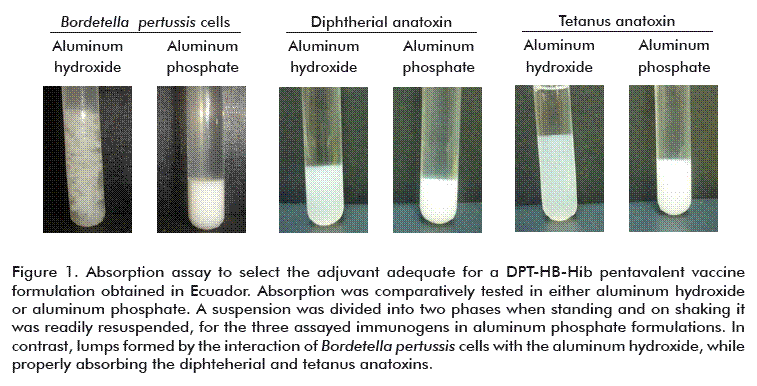
<body><![CDATA[<P   ><font size="2" face="Verdana, Arial, Helvetica, sans-serif"><B>Statistical analysis      </b></font></P >       <P   ><font size="2" face="Verdana, Arial, Helvetica, sans-serif">For the statistical      analysis of the different values in the adsorption kinetics study, the ANOVA      F-test was applied to determine if there were any significant differences      between the means of the samples with a 95.0 % confidence interval. If this      was true, the Multiple Range Test was applied to define the means that were      significantly different from the others, using the Fisher&rsquo;s least significant      difference (LSD) method. There was a risk of 5.0 % of saying that each pair      of means is significantly different, when the true difference equals 0. For      this analysis, we used the STATGRAPHICS Centurion XV.II statistical program.      </font></P >       <P   >&nbsp;</P >       <P   ><font size="2" face="Verdana, Arial, Helvetica, sans-serif"><B><font size="3">RESULTS      AND DISCUSSION </font> </b></font></P >   <FONT size="+1"><B>        <P   ><font size="2" face="Verdana, Arial, Helvetica, sans-serif">Definition of the      adjuvant to be used in the pentavalent vaccine formulation </font></P >   </B>        <P   ><font size="2" face="Verdana, Arial, Helvetica, sans-serif">The objective of      the assay was to evaluate the organoleptic characteristics of these vaccine      preparations. According to the results obtained in this experiment, we defined      the aluminum phosphate gel as the adjuvant, because the whole cells of <I>B.      pertussis </I>produced in Ecuador is inactivated with thimerosal, this preservative      therefore incompatible with the aluminum hydroxide gel due to the formation      of lumps, as observed in <a href="/img/revistas/bta/v32n4/f0106415.gif">figure 1</a>. </font></P >   <FONT size="+1">        
<P   ><font size="2" face="Verdana, Arial, Helvetica, sans-serif">This phenomenon may      be caused by <I>B. pertussis </I>cell wall adhesins, such as filamentous hemagglutinin,      pertactin and pertussis toxin, which in the presence of heat or thimerosal      can favor the cell agglutination process, so that when combined with the aluminum      hydroxide, the lumps are produced. For instance, in the case of the Cuban      pentavalent vaccine, the aluminum hydroxide is used because the P is inactivated      with formaldehyde that does not favor the formation of lumps with the gel.      Regarding the D and T antigens, in the presence of aluminum hydroxide or aluminum      phosphate, do not show undesirable interactions as seen in <a href="/img/revistas/bta/v32n4/f0106415.gif">figure      1</a>. </font></P >       
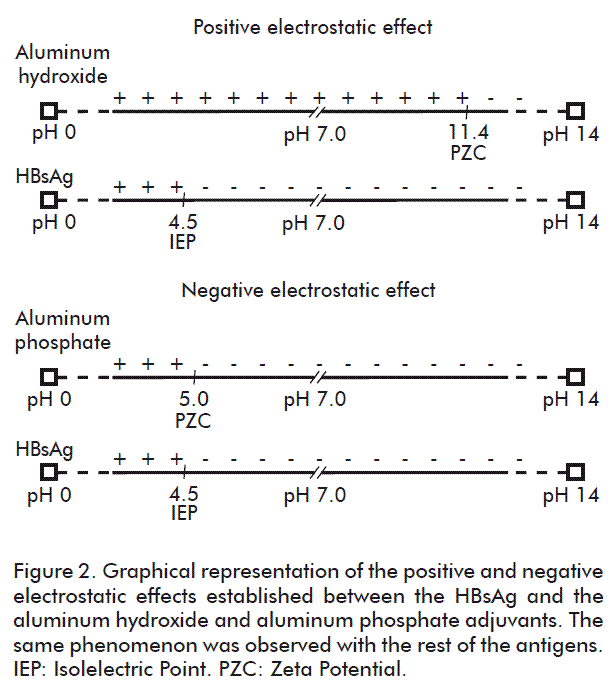
<P   ><font size="2" face="Verdana, Arial, Helvetica, sans-serif">No experiment was      carried out to define the adjuvant for HBsAg and the PRP-T, because previous      experiments have shown that there is no interaction in neither of them with      both adjuvants. </font></P >       <P   ><font size="2" face="Verdana, Arial, Helvetica, sans-serif">The aluminum phosphate      gel has a zeta potential (ZP) of 5.0, <I>i.e</I>., above pH 5.0 its charge      is predominantly negative; that is why it is designed to absorb antigens with      high isoelectric points, when they have predominantly positive charges. The      selection of the aluminum phosphate gel for the formulation of this pentavalent      vaccine predicts the discrete adsorption values for the different antigens,      according to their isoelectric points (Ip). For example, that of HBsAg is      4.5, the anatoxin D has 4.1 and T is 5.1 [26]; so that the predominant charge      of these antigens is negative, similar to that of the aluminum phosphate when      the pH is near the neutrality value, as observed in <a href="/img/revistas/bta/v32n4/f0206415.gif">Figure      2</a>. Overall, this means that a negative electrostatic effect is expressed.      The contrary occurs when using the aluminum hydroxide, since near neutrality      the hydroxide has a positive charge, in contrast to the HBsAg, establishing      a positive electrostatic effect that favors the adsorption process. </font></P >       
<P   ><font size="2" face="Verdana, Arial, Helvetica, sans-serif">In previous adsorption      experiments using an aluminum phosphate gel, we have obtained values of about      80 % for the HBsAg and of about 40 % for the PRP-T (unpublished results).      </font></P >       ]]></body>
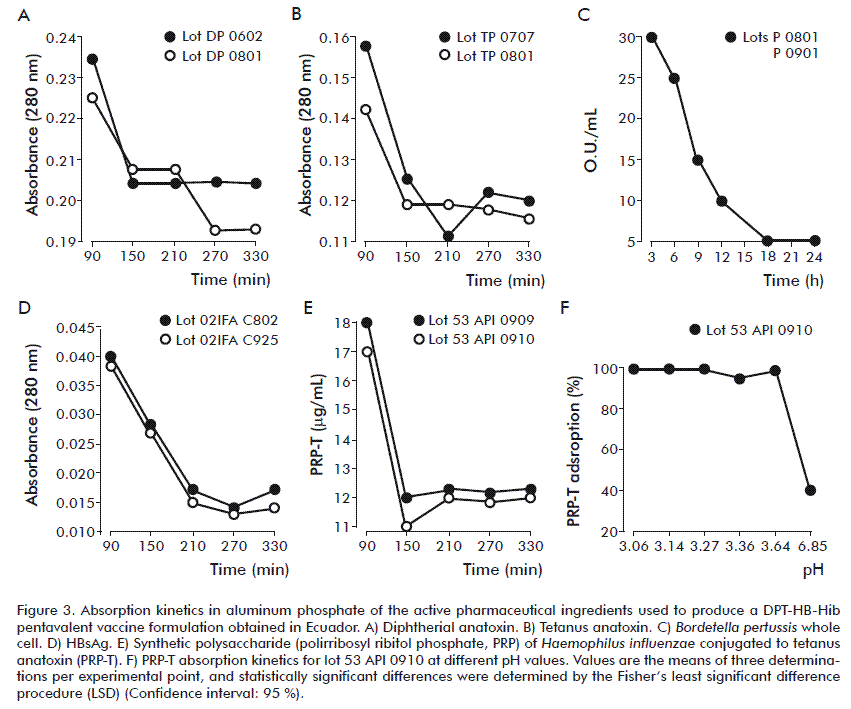
<body><![CDATA[<P   ><font size="2" face="Verdana, Arial, Helvetica, sans-serif"><B>Definition of      the buffer solution for the formulation of the pentavalent vaccine </b></font></P >       <P   ><font size="2" face="Verdana, Arial, Helvetica, sans-serif">Salts are fundamental      elements in the composition of vaccines; they fulfill different functions      such as the regulation of isotonicity of the vaccine preparation and pH. </font></P >       <P   ><font size="2" face="Verdana, Arial, Helvetica, sans-serif">These two parameters      should be well controlled in a parenteral product, since when uncontrolled,      they can produce the rupture of muscular tissue because of the difference      in the salt composition and the pH, giving place to undesirable adverse events      such as pain, reddening, and induration at the application site. </font></P >       <P   ><font size="2" face="Verdana, Arial, Helvetica, sans-serif">On the other hand,      the degree of adsorption of the antigens depends on their nature and concentration,      on the presence of salts and ions such as buffers and on the pH of the resulting      mixture [27]; these elements are achieved using the PBS 8.0 mM in the formulation.      </font></P >       <P   ><font size="2" face="Verdana, Arial, Helvetica, sans-serif">Many buffer solutions      can be used in the formulation of a vaccine, but our experience shows that      we have had good results in other vaccines using PBS 8.0 mM (NaCl, dihydrogen      dihydrated sodium phosphate, NaH<sub>2</sub>PO<sub>4</sub> &middot; 2H<sub>2</sub>O      and disodium hydrogen phosphate, Na<sub>2</sub>HPO<sub>4</sub>) which is used      to complete the final volume of the vaccine, with a final concentration of      between 4.0 and 5.0 mM. </font></P >   <FONT size="+1"><FONT size="+1"><FONT size="+1"><FONT size="+1"><FONT size="+1"><FONT size="+1"><FONT size="+1"><FONT size="+1"><FONT size="+1"><FONT size="+1">        <P   ><font size="2" face="Verdana, Arial, Helvetica, sans-serif"><B>Adsorption kinetics      of the antigens in the aluminum phosphate </b></font></P >       <P   ><font size="2" face="Verdana, Arial, Helvetica, sans-serif">The objective of      this study was to define the time needed to reach the highest adsorption of      each antigen onto the aluminum phosphate gel. The results of the kinetics      of adsorption of D in the aluminum phosphate are shown in <a href="/img/revistas/bta/v32n4/f0306415.gif">Figure      3 A</a>. The adsorption kinetics of the diphtherial anatoxin shows that 2h30min      is enough to reach the maximum adsorption of this antigen, since the results      show no significant differences. </font></P >       
<P   ><font size="2" face="Verdana, Arial, Helvetica, sans-serif">As observed between      the values of the quantified diphtherial anatoxin O.D. in the supernatant      of the vaccine, at the time periods of 1h30min and 2h30min, there is a significant      difference, but between the values reached at 2h30min and the rest of the      values corresponding to longer time periods, there were no significant differences.      This indicates that the time for a maximum adsorption of this antigen to the      aluminum phosphate adjuvant under these conditions is of 2h30min. </font></P >       <P   ><font size="2" face="Verdana, Arial, Helvetica, sans-serif">The results of the      adsorption kinetics of T to the aluminum phosphate gel are shown in <a href="/img/revistas/bta/v32n4/f0306415.gif">Figure      3 B</a>. A similar result was reached with the tetanus anatoxin, with 2h30min      as enough to achieve the highest adsorption of this antigen onto the aluminum      phosphate, without any significant difference between this result and those      reached at longer periods. </font></P >       
<P   ><font size="2" face="Verdana, Arial, Helvetica, sans-serif">The behavior of the      dynamics of the adsorption of T is similar to that obtained with D; as of      2h30min the maximum adsorption is reached and there are no significant differences      in the values as of this time in relation to the results of longer periods.      </font></P >       ]]></body>
<body><![CDATA[<P   ><font size="2" face="Verdana, Arial, Helvetica, sans-serif">The kinetics of the      adsorption of whole cell <i>B. pertussis</i> was a much slower process, which      may be observed in <a href="/img/revistas/bta/v32n4/f0306415.gif">Figure 3 C</a>; here regardless      of the fact that these cells present on their cell wall a chemical composition      based mainly on proteins favoring the interaction with the aluminum adjuvants,      [28] their size influenced the adsorption process. </font></P >       
<P   ><font size="2" face="Verdana, Arial, Helvetica, sans-serif">After 3 h, there      were approximately 30 O.U./mL of <I>B. pertussis </I>whole cells in the supernatant      ,of the total added. At 6 h, this was of 25 O.U./mL, showing that this adsorption      process is occurring, since at 9 and 12 h the quantification was of 15 and      10 O.U./ mL, respectively; is process, however, was able to conclude as of      18 h since the result of 24 h is similar, at which 5 O.U./mL were quantified.      </font></P >       <P   ><font size="2" face="Verdana, Arial, Helvetica, sans-serif">This result was similar      in both APIs of <I>B. pertussis</I>; because of this only one curve is shown      in the graph indicating that the process concludes at 18 h of adsorption,      where up to 5 O.U./mL were adsorbed, and this was sufficient time, since the      result reached at 24 h is similar to that at 18 h. All results quantified      in the different times showed significant differences except for 18 and 24      h. This shows that for completing the adsorption process, 18 h are required.      It is important to point out that the behavior was identical in both pertussis      lots and because of this the graph only shows one curve although both lots      are represented. </font></P >       <P   ><font size="2" face="Verdana, Arial, Helvetica, sans-serif">The adsorption kinetics      of the HBsAg is shown in <a href="/img/revistas/bta/v32n4/f0306415.gif">Figure 3D</a>. This antigen      presents certain physic-chemical characteristics that give it a predominantly      negative charge at a pH that is close to neutrality, similar to that of the      aluminum phosphate; therefore, the adsorption process does not occur as fast      as in the case of the adsorption to the aluminum hydroxide, where it is facilitated      by a ligand exchange process [29]. </font></P >       
<P   ><font size="2" face="Verdana, Arial, Helvetica, sans-serif">Nonetheless, the      adsorption process basically occurs by hydrophobic interactions. It should      be observed how most of the adsorption occurs in 3 h and a half and the results      after this time period do not show significant differences. </font></P >       <P   ><font size="2" face="Verdana, Arial, Helvetica, sans-serif">The results of the      adsorption kinetics of the PRP-T are shown in <a href="/img/revistas/bta/v32n4/f0306415.gif">Figure      3 E</a>. This process indicates that the largest amount of this antigen absorbs      onto the aluminum phosphate at 2h30min, representing approximately 40 % of      the total PRP-T added. It is evident that a negative electrostatic effect      is expressed, as occurring with the rest of the antigens with charges that      are opposite to those of the gel, and, therefore, the predominating interactions      are the hydrophobic interactions. </font></P >       
<P   ><font size="2" face="Verdana, Arial, Helvetica, sans-serif">Adsorption experiments      of the PRP-T onto the aluminum phosphate at pH 3 to 4 have been carried out,      with percentages of adsorption above 97 %. But, when the pH was increased      to reach a value that was near neutrality, more than half of the PRP-T in      the vaccine de-adsorbed from the aluminum phosphate, reaching only 40 % of      PRP-T adsorbed. This event was caused by the increase of the H+ ion concentration      of HCl, since this ion is small and can readily bind to the negative surface      charges of the gel, thereby inverting the net load of the aluminum phosphate      from negative to positive. Hence, the electrostatic interaction between the      PRP-T and the aluminum phosphate is facilitated. In this process of increasing      the vaccine pH up to 6.85, 0.2 M NaOH was added, the OH<SUP>-</sup> ions displacing      by size the PRP-T previously adsorbed. Therefore, this antigen becomes de-adsorbed      as shown in <a href="/img/revistas/bta/v32n4/f0306415.gif">figure 3 F</a>.      </font></P >       
<P   ><font size="2" face="Verdana, Arial, Helvetica, sans-serif">Other studies on      the adsorption of antigens to aluminum gels have demonstrated that the process      is mediated by electrostatic, hydrophobic and ligand exchange interactions,      all of them contributing to the adsorption of the given antigen to the adjuvant      by their respective mechanisms [30, 31]. Nevertheless, a lower or higher percentage      of adsorption of an antigen depends on their physicochemical characteristics,      the type of interactions achieved according to the pH of the medium and the      net charge of the adjuvant under the test conditions. </font></P >       <P   ><font size="2" face="Verdana, Arial, Helvetica, sans-serif">As a general rule,      for several antigens, the adsorption process is performed more effectively      in the pH interval where the isoelectric point of the antigen and the zero      zeta potential of the adjuvant have opposite charges, as shown in <a href="/img/revistas/bta/v32n4/f0206415.gif">Figure      2</a>. This condition is met both for the phosphate and for the aluminum hydroxide.      In fact, this is interval at which the adjuvant and the antigen have opposite      electric charges that facilitate the electrostatic attraction, the ligand      exchange and the adsorption process. </font></P >       
<P   ><font size="2" face="Verdana, Arial, Helvetica, sans-serif"><B>Order in which      the antigens are added </b></font></P >       ]]></body>
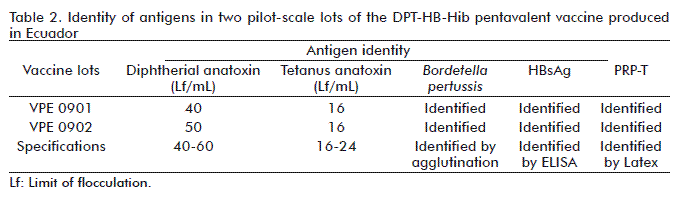
<body><![CDATA[<P   ><font size="2" face="Verdana, Arial, Helvetica, sans-serif">The inclusion in      the formulation of the diphtherial anatoxin as the first antigen is sustained,      because it is much less immunogenic and it is a substantially smaller molecule      compared to the rest of the antigens of the vaccine. Epitopic localization      studies have shown that the largest epitope protector found in the diphtherial      anatoxin is discontinuous and small in extension; hence it is more susceptible      to damage or masking during the technological processes and it is therefore      less competitive when presented to the histocompatibility cells [32, 33].      </font></P >       <P   ><font size="2" face="Verdana, Arial, Helvetica, sans-serif">On the other hand,      it has been verified that the percentage of adsorption of the diphtherial      and tetanus anatoxins vary when bivalent vaccines against diphtheria-tetanus      are formulated. Here the adsorption of these antigens to the adjuvant gel      is higher than when <I>B. pertussis </I>is incorporated to produce the triple      vaccine, DPT. This suggests that these cells displace the anatoxins from the      sites of the adsorption in the gel, which is considered as one of the potential      problems associated to combination vaccines [16]. </font></P >       <P   ><font size="2" face="Verdana, Arial, Helvetica, sans-serif">In the case of the      HBsAg and the PRP-T, they were adsorbed in parallel on a fraction of the total      volume of the adjuvant gel. This was aimed to minimizing the possible interactions      with D, P and T the PRP-T and the HBsAg, so that on mixing both adsorptions,      a large part of the antigens could be already mobilized in the matrix of the      adjuvant, thus ensuring a greater protection and decreasing the interaction      between them. </font></P >       <P   ><font size="2" face="Verdana, Arial, Helvetica, sans-serif"><B>Physicochemical      tests of the two lots of the pentavalent vaccine </b></font></P >   <B>        <P   ><font size="2" face="Verdana, Arial, Helvetica, sans-serif"><I>Organoleptic characteristics      </I></font></P >   </B>        <P   ><font size="2" face="Verdana, Arial, Helvetica, sans-serif">For both lots of      the pentavalent vaccine, a grey-white suspension was obtained, which was separated      into two phases after standing for a certain time, yielding a transparent      liquid supernatant and a precipitate that corresponded to the adjuvant gel.      After shaking the vaccine, it was readily resuspended, showing a homogeneous      suspension. </font></P >       <P   ><font size="2" face="Verdana, Arial, Helvetica, sans-serif"><B><I>pH </I></b></font></P >       <P   ><font size="2" face="Verdana, Arial, Helvetica, sans-serif">After concluding      the formulation, both lots (VPE 0901 and VPE 0902) had pH 6.6. After 6 months      of storage, the pH of the lots had similar values, of 6.6 and 6.7 respectively.      This demonstrated that the 8 mM PBS solution guaranteed this parameter at      least for the time evaluated, and at 5 &plusmn; 3 &ordm;C. </font></P >       <P   ><font size="2" face="Verdana, Arial, Helvetica, sans-serif"><B><I>Identification      of the antigens in the formulation</I> </b></font></P >       <P   ><font size="2" face="Verdana, Arial, Helvetica, sans-serif">The results of the      identification of the antigens in the two lots formulated for the pentavalent      vaccine are shown in <a href="/img/revistas/bta/v32n4/t0206415.gif">Table 2</a>, with identity values      as established for anatoxins. This result supports the production of both      antigens with the adequate potency, since this parameter is directly related      to the capacity of the preparation to induce an immune response in animals,      which in the case of D and T highly correlates with seroprotection in humans.      </font></P >       
]]></body>
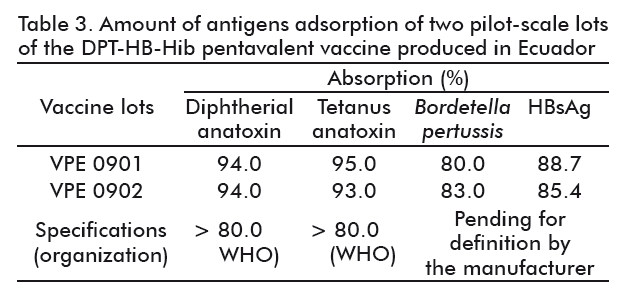
<body><![CDATA[<P   ><font size="2" face="Verdana, Arial, Helvetica, sans-serif">The whole cells of      <I>B. pertussis</I>, HBsAg and PRP-T were identified in both lots. Regardless      of using specific antibodies to identify the five antigens, the biological      tests provided additional information that may confirm that there is no interference      between the antigens, excipients, preservatives and adjuvants in the pentavalent      vaccine, at least in the first stage. </font></P >       <P   ><font size="2" face="Verdana, Arial, Helvetica, sans-serif"><B><I>Adsorption      of the antigens in both lots of the pentavalent vaccine </I></b></font></P >       <P   ><font size="2" face="Verdana, Arial, Helvetica, sans-serif">The results of the      percentage of adsorption of the D, T, HBsAg and P in both lots of the pentavalent      vaccine are shown in <a href="/img/revistas/bta/v32n4/t0306415.gif">Table 3</a>. Results for D and      T in both lots were above 93 %, complying with WHO recommendations stating      that vaccines containing these antigens should be adsorbed in more than 80      % [34]. </font></P >       
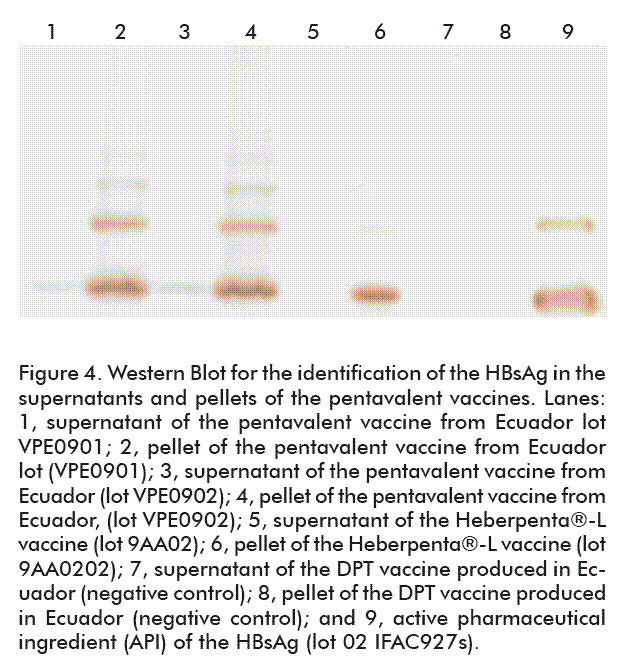
<P   ><font size="2" face="Verdana, Arial, Helvetica, sans-serif">This positive result      directly derived from the inclusion order of the anatoxins, the defined adsorption      periods according to the kinetic studies and the use of 8 mM PBS. This last      remains at a final concentration from 4 to 5 mM after completing the final      volume of the vaccine, thereby, ensuring the pH of the vaccine in the medium.      </font></P >       <P   ><font size="2" face="Verdana, Arial, Helvetica, sans-serif">The adsorption of      the whole cells of <I>B. pertussis </I>in the pentavalent vaccine was obtained      at 80-83 % for the VPE 0901 and VPE0902 lots, similar to those values reached      in kinetic studies of monovalent pertussis vaccines. Hence, it was demonstrated      that there was no interference for this parameter on combining the five antigens.      Noteworthy, there are no WHO recommendations regarding the percentage of adsorption      of the whole cells of <I>B. pertussis </I>to aluminum adjuvants. </font></P >       <P   ><font size="2" face="Verdana, Arial, Helvetica, sans-serif">HBsAg was able to      be adsorbed at 85 to 87 %, which is a positive result considering the conditions      generating opposite charges between this antigen and the aluminum phosphate      that do not favor this process. In fact, WHO recommends that the degree of      adsorption for this antigen should be evaluated in each lot of the vaccine,      and that specifications or ranges for approval have to be established once      demonstrated the consistency of the results evaluated for the approval of      the National Regulatory Authority [25]. </font></P >       <P   ><font size="2" face="Verdana, Arial, Helvetica, sans-serif"><B><I>Western Blot      anti-HBsAg </I></b></font></P >       <P   ><font size="2" face="Verdana, Arial, Helvetica, sans-serif">A more specific test      other than electrophoresis had to be made to detect the presence of this antigen      in both vaccine lots, for a clear identification of HBsAg on the pentavalent      vaccines. Additionally, it was evaluated if there were any interactions between      this antigen and the other formulation components. </font></P >       <P   ><font size="2" face="Verdana, Arial, Helvetica, sans-serif"><a href="/img/revistas/bta/v32n4/f0406415.gif">Figure      4</a> shows the anti-HBsAg Western Blot made on samples of supernatants and      pellets of both pentavalent vaccine lots, VPE 0901 and VPE 0901. As observed      in lanes 1 and 3, corresponding to vaccine supernatants, HBsAg was effectively      detected as expected, since the percentage of absorption for this antigen      in the respective test rendered 11.3 to 14.6 % of the antigen unabsorbed.      </font></P >       
<P   ><font size="2" face="Verdana, Arial, Helvetica, sans-serif">As shown in lanes      2 and 4, corresponding to the pellets of this same vaccine, there were bands      with greater intensities corresponding to aggregates, such as HBsAg dimers      and trimers with 88.7 and 85.4 % of this antigen adsorbed onto the aluminum      phosphate gel, respectively. </font></P >       ]]></body>
<body><![CDATA[<P   ><font size="2" face="Verdana, Arial, Helvetica, sans-serif">In the case of supernatant      and pellet of the pentavalent vaccine lot 9AA0202 produced in Cuba, lanes      5 and 6, a different pattern was obtained, since the HBsAg was not identified      in the supernatant but to 100 % in the pellet, because of using the aluminum      hydroxide gel with which the interaction is established by a very strong ligand      exchange interaction. No specific bands were present in lanes 7 and 8 (supernatant      and pellet, respectively) corresponding to the DPT vaccine obtained in Ecuador,      devoid of HBsAg, while detected for the positive control of an HBsAg-containing      API (lane 9), with clear evidences of the monomer and dimer molecular species      of that molecule. </font></P >       <P   ><font size="2" face="Verdana, Arial, Helvetica, sans-serif">According to these      results, there is no interference between HBsAg and the other antigens in      the formulation, indicated by absence of degradation. </font></P >       <P   ><font size="2" face="Verdana, Arial, Helvetica, sans-serif"><B>Potency and immunogenicity      of the antigens in the lots of the pentavalent vaccine </b></font></P >       <P   ><font size="2" face="Verdana, Arial, Helvetica, sans-serif">Potency and immunogenicity      results for the five antigens in both vaccine lots complied with the specifications      established for the study, as shown in <a href="/img/revistas/bta/v32n4/t0406415.gif">Table 4</a>,      at both time periods evaluated. </font></P >       
<P   ><font size="2" face="Verdana, Arial, Helvetica, sans-serif">The combination of      several antigens of different nature within the same formulation is always      a challenge, since there could be negative interactions that could affect      the potency or immunogenicity of the antigens, considering that the HBsAg      comes from a virus and that the PRP-T is synthetically obtained. The results      of the potency of the HBsAg were very much higher than the specification established,      <I>i.e</I>., the response of the lots of the pentavalent vaccine produced      in Ecuador was several times higher for the HBsAg than the control lot, which      is a monovalent vaccine. This could be related to the immunomodulating properties      of some <I>B. pertussis </I>components which contribute with immunostimulatory      effects on the immune response for some of the antigens in vaccine preparations      [35]. </font></P >       <P   ><font size="2" face="Verdana, Arial, Helvetica, sans-serif">PRP-T results demonstrated      that at least in the time period evaluated, there was a good response since      more than 80 % of the animals seroconverted and the titers obtained were higher      than 800 IU/mL [36]. </font></P >       <P   ><font size="2" face="Verdana, Arial, Helvetica, sans-serif">The variability observed      is characteristic for this type of biological assay [31]. The methods to determine      potency and immunogenicity are frequently highly variable, due to variations      in the biological response in animals and during sample handling for experimental      determinations. </font></P >       <P   ><font size="2" face="Verdana, Arial, Helvetica, sans-serif">In summary, the obtained      potency and immunogenicity results demonstrated no immunological interferences,      either chemical or between the antigens, the adjuvant or thimerosal preservative      during animal testing, one of the main purposes pursued at the pre-formulation      stage. </font></P >       <P   >&nbsp;</P >       <P   ><font size="2" face="Verdana, Arial, Helvetica, sans-serif"><B><font size="3">CONCLUSIONS      </font></b></font></P >   <FONT size="+1">        ]]></body>
<body><![CDATA[<P   ><font size="2" face="Verdana, Arial, Helvetica, sans-serif">It was possible to      define a technology for the production of a DPT-HB-Hib pentavalent vaccine      in Ecuador at the preformulation stage, comprising the selection of aluminum      phosphate as adjuvant, establishing the adequate order in which the antigens      are added, setting the optimal absorption time period to 2h30min for the diphtherial      and tetanus anatoxins and the PRP-T, and 3h30 min for HBsAg and 18 h for whole      cell <I>B. pertussis</I>. </font></P >   <FONT size="+1">        <P   ><font size="2" face="Verdana, Arial, Helvetica, sans-serif">Satisfactory results      were obtained in the physico-chemical testing for pH, the identity of antigens,      with high adsorption percentage and adequate organoleptic characteristics      established for two pentavalent vaccine lots formulated at pilot scale. Potency      and immunogenicity of the five antigens present in the formulation were adequate      as well. </font></P >       <P   >&nbsp;</P >       <P   > </P >       <P   ><font size="3" face="Verdana, Arial, Helvetica, sans-serif"><B>REFERENCES </b></font></P >       <!-- ref --><P   ><font size="2" face="Verdana, Arial, Helvetica, sans-serif">1. Exp&oacute;sito      NS, Cardoso D, Mart&iacute;nez E, Herrera Y, Cosme K, D&iacute;az PA, <i>et      al</i>. Vacuna combinada cubana Trivac HB&reg;, Biotecnol Apl. 2006;23(2):158-64.          </font></P >   <FONT size="+1">        <P   ><font size="2" face="Verdana, Arial, Helvetica, sans-serif">2. World Health Organization.      WHO. Recommendations for Routine immnunization &ndash; summary tables. 2012      [cited 2015 Aug 16]. Available from: <A href="http://www.who.int/immunization/policy/immunization_tables/en/" target="_blank">      <FONT color="#0000FF">http://www.who.int/immunization/policy/immunization_tables/en/</font></A>      </font></P >   <FONT color="#0000FF"><FONT color="#211E1F">        <!-- ref --><P   ><font size="2" face="Verdana, Arial, Helvetica, sans-serif">3. Schmitt HJ, Booy      R, Weil-Olivier C, Van Damme P, Cohen R, Peltola H. Child vaccination policies      in Europe: a report from the Summits of Independent European Vaccination Experts.      Lancet Infect Dis. 2003;3(2):103-8.     </font></P >       ]]></body>
<body><![CDATA[<!-- ref --><P   ><font size="2" face="Verdana, Arial, Helvetica, sans-serif">4. Mart&iacute;n-Moreno      JM. De vacunas combinadas pentavalentes a hexavalentes: esperar o no esperar,      esa es la cuesti&oacute;n. JANO. 2005;(1589):63.     </font></P >       <P   ><font size="2" face="Verdana, Arial, Helvetica, sans-serif">5. Skibinski DA,      Baudner BC, Singh M, O&rsquo;Hagan DT. Combination vaccines. J Glob Infect      Dis. 2011;3(1):63-72. </font></P >       <P   ><font size="2" face="Verdana, Arial, Helvetica, sans-serif">6. US Food and Drug      administration. Guidance for industry for the evaluation of combination vaccines      for preventable diseases: production, testing and clinical studies; 1997 [cited      2015 Aug 16]. Available from: <A href="http://www.fda.gov/downloads/BiologicsBloodVaccines/GuidanceComplianceRegulatoryInformation/Guidances/Vaccines/UCM175909.pdf" target="_blank">      <FONT color="#0000FF">http://www.fda.gov/downloads/BiologicsBloodVaccines/GuidanceComplianceRegulatoryInformation/Guidances/Vaccines/UCM175909.pdf</font></A>      </font></P >   <FONT color="#0000FF"><FONT color="#211E1F">        <P   ><font size="2" face="Verdana, Arial, Helvetica, sans-serif">7. Halsey NA. Safety      of combination vaccines: perception versus reality. Pediatr Infect Dis J 2001;20(11      Suppl):S40-4. </font></P >       <!-- ref --><P   ><font size="2" face="Verdana, Arial, Helvetica, sans-serif">8. Yeh SH, Ward JI,      Partridge S, Marcy SM, Lee H, Jing J, <i>et al</i>. Safety and immunogenicity      of a pentavalent diphtheria, tetanus, pertussis, hepatitis B and polio combination      vaccine in infants. Pediatr Infect Dis J. 2001;20(10):973-80.     </font></P >       <!-- ref --><P   ><font size="2" face="Verdana, Arial, Helvetica, sans-serif">9. Elliman D, Bedford      H. Safety and efficacy of combination vaccines. BMJ. 2003;326(7397):995-6.          </font></P >       <P   ><font size="2" face="Verdana, Arial, Helvetica, sans-serif">10. Vose J. Regulatory      considerations for developers. In: Ronald W. Ellis, ed. Combination vaccines.      Totowa, NJ: Human Press; 1999. p. 213-33. </font></P >       ]]></body>
<body><![CDATA[<P   ><font size="2" face="Verdana, Arial, Helvetica, sans-serif">11. Insel R. Potential      alterations in immunogenicity by combining or simultaneously administering      vaccine components. Ann N Y Acad Sci. 1995;754:35-47. </font></P >       <P   ><font size="2" face="Verdana, Arial, Helvetica, sans-serif">12. Falk LA, Arciniega      J, McVittie L. Manufacturing issues with combining different antigens: a regulatory      perspective. Clin Infect Dis. 2001;33 Suppl 4:S351-5. </font></P >       <P   ><font size="2" face="Verdana, Arial, Helvetica, sans-serif">13. Unicef. Influencing      markets to reduce vaccine prices. 2015 [cited 2015 Aug 16]. Available from:      <A href="http://sowc2015.unicef.org/stories/influencing-markets-to-reduce-vaccine-prices/" target="_blank">      <FONT color="#0000FF">http://sowc2015.unicef.org/stories/influencing-markets-to-reduce-vaccine-prices/</font></A>      </font></P >   <FONT color="#0000FF"><FONT color="#211E1F">        <!-- ref --><P   ><font size="2" face="Verdana, Arial, Helvetica, sans-serif">14. Meeting of the      Strategic Advisory Group of Experts on Immunization, November 2011 - conclusions      and recommendations. Wkly Epidemiol Rec. 2012;87(1):1-16.     </font></P >       <P   ><font size="2" face="Verdana, Arial, Helvetica, sans-serif">15. Aguas Ortiz JC.      La Salud P&uacute;blica en el Ecuador en el siglo XX: El Instituto Nacional      de Higiene y Medicina Tropical &ldquo;Leopoldo Izquieta P&eacute;rez&rdquo;      (INHMT-LIP, 1937-1980). Barcelona: Universidad Aut&oacute;noma de Barcelona;      2012. </font></P >       <!-- ref --><P   ><font size="2" face="Verdana, Arial, Helvetica, sans-serif">16. OMS. Manual para      la producci&oacute;n y control de vacunas <i>Bordetella pertussis</i>; 1979.          </font></P >       <!-- ref --><P   ><font size="2" face="Verdana, Arial, Helvetica, sans-serif">17. Galazka AM. The      immunological basis for immunization series. Module 2. Diphtheria. Geneva:      World Health Organization; 1996.     </font></P >       ]]></body>
<body><![CDATA[<!-- ref --><P   ><font size="2" face="Verdana, Arial, Helvetica, sans-serif">18. United States      Pharmacopoeial Convention. United States Pharmacopeia 29, 2006. National Formulary      25. Rockville: United States Pharmacopoeial Convention, Inc. 2006.     </font></P >       <!-- ref --><P   ><font size="2" face="Verdana, Arial, Helvetica, sans-serif">19. Ramon G. Floculation      dans un &eacute;lange neutre de toxin-antitoxine dipht&eacute;riques. C R      Soc Biol. 1922;86:6.     </font></P >       <!-- ref --><P   ><font size="2" face="Verdana, Arial, Helvetica, sans-serif">20. World Health      Organization. Manual for the Production and Control of Vaccines: Tetanus Toxoid;      1978.     </font></P >       <!-- ref --><P   ><font size="2" face="Verdana, Arial, Helvetica, sans-serif">21. PPO 1.34.602.03.      Procedimiento para el reconocimiento inmunol&oacute;gico por electrotransfer      de prote&iacute;nas espec&iacute;ficas o de la cepa hospedera en productos      en desarrollo. La Habana: CIGB; 2011.     </font></P >       <P   ><font size="2" face="Verdana, Arial, Helvetica, sans-serif">22. PNO 07.153. Procedimiento      establecido para determinar la potencia de la anatoxina dift&eacute;rica en      el BioCen. La Habana: BioCen; 2015. </font></P >       <!-- ref --><P   ><font size="2" face="Verdana, Arial, Helvetica, sans-serif">23. PNO 07.161. Procedimiento      establecido para determinar la potencia de la anatoxina tet&aacute;nica en      el BioCen. La Habana: BioCen; 2014.     </font></P >       <P   ><font size="2" face="Verdana, Arial, Helvetica, sans-serif">24. BioCen, 2014.      PNO 07.160. Procedimiento establecido para determinar la potencia de la <i>Bordetella      pertussis</i> en el BioCen. La Habana: BioCen; 2014. </font></P >       <!-- ref --><P   ><font size="2" face="Verdana, Arial, Helvetica, sans-serif">25. WHO. Recommendations      to Assure the Quality, Safety and Efficacy of Recombinant Hepatitis B Vaccines.      WHO Technical Report Series. 2013;(978):189-240.     </font></P >       <!-- ref --><P   ><font size="2" face="Verdana, Arial, Helvetica, sans-serif">26. Pillemer L, Wittler      RG, Burrell JI, Grossberg DB. The Immunochemistry of toxins and toxoids. VI.      The crystallization and characterization of tetanus toxin. J Exp Med. 1948;88:205-21.          </font></P >       <!-- ref --><P   ><font size="2" face="Verdana, Arial, Helvetica, sans-serif">27. Clapp T, Siebert      P, Chen D, Jones Braun L. Vaccines with aluminum-containing adjuvants: optimizing      vaccine efficacy and thermal stability. J Pharm Sci. 2011;100(2):388-401.          </font></P >       <P   ><font size="2" face="Verdana, Arial, Helvetica, sans-serif">28. Gilchrist M.      Bordetella. In: Balows A, Hausler WJ, Herrmann KL, Isenberg HD, Shadomy HJ,      eds. Manual of clinical microbiology, 5th ed. Washington DC: American Society      for Microbiology; 1991. p. 471-7. </font></P >       <P   ><font size="2" face="Verdana, Arial, Helvetica, sans-serif">29. Vogel FR, Hem      SL. Immunologic adjuvants. In: Plotkin SA, Orenstein MD, eds. Vaccines. 4th      ed. New York: Saunders; 2004. p. 69-79.</font></P >       ]]></body>
<body><![CDATA[<!-- ref --><P   ><font size="2" face="Verdana, Arial, Helvetica, sans-serif">30. Morefield, GL,      Jiang D, Romero IZ, Geahlen RL, Hogenesch H, Hem SL. Effect of phosphorylation      of ovalbumin on adsorption by aluminum-containing adjuvants and elution upon      exposure to interstitial fluid. Vaccine. 2005;23(12):1502-6.     </font></P >       <P   ><font size="2" face="Verdana, Arial, Helvetica, sans-serif">31. Bleam WF, Pfeffer      PE, Goldberg S, Taylor RW, Dudley RA. 31 P solid-state nuclear magnetic resonance      study of phosphate adsorption at the boehmite/aqueous solution interface.      Langmuir. 1991;7:1702-12. </font></P >       <!-- ref --><P   ><font size="2" face="Verdana, Arial, Helvetica, sans-serif">32. OMS. Gu&iacute;a      de la OMS. Requisitos de las pr&aacute;cticas adecuadas de fabricaci&oacute;n      (PAF). WHO/VSQ/97.01. Ginebra: Organizaci&oacute;n Mundial de la Salud; 1998.          </font></P >       <!-- ref --><P   ><font size="2" face="Verdana, Arial, Helvetica, sans-serif">33. Corbel MJ. Control      testing of combined vaccines: A consideration of potential problems and approaches.      Biologicals. 1994;22(4):353-60.     </font></P >       <!-- ref --><P   ><font size="2" face="Verdana, Arial, Helvetica, sans-serif">34. EMEA. Committee      for Proprietary Medicinal Products, European. Note for Guidance on Pharmaceutical      and Biological aspects of combined -vaccines. London: Agency for the Evaluation      of Medicinal Products; 1997.     </font></P >       <P   ><font size="2" face="Verdana, Arial, Helvetica, sans-serif">35. Chaby R, Caroff      M. Lipopolysaccharides of <i>Bordetella pertusis</i> endotoxin. In: Wardlaw      AC, Parton P, editors. Pathogenesis and immunity in Pertussis. New York: John      Wiley &amp; Sons; 1988. p. 247-71. </font></P >       ]]></body>
<body><![CDATA[<!-- ref --><P   ><font size="2" face="Verdana, Arial, Helvetica, sans-serif">36. PPO 4 .09.037.03.      Procedimiento establecido para determinar la inmunogenicidad del PRP-T en      el CIGB. La Habana: CIGB; 2013.     </font></P >       <P   >&nbsp;</P >       <P   >&nbsp;</P >       <P   > </P >       <P   > </P >       <P   ><font size="2" face="Verdana, Arial, Helvetica, sans-serif">Received in September,      2015.     <br>     Accepted in December, 2015.</font></P >       <P   >&nbsp;</P >       <P   >&nbsp;</P >   <FONT size="+1"><FONT size="+1">        ]]></body>
<body><![CDATA[<P   > </P >       <P   > </P >       <P   ><i><font size="2" face="Verdana, Arial, Helvetica, sans-serif">N&eacute;stor      Exp&oacute;sito</font></i><font size="2" face="Verdana, Arial, Helvetica, sans-serif">.      Direcci&oacute;n de Desarrollo Tecnol&oacute;gico, Centro de Ingenier&iacute;a      Gen&eacute;tica y Biotecnolog&iacute;a, CIGB. Ave. 31 e/ 158 y 190, Cubanac&aacute;n,      Playa, CP 11600, La Habana, Cuba. E-mail: <A href="mailto:nestor.exposito@cigb.edu.cu">      <FONT color="#0000FF">nestor.exposito@cigb.edu.cu</font></A>.</font></P >   </font></font></font></font></font></font></font></font></font></font></font></font></font></font></font></font></font></font></font></font></font></font></font></font></font></font></font></font></font></font></font></font></font></font></font></font></font></font></font></font></font></font></font></font></font></font></font></font></font></font></font></font></font></font></font></font></font></font></font></font></font></font></font></font></font></font></font></font></font></font></font></font></font></font></font></font></font></font></font></font></font></font></font></font></font></font></font></font></font></font></font></DIV >      ]]></body><back>
<ref-list>
<ref id="B1">
<label>1</label><nlm-citation citation-type="journal">
<person-group person-group-type="author">
<name>
<surname><![CDATA[Expósito]]></surname>
<given-names><![CDATA[NS]]></given-names>
</name>
<name>
<surname><![CDATA[Cardoso]]></surname>
<given-names><![CDATA[D]]></given-names>
</name>
<name>
<surname><![CDATA[Martínez]]></surname>
<given-names><![CDATA[E]]></given-names>
</name>
<name>
<surname><![CDATA[Herrera]]></surname>
<given-names><![CDATA[Y]]></given-names>
</name>
<name>
<surname><![CDATA[Cosme]]></surname>
<given-names><![CDATA[K]]></given-names>
</name>
<name>
<surname><![CDATA[Díaz]]></surname>
<given-names><![CDATA[PA]]></given-names>
</name>
</person-group>
<article-title xml:lang="en"><![CDATA[en]]></article-title>
<source><![CDATA[Vacuna combinada cubana Trivac HB®, Biotecnol Apl]]></source>
<year>2006</year>
<volume>23</volume>
<numero>2</numero>
<issue>2</issue>
<page-range>158-64</page-range></nlm-citation>
</ref>
<ref id="B2">
<label>2</label><nlm-citation citation-type="">
<collab>World Health Organization</collab>
<source><![CDATA[WHO. Recommendations for Routine immnunization - summary tables]]></source>
<year>2012</year>
</nlm-citation>
</ref>
<ref id="B3">
<label>3</label><nlm-citation citation-type="journal">
<person-group person-group-type="author">
<name>
<surname><![CDATA[Schmitt]]></surname>
<given-names><![CDATA[HJ]]></given-names>
</name>
<name>
<surname><![CDATA[Booy]]></surname>
<given-names><![CDATA[R]]></given-names>
</name>
<name>
<surname><![CDATA[Weil-Olivier]]></surname>
<given-names><![CDATA[C]]></given-names>
</name>
<name>
<surname><![CDATA[Van Damme]]></surname>
<given-names><![CDATA[P]]></given-names>
</name>
<name>
<surname><![CDATA[Cohen]]></surname>
<given-names><![CDATA[R]]></given-names>
</name>
<name>
<surname><![CDATA[Peltola]]></surname>
<given-names><![CDATA[H]]></given-names>
</name>
</person-group>
<article-title xml:lang="en"><![CDATA[Child vaccination policies in Europe: a report from the Summits of Independent European Vaccination Experts]]></article-title>
<source><![CDATA[Lancet Infect Dis]]></source>
<year>2003</year>
<volume>3</volume>
<numero>2</numero>
<issue>2</issue>
<page-range>103-8</page-range></nlm-citation>
</ref>
<ref id="B4">
<label>4</label><nlm-citation citation-type="journal">
<person-group person-group-type="author">
<name>
<surname><![CDATA[Martín-Moreno]]></surname>
<given-names><![CDATA[JM]]></given-names>
</name>
</person-group>
<article-title xml:lang="es"><![CDATA[De vacunas combinadas pentavalentes a hexavalentes: esperar o no esperar, esa es la cuestión]]></article-title>
<source><![CDATA[JANO]]></source>
<year>2005</year>
<numero>1589</numero>
<issue>1589</issue>
<page-range>63</page-range></nlm-citation>
</ref>
<ref id="B5">
<label>5</label><nlm-citation citation-type="journal">
<person-group person-group-type="author">
<name>
<surname><![CDATA[Skibinski]]></surname>
<given-names><![CDATA[DA]]></given-names>
</name>
<name>
<surname><![CDATA[Baudner]]></surname>
<given-names><![CDATA[BC]]></given-names>
</name>
<name>
<surname><![CDATA[Singh]]></surname>
<given-names><![CDATA[M]]></given-names>
</name>
<name>
<surname><![CDATA[O'Hagan]]></surname>
<given-names><![CDATA[DT]]></given-names>
</name>
</person-group>
<article-title xml:lang="es"><![CDATA[Combination vaccines]]></article-title>
<source><![CDATA[J Glob Infect Dis]]></source>
<year>2011</year>
<volume>3</volume>
<numero>1</numero>
<issue>1</issue>
<page-range>63-72</page-range></nlm-citation>
</ref>
<ref id="B6">
<label>6</label><nlm-citation citation-type="">
<collab>US Food and Drug administration</collab>
<source><![CDATA[Guidance for industry for the evaluation of combination vaccines for preventable diseases: production, testing and clinical studies]]></source>
<year>1997</year>
</nlm-citation>
</ref>
<ref id="B7">
<label>7</label><nlm-citation citation-type="journal">
<person-group person-group-type="author">
<name>
<surname><![CDATA[Halsey]]></surname>
<given-names><![CDATA[NA]]></given-names>
</name>
</person-group>
<article-title xml:lang="en"><![CDATA[Safety of combination vaccines: perception versus reality]]></article-title>
<source><![CDATA[Pediatr Infect Dis J]]></source>
<year>2001</year>
<volume>20</volume>
<numero>11S40</numero>
<issue>11S40</issue>
<page-range>4</page-range></nlm-citation>
</ref>
<ref id="B8">
<label>8</label><nlm-citation citation-type="journal">
<person-group person-group-type="author">
<name>
<surname><![CDATA[Yeh]]></surname>
<given-names><![CDATA[SH]]></given-names>
</name>
<name>
<surname><![CDATA[Ward]]></surname>
<given-names><![CDATA[JI]]></given-names>
</name>
<name>
<surname><![CDATA[Partridge]]></surname>
<given-names><![CDATA[S]]></given-names>
</name>
<name>
<surname><![CDATA[Marcy]]></surname>
<given-names><![CDATA[SM]]></given-names>
</name>
<name>
<surname><![CDATA[Lee]]></surname>
<given-names><![CDATA[H]]></given-names>
</name>
<name>
<surname><![CDATA[Jing]]></surname>
<given-names><![CDATA[J]]></given-names>
</name>
</person-group>
<article-title xml:lang="en"><![CDATA[Safety and immunogenicity of a pentavalent diphtheria, tetanus, pertussis, hepatitis B and polio combination vaccine in infants]]></article-title>
<source><![CDATA[Pediatr Infect Dis J]]></source>
<year>2001</year>
<volume>20</volume>
<numero>10</numero>
<issue>10</issue>
<page-range>973-80</page-range></nlm-citation>
</ref>
<ref id="B9">
<label>9</label><nlm-citation citation-type="journal">
<person-group person-group-type="author">
<name>
<surname><![CDATA[Elliman]]></surname>
<given-names><![CDATA[D]]></given-names>
</name>
<name>
<surname><![CDATA[Bedford]]></surname>
<given-names><![CDATA[H]]></given-names>
</name>
</person-group>
<article-title xml:lang="en"><![CDATA[Safety and efficacy of combination vaccines]]></article-title>
<source><![CDATA[BMJ]]></source>
<year>2003</year>
<volume>326</volume>
<numero>7397</numero>
<issue>7397</issue>
<page-range>995-6</page-range></nlm-citation>
</ref>
<ref id="B10">
<label>10</label><nlm-citation citation-type="book">
<person-group person-group-type="author">
<name>
<surname><![CDATA[Vose]]></surname>
<given-names><![CDATA[J]]></given-names>
</name>
</person-group>
<article-title xml:lang="es"><![CDATA[Regulatory considerations for developers]]></article-title>
<person-group person-group-type="editor">
<name>
<surname><![CDATA[Ellis]]></surname>
<given-names><![CDATA[RW]]></given-names>
</name>
</person-group>
<source><![CDATA[Combination vaccines]]></source>
<year>1999</year>
<page-range>213-33</page-range><publisher-loc><![CDATA[Totowa, NJ ]]></publisher-loc>
<publisher-name><![CDATA[Human Press]]></publisher-name>
</nlm-citation>
</ref>
<ref id="B11">
<label>11</label><nlm-citation citation-type="journal">
<person-group person-group-type="author">
<name>
<surname><![CDATA[Insel]]></surname>
<given-names><![CDATA[R]]></given-names>
</name>
</person-group>
<article-title xml:lang="en"><![CDATA[Potential alterations in immunogenicity by combining or simultaneously administering vaccine components]]></article-title>
<source><![CDATA[Ann N Y Acad Sci]]></source>
<year>1995</year>
<volume>754</volume>
<numero>^s1</numero>
<issue>^s1</issue>
<supplement>1</supplement>
<page-range>35-47</page-range></nlm-citation>
</ref>
<ref id="B12">
<label>12</label><nlm-citation citation-type="journal">
<person-group person-group-type="author">
<name>
<surname><![CDATA[Falk]]></surname>
<given-names><![CDATA[LA]]></given-names>
</name>
<name>
<surname><![CDATA[Arciniega]]></surname>
<given-names><![CDATA[J]]></given-names>
</name>
<name>
<surname><![CDATA[McVittie]]></surname>
<given-names><![CDATA[L]]></given-names>
</name>
</person-group>
<article-title xml:lang="en"><![CDATA[Manufacturing issues with combining different antigens: a regulatory perspective]]></article-title>
<source><![CDATA[Clin Infect Dis]]></source>
<year>2001</year>
<volume>33</volume>
<numero>^s4</numero>
<issue>^s4</issue>
<supplement>4</supplement>
<page-range>351-5</page-range></nlm-citation>
</ref>
<ref id="B13">
<label>13</label><nlm-citation citation-type="">
<collab>Unicef</collab>
<source><![CDATA[Influencing markets to reduce vaccine prices]]></source>
<year>2015</year>
</nlm-citation>
</ref>
<ref id="B14">
<label>14</label><nlm-citation citation-type="journal">
<article-title xml:lang="en"><![CDATA[Meeting of the Strategic Advisory Group of Experts on Immunization, November 2011 - conclusions and recommendations]]></article-title>
<source><![CDATA[Wkly Epidemiol Rec]]></source>
<year>2012</year>
<volume>87</volume>
<numero>1</numero>
<issue>1</issue>
<page-range>1-16</page-range></nlm-citation>
</ref>
<ref id="B15">
<label>15</label><nlm-citation citation-type="book">
<person-group person-group-type="author">
<name>
<surname><![CDATA[Aguas Ortiz]]></surname>
<given-names><![CDATA[JC]]></given-names>
</name>
</person-group>
<source><![CDATA[La Salud Pública en el Ecuador en el siglo XX: El Instituto Nacional de Higiene y Medicina Tropical "Leopoldo Izquieta Pérez" (INHMT-LIP, 1937-1980)]]></source>
<year>2012</year>
<publisher-loc><![CDATA[Barcelona ]]></publisher-loc>
<publisher-name><![CDATA[Universidad Autónoma de Barcelona]]></publisher-name>
</nlm-citation>
</ref>
<ref id="B16">
<label>16</label><nlm-citation citation-type="">
<collab>OMS</collab>
<source><![CDATA[Manual para la producción y control de vacunas Bordetella pertussis]]></source>
<year>1979</year>
</nlm-citation>
</ref>
<ref id="B17">
<label>17</label><nlm-citation citation-type="book">
<person-group person-group-type="author">
<name>
<surname><![CDATA[Galazka]]></surname>
<given-names><![CDATA[AM]]></given-names>
</name>
</person-group>
<source><![CDATA[The immunological basis for immunization series. Module 2. Diphtheria]]></source>
<year>1996</year>
<publisher-loc><![CDATA[Geneva ]]></publisher-loc>
<publisher-name><![CDATA[World Health Organization]]></publisher-name>
</nlm-citation>
</ref>
<ref id="B18">
<label>18</label><nlm-citation citation-type="book">
<collab>United States Pharmacopoeial Convention</collab>
<source><![CDATA[United States Pharmacopeia 29, 2006. National Formulary 25]]></source>
<year>2006</year>
<publisher-loc><![CDATA[Rockville ]]></publisher-loc>
<publisher-name><![CDATA[United States Pharmacopoeial Convention, Inc.]]></publisher-name>
</nlm-citation>
</ref>
<ref id="B19">
<label>19</label><nlm-citation citation-type="journal">
<person-group person-group-type="author">
<name>
<surname><![CDATA[Ramon]]></surname>
<given-names><![CDATA[G]]></given-names>
</name>
</person-group>
<article-title xml:lang="es"><![CDATA[Floculation dans un élange neutre de toxin-antitoxine diphtériques]]></article-title>
<source><![CDATA[C R Soc Biol]]></source>
<year>1922</year>
<volume>86</volume>
<page-range>6</page-range></nlm-citation>
</ref>
<ref id="B20">
<label>20</label><nlm-citation citation-type="book">
<collab>World Health Organization</collab>
<source><![CDATA[en]]></source>
<year>1978</year>
<publisher-loc><![CDATA[Manual for the Production and Control of Vaccines ]]></publisher-loc>
<publisher-name><![CDATA[Tetanus Toxoid]]></publisher-name>
</nlm-citation>
</ref>
<ref id="B21">
<label>21</label><nlm-citation citation-type="book">
<source><![CDATA[PPO 13460203. Procedimiento para el reconocimiento inmunológico por electrotransfer de proteínas específicas o de la cepa hospedera en productos en desarrollo]]></source>
<year>2011</year>
<publisher-loc><![CDATA[La Habana ]]></publisher-loc>
<publisher-name><![CDATA[CIGB]]></publisher-name>
</nlm-citation>
</ref>
<ref id="B22">
<label>22</label><nlm-citation citation-type="book">
<source><![CDATA[PNO 07153. Procedimiento establecido para determinar la potencia de la anatoxina tetánica en el BioCen]]></source>
<year>2015</year>
<publisher-loc><![CDATA[La Habana ]]></publisher-loc>
<publisher-name><![CDATA[BioCen]]></publisher-name>
</nlm-citation>
</ref>
<ref id="B23">
<label>23</label><nlm-citation citation-type="book">
<source><![CDATA[PNO 07161. Procedimiento establecido para determinar la potencia de la anatoxina tetánica en el BioCen]]></source>
<year>2014</year>
<publisher-loc><![CDATA[La Habana ]]></publisher-loc>
<publisher-name><![CDATA[BioCen]]></publisher-name>
</nlm-citation>
</ref>
<ref id="B24">
<label>24</label><nlm-citation citation-type="book">
<collab>BioCen</collab>
<source><![CDATA[PNO 07.160. Procedimiento establecido para determinar la potencia de la Bordetella pertussis en el BioCen]]></source>
<year>2014</year>
<publisher-loc><![CDATA[La Habana ]]></publisher-loc>
<publisher-name><![CDATA[BioCen]]></publisher-name>
</nlm-citation>
</ref>
<ref id="B25">
<label>25</label><nlm-citation citation-type="journal">
<collab>WHO</collab>
<article-title xml:lang="en"><![CDATA[Recommendations to Assure the Quality, Safety and Efficacy of Recombinant Hepatitis B Vaccines]]></article-title>
<source><![CDATA[WHO Technical Report Series]]></source>
<year>2013</year>
<numero>978</numero>
<issue>978</issue>
<page-range>189-240</page-range></nlm-citation>
</ref>
<ref id="B26">
<label>26</label><nlm-citation citation-type="journal">
<person-group person-group-type="author">
<name>
<surname><![CDATA[Pillemer]]></surname>
<given-names><![CDATA[L]]></given-names>
</name>
<name>
<surname><![CDATA[Wittler]]></surname>
<given-names><![CDATA[RG]]></given-names>
</name>
<name>
<surname><![CDATA[Burrell]]></surname>
<given-names><![CDATA[JI]]></given-names>
</name>
<name>
<surname><![CDATA[Grossberg]]></surname>
<given-names><![CDATA[DB]]></given-names>
</name>
</person-group>
<article-title xml:lang="en"><![CDATA[The Immunochemistry of toxins and toxoids. VI. The crystallization and characterization of tetanus toxin]]></article-title>
<source><![CDATA[J Exp Med]]></source>
<year>1948</year>
<volume>88</volume>
<page-range>205-21</page-range></nlm-citation>
</ref>
<ref id="B27">
<label>27</label><nlm-citation citation-type="journal">
<person-group person-group-type="author">
<name>
<surname><![CDATA[Clapp]]></surname>
<given-names><![CDATA[T]]></given-names>
</name>
<name>
<surname><![CDATA[Siebert]]></surname>
<given-names><![CDATA[P]]></given-names>
</name>
<name>
<surname><![CDATA[Chen]]></surname>
<given-names><![CDATA[D]]></given-names>
</name>
<name>
<surname><![CDATA[Jones Braun]]></surname>
<given-names><![CDATA[L]]></given-names>
</name>
</person-group>
<article-title xml:lang="en"><![CDATA[Vaccines with aluminum-containing adjuvants: optimizing vaccine efficacy and thermal stability]]></article-title>
<source><![CDATA[J Pharm Sci]]></source>
<year>2011</year>
<volume>100</volume>
<numero>2</numero>
<issue>2</issue>
<page-range>388-401</page-range></nlm-citation>
</ref>
<ref id="B28">
<label>28</label><nlm-citation citation-type="book">
<person-group person-group-type="author">
<name>
<surname><![CDATA[Gilchrist]]></surname>
<given-names><![CDATA[M]]></given-names>
</name>
</person-group>
<article-title xml:lang="en"><![CDATA[Bordetella]]></article-title>
<person-group person-group-type="editor">
<name>
<surname><![CDATA[Balows]]></surname>
<given-names><![CDATA[A]]></given-names>
</name>
<name>
<surname><![CDATA[Hausler]]></surname>
<given-names><![CDATA[WJ]]></given-names>
</name>
<name>
<surname><![CDATA[Herrmann]]></surname>
<given-names><![CDATA[KL]]></given-names>
</name>
<name>
<surname><![CDATA[Isenberg]]></surname>
<given-names><![CDATA[HD]]></given-names>
</name>
<name>
<surname><![CDATA[Shadomy]]></surname>
<given-names><![CDATA[HJ]]></given-names>
</name>
</person-group>
<source><![CDATA[Manual of clinical Microbiology]]></source>
<year>1991</year>
<edition>5</edition>
<page-range>471-7</page-range><publisher-loc><![CDATA[Washington DC ]]></publisher-loc>
<publisher-name><![CDATA[American Society for Microbiology]]></publisher-name>
</nlm-citation>
</ref>
<ref id="B29">
<label>29</label><nlm-citation citation-type="book">
<person-group person-group-type="author">
<name>
<surname><![CDATA[Vogel]]></surname>
<given-names><![CDATA[FR]]></given-names>
</name>
<name>
<surname><![CDATA[Hem]]></surname>
<given-names><![CDATA[SL]]></given-names>
</name>
</person-group>
<article-title xml:lang="en"><![CDATA[Immunologic adjuvants]]></article-title>
<person-group person-group-type="editor">
<name>
<surname><![CDATA[Plotkin]]></surname>
<given-names><![CDATA[SA]]></given-names>
</name>
<name>
<surname><![CDATA[Orenstein]]></surname>
<given-names><![CDATA[MD]]></given-names>
</name>
</person-group>
<source><![CDATA[Vaccines]]></source>
<year>2004</year>
<edition>4</edition>
<page-range>69-79</page-range><publisher-loc><![CDATA[New York ]]></publisher-loc>
<publisher-name><![CDATA[Sanders]]></publisher-name>
</nlm-citation>
</ref>
<ref id="B30">
<label>30</label><nlm-citation citation-type="journal">
<person-group person-group-type="author">
<name>
<surname><![CDATA[Morefield]]></surname>
<given-names><![CDATA[GL]]></given-names>
</name>
<name>
<surname><![CDATA[Jiang]]></surname>
<given-names><![CDATA[D]]></given-names>
</name>
<name>
<surname><![CDATA[Romero]]></surname>
<given-names><![CDATA[IZ]]></given-names>
</name>
<name>
<surname><![CDATA[Geahlen]]></surname>
<given-names><![CDATA[RL]]></given-names>
</name>
<name>
<surname><![CDATA[Hogenesch]]></surname>
<given-names><![CDATA[H]]></given-names>
</name>
<name>
<surname><![CDATA[Hem]]></surname>
<given-names><![CDATA[SL]]></given-names>
</name>
</person-group>
<article-title xml:lang="en"><![CDATA[Effect of phosphorylation of ovalbumin on adsorption by aluminum-containing adjuvants and elution upon exposure to interstitial fluid]]></article-title>
<source><![CDATA[Vaccine]]></source>
<year>2005</year>
<volume>23</volume>
<numero>12</numero>
<issue>12</issue>
<page-range>1502-6</page-range></nlm-citation>
</ref>
<ref id="B31">
<label>31</label><nlm-citation citation-type="journal">
<person-group person-group-type="author">
<name>
<surname><![CDATA[Bleam]]></surname>
<given-names><![CDATA[WF]]></given-names>
</name>
<name>
<surname><![CDATA[Pfeffer]]></surname>
<given-names><![CDATA[PE]]></given-names>
</name>
<name>
<surname><![CDATA[Goldberg]]></surname>
<given-names><![CDATA[S]]></given-names>
</name>
<name>
<surname><![CDATA[Taylor]]></surname>
<given-names><![CDATA[RW]]></given-names>
</name>
</person-group>
<article-title xml:lang="en"><![CDATA[Dudley RA 31 P solid-state nuclear magnetic resonance study of phosphate adsorption at the boehmite/aqueous solution interface]]></article-title>
<source><![CDATA[Langmuir]]></source>
<year>1991</year>
<volume>7</volume>
<numero>^s4</numero>
<issue>^s4</issue>
<supplement>4</supplement>
<page-range>1702-12</page-range></nlm-citation>
</ref>
<ref id="B32">
<label>32</label><nlm-citation citation-type="book">
<collab>OMS</collab>
<source><![CDATA[Guía de la OMS. Requisitos de las prácticas adecuadas de fabricación (PAF). WHO/VSQ/97.01]]></source>
<year>1998</year>
<publisher-loc><![CDATA[Ginebra ]]></publisher-loc>
<publisher-name><![CDATA[Organización Mundial de la Salud]]></publisher-name>
</nlm-citation>
</ref>
<ref id="B33">
<label>33</label><nlm-citation citation-type="journal">
<person-group person-group-type="author">
<name>
<surname><![CDATA[Corbel]]></surname>
<given-names><![CDATA[MJ]]></given-names>
</name>
</person-group>
<article-title xml:lang="en"><![CDATA[Control testing of combined vaccines: A consideration of potential problems and approaches]]></article-title>
<source><![CDATA[Biologicals]]></source>
<year>1994</year>
<volume>22</volume>
<numero>4</numero>
<issue>4</issue>
<page-range>353-60</page-range></nlm-citation>
</ref>
<ref id="B34">
<label>34</label><nlm-citation citation-type="book">
<collab>EMEA</collab>
<source><![CDATA[Committee for Proprietary Medicinal Products, European. Note for Guidance on Pharmaceutical and Biological aspects of combined-vaccines]]></source>
<year>1997</year>
<publisher-loc><![CDATA[London ]]></publisher-loc>
<publisher-name><![CDATA[Agency for the Evaluation of Medicinal Products]]></publisher-name>
</nlm-citation>
</ref>
<ref id="B35">
<label>35</label><nlm-citation citation-type="book">
<person-group person-group-type="author">
<name>
<surname><![CDATA[Chaby]]></surname>
<given-names><![CDATA[R]]></given-names>
</name>
<name>
<surname><![CDATA[Caroff]]></surname>
<given-names><![CDATA[M]]></given-names>
</name>
</person-group>
<article-title xml:lang="en"><![CDATA[Lipopolysaccharides of Bordetella pertusis endotoxin]]></article-title>
<person-group person-group-type="editor">
<name>
<surname><![CDATA[Wardlaw]]></surname>
<given-names><![CDATA[AC]]></given-names>
</name>
<name>
<surname><![CDATA[Parton]]></surname>
<given-names><![CDATA[P]]></given-names>
</name>
</person-group>
<source><![CDATA[Pathogenesis and immunity in Pertussis]]></source>
<year>1988</year>
<page-range>247-71</page-range><publisher-loc><![CDATA[New York ]]></publisher-loc>
<publisher-name><![CDATA[John Wiley & Sons]]></publisher-name>
</nlm-citation>
</ref>
<ref id="B36">
<label>36</label><nlm-citation citation-type="book">
<source><![CDATA[PPO 4 0903703. Procedimiento establecido para determinar la inmunogenicidad del PRP-T en el CIGB]]></source>
<year>2013</year>
<publisher-loc><![CDATA[La Habana ]]></publisher-loc>
<publisher-name><![CDATA[CIGB]]></publisher-name>
</nlm-citation>
</ref>
</ref-list>
</back>
</article>