<?xml version="1.0" encoding="ISO-8859-1"?><article xmlns:mml="http://www.w3.org/1998/Math/MathML" xmlns:xlink="http://www.w3.org/1999/xlink" xmlns:xsi="http://www.w3.org/2001/XMLSchema-instance">
<front>
<journal-meta>
<journal-id>1027-2852</journal-id>
<journal-title><![CDATA[Biotecnología Aplicada]]></journal-title>
<abbrev-journal-title><![CDATA[Biotecnol Apl]]></abbrev-journal-title>
<issn>1027-2852</issn>
<publisher>
<publisher-name><![CDATA[Editorial Elfos Scientiae]]></publisher-name>
</publisher>
</journal-meta>
<article-meta>
<article-id>S1027-28522015000400008</article-id>
<title-group>
<article-title xml:lang="en"><![CDATA[Adjusting the conditions of a system for the in vivo production of a nucleopolyhedrovirus of Spodoptera frugiperda (Lepidoptera: Noctuidae)]]></article-title>
<article-title xml:lang="es"><![CDATA[Ajuste de las condiciones de un sistema para la producción in vivo de un nucleopoliedrovirus de Spodoptera frugiperda (Lepidoptera: Noctuidae)]]></article-title>
</title-group>
<contrib-group>
<contrib contrib-type="author">
<name>
<surname><![CDATA[Ruiz]]></surname>
<given-names><![CDATA[Carolina]]></given-names>
</name>
<xref ref-type="aff" rid="A01"/>
</contrib>
<contrib contrib-type="author">
<name>
<surname><![CDATA[Gómez-Valderrama]]></surname>
<given-names><![CDATA[Juliana]]></given-names>
</name>
<xref ref-type="aff" rid="A01"/>
</contrib>
<contrib contrib-type="author">
<name>
<surname><![CDATA[Chaparro]]></surname>
<given-names><![CDATA[Martha]]></given-names>
</name>
<xref ref-type="aff" rid="A01"/>
</contrib>
<contrib contrib-type="author">
<name>
<surname><![CDATA[Sotelo]]></surname>
<given-names><![CDATA[Paula]]></given-names>
</name>
<xref ref-type="aff" rid="A02"/>
</contrib>
<contrib contrib-type="author">
<name>
<surname><![CDATA[Villamizar]]></surname>
<given-names><![CDATA[Laura]]></given-names>
</name>
<xref ref-type="aff" rid="A01"/>
</contrib>
</contrib-group>
<aff id="A02">
<institution><![CDATA[,Pontificia Universidad Javeriana sede Bogotá  ]]></institution>
<addr-line><![CDATA[ ]]></addr-line>
<country>Colombia</country>
</aff>
<aff id="A01">
<institution><![CDATA[,Corpoica Laboratorio de Control Biológico Laboratorio de Control Biológico]]></institution>
<addr-line><![CDATA[ ]]></addr-line>
<country>Colombia</country>
</aff>
<pub-date pub-type="pub">
<day>00</day>
<month>12</month>
<year>2015</year>
</pub-date>
<pub-date pub-type="epub">
<day>00</day>
<month>12</month>
<year>2015</year>
</pub-date>
<volume>32</volume>
<numero>4</numero>
<fpage>4311</fpage>
<lpage>4316</lpage>
<copyright-statement/>
<copyright-year/>
<self-uri xlink:href="http://scielo.sld.cu/scielo.php?script=sci_arttext&amp;pid=S1027-28522015000400008&amp;lng=en&amp;nrm=iso"></self-uri><self-uri xlink:href="http://scielo.sld.cu/scielo.php?script=sci_abstract&amp;pid=S1027-28522015000400008&amp;lng=en&amp;nrm=iso"></self-uri><self-uri xlink:href="http://scielo.sld.cu/scielo.php?script=sci_pdf&amp;pid=S1027-28522015000400008&amp;lng=en&amp;nrm=iso"></self-uri><kwd-group>
<kwd lng="en"><![CDATA[baculovirus]]></kwd>
<kwd lng="en"><![CDATA[corn armyworm]]></kwd>
<kwd lng="en"><![CDATA[biological control]]></kwd>
<kwd lng="en"><![CDATA[viral multiplication]]></kwd>
<kwd lng="es"><![CDATA[baculovirus]]></kwd>
<kwd lng="es"><![CDATA[cogollero del maíz]]></kwd>
<kwd lng="es"><![CDATA[control biológico]]></kwd>
<kwd lng="es"><![CDATA[multiplicación viral]]></kwd>
</kwd-group>
</article-meta>
</front><body><![CDATA[ <DIV class="Sect"   >        <P align="right"   ><font size="2" color="#000000" face="Verdana, Arial, Helvetica, sans-serif"><b>TECHNIQUE      </b> </font></P >       <P   >&nbsp;</P >   <FONT size="+1" color="#000000">        <P   > </P >   <FONT size="+1" color="#211E1F">       <P   ><b><font size="2" face="Verdana, Arial, Helvetica, sans-serif"><font size="4">Adjusting      the conditions of a system for the <I>in vivo</I> production of a nucleopolyhedrovirus      of <I>Spodoptera frugiperda</I> (Lepidoptera: Noctuidae) </font></font></b></P >       <P   >&nbsp;</P >       <P   > </P >       <P   ></P >   <FONT size="+1" color="#000000">       <P   ><b><font size="3" color="#211E1F" face="Verdana, Arial, Helvetica, sans-serif">Ajuste      de las condiciones de un sistema para la producci&oacute;n <I>in vivo </I>de      un nucleopoliedrovirus de <I>Spodoptera frugiperda </I>(Lepidoptera: Noctuidae)      </font></b></P >       <P   >&nbsp;</P >       ]]></body>
<body><![CDATA[<P   >&nbsp;</P >   <FONT size="+1" color="#211E1F">       <P   > </P >       <P   ></P >   <FONT size="+1" color="#000000">       <P   ><b><font size="2" color="#211E1F" face="Verdana, Arial, Helvetica, sans-serif">Carolina      Ruiz<sup>1</sup>, Juliana G&oacute;mez-Valderrama<sup>1</sup>, Martha Chaparro<sup>1</sup>,      Paula Sotelo<sup>2</sup>, Laura Villamizar<sup>1</sup> </font></b><font size="2" color="#211E1F" face="Verdana, Arial, Helvetica, sans-serif"></font></P >   <FONT size="+1" color="#211E1F"><FONT size="+1"><FONT size="+1"><FONT size="+1"><FONT size="+1"><FONT size="+1"><FONT size="+1"><FONT size="+1"><FONT size="+1"><FONT size="+1">        <P   > </P >   <FONT size="+1" color="#000000">        <P   ><font size="2" color="#211E1F" face="Verdana, Arial, Helvetica, sans-serif"><sup>1</sup>      Laboratorio de Control Biol&oacute;gico, Centro de Investigaci&oacute;n Tibaitat&aacute;,      Corpoica Km. 14 v&iacute;a Mosquera, Colombia.    <br>     </font><font size="2" face="Verdana, Arial, Helvetica, sans-serif"><sup>2</sup>      Pontificia Universidad Javeriana sede Bogot&aacute;, Colombia. </font></P >       <P   >&nbsp;</P >       <P   >&nbsp;</P >   <FONT size="+1" color="#211E1F"><FONT size="+1"><FONT size="+1"><FONT size="+1">        <P   > </P >   </font></font></font></font></font></font></font></font></font></font></font></font></font></font></font></font></font></font></font></font>    <hr>   <FONT size="+1" color="#000000"><FONT size="+1" color="#211E1F"><FONT size="+1" color="#000000"><FONT size="+1" color="#211E1F"><FONT size="+1" color="#000000"><FONT size="+1" color="#211E1F"><FONT size="+1"><FONT size="+1"><FONT size="+1"><FONT size="+1"><FONT size="+1"><FONT size="+1"><FONT size="+1"><FONT size="+1"><FONT size="+1"><FONT size="+1" color="#000000"><FONT size="+1" color="#211E1F"><FONT size="+1"><FONT size="+1"><FONT size="+1">       ]]></body>
<body><![CDATA[<P   ><font size="2" face="Verdana, Arial, Helvetica, sans-serif"><b>ABSTRACT </b></font></P >       <P   > </P >   <FONT size="+1" color="#000000">        <P   ><font size="2" color="#211E1F" face="Verdana, Arial, Helvetica, sans-serif">The      Colombian <I>Spodoptera frugiperda </I>nucleopolyhedrovirus isolate SfNPV003,      was used to develop a biopesticide with a strong potential for the control      of this pest in the field, making it an alternative to chemical pesticides.      Its marketing has, however, been limited due to the high in vivo virus production      costs, which has a significant impact on product price. Hence, in this study,      the conditions for the viral multiplication system were adjusted, in order      to increase process yield and reduce costs. Initially, the effect of larval      age and viral inoculum concentration on viral productivity was determined.      Subsequently, the effect of the dietary regime for larvae development was      established and finally, the effect of harvest time was evaluated on productivity      and contaminant content. Sixteen-day-old larvae (fourth instar) were chosen      considering this as an appropriate inoculation age, inoculum concentration      was 1 &times; 10<sup>7</sup> occlusion bodies (OBs)/mL and a wheat germ-based      maintenance diet was selected. Seven days post-inoculation (23 day-old larvae,      fourth instar) was chosen as the optimum harvesting time of the infected larvae.      Under these conditions the production capacity of viral particles was increased      95 times (from 9.5 &times; 10<sup>11</sup> to 9.1 &times; 10<sup>13</sup>      OBs/month), allowing for a 20 % reduction in product price, thus improving      its economic feasibility. </font></P >   <FONT size="+1" color="#211E1F"><FONT size="+1"><FONT size="+1"><FONT size="+1"><FONT size="+1"><FONT size="+1"><FONT size="+1">        <P   ><font size="2" face="Verdana, Arial, Helvetica, sans-serif"><B><I>Keywords:</I></B><I>      </I>baculovirus, corn armyworm, biological control, viral multiplication.      </font></P >   </font></font></font></font></font></font></font></font></font></font></font></font></font></font></font></font></font></font></font></font></font></font></font></font></font></font></font></font>    <hr>   <FONT size="+1" color="#000000"><FONT size="+1" color="#211E1F"><FONT size="+1" color="#000000"><FONT size="+1" color="#211E1F"><FONT size="+1" color="#000000"><FONT size="+1" color="#211E1F"><FONT size="+1"><FONT size="+1"><FONT size="+1"><FONT size="+1"><FONT size="+1"><FONT size="+1"><FONT size="+1"><FONT size="+1"><FONT size="+1"><FONT size="+1" color="#000000"><FONT size="+1" color="#211E1F"><FONT size="+1"><FONT size="+1"><FONT size="+1"><FONT size="+1" color="#000000"><FONT size="+1" color="#211E1F"><FONT size="+1"><FONT size="+1"><FONT size="+1"><FONT size="+1"><FONT size="+1"><FONT size="+1">       <P   > </P >       <P   ><b><font size="2" face="Verdana, Arial, Helvetica, sans-serif">RESUMEN </font></b></P >       <P   ><font size="2" face="Verdana, Arial, Helvetica, sans-serif">El aislamiento colombiano      de nucleopoliedrovirus de <I>Spodoptera frugiperda </I>SfNPV003 se emplea      para desarrollar un bioplaguicida con alto potencial para el control biol&oacute;gico      de esta plaga, como alternativa a los plaguicidas qu&iacute;micos. Sin embargo,      su comercializaci&oacute;n se ha visto limitada por los altos costos de la      producci&oacute;n in vivo del virus, que repercuten de manera importante en      el precio del producto. Por tales razones, se ajustaron las condiciones del      sistema de multiplicaci&oacute;n viral, para aumentar el rendimiento y reducir      los costos. Se determin&oacute; el efecto de la edad larval y la </font><font size="2" face="Verdana, Arial, Helvetica, sans-serif">concentraci&oacute;n      viral del in&oacute;culo sobre la productividad del virus. Posteriormente      se estableci&oacute; el efecto de la dieta de alimentaci&oacute;n de las larvas,      y se evalu&oacute; el efecto del tiempo de recolecci&oacute;n de las larvas      infectadas sobre el rendimiento del proceso y el contenido de contaminantes.      El periodo de 16 d&iacute;as (cuarto instar larval) se estableci&oacute; como      la edad adecuada para la inoculaci&oacute;n a una concentraci&oacute;n de      1 &times; 10<sup>7</sup> cuerpos de inclusi&oacute;n (CIs)/mL y con la larvas      bajo una dieta a base de germen de trigo para garantizar su mantenimiento.      Se seleccion&oacute; el d&iacute;a 7 posinoculaci&oacute;n (larvas de 23 d&iacute;as,      cuarto instar larval) como el tiempo &oacute;ptimo de recolecci&oacute;n de      las larvas infectadas. Bajo estas condiciones se increment&oacute; en 95 veces      la capacidad de producci&oacute;n de part&iacute;culas virales (de 9.5 &times;      10<sup>11</sup> a 9.1 &times; 10<sup>13</sup> CIs/mes), lo cual permiti&oacute;      una reducci&oacute;n del 20 % en el precio de venta del producto, mejorando      su factibilidad econ&oacute;mica. </font></P >   <FONT size="+1"><FONT size="+1"><FONT size="+1"><FONT size="+1"><FONT size="+1"><FONT size="+1">        <P   ><font size="2" face="Verdana, Arial, Helvetica, sans-serif"><B><I>Palabras clave:</I></B><I>      </I>baculovirus, cogollero del ma&iacute;z, control biol&oacute;gico, multiplicaci&oacute;n      viral. </font></P >   </font></font></font></font></font></font></font></font></font></font></font></font></font></font></font></font></font></font></font></font></font></font></font></font></font></font></font></font></font></font></font></font></font></font>    <hr>   <FONT size="+1" color="#000000"><FONT size="+1" color="#211E1F"><FONT size="+1" color="#000000"><FONT size="+1" color="#211E1F"><FONT size="+1" color="#000000"><FONT size="+1" color="#211E1F"><FONT size="+1"><FONT size="+1"><FONT size="+1"><FONT size="+1"><FONT size="+1"><FONT size="+1"><FONT size="+1"><FONT size="+1"><FONT size="+1"><FONT size="+1" color="#000000"><FONT size="+1" color="#211E1F"><FONT size="+1"><FONT size="+1"><FONT size="+1"><FONT size="+1" color="#000000"><FONT size="+1" color="#211E1F"><FONT size="+1"><FONT size="+1"><FONT size="+1"><FONT size="+1"><FONT size="+1"><FONT size="+1"><FONT size="+1"><FONT size="+1"><FONT size="+1"><FONT size="+1"><FONT size="+1"><FONT size="+1">        <P   >&nbsp;</P >       <P   >&nbsp;</P >       ]]></body>
<body><![CDATA[<P   > </P >       <P   ><b><font size="3" face="Verdana, Arial, Helvetica, sans-serif">INTRODUCTION </font></b></P >       <P   ><font size="2" face="Verdana, Arial, Helvetica, sans-serif">The corn armyworm      <I>Spodoptera frugiperda </I>(J. E. Smith, 1797) (Lepidoptera: Noctuidae)      is the most important pest of the corn fields in Colombia, producing losses      ranging from 13 to 60 % [1]. The unrestrained use of chemical insecticides      for their control bring about high costs, environmental contamination and      pest resistance [2, 3]. The use of baculoviruses, specifically the nucleopolyhedrovirus      (NPV) therefore arises as a promising and environmentally safe alternative,      since it is a specific arthropod virus that is not harmful to other organisms      [4]. </font></P >       <P   ><font size="2" face="Verdana, Arial, Helvetica, sans-serif">A large number of      biopesticides based on baculoviruses have been developed worldwide for the      control of different agriculturally important pests [5], although their use      has been limited, and in some cases the products have disappeared from the      market. One of the main problems is that these viruses are obligate pathogens,      where an infection of a host is needed for their multiplication, for which      reason the implementation of an <I>in vivo </I>production system is required.      The <I>in vivo </I>system on the larvae of the insect is cumbersome and highly      labor demanding, thereby increasing production costs, while showing contamination      by other microorganisms and differences in viral productivity due to the lack      of standardized procedures [6, 7]. </font></P >       <P   ><font size="2" face="Verdana, Arial, Helvetica, sans-serif">A Colombian isolate      of the nucleopolyhedrovirus of <I>S. frugiperda </I>codified as SfNPV003,      was formulated as a wettable powder (WP), showing strong insecticide activity      on pests under field conditions with over 70 % efficacy and a minimal impact      on the beneficial entomofauna associated to the crop [8], as well as the efficient      protection of the virus against the inactivation produced by UV rays [9].      The product is stable for 17 months under storage conditions at room temperature      and it is compatible with commonly used agricultural chemicals for plant health      problems in corn; it can be used in integrated crop management programs [10].      </font></P >       <P   ><font size="2" face="Verdana, Arial, Helvetica, sans-serif">In spite of the high      potential of this biological product, its scaling up and marketing depend      on the efficient production system of its active principle. Production is      currently carried out through an in vivo viral propagation system through      the inoculation of eight-day-old <I>S. frugiperda </I>larvae (second instar),      with the nucleopolyhedrovirus SfNPV003 at a 5 &times; 10<sup>6</sup> occlusion      bodies (OBs)/mL concentration. Larvae maintenance is carried out using an      artificial diet [11], and the dead individuals are harvested daily starting      on the fifth day after the inoculation. The system, however, is highly labor-demanding      in order to check each larva daily; the larvae collected have a wide variability      in weight and size, and the high cost of the diet have negative effects on      the production cost of the active ingredient. </font></P >   <FONT size="+1"><FONT size="+1">        <P   ><font size="2" face="Verdana, Arial, Helvetica, sans-serif">Considering all the      above mentioned aspects, the aim of this work was to improve yields and decrease      costs of NPV viral production, through the adjustment of the mass production      of the SfNPV003 virus, assessing the different factors, such as the diet,      the age of the larvae at infection, the concentration of the viral inoculum      and the harvest time of the infected larvae. </font></P >       <P   >&nbsp;</P >       <P   ><font size="2" face="Verdana, Arial, Helvetica, sans-serif"><B><font size="3">MATERIALS      AND METHODS </font></b></font></P >   <FONT size="+1"><B><FONT size="+1">        <P   ><font size="2" face="Verdana, Arial, Helvetica, sans-serif">Insect rearing </font></P >   </font></B>        ]]></body>
<body><![CDATA[<P   ><font size="2" face="Verdana, Arial, Helvetica, sans-serif">The larvae used for      this study were obtained from a <I>S. frugiperda </I>colony established from      the larvae collected from corn crops at the Espinal municipality (Tolima,      Colombia). This colony was renewed with insects obtained in the field every      six months; for this study we used the insects of the third generation (F3).      These larvae remained under controlled feeding conditions with an artificial      diet described by Greene <I>et al</I>. [11]. </font></P >   <FONT size="+1">        <P   ><font size="2" face="Verdana, Arial, Helvetica, sans-serif"><B>Virus </b></font></P >       <P   ><font size="2" face="Verdana, Arial, Helvetica, sans-serif">The virus used in      this study was the semi-purified isolate of SfNPV003, which was amplified      through the inoculation of larvae of <I>S. frugiperda </I>of the third stage      using the droplet feeding method [12]. The dead larvae were crushed in sterile      distilled water and homogenized. The mixture was filtered through a sheet      of cloth to eliminate insect tissues debris, and the viral concentration was      determined by counting in a Neubauer chamber [10]. </font></P >       <P   ><font size="2" face="Verdana, Arial, Helvetica, sans-serif"><B>Preparing a semi-synthetic      alternative for the production of the SfNPV003 viral isolate </b></font></P >       <P   ><font size="2" face="Verdana, Arial, Helvetica, sans-serif">With the artificial      diet used to rear the insect [11], four modified compositions were designed      by modifying their components as described in <a href="/img/revistas/bta/v32n4/t0108415.gif">table      1</a>. </font></P >       
<P   ><font size="2" face="Verdana, Arial, Helvetica, sans-serif">All modified diets      included a lipid source considering that all insects require a dietary source      of sterols [13]. The diet based on wheat germ included cholesterol and linseed      oil and was based on the diet used for <I>Spodoptera litura </I>[14]. Considering      the high cost of the cholesterol, the remaining three diets used only linseed      oil, according to the diet described by G&oacute;mez <I>et al</I>. [15] for      <I>S. frugiperda</I>. </font></P >       <P   ><font size="2" face="Verdana, Arial, Helvetica, sans-serif">To assess the effect      of the feeding substrate on larval development, a bioassay with larvae of      <I>S. frugiperda </I>of the third stage of the offspring was used; these were      individualized, and from that time onward, they were fed four modified diets      daily and remained under controlled conditions. During the setting-up period      and every 4 days for 20 days, each one of the larvae was weighed. The experimental      unit consisted of a plastic box with 10 flasks, each containing a <I>S. frugiperda      </I>larva, and a food cube; there were three replicates per treatment. The      experimental design was completely randomized. </font></P >       <P   ><font size="2" face="Verdana, Arial, Helvetica, sans-serif">To assess the effect      of the diet on viral productivity, another bioassay was carried out, where      a group of <I>S. frugiperda </I>larvae of the third stage of the offspring      that underwent a 24 hour fast were given a viral suspension adjusted to 5      &times; 10<i>6</i> OBs/mL, using the droplet feeding method [12]. Each larva      was later inoculated in a plastic flask; they were fed an artificial diet      cube, according to the corresponding treatment, and they were incubated in      a bioassay room. As of the fifth day of the inoculation, the larvae were checked      daily, and each larva that died because of viral infection was weighed, crushed,      and diluted in a known volume of sterile water. With the viral suspension      obtained, they were counted in a Neubauer chamber, and with this result, and      the weight of the larva, the productivity was calculated and expressed as      OBs per g of larva tissue. </font></P >   <FONT size="+1"><FONT size="+1">        <P   ><font size="2" face="Verdana, Arial, Helvetica, sans-serif">The experimental      unit consisted of a plastic box with 10 glasses containing one <I>S. frugiperda      </I>larva each and an artificial diet cube according to the treatment. The      experimental design was completely randomized, with three replicates per treatment.      One absolute control was used, which corresponded to the larva that had not      been inoculated. </font></P >       <P   ><font size="2" face="Verdana, Arial, Helvetica, sans-serif">A nutritional analysis      of the diets was also carried out, which included the following parameters:      crude protein, dry matter (105 &ordm;C), ashes, neutral dietary fiber, acid      dietary fiber and ether extract. Finally, a cost analysis for each diet was      made, using the composition of each one and comparing it to the standard artificial      diet. </font></P >       ]]></body>
<body><![CDATA[<P   ><font size="2" face="Verdana, Arial, Helvetica, sans-serif">In order to select      the composition producing the best conditions for viral propagation, we analyzed      the average weights of each larva after their death, as well as viral productivity      (OBs/g), larva mortality due to viral infection, and the cost of the diet      per liter, using a decision matrix according to the methodology described      by Dean and Nishry [16]. </font></P >       <P   ><font size="2" face="Verdana, Arial, Helvetica, sans-serif"><B>Assessment of      the effect of larval age and viral concentration on productivity </b></font></P >       <P   ><font size="2" face="Verdana, Arial, Helvetica, sans-serif">In order to determine      the influence of larval age and viral concentration on the productivity of      the SfNPV003 nucleopolyhedrovirus, we carried out a bioassay following the      above mentioned procedures, but inoculating <I>S. frugiperda </I>larvae of      4, 8, 12 and 16 days of age with suspension adjusted to 5 &times; 10<sup>6</sup>      OBs/mL. A bioassay was later carried out with the individuals of the chosen      larval age where 5 concentrations of the inoculum were assessed, namely: 1      &times; 10<sup>5</sup>, 5 &times; 10<sup>5</sup>, 1 &times; 10<sup>6</sup>,      5 &times; 10<sup>6</sup> and 1 &times; 10<sup>7</sup> OBs/mL. </font></P >   <FONT size="+1"><FONT size="+1"><FONT size="+1"><FONT size="+1"><FONT size="+1"><FONT size="+1"><FONT size="+1"><FONT size="+1"><FONT size="+1"><FONT size="+1"><FONT size="+1"><FONT size="+1">        <P   ><font size="2" face="Verdana, Arial, Helvetica, sans-serif">The experimental      unit for both bioassays consisted of a plastic box with 15 glasses containing      one <I>S. frugiperda </I>larva and a diet cube, each. The experimental design      was completely randomized, with three replicates per treatment. There was      an absolute control consisting of uninoculated larvae. </font></P >       <P   ><font size="2" face="Verdana, Arial, Helvetica, sans-serif">To select the concentration      of the most appropriate inoculum and the age of the larvae, the variables      evaluated were: the average weight of each larva after its death, viral productivity      (OBs/g), and mortality of the larvae due to viral infection. The selection      of the concentration of the inoculum was carried out by establishing the importance      of each factor through the decision matrix described above. </font></P >       <P   ><font size="2" face="Verdana, Arial, Helvetica, sans-serif"><B>Effect of harvest      time on viral productivity </b></font></P >       <P   ><font size="2" face="Verdana, Arial, Helvetica, sans-serif">Harvest time of the      larvae was estimated with the concentration of the selected inoculum, evaluating      7, 9 and 11 days after the inoculation and a treatment in which the larvae      were collected at the time of death (D), that is to say, only those showing      viral infection symptoms. To set up the bioassay we used the previously described      methodology. </font></P >       <P   ><font size="2" face="Verdana, Arial, Helvetica, sans-serif">The experimental      unit for the two bioassays consisted of a plastic box with 15 glasses that      contained one <I>S. frugiperda </I>larva and a diet cube, each. The experimental      design was completely randomized, with three replicates per treatment. There      was an absolute witness, consisting of uninoculated larvae. The variables      evaluated were the average weight of each larva after its death and viral      productivity (OBs/g). </font></P >       <P   ><font size="2" face="Verdana, Arial, Helvetica, sans-serif">On the other hand,      the amount of contaminants found in the collected larvae in each one of the      treatments were evaluated, determining the bacterial, mold and yeast concentration      by plate counting (c.f.u./ mL), following the methodology described by Santos      <I>et al</I>. [10]. </font></P >       <P   ><font size="2" face="Verdana, Arial, Helvetica, sans-serif">The yield of the      productive process of the selected treatment was estimated on the basis of      the installed capacity that enables the inoculation of 104 601 larvae/ month,      using the following formula: </font></P >       ]]></body>
<body><![CDATA[<P   > </P >       <P align="center"   ><img src="/img/revistas/bta/v32n4/fr0108415.gif" width="448" height="42"></P >       
<P   > </P >       <P   ><font size="2" face="Verdana, Arial, Helvetica, sans-serif">Where: </font></P >       <P   ><font size="2" face="Verdana, Arial, Helvetica, sans-serif">D: weight of the      larva in grams </font></P >       <P   ><font size="2" face="Verdana, Arial, Helvetica, sans-serif">P: productivity expressed      as occlusion bodies produced per gram of larval tissue </font></P >       <P   ><font size="2" face="Verdana, Arial, Helvetica, sans-serif"><B>Statistical analysis      </b></font></P >       <P   ><font size="2" face="Verdana, Arial, Helvetica, sans-serif">The normality of      the data was verified with a Shapiro-Wilk test (95 %) and the homoscedasticity      was determined through the Barlett&rsquo;s test (95 %). Since both of the      principles were met, an analysis of variance (ANOVA) was carried out and the      means were compared using least significant differences tests and mean comparisons      were made using Tukey, according to each case (95 %). The data that did not      comply with the normality and homoscedasticity parameters were submitted to      a non-parametric analysis of Kruskal-Wallis. The Statistix 8.1 software was      used for all statistical analyses. </font></P >       <P   >&nbsp;</P >       <P   ><font size="2" face="Verdana, Arial, Helvetica, sans-serif"><B><font size="3">RESULTS      AND DISCUSSION </font> </b></font></P >   <FONT size="+1"><B><FONT size="+1">        ]]></body>
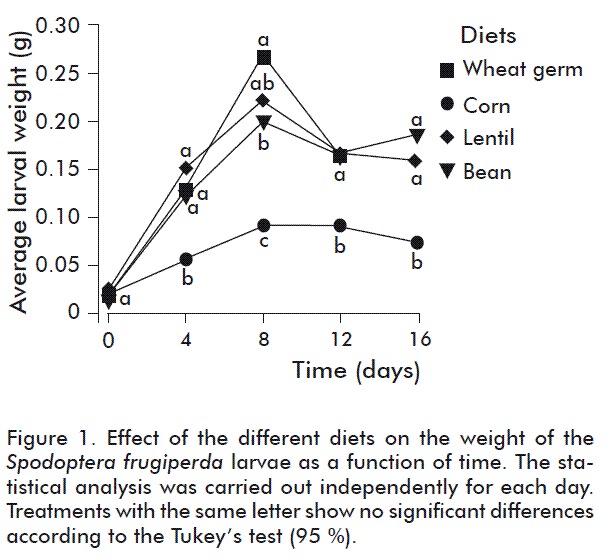
<body><![CDATA[<P   ><font size="2" face="Verdana, Arial, Helvetica, sans-serif">Development of a      semi-synthetic diet alternative for the production of the SfNPV003 viral isolate      </font></P >       <P   ><font size="2" face="Verdana, Arial, Helvetica, sans-serif"><I>Effect of the      diet on larval development</I> </font></P >   </font></B>        <P   ><font size="2" face="Verdana, Arial, Helvetica, sans-serif">As of the time at      which the different diets were supplied up until day 8, exponential weight      gains of the larvae were observed in all treatments (<a href="/img/revistas/bta/v32n4/f0108415.gif">Figure      1</a>). The average weights of the larvae fed the diet based on wheat germ      and the diet based on lentils, were similar and significantly higher (F =      18.56; d.f. = 3; p = 0.000) than the average weight obtained with the larvae      fed the diet based on beans. The larvae fed the diet based on corn showed      significantly lower weights on all evaluation dates, compare to the weights      obtained with the other treatments (F = 18.56; d.f. = 3; p = 0.000) (<a href="/img/revistas/bta/v32n4/f0108415.gif">Figure      1</a>); this result suggests that the diet did not allow for an appropriate      development of the <I>S. frugiperda </I>larvae. </font></P >   <FONT size="+1">        
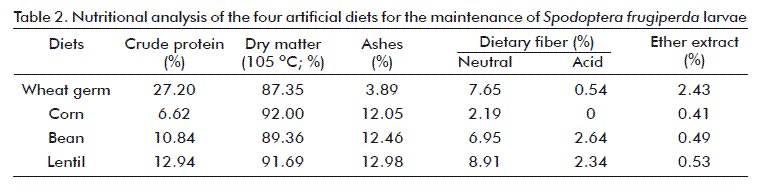
<P   ><font size="2" face="Verdana, Arial, Helvetica, sans-serif">As of day 12, and      up until day 16, the larvae of all treatments started losing weight, possibly      due to the start of the pre-pupa stage, in which the larvae stop eating and      empty their intestine to enter the pupa stage [17]. </font></P >       <P   ><font size="2" face="Verdana, Arial, Helvetica, sans-serif">Nutritional composition      analyses of the four diets used in this study are shown in <a href="/img/revistas/bta/v32n4/t0208415.gif">table      2</a>. According to these results, the best larval development was obtained      with the larvae fed the diet based on wheat germ, which could be related to      the differences in protein and ash content, acid dietary fiber and ether extract.      Similar results were obtained by Busato <I>et al. </I>[18], who found a better      larval development with <I>S. frugiperda </I>using diets with higher protein      concentration, on evaluating two diets based on wheat germ. </font></P >       
<P   ><font size="2" face="Verdana, Arial, Helvetica, sans-serif">It was found that      the diet based on wheat germ had the highest percentage of crude protein,      compared to the other diets (<a href="/img/revistas/bta/v32n4/t0208415.gif">Table 2</a>). Proteins      are important sources of essential amino acids forming the body of the insect      in their muscles, enzymes and membranes, while also being indispensable for      survival, weight gains, cuticle formation, while it also participates in the      immune system [19]. For example, Wiseman and Carpenter [20] studied the influence      of the amount of protein in an artificial diet for <I>Helicoverpa zea </I>(Boddie)      (Lepidoptera: Noctuidae) on larval development time, finding that this was      significantly reduced on increasing the amount of protein, with an evident      weight gain of the pupae, which is similar to the result of the current study.      </font></P >       
<P   ><font size="2" face="Verdana, Arial, Helvetica, sans-serif">Ash content was approximately      3 times lower in the diet based on wheat germ, indicating that this diet has      less essential minerals; however, the proportion of these minerals needed      for good larval development are trace amounts [21]. </font></P >       <P   ><font size="2" face="Verdana, Arial, Helvetica, sans-serif">The percentage of      neutral dietary fiber of the diets based on wheat germ, lentils and beans      were higher than the diet based on corn (<a href="/img/revistas/bta/v32n4/t0208415.gif">Table 2</a>).      Here is still another factor that may be associated to the low efficacy of      this diet for the maintenance of the <I>S. frugiperda </I>larvae, since it      has a lower amount of lignocellulosic and hemicellulosic compounds [22]. </font></P >       
<P   ><font size="2" face="Verdana, Arial, Helvetica, sans-serif">It is important to      stress the result of the ether extract that was approximately five times higher      in the diet based on wheat germ, compared to all the modified diets, showing      that the cholesterol used in this diet generates a greater lipid contribution      to the insect in relation to linseed oil, used in the modified diets. Lipids      participate as a structural component of the cell membrane of the insect,      while also being used as a source of energy and they are the predecessors      of hormones [13, 21, 23, 24]. </font></P >       <P   ><font size="2" face="Verdana, Arial, Helvetica, sans-serif">The diet based on      cornmeal showed a nutritional unbalance because of its low nutrient content,      which may have negatively affected the development and weight gains of the      larvae, for which reason it was eliminated. Similar results were found by      Mur&uacute;a <I>et al</I>. [25], who evaluated four diets based on white bean      meal, red corn meal (polenta), small-kerneled white corn (frangollo) and rice,      finding that the larvae of <I>S. frugiperda </I>fed diets containing cornmeal      showed supernumerary stages that were longer lasting, with 82 % mortality      of the individuals during the formation of the pupal chamber. </font></P >       ]]></body>
<body><![CDATA[<P   ><font size="2" face="Verdana, Arial, Helvetica, sans-serif"><B><I>Effect of the      diet on viral productivity </I></b></font></P >       <P   ><font size="2" face="Verdana, Arial, Helvetica, sans-serif">Using the diets based      on bean meal, lentils and wheat germ selected in the above bioassay, we evaluated      their effect on viral productivity. The weights of the infected larvae as      well as viral productivity were both affected by the diet used to feed the      larvae. These variables were significantly higher when the larvae were kept      under a wheat germ diet (F = 29.31; d.f. =2; p = 0.000) compared to the larvae      fed the lentil diet and the bean diet (<a href="/img/revistas/bta/v32n4/t0308415.gif">Table 3</a>).      These results suggest that the diet based on wheat germ had the best nutritional      balance for the maintenance of the insect during the infection cycle. This      is probably due to the appropriate availability of nutrients found in the      substrate that are linked to the amount of cells/tissues available in the      insect for the viral infection [26]. </font></P >       
<P   ><font size="2" face="Verdana, Arial, Helvetica, sans-serif">Concerning mortality,      it was shown that the highest significant percentages were obtained with diets      based on wheat germ and lentils with values of over 80 % (F = 13.9; d.f. =      2; p = 0.0056). This value is appropriate for this type of process, since      most of the inoculated larvae are expected to be recovered dead because of      the viral infection, reducing the loss of material [27]. With the diet based      on bean meal, a significantly lower mortality was reached compared to other      diets (F = 13.9; d.f. = 2; p = 0.0056), suggesting that this feed substrate      alters the immunocompetency of the larvae due to the effect of nutrition,      thus avoiding viral infection [19, 28]. </font></P >       <P   ><font size="2" face="Verdana, Arial, Helvetica, sans-serif">In the decision matrix,      the diet based on wheat germ had the highest final selection index (0.359)      compared to the lentil meal diet (0.327) and the bean meal (0.315); that diet      was therefore selected for larvae propagation, since it did not affect the      development of the larvae, presenting the best nutritional content and producing      the highest viral productivity at the lowest cost. </font></P >       <P   ><font size="2" face="Verdana, Arial, Helvetica, sans-serif"><B>Effect of larval      age and viral concentration on viral productivity </b></font></P >       <P   ><font size="2" face="Verdana, Arial, Helvetica, sans-serif">Significantly higher      values were obtained with the individuals inoculated at 16 days compared to      other inoculation ages evaluated for the weight variable (F = 142; d.f. =      3; p = 0.000) and for the viral productivity variable (F = 108; d.f. = 3;      p = 0.000) (<a href="/img/revistas/bta/v32n4/t0408415.gif">Table 4</a>). As a consequence, we selected      this age as the most appropriate one for the inoculation of the larvae for      viral propagation. There is a constant relationship between the weight of      the infected larvae at their death and the virus produced, since there is      a greater availability of cells for viral replication [3, 29]. </font></P >       
<P   ><font size="2" face="Verdana, Arial, Helvetica, sans-serif">Afterwards, on evaluating      4 concentrations of the different inocula on this larval age, we found that      there were no significant differences between any of the treatments evaluated      (<a href="/img/revistas/bta/v32n4/t0508415.gif">Table 5</a>) (F = 0.34; d.f. = 3; p = 0.7936). In      relation to mortality percentage, with the concentration of 1 &times; 10<sup>7</sup>      OBs/mL we obtained a mortality of over 80 %, a value that is considered appropriate      for this type of process, as explained above. In the decision matrix, the      highest final selection index was obtained with the concentration of 1 &times;      10<sup>7</sup> OBs/mL (<a href="/img/revistas/bta/v32n4/t0508415.gif">Table 5</a>), for which reason      this value was chosen as the inoculation concentration for the <I>S. frugiperda      </I>larvae. </font></P >   <FONT size="+1"><FONT size="+1"><FONT size="+1"><FONT size="+1">        
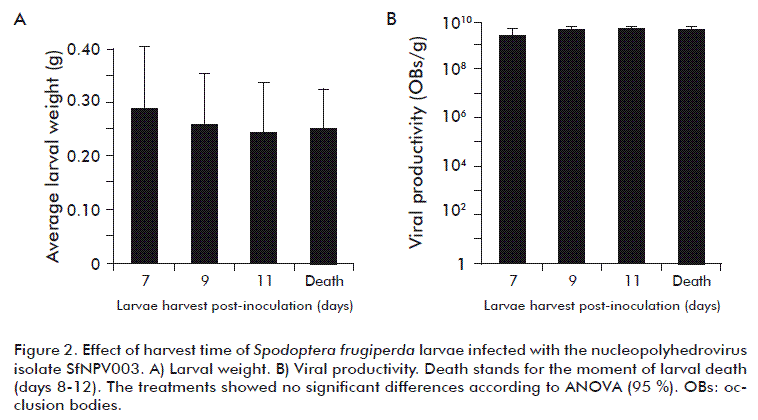
<P   ><font size="2" face="Verdana, Arial, Helvetica, sans-serif"><B>The effect of      harvest time on viral productivity </b></font></P >       <P   ><font size="2" face="Verdana, Arial, Helvetica, sans-serif">After determining      the diet, larval inoculation age and viral concentration of the inoculum,      we evaluated the appropriate harvest time for the infected larvae to optimize      productivity and minimize microbial contamination. </font></P >       <P   ><font size="2" face="Verdana, Arial, Helvetica, sans-serif"><a href="/img/revistas/bta/v32n4/f0208415.gif">Figure      2</a> shows the results of the weight of the larvae (<a href="/img/revistas/bta/v32n4/f0208415.gif">Figure      2A</a>) and viral productivity (<a href="/img/revistas/bta/v32n4/f0208415.gif">Figure 2B</a>), corresponding      to days 7, 9 and 11 after the inoculation and at the time of larval death      (D), which took place between days 8 and 12 after the inoculation, where the      dead individuals with symptoms of viral infection were collected. There were      no significant differences between any of the treatments evaluated (F = 1.68;      d.f. = 3; p = 0.2479), showing that the harvest time of the inoculated larvae      did not have a significant effect on the amount of viruses recovered. However,      the grams of larva collected at the end of the test was greater when the harvest      was made 7 days after the inoculation with 12.51 g, which correspond to the      harvest of 43 individuals, while when the harvest was carried out on days      9, 11 and the day of death the values obtained were of 7.83 g, 4.93 g and      3.14 g corresponding to 29, 21 and 13 individuals respectively. This is because      when harvest time is increased after the inoculation, a larger number of individuals      reached the pupal stage and were therefore not considered for the final analysis.      Another important factor for the harvest of dead individuals with viral infection      symptoms was the loss of the virus caused by the rupture of the integument,      given the advanced state of degradation that was increased when the number      of post-inoculation days increased [3, 30]. Similar results were found by      Grzywacz <I>et al</I>. [6] who assessed the effect of incubation time on the      viral productivity of the NPV of <I>S. littoralis </I>selected on day 7, which      made it possible to obtain a higher productivity and facilitated the harvesting      of the larvae. </font></P >       
]]></body>
<body><![CDATA[<P   ><font size="2" face="Verdana, Arial, Helvetica, sans-serif">One of the main difficulties      in the <I>in vivo </I>production is the contamination with microorganisms      from the collected material [31]; this is why in this study we evaluated the      contaminant content found in the crushed larvae collected at each harvest      time. The average results of this evaluation are shown in <a href="/img/revistas/bta/v32n4/t0608415.gif">table      6</a>. There were no significant differences in the amount of contaminating      microorganisms present in the evaluated treatments (F = 1.23; d.f. = 3; p      = 0.3603) (<a href="/img/revistas/bta/v32n4/t0608415.gif">Table 6</a>), but it was found that on increasing      harvest time the number of contaminating microorganisms increased. Treatment      D showed a numerically lower contamination since the harvesting of the individuals      was made immediately after their death (<a href="/img/revistas/bta/v32n4/t0608415.gif">Table 6</a>).      </font></P >       
<P   ><font size="2" face="Verdana, Arial, Helvetica, sans-serif">This suggests that      the larvae collected at their death have more microorganism contamination      than the larvae collected before death or immediately afterwards. This may      be due to the fact that the bodies of these insects become a substrate, promoting      the growth of the saprophytic microorganisms, when large amounts of cellular      material are exposed [6]. Furthermore, these saprophytic microorganisms may      contaminate the nourishment substrate, the surface of the insect and the feces,      increasing their concentration with time [30]. The elimination of these contaminants      may generate an important increase in the cost of production, on having to      implement corrective measures to decrease the concentration of microorganisms,      as purification through filtration, centrifugation and the inclusion of antibiotics      [30, 31] </font></P >       <P   ><font size="2" face="Verdana, Arial, Helvetica, sans-serif">Although the D treatment      had a numerically lower amount of contaminants, the final volume of the virus      collected was 75 % lower than that obtained on day 7 after the inoculation.      Day 7 after the inoculation was chosen as the appropriate time to harvest      the larvae infected with SfNPV003, on obtaining a larger volume of infected      tissue, </font><font size="2" face="Verdana, Arial, Helvetica, sans-serif">without      any significant differences both in productivity and in the content of final      contaminants, compared to the other treatments evaluated. </font></P >       <P   ><font size="2" face="Verdana, Arial, Helvetica, sans-serif">Taking into account      the chosen treatment, with which individuals having an average weight per      larva of 0.28 g and a productivity of 3.1 &times; 10<sup>9</sup> OBs/g of      larval tissue were obtained, we calculated the monthly yield of the productive      process with the adjustments made, and compared it with the previous process      where we obtained larvae of 0.03 g with a productivity of 3.02 &times; 10<sup>8</sup>      OBs/g of larval tissue. The yield of the process without any adjustment was      estimated in a total production of 9.5 &times; 10<sup>11</sup> OBs/month,      which was increased 95 times on improving the process with the conditions      chosen in the current study, reaching a yield of 9.1 &times; 10<sup>13</sup>      OBs/month. </font></P >       <P   >&nbsp;</P >   <FONT size="+1"><FONT size="+1"><FONT size="+1"><FONT size="+1"><FONT size="+1"><FONT size="+1"><FONT size="+1"><FONT size="+1">        <P   ><font size="2" face="Verdana, Arial, Helvetica, sans-serif"><B><font size="3">CONCLUSIONS      </font></b></font></P >       <P   ><font size="2" face="Verdana, Arial, Helvetica, sans-serif">With the selection      of the diet (based on wheat germ), the age of the individuals at the time      of the infection (16 days), the concentration of the viral inoculum (1 &times;      10<sup>7</sup> OBs/mL) and the harvest time allowing for a greater amount      of the nucleopolyhedrovirus of <I>S. frugiperda </I>SfNPV003 and a lower contaminant      content (day seven after the inoculation), we were able to increase the production      capacity of viral particles per month 95 times. Here we used the same installed      capacity, and it will produce a reduction of the sales price of the biopesticide      in 20 %, improving its economic feasibility. </font></P >       <P   >&nbsp;</P >   <FONT size="+1"><FONT size="+1">        <P   ><font size="2" face="Verdana, Arial, Helvetica, sans-serif"><B><font size="3">ACKNOWLEDGEMENTS      </font> </b></font></P >       <P   ><font size="2" face="Verdana, Arial, Helvetica, sans-serif">The authors would      like to express their acknowledgement to the Administrative Department of      Science and Technology COLCIENCIAS, to the Ministry of Agriculture and Rural      Development of Colombia (MADR) and to the Colombian Corporation for Agricultural      Research CORPOICA, for their financial support for this research. </font></P >       ]]></body>
<body><![CDATA[<P   >&nbsp;</P >       <P   > </P >       <P   ><font size="3" face="Verdana, Arial, Helvetica, sans-serif"><B>REFERENCES </b></font></P >       <!-- ref --><P   ><font size="2" face="Verdana, Arial, Helvetica, sans-serif">1. Instituto Colombiano      Agropecuario ICA. RESOLUCION No. 000879. Bogot&aacute;: Ministerio de Agricultura      y Desarrollo Rural. 2008.     </font></P >       <!-- ref --><P   ><font size="2" face="Verdana, Arial, Helvetica, sans-serif">2. Behle RW, Popham      HJR. Laboratory and field evaluations of the efficacy of a fast-killing baculovirus      isolate from <i>Spodoptera frugiperda</i>. J Invertebr Pathol. 2012;109:194-200.          </font></P >       <!-- ref --><P   ><font size="2" face="Verdana, Arial, Helvetica, sans-serif">3. Caballero P, Murillo      R, Mu&ntilde;oz D, Williams T. El nucleopoliedrovirus de <i>Spodoptera exigua</i>      (Lepidoptera: Noctuidae) como bioplaguicida: an&aacute;lisis de avances recientes      en Espa&ntilde;a. Rev Colomb Entomol. 2009;35:105-15.     </font></P >       <!-- ref --><P   ><font size="2" face="Verdana, Arial, Helvetica, sans-serif">4. Caballero P, Williams      T, L&oacute;pez-Ferber M. Los baculovirus y sus aplicaciones como bioinsecticidas      en el control biol&oacute;gico de plagas. Madrid: Espa&ntilde;a; 2001.     </font></P >       <P   ><font size="2" face="Verdana, Arial, Helvetica, sans-serif">5. Copping L. The      Manual of biocontrol agents, the biopesticide manual. 4th edition. Hampshire:      The British Crop Protection Council; 2009. </font></P >       <!-- ref --><P   ><font size="2" face="Verdana, Arial, Helvetica, sans-serif">6. Grzywacz D, Jones      K, Moawad G, Cherry J. The in vivo production of Spodoptera littoralis nuclear      polyhedrosis virus. J Virol Methods. 1998;71:115-22.     </font></P >       <!-- ref --><P   ><font size="2" face="Verdana, Arial, Helvetica, sans-serif">7. Sajjan DB, Hinchigeri      SB. Increase in production of baculovirus occlusion bodies through cold incubation      in silkworms. Int J Adv Res. 2015;3:5-17.     </font></P >       <!-- ref --><P   ><font size="2" face="Verdana, Arial, Helvetica, sans-serif">8. G&oacute;mez J,      Guevara J, Cuartas P, Espinel C, Villamizar L. Microencapsulated <i>Spodoptera      frugiperda</i> nucleopolyhedrovirus: insecticidal activity and effect on arthropod      populations in maize. Biocontrol Sci Technol. 2013;23:829-46.     </font></P >       <!-- ref --><P   ><font size="2" face="Verdana, Arial, Helvetica, sans-serif">9. Villamizar L,      Barrera G, Cotes AM, Mart&iacute;nez F. Eudragit S100 microparticles containing      <i>Spodoptera frugiperda</i> nucleopolyehedrovirus: physicochemical characterization,      photostability and in vitro virus release. J Microencapsul. 2010; 27:314-24.          </font></P >       ]]></body>
<body><![CDATA[<!-- ref --><P   ><font size="2" face="Verdana, Arial, Helvetica, sans-serif">10. Santos AM, Uribe      LA, Ruiz JC, Tabima L, G&oacute;mez JA, Villamizar LF. Nucleopoliedrovirus      de <i>Spodoptera frugiperda</i> SfNPV003: compatibilidad con agroqu&iacute;micos      y estabilidad en condiciones de almacenamiento. Corpoica Cienc Tecnol Agropecu.      2014;15:219-28.     </font></P >       <!-- ref --><P   ><font size="2" face="Verdana, Arial, Helvetica, sans-serif">11. Greene G, Leppla      N, Dickerson W. Velvetbean caterpillar (Lepidoptera: Noctuidae) rearing procedure      and artificial medium. J Econ Entomol. 1976;69:487-8.     </font></P >       <!-- ref --><P   ><font size="2" face="Verdana, Arial, Helvetica, sans-serif">12. Hughes P, Wood      H. A synchronous peroral technique for the bioassay of insect viruses. J Invertebr.      Pathol. 1981;37:154-9.     </font></P >       <!-- ref --><P   ><font size="2" face="Verdana, Arial, Helvetica, sans-serif">13. Cohen A. Insect      diet: science and technology. Boca Raton: CRC Press LLC.; 2004.     </font></P >       <P   ><font size="2" face="Verdana, Arial, Helvetica, sans-serif">14. Seth RK, Sharma      VP. Growth, development, reproductive competence and adult behaviour of <i>Spodoptera      litura</i> (Lepidoptera: Noctuidae) reared on different diets. Int Atom Energy      Agency Tech Doc IAEA TECDOCs; 2002. </font></P >       <!-- ref --><P   ><font size="2" face="Verdana, Arial, Helvetica, sans-serif">15. G&oacute;mez      J, Guevara, Barrera G, Cotes AM, Villamizar L. Aislamiento, identificaci&oacute;n      y caracterizaci&oacute;n de nucleopoliedrovirus nativos de <i>Spodoptera frugiperda</i>      en Colombia. Rev Fac Nac Agron. 2010;63:1-10.     </font></P >       <!-- ref --><P   ><font size="2" face="Verdana, Arial, Helvetica, sans-serif">16. Dean B, Nishry      T. Scoring and profitability models for evaluating and selecting engineering      products. J Oper Res Soc Am. 1965;13:550-69.     </font></P >       <!-- ref --><P   ><font size="2" face="Verdana, Arial, Helvetica, sans-serif">17. Gilbert L. Insect      development morphogenesis, molting and metamorphosis. Oxford: Academic Press;      2009.     </font></P >       <P   ><font size="2" face="Verdana, Arial, Helvetica, sans-serif">18. Busato GR, Garcia      MS, Loeck AE, Zart M, Nunes AM, Bernardi O, <i>et al</i>. Adequacao de uma      dieta artificial para os bi&oacute;tipos &ldquo;milho&rdquo; e &ldquo;arroz&rdquo;      de <i>Spodoptera frugiperda</i> (Lepidoptera: Noctuidae). Bragantia. 2006;65:317-23.      </font></P >       <!-- ref --><P   ><font size="2" face="Verdana, Arial, Helvetica, sans-serif">19. Lee KP, Simpson      SJ, Wilson K. Dietary protein-quality influences melanization and immune function      in an insect. Funct Ecol. 2008;22:1052-61.     </font></P >       <!-- ref --><P   ><font size="2" face="Verdana, Arial, Helvetica, sans-serif">20. Wiseman B, Carpenter      E. Growth inhibition of corn earworm (Lepidoptera: Noctuidae) larvae reared      on resistant corn silk diets. J Econ Entomol. 1995;88:1037-43.     </font></P >       ]]></body>
<body><![CDATA[<!-- ref --><P   ><font size="2" face="Verdana, Arial, Helvetica, sans-serif">21. Lee KP, Simpson      SJ, Raubenheimer D. A comparison of nutrient regulation between solitarious      and gregarious phases of the specialist caterpillar, <i>Spodoptera exempta</i>      (Walker). J Insect Physiol. 2004;50: 1171-80.     </font></P >       <P   ><font size="2" face="Verdana, Arial, Helvetica, sans-serif">22. Pomeranz Y, Meloan      C. Food analysis: Theory and practice; 3rd edition. New York: Chapman and      Hall; 1994. </font></P >       <!-- ref --><P   ><font size="2" face="Verdana, Arial, Helvetica, sans-serif">23. Karowe DN, Martin      MM. The effects of quantity and quality of diet nitrogen on the growth, efficiency      of food utilization, nitrogen budget, and metabolic rate of fifth-instar <i>Spodoptera      eridania</i> larvae (Lepidoptera: Noctuidae). J Insect Physiol. 1989;35:699-708.          </font></P >       <!-- ref --><P   ><font size="2" face="Verdana, Arial, Helvetica, sans-serif">24. Popham HJR, Shelby      KS. Uptake of dietary micronutrients from artificial diets by larval <i>Heliothis      virescens</i>. J Insect Physiol. 2006;52:771-7.     </font></P >       <!-- ref --><P   ><font size="2" face="Verdana, Arial, Helvetica, sans-serif">25. Mur&uacute;a      MG, Virla EG, Defag&oacute; V. Evaluaci&oacute;n de cuatro dietas artificiales      para la cr&iacute;a de <i>Spodoptera frugiperda</i> (Lep.: Noctuidae) destinada      a mantener poblaciones experimentales de himen&oacute;pteros parasitoides.      Bol San Veg Plagas. 2003;29:43-51.     </font></P >       <!-- ref --><P   ><font size="2" face="Verdana, Arial, Helvetica, sans-serif">26. Kalia V, Chaudhari      S, Gujar GT. Optimization of production of nucleopolyhedrovirus of <i>Helicoverpa      armigera</i> throughout larval stages. Phytoparasitica. 2001;29:23-8.     </font></P >       <P   ><font size="2" face="Verdana, Arial, Helvetica, sans-serif">27. Grzywacz D, Rabindra      RJ, Brown M, Jones KA, Parnell M. The <i>Helicoverpa armigera</i> NPV production      manual. 2011 [cited 2015 Jun 15]. Available from: <A href="http://www.fao.org/docs/eims/upload/agrotech/2011/hanpvmanual-pt1.pdf" target="_blank">      <FONT color="#0000FF">www.fao.org/docs/eims/upload/agrotech/2011/hanpvmanual-pt1.pdf</font></A>      </font></P >   <FONT color="#0000FF"><FONT color="#211E1F">        <P   ><font size="2" face="Verdana, Arial, Helvetica, sans-serif">28. Adamo S. The      impact of physiological state on immune function in insects. In: Rolff J,      Reynolds S, Eds. Insect Infection and Immunity. Evolution, Ecology and Mechanisms.      Oxford: Oxford University Press; 2009; p. 173-86. </font></P >       <!-- ref --><P   ><font size="2" face="Verdana, Arial, Helvetica, sans-serif">29. Cherry J, Parnell      M, Grzywacz D, Jones K. The optimization of in vivo nuclear polyhedrosis virus      production in <i>Spodoptera exempta</i> (Walker) and Spodoptera exigua (Hubner).      J Invertebr Pathol. 1997;70:50-8.     </font></P >       <P   ><font size="2" face="Verdana, Arial, Helvetica, sans-serif">30. Caballero P,      Williams T. Virus entomopat&oacute;genos. In: Control biol&oacute;gico de      plagas agr&iacute;colas; Valencia: Editorial Phytoma; 2008. p. 121-35. </font></P >       <!-- ref --><P   ><font size="2" face="Verdana, Arial, Helvetica, sans-serif">31. Ravensberg W.      Progress in biological control. A roadmap to the successful development and      commercialization of microbial pest control products for control of arthropods.      Netherlands: Springer; 2011.     </font></P >       <P   >&nbsp;</P >       <P   >&nbsp;</P >       ]]></body>
<body><![CDATA[<P   > </P >       <P   > </P >       <P   ><font size="2" face="Verdana, Arial, Helvetica, sans-serif">Received in July,      2015.     <br>     Accepted in December, 2015. </font></P >       <P   >&nbsp;</P >       <P   >&nbsp;</P >   <FONT size="+1"><FONT size="+1">        <P   > </P >       <P   > </P >       <P   ><i><font size="2" face="Verdana, Arial, Helvetica, sans-serif">Carolina Ruiz</font></i><font size="2" face="Verdana, Arial, Helvetica, sans-serif">.      Laboratorio de Control Biol&oacute;gico, Centro de Investigaci&oacute;n Tibaitat&aacute;,      Corpoica Km. 14 v&iacute;a Mosquera, Colombia. E-mail: <A href="mailto:jcruiz@corpoica.org.co">      <FONT color="#0000FF">jcruiz@corpoica.org.co</font></A><FONT color="#0000FF"><FONT color="#211E1F">.      </font></font></font></P >   </font></font></font></font></font></font></font></font></font></font></font></font></font></font></font></font></font></font></font></font></font></font></font></font></font></font></font></font></font></font></font></font></font></font></font></font></font></font></font></font></font></font></font></font></font></font></font></font></font></font></font></font></font></font></font></font></font></font></font></font></font></font></font></font></font></font></font></font></font></font></font></font></DIV >      ]]></body><back>
<ref-list>
<ref id="B1">
<label>1</label><nlm-citation citation-type="book">
<collab>Instituto Colombiano Agropecuario ICA</collab>
<source><![CDATA[RESOLUCION No. 000879]]></source>
<year>2008</year>
<publisher-loc><![CDATA[Bogotá ]]></publisher-loc>
<publisher-name><![CDATA[Ministerio de Agricultura y Desarrollo Rural]]></publisher-name>
</nlm-citation>
</ref>
<ref id="B2">
<label>2</label><nlm-citation citation-type="journal">
<person-group person-group-type="author">
<name>
<surname><![CDATA[Behle]]></surname>
<given-names><![CDATA[RW]]></given-names>
</name>
<name>
<surname><![CDATA[Popham]]></surname>
<given-names><![CDATA[HJR]]></given-names>
</name>
</person-group>
<article-title xml:lang="en"><![CDATA[Laboratory and field evaluations of the efficacy of a fast-killing baculovirus isolate from Spodoptera frugiperda]]></article-title>
<source><![CDATA[J Invertebr Pathol]]></source>
<year>2012</year>
<volume>109</volume>
<page-range>194-200</page-range></nlm-citation>
</ref>
<ref id="B3">
<label>3</label><nlm-citation citation-type="journal">
<person-group person-group-type="author">
<name>
<surname><![CDATA[Caballero]]></surname>
<given-names><![CDATA[P]]></given-names>
</name>
<name>
<surname><![CDATA[Murillo]]></surname>
<given-names><![CDATA[R]]></given-names>
</name>
<name>
<surname><![CDATA[Muñoz]]></surname>
<given-names><![CDATA[D]]></given-names>
</name>
<name>
<surname><![CDATA[Williams]]></surname>
<given-names><![CDATA[T]]></given-names>
</name>
</person-group>
<article-title xml:lang="es"><![CDATA[El nucleopoliedrovirus de Spodoptera exigua (Lepidoptera: Noctuidae) como bioplaguicida: análisis de avances recientes en España]]></article-title>
<source><![CDATA[Rev Colomb Entomol]]></source>
<year>2009</year>
<volume>35</volume>
<page-range>105-15</page-range></nlm-citation>
</ref>
<ref id="B4">
<label>4</label><nlm-citation citation-type="book">
<person-group person-group-type="author">
<name>
<surname><![CDATA[Caballero]]></surname>
<given-names><![CDATA[P]]></given-names>
</name>
<name>
<surname><![CDATA[Williams]]></surname>
<given-names><![CDATA[T]]></given-names>
</name>
<name>
<surname><![CDATA[López-Ferber]]></surname>
<given-names><![CDATA[M]]></given-names>
</name>
</person-group>
<source><![CDATA[Los baculovirus y sus aplicaciones como bioinsecticidas en el control biológico de plagas]]></source>
<year>2001</year>
<publisher-loc><![CDATA[Madrid ]]></publisher-loc>
<publisher-name><![CDATA[España]]></publisher-name>
</nlm-citation>
</ref>
<ref id="B5">
<label>5</label><nlm-citation citation-type="book">
<person-group person-group-type="author">
<name>
<surname><![CDATA[Copping]]></surname>
<given-names><![CDATA[L]]></given-names>
</name>
</person-group>
<source><![CDATA[The Manual of biocontrol agents, the biopesticide manual]]></source>
<year>2009</year>
<edition>4</edition>
<publisher-loc><![CDATA[Hampshire ]]></publisher-loc>
<publisher-name><![CDATA[The British Crop Protection Council]]></publisher-name>
</nlm-citation>
</ref>
<ref id="B6">
<label>6</label><nlm-citation citation-type="journal">
<person-group person-group-type="author">
<name>
<surname><![CDATA[Grzywacz]]></surname>
<given-names><![CDATA[D]]></given-names>
</name>
<name>
<surname><![CDATA[Jones]]></surname>
<given-names><![CDATA[K]]></given-names>
</name>
<name>
<surname><![CDATA[Moawad]]></surname>
<given-names><![CDATA[G]]></given-names>
</name>
<name>
<surname><![CDATA[Cherry]]></surname>
<given-names><![CDATA[J]]></given-names>
</name>
</person-group>
<article-title xml:lang="en"><![CDATA[The in vivo production of Spodoptera littoralis nuclear polyhedrosis virus]]></article-title>
<source><![CDATA[J Virol Methods]]></source>
<year>1998</year>
<volume>71</volume>
<page-range>115-22</page-range></nlm-citation>
</ref>
<ref id="B7">
<label>7</label><nlm-citation citation-type="journal">
<person-group person-group-type="author">
<name>
<surname><![CDATA[Sajjan]]></surname>
<given-names><![CDATA[DB]]></given-names>
</name>
<name>
<surname><![CDATA[Hinchigeri]]></surname>
<given-names><![CDATA[SB]]></given-names>
</name>
</person-group>
<article-title xml:lang="en"><![CDATA[Increase in production of baculovirus occlusion bodies through cold incubation in silkworms]]></article-title>
<source><![CDATA[Int J Adv Res]]></source>
<year>2015</year>
<volume>3</volume>
<page-range>5-17</page-range></nlm-citation>
</ref>
<ref id="B8">
<label>8</label><nlm-citation citation-type="journal">
<person-group person-group-type="author">
<name>
<surname><![CDATA[Gómez]]></surname>
<given-names><![CDATA[J]]></given-names>
</name>
<name>
<surname><![CDATA[Guevara]]></surname>
<given-names><![CDATA[J]]></given-names>
</name>
<name>
<surname><![CDATA[Cuartas]]></surname>
<given-names><![CDATA[P]]></given-names>
</name>
<name>
<surname><![CDATA[Espinel]]></surname>
<given-names><![CDATA[C]]></given-names>
</name>
<name>
<surname><![CDATA[Villamizar]]></surname>
<given-names><![CDATA[L]]></given-names>
</name>
</person-group>
<article-title xml:lang="en"><![CDATA[Microencapsulated Spodoptera frugiperda nucleopolyhedrovirus: insecticidal activity and effect on arthropod populations in maize]]></article-title>
<source><![CDATA[Biocontrol Sci Technol]]></source>
<year>2013</year>
<volume>23</volume>
<page-range>829-46</page-range></nlm-citation>
</ref>
<ref id="B9">
<label>9</label><nlm-citation citation-type="journal">
<person-group person-group-type="author">
<name>
<surname><![CDATA[Villamizar]]></surname>
<given-names><![CDATA[L]]></given-names>
</name>
<name>
<surname><![CDATA[Barrera]]></surname>
<given-names><![CDATA[G]]></given-names>
</name>
<name>
<surname><![CDATA[Cotes]]></surname>
<given-names><![CDATA[AM]]></given-names>
</name>
<name>
<surname><![CDATA[Martínez]]></surname>
<given-names><![CDATA[F]]></given-names>
</name>
</person-group>
<article-title xml:lang="en"><![CDATA[Eudragit S100 microparticles containing Spodoptera frugiperda nucleopolyehedrovirus: physicochemical characterization, photostability and in vitro virus release]]></article-title>
<source><![CDATA[J Microencapsul]]></source>
<year>2010</year>
<volume>27</volume>
<page-range>314-24</page-range></nlm-citation>
</ref>
<ref id="B10">
<label>10</label><nlm-citation citation-type="journal">
<person-group person-group-type="author">
<name>
<surname><![CDATA[Santos]]></surname>
<given-names><![CDATA[AM]]></given-names>
</name>
<name>
<surname><![CDATA[Uribe]]></surname>
<given-names><![CDATA[LA]]></given-names>
</name>
<name>
<surname><![CDATA[Ruiz]]></surname>
<given-names><![CDATA[JC]]></given-names>
</name>
<name>
<surname><![CDATA[Tabima]]></surname>
<given-names><![CDATA[L]]></given-names>
</name>
<name>
<surname><![CDATA[Gómez]]></surname>
<given-names><![CDATA[JA]]></given-names>
</name>
<name>
<surname><![CDATA[Villamizar]]></surname>
<given-names><![CDATA[LF]]></given-names>
</name>
</person-group>
<article-title xml:lang="es"><![CDATA[Nucleopoliedrovirus de Spodoptera frugiperda SfNPV003: compatibilidad con agroquímicos y estabilidad en condiciones de almacenamiento]]></article-title>
<source><![CDATA[Corpoica Cienc Tecnol Agropecu]]></source>
<year>2014</year>
<volume>15</volume>
<page-range>219-28</page-range></nlm-citation>
</ref>
<ref id="B11">
<label>11</label><nlm-citation citation-type="journal">
<person-group person-group-type="author">
<name>
<surname><![CDATA[Greene]]></surname>
<given-names><![CDATA[G]]></given-names>
</name>
<name>
<surname><![CDATA[Leppla]]></surname>
<given-names><![CDATA[N]]></given-names>
</name>
<name>
<surname><![CDATA[Dickerson]]></surname>
<given-names><![CDATA[W]]></given-names>
</name>
</person-group>
<article-title xml:lang="en"><![CDATA[Velvetbean caterpillar (Lepidoptera: Noctuidae) rearing procedure and artificial medium]]></article-title>
<source><![CDATA[J Econ Entomol]]></source>
<year>1976</year>
<volume>69</volume>
<page-range>487-8</page-range></nlm-citation>
</ref>
<ref id="B12">
<label>12</label><nlm-citation citation-type="journal">
<person-group person-group-type="author">
<name>
<surname><![CDATA[Hughes]]></surname>
<given-names><![CDATA[P]]></given-names>
</name>
<name>
<surname><![CDATA[Wood]]></surname>
<given-names><![CDATA[H]]></given-names>
</name>
</person-group>
<article-title xml:lang="en"><![CDATA[A synchronous peroral technique for the bioassay of insect viruses. J Invertebr]]></article-title>
<source><![CDATA[Pathol]]></source>
<year>1981</year>
<volume>37</volume>
<page-range>154-9</page-range></nlm-citation>
</ref>
<ref id="B13">
<label>13</label><nlm-citation citation-type="book">
<person-group person-group-type="author">
<name>
<surname><![CDATA[Cohen]]></surname>
<given-names><![CDATA[A]]></given-names>
</name>
</person-group>
<source><![CDATA[Insect diet: science and technology]]></source>
<year>2004</year>
<publisher-loc><![CDATA[Boca Raton ]]></publisher-loc>
<publisher-name><![CDATA[CRC Press LLC]]></publisher-name>
</nlm-citation>
</ref>
<ref id="B14">
<label>14</label><nlm-citation citation-type="book">
<person-group person-group-type="author">
<name>
<surname><![CDATA[Seth]]></surname>
<given-names><![CDATA[RK]]></given-names>
</name>
<name>
<surname><![CDATA[Sharma]]></surname>
<given-names><![CDATA[VP]]></given-names>
</name>
</person-group>
<source><![CDATA[Growth, development, reproductive competence and adult behaviour of Spodoptera litura (Lepidoptera: Noctuidae) reared on different diets]]></source>
<year>2002</year>
<publisher-loc><![CDATA[Insect diet ]]></publisher-loc>
<publisher-name><![CDATA[Int Atom Energy Agency Tech Doc IAEA TECDOCs]]></publisher-name>
</nlm-citation>
</ref>
<ref id="B15">
<label>15</label><nlm-citation citation-type="journal">
<person-group person-group-type="author">
<name>
<surname><![CDATA[Gómez]]></surname>
<given-names><![CDATA[J]]></given-names>
</name>
<name>
<surname><![CDATA[Guevara Barrera]]></surname>
<given-names><![CDATA[G]]></given-names>
</name>
<name>
<surname><![CDATA[Cotes]]></surname>
<given-names><![CDATA[AM]]></given-names>
</name>
<name>
<surname><![CDATA[Villamizar]]></surname>
<given-names><![CDATA[L]]></given-names>
</name>
</person-group>
<article-title xml:lang="es"><![CDATA[Aislamiento, identificación y caracterización de nucleopoliedrovirus nativos de Spodoptera frugiperda en Colombia]]></article-title>
<source><![CDATA[Rev Fac Nac Agron]]></source>
<year>2010</year>
<volume>63</volume>
<page-range>1-10</page-range></nlm-citation>
</ref>
<ref id="B16">
<label>16</label><nlm-citation citation-type="journal">
<person-group person-group-type="author">
<name>
<surname><![CDATA[Dean]]></surname>
<given-names><![CDATA[B]]></given-names>
</name>
<name>
<surname><![CDATA[Nishry]]></surname>
<given-names><![CDATA[T]]></given-names>
</name>
</person-group>
<article-title xml:lang="en"><![CDATA[Scoring and profitability models for evaluating and selecting engineering products]]></article-title>
<source><![CDATA[J Oper Res Soc Am]]></source>
<year>1965</year>
<volume>13</volume>
<page-range>550-69</page-range></nlm-citation>
</ref>
<ref id="B17">
<label>17</label><nlm-citation citation-type="book">
<person-group person-group-type="author">
<name>
<surname><![CDATA[Gilbert]]></surname>
<given-names><![CDATA[L]]></given-names>
</name>
</person-group>
<source><![CDATA[Insect development morphogenesis, molting and metamorphosis]]></source>
<year>2009</year>
<publisher-loc><![CDATA[Oxford ]]></publisher-loc>
<publisher-name><![CDATA[Academic Press]]></publisher-name>
</nlm-citation>
</ref>
<ref id="B18">
<label>18</label><nlm-citation citation-type="journal">
<person-group person-group-type="author">
<name>
<surname><![CDATA[Busato]]></surname>
<given-names><![CDATA[GR]]></given-names>
</name>
<name>
<surname><![CDATA[Garcia]]></surname>
<given-names><![CDATA[MS]]></given-names>
</name>
<name>
<surname><![CDATA[Loeck]]></surname>
<given-names><![CDATA[AE]]></given-names>
</name>
<name>
<surname><![CDATA[Zart]]></surname>
<given-names><![CDATA[M]]></given-names>
</name>
<name>
<surname><![CDATA[Nunes]]></surname>
<given-names><![CDATA[AM]]></given-names>
</name>
<name>
<surname><![CDATA[Bernardi]]></surname>
<given-names><![CDATA[O]]></given-names>
</name>
</person-group>
<article-title xml:lang="pt"><![CDATA[Adequacao de uma dieta artificial para os biótipos "milho" e "arroz" de Spodoptera frugiperda (Lepidoptera: Noctuidae)]]></article-title>
<source><![CDATA[Bragantia]]></source>
<year>2006</year>
<volume>65</volume>
<page-range>317-23</page-range></nlm-citation>
</ref>
<ref id="B19">
<label>19</label><nlm-citation citation-type="journal">
<person-group person-group-type="author">
<name>
<surname><![CDATA[Lee]]></surname>
<given-names><![CDATA[KP]]></given-names>
</name>
<name>
<surname><![CDATA[Simpson]]></surname>
<given-names><![CDATA[SJ]]></given-names>
</name>
<name>
<surname><![CDATA[Wilson]]></surname>
<given-names><![CDATA[K]]></given-names>
</name>
</person-group>
<article-title xml:lang="en"><![CDATA[Dietary protein-quality influences melanization and immune function in an insect]]></article-title>
<source><![CDATA[Funct Ecol]]></source>
<year>2008</year>
<volume>22</volume>
<page-range>1052-61</page-range></nlm-citation>
</ref>
<ref id="B20">
<label>20</label><nlm-citation citation-type="journal">
<person-group person-group-type="author">
<name>
<surname><![CDATA[Wiseman]]></surname>
<given-names><![CDATA[B]]></given-names>
</name>
<name>
<surname><![CDATA[Carpenter]]></surname>
<given-names><![CDATA[E]]></given-names>
</name>
</person-group>
<article-title xml:lang="en"><![CDATA[Growth inhibition of corn earworm (Lepidoptera: Noctuidae) larvae reared on resistant corn silk diets]]></article-title>
<source><![CDATA[J Econ Entomol]]></source>
<year>1995</year>
<volume>88</volume>
<page-range>1037-43</page-range></nlm-citation>
</ref>
<ref id="B21">
<label>21</label><nlm-citation citation-type="journal">
<person-group person-group-type="author">
<name>
<surname><![CDATA[Lee]]></surname>
<given-names><![CDATA[KP]]></given-names>
</name>
<name>
<surname><![CDATA[Simpson]]></surname>
<given-names><![CDATA[SJ]]></given-names>
</name>
<name>
<surname><![CDATA[Raubenheimer]]></surname>
<given-names><![CDATA[D]]></given-names>
</name>
</person-group>
<article-title xml:lang="en"><![CDATA[A comparison of nutrient regulation between solitarious and gregarious phases of the specialist caterpillar, Spodoptera exempta (Walker)]]></article-title>
<source><![CDATA[J Insect Physiol]]></source>
<year>2004</year>
<volume>50</volume>
<page-range>1171-80</page-range></nlm-citation>
</ref>
<ref id="B22">
<label>22</label><nlm-citation citation-type="book">
<person-group person-group-type="author">
<name>
<surname><![CDATA[Pomeranz]]></surname>
<given-names><![CDATA[Y]]></given-names>
</name>
<name>
<surname><![CDATA[Meloan]]></surname>
<given-names><![CDATA[C]]></given-names>
</name>
</person-group>
<source><![CDATA[Food analysis: Theory and practice]]></source>
<year>1994</year>
<edition>3</edition>
<publisher-loc><![CDATA[New York ]]></publisher-loc>
<publisher-name><![CDATA[Chapman and Hall]]></publisher-name>
</nlm-citation>
</ref>
<ref id="B23">
<label>23</label><nlm-citation citation-type="journal">
<person-group person-group-type="author">
<name>
<surname><![CDATA[Karowe]]></surname>
<given-names><![CDATA[DN]]></given-names>
</name>
<name>
<surname><![CDATA[Martin]]></surname>
<given-names><![CDATA[MM]]></given-names>
</name>
</person-group>
<article-title xml:lang="en"><![CDATA[The effects of quantity and quality of diet nitrogen on the growth, efficiency of food utilization, nitrogen budget, and metabolic rate of fifth-instar Spodoptera eridania larvae (Lepidoptera: Noctuidae)]]></article-title>
<source><![CDATA[J Insect Physiol]]></source>
<year>1989</year>
<volume>35</volume>
<page-range>699-708</page-range></nlm-citation>
</ref>
<ref id="B24">
<label>24</label><nlm-citation citation-type="journal">
<person-group person-group-type="author">
<name>
<surname><![CDATA[Popham]]></surname>
<given-names><![CDATA[HJR]]></given-names>
</name>
<name>
<surname><![CDATA[Shelby]]></surname>
<given-names><![CDATA[KS]]></given-names>
</name>
</person-group>
<article-title xml:lang="en"><![CDATA[Uptake of dietary micronutrients from artificial diets by larval Heliothis virescens]]></article-title>
<source><![CDATA[J Insect Physiol]]></source>
<year>2006</year>
<volume>52</volume>
<page-range>771-7</page-range></nlm-citation>
</ref>
<ref id="B25">
<label>25</label><nlm-citation citation-type="journal">
<person-group person-group-type="author">
<name>
<surname><![CDATA[Murúa]]></surname>
<given-names><![CDATA[MG]]></given-names>
</name>
<name>
<surname><![CDATA[Virla]]></surname>
<given-names><![CDATA[EG]]></given-names>
</name>
<name>
<surname><![CDATA[Defagó]]></surname>
<given-names><![CDATA[V]]></given-names>
</name>
</person-group>
<article-title xml:lang="es"><![CDATA[Evaluación de cuatro dietas artificiales para la cría de Spodoptera frugiperda (Lep: Noctuidae) destinada a mantener poblaciones experimentales de himenópteros parasitoides]]></article-title>
<source><![CDATA[Bol San Veg Plagas]]></source>
<year>2003</year>
<volume>29</volume>
<page-range>43-51</page-range></nlm-citation>
</ref>
<ref id="B26">
<label>26</label><nlm-citation citation-type="journal">
<person-group person-group-type="author">
<name>
<surname><![CDATA[Kalia]]></surname>
<given-names><![CDATA[V]]></given-names>
</name>
<name>
<surname><![CDATA[Chaudhari]]></surname>
<given-names><![CDATA[S]]></given-names>
</name>
<name>
<surname><![CDATA[Gujar]]></surname>
<given-names><![CDATA[GT]]></given-names>
</name>
</person-group>
<article-title xml:lang="en"><![CDATA[Optimization of production of nucleopolyhedrovirus of Helicoverpa armigera throughout larval stages]]></article-title>
<source><![CDATA[Phytoparasitica]]></source>
<year>2001</year>
<volume>29</volume>
<page-range>23-8</page-range></nlm-citation>
</ref>
<ref id="B27">
<label>27</label><nlm-citation citation-type="">
<person-group person-group-type="author">
<name>
<surname><![CDATA[Grzywacz]]></surname>
<given-names><![CDATA[D]]></given-names>
</name>
<name>
<surname><![CDATA[Rabindra]]></surname>
<given-names><![CDATA[RJ]]></given-names>
</name>
<name>
<surname><![CDATA[Brown]]></surname>
<given-names><![CDATA[M]]></given-names>
</name>
<name>
<surname><![CDATA[Jones]]></surname>
<given-names><![CDATA[KA]]></given-names>
</name>
<name>
<surname><![CDATA[Parnell]]></surname>
<given-names><![CDATA[M]]></given-names>
</name>
</person-group>
<source><![CDATA[The Helicoverpa armigera NPV production manual]]></source>
<year>2011</year>
</nlm-citation>
</ref>
<ref id="B28">
<label>28</label><nlm-citation citation-type="book">
<person-group person-group-type="author">
<name>
<surname><![CDATA[Adamo]]></surname>
<given-names><![CDATA[S]]></given-names>
</name>
</person-group>
<article-title xml:lang="en"><![CDATA[The impact of physiological state on immune function in insects]]></article-title>
<person-group person-group-type="editor">
<name>
<surname><![CDATA[Rolff]]></surname>
<given-names><![CDATA[J]]></given-names>
</name>
<name>
<surname><![CDATA[Reynolds]]></surname>
<given-names><![CDATA[S]]></given-names>
</name>
</person-group>
<source><![CDATA[Insect Infection and Immunity. Evolution, Ecology and Mechanisms]]></source>
<year>2009</year>
<page-range>173-86</page-range><publisher-loc><![CDATA[Oxford ]]></publisher-loc>
<publisher-name><![CDATA[Oxford University Press]]></publisher-name>
</nlm-citation>
</ref>
<ref id="B29">
<label>29</label><nlm-citation citation-type="journal">
<person-group person-group-type="author">
<name>
<surname><![CDATA[Cherry]]></surname>
<given-names><![CDATA[J]]></given-names>
</name>
<name>
<surname><![CDATA[Parnell]]></surname>
<given-names><![CDATA[M]]></given-names>
</name>
<name>
<surname><![CDATA[Grzywacz]]></surname>
<given-names><![CDATA[D]]></given-names>
</name>
<name>
<surname><![CDATA[Jones]]></surname>
<given-names><![CDATA[K]]></given-names>
</name>
</person-group>
<article-title xml:lang="en"><![CDATA[The optimization of in vivo nuclear polyhedrosis virus production in Spodoptera exempta (Walker) and Spodoptera exigua (Hubner)]]></article-title>
<source><![CDATA[J Invertebr Pathol]]></source>
<year>1997</year>
<volume>70</volume>
<page-range>50-8</page-range></nlm-citation>
</ref>
<ref id="B30">
<label>30</label><nlm-citation citation-type="book">
<person-group person-group-type="author">
<name>
<surname><![CDATA[Caballero]]></surname>
<given-names><![CDATA[P]]></given-names>
</name>
<name>
<surname><![CDATA[Williams]]></surname>
<given-names><![CDATA[T]]></given-names>
</name>
</person-group>
<article-title xml:lang="es"><![CDATA[Virus entomopatógenos]]></article-title>
<source><![CDATA[Control biológico de plagas agrícolas]]></source>
<year>2008</year>
<page-range>121-35</page-range><publisher-loc><![CDATA[Valencia ]]></publisher-loc>
<publisher-name><![CDATA[Editorial Phytoma]]></publisher-name>
</nlm-citation>
</ref>
<ref id="B31">
<label>31</label><nlm-citation citation-type="book">
<person-group person-group-type="author">
<name>
<surname><![CDATA[Ravensberg]]></surname>
<given-names><![CDATA[W]]></given-names>
</name>
</person-group>
<source><![CDATA[Progress in biological control. A roadmap to the successful development and commercialization of microbial pest control products for control of arthropods]]></source>
<year>2011</year>
<publisher-loc><![CDATA[Netherlands ]]></publisher-loc>
<publisher-name><![CDATA[Springer]]></publisher-name>
</nlm-citation>
</ref>
</ref-list>
</back>
</article>