<?xml version="1.0" encoding="ISO-8859-1"?><article xmlns:mml="http://www.w3.org/1998/Math/MathML" xmlns:xlink="http://www.w3.org/1999/xlink" xmlns:xsi="http://www.w3.org/2001/XMLSchema-instance">
<front>
<journal-meta>
<journal-id>1027-2852</journal-id>
<journal-title><![CDATA[Biotecnología Aplicada]]></journal-title>
<abbrev-journal-title><![CDATA[Biotecnol Apl]]></abbrev-journal-title>
<issn>1027-2852</issn>
<publisher>
<publisher-name><![CDATA[Editorial Elfos Scientiae]]></publisher-name>
</publisher>
</journal-meta>
<article-meta>
<article-id>S1027-28522016000100002</article-id>
<title-group>
<article-title xml:lang="en"><![CDATA[Micropropagation of Espeletiopsis rabanalensis S. Díaz & Rodr.-Cabeza]]></article-title>
<article-title xml:lang="es"><![CDATA[Micropropagación de Espeletiopsis rabanalensis S. Díaz & Rodr.-Cabeza]]></article-title>
</title-group>
<contrib-group>
<contrib contrib-type="author">
<name>
<surname><![CDATA[Araque-Barrera]]></surname>
<given-names><![CDATA[Eyda J]]></given-names>
</name>
<xref ref-type="aff" rid="A01"/>
</contrib>
<contrib contrib-type="author">
<name>
<surname><![CDATA[Bohórquez-Quintero]]></surname>
<given-names><![CDATA[María de los A]]></given-names>
</name>
<xref ref-type="aff" rid="A01"/>
</contrib>
<contrib contrib-type="author">
<name>
<surname><![CDATA[Pacheco-Maldonado]]></surname>
<given-names><![CDATA[José C]]></given-names>
</name>
<xref ref-type="aff" rid="A01"/>
</contrib>
</contrib-group>
<aff id="A01">
<institution><![CDATA[,Universidad Pedagógica y Tecnológica de Colombia Laboratorio de Cultivo de Tejidos Vegetales Bioplasma ]]></institution>
<addr-line><![CDATA[ ]]></addr-line>
<country>Colombia</country>
</aff>
<pub-date pub-type="pub">
<day>00</day>
<month>03</month>
<year>2016</year>
</pub-date>
<pub-date pub-type="epub">
<day>00</day>
<month>03</month>
<year>2016</year>
</pub-date>
<volume>33</volume>
<numero>1</numero>
<fpage>1211</fpage>
<lpage>1217</lpage>
<copyright-statement/>
<copyright-year/>
<self-uri xlink:href="http://scielo.sld.cu/scielo.php?script=sci_arttext&amp;pid=S1027-28522016000100002&amp;lng=en&amp;nrm=iso"></self-uri><self-uri xlink:href="http://scielo.sld.cu/scielo.php?script=sci_abstract&amp;pid=S1027-28522016000100002&amp;lng=en&amp;nrm=iso"></self-uri><self-uri xlink:href="http://scielo.sld.cu/scielo.php?script=sci_pdf&amp;pid=S1027-28522016000100002&amp;lng=en&amp;nrm=iso"></self-uri><kwd-group>
<kwd lng="en"><![CDATA[frailejon]]></kwd>
<kwd lng="en"><![CDATA[paramo]]></kwd>
<kwd lng="en"><![CDATA[achene]]></kwd>
<kwd lng="en"><![CDATA[embryo]]></kwd>
<kwd lng="en"><![CDATA[micropropagation]]></kwd>
<kwd lng="es"><![CDATA[frailejón]]></kwd>
<kwd lng="es"><![CDATA[páramo]]></kwd>
<kwd lng="es"><![CDATA[aquenio]]></kwd>
<kwd lng="es"><![CDATA[embrión]]></kwd>
<kwd lng="es"><![CDATA[micropropagación]]></kwd>
</kwd-group>
</article-meta>
</front><body><![CDATA[ <DIV class="Sect"   >        <P align="right"   ><font size="2" color="#000000" face="Verdana, Arial, Helvetica, sans-serif"><b>RESEARCH</b>      </font></P >       <P align="right"   >&nbsp;</P >   <FONT size="+1" color="#000000">        <P   > </P >   <FONT size="+1">        <P   ><b><font size="4" color="#211E1F" face="Verdana, Arial, Helvetica, sans-serif">Micropropagation      of <I>Espeletiopsis rabanalensis</I> S. D&iacute;az &amp; Rodr.-Cabeza </font></b></P >       <P   >&nbsp;</P >   <FONT size="+1" color="#211E1F">        <P   ></P >   <FONT size="+1" color="#000000">        <P   ><font size="3"><b><font color="#211E1F" face="Verdana, Arial, Helvetica, sans-serif">Micropropagaci&oacute;n      de <I>Espeletiopsis rabanalensis </I>S. D&iacute;az &amp; Rodr.-Cabeza </font></b></font></P >       <P   >&nbsp;</P >       <P   >&nbsp;</P >   <FONT size="+1" color="#211E1F">        ]]></body>
<body><![CDATA[<P   ></P >   <FONT size="+1" color="#000000">        <P   ><b><font size="2" color="#211E1F" face="Verdana, Arial, Helvetica, sans-serif">Eyda      J Araque-Barrera, Mar&iacute;a de los A Boh&oacute;rquez-Quintero, Jos&eacute;      C Pacheco-Maldonado</font></b><font size="2" color="#211E1F" face="Verdana, Arial, Helvetica, sans-serif">      </font></P >   <FONT size="+1" color="#211E1F">        <P   ><font size="2" face="Verdana, Arial, Helvetica, sans-serif">Laboratorio de Cultivo      de Tejidos Vegetales Bioplasma, Universidad Pedag&oacute;gica y Tecnol&oacute;gica      de Colombia, Colombia. </font></P >       <P   >&nbsp;</P >       <P   >&nbsp;</P >   <FONT size="+1"><B>        <P   ></P >   </B> <FONT size="+1" color="#000000"> </font></font></font></font></font></font></font></font></font>   <hr>   <FONT size="+1" color="#000000"><FONT size="+1"><FONT size="+1" color="#211E1F"><FONT size="+1" color="#000000"><FONT size="+1" color="#211E1F"><FONT size="+1" color="#000000"><FONT size="+1" color="#211E1F"><FONT size="+1"><FONT size="+1" color="#000000">        <P   ><font size="2" color="#211E1F" face="Verdana, Arial, Helvetica, sans-serif"><B>ABSTRACT      </b></font></P >   <FONT size="+1" color="#211E1F">        <P   ><font size="2" face="Verdana, Arial, Helvetica, sans-serif">Paramo ecosystems      have been suffering alterations which represent a threat to the survival of      species which inhabit them, among which we have frailejon, catalogued as key      species to the restoration and preservation of biodiversity. Most frailejones      are endangered species which require help for their reproduction through micropropagation,      with the intention of massive multiplication. Bearing this in mind, a micropropagation      protocol was established for <I>Espeletiopsis rabanalensis</I>, S. D&iacute;az      &amp; Rodr.-Cabeza 2008, from embryos disinfected with Ca(OCl)<sub>2</sub>      at 4 % and cultured in MS/4 supplemented with GA<sub>3</sub>. Seedlings obtained      were multiplied in MS supplemented with 0.5 mg/L IBA and 0.05 mg/L BA; 80      % of the shoots rooted in MS with 3 mg/L IBA and 75 % of the seedlings were      viable after the hardening stage. The protocol established, along with previous      works on <I>Espeletiopsis muiska </I>and <I>Espeletia paipana </I>effectively      contribute to the recovery of endangered species, as well as the maintenance      and protection of the water resource born in paramo ecosystems. </font></P >   <FONT size="+1"><FONT size="+1"><FONT size="+1"><FONT size="+1">        <P   ><font size="2" face="Verdana, Arial, Helvetica, sans-serif"><I><b>Keywords:</b>      </I>frailejon, paramo, achene, embryo, micropropagation. </font></P >   </font></font></font></font></font></font></font></font></font></font></font></font></font></font>   <hr>   <FONT size="+1" color="#000000"><FONT size="+1"><FONT size="+1" color="#211E1F"><FONT size="+1" color="#000000"><FONT size="+1" color="#211E1F"><FONT size="+1" color="#000000"><FONT size="+1" color="#211E1F"><FONT size="+1"><FONT size="+1" color="#000000"><FONT size="+1" color="#211E1F"><FONT size="+1"><FONT size="+1"><FONT size="+1"><FONT size="+1">        <P   > </P >   <FONT size="+1" color="#000000">        ]]></body>
<body><![CDATA[<P   ><font size="2" color="#211E1F" face="Verdana, Arial, Helvetica, sans-serif"><B>RESUMEN      </b></font></P >   <FONT size="+1" color="#211E1F">        <P   ><font size="2" face="Verdana, Arial, Helvetica, sans-serif">Los ecosistemas de      p&aacute;ramo han venido sufriendo alteraciones que representan una amenaza      para la supervivencia de las especies que los habitan, entre las cuales se      encuentran los frailejones, catalogadas como especies clave para restauraci&oacute;n      y conservaci&oacute;n de la biodiversidad. La mayor&iacute;a de frailejones      son especies amenazadas que requieren ayuda para su reproducci&oacute;n a      trav&eacute;s de la micropropagaci&oacute;n, con el fin de multiplicarlas      masivamente. Teniendo en cuenta lo anterior, se estableci&oacute; un protocolo      de micropropagaci&oacute;n para Espeletiopsis rabanalensis, S. D&iacute;az      &amp; Rodr.-Cabeza, a partir de embriones desinfectados con Ca(OCl)<sub>2</sub>      al 4 % y cultivados en medio MS/4 suplementado con GA<sub>3</sub>. Las pl&aacute;ntulas      obtenidas se multiplicaron en MS con AIB (0.5 mg/L) y BA (0.05 mg/L), un 80      % de los brotes producidos enraizaron en MS con AIB (3 mg/L) y un 75 % de      pl&aacute;ntulas fueron viables despu&eacute;s de la etapa de endurecimiento.      El protocolo establecido, en conjunto con los trabajos en <I>Espeletiopsis      muiska </I>y <I>Espeletia paipana </I>contribuye efectivamente a la recuperaci&oacute;n      de especies amenazadas, as&iacute; como al mantenimiento y protecci&oacute;n      del recurso h&iacute;drico que nace en los ecosistemas paramunos. </font></P >   <FONT size="+1"><FONT size="+1"><FONT size="+1"><FONT size="+1">        <P   ><font size="2" face="Verdana, Arial, Helvetica, sans-serif"><I><b>Palabras clave:</b>      </I>frailej&oacute;n, p&aacute;ramo, aquenio, embri&oacute;n, micropropagaci&oacute;n.      </font></P >   </font></font></font></font></font></font></font></font></font></font></font></font></font></font></font></font></font></font></font></font>   <hr>   <FONT size="+1" color="#000000"><FONT size="+1"><FONT size="+1" color="#211E1F"><FONT size="+1" color="#000000"><FONT size="+1" color="#211E1F"><FONT size="+1" color="#000000"><FONT size="+1" color="#211E1F"><FONT size="+1"><FONT size="+1" color="#000000"><FONT size="+1" color="#211E1F"><FONT size="+1"><FONT size="+1"><FONT size="+1"><FONT size="+1"><FONT size="+1" color="#000000"><FONT size="+1" color="#211E1F"><FONT size="+1"><FONT size="+1"><FONT size="+1"><FONT size="+1">        <P   >&nbsp;</P >       <P   ><font size="2" face="Verdana, Arial, Helvetica, sans-serif"> </font></P >       <P   > </P >       <P   ><b><font size="3" face="Verdana, Arial, Helvetica, sans-serif">INTRODUCTION </font></b></P >       <P   > </P >   <FONT size="+1" color="#000000">        <P   ><font size="2" face="Verdana, Arial, Helvetica, sans-serif">Paramos are high      mountain ecosystems which constitute insular shelters and lack biological      connectivity to similar ecosystems [1]. Both strategic location and extreme      environmental conditions, as well as the ecosystemic goods and services they      present, make paramo biomes of a great value in the regulation of water cycle      and the retention </font><font size="2" face="Verdana, Arial, Helvetica, sans-serif">of      atmospheric carbon in the soil [2]. Nevertheless, paramos have been suffering      severe alterations and transformations, and it is estimated that 66 % of these      ecosystems have been modified [3, 4]. Such alterations have been causing physiological      modifications in species and their life cycles, which pose a threat to their      survival and, in a greater scale, for paramo ecosystems [5]. </font></P >       <P   ><font size="2" color="#211E1F" face="Verdana, Arial, Helvetica, sans-serif">Frailejones      (Espeletiinae) are endemic South American plants: Colombia (86 spp.), Venezuela      (67 spp) and Ecuador (1 spp.) [6]. They show morphologic and physiologic adaptations      to paramo conditions, where they thrive due to their stand and abundance.      Due to their morphological characteristics and functionality, frailejones      are a key species for the processes of restoration and preservation of high-mountain      ecosystem biodiversity, since they hold great importance due to their trophic      structure and in general. In fact, they enrich the goods and services provided      by the paramo; therefore, their permanence is decisive for the maintenance      of balance and ecological functions in paramo ecosystems [7]. Despite their      importance in paramos, it is feasible that frailejones have been suffering      alterations that influence their reproduction and survival. Currently there      is no clear information available regarding causing agents, reason why it      is hard to establish proper control strategies [5]. </font></P >   <FONT size="+1" color="#211E1F">        ]]></body>
<body><![CDATA[<P   ><font size="2" face="Verdana, Arial, Helvetica, sans-serif">In Colombia, there      are few studies regarding ecological restoration in high-Andean ecosystems      [8] and although some projects have been presented to recover zones degraded      due to mining use, the ones for paramounts are scarce [9]. Studies and restoration      projects are aimed at restoring to degraded ecosystems its native functions      and retrieving them their native natural conditions. For this reason, it becomes      necessary to recuperate and/or maintain species such as <i>E. rabanalensis</i>,      to maintain the ecosystem quality of paramos. Furthermore, there is a pressing      need for the consolidation of strategies through developmental programs, which      allow the application of biotechnologies, to enable faster, more precise and      efficient processes to preserve, characterize, assess and productively take      advantage of genetic resources [10]. Therefore, this work was aimed to establish      a protocol for <i>in vitro</i> propagation, to support the development of      replanting and preservation programs for <i>E. rabanalensis</i> in the Paramo      Rabanal (Ventaquemada- Samac&aacute;, Boyac&aacute;), a paramo ecosystem that      has been negatively affected by open pit coal mining. </font></P >       <P   >&nbsp;</P >       <P   > </P >       <P   ><b><font size="3" face="Verdana, Arial, Helvetica, sans-serif">MATERIALS AND      METHODS </font></b></P >       <P   ><font size="2" face="Verdana, Arial, Helvetica, sans-serif"><b>Study methodology      </b> </font></P >       <P   ><font size="2" face="Verdana, Arial, Helvetica, sans-serif">This research was      carried out at BIOPLASMA-UPTC (Laboratorio de Cultivo de Tejidos Vegetales,      Universidad Pedag&oacute;gica y Tecnol&oacute;gica de Colombia). The methodology      developed was based on the work by Araque et al. [11] and Boh&oacute;rquez      et al. [12] regarding <i>Espeletia paipana</i>. </font></P >       <P   ><font size="2" face="Verdana, Arial, Helvetica, sans-serif"><b>Starting vegetal      material, superficial disinfection and <i>in vitro</i> establishment </b></font></P >       <P   ><font size="2" face="Verdana, Arial, Helvetica, sans-serif">Adult plants of <i>E.      rabanalensis</i> S. D&iacute;az &amp; Rodr.-Cabeza used as seed source are      located in the Paramo Rabanal (Ventaquemada-Samac&aacute;, Boyac&aacute;,      Colombia, at 3412 m of altitude). Between April and May, 2014, flower heads      of <i>E. rabanalensis</i> were collected and mature achenes were extracted      from them at the laboratory. From these achenes, embryos were extracted and      superficially disinfected in sterile muslin bags, in batches of 30 units.      In laminar flow chamber, bags containing the embryos were submerged for three      min in 50 mL of sterile distilled water with 0.1 mL of Tween 20; then, they      were rinsed three consecutive times with sterile distilled water. For superficial      asepsis, the efficiency of calcium hypochlorite (Ca(OCl)<sub>2</sub>) was      tested at 1 % (w/v; T1), 2 % (T2) and 4 % (T3), for five min and at 4 % (T4)      for 7 min, as well as the effect of sodium hypochlorite (NaOCl) at 0.21 %      (w/v) for 5 min (T5) and 7 min (T6). Finally, the bags containing the embryos      were rinsed five consecutive times using sterile distilled water. Each asepsis      treatment was applied to 924 embryos, for a grand total of 5543. Embryos of      each treatment were cultured for 45 days in the following germination media:      MS (Murashige and Skoog) [13] without growth regulators (1392 embryos), MS      with salts diluted at &frac12; (MS/2) (1389 embryos), diluted at &frac14;      (MS/4) (1394 embryos) and finally MS/4 supplemented with 1 mg/L gibberellic      acid (GA<sub>3</sub>;1368 embryos). </font></P >       <P   ><font size="2" face="Verdana, Arial, Helvetica, sans-serif">By the end of the      germination stage (establishment stage), the percentages of aseptic embryos,      fungus or bacteria-contaminated, non-viable, in-development seedlings (reactive      and germinated embryos) and normal appearance seedlings were quantified. </font></P >       <P   ><font size="2" face="Verdana, Arial, Helvetica, sans-serif"><b>Axillary shoot      multiplication </b> </font></P >       ]]></body>
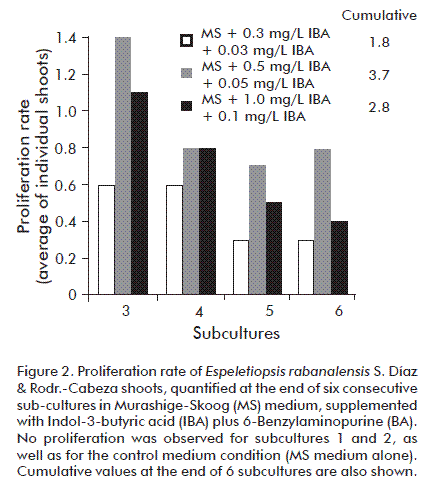
<body><![CDATA[<P   ><font size="2" face="Verdana, Arial, Helvetica, sans-serif">Multiplication stage      was performed using 1-2 cm long rootless seedlings developed in the previous      stage. Explants were grown for six consecutive sub-cultures (30 days each)      in MS without growth regulators and MS supplemented with 0.3 mg/L Indol-3-butyric      acid (IBA) plus 0.03 mg/L 6-Benzylaminopurine (BA), 0.5 mg/L IBA plus 0.05      mg/L BA, and 1.0 mg/L IBA plus 0.1 mg/L BA; 30 explants (5 per a 100-mL glass      jar with 15 mL of medium) were cultured in each medium. Taking into account      the total amount of individualized shoots per sub-culture, the percentage      of individualized shoot per treatment and the proliferation rate (PT) were      calculated by using the relationship PT = (Bi &ndash; B0)/B0, with B0 and      Bi representing the initial and individualized shoots, respectively. Individualized      shoots was the expression used for shoots with an easily observable portion      of stem (minimal length of </font><font size="2" face="Verdana, Arial, Helvetica, sans-serif">0.2      cm). Based on the results obtained, it was possible to determine the most      appropriate hormonal combination for shoot multiplication, which was later      used to support proliferation chains. </font></P >       <P   ><font size="2" face="Verdana, Arial, Helvetica, sans-serif"><b>Shoot rooting      and plantlet acclimatization </b></font></P >       <P   ><font size="2" face="Verdana, Arial, Helvetica, sans-serif">Individualized shoots      obtained during the multiplication stage were selected for rooting and they      were grown in MS without growth regulators and MS supplemented with 3, 5 or      7 mg/L IBA for 60 days with a subculture in fresh medium after 30 days. In      each of the treatments performed, 30 explants were cultured and the percentage      of rooted shoots was quantified, along with the number and length of roots      per shoot and d the percentage of shoots which formed basal callus. </font></P >       <P   ><font size="2" face="Verdana, Arial, Helvetica, sans-serif">Rooted shoots were      transferred to 200-mL glass jars, closed off with extensible paper which was      progressively pierced to 80 % of its total surface. The jars were filled with      30 g of sterile washed sand and 15 mL of a solution containing 200 mg/L KNO<sub>3</sub>,      800 mg/L Ca(NO<sub>3</sub>)<sub>2</sub> &bull;4H<sub>2</sub>O, 200 mg/L KHPO<sub>4</sub>,      200 mg/L MgSO<sub>4</sub>&bull;7H<sub>2</sub>O and 100 mg/L FeSO<sub>4</sub>.      Jars were kept in an incubation room for 40 days at 23 &ordm;C with continuous      illumination. Subsequently, under greenhouse conditions, the plantlets were      transferred to 250 cc plastic pots, each containing sterile substratum composed      by ground mulch, sand and soil, 3:2:1; the plantlets were then watered manually      once a day. After 60-day acclimatization, the percentage of viable plantlets      was registered. </font></P >       <P   ><font size="2" face="Verdana, Arial, Helvetica, sans-serif"><b>Culture conditions      </b> </font></P >       <P   ><font size="2" face="Verdana, Arial, Helvetica, sans-serif">Before adding agar      (6.5 g/L) pH in every medium was adjusted to 5.7 with 1 N KOH or 1 N HCL;      conse-quently, the media were sterilized in autoclave at 15 psi and 121 &ordm;C      for 20 min. Cultures were incubated at 24 &plusmn; 1 &deg;C with continuous      fluorescent illumination of 70-80 &mu;mol/m2&bull;s. </font></P >       <P   ><font size="2" face="Verdana, Arial, Helvetica, sans-serif"><b>Data analysis      </b></font></P >       <P   ><font size="2" face="Verdana, Arial, Helvetica, sans-serif">Data obtained were      processed using PASW Statistics 18 Software, version 18.0.0 (jul-30-2009),      and Excel 2013. Then the data were analyzed using the Chi-squared test goodness      of fit with a confidence interval of 95 %. Once the differences between the      average quantities were determined, they were grouped by higher and lower      average difference in order to identify homogeneous subset. </font></P >       <P   >&nbsp;</P >       <P   ><font size="3" face="Verdana, Arial, Helvetica, sans-serif"><b>RESULTS </b></font></P >       ]]></body>
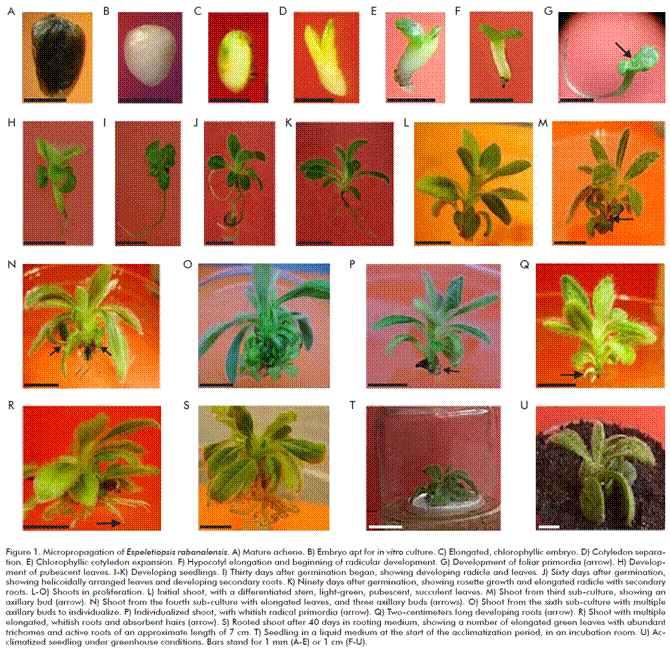
<body><![CDATA[<P   ><font size="2" face="Verdana, Arial, Helvetica, sans-serif"><b>Vegetal material,      superficial disinfection and in vitro establishment </b></font></P >       <P   ><font size="2" face="Verdana, Arial, Helvetica, sans-serif">Up to 5544 embryos,      1-1.5 mm long, were retrieved from the achenes (<a href="/img/revistas/bta/v33n1/f0102116.gif">Figure      1A</a>) extracted from collected flower heads. These embryos were apt for      <i>in vitro</i> culture, characterized by having consistent tissue, swollen      aspect and whitish coloration (<a href="/img/revistas/bta/v33n1/f0102116.gif">Figure 1B</a>). </font></P >       
<P   ><font size="2" face="Verdana, Arial, Helvetica, sans-serif">According to the      Chi-square test, statistically significant differences were found between      treatments (p = 0.0000282) treatments assayed for superficial asepsis (<a href="/img/revistas/bta/v33n1/t0102116.gif">Table      1</a>); nevertheless, similar behaviors were detected for treatments T1 and      T2, T3, and for treatments T4, T5, and T6. The most effective treatments were      T4 and T6, with 94.0 (868) and 85.0 % (785) aseptic embryos, followed by T3,      T5, T2 and T1 with 74.0 (684), 73.0 (674), 47.0 (434) and 45.0 % (415) aseptic      embryos, respectively. Similarly, 26 % (1441 out of the 5543 embryos treated)      showed microbial contamination, 16 % (887) bacterial contamination and 10      % (554) fungal contamination (<a href="/img/revistas/bta/v33n1/t0102116.gif">Table 1</a>). </font></P >       
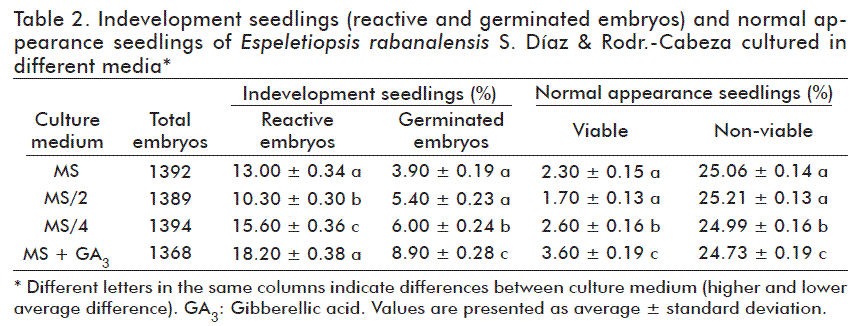
<P   ><font size="2" face="Verdana, Arial, Helvetica, sans-serif">After 45 days of      culture in germination media, 85.72 % (4753 embryos) did not show reactivity      and remained with the same appearance they had at the start of culture. Developing      seedlings showed greenish coloration or a slight elongation (14.28 %; 790),      42.27 % (334) of them germinating and 57.73 % (193) became brownish-grey and      died, for a final 42.21 % (141) of seedlings with normal appearance after      90 days of culture. This accounted for 2.5 % of the total embryos cultured.      </font></P >       <P   ><font size="2" face="Verdana, Arial, Helvetica, sans-serif">The highest percentage      of seedlings under development (reactive embryos, 18.2 %; germinated embryos,      8.92 %; normal appearance seedlings, 3.58 %) were obtained in MS/4 supplemented      with 1 mg/L GA<sub>3</sub>. The second best results were obtained in in MS/4      medium, with 15.6 % reactive embryos, 5.6 % germinated embryos and 2.6 % viable      seedlings. Seedling growth and development with vigorous appearance and leaves      in rosette arrangement were observed in these two culture media. Noteworthy,      there were no statistically significant differences in the number of reactive      embryos (Chi-square test; (p = 0.48966671) or germinated embryos (p = 0.52912812)      as a function of the culture medium assayed. Nevertheless, there were variations      between treatments the in reactivation and germination responses of embryos,      which made possible distinguishing three groups according to percentage differences      (<a href="/img/revistas/bta/v33n1/t0202116.gif">Table 2</a>). For the case of viable, normal appearance      seedlings after 90 days, it was not possible to apply the Chi-square test,      since the expected average values were lower than 5. For this reason, the      data were processed and analyzed considering the unviability as a function      of the assessed treatments, estimating that the culture media did not affect      seedling unviability (p = 0.9993). </font></P >       
<P   ><font size="2" face="Verdana, Arial, Helvetica, sans-serif">At the beginning      of the germination process, embryos suffered a slight elongation and turned      green-yellowish (<a href="/img/revistas/bta/v33n1/f0102116.gif">Figure 1 C</a>), cotyledons then separated,      expanded and turned green (<a href="/img/revistas/bta/v33n1/f0102116.gif">Figures 1 D-E</a>), hypocotyls      elongated and the development of the radicle began (<a href="/img/revistas/bta/v33n1/f0102116.gif">Figures      1 F-G</a>); the activity in the apical bud was evident and the first leaves      developed (<a href="/img/revistas/bta/v33n1/f0102116.gif">Figures 1 G-H</a>); the stem reached 1-3      mm and new dark-green pubescent leaves developed in a helicoid arranged (<a href="/img/revistas/bta/v33n1/f0102116.gif">Figures      1 H-K</a>), reaching up to 3-cm height. </font></P >       
<P   ><font size="2" face="Verdana, Arial, Helvetica, sans-serif"><b>Multiplication      of axillary shoots </b></font></P >       <P   ><font size="2" face="Verdana, Arial, Helvetica, sans-serif">The new shoots were      individualized from the third sub-culture on. Proliferation rates for the      assayed treatments showed statistically significant differences for sub-cultures      3 (p = 0.000266129), 4 (p = </font><font size="2" face="Verdana, Arial, Helvetica, sans-serif">2.57775      &times; 10<sup>-15</sup>), 5 (p = 2.57775 &times; 10<sup>-15</sup>) and 6      (p = 2.57775 &times; 10<sup>-82</sup>). The treatment with the highest percentage      of individualized shoots per culture (subculture 3: 33.49; subculture 4: 37.22;      subculture 5: 42.26; and subc6: 50.06) was the one performed in MS supplemented      with 0.5 mg/L IBA plus 0.05 mg/L BA (71, 131, 221 and 404 shoots in sub-cultures      3, 4, 5 and 6, respectively); by the end of the sub-culture 6, there was an      accumulated rate of proliferation of 1:4 individualized shoots (<a href="/img/revistas/bta/v33n1/f0202116.gif">Figure      2</a>). Besides, in this treatment, individualized explants reached up to      4 cm height and showed rosette growth (<a href="/img/revistas/bta/v33n1/f0102116.gif">Figures 1 L-M</a>),      10-15 succulent, pubescent, 2-5 cm long, dark-green leaves with continuous      edges (<a href="/img/revistas/bta/v33n1/f0102116.gif">Figures 1 N-O</a>). </font></P >       
<P   ><font size="2" face="Verdana, Arial, Helvetica, sans-serif"><b>Shoot rooting      and plantlets acclimatization </b></font></P >       <P   ><font size="2" face="Verdana, Arial, Helvetica, sans-serif">After 25 days of      culture in rooting media, most shoots showed radical primordia (<a href="/img/revistas/bta/v33n1/f0102116.gif">Figure      1 P</a>), root development (<a href="/img/revistas/bta/v33n1/f0102116.gif">Figure 1 Q</a>) was detected      after 40 days in all assayed media, except the controls, reaching up to 90      % of rooted shoots in MS supplemented with 7 mg/L IBA and 86.7 % in MS plus      5 mg/L IBA (35.1 and 33.8 % respectively, from total number of rooted shoots).      There were statistically significant differences (Chi-square test; p = 0.0358)      between treatments, particularly with 5 mg/L IBA which induced the best average      of root number and length. Keeping in mind the minimum length of roots, there      were mild statistical significances (p = 0.0537; Chi = 7.6515) and considerable      statistical significances for the maximum length (p = 0.0156; Chi = 10.3718).      Nonetheless, similar minimum length roots were obtained in treatments with      MS medium supplemented with either 3 or 7 mg/L IBA and similar maximum length      roots when the plantlets were cultured in MS plus 3 or 5 mg/L IBA (<a href="/img/revistas/bta/v33n1/t0302116.gif">Table      3</a>). </font></P >       
]]></body>
<body><![CDATA[<P   ><font size="2" face="Verdana, Arial, Helvetica, sans-serif">Results quantified      in MS plus 5 mg/L or 7 mg/L IBA showed the best results of shoot rooting,      and also the highest amount of developed shoots with basal callus (statistically      significant differences were found between treatments; p = 0.000547984). These      two groups also differentiated from the others in the for-mation of basal      calluses. Thus, the most appropriate medium for rooting of E. rabanalensis      shoots was MS supplemented with 3 mg/L IBA (<a href="/img/revistas/bta/v33n1/t0302116.gif">Table 3</a>),      this medium supporting the development of numerous, nor-mal-looking roots      of considerable length, whitish and showing multiple absorbent hairs (<a href="/img/revistas/bta/v33n1/f0102116.gif">Figure      1 R and S</a>). </font></P >       
<P   ><font size="2" face="Verdana, Arial, Helvetica, sans-serif">In plantlets rooted      in MS supplemented with 3, 5 or 7 mg/L IBA, viability was 75, 15 and 10 %,      respectively. Plantlets showed vigorous appearance, pubescent leaves, growth      and development of shoots and roots with multiple absorbent hairs (<a href="/img/revistas/bta/v33n1/f0102116.gif">Figures      1 T-U</a>). Besides, shoots which formed basal callus were not viable during      hardening, despite they developed roots. </font></P >       
<P   >&nbsp;</P >       <P   ><font size="2" face="Verdana, Arial, Helvetica, sans-serif"><b><font size="3">DISCUSSION      </font></b></font></P >       <P   ><font size="2" face="Verdana, Arial, Helvetica, sans-serif">When explants coming      from adult plants are cultured in vitro, establishing completely aseptic cultures      is usually very difficult due to the action of bacteria and fungi already      present in those plants [14-16]. Nevertheless, in the case of <i>E. rabanalensis</i>,      the application of sodium hypochlorite and calcium hypochlorite in adequate      amounts is an effective alternative for the efficient superficial disinfection      of sexual embryos. This last effect results from the germicide action of chlorine,      which is less phytotoxic than other disinfectants and destroys microorganisms      through its action on specific cellular components [17]. The use of calcium      hypochlorite favored the recovery of a high percentage of reactive aseptic      embryos with a smaller alteration and damage to their tissues, similarly to      reports by S&aacute;nchez <i>et al</i>. [18] in <i>Gyrocarpus americanus</i>      and Araque <i>et al</i>. [11] and Boh&oacute;rquez <i>et al</i>. [12] in <i>E.      paipana</i>. Furthermore, according to S&aacute;nchez and Salaverr&iacute;a      [19], calcium hypochlorite might be part of some processes of vegetal metabolism,      since Ca2+ is essential for several ones; calcium hypochlorite may also provide      soluble calcium to the tissue, thereby neutralizing organic acids and the      production of phenols and polyphenols, substances which contribute to the      oxidation of the explants during superficial asepsis. </font></P >       <P   ><font size="2" face="Verdana, Arial, Helvetica, sans-serif">Although there were      a high percentage of superficially aseptic embryos in the disinfection treatments      here assayed, it was also observed that when cultured <i>in vitro</i>, the      number of reactive and germinative embryos was low, a reason why the amount      of viable seedlings (2.5 %) 90 days after culture was notoriously low. This      response was similar to the one observed in <i>E. paipana</i> [12]. Nevertheless,      this action is not applicable to <i>E. rabanalensis</i> since the inter-annual      flowering rates are notoriously low and the reproductive sequence is asynchronous      and irregular [20, 21], despite the quality of this action is essential to      establish <i>in vitro</i> cultures from seeds. Therefore, the number of available      seeds is limited and plants further show monoecious flower heads which vary      in size and number of flowers [22]. They also present a strong sporophytic      self-incompatibility mechanism and a tendency to hybridation [22, 23]. Likewise,      Garc&iacute;a <i>et al</i>. [24] have pointed out that for <i>Dendrocalamus      strictus</i>, the availability of seeds is affected by the long and erratic      flowering cycle of the species, which makes its sexual propagation difficult;      besides, it is also important to note that, in tropical settings, seeds lose      viability after 2 or 3 months [25]. </font></P >       <P   ><font size="2" face="Verdana, Arial, Helvetica, sans-serif">Noteworthy, in addition      to the low germination capacity of the embryos, it is not possible to take      buds, organs or tissues from <i>E. rabanalensis</i> to establish <i>in vitro</i>      cultures. Instead, is relevant to use of zygotic embryos as initial explants      for the establishment of in vitro cultures, since it allows maintaining, at      least in part, the natural genetic diversity of the plant, a favorable aspect      in the processes of repopulation of natural areas and for in situ and ex situ      preservation [26]. Guerra <i>et al</i>. [27] pointed out that micropropagation      systems are an important tool for the improvement and massive clonal propagation      of selected genotypes, and that the use of embryos can be justified when conventional      propagation methods were inefficient in the species. That is the case of frailejones      and orchids, which bud multiplication depends on seed germination for the      initial production of seedlings. It is worth to say that not all the seeds      in a flower head, or a capsule for the case of orchids, are fully formed or      fertile, and only those with a viable embryo actually germinate [28]. In other      cases, the embryo is too small compared to the seed coat that the volume of      the seed is formed for up to 96 % of air [29], thereby humidity not reaching      the embryo, as in the case of <i>Laelia speciosa</i> [30]. Therefore, the      obtainment of seedlings through in vitro seed germination is an appropriate      tool when it is used to propagate hybrid plants or plants with very particular      properties as <i>E. rabanalensis</i>. </font></P >       <P   ><font size="2" face="Verdana, Arial, Helvetica, sans-serif">Regarding the culture      media assayed for embryo germination, those with mineral salts diluted at      &frac14; (MS/4) and supplemented with GA3 produced the best results for <i>in      vitro</i> cultures establishment. These results matched the ones obtained      by Mayo <i>et al</i>. [31], Brar <i>et al</i>. [32] and Boh&oacute;rquez <i>et      al</i>. [12] who established a high average of seed germination in low-salt      media. Besides, Vidales [33] indicated that, in order to carry out micropropagation      in some species, it should be advisable to use GA<sub>3</sub> during the <i>in      vitro</i> and <i>ex vitro</i> establishment phase, since phyto-regulator causes      a positive effect by improving the germinative energy of the species mainly      at the beginning of the germination process and during explant development.      In this regard, Gamborg <i>et a</i>l. [34] and Roca and Mroginsky [35] reported      that success in the establishment of <i>in vitro</i> cultures depends on the      medium selection, including chemical composition and physical form. Nevertheless,      it is difficult to find a completely efficient medium for plant production      from seeds, a particularly difficult task for the propagation of wild species.      </font></P >       <P   ><font size="2" face="Verdana, Arial, Helvetica, sans-serif">During the shoot      multiplication phase, explants coming from germinated embryos which showed      contamination by bacteria were not viable; they suffered necrosis and died      after the first or second sub-culture. In contrast, explants coming from germinated      embryos which did not show contamination formed and developed new axillary      buds, capable of responding to hormonal stimuli from the culture medium and      become individualized shoots. Statistical resemblance between multiplication      responses in the different treatments indicates that the range of usable hexogen      hormonal balance is not so narrow, indicating that both high and low relative      concentrations of assayed IBA and BA are effective to induce favorable response      on shoot proliferation of <i>E. rabanalensis</i>. Regarding concentrations,      Hugues [36] established that the levels of auxin and cytokinin required for      morphogenesis in explants from different taxa and different genotypes were      highly variable. Hence, such levels must be determined for each species or      variety. Likewise, the positive effect of the auxin-cytokinin combination      on cellular multiplication and the relevance of an adequate auxin/cytokinin      balance to increase proliferation rates have been corroborated for micropropagation      of <i>Espeletiopsis muiska</i> [37] and <i>E. paipana</i> [12], where a hormonal      balance favorable towards cytokinin was determined. </font></P >       <P   ><font size="2" face="Verdana, Arial, Helvetica, sans-serif">On the other hand,      as shown in <a href="/img/revistas/bta/v33n1/f0202116.gif">figure 2</a>, there was a growing tendency      in the proliferation rate of individualized shoots produced in the MS m&eacute;dium      supplemented with 0.5 mg/L IBA plus 0.05 mg/L BA, with bud formation pattern      and shoot development consistent and repetitive in such a way that individualized      shoots also formed axillary buds and developed new shoots. This guaranteed      the continuous maintenance of proliferative chains and the production of shoots      for in vitro rooting of <i>E. rabanalensis</i>. </font></P >       
]]></body>
<body><![CDATA[<P   ><font size="2" face="Verdana, Arial, Helvetica, sans-serif">Regarding the media      assayed for the rooting process, it was observed that none of the shoots cultured      in the control medium developed roots; therefore, it was evident that IBA      in the assayed rooting media stimulated rhizogenic development of shoots on      <i>E. rabanalensis</i>. This observation matches the statement made by Murashige      [38], who determined that high relative concentrations of auxin favor root      development. Data regarding <i>E. rabanalensis</i> shoot rooting showed statistically      significant differences between treatments; nevertheless, it is necessary      to bear in mind that the excess of auxin in the medium induced the formation      of basal callus, which according to Rios <i>et al</i>. [39] and Boh&oacute;rquez      <i>et al</i>. [12] makes seedlings unviable during the processes of acclimatization      and transference to greenhouse or open field conditions. Data registered in      <a href="/img/revistas/bta/v33n1/t0302116.gif">table 3</a> indicate that the number and length of      the roots increases with the incremented concentration of auxin, similar to      the process reported for <i>E. muiska</i> [37] and <i>E. paipana</i> [12],      as long as concentration does not exceed 5 mg/L. It may be observed that the      average values of the variables studied in <i>E. rabanalensis</i> decreased      in presence of 7 mg/L IBA. Moreover, N&eacute;meth [40] and Bennett <i>et      al</i>. [41] indicated that in vitro rooting of the obtained shoots is an      essential step which directly affects the success of <i>in vivo</i> plant      regeneration. </font></P >       
<P   ><font size="2" face="Verdana, Arial, Helvetica, sans-serif">Observations performed      on rooted shoots indicate that both the development of a proper radical system      and the development of functional roots, which facilitate nutrient absorption      from substratum used during acclimatization, increment the percentage of viable      seedlings in <i>ex vitro</i> conditions. When properly done, the acclimatization      phase facilitates the formation and development of new functional structures      which favor the viability of seedlings produced <i>in vitro</i>. That is the      case of newborn leaves which develop cuticle, produce epicuticular wax and      form functional stomata which provides an adequate transpiration rate. At      the same time, it must be taken into account that plants generated by in in      vitro culture behave as heterotrophic or mixotrophic organisms, a reason why      during the acclimatization phase they are forced to become autotrophs, what      changes their morphology and makes them susceptible to different types of      stress. </font></P >       <P   ><font size="2" face="Verdana, Arial, Helvetica, sans-serif">The substrate used      for acclimatization (ground mulch, sand and dirt; ratio 3:2:1) resulted appropriate      for growth and development of <i>E. rabanalensis</i> plantlets. According      to Valencia and Ramirez [42], this mixture provides high porosity, high water      retention, good ventilation, low pH and a fine texture. In fact, the nutritional      requirements of E. rabanalensis are rather particular, considering that it      is a paramo species. For instance, Mu&ntilde;oz [43] has pointed out that      it is important to keep the natural conditions on the soil in which the species      are intended to be spread and later develop, not always being necessary to      enrich the soil with fertilizer or any other corrective elements. Results      obtained in <i>E. rabanalensis</i> matched those reported for <i>E. muiska</i>      [37] and <i>E. paipana</i> [12], emphasizing that the initial control of temperature,      humidity and illumination is essential during the first stage of acclimatization.      Later on it was shown that that seedlings transferred directly from the culture      room to greenhouse conditions did not survive, even though the mixture used      as a substrate was adequate to establish ex vitro plantlets of frailejon.      </font></P >       <P   ><font size="2" face="Verdana, Arial, Helvetica, sans-serif">Hence, our results      contribute to the preservation not only of <i>E. rabanalensis</i>, a key species,      but of the paramos itself as the fragile ecosystem as it is. Moreover, micropropagation      of <i>E. rabanalensis</i> for replanting, relocation and preservation of high-mountain      ecosystems is an affordable and effective strategy for the restoration and/or      preservation of altered and degraded areas, further contributing to the protection      of water resources. According to Sturm and Rangel [2, 44], the implementation      of such strategy can be efficient for ecosystems where regeneration processes      are slow due to low net primary productivity, low temperatures, drastic day-to-night      temperature oscillations and acid soils, as it is the case of the tropical      high-mountain ecosystem. </font></P >       <P   ><font size="2" face="Verdana, Arial, Helvetica, sans-serif">In summary, the establishment      of an <i>in vitro</i> propagation protocol for <i>E. rabanalensis</i> contributes      to the knowledge and preservation of frailejones, facilitating the production      of plants from embryos superficially disinfected with calcium hypochlorite      (4 %) and cultured in MS/4 medium further supplemented with 1 mg/L GA3. The      in vitro vegetal material can be multiplied through proliferative chains in      MS with 0.5 mg/L IBA plus 0.05 mg/L BA; up to 80 % of shoots can produced      roots in MS medium supplemented with 3 mg/L IBA and 75 % viable plantlets      can be retrieved by the end of the acclimation stage. These also support further      studies to improve and maintain the native, introduced or endangered species      usable for restoration of degraded biomes, mainly caused by human productive      activities or due to the climate change. </font></P >       <P   >&nbsp;</P >       <P   ><font size="3" face="Verdana, Arial, Helvetica, sans-serif"><b>ACKNOWLEDGEMENTS      </b> </font></P >       <P   ><font size="2" face="Verdana, Arial, Helvetica, sans-serif">The authors thank      the staff of the Laboratorio de Cultivo de Tejidos Vegetales of the Universidad      Ped-ag&oacute;gica y Tecnol&oacute;gica de Colombia and ECOPETROL, agreement      5211740 UPTC-ECOPETROL, for their support during the execution and development      of this research. Also to Virginia Guti&eacute;rrez Pineda from the Departamento      Administrativo de Ciencia, Tecnolog&iacute;a e Innovaci&oacute;n, COLCIENCIAS,      and the Direcci&oacute;n de Investigaciones, DIN, of the Universidad Pedag&oacute;gica      y Tecnol&oacute;gica de Colombia. The research was financed by the program      Joven Talento Colciencias-UPTC, agreement 701, 2013, Scholarship J&oacute;venes      Investigadores e Innovadores 2013. </font></P >       <P   >&nbsp;</P >       <P   ><font face="Verdana, Arial, Helvetica, sans-serif" size="3"><b>REFERENCES</b></font></P >       ]]></body>
<body><![CDATA[<!-- ref --><P   ><font size="2" color="#000000" face="Verdana, Arial, Helvetica, sans-serif">1.      Casta&ntilde;o C. P&aacute;ramos y Ecosistemas alto andinos de Colombia en      condici&oacute;n de hotspot y global climatic tensor. Bogot&aacute;: Instituto      de Hidrolog&iacute;a, Metereolog&iacute;a y Estudios Ambientales, Ministerio      de Medio Ambiente, IDEAM, PNUD; 2002.     </font></P >   </font></font></font></font></font></font></font></font></font></font></font></font></font></font></font></font></font></font></font></font></font></font>        <p   ><font size="2" color="#000000" face="Verdana, Arial, Helvetica, sans-serif">2.      Sturm H, Rangel O. Ecolog&iacute;a de los p&aacute;ramos andinos. Una visi&oacute;n      preliminar integrada. Bogot&aacute;: Instituto de Ciencias Naturales. Universidad      Nacional de Colombia; 1985. </font></p >       <p   ><font size="2" color="#000000" face="Verdana, Arial, Helvetica, sans-serif">3.      Van der Hammen T. P&aacute;ramos. In: Informe nacional sobre el estado de      la biodiversidad 1997-Colombia. Bogot&aacute;: Instituto de Investigaci&oacute;n      de Recursos biol&oacute;gicos Alexander von Humboldt; 1998. </font></p >       <!-- ref --><p   ><font size="2" color="#000000" face="Verdana, Arial, Helvetica, sans-serif">4.      Hofstede R, Coppus R, Mena P, Segarra P, Wolf J, Sevink J. The conservation      status of tussock grass p&aacute;ramo in Ecuador. Ecotropicos. 2002;15(1):3-18.          </font></p >       <!-- ref --><p   ><font size="2" color="#000000" face="Verdana, Arial, Helvetica, sans-serif">5.      Salinas C, Fuentes L, Hern&aacute;ndez L. Caracterizaci&oacute;n de lepid&oacute;pteros      fit&oacute;fagos asociados a la hervibor&iacute;a de frailejones en la microcuenca      de la quebrada Calostros del Parque Nacional Natural Chingaza. Rev Mutis.      2013;3(1):1-22.     </font></p >       <!-- ref --><p   ><font size="2" color="#000000" face="Verdana, Arial, Helvetica, sans-serif">6.      D&iacute;asgranados M. A nomenclator for the frailejones (Espeletiinae Cuatrec,      Asteraceae). PhytoKeys. 2012;16:1-52.     </font></p >       ]]></body>
<body><![CDATA[<!-- ref --><p   ><font size="2" color="#000000" face="Verdana, Arial, Helvetica, sans-serif">7.      Rivera D. P&aacute;ramos de Colombia. Bogot&aacute;: Banco de Occidente; 2001.          </font></p >       <!-- ref --><p   ><font size="2" color="#000000" face="Verdana, Arial, Helvetica, sans-serif">8.      Secretaria Distrital de Ambiente y Conservaci&oacute;n Internacional Colombia.      Formulaci&oacute;n de la pol&iacute;tica de conservaci&oacute;n de la biodiversidad      en el distrito capital, su plan de acci&oacute;n y los lineamientos de conectividad      ecol&oacute;gica. Diagn&oacute;stico sobre la conservaci&oacute;n, conocimiento      y uso de la biodiversidad del Distrito Capital de Bogot&aacute;, Colombia;      2010.     </font></p >       <!-- ref --><p   ><font size="2" color="#000000" face="Verdana, Arial, Helvetica, sans-serif">9.      D&iacute;az W, Torres C. Estudio b&aacute;sico de restauraci&oacute;n vegetal      en &aacute;reas de subp&aacute;ramo degradadas de la Vereda Monquetiva-Guatavita.      Colomb. For. 2001;7(14):116-23.     </font></p >       <!-- ref --><p   ><font size="2" color="#000000" face="Verdana, Arial, Helvetica, sans-serif">10.      Ministerio de Agricultura y Desarrollo Rural. Colombia: Informe nacional para      la conferencia t&eacute;cnica internacional de la FAO sobre los recursos fitogen&eacute;ticos      (Leipzig 1996). Bogot&aacute;: Ministerio de Agricultura y Desarrollo Rural;      1995.     </font></p >       <!-- ref --><p   ><font size="2" color="#000000" face="Verdana, Arial, Helvetica, sans-serif">11.      Araque EJ, Boh&oacute;rquez MD, Pacheco JC. Micropropagaci&oacute;n de <i>Espeletia      paipana</i>. Clonaci&oacute;n de Frailejones. Tunja: Corporaci&oacute;n Aut&oacute;noma      Regional de Boyac&aacute;, Corpoboyac&aacute;; 2014.     </font></p >       ]]></body>
<body><![CDATA[<!-- ref --><p   ><font size="2" color="#000000" face="Verdana, Arial, Helvetica, sans-serif">12.      Boh&oacute;rquez MD, Araque EJ, Pacheco JC. Propagaci&oacute;n <i>in vitro</i>      de <i>Espeletia paipana</i> S. D&iacute;az y Pedraza, frailej&oacute;n end&eacute;mico      en peligro de extinci&oacute;n. Actual Biol. 2016;38(104):23-36.     </font></p >       <p   ><font size="2" color="#000000" face="Verdana, Arial, Helvetica, sans-serif">13.      Murashige T, Skoog F. A revised medium for rapid growth and bio-assays with      Tobacco tissue cultures. Physiol. Plant. 1962;15:473-97. </font></p >       <p   ><font size="2" color="#000000" face="Verdana, Arial, Helvetica, sans-serif">14.      Folgueras M, Herrera L, Carrazana D. La contaminaci&oacute;n microbiana en      la micropropagaci&oacute;n <i>in vitro</i> de las ra&iacute;ces y tub&eacute;rculos      tropicales. Libro de reportes cortos. Taller internacional BioVeg&rsquo;.      Ciego de Avila, Cuba; 2001. </font></p >       <!-- ref --><p   ><font size="2" color="#000000" face="Verdana, Arial, Helvetica, sans-serif">15.      Das M, Pal A. <i>In vitro</i> regeneration of <i>Bambusa balcoa</i> Roxb.      Factors affecting changes of morphogenetic competence buds. Plant Cell Tissue      Organ Cult. 2005;85(1):109-12.     </font></p >       <!-- ref --><p   ><font size="2" color="#000000" face="Verdana, Arial, Helvetica, sans-serif">16.      Rodr&iacute;guez M, Matehus J, Gersti A, Santana M. Identificaci&oacute;n      del agente causal de una bacteriosis en &ntilde;ame (Dioscorea alata L.).      Interciencia. 2008;33(7):1-11.     </font></p >       <!-- ref --><p   ><font size="2" color="#000000" face="Verdana, Arial, Helvetica, sans-serif">17.      Murata Y, Katsura S, Obi I, Kakutani T. Alterations in Ca2+ binding on plasma      membrane after adaptation to salt stress of tobacco cells in suspension. Plant      Cell Physiol. 2000;41:1286-92.     </font></p >       ]]></body>
<body><![CDATA[<!-- ref --><p   ><font size="2" color="#000000" face="Verdana, Arial, Helvetica, sans-serif">18.      S&aacute;nchez L, Rozo G, Montiel J. Cultivo in vitro de <i>Gyrocarpus americanus</i>      (Hernandiaceae). Ibagu&eacute;: Universidad del Tolima; 2012.     </font></p >       <!-- ref --><p   ><font size="2" color="#000000" face="Verdana, Arial, Helvetica, sans-serif">19.      S&aacute;nchez M, Salaverr&iacute;a J. Control de la oxidaci&oacute;n y la      contaminaci&oacute;n en el cultivo <i>in vitro</i> de fresa (<i>Fragaria ananassa</i>      Duch.). UDO Agr&iacute;cola. 2004;4:21-6.     </font></p >       <!-- ref --><p   ><font size="2" color="#000000" face="Verdana, Arial, Helvetica, sans-serif">20.      Estrada C, Monasterio M. Comportamiento reproductivo de una roseta gigante,      <i>Espeletia spicata</i> Sch. Bip. (Composite) del P&aacute;ramo des&eacute;rtico.      Ecotropicos. 1991;4(1):1-17.     </font></p >       <!-- ref --><p   ><font size="2" color="#000000" face="Verdana, Arial, Helvetica, sans-serif">21.      Cavelier J, Machado JL, Valencia D, Montoya J, Laignelet A, Hurtado A, <i>et      al.</i> Leaf demography and growth rates of <i>Espeletia barclayana</i> Cuatrec.      (Compositae), a caulescent rosette in a Colombian paramo. Biotropica. 1992;24:52-63.          </font></p >       <!-- ref --><p   ><font size="2" color="#000000" face="Verdana, Arial, Helvetica, sans-serif">22.      Berry P, Calvo R. Wind pollination, self-incompatibility and altitudinal shifts      in pollination systems in the high Andean genus <i>Espeletia</i> (Asteraceae).      Am J Bot. 1989;76:1602-14.     </font></p >       ]]></body>
<body><![CDATA[<!-- ref --><p   ><font size="2" color="#000000" face="Verdana, Arial, Helvetica, sans-serif">23.      Sobrevila C. Effects of pollen donors on seed formation in <i>Espeletia schultzii</i>      (Compositae) populations at different altitudes. Plant Syst Evol. 1989;166:45-67.          </font></p >       <!-- ref --><p   ><font size="2" color="#000000" face="Verdana, Arial, Helvetica, sans-serif">24.      Garc&iacute;a Y, Freire M; Tejeda M, Reyes M. Germinaci&oacute;n in vitro      de semillas de <i>Dendrocalamus strictus</i> (Rosb.) Nees. Biotecnolog&iacute;a      Vegetal 2007;7(1):41-4.     </font></p >       <p   ><font size="2" color="#000000" face="Verdana, Arial, Helvetica, sans-serif">25.      Gielis J, Woods J, Oprins J. Micropropagation, synthetic seeds and germplasm      storage of bamboos. 2004 [cited 2013 dic 26]. Available from: <a href="http://www.patentstorm.us/patents/6677154-description.html" target="_blank">http://www.patentstorm.us/patents/6677154-description.html</a>      </font></p >       <!-- ref --><p   ><font size="2" color="#000000" face="Verdana, Arial, Helvetica, sans-serif">26.      Raggio M, Moro N, Busso C. Germinaci&oacute;n <i>in vitro</i> de semillas      de <i>Encyclia adenocaula</i> (La Llave &amp; Lex.) Schltr (Orchidaceae).      Phyton. 2008;77:203-15.     </font></p >       <!-- ref --><p   ><font size="2" color="#000000" face="Verdana, Arial, Helvetica, sans-serif">27.      Guerra M, Pescador R, Dal Vesco L, Nodari R, Ducroquet J. <i>In vitro</i>      morphogenesis in <i>Feijoa sellowiana</i>: somatic embryogenesis. Proc. Int.      Sym. Myrtaceae. L. C. Donadio (Ed). Acta Hort. 1996;452:27-35.     </font></p >       <!-- ref --><p   ><font size="2" color="#000000" face="Verdana, Arial, Helvetica, sans-serif">28.      Arditti J, Ghani A. Numerical and physical properties of orchid seeds and      their biological implications. New Phytol. 2000;145(3):367-421.     </font></p >       <!-- ref --><p   ><font size="2" color="#000000" face="Verdana, Arial, Helvetica, sans-serif">29.      Arditti J. Fundamentals of orchid biology. New York: Wiley-Interscience; 1992.          </font></p >       <!-- ref --><p   ><font size="2" color="#000000" face="Verdana, Arial, Helvetica, sans-serif">30.      Arciga M. Germinaci&oacute;n in vitro de <i>Guarianthe aurantiaca</i> Bateman      (Orchidaceae) [dissertation]. Morelia, Mitch: Univ. Michoacana de San Nicol&aacute;s;      2011.     </font></p >       <!-- ref --><p   ><font size="2" color="#000000" face="Verdana, Arial, Helvetica, sans-serif">31.      Mayo A, C&aacute;zares J, De La Cruz E, Flores A. Germinaci&oacute;n in vitro      de semillas y desarrollo de pl&aacute;ntulas de orqu&iacute;deas silvestres      de Tabasco. (Colecci&oacute;n Jos&eacute; N. Rovirosa, Biodiversidad, Desarrollo      Sustentable y Tr&oacute;pico H&uacute;medo). Tabasco M&eacute;xico: Univ.      Ju&aacute;rez Aut&oacute;noma de Tabasco; 2010.     </font></p >       <!-- ref --><p   ><font size="2" color="#000000" face="Verdana, Arial, Helvetica, sans-serif">32.      Brar J, Anand M, Sood A. <i>In vitro</i> seed germination of economically      important edible bamboo <i>Dendrocalamus membranaceus</i> Munro. Indian J      Exp Biol. 2013;51(1):88-96.     </font></p >       <!-- ref --><p   ><font size="2" color="#000000" face="Verdana, Arial, Helvetica, sans-serif">33.      Vidales M. Regulaci&oacute;n hormonal en las plantas. Funci&oacute;n de relaci&oacute;n      en el reino Metafitas. Biolog&iacute;a y Geolog&iacute;a Argentina; 2003.          </font></p >       <!-- ref --><p   ><font size="2" color="#000000" face="Verdana, Arial, Helvetica, sans-serif">34.      Gamborg OL, Wetter LR. Plant tissue culture methods. Ottawa: National research      Council of Canada (NRC); 1975.     </font></p >       <!-- ref --><p   ><font size="2" color="#000000" face="Verdana, Arial, Helvetica, sans-serif">35.      Roca W, Mroginski L. Cultivo de tejidos en la agricultura: Fundamentos y aplicaciones.      Cali: Centro Internacional Agricultura Tropical, CIAT; 1991.     </font></p >       <!-- ref --><p   ><font size="2" color="#000000" face="Verdana, Arial, Helvetica, sans-serif">36.      Hughes W. Ornamental species. Cloning agricultural plants via <i>in vitro</i>      techniques. B.V. Conge (De). Boca Rat&oacute;n, Florida: CRC Press; 1981.          </font></p >       <!-- ref --><p   ><font size="2" color="#000000" face="Verdana, Arial, Helvetica, sans-serif">37.      Rache L, Pacheco J. Micropropagaci&oacute;n de <i>Espeletiopsis muiska</i>      (Cuatrecasas), frailej&oacute;n del Parque Natural Rancher&iacute;a-Boyac&aacute;,      Colombia. Agron Colomb. 2009; 27(3):349-358.     </font></p >       <!-- ref --><p   ><font size="2" color="#000000" face="Verdana, Arial, Helvetica, sans-serif">38.      Murashige T. Plant propagation through tissue cultures. Annu Rev Plant Physiol.      1974;25:135-66.     </font></p >       <!-- ref --><p   ><font size="2" color="#000000" face="Verdana, Arial, Helvetica, sans-serif">39.      R&iacute;os D, Avil&eacute;s F, S&aacute;nchez M, Escobar R, Pereira G. Variaci&oacute;n      de la tasa de enraizamiento asociada al n&uacute;mero de subcultivo y di&aacute;metro      de microtallos de casta&ntilde;o <i>Castanea sativa</i> Mill. Agricultura      T&eacute;cnica (Chile). 2005;65(3):258-64.     </font></p >       <p   ><font size="2" color="#000000" face="Verdana, Arial, Helvetica, sans-serif">40.      N&eacute;meth G. Induction of rooting. In: Baja Y. Biotechnology in agriculture      and forestry. Berlin: Springer; 1986. p. 49-64. </font></p >       <!-- ref --><p   ><font size="2" color="#000000" face="Verdana, Arial, Helvetica, sans-serif">41.      Bennett IJ, McComb JA, Tonkin CM, McDavid DA. Alternating cytokinins in multiplication      media stimulates in vitro shoot growth and rooting of <i>Eucalyptus globulus</i>      Labill. Ann Bot. 1994;74:53-8.     </font></p >       <!-- ref --><p   ><font size="2" color="#000000" face="Verdana, Arial, Helvetica, sans-serif">42.      Valencia M, Ram&iacute;rez F. Notas sobre la morfolog&iacute;a, anatom&iacute;a      y germinaci&oacute;n de agraz (<i>Vaccinium meridionale</i> Sw). Agron Colomb.      1993;10(2):151-9.     </font></p >       <!-- ref --><p   ><font size="2" color="#000000" face="Verdana, Arial, Helvetica, sans-serif">43.      Mu&ntilde;oz F. Propagaci&oacute;n de flora end&eacute;mica de p&aacute;ramo      o en peligro de extinci&oacute;n en el Parque Natural del Cocuy. Boyac&aacute;:      Parque Nacional del Cocuy; 2002.     </font></p >       ]]></body>
<body><![CDATA[<p   ><font size="2" color="#000000" face="Verdana, Arial, Helvetica, sans-serif">44.      Rangel JO, Sturm H. Consideraciones sobre la vegetaci&oacute;n, la productividad      y la artropofauna asociada a regiones paramunas de la cordillera oriental.      In: Mora LE, Sturm H. Estudios ecol&oacute;gicos del p&aacute;ramo y del bosque      altoandino cordillera oriental de Colombia. Tomo I. Bogot&aacute;: Academia      Colombiana de Ciencias Exactas, F&iacute;sicas y Naturales; 1995. p. 47-70.</font></p >   <FONT size="+1" color="#000000"><FONT size="+1"><FONT size="+1" color="#211E1F"><FONT size="+1" color="#000000"><FONT size="+1" color="#211E1F"><FONT size="+1" color="#000000"><FONT size="+1" color="#211E1F"><FONT size="+1"><FONT size="+1" color="#000000"><FONT size="+1" color="#211E1F"><FONT size="+1"><FONT size="+1"><FONT size="+1"><FONT size="+1"><FONT size="+1" color="#000000"><FONT size="+1" color="#211E1F"><FONT size="+1"><FONT size="+1"><FONT size="+1"><FONT size="+1"><FONT size="+1" color="#000000"><FONT size="+1" color="#211E1F">       <P   >&nbsp;</P >       <P   >&nbsp;</P >       <P   ><font size="2" face="Verdana, Arial, Helvetica, sans-serif">Received in July      2015.    <br>     Accepted in March 2016.</font></P >       <P   >&nbsp;</P >       <P   >&nbsp;</P >       <P   > </P >       <P   > </P >       <P   > </P >   <FONT size="+1" color="#000000">        ]]></body>
<body><![CDATA[<P   ><i><font size="2" color="#211E1F" face="Verdana, Arial, Helvetica, sans-serif">Eyda      J Araque-Barrera</font></i><font size="2" color="#211E1F" face="Verdana, Arial, Helvetica, sans-serif">.      Laboratorio de Cultivo de Tejidos Vegetales Bioplasma, Universidad Pedag&oacute;gica      y Tecnol&oacute;gica de Colombia, Colombia. E-mail: <A href="mailto:eyda.araque@uptc.edu.co">      <FONT color="#0000FF">eyda.araque@uptc.edu.co</font></A> </font></P >   </font></font></font></font></font></font></font></font></font></font></font></font></font></font></font></font></font></font></font></font></font></font></font></DIV >      ]]></body><back>
<ref-list>
<ref id="B1">
<label>1</label><nlm-citation citation-type="book">
<person-group person-group-type="author">
<name>
<surname><![CDATA[Castaño]]></surname>
<given-names><![CDATA[C]]></given-names>
</name>
</person-group>
<source><![CDATA[Páramos y Ecosistemas alto andinos de Colombia en condición de hotspot y global climatic tensor]]></source>
<year>2002</year>
<publisher-loc><![CDATA[Bogotá ]]></publisher-loc>
<publisher-name><![CDATA[Instituto de Hidrología, Metereología y Estudios Ambientales, Ministerio de Medio Ambiente, IDEAM, PNUD]]></publisher-name>
</nlm-citation>
</ref>
<ref id="B2">
<label>2</label><nlm-citation citation-type="book">
<person-group person-group-type="author">
<name>
<surname><![CDATA[Sturm]]></surname>
<given-names><![CDATA[H]]></given-names>
</name>
<name>
<surname><![CDATA[Rangel]]></surname>
<given-names><![CDATA[O]]></given-names>
</name>
</person-group>
<source><![CDATA[Ecología de los páramos andinos. Una visión preliminar integrada: Instituto de Ciencias Naturales]]></source>
<year>1985</year>
<publisher-loc><![CDATA[Bogotá ]]></publisher-loc>
<publisher-name><![CDATA[Universidad Nacional de Colombia]]></publisher-name>
</nlm-citation>
</ref>
<ref id="B3">
<label>3</label><nlm-citation citation-type="book">
<person-group person-group-type="author">
<name>
<surname><![CDATA[Van der Hammen]]></surname>
<given-names><![CDATA[T]]></given-names>
</name>
</person-group>
<article-title xml:lang="es"><![CDATA[Páramos]]></article-title>
<source><![CDATA[Informe nacional sobre el estado de la biodiversidad 1997-Colombia]]></source>
<year>1998</year>
<publisher-loc><![CDATA[Bogotá ]]></publisher-loc>
<publisher-name><![CDATA[Instituto de Investigación de Recursos biológicos Alexander von Humboldt]]></publisher-name>
</nlm-citation>
</ref>
<ref id="B4">
<label>4</label><nlm-citation citation-type="journal">
<person-group person-group-type="author">
<name>
<surname><![CDATA[Hofstede]]></surname>
<given-names><![CDATA[R]]></given-names>
</name>
<name>
<surname><![CDATA[Coppus]]></surname>
<given-names><![CDATA[R]]></given-names>
</name>
<name>
<surname><![CDATA[Mena]]></surname>
<given-names><![CDATA[P]]></given-names>
</name>
<name>
<surname><![CDATA[Segarra]]></surname>
<given-names><![CDATA[P]]></given-names>
</name>
<name>
<surname><![CDATA[Wolf]]></surname>
<given-names><![CDATA[J]]></given-names>
</name>
<name>
<surname><![CDATA[Sevink]]></surname>
<given-names><![CDATA[J]]></given-names>
</name>
</person-group>
<article-title xml:lang="en"><![CDATA[The conservation status of tussock grass páramo in Ecuador]]></article-title>
<source><![CDATA[Ecotropicos]]></source>
<year>2002</year>
<volume>15</volume>
<numero>1</numero>
<issue>1</issue>
<page-range>3-18</page-range></nlm-citation>
</ref>
<ref id="B5">
<label>5</label><nlm-citation citation-type="journal">
<person-group person-group-type="author">
<name>
<surname><![CDATA[Salinas]]></surname>
<given-names><![CDATA[C]]></given-names>
</name>
<name>
<surname><![CDATA[Fuentes]]></surname>
<given-names><![CDATA[L]]></given-names>
</name>
<name>
<surname><![CDATA[Hernández]]></surname>
<given-names><![CDATA[L]]></given-names>
</name>
</person-group>
<article-title xml:lang="es"><![CDATA[Caracterización de lepidópteros fitófagos asociados a la herviboría de frailejones en la microcuenca de la quebrada Calostros del Parque Nacional Natural Chingaza]]></article-title>
<source><![CDATA[Rev Mutis]]></source>
<year>2013</year>
<volume>3</volume>
<numero>1</numero>
<issue>1</issue>
<page-range>1-22</page-range></nlm-citation>
</ref>
<ref id="B6">
<label>6</label><nlm-citation citation-type="journal">
<person-group person-group-type="author">
<name>
<surname><![CDATA[Díasgranados]]></surname>
<given-names><![CDATA[M]]></given-names>
</name>
</person-group>
<article-title xml:lang="en"><![CDATA[A nomenclator for the frailejones (Espeletiinae Cuatrec, Astera-ceae)]]></article-title>
<source><![CDATA[PhytoKeys]]></source>
<year>2012</year>
<volume>16</volume>
<page-range>1-52</page-range></nlm-citation>
</ref>
<ref id="B7">
<label>7</label><nlm-citation citation-type="book">
<person-group person-group-type="author">
<name>
<surname><![CDATA[Rivera]]></surname>
<given-names><![CDATA[D]]></given-names>
</name>
</person-group>
<source><![CDATA[Páramos de Colombia]]></source>
<year>2001</year>
<publisher-loc><![CDATA[Bogotá ]]></publisher-loc>
<publisher-name><![CDATA[Banco de Occidente]]></publisher-name>
</nlm-citation>
</ref>
<ref id="B8">
<label>8</label><nlm-citation citation-type="">
<collab>Secretaria Distrital de Ambiente y Conservación Internacional Colombia</collab>
<source><![CDATA[Formulación de la política de conservación de la biodiversidad en el distrito capital, su plan de acción y los lineamientos de conectividad ecológica. Diagnóstico sobre la conservación, conocimiento y uso de la biodiversidad del Distrito Capital de Bogotá, Colombia]]></source>
<year>2010</year>
</nlm-citation>
</ref>
<ref id="B9">
<label>9</label><nlm-citation citation-type="journal">
<person-group person-group-type="author">
<name>
<surname><![CDATA[Díaz]]></surname>
<given-names><![CDATA[W]]></given-names>
</name>
<name>
<surname><![CDATA[Torres]]></surname>
<given-names><![CDATA[C]]></given-names>
</name>
</person-group>
<article-title xml:lang="es"><![CDATA[Estudio básico de restauración vegetal en áreas de subpáramo degradadas de la Vereda Monquetiva-Guatavita]]></article-title>
<source><![CDATA[Colomb For]]></source>
<year>2001</year>
<volume>7</volume>
<numero>14</numero>
<issue>14</issue>
<page-range>116-23</page-range></nlm-citation>
</ref>
<ref id="B10">
<label>10</label><nlm-citation citation-type="book">
<collab>Ministerio de Agricultura y Desarrollo Rural</collab>
<source><![CDATA[Colombia: Informe nacional para la conferencia técnica internacional de la FAO sobre los recursos fitogenéticos (Leipzig 1996)]]></source>
<year>1995</year>
<publisher-loc><![CDATA[Bogotá ]]></publisher-loc>
<publisher-name><![CDATA[Ministerio de Agricultura y Desarrollo Rural]]></publisher-name>
</nlm-citation>
</ref>
<ref id="B11">
<label>11</label><nlm-citation citation-type="book">
<person-group person-group-type="author">
<name>
<surname><![CDATA[Araque]]></surname>
<given-names><![CDATA[EJ]]></given-names>
</name>
<name>
<surname><![CDATA[Bohórquez]]></surname>
<given-names><![CDATA[MD]]></given-names>
</name>
<name>
<surname><![CDATA[Pacheco]]></surname>
<given-names><![CDATA[JC]]></given-names>
</name>
</person-group>
<source><![CDATA[Micropropagación de Espeletia paipana. Clonación de Frailejones]]></source>
<year>2014</year>
<publisher-loc><![CDATA[Tunja ]]></publisher-loc>
<publisher-name><![CDATA[Corporación Autónoma Regional de Boyacá, Corpoboyacá]]></publisher-name>
</nlm-citation>
</ref>
<ref id="B12">
<label>12</label><nlm-citation citation-type="journal">
<person-group person-group-type="author">
<name>
<surname><![CDATA[Bohórquez]]></surname>
<given-names><![CDATA[MD]]></given-names>
</name>
<name>
<surname><![CDATA[Araque]]></surname>
<given-names><![CDATA[EJ]]></given-names>
</name>
<name>
<surname><![CDATA[Pacheco]]></surname>
<given-names><![CDATA[JC]]></given-names>
</name>
</person-group>
<article-title xml:lang="es"><![CDATA[Propagación in vitro de Espeletia paipana S. Díaz y Pedraza, frailejón endémico en peligro de extinción]]></article-title>
<source><![CDATA[Actual Biol]]></source>
<year>2016</year>
<volume>38</volume>
<numero>104</numero>
<issue>104</issue>
<page-range>23-36</page-range></nlm-citation>
</ref>
<ref id="B13">
<label>13</label><nlm-citation citation-type="journal">
<person-group person-group-type="author">
<name>
<surname><![CDATA[Murashige]]></surname>
<given-names><![CDATA[T]]></given-names>
</name>
<name>
<surname><![CDATA[Skoog]]></surname>
<given-names><![CDATA[F]]></given-names>
</name>
</person-group>
<article-title xml:lang="en"><![CDATA[A revised medium for rapid growth and bio-assays whith Tobacco tissue cultures]]></article-title>
<source><![CDATA[Physiol Plant]]></source>
<year>1962</year>
<volume>15</volume>
<page-range>473-97</page-range></nlm-citation>
</ref>
<ref id="B14">
<label>14</label><nlm-citation citation-type="book">
<person-group person-group-type="author">
<name>
<surname><![CDATA[Folgueras]]></surname>
<given-names><![CDATA[M]]></given-names>
</name>
<name>
<surname><![CDATA[Herrera]]></surname>
<given-names><![CDATA[L]]></given-names>
</name>
<name>
<surname><![CDATA[Carrazana]]></surname>
<given-names><![CDATA[D]]></given-names>
</name>
</person-group>
<source><![CDATA[La contaminación microbiana en la micropropagación in vitro de las raíces y tubérculos tropicales. Libro de reportes cortos]]></source>
<year>2001</year>
<publisher-loc><![CDATA[Ciego de Ávila ]]></publisher-loc>
<publisher-name><![CDATA[Taller internacional BioVeg']]></publisher-name>
</nlm-citation>
</ref>
<ref id="B15">
<label>15</label><nlm-citation citation-type="journal">
<person-group person-group-type="author">
<name>
<surname><![CDATA[Das]]></surname>
<given-names><![CDATA[M]]></given-names>
</name>
<name>
<surname><![CDATA[Pal]]></surname>
<given-names><![CDATA[A]]></given-names>
</name>
</person-group>
<article-title xml:lang="en"><![CDATA[In vitro regeneration of Bambusa balcoa Roxb. Factors affecting changes of morphogenetic competence buds]]></article-title>
<source><![CDATA[Plant Cell Tissue Organ Cult]]></source>
<year>2005</year>
<volume>85</volume>
<numero>1</numero>
<issue>1</issue>
<page-range>109-12</page-range></nlm-citation>
</ref>
<ref id="B16">
<label>16</label><nlm-citation citation-type="journal">
<person-group person-group-type="author">
<name>
<surname><![CDATA[Rodríguez]]></surname>
<given-names><![CDATA[M]]></given-names>
</name>
<name>
<surname><![CDATA[Matehus]]></surname>
<given-names><![CDATA[J]]></given-names>
</name>
<name>
<surname><![CDATA[Gersti]]></surname>
<given-names><![CDATA[A]]></given-names>
</name>
<name>
<surname><![CDATA[Santana]]></surname>
<given-names><![CDATA[M]]></given-names>
</name>
</person-group>
<article-title xml:lang="es"><![CDATA[Identificación del agente causal de una bacteriosis en ñame (Dioscorea alata L.)]]></article-title>
<source><![CDATA[Interciencia]]></source>
<year>2008</year>
<volume>33</volume>
<numero>7</numero>
<issue>7</issue>
<page-range>1-11</page-range></nlm-citation>
</ref>
<ref id="B17">
<label>17</label><nlm-citation citation-type="journal">
<person-group person-group-type="author">
<name>
<surname><![CDATA[Murata]]></surname>
<given-names><![CDATA[Y]]></given-names>
</name>
<name>
<surname><![CDATA[Katsura]]></surname>
<given-names><![CDATA[S]]></given-names>
</name>
<name>
<surname><![CDATA[Obi]]></surname>
<given-names><![CDATA[I]]></given-names>
</name>
<name>
<surname><![CDATA[Kakutani]]></surname>
<given-names><![CDATA[T]]></given-names>
</name>
</person-group>
<article-title xml:lang="en"><![CDATA[Alterations in Ca2+ binding on plasma membrane after adaptation to salt stress of tobacco cells in suspension]]></article-title>
<source><![CDATA[Plant Cell Physiol]]></source>
<year>2000</year>
<volume>41</volume>
<page-range>1286-92</page-range></nlm-citation>
</ref>
<ref id="B18">
<label>18</label><nlm-citation citation-type="book">
<person-group person-group-type="author">
<name>
<surname><![CDATA[Sánchez]]></surname>
<given-names><![CDATA[L]]></given-names>
</name>
<name>
<surname><![CDATA[Rozo]]></surname>
<given-names><![CDATA[G]]></given-names>
</name>
<name>
<surname><![CDATA[Montiel]]></surname>
<given-names><![CDATA[J]]></given-names>
</name>
</person-group>
<source><![CDATA[Cultivo in vitro de Gyrocarpus americanus (Hernandiaceae)]]></source>
<year>2012</year>
<publisher-loc><![CDATA[Ibagué ]]></publisher-loc>
<publisher-name><![CDATA[Universidad del Tolima]]></publisher-name>
</nlm-citation>
</ref>
<ref id="B19">
<label>19</label><nlm-citation citation-type="journal">
<person-group person-group-type="author">
<name>
<surname><![CDATA[Sánchez]]></surname>
<given-names><![CDATA[M]]></given-names>
</name>
<name>
<surname><![CDATA[Salaverría]]></surname>
<given-names><![CDATA[J]]></given-names>
</name>
</person-group>
<article-title xml:lang="es"><![CDATA[Control de la oxidación y la contaminación en el cultivo in vitro de fresa (Fragaria ananassa Duch.)]]></article-title>
<source><![CDATA[UDO Agrícola]]></source>
<year>2004</year>
<volume>4</volume>
<page-range>21-6</page-range></nlm-citation>
</ref>
<ref id="B20">
<label>20</label><nlm-citation citation-type="journal">
<person-group person-group-type="author">
<name>
<surname><![CDATA[Estrada]]></surname>
<given-names><![CDATA[C]]></given-names>
</name>
<name>
<surname><![CDATA[Monasterio]]></surname>
<given-names><![CDATA[M]]></given-names>
</name>
</person-group>
<article-title xml:lang="es"><![CDATA[Comportamiento reproductivo de una roseta gigante, Espeletia spicata Sch. Bip. (Composite) del Páramo desértico]]></article-title>
<source><![CDATA[Ecotropicos]]></source>
<year>1991</year>
<volume>4</volume>
<numero>1</numero>
<issue>1</issue>
<page-range>1-17</page-range></nlm-citation>
</ref>
<ref id="B21">
<label>21</label><nlm-citation citation-type="journal">
<person-group person-group-type="author">
<name>
<surname><![CDATA[Cavelier]]></surname>
<given-names><![CDATA[J]]></given-names>
</name>
<name>
<surname><![CDATA[Machado]]></surname>
<given-names><![CDATA[JL]]></given-names>
</name>
<name>
<surname><![CDATA[Valencia]]></surname>
<given-names><![CDATA[D]]></given-names>
</name>
<name>
<surname><![CDATA[Montoya]]></surname>
<given-names><![CDATA[J]]></given-names>
</name>
<name>
<surname><![CDATA[Laignelet]]></surname>
<given-names><![CDATA[A]]></given-names>
</name>
<name>
<surname><![CDATA[Hurtado]]></surname>
<given-names><![CDATA[A]]></given-names>
</name>
</person-group>
<article-title xml:lang="en"><![CDATA[Leaf demography and growth rates of Espeletia barclayana Cuatrec. (Compositae), a caulescent rosette in a Colombian paramo]]></article-title>
<source><![CDATA[Biotropica]]></source>
<year>1992</year>
<volume>24</volume>
<page-range>52-63</page-range></nlm-citation>
</ref>
<ref id="B22">
<label>22</label><nlm-citation citation-type="journal">
<person-group person-group-type="author">
<name>
<surname><![CDATA[Berry]]></surname>
<given-names><![CDATA[P]]></given-names>
</name>
<name>
<surname><![CDATA[Calvo]]></surname>
<given-names><![CDATA[R]]></given-names>
</name>
</person-group>
<article-title xml:lang="en"><![CDATA[Wind pollination, self-incompatibility and altitudinal shifts in pollination systems in the high Andean genus Espeletia (Asteraceae)]]></article-title>
<source><![CDATA[Am J Bot]]></source>
<year>1989</year>
<volume>76</volume>
<page-range>1602-14</page-range></nlm-citation>
</ref>
<ref id="B23">
<label>23</label><nlm-citation citation-type="journal">
<person-group person-group-type="author">
<name>
<surname><![CDATA[Sobrevila]]></surname>
<given-names><![CDATA[C]]></given-names>
</name>
</person-group>
<article-title xml:lang="en"><![CDATA[Effects of pollen donors on seed formation in Espeletia schultzii (Compositae) populations at different altitudes]]></article-title>
<source><![CDATA[Plant Syst Evol]]></source>
<year>1989</year>
<volume>166</volume>
<page-range>45-67</page-range></nlm-citation>
</ref>
<ref id="B24">
<label>24</label><nlm-citation citation-type="journal">
<person-group person-group-type="author">
<name>
<surname><![CDATA[García]]></surname>
<given-names><![CDATA[Y]]></given-names>
</name>
<name>
<surname><![CDATA[Freire]]></surname>
<given-names><![CDATA[M]]></given-names>
</name>
<name>
<surname><![CDATA[Tejeda]]></surname>
<given-names><![CDATA[M]]></given-names>
</name>
<name>
<surname><![CDATA[Reyes]]></surname>
<given-names><![CDATA[M]]></given-names>
</name>
</person-group>
<article-title xml:lang="es"><![CDATA[Germinación in vitro de semillas de Dendrocalamus strictus (Rosb.) Nees]]></article-title>
<source><![CDATA[Biotecnología Vegetal]]></source>
<year>2007</year>
<volume>7</volume>
<numero>1</numero>
<issue>1</issue>
<page-range>41-4</page-range></nlm-citation>
</ref>
<ref id="B25">
<label>25</label><nlm-citation citation-type="">
<person-group person-group-type="author">
<name>
<surname><![CDATA[Gielis]]></surname>
<given-names><![CDATA[J]]></given-names>
</name>
<name>
<surname><![CDATA[Woods]]></surname>
<given-names><![CDATA[J]]></given-names>
</name>
<name>
<surname><![CDATA[Oprins]]></surname>
<given-names><![CDATA[J]]></given-names>
</name>
</person-group>
<source><![CDATA[Micropropagation, synthetic seeds and germplasm storage of bamboos]]></source>
<year>2004</year>
</nlm-citation>
</ref>
<ref id="B26">
<label>26</label><nlm-citation citation-type="journal">
<person-group person-group-type="author">
<name>
<surname><![CDATA[Raggio]]></surname>
<given-names><![CDATA[M]]></given-names>
</name>
<name>
<surname><![CDATA[Moro]]></surname>
<given-names><![CDATA[N]]></given-names>
</name>
<name>
<surname><![CDATA[Busso]]></surname>
<given-names><![CDATA[C]]></given-names>
</name>
</person-group>
<article-title xml:lang="es"><![CDATA[Germinación in vitro de semillas de Encyclia adenocaula (La Llave & Lex.) Schltr (Orchidaceae)]]></article-title>
<source><![CDATA[Phyton]]></source>
<year>2008</year>
<volume>77</volume>
<page-range>203-15</page-range></nlm-citation>
</ref>
<ref id="B27">
<label>27</label><nlm-citation citation-type="journal">
<person-group person-group-type="author">
<name>
<surname><![CDATA[Guerra]]></surname>
<given-names><![CDATA[M]]></given-names>
</name>
<name>
<surname><![CDATA[Pescador]]></surname>
<given-names><![CDATA[R]]></given-names>
</name>
<name>
<surname><![CDATA[Dal Vesco]]></surname>
<given-names><![CDATA[L]]></given-names>
</name>
<name>
<surname><![CDATA[Nodari]]></surname>
<given-names><![CDATA[R]]></given-names>
</name>
<name>
<surname><![CDATA[Ducroquet]]></surname>
<given-names><![CDATA[J]]></given-names>
</name>
</person-group>
<article-title xml:lang="en"><![CDATA[In vitro morphogenesis in Feijoa sellowiana: somatic embryogenesis. Proc. Int. Sym. Myrtaceae. L. C. Donadio (Ed)]]></article-title>
<source><![CDATA[Acta Hort]]></source>
<year>1996</year>
<volume>452</volume>
<page-range>27-35</page-range></nlm-citation>
</ref>
<ref id="B28">
<label>28</label><nlm-citation citation-type="journal">
<person-group person-group-type="author">
<name>
<surname><![CDATA[Arditti]]></surname>
<given-names><![CDATA[J]]></given-names>
</name>
<name>
<surname><![CDATA[Ghani]]></surname>
<given-names><![CDATA[A]]></given-names>
</name>
</person-group>
<article-title xml:lang="en"><![CDATA[Numerical and physical properties of orchid seeds and their biological implications]]></article-title>
<source><![CDATA[New Phytol]]></source>
<year>2000</year>
<volume>145</volume>
<numero>3</numero>
<issue>3</issue>
<page-range>367-421</page-range></nlm-citation>
</ref>
<ref id="B29">
<label>29</label><nlm-citation citation-type="book">
<person-group person-group-type="author">
<name>
<surname><![CDATA[Arditti]]></surname>
<given-names><![CDATA[J]]></given-names>
</name>
</person-group>
<source><![CDATA[Fundamentals of orchid biology]]></source>
<year>1992</year>
<publisher-loc><![CDATA[New York ]]></publisher-loc>
<publisher-name><![CDATA[Wiley-Interscience]]></publisher-name>
</nlm-citation>
</ref>
<ref id="B30">
<label>30</label><nlm-citation citation-type="book">
<person-group person-group-type="author">
<name>
<surname><![CDATA[Arciga]]></surname>
<given-names><![CDATA[M]]></given-names>
</name>
</person-group>
<source><![CDATA[Germinación in vitro de Guarianthe aurantiaca Bateman (Orchidaceae) (dissertation)]]></source>
<year>2011</year>
<publisher-loc><![CDATA[Morelia, Mitch ]]></publisher-loc>
<publisher-name><![CDATA[Univ. Michoacana de San Nicolás]]></publisher-name>
</nlm-citation>
</ref>
<ref id="B31">
<label>31</label><nlm-citation citation-type="book">
<person-group person-group-type="author">
<name>
<surname><![CDATA[Mayo]]></surname>
<given-names><![CDATA[A]]></given-names>
</name>
<name>
<surname><![CDATA[Cázares]]></surname>
<given-names><![CDATA[J]]></given-names>
</name>
<name>
<surname><![CDATA[De La Cruz]]></surname>
<given-names><![CDATA[E]]></given-names>
</name>
<name>
<surname><![CDATA[Flores]]></surname>
<given-names><![CDATA[A]]></given-names>
</name>
</person-group>
<source><![CDATA[Germinación in vitro de semillas y desarrollo de plántulas de orquídeas silvestres de Tabasco. (Colección José N. Rovirosa, Biodiversidad, Desarrollo Sustentable y Trópico Húmedo)]]></source>
<year>2010</year>
<publisher-loc><![CDATA[Tabasco México ]]></publisher-loc>
<publisher-name><![CDATA[Univ. Juárez Autónoma de Tabasco]]></publisher-name>
</nlm-citation>
</ref>
<ref id="B32">
<label>32</label><nlm-citation citation-type="journal">
<person-group person-group-type="author">
<name>
<surname><![CDATA[Brar]]></surname>
<given-names><![CDATA[J]]></given-names>
</name>
<name>
<surname><![CDATA[Anand]]></surname>
<given-names><![CDATA[M]]></given-names>
</name>
<name>
<surname><![CDATA[Sood]]></surname>
<given-names><![CDATA[A]]></given-names>
</name>
</person-group>
<article-title xml:lang="en"><![CDATA[In vitro seed germination of economically important edible bamboo Dendrocalamus membranaceus Munro]]></article-title>
<source><![CDATA[Indian J Exp Biol]]></source>
<year>2013</year>
<volume>51</volume>
<numero>1</numero>
<issue>1</issue>
<page-range>88-96</page-range></nlm-citation>
</ref>
<ref id="B33">
<label>33</label><nlm-citation citation-type="">
<person-group person-group-type="author">
<name>
<surname><![CDATA[Vidales]]></surname>
<given-names><![CDATA[M]]></given-names>
</name>
</person-group>
<source><![CDATA[Regulación hormonal en las plantas. Función de relación en el reino Metafitas. Biología y Geología Argentina]]></source>
<year>2003</year>
</nlm-citation>
</ref>
<ref id="B34">
<label>34</label><nlm-citation citation-type="book">
<person-group person-group-type="author">
<name>
<surname><![CDATA[Gamborg]]></surname>
<given-names><![CDATA[OL]]></given-names>
</name>
<name>
<surname><![CDATA[Wetter]]></surname>
<given-names><![CDATA[LR]]></given-names>
</name>
</person-group>
<source><![CDATA[Plant tissue culture methods]]></source>
<year>1975</year>
<publisher-loc><![CDATA[Ottawa ]]></publisher-loc>
<publisher-name><![CDATA[National research Council of Canada (NRC)]]></publisher-name>
</nlm-citation>
</ref>
<ref id="B35">
<label>35</label><nlm-citation citation-type="book">
<person-group person-group-type="author">
<name>
<surname><![CDATA[Roca]]></surname>
<given-names><![CDATA[W]]></given-names>
</name>
<name>
<surname><![CDATA[Mroginski]]></surname>
<given-names><![CDATA[L]]></given-names>
</name>
</person-group>
<source><![CDATA[Cultivo de tejidos en la agricultura: Fundamentos y aplicacio-nes]]></source>
<year>1991</year>
<publisher-loc><![CDATA[Cali ]]></publisher-loc>
<publisher-name><![CDATA[Centro Internacional Agricultura Tropical, CIAT]]></publisher-name>
</nlm-citation>
</ref>
<ref id="B36">
<label>36</label><nlm-citation citation-type="book">
<person-group person-group-type="author">
<name>
<surname><![CDATA[Hughes]]></surname>
<given-names><![CDATA[W]]></given-names>
</name>
</person-group>
<source><![CDATA[Ornamental species. Cloning agricultural plants via in vitro techniques. B.V. Conge (De)]]></source>
<year>1981</year>
<publisher-loc><![CDATA[Boca Ratón, Florida ]]></publisher-loc>
<publisher-name><![CDATA[CRC Press]]></publisher-name>
</nlm-citation>
</ref>
<ref id="B37">
<label>37</label><nlm-citation citation-type="journal">
<person-group person-group-type="author">
<name>
<surname><![CDATA[Rache]]></surname>
<given-names><![CDATA[L]]></given-names>
</name>
<name>
<surname><![CDATA[Pacheco]]></surname>
<given-names><![CDATA[J]]></given-names>
</name>
</person-group>
<article-title xml:lang="es"><![CDATA[Micropropagación de Espeletiopsis muiska (Cuatrecasas), frailejón del Parque Natural Ranchería- Boyacá, Colombia]]></article-title>
<source><![CDATA[Agron Colomb]]></source>
<year>2009</year>
<volume>27</volume>
<numero>3</numero>
<issue>3</issue>
<page-range>349-358</page-range></nlm-citation>
</ref>
<ref id="B38">
<label>38</label><nlm-citation citation-type="journal">
<person-group person-group-type="author">
<name>
<surname><![CDATA[Murashige]]></surname>
<given-names><![CDATA[T]]></given-names>
</name>
</person-group>
<article-title xml:lang="en"><![CDATA[Plant propagation through tissue cultures]]></article-title>
<source><![CDATA[Annu Rev Plant Physiol]]></source>
<year>1974</year>
<volume>25</volume>
<page-range>135-66</page-range></nlm-citation>
</ref>
<ref id="B39">
<label>39</label><nlm-citation citation-type="journal">
<person-group person-group-type="author">
<name>
<surname><![CDATA[Ríos]]></surname>
<given-names><![CDATA[D]]></given-names>
</name>
<name>
<surname><![CDATA[Avilés]]></surname>
<given-names><![CDATA[F]]></given-names>
</name>
<name>
<surname><![CDATA[Sánchez]]></surname>
<given-names><![CDATA[M]]></given-names>
</name>
<name>
<surname><![CDATA[Escobar]]></surname>
<given-names><![CDATA[R]]></given-names>
</name>
<name>
<surname><![CDATA[Pereira]]></surname>
<given-names><![CDATA[G]]></given-names>
</name>
</person-group>
<article-title xml:lang="es"><![CDATA[Variación de la tasa de enraizamiento asociada al número de subcultivo y diámetro de microtallos de castaño Castanea sativa Mill]]></article-title>
<source><![CDATA[Agricultura Técnica (Chile)]]></source>
<year>2005</year>
<volume>65</volume>
<numero>3</numero>
<issue>3</issue>
<page-range>258-64</page-range></nlm-citation>
</ref>
<ref id="B40">
<label>40</label><nlm-citation citation-type="book">
<person-group person-group-type="author">
<name>
<surname><![CDATA[Németh]]></surname>
<given-names><![CDATA[G]]></given-names>
</name>
</person-group>
<article-title xml:lang="en"><![CDATA[Induction of rooting]]></article-title>
<person-group person-group-type="editor">
<name>
<surname><![CDATA[Baja]]></surname>
<given-names><![CDATA[Y]]></given-names>
</name>
</person-group>
<source><![CDATA[Biotechnology in agriculture and forestry]]></source>
<year>1986</year>
<page-range>49-64</page-range><publisher-loc><![CDATA[Berlin ]]></publisher-loc>
<publisher-name><![CDATA[Springer]]></publisher-name>
</nlm-citation>
</ref>
<ref id="B41">
<label>41</label><nlm-citation citation-type="journal">
<person-group person-group-type="author">
<name>
<surname><![CDATA[Bennett]]></surname>
<given-names><![CDATA[IJ]]></given-names>
</name>
<name>
<surname><![CDATA[McComb]]></surname>
<given-names><![CDATA[JA]]></given-names>
</name>
<name>
<surname><![CDATA[Tonkin]]></surname>
<given-names><![CDATA[CM]]></given-names>
</name>
<name>
<surname><![CDATA[McDavid]]></surname>
<given-names><![CDATA[DA]]></given-names>
</name>
</person-group>
<article-title xml:lang="en"><![CDATA[Alternating cytokinins in multiplication media stimulates in vitro shoot growth and rooting of Eucalyptus globulus Labill]]></article-title>
<source><![CDATA[Ann Bot]]></source>
<year>1994</year>
<volume>74</volume>
<page-range>53-8</page-range></nlm-citation>
</ref>
<ref id="B42">
<label>42</label><nlm-citation citation-type="journal">
<person-group person-group-type="author">
<name>
<surname><![CDATA[Valencia]]></surname>
<given-names><![CDATA[M]]></given-names>
</name>
<name>
<surname><![CDATA[Ramírez]]></surname>
<given-names><![CDATA[F]]></given-names>
</name>
</person-group>
<article-title xml:lang="es"><![CDATA[Notas sobre la morfología, anatomía y germinación de agraz (Vaccinium meridionale Sw)]]></article-title>
<source><![CDATA[Agron Colomb]]></source>
<year>1993</year>
<volume>10</volume>
<numero>2</numero>
<issue>2</issue>
<page-range>151-9</page-range></nlm-citation>
</ref>
<ref id="B43">
<label>43</label><nlm-citation citation-type="book">
<person-group person-group-type="author">
<name>
<surname><![CDATA[Muñoz]]></surname>
<given-names><![CDATA[F]]></given-names>
</name>
</person-group>
<source><![CDATA[Propagación de flora endémica de páramo o en peligro de extinción en el Parque Natural del Cocuy]]></source>
<year>2002</year>
<publisher-loc><![CDATA[Boyacá ]]></publisher-loc>
<publisher-name><![CDATA[Parque Nacional del Cocuy]]></publisher-name>
</nlm-citation>
</ref>
<ref id="B44">
<label>44</label><nlm-citation citation-type="book">
<person-group person-group-type="author">
<name>
<surname><![CDATA[Rangel]]></surname>
<given-names><![CDATA[JO]]></given-names>
</name>
<name>
<surname><![CDATA[Sturm]]></surname>
<given-names><![CDATA[H]]></given-names>
</name>
</person-group>
<article-title xml:lang="es"><![CDATA[Consideraciones sobre la vegetación, la productividad y la artropofauna asociada a regiones paramunas de la cordillera oriental]]></article-title>
<person-group person-group-type="editor">
<name>
<surname><![CDATA[Mora]]></surname>
<given-names><![CDATA[LE]]></given-names>
</name>
<name>
<surname><![CDATA[Sturm]]></surname>
<given-names><![CDATA[H]]></given-names>
</name>
</person-group>
<source><![CDATA[Estudios ecológicos del páramo y del bosque altoandino cordillera oriental de Colombia. Tomo I]]></source>
<year>1995</year>
<page-range>47-70</page-range><publisher-loc><![CDATA[Bogotá ]]></publisher-loc>
<publisher-name><![CDATA[Academia Colombiana de Ciencias Exactas, Físicas y Naturales]]></publisher-name>
</nlm-citation>
</ref>
</ref-list>
</back>
</article>