<?xml version="1.0" encoding="ISO-8859-1"?><article xmlns:mml="http://www.w3.org/1998/Math/MathML" xmlns:xlink="http://www.w3.org/1999/xlink" xmlns:xsi="http://www.w3.org/2001/XMLSchema-instance">
<front>
<journal-meta>
<journal-id>1027-2852</journal-id>
<journal-title><![CDATA[Biotecnología Aplicada]]></journal-title>
<abbrev-journal-title><![CDATA[Biotecnol Apl]]></abbrev-journal-title>
<issn>1027-2852</issn>
<publisher>
<publisher-name><![CDATA[Editorial Elfos Scientiae]]></publisher-name>
</publisher>
</journal-meta>
<article-meta>
<article-id>S1027-28522016000100007</article-id>
<title-group>
<article-title xml:lang="en"><![CDATA[Spreading kinetics of the exogenous porcine surfactant Surfacen® mixed with drugs used in respiratory clinics]]></article-title>
<article-title xml:lang="es"><![CDATA[Cinética de esparcimiento del surfactante porcino exógeno Surfacen® mezclado con fármacos empleados en la clínica respiratoria]]></article-title>
</title-group>
<contrib-group>
<contrib contrib-type="author">
<name>
<surname><![CDATA[Blanco]]></surname>
<given-names><![CDATA[Odalys]]></given-names>
</name>
<xref ref-type="aff" rid="A01"/>
</contrib>
<contrib contrib-type="author">
<name>
<surname><![CDATA[Pérez]]></surname>
<given-names><![CDATA[Rebeca]]></given-names>
</name>
<xref ref-type="aff" rid="A01"/>
</contrib>
<contrib contrib-type="author">
<name>
<surname><![CDATA[Lugones]]></surname>
<given-names><![CDATA[Yuliannis]]></given-names>
</name>
<xref ref-type="aff" rid="A01"/>
</contrib>
<contrib contrib-type="author">
<name>
<surname><![CDATA[Morilla]]></surname>
<given-names><![CDATA[Andrés]]></given-names>
</name>
<xref ref-type="aff" rid="A02"/>
</contrib>
<contrib contrib-type="author">
<name>
<surname><![CDATA[Faure]]></surname>
<given-names><![CDATA[Roberto]]></given-names>
</name>
<xref ref-type="aff" rid="A01"/>
</contrib>
</contrib-group>
<aff id="A02">
<institution><![CDATA[,Hospital Materno Infantil Dr. Ángel Arturo Aballí  ]]></institution>
<addr-line><![CDATA[La Habana ]]></addr-line>
<country>Cuba</country>
</aff>
<aff id="A01">
<institution><![CDATA[,Centro Nacional de Sanidad Agropecuaria, CENSA  ]]></institution>
<addr-line><![CDATA[San José de las Lajas ]]></addr-line>
<country>Cuba</country>
</aff>
<pub-date pub-type="pub">
<day>00</day>
<month>03</month>
<year>2016</year>
</pub-date>
<pub-date pub-type="epub">
<day>00</day>
<month>03</month>
<year>2016</year>
</pub-date>
<volume>33</volume>
<numero>1</numero>
<fpage>1521</fpage>
<lpage>1525</lpage>
<copyright-statement/>
<copyright-year/>
<self-uri xlink:href="http://scielo.sld.cu/scielo.php?script=sci_arttext&amp;pid=S1027-28522016000100007&amp;lng=en&amp;nrm=iso"></self-uri><self-uri xlink:href="http://scielo.sld.cu/scielo.php?script=sci_abstract&amp;pid=S1027-28522016000100007&amp;lng=en&amp;nrm=iso"></self-uri><self-uri xlink:href="http://scielo.sld.cu/scielo.php?script=sci_pdf&amp;pid=S1027-28522016000100007&amp;lng=en&amp;nrm=iso"></self-uri><kwd-group>
<kwd lng="en"><![CDATA[Surfacen]]></kwd>
<kwd lng="en"><![CDATA[pulmonary surfactant]]></kwd>
<kwd lng="en"><![CDATA[N-acetylcysteine]]></kwd>
<kwd lng="en"><![CDATA[amikacin]]></kwd>
<kwd lng="en"><![CDATA[hydrocortisone]]></kwd>
<kwd lng="en"><![CDATA[spreading kinetics]]></kwd>
<kwd lng="es"><![CDATA[Surfacen]]></kwd>
<kwd lng="es"><![CDATA[surfactante pulmonar]]></kwd>
<kwd lng="es"><![CDATA[N-acetilcisteína]]></kwd>
<kwd lng="es"><![CDATA[amikacina]]></kwd>
<kwd lng="es"><![CDATA[hidrocortisona]]></kwd>
<kwd lng="es"><![CDATA[cinética de esparcimiento]]></kwd>
</kwd-group>
</article-meta>
</front><body><![CDATA[ <DIV class="Sect"   >        <P align="right"   ><font size="2" color="#000000" face="Verdana, Arial, Helvetica, sans-serif"><b>REPORT      </b> </font></P >       <P align="right"   >&nbsp;</P >   <FONT size="+1" color="#000000">        <P   ><font size="4" color="#211E1F" face="Verdana, Arial, Helvetica, sans-serif"><B>Spreading      kinetics of the exogenous porcine surfactant Surfacen&reg; mixed with drugs      used in respiratory clinics </b></font></P >       <P   >&nbsp;</P >   <FONT size="+1" color="#211E1F"><B>        <P   ><font size="3" face="Verdana, Arial, Helvetica, sans-serif">Cin&eacute;tica de      esparcimiento del surfactante porcino ex&oacute;geno Surfacen&reg; mezclado      con f&aacute;rmacos empleados en la cl&iacute;nica respiratoria </font></P >       <P   >&nbsp;</P >       <P   >&nbsp;</P >   </B><FONT size="+1">       <P   ></P >   </font><FONT size="+1">       <P   ><b><font size="2" color="#211E1F" face="Verdana, Arial, Helvetica, sans-serif">Odalys      Blanco<sup>1</sup>, Rebeca P&eacute;rez<sup>1</sup>, Yuliannis Lugones<sup>1</sup>,      Andr&eacute;s Morilla<sup>2</sup>, Roberto Faure<sup>1</sup> </font></b><font size="2" color="#211E1F" face="Verdana, Arial, Helvetica, sans-serif"></font></P >   <FONT size="+1" color="#211E1F"><FONT size="+1"><FONT size="+1"><FONT size="+1"><FONT size="+1"><FONT size="+1"><FONT size="+1"><FONT size="+1"><FONT size="+1"><FONT size="+1">        ]]></body>
<body><![CDATA[<P   > </P >   <FONT size="+1" color="#000000">        <P   ><font size="2" color="#211E1F" face="Verdana, Arial, Helvetica, sans-serif"><sup>1</sup>      Centro Nacional de Sanidad Agropecuaria, CENSA. San Jos&eacute; de las Lajas,      Mayabeque, Cuba.     <br>     </font><font size="2" face="Verdana, Arial, Helvetica, sans-serif"><sup>2</sup>      Hospital Materno Infantil Dr. &Aacute;ngel Arturo Aball&iacute;. Calzada de      Bejucal s/n, Km 7&frac12;. Arroyo Naranjo, La Habana, Cuba. </font></P >   <FONT size="+1" color="#211E1F"><FONT size="+1"><FONT size="+1"><FONT size="+1"><FONT size="+1" color="#000000">        <P   >&nbsp;</P >       <P   >&nbsp;</P >   <FONT size="+1" color="#211E1F"><B> </B></font></font></font></font></font></font></font></font></font></font></font></font></font></font></font></font></font></font></font></font>   <hr>   <FONT size="+1" color="#000000"><FONT size="+1" color="#211E1F"><FONT size="+1"><FONT size="+1" color="#211E1F"><FONT size="+1"><FONT size="+1"><FONT size="+1"><FONT size="+1"><FONT size="+1"><FONT size="+1"><FONT size="+1"><FONT size="+1"><FONT size="+1"><FONT size="+1" color="#000000"><FONT size="+1" color="#211E1F"><FONT size="+1"><FONT size="+1"><FONT size="+1"><FONT size="+1" color="#000000"><FONT size="+1" color="#211E1F"><B>        <P   ><font size="2" face="Verdana, Arial, Helvetica, sans-serif">ABSTRACT </font></P >   </B>        <P   ><font size="2" face="Verdana, Arial, Helvetica, sans-serif">The specific biophysical      properties of the surfactant complex, able to adsorb with high efficiency      to the air-liquid interface and, through it, quickly travel to the distal      airways, becomes the surfactant a potential vehicle for drug delivery by the      inhaled route in the treatment of several lung diseases. However it is vital      that drugs delivered via lungs did not interfere with the pulmonary surfactant      lining layer surface activity. The aim of this study was to evaluate the <I>in      vitro </I>effect of N-acetylcysteine, hydrocortisone and amikacin on the interfacial      property (spreading) of Surfacen &reg;. The interfacial property of porcine      lipid extract, Surfacen&reg;, was evaluated in vitro by <I>Langmuir </I>balance.      Measurements were obtained before and after the addition of a low and high      concentration of drugs. The drugs do not affect the ability of spreading Surfacen.      Future studies are necessary to evaluate all Surfacen biophysical properties      in the presence of these drugs. </font></P >       <P   ><font size="2" face="Verdana, Arial, Helvetica, sans-serif"><I><b>Keywords:</b>      </I>Surfacen, pulmonary surfactant, N-acetylcysteine, amikacin, hydrocortisone,      spreading kinetics. </font></P >       <P   > </P >   <FONT size="+1" color="#000000"> </font></font></font></font></font></font></font></font></font></font></font></font></font></font></font></font></font></font></font></font></font>   <hr>   <FONT size="+1" color="#000000"><FONT size="+1" color="#211E1F"><FONT size="+1"><FONT size="+1" color="#211E1F"><FONT size="+1"><FONT size="+1"><FONT size="+1"><FONT size="+1"><FONT size="+1"><FONT size="+1"><FONT size="+1"><FONT size="+1"><FONT size="+1"><FONT size="+1" color="#000000"><FONT size="+1" color="#211E1F"><FONT size="+1"><FONT size="+1"><FONT size="+1"><FONT size="+1" color="#000000"><FONT size="+1" color="#211E1F"><FONT size="+1" color="#000000">        <P   ><font size="2" color="#211E1F" face="Verdana, Arial, Helvetica, sans-serif"><B>RESUMEN      </b></font></P >   <FONT size="+1" color="#211E1F">        ]]></body>
<body><![CDATA[<P   ><font size="2" face="Verdana, Arial, Helvetica, sans-serif">Las particulares      propiedades de biof&iacute;sicas del surfactante pulmonar, capaces de adsorberse      con muy alta eficiencia a la interfase aire-l&iacute;quido y, a trav&eacute;s      de &eacute;sta, viajar r&aacute;pidamente a las v&iacute;as a&eacute;reas      distales, convierte al surfactante en un potencial veh&iacute;culo para la      administraci&oacute;n de f&aacute;rmacos por la v&iacute;a pulmonar en el      tratamiento de varias enfermedades pulmonares. Sin embargo es de vital importancia      que el f&aacute;rmaco suministrado v&iacute;a pulmonar no interfiera con la      actividad de superficie del surfactante pulmonar. El objetivo del estudio      fue evaluar el efecto de N-acetilciste&iacute;na, Hidrocortisona y Amikacina      en la propiedad interfacial (cin&eacute;tica de esparcimiento) del surfactante      pulmonar, Surfacen&reg;. La propiedad interfacial del extracto lip&iacute;dico      porcino, Surfacen&reg; se evalu&oacute; in vitro en la balanza de Langmuir,      las mediciones fueron obtenidas antes y despu&eacute;s de la adici&oacute;n      de concentraciones bajas y altas de los diferentes f&aacute;rmacos. La adici&oacute;n      de la N-acetilciste&iacute;na, Hidrocortisona y Amikacina no afecta la cin&eacute;tica      de esparcimiento de Surfacen&reg;. Los f&aacute;rmacos no afectan la capacidad      de esparcimiento de Surfacen&reg;. Futuros es-tudios son necesarios para evaluar      todas las propiedades biof&iacute;sicas de Surfacen&reg; en presencia de estos      f&aacute;rmacos. </font></P >       <P   ><font size="2" face="Verdana, Arial, Helvetica, sans-serif"><I><b>Palabras clave:</b>      </I>Surfacen, surfactante pulmonar, N-acetilciste&iacute;na, amikacina, hidrocortisona,      cin&eacute;tica de esparcimiento. </font></P >   </font></font></font></font></font></font></font></font></font></font></font></font></font></font></font></font></font></font></font></font></font></font>   <hr>   <FONT size="+1" color="#000000"><FONT size="+1" color="#211E1F"><FONT size="+1"><FONT size="+1" color="#211E1F"><FONT size="+1"><FONT size="+1"><FONT size="+1"><FONT size="+1"><FONT size="+1"><FONT size="+1"><FONT size="+1"><FONT size="+1"><FONT size="+1"><FONT size="+1" color="#000000"><FONT size="+1" color="#211E1F"><FONT size="+1"><FONT size="+1"><FONT size="+1"><FONT size="+1" color="#000000"><FONT size="+1" color="#211E1F"><FONT size="+1" color="#000000"><FONT size="+1" color="#211E1F">        <P   > </P >   <FONT size="+1" color="#000000">        <P   >&nbsp;</P >       <P   >&nbsp;</P >       <P   ><font size="3" color="#211E1F" face="Verdana, Arial, Helvetica, sans-serif"><b>INTRODUCTION      </b> </font></P >   <FONT size="+1" color="#211E1F">        <P   ><font color="#000000" size="2" face="Verdana, Arial, Helvetica, sans-serif">Pulmonary      surfactant is a lipoprotein complex essential to allow a stable opening of      the pulmonary respiratory spaces, and its absence or dysfunction is associated      to the development of severe diseases [1]. </font></P >   <FONT color="#000000">        <P   ><font size="2" face="Verdana, Arial, Helvetica, sans-serif">A functional pulmonary      surfactant should be adsorbed rapidly to form a film at the air-water interface      of the lungs, probably within a few seconds, thus lowering the surface tension      at very low values on dynamic compression. There are two surface pressure      values that have traditionally been used to characterize the functional capacities      of the pulmonary surfactant: the surface pressure reached when forming an      interfacial film on equilibrium and the surface pressure when the film is      subjected to compression, which physiologically occurs at the end of expiration.      </font></P >       <P   ><font size="2" face="Verdana, Arial, Helvetica, sans-serif">Beyond its primary      action, the specific biophysical properties of the surfactant complex, able      to adsorb with high efficiency to the air-liquid interface and quickly traveling      through it to the distal airways, makes the surfactant a potential vehicle      for drug delivery by the inhaled route. The integration of drugs (antibiotics,      anti-inflammatory and antioxidants) and the surfactant may allow an efficient      quasi-topical administration, with greatly reduced side effects. However,      it is vital that drugs delivered via the lungs did not interfere with the      surface activity of the pulmonary surfactant lining layer [2-4]. </font></P >       <P   ><font size="2" face="Verdana, Arial, Helvetica, sans-serif">The formulation of      multiple drugs inhaled opens up exciting the therapeutic opportunities for      treating asthma and chronic obstructive pulmonary diseases (COPD). For instance,      Adi <i>et al</i>. [5] demonstrated the feasibility of formulating a solution-based      pressurized metered dose inhaler containing a triple therapy with identical      deposition pattern for the treatment of several respiratory diseases where      multi-drug cell targeting is required. </font></P >       ]]></body>
<body><![CDATA[<P   ><font size="2" face="Verdana, Arial, Helvetica, sans-serif">Corticosteroids,      because of their anti-inflammatory actions, have commonly been used to modify      the course of chronic lung disease [6-8]. However, the use of systemic corticosteroids      has adverse effects. In efforts to overcome the adverse effects of systemic      corticosteroids, significant attention has been given to the topical administration      of corticosteroids directly to the lungs. Two different pulmonary drug-delivery      methods have been clinically tested: inhalation delivery of steroid aerosols      [9, 10] and, very recently, the intratracheal instillation of steroids, using      exogenous surfactant as a carrier [3, 11-13]. Therefore, it is critical that      corticosteroids delivered via the respiratory system did not impair the biophysical      properties of the pulmonary surfactant. </font></P >       <P   ><font size="2" face="Verdana, Arial, Helvetica, sans-serif">In neonatal pneumonia,      pulmonary surfactant surface activity tends to be damaged by microorganisms      that can invade through the air-liquid interface, so the direct application      of antibiotics to the airways offers potential advantages in the treatment      and prevention of pneumonia. Despite the high antibiotic dose delivered to      the lung, the question of efficacy remains controversial. Explanations for      this include failure of the antibiotic to reach the infected lung area. In      this sense, the use of surfactant as carrier of antimicrobial agents to deliver      them into the lung parenchyma has been more promising and offers an alternative      for critically ill patients with pneumonia [14, 15]. One of them, amikacin,      is commonly used together with beta-lactam antibiotics to the sepsis treatment      in neonates. </font></P >       <P   ><font size="2" face="Verdana, Arial, Helvetica, sans-serif">Additionally, there      is also increasing evidence that the inflammatory processes of COPD are closely      associated to oxidative stress. Proinflammatory cytokines and growth factors      stimulate the production of reactive oxygen species. N-acetylcysteine (NAC)      is a glutathione precursor with beneficial properties. NAC is a scavenger      of free radicals as it interacts with reactive oxygen species, such as hydroxyl      radical (OH&ndash;) and hydrogen peroxide (H2O2). In COPD patients, NAC has      been used as a mucolytic and for its antioxidant properties [16, 17]. </font></P >       <P   ><font size="2" face="Verdana, Arial, Helvetica, sans-serif">Considering all these,      no previous studies addressed the drug-carrier properties of Surfacen&reg;,      a registered, natural exogenous surfactant widely used in Cuba to treat pre-term      babies at risk or already suffering neonatal respiratory distress [4]. In      this report, the spreading kinetics of Surfacen&reg; was investigated heading      for its future use as drug carrier for antimicrobials or hydroxycorticosteroids.      The effect of three drugs (NAC, hydrocortisone and amikacin) on the interfacial      properties of Surfacen&reg; was determined by the equilibrium surface pressure      (&pi;e) method. This characterizes the spreading kinetics as the maximum surface      pressure that an interfacial film reaches spontaneously in the absence of      external compression, when phospholipids molecules at the air&ndash;water      interface are in a thermodynamic equilibrium with the molecules in the bulk      phase. </font></P >       <P   >&nbsp;</P >       <P   ><font size="3" face="Verdana, Arial, Helvetica, sans-serif"><b>MATERIALS AND      METHODS</b></font><font size="2" face="Verdana, Arial, Helvetica, sans-serif">      </font></P >       <P   ><font size="2" face="Verdana, Arial, Helvetica, sans-serif"><b>Surfactant preparation</b>      </font></P >       <P   ><font size="2" face="Verdana, Arial, Helvetica, sans-serif">Surfacen&reg; was      supplied by the Centro Nacional de Sanidad Agropecuaria (CENSA, Mayabeque,      Cuba). It is obtained from organic extracts of porcine bronchoalveolar lavages      and provided as a sterile white lyophilized powder, dosed in 50 mg phospholipid      vials [18]. To reconstitute Surfacen&reg; dry powder, the proper amount of      the surfactant is weighted and sus-pended in distilled water, with 60 min      preincubation of the suspension at 37 &ordm;C, under shaking at 550 rpm in      a thermo-shaker (TS 100, Fisher, USA). </font></P >       <P   ><font size="2" face="Verdana, Arial, Helvetica, sans-serif"><b>Drugs </b></font></P >       <P   ><font size="2" face="Verdana, Arial, Helvetica, sans-serif">NAC was supplied      as a 100 mg/mL nebulizer solution (Quimefa, Cuba), hydrocortisone (HCORT;      Vitrofarma, S.A.; Bogota DC, Colombia) was supplied as a 100 mg lyophilized      powder and amikacin (AMK) was supplied as 500 mg (Quimefa, Cuba). </font></P >       ]]></body>
<body><![CDATA[<P   ><font size="2" face="Verdana, Arial, Helvetica, sans-serif">Surfacen&reg; was      experimentally tested at a 15 mg/mL concentration, and NAC and Amikacin at      1 and 10 % regarding the phospholipids concentration, respectively. HCORT      was used at 0.1, 5 and 10 %. The surfactant-drug combinations were incubated      for 60 min at 37 &ordm;C under at 550 rpm in a thermo-shaker (TS 100, Fisher,      USA). </font></P >       <P   ><font size="2" face="Verdana, Arial, Helvetica, sans-serif"><b>Spreading assays      in a modified Langmuir balance</b> </font></P >       <P   ><font size="2" face="Verdana, Arial, Helvetica, sans-serif">Surfacen&reg; suspensions      or surfactant-drug combinations were applied with a syringe onto the interface      of a specially designed T-shaped Teflon trough (Nima Technology, Coventry,      UK) with 15 mL of subphase buffer 5 mM Tris, pH 7.0, plus 150 mM NaCl. Samples      were applied in one end of the trough, while a pressure sensor monitored the      time-dependent spreading and the lateral diffusion of the surface active material      arriving at the other end. Spreading isotherms were obtained at 37 &plusmn;      1 &ordm;C. </font></P >       <P   ><font size="2" face="Verdana, Arial, Helvetica, sans-serif"><b>Statistical analysis      </b> </font></P >       <P   ><font size="2" face="Verdana, Arial, Helvetica, sans-serif">Statistical analysis      was performed using the SPSS 21.0 software. Data were expressed as mean &plusmn;      standard deviation and analyzed by one way ANOVA with least significant difference      (LSD) <i>post hoc</i> analysis. A probability value of p &le; 0.05 was considered      statistically significant. </font></P >       <P   >&nbsp;</P >       <P   ><font size="3" face="Verdana, Arial, Helvetica, sans-serif"><b>RESULTS AND DISCUSSION      </b> </font></P >       <P   ><font size="2" face="Verdana, Arial, Helvetica, sans-serif"><b>Effect of NAC,      hydrocortisone and amikacin on Surfacen&reg; spreading properties </b></font></P >       <P   ><font size="2" face="Verdana, Arial, Helvetica, sans-serif">The &pi;-t spreading      kinetics of Surfacen&reg; suspensions and Surfacen&reg;-NAC combinations at      the interface, at 37 &ordm;C are shown in <a href="/img/revistas/bta/v33n1/f0107116.gif">Figure 1</a>.      Surfacen&reg; adsorbed very effectively at the interface, producing an equilibrium      surface pressure of approximately 42 mN/m in less than a minute. These results      are in agreement with prior evidences obtained by our group [19]. The addition      of NAC at 1 % did not affect the Surfacen&reg; spreading kinetics. A different      effect was detected at 10 % NAC, with a fast adsorption, followed by a significantly      lower pressure (p &le; 0.05) after 25 seconds than that obtained with Surfacen&reg;      alone. But after 5 min, this combination behaved as Surfacen&reg;. NAC showed      no interfacial behavior at the two concentrations tested. </font></P >       
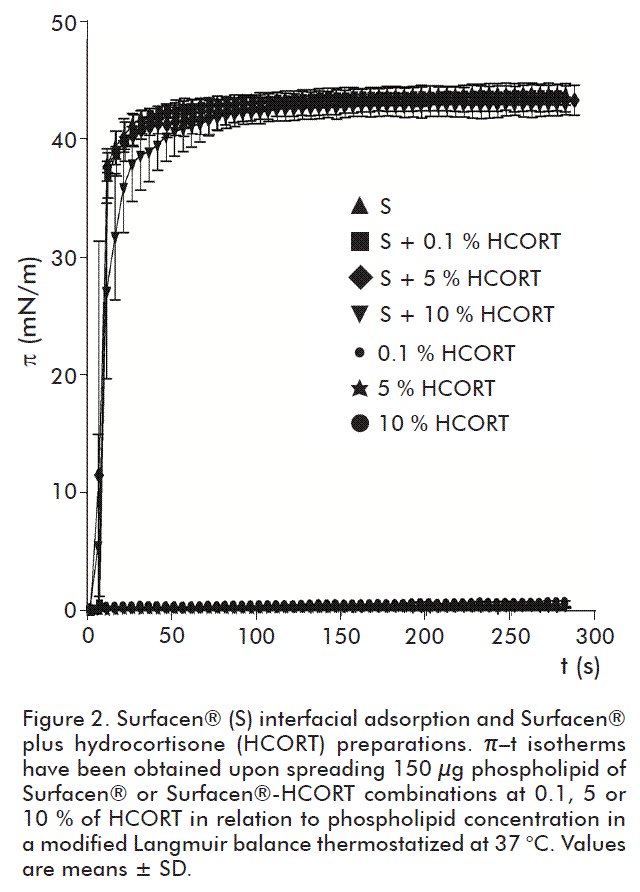
<P   ><font size="2" face="Verdana, Arial, Helvetica, sans-serif"><a href="/img/revistas/bta/v33n1/f0207116.gif">Figure      2</a> shows the &pi;-t spreading kinetics of Surfacen&reg; suspensions and      the three Surfacen&reg;-HCORT (0.1, 5 or 10 %) combinations at the interface      at 37 &ordm;C. The addition of different concentrations of HCORT to Surfacen&reg;      did not affect the spreading kinetics, with HCORT lacking interfacial behavior      alone at either concentration. </font></P >       
]]></body>
<body><![CDATA[<P   ><font size="2" face="Verdana, Arial, Helvetica, sans-serif">For amykacin (<a href="/img/revistas/bta/v33n1/f0307116.gif">Figure      3</a>), the &pi;-t spreading kinetics values of Surfacen&reg; suspensions      and Surfacen&reg; combined with AMIK at the interface, at 37 &ordm;C showed      that the addition of this antibiotic did not affected the surfactant spreading      kinetics. Additionally, amykacin alone showed no interfacial behavior. </font></P >       
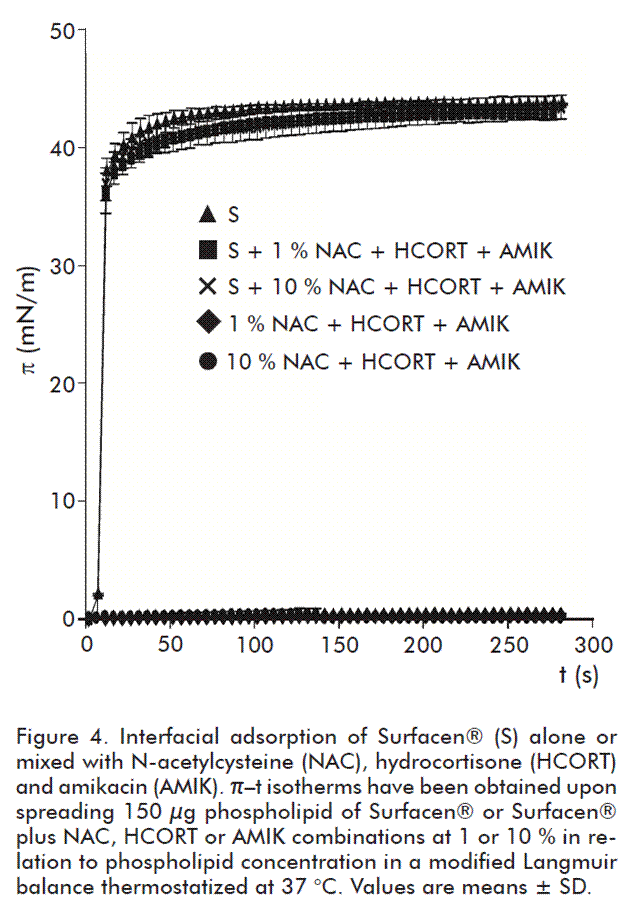
<P   ><font size="2" face="Verdana, Arial, Helvetica, sans-serif">Also to evaluate      de possible interaction of multiple drug formulations in the spreading kinetics      of Surfacen&reg;, the three drugs (NAC, HCORT and amykacin) were administered      together to Surfacen&reg;, and it was demonstrated that their simultaneous      administration did not alter the surfactant spreading properties. The mixture      of the three drugs at the two concentrations tested showed not any interfacial      behavior (<a href="/img/revistas/bta/v33n1/f0407116.gif">Figure 4</a>). </font></P >       
<P   ><font size="2" face="Verdana, Arial, Helvetica, sans-serif">Regarding the biophysical      activity of the surfactant, it is determined by three main functions: i) the      surfactant must be adsorbed quickly (within seconds) to reduce the surface      tension at the interface; ii) the surfactant should be efficiently re-adsorbed      at the interface air-subphase (as occurring during inspiration in the alveoli)      and, iii) the surfactant must form rigid films during surface compression      (as occurring during expiration), which allows to obtain a low surface ten-sion      [20]. </font></P >       <P   ><font size="2" face="Verdana, Arial, Helvetica, sans-serif">The pulmonary surfactant      should also show a fast interfacial adsorption while equilibrating surface      tension to stabilize lungs. During this process, the surfactant proteo-lipid      complexes reach and spread into the interface from the sub-phase, forming      a surface active interfacial film. The interfacial adsorption process includes      both arrival and accumu-lation of material near the interface, and the ultimate      transfer processes that insert the molecules into the interface, forming a      layer exposed to air [21]. In this work, the ability to spread Surfacen&reg;      after being applied directly to the interface in the presence of the most      frequently drugs used in </font><font size="2" face="Verdana, Arial, Helvetica, sans-serif">respiratory      medicine (an antioxidant-mucolytic, anti-inflammatory and antimicrobial) was      evaluated by Langmuir balance. </font></P >       <P   ><font size="2" face="Verdana, Arial, Helvetica, sans-serif">In another study,      the effect of budesonide on the surfactant biophysical properties of two exogenous      surfactants (Survanta&reg; and BLES) was evaluated in a captive bubble surfactometer.      Another steroid medication, Budesonide, markedly reduced the surface tension-lowering      properties of both surfactant preparations [2]. The surfactant adsorption      was significantly reduced at a high budesonide concentration with bovine lipid      extract surfactant (BLES) and both concentrations with Survanta&reg;. At both      concentrations, budesonide reduced Survanta film stability, whereas no changes      were observed with BLES. Therefore, it has been concluded that budesonide,      at common therapeutic concentrations, adversely affected the surface-tension-lowering      properties of surfactant [2]. </font></P >       <P   ><font size="2" face="Verdana, Arial, Helvetica, sans-serif">In contrast, more      recently, using a pulsating bubble surfactometer, it was shown that the addition      of 2 % Budesonide to Survanta&reg; minimally affected its dynamic surface      activity [3]. These authors concluded that budesonide would not reduce the      ability of Survanta (<i>i.e.</i>, to reduce surface tension) when simultaneously      administering it with budesonide at a 50:1 concentration ratio or more. Moreover,      they found that the early postnatal intratracheal instillation of budesonide      using surfactant as vehicle significantly improved the combined outcome of      death or chronic lung disease in small premature infants, without causing      immediate adverse effects. Nevertheless, they considered that results should      be corroborated in a large sample multicenter clinical trial. </font></P >       <P   ><font size="2" face="Verdana, Arial, Helvetica, sans-serif">Particularly for      corticosteroids, they are biochemically derived from cholesterol and, therefore,      they share a close structural similarity with it. Recent findings showed differential      effects of cholesterol and budesonide on the biophysical properties of an      animal-derived surfactant preparation, Curosurf&reg;. At low concentrations      (0.1 or 1 %), neither cholesterol nor budesonide significantly affected the      Curosurf&reg; surface activity, and 10 % cholesterol completely inhibited      its surface-tension lowering ability. By contrast, budesonide at the same      concentration only moderately reduced film stability and did not significantly      alter the compression isotherm [4]. In another research, this author showed      that the addition of 10 % budesonide significantly decreased the surface activity      of another clinical surfactant preparation, Infasurf&reg; [22]. A main difference      between Infasurf&reg; and Curosurf&reg; compositions is that Infasurf&reg;      contains 5-8 % cholesterol whereas Curosurf&reg; is cholesterol-free. Remarkably,      Surfacen&reg; is a cholesterol-free surfactant preparation and our findings      showed that adding hydrocortisone (another corticosteroid) did not affect      Surfacen&reg; spreading kinetics, these results consistent with those of previous      reports [2-4]. </font></P >       <P   ><font size="2" face="Verdana, Arial, Helvetica, sans-serif">The large surface      area for gas exchange made the respiratory system particularly susceptible      to oxidative stress-mediated injury. Both endogenous and exogenous pro-oxidants      (e.g. cigarette smoke) activate leukocytes and host defenses. Several studies      have demonstrated the presence of an increased oxidative stress and decreased      antioxidants in subjects with chronic obstructive pulmonary disease (COPD),      but the contribution of oxidative stress to the pathophy-siology of COPD is      generally less discussed. So far, antioxidant drugs such as NAC have been      regarded only as mucolytic agents, but several recent clinical trials indicate      that NAC may reduce the rate of COPD exacerbations and improve small airways      function. The most plausible explanation for the beneficial effects observed      in patients with COPD treated with NAC lies in the mucolytic and antioxidant      effects of this drug [23, 24]. To our knowledge, there were no previous reports      on the evaluation of NAC effects on the biophysical properties of the pulmonary      surfactant for delivery purposes. </font></P >       <P   ><font size="2" face="Verdana, Arial, Helvetica, sans-serif">Several studies have      evaluated the influence of antibiotics on the biophysical properties of the      pulmonary surfactants. For instance, five antibiotics (amphotericin B, amoxicillin,      ceftazidime, pentamidine and Tobramycin) were tested for their effects on      the surface activity of a bovine surfactant [25]. The minimal surface tension      of the antibiotic-surfactant mixtures was comparable to that of the surfactant      alone. Nevertheless, when the surfactant function was evaluated in the animal      model of respiratory failure induced by lung lavage, PaO<SUB>2</sub> levels      in the animals receiving ceftazidime-surfactant or pentamidine surfactant      were unchanged when compared to the surfactant group. PaO<SUB>2</sub> levels      in animals receiving the mixtures amphotericin B-surfactant, amoxicillin-surfactant      or tobramycin-surfactant significantly decreased as compared to the surfactant      group. For tobramycin, it was further found that PaO2 levels were not affected      when NaHCO<SUB>3</sub> buffer was used surfactant suspension instead of saline.      They concluded that some antibiotics affect the in vivo activity of a bovine      pulmonary surfactant [25]. Therefore, before using surfactant-antibiotic mixtures      in clinical trials, interactions between the two agents should be carefully      evaluated. Calkovska <i>et al</i>. [26] showed that the Curosurf&reg; biophysical      and physiological properties were improved by the cyclic amphipathic decapeptide      polymyxin B. Recently, the mutual influence of the natural surfactant preparation      and three antibiotics (amikacin, cefepime, and colistimethate sodium) were      characterized in vitro. It was shown that the addition of amikacin or cefepime      to the Suzacrin&reg; surfactant had no significant influence on the surfactant      surface-active properties. An obvious reduction of the surface-active properties      was confirmed for a surfactant/colistimethate composition [27]. In our experimental      setting, Amikacin did not affect the Surfacen&reg; spreading properties, corroborating      the results obtained with the surfactant Suzacrin&reg; and amikacin [27].      </font></P >       <P   ><font size="2" face="Verdana, Arial, Helvetica, sans-serif">Our work corroborates      that Surfacen&reg; is able to retain good surface activity (spreading kinetic)      when mixed with anti-inflammatory, antioxidant and antibiotic drugs. Further      studies are required to to evaluate all Surfacen&reg; biophysical properties      in the presence of these drugs, further supporting its simultaneous use as      drug carrier to the lung in the clinical setting. </font></P >       ]]></body>
<body><![CDATA[<P   >&nbsp;</P >       <P   ><font size="3" face="Verdana, Arial, Helvetica, sans-serif"><b>ACKNOWLEDGEMENTS      </b> </font></P >       <P   ><font size="2" face="Verdana, Arial, Helvetica, sans-serif">This study was supported      by a project from Cuban Health Ministry (1008013). The authors thank to Leyanis      Aguiar from Censa for her assistance in reviewing manuscript writing and language      usage. </font></P >       <P   >&nbsp;</P >       <P   ><font face="Verdana, Arial, Helvetica, sans-serif" size="3"><b>REFERENCES</b></font></P >       <P   ><font size="2" color="#000000" face="Verdana, Arial, Helvetica, sans-serif">1.      Moreno OV, L&oacute;pez ML, Dieppa FD, L&oacute;pez MAP, Abad AA, Rivero GJ,      <i>et al.</i> Estudio de la eficacia del surfacen en el distress respiratorio      del reci&eacute;n nacido. Rev Cubana Pediatria. 1999;71((2)):60-71. </font></P >   </font></font></font></font></font></font></font></font></font></font></font></font></font></font></font></font></font></font></font></font></font></font></font></font></font>        <p   ><font size="2" color="#000000" face="Verdana, Arial, Helvetica, sans-serif">2.      Palmer D, Schurch S, Belik J. Effect of budesonide and salbutamol on surfactant      properties. J Appl Physiol. 2000;89(3):884-90. </font></p >       <p   ><font size="2" color="#000000" face="Verdana, Arial, Helvetica, sans-serif">3.      Yeh TF, Lin HC, Chang CH, Wu TS, Su BH, Li TC, <i>et al.</i> Early intratracheal      instillation of budesonide using surfactant as a vehicle to prevent chronic      lung disease in preterm infants: a pilot study. Pediatrics. 2008;121(5):e1310-8.      </font></p >       <!-- ref --><p   ><font size="2" color="#000000" face="Verdana, Arial, Helvetica, sans-serif">4.      Zhang H, Wang YE, Neal CR, Zuo YY. Differential effects of cholesterol and      budesonide on biophysical properties of clinical surfactant. Pediatr Res.      2012;71(4 Pt 1):316-23.     </font></p >       ]]></body>
<body><![CDATA[<!-- ref --><p   ><font size="2" color="#000000" face="Verdana, Arial, Helvetica, sans-serif">5.      Adi H, Young PM, Traini D. Co-deposition of a triple therapy drug formulation      for the treatment of chronic obstructive pulmonary disease using solution-based      pressurised metered dose inhalers. J Pharm Pharmacol. 2012;64(9):1245-53.          </font></p >       <!-- ref --><p   ><font size="2" color="#000000" face="Verdana, Arial, Helvetica, sans-serif">6.      Nannini LJ, Poole P, Milan SJ, Holmes R, Normansell R. Combined corticosteroid      and long-acting beta(2)-agonist in one inhaler versus placebo for chronic      obstructive pulmonary disease. Cochrane Database Syst Rev. 2013;11:CD003794.          </font></p >       <!-- ref --><p   ><font size="2" color="#000000" face="Verdana, Arial, Helvetica, sans-serif">7.      Shah SS, Ohlsson A, Halliday HL, Shah VS. Inhaled versus systemic corticosteroids      for the treatment of chronic lung disease in ventilated very low birth weight      preterm infants. Cochrane Database Syst Rev. 2012;5:CD002057.     </font></p >       <!-- ref --><p   ><font size="2" color="#000000" face="Verdana, Arial, Helvetica, sans-serif">8.      Yang CF, Lin CH, Chiou SY, Yang YC, Tsao PC, Lee YS, <i>et al.</i> Intratracheal      budesonide supplementation in addition to surfactant improves pulmonary outcome      in surfactant-depleted newborn piglets. Pediatr Pulmonol. 2013;48(2):151-9.          </font></p >       <!-- ref --><p   ><font size="2" color="#000000" face="Verdana, Arial, Helvetica, sans-serif">9.      Cole CH, Colton T, Shah BL, Abbasi S, MacKinnon BL, Demissie S, <i>et al.</i>      Early inhaled glucocorticoid therapy to prevent bronchopulmonary dysplasia.      N Engl J Med. 1999;340(13):1005-10.     </font></p >       ]]></body>
<body><![CDATA[<p   ><font size="2" color="#000000" face="Verdana, Arial, Helvetica, sans-serif">10.      Shah SS, Ohlsson A, Halliday H, Shah VS. Inhaled versus systemic corticosteroids      for the treatment of chronic lung disease in ventilated very low birth weight      preterm infants. Cochrane Database Syst Rev. 2007(4):CD002057. </font></p >       <!-- ref --><p   ><font size="2" color="#000000" face="Verdana, Arial, Helvetica, sans-serif">11.      Dani C, Corsini I, Burchielli S, Cangiamila V, Longini M, Paternostro F, <i>et      al.</i> Natural surfactant combined with beclomethasone decreases oxidative      lung injury in the preterm lamb. Pediatr Pulmonol. 2009;44(12):1159-67.     </font></p >       <!-- ref --><p   ><font size="2" color="#000000" face="Verdana, Arial, Helvetica, sans-serif">12.      Yang CF, Jeng MJ, Soong WJ, Lee YS, Tsao PC, Tang RB. Acute pathophysiological      effects of intratracheal instillation of budesonide and exogenous surfactant      in a neonatal surfactant-depleted piglet model. Pediatr Neonatol. 2010;51(4):219-26.          </font></p >       <!-- ref --><p   ><font size="2" color="#000000" face="Verdana, Arial, Helvetica, sans-serif">13.      Dani C, Corsini I, Burchielli S, Cangiamila V, Romagnoli R, Jayonta B, <i>et      al.</i> Natural surfactant combined with beclomethasone decreases lung inflammation      in the preterm lamb. Respiration. 2011;82(4):369-76.     </font></p >       <!-- ref --><p   ><font size="2" color="#000000" face="Verdana, Arial, Helvetica, sans-serif">14.      Haitsma JJ, Lachmann U, Lachmann B. Exogenous surfactant as a drug delivery      agent. Adv Drug Deliv Rev. 2001;47(2- 3):197-207.     </font></p >       <!-- ref --><p   ><font size="2" color="#000000" face="Verdana, Arial, Helvetica, sans-serif">15.      Schwameis R, Erdogan-Yildirim Z, Manafi M, Zeitlinger MA, Strommer S, Sauermann      R. Effect of pulmonary surfactant on antimicrobial activity in vitro. Antimicrob      Agents Chemother. 2013;57(10):5151-4.     </font></p >       <!-- ref --><p   ><font size="2" color="#000000" face="Verdana, Arial, Helvetica, sans-serif">16.      Sadowska AM, Manuel YKB, De Backer WA. Antioxidant and anti-inflammatory efficacy      of NAC in the treatment of COPD: discordant in vitro and in vivo dose-effects:      a review. Pulm Pharmacol Ther. 2007;20(1):9-22.     </font></p >       <!-- ref --><p   ><font size="2" color="#000000" face="Verdana, Arial, Helvetica, sans-serif">17.      De Backer J, Vos W, Van Holsbeke C, Vinchurkar S, Claes R, Parizel PM, <i>et      al.</i> Effect of high-dose N-acetylcysteine on airway geometry, inflammation,      and oxidative stress in COPD patients. Int J Chron Obstruct Pulmon Dis. 2013;8:569-79.          </font></p >       <p   ><font size="2" color="#000000" face="Verdana, Arial, Helvetica, sans-serif">18.      Manzanares D, D&iacute;az E, Alfonso W, Escobar A, Colom&eacute; H, Mu&ntilde;oz      MC, <i>et al.</i> Surfactante pulmonar porcino. Rep&uacute;blica de Cuba 1995;A      61:35-42 K. </font></p >       <!-- ref --><p   ><font size="2" color="#000000" face="Verdana, Arial, Helvetica, sans-serif">19.      Blanco O, Cruz A, Ospina OL, Lopez- Rodriguez E, Vazquez L, Perez-Gil J. Interfacial      behavior and structural properties of a clinical lung surfactant from porcine      source. Biochim Biophys Acta. 2012;1818(11):2756-66.     </font></p >       <!-- ref --><p   ><font size="2" color="#000000" face="Verdana, Arial, Helvetica, sans-serif">20.      Schurch S, Green FH, Bachofen H. Formation and structure of surface films:      captive bubble surfactometry. Biochim Biophys Acta. 1998;1408(2-3):180-202.          </font></p >       ]]></body>
<body><![CDATA[<!-- ref --><p   ><font size="2" color="#000000" face="Verdana, Arial, Helvetica, sans-serif">21.      Lopez-Rodriguez E, Perez-Gil J. Structure-function relationships in pulmonary      surfactant membranes: from biophysics to therapy. Biochim Biophys Acta. 2014;1838(6):1568-85.          </font></p >       <!-- ref --><p   ><font size="2" color="#000000" face="Verdana, Arial, Helvetica, sans-serif">22.      Wang YE, Zhang H, Fan Q, Neal CR, Zuo YY. Biophysical interaction between      corticosteroids and natural surfactant preparation: implications for pulmonary      drug delivery using surfactant as a carrier. Soft Matter. 2012;8(2):504-11.          </font></p >       <!-- ref --><p   ><font size="2" color="#000000" face="Verdana, Arial, Helvetica, sans-serif">23.      Santus P, Corsico A, Solidoro P, Braido F, Marco FD, Scichilone N. Oxidative      Stress and Respiratory System: Pharmacological and Clinical Reappraisal of      N-Acetylcysteine. Copd. 2014.     </font></p >       <!-- ref --><p   ><font size="2" color="#000000" face="Verdana, Arial, Helvetica, sans-serif">24.      Zhang T, Zhou X. Clinical application of expectorant therapy in chronic inflammatory      airway diseases (Review). Experimental and therapeutic medicine. 2014;7(4):763-7.          </font></p >       <p   ><font size="2" color="#000000" face="Verdana, Arial, Helvetica, sans-serif">25.      van &lsquo;t Veen A, Gommers D, Mouton JW, Kluytmans JA, Krijt EJ, Lachmann      B. Exogenous pulmonary surfactant as a drug delivering agent: influence of      antibiotics on surfactant activity. Br J Pharmacol. 1996;118(3):593-8. </font></p >       <!-- ref --><p   ><font size="2" color="#000000" face="Verdana, Arial, Helvetica, sans-serif">26.      Calkovska A, Some M, Linderholm B, Johansson J, Curstedt T, Robertson B. Biophysical      and physiological properties of porcine surfactant enriched with polymyxin      B. Biol Neonate. 2005;88(2):101-8.     </font></p >       <p   ><font size="2" color="#000000" face="Verdana, Arial, Helvetica, sans-serif">27.      Birkun A. Exogenous Pulmonary surfactant as a vehicle for antimicrobials:      assessment of surfactant-antibacterial interactions <i>in vitro</i>. Scientifica.      2014;2014. </font></p >       <p   >&nbsp;</p >       <p   >&nbsp;</p >   <FONT size="+1" color="#000000"><FONT size="+1" color="#211E1F"><FONT size="+1"><FONT size="+1" color="#211E1F"><FONT size="+1"><FONT size="+1"><FONT size="+1"><FONT size="+1"><FONT size="+1"><FONT size="+1"><FONT size="+1"><FONT size="+1"><FONT size="+1"><FONT size="+1" color="#000000"><FONT size="+1" color="#211E1F"><FONT size="+1"><FONT size="+1"><FONT size="+1"><FONT size="+1" color="#000000"><FONT size="+1" color="#211E1F"><FONT size="+1" color="#000000"><FONT size="+1" color="#211E1F"><FONT size="+1" color="#000000"><FONT size="+1" color="#211E1F"><FONT color="#000000">       <P   ><font size="2" color="#211E1F" face="Verdana, Arial, Helvetica, sans-serif"><i>Odalys      Blanco</i>. Centro Nacional de Sanidad Agropecuaria, CENSA. San Jos&eacute;      de las Lajas, Mayabeque, Cuba. E-mail: <A href="mailto:oblanco@censa.edu.cu">      <FONT color="#0000FF">oblanco@censa.edu.cu</font></A><FONT color="#0000FF">,      <A href="mailto:odalysbh@infomed.sld.cu"> <FONT color="#0000FF">odalysbh@infomed.sld.cu</font></A>      </font></font></P >   </font></font></font></font></font></font></font></font></font></font></font></font></font></font></font></font></font></font></font></font></font></font></font></font></font></DIV >      ]]></body><back>
<ref-list>
<ref id="B1">
<label>1</label><nlm-citation citation-type="journal">
<person-group person-group-type="author">
<name>
<surname><![CDATA[Moreno]]></surname>
<given-names><![CDATA[OV]]></given-names>
</name>
<name>
<surname><![CDATA[López]]></surname>
<given-names><![CDATA[ML]]></given-names>
</name>
<name>
<surname><![CDATA[Dieppa]]></surname>
<given-names><![CDATA[FD]]></given-names>
</name>
<name>
<surname><![CDATA[López]]></surname>
<given-names><![CDATA[MAP]]></given-names>
</name>
<name>
<surname><![CDATA[Abad]]></surname>
<given-names><![CDATA[AA]]></given-names>
</name>
<name>
<surname><![CDATA[Rivero]]></surname>
<given-names><![CDATA[GJ]]></given-names>
</name>
</person-group>
<article-title xml:lang="es"><![CDATA[Estudio de la eficacia del surfacen en el distress respiratorio del recién nacido]]></article-title>
<source><![CDATA[Rev Cubana Pediatría]]></source>
<year>1999</year>
<volume>71</volume>
<numero>2</numero>
<issue>2</issue>
<page-range>60-71</page-range></nlm-citation>
</ref>
<ref id="B2">
<label>2</label><nlm-citation citation-type="journal">
<person-group person-group-type="author">
<name>
<surname><![CDATA[Palmer]]></surname>
<given-names><![CDATA[D]]></given-names>
</name>
<name>
<surname><![CDATA[Schurch]]></surname>
<given-names><![CDATA[S]]></given-names>
</name>
<name>
<surname><![CDATA[Belik]]></surname>
<given-names><![CDATA[J]]></given-names>
</name>
</person-group>
<article-title xml:lang="en"><![CDATA[Effect of budesonide and salbutamol on surfactant properties]]></article-title>
<source><![CDATA[J Appl Physiol (]]></source>
<year>1985</year>
<volume>2000</volume>
<numero>89</numero>
<issue>89</issue>
<page-range>3):884-90</page-range></nlm-citation>
</ref>
<ref id="B3">
<label>3</label><nlm-citation citation-type="journal">
<person-group person-group-type="author">
<name>
<surname><![CDATA[Yeh]]></surname>
<given-names><![CDATA[TF]]></given-names>
</name>
<name>
<surname><![CDATA[Lin]]></surname>
<given-names><![CDATA[HC]]></given-names>
</name>
<name>
<surname><![CDATA[Chang]]></surname>
<given-names><![CDATA[CH]]></given-names>
</name>
<name>
<surname><![CDATA[Wu]]></surname>
<given-names><![CDATA[TS]]></given-names>
</name>
<name>
<surname><![CDATA[Su]]></surname>
<given-names><![CDATA[BH]]></given-names>
</name>
<name>
<surname><![CDATA[Li]]></surname>
<given-names><![CDATA[TC]]></given-names>
</name>
</person-group>
<article-title xml:lang="en"><![CDATA[Early intratracheal instillation of budesonide using surfactant as a vehicle to prevent chronic lung disease in preterm infants: a pilot study]]></article-title>
<source><![CDATA[Pediatrics]]></source>
<year>2008</year>
<volume>121</volume>
<numero>5</numero>
<issue>5</issue>
<page-range>1310-8</page-range></nlm-citation>
</ref>
<ref id="B4">
<label>4</label><nlm-citation citation-type="journal">
<person-group person-group-type="author">
<name>
<surname><![CDATA[Zhang]]></surname>
<given-names><![CDATA[H]]></given-names>
</name>
<name>
<surname><![CDATA[Wang]]></surname>
<given-names><![CDATA[YE]]></given-names>
</name>
<name>
<surname><![CDATA[Neal]]></surname>
<given-names><![CDATA[CR]]></given-names>
</name>
<name>
<surname><![CDATA[Zuo]]></surname>
<given-names><![CDATA[YY]]></given-names>
</name>
</person-group>
<article-title xml:lang="en"><![CDATA[Differential effects of cholesterol and budesonide on biophysical properties of clinical surfactant]]></article-title>
<source><![CDATA[Pediatr Res]]></source>
<year>2012</year>
<volume>71</volume>
<numero>4 Pt 1</numero>
<issue>4 Pt 1</issue>
<page-range>316-23</page-range></nlm-citation>
</ref>
<ref id="B5">
<label>5</label><nlm-citation citation-type="journal">
<person-group person-group-type="author">
<name>
<surname><![CDATA[Adi]]></surname>
<given-names><![CDATA[H]]></given-names>
</name>
<name>
<surname><![CDATA[Young]]></surname>
<given-names><![CDATA[PM]]></given-names>
</name>
<name>
<surname><![CDATA[Traini]]></surname>
<given-names><![CDATA[D]]></given-names>
</name>
</person-group>
<article-title xml:lang="en"><![CDATA[Co-deposition of a triple therapy drug formulation for the treatment of chronic obstructive pulmonary disease using solution-based pressurised metered dose inhalers]]></article-title>
<source><![CDATA[J Pharm Pharmacol]]></source>
<year>2012</year>
<volume>64</volume>
<numero>9</numero>
<issue>9</issue>
<page-range>1245-53</page-range></nlm-citation>
</ref>
<ref id="B6">
<label>6</label><nlm-citation citation-type="journal">
<person-group person-group-type="author">
<name>
<surname><![CDATA[Nannini]]></surname>
<given-names><![CDATA[LJ]]></given-names>
</name>
<name>
<surname><![CDATA[Poole]]></surname>
<given-names><![CDATA[P]]></given-names>
</name>
<name>
<surname><![CDATA[Milan]]></surname>
<given-names><![CDATA[SJ]]></given-names>
</name>
<name>
<surname><![CDATA[Holmes]]></surname>
<given-names><![CDATA[R]]></given-names>
</name>
<name>
<surname><![CDATA[Normansell]]></surname>
<given-names><![CDATA[R]]></given-names>
</name>
</person-group>
<article-title xml:lang="en"><![CDATA[Combined corticosteroid and long-acting beta(2)-agonist in one inhaler versus placebo for chronic obstructive pulmonary disease]]></article-title>
<source><![CDATA[Cochrane Database Syst Rev]]></source>
<year>2013</year>
<volume>11</volume>
<page-range>CD003794</page-range></nlm-citation>
</ref>
<ref id="B7">
<label>7</label><nlm-citation citation-type="journal">
<person-group person-group-type="author">
<name>
<surname><![CDATA[Shah]]></surname>
<given-names><![CDATA[SS]]></given-names>
</name>
<name>
<surname><![CDATA[Ohlsson]]></surname>
<given-names><![CDATA[A]]></given-names>
</name>
<name>
<surname><![CDATA[Halliday]]></surname>
<given-names><![CDATA[HL]]></given-names>
</name>
<name>
<surname><![CDATA[Shah]]></surname>
<given-names><![CDATA[VS]]></given-names>
</name>
</person-group>
<article-title xml:lang="en"><![CDATA[Inhaled versus systemic corticosteroids for the treatment of chronic lung disease in ventilated very low birth weight preterm infants]]></article-title>
<source><![CDATA[Cochrane Database Syst Rev]]></source>
<year>2012</year>
<volume>5</volume>
<page-range>CD002057</page-range></nlm-citation>
</ref>
<ref id="B8">
<label>8</label><nlm-citation citation-type="journal">
<person-group person-group-type="author">
<name>
<surname><![CDATA[Yang]]></surname>
<given-names><![CDATA[CF]]></given-names>
</name>
<name>
<surname><![CDATA[Lin]]></surname>
<given-names><![CDATA[CH]]></given-names>
</name>
<name>
<surname><![CDATA[Chiou]]></surname>
<given-names><![CDATA[SY]]></given-names>
</name>
<name>
<surname><![CDATA[Yang]]></surname>
<given-names><![CDATA[YC]]></given-names>
</name>
<name>
<surname><![CDATA[Tsao]]></surname>
<given-names><![CDATA[PC]]></given-names>
</name>
<name>
<surname><![CDATA[Lee]]></surname>
<given-names><![CDATA[YS]]></given-names>
</name>
</person-group>
<article-title xml:lang="en"><![CDATA[Intratracheal budesonide supplementation in addition to surfactant improves pulmonary outcome in surfactant-depleted newborn piglets]]></article-title>
<source><![CDATA[Pediatr Pulmonol]]></source>
<year>2013</year>
<volume>48</volume>
<numero>2</numero>
<issue>2</issue>
<page-range>151-9</page-range></nlm-citation>
</ref>
<ref id="B9">
<label>9</label><nlm-citation citation-type="journal">
<person-group person-group-type="author">
<name>
<surname><![CDATA[Cole]]></surname>
<given-names><![CDATA[CH]]></given-names>
</name>
<name>
<surname><![CDATA[Colton]]></surname>
<given-names><![CDATA[T]]></given-names>
</name>
<name>
<surname><![CDATA[Shah]]></surname>
<given-names><![CDATA[BL]]></given-names>
</name>
<name>
<surname><![CDATA[Abbasi]]></surname>
<given-names><![CDATA[S]]></given-names>
</name>
<name>
<surname><![CDATA[MacKinnon]]></surname>
<given-names><![CDATA[BL]]></given-names>
</name>
<name>
<surname><![CDATA[Demissie]]></surname>
<given-names><![CDATA[S]]></given-names>
</name>
</person-group>
<article-title xml:lang="en"><![CDATA[Early inhaled glucocorticoid therapy to prevent bronchopulmonary dysplasia]]></article-title>
<source><![CDATA[N Engl J Med]]></source>
<year>1999</year>
<volume>340</volume>
<numero>13</numero>
<issue>13</issue>
<page-range>1005-10</page-range></nlm-citation>
</ref>
<ref id="B10">
<label>10</label><nlm-citation citation-type="journal">
<person-group person-group-type="author">
<name>
<surname><![CDATA[Shah]]></surname>
<given-names><![CDATA[SS]]></given-names>
</name>
<name>
<surname><![CDATA[Ohlsson]]></surname>
<given-names><![CDATA[A]]></given-names>
</name>
<name>
<surname><![CDATA[Halliday]]></surname>
<given-names><![CDATA[HL]]></given-names>
</name>
<name>
<surname><![CDATA[Shah]]></surname>
<given-names><![CDATA[VS]]></given-names>
</name>
</person-group>
<article-title xml:lang="en"><![CDATA[Inhaled versus systemic corticosteroids for the treatment of chronic lung disease in ventilated very low birth weight preterm infants]]></article-title>
<source><![CDATA[Cochrane Database Syst Rev]]></source>
<year>2007</year>
<volume>4</volume>
<page-range>CD002057</page-range></nlm-citation>
</ref>
<ref id="B11">
<label>11</label><nlm-citation citation-type="journal">
<person-group person-group-type="author">
<name>
<surname><![CDATA[Dani]]></surname>
<given-names><![CDATA[C]]></given-names>
</name>
<name>
<surname><![CDATA[Corsini]]></surname>
<given-names><![CDATA[I]]></given-names>
</name>
<name>
<surname><![CDATA[Burchielli]]></surname>
<given-names><![CDATA[S]]></given-names>
</name>
<name>
<surname><![CDATA[Cangiamila]]></surname>
<given-names><![CDATA[V]]></given-names>
</name>
<name>
<surname><![CDATA[Longini]]></surname>
<given-names><![CDATA[M]]></given-names>
</name>
<name>
<surname><![CDATA[Paternostro]]></surname>
<given-names><![CDATA[F]]></given-names>
</name>
</person-group>
<article-title xml:lang="en"><![CDATA[Natural surfactant combined with beclomethasone decreases oxidative lung injury in the preterm lamb]]></article-title>
<source><![CDATA[Pediatr Pulmonol]]></source>
<year>2009</year>
<volume>44</volume>
<numero>12</numero>
<issue>12</issue>
<page-range>1159-67</page-range></nlm-citation>
</ref>
<ref id="B12">
<label>12</label><nlm-citation citation-type="journal">
<person-group person-group-type="author">
<name>
<surname><![CDATA[Yang]]></surname>
<given-names><![CDATA[CF]]></given-names>
</name>
<name>
<surname><![CDATA[Jeng]]></surname>
<given-names><![CDATA[MJ]]></given-names>
</name>
<name>
<surname><![CDATA[Soong]]></surname>
<given-names><![CDATA[WJ]]></given-names>
</name>
<name>
<surname><![CDATA[Lee]]></surname>
<given-names><![CDATA[YS]]></given-names>
</name>
<name>
<surname><![CDATA[Tsao]]></surname>
<given-names><![CDATA[PC]]></given-names>
</name>
<name>
<surname><![CDATA[Tang]]></surname>
<given-names><![CDATA[RB]]></given-names>
</name>
</person-group>
<article-title xml:lang="en"><![CDATA[Acute pathophysiological effects of intratracheal instillation of budesonide and exogenous surfactant in a neonatal surfactant-depleted piglet model]]></article-title>
<source><![CDATA[Pediatr Neonatol]]></source>
<year>2010</year>
<volume>51</volume>
<numero>4</numero>
<issue>4</issue>
<page-range>219-26</page-range></nlm-citation>
</ref>
<ref id="B13">
<label>13</label><nlm-citation citation-type="journal">
<person-group person-group-type="author">
<name>
<surname><![CDATA[Dani]]></surname>
<given-names><![CDATA[C]]></given-names>
</name>
<name>
<surname><![CDATA[Corsini]]></surname>
<given-names><![CDATA[I]]></given-names>
</name>
<name>
<surname><![CDATA[Burchielli]]></surname>
<given-names><![CDATA[S]]></given-names>
</name>
<name>
<surname><![CDATA[Cangiamila]]></surname>
<given-names><![CDATA[V]]></given-names>
</name>
<name>
<surname><![CDATA[Romagnoli]]></surname>
<given-names><![CDATA[R]]></given-names>
</name>
<name>
<surname><![CDATA[Jayonta]]></surname>
<given-names><![CDATA[B]]></given-names>
</name>
</person-group>
<article-title xml:lang="en"><![CDATA[Natural surfactant combined with beclomethasone decreases lung inflammation in the preterm lamb]]></article-title>
<source><![CDATA[Respiration]]></source>
<year>2011</year>
<volume>82</volume>
<numero>4</numero>
<issue>4</issue>
<page-range>369-76</page-range></nlm-citation>
</ref>
<ref id="B14">
<label>14</label><nlm-citation citation-type="journal">
<person-group person-group-type="author">
<name>
<surname><![CDATA[Haitsma]]></surname>
<given-names><![CDATA[JJ]]></given-names>
</name>
<name>
<surname><![CDATA[Lachmann]]></surname>
<given-names><![CDATA[U]]></given-names>
</name>
<name>
<surname><![CDATA[Lachmann]]></surname>
<given-names><![CDATA[B]]></given-names>
</name>
</person-group>
<article-title xml:lang="en"><![CDATA[Exogenous surfactant as a drug delivery agent]]></article-title>
<source><![CDATA[Adv Drug Deliv Rev]]></source>
<year>2001</year>
<volume>47</volume>
<numero>2</numero>
<issue>2</issue>
<page-range>3):197-207</page-range></nlm-citation>
</ref>
<ref id="B15">
<label>15</label><nlm-citation citation-type="journal">
<person-group person-group-type="author">
<name>
<surname><![CDATA[Schwameis]]></surname>
<given-names><![CDATA[R]]></given-names>
</name>
<name>
<surname><![CDATA[Erdogan-Yildirim]]></surname>
<given-names><![CDATA[Z]]></given-names>
</name>
<name>
<surname><![CDATA[Manafi]]></surname>
<given-names><![CDATA[M]]></given-names>
</name>
<name>
<surname><![CDATA[Zeitlinger]]></surname>
<given-names><![CDATA[MA]]></given-names>
</name>
<name>
<surname><![CDATA[Strommer]]></surname>
<given-names><![CDATA[S]]></given-names>
</name>
<name>
<surname><![CDATA[Sauermann]]></surname>
<given-names><![CDATA[R]]></given-names>
</name>
</person-group>
<article-title xml:lang="en"><![CDATA[Effect of pulmonary surfactant on antimicrobial activity in vitro]]></article-title>
<source><![CDATA[Antimicrob Agents Chemother]]></source>
<year>2013</year>
<volume>57</volume>
<numero>10</numero>
<issue>10</issue>
<page-range>5151-4</page-range></nlm-citation>
</ref>
<ref id="B16">
<label>16</label><nlm-citation citation-type="journal">
<person-group person-group-type="author">
<name>
<surname><![CDATA[Sadowska]]></surname>
<given-names><![CDATA[AM]]></given-names>
</name>
<name>
<surname><![CDATA[Manuel]]></surname>
<given-names><![CDATA[YKB]]></given-names>
</name>
<name>
<surname><![CDATA[De Backer]]></surname>
<given-names><![CDATA[WA]]></given-names>
</name>
</person-group>
<article-title xml:lang="en"><![CDATA[Antioxidant and anti-inflammatory efficacy of NAC in the treatment of COPD: discordant in vitro and in vivo dose-effects: a review]]></article-title>
<source><![CDATA[Pulm Pharmacol Ther]]></source>
<year>2007</year>
<volume>20</volume>
<numero>1</numero>
<issue>1</issue>
<page-range>9-22</page-range></nlm-citation>
</ref>
<ref id="B17">
<label>17</label><nlm-citation citation-type="journal">
<person-group person-group-type="author">
<name>
<surname><![CDATA[De Backer]]></surname>
<given-names><![CDATA[J]]></given-names>
</name>
<name>
<surname><![CDATA[Vos]]></surname>
<given-names><![CDATA[W]]></given-names>
</name>
<name>
<surname><![CDATA[Van Holsbeke]]></surname>
<given-names><![CDATA[C]]></given-names>
</name>
<name>
<surname><![CDATA[Vinchurkar]]></surname>
<given-names><![CDATA[S]]></given-names>
</name>
<name>
<surname><![CDATA[Claes]]></surname>
<given-names><![CDATA[R]]></given-names>
</name>
<name>
<surname><![CDATA[Parizel]]></surname>
<given-names><![CDATA[PM]]></given-names>
</name>
</person-group>
<article-title xml:lang="en"><![CDATA[Effect of high-dose N-acetylcysteine on airway geometry, inflammation, and oxidative stress in COPD patients]]></article-title>
<source><![CDATA[Int J Chron Obstruct Pulmon Dis]]></source>
<year>2013</year>
<volume>8</volume>
<page-range>569-79</page-range></nlm-citation>
</ref>
<ref id="B18">
<label>18</label><nlm-citation citation-type="">
<person-group person-group-type="author">
<name>
<surname><![CDATA[Manzanares]]></surname>
<given-names><![CDATA[D]]></given-names>
</name>
<name>
<surname><![CDATA[Díaz]]></surname>
<given-names><![CDATA[E]]></given-names>
</name>
<name>
<surname><![CDATA[Alfonso]]></surname>
<given-names><![CDATA[W]]></given-names>
</name>
<name>
<surname><![CDATA[Escobar]]></surname>
<given-names><![CDATA[A]]></given-names>
</name>
<name>
<surname><![CDATA[Colomé]]></surname>
<given-names><![CDATA[H]]></given-names>
</name>
<name>
<surname><![CDATA[Muñoz]]></surname>
<given-names><![CDATA[MC]]></given-names>
</name>
</person-group>
<source><![CDATA[Surfactante pulmonar porcino]]></source>
<year></year>
</nlm-citation>
</ref>
<ref id="B19">
<label>19</label><nlm-citation citation-type="journal">
<person-group person-group-type="author">
<name>
<surname><![CDATA[Blanco]]></surname>
<given-names><![CDATA[O]]></given-names>
</name>
<name>
<surname><![CDATA[Cruz]]></surname>
<given-names><![CDATA[A]]></given-names>
</name>
<name>
<surname><![CDATA[Ospina]]></surname>
<given-names><![CDATA[OL]]></given-names>
</name>
<name>
<surname><![CDATA[Lopez- Rodriguez]]></surname>
<given-names><![CDATA[E]]></given-names>
</name>
<name>
<surname><![CDATA[Vazquez]]></surname>
<given-names><![CDATA[L]]></given-names>
</name>
<name>
<surname><![CDATA[Perez-Gil]]></surname>
<given-names><![CDATA[J]]></given-names>
</name>
</person-group>
<article-title xml:lang="en"><![CDATA[Interfacial behavior and structural properties of a clinical lung surfactant from porcine source]]></article-title>
<source><![CDATA[Biochim Biophys Acta]]></source>
<year>2012</year>
<volume>1818</volume>
<numero>11</numero>
<issue>11</issue>
<page-range>2756-66</page-range></nlm-citation>
</ref>
<ref id="B20">
<label>20</label><nlm-citation citation-type="journal">
<person-group person-group-type="author">
<name>
<surname><![CDATA[Schurch]]></surname>
<given-names><![CDATA[S]]></given-names>
</name>
<name>
<surname><![CDATA[Green]]></surname>
<given-names><![CDATA[FH]]></given-names>
</name>
<name>
<surname><![CDATA[Bachofen]]></surname>
<given-names><![CDATA[H]]></given-names>
</name>
</person-group>
<article-title xml:lang="en"><![CDATA[Formation and structure of surface films: captive bubble surfactometry]]></article-title>
<source><![CDATA[Biochim Biophys Acta]]></source>
<year>1998</year>
<volume>1408</volume>
<numero>2</numero>
<issue>2</issue>
<page-range>3):180-202</page-range></nlm-citation>
</ref>
<ref id="B21">
<label>21</label><nlm-citation citation-type="journal">
<person-group person-group-type="author">
<name>
<surname><![CDATA[Lopez-Rodriguez]]></surname>
<given-names><![CDATA[E]]></given-names>
</name>
<name>
<surname><![CDATA[Perez-Gil]]></surname>
<given-names><![CDATA[J]]></given-names>
</name>
</person-group>
<article-title xml:lang="en"><![CDATA[Structure-function relationships in pulmonary surfactant membranes: from biophysics to therapy]]></article-title>
<source><![CDATA[Biochim Biophys Acta]]></source>
<year>2014</year>
<volume>1838</volume>
<numero>6</numero>
<issue>6</issue>
<page-range>1568-85</page-range></nlm-citation>
</ref>
<ref id="B22">
<label>22</label><nlm-citation citation-type="journal">
<person-group person-group-type="author">
<name>
<surname><![CDATA[Wang]]></surname>
<given-names><![CDATA[YE]]></given-names>
</name>
<name>
<surname><![CDATA[Zhang]]></surname>
<given-names><![CDATA[H]]></given-names>
</name>
<name>
<surname><![CDATA[Fan]]></surname>
<given-names><![CDATA[Q]]></given-names>
</name>
<name>
<surname><![CDATA[Neal]]></surname>
<given-names><![CDATA[CR]]></given-names>
</name>
<name>
<surname><![CDATA[Zuo]]></surname>
<given-names><![CDATA[YY]]></given-names>
</name>
</person-group>
<article-title xml:lang="en"><![CDATA[Biophysical interaction between corticosteroids and natural surfactant preparation: implications for pulmonary drug delivery using surfactant as a carrier]]></article-title>
<source><![CDATA[Soft Matter]]></source>
<year>2012</year>
<volume>8</volume>
<numero>2</numero>
<issue>2</issue>
<page-range>504-11</page-range></nlm-citation>
</ref>
<ref id="B23">
<label>23</label><nlm-citation citation-type="">
<person-group person-group-type="author">
<name>
<surname><![CDATA[Santus]]></surname>
<given-names><![CDATA[P]]></given-names>
</name>
<name>
<surname><![CDATA[Corsico]]></surname>
<given-names><![CDATA[A]]></given-names>
</name>
<name>
<surname><![CDATA[Solidoro]]></surname>
<given-names><![CDATA[P]]></given-names>
</name>
<name>
<surname><![CDATA[Braido]]></surname>
<given-names><![CDATA[F]]></given-names>
</name>
<name>
<surname><![CDATA[Marco]]></surname>
<given-names><![CDATA[FD]]></given-names>
</name>
<name>
<surname><![CDATA[Scichilone]]></surname>
<given-names><![CDATA[N]]></given-names>
</name>
</person-group>
<source><![CDATA[Oxidative Stress and Respiratory System: Pharmacological and Clinical Reappraisal of N-Acetylcysteine]]></source>
<year>2014</year>
</nlm-citation>
</ref>
<ref id="B24">
<label>24</label><nlm-citation citation-type="journal">
<person-group person-group-type="author">
<name>
<surname><![CDATA[Zhang]]></surname>
<given-names><![CDATA[T]]></given-names>
</name>
<name>
<surname><![CDATA[Zhou]]></surname>
<given-names><![CDATA[X]]></given-names>
</name>
</person-group>
<article-title xml:lang="en"><![CDATA[Clinical application of expectorant therapy in chronic inflammatory airway diseases (Review)]]></article-title>
<source><![CDATA[Experimental and therapeutic medicine]]></source>
<year>2014</year>
<volume>7</volume>
<numero>4</numero>
<issue>4</issue>
<page-range>763-7</page-range></nlm-citation>
</ref>
<ref id="B25">
<label>25</label><nlm-citation citation-type="journal">
<person-group person-group-type="author">
<name>
<surname><![CDATA[van 't Veen]]></surname>
<given-names><![CDATA[A]]></given-names>
</name>
<name>
<surname><![CDATA[Gommers]]></surname>
<given-names><![CDATA[D]]></given-names>
</name>
<name>
<surname><![CDATA[Mouton]]></surname>
<given-names><![CDATA[JW]]></given-names>
</name>
<name>
<surname><![CDATA[Kluytmans]]></surname>
<given-names><![CDATA[JA]]></given-names>
</name>
<name>
<surname><![CDATA[Krijt]]></surname>
<given-names><![CDATA[EJ]]></given-names>
</name>
<name>
<surname><![CDATA[Lachmann]]></surname>
<given-names><![CDATA[B]]></given-names>
</name>
</person-group>
<article-title xml:lang="en"><![CDATA[Exogenous pulmonary surfactant as a drug delivering agent: influence of antibiotics on surfactant activity]]></article-title>
<source><![CDATA[Br J Pharmacol]]></source>
<year>1996</year>
<volume>118</volume>
<numero>3</numero>
<issue>3</issue>
<page-range>593-8</page-range></nlm-citation>
</ref>
<ref id="B26">
<label>26</label><nlm-citation citation-type="journal">
<person-group person-group-type="author">
<name>
<surname><![CDATA[Calkovska]]></surname>
<given-names><![CDATA[A]]></given-names>
</name>
<name>
<surname><![CDATA[Some]]></surname>
<given-names><![CDATA[M]]></given-names>
</name>
<name>
<surname><![CDATA[Linderholm]]></surname>
<given-names><![CDATA[B]]></given-names>
</name>
<name>
<surname><![CDATA[Johansson]]></surname>
<given-names><![CDATA[J]]></given-names>
</name>
<name>
<surname><![CDATA[Curstedt]]></surname>
<given-names><![CDATA[T]]></given-names>
</name>
<name>
<surname><![CDATA[Robertson]]></surname>
<given-names><![CDATA[B]]></given-names>
</name>
</person-group>
<article-title xml:lang="en"><![CDATA[Biophysical and physiological properties of porcine surfactant enriched with polymyxin B]]></article-title>
<source><![CDATA[Biol Neonate]]></source>
<year>2005</year>
<volume>88</volume>
<numero>2</numero>
<issue>2</issue>
<page-range>101-8</page-range></nlm-citation>
</ref>
<ref id="B27">
<label>27</label><nlm-citation citation-type="journal">
<person-group person-group-type="author">
<name>
<surname><![CDATA[Birkun]]></surname>
<given-names><![CDATA[A]]></given-names>
</name>
</person-group>
<article-title xml:lang="en"><![CDATA[Exogenous Pulmonary surfactant as a vehicle for antimicrobials: assessment of surfactant-antibacterial interactions in vitro]]></article-title>
<source><![CDATA[Scientifica]]></source>
<year>2014</year>
<volume>2014</volume>
<page-range>0</page-range></nlm-citation>
</ref>
</ref-list>
</back>
</article>