<?xml version="1.0" encoding="ISO-8859-1"?><article xmlns:mml="http://www.w3.org/1998/Math/MathML" xmlns:xlink="http://www.w3.org/1999/xlink" xmlns:xsi="http://www.w3.org/2001/XMLSchema-instance">
<front>
<journal-meta>
<journal-id>1027-2852</journal-id>
<journal-title><![CDATA[Biotecnología Aplicada]]></journal-title>
<abbrev-journal-title><![CDATA[Biotecnol Apl]]></abbrev-journal-title>
<issn>1027-2852</issn>
<publisher>
<publisher-name><![CDATA[Editorial Elfos Scientiae]]></publisher-name>
</publisher>
</journal-meta>
<article-meta>
<article-id>S1027-28522016000200001</article-id>
<title-group>
<article-title xml:lang="en"><![CDATA[Oxidative stress in pharmacoresistant epilepsy]]></article-title>
<article-title xml:lang="es"><![CDATA[Estrés oxidativo en la epilepsia resistente a fármacos]]></article-title>
</title-group>
<contrib-group>
<contrib contrib-type="author">
<name>
<surname><![CDATA[Lorigados]]></surname>
<given-names><![CDATA[Lourdes]]></given-names>
</name>
<xref ref-type="aff" rid="A01"/>
</contrib>
<contrib contrib-type="author">
<name>
<surname><![CDATA[Morales]]></surname>
<given-names><![CDATA[Lilia M]]></given-names>
</name>
<xref ref-type="aff" rid="A02"/>
</contrib>
<contrib contrib-type="author">
<name>
<surname><![CDATA[Orozco-Suárez]]></surname>
<given-names><![CDATA[Sandra]]></given-names>
</name>
<xref ref-type="aff" rid="A03"/>
</contrib>
<contrib contrib-type="author">
<name>
<surname><![CDATA[Gallardo]]></surname>
<given-names><![CDATA[Juan M]]></given-names>
</name>
<xref ref-type="aff" rid="A04"/>
</contrib>
<contrib contrib-type="author">
<name>
<surname><![CDATA[Díaz-Hung]]></surname>
<given-names><![CDATA[Mei L]]></given-names>
</name>
<xref ref-type="aff" rid="A01"/>
</contrib>
<contrib contrib-type="author">
<name>
<surname><![CDATA[González]]></surname>
<given-names><![CDATA[María E]]></given-names>
</name>
<xref ref-type="aff" rid="A01"/>
</contrib>
<contrib contrib-type="author">
<name>
<surname><![CDATA[Estupiñán]]></surname>
<given-names><![CDATA[Bárbara]]></given-names>
</name>
<xref ref-type="aff" rid="A05"/>
</contrib>
<contrib contrib-type="author">
<name>
<surname><![CDATA[Pavón]]></surname>
<given-names><![CDATA[Nancy]]></given-names>
</name>
<xref ref-type="aff" rid="A01"/>
</contrib>
<contrib contrib-type="author">
<name>
<surname><![CDATA[Rocha]]></surname>
<given-names><![CDATA[Luisa]]></given-names>
</name>
<xref ref-type="aff" rid="A06"/>
</contrib>
</contrib-group>
<aff id="A02">
<institution><![CDATA[,Ciren Servicio de Neurofisiología Clínica ]]></institution>
<addr-line><![CDATA[La Habana ]]></addr-line>
<country>Cuba</country>
</aff>
<aff id="A03">
<institution><![CDATA[,Instituto Mexicano del Seguro Social Hospital de Especialidades, Centro Médico Nacional Siglo XXI Unidad de Investigación Médica en Enfermedades Neurológicas]]></institution>
<addr-line><![CDATA[ ]]></addr-line>
<country>México</country>
</aff>
<aff id="A04">
<institution><![CDATA[,Instituto Mexicano del Seguro Social Hospital de Especialidades, Centro Médico Nacional Siglo XXI Unidad de Investigación Médica en Enfermedades Nefrológicas]]></institution>
<addr-line><![CDATA[ ]]></addr-line>
<country>México</country>
</aff>
<aff id="A05">
<institution><![CDATA[,Ciren Laboratorio de Morfología ]]></institution>
<addr-line><![CDATA[La Habana ]]></addr-line>
<country>Cuba</country>
</aff>
<aff id="A06">
<institution><![CDATA[,CINVESTAV Sede Sur Departamento de Farmacobiología]]></institution>
<addr-line><![CDATA[DF ]]></addr-line>
<country>México</country>
</aff>
<aff id="A01">
<institution><![CDATA[,Centro Internacional de Restauración Neurológica, Ciren Departamento de Inmunoquímica ]]></institution>
<addr-line><![CDATA[La Habana ]]></addr-line>
<country>Cuba</country>
</aff>
<pub-date pub-type="pub">
<day>00</day>
<month>06</month>
<year>2016</year>
</pub-date>
<pub-date pub-type="epub">
<day>00</day>
<month>06</month>
<year>2016</year>
</pub-date>
<volume>33</volume>
<numero>2</numero>
<fpage>2101</fpage>
<lpage>2107</lpage>
<copyright-statement/>
<copyright-year/>
<self-uri xlink:href="http://scielo.sld.cu/scielo.php?script=sci_arttext&amp;pid=S1027-28522016000200001&amp;lng=en&amp;nrm=iso"></self-uri><self-uri xlink:href="http://scielo.sld.cu/scielo.php?script=sci_abstract&amp;pid=S1027-28522016000200001&amp;lng=en&amp;nrm=iso"></self-uri><self-uri xlink:href="http://scielo.sld.cu/scielo.php?script=sci_pdf&amp;pid=S1027-28522016000200001&amp;lng=en&amp;nrm=iso"></self-uri><kwd-group>
<kwd lng="en"><![CDATA[epilepsy]]></kwd>
<kwd lng="en"><![CDATA[pharmacoresistance]]></kwd>
<kwd lng="en"><![CDATA[oxidative stress]]></kwd>
<kwd lng="en"><![CDATA[neuroinflammation]]></kwd>
<kwd lng="en"><![CDATA[antiepileptic drug therapies]]></kwd>
<kwd lng="es"><![CDATA[epilepsia resistente a fármacos]]></kwd>
<kwd lng="es"><![CDATA[estrés oxidativo]]></kwd>
<kwd lng="es"><![CDATA[neuroinflamación]]></kwd>
<kwd lng="es"><![CDATA[terapias con fármacos antiepilépticos]]></kwd>
</kwd-group>
</article-meta>
</front><body><![CDATA[ <DIV class="Part"   >        <P align="right"   ><font size="2" color="#000000" face="Verdana, Arial, Helvetica, sans-serif"><b>REVIEW      </b> </font></P >       <P   >&nbsp;</P >   <FONT size="+1" color="#000000">        <P   > </P >   <FONT size="+1">        <P   ><font size="4" face="Verdana, Arial, Helvetica, sans-serif"> <FONT color="#211E1F"><B>Oxidative      stress in pharmacoresistant epilepsy </b></font></font></P >   <FONT size="+1"><FONT size="+1" color="#211E1F"><B>        <P   ></P >   </B> <FONT size="+1" color="#000000">        <P   >&nbsp;</P >       <P   ><font size="2" face="Verdana, Arial, Helvetica, sans-serif"><FONT color="#211E1F"><B><font size="3">Estr&eacute;s      oxidativo en la epilepsia resistente a f&aacute;rmacos </font></b></font></font></P >       <P   >&nbsp;</P >       <P   >&nbsp;</P >   <FONT size="+1"><FONT size="+1" color="#211E1F">        ]]></body>
<body><![CDATA[<P   ></P >   <FONT size="+1" color="#000000">        <P   ><b><font size="2" color="#211E1F" face="Verdana, Arial, Helvetica, sans-serif">Lourdes      Lorigados<sup>1</sup>, Lilia M Morales<sup>2</sup>, Sandra Orozco-Su&aacute;rez<sup>3</sup>,      Juan M Gallardo<sup>4</sup>, Mei L D&iacute;az-Hung<sup>1</sup>, Mar&iacute;a      E Gonz&aacute;lez<sup>1</sup>, B&aacute;rbara Estupi&ntilde;&aacute;n<sup>5</sup>,      Nancy Pav&oacute;n<sup>1</sup>, Luisa Rocha<sup>6</sup> </font></b><font size="2" color="#211E1F" face="Verdana, Arial, Helvetica, sans-serif"></font></P >   <FONT size="+1" color="#211E1F"><FONT size="+1"><FONT size="+1"><FONT size="+1"><FONT size="+1"><FONT size="+1"><FONT size="+1"><FONT size="+1"><FONT size="+1"><FONT size="+1"><FONT size="+1"><FONT size="+1"><FONT size="+1"><FONT size="+1"><FONT size="+1"><FONT size="+1"><FONT size="+1"><FONT size="+1">        <P   > </P >   <FONT size="+1" color="#000000">        <P   ><font size="2" color="#211E1F" face="Verdana, Arial, Helvetica, sans-serif"><sup>1</sup>      Departamento de Inmunoqu&iacute;mica, Centro Internacional de Restauraci&oacute;n      Neurol&oacute;gica, Ciren. Ave. 25 No. 15805 e/ 158 y 160, CP 11300, Playa,      La Habana, Cuba.    <br>     </font><font size="2" face="Verdana, Arial, Helvetica, sans-serif"><sup>2</sup>      Servicio de Neurofisiolog&iacute;a Cl&iacute;nica, Ciren, La Habana, Cuba.          <br>     </font><font size="2" face="Verdana, Arial, Helvetica, sans-serif"><sup>3</sup>      Unidad de Investigaci&oacute;n M&eacute;dica en Enfermedades Neurol&oacute;gicas,      Hospital de Especialidades, Centro M&eacute;dico Nacional Siglo XXI, Instituto      Mexicano del Seguro Social, M&eacute;xico.    <br>     </font><font size="2" face="Verdana, Arial, Helvetica, sans-serif"><sup>4</sup>      Unidad de Investigaci&oacute;n M&eacute;dica en Enfermedades Nefrol&oacute;gicas,      Hospital de Especialidades. Centro M&eacute;dico Nacional Siglo XXI, Instituto      Mexicano del Seguro Social, M&eacute;xico.     <br>     </font><font size="2" face="Verdana, Arial, Helvetica, sans-serif"><sup>5</sup>      Laboratorio de Morfolog&iacute;a, Ciren, La Habana, Cuba.    <br>     <sup>6</sup> Departamento de Farmacobiolog&iacute;a, CINVESTAV, Sede Sur,      DF, M&eacute;xico. </font></P >   <FONT size="+1" color="#211E1F"><FONT size="+1"><FONT size="+1"><FONT size="+1"><FONT size="+1"><FONT size="+1"><FONT size="+1"><FONT size="+1">        <P   >&nbsp;</P >       ]]></body>
<body><![CDATA[<P   >&nbsp;</P >   <FONT size="+1"><FONT size="+1"><FONT size="+1"><FONT size="+1">        <P   > </P >   <FONT size="+1" color="#000000"> </font></font></font></font></font></font></font></font></font></font></font></font></font></font></font></font></font></font></font></font></font></font></font></font></font></font></font></font></font></font></font></font></font></font></font></font></font></font></font></font>    <hr>   <FONT size="+1" color="#000000"><FONT size="+1"><FONT size="+1"><FONT size="+1" color="#211E1F"><FONT size="+1" color="#000000"><FONT size="+1"><FONT size="+1" color="#211E1F"><FONT size="+1" color="#000000"><FONT size="+1" color="#211E1F"><FONT size="+1"><FONT size="+1"><FONT size="+1"><FONT size="+1"><FONT size="+1"><FONT size="+1"><FONT size="+1"><FONT size="+1"><FONT size="+1"><FONT size="+1"><FONT size="+1"><FONT size="+1"><FONT size="+1"><FONT size="+1"><FONT size="+1"><FONT size="+1"><FONT size="+1"><FONT size="+1" color="#000000"><FONT size="+1" color="#211E1F"><FONT size="+1"><FONT size="+1"><FONT size="+1"><FONT size="+1"><FONT size="+1"><FONT size="+1"><FONT size="+1"><FONT size="+1"><FONT size="+1"><FONT size="+1"><FONT size="+1"><FONT size="+1" color="#000000">       <P   ><font size="2" face="Verdana, Arial, Helvetica, sans-serif"><b>ABSTRACT </b></font></P >       <P   > </P >   <FONT size="+1">        <P   ><font size="2" face="Verdana, Arial, Helvetica, sans-serif"> <FONT color="#211E1F">Pharmacoresistant      epilepsy is a phenomenon increasingly affecting a substantial proportion of      patients treated with current anti-epileptic drugs, who became refractive      to therapy. Coincidently, anti-epileptic drugs have been related to oxidative      stress (OS)-related processes, which could have an impact in further drug      development and also disease progression. Therefore, this review is aimed      to analyzing the OS processes resulting in excitotoxicity, neuroinflammation      or mitochondrial dysfunction, which have been implicated in numerous neurological      disorders, and particularly its role in epilepsy. Evidence from clinical data      and a variety of animal models of temporal lobe epilepsy (TLE) is discussed,      regarding damage to proteins, lipids, and antioxidant defenses. An emerging      overall picture on the relationship of OS with cell and soluble mediators      of inflammation and excitotoxicity is presented. Moreover, new therapeutic      strategies are discussed, as proposed to complement current therapies or to      develop new ones which could effectively interfere with the chronic changes      induced by recurrent seizures for a better control on the progression of the      disease. </font></font></P >   <FONT size="+1"><FONT size="+1" color="#211E1F">        <P   ><font size="2" face="Verdana, Arial, Helvetica, sans-serif"><I><b>Keywords:</b>      </I>epilepsy, pharmacoresistance, oxidative stress, neuroinflammation, antiepileptic      drug therapies. </font></P >   </font></font></font></font></font></font></font></font></font></font></font></font></font></font></font></font></font></font></font></font></font></font></font></font></font></font></font></font></font></font></font></font></font></font></font></font></font></font></font></font></font></font></font>    <hr>   <FONT size="+1" color="#000000"><FONT size="+1"><FONT size="+1"><FONT size="+1" color="#211E1F"><FONT size="+1" color="#000000"><FONT size="+1"><FONT size="+1" color="#211E1F"><FONT size="+1" color="#000000"><FONT size="+1" color="#211E1F"><FONT size="+1"><FONT size="+1"><FONT size="+1"><FONT size="+1"><FONT size="+1"><FONT size="+1"><FONT size="+1"><FONT size="+1"><FONT size="+1"><FONT size="+1"><FONT size="+1"><FONT size="+1"><FONT size="+1"><FONT size="+1"><FONT size="+1"><FONT size="+1"><FONT size="+1"><FONT size="+1" color="#000000"><FONT size="+1" color="#211E1F"><FONT size="+1"><FONT size="+1"><FONT size="+1"><FONT size="+1"><FONT size="+1"><FONT size="+1"><FONT size="+1"><FONT size="+1"><FONT size="+1"><FONT size="+1"><FONT size="+1"><FONT size="+1" color="#000000"><FONT size="+1"><FONT size="+1"><FONT size="+1" color="#211E1F">       <P   ><font size="2" face="Verdana, Arial, Helvetica, sans-serif"><b>RESUMEN </b></font></P >       <P   > </P >   <FONT size="+1" color="#000000">        <P   ><font size="2" face="Verdana, Arial, Helvetica, sans-serif"> <FONT color="#211E1F">La      epilepsia resistente a f&aacute;rmacos es una condici&oacute;n que afecta      a una proporci&oacute;n sustancial de pacientes tratados con los f&aacute;rmacos      antiepil&eacute;pticos disponibles, los que devienen refractarios a la terapia.      Coincidentemente, los f&aacute;rmacos antiepil&eacute;pticos han sido relacionados      con procesos de estr&eacute;s oxidativo (OS), lo cual puede impactar en la      progresi&oacute;n de la enfermedad y ser relevante para el sucesivo desarrollo      de f&aacute;rmacos. En esta revisi&oacute;n se analizan los procesos de OS      vinculados a la epilepsia resistente a f&aacute;rmacos, que derivan en procesos      de excitotoxicidad, neuroinflamaci&oacute;n o disfunci&oacute;n mitocondrial,      que se han manifestado en otros des&oacute;rdenes neurol&oacute;gicos y particularmente      en la epilepsia. Se muestran evidencias basadas en datos obtenidos mediante      el estudio de la </font></font><font size="2" face="Verdana, Arial, Helvetica, sans-serif">epilepsia      del l&oacute;bulo temporal (ELT) en modelos animales, que derivan en da&ntilde;o      a las prote&iacute;nas, los l&iacute;pidos y las defensas antioxidantes. Se      incluye una vista general emergente sobre la relaci&oacute;n del OS y los      mediadores solubles involucrados de la inflamaci&oacute;n y la excitotoxicidad.      Adem&aacute;s, se discuten nuevos abordajes terap&eacute;uticos, como los      propuestos para complementar las terapias existentes o incluso nuevas estrategias      para interferir los cambios cr&oacute;nicos inducidos por los ataques recurrentes      para un mejor control de la progresi&oacute;n de la enfermedad. </font></P >   <FONT size="+1"><FONT size="+1" color="#211E1F">     <P   ><font size="2" face="Verdana, Arial, Helvetica, sans-serif"><I><b>Palabras clave:      </b></I>epilepsia resistente a f&aacute;rmacos, estr&eacute;s oxidativo, neuroinflamaci&oacute;n,      terapias con f&aacute;rmacos antiepil&eacute;pticos. </font></P >   </font></font></font></font></font></font></font></font></font></font></font></font></font></font></font></font></font></font></font></font></font></font></font></font></font></font></font></font></font></font></font></font></font></font></font></font></font></font></font></font></font></font></font></font></font></font>    <hr>   <FONT size="+1" color="#000000"><FONT size="+1"><FONT size="+1"><FONT size="+1" color="#211E1F"><FONT size="+1" color="#000000"><FONT size="+1"><FONT size="+1" color="#211E1F"><FONT size="+1" color="#000000"><FONT size="+1" color="#211E1F"><FONT size="+1"><FONT size="+1"><FONT size="+1"><FONT size="+1"><FONT size="+1"><FONT size="+1"><FONT size="+1"><FONT size="+1"><FONT size="+1"><FONT size="+1"><FONT size="+1"><FONT size="+1"><FONT size="+1"><FONT size="+1"><FONT size="+1"><FONT size="+1"><FONT size="+1"><FONT size="+1" color="#000000"><FONT size="+1" color="#211E1F"><FONT size="+1"><FONT size="+1"><FONT size="+1"><FONT size="+1"><FONT size="+1"><FONT size="+1"><FONT size="+1"><FONT size="+1"><FONT size="+1"><FONT size="+1"><FONT size="+1"><FONT size="+1" color="#000000"><FONT size="+1"><FONT size="+1"><FONT size="+1" color="#211E1F"><FONT size="+1" color="#000000"><FONT size="+1"><FONT size="+1" color="#211E1F">       ]]></body>
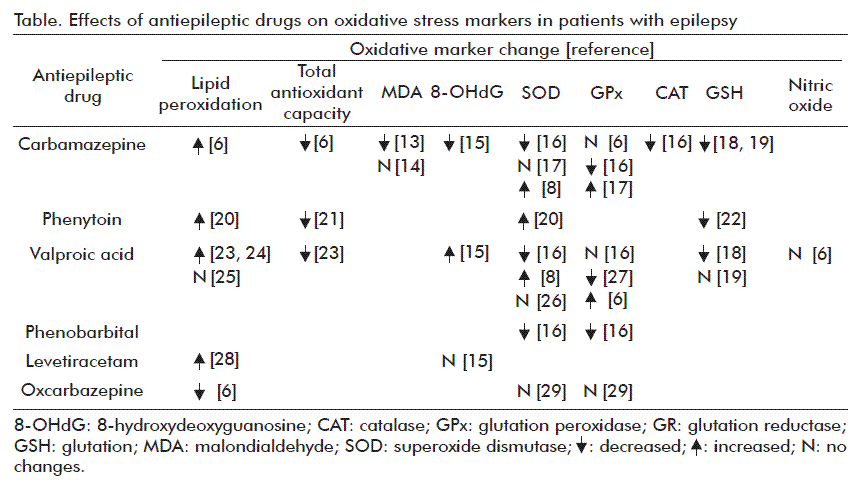
<body><![CDATA[<P   >&nbsp;</P >       <P   >&nbsp;</P >       <P   > </P >       <P   ><b><font size="3" face="Verdana, Arial, Helvetica, sans-serif">INTRODUCTION </font></b></P >   <FONT size="+1">        <P   > </P >       <P   > </P >       <P   ><font size="2" face="Verdana, Arial, Helvetica, sans-serif">Epilepsy is one of      the most common and serious brain disorders. It affects nearly 50 million      people worldwide. It is characterized by recurrent spontaneous seizures due      to an imbalance between cerebral excitability and inhibition [1]. This leads      to uncontrolled excitability, which generates an imbalance in the metabolic      rate of the brain. Nevertheless, the molecular mechanisms that lead to seizures      and epilepsy are not well understood. </font></P >       <P   ><font size="2" face="Verdana, Arial, Helvetica, sans-serif">The incidence of      epilepsy is about 2 % and approximately 60-80 % of patients can be controlled      with antiepileptic drugs [2]. In more than 60 % of cases, seizures remit permanently.      Nevertheless, a substantial proportion of patients (30 %) do not respond to      antiepileptic drugs (AEDs) medication, despite its administration in an optimally      monitored regimen. Such cases are often loosely termed intractable or pharmacoresistant      epilepsy [3]. Most of them suffer from a focal form of epilepsy. The areas      of epileptogenesis are usually characterized by cell loss [4, 5]. Simultaneously,      AEDs could also contribute to the established brain damage through their diverse      effects on the antioxidative system [6, 7], some of them potentially generating      reactive oxygen species (ROS) and triggering oxygen-dependent tissue injury      [8]. Whereas a precise role for ROS in the epilepsies remains to be defined,      a general role for ROS in seizure-induced neuronal death is supported in part      by the observations that repeated seizures result in increased oxidation of      cellular macromolecules [9]. Moreover, there is an intrinsic relationship      between oxidative stress (OS) and inflammation in epileptic patients, as a      source of neuronal decline, manifested in a series of pathological etiologies      and particularly in pharmacorresistant epilepsy. </font></P >       <P   ><font size="2" face="Verdana, Arial, Helvetica, sans-serif">The use of AEDs with      possible neuroprotective effects has been investigated in human or animal      models [10, 11]. Furthermore, AEDs pro-oxidative effects might lead to the      enhancement of seizure activity, which can result in loss of AEDs efficacy      or apparent functional tolerance, pharmacotherapy resistance and undesired      side effects. Studies have been performed in serum, plasma, erythrocytes or      leukocytes [12], some of their effects on OS markers in epileptic patients      summarized in the <a href="/img/revistas/bta/v33n2/t0101216.gif">table</a>. </font></P >       
<P   ><font size="2" face="Verdana, Arial, Helvetica, sans-serif">During metabolic      processes, numerous AEDs as phenobarbitone (PB), phenytoin (PHT), carbamazepine      (CBZ) and valproic acid (VPA), produce reactive metabolites which can increase      the formation of ROS that can induce oxidative damage and cause toxicity.      To support this theory, numerous studies evaluating the influence of epilepsy      and AEDs on the formation of </font><font size="2" face="Verdana, Arial, Helvetica, sans-serif">free      radicals, show that either of them could be connected to oxidative stress      generation [30]. Moreover, AEDs may also provoke systemic toxicity, in addition      to their main inhibitory activity on the epileptic focuses, either through      increased oxidative damage or covalent binding of their reactive metabolites      to biological macromolecules [23, 31]. </font></P >       ]]></body>
<body><![CDATA[<P   ><font size="2" face="Verdana, Arial, Helvetica, sans-serif">Therefore, in this      review, we address the picture arising from the connection among pharmacoresistant      epilepsy and OS, and their relation to inflammation (<a href="/img/revistas/bta/v33n2/f0101216.gif">Figure</a>).      Results in experimental models and in patients that support the presence of      an imbalance in the oxidative status in pharmacoresistant epilepsy are also      discussed, with emphasis on pharmacoresistant temporal lobe epilepsy (TLE).      </font></P >       
<P   >&nbsp;</P >       <P   ><font size="2" face="Verdana, Arial, Helvetica, sans-serif"><b><font size="3">PARTICIPATION      OF OXIDATIVE STRESS IN EPILEPSY </font></b></font></P >       <P   ><font size="2" face="Verdana, Arial, Helvetica, sans-serif">Oxidative stress      (OS) is a biochemical state in which reactive oxygen species (ROS) are generated,      been involved in diverse physiological and pathological conditions, including      epilepsy. At high concentrations, ROS react readily with proteins, lipids,      carbohydrates, and nucleic acids, often inducing signaling and redox control      disruption, and irreversible functional alterations of molecules or even their      complete destruction [32]. </font></P >       <P   ><font size="2" face="Verdana, Arial, Helvetica, sans-serif">ROS have a crucial      role in human physiological and pathophysiological processes [33]. They were      originally considered to be exclusively detrimental to cells [34], but recent      evidence suggests that redox regulation involving ROS is essential for the      modulation of critical cellular functions such as mitogen-activated protein      (MAP) kinase cascade activation, ion transport, calcium mobilization, apoptosis      program activation, and other signaling mechanisms. At the systemic level      they contribute to complex functions such as blood pressure regulation, cognitive      function and immune function. ROS enable the response to growth factor stimulation      and the generation of the inflammatory response [33]. Therefore, OS is involved      also in acute and chronic CNS through the action of free radicals-mediated      injury and is a major factor in the pathogenesis of neuronal damage [35].      </font></P >       <P   ><font size="2" face="Verdana, Arial, Helvetica, sans-serif">The brain is believed      to be particularly vulnerable to OS as it contains high concentrations of      polyunsaturated fatty acids that are susceptible to lipid peroxidation, consumes      relatively large amounts of oxygen for energy production, and has lower antioxidant      defenses compared to other organs, making OS a likely contributor to neurological      disorders [12, 35, 36]. The central nervous system (CNS) has an extraordinary      metabolic rate consuming approximately 20 % of all inhaled oxygen at rest;      however, it only accounts for 2 % of body weight. This enormous metabolic      demand is due to the fact that neurons are highly differentiated cells and      need large amounts of ATP in order to maintain ionic gradients across cell      membranes and for neurotransmission [37]. </font></P >       <P   ><font size="2" face="Verdana, Arial, Helvetica, sans-serif">Recently, accumulating      evidence supports the association between OS and seizures, in the process      of their generation, and in the mechanisms associated with refractoriness      to drug therapy. Alterations in the antioxidant enzymes [38-40] and increases      in the indicators of oxidative damage to biomolecules, such as malondialdehyde      (MDA), protein carbonyls and 8-hydroxy-2-deoxyguanosine and activation of      the nicotinamide adenine dinucleotide phosphate oxidase have been reported      [39, 41]. Similarly, data from animal studies suggest that </font><font size="2" face="Verdana, Arial, Helvetica, sans-serif">prolonged      seizure activity might result in the increased production of ROS and generation      of nitric oxide and peroxynitrite preceded neuronal cell death in vulnerable      brain regions [42, 43]. </font></P >       <P   ><font size="2" face="Verdana, Arial, Helvetica, sans-serif">Previous studies      have demonstrated that seizure-induced mitochondrial dysfunction and excess      free radical production cause oxidative damage to cellular components and      initiate the mitochondrial apoptotic pathway [44, 45]. OS is also considered      an important consequence of excitotoxicity and inflammation, two of the proposed      mechanisms for seizure-induced brain damage [45-48] and finally, there are      evidences of the changes on oxidative markers when some AEDs are consumed      [12]. </font></P >       <P   >&nbsp;</P >       <P   ><font size="3" face="Verdana, Arial, Helvetica, sans-serif"><b>OXIDATIVE STRESS      AND INFLAMMATION IN EPILEPSY </b></font></P >       ]]></body>
<body><![CDATA[<P   ><font size="2" face="Verdana, Arial, Helvetica, sans-serif">Inflammation, in      turn, appears to play a central role among the various mechanisms that have      been connected to epileptogenic process [49-53]. The oxidative and nitrosative      stress pathways are induced by inflammatory responses, and subsequent mitochondrial      metabolic processes generate highly reactive free radical. There are different      pathways of ROS generation, and one of them is through cellular pathway like      cytokines receptors [54]. </font></P >       <P   ><font size="2" face="Verdana, Arial, Helvetica, sans-serif">Several studies have      suggested a link between OS and inflammation [55, 56]. Some authors have implicated      OS as a major upstream component in the signaling cascade involved in activation      of redox-sensitive transcription factors and proinflammatory gene expression      leading to inflammatory response [57]. </font></P >       <P   ><font size="2" face="Verdana, Arial, Helvetica, sans-serif">Although often overlooked,      glial cells, such as astrocytes and microglia, play important roles in maintaining      overall CNS homeostasis, providing trophic support to neurons, clearing synapses      of the released neurotransmitters, mediating immune responses in the brain,      and reducing OS [58]. When CNS regional homeostasis is disturbed because of      redox shifts or other neurodegenerative conditions, astrocytes and microglia      release various cytokines in an effort to re-establish regional integrity      and repair damaged cells. While these glial responses are beneficial to neurons,      the continuous or repeated activation of astrocytes and microglia under conditions      of chronic inflammatory stresses can lead to the increased production of ROS/RNS,      which can lead to severe neuronal damage [59, 60]. </font></P >       <P   ><font size="2" face="Verdana, Arial, Helvetica, sans-serif">In special, evidence      of brain inflammation has been found to be associated with diverse pathological      etiologies in patients with epilepsy and in special in pharmacorresistant      epilepsy. For example, proinflammatory molecules, reactive astrocytosis, activated      microglia, and other indicators of inflammation have been found in the hippocampi      of patients with TLE, in and around epileptic tubers in patients with tuberous      sclerosis, and in some epileptic cases with cortical dysplastic lesions [46,      61-64]. </font></P >       <P   ><font size="2" face="Verdana, Arial, Helvetica, sans-serif">Data collected using      tissue of patients with TLE suggests that specific inflammatory pathways are      chronically activated during epileptogenesis and that they persist in chronic      epileptic tissue, contributing to the etiopathogenesis of TLE [62]. Hippocampus      obtained from patients with hippocampal sclerosis (HS) shows microglial activation      [61, 62]. Expression of proinflammatory molecules (IL-1, IL-6 and TNF) as      well as IL-1&alpha;, IL-1&beta; and IL-1 receptor type I, NFkB. Also the complement      system is augmented in epileptic tissue surgically removed from patients with      pharmacoresistant epilepsy [65]. Systemic IL-6 levels in peripheral blood      are </font><font size="2" face="Verdana, Arial, Helvetica, sans-serif">increased      immediately after seizures and long lasting during post-ictal period (24 h      after ictal event) in patients with TLE, an effect not detected in patients      with HS [66]. Expression of C1q, C3c, and C3d is augmented within regions      where neuronal cell loss occurs. Other studies indicate the activation of      complement pathway, involving both reactive astrocytes and cells of the microglia/macrophage      lineage in human HS specimens [61]. These observations suggest the existence      of a feedback loop between the pro-inflammatory cytokine system and components      of the complement cascade, which may be critical for the propagation of the      inflammatory response in human TLE with HS and therefore consequent OS as      a result of the inflammation. </font></P >       <P   ><font size="2" face="Verdana, Arial, Helvetica, sans-serif">Thus, the mechanisms      related to OS and inflammation in epileptic patients must be further explored      in the clinical management of these conditions. </font></P >       <P   >&nbsp;</P >       <P   ><font size="3" face="Verdana, Arial, Helvetica, sans-serif"><b>OXIDATIVE STRESS      AND EXCITOTOXICITY IN EPILEPSY </b></font></P >       <P   ><font size="2" face="Verdana, Arial, Helvetica, sans-serif">OS is thought to      be an important consequence of glutamate receptor activation and excitotoxicity      which plays a critical role in epileptic brain damage. There is evidence supporting      the hypothesis that the neurodegenerative changes associated with human epilepsy      arise from persistent discharges in the glutamate pathway [36]. The mechanism      is relatively simple: excess of glutamate release leads to repeated depolarization-repolarization      cycles in glutamate terminals, until glutamate reaches toxic concentrations      and, finally, the excitotoxic degeneration of post-synaptic neurons takes      place [67]. </font></P >       <P   ><font size="2" face="Verdana, Arial, Helvetica, sans-serif">In general, excitotoxic      damage to the neurons of epileptic patients is mediated by excessive calcium      inflow during seizures. The excessive elevation of the cytoplasmic Ca<sup>2+</sup>      concentration could promote: 1. the synthesis of nitric oxide, 2. the generation      of free radicals, as superoxide or peroxynitrites, and 3. the loss of electrochemical      mitochondrial potential, altering the oxidative phosphorylation and promoting      the free radicals generation until complete invalidation of the mitochondrial      metabolism, which could lead to the ending of the energy cellular reserves.      Furthermore, the rising in Ca<sup>2+</sup> cytoplasmic concentration activatesvarious      intracellular signaling pathways dependent on protein kinases and phosphatases      that could promote proteolysis of the cellular content [47, 68, 69]. Finally,      procaspases are activated likewise, and neuronal death eventually takes place      by necrosis, apoptosis or autophagy [48]. </font></P >       ]]></body>
<body><![CDATA[<P   ><font size="2" face="Verdana, Arial, Helvetica, sans-serif">Taken these evidences      together, it is now clear that excitatory amino acid and ROS may cooperate      in the pathogenesis of neuronal damage, involving loss of cellular calcium      homeostasis. Excitatory events may stimulate ROS, and there is evidence that      ROS can lead to release of excitatory amino acid, suggesting a bidirectional      relationship. </font></P >       <P   >&nbsp;</P >       <P   ><font size="2" face="Verdana, Arial, Helvetica, sans-serif"><b><font size="3">EXPERIMENTAL      AND CLINICAL EVIDENCES OF OXIDATIVE STRESS AND MITOCHONDRIAL DYSFUNCTION IN      PHARMACORESISTANT EPILEPSY </font></b></font></P >       <P   ><font size="2" face="Verdana, Arial, Helvetica, sans-serif"><b>Experimental models      </b> </font></P >       <P   ><font size="2" face="Verdana, Arial, Helvetica, sans-serif">The use of animal      models has made important contributions to our understanding of seizures.      The most popular models of excitotoxicity employing adult animals are those      based on the use of kainic acid (KA) and pilocarpine. These are models of      TLE, induced by the unilateral or systemic injection of these compounds at      convulsant doses, causing excitotoxic damage at the </font></P >       <P   ><font size="2" face="Verdana, Arial, Helvetica, sans-serif">pyramidal neurons      of hippocampus and the hilar region. The models based on systemically administering      KA or pilocarpine are widely used for studying generalized tonic-clonic convulsions      or the epileptic state, whose neuroanatomical substrate is temporal mesial      sclerosis [70]. Liang et al. have demonstrated that 16 hours after KA injection,      the enzyme aconitase becomes inactive decreasing the availability of reducing      agents for the mitochondrial electron transport chain and compromising ATP      synthesis [71]. </font></P >       <P   ><font size="2" face="Verdana, Arial, Helvetica, sans-serif">During other experiment      in which KA was injected directly into the CA3 area of the hippocampus, an      increase in nitric oxide synthesis was demonstrated, contributing to cell      death by apoptosis in the CA3 area of the hippocampus after the induction      of a status epilepticus [42]. Therefore in the KA induction model there is      an increase in ROS production, mitochondrial dysfunction, and apoptosis of      neurons in several areas of the brain, especially those in the hippocampus      [72]. </font></P >       <P   ><font size="2" face="Verdana, Arial, Helvetica, sans-serif">Other recent research      have shown an acute increase in mitochondrial hydrogen peroxide production,      an index of mitochondrial OS, and oxidative damage to mitochondrial DNA up      to 96 h following KA and lithium pilocarpine induced epileptogenesis [73-75].      Lipid peroxidation is a pathway suggested as a mechanism of epileptic activity      [76]. Whereas the MDA has been used to identify oxidative damage to lipids      acutely following seizure events [77] and their levels have been reported      to be increased up to 16 h following KA treatment in the hippocampus [78],      up to 24 h in an amygdala kindling model of epilepsy [79], and 2 h post-pilocarpine-induced      status epilepticus in the cortex [80]. </font></P >       <P   ><font size="2" face="Verdana, Arial, Helvetica, sans-serif">There is evidence      to support an increase in ROS production in epilepticus induced by pilocarpine      or KA, producing considerable amounts of superoxide and overloading endogenous      protection mechanisms (GPx, proteins, phospholipids, and mitochondrial DNA      [81]. Other authors reported hydroperoxide to be increased at 1 h post-pilocarpine      treatment [82]. A large increase in stable arachidonic acid derived prostaglandin      products of lipid oxidation, including F2-isoprostanes and isofurans has been      shown early after status epilepticus in hippocampal subregions [83]. </font></P >       <P   ><font size="2" face="Verdana, Arial, Helvetica, sans-serif">On the other hand,      Kudin <i>et al</i>. [84] have shown a mitochondrial dysfunction several weeks      after pilocarpine-induced status epilepticus. The activities of complexes      I and IV of the electron transport chain decrease and complex II increases      1 month after pilocarpine status epilepticus. They found also lowered mitochondrial      membrane potential in the CA1 and CA3 areas. These changes may be attributed      to decreased mitochondrial DNA copy number that results in down regulation      of oxidative phosphorylation enzymes encoded by mitochondrial DNA [84]. </font></P >       ]]></body>
<body><![CDATA[<P   ><font size="2" face="Verdana, Arial, Helvetica, sans-serif">Recently, Waldbaum      <i>et al</i>. investigated whether acute lesions induced by ROS formation      contribute to the formation of chronic epilepsy [85]. They have questioned      whether mitochondrial and cellular alterations might occur during the &lsquo;latency      period&rsquo; between the initial brain lesion and the appearance of recurring      spontaneous seizures, inducing progression to chronic epilepsy. An adaptive      increase of mitochondrial DNA repair occurs immediately after ROS increase      induced by acute status epilepticus. However, chronic increase in ROS production      is accompanied by failure in the induction of mitochondrial DNA repair [73].      OS markers as glutation and specific markers of redox status in the mitochondrion      (coenzyme A) have recently been demonstrated to decrease in the hippocampus      after lithium pilocarpine </font><font size="2" face="Verdana, Arial, Helvetica, sans-serif">induced      status epilepticus and to become permanently damaged during epileptogenesis      and chronic epilepsy, even when hydrogen peroxide production measurements      and mitochondrial DNA damage return to control levels [74]. This may contribute      to significant mitochondrial dysfunction, harming neuronal excitability through      electron transport chain dysfunction and decreased ATP production. </font></P >       <P   ><font size="2" face="Verdana, Arial, Helvetica, sans-serif">In summary, status      epilepticus and other epileptogenic injuries result in mitochondrial dysfunction,      increased ROS formation and oxidative damage to proteins, lipids and DNA in      different experimental models of epilepsy. </font></P >       <P   ><font size="2" face="Verdana, Arial, Helvetica, sans-serif"><b>Clinical evidences      </b> </font></P >       <P   ><font size="2" face="Verdana, Arial, Helvetica, sans-serif">Evidences of mitochondrial      dysfunction and OS during chronic epilepsy have been recently found in TLE      patients [86, 87]. For example, Kunz <i>et al</i>. have been finding mitochondrial      complex I deficiency in the seizure foci [88]. </font></P >       <P   ><font size="2" face="Verdana, Arial, Helvetica, sans-serif">Previously studies      found increased activities of SOD, CAT, markers of lipid peroxidation and      decreased activities of GPx in pharmacoresistant TLE patients [24, 89]. Sudha      <i>et al</i>. reported in 2001 decreased glutathione reductase activity. The      lipid peroxidation and percentage haemolysis were higher compared to controls.      Furthermore, erythrocyte glutathione reductase and plasma ascorbate and vitamin      A concentrations were lower [86]. Meanwhile, many different studies were noted      increased markers of lipid peroxidation [39, 89, 90]. </font></P >       <P   ><font size="2" face="Verdana, Arial, Helvetica, sans-serif">On the other hand,      there are also other studies have not detected changes in SOD, CAT, GPx and      glutation reductase activities [86, 89, 91, 92]. </font></P >       <P   ><font size="2" face="Verdana, Arial, Helvetica, sans-serif">Our group has been      investigating the impact of the epilepsy surgery on serum markers of oxidative      damage in pharmacoresistant TLE patients [39]. Before surgery, we found increased      activities of SOD, CAT, markers of lipid peroxidation and decreased activities      of GPx. An interesting finding was the positive correlation between duration      of the disease and advanced oxidation protein product levels. This result      suggests the early presence of oxidative damage to proteins in initial stages      of the illness. This could be due to protein repairing mechanisms that do      not act as efficiently as in other biomolecules. </font></P >       <P   ><font size="2" face="Verdana, Arial, Helvetica, sans-serif">After surgery, the      patients showed a tendency to normalization of the studied variables, except      for SOD activity. The outlying redox state of the patients markedly improved      after surgery, which is clearly evidenced by an important decrease in MDA      and advanced oxidative protein products levels two years after surgery. The      recovery in GPx activity was also notorious, as it contributes to a decrease      in oxidative damage and a better redox balance [39]. On the other hand, we      can speculate that the sustained increase in superoxide dismutase activity      could recede if the epileptoid activity in the remaining regions eventually      disappears in these patients. Finally, the increase in CAT activity levels      seems to be a cellular response to the intense ROS production triggered by      seizure episodes. </font></P >       <P   ><font size="2" face="Verdana, Arial, Helvetica, sans-serif">Other recent results      from our group showed alterations in oxidative markers in tissue from 16 TLE      pharmacoresistant patients who received surgical treatment. There are increases      of lipid peroxidation measured in terms of tissue MDA and altered antixodative      defenses (SOD, GPx, unpublished data). </font></P >       <P   ><font size="2" face="Verdana, Arial, Helvetica, sans-serif">When we evaluated      the cellular immunity (CD8+, CD25+ and HLA-DR+ cells) and inflammatory markers      (IL-1&beta;, IL-6) in the same patients before surgical treatment, both parameters      were found increased. One year after surgical treatment, we have detected      a decrease in all markers (cellular immunity and inflammatory response) when      compared with presurgical values [46]. A previous study of brain tissue from      the same patients evidenced an increase in immunopositivity to Anexin-V [93]      and this correlated positively with the IL-6, and IL-1&beta; [94]. This finding      supports a relationship between the inflammatory process in epilepsy and the      neuronal death observed in neocortical tissue from these patients. These results      indicate that once the epileptogenic zone is resected and seizure activity      is decreased, there is a reduction in proinflammatory cytokines suggesting      that seizures are the cause of the inflammatory disorders observed in patients      with drug-resistant epilepsy [46, 94]. It is of particular interest to note      that one year after surgery 75 % of these patients were free of seizures and      the rest of the patients showed a significant decrease in the number of episodes      [95]. </font></P >       ]]></body>
<body><![CDATA[<P   ><font size="2" face="Verdana, Arial, Helvetica, sans-serif">In summary, our results      indicate altered antioxidative defenses and damage to biomolecules, immunological      and inflammatory alteration in patients with pharmacoresistant TLE [39]. Further      studies are needed to ascertain whether ROS are involved in the pathogenesis      of pharmacoresistant TLE and the association with inflammatory mechanisms      that take place in the pathophysiology of this type of epilepsy. Considering      this knowledge would be interesting to correlate the oxidative markers in      TLE pharmacoresistant patients and levels of proinflammatory mediators in      order elucidate the relationship between oxidative imbalance described for      these patients and these mechanisms. </font></P >       <P   >&nbsp;</P >       <P   ><font size="3" face="Verdana, Arial, Helvetica, sans-serif"><b>THERAPEUTIC POTENTIAL      FOR PHARMACORESISTANT EPILEPSY </b></font></P >       <P   ><font size="2" face="Verdana, Arial, Helvetica, sans-serif">Therapies supplementary      to AEDs have been proposed to increase their effectiveness and their testing      is underway, most of them counteracting the action of ROS through the enhancement      of antioxidant defenses or by providing antioxidant-rich supplementary diets.      </font></P >       <P   ><font size="2" face="Verdana, Arial, Helvetica, sans-serif">Such strategies are      based on the distribution of protective antioxidants in the body, which shows      some interesting features: there is a relatively high concentration of the      water-soluble antioxidant vitamin C in the brain, while vitamin E concentrations      in CNS are not remarkably different from those in other organs. The concentrations      of antioxidants also vary within the different regions of the brain itself.      For instance, the lowest concentration of vitamin E is found in the cerebellum.      It was also shown that enzymatic antioxidants, such as CAT, are at lower concentrations      in the brain than in other tissues [96]. </font></P >       <P   ><font size="2" face="Verdana, Arial, Helvetica, sans-serif">Antioxidants are      exogenous (natural or synthetic) or endogenous compounds acting in several      ways including removal of superoxide, scavenging ROS or their precursors,      inhibiting ROS formation and binding metal ions needed for catalysis of ROS      generation [97]. Among those showing enzymatic activity, CAT, SOD, GPx), glutathione      reductase and thioredoxin exhibit biological value [98]. Particularly, SOD      has been shown to protect against programmed cell death [99]. The non-enzymatic      antioxidants are actually the scavengers of ROS and reactive nitrogen species      (RNS). These include glutathione, vitamins E and C (inhibits oxidation of      membrane lipid). Uric acid is the scavenger of peroxynitrite in plasma, albumin,      bilirubin, N-Acetylcysteine, melatonin which directly reacts with ROS and      form disulfides. </font></P >       <P   ><font size="2" face="Verdana, Arial, Helvetica, sans-serif">Other antioxidant      compounds such as lipoic acid, ascorbic acid and alphatocopherol can protect      the brain against OS [100-102]. In animal models of TLE, the OS and neuronal      damage, but not behavioral seizures induced by kainate can be ameliorated      by at least two types of SOD mimetics, the manganese porphyrin MnTBAP [71]      and the compound EUK134 [103]. Other compounds with antioxidant properties      that inhibit seizure-induced brain injury include the hormone melatonin. Melatonin      stimulates gene expression for the antioxidant enzymes and increases their      activity. Additionally, it neutralizes the hydroxyl, superoxide and peroxyl      radicals, peroxynitrite anion, singlet oxygen, hydrogen peroxide, nitric oxide,      and hypochlorous acid [104]. </font></P >       <P   ><font size="2" face="Verdana, Arial, Helvetica, sans-serif">Kong <i>et al</i>.      have investigated the role of RNA oxidation in epileptogenesis. Using pilocarpine      to induce SE, they observed a significant increase in RNA oxidation in vulnerable      neurons in rat brains immediately after SE followed by neuronal death [105].      However, a daily supplement of antioxidants (coenzyme Q10) significantly reduced      RNA oxidation and protected rats from status epilepticus and neuronal loss      [105]. </font></P >       <P   ><font size="2" face="Verdana, Arial, Helvetica, sans-serif">In the case of Vitamin      E (as &alpha;-tocopherol), it displays beneficial effects in epilepsy, mainly      ascribed to its antioxidant properties. Ambrogini et al. showed that &alpha;-tocopherol      oral supplementation before inducing status epilepticus, markedly reduces      astrocytic and microglial activation, neuronal cell death and oxidative stress      in the hippocampus from kainic acid-induced epilepsy rats [106]. However,      clinical trials of vitamin E as an add-on therapy for refractory epilepsy      have been controversial, with largely failed attempts to influence the occurrence      of epileptic seizures in pediatric patients [9]. </font></P >       <P   ><font size="2" face="Verdana, Arial, Helvetica, sans-serif">Additionally, Creatine      supplementation has been effective in reducing hypoxia-induced seizures in      animal models [107]. The finding that newer antiepileptic drugs such as zonisamide      possess antioxidant properties raises the possibility that free radical scavenging      may in part support their antiepileptic actions [108]. </font></P >       ]]></body>
<body><![CDATA[<P   ><font size="2" face="Verdana, Arial, Helvetica, sans-serif">On other hand, ketogenic      diets (i.e., high-fat, low carbohydrate diet) are used as another therapy      for intractable epilepsy, although its mechanism of action is unknown. The      proposed mechanism relies on the change of energy metabolism to utilization      of fatty acids and their metabolites, ketonic bodies [109-111]. Recent works      suggest that chronic consumption of a ketogenic diet may alter mitochondrial      function by chronically decreasing production of ROS, increasing the expression      of uncoupling proteins, promoting mitochondrial biogenesis, and stimulating      GSH biosynthesis [112, 113]. Jarret <i>et al.</i> have demonstrated that the      ketogenic diet specifically enhances the antioxidant capacity of brain mitochondria      and showed evidence that GSH synthesis is up-regulated in ketogenic diet fed      rats [112]. </font></P >       <P   ><font size="2" face="Verdana, Arial, Helvetica, sans-serif">Studies have shown      that this diet is as good as, or better than, any of the newer medications      in reducing seizure frequency. However, concerns about adverse effects have      been raised. Zamani <i>et al</i>. showed in an open label trial the effects      of this diet on serum lipid profile. Results of this study indicate that a      classic ketogenic diet in children with refractory seizures is effective in      seizure reduction, but leads to development of hypercholesterolemia and hypertriglyceridemia      [114]. </font></P >       <P   ><font size="2" face="Verdana, Arial, Helvetica, sans-serif">Finally, development      of therapies influencing mitochondrial energetic and OS for the epilepsies      will ultimately depend on unraveling their role in the disease process. </font></P >       <P   >&nbsp;</P >       <P   ><font size="3" face="Verdana, Arial, Helvetica, sans-serif"><b>CONCLUDING REMARKS      </b> </font></P >   <FONT size="+1">        <P   ><font size="2" face="Verdana, Arial, Helvetica, sans-serif">Clinical and preclinical      data support the participation of OS and mitochondrial dysfunction in the      epileptic process, suggesting that specific inflammatory pathways are chronically      activated in the epileptogenic brain tissue. These results highlight the need      for research that enables us to understand the role of the OS in the pathogenesis      of pharmacoresistant epilepsy and particularly, to clarify the relationship      between OS, inflammation and immunological deficit as physiopathological mechanism      in TLE. OS and mitochondrial dysfunction occur as a consequence of prolonged      epileptic seizures and influence seizure-induced brain injury. Conversely,      OS can render the brain more susceptible to epileptic seizures. Therefore,      OS and mitochondrial dysfunction may be both an important cause and a consequence      of prolonged seizures. </font></P >       <P   ><font size="2" face="Verdana, Arial, Helvetica, sans-serif">Insight into the      mechanisms by which seizures initiate OS and mitochondrial dysfunction and      vice versa may provide novel therapeutic approaches for the treatment of epilepsies.      </font></P >       <P   ><font size="2" face="Verdana, Arial, Helvetica, sans-serif">Further investigations      into the role of inflammation and the immune response in CNS, particularly      in pharmacoresistant epilepsy may add important insights in the understanding      of the epileptogenic mechanism and open new ways of neuromodulatory treatment      of epilepsy. </font></P >       <P   >&nbsp;</P >       <P   ><font size="3" face="Verdana, Arial, Helvetica, sans-serif"><b>REFERENCES </b></font></P >       ]]></body>
<body><![CDATA[<P   ><font size="2" face="Verdana, Arial, Helvetica, sans-serif">1. World Health Organization.      Epilepsy Fact Sheet. 2016 Feb [cited 2016 Feb 7]. Available from: <a href="http://www.who.int/mediacen-tre/factsheets/fs999/en/" target="_blank">http://www.who.int/mediacen-tre/factsheets/fs999/en/</a>      </font></P >       <!-- ref --><P   ><font size="2" face="Verdana, Arial, Helvetica, sans-serif">2. Hauser WA, Annegers      JF, Kurland LT. Prevalence of epilepsy in Rochester, Minnesota: 1940-1980.      Epilepsia. 1991;32(4):429-45.     </font></P >       <!-- ref --><P   ><font size="2" face="Verdana, Arial, Helvetica, sans-serif">3. Regesta G, Tanganelli      P. Clinical aspects and biological bases of drug-resistant epilepsies. Epilepsy      Res. 1999;34(2-3):109-22.     </font></P >       <P   ><font size="2" face="Verdana, Arial, Helvetica, sans-serif">4. Henshall DC, Meldrum      BS. Cell death and survival mechanisms after single and repeated brief seizures.      In: Noebels JL, Avoli M, Rogawski MA, Olsen RW, Delgado-Escueta AV, editors.      Jasper&rsquo;s Basic Mechanisms of the Epilepsies. 4th ed. Bethesda (MD)2012.      </font></P >       <!-- ref --><P   ><font size="2" face="Verdana, Arial, Helvetica, sans-serif">5. Fujikawa DG, Shinmei      SS, Cai B. Kainic acid-induced seizures produce necrotic, not apoptotic, neurons      with internucleosomal DNA cleavage: implications for programmed cell death      mechanisms. Neuroscience. 2000;98(1):41-53.     </font></P >       <!-- ref --><P   ><font size="2" face="Verdana, Arial, Helvetica, sans-serif">6. Hamed SA, Abdellah      MM, El-Melegy N. Blood levels of trace elements, electrolytes, and oxidative      stress/antioxidant systems in epileptic patients. J Pharmacol Sci. 2004;96(4):465-73.          </font></P >       ]]></body>
<body><![CDATA[<!-- ref --><P   ><font size="2" face="Verdana, Arial, Helvetica, sans-serif">7. Solowiej E, Sobaniec      W. The effect of antiepileptic drug therapy on antioxidant enzyme activity      and serum lipid peroxidation in young patients with epilepsy. Neurol Neurochir      Pol. 2003;37(5):991-1003.     </font></P >       <!-- ref --><P   ><font size="2" face="Verdana, Arial, Helvetica, sans-serif">8. Karikas GA, Schulpis      KH, Bartzeliotou A, Regoutas S, Thanopoulou C, Papaevangelou V, <i>et al</i>.      Early effects of sodium valproate monotherapy on serum paraoxonase/arylesterase      activities. Scand J Clin Lab Invest. 2009;69(1):31-5.     </font></P >       <!-- ref --><P   ><font size="2" face="Verdana, Arial, Helvetica, sans-serif">9. Patel M. Mitochondrial      dysfunction and oxidative stress: cause and consequence of epileptic seizures.      Free Radic Biol Med. 2004;37(12):1951-62.     </font></P >       <!-- ref --><P   ><font size="2" face="Verdana, Arial, Helvetica, sans-serif">10. Azam F, El-Gnidi      BA, Alkskas IA. Combating oxidative stress in epilepsy: design, synthesis,      quantum chemical studies and anticonvulsant evaluation of 1-(substituted benzylidene/ethylidene)-4-(naphthalen-      1-yl)semicarbazides. Eur J Med Chem. 2010;45(7):2817-26.     </font></P >       <!-- ref --><P   ><font size="2" face="Verdana, Arial, Helvetica, sans-serif">11. Azam F, Prasad      MV, Thangavel N. Targeting oxidative stress component in the therapeutics      of epilepsy. Curr Top Med Chem. 2012;12(9):994-1007.     </font></P >       ]]></body>
<body><![CDATA[<!-- ref --><P   ><font size="2" face="Verdana, Arial, Helvetica, sans-serif">12. Martinc B, Grabnar      I, Vovk T. The role of reactive species in epileptogenesis and influence of      antiepileptic drug therapy on oxidative stress. Curr Neuropharmacol. 2012;10(4):328-43.          </font></P >       <P   ><font size="2" face="Verdana, Arial, Helvetica, sans-serif">13. Sobaniec W, Solowiej      E, Kulak W, Bockowski L, Smigielska-Kuzia J, Artemowicz B. Evaluation of the      influence of antiepileptic therapy on antioxidant enzyme activity and lipid      peroxidation in erythrocytes of children with epilepsy. J Child Neurol 2006      Jul;21(7):558-62. </font></P >       <!-- ref --><P   ><font size="2" face="Verdana, Arial, Helvetica, sans-serif">14. Safar MM, Abdallah      DM, Arafa NM, Abdel-Aziz MT. Magnesium supplementation enhances the anticonvulsant      potential of valproate in pentylenetetrazol-treated rats. Brain Res. 2010;1334:58-64.          </font></P >       <!-- ref --><P   ><font size="2" face="Verdana, Arial, Helvetica, sans-serif">15. Varoglu AO, Yildirim      A, Aygul R, Gundogdu OL, Sahin YN. Effects of valproate, carbamazepine, and      levetiracetam on the antioxidant and oxidant systems in epileptic patients      and their clinical importance. Clin Neuropharmacol. 2010;33(3):155-7.     </font></P >       <!-- ref --><P   ><font size="2" face="Verdana, Arial, Helvetica, sans-serif">16. Niketic V, Ristic      S, Saicic ZS, Spasic M, Buzadzic B, Stojkovic M. Activities of antioxidant      enzymes and formation of the glutathione adduct of hemoglobin (Hb ASSG) in      epileptic patients with long-term antiepileptic therapy. Farmaco. 1995;50(11):811-3.          </font></P >       <!-- ref --><P   ><font size="2" face="Verdana, Arial, Helvetica, sans-serif">17. Johannessen SI,      Landmark CJ. Antiepileptic drug interactions - principles and clinical implications.      Curr Neuropharmacol. 2010;8(3):254-67.     </font></P >       <!-- ref --><P   ><font size="2" face="Verdana, Arial, Helvetica, sans-serif">18. Cengiz M, Yuksel      A, Seven M. The effects of carbamazepine and valproic acid on the erythrocyte      glutathione, glutathione peroxidase, superoxide dismutase and serum lipid      peroxidation in epileptic children. Pharmacol Res. 2000;41(4):423-5.     </font></P >       <!-- ref --><P   ><font size="2" face="Verdana, Arial, Helvetica, sans-serif">19. Ono H, Sakamoto      A, Sakura N. Plasma total glutathione concentrations in epileptic patients      taking anticonvulsants. Clin Chim Acta. 2000;298(1-2):135-43.     </font></P >       <!-- ref --><P   ><font size="2" face="Verdana, Arial, Helvetica, sans-serif">20. Liu CS, Wu HM,      Kao SH, Wei YH. Serum trace elements, glutathione, copper/zinc superoxide      dismutase, and lipid peroxidation in epileptic patients with phenytoin or      carbamazepine monotherapy. Clin Neuropharmacol. 1998;21(1):62-4.     </font></P >       <!-- ref --><P   ><font size="2" face="Verdana, Arial, Helvetica, sans-serif">21. Mahle C, Dasgupta      A. Decreased total antioxidant capacity and elevated lipid hydroperoxide concentrations      in sera of epileptic patients receiving phenytoin. Life Sci. 1997;61(4):437-43.          </font></P >       <!-- ref --><P   ><font size="2" face="Verdana, Arial, Helvetica, sans-serif">22. Karabiber H,      Yakinci C, Durmaz Y, Temel I, Mehmet N. Serum nitrite and nitrate levels in      epileptic children using valproic acid or carbamazepine. Brain Dev. 2004;26(1):15-8.          </font></P >       <!-- ref --><P   ><font size="2" face="Verdana, Arial, Helvetica, sans-serif">23. Schulpis KH,      Lazaropoulou C, Regoutas S, Karikas GA, Margeli A, Tsakiris S, et al. Valproic      acid monotherapy induces DNA oxidative damage. Toxicology. 2006;217(2-3):228-32.          </font></P >       <!-- ref --><P   ><font size="2" face="Verdana, Arial, Helvetica, sans-serif">24. Yis U, Seckin      E, Kurul SH, Kuralay F, Dirik E. Effects of epilepsy and valproic acid on      oxidant status in children with idiopathic epilepsy. Epilepsy Res. 2009;84(2-3):232-7.          </font></P >       <!-- ref --><P   ><font size="2" face="Verdana, Arial, Helvetica, sans-serif">25. Arhan E, Serdaroglu      A, Ozturk B, Ozturk HS, Ozcelik A, Kurt N, <i>et al</i>. Effects of epilepsy      and antiepileptic drugs on nitric oxide, lipid peroxidation and xanthine oxidase      system in children with idiopathic epilepsy. Seizure. 2011;20(2):138-42.     </font></P >       <!-- ref --><P   ><font size="2" face="Verdana, Arial, Helvetica, sans-serif">26. Kurekci AE, Alpay      F, Tanindi S, Gokcay E, Ozcan O, Akin R, <i>et al</i>. Plasma trace element,      plasma glutathione peroxidase, and superoxide dismutase levels in epileptic      children receiving antiepileptic drug therapy. Epilepsia. 1995;36(6):600-4.          </font></P >       <!-- ref --><P   ><font size="2" face="Verdana, Arial, Helvetica, sans-serif">27. Yuksel A, Cengiz      M, Seven M, Ulutin T. Changes in the antioxidant system in epileptic children      receiving antiepileptic drugs: two-year prospective studies. J Child Neurol.      2001;16(8):603-6.     </font></P >       <!-- ref --><P   ><font size="2" face="Verdana, Arial, Helvetica, sans-serif">28. Ozden H, Kabay      SC, Toker A, Ustuner MC, Ozbayer C, Ustuner D, <i>et al</i>. The effects of      levetiracetam on urinary 15f-2t-isoprostane levels in epileptic patients.      Seizure. 2010;19(8):514-6.     </font></P >       <!-- ref --><P   ><font size="2" face="Verdana, Arial, Helvetica, sans-serif">29. Bolayir E, Celik      K, Tas A, Topaktas S, Bakir S. The effects of oxcarbazepine on oxidative stress      in epileptic patients. Methods Find Exp Clin Pharmacol. 2004;26(5):345-8.          </font></P >       <!-- ref --><P   ><font size="2" face="Verdana, Arial, Helvetica, sans-serif">30. Martinc B, Grabnar      I, Vovk T. Antioxidants as a preventive treatment for epileptic process: a      review of the current status. Curr Neuropharmacol. 2014;12(6):527-50.     </font></P >       <!-- ref --><P   ><font size="2" face="Verdana, Arial, Helvetica, sans-serif">31. Higuchi S, Yano      A, Takai S, Tsuneyama K, Fukami T, Nakajima M, <i>et al</i>. Metabolic activation      and inflammation reactions involved in carbamazepine-induced liver injury.      Toxicol Sci. 2012;130(1):4-16.     </font></P >       <!-- ref --><P   ><font size="2" face="Verdana, Arial, Helvetica, sans-serif">32. Cardenas-Rodriguez      N, Huerta-Gertrudis B, Rivera-Espinosa L, Montesinos- Correa H, Bandala C,      Carmona-Aparicio L, <i>et al</i>. Role of oxidative stress in refractory epilepsy:      evidence in patients and experimental models. Int J Mol Sci. 2013;14(1):1455-76.          </font></P >       <P   ><font size="2" face="Verdana, Arial, Helvetica, sans-serif">33. Brieger K, Schiavone      S, Miller FJ, Krause KH. Reactive oxygen species: from health to disease.      Swiss Med Wkly. 2012;142:w13659. </font></P >       <P   ><font size="2" face="Verdana, Arial, Helvetica, sans-serif">34. D&rsquo;Autreaux      B, Toledano MB. ROS as signalling molecules: mechanisms that generate specificity      in ROS homeostasis. Nat Rev Mol Cell Biol. 2007;8(10):813-24. </font></P >       <!-- ref --><P   ><font size="2" face="Verdana, Arial, Helvetica, sans-serif">35. Uttara B, Singh      AV, Zamboni P, Mahajan RT. Oxidative stress and neurodegenerative diseases:      a review of upstream and downstream antioxidant therapeutic options. Curr      Neuropharmacol. 2009;7(1):65-74.     </font></P >       <!-- ref --><P   ><font size="2" face="Verdana, Arial, Helvetica, sans-serif">36. Mendez-Armenta      M, Nava-Ruiz C, Juarez-Rebollar D, Rodriguez-Martinez E, Gomez PY. Oxidative      stress associated with neuronal apoptosis in experimental models of epilepsy.      Oxid Med Cell Longev. 2014;2014:293689.     </font></P >       <P   ><font size="2" face="Verdana, Arial, Helvetica, sans-serif">37. Kann O, Kovacs      R. Mitochondria and neuronal activity. Am J Physiol Cell Physiol. 2007;292(2):C641-57.      </font></P >       <!-- ref --><P   ><font size="2" face="Verdana, Arial, Helvetica, sans-serif">38. Ben-Menachem      E, Kyllerman M, Marklund S. Superoxide dismutase and glutathione peroxidase      function in progressive myoclonus epilepsies. Epilepsy Res. 2000;40(1):33-9.          </font></P >       ]]></body>
<body><![CDATA[<!-- ref --><P   ><font size="2" face="Verdana, Arial, Helvetica, sans-serif">39. Lopez J, Gonzalez      ME, Lorigados L, Morales L, Riveron G, Bauza JY. Oxidative stress markers      in surgically treated patients with refractory epilepsy. Clin Biochem. 2007;40(5-6):292-8.          </font></P >       <!-- ref --><P   ><font size="2" face="Verdana, Arial, Helvetica, sans-serif">40. Ho YH, Lin YT,      Wu CW, Chao YM, Chang AY, Chan JY. Peripheral inflammation increases seizure      susceptibility via the induction of neuroinflammation and oxidative stress      in the hippocampus. J Biomed Sci. 2015;22:46.     </font></P >       <!-- ref --><P   ><font size="2" face="Verdana, Arial, Helvetica, sans-serif">41. Pecorelli A,      Natrella F, Belmonte G, Miracco C, Cervellati F, Ciccoli L, <i>et al</i>.      NADPH oxidase activation and 4-hydroxy-2-nonenal/aquaporin-4 adducts as possible      new players in oxidative neuronal damage presents in drug-resistant epilepsy.      Biochim Biophys Acta. 2015;1852(3):507-19.     </font></P >       <!-- ref --><P   ><font size="2" face="Verdana, Arial, Helvetica, sans-serif">42. Chuang YC, Chen      SD, Lin TK, Liou CW, Chang WN, Chan SH, <i>et al</i>. Upregulation of nitric      oxide synthase II contributes to apoptotic cell death in the hippocampal CA3      subfield via a cytochrome c/caspase-3 signaling cascade following induction      of experimental temporal lobe status epilepticus in the rat. Neuropharmacology.      2007;52(5):1263-73.     </font></P >       <!-- ref --><P   ><font size="2" face="Verdana, Arial, Helvetica, sans-serif">43. Chuang YC, Chen      SD, Liou CW, Lin TK, Chang WN, Chan SH, <i>et al</i>. Contribution of nitric      oxide, superoxide anion, and peroxynitrite to activation of mitochondrial      apoptotic signaling in hippocampal CA3 subfield following experimental temporal      lobe status epilepticus. Epilepsia. 2009;50(4):731-46.     </font></P >       ]]></body>
<body><![CDATA[<P   ><font size="2" face="Verdana, Arial, Helvetica, sans-serif">44. Henshall DC.      Apoptosis signalling pathways in seizure-induced neuronal death and epilepsy.      Biochem Soc Trans. 2007;35(Pt 2):421-3. </font></P >       <!-- ref --><P   ><font size="2" face="Verdana, Arial, Helvetica, sans-serif">45. Vezzani A, Balosso      S, Ravizza T. Inflammation and epilepsy. Handb Clin Neurol. 2012;107:163-75.          </font></P >       <P   ><font size="2" face="Verdana, Arial, Helvetica, sans-serif">46. Lorigados PL,      Morales CL, Orozco SS, Rocha AL. Pharmacoresistant epilepsy and immune system.      In: Rocha AL, Cavalheiro EA, editors. Pharmacoresistance in Epilepsy. From      Genes and Molecules to Promising Therapies. New York: Springer; 2013. p. 149-68.      </font></P >       <P   ><font size="2" face="Verdana, Arial, Helvetica, sans-serif">47. Ure&ntilde;a-Guerrero      ME, Feria-Velasco A, Gudi&ntilde;o-Cabrera G, Camin-Espuny A, Beas-Z&aacute;rate      C. Modifications in the Seizures Susceptibility by Excitotoxic Neuronal Damage      and Possible Relationship with the Pharmacoresistance. In: Rocha AL, Cavalheiro      EA, editors. Pharmacoresistance in Ep&igrave;lepsy. From Genes and Molecules      to Promising Therapy. NY: Springer; 2013. p. 59-76. </font></P >       <!-- ref --><P   ><font size="2" face="Verdana, Arial, Helvetica, sans-serif">48. Lorigados L,      Orozco S, Morales-Chacon L, Estupi&ntilde;an B, Garc&iacute;a I, Rocha L.      Excitotoxicity and neuronal death in epilepsy. Biotecnol Apl. 2013;30(1):9-16.          </font></P >       <!-- ref --><P   ><font size="2" face="Verdana, Arial, Helvetica, sans-serif">49. Vezzani A, Aronica      E, Mazarati A, Pittman QJ. Epilepsy and brain inflammation. Exp Neurol. 2013;244:11-21.          </font></P >       <!-- ref --><P   ><font size="2" face="Verdana, Arial, Helvetica, sans-serif">50. Riazi K, Galic      MA, Pittman QJ. Contributions of peripheral inflammation to seizure susceptibility:      cytokines and brain excitability. Epilepsy Res. 2010;89(1):34-42.     </font></P >       <!-- ref --><P   ><font size="2" face="Verdana, Arial, Helvetica, sans-serif">51. Ravizza T, Balosso      S, Vezzani A. Inflammation and prevention of epileptogenesis. Neurosci Lett.      2011;497(3):223-30.     </font></P >       <!-- ref --><P   ><font size="2" face="Verdana, Arial, Helvetica, sans-serif">52. Eid T, Tu N,      Lee TS, Lai JC. Regulation of astrocyte glutamine synthetase in epilepsy.      Neurochem Int. 2013;63(7):670-81.     </font></P >       <!-- ref --><P   ><font size="2" face="Verdana, Arial, Helvetica, sans-serif">53. Marchi N, Granata      T, Janigro D. Inflammatory pathways of seizure disorders. Trends Neurosci.      2014;37(2):55-65.     </font></P >       <!-- ref --><P   ><font size="2" face="Verdana, Arial, Helvetica, sans-serif">54. Touyz RM, Deng      LY, He G, Wu XH, Schiffrin EL. Angiotensin II stimulates DNA and protein synthesis      in vascular smooth muscle cells from human arteries: role of extracellular      signal-regulated kinases. J Hypertens. 1999;17(7):907-16.     </font></P >       <!-- ref --><P   ><font size="2" face="Verdana, Arial, Helvetica, sans-serif">55. De La Fuente      M, Miquel J, Catalan MP, Victor VM, Guayerbas N. The amount of thiolic antioxidant      ingestion needed to improve several immune functions is higher in aged than      in adult mice. Free Radic Res. 2002;36(2):119-26.     </font></P >       <!-- ref --><P   ><font size="2" face="Verdana, Arial, Helvetica, sans-serif">56. Viora M, Quaranta      MG, Straface E, Vari R, Masella R, Malorni W. Redox imbalance and immune functions:      opposite effects of oxidized low-density lipoproteins and N-acetylcysteine.      Immunology. 2001;104(4):431-8.     </font></P >       <!-- ref --><P   ><font size="2" face="Verdana, Arial, Helvetica, sans-serif">57. Uchida K, Shiraishi      M, Naito Y, Torii Y, Nakamura Y, Osawa T. Activation of stress signaling pathways      by the end product of lipid peroxidation. 4-hydroxy-2-nonenal is a potential      inducer of intracellular peroxide production. J Biol Chem. 1999;274(4):2234-42.          </font></P >       <!-- ref --><P   ><font size="2" face="Verdana, Arial, Helvetica, sans-serif">58. Dringen R, Gutterer      JM, Hirrlinger J. Glutathione metabolism in brain metabolic interaction between      astrocytes and neurons in the defense against reactive oxygen species. Eur      J Biochem. 2000;267(16):4912-6.     </font></P >       <!-- ref --><P   ><font size="2" face="Verdana, Arial, Helvetica, sans-serif">59. Wang X, Michaelis      EK. Selective neuronal vulnerability to oxidative stress in the brain. Front      Aging Neurosci. 2010;2:12.     </font></P >       <!-- ref --><P   ><font size="2" face="Verdana, Arial, Helvetica, sans-serif">60. Streit WJ. Microglia      and the response to brain injury. Ernst Schering Res Found Workshop. 2002(39):11-24.          </font></P >       <!-- ref --><P   ><font size="2" face="Verdana, Arial, Helvetica, sans-serif">61. Aronica E, Boer      K, van Vliet EA, Redeker S, Baayen JC, Spliet WG, <i>et al</i>. Complement      activation in experimental and human temporal lobe epilepsy. Neurobiol Dis.      2007;26(3):497-511.     </font></P >       <!-- ref --><P   ><font size="2" face="Verdana, Arial, Helvetica, sans-serif">62. Ravizza T, Gagliardi      B, Noe F, Boer K, Aronica E, Vezzani A. Innate and adaptive immunity during      epileptogenesis and spontaneous seizures: evidence from experimental models      and human temporal lobe epilepsy. Neurobiol Dis. 2008;29(1):142-60.     </font></P >       <!-- ref --><P   ><font size="2" face="Verdana, Arial, Helvetica, sans-serif">63. Boer K, Crino      PB, Gorter JA, Nellist M, Jansen FE, Spliet WG, <i>et al</i>. Gene expression      analysis of tuberous sclerosis complex cortical tubers reveals increased expression      of adhesion and inflammatory factors. Brain Pathol. 2010;20(4):704-19.     </font></P >       <!-- ref --><P   ><font size="2" face="Verdana, Arial, Helvetica, sans-serif">64. Iyer A, Zurolo      E, Spliet WG, van Rijen PC, Baayen JC, Gorter JA, <i>et al</i>. Evaluation      of the innate and adaptive immunity in type I and type II focal cortical dysplasias.      Epilepsia. 2010;51(9):1763-73.     </font></P >       <P   ><font size="2" face="Verdana, Arial, Helvetica, sans-serif">65. Maldonado M,      Baybis M, Newman D, Kolson DL, Chen W, McKhann G, 2nd, <i>et al</i>. Expression      of ICAM-1, TNF-alpha, NF kappa B, and MAP kinase in tubers of the tuberous      sclerosis complex. Neurobiol Dis. 2003;14(2):279-90. </font></P >       ]]></body>
<body><![CDATA[<!-- ref --><P   ><font size="2" face="Verdana, Arial, Helvetica, sans-serif">66. Bauer S, Cepok      S, Todorova-Rudolph A, Nowak M, Koller M, Lorenz R, <i>et al</i>. Etiology      and site of temporal lobe epilepsy influence postictal cytokine release. Epilepsy      Res. 2009;86(1):82-8.     </font></P >       <P   ><font size="2" face="Verdana, Arial, Helvetica, sans-serif">67. Eid T, Williamson      A, Lee TS, Petroff OA, de Lanerolle NC. Glutamate and astrocytes- -key players      in human mesial temporal lobe epilepsy? Epilepsia. 2008;49 Suppl 2:42-52.      </font></P >       <!-- ref --><P   ><font size="2" face="Verdana, Arial, Helvetica, sans-serif">68. Arundine M, Tymianski      M. Molecular mechanisms of calcium-dependent neurodegeneration in excitotoxicity.      Cell Calcium. 2003;34(4-5):325-37.     </font></P >       <!-- ref --><P   ><font size="2" face="Verdana, Arial, Helvetica, sans-serif">69. Dong XX, Wang      Y, Qin ZH. Molecular mechanisms of excitotoxicity and their relevance to pathogenesis      of neurodegenerative diseases. Acta Pharmacol Sin. 2009;30(4):379-87.     </font></P >       <!-- ref --><P   ><font size="2" face="Verdana, Arial, Helvetica, sans-serif">70. Sloviter RS.      The neurobiology of temporal lobe epilepsy: too much information, not enough      knowledge. C R Biol. 2005;328(2):143-53.     </font></P >       <!-- ref --><P   ><font size="2" face="Verdana, Arial, Helvetica, sans-serif">71. Liang LP, Ho      YS, Patel M. Mitochondrial superoxide production in kainate-induced hippocampal      damage. Neuroscience. 2000;101(3):563-70.     </font></P >       <!-- ref --><P   ><font size="2" face="Verdana, Arial, Helvetica, sans-serif">72. Shin EJ, Jeong      JH, Chung YH, Kim WK, Ko KH, Bach JH, <i>et al</i>. Role of oxidative stress      in epileptic seizures. Neurochem Int. 2011;59(2):122-37.     </font></P >       <!-- ref --><P   ><font size="2" face="Verdana, Arial, Helvetica, sans-serif">73. Jarrett SG, Liang      LP, Hellier JL, Staley KJ, Patel M. Mitochondrial DNA damage and impaired      base excision repair during epileptogenesis. Neurobiol Dis. 2008;30(1): 130-8.          </font></P >       <!-- ref --><P   ><font size="2" face="Verdana, Arial, Helvetica, sans-serif">74. Waldbaum S, Patel      M. Mitochondria, oxidative stress, and temporal lobe epilepsy. Epilepsy Res.      2010;88(1):23-45.     </font></P >       <!-- ref --><P   ><font size="2" face="Verdana, Arial, Helvetica, sans-serif">75. Waldbaum S, Liang      LP, Patel M. Persistent impairment of mitochondrial and tissue redox status      during lithium-pilocarpine-induced epileptogenesis. J Neurochem. 2010;115(5):1172-82.          </font></P >       <!-- ref --><P   ><font size="2" face="Verdana, Arial, Helvetica, sans-serif">76. Dal-Pizzol F,      Klamt F, Vianna MM, Schroder N, Quevedo J, Benfato MS, <i>et al</i>. Lipid      peroxidation in hippocampus early and late after status epilepticus induced      by pilocarpine or kainic acid in Wistar rats. Neurosci Lett. 2000;291(3):179-82.          </font></P >       <!-- ref --><P   ><font size="2" face="Verdana, Arial, Helvetica, sans-serif">77. Cini M, Moretti      A. Studies on lipid peroxidation and protein oxidation in the aging brain.      Neurobiol Aging. 1995;16(1):53-7.     </font></P >       <!-- ref --><P   ><font size="2" face="Verdana, Arial, Helvetica, sans-serif">78. Bruce AJ, Baudry      M. Oxygen free radicals in rat limbic structures after kainate-induced seizures.      Free Radic Biol Med. 1995;18(6):993- 1002.     </font></P >       <!-- ref --><P   ><font size="2" face="Verdana, Arial, Helvetica, sans-serif">79. Frantseva MV,      Perez Velazquez JL, Tsoraklidis G, Mendonca AJ, Adamchik Y, Mills LR, <i>et      al</i>. Oxidative stress is involved in seizure-induced neurodegeneration      in the kindling model of epilepsy. Neuroscience. 2000;97(3):431-5.     </font></P >       <!-- ref --><P   ><font size="2" face="Verdana, Arial, Helvetica, sans-serif">80. Tejada S, Sureda      A, Roca C, Gamundi A, Esteban S. Antioxidant response and oxidative damage      in brain cortex after high dose of pilocarpine. Brain Res Bull. 2007;71(4):372-5.          </font></P >       <!-- ref --><P   ><font size="2" face="Verdana, Arial, Helvetica, sans-serif">81. Folbergrova J,      Kunz WS. Mitochondrial dysfunction in epilepsy. Mitochondrion. 2012;12(1):35-40.          </font></P >       <!-- ref --><P   ><font size="2" face="Verdana, Arial, Helvetica, sans-serif">82. Bellissimo MI,      Amado D, Abdalla DS, Ferreira EC, Cavalheiro EA, Naffah-Mazzacoratti MG. Superoxide      dismutase, glutathione peroxidase activities and the hydroperoxide concentration      are modified in the hippocampus of epileptic rats. Epilepsy Res. 2001;46(2):121-8.          </font></P >       <P   ><font size="2" face="Verdana, Arial, Helvetica, sans-serif">83. Patel M, Liang      LP, Roberts LJ, 2nd. Enhanced hippocampal F2-isoprostane formation following      kainate-induced seizures. J Neurochem. 2001;79(5):1065-9. </font></P >       <!-- ref --><P   ><font size="2" face="Verdana, Arial, Helvetica, sans-serif">84. Kudin AP, Kudina      TA, Seyfried J, Vielhaber S, Beck H, Elger CE, <i>et al</i>. Seizure-dependent      modulation of mitochondrial oxidative phosphorylation in rat hippocampus.      Eur J Neurosci. 2002;15(7):1105-14.     </font></P >       <!-- ref --><P   ><font size="2" face="Verdana, Arial, Helvetica, sans-serif">85. Waldbaum S, Patel      M. Mitochondrial dysfunction and oxidative stress: a contributing link to      acquired epilepsy? J Bioenerg Biomembr. 2010;42(6):449-55.     </font></P >       <!-- ref --><P   ><font size="2" face="Verdana, Arial, Helvetica, sans-serif">86. Sudha K, Rao      AV, Rao A. Oxidative stress and antioxidants in epilepsy. Clin Chim Acta.      2001;303(1-2):19-24.     </font></P >       ]]></body>
<body><![CDATA[<!-- ref --><P   ><font size="2" face="Verdana, Arial, Helvetica, sans-serif">87. Vielhaber S,      Niessen HG, Debska-Vielhaber G, Kudin AP, Wellmer J, Kaufmann J, <i>et al</i>.      Subfield-specific loss of hippocampal N-acetyl aspartate in temporal lobe      epilepsy. Epilepsia. 2008;49(1):40-50.     </font></P >       <!-- ref --><P   ><font size="2" face="Verdana, Arial, Helvetica, sans-serif">88. Heller A, Kunz      M, Samakas A, Haase M, Kirschfink M, Koch T. The complement regulators C1      inhibitor and soluble complement receptor 1 attenuate acute lung injury in      rabbits. Shock. 2000;13(4):285-90.     </font></P >       <!-- ref --><P   ><font size="2" face="Verdana, Arial, Helvetica, sans-serif">89. Turkdogan D,      Toplan S, Karakoc Y. Lipid peroxidation and antioxidative enzyme activities      in childhood epilepsy. J Child Neurol. 2002;17(9):673-6.     </font></P >       <!-- ref --><P   ><font size="2" face="Verdana, Arial, Helvetica, sans-serif">90. Aycicek A, Iscan      A. The effects of carbamazepine, valproic acid and phenobarbital on the oxidative      and antioxidative balance in epileptic children. Eur Neurol. 2007;57(2):65-9.          </font></P >       <!-- ref --><P   ><font size="2" face="Verdana, Arial, Helvetica, sans-serif">91. Verrotti A, Basciani      F, Trotta D, Pomilio MP, Morgese G, Chiarelli F. Serum copper, zinc, selenium,      glutathione peroxidase and superoxide dismutase levels in epileptic children      before and after 1 year of sodium valproate and carbamazepine therapy. Epilepsy      Res. 2002;48(1-2):71-5.     </font></P >       ]]></body>
<body><![CDATA[<!-- ref --><P   ><font size="2" face="Verdana, Arial, Helvetica, sans-serif">92. Gunes S, Dirik      E, Yis U, Seckin E, Kuralay F, Kose S, <i>et al</i>. Oxidant status in children      after febrile seizures. Pediatr Neurol. 2009;40(1):47-9.     </font></P >       <!-- ref --><P   ><font size="2" face="Verdana, Arial, Helvetica, sans-serif">93. Lorigados Pedre      L, Orozco Suarez S, Morales Chacon L, Garcia Maeso I, Estupinan Diaz B, Bender      del Busto JE, <i>et al</i>. Neuronal death in the neocortex of drug resistant      temporal lobe epilepsy patients. Neurologia. 2008;23(9):555-65.     </font></P >       <!-- ref --><P   ><font size="2" face="Verdana, Arial, Helvetica, sans-serif">94. Lorigados Pedre      L, Morales Chacon LM, Orozco Suarez S, Pavon Fuentes N, Estupinan Diaz B,      Serrano Sanchez T, <i>et al</i>. Inflammatory mediators in epilepsy. Curr      Pharm Des. 2013;19(38):6766-72.     </font></P >       <!-- ref --><P   ><font size="2" face="Verdana, Arial, Helvetica, sans-serif">95. Estupinan-Diaz      B, Morales-Chacon LM, Lorigados-Pedre L, Garcia-Maeso I, Bender-del Busto      JE, Trapaga-Quincoses O, <i>et al</i>. Pathological neocortical findings in      patients with medication-resistant medial temporal lobe epilepsy submitted      to surgery. Rev Neurol. 2008;46(4):203-9.     </font></P >       <P   ><font size="2" face="Verdana, Arial, Helvetica, sans-serif">96. Vatassery GT.      Vitamin E. Neurochemistry and implications for neurodegeneration in Parkinson&rsquo;s      disease. Ann N Y Acad Sci. 1992;669:97-109. </font></P >       <P   ><font size="2" face="Verdana, Arial, Helvetica, sans-serif">97. Pisoschi AM,      Pop A. The role of antioxidants in the chemistry of oxidative stress: A review.      Eur J Med Chem. 2015;97:55-74. </font></P >       ]]></body>
<body><![CDATA[<!-- ref --><P   ><font size="2" face="Verdana, Arial, Helvetica, sans-serif">98. Birben E, Sahiner      UM, Sackesen C, Erzurum S, Kalayci O. Oxidative stress and antioxidant defense.      World Allergy Organ J. 2012;5(1):9-19.     </font></P >       <!-- ref --><P   ><font size="2" face="Verdana, Arial, Helvetica, sans-serif">99. Naziroglu M,      Yurekli VA. Effects of antiepileptic drugs on antioxidant and oxidant molecular      pathways: focus on trace elements. Cell Mol Neurobiol. 2013;33(5):589-99.          </font></P >       <!-- ref --><P   ><font size="2" face="Verdana, Arial, Helvetica, sans-serif">100. Freitas RM.      The evaluation of effects of lipoic acid on the lipid peroxidation, nitrite      formation and antioxidant enzymes in the hippocampus of rats after pilocarpine-induced      seizures. Neurosci Lett. 2009;455(2):140-4.     </font></P >       <!-- ref --><P   ><font size="2" face="Verdana, Arial, Helvetica, sans-serif">101. Cardenas-Rodriguez      N, Coballase-Urrutia E, Huerta-Gertrudis B, Garcia-Cruz ME, Pedraza-Chaverri      J, Coria-Jimenez R, <i>et al</i>. Antioxidant activity of topiramate: an antiepileptic      agent. Neurol Sci. 2013;34(5):741-7.     </font></P >       <!-- ref --><P   ><font size="2" face="Verdana, Arial, Helvetica, sans-serif">102. Niedzielska      E, Smaga I, Gawlik M, Moniczewski A, Stankowicz P, Pera J, <i>et al</i>. Oxidative      Stress in Neurodegenerative Diseases. Mol Neurobiol. 2016;53(6):4094-125.          </font></P >       ]]></body>
<body><![CDATA[<!-- ref --><P   ><font size="2" face="Verdana, Arial, Helvetica, sans-serif">103. Rong Y, Doctrow      SR, Tocco G, Baudry M. EUK-134, a synthetic superoxide dismutase and catalase      mimetic, prevents oxidative stress and attenuates kainate-induced neuropathology.      Proc Natl Acad Sci U S A. 1999;96(17):9897-902.     </font></P >       <!-- ref --><P   ><font size="2" face="Verdana, Arial, Helvetica, sans-serif">104. Gupta YK, Gupta      M, Kohli K. Neuroprotective role of melatonin in oxidative stress vulnerable      brain. Indian J Physiol Pharmacol. 2003;47(4):373-86.     </font></P >       <!-- ref --><P   ><font size="2" face="Verdana, Arial, Helvetica, sans-serif">105. Kong Q, Lin      CL. Oxidative damage to RNA: mechanisms, consequences, and diseases. Cell      Mol Life Sci. 2010;67(11):1817- 29.     </font></P >       <!-- ref --><P   ><font size="2" face="Verdana, Arial, Helvetica, sans-serif">106. Ambrogini P,      Minelli A, Galati C, Betti M, Lattanzi D, Ciffolilli S, <i>et al</i>. Post-seizure      alpha-tocopherol treatment decreases neuroinflammation and neuronal degeneration      induced by status epilepticus in rat hippocampus. Mol Neurobiol. 2014;50(1):246-56.          </font></P >       <!-- ref --><P   ><font size="2" face="Verdana, Arial, Helvetica, sans-serif">107. Holtzman D,      Khait I, Mulkern R, Allred E, Rand T, Jensen F, <i>et al</i>. <i>In vivo</i>      development of brain phosphocreatine in normal and creatine-treated rabbit      pups. J Neurochem. 1999;73(6):2477-84.     </font></P >       ]]></body>
<body><![CDATA[<!-- ref --><P   ><font size="2" face="Verdana, Arial, Helvetica, sans-serif">108. Mori A, Noda      Y, Packer L. The anticonvulsant zonisamide scavenges free radicals. Epilepsy      Res. 1998;30(2):153-8.     </font></P >       <!-- ref --><P   ><font size="2" face="Verdana, Arial, Helvetica, sans-serif">109. Lima PA, Sampaio      LP, Damasceno NR. Neurobiochemical mechanisms of a ketogenic diet in refractory      epilepsy. Clinics (Sao Paulo). 2014;69(10):699-705.     </font></P >       <!-- ref --><P   ><font size="2" face="Verdana, Arial, Helvetica, sans-serif">110. Auvin S. Fatty      acid oxidation and epilepsy. Epilepsy Res. 2012;100(3):224-8.     </font></P >       <P   ><font size="2" face="Verdana, Arial, Helvetica, sans-serif">111. Giordano C,      Marchio M, Timofeeva E, Biagini G. Neuroactive peptides as putative mediators      of antiepileptic ketogenic diets. Front Neurol. 2014;5:63. </font></P >       <!-- ref --><P   ><font size="2" face="Verdana, Arial, Helvetica, sans-serif">112. Jarrett SG,      Milder JB, Liang LP, Patel M. The ketogenic diet increases mitochondrial glutathione      levels. J Neurochem. 2008;106(3):1044-51.     </font></P >       <!-- ref --><P   ><font size="2" face="Verdana, Arial, Helvetica, sans-serif">113. Milder J, Patel      M. Modulation of oxidative stress and mitochondrial function by the ketogenic      diet. Epilepsy Res. 2012;100(3):295-303.     </font></P >       <!-- ref --><P   ><font size="2" face="Verdana, Arial, Helvetica, sans-serif">114. Zamani GR, Mohammadi      M, Ashrafi MR, Karimi P, Mahmoudi M, Badv RS, <i>et al</i>. The effects of      classic ketogenic diet on serum lipid profile in children with refractory      seizures. Acta Neurol Belg. 2016;116(4):529-34.     </font></P >       <P   >&nbsp;</P >       <P   >&nbsp;</P >       <P   > </P >       <P   ><font size="2" face="Verdana, Arial, Helvetica, sans-serif">Received in February,      2016.     <br>     </font><font size="2" face="Verdana, Arial, Helvetica, sans-serif">Accepted      in June, 2016. </font></P >       <P   >&nbsp;</P >       <P   >&nbsp;</P >       ]]></body>
<body><![CDATA[<P   > </P >       <P   ><font size="2" face="Verdana, Arial, Helvetica, sans-serif"><i>Lourdes Lorigados</i>.      Departamento de Inmunoqu&iacute;mica, Centro Internacional de Restauraci&oacute;n      Neurol&oacute;gica, Ciren. Ave. 25 No. 15805 e/ 158 y 160, CP 11300, Playa,      La Habana, Cuba. E-mail: <A href="mailto:lourdesl@neuro.ciren.cu"> <FONT color="#0000FF">lourdesl@neuro.ciren.cu</font></A><FONT color="#0000FF"><FONT color="#211E1F">.</font></font></font></P >   <FONT size="+1"><FONT size="+1"><FONT color="#0000FF"><FONT color="#211E1F"><FONT size="+1" color="#000000">        <P   > </P >   <FONT size="+1" color="#211E1F">        <P   > </P >   <FONT size="+1" color="#000000">        <P   > <font size="2" color="#FFFFFF" face="Verdana, Arial, Helvetica, sans-serif">REVIEW      </font></P >   </font></font></font></font></font></font></font></font></font></font></font></font></font></font></font></font></font></font></font></font></font></font></font></font></font></font></font></font></font></font></font></font></font></font></font></font></font></font></font></font></font></font></font></font></font></font></font></font></font></font></font></font></font></font></font></DIV >      ]]></body><back>
<ref-list>
<ref id="B1">
<label>1</label><nlm-citation citation-type="">
<collab>World Health Organization</collab>
<source><![CDATA[Epilepsy Fact Sheet]]></source>
<year>2016</year>
</nlm-citation>
</ref>
<ref id="B2">
<label>2</label><nlm-citation citation-type="journal">
<person-group person-group-type="author">
<name>
<surname><![CDATA[Hauser]]></surname>
<given-names><![CDATA[WA]]></given-names>
</name>
<name>
<surname><![CDATA[Annegers]]></surname>
<given-names><![CDATA[JF]]></given-names>
</name>
<name>
<surname><![CDATA[Kurland]]></surname>
<given-names><![CDATA[LT]]></given-names>
</name>
</person-group>
<article-title xml:lang="en"><![CDATA[Prevalence of epilepsy in Rochester, Minnesota: 1940-1980]]></article-title>
<source><![CDATA[Epilepsia]]></source>
<year>1991</year>
<volume>32</volume>
<numero>4</numero>
<issue>4</issue>
<page-range>429-45</page-range></nlm-citation>
</ref>
<ref id="B3">
<label>3</label><nlm-citation citation-type="journal">
<person-group person-group-type="author">
<name>
<surname><![CDATA[Regesta]]></surname>
<given-names><![CDATA[G]]></given-names>
</name>
<name>
<surname><![CDATA[Tanganelli]]></surname>
<given-names><![CDATA[P]]></given-names>
</name>
</person-group>
<article-title xml:lang="en"><![CDATA[Clinical aspects and biological bases of drug-resistant epilepsies]]></article-title>
<source><![CDATA[Epilepsy Res]]></source>
<year>1999</year>
<volume>34</volume>
<numero>2</numero>
<issue>2</issue>
<page-range>3):109-22</page-range></nlm-citation>
</ref>
<ref id="B4">
<label>4</label><nlm-citation citation-type="book">
<person-group person-group-type="author">
<name>
<surname><![CDATA[Henshall]]></surname>
<given-names><![CDATA[DC]]></given-names>
</name>
<name>
<surname><![CDATA[Meldrum]]></surname>
<given-names><![CDATA[BS]]></given-names>
</name>
</person-group>
<article-title xml:lang="en"><![CDATA[Cell death and survival mechanisms after single and repeated brief seizures]]></article-title>
<person-group person-group-type="editor">
<name>
<surname><![CDATA[Noebels]]></surname>
<given-names><![CDATA[JL]]></given-names>
</name>
<name>
<surname><![CDATA[Avoli]]></surname>
<given-names><![CDATA[M]]></given-names>
</name>
<name>
<surname><![CDATA[Rogawski]]></surname>
<given-names><![CDATA[MA]]></given-names>
</name>
<name>
<surname><![CDATA[Olsen]]></surname>
<given-names><![CDATA[RW]]></given-names>
</name>
<name>
<surname><![CDATA[Delgado-Escueta]]></surname>
<given-names><![CDATA[AV]]></given-names>
</name>
</person-group>
<source><![CDATA[Jasper's Basic Mechanisms of the Epilepsies]]></source>
<year>2012</year>
<edition>4</edition>
<page-range>0</page-range><publisher-loc><![CDATA[Bethesda (MD) ]]></publisher-loc>
<publisher-name><![CDATA[editorial]]></publisher-name>
</nlm-citation>
</ref>
<ref id="B5">
<label>5</label><nlm-citation citation-type="journal">
<person-group person-group-type="author">
<name>
<surname><![CDATA[Fujikawa]]></surname>
<given-names><![CDATA[DG]]></given-names>
</name>
<name>
<surname><![CDATA[Shinmei]]></surname>
<given-names><![CDATA[SS]]></given-names>
</name>
<name>
<surname><![CDATA[Cai]]></surname>
<given-names><![CDATA[B]]></given-names>
</name>
</person-group>
<article-title xml:lang="en"><![CDATA[Kainic acid-induced seizures produce necrotic, not apoptotic, neurons with internucleosomal DNA cleavage: implications for programmed cell death mechanisms]]></article-title>
<source><![CDATA[Neuroscience]]></source>
<year>2000</year>
<volume>98</volume>
<numero>1</numero>
<issue>1</issue>
<page-range>41-53</page-range></nlm-citation>
</ref>
<ref id="B6">
<label>6</label><nlm-citation citation-type="journal">
<person-group person-group-type="author">
<name>
<surname><![CDATA[Hamed]]></surname>
<given-names><![CDATA[SA]]></given-names>
</name>
<name>
<surname><![CDATA[Abdellah]]></surname>
<given-names><![CDATA[MM]]></given-names>
</name>
<name>
<surname><![CDATA[El-Melegy]]></surname>
<given-names><![CDATA[N]]></given-names>
</name>
</person-group>
<article-title xml:lang="en"><![CDATA[Blood levels of trace elements, electrolytes, and oxidative stress/antioxidant systems in epileptic patients]]></article-title>
<source><![CDATA[J Pharmacol Sci]]></source>
<year>2004</year>
<volume>96</volume>
<numero>4</numero>
<issue>4</issue>
<page-range>465-73</page-range></nlm-citation>
</ref>
<ref id="B7">
<label>7</label><nlm-citation citation-type="journal">
<person-group person-group-type="author">
<name>
<surname><![CDATA[Solowiej]]></surname>
<given-names><![CDATA[E]]></given-names>
</name>
<name>
<surname><![CDATA[Sobaniec]]></surname>
<given-names><![CDATA[W]]></given-names>
</name>
</person-group>
<article-title xml:lang="en"><![CDATA[The effect of antiepileptic drug therapy on antioxidant enzyme activity and serum lipid peroxidation in young patients with epilepsy]]></article-title>
<source><![CDATA[Neurol Neurochir Pol]]></source>
<year>2003</year>
<volume>37</volume>
<numero>5</numero>
<issue>5</issue>
<page-range>991-1003</page-range></nlm-citation>
</ref>
<ref id="B8">
<label>8</label><nlm-citation citation-type="journal">
<person-group person-group-type="author">
<name>
<surname><![CDATA[Karikas]]></surname>
<given-names><![CDATA[GA]]></given-names>
</name>
<name>
<surname><![CDATA[Schulpis]]></surname>
<given-names><![CDATA[KH]]></given-names>
</name>
<name>
<surname><![CDATA[Bartzeliotou]]></surname>
<given-names><![CDATA[A]]></given-names>
</name>
<name>
<surname><![CDATA[Regoutas]]></surname>
<given-names><![CDATA[S]]></given-names>
</name>
<name>
<surname><![CDATA[Thanopoulou]]></surname>
<given-names><![CDATA[C]]></given-names>
</name>
<name>
<surname><![CDATA[Papaevangelou]]></surname>
<given-names><![CDATA[V]]></given-names>
</name>
</person-group>
<article-title xml:lang="en"><![CDATA[Early effects of sodium valproate monotherapy on serum paraoxonase/arylesterase activities]]></article-title>
<source><![CDATA[Scand J Clin Lab Invest]]></source>
<year>2009</year>
<volume>69</volume>
<numero>1</numero>
<issue>1</issue>
<page-range>31-5</page-range></nlm-citation>
</ref>
<ref id="B9">
<label>9</label><nlm-citation citation-type="journal">
<person-group person-group-type="author">
<name>
<surname><![CDATA[Patel]]></surname>
<given-names><![CDATA[M]]></given-names>
</name>
</person-group>
<article-title xml:lang="en"><![CDATA[Mitochondrial dysfunction and oxidative stress: cause and consequence of epileptic seizures]]></article-title>
<source><![CDATA[Free Radic Biol Med]]></source>
<year>2004</year>
<volume>37</volume>
<numero>12</numero>
<issue>12</issue>
<page-range>1951-62</page-range></nlm-citation>
</ref>
<ref id="B10">
<label>10</label><nlm-citation citation-type="journal">
<person-group person-group-type="author">
<name>
<surname><![CDATA[Azam]]></surname>
<given-names><![CDATA[F]]></given-names>
</name>
<name>
<surname><![CDATA[El-Gnidi]]></surname>
<given-names><![CDATA[BA]]></given-names>
</name>
<name>
<surname><![CDATA[Alkskas]]></surname>
<given-names><![CDATA[IA]]></given-names>
</name>
</person-group>
<article-title xml:lang="en"><![CDATA[Combating oxidative stress in epilepsy: design, synthesis, quantum chemical studies and anticonvulsant evaluation of 1-(substituted benzylidene/ethylidene)-4-(naphthalen- 1-yl)semicarbazides]]></article-title>
<source><![CDATA[Eur J Med Chem]]></source>
<year>2010</year>
<volume>45</volume>
<numero>7</numero>
<issue>7</issue>
<page-range>2817-26</page-range></nlm-citation>
</ref>
<ref id="B11">
<label>11</label><nlm-citation citation-type="journal">
<person-group person-group-type="author">
<name>
<surname><![CDATA[Azam]]></surname>
<given-names><![CDATA[F]]></given-names>
</name>
<name>
<surname><![CDATA[Prasad]]></surname>
<given-names><![CDATA[MV]]></given-names>
</name>
<name>
<surname><![CDATA[Thangavel]]></surname>
<given-names><![CDATA[N]]></given-names>
</name>
</person-group>
<article-title xml:lang="en"><![CDATA[Targeting oxidative stress component in the therapeutics of epilepsy]]></article-title>
<source><![CDATA[Curr Top Med Chem]]></source>
<year>2012</year>
<volume>12</volume>
<numero>9</numero>
<issue>9</issue>
<page-range>994-1007</page-range></nlm-citation>
</ref>
<ref id="B12">
<label>12</label><nlm-citation citation-type="journal">
<person-group person-group-type="author">
<name>
<surname><![CDATA[Martinc]]></surname>
<given-names><![CDATA[B]]></given-names>
</name>
<name>
<surname><![CDATA[Grabnar]]></surname>
<given-names><![CDATA[I]]></given-names>
</name>
<name>
<surname><![CDATA[Vovk]]></surname>
<given-names><![CDATA[T]]></given-names>
</name>
</person-group>
<article-title xml:lang="en"><![CDATA[The role of reactive species in epileptogenesis and influence of antiepileptic drug therapy on oxidative stress]]></article-title>
<source><![CDATA[Curr Neuropharmacol]]></source>
<year>2012</year>
<volume>10</volume>
<numero>4</numero>
<issue>4</issue>
<page-range>328-43</page-range></nlm-citation>
</ref>
<ref id="B13">
<label>13</label><nlm-citation citation-type="journal">
<person-group person-group-type="author">
<name>
<surname><![CDATA[Sobaniec]]></surname>
<given-names><![CDATA[W]]></given-names>
</name>
<name>
<surname><![CDATA[Solowiej]]></surname>
<given-names><![CDATA[E]]></given-names>
</name>
<name>
<surname><![CDATA[Kulak]]></surname>
<given-names><![CDATA[W]]></given-names>
</name>
<name>
<surname><![CDATA[Bockowski]]></surname>
<given-names><![CDATA[L]]></given-names>
</name>
<name>
<surname><![CDATA[Smigielska-Kuzia]]></surname>
<given-names><![CDATA[J]]></given-names>
</name>
<name>
<surname><![CDATA[Artemowicz]]></surname>
<given-names><![CDATA[B]]></given-names>
</name>
</person-group>
<article-title xml:lang="en"><![CDATA[Evaluation of the influence of antiepileptic therapy on antioxidant enzyme activity and lipid peroxidation in erythrocytes of children with epilepsy]]></article-title>
<source><![CDATA[J Child Neurol]]></source>
<year>2006</year>
<volume>21</volume>
<numero>7</numero>
<issue>7</issue>
<page-range>558-62</page-range></nlm-citation>
</ref>
<ref id="B14">
<label>14</label><nlm-citation citation-type="journal">
<person-group person-group-type="author">
<name>
<surname><![CDATA[Safar]]></surname>
<given-names><![CDATA[MM]]></given-names>
</name>
<name>
<surname><![CDATA[Abdallah]]></surname>
<given-names><![CDATA[DM]]></given-names>
</name>
<name>
<surname><![CDATA[Arafa]]></surname>
<given-names><![CDATA[NM]]></given-names>
</name>
<name>
<surname><![CDATA[Abdel-Aziz]]></surname>
<given-names><![CDATA[MT]]></given-names>
</name>
</person-group>
<article-title xml:lang="en"><![CDATA[Magnesium supplementation enhances the anticonvulsant potential of valproate in pentylenetetrazol-treated rats]]></article-title>
<source><![CDATA[Brain Res]]></source>
<year>2010</year>
<volume>1334</volume>
<page-range>58-64</page-range></nlm-citation>
</ref>
<ref id="B15">
<label>15</label><nlm-citation citation-type="journal">
<person-group person-group-type="author">
<name>
<surname><![CDATA[Varoglu]]></surname>
<given-names><![CDATA[AO]]></given-names>
</name>
<name>
<surname><![CDATA[Yildirim]]></surname>
<given-names><![CDATA[A]]></given-names>
</name>
<name>
<surname><![CDATA[Aygul]]></surname>
<given-names><![CDATA[R]]></given-names>
</name>
<name>
<surname><![CDATA[Gundogdu]]></surname>
<given-names><![CDATA[OL]]></given-names>
</name>
<name>
<surname><![CDATA[Sahin]]></surname>
<given-names><![CDATA[YN]]></given-names>
</name>
</person-group>
<article-title xml:lang="en"><![CDATA[Effects of valproate, carbamazepine, and levetiracetam on the antioxidant and oxidant systems in epileptic patients and their clinical importance]]></article-title>
<source><![CDATA[Clin Neuropharmacol]]></source>
<year>2010</year>
<volume>33</volume>
<numero>3</numero>
<issue>3</issue>
<page-range>155-7</page-range></nlm-citation>
</ref>
<ref id="B16">
<label>16</label><nlm-citation citation-type="journal">
<person-group person-group-type="author">
<name>
<surname><![CDATA[Niketic]]></surname>
<given-names><![CDATA[V]]></given-names>
</name>
<name>
<surname><![CDATA[Ristic]]></surname>
<given-names><![CDATA[S]]></given-names>
</name>
<name>
<surname><![CDATA[Saicic]]></surname>
<given-names><![CDATA[ZS]]></given-names>
</name>
<name>
<surname><![CDATA[Spasic]]></surname>
<given-names><![CDATA[M]]></given-names>
</name>
<name>
<surname><![CDATA[Buzadzic]]></surname>
<given-names><![CDATA[B]]></given-names>
</name>
<name>
<surname><![CDATA[Stojkovic]]></surname>
<given-names><![CDATA[M]]></given-names>
</name>
</person-group>
<article-title xml:lang="en"><![CDATA[Activities of antioxidant enzymes and formation of the glutathione adduct of hemoglobin (Hb ASSG) in epileptic patients with long-term antiepileptic therapy]]></article-title>
<source><![CDATA[Farmaco]]></source>
<year>1995</year>
<volume>50</volume>
<numero>11</numero>
<issue>11</issue>
<page-range>811-3</page-range></nlm-citation>
</ref>
<ref id="B17">
<label>17</label><nlm-citation citation-type="journal">
<person-group person-group-type="author">
<name>
<surname><![CDATA[Johannessen]]></surname>
<given-names><![CDATA[SI]]></given-names>
</name>
<name>
<surname><![CDATA[Landmark]]></surname>
<given-names><![CDATA[CJ]]></given-names>
</name>
</person-group>
<article-title xml:lang="en"><![CDATA[Antiepileptic drug interactions - principles and clinical implications]]></article-title>
<source><![CDATA[Curr Neuropharmacol]]></source>
<year>2010</year>
<volume>8</volume>
<numero>3</numero>
<issue>3</issue>
<page-range>254-67</page-range></nlm-citation>
</ref>
<ref id="B18">
<label>18</label><nlm-citation citation-type="journal">
<person-group person-group-type="author">
<name>
<surname><![CDATA[Cengiz]]></surname>
<given-names><![CDATA[M]]></given-names>
</name>
<name>
<surname><![CDATA[Yuksel]]></surname>
<given-names><![CDATA[A]]></given-names>
</name>
<name>
<surname><![CDATA[Seven]]></surname>
<given-names><![CDATA[M]]></given-names>
</name>
</person-group>
<article-title xml:lang="en"><![CDATA[The effects of carbamazepine and valproic acid on the erythrocyte glutathione, glutathione peroxidase, superoxide dismutase and serum lipid peroxidation in epileptic children]]></article-title>
<source><![CDATA[Pharmacol Res]]></source>
<year>2000</year>
<volume>41</volume>
<numero>4</numero>
<issue>4</issue>
<page-range>423-5</page-range></nlm-citation>
</ref>
<ref id="B19">
<label>19</label><nlm-citation citation-type="journal">
<person-group person-group-type="author">
<name>
<surname><![CDATA[Ono]]></surname>
<given-names><![CDATA[H]]></given-names>
</name>
<name>
<surname><![CDATA[Sakamoto]]></surname>
<given-names><![CDATA[A]]></given-names>
</name>
<name>
<surname><![CDATA[Sakura]]></surname>
<given-names><![CDATA[N]]></given-names>
</name>
</person-group>
<article-title xml:lang="en"><![CDATA[Plasma total glutathione concentrations in epileptic patients taking anticonvulsants]]></article-title>
<source><![CDATA[Clin Chim Acta]]></source>
<year>2000</year>
<volume>298</volume>
<numero>1</numero>
<issue>1</issue>
<page-range>2):135-43</page-range></nlm-citation>
</ref>
<ref id="B20">
<label>20</label><nlm-citation citation-type="journal">
<person-group person-group-type="author">
<name>
<surname><![CDATA[Liu]]></surname>
<given-names><![CDATA[CS]]></given-names>
</name>
<name>
<surname><![CDATA[Wu]]></surname>
<given-names><![CDATA[HM]]></given-names>
</name>
<name>
<surname><![CDATA[Kao]]></surname>
<given-names><![CDATA[SH]]></given-names>
</name>
<name>
<surname><![CDATA[Wei]]></surname>
<given-names><![CDATA[YH]]></given-names>
</name>
</person-group>
<article-title xml:lang="en"><![CDATA[Serum trace elements, glutathione, copper/zinc superoxide dismutase, and lipid peroxidation in epileptic patients with phenytoin or carbamazepine monotherapy]]></article-title>
<source><![CDATA[Clin Neuropharmacol]]></source>
<year>1998</year>
<volume>21</volume>
<numero>1</numero>
<issue>1</issue>
<page-range>62-4</page-range></nlm-citation>
</ref>
<ref id="B21">
<label>21</label><nlm-citation citation-type="journal">
<person-group person-group-type="author">
<name>
<surname><![CDATA[Mahle]]></surname>
<given-names><![CDATA[C]]></given-names>
</name>
<name>
<surname><![CDATA[Dasgupta]]></surname>
<given-names><![CDATA[A]]></given-names>
</name>
</person-group>
<article-title xml:lang="en"><![CDATA[Decreased total antioxidant capacity and elevated lipid hydroperoxide concentrations in sera of epileptic patients receiving phenytoin]]></article-title>
<source><![CDATA[Life Sci]]></source>
<year>1997</year>
<volume>61</volume>
<numero>4</numero>
<issue>4</issue>
<page-range>437-43</page-range></nlm-citation>
</ref>
<ref id="B22">
<label>22</label><nlm-citation citation-type="journal">
<person-group person-group-type="author">
<name>
<surname><![CDATA[Karabiber]]></surname>
<given-names><![CDATA[H]]></given-names>
</name>
<name>
<surname><![CDATA[Yakinci]]></surname>
<given-names><![CDATA[C]]></given-names>
</name>
<name>
<surname><![CDATA[Durmaz]]></surname>
<given-names><![CDATA[Y]]></given-names>
</name>
<name>
<surname><![CDATA[Temel]]></surname>
<given-names><![CDATA[I]]></given-names>
</name>
<name>
<surname><![CDATA[Mehmet]]></surname>
<given-names><![CDATA[N]]></given-names>
</name>
</person-group>
<article-title xml:lang="en"><![CDATA[Serum nitrite and nitrate levels in epileptic children using valproic acid or carbamazepine]]></article-title>
<source><![CDATA[Brain Dev]]></source>
<year>2004</year>
<volume>26</volume>
<numero>1</numero>
<issue>1</issue>
<page-range>15-8</page-range></nlm-citation>
</ref>
<ref id="B23">
<label>23</label><nlm-citation citation-type="journal">
<person-group person-group-type="author">
<name>
<surname><![CDATA[Schulpis]]></surname>
<given-names><![CDATA[KH]]></given-names>
</name>
<name>
<surname><![CDATA[Lazaropoulou]]></surname>
<given-names><![CDATA[C]]></given-names>
</name>
<name>
<surname><![CDATA[Regoutas]]></surname>
<given-names><![CDATA[S]]></given-names>
</name>
<name>
<surname><![CDATA[Karikas]]></surname>
<given-names><![CDATA[GA]]></given-names>
</name>
<name>
<surname><![CDATA[Margeli]]></surname>
<given-names><![CDATA[A]]></given-names>
</name>
<name>
<surname><![CDATA[Tsakiris]]></surname>
<given-names><![CDATA[S]]></given-names>
</name>
</person-group>
<article-title xml:lang="en"><![CDATA[Valproic acid monotherapy induces DNA oxidative damage]]></article-title>
<source><![CDATA[Toxicology]]></source>
<year>2006</year>
<volume>217</volume>
<numero>2</numero>
<issue>2</issue>
<page-range>3):228-32</page-range></nlm-citation>
</ref>
<ref id="B24">
<label>24</label><nlm-citation citation-type="journal">
<person-group person-group-type="author">
<name>
<surname><![CDATA[Yis]]></surname>
<given-names><![CDATA[U]]></given-names>
</name>
<name>
<surname><![CDATA[Seckin]]></surname>
<given-names><![CDATA[E]]></given-names>
</name>
<name>
<surname><![CDATA[Kurul]]></surname>
<given-names><![CDATA[SH]]></given-names>
</name>
<name>
<surname><![CDATA[Kuralay]]></surname>
<given-names><![CDATA[F]]></given-names>
</name>
<name>
<surname><![CDATA[Dirik]]></surname>
<given-names><![CDATA[E]]></given-names>
</name>
</person-group>
<article-title xml:lang="en"><![CDATA[Effects of epilepsy and valproic acid on oxidant status in children with idiopathic epilepsy]]></article-title>
<source><![CDATA[Epilepsy Res]]></source>
<year>2009</year>
<volume>84</volume>
<numero>2</numero>
<issue>2</issue>
<page-range>3):232-7</page-range></nlm-citation>
</ref>
<ref id="B25">
<label>25</label><nlm-citation citation-type="journal">
<person-group person-group-type="author">
<name>
<surname><![CDATA[Arhan]]></surname>
<given-names><![CDATA[E]]></given-names>
</name>
<name>
<surname><![CDATA[Serdaroglu]]></surname>
<given-names><![CDATA[A]]></given-names>
</name>
<name>
<surname><![CDATA[Ozturk]]></surname>
<given-names><![CDATA[B]]></given-names>
</name>
<name>
<surname><![CDATA[Ozturk]]></surname>
<given-names><![CDATA[HS]]></given-names>
</name>
<name>
<surname><![CDATA[Ozcelik]]></surname>
<given-names><![CDATA[A]]></given-names>
</name>
<name>
<surname><![CDATA[Kurt]]></surname>
<given-names><![CDATA[N]]></given-names>
</name>
</person-group>
<article-title xml:lang="en"><![CDATA[Effects of epilepsy and antiepileptic drugs on nitric oxide, lipid peroxidation and xanthine oxidase system in children with idiopathic epilepsy]]></article-title>
<source><![CDATA[Seizure]]></source>
<year>2011</year>
<volume>20</volume>
<numero>2</numero>
<issue>2</issue>
<page-range>138-42</page-range></nlm-citation>
</ref>
<ref id="B26">
<label>26</label><nlm-citation citation-type="journal">
<person-group person-group-type="author">
<name>
<surname><![CDATA[Kurekci]]></surname>
<given-names><![CDATA[AE]]></given-names>
</name>
<name>
<surname><![CDATA[Alpay]]></surname>
<given-names><![CDATA[F]]></given-names>
</name>
<name>
<surname><![CDATA[Tanindi]]></surname>
<given-names><![CDATA[S]]></given-names>
</name>
<name>
<surname><![CDATA[Gokcay]]></surname>
<given-names><![CDATA[E]]></given-names>
</name>
<name>
<surname><![CDATA[Ozcan]]></surname>
<given-names><![CDATA[O]]></given-names>
</name>
<name>
<surname><![CDATA[Akin]]></surname>
<given-names><![CDATA[R]]></given-names>
</name>
</person-group>
<article-title xml:lang="en"><![CDATA[Plasma trace element, plasma glutathione peroxidase, and superoxide dismutase levels in epileptic children receiving antiepileptic drug therapy]]></article-title>
<source><![CDATA[Epilepsia]]></source>
<year>1995</year>
<volume>36</volume>
<numero>6</numero>
<issue>6</issue>
<page-range>600-4</page-range></nlm-citation>
</ref>
<ref id="B27">
<label>27</label><nlm-citation citation-type="journal">
<person-group person-group-type="author">
<name>
<surname><![CDATA[Yuksel]]></surname>
<given-names><![CDATA[A]]></given-names>
</name>
<name>
<surname><![CDATA[Cengiz]]></surname>
<given-names><![CDATA[M]]></given-names>
</name>
<name>
<surname><![CDATA[Seven]]></surname>
<given-names><![CDATA[M]]></given-names>
</name>
<name>
<surname><![CDATA[Ulutin]]></surname>
<given-names><![CDATA[T]]></given-names>
</name>
</person-group>
<article-title xml:lang="en"><![CDATA[Changes in the antioxidant system in epileptic children receiving antiepileptic drugs: two-year prospective studies]]></article-title>
<source><![CDATA[J Child Neurol]]></source>
<year>2001</year>
<volume>16</volume>
<numero>8</numero>
<issue>8</issue>
<page-range>603-6</page-range></nlm-citation>
</ref>
<ref id="B28">
<label>28</label><nlm-citation citation-type="journal">
<person-group person-group-type="author">
<name>
<surname><![CDATA[Ozden]]></surname>
<given-names><![CDATA[H]]></given-names>
</name>
<name>
<surname><![CDATA[Kabay]]></surname>
<given-names><![CDATA[SC]]></given-names>
</name>
<name>
<surname><![CDATA[Toker]]></surname>
<given-names><![CDATA[A]]></given-names>
</name>
<name>
<surname><![CDATA[Ustuner]]></surname>
<given-names><![CDATA[MC]]></given-names>
</name>
<name>
<surname><![CDATA[Ozbayer]]></surname>
<given-names><![CDATA[C]]></given-names>
</name>
<name>
<surname><![CDATA[Ustuner]]></surname>
<given-names><![CDATA[D]]></given-names>
</name>
</person-group>
<article-title xml:lang="en"><![CDATA[The effects of levetiracetam on urinary 15f-2t-isoprostane levels in epileptic patients]]></article-title>
<source><![CDATA[Seizure]]></source>
<year>2010</year>
<volume>19</volume>
<numero>8</numero>
<issue>8</issue>
<page-range>514-6</page-range></nlm-citation>
</ref>
<ref id="B29">
<label>29</label><nlm-citation citation-type="journal">
<person-group person-group-type="author">
<name>
<surname><![CDATA[Bolayir]]></surname>
<given-names><![CDATA[E]]></given-names>
</name>
<name>
<surname><![CDATA[Celik]]></surname>
<given-names><![CDATA[K]]></given-names>
</name>
<name>
<surname><![CDATA[Tas]]></surname>
<given-names><![CDATA[A]]></given-names>
</name>
<name>
<surname><![CDATA[Topaktas]]></surname>
<given-names><![CDATA[S]]></given-names>
</name>
<name>
<surname><![CDATA[Bakir]]></surname>
<given-names><![CDATA[S]]></given-names>
</name>
</person-group>
<article-title xml:lang="en"><![CDATA[The effects of oxcarbazepine on oxidative stress in epileptic patients]]></article-title>
<source><![CDATA[Methods Find Exp Clin Pharmacol]]></source>
<year>2004</year>
<volume>26</volume>
<numero>5</numero>
<issue>5</issue>
<page-range>345-8</page-range></nlm-citation>
</ref>
<ref id="B30">
<label>30</label><nlm-citation citation-type="journal">
<person-group person-group-type="author">
<name>
<surname><![CDATA[Martinc]]></surname>
<given-names><![CDATA[B]]></given-names>
</name>
<name>
<surname><![CDATA[Grabnar]]></surname>
<given-names><![CDATA[I]]></given-names>
</name>
<name>
<surname><![CDATA[Vovk]]></surname>
<given-names><![CDATA[T]]></given-names>
</name>
</person-group>
<article-title xml:lang="en"><![CDATA[Antioxidants as a preventive treatment for epileptic process: a review of the current status]]></article-title>
<source><![CDATA[Curr Neuropharmacol]]></source>
<year>2014</year>
<volume>12</volume>
<numero>6</numero>
<issue>6</issue>
<page-range>527-50</page-range></nlm-citation>
</ref>
<ref id="B31">
<label>31</label><nlm-citation citation-type="journal">
<person-group person-group-type="author">
<name>
<surname><![CDATA[Higuchi]]></surname>
<given-names><![CDATA[S]]></given-names>
</name>
<name>
<surname><![CDATA[Yano]]></surname>
<given-names><![CDATA[A]]></given-names>
</name>
<name>
<surname><![CDATA[Takai]]></surname>
<given-names><![CDATA[S]]></given-names>
</name>
<name>
<surname><![CDATA[Tsuneyama]]></surname>
<given-names><![CDATA[K]]></given-names>
</name>
<name>
<surname><![CDATA[Fukami]]></surname>
<given-names><![CDATA[T]]></given-names>
</name>
<name>
<surname><![CDATA[Nakajima]]></surname>
<given-names><![CDATA[M]]></given-names>
</name>
</person-group>
<article-title xml:lang="en"><![CDATA[Metabolic activation and inflammation reactions involved in carbamazepine-induced liver injury]]></article-title>
<source><![CDATA[Toxicol Sci]]></source>
<year>2012</year>
<volume>130</volume>
<numero>1</numero>
<issue>1</issue>
<page-range>4-16</page-range></nlm-citation>
</ref>
<ref id="B32">
<label>32</label><nlm-citation citation-type="journal">
<person-group person-group-type="author">
<name>
<surname><![CDATA[Cardenas-Rodriguez]]></surname>
<given-names><![CDATA[N]]></given-names>
</name>
<name>
<surname><![CDATA[Huerta-Gertrudis]]></surname>
<given-names><![CDATA[B]]></given-names>
</name>
<name>
<surname><![CDATA[Rivera-Espinosa]]></surname>
<given-names><![CDATA[L]]></given-names>
</name>
<name>
<surname><![CDATA[Montesinos- Correa]]></surname>
<given-names><![CDATA[H]]></given-names>
</name>
<name>
<surname><![CDATA[Bandala]]></surname>
<given-names><![CDATA[C]]></given-names>
</name>
<name>
<surname><![CDATA[Carmona-Aparicio]]></surname>
<given-names><![CDATA[L]]></given-names>
</name>
</person-group>
<article-title xml:lang="en"><![CDATA[Role of oxidative stress in refractory epilepsy: evidence in patients and experimental models]]></article-title>
<source><![CDATA[Int J Mol Sci]]></source>
<year>2013</year>
<volume>14</volume>
<numero>1</numero>
<issue>1</issue>
<page-range>1455-76</page-range></nlm-citation>
</ref>
<ref id="B33">
<label>33</label><nlm-citation citation-type="journal">
<person-group person-group-type="author">
<name>
<surname><![CDATA[Brieger]]></surname>
<given-names><![CDATA[K]]></given-names>
</name>
<name>
<surname><![CDATA[Schiavone]]></surname>
<given-names><![CDATA[S]]></given-names>
</name>
<name>
<surname><![CDATA[Miller]]></surname>
<given-names><![CDATA[FJ]]></given-names>
</name>
<name>
<surname><![CDATA[Krause]]></surname>
<given-names><![CDATA[KH]]></given-names>
</name>
</person-group>
<article-title xml:lang="en"><![CDATA[Reactive oxygen species: from health to disease]]></article-title>
<source><![CDATA[Swiss Med Wkly]]></source>
<year>2012</year>
<volume>142</volume>
<page-range>13659</page-range></nlm-citation>
</ref>
<ref id="B34">
<label>34</label><nlm-citation citation-type="journal">
<person-group person-group-type="author">
<name>
<surname><![CDATA[D'Autreaux]]></surname>
<given-names><![CDATA[B]]></given-names>
</name>
<name>
<surname><![CDATA[Toledano]]></surname>
<given-names><![CDATA[MB]]></given-names>
</name>
</person-group>
<article-title xml:lang="en"><![CDATA[ROS as signalling molecules: mechanisms that generate specificity in ROS homeostasis]]></article-title>
<source><![CDATA[Nat Rev Mol Cell Biol]]></source>
<year>2007</year>
<volume>8</volume>
<numero>10</numero>
<issue>10</issue>
<page-range>813-24</page-range></nlm-citation>
</ref>
<ref id="B35">
<label>35</label><nlm-citation citation-type="journal">
<person-group person-group-type="author">
<name>
<surname><![CDATA[Uttara]]></surname>
<given-names><![CDATA[B]]></given-names>
</name>
<name>
<surname><![CDATA[Singh]]></surname>
<given-names><![CDATA[AV]]></given-names>
</name>
<name>
<surname><![CDATA[Zamboni]]></surname>
<given-names><![CDATA[P]]></given-names>
</name>
<name>
<surname><![CDATA[Mahajan]]></surname>
<given-names><![CDATA[RT]]></given-names>
</name>
</person-group>
<article-title xml:lang="en"><![CDATA[Oxidative stress and neurodegenerative diseases: a review of upstream and downstream antioxidant therapeutic options]]></article-title>
<source><![CDATA[Curr Neuropharmacol]]></source>
<year>2009</year>
<volume>7</volume>
<numero>1</numero>
<issue>1</issue>
<page-range>65-74</page-range></nlm-citation>
</ref>
<ref id="B36">
<label>36</label><nlm-citation citation-type="journal">
<person-group person-group-type="author">
<name>
<surname><![CDATA[Mendez-Armenta]]></surname>
<given-names><![CDATA[M]]></given-names>
</name>
<name>
<surname><![CDATA[Nava-Ruiz]]></surname>
<given-names><![CDATA[C]]></given-names>
</name>
<name>
<surname><![CDATA[Juarez-Rebollar]]></surname>
<given-names><![CDATA[D]]></given-names>
</name>
<name>
<surname><![CDATA[Rodriguez-Martinez]]></surname>
<given-names><![CDATA[E]]></given-names>
</name>
<name>
<surname><![CDATA[Gomez]]></surname>
<given-names><![CDATA[PY]]></given-names>
</name>
</person-group>
<article-title xml:lang="en"><![CDATA[Oxidative stress associated with neuronal apoptosis in experimental models of epilepsy]]></article-title>
<source><![CDATA[Oxid Med Cell Longev]]></source>
<year>2014</year>
<volume>2014</volume>
<page-range>293689</page-range></nlm-citation>
</ref>
<ref id="B37">
<label>37</label><nlm-citation citation-type="journal">
<person-group person-group-type="author">
<name>
<surname><![CDATA[Kann]]></surname>
<given-names><![CDATA[O]]></given-names>
</name>
<name>
<surname><![CDATA[Kovacs]]></surname>
<given-names><![CDATA[R]]></given-names>
</name>
</person-group>
<article-title xml:lang="en"><![CDATA[Mitochondria and neuronal activity]]></article-title>
<source><![CDATA[Am J Physiol Cell Physiol]]></source>
<year>2007</year>
<volume>292</volume>
<numero>2</numero>
<issue>2</issue>
<page-range>641-57</page-range></nlm-citation>
</ref>
<ref id="B38">
<label>38</label><nlm-citation citation-type="journal">
<person-group person-group-type="author">
<name>
<surname><![CDATA[Ben-Menachem]]></surname>
<given-names><![CDATA[E]]></given-names>
</name>
<name>
<surname><![CDATA[Kyllerman]]></surname>
<given-names><![CDATA[M]]></given-names>
</name>
<name>
<surname><![CDATA[Marklund]]></surname>
<given-names><![CDATA[S]]></given-names>
</name>
</person-group>
<article-title xml:lang="en"><![CDATA[Superoxide dismutase and glutathione peroxidase function in progressive myoclonus epilepsies]]></article-title>
<source><![CDATA[Epilepsy Res]]></source>
<year>2000</year>
<volume>40</volume>
<numero>1</numero>
<issue>1</issue>
<page-range>33-9</page-range></nlm-citation>
</ref>
<ref id="B39">
<label>39</label><nlm-citation citation-type="journal">
<person-group person-group-type="author">
<name>
<surname><![CDATA[Lopez]]></surname>
<given-names><![CDATA[J]]></given-names>
</name>
<name>
<surname><![CDATA[Gonzalez]]></surname>
<given-names><![CDATA[ME]]></given-names>
</name>
<name>
<surname><![CDATA[Lorigados]]></surname>
<given-names><![CDATA[L]]></given-names>
</name>
<name>
<surname><![CDATA[Morales]]></surname>
<given-names><![CDATA[L]]></given-names>
</name>
<name>
<surname><![CDATA[Riveron]]></surname>
<given-names><![CDATA[G]]></given-names>
</name>
<name>
<surname><![CDATA[Bauza]]></surname>
<given-names><![CDATA[JY]]></given-names>
</name>
</person-group>
<article-title xml:lang="en"><![CDATA[Oxidative stress markers in surgically treated patients with refractory epilepsy]]></article-title>
<source><![CDATA[Clin Biochem]]></source>
<year>2007</year>
<volume>40</volume>
<numero>5</numero>
<issue>5</issue>
<page-range>6):292-8</page-range></nlm-citation>
</ref>
<ref id="B40">
<label>40</label><nlm-citation citation-type="journal">
<person-group person-group-type="author">
<name>
<surname><![CDATA[Ho]]></surname>
<given-names><![CDATA[YH]]></given-names>
</name>
<name>
<surname><![CDATA[Lin]]></surname>
<given-names><![CDATA[YT]]></given-names>
</name>
<name>
<surname><![CDATA[Wu]]></surname>
<given-names><![CDATA[CW]]></given-names>
</name>
<name>
<surname><![CDATA[Chao]]></surname>
<given-names><![CDATA[YM]]></given-names>
</name>
<name>
<surname><![CDATA[Chang]]></surname>
<given-names><![CDATA[AY]]></given-names>
</name>
<name>
<surname><![CDATA[Chan]]></surname>
<given-names><![CDATA[JY]]></given-names>
</name>
</person-group>
<article-title xml:lang="en"><![CDATA[Peripheral inflammation increases seizure susceptibility via the induction of neuroinflammation and oxidative stress in the hippocampus]]></article-title>
<source><![CDATA[J Biomed Sci]]></source>
<year>2015</year>
<volume>22</volume>
<page-range>46</page-range></nlm-citation>
</ref>
<ref id="B41">
<label>41</label><nlm-citation citation-type="journal">
<person-group person-group-type="author">
<name>
<surname><![CDATA[Pecorelli]]></surname>
<given-names><![CDATA[A]]></given-names>
</name>
<name>
<surname><![CDATA[Natrella]]></surname>
<given-names><![CDATA[F]]></given-names>
</name>
<name>
<surname><![CDATA[Belmonte]]></surname>
<given-names><![CDATA[G]]></given-names>
</name>
<name>
<surname><![CDATA[Miracco]]></surname>
<given-names><![CDATA[C]]></given-names>
</name>
<name>
<surname><![CDATA[Cervellati]]></surname>
<given-names><![CDATA[F]]></given-names>
</name>
<name>
<surname><![CDATA[Ciccoli]]></surname>
<given-names><![CDATA[L]]></given-names>
</name>
</person-group>
<article-title xml:lang="en"><![CDATA[NADPH oxidase activation and 4-hydroxy-2-nonenal/aquaporin-4 adducts as possible new players in oxidative neuronal damage presents in drug-resistant epilepsy]]></article-title>
<source><![CDATA[Biochim Biophys Acta]]></source>
<year>2015</year>
<volume>1852</volume>
<numero>3</numero>
<issue>3</issue>
<page-range>507-19</page-range></nlm-citation>
</ref>
<ref id="B42">
<label>42</label><nlm-citation citation-type="journal">
<person-group person-group-type="author">
<name>
<surname><![CDATA[Chuang]]></surname>
<given-names><![CDATA[YC]]></given-names>
</name>
<name>
<surname><![CDATA[Chen]]></surname>
<given-names><![CDATA[SD]]></given-names>
</name>
<name>
<surname><![CDATA[Lin]]></surname>
<given-names><![CDATA[TK]]></given-names>
</name>
<name>
<surname><![CDATA[Liou]]></surname>
<given-names><![CDATA[CW]]></given-names>
</name>
<name>
<surname><![CDATA[Chang]]></surname>
<given-names><![CDATA[WN]]></given-names>
</name>
<name>
<surname><![CDATA[Chan]]></surname>
<given-names><![CDATA[SH]]></given-names>
</name>
</person-group>
<article-title xml:lang="en"><![CDATA[Upregulation of nitric oxide synthase II contributes to apoptotic cell death in the hippocampal CA3 subfield via a cytochrome c/caspase-3 signaling cascade following induction of experimental temporal lobe status epilepticus in the rat]]></article-title>
<source><![CDATA[Neuropharmacology]]></source>
<year>2007</year>
<volume>52</volume>
<numero>5</numero>
<issue>5</issue>
<page-range>1263-73</page-range></nlm-citation>
</ref>
<ref id="B43">
<label>43</label><nlm-citation citation-type="journal">
<person-group person-group-type="author">
<name>
<surname><![CDATA[Chuang]]></surname>
<given-names><![CDATA[YC]]></given-names>
</name>
<name>
<surname><![CDATA[Chen]]></surname>
<given-names><![CDATA[SD]]></given-names>
</name>
<name>
<surname><![CDATA[Liou]]></surname>
<given-names><![CDATA[CW]]></given-names>
</name>
<name>
<surname><![CDATA[Lin]]></surname>
<given-names><![CDATA[TK]]></given-names>
</name>
<name>
<surname><![CDATA[Chang]]></surname>
<given-names><![CDATA[WN]]></given-names>
</name>
<name>
<surname><![CDATA[Chan]]></surname>
<given-names><![CDATA[SH]]></given-names>
</name>
</person-group>
<article-title xml:lang="en"><![CDATA[Contribution of nitric oxide, superoxide anion, and peroxynitrite to activation of mitochondrial apoptotic signaling in hippocampal CA3 subfield following experimental temporal lobe status epilepticus]]></article-title>
<source><![CDATA[Epilepsia]]></source>
<year>2009</year>
<volume>50</volume>
<numero>4</numero>
<issue>4</issue>
<page-range>731-46</page-range></nlm-citation>
</ref>
<ref id="B44">
<label>44</label><nlm-citation citation-type="journal">
<person-group person-group-type="author">
<name>
<surname><![CDATA[Henshall]]></surname>
<given-names><![CDATA[DC]]></given-names>
</name>
</person-group>
<article-title xml:lang="en"><![CDATA[Apoptosis signalling pathways in seizure-induced neuronal death and epilepsy]]></article-title>
<source><![CDATA[Biochem Soc Trans]]></source>
<year>2007</year>
<volume>35</volume>
<numero>421 Pt 2</numero>
<issue>421 Pt 2</issue>
<page-range>3</page-range></nlm-citation>
</ref>
<ref id="B45">
<label>45</label><nlm-citation citation-type="journal">
<person-group person-group-type="author">
<name>
<surname><![CDATA[Vezzani]]></surname>
<given-names><![CDATA[A]]></given-names>
</name>
<name>
<surname><![CDATA[Balosso]]></surname>
<given-names><![CDATA[S]]></given-names>
</name>
<name>
<surname><![CDATA[Ravizza]]></surname>
<given-names><![CDATA[T]]></given-names>
</name>
</person-group>
<article-title xml:lang="en"><![CDATA[Inflammation and epilepsy]]></article-title>
<source><![CDATA[Handb Clin Neurol]]></source>
<year>2012</year>
<volume>107</volume>
<page-range>163-75</page-range></nlm-citation>
</ref>
<ref id="B46">
<label>46</label><nlm-citation citation-type="book">
<person-group person-group-type="author">
<name>
<surname><![CDATA[Lorigados]]></surname>
<given-names><![CDATA[PL]]></given-names>
</name>
<name>
<surname><![CDATA[Morales]]></surname>
<given-names><![CDATA[CL]]></given-names>
</name>
<name>
<surname><![CDATA[Orozco]]></surname>
<given-names><![CDATA[SS]]></given-names>
</name>
<name>
<surname><![CDATA[Rocha]]></surname>
<given-names><![CDATA[AL]]></given-names>
</name>
</person-group>
<article-title xml:lang="en"><![CDATA[Pharmacoresistant epilepsy and immune system]]></article-title>
<person-group person-group-type="editor">
<name>
<surname><![CDATA[Rocha]]></surname>
<given-names><![CDATA[AL]]></given-names>
</name>
<name>
<surname><![CDATA[Cavalheiro]]></surname>
<given-names><![CDATA[EA]]></given-names>
</name>
</person-group>
<source><![CDATA[Pharmacoresistance in Epilepsy. From Genes and Molecules to Promising Therapies]]></source>
<year>2013</year>
<page-range>149-68</page-range><publisher-loc><![CDATA[New York ]]></publisher-loc>
<publisher-name><![CDATA[Springer]]></publisher-name>
</nlm-citation>
</ref>
<ref id="B47">
<label>47</label><nlm-citation citation-type="book">
<person-group person-group-type="author">
<name>
<surname><![CDATA[Ureña-Guerrero]]></surname>
<given-names><![CDATA[ME]]></given-names>
</name>
<name>
<surname><![CDATA[Feria-Velasco]]></surname>
<given-names><![CDATA[A]]></given-names>
</name>
<name>
<surname><![CDATA[Gudiño-Cabrera]]></surname>
<given-names><![CDATA[G]]></given-names>
</name>
<name>
<surname><![CDATA[Camin-Espuny]]></surname>
<given-names><![CDATA[A]]></given-names>
</name>
<name>
<surname><![CDATA[Beas-Zárate]]></surname>
<given-names><![CDATA[C]]></given-names>
</name>
</person-group>
<article-title xml:lang="en"><![CDATA[Modifications in the Seizures Susceptibility by Excitotoxic Neuronal Damage and Possible Relationship with the Pharmacoresistance]]></article-title>
<person-group person-group-type="editor">
<name>
<surname><![CDATA[Rocha]]></surname>
<given-names><![CDATA[AL]]></given-names>
</name>
<name>
<surname><![CDATA[Cavalheiro]]></surname>
<given-names><![CDATA[EA]]></given-names>
</name>
</person-group>
<source><![CDATA[Pharmacoresistance in Epìlepsy]]></source>
<year>2013</year>
<page-range>59-76</page-range><publisher-loc><![CDATA[From Genes and Molecules to Promising Therapy.NY ]]></publisher-loc>
<publisher-name><![CDATA[Springer]]></publisher-name>
</nlm-citation>
</ref>
<ref id="B48">
<label>48</label><nlm-citation citation-type="journal">
<person-group person-group-type="author">
<name>
<surname><![CDATA[Lorigados]]></surname>
<given-names><![CDATA[L]]></given-names>
</name>
<name>
<surname><![CDATA[Orozco]]></surname>
<given-names><![CDATA[S]]></given-names>
</name>
<name>
<surname><![CDATA[Morales-Chacon]]></surname>
<given-names><![CDATA[L]]></given-names>
</name>
<name>
<surname><![CDATA[Estupiñan]]></surname>
<given-names><![CDATA[B]]></given-names>
</name>
<name>
<surname><![CDATA[García]]></surname>
<given-names><![CDATA[I]]></given-names>
</name>
<name>
<surname><![CDATA[Rocha]]></surname>
<given-names><![CDATA[L]]></given-names>
</name>
</person-group>
<article-title xml:lang="en"><![CDATA[Excitotoxicity and neuronal death in epilepsy]]></article-title>
<source><![CDATA[Biotecnol Apl]]></source>
<year>2013</year>
<volume>30</volume>
<numero>1</numero>
<issue>1</issue>
<page-range>9-16</page-range></nlm-citation>
</ref>
<ref id="B49">
<label>49</label><nlm-citation citation-type="journal">
<person-group person-group-type="author">
<name>
<surname><![CDATA[Vezzani]]></surname>
<given-names><![CDATA[A]]></given-names>
</name>
<name>
<surname><![CDATA[Aronica]]></surname>
<given-names><![CDATA[E]]></given-names>
</name>
<name>
<surname><![CDATA[Mazarati]]></surname>
<given-names><![CDATA[A]]></given-names>
</name>
<name>
<surname><![CDATA[Pittman]]></surname>
<given-names><![CDATA[QJ]]></given-names>
</name>
</person-group>
<article-title xml:lang="en"><![CDATA[Epilepsy and brain inflammation]]></article-title>
<source><![CDATA[Exp Neurol]]></source>
<year>2013</year>
<volume>244</volume>
<page-range>11-21</page-range></nlm-citation>
</ref>
<ref id="B50">
<label>50</label><nlm-citation citation-type="journal">
<person-group person-group-type="author">
<name>
<surname><![CDATA[Riazi]]></surname>
<given-names><![CDATA[K]]></given-names>
</name>
<name>
<surname><![CDATA[Galic]]></surname>
<given-names><![CDATA[MA]]></given-names>
</name>
<name>
<surname><![CDATA[Pittman]]></surname>
<given-names><![CDATA[QJ]]></given-names>
</name>
</person-group>
<article-title xml:lang="en"><![CDATA[Contributions of peripheral inflammation to seizure susceptibility: cytokines and brain excitability]]></article-title>
<source><![CDATA[Epilepsy Res]]></source>
<year>2010</year>
<volume>89</volume>
<numero>1</numero>
<issue>1</issue>
<page-range>34-42</page-range></nlm-citation>
</ref>
<ref id="B51">
<label>51</label><nlm-citation citation-type="journal">
<person-group person-group-type="author">
<name>
<surname><![CDATA[Ravizza]]></surname>
<given-names><![CDATA[T]]></given-names>
</name>
<name>
<surname><![CDATA[Balosso]]></surname>
<given-names><![CDATA[S]]></given-names>
</name>
<name>
<surname><![CDATA[Vezzani]]></surname>
<given-names><![CDATA[A]]></given-names>
</name>
</person-group>
<article-title xml:lang="en"><![CDATA[Inflammation and prevention of epileptogenesis]]></article-title>
<source><![CDATA[Neurosci Lett]]></source>
<year>2011</year>
<volume>497</volume>
<numero>3</numero>
<issue>3</issue>
<page-range>223-30</page-range></nlm-citation>
</ref>
<ref id="B52">
<label>52</label><nlm-citation citation-type="journal">
<person-group person-group-type="author">
<name>
<surname><![CDATA[Eid]]></surname>
<given-names><![CDATA[T]]></given-names>
</name>
<name>
<surname><![CDATA[Tu]]></surname>
<given-names><![CDATA[N]]></given-names>
</name>
<name>
<surname><![CDATA[Lee]]></surname>
<given-names><![CDATA[TS]]></given-names>
</name>
<name>
<surname><![CDATA[Lai]]></surname>
<given-names><![CDATA[JC]]></given-names>
</name>
</person-group>
<article-title xml:lang="en"><![CDATA[Regulation of astrocyte glutamine synthetase in epilepsy]]></article-title>
<source><![CDATA[Neurochem Int]]></source>
<year>2013</year>
<volume>63</volume>
<numero>7</numero>
<issue>7</issue>
<page-range>670-81</page-range></nlm-citation>
</ref>
<ref id="B53">
<label>53</label><nlm-citation citation-type="journal">
<person-group person-group-type="author">
<name>
<surname><![CDATA[Marchi]]></surname>
<given-names><![CDATA[N]]></given-names>
</name>
<name>
<surname><![CDATA[Granata]]></surname>
<given-names><![CDATA[T]]></given-names>
</name>
<name>
<surname><![CDATA[Janigro]]></surname>
<given-names><![CDATA[D]]></given-names>
</name>
</person-group>
<article-title xml:lang="en"><![CDATA[Inflammatory pathways of seizure disorders]]></article-title>
<source><![CDATA[Trends Neurosci]]></source>
<year>2014</year>
<volume>37</volume>
<numero>2</numero>
<issue>2</issue>
<page-range>55-65</page-range></nlm-citation>
</ref>
<ref id="B54">
<label>54</label><nlm-citation citation-type="journal">
<person-group person-group-type="author">
<name>
<surname><![CDATA[Touyz]]></surname>
<given-names><![CDATA[RM]]></given-names>
</name>
<name>
<surname><![CDATA[Deng]]></surname>
<given-names><![CDATA[LY]]></given-names>
</name>
<name>
<surname><![CDATA[He]]></surname>
<given-names><![CDATA[G]]></given-names>
</name>
<name>
<surname><![CDATA[Wu]]></surname>
<given-names><![CDATA[XH]]></given-names>
</name>
<name>
<surname><![CDATA[Schiffrin]]></surname>
<given-names><![CDATA[EL]]></given-names>
</name>
</person-group>
<article-title xml:lang="en"><![CDATA[Angiotensin II stimulates DNA and protein synthesis in vascular smooth muscle cells from human arteries: role of extracellular signal-regulated kinases]]></article-title>
<source><![CDATA[J Hypertens]]></source>
<year>1999</year>
<volume>17</volume>
<numero>7</numero>
<issue>7</issue>
<page-range>907-16</page-range></nlm-citation>
</ref>
<ref id="B55">
<label>55</label><nlm-citation citation-type="journal">
<person-group person-group-type="author">
<name>
<surname><![CDATA[De La Fuente]]></surname>
<given-names><![CDATA[M]]></given-names>
</name>
<name>
<surname><![CDATA[Miquel]]></surname>
<given-names><![CDATA[J]]></given-names>
</name>
<name>
<surname><![CDATA[Catalan]]></surname>
<given-names><![CDATA[MP]]></given-names>
</name>
<name>
<surname><![CDATA[Victor]]></surname>
<given-names><![CDATA[VM]]></given-names>
</name>
<name>
<surname><![CDATA[Guayerbas]]></surname>
<given-names><![CDATA[N]]></given-names>
</name>
</person-group>
<article-title xml:lang="en"><![CDATA[The amount of thiolic antioxidant ingestion needed to improve several immune functions is higher in aged than in adult mice]]></article-title>
<source><![CDATA[Free Radic Res]]></source>
<year>2002</year>
<volume>36</volume>
<numero>2</numero>
<issue>2</issue>
<page-range>119-26</page-range></nlm-citation>
</ref>
<ref id="B56">
<label>56</label><nlm-citation citation-type="journal">
<person-group person-group-type="author">
<name>
<surname><![CDATA[Viora]]></surname>
<given-names><![CDATA[M]]></given-names>
</name>
<name>
<surname><![CDATA[Quaranta]]></surname>
<given-names><![CDATA[MG]]></given-names>
</name>
<name>
<surname><![CDATA[Straface]]></surname>
<given-names><![CDATA[E]]></given-names>
</name>
<name>
<surname><![CDATA[Vari]]></surname>
<given-names><![CDATA[R]]></given-names>
</name>
<name>
<surname><![CDATA[Masella]]></surname>
<given-names><![CDATA[R]]></given-names>
</name>
<name>
<surname><![CDATA[Malorni]]></surname>
<given-names><![CDATA[W]]></given-names>
</name>
</person-group>
<article-title xml:lang="en"><![CDATA[Redox imbalance and immune functions: opposite effects of oxidized low-density lipoproteins and N-acetylcysteine]]></article-title>
<source><![CDATA[Immunology]]></source>
<year>2001</year>
<volume>104</volume>
<numero>4</numero>
<issue>4</issue>
<page-range>431-8</page-range></nlm-citation>
</ref>
<ref id="B57">
<label>57</label><nlm-citation citation-type="journal">
<person-group person-group-type="author">
<name>
<surname><![CDATA[Uchida]]></surname>
<given-names><![CDATA[K]]></given-names>
</name>
<name>
<surname><![CDATA[Shiraishi]]></surname>
<given-names><![CDATA[M]]></given-names>
</name>
<name>
<surname><![CDATA[Naito]]></surname>
<given-names><![CDATA[Y]]></given-names>
</name>
<name>
<surname><![CDATA[Torii]]></surname>
<given-names><![CDATA[Y]]></given-names>
</name>
<name>
<surname><![CDATA[Nakamura]]></surname>
<given-names><![CDATA[Y]]></given-names>
</name>
<name>
<surname><![CDATA[Osawa]]></surname>
<given-names><![CDATA[T]]></given-names>
</name>
</person-group>
<article-title xml:lang="en"><![CDATA[Activation of stress signaling pathways by the end product of lipid peroxidation. 4-hydroxy-2-nonenal is a potential inducer of intracellular peroxide production]]></article-title>
<source><![CDATA[J Biol Chem]]></source>
<year>1999</year>
<volume>274</volume>
<numero>4</numero>
<issue>4</issue>
<page-range>2234-42</page-range></nlm-citation>
</ref>
<ref id="B58">
<label>58</label><nlm-citation citation-type="journal">
<person-group person-group-type="author">
<name>
<surname><![CDATA[Dringen]]></surname>
<given-names><![CDATA[R]]></given-names>
</name>
<name>
<surname><![CDATA[Gutterer]]></surname>
<given-names><![CDATA[JM]]></given-names>
</name>
<name>
<surname><![CDATA[Hirrlinger]]></surname>
<given-names><![CDATA[J]]></given-names>
</name>
</person-group>
<article-title xml:lang="en"><![CDATA[Glutathione metabolism in brain metabolic interaction between astrocytes and neurons in the defense against reactive oxygen species]]></article-title>
<source><![CDATA[Eur J Biochem]]></source>
<year>2000</year>
<volume>267</volume>
<numero>16</numero>
<issue>16</issue>
<page-range>4912-6</page-range></nlm-citation>
</ref>
<ref id="B59">
<label>59</label><nlm-citation citation-type="journal">
<person-group person-group-type="author">
<name>
<surname><![CDATA[Wang]]></surname>
<given-names><![CDATA[X]]></given-names>
</name>
<name>
<surname><![CDATA[Michaelis]]></surname>
<given-names><![CDATA[EK]]></given-names>
</name>
</person-group>
<article-title xml:lang="en"><![CDATA[Selective neuronal vulnerability to oxidative stress in the brain]]></article-title>
<source><![CDATA[Front Aging Neurosci]]></source>
<year>2010</year>
<volume>2</volume>
<page-range>12</page-range></nlm-citation>
</ref>
<ref id="B60">
<label>60</label><nlm-citation citation-type="journal">
<person-group person-group-type="author">
<name>
<surname><![CDATA[Streit]]></surname>
<given-names><![CDATA[WJ]]></given-names>
</name>
</person-group>
<article-title xml:lang="en"><![CDATA[Microglia and the response to brain injury]]></article-title>
<source><![CDATA[Ernst Schering Res Found Workshop]]></source>
<year>2002</year>
<numero>39</numero>
<issue>39</issue>
<page-range>11-24</page-range></nlm-citation>
</ref>
<ref id="B61">
<label>61</label><nlm-citation citation-type="journal">
<person-group person-group-type="author">
<name>
<surname><![CDATA[Aronica]]></surname>
<given-names><![CDATA[E]]></given-names>
</name>
<name>
<surname><![CDATA[Boer]]></surname>
<given-names><![CDATA[K]]></given-names>
</name>
<name>
<surname><![CDATA[van Vliet]]></surname>
<given-names><![CDATA[EA]]></given-names>
</name>
<name>
<surname><![CDATA[Redeker]]></surname>
<given-names><![CDATA[S]]></given-names>
</name>
<name>
<surname><![CDATA[Baayen]]></surname>
<given-names><![CDATA[JC]]></given-names>
</name>
<name>
<surname><![CDATA[Spliet]]></surname>
<given-names><![CDATA[WG]]></given-names>
</name>
</person-group>
<article-title xml:lang="en"><![CDATA[Complement activation in experimental and human temporal lobe epilepsy]]></article-title>
<source><![CDATA[Neurobiol Dis]]></source>
<year>2007</year>
<volume>26</volume>
<numero>3</numero>
<issue>3</issue>
<page-range>497-511</page-range></nlm-citation>
</ref>
<ref id="B62">
<label>62</label><nlm-citation citation-type="journal">
<person-group person-group-type="author">
<name>
<surname><![CDATA[Ravizza]]></surname>
<given-names><![CDATA[T]]></given-names>
</name>
<name>
<surname><![CDATA[Gagliardi]]></surname>
<given-names><![CDATA[B]]></given-names>
</name>
<name>
<surname><![CDATA[Noe]]></surname>
<given-names><![CDATA[F]]></given-names>
</name>
<name>
<surname><![CDATA[Boer]]></surname>
<given-names><![CDATA[K]]></given-names>
</name>
<name>
<surname><![CDATA[Aronica]]></surname>
<given-names><![CDATA[E]]></given-names>
</name>
<name>
<surname><![CDATA[Vezzani]]></surname>
<given-names><![CDATA[A]]></given-names>
</name>
</person-group>
<article-title xml:lang="en"><![CDATA[Innate and adaptive immunity during epileptogenesis and spontaneous seizures: evidence from experimental models and human temporal lobe epilepsy]]></article-title>
<source><![CDATA[Neurobiol Dis]]></source>
<year>2008</year>
<volume>29</volume>
<numero>1</numero>
<issue>1</issue>
<page-range>142-60</page-range></nlm-citation>
</ref>
<ref id="B63">
<label>63</label><nlm-citation citation-type="journal">
<person-group person-group-type="author">
<name>
<surname><![CDATA[Boer]]></surname>
<given-names><![CDATA[K]]></given-names>
</name>
<name>
<surname><![CDATA[Crino]]></surname>
<given-names><![CDATA[PB]]></given-names>
</name>
<name>
<surname><![CDATA[Gorter]]></surname>
<given-names><![CDATA[JA]]></given-names>
</name>
<name>
<surname><![CDATA[Nellist]]></surname>
<given-names><![CDATA[M]]></given-names>
</name>
<name>
<surname><![CDATA[Jansen]]></surname>
<given-names><![CDATA[FE]]></given-names>
</name>
<name>
<surname><![CDATA[Spliet]]></surname>
<given-names><![CDATA[WG]]></given-names>
</name>
</person-group>
<article-title xml:lang="en"><![CDATA[Gene expression analysis of tuberous sclerosis complex cortical tubers reveals increased expression of adhesion and inflammatory factors]]></article-title>
<source><![CDATA[Brain Pathol]]></source>
<year>2010</year>
<volume>20</volume>
<numero>4</numero>
<issue>4</issue>
<page-range>704-19</page-range></nlm-citation>
</ref>
<ref id="B64">
<label>64</label><nlm-citation citation-type="journal">
<person-group person-group-type="author">
<name>
<surname><![CDATA[Iyer]]></surname>
<given-names><![CDATA[A]]></given-names>
</name>
<name>
<surname><![CDATA[Zurolo]]></surname>
<given-names><![CDATA[E]]></given-names>
</name>
<name>
<surname><![CDATA[Spliet]]></surname>
<given-names><![CDATA[WG]]></given-names>
</name>
<name>
<surname><![CDATA[van Rijen]]></surname>
<given-names><![CDATA[PC]]></given-names>
</name>
<name>
<surname><![CDATA[Baayen]]></surname>
<given-names><![CDATA[JC]]></given-names>
</name>
<name>
<surname><![CDATA[Gorter]]></surname>
<given-names><![CDATA[JA]]></given-names>
</name>
</person-group>
<article-title xml:lang="en"><![CDATA[Evaluation of the innate and adaptive immunity in type I and type II focal cortical dysplasias]]></article-title>
<source><![CDATA[Epilepsia]]></source>
<year>2010</year>
<volume>51</volume>
<numero>9</numero>
<issue>9</issue>
<page-range>1763-73</page-range></nlm-citation>
</ref>
<ref id="B65">
<label>65</label><nlm-citation citation-type="journal">
<person-group person-group-type="author">
<name>
<surname><![CDATA[Maldonado]]></surname>
<given-names><![CDATA[M]]></given-names>
</name>
<name>
<surname><![CDATA[Baybis]]></surname>
<given-names><![CDATA[M]]></given-names>
</name>
<name>
<surname><![CDATA[Newman]]></surname>
<given-names><![CDATA[D]]></given-names>
</name>
<name>
<surname><![CDATA[Kolson]]></surname>
<given-names><![CDATA[DL]]></given-names>
</name>
<name>
<surname><![CDATA[Chen]]></surname>
<given-names><![CDATA[W]]></given-names>
</name>
<name>
<surname><![CDATA[McKhann]]></surname>
<given-names><![CDATA[G]]></given-names>
</name>
</person-group>
<article-title xml:lang="en"><![CDATA[Expression of ICAM-1, TNF-alpha, NF kappa B, and MAP kinase in tubers of the tuberous sclerosis complex]]></article-title>
<source><![CDATA[Neurobiol Dis]]></source>
<year>2003</year>
<volume>14</volume>
<numero>2</numero>
<issue>2</issue>
<page-range>279-90</page-range></nlm-citation>
</ref>
<ref id="B66">
<label>66</label><nlm-citation citation-type="journal">
<person-group person-group-type="author">
<name>
<surname><![CDATA[Bauer]]></surname>
<given-names><![CDATA[S]]></given-names>
</name>
<name>
<surname><![CDATA[Cepok]]></surname>
<given-names><![CDATA[S]]></given-names>
</name>
<name>
<surname><![CDATA[Todorova-Rudolph]]></surname>
<given-names><![CDATA[A]]></given-names>
</name>
<name>
<surname><![CDATA[Nowak]]></surname>
<given-names><![CDATA[M]]></given-names>
</name>
<name>
<surname><![CDATA[Koller]]></surname>
<given-names><![CDATA[M]]></given-names>
</name>
<name>
<surname><![CDATA[Lorenz]]></surname>
<given-names><![CDATA[R]]></given-names>
</name>
</person-group>
<article-title xml:lang="en"><![CDATA[Etiology and site of temporal lobe epilepsy influence postictal cytokine release]]></article-title>
<source><![CDATA[Epilepsy Res]]></source>
<year>2009</year>
<volume>86</volume>
<numero>1</numero>
<issue>1</issue>
<page-range>82-8</page-range></nlm-citation>
</ref>
<ref id="B67">
<label>67</label><nlm-citation citation-type="journal">
<person-group person-group-type="author">
<name>
<surname><![CDATA[Eid]]></surname>
<given-names><![CDATA[T]]></given-names>
</name>
<name>
<surname><![CDATA[Williamson]]></surname>
<given-names><![CDATA[A]]></given-names>
</name>
<name>
<surname><![CDATA[Lee]]></surname>
<given-names><![CDATA[TS]]></given-names>
</name>
<name>
<surname><![CDATA[Petroff]]></surname>
<given-names><![CDATA[OA]]></given-names>
</name>
<name>
<surname><![CDATA[de Lanerolle]]></surname>
<given-names><![CDATA[NC]]></given-names>
</name>
</person-group>
<article-title xml:lang="en"><![CDATA[Glutamate and astrocytes- -key players in human mesial temporal lobe epilepsy?]]></article-title>
<source><![CDATA[Epilepsia]]></source>
<year>2008</year>
<volume>49</volume>
<numero>^s2</numero>
<issue>^s2</issue>
<supplement>2</supplement>
<page-range>42-52</page-range></nlm-citation>
</ref>
<ref id="B68">
<label>68</label><nlm-citation citation-type="journal">
<person-group person-group-type="author">
<name>
<surname><![CDATA[Arundine]]></surname>
<given-names><![CDATA[M]]></given-names>
</name>
<name>
<surname><![CDATA[Tymianski]]></surname>
<given-names><![CDATA[M]]></given-names>
</name>
</person-group>
<article-title xml:lang="en"><![CDATA[Molecular mechanisms of calcium-dependent neurodegeneration in excitotoxicity]]></article-title>
<source><![CDATA[Cell Calcium]]></source>
<year>2003</year>
<volume>34</volume>
<numero>4</numero>
<issue>4</issue>
<page-range>5):325-37</page-range></nlm-citation>
</ref>
<ref id="B69">
<label>69</label><nlm-citation citation-type="journal">
<person-group person-group-type="author">
<name>
<surname><![CDATA[Dong]]></surname>
<given-names><![CDATA[XX]]></given-names>
</name>
<name>
<surname><![CDATA[Wang]]></surname>
<given-names><![CDATA[Y]]></given-names>
</name>
<name>
<surname><![CDATA[Qin]]></surname>
<given-names><![CDATA[ZH]]></given-names>
</name>
</person-group>
<article-title xml:lang="en"><![CDATA[Molecular mechanisms of excitotoxicity and their relevance to pathogenesis of neurodegenerative diseases]]></article-title>
<source><![CDATA[Acta Pharmacol Sin]]></source>
<year>2009</year>
<volume>30</volume>
<numero>4</numero>
<issue>4</issue>
<page-range>379-87</page-range></nlm-citation>
</ref>
<ref id="B70">
<label>70</label><nlm-citation citation-type="journal">
<person-group person-group-type="author">
<name>
<surname><![CDATA[Sloviter]]></surname>
<given-names><![CDATA[RS]]></given-names>
</name>
</person-group>
<article-title xml:lang="en"><![CDATA[The neurobiology of temporal lobe epilepsy: too much information, not enough knowledge]]></article-title>
<source><![CDATA[C R Biol]]></source>
<year>2005</year>
<volume>328</volume>
<numero>2</numero>
<issue>2</issue>
<page-range>143-53</page-range></nlm-citation>
</ref>
<ref id="B71">
<label>71</label><nlm-citation citation-type="journal">
<person-group person-group-type="author">
<name>
<surname><![CDATA[Liang]]></surname>
<given-names><![CDATA[LP]]></given-names>
</name>
<name>
<surname><![CDATA[Ho]]></surname>
<given-names><![CDATA[YS]]></given-names>
</name>
<name>
<surname><![CDATA[Patel]]></surname>
<given-names><![CDATA[M]]></given-names>
</name>
</person-group>
<article-title xml:lang="en"><![CDATA[Mitochondrial superoxide production in kainate-induced hippocampal damage]]></article-title>
<source><![CDATA[Neuroscience]]></source>
<year>2000</year>
<volume>101</volume>
<numero>3</numero>
<issue>3</issue>
<page-range>563-70</page-range></nlm-citation>
</ref>
<ref id="B72">
<label>72</label><nlm-citation citation-type="journal">
<person-group person-group-type="author">
<name>
<surname><![CDATA[Shin]]></surname>
<given-names><![CDATA[EJ]]></given-names>
</name>
<name>
<surname><![CDATA[Jeong]]></surname>
<given-names><![CDATA[JH]]></given-names>
</name>
<name>
<surname><![CDATA[Chung]]></surname>
<given-names><![CDATA[YH]]></given-names>
</name>
<name>
<surname><![CDATA[Kim]]></surname>
<given-names><![CDATA[WK]]></given-names>
</name>
<name>
<surname><![CDATA[Ko]]></surname>
<given-names><![CDATA[KH]]></given-names>
</name>
<name>
<surname><![CDATA[Bach]]></surname>
<given-names><![CDATA[JH]]></given-names>
</name>
</person-group>
<article-title xml:lang="en"><![CDATA[Role of oxidative stress in epileptic seizures]]></article-title>
<source><![CDATA[Neurochem Int]]></source>
<year>2011</year>
<volume>59</volume>
<numero>2</numero>
<issue>2</issue>
<page-range>122-37</page-range></nlm-citation>
</ref>
<ref id="B73">
<label>73</label><nlm-citation citation-type="journal">
<person-group person-group-type="author">
<name>
<surname><![CDATA[Jarrett]]></surname>
<given-names><![CDATA[SG]]></given-names>
</name>
<name>
<surname><![CDATA[Liang]]></surname>
<given-names><![CDATA[LP]]></given-names>
</name>
<name>
<surname><![CDATA[Hellier]]></surname>
<given-names><![CDATA[JL]]></given-names>
</name>
<name>
<surname><![CDATA[Staley]]></surname>
<given-names><![CDATA[KJ]]></given-names>
</name>
<name>
<surname><![CDATA[Patel]]></surname>
<given-names><![CDATA[M]]></given-names>
</name>
</person-group>
<article-title xml:lang="en"><![CDATA[Mitochondrial DNA damage and impaired base excision repair during epileptogenesis]]></article-title>
<source><![CDATA[Neurobiol Dis]]></source>
<year>2008</year>
<volume>30</volume>
<numero>1</numero>
<issue>1</issue>
<page-range>130-8</page-range></nlm-citation>
</ref>
<ref id="B74">
<label>74</label><nlm-citation citation-type="journal">
<person-group person-group-type="author">
<name>
<surname><![CDATA[Waldbaum]]></surname>
<given-names><![CDATA[S]]></given-names>
</name>
<name>
<surname><![CDATA[Patel]]></surname>
<given-names><![CDATA[M]]></given-names>
</name>
</person-group>
<article-title xml:lang="en"><![CDATA[Mitochondria, oxidative stress, and temporal lobe epilepsy]]></article-title>
<source><![CDATA[Epilepsy Res]]></source>
<year>2010</year>
<volume>88</volume>
<numero>1</numero>
<issue>1</issue>
<page-range>23-45</page-range></nlm-citation>
</ref>
<ref id="B75">
<label>75</label><nlm-citation citation-type="journal">
<person-group person-group-type="author">
<name>
<surname><![CDATA[Waldbaum]]></surname>
<given-names><![CDATA[S]]></given-names>
</name>
<name>
<surname><![CDATA[Liang]]></surname>
<given-names><![CDATA[LP]]></given-names>
</name>
<name>
<surname><![CDATA[Patel]]></surname>
<given-names><![CDATA[M]]></given-names>
</name>
</person-group>
<article-title xml:lang="en"><![CDATA[Persistent impairment of mitochondrial and tissue redox status during lithium-pilocarpine-induced epileptogenesis]]></article-title>
<source><![CDATA[J Neurochem]]></source>
<year>2010</year>
<volume>115</volume>
<numero>5</numero>
<issue>5</issue>
<page-range>1172-82</page-range></nlm-citation>
</ref>
<ref id="B76">
<label>76</label><nlm-citation citation-type="journal">
<person-group person-group-type="author">
<name>
<surname><![CDATA[Dal-Pizzol]]></surname>
<given-names><![CDATA[F]]></given-names>
</name>
<name>
<surname><![CDATA[Klamt]]></surname>
<given-names><![CDATA[F]]></given-names>
</name>
<name>
<surname><![CDATA[Vianna]]></surname>
<given-names><![CDATA[MM]]></given-names>
</name>
<name>
<surname><![CDATA[Schroder]]></surname>
<given-names><![CDATA[N]]></given-names>
</name>
<name>
<surname><![CDATA[Quevedo]]></surname>
<given-names><![CDATA[J]]></given-names>
</name>
<name>
<surname><![CDATA[Benfato]]></surname>
<given-names><![CDATA[MS]]></given-names>
</name>
</person-group>
<article-title xml:lang="en"><![CDATA[Lipid peroxidation in hippocampus early and late after status epilepticus induced by pilocarpine or kainic acid in Wistar rats]]></article-title>
<source><![CDATA[Neurosci Lett]]></source>
<year>2000</year>
<volume>291</volume>
<numero>3</numero>
<issue>3</issue>
<page-range>179-82</page-range></nlm-citation>
</ref>
<ref id="B77">
<label>77</label><nlm-citation citation-type="journal">
<person-group person-group-type="author">
<name>
<surname><![CDATA[Cini]]></surname>
<given-names><![CDATA[M]]></given-names>
</name>
<name>
<surname><![CDATA[Moretti]]></surname>
<given-names><![CDATA[A]]></given-names>
</name>
</person-group>
<article-title xml:lang="en"><![CDATA[Studies on lipid peroxidation and protein oxidation in the aging brain]]></article-title>
<source><![CDATA[Neurobiol Aging]]></source>
<year>1995</year>
<volume>16</volume>
<numero>1</numero>
<issue>1</issue>
<page-range>53-7</page-range></nlm-citation>
</ref>
<ref id="B78">
<label>78</label><nlm-citation citation-type="journal">
<person-group person-group-type="author">
<name>
<surname><![CDATA[Bruce]]></surname>
<given-names><![CDATA[AJ]]></given-names>
</name>
<name>
<surname><![CDATA[Baudry]]></surname>
<given-names><![CDATA[M]]></given-names>
</name>
</person-group>
<article-title xml:lang="en"><![CDATA[Oxygen free radicals in rat limbic structures after kainate-induced seizures]]></article-title>
<source><![CDATA[Free Radic Biol Med]]></source>
<year>1995</year>
<volume>18</volume>
<numero>6</numero>
<issue>6</issue>
<page-range>993- 1002</page-range></nlm-citation>
</ref>
<ref id="B79">
<label>79</label><nlm-citation citation-type="journal">
<person-group person-group-type="author">
<name>
<surname><![CDATA[Frantseva]]></surname>
<given-names><![CDATA[MV]]></given-names>
</name>
<name>
<surname><![CDATA[Perez Velazquez]]></surname>
<given-names><![CDATA[JL]]></given-names>
</name>
<name>
<surname><![CDATA[Tsoraklidis]]></surname>
<given-names><![CDATA[G]]></given-names>
</name>
<name>
<surname><![CDATA[Mendonca]]></surname>
<given-names><![CDATA[AJ]]></given-names>
</name>
<name>
<surname><![CDATA[Adamchik]]></surname>
<given-names><![CDATA[Y]]></given-names>
</name>
<name>
<surname><![CDATA[Mills]]></surname>
<given-names><![CDATA[LR]]></given-names>
</name>
</person-group>
<article-title xml:lang="en"><![CDATA[Oxidative stress is involved in seizure-induced neurodegeneration in the kindling model of epilepsy]]></article-title>
<source><![CDATA[Neuroscience]]></source>
<year>2000</year>
<volume>97</volume>
<numero>3</numero>
<issue>3</issue>
<page-range>431-5</page-range></nlm-citation>
</ref>
<ref id="B80">
<label>80</label><nlm-citation citation-type="journal">
<person-group person-group-type="author">
<name>
<surname><![CDATA[Tejada]]></surname>
<given-names><![CDATA[S]]></given-names>
</name>
<name>
<surname><![CDATA[Sureda]]></surname>
<given-names><![CDATA[A]]></given-names>
</name>
<name>
<surname><![CDATA[Roca]]></surname>
<given-names><![CDATA[C]]></given-names>
</name>
<name>
<surname><![CDATA[Gamundi]]></surname>
<given-names><![CDATA[A]]></given-names>
</name>
<name>
<surname><![CDATA[Esteban]]></surname>
<given-names><![CDATA[S]]></given-names>
</name>
</person-group>
<article-title xml:lang="en"><![CDATA[Antioxidant response and oxidative damage in brain cortex after high dose of pilocarpine]]></article-title>
<source><![CDATA[Brain Res Bull]]></source>
<year>2007</year>
<volume>71</volume>
<numero>4</numero>
<issue>4</issue>
<page-range>372-5</page-range></nlm-citation>
</ref>
<ref id="B81">
<label>81</label><nlm-citation citation-type="journal">
<person-group person-group-type="author">
<name>
<surname><![CDATA[Folbergrova]]></surname>
<given-names><![CDATA[J]]></given-names>
</name>
<name>
<surname><![CDATA[Kunz]]></surname>
<given-names><![CDATA[WS]]></given-names>
</name>
</person-group>
<article-title xml:lang="en"><![CDATA[Mitochondrial dysfunction in epilepsy]]></article-title>
<source><![CDATA[Mitochondrion]]></source>
<year>2012</year>
<volume>12</volume>
<numero>1</numero>
<issue>1</issue>
<page-range>35-40</page-range></nlm-citation>
</ref>
<ref id="B82">
<label>82</label><nlm-citation citation-type="journal">
<person-group person-group-type="author">
<name>
<surname><![CDATA[Bellissimo]]></surname>
<given-names><![CDATA[MI]]></given-names>
</name>
<name>
<surname><![CDATA[Amado]]></surname>
<given-names><![CDATA[D]]></given-names>
</name>
<name>
<surname><![CDATA[Abdalla]]></surname>
<given-names><![CDATA[DS]]></given-names>
</name>
<name>
<surname><![CDATA[Ferreira]]></surname>
<given-names><![CDATA[EC]]></given-names>
</name>
<name>
<surname><![CDATA[Cavalheiro]]></surname>
<given-names><![CDATA[EA]]></given-names>
</name>
<name>
<surname><![CDATA[Naffah-Mazzacoratti]]></surname>
<given-names><![CDATA[MG]]></given-names>
</name>
</person-group>
<article-title xml:lang="en"><![CDATA[Superoxide dismutase, glutathione peroxidase activities and the hydroperoxide concentration are modified in the hippocampus of epileptic rats]]></article-title>
<source><![CDATA[Epilepsy Res]]></source>
<year>2001</year>
<volume>46</volume>
<numero>2</numero>
<issue>2</issue>
<page-range>121-8</page-range></nlm-citation>
</ref>
<ref id="B83">
<label>83</label><nlm-citation citation-type="journal">
<person-group person-group-type="author">
<name>
<surname><![CDATA[Patel]]></surname>
<given-names><![CDATA[M]]></given-names>
</name>
<name>
<surname><![CDATA[Liang]]></surname>
<given-names><![CDATA[LP]]></given-names>
</name>
<name>
<surname><![CDATA[Roberts]]></surname>
<given-names><![CDATA[LJ]]></given-names>
</name>
</person-group>
<article-title xml:lang="en"><![CDATA[Enhanced hippocampal F2-isoprostane formation following kainate-induced seizures]]></article-title>
<source><![CDATA[J Neurochem]]></source>
<year>2001</year>
<volume>79</volume>
<numero>5</numero>
<issue>5</issue>
<page-range>1065-9</page-range></nlm-citation>
</ref>
<ref id="B84">
<label>84</label><nlm-citation citation-type="journal">
<person-group person-group-type="author">
<name>
<surname><![CDATA[Kudin]]></surname>
<given-names><![CDATA[AP]]></given-names>
</name>
<name>
<surname><![CDATA[Kudina]]></surname>
<given-names><![CDATA[TA]]></given-names>
</name>
<name>
<surname><![CDATA[Seyfried]]></surname>
<given-names><![CDATA[J]]></given-names>
</name>
<name>
<surname><![CDATA[Vielhaber]]></surname>
<given-names><![CDATA[S]]></given-names>
</name>
<name>
<surname><![CDATA[Beck]]></surname>
<given-names><![CDATA[H]]></given-names>
</name>
<name>
<surname><![CDATA[Elger]]></surname>
<given-names><![CDATA[CE]]></given-names>
</name>
</person-group>
<article-title xml:lang="en"><![CDATA[Seizure-dependent modulation of mitochondrial oxidative phosphorylation in rat hippocampus]]></article-title>
<source><![CDATA[Eur J Neurosci]]></source>
<year>2002</year>
<volume>15</volume>
<numero>7</numero>
<issue>7</issue>
<page-range>1105-14</page-range></nlm-citation>
</ref>
<ref id="B85">
<label>85</label><nlm-citation citation-type="journal">
<person-group person-group-type="author">
<name>
<surname><![CDATA[Waldbaum]]></surname>
<given-names><![CDATA[S]]></given-names>
</name>
<name>
<surname><![CDATA[Patel]]></surname>
<given-names><![CDATA[M]]></given-names>
</name>
</person-group>
<article-title xml:lang="en"><![CDATA[Mitochondrial dysfunction and oxidative stress: a contributing link to acquired epilepsy?]]></article-title>
<source><![CDATA[J Bioenerg Biomembr]]></source>
<year>2010</year>
<volume>42</volume>
<numero>6</numero>
<issue>6</issue>
<page-range>449-55</page-range></nlm-citation>
</ref>
<ref id="B86">
<label>86</label><nlm-citation citation-type="journal">
<person-group person-group-type="author">
<name>
<surname><![CDATA[Sudha]]></surname>
<given-names><![CDATA[K]]></given-names>
</name>
<name>
<surname><![CDATA[Rao]]></surname>
<given-names><![CDATA[AV]]></given-names>
</name>
<name>
<surname><![CDATA[Rao]]></surname>
<given-names><![CDATA[A]]></given-names>
</name>
</person-group>
<article-title xml:lang="en"><![CDATA[Oxidative stress and antioxidants in epilepsy]]></article-title>
<source><![CDATA[Clin Chim Acta]]></source>
<year>2001</year>
<volume>303</volume>
<numero>1</numero>
<issue>1</issue>
<page-range>2):19-24</page-range></nlm-citation>
</ref>
<ref id="B87">
<label>87</label><nlm-citation citation-type="journal">
<person-group person-group-type="author">
<name>
<surname><![CDATA[Vielhaber]]></surname>
<given-names><![CDATA[S]]></given-names>
</name>
<name>
<surname><![CDATA[Niessen]]></surname>
<given-names><![CDATA[HG]]></given-names>
</name>
<name>
<surname><![CDATA[Debska-Vielhaber]]></surname>
<given-names><![CDATA[G]]></given-names>
</name>
<name>
<surname><![CDATA[Kudin]]></surname>
<given-names><![CDATA[AP]]></given-names>
</name>
<name>
<surname><![CDATA[Wellmer]]></surname>
<given-names><![CDATA[J]]></given-names>
</name>
<name>
<surname><![CDATA[Kaufmann]]></surname>
<given-names><![CDATA[J]]></given-names>
</name>
</person-group>
<article-title xml:lang="en"><![CDATA[Subfield-specific loss of hippocampal N-acetyl aspartate in temporal lobe epilepsy]]></article-title>
<source><![CDATA[Epilepsia]]></source>
<year>2008</year>
<volume>49</volume>
<numero>1</numero>
<issue>1</issue>
<page-range>40-50</page-range></nlm-citation>
</ref>
<ref id="B88">
<label>88</label><nlm-citation citation-type="journal">
<person-group person-group-type="author">
<name>
<surname><![CDATA[Heller]]></surname>
<given-names><![CDATA[A]]></given-names>
</name>
<name>
<surname><![CDATA[Kunz]]></surname>
<given-names><![CDATA[M]]></given-names>
</name>
<name>
<surname><![CDATA[Samakas]]></surname>
<given-names><![CDATA[A]]></given-names>
</name>
<name>
<surname><![CDATA[Haase]]></surname>
<given-names><![CDATA[M]]></given-names>
</name>
<name>
<surname><![CDATA[Kirschfink]]></surname>
<given-names><![CDATA[M]]></given-names>
</name>
<name>
<surname><![CDATA[Koch]]></surname>
<given-names><![CDATA[T]]></given-names>
</name>
</person-group>
<article-title xml:lang="en"><![CDATA[The complement regulators C1 inhibitor and soluble complement receptor 1 attenuate acute lung injury in rabbits]]></article-title>
<source><![CDATA[Shock]]></source>
<year>2000</year>
<volume>13</volume>
<numero>4</numero>
<issue>4</issue>
<page-range>285-90</page-range></nlm-citation>
</ref>
<ref id="B89">
<label>89</label><nlm-citation citation-type="journal">
<person-group person-group-type="author">
<name>
<surname><![CDATA[Turkdogan]]></surname>
<given-names><![CDATA[D]]></given-names>
</name>
<name>
<surname><![CDATA[Toplan]]></surname>
<given-names><![CDATA[S]]></given-names>
</name>
<name>
<surname><![CDATA[Karakoc]]></surname>
<given-names><![CDATA[Y]]></given-names>
</name>
</person-group>
<article-title xml:lang="en"><![CDATA[Lipid peroxidation and antioxidative enzyme activities in childhood epilepsy]]></article-title>
<source><![CDATA[J Child Neurol]]></source>
<year>2002</year>
<volume>17</volume>
<numero>9</numero>
<issue>9</issue>
<page-range>673-6</page-range></nlm-citation>
</ref>
<ref id="B90">
<label>90</label><nlm-citation citation-type="journal">
<person-group person-group-type="author">
<name>
<surname><![CDATA[Aycicek]]></surname>
<given-names><![CDATA[A]]></given-names>
</name>
<name>
<surname><![CDATA[Iscan]]></surname>
<given-names><![CDATA[A]]></given-names>
</name>
</person-group>
<article-title xml:lang="en"><![CDATA[The effects of carbamazepine, valproic acid and phenobarbital on the oxidative and antioxidative balance in epileptic children]]></article-title>
<source><![CDATA[Eur Neurol]]></source>
<year>2007</year>
<volume>57</volume>
<numero>2</numero>
<issue>2</issue>
<page-range>65-9</page-range></nlm-citation>
</ref>
<ref id="B91">
<label>91</label><nlm-citation citation-type="journal">
<person-group person-group-type="author">
<name>
<surname><![CDATA[Verrotti]]></surname>
<given-names><![CDATA[A]]></given-names>
</name>
<name>
<surname><![CDATA[Basciani]]></surname>
<given-names><![CDATA[F]]></given-names>
</name>
<name>
<surname><![CDATA[Trotta]]></surname>
<given-names><![CDATA[D]]></given-names>
</name>
<name>
<surname><![CDATA[Pomilio]]></surname>
<given-names><![CDATA[MP]]></given-names>
</name>
<name>
<surname><![CDATA[Morgese]]></surname>
<given-names><![CDATA[G]]></given-names>
</name>
<name>
<surname><![CDATA[Chiarelli]]></surname>
<given-names><![CDATA[F]]></given-names>
</name>
</person-group>
<article-title xml:lang="en"><![CDATA[Serum copper, zinc, selenium, glutathione peroxidase and superoxide dismutase levels in epileptic children before and after 1 year of sodium valproate and carbamazepine therapy]]></article-title>
<source><![CDATA[Epilepsy Res]]></source>
<year>2002</year>
<volume>48</volume>
<numero>1</numero>
<issue>1</issue>
<page-range>2):71-5</page-range></nlm-citation>
</ref>
<ref id="B92">
<label>92</label><nlm-citation citation-type="journal">
<person-group person-group-type="author">
<name>
<surname><![CDATA[Gunes]]></surname>
<given-names><![CDATA[S]]></given-names>
</name>
<name>
<surname><![CDATA[Dirik]]></surname>
<given-names><![CDATA[E]]></given-names>
</name>
<name>
<surname><![CDATA[Yis]]></surname>
<given-names><![CDATA[U]]></given-names>
</name>
<name>
<surname><![CDATA[Seckin]]></surname>
<given-names><![CDATA[E]]></given-names>
</name>
<name>
<surname><![CDATA[Kuralay]]></surname>
<given-names><![CDATA[F]]></given-names>
</name>
<name>
<surname><![CDATA[Kose]]></surname>
<given-names><![CDATA[S]]></given-names>
</name>
</person-group>
<article-title xml:lang="en"><![CDATA[Oxidant status in children after febrile seizures]]></article-title>
<source><![CDATA[Pediatr Neurol]]></source>
<year>2009</year>
<volume>40</volume>
<numero>1</numero>
<issue>1</issue>
<page-range>47-9</page-range></nlm-citation>
</ref>
<ref id="B93">
<label>93</label><nlm-citation citation-type="journal">
<person-group person-group-type="author">
<name>
<surname><![CDATA[Lorigados Pedre]]></surname>
<given-names><![CDATA[L]]></given-names>
</name>
<name>
<surname><![CDATA[Orozco Suarez]]></surname>
<given-names><![CDATA[S]]></given-names>
</name>
<name>
<surname><![CDATA[Morales Chacon]]></surname>
<given-names><![CDATA[L]]></given-names>
</name>
<name>
<surname><![CDATA[Garcia Maeso]]></surname>
<given-names><![CDATA[I]]></given-names>
</name>
<name>
<surname><![CDATA[Estupinan Diaz]]></surname>
<given-names><![CDATA[B]]></given-names>
</name>
<name>
<surname><![CDATA[Bender del Busto]]></surname>
<given-names><![CDATA[JE]]></given-names>
</name>
</person-group>
<article-title xml:lang="en"><![CDATA[Neuronal death in the neocortex of drug resistant temporal lobe epi-lepsy patients]]></article-title>
<source><![CDATA[Neurologia]]></source>
<year>2008</year>
<volume>23</volume>
<numero>9</numero>
<issue>9</issue>
<page-range>555-65</page-range></nlm-citation>
</ref>
<ref id="B94">
<label>94</label><nlm-citation citation-type="journal">
<person-group person-group-type="author">
<name>
<surname><![CDATA[Lorigados Pedre]]></surname>
<given-names><![CDATA[L]]></given-names>
</name>
<name>
<surname><![CDATA[Morales Chacon]]></surname>
<given-names><![CDATA[LM]]></given-names>
</name>
<name>
<surname><![CDATA[Orozco Suarez]]></surname>
<given-names><![CDATA[S]]></given-names>
</name>
<name>
<surname><![CDATA[Pavon Fuentes]]></surname>
<given-names><![CDATA[N]]></given-names>
</name>
<name>
<surname><![CDATA[Estupinan Diaz]]></surname>
<given-names><![CDATA[B]]></given-names>
</name>
<name>
<surname><![CDATA[Serrano Sanchez]]></surname>
<given-names><![CDATA[T]]></given-names>
</name>
</person-group>
<article-title xml:lang="en"><![CDATA[Inflammatory mediators in epilepsy]]></article-title>
<source><![CDATA[Curr Pharm Des]]></source>
<year>2013</year>
<volume>19</volume>
<numero>38</numero>
<issue>38</issue>
<page-range>6766-72</page-range></nlm-citation>
</ref>
<ref id="B95">
<label>95</label><nlm-citation citation-type="journal">
<person-group person-group-type="author">
<name>
<surname><![CDATA[Estupinan-Diaz]]></surname>
<given-names><![CDATA[B]]></given-names>
</name>
<name>
<surname><![CDATA[Morales-Chacon]]></surname>
<given-names><![CDATA[LM]]></given-names>
</name>
<name>
<surname><![CDATA[Lorigados-Pedre]]></surname>
<given-names><![CDATA[L]]></given-names>
</name>
<name>
<surname><![CDATA[Garcia-Maeso]]></surname>
<given-names><![CDATA[I]]></given-names>
</name>
<name>
<surname><![CDATA[Bender-del Busto]]></surname>
<given-names><![CDATA[JE]]></given-names>
</name>
<name>
<surname><![CDATA[Trapaga-Quincoses]]></surname>
<given-names><![CDATA[O]]></given-names>
</name>
</person-group>
<article-title xml:lang="en"><![CDATA[Pathological neocortical findings in patients with medication-resistant medial temporal lobe epilepsy submitted to surgery]]></article-title>
<source><![CDATA[Rev Neurol]]></source>
<year>2008</year>
<volume>46</volume>
<numero>4</numero>
<issue>4</issue>
<page-range>203-9</page-range></nlm-citation>
</ref>
<ref id="B96">
<label>96</label><nlm-citation citation-type="journal">
<person-group person-group-type="author">
<name>
<surname><![CDATA[Vatassery]]></surname>
<given-names><![CDATA[GT]]></given-names>
</name>
</person-group>
<article-title xml:lang="en"><![CDATA[Vitamin E. Neurochemistry and implications for neurodegeneration in Parkinson's disease]]></article-title>
<source><![CDATA[Ann N Y Acad Sci]]></source>
<year>1992</year>
<volume>669</volume>
<numero>^s2</numero>
<issue>^s2</issue>
<supplement>2</supplement>
<page-range>97-109</page-range></nlm-citation>
</ref>
<ref id="B97">
<label>97</label><nlm-citation citation-type="journal">
<person-group person-group-type="author">
<name>
<surname><![CDATA[Pisoschi]]></surname>
<given-names><![CDATA[AM]]></given-names>
</name>
<name>
<surname><![CDATA[Pop]]></surname>
<given-names><![CDATA[A]]></given-names>
</name>
</person-group>
<article-title xml:lang="en"><![CDATA[The role of antioxidants in the chemistry of oxidative stress: A review]]></article-title>
<source><![CDATA[Eur J Med Chem]]></source>
<year>2015</year>
<volume>97</volume>
<numero>^s2</numero>
<issue>^s2</issue>
<supplement>2</supplement>
<page-range>55-74</page-range></nlm-citation>
</ref>
<ref id="B98">
<label>98</label><nlm-citation citation-type="journal">
<person-group person-group-type="author">
<name>
<surname><![CDATA[Birben]]></surname>
<given-names><![CDATA[E]]></given-names>
</name>
<name>
<surname><![CDATA[Sahiner]]></surname>
<given-names><![CDATA[UM]]></given-names>
</name>
<name>
<surname><![CDATA[Sackesen]]></surname>
<given-names><![CDATA[C]]></given-names>
</name>
<name>
<surname><![CDATA[Erzurum]]></surname>
<given-names><![CDATA[S]]></given-names>
</name>
<name>
<surname><![CDATA[Kalayci]]></surname>
<given-names><![CDATA[O]]></given-names>
</name>
</person-group>
<article-title xml:lang="en"><![CDATA[Oxidative stress and antioxidant defense]]></article-title>
<source><![CDATA[World Allergy Organ J]]></source>
<year>2012</year>
<volume>5</volume>
<numero>1</numero>
<issue>1</issue>
<page-range>9-19</page-range></nlm-citation>
</ref>
<ref id="B99">
<label>99</label><nlm-citation citation-type="journal">
<person-group person-group-type="author">
<name>
<surname><![CDATA[Naziroglu]]></surname>
<given-names><![CDATA[M]]></given-names>
</name>
<name>
<surname><![CDATA[Yurekli]]></surname>
<given-names><![CDATA[VA]]></given-names>
</name>
</person-group>
<article-title xml:lang="en"><![CDATA[Effects of antiepileptic drugs on antioxidant and oxidant molecular pathways: focus on trace elements]]></article-title>
<source><![CDATA[Cell Mol Neurobiol]]></source>
<year>2013</year>
<volume>33</volume>
<numero>5</numero>
<issue>5</issue>
<page-range>589-99</page-range></nlm-citation>
</ref>
<ref id="B100">
<label>100</label><nlm-citation citation-type="journal">
<person-group person-group-type="author">
<name>
<surname><![CDATA[Freitas]]></surname>
<given-names><![CDATA[RM]]></given-names>
</name>
</person-group>
<article-title xml:lang="en"><![CDATA[The evaluation of effects of lipoic acid on the lipid peroxidation, nitrite formation and antioxidant enzymes in the hippocampus of rats after pilocarpine-induced seizures]]></article-title>
<source><![CDATA[Neurosci Lett]]></source>
<year>2009</year>
<volume>455</volume>
<numero>2</numero>
<issue>2</issue>
<page-range>140-4</page-range></nlm-citation>
</ref>
<ref id="B101">
<label>101</label><nlm-citation citation-type="journal">
<person-group person-group-type="author">
<name>
<surname><![CDATA[Cardenas-Rodriguez]]></surname>
<given-names><![CDATA[N]]></given-names>
</name>
<name>
<surname><![CDATA[Coballase-Urrutia]]></surname>
<given-names><![CDATA[E]]></given-names>
</name>
<name>
<surname><![CDATA[Huerta-Gertrudis]]></surname>
<given-names><![CDATA[B]]></given-names>
</name>
<name>
<surname><![CDATA[Garcia-Cruz]]></surname>
<given-names><![CDATA[ME]]></given-names>
</name>
<name>
<surname><![CDATA[Pedraza-Chaverri]]></surname>
<given-names><![CDATA[J]]></given-names>
</name>
<name>
<surname><![CDATA[Coria-Jimenez]]></surname>
<given-names><![CDATA[R]]></given-names>
</name>
</person-group>
<article-title xml:lang="en"><![CDATA[Antioxidant activity of topiramate: an antiepileptic agent]]></article-title>
<source><![CDATA[Neurol Sci]]></source>
<year>2013</year>
<volume>34</volume>
<numero>5</numero>
<issue>5</issue>
<page-range>741-7</page-range></nlm-citation>
</ref>
<ref id="B102">
<label>102</label><nlm-citation citation-type="journal">
<person-group person-group-type="author">
<name>
<surname><![CDATA[Niedzielska]]></surname>
<given-names><![CDATA[E]]></given-names>
</name>
<name>
<surname><![CDATA[Smaga]]></surname>
<given-names><![CDATA[I]]></given-names>
</name>
<name>
<surname><![CDATA[Gawlik]]></surname>
<given-names><![CDATA[M]]></given-names>
</name>
<name>
<surname><![CDATA[Moniczewski]]></surname>
<given-names><![CDATA[A]]></given-names>
</name>
<name>
<surname><![CDATA[Stankowicz]]></surname>
<given-names><![CDATA[P]]></given-names>
</name>
<name>
<surname><![CDATA[Pera]]></surname>
<given-names><![CDATA[J]]></given-names>
</name>
</person-group>
<article-title xml:lang="en"><![CDATA[Oxidative Stress in Neurodegenerative Diseases]]></article-title>
<source><![CDATA[Mol Neurobiol]]></source>
<year>2016</year>
<volume>53</volume>
<numero>6</numero>
<issue>6</issue>
<page-range>4094-125</page-range></nlm-citation>
</ref>
<ref id="B103">
<label>103</label><nlm-citation citation-type="journal">
<person-group person-group-type="author">
<name>
<surname><![CDATA[Rong]]></surname>
<given-names><![CDATA[Y]]></given-names>
</name>
<name>
<surname><![CDATA[Doctrow]]></surname>
<given-names><![CDATA[SR]]></given-names>
</name>
<name>
<surname><![CDATA[Tocco]]></surname>
<given-names><![CDATA[G]]></given-names>
</name>
<name>
<surname><![CDATA[Baudry]]></surname>
<given-names><![CDATA[M]]></given-names>
</name>
</person-group>
<article-title xml:lang="en"><![CDATA[EUK-134, a synthetic superoxide dismutase and catalase mimetic, prevents oxidative stress and attenuates kainate-induced neuropathology]]></article-title>
<source><![CDATA[Proc Natl Acad Sci USA]]></source>
<year>1999</year>
<volume>96</volume>
<numero>17</numero>
<issue>17</issue>
<page-range>9897-902</page-range></nlm-citation>
</ref>
<ref id="B104">
<label>104</label><nlm-citation citation-type="journal">
<person-group person-group-type="author">
<name>
<surname><![CDATA[Gupta]]></surname>
<given-names><![CDATA[YK]]></given-names>
</name>
<name>
<surname><![CDATA[Gupta]]></surname>
<given-names><![CDATA[M]]></given-names>
</name>
<name>
<surname><![CDATA[Kohli]]></surname>
<given-names><![CDATA[K]]></given-names>
</name>
</person-group>
<article-title xml:lang="en"><![CDATA[Neuroprotective role of melatonin in oxidative stress vulnerable brain]]></article-title>
<source><![CDATA[Indian J Physiol Pharmacol]]></source>
<year>2003</year>
<volume>47</volume>
<numero>4</numero>
<issue>4</issue>
<page-range>373-86</page-range></nlm-citation>
</ref>
<ref id="B105">
<label>105</label><nlm-citation citation-type="journal">
<person-group person-group-type="author">
<name>
<surname><![CDATA[Kong]]></surname>
<given-names><![CDATA[Q]]></given-names>
</name>
<name>
<surname><![CDATA[Lin]]></surname>
<given-names><![CDATA[CL]]></given-names>
</name>
</person-group>
<article-title xml:lang="en"><![CDATA[Oxidative damage to RNA: mechanisms, consequences, and diseases]]></article-title>
<source><![CDATA[Cell Mol Life Sci]]></source>
<year>2010</year>
<volume>67</volume>
<numero>11</numero>
<issue>11</issue>
<page-range>1817- 29</page-range></nlm-citation>
</ref>
<ref id="B106">
<label>106</label><nlm-citation citation-type="journal">
<person-group person-group-type="author">
<name>
<surname><![CDATA[Ambrogini]]></surname>
<given-names><![CDATA[P]]></given-names>
</name>
<name>
<surname><![CDATA[Minelli]]></surname>
<given-names><![CDATA[A]]></given-names>
</name>
<name>
<surname><![CDATA[Galati]]></surname>
<given-names><![CDATA[C]]></given-names>
</name>
<name>
<surname><![CDATA[Betti]]></surname>
<given-names><![CDATA[M]]></given-names>
</name>
<name>
<surname><![CDATA[Lattanzi]]></surname>
<given-names><![CDATA[D]]></given-names>
</name>
<name>
<surname><![CDATA[Ciffolilli]]></surname>
<given-names><![CDATA[S]]></given-names>
</name>
</person-group>
<article-title xml:lang="en"><![CDATA[Post-seizure alpha-tocopherol treatment decreases neuroinflammation and neuronal degeneration induced by status epilepticus in rat hippocampus]]></article-title>
<source><![CDATA[Mol Neurobiol]]></source>
<year>2014</year>
<volume>50</volume>
<numero>1</numero>
<issue>1</issue>
<page-range>246-56</page-range></nlm-citation>
</ref>
<ref id="B107">
<label>107</label><nlm-citation citation-type="journal">
<person-group person-group-type="author">
<name>
<surname><![CDATA[Holtzman]]></surname>
<given-names><![CDATA[D]]></given-names>
</name>
<name>
<surname><![CDATA[Khait]]></surname>
<given-names><![CDATA[I]]></given-names>
</name>
<name>
<surname><![CDATA[Mulkern]]></surname>
<given-names><![CDATA[R]]></given-names>
</name>
<name>
<surname><![CDATA[Allred]]></surname>
<given-names><![CDATA[E]]></given-names>
</name>
<name>
<surname><![CDATA[Rand]]></surname>
<given-names><![CDATA[T]]></given-names>
</name>
<name>
<surname><![CDATA[Jensen]]></surname>
<given-names><![CDATA[F]]></given-names>
</name>
</person-group>
<article-title xml:lang="en"><![CDATA[In vivo development of brain phosphocreatine in normal and creatine-treated rabbit pups]]></article-title>
<source><![CDATA[J Neurochem]]></source>
<year>1999</year>
<volume>73</volume>
<numero>6</numero>
<issue>6</issue>
<page-range>2477-84</page-range></nlm-citation>
</ref>
<ref id="B108">
<label>108</label><nlm-citation citation-type="journal">
<person-group person-group-type="author">
<name>
<surname><![CDATA[Mori]]></surname>
<given-names><![CDATA[A]]></given-names>
</name>
<name>
<surname><![CDATA[Noda]]></surname>
<given-names><![CDATA[Y]]></given-names>
</name>
<name>
<surname><![CDATA[Packer]]></surname>
<given-names><![CDATA[L]]></given-names>
</name>
</person-group>
<article-title xml:lang="en"><![CDATA[The anticonvulsant zonisamide scavenges free radicals]]></article-title>
<source><![CDATA[Epilepsy Res]]></source>
<year>1998</year>
<volume>30</volume>
<numero>2</numero>
<issue>2</issue>
<page-range>153-8</page-range></nlm-citation>
</ref>
<ref id="B109">
<label>109</label><nlm-citation citation-type="journal">
<person-group person-group-type="author">
<name>
<surname><![CDATA[Lima]]></surname>
<given-names><![CDATA[PA]]></given-names>
</name>
<name>
<surname><![CDATA[Sampaio]]></surname>
<given-names><![CDATA[LP]]></given-names>
</name>
<name>
<surname><![CDATA[Damasceno]]></surname>
<given-names><![CDATA[NR]]></given-names>
</name>
</person-group>
<article-title xml:lang="en"><![CDATA[Neurobiochemical mechanisms of a ketogenic diet in refractory epilepsy]]></article-title>
<source><![CDATA[Clinics (Sao Paulo)]]></source>
<year>2014</year>
<volume>69</volume>
<numero>10</numero>
<issue>10</issue>
<page-range>699-705</page-range></nlm-citation>
</ref>
<ref id="B110">
<label>110</label><nlm-citation citation-type="journal">
<person-group person-group-type="author">
<name>
<surname><![CDATA[Auvin]]></surname>
<given-names><![CDATA[S]]></given-names>
</name>
</person-group>
<article-title xml:lang="en"><![CDATA[Fatty acid oxidation and epilepsy]]></article-title>
<source><![CDATA[Epilepsy Res]]></source>
<year>2012</year>
<volume>100</volume>
<numero>3</numero>
<issue>3</issue>
<page-range>224-8</page-range></nlm-citation>
</ref>
<ref id="B111">
<label>111</label><nlm-citation citation-type="journal">
<person-group person-group-type="author">
<name>
<surname><![CDATA[Giordano]]></surname>
<given-names><![CDATA[C]]></given-names>
</name>
<name>
<surname><![CDATA[Marchio]]></surname>
<given-names><![CDATA[M]]></given-names>
</name>
<name>
<surname><![CDATA[Timofeeva]]></surname>
<given-names><![CDATA[E]]></given-names>
</name>
<name>
<surname><![CDATA[Biagini]]></surname>
<given-names><![CDATA[G]]></given-names>
</name>
</person-group>
<article-title xml:lang="en"><![CDATA[Neuroactive peptides as putative mediators of antiepileptic ketogenic diets]]></article-title>
<source><![CDATA[Front Neurol]]></source>
<year>2014</year>
<volume>5</volume>
<numero>^s2</numero>
<issue>^s2</issue>
<supplement>2</supplement>
<page-range>63</page-range></nlm-citation>
</ref>
<ref id="B112">
<label>112</label><nlm-citation citation-type="journal">
<person-group person-group-type="author">
<name>
<surname><![CDATA[Jarrett]]></surname>
<given-names><![CDATA[SG]]></given-names>
</name>
<name>
<surname><![CDATA[Milder]]></surname>
<given-names><![CDATA[JB]]></given-names>
</name>
<name>
<surname><![CDATA[Liang]]></surname>
<given-names><![CDATA[LP]]></given-names>
</name>
<name>
<surname><![CDATA[Patel]]></surname>
<given-names><![CDATA[M]]></given-names>
</name>
</person-group>
<article-title xml:lang="en"><![CDATA[The ketogenic diet increases mitochondrial glutathione levels]]></article-title>
<source><![CDATA[J Neurochem]]></source>
<year>2008</year>
<volume>106</volume>
<numero>3</numero>
<issue>3</issue>
<page-range>1044-51</page-range></nlm-citation>
</ref>
<ref id="B113">
<label>113</label><nlm-citation citation-type="journal">
<person-group person-group-type="author">
<name>
<surname><![CDATA[Milder]]></surname>
<given-names><![CDATA[J]]></given-names>
</name>
<name>
<surname><![CDATA[Patel]]></surname>
<given-names><![CDATA[M]]></given-names>
</name>
</person-group>
<article-title xml:lang="en"><![CDATA[Modulation of oxidative stress and mitochondrial function by the ketogenic diet]]></article-title>
<source><![CDATA[Epilepsy Res]]></source>
<year>2012</year>
<volume>100</volume>
<numero>3</numero>
<issue>3</issue>
<page-range>295-303</page-range></nlm-citation>
</ref>
<ref id="B114">
<label>114</label><nlm-citation citation-type="journal">
<person-group person-group-type="author">
<name>
<surname><![CDATA[Zamani]]></surname>
<given-names><![CDATA[GR]]></given-names>
</name>
<name>
<surname><![CDATA[Mohammadi]]></surname>
<given-names><![CDATA[M]]></given-names>
</name>
<name>
<surname><![CDATA[Ashrafi]]></surname>
<given-names><![CDATA[MR]]></given-names>
</name>
<name>
<surname><![CDATA[Karimi]]></surname>
<given-names><![CDATA[P]]></given-names>
</name>
<name>
<surname><![CDATA[Mahmoudi]]></surname>
<given-names><![CDATA[M]]></given-names>
</name>
<name>
<surname><![CDATA[Badv]]></surname>
<given-names><![CDATA[RS]]></given-names>
</name>
</person-group>
<article-title xml:lang="en"><![CDATA[The effects of classic ketogenic diet on serum lipid profile in children with refractory seizures]]></article-title>
<source><![CDATA[Acta Neurol Belg]]></source>
<year>2016</year>
<volume>116</volume>
<numero>4</numero>
<issue>4</issue>
<page-range>529-34</page-range></nlm-citation>
</ref>
</ref-list>
</back>
</article>