<?xml version="1.0" encoding="ISO-8859-1"?><article xmlns:mml="http://www.w3.org/1998/Math/MathML" xmlns:xlink="http://www.w3.org/1999/xlink" xmlns:xsi="http://www.w3.org/2001/XMLSchema-instance">
<front>
<journal-meta>
<journal-id>1027-2852</journal-id>
<journal-title><![CDATA[Biotecnología Aplicada]]></journal-title>
<abbrev-journal-title><![CDATA[Biotecnol Apl]]></abbrev-journal-title>
<issn>1027-2852</issn>
<publisher>
<publisher-name><![CDATA[Editorial Elfos Scientiae]]></publisher-name>
</publisher>
</journal-meta>
<article-meta>
<article-id>S1027-28522016000400003</article-id>
<title-group>
<article-title xml:lang="en"><![CDATA[Changes in peptide and protein concentrations during the ontogenesis of honeybee (A. mellifera) drone larvae is associated to variations in protease activity]]></article-title>
<article-title xml:lang="es"><![CDATA[Cambios en las concentraciones de péptidos y proteínas durante la ontogénesis de larvas de zángano de abeja (A. mellifera) asociados con variaciones en la actividad proteolítica]]></article-title>
</title-group>
<contrib-group>
<contrib contrib-type="author">
<name>
<surname><![CDATA[Grishina]]></surname>
<given-names><![CDATA[Zhanna]]></given-names>
</name>
<xref ref-type="aff" rid="A01"/>
</contrib>
<contrib contrib-type="author">
<name>
<surname><![CDATA[Gengin]]></surname>
<given-names><![CDATA[Michael]]></given-names>
</name>
<xref ref-type="aff" rid="A01"/>
</contrib>
</contrib-group>
<aff id="A01">
<institution><![CDATA[,Penza State University  ]]></institution>
<addr-line><![CDATA[Penza ]]></addr-line>
<country>Russia</country>
</aff>
<pub-date pub-type="pub">
<day>00</day>
<month>12</month>
<year>2016</year>
</pub-date>
<pub-date pub-type="epub">
<day>00</day>
<month>12</month>
<year>2016</year>
</pub-date>
<volume>33</volume>
<numero>4</numero>
<fpage>4221</fpage>
<lpage>4224</lpage>
<copyright-statement/>
<copyright-year/>
<self-uri xlink:href="http://scielo.sld.cu/scielo.php?script=sci_arttext&amp;pid=S1027-28522016000400003&amp;lng=en&amp;nrm=iso"></self-uri><self-uri xlink:href="http://scielo.sld.cu/scielo.php?script=sci_abstract&amp;pid=S1027-28522016000400003&amp;lng=en&amp;nrm=iso"></self-uri><self-uri xlink:href="http://scielo.sld.cu/scielo.php?script=sci_pdf&amp;pid=S1027-28522016000400003&amp;lng=en&amp;nrm=iso"></self-uri><kwd-group>
<kwd lng="en"><![CDATA[honeybee]]></kwd>
<kwd lng="en"><![CDATA[drone larvae]]></kwd>
<kwd lng="en"><![CDATA[ontogenesis]]></kwd>
<kwd lng="en"><![CDATA[peptides]]></kwd>
<kwd lng="en"><![CDATA[cathepsin D]]></kwd>
<kwd lng="en"><![CDATA[trypsin-like proteases]]></kwd>
<kwd lng="es"><![CDATA[abeja mielífera]]></kwd>
<kwd lng="es"><![CDATA[larva de zángano]]></kwd>
<kwd lng="es"><![CDATA[ontogénesis, péptidos]]></kwd>
<kwd lng="es"><![CDATA[catepsina D]]></kwd>
<kwd lng="es"><![CDATA[proteasas similares a tripsina]]></kwd>
</kwd-group>
</article-meta>
</front><body><![CDATA[ <DIV class="Part"   >        <P align="right"   ><font size="2" color="#000000" face="Verdana, Arial, Helvetica, sans-serif"><b>RESEARCH      </b> </font></P >       <P   >&nbsp;</P >   <FONT size="+1" color="#000000">        <P   > </P >   <FONT size="+1">        <P   ><font size="2" color="#211E1F" face="Verdana, Arial, Helvetica, sans-serif"><B><font size="4">Changes      in peptide and protein concentrations during the ontogenesis of honeybee (<i>A.      mellifera</i>) drone larvae is associated to variations in protease activity      </font></b></font></P >       <P   >&nbsp;</P >   <FONT size="+1" color="#211E1F"><B>        <P   ></P >   </B> <FONT size="+1" color="#000000">        <P   ><font size="3" color="#211E1F" face="Verdana, Arial, Helvetica, sans-serif"><B>Cambios      en las concentraciones de p&eacute;ptidos y prote&iacute;nas durante la ontog&eacute;nesis      de larvas de z&aacute;ngano de abeja (</B><I>A. mellifera</I><B>) asociados      con variaciones en la actividad proteol&iacute;tica</B> </font></P >       <P   >&nbsp;</P >       <P   >&nbsp;</P >   <FONT size="+1" color="#211E1F"><FONT size="+1" color="#000000">        ]]></body>
<body><![CDATA[<P   ><font size="2" color="#211E1F" face="Verdana, Arial, Helvetica, sans-serif"><b>Zhanna      Grishina, Michael Gengin<sup>&#134;</sup></b></font></P >   <FONT size="+1" color="#211E1F">        <P   ><font size="2" face="Verdana, Arial, Helvetica, sans-serif">Penza State University,      Penza, 440026, Russia.</font></P >       <P   >&nbsp;</P >       <P   >&nbsp;</P >   <FONT size="+1"><FONT color="#0000FF"><FONT color="#211E1F">        <P   > </P >   </font></font></font></font></font></font></font></font></font></font>    <hr>   <FONT size="+1" color="#000000"><FONT size="+1"><FONT size="+1" color="#211E1F"><FONT size="+1" color="#000000"><FONT size="+1" color="#211E1F"><FONT size="+1" color="#000000"><FONT size="+1" color="#211E1F"><FONT size="+1"><FONT color="#0000FF"><FONT color="#211E1F">       <P   ><font size="2" face="Verdana, Arial, Helvetica, sans-serif"><b>ABSTRACT </b></font></P >       <P   ><font size="2" face="Verdana, Arial, Helvetica, sans-serif">The development of      a bee drone larvae comprises a period of seven days, in which the larva mass      increases 1500-fold. There is no comparable increase during the development      of any other species, the in metabolic activity is not observed in any other      species development. Rapid development of larvae of insects is mediated by      key regulators such as regulatory peptides or protease activity acting on      those peptides. Therefore, we studied the dynamics of peptide turn-over during      larvae ontogenesis by purifying and measuring the peptide amount in larvae,      depending on their age, using size-exclusion chromatography and spectrophotometric      measurement. Additionally, we measured the activity of proteolytic enzymes      such as a cathepsin D and the trypsin-like proteases, by measuring the conversion      rate of enzyme specific substrates, and the effect of pH on the enzyme activity      was studied using specific substrates, to corroborate the differences to be      found in the studied proteolytic enzymes. We demonstrated correlation between      the activity of trypsin-like proteases and peptide amount during larvae ontogenesis.      This could indicate that these enzymes participate in the production and cleavage      of regulatory peptides during larvae ontogenesis, whereas no correlation was      observed for cathepsin D activity and peptide amount. </font></P >       <P   ><font size="2" face="Verdana, Arial, Helvetica, sans-serif"><I><b>Keywords: </b></I>honeybee,      drone larvae, ontogenesis, peptides, cathepsin D, trypsin-like proteases.      </font></P >   </font></font></font></font></font></font></font></font></font></font>    <hr>   <FONT size="+1" color="#000000"><FONT size="+1"><FONT size="+1" color="#211E1F"><FONT size="+1" color="#000000"><FONT size="+1" color="#211E1F"><FONT size="+1" color="#000000"><FONT size="+1" color="#211E1F"><FONT size="+1"><FONT color="#0000FF"><FONT color="#211E1F">       <P   ><font size="2" face="Verdana, Arial, Helvetica, sans-serif"><b>RESUMEN </b></font></P >       <P   ><font size="2" face="Verdana, Arial, Helvetica, sans-serif">La larva de z&aacute;ngano      de abeja se desarrolla en un periodo de siete d&iacute;as, durante el cual      la masa de la larva aumenta mil quinientas veces. Tal aumento en la actividad      metab&oacute;lica es &uacute;nico entre las especies del Reino Animal. El      r&aacute;pido desarrollo de las larvas de los insectos est&aacute; mediado      por reguladores clave, como son los p&eacute;ptidos reguladores o las diferentes      actividades de proteasas que act&uacute;an sobre dichos p&eacute;ptidos. Por      tales razones, en este trabajo se estudi&oacute; la din&aacute;mica del recambio      de p&eacute;ptidos durante la ontog&eacute;nesis de las larvas de z&aacute;ngano      de abeja, mediante la purificaci&oacute;n y la medici&oacute;n de los niveles      de p&eacute;ptidos en diferentes edades del desarrollo de las larvas. Para      ello se emple&oacute; la cromatograf&iacute;a de exclusi&oacute;n molecular      y la espectrofotometr&iacute;a. Tambi&eacute;n se midi&oacute; la actividad      de enzimas proteol&iacute;ticas como la catepsina D y las proteasas similares      a tripsina, a las que se les evalu&oacute; la tasa de conversi&oacute;n de      los sustratos espec&iacute;ficos. Adem&aacute;s, se evalu&oacute; el efecto      del pH sobre la actividad de estas enzimas proteol&iacute;ticas, con el uso      de sustratos espec&iacute;ficos. Se demostr&oacute; la correlaci&oacute;n      existente entre la actividad de las proteasas similares a tripsina y los niveles      de p&eacute;ptidos durante la ontog&eacute;nesis. Estos resultados pueden      indicar que dichas enzimas participan en la producci&oacute;n y clivaje de      los p&eacute;ptidos reguladores durante la ontog&eacute;nesis de las larvas      de z&aacute;ngano de abeja. No se observ&oacute; dicha correlaci&oacute;n      entre los niveles de p&eacute;ptidos y la actividad catepsina D. </font></P >       ]]></body>
<body><![CDATA[<P   ><font size="2" face="Verdana, Arial, Helvetica, sans-serif"><I><b>Palabras clave:</b>      </I>abeja miel&iacute;fera, larva de z&aacute;ngano, ontog&eacute;nesis, p&eacute;ptidos,      catepsina D, proteasas similares a tripsina. </font></P >   </font></font></font></font></font></font></font></font></font></font>    <hr>   <FONT size="+1" color="#000000"><FONT size="+1"><FONT size="+1" color="#211E1F"><FONT size="+1" color="#000000"><FONT size="+1" color="#211E1F"><FONT size="+1" color="#000000"><FONT size="+1" color="#211E1F"><FONT size="+1"><FONT color="#0000FF"><FONT color="#211E1F"><FONT size="+1" color="#000000">        <P   >&nbsp;</P >       <P   >&nbsp;</P >       <P   ><font size="3" face="Verdana, Arial, Helvetica, sans-serif"><b>INTRODUCTION </b></font></P >       <P   ><font size="2" color="#211E1F" face="Verdana, Arial, Helvetica, sans-serif">The      evolutionary development of organisms is mediated by relevant regulatory processes      and mechanisms during the different ontogenesis stages. One of such processes      is honeybee drone larvae development, in which the drone<font size="+1" color="#000000">      </font></font><font size="2" face="Verdana, Arial, Helvetica, sans-serif">increases      its body mass 1500-fold in just 7 days, what poses a huge metabolic pressure,      not paralleled in the rest of the Animal kingdom [1]. Among the said regulatory      processes involved, the control exerted by proteolytic enzymes on protein      turnover during development is essential, which could be particularly relevant      in honeybee drone larvae, as in other living organism. </font></P >   <FONT size="+1" color="#211E1F">     <P   ><font size="2" face="Verdana, Arial, Helvetica, sans-serif">All structural proteins,      enzymes and peptides with numerous physiological actions are substrates of      proteolytic enzymes in a varying degree [2-5]. Proteases are not only responsible      for protein degradation for the aim of protein <I>de novo </I>synthesis, but      it is also considered as a major metabolism regulatory factor. In fact, the      hydrolysis of a peptide bond in an active or inactive protein can lead to      a protein or peptide with new properties [6]. </font></P >       <P   ><font size="2" face="Verdana, Arial, Helvetica, sans-serif">Recently, the regulatory      role of peptides in the regulation of ontogenesis was recognized [7]. Peptides      can act on the re-organization of proteins during phases of development of      an organism including tissue and organ formation. According to the modern      idea, regulatory action of peptides in an organism of animals is carried out      by particular enzymatic systems [8-10]. </font></P >       <P   ><font size="2" face="Verdana, Arial, Helvetica, sans-serif">Our previous work      focused on the ontogeny of honeybees because different members of this family      spend different periods for embryonal and post-embryonal development, and      differences in their life expectancy were shown in spite of carrying an identical      genome [11]. However, the mechanisms mediating those differences remained      to be characterized. Therefore, the aim of this work was to study the turnover      of regulatory peptides during the development of honeybee drone larvae, as      measuring the activity of proteolytic enzymes such as a cathepsin D and the      trypsin-like proteases. Our results evidence a possible direct link between      proteolytic activity and regulatory peptides during the development of honeybee      drone larvae. </font></P >       <P   >&nbsp;</P >       <P   > </P >   <FONT size="+1" color="#000000">        ]]></body>
<body><![CDATA[<P   ><font size="3" face="Verdana, Arial, Helvetica, sans-serif"><B>MATERIALS AND      METHODS </b></font></P >   <B>        <P   ><font size="2" color="#211E1F" face="Verdana, Arial, Helvetica, sans-serif">Reagents      </font></P >   </B>        <P   ><font size="2" color="#211E1F" face="Verdana, Arial, Helvetica, sans-serif">Pepstatin      A and hemoglobin (Methemoglobin) substrate, Sephadex G-25, Kunitz STI protease      inhibitor, trichloroacetic acid (TCA), NaCl, HCl and sodium acetate were from      Sigma-Aldrich (USA). N&alpha;-Benzoyl- D,L-arginine 4-nitroanilide hydrochloride      (BAPNA) was from Sigma (Germany). </font></P >   <FONT size="+1" color="#211E1F">        <P   ><font size="2" face="Verdana, Arial, Helvetica, sans-serif"><B>Samples </b></font></P >       <P   ><font size="2" face="Verdana, Arial, Helvetica, sans-serif">The experimental      material was a larvae drone and worker of the <I>A. mellifera</I>, collected      in the second half of May-June 2016. The brood originated from a 30-colony      private apiary of Dr. Michael Gengin located 50 km outside Penza. To acquire      larvae of known ages, a queen was isolated on an empty frame with honey and      pollen for 16 h inside a nucleus colony with several hundred worker bees.      The brood frame with newly laid eggs was then placed into the original hive,      along with the queen, workers, and two supporting frames. Three days after      reintroducing the eggs into the colonies, larvae were collected for five consecutive      days. Before proceeding with protein collection, all larvae were washed in      0.9 % NaCl to reduce royal jelly contamination. </font></P >       <P   ><font size="2" face="Verdana, Arial, Helvetica, sans-serif">Thereafter, the larvae      was isolated from honeycombs and separated into developmental stages based      on morphological features according to Jay (1962, 1963) [12]: one, two, three,      four, five and six-seven days-old drones larvae and one to six days-old workers      larvae. </font></P >       <P   ><font size="2" face="Verdana, Arial, Helvetica, sans-serif"><B>Sample preparation      </b></font></P >       <P   ><font size="2" face="Verdana, Arial, Helvetica, sans-serif">For each time-point,      1 g larvae was macerated in a glass homogenizer and resuspended in 10 mL of      0.9 % NaCl (10 %) for protein extraction, and centrifuged at 10 000 <I>g </I>for      30 min to remove cell debris. Then, the supernatant was used for further gel-filtration      to obtain the fraction of peptides (<I>Mr </I>&le; 10 kDa) and proteins (<I>Mr      </I>&ge; 10 kDa). Protein concentration was measured by Lowry method [13].      All procedures were performed on ice and the extract was stored at &ndash;40      &deg;C. All the experiments were run using 4-6 homogenates for each stage      of larval development. Homogenates were analyzed independently. </font></P >       <P   ><font size="2" face="Verdana, Arial, Helvetica, sans-serif"><B>Size-exclusion      chromatography fractionation of extracts </b></font></P >       <P   ><font size="2" face="Verdana, Arial, Helvetica, sans-serif">Proteins and peptides      were fractionated from the initial 10 % extract by gel-filtration, using a      35 &times; 1.5-cm column filled with Sephadex G-25 (Sigma-Aldrich, USA): 400-500      &mu;L of protein solutions with concentration of 4-5 mg/mL in 0.9 % of NaCl      were used for gel-filtration. Proteins were eluted from the column at a 30      mL/h flow rate and fractions were collected in a final volume of 2 mL. Concentration      of the eluted proteins was measured spectrophotometrically at a wavelength      of 280 nm. </font></P >       ]]></body>
<body><![CDATA[<P   ><font size="2" face="Verdana, Arial, Helvetica, sans-serif"><B>Enzyme assay </b></font></P >       <P   ><font size="2" face="Verdana, Arial, Helvetica, sans-serif">The cathepsin D assay      for cathepsin activity measurement was carried out according to Barrett&rsquo;s      method with the following modifications: 40 &mu;L of 8 % hemoglobin solution      was mixed with 120 &mu;L of 100 mM sodium acetate buffer pH 4.5, to which      40 &mu;L of the enzyme (~20 &mu;g protein) was added and incubated for 40      min at 37 &deg;C [14]. Then 200 &mu;L of 5 % TCA was added and the samples      were centrifuged for 20 min at 4000 <I>g</I>. Afterwards, 100 &mu;L of supernatant      were collected, containing the TCA soluble peptide fraction. Hemoglobin hydrolysates      were quantified using the Lowry protein assay. The activity of the enzyme      was expressed as the amount of &mu;mol of tyrosine formed during 40 min incubation      at 37 &deg;C, estimated using 1 mg of protein. Activity was measured by determining      the optical density (O.D.) at 750 nm. </font></P >       <P   ><font size="2" face="Verdana, Arial, Helvetica, sans-serif">To determine the      enzyme activity of trypsin-like proteases, 0.5 mL BAPNA and 0.05 M of Phosphate      buffer (pH 10) was added to 250 &mu;L of each sample and incubated at 37 &deg;C      for 30 min. Subsequently, the reaction was stopped with 350 &mu;L of 1 M HCl.      The supernatant containing the peptides was collected and O.D. was determined      at 383 nm against blank. The enzymatic activity was expressed as the amount      of &mu;mol of p-nitroaniline formed during 30 min of incubation at 37 &deg;C,      estimated using 1 mg of protein. </font></P >       <P   ><font size="2" face="Verdana, Arial, Helvetica, sans-serif">All enzyme assays      were analyzed in triplicates, the average values and standard deviations are      presented. </font></P >       <P   ><font size="2" face="Verdana, Arial, Helvetica, sans-serif"><B>Analysis of enzyme      optimal pH and activity </b></font></P >       <P   ><font size="2" face="Verdana, Arial, Helvetica, sans-serif">To determine the      pH optimum of cathepsin D, enzymes containing samples were incubated with      hemoglobin in different buffers of the pH range 3.0&ndash;5.0, and the activities      were measured as described above. To determine the pH optimum of trypsin-like      proteases, enzymes containing samples was incubated with BAPNA in different      buffers of the pH range 7.0-11.0, and the enzymatic activities were measured      as described above. </font></P >       <P   ><font size="2" face="Verdana, Arial, Helvetica, sans-serif">Inhibition analysis      was performed using specific inhibitors of proteases: pepstatin (0.1 mg/mL)      for cathepsin D and Kunitz STI protease inhibitor (0.1 mg/ mL) for trypsin-like      proteases. </font></P >       <P   ><font size="2" face="Verdana, Arial, Helvetica, sans-serif"><B>Statistical analysis      </b></font></P >       <P   ><font size="2" face="Verdana, Arial, Helvetica, sans-serif">The experiment was      done in three replicates, each containing four to six samples (all stages      of development) of the studied stages. Data was expressed as average values      &plusmn; standard deviations. ANOVA (single-tailed) and the Student&rsquo;s      t-test were employed to evaluate the differences between means of the enzymatic      activities (p &lt; 0.05) [15]. For identification of interrelation between      activity of enzymes and amount of proteins and peptides correlation analysis      was carried out (Pearson&rsquo;s test). All statistic estimations were done      by using the Microsoft Exel-2007 software. </font></P >       <P   >&nbsp;</P >       ]]></body>
<body><![CDATA[<P   > </P >   <FONT size="+1" color="#000000">        <P   ><font size="3" face="Verdana, Arial, Helvetica, sans-serif"><B>RESULTS AND DISCUSSION      </b></font></P >       <P   ><font size="2" face="Verdana, Arial, Helvetica, sans-serif"><FONT color="#211E1F">The      fast development of insect larvae is mediated by a highly active metabolism,      of which key regulators are peptides [16], their levels defined by the activity      of proteases. Therefore, we studied the dynamics of peptide turn-over during      larvae ontogenesis in honeybee drone larvae and the activity of proteolytic      enzymes such as a cathepsin D and the trypsin-like proteases. The effect of      pH on the enzyme activity was studied using specific substrates to confirm      the difference in the studied proteolytic enzymes [17-20]. It has been described      that the pH for the optimum enzymatic activity of Capthesin D and trypsin-like      proteases differs between vertebrate animals and insects [5, 21]. As far as      we know, the optimum pH of honeybee Capthesin D and trypsin-like proteases      remained unknown. Therefore, the effect of pH on the enzymatic activity of      these enzymes was studied using specific </font>substrates. It was found that      the optimum pH for cathepsin D was pH 4.5, and pH 10.1 for trypsin-like proteases      (<a href="/img/revistas/bta/v33n4/f0103416.gif">Figure 1</a>). </font></P >   <FONT size="+1" color="#211E1F">        
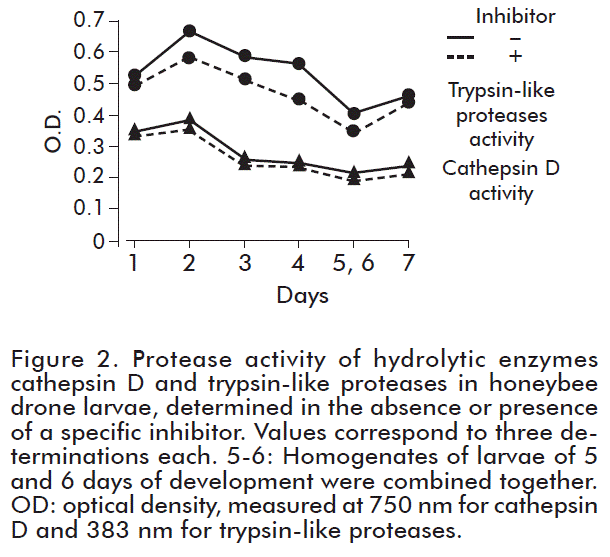
<P   ><font size="2" face="Verdana, Arial, Helvetica, sans-serif">Additionally, we      analyzed the protease class using specific inhibitors for proteolytic enzymes.      These substrates (pepstatin for cathepsin D and Kunitz STI protease inhibitor      for trypsin-like proteases) inhibited the activity of the enzymes in 7-10      % (<a href="/img/revistas/bta/v33n4/f0203416.gif">Figure 2</a>). There was a low inhibition rate because      the proteases in insects show different substrate specificity [3, 5, 19].      </font></P >       
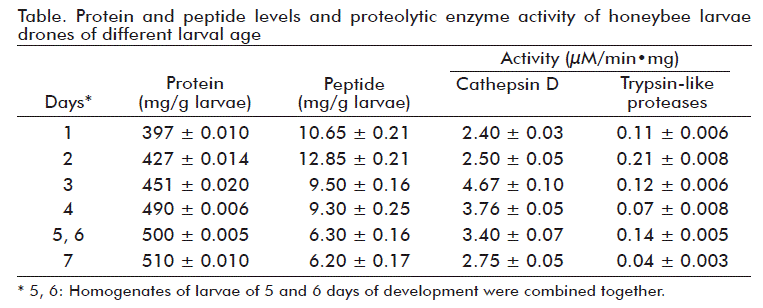
<P   ><font size="2" face="Verdana, Arial, Helvetica, sans-serif">Results of protein      and peptide concentration, and enzyme activity in larvae extracts, are presented      in the table. There was observed an increase in protein concentration along      with the development stages of drone larvae. Dynamics of peptides during ontogenesis      of larvae differs from dynamics of proteins. The maximal abundance of peptides      in larvae was detected on day 2 (<a href="/img/revistas/bta/v33n4/t0103416.gif">Table</a>). </font></P >       
<P   ><font size="2" face="Verdana, Arial, Helvetica, sans-serif">On day 1, 1 g of      larvae contained an average of 397 mg of protein, whereas, on day 4, protein      content reached 490 mg. In contrast, the maximal abundance of peptides is      observed on day 2 (12.9 mg) of larvae development. Its minimum was reached      after 4-5 days (6.3 mg), which is 2-fold less than the amount on day 2. Thus,      early stages of larvae development include protein biosynthetic processes,      which are regulated by the turn-over of regulatory peptides [2, 8-11]. </font></P >       <P   ><font size="2" face="Verdana, Arial, Helvetica, sans-serif">The dynamics of cathepsin      D and trypsin-like protease activity at different stages of larvae development      is presented in <a href="/img/revistas/bta/v33n4/f0303416.gif">Figure 3</a>. Activity of cathepsin      D reaches a maximum on day 3 and decreases subsequently in larvae with their      age (Table). In contrast, the activity of trypsin-like proteases shows its      maximum on day 2 followed by an inconsistent pattern of lower enzyme activity.      </font></P >       
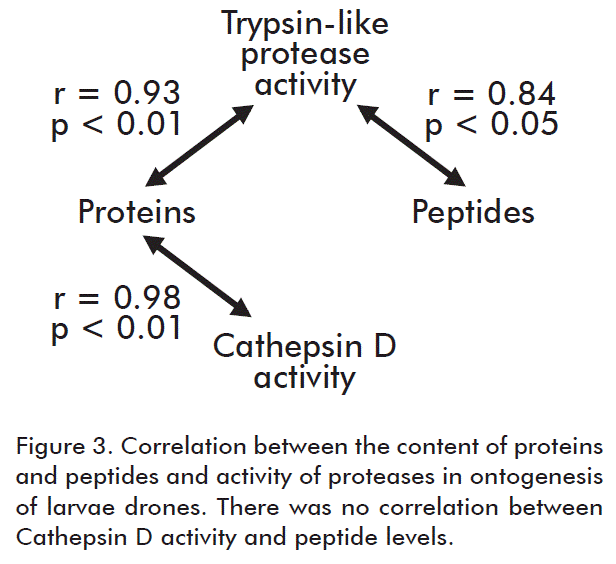
<P   ><font size="2" face="Verdana, Arial, Helvetica, sans-serif">According to the      correlation analysis, we demonstrated a correlation between the activity of      trypsin-like proteases and peptide amount during ontogenesis of larvae (<a href="/img/revistas/bta/v33n4/t0103416.gif">Table</a>).      Therefore, we assumed that these enzymes participate in production and cleavage      of regulatory peptides. Besides, correlation between the activity of trypsin-like      proteases and concentration of proteins is shown (<a href="/img/revistas/bta/v33n4/f0303416.gif">Figure      3</a>), indicative of their activity during protein metabolism in insects.      This dependence has been observed also in vertebrate animals [2, 4, 19- 22].      No reliable correlation of cathepsin D activity and peptides was observed      (<a href="/img/revistas/bta/v33n4/f0303416.gif">Figure 3</a>) [15, 21]. </font></P >       
<P   ><font size="2" face="Verdana, Arial, Helvetica, sans-serif">Cathepsin D is known      to proteolytically cleave and modify lysosomal proteins. This coincides with      the correlation observed in this study between cathepsin D activity and protein      amounts, and the lack of correlation with the concentration of peptides. Trypsin-like      proteases are commonly active in the cytoplasm and their activity correlates      with protein as well as peptide amounts in larvae. Thus, we propose that trypsin-like      proteases are involved in the synthesis of regulatory peptides whereas cathepsin      D is not connected with this process. Regulatory peptides have their function      in the cytoplasm during biosynthesis of regulatory protein needed during early      stages of larvae development [2, 8-11]. </font></P >       <P   ><font size="2" face="Verdana, Arial, Helvetica, sans-serif">Notably, these enzymes      usually participate in the degradation of proteins to free amino acids, contributing      too homeostasis of proteins and peptides with functions other than regulation      [2, 4, 5, 19, 21, 23]. </font></P >       ]]></body>
<body><![CDATA[<P   >&nbsp;</P >       <P   > </P >   <FONT size="+1" color="#000000">        <P   ><b><font size="3" face="Verdana, Arial, Helvetica, sans-serif">CONCLUSIONS </font></b></P >       <P   ><font size="2" color="#211E1F" face="Verdana, Arial, Helvetica, sans-serif">Studying      the dynamics of regulatory peptides and proteolytic enzymes during ontogenesis      of larvae drones opens the view on evolutionary mechanisms in bee families.      Our data reveals the correlation between the activity of our studied enzymes      and amount of proteins or peptides, thus, confirming the functional dependence      of proteolytic enzymes and cellular substrates. </font></P >   <FONT size="+1" color="#211E1F">        <P   ><font size="2" face="Verdana, Arial, Helvetica, sans-serif">By studying proteolytic      activity with specific substrates we examined the dynamics in the activity      change of cathepsin D and the trypsin-like proteases in ontogenesis of larvae      drone. The correlation of cathepsin D activity and protein during ontogenesis      indicates an important role of cathepsin D in protein metabolism regarding      the degradation of spare proteins as well as the catabolism to deliver structural      proteins for building the developing larva organism. Due to the correlation      of trypsin-like protease activity and peptide dynamics, participation of these      </font><font size="2" face="Verdana, Arial, Helvetica, sans-serif">proteases      in the synthesis of regulatory peptides is suggested. Thus, trypsin-like proteases      have regulatory function during ontogenesis of larva drone additionally to      their role during protein homeostasis. </font></P >       <P   >&nbsp;</P >       <P   > </P >   <FONT size="+1" color="#000000">       <P   ><b><font size="3" face="Verdana, Arial, Helvetica, sans-serif">REFERENCES </font></b></P >       <P   ><font size="2" color="#211E1F" face="Verdana, Arial, Helvetica, sans-serif">1.      Chan QW, Foster LJ. Changes in protein expression during honey bee larval      development. Genome Biol. 2008;9(10):R156. </font></P >   <FONT size="+1" color="#211E1F">        <!-- ref --><P   ><font size="2" face="Verdana, Arial, Helvetica, sans-serif">2. Gengin M. Features      structural - functional organization and physicochemical properties not lysosomal      peptide-hydrolases of animal brain (PhD Thesis). Penza: Penza University;      2002.     </font></P >       <!-- ref --><P   ><font size="2" face="Verdana, Arial, Helvetica, sans-serif">3. Z&oacute;towska      K, Lipinski Z, Farjan M. Activity of selected hydrolases in ontogeny of drone      <I>Apis mellifera carnica</I>. J Apicult Sci. 2011;51(1):95-100.     </font></P >       <!-- ref --><P   ><font size="2" face="Verdana, Arial, Helvetica, sans-serif">4. Z&oacute;towska      K, Fraczek R, Lipinski Z. Hydrolases of developing worker brood and newly      emerged worker of Apis mellifera carnica. J Apicult Sci. 2011;51(1):27-37.          </font></P >       <P   ><font size="2" face="Verdana, Arial, Helvetica, sans-serif">5. Iarygin DV, Min&rsquo;kova      NO, Filippovich Iu B. Study of intracellular localization of the proteolytic      enzyme complex and its protein inhibitors in bombyx grain. Ontogenez. 2012;43(5):325-32.      </font></P >       <!-- ref --><P   ><font size="2" face="Verdana, Arial, Helvetica, sans-serif">6. Gomazkov OA. Functional      biochemistry of regulatory peptides. Moscow: Nauka; 1993.     </font></P >       <!-- ref --><P   ><font size="2" face="Verdana, Arial, Helvetica, sans-serif">7. Fang Y, Feng M,      Han B, Qi Y, Hu H, Fan P, <I>et al</I>. Proteome Analysis Unravels Mechanism      Underling the Embryogenesis of the Honeybee Drone and Its Divergence with      the Worker (<I>Apis mellifera lingustica</I>). J Proteome Res. 2015;14(9):4059-71.          </font></P >       ]]></body>
<body><![CDATA[<!-- ref --><P   ><font size="2" face="Verdana, Arial, Helvetica, sans-serif">8. Nassel DR, Homberg      U. Neuropeptides in interneurons of the insect brain. Cell Tissue Res. 2006;326(1):1-24.          </font></P >       <!-- ref --><P   ><font size="2" face="Verdana, Arial, Helvetica, sans-serif">9. Havinson V, Kvetnaja      T. Regulatory peptides and homeostasis. Russ Chem J. 2005;XLIX(1):112-7.     </font></P >       <!-- ref --><P   ><font size="2" face="Verdana, Arial, Helvetica, sans-serif">10. Ashmarin IP,      Obukhova MF. Regulatory peptides. A functionally continuous collection. J      Biochem. 1986;51(4):531-42.     </font></P >       <!-- ref --><P   ><font size="2" face="Verdana, Arial, Helvetica, sans-serif">11. Mishukovskaya      G. Ultrastructural and histochemical changes in the isolated muscle of a flying      musculation of bees during ontogenesis. Bee J. 2007; 7:18-20.     </font></P >       <!-- ref --><P   ><font size="2" face="Verdana, Arial, Helvetica, sans-serif">12. Jay SC. The Development      of Honeybees in their Cells. Journal of Apicultural Research. 1963;2(2):117-34.          </font></P >       ]]></body>
<body><![CDATA[<!-- ref --><P   ><font size="2" face="Verdana, Arial, Helvetica, sans-serif">13. Lowry OH, Rosebrough      NJ, Farr AL, Randall RJ. Protein measurement with the Folin phenol reagent.      J Biol Chem. 1951;193(1):265-75.     </font></P >       <!-- ref --><P   ><font size="2" face="Verdana, Arial, Helvetica, sans-serif">14. Barrett AJ. Cathepsin      D. Purification of isoenzymes from human and chicken liver. Biochem J. 1970;117(3):601-7.          </font></P >       <!-- ref --><P   ><font size="2" face="Verdana, Arial, Helvetica, sans-serif">15. Ivanter EV, Korosov      AV. Elementary Biometrics: A Tutorial. Petrozavodsk: Izd. PetrGU; 2010.     </font></P >       <!-- ref --><P   ><font size="2" face="Verdana, Arial, Helvetica, sans-serif">16. Crailsheim K.      The protein balance of the honeybee worker. Apidologie. 1990;21: 417-29.     </font></P >       <!-- ref --><P   ><font size="2" face="Verdana, Arial, Helvetica, sans-serif">17. Blanco-Labra      A, Martinez-Gallardo NA, Sandoval-Cardoso L, Delano-Frier J. Purification      and characterization of a digestive cathepsin D proteinase isolated from <I>Tribolium      castaneum</I> larvae (Herbst). Insect Biochem Mol Biol. 1996;26(1):95-100.          </font></P >       ]]></body>
<body><![CDATA[<!-- ref --><P   ><font size="2" face="Verdana, Arial, Helvetica, sans-serif">18. Saikhedkar N,      Summanwar A, Joshi R, Giri A. Cathepsins of lepidopteran insects: Aspects      and prospects. Insect Biochem Mol Biol. 2015;64:51-9.     </font></P >       <!-- ref --><P   ><font size="2" face="Verdana, Arial, Helvetica, sans-serif">19. Wielkopolan B,      Walczak F, Podlesny A, Nawrot R, Obrepalska-Steplowska A. Identification and      partial characterization of proteases in larval preparations of the cereal      leaf beetle (<I>Oulema melanopus</I>, <I>Chrysomelidae</I>, Coleoptera). Arch      Insect Biochem Physiol. 2015;88(3):192-202.     </font></P >       <!-- ref --><P   ><font size="2" face="Verdana, Arial, Helvetica, sans-serif">20. Shrimpton CN,      Smith AI. Soluble neutral metallopeptidases: physiological regulators of peptide      action. J Pept Sci. 2000;6(6):251-63.     </font></P >       <!-- ref --><P   ><font size="2" face="Verdana, Arial, Helvetica, sans-serif">21. Gui ZZ, Lee KS,      Kim BY, Choi YS, Wei YD, Choo YM, <I>et al</I>. Functional role of aspartic      proteinase cathepsin D in insect metamorphosis. BMC Dev Biol. 2006;6:49.     </font></P >       <!-- ref --><P   ><font size="2" face="Verdana, Arial, Helvetica, sans-serif">22. Volpicella M,      Ceci LR, Cordewener J, America T, Gallerani R, Bode W, <I>et al</I>. Properties      of purified gut trypsin from Helicoverpa zea, adapted to proteinase inhibitors.      Eur J Biochem. 2003;270(1):10-9.     </font></P >       ]]></body>
<body><![CDATA[<!-- ref --><P   ><font size="2" face="Verdana, Arial, Helvetica, sans-serif">23. Fusek M, Vetvicka      V. Dual role of cathepsin D: ligand and protease. Biomed Pap Med Fac Univ      Palacky Olomouc Czech Repub. 2005;149(1):43-50.     </font></P >       <P   >&nbsp;</P >       <P   >&nbsp;</P >       <P   > </P >       <P   > </P >   <FONT size="+1" color="#000000">        <P   ><font size="2" color="#211E1F" face="Verdana, Arial, Helvetica, sans-serif">Received      in October, 2016.     <br>     Accepted in December, 2016. </font></P >   <FONT size="+1" color="#211E1F">        <P   >&nbsp;</P >   <FONT size="+1" color="#000000">        <P   >&nbsp;</P >       ]]></body>
<body><![CDATA[<P   ><font size="2" color="#211E1F" face="Verdana, Arial, Helvetica, sans-serif"><i>Zhanna      Grishina</i>. Penza State University, Penza, 440026, Russia. E-mail: <A href="mailto:grinzanetk@icloud.com">      <FONT color="#0000FF">grinzanetk@icloud.com</font></A><FONT color="#0000FF">.</font></font></P >   </font></font></font></font></font></font></font></font></font></font></font></font></font></font></font></font></font></font></font></font></font></font></font></DIV >      ]]></body><back>
<ref-list>
<ref id="B1">
<label>1</label><nlm-citation citation-type="journal">
<person-group person-group-type="author">
<name>
<surname><![CDATA[Chan]]></surname>
<given-names><![CDATA[QW]]></given-names>
</name>
<name>
<surname><![CDATA[Foster]]></surname>
<given-names><![CDATA[LJ]]></given-names>
</name>
</person-group>
<article-title xml:lang="en"><![CDATA[Changes in protein expression during honey bee larval development]]></article-title>
<source><![CDATA[Genome Biol]]></source>
<year>2008</year>
<volume>9</volume>
<numero>10</numero>
<issue>10</issue>
<page-range>156</page-range></nlm-citation>
</ref>
<ref id="B2">
<label>2</label><nlm-citation citation-type="book">
<person-group person-group-type="author">
<name>
<surname><![CDATA[Gengin]]></surname>
<given-names><![CDATA[M]]></given-names>
</name>
</person-group>
<source><![CDATA[Features structural - functional organization and physicochemical properties not lysosomal peptide-hydrolases of animal brain (PhD Thesis)]]></source>
<year>2002</year>
<publisher-loc><![CDATA[Penza ]]></publisher-loc>
<publisher-name><![CDATA[Penza University]]></publisher-name>
</nlm-citation>
</ref>
<ref id="B3">
<label>3</label><nlm-citation citation-type="journal">
<person-group person-group-type="author">
<name>
<surname><![CDATA[Zótowska]]></surname>
<given-names><![CDATA[K]]></given-names>
</name>
<name>
<surname><![CDATA[Lipinski]]></surname>
<given-names><![CDATA[Z]]></given-names>
</name>
<name>
<surname><![CDATA[Farjan]]></surname>
<given-names><![CDATA[M]]></given-names>
</name>
</person-group>
<article-title xml:lang="en"><![CDATA[Activity of selected hydrolases in ontogeny of drone Apis mellifera carnica]]></article-title>
<source><![CDATA[J Apicult Sci]]></source>
<year>2011</year>
<volume>51</volume>
<numero>1</numero>
<issue>1</issue>
<page-range>95-100</page-range></nlm-citation>
</ref>
<ref id="B4">
<label>4</label><nlm-citation citation-type="journal">
<person-group person-group-type="author">
<name>
<surname><![CDATA[Zótowska]]></surname>
<given-names><![CDATA[K]]></given-names>
</name>
<name>
<surname><![CDATA[Fraczek]]></surname>
<given-names><![CDATA[R]]></given-names>
</name>
<name>
<surname><![CDATA[Lipinski]]></surname>
<given-names><![CDATA[Z]]></given-names>
</name>
</person-group>
<article-title xml:lang="en"><![CDATA[Hydrolases of developing worker brood and newly emerged worker of Apis mellifera carnica]]></article-title>
<source><![CDATA[J Apicult Sci]]></source>
<year>2011</year>
<volume>51</volume>
<numero>1</numero>
<issue>1</issue>
<page-range>27-37</page-range></nlm-citation>
</ref>
<ref id="B5">
<label>5</label><nlm-citation citation-type="journal">
<person-group person-group-type="author">
<name>
<surname><![CDATA[Iarygin]]></surname>
<given-names><![CDATA[DV]]></given-names>
</name>
<name>
<surname><![CDATA[Minkova]]></surname>
<given-names><![CDATA[NO]]></given-names>
</name>
<name>
<surname><![CDATA[Filippovich Iu]]></surname>
<given-names><![CDATA[B]]></given-names>
</name>
</person-group>
<article-title xml:lang="en"><![CDATA[Study of intracellular localization of the proteolytic enzyme complex and its protein inhibitors in bombyx grain]]></article-title>
<source><![CDATA[Ontogenez]]></source>
<year>2012</year>
<volume>43</volume>
<numero>5</numero>
<issue>5</issue>
<page-range>325-32</page-range></nlm-citation>
</ref>
<ref id="B6">
<label>6</label><nlm-citation citation-type="book">
<person-group person-group-type="author">
<name>
<surname><![CDATA[Gomazkov]]></surname>
<given-names><![CDATA[OA]]></given-names>
</name>
</person-group>
<source><![CDATA[Functional biochemistry of regulatory peptides]]></source>
<year>1993</year>
<publisher-loc><![CDATA[Moscow ]]></publisher-loc>
<publisher-name><![CDATA[Nauka]]></publisher-name>
</nlm-citation>
</ref>
<ref id="B7">
<label>7</label><nlm-citation citation-type="journal">
<person-group person-group-type="author">
<name>
<surname><![CDATA[Fang]]></surname>
<given-names><![CDATA[Y]]></given-names>
</name>
<name>
<surname><![CDATA[Feng]]></surname>
<given-names><![CDATA[M]]></given-names>
</name>
<name>
<surname><![CDATA[Han]]></surname>
<given-names><![CDATA[B]]></given-names>
</name>
<name>
<surname><![CDATA[Qi]]></surname>
<given-names><![CDATA[Y]]></given-names>
</name>
<name>
<surname><![CDATA[Hu]]></surname>
<given-names><![CDATA[H]]></given-names>
</name>
<name>
<surname><![CDATA[Fan]]></surname>
<given-names><![CDATA[P]]></given-names>
</name>
</person-group>
<article-title xml:lang="en"><![CDATA[Proteome Analysis Unravels Mechanism Underling the Embryogenesis of the Honeybee Drone and Its Divergence with the Worker (Apis mellifera lingustica)]]></article-title>
<source><![CDATA[J Proteome Res]]></source>
<year>2015</year>
<volume>14</volume>
<numero>9</numero>
<issue>9</issue>
<page-range>4059-71</page-range></nlm-citation>
</ref>
<ref id="B8">
<label>8</label><nlm-citation citation-type="journal">
<person-group person-group-type="author">
<name>
<surname><![CDATA[Nassel]]></surname>
<given-names><![CDATA[DR]]></given-names>
</name>
<name>
<surname><![CDATA[Homberg]]></surname>
<given-names><![CDATA[U]]></given-names>
</name>
</person-group>
<article-title xml:lang="en"><![CDATA[Neuropeptides in interneurons of the insect brain]]></article-title>
<source><![CDATA[Cell Tissue Res]]></source>
<year>2006</year>
<volume>326</volume>
<numero>1</numero>
<issue>1</issue>
<page-range>1-24</page-range></nlm-citation>
</ref>
<ref id="B9">
<label>9</label><nlm-citation citation-type="journal">
<person-group person-group-type="author">
<name>
<surname><![CDATA[Havinson]]></surname>
<given-names><![CDATA[V]]></given-names>
</name>
<name>
<surname><![CDATA[Kvetnaja]]></surname>
<given-names><![CDATA[T]]></given-names>
</name>
</person-group>
<article-title xml:lang="en"><![CDATA[Regulatory peptides and homeostasis]]></article-title>
<source><![CDATA[Russ Chem J]]></source>
<year>2005</year>
<volume>XLIX</volume>
<numero>1</numero>
<issue>1</issue>
<page-range>112-7</page-range></nlm-citation>
</ref>
<ref id="B10">
<label>10</label><nlm-citation citation-type="journal">
<person-group person-group-type="author">
<name>
<surname><![CDATA[Ashmarin]]></surname>
<given-names><![CDATA[IP]]></given-names>
</name>
<name>
<surname><![CDATA[Obukhova]]></surname>
<given-names><![CDATA[MF]]></given-names>
</name>
</person-group>
<article-title xml:lang="en"><![CDATA[Regulatory peptides. A functionally continuous collection]]></article-title>
<source><![CDATA[J Biochem]]></source>
<year>1986</year>
<volume>51</volume>
<numero>4</numero>
<issue>4</issue>
<page-range>531-42</page-range></nlm-citation>
</ref>
<ref id="B11">
<label>11</label><nlm-citation citation-type="journal">
<person-group person-group-type="author">
<name>
<surname><![CDATA[Mishukovskaya]]></surname>
<given-names><![CDATA[G]]></given-names>
</name>
</person-group>
<article-title xml:lang="en"><![CDATA[Ultrastructural and histochemical changes in the isolated muscle of a flying musculation of bees during ontogenesis]]></article-title>
<source><![CDATA[Bee J]]></source>
<year>2007</year>
<volume>7</volume>
<page-range>18-20</page-range></nlm-citation>
</ref>
<ref id="B12">
<label>12</label><nlm-citation citation-type="journal">
<person-group person-group-type="author">
<name>
<surname><![CDATA[Jay]]></surname>
<given-names><![CDATA[SC]]></given-names>
</name>
</person-group>
<article-title xml:lang="en"><![CDATA[The Development of Honeybees in their Cells]]></article-title>
<source><![CDATA[Journal of Apicultural Research]]></source>
<year>1963</year>
<volume>2</volume>
<numero>2</numero>
<issue>2</issue>
<page-range>117-34</page-range></nlm-citation>
</ref>
<ref id="B13">
<label>13</label><nlm-citation citation-type="journal">
<person-group person-group-type="author">
<name>
<surname><![CDATA[Lowry]]></surname>
<given-names><![CDATA[OH]]></given-names>
</name>
<name>
<surname><![CDATA[Rosebrough]]></surname>
<given-names><![CDATA[NJ]]></given-names>
</name>
<name>
<surname><![CDATA[Farr]]></surname>
<given-names><![CDATA[AL]]></given-names>
</name>
<name>
<surname><![CDATA[Randall]]></surname>
<given-names><![CDATA[RJ]]></given-names>
</name>
</person-group>
<article-title xml:lang="en"><![CDATA[Protein measurement with the Folin phenol reagent]]></article-title>
<source><![CDATA[J Biol Chem]]></source>
<year>1951</year>
<volume>193</volume>
<numero>1</numero>
<issue>1</issue>
<page-range>265-75</page-range></nlm-citation>
</ref>
<ref id="B14">
<label>14</label><nlm-citation citation-type="journal">
<person-group person-group-type="author">
<name>
<surname><![CDATA[Barrett]]></surname>
<given-names><![CDATA[AJ]]></given-names>
</name>
</person-group>
<article-title xml:lang="en"><![CDATA[Cathepsin D. Purification of isoenzymes from human and chicken liver]]></article-title>
<source><![CDATA[Biochem J]]></source>
<year>1970</year>
<volume>117</volume>
<numero>3</numero>
<issue>3</issue>
<page-range>601-7</page-range></nlm-citation>
</ref>
<ref id="B15">
<label>15</label><nlm-citation citation-type="book">
<person-group person-group-type="author">
<name>
<surname><![CDATA[Ivanter]]></surname>
<given-names><![CDATA[EV]]></given-names>
</name>
<name>
<surname><![CDATA[Korosov]]></surname>
<given-names><![CDATA[AV]]></given-names>
</name>
</person-group>
<source><![CDATA[Elementary Biometrics: A Tutorial]]></source>
<year>2010</year>
<publisher-loc><![CDATA[Petrozavodsk ]]></publisher-loc>
<publisher-name><![CDATA[Izd PetrGU]]></publisher-name>
</nlm-citation>
</ref>
<ref id="B16">
<label>16</label><nlm-citation citation-type="journal">
<person-group person-group-type="author">
<name>
<surname><![CDATA[Crailsheim]]></surname>
<given-names><![CDATA[K]]></given-names>
</name>
</person-group>
<article-title xml:lang="en"><![CDATA[The protein balance of the honeybee worker]]></article-title>
<source><![CDATA[Apidologie]]></source>
<year>1990</year>
<volume>21</volume>
<page-range>417-29</page-range></nlm-citation>
</ref>
<ref id="B17">
<label>17</label><nlm-citation citation-type="journal">
<person-group person-group-type="author">
<name>
<surname><![CDATA[Blanco-Labra]]></surname>
<given-names><![CDATA[A]]></given-names>
</name>
<name>
<surname><![CDATA[Martinez-Gallardo]]></surname>
<given-names><![CDATA[NA]]></given-names>
</name>
<name>
<surname><![CDATA[Sandoval-Cardoso]]></surname>
<given-names><![CDATA[L]]></given-names>
</name>
<name>
<surname><![CDATA[Delano-Frier]]></surname>
<given-names><![CDATA[J]]></given-names>
</name>
</person-group>
<article-title xml:lang="en"><![CDATA[Purification and characterization of a digestive cathepsin D proteinase isolated from Tribolium castaneum larvae (Herbst)]]></article-title>
<source><![CDATA[Insect Biochem Mol Biol]]></source>
<year>1996</year>
<volume>26</volume>
<numero>1</numero>
<issue>1</issue>
<page-range>95-100</page-range></nlm-citation>
</ref>
<ref id="B18">
<label>18</label><nlm-citation citation-type="journal">
<person-group person-group-type="author">
<name>
<surname><![CDATA[Saikhedkar]]></surname>
<given-names><![CDATA[N]]></given-names>
</name>
<name>
<surname><![CDATA[Summanwar]]></surname>
<given-names><![CDATA[A]]></given-names>
</name>
<name>
<surname><![CDATA[Joshi]]></surname>
<given-names><![CDATA[R]]></given-names>
</name>
<name>
<surname><![CDATA[Giri]]></surname>
<given-names><![CDATA[A]]></given-names>
</name>
</person-group>
<article-title xml:lang="en"><![CDATA[Cathepsins of lepidopteran insects: Aspects and prospects]]></article-title>
<source><![CDATA[Insect Biochem Mol Biol]]></source>
<year>2015</year>
<volume>64</volume>
<page-range>51-9</page-range></nlm-citation>
</ref>
<ref id="B19">
<label>19</label><nlm-citation citation-type="journal">
<person-group person-group-type="author">
<name>
<surname><![CDATA[Wielkopolan]]></surname>
<given-names><![CDATA[B]]></given-names>
</name>
<name>
<surname><![CDATA[Walczak]]></surname>
<given-names><![CDATA[F]]></given-names>
</name>
<name>
<surname><![CDATA[Podlesny]]></surname>
<given-names><![CDATA[A]]></given-names>
</name>
<name>
<surname><![CDATA[Nawrot]]></surname>
<given-names><![CDATA[R]]></given-names>
</name>
<name>
<surname><![CDATA[Obrepalska-Steplowska]]></surname>
<given-names><![CDATA[A]]></given-names>
</name>
</person-group>
<article-title xml:lang="en"><![CDATA[Identification and partial characterization of proteases in larval preparations of the cereal leaf beetle (Oulema melanopus, Chrysomelidae, Coleoptera)]]></article-title>
<source><![CDATA[Arch Insect Biochem Physiol]]></source>
<year>2015</year>
<volume>88</volume>
<numero>3</numero>
<issue>3</issue>
<page-range>192-202</page-range></nlm-citation>
</ref>
<ref id="B20">
<label>20</label><nlm-citation citation-type="journal">
<person-group person-group-type="author">
<name>
<surname><![CDATA[Shrimpton]]></surname>
<given-names><![CDATA[CN]]></given-names>
</name>
<name>
<surname><![CDATA[Smith]]></surname>
<given-names><![CDATA[AI]]></given-names>
</name>
</person-group>
<article-title xml:lang="en"><![CDATA[Soluble neutral metallopeptidases: physiological regulators of peptide action]]></article-title>
<source><![CDATA[J Pept Sci]]></source>
<year>2000</year>
<volume>6</volume>
<numero>6</numero>
<issue>6</issue>
<page-range>251-63</page-range></nlm-citation>
</ref>
<ref id="B21">
<label>21</label><nlm-citation citation-type="journal">
<person-group person-group-type="author">
<name>
<surname><![CDATA[Gui]]></surname>
<given-names><![CDATA[ZZ]]></given-names>
</name>
<name>
<surname><![CDATA[Lee]]></surname>
<given-names><![CDATA[KS]]></given-names>
</name>
<name>
<surname><![CDATA[Kim]]></surname>
<given-names><![CDATA[BY]]></given-names>
</name>
<name>
<surname><![CDATA[Choi]]></surname>
<given-names><![CDATA[YS]]></given-names>
</name>
<name>
<surname><![CDATA[Wei]]></surname>
<given-names><![CDATA[YD]]></given-names>
</name>
<name>
<surname><![CDATA[Choo]]></surname>
<given-names><![CDATA[YM]]></given-names>
</name>
</person-group>
<article-title xml:lang="en"><![CDATA[Functional role of aspartic proteinase cathepsin D in insect metamorphosis]]></article-title>
<source><![CDATA[BMC Dev Biol]]></source>
<year>2006</year>
<volume>6</volume>
<page-range>49</page-range></nlm-citation>
</ref>
<ref id="B22">
<label>22</label><nlm-citation citation-type="journal">
<person-group person-group-type="author">
<name>
<surname><![CDATA[Volpicella]]></surname>
<given-names><![CDATA[M]]></given-names>
</name>
<name>
<surname><![CDATA[Ceci]]></surname>
<given-names><![CDATA[LR]]></given-names>
</name>
<name>
<surname><![CDATA[Cordewener]]></surname>
<given-names><![CDATA[J]]></given-names>
</name>
<name>
<surname><![CDATA[America]]></surname>
<given-names><![CDATA[T]]></given-names>
</name>
<name>
<surname><![CDATA[Gallerani]]></surname>
<given-names><![CDATA[R]]></given-names>
</name>
<name>
<surname><![CDATA[Bode]]></surname>
<given-names><![CDATA[W]]></given-names>
</name>
</person-group>
<article-title xml:lang="en"><![CDATA[Properties of purified gut trypsin from Helicoverpa zea, adapted to proteinase inhibitors]]></article-title>
<source><![CDATA[Eur J Biochem]]></source>
<year>2003</year>
<volume>270</volume>
<numero>1</numero>
<issue>1</issue>
<page-range>10-9</page-range></nlm-citation>
</ref>
<ref id="B23">
<label>23</label><nlm-citation citation-type="journal">
<person-group person-group-type="author">
<name>
<surname><![CDATA[Fusek]]></surname>
<given-names><![CDATA[M]]></given-names>
</name>
<name>
<surname><![CDATA[Vetvicka]]></surname>
<given-names><![CDATA[V]]></given-names>
</name>
</person-group>
<article-title xml:lang="en"><![CDATA[Dual role of cathepsin D: ligand and protease]]></article-title>
<source><![CDATA[Biomed Pap Med Fac Univ Palacky Olomouc Czech Repub]]></source>
<year>2005</year>
<volume>149</volume>
<numero>1</numero>
<issue>1</issue>
<page-range>43-50</page-range></nlm-citation>
</ref>
</ref-list>
</back>
</article>