<?xml version="1.0" encoding="ISO-8859-1"?><article xmlns:mml="http://www.w3.org/1998/Math/MathML" xmlns:xlink="http://www.w3.org/1999/xlink" xmlns:xsi="http://www.w3.org/2001/XMLSchema-instance">
<front>
<journal-meta>
<journal-id>1027-2852</journal-id>
<journal-title><![CDATA[Biotecnología Aplicada]]></journal-title>
<abbrev-journal-title><![CDATA[Biotecnol Apl]]></abbrev-journal-title>
<issn>1027-2852</issn>
<publisher>
<publisher-name><![CDATA[Editorial Elfos Scientiae]]></publisher-name>
</publisher>
</journal-meta>
<article-meta>
<article-id>S1027-28522016000400004</article-id>
<title-group>
<article-title xml:lang="en"><![CDATA[A simple method for determining protein-bound homocysteine and cysteine in human plasma by capillary electrophoresis]]></article-title>
<article-title xml:lang="es"><![CDATA[Método simple para la determinación de homocisteína y cisteína unida a proteínas en muestras de plasma humano mediante electroforesis capilar]]></article-title>
</title-group>
<contrib-group>
<contrib contrib-type="author">
<name>
<surname><![CDATA[Danielevich]]></surname>
<given-names><![CDATA[Virus E]]></given-names>
</name>
<xref ref-type="aff" rid="A01"/>
</contrib>
<contrib contrib-type="author">
<name>
<surname><![CDATA[Vladimirovich]]></surname>
<given-names><![CDATA[Ivanov A]]></given-names>
</name>
<xref ref-type="aff" rid="A01"/>
</contrib>
<contrib contrib-type="author">
<name>
<surname><![CDATA[Iusupovna]]></surname>
<given-names><![CDATA[Kuchukova M]]></given-names>
</name>
<xref ref-type="aff" rid="A01"/>
</contrib>
<contrib contrib-type="author">
<name>
<surname><![CDATA[Petrovich]]></surname>
<given-names><![CDATA[Luzyanin B]]></given-names>
</name>
<xref ref-type="aff" rid="A01"/>
</contrib>
<contrib contrib-type="author">
<name>
<surname><![CDATA[Amirkhanovich]]></surname>
<given-names><![CDATA[Kubatiev A]]></given-names>
</name>
<xref ref-type="aff" rid="A01"/>
</contrib>
</contrib-group>
<aff id="A01">
<institution><![CDATA[,FSBSI Institute of General Pathology and Pathophysiology  ]]></institution>
<addr-line><![CDATA[Moscow ]]></addr-line>
<country>Russia</country>
</aff>
<pub-date pub-type="pub">
<day>00</day>
<month>12</month>
<year>2016</year>
</pub-date>
<pub-date pub-type="epub">
<day>00</day>
<month>12</month>
<year>2016</year>
</pub-date>
<volume>33</volume>
<numero>4</numero>
<fpage>4301</fpage>
<lpage>4304</lpage>
<copyright-statement/>
<copyright-year/>
<self-uri xlink:href="http://scielo.sld.cu/scielo.php?script=sci_arttext&amp;pid=S1027-28522016000400004&amp;lng=en&amp;nrm=iso"></self-uri><self-uri xlink:href="http://scielo.sld.cu/scielo.php?script=sci_abstract&amp;pid=S1027-28522016000400004&amp;lng=en&amp;nrm=iso"></self-uri><self-uri xlink:href="http://scielo.sld.cu/scielo.php?script=sci_pdf&amp;pid=S1027-28522016000400004&amp;lng=en&amp;nrm=iso"></self-uri><kwd-group>
<kwd lng="en"><![CDATA[protein-bound homocysteine]]></kwd>
<kwd lng="en"><![CDATA[protein-bound cysteine]]></kwd>
<kwd lng="en"><![CDATA[thiocarbonyldiimidazole]]></kwd>
<kwd lng="en"><![CDATA[capillary electrophoresis]]></kwd>
<kwd lng="en"><![CDATA[human plasma]]></kwd>
<kwd lng="en"><![CDATA[UV detection]]></kwd>
<kwd lng="es"><![CDATA[cisteína unida a proteínas]]></kwd>
<kwd lng="es"><![CDATA[homocisteína unida a proteínas]]></kwd>
<kwd lng="es"><![CDATA[tiocarbonildiimidazol]]></kwd>
<kwd lng="es"><![CDATA[electroforesis capilar]]></kwd>
<kwd lng="es"><![CDATA[plasma humano]]></kwd>
<kwd lng="es"><![CDATA[detección UV]]></kwd>
</kwd-group>
</article-meta>
</front><body><![CDATA[ <DIV class="Part"   >        <P align="right"   ><font size="2" color="#000000" face="Verdana, Arial, Helvetica, sans-serif"><b>TECHNIQUE      </b></font></P >   <FONT size="+1" color="#000000">        <P   > </P >   <FONT size="+1">        <P   >&nbsp;</P >       <P   ><font size="2" color="#211E1F" face="Verdana, Arial, Helvetica, sans-serif"><B><font size="4">A      simple method for determining protein-bound homocysteine and cysteine in human      plasma by capillary electrophoresis </font></b></font></P >   <FONT size="+1" color="#211E1F"><B>        <P   >&nbsp;</P >       <P   ><font size="3" face="Verdana, Arial, Helvetica, sans-serif">M&eacute;todo simple      para la determinaci&oacute;n de homociste&iacute;na y ciste&iacute;na unida      a prote&iacute;nas en muestras de plasma humano mediante electroforesis capilar      </font></P >       <P   >&nbsp;</P >       <P   >&nbsp;</P >   </B><FONT size="+1">       <P   ></P >   </font><FONT size="+1">       ]]></body>
<body><![CDATA[<P   ><b><font size="2" color="#211E1F" face="Verdana, Arial, Helvetica, sans-serif">Virus      E Danielevich, Ivanov A Vladimirovich, Kuchukova M Iusupovna, Luzyanin B Petrovich,      Kubatiev A Amirkhanovich </font></b><font size="2" color="#211E1F" face="Verdana, Arial, Helvetica, sans-serif"></font></P >   <FONT size="+1" color="#211E1F">        <P   ><font size="2" face="Verdana, Arial, Helvetica, sans-serif">FSBSI Institute of      General Pathology and Pathophysiology. Moscow, 125315, Baltiyskaya str.,8,      Moscow, Russia. </font></P >       <P   >&nbsp;</P >       <P   >&nbsp;</P >   <FONT size="+1">        <P   > </P >   <B> </B></font></font></font></font></font></font>   <hr>   <FONT size="+1" color="#000000"><FONT size="+1"><FONT size="+1" color="#211E1F"><FONT size="+1"><FONT size="+1" color="#211E1F"><FONT size="+1"><B>       <P   ><font size="2" face="Verdana, Arial, Helvetica, sans-serif">ABSTRACT </font></P >   </B>        <P   ><font size="2" face="Verdana, Arial, Helvetica, sans-serif">A capillary electrophoresis      method with UV detection has been developed for the determination of protein-bound      cysteine and homocysteine in human plasma based on the combination of derivatization      step with pH-mediated base stacking. Centrifugal ultrafiltration was carried      out to clarify plasma proteins from salts and low-molecular weight compounds.      Thereafter, the sample was incubated with dithiothreitol to reduce the disulfides      and release protein-bound aminothiols. The released thiols were derivatized      with thiocarbonyldiimidazole and injected into the capillary electrophoresis      by voltage. Due to the stacking effects it is possible to perform a considerable      on-line pre-concentration of the analytes. The proposed approach allows to      reach a detection limit of 1 &mu;mol/L in blood plasma using 48.5 cm total      length 50-&mu;m i.d. uncoated capillary. The coefficient of variation of the      assay was within &plusmn; 5 % for both homocysteine and cysteine. </font></P >       <P   ><font size="2" face="Verdana, Arial, Helvetica, sans-serif"><I><font size="3"><b><font size="2">Keywords:</font></b></font>      </I>protein-bound homocysteine, protein-bound cysteine, thiocarbonyldiimidazole,      capillary electrophoresis, human plasma, UV detection. </font></P >   </font></font></font></font></font></font>    <hr>   <FONT size="+1" color="#000000"><FONT size="+1"><FONT size="+1" color="#211E1F"><FONT size="+1"><FONT size="+1" color="#211E1F"><FONT size="+1">       <P   ><font size="3" face="Verdana, Arial, Helvetica, sans-serif"><b>RESUMEN </b></font></P >       <P   ><font size="2" face="Verdana, Arial, Helvetica, sans-serif">Se desarroll&oacute;      un m&eacute;todo basado en electroforesis capilar para la detecci&oacute;n      mediante luz ultravioleta de residuos de ciste&iacute;na y homociste&iacute;na      unidos a prote&iacute;nas en plasma humano, mediante la combinaci&oacute;n      de un paso de derivatizaci&oacute;n con apilamiento mediado por pH. Las sales      y los compuestos de bajo peso molecular se eliminaron de la mezcla de prote&iacute;nas      mediante ultracentrifugaci&oacute;n. A continuaci&oacute;n, la muestra se      incub&oacute; con ditiotreitol para reducir los puentes disulfuro. Los compuestos      derivatizados se inyectaron a la electroforesis capilar mediante su aplicaci&oacute;n      por voltaje. El efecto de apilamiento permiti&oacute; una considerable preconcentraci&oacute;n      de los analitos antes de su separaci&oacute;n. El enfoque propuesto permite      alcanzar un l&iacute;mite de detecci&oacute;n de 1 &mu;mol/L en muestras de      plasma sangu&iacute;neo con el empleo de un capilar no recubierto de 48.5      cm de largo y un di&aacute;metro interno de 50 &mu;m. El coeficiente de variaci&oacute;n      del ensayo para la homociste&iacute;na y la ciste&iacute;na fue de &plusmn;      5 %. </font></P >       ]]></body>
<body><![CDATA[<P   ><font size="2" face="Verdana, Arial, Helvetica, sans-serif"><I><b>Palabras clave:      </b></I>ciste&iacute;na unida a prote&iacute;nas, homociste&iacute;na unida      a prote&iacute;nas, tiocarbonildiimidazol, electroforesis capilar, plasma      humano, detecci&oacute;n UV. </font></P >   </font></font></font></font></font></font>    <hr>       <p>&nbsp;</p>    <p><FONT size="+1" color="#000000"><FONT size="+1"><FONT size="+1" color="#211E1F"><FONT size="+1"><FONT size="+1" color="#211E1F"><FONT size="+1"><B>    </B></font></font></font></font></font></font></p><FONT size="+1" color="#000000"><FONT size="+1"><FONT size="+1" color="#211E1F"><FONT size="+1"><FONT size="+1" color="#211E1F"><FONT size="+1">       <P   ></P >       <P   ></P >   <FONT size="+1" color="#000000">       <P   ><b><font size="3" face="Verdana, Arial, Helvetica, sans-serif">INTRODUCTION </font></b></P >       <P   ><font size="2" color="#211E1F" face="Verdana, Arial, Helvetica, sans-serif">About      of 70 % of total Hcy and 50 % of Cys are bound to proteins in blood plasma      [1]. Elevated level of Hcy (hyperhomocysteinemia) is independent marker of      various cardiovascular diseases [2]. The determination of protein-bound Hcy      is attractive because some plasma proteins are discussed as carriers of this      compound into the cells given that their presence causes cell dysfunction,      especially endothelial dysfunction [3, 4]. Furthermore, the homocysteinilation      may be associated with oxidative stress and/or with dysfunction of plasma      proteins [5-7]. </font></P >   <FONT size="+1" color="#211E1F">        <P   > </P >   <FONT size="+1" color="#000000">        <P   ><font size="2" color="#211E1F" face="Verdana, Arial, Helvetica, sans-serif">Plasma      cysteine is an end product of Hcy transsulfuration pathway and major competitor      for binding sites on proteins [8]. Close metabolic relations of this amino      acids cause an interest to using of Hcy/Cys ratio as alternative total Hcy.      This ratio may better reflect abnormalities of transsulfuration enzymes, affects      bioavailability of Hcy or reveal of preanalytical errors [8]. Also it was      shown that high plasma homocysteine concentration is associated with increased      risk of colorectal cancer among postmenopausal women, whereas high cysteine      is associated with decreased risk [9]. </font></P >   <FONT size="+1" color="#211E1F">        <P   ><font size="2" face="Verdana, Arial, Helvetica, sans-serif">Although immunoassay      analysis [10] is a widespread routine method for determination of total (oxidized      + reduced) Hcy but it cannot been applied to the determination of Cys. To      solve this problem many analytical methods based on HPLC or CE with laser      induced fluorescence (LIF) [1, 11, 12], electrochemical [13] or mass spectrometry      (MS) detectors [14, 15] have been proposed. Most methods are relevant to the      analysis of total aminothiols, but they may also be applied to their bound      forms. Unfortunately, the poor throughput of these approaches makes it difficult      their implementation in clinical laboratories. In our opinion, available HPLC      and CE with ultraviolet light (UV)-detectors are more accessible for clinical      laboratories. However, only several HPLC-UV methods have been proposed for      the quantitative determination of aminothiols in blood plasma [16-18]. Some      CE-UV methods with a derivatization step were proposed [19-22], but their      sensitivity was insufficient to detect plasma Hcy, in contrast to CE-LIF and      HPLC-UV. </font></P >       ]]></body>
<body><![CDATA[<P   ><font size="2" face="Verdana, Arial, Helvetica, sans-serif">Several years ago,      Zinellu <I>et al</I>. have shown that CE-UV sensitivity is sufficient for      the direct determination of Hcy and Cys at 190 nm in the micromolar range      in model mixtures [23]. Obviously, high salts concentration and potential      interferences will hamper to the sensitive CE-UV detection of protein-bound      homocysteine and cysteine in human plasma. However, noteworthy works of Kubalzcyk      <I>et al</I>. where a good LOD (1 &mu;mol/L) was reached for total Hcy in      human plasma samples [24, 25]. They applied Hcy derivatization with 2-chloro-1-methylquinolinium      tetrafluoroborate. Unfortunately, this reagent is not commercially available.      High sensitivity was also achieved by Chang and Tseng [26]. They used gold      nanoparticles to achieve a great concentration effect with achieving of LOD      10-65 nM. Despite the attractiveness of this approach, it is time-consuming      because of multistage sample preparation and long analysis time. Moreover,      protein-bound thiols were calculated as the difference in concentration between      total and free their forms. Therefore from our point of view, indirect methods      in combination with in-capillary concentration would be preferable. </font></P >       <P   ><font size="2" face="Verdana, Arial, Helvetica, sans-serif">In this case, reagents      should meet the following requirements. First, its derivatives must be suitable      for pre-concentration. Second, excess of reagent must not create interferences.      Early used reagents (5,5&rsquo;-(2-dithiobisnitrobenzoic) acid, monobromobimane,      4-aminosulfonyl-7-fluoro-2,1,3-benzoxadiazole and 2,2&rsquo;-dipyridyl disulfide)      were not are not completely satisfied with these requirements. On the other      hand, Amarnath <I>et al</I>. used thiocarbonyldiimidazole (TCDI) for derivatization      of Cys, Hcy and HPLC for separation of corresponding derivatives which can      be able to absorb in UV region [27]. TCDI binds NH2- and SH-groups of analytes      via thiocarbonyl moiety. Thus, the reaction products acquire acidic character      as their carboxyl groups of aminothiols are preserved. </font></P >       <P   ><font size="2" face="Verdana, Arial, Helvetica, sans-serif">TCDI and products      of its hydrolysis are also weak electrolytes and they do not have a significant      impact on in-capillary concentration. This allows us to use pH-mediated base      stacking [28]. This approach includes electrokinetic injection (EI) of sample      and subsequent postinjection of alkaline solution (base stacking). Sample      anions (include analytes) migrate in capillary and formed an injection zone      at EI stage. The key parameter of EI effectiveness (i.e. amount of injected      analytes) is ratio BGE/sample conductivity or ionic strength. BGE ionic strength      is limited by heating during CE therefore it is necessary to minimize sample      ionic strength. A possibility subsequent removing of salts and plasma proteins,      low-ionizable properties of TCDI are appropriate conditions for EI. If injection      time is a sustained then length of injection zone may be too long for good      separation. In that case an alkaline postinjection is used for titration and      narrowing of injection zone [28]. </font></P >       <P   ><font size="2" face="Verdana, Arial, Helvetica, sans-serif">Thereby the aim of      this study was to develop a sensitive, fast, simple and available electrophoretic      method with UV-detection for determination of protein-bound Hcy, Cys and corresponding      Cys/ Hcy ratio in human blood plasma based on the combination of derivatization      step with in-capillary concentration. </font></P >       <P   >&nbsp;</P >       <P   > </P >   <FONT size="+1" color="#000000">        <P   ><font size="3" face="Verdana, Arial, Helvetica, sans-serif"><B>MATERIALS AND      METHODS </b></font></P >   <B>        <P   ><font size="2" color="#211E1F" face="Verdana, Arial, Helvetica, sans-serif">Reagents      </font></P >   </B>        <P   ><font size="2" color="#211E1F" face="Verdana, Arial, Helvetica, sans-serif">Formic      acid for LC-MS (Fluka, Germany), TCDI purum (Sigma-Aldrich, Switzerland),      ammonium acetate pure (Reahim, Russia), acetonitrile HPLC grade (Himmed, Russia),      NaCl purum p.a. (Fluka, Switzerland), D-penicillamine (PA; Sigma-Aldrich,      Germany), DL-dithiotreitol (DTT, &gt; 99.5 %; Fluka, Germany), Cys 97 % (Aldrich,      USA), cysteinylgly-cine (CysGly) &gt; 85 % (Sigma, Germany), Hcy &gt; 95 %      (Sigma, Germany), hexadecyltrimethylammonium bromide (CTAB; Sigma, India),      NaOH purum (Dia- M, Germany). </font></P >   <FONT size="+1" color="#211E1F">        <P   ><font size="2" face="Verdana, Arial, Helvetica, sans-serif">Deionized water was      prepared by using a deionizer Millipore Simplicity 185 with Simpakor 1 cartridge.      Stock solutions of Cys (100 mmol/L), Hcy (50 mmol/L) and PA (50 mmol/L) were      prepared by dissolving of appropriate amounts of analytes 0.1 % (v/v) formic      acid and kept at &ndash;80 &ordm;C. For plasma proteins reduction prior to      derivatization a fresh 0.1 mol/L solution of DTT was prepared. TCDI solution      was prepared by dissolving of appropriate amount of the reagent in one volume      acetonitrile and dilution by 9 volumes of water. </font></P >       ]]></body>
<body><![CDATA[<P   ><font size="2" face="Verdana, Arial, Helvetica, sans-serif"><B>Instrumentation      </b></font></P >       <P   ><font size="2" face="Verdana, Arial, Helvetica, sans-serif">Agilent CE 3D system      (Germany) with diode-array detector and 50 &mu;m i.d. capillary 48.5 cm length      (40 cm eff.) was used. Absorption was detected at 254 &plusmn; 20 nm with      frequency 5 s<sup>-1</sup>. Centrifuge filters Amicon Ultra-3K (Millipore,      Ireland) were used for ultrafiltration. </font></P >   <FONT size="+1"><FONT size="+1">        <P   ><font size="2" face="Verdana, Arial, Helvetica, sans-serif"><B>Sample preparation      </b></font></P >       <P   ><font size="2" face="Verdana, Arial, Helvetica, sans-serif">Venous blood was      voluntarily donated by women who consented to provide the samples required      for the study (N = 19, 35-47 years old, mean 41 years). Samples were collected      in vacuum tubes with 3.8 % sodium citrate (Greiner Bio-One GmbH, Austria)      and processed at 3000 <I>g </I>for 3 min. Plasma was separated and stored      at &ndash;20 &ordm;C. Blood plasma (50 &mu;L) was mixed with deionized water      (450 &mu;L) and was filtrated through Amicon Ultra 3K filter at 14 000 <I>g      </I>for 15 min. Then residual (upper) solution (~100 &mu;L) was diluted in      400 &mu;L water and was filtrated again. Then 50 &mu;L of 100 &mu;mol/L PA      (internal standard) with 20 mmol/L DTT was added to residual solution. This      mixture was incubated 10 min under 37 &ordm;C and 100 &mu;L of 50 mmol/L TCDI      was added. Then mixture was centrifuged at 5000 <I>g </I>for 5 min and supernatant      was ultrafiltrated 15 min at 14 000 <I>g</I>. Prepared samples were stored      at 4 &ordm;C up to 3 days before analysis. </font></P >       <P   ><font size="2" face="Verdana, Arial, Helvetica, sans-serif"><B>Validation </b></font></P >       <P   ><font size="2" face="Verdana, Arial, Helvetica, sans-serif">Calibration solutions      were performed using water and mixture of filtrated plasma samples as matrixes.      For calibration in water 7 standard solutions were prepared (corresponding      of Cys concentrations 0, 15.6, 31.3, 62.5, 125, 250 and 500 &mu;mol/L and      Hcy concentrations 0, 3.1, 6.3, 12.5, 25, 50 and 100 &mu;mol/L). For calibration      of bound thiols in plasma a solution of plasma proteins were prepared according      to sample preparation procedure using ultrafiltration of eight plasma samples      mixture. 5 portions of this filtrate were spiked with thiols (0, 62.5, 125,      250, 500 &mu;mol/L Cys and 0, 12.5, 25, 50, 100 &mu;mol/L Hcy) and incubated      10 min at 25 &ordm;C. Reduction and derivatization were carried out according      to the sample preparation procedure. Peak areas vs. the spiked concentrations      were used to generate the calibration curves, which were fitted by least squares      linear regression analysis. </font></P >       <P   ><font size="2" face="Verdana, Arial, Helvetica, sans-serif">Estimation of sensitivity      (LOQ) was performed only for bound Hcy since its concentration in plasma lower      (~4-8 &mu;mol/L) than bound Cys (60-207 &mu;mol/L) [1, 8, 29]. To take account      &ldquo;matrix effect&rdquo; a &ldquo;blank&rdquo; plasma (<I>i.e.</I>, without      reduction but with derivatization) was prepared. </font></P >       <P   ><font size="2" face="Verdana, Arial, Helvetica, sans-serif"><B>CE procedure </b></font></P >       <P   ><font size="2" face="Verdana, Arial, Helvetica, sans-serif">Before acquisition      the capillary was rinsed 1 mol/L NaOH, 10 mmol/L CTAB, water and BGE (0.2      mol/L ammonium acetate with 25 &mu;mol/L CTAB) for 2 min each one. CE was      performed at &ndash;15kV 15 min. Flushing was 1 min water and 2 min BGE. Sample      injection was at &ndash;15kV for 30 s the sample and 60 s for 0.2 mol/L NaOH.      </font></P >       <P   >&nbsp;</P >       ]]></body>
<body><![CDATA[<P   > </P >   <FONT size="+1" color="#000000">        <P   ><b><font size="3" face="Verdana, Arial, Helvetica, sans-serif">RESULTS AND DISCUSSION      </font></b></P >       <P   ><font size="2" color="#211E1F" face="Verdana, Arial, Helvetica, sans-serif">Advantageously,      the concentration of sample ions in the injection zone in EI tends to the      concentration of BGE ions, the sample being concentrated against it. Since      our analytes are anions, a reverse polarity mode is required </font><font size="2" face="Verdana, Arial, Helvetica, sans-serif">(cathode      on inlet) for EI and separation. CTAB was used to invert electroosmotic flow      (EOF) in the same direction. A typical electropherogram of human plasma with      pH-mediated base stacking is shown in <a href="/img/revistas/bta/v33n4/f0104416.gif">Figure 1</a>.      Noteworthy, it is also possible to determinate thiol-containing dipeptide      CysGly, a product of plasma glutathione cleavage. Analytes were cleared from      salts and proteins by ultrafiltration. </font></P >   <FONT size="+1" color="#211E1F">        
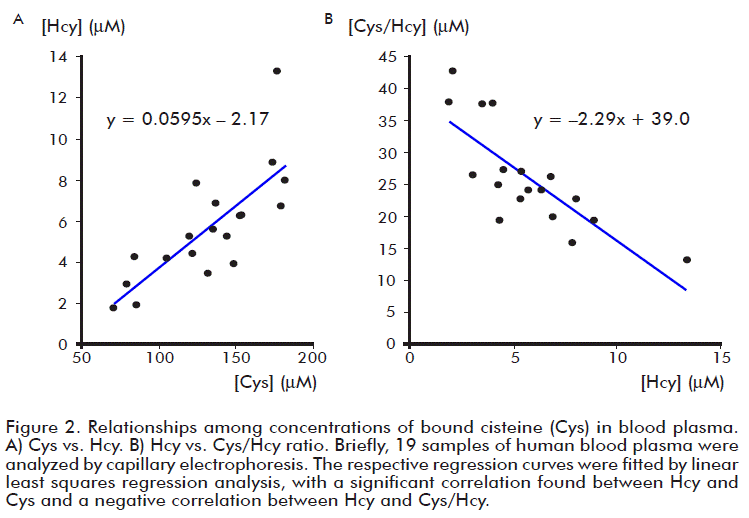
<P   ><font size="2" face="Verdana, Arial, Helvetica, sans-serif">Widespread methods      such as acid or alcohol precipitation and solid-phase extraction are difficult      to combine with pH-mediated base stacking because they have drawbacks, due      to the sample&rsquo;s high ionic strength and/or sample dilution. At the same      time, desalting leads to overestimations, while the addition of small amounts      of NaCl (10 mmol/L) to prepared samples results in 10-fold reduced signal      intensity (data not shown). Relative retention times of Cys and Hcy were 0.8      &plusmn; 0.02 and 0.887 &plusmn; 0.014, respectively. RRT was been calculated      as: retention time of the analyte/retention time of internal standard (IS).      </font></P >       <P   ><font size="2" face="Verdana, Arial, Helvetica, sans-serif">A calibration was      carried out by adding internal standard (PA) and analytes in the concentration      range 0-500 and 0-100 &mu;mol/L for Cys and Hcy, respectively, to plasma protein      solution and water. Calibration curves demonstrated a linear relationship      with correlation coefficients above 0.995 (p &lt; 0.0001) in all the cases.      Linear regression equations were: y = 0.0135x + 1.4 and y = 0.0086x + 0.029      for Cys and Hcy, respectively. The close slope was taken from analytes calibration      in water solution (y = 0.0136x + 0.124 and y = 0.0083x + 0.0095). Reproducibility      was measured using six continuous injections and CV of Hcy/PA and Cys/PA were      within the &plusmn; 5 % range. The absolute intensity varied slightly higher      (8-12 %). </font></P >       <P   ><font size="2" face="Verdana, Arial, Helvetica, sans-serif">Two probes selected      for sensitivity estimation: plasma with reduction and derivatization, and      the other &ldquo;blank&rdquo; with plasma without reduction but with TCDI      also. The first probe (plasma sample with reduction and derivatization) was      diluted by second probe (blank sample without reduction but with TCDI also)      in 2.4 and 8 times. In the latter case the S/N ratio for Hcy was about of      7 that corresponding its concentration 0.8 &mu;M in the sample. </font></P >       <P   ><font size="2" face="Verdana, Arial, Helvetica, sans-serif">We analyzed 19 samples      of human blood plasma. Concentrations of bound Cys and Hcy were 132 &plusmn;      35 (70-182) and 5.7 &plusmn; 2.7 (1.9-13.3) &mu;mol/L, respectively. These      levels are between those previously reported for control groups of healthy      people [1, 8, 29]. The Cys/Hcy ratio was 26 &plusmn; 8 (13-43). It should      be noted that CV for Hcy (47 %) was slightly higher than the CV for Cys/Hcy      (31 %). There was a significant correlation between Hcy and Cys (<a href="/img/revistas/bta/v33n4/f0204416.gif">Figure      2A</a>, r = 0.77, p &lt; 0.001), and a negative correlation between Hcy and      Cys/Hcy (<a href="/img/revistas/bta/v33n4/f0204416.gif">Figure 2B</a>, r = &ndash;0.79, p &lt; 0.001).      These findings are similar for total Hcy and Cys as previously reported [8].      Additionally, a strongly positive correlation was observed between Hcy and      Hcy/Cys (r = 0.86, p &lt; 0.001, data not shown). Also, there was no positive      correlation between Cys and Cys/Hcy (r = &ndash;0.41, data not shown). </font></P >       
<P   ><font size="2" face="Verdana, Arial, Helvetica, sans-serif">Thus, CE-UV approach      for the determination of bound plasma Hcy and Cys has been developed. Plasma      proteins are separated from free thiols and salts by ultrafiltration, but      it is possible to use gel-filtration chromatography as alternative. Since      bound thiols exist in an oxidize state, there is necessary to convert them      to the reduce form by DTT before the derivatization step. The specific reagent      TCDI was used to obtain derivatives able to be detected by UV absorption.      Because of low salts concentration in samples and titratable acidic character      of them, it was possible in-capillary concentration using pH-mediated base      stacking [28]. Weak base character of TCDI and imidazole also favored EI of      analytes too. Due to the high resolution power of CE, it was possible to resolve      peaks of analytes from interfering compounds, and the theoretical plate number      of this approach was about 65 000. It should be noted that this CE analysis,      contrary to HPLC [27], SPE is not require, hence, the method proposed follows      a simple sample preparation step. Additionally, the sensitivity of CE-UV analysis      was enough to determine bound Hcy and at a level similar to that of an early      reported HPLC-UV method [27]. </font></P >       <P   >&nbsp;</P >       <P   > </P >   <FONT size="+1" color="#000000">        ]]></body>
<body><![CDATA[<P   ><b><font size="3" face="Verdana, Arial, Helvetica, sans-serif">CONCLUSIONS </font></b></P >       <P   ><font size="2" color="#211E1F" face="Verdana, Arial, Helvetica, sans-serif">The      developed approach provides an opportunity to determine bound aminothiols      with enough sensitivity (less than 1 &mu;mol/L) by CE-UV, without using nanoparticles      and with a commercially available derivatization reagent. It was shown a positive      correlation between protein-bound Hcy and Cys. </font></P >       <P   >&nbsp;</P >   <FONT size="+1" color="#211E1F">        <P   > </P >   <FONT size="+1" color="#000000">        <P   ><b><font size="3" face="Verdana, Arial, Helvetica, sans-serif">ACKNOWLEDGEMENTS      </font></b></P >       <P   ><font size="2" color="#211E1F" face="Verdana, Arial, Helvetica, sans-serif">This      study was supported by grant from the Russian Science Foundation (project      No. 16-15-10340). </font></P >       <P   >&nbsp;</P >   <FONT size="+1" color="#211E1F">        <P   > </P >   <FONT size="+1" color="#000000">        <P   ><b><font size="3" face="Verdana, Arial, Helvetica, sans-serif">REFERENCES </font></b></P >       <!-- ref --><P   ><font size="2" color="#211E1F" face="Verdana, Arial, Helvetica, sans-serif">1.      Williams RH, Maggiore JA, Reynolds RD, Helgason CM. Novel approach for the      determination of the redox status of homocysteine and other aminothiols in      plasma from healthy subjects and patients with ischemic stroke. Clin Chem.      2001;47(6):1031-9.     </font></P >   <FONT size="+1" color="#211E1F">        <!-- ref --><P   ><font size="2" face="Verdana, Arial, Helvetica, sans-serif">2. Newton LA, Sandhu      K, Livingstone C, Leslie R, Davis J. Clinical diagnostics for homocysteine:      a rogue amino acid? Expert Rev Mol Diagn. 2010;10(4):489-500.     </font></P >       <!-- ref --><P   ><font size="2" face="Verdana, Arial, Helvetica, sans-serif">3. Sengupta S, Wehbe      C, Majors AK, Ketterer ME, DiBello PM, Jacobsen DW. Relative roles of albumin      and ceruloplasmin in the formation of homocystine, homocysteine-cysteine-mixed      disulfide, and cystine in circulation. J Biol Chem. 2001;276(50):46896-904.          </font></P >       <!-- ref --><P   ><font size="2" face="Verdana, Arial, Helvetica, sans-serif">4. Zhloba AA, Subbotina      TF. Homocysteinylation score of high-molecular weight plasma proteins. Amino      Acids. 2014;46(4):893-9.     </font></P >       <!-- ref --><P   ><font size="2" face="Verdana, Arial, Helvetica, sans-serif">5. Majors AK, Sengupta      S, Willard B, Kinter MT, Pyeritz RE, Jacobsen DW. Homocysteine binds to human      plasma fibronectin and inhibits its interaction with fibrin. Arterioscler      Thromb Vasc Biol. 2002;22(8):1354-9.     </font></P >       <!-- ref --><P   ><font size="2" face="Verdana, Arial, Helvetica, sans-serif">6. McCully KS. Chemical      pathology of homocysteine. IV. Excitotoxicity, oxidative stress, endothelial      dysfunction, and inflammation. Ann Clin Lab Sci. 2009;39(3):219-32.     </font></P >       <!-- ref --><P   ><font size="2" face="Verdana, Arial, Helvetica, sans-serif">7. Zinellu A, Sotgia      S, Deiana L, Carru C. Quantification of thiol-containing amino acids linked      by disulfides to LDL. Clin Chem. 2005;51(3):658-60.     </font></P >       <!-- ref --><P   ><font size="2" face="Verdana, Arial, Helvetica, sans-serif">8. Hortin GL, Sullivan      P, Csako G. Relationships among plasma homocysteine, cysteine, and albumin      concentrations: potential utility of assessing the cysteine/homocysteine ratio.      Clin Chem. 2001;47(6):1121-4.     </font></P >       <P   ><font size="2" face="Verdana, Arial, Helvetica, sans-serif">9. Miller JW, Beresford      SA, Neuhouser ML, Cheng TY, Song X, Brown EC, <I>et al</I>. Homocysteine,      cysteine, and risk of incident colorectal cancer in the Women&rsquo;s Health      Initiative observational cohort. Am J Clin Nutr. 2013;97(4):827-34. </font></P >       <!-- ref --><P   ><font size="2" face="Verdana, Arial, Helvetica, sans-serif">10. Pernet P, Lasnier      E, Vaubourdolle M. Evaluation of the AxSYM homocysteine assay and comparison      with the IMx homocysteine assay. Clin Chem. 2000;46(9):1440-1.     </font></P >       <!-- ref --><P   ><font size="2" face="Verdana, Arial, Helvetica, sans-serif">11. Wada M, Kuroki      M, Minami Y, Ikeda R, Sekitani Y, Takamura N, <I>et al</I>. Quantitation of      sulfur-containing amino acids, homocysteine, methionine and cysteine in dried      blood spot from newborn baby by HPLC-fluorescence detection. Biomed Chromatogr.      2014;28(6):810-4.     </font></P >       ]]></body>
<body><![CDATA[<!-- ref --><P   ><font size="2" face="Verdana, Arial, Helvetica, sans-serif">12. Zinellu A, Lepedda      A, Sotgia S, Zinellu E, Marongiu G, Usai MF, <I>et al</I>. Albumin-bound low      molecular weight thiols analysis in plasma and carotid plaques by CE. J Sep      Sci. 2010;33(1):126-31.     </font></P >       <!-- ref --><P   ><font size="2" face="Verdana, Arial, Helvetica, sans-serif">13. Baron M, Sochor      J. Estimation of thiol compounds cysteine and homocysteine in sources of protein      by means of electrochemical techniques. Int J Electrochem Sci. 2013;8:11072-86.          </font></P >       <!-- ref --><P   ><font size="2" face="Verdana, Arial, Helvetica, sans-serif">14. Jiang Z, Liang      Q, Luo G, Hu P, Li P, Wang Y. HPLC-electrospray tandem mass spectrometry for      simultaneous quantitation of eight plasma aminothiols: application to studies      of diabetic nephropathy. Talanta. 2009;77(4):1279-84.     </font></P >       <!-- ref --><P   ><font size="2" face="Verdana, Arial, Helvetica, sans-serif">15. Ivanov AV, Luzyanin      BP, Kubatiev AA. The use of N-ethylmaleimide for mass spectrometric detection      of homocysteine fractions in blood plasma. Bull Exp Biol Med. 2012;152(3):289-92.          </font></P >       <!-- ref --><P   ><font size="2" face="Verdana, Arial, Helvetica, sans-serif">16. Andersson A,      Isaksson A, Brattstrom L, Hultberg B. Homocysteine and other thiols determined      in plasma by HPLC and thiol-specific postcolumn derivatization. Clin Chem.      1993;39(8):1590-7.     </font></P >       ]]></body>
<body><![CDATA[<!-- ref --><P   ><font size="2" face="Verdana, Arial, Helvetica, sans-serif">17. Katrusiak AE,      Paterson PG, Kamencic H, Shoker A, Lyon AW. Pre-column derivatization high-performance      liquid chromatographic method for determination of cysteine, cysteinyl-glycine,      homocysteine and glutathione in plasma and cell extracts. J Chromatogr B Biomed      Sci Appl. 2001;758(2):207-12.     </font></P >       <!-- ref --><P   ><font size="2" face="Verdana, Arial, Helvetica, sans-serif">18. Kusmierek K,      Bald E. Reversed-phase liquid chromatography method for the determination      of total plasma thiols after derivatization with 1-benzyl-2-chloropyridinium      bromide. Biomed Chromatogr. 2009;23(7):770-5.     </font></P >       <P   ><font size="2" face="Verdana, Arial, Helvetica, sans-serif">19. Russell J, Rabenstein      DL. Speciation and quantitation of underivatized and Ellman&rsquo;s derivatized      biological thiols and disulfides by capillary electrophoresis. Anal Biochem.      1996;242(1):136-44. </font></P >       <!-- ref --><P   ><font size="2" face="Verdana, Arial, Helvetica, sans-serif">20. Ivanov AR, Nazimov      IV, Baratova LA. Determination of biologically active low-molecular-mass thiols      in human blood. II. High-performance capillary electrophoresis with photometric      detection. J Chromatogr A. 2000;895(1-2):167-71.     </font></P >       <!-- ref --><P   ><font size="2" face="Verdana, Arial, Helvetica, sans-serif">21. Kang SH, Wei      W, Yeung ES. On-column derivatization for the analysis of homocysteine and      other thiols by capillary electrophoresis with laser-induced fluorescence      detection. J Chromatogr B Biomed Sci Appl. 2000;744(1):149-56.     </font></P >       <P   ><font size="2" face="Verdana, Arial, Helvetica, sans-serif">22. Sevcikova P,      Glatz Z, Tomandl J. Determination of homocysteine in human plasma by micellar      electrokinetic chromatography and in-capillary detection reaction with 2,2&rsquo;-dipyridyl      disulfide. J Chromatogr A. 2003;990(1-2):197-204. </font></P >       ]]></body>
<body><![CDATA[<!-- ref --><P   ><font size="2" face="Verdana, Arial, Helvetica, sans-serif">23. Zinellu A, Sotgia      S, Scanu B, Pisanu E, Sanna M, Sati S, <I>et al</I>. Determination of homocysteine      thiolactone, reduced homocysteine, homocystine, homocysteine-cysteine mixed      disulfide, cysteine and cystine in a reaction mixture by overimposed pressure/      voltage capillary electrophoresis. Talanta. 2010;82(4):1281-5.     </font></P >       <!-- ref --><P   ><font size="2" face="Verdana, Arial, Helvetica, sans-serif">24. Kubalczyk P,      Bald E. Transient pseudo-isotachophoretic stacking in analysis of plasma for      homocysteine by capillary zone electrophoresis. Anal Bioanal Chem. 2006;384(5):1181-5.          </font></P >       <!-- ref --><P   ><font size="2" face="Verdana, Arial, Helvetica, sans-serif">25. Kubalczyk P,      Bald E, Furmaniaka P, Glowacki R. Simultaneous determination of total homocysteine      and cysteine in human plasma by capillary zone electrophoresis with pH-mediated      sample stacking. Anal Methods. 2014;6(12):4138-43.     </font></P >       <!-- ref --><P   ><font size="2" face="Verdana, Arial, Helvetica, sans-serif">26. Chang CW, Tseng      WL. Gold nanoparticle extraction followed by capillary electrophoresis to      determine the total, free, and protein-bound aminothiols in plasma. Anal Chem.      2010;82(7):2696-702.     </font></P >       <!-- ref --><P   ><font size="2" face="Verdana, Arial, Helvetica, sans-serif">27. Amarnath K, Amarnath      V, Amarnath K, Valentine HL, Valentine WM. A specific HPLC-UV method for the      determination of cysteine and related aminothiols in biological samples. Talanta.      2003;60(6):1229-38.     </font></P >       ]]></body>
<body><![CDATA[<!-- ref --><P   ><font size="2" face="Verdana, Arial, Helvetica, sans-serif">28. Hoque ME, Arnett      SD, Lunte CE. On-column preconcentration of glutathione and glutathione disulfide      using pH-mediated base stacking for the analysis of microdialysis samples      by capillary electrophoresis. J Chromatogr B Analyt Technol Biomed Life Sci.      2005;827(1):51-7.     </font></P >       <!-- ref --><P   ><font size="2" face="Verdana, Arial, Helvetica, sans-serif">29. Andersson A,      Lindgren A, Hultberg B. Effect of thiol oxidation and thiol export from erythrocytes      on determination of redox status of homocysteine and other thiols in plasma      from healthy subjects and patients with cerebral infarction. Clin Chem. 1995;41(3):361-6.          </font></P >       <P   > </P >   <FONT size="+1" color="#000000">        <P   >&nbsp;</P >       <P   >&nbsp;</P >       <P   ><font size="2" color="#211E1F" face="Verdana, Arial, Helvetica, sans-serif">Received      in October, 2016.    <br>     </font><font size="2" face="Verdana, Arial, Helvetica, sans-serif">Accepted      in December, 2016. </font></P >   <FONT size="+1" color="#211E1F">        <P   > </P >       ]]></body>
<body><![CDATA[<P   >&nbsp;</P >       <P   >&nbsp;</P >   <FONT size="+1" color="#000000">        <P   ><font size="2" color="#211E1F" face="Verdana, Arial, Helvetica, sans-serif"><i>Virus      E Danielevich</i>. FSBSI Institute of General Pathology and PathophysiologyMoscow,      125315, Baltiyskaya str.,8, Moscow, Russia. E-mail: <FONT color="#000000">      <A href="mailto:edwardvirus@yandex.ru"> <FONT color="#0000FF">edwardvirus@yandex.ru</font></A>.</font></font><FONT size="+1" color="#211E1F"><FONT size="+1"><FONT size="+1" color="#000000"><FONT size="+1" color="#0000FF"><FONT color="#211E1F">      </font></font></font></font></font></P >   </font></font></font></font></font></font></font></font></font></font></font></font></font></font></font></font></font></font></font></font></font></font></font></font></font></DIV >      ]]></body><back>
<ref-list>
<ref id="B1">
<label>1</label><nlm-citation citation-type="journal">
<person-group person-group-type="author">
<name>
<surname><![CDATA[Williams]]></surname>
<given-names><![CDATA[RH]]></given-names>
</name>
<name>
<surname><![CDATA[Maggiore]]></surname>
<given-names><![CDATA[JA]]></given-names>
</name>
<name>
<surname><![CDATA[Reynolds]]></surname>
<given-names><![CDATA[RD]]></given-names>
</name>
<name>
<surname><![CDATA[Helgason]]></surname>
<given-names><![CDATA[CM]]></given-names>
</name>
</person-group>
<article-title xml:lang="en"><![CDATA[Novel approach for the determination of the redox status of homocysteine and other aminothiols in plasma from healthy subjects and patients with ischemic stroke]]></article-title>
<source><![CDATA[Clin Chem]]></source>
<year>2001</year>
<volume>47</volume>
<numero>6</numero>
<issue>6</issue>
<page-range>1031-9</page-range></nlm-citation>
</ref>
<ref id="B2">
<label>2</label><nlm-citation citation-type="journal">
<person-group person-group-type="author">
<name>
<surname><![CDATA[Newton]]></surname>
<given-names><![CDATA[LA]]></given-names>
</name>
<name>
<surname><![CDATA[Sandhu]]></surname>
<given-names><![CDATA[K]]></given-names>
</name>
<name>
<surname><![CDATA[Livingstone]]></surname>
<given-names><![CDATA[C]]></given-names>
</name>
<name>
<surname><![CDATA[Leslie]]></surname>
<given-names><![CDATA[R]]></given-names>
</name>
<name>
<surname><![CDATA[Davis]]></surname>
<given-names><![CDATA[J]]></given-names>
</name>
</person-group>
<article-title xml:lang="en"><![CDATA[Clinical diagnostics for homocysteine: a rogue amino acid?]]></article-title>
<source><![CDATA[Expert Rev Mol Diagn]]></source>
<year>2010</year>
<volume>10</volume>
<numero>4</numero>
<issue>4</issue>
<page-range>489-500</page-range></nlm-citation>
</ref>
<ref id="B3">
<label>3</label><nlm-citation citation-type="journal">
<person-group person-group-type="author">
<name>
<surname><![CDATA[Sengupta]]></surname>
<given-names><![CDATA[S]]></given-names>
</name>
<name>
<surname><![CDATA[Wehbe]]></surname>
<given-names><![CDATA[C]]></given-names>
</name>
<name>
<surname><![CDATA[Majors]]></surname>
<given-names><![CDATA[AK]]></given-names>
</name>
<name>
<surname><![CDATA[Ketterer]]></surname>
<given-names><![CDATA[ME]]></given-names>
</name>
<name>
<surname><![CDATA[DiBello]]></surname>
<given-names><![CDATA[PM]]></given-names>
</name>
<name>
<surname><![CDATA[Jacobsen]]></surname>
<given-names><![CDATA[DW]]></given-names>
</name>
</person-group>
<article-title xml:lang="en"><![CDATA[Relative roles of albumin and ceruloplasmin in the formation of homocystine, homocysteine-cysteine-mixed disulfide, and cystine in circulation]]></article-title>
<source><![CDATA[J Biol Chem]]></source>
<year>2001</year>
<volume>276</volume>
<numero>50</numero>
<issue>50</issue>
<page-range>46896-904</page-range></nlm-citation>
</ref>
<ref id="B4">
<label>4</label><nlm-citation citation-type="journal">
<person-group person-group-type="author">
<name>
<surname><![CDATA[Zhloba]]></surname>
<given-names><![CDATA[AA]]></given-names>
</name>
<name>
<surname><![CDATA[Subbotina]]></surname>
<given-names><![CDATA[TF]]></given-names>
</name>
</person-group>
<article-title xml:lang="en"><![CDATA[Homocysteinylation score of high-molecular weight plasma proteins]]></article-title>
<source><![CDATA[Amino Acids]]></source>
<year>2014</year>
<volume>46</volume>
<numero>4</numero>
<issue>4</issue>
<page-range>893-9</page-range></nlm-citation>
</ref>
<ref id="B5">
<label>5</label><nlm-citation citation-type="journal">
<person-group person-group-type="author">
<name>
<surname><![CDATA[Majors]]></surname>
<given-names><![CDATA[AK]]></given-names>
</name>
<name>
<surname><![CDATA[Sengupta]]></surname>
<given-names><![CDATA[S]]></given-names>
</name>
<name>
<surname><![CDATA[Willard]]></surname>
<given-names><![CDATA[B]]></given-names>
</name>
<name>
<surname><![CDATA[Kinter]]></surname>
<given-names><![CDATA[MT]]></given-names>
</name>
<name>
<surname><![CDATA[Pyeritz]]></surname>
<given-names><![CDATA[RE]]></given-names>
</name>
<name>
<surname><![CDATA[Jacobsen]]></surname>
<given-names><![CDATA[DW]]></given-names>
</name>
</person-group>
<article-title xml:lang="en"><![CDATA[Homocysteine binds to human plasma fibronectin and inhibits its interaction with fibrin]]></article-title>
<source><![CDATA[Arterioscler Thromb Vasc Biol]]></source>
<year>2002</year>
<volume>22</volume>
<numero>8</numero>
<issue>8</issue>
<page-range>1354-9</page-range></nlm-citation>
</ref>
<ref id="B6">
<label>6</label><nlm-citation citation-type="journal">
<person-group person-group-type="author">
<name>
<surname><![CDATA[McCully]]></surname>
<given-names><![CDATA[KS]]></given-names>
</name>
</person-group>
<article-title xml:lang="en"><![CDATA[Chemical pathology of homocysteine. IV. Excitotoxicity, oxidative stress, endothelial dysfunction, and inflammation]]></article-title>
<source><![CDATA[Ann Clin Lab Sci]]></source>
<year>2009</year>
<volume>39</volume>
<numero>3</numero>
<issue>3</issue>
<page-range>219-32</page-range></nlm-citation>
</ref>
<ref id="B7">
<label>7</label><nlm-citation citation-type="journal">
<person-group person-group-type="author">
<name>
<surname><![CDATA[Zinellu]]></surname>
<given-names><![CDATA[A]]></given-names>
</name>
<name>
<surname><![CDATA[Sotgia]]></surname>
<given-names><![CDATA[S]]></given-names>
</name>
<name>
<surname><![CDATA[Deiana]]></surname>
<given-names><![CDATA[L]]></given-names>
</name>
<name>
<surname><![CDATA[Carru]]></surname>
<given-names><![CDATA[C]]></given-names>
</name>
</person-group>
<article-title xml:lang="en"><![CDATA[Quantification of thiol-containing amino acids linked by disulfides to LDL]]></article-title>
<source><![CDATA[Clin Chem]]></source>
<year>2005</year>
<volume>51</volume>
<numero>3</numero>
<issue>3</issue>
<page-range>658-60</page-range></nlm-citation>
</ref>
<ref id="B8">
<label>8</label><nlm-citation citation-type="journal">
<person-group person-group-type="author">
<name>
<surname><![CDATA[Hortin]]></surname>
<given-names><![CDATA[GL]]></given-names>
</name>
<name>
<surname><![CDATA[Sullivan]]></surname>
<given-names><![CDATA[P]]></given-names>
</name>
<name>
<surname><![CDATA[Csako]]></surname>
<given-names><![CDATA[G]]></given-names>
</name>
</person-group>
<article-title xml:lang="en"><![CDATA[Relationships among plasma homocysteine, cysteine, and albumin concentrations: potential utility of assessing the cysteine/homocysteine ratio]]></article-title>
<source><![CDATA[Clin Chem]]></source>
<year>2001</year>
<volume>47</volume>
<numero>6</numero>
<issue>6</issue>
<page-range>1121-4</page-range></nlm-citation>
</ref>
<ref id="B9">
<label>9</label><nlm-citation citation-type="journal">
<person-group person-group-type="author">
<name>
<surname><![CDATA[Miller]]></surname>
<given-names><![CDATA[JW]]></given-names>
</name>
<name>
<surname><![CDATA[Beresford]]></surname>
<given-names><![CDATA[SA]]></given-names>
</name>
<name>
<surname><![CDATA[Neuhouser]]></surname>
<given-names><![CDATA[ML]]></given-names>
</name>
<name>
<surname><![CDATA[Cheng]]></surname>
<given-names><![CDATA[TY]]></given-names>
</name>
<name>
<surname><![CDATA[Song]]></surname>
<given-names><![CDATA[X]]></given-names>
</name>
<name>
<surname><![CDATA[Brown]]></surname>
<given-names><![CDATA[EC]]></given-names>
</name>
</person-group>
<article-title xml:lang="en"><![CDATA[Homocysteine, cysteine, and risk of incident colorectal cancer in the Women's Health Initiative observational cohort]]></article-title>
<source><![CDATA[Am J Clin Nutr]]></source>
<year>2013</year>
<volume>97</volume>
<numero>4</numero>
<issue>4</issue>
<page-range>827-34</page-range></nlm-citation>
</ref>
<ref id="B10">
<label>10</label><nlm-citation citation-type="journal">
<person-group person-group-type="author">
<name>
<surname><![CDATA[Pernet]]></surname>
<given-names><![CDATA[P]]></given-names>
</name>
<name>
<surname><![CDATA[Lasnier]]></surname>
<given-names><![CDATA[E]]></given-names>
</name>
<name>
<surname><![CDATA[Vaubourdolle]]></surname>
<given-names><![CDATA[M]]></given-names>
</name>
</person-group>
<article-title xml:lang="en"><![CDATA[Evaluation of the AxSYM homocysteine assay and comparison with the IMx homocysteine assay]]></article-title>
<source><![CDATA[Clin Chem]]></source>
<year>2000</year>
<volume>46</volume>
<numero>9</numero>
<issue>9</issue>
<page-range>1440-1</page-range></nlm-citation>
</ref>
<ref id="B11">
<label>11</label><nlm-citation citation-type="journal">
<person-group person-group-type="author">
<name>
<surname><![CDATA[Wada]]></surname>
<given-names><![CDATA[M]]></given-names>
</name>
<name>
<surname><![CDATA[Kuroki]]></surname>
<given-names><![CDATA[M]]></given-names>
</name>
<name>
<surname><![CDATA[Minami]]></surname>
<given-names><![CDATA[Y]]></given-names>
</name>
<name>
<surname><![CDATA[Ikeda]]></surname>
<given-names><![CDATA[R]]></given-names>
</name>
<name>
<surname><![CDATA[Sekitani]]></surname>
<given-names><![CDATA[Y]]></given-names>
</name>
<name>
<surname><![CDATA[Takamura]]></surname>
<given-names><![CDATA[N]]></given-names>
</name>
</person-group>
<article-title xml:lang="en"><![CDATA[Quantitation of sulfur-containing amino acids, homocysteine, methionine and cysteine in dried blood spot from newborn baby by HPLC-fluorescence detection]]></article-title>
<source><![CDATA[Biomed Chromatogr]]></source>
<year>2014</year>
<volume>28</volume>
<numero>6</numero>
<issue>6</issue>
<page-range>810-4</page-range></nlm-citation>
</ref>
<ref id="B12">
<label>12</label><nlm-citation citation-type="journal">
<person-group person-group-type="author">
<name>
<surname><![CDATA[Zinellu]]></surname>
<given-names><![CDATA[A]]></given-names>
</name>
<name>
<surname><![CDATA[Lepedda]]></surname>
<given-names><![CDATA[A]]></given-names>
</name>
<name>
<surname><![CDATA[Sotgia]]></surname>
<given-names><![CDATA[S]]></given-names>
</name>
<name>
<surname><![CDATA[Zinellu]]></surname>
<given-names><![CDATA[E]]></given-names>
</name>
<name>
<surname><![CDATA[Marongiu]]></surname>
<given-names><![CDATA[G]]></given-names>
</name>
<name>
<surname><![CDATA[Usai]]></surname>
<given-names><![CDATA[MF]]></given-names>
</name>
</person-group>
<article-title xml:lang="en"><![CDATA[Albumin-bound low molecular weight thiols analysis in plasma and carotid plaques by CE]]></article-title>
<source><![CDATA[J Sep Sci]]></source>
<year>2010</year>
<volume>33</volume>
<numero>1</numero>
<issue>1</issue>
<page-range>126-31</page-range></nlm-citation>
</ref>
<ref id="B13">
<label>13</label><nlm-citation citation-type="journal">
<person-group person-group-type="author">
<name>
<surname><![CDATA[Baron]]></surname>
<given-names><![CDATA[M]]></given-names>
</name>
<name>
<surname><![CDATA[Sochor]]></surname>
<given-names><![CDATA[J]]></given-names>
</name>
</person-group>
<article-title xml:lang="en"><![CDATA[Estimation of thiol compounds cysteine and homocysteine in sources of protein by means of electrochemical techniques]]></article-title>
<source><![CDATA[Int J Electrochem Sci]]></source>
<year>2013</year>
<volume>8</volume>
<page-range>11072-86</page-range></nlm-citation>
</ref>
<ref id="B14">
<label>14</label><nlm-citation citation-type="journal">
<person-group person-group-type="author">
<name>
<surname><![CDATA[Jiang]]></surname>
<given-names><![CDATA[Z]]></given-names>
</name>
<name>
<surname><![CDATA[Liang]]></surname>
<given-names><![CDATA[Q]]></given-names>
</name>
<name>
<surname><![CDATA[Luo]]></surname>
<given-names><![CDATA[G]]></given-names>
</name>
<name>
<surname><![CDATA[Hu]]></surname>
<given-names><![CDATA[P]]></given-names>
</name>
<name>
<surname><![CDATA[Li]]></surname>
<given-names><![CDATA[P]]></given-names>
</name>
<name>
<surname><![CDATA[Wang]]></surname>
<given-names><![CDATA[Y]]></given-names>
</name>
</person-group>
<article-title xml:lang="en"><![CDATA[HPLC-electrospray tandem mass spectrometry for simultaneous quantitation of eight plasma aminothiols: application to studies of diabetic nephropathy]]></article-title>
<source><![CDATA[Talanta]]></source>
<year>2009</year>
<volume>77</volume>
<numero>4</numero>
<issue>4</issue>
<page-range>1279-84</page-range></nlm-citation>
</ref>
<ref id="B15">
<label>15</label><nlm-citation citation-type="journal">
<person-group person-group-type="author">
<name>
<surname><![CDATA[Ivanov]]></surname>
<given-names><![CDATA[AV]]></given-names>
</name>
<name>
<surname><![CDATA[Luzyanin]]></surname>
<given-names><![CDATA[BP]]></given-names>
</name>
<name>
<surname><![CDATA[Kubatiev]]></surname>
<given-names><![CDATA[AA]]></given-names>
</name>
</person-group>
<article-title xml:lang="en"><![CDATA[The use of N-ethylmaleimide for mass spectrometric detection of homocysteine fractions in blood plasma]]></article-title>
<source><![CDATA[Bull Exp Biol Med]]></source>
<year>2012</year>
<volume>152</volume>
<numero>3</numero>
<issue>3</issue>
<page-range>289-92</page-range></nlm-citation>
</ref>
<ref id="B16">
<label>16</label><nlm-citation citation-type="journal">
<person-group person-group-type="author">
<name>
<surname><![CDATA[Andersson]]></surname>
<given-names><![CDATA[A]]></given-names>
</name>
<name>
<surname><![CDATA[Isaksson]]></surname>
<given-names><![CDATA[A]]></given-names>
</name>
<name>
<surname><![CDATA[Brattstrom]]></surname>
<given-names><![CDATA[L]]></given-names>
</name>
<name>
<surname><![CDATA[Hultberg]]></surname>
<given-names><![CDATA[B]]></given-names>
</name>
</person-group>
<article-title xml:lang="en"><![CDATA[Homocysteine and other thiols determined in plasma by HPLC and thiol-specific postcolumn derivatization]]></article-title>
<source><![CDATA[Clin Chem]]></source>
<year>1993</year>
<volume>39</volume>
<numero>8</numero>
<issue>8</issue>
<page-range>1590-7</page-range></nlm-citation>
</ref>
<ref id="B17">
<label>17</label><nlm-citation citation-type="journal">
<person-group person-group-type="author">
<name>
<surname><![CDATA[Katrusiak]]></surname>
<given-names><![CDATA[AE]]></given-names>
</name>
<name>
<surname><![CDATA[Paterson]]></surname>
<given-names><![CDATA[PG]]></given-names>
</name>
<name>
<surname><![CDATA[Kamencic]]></surname>
<given-names><![CDATA[H]]></given-names>
</name>
<name>
<surname><![CDATA[Shoker]]></surname>
<given-names><![CDATA[A]]></given-names>
</name>
<name>
<surname><![CDATA[Lyon]]></surname>
<given-names><![CDATA[AW]]></given-names>
</name>
</person-group>
<article-title xml:lang="en"><![CDATA[Pre-column derivatization high-performance liquid chromatographic method for determination of cysteine, cysteinyl-glycine, homocysteine and glutathione in plasma and cell extracts]]></article-title>
<source><![CDATA[J Chromatogr B Biomed Sci Appl]]></source>
<year>2001</year>
<volume>758</volume>
<numero>2</numero>
<issue>2</issue>
<page-range>207-12</page-range></nlm-citation>
</ref>
<ref id="B18">
<label>18</label><nlm-citation citation-type="journal">
<person-group person-group-type="author">
<name>
<surname><![CDATA[Kusmierek]]></surname>
<given-names><![CDATA[K]]></given-names>
</name>
<name>
<surname><![CDATA[Bald]]></surname>
<given-names><![CDATA[E]]></given-names>
</name>
</person-group>
<article-title xml:lang="en"><![CDATA[Reversed-phase liquid chromatography method for the determination of total plasma thiols after derivatization with 1-benzyl-2-chloropyridinium bromide]]></article-title>
<source><![CDATA[Biomed Chromatogr]]></source>
<year>2009</year>
<volume>23</volume>
<numero>7</numero>
<issue>7</issue>
<page-range>770-5</page-range></nlm-citation>
</ref>
<ref id="B19">
<label>19</label><nlm-citation citation-type="journal">
<person-group person-group-type="author">
<name>
<surname><![CDATA[Russell]]></surname>
<given-names><![CDATA[J]]></given-names>
</name>
<name>
<surname><![CDATA[Rabenstein]]></surname>
<given-names><![CDATA[DL]]></given-names>
</name>
</person-group>
<article-title xml:lang="en"><![CDATA[Speciation and quantitation of underivatized and Ellman's derivatized biological thiols and disulfides by capillary electrophoresis]]></article-title>
<source><![CDATA[Anal Biochem]]></source>
<year>1996</year>
<volume>242</volume>
<numero>1</numero>
<issue>1</issue>
<page-range>136-44</page-range></nlm-citation>
</ref>
<ref id="B20">
<label>20</label><nlm-citation citation-type="journal">
<person-group person-group-type="author">
<name>
<surname><![CDATA[Ivanov]]></surname>
<given-names><![CDATA[AR]]></given-names>
</name>
<name>
<surname><![CDATA[Nazimov]]></surname>
<given-names><![CDATA[IV]]></given-names>
</name>
<name>
<surname><![CDATA[Baratova]]></surname>
<given-names><![CDATA[LA]]></given-names>
</name>
</person-group>
<article-title xml:lang="en"><![CDATA[Determination of biologically active low-molecular-mass thiols in human blood. II. High-performance capillary electrophoresis with photometric detection]]></article-title>
<source><![CDATA[J Chromatogr A]]></source>
<year>2000</year>
<volume>895</volume>
<numero>1</numero>
<issue>1</issue>
<page-range>2):167-71</page-range></nlm-citation>
</ref>
<ref id="B21">
<label>21</label><nlm-citation citation-type="journal">
<person-group person-group-type="author">
<name>
<surname><![CDATA[Kang]]></surname>
<given-names><![CDATA[SH]]></given-names>
</name>
<name>
<surname><![CDATA[Wei]]></surname>
<given-names><![CDATA[W]]></given-names>
</name>
<name>
<surname><![CDATA[Yeung]]></surname>
<given-names><![CDATA[ES]]></given-names>
</name>
</person-group>
<article-title xml:lang="en"><![CDATA[On-column derivatization for the analysis of homocysteine and other thiols by capillary electrophoresis with laser-induced fluorescence detection]]></article-title>
<source><![CDATA[J Chromatogr B Biomed Sci Appl]]></source>
<year>2000</year>
<volume>744</volume>
<numero>1</numero>
<issue>1</issue>
<page-range>149-56</page-range></nlm-citation>
</ref>
<ref id="B22">
<label>22</label><nlm-citation citation-type="journal">
<person-group person-group-type="author">
<name>
<surname><![CDATA[Sevcikova]]></surname>
<given-names><![CDATA[P]]></given-names>
</name>
<name>
<surname><![CDATA[Glatz]]></surname>
<given-names><![CDATA[Z]]></given-names>
</name>
<name>
<surname><![CDATA[Tomandl]]></surname>
<given-names><![CDATA[J]]></given-names>
</name>
</person-group>
<article-title xml:lang="en"><![CDATA[Determination of homocysteine in human plasma by micellar electrokinetic chromatography and in-capillary detection reaction with 2,2'-dipyridyl disulfide]]></article-title>
<source><![CDATA[J Chromatogr A]]></source>
<year>2003</year>
<volume>990</volume>
<numero>1</numero>
<issue>1</issue>
<page-range>2):197-204</page-range></nlm-citation>
</ref>
<ref id="B23">
<label>23</label><nlm-citation citation-type="journal">
<person-group person-group-type="author">
<name>
<surname><![CDATA[Zinellu]]></surname>
<given-names><![CDATA[A]]></given-names>
</name>
<name>
<surname><![CDATA[Sotgia]]></surname>
<given-names><![CDATA[S]]></given-names>
</name>
<name>
<surname><![CDATA[Scanu]]></surname>
<given-names><![CDATA[B]]></given-names>
</name>
<name>
<surname><![CDATA[Pisanu]]></surname>
<given-names><![CDATA[E]]></given-names>
</name>
<name>
<surname><![CDATA[Sanna]]></surname>
<given-names><![CDATA[M]]></given-names>
</name>
<name>
<surname><![CDATA[Sati]]></surname>
<given-names><![CDATA[S]]></given-names>
</name>
</person-group>
<article-title xml:lang="en"><![CDATA[Determination of homocysteine thiolactone, reduced homocysteine, homocystine, homocysteine-cysteine mixed disulfide, cysteine and cystine in a reaction mixture by overimposed pressure/ voltage capillary electrophoresis]]></article-title>
<source><![CDATA[Talanta]]></source>
<year>2010</year>
<volume>82</volume>
<numero>4</numero>
<issue>4</issue>
<page-range>1281-5</page-range></nlm-citation>
</ref>
<ref id="B24">
<label>24</label><nlm-citation citation-type="journal">
<person-group person-group-type="author">
<name>
<surname><![CDATA[Kubalczyk]]></surname>
<given-names><![CDATA[P]]></given-names>
</name>
<name>
<surname><![CDATA[Bald]]></surname>
<given-names><![CDATA[E]]></given-names>
</name>
</person-group>
<article-title xml:lang="en"><![CDATA[Transient pseudo-isotachophoretic stacking in analysis of plasma for homocysteine by capillary zone electrophoresis]]></article-title>
<source><![CDATA[Anal Bioanal Chem]]></source>
<year>2006</year>
<volume>384</volume>
<numero>5</numero>
<issue>5</issue>
<page-range>1181-5</page-range></nlm-citation>
</ref>
<ref id="B25">
<label>25</label><nlm-citation citation-type="journal">
<person-group person-group-type="author">
<name>
<surname><![CDATA[Kubalczyk]]></surname>
<given-names><![CDATA[P]]></given-names>
</name>
<name>
<surname><![CDATA[Bald]]></surname>
<given-names><![CDATA[E]]></given-names>
</name>
<name>
<surname><![CDATA[Furmaniaka]]></surname>
<given-names><![CDATA[P]]></given-names>
</name>
<name>
<surname><![CDATA[Glowacki]]></surname>
<given-names><![CDATA[R]]></given-names>
</name>
</person-group>
<article-title xml:lang="en"><![CDATA[Simultaneous determination of total homocysteine and cysteine in human plasma by capillary zone electrophoresis with pH-mediated sample stacking]]></article-title>
<source><![CDATA[Anal Methods]]></source>
<year>2014</year>
<volume>6</volume>
<numero>12</numero>
<issue>12</issue>
<page-range>4138-43</page-range></nlm-citation>
</ref>
<ref id="B26">
<label>26</label><nlm-citation citation-type="journal">
<person-group person-group-type="author">
<name>
<surname><![CDATA[Chang]]></surname>
<given-names><![CDATA[CW]]></given-names>
</name>
<name>
<surname><![CDATA[Tseng]]></surname>
<given-names><![CDATA[WL]]></given-names>
</name>
</person-group>
<article-title xml:lang="en"><![CDATA[Gold nanoparticle extraction followed by capillary electrophoresis to determine the total, free, and protein-bound aminothiols in plasma]]></article-title>
<source><![CDATA[Anal Chem]]></source>
<year>2010</year>
<volume>82</volume>
<numero>7</numero>
<issue>7</issue>
<page-range>2696-702</page-range></nlm-citation>
</ref>
<ref id="B27">
<label>27</label><nlm-citation citation-type="journal">
<person-group person-group-type="author">
<name>
<surname><![CDATA[Amarnath]]></surname>
<given-names><![CDATA[K]]></given-names>
</name>
<name>
<surname><![CDATA[Amarnath]]></surname>
<given-names><![CDATA[V]]></given-names>
</name>
<name>
<surname><![CDATA[Amarnath]]></surname>
<given-names><![CDATA[K]]></given-names>
</name>
<name>
<surname><![CDATA[Valentine]]></surname>
<given-names><![CDATA[HL]]></given-names>
</name>
<name>
<surname><![CDATA[Valentine]]></surname>
<given-names><![CDATA[WM]]></given-names>
</name>
</person-group>
<article-title xml:lang="en"><![CDATA[A specific HPLC-UV method for the determination of cysteine and related aminothiols in biological samples]]></article-title>
<source><![CDATA[Talanta]]></source>
<year>2003</year>
<volume>60</volume>
<numero>6</numero>
<issue>6</issue>
<page-range>1229-38</page-range></nlm-citation>
</ref>
<ref id="B28">
<label>28</label><nlm-citation citation-type="journal">
<person-group person-group-type="author">
<name>
<surname><![CDATA[Hoque]]></surname>
<given-names><![CDATA[ME]]></given-names>
</name>
<name>
<surname><![CDATA[Arnett]]></surname>
<given-names><![CDATA[SD]]></given-names>
</name>
<name>
<surname><![CDATA[Lunte]]></surname>
<given-names><![CDATA[CE]]></given-names>
</name>
</person-group>
<article-title xml:lang="en"><![CDATA[On-column preconcentration of glutathione and glutathione disulfide using pH-mediated base stacking for the analysis of microdialysis samples by capillary electrophoresis]]></article-title>
<source><![CDATA[J Chromatogr B Analyt Technol Biomed Life Sci]]></source>
<year>2005</year>
<volume>827</volume>
<numero>1</numero>
<issue>1</issue>
<page-range>51-7</page-range></nlm-citation>
</ref>
<ref id="B29">
<label>29</label><nlm-citation citation-type="journal">
<person-group person-group-type="author">
<name>
<surname><![CDATA[Andersson]]></surname>
<given-names><![CDATA[A]]></given-names>
</name>
<name>
<surname><![CDATA[Lindgren]]></surname>
<given-names><![CDATA[A]]></given-names>
</name>
<name>
<surname><![CDATA[Hultberg]]></surname>
<given-names><![CDATA[B]]></given-names>
</name>
</person-group>
<article-title xml:lang="en"><![CDATA[Effect of thiol oxidation and thiol export from erythrocytes on determination of redox status of homocysteine and other thiols in plasma from healthy subjects and patients with cerebral infarction]]></article-title>
<source><![CDATA[Clin Chem]]></source>
<year>1995</year>
<volume>41</volume>
<numero>3</numero>
<issue>3</issue>
<page-range>361-6</page-range></nlm-citation>
</ref>
</ref-list>
</back>
</article>