<?xml version="1.0" encoding="ISO-8859-1"?><article xmlns:mml="http://www.w3.org/1998/Math/MathML" xmlns:xlink="http://www.w3.org/1999/xlink" xmlns:xsi="http://www.w3.org/2001/XMLSchema-instance">
<front>
<journal-meta>
<journal-id>1027-2852</journal-id>
<journal-title><![CDATA[Biotecnología Aplicada]]></journal-title>
<abbrev-journal-title><![CDATA[Biotecnol Apl]]></abbrev-journal-title>
<issn>1027-2852</issn>
<publisher>
<publisher-name><![CDATA[Editorial Elfos Scientiae]]></publisher-name>
</publisher>
</journal-meta>
<article-meta>
<article-id>S1027-28522017000100004</article-id>
<title-group>
<article-title xml:lang="en"><![CDATA[Evaluation of viral RNA thermostability stored as dry pellet at room temperature]]></article-title>
<article-title xml:lang="es"><![CDATA[Evaluación de la termoestabilidad del ARN viral almacenado como pellet seco a temperatura ambiente]]></article-title>
</title-group>
<contrib-group>
<contrib contrib-type="author">
<name>
<surname><![CDATA[Relova]]></surname>
<given-names><![CDATA[Damarys]]></given-names>
</name>
<xref ref-type="aff" rid="A01"/>
</contrib>
<contrib contrib-type="author">
<name>
<surname><![CDATA[Pérez]]></surname>
<given-names><![CDATA[Lester J]]></given-names>
</name>
<xref ref-type="aff" rid="A01"/>
</contrib>
<contrib contrib-type="author">
<name>
<surname><![CDATA[Coronado]]></surname>
<given-names><![CDATA[Liani]]></given-names>
</name>
<xref ref-type="aff" rid="A01"/>
</contrib>
<contrib contrib-type="author">
<name>
<surname><![CDATA[Hinojosa]]></surname>
<given-names><![CDATA[Yoandry]]></given-names>
</name>
<xref ref-type="aff" rid="A01"/>
</contrib>
<contrib contrib-type="author">
<name>
<surname><![CDATA[Ríos]]></surname>
<given-names><![CDATA[Liliam]]></given-names>
</name>
<xref ref-type="aff" rid="A01"/>
</contrib>
<contrib contrib-type="author">
<name>
<surname><![CDATA[Acevedo]]></surname>
<given-names><![CDATA[Ana María]]></given-names>
</name>
<xref ref-type="aff" rid="A01"/>
</contrib>
<contrib contrib-type="author">
<name>
<surname><![CDATA[Frías]]></surname>
<given-names><![CDATA[María Teresa]]></given-names>
</name>
<xref ref-type="aff" rid="A01"/>
</contrib>
<contrib contrib-type="author">
<name>
<surname><![CDATA[Perera]]></surname>
<given-names><![CDATA[Carmen L]]></given-names>
</name>
<xref ref-type="aff" rid="A01"/>
</contrib>
</contrib-group>
<aff id="A01">
<institution><![CDATA[,Centro Nacional de Sanidad Agropecuaria, CENSA Departamento de Virología ]]></institution>
<addr-line><![CDATA[San José de las ]]></addr-line>
<country>Cuba</country>
</aff>
<pub-date pub-type="pub">
<day>00</day>
<month>03</month>
<year>2017</year>
</pub-date>
<pub-date pub-type="epub">
<day>00</day>
<month>03</month>
<year>2017</year>
</pub-date>
<volume>34</volume>
<numero>1</numero>
<fpage>1301</fpage>
<lpage>1305</lpage>
<copyright-statement/>
<copyright-year/>
<self-uri xlink:href="http://scielo.sld.cu/scielo.php?script=sci_arttext&amp;pid=S1027-28522017000100004&amp;lng=en&amp;nrm=iso"></self-uri><self-uri xlink:href="http://scielo.sld.cu/scielo.php?script=sci_abstract&amp;pid=S1027-28522017000100004&amp;lng=en&amp;nrm=iso"></self-uri><self-uri xlink:href="http://scielo.sld.cu/scielo.php?script=sci_pdf&amp;pid=S1027-28522017000100004&amp;lng=en&amp;nrm=iso"></self-uri><kwd-group>
<kwd lng="en"><![CDATA[viral RNA]]></kwd>
<kwd lng="en"><![CDATA[dry pellet]]></kwd>
<kwd lng="en"><![CDATA[thermostability]]></kwd>
<kwd lng="en"><![CDATA[storage]]></kwd>
<kwd lng="en"><![CDATA[rRT-qPCR]]></kwd>
<kwd lng="es"><![CDATA[ARN viral]]></kwd>
<kwd lng="es"><![CDATA[termoestabilidad]]></kwd>
<kwd lng="es"><![CDATA[precipitado seco]]></kwd>
<kwd lng="es"><![CDATA[almacenamiento]]></kwd>
<kwd lng="es"><![CDATA[rRT-qPCR]]></kwd>
</kwd-group>
</article-meta>
</front><body><![CDATA[ <DIV class="Sect"   >        <P align="right"   ><font size="2" color="#000000" face="Verdana, Arial, Helvetica, sans-serif"><b>TECHNIQUE      </b> </font></P >       <P   >&nbsp;</P >   <FONT size="+1" color="#000000">        <P   > </P >       <P   ><font size="4" color="#211E1F" face="Verdana, Arial, Helvetica, sans-serif"><B>Evaluation      of viral RNA thermostability stored as dry pellet at room temperature</B>      </font></P >       <P   >&nbsp;</P >   <FONT size="+1" color="#211E1F"><FONT size="+1" color="#000000">        <P   > </P >   <FONT size="+1">       <P   ><font size="3" color="#211E1F" face="Verdana, Arial, Helvetica, sans-serif"><B>Evaluaci&oacute;n      de la termoestabilidad del ARN viral almacenado como pellet seco a temperatura      ambiente </b></font></P >       <P   >&nbsp;</P >       <P   >&nbsp;</P >   <FONT size="+1" color="#211E1F">       ]]></body>
<body><![CDATA[<P   ></P >   <FONT size="+1" color="#000000">       <P   ><b><font size="2" color="#211E1F" face="Verdana, Arial, Helvetica, sans-serif">Damarys      Relova, Lester J P&eacute;rez, Liani Coronado, Yoandry Hinojosa, Liliam R&iacute;os,      Ana Mar&iacute;a Acevedo, Mar&iacute;a Teresa Fr&iacute;as, Carmen L Perera      </font></b><font size="2" color="#211E1F" face="Verdana, Arial, Helvetica, sans-serif">      </font></P >   <FONT size="+1" color="#211E1F">        <P   > </P >   <FONT size="+1" color="#000000">        <P   ><font size="2" color="#211E1F" face="Verdana, Arial, Helvetica, sans-serif">Departamento      de Virolog&iacute;a, Centro Nacional de Sanidad Agropecuaria, CENSA. Apartado      10, San Jos&eacute; de las Lajas, Mayabeque, Cuba. </font></P >       <P   >&nbsp;</P >       <P   >&nbsp;</P >   <FONT size="+1" color="#211E1F">        <P   > </P >       <P   ></P >   <FONT size="+1" color="#000000"> </font></font></font></font></font></font></font></font></font></font>   <hr>   <FONT size="+1" color="#000000"><FONT size="+1" color="#211E1F"><FONT size="+1" color="#000000"><FONT size="+1"><FONT size="+1" color="#211E1F"><FONT size="+1" color="#000000"><FONT size="+1" color="#211E1F"><FONT size="+1" color="#000000"><FONT size="+1" color="#211E1F"><FONT size="+1" color="#000000">        <P   ><b><font size="2" color="#211E1F" face="Verdana, Arial, Helvetica, sans-serif">ABSTRACT</font></b><font size="2" color="#211E1F" face="Verdana, Arial, Helvetica, sans-serif">      </font></P >   <FONT size="+1" color="#211E1F">        <P   > </P >   <FONT size="+1" color="#000000">        ]]></body>
<body><![CDATA[<P   ><font size="2" face="Verdana, Arial, Helvetica, sans-serif"> <FONT color="#211E1F">There      is now widespread use of molecular tools for diagnosis and study of viral      diseases. For this, it is essential to preserve the quality of genetic material      while it is stored. Most laboratories store nucleic acid at ultra-low temperatures.      However, there is a growing tendency on the search for new alternatives that      allow storage of nucleic acid at room temperature. In this work the thermal      stability of viral RNA retained as a dry pellet inside a sealed polyethylene      tube and stored at 4, 20 and 37 &ordm;C for a period of two months was studied.      The study was conducted through periodic quantification of the concentration      of total RNA of classical swine fever virus (CSFV) and avian influenza virus      (AIV) using the rRT-qPCR. The results showed the efficacy of preservation      method used in this experiment. In each time evaluated it was possible to      quantify the amplification of the 5&rsquo;UTR and NS5B regions of CSFV and      M and HA genes of avian influenza virus, regardless of the temperature at      which the RNA samples were stored. It showed that viral RNA storage as dry      pellet retained within a hermetically sealed polyethylene tube is an effective      way to preserve the stability of the viral RNA for long periods at room temperature.      </font></font></P >   <FONT size="+1"><FONT size="+1" color="#211E1F">        <P   ><font size="2" face="Verdana, Arial, Helvetica, sans-serif"><b><i>Keywords:</i></b>      viral RNA, dry pellet, thermostability, storage, rRT-qPCR.</font></P >   </font></font></font></font></font></font></font></font></font></font></font></font></font></font>   <hr>   <FONT size="+1" color="#000000"><FONT size="+1" color="#211E1F"><FONT size="+1" color="#000000"><FONT size="+1"><FONT size="+1" color="#211E1F"><FONT size="+1" color="#000000"><FONT size="+1" color="#211E1F"><FONT size="+1" color="#000000"><FONT size="+1" color="#211E1F"><FONT size="+1" color="#000000"><FONT size="+1" color="#211E1F"><FONT size="+1" color="#000000"><FONT size="+1"><FONT size="+1" color="#211E1F">       <P   > </P >       <P   ><b><font size="2" face="Verdana, Arial, Helvetica, sans-serif">RESUMEN</font></b><font size="2" face="Verdana, Arial, Helvetica, sans-serif">      </font></P >       <P   ><font size="2" face="Verdana, Arial, Helvetica, sans-serif">Dada la gama de herramientas      moleculares disponibles para el diagn&oacute;stico y estudio de las enfermedades      virales, es esencial preservar la calidad del material gen&eacute;tico durante      su almacenamiento. La mayor parte de los laboratorios almacenan las muestras      de &aacute;cidos nucleicos a temperaturas ultrabajas. Sin embargo, existe      una tendencia creciente hacia la b&uacute;squeda de nuevas alternativas que      permitan el almacenamiento a temperatura ambiente. En este trabajo se estudi&oacute;      la termoestabilidad del ARN viral conservado en forma de pellet seco, en viales      de polietileno herm&eacute;ticamente cerrados y almacenados a 4, 20 o 37 &ordm;C      durante dos meses. Las muestras se analizaron peri&oacute;dicamente mediante      la cuantificaci&oacute;n por rRT-qPCR de la concentraci&oacute;n del ARN total      del virus de la peste porcina cl&aacute;sica (VPPC) y el virus de la influenza      aviar (VIA). El m&eacute;todo de conservaci&oacute;n ensayado fue eficaz a      las temperaturas ensayadas. Fue posible cuantificar las muestras de VPPC y      de VIA mediante la amplificaci&oacute;n de las regiones 5&rsquo;UTR y NS5B,      y de los genes M y HA, respectivamente, con independencia de la temperatura      de almacenamiento. Se demostr&oacute; que el almacenamiento de la ARN viral      conservado en forma de precipitado seco en viales de polietileno herm&eacute;ticamente      cerrados es una forma efectiva para la preservaci&oacute;n de la estabilidad      del ARN viral durante largos per&iacute;odos a temperatura ambiente. </font></P >       <P   ><font size="2" face="Verdana, Arial, Helvetica, sans-serif"><i><b>Palabras clave:</b></i>      ARN viral, termoestabilidad, precipitado seco, almacenamiento, rRT-qPCR. </font></P >   </font></font></font></font></font></font></font></font></font></font></font></font></font></font>    <hr>   <FONT size="+1" color="#000000"><FONT size="+1" color="#211E1F"><FONT size="+1" color="#000000"><FONT size="+1"><FONT size="+1" color="#211E1F"><FONT size="+1" color="#000000"><FONT size="+1" color="#211E1F"><FONT size="+1" color="#000000"><FONT size="+1" color="#211E1F"><FONT size="+1" color="#000000"><FONT size="+1" color="#211E1F"><FONT size="+1" color="#000000"><FONT size="+1"><FONT size="+1" color="#211E1F">       <P   > </P >       <P   >&nbsp;</P >       <P   >&nbsp;</P >       <P   ><font size="3" face="Verdana, Arial, Helvetica, sans-serif"><b>INTRODUCTION </b></font></P >       ]]></body>
<body><![CDATA[<P   > </P >   <FONT size="+1" color="#000000">        <P   ><font size="2" color="#211E1F" face="Verdana, Arial, Helvetica, sans-serif">With      the increasing use of molecular techniques for the diagnosis and study of      diseases, many laboratories have developed different strategies for the preservation      and storage of genetic material without affecting its quality [1]. Regardless      of the number and intrinsic differences of the types of samples from which      the nucleic acids are obtained, their quality will depend on several factors      such as: efficiency of the extraction method used, the type of matrix in which      it they are stored, purity, ionic strengths, the quality of the container      material, exposure to UV light, humidity and temperature range, as well as      the time in which the sample is stored and its exposure to multiple freeze-thaw      cycles [2]. </font></P >   <FONT size="+1" color="#211E1F">        <P   ><font size="2" face="Verdana, Arial, Helvetica, sans-serif">The DNA molecule      is very stable unlike RNA, which is highly vulnerable to degradation under      extreme conditions, such as storage for long periods of time or at high temperatures      [3]. RNA in aqueous environment can be degraded by the spontaneous cleavage      of the phosphodiester bonds as a result of the acid or basic hydrolysis of      the 2&acute;-OH group of the phosphorus atom [4]. In addition, it is very      sensitive to oxidation by reactive oxygen species, so it is also necessary      to protect it from the oxygen contained in the atmosphere [5]. Oxidation could      also be a result of ozone attack, an atmospheric pollutant that reacts rapidly      with RNA, either in solution or in solid state [6]. </font></P >       <P   ><font size="2" face="Verdana, Arial, Helvetica, sans-serif">For several years      the most effective and least expensive ways of storing genetic material have      been studied. The most widely used alternative for the preservation of nucleic      acids for long periods of time has been aqueous matrices at freezing temperatures      of &ndash;20 and &ndash;80 &deg;C. Another widely used method has been the      preservation and storage of nucleic acids in buffer solutions where they can      keep their stability even at room temperature, but only for short periods      of time [7, 8]. In recent years, researchers have paid special attention to      the study of long-term storage systems for dehydrated RNA at room temperature      [1, 9]. </font></P >       <P   ><font size="2" face="Verdana, Arial, Helvetica, sans-serif">On the other hand,      most of the diseases that have caused devastating losses in the agricultural      sector have been caused by viruses, the most significant ones caused by RNA      viruses such as: avian influenza virus (AIV), foot-and-mouth disease virus      (FMDV), African swine fever virus (ASFV) and classical swine fever virus (CSFV),      among others. The rapid and accurate confirmatory diagnosis of suspected outbreaks      of these diseases is vital to take timely zoo-sanitary measures [10-12]. That      is why the polymerase chain reaction (PCR) technique has become the diagnostic      tool of choice for these entities, which makes it essential to guarantee the      non-degradation of the RNA sample used for this diagnosis [13-18]. </font></P >       <P   ><font size="2" face="Verdana, Arial, Helvetica, sans-serif">Many of these viral      RNA samples are stored for long periods of time for use in subsequent epidemiological      studies. Hence, it is necessary to evaluate efficient storage methods that      ensure the preservation of viral RNA stability. Therefore, this work was aimed      to evaluate the viral RNA thermostability stored as dry pellet at room temperature.      </font></P >       <P   >&nbsp;</P >       <P   > </P >       <P   ><font size="3"><b><font face="Verdana, Arial, Helvetica, sans-serif">MATERIALS      AND METHODS </font></b></font></P >       <P   ><font size="2" face="Verdana, Arial, Helvetica, sans-serif"><b>Selection of working      samples </b></font></P >       ]]></body>
<body><![CDATA[<P   ><font size="2" face="Verdana, Arial, Helvetica, sans-serif">For this study, RNAs      of the AIV and of the CSFV were taken as experimental models. RNA samples      were obtained from the hemagglutinin antigen of AIV type A subtype H5N1 (A/chicken/Egypt/0870-NLQP      / 2008), kindly donated by the Institute of Virology of Padova, Italy, and      the Cuban CSFV isolate, &lsquo;Pinar del R&iacute;o&rsquo; (CSF1058), from      the microbial collection of the National Center for Agricultural and Livestock      Health (CENSA), Cuba. </font></P >       <P   ><font size="2" face="Verdana, Arial, Helvetica, sans-serif"><b>RNA extraction      </b></font></P >       <P   ><font size="2" face="Verdana, Arial, Helvetica, sans-serif">Total RNA extraction      was performed from 140 &mu;L of each sample, using the commercial kit QIAamp      Viral RNA Mini Kit (Qiagen GmbH, Germany), according to the manufacturer&rsquo;s      instructions. </font></P >       <P   ><font size="2" face="Verdana, Arial, Helvetica, sans-serif"><b>RNA samples processing      and storage </b></font></P >       <P   ><font size="2" face="Verdana, Arial, Helvetica, sans-serif">The isolated RNAs      were distributed in 20 &mu;L aliquots in 200-&mu;L polypropylene tubes (Eppendorf      AG, Hamburg, Germany) and to each tube was added 53.6 &mu;L of precipitation      solution (20 mg/mL Glycogen, 7.4 M Ammonium Acetate in absolute Ethanol).      They were centrifuged at 12 000 <I>g </I>for 10 min, the supernatant was discarded      and the RNA pellets were allowed to dry at room temperature until total dehydration.      </font></P >       <P   ><font size="2" face="Verdana, Arial, Helvetica, sans-serif">The samples, once      dehydrated, were tightly closed in the polypropylene tubes containing them      and stored at three independent temperature conditions: 4, 20 or 37 &ordm;C.      The efficiency of the different conservation methods was evaluated periodically      for two months. At each time point, three replicates per sample were rehydrated      with nuclease-free water and analyzed by real-time quantitative RT-PCR (rRT-qPCR).      </font></P >       <P   ><font size="2" face="Verdana, Arial, Helvetica, sans-serif"><B>Complementary      DNA synthesis </b></font></P >       <P   ><font size="2" face="Verdana, Arial, Helvetica, sans-serif">The complementary      DNA (cDNA) was synthesized by using theMoloney-Murine leukemia virus reverse      transcriptase enzyme (M-MLV RT) (Promega, Madison, WI, USA). For this purpose,      a mixture of 7.7 &mu;L of nuclease-free water (Promega, Madison, WI, USA),      1 &mu;L of random primers (Promega, Madison, WI, USA; 50 ng/ &mu;L), 1 &mu;L      DNTP (10 mM), 4 &mu;L of the 5&times; reaction buffer, 0.5 &mu;L of ribonucleases      inhibitor RNAsin (40 U/&mu;L) (Promega, Madison, WI, USA), 0.8 &mu;L of M-MLV      RT 200 U/&mu;L and 5 &Mu;L of RNA template for a final reaction volume of      20 &mu;L. The reaction mixture was then incubated at 25 &deg;C for 15 min,      followed by 37 &deg;C for 1 h and final denaturation at 94 &deg;C for 5 min.      The cDNA was stored at &ndash;20 &deg;C until use [19]. </font></P >       <P   ><font size="2" face="Verdana, Arial, Helvetica, sans-serif"><B>Quantitative real-time      RT-PCR (rRT-qPCR)</B> </font></P >       <P   ><font size="2" face="Verdana, Arial, Helvetica, sans-serif">The thermostability      of each viral RNA was assessed by rRT-qPCR assays based on SYBR Green I. The      rRT-qPCR assays were performed on the LightCycler 2.0&reg; instrument (Roche      Applied Science, Mannheim, Germany). </font></P >       ]]></body>
<body><![CDATA[<P   ><font size="2" face="Verdana, Arial, Helvetica, sans-serif">To quantify RNA concentrations      in terms of copy number, from the different target regions under study, standard      curves were generated. Each standard curve was obtained by testing sequential      ten-fold dilutions of the <I>in vitro</I>-transcribed RNA, from the 5&acute;UTR      region and the NS5B protein of the CSFV RNA and the M and HA genes of AIV      RNA, in nuclease free water (Promega, Madison, USA). </font></P >       <P   ><font size="2" face="Verdana, Arial, Helvetica, sans-serif">The &lsquo;<I>in      vitro</I>&rsquo; transcripts in each case were obtained using the commercial      kit MEGAscript_Kit (Ambion), according to the manufacturer&rsquo;s recommendations.      The efficiency of each reaction as well as the linearity, amplification efficiency      and dynamic range of each generated curve were calculated using the Light      Cycler 2.0 software (Version 4.05). </font></P >       <P   ><font size="2" face="Verdana, Arial, Helvetica, sans-serif">The target regions      for the specific detection of the viral RNA of the CSFV were the 5&acute;UTR      and that of the NS5B protein. The rRT-qPCR corresponding to the 5&acute;UTR      region was carried out with the working protocol proposed by Hoffmann <I>et      al</I>. [20], with the primer pair CSF100-F: 5&acute;ATGCCCAYAGTAGGACTAGCA3&acute;      and CSF192-R: 5&acute;CTACTGACGACTGTCCTGTAC3&acute;) and probe FAM-TGGCGAGCTCCCTGGGTGGTCTAAGT-TAMRA).      Meanwhile, the rRT-qPCR of the NS5B region was performed by the protocol described      by Perez <I>et al</I>. [21], with the primer pair (CSFV1: 5&acute;CCTGAGGACCAAACACATGTTG3&acute;      and CSFV2: 5&acute;TGGTG-GAAGTTGGTTGTGTCTG3&acute;) proposed by D&iacute;az      de Arce <I>et al</I>. [22]. </font></P >       <P   ><font size="2" face="Verdana, Arial, Helvetica, sans-serif">Target regions for      the specific detection of AIV type A viral RNA were a fragment of the matrix      gene (M gene) and a fragment of the H5 subtype of the hemagglutinin gene (HA      gene). The primers used for the specific detection of the M gene and the HA      gene were those previously published by Spackman <I>et al</I>. [23] (M+25-      5&acute;-TGAGTCTTCTAACCGAGGTCG-3&acute;; M-124-5&acute;- TGCAAAGACACTTTCCAGTCTCTG-3&acute;)      and by Lee <I>et al</I>. [24] (H5155f: 5&acute;-ACACATGCYCARGACATACT-3&acute;;      H5699r: 5&acute;-CTYTGRTTYAGTGTTGATGT-3&acute;) respectively. </font></P >       <P   ><font size="2" face="Verdana, Arial, Helvetica, sans-serif">In the rRT-qPCR assay      of the M gene the reaction was run in a final volume of 20 &mu;L, containing      a concentration of 0.4 &mu;M of the sense and the antisense primers, 2 mM      MgCl<sub>2</sub>, 2 &mu;L of FastStart DNA Master SYBR Green I (10&times;),      5 &mu;L of cDNA template and nuclease-free water. The reaction was run under      the following conditions: 10 min at 95 &deg;C, followed by 40 cycles at 95      &deg;C for 10 s, 55 &deg;C for 10 s and 72 &deg;C for 20 s. After the PCR      cycles, a specific melting curve was generated (0 sec at 95 &deg;C, 15 sec.      at 65 &deg; C, a ramp time of 20 &deg;C/s. and 0 s at 95 &deg;C with a ramp      time of 0.1 &deg;C/s) in order to discriminate between products of specific      and non-specific amplifications. Quantification of the HA gene of the H5 subtype      AIV was performed by the rRT-PCR assay described by P&eacute;rez <I>et al</I>.      [25]. </font></P >   <FONT size="+1"><FONT size="+1">        <P   ><font size="2" face="Verdana, Arial, Helvetica, sans-serif"><b>Statistical analysis</b>      </font></P >       <P   ><font size="2" face="Verdana, Arial, Helvetica, sans-serif">Data were analyzed      using the statistical package InfoStat 2016 [26], where a simple variance      and mean contrast analysis was performed by Duncan&rsquo;s multiple-range      test.</font></P >       <P   >&nbsp;</P >       <P   ><font size="3" face="Verdana, Arial, Helvetica, sans-serif"><b>RESULTS AND DISCUSSION      </b> </font></P >       <P   ><font size="2" face="Verdana, Arial, Helvetica, sans-serif">RNAs are highly labile      molecules and rapidly degrade under inappropriate storage conditions [2].      A large variety of DNA/RNA biological samples and positive controls of molecular      assays preserved at ultra-low temperatures (&ndash;20 or &ndash;80 &ordm;C),      are lost each year in many laboratories due to temporary absence of power,      either as a result of damages in energy-generating systems or natural disasters.      As example there could be mentioned the million dollar losses in bio-specimens      caused by Hurricane Sandy in US in 2012 [27, 28]. </font></P >       ]]></body>
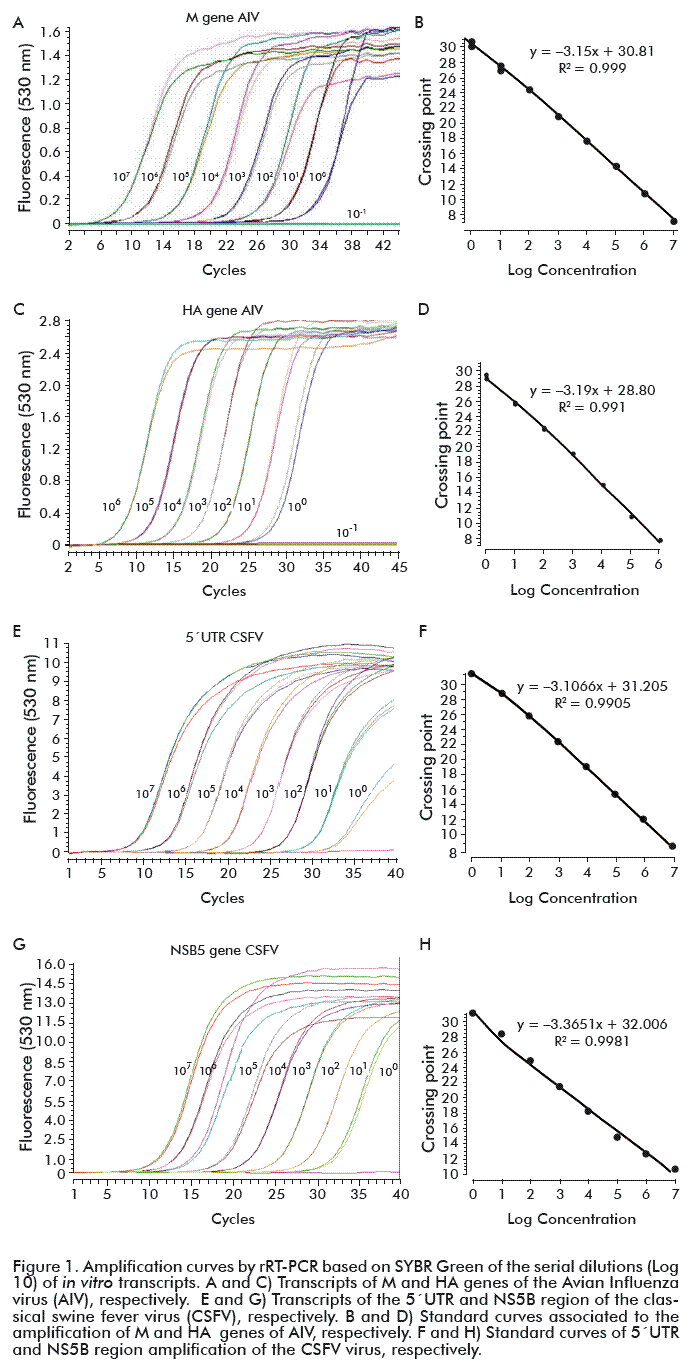
<body><![CDATA[<P   ><font size="2" face="Verdana, Arial, Helvetica, sans-serif">Both dehydration      and cryopreservation keep the nucleic acid in a crystallized state where the      molecule has very few levels of motion and the likelihood of chemical reactions      is practically unlikely [29]. It has been shown that even nucleic acids preserved      at ultra-low temperatures have some reactivity when they are in a hydrated      environment. This was demonstrated by Ma <I>et al</I>. [30], where they observed      that ribonucleases continue to be active in frozen RNA at &ndash;</font><font size="2" face="Verdana, Arial, Helvetica, sans-serif">20      &ordm;C. Also, other authors suggest that the activity of some ribozymes remains      significant at &ndash;70 &ordm;C [31]. In more recent studies on the conservation      of dehydrated RNA, it has been shown that with prior treatment with stabilizing      solutions, they can be stable even if they are preserved at room temperature      [7, 32, 33]. </font></P >       <P   ><font size="2" face="Verdana, Arial, Helvetica, sans-serif">To demonstrate that      a method for preserving nucleic acid stability is effective, the conservation      of the strand structure must be verified over time. The most commonly used      method for this verification was the RT-qPCR [5, 34], where the amplification      efficiency of the RT-PCR assays must be taken into account through a standard      curve [35, 36]. The standard curve for both viral agents was established from      <I>in vitro </I>transcripts, since they are an alternative for the development      and evaluation of molecular tools, by guaranteeing a positive control of intact      RNA, a critical aspect for screening [7, 25]. </font></P >       <P   ><font size="2" face="Verdana, Arial, Helvetica, sans-serif">The standard curves      obtained for the quantification of AIV M and HA genes and the 5&rsquo;UTR      and NS5B regions of the CSFV (<a href="/img/revistas/bta/v34n1/f0104117.gif">Figure 1</a>) showed      amplification efficiency between 1.8 and 2.0, these values permissible for      the real time PCR assays with the use of Roche&rsquo;s Light Cycler [37].      The coefficient of determination in all cases was R<sup>2</sup> &gt; 0.99.      Taking into account that the determination coefficient expresses the measure      of the variation of the data, which is explained by the linear relationship      between the two variables (initial copy number of the genes and the threshold      cycle (Ct)) one can expect good certainty in the quantification of the samples      to evaluate. </font></P >   <FONT size="+1"><FONT size="+1">        
<P   ><font size="2" face="Verdana, Arial, Helvetica, sans-serif">The standard curve      in terms of RNA copy number obtained for the quantification of M transcript      showed a linear range from 10<sup>7</sup> to 10<sup>0</sup> copies/&mu;L and      from 10<sup>6</sup> to 10<sup>0</sup> copies/&mu;L for the HA transcript (<a href="/img/revistas/bta/v34n1/f0104117.gif">Figure      1A and C</a>). On the other hand, for the target regions evaluated for CSFV,      the linear range obtained for each 5&acute;UTR and NS5B transcript generated      standard curves from 10<sup>7</sup> to 10<sup>0</sup> copies/&mu;L (in terms      of RNA copy number) in both cases (<a href="/img/revistas/bta/v34n1/f0104117.gif">Figure 1 E and G</a>).      </font></P >   <FONT size="+1"><FONT size="+1"><FONT size="+1"><FONT size="+1"><FONT size="+1"><FONT size="+1"><FONT size="+1"><FONT size="+1"><FONT size="+1"><FONT size="+1"><FONT size="+1"><FONT size="+1">        
<P   ><font size="2" face="Verdana, Arial, Helvetica, sans-serif">In the evaluation      of the CSFV RNA thermostability, the target regions of the viral RNA that      are commonly used in the diagnosis of this viral entity were selected. For      the diagnosis of CSFV, some laboratories target the 5&acute;UTR region [16,      38, 39], as it has a highly conserved sequence among the Pestiviruses since      the internal ribosome entry site (IRES) is located in this region, which is      indispensable for the initiation of the translation of viral proteins [40].      However, other laboratories target the NS5B protein binding region [19, 41],      which is a region located at the C-terminal of the polyprotein that binds      to the 3&acute;UTR end of the viral RNA. This protein plays a relevant role      in the replication of the viral genome. It is known that problems in this      region of the genome would cause degradation of all viral RNA, with subsequent      reduction of viral replication [42]. </font></P >       <P   ><font size="2" face="Verdana, Arial, Helvetica, sans-serif">The results obtained      in the evaluation of the thermostability of the preserved CSFV RNA in dry      pellet form (<a href="/img/revistas/bta/v34n1/f0204117.gif">Figure 2</a>) showed that both target      regions 5&acute;UTR and NS5B had a very similar behavior throughout the experiment.      Although there were statistically significant differences between the thermostability      of each target region depending on the storage temperature after 30 days in      none of the cases the DNA amplification performance of the samples was drastically      affected. For both targets up to the end of the experiment, quantifiable values      above 10<sup>2</sup> copies/&mu;L of RNA were detected, even in those samples      that were stored at the most extreme temperature (37 &ordm;C). These results      show that laboratories that store or receive the CSFV RNA in the form of dry      pellet can use both targets for the diagnosis of this disease, since under      these conservation conditions both fragments of the genome are thermostable      for at least 60 days. </font></P >   <FONT size="+1"><FONT size="+1">        
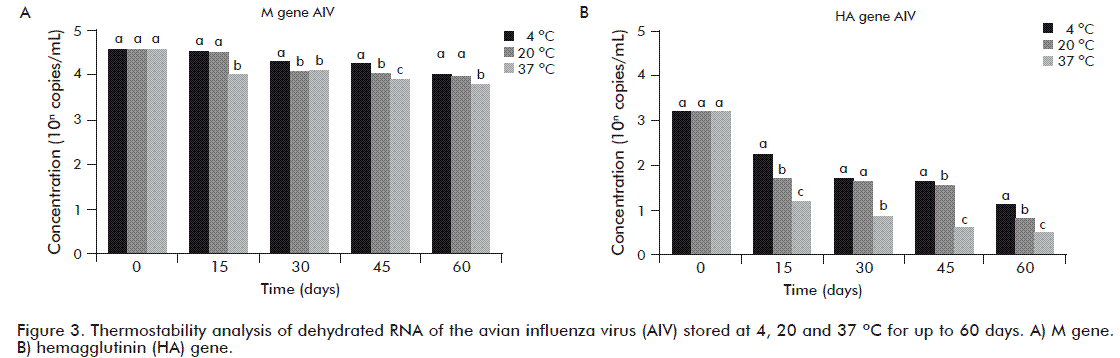
<P   ><font size="2" face="Verdana, Arial, Helvetica, sans-serif">Several rRT-PCR assays      have been described and validated for the diagnosis of AIV to amplify both,      regions of the matrix gene (M) and the HA2 region of the HA gene. The M gene      is preserved in all 16 subtypes of the virus from all geographic regions,      making it ideal for AIV detection. While the HA2 region is relatively preserved      among the hemagglutinin genes, which makes it the most relevant for the diagnosis      of different viral subtypes [23, 43-45]. Highly pathogenic avian influenza      viruses (HPAI) have been associated with H5 and H7 subtypes, although not      all viruses of these subtypes cause HPAI. Both, HPAI and low pathogenic avian      influenza (LPAI) cause a highly contagious disease capable of spreading to      susceptible populations in a short period of time [46]. This can have devastating      effects on the poultry industry, particularly if it occurs in high bird density      areas [47]. The most effective strategy to fight efficiently the AIV is to      conduct early detection and warning to prevent the spread of the disease and      achieve effective control. Hence, the preservation of AIV RNA stability in      these two diagnostic regions (M and HA gene) is indispensable for the accurate      diagnosis of this entity. </font></P >       <P   ><font size="2" face="Verdana, Arial, Helvetica, sans-serif">It is important to      note that the AIV genome consists of eight segments (PB2, PB1, PA, HA, NP,      NA, M and NS) coding for nine proteins (PB2, PA, HA, NP, NA, M1 and M2, NS1      and NS2) [48, 49]. The degradation of one of these segments of the genome      can be translated into possible failures in the viral multiplication cycle      and thus subvert viral isolation [49]. Nevertheless, if degradation does not      occur at the recognition sites of the primers in the segment used for the      diagnosis, hence, the performance of the molecular assays is not affected.      </font></P >       <P   ><font size="2" face="Verdana, Arial, Helvetica, sans-serif">There were also found      differences in the behavior of the thermostability of the AIV M and HA genes      (<a href="/img/revistas/bta/v34n1/f0304117.gif">Figure 3</a>). Even though both target regions of      the genome generated a quantifiable amplification of the RNA by the rRT-qPCR      throughout the experiment, the yield of amplification of the target region      of the HA gene was gradually decreasing over time. Notably, that yield was      further affected when the RNA was stored as dry pellet at 37 &deg;C. This      same behavior was not observed in the yield of the M gene amplification, which      was very similar at all time points evaluated, regardless of the samples storage      temperature. </font></P >       
<P   ><font size="2" face="Verdana, Arial, Helvetica, sans-serif">As we have observed,      the conservation of RNA as dry pellets within hermetically sealed polyethylene      tubes could be an efficient and low cost alternative for the preservation      of viral RNAs that are stored for long periods in diagnostic laboratories      and biobanks. It has been shown that nucleic acids stored in a dehydrated      matrix at ultra-low temperatures can be preserved for hundreds of years [31].      In most laboratories where genetic material is preserved, there are storage      conditions of &ndash;20 or &ndash;80 &deg;C, and unexpected electrical power      failures can occur. In that setting, the </font><font size="2" face="Verdana, Arial, Helvetica, sans-serif">preservation      method proposed in this work guarantee that viral RNAs stored at ultra-low      temperatures can continue its storage once they reach room temperature, without      degradation in the form of dry pellet and for up to two months. Thus, losses      of stored genetic material would be avoided. Above all, the loss of positive      controls would not be regretted. These controls are indispensable for the      execution of molecular tests and commonly difficult to obtain, especially      in those diseases that are exotic to a country. </font></P >       ]]></body>
<body><![CDATA[<P   ><font size="2" face="Verdana, Arial, Helvetica, sans-serif">In summary, the study      demonstrated that storing viral RNAs under dry pellet conditions within hermetically      sealed polyethylene tubes is an effective alternative for the preservation      of viral RNA stability for long periods of time at room temperature.</font></P >       <P   >&nbsp;</P >       <P   ><font size="3" face="Verdana, Arial, Helvetica, sans-serif"><b>REFERENCES </b></font></P >       <P   > </P >   <FONT size="+1" color="#000000">        <!-- ref --><P   ><font size="2" color="#211E1F" face="Verdana, Arial, Helvetica, sans-serif">1.      Ivanova NV, Kuzmina ML. Protocols for dry DNA storage and shipment at room      temperature. Mol Ecol Resour. 2013;13(5):890-8.     </font></P >   <FONT size="+1" color="#211E1F">        <P   ><font size="2" face="Verdana, Arial, Helvetica, sans-serif">2. Seelenfreund E,      Robinson WA, Amato CM, Tan AC, Kim J, Robinson SE. Long term storage of dry      versus frozen RNA for next generation molecular studies. PLoS One. 2014;9(11):e111827.      </font></P >       <!-- ref --><P   ><font size="2" face="Verdana, Arial, Helvetica, sans-serif">3. Gonzalez-Perez      I, Rosa IG, Cayarga AA, Hernandez YP, Gonzalez YJ, Victores YR, <I>et al</I>.      Scaling up <I>in vitro </I>transcription synthesis of RNA standards for competitive      quantitative RT-PCR: looking for bigger yields. Anal Biochem. 2009;385(1):179-81.          </font></P >       <!-- ref --><P   ><font size="2" face="Verdana, Arial, Helvetica, sans-serif">4. Oivanen M, Kuusela      S, Lonnberg H. Kinetics and mechanisms for the cleavage and isomerization      of the phosphodiester bonds of RNA by Bronsted acids and bases. Chem Rev.      1998;98(3):961-90.     </font></P >       <!-- ref --><P   ><font size="2" face="Verdana, Arial, Helvetica, sans-serif">5. Fabre AL, Colotte      M, Luis A, Tuffet S, Bonnet J. An efficient method for long-term room temperature      storage of RNA. Eur J Hum Genet. 2014;22(3):379-85.     </font></P >       <!-- ref --><P   ><font size="2" face="Verdana, Arial, Helvetica, sans-serif">6. Shinriki N, Ishizaki      K, Miura K, Ueda T, Harada F. Degradation of nucleic acids with ozone. III.      Mode of ozone-degradation of mouse proline transfer ribonucleic acid (tRNA)      and isoleucine tRNA. Chem Pharm Bull (Tokyo). 1983;31(10):3601-8.     </font></P >       <!-- ref --><P   ><font size="2" face="Verdana, Arial, Helvetica, sans-serif">7. Hoffmann B, Depner      K, Schirrmeier H, Beer M. A universal heterologous internal control system      for duplex real-time RT-PCR assays used in a detection system for pestiviruses.      J Virol Methods. 2006;136(1-2):200-9.     </font></P >       <P   ><font size="2" face="Verdana, Arial, Helvetica, sans-serif">8. Martinez H, Beaudry      G, Veer J, Robitaille M, Wong D, Iverson B, <I>et al</I>. Ambient temperature      storage of RNA in GenTegra&trade; for use in RT-qPCR. BioTechniques. 2010;48(4):328-9.      </font></P >       <!-- ref --><P   ><font size="2" face="Verdana, Arial, Helvetica, sans-serif">9. Moscoso H, Raybon      EO, Thayer SG, Hofacre CL. Molecular detection and serotyping of infectious      bronchitis virus from FTA filter paper. Avian Dis. 2005;49(1):24-9.     </font></P >       ]]></body>
<body><![CDATA[<!-- ref --><P   ><font size="2" face="Verdana, Arial, Helvetica, sans-serif">10. Spackman E, Pedersen      JC, McKinley ET, Gelb J. Optimal specimen collection and transport methods      for the detection of avian influenza virus and Newcastle disease virus. BMC      Vet Res. 2013;9:35.     </font></P >       <!-- ref --><P   ><font size="2" face="Verdana, Arial, Helvetica, sans-serif">11. Floegel-Niesmann      G, Bunzenthal C, Fischer S, Moennig V. Virulence of recent and former classical      swine fever virus isolates evaluated by their clinical and pathological signs.      J Vet Med B Infect Dis Vet Public Health. 2003;50(5):214-20.     </font></P >       <P   ><font size="2" face="Verdana, Arial, Helvetica, sans-serif">12. World Organization      of Animal Health. Avian influenza. In: OIE. Manual of Diagnostic Tests and      Vaccines for Terrestrial Animals. Paris: OIE; 2014. p. 1128-38. </font></P >       <!-- ref --><P   ><font size="2" face="Verdana, Arial, Helvetica, sans-serif">13. Depner K, Hoffmann      B, Beer M. Evaluation of real-time RT-PCR assay for the routine intra vitam      diagnosis of classical swine fever. Vet Microbiol. 2007;121(3-4):338-43.     </font></P >       <!-- ref --><P   ><font size="2" face="Verdana, Arial, Helvetica, sans-serif">14. Cheng D, Zhao      JJ, Li N, Sun Y, Zhou YJ, Zhu Y, <I>et al</I>. Simultaneous detection of Classical      swine fever virus and North American genotype Porcine reproductive and respiratory      syndrome virus using a duplex real-time RT-PCR. J Virol Methods. 2008;151(2):194-9.          </font></P >       <!-- ref --><P   ><font size="2" face="Verdana, Arial, Helvetica, sans-serif">15. Zambon M, Goddard      N, Meijer A, McCauley J, Daniels R. Diagnostic preparedness in Europe for      detection of avian influenza A(H7N9) viruses, Techni-cal briefing note. Stockholm:      European Centre for Disease Prevention and Control, ECDC; 2013.     </font></P >       <P   ><font size="2" face="Verdana, Arial, Helvetica, sans-serif">16. Haines FJ, Hofmann      MA, King DP, Drew TW, Crooke HR. Development and validation of a multiplex,      real-time RT PCR assay for the simultaneous detection of classical and African      swine fever viruses. PLoS One. 2013;8(7):e71019. </font></P >       <!-- ref --><P   ><font size="2" face="Verdana, Arial, Helvetica, sans-serif">17. Reid SM, Ferris      NP, Hutchings GH, Zhang Z, Belsham GJ, Alexandersen S. Detection of all seven      serotypes of foot-and-mouth disease virus by real-time, fluorogenic reverse      transcription polymerase chain reaction assay. J Virol Methods. 2002;105(1):67-80.          </font></P >       <!-- ref --><P   ><font size="2" face="Verdana, Arial, Helvetica, sans-serif">18. Fernandez-Pinero      J, Gallardo C, Elizalde M, Robles A, Gomez C, Bishop R, <I>et al</I>. Molecular      diagnosis of African Swine Fever by a new real-time PCR using universal probe      library. Transbound Emerg Dis. 2013;60(1):48-58.     </font></P >       <!-- ref --><P   ><font size="2" face="Verdana, Arial, Helvetica, sans-serif">19. Diaz de Arce      H, Perez LJ, Frias MT, Rosell R, Tarradas J, Nunez JI, <I>et al</I>. A multiplex      RT-PCR assay for the rapid and differential diagnosis of classical swine fever      and other pestivirus infections. Vet Microbiol. 2009;139(3-4):245-52.     </font></P >       <!-- ref --><P   ><font size="2" face="Verdana, Arial, Helvetica, sans-serif">20. Hoffmann B, Beer      M, Schelp C, Schirrmeier H, Depner K. Validation of a real-time RT-PCR assay      for sensitive and specific detection of classical swine fever. J Virol Methods.      2005;130(1-2):36-44.     </font></P >       ]]></body>
<body><![CDATA[<!-- ref --><P   ><font size="2" face="Verdana, Arial, Helvetica, sans-serif">21. Perez LJ, Diaz      de Arce H, Tarradas J, Rosell R, Perera CL, Munoz M, <I>et al</I>. Development      and validation of a novel SYBR Green real-time RT-PCR assay for the detection      of classical swine fever virus evaluated on different real-time PCR platforms.      J Virol Methods. 2011;174(1-2):53-9.     </font></P >       <!-- ref --><P   ><font size="2" face="Verdana, Arial, Helvetica, sans-serif">22. Diaz de Arce      H, Nunez JI, Ganges L, Barreras M, Frias MT, Sobrino F. An RT-PCR assay for      the specific detection of classical swine fever virus in clinical samples.      Vet Res. 1998;29(5):431-40.     </font></P >       <!-- ref --><P   ><font size="2" face="Verdana, Arial, Helvetica, sans-serif">23. Spackman E, Senne      DA, Myers TJ, Bulaga LL, Garber LP, Perdue ML, <I>et al</I>. Development of      a real-time reverse transcriptase PCR assay for type A influenza virus and      the avian H5 and H7 hemagglutinin subtypes. J Clin Microbiol. 2002;40(9):3256-60.          </font></P >       <!-- ref --><P   ><font size="2" face="Verdana, Arial, Helvetica, sans-serif">24. Lee MS, Chang      PC, Shien JH, Cheng MC, Shieh HK. Identification and subtyping of avian influenza      viruses by reverse transcription-PCR. J Virol Methods. 2001;97(1-2):13-22.          </font></P >       <!-- ref --><P   ><font size="2" face="Verdana, Arial, Helvetica, sans-serif">25. Perez LJ, Diaz      de Arce H, Cilloni F, Salviato A, Marciano S, Perera CL, <I>et al</I>. An      SYBR Green-based real-time RT-PCR assay for the detection of H5 hemagglutinin      subtype avian influenza virus. Mol Cell Probes. 2012;26(3):137-45.     </font></P >       ]]></body>
<body><![CDATA[<P   ><font size="2" face="Verdana, Arial, Helvetica, sans-serif">26. Di Rienzo JA,      Casanoves F, Balzarini MG, Gonzalez L, Tablada M, Robledo CW. InfoStat version      2016. National University of Cordova, Argentina: Grupo InfoStat, FCA. 2016      [cited 2016 Jan 17]. Available from: <FONT color="#0000FF"><a href="http://www.infostat.com.ar" target="_blank">http://www.infostat.com.ar</a>      </font></font></P >   <FONT color="#0000FF">        <P   ><font color="#211E1F" size="2" face="Verdana, Arial, Helvetica, sans-serif">27.      CBS. News Staff. Freezer Malfunction Thaws 150 Brains at Harvard Research      Hospital. CBS NEWS. 2012 Jun 1 [cited 2016 Jan 17]. Available from: <FONT color="#0000FF"><a href="http://www.cbsnews.com/news/freezer-malfunction-thaws-150-brains-at-harvard-research-hospital" target="_blank">http://www.cbsnews.com/news/freezer-malfunction-thaws-150-brains-at-harvard-research-hospital</a>      </font></font></P >   <FONT color="#211E1F"><FONT color="#0000FF">        <P   ><font color="#211E1F" size="2" face="Verdana, Arial, Helvetica, sans-serif">28.      Kuntzman G. Loses years of scientific research and thousands of mice to hurricane      Sandy. NY Daily News. 2012 Oct 30 [cited 2016 Jan 17]. Available from:<a href="http://www.nydailynews.com/new-york/nyu-loses-thousands-mice-sandy-article-1" target="_blank">      <FONT color="#0000FF">http://www.nydailynews.com/new-york/nyu-loses-thousands-mice-sandy-article-1</font></a><FONT color="#0000FF">      </font></font></P >   <FONT color="#211E1F"><FONT color="#0000FF">        <!-- ref --><P   ><font color="#211E1F" size="2" face="Verdana, Arial, Helvetica, sans-serif">29.      Lee SB, Crouse CA, Kline MC. Optimizing Storage and Handling of DNA Extracts.      Forensic Sci Rev. 2010;22(2):131-44.     </font></P >   <FONT color="#211E1F">        <!-- ref --><P   ><font size="2" face="Verdana, Arial, Helvetica, sans-serif">30. Ma S, Huang Y,      van Huystee RB. Improved plant RNA stability in storage. Anal Biochem. 2004;326(1):122-4.          </font></P >       <!-- ref --><P   ><font size="2" face="Verdana, Arial, Helvetica, sans-serif">31. Seyhan AA, Burke      JM. Mg2+-independent hairpin ribozyme catalysis in hydrated RNA films. RNA.      2000;6(2):189-98.     </font></P >   <FONT size="+1"><FONT size="+1">        <!-- ref --><P   ><font size="2" face="Verdana, Arial, Helvetica, sans-serif">32. Stevens DS, Crudder      CH, Domingo GJ. Post-extraction stabilization of HIV viral RNA for quantitative      molecular tests. J Virol Methods. 2012;182(1-2):104-10.     </font></P >       <!-- ref --><P   ><font size="2" face="Verdana, Arial, Helvetica, sans-serif">33. Conny M, Wusheng      Y, Rodrigo C, Amy PN, Skubitz A, <I>et al</I>. Short-Term Stability Study      of RNA at Room Temperature. Biopreserv Biobank. 2012;10(6):532-42.     </font></P >       <!-- ref --><P   ><font size="2" face="Verdana, Arial, Helvetica, sans-serif">34. Liu X, Li Q,      Wang X, Zhou X, He X, Liao Q, <I>et al</I>. Evaluation of DNA/RNAshells for      room temperature nucleic acids storage. Biopreserv Biobank. 2015;13(1):49-55.          </font></P >       <P   ><font size="2" face="Verdana, Arial, Helvetica, sans-serif">35. Aguilera P, Ruiz      M, Rocha M, Pineda B, Ch&aacute;nez ME. PCR en tiempo real. In: Cornejo A,      Serrato A, Rend&oacute;n B, Roche MG, editors. Herramientas moleculares aplicadas      en ecolog&iacute;a: aspectos te&oacute;ricos y pr&aacute;cticos. Ciudad de      M&eacute;xico: Laboratorio de Patolog&iacute;a Vascular Cerebral, Instituto      Nacional de Neurolog&iacute;a y Neurocirug&iacute;a; 2014 [cited 2016 Jun      16]. Available from: <FONT color="#0000FF"><a href="http://www2.inecc.gob.mx/publicaciones/libros/710/pcrtiempo.pdf" target="_blank">http://www2.inecc.gob.mx/publicaciones/libros/710/pcrtiempo.pd<FONT color="#211E1F">f</font></a><FONT color="#211E1F">      </font></font></font></P >   <FONT color="#0000FF"><FONT color="#211E1F">        <!-- ref --><P   ><font size="2" face="Verdana, Arial, Helvetica, sans-serif">36. Wong ML, Medrano      JF. Real-time PCR for mRNA quantitation. Biotechniques. 2005;39(1):75-85.          </font></P >       <P   ><font size="2" face="Verdana, Arial, Helvetica, sans-serif">37. Pfaffl MW, Horgan      GW, Dempfle L. Relative expression software tool (REST) for group-wise comparison      and statistical analysis of relative expression results in real-time PCR.      Nucleic Acids Res. 2002;30(9):e36. </font></P >       <!-- ref --><P   ><font size="2" face="Verdana, Arial, Helvetica, sans-serif">38. Liu J, Fan XZ,      Wang Q, Xu L, Zhao QZ, Huang W, <I>et al</I>. Dynamic distribution and tissue      tropism of classical swine fever virus in experimentally infected pigs. Virol      J. 2011;8:201.     </font></P >       <P   ><font size="2" face="Verdana, Arial, Helvetica, sans-serif">39. Hsu WL, Chen      CL, Huang SW, Wu CC, Chen IH, Nadar M, <I>et al</I>. The untranslated regions      of classic swine fever virus RNA trigger apoptosis. PLoS One. 2014;9(2):e88863.      </font></P >       <!-- ref --><P   ><font size="2" face="Verdana, Arial, Helvetica, sans-serif">40. Xiao M, Zhu ZZ,      Liu J, Zhang CY. Prediction of recognition sites for genomic replication of      classical swine fever virus with information analysis. Mol Biol. 2002;36(1):48-57.          </font></P >       <!-- ref --><P   ><font size="2" face="Verdana, Arial, Helvetica, sans-serif">41. Malswamkima D,      Rajkhowa TK, Chandra R, Dutta TK. Pathology and molecular diagnosis of classical      swine fever in Mizoram. Vet World. 2015;8(1):76-81.     </font></P >       <!-- ref --><P   ><font size="2" face="Verdana, Arial, Helvetica, sans-serif">42. Haegeman A, Dewulf      J, Vrancken R, Tignon M, Ribbens S, Koenen F. Characterisation of the discrepancy      between PCR and virus isolation in relation to classical swine fever virus      detection. J Virol Methods. 2006;136(1-2):44-50.     </font></P >       <!-- ref --><P   ><font size="2" face="Verdana, Arial, Helvetica, sans-serif">43. United States      Department of Agriculture. Avian influenza testing and diagnostics. Washington,      D.C.: USDA Press Office; 2015.     </font></P >       ]]></body>
<body><![CDATA[<!-- ref --><P   ><font size="2" face="Verdana, Arial, Helvetica, sans-serif">44. Lee CW, Suarez      DL. Application of real-time RT-PCR for the quantitation and competitive replication      study of H5 and H7 subtype avian influenza virus. J Virol Methods. 2004;119(2):151-8.          </font></P >       <!-- ref --><P   ><font size="2" face="Verdana, Arial, Helvetica, sans-serif">45. Perera CL, D&iacute;az      de Arce H, P&eacute;rez LJ. Actualizaci&oacute;n y perspectivas en el diagn&oacute;stico      del virus de la influenza aviar. Rev Salud Anim. 2011;33(1):1-7.     </font></P >       <!-- ref --><P   ><font size="2" face="Verdana, Arial, Helvetica, sans-serif">46. Heine HG, Foord      AJ, Wang J, Valdeter S, Walker S, Morrissy C, <I>et al</I>. Detection of highly      pathogenic zoonotic influenza virus H5N6 by reverse-transcriptase quantitative      polymerase chain reaction. Virol J. 2015;12:18.     </font></P >       <P   ><font size="2" face="Verdana, Arial, Helvetica, sans-serif">47. McAuley JL, Chipuk      JE, Boyd KL, Van De Velde N, Green DR, McCullers JA. PB1-F2 proteins from      H5N1 and 20 century pandemic influenza viruses cause immunopathology. PLoS      Pathog. 2010;6(7):e1001014. </font></P >       <!-- ref --><P   ><font size="2" face="Verdana, Arial, Helvetica, sans-serif">48. Lekcharoensuk      P, Nanakorn J, Wajjwalku W, Webby R, Chumsing W. First whole genome characterization      of swine influenza virus subtype H3N2 in Thailand. Vet Microbiol. 2010;145(3-4):230-44.          </font></P >       <P   ><font size="2" face="Verdana, Arial, Helvetica, sans-serif">49. Palase P, Shaw      ML. Orthomyxoviridae: The viruses and their replication. In: Knipes D, Howley      P, editors. Field&rsquo;s Virology. 5th edition. Philadelphia: Lipincott Williamson      and Wilkinson; 2007. p. 1647-89. </font></P >       ]]></body>
<body><![CDATA[<P   > </P >   <FONT size="+1">        <P   >&nbsp;</P >       <P   >&nbsp;</P >       <P   ><font size="2" face="Verdana, Arial, Helvetica, sans-serif">Received in July,      2016.     <br>     Accepted in November, 2016. </font></P >       <P   >&nbsp;</P >       <P   >&nbsp;</P >   <FONT size="+1"><FONT size="+1">        <P   ><font size="2" face="Verdana, Arial, Helvetica, sans-serif"><i>Damarys Relova</i>.      Departamento de Virolog&iacute;a, Centro Nacional de Sanidad Agropecuaria,      CENSA. Apartado 10, San Jos&eacute; de las Lajas, Mayabeque, Cuba. E-mail:      <A href="mailto:drelova@censa.edu.cu"> <FONT color="#0000FF">drelova@censa.edu.cu</font></A><FONT color="#0000FF"><FONT color="#211E1F">.</font></font></font></P >   <FONT size="+1"><FONT size="+1"><FONT color="#0000FF"><FONT color="#211E1F"></font></font></font></font></font></font></font></font></font></font></font></font></font></font></font></font></font></font></font></font></font></font></font></font></font></font></font></font></font></font></font></font></font></font></font></font></font></font></font></font></font></font></font></font></font></font></font></font></font></font></font></font></font></DIV >      ]]></body><back>
<ref-list>
<ref id="B1">
<label>1</label><nlm-citation citation-type="journal">
<person-group person-group-type="author">
<name>
<surname><![CDATA[Ivanova]]></surname>
<given-names><![CDATA[NV]]></given-names>
</name>
<name>
<surname><![CDATA[Kuzmina]]></surname>
<given-names><![CDATA[ML]]></given-names>
</name>
</person-group>
<article-title xml:lang="en"><![CDATA[Protocols for dry DNA storage and shipment at room temperature]]></article-title>
<source><![CDATA[Mol Ecol Resour]]></source>
<year>2013</year>
<volume>13</volume>
<numero>5</numero>
<issue>5</issue>
<page-range>890-8</page-range></nlm-citation>
</ref>
<ref id="B2">
<label>2</label><nlm-citation citation-type="journal">
<person-group person-group-type="author">
<name>
<surname><![CDATA[Seelenfreund]]></surname>
<given-names><![CDATA[E]]></given-names>
</name>
<name>
<surname><![CDATA[Robinson]]></surname>
<given-names><![CDATA[WA]]></given-names>
</name>
<name>
<surname><![CDATA[Amato]]></surname>
<given-names><![CDATA[CM]]></given-names>
</name>
<name>
<surname><![CDATA[Tan]]></surname>
<given-names><![CDATA[AC]]></given-names>
</name>
<name>
<surname><![CDATA[Kim]]></surname>
<given-names><![CDATA[J]]></given-names>
</name>
<name>
<surname><![CDATA[Robinson]]></surname>
<given-names><![CDATA[SE]]></given-names>
</name>
</person-group>
<article-title xml:lang="en"><![CDATA[Long term storage of dry versus frozen RNA for next generation molecular studies]]></article-title>
<source><![CDATA[PLoS One]]></source>
<year>2014</year>
<volume>9</volume>
<numero>11</numero>
<issue>11</issue>
<page-range>111827</page-range></nlm-citation>
</ref>
<ref id="B3">
<label>3</label><nlm-citation citation-type="journal">
<person-group person-group-type="author">
<name>
<surname><![CDATA[Gonzalez-Perez]]></surname>
<given-names><![CDATA[I]]></given-names>
</name>
<name>
<surname><![CDATA[Rosa]]></surname>
<given-names><![CDATA[IG]]></given-names>
</name>
<name>
<surname><![CDATA[Cayarga]]></surname>
<given-names><![CDATA[AA]]></given-names>
</name>
<name>
<surname><![CDATA[Hernandez]]></surname>
<given-names><![CDATA[YP]]></given-names>
</name>
<name>
<surname><![CDATA[Gonzalez]]></surname>
<given-names><![CDATA[YJ]]></given-names>
</name>
<name>
<surname><![CDATA[Victores]]></surname>
<given-names><![CDATA[YR]]></given-names>
</name>
</person-group>
<article-title xml:lang="en"><![CDATA[Scaling up in vitro transcription synthesis of RNA standards for competitive quantitative RT-PCR: looking for bigger yields]]></article-title>
<source><![CDATA[Anal Biochem]]></source>
<year>2009</year>
<volume>385</volume>
<numero>1</numero>
<issue>1</issue>
<page-range>179-81</page-range></nlm-citation>
</ref>
<ref id="B4">
<label>4</label><nlm-citation citation-type="journal">
<person-group person-group-type="author">
<name>
<surname><![CDATA[Oivanen]]></surname>
<given-names><![CDATA[M]]></given-names>
</name>
<name>
<surname><![CDATA[Kuusela]]></surname>
<given-names><![CDATA[S]]></given-names>
</name>
<name>
<surname><![CDATA[Lonnberg]]></surname>
<given-names><![CDATA[H]]></given-names>
</name>
</person-group>
<article-title xml:lang="en"><![CDATA[Kinetics and mechanisms for the cleavage and isomerization of the phosphodiester bonds of RNA by Bronsted acids and bases]]></article-title>
<source><![CDATA[Chem Rev]]></source>
<year>1998</year>
<volume>98</volume>
<numero>3</numero>
<issue>3</issue>
<page-range>961-90</page-range></nlm-citation>
</ref>
<ref id="B5">
<label>5</label><nlm-citation citation-type="journal">
<person-group person-group-type="author">
<name>
<surname><![CDATA[Fabre]]></surname>
<given-names><![CDATA[AL]]></given-names>
</name>
<name>
<surname><![CDATA[Colotte]]></surname>
<given-names><![CDATA[M]]></given-names>
</name>
<name>
<surname><![CDATA[Luis]]></surname>
<given-names><![CDATA[A]]></given-names>
</name>
<name>
<surname><![CDATA[Tuffet]]></surname>
<given-names><![CDATA[S]]></given-names>
</name>
<name>
<surname><![CDATA[Bonnet]]></surname>
<given-names><![CDATA[J]]></given-names>
</name>
</person-group>
<article-title xml:lang="en"><![CDATA[An efficient method for long-term room temperature storage of RNA]]></article-title>
<source><![CDATA[Eur J Hum Genet]]></source>
<year>2014</year>
<volume>22</volume>
<numero>3</numero>
<issue>3</issue>
<page-range>379-85</page-range></nlm-citation>
</ref>
<ref id="B6">
<label>6</label><nlm-citation citation-type="journal">
<person-group person-group-type="author">
<name>
<surname><![CDATA[Shinriki]]></surname>
<given-names><![CDATA[N]]></given-names>
</name>
<name>
<surname><![CDATA[Ishizaki]]></surname>
<given-names><![CDATA[K]]></given-names>
</name>
<name>
<surname><![CDATA[Miura]]></surname>
<given-names><![CDATA[K]]></given-names>
</name>
<name>
<surname><![CDATA[Ueda]]></surname>
<given-names><![CDATA[T]]></given-names>
</name>
<name>
<surname><![CDATA[Harada]]></surname>
<given-names><![CDATA[F]]></given-names>
</name>
</person-group>
<article-title xml:lang="en"><![CDATA[Degradation of nucleic acids with ozone. III. Mode of ozone-degradation of mouse proline transfer ribonucleic acid (tRNA) and isoleucine tRNA]]></article-title>
<source><![CDATA[Chem Pharm Bull (Tokyo)]]></source>
<year>1983</year>
<volume>31</volume>
<numero>10</numero>
<issue>10</issue>
<page-range>3601-8</page-range></nlm-citation>
</ref>
<ref id="B7">
<label>7</label><nlm-citation citation-type="journal">
<person-group person-group-type="author">
<name>
<surname><![CDATA[Hoffmann]]></surname>
<given-names><![CDATA[B]]></given-names>
</name>
<name>
<surname><![CDATA[Depner]]></surname>
<given-names><![CDATA[K]]></given-names>
</name>
<name>
<surname><![CDATA[Schirrmeier]]></surname>
<given-names><![CDATA[H]]></given-names>
</name>
<name>
<surname><![CDATA[Beer]]></surname>
<given-names><![CDATA[M]]></given-names>
</name>
</person-group>
<article-title xml:lang="en"><![CDATA[A universal heterologous internal control system for duplex real-time RT-PCR assays used in a detection system for pestiviruses]]></article-title>
<source><![CDATA[J Virol Methods]]></source>
<year>2006</year>
<volume>136</volume>
<numero>1</numero>
<issue>1</issue>
<page-range>2):200-9</page-range></nlm-citation>
</ref>
<ref id="B8">
<label>8</label><nlm-citation citation-type="journal">
<person-group person-group-type="author">
<name>
<surname><![CDATA[Martinez]]></surname>
<given-names><![CDATA[H]]></given-names>
</name>
<name>
<surname><![CDATA[Beaudry]]></surname>
<given-names><![CDATA[G]]></given-names>
</name>
<name>
<surname><![CDATA[Veer]]></surname>
<given-names><![CDATA[J]]></given-names>
</name>
<name>
<surname><![CDATA[Robitaille]]></surname>
<given-names><![CDATA[M]]></given-names>
</name>
<name>
<surname><![CDATA[Wong]]></surname>
<given-names><![CDATA[D]]></given-names>
</name>
<name>
<surname><![CDATA[Iverson]]></surname>
<given-names><![CDATA[B]]></given-names>
</name>
</person-group>
<article-title xml:lang="en"><![CDATA[Ambient temperature storage of RNA in GenTegra & trade; for use in RT-qPCR]]></article-title>
<source><![CDATA[BioTechniques]]></source>
<year>2010</year>
<volume>48</volume>
<numero>4</numero>
<issue>4</issue>
<page-range>328-9</page-range></nlm-citation>
</ref>
<ref id="B9">
<label>9</label><nlm-citation citation-type="journal">
<person-group person-group-type="author">
<name>
<surname><![CDATA[Moscoso]]></surname>
<given-names><![CDATA[H]]></given-names>
</name>
<name>
<surname><![CDATA[Raybon]]></surname>
<given-names><![CDATA[EO]]></given-names>
</name>
<name>
<surname><![CDATA[Thayer]]></surname>
<given-names><![CDATA[SG]]></given-names>
</name>
<name>
<surname><![CDATA[Hofacre]]></surname>
<given-names><![CDATA[CL]]></given-names>
</name>
</person-group>
<article-title xml:lang="en"><![CDATA[Molecular detection and serotyping of infectious bronchitis virus from FTA filter paper]]></article-title>
<source><![CDATA[Avian Dis]]></source>
<year>2005</year>
<volume>49</volume>
<numero>1</numero>
<issue>1</issue>
<page-range>24-9</page-range></nlm-citation>
</ref>
<ref id="B10">
<label>10</label><nlm-citation citation-type="journal">
<person-group person-group-type="author">
<name>
<surname><![CDATA[Spackman]]></surname>
<given-names><![CDATA[E]]></given-names>
</name>
<name>
<surname><![CDATA[Pedersen]]></surname>
<given-names><![CDATA[JC]]></given-names>
</name>
<name>
<surname><![CDATA[McKinley]]></surname>
<given-names><![CDATA[ET]]></given-names>
</name>
<name>
<surname><![CDATA[Gelb]]></surname>
<given-names><![CDATA[J]]></given-names>
</name>
</person-group>
<article-title xml:lang="en"><![CDATA[Optimal specimen collection and transport methods for the detection of avian influenza virus and Newcastle disease virus]]></article-title>
<source><![CDATA[BMC Vet Res]]></source>
<year>2013</year>
<volume>9</volume>
<page-range>35</page-range></nlm-citation>
</ref>
<ref id="B11">
<label>11</label><nlm-citation citation-type="journal">
<person-group person-group-type="author">
<name>
<surname><![CDATA[Floegel-Niesmann]]></surname>
<given-names><![CDATA[G]]></given-names>
</name>
<name>
<surname><![CDATA[Bunzenthal]]></surname>
<given-names><![CDATA[C]]></given-names>
</name>
<name>
<surname><![CDATA[Fischer]]></surname>
<given-names><![CDATA[S]]></given-names>
</name>
<name>
<surname><![CDATA[Moennig]]></surname>
<given-names><![CDATA[V]]></given-names>
</name>
</person-group>
<article-title xml:lang="en"><![CDATA[Virulence of recent and former classical swine fever virus isolates evaluated by their clinical and pathological signs]]></article-title>
<source><![CDATA[J Vet Med B Infect Dis Vet Public Health]]></source>
<year>2003</year>
<volume>50</volume>
<numero>5</numero>
<issue>5</issue>
<page-range>214-20</page-range></nlm-citation>
</ref>
<ref id="B12">
<label>12</label><nlm-citation citation-type="book">
<collab>World Organization of Animal Health</collab>
<article-title xml:lang="en"><![CDATA[Avian influenza]]></article-title>
<collab>OIE</collab>
<source><![CDATA[Manual of Diagnostic Tests and Vaccines for Terrestrial Animals]]></source>
<year>2014</year>
<page-range>1128-</page-range><publisher-loc><![CDATA[Paris ]]></publisher-loc>
<publisher-name><![CDATA[OIE]]></publisher-name>
</nlm-citation>
</ref>
<ref id="B13">
<label>13</label><nlm-citation citation-type="journal">
<person-group person-group-type="author">
<name>
<surname><![CDATA[Depner]]></surname>
<given-names><![CDATA[K]]></given-names>
</name>
<name>
<surname><![CDATA[Hoffmann]]></surname>
<given-names><![CDATA[B]]></given-names>
</name>
<name>
<surname><![CDATA[Beer]]></surname>
<given-names><![CDATA[M]]></given-names>
</name>
</person-group>
<article-title xml:lang="en"><![CDATA[Evaluation of real-time RT-PCR assay for the routine intra vitam diagnosis of classical swine fever]]></article-title>
<source><![CDATA[Vet Microbiol]]></source>
<year>2007</year>
<volume>121</volume>
<numero>3</numero>
<issue>3</issue>
<page-range>4):338-43</page-range></nlm-citation>
</ref>
<ref id="B14">
<label>14</label><nlm-citation citation-type="journal">
<person-group person-group-type="author">
<name>
<surname><![CDATA[Cheng]]></surname>
<given-names><![CDATA[D]]></given-names>
</name>
<name>
<surname><![CDATA[Zhao]]></surname>
<given-names><![CDATA[JJ]]></given-names>
</name>
<name>
<surname><![CDATA[Li]]></surname>
<given-names><![CDATA[N]]></given-names>
</name>
<name>
<surname><![CDATA[Sun]]></surname>
<given-names><![CDATA[Y]]></given-names>
</name>
<name>
<surname><![CDATA[Zhou]]></surname>
<given-names><![CDATA[YJ]]></given-names>
</name>
<name>
<surname><![CDATA[Zhu]]></surname>
<given-names><![CDATA[Y]]></given-names>
</name>
</person-group>
<article-title xml:lang="en"><![CDATA[Simultaneous detection of Classical swine fever virus and North American genotype Porcine reproductive and respiratory syndrome virus using a duplex real-time RT-PCR]]></article-title>
<source><![CDATA[J Virol Methods]]></source>
<year>2008</year>
<volume>151</volume>
<numero>2</numero>
<issue>2</issue>
<page-range>194-9</page-range></nlm-citation>
</ref>
<ref id="B15">
<label>15</label><nlm-citation citation-type="book">
<person-group person-group-type="author">
<name>
<surname><![CDATA[Zambon]]></surname>
<given-names><![CDATA[M]]></given-names>
</name>
<name>
<surname><![CDATA[Goddard]]></surname>
<given-names><![CDATA[N]]></given-names>
</name>
<name>
<surname><![CDATA[Meijer]]></surname>
<given-names><![CDATA[A]]></given-names>
</name>
<name>
<surname><![CDATA[McCauley]]></surname>
<given-names><![CDATA[J]]></given-names>
</name>
<name>
<surname><![CDATA[Daniels]]></surname>
<given-names><![CDATA[R]]></given-names>
</name>
</person-group>
<source><![CDATA[Diagnostic preparedness in Europe for detection of avian influenza A(H7N9) viruses, Techni-cal briefing note]]></source>
<year>2013</year>
<publisher-loc><![CDATA[Stockholm ]]></publisher-loc>
<publisher-name><![CDATA[European Centre for Disease Prevention and Control, ECDC]]></publisher-name>
</nlm-citation>
</ref>
<ref id="B16">
<label>16</label><nlm-citation citation-type="journal">
<person-group person-group-type="author">
<name>
<surname><![CDATA[Haines]]></surname>
<given-names><![CDATA[FJ]]></given-names>
</name>
<name>
<surname><![CDATA[Hofmann]]></surname>
<given-names><![CDATA[MA]]></given-names>
</name>
<name>
<surname><![CDATA[King]]></surname>
<given-names><![CDATA[DP]]></given-names>
</name>
<name>
<surname><![CDATA[Drew]]></surname>
<given-names><![CDATA[TW]]></given-names>
</name>
<name>
<surname><![CDATA[Crooke]]></surname>
<given-names><![CDATA[HR]]></given-names>
</name>
</person-group>
<article-title xml:lang="en"><![CDATA[Development and validation of a multiplex, real-time RT PCR assay for the simultaneous detection of classical and African swine fever viruses]]></article-title>
<source><![CDATA[PLoS One]]></source>
<year>2013</year>
<volume>8</volume>
<numero>7</numero>
<issue>7</issue>
<page-range>71019</page-range></nlm-citation>
</ref>
<ref id="B17">
<label>17</label><nlm-citation citation-type="journal">
<person-group person-group-type="author">
<name>
<surname><![CDATA[Reid]]></surname>
<given-names><![CDATA[SM]]></given-names>
</name>
<name>
<surname><![CDATA[Ferris]]></surname>
<given-names><![CDATA[NP]]></given-names>
</name>
<name>
<surname><![CDATA[Hutchings]]></surname>
<given-names><![CDATA[GH]]></given-names>
</name>
<name>
<surname><![CDATA[Zhang]]></surname>
<given-names><![CDATA[Z]]></given-names>
</name>
<name>
<surname><![CDATA[Belsham]]></surname>
<given-names><![CDATA[GJ]]></given-names>
</name>
<name>
<surname><![CDATA[Alexandersen]]></surname>
<given-names><![CDATA[S]]></given-names>
</name>
</person-group>
<article-title xml:lang="en"><![CDATA[Detection of all seven serotypes of foot-and-mouth disease virus by real-time, fluorogenic reverse transcription polymerase chain reaction assay]]></article-title>
<source><![CDATA[J Virol Methods]]></source>
<year>2002</year>
<volume>105</volume>
<numero>1</numero>
<issue>1</issue>
<page-range>67-80</page-range></nlm-citation>
</ref>
<ref id="B18">
<label>18</label><nlm-citation citation-type="journal">
<person-group person-group-type="author">
<name>
<surname><![CDATA[Fernandez-Pinero]]></surname>
<given-names><![CDATA[J]]></given-names>
</name>
<name>
<surname><![CDATA[Gallardo]]></surname>
<given-names><![CDATA[C]]></given-names>
</name>
<name>
<surname><![CDATA[Elizalde]]></surname>
<given-names><![CDATA[M]]></given-names>
</name>
<name>
<surname><![CDATA[Robles]]></surname>
<given-names><![CDATA[A]]></given-names>
</name>
<name>
<surname><![CDATA[Gomez]]></surname>
<given-names><![CDATA[C]]></given-names>
</name>
<name>
<surname><![CDATA[Bishop]]></surname>
<given-names><![CDATA[R]]></given-names>
</name>
</person-group>
<article-title xml:lang="en"><![CDATA[Molecular diagnosis of African Swine Fever by a new real-time PCR using universal probe library]]></article-title>
<source><![CDATA[Transbound Emerg Dis]]></source>
<year>2013</year>
<volume>60</volume>
<numero>1</numero>
<issue>1</issue>
<page-range>48-58</page-range></nlm-citation>
</ref>
<ref id="B19">
<label>19</label><nlm-citation citation-type="journal">
<person-group person-group-type="author">
<name>
<surname><![CDATA[Diaz de Arce]]></surname>
<given-names><![CDATA[H]]></given-names>
</name>
<name>
<surname><![CDATA[Perez]]></surname>
<given-names><![CDATA[LJ]]></given-names>
</name>
<name>
<surname><![CDATA[Frias]]></surname>
<given-names><![CDATA[MT]]></given-names>
</name>
<name>
<surname><![CDATA[Rosell]]></surname>
<given-names><![CDATA[R]]></given-names>
</name>
<name>
<surname><![CDATA[Tarradas]]></surname>
<given-names><![CDATA[J]]></given-names>
</name>
<name>
<surname><![CDATA[Nunez]]></surname>
<given-names><![CDATA[JI]]></given-names>
</name>
</person-group>
<article-title xml:lang="en"><![CDATA[A multiplex RT-PCR assay for the rapid and differential diagnosis of classical swine fever and other pestivirus infections]]></article-title>
<source><![CDATA[Vet Microbiol]]></source>
<year>2009</year>
<volume>139</volume>
<numero>3</numero>
<issue>3</issue>
<page-range>4):245-52</page-range></nlm-citation>
</ref>
<ref id="B20">
<label>20</label><nlm-citation citation-type="journal">
<person-group person-group-type="author">
<name>
<surname><![CDATA[Hoffmann]]></surname>
<given-names><![CDATA[B]]></given-names>
</name>
<name>
<surname><![CDATA[Beer]]></surname>
<given-names><![CDATA[M]]></given-names>
</name>
<name>
<surname><![CDATA[Schelp]]></surname>
<given-names><![CDATA[C]]></given-names>
</name>
<name>
<surname><![CDATA[Schirrmeier]]></surname>
<given-names><![CDATA[H]]></given-names>
</name>
<name>
<surname><![CDATA[Depner]]></surname>
<given-names><![CDATA[K]]></given-names>
</name>
</person-group>
<article-title xml:lang="en"><![CDATA[Validation of a real-time RT-PCR assay for sensitive and specific detection of classical swine fever]]></article-title>
<source><![CDATA[J Virol Methods]]></source>
<year>2005</year>
<volume>130</volume>
<numero>1</numero>
<issue>1</issue>
<page-range>2):36-44</page-range></nlm-citation>
</ref>
<ref id="B21">
<label>21</label><nlm-citation citation-type="journal">
<person-group person-group-type="author">
<name>
<surname><![CDATA[Perez]]></surname>
<given-names><![CDATA[LJ]]></given-names>
</name>
<name>
<surname><![CDATA[Diaz de Arce]]></surname>
<given-names><![CDATA[H]]></given-names>
</name>
<name>
<surname><![CDATA[Tarradas]]></surname>
<given-names><![CDATA[J]]></given-names>
</name>
<name>
<surname><![CDATA[Rosell]]></surname>
<given-names><![CDATA[R]]></given-names>
</name>
<name>
<surname><![CDATA[Perera]]></surname>
<given-names><![CDATA[CL]]></given-names>
</name>
<name>
<surname><![CDATA[Munoz]]></surname>
<given-names><![CDATA[M]]></given-names>
</name>
</person-group>
<article-title xml:lang="en"><![CDATA[Development and validation of a novel SYBR Green real-time RT-PCR assay for the detection of classical swine fever virus evaluated on different real-time PCR platforms]]></article-title>
<source><![CDATA[J Virol Methods]]></source>
<year>2011</year>
<volume>174</volume>
<numero>1</numero>
<issue>1</issue>
<page-range>2):53-9</page-range></nlm-citation>
</ref>
<ref id="B22">
<label>22</label><nlm-citation citation-type="journal">
<person-group person-group-type="author">
<name>
<surname><![CDATA[Diaz de Arce]]></surname>
<given-names><![CDATA[H]]></given-names>
</name>
<name>
<surname><![CDATA[Nunez]]></surname>
<given-names><![CDATA[JI]]></given-names>
</name>
<name>
<surname><![CDATA[Ganges]]></surname>
<given-names><![CDATA[L]]></given-names>
</name>
<name>
<surname><![CDATA[Barreras]]></surname>
<given-names><![CDATA[M]]></given-names>
</name>
<name>
<surname><![CDATA[Frias]]></surname>
<given-names><![CDATA[MT]]></given-names>
</name>
<name>
<surname><![CDATA[Sobrino]]></surname>
<given-names><![CDATA[F]]></given-names>
</name>
</person-group>
<article-title xml:lang="en"><![CDATA[An RT-PCR assay for the specific detection of classical swine fever virus in clinical samples]]></article-title>
<source><![CDATA[Vet Res]]></source>
<year>1998</year>
<volume>29</volume>
<numero>5</numero>
<issue>5</issue>
<page-range>431-40</page-range></nlm-citation>
</ref>
<ref id="B23">
<label>23</label><nlm-citation citation-type="journal">
<person-group person-group-type="author">
<name>
<surname><![CDATA[Spackman]]></surname>
<given-names><![CDATA[E]]></given-names>
</name>
<name>
<surname><![CDATA[Senne]]></surname>
<given-names><![CDATA[DA]]></given-names>
</name>
<name>
<surname><![CDATA[Myers]]></surname>
<given-names><![CDATA[TJ]]></given-names>
</name>
<name>
<surname><![CDATA[Bulaga]]></surname>
<given-names><![CDATA[LL]]></given-names>
</name>
<name>
<surname><![CDATA[Garber]]></surname>
<given-names><![CDATA[LP]]></given-names>
</name>
<name>
<surname><![CDATA[Perdue]]></surname>
<given-names><![CDATA[ML]]></given-names>
</name>
</person-group>
<article-title xml:lang="en"><![CDATA[Development of a real-time reverse transcriptase PCR assay for type A influenza virus and the avian H5 and H7 hemagglutinin subtypes]]></article-title>
<source><![CDATA[J Clin Microbiol]]></source>
<year>2002</year>
<volume>40</volume>
<numero>9</numero>
<issue>9</issue>
<page-range>3256-60</page-range></nlm-citation>
</ref>
<ref id="B24">
<label>24</label><nlm-citation citation-type="journal">
<person-group person-group-type="author">
<name>
<surname><![CDATA[Lee]]></surname>
<given-names><![CDATA[MS]]></given-names>
</name>
<name>
<surname><![CDATA[Chang]]></surname>
<given-names><![CDATA[PC]]></given-names>
</name>
<name>
<surname><![CDATA[Shien]]></surname>
<given-names><![CDATA[JH]]></given-names>
</name>
<name>
<surname><![CDATA[Cheng]]></surname>
<given-names><![CDATA[MC]]></given-names>
</name>
<name>
<surname><![CDATA[Shieh]]></surname>
<given-names><![CDATA[HK]]></given-names>
</name>
</person-group>
<article-title xml:lang="en"><![CDATA[Identification and subtyping of avian influenza viruses by reverse transcription-PCR]]></article-title>
<source><![CDATA[J Virol Methods]]></source>
<year>2001</year>
<volume>97</volume>
<numero>1</numero>
<issue>1</issue>
<page-range>2):13-22</page-range></nlm-citation>
</ref>
<ref id="B25">
<label>25</label><nlm-citation citation-type="journal">
<person-group person-group-type="author">
<name>
<surname><![CDATA[Perez]]></surname>
<given-names><![CDATA[LJ]]></given-names>
</name>
<name>
<surname><![CDATA[Diaz de Arce]]></surname>
<given-names><![CDATA[H]]></given-names>
</name>
<name>
<surname><![CDATA[Cilloni]]></surname>
<given-names><![CDATA[F]]></given-names>
</name>
<name>
<surname><![CDATA[Salviato]]></surname>
<given-names><![CDATA[A]]></given-names>
</name>
<name>
<surname><![CDATA[Marciano]]></surname>
<given-names><![CDATA[S]]></given-names>
</name>
<name>
<surname><![CDATA[Perera]]></surname>
<given-names><![CDATA[CL]]></given-names>
</name>
</person-group>
<article-title xml:lang="en"><![CDATA[An SYBR Green-based real-time RT-PCR assay for the detection of H5 hemagglutinin subtype avian influenza virus]]></article-title>
<source><![CDATA[Mol Cell Probes]]></source>
<year>2012</year>
<volume>26</volume>
<numero>3</numero>
<issue>3</issue>
<page-range>137-45</page-range></nlm-citation>
</ref>
<ref id="B26">
<label>26</label><nlm-citation citation-type="book">
<person-group person-group-type="author">
<name>
<surname><![CDATA[Di Rienzo]]></surname>
<given-names><![CDATA[JA]]></given-names>
</name>
<name>
<surname><![CDATA[Casanoves]]></surname>
<given-names><![CDATA[F]]></given-names>
</name>
<name>
<surname><![CDATA[Balzarini]]></surname>
<given-names><![CDATA[MG]]></given-names>
</name>
<name>
<surname><![CDATA[Gonzalez]]></surname>
<given-names><![CDATA[L]]></given-names>
</name>
<name>
<surname><![CDATA[Tablada]]></surname>
<given-names><![CDATA[M]]></given-names>
</name>
<name>
<surname><![CDATA[Robledo]]></surname>
<given-names><![CDATA[CW]]></given-names>
</name>
</person-group>
<source><![CDATA[InfoStat version 2016]]></source>
<year>2016</year>
<publisher-loc><![CDATA[Cordova ]]></publisher-loc>
<publisher-name><![CDATA[Grupo InfoStat, FCA]]></publisher-name>
</nlm-citation>
</ref>
<ref id="B27">
<label>27</label><nlm-citation citation-type="journal">
<collab>CBS. News Staff</collab>
<article-title xml:lang="en"><![CDATA[Freezer Malfunction Thaws 150 Brains at Harvard Research Hospital]]></article-title>
<source><![CDATA[CBS NEWS]]></source>
<year>2012</year>
<month> J</month>
<day>un</day>
</nlm-citation>
</ref>
<ref id="B28">
<label>28</label><nlm-citation citation-type="journal">
<person-group person-group-type="author">
<name>
<surname><![CDATA[Kuntzman]]></surname>
<given-names><![CDATA[G]]></given-names>
</name>
</person-group>
<article-title xml:lang="en"><![CDATA[Loses years of scientific research and thousands of mice to hurricane Sandy]]></article-title>
<source><![CDATA[NY Daily News]]></source>
<year>2012</year>
<month> O</month>
<day>ct</day>
</nlm-citation>
</ref>
<ref id="B29">
<label>29</label><nlm-citation citation-type="journal">
<person-group person-group-type="author">
<name>
<surname><![CDATA[Lee]]></surname>
<given-names><![CDATA[SB]]></given-names>
</name>
<name>
<surname><![CDATA[Crouse]]></surname>
<given-names><![CDATA[CA]]></given-names>
</name>
<name>
<surname><![CDATA[Kline]]></surname>
<given-names><![CDATA[MC]]></given-names>
</name>
</person-group>
<article-title xml:lang="en"><![CDATA[Optimizing Storage and Handling of DNA Extracts]]></article-title>
<source><![CDATA[Forensic Sci Rev]]></source>
<year>2010</year>
<volume>22</volume>
<numero>2</numero>
<issue>2</issue>
<page-range>131-44</page-range></nlm-citation>
</ref>
<ref id="B30">
<label>30</label><nlm-citation citation-type="journal">
<person-group person-group-type="author">
<name>
<surname><![CDATA[Ma]]></surname>
<given-names><![CDATA[S]]></given-names>
</name>
<name>
<surname><![CDATA[Huang]]></surname>
<given-names><![CDATA[Y]]></given-names>
</name>
<name>
<surname><![CDATA[van Huystee]]></surname>
<given-names><![CDATA[RB]]></given-names>
</name>
</person-group>
<article-title xml:lang="en"><![CDATA[Improved plant RNA stability in storage]]></article-title>
<source><![CDATA[Anal Biochem]]></source>
<year>2004</year>
<volume>326</volume>
<numero>1</numero>
<issue>1</issue>
<page-range>122-4</page-range></nlm-citation>
</ref>
<ref id="B31">
<label>31</label><nlm-citation citation-type="journal">
<person-group person-group-type="author">
<name>
<surname><![CDATA[Seyhan]]></surname>
<given-names><![CDATA[AA]]></given-names>
</name>
<name>
<surname><![CDATA[Burke]]></surname>
<given-names><![CDATA[JM]]></given-names>
</name>
</person-group>
<article-title xml:lang="en"><![CDATA[Mg2+-independent hairpin ribozyme catalysis in hydrated RNA films]]></article-title>
<source><![CDATA[RNA]]></source>
<year>2000</year>
<volume>6</volume>
<numero>2</numero>
<issue>2</issue>
<page-range>189-98</page-range></nlm-citation>
</ref>
<ref id="B32">
<label>32</label><nlm-citation citation-type="journal">
<person-group person-group-type="author">
<name>
<surname><![CDATA[Stevens]]></surname>
<given-names><![CDATA[DS]]></given-names>
</name>
<name>
<surname><![CDATA[Crudder]]></surname>
<given-names><![CDATA[CH]]></given-names>
</name>
<name>
<surname><![CDATA[Domingo]]></surname>
<given-names><![CDATA[GJ]]></given-names>
</name>
</person-group>
<article-title xml:lang="en"><![CDATA[Post-extraction stabilization of HIV viral RNA for quantitative molecular tests]]></article-title>
<source><![CDATA[J Virol Methods]]></source>
<year>2012</year>
<volume>182</volume>
<numero>1</numero>
<issue>1</issue>
<page-range>2):104-10</page-range></nlm-citation>
</ref>
<ref id="B33">
<label>33</label><nlm-citation citation-type="journal">
<person-group person-group-type="author">
<name>
<surname><![CDATA[Conny]]></surname>
<given-names><![CDATA[M]]></given-names>
</name>
<name>
<surname><![CDATA[Wusheng]]></surname>
<given-names><![CDATA[Y]]></given-names>
</name>
<name>
<surname><![CDATA[Rodrigo]]></surname>
<given-names><![CDATA[C]]></given-names>
</name>
<name>
<surname><![CDATA[Amy]]></surname>
<given-names><![CDATA[PN]]></given-names>
</name>
<name>
<surname><![CDATA[Skubitz]]></surname>
<given-names><![CDATA[A]]></given-names>
</name>
</person-group>
<article-title xml:lang="en"><![CDATA[Short-Term Stability Study of RNA at Room Temperature]]></article-title>
<source><![CDATA[Biopreserv Biobank]]></source>
<year>2012</year>
<volume>10</volume>
<numero>6</numero>
<issue>6</issue>
<page-range>532-42</page-range></nlm-citation>
</ref>
<ref id="B34">
<label>34</label><nlm-citation citation-type="journal">
<person-group person-group-type="author">
<name>
<surname><![CDATA[Liu]]></surname>
<given-names><![CDATA[X]]></given-names>
</name>
<name>
<surname><![CDATA[Li]]></surname>
<given-names><![CDATA[Q]]></given-names>
</name>
<name>
<surname><![CDATA[Wang]]></surname>
<given-names><![CDATA[X]]></given-names>
</name>
<name>
<surname><![CDATA[Zhou]]></surname>
<given-names><![CDATA[X]]></given-names>
</name>
<name>
<surname><![CDATA[He]]></surname>
<given-names><![CDATA[X]]></given-names>
</name>
<name>
<surname><![CDATA[Liao]]></surname>
<given-names><![CDATA[Q]]></given-names>
</name>
</person-group>
<article-title xml:lang="en"><![CDATA[Evaluation of DNA/RNAshells for room temperature nucleic acids storage]]></article-title>
<source><![CDATA[Biopreserv Biobank]]></source>
<year>2015</year>
<volume>13</volume>
<numero>1</numero>
<issue>1</issue>
<page-range>49-55</page-range></nlm-citation>
</ref>
<ref id="B35">
<label>35</label><nlm-citation citation-type="book">
<person-group person-group-type="author">
<name>
<surname><![CDATA[Aguilera]]></surname>
<given-names><![CDATA[P]]></given-names>
</name>
<name>
<surname><![CDATA[Ruiz]]></surname>
<given-names><![CDATA[M]]></given-names>
</name>
<name>
<surname><![CDATA[Rocha]]></surname>
<given-names><![CDATA[M]]></given-names>
</name>
<name>
<surname><![CDATA[Pineda]]></surname>
<given-names><![CDATA[B]]></given-names>
</name>
<name>
<surname><![CDATA[Chánez]]></surname>
<given-names><![CDATA[ME]]></given-names>
</name>
</person-group>
<article-title xml:lang="es"><![CDATA[PCR en tiempo real]]></article-title>
<person-group person-group-type="editor">
<name>
<surname><![CDATA[Cornejo]]></surname>
<given-names><![CDATA[A]]></given-names>
</name>
<name>
<surname><![CDATA[Serrato]]></surname>
<given-names><![CDATA[A]]></given-names>
</name>
<name>
<surname><![CDATA[Rendón]]></surname>
<given-names><![CDATA[B]]></given-names>
</name>
<name>
<surname><![CDATA[Roche]]></surname>
<given-names><![CDATA[MG]]></given-names>
</name>
</person-group>
<source><![CDATA[Herramientas moleculares aplicadas en ecología: aspectos teóricos y prácticos]]></source>
<year>2014</year>
<publisher-loc><![CDATA[Ciudad de México ]]></publisher-loc>
<publisher-name><![CDATA[Laboratorio de Patología Vascular Cerebral, Instituto Nacional de Neurología y Neurocirugía]]></publisher-name>
</nlm-citation>
</ref>
<ref id="B36">
<label>36</label><nlm-citation citation-type="journal">
<person-group person-group-type="author">
<name>
<surname><![CDATA[Wong]]></surname>
<given-names><![CDATA[ML]]></given-names>
</name>
<name>
<surname><![CDATA[Medrano]]></surname>
<given-names><![CDATA[JF]]></given-names>
</name>
</person-group>
<article-title xml:lang="en"><![CDATA[Real-time PCR for mRNA quantitation]]></article-title>
<source><![CDATA[Biotechniques]]></source>
<year>2005</year>
<volume>39</volume>
<numero>1</numero>
<issue>1</issue>
<page-range>75-85</page-range></nlm-citation>
</ref>
<ref id="B37">
<label>37</label><nlm-citation citation-type="journal">
<person-group person-group-type="author">
<name>
<surname><![CDATA[Pfaffl]]></surname>
<given-names><![CDATA[MW]]></given-names>
</name>
<name>
<surname><![CDATA[Horgan]]></surname>
<given-names><![CDATA[GW]]></given-names>
</name>
<name>
<surname><![CDATA[Dempfle]]></surname>
<given-names><![CDATA[L]]></given-names>
</name>
</person-group>
<article-title xml:lang="en"><![CDATA[Relative expression software tool (REST) for group-wise comparison and statistical analysis of relative expression results in real-time PCR]]></article-title>
<source><![CDATA[Nucleic Acids Res]]></source>
<year>2002</year>
<volume>30</volume>
<numero>9</numero>
<issue>9</issue>
<page-range>36</page-range></nlm-citation>
</ref>
<ref id="B38">
<label>38</label><nlm-citation citation-type="journal">
<person-group person-group-type="author">
<name>
<surname><![CDATA[Liu]]></surname>
<given-names><![CDATA[J]]></given-names>
</name>
<name>
<surname><![CDATA[Fan]]></surname>
<given-names><![CDATA[XZ]]></given-names>
</name>
<name>
<surname><![CDATA[Wang]]></surname>
<given-names><![CDATA[Q]]></given-names>
</name>
<name>
<surname><![CDATA[Xu]]></surname>
<given-names><![CDATA[L]]></given-names>
</name>
<name>
<surname><![CDATA[Zhao]]></surname>
<given-names><![CDATA[QZ]]></given-names>
</name>
<name>
<surname><![CDATA[Huang]]></surname>
<given-names><![CDATA[W]]></given-names>
</name>
</person-group>
<article-title xml:lang="en"><![CDATA[Dynamic distribution and tissue tropism of classical swine fever virus in experimentally infected pigs]]></article-title>
<source><![CDATA[Virol J]]></source>
<year>2011</year>
<volume>8</volume>
<page-range>201</page-range></nlm-citation>
</ref>
<ref id="B39">
<label>39</label><nlm-citation citation-type="journal">
<person-group person-group-type="author">
<name>
<surname><![CDATA[Hsu]]></surname>
<given-names><![CDATA[WL]]></given-names>
</name>
<name>
<surname><![CDATA[Chen]]></surname>
<given-names><![CDATA[CL]]></given-names>
</name>
<name>
<surname><![CDATA[Huang]]></surname>
<given-names><![CDATA[SW]]></given-names>
</name>
<name>
<surname><![CDATA[Wu]]></surname>
<given-names><![CDATA[CC]]></given-names>
</name>
<name>
<surname><![CDATA[Chen]]></surname>
<given-names><![CDATA[IH]]></given-names>
</name>
<name>
<surname><![CDATA[Nadar]]></surname>
<given-names><![CDATA[M]]></given-names>
</name>
</person-group>
<article-title xml:lang="en"><![CDATA[The untranslated regions of classic swine fever virus RNA trigger apoptosis]]></article-title>
<source><![CDATA[PLoS One]]></source>
<year>2014</year>
<volume>9</volume>
<numero>2</numero>
<issue>2</issue>
<page-range>88863</page-range></nlm-citation>
</ref>
<ref id="B40">
<label>40</label><nlm-citation citation-type="journal">
<person-group person-group-type="author">
<name>
<surname><![CDATA[Xiao]]></surname>
<given-names><![CDATA[M]]></given-names>
</name>
<name>
<surname><![CDATA[Zhu]]></surname>
<given-names><![CDATA[ZZ]]></given-names>
</name>
<name>
<surname><![CDATA[Liu]]></surname>
<given-names><![CDATA[J]]></given-names>
</name>
<name>
<surname><![CDATA[Zhang]]></surname>
<given-names><![CDATA[CY]]></given-names>
</name>
</person-group>
<article-title xml:lang="en"><![CDATA[Prediction of recognition sites for genomic replication of classical swine fever virus with information analysis]]></article-title>
<source><![CDATA[Mol Biol]]></source>
<year>2002</year>
<volume>36</volume>
<numero>1</numero>
<issue>1</issue>
<page-range>48-57</page-range></nlm-citation>
</ref>
<ref id="B41">
<label>41</label><nlm-citation citation-type="journal">
<person-group person-group-type="author">
<name>
<surname><![CDATA[Malswamkima]]></surname>
<given-names><![CDATA[D]]></given-names>
</name>
<name>
<surname><![CDATA[Rajkhowa]]></surname>
<given-names><![CDATA[TK]]></given-names>
</name>
<name>
<surname><![CDATA[Chandra]]></surname>
<given-names><![CDATA[R]]></given-names>
</name>
<name>
<surname><![CDATA[Dutta]]></surname>
<given-names><![CDATA[TK]]></given-names>
</name>
</person-group>
<article-title xml:lang="en"><![CDATA[Pathology and molecular diagnosis of classical swine fever in Mizoram]]></article-title>
<source><![CDATA[Vet World]]></source>
<year>2015</year>
<volume>8</volume>
<numero>1</numero>
<issue>1</issue>
<page-range>76-81</page-range></nlm-citation>
</ref>
<ref id="B42">
<label>42</label><nlm-citation citation-type="journal">
<person-group person-group-type="author">
<name>
<surname><![CDATA[Haegeman]]></surname>
<given-names><![CDATA[A]]></given-names>
</name>
<name>
<surname><![CDATA[Dewulf]]></surname>
<given-names><![CDATA[J]]></given-names>
</name>
<name>
<surname><![CDATA[Vrancken]]></surname>
<given-names><![CDATA[R]]></given-names>
</name>
<name>
<surname><![CDATA[Tignon]]></surname>
<given-names><![CDATA[M]]></given-names>
</name>
<name>
<surname><![CDATA[Ribbens]]></surname>
<given-names><![CDATA[S]]></given-names>
</name>
<name>
<surname><![CDATA[Koenen]]></surname>
<given-names><![CDATA[F]]></given-names>
</name>
</person-group>
<article-title xml:lang="en"><![CDATA[Characterisation of the discrepancy between PCR and virus isolation in relation to classical swine fever virus detection]]></article-title>
<source><![CDATA[J Virol Methods]]></source>
<year>2006</year>
<volume>136</volume>
<numero>1</numero>
<issue>1</issue>
<page-range>2):44-50</page-range></nlm-citation>
</ref>
<ref id="B43">
<label>43</label><nlm-citation citation-type="book">
<collab>United States Department of Agriculture</collab>
<source><![CDATA[Avian influenza testing and diagnostics]]></source>
<year>2015</year>
<publisher-loc><![CDATA[Washington, D.C ]]></publisher-loc>
<publisher-name><![CDATA[USDA Press Office]]></publisher-name>
</nlm-citation>
</ref>
<ref id="B44">
<label>44</label><nlm-citation citation-type="journal">
<person-group person-group-type="author">
<name>
<surname><![CDATA[Lee]]></surname>
<given-names><![CDATA[CW]]></given-names>
</name>
<name>
<surname><![CDATA[Suarez]]></surname>
<given-names><![CDATA[DL]]></given-names>
</name>
</person-group>
<article-title xml:lang="en"><![CDATA[Application of real-time RT-PCR for the quantitation and competitive replication study of H5 and H7 subtype avian influenza virus]]></article-title>
<source><![CDATA[J Virol Methods]]></source>
<year>2004</year>
<volume>119</volume>
<numero>2</numero>
<issue>2</issue>
<page-range>151-8</page-range></nlm-citation>
</ref>
<ref id="B45">
<label>45</label><nlm-citation citation-type="journal">
<person-group person-group-type="author">
<name>
<surname><![CDATA[Perera]]></surname>
<given-names><![CDATA[CL]]></given-names>
</name>
<name>
<surname><![CDATA[Díaz de Arce]]></surname>
<given-names><![CDATA[H]]></given-names>
</name>
<name>
<surname><![CDATA[Pérez]]></surname>
<given-names><![CDATA[LJ]]></given-names>
</name>
</person-group>
<article-title xml:lang="es"><![CDATA[Actualización y perspectivas en el diagnóstico del virus de la influenza aviar]]></article-title>
<source><![CDATA[Rev Salud Anim]]></source>
<year>2011</year>
<volume>33</volume>
<numero>1</numero>
<issue>1</issue>
<page-range>1-7</page-range></nlm-citation>
</ref>
<ref id="B46">
<label>46</label><nlm-citation citation-type="journal">
<person-group person-group-type="author">
<name>
<surname><![CDATA[Heine]]></surname>
<given-names><![CDATA[HG]]></given-names>
</name>
<name>
<surname><![CDATA[Foord]]></surname>
<given-names><![CDATA[AJ]]></given-names>
</name>
<name>
<surname><![CDATA[Wang]]></surname>
<given-names><![CDATA[J]]></given-names>
</name>
<name>
<surname><![CDATA[Valdeter]]></surname>
<given-names><![CDATA[S]]></given-names>
</name>
<name>
<surname><![CDATA[Walker]]></surname>
<given-names><![CDATA[S]]></given-names>
</name>
<name>
<surname><![CDATA[Morrissy]]></surname>
<given-names><![CDATA[C]]></given-names>
</name>
</person-group>
<article-title xml:lang="en"><![CDATA[Detection of highly pathogenic zoonotic influenza virus H5N6 by reverse-transcriptase quantitative polymerase chain reaction]]></article-title>
<source><![CDATA[Virol J]]></source>
<year>2015</year>
<volume>12</volume>
<page-range>18</page-range></nlm-citation>
</ref>
<ref id="B47">
<label>47</label><nlm-citation citation-type="journal">
<person-group person-group-type="author">
<name>
<surname><![CDATA[McAuley]]></surname>
<given-names><![CDATA[JL]]></given-names>
</name>
<name>
<surname><![CDATA[Chipuk]]></surname>
<given-names><![CDATA[JE]]></given-names>
</name>
<name>
<surname><![CDATA[Boyd]]></surname>
<given-names><![CDATA[KL]]></given-names>
</name>
<name>
<surname><![CDATA[Van De Velde]]></surname>
<given-names><![CDATA[N]]></given-names>
</name>
<name>
<surname><![CDATA[Green]]></surname>
<given-names><![CDATA[DR]]></given-names>
</name>
<name>
<surname><![CDATA[McCullers]]></surname>
<given-names><![CDATA[JA]]></given-names>
</name>
</person-group>
<article-title xml:lang="en"><![CDATA[PB1-F2 proteins from H5N1 and 20 century pandemic influenza viruses cause immunopathology]]></article-title>
<source><![CDATA[PLoS Pathog]]></source>
<year>2010</year>
<volume>6</volume>
<numero>7</numero>
<issue>7</issue>
<page-range>1001014</page-range></nlm-citation>
</ref>
<ref id="B48">
<label>48</label><nlm-citation citation-type="journal">
<person-group person-group-type="author">
<name>
<surname><![CDATA[Lekcharoensuk]]></surname>
<given-names><![CDATA[P]]></given-names>
</name>
<name>
<surname><![CDATA[Nanakorn]]></surname>
<given-names><![CDATA[J]]></given-names>
</name>
<name>
<surname><![CDATA[Wajjwalku]]></surname>
<given-names><![CDATA[W]]></given-names>
</name>
<name>
<surname><![CDATA[Webby]]></surname>
<given-names><![CDATA[R]]></given-names>
</name>
<name>
<surname><![CDATA[Chumsing]]></surname>
<given-names><![CDATA[W]]></given-names>
</name>
</person-group>
<article-title xml:lang="en"><![CDATA[First whole genome characterization of swine influenza virus subtype H3N2 in Thailand]]></article-title>
<source><![CDATA[Vet Microbiol]]></source>
<year>2010</year>
<volume>145</volume>
<numero>3</numero>
<issue>3</issue>
<page-range>4):230-44</page-range></nlm-citation>
</ref>
<ref id="B49">
<label>49</label><nlm-citation citation-type="book">
<person-group person-group-type="author">
<name>
<surname><![CDATA[Palase]]></surname>
<given-names><![CDATA[P]]></given-names>
</name>
<name>
<surname><![CDATA[Shaw]]></surname>
<given-names><![CDATA[ML]]></given-names>
</name>
</person-group>
<article-title xml:lang="en"><![CDATA[Orthomyxoviridae: The viruses and their replication]]></article-title>
<person-group person-group-type="editor">
<name>
<surname><![CDATA[Knipes]]></surname>
<given-names><![CDATA[D]]></given-names>
</name>
<name>
<surname><![CDATA[Howley]]></surname>
<given-names><![CDATA[P]]></given-names>
</name>
</person-group>
<source><![CDATA[Field & rsquo;s Virology. 5th edition]]></source>
<year>2007</year>
<page-range>1647-89</page-range><publisher-loc><![CDATA[Philadelphia ]]></publisher-loc>
<publisher-name><![CDATA[Lipincott Williamson and Wilkinson]]></publisher-name>
</nlm-citation>
</ref>
</ref-list>
</back>
</article>