<?xml version="1.0" encoding="ISO-8859-1"?><article xmlns:mml="http://www.w3.org/1998/Math/MathML" xmlns:xlink="http://www.w3.org/1999/xlink" xmlns:xsi="http://www.w3.org/2001/XMLSchema-instance">
<front>
<journal-meta>
<journal-id>1027-2852</journal-id>
<journal-title><![CDATA[Biotecnología Aplicada]]></journal-title>
<abbrev-journal-title><![CDATA[Biotecnol Apl]]></abbrev-journal-title>
<issn>1027-2852</issn>
<publisher>
<publisher-name><![CDATA[Editorial Elfos Scientiae]]></publisher-name>
</publisher>
</journal-meta>
<article-meta>
<article-id>S1027-28522017000200002</article-id>
<title-group>
<article-title xml:lang="en"><![CDATA[A comparison of the antiamnesic effects of erythropoietin derivatives and their mutant forms on the level of S100b protein in the serum of rats with ischemic damage to the prefrontal cortex]]></article-title>
<article-title xml:lang="es"><![CDATA[Comparación del efecto antiamnésico de derivados de la eritropoyetina y sus especies mutadas sobre los niveles de la proteína S100b en suero de ratas con daño isquémico en la corteza prefrontal]]></article-title>
</title-group>
<contrib-group>
<contrib contrib-type="author">
<name>
<surname><![CDATA[Shakova]]></surname>
<given-names><![CDATA[Fatima M]]></given-names>
</name>
<xref ref-type="aff" rid="A01"/>
</contrib>
<contrib contrib-type="author">
<name>
<surname><![CDATA[Zakharova]]></surname>
<given-names><![CDATA[Irina A]]></given-names>
</name>
<xref ref-type="aff" rid="A01"/>
</contrib>
<contrib contrib-type="author">
<name>
<surname><![CDATA[Kalinina]]></surname>
<given-names><![CDATA[Tatyana I]]></given-names>
</name>
<xref ref-type="aff" rid="A02"/>
</contrib>
<contrib contrib-type="author">
<name>
<surname><![CDATA[Yurin]]></surname>
<given-names><![CDATA[Vitaly L]]></given-names>
</name>
<xref ref-type="aff" rid="A02"/>
</contrib>
<contrib contrib-type="author">
<name>
<surname><![CDATA[Romanova]]></surname>
<given-names><![CDATA[Galina A]]></given-names>
</name>
<xref ref-type="aff" rid="A01"/>
</contrib>
<contrib contrib-type="author">
<name>
<surname><![CDATA[Morozov]]></surname>
<given-names><![CDATA[Sergey G]]></given-names>
</name>
<xref ref-type="aff" rid="A01"/>
</contrib>
</contrib-group>
<aff id="A02">
<institution><![CDATA[,State Research Institute of Genetics and Selection of Industrial Microorganisms  ]]></institution>
<addr-line><![CDATA[Moscow ]]></addr-line>
<country>Russian Federation</country>
</aff>
<aff id="A01">
<institution><![CDATA[,FSBI Institute of General Pathology and Pathophysiology  ]]></institution>
<addr-line><![CDATA[Moscow ]]></addr-line>
<country>Russian Federation</country>
</aff>
<pub-date pub-type="pub">
<day>00</day>
<month>06</month>
<year>2017</year>
</pub-date>
<pub-date pub-type="epub">
<day>00</day>
<month>06</month>
<year>2017</year>
</pub-date>
<volume>34</volume>
<numero>2</numero>
<fpage>2201</fpage>
<lpage>2204</lpage>
<copyright-statement/>
<copyright-year/>
<self-uri xlink:href="http://scielo.sld.cu/scielo.php?script=sci_arttext&amp;pid=S1027-28522017000200002&amp;lng=en&amp;nrm=iso"></self-uri><self-uri xlink:href="http://scielo.sld.cu/scielo.php?script=sci_abstract&amp;pid=S1027-28522017000200002&amp;lng=en&amp;nrm=iso"></self-uri><self-uri xlink:href="http://scielo.sld.cu/scielo.php?script=sci_pdf&amp;pid=S1027-28522017000200002&amp;lng=en&amp;nrm=iso"></self-uri><kwd-group>
<kwd lng="en"><![CDATA[ischemia]]></kwd>
<kwd lng="en"><![CDATA[prefrontal cortex]]></kwd>
<kwd lng="en"><![CDATA[S100b]]></kwd>
<kwd lng="en"><![CDATA[derivatives and mutated erythropoietin forms]]></kwd>
<kwd lng="en"><![CDATA[rats]]></kwd>
<kwd lng="es"><![CDATA[isquemia]]></kwd>
<kwd lng="es"><![CDATA[corteza prefrontal]]></kwd>
<kwd lng="es"><![CDATA[eritropoyetina]]></kwd>
<kwd lng="es"><![CDATA[variantes de EPO]]></kwd>
<kwd lng="es"><![CDATA[mutaciones de EPO]]></kwd>
<kwd lng="es"><![CDATA[ratas]]></kwd>
</kwd-group>
</article-meta>
</front><body><![CDATA[ <DIV class="Part"   >        <P align="right"   ><font size="2" color="#211E1F" face="Verdana, Arial, Helvetica, sans-serif"><B>RESEARCH      </b></font></P >       <P   >&nbsp;</P >   <FONT size="+1" color="#211E1F"><B>        <P   ><font size="4" face="Verdana, Arial, Helvetica, sans-serif">A comparison of the      antiamnesic effects of erythropoietin derivatives and their mutant forms on      the level of S100b protein in the serum of rats with ischemic damage to the      prefrontal cortex </font></P >       <P   >&nbsp;</P >       <P   ></P >   </B> <FONT size="+1" color="#000000">       <P   ><font size="3" color="#211E1F" face="Verdana, Arial, Helvetica, sans-serif"><B>Comparaci&oacute;n      del efecto antiamn&eacute;sico de derivados de la eritropoyetina y sus especies      mutadas sobre los niveles de la prote&iacute;na S100b en suero de ratas con      da&ntilde;o isqu&eacute;mico en la corteza prefrontal </b></font></P >       <P   >&nbsp;</P >       <P   >&nbsp;</P >   <FONT size="+1" color="#211E1F">       <P   ></P >   <FONT size="+1" color="#000000">       ]]></body>
<body><![CDATA[<P   ><b><font size="2" color="#211E1F" face="Verdana, Arial, Helvetica, sans-serif">Fatima      M Shakova<sup>1</sup>, Irina A Zakharova<sup>1</sup>, Tatyana I Kalinina<sup>2</sup>,      Vitaly L Yurin<sup>2</sup>, Galina A Romanova<sup>1</sup>, Sergey G Morozov<sup>1</sup>      </font></b><font size="2" color="#211E1F" face="Verdana, Arial, Helvetica, sans-serif"></font></P >   <FONT size="+1" color="#211E1F"><FONT size="+1"><FONT size="+1"><FONT size="+1"><FONT size="+1"><FONT size="+1"><FONT size="+1"><FONT size="+1"><FONT size="+1"><FONT size="+1"><FONT size="+1"><FONT size="+1">        <P   ><font size="2" face="Verdana, Arial, Helvetica, sans-serif"><sup>1</sup> FSBI      Institute of General Pathology and Pathophysiology, 8 Baltiyskaya str., 125315      Moscow, Russian Federation.     <br>     </font><font size="2" face="Verdana, Arial, Helvetica, sans-serif"><sup>2</sup>      State Research Institute of Genetics and Selection of Industrial Microorganisms,      1 - 1st Dorozhny proezd, 117545 Moscow, Russian Federation. </font></P >   <FONT size="+1"><FONT size="+1">        <P   >&nbsp;</P >       <P   >&nbsp;</P >   </font></font></font></font></font></font></font></font></font></font></font></font></font></font></font></font></font></font>    <hr>   <FONT size="+1" color="#211E1F"><FONT size="+1" color="#000000"><FONT size="+1" color="#211E1F"><FONT size="+1" color="#000000"><FONT size="+1" color="#211E1F"><FONT size="+1"><FONT size="+1"><FONT size="+1"><FONT size="+1"><FONT size="+1"><FONT size="+1"><FONT size="+1"><FONT size="+1"><FONT size="+1"><FONT size="+1"><FONT size="+1"><FONT size="+1"><FONT size="+1"><FONT size="+1"><FONT size="+1">        <P   > </P >       <P   ><b><font size="2" face="Verdana, Arial, Helvetica, sans-serif">ABSTRACT </font></b></P >       <P   ><font size="2" face="Verdana, Arial, Helvetica, sans-serif">New hybrid proteins      based on erythropoietin (EPO), EPO-TR and EPO-Fc, and their mutant forms,      MEPO-Fc and MEPO-TR, which lack hematopoietic activity but retain the cytoprotective      properties of erythropoietin, were created via genetic engineering. The assessment      of the antiamnesic efficiency of the obtained proteins was conducted on the      4th day after bilateral photothrombosis of the medial prefrontal cortex of      rats and it was dependent on the strength of the conditioned passive avoidance      reflex before ischemia. The concentration of S100b protein, a glial marker      of brain tissue damage in the serum of rats, was assessed using enzyme-linked      immunosorbent assay (ELISA) within the same period. A one-time intranasal      administration of erythropoietin derivatives EPO-Fc and EPO-TR, as well as      their mutated forms, MEPO-Fc and MEPO-TR, at a dose of 50 mg/kg, one hour      after ischemic brain cortex injury, was associated with the preservation of      the skill that was developed before ischemia. A significant decrease in the      level of S100b protein in serum was found when EPO-TR was administered. Administration      of the other tested derivatives showed a tendency to decrease the S100b level,      which was most pronounced in animals treated with MEPO-TR. Our results confirm      the neuroprotective efficacy of these novel proteins as potential drugs for      the treatment of experimental focal ischemic brain damage. </font></P >       <P   ><font size="2" face="Verdana, Arial, Helvetica, sans-serif"><i><b>Keywords:</b></i>      <FONT color="#000000"> <FONT color="#211E1F">ischemia, prefrontal cortex,      S100b, derivatives and mutated erythropoietin forms, rats. </font></font></font></P >   </font></font></font></font></font></font></font></font></font></font></font></font></font></font></font></font></font></font></font></font>    <hr>   <FONT size="+1" color="#211E1F"><FONT size="+1" color="#000000"><FONT size="+1" color="#211E1F"><FONT size="+1" color="#000000"><FONT size="+1" color="#211E1F"><FONT size="+1"><FONT size="+1"><FONT size="+1"><FONT size="+1"><FONT size="+1"><FONT size="+1"><FONT size="+1"><FONT size="+1"><FONT size="+1"><FONT size="+1"><FONT size="+1"><FONT size="+1"><FONT size="+1"><FONT size="+1"><FONT size="+1"><FONT size="+1" color="#000000"><FONT size="+1" color="#211E1F">        <P   > </P >       ]]></body>
<body><![CDATA[<P   ><b><font size="2" face="Verdana, Arial, Helvetica, sans-serif">RESUMEN </font></b></P >       <P   > </P >   <FONT size="+1" color="#000000">        <P   ><font size="2" face="Verdana, Arial, Helvetica, sans-serif"> <FONT color="#211E1F">Con      anterioridad se obtuvieron mediante ingenier&iacute;a gen&eacute;tica cuatro      nuevas especies h&iacute;bridas de la eritropoyetina (EPO), llamadas EPO-TR      y EPO-Fc (fusionadas por el extremo C-terminal al dominio TR de la glicoprote&iacute;na      humana MUC1 y al dominio FC de una mol&eacute;cula de IgG, respectivamente),      y sus variantes mutadas MEPO-TR y MEPO-Fc. Estas mol&eacute;culas carecen      de actividad hematopoi&eacute;tica pero retienen las propiedades citoprotectoras      de la eritropoyetina. En este estudio se evalu&oacute; su eficiencia antiamn&eacute;sica      en ratas, a los cuatro d&iacute;as de haberles inducido protromb&oacute;sis      bilateral de a corteza media prefrontal, dicha evaluaci&oacute;n siendo dependiente      de la severidad del reflejo de evasi&oacute;n pasiva condicionado previo a      la isquemia. Se determinaron los niveles de la prote&iacute;na S100b mediante      un ensayo de inmunoadsorci&oacute;n (ELISA) en dicho periodo, por ser esta      mol&eacute;cula un marcador en c&eacute;lulas de la glia del da&ntilde;o tisular      cerebral. Una sola administraci&oacute;n de cualquiera de las cuatro nuevas      prote&iacute;nas derivadas de la EPO en una dosis de 50 mg/kg, una hora despu&eacute;s      del da&ntilde;o isqu&eacute;mico en la corteza cerebral, se asoci&oacute;      con la preservaci&oacute;n por los animales de las habilidades desarrolladas      antes de la isquemia. Se observ&oacute; un incremento significativo en los      niveles de prote&iacute;na S100b en suero cuando se administr&oacute; la variante      EPO-TR. Las otras tres </font></font><font size="2" face="Verdana, Arial, Helvetica, sans-serif">prote&iacute;nas      indujeron una tendencia a la disminuci&oacute;n de los niveles de S100b, m&aacute;s      pronunciada en los animales tratados con la variante MEPO. Nuestros resultados      confirman la eficacia neuroprotectora de estas cuatro nuevas variantes de      EPO, como candidatos terap&eacute;uticos potenciales para el tratamiento del      da&ntilde;o isqu&eacute;mico focal experimental del cerebro. </font></P >   <FONT size="+1"><FONT size="+1" color="#211E1F">     <P   ><font size="2" face="Verdana, Arial, Helvetica, sans-serif"><i><b>Palabras clave:</b></i>      isquemia, corteza prefrontal, eritropoyetina, variantes de EPO, mutaciones      de EPO, ratas. </font></P >   </font></font></font></font></font></font></font></font></font></font></font></font></font></font></font></font></font></font></font></font></font></font></font></font></font>    <hr>   <FONT size="+1" color="#211E1F"><FONT size="+1" color="#000000"><FONT size="+1" color="#211E1F"><FONT size="+1" color="#000000"><FONT size="+1" color="#211E1F"><FONT size="+1"><FONT size="+1"><FONT size="+1"><FONT size="+1"><FONT size="+1"><FONT size="+1"><FONT size="+1"><FONT size="+1"><FONT size="+1"><FONT size="+1"><FONT size="+1"><FONT size="+1"><FONT size="+1"><FONT size="+1"><FONT size="+1"><FONT size="+1" color="#000000"><FONT size="+1" color="#211E1F"><FONT size="+1" color="#000000"><FONT size="+1"><FONT size="+1" color="#211E1F">       <P   >&nbsp;</P >       <P   ><font size="2" face="Verdana, Arial, Helvetica, sans-serif"> </font></P >       <P   > </P >       <P   ><font size="3"><b><font face="Verdana, Arial, Helvetica, sans-serif">INTRODUCTION      </font></b></font></P >       <P   ><font size="2" face="Verdana, Arial, Helvetica, sans-serif">Stroke has been one      of the leading causes of disease and of death for many years [1-3]. Approximately      80 % of all strokes are transient ischemic attacks. A search for complex anti-pathogenic      therapies to lower the degree of neurodegeneration and to help in restoring      disturbed central nervous system functions will significantly reduce the pathologic      consequences of stroke. These are current medical issues and important social      tasks. </font></P >       <P   ><font size="2" face="Verdana, Arial, Helvetica, sans-serif">It is known that      there are biochemical markers (glial and neuronal specific proteins) that      are used for the detection of central nervous system injuries. For instance,      the calcium binding protein S100b has been identified as a glial marker of      brain tissue damage of different origins, including mechanical trauma and      stroke [4]. The use of modern technology allows the quantitative assessment      of the concentration of S100b protein in many biological liquids, particularly      in serum; its concentration in blood samples consistently correlates with      the degree of brain damage. It has been established that, at an early stage      of ischemic stroke, microglial cells in the peri-infarct zone express the      S100b family proteins and actively proliferate, whereas the proteins are expressed      for no longer than 3 days after a stroke. These findings indicate that a permanent      microglia population becomes activated early in brain tissue in response to      ischemia. The correlation has been demonstrated between the general protein      fraction, the size of the ischemic zone, and the clinical outcome of stroke      [5]. </font></P >       ]]></body>
<body><![CDATA[<P   ><font size="2" face="Verdana, Arial, Helvetica, sans-serif">One of the experimental      models that fully reproduce this clinical picture of focal brain ischemia      is the photochemical thrombosis of cortical vessels. This model allows the      quantitative assessment of neuroprotective and antiamnesic effects of substances      used for the pharmacological correction of cerebral ischemic pathology [6-9].      A preclinical trial of carbamylated forms of new hybrid proteins based on      EPO was conducted earlier on the focal ischemic stroke model [8, 9]. It has      been shown that this chemical modification of both EPO and its derivatives      (EPO-TR and EPO- Fc) leads to the loss of erythropoietin activity but maintains      the neuroprotective action [10]. To activate cytoprotection, unlike erythropoiesis,      significantly higher doses of EPO are needed. This can also induce side effects      such as elevated haematocrit and platelet activation, ultimately causing thrombosis.      However, there are still no mutated EPO forms able to display a cytoprotective      function and stimulating erythropoiesis downwards. </font></P >       <P   ><font size="2" face="Verdana, Arial, Helvetica, sans-serif">There has been recently      shown that certain mutant variants of EPO, such as the one carrying the arginine      at position 103 replaced by glutamic acid (R103E), lose erythropoietic function      but, otherwise, retain a high cytoprotective efficacy [11]. Mutant EPO molecules      that carry the substitution (R103E) were produced via genetic engineering      techniques in monomeric form of EPO-TR and in a dimer form of the recombinant      protein, in which the immunoglobulin Fc-fragment was formed due to the dimerization      of two Fc-fragments. CHO-producing mutant proteins were established with plasmids      that carried mutant EPO genes, and the Flp / FRT site-specific transgenes      were incorporated into the genome of Flp-In / CHO cells. Erythropoietic activity      of the resulting mutant hybrid protein was evaluated in <I>in vitro </I>tests,      in which the capacity of purified mutant proteins to initiate the proliferation      of UT-7epo cells was estimated in comparison to the standard EPO preparation.      </font></P >       <P   ><font size="2" face="Verdana, Arial, Helvetica, sans-serif">The erythropoietin      activity of the obtained mutated hybrid proteins was analysed <I>in vitro</I>,      in which the capacity of eliminated mutated proteins to initiate the proliferation      of UT-7eop cells sensitive to EPO was examined in comparison with the standard      EPO. The resulting data showed that EPO ability to interact with the receptor      and to initiate UT-7epo cell proliferation was reduced more than 1000 times      in a mutant bearing the R103E substitution in the context of the EPO monomer.      In the case of dimer molecules with Fc, the molecule had a 100 times lower      capacity to induce proliferation. Thus, the mutant EPO-TR and EPO-Fc erythropoietin      molecules exhibited greatly reduced erythropoietic activity. Advantageously,      the preparation and purification of these proteins require no fur-ther chemical      modification, which makes the process more reproducible and time-saving for      biotechnological production. </font></P >       <P   ><font size="2" face="Verdana, Arial, Helvetica, sans-serif">Therefore, the aim      of this work was to compare the effects of EPO derivatives and their mutant      forms on the preservation of the passive avoidance reaction and the serum      levels of S100b protein in rats with photochemical ischemic damage in the      prefrontal cortex. </font></P >       <P   >&nbsp;</P >       <P   > </P >       <P   ><b><font size="3" face="Verdana, Arial, Helvetica, sans-serif">MATERIALS AND      METHODS </font></b></P >       <P   ><font size="2" face="Verdana, Arial, Helvetica, sans-serif"><b>Animals and housing      conditions </b></font></P >       <P   ><font size="2" face="Verdana, Arial, Helvetica, sans-serif">Experiments were      performed on 2,5-3 three-month-old outbred male rats (n = 70), weighing 200-220      g each, obtained from the vivarium of the FSBI Institute of General Pathology      and Pathophysiology, Russia. The animals were kept in a vivarium at 12-h light      regimen with free access to water and food. Animals were handled following      the animal healthcare Directive 2010/63/EU on the protection of animals used      for scientific purposes. </font></P >       <P   ><font size="2" face="Verdana, Arial, Helvetica, sans-serif"><b>EPO derivatives      </b></font></P >       ]]></body>
<body><![CDATA[<P   ><font size="2" face="Verdana, Arial, Helvetica, sans-serif">The erythropoietin      EPO-TR, EPO-Fc derivatives and their mutated MEPO-TR and MEPO-Fc variants      were previously described [12]. Briefly, EPO-TR variant is a fusion protein      containing the TR domain of the glycoprotein MUC1-(TR), which has additional      sites for O-glycosylation. EPO-Fc fusion protein consists of EPO with a C-terminal-linked      IgG-Fc domain. The MEPO variants contain the R103E substitution in the context      of the EPO monomer. Cell lines on the basis of CHO producing proteins were      obtained using the Flp/ FRT-dependent site-specific transgene integration      in the DG44(FRT+/Dhfr+) genome of the recipient CHO cells. The four mutant      recombinant proteins were purified from cell supernatants using affinity chromatography      on an anti-EPO antibody column [12]. </font></P >       <P   ><font size="2" face="Verdana, Arial, Helvetica, sans-serif"><b>Induction of passive      avoidance </b></font></P >       <P   ><font size="2" face="Verdana, Arial, Helvetica, sans-serif">The conditioned passive      avoidance response (PA) was induced according to a previously described scheme      [6]. The latent period (LP), i.e., the time from the start of the test to      the moment when the rat passed the hole between illuminated and dark compartments      of the chamber, was determined. When the rat re-entered the dark compartment,      the door was closed and electrical current was passed through metal rods of      the floor (1.3 mA, 50 Hz, 5 s). PA was formed if the LP was higher than or      equal to 300 s. Animals with lower LPs were excluded from the experiment.      The antiamnesic effect of tested EPO derivatives and mutated forms was evaluated      on the 4th day after photochemical in-duced damage to the prefrontal cortex.      </font></P >       <P   ><font size="2" face="Verdana, Arial, Helvetica, sans-serif">Bilateral focal ischemic      infarction was modelled in the rat prefrontal cortex (fields Fr1 and Fr2)      by photochemically induced thrombosis [13, 14]. The operation was performed      under anaesthesia (chloral hydrate intraperitoneally at 300 mg/kg). After      the administration of the photosensitive dye rose Bengal (40 mg/kg intravenously;      Sigma, USA), the rat&rsquo;s head was fixed in a stereotaxic frame. The unit      used for irradiation consisted of a source of cold light (250 W halogen lamp)      and light fibre with an inner diameter of 3 mm. The light fibre was placed      at a distance of 1 mm from the cranial surface, 2 mm rostral to bregma, 2      mm lateral to the sagittal suture. Each hemisphere of the brain was irradiated      with cold light with a &lambda; = 560 nm for 15 min. The control group was      not exposed to any influence other than elaboration PA. </font></P >       <P   ><font size="2" face="Verdana, Arial, Helvetica, sans-serif"><b>EPO administration      and experimental treatments </b></font></P >       <P   ><font size="2" face="Verdana, Arial, Helvetica, sans-serif">The derivatives of      erythropoietin and the mutant forms were administered intranasally once 1      h after the injury at a dose of 50 &mu;g/kg. Animals were randomly distributed      among seven groups of 10 rats each and subjected to the following treatments:      1) Intact control rats for ELISA; 2) Control: trained passive avoidance reaction      before photothrombosis; 3) Photothrombosis + 0.9 % NaCl solution in a volume      of 50 &mu;L; 4) Photothrombosis + EPO-Fc at 50 &mu;g/kg; 5) Photothrombosis      + EPO-TR at 50 &mu;g/kg; 6) Photothrombosis + MEPO-Fc at 50 &mu;g/kg; 7) Photothrom-bosis      + MEPO-TR at 50 &mu;g/kg. </font></P >       <P   ><font size="2" face="Verdana, Arial, Helvetica, sans-serif"><b>Determination      of S100b protein levels in serum samples </b></font></P >       <P   ><font size="2" face="Verdana, Arial, Helvetica, sans-serif">To assess the level      of S100b protein in the serum samples of rats, the &ldquo;Rat soluble protein-100B      (S- 100B) ELISA Kit&rdquo; (catalogue number: CSB-E08066r; Cusabio Biotech      Co., Ltd, USA) was used according to the instructions from the manufacturer.      The analysis was the high-sensitivity ELISA (enzyme-linked immunosorbent assay)      method, the range of protein identification was 3.12-200.00 pg/mL. S100b protein      concentration in the samples was assessed by using the working curve made      according to the standards of known S100b concentrations [15, 16]. The control      group consisted of intact rats. </font></P >       <P   ><font size="2" face="Verdana, Arial, Helvetica, sans-serif"><b>Statistical analysis      </b> </font></P >       <P   ><font size="2" face="Verdana, Arial, Helvetica, sans-serif">Statistical data      processing was conducted with Statistica 6.0 software. The values of the latent      period in the conditioned passive avoidance reflex and the level of S100b      protein contained between the groups were compared by using the Mann-Whitney      U test. Differences were considered statistically significant for p &lt; 0.05.      </font></P >       ]]></body>
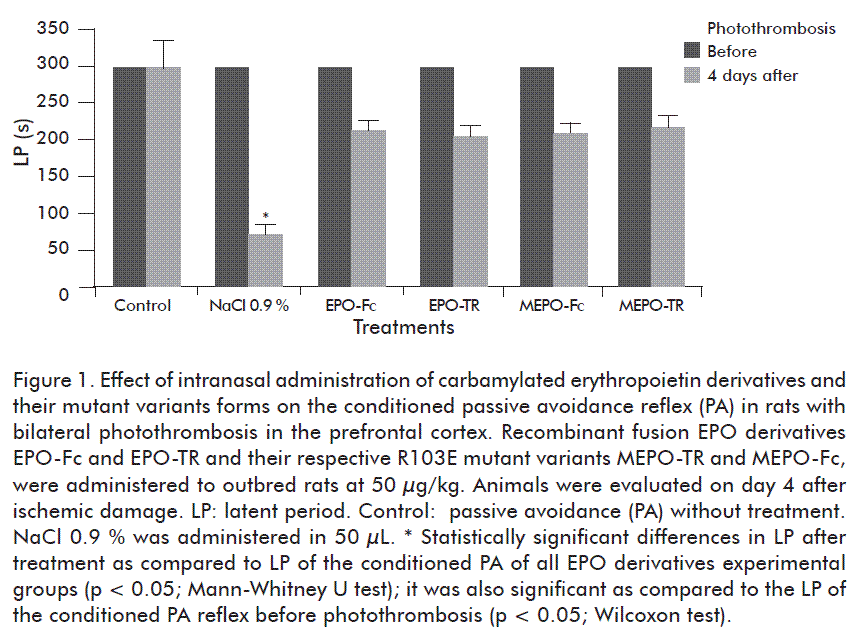
<body><![CDATA[<P   >&nbsp;</P >       <P   > </P >       <P   > </P >       <P   ><font size="3"><b><font face="Verdana, Arial, Helvetica, sans-serif">RESULTS      </font></b></font></P >       <P   ><font size="2" face="Verdana, Arial, Helvetica, sans-serif">The functional state      of the central nervous system was assessed by measuring the LP passive avoidance      reaction before and after ischemic damage of the cerebral cortex of rats.      Before photothrombosis, the LP in all trained animals was 300 s. The passive      avoidance reaction was evaluated on the 4th postoperative day. After a single      intranasal administration of derivatives of erythropoietin and their mutant      forms, the LP passive avoidance reaction on the 4th day after ischemia was      reduced to similar levels in animals treated with EPO-Fc, EPO-TR, MEPO-Fc      and MEPO-TR (205, 198, 200 and 211 s, respectively) at 50 &mu;g/kg each, a      strikingly different behavior when compared to the 68 s value of control animals      receiving 50 &mu;L of 0.9 % NaCl. The data showed that treatment with standard      doses of the EPO-Fc and EPO-TR derivatives of native EPO and their mutant      forms MEPO-TR and MEPO-Fc resulted in a significant preservation of the passive      avoidance reaction that had been established prior to ischemia (<a href="/img/revistas/bta/v34n2/f0102217.gif">Figure      1</a>). </font></P >       
<P   ><font size="2" face="Verdana, Arial, Helvetica, sans-serif">A study of the serum      content of S100b protein in rats with photochemical ischemic brain damage      and the effect of erythropoietin derivatives and mutant forms was carried      out on the 4th day after photothrombosis (<a href="/img/revistas/bta/v34n2/f0202217.gif">Figure 2</a>).      A two-fold increase was shown in the level of S100b protein in rats with photochemical      damage to the prefrontal cortex, in comparison with the intact control animals.      The intranasal administration of EPO-TR (50 &mu;g/kg) signif-icantly reduced      this index, which confirms the neuroprotective effect of EPO-TR. With the      introduction of other studied derivatives, there was a tendency of the level      of S100b to decrease, the lowest levels attained in the MEPO-TR group. Thus,      a single intranasal administration of EPO-Fc, EPO-TR, MEPO-Fc or MEPO-TR after      bilateral photochemical damage to the prefrontal cortex of rat brain produced      antiamnesic effects. The levels of S100b protein in the same animals on the      4th day showed a neuroprotective effect of EPO-TR at a dose of 50 &mu;g/kg      (p &lt;0.05). Treatment with the other studied derivatives was associated      with a trend in the decrease of the levels of S100b, particularly with MEPO-TR.      </font></P >       
<P   >&nbsp;</P >       <P   > </P >       <P   ><font size="3"><b><font face="Verdana, Arial, Helvetica, sans-serif">DISCUSSION</font></b><font face="Verdana, Arial, Helvetica, sans-serif">      </font></font></P >       <P   ><font size="2" face="Verdana, Arial, Helvetica, sans-serif">An evaluation of      the therapeutic efficacy of EPO derivatives and mutant proteins was carried      out by determining the degree of preservation of the conditioned passive avoidance      reflex after photochemical damage of the vessels of the prefrontal cerebral      cortex. The level of the S100b protein was measured in the sera of treated      and control rats, this marker relevant for evaluating brain tissue damage.      In fact, high concentrations of this protein are found in individuals with      brain trauma and neurodegenerative and cerebrovascular lesions, including      stroke [5]. </font></P >       ]]></body>
<body><![CDATA[<P   ><font size="2" face="Verdana, Arial, Helvetica, sans-serif">We have previously      shown that a photochemically induced bilateral thrombosis of the blood vessels      of the prefrontal areas of the cerebral cortex leads to the formation of an      ischemic focus. This lesion captures the entire thickness of the cortex and      it is separated from the surrounding intact tissue by a clearly defined border;      the damage to the cortex accompanied by a loss of the conditioned reflex of      passive avoidance [6, 7]. Previous studies have shown the antiamnesic and      neuroprotective effects of the studied erythropoietin derivatives [8, 9].      At the same time, in this study, there was a reliable preservation of passive      avoidance that had been established before ischemia and a decrease in serum      S100b levels in animals that were treated with EPO-TR. This index tended to      decrease when other EPO derivatives were used. Thus, this test of ischemic      damage to the brain tissue once again confirmed the neuroprotective efficacy      of these drugs for the treatment of experimental focal ischemic brain damage.      </font></P >       <P   ><font size="2" face="Verdana, Arial, Helvetica, sans-serif">Our data provide      the evidence that fusion proteins (EPO-TR and EPO-Fc), bearing R103E mutation      could have the same properties. Using our preclinical model of focal ischemic      damage to the prefrontal cortex of rats, we were able to show significant      preservation of skill generated before ischemia, indicating the nootropic      and neuroprotective activity of the hybrid proteins. Based on these results,      we suggest that our mutant variants of EPO fusion proteins are effective and      highly specific in neuroprotection. Further studies should be conducted on      animal models to suggest which EPO variant could be used in clinical trials.      We plan to obtain more data in our next experiments and verify pharmacological      properties of these proteins compared with other neuroprotective molecules.      </font></P >       <P   >&nbsp;</P >       <P   ><font size="2" face="Verdana, Arial, Helvetica, sans-serif"><B><font size="3">ACKNOWLEDGEMENTS      </font> </B> </font></P >   <FONT size="+1">        <P   ><font size="2" face="Verdana, Arial, Helvetica, sans-serif">This work was supported      by the program of the Presidium of the Russian Academy of Sciences &ldquo;Fundamental      Researches for the Development of Biomedical Technologies&rdquo; for 2014-2016.      </font></P >       <P   >&nbsp;</P >   <FONT size="+1">        <P   ><font size="2" face="Verdana, Arial, Helvetica, sans-serif"><B><font size="3">CONFLICTS      OF INTEREST STATEMENT </font></B></font></P >   <FONT size="+1">        <P   ><font size="2" face="Verdana, Arial, Helvetica, sans-serif">The authors declare      that they have no conflicts of interest. </font></P >       <P   >&nbsp;</P >   <FONT size="+1">        <P   > </P >   <FONT size="+1">        ]]></body>
<body><![CDATA[<P   ><font size="3"><b><font face="Verdana, Arial, Helvetica, sans-serif">REFERENCES      </font></b></font></P >       <!-- ref --><P   ><font size="2" face="Verdana, Arial, Helvetica, sans-serif">1. Suslina ZA, Piradova      MA. Stroke: Diagnosis, treatment, prevention. Moscow: Medpress-inform; 2009.          </font></P >   <FONT size="+1">        <!-- ref --><P   ><font size="2" face="Verdana, Arial, Helvetica, sans-serif">2. Suslina ZA, Varakin      YY. Epidemiological aspects of stroke study. Time for conclusions. Ann Clin      Experim Neurol. 2007;1(2):22-8.     </font></P >       <!-- ref --><P   ><font size="2" face="Verdana, Arial, Helvetica, sans-serif">3. Feigin VL, Lawes      CM, Bennett DA, Barker-Collo SL, Parag V. Worldwide stroke incidence and early      case fatality reported in 56 population-based studies: a systematic review.      Lancet Neurol. 2009;8(4):355-69.     </font></P >       <!-- ref --><P   ><font size="2" face="Verdana, Arial, Helvetica, sans-serif">4. Bertsch T, Casarin      W, Kretschmar M, Zimmer W, Walter S, Sommer C, et al. Protein S-100B: a serum      marker for ischemic and infectious injury of cerebral tissue. Clin Chem Lab      Med. 2001;39(4):319-23.     </font></P >       <!-- ref --><P   ><font size="2" face="Verdana, Arial, Helvetica, sans-serif">5. Elting JW, de      Jager AE, Teelken AW, Schaaf MJ, Maurits NM, van der Naalt J, <I>et al</I>.      Comparison of serum S-100 protein levels following stroke and traumatic brain      injury. J Neurol Sci. 2000;181(1- 2):104-10.     </font></P >       <!-- ref --><P   ><font size="2" face="Verdana, Arial, Helvetica, sans-serif">6. Romanova GA, Barskov      IV, Ostrovskaia RU, Gudasheva TA, Viktorov IV. Behavioral and morphologic      disorders caused by bilateral photoinduced thrombosis of the cerebral vessels      of the frontal cortex in rats. Patol Fiziol Eksp Ter. 1998(2):8-10.     </font></P >       <!-- ref --><P   ><font size="2" face="Verdana, Arial, Helvetica, sans-serif">7. Romanova GA, Silachev      DN, Shakova FM, Kvashennikova YN, Viktorov IV, Shram SI, <I>et al</I>. Neuroprotective      and antiamnesic effect of Semax during experimental ischemic infarction of      the cerebral cortex. Bull Exp Biol Med. 2006;142(6):618-21.     </font></P >       <!-- ref --><P   ><font size="2" face="Verdana, Arial, Helvetica, sans-serif">8. Shakova FM, Kalinina      TI, Romanova GA, Barskov IV. Comparison of neuroprotective effects of derivatives      of eritropoetine by different way of bringing in drugs with model of bilateral      photochemically induced thrombosis of the prefrontal cortex of rat brain.      Patol Fiziol Eksp Ter. 2015;59(3):26-33.     </font></P >       <!-- ref --><P   ><font size="2" face="Verdana, Arial, Helvetica, sans-serif">9. Shakova FM, Kalinina      TI, Gulyaev MV, Cheremnykh AM, Yurin VL, Romanova GA. Neuroprotective and      antiamnesic effects of mutated erythropoietin molecules on the model of photochemical      ischemic injury of the medial prefrontal cortex. Patol Fiziol Eksp Ter. 2016;60      (4): 34-38.     </font></P >       <P   ><font size="2" face="Verdana, Arial, Helvetica, sans-serif">10. Kalinina TI,      Cheremnykh AM, Yurin VL, Romanova GA, Shakova FM. The neuroprotective effect      of carbamylated erythropoietin and its derivates [abstract]. In: Proceedings      of the VIII Moscow International Congress Biotechnology: State of the Art      and Prospects of Development. Moscow: D.I. Mendeleyev University of Chemistry      and Technology; 2015. p. 113-5. </font></P >       ]]></body>
<body><![CDATA[<!-- ref --><P   ><font size="2" face="Verdana, Arial, Helvetica, sans-serif">11. Leist M, Ghezzi      P, Grasso G, Bianchi R, Villa P, Fratelli M, <I>et al</I>. Derivatives of      erythropoietin that are tissue protective but not erythropoietic. Science.      2004;305(5681):239-42.     </font></P >       <!-- ref --><P   ><font size="2" face="Verdana, Arial, Helvetica, sans-serif">12. Gavrilova NA,      Cheremnykh AM, Bobreneva RA, Askerova EV, Kalinina TI, Bulushova NV, <I>et      al</I>. The Haemopoietic Activity and Pharmacokinetics of EPO-Fc, EPO-Fcneo      and Alb-EPO fused proteins, derivatives of human erythropoietin. Biotechnology      (Moskow). 2012(5):38-49.     </font></P >       <!-- ref --><P   ><font size="2" face="Verdana, Arial, Helvetica, sans-serif">13. Paxinos G, Watson      S. Atlas of Anatomy of Rat Brain. The Rat brain in stereotaxic coordinates.      San Diego: Academic Press;1986.     </font></P >       <!-- ref --><P   ><font size="2" face="Verdana, Arial, Helvetica, sans-serif">14. Watson BD, Dietrich      WD, Busto R, Wachtel MS, Ginsberg MD. Induction of reproducible brain infarction      by photochemically initiated thrombosis. Ann Neurol. 1985;17(5):497-504.     </font></P >       <!-- ref --><P   ><font size="2" face="Verdana, Arial, Helvetica, sans-serif">15. Nishimura R,      Yokose T, Mukai K. S-100 protein is a differentiation marker in thyroid carcinoma      of follicular cell origin: an immunohistochemical study. Pathol Int. 1997;47(10):673-9.          </font></P >       ]]></body>
<body><![CDATA[<!-- ref --><P   ><font size="2" face="Verdana, Arial, Helvetica, sans-serif">16. Orchard GE. Comparison      of immunohistochemical labelling of melanocyte differentiation antibodies      melan-A, tyrosinase and HMB 45 with NKIC3 and S100 protein in the evaluation      of benign naevi and malignant melanoma. Histochem J. 2000;32(8):475-81.     </font></P >       <P   >&nbsp;</P >       <P   > </P >   <FONT size="+1">        <P   ><font size="2" face="Verdana, Arial, Helvetica, sans-serif">Received in October,      2016.     <br>     Accepted in April, 2017. </font></P >       <P   >&nbsp;</P >       <P   > </P >   <FONT size="+1">       <P   ><i><font size="2" face="Verdana, Arial, Helvetica, sans-serif">Fatima M Shakova</font></i><font size="2" face="Verdana, Arial, Helvetica, sans-serif">.      FSBI Institute of General Pathology and Pathophysiology, 8 Baltiyskaya str.,      125315 Moscow, Russian Federation. E-mail: <A href="mailto:shakova.fatima@yandex.ru">      <FONT color="#0000FF">shakova.fatima@yandex.ru</font></A><FONT color="#0000FF"><FONT color="#211E1F">.<I>      </I></font></font></font></P >   </font></font></font></font></font></font></font></font></font></font></font></font></font></font></font></font></font></font></font></font></font></font></font></font></font></font></font></font></font></font></font></font></font></DIV >      ]]></body><back>
<ref-list>
<ref id="B1">
<label>1</label><nlm-citation citation-type="book">
<person-group person-group-type="author">
<name>
<surname><![CDATA[Suslina]]></surname>
<given-names><![CDATA[ZA]]></given-names>
</name>
<name>
<surname><![CDATA[Piradova]]></surname>
<given-names><![CDATA[MA]]></given-names>
</name>
</person-group>
<source><![CDATA[Stroke: Diagnosis, treatment, prevention]]></source>
<year>2009</year>
<publisher-loc><![CDATA[Moscow ]]></publisher-loc>
<publisher-name><![CDATA[Medpress-inform]]></publisher-name>
</nlm-citation>
</ref>
<ref id="B2">
<label>2</label><nlm-citation citation-type="journal">
<person-group person-group-type="author">
<name>
<surname><![CDATA[Suslina]]></surname>
<given-names><![CDATA[ZA]]></given-names>
</name>
<name>
<surname><![CDATA[Varakin]]></surname>
<given-names><![CDATA[YY]]></given-names>
</name>
</person-group>
<article-title xml:lang="en"><![CDATA[Epidemiological aspects of stroke study. Time for conclusions]]></article-title>
<source><![CDATA[Ann Clin Experim Neurol]]></source>
<year>2007</year>
<volume>1</volume>
<numero>2</numero>
<issue>2</issue>
<page-range>22-8</page-range></nlm-citation>
</ref>
<ref id="B3">
<label>3</label><nlm-citation citation-type="journal">
<person-group person-group-type="author">
<name>
<surname><![CDATA[Feigin]]></surname>
<given-names><![CDATA[VL]]></given-names>
</name>
<name>
<surname><![CDATA[Lawes]]></surname>
<given-names><![CDATA[CM]]></given-names>
</name>
<name>
<surname><![CDATA[Bennett]]></surname>
<given-names><![CDATA[DA]]></given-names>
</name>
<name>
<surname><![CDATA[Barker-Collo]]></surname>
<given-names><![CDATA[SL]]></given-names>
</name>
<name>
<surname><![CDATA[Parag]]></surname>
<given-names><![CDATA[V]]></given-names>
</name>
</person-group>
<article-title xml:lang="en"><![CDATA[Worldwide stroke incidence and early case fatality reported in 56 population-based studies: a systematic review]]></article-title>
<source><![CDATA[Lancet Neurol]]></source>
<year>2009</year>
<volume>8</volume>
<numero>4</numero>
<issue>4</issue>
<page-range>355-69</page-range></nlm-citation>
</ref>
<ref id="B4">
<label>4</label><nlm-citation citation-type="journal">
<person-group person-group-type="author">
<name>
<surname><![CDATA[Bertsch]]></surname>
<given-names><![CDATA[T]]></given-names>
</name>
<name>
<surname><![CDATA[Casarin]]></surname>
<given-names><![CDATA[W]]></given-names>
</name>
<name>
<surname><![CDATA[Kretschmar]]></surname>
<given-names><![CDATA[M]]></given-names>
</name>
<name>
<surname><![CDATA[Zimmer]]></surname>
<given-names><![CDATA[W]]></given-names>
</name>
<name>
<surname><![CDATA[Walter]]></surname>
<given-names><![CDATA[S]]></given-names>
</name>
<name>
<surname><![CDATA[Sommer]]></surname>
<given-names><![CDATA[C]]></given-names>
</name>
</person-group>
<article-title xml:lang="en"><![CDATA[Protein S-100B: a serum marker for ischemic and infectious injury of cerebral tissue]]></article-title>
<source><![CDATA[Clin Chem Lab Med]]></source>
<year>2001</year>
<volume>39</volume>
<numero>4</numero>
<issue>4</issue>
<page-range>319-23</page-range></nlm-citation>
</ref>
<ref id="B5">
<label>5</label><nlm-citation citation-type="journal">
<person-group person-group-type="author">
<name>
<surname><![CDATA[Elting]]></surname>
<given-names><![CDATA[JW]]></given-names>
</name>
<name>
<surname><![CDATA[de Jager]]></surname>
<given-names><![CDATA[AE]]></given-names>
</name>
<name>
<surname><![CDATA[Teelken]]></surname>
<given-names><![CDATA[AW]]></given-names>
</name>
<name>
<surname><![CDATA[Schaaf]]></surname>
<given-names><![CDATA[MJ]]></given-names>
</name>
<name>
<surname><![CDATA[Maurits]]></surname>
<given-names><![CDATA[NM]]></given-names>
</name>
<name>
<surname><![CDATA[van der Naalt]]></surname>
<given-names><![CDATA[J]]></given-names>
</name>
</person-group>
<article-title xml:lang="en"><![CDATA[Comparison of serum S-100 protein levels following stroke and traumatic brain injury]]></article-title>
<source><![CDATA[J Neurol Sci]]></source>
<year>2000</year>
<volume>181</volume>
<numero>1</numero>
<issue>1</issue>
<page-range>2):104-10</page-range></nlm-citation>
</ref>
<ref id="B6">
<label>6</label><nlm-citation citation-type="journal">
<person-group person-group-type="author">
<name>
<surname><![CDATA[Romanova]]></surname>
<given-names><![CDATA[GA]]></given-names>
</name>
<name>
<surname><![CDATA[Barskov]]></surname>
<given-names><![CDATA[IV]]></given-names>
</name>
<name>
<surname><![CDATA[Ostrovskaia]]></surname>
<given-names><![CDATA[RU]]></given-names>
</name>
<name>
<surname><![CDATA[Gudasheva]]></surname>
<given-names><![CDATA[TA]]></given-names>
</name>
<name>
<surname><![CDATA[Viktorov]]></surname>
<given-names><![CDATA[IV]]></given-names>
</name>
</person-group>
<article-title xml:lang="en"><![CDATA[Behavioral and morphologic disorders caused by bilateral photoinduced thrombosis of the cerebral vessels of the frontal cortex in rats]]></article-title>
<source><![CDATA[Patol Fiziol Eksp Ter]]></source>
<year>1998</year>
<numero>2</numero>
<issue>2</issue>
<page-range>8-10</page-range></nlm-citation>
</ref>
<ref id="B7">
<label>7</label><nlm-citation citation-type="journal">
<person-group person-group-type="author">
<name>
<surname><![CDATA[Romanova]]></surname>
<given-names><![CDATA[GA]]></given-names>
</name>
<name>
<surname><![CDATA[Silachev]]></surname>
<given-names><![CDATA[DN]]></given-names>
</name>
<name>
<surname><![CDATA[Shakova]]></surname>
<given-names><![CDATA[FM]]></given-names>
</name>
<name>
<surname><![CDATA[Kvashennikova]]></surname>
<given-names><![CDATA[YN]]></given-names>
</name>
<name>
<surname><![CDATA[Viktorov]]></surname>
<given-names><![CDATA[IV]]></given-names>
</name>
<name>
<surname><![CDATA[Shram]]></surname>
<given-names><![CDATA[SI]]></given-names>
</name>
</person-group>
<article-title xml:lang="en"><![CDATA[Neuroprotective and antiamnesic effect of Semax during experimental ischemic infarction of the cerebral cortex]]></article-title>
<source><![CDATA[Bull Exp Biol Med]]></source>
<year>2006</year>
<volume>142</volume>
<numero>6</numero>
<issue>6</issue>
<page-range>618-21</page-range></nlm-citation>
</ref>
<ref id="B8">
<label>8</label><nlm-citation citation-type="journal">
<person-group person-group-type="author">
<name>
<surname><![CDATA[Shakova]]></surname>
<given-names><![CDATA[FM]]></given-names>
</name>
<name>
<surname><![CDATA[Kalinina]]></surname>
<given-names><![CDATA[TI]]></given-names>
</name>
<name>
<surname><![CDATA[Romanova]]></surname>
<given-names><![CDATA[GA]]></given-names>
</name>
<name>
<surname><![CDATA[Barskov]]></surname>
<given-names><![CDATA[IV]]></given-names>
</name>
</person-group>
<article-title xml:lang="en"><![CDATA[Comparison of neuroprotective effects of derivatives of eritropoetine by different way of bringing in drugs with model of bilateral photochemically induced thrombosis of the prefrontal cortex of rat brain]]></article-title>
<source><![CDATA[Patol Fiziol Eksp Ter]]></source>
<year>2015</year>
<volume>59</volume>
<numero>3</numero>
<issue>3</issue>
<page-range>26-33</page-range></nlm-citation>
</ref>
<ref id="B9">
<label>9</label><nlm-citation citation-type="journal">
<person-group person-group-type="author">
<name>
<surname><![CDATA[Shakova]]></surname>
<given-names><![CDATA[FM]]></given-names>
</name>
<name>
<surname><![CDATA[Kalinina]]></surname>
<given-names><![CDATA[TI]]></given-names>
</name>
<name>
<surname><![CDATA[Gulyaev]]></surname>
<given-names><![CDATA[MV]]></given-names>
</name>
<name>
<surname><![CDATA[Cheremnykh]]></surname>
<given-names><![CDATA[AM]]></given-names>
</name>
<name>
<surname><![CDATA[Yurin]]></surname>
<given-names><![CDATA[VL]]></given-names>
</name>
<name>
<surname><![CDATA[Romanova]]></surname>
<given-names><![CDATA[GA]]></given-names>
</name>
</person-group>
<article-title xml:lang="en"><![CDATA[Neuroprotective and antiamnesic effects of mutated erythropoietin molecules on the model of photochemical ischemic injury of the medial prefrontal cortex]]></article-title>
<source><![CDATA[Patol Fiziol Eksp Ter]]></source>
<year>2016</year>
<volume>60</volume>
<numero>4</numero>
<issue>4</issue>
<page-range>34-38</page-range></nlm-citation>
</ref>
<ref id="B10">
<label>10</label><nlm-citation citation-type="book">
<person-group person-group-type="author">
<name>
<surname><![CDATA[Kalinina]]></surname>
<given-names><![CDATA[TI]]></given-names>
</name>
<name>
<surname><![CDATA[Cheremnykh]]></surname>
<given-names><![CDATA[AM]]></given-names>
</name>
<name>
<surname><![CDATA[Yurin]]></surname>
<given-names><![CDATA[VL]]></given-names>
</name>
<name>
<surname><![CDATA[Romanova]]></surname>
<given-names><![CDATA[GA]]></given-names>
</name>
<name>
<surname><![CDATA[Shakova]]></surname>
<given-names><![CDATA[FM]]></given-names>
</name>
</person-group>
<article-title xml:lang="en"><![CDATA[The neuroprotective effect of carbamylated erythropoietin and its derivates (abstract)]]></article-title>
<source><![CDATA[Proceedings of the VIII Moscow International Congress Biotechnology: State of the Art and Prospects of Development]]></source>
<year>2015</year>
<page-range>113-5</page-range><publisher-loc><![CDATA[Moscow ]]></publisher-loc>
<publisher-name><![CDATA[Mendeleyev University of Chemistry and Technology]]></publisher-name>
</nlm-citation>
</ref>
<ref id="B11">
<label>11</label><nlm-citation citation-type="journal">
<person-group person-group-type="author">
<name>
<surname><![CDATA[Leist]]></surname>
<given-names><![CDATA[M]]></given-names>
</name>
<name>
<surname><![CDATA[Ghezzi]]></surname>
<given-names><![CDATA[P]]></given-names>
</name>
<name>
<surname><![CDATA[Grasso]]></surname>
<given-names><![CDATA[G]]></given-names>
</name>
<name>
<surname><![CDATA[Bianchi]]></surname>
<given-names><![CDATA[R]]></given-names>
</name>
<name>
<surname><![CDATA[Villa]]></surname>
<given-names><![CDATA[P]]></given-names>
</name>
<name>
<surname><![CDATA[Fratelli]]></surname>
<given-names><![CDATA[M]]></given-names>
</name>
</person-group>
<article-title xml:lang="en"><![CDATA[Derivatives of erythropoietin that are tissue protective but not erythropoietic]]></article-title>
<source><![CDATA[Science]]></source>
<year>2004</year>
<volume>305</volume>
<numero>5681</numero>
<issue>5681</issue>
<page-range>239-42</page-range></nlm-citation>
</ref>
<ref id="B12">
<label>12</label><nlm-citation citation-type="journal">
<person-group person-group-type="author">
<name>
<surname><![CDATA[Gavrilova]]></surname>
<given-names><![CDATA[NA]]></given-names>
</name>
<name>
<surname><![CDATA[Cheremnykh]]></surname>
<given-names><![CDATA[AM]]></given-names>
</name>
<name>
<surname><![CDATA[Bobreneva]]></surname>
<given-names><![CDATA[RA]]></given-names>
</name>
<name>
<surname><![CDATA[Askerova]]></surname>
<given-names><![CDATA[EV]]></given-names>
</name>
<name>
<surname><![CDATA[Kalinina]]></surname>
<given-names><![CDATA[TI]]></given-names>
</name>
<name>
<surname><![CDATA[Bulushova]]></surname>
<given-names><![CDATA[NV]]></given-names>
</name>
</person-group>
<article-title xml:lang="en"><![CDATA[The Haemopoietic Activity and Pharmacokinetics of EPO-Fc, EPO-Fcneo and Alb-EPO fused proteins, derivatives of human erythropoietin]]></article-title>
<source><![CDATA[Biotechnology (Moskow)]]></source>
<year>2012</year>
<numero>5</numero>
<issue>5</issue>
<page-range>38-49</page-range></nlm-citation>
</ref>
<ref id="B13">
<label>13</label><nlm-citation citation-type="book">
<person-group person-group-type="author">
<name>
<surname><![CDATA[Paxinos]]></surname>
<given-names><![CDATA[G]]></given-names>
</name>
<name>
<surname><![CDATA[Watson]]></surname>
<given-names><![CDATA[S]]></given-names>
</name>
</person-group>
<source><![CDATA[Atlas of Anatomy of Rat Brain. The Rat brain in stereotaxic coordinates]]></source>
<year>1986</year>
<publisher-loc><![CDATA[San Diego ]]></publisher-loc>
<publisher-name><![CDATA[Academic Press]]></publisher-name>
</nlm-citation>
</ref>
<ref id="B14">
<label>14</label><nlm-citation citation-type="journal">
<person-group person-group-type="author">
<name>
<surname><![CDATA[Watson]]></surname>
<given-names><![CDATA[BD]]></given-names>
</name>
<name>
<surname><![CDATA[Dietrich]]></surname>
<given-names><![CDATA[WD]]></given-names>
</name>
<name>
<surname><![CDATA[Busto]]></surname>
<given-names><![CDATA[R]]></given-names>
</name>
<name>
<surname><![CDATA[Wachtel]]></surname>
<given-names><![CDATA[MS]]></given-names>
</name>
<name>
<surname><![CDATA[Ginsberg]]></surname>
<given-names><![CDATA[MD]]></given-names>
</name>
</person-group>
<article-title xml:lang="en"><![CDATA[Induction of reproducible brain infarction by photochemically initiated thrombosis]]></article-title>
<source><![CDATA[Ann Neurol]]></source>
<year>1985</year>
<volume>17</volume>
<numero>5</numero>
<issue>5</issue>
<page-range>497-504</page-range></nlm-citation>
</ref>
<ref id="B15">
<label>15</label><nlm-citation citation-type="journal">
<person-group person-group-type="author">
<name>
<surname><![CDATA[Nishimura]]></surname>
<given-names><![CDATA[R]]></given-names>
</name>
<name>
<surname><![CDATA[Yokose]]></surname>
<given-names><![CDATA[T]]></given-names>
</name>
<name>
<surname><![CDATA[Mukai]]></surname>
<given-names><![CDATA[K]]></given-names>
</name>
</person-group>
<article-title xml:lang="en"><![CDATA[S-100 protein is a differentiation marker in thyroid carcinoma of follicular cell origin: an immunohistochemical study]]></article-title>
<source><![CDATA[Pathol Int]]></source>
<year>1997</year>
<volume>47</volume>
<numero>10</numero>
<issue>10</issue>
<page-range>673-9</page-range></nlm-citation>
</ref>
<ref id="B16">
<label>16</label><nlm-citation citation-type="journal">
<person-group person-group-type="author">
<name>
<surname><![CDATA[Orchard]]></surname>
<given-names><![CDATA[GE]]></given-names>
</name>
</person-group>
<article-title xml:lang="en"><![CDATA[Comparison of immunohistochemical labelling of melanocyte differentiation antibodies melan-A, tyrosinase and HMB 45 with NKIC3 and S100 protein in the evaluation of benign naevi and malignant melanoma]]></article-title>
<source><![CDATA[Histochem J]]></source>
<year>2000</year>
<volume>32</volume>
<numero>8</numero>
<issue>8</issue>
<page-range>475-81</page-range></nlm-citation>
</ref>
</ref-list>
</back>
</article>