<?xml version="1.0" encoding="ISO-8859-1"?><article xmlns:mml="http://www.w3.org/1998/Math/MathML" xmlns:xlink="http://www.w3.org/1999/xlink" xmlns:xsi="http://www.w3.org/2001/XMLSchema-instance">
<front>
<journal-meta>
<journal-id>1027-2852</journal-id>
<journal-title><![CDATA[Biotecnología Aplicada]]></journal-title>
<abbrev-journal-title><![CDATA[Biotecnol Apl]]></abbrev-journal-title>
<issn>1027-2852</issn>
<publisher>
<publisher-name><![CDATA[Editorial Elfos Scientiae]]></publisher-name>
</publisher>
</journal-meta>
<article-meta>
<article-id>S1027-28522017000200003</article-id>
<title-group>
<article-title xml:lang="en"><![CDATA[Proteomic analysis of serum proteins of children with autism]]></article-title>
<article-title xml:lang="es"><![CDATA[Análisis proteómico del perfil de proteínas séricas de niños con autismo]]></article-title>
</title-group>
<contrib-group>
<contrib contrib-type="author">
<name>
<surname><![CDATA[Kaysheva]]></surname>
<given-names><![CDATA[Anna L]]></given-names>
</name>
<xref ref-type="aff" rid="A01"/>
</contrib>
<contrib contrib-type="author">
<name>
<surname><![CDATA[Kopylov]]></surname>
<given-names><![CDATA[Artur T]]></given-names>
</name>
<xref ref-type="aff" rid="A01"/>
</contrib>
<contrib contrib-type="author">
<name>
<surname><![CDATA[Pleshakova]]></surname>
<given-names><![CDATA[Tatyana O]]></given-names>
</name>
<xref ref-type="aff" rid="A01"/>
</contrib>
<contrib contrib-type="author">
<name>
<surname><![CDATA[Iourov]]></surname>
<given-names><![CDATA[Ivan Y]]></given-names>
</name>
<xref ref-type="aff" rid="A02"/>
</contrib>
<contrib contrib-type="author">
<name>
<surname><![CDATA[Vorsanova]]></surname>
<given-names><![CDATA[Svetlana G]]></given-names>
</name>
<xref ref-type="aff" rid="A02"/>
</contrib>
<contrib contrib-type="author">
<name>
<surname><![CDATA[Yurov]]></surname>
<given-names><![CDATA[Yuri B]]></given-names>
</name>
<xref ref-type="aff" rid="A02"/>
</contrib>
<contrib contrib-type="author">
<name>
<surname><![CDATA[Shchetkin]]></surname>
<given-names><![CDATA[Andrey A]]></given-names>
</name>
<xref ref-type="aff" rid="A03"/>
</contrib>
<contrib contrib-type="author">
<name>
<surname><![CDATA[Archakov]]></surname>
<given-names><![CDATA[Alexander I]]></given-names>
</name>
<xref ref-type="aff" rid="A01"/>
</contrib>
<contrib contrib-type="author">
<name>
<surname><![CDATA[Ivanov]]></surname>
<given-names><![CDATA[Yuri D]]></given-names>
</name>
<xref ref-type="aff" rid="A01"/>
</contrib>
</contrib-group>
<aff id="A02">
<institution><![CDATA[,Mental Health Research Center  ]]></institution>
<addr-line><![CDATA[Moscow ]]></addr-line>
<country>Russia</country>
</aff>
<aff id="A03">
<institution><![CDATA[,Center of Medical Prevention  ]]></institution>
<addr-line><![CDATA[ ]]></addr-line>
<country>Russia</country>
</aff>
<aff id="A01">
<institution><![CDATA[,Institute of Biomedical Chemistry, IBMC RAMS Laboratorio de Biología Molecular ]]></institution>
<addr-line><![CDATA[Moscow ]]></addr-line>
<country>Russia</country>
</aff>
<pub-date pub-type="pub">
<day>00</day>
<month>06</month>
<year>2017</year>
</pub-date>
<pub-date pub-type="epub">
<day>00</day>
<month>06</month>
<year>2017</year>
</pub-date>
<volume>34</volume>
<numero>2</numero>
<fpage>2211</fpage>
<lpage>2214</lpage>
<copyright-statement/>
<copyright-year/>
<self-uri xlink:href="http://scielo.sld.cu/scielo.php?script=sci_arttext&amp;pid=S1027-28522017000200003&amp;lng=en&amp;nrm=iso"></self-uri><self-uri xlink:href="http://scielo.sld.cu/scielo.php?script=sci_abstract&amp;pid=S1027-28522017000200003&amp;lng=en&amp;nrm=iso"></self-uri><self-uri xlink:href="http://scielo.sld.cu/scielo.php?script=sci_pdf&amp;pid=S1027-28522017000200003&amp;lng=en&amp;nrm=iso"></self-uri><kwd-group>
<kwd lng="en"><![CDATA[autism]]></kwd>
<kwd lng="en"><![CDATA[ESI-MS/MS]]></kwd>
<kwd lng="en"><![CDATA[mass spectrometry]]></kwd>
<kwd lng="en"><![CDATA[diagnosis]]></kwd>
<kwd lng="en"><![CDATA[protein markers]]></kwd>
<kwd lng="es"><![CDATA[autismo]]></kwd>
<kwd lng="es"><![CDATA[ESI-MS/MS]]></kwd>
<kwd lng="es"><![CDATA[espectrometría de masa]]></kwd>
<kwd lng="es"><![CDATA[diagnóstico]]></kwd>
<kwd lng="es"><![CDATA[proteínas marcadoras]]></kwd>
</kwd-group>
</article-meta>
</front><body><![CDATA[ <DIV class="Part"   >        <P align="right"   ><font size="2" color="#000000" face="Verdana, Arial, Helvetica, sans-serif"><b>RESEARCH      </b> </font></P >       <P   >&nbsp;</P >   <FONT size="+1" color="#000000">        <P   > </P >       <P   > </P >   <FONT size="+1">       <P   ><font size="4" color="#211E1F" face="Verdana, Arial, Helvetica, sans-serif"><B>Proteomic      analysis of serum proteins of children with autism </b></font></P >       <P   >&nbsp;</P >   <FONT size="+1" color="#211E1F"><B>        <P   ></P >   </B> <FONT size="+1" color="#000000">       <P   ><font size="3" color="#211E1F" face="Verdana, Arial, Helvetica, sans-serif"><B>An&aacute;lisis      prote&oacute;mico del perfil de prote&iacute;nas s&eacute;ricas de ni&ntilde;os      con autismo </b></font></P >       <P   >&nbsp;</P >       ]]></body>
<body><![CDATA[<P   >&nbsp;</P >   <FONT size="+1" color="#211E1F">       <P   ></P >   <FONT size="+1" color="#000000">       <P   ><b><font size="2" color="#211E1F" face="Verdana, Arial, Helvetica, sans-serif">Anna      L Kaysheva<sup>1</sup>, Artur T Kopylov<sup>1</sup>, Tatyana O Pleshakova<sup>1</sup>,      Ivan Y Iourov<sup>2</sup>, Svetlana G Vorsanova<sup>2</sup>, Yuri B Yurov<sup>2</sup>,      Andrey A Shchetkin<sup>3</sup>, Alexander I Archakov<sup>1</sup>, Yuri D Ivanov<sup>1</sup>      </font></b><font size="2" color="#211E1F" face="Verdana, Arial, Helvetica, sans-serif">      </font></P >   <FONT size="+1" color="#211E1F"><FONT size="+1"><FONT size="+1"><FONT size="+1"><FONT size="+1"><FONT size="+1"><FONT size="+1"><FONT size="+1"><FONT size="+1"><FONT size="+1"><FONT size="+1"><FONT size="+1"><FONT size="+1"><FONT size="+1"><FONT size="+1"><FONT size="+1"><FONT size="+1"><FONT size="+1">        <P   ><font size="2" face="Verdana, Arial, Helvetica, sans-serif"><sup>1</sup> Institute      of Biomedical Chemistry, IBMC RAMS, Pogodinskaya St. 10/8, Moscow, 119121      Russia. </font>    <br>     <font size="2" face="Verdana, Arial, Helvetica, sans-serif"><sup>2</sup> Mental      Health Research Center, Kashirskoe Shosse 34, Moscow, 115522 Russia. </font>    <br>     <font size="2" face="Verdana, Arial, Helvetica, sans-serif"><sup>3</sup> Center      of Medical Prevention, Navaginskaya St. 9, 354000 Russia. </font></P >   <FONT size="+1"><FONT size="+1"><FONT size="+1"><FONT size="+1">        <P   >&nbsp;</P >       <P   >&nbsp;</P >   <FONT size="+1"><FONT size="+1"><B> </B></font></font></font></font></font></font></font></font></font></font></font></font></font></font></font></font></font></font></font></font></font></font></font></font></font></font></font></font></font></font>    <hr>   <FONT size="+1" color="#000000"><FONT size="+1"><FONT size="+1" color="#211E1F"><FONT size="+1" color="#000000"><FONT size="+1" color="#211E1F"><FONT size="+1" color="#000000"><FONT size="+1" color="#211E1F"><FONT size="+1"><FONT size="+1"><FONT size="+1"><FONT size="+1"><FONT size="+1"><FONT size="+1"><FONT size="+1"><FONT size="+1"><FONT size="+1"><FONT size="+1"><FONT size="+1"><FONT size="+1"><FONT size="+1"><FONT size="+1"><FONT size="+1"><FONT size="+1"><FONT size="+1"><FONT size="+1"><FONT size="+1"><FONT size="+1"><FONT size="+1"><FONT size="+1"><FONT size="+1"><B>       <P   ><font size="2" face="Verdana, Arial, Helvetica, sans-serif">ABSTRACT </font></P >   </B>        <P   ><font size="2" face="Verdana, Arial, Helvetica, sans-serif">A comparative panoramic      mass spectrometric analysis of serum samples of children suffering from autistic      disorders was carried out. Three families were examined, with nine samples      distributed in four control samples of healthy parents and five samples of      autistic children. In the course of comparative analysis of protein composition      of the serum samples, a small group of potential marker proteins for diagnosis      was selected, which are not functionally or structurally related to one another.      The group included 15 proteins; one of them, LIM domain-containing protein      1, was identified in four out of the five autism depleted serum samples, and      the other 14 were identified in three samples. This could be the basis to      develop highly sensitive quantitative mass spectrometric SRM methods to detect      autism markers in serum. </font></P >       ]]></body>
<body><![CDATA[<P   ><font size="2" face="Verdana, Arial, Helvetica, sans-serif"><i><b>Keywords:</b></i><b>      </b>autism, ESI-MS/MS, mass spectrometry, diagnosis, protein markers. </font></P >   </font></font></font></font></font></font></font></font></font></font></font></font></font></font></font></font></font></font></font></font></font></font></font></font></font></font></font></font></font></font>    <hr>   <FONT size="+1" color="#000000"><FONT size="+1"><FONT size="+1" color="#211E1F"><FONT size="+1" color="#000000"><FONT size="+1" color="#211E1F"><FONT size="+1" color="#000000"><FONT size="+1" color="#211E1F"><FONT size="+1"><FONT size="+1"><FONT size="+1"><FONT size="+1"><FONT size="+1"><FONT size="+1"><FONT size="+1"><FONT size="+1"><FONT size="+1"><FONT size="+1"><FONT size="+1"><FONT size="+1"><FONT size="+1"><FONT size="+1"><FONT size="+1"><FONT size="+1"><FONT size="+1"><FONT size="+1"><FONT size="+1"><FONT size="+1"><FONT size="+1"><FONT size="+1"><FONT size="+1">       <P   > </P >       <P   ><b><font size="2" face="Verdana, Arial, Helvetica, sans-serif">RESUMEN </font></b></P >       <P   ><font size="2" face="Verdana, Arial, Helvetica, sans-serif">Se estudiaron muestras      de suero de ni&ntilde;os autistas mediante el an&aacute;lisis panor&aacute;mico      comparativo de espectrometr&iacute;a de masas. Tres familias fueron analizadas,      con nueve muestras distribuidas en cuatro correspondientes a padres sanos      y cinco a ni&ntilde;os autistas. Se seleccion&oacute; un subconjunto de 15      prote&iacute;nas, sin relaci&oacute;n estructural ni funcional entre ellas,      como biomarcadores con potencial para el diagn&oacute;stico. Una de ellas,      la prote&iacute;na 1 portadora de dominio LIM, estuvo presente en cuatro de      las cinco muestras de pacientes estudiadas. Las otras 14 prote&iacute;nas      fueron identificadas en tres de las cuatro muestras sin suero de los pacientes.      Estos biomarcadores pudieran servir de base para desarrollar m&eacute;todos      de espectrometr&iacute;a de masa SRM para la detecci&oacute;n del autismo      a partir de muestras de suero. </font></P >       <P   ><font size="2" color="#000000" face="Verdana, Arial, Helvetica, sans-serif"><i><b>Palabras      clave:</b></i> <FONT color="#211E1F">autismo, ESI-MS/MS, espectrometr&iacute;a      de masa, diagn&oacute;stico, prote&iacute;nas marcadoras. </font></font></P >   </font></font></font></font></font></font></font></font></font></font></font></font></font></font></font></font></font></font></font></font></font></font></font></font></font></font></font></font></font></font>    <hr>       <p>&nbsp;</p>    <p><FONT size="+1" color="#000000"><FONT size="+1"><FONT size="+1" color="#211E1F"><FONT size="+1" color="#000000"><FONT size="+1" color="#211E1F"><FONT size="+1" color="#000000"><FONT size="+1" color="#211E1F"><FONT size="+1"><FONT size="+1"><FONT size="+1"><FONT size="+1"><FONT size="+1"><FONT size="+1"><FONT size="+1"><FONT size="+1"><FONT size="+1"><FONT size="+1"><FONT size="+1"><FONT size="+1"><FONT size="+1"><FONT size="+1"><FONT size="+1"><FONT size="+1"><FONT size="+1"><FONT size="+1"><FONT size="+1"><FONT size="+1"><FONT size="+1"><FONT size="+1"><FONT size="+1"><FONT size="+1" color="#000000"><FONT size="+1" color="#211E1F">    </font></font></font></font></font></font></font></font></font></font></font></font></font></font></font></font></font></font></font></font></font></font></font></font></font></font></font></font></font></font></font></font></p>   <FONT size="+1" color="#000000"><FONT size="+1"><FONT size="+1" color="#211E1F"><FONT size="+1" color="#000000"><FONT size="+1" color="#211E1F"><FONT size="+1" color="#000000"><FONT size="+1" color="#211E1F"><FONT size="+1"><FONT size="+1"><FONT size="+1"><FONT size="+1"><FONT size="+1"><FONT size="+1"><FONT size="+1"><FONT size="+1"><FONT size="+1"><FONT size="+1"><FONT size="+1"><FONT size="+1"><FONT size="+1"><FONT size="+1"><FONT size="+1"><FONT size="+1"><FONT size="+1"><FONT size="+1"><FONT size="+1"><FONT size="+1"><FONT size="+1"><FONT size="+1"><FONT size="+1"><FONT size="+1" color="#000000"><FONT size="+1" color="#211E1F">       <P   > </P >       <P   ><b><font size="3" face="Verdana, Arial, Helvetica, sans-serif">INTRODUCTION </font></b></P >   </font></font></font></font></font></font></font></font></font></font></font></font></font></font></font></font></font></font></font></font></font></font></font></font></font></font></font></font></font></font></font></font>        <p   ><font size="2" color="#000000" face="Verdana, Arial, Helvetica, sans-serif">Autism      is a non-communicable disease of increasing prevalence, with global estimates      of approximately 67 million people worldwide suffering from autism, and each      year this level increases by 14 % [1]. Owing to the difficulty of diagnosing      this disorder, no official data on the number of autistic children in Russia      is available. However, the groups of individuals at risk, for the development      of autism are large enough. To date, more than 80 % of children with autism      are disabled persons. In 2012, the Center for disease control in the USA reported,      on average, about one case of autism for every 88 children [2]. According      to the international classification of diseases ICD-10, autistic disorders      include: childhood autism (F84.0), atypical autism (after 3 years) (F84.1),      Rett syndrome (F84.2) and Asperger syndrome (F84.5) [3]. Autism can be caused      by genetic modifications, organic lesions of the central nervous system, metabolic      disorders, the exposure to viral and bacterial infections, chemical exposure      to the mother&rsquo;s body during pregnancy, among others. In fact, autism      in children is more common than cancer, diabetes and AIDS combined [2]. </font></p >       ]]></body>
<body><![CDATA[<p   ><font size="2" color="#000000" face="Verdana, Arial, Helvetica, sans-serif">In      the early 2000&rsquo;s, the genes associated with development of autistic      disorders were annotated, and their heritability was established [4-6]. Based      on genetic data, it was shown that autistic disorders are heterogeneous [7].      Genes associated with development of autistic disorders may participate in      other psychiatric and neurological disturbances </font></p >       <p   ><font size="2" color="#000000" face="Verdana, Arial, Helvetica, sans-serif">[8].      There are more than 60 genetic mutations in chromosomes 11, 12, 13, 14 and      16 that are associated with the risk of autism, predominantly of paternal      origin [8]. However, careful analysis of proteins associated with these genes      showed that most of the observed <i>de novo </i>mutations are not associated      with autism spectrum disorders [9]. To date, only the protein products of      the CHD8 and KATNAL2 genes [9] are acknowledged by the scientific community      to be associated with the development of autistic disorders. Therefore, it      appears that genomic information is not unambiguous and provides only an indirect      view as to risk of development of autistic disorders. A deeper understanding      of the causes of autism can be achieved by identifying functional protein      markers along with phenotypic and behavioral reactions [10]. It is essential      the availability of protein biomarkers able to provide early diagnosis at      the preverbal stage [11]. In addition, protein biomarkers will identify targets      for drug therapy and determine biological reference points for monitoring      behavioral changes or treatment efficiency, and could reveal the underlying      causes for the development of autistic disorders. </font></p >       <p   ><font size="2" color="#000000" face="Verdana, Arial, Helvetica, sans-serif">To      date, the scientific literature provides evidence for the increased levels      of the following proteins in the serum samples of autistic patients: the complement      system proteins [12, 13]: apolipoproteins ApoA1, ApoA4 and PON1 [14]; GFAP,      apoptosis factor Bcl-2, a factor of the metabolism of glutamate GAD-2 [15],      and autoantibodies against brain proteins [16]. Also the levels of C-reactive      protein [17] and chemokines during pregnancy were found increased [18]. All      these proteins are regarded as potential markers of autism in children. </font></p >       <p   ><font size="2" color="#000000" face="Verdana, Arial, Helvetica, sans-serif">We      have investigated five serum samples of children suffering from autism spectrum      disorders using the panoramic mass spectrometric analysis of high resolution.      It appears that, in contrast to control samples, at least 15 functionally      and structurally related proteins (attributed by us to the group of potential      marker proteins) are detectable in their sera, one of them, the LIM domain-containing      protein 1, of potential interest for autism diagnosis. </font></p >       <p   >&nbsp;</p >       <p   > </p >       <p   ><b><font size="3" color="#000000" face="Verdana, Arial, Helvetica, sans-serif">MATERIALS      AND METHODS </font></b></p >       <p   ><font size="2" color="#000000" face="Verdana, Arial, Helvetica, sans-serif"><b>Reagents      </b> </font></p >       <p   ><font size="2" color="#000000" face="Verdana, Arial, Helvetica, sans-serif">Acetonitrile      and TCA were from Merck (Germany). Formic acid was from ACROS Organics (USA).      Ethylenediaminetetraacetic acid (EDTA) was from Sigma-Aldrich (USA). Modified      trypsin was from Promega (USA). </font></p >       <p   ><font size="2" color="#000000" face="Verdana, Arial, Helvetica, sans-serif"><b>Serum      samples </b></font></p >       ]]></body>
<body><![CDATA[<p   ><font size="2" color="#000000" face="Verdana, Arial, Helvetica, sans-serif">Four      control samples of serum from healthy volunteers and five samples of blood      serum of children with autistic disorders was provided by the Veltischev Clinical      Pediatric Research Institute of Pirogov, at the Russian National Research      Medical University, in Moscow, Russia. Samples of blood serum were obtained      from three families. The first family includes healthy mother (aged 48) &ndash;      C1 sample, two sons with autistic disorder (aged 10 and 20) samples S2 and      S3 samples, respectively. The second family includes: healthy mother (aged      34) and father (aged 38) &ndash; C4 and C6 samples, respectively, and a son      with autistic disorder (aged 6) &ndash; S5. The third family includes: healthy      mother (aged 37) &ndash; C8, and children with autistic disorders (aged 7      and 8) &ndash; S7 and S9 samples, respectively. Written informed consents      were obtained from the parents of autistic children studied, authorizing the      participation in the study and the use of the biological material for the      intended research use. </font></p >       <p   ><font size="2" color="#000000" face="Verdana, Arial, Helvetica, sans-serif">The      material under study consisted of serum samples from fresh venous blood obtained      in the morning on fasting. Blood was collected in pre-chilled tubes with EDTA,      quickly mixed and centrifuged at 4 &ordm;C and 1500 rpm for 10 min. After      centrifugation, the supernatant in the tubes was carefully collected with      an automated pipette and placed in nine cryovials with a volume of 2 mL. The      serum samples were stored in cryovials at -80 &ordm;C until use [19]. </font></p >       <p   ><font size="2" color="#000000" face="Verdana, Arial, Helvetica, sans-serif">The      depletion of serum samples from major protein fractions was performed using      affinity HPLC columns MARS Hu-14 (Agilent, USA) according to the manufacturer&rsquo;s      protocol. Hydrolytic cleavage of proteins in serum samples was performed according      to Kopylov <i>et al</i>. [20]. </font></p >       <p   ><font size="2" color="#000000" face="Verdana, Arial, Helvetica, sans-serif">Mass      spectrometric analysis of the peptide composition in serum samples was conducted      for serum-depleted samples: four control (labeled as C1, C4, C6, C8) and five      patients with autistic disorder (labeled S2, S3, S5, S7, S9). </font></p >       <p   ><font size="2" color="#000000" face="Verdana, Arial, Helvetica, sans-serif"><b>Methods      </b> </font></p >       <p   ><font size="2" color="#000000" face="Verdana, Arial, Helvetica, sans-serif"><i><b>Mass      spectrometric protein registration in the serum samples </b></i> </font></p >       <p   ><font size="2" color="#000000" face="Verdana, Arial, Helvetica, sans-serif">Hydrolyzed      samples of serum (the original and enrichment) were analyzed by reversed phase      liquid chromatography (LC) in conjunction with tandem mass spectrometry (MS/MS).      Separation of peptides was performed using Ultimate 3000 Nano-flow HPLC chromatographic      system (Thermo Scientific, USA) coupled with Orbitrap Q Exactive high resolution      mass spectrometer (Thermo Scientific, USA). </font></p >       <p   ><font size="2" color="#000000" face="Verdana, Arial, Helvetica, sans-serif">Peptides      were separated using PepMap C18 analytical column (Thermo Scientific, USA;      column dimensions 3 mm &times; 500 &mu;m, particle size 5 &mu;m) in a linear      gradient from 98 % buffer A (water, 0.1 % formic acid) and 2 % buffer B (water,      0.1 % formic acid, 80 % acetonitrile) to 65 % buffer B for 95 min at a flow      rate of 0.4 &mu;L/min. </font></p >       <p   ><font size="2" color="#000000" face="Verdana, Arial, Helvetica, sans-serif">Peptides      were analyzed by LC-MS/MS with the the nanospray ionization (NSI) source in      three technical replicates for each sample with high-energy fragmentation      induced by collision higher energy collisional dissociation (HCD), and normalized      collision energy was 27 % (per 400 m/z and z = 2+). Singly charged ions and      ions with undetermined charge state were excluded upon MS/MS scanning. </font></p >       <p   ><font size="2" color="#000000" face="Verdana, Arial, Helvetica, sans-serif"><i><b>Analysis      of mass spectrometric data </b></i> </font></p >       ]]></body>
<body><![CDATA[<p   ><font size="2" color="#000000" face="Verdana, Arial, Helvetica, sans-serif">MS/MS      spectra in RAW format were processed using Mass Hunter (version B 2.0) software      (Agilent, USA). To identify the proteins, the Mascot proteomic search engine      (hereinafter &ndash;Mascot, <a href="www.matrixscience.com" target="_blank"><font color="#0000FF">www.matrixscience.com</font></a>)      was used with the following search parameters: database (Database) &ndash;      SwissProt &ldquo;SwissProt 2012_11&rdquo;; taxonomic group (Taxonomy filter)      &ndash; human; fixed modifications (Fixed modifications) &ndash; none; non-fixed      modifications (variable modifications &ndash; oxidation (M); enzyme &ndash;      none; Peptide Mass Tolerance &ndash; 20 ppm; Fragment Mass Tolerance &ndash;      50 mmu; Use MUDPIT protein scoring &ndash; 1; Include Sub Set Proteins &ndash;      1; Use Homology Threshold &ndash; 1; Group Protein Families &ndash; 1. Peptides      and proteins identified with Mascot with index of reliability (score) more      than 30 and 50 consequently, and an emPAI factor of less than 0.02, were considered      unreliable [21]. </font></p >       <p   ><font color="#000000" size="2" face="Verdana, Arial, Helvetica, sans-serif">In      addition, another proteomic search engine, the X!Tandem (<font color="#0000FF"><a href="http://human.thegpm.org/" target="_blank">http://human.thegpm.org/</a></font>),      was used for protein identification, with the following search options: Taxon      &ndash; human (SwissProt), Fragment mass error &ndash; 0.05 Da, Potential      modifications &ndash; oxidation (M), Method: Select device &amp; parent &delta;m      &ndash; Orbitrap (20 ppm), log(e) &lt; &ndash;1.5. </font></p >       <p   >&nbsp;</p >   <FONT size="+1" color="#000000"><FONT size="+1"><FONT size="+1" color="#211E1F"><FONT size="+1" color="#000000"><FONT size="+1" color="#211E1F"><FONT size="+1" color="#000000"><FONT size="+1" color="#211E1F"><FONT size="+1"><FONT size="+1"><FONT size="+1"><FONT size="+1"><FONT size="+1"><FONT size="+1"><FONT size="+1"><FONT size="+1"><FONT size="+1"><FONT size="+1"><FONT size="+1"><FONT size="+1"><FONT size="+1"><FONT size="+1"><FONT size="+1"><FONT size="+1"><FONT size="+1"><FONT size="+1"><FONT size="+1"><FONT size="+1"><FONT size="+1"><FONT size="+1"><FONT size="+1"><FONT size="+1" color="#000000"><FONT size="+1" color="#211E1F">     <P   > </P >       <P   > </P >       <P   ><b><font size="3" face="Verdana, Arial, Helvetica, sans-serif">RESULTS AND DISCUSSION      </font></b></P >       <P   ><font size="2" face="Verdana, Arial, Helvetica, sans-serif">We have conducted      a panoramic mass spectrometric analysis (shotgun LC-MS/MS) of protein composi-tion      of nine depleted serum samples, including four controls (C1, C4, C6 and C8)      and five samples of autistic children (S2, S3, S5, S7 and S9). A complete      list of proteins identified in our experiments using two proteomic search      engines &ndash; Mascot and X!Tandem &ndash; is given in Supplementary 1. </font></P >       <P   ><font size="2" face="Verdana, Arial, Helvetica, sans-serif">Depleted serum samples      differ in the number of identified proteins and in protein composition. The      number of identified proteins using Mascot in depleted serum samples varies      within the 25 % range, while the number of identifications revealed through      X!Tandem varies within the 40 % range (<a href="/img/revistas/bta/v34n2/f0103217.gif">Figure 1</a>).      </font></P >       
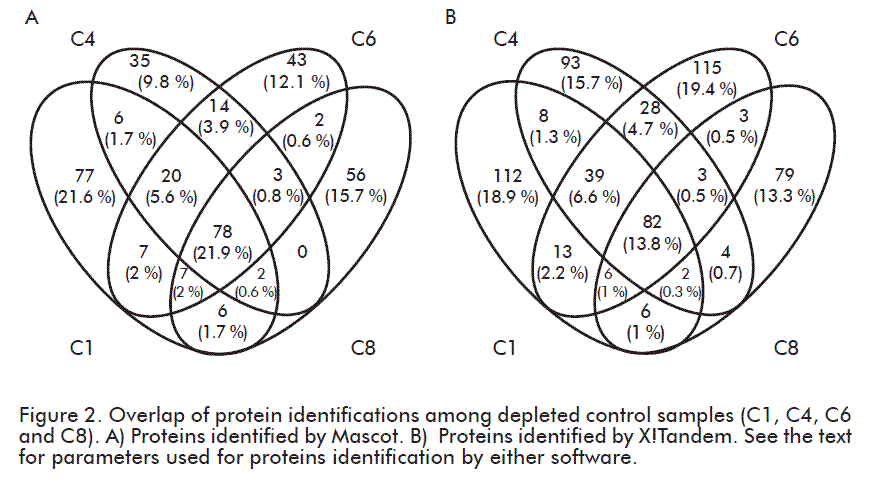
<P   ><font size="2" face="Verdana, Arial, Helvetica, sans-serif">Among all four control      samples of depleted serum, the matching of protein identifications revealed      with Mascot was 78 proteins, while with X!Tandem it was 82 proteins (<a href="/img/revistas/bta/v34n2/f0203217.gif">Figure      2</a>). </font></P >       
<P   ><font size="2" face="Verdana, Arial, Helvetica, sans-serif">In control samples,      the protein composition detected by both search engines was very similar.      Large groups of apolipoproteins, proteins of the blood coagulation system      and complement, immunoglobulins, as well as keratins and the contractile proteins      (actin, tropomyosin) were discovered (Supplementary information 1). In the      course of identification, two comparison lists for control proteins have been      established: the first (for &#1052;ascot) included 130 proteins, and the second      (for X!Tandem) included 171 proteins. Comparison lists contain the names and      UniProtKB identifiers of proteins that were revealed in at least two control      samples. </font></P >       ]]></body>
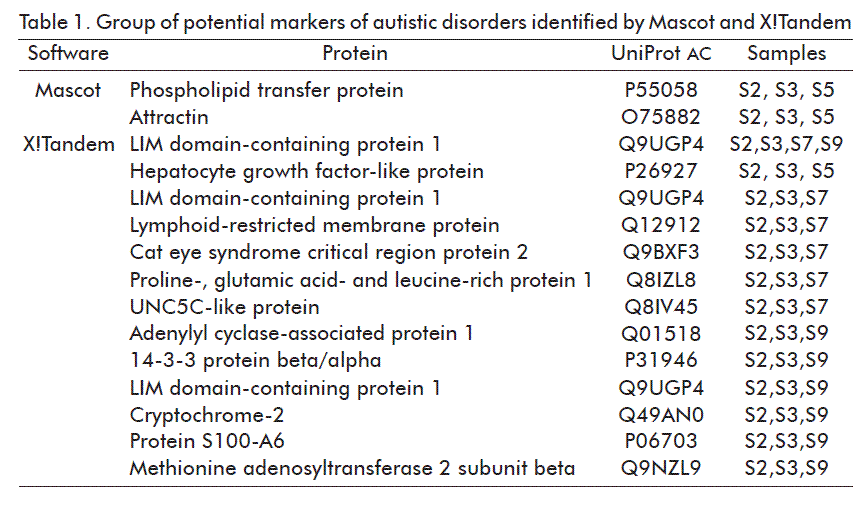
<body><![CDATA[<P   ><font size="2" face="Verdana, Arial, Helvetica, sans-serif">It is interesting      to point out that in control serum samples, X!Tandem proteomic search engine      identified virtually all the proteins (126 proteins out of 130) from the list      of control proteins for Mascot. In control serum samples, some proteins of      the complement system, apolipoproteins, hepatocyte growth factor, G-chain      of immunoglobulins G, beta-2-glycoprotein and other high- and medium-abundant      serum proteins were identified by X!Tandem and were not found by Mascot. </font></P >       <P   ><font size="2" face="Verdana, Arial, Helvetica, sans-serif">A subsequent comparative      analysis with depleted serum samples of children suffering from autistic disorders      was conducted with the use of these lists. The analysis of protein composition      of autistic depleted serum samples, that differ from proteins in comparison      lists of control serum samples, revealed the heterogeneity of results obtained      by the two search engines. </font></P >       <P   ><font size="2" face="Verdana, Arial, Helvetica, sans-serif">The comparison of      protein identifications obtained using Mascot and X!Tandem for the serum samples      of children suffering from autism spectrum disorders has shown that, in average,      80 % of the proteins identified by Mascot are also identified by X!Tandem      (Supplementary information 2). It is also worth noting that X!Tandem proteomic      search engine identifies in the samples a greater number of proteins than      Mascot. The latter, in its turn, demonstrates better coverage of the amino      acid sequence of the identified proteins in comparison with X!Tandem. Detailed      comparison of the identifications of the two searches is presented in Supplementary      2. It was evidenced that the selected most popular search engines supplemented      each other and allowed the most complete evaluation of the protein composition      of the analyzed biological samples. </font></P >       <P   ><font size="2" face="Verdana, Arial, Helvetica, sans-serif">Among the identifications      obtained with the Mascot, only two proteins differ from the comparison list      in three out of the five samples collected from autistic children. The greater      number of matches between serum samples of autistic children was detected      using X!Tandem. Thus, with the use of this search engine, the LIM domain-containing      protein 1 (Q9UGP4) was identified in four out of the five samples. In addition,      12 more proteins were identified in three out of the five samples collected      from the autistic children (<a href="/img/revistas/bta/v34n2/t0103217.gif">Table 1</a>).      </font></P >       
<P   ><font size="2" face="Verdana, Arial, Helvetica, sans-serif">Proteins identified      only in two serum samples were not analyzed. A group of potential markers      was proposed based on these analyses. This group included proteins detected      in three and four depleted serum samples of children suffering from autistic      disorders (<a href="/img/revistas/bta/v34n2/t0103217.gif">Table 1</a>). </font></P >       
<P   ><font size="2" face="Verdana, Arial, Helvetica, sans-serif">Noteworthy, the most      authoritative database STRING 10 (<FONT color="#0000FF"><a href="http://string-db.org/" target="_blank">http://string-db.org/</a>)<FONT color="#211E1F">,      designed for the detection of direct or indirect protein interactions, in      which 184 million of interactions for 9.6 million of proteins are annotated,      has not revealed direct or indirect associations (including functional ones)      among the proteins from the group of conventional markers. It is interesting      that, according to protein knowledgebase UniProt KB (<FONT color="#0000FF"><a href="http://www.uniprot.org/" target="_blank">http://www.uniprot.org/</a><FONT color="#211E1F">),      most of the group of potential markers (consisting of 8 proteins) is involved      in cell proliferation and differentiation. The rest of the proteins perform      transport function (one protein) or participate in the implementation of immune      response (three proteins). </font></font></font></font></font></P >   <FONT color="#0000FF"><FONT color="#211E1F"><FONT color="#0000FF"><FONT color="#211E1F">        <P   ><font size="2" face="Verdana, Arial, Helvetica, sans-serif">In comparison with      a few other studies we have revealed significant inconsistencies in the list      of potential biomarkers. So, we have revealed the group of apolipoproteins,      proteins of the complement system and the C-reactive protein were present      in both types of serum samples, control (normal) and autistic [10-14]. Therefore,      they were not attributed for us to the group of potential markers. Moreover,      in many studies it is shown that the proteins listed above are found in human      normal serum [22, 23]. In its turn, we have not identified glutamate metabolism      factor GAD-2 and autoantibodies against brain proteins in the control samples      or in the autistic serum samples. </font></P >       <P   >&nbsp;</P >       <P   > </P >       <P   ><b><font size="3" face="Verdana, Arial, Helvetica, sans-serif">CONCLUSIONS </font></b></P >       ]]></body>
<body><![CDATA[<P   ><font size="2" face="Verdana, Arial, Helvetica, sans-serif">In the course of      a exploratory comparative study of five samples of depleted sera of autistic      children, it was found that, compared to the control samples, the serum samples      of autistic children contain a small group of common proteins that are not      functionally or structurally related to one another. We have designated them      as potential markers. Among these proteins, only the LIM domain-containing      protein 1 was revealed in four out of five samples. The remaining 14 proteins      of this group were only detected in three samples of children suffering from      autistic disorders. It should be noted that we do not identify a greater overlap      when comparing the list of proteins of brothers with autism (S2 and S3) with      respect to the other children&rsquo;s. </font></P >       <P   ><font size="2" face="Verdana, Arial, Helvetica, sans-serif">Nevertheless, in      the future we plan to continue the study using a large number of samples.      We intend to develop highly sensitive (at the level of 10<sup>-15</sup> M)      quantitative mass spectrometric SRM methods for the evaluation of the selected      proteins in serum. </font></P >       <P   >&nbsp;</P >   <FONT size="+1"><FONT size="+1">        <P   > </P >       <P   ><b><font size="3" face="Verdana, Arial, Helvetica, sans-serif">ACKNOWLEDGEMENTS      </font></b></P >       <P   ><font size="2" face="Verdana, Arial, Helvetica, sans-serif">This study was supported      by the Russian Science Foundation, Grant No.14-25-00132. </font></P >       <P   >&nbsp;</P >       <P   > </P >       <P   ><b><font size="3" face="Verdana, Arial, Helvetica, sans-serif">REFERENCES </font></b></P >       <P   > </P >   <FONT size="+1" color="#000000">        ]]></body>
<body><![CDATA[<!-- ref --><P   ><font size="2" color="#211E1F" face="Verdana, Arial, Helvetica, sans-serif">1.      Kopetz PB, Endowed ED. Autism worldwide: Prevalence, perceptions, acceptance,      action. J Soc Sci. 2012;8:196-201.     </font></P >   <FONT size="+1" color="#211E1F">        <P   ><font size="2" face="Verdana, Arial, Helvetica, sans-serif">2. Autism and Developmental      Disabilities Monitoring Network Surveillance Year 2008 Principal Investigators;      Centers for Disease Control and Prevention. Prevalence of autism spectrum      disorders--Autism and Developmental Disabilities Monitoring Network, 14 sites,      United States, 2008. MMWR Surveill Summ. 2012;61(3):1-19. </font></P >       <!-- ref --><P   ><font size="2" face="Verdana, Arial, Helvetica, sans-serif">3. World Health Organization.      The ICD-10 Classification of Mental and Behavioural Disorders. Clinical descriptions      and diagnostic guidelines. Geneva: WHO; 2004.     </font></P >       <P   ><font size="2" face="Verdana, Arial, Helvetica, sans-serif">4. Conciatori M,      Stodgell CJ, Hyman SL, O&rsquo;Bara M, Militerni R, Bravaccio C, <I>et al</I>.      Association between the HOXA1 A218G polymorphism and increased head circumference      in patients with autism. Biol Psychiatry. 2004;55(4):413-9. </font></P >       <!-- ref --><P   ><font size="2" face="Verdana, Arial, Helvetica, sans-serif">5. Freitag CM, Staal      W, Klauck SM, Duketis E, Waltes R. Genetics of autistic disorders: review      and clinical implications. Eur Child Adolesc Psychiatry. 2010;19(3):169-78.          </font></P >       <P   ><font size="2" face="Verdana, Arial, Helvetica, sans-serif">6. Hu VW, Nguyen      A, Kim KS, Steinberg ME, Sarachana T, Scully MA, <I>et al</I>. Gene expression      profiling of lymphoblasts from autistic and nonaffected sib pairs: altered      pathways in neuronal development and steroid biosynthesis. PLoS One. 2009;4(6):e5775.      </font></P >       <P   ><font size="2" face="Verdana, Arial, Helvetica, sans-serif">7. O&rsquo;Roak BJ,      Vives L, Girirajan S, Karakoc E, Krumm N, Coe BP, <I>et al</I>. Sporadic autism      exomes reveal a highly interconnected protein network of de novo mutations.      Nature. 2012;485(7397):246-50. </font></P >       ]]></body>
<body><![CDATA[<!-- ref --><P   ><font size="2" face="Verdana, Arial, Helvetica, sans-serif">8. Guilmatre A, Dubourg      C, Mosca AL, Legallic S, Goldenberg A, Drouin-Garraud V, <I>et al</I>. Recurrent      rearrangements in synaptic and neurodevelopmental genes and shared biologic      pathways in schizophrenia, autism, and mental retardation. Arch Gen Psychiatry.      2009;66(9):947-56.     </font></P >       <P   ><font size="2" face="Verdana, Arial, Helvetica, sans-serif">9. Neale BM, Kou      Y, Liu L, Ma&rsquo;ayan A, Samocha KE, Sabo A, <I>et al</I>. Patterns and      rates of exonic de novo mutations in autism spectrum disorders. Nature. 2012;485(7397):242-5.      </font></P >       <!-- ref --><P   ><font size="2" face="Verdana, Arial, Helvetica, sans-serif">10. Hartley SL, Seltzer      MM, Hong J, Greenberg JS, Smith L, Almeida D, <I>et al</I>. Cortisol response      to behavior problems in FMR1 premutation mothers of adolescents and adults      with fragile X syndrome: A diathesis-stress model. Int J Behav Dev. 2012;36(1):53-61.          </font></P >       <!-- ref --><P   ><font size="2" face="Verdana, Arial, Helvetica, sans-serif">11. Ngounou Wetie      AG, Sokolowska I, Wormwood K, Beglinger K, Michel TM, Thome J, <I>et al</I>.      Mass spectrometry for the detection of potential psychiatric biomarkers. J      Mol Psychiatry. 2013;1(1):8.     </font></P >       <!-- ref --><P   ><font size="2" face="Verdana, Arial, Helvetica, sans-serif">12. Corbett BA, Kantor      AB, Schulman H, Walker WL, Lit L, Ashwood P, <I>et al</I>. A proteomic study      of serum from children with autism showing differential expression of apolipoproteins      and complement proteins. Mol Psychiatry. 2007;12(3):292-306.     </font></P >       <!-- ref --><P   ><font size="2" face="Verdana, Arial, Helvetica, sans-serif">13. Woods AG, Sokolowska      I, Taurines R, Gerlach M, Dudley E, Thome J, <I>et al</I>. Potential biomarkers      in psychiatry: focus on the cholesterol system. J Cell Mol Med. 2012;16(6):1184-95.          </font></P >       <!-- ref --><P   ><font size="2" face="Verdana, Arial, Helvetica, sans-serif">14. Ngounou Wetie      AG, Wormwood K, Thome J, Dudley E, Taurines R, Gerlach M, <I>et al</I>. A      pilot proteomic study of protein markers in autism spectrum disorder. Electrophoresis.      2014;35(14):2046-54.     </font></P >       <!-- ref --><P   ><font size="2" face="Verdana, Arial, Helvetica, sans-serif">15. Eichler EE, Zimmerman      AW. A hot spot of genetic instability in autism. N Engl J Med. 2008;358(7):737-9.          </font></P >       <!-- ref --><P   ><font size="2" face="Verdana, Arial, Helvetica, sans-serif">16. Elamin NE, Al-Ayadhi      LY. Brain autoantibodies in autism spectrum disorder. Biomark Med. 2014;8(3):345-52.          </font></P >       <!-- ref --><P   ><font size="2" face="Verdana, Arial, Helvetica, sans-serif">17. Lehti V, Hinkka-Yli-Salomaki      S, Cheslack-Postava K, Gissler M, Brown AS, Sourander A. The risk of childhood      autism among second-generation migrants in Finland: a case-control study.      BMC Pediatr. 2013;13:171.     </font></P >       <!-- ref --><P   ><font size="2" face="Verdana, Arial, Helvetica, sans-serif">18. Zerbo O, Yoshida      C, Grether JK, Van de Water J, Ashwood P, Delorenze GN, <I>et al</I>. Neonatal      cytokines and chemokines and risk of Autism Spectrum Disorder: the Early Markers      for Autism (EMA) study: a case-control study. J Neuroinflammation. 2014;11:113.          </font></P >       <!-- ref --><P   ><font size="2" face="Verdana, Arial, Helvetica, sans-serif">19. Kaysheva AL,      Ivanov YD, Frantsuzov PA, Krohin NV, Pavlova TI, Uchaikin VF, <I>et al</I>.      Mass spectrometric detection of the amino acid sequence polymorphism of the      hepatitis C virus antigen. J Virol Methods. 2016;229:86-90.     </font></P >       <!-- ref --><P   ><font size="2" face="Verdana, Arial, Helvetica, sans-serif">20. Kopylov AT, Zgoda      VG, Lisitsa AV, Archakov AI. Combined use of irreversible binding and MRM      technology for low- and ultralow copy-number protein detection and quantitation.      Proteomics. 2013;13(5):727-42.     </font></P >       <!-- ref --><P   ><font size="2" face="Verdana, Arial, Helvetica, sans-serif">21. Ivanov YD, Kaysheva      AL, Frantsuzov PA, Pleshakova TO, Krohin NV, Izotov AA, <I>et al</I>. Detection      of hepatitis C virus core protein in serum by atomic force microscopy combined      with mass spectrometry. Int J Nanomedicine. 2015;10:1597-608.     </font></P >       <!-- ref --><P   ><font size="2" face="Verdana, Arial, Helvetica, sans-serif">22. Anderson L, Anderson      NG. High resolution two-dimensional electrophoresis of human plasma proteins.      Proc Natl Acad Sci U S A. 1977;74(12):5421-5.     </font></P >       <!-- ref --><P   ><font size="2" face="Verdana, Arial, Helvetica, sans-serif">23. Semple SJ, Smith      LL, McKune AJ, Hoyos J, Mokgethwa B, San Juan AF, <I>et al. </I>Serum concentrations      of C reactive protein, alpha1 antitrypsin, and complement (C3, C4, C1 esterase      inhibitor) before and during the Vuelta a Espana. Br J Sports Med. 2006;40(2):124-7.          </font></P >       <P   >&nbsp;</P >       <P   >&nbsp;</P >   <FONT size="+1">        <P   > </P >       <P   > </P >       <P   > </P >       <P   ><font size="2" face="Verdana, Arial, Helvetica, sans-serif">Received in October,      2016.     <br>     Accepted in April, 2017. </font></P >   <FONT size="+1">        <P   >&nbsp;</P >       <P   >&nbsp;</P >       ]]></body>
<body><![CDATA[<P   ><font size="2" face="Verdana, Arial, Helvetica, sans-serif"><i>Anna L Kaysheva</i>.      Institute of Biomedical Chemistry, IBMC RAMS, Pogodinskaya St. 10/8, Moscow,      119121 Russia. E-mail: <A href="mailto:kaysheva1@gmail.com"> <FONT color="#0000FF">kaysheva1@gmail.com</font></A><FONT color="#0000FF"><FONT color="#211E1F">.      </font></font></font></P >   </font></font></font></font></font></font></font></font></font></font></font></font></font></font></font></font></font></font></font></font></font></font></font></font></font></font></font></font></font></font></font></font></font></font></font></font></font></font></font></font></font></font></DIV >      ]]></body><back>
<ref-list>
<ref id="B1">
<label>1</label><nlm-citation citation-type="journal">
<person-group person-group-type="author">
<name>
<surname><![CDATA[Kopetz]]></surname>
<given-names><![CDATA[PB]]></given-names>
</name>
<name>
<surname><![CDATA[Endowed]]></surname>
<given-names><![CDATA[ED]]></given-names>
</name>
</person-group>
<article-title xml:lang="en"><![CDATA[Autism worldwide: Prevalence, perceptions, acceptance, action]]></article-title>
<source><![CDATA[J Soc Sci]]></source>
<year>2012</year>
<volume>8</volume>
<page-range>196-201</page-range></nlm-citation>
</ref>
<ref id="B2">
<label>2</label><nlm-citation citation-type="journal">
<collab>Autism and Developmental Disabilities Monitoring Network Surveillance Year 2008 Principal Investigators</collab>
<collab>Centers for Disease Control and Prevention</collab>
<article-title xml:lang="en"><![CDATA[en]]></article-title>
<source><![CDATA[MMWR Surveill Summ]]></source>
<year>2012</year>
<volume>61</volume>
<numero>3</numero>
<issue>3</issue>
<page-range>1-19</page-range></nlm-citation>
</ref>
<ref id="B3">
<label>3</label><nlm-citation citation-type="book">
<collab>World Health Organization</collab>
<source><![CDATA[The ICD-10 Classification of Mental and Behavioural Disorders. Clinical descriptions and diagnostic guidelines]]></source>
<year>2004</year>
<publisher-loc><![CDATA[Geneva ]]></publisher-loc>
<publisher-name><![CDATA[WHO]]></publisher-name>
</nlm-citation>
</ref>
<ref id="B4">
<label>4</label><nlm-citation citation-type="journal">
<person-group person-group-type="author">
<name>
<surname><![CDATA[Conciatori]]></surname>
<given-names><![CDATA[M]]></given-names>
</name>
<name>
<surname><![CDATA[Stodgell]]></surname>
<given-names><![CDATA[CJ]]></given-names>
</name>
<name>
<surname><![CDATA[Hyman]]></surname>
<given-names><![CDATA[SL]]></given-names>
</name>
<name>
<surname><![CDATA[O'Bara]]></surname>
<given-names><![CDATA[M]]></given-names>
</name>
<name>
<surname><![CDATA[Militerni]]></surname>
<given-names><![CDATA[R]]></given-names>
</name>
<name>
<surname><![CDATA[Bravaccio]]></surname>
<given-names><![CDATA[C]]></given-names>
</name>
</person-group>
<article-title xml:lang="en"><![CDATA[Association between the HOXA1 A218G polymorphism and increased head circumference in patients with autism]]></article-title>
<source><![CDATA[Biol Psychiatry]]></source>
<year>2004</year>
<volume>55</volume>
<numero>4</numero>
<issue>4</issue>
<page-range>413-9</page-range></nlm-citation>
</ref>
<ref id="B5">
<label>5</label><nlm-citation citation-type="journal">
<person-group person-group-type="author">
<name>
<surname><![CDATA[Freitag]]></surname>
<given-names><![CDATA[CM]]></given-names>
</name>
<name>
<surname><![CDATA[Staal]]></surname>
<given-names><![CDATA[W]]></given-names>
</name>
<name>
<surname><![CDATA[Klauck]]></surname>
<given-names><![CDATA[SM]]></given-names>
</name>
<name>
<surname><![CDATA[Duketis]]></surname>
<given-names><![CDATA[E]]></given-names>
</name>
<name>
<surname><![CDATA[Waltes]]></surname>
<given-names><![CDATA[R]]></given-names>
</name>
</person-group>
<article-title xml:lang="en"><![CDATA[Genetics of autistic disorders: review and clinical implications]]></article-title>
<source><![CDATA[Eur Child Adolesc Psychiatry]]></source>
<year>2010</year>
<volume>19</volume>
<numero>3</numero>
<issue>3</issue>
<page-range>169-78</page-range></nlm-citation>
</ref>
<ref id="B6">
<label>6</label><nlm-citation citation-type="journal">
<person-group person-group-type="author">
<name>
<surname><![CDATA[Hu]]></surname>
<given-names><![CDATA[VW]]></given-names>
</name>
<name>
<surname><![CDATA[Nguyen]]></surname>
<given-names><![CDATA[A]]></given-names>
</name>
<name>
<surname><![CDATA[Kim]]></surname>
<given-names><![CDATA[KS]]></given-names>
</name>
<name>
<surname><![CDATA[Steinberg]]></surname>
<given-names><![CDATA[ME]]></given-names>
</name>
<name>
<surname><![CDATA[Sarachana]]></surname>
<given-names><![CDATA[T]]></given-names>
</name>
<name>
<surname><![CDATA[Scully]]></surname>
<given-names><![CDATA[MA]]></given-names>
</name>
</person-group>
<article-title xml:lang="en"><![CDATA[Gene expression profiling of lymphoblasts from autistic and nonaffected sib pairs: altered pathways in neuronal development and steroid biosynthesis]]></article-title>
<source><![CDATA[PLoS One]]></source>
<year>2009</year>
<volume>4</volume>
<numero>6</numero>
<issue>6</issue>
<page-range>5775</page-range></nlm-citation>
</ref>
<ref id="B7">
<label>7</label><nlm-citation citation-type="journal">
<person-group person-group-type="author">
<name>
<surname><![CDATA[O'Roak]]></surname>
<given-names><![CDATA[BJ]]></given-names>
</name>
<name>
<surname><![CDATA[Vives]]></surname>
<given-names><![CDATA[L]]></given-names>
</name>
<name>
<surname><![CDATA[Girirajan]]></surname>
<given-names><![CDATA[S]]></given-names>
</name>
<name>
<surname><![CDATA[Karakoc]]></surname>
<given-names><![CDATA[E]]></given-names>
</name>
<name>
<surname><![CDATA[Krumm]]></surname>
<given-names><![CDATA[N]]></given-names>
</name>
<name>
<surname><![CDATA[Coe]]></surname>
<given-names><![CDATA[BP]]></given-names>
</name>
</person-group>
<article-title xml:lang="en"><![CDATA[Sporadic autism exomes reveal a highly interconnected protein network of de novo mutations]]></article-title>
<source><![CDATA[Nature]]></source>
<year>2012</year>
<volume>485</volume>
<numero>7397</numero>
<issue>7397</issue>
<page-range>246-50</page-range></nlm-citation>
</ref>
<ref id="B8">
<label>8</label><nlm-citation citation-type="journal">
<person-group person-group-type="author">
<name>
<surname><![CDATA[Guilmatre]]></surname>
<given-names><![CDATA[A]]></given-names>
</name>
<name>
<surname><![CDATA[Dubourg]]></surname>
<given-names><![CDATA[C]]></given-names>
</name>
<name>
<surname><![CDATA[Mosca]]></surname>
<given-names><![CDATA[AL]]></given-names>
</name>
<name>
<surname><![CDATA[Legallic]]></surname>
<given-names><![CDATA[S]]></given-names>
</name>
<name>
<surname><![CDATA[Goldenberg]]></surname>
<given-names><![CDATA[A]]></given-names>
</name>
<name>
<surname><![CDATA[Drouin-Garraud]]></surname>
<given-names><![CDATA[V]]></given-names>
</name>
</person-group>
<article-title xml:lang="en"><![CDATA[Recurrent rearrangements in synaptic and neurodevelopmental genes and shared biologic pathways in schizophrenia, autism, and mental retardation]]></article-title>
<source><![CDATA[Arch Gen Psychiatry]]></source>
<year>2009</year>
<volume>66</volume>
<numero>9</numero>
<issue>9</issue>
<page-range>947-56</page-range></nlm-citation>
</ref>
<ref id="B9">
<label>9</label><nlm-citation citation-type="journal">
<person-group person-group-type="author">
<name>
<surname><![CDATA[Neale]]></surname>
<given-names><![CDATA[BM]]></given-names>
</name>
<name>
<surname><![CDATA[Kou]]></surname>
<given-names><![CDATA[Y]]></given-names>
</name>
<name>
<surname><![CDATA[Liu]]></surname>
<given-names><![CDATA[L]]></given-names>
</name>
<name>
<surname><![CDATA[Ma'ayan]]></surname>
<given-names><![CDATA[A]]></given-names>
</name>
<name>
<surname><![CDATA[Samocha]]></surname>
<given-names><![CDATA[KE]]></given-names>
</name>
<name>
<surname><![CDATA[Sabo]]></surname>
<given-names><![CDATA[A]]></given-names>
</name>
</person-group>
<article-title xml:lang="en"><![CDATA[Patterns and rates of exonic de novo mutations in autism spectrum disorders]]></article-title>
<source><![CDATA[Nature]]></source>
<year>2012</year>
<volume>485</volume>
<numero>7397</numero>
<issue>7397</issue>
<page-range>242-5</page-range></nlm-citation>
</ref>
<ref id="B10">
<label>10</label><nlm-citation citation-type="journal">
<person-group person-group-type="author">
<name>
<surname><![CDATA[Hartley]]></surname>
<given-names><![CDATA[SL]]></given-names>
</name>
<name>
<surname><![CDATA[Seltzer]]></surname>
<given-names><![CDATA[MM]]></given-names>
</name>
<name>
<surname><![CDATA[Hong]]></surname>
<given-names><![CDATA[J]]></given-names>
</name>
<name>
<surname><![CDATA[Greenberg]]></surname>
<given-names><![CDATA[JS]]></given-names>
</name>
<name>
<surname><![CDATA[Smith]]></surname>
<given-names><![CDATA[L]]></given-names>
</name>
<name>
<surname><![CDATA[Almeida]]></surname>
<given-names><![CDATA[D]]></given-names>
</name>
</person-group>
<article-title xml:lang="en"><![CDATA[Cortisol response to behavior problems in FMR1 premutation mothers of adolescents and adults with fragile X syndrome: A diathesis-stress model]]></article-title>
<source><![CDATA[Int J Behav Dev]]></source>
<year>2012</year>
<volume>36</volume>
<numero>1</numero>
<issue>1</issue>
<page-range>53-61</page-range></nlm-citation>
</ref>
<ref id="B11">
<label>11</label><nlm-citation citation-type="journal">
<person-group person-group-type="author">
<name>
<surname><![CDATA[Ngounou Wetie]]></surname>
<given-names><![CDATA[AG]]></given-names>
</name>
<name>
<surname><![CDATA[Sokolowska]]></surname>
<given-names><![CDATA[I]]></given-names>
</name>
<name>
<surname><![CDATA[Wormwood]]></surname>
<given-names><![CDATA[K]]></given-names>
</name>
<name>
<surname><![CDATA[Beglinger]]></surname>
<given-names><![CDATA[K]]></given-names>
</name>
<name>
<surname><![CDATA[Michel]]></surname>
<given-names><![CDATA[TM]]></given-names>
</name>
<name>
<surname><![CDATA[Thome]]></surname>
<given-names><![CDATA[J]]></given-names>
</name>
</person-group>
<article-title xml:lang="en"><![CDATA[Mass spectrometry for the detection of potential psychiatric biomarkers]]></article-title>
<source><![CDATA[J Mol Psychiatry]]></source>
<year>2013</year>
<volume>1</volume>
<numero>1</numero>
<issue>1</issue>
<page-range>8</page-range></nlm-citation>
</ref>
<ref id="B12">
<label>12</label><nlm-citation citation-type="journal">
<person-group person-group-type="author">
<name>
<surname><![CDATA[Corbett]]></surname>
<given-names><![CDATA[BA]]></given-names>
</name>
<name>
<surname><![CDATA[Kantor]]></surname>
<given-names><![CDATA[AB]]></given-names>
</name>
<name>
<surname><![CDATA[Schulman]]></surname>
<given-names><![CDATA[H]]></given-names>
</name>
<name>
<surname><![CDATA[Walker]]></surname>
<given-names><![CDATA[WL]]></given-names>
</name>
<name>
<surname><![CDATA[Lit]]></surname>
<given-names><![CDATA[L]]></given-names>
</name>
<name>
<surname><![CDATA[Ashwood]]></surname>
<given-names><![CDATA[P]]></given-names>
</name>
</person-group>
<article-title xml:lang="en"><![CDATA[A proteomic study of serum from children with autism showing differential expression of apolipoproteins and complement proteins]]></article-title>
<source><![CDATA[Mol Psychiatry]]></source>
<year>2007</year>
<volume>12</volume>
<numero>3</numero>
<issue>3</issue>
<page-range>292-306</page-range></nlm-citation>
</ref>
<ref id="B13">
<label>13</label><nlm-citation citation-type="journal">
<person-group person-group-type="author">
<name>
<surname><![CDATA[Woods]]></surname>
<given-names><![CDATA[AG]]></given-names>
</name>
<name>
<surname><![CDATA[Sokolowska]]></surname>
<given-names><![CDATA[I]]></given-names>
</name>
<name>
<surname><![CDATA[Taurines]]></surname>
<given-names><![CDATA[R]]></given-names>
</name>
<name>
<surname><![CDATA[Gerlach]]></surname>
<given-names><![CDATA[M]]></given-names>
</name>
<name>
<surname><![CDATA[Dudley]]></surname>
<given-names><![CDATA[E]]></given-names>
</name>
<name>
<surname><![CDATA[Thome]]></surname>
<given-names><![CDATA[J]]></given-names>
</name>
</person-group>
<article-title xml:lang="en"><![CDATA[Potential biomarkers in psychiatry: focus on the cholesterol system]]></article-title>
<source><![CDATA[J Cell Mol Med]]></source>
<year>2012</year>
<volume>16</volume>
<numero>6</numero>
<issue>6</issue>
<page-range>1184-95</page-range></nlm-citation>
</ref>
<ref id="B14">
<label>14</label><nlm-citation citation-type="journal">
<person-group person-group-type="author">
<name>
<surname><![CDATA[Ngounou Wetie]]></surname>
<given-names><![CDATA[AG]]></given-names>
</name>
<name>
<surname><![CDATA[Wormwood]]></surname>
<given-names><![CDATA[K]]></given-names>
</name>
<name>
<surname><![CDATA[Thome]]></surname>
<given-names><![CDATA[J]]></given-names>
</name>
<name>
<surname><![CDATA[Dudley]]></surname>
<given-names><![CDATA[E]]></given-names>
</name>
<name>
<surname><![CDATA[Taurines]]></surname>
<given-names><![CDATA[R]]></given-names>
</name>
<name>
<surname><![CDATA[Gerlach]]></surname>
<given-names><![CDATA[M]]></given-names>
</name>
</person-group>
<article-title xml:lang="en"><![CDATA[A pilot proteomic study of protein markers in autism spectrum disorder]]></article-title>
<source><![CDATA[Electrophoresis]]></source>
<year>2014</year>
<volume>35</volume>
<numero>14</numero>
<issue>14</issue>
<page-range>2046-54</page-range></nlm-citation>
</ref>
<ref id="B15">
<label>15</label><nlm-citation citation-type="journal">
<person-group person-group-type="author">
<name>
<surname><![CDATA[Eichler]]></surname>
<given-names><![CDATA[EE]]></given-names>
</name>
<name>
<surname><![CDATA[Zimmerman]]></surname>
<given-names><![CDATA[AW]]></given-names>
</name>
</person-group>
<article-title xml:lang="en"><![CDATA[A hot spot of genetic instability in autism]]></article-title>
<source><![CDATA[N Engl J Med]]></source>
<year>2008</year>
<volume>358</volume>
<numero>7</numero>
<issue>7</issue>
<page-range>737-9</page-range></nlm-citation>
</ref>
<ref id="B16">
<label>16</label><nlm-citation citation-type="journal">
<person-group person-group-type="author">
<name>
<surname><![CDATA[Elamin]]></surname>
<given-names><![CDATA[NE]]></given-names>
</name>
<name>
<surname><![CDATA[Al-Ayadhi]]></surname>
<given-names><![CDATA[LY]]></given-names>
</name>
</person-group>
<article-title xml:lang="en"><![CDATA[Brain autoantibodies in autism spectrum disorder]]></article-title>
<source><![CDATA[Biomark Med]]></source>
<year>2014</year>
<volume>8</volume>
<numero>3</numero>
<issue>3</issue>
<page-range>345-52</page-range></nlm-citation>
</ref>
<ref id="B17">
<label>17</label><nlm-citation citation-type="journal">
<person-group person-group-type="author">
<name>
<surname><![CDATA[Lehti]]></surname>
<given-names><![CDATA[V]]></given-names>
</name>
<name>
<surname><![CDATA[Hinkka-Yli-Salomaki]]></surname>
<given-names><![CDATA[S]]></given-names>
</name>
<name>
<surname><![CDATA[Cheslack-Postava]]></surname>
<given-names><![CDATA[K]]></given-names>
</name>
<name>
<surname><![CDATA[Gissler]]></surname>
<given-names><![CDATA[M]]></given-names>
</name>
<name>
<surname><![CDATA[Brown]]></surname>
<given-names><![CDATA[AS]]></given-names>
</name>
<name>
<surname><![CDATA[Sourander]]></surname>
<given-names><![CDATA[A]]></given-names>
</name>
</person-group>
<article-title xml:lang="en"><![CDATA[The risk of childhood autism among second-generation migrants in Finland: a case-control study]]></article-title>
<source><![CDATA[BMC Pediatr]]></source>
<year>2013</year>
<volume>13</volume>
<page-range>171</page-range></nlm-citation>
</ref>
<ref id="B18">
<label>18</label><nlm-citation citation-type="journal">
<person-group person-group-type="author">
<name>
<surname><![CDATA[Zerbo]]></surname>
<given-names><![CDATA[O]]></given-names>
</name>
<name>
<surname><![CDATA[Yoshida]]></surname>
<given-names><![CDATA[C]]></given-names>
</name>
<name>
<surname><![CDATA[Grether]]></surname>
<given-names><![CDATA[JK]]></given-names>
</name>
<name>
<surname><![CDATA[Van de Water]]></surname>
<given-names><![CDATA[J]]></given-names>
</name>
<name>
<surname><![CDATA[Ashwood]]></surname>
<given-names><![CDATA[P]]></given-names>
</name>
<name>
<surname><![CDATA[Delorenze]]></surname>
<given-names><![CDATA[GN]]></given-names>
</name>
</person-group>
<article-title xml:lang="en"><![CDATA[Neonatal cytokines and chemokines and risk of Autism Spectrum Disorder: the Early Markers for Autism (EMA) study: a case-control study]]></article-title>
<source><![CDATA[J Neuroinflammation]]></source>
<year>2014</year>
<volume>11</volume>
<page-range>113</page-range></nlm-citation>
</ref>
<ref id="B19">
<label>19</label><nlm-citation citation-type="journal">
<person-group person-group-type="author">
<name>
<surname><![CDATA[Kaysheva]]></surname>
<given-names><![CDATA[AL]]></given-names>
</name>
<name>
<surname><![CDATA[Ivanov]]></surname>
<given-names><![CDATA[YD]]></given-names>
</name>
<name>
<surname><![CDATA[Frantsuzov]]></surname>
<given-names><![CDATA[PA]]></given-names>
</name>
<name>
<surname><![CDATA[Krohin]]></surname>
<given-names><![CDATA[NV]]></given-names>
</name>
<name>
<surname><![CDATA[Pavlova]]></surname>
<given-names><![CDATA[TI]]></given-names>
</name>
<name>
<surname><![CDATA[Uchaikin]]></surname>
<given-names><![CDATA[VF]]></given-names>
</name>
</person-group>
<article-title xml:lang="en"><![CDATA[Mass spectrometric detection of the amino acid sequence polymorphism of the hepatitis C virus antigen]]></article-title>
<source><![CDATA[J Virol Methods]]></source>
<year>2016</year>
<volume>229</volume>
<page-range>86-90</page-range></nlm-citation>
</ref>
<ref id="B20">
<label>20</label><nlm-citation citation-type="journal">
<person-group person-group-type="author">
<name>
<surname><![CDATA[Kopylov]]></surname>
<given-names><![CDATA[AT]]></given-names>
</name>
<name>
<surname><![CDATA[Zgoda]]></surname>
<given-names><![CDATA[VG]]></given-names>
</name>
<name>
<surname><![CDATA[Lisitsa]]></surname>
<given-names><![CDATA[AV]]></given-names>
</name>
<name>
<surname><![CDATA[Archakov]]></surname>
<given-names><![CDATA[AI]]></given-names>
</name>
</person-group>
<article-title xml:lang="en"><![CDATA[Combined use of irreversible binding and MRM technology for low- and ultralow copy-number protein detection and quantitation]]></article-title>
<source><![CDATA[Proteomics]]></source>
<year>2013</year>
<volume>13</volume>
<numero>5</numero>
<issue>5</issue>
<page-range>727-42</page-range></nlm-citation>
</ref>
<ref id="B21">
<label>21</label><nlm-citation citation-type="journal">
<person-group person-group-type="author">
<name>
<surname><![CDATA[Ivanov]]></surname>
<given-names><![CDATA[YD]]></given-names>
</name>
<name>
<surname><![CDATA[Kaysheva]]></surname>
<given-names><![CDATA[AL]]></given-names>
</name>
<name>
<surname><![CDATA[Frantsuzov]]></surname>
<given-names><![CDATA[PA]]></given-names>
</name>
<name>
<surname><![CDATA[Pleshakova]]></surname>
<given-names><![CDATA[TO]]></given-names>
</name>
<name>
<surname><![CDATA[Krohin]]></surname>
<given-names><![CDATA[NV]]></given-names>
</name>
<name>
<surname><![CDATA[Izotov]]></surname>
<given-names><![CDATA[AA]]></given-names>
</name>
</person-group>
<article-title xml:lang="en"><![CDATA[Detection of hepatitis C virus core protein in serum by atomic force microscopy combined with mass spectrometry]]></article-title>
<source><![CDATA[Int J Nanomedicine]]></source>
<year>2015</year>
<volume>10</volume>
<page-range>1597-608</page-range></nlm-citation>
</ref>
<ref id="B22">
<label>22</label><nlm-citation citation-type="journal">
<person-group person-group-type="author">
<name>
<surname><![CDATA[Anderson]]></surname>
<given-names><![CDATA[L]]></given-names>
</name>
<name>
<surname><![CDATA[Anderson]]></surname>
<given-names><![CDATA[NG]]></given-names>
</name>
</person-group>
<article-title xml:lang="en"><![CDATA[High resolution two-dimensional electrophoresis of human plasma proteins]]></article-title>
<source><![CDATA[Proc Natl Acad Sci U S A]]></source>
<year>1977</year>
<volume>74</volume>
<numero>12</numero>
<issue>12</issue>
<page-range>5421-5</page-range></nlm-citation>
</ref>
<ref id="B23">
<label>23</label><nlm-citation citation-type="journal">
<person-group person-group-type="author">
<name>
<surname><![CDATA[Semple]]></surname>
<given-names><![CDATA[SJ]]></given-names>
</name>
<name>
<surname><![CDATA[Smith]]></surname>
<given-names><![CDATA[LL]]></given-names>
</name>
<name>
<surname><![CDATA[McKune]]></surname>
<given-names><![CDATA[AJ]]></given-names>
</name>
<name>
<surname><![CDATA[Hoyos]]></surname>
<given-names><![CDATA[J]]></given-names>
</name>
<name>
<surname><![CDATA[Mokgethwa]]></surname>
<given-names><![CDATA[B]]></given-names>
</name>
<name>
<surname><![CDATA[San Juan]]></surname>
<given-names><![CDATA[AF]]></given-names>
</name>
</person-group>
<article-title xml:lang="en"><![CDATA[Serum concentrations of C reactive protein, alpha1 antitrypsin, and complement (C3, C4, C1 esterase inhibitor) before and during the Vuelta a Espana]]></article-title>
<source><![CDATA[Br J Sports Med]]></source>
<year>2006</year>
<volume>40</volume>
<numero>2</numero>
<issue>2</issue>
<page-range>124-7</page-range></nlm-citation>
</ref>
</ref-list>
</back>
</article>