<?xml version="1.0" encoding="ISO-8859-1"?><article xmlns:mml="http://www.w3.org/1998/Math/MathML" xmlns:xlink="http://www.w3.org/1999/xlink" xmlns:xsi="http://www.w3.org/2001/XMLSchema-instance">
<front>
<journal-meta>
<journal-id>1027-2852</journal-id>
<journal-title><![CDATA[Biotecnología Aplicada]]></journal-title>
<abbrev-journal-title><![CDATA[Biotecnol Apl]]></abbrev-journal-title>
<issn>1027-2852</issn>
<publisher>
<publisher-name><![CDATA[Editorial Elfos Scientiae]]></publisher-name>
</publisher>
</journal-meta>
<article-meta>
<article-id>S1027-28522017000200004</article-id>
<title-group>
<article-title xml:lang="en"><![CDATA[Correlation between antibody titers in human serum and plasma prepared with EDTA for the assessment of cholera vaccine immune responses]]></article-title>
<article-title xml:lang="es"><![CDATA[Correlación entre los títulos de anticuerpos en suero y plasma humano preparados con EDTA para la evaluación de la respuesta inmune inducida por vacunas contra el cólera]]></article-title>
</title-group>
<contrib-group>
<contrib contrib-type="author">
<name>
<surname><![CDATA[Ledón-Pérez]]></surname>
<given-names><![CDATA[Talena]]></given-names>
</name>
<xref ref-type="aff" rid="A01"/>
</contrib>
<contrib contrib-type="author">
<name>
<surname><![CDATA[Zelada-Valdés]]></surname>
<given-names><![CDATA[Adrian]]></given-names>
</name>
<xref ref-type="aff" rid="A01"/>
</contrib>
<contrib contrib-type="author">
<name>
<surname><![CDATA[Tamayo-García]]></surname>
<given-names><![CDATA[Yolexis]]></given-names>
</name>
<xref ref-type="aff" rid="A02"/>
</contrib>
<contrib contrib-type="author">
<name>
<surname><![CDATA[Lara-Fuentes]]></surname>
<given-names><![CDATA[Dareyne]]></given-names>
</name>
<xref ref-type="aff" rid="A02"/>
</contrib>
<contrib contrib-type="author">
<name>
<surname><![CDATA[Pérez-Lastre]]></surname>
<given-names><![CDATA[Jorge]]></given-names>
</name>
<xref ref-type="aff" rid="A03"/>
</contrib>
<contrib contrib-type="author">
<name>
<surname><![CDATA[Fando-Calzada]]></surname>
<given-names><![CDATA[Rafael]]></given-names>
</name>
<xref ref-type="aff" rid="A01"/>
</contrib>
</contrib-group>
<aff id="A02">
<institution><![CDATA[,Instituto Finlay de Sueros y Vacunas Departamento de Materiales de Referencia ]]></institution>
<addr-line><![CDATA[La Habana ]]></addr-line>
<country>Cuba</country>
</aff>
<aff id="A03">
<institution><![CDATA[,Instituto Pedro Kourí, IPK  ]]></institution>
<addr-line><![CDATA[La Habana ]]></addr-line>
<country>Cuba</country>
</aff>
<aff id="A01">
<institution><![CDATA[,Centro Nacional de Investigaciones Científicas, CNIC Dirección de Enfermedades Infecciosas Departamento de Biología Molecular]]></institution>
<addr-line><![CDATA[La Habana ]]></addr-line>
<country>Cuba</country>
</aff>
<pub-date pub-type="pub">
<day>00</day>
<month>06</month>
<year>2017</year>
</pub-date>
<pub-date pub-type="epub">
<day>00</day>
<month>06</month>
<year>2017</year>
</pub-date>
<volume>34</volume>
<numero>2</numero>
<fpage>2221</fpage>
<lpage>2225</lpage>
<copyright-statement/>
<copyright-year/>
<self-uri xlink:href="http://scielo.sld.cu/scielo.php?script=sci_arttext&amp;pid=S1027-28522017000200004&amp;lng=en&amp;nrm=iso"></self-uri><self-uri xlink:href="http://scielo.sld.cu/scielo.php?script=sci_abstract&amp;pid=S1027-28522017000200004&amp;lng=en&amp;nrm=iso"></self-uri><self-uri xlink:href="http://scielo.sld.cu/scielo.php?script=sci_pdf&amp;pid=S1027-28522017000200004&amp;lng=en&amp;nrm=iso"></self-uri><kwd-group>
<kwd lng="en"><![CDATA[vibriocidal assay]]></kwd>
<kwd lng="en"><![CDATA[cholera]]></kwd>
<kwd lng="en"><![CDATA[Vibrio cholerae]]></kwd>
<kwd lng="en"><![CDATA[vaccine]]></kwd>
<kwd lng="en"><![CDATA[blood tests]]></kwd>
<kwd lng="en"><![CDATA[reference sera]]></kwd>
<kwd lng="es"><![CDATA[ensayo vibriocida]]></kwd>
<kwd lng="es"><![CDATA[cólera]]></kwd>
<kwd lng="es"><![CDATA[Vibrio cholerae, vacuna]]></kwd>
<kwd lng="es"><![CDATA[ensayos sanguíneos]]></kwd>
<kwd lng="es"><![CDATA[suero de referencia]]></kwd>
</kwd-group>
</article-meta>
</front><body><![CDATA[ <DIV class="Part"   >        <P align="right"   ><font size="2" color="#000000" face="Verdana, Arial, Helvetica, sans-serif"><b>RESEARCH      </b> </font></P >       <P   >&nbsp;</P >   <FONT size="+1" color="#000000">        <P   ></P >       <P   > </P >       <P   ><font size="4" color="#211E1F" face="Verdana, Arial, Helvetica, sans-serif"><B>Correlation      between antibody titers in human serum and plasma prepared with EDTA for the      assessment of cholera vaccine immune responses </b></font></P >   <FONT size="+1" color="#211E1F"><B>        <P   ></P >   </B> <FONT size="+1" color="#000000">        <P   >&nbsp;</P >       <P   ><font size="2" color="#211E1F" face="Verdana, Arial, Helvetica, sans-serif"><B><font size="3">Correlaci&oacute;n      entre los t&iacute;tulos de anticuerpos en suero y plasma humano preparados      con EDTA para la evaluaci&oacute;n de la respuesta inmune inducida por vacunas      contra el c&oacute;lera</font></b></font></P >       <P   >&nbsp;</P >       ]]></body>
<body><![CDATA[<P   >&nbsp;</P >   <FONT size="+1" color="#211E1F">       <P   ></P >       <P   ></P >       <P   > </P >       <P   ></P >   <FONT size="+1" color="#000000">       <P   ><b><font size="2" color="#211E1F" face="Verdana, Arial, Helvetica, sans-serif">Talena      Led&oacute;n-P&eacute;rez<sup>1</sup>, Adrian Zelada-Vald&eacute;s<sup>1</sup>,      Yolexis Tamayo-Garc&iacute;a<sup>2</sup>, Dareyne Lara-Fuentes<sup>2</sup>,      Jorge P&eacute;rez-Lastre<sup>3</sup>, Rafael Fando-Calzada<sup>1</sup> </font></b><font size="2" color="#211E1F" face="Verdana, Arial, Helvetica, sans-serif"></font></P >   <FONT size="+1" color="#211E1F"><FONT size="+1"><FONT size="+1"><FONT size="+1"><FONT size="+1"><FONT size="+1"><FONT size="+1"><FONT size="+1"><FONT size="+1"><FONT size="+1"><FONT size="+1"><FONT size="+1">        <P   > </P >   <FONT size="+1" color="#000000">        <P   ><font size="2" color="#211E1F" face="Verdana, Arial, Helvetica, sans-serif"><sup>1</sup>      Departamento de Biolog&iacute;a Molecular, Direcci&oacute;n de Enfermedades      Infecciosas, Centro Nacional de Investigaciones Cient&iacute;ficas, CNIC.      AP 6412, La Habana, Cuba. </font>    <br>     <font size="2" face="Verdana, Arial, Helvetica, sans-serif"><sup>2</sup> Departamento      de Materiales de Referencia, Instituto Finlay de Sueros y Vacunas. AP 16017,      La Habana, Cuba. </font>    <br>     <font size="2" face="Verdana, Arial, Helvetica, sans-serif"><sup>3</sup> Instituto      Pedro Kour&iacute;, IPK. Autopista Novia del Mediod&iacute;a Km. 6&frac12;,      POBox 601, La Lisa, La Habana, Cuba. </font></P >   <FONT size="+1" color="#211E1F"><FONT size="+1"><FONT size="+1"><FONT size="+1">        ]]></body>
<body><![CDATA[<P   >&nbsp;</P >       <P   >&nbsp;</P >   </font></font></font></font></font></font></font></font></font></font></font></font></font></font></font></font></font></font></font></font></font></font>    <hr>   <FONT size="+1" color="#000000"><FONT size="+1" color="#211E1F"><FONT size="+1" color="#000000"><FONT size="+1" color="#211E1F"><FONT size="+1" color="#000000"><FONT size="+1" color="#211E1F"><FONT size="+1"><FONT size="+1"><FONT size="+1"><FONT size="+1"><FONT size="+1"><FONT size="+1"><FONT size="+1"><FONT size="+1"><FONT size="+1"><FONT size="+1"><FONT size="+1"><FONT size="+1" color="#000000"><FONT size="+1" color="#211E1F"><FONT size="+1"><FONT size="+1"><FONT size="+1"><FONT size="+1"><FONT size="+1">        <P   > </P >       <P   > </P >       <P   ><b><font size="2" face="Verdana, Arial, Helvetica, sans-serif">ABSTRACT </font></b></P >       <P   ><font size="2" face="Verdana, Arial, Helvetica, sans-serif">The possibility of      quantifying vibriocidal antibody activity and cholera anti-toxin IgG antibody      levels using both serum and plasma samples in quantification assays is essential      during the clinical evaluation of cholera vaccines. However, the anticoagulant      used to obtain plasma could not interfere with the analytical results. In      this work, the activity of bacterial growth inhibitory antibodies (vibriocidal      antibody activity), as well as anti-toxin IgG levels, was determined in the      blood of nine patients diagnosed with cholera. A strong correlation was demonstrated      between antibody titers against immunologically relevant antigens during the      analysis of serum and plasma samples, which were obtained concomitantly and      prepared in the presence of EDTA. This result supports the feasibility of      the indiscriminate use of serum or plasma in such immunological assays. Likewise,      we report the preparation and characterization of reference samples that can      be used as positive and negative controls in such tests. </font></P >       <P   ><font size="2" face="Verdana, Arial, Helvetica, sans-serif"><i><b>Keywords:</b>      </i>vibriocidal assay, cholera, <I>Vibrio cholerae</I>, vaccine, blood tests,      reference sera. </font></P >   </font></font></font></font></font></font></font></font></font></font></font></font></font></font></font></font></font></font></font></font></font></font></font></font>   <hr>   <FONT size="+1" color="#000000"><FONT size="+1" color="#211E1F"><FONT size="+1" color="#000000"><FONT size="+1" color="#211E1F"><FONT size="+1" color="#000000"><FONT size="+1" color="#211E1F"><FONT size="+1"><FONT size="+1"><FONT size="+1"><FONT size="+1"><FONT size="+1"><FONT size="+1"><FONT size="+1"><FONT size="+1"><FONT size="+1"><FONT size="+1"><FONT size="+1"><FONT size="+1" color="#000000"><FONT size="+1" color="#211E1F"><FONT size="+1"><FONT size="+1"><FONT size="+1"><FONT size="+1"><FONT size="+1">       <P   > </P >       <P   ><b><font size="2" face="Verdana, Arial, Helvetica, sans-serif">RESUMEN </font></b></P >       <P   ><font size="2" face="Verdana, Arial, Helvetica, sans-serif">La posibilidad de      utilizar tanto muestras de suero como de plasma en los ensayos de cuantificaci&oacute;n      de la actividad de anticuerpos vibriocidas y los niveles de anticuerpos IgG      anti-toxina del c&oacute;lera resulta &uacute;til durante la evaluaci&oacute;n      cl&iacute;nica de una vacuna contra el c&oacute;lera. Sin embargo, el anticoagulante      empleado en la obtenci&oacute;n del plasma puede afectar los resultados anal&iacute;ticos.      En este trabajo se determin&oacute; la actividad de anticuerpos inhibidores      del crecimiento bacteriano (vibriocidas), as&iacute; como los niveles de IgG      anti-toxina en muestras de sangre de pacientes diagnosticados con c&oacute;lera.      En el an&aacute;lisis de muestras de suero y plasma preparado en presencia      de EDTA, obtenidas concomitantemente, se demostr&oacute; una fuerte correlaci&oacute;n      entre los t&iacute;tulos de anticuerpos contra ant&iacute;genos inmunol&oacute;gicamente      relevantes. Este resultado presupone la factibilidad del uso indistinto de      suero o plasma en dichos ensayos inmunol&oacute;gicos. Asimismo, se informa      de la preparaci&oacute;n y caracterizaci&oacute;n de muestras de referencia      que pueden ser empleadas como controles en este tipo de ensayos. </font></P >       ]]></body>
<body><![CDATA[<P   ><font size="2" face="Verdana, Arial, Helvetica, sans-serif"><i><b>Palabras clave:</b></i><b>      </b>ensayo vibriocida, c&oacute;lera, <I>Vibrio cholerae, </I>vacuna, ensayos      sangu&iacute;neos, suero de referencia. </font></P >   </font></font></font></font></font></font></font></font></font></font></font></font></font></font></font></font></font></font></font></font></font></font></font></font>    <hr>   <FONT size="+1" color="#000000"><FONT size="+1" color="#211E1F"><FONT size="+1" color="#000000"><FONT size="+1" color="#211E1F"><FONT size="+1" color="#000000"><FONT size="+1" color="#211E1F"><FONT size="+1"><FONT size="+1"><FONT size="+1"><FONT size="+1"><FONT size="+1"><FONT size="+1"><FONT size="+1"><FONT size="+1"><FONT size="+1"><FONT size="+1"><FONT size="+1"><FONT size="+1" color="#000000"><FONT size="+1" color="#211E1F"><FONT size="+1"><FONT size="+1"><FONT size="+1"><FONT size="+1"><FONT size="+1">       <P   >&nbsp;</P >       <P   >&nbsp;</P >       <P   > </P >       <P   ><b><font size="3" face="Verdana, Arial, Helvetica, sans-serif">INTRODUCTION </font></b></P >       <P   ><font size="2" face="Verdana, Arial, Helvetica, sans-serif">Cholera is a diarrheal      disease feared particularly by its propensity to appear as explosive outbreaks      that can turn into pandemics very rapidly [1]. The disease is caused by infection      with toxigenic variants of <I>Vibrio cholerae</I> that colonizes the intestine      and produces the cholera toxin (CT) responsible for the severe diarrhea. Infection      with <I>V. cholerae </I>confers long-lasting protective immunity against a      second exposure [2]. It is known that cholera vaccination, together with conventional      measures of drinking water supply and sanitation, can positively impact on      reducing the spreads and size of epidemics, especially under conditions of      deficient access to drinking water and poor sanitation during the outbreaks.      </font></P >       <P   ><font size="2" face="Verdana, Arial, Helvetica, sans-serif">Given the non-invasive      nature of this microorganism, protective immunity against cholera depends      only on prevention measures against colonization, mainly those against lipopolysaccharide      (LPS) [3], while cholera toxin (CT) has no protective effect [4]. The stimulus      at mucosal level produces a detectable humoral response in serum, characterized      by the induction of B lymphocytes which secrete antibacterial IgA, IgM and      IgG antibodies indicating a highly active mucosal response [5, 6]. In fact,      the presence of bactericidal antibodies in serum of infected subjects is the      standard marker of protection for both disease and colonization [7, 8]. In      this case, the detected vibriocidal activity is essential due to the increase      of IgM and IgG response type, specific against LPS [9]. </font></P >       <P   ><font size="2" face="Verdana, Arial, Helvetica, sans-serif">The bactericidal      or vibriocidal assay against <I>V. cholerae</I>, measures the functionality      of serum antibodies capable of lysing the vibrios in the presence of exogenous      blood complement. This serological analysis has been very useful since it      is the only currently recognized marker of protective immunity against <I>V.      cholerae </I>infection. In this sense, it has been accepted by the US Food      and Drug Administration (FDA) as a regulatory criterion for evaluating effectiveness      of vaccines in clinical trials [10]. In these studies, it is sometimes necessary      to further evaluate another reliable indicator of recent infection with toxigenic      <I>V. cholerae</I>. That is why the immune response of each individual against      the cholera toxin is determined, specifically the anti-CT antibody levels      by the ELISA technique. Therefore, the combination of these two determinations      of vibriocidal and anti-CT antibodies help to establish whether a person has      been recently infected by <I>V. cholerae </I>or not, and provides an eligibility      criterion for the enrollment of test subjects in a clinical trial of a given      cholera vaccine. </font></P >       <P   ><font size="2" face="Verdana, Arial, Helvetica, sans-serif">Another essential      aspect while testing vaccines candidates in clinical trials comprises the      availability of positive and negative serum reference materials as controls,      to be used for the selection of volunteers and to further assess the immunological      potential of the vaccine. In fact, it is recommended to include the same control      sera in both analytical procedures. </font></P >       <P   ><font size="2" face="Verdana, Arial, Helvetica, sans-serif">Traditionally, human      serum has been employed in cholera serological tests in the clinical and epidemiological      settings. Serum differs from plasma in that fibrinogen and coagulation factors      have been removed, and, unfortunately, plasma samples obtained for clinical      trials or those for routine research are often discarded. It would be beneficial      if serological studies of cholera could be performed indistinctly with serum      and plasma samples. This is advantageous in infants and young children settings,      where small volumes of blood have to be extracted, these age groups consid-ered      relevant for its inclusion at different stages of the clinical development      of vaccine products against cholera. This appraisal is based on the fact that      obtaining plasma offers a higher availability of supernatant (15-20 % more      than serum). Aside of the practical recovery of plasma, a technical difficulty      arises from the use of EDTA as anticoagulant for plasma obtainment. This compound      prevents the formation of thrombin by Ca<sup>2+</sup> chelation, which is      necessary for the blood clotting cascade, while complement activation by blocking      the formation of the membrane attack complex [11]. Moreover, the chelating      capacity of EDTA-bound divalent cations such as Ca<sup>2+</sup> and Mg<sup>2+</sup>      is associated with the interruption of the outer membrane of Gram-negative      bacteria [12]. </font></P >   <FONT size="+1"><FONT size="+1"><FONT size="+1"><FONT size="+1"><FONT size="+1"><FONT size="+1">        ]]></body>
<body><![CDATA[<P   ><font size="2" face="Verdana, Arial, Helvetica, sans-serif">Therefore, in this      work, it was assessed the usefulness of plasma obtained with EDTA as an anticoagulant      for performing vibriocidal antibody assays and to quantify anti-CT antibody      levels, as compared to the respective serum samples. Likewise, positive and      negative reference human serum samples were obtained and characterized in      both types of assays during the clinical assessment of a Cuban vaccine candidate      against cholera. </font></P >       <P   >&nbsp;</P >       <P   ><font size="2" face="Verdana, Arial, Helvetica, sans-serif"><b><font size="3">MATERIALS      AND METHODS </font></b></font></P >       <P   ><b><font size="2" face="Verdana, Arial, Helvetica, sans-serif">Reagents and bacterial      strain </font></b></P >       <P   ><font size="2" face="Verdana, Arial, Helvetica, sans-serif">The commercially      available young rabbit serum supplied by Invitrogen (USA) was used as an exogenous      complement source in the bactericidal assay. </font></P >       <P   ><font size="2" face="Verdana, Arial, Helvetica, sans-serif">The reference strain      <I>Vibrio cholerae </I>VC12 (<I>Vibrio cholerae </I>O1, Ogawa Serotype, Classic      Biotype) was used as a target in the bactericidal assay. It was stored frozen      at &ndash;80 &deg;C in Luria-Bertani (LB) broth supplemented with glycerol      at 20 % [13]. </font></P >       <P   ><font size="2" face="Verdana, Arial, Helvetica, sans-serif"><b>Serum samples      </b></font></P >       <P   ><font size="2" face="Verdana, Arial, Helvetica, sans-serif">Experiments were      run with human biological samples provided by human subjects who provided      their approved informed consent, in agreement with Helsinki guidelines [14].      Blood samples were extracted by medical professionals, with disposable sterile      material and following all measures of asepsis. Serum was obtained from nine      individuals recovering from cholera, who were residents in Havana city in      2013. Additionally, blood was collected by venipuncture from six out of these      nine human subjects for plasma extraction, in venipuncture-specific test tubes      (Vacutainer, Becton Dickinson, USA) containing EDTA 5 mM as an anticoagulant      agent. An aliquot of each sample was taken and stored at 4 &deg;C for immediate      use and the rest was stored at &ndash;20 &deg;C. In all cases, blood was centrifuged      for 10 min at 5000 rpm to separate the cells from the serum or plasma. </font></P >       <P   ><font size="2" face="Verdana, Arial, Helvetica, sans-serif">Serum obtained from      a patient diagnosed with cholera during the 2012 outbreak in Manzanillo, Granma      province, was used as a positive control. Similarly, serum with no detectable      bactericidal or anti-CT antibodies and obtained from a patient diagnosed with      Acute Diarrheal Disease (ADD) during the same outbreak and time, was used      as negative control. Negative control plasma was extracted from samples of      O+ blood provided by the Havana Province Blood Bank. </font></P >       <P   ><font size="2" face="Verdana, Arial, Helvetica, sans-serif"><b>Vibriocidal assay      </b> </font></P >       ]]></body>
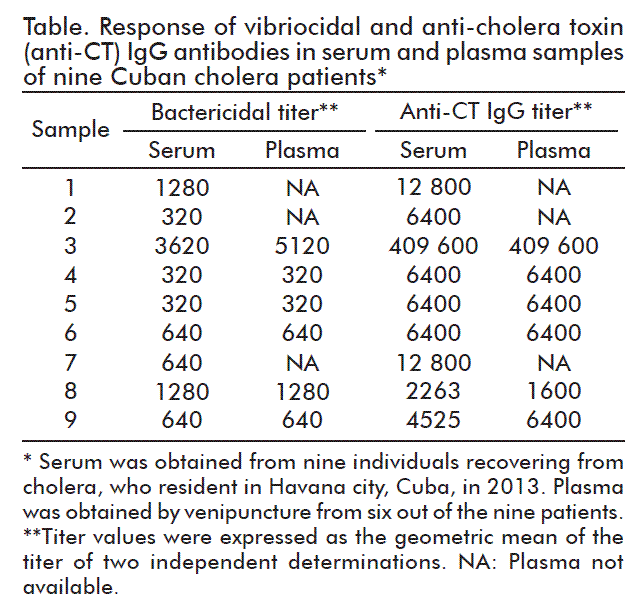
<body><![CDATA[<P   ><font size="2" face="Verdana, Arial, Helvetica, sans-serif">The vibriocidal antibody      assay was performed as previously described [15]. Briefly, serum or human      plasma samples were subjected to serial paired dilutions with saline solution      (0.85 % NaCl) in sterile microtitration plates (Greiner, Germany). Starting      from a 1:20 to 1:40 960 dilutions. Each sample was evaluated in duplicates.      <I>V. cholerae </I>VC12 was cultured in Brain Heart Infusion medium (BHI)      at 37 &deg;C for 4 h. Then, biomass was collected in physiological saline      solution, adjusted to a concentration of approximately 10<sup>7</sup> c.f.u./mL      and mixed with the same volume of young rabbit complement diluted 1:5 in saline      solution. Sera were mixed with equivalent volumes of the bacterium-complement      suspension and the plates were further incubated at 37 &deg;C for 1 h. The      positive and negative control serum samples and a suspension control were      included on each plate, mixed with serum-free complement. Right after the      complement-dependent cell lysis reaction, 150 &mu;L of indicator medium (LB      supplemented with glucose 1 % and purple bromocresol 0.003 %) were added.      Then plates were incubated for 3 h and the reaction read by visual inspection.      The titer of vibriocidal antibodies was expressed as the reciprocal of the      highest dilution at which complete inhibition of bacterial growth was achieved,      detected by the absence of color change in the culture medium. </font></P >   <FONT size="+1"><FONT size="+1">        <P   ><font size="2" face="Verdana, Arial, Helvetica, sans-serif"><b>Cholera anti-toxin      antibody detection by ELISA </b></font></P >       <P   ><font size="2" face="Verdana, Arial, Helvetica, sans-serif">Alternate wells of      Maxisorp 96-well microtitration plates (Nunc, Denmark) were coated with 100      &mu;L of 1 &mu;g/mL CT (Sigma) in carbonate buffer (0.05 M, pH 9.6). Uncoated      wells were filled with 100 &mu;L of 0.01 M phosphate-buffered saline, pH 7.2,      plus 0.05 % Tween (PBS-T). Plates were incubated overnight at 4 &deg;C, subsequently      washed three times with PBS-T and blocked with PBS supplemented with skimmed      milk at 5 %. Then, the 1:200 diluted sera were added in PBS-T and paired serial      dilutions were performed. Plates were incubated at 37 &deg;C for 1 h. After      washing with PBS-T, an anti-human IgG-peroxidase conjugate preparation (CIGB-Sacti      Spiritus, Cuba) was added. Reactions were developed by adding 50 &mu;L of      1 mg/mL 3,3&rsquo;,5,5&rsquo;-Tetramethylbenzidine substrate (Sigma Chemical      Co., Germany) and H<sub>2</sub>O<sub>2</sub> 0.0064 % in sodium acetate buffer      0.11 M, pH 5.5. Reactions were stopped by adding 50 &mu;L of 2.5 N H<sub>2</sub>SO<sub>4</sub>      and the plates were read on a DIALAB microplate reader (Austria) at a wavelength      of 450 nm. The cutoff value was established as the mean reading of the negative      control serum plus 3 times the standard deviation. The anti-CT antibody titer      was determined as the reciprocal of the highest dilution at which the optical      density (OD) was greater than or equal to the cutoff value. </font></P >   <FONT size="+1"><FONT size="+1"><FONT size="+1"><FONT size="+1"><FONT size="+1"><FONT size="+1"><FONT size="+1"><FONT size="+1">        <P   ><font size="2" face="Verdana, Arial, Helvetica, sans-serif"><b>Statistical analysis      </b> </font></P >       <P   ><font size="2" face="Verdana, Arial, Helvetica, sans-serif">The statistical analysis      was performed using the statistical package GraphPad Prism 5 (GraphPad Software,      Inc., La Jolla, CA, USA). A statistical significance level of 0.05 % was used      for all comparisons. Results of the vibriocidal antibody titers and the level      of anti-CT-specific antibodies in the relevant serum and plasma samples were      plotted, and the correlation between values of both assays was examined using      the Pearson correlation coefficient (r). </font></P >       <P   >&nbsp;</P >       <P   ><font size="2" face="Verdana, Arial, Helvetica, sans-serif"><b><font size="3">RESULTS      AND DISCUSSION </font> </b> </font></P >       <P   ><font size="2" face="Verdana, Arial, Helvetica, sans-serif"><b>Correlation of      vibriocidal response and anti-CT antibodies in human serum and plasma samples      </b></font></P >       <P   ><font size="2" face="Verdana, Arial, Helvetica, sans-serif">The alternative use      of either serum or plasma samples in antibody detection assays has been reported,      but few studies have correlated antibody titers against microbial antigens      between both types of samples obtained concomitantly [16, 17]. Hence, we examined      the activity of bacterial growth inhibitory antibodies (vibriocides) as well      as anti-CT IgG antibody levels in the blood of patients diagnosed with cholera,      and its correlation. Samples were taken generally from 18 to 28 days after      patient discharge. Considering that the in-hospital period ranged from 3 to      10 days after the onset of disease symptoms, most samples were older than      28 days from the start of infection. Only in one case the sample was obtained      earlier, at 14 days. Blood samples were collected from nine patients, from      which serum was prepared and only six samples were also processed for plasma      obtainment. All serum and plasma samples were positive for vibriocidal and      cholera anti-CT antibodies (<a href="/img/revistas/bta/v34n2/t0104217.gif">Table</a>). </font></P >       
<P   ><font size="2" face="Verdana, Arial, Helvetica, sans-serif">The high antibody      titers detected in serum indicate the effective stimulation of the immune      system against both the somatic antigen and CT in all the patients. The relative      increase of anti-CT titers regarding unstimulated individuals (below 200)      was far higher than those observed for bactericidal antibodies, probably due      to the slower decline kinetics. Anti-CT IgG antibodies reach their maximum      value from 21 to 28 days after the onset of the disease and can remain at      detectable levels for up to two years after infection. Nevertheless, maximum      values of bactericidal anti-bodies (mainly IgM) are reached from 7 to 10 days      after and decrease significantly thereafter [17-19]. </font></P >       ]]></body>
<body><![CDATA[<P   ><font size="2" face="Verdana, Arial, Helvetica, sans-serif">Identical values      of vibriocidal antibody titers and anti-CT IgG were detected in paired analysis      of serum and plasma samples, in 5/6 and 4/6 samples, respectively. Variations      were within the range of error allowed for each technique (&plusmn; 1 dilution).      Noteworthy, a statistically significant correlation was found between the      titers of vibriocidal antibodies of the respective serum and plasma samples      (r = 0.9974, p &lt; 0.0001, <a href="/img/revistas/bta/v34n2/f0104217.gif">Figure 1</a>), as well      as in the level of specific antibodies against CT (r = 0.9934, p &lt; 0.0001,      <a href="/img/revistas/bta/v34n2/f0204217.gif">Figure 2</a>). This indicates that neither the anticoagulant      nor the remaining components present in plasma cause significant variations      in vibriocidal and anti-CT titers, as compared to the titer of the respective      serum samples. </font></P >       
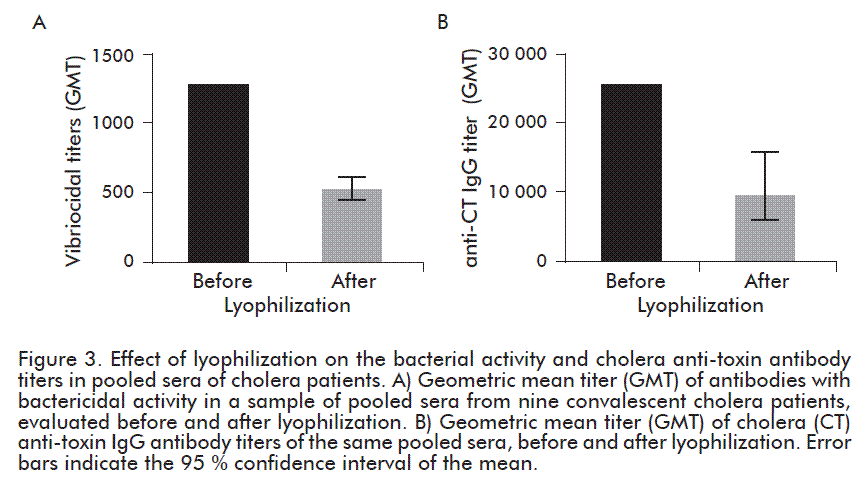
<P   ><font size="2" face="Verdana, Arial, Helvetica, sans-serif">Simultaneously, during      the preparation of this report, another research group published results somewhat      differing from ours [20]. They found that heparin is an anticoagulant adequate      for blood collection and to measure vibriocidal activity and to quantify antibody      levels against different <I>V. cholerae </I>antigens in plasma samples. Nonetheless,      they report that the use of EDTA in plasma production does not affect the      quantification of specific antibodies but interferes in the determination      of bactericidal activity. </font></P >       <P   ><font size="2" face="Verdana, Arial, Helvetica, sans-serif">In this regard, in      the history of bactericidal assays for cholera, different methodologies have      been developed, with different endpoints and methods for the determination      of vibriocidal titers. Analysis based on microtitration plates has been widely      used to assess the effectiveness of vaccines against <I>V. cholerae </I>[15,      21, 22]. The two variants most commonly used for determining the bactericidal      titer are: spectrophotometric determination and visual observation using a      chromogenic substrate as an indicator of pH changes [23] or redox changes      [24]. </font></P >       <P   ><font size="2" face="Verdana, Arial, Helvetica, sans-serif">Cedr&eacute; <I>et      al</I>. developed a colorimetric method by adding glucose and a pH indicator      to the culture medium for growing the surviving cells, which has been used      in the clinical assessment of vaccine candidates against cholera developed      in Cuba [15]. This method is based on the fact that vibrios surviving the      bactericidal action grow at the expense of nutrients, leading to culture medium      acidification that causes the color change of the indicator from purple to      yellow. In this method the titer corresponds to 98 % or more bacterial lysis      detected for the serum-free control [15, 25]. In the abovementioned study      [20], a bactericidal procedure was used in microtitration plates, the end      point established by spectrophotometric determination after 4 h of growth,      and the highest dilution that completely inhibited bacterial growth was set      as the vibriocidal titer [20]. The method of choice to establish the cutoff      criterion determines the sensitivity of each technique and the ability to      detect the effect that a given factor may have on the kinetics of bactericidal      activity. The observed differences as for the influence of the anticoagulant,      in this case EDTA, on the final result of the assay could be attributed to      methodological differences between both experimental settings, mainly due      to differences for determining the endpoint. In this case, the advantage of      having a simple and fast method, through visual inspection of the pH indicator      color change, is associated to a lower sensitivity. Altogether, our results      support the use of plasma samples obtained in the presence of EDTA for the      assessment of the vibriocidal response with the colorimetric method developed      in Cuba. The influence of other anticoagulants on the results shown here should      be further evaluated. It was also evidenced that the variety of techniques      implemented by different laboratories worldwide to measure the vibriocidal      response complicates the extrapolation and comparison of results. </font></P >       <P   ><font size="2" face="Verdana, Arial, Helvetica, sans-serif"><b>Obtainment of      control serum as positive and negative reference material for the evaluation      of the immune response against <I>V. cholerae </I></b> </font></P >       <P   ><font size="2" face="Verdana, Arial, Helvetica, sans-serif">Considering the presence      of antibodies against <I>V. cholerae </I>in the serum samples available, corresponding      to nine cholera-convalescent subjects, they were pooled in a single sample      set as positive control for the evaluation of the immune response against      this microorganism. The presence of bactericidal and anti-CT antibodies was      evaluated in this sample, with titers of 1280 and 25 600, respectively, what      make it available as positive control serum for both analytical techniques.      </font></P >       <P   ><font size="2" face="Verdana, Arial, Helvetica, sans-serif">Similarly, a negative      control reference sample was generated by evaluating plasma obtained from      healthy blood donors, the mixture was found to have undetectable levels of      both vibriocidal and anti-CT antibodies. Hence, it was established as negative      control in the clinical trial. </font></P >       <P   ><font size="2" face="Verdana, Arial, Helvetica, sans-serif">To generate reference      samples of greater stability, batches were prepared of each control (positive      and negative), by fractionating the reference samples in aliquots that were      lyophilized in the presence of 6.6 % bovine serum albumin. After lyophilization,      3 vials were processed from each batch per day (vials from the same batch      processed in the same plate and in duplicate), which were reconstituted and      the bactericidal activity and anti-CT titers reassessed (<a href="/img/revistas/bta/v34n2/f0304217.gif">Figure      3</a>). </font></P >       
<P   ><font size="2" face="Verdana, Arial, Helvetica, sans-serif">Following lyophilization,      a statistically significant reduction was observed in vibriocidal titers (median:      640, Mann Whitney U-test, p = 0.0025) and anti-CT IgG titers (median: 12 800,      Mann Whitney U-Test, p = 0.0179). In the case of the determination assay for      anti-CT antibody test in human serum, a titer of 400 is considered positive,      while seroconversion criterion for bactericidal antibodies is established      based on a four-fold increase in titer values in respect to that of pre-immune      serum, which is usually in a range between 20 and 80 in individuals without      prior exposure to <I>V. cholerae </I>[9]. These elements determined that both      the anti-CT and vibriocidal antibody titers in the analyzed reference sample      are considered unequivocally positive and it is ready to be used as control      material in both assays. On the other hand, the negative control reference      sample maintained the antibody levels detected before lyophilization, with      assigned titers of 10 (vibriocidal titer) and 100 (anti-CT antibody titer),      respectively. These results allow us to conclude that both reference samples      can be used as positive and negative controls, respectively, in assays to      determine vibriocidal and anti-CT antibodies present in human serum samples.      Moreover, these provide us an advantage for the research, since the homogeneity      and stability of samples is guaranteed during the clinical evaluation of vaccine      candidates. They are very valuable reference quality control tools that allow      detecting any deviation of the results during the execution of each technique,      as well as to harmonize the results among different tests. </font></P >       <P   >&nbsp;</P >       ]]></body>
<body><![CDATA[<P   > </P >       <P   ><b><font size="3" face="Verdana, Arial, Helvetica, sans-serif">CONCLUSIONS </font></b></P >       <P   ><font size="2" face="Verdana, Arial, Helvetica, sans-serif">In summary, our results      indicate that serum and plasma samples obtained in the presence of EDTA at      the concentration tested can be used interchangeably to perform the quantification      assay of anti-CT and vibriocidal antibody levels. Notably, the correlation      between the vibriocidal titers corresponding to each type of sample will depend      on the characteristics of the test used. It is also reported the collection      and evaluation of human sera and plasma reference samples positive and negative      against anti-cholera antibodies. These can be applied as controls in assays      aimed to determine cholera anti-toxin antibodies and vibriocidal activity      during the clinical assessment of vaccines against cholera. </font></P >       <P   >&nbsp;</P >       <P   > </P >       <P   ><font size="3"><b><font face="Verdana, Arial, Helvetica, sans-serif">REFERENCES      </font></b></font></P >       <!-- ref --><P   ><font size="2" face="Verdana, Arial, Helvetica, sans-serif">1. Petri WA, Miller      M, Binder HJ, Levine MM, Dillingham R, Guerrant RL. Enteric infections, diarrhea,      and their impact on function and development. J Clin Invest. 2008;118(4):1277-90.          </font></P >   <FONT size="+1">        <!-- ref --><P   ><font size="2" face="Verdana, Arial, Helvetica, sans-serif">2. Lopez AL, Clemens      JD, Deen J, Jodar L. Cholera vaccines for the developing world. Hum Vaccin.      2008;4(2):165-9.     </font></P >       ]]></body>
<body><![CDATA[<!-- ref --><P   ><font size="2" face="Verdana, Arial, Helvetica, sans-serif">3. Saha D, LaRocque      RC, Khan AI, Harris JB, Begum YA, Akramuzzaman SM, <I>et al</I>. Incomplete      correlation of serum vibriocidal antibody titer with protection from Vibrio      cholerae infection in urban Bangladesh. J Infect Dis. 2004;189(12):2318-22.          </font></P >       <!-- ref --><P   ><font size="2" face="Verdana, Arial, Helvetica, sans-serif">4. Glass RI, Svennerholm      AM, Khan MR, Huda S, Huq MI, Holmgren J. Seroepidemiological studies of El      Tor cholera in Bangladesh: association of serum antibody levels with protection.      J Infect Dis. 1985;151(2):236-42.     </font></P >       <!-- ref --><P   ><font size="2" face="Verdana, Arial, Helvetica, sans-serif">5. Qadri F, Ahmed      F, Karim MM, Wenneras C, Begum YA, Abdus Salam M, <I>et al</I>. Lipopolysaccharide-      and cholera toxin-specific subclass distribution of B-cell responses in cholera.      Clin Diagn Lab Immunol. 1999;6(6):812-8.     </font></P >       <!-- ref --><P   ><font size="2" face="Verdana, Arial, Helvetica, sans-serif">6. Viret JF, Favre      D, Wegmuller B, Herzog C, Que JU, Cryz SJ, <I>et al</I>. Mucosal and systemic      immune responses in humans after primary and booster immunizations with orally      administered invasive and noninvasive live attenuated bacteria. Infect Immun.      1999;67(7):3680-5.     </font></P >       <!-- ref --><P   ><font size="2" face="Verdana, Arial, Helvetica, sans-serif">7. Clemens J, Sack      D, Rao M, Chakraborty J, Kay B, Ahmed F, <I>et al</I>. The design and analysis      of cholera vaccine trials: recent lessons from Bangladesh. Int J Epidemiol.      1993;22(4):724-30.     </font></P >       ]]></body>
<body><![CDATA[<!-- ref --><P   ><font size="2" face="Verdana, Arial, Helvetica, sans-serif">8. Croft NM, Hodges      M. IgM: mucosal response in acute diarrhoeal disease of infants. Scand J Gastroenterol.      2005;40(8):965-71.     </font></P >       <!-- ref --><P   ><font size="2" face="Verdana, Arial, Helvetica, sans-serif">9. Losonsky GA, Yunyongying      J, Lim V, Reymann M, Lim YL, Wasserman SS, <I>et al</I>. Factors influencing      secondary vibriocidal immune responses: relevance for understanding immunity      to cholera. Infect Immun. 1996;64(1):10-5.     </font></P >       <!-- ref --><P   ><font size="2" face="Verdana, Arial, Helvetica, sans-serif">10. Chen WH, Cohen      MB, Kirkpatrick BD, Brady RC, Galloway D, Gurwith M, <I>et al</I>. Single-dose      Live Oral Cholera Vaccine CVD 103-HgR Protects Against Human Experimental      Infection With Vibrio cholerae O1 El Tor. Clin Infect Dis. 2016;62(11):1329-35.          </font></P >       <!-- ref --><P   ><font size="2" face="Verdana, Arial, Helvetica, sans-serif">11. Mollnes TE, Garred      P, Bergseth G. Effect of time, temperature and anticoagulants on <I>in vitro      </I>complement activation: consequences for collection and preservation of      samples to be examined for complement activation. Clin Exp Immunol. 1988;73(3):484-8.          </font></P >       <!-- ref --><P   ><font size="2" face="Verdana, Arial, Helvetica, sans-serif">12. Ocana-Morgner      C, Dankert JR. Induction of complement sensitivity in <I>Escherichia coli      </I>by citric acid and low pH. J Appl Microbiol. 2001;90(5):771-8.     </font></P >       ]]></body>
<body><![CDATA[<!-- ref --><P   ><font size="2" face="Verdana, Arial, Helvetica, sans-serif">13. Sambrook J; Fritsch      EF; Maniatis T. Molecular Cloning: A Laboratory Manual. New York: Cold Spring      Harbor Laboratory Press; 1989.     </font></P >       <P   ><font size="2" face="Verdana, Arial, Helvetica, sans-serif">14. WMA Declaration      of Helsinki - Ethical Principles for Medical Research Involving Human Subjects      [Internet]. Ferney-Voltaire: World Medical Association, Inc.; 2013 [cited      2015 Oct 11]. Available from: <A href="http://www.wma.net/en/30publications/10policies/b3/" target="_blank">      <FONT color="#0000FF">http://www.wma.net/en/30publications/10policies/b3/</font></A><FONT color="#0000FF"><FONT color="#211E1F">.      </font></font></font></P >   <FONT color="#0000FF"><FONT color="#211E1F">        <!-- ref --><P   ><font size="2" face="Verdana, Arial, Helvetica, sans-serif">15. Cedr&eacute;      B, Viel Y, Rodr&iacute;guez T, A&ntilde;o G, Pino Y, Garc&iacute;a H. Validaci&oacute;n      del ensayo vibriocida colorim&eacute;trico para determinar anticuerpos s&eacute;ricos      contra cepas candidatas vacunales de <I>Vibrio cholerae</I>. Vaccimonitor      2003;12(1):23-30.     </font></P >       <!-- ref --><P   ><font size="2" face="Verdana, Arial, Helvetica, sans-serif">16. Siev M, Yu X,      Prados-Rosales R, Martiniuk FT, Casadevall A, Achkar JM. Correlation between      serum and plasma antibody titers to mycobacterial antigens. Clin Vaccine Immunol.      2011;18(1):173-5.     </font></P >       <!-- ref --><P   ><font size="2" face="Verdana, Arial, Helvetica, sans-serif">17. Uddin T, Harris      JB, Bhuiyan TR, Shirin T, Uddin MI, Khan AI, <I>et al</I>. Mucosal immunologic      responses in cholera patients in Bangladesh. Clin Vaccine Immunol. 2011;18(3):506-12.          </font></P >       <P   ><font size="2" face="Verdana, Arial, Helvetica, sans-serif">18. Levine MM, Young      CR, Hughes TP, O&rsquo;Donnell S, Black RE, Clements ML, <I>et al</I>. Duration      of serum antitoxin response following <I>Vibrio cholerae </I>infection in      North Americans: relevance for seroepidemiology. Am J Epidemiol. 1981;114(3):348-54.      </font></P >       ]]></body>
<body><![CDATA[<!-- ref --><P   ><font size="2" face="Verdana, Arial, Helvetica, sans-serif">19. Levine MM, Black      RE, Clements ML, Cisneros L, Nalin DR, Young CR. Duration of infection-derived      immunity to cholera. J Infect Dis. 1981;143(6):818-20.     </font></P >       <!-- ref --><P   ><font size="2" face="Verdana, Arial, Helvetica, sans-serif">20. Yang JS, Kang      SS, Yun CH, Han SH. Evaluation of anticoagulants for serologic assays of cholera      vaccination. Clin Vaccine Immunol. 2014;21(6):854-8.     </font></P >       <!-- ref --><P   ><font size="2" face="Verdana, Arial, Helvetica, sans-serif">21. Yang JS, Kim      HJ, Yun CH, Kang SS, Im J, Kim HS, <I>et al</I>. A semi-automated vibriocidal      assay for improved measurement of cholera vaccine-induced im-mune responses.      J Microbiol Methods. 2007;71(2):141-6.     </font></P >       <!-- ref --><P   ><font size="2" face="Verdana, Arial, Helvetica, sans-serif">22. Attridge SR,      Johansson C, Trach DD, Qadri F, Svennerholm AM. Sensitive microplate assay      for detection of bactericidal antibodies to <I>Vibrio cholerae </I>O139. Clin      Diagn Lab Immunol. 2002;9(2):383-7.     </font></P >       <!-- ref --><P   ><font size="2" face="Verdana, Arial, Helvetica, sans-serif">23. Cedre Marrero      B, Garcia Sanchez HM, Garcia Imia LG, Talavera Coronel A. Standardization      and evaluation of the modified vibriocidal assay. Rev Cubana Med Trop. 1999;51(3):156-9.          </font></P >       ]]></body>
<body><![CDATA[<!-- ref --><P   ><font size="2" face="Verdana, Arial, Helvetica, sans-serif">24. Boutonnier A,      Dassy B, Dumenil R, Guenole A, Ratsitorahina M, Migliani R, <I>et al</I>.      A simple and convenient microtiter plate assay for the detection of bactericidal      antibodies to <I>Vibrio cholerae </I>O1 and <I>Vibrio cholerae </I>O139. J      Microbiol Methods. 2003;55(3):745-53.     </font></P >       <!-- ref --><P   ><font size="2" face="Verdana, Arial, Helvetica, sans-serif">25. Vichi J, Suzarte      E, Led&oacute;n T, Fando R. Optimizaci&oacute;n del ensayo vibriocida colorim&eacute;trico      para <I>V. cholerae </I>O139. Revista CENIC Ciencias Biol&oacute;gicas. 2011;42(2):      89-96.     </font></P >       <P   > </P >   <FONT size="+1">        <P   >&nbsp;</P >       <P   >&nbsp;</P >       <P   ><font size="2" face="Verdana, Arial, Helvetica, sans-serif">Received in October,      2016.     <br>     Accepted in April, 2017. </font></P >   <FONT size="+1">        <P   >&nbsp;</P >       ]]></body>
<body><![CDATA[<P   >&nbsp;</P >       <P   > </P >   <FONT size="+1" color="#000000">        <P   ><font size="2" color="#211E1F" face="Verdana, Arial, Helvetica, sans-serif"><i>Talena      Led&oacute;n-P&eacute;rez</i>. Departamento de Biolog&iacute;a Molecular,      Direcci&oacute;n de Enfermedades Infecciosas, Centro Nacional de Investigaciones      Cient&iacute;ficas, CNIC. AP 6412, La Habana, Cuba. E-mail: <A href="mailto:talena.ledon@cnic.edu.cu">      <FONT color="#0000FF">talena.ledon@cnic.edu.cu</font></A><FONT color="#0000FF">.      </font></font></P >   </font></font></font></font></font></font></font></font></font></font></font></font></font></font></font></font></font></font></font></font></font></font></font></font></font></font></font></font></font></font></font></font></font></font></font></font></font></font></font></font></font></font></font></font></font></font></DIV >      ]]></body><back>
<ref-list>
<ref id="B1">
<label>1</label><nlm-citation citation-type="journal">
<person-group person-group-type="author">
<name>
<surname><![CDATA[Petri]]></surname>
<given-names><![CDATA[WA]]></given-names>
</name>
<name>
<surname><![CDATA[Miller]]></surname>
<given-names><![CDATA[M]]></given-names>
</name>
<name>
<surname><![CDATA[Binder]]></surname>
<given-names><![CDATA[HJ]]></given-names>
</name>
<name>
<surname><![CDATA[Levine]]></surname>
<given-names><![CDATA[MM]]></given-names>
</name>
<name>
<surname><![CDATA[Dillingham]]></surname>
<given-names><![CDATA[R]]></given-names>
</name>
<name>
<surname><![CDATA[Guerrant]]></surname>
<given-names><![CDATA[RL]]></given-names>
</name>
</person-group>
<article-title xml:lang="en"><![CDATA[Enteric infections, diarrhea, and their impact on function and development]]></article-title>
<source><![CDATA[J Clin Invest]]></source>
<year>2008</year>
<volume>118</volume>
<numero>4</numero>
<issue>4</issue>
<page-range>1277-90</page-range></nlm-citation>
</ref>
<ref id="B2">
<label>2</label><nlm-citation citation-type="journal">
<person-group person-group-type="author">
<name>
<surname><![CDATA[Lopez]]></surname>
<given-names><![CDATA[AL]]></given-names>
</name>
<name>
<surname><![CDATA[Clemens]]></surname>
<given-names><![CDATA[JD]]></given-names>
</name>
<name>
<surname><![CDATA[Deen]]></surname>
<given-names><![CDATA[J]]></given-names>
</name>
<name>
<surname><![CDATA[Jodar]]></surname>
<given-names><![CDATA[L]]></given-names>
</name>
</person-group>
<article-title xml:lang="en"><![CDATA[Cholera vaccines for the developing world]]></article-title>
<source><![CDATA[Hum Vaccin]]></source>
<year>2008</year>
<volume>4</volume>
<numero>2</numero>
<issue>2</issue>
<page-range>165-9</page-range></nlm-citation>
</ref>
<ref id="B3">
<label>3</label><nlm-citation citation-type="journal">
<person-group person-group-type="author">
<name>
<surname><![CDATA[Saha]]></surname>
<given-names><![CDATA[D]]></given-names>
</name>
<name>
<surname><![CDATA[LaRocque]]></surname>
<given-names><![CDATA[RC]]></given-names>
</name>
<name>
<surname><![CDATA[Khan]]></surname>
<given-names><![CDATA[AI]]></given-names>
</name>
<name>
<surname><![CDATA[Harris]]></surname>
<given-names><![CDATA[JB]]></given-names>
</name>
<name>
<surname><![CDATA[Begum]]></surname>
<given-names><![CDATA[YA]]></given-names>
</name>
<name>
<surname><![CDATA[Akramuzzaman]]></surname>
<given-names><![CDATA[SM]]></given-names>
</name>
</person-group>
<article-title xml:lang="en"><![CDATA[Incomplete correlation of serum vibriocidal antibody titer with protection from Vibrio cholerae infection in urban Bangladesh]]></article-title>
<source><![CDATA[J Infect Dis]]></source>
<year>2004</year>
<volume>189</volume>
<numero>12</numero>
<issue>12</issue>
<page-range>2318-22</page-range></nlm-citation>
</ref>
<ref id="B4">
<label>4</label><nlm-citation citation-type="journal">
<person-group person-group-type="author">
<name>
<surname><![CDATA[Glass]]></surname>
<given-names><![CDATA[RI]]></given-names>
</name>
<name>
<surname><![CDATA[Svennerholm]]></surname>
<given-names><![CDATA[AM]]></given-names>
</name>
<name>
<surname><![CDATA[Khan]]></surname>
<given-names><![CDATA[MR]]></given-names>
</name>
<name>
<surname><![CDATA[Huda]]></surname>
<given-names><![CDATA[S]]></given-names>
</name>
<name>
<surname><![CDATA[Huq]]></surname>
<given-names><![CDATA[MI]]></given-names>
</name>
<name>
<surname><![CDATA[Holmgren]]></surname>
<given-names><![CDATA[J]]></given-names>
</name>
</person-group>
<article-title xml:lang="en"><![CDATA[Seroepidemiological studies of El Tor cholera in Bangladesh: association of serum antibody levels with protection]]></article-title>
<source><![CDATA[J Infect Dis]]></source>
<year>1985</year>
<volume>151</volume>
<numero>2</numero>
<issue>2</issue>
<page-range>236-42</page-range></nlm-citation>
</ref>
<ref id="B5">
<label>5</label><nlm-citation citation-type="journal">
<person-group person-group-type="author">
<name>
<surname><![CDATA[Qadri]]></surname>
<given-names><![CDATA[F]]></given-names>
</name>
<name>
<surname><![CDATA[Ahmed]]></surname>
<given-names><![CDATA[F]]></given-names>
</name>
<name>
<surname><![CDATA[Karim]]></surname>
<given-names><![CDATA[MM]]></given-names>
</name>
<name>
<surname><![CDATA[Wenneras]]></surname>
<given-names><![CDATA[C]]></given-names>
</name>
<name>
<surname><![CDATA[Begum]]></surname>
<given-names><![CDATA[YA]]></given-names>
</name>
<name>
<surname><![CDATA[Abdus Salam]]></surname>
<given-names><![CDATA[M]]></given-names>
</name>
</person-group>
<article-title xml:lang="en"><![CDATA[Lipopolysaccharide- and cholera toxin-specific subclass distribution of B-cell responses in cholera]]></article-title>
<source><![CDATA[Clin Diagn Lab Immunol]]></source>
<year>1999</year>
<volume>6</volume>
<numero>6</numero>
<issue>6</issue>
<page-range>812-8</page-range></nlm-citation>
</ref>
<ref id="B6">
<label>6</label><nlm-citation citation-type="journal">
<person-group person-group-type="author">
<name>
<surname><![CDATA[Viret]]></surname>
<given-names><![CDATA[JF]]></given-names>
</name>
<name>
<surname><![CDATA[Favre]]></surname>
<given-names><![CDATA[D]]></given-names>
</name>
<name>
<surname><![CDATA[Wegmuller]]></surname>
<given-names><![CDATA[B]]></given-names>
</name>
<name>
<surname><![CDATA[Herzog]]></surname>
<given-names><![CDATA[C]]></given-names>
</name>
<name>
<surname><![CDATA[Que]]></surname>
<given-names><![CDATA[JU]]></given-names>
</name>
<name>
<surname><![CDATA[Cryz]]></surname>
<given-names><![CDATA[SJ]]></given-names>
</name>
</person-group>
<article-title xml:lang="en"><![CDATA[Mucosal and systemic immune responses in humans after primary and booster immunizations with orally administered invasive and noninvasive live attenuated bacteria]]></article-title>
<source><![CDATA[Infect Immun]]></source>
<year>1999</year>
<volume>67</volume>
<numero>7</numero>
<issue>7</issue>
<page-range>3680-5</page-range></nlm-citation>
</ref>
<ref id="B7">
<label>7</label><nlm-citation citation-type="journal">
<person-group person-group-type="author">
<name>
<surname><![CDATA[Clemens]]></surname>
<given-names><![CDATA[J]]></given-names>
</name>
<name>
<surname><![CDATA[Sack]]></surname>
<given-names><![CDATA[D]]></given-names>
</name>
<name>
<surname><![CDATA[Rao]]></surname>
<given-names><![CDATA[M]]></given-names>
</name>
<name>
<surname><![CDATA[Chakraborty]]></surname>
<given-names><![CDATA[J]]></given-names>
</name>
<name>
<surname><![CDATA[Kay]]></surname>
<given-names><![CDATA[B]]></given-names>
</name>
<name>
<surname><![CDATA[Ahmed]]></surname>
<given-names><![CDATA[F]]></given-names>
</name>
</person-group>
<article-title xml:lang="en"><![CDATA[The design and analysis of cholera vaccine trials: recent lessons from Bangladesh]]></article-title>
<source><![CDATA[Int J Epidemiol]]></source>
<year>1993</year>
<volume>22</volume>
<numero>4</numero>
<issue>4</issue>
<page-range>724-30</page-range></nlm-citation>
</ref>
<ref id="B8">
<label>8</label><nlm-citation citation-type="journal">
<person-group person-group-type="author">
<name>
<surname><![CDATA[Croft]]></surname>
<given-names><![CDATA[NM]]></given-names>
</name>
<name>
<surname><![CDATA[Hodges]]></surname>
<given-names><![CDATA[M]]></given-names>
</name>
</person-group>
<article-title xml:lang="en"><![CDATA[IgM: mucosal response in acute diarrhoeal disease of infants]]></article-title>
<source><![CDATA[Scand J Gastroenterol]]></source>
<year>2005</year>
<volume>40</volume>
<numero>8</numero>
<issue>8</issue>
<page-range>965-71</page-range></nlm-citation>
</ref>
<ref id="B9">
<label>9</label><nlm-citation citation-type="journal">
<person-group person-group-type="author">
<name>
<surname><![CDATA[Losonsky]]></surname>
<given-names><![CDATA[GA]]></given-names>
</name>
<name>
<surname><![CDATA[Yunyongying]]></surname>
<given-names><![CDATA[J]]></given-names>
</name>
<name>
<surname><![CDATA[Lim]]></surname>
<given-names><![CDATA[V]]></given-names>
</name>
<name>
<surname><![CDATA[Reymann]]></surname>
<given-names><![CDATA[M]]></given-names>
</name>
<name>
<surname><![CDATA[Lim]]></surname>
<given-names><![CDATA[YL]]></given-names>
</name>
<name>
<surname><![CDATA[Wasserman]]></surname>
<given-names><![CDATA[SS]]></given-names>
</name>
</person-group>
<article-title xml:lang="en"><![CDATA[Factors influencing secondary vibriocidal immune responses: relevance for understanding immunity to cholera]]></article-title>
<source><![CDATA[Infect Immun]]></source>
<year>1996</year>
<volume>64</volume>
<numero>1</numero>
<issue>1</issue>
<page-range>10-5</page-range></nlm-citation>
</ref>
<ref id="B10">
<label>10</label><nlm-citation citation-type="journal">
<person-group person-group-type="author">
<name>
<surname><![CDATA[Chen]]></surname>
<given-names><![CDATA[WH]]></given-names>
</name>
<name>
<surname><![CDATA[Cohen]]></surname>
<given-names><![CDATA[MB]]></given-names>
</name>
<name>
<surname><![CDATA[Kirkpatrick]]></surname>
<given-names><![CDATA[BD]]></given-names>
</name>
<name>
<surname><![CDATA[Brady]]></surname>
<given-names><![CDATA[RC]]></given-names>
</name>
<name>
<surname><![CDATA[Galloway]]></surname>
<given-names><![CDATA[D]]></given-names>
</name>
<name>
<surname><![CDATA[Gurwith]]></surname>
<given-names><![CDATA[M]]></given-names>
</name>
</person-group>
<article-title xml:lang="en"><![CDATA[Single-dose Live Oral Cholera Vaccine CVD 103-HgR Protects Against Human Experimental Infection With Vibrio cholerae O1 El Tor]]></article-title>
<source><![CDATA[Clin Infect Dis]]></source>
<year>2016</year>
<volume>62</volume>
<numero>11</numero>
<issue>11</issue>
<page-range>1329-35</page-range></nlm-citation>
</ref>
<ref id="B11">
<label>11</label><nlm-citation citation-type="journal">
<person-group person-group-type="author">
<name>
<surname><![CDATA[Mollnes]]></surname>
<given-names><![CDATA[TE]]></given-names>
</name>
<name>
<surname><![CDATA[Garred]]></surname>
<given-names><![CDATA[P]]></given-names>
</name>
<name>
<surname><![CDATA[Bergseth]]></surname>
<given-names><![CDATA[G]]></given-names>
</name>
</person-group>
<article-title xml:lang="en"><![CDATA[Effect of time, temperature and anticoagulants on in vitro complement activation: consequences for collection and preservation of samples to be examined for complement activation]]></article-title>
<source><![CDATA[Clin Exp Immunol]]></source>
<year>1988</year>
<volume>73</volume>
<numero>3</numero>
<issue>3</issue>
<page-range>484-8</page-range></nlm-citation>
</ref>
<ref id="B12">
<label>12</label><nlm-citation citation-type="journal">
<person-group person-group-type="author">
<name>
<surname><![CDATA[Ocana-Morgner]]></surname>
<given-names><![CDATA[C]]></given-names>
</name>
<name>
<surname><![CDATA[Dankert]]></surname>
<given-names><![CDATA[JR]]></given-names>
</name>
</person-group>
<article-title xml:lang="en"><![CDATA[Induction of complement sensitivity in Escherichia coli by citric acid and low pH]]></article-title>
<source><![CDATA[J Appl Microbiol]]></source>
<year>2001</year>
<volume>90</volume>
<numero>5</numero>
<issue>5</issue>
<page-range>771-8</page-range></nlm-citation>
</ref>
<ref id="B13">
<label>13</label><nlm-citation citation-type="book">
<person-group person-group-type="author">
<name>
<surname><![CDATA[Sambrook]]></surname>
<given-names><![CDATA[J]]></given-names>
</name>
<name>
<surname><![CDATA[Fritsch]]></surname>
<given-names><![CDATA[EF]]></given-names>
</name>
<name>
<surname><![CDATA[Maniatis]]></surname>
<given-names><![CDATA[T]]></given-names>
</name>
</person-group>
<source><![CDATA[Molecular Cloning: A Laboratory Manual]]></source>
<year>1989</year>
<publisher-loc><![CDATA[New York ]]></publisher-loc>
<publisher-name><![CDATA[Cold Spring Harbor Laboratory Press]]></publisher-name>
</nlm-citation>
</ref>
<ref id="B14">
<label>14</label><nlm-citation citation-type="book">
<collab>WMA</collab>
<source><![CDATA[Declaration of Helsinki - Ethical Principles for Medical Research Involving Human Subjects]]></source>
<year>2016</year>
<publisher-loc><![CDATA[Ferney-Voltaire ]]></publisher-loc>
<publisher-name><![CDATA[World Medical Association, Inc.]]></publisher-name>
</nlm-citation>
</ref>
<ref id="B15">
<label>15</label><nlm-citation citation-type="journal">
<person-group person-group-type="author">
<name>
<surname><![CDATA[Cedré]]></surname>
<given-names><![CDATA[B]]></given-names>
</name>
<name>
<surname><![CDATA[Viel]]></surname>
<given-names><![CDATA[Y]]></given-names>
</name>
<name>
<surname><![CDATA[Rodríguez]]></surname>
<given-names><![CDATA[T]]></given-names>
</name>
<name>
<surname><![CDATA[Año]]></surname>
<given-names><![CDATA[G]]></given-names>
</name>
<name>
<surname><![CDATA[Pino]]></surname>
<given-names><![CDATA[Y]]></given-names>
</name>
<name>
<surname><![CDATA[García]]></surname>
<given-names><![CDATA[H]]></given-names>
</name>
</person-group>
<article-title xml:lang="es"><![CDATA[Validación del ensayo vibriocida colorimétrico para determinar anticuerpos séricos contra cepas candidatas vacunales de Vibrio cholerae]]></article-title>
<source><![CDATA[Vaccimonitor]]></source>
<year>2003</year>
<volume>12</volume>
<numero>1</numero>
<issue>1</issue>
<page-range>23-30</page-range></nlm-citation>
</ref>
<ref id="B16">
<label>16</label><nlm-citation citation-type="journal">
<person-group person-group-type="author">
<name>
<surname><![CDATA[Siev]]></surname>
<given-names><![CDATA[M]]></given-names>
</name>
<name>
<surname><![CDATA[Yu]]></surname>
<given-names><![CDATA[X]]></given-names>
</name>
<name>
<surname><![CDATA[Prados-Rosales]]></surname>
<given-names><![CDATA[R]]></given-names>
</name>
<name>
<surname><![CDATA[Martiniuk]]></surname>
<given-names><![CDATA[FT]]></given-names>
</name>
<name>
<surname><![CDATA[Casadevall]]></surname>
<given-names><![CDATA[A]]></given-names>
</name>
<name>
<surname><![CDATA[Achkar]]></surname>
<given-names><![CDATA[JM]]></given-names>
</name>
</person-group>
<article-title xml:lang="en"><![CDATA[Correlation between serum and plasma antibody titers to mycobacterial antigens]]></article-title>
<source><![CDATA[Clin Vaccine Immunol]]></source>
<year>2011</year>
<volume>18</volume>
<numero>1</numero>
<issue>1</issue>
<page-range>173-5</page-range></nlm-citation>
</ref>
<ref id="B17">
<label>17</label><nlm-citation citation-type="journal">
<person-group person-group-type="author">
<name>
<surname><![CDATA[Uddin]]></surname>
<given-names><![CDATA[T]]></given-names>
</name>
<name>
<surname><![CDATA[Harris]]></surname>
<given-names><![CDATA[JB]]></given-names>
</name>
<name>
<surname><![CDATA[Bhuiyan]]></surname>
<given-names><![CDATA[TR]]></given-names>
</name>
<name>
<surname><![CDATA[Shirin]]></surname>
<given-names><![CDATA[T]]></given-names>
</name>
<name>
<surname><![CDATA[Uddin]]></surname>
<given-names><![CDATA[MI]]></given-names>
</name>
<name>
<surname><![CDATA[Khan]]></surname>
<given-names><![CDATA[AI]]></given-names>
</name>
</person-group>
<article-title xml:lang="en"><![CDATA[Mucosal immunologic responses in cholera patients in Bangladesh]]></article-title>
<source><![CDATA[Clin Vaccine Immunol]]></source>
<year>2011</year>
<volume>18</volume>
<numero>3</numero>
<issue>3</issue>
<page-range>506-12</page-range></nlm-citation>
</ref>
<ref id="B18">
<label>18</label><nlm-citation citation-type="journal">
<person-group person-group-type="author">
<name>
<surname><![CDATA[Levine]]></surname>
<given-names><![CDATA[MM]]></given-names>
</name>
<name>
<surname><![CDATA[Young]]></surname>
<given-names><![CDATA[CR]]></given-names>
</name>
<name>
<surname><![CDATA[Hughes]]></surname>
<given-names><![CDATA[TP]]></given-names>
</name>
<name>
<surname><![CDATA[O'Donnell]]></surname>
<given-names><![CDATA[S]]></given-names>
</name>
<name>
<surname><![CDATA[Black]]></surname>
<given-names><![CDATA[RE]]></given-names>
</name>
<name>
<surname><![CDATA[Clements]]></surname>
<given-names><![CDATA[ML]]></given-names>
</name>
</person-group>
<article-title xml:lang="en"><![CDATA[Duration of serum antitoxin response following Vibrio cholerae infection in North Americans: relevance for seroepidemiology]]></article-title>
<source><![CDATA[Am J Epidemiol]]></source>
<year>1981</year>
<volume>114</volume>
<numero>3</numero>
<issue>3</issue>
<page-range>348-54</page-range></nlm-citation>
</ref>
<ref id="B19">
<label>19</label><nlm-citation citation-type="journal">
<person-group person-group-type="author">
<name>
<surname><![CDATA[Levine]]></surname>
<given-names><![CDATA[MM]]></given-names>
</name>
<name>
<surname><![CDATA[Black]]></surname>
<given-names><![CDATA[RE]]></given-names>
</name>
<name>
<surname><![CDATA[Clements]]></surname>
<given-names><![CDATA[ML]]></given-names>
</name>
<name>
<surname><![CDATA[Cisneros]]></surname>
<given-names><![CDATA[L]]></given-names>
</name>
<name>
<surname><![CDATA[Nalin]]></surname>
<given-names><![CDATA[DR]]></given-names>
</name>
<name>
<surname><![CDATA[Young]]></surname>
<given-names><![CDATA[CR]]></given-names>
</name>
</person-group>
<article-title xml:lang="en"><![CDATA[Duration of infection-derived immunity to cholera]]></article-title>
<source><![CDATA[J Infect Dis]]></source>
<year>1981</year>
<volume>143</volume>
<numero>6</numero>
<issue>6</issue>
<page-range>818-20</page-range></nlm-citation>
</ref>
<ref id="B20">
<label>20</label><nlm-citation citation-type="journal">
<person-group person-group-type="author">
<name>
<surname><![CDATA[Yang]]></surname>
<given-names><![CDATA[JS]]></given-names>
</name>
<name>
<surname><![CDATA[Kang]]></surname>
<given-names><![CDATA[SS]]></given-names>
</name>
<name>
<surname><![CDATA[Yun]]></surname>
<given-names><![CDATA[CH]]></given-names>
</name>
<name>
<surname><![CDATA[Han]]></surname>
<given-names><![CDATA[SH]]></given-names>
</name>
</person-group>
<article-title xml:lang="en"><![CDATA[Evaluation of anticoagulants for serologic assays of cholera vaccination]]></article-title>
<source><![CDATA[Clin Vaccine Immunol]]></source>
<year>2014</year>
<volume>21</volume>
<numero>6</numero>
<issue>6</issue>
<page-range>854-8</page-range></nlm-citation>
</ref>
<ref id="B21">
<label>21</label><nlm-citation citation-type="journal">
<person-group person-group-type="author">
<name>
<surname><![CDATA[Yang]]></surname>
<given-names><![CDATA[JS]]></given-names>
</name>
<name>
<surname><![CDATA[Kim]]></surname>
<given-names><![CDATA[HJ]]></given-names>
</name>
<name>
<surname><![CDATA[Yun]]></surname>
<given-names><![CDATA[CH]]></given-names>
</name>
<name>
<surname><![CDATA[Kang]]></surname>
<given-names><![CDATA[SS]]></given-names>
</name>
<name>
<surname><![CDATA[Im]]></surname>
<given-names><![CDATA[J]]></given-names>
</name>
<name>
<surname><![CDATA[Kim]]></surname>
<given-names><![CDATA[HS]]></given-names>
</name>
</person-group>
<article-title xml:lang="en"><![CDATA[A semi-automated vibriocidal assay for improved measurement of cholera vaccine-induced im-mune responses]]></article-title>
<source><![CDATA[J Microbiol Methods]]></source>
<year>2007</year>
<volume>71</volume>
<numero>2</numero>
<issue>2</issue>
<page-range>141-6</page-range></nlm-citation>
</ref>
<ref id="B22">
<label>22</label><nlm-citation citation-type="journal">
<person-group person-group-type="author">
<name>
<surname><![CDATA[Attridge]]></surname>
<given-names><![CDATA[SR]]></given-names>
</name>
<name>
<surname><![CDATA[Johansson]]></surname>
<given-names><![CDATA[C]]></given-names>
</name>
<name>
<surname><![CDATA[Trach]]></surname>
<given-names><![CDATA[DD]]></given-names>
</name>
<name>
<surname><![CDATA[Qadri]]></surname>
<given-names><![CDATA[F]]></given-names>
</name>
<name>
<surname><![CDATA[Svennerholm]]></surname>
<given-names><![CDATA[AM]]></given-names>
</name>
</person-group>
<article-title xml:lang="en"><![CDATA[Sensitive microplate assay for detection of bactericidal antibodies to Vibrio cholerae O139]]></article-title>
<source><![CDATA[Clin Diagn Lab Immunol]]></source>
<year>2002</year>
<volume>9</volume>
<numero>2</numero>
<issue>2</issue>
<page-range>383-7</page-range></nlm-citation>
</ref>
<ref id="B23">
<label>23</label><nlm-citation citation-type="journal">
<person-group person-group-type="author">
<name>
<surname><![CDATA[Cedre Marrero]]></surname>
<given-names><![CDATA[B]]></given-names>
</name>
<name>
<surname><![CDATA[Garcia Sanchez]]></surname>
<given-names><![CDATA[HM]]></given-names>
</name>
<name>
<surname><![CDATA[Garcia Imia]]></surname>
<given-names><![CDATA[LG]]></given-names>
</name>
<name>
<surname><![CDATA[Talavera Coronel]]></surname>
<given-names><![CDATA[A]]></given-names>
</name>
</person-group>
<article-title xml:lang="en"><![CDATA[Standardization and evaluation of the modified vibriocidal assay]]></article-title>
<source><![CDATA[Rev Cubana Med Trop]]></source>
<year>1999</year>
<volume>51</volume>
<numero>3</numero>
<issue>3</issue>
<page-range>156-9</page-range></nlm-citation>
</ref>
<ref id="B24">
<label>24</label><nlm-citation citation-type="journal">
<person-group person-group-type="author">
<name>
<surname><![CDATA[Boutonnier]]></surname>
<given-names><![CDATA[A]]></given-names>
</name>
<name>
<surname><![CDATA[Dassy]]></surname>
<given-names><![CDATA[B]]></given-names>
</name>
<name>
<surname><![CDATA[Dumenil]]></surname>
<given-names><![CDATA[R]]></given-names>
</name>
<name>
<surname><![CDATA[Guenole]]></surname>
<given-names><![CDATA[A]]></given-names>
</name>
<name>
<surname><![CDATA[Ratsitorahina]]></surname>
<given-names><![CDATA[M]]></given-names>
</name>
<name>
<surname><![CDATA[Migliani]]></surname>
<given-names><![CDATA[R]]></given-names>
</name>
</person-group>
<article-title xml:lang="en"><![CDATA[A simple and convenient microtiter plate assay for the detection of bactericidal antibodies to Vibrio cholerae O1 and Vibrio cholerae O139]]></article-title>
<source><![CDATA[J Microbiol Methods]]></source>
<year>2003</year>
<volume>55</volume>
<numero>3</numero>
<issue>3</issue>
<page-range>745-53</page-range></nlm-citation>
</ref>
<ref id="B25">
<label>25</label><nlm-citation citation-type="journal">
<person-group person-group-type="author">
<name>
<surname><![CDATA[Vichi]]></surname>
<given-names><![CDATA[J]]></given-names>
</name>
<name>
<surname><![CDATA[Suzarte]]></surname>
<given-names><![CDATA[E]]></given-names>
</name>
<name>
<surname><![CDATA[Ledón]]></surname>
<given-names><![CDATA[T]]></given-names>
</name>
<name>
<surname><![CDATA[Fando]]></surname>
<given-names><![CDATA[R]]></given-names>
</name>
</person-group>
<article-title xml:lang="es"><![CDATA[Optimización del ensayo vibriocida colorimétrico para V. cholerae O139]]></article-title>
<source><![CDATA[Revista CENIC Ciencias Biológicas]]></source>
<year>2011</year>
<volume>42</volume>
<numero>2</numero>
<issue>2</issue>
<page-range>89-96</page-range></nlm-citation>
</ref>
</ref-list>
</back>
</article>