<?xml version="1.0" encoding="ISO-8859-1"?><article xmlns:mml="http://www.w3.org/1998/Math/MathML" xmlns:xlink="http://www.w3.org/1999/xlink" xmlns:xsi="http://www.w3.org/2001/XMLSchema-instance">
<front>
<journal-meta>
<journal-id>1027-2852</journal-id>
<journal-title><![CDATA[Biotecnología Aplicada]]></journal-title>
<abbrev-journal-title><![CDATA[Biotecnol Apl]]></abbrev-journal-title>
<issn>1027-2852</issn>
<publisher>
<publisher-name><![CDATA[Editorial Elfos Scientiae]]></publisher-name>
</publisher>
</journal-meta>
<article-meta>
<article-id>S1027-28522017000200006</article-id>
<title-group>
<article-title xml:lang="en"><![CDATA[GHRP-6, a novel candidate for prevention and treatment of fibrotic disorders]]></article-title>
<article-title xml:lang="es"><![CDATA[GHRP-6, un candidato novedoso para la prevención y tratamiento de desórdenes fibróticos]]></article-title>
</title-group>
<contrib-group>
<contrib contrib-type="author">
<name>
<surname><![CDATA[Mendoza-Marí]]></surname>
<given-names><![CDATA[Yssel]]></given-names>
</name>
<xref ref-type="aff" rid="A01"/>
</contrib>
<contrib contrib-type="author">
<name>
<surname><![CDATA[Fernández-Mayola]]></surname>
<given-names><![CDATA[Maday]]></given-names>
</name>
<xref ref-type="aff" rid="A01"/>
</contrib>
<contrib contrib-type="author">
<name>
<surname><![CDATA[Vázquez-Blomquist]]></surname>
<given-names><![CDATA[Dania]]></given-names>
</name>
<xref ref-type="aff" rid="A01"/>
</contrib>
<contrib contrib-type="author">
<name>
<surname><![CDATA[García-Ojalvo]]></surname>
<given-names><![CDATA[Ariana]]></given-names>
</name>
<xref ref-type="aff" rid="A01"/>
</contrib>
<contrib contrib-type="author">
<name>
<surname><![CDATA[Suárez-Alba]]></surname>
<given-names><![CDATA[José]]></given-names>
</name>
<xref ref-type="aff" rid="A01"/>
</contrib>
<contrib contrib-type="author">
<name>
<surname><![CDATA[Guillén-Nieto]]></surname>
<given-names><![CDATA[Gerardo]]></given-names>
</name>
<xref ref-type="aff" rid="A01"/>
</contrib>
<contrib contrib-type="author">
<name>
<surname><![CDATA[Aguilera-Barreto]]></surname>
<given-names><![CDATA[Ana]]></given-names>
</name>
<xref ref-type="aff" rid="A01"/>
</contrib>
<contrib contrib-type="author">
<name>
<surname><![CDATA[Bermúdez-Álvarez]]></surname>
<given-names><![CDATA[Yilian]]></given-names>
</name>
<xref ref-type="aff" rid="A01"/>
</contrib>
<contrib contrib-type="author">
<name>
<surname><![CDATA[Ugarte]]></surname>
<given-names><![CDATA[Dayana]]></given-names>
</name>
<xref ref-type="aff" rid="A01"/>
</contrib>
<contrib contrib-type="author">
<name>
<surname><![CDATA[García del Barco-Herrera]]></surname>
<given-names><![CDATA[Diana]]></given-names>
</name>
<xref ref-type="aff" rid="A01"/>
</contrib>
<contrib contrib-type="author">
<name>
<surname><![CDATA[López-Mola]]></surname>
<given-names><![CDATA[Ernesto]]></given-names>
</name>
<xref ref-type="aff" rid="A01"/>
</contrib>
<contrib contrib-type="author">
<name>
<surname><![CDATA[Selman-Hussein]]></surname>
<given-names><![CDATA[Manuel]]></given-names>
</name>
<xref ref-type="aff" rid="A01"/>
</contrib>
<contrib contrib-type="author">
<name>
<surname><![CDATA[Berlanga-Acosta]]></surname>
<given-names><![CDATA[Jorge]]></given-names>
</name>
<xref ref-type="aff" rid="A01"/>
</contrib>
</contrib-group>
<aff id="A01">
<institution><![CDATA[,Centro de Ingeniería Genética y Biotecnología, CIGB  ]]></institution>
<addr-line><![CDATA[La Habana ]]></addr-line>
<country>Cuba</country>
</aff>
<pub-date pub-type="pub">
<day>00</day>
<month>06</month>
<year>2017</year>
</pub-date>
<pub-date pub-type="epub">
<day>00</day>
<month>06</month>
<year>2017</year>
</pub-date>
<volume>34</volume>
<numero>2</numero>
<fpage>2501</fpage>
<lpage>2504</lpage>
<copyright-statement/>
<copyright-year/>
<self-uri xlink:href="http://scielo.sld.cu/scielo.php?script=sci_arttext&amp;pid=S1027-28522017000200006&amp;lng=en&amp;nrm=iso"></self-uri><self-uri xlink:href="http://scielo.sld.cu/scielo.php?script=sci_abstract&amp;pid=S1027-28522017000200006&amp;lng=en&amp;nrm=iso"></self-uri><self-uri xlink:href="http://scielo.sld.cu/scielo.php?script=sci_pdf&amp;pid=S1027-28522017000200006&amp;lng=en&amp;nrm=iso"></self-uri><kwd-group>
<kwd lng="en"><![CDATA[fibrosis]]></kwd>
<kwd lng="en"><![CDATA[hypertrophic scarring]]></kwd>
<kwd lng="en"><![CDATA[keloid]]></kwd>
<kwd lng="en"><![CDATA[GHRP-6]]></kwd>
<kwd lng="en"><![CDATA[TGFB1]]></kwd>
<kwd lng="en"><![CDATA[PPARG]]></kwd>
<kwd lng="en"><![CDATA[wound healing]]></kwd>
<kwd lng="es"><![CDATA[fibrosis]]></kwd>
<kwd lng="es"><![CDATA[cicatriz hipertrófica]]></kwd>
<kwd lng="es"><![CDATA[queloide]]></kwd>
<kwd lng="es"><![CDATA[GHRP-6]]></kwd>
<kwd lng="es"><![CDATA[TGFB1]]></kwd>
<kwd lng="es"><![CDATA[PPARG]]></kwd>
<kwd lng="es"><![CDATA[cicatrización]]></kwd>
</kwd-group>
</article-meta>
</front><body><![CDATA[ <DIV class="Part"   >        <P align="right"   ><font size="2" color="#000000" face="Verdana, Arial, Helvetica, sans-serif"><b>REPORT      </b></font></P >       <P align="right"   >&nbsp;</P >   <FONT size="+1" color="#000000">        <P   > </P >   <FONT size="+1">       <P   ><font size="4" color="#211E1F" face="Verdana, Arial, Helvetica, sans-serif"><B>GHRP-6,      a novel candidate for prevention and treatment of fibrotic disorders </b></font></P >       <P   >&nbsp;</P >   <FONT size="+1" color="#211E1F"><B>        <P   ></P >   </B> <FONT size="+1" color="#000000">       <P   ><font size="3" color="#211E1F" face="Verdana, Arial, Helvetica, sans-serif"><B>GHRP-6,      un candidato novedoso para la prevenci&oacute;n y tratamiento de des&oacute;rdenes      fibr&oacute;ticos</b></font><font size="2" color="#211E1F" face="Verdana, Arial, Helvetica, sans-serif"><B>      </b></font></P >   <FONT size="+1" color="#211E1F"><B>        <P   > </P >       <P   ></P >   </B> <FONT size="+1" color="#000000">        ]]></body>
<body><![CDATA[<P   >&nbsp;</P >       <P   >&nbsp;</P >       <P   ><font size="2" color="#211E1F" face="Verdana, Arial, Helvetica, sans-serif"><b>Yssel      Mendoza-Mar&iacute;, Maday Fern&aacute;ndez-Mayola, Dania V&aacute;zquez-Blomquist,      Ariana Garc&iacute;a-Ojalvo, Jos&eacute; Su&aacute;rez-Alba, Gerardo Guill&eacute;n-Nieto,      Ana Aguilera-Barreto, Yilian Berm&uacute;dez-&Aacute;lvarez, Dayana Ugarte,      Diana Garc&iacute;a del Barco-Herrera, Ernesto L&oacute;pez-Mola, Manuel Selman-Hussein,      Jorge Berlanga-Acosta </b></font></P >   <FONT size="+1" color="#211E1F">        <P   ><font size="2" face="Verdana, Arial, Helvetica, sans-serif">Centro de Ingenier&iacute;a      Gen&eacute;tica y Biotecnolog&iacute;a, CIGB. Ave. 31 entre 158 y 190, Cubanac&aacute;n,      Playa, CP 11600, La Habana, Cuba.</font></P >       <P   >&nbsp;</P >       <P   >&nbsp;</P >   <FONT size="+1">        <P   > </P >   </font></font></font></font></font></font></font></font>   <hr>   <FONT size="+1" color="#000000"><FONT size="+1"><FONT size="+1" color="#211E1F"><FONT size="+1" color="#000000"><FONT size="+1" color="#211E1F"><FONT size="+1" color="#000000"><FONT size="+1" color="#211E1F"><FONT size="+1">       <P   ><font size="2" face="Verdana, Arial, Helvetica, sans-serif"><b>ABSTRACT </b></font></P >       <P   ><font size="2" face="Verdana, Arial, Helvetica, sans-serif">Fibrosis is defined      as the pathological accumulation of extracellular matrix proteins (ECM) during      the tissue repair response to an injury, which interferes with the functioning      of the damaged organ or tissue. So far, there are no effective preventive      or curative treatments. The growth hormone-releasing peptide 6 (GHRP-6) has      anti-inflammatory, anti-oxidant and cytoprotective properties. Early signs      of its possible anti-fibrotic effect were observed in a model of dilated cardiomyopathy      in rats. This new property of the peptide was first studied in a model of      liver cirrhosis in rats, in preventive and therapeutic scenarios. GHRP-6 reduced      fibrotic induration in more than 75%, cords thickness and number of cirrhotic      nodules by up to 60%, exerting besides a marked hepatoprotective effect. To      assess its effect on the skin, GHRP-6 was applied in a simple wound model      in rats, where it increased the rate of wound closure and decreased the inflammatory      infiltrate. Subsequently, in a model of hypertrophic scarring in rabbits,      the peptide prevented the appearance of keloids in more than 90% of the treated      wounds. From the molecular point of view, GHRP-6 decreased the transcriptional      expression of the pro-fibrotic genes TGFB1 and CTGF and induced the expression      of the PPARG and MMP-13 genes, relevant for the inhibition of the pathological      cumulative process. This work received the Annual Prize of the Cuban Academy      of Sciences for the year 2016. </font></P >       <P   ><font size="2" face="Verdana, Arial, Helvetica, sans-serif"><I><b>Keywords:</b>      </I>fibrosis, hypertrophic scarring, keloid, GHRP-6, TGFB1, PPARG, wound healing.      </font></P >   </font></font></font></font></font></font></font></font>    <hr>   <FONT size="+1" color="#000000"><FONT size="+1"><FONT size="+1" color="#211E1F"><FONT size="+1" color="#000000"><FONT size="+1" color="#211E1F"><FONT size="+1" color="#000000"><FONT size="+1" color="#211E1F"><FONT size="+1">       ]]></body>
<body><![CDATA[<P   > </P >       <P   ><b><font size="2" face="Verdana, Arial, Helvetica, sans-serif">RESUMEN </font></b></P >       <P   ><font size="2" face="Verdana, Arial, Helvetica, sans-serif">La fibrosis se define      como la acumulaci&oacute;n patol&oacute;gica de prote&iacute;nas de la matriz      extracelular (MEC) durante la respuesta reparativa tisular frente a una lesi&oacute;n,      que interfiere con el funcionamiento del &oacute;rgano o tejido da&ntilde;ado.      Hasta el momento no existen tratamientos preventivos o curativos del todo      eficaces. El p&eacute;ptido liberador de la hormona de crecimiento tipo 6      (GHRP-6) posee propiedades anti-inflamatorias, anti-oxidantes y citoprotectoras.      Los primeros indicios de su posible efecto anti-fibr&oacute;tico se observaron      en un modelo en ratas de miocardiopat&iacute;a dilatada. Esta nueva propiedad      del p&eacute;ptido se estudi&oacute; en un modelo de cirrosis hep&aacute;tica      en ratas, en escenarios preventivo y terap&eacute;utico. El GHRP-6 redujo      la induraci&oacute;n fibr&oacute;tica en m&aacute;s del 75%, el grosor de      los cordones y el n&uacute;mero de n&oacute;dulos cirr&oacute;ticos hasta      en un 60%, adem&aacute;s de ejercer un marcado efecto hepatoprotector. Para      evaluar su efecto en la piel, el GHRP-6 se aplic&oacute; en un modelo de herida      simple en rata, donde increment&oacute; la velocidad del cierre de las heridas      y disminuy&oacute; el infiltrado inflamatorio. Posteriormente, en un modelo      de cicatrizaci&oacute;n hipertr&oacute;fica en conejos, el p&eacute;ptido      previno la aparici&oacute;n de queloides en m&aacute;s del 90% de las heridas      tratadas. Desde el punto de vista molecular, el GHRP-6 disminuy&oacute; la      expresi&oacute;n transcripcional de los genes pro-fibr&oacute;ticos TGFB1      y CTGF e indujo la expresi&oacute;n de los genes PPARG y de MMP-13, relevantes      para la inhibici&oacute;n del proceso acumulativo patol&oacute;gico. Este      trabajo mereci&oacute; el Premio Anual de la Academia de Ciencias de Cuba      para el a&ntilde;o 2016. </font></P >       <P   ><font size="2" face="Verdana, Arial, Helvetica, sans-serif"><I><b>Palabras clave:</b>      </I>fibrosis, cicatriz hipertr&oacute;fica, queloide, GHRP-6, TGFB1, PPARG,      cicatrizaci&oacute;n </font></P >   </font></font></font></font></font></font></font></font>    <hr>   <FONT size="+1" color="#000000"><FONT size="+1"><FONT size="+1" color="#211E1F"><FONT size="+1" color="#000000"><FONT size="+1" color="#211E1F"><FONT size="+1" color="#000000"><FONT size="+1" color="#211E1F"><FONT size="+1">       <P   > </P >       <P   >&nbsp;</P >       <P   >&nbsp;</P >       <P   ><font size="3" face="Verdana, Arial, Helvetica, sans-serif"><b>INTRODUCTION </b></font></P >       <P   ><font size="2" face="Verdana, Arial, Helvetica, sans-serif">Fibrosis is defined      as the pathological accumulation of extracellular matrix proteins (ECM) during      tissue the repair response to mechanical, chemical or biological damage and      interferes with the functioning of the affected organ or tissue [1]. Hepatic      cirrhosis, cystic fibrosis and keloids are among the diseases displaying this      type of process, which </font><font size="2" face="Verdana, Arial, Helvetica, sans-serif">show      a high incidence rate worldwide, particularly in developed countries, and      with no efficacious preventive or curative treatments available [2]. </font></P >       <P   ><font size="2" face="Verdana, Arial, Helvetica, sans-serif">A fortuitous finding      made by our research group provided the first observations that the growth      hormone-releasing peptide 6 (GHRP-6) establishes a cellular program of degradation      or removal of excess ECM in parenchymal organs. GHRP-6 is a six-amino acids      synthetic peptide with the sequence His-D-Trp-Ala-Trp-D-Phe-Lys-NH<sub>2</sub>,      which was originally obtained as a synthetic derivative of intestinal metaencephalin      [3]. At present, this peptide and some of its synthetic analogues are used      as growth hormone secretagogues for the clinical diagnosis of different forms      of dwarf-ism [4], and they have shown anti-inflammatory, anti-oxidant and      cytoprotective properties with good safety profiles [5]. </font></P >   <FONT size="+1"><FONT size="+1">        ]]></body>
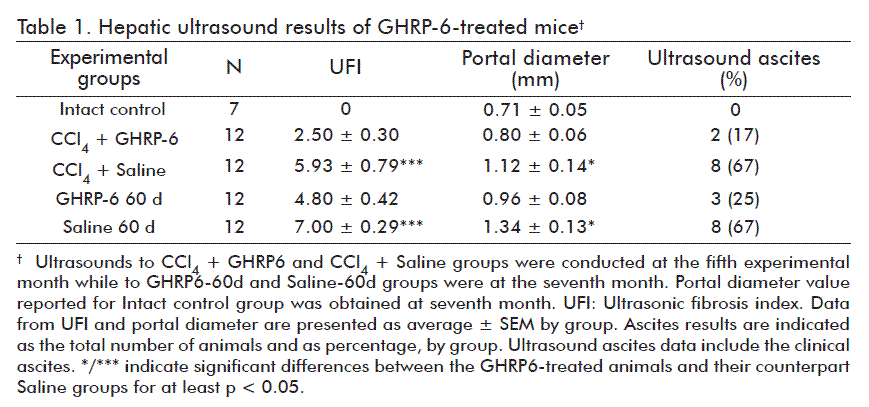
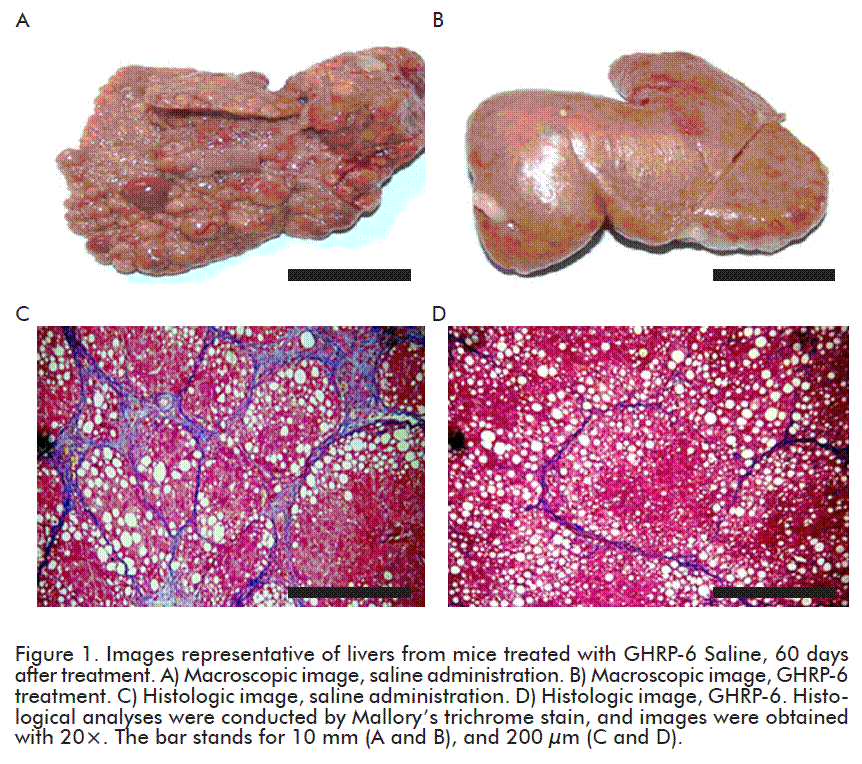
<body><![CDATA[<P   ><font size="2" face="Verdana, Arial, Helvetica, sans-serif">In previous experiments,      rats receiving repeated doses of doxorubicin for the induction of dilated      car-diomyopathy, developed an intense interstitial fibrosis in the liver,      kidneys and lungs. Subsequent his-tological examination showed a substantial      decrease in the accumulation of collagen in animals treated with GHRP-6 versus      those receiving a placebo solution (unpublished observations). To rigorously      study these merely circumstantial findings, the anti-fibrotic effect of the      peptide was characterized in several experimental models. First, the molecule      was evaluated in a model of liver cirrhosis in rats mediated by carbon tetrachloride      intoxication, in a preventive and two therapeutic scenarios. Subsequently,      topical application of a viscous composition containing GHRP-6 was assessed      in a simple wound model in rats and, afterwards, in a model of hypertrophic      scarring in rabbit ears. The results obtained in these experiments will be      briefly described below. </font></P >       <P   >&nbsp;</P >       <P   > </P >       <P   ><b><font size="3" face="Verdana, Arial, Helvetica, sans-serif">RESULTS </font></b></P >       <P   ><font size="2" face="Verdana, Arial, Helvetica, sans-serif"><b>Evaluation of      the anti-fibrotic effect of GHRP-6 in a model of liver cirrhosis mediated      by carbon tetrachloride intoxication in rats </b></font></P >       <P   ><font size="2" face="Verdana, Arial, Helvetica, sans-serif">Liver fibrosis was      induced by the subcutaneous injection of CCl<sub>4</sub> twice a week for      five months. The potential effect of the GHRP-6 intervention toward both fibrosis      prevention and regression, was examined in two experimental blocks. The first      one, developed during the five initial months, included the concomitant administration      of GHRP-6 with CCl<sub>4</sub> to assess hepatic fibrosis prevention. In the      second block of experiments, hepatic fibrosis was established during the first      five months and then animals were divided into two groups of treatments: one      received GHRP-6 alone for 15 days and the other received GHRP-6 and CCl<sub>4</sub>      for 60 days. In these two schemes were carried out to assess the peptide potential      in promoting cirrhosis regression. </font></P >   <FONT size="+1"><FONT size="+1"><FONT size="+1"><FONT size="+1"><FONT size="+1"><FONT size="+1">        <P   ><font size="2" face="Verdana, Arial, Helvetica, sans-serif">The percentage of      fibrosis, nodularity and septal thickness were quantified by histomorphometric      studies and ascites or portal dilation by ultrasound. The biochemical profile      and the parameters of oxidative stress in serum, as well as the genes and      proteins expression pattern, were determined by reverse transcription associated      to polymerase chain reaction and by immunohistochemistry. </font></P >       <P   ><font size="2" face="Verdana, Arial, Helvetica, sans-serif">Treatment with GHRP-6      significantly reduced fibrosis markers such as fibrosis index, portal diameter,      presence of ascites, thickness of the walls and number of nodules per field,      both from the ultrasonographic and histological point of view (<a href="/img/revistas/bta/v34n2/t0106217.gif">Table      1</a> and <a href="/img/revistas/bta/v34n2/t0206217.gif">Table 2</a>, respectively), in both concomitant      and therapeutic approaches. Representative images of the macroscopic and histological      structure of livers before and after GHRP-6 peptide administration are shown      in <a href="/img/revistas/bta/v34n2/f0106217.gif">Figure 1</a>. </font></P >       
<P   ><font size="2" face="Verdana, Arial, Helvetica, sans-serif">From the functional      point of view, it was observed that the peptide significantly attenuated the      dramatic increase in the levels of the transaminases aspartate-aminotransferase      and alanine-aminotransferase, which occurred in the animals receiving the      hepatotoxic agent. On the other hand, GHRP-6 significantly reduced the levels      of oxidative stress markers as compared to saline-treated animals (p &lt;      0.01) in the three experimental schemes, including the levels of total hydroperoxides,      advanced protein oxidation products, malondialdehyde and the lipid peroxidation      potential. Concurrently, GHRP-6 increased the activity of the anti-oxidant      enzymes catalase and superoxide dismutase (p &lt; 0.05). In general, we could      conclude that the GHRP-6 intervention removed and controlled the pathological      deposition of collagen and ECM in the hepatic parenchyma, while exerting marked      hepatoprotective and proliferation promoter effects [7]. </font></P >       <P   ><font size="2" face="Verdana, Arial, Helvetica, sans-serif"><b>Topical application      of a carboxymethylcellulose gel containing GHRP-6 in the simple open excision      wound model in rats </b></font></P >       ]]></body>
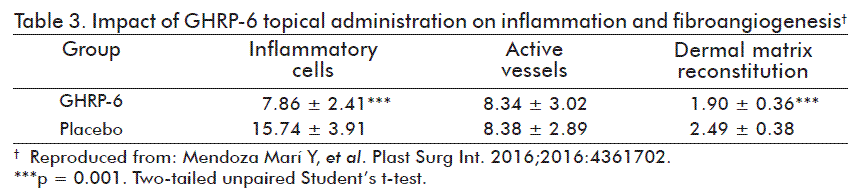
<body><![CDATA[<P   ><font size="2" face="Verdana, Arial, Helvetica, sans-serif">More than a decade      ago, CD36 was identified as one of the GHRP-6 receptors [8]. Serendipitous      observations of our laboratory indicated that CD36 mRNA transcript appeared      abundantly represented in clinical samples of granulation tissue of either      acute (deep burn injuries) or chronic (pressure ulcers) wounds. This finding      incited us to speculate about the possible effect of GHRP-6 topical administration      on the wound healing process. </font></P >       <P   ><font size="2" face="Verdana, Arial, Helvetica, sans-serif">A formulation of      GHRP-6 (400 &mu;g/mL) in 1 % carboxymethylcellulose gel (CMC) was applied      for 4 days in controlled full-thickness skin wounds, which were surgically      made on the back of male Wistar rats. As shown in <a href="/img/revistas/bta/v34n2/f0206217.gif">Figure      2</a>, the administration of GHRP-6 significantly increased wound closure      rate as compared to vehicle (CMC 1 %), starting 24 h after the initial administration      of the peptide (p = 0.016) and until the end of the experiment (p &lt; 0.0001).      Wounds treated with GHRP-6 showed lower amounts of inflammatory infiltrate      and attained a higher degree of organization of their ECM, due to a lower      accumulation of fibrin and the presence of thinner and horizontally distributed      collagen strands. No statistically significant differences were observed in      the number of active blood vessels (<a href="/img/revistas/bta/v34n2/t0306217.gif">Table 3</a>). </font></P >       
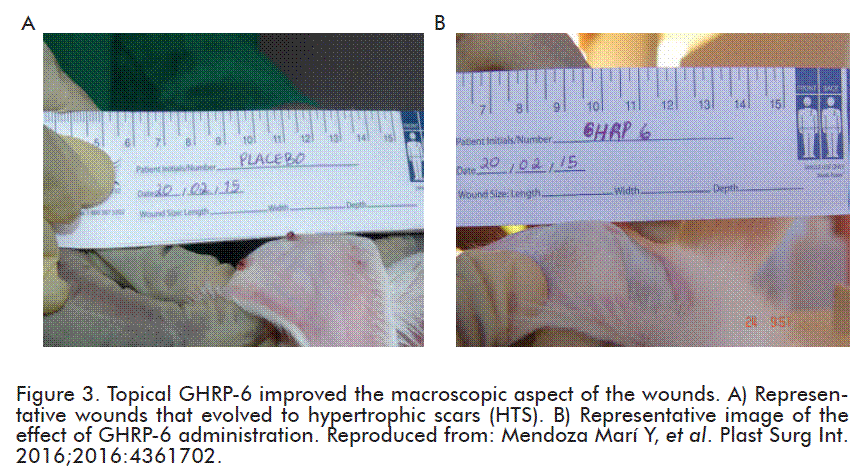
<P   ><font size="2" face="Verdana, Arial, Helvetica, sans-serif">At the molecular      level, GHRP-6 reduced the transcriptional expression of genes encoding tumor      necrosis factor converting enzyme (Adam17; p = 0.0306), transforming growth      factor &beta;1 (Tgfb1; p = 0.0171) and connective tissue </font><font size="2" face="Verdana, Arial, Helvetica, sans-serif">growth      factor (Ctgf; p = 0.001). These effects were translated into a decreased expression      of genes coding for ECM proteins and for myofibroblast marker proteins [9].      </font></P >       <P   ><font size="2" face="Verdana, Arial, Helvetica, sans-serif"><b>Demonstration      of the anti-fibrotic effect of GHRP-6 in the keloid model on the inner surface      of the rabbit ear </b></font></P >       <P   ><font size="2" face="Verdana, Arial, Helvetica, sans-serif">White male New Zealand      rabbits (4.3-4.5 kg) were used in four independent and extemporaneous experiments.      Three to four wounds were created on the ventral side of each ear, down to      the surface of the cartilage, using a 6 mm diameter punch biotome. Rabbits      were randomly assigned to either GHRP-6 (400 &mu;g/mL) treatment or 1 % CMC      placebo gel. Treatments were initiated immediately after surgery and continued      thereafter until day 30 and the animals remained in observation for another      20 days after GHRP-6 administration had been completed. The most notable effect      of the GHRP-6 intervention was the prevention of hypertrophic scar formation.      As shown in <a href="/img/revistas/bta/v34n2/t0406217.gif">Table 4</a>, treatment with the peptide      abrogated the debut of keloids in 90.5 % of the treated wounds. Conversely,      87.5 % of the wounds that received the viscous solution of 1 % CMC without      the peptide evolved into a hypertrophic scar, with a nipple-like appearance,      reddened and firm in touch (<a href="/img/revistas/bta/v34n2/f0306217.gif">Figure 3</a>). </font></P >       
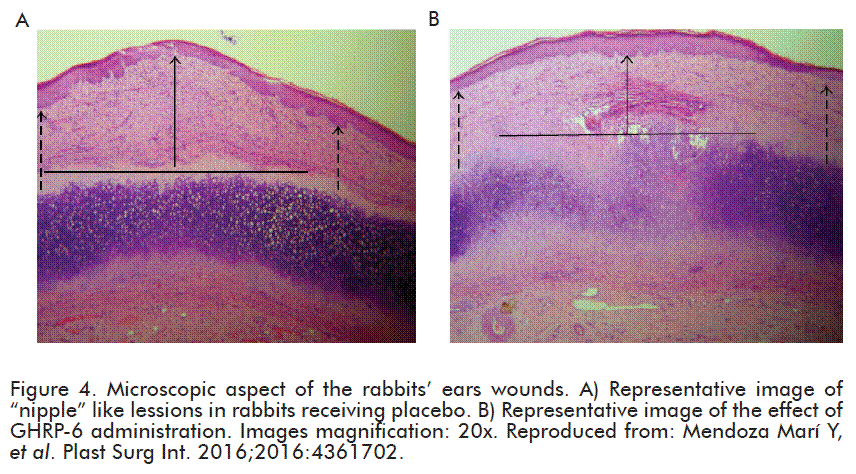
<P   ><font size="2" face="Verdana, Arial, Helvetica, sans-serif">GHRP-6 appears to      primarily reduce the local hypercellularity associated with cartilage perichondrium      cells and the resulting accumulation of ECM (<a href="/img/revistas/bta/v34n2/f0406217.gif">Figure      4</a>). Consequently, the scar elevation index was significantly lower (p      = 0.001) in treated wounds (1.12 &plusmn; 0.11) than those receiving the vehicle      (1.62 &plusmn; 0.15). At the molecular level, GHRP-6 significantly reduced      the transcriptional expression of Tgfb1 and Ctgf (p &lt; 0.05) and increased      the expression of the PPAR&gamma; transcriptional factor (p = 0.016) [9].      </font></P >       
<P   >&nbsp;</P >       <P   > </P >       <P   ><font size="3"><b><font face="Verdana, Arial, Helvetica, sans-serif">RELEVANCE      OF THE STUDY </font></b></font></P >       <P   ><font size="2" face="Verdana, Arial, Helvetica, sans-serif">The results presented      above constitute the first evidence of a new pharmacological property for      GHRP- 6: its ability to inhibit synthesis and excessive accumulation of extracellular      matrix proteins. This effect was demonstrated in parenchymal (liver) and peripheral      (skin) organs and in prophylactic and therapeutic scenarios. On the other      hand, a new mechanism of action for GHRP-6, based on the induction of PPAR&gamma;,      is described. Evidence obtained indicates that GHRP-6 is potentially useful      for the prevention/treatment of liver fibrosis, keloids and hypertrophic scars      and broadens the spectrum of therapeutic possibilities to other fibrotic and      accumulation diseases. </font></P >       ]]></body>
<body><![CDATA[<P   > </P >       <P   > </P >       <P   >&nbsp;</P >       <P   ><font size="2" face="Verdana, Arial, Helvetica, sans-serif"><b><font size="3">ACKNOWLEDGEMENTS      </font> </b> </font></P >       <P   ><font size="2" face="Verdana, Arial, Helvetica, sans-serif">The authors thank      the valuable cooperation of the following collaborators: Mar&iacute;a Elena      Ochagav&iacute;a Roque, Jamilet Miranda Navarro, Ricardo Bringas P&eacute;rez,      Karelia Cosme D&iacute;az, Daniel Palenzuela Gard&oacute;n, Julio Ra&uacute;l      Fern&aacute;ndez Mass&oacute;, Isabel Guill&eacute;n P&eacute;rez, Alberto      Cintado Ben&iacute;tez, Lidia In&eacute;s Novoa, Jos&eacute; &Aacute;ngel      Silva Guirado, Regla Estrada V&aacute;zquez, from the Center for Genetic Engineering      and Biotechnology, CIGB; Yolanda Gonz&aacute;lez Ferrer, Jos&eacute; M. Vila,      Angel Abreu, Yolanda Cruz, Ivon Howland, Aleida Urquiza, from the from Center      for Medical and Surgical Research, CIMEQ, Cuba; Ana Janet Mir Ben&iacute;tez      from the Clinical and Surgical Hospital Joaqu&iacute;n Albarr&aacute;n, Havana,      Cuba; Rosa Mar&iacute;a Coro Antich, from the Neurology and Neurosurgery Institute,      INN, Cuba; and Olga Sonia Le&oacute;n Fern&aacute;ndez, from the Institute      of Pharmacy and Food, IFAL, Havana, Cuba. </font></P >       <P   >&nbsp;</P >       <P   > </P >       <P   > </P >       <P   ><font size="3"><b><font face="Verdana, Arial, Helvetica, sans-serif">REFERENCES      </font></b></font></P >       <P   > </P >   <FONT size="+1" color="#000000">        ]]></body>
<body><![CDATA[<!-- ref --><P   ><font size="2" color="#211E1F" face="Verdana, Arial, Helvetica, sans-serif">1.      Rosenbloom J, Castro SV, Jimenez SA. Narrative review: fibrotic diseases:      cellular and molecular mechanisms and novel therapies. Ann Intern Med. 2010;152(3):159-66.          </font></P >   <FONT size="+1" color="#211E1F">        <!-- ref --><P   ><font size="2" face="Verdana, Arial, Helvetica, sans-serif">2. Kochanek KD, Murphy      SL, Anderson RN, Scott C. Deaths: final data for 2002. Natl Vital Stat Rep.      2004;53(5):1-115.     </font></P >       <!-- ref --><P   ><font size="2" face="Verdana, Arial, Helvetica, sans-serif">3. Bowers CY, Momany      FA, Reynolds GA, Hong A. On the <I>in vitro </I>and <I>in vivo </I>activity      of a new synthetic hexapeptide that acts on the pituitary to specifically      release growth hormone. Endocrinology. 1984;114(5):1537-45.     </font></P >       <!-- ref --><P   ><font size="2" face="Verdana, Arial, Helvetica, sans-serif">4. Correa-Silva SR,      Sa LB, Lengyel AM. Ghrelin and growth hormone secretagogues (GHS): modulation      of growth hormone secretion and therapeutic ap-plications. Arq Bras Endocrinol      Metabol. 2008;52(5):726-33.     </font></P >       <!-- ref --><P   ><font size="2" face="Verdana, Arial, Helvetica, sans-serif">5. Cibrian D, Ajamieh      H, Berlanga J, Leon OS, Alba JS, Kim MJ, <I>et al</I>. Use of growth-hormone-releasing      peptide-6 (GHRP-6) for the prevention of multiple organ failure. Clin Sci      (Lond). 2006;110(5):563-73.     </font></P >       ]]></body>
<body><![CDATA[<!-- ref --><P   ><font size="2" face="Verdana, Arial, Helvetica, sans-serif">6. Bodart V, Febbraio      M, Demers A, McNicoll N, Pohankova P, Perreault A, <I>et al</I>. CD36 mediates      the cardiovascular action of growth hormone-releasing peptides in the heart.      Circ Res. 2002;90(8):844-9.     </font></P >       <!-- ref --><P   ><font size="2" face="Verdana, Arial, Helvetica, sans-serif">7. Berlanga J, V&aacute;zquez      D, Cibri&aacute;n D, Mendoza Y, Ochagav&iacute;a ME, Miranda J, <I>et al</I>.      Growth Hormone Releasing Peptide 6 (GHRP6) reduces liver fibrosis in CCl4      chronically intoxicated rats. Biotecnol Apl. 2012;29:60-72.     </font></P >       <P   ><font size="2" face="Verdana, Arial, Helvetica, sans-serif">8. Demers A, McNicoll      N, Febbraio M, Servant M, Marleau S, Silverstein R, <I>et al</I>. Identification      of the growth hormone-releasing peptide binding site in CD36: a photoaffinity      cross-linking study. Biochem J. 2004;382(Pt 2):417-24. </font></P >       <!-- ref --><P   ><font size="2" face="Verdana, Arial, Helvetica, sans-serif">9. Mendoza Mari Y,      Fernandez Mayola M, Aguilera Barreto A, Garcia Ojalvo A, Bermudez Alvarez      Y, Mir Benitez AJ, <I>et al</I>. Growth Hormone-Releasing Peptide 6 enhances      the healing process and improves the esthetic outcome of the wounds. Plast      Surg Int. 2016;2016: 4361702.     </font></P >       <P   >&nbsp;</P >       <P   >&nbsp;</P >       <P   > </P >       ]]></body>
<body><![CDATA[<P   > </P >   <FONT size="+1">        <P   ><font size="2" face="Verdana, Arial, Helvetica, sans-serif"><i>Jorge Berlanga-Acosta</i>.      Centro de Ingenier&iacute;a Gen&eacute;tica y Biotecnolog&iacute;a, CIGB.      Ave. 31 entre 158 y 190, Cubanac&aacute;n, Playa, CP 11600, La Habana, Cuba.      E-mail: <A href="mailto:jorge.berlanga@cigb.edu.cu"> <FONT color="#0000FF">jorge.berlanga@cigb.edu.cu</font></A><FONT color="#0000FF"><FONT color="#211E1F">.</font></font></font></P >   </font></font></font></font></font></font></font></font></font></font></font></font></font></font></font></font></font></font></font></DIV >      ]]></body><back>
<ref-list>
<ref id="B1">
<label>1</label><nlm-citation citation-type="journal">
<person-group person-group-type="author">
<name>
<surname><![CDATA[Rosenbloom]]></surname>
<given-names><![CDATA[J]]></given-names>
</name>
<name>
<surname><![CDATA[Castro]]></surname>
<given-names><![CDATA[SV]]></given-names>
</name>
<name>
<surname><![CDATA[Jimenez]]></surname>
<given-names><![CDATA[SA]]></given-names>
</name>
</person-group>
<article-title xml:lang="en"><![CDATA[Narrative review: fibrotic diseases: cellular and molecular mechanisms and novel therapies]]></article-title>
<source><![CDATA[Ann Intern Med]]></source>
<year>2010</year>
<volume>152</volume>
<numero>3</numero>
<issue>3</issue>
<page-range>159-66</page-range></nlm-citation>
</ref>
<ref id="B2">
<label>2</label><nlm-citation citation-type="journal">
<person-group person-group-type="author">
<name>
<surname><![CDATA[Kochanek]]></surname>
<given-names><![CDATA[KD]]></given-names>
</name>
<name>
<surname><![CDATA[Murphy]]></surname>
<given-names><![CDATA[SL]]></given-names>
</name>
<name>
<surname><![CDATA[Anderson]]></surname>
<given-names><![CDATA[RN]]></given-names>
</name>
<name>
<surname><![CDATA[Scott]]></surname>
<given-names><![CDATA[C]]></given-names>
</name>
</person-group>
<article-title xml:lang="en"><![CDATA[Deaths: final data for 2002]]></article-title>
<source><![CDATA[Natl Vital Stat Rep]]></source>
<year>2004</year>
<volume>53</volume>
<numero>5</numero>
<issue>5</issue>
<page-range>1-115</page-range></nlm-citation>
</ref>
<ref id="B3">
<label>3</label><nlm-citation citation-type="journal">
<person-group person-group-type="author">
<name>
<surname><![CDATA[Bowers]]></surname>
<given-names><![CDATA[CY]]></given-names>
</name>
<name>
<surname><![CDATA[Momany]]></surname>
<given-names><![CDATA[FA]]></given-names>
</name>
<name>
<surname><![CDATA[Reynolds]]></surname>
<given-names><![CDATA[GA]]></given-names>
</name>
<name>
<surname><![CDATA[Hong]]></surname>
<given-names><![CDATA[A]]></given-names>
</name>
</person-group>
<article-title xml:lang="en"><![CDATA[On the in vitro and in vivo activity of a new synthetic hexapeptide that acts on the pituitary to specifically release growth hormone]]></article-title>
<source><![CDATA[Endocrinology]]></source>
<year>1984</year>
<volume>114</volume>
<numero>5</numero>
<issue>5</issue>
<page-range>1537-45</page-range></nlm-citation>
</ref>
<ref id="B4">
<label>4</label><nlm-citation citation-type="journal">
<person-group person-group-type="author">
<name>
<surname><![CDATA[Correa-Silva]]></surname>
<given-names><![CDATA[SR]]></given-names>
</name>
<name>
<surname><![CDATA[Sa]]></surname>
<given-names><![CDATA[LB]]></given-names>
</name>
<name>
<surname><![CDATA[Lengyel]]></surname>
<given-names><![CDATA[AM]]></given-names>
</name>
</person-group>
<article-title xml:lang="en"><![CDATA[Ghrelin and growth hormone secretagogues (GHS): modulation of growth hormone secretion and therapeutic ap-plications]]></article-title>
<source><![CDATA[Arq Bras Endocrinol Metabol]]></source>
<year>2008</year>
<volume>52</volume>
<numero>5</numero>
<issue>5</issue>
<page-range>726-33</page-range></nlm-citation>
</ref>
<ref id="B5">
<label>5</label><nlm-citation citation-type="journal">
<person-group person-group-type="author">
<name>
<surname><![CDATA[Cibrian]]></surname>
<given-names><![CDATA[D]]></given-names>
</name>
<name>
<surname><![CDATA[Ajamieh]]></surname>
<given-names><![CDATA[H]]></given-names>
</name>
<name>
<surname><![CDATA[Berlanga]]></surname>
<given-names><![CDATA[J]]></given-names>
</name>
<name>
<surname><![CDATA[Leon]]></surname>
<given-names><![CDATA[OS]]></given-names>
</name>
<name>
<surname><![CDATA[Alba]]></surname>
<given-names><![CDATA[JS]]></given-names>
</name>
<name>
<surname><![CDATA[Kim]]></surname>
<given-names><![CDATA[MJ]]></given-names>
</name>
</person-group>
<article-title xml:lang="en"><![CDATA[Use of growth-hormone-releasing peptide-6 (GHRP-6) for the prevention of multiple organ failure]]></article-title>
<source><![CDATA[Clin Sci (Lond)]]></source>
<year>2006</year>
<volume>110</volume>
<numero>5</numero>
<issue>5</issue>
<page-range>563-73</page-range></nlm-citation>
</ref>
<ref id="B6">
<label>6</label><nlm-citation citation-type="journal">
<person-group person-group-type="author">
<name>
<surname><![CDATA[Bodart]]></surname>
<given-names><![CDATA[V]]></given-names>
</name>
<name>
<surname><![CDATA[Febbraio]]></surname>
<given-names><![CDATA[M]]></given-names>
</name>
<name>
<surname><![CDATA[Demers]]></surname>
<given-names><![CDATA[A]]></given-names>
</name>
<name>
<surname><![CDATA[McNicoll]]></surname>
<given-names><![CDATA[N]]></given-names>
</name>
<name>
<surname><![CDATA[Pohankova]]></surname>
<given-names><![CDATA[P]]></given-names>
</name>
<name>
<surname><![CDATA[Perreault]]></surname>
<given-names><![CDATA[A]]></given-names>
</name>
</person-group>
<article-title xml:lang="en"><![CDATA[CD36 mediates the cardiovascular action of growth hormone-releasing peptides in the heart]]></article-title>
<source><![CDATA[Circ Res]]></source>
<year>2002</year>
<volume>90</volume>
<numero>8</numero>
<issue>8</issue>
<page-range>844-9</page-range></nlm-citation>
</ref>
<ref id="B7">
<label>7</label><nlm-citation citation-type="journal">
<person-group person-group-type="author">
<name>
<surname><![CDATA[Berlanga]]></surname>
<given-names><![CDATA[J]]></given-names>
</name>
<name>
<surname><![CDATA[Vázquez]]></surname>
<given-names><![CDATA[D]]></given-names>
</name>
<name>
<surname><![CDATA[Cibrián]]></surname>
<given-names><![CDATA[D]]></given-names>
</name>
<name>
<surname><![CDATA[Mendoza]]></surname>
<given-names><![CDATA[Y]]></given-names>
</name>
<name>
<surname><![CDATA[Ochagavía]]></surname>
<given-names><![CDATA[ME]]></given-names>
</name>
<name>
<surname><![CDATA[Miranda]]></surname>
<given-names><![CDATA[J]]></given-names>
</name>
</person-group>
<article-title xml:lang="en"><![CDATA[Growth Hormone Releasing Peptide 6 (GHRP6) reduces liver fibrosis in CCl4 chronically intoxicated rats]]></article-title>
<source><![CDATA[Biotecnol Apl]]></source>
<year>2012</year>
<volume>29</volume>
<page-range>60-72</page-range></nlm-citation>
</ref>
<ref id="B8">
<label>8</label><nlm-citation citation-type="journal">
<person-group person-group-type="author">
<name>
<surname><![CDATA[Demers]]></surname>
<given-names><![CDATA[A]]></given-names>
</name>
<name>
<surname><![CDATA[McNicoll]]></surname>
<given-names><![CDATA[N]]></given-names>
</name>
<name>
<surname><![CDATA[Febbraio]]></surname>
<given-names><![CDATA[M]]></given-names>
</name>
<name>
<surname><![CDATA[Servant]]></surname>
<given-names><![CDATA[M]]></given-names>
</name>
<name>
<surname><![CDATA[Marleau]]></surname>
<given-names><![CDATA[S]]></given-names>
</name>
<name>
<surname><![CDATA[Silverstein]]></surname>
<given-names><![CDATA[R]]></given-names>
</name>
</person-group>
<article-title xml:lang="en"><![CDATA[Identification of the growth hormone-releasing peptide binding site in CD36: a photoaffinity cross-linking study]]></article-title>
<source><![CDATA[Biochem J]]></source>
<year>2004</year>
<volume>382</volume>
<numero>417 Pt 2</numero>
<issue>417 Pt 2</issue>
<page-range>24</page-range></nlm-citation>
</ref>
<ref id="B9">
<label>9</label><nlm-citation citation-type="journal">
<person-group person-group-type="author">
<name>
<surname><![CDATA[Mendoza Mari]]></surname>
<given-names><![CDATA[Y]]></given-names>
</name>
<name>
<surname><![CDATA[Fernandez Mayola]]></surname>
<given-names><![CDATA[M]]></given-names>
</name>
<name>
<surname><![CDATA[Aguilera Barreto]]></surname>
<given-names><![CDATA[A]]></given-names>
</name>
<name>
<surname><![CDATA[Garcia Ojalvo]]></surname>
<given-names><![CDATA[A]]></given-names>
</name>
<name>
<surname><![CDATA[Bermudez Alvarez]]></surname>
<given-names><![CDATA[Y]]></given-names>
</name>
<name>
<surname><![CDATA[Mir Benitez]]></surname>
<given-names><![CDATA[AJ]]></given-names>
</name>
</person-group>
<article-title xml:lang="en"><![CDATA[Growth Hormone-Releasing Peptide 6 enhances the healing process and improves the esthetic outcome of the wounds]]></article-title>
<source><![CDATA[Plast Surg Int]]></source>
<year>2016</year>
<volume>2016</volume>
<page-range>4361702</page-range></nlm-citation>
</ref>
</ref-list>
</back>
</article>