<?xml version="1.0" encoding="ISO-8859-1"?><article xmlns:mml="http://www.w3.org/1998/Math/MathML" xmlns:xlink="http://www.w3.org/1999/xlink" xmlns:xsi="http://www.w3.org/2001/XMLSchema-instance">
<front>
<journal-meta>
<journal-id>1027-2852</journal-id>
<journal-title><![CDATA[Biotecnología Aplicada]]></journal-title>
<abbrev-journal-title><![CDATA[Biotecnol Apl]]></abbrev-journal-title>
<issn>1027-2852</issn>
<publisher>
<publisher-name><![CDATA[Editorial Elfos Scientiae]]></publisher-name>
</publisher>
</journal-meta>
<article-meta>
<article-id>S1027-28522017000300005</article-id>
<title-group>
<article-title xml:lang="en"><![CDATA[New biohybrid materials as nanocarriers of nucleic acids, and their biotechnological applications]]></article-title>
<article-title xml:lang="es"><![CDATA[Nuevos materiales biohíbridos como nano-portadores de ácidos nucleicos, y sus aplicaciones biotecnológicas]]></article-title>
</title-group>
<contrib-group>
<contrib contrib-type="author">
<name>
<surname><![CDATA[Castro-Smirnov]]></surname>
<given-names><![CDATA[Fidel Antonio]]></given-names>
</name>
<xref ref-type="aff" rid="A01"/>
</contrib>
<contrib contrib-type="author">
<name>
<surname><![CDATA[Rodriguez-Hoyos]]></surname>
<given-names><![CDATA[Oscar Edgar]]></given-names>
</name>
<xref ref-type="aff" rid="A02"/>
</contrib>
<contrib contrib-type="author">
<name>
<surname><![CDATA[Guzmán-Martínez]]></surname>
<given-names><![CDATA[Fernando]]></given-names>
</name>
<xref ref-type="aff" rid="A02"/>
</contrib>
<contrib contrib-type="author">
<name>
<surname><![CDATA[Lopez]]></surname>
<given-names><![CDATA[Bernard S]]></given-names>
</name>
<xref ref-type="aff" rid="A03"/>
</contrib>
<contrib contrib-type="author">
<name>
<surname><![CDATA[Piétrement]]></surname>
<given-names><![CDATA[Olivier]]></given-names>
</name>
<xref ref-type="aff" rid="A04"/>
</contrib>
<contrib contrib-type="author">
<name>
<surname><![CDATA[Ayache]]></surname>
<given-names><![CDATA[Jeanne]]></given-names>
</name>
<xref ref-type="aff" rid="A04"/>
</contrib>
<contrib contrib-type="author">
<name>
<surname><![CDATA[Le Cam]]></surname>
<given-names><![CDATA[Eric]]></given-names>
</name>
<xref ref-type="aff" rid="A04"/>
</contrib>
<contrib contrib-type="author">
<name>
<surname><![CDATA[Bertrand]]></surname>
<given-names><![CDATA[Jean-Rémi]]></given-names>
</name>
<xref ref-type="aff" rid="A05"/>
</contrib>
<contrib contrib-type="author">
<name>
<surname><![CDATA[Aranda]]></surname>
<given-names><![CDATA[Pilar]]></given-names>
</name>
<xref ref-type="aff" rid="A06"/>
</contrib>
<contrib contrib-type="author">
<name>
<surname><![CDATA[Ruiz-Hitzky]]></surname>
<given-names><![CDATA[Eduardo]]></given-names>
</name>
<xref ref-type="aff" rid="A06"/>
</contrib>
</contrib-group>
<aff id="A02">
<institution><![CDATA[,Instituto Superior de Tecnologías y Ciencias Aplicadas  ]]></institution>
<addr-line><![CDATA[La Habana ]]></addr-line>
<country>Cuba</country>
</aff>
<aff id="A03">
<institution><![CDATA[,Université Paris-Saclay Institut de Cancérologie Gustave-Roussy CNRS UMR 8200]]></institution>
<addr-line><![CDATA[Villejuif ]]></addr-line>
<country>France</country>
</aff>
<aff id="A04">
<institution><![CDATA[,Université Paris-Saclay Gustave-Roussy CNRS UMR 8126]]></institution>
<addr-line><![CDATA[Villejuif ]]></addr-line>
<country>France</country>
</aff>
<aff id="A05">
<institution><![CDATA[,Université Paris-Saclay Gustave-Roussy Vectorology and Anticancer Therapies, UMR 8203, CNRS]]></institution>
<addr-line><![CDATA[Villejuif ]]></addr-line>
<country>France</country>
</aff>
<aff id="A06">
<institution><![CDATA[,Instituto de Ciencia de Materiales de Madrid (ICMM-CSIC)  ]]></institution>
<addr-line><![CDATA[Madrid ]]></addr-line>
<country>Spain</country>
</aff>
<aff id="A01">
<institution><![CDATA[,Universidad de las Ciencias Informáticas  ]]></institution>
<addr-line><![CDATA[La Habana ]]></addr-line>
<country>Cuba</country>
</aff>
<pub-date pub-type="pub">
<day>00</day>
<month>09</month>
<year>2017</year>
</pub-date>
<pub-date pub-type="epub">
<day>00</day>
<month>09</month>
<year>2017</year>
</pub-date>
<volume>34</volume>
<numero>3</numero>
<fpage>3511</fpage>
<lpage>3514</lpage>
<copyright-statement/>
<copyright-year/>
<self-uri xlink:href="http://scielo.sld.cu/scielo.php?script=sci_arttext&amp;pid=S1027-28522017000300005&amp;lng=en&amp;nrm=iso"></self-uri><self-uri xlink:href="http://scielo.sld.cu/scielo.php?script=sci_abstract&amp;pid=S1027-28522017000300005&amp;lng=en&amp;nrm=iso"></self-uri><self-uri xlink:href="http://scielo.sld.cu/scielo.php?script=sci_pdf&amp;pid=S1027-28522017000300005&amp;lng=en&amp;nrm=iso"></self-uri></article-meta>
</front><body><![CDATA[ <DIV class="Sect"   >        <P align="right"   ><font size="2" color="#000000" face="Verdana, Arial, Helvetica, sans-serif"><b>REPORT</b>      </font></P >   <FONT size="+1" color="#000000">        <P   > </P >       <P   >&nbsp;</P >       <P   ><font size="2" color="#211E1F" face="Verdana, Arial, Helvetica, sans-serif"><B><font size="4">New      biohybrid materials as nanocarriers of nucleic acids, and their biotechnological      applications </font></b></font></P >   <FONT size="+1" color="#211E1F"><B>        <P   ></P >   </B> <FONT size="+1" color="#000000">        <P   >&nbsp;</P >       <P   ><font size="2" color="#211E1F" face="Verdana, Arial, Helvetica, sans-serif"><B><font size="3">Nuevos      materiales bioh&iacute;bridos como nano-portadores de &aacute;cidos nucleicos,      y sus aplicaciones biotecnol&oacute;gicas</font> </b></font></P >       <P   >&nbsp;</P >       <P   >&nbsp;</P >   <FONT size="+1" color="#211E1F">        ]]></body>
<body><![CDATA[<P   ></P >   <FONT size="+1" color="#000000">        <P   ><b><font size="2" color="#211E1F" face="Verdana, Arial, Helvetica, sans-serif">Fidel      Antonio Castro-Smirnov<sup>1,2</sup>, Oscar Edgar Rodriguez-Hoyos<sup>2</sup>,      Fernando Guzm&aacute;n-Mart&iacute;nez<sup>2</sup>, Bernard S Lopez<sup>3</sup>,      Olivier Pi&eacute;trement<sup>4</sup>, Jeanne Ayache<sup>4</sup>, Eric Le      Cam<sup>4</sup>, Jean-R&eacute;mi Bertrand<sup>5</sup>, Pilar Aranda<sup>6</sup>,      Eduardo Ruiz-Hitzky<sup>6</sup></font></b><font size="2" color="#211E1F" face="Verdana, Arial, Helvetica, sans-serif"></font><FONT size="+1" color="#211E1F"><FONT size="+1"><FONT size="+1"><FONT size="+1"><FONT size="+1"><FONT size="+1"><FONT size="+1"><FONT size="+1"><FONT size="+1"><FONT size="+1"><FONT size="+1"><FONT size="+1"><FONT size="+1"><FONT size="+1"><FONT size="+1"><FONT size="+1"><FONT size="+1"><FONT size="+1"><FONT size="+1"><FONT size="+1"></font></font></font></font></font></font></font></font></font></font></font></font></font></font></font></font></font></font></font></font></P >   <FONT size="+1" color="#211E1F"><FONT size="+1"><FONT size="+1"><FONT size="+1"><FONT size="+1"><FONT size="+1"><FONT size="+1"><FONT size="+1"><FONT size="+1"><FONT size="+1"><FONT size="+1"><FONT size="+1"><FONT size="+1"><FONT size="+1"><FONT size="+1"><FONT size="+1"><FONT size="+1"><FONT size="+1"><FONT size="+1"><FONT size="+1">        <P   ></P >       <P   > </P >   <FONT size="+1" color="#000000">        <P   > <font size="2" color="#211E1F" face="Verdana, Arial, Helvetica, sans-serif"><sup>1</sup>      Universidad de las Ciencias Inform&aacute;ticas. Carretera a San Antonio de      los Ba&ntilde;os, km 2 1/2, La Habana 19370, Cuba.    <br>     </font><font size="2" face="Verdana, Arial, Helvetica, sans-serif"><sup>2</sup>      Instituto Superior de Tecnolog&iacute;as y Ciencias Aplicadas, La Habana,      Cuba.    <br>     <sup>3</sup>      CNRS UMR 8200, Institut de Canc&eacute;rologie Gustave-Roussy, Universit&eacute;      Paris-Saclay, Team labeled &ldquo;Ligue 2014&rdquo;, 114 rue Edouard Vaillant,      94805 Villejuif, France.    <br>     <sup>4</sup>      CNRS UMR 8126, Gustave-Roussy, Universit&eacute; Paris-Saclay, F-94805 Villejuif,      France.    <br>     <sup>5</sup>      Vectorology and Anticancer Therapies, UMR 8203, CNRS, Universit&eacute; Paris-Saclay,      Gustave-Roussy, Universit&eacute; Paris-Saclay, 94805 Villejuif, France.    <br>     </font><font size="2" face="Verdana, Arial, Helvetica, sans-serif"><sup>6</sup>      Instituto de Ciencia de Materiales de Madrid (ICMM-CSIC). c/ Sor Juana In&eacute;s      de la Cruz 3, 28049 Madrid, Spain. </font></P >   <FONT size="+1" color="#211E1F"><FONT size="+1"><FONT size="+1"><FONT size="+1"><FONT size="+1"><FONT size="+1"><FONT size="+1"><FONT size="+1"><FONT size="+1"><FONT size="+1"><FONT size="+1"><FONT size="+1">        ]]></body>
<body><![CDATA[<P   > </P >       <P   >&nbsp;</P >       <P   >&nbsp;</P >   </font></font></font></font></font></font></font></font></font></font></font></font></font></font></font></font></font></font></font></font></font></font></font></font></font></font></font></font></font></font></font></font></font></font></font></font></font></font>    <hr>   <FONT size="+1" color="#000000"><FONT size="+1" color="#211E1F"><FONT size="+1" color="#000000"><FONT size="+1" color="#211E1F"><FONT size="+1" color="#000000"><FONT size="+1" color="#211E1F"><FONT size="+1"><FONT size="+1"><FONT size="+1"><FONT size="+1"><FONT size="+1"><FONT size="+1"><FONT size="+1"><FONT size="+1"><FONT size="+1"><FONT size="+1"><FONT size="+1"><FONT size="+1"><FONT size="+1"><FONT size="+1"><FONT size="+1"><FONT size="+1"><FONT size="+1"><FONT size="+1"><FONT size="+1"><FONT size="+1" color="#000000"><FONT size="+1" color="#211E1F"><FONT size="+1"><FONT size="+1"><FONT size="+1"><FONT size="+1"><FONT size="+1"><FONT size="+1"><FONT size="+1"><FONT size="+1"><FONT size="+1"><FONT size="+1"><FONT size="+1">       <P   ><font size="2" face="Verdana, Arial, Helvetica, sans-serif"><b>ABSTRACT </b></font></P >       <P   ><font size="2" face="Verdana, Arial, Helvetica, sans-serif">This work focused      on the synthesis, physicochemical characterization and biotechnological applications      of new nanomaterials composed of sepiolite for gene transfer. Biohybrids were      obtained of sepiolite nanofibers covered by nucleic acids (DNA and RNA molecules).      They were characterized by novel techniques and procedures, identifying that      the DNA gets adsorbed onto the surface of sepiolite nanofibers that were previously      subjected to disaggre-gation procedures for a maximum fractionation. Such      interaction is mediated by silanol groups evenly spaced on the outer surface      of silicate particles, through electrostatic interactions, hydrogen bonds,      cation bridges and Van der Waals forces. It was shown that sepiolite can be      spontaneously internalized by eukaryotic cells in culture, and the mechanisms      mediating such internalization were characterized, both endocytic and non-endocytic.      Similarly, it was found that sepiolite nanofibers can be transferred between      neighboring cells spontaneously, these particles displaying intrinsic fluorescence      that facilitates its detection within the cell as gene transfer vector. The      biohybrids were assayed with satisfactory results for the transfer of a plasmid      DNA vector into cancer cell lines, and strategies were also established to      significantly increase their transfection efficiency. These studies demonstrated      for the first time the use of sepiolite nanofibers as a platform for transferring      nucleic acids and potentially other types of mol-ecules into mammalian cells,      those molecules administered for functional or therapeutic purposes, among      other applications. This work granted the Annual Award of the National Academy      of Sciences of Cuba for the year 2016. </font></P >       <P   ><font size="2" face="Verdana, Arial, Helvetica, sans-serif"><i><b>Keywords:</b></i>      Nanomaterials, nanofibers, clays, sepiolite, gene transfer, transfection,      nanocarriers, endocytosis. </font></P >   </font></font></font></font></font></font></font></font></font></font></font></font></font></font></font></font></font></font></font></font></font></font></font></font></font></font></font></font></font></font></font></font></font></font></font></font></font></font>    <hr>   <FONT size="+1" color="#000000"><FONT size="+1" color="#211E1F"><FONT size="+1" color="#000000"><FONT size="+1" color="#211E1F"><FONT size="+1" color="#000000"><FONT size="+1" color="#211E1F"><FONT size="+1"><FONT size="+1"><FONT size="+1"><FONT size="+1"><FONT size="+1"><FONT size="+1"><FONT size="+1"><FONT size="+1"><FONT size="+1"><FONT size="+1"><FONT size="+1"><FONT size="+1"><FONT size="+1"><FONT size="+1"><FONT size="+1"><FONT size="+1"><FONT size="+1"><FONT size="+1"><FONT size="+1"><FONT size="+1" color="#000000"><FONT size="+1" color="#211E1F"><FONT size="+1"><FONT size="+1"><FONT size="+1"><FONT size="+1"><FONT size="+1"><FONT size="+1"><FONT size="+1"><FONT size="+1"><FONT size="+1"><FONT size="+1"><FONT size="+1">       <P   > </P >       <P   ><font size="2" face="Verdana, Arial, Helvetica, sans-serif"><b>RESUMEN </b></font></P >       <P   ><font size="2" face="Verdana, Arial, Helvetica, sans-serif">Este trabajo se centr&oacute;      en la s&iacute;ntesis, caracterizaci&oacute;n f&iacute;sicoqu&iacute;mica-biol&oacute;gica      y aplicaciones biotecnol&oacute;gicas de nuevos nanomateriales basados en      el uso de la sepiolita como vector de transferencia g&eacute;nica. Se obtuvieron      bioh&iacute;bridos de </font><font size="2" face="Verdana, Arial, Helvetica, sans-serif">nanofibras      de sepiolita con &aacute;cidos nucleicos (ADN y ARN) adsorbidos, caracterizados      mediante t&eacute;cnicas y metodolog&iacute;as novedosas. Se identific&oacute;      que el ADN se adsorbe de manera reversible y eficiente en las nanofibras de      sepiolita previamente desagregadas e individualizadas al m&aacute;ximo. Dicha      interacci&oacute;n es mediada por los grupos silanoles regularmente localizados      en la superficie externa del silicato, por interacciones que pueden implicar      fuerzas electrost&aacute;ticas, puentes de hidr&oacute;geno, puentes a trav&eacute;s      de cationes, y fuerzas de Van der Waals. Se observ&oacute; que las nanofibras      de sepiolita pueden ser internalizadas de manera espont&aacute;nea por c&eacute;lulas      eucariotas en cultivo, y se identificaron los mecanismos endoc&iacute;ticos      y no endoc&iacute;ticos predominantes de internalizaci&oacute;n. De igual      manera, pueden ser transferidas entre c&eacute;lulas vecinas de forma espont&aacute;nea,      adem&aacute;s de poseer fluorescencia intr&iacute;nseca, lo cual facilita      la detecci&oacute;n de su localizaci&oacute;n como veh&iacute;culo de transferencia      g&eacute;nica. Los bioh&iacute;bridos se ensayaron de forma satisfactoria      para la transferencia de un vector g&eacute;nico plasm&iacute;dico en l&iacute;neas      celulares cancer&iacute;genas, y se en-sayaron estrategias que incrementaron      significativamente la eficiencia de transfecci&oacute;n. Estos estudios demostraron      por primera vez el uso de las nanofibras de sepiolita como una plataforma      para la transferencia de &aacute;cidos nucleicos y potencialmente otras mol&eacute;culas      a c&eacute;lulas de mam&iacute;feros, con posible acci&oacute;n terap&eacute;utica      o funcional, u otras apli-caciones. Este trabajo mereci&oacute; el Premio      Anual de la Academia de Ciencias de Cuba para el a&ntilde;o 2016. </font></P >       <P   ><font size="2" face="Verdana, Arial, Helvetica, sans-serif"><i><b>Palabras clave:      </b></i>Nanomateriales, nanofibras, arcillas, sepiolita, transferencia g&eacute;nica,      transfecci&oacute;n, nanoportadores, endocitosis. </font></P >   </font></font></font></font></font></font></font></font></font></font></font></font></font></font></font></font></font></font></font></font></font></font></font></font></font></font></font></font></font></font></font></font></font></font></font></font></font></font>    <hr>   <FONT size="+1" color="#000000"><FONT size="+1" color="#211E1F"><FONT size="+1" color="#000000"><FONT size="+1" color="#211E1F"><FONT size="+1" color="#000000"><FONT size="+1" color="#211E1F"><FONT size="+1"><FONT size="+1"><FONT size="+1"><FONT size="+1"><FONT size="+1"><FONT size="+1"><FONT size="+1"><FONT size="+1"><FONT size="+1"><FONT size="+1"><FONT size="+1"><FONT size="+1"><FONT size="+1"><FONT size="+1"><FONT size="+1"><FONT size="+1"><FONT size="+1"><FONT size="+1"><FONT size="+1"><FONT size="+1" color="#000000"><FONT size="+1" color="#211E1F"><FONT size="+1"><FONT size="+1"><FONT size="+1"><FONT size="+1"><FONT size="+1"><FONT size="+1"><FONT size="+1"><FONT size="+1"><FONT size="+1"><FONT size="+1"><FONT size="+1">        ]]></body>
<body><![CDATA[<P   >&nbsp;</P >       <P   >&nbsp;</P >       <P   > </P >       <P   ><b><font size="3" face="Verdana, Arial, Helvetica, sans-serif">INTRODUCTION </font></b></P >       <P   ><font size="2" face="Verdana, Arial, Helvetica, sans-serif">DNA transfer into      mammalian cells is a state-of-the-art technique in nanobiotechnology, playing      a pivotal role between the design of novel and promising strategies for gene      therapy and the development of new experimental models for academic and applied      research in medicine, biotechnology and agronomy. </font></P >       <P   ><font size="2" face="Verdana, Arial, Helvetica, sans-serif">However, its effectiveness      depends on the availability of efficient nanocarriers for the delivery of      new gene vectors for non-viral gene transfer. One alternative to cope with      this challenge comprises the use of biohybrid nanomaterials, and particularly      bionanocomposites, with attractive properties for this purpose [1]. This work      is focused on new approaches with potential impact on the treatment of genetic      diseases, cardiovascular diseases, AIDS, Alzheimer&rsquo;s disease, and several      types of cancer, by using gene transfer. In this paper we report the synthesis      and physicochemical-biological characterization of new biohybrid nanomaterials,      in which the DNA is adsorbed on composites of clay mineral of fibrous morphology:      sepiolite. In addition, novel protocols for the use of these composites as      gene vectors were developed for the first time, to transfer DNA and RNA into      mammalian cells. </font></P >       <P   >&nbsp;</P >       <P   > </P >   <FONT size="+1" color="#000000">        <P   ><b><font size="3" face="Verdana, Arial, Helvetica, sans-serif">RESULTS AND DISCUSSION      </font></b></P >       <P   ><font size="2" color="#211E1F" face="Verdana, Arial, Helvetica, sans-serif"><B>Spontaneous      internalization of sepiolite in mammalian cells </b></font></P >   <FONT size="+1" color="#211E1F">        ]]></body>
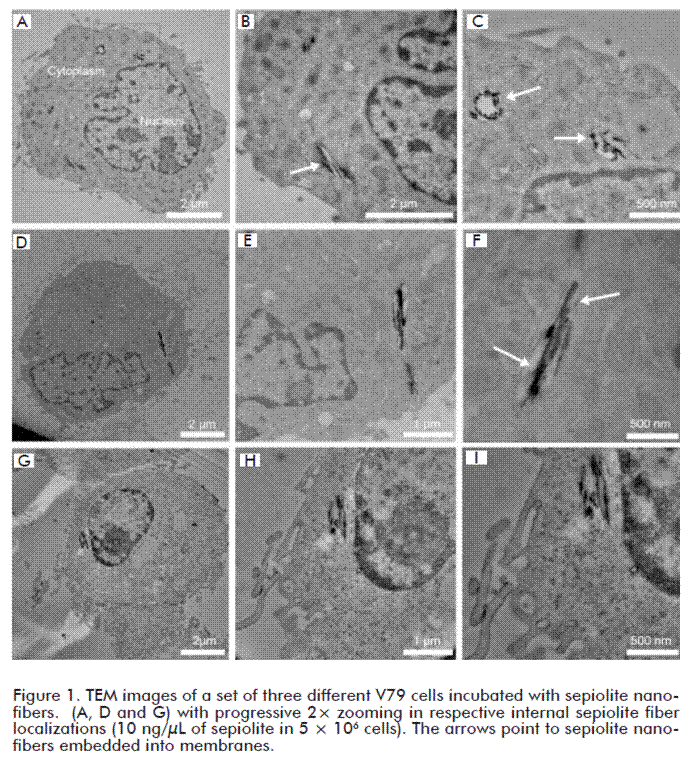
<body><![CDATA[<P   ><font size="2" face="Verdana, Arial, Helvetica, sans-serif">Sepiolite is a clay      mineral of high purity (&gt; 95 %) obtained by a wet grinding process. It      was supplied by TOLSA SA (Spain) as Pangel S9, previously obtained from the      Vallecas-Vicalvaro deposits near Madrid. Sepiolite is a natural hydrated magnesium      silicate with micro-nanofibrous morphology, with a theoretical cell formula      Si<sub>12</sub>O<sub>30</sub>Mg<sub>8</sub>(OH,F)<sub>4</sub>(H<sub>2</sub>O)<sub>4</sub>      &middot; 8H<sub>2</sub>O [2]. We took advantage of the nature of the sepiolite      surface, which shows extensive negatively charged area, and its nanofibrous      morphology, as potential nanoplatform for the co-transfection of different      types of active molecules. In fact, we formerly found that sepiolite was capable      of interacting with polysaccharides, lipids, proteins and viruses, resulting      in a wide variety of biohybrid and bionanocomposite materials for diverse      applications, which could find applications in biotechnology and biomedicine      [3]. </font></P >   <FONT size="+1"><FONT size="+1"><FONT size="+1"><FONT size="+1"><FONT size="+1"><FONT size="+1"><FONT size="+1"><FONT size="+1"><FONT size="+1"><FONT size="+1"><FONT size="+1"><FONT size="+1"><FONT size="+1"><FONT size="+1">        <P   ><font size="2" face="Verdana, Arial, Helvetica, sans-serif">A first point on      this study was to analyze the aspect and size distribution of these clay fibers      by transmission electron microscopy (TEM). For this, clay was submitted to      ultrasonication to conveniently detangle the fibers. This treatment may have      shorten them but also generated an relatively uniform particle size range      and reactivity, with an average width of 15 nm and about 80 % of fibers 200-400      nm in length [4]. </font></P >       <P   ><font size="2" face="Verdana, Arial, Helvetica, sans-serif">The sub-micrometric      size combined with the low toxicity described for sepiolite fibers, makes      it potentially suitable for delivery of molecules into mammalian cells. Considering      this, working concentrations of sepiolite suspensions in the range of 1-10      ng/&mu;L were prepared and assessed for toxicity. They were found to be non-toxic      in different mammalian cell lines. Moreover, it was observed that sepiolite      has a high natural stable fluorescence (green excitation at 488 nm and emission      between 498 nm and 530 nm, red excitation at 532 nm and emission between 542      nm and 685 nm), which allows to directly follow up the uptake process of sepiolite      nanofibers by cells without adding any other compound as required for other      gene transfer vectors [5]. Taking advantage of this property, the internalization      of sepiolite fibers was analyzed by laser confocal microscopy and the spontaneous      cellular uptake was confirmed in V79 cells. Remarkably, time-lapse video-fluorescent      microscopy revealed that mammalian cells were able to spontaneously internalized      sepiolite fibers but were also able to eject them, and by this way, sepiolite      nanofibers can be transported between adjacent cells. Additionally, the incorporation      kinetics was followed by Flow Activated Cell Sorting (FACS), with 45 % of      cells becoming fluorescent after 6 h, up to 55 % after 24 h [5]. Using TEM      we found that in the cytoplasm the sepiolite fibers were surrounded by membranes      or endosomes, suggesting the internalization by endocytosis (<a href="/img/revistas/bta/v34n3/f0105317.gif">Figure      1</a>). </font></P >       
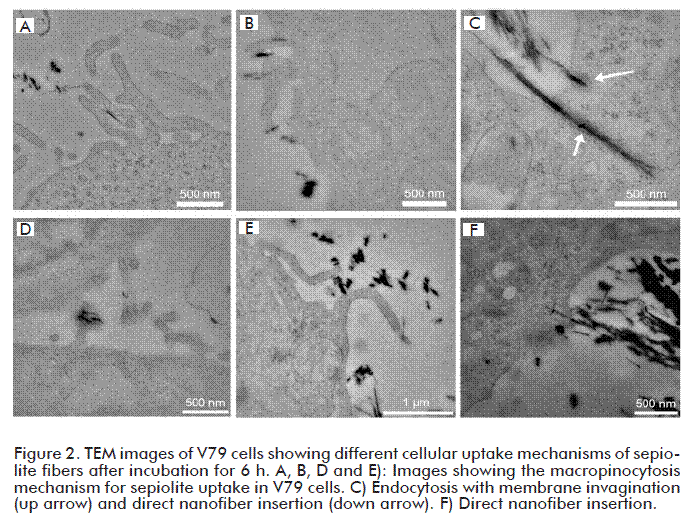
<P   ><font size="2" face="Verdana, Arial, Helvetica, sans-serif">Specific endocytosis      and macropinocytosis structures were observed at the membrane/sepiolite junction      (<a href="/img/revistas/bta/v34n3/f0205317.gif">Figure 2</a>). It was also found that some sepiolite      fibers were not surrounded by endosomal membranes, suggesting an alternative      pathway for endocytosis in the internalization of sepiolite (direct cytoplasmic      membrane insertion). We used FACS analysis to quantitatively determine the      involvement of macropinocytosis and clathrin-mediated endocytosis following      incubation with sepiolite in the presence of endocytosis inhibitors including      chloroquin (which blocks the clathrin-mediated endocytosis) and amiloride      (which inhibits macropinocytosis). While chloro-quine reduced only 20 % of      the sepiolite celular internalization, amiloride inhibited it by 50 %, showing      that one of the main mechanisms of cellular internalization of sepiolite is      macropinocitosis, in agreement with previous observations using TEM [5]. </font></P >       
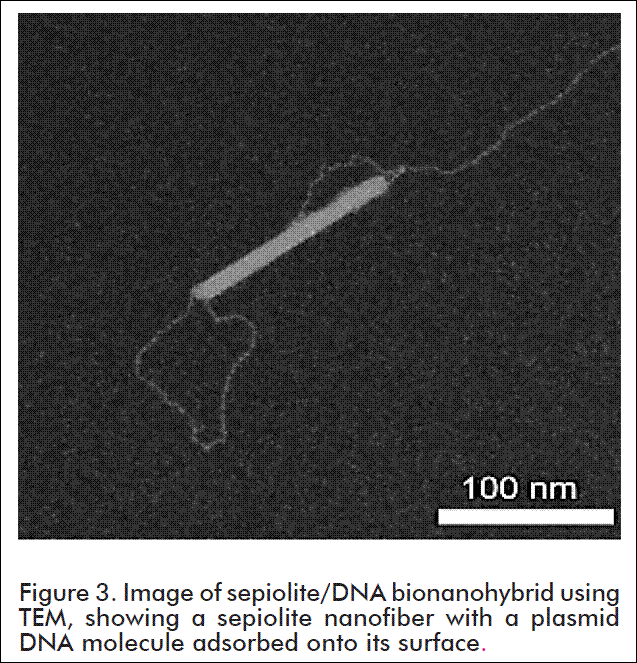
<P   ><font size="2" face="Verdana, Arial, Helvetica, sans-serif"><B>Synthesis of biohybrids      based on sepiolite and DNA </b></font></P >       <P   ><font size="2" face="Verdana, Arial, Helvetica, sans-serif">In order to demonstrate      the use of sepiolite as DNA transfer vector, sepiolite fibers were incubated      with plasmid DNA. It was shown that DNA could actually be adsorbed onto sepiolite      spontaneously up to 80 &mu;g of DNA per mg of sepiolite, as deduced from the      analysis of adsorption isotherms (determined using UV-vis spectrometry to      calculate DNA concentration in solution before and after adsorption). It was      shown that polyvalent cations such as Mg<sup>2+</sup>, Ca<sup>2+</sup>, spermidine      and spermine strongly stimulate DNA adsorption in a way directly correlated      to the valence of the cations. Up to nearly 300 &mu;g of DNA could be adsorbed      per mg of sepiolite in the presence of the tetravalent cation (spermine).      Most DNA molecules were absorbed instantaneously, suggesting a predominance      of electrostatic and hydrogen bridging interactions between sepiolite and      DNA. Subsequently, the changes in the surface electric charge of biohybrids      due to the presence of multivalent cations and DNA were studied by determining      zeta potential through electrokinetic analysis. Different DNA conformations      were characterized: linear genomic DNA (300 bp in average) containing complex      sequences (salmon sperm DNA), covalently closed circular plasmid DNA (5.7      kb), double-stranded linear DNA (dsDNA, 15 bp) and single-stranded linear      DNA (non-translated single stranded DNA, 15 bp). Analysis using Fourier transform      infrared spectroscopy (FTIR) confirmed that the interaction of DNA with sepiolite      was occurred through the external silanol groups of sepiolite [4]. Moreover,      analyzes using TEM and atomic force microscopy (AFM) showed that sepiolite      fibers assembled DNA biomolecules on their outer surface (<a href="/img/revistas/bta/v34n3/f0305317.gif">Figure      3</a>). </font></P >   <FONT size="+1"><FONT size="+1"><FONT size="+1"><FONT size="+1">        
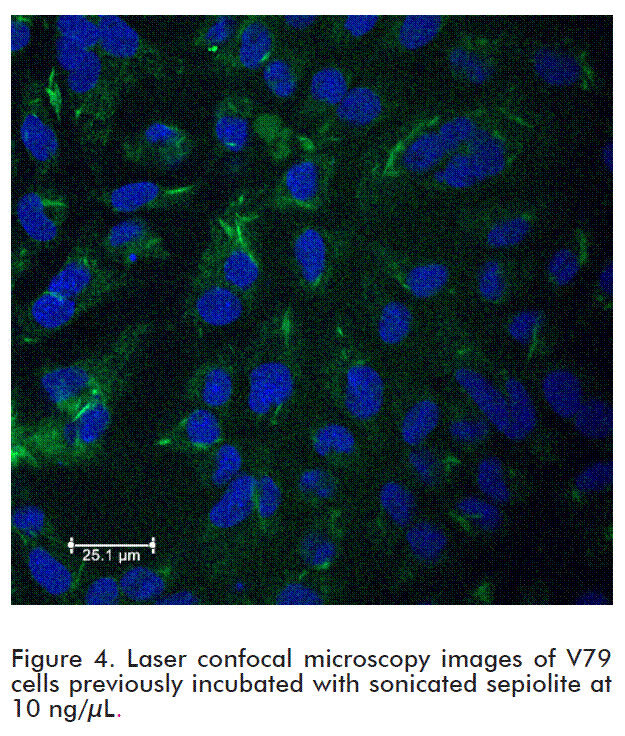
<P   ><font size="2" face="Verdana, Arial, Helvetica, sans-serif">Additionally, the      reversibility of the DNA adsorption process onto sepiolite was confirmed,      i.e. the possibility of recovering DNA previously adsorbed on sepiolite. For      this, the biohybrid was re-suspended in ethylenediaminetetraacetic acid (EDTA),      which is a standard metal ion chelating agent. The displacement and sequestration      of poly-cations favoring DNA binding to sepiolite, allowed the recovery of      DNA previously adsorbed on the clay surface by cation bridges. The quality      of the DNA plasmids recovered by EDTA re-suspension was estimated by electrophoresis:      the distribution of different DNA isoforms (supercoiled, open circle, linear)      was un-changed during the sepiolite adsorption-desorption processes. This      demonstrated that interaction with sepiolite does not affect the biological      quality of DNA and even more, that the method of incubation of DNA with sepiolite      nanoparticles and a chelating agent can be established as a new methodology      for the extraction and purification of DNA, much cheaper than some available      commercial systems [4]. </font></P >       <P   ><font size="2" face="Verdana, Arial, Helvetica, sans-serif"><B>Transfer of nucleic      acids into mammalian cells </b></font></P >       <P   ><font size="2" face="Verdana, Arial, Helvetica, sans-serif">Since it was determined      that sepiolite is able to efficiently transfer small interfering RNA (FTIC      labeled siRNA) into human cancer cells (A673 sarcoma cells) [4], its ability      as biohybrid nanoplataform to transfer DNA into the nucleus of mammalian cells      was evaluated by synthesizing a sepiolite/DNA (Sep/DNA) bionanohybrid. It      was prepared by incubating the pCMV plasmid vector, which harbors a gene conferring      resistance to G418 antibiotic cells, with sepiolite nanofibers. The efficiency      of DNA transfer was then measured in cells through selection of G418-resistant      cell colonies after the exposure of cells to Sep/DNA. Numerous resistant colonies      were observed in V79 hamster cancer cells and U2OS human osteosarcoma cells      after 10 days of incubation with the G418 antibiotic, demonstrating the ability      of sepiolite to stably transfer an exogenous DNA into mammalian cells [4].      </font></P >       <P   ><font size="2" face="Verdana, Arial, Helvetica, sans-serif">Subsequently, another      strategy was tested to increase the efficiency of sepiolite-mediated DNA transfection.      It consisted on disaggregating the sepiolite fibers more efficiently by ultrasonication      of the sepiolite suspension (sonicated sepiolite; SSEP). Then, new biohybrids      were synthesized with the above mentioned plasmid and SSEP, and mammalian      cells were then incubated with the resulting SSEP/ DNA complexes (<a href="/img/revistas/bta/v34n3/f0405317.gif">Figure      4</a>). </font></P >       
]]></body>
<body><![CDATA[<P   ><font size="2" face="Verdana, Arial, Helvetica, sans-serif">Surprisingly, ultrasonicated      sepiolite complexes increased transfection efficiency in two orders of magnitude      when applied to human cells in culture. In fact, the number of transfected      colonies reached 350 per &mu;g of DNA [4]. The efficiency of SSEP/DNA transfection      was further measured by prior incubation of the cells with chloroquine or      amiloride, to try to favor the endosomal escape of nanofibers. While amiloride      does not produce a significant effect, prior incubation of the cells with      chloroquine stimulated transfection efficiency by a factor of 3 in human cells.      These data indicate that, in human cells and using SSEP/DNA biohybrids, chloroquine      favors endosomal escape </font><font size="2" face="Verdana, Arial, Helvetica, sans-serif">more      effectively than the inhibition of the internalization of the bionanohybrid,      thus increasing the transfection efficiency to reach 900 resistant colonies      per microgram of DNA. Furthermore, a transfection efficiency similar and only      slightly lower than that obtained by using conventional transfection methods      as Jet PEI was achieved by combining the two protocols, chloroquine pretreatment      plus SSEP/ DNA [5]. This strategy is further complemented by the sepiolite      advantage of having a relatively lower cost than existing transfection agents      and being si-multaneously non-toxic to cells. Overall, our results indicate      that sepiolite could provide an efficient transfection nanohybrid system for      the delivery of nucleic acids into cells.</font></P >       <P   >&nbsp;</P >       <P   > </P >       <P   ><b><font size="3" color="#000000" face="Verdana, Arial, Helvetica, sans-serif">SCIENTIFIC      RELEVANCE </font></b></P >   <FONT size="+1" color="#000000">        <P   ><font size="2" color="#211E1F" face="Verdana, Arial, Helvetica, sans-serif">Due      to its relatively low cost, simplicity and feasibility of preparation, and      convenience of the synthesis methods described in this work, sepiolite-based      biohybrids offer a new and attractive platform for the transfer of nucleic      acids in mammalian cells, and particularly humans, with potentially promising      future developments with application in Nanomedicine and Nanobiotechnology.      Higher co-transfection efficiencies could be also possible with sepiolite      nanofibers than with typical small spherical nanoparticles due to the higher      surface area of the nanofibers for non-viral gene transfer. This is also attractive      for the co-transfection of DNA molecules together proteins and targeting or      therapeutic, for instance, monoclonal antibodies, in order to achieved synergic      effects. They can also be applied as delivery vectors for gene editing purposes,      for cellular engineering to produce recombinant proteins of biomedical use,      to generate new transgenic models in plants and animals, in gene and cell      therapies, and to develop new treatments against diseases of genetic origin.      Our results supported 3 international patent applications, one of them already      granted (EP3009514A1). </font></P >   <FONT size="+1" color="#211E1F">        <P   ><font size="2" face="Verdana, Arial, Helvetica, sans-serif">This work also granted      Castro Smirnov FA with a National Award to a Young Researcher from the Cuban      Ministry of Science, Technology and the Environment (CITMA). It also contributed      to a multidisciplinary Ph.D. thesis in Biological Sciences at the Universit&eacute;      Paris XI and in the Institute of Cancerology Gustave-Roussy in Paris (discipline      Molecular Biophysics, Life Sciences and Health), then homologated by the Cuban      National Commission of Scientific Degrees in Physical Sciences in 2014. Six      international articles were published in high prestige journals, the two most      recent in Scientific Reports, from the Nature Publishing Group. Oral presentations      and keynotes were de-livered at 10 international scientific conferences, including      the 251th National Meeting of the American Chemical Society in USA, Nanotech      France 2016, the 4th International Conference on Multifunctional, Hybrid and      Nanomaterial 2015 and the International Clay Conference 2017, and 20 technical      lectures were imparted in universities and research centers in Cuba and abroad,      including the Imperial College of London, Johns Hopkins University in Baltimore,      New York University, Tel Aviv University, Federal University of Roraima, and      the Istituto Italiano di Tecnologia, Politecnico di Torino, Italy.</font></P >       <P   >&nbsp;</P >       <P   > </P >   <FONT size="+1" color="#000000">        <P   ><font size="3" face="Verdana, Arial, Helvetica, sans-serif"><b>ACKNOWLEDGEMENTS      </b> </font></P >       <P   ><font size="2" color="#211E1F" face="Verdana, Arial, Helvetica, sans-serif">This      research was possible due to the international collaboration among complementary      research teams from Cuba, France and Spain, spanning all aspects of a multidisciplinary      analysis at the edges of physics, chemistry and biology. This work was supported      by La Ligue Nationale Contre le Cancer, ANR (Agence Nationale de la Recherche,      ANR-14-CE10-0010-02), AFM-T&eacute;l&eacute;thon and INCa (Institut National      du Cancer, 2011-1-RT-01, 2011-1-PLBIO-09, 2013-1-PLBIO-14), the MINECO in      Spain (projects MAT2012-31759 and MAT2015-71117-R), and the EU COST Action      MP1202. Thanks are due to the French Embassy in Cuba and the Campus France      for their contribution in partial financial support. </font></P >       ]]></body>
<body><![CDATA[<P   >&nbsp;</P >   <FONT size="+1" color="#211E1F">        <P   > </P >   <FONT size="+1" color="#000000">        <P   ><b><font size="3" face="Verdana, Arial, Helvetica, sans-serif">REFERENCES </font></b></P >       <!-- ref --><P   ><font size="2" color="#211E1F" face="Verdana, Arial, Helvetica, sans-serif">1.      Castro Smirnov, FA. Physicochemical characterization of DNA-based bionanocomposites      using nonafibrous clay minerals: biological applications. Biophysics. Paris:      Universit&eacute; Paris Sud - Paris XI; 2014.     </font></P >   <FONT size="+1" color="#211E1F">        <!-- ref --><P   ><font size="2" face="Verdana, Arial, Helvetica, sans-serif">2. Santaren J, Sanz      J, Ruiz-Hitzky E. Structural Fluorine in Sepiolite. Clays Clay Miner. 1990;38:63-8.          </font></P >       <!-- ref --><P   ><font size="2" face="Verdana, Arial, Helvetica, sans-serif">3. Ruiz-Hitzky E,      Darder M, Wicklein B, Fernandes FM, Castro-Smirnov FA, Mart&iacute;n del Burgo      MA, <i>et al</i>. Advanced biohybrid materials based on nanoclays for biomedical      applications. Proc SPIE 8548, Nanosystems in Engineering and Medicine, 85480D      (October 24, 2012); 2012.     </font></P >       <P   ><font size="2" face="Verdana, Arial, Helvetica, sans-serif">4. Castro-Smirnov      FA, Pietrement O, Aranda P, Bertrand JR, Ayache J, Le Cam E, <i>et al</i>.      Physical interactions between DNA and sepiolite nanofibers, and potential      application for DNA transfer into mammalian cells. Sci Rep. 2016;6:36341.      </font></P >       ]]></body>
<body><![CDATA[<!-- ref --><P   ><font size="2" face="Verdana, Arial, Helvetica, sans-serif">5. Castro-Smirnov      FA, Ayache J, Bertrand JR, Dardillac E, Le Cam E, Pietrement O, <i>et al</i>.      Cellular uptake pathways of sepiolite nanofibers and DNA transfection improvement.      Sci Rep. 2017;7(1):5586.    </font></P >       <P   >&nbsp;</P >       <P   >&nbsp;</P >       <P   ><font size="2" face="Verdana, Arial, Helvetica, sans-serif">Received in October,      2016.    <br>     Accepted in March, 2017.</font></P >       <P   >&nbsp;</P >       <P   >&nbsp;</P >       <P   ><font size="2" face="Verdana, Arial, Helvetica, sans-serif"><I>Fidel Antonio      Castro-Smirnov</I>. Universidad de las Ciencias Inform&aacute;ticas. Carretera      a San Antonio de los Ba&ntilde;os, km 2 1/2, La Habana 19370, Cuba. E-mail:      <A href="mailto:fide@uci.cu"> <FONT color="#0000FF">fide@uci.cu</font></A><FONT color="#0000FF"><FONT color="#211E1F">,      <A href="mailto:fsmirnov@yahoo.com"> <FONT color="#0000FF">fsmirnov@yahoo.com</font></A><FONT color="#0000FF"><FONT color="#211E1F">.</font></font></font></font></font></P >   </font></font></font></font></font></font></font></font></font></font></font></font></font></font></font></font></font></font></font></font></font></font></font></font></font></font></font></font></font></font></font></font></font></font></font></font></font></font></font></font></font></font></font></font></font></font></font></font></font></font></font></font></font></font></font></font></font></font></font></font></font></font></font></font></DIV >      ]]></body><back>
<ref-list>
<ref id="B1">
<label>1</label><nlm-citation citation-type="book">
<person-group person-group-type="author">
<name>
<surname><![CDATA[Castro Smirnov]]></surname>
<given-names><![CDATA[FA]]></given-names>
</name>
</person-group>
<source><![CDATA[Physicochemical characterization of DNA-based bionanocomposites using nonafibrous clay minerals: biological applications. Biophysics]]></source>
<year>2014</year>
<publisher-loc><![CDATA[Paris ]]></publisher-loc>
<publisher-name><![CDATA[Université Paris Sud - Paris XI]]></publisher-name>
</nlm-citation>
</ref>
<ref id="B2">
<label>2</label><nlm-citation citation-type="journal">
<person-group person-group-type="author">
<name>
<surname><![CDATA[Santaren]]></surname>
<given-names><![CDATA[J]]></given-names>
</name>
<name>
<surname><![CDATA[Sanz]]></surname>
<given-names><![CDATA[J]]></given-names>
</name>
<name>
<surname><![CDATA[Ruiz-Hitzky]]></surname>
<given-names><![CDATA[E]]></given-names>
</name>
</person-group>
<article-title xml:lang="en"><![CDATA[Structural Fluorine in Sepiolite]]></article-title>
<source><![CDATA[Clays Clay Miner]]></source>
<year>1990</year>
<volume>38</volume>
<page-range>63-8</page-range></nlm-citation>
</ref>
<ref id="B3">
<label>3</label><nlm-citation citation-type="">
<person-group person-group-type="author">
<name>
<surname><![CDATA[Ruiz-Hitzky]]></surname>
<given-names><![CDATA[E]]></given-names>
</name>
<name>
<surname><![CDATA[Darder]]></surname>
<given-names><![CDATA[M]]></given-names>
</name>
<name>
<surname><![CDATA[Wicklein]]></surname>
<given-names><![CDATA[B]]></given-names>
</name>
<name>
<surname><![CDATA[Fernandes]]></surname>
<given-names><![CDATA[FM]]></given-names>
</name>
<name>
<surname><![CDATA[Castro-Smirnov]]></surname>
<given-names><![CDATA[FA]]></given-names>
</name>
<name>
<surname><![CDATA[Martín del Burgo]]></surname>
<given-names><![CDATA[MA]]></given-names>
</name>
</person-group>
<source><![CDATA[Advanced biohybrid materials based on nanoclays for biomedical applications. Proc SPIE 8548, Nanosystems in Engineering and Medicine, 85480D (October 24, 2012)]]></source>
<year>2012</year>
</nlm-citation>
</ref>
<ref id="B4">
<label>4</label><nlm-citation citation-type="journal">
<person-group person-group-type="author">
<name>
<surname><![CDATA[Castro-Smirnov]]></surname>
<given-names><![CDATA[FA]]></given-names>
</name>
<name>
<surname><![CDATA[Pietrement]]></surname>
<given-names><![CDATA[O]]></given-names>
</name>
<name>
<surname><![CDATA[Aranda]]></surname>
<given-names><![CDATA[P]]></given-names>
</name>
<name>
<surname><![CDATA[Bertrand]]></surname>
<given-names><![CDATA[JR]]></given-names>
</name>
<name>
<surname><![CDATA[Ayache]]></surname>
<given-names><![CDATA[J]]></given-names>
</name>
<name>
<surname><![CDATA[Le]]></surname>
<given-names><![CDATA[Cam]]></given-names>
</name>
</person-group>
<article-title xml:lang="en"><![CDATA[Physical interactions between DNA and sepiolite nanofibers, and potential application for DNA transfer into mammalian cells]]></article-title>
<source><![CDATA[Sci Rep]]></source>
<year>2016</year>
<volume>6</volume>
<page-range>36341</page-range></nlm-citation>
</ref>
<ref id="B5">
<label>5</label><nlm-citation citation-type="journal">
<person-group person-group-type="author">
<name>
<surname><![CDATA[Castro-Smirnov]]></surname>
<given-names><![CDATA[FA]]></given-names>
</name>
<name>
<surname><![CDATA[Ayache]]></surname>
<given-names><![CDATA[J]]></given-names>
</name>
<name>
<surname><![CDATA[Bertrand]]></surname>
<given-names><![CDATA[JR]]></given-names>
</name>
<name>
<surname><![CDATA[Dardillac]]></surname>
<given-names><![CDATA[E]]></given-names>
</name>
<name>
<surname><![CDATA[Le Cam]]></surname>
<given-names><![CDATA[E]]></given-names>
</name>
<name>
<surname><![CDATA[Pietrement]]></surname>
<given-names><![CDATA[O]]></given-names>
</name>
</person-group>
<article-title xml:lang="en"><![CDATA[Cellular uptake pathways of sepiolite nanofibers and DNA transfection improvement]]></article-title>
<source><![CDATA[Sci Rep]]></source>
<year>2017</year>
<volume>7</volume>
<numero>1</numero>
<issue>1</issue>
<page-range>5586</page-range></nlm-citation>
</ref>
</ref-list>
</back>
</article>