<?xml version="1.0" encoding="ISO-8859-1"?><article xmlns:mml="http://www.w3.org/1998/Math/MathML" xmlns:xlink="http://www.w3.org/1999/xlink" xmlns:xsi="http://www.w3.org/2001/XMLSchema-instance">
<front>
<journal-meta>
<journal-id>1027-2852</journal-id>
<journal-title><![CDATA[Biotecnología Aplicada]]></journal-title>
<abbrev-journal-title><![CDATA[Biotecnol Apl]]></abbrev-journal-title>
<issn>1027-2852</issn>
<publisher>
<publisher-name><![CDATA[Editorial Elfos Scientiae]]></publisher-name>
</publisher>
</journal-meta>
<article-meta>
<article-id>S1027-28522017000300006</article-id>
<title-group>
<article-title xml:lang="en"><![CDATA[New methodology for Vip3A monitoring in corn resistant to Spodoptera frugiperda (Lepidoptera: Noctuidae)]]></article-title>
<article-title xml:lang="es"><![CDATA[Nueva metodología para el monitoreo de Vip3A en plantas de maíz resistentes a Spodoptera frugiperda (Lepidoptera: Noctuidae)]]></article-title>
</title-group>
<contrib-group>
<contrib contrib-type="author">
<name>
<surname><![CDATA[Hernández]]></surname>
<given-names><![CDATA[Daily]]></given-names>
</name>
<xref ref-type="aff" rid="A01"/>
</contrib>
<contrib contrib-type="author">
<name>
<surname><![CDATA[Aragón]]></surname>
<given-names><![CDATA[Hasel]]></given-names>
</name>
<xref ref-type="aff" rid="A01"/>
</contrib>
<contrib contrib-type="author">
<name>
<surname><![CDATA[González]]></surname>
<given-names><![CDATA[Marcos]]></given-names>
</name>
<xref ref-type="aff" rid="A01"/>
</contrib>
<contrib contrib-type="author">
<name>
<surname><![CDATA[Rodríguez-Cabrera]]></surname>
<given-names><![CDATA[Lianet]]></given-names>
</name>
<xref ref-type="aff" rid="A01"/>
</contrib>
<contrib contrib-type="author">
<name>
<surname><![CDATA[Ponce]]></surname>
<given-names><![CDATA[Milagros]]></given-names>
</name>
<xref ref-type="aff" rid="A01"/>
</contrib>
<contrib contrib-type="author">
<name>
<surname><![CDATA[Tamayo]]></surname>
<given-names><![CDATA[Andrés]]></given-names>
</name>
<xref ref-type="aff" rid="A01"/>
</contrib>
<contrib contrib-type="author">
<name>
<surname><![CDATA[Téllez]]></surname>
<given-names><![CDATA[Pilar]]></given-names>
</name>
<xref ref-type="aff" rid="A01"/>
</contrib>
<contrib contrib-type="author">
<name>
<surname><![CDATA[Ayra-Pardo]]></surname>
<given-names><![CDATA[Camilo]]></given-names>
</name>
<xref ref-type="aff" rid="A01"/>
</contrib>
<contrib contrib-type="author">
<name>
<surname><![CDATA[Valdés]]></surname>
<given-names><![CDATA[Rodolfo]]></given-names>
</name>
<xref ref-type="aff" rid="A01"/>
</contrib>
</contrib-group>
<aff id="A01">
<institution><![CDATA[,Centro de Ingeniería Genética y Biotecnología  ]]></institution>
<addr-line><![CDATA[La Habana ]]></addr-line>
<country>Cuba</country>
</aff>
<pub-date pub-type="pub">
<day>00</day>
<month>09</month>
<year>2017</year>
</pub-date>
<pub-date pub-type="epub">
<day>00</day>
<month>09</month>
<year>2017</year>
</pub-date>
<volume>34</volume>
<numero>3</numero>
<fpage>3521</fpage>
<lpage>3524</lpage>
<copyright-statement/>
<copyright-year/>
<self-uri xlink:href="http://scielo.sld.cu/scielo.php?script=sci_arttext&amp;pid=S1027-28522017000300006&amp;lng=en&amp;nrm=iso"></self-uri><self-uri xlink:href="http://scielo.sld.cu/scielo.php?script=sci_abstract&amp;pid=S1027-28522017000300006&amp;lng=en&amp;nrm=iso"></self-uri><self-uri xlink:href="http://scielo.sld.cu/scielo.php?script=sci_pdf&amp;pid=S1027-28522017000300006&amp;lng=en&amp;nrm=iso"></self-uri><kwd-group>
<kwd lng="en"><![CDATA[Vip3A ELISA]]></kwd>
<kwd lng="en"><![CDATA[Bt-Vip3A hybrids]]></kwd>
<kwd lng="en"><![CDATA[high dose]]></kwd>
<kwd lng="en"><![CDATA[corn]]></kwd>
<kwd lng="es"><![CDATA[Vip3A ELISA]]></kwd>
<kwd lng="es"><![CDATA[híbridos Bt-Vip3A]]></kwd>
<kwd lng="es"><![CDATA[alta dosis]]></kwd>
<kwd lng="es"><![CDATA[maíz]]></kwd>
</kwd-group>
</article-meta>
</front><body><![CDATA[ <DIV class="Sect"   >        <P align="right"   ><font size="2" color="#000000" face="Verdana, Arial, Helvetica, sans-serif"><b>REPORT</b>      </font></P >       <P align="right"   >&nbsp;</P >   <FONT size="+1" color="#000000">        <P   > </P >   <FONT size="+1">       <P   ><font size="4" color="#211E1F" face="Verdana, Arial, Helvetica, sans-serif"><B>New      methodology for Vip3A monitoring in corn resistant to <i>Spodoptera frugiperda</i>      (Lepidoptera: Noctuidae) </b></font></P >       <P   >&nbsp;</P >       <P   ><font size="2" face="Verdana, Arial, Helvetica, sans-serif"><b><font size="3">Nueva      metodolog&iacute;a para el monitoreo de Vip3A en plantas de ma&iacute;z resistentes      a <i>Spodoptera frugiperda</i> (Lepidoptera: Noctuidae)</font></b></font></P >   <FONT size="+1" color="#211E1F">        <P   >&nbsp;</P >       <P   >&nbsp;</P >   <FONT size="+1" color="#000000">        <P   ><font size="2" color="#211E1F" face="Verdana, Arial, Helvetica, sans-serif"><b>Daily      Hern&aacute;ndez, Hasel Arag&oacute;n, Marcos Gonz&aacute;lez, Lianet Rodr&iacute;guez-Cabrera,      Milagros Ponce, Andr&eacute;s Tamayo, Pilar T&eacute;llez, Camilo Ayra-Pardo,      Rodolfo Vald&eacute;s </b></font></P >   <FONT size="+1" color="#211E1F">        ]]></body>
<body><![CDATA[<P   ><font size="2" face="Verdana, Arial, Helvetica, sans-serif">Centro de Ingenier&iacute;a      Gen&eacute;tica y Biotecnolog&iacute;a, Ave 31 e/ 158 y 190, Cubanac&aacute;n,      Playa, CP 11600, La Habana, Cuba. </font></P >       <P   >&nbsp;</P >       <P   >&nbsp;</P >   <FONT size="+1"> </font></font></font></font></font></font>    <hr>   <FONT size="+1" color="#000000"><FONT size="+1"><FONT size="+1" color="#211E1F"><FONT size="+1" color="#000000"><FONT size="+1" color="#211E1F"><FONT size="+1">       <P   ><font size="2" face="Verdana, Arial, Helvetica, sans-serif"><b>ABSTRACT</b> </font></P >       <P   ><font size="2" face="Verdana, Arial, Helvetica, sans-serif">Here we report the      main research results demonstrating the expression of the insecticidal toxin      Vip3Aa in transgenic Bt-Vip3Aa corn hybrids, at &lsquo;high dose&rsquo; according      to the Environmental Protection Agency of the USA. It was also developed a      quantitative ELISA assay named TOXIVip, specific against the Vip3Aa protein.      The Vip3Aa toxin was cloned and expressed in <I>Escherichia coli </I>(Ec-Vip3Aa),      purified by Immobilized Metal Affinity Chromatography (IMAC) and used for      the generation of monoclonal antibodies (mAbs). The mAbs were able to recognize      the native Vip3Aa protein expressed in transgenic corn plants and were used      in the development of the TOXIVip method. Specifically, the TOXIVip method      allowed quantifying the expression of the toxin in Bt-Vip3Aa corn hybrids,      and aided on corroborating them as complying with the &lsquo;high dose&rsquo;      criterion. So far, the TOXIVip method was the first quantitative system ever      reported for selecting the best Bt-Vip3Aa corn plants showing insecticidal      activity according to the highest levels of the Vip3Aa toxin expressed. Advantageously,      the TOXIVip method provides a fast and specific procedure to determine the      Vip3Aa protein in transgenic plants, particularly in Bt-Vip3Aa corn plants,      and also in the environment and as part of the screening tests in the food      stock chain. Such system could be determinant to establish the &lsquo;high      dose&rsquo; criterion during the introduction of new lines and hybrids of      Bt-Vip3A corn, also helping in genetic introgression analyses while developing      new corn genotypes. This research granted the 2016 Award of the Cuban National      Academy of Sciences. </font></P >       <P   ><font size="2" color="#000000" face="Verdana, Arial, Helvetica, sans-serif"><i><b>Keywords:</b></i>      <FONT color="#211E1F">Vip3A ELISA, Bt-Vip3A hybrids, high dose, corn. </font></font></P >   </font></font></font></font></font></font>    <hr>   <FONT size="+1" color="#000000"><FONT size="+1"><FONT size="+1" color="#211E1F"><FONT size="+1" color="#000000"><FONT size="+1" color="#211E1F"><FONT size="+1"><FONT size="+1" color="#000000"><FONT size="+1" color="#211E1F">        <P   ><font size="2" face="Verdana, Arial, Helvetica, sans-serif"><b>RESUMEN</b> </font></P >       <P   ><font size="2" face="Verdana, Arial, Helvetica, sans-serif">Se presentan los      principales resultados de investigaci&oacute;n que demostraron la producci&oacute;n      de la toxina insecticida Vip3A en plantas transg&eacute;nicas de ma&iacute;z      h&iacute;brido Bt-Vip3A, a altas dosis seg&uacute;n los requerimientos de      la Agencia de Protecci&oacute;n Ambiental de EE.UU. Tambi&eacute;n se desarroll&oacute;      un ensayo de ELISA espec&iacute;fico contra la prote&iacute;na Vip3A, denominado      m&eacute;todo TOXIVip. Para ello, la Vip3A se clon&oacute; y expres&oacute;      en <I>Escherichia coli </I>(Ec-Vip3Aa), se purific&oacute; mediante cromatograf&iacute;a      de afinidad por quelatos met&aacute;licos y se uso para la obtenci&oacute;n      de anticuerpos monoclonales (mAbs). Los anticuerpos fueron capaces de reconocer      a la toxina Vip3A nativa, expresada en las plantas transg&eacute;nicas y con      ellos se desarroll&oacute; el m&eacute;todo TOXIVip. Este ensayo permiti&oacute;      cuantificar la expresi&oacute;n de la toxina en plantas h&iacute;bridas Bt-Vip3Aa,      as&iacute; como el cumplimiento del criterio de altas dosis. Hasta el momento,      el m&eacute;todo TOXIVip es el primer sistema conocido que permita la selecci&oacute;n      de las mejores plantas Bt-Vip3Aa con actividad insecticida, seg&uacute;n los      altos niveles de toxina Vip3Aa expresada. Ventajosamente, el m&eacute;todo      TOXIVip proporciona un procedimiento r&aacute;pido y espec&iacute;fico para      determinar la prote&iacute;na Vip3Aa en plantas transg&eacute;nicas, especialmente      en plantas Bt-Vip3Aa de ma&iacute;z, as&iacute; como en el medioambiente y      en la cadena de productos alimentarios. Tal sistema puede ser determinante      para establecer el criterio de alta dosis durante la introducci&oacute;n de      nuevas l&iacute;neas e h&iacute;bridos de ma&iacute;z Bt-Vip3A, y de ayuda      en los an&aacute;lisis de introgresi&oacute;n gen&eacute;tica durante el desarrollo      de nuevos genotipos de ma&iacute;z. Este trabajo mereci&oacute; el Premio      Anual de la Academia de Ciencias de Cuba para el a&ntilde;o 2016. </font></P >       <P   ><font size="2" face="Verdana, Arial, Helvetica, sans-serif"><i><b>Palabras clave:</b></i>      Vip3A ELISA, h&iacute;bridos Bt-Vip3A, alta dosis, ma&iacute;z. </font></P >   </font></font></font></font></font></font></font></font>    <hr>   <FONT size="+1" color="#000000"><FONT size="+1"><FONT size="+1" color="#211E1F"><FONT size="+1" color="#000000"><FONT size="+1" color="#211E1F"><FONT size="+1"><FONT size="+1" color="#000000"><FONT size="+1" color="#211E1F">        <P   >&nbsp;</P >       ]]></body>
<body><![CDATA[<P   >&nbsp;</P >       <P   > </P >       <P   ><font size="3"><b><font face="Verdana, Arial, Helvetica, sans-serif">INTRODUCTION      </font></b></font></P >       <P   > </P >   <FONT size="+1" color="#000000">        <P   ><font size="2" color="#211E1F" face="Verdana, Arial, Helvetica, sans-serif">The      indiscriminate and long-term use of corn plants that express <I>Bacillus thuringiensis      </I>toxins (plants-Bt), have been the causes of the emergence of resistant      insects [1]. In this sense, for the management of insects resistant to Bt      toxins, several strategies have been drawn up, among which are combining several      Bt toxins in the same plant (Cry1/Vip3A), and development of self-pesticide      plants, with &lsquo;high dose&rsquo; of expression of one of the Bt toxins      [2]. </font></P >   <FONT size="+1" color="#211E1F">        <P   ><font size="2" face="Verdana, Arial, Helvetica, sans-serif">Therefore, determining      the &lsquo;high dose&rsquo; criterion in Bt plants plays a key role in resistance      management by insect pests. In this regard, the criterion &lsquo;high dose&rsquo;      was described for the first time by the Environmental Protection Agency of      the USA (EPA) and refers to the concentration of the insecticidal protein      (Vip3Aa) expressed in the Bt/Vip3Aa corn plants must be equal to or greater      than 25 times the required concentration of the insecticidal protein to eliminate      99.99 % of the population of susceptible insects present in the field [3].      To do this, lyophilized Bt-Vip3Aa corn leaves have been used, diluting the      powder at 1:25 in the artificial diet of susceptible insects. The main limitation      of this strategy is the possible synergistic effect of the toxin with secondary      metabolites of the leaves generated during lyophilization. Moreover, it takes      a relatively long period of 7-10 days for obtaining the final result, and      it requires an artificial colony of insects that could differ genetically      from insects found in the field in terms of susceptibility [4]. </font></P >       <P   ><font size="2" face="Verdana, Arial, Helvetica, sans-serif">The quantification      of the Vip3Aa toxin in lines and hybrids of Bt-Vip3Aa corn was a critical      point in this study because the technology available in the world market is      destined only for the detection of the Vip3Aa toxin in corn plants. Therefore,      a new methodology called TOXIVip was developed to detect, quantify and select      corn plants that express the Vip3Aa toxin in &lsquo;high doses&rsquo;. In      the other hand, the Vip3Aa toxin was cloned into an expression vector in <I>Escherichia      coli </I>(Ec-Vip3Aa), purified and used more for the generation of mAbs. These      specific mAbs to the Ec-Vip3Aa toxin were used to develop the TOXIVip method      aimed at the quantification of the Vip3Aa toxin and selection of Bt-Vip3Aa      corn plants that meet the &lsquo;high dose&rsquo; criterion.</font></P >       <P   >&nbsp;</P >       <P   > </P >       <P   ><b><font size="3" face="Verdana, Arial, Helvetica, sans-serif">RESULTS </font></b></P >       ]]></body>
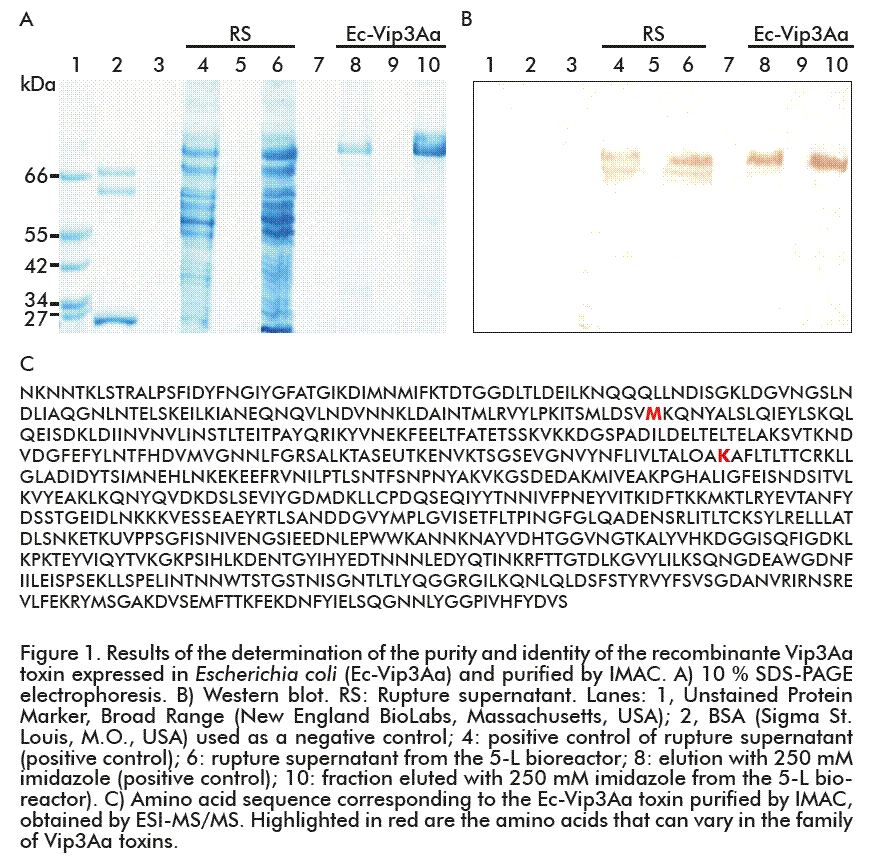
<body><![CDATA[<P   ><font size="2" face="Verdana, Arial, Helvetica, sans-serif">The Ec-Vip3Aa toxin      was cloned into the pQE-30 expression vector in <I>E. coli </I>strain JM-109,      under the control of the strong <I>pTaq </I>promoter [5]. Protein expression      was induced by adding IPTG, and the Ec-Vip3Aa toxin was fused to a histidine      leader. This last facilitated the isolation of the Ec-Vip3Aa toxin from the      rupture supernatant (RS), mediated by the interaction that was established      between the groups imidazole of the histidines and the metal fixed in the      IMAC chromatography matrix used (<a href="/img/revistas/bta/v34n3/f0106317.gif">Figure 1</a>). Therefore,      after cell rupture and centrifugation, the Ec-Vip3Aa toxin was purified from      RS, 97.2 &plusmn; 2.8 % pure and for a final recovery of 50.4 &plusmn; 4.0      %. These parameters were sufficient to generate the mAb required for the development      of the TOXIVip method with the aim of detecting and quantifying the Vip3Aa      toxin in Bt-Vip3Aa corn plants. </font></P >       
<P   ><font size="2" face="Verdana, Arial, Helvetica, sans-serif">The Ec-Vip3Aa toxin      was sequenced for identity analysis, the sequence further confirmed by mass      spectrometry (<a href="/img/revistas/bta/v34n3/f0106317.gif">Figure 1</a>) and further compared to      those reported for the Vip3Aa toxin in the <I>Bacillus thuringiensis </I>(Bt)      database [6]. It was demonstrated that both polypeptide sequences were similar,      the Ec-Vip3Aa toxin with 789 amino acids [5, 7-9]. </font></P >       
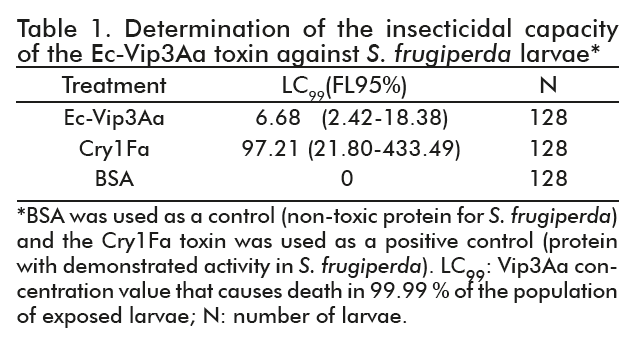
<P   ><font size="2" face="Verdana, Arial, Helvetica, sans-serif">It was also checked      whether the Ec-Vip3Aa toxin is biologically active against <I>S. frugiperda      </I>larvae [10-12]. Toxicity is defined as the lethal concentration of the      Ec-Vip3Aa toxin that causes death in 99 % (LC<sub>99</sub>) of the susceptible      and exposed insect population. Data obtained from the bioassay were analyzed      using the Probit statistical method and it was shown that the Ec-Vip3Aa toxin      was biologically active against larvae of the corn moth, with a LC<sub>99</sub>      of 6.680 ppm (<a href="/img/revistas/bta/v34n3/t0106317.gif">Table 1</a>). </font></P >   <FONT size="+1"><FONT size="+1"><FONT size="+1"><FONT size="+1">        
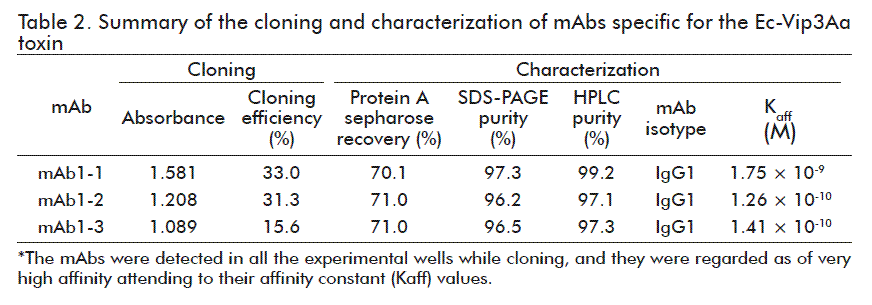
<P   ><font size="2" face="Verdana, Arial, Helvetica, sans-serif">The LC<sub>99</sub>      value measured in the biological activity assay of the Ec-Vip3Aa toxin will      allow the subsequent selection of Bt-Vip3Aa corn plants that meet the &lsquo;high      dose&rsquo; criterion. The strategy proposed in this study for the selection      of Bt-Vip3Aa corn plants expressing the Vip3Aa toxin at high doses was divided      into two fundamental steps: 1) determination of the LC<sub>99</sub> of the      Ec-Vip3Aa toxin, 2) direct quantification of the Vip3Aa toxin in Bt-Vip3Aa      corn plants using the TOXIVip method. </font></P >   <FONT size="+1"><FONT size="+1"><FONT size="+1"><FONT size="+1">        <P   ><font size="2" face="Verdana, Arial, Helvetica, sans-serif">For the development      of the method it was necessary to generate specific mAbs to the Ec-Vip3Aa      toxin, so it was used as an immunogen. Up to 50 &mu;g of the Ec- Vip3Aa toxin      were administered in three subcutaneous immunizations at 15-day intervals,      the first was completed with 100 &mu;L of complete Freund&rsquo;s adjuvant      and the remaining two in incomplete Freund&rsquo;s adjuvant [13, 14]. A booster      dose was applied intraperitoneally, 72 h before the extraction of the B cells      and fusion with the myeloma cells (1: 1 v/v) to generate the respective hybridomas.      Cells producing the anti-Ec-Vip3Aa antibodies were subjected to several cloning      steps using the limiting dilution technique, whereas hybridomas were selected      by a qualitative DAS-ELISA. The hybrid cells were inoculated intraperitoneally      in Balb/c mice and the ascites was collected ten days after the inoculation      [13, 15]. The anti-Ec-Vip3Aa antibodies were purified by affinity chromatography,      using a Sepharose Fast-Flow Protein A matrix (GE Healthcare, Uppsala, Sweden)      (<a href="/img/revistas/bta/v34n3/t0206317.gif">Table 2</a>). </font></P >       
<P   ><font size="2" face="Verdana, Arial, Helvetica, sans-serif">The specific mAbs      to the Ec-Vip3Aa toxin showed selectivity, specificity and affinity for the      Ec-Vip3Aa toxin (<a href="/img/revistas/bta/v34n3/t0206317.gif">Table 2</a>), and they were used for      the development of the TOXIVip method [7]. The quantification of the Vip3Aa      toxin in Bt-Vip3Aa corn plants is limited as there are no quantification systems      available on the market that allow direct quantification of this Bt toxin.      The immunoassays are fast and effective methods of high precision and specificity      for the desired analyte [16, 17]. </font></P >       
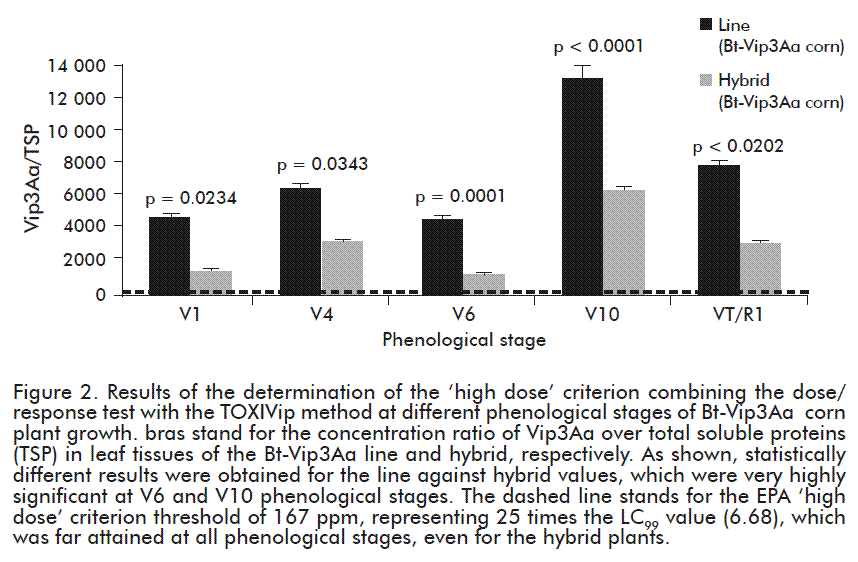
<P   ><font size="2" face="Verdana, Arial, Helvetica, sans-serif">In the other hand,      in this study it is proposed for the selection of corn plants that meet the      &lsquo;high dose&rsquo; criterion, to combine the dose/response bioassay with      the TOXIVip method developed to quantify the Vip3Aa toxin. The advantage of      the combined use of the TOXIVip bioassay for the selection of Bt-Vip3Aa corn      plants with high dose expression of the Vip3Aa toxin lies in the non-interference      of the secondary metabolites generated during the corn leaves lyophilization      process [18]. It is performed in a shorter period and does not need specialized      equipment. The TOXIVip method could also be useful to assess possible changes      in Vip3Aa toxin levels in Bt-Vip3Aa corn plants </font><font size="2" face="Verdana, Arial, Helvetica, sans-serif">exposed      to different abiotic stress agents, to assist corn breeders during the process      of introgression of new Bt-Vip3Aa corn plants, as well as on assessing the      impact on the environment of the dissemination of transgenic characters [19,      20]. </font></P >       <P   ><font size="2" face="Verdana, Arial, Helvetica, sans-serif">The larvae of <I>S.      frugiperda </I>are characterized by consuming foliar tissue in plants [21].      However, the newborn larvae feed on the same mass of eggs to which they belonged,      and then consume the foliar tissue on one side, without perforating it, leaving      the epidermal layer of the leaf bundle intact [22]. From the second or third      stage, the feeding seems more voracious, leaving a trail of perforations in      the leaves. The last stages can cause complete defoliation. In Cuba, <I>S.      frugiperda </I>is the main pest of corn cultivation. The life cycle of the      corn goes through the vegetative growth stage (V), which is divided into sub-stages      according to the number of leaves of the plant that goes from V1-V16 and the      reproductive phase (VT/R) [23]. The monitoring of variations on the level      of expression of the Vip3Aa toxin in Bt-Vip3Aa corn plants, meeting the &lsquo;high      dose&rsquo; criterion, becomes a necessity for the control of insects resistant      to Bt-Vip3Aa corn plants. </font></P >       <P   ><font size="2" face="Verdana, Arial, Helvetica, sans-serif">The quantification      of the Vip3Aa toxin was performed in the foliar tissue of the Bt-Vip3Aa corn      plants using the TOXIVip method. Significantly higher differences were found      in the expression of Vip3Aa in leaves between the line and the corn hybrid      Bt-Vip3A (p &lt; 0.05) at phonological stages included from V1, V4, V6 and      V10 to VT/R1 (<a href="/img/revistas/bta/v34n3/f0206317.gif">Figure 2</a>). Such differences could      be derived from changes in the copy number of the transgene between both cultivars      (two in the line against one in the hybrid), or due to particular genomic      influences in the resulting proteome [24, 25]. </font></P >       
<P   ><font size="2" face="Verdana, Arial, Helvetica, sans-serif">For the management      of resistant insects in autopesticide crops, EPA establishes that the expression      of the toxin in the Bt-Vip3A plant must be 25 times higher or equal to the      toxin concentration value obtained during the bioassay that eliminates 99      % of the population of exposed insects, known as LC<sub>99</sub>. In our experimental      setting, the 25 &times; LC<sub>99</sub> value (25 &times; 6.680 ppm) was 167      ppm, while the lowest Vip3Aa expression was attained in the evaluated hybrids      at 829 ppm in the V4 stage of culture (<a href="/img/revistas/bta/v34n3/f0206317.gif">Figure 2</a>).      This confirmed that the Bt-Vip3Aa corn line and hybrids are capable of expressing      the Vip3Aa toxin at the levels required by international regulatory agencies      and therefore meeting the &lsquo;high dose&rsquo; criteria.</font></P >       
]]></body>
<body><![CDATA[<P   >&nbsp;</P >   <FONT size="+1"><FONT size="+1"><FONT size="+1"><FONT size="+1">        <P   ><font size="2" face="Verdana, Arial, Helvetica, sans-serif"><b><font size="3">SCIENTIFIC      AND ECONOMIC RELEVANCE </font></b></font></P >       <P   ><font size="2" face="Verdana, Arial, Helvetica, sans-serif">In summary, the usefulness      of the TOXIVip method was demonstrated for the first time, for the rapid and      specific quantification of the Vip3Aa toxin. In addition, a dose-response      bioassay was combined for the first time with the TOXIVip method, which allowed      the selection of the best hybrids. of corn Bt-Vip3Aa plants in terms of expression      levels of the Vip3Aa toxin. Therefore, it is proposed to include this methodology      as a tool to: </font></P >       <P   ><font size="2" face="Verdana, Arial, Helvetica, sans-serif">1) The direct and      short-term evaluation of the &lsquo;high dose&rsquo; criterion in Bt-Vip3Aa      corn plants to guarantee the control of resistant insects; </font></P >       <P   ><font size="2" face="Verdana, Arial, Helvetica, sans-serif">2) Assist corn breeders      in the process of genetic introgression of Bt-Vip3Aa corn for the development      of new maize genotypes; </font></P >       <P   ><font size="2" face="Verdana, Arial, Helvetica, sans-serif">3) Assist the regulators      in the detection and quantification of Vip3Aa toxin in the environment, grain      imports and in the food chain; </font></P >       <P   ><font size="2" face="Verdana, Arial, Helvetica, sans-serif">4) For the quality      evaluation of seeds and plant varieties; </font></P >       <P   ><font size="2" face="Verdana, Arial, Helvetica, sans-serif">5) Analyze environmental      risks when using Bt-Vip3A corn plants. </font></P >       <P   ><font size="2" face="Verdana, Arial, Helvetica, sans-serif">Noteworthy, the TOXIVip      method developed is not commercially available yet. </font></P >       <P   ><font size="2" face="Verdana, Arial, Helvetica, sans-serif">This work was awarded      in different phases of development, on 2013 at CIGB as Scientific-Technical      Breakthrough of the Year, for the development of immunochemical tools to detect      the MIR162 event in transgenic maize resistant to <I>Spodoptera frugiperda</I>.      It was also presented in seven specialized international conferences and published      in reputed international journals as well as celebrated by international experts      on this field of research.</font></P >       ]]></body>
<body><![CDATA[<P   >&nbsp;</P >   <FONT size="+1">        <P   > </P >   <FONT size="+1">        <P   ><b><font size="3" face="Verdana, Arial, Helvetica, sans-serif">ACKNOWLEDGEMENTS      </font></b></P >       <P   ><font size="2" face="Verdana, Arial, Helvetica, sans-serif">The authors thank      the collaboration of the following specialists from the CIGB: Pilar T&eacute;llez,      Ivis Mor&aacute;n, Claudia Rodr&iacute;guez and Albis River&oacute;n, from      the Laboratory of Enviromental and Biotechnology; Miguel Castillo and Leonardo      G&oacute;mez from the Deparment of Monoclonal Antibody Production; Victoria      Mar&iacute;a Lugo from the Deparment of Technological Development, and Yassel      Ramos from the Direction of Biomedical Research.</font></P >       <P   >&nbsp;</P >       <P   > </P >       <P   ><b><font size="3" face="Verdana, Arial, Helvetica, sans-serif">REFERENCES </font></b></P >       <!-- ref --><P   ><font size="2" face="Verdana, Arial, Helvetica, sans-serif">1. Moar W, Roush      R, Shelton A, Ferre J, MacIntosh S, Leonard BR, et al. Field-evolved resistance      to Bt toxins. Nat Biotechnol. 2008;26(10):1072-4.     </font></P >   <FONT size="+1">        <!-- ref --><P   ><font size="2" face="Verdana, Arial, Helvetica, sans-serif">2. Huang F, Andow      DA, Buschman LL. Success of the high dose/refuge resistance management strategy      after 15 years of Bt crop use in North America. Entomol Exp Appl. 2011;140:1-16.          </font></P >       <!-- ref --><P   ><font size="2" face="Verdana, Arial, Helvetica, sans-serif">3. Bernardi O, Bernardi      D, Ribeiro RS, Okuma DM, Salmeron E, Fatoretto J, <i>et al</i>. Frequency      of resistance to Vip3Aa20 toxin from <i>Bacillus thuringiensis</i> in <i>Spodoptera      frugiperda</i> (Lepidoptera: Noctuidae) populations in Brazil. Crop Protection.      2015;76:7-14.     </font></P >       <!-- ref --><P   ><font size="2" face="Verdana, Arial, Helvetica, sans-serif">4. Tabashnik BE,      Carriere Y. Surge in insect resistance to transgenic crops and prospects for      sustainability. Nat Biotechnol. 2017;35(10):926-35.     </font></P >       <P   ><font size="2" face="Verdana, Arial, Helvetica, sans-serif">5. Hern&aacute;ndez      D, Rodr&iacute;guez-Cabrera L, Vald&eacute;s R, Mor&aacute;n I, T&eacute;llez      P, Ayra-Pardo. Bacillus thuringiensis Vip3Aa1 Expression and Purification      from E. Coli to be determined in seeds and leaves of genetically-modified      corn plants. J Agron. 2013;12(4):153-67. </font></P >       <!-- ref --><P   ><font size="2" face="Verdana, Arial, Helvetica, sans-serif">6. Crickmore N. The      Vip nomenclature. 2016 [cited 2016 Oct 14]. Available from: <a href="http://www.lifesci.sussex.ac.uk/home/Neil_Crickmore/Bt/vip.html" target="_blank">http://www.lifesci.sussex.ac.uk/home/Neil_Crickmore/Bt/vip.html</a></font></P >   <FONT color="#0000FF">        <!-- ref --><P   ><font color="#211E1F" size="2" face="Verdana, Arial, Helvetica, sans-serif">7.      Estruch JJ, Yu CG. Plant pest control. US patent 6,291,156 B1, 2001.     </font></P >   <FONT color="#211E1F">        <!-- ref --><P   ><font size="2" face="Verdana, Arial, Helvetica, sans-serif">8. Lee MK, Walters      FS, Hart H, Palekar N, Chen JS. The mode of action of the <i>Bacillus thuringiensis</i>      vegetative insecticidal protein Vip3A differs from that of Cry1Ab delta-endotoxin.      Appl Environ Microbiol. 2003;69(8):4648-57.     </font></P >       <!-- ref --><P   ><font size="2" face="Verdana, Arial, Helvetica, sans-serif">9. Syngenta Report.      Solicitud de liberaci&oacute;n experimental de ma&iacute;z con la tecnolog&iacute;a      BT11 x MIR162 x MIR604 x GA21 x (SYN-BTO11-1 x SYN-IR162-4 x SYN-IR604-5 x      MON-00021-9) en la regi&oacute;n agr&iacute;cola del Estado de Chiguagua durante      los ciclos PV 2013 y Pv 2014. Ciudad de M&eacute;xico: Syngenta Agro S.A.      de C.V.; 2012.     </font></P >       <!-- ref --><P   ><font size="2" face="Verdana, Arial, Helvetica, sans-serif">10. Pardo-Lopez L,      Munoz-Garay C, Porta H, Rodriguez-Almazan C, Soberon M, Bravo A. Strategies      to improve the insecticidal activity of Cry toxins from <i>Bacillus thuringiensis</i>.      Peptides. 2009;30(3):589-95.     </font></P >       <!-- ref --><P   ><font size="2" face="Verdana, Arial, Helvetica, sans-serif">11. Hernandez-Martinez      P, Hernandez- Rodriguez CS, Rie JV, Escriche B, Ferre J. Insecticidal activity      of Vip3Aa, Vip3Ad, Vip3Ae, and Vip3Af from Bacillus thuringiensis against      lepidopteran corn pests. J Invertebr Pathol. 2013;113(1):78-81.     </font></P >       <!-- ref --><P   ><font size="2" face="Verdana, Arial, Helvetica, sans-serif">12. Palma L, Munoz      D, Berry C, Murillo J, Caballero P. <i>Bacillus thuringiensis</i> toxins:      an overview of their biocidal activity. Toxins (Basel). 2014;6(12):3296-325.          </font></P >       <!-- ref --><P   ><font size="2" face="Verdana, Arial, Helvetica, sans-serif">13. Gavilondo JV.      Anticuerpos monoclonales. La Habana: Elfos Scientiae;1995 </font></P >       <!-- ref --><P   ><font size="2" face="Verdana, Arial, Helvetica, sans-serif">14. Ben Hamadou-Charfi      D, Sauer AJ, Abdelkafi-Mesrati L, Jaoua S, Stephan D. Production of polyclonal      and monoclonal antibodies against the Bacillus thuringiensis vegetative insecticidal      protein Vip3Aa16. Appl Biochem Biotechnol. 2015;175(5):2357-65.     </font></P >       <P   ><font size="2" face="Verdana, Arial, Helvetica, sans-serif">15. Hern&aacute;ndez      D, Arag&oacute;n H, Gonz&aacute;lez M, Gonz&aacute;lez G, Tamayo A, Mor&aacute;n      I, <i>et al</i>. Monoclonal antibody generation and characterization for Vip3Aa20      quantification in transgenic corn plants. BioProcessing J. 2016;15(3):30-43.      </font></P >       <P   ><font size="2" face="Verdana, Arial, Helvetica, sans-serif">16. Grothaus GD,      Bandla M, Currier T, Giroux R, Jenkins GR, Lipp M, <i>et al</i>. Immunoassay      as an analytical tool in agricultural biotechnology. J AOAC Int. 2006;89(4):913-28.      </font></P >       <P   ><font size="2" face="Verdana, Arial, Helvetica, sans-serif">17. Yang L, Wang      C, Holst-Jensen A, Morisset D, Lin Y, Zhang D. Characterization of GM events      by insert knowledge adapted re-sequencing approaches. Sci Rep. 2013;3:2839.      </font></P >       <P   ><font size="2" face="Verdana, Arial, Helvetica, sans-serif">18. Fabrick JA, Unnithan      GC, Yelich AJ, DeGain B, Masson L, Zhang J, <i>et al</i>. Multi-toxin resistance      enables pink bollworm survival on pyramided Bt cotton. Sci Rep. 2015;5:16554.      </font></P >       <!-- ref --><P   ><font size="2" face="Verdana, Arial, Helvetica, sans-serif">19. Amanullah, Kakar      KM, Khan A, Khan I, Shah Z, Hussain Z. Growth and yield response ofmaize (<i>Zea      may</i>s L.) to foliar NPK-fertilizers undermoisture stress condition. Soil      Environ. 2014;33(2):116-23.     </font></P >       <P   ><font size="2" face="Verdana, Arial, Helvetica, sans-serif">20. Kachhawa, D..      (2017). Microorganisms as a biopesticides. J Entomol Zool Studies. 2017;5(3):468-73.      </font></P >       <P   ><font size="2" face="Verdana, Arial, Helvetica, sans-serif">21. Lemes ARN, Figueiredo      CS, Sebastiao I, Marques da Silva L, da Costa Alves R, de Siqueira HAA, <i>et      al</i>. Cry1Ac and Vip3Aa proteins from Bacillus thuringiensis targeting Cry      toxin resistance in Diatraea flavipennella and Elasmopalpus lignosellus from      sugarcane. PeerJ. 2017;5:e2866. </font></P >       ]]></body>
<body><![CDATA[<!-- ref --><P   ><font size="2" face="Verdana, Arial, Helvetica, sans-serif">22. Silva DM, Bueno      AF, Andrade K, Stecca CS, Oliveira PM, Oliveira MCN. Biology and nutrition      of Spodoptera frugiperda (Lepidoptera: Noctuidae) fed on different food sources.      Scientia Agricola. 2017;74(1):18-31.     </font></P >       <!-- ref --><P   ><font size="2" face="Verdana, Arial, Helvetica, sans-serif">23. Munkvold GP,      White DG. Compendium of Corn Diseases. Fourth Edition. St. Paul, MN: American      Phytopathological Society; 2016.     </font></P >       <!-- ref --><P   ><font size="2" face="Verdana, Arial, Helvetica, sans-serif">24. Herrero S, Bel      Y, Hernandez-Martinez P, Ferre J. Susceptibility, mechanisms of response and      resistance to Bacillus thuringiensis toxins in Spodoptera spp. Curr Opin Insect      Sci. 2016;15:89-96.     </font></P >       <P   ><font size="2" face="Verdana, Arial, Helvetica, sans-serif">25. Marques LH, Castro      BA, Rossetto J, Silva OA, Moscardini VF, Zobiole LH, <i>et al</i>. Efficacy      of Soybean&rsquo;s Event DAS-81419-2 Expressing Cry1F and Cry1Ac to Manage      Key Tropical Lepidopteran Pests Under Field Conditions in Brazil. J Econ Entomol.      2016;109(4):1922-8.</font></P >       <P   >&nbsp;</P >       <P   >&nbsp;</P >       <P   ><font face="Verdana, Arial, Helvetica, sans-serif" size="2">Received in October,      2016.    ]]></body>
<body><![CDATA[<br>     Accepted in March, 2017.</font></P >       <P   >&nbsp;</P >       <P   >&nbsp;</P >       <P   > </P >   <FONT size="+1">        <P   ><i><font size="2" face="Verdana, Arial, Helvetica, sans-serif">Daily Hern&aacute;ndez</font></i><font size="2" face="Verdana, Arial, Helvetica, sans-serif">.      Centro de Ingenier&iacute;a Gen&eacute;tica y Biotecnolog&iacute;a, Ave 31      e/ 158 y 190, Cubanac&aacute;n, Playa, CP 11600, La Habana, Cuba. E-mail:      <A href="mailto:daily.hernandez@cigb.edu.cu"> <FONT color="#0000FF">daily.hernandez@cigb.edu.cu</font></A><FONT color="#0000FF"><FONT color="#211E1F">.</font></font></font></P >   </font></font></font></font></font></font></font></font></font></font></font></font></font></font></font></font></font></font></font></font></font></font></font></font></font></font></font></font></DIV >      ]]></body><back>
<ref-list>
<ref id="B1">
<label>1</label><nlm-citation citation-type="journal">
<person-group person-group-type="author">
<name>
<surname><![CDATA[Moar]]></surname>
<given-names><![CDATA[W]]></given-names>
</name>
<name>
<surname><![CDATA[Roush]]></surname>
<given-names><![CDATA[R]]></given-names>
</name>
<name>
<surname><![CDATA[Shelton]]></surname>
<given-names><![CDATA[A]]></given-names>
</name>
<name>
<surname><![CDATA[Ferre]]></surname>
<given-names><![CDATA[J]]></given-names>
</name>
<name>
<surname><![CDATA[MacIntosh]]></surname>
<given-names><![CDATA[S]]></given-names>
</name>
<name>
<surname><![CDATA[Leonard]]></surname>
<given-names><![CDATA[BR]]></given-names>
</name>
</person-group>
<article-title xml:lang="en"><![CDATA[Field-evolved resistance to Bt toxins]]></article-title>
<source><![CDATA[Nat Biotechnol]]></source>
<year>2008</year>
<volume>26</volume>
<numero>10</numero>
<issue>10</issue>
<page-range>1072-4</page-range></nlm-citation>
</ref>
<ref id="B2">
<label>2</label><nlm-citation citation-type="journal">
<person-group person-group-type="author">
<name>
<surname><![CDATA[Huang]]></surname>
<given-names><![CDATA[F]]></given-names>
</name>
<name>
<surname><![CDATA[Andow]]></surname>
<given-names><![CDATA[DA]]></given-names>
</name>
<name>
<surname><![CDATA[Buschman]]></surname>
<given-names><![CDATA[LL]]></given-names>
</name>
</person-group>
<article-title xml:lang="en"><![CDATA[Success of the high dose/refuge resistance management strategy after 15 years of Bt crop use in North America]]></article-title>
<source><![CDATA[Entomol Exp Appl]]></source>
<year>2011</year>
<volume>140</volume>
<page-range>1-16</page-range></nlm-citation>
</ref>
<ref id="B3">
<label>3</label><nlm-citation citation-type="journal">
<person-group person-group-type="author">
<name>
<surname><![CDATA[Bernardi]]></surname>
<given-names><![CDATA[O]]></given-names>
</name>
<name>
<surname><![CDATA[Bernardi]]></surname>
<given-names><![CDATA[D]]></given-names>
</name>
<name>
<surname><![CDATA[Ribeiro]]></surname>
<given-names><![CDATA[RS]]></given-names>
</name>
<name>
<surname><![CDATA[Okuma]]></surname>
<given-names><![CDATA[DM]]></given-names>
</name>
<name>
<surname><![CDATA[Salmeron]]></surname>
<given-names><![CDATA[E]]></given-names>
</name>
<name>
<surname><![CDATA[Fatoretto]]></surname>
<given-names><![CDATA[J]]></given-names>
</name>
</person-group>
<article-title xml:lang="en"><![CDATA[Frequency of resistance to Vip3Aa20 toxin from Bacillus thuringiensis in Spodoptera frugiperda (Lepidoptera: Noctuidae) populations in Brazil]]></article-title>
<source><![CDATA[Crop Protection]]></source>
<year>2015</year>
<volume>76</volume>
<page-range>7-14</page-range></nlm-citation>
</ref>
<ref id="B4">
<label>4</label><nlm-citation citation-type="journal">
<person-group person-group-type="author">
<name>
<surname><![CDATA[Tabashnik]]></surname>
<given-names><![CDATA[BE]]></given-names>
</name>
<name>
<surname><![CDATA[Carriere]]></surname>
<given-names><![CDATA[Y]]></given-names>
</name>
</person-group>
<article-title xml:lang="en"><![CDATA[Surge in insect resistance to transgenic crops and prospects for sustainability]]></article-title>
<source><![CDATA[Nat Biotechnol]]></source>
<year>2017</year>
<volume>35</volume>
<numero>10</numero>
<issue>10</issue>
<page-range>926-35</page-range></nlm-citation>
</ref>
<ref id="B5">
<label>5</label><nlm-citation citation-type="journal">
<person-group person-group-type="author">
<name>
<surname><![CDATA[Hernández]]></surname>
<given-names><![CDATA[D]]></given-names>
</name>
<name>
<surname><![CDATA[Rodríguez-Cabrera]]></surname>
<given-names><![CDATA[L]]></given-names>
</name>
<name>
<surname><![CDATA[Valdés]]></surname>
<given-names><![CDATA[R]]></given-names>
</name>
<name>
<surname><![CDATA[Morán]]></surname>
<given-names><![CDATA[I]]></given-names>
</name>
<name>
<surname><![CDATA[Téllez]]></surname>
<given-names><![CDATA[P]]></given-names>
</name>
<name>
<surname><![CDATA[Ayra-Pardo]]></surname>
<given-names><![CDATA[C]]></given-names>
</name>
</person-group>
<article-title xml:lang="en"><![CDATA[Bacillus thuringiensis Vip3Aa1 Expression and Purification from E. Coli to be determined in seeds and leaves of genetically-modified corn plants]]></article-title>
<source><![CDATA[J Agron]]></source>
<year>2013</year>
<volume>12</volume>
<numero>4</numero>
<issue>4</issue>
<page-range>153-67</page-range></nlm-citation>
</ref>
<ref id="B6">
<label>6</label><nlm-citation citation-type="">
<person-group person-group-type="author">
<name>
<surname><![CDATA[Crickmore]]></surname>
<given-names><![CDATA[N]]></given-names>
</name>
</person-group>
<source><![CDATA[The Vip nomenclature]]></source>
<year>2016</year>
</nlm-citation>
</ref>
<ref id="B7">
<label>7</label><nlm-citation citation-type="">
<person-group person-group-type="author">
<name>
<surname><![CDATA[Estruch]]></surname>
<given-names><![CDATA[JJ]]></given-names>
</name>
<name>
<surname><![CDATA[Yu]]></surname>
<given-names><![CDATA[CG]]></given-names>
</name>
</person-group>
<source><![CDATA[Plant pest control]]></source>
<year></year>
</nlm-citation>
</ref>
<ref id="B8">
<label>8</label><nlm-citation citation-type="journal">
<person-group person-group-type="author">
<name>
<surname><![CDATA[Lee]]></surname>
<given-names><![CDATA[MK]]></given-names>
</name>
<name>
<surname><![CDATA[Walters]]></surname>
<given-names><![CDATA[FS]]></given-names>
</name>
<name>
<surname><![CDATA[Hart]]></surname>
<given-names><![CDATA[H]]></given-names>
</name>
<name>
<surname><![CDATA[Palekar]]></surname>
<given-names><![CDATA[N]]></given-names>
</name>
<name>
<surname><![CDATA[Chen]]></surname>
<given-names><![CDATA[JS]]></given-names>
</name>
</person-group>
<article-title xml:lang="en"><![CDATA[The mode of action of the Bacillus thuringiensis vegetative insecticidal protein Vip3A differs from that of Cry1Ab delta-endotoxin]]></article-title>
<source><![CDATA[Appl Environ Microbiol]]></source>
<year>2003</year>
<volume>69</volume>
<numero>8</numero>
<issue>8</issue>
<page-range>4648-57</page-range></nlm-citation>
</ref>
<ref id="B9">
<label>9</label><nlm-citation citation-type="book">
<source><![CDATA[Syngenta Report. Solicitud de liberación experimental de maíz con la tecnología BT11 x MIR162 x MIR604 x GA21 x (SYN-BTO11-1 x SYN-IR162-4 x SYN-IR604-5 x MON-00021-9) en la región agrícola del Estado de Chiguagua durante los ciclos PV 2013 y Pv 2014]]></source>
<year>2012</year>
<publisher-loc><![CDATA[Ciudad de México ]]></publisher-loc>
<publisher-name><![CDATA[Syngenta Agro S.A. de C.V.]]></publisher-name>
</nlm-citation>
</ref>
<ref id="B10">
<label>10</label><nlm-citation citation-type="journal">
<person-group person-group-type="author">
<name>
<surname><![CDATA[Pardo-Lopez]]></surname>
<given-names><![CDATA[L]]></given-names>
</name>
<name>
<surname><![CDATA[Munoz-Garay]]></surname>
<given-names><![CDATA[C]]></given-names>
</name>
<name>
<surname><![CDATA[Porta]]></surname>
<given-names><![CDATA[H]]></given-names>
</name>
<name>
<surname><![CDATA[Rodriguez-Almazan]]></surname>
<given-names><![CDATA[C]]></given-names>
</name>
<name>
<surname><![CDATA[Soberon]]></surname>
<given-names><![CDATA[M]]></given-names>
</name>
<name>
<surname><![CDATA[Bravo]]></surname>
<given-names><![CDATA[A]]></given-names>
</name>
</person-group>
<article-title xml:lang="en"><![CDATA[Strategies to improve the insecticidal activity of Cry toxins from Bacillus thuringiensis]]></article-title>
<source><![CDATA[Peptides]]></source>
<year>2009</year>
<volume>30</volume>
<numero>3</numero>
<issue>3</issue>
<page-range>589-95</page-range></nlm-citation>
</ref>
<ref id="B11">
<label>11</label><nlm-citation citation-type="journal">
<person-group person-group-type="author">
<name>
<surname><![CDATA[Hernandez-Martinez]]></surname>
<given-names><![CDATA[P]]></given-names>
</name>
<name>
<surname><![CDATA[Hernandez- Rodriguez]]></surname>
<given-names><![CDATA[CS]]></given-names>
</name>
<name>
<surname><![CDATA[Rie]]></surname>
<given-names><![CDATA[JV]]></given-names>
</name>
<name>
<surname><![CDATA[Escriche]]></surname>
<given-names><![CDATA[B]]></given-names>
</name>
<name>
<surname><![CDATA[Ferre]]></surname>
<given-names><![CDATA[J]]></given-names>
</name>
</person-group>
<article-title xml:lang="en"><![CDATA[Insecticidal activity of Vip3Aa, Vip3Ad, Vip3Ae, and Vip3Af from Bacillus thuringiensis against lepidopteran corn pests]]></article-title>
<source><![CDATA[J Invertebr Pathol]]></source>
<year>2013</year>
<volume>113</volume>
<numero>1</numero>
<issue>1</issue>
<page-range>78-81</page-range></nlm-citation>
</ref>
<ref id="B12">
<label>12</label><nlm-citation citation-type="journal">
<person-group person-group-type="author">
<name>
<surname><![CDATA[Palma]]></surname>
<given-names><![CDATA[L]]></given-names>
</name>
<name>
<surname><![CDATA[Munoz]]></surname>
<given-names><![CDATA[D]]></given-names>
</name>
<name>
<surname><![CDATA[Berry]]></surname>
<given-names><![CDATA[C]]></given-names>
</name>
<name>
<surname><![CDATA[Murillo]]></surname>
<given-names><![CDATA[J]]></given-names>
</name>
<name>
<surname><![CDATA[Caballero]]></surname>
<given-names><![CDATA[P]]></given-names>
</name>
</person-group>
<article-title xml:lang="en"><![CDATA[Bacillus thuringiensis toxins: an overview of their biocidal activity]]></article-title>
<source><![CDATA[Toxins (Basel)]]></source>
<year>2014</year>
<volume>6</volume>
<numero>12</numero>
<issue>12</issue>
<page-range>3296-325</page-range></nlm-citation>
</ref>
<ref id="B13">
<label>13</label><nlm-citation citation-type="book">
<person-group person-group-type="author">
<name>
<surname><![CDATA[Gavilondo]]></surname>
<given-names><![CDATA[JV]]></given-names>
</name>
</person-group>
<source><![CDATA[Anticuerpos monoclonales]]></source>
<year>1995</year>
<publisher-loc><![CDATA[La Habana ]]></publisher-loc>
<publisher-name><![CDATA[Elfos Scientiae]]></publisher-name>
</nlm-citation>
</ref>
<ref id="B14">
<label>14</label><nlm-citation citation-type="journal">
<person-group person-group-type="author">
<name>
<surname><![CDATA[Ben Hamadou-Charfi]]></surname>
<given-names><![CDATA[D]]></given-names>
</name>
<name>
<surname><![CDATA[Sauer]]></surname>
<given-names><![CDATA[AJ]]></given-names>
</name>
<name>
<surname><![CDATA[Abdelkafi-Mesrati]]></surname>
<given-names><![CDATA[L]]></given-names>
</name>
<name>
<surname><![CDATA[Jaoua]]></surname>
<given-names><![CDATA[S]]></given-names>
</name>
<name>
<surname><![CDATA[Stephan]]></surname>
<given-names><![CDATA[D]]></given-names>
</name>
</person-group>
<article-title xml:lang="en"><![CDATA[Production of polyclonal and monoclonal antibodies against the Bacillus thuringiensis vegetative insecticidal protein Vip3Aa16]]></article-title>
<source><![CDATA[Appl Biochem Biotechnol]]></source>
<year>2015</year>
<volume>175</volume>
<numero>5</numero>
<issue>5</issue>
<page-range>2357-65</page-range></nlm-citation>
</ref>
<ref id="B15">
<label>19</label><nlm-citation citation-type="journal">
<person-group person-group-type="author">
<name>
<surname><![CDATA[Amanullah]]></surname>
</name>
<name>
<surname><![CDATA[Kakar]]></surname>
<given-names><![CDATA[KM]]></given-names>
</name>
<name>
<surname><![CDATA[Khan]]></surname>
<given-names><![CDATA[A]]></given-names>
</name>
<name>
<surname><![CDATA[Khan]]></surname>
<given-names><![CDATA[I]]></given-names>
</name>
<name>
<surname><![CDATA[Shah]]></surname>
<given-names><![CDATA[Z]]></given-names>
</name>
<name>
<surname><![CDATA[Hussain]]></surname>
<given-names><![CDATA[Z]]></given-names>
</name>
</person-group>
<article-title xml:lang="en"><![CDATA[Growth and yield response ofmaize (Zea mays L.) to foliar NPK-fertilizers undermoisture stress condition]]></article-title>
<source><![CDATA[Soil Environ]]></source>
<year>2014</year>
<volume>33</volume>
<numero>2</numero>
<issue>2</issue>
<page-range>116-23</page-range></nlm-citation>
</ref>
<ref id="B16">
<label>20</label><nlm-citation citation-type="journal">
<person-group person-group-type="author">
<name>
<surname><![CDATA[Kachhawa]]></surname>
<given-names><![CDATA[D]]></given-names>
</name>
</person-group>
<article-title xml:lang="en"><![CDATA[Microorganisms as a biopesticides]]></article-title>
<source><![CDATA[J Entomol Zool Studies]]></source>
<year>2017</year>
<volume>5</volume>
<numero>3</numero>
<issue>3</issue>
<page-range>468-73</page-range></nlm-citation>
</ref>
<ref id="B17">
<label>21</label><nlm-citation citation-type="journal">
<person-group person-group-type="author">
<name>
<surname><![CDATA[Lemes]]></surname>
<given-names><![CDATA[ARN]]></given-names>
</name>
<name>
<surname><![CDATA[Figueiredo]]></surname>
<given-names><![CDATA[CS]]></given-names>
</name>
<name>
<surname><![CDATA[Sebastiao]]></surname>
<given-names><![CDATA[I]]></given-names>
</name>
<name>
<surname><![CDATA[Marques da Silva]]></surname>
<given-names><![CDATA[L]]></given-names>
</name>
<name>
<surname><![CDATA[da Costa Alves]]></surname>
<given-names><![CDATA[R]]></given-names>
</name>
<name>
<surname><![CDATA[de Siqueira]]></surname>
<given-names><![CDATA[HAA]]></given-names>
</name>
</person-group>
<article-title xml:lang="en"><![CDATA[Cry1Ac and Vip3Aa proteins from Bacillus thuringiensis targeting Cry toxin resistance in Diatraea flavipennella and Elasmopalpus lignosellus from sugarcane]]></article-title>
<source><![CDATA[PeerJ]]></source>
<year>2017</year>
<volume>5</volume>
<page-range>2866</page-range></nlm-citation>
</ref>
<ref id="B18">
<label>22</label><nlm-citation citation-type="journal">
<person-group person-group-type="author">
<name>
<surname><![CDATA[Silva]]></surname>
<given-names><![CDATA[DM]]></given-names>
</name>
<name>
<surname><![CDATA[Bueno]]></surname>
<given-names><![CDATA[AF]]></given-names>
</name>
<name>
<surname><![CDATA[Andrade]]></surname>
<given-names><![CDATA[K]]></given-names>
</name>
<name>
<surname><![CDATA[Stecca]]></surname>
<given-names><![CDATA[CS]]></given-names>
</name>
<name>
<surname><![CDATA[Oliveira]]></surname>
<given-names><![CDATA[PM]]></given-names>
</name>
<name>
<surname><![CDATA[Oliveira]]></surname>
<given-names><![CDATA[MCN]]></given-names>
</name>
</person-group>
<article-title xml:lang="en"><![CDATA[Biology and nutrition of Spodoptera frugiperda (Lepidoptera: Noctuidae) fed on different food sources]]></article-title>
<source><![CDATA[Scientia Agricola]]></source>
<year>2017</year>
<volume>74</volume>
<numero>1</numero>
<issue>1</issue>
<page-range>18-31</page-range></nlm-citation>
</ref>
<ref id="B19">
<label>23</label><nlm-citation citation-type="book">
<person-group person-group-type="author">
<name>
<surname><![CDATA[Munkvold]]></surname>
<given-names><![CDATA[GP]]></given-names>
</name>
<name>
<surname><![CDATA[White]]></surname>
<given-names><![CDATA[DG]]></given-names>
</name>
</person-group>
<source><![CDATA[Compendium of Corn Diseases]]></source>
<year>2016</year>
<edition>Fourth Edition</edition>
<publisher-loc><![CDATA[Paul, MN ]]></publisher-loc>
<publisher-name><![CDATA[American Phytopathological Society]]></publisher-name>
</nlm-citation>
</ref>
<ref id="B20">
<label>24</label><nlm-citation citation-type="journal">
<person-group person-group-type="author">
<name>
<surname><![CDATA[Herrero]]></surname>
<given-names><![CDATA[S]]></given-names>
</name>
<name>
<surname><![CDATA[Bel]]></surname>
<given-names><![CDATA[Y]]></given-names>
</name>
<name>
<surname><![CDATA[Hernandez-Martinez]]></surname>
<given-names><![CDATA[P]]></given-names>
</name>
<name>
<surname><![CDATA[Ferre]]></surname>
<given-names><![CDATA[J]]></given-names>
</name>
</person-group>
<article-title xml:lang="en"><![CDATA[Susceptibility, mechanisms of response and resistance to Bacillus thuringiensis toxins in Spodoptera spp]]></article-title>
<source><![CDATA[Curr Opin Insect Sci]]></source>
<year>2016</year>
<volume>15</volume>
<page-range>89-96</page-range></nlm-citation>
</ref>
<ref id="B21">
<label>25</label><nlm-citation citation-type="journal">
<person-group person-group-type="author">
<name>
<surname><![CDATA[Marques]]></surname>
<given-names><![CDATA[LH]]></given-names>
</name>
<name>
<surname><![CDATA[Castro]]></surname>
<given-names><![CDATA[BA]]></given-names>
</name>
<name>
<surname><![CDATA[Rossetto]]></surname>
<given-names><![CDATA[J]]></given-names>
</name>
<name>
<surname><![CDATA[Silva]]></surname>
<given-names><![CDATA[OA]]></given-names>
</name>
<name>
<surname><![CDATA[Moscardini]]></surname>
<given-names><![CDATA[VF]]></given-names>
</name>
<name>
<surname><![CDATA[Zobiole]]></surname>
<given-names><![CDATA[LH]]></given-names>
</name>
</person-group>
<article-title xml:lang="en"><![CDATA[Efficacy of Soybean's Event DAS-81419-2 Expressing Cry1F and Cry1Ac to Manage Key Tropical Lepidopteran Pests Under Field Conditions in Brazil]]></article-title>
<source><![CDATA[J Econ Entomol]]></source>
<year>2016</year>
<volume>109</volume>
<numero>4</numero>
<issue>4</issue>
<page-range>1922-8</page-range></nlm-citation>
</ref>
</ref-list>
</back>
</article>