<?xml version="1.0" encoding="ISO-8859-1"?><article xmlns:mml="http://www.w3.org/1998/Math/MathML" xmlns:xlink="http://www.w3.org/1999/xlink" xmlns:xsi="http://www.w3.org/2001/XMLSchema-instance">
<front>
<journal-meta>
<journal-id>1027-2852</journal-id>
<journal-title><![CDATA[Biotecnología Aplicada]]></journal-title>
<abbrev-journal-title><![CDATA[Biotecnol Apl]]></abbrev-journal-title>
<issn>1027-2852</issn>
<publisher>
<publisher-name><![CDATA[Editorial Elfos Scientiae]]></publisher-name>
</publisher>
</journal-meta>
<article-meta>
<article-id>S1027-28522017000400002</article-id>
<title-group>
<article-title xml:lang="en"><![CDATA[Genetic stability of the Primary Cell Bank expressing the recombinant antigen MY32/Ls of Sea lice]]></article-title>
<article-title xml:lang="es"><![CDATA[Estabilidad genética del Banco de Células Primario que expresa el antígeno recombinante MY32/Ls del piojo de mar]]></article-title>
</title-group>
<contrib-group>
<contrib contrib-type="author">
<name>
<surname><![CDATA[Montoya]]></surname>
<given-names><![CDATA[Niuvis]]></given-names>
</name>
<xref ref-type="aff" rid="A01"/>
</contrib>
<contrib contrib-type="author">
<name>
<surname><![CDATA[González]]></surname>
<given-names><![CDATA[Nemecio]]></given-names>
</name>
<xref ref-type="aff" rid="A01"/>
</contrib>
<contrib contrib-type="author">
<name>
<surname><![CDATA[Sánchez]]></surname>
<given-names><![CDATA[Ileana]]></given-names>
</name>
<xref ref-type="aff" rid="A01"/>
</contrib>
<contrib contrib-type="author">
<name>
<surname><![CDATA[Pimentel]]></surname>
<given-names><![CDATA[Rafael]]></given-names>
</name>
<xref ref-type="aff" rid="A01"/>
</contrib>
<contrib contrib-type="author">
<name>
<surname><![CDATA[Basabe]]></surname>
<given-names><![CDATA[Liliana]]></given-names>
</name>
<xref ref-type="aff" rid="A02"/>
</contrib>
<contrib contrib-type="author">
<name>
<surname><![CDATA[Basulto]]></surname>
<given-names><![CDATA[Rosa M]]></given-names>
</name>
<xref ref-type="aff" rid="A01"/>
</contrib>
<contrib contrib-type="author">
<name>
<surname><![CDATA[Galdós]]></surname>
<given-names><![CDATA[Liszoe]]></given-names>
</name>
<xref ref-type="aff" rid="A01"/>
</contrib>
<contrib contrib-type="author">
<name>
<surname><![CDATA[Mora]]></surname>
<given-names><![CDATA[Nestor]]></given-names>
</name>
<xref ref-type="aff" rid="A01"/>
</contrib>
<contrib contrib-type="author">
<name>
<surname><![CDATA[Salazar]]></surname>
<given-names><![CDATA[Eladio]]></given-names>
</name>
<xref ref-type="aff" rid="A01"/>
</contrib>
<contrib contrib-type="author">
<name>
<surname><![CDATA[Salinas]]></surname>
<given-names><![CDATA[Diasmarys]]></given-names>
</name>
<xref ref-type="aff" rid="A01"/>
</contrib>
<contrib contrib-type="author">
<name>
<surname><![CDATA[Pérez]]></surname>
<given-names><![CDATA[Carlos]]></given-names>
</name>
<xref ref-type="aff" rid="A01"/>
</contrib>
<contrib contrib-type="author">
<name>
<surname><![CDATA[Moreira]]></surname>
<given-names><![CDATA[Alain]]></given-names>
</name>
<xref ref-type="aff" rid="A01"/>
</contrib>
<contrib contrib-type="author">
<name>
<surname><![CDATA[Segura]]></surname>
<given-names><![CDATA[Rutdali]]></given-names>
</name>
<xref ref-type="aff" rid="A01"/>
</contrib>
</contrib-group>
<aff id="A02">
<institution><![CDATA[,Centro de Ingeniería Genética y Biotecnología de Camagüey  ]]></institution>
<addr-line><![CDATA[La Habana ]]></addr-line>
<country>Cuba</country>
</aff>
<aff id="A01">
<institution><![CDATA[,Centro de Ingeniería Genética y Biotecnología de Camagüey  ]]></institution>
<addr-line><![CDATA[Camagüey ]]></addr-line>
<country>Cuba</country>
</aff>
<pub-date pub-type="pub">
<day>00</day>
<month>12</month>
<year>2017</year>
</pub-date>
<pub-date pub-type="epub">
<day>00</day>
<month>12</month>
<year>2017</year>
</pub-date>
<volume>34</volume>
<numero>4</numero>
<fpage>4211</fpage>
<lpage>4216</lpage>
<copyright-statement/>
<copyright-year/>
<self-uri xlink:href="http://scielo.sld.cu/scielo.php?script=sci_arttext&amp;pid=S1027-28522017000400002&amp;lng=en&amp;nrm=iso"></self-uri><self-uri xlink:href="http://scielo.sld.cu/scielo.php?script=sci_abstract&amp;pid=S1027-28522017000400002&amp;lng=en&amp;nrm=iso"></self-uri><self-uri xlink:href="http://scielo.sld.cu/scielo.php?script=sci_pdf&amp;pid=S1027-28522017000400002&amp;lng=en&amp;nrm=iso"></self-uri><kwd-group>
<kwd lng="en"><![CDATA[plasmid stability]]></kwd>
<kwd lng="en"><![CDATA[primary cell bank]]></kwd>
<kwd lng="en"><![CDATA[recombinant protein production]]></kwd>
<kwd lng="en"><![CDATA[number of generations]]></kwd>
<kwd lng="en"><![CDATA[sea lice]]></kwd>
<kwd lng="en"><![CDATA[MYL32/Ls]]></kwd>
<kwd lng="es"><![CDATA[estabilidad plasmídica]]></kwd>
<kwd lng="es"><![CDATA[banco de células primario]]></kwd>
<kwd lng="es"><![CDATA[producción de proteína recombinante]]></kwd>
<kwd lng="es"><![CDATA[número de generaciones]]></kwd>
<kwd lng="es"><![CDATA[piojo de mar]]></kwd>
<kwd lng="es"><![CDATA[MYL32/Ls]]></kwd>
</kwd-group>
</article-meta>
</front><body><![CDATA[ <DIV class="Part"   >        <P align="right"   ><font size="2" color="#000000" face="Verdana, Arial, Helvetica, sans-serif"><b>RESEARCH      </b> </font></P >       <P align="right"   >&nbsp;</P >   <FONT size="+1" color="#000000">        <P   > </P >       <P   > </P >   <FONT size="+1">        <P   ><font size="4" color="#211E1F" face="Verdana, Arial, Helvetica, sans-serif"><B>Genetic      stability of the Primary Cell Bank expressing the recombinant antigen MY32/Ls      of Sea lice </b></font></P >       <P   >&nbsp;</P >   <FONT size="+1" color="#211E1F"><B>        <P   ></P >   </B> <FONT size="+1" color="#000000">        <P   ><font size="3" color="#211E1F" face="Verdana, Arial, Helvetica, sans-serif"><B>Estabilidad      gen&eacute;tica del Banco de C&eacute;lulas Primario que expresa el ant&iacute;geno      recombinante MY32/</B><I>Ls </I><B>del piojo de mar </b></font></P >       <P   >&nbsp;</P >       ]]></body>
<body><![CDATA[<P   >&nbsp;</P >   <FONT size="+1" color="#211E1F">        <P   ></P >   <FONT size="+1" color="#000000">        <P   ><b><font size="2" color="#211E1F" face="Verdana, Arial, Helvetica, sans-serif">Niuvis      Montoya<sup>1</sup>, Nemecio Gonz&aacute;lez<sup>1</sup>, Ileana S&aacute;nchez<sup>1</sup>,      Rafael Pimentel<sup>1</sup>, Liliana Basabe<sup>2</sup>, Rosa M Basulto<sup>1</sup>,      Liszoe Gald&oacute;s<sup>1</sup>, Nestor Mora<sup>1</sup>, Eladio Salazar<sup>1</sup>,      Diasmarys Salinas<sup>1</sup>, Carlos P&eacute;rez<sup>1</sup>, Alain Moreira<sup>1</sup>,      Rutdali Segura<sup>1</sup> </font></b><font size="2" color="#211E1F" face="Verdana, Arial, Helvetica, sans-serif"></font></P >   <FONT size="+1" color="#211E1F"><FONT size="+1"><FONT size="+1"><FONT size="+1"><FONT size="+1"><FONT size="+1"><FONT size="+1"><FONT size="+1"><FONT size="+1"><FONT size="+1"><FONT size="+1"><FONT size="+1"><FONT size="+1"><FONT size="+1"><FONT size="+1"><FONT size="+1"><FONT size="+1"><FONT size="+1"><FONT size="+1"><FONT size="+1"><FONT size="+1"><FONT size="+1"><FONT size="+1"><FONT size="+1"><FONT size="+1"><FONT size="+1">        <P   ><font size="2" face="Verdana, Arial, Helvetica, sans-serif"><sup>1</sup> Centro      de Ingenier&iacute;a Gen&eacute;tica y Biotecnolog&iacute;a de Camag&uuml;ey.      Circunvalaci&oacute;n Norte y Ave. Finlay, Camag&uuml;ey, Camag&uuml;ey, Cuba.</font></P >   <FONT size="+1"><FONT size="+1">        <P   ><font size="2" face="Verdana, Arial, Helvetica, sans-serif"><sup>2</sup> Centro      de Ingenier&iacute;a Gen&eacute;tica y Biotecnolog&iacute;a, CIGB. Ave. 31      entre 158 y 190, Cubanac&aacute;n, Playa, CP 11600, La Habana, Cuba.</font></P >       <P   >&nbsp;</P >       <P   >&nbsp;</P >   </font></font></font></font></font></font></font></font></font></font></font></font></font></font></font></font></font></font></font></font></font></font></font></font></font></font></font></font></font></font></font></font></font></font>   <hr>   <FONT size="+1" color="#000000"><FONT size="+1"><FONT size="+1" color="#211E1F"><FONT size="+1" color="#000000"><FONT size="+1" color="#211E1F"><FONT size="+1" color="#000000"><FONT size="+1" color="#211E1F"><FONT size="+1"><FONT size="+1"><FONT size="+1"><FONT size="+1"><FONT size="+1"><FONT size="+1"><FONT size="+1"><FONT size="+1"><FONT size="+1"><FONT size="+1"><FONT size="+1"><FONT size="+1"><FONT size="+1"><FONT size="+1"><FONT size="+1"><FONT size="+1"><FONT size="+1"><FONT size="+1"><FONT size="+1"><FONT size="+1"><FONT size="+1"><FONT size="+1"><FONT size="+1"><FONT size="+1"><FONT size="+1"><FONT size="+1"><FONT size="+1">        <P   ><b><font face="Verdana, Arial, Helvetica, sans-serif" size="2">ABSTRACT </font></b></P >   <FONT size="+1"><FONT size="+1"><FONT size="+1" color="#000000">        <P   > </P >   <FONT size="+1">        <P   ><font size="2" color="#211E1F" face="Verdana, Arial, Helvetica, sans-serif">The      recombinant MY32/Ls protein is used as a vaccine antigen against sea lice      <I>Lepeophtherius salmonis</I>. It is produced from the fermentation of the      <I>E. coli </I>BL21 (DE3)-pET28a-my32/Ls expression system, which is stored      frozen at -70 &ordm;C in a pure and homogeneous Primary Cell Bank (PCB). This      work was aimed to analyze the genetic stability of cells from this PCB grown      for a high number of generations, and how it influences cell growth rate,      doubling time and the expression of the protein of interest, either in shake      flasks or cultured in a 200-L bioreactor. It was found that in this large      scale process, the strain replicates for 46 generations. It was demonstrated      that the number of generations did not affect the growth rate (&mu;) and the      doubling time. Similarly, plasmid stability and protein expression remained      unaffected and a 100 % identity match was obtained for the <I>my32/Ls </I>gene      sequences in the expression plasmid isolated from PCB samples and after nearly      100 generations. It was also shown that the expression system of the MY32/<I>Ls      </I>protein is genetically stable throughout the production process, supporting      the development of a working cell bank from the characterized PCB that guarantees      the stability, integrity and safety of large scale productions of this recombinant      protein. </font></P >   <FONT size="+1" color="#211E1F">        ]]></body>
<body><![CDATA[<P   ><font face="Verdana, Arial, Helvetica, sans-serif" size="2"><I><b>Keywords:</b>      </I>plasmid stability, primary cell bank, recombinant protein production,      number of generations, sea lice, MYL32/<I>Ls</I>.</font></P >   </font></font></font></font></font></font></font></font></font></font></font></font></font></font></font></font></font></font></font></font></font></font></font></font></font></font></font></font></font></font></font></font></font></font></font></font></font></font></font>   <hr>   <FONT size="+1" color="#000000"><FONT size="+1"><FONT size="+1" color="#211E1F"><FONT size="+1" color="#000000"><FONT size="+1" color="#211E1F"><FONT size="+1" color="#000000"><FONT size="+1" color="#211E1F"><FONT size="+1"><FONT size="+1"><FONT size="+1"><FONT size="+1"><FONT size="+1"><FONT size="+1"><FONT size="+1"><FONT size="+1"><FONT size="+1"><FONT size="+1"><FONT size="+1"><FONT size="+1"><FONT size="+1"><FONT size="+1"><FONT size="+1"><FONT size="+1"><FONT size="+1"><FONT size="+1"><FONT size="+1"><FONT size="+1"><FONT size="+1"><FONT size="+1"><FONT size="+1"><FONT size="+1"><FONT size="+1"><FONT size="+1"><FONT size="+1"><FONT size="+1"><FONT size="+1"><FONT size="+1" color="#000000"><FONT size="+1"><FONT size="+1" color="#211E1F"><FONT size="+1" color="#000000">        <P   > </P >   <FONT size="+1">       <P   ><b><font face="Verdana, Arial, Helvetica, sans-serif" size="2">RESUMEN</font></b><font face="Verdana, Arial, Helvetica, sans-serif" size="2">      </font></P >       <P   ><font size="2" color="#211E1F" face="Verdana, Arial, Helvetica, sans-serif">La      prote&iacute;na MY32/Ls recombinante se emplea como ant&iacute;geno vacunal      contra el piojo de mar <I>Lepeophtherius salmonis</I>. La misma se produce      a partir de la fermentaci&oacute;n del sistema de expresi&oacute;n en la cepa      bacteriana de <I>Escherichia coli </I>BL21(DE3)-pET28a-my32/Ls, la cual se      preserva congelada a &ndash;70 &ordm;C en un Banco de C&eacute;lulas Primario      (BCP) puro y homog&eacute;neo. El objetivo del presente trabajo fue determinar      la estabilidad gen&eacute;tica del BCP mediante en c&eacute;lulas crecidas      propagadas durante un alto n&uacute;mero de generaciones, as&iacute; como      evaluar su influencia sobre el crecimiento y la expresi&oacute;n de la prote&iacute;na.      Al cultivo con elevado n&uacute;mero de generaciones se le analiz&oacute;      la estabilidad plasm&iacute;dica, la<font size="+1" color="#000000"> </font></font><font face="Verdana, Arial, Helvetica, sans-serif" size="2">expresi&oacute;n      de la prote&iacute;na recombinante, y el patr&oacute;n de restricci&oacute;n      enzim&aacute;tica y se secuenci&oacute; el gen de inter&eacute;s. Se determin&oacute;      que las la cepa se propaga durante 46 generaciones durante el proceso productivo      en un fermentador de 200-L. Se comprob&oacute; que el n&uacute;mero de generaciones      no afect&oacute; la velocidad de crecimiento (<FONT color="#000000">&micro;<FONT color="#211E1F">)      ni el tiempo de duplicaci&oacute;n durante todo el estudio. La estabilidad      plasm&iacute;dica y la expresi&oacute;n de la prote&iacute;na recombinante      se mantuvieron a niveles equivalentes entre el BCP y la cepa propagada durante      casi 100 generaciones, y se obtuvo una coincidencia del 100 % de la identidad      plasm&iacute;dica del gen <I>my32/Ls </I>entre ambos cultivos. El patr&oacute;n      de restricci&oacute;n obtenido coincidi&oacute; con el esperado para el pl&aacute;smido      recombinante. El estudio permiti&oacute; conocer que el sistema de expresi&oacute;n      de la prote&iacute;na MY32 es gen&eacute;ticamente estable durante todo el      proceso productivo, lo que posibilita la elaboraci&oacute;n de un Banco de      C&eacute;lulas de Trabajo que garantice la estabilidad, la integridad y la      seguridad de las producciones a gran escala de la prote&iacute;na MY32/<I>Ls</I>.      </font></font></font></P >   <FONT size="+1" color="#211E1F"><FONT color="#000000"><FONT color="#211E1F">        <P   ><font size="2" color="#000000" face="Verdana, Arial, Helvetica, sans-serif"><I>Palabras      clave:</I> <FONT color="#211E1F">estabilidad plasm&iacute;dica, banco de c&eacute;lulas      primario, producci&oacute;n de prote&iacute;na recombinante, n&uacute;mero      de generaciones, piojo de mar, MYL32/<I>Ls.</I></font></font></P >   </font></font></font></font></font></font></font></font></font></font></font></font></font></font></font></font></font></font></font></font></font></font></font></font></font></font></font></font></font></font></font></font></font></font></font></font></font></font></font></font></font></font></font></font>   <hr>   <FONT size="+1" color="#000000"><FONT size="+1"><FONT size="+1" color="#211E1F"><FONT size="+1" color="#000000"><FONT size="+1" color="#211E1F"><FONT size="+1" color="#000000"><FONT size="+1" color="#211E1F"><FONT size="+1"><FONT size="+1"><FONT size="+1"><FONT size="+1"><FONT size="+1"><FONT size="+1"><FONT size="+1"><FONT size="+1"><FONT size="+1"><FONT size="+1"><FONT size="+1"><FONT size="+1"><FONT size="+1"><FONT size="+1"><FONT size="+1"><FONT size="+1"><FONT size="+1"><FONT size="+1"><FONT size="+1"><FONT size="+1"><FONT size="+1"><FONT size="+1"><FONT size="+1"><FONT size="+1"><FONT size="+1"><FONT size="+1"><FONT size="+1"><FONT size="+1"><FONT size="+1"><FONT size="+1" color="#000000"><FONT size="+1"><FONT size="+1" color="#211E1F"><FONT size="+1" color="#000000"><FONT size="+1"><FONT size="+1" color="#211E1F"><FONT color="#000000"><FONT color="#211E1F"><FONT size="+1" color="#000000"><FONT size="+1" color="#211E1F">        <P   > </P >       <P   >&nbsp;</P >       <P   >&nbsp;</P >       <P   ><font face="Verdana, Arial, Helvetica, sans-serif" size="2"><b><font size="3">INTRODUCTION</font></b>      </font></P >       <P   > </P >       ]]></body>
<body><![CDATA[<P   ><font face="Verdana, Arial, Helvetica, sans-serif" size="2">Sea lice <I>Caligus      rogercresseyi </I>and <I>Lepeophtherius salmonis </I>have emerged as the main      pathogen affecting the salmon industry during the last 30 years [1, 2]. This      has led to the introduction of a wide range of treatments to try to contain      or control the infection. However, pathogens&rsquo; resistance to chemicals,      and the associated environmental damage and high costs associated to those      compounds redirected the attention to more enduring treatments, such as vaccination      [3]. Vaccination strategies under research against sea lice follows other      approaches common to veterinary vaccines against insect-mediated infestations,      like those employing tick gut antigens (Bm86 protein) for vaccination in cattle      and marketed as Gavac&reg; and TickGARD&reg; [3], aimed to reduce larval populations      [4]. Specifically for sea lice, some groups have reported the potential of      the MY32 protein as vaccine antigen, this protein playing a physiological      role in reproduction and able to induce a protecting response in salmon upon      vaccination (57 % inhibition of <I>C. rogercresseyi </I>and <I>L. salmonis      </I>infestation). </font></P >   <FONT size="+1"><FONT size="+1"><FONT size="+1"><FONT size="+1"><FONT size="+1" color="#000000">        <P   ><font size="2" color="#211E1F" face="Verdana, Arial, Helvetica, sans-serif">In      this regard, our group have recently established an expression system in <I>Escherichia      coli </I>BL21(DE3)-pET28a-my32/<I>Ls</I>, expressing the MY32/<I>Ls </I>intracellularly      and forming inclusion bodies [3, 5]. The production process of this protein      for vaccine purposes includes the storage of the expression system in a Primary      Cell Bank (PCB) by freezing at &ndash;70 &ordm;C. This step is fundamental      for the construction and characterization of recombinant products, particularly      to guarantee their high stability, integrity and safety for biopharmaceutical      application after the large scale production process [6]. </font></P >   <FONT size="+1" color="#211E1F">        <P   ><font face="Verdana, Arial, Helvetica, sans-serif" size="2">In this regard, the      analysis of genetic stability of the cell bank determines the integrity of      the genetic sequence coding for the recombinant protein and its stability      until the end of the production process [7]. Stability could be affected after      cloning due to sequence modification in cells upon culture after several generations      [8, 9], mainly in large scale cultures [10]. It is essential to study the      stability of the expression vector in the PCB during the scale-up of the protein      production process, and for several generations. Therefore, it was evaluated      the genetic stability of the PCB expressing the recombinant protein MY32/Ls,      which determines the consistency of the process and the final product. It      was analyzed through the study of the cell population doubling of the <I>Escherichia      coli </I>BL21(DE3)-pET28a-my32/<I>Ls </I>expression system during the production      process, which was modeled at a 3-L scale and equivalent to that of a 200-L      production fermentation. This establishes whether the expression system retains      its expected stability and if it expresses the recombinant antigen properly.</font></P >       <P   >&nbsp;</P >       <P   > </P >       <P   ><b><font face="Verdana, Arial, Helvetica, sans-serif" size="3">MATERIALS AND      METHODS </font></b></P >       <P   > </P >       <P   ><b><font face="Verdana, Arial, Helvetica, sans-serif" size="2">Bacterial strain      and expression vector </font></b></P >       <P   ><font face="Verdana, Arial, Helvetica, sans-serif" size="2">The <I>E. coli </I>BL21(DE3)      (genotype F<sup>&ndash;</sup>, ompT, hsdS (r B<sup>&ndash;</sup>, mB<sup>&ndash;</sup>)      gal, &Delta; lon, dcm (&lambda;D69) strain [11] was used transformed with      the plasmid pET28a-my32/<I>Ls </I>[3]. This constructs expresses the T7 RNA      polymerase under the control of the <I>lac</I>UV5 promoter, and the gene of      interest cloned under the control of the T7 promoter, with a plasmid size      of 5369 bp. The protein of interest is then induced by adding IPTG to the      culture medium. The vector also carries a kanamycin resistance gene and a      6His tag for downstream protein purification. The gene MY32/<I>Ls </I>codes      for the Akirin 2 protein of <I>Lepeophtheirus salmonis</I>, which is expressed      intracellularly. It was previously isolated by reverse transcription and PCR      as cDNA. </font></P >   <FONT size="+1"><FONT size="+1"><FONT size="+1"><FONT size="+1"><FONT size="+1"><FONT size="+1">        <P   ><font face="Verdana, Arial, Helvetica, sans-serif" size="2"><b>Culture media      and solutions </b></font></P >       ]]></body>
<body><![CDATA[<P   ><font face="Verdana, Arial, Helvetica, sans-serif" size="2">Luria-Bertani (LB)      medium was prepared for propagation (5 g/L Yeast extract (Oxoid, Germany);      10 g/L Tryptone (Oxoid, Germany), 5 g/L NaCl (Merck, Germany); pH 7.3). Solid      LB media was also prepared by adding Technical Agar #3 1.5 % w/v. Both media      were autoclaved at 121 &ordm;C for 30 min. </font></P >       <P   ><font face="Verdana, Arial, Helvetica, sans-serif" size="2">Solutions of 40 %      Glucose (Sigma, USA) and 50 mg/mL Kanamycin (Applichem, Germany) were made,      and subsequently sterilized at 121 &ordm;C for 20 min or filtered, respectively.      They were added to the LB liquid culture medium upon use and when reaching      45-50 &ordm;C to the solid culture medium (12.5 mL Glucose 40 % and 400 &mu;L      of 50 mg/mL Kanamycin per liter of medium). </font></P >       <P   ><font face="Verdana, Arial, Helvetica, sans-serif" size="2">Protein expression      was analyzed by using the fermentation medium described by Studier [11].</font></P >       <P   ><font face="Verdana, Arial, Helvetica, sans-serif" size="2"><b>Estimation of      bacterial number of generations at 200-L scale and design of the genetic stability      study at laboratory scale </b></font></P >       <P   ><font face="Verdana, Arial, Helvetica, sans-serif" size="2">The number of generations      of the transformed bacterial strain <I>E. coli </I>BL21 (DE3)-pET28a-my32/<I>Ls      </I>was studied at 200-L scale representing the proposed working volume for      the production of the recombinant MY32/<I>Ls </I>protein. For this, the wet      weight and cellular viability parameters were proportionally estimated at      3-L scale. The number of generations was calculated as described for a culture      at exponential growth phase [12]. </font></P >       <P   ><font face="Verdana, Arial, Helvetica, sans-serif" size="2"><I><b>Bacterial culture      at 3-L scale with IPTG-induced protein expression </b></I> </font></P >       <P   ><font face="Verdana, Arial, Helvetica, sans-serif" size="2">The <I>E. coli </I>BL21      (DE3)-pET28a-my32/<I>Ls </I>strain was cultured in a 3-L Marubishi bioreactor      (Marubishi, Japan) at the following conditions: 1 vvm aeriation, 500 rpm stirring,      37 &plusmn; 1 &ordm;C, and culture medium pH 7.0-7.2. </font></P >       <P   ><font face="Verdana, Arial, Helvetica, sans-serif" size="2">Fermentation was      done in two phases, the first comprising a batch culture for 7 h, followed      by the second consisting on growth by fed-batch fermentation on pH demand.      For this second phase, the feed medium was supplied through the pH pump (acid      pH) to reach a high density cell culture with pH values within the established      range. Samples were periodically taken to evaluate cell growth, the expression      of the protein of interest, and to monitor glucose and amino acids concentration.      Once reaching the desired wet weight values, the expression of the MY32/<I>Ls      </I>protein was in-duced with 0.25 mM IPTG for 12 h [13]. </font></P >       <P   ><font face="Verdana, Arial, Helvetica, sans-serif" size="2"><I><b>Estimation      of the number of generations for the E. coli BL21 (DE3)-pET28a-my32/Ls strain      at 200-L scale in 500-mL flasks </b></I> </font></P >       <P   ><font face="Verdana, Arial, Helvetica, sans-serif" size="2">The number of generations      of the <I>E. coli </I>BL21 (DE3)- pET28a-my32/<I>Ls </I>strain at the 200-L      fermentation scale was estimated considering the following parameters: </font></P >       ]]></body>
<body><![CDATA[<P   ><font face="Verdana, Arial, Helvetica, sans-serif" size="2">1. The wet weight      and cell viability values reached after the induction of protein expression      with IPTG at 3-L, which were used to estimate the biomass (g) and total cell      number, respectively, that could be obtained in a 200-L bioreactor. </font></P >       <P   ><font face="Verdana, Arial, Helvetica, sans-serif" size="2">2. The number of      viable cells calculated per g of biomass. </font></P >       <P   ><font face="Verdana, Arial, Helvetica, sans-serif" size="2">Then, the number      of cell generations that could be reached during the production process was      calculated, and a shake flasks culture process was designed, at the end of      which the value for this this kinetic parameter will be doubled. </font></P >       <P   ><font face="Verdana, Arial, Helvetica, sans-serif" size="2"><I><b>Design of the      assay to determine the number of cell generations for the E. coli BL21 (DE3)-      pET28a-my32/Ls at laboratory scale </b></I> </font></P >       <P   ><font face="Verdana, Arial, Helvetica, sans-serif" size="2">An assay was designed      in shake flasks at laboratory scale to determine the number of cell generations      for the <I>E. coli </I>BL21 (DE3)-pET28a-my32/Ls. Three cell propagation cycles      (C1 to C3) were established, consisting on inoculation from Petri dishes to      500-mL Erlenmeyer flasks and then to Petri dishes for c.f.u. count. </font></P >       <P   ><font face="Verdana, Arial, Helvetica, sans-serif" size="2"><I>E. coli </I>BL21      (DE3) cells transformed with the plasmid pET28a-my32/<I>Ls </I>were inoculated      from a cell storage vial, containing Luria-Bertani (LB) storage medium with      20 % glycerol, onto three dishes containing solid LB medium, and they were      further incubated for 24 h at 37 &ordm;C. Then, three Erlenmeyer flasks containing      500 mL of LB medium each were inoculated from five colonies each and they      were incubated at 37 &ordm;C for 8 h. After that, wet weight and viability      were determined to each culture. </font></P >       <P   ><font face="Verdana, Arial, Helvetica, sans-serif" size="2"><b>Evaluation of      the genetic stability of the pET28a-my32/Ls construct in <I>E. coli </I>BL21(DE3)      fermentations duplicating the number of generations of the production process      </b> </font></P >       <P   ><font face="Verdana, Arial, Helvetica, sans-serif" size="2"><I><b>Influence of      the number of cell generations on bacterial strain growth</b> </I> </font></P >       <P   ><font face="Verdana, Arial, Helvetica, sans-serif" size="2">The influence of      cell generation number on strain growth was studied through the specific growth      rate (&mu;) and doubling time (dT) at 37 &ordm;C for 250 rpm. Samples were      taken for the first and third propagation cycles (C1 and C3, respectively)      at 0, 2, 4, 5, 6, 7 and 8 h and optical density was measured at 600 nm (O.D.<sub>600      nm</sub>). Both parameters were determined as previously described [14]. </font></P >   <FONT size="+1"><FONT size="+1">        <P   ><font face="Verdana, Arial, Helvetica, sans-serif" size="2"><I><b>Plasmid stability      testing </b></I> </font></P >       ]]></body>
<body><![CDATA[<P   ><font face="Verdana, Arial, Helvetica, sans-serif" size="2">Plasmid stability      was checked at the end of the third fermentation cycle as described [15] at      the end of the third propagation cycle (C3). Colonies were sampled in plates      containing unsupplemented solid LB medium, and also supplemented with kanamycin.      Plates were incubated at 37 &ordm;C for 24 h. </font></P >       <P   ><font face="Verdana, Arial, Helvetica, sans-serif" size="2"><I><b>Determination      of MY32/Ls protein expression in shake flasks </b></I> </font></P >       <P   ><font face="Verdana, Arial, Helvetica, sans-serif" size="2">Protein expression      was determined in bacterial cultures corresponding to the bacterial strain      with high generation number by SDS-PAGE in 12 % gels under reducing conditions      [16]. </font></P >       <P   ><font face="Verdana, Arial, Helvetica, sans-serif" size="2"><I><b>Purification      of the pET28a-my32/Ls plasmid DNA</b> </I> </font></P >       <P   ><font face="Verdana, Arial, Helvetica, sans-serif" size="2">Ten bacterial colonies      with 100 cell generations (C3 cycle) were randomly selected, and their plasmid      DNA molecules were purified with the Wizard&reg; Plus Midipreps DNA Purification      System (Promega, USA). The resulting plasmid material was checked by restriction      with <I>Nco </I>I-<I>Hin</I>d III, <I>Hin</I>d III and <I>Nco </I>I. Restriction      patterns were checked by 0.8 % agarose gel electrophoresis. </font></P >       <P   ><font face="Verdana, Arial, Helvetica, sans-serif" size="2"><I><b>my32/Ls gene      sequencing </b> </I> </font></P >       <P   ><font face="Verdana, Arial, Helvetica, sans-serif" size="2">The fragment in the      construct pET28a-my32/<I>Ls </I>containing the gene <I>my32/Ls </I>was sequenced      by using the DNA primers T7p (5&acute;-TAATACGACTCACTATAGGG-3&acute;) and      T7t (5&acute;-GCTAGTTATTGCTCAGCGG-3&acute;), which were specific for the pT7      promoter and T7 terminator sequences, respectively. The fragment was sequenced      in triplicate, </font><font face="Verdana, Arial, Helvetica, sans-serif" size="2">by      the Big Dye Chemistry system with capillary electrophoresis (Applied Biosystems;      Macrogen) and processed in a ABI 3730XL Genetic Analyzer. </font></P >       <P   ><font face="Verdana, Arial, Helvetica, sans-serif" size="2">Genetic sequence      data of the samples from the high generation number were processes with the      Vector NTI Suite software (version 8.0); the consensus sequence was generated      from sequencing replicates, and it was further aligned to the expected standard      plasmid sequence sequence established for the PCB of the <I>E. coli </I>BL21      (DE3)-pET28a-my32/<I>Ls</I>. </font></P >       <P   ><font face="Verdana, Arial, Helvetica, sans-serif" size="2"><b><i>Statistical      analysis </i> </b> </font></P >       <P   ><font face="Verdana, Arial, Helvetica, sans-serif" size="2">Data obtained were      analyzed with the aid of the STATGRAPHICS Plus 5.1 statistical package. Paired      samples comparisons and the typical deviation measures were assessed by the      Student&rsquo;s t tests and Fisher&rsquo;s exact test, respectively.</font></P >       ]]></body>
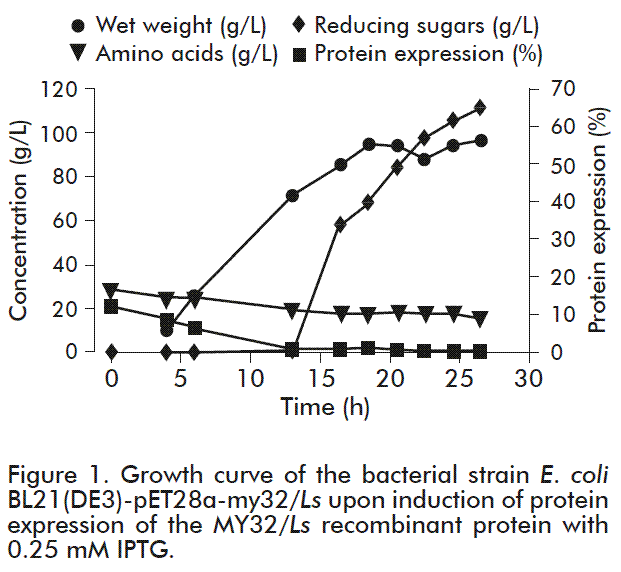
<body><![CDATA[<P   >&nbsp;</P >       <P   > </P >       <P   > </P >       <P   ><font size="3"><b><font face="Verdana, Arial, Helvetica, sans-serif">RESULTS      </font></b></font></P >       <P   ><font face="Verdana, Arial, Helvetica, sans-serif" size="2"><b>Estimation of      generation number for fermentation at 200-L and plasmid genetic stability      at laboratory scale </b></font></P >       <P   ><b><font face="Verdana, Arial, Helvetica, sans-serif" size="2"><I>E. coli BL21(DE3)-pET28a-my32/Ls      culture at 3-L induced with IPTG </I></font></b><font face="Verdana, Arial, Helvetica, sans-serif" size="2">      </font></P >       <P   ><font face="Verdana, Arial, Helvetica, sans-serif" size="2">Culture reached a      70 g/L cell density after 13 h (<a href="/img/revistas/bta/v34n4/f0102417.gif">Figure 1</a>), and      then, expression of the MY32/<I>Ls </I>protein was induced with 0.25 mM IPTG      and carried out for 12 h until reaching 90 g/L of wet biomass at the end of      culture. Protein expression was achieved for up to 63.29 %, as determined      by densitometry analysis of PAGE gels. </font></P >       
<P   ><font face="Verdana, Arial, Helvetica, sans-serif" size="2"><I><b>Assessment      of generation number of the E. coli BL21(DE3)-pET28a-my32/Ls strain in shake      flask cultures and during the production process at 200-L culture </b></I>      </font></P >       <P   ><font face="Verdana, Arial, Helvetica, sans-serif" size="2">The number of cell      generations able to be achieved by the <I>E. coli </I>BL21(DE3)-pET28a-my32/<I>Ls      </I>strain in a 200-L bioreactor was calculated according to viability and      wet weight, which were determined during the starting shake flasks propagation      (C1) (<a href="/img/revistas/bta/v34n4/t0102417.gif">Table</a>). It was estimated to reach a cell      mass of 100 g/L and a cell density of 1.1 &times; 10<sup>15</sup> total cells      in the bioreactor under the previously described conditions, and up to 45.6      generations. With three successive propagation cycles C1 to C3 (Petri dishes-flasks-Petri      dishes) nearly 100 generations could be achieved. </font></P >   <FONT size="+1"><FONT size="+1">        
<P   ><font face="Verdana, Arial, Helvetica, sans-serif" size="2"><b>Evaluation of      the genetic stability of the plasmid construct in fermentations duplicating      the generation number of the production process </b></font></P >       ]]></body>
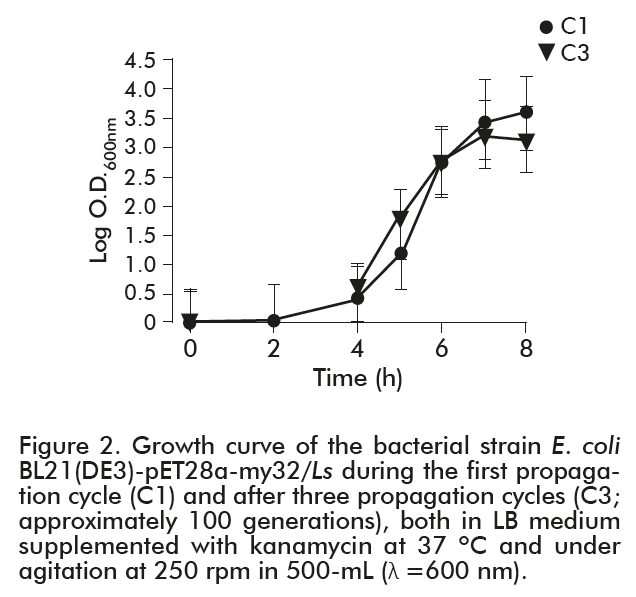
<body><![CDATA[<P   ><b><font face="Verdana, Arial, Helvetica, sans-serif" size="2"><I>Influence of      generation number on bacterial strain growth </I></font></b><font face="Verdana, Arial, Helvetica, sans-serif" size="2">      </font></P >       <P   ><font face="Verdana, Arial, Helvetica, sans-serif" size="2">As shown in <a href="/img/revistas/bta/v34n4/f0202417.gif">figure      2</a>, the bacterial strain reached the exponential phase during the last      propagation after 5 h of culture (1.21 O.D.<sub>600 nm</sub>), while the same      phase was reached during the first propagation after 4 h (0.558 O.D.<sub>600      nm</sub>). Noteworthy, exponential phase ended in both cultures after 6 h,      with 2.0 O.D.600 nm. This evidenced that the number of generations reached      by the bacterial strain did not affected the metabolic processes needed for      the cellular division. </font></P >   <FONT size="+1"><FONT size="+1"><FONT size="+1"><FONT size="+1"><FONT size="+1"><FONT size="+1">        
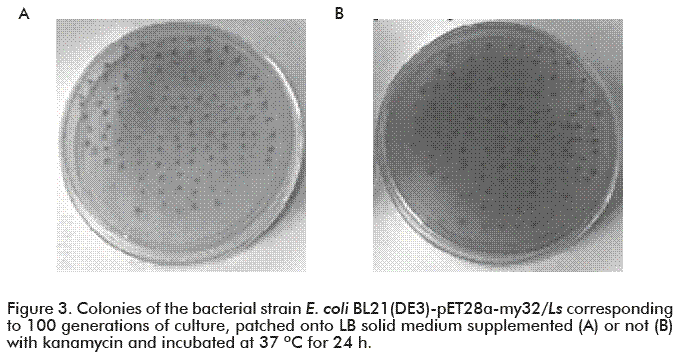
<P   ><font face="Verdana, Arial, Helvetica, sans-serif" size="2">The specific growth      rate of the strain during the first propagation cycle was 0.78 h<sup>-1</sup>,      with a doubling time of 53 min, while the same parameters were 0.81 h<sup>-1</sup>      and 51 min, respectively, for the C3 cycle, with no statistically significant      differences between the specific growth rate mean values. These results demonstrated      that the number of generations did vary neither the specific growth rate,      nor the doubling time of the strain. </font></P >   <FONT size="+1"><FONT size="+1"><FONT size="+1"><FONT size="+1">        <P   ><font face="Verdana, Arial, Helvetica, sans-serif" size="2">These two parameters      were only assessed between propagation cycles 1 (34 cell generations) and      3 (100 cell generations), to analyze the possible influence of generation      number on growth kinetics parameters. </font></P >       <P   ><font face="Verdana, Arial, Helvetica, sans-serif" size="2"><I><b>Plasmid stability      </b> </I> </font></P >       <P   ><font face="Verdana, Arial, Helvetica, sans-serif" size="2">The pET28a-my32/<I>Ls      </I>plasmid was shown to be 98 % stable within the <I>E. coli </I>BL21(DE3)      strain after approximately 100 cell generations (<a href="/img/revistas/bta/v34n4/f0302417.gif">Figure      3</a>). </font></P >       
<P   ><font face="Verdana, Arial, Helvetica, sans-serif" size="2"><I><b>Assessment      of MY32/Ls protein expression in shake flasks </b></I> </font></P >       <P   ><font face="Verdana, Arial, Helvetica, sans-serif" size="2">As shown in <a href="/img/revistas/bta/v34n4/f0402417.gif">figure      4</a>, the cell generation number did not affected the MY32/<I>Ls </I>protein      expression, with a notable protein band detected in cell extracts of shake      flask cultures in the 20-28 kDa molecular weight range by SDS-PAGE (<a href="/img/revistas/bta/v34n4/f0402417.gif">Figure      4A</a>), coincident with the migration pattern of the standard MY32/<I>Ls      </I>protein on lane 1. This pattern was similar to that observed for the bands      shown in <a href="/img/revistas/bta/v34n4/f0502417.gif">figure 5B</a> [3] after 100 cell generations.      The MY32/<I>Ls </I>protein band was absent in the cell extracts from non-induced      cell cultures (data not shown). Up to 56.92 % of expression was achieved,      as determined by densitometry analysis. </font></P >       
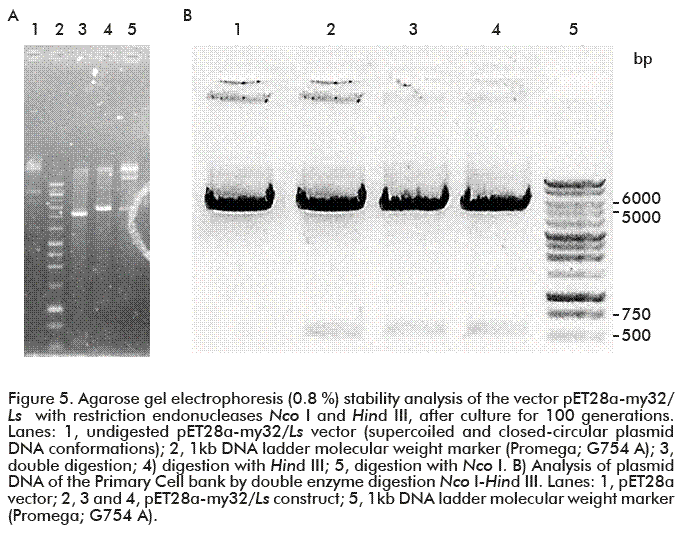
<P   ><font face="Verdana, Arial, Helvetica, sans-serif" size="2"><I><b>Purification      of the pET28a-my32/Ls plasmid DNA </b></I> </font></P >       <P   ><font face="Verdana, Arial, Helvetica, sans-serif" size="2">The pET28a-my32/<I>Ls      </I>plasmid DNA was purified to analyze plasmid stability after 100 generations.      The identity of the construct was checked by 0.8 % agarose gel electrophoresis      followed by restriction analysis with <I>Nco </I>I and <I>Hind </I>III, and      the expected restriction pattern was obtained. As shown in <a href="/img/revistas/bta/v34n4/f0502417.gif">figure      5A</a>, a band consistent with the 535 bp size of the <I>my32/Ls </I>gene      was exscinded from the vector backbone (approximately 5246 bp) by <I>Nco </I>I-<I>Hind      </I>III digestion. This pattern coincided with that of the PCB analysis (Figura      5B). The linear vector after the Hind III restriction corresponds to a band      of approximately 5.7 kb (<a href="/img/revistas/bta/v34n4/f0502417.gif">Figure 5A</a>, lane 4). The      preservation of the restriction pattern after 100 generations provided evidence      of the preservation of plasmid integrity, what have to be thoroughly corroborated      by sequencing. </font></P >       
]]></body>
<body><![CDATA[<P   ><font face="Verdana, Arial, Helvetica, sans-serif" size="2"><I><b>Sequencing      of the my32/Ls gene </b></I> </font></P >       <P   ><font face="Verdana, Arial, Helvetica, sans-serif" size="2">After sequencing,      a 100 % identity match was found between the established sequence for the      gene <I>my32/ Ls </I>and that determined in plasmid samples taken after 100      cell generations of the <I>E. coli </I>BL21DE3-pET28a-my32/<I>Ls </I>strain.</font></P >       <P   >&nbsp;</P >       <P   > </P >       <P   ><b><font size="3" color="#000000" face="Verdana, Arial, Helvetica, sans-serif">DISCUSSION</font></b><font size="2" color="#000000" face="Verdana, Arial, Helvetica, sans-serif">      </font></P >   <FONT size="+1" color="#000000">        <P   ><font size="2" face="Verdana, Arial, Helvetica, sans-serif"><b>Evaluating the      genetic stability of the pET28a-my32/<I>Ls</I> gene construct in the protein      production process during fermentation that double cell generations of the      <I>E. coli</I> BL21(DE3) host cells </b></font></P >   <FONT size="+1">        <P   ><font face="Verdana, Arial, Helvetica, sans-serif" size="2">In this work, we      demonstrate that the number of cell generations did not affected the genetic      stability of the expression construct pET28a-my32/<I>Ls</I> in the PCB of      <I>E. coli</I> BL21(DE3) transformed host cells. The genetic stability analysis      provides information on the preservation of the genetic sequence of the PCB      coding for the expression product, required to be stable to the end of the      process. Besides, genetic stability is influenced by many factors, including      the metabolic burden of the plasmid, copy number, replication species, type      of growth substrate, medium composition, culture conditions, and the successive      culture rounds [8]. </font></P >       <P   ><font face="Verdana, Arial, Helvetica, sans-serif" size="2">For instance, Ashby      and Stacey [17] reported that a plasmid-free bacterial strain showed a specific      growth rate faster than the same strain carrying an expression plasmid, due      to the increased metabolic energy demand for plasmid maintenance and replication      within the cell. In our study, experimental data showed no statistical differences      in the cell growth speed and cell generation doubling time of the strain during      C1 and C3 propagation cycles, indicative of similar growth rates both in the      presence and absence of the plasmid until the end of the fermentation process.      Silva <I>et al</I>. [18] reported that plasmid instability could be caused      by low growth rates in plasmid-carrying cells as compared to plasmid-free      cells. </font></P >       <P   ><font face="Verdana, Arial, Helvetica, sans-serif" size="2">As could be inferred      from the abovementioned aspects, plasmids are not always stable in cells culture      for many generations in large-scale cultures. Therefore, it demands to study      plasmid stability when changing the fermentation scale [10]. However, it could      be possible that the sole change of fermentation scale does not always affect      the plasmid genetic stability, since we found no changes in this parameter      for the plasmid genetic construct under study. In fact, the pET28a-my32/<I>Ls</I>      was shown to be quite stable after 100 generations. Similar results have also      been obtained by other groups [8], also in <I>E. coli</I> BL21(DE3), at that      time transformed with the pED-GnRH3-MVP construct expressing the gonadotropin-releasing      hormone (GnRH) as a fusion protein under the control of the <I>plac</I> promoter,      which was stable for up to 50 generations. </font></P >       <P   ><font face="Verdana, Arial, Helvetica, sans-serif" size="2">Furthermore, the      level of expression achieved after 100 generations for the MY32/<I>Ls</I>      provided further evidence of the stability and the expression efficiency of      the pET28a vector backbone. The design of the expression process at the technological      development scale, specifically at the end of the fermentation process, supported      expression levels higher than 40 % after its induction by adding IPTG. The      expression levels achieved in our study also confirm that the pET expression      system is adequate to clone and express recombinant proteins in <I>E. coli</I>      at industrial scale. In fact, the expressed protein could reach up to 50 %      of the biomass total proteins just a few hours after induction [19]. In our      case 56.9 % of total proteins corresponded to the MY32/<I>Ls</I> recombinant      protein, similar to those obtained while checking the expression levels of      the PCB (55.8 %, average expression value). Besides, bands in the range of      20-28 kDa were identified in SDS-PAGE, corresponding to the molecular weight      expected for the MY32/<I>Ls</I> protein. Similar results were reported by      Xu <I>et al</I>. [8], who found bands for the GnRH fusion protein at the expected      size (&gt; 20 kDa) after 4 h of induction with lactose. They also found expression      levels higher than 40 % of total proteins in cultures after 50 generations.      </font></P >       ]]></body>
<body><![CDATA[<P   ><font color="#211E1F" face="Verdana, Arial, Helvetica, sans-serif" size="2">The      identity of the my32/<I>Ls </I>gene inserted into the pET28a plasmid harbored      by the <I>E. coli </I>BL21(DE3)-pET28a-my32/<I>Ls </I>strain was preserved      100 % for 100 generations, as it was corroborated by sequencing, and the gene      sequence completely matched that reported for the Primary Cell Bank. This      was also indicative of the stability of the gene construct, which was devoid      of gene modifications resulting from gene instability processes that affect      expression vectors, such as insertions, direct or inverted repeats and deletions.      </font></P >   <FONT color="#211E1F">        <P   ><font face="Verdana, Arial, Helvetica, sans-serif" size="2">In summary, this      study provided data confirming that the expression system for the production      of the MY32/<I>Ls </I>protein is genetically stable during the entire production      process in the host system used. This supports the generation of a working      cell bank guaranteeing the stability, integrity and safety of the production      process at large scale.</font></P >       <P   >&nbsp;</P >       <P   > </P >       <P   ><b><font size="3" color="#000000" face="Verdana, Arial, Helvetica, sans-serif">CONFLICTS      OF INTEREST STATEMENT </font></b></P >   <FONT size="+1" color="#000000"><FONT color="#211E1F">        <P   ><font size="2" face="Verdana, Arial, Helvetica, sans-serif">The authors declare      that there are no conflicts of interest.</font></P >       <P   >&nbsp;</P >   <FONT size="+1">        <P   > </P >   <FONT size="+1" color="#000000">        <P   ><b><font face="Verdana, Arial, Helvetica, sans-serif" size="3">REFERENCES </font></b></P >       <!-- ref --><P   ><font size="2" color="#211E1F" face="Verdana, Arial, Helvetica, sans-serif">1.      Costello MJ. The global economic cost of sea lice to the salmonid farming      industry. J Fish Dis. 2009;32(1):115-8.     </font></P >   <FONT size="+1" color="#211E1F">        <!-- ref --><P   ><font face="Verdana, Arial, Helvetica, sans-serif" size="2">2. Bravo S. The reproductive      output of sea lice <I>Caligus rogercresseyi </I>under controlled conditions.      Exp Parasitol. 2010;125(1):51-4.     </font></P >       <!-- ref --><P   ><font face="Verdana, Arial, Helvetica, sans-serif" size="2">3. Carpio Y, Basabe      L, Acosta J, Rodriguez A, Mendoza A, Lisperger A, <I>et al</I>. Novel gene      isolated from <I>Caligus rogercresseyi</I>: a promising target for vaccine      development against sea lice. Vaccine. 2011;29(15):2810-20.     </font></P >       <!-- ref --><P   ><font face="Verdana, Arial, Helvetica, sans-serif" size="2">4. Ruiz LM, Orduz      S, Lopez ED, Guzman F, Patarroyo ME, Armengol G. Immune response in mice and      cattle after immunization with a <I>Boophilus microplus </I>DNA vaccine containing      bm86 gene. Vet Parasitol. 2007;144(1-2):138-45.     </font></P >       <!-- ref --><P   ><font face="Verdana, Arial, Helvetica, sans-serif" size="2">5. Carpio Y, Garcia      C, Pons T, Haussmann D, Rodriguez-Ramos T, Basabe L, <I>et al</I>. Akirins      in sea lice: first steps towards a deeper understanding. Exp Parasitol. 2013;135(2):188-99.          </font></P >       <!-- ref --><P   ><font face="Verdana, Arial, Helvetica, sans-serif" size="2">6. Poutou RA, Amador      E, Candelario M. Banco de C&eacute;lulas Primario (BCP): Caracterizaci&oacute;n      y papel en la producci&oacute;n de prote&iacute;nas recombinantes. Biotecnol      Apl. 1993;11(1)55-62.     </font></P >       <!-- ref --><P   ><font face="Verdana, Arial, Helvetica, sans-serif" size="2">7. Ram&iacute;rez      R, Mun&eacute; M, Mansur M, Soto Y, Pimentel T. Estudio de estabilidad gen&eacute;tica      del sistema de expresi&oacute;n de la prote&iacute;na E del virus dengue 4      en la levadura metilotr&oacute;fica <I>Pichia pastoris</I>. Rev Cubana Med      Trop. 2005;57:3.     </font></P >       <!-- ref --><P   ><font face="Verdana, Arial, Helvetica, sans-serif" size="2">8. Xu J, Li W, Wu      J, Zhang Y, Zhu Z, Liu J, et al. Stability of plasmid and expression of a      recombinant gonadotropin-releasing hormone (GnRH) vaccine in <I>Escherichia      coli</I>. Appl Microbiol Biotechnol. 2006;73(4):780-8.     </font></P >       <!-- ref --><P   ><font face="Verdana, Arial, Helvetica, sans-serif" size="2">9. Fakruddin M, Mohammad      Mazumdar R, Bin Mannan KS, Chowdhury A, Hossain MN. Critical factors affecting      the success of cloning, expression, and mass production of enzymes by recombinant      <I>E. coli</I>. ISRN Biotechnol. 2013;2013:590587.     </font></P >       <!-- ref --><P   ><font face="Verdana, Arial, Helvetica, sans-serif" size="2">10. Pierce J, Gutteridge      S. Large-scale preparation of ribulosebisphosphate carboxylase from a recombinant      system in <I>Escherichia coli </I>characterized by extreme plasmid instability.      Appl Environ Microbiol. 1985;49(5):1094-100.     </font></P >       <!-- ref --><P   ><font face="Verdana, Arial, Helvetica, sans-serif" size="2">11. Studier FW. Protein      production by auto-induction in high density shaking cultures. Protein Expr      Purif. 2005;41(1):207-34.     </font></P >       <P   ><font face="Verdana, Arial, Helvetica, sans-serif" size="2">12. Mart&iacute;nez      J, Romay Z, Rojas T, Guerra G. Manual pr&aacute;ctico de microbiolog&iacute;a.      La Habana: Ed. Pueblo y Educaci&oacute;n; 1985. </font></P >       <!-- ref --><P   ><font face="Verdana, Arial, Helvetica, sans-serif" size="2">13. Lee SY, Chang      HN. High cell density cultivation of <I>Escherichia coli </I>W using sucrose      as a carbon source. Biotechnol Lett. 1993;15:971-4.     </font></P >       <!-- ref --><P   ><font face="Verdana, Arial, Helvetica, sans-serif" size="2">14. Madigan M, Martinko      JM, Parker J. Brock Microbiolog&iacute;a de los microorganismos. Madrid: Pearson      Educaci&oacute;n; 2003.     </font></P >       <!-- ref --><P   ><font face="Verdana, Arial, Helvetica, sans-serif" size="2">15. Amador E, Almazan      M, Quintana M, Poutou RA, Candelario M. Estudio preliminar de la estabilidad      de los Bancos de C&eacute;lulas Primarios para la producci&oacute;n de interfer&oacute;n      alfa recombinante. Biotecnol Apl. 1994;11(1):60-3.     </font></P >       <!-- ref --><P   ><font face="Verdana, Arial, Helvetica, sans-serif" size="2">16. Laemmli UK. Cleavage      of structural proteins during the assembly of the head of bacteriophage T4.      Nature. 1970;227(5259):680-5.     </font></P >       ]]></body>
<body><![CDATA[<!-- ref --><P   ><font face="Verdana, Arial, Helvetica, sans-serif" size="2">17. Ashby RE, Stacey      KA. Stability of a plasmid F Trim in populations of a recombination-deficient      strain of <I>Escherichia coli </I>in continuous culture. Antonie Van Leeuwenhoek.      1984;50(2):125-34.     </font></P >       <!-- ref --><P   ><font face="Verdana, Arial, Helvetica, sans-serif" size="2">18. Silva F, Louren&ccedil;o      O, Maia C, Queiroz JA, Domingues FC. Impact of plasmid induction strategy      on overall plasmid DNA yield and <I>E. coli </I>physiology using flow cytometry      and real-time PCR. Process Biochem. 2011;46:174-81.     </font></P >       <!-- ref --><P   ><font face="Verdana, Arial, Helvetica, sans-serif" size="2">19. Palomares LA,      Estrada-Mondaca S, Ramirez OT. Production of recombinant proteins: challenges      and solutions. Methods Mol Biol. 2004;267:15-52.     </font></P >       <P   >&nbsp;</P >       <P   >&nbsp;</P >       <P   > </P >   <FONT size="+1" color="#000000">        <P   ><font size="2" color="#211E1F" face="Verdana, Arial, Helvetica, sans-serif"><i>Received      in May, 2017.     ]]></body>
<body><![CDATA[<br>     </i></font><i><font face="Verdana, Arial, Helvetica, sans-serif" size="2">Accepted      in October, 2017. </font></i></P >   <FONT size="+1" color="#211E1F">       <P   >&nbsp;</P >       <P   >&nbsp;</P >       <P   > </P >       <P   > </P >   <FONT size="+1" color="#000000">        <P   ><i><font size="2" color="#211E1F" face="Verdana, Arial, Helvetica, sans-serif">Niuvis      Montoya</font></i><font size="2" color="#211E1F" face="Verdana, Arial, Helvetica, sans-serif">.      Centro de Ingenier&iacute;a Gen&eacute;tica y Biotecnolog&iacute;a de Camag&uuml;ey.      Circunvalaci&oacute;n Norte y Ave. Finlay, Camag&uuml;ey, Camag&uuml;ey, Cuba.      E-mail: <A href="mailto:niuvis.montoya@cigb.edu.cu"> <FONT color="#0000FF">niuvis.montoya@cigb.edu.cu</font></A><FONT color="#0000FF"><FONT color="#000000">.</font></font></font></P >   </font></font></font></font></font></font></font></font></font></font></font></font></font></font></font></font></font></font></font></font></font></font></font></font></font></font></font></font></font></font></font></font></font></font></font></font></font></font></font></font></font></font></font></font></font></font></font></font></font></font></font></font></font></font></font></font></font></font></font></font></font></font></font></font></font></font></font></font></font></font></font></font></font></font></font></font></font></font></font></font></font></font></font></DIV >      ]]></body><back>
<ref-list>
<ref id="B1">
<label>1</label><nlm-citation citation-type="journal">
<person-group person-group-type="author">
<name>
<surname><![CDATA[Costello]]></surname>
<given-names><![CDATA[MJ]]></given-names>
</name>
</person-group>
<article-title xml:lang="en"><![CDATA[The global economic cost of sea lice to the salmonid farming industry]]></article-title>
<source><![CDATA[J Fish Dis]]></source>
<year>2009</year>
<volume>32</volume>
<numero>1</numero>
<issue>1</issue>
<page-range>115-8</page-range></nlm-citation>
</ref>
<ref id="B2">
<label>2</label><nlm-citation citation-type="journal">
<person-group person-group-type="author">
<name>
<surname><![CDATA[Bravo]]></surname>
<given-names><![CDATA[S]]></given-names>
</name>
</person-group>
<article-title xml:lang="en"><![CDATA[The reproductive output of sea lice Caligus rogercresseyi under controlled conditions]]></article-title>
<source><![CDATA[Exp Parasitol]]></source>
<year>2010</year>
<volume>125</volume>
<numero>1</numero>
<issue>1</issue>
<page-range>51-4</page-range></nlm-citation>
</ref>
<ref id="B3">
<label>3</label><nlm-citation citation-type="journal">
<person-group person-group-type="author">
<name>
<surname><![CDATA[Carpio]]></surname>
<given-names><![CDATA[Y]]></given-names>
</name>
<name>
<surname><![CDATA[Basabe]]></surname>
<given-names><![CDATA[L]]></given-names>
</name>
<name>
<surname><![CDATA[Acosta]]></surname>
<given-names><![CDATA[J]]></given-names>
</name>
<name>
<surname><![CDATA[Rodriguez]]></surname>
<given-names><![CDATA[A]]></given-names>
</name>
<name>
<surname><![CDATA[Mendoza]]></surname>
<given-names><![CDATA[A]]></given-names>
</name>
<name>
<surname><![CDATA[Lisperger]]></surname>
<given-names><![CDATA[A]]></given-names>
</name>
</person-group>
<article-title xml:lang="en"><![CDATA[Novel gene isolated from Caligus rogercresseyi: a promising target for vaccine development against sea lice]]></article-title>
<source><![CDATA[Vaccine]]></source>
<year>2011</year>
<volume>29</volume>
<numero>15</numero>
<issue>15</issue>
<page-range>2810-20</page-range></nlm-citation>
</ref>
<ref id="B4">
<label>4</label><nlm-citation citation-type="journal">
<person-group person-group-type="author">
<name>
<surname><![CDATA[Ruiz]]></surname>
<given-names><![CDATA[LM]]></given-names>
</name>
<name>
<surname><![CDATA[Orduz]]></surname>
<given-names><![CDATA[S]]></given-names>
</name>
<name>
<surname><![CDATA[Lopez]]></surname>
<given-names><![CDATA[ED]]></given-names>
</name>
<name>
<surname><![CDATA[Guzman]]></surname>
<given-names><![CDATA[F]]></given-names>
</name>
<name>
<surname><![CDATA[Patarroyo]]></surname>
<given-names><![CDATA[ME]]></given-names>
</name>
<name>
<surname><![CDATA[Armengol]]></surname>
<given-names><![CDATA[G]]></given-names>
</name>
</person-group>
<article-title xml:lang="en"><![CDATA[Immune response in mice and cattle after immunization with a Boophilus microplus DNA vaccine containing bm86 gene]]></article-title>
<source><![CDATA[Vet Parasitol]]></source>
<year>2007</year>
<volume>144</volume>
<numero>1-2</numero>
<issue>1-2</issue>
<page-range>138-45</page-range></nlm-citation>
</ref>
<ref id="B5">
<label>5</label><nlm-citation citation-type="journal">
<person-group person-group-type="author">
<name>
<surname><![CDATA[Carpio]]></surname>
<given-names><![CDATA[Y]]></given-names>
</name>
<name>
<surname><![CDATA[Garcia]]></surname>
<given-names><![CDATA[C]]></given-names>
</name>
<name>
<surname><![CDATA[Pons]]></surname>
<given-names><![CDATA[T]]></given-names>
</name>
<name>
<surname><![CDATA[Haussmann]]></surname>
<given-names><![CDATA[D]]></given-names>
</name>
<name>
<surname><![CDATA[Rodriguez-Ramos]]></surname>
<given-names><![CDATA[T]]></given-names>
</name>
<name>
<surname><![CDATA[Basabe]]></surname>
<given-names><![CDATA[L]]></given-names>
</name>
</person-group>
<article-title xml:lang="en"><![CDATA[Akirins in sea lice: first steps towards a deeper understanding]]></article-title>
<source><![CDATA[Exp Parasitol]]></source>
<year>2013</year>
<volume>135</volume>
<numero>2</numero>
<issue>2</issue>
<page-range>188-99</page-range></nlm-citation>
</ref>
<ref id="B6">
<label>6</label><nlm-citation citation-type="journal">
<person-group person-group-type="author">
<name>
<surname><![CDATA[Poutou]]></surname>
<given-names><![CDATA[RA]]></given-names>
</name>
<name>
<surname><![CDATA[Amador]]></surname>
<given-names><![CDATA[E]]></given-names>
</name>
<name>
<surname><![CDATA[Candelario]]></surname>
<given-names><![CDATA[M]]></given-names>
</name>
</person-group>
<article-title xml:lang="es"><![CDATA[Banco de Células Primario (BCP): Caracterización y papel en la producción de proteínas recombinantes]]></article-title>
<source><![CDATA[Biotecnol Apl]]></source>
<year>1993</year>
<volume>11</volume>
<numero>1</numero>
<issue>1</issue>
<page-range>55-62</page-range></nlm-citation>
</ref>
<ref id="B7">
<label>7</label><nlm-citation citation-type="journal">
<person-group person-group-type="author">
<name>
<surname><![CDATA[Ramírez]]></surname>
<given-names><![CDATA[R]]></given-names>
</name>
<name>
<surname><![CDATA[Muné]]></surname>
<given-names><![CDATA[M]]></given-names>
</name>
<name>
<surname><![CDATA[Mansur]]></surname>
<given-names><![CDATA[M]]></given-names>
</name>
<name>
<surname><![CDATA[Soto]]></surname>
<given-names><![CDATA[Y]]></given-names>
</name>
<name>
<surname><![CDATA[Pimentel]]></surname>
<given-names><![CDATA[T]]></given-names>
</name>
</person-group>
<article-title xml:lang="es"><![CDATA[Estudio de estabilidad genética del sistema de expresión de la proteína E del virus dengue 4 en la levadura metilotrófica Pichia pastoris]]></article-title>
<source><![CDATA[Rev Cubana Med Trop]]></source>
<year>2005</year>
<volume>57</volume>
<page-range>3</page-range></nlm-citation>
</ref>
<ref id="B8">
<label>8</label><nlm-citation citation-type="journal">
<person-group person-group-type="author">
<name>
<surname><![CDATA[Xu]]></surname>
<given-names><![CDATA[J]]></given-names>
</name>
<name>
<surname><![CDATA[Li]]></surname>
<given-names><![CDATA[W]]></given-names>
</name>
<name>
<surname><![CDATA[Wu]]></surname>
<given-names><![CDATA[J]]></given-names>
</name>
<name>
<surname><![CDATA[Zhang]]></surname>
<given-names><![CDATA[Y]]></given-names>
</name>
<name>
<surname><![CDATA[Zhu]]></surname>
<given-names><![CDATA[Z]]></given-names>
</name>
<name>
<surname><![CDATA[Liu]]></surname>
<given-names><![CDATA[J]]></given-names>
</name>
</person-group>
<article-title xml:lang="en"><![CDATA[Stability of plasmid and expression of a recombinant gonadotropin-releasing hormone (GnRH) vaccine in Escherichia coli]]></article-title>
<source><![CDATA[Appl Microbiol Biotechnol]]></source>
<year>2006</year>
<volume>73</volume>
<numero>4</numero>
<issue>4</issue>
<page-range>780-8</page-range></nlm-citation>
</ref>
<ref id="B9">
<label>9</label><nlm-citation citation-type="journal">
<person-group person-group-type="author">
<name>
<surname><![CDATA[Fakruddin]]></surname>
<given-names><![CDATA[M]]></given-names>
</name>
<name>
<surname><![CDATA[Mohammad Mazumdar]]></surname>
<given-names><![CDATA[R]]></given-names>
</name>
<name>
<surname><![CDATA[Bin Mannan]]></surname>
<given-names><![CDATA[KS]]></given-names>
</name>
<name>
<surname><![CDATA[Chowdhury]]></surname>
<given-names><![CDATA[A]]></given-names>
</name>
<name>
<surname><![CDATA[Hossain]]></surname>
<given-names><![CDATA[MN]]></given-names>
</name>
</person-group>
<article-title xml:lang="en"><![CDATA[Critical factors affecting the success of cloning, expression, and mass production of enzymes by recombinant E. coli]]></article-title>
<source><![CDATA[ISRN Biotechnol]]></source>
<year>2013</year>
<volume>2013</volume>
<page-range>590587</page-range></nlm-citation>
</ref>
<ref id="B10">
<label>10</label><nlm-citation citation-type="journal">
<person-group person-group-type="author">
<name>
<surname><![CDATA[Pierce]]></surname>
<given-names><![CDATA[J]]></given-names>
</name>
<name>
<surname><![CDATA[Gutteridge]]></surname>
<given-names><![CDATA[S]]></given-names>
</name>
</person-group>
<article-title xml:lang="en"><![CDATA[Large-scale preparation of ribulosebisphosphate carboxylase from a recombinant system in Escherichia coli characterized by extreme plasmid instability]]></article-title>
<source><![CDATA[Appl Environ Microbiol]]></source>
<year>1985</year>
<volume>49</volume>
<numero>5</numero>
<issue>5</issue>
<page-range>1094-100</page-range></nlm-citation>
</ref>
<ref id="B11">
<label>11</label><nlm-citation citation-type="journal">
<person-group person-group-type="author">
<name>
<surname><![CDATA[Studier]]></surname>
<given-names><![CDATA[FW]]></given-names>
</name>
</person-group>
<article-title xml:lang="en"><![CDATA[Protein production by auto-induction in high density shaking cultures]]></article-title>
<source><![CDATA[Protein Expr Purif]]></source>
<year>2005</year>
<volume>41</volume>
<numero>1</numero>
<issue>1</issue>
<page-range>207-34</page-range></nlm-citation>
</ref>
<ref id="B12">
<label>12</label><nlm-citation citation-type="book">
<person-group person-group-type="author">
<name>
<surname><![CDATA[Martínez]]></surname>
<given-names><![CDATA[J]]></given-names>
</name>
<name>
<surname><![CDATA[Romay]]></surname>
<given-names><![CDATA[Z]]></given-names>
</name>
<name>
<surname><![CDATA[Rojas]]></surname>
<given-names><![CDATA[T]]></given-names>
</name>
<name>
<surname><![CDATA[Guerra]]></surname>
<given-names><![CDATA[G]]></given-names>
</name>
</person-group>
<source><![CDATA[Manual práctico de microbiología]]></source>
<year>1985</year>
<publisher-loc><![CDATA[La Habana ]]></publisher-loc>
<publisher-name><![CDATA[Pueblo y Educación]]></publisher-name>
</nlm-citation>
</ref>
<ref id="B13">
<label>13</label><nlm-citation citation-type="journal">
<person-group person-group-type="author">
<name>
<surname><![CDATA[Lee]]></surname>
<given-names><![CDATA[SY]]></given-names>
</name>
<name>
<surname><![CDATA[Chang]]></surname>
<given-names><![CDATA[HN]]></given-names>
</name>
</person-group>
<article-title xml:lang="en"><![CDATA[High cell density cultivation of Escherichia coli W using sucrose as a carbon source]]></article-title>
<source><![CDATA[Biotechnol Lett]]></source>
<year>1993</year>
<volume>15</volume>
<page-range>971-4</page-range></nlm-citation>
</ref>
<ref id="B14">
<label>14</label><nlm-citation citation-type="book">
<person-group person-group-type="author">
<name>
<surname><![CDATA[Madigan]]></surname>
<given-names><![CDATA[M]]></given-names>
</name>
<name>
<surname><![CDATA[Martinko]]></surname>
<given-names><![CDATA[JM]]></given-names>
</name>
<name>
<surname><![CDATA[Parker]]></surname>
<given-names><![CDATA[J]]></given-names>
</name>
</person-group>
<source><![CDATA[Brock Microbiología de los microorganismos]]></source>
<year>2003</year>
<publisher-loc><![CDATA[Madrid ]]></publisher-loc>
<publisher-name><![CDATA[Pearson Educación]]></publisher-name>
</nlm-citation>
</ref>
<ref id="B15">
<label>15</label><nlm-citation citation-type="journal">
<person-group person-group-type="author">
<name>
<surname><![CDATA[Amador]]></surname>
<given-names><![CDATA[E]]></given-names>
</name>
<name>
<surname><![CDATA[Almazan]]></surname>
<given-names><![CDATA[M]]></given-names>
</name>
<name>
<surname><![CDATA[Quintana]]></surname>
<given-names><![CDATA[M]]></given-names>
</name>
<name>
<surname><![CDATA[Poutou]]></surname>
<given-names><![CDATA[RA]]></given-names>
</name>
<name>
<surname><![CDATA[Candelario]]></surname>
<given-names><![CDATA[M]]></given-names>
</name>
</person-group>
<article-title xml:lang="es"><![CDATA[Estudio preliminar de la estabilidad de los Bancos de Células Primarios para la producción de interferón alfa recombinante]]></article-title>
<source><![CDATA[Biotecnol Apl]]></source>
<year>1994</year>
<volume>11</volume>
<numero>1</numero>
<issue>1</issue>
<page-range>60-3</page-range></nlm-citation>
</ref>
<ref id="B16">
<label>16</label><nlm-citation citation-type="journal">
<person-group person-group-type="author">
<name>
<surname><![CDATA[Laemmli]]></surname>
<given-names><![CDATA[UK]]></given-names>
</name>
</person-group>
<article-title xml:lang="en"><![CDATA[Cleavage of structural proteins during the assembly of the head of bacteriophage T4]]></article-title>
<source><![CDATA[Nature]]></source>
<year>1970</year>
<volume>227</volume>
<numero>5259</numero>
<issue>5259</issue>
<page-range>680-5</page-range></nlm-citation>
</ref>
<ref id="B17">
<label>17</label><nlm-citation citation-type="journal">
<person-group person-group-type="author">
<name>
<surname><![CDATA[Ashby]]></surname>
<given-names><![CDATA[RE]]></given-names>
</name>
<name>
<surname><![CDATA[Stacey]]></surname>
<given-names><![CDATA[KA]]></given-names>
</name>
</person-group>
<article-title xml:lang="en"><![CDATA[Stability of a plasmid F Trim in populations of a recombination-deficient strain of Escherichia coli in continuous culture]]></article-title>
<source><![CDATA[Antonie Van Leeuwenhoek]]></source>
<year>1984</year>
<volume>50</volume>
<numero>2</numero>
<issue>2</issue>
<page-range>125-34</page-range></nlm-citation>
</ref>
<ref id="B18">
<label>18</label><nlm-citation citation-type="journal">
<person-group person-group-type="author">
<name>
<surname><![CDATA[Silva]]></surname>
<given-names><![CDATA[F]]></given-names>
</name>
<name>
<surname><![CDATA[Lourenço]]></surname>
<given-names><![CDATA[O]]></given-names>
</name>
<name>
<surname><![CDATA[Maia]]></surname>
<given-names><![CDATA[C]]></given-names>
</name>
<name>
<surname><![CDATA[Queiroz]]></surname>
<given-names><![CDATA[JA]]></given-names>
</name>
<name>
<surname><![CDATA[Domingues]]></surname>
<given-names><![CDATA[FC]]></given-names>
</name>
</person-group>
<article-title xml:lang="en"><![CDATA[Impact of plasmid induction strategy on overall plasmid DNA yield and E. coli physiology using flow cytometry and real-time PCR]]></article-title>
<source><![CDATA[Process Biochem]]></source>
<year>2011</year>
<volume>46</volume>
<page-range>174-81</page-range></nlm-citation>
</ref>
<ref id="B19">
<label>19</label><nlm-citation citation-type="journal">
<person-group person-group-type="author">
<name>
<surname><![CDATA[Palomares]]></surname>
<given-names><![CDATA[LA]]></given-names>
</name>
<name>
<surname><![CDATA[Estrada-Mondaca]]></surname>
<given-names><![CDATA[S]]></given-names>
</name>
<name>
<surname><![CDATA[Ramirez]]></surname>
<given-names><![CDATA[OT]]></given-names>
</name>
</person-group>
<article-title xml:lang="en"><![CDATA[Production of recombinant proteins: challenges and solutions]]></article-title>
<source><![CDATA[Methods Mol Biol]]></source>
<year>2004</year>
<volume>267</volume>
<page-range>15-52</page-range></nlm-citation>
</ref>
</ref-list>
</back>
</article>