<?xml version="1.0" encoding="ISO-8859-1"?><article xmlns:mml="http://www.w3.org/1998/Math/MathML" xmlns:xlink="http://www.w3.org/1999/xlink" xmlns:xsi="http://www.w3.org/2001/XMLSchema-instance">
<front>
<journal-meta>
<journal-id>1027-2852</journal-id>
<journal-title><![CDATA[Biotecnología Aplicada]]></journal-title>
<abbrev-journal-title><![CDATA[Biotecnol Apl]]></abbrev-journal-title>
<issn>1027-2852</issn>
<publisher>
<publisher-name><![CDATA[Editorial Elfos Scientiae]]></publisher-name>
</publisher>
</journal-meta>
<article-meta>
<article-id>S1027-28522018000100002</article-id>
<title-group>
<article-title xml:lang="en"><![CDATA[Fermentative behavior of the Candida stellata yeast under different aeration conditions]]></article-title>
<article-title xml:lang="es"><![CDATA[Comportamiento fermentativo de la levadura Candida stellata en diferentes condiciones de aireación]]></article-title>
</title-group>
<contrib-group>
<contrib contrib-type="author">
<name>
<surname><![CDATA[Estela-Escalante]]></surname>
<given-names><![CDATA[Waldir D]]></given-names>
</name>
<xref ref-type="aff" rid="A01"/>
</contrib>
<contrib contrib-type="author">
<name>
<surname><![CDATA[Cosco-Salguero]]></surname>
<given-names><![CDATA[Gloria A]]></given-names>
</name>
<xref ref-type="aff" rid="A01"/>
</contrib>
<contrib contrib-type="author">
<name>
<surname><![CDATA[Quillama-Polo]]></surname>
<given-names><![CDATA[Elena L]]></given-names>
</name>
<xref ref-type="aff" rid="A01"/>
</contrib>
<contrib contrib-type="author">
<name>
<surname><![CDATA[Rychtera]]></surname>
<given-names><![CDATA[Mojmír]]></given-names>
</name>
<xref ref-type="aff" rid="A02"/>
</contrib>
</contrib-group>
<aff id="A02">
<institution><![CDATA[,University of Chemistry and Technology Faculty of Food and Biochemical Technology Department of Fermentation Chemistry and Bioengineering]]></institution>
<addr-line><![CDATA[ ]]></addr-line>
<country>Czech Republic</country>
</aff>
<aff id="A01">
<institution><![CDATA[,Universidad Nacional Mayor de San Marcos Facultad de Química e Ingeniería Química Escuela Profesional de Ingeniería Agroindustrial]]></institution>
<addr-line><![CDATA[ ]]></addr-line>
<country>Perú</country>
</aff>
<pub-date pub-type="pub">
<day>00</day>
<month>03</month>
<year>2018</year>
</pub-date>
<pub-date pub-type="epub">
<day>00</day>
<month>03</month>
<year>2018</year>
</pub-date>
<volume>35</volume>
<numero>1</numero>
<fpage>1211</fpage>
<lpage>1217</lpage>
<copyright-statement/>
<copyright-year/>
<self-uri xlink:href="http://scielo.sld.cu/scielo.php?script=sci_arttext&amp;pid=S1027-28522018000100002&amp;lng=en&amp;nrm=iso"></self-uri><self-uri xlink:href="http://scielo.sld.cu/scielo.php?script=sci_abstract&amp;pid=S1027-28522018000100002&amp;lng=en&amp;nrm=iso"></self-uri><self-uri xlink:href="http://scielo.sld.cu/scielo.php?script=sci_pdf&amp;pid=S1027-28522018000100002&amp;lng=en&amp;nrm=iso"></self-uri><kwd-group>
<kwd lng="en"><![CDATA[Candida stellata]]></kwd>
<kwd lng="en"><![CDATA[alcoholic fermentation]]></kwd>
<kwd lng="en"><![CDATA[higher alcohols]]></kwd>
<kwd lng="en"><![CDATA[ethyl acetate]]></kwd>
<kwd lng="es"><![CDATA[Candida stellata]]></kwd>
<kwd lng="es"><![CDATA[fermentación alcohólica]]></kwd>
<kwd lng="es"><![CDATA[alcoholes superiores]]></kwd>
<kwd lng="es"><![CDATA[etil acetato]]></kwd>
</kwd-group>
</article-meta>
</front><body><![CDATA[ <DIV class="Part"   >        <P align="right"   ><font size="2" color="#000000" face="Verdana, Arial, Helvetica, sans-serif"><b>RESEARCH      </b></font></P >       <P align="right"   >&nbsp;</P >   <FONT size="+1" color="#000000">        <P   > </P >       <P   ><font size="4"><b><font face="Verdana, Arial, Helvetica, sans-serif">Fermentative      behavior of the <i>Candida stellata</i> yeast under different aeration conditions</font></b></font></P >       <P   >&nbsp;</P >       <P   > </P >       <P   ><b><font face="Verdana, Arial, Helvetica, sans-serif" size="3">Comportamiento      fermentativo de la levadura <i>Candida stellata </i>en diferentes condiciones      de aireaci&oacute;n</font></b></P >       <P   >&nbsp;</P >       <P   ></P >       ]]></body>
<body><![CDATA[<P   ><b><font face="Verdana, Arial, Helvetica, sans-serif" size="2">Waldir D Estela-Escalante<sup>1,2</sup>,      Gloria A Cosco-Salguero<sup>1</sup>, Elena L Quillama-Polo<sup>1</sup>, Mojm&iacute;r      Rychtera<sup>2</sup></font></b></P >       <P   ><font size="2" face="Verdana, Arial, Helvetica, sans-serif"><sup>1</sup> Escuela      Profesional de Ingenier&iacute;a Agroindustrial. Facultad de Qu&iacute;mica      e Ingenier&iacute;a Qu&iacute;mica, Universidad Nacional Mayor de San Marcos.      Av. Universitaria s/n. Lima 1, Lima, Per&uacute;.    <br>     <sup>2</sup> Department of Fermentation Chemistry and Bioengineering. Faculty      of Food and Biochemical Technology. University of Chemistry and Technology.      Prague 6, Dejvice. Czech Republic.</font></P >   </font>        <p>&nbsp;</p>       <p>&nbsp;</p>   <hr>   <FONT size="+1" color="#000000">        <P   ><font face="Verdana, Arial, Helvetica, sans-serif" size="2"><b>ABSTRACT </b></font></P >       <P   ><font face="Verdana, Arial, Helvetica, sans-serif" size="2">The influence of      aeration on the fermentative activity of <i>Candida stellata</i> RIVE 3-16-1      was studied. The strain was cultured either in Erlenmeyer flasks or a bioreactor      containing sterilized and aroma-removed apple juice. Cultures in Erlenmeyer      flasks were done under shaken or static condition, whereas in the bioreactor,      a constant air flow regime was kept. Chemical compounds produced during fermentation      were determined by GC and HPLC. The agitation of Erlenmeyer flasks increased      the production of total higher alcohols as compared to static culture and      enhanced dramatically the ethyl acetate production. Meanwhile, the production      of acetic acid and glycerol were higher under static culture. Bioreactor fermentation      at constant air flow was important to visualize the effect of oxygen on the      production of compounds and its impact in the quality of alcoholic beverages.      It is reported a specific growth rate of 0.13 h<sup>-1</sup>. Aireation promoted      the cell growth affecting the ethanol yield. At the end of culture, malic      acid naturally present in apple juice and the ethanol produced were consumed      after sugar depletion. Moreover, the acetic acid produced at the end of the      fermentation served as carbon source too. The best results in terms of acceptability      of the fermented beverages were obtained when cultivated statically.</font></P >       <P   ><font face="Verdana, Arial, Helvetica, sans-serif" size="2"><b><i>Keywords:</i></b>      <i>Candida stellata</i>, alcoholic fermentation, higher alcohols, ethyl acetate.</font></P >   </font>   <hr>   <FONT size="+1" color="#000000">        <P   ></P >       <P   ><b><font face="Verdana, Arial, Helvetica, sans-serif" size="2">RESUMEN</font></b></P >       ]]></body>
<body><![CDATA[<P   ><font face="Verdana, Arial, Helvetica, sans-serif" size="2">Se evalu&oacute;      la influencia de la aireaci&oacute;n en la actividad fermentativa de <i>Candida      stellata</i> RIVE 3-16-1. La cepa se cultiv&oacute; en frascos de Erlenmeyer      y en un biorreactor que conten&iacute;a jugo de manzana esterilizado y sin      aroma. El cultivo en erlenmeyers se realiz&oacute; en condiciones est&aacute;ticas      o con agitaci&oacute;n, mientras queen el biorreactor se mantuvo bajo r&eacute;gimen      constante de flujo de aire. Los compuestos qu&iacute;micos producidos durante      la fermentaci&oacute;n se determinaron por cromatograf&iacute;a de gases y      cromatograf&iacute;a l&iacute;quida de alta presi&oacute;n (HPLC). La agitaci&oacute;n      de los frascos de Erlenmeyer increment&oacute; la producci&oacute;n de alcoholes      superiores en comparaci&oacute;n con el cultivo est&aacute;tico y mejor&oacute;      acentuadamente la producci&oacute;n de etil acetato. Mientras tanto, la producci&oacute;n      de &aacute;cido ac&eacute;tico y glicerol fue mayor en el cultivo est&aacute;tico.      El efecto del ox&iacute;geno en la producci&oacute;n de compuestos y su impacto      en la calidad de bebidas alcoh&oacute;licas se visualize en cultivo en biorreactor      a flujo de aire constante. Se observ&oacute; una tasa de crecimiento espec&iacute;fico      de 0.13 h<sup>-1</sup>. La aireaci&oacute;n promovi&oacute; el crecimiento      celular afectando el rendimiento de etanol. Al final del cultivo, el &aacute;cido      m&aacute;lico presente naturalmente en el jugo de manzana y el etanol producido      fueron consumidos despu&eacute;s del agotamiento del az&uacute;car. Adicionalmente,      el &aacute;cido acetico producido al final del proceso sirvi&oacute; como      fuente de carbono. Los mejores resultados en t&eacute;rminos de aceptabilidad      de las bebidas fermentadas se obtuvieron en cultivo est&aacute;tico.</font></P >       <P   ><font face="Verdana, Arial, Helvetica, sans-serif" size="2"><b><i>Palabras clave:</i></b>      <i>Candida stellata</i>, fermentaci&oacute;n alcoh&oacute;lica, alcoholes      superiores, etil acetato.</font></P >   </font>   <hr>   <FONT size="+1" color="#000000">        <P   >&nbsp;</P >       <P   >&nbsp;</P >       <P   ></P >       <P   ><b><font face="Verdana, Arial, Helvetica, sans-serif" size="3">INTRODUCTION</font></b></P >       <P   ><font size="2" face="Verdana, Arial, Helvetica, sans-serif">Non-<I>Saccharomyces      </I>yeasts have been always regarded as contaminants in the production of      wines, ciders and beers. For this reason, no attention has been paid to the      potential use of these yeasts for fermented beverages production processes.      Just few studies have addressed their fermentative behaviour and the factors      influencing it, with <I>Kloeckera apiculata</I>, <I>Saccharomycodes ludwigii</I>,      <I>Hansenula anomala </I>and <I>Hanseniaspora uvarum </I>as the most relevant      non-<I>Saccharomyces </I>yeasts studied in the last years [1-4]. All of them      showed that these yeasts are strongly influenced by the presence of oxygen      in the fermentation medium and, consequently, it impacts in the production      of compounds of sensory importance, such as esters and higher alcohols. </font></P >   <FONT size="+1">        <P   ><font face="Verdana, Arial, Helvetica, sans-serif" size="2">Among the non-<I>Saccharomyces      </I>yeasts, <I>Candida </I>spp. are gaining importance from the industrial      point of view due to its particular fermentative behavior. For instance, some      <I>Candida </I>species are being considered potential candidates for the fermentation      of wines and beers respectively [5-7]. Of them, <I>Candida stellata </I>is      commonly isolated from grape must and survives during spontaneous wine fermentation      for longer </font><font face="Verdana, Arial, Helvetica, sans-serif" size="2">periods      of time [8, 9]. Studies on the fermentative activity of <I>C. stellata </I>showed      that it could positively affect the taste and flavour of alcoholic beverages      [10]. Moreover, this yeast shows a strong fructophilic and osmophilic character      [11] and it is a potent producer of glycerol under aerobic growth conditions      and especially in anaerobic ones [12]. Regarding its metabolism, some authors      refer to <I>C. stellata </I>as Crabtree positive yeast [13], since it shows      different metabolic behaviour depending on the oxygen and glucose concentration      in the fermentation medium. Under anaerobic or oxygenlimited conditions, this      type of yeasts exhibit alcoholic fermentation [14], but in fully aerobic ones,      a mixed respiro-fermentative metabolism is observed due to the excess of sugar      concentration over a given threshold value. That value tends to be about 1      mM in <I>Saccharomyces cerevisiae </I>[15]. Conditions leading to sugar fermentation      result in the production of major fermentative compounds in detriment of biomass      yield, including ethanol, acetic acid and glycerol, with small amounts of      higher alcohols, esters, volatile fatty acids and carbonyl compounds (less      than 1 % w/v of the utilized sugar). Due to these metabolic losses, the complete      fermentation of hexose by yeasts yields 94-96 % of the theoretical ethanol      yield [16]. </font></P >       <P   ><font face="Verdana, Arial, Helvetica, sans-serif" size="2">While complementary      to major fermentative products, those minoritary chemical compounds are of      paramount sensory importance, including esters, higher alcohols, organic acids,      aldehydes and others. In fact, esters are the most important flavour compounds      in many alcoholic beverages such as beer and wine [17]. Esthers are produced      from the reaction between alcohols and fatty acids, which is catalyzed by      the enzyme alcohol acetyl transferase (AATase) [18]. Noteworthy, AATase activity      is strongly inhibited by trace amounts of oxygen [19]. Regarding higher alcohols,      they are produced either catabolically from the degradation of cell-imported      amino acids or anabolically via the biosynthetic route from the carbon source      [20]. Oxygen supplementation and temperature increase during fermentation      enhance the production of higher alcohols by metabolism activation and, consequently,      it promotes the cell growth [21]. </font></P >       <P   ><font face="Verdana, Arial, Helvetica, sans-serif" size="2">In order to elucidate      the balance between all these processes, in this work it was studied the effect      of aeration on the fermentative metabolism of <I>Candida stellata </I>RIVE      3-16-1, and the production of sensory-relevant compounds, using apple juice      as fermentation medium. Two culture conditions were considered, attending      to their technological importance: fermentation under highly limited oxygen      concentration (static culture) or with moderate oxygen (agitated culture).      Additionally, a batch culture in a bioreactor containing juice of a specific      apple variety under constant air flow was done to evaluate the metabolic fermentative      behavior of <I>C. stellata </I>RIVE 3-16-1. </font></P >       ]]></body>
<body><![CDATA[<P   >&nbsp;</P >       <P   > </P >       <P   > </P >       <P   ><font size="3"><b><font face="Verdana, Arial, Helvetica, sans-serif">MATERIALS      AND METHODS</font></b></font></P >       <P   ><font face="Verdana, Arial, Helvetica, sans-serif" size="2"><b>Microorganism      and maintenance</b></font></P >       <P   ><font face="Verdana, Arial, Helvetica, sans-serif" size="2">The <I>Candida stellata      </I>RIVE 3-16-1 yeast strain was acquired from the collection of yeasts at      the Research Institute of Viniculture and Enology of Bratislava, Slovak Republic,      as used in the experiments as further specified. The strain was maintained      on malt extract agar at 7 &ordm;C and renewed every three months, until use.      </font></P >       <P   ><font face="Verdana, Arial, Helvetica, sans-serif" size="2"><b>Propagation of      inoculum</b></font></P >       <P   ><font face="Verdana, Arial, Helvetica, sans-serif" size="2">The inoculum was      propagated in 100 mL of sterile apple juice at 28 &ordm;C for 24 h. Flasks      were shaken at 200 min<sup>-1</sup> in an orbital shaker. Cell biomass was      separated by centrifugation (3000 rpm for 10 min) and then washed three times      with sterile physiological solution. Fermentation media were inoculated with      1.0 &plusmn; 0.1 g of cells based on wet weight [1-4]. </font></P >   <FONT size="+1"><FONT size="+1">        <P   ><font face="Verdana, Arial, Helvetica, sans-serif" size="2"><b>Synthesis of compounds      of sensory importance</b></font></P >       <P   ><font face="Verdana, Arial, Helvetica, sans-serif" size="2">Sensory-relevant      compounds were produced by fermentation in concentrated, sterilized and aroma-removed      apple juice (Severofrukt a.s, Terezin, Czech Republic). It was reconstituted      with sterilized distilled water up to a total sugar concentration of 12.8      % w/v and pH 3.8 [1-4, 22]. Fermentations were done in triplicate, both static      and agitated at 28 &ordm;C in 500 mL Erlenmeyer flasks containing 250 mL of      medium. Under agitation, flasks were shaken at 200 rpm for 8 d. Static cultures      were fermented for 15 d, approximately. Fermentations were regarded as finished      when sugar was depleted. </font></P >       ]]></body>
<body><![CDATA[<P   ><font face="Verdana, Arial, Helvetica, sans-serif" size="2"><b>Batch culture      in bioreactor</b></font></P >       <P   ><font face="Verdana, Arial, Helvetica, sans-serif" size="2">Apple juice of Rubin      variety containing 13 % w/v of total sugars and pH 3.8 was utilized in the      experiments. Apples were acquired from CZ-fruit, (Prague-CR, Czech Republic),      and the juice was extracted by pressing and then placed in 10-L glass containers.      Then, juice was pasteurized in a thermostat at 65-70 &ordm;C for 10 h (including      the cooling time) to eliminate microflora and the varietal </font><font face="Verdana, Arial, Helvetica, sans-serif" size="2">volatile      compounds [1-4, 23]. Subsequently, juice was supplemented with 1.2 g/L KH<sub>2</sub>PO<sub>4</sub>      and 1.2 g/L (NH<sub>4</sub>)<sub>2</sub>SO<sub>4</sub> as cell growth promoter      compounds [1-4, 24]. </font></P >   <FONT size="+1"><FONT size="+1"><FONT size="+1"><FONT size="+1"><FONT size="+1"><FONT size="+1"><FONT size="+1"><FONT size="+1"><FONT size="+1"><FONT size="+1">        <P   ><font face="Verdana, Arial, Helvetica, sans-serif" size="2">Cultures were carried      out in a 2-L bioreactor (BIOSTAT, B. Braun International, Germany) containing      1.5 L of apple juice. The equipment was provided with a pH-meter, thermometer,      stirrer and an electrode for measurement of dissolved oxygen. The bioreactor      was connected to a micro-DCU-300 regulation and measurement unit. The following      parameters were kept constant during the entire process: temperature, 18 &ordm;C;      stirring frequency, 300 rpm; air flow rate, 25 L/h (0.2 mol O<sub>2</sub>/h).      Cultures were stopped when observing an increase of the dissolved oxygen value      to its initial value (100 %). </font></P >   <FONT size="+1"><FONT size="+1">        <P   ><font face="Verdana, Arial, Helvetica, sans-serif" size="2">The inoculum was      propagated in 80 mL of synthetic medium containing: 100 g/L glucose; 10 g/L      peptone, 1.2 g/L KH<sub>2</sub>PO<sub>4</sub>, 1.2 g/L (NH<sub>4</sub>)<sub>2</sub>SO<sub>4</sub>      and 10 g/L yeast extract; pH was adjusted to 3.8 with a 5 % v/v HCl solution.      Cells were propagated at 28 &ordm;C for 48 h in an orbital shaker at 150 rpm.      Subsequently, the cells were separated by centrifugation (3000 rpm for 10      min), washed with sterile physiological solution and finally inoculated into      the bioreactor. </font></P >   <FONT size="+1"><FONT size="+1"><FONT size="+1"><FONT size="+1"><FONT size="+1"><FONT size="+1"><FONT size="+1"><FONT size="+1"><FONT size="+1"><FONT size="+1">        <P   ><font face="Verdana, Arial, Helvetica, sans-serif" size="2"><b>Analytical methods</b></font></P >       <P   ><font face="Verdana, Arial, Helvetica, sans-serif" size="2">Volatile compounds      (higher alcohols and esters) produced during fermentation were analyzed by      a gas chromatograph (Hewlett-Packard 5890II), equipped with a HP5 column (30      m &times; 0.32 mm) and FID detector. The working parameters were: injector      temperature, 240 &deg;C; oven conditions, 40 &deg;C initial temperature for      5 min, then was raised to 220 &deg;C at 4 &deg;C/min and kept at this temperature      for 5 min. The samples (three replicates for each experiment) were previously      centrifuged and then filtered through 0.45 &mu;m micromembranes. Volatile      compounds were analyzed using the method of dichloromethane micro extraction      [25]. Finally, 1 &mu;L of each extract was injected into the column of the      equipment. </font></P >       <P   ><font face="Verdana, Arial, Helvetica, sans-serif" size="2">Acetic, succinic      and malic acids, ethanol, glycerol, fructose and glucose were analyzed by      a HPLC (Pump LCP 4000), equipped with a repacking watrex 250 &times; 8 mm      column (Ostion LGKS 0800 H+ form) and a RID detector. Malic acid was analyzed      only in fermentations carried out with Rubin apple juice. The conditions of      analysis were: column temperature 80 &deg;C, mobile phase 5 mM H2SO4, 1 mL/min      flow rate. </font></P >   <FONT size="+1"><FONT size="+1"><FONT size="+1"><FONT size="+1">        <P   ><font face="Verdana, Arial, Helvetica, sans-serif" size="2">Once centrifuged      at 10 000 rpm and filtered, samples were diluted with demineralized water      (1:3) before injecting to the equipment [1-4, 24]. </font></P >       <P   ><font face="Verdana, Arial, Helvetica, sans-serif" size="2">Cell biomass was      determined by gravimetry. Cells were separated by centrifugation (3000 rpm      for 10 min), then washed three times with distilled water, dried at 110 &deg;C      until constant weight and finally weighed. Additionally, biomass yield and      ethanol (Y<sub>X/S</sub> and Y<sub>E/S</sub>) and, the specific growth rate      (&mu;) were determined at the end of the experiment. </font></P >   <FONT size="+1"><FONT size="+1"><FONT size="+1"><FONT size="+1">        <P   ><font face="Verdana, Arial, Helvetica, sans-serif" size="2"><b>Sensory and statistical      analyses</b></font></P >       ]]></body>
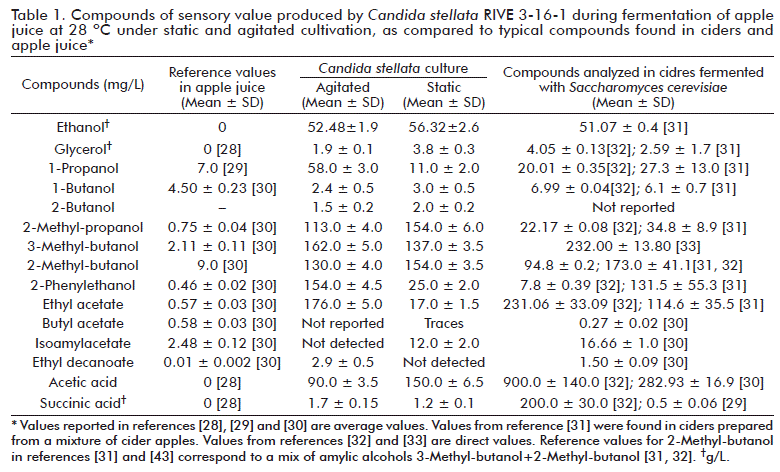
<body><![CDATA[<P   ><font face="Verdana, Arial, Helvetica, sans-serif" size="2">Sensory assessment      of ciders fermented statically and in agitation was performed using an affective      and descriptive analysis in the same manner as in previous studies carried      by Estela-Escalante <I>et al</I>. [1-4, 24]. Attributes such as taste, aroma      and odor were evaluated using a 5-points Hedonic scale (1, dislike very much;      2, dislike somewhat; 3, neither like nor dislike; 4, like somewhat; 5, like      very much). Samples were evaluated by a trained panel of 10 judges, (all men,      and aged 25-30 years). The sensory evaluation was done according to Meilgaard      <I>et al</I>. [26], and sensory evaluation data were presented as means of      the score of all the judges. A standard Student&rsquo;s t test was used to      analyze the statistical significance (p &lt; 0.05) of the differences observed      between the scores for two fermented beverages (cultivated under agitation      or static). Statistical analysis was done using Statistica v.8.0 software.</font></P >       <P   >&nbsp;</P >       <P   > </P >       <P   ><font size="3"><b><font face="Verdana, Arial, Helvetica, sans-serif">RESULTS      AND DISCUSSION</font></b></font></P >       <P   ><font face="Verdana, Arial, Helvetica, sans-serif" size="2"><b>Culture under      static and agitated conditions</b></font></P >       <P   ><font face="Verdana, Arial, Helvetica, sans-serif" size="2">Culture experiments      done in shake-flasks are regarded as oxygen-limited [27], this culture condition      affecting the fermentative metabolism of yeasts. In fact, high concentration      of sugar present in apple juice leads to alcoholic fermentation in Crabtree      positive species even when oxygen is present in enough concentration. Culture      without agitation (statically) are even more oxygen-limited, since only the      surface of the liquid gets into contact with the air and the movement of cells      in the liquid is very slow. Oxygen is necessary to improve yeast metabolism      and, thus, to successfully complete the fermentation. Results consistent with      these observations and derived from the production of chemical compounds during      fermentation of apple juice by <I>C. stellata </I>RIVE 3-16-1 in static and      agitated cultures are shown in <a href="/img/revistas/bta/v35n1/t0102118.gif">Table 1</a>. Compounds      analyzed in ciders fermented with different strains of <I>S. cerevisiae </I>as      reported by different authors were included for comparison. </font></P >       
<P   ><font face="Verdana, Arial, Helvetica, sans-serif" size="2"><b>Glycerol production</b></font></P >       <P   ><font face="Verdana, Arial, Helvetica, sans-serif" size="2">The production of      glycerol under static culture reached 1.9 &plusmn; 0.1 g/L, significantly      different (p &lt; 0.05; determinations in triplicates) from results in static      culture (3.8 &plusmn; 0.3 g/L). The decrease of glycerol production under      agitated conditions was also observed in previous studies with <I>Kloeckera      apiculata</I>, <I>S. cerevisiae</I>, <I>Saccharomycodes ludwigii </I>and <I>Hanseniaspora      uvarum </I>under similar culture conditions [1, 2, 4, 24]. Aerobic conditions      promote cellular respiration and severely decrease glycerol production. Noteworthy,      <I>C. stellata </I>is considered as a high producer of glycerol and amounts      up to 11.76 g/L have been reported [34]. Despite, the 3.8 &plusmn; 0.3 g/L      glycerol obtained in this study is low as compared to values reported in the      literature, what would suggest that glycerol production by <I>C. stellata      </I>could be strain-dependent. From the technological point of view, a higher      production of glycerol is desirable since it influences positively the sensory      quality of alcoholic beverages, while not detrimental for alcohol production.      Glycerol imparts a slightly sweet taste and contributes to the mouth-feel      and complexity of wine flavour at low levels [35, 36]. </font></P >       <P   ><font face="Verdana, Arial, Helvetica, sans-serif" size="2"><b>Production of      higher alcohols</b></font></P >       <P   ><font face="Verdana, Arial, Helvetica, sans-serif" size="2">Higher alcohols need      to be kept low since they are mostly detrimental, with few exceptions, to      the sensory quality of fermented beverages. In our experiments, a higher production      of total higher alcohols in agitated culture (620.9 mg/L) was observed, in      comparison with the static culture (486.0 mg/L). This behavior has been also      described for non-Saccharomyces yeasts (<I>K. apiculata</I>, <I>H. uvarum      </I>and <I>S. ludwigii</I>) under similar culture conditions [1, 2, 4]. Nevertheless,      an opposite effect was evidenced with <I>S. cerevisiae </I>[24]. Hence, considering      the present results together with previous ones from our group [1-4, 24],      it is possible to suggest that the production of higher alcohols depends on      yeast type and culture conditions. From the sensory point of view, higher      alcohols are identified by a strong, pungent smell and taste [37, 38]. For      instance, total concentrations higher than 400 mg/L negatively contribute      to the organoleptic quality of wines [39]. Except for 2-phenylethanol, which      imparts a floral aroma [40], the rest of higher alcohols provide unpleasant      sensory characteristics [39, 40]. </font></P >       ]]></body>
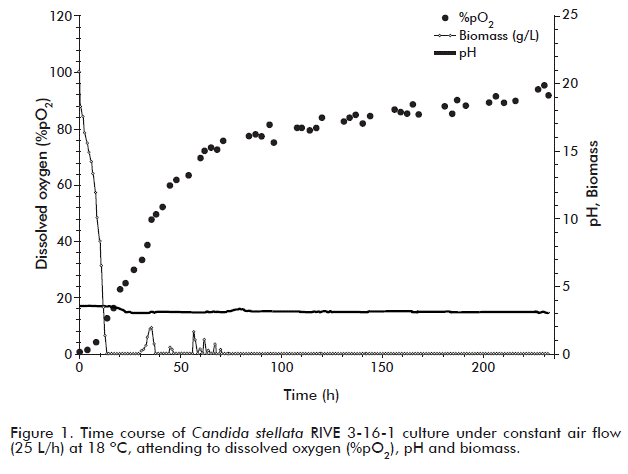
<body><![CDATA[<P   ><font face="Verdana, Arial, Helvetica, sans-serif" size="2"><b>Production of      esters</b></font></P >       <P   ><font face="Verdana, Arial, Helvetica, sans-serif" size="2">Esters are the most      important aroma compounds in alcoholic beverages. They confer pleasant sensory      characteristics under certain concentrations. Among them, ethyl acetate is      present in most fermented beverages in higher amounts as compared to the rest      of acetate esters. It imparts a light-fruity or solvent-like aroma depending      on its concentration. Mean values of experiments carried out in triplicate      showed that agitation enhanced the production of ethyl acetate (176.0 &plusmn;      5.0 mg/L), ten times higher than in static culture (17.0 &plusmn; 1.5 mg/L,      p &lt; 0.05). These results are opposite to those by Yoshioka and Hashimoto      [19], reporting that small amounts of oxygen had inhibitory effects on AATase,      the enzyme responsible for the ester generation. Previous results from our      group with other non-<I>Saccharomyces </I>yeasts such as <I>K. apiculate </I>and      <I>H. uvarum </I>showed that ethyl acetate production diminished as consequence      of agitation [1, 4]. On the other hand, in studies with <I>S. cerevisiae</I>,      <I>S. ludwiggi </I>and <I>Hansenula anomala </I>carried out under similar      cultivation conditions an opposite effect was evidenced [2, 3, 24]. From the      sensory point of view, ethyl acetate concentrations lower than 80.0 mg/L contribute      positively to the flavour and taste of wines [41]. On the contrary, concentrations      over 200.0 mg/L would impart a vinegar taste [42]. </font></P >       <P   ><font face="Verdana, Arial, Helvetica, sans-serif" size="2"><b>Production of      organic acids</b></font></P >       <P   ><font face="Verdana, Arial, Helvetica, sans-serif" size="2">Two relevant organic      acids were determined: acetic acid and succinic acid. Acetic acid is quantitatively      and sensorially the most important volatile fatty acid produced during alcoholic      fermentation. Yeasts produce different amount of acetic acid during ethanol      production. In this study, higher amounts were produced in static (150.0 &plusmn;      6.5 mg/L) vs agitated (90.0 &plusmn; 3.5 mg/L) conditions. This behavior matched      that observed in previous studies with <I>S. cerevisiae </I>and <I>K. apiculata      </I>under similar culture conditions [1, 24]. The flavour threshold for acetic      acid depends on the type of alcoholic beverage, ranging 0.4-1.1 g/L for wines      [43]. </font></P >       <P   ><font face="Verdana, Arial, Helvetica, sans-serif" size="2">In the case of succinic      acid, it is the major organic acid produced by yeast metabolism [44], and      it has an unusual salty and bitter taste. Metabolically, it is an intermediary      compound of the Krebs cycle. No significant differences were found (p &gt;      0.05) of succinic acid production between static (1.2 &plusmn; 0.1 g/L) and      agitated (1.7 &plusmn; 0.15 g/L) conditions, as mean values from three replicates      of each fermentation condition. This can be explained due to the fact that      agitation oxygenates the medium, promoting the synthesis of this acid. </font></P >       <P   ><font face="Verdana, Arial, Helvetica, sans-serif" size="2"><b>Sensory evaluation      of fermentation product</b></font></P >       <P   ><font face="Verdana, Arial, Helvetica, sans-serif" size="2">Significant differences      (p &lt; 0.05) were found for the two fermentation beverages (static vs agitated)      when comparing the mean values of the score of 10 judges who evaluated them      attending to flavour, taste and odour. Panelists described the beverage fermented      statically with a slightly taste of solvent-like, little acidic, with an acceptable      balanced sensory profile. On the other hand, they referred to the beverage      fermented under agitation as of strong taste to solvent like and with unbalanced      sensory profile. The beverage fermented statically had an overall acceptability,      based on the attributes evaluated, which is consistent with the traditional      fermentation process. </font></P >       <P   ><font face="Verdana, Arial, Helvetica, sans-serif" size="2"><b>Batch cultivation      in bioreactor under constant air flow</b></font></P >       <P   ><font face="Verdana, Arial, Helvetica, sans-serif" size="2">Batch cultivation      with constant air flow regime allows constant supply of oxygen to the medium.      Oxygen is the most important parameter determining the balance between fermentative      and respiratory activity in most yeasts. Respiration rate becomes dependent      on oxygen availability in the medium at concentrations lower than the critical      value, this parameter very low for yeasts at about 0.12 mg/L at 20 &ordm;C      [45]. Oxygen transfer into the liquid phase depends on several parameters,      such as: the bioreactor geometry, type of impeller, culture medium viscosity,      agitation speed, number of baffles, temperature, among others. Only the oxygen      dissolved in the liquid phase is available for yeast cells. </font></P >       <P   ><font face="Verdana, Arial, Helvetica, sans-serif" size="2">Therefore, the aim      was to evaluate the impact of oxygenation on the fermentative behavior of      <I>C. stellate </I>RIVE 3-16-1 yeast. For that purpose, apple juice from the      single Rubin variety was used and following the routine procedure of juice      extraction. Oxygen consumption, cell growth, pH shift and the synthesis and      utilization of metabolism byproducts were monitored at a constant air flow      rate of 25.0 L/h (0.2 mol O<sub>2</sub>/h) during the whole fermentation time      (232 h). As shown in <a href="/img/revistas/bta/v35n1/f0102118.gif">figure 1</a>, after 10 h of culture,      the concentration of dissolved oxygen dropped down to zero and remained at      this value the whole cultivation period. During this time the oxygen transferred      to the liquid phase was totally consumed. Since this value does not give information      about the rate of oxygen consumption, it was required to measure this parameter      in the oulet gas of the bioreactor. This was also observed in previous reports      of our group, for <I>H. anomala</I>, <I>S. ludwigii </I>and <I>Brettanomyces      intermedius </I>yeasts when cultured under conditions similar to the ones      tested [2, 3, 46]. Nevertheless, oxygen consumption by <I>S. cerevisiae </I>was      reported to follow a different behavior after 50 h in culture. Almost the      same pattern of oxygen consumption was followed by <I>K. apiculata </I>and      <I>H. uvarum </I>[1, 4, 24]. The oxygen consumed by these yeasts is used in      the respiration process for glucose oxidation, and also in non-respiratory      pathways such as synthesis of sterols and unsaturated fatty acids, which are      essential components of the cellular membrane [47]. </font></P >   <FONT size="+1"><FONT size="+1">        
]]></body>
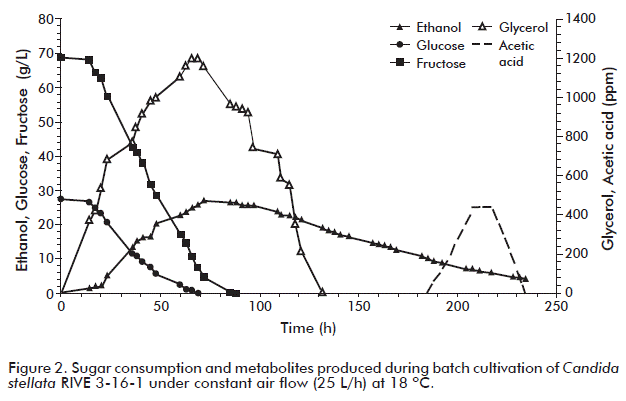
<body><![CDATA[<P   ><font face="Verdana, Arial, Helvetica, sans-serif" size="2">The course of the      whole fermentation process in terms of sugar consumption, ethanol, glycerol      and acetic acid production is shown in <a href="/img/revistas/bta/v35n1/f0202118.gif">figure 2</a>.      Fermentation can be divided in two stages: one characterized by sugar consumption      (glucose and fructose) and production of ethanol and glycerol until 70 h,      followed by a second one in which fermentation byproducts (ethanol and glycerol)      are consumed. Regarding yeast growth kinetics, it reached 19.6 g/L, with an      specific growth rate of 0.13 h-1 at the end of culture. In this regard, Ciani      <I>et al</I>. [12] reported that the presence of oxygen increased growth rate      in approximately three-fold (from 0.05 to 0.16 h-1) when <I>C. stellate </I>was      cultured in shake flasks at 150 rpm in synthetic medium and synthetic grape      juice, as compared to anaerobic cultivation experiments. The low biomass production      seen in our experiment may be due to the use of fermentable sugar by <I>C.      stellata </I>RIVE 3-16-1 in cell maintenance reactions, as cultures were run      at a low pH value (3.2-3.8). It was also observed that once sugars were consumed,      ethanol and glycerol were simultaneously used as carbon source, followed by      acetic acid. </font></P >   <FONT size="+1"><FONT size="+1"><FONT size="+1"><FONT size="+1">        
<P   ><font face="Verdana, Arial, Helvetica, sans-serif" size="2">As shown for sugar      consumption (<a href="/img/revistas/bta/v35n1/f0202118.gif">Figure 2</a>), glucose was the first substrate      to be depleted (up to 70 h) and then fructose (up to 90 h), this last with      a higher consumption rate. This can be explained due to the fact that <I>C.      stellata </I>is a fructophilic yeast using fructose as a preferential substrate.      This sugar depletion up to 90 h was also observed previously in experiments      with <I>S. cerevisiae </I>under similar culture conditions [24]. </font></P >       
<P   ><font face="Verdana, Arial, Helvetica, sans-serif" size="2">Ethanol and glycerol      production were mainly produced in the first stage (<a href="/img/revistas/bta/v35n1/f0202118.gif">Figure      2</a>), the former at lower levels than in previous studies with <I>S. cerevisiae      </I>under similar culture conditions [24]. On the other hand, acetic acid      production was observed at the end of culture when ethanol was the main carbon      source. In fact, it was generated by <I>C. stellata </I>RIVE 3-16-1 at levels      three-fold lower than those attained with <I>S. cerevisiae </I>[24]. </font></P >       
<P   ><font face="Verdana, Arial, Helvetica, sans-serif" size="2">Simultaneously, sugar      consumption resulted in maximum production of ethanol (27.0 g/L) and glycerol      (1.2 g/L), these compounds serving as carbon source to maintain cell growth      once sugars were depleted (<a href="/img/revistas/bta/v35n1/f0202118.gif">Figure 2</a>). From this      stage on, the dissolved oxygen concentration dropped to zero and it remained      constant toward the end of the cultivation period. Finally, acetic acid was      produced toward the end of cultivation during ethanol assimilation. </font></P >       
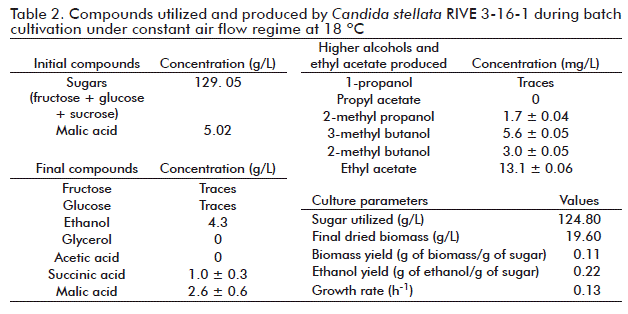
<P   ><font face="Verdana, Arial, Helvetica, sans-serif" size="2">In the case of glycerol,      its production by yeast may constitute a response against the high osmolarity      of the environment (osmoregulation) [48]. Apple juice normally contains high      sugar concentrations and it can increase the osmolarity in <I>C. stellata      </I>RIVE 3-16-1 cells, which could synthesize glycerol as compatible intracellular      solute to compensate this parameter. In fermentation studies with <I>Candida      magnolia</I>, it was shown that that cell growth and glycerol production were      strongly affected by oxygen supply [49]. Apart from the effect on glycerol      synthesis, the 0.13 h<sup>-1</sup> growth rate seen (<a href="/img/revistas/bta/v35n1/t0202118.gif">Table      2</a>) was similar to that reported by us for other yeasts cultured under      similar conditions [3, 24]. It is common knowledge that the energy generated      from glucose metabolism may be mostly used in cell growth during glucose-limited      and fully aerobic fermentations. </font></P >   <FONT size="+1"><FONT size="+1">        
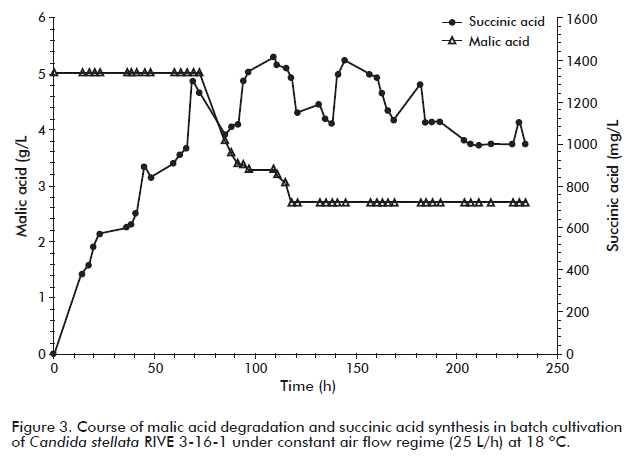
<P   ><font face="Verdana, Arial, Helvetica, sans-serif" size="2">Additionally, in      in-batch cultivation under constant air flow, <I>C. stellata </I>RIVE 3-16-1      was able to utilize </font><font face="Verdana, Arial, Helvetica, sans-serif" size="2">48.2      % of the total malic acid present in apple juice. This finding is interesting      since yeasts with high capability to degrade malic acid are desired. The presence      of oxygen in the medium would enhance its utilisation. It was also observed      that degradation of malic acid started after sugar depletion and at the same      time with ethanol assimilation (<a href="/img/revistas/bta/v35n1/f0202118.gif">Figure 2</a> and <a href="/img/revistas/bta/v35n1/f0302118.gif">Figure      3</a>). This behavior was also observed in previous studies with <I>S. cerevisiae      </I>cultured under similar conditions as used in this study [24] and, it may      indicate that malic acid serves as carbon source to support the cell growth      in both yeasts. Malic acid is the most important organic acid present in apple      juice. It contributes to the total acidity in ciders. The decrease of its      content to values lower than 5 g/L gives ciders with better sensory quality.      Wine yeast in general cannot effectively degrade malic acid during alcoholic      fermentation. Commercial wine yeasts (<I>S. cerevisiae</I>) are able to degrade      only 18 % of the total malic acid [50], we previously reported degradation      levels of up to 36 % of the total malic acid present in apple juice [24].      The other major metabolic compound, succinic acid, is the main organic acid      generated by yeasts during metabolism of the carbon source, contributing to      the taste of many alcoholic beverages [38, 44]. Here we found that <I>C. stellata      </I>RIVE 3-16-1 produced it at 1.4 g/L. Moreover, the variability found for      succinic acid synthesis throughout the entire fermentation process could be      explained by its continuous excretion and reimport into yeast cells [38, 48].      </font></P >       
<P   ><font face="Verdana, Arial, Helvetica, sans-serif" size="2">Finally, other byproducts      such as higher alcohols and acetate esters were also identified. They were      confirmed among trace compounds remaining at the end of culture (<a href="/img/revistas/bta/v35n1/t0202118.gif">Table      2</a>). Probably, at the second fermentation stage (aerobic assimilation of      ethanol), these higher alcohols could have served as carbon source for cell      biomass increase, their low concentrations at the end of cultivation supporting      this hypothesis (<a href="/img/revistas/bta/v35n1/t0202118.gif">Table 2</a>). From the technological      point of view, fermentations should be stopped once sugars get depleted or      when ethanol concentrations reach the intended value. Overall, our results      are in line with common knowledge on alcoholic fermentation, regarding that      excessive aeration during fermentation leads to increased cell biomass and      consequently decreased ethanol production. </font></P >       
<P   >&nbsp;</P >       <P   > </P >       <P   ><b><font face="Verdana, Arial, Helvetica, sans-serif" size="3">CONCLUSIONS</font></b></P >       ]]></body>
<body><![CDATA[<P   ><font face="Verdana, Arial, Helvetica, sans-serif" size="2">The concentration      of oxygen and sugars are the most important factors that affect the metabolism      of <I>C. stellata </I>RIVE 3-16-1. At high sugar concentration, alcoholic      fermentation takes place even with insufficient oxygen amounts. In culture      under agitation in Erlenmeyer flasks it was found oxygen transference is a      limiting factor, probably leading to very low oxygen concentration in the      medium. These oxygen-limited conditions influences the synthesis of fermentation      byproducts by <I>C. stellata </I>RIVE 3-16-1, particularly glycerol and increases      the overall production of higher alcohols (especially 3-methyl-butanol and      2-phenylethanol) and acetate esters such as ethyl acetate. Simultaneously,      acetic acid diminishes under agitation, something desirable for alcoholic      beverages, due to low volatile acidity. From the sensory point of view, the      static culture conditions provide the best acceptability criteria, providing      additional evidence for static culture as optimal for apple juice fermentation.      </font></P >       <P   ><font face="Verdana, Arial, Helvetica, sans-serif" size="2">Conversely, constant      air flow conditions supporting oxygen consumption for three days led to sugar      depletion and enhanced yeast growth and fermentation rate, but affecting ethanol      yields. Hence, excessive aeration should be avoided to improve ethanol yields,      since <I>C. stellata </I>RIVE 3-16-1 normally produces ethanol, glycerol and      acetic acid during aerobic fermentation, but these products are metabolized      with continuous oxygen supply once the sugars are aerobically depleted. Therefore,      care must be taken when main carbon sources (sugars) are exhausted, to avoid      the consumption of glycerol and acetic acid as energy sources, as well as      malic acid, affecting the sensory quality of the final </font><font face="Verdana, Arial, Helvetica, sans-serif" size="2">beverage.      In this case, the fermentation process should be stopped once the maximum      ethanol concentration has been attained. </font></P >       <P   ><font face="Verdana, Arial, Helvetica, sans-serif" size="2">From the technological      point of view, small amounts of oxygen would be suitable in order to control      the production of ethanol and the synthesis of fermentation byproducts.</font></P >       <P   >&nbsp;</P >       <P   ><font face="Verdana, Arial, Helvetica, sans-serif" size="2"><b><font size="3">CONFLICTS      OF INTEREST STATEMENT</font></b></font></P >       <P   ><font face="Verdana, Arial, Helvetica, sans-serif" size="2">The authors declare      that there are no conflicts of interest. </font></P >       <P   >&nbsp;</P >       <P   > </P >       <P   ><b><font face="Verdana, Arial, Helvetica, sans-serif" size="3">REFERENCES </font></b></P >       <!-- ref --><P   ><font face="Verdana, Arial, Helvetica, sans-serif" size="2">1. Estela-Escalante      WD, Rychtera M, Melzoch K, Guerrero-Ochoa MR. Influencia de la aireaci&oacute;n      en la actividad fermentative de <i>Kloeckera apiculata </i>durante lafermentaci&oacute;n      de jugo de manzana. Acta Biol Colombiana. 2012;17(2):309-22.    </font></P >       <!-- ref --><P   ><font face="Verdana, Arial, Helvetica, sans-serif" size="2">2. Estela-Escalante      WD, Rychtera M, Melzoch K, Hatta-Sakoda B, Lude&ntilde;a-Cervantes Z, Sarmiento-Casavilca      V, <i>et al</i>. Actividad fermentativa de <i>Saccharomycodes ludwigii</i>      y evaluaci&oacute;n de la s&iacute;ntesis de compuestos de importancia sensorial      durante la fermentaci&oacute;n de jugo de manzana. TIP.2011;14(1):12-23.    </font></P >       <!-- ref --><P   ><font face="Verdana, Arial, Helvetica, sans-serif" size="2">3. Estela-Escalante      W, Rychtera M, Melzoch K, Quillama-Polo E, Hatta-Sakoda B. Estudio de la actividad      fermentativa de <i>Hansenula anomala</i> y producci&oacute;n de compuestos      qu&iacute;micos de importancia sensorial. Rev Peru Biol. 2011;18(3):325-34.    </font></P >       <!-- ref --><P   ><font face="Verdana, Arial, Helvetica, sans-serif" size="2">4. Estela-Escalante      W, Rychtera M, Melzoch K, Hatta-Sakoda B, Quillama-Polo E, Lude&ntilde;a-Cervantes      Z, <i>et al</i>. Actividad fermentativa de <i>Hanseniaspora uvarum</i> y su      importancia en la producci&oacute;n de bebidas fermentadas. Rev Soc Venezolana      Microbiol. 2011;31:57-63.    </font></P >       <!-- ref --><P   ><font face="Verdana, Arial, Helvetica, sans-serif" size="2">5. Englezos E, Rantsiou      K, Torchio F, Rolle L, Gerbi V, Cocolin L. Exploitation of the non-Saccharomyces      yeast <i>Starmerella bacillaris</i> (synonym <i>Candida zemplinina</i>) in      wine fermentation: Physiological and molecular characterizations. Int J Food      Microbiol. 2015;199:33-40.    </font></P >       <!-- ref --><P   ><font face="Verdana, Arial, Helvetica, sans-serif" size="2">6. Estela-Escalante      WD, Rosales-Mendoza S, Moscosa-Santill&aacute;n M, Gonz&aacute;lez-Ram&iacute;rez      JE. Evaluation of the fermentative potential of <i>Candida zemplinina</i>      yeasts for craft beer fermentation. J Inst Brew. 2016;122:530-5.    </font></P >       <!-- ref --><P   ><font face="Verdana, Arial, Helvetica, sans-serif" size="2">7. Estela-Escalante      WD, Moscosa-Santill&aacute;n M, Gonz&aacute;lez-Ram&iacute;rez JE, Rosales-Mendoza      S. Evaluation of the potential production of ethanol by <i>Candida zemplinina</i>      yeast with regard to beer fermentation. J Am Soc Brew Chem. 2017;75(2):130-5.    </font></P >       <!-- ref --><P   ><font face="Verdana, Arial, Helvetica, sans-serif" size="2">8. Mora J, Mulet      A. Effects of some treatments of grape juice on the population and growth      of yeast species during fermentation. Am J Enol Viticult. 1991;42:133-6.    </font></P >       <!-- ref --><P   ><font face="Verdana, Arial, Helvetica, sans-serif" size="2">9. Jolly NP, Augustyn      OPH, Pretorius IS. The occurrence of non-Saccharomyces species over three      vintages in four vineyards and grape musts from four production regions of      the Western Cape, South Africa. South Afr J Enol Viticult. 2003;24:35-42.    </font></P >       <!-- ref --><P   ><font face="Verdana, Arial, Helvetica, sans-serif" size="2">10. Ciani M, Ferraro      L. Combined use of immobilized <i>Candida stellata</i> cells and <i>Saccharomyces      cerevisiae</i> to improve the quality of wines. J Appl Microbiol.1998;85:247-54.    </font></P >       <!-- ref --><P   ><font face="Verdana, Arial, Helvetica, sans-serif" size="2">11. Magyar I, Toth      T. Comparative evaluation of some oenological properties in wine strains of      <i>Candida stellata</i>, <i>Candida zemplinina</i>, <i>Saccharomyces uvarum</i>      and <i>Saccharomyces cerevisiae</i>. Food Microbiol. 2011;28:94-100.    </font></P >       <!-- ref --><P   ><font face="Verdana, Arial, Helvetica, sans-serif" size="2">12. Ciani M, Ferraro      L, Fatichenti F. Influenceof glycerol production on the aerobic and anaerobic      growth of the wine yeast <i>Candida stellata</i>. Enz Microb Technol. 2000;27:698-703.    </font></P >       <P   ><font face="Verdana, Arial, Helvetica, sans-serif" size="2">13. Rodicio R, Heinisch      JJ. Sugar metabolism by <i>Saccharomyces</i> and non-<i>Saccharomyces</i>      yeasts. In: Helmut-Konig H, Unden G, Frohlich J (Editors). Biology of microorganisms      on grapes, in must and inwine. Berlin Heidelberg: Springer-Verlag;2009. p.      113-34.</font></P >       <!-- ref --><P   ><font face="Verdana, Arial, Helvetica, sans-serif" size="2">14. Van Dijken JP,      Scheffers WA. Redox balances in the metabolism of sugars by yeasts. FEMS Microbiol      Rev. 1986;32:199-224.    </font></P >       <!-- ref --><P   ><font face="Verdana, Arial, Helvetica, sans-serif" size="2">15. Verduyn C. Physiology      of yeasts inrelation to biomass yields. Antonie van Leeuwenhoek. 1991;60:325-53.    </font></P >       <P   ><font face="Verdana, Arial, Helvetica, sans-serif" size="2">16. Ribereau-Gayon      P, Dubourdieu D, Doneche B, Lonvaud A. Biochemistry of alcoholic fermentation      and metabolic pathways of wine yeasts. In: Handbook of Enology. The Microbiology      of Wine and Vinifications. New York: John Wiley and Sons; 2000. p. 51-74.</font></P >       <!-- ref --><P   ><font face="Verdana, Arial, Helvetica, sans-serif" size="2">17. Suomalainen H.      Yeast esterase and aroma esters in alcoholic beverages. J Inst Brew. 1981;87:296-300.    </font></P >       <P   ><font face="Verdana, Arial, Helvetica, sans-serif" size="2">18. Nordstrom K.      Formation of ethyl acetate in fermentation with brewer&rsquo;s yeast. III.      Participation of coenzyme A. J Inst Brew. 1962;68:398-407.</font></P >       <P   ><font face="Verdana, Arial, Helvetica, sans-serif" size="2">19. Yoshioka K, Hashimoto      H. Cellular fatty acid and ester formation by brewers&rsquo; yeast. Agr Biol      Chem. 1983;47:2287-94.</font></P >       <P   ><font face="Verdana, Arial, Helvetica, sans-serif" size="2">20. Hammond JRM.      Brewer&rsquo;s yeasts. In: Rose AH, Harrison JS (Editors). The Yeast.Yeast      technology (vol. 5). London: Academic Press; 1993. p. 7-67.</font></P >       <!-- ref --><P   ><font face="Verdana, Arial, Helvetica, sans-serif" size="2">21. Barker RL, Irwin      JA, Murray CR. The relationship bewteen fermentation variables and flavour      volatiles by direct gas chromatographic injection of beer. Master Brewers      Assoc Am Tech Quart.1992;29:11-7.    </font></P >       <P   ><font face="Verdana, Arial, Helvetica, sans-serif" size="2">22. Downing DL. Apple      Cider. In: DonaldLD (Editor). Processed Apple Products. NewYork: Van Nostrand      Reinhold Publisher. USA; 1989. p. 169-188.</font></P >       <!-- ref --><P   ><font face="Verdana, Arial, Helvetica, sans-serif" size="2">23. Su SK, Wiley      RC. Changes in applejuice flavor compounds during processing. J Food Sci.      1998;63(4):688-69.    </font></P >       <!-- ref --><P   ><font face="Verdana, Arial, Helvetica, sans-serif" size="2">24. Estela-Escalante      WD, Rychtera M, Melzoch K, Hatta-Sakoda B. Effect of aeration on the fermentative      activity of <i>Saccharomyces cerevisiae</i> cultured in apple juice. Rev Mexicana      Ing Qu&iacute;m. 2012;11(2):211-26.    </font></P >       <!-- ref --><P   ><font face="Verdana, Arial, Helvetica, sans-serif" size="2">25. Ortega C, Lopez      R, Cacho J, Ferreira V. Fast analysis of important wine volatile compounds:      Development and validation of a new method based on gas chromatography-flame      ionization detection analysis of dichloromethane microextracts. J Chrom A.      2001;923:205-14.    </font></P >       <!-- ref --><P   ><font face="Verdana, Arial, Helvetica, sans-serif" size="2">26. Meilgaard M,      Civille GV, Carr BT. Sensory Evaluation Techniques. 4rd edition. Boca Raton,      New York: CRC Press;2006.     p. 22-35.</font></P >       <!-- ref --><P   ><font face="Verdana, Arial, Helvetica, sans-serif" size="2">27. Gupta A, Rao      GA. Study of oxygen transfer in shake flasks using a noninvasive oxygen sensor.      Biotechnol Bioeng. 2003;84(3):351-8.    </font></P >       <!-- ref --><P   ><font face="Verdana, Arial, Helvetica, sans-serif" size="2">28. Cabranes C, Moreno      J, Mangas JJ. Cider production with immobilized <i>Leuconostoc oenos</i>.      J Inst Brew. 1998;4:127-30.    </font></P >       <!-- ref --><P   ><font face="Verdana, Arial, Helvetica, sans-serif" size="2">29. Souci SW, Fachmann      W, Kraut H. Juices from fruits and berries: Food composition and nutrition      tables. 6th edition. Stuttgart: Scientific publishers; 2000.     p. 13-52.</font></P >       <!-- ref --><P   ><font face="Verdana, Arial, Helvetica, sans-serif" size="2">30. Wang L, Xu Y,      Zhao G, Li J. Rapid analysis of flavor volatiles inapple wine using Headspace      Solid-Phase microextraction. J Inst Brew. 2004;110(1):57-65.    </font></P >       <!-- ref --><P   ><font face="Verdana, Arial, Helvetica, sans-serif" size="2">31. Picinelli A,      Suarez B, Moreno J, Rodr&iacute;guez R, Caso-Garc&iacute;a LM, Mangas JJ.      Chemical characterization of Asturian cider. J Agr Food Chem. 2000;48:3997-4002.    </font></P >       <!-- ref --><P   ><font face="Verdana, Arial, Helvetica, sans-serif" size="2">32. Suarez-Valles      B, Pando-Bedrinana R, Fernandez-Tascon N, Gonzales-Garcia A, Rodr&iacute;guez-Madrera      R. Analytical differentiation of cider inoculated with yeast (<i>Saccharomyces      cerevisiae</i>) isolated from Asturian (Spain) apple juice. LWT-Food Sci Technol.      2005;38:455-61.    </font></P >       <!-- ref --><P   ><font face="Verdana, Arial, Helvetica, sans-serif" size="2">33. Jarvis B, Forster      MJ, Kinsella WP. Factors affecting the development of cider flavour. J Appl      Bacteriol. 1995;79:5S-18S.    </font></P >       <!-- ref --><P   ><font face="Verdana, Arial, Helvetica, sans-serif" size="2">34. Ciani M, Maccarelli      F. Oenological properties of non-<i>Saccharomyces</i> yeasts associated with      winemaking. World J Microbiol Biotechnol. 1998;14:199-203.    </font></P >       <!-- ref --><P   ><font face="Verdana, Arial, Helvetica, sans-serif" size="2">35. Prior BA, Toh      TH, Jolly N, Baccari C, Mortimer RK. Impact of yeast breeding for elevated      glycerol production on fermentation activity and metabolite formation in Chardonnay.      South Afr J Enology Viticulture. 2000;21:92-9.    </font></P >       <!-- ref --><P   ><font face="Verdana, Arial, Helvetica, sans-serif" size="2">36. Nieuwoudt HH,      Prior BA, Pretorius IS, Bauer FF. Glycerol in South African table wines: an      assessment of its relationship to wine quality. South Afr J Enol Viticult.      2002;23:22-30.    </font></P >       <!-- ref --><P   ><font face="Verdana, Arial, Helvetica, sans-serif" size="2">37. Swiegers JH,      Pretorius IS. Yeast modulation of wine flavour. Adv Appl Microbiol. 2005;57:131-75.    </font></P >       <!-- ref --><P   ><font face="Verdana, Arial, Helvetica, sans-serif" size="2">38. Swiegers JH,      Bartowsky EJ, HenschkePA, Pretorius IS. Yeast and bacterial modulation of      wine aroma and flavour. Austr J Grape Wine Res. 2005;11:139-73.    </font></P >       <!-- ref --><P   ><font face="Verdana, Arial, Helvetica, sans-serif" size="2">39. Rapp A, Mandery      H. New progress in wine and wine research. Experientia. 1986;42(8):873-84.    </font></P >       <P   ><font face="Verdana, Arial, Helvetica, sans-serif" size="2">40. Ribereau-Gayon      P, Dubourdieu D, Doneche B. Biochemistry of alcoholic fermentation and metabolic      pathways of wine yeasts. In: Handbook of enology. The microbiology of wine      and vinifications. Chichester: John Wiley and Sons, Ltd;2006. p. 74-7.</font></P >       <P   ><font face="Verdana, Arial, Helvetica, sans-serif" size="2">41. Ribereau-Gayon      P. Wine aroma. In: Charalambous G, Inglett GE (Editors). Flavour of foods      and beverages. NewYork: Academic Press; 1978. p. 362-71.</font></P >       <P   ><font face="Verdana, Arial, Helvetica, sans-serif" size="2">42. Dequin S, Salmon      JM, Nguyen HV. Wine yeasts. In: Boekhout T, Robert V(Editors). Yeasts in food-beneficial      and detrimental aspects. Hamburg: Behr&rsquo;s Verlag; 2003. p. 389-412.</font></P >       <P   ><font face="Verdana, Arial, Helvetica, sans-serif" size="2">43. Dubois P. Les      aromes des vins et leurs defauts. Revue Francaise d&rsquo;Oenologie.1994;145:27-40.</font></P >       <!-- ref --><P   ><font face="Verdana, Arial, Helvetica, sans-serif" size="2">44. Coulter AD, Godden      PW, Pretorius IS. Succinic acid-How it is formed, what is its effect on titratable      acidity, and what factor sinfluence its concentration in wine? Austr New Zealand      Wine Ind J. 2004;19:16-25.    </font></P >       <!-- ref --><P   ><font face="Verdana, Arial, Helvetica, sans-serif" size="2">45. Furukawa K, Heinzle      E, Dunn IJ. Influence of oxygen on the growth of <i>Saccharomyces cerevisiae</i>      in continuous culture. Biotechnol Bioeng. 1983;25(10):2293-317.    </font></P >       <!-- ref --><P   ><font face="Verdana, Arial, Helvetica, sans-serif" size="2">46. Estela-Escalante      WD, Rychtera M, Melzoch K, Torres-Ib&aacute;&ntilde;ez F, Calixto-Cotos R,      Bravo-Aran&iacute;bar N, <i>et al</i>. Efecto de la aireaci&oacute;n en la      producci&oacute;n de compuestos vol&aacute;tiles por cultivo mixto de <i>Brettanomyces      intermedius</i> y <i>Saccharomyces cerevisiae</i> durante la fermentaci&oacute;n      de sidra. TIP.2014;17(1):5-14.    </font></P >       <!-- ref --><P   ><font face="Verdana, Arial, Helvetica, sans-serif" size="2">47. Rosenfeld E,      Beauvoit B. Role of the non-respiratory pathways in the utilization of molecular      oxygen by <i>Saccharomyces cerevisiae</i>. Yeast. 2003;20:1115-44.    </font></P >       <!-- ref --><P   ><font face="Verdana, Arial, Helvetica, sans-serif" size="2">48. Hohmann S. Osmotic      stress signaling and osmoadaptation in yeasts. Microbiol Mol Biol Rev. 2002;66:300-72.    </font></P >       <!-- ref --><P   ><font face="Verdana, Arial, Helvetica, sans-serif" size="2">49. Sahoo DK, Agarwal      GP. Effect of oxygen transfer on glycerol biosynthesis by an osmophilic yeast      <i>Candida magnoliae</i> I2B. Biotechnol Bioeng. 2002;78(5):545-55.    </font></P >       <!-- ref --><P   ><font face="Verdana, Arial, Helvetica, sans-serif" size="2">50. Redzepovic S,      Orlic S, Majdak A, Kozina B, Volschenk H, Viljoen-Bloom M. Differential malic      acid degradation by selected strains of <i>Saccharomyces</i> during alcoholic      fermentation. Int J Food Microbiol. 2003;83:49-61.    </font></P >       <P   >&nbsp;</P >       ]]></body>
<body><![CDATA[<P   ></P >       <P   ><font face="Verdana, Arial, Helvetica, sans-serif" size="2">Received in October,      2017.    <br>     </font><font face="Verdana, Arial, Helvetica, sans-serif" size="2">Accepted      in March, 2018.</font></P >       <P   >&nbsp;</P >       <P   ></P >       <P   ><i><font face="Verdana, Arial, Helvetica, sans-serif" size="2">Waldir D Estela-Escalante</font></i><font face="Verdana, Arial, Helvetica, sans-serif" size="2">.      Escuela Profesional de Ingenier&iacute;a Agroindustrial. Facultad de Qu&iacute;mica      e Ingenier&iacute;a Qu&iacute;mica, Universidad Nacional Mayor de San Marcos.      Av. Universitaria s/n. Lima 1, Lima, Per&uacute;. E-mail: <A href="mailto:waldir.estela@unmsm.edu.pe">      waldir.estela@unmsm.edu.pe</A>. </font></P >   </font></font></font></font></font></font></font></font></font></font></font></font></font></font></font></font></font></font></font></font></font></font></font></font></font></font></font></font></font></font></font></font></font></font></font></font></font></font></font></font></font></font></DIV >      ]]></body><back>
<ref-list>
<ref id="B1">
<label>1</label><nlm-citation citation-type="journal">
<person-group person-group-type="author">
<name>
<surname><![CDATA[Estela-Escalante]]></surname>
<given-names><![CDATA[WD]]></given-names>
</name>
<name>
<surname><![CDATA[Rychtera]]></surname>
<given-names><![CDATA[M]]></given-names>
</name>
<name>
<surname><![CDATA[Melzoch]]></surname>
<given-names><![CDATA[K]]></given-names>
</name>
<name>
<surname><![CDATA[Guerrero-Ochoa]]></surname>
<given-names><![CDATA[MR]]></given-names>
</name>
</person-group>
<article-title xml:lang="es"><![CDATA[Influencia de la aireación en la actividad fermentative de Kloeckera apiculata durante lafermentación de jugo de manzana]]></article-title>
<source><![CDATA[Acta Biol Colombiana]]></source>
<year>2012</year>
<volume>17</volume>
<numero>2</numero>
<issue>2</issue>
<page-range>309-22</page-range></nlm-citation>
</ref>
<ref id="B2">
<label>2</label><nlm-citation citation-type="journal">
<person-group person-group-type="author">
<name>
<surname><![CDATA[Estela-Escalante]]></surname>
<given-names><![CDATA[WD]]></given-names>
</name>
<name>
<surname><![CDATA[Rychtera]]></surname>
<given-names><![CDATA[M]]></given-names>
</name>
<name>
<surname><![CDATA[Melzoch]]></surname>
<given-names><![CDATA[K]]></given-names>
</name>
<name>
<surname><![CDATA[Hatta-Sakoda]]></surname>
<given-names><![CDATA[B]]></given-names>
</name>
<name>
<surname><![CDATA[Ludeña-Cervantes]]></surname>
<given-names><![CDATA[Z]]></given-names>
</name>
<name>
<surname><![CDATA[Sarmiento-Casavilca]]></surname>
<given-names><![CDATA[V]]></given-names>
</name>
</person-group>
<article-title xml:lang="es"><![CDATA[Actividad fermentativa de Saccharomycodes ludwigii y evaluación de la síntesis de compuestos de importancia sensorial durante la fermentación de jugo de manzana]]></article-title>
<source><![CDATA[TIP]]></source>
<year>2011</year>
<volume>14</volume>
<numero>1</numero>
<issue>1</issue>
<page-range>12-23</page-range></nlm-citation>
</ref>
<ref id="B3">
<label>3</label><nlm-citation citation-type="journal">
<person-group person-group-type="author">
<name>
<surname><![CDATA[Estela-Escalante]]></surname>
<given-names><![CDATA[W]]></given-names>
</name>
<name>
<surname><![CDATA[Rychtera]]></surname>
<given-names><![CDATA[M]]></given-names>
</name>
<name>
<surname><![CDATA[Melzoch]]></surname>
<given-names><![CDATA[K]]></given-names>
</name>
<name>
<surname><![CDATA[Quillama-Polo]]></surname>
<given-names><![CDATA[E]]></given-names>
</name>
<name>
<surname><![CDATA[Hatta-Sakoda]]></surname>
<given-names><![CDATA[B]]></given-names>
</name>
</person-group>
<article-title xml:lang="es"><![CDATA[Estudio de la actividad fermentativa de Hansenula anomala y producción de compuestos químicos de importancia sensorial]]></article-title>
<source><![CDATA[Rev Peru Biol]]></source>
<year>2011</year>
<volume>18</volume>
<numero>3</numero>
<issue>3</issue>
<page-range>325-34</page-range></nlm-citation>
</ref>
<ref id="B4">
<label>4</label><nlm-citation citation-type="journal">
<person-group person-group-type="author">
<name>
<surname><![CDATA[Estela-Escalante]]></surname>
<given-names><![CDATA[W]]></given-names>
</name>
<name>
<surname><![CDATA[Rychtera]]></surname>
<given-names><![CDATA[M]]></given-names>
</name>
<name>
<surname><![CDATA[Melzoch]]></surname>
<given-names><![CDATA[K]]></given-names>
</name>
<name>
<surname><![CDATA[Hatta-Sakoda]]></surname>
<given-names><![CDATA[B]]></given-names>
</name>
<name>
<surname><![CDATA[Quillama-Polo]]></surname>
<given-names><![CDATA[E]]></given-names>
</name>
<name>
<surname><![CDATA[Ludeña-Cervantes]]></surname>
<given-names><![CDATA[Z]]></given-names>
</name>
</person-group>
<article-title xml:lang="es"><![CDATA[Actividad fermentativa de Hanseniaspora uvarum y su importancia en la producción de bebidas fermentadas]]></article-title>
<source><![CDATA[Rev Soc Venezolana Microbiol]]></source>
<year>2011</year>
<volume>31</volume>
<page-range>57-63</page-range></nlm-citation>
</ref>
<ref id="B5">
<label>5</label><nlm-citation citation-type="journal">
<person-group person-group-type="author">
<name>
<surname><![CDATA[Englezos]]></surname>
<given-names><![CDATA[E]]></given-names>
</name>
<name>
<surname><![CDATA[Rantsiou]]></surname>
<given-names><![CDATA[K]]></given-names>
</name>
<name>
<surname><![CDATA[Torchio]]></surname>
<given-names><![CDATA[F]]></given-names>
</name>
<name>
<surname><![CDATA[Rolle]]></surname>
<given-names><![CDATA[L]]></given-names>
</name>
<name>
<surname><![CDATA[Gerbi]]></surname>
<given-names><![CDATA[V]]></given-names>
</name>
<name>
<surname><![CDATA[Cocolin]]></surname>
<given-names><![CDATA[L]]></given-names>
</name>
</person-group>
<article-title xml:lang="en"><![CDATA[Exploitation of the non-Saccharomyces yeast Starmerella bacillaris (synonym Candida zemplinina) in wine fermentation: Physiological and molecular characterizations]]></article-title>
<source><![CDATA[Int J Food Microbiol]]></source>
<year>2015</year>
<volume>199</volume>
<page-range>33-40</page-range></nlm-citation>
</ref>
<ref id="B6">
<label>6</label><nlm-citation citation-type="journal">
<person-group person-group-type="author">
<name>
<surname><![CDATA[Estela-Escalante]]></surname>
<given-names><![CDATA[WD]]></given-names>
</name>
<name>
<surname><![CDATA[Rosales-Mendoza]]></surname>
<given-names><![CDATA[S]]></given-names>
</name>
<name>
<surname><![CDATA[Moscosa-Santillán]]></surname>
<given-names><![CDATA[M]]></given-names>
</name>
<name>
<surname><![CDATA[González-Ramírez]]></surname>
<given-names><![CDATA[JE]]></given-names>
</name>
</person-group>
<article-title xml:lang="en"><![CDATA[Evaluation of the fermentative potential of Candida zemplinina yeasts for craft beer fermentation]]></article-title>
<source><![CDATA[J Inst Brew]]></source>
<year>2016</year>
<volume>122</volume>
<page-range>530-5</page-range></nlm-citation>
</ref>
<ref id="B7">
<label>7</label><nlm-citation citation-type="journal">
<person-group person-group-type="author">
<name>
<surname><![CDATA[Estela-Escalante]]></surname>
<given-names><![CDATA[WD]]></given-names>
</name>
<name>
<surname><![CDATA[Moscosa-Santillán]]></surname>
<given-names><![CDATA[M]]></given-names>
</name>
<name>
<surname><![CDATA[González-Ramírez]]></surname>
<given-names><![CDATA[JE]]></given-names>
</name>
<name>
<surname><![CDATA[Rosales-Mendoza]]></surname>
<given-names><![CDATA[S]]></given-names>
</name>
</person-group>
<article-title xml:lang="en"><![CDATA[Evaluation of the potential production of ethanol by Candida zemplinina yeast with regard to beer fermentation]]></article-title>
<source><![CDATA[J Am Soc Brew Chem]]></source>
<year>2017</year>
<volume>75</volume>
<numero>2</numero>
<issue>2</issue>
<page-range>130-5</page-range></nlm-citation>
</ref>
<ref id="B8">
<label>8</label><nlm-citation citation-type="journal">
<person-group person-group-type="author">
<name>
<surname><![CDATA[Mora]]></surname>
<given-names><![CDATA[J]]></given-names>
</name>
<name>
<surname><![CDATA[Mulet]]></surname>
<given-names><![CDATA[A]]></given-names>
</name>
</person-group>
<article-title xml:lang="en"><![CDATA[Effects of some treatments of grape juice on the population and growth of yeast species during fermentation]]></article-title>
<source><![CDATA[Am J Enol Viticult]]></source>
<year>1991</year>
<volume>42</volume>
<page-range>133-6</page-range></nlm-citation>
</ref>
<ref id="B9">
<label>9</label><nlm-citation citation-type="journal">
<person-group person-group-type="author">
<name>
<surname><![CDATA[Jolly]]></surname>
<given-names><![CDATA[NP]]></given-names>
</name>
<name>
<surname><![CDATA[Augustyn]]></surname>
<given-names><![CDATA[OPH]]></given-names>
</name>
<name>
<surname><![CDATA[Pretorius]]></surname>
<given-names><![CDATA[IS]]></given-names>
</name>
</person-group>
<article-title xml:lang="en"><![CDATA[The occurrence of non-Saccharomyces species over three vintages in four vineyards and grape musts from four production regions of the Western Cape, South Africa]]></article-title>
<source><![CDATA[South Afr J Enol Viticult]]></source>
<year>2003</year>
<volume>24</volume>
<page-range>35-42</page-range></nlm-citation>
</ref>
<ref id="B10">
<label>10</label><nlm-citation citation-type="journal">
<person-group person-group-type="author">
<name>
<surname><![CDATA[Ciani]]></surname>
<given-names><![CDATA[M]]></given-names>
</name>
<name>
<surname><![CDATA[Ferraro]]></surname>
<given-names><![CDATA[L]]></given-names>
</name>
</person-group>
<article-title xml:lang="en"><![CDATA[Combined use of immobilized Candida stellata cells and Saccharomyces cerevisiae to improve the quality of wines]]></article-title>
<source><![CDATA[J Appl Microbiol]]></source>
<year>1998</year>
<volume>85</volume>
<page-range>247-54</page-range></nlm-citation>
</ref>
<ref id="B11">
<label>11</label><nlm-citation citation-type="journal">
<person-group person-group-type="author">
<name>
<surname><![CDATA[Magyar]]></surname>
<given-names><![CDATA[I]]></given-names>
</name>
<name>
<surname><![CDATA[Toth]]></surname>
<given-names><![CDATA[T]]></given-names>
</name>
</person-group>
<article-title xml:lang="en"><![CDATA[Comparative evaluation of some oenological properties in wine strains of Candida stellata, Candida zemplinina, Saccharomyces uvarum and Saccharomyces cerevisiae]]></article-title>
<source><![CDATA[Food Microbiol]]></source>
<year>2011</year>
<volume>28</volume>
<page-range>94-100</page-range></nlm-citation>
</ref>
<ref id="B12">
<label>12</label><nlm-citation citation-type="journal">
<person-group person-group-type="author">
<name>
<surname><![CDATA[Ciani]]></surname>
<given-names><![CDATA[M]]></given-names>
</name>
<name>
<surname><![CDATA[Ferraro]]></surname>
<given-names><![CDATA[L]]></given-names>
</name>
<name>
<surname><![CDATA[Fatichenti]]></surname>
<given-names><![CDATA[F]]></given-names>
</name>
</person-group>
<article-title xml:lang="en"><![CDATA[Influence of glycerol production on the aerobic and anaerobic growth of the wine yeast Candida stellata]]></article-title>
<source><![CDATA[Enz Microb Technol]]></source>
<year>2000</year>
<volume>27</volume>
<page-range>698-703</page-range></nlm-citation>
</ref>
<ref id="B13">
<label>13</label><nlm-citation citation-type="book">
<person-group person-group-type="author">
<name>
<surname><![CDATA[Rodicio]]></surname>
<given-names><![CDATA[R]]></given-names>
</name>
<name>
<surname><![CDATA[Heinisch]]></surname>
<given-names><![CDATA[JJ]]></given-names>
</name>
</person-group>
<article-title xml:lang="en"><![CDATA[Sugar metabolism by Saccharomyces and non-Saccharomyces yeasts]]></article-title>
<person-group person-group-type="editor">
<name>
<surname><![CDATA[Helmut-Konig]]></surname>
<given-names><![CDATA[H]]></given-names>
</name>
<name>
<surname><![CDATA[Unden]]></surname>
<given-names><![CDATA[G]]></given-names>
</name>
<name>
<surname><![CDATA[Frohlich]]></surname>
<given-names><![CDATA[J]]></given-names>
</name>
</person-group>
<source><![CDATA[Biology of microorganisms on grapes, in must and inwine]]></source>
<year>2009</year>
<page-range>113-34</page-range><publisher-loc><![CDATA[Berlin, Heidelberg ]]></publisher-loc>
<publisher-name><![CDATA[Springer-Verlag]]></publisher-name>
</nlm-citation>
</ref>
<ref id="B14">
<label>14</label><nlm-citation citation-type="journal">
<person-group person-group-type="author">
<name>
<surname><![CDATA[Van Dijken]]></surname>
<given-names><![CDATA[JP]]></given-names>
</name>
<name>
<surname><![CDATA[Scheffers]]></surname>
<given-names><![CDATA[WA]]></given-names>
</name>
</person-group>
<article-title xml:lang="en"><![CDATA[Redox balances in the metabolism of sugars by yeasts]]></article-title>
<source><![CDATA[FEMS Microbiol Rev]]></source>
<year>1986</year>
<volume>32</volume>
<page-range>199-224</page-range></nlm-citation>
</ref>
<ref id="B15">
<label>15</label><nlm-citation citation-type="journal">
<person-group person-group-type="author">
<name>
<surname><![CDATA[Verduyn]]></surname>
<given-names><![CDATA[C]]></given-names>
</name>
</person-group>
<article-title xml:lang="en"><![CDATA[Physiology of yeasts in relation to biomass yields]]></article-title>
<source><![CDATA[Antonie van Leeuwenhoek]]></source>
<year>1991</year>
<volume>60</volume>
<page-range>325-53</page-range></nlm-citation>
</ref>
<ref id="B16">
<label>16</label><nlm-citation citation-type="book">
<person-group person-group-type="author">
<name>
<surname><![CDATA[Ribereau-Gayon]]></surname>
<given-names><![CDATA[P]]></given-names>
</name>
<name>
<surname><![CDATA[Dubourdieu]]></surname>
<given-names><![CDATA[D]]></given-names>
</name>
<name>
<surname><![CDATA[Doneche]]></surname>
<given-names><![CDATA[B]]></given-names>
</name>
<name>
<surname><![CDATA[Lonvaud]]></surname>
<given-names><![CDATA[A]]></given-names>
</name>
</person-group>
<article-title xml:lang="en"><![CDATA[Biochemistry of alcoholic fermentation and metabolic pathways of wine yeasts]]></article-title>
<source><![CDATA[Handbook of Enology: The Microbiology of Wine and Vinifications]]></source>
<year>2000</year>
<page-range>51-74</page-range><publisher-loc><![CDATA[New York ]]></publisher-loc>
<publisher-name><![CDATA[John Wiley andSons]]></publisher-name>
</nlm-citation>
</ref>
<ref id="B17">
<label>17</label><nlm-citation citation-type="journal">
<person-group person-group-type="author">
<name>
<surname><![CDATA[Suomalainen]]></surname>
<given-names><![CDATA[H]]></given-names>
</name>
</person-group>
<article-title xml:lang="en"><![CDATA[Yeast esterase and aroma esters in alcoholic beverages]]></article-title>
<source><![CDATA[J Inst Brew]]></source>
<year>1981</year>
<volume>87</volume>
<page-range>296-300</page-range></nlm-citation>
</ref>
<ref id="B18">
<label>18</label><nlm-citation citation-type="journal">
<person-group person-group-type="author">
<name>
<surname><![CDATA[Nordstrom]]></surname>
<given-names><![CDATA[K]]></given-names>
</name>
</person-group>
<article-title xml:lang="en"><![CDATA[Formation of ethyl acetate in fermentation with brewer's yeast. III. Participation of coenzyme A]]></article-title>
<source><![CDATA[J Inst Brew]]></source>
<year>1962</year>
<volume>68</volume>
<page-range>398-407</page-range></nlm-citation>
</ref>
<ref id="B19">
<label>19</label><nlm-citation citation-type="journal">
<person-group person-group-type="author">
<name>
<surname><![CDATA[Yoshioka]]></surname>
<given-names><![CDATA[K]]></given-names>
</name>
<name>
<surname><![CDATA[Hashimoto]]></surname>
<given-names><![CDATA[H]]></given-names>
</name>
</person-group>
<article-title xml:lang="en"><![CDATA[Cellular fatty acid and ester formation by brewers' yeast]]></article-title>
<source><![CDATA[Agr Biol Chem]]></source>
<year>1983</year>
<volume>47</volume>
<page-range>2287-94</page-range></nlm-citation>
</ref>
<ref id="B20">
<label>20</label><nlm-citation citation-type="book">
<person-group person-group-type="author">
<name>
<surname><![CDATA[Hammond Jr]]></surname>
<given-names><![CDATA[M]]></given-names>
</name>
</person-group>
<article-title xml:lang="en"><![CDATA[Brewer's yeasts]]></article-title>
<person-group person-group-type="editor">
<name>
<surname><![CDATA[Rose]]></surname>
<given-names><![CDATA[AH]]></given-names>
</name>
<name>
<surname><![CDATA[Harrison]]></surname>
<given-names><![CDATA[JS]]></given-names>
</name>
</person-group>
<source><![CDATA[The Yeast. Yeast technology (vol. 5)]]></source>
<year>1993</year>
<page-range>7-67</page-range><publisher-loc><![CDATA[London ]]></publisher-loc>
<publisher-name><![CDATA[Academic Press]]></publisher-name>
</nlm-citation>
</ref>
<ref id="B21">
<label>21</label><nlm-citation citation-type="journal">
<person-group person-group-type="author">
<name>
<surname><![CDATA[Barker]]></surname>
<given-names><![CDATA[RL]]></given-names>
</name>
<name>
<surname><![CDATA[Irwin]]></surname>
<given-names><![CDATA[JA]]></given-names>
</name>
<name>
<surname><![CDATA[Murray]]></surname>
<given-names><![CDATA[CR]]></given-names>
</name>
</person-group>
<article-title xml:lang="en"><![CDATA[The relationship bewteen fermentation variables and flavour volatiles by direct gas chromatographic injection of beer]]></article-title>
<source><![CDATA[Master Brewers Assoc Am Tech Quart]]></source>
<year>1992</year>
<volume>29</volume>
<page-range>11-7</page-range></nlm-citation>
</ref>
<ref id="B22">
<label>22</label><nlm-citation citation-type="book">
<person-group person-group-type="author">
<name>
<surname><![CDATA[Downing]]></surname>
<given-names><![CDATA[DL]]></given-names>
</name>
</person-group>
<article-title xml:lang="en"><![CDATA[Apple Cider]]></article-title>
<person-group person-group-type="editor">
<name>
<surname><![CDATA[Donald]]></surname>
<given-names><![CDATA[LD]]></given-names>
</name>
</person-group>
<source><![CDATA[Processed Apple Products]]></source>
<year>1989</year>
<page-range>169-188</page-range><publisher-loc><![CDATA[NewYork ]]></publisher-loc>
<publisher-name><![CDATA[Van Nostrand Reinhold Publisher, USA]]></publisher-name>
</nlm-citation>
</ref>
<ref id="B23">
<label>23</label><nlm-citation citation-type="journal">
<person-group person-group-type="author">
<name>
<surname><![CDATA[Su]]></surname>
<given-names><![CDATA[SK]]></given-names>
</name>
<name>
<surname><![CDATA[Wiley]]></surname>
<given-names><![CDATA[RC]]></given-names>
</name>
</person-group>
<article-title xml:lang="en"><![CDATA[Changes in apple juice flavor compounds during processing]]></article-title>
<source><![CDATA[J Food Sci]]></source>
<year>1998</year>
<volume>63</volume>
<numero>4</numero>
<issue>4</issue>
<page-range>688-69</page-range></nlm-citation>
</ref>
<ref id="B24">
<label>24</label><nlm-citation citation-type="journal">
<person-group person-group-type="author">
<name>
<surname><![CDATA[Estela-Escalante]]></surname>
<given-names><![CDATA[WD]]></given-names>
</name>
<name>
<surname><![CDATA[Rychtera]]></surname>
<given-names><![CDATA[M]]></given-names>
</name>
<name>
<surname><![CDATA[Melzoch]]></surname>
<given-names><![CDATA[K]]></given-names>
</name>
<name>
<surname><![CDATA[Hatta-Sakoda]]></surname>
<given-names><![CDATA[B]]></given-names>
</name>
</person-group>
<article-title xml:lang="en"><![CDATA[Effect of aeration on the fermentative activity of Saccharomyces cerevisiae cultured in apple juice]]></article-title>
<source><![CDATA[Rev Mexicana Ing Quím]]></source>
<year>2012</year>
<volume>11</volume>
<numero>2</numero>
<issue>2</issue>
<page-range>211-26</page-range></nlm-citation>
</ref>
<ref id="B25">
<label>25</label><nlm-citation citation-type="journal">
<person-group person-group-type="author">
<name>
<surname><![CDATA[Ortega]]></surname>
<given-names><![CDATA[C]]></given-names>
</name>
<name>
<surname><![CDATA[Lopez]]></surname>
<given-names><![CDATA[R]]></given-names>
</name>
<name>
<surname><![CDATA[Cacho]]></surname>
<given-names><![CDATA[J]]></given-names>
</name>
<name>
<surname><![CDATA[Ferreira]]></surname>
<given-names><![CDATA[V]]></given-names>
</name>
</person-group>
<article-title xml:lang="en"><![CDATA[Fast analysis of important wine volatile compounds: Development and validation of a new method based on gas chromatography-flame ionization detection analysis of dichloromethane microextracts]]></article-title>
<source><![CDATA[J Chrom A]]></source>
<year>2001</year>
<volume>923</volume>
<page-range>205-14</page-range></nlm-citation>
</ref>
<ref id="B26">
<label>26</label><nlm-citation citation-type="book">
<person-group person-group-type="author">
<name>
<surname><![CDATA[Meilgaard]]></surname>
<given-names><![CDATA[M]]></given-names>
</name>
<name>
<surname><![CDATA[Civille]]></surname>
<given-names><![CDATA[GV]]></given-names>
</name>
<name>
<surname><![CDATA[Carr]]></surname>
<given-names><![CDATA[BT]]></given-names>
</name>
</person-group>
<source><![CDATA[Sensory Evaluation Techniques]]></source>
<year>2006</year>
<edition>4</edition>
<publisher-loc><![CDATA[Boca Raton, New York ]]></publisher-loc>
<publisher-name><![CDATA[CRC Press]]></publisher-name>
</nlm-citation>
</ref>
<ref id="B27">
<label>27</label><nlm-citation citation-type="journal">
<person-group person-group-type="author">
<name>
<surname><![CDATA[Gupta]]></surname>
<given-names><![CDATA[A]]></given-names>
</name>
<name>
<surname><![CDATA[Rao]]></surname>
<given-names><![CDATA[GA]]></given-names>
</name>
</person-group>
<article-title xml:lang="en"><![CDATA[Study of oxygen transfer in shake flasks using a noninvasive oxygen sensor]]></article-title>
<source><![CDATA[Biotechnol Bioeng]]></source>
<year>2003</year>
<volume>84</volume>
<numero>3</numero>
<issue>3</issue>
<page-range>351-8</page-range></nlm-citation>
</ref>
<ref id="B28">
<label>28</label><nlm-citation citation-type="journal">
<person-group person-group-type="author">
<name>
<surname><![CDATA[Cabranes]]></surname>
<given-names><![CDATA[C]]></given-names>
</name>
<name>
<surname><![CDATA[Moreno]]></surname>
<given-names><![CDATA[J]]></given-names>
</name>
<name>
<surname><![CDATA[Mangas]]></surname>
<given-names><![CDATA[JJ]]></given-names>
</name>
</person-group>
<article-title xml:lang="en"><![CDATA[Cider production with immobilized Leuconostoc oenos]]></article-title>
<source><![CDATA[J Inst Brew]]></source>
<year>1998</year>
<volume>4</volume>
<page-range>127-30</page-range></nlm-citation>
</ref>
<ref id="B29">
<label>29</label><nlm-citation citation-type="book">
<person-group person-group-type="author">
<name>
<surname><![CDATA[Souci]]></surname>
<given-names><![CDATA[SW]]></given-names>
</name>
<name>
<surname><![CDATA[Fachmann]]></surname>
<given-names><![CDATA[W]]></given-names>
</name>
<name>
<surname><![CDATA[Kraut]]></surname>
<given-names><![CDATA[H]]></given-names>
</name>
</person-group>
<source><![CDATA[Juices from fruits and berries: Food composition and nutrition tables. 6th edition]]></source>
<year>2000</year>
<publisher-loc><![CDATA[Stuttgart ]]></publisher-loc>
<publisher-name><![CDATA[Scientific publishers]]></publisher-name>
</nlm-citation>
</ref>
<ref id="B30">
<label>30</label><nlm-citation citation-type="journal">
<person-group person-group-type="author">
<name>
<surname><![CDATA[Wang]]></surname>
<given-names><![CDATA[L]]></given-names>
</name>
<name>
<surname><![CDATA[Xu]]></surname>
<given-names><![CDATA[Y]]></given-names>
</name>
<name>
<surname><![CDATA[Zhao]]></surname>
<given-names><![CDATA[G]]></given-names>
</name>
<name>
<surname><![CDATA[Li]]></surname>
<given-names><![CDATA[J]]></given-names>
</name>
</person-group>
<article-title xml:lang="en"><![CDATA[Rapid analysis of flavor volatiles inapple wine using Headspace Solid-Phase microextraction]]></article-title>
<source><![CDATA[J Inst Brew]]></source>
<year>2004</year>
<volume>110</volume>
<numero>1</numero>
<issue>1</issue>
<page-range>57-65</page-range></nlm-citation>
</ref>
<ref id="B31">
<label>31</label><nlm-citation citation-type="journal">
<person-group person-group-type="author">
<name>
<surname><![CDATA[Picinelli]]></surname>
<given-names><![CDATA[A]]></given-names>
</name>
<name>
<surname><![CDATA[Suarez]]></surname>
<given-names><![CDATA[B]]></given-names>
</name>
<name>
<surname><![CDATA[Moreno]]></surname>
<given-names><![CDATA[J]]></given-names>
</name>
<name>
<surname><![CDATA[Rodríguez]]></surname>
<given-names><![CDATA[R]]></given-names>
</name>
<name>
<surname><![CDATA[Caso-García]]></surname>
<given-names><![CDATA[LM]]></given-names>
</name>
<name>
<surname><![CDATA[Mangas]]></surname>
<given-names><![CDATA[JJ]]></given-names>
</name>
</person-group>
<article-title xml:lang="en"><![CDATA[Chemical characterization of Asturian cider]]></article-title>
<source><![CDATA[J Agr Food Chem]]></source>
<year>2000</year>
<volume>48</volume>
<page-range>3997-4002</page-range></nlm-citation>
</ref>
<ref id="B32">
<label>32</label><nlm-citation citation-type="journal">
<person-group person-group-type="author">
<name>
<surname><![CDATA[Suarez-Valles]]></surname>
<given-names><![CDATA[B]]></given-names>
</name>
<name>
<surname><![CDATA[Pando-Bedrinana]]></surname>
<given-names><![CDATA[R]]></given-names>
</name>
<name>
<surname><![CDATA[Fernandez-Tascon]]></surname>
<given-names><![CDATA[N]]></given-names>
</name>
<name>
<surname><![CDATA[Gonzales-Garcia]]></surname>
<given-names><![CDATA[A]]></given-names>
</name>
<name>
<surname><![CDATA[Rodríguez-Madrera]]></surname>
<given-names><![CDATA[R]]></given-names>
</name>
</person-group>
<article-title xml:lang="en"><![CDATA[Analytical differentiation of cider inoculated with yeast (Saccharomyces cerevisiae) isolated from Asturian (Spain) apple juice]]></article-title>
<source><![CDATA[LWT-Food Sci Technol]]></source>
<year>2005</year>
<volume>38</volume>
<page-range>455-61</page-range></nlm-citation>
</ref>
<ref id="B33">
<label>33</label><nlm-citation citation-type="journal">
<person-group person-group-type="author">
<name>
<surname><![CDATA[Jarvis]]></surname>
<given-names><![CDATA[B]]></given-names>
</name>
<name>
<surname><![CDATA[Forster]]></surname>
<given-names><![CDATA[MJ]]></given-names>
</name>
<name>
<surname><![CDATA[Kinsella]]></surname>
<given-names><![CDATA[WP]]></given-names>
</name>
</person-group>
<article-title xml:lang="en"><![CDATA[Factors affecting the development of cider flavour]]></article-title>
<source><![CDATA[J Appl Bacteriol]]></source>
<year>1995</year>
<volume>79</volume>
<page-range>5S-18S</page-range></nlm-citation>
</ref>
<ref id="B34">
<label>34</label><nlm-citation citation-type="journal">
<person-group person-group-type="author">
<name>
<surname><![CDATA[Ciani]]></surname>
<given-names><![CDATA[M]]></given-names>
</name>
<name>
<surname><![CDATA[Maccarelli]]></surname>
<given-names><![CDATA[F]]></given-names>
</name>
</person-group>
<article-title xml:lang="en"><![CDATA[Oenological properties of non-Saccharomyces yeasts associated with winemaking]]></article-title>
<source><![CDATA[World J Microbiol Biotechnol]]></source>
<year>1998</year>
<volume>14</volume>
<page-range>199-203</page-range></nlm-citation>
</ref>
<ref id="B35">
<label>35</label><nlm-citation citation-type="journal">
<person-group person-group-type="author">
<name>
<surname><![CDATA[Prior]]></surname>
<given-names><![CDATA[BA]]></given-names>
</name>
<name>
<surname><![CDATA[Toh]]></surname>
<given-names><![CDATA[TH]]></given-names>
</name>
<name>
<surname><![CDATA[Jolly]]></surname>
<given-names><![CDATA[N]]></given-names>
</name>
<name>
<surname><![CDATA[Baccari]]></surname>
<given-names><![CDATA[C]]></given-names>
</name>
<name>
<surname><![CDATA[Mortimer]]></surname>
<given-names><![CDATA[RK]]></given-names>
</name>
</person-group>
<article-title xml:lang="en"><![CDATA[Impact of yeast breeding for elevated glycerol production on fermentation activity and metabolite formation in Chardonnay]]></article-title>
<source><![CDATA[South Afr J Enology Viticulture]]></source>
<year>2000</year>
<volume>21</volume>
<page-range>92-9</page-range></nlm-citation>
</ref>
<ref id="B36">
<label>36</label><nlm-citation citation-type="journal">
<person-group person-group-type="author">
<name>
<surname><![CDATA[Nieuwoudt]]></surname>
<given-names><![CDATA[HH]]></given-names>
</name>
<name>
<surname><![CDATA[Prior]]></surname>
<given-names><![CDATA[BA]]></given-names>
</name>
<name>
<surname><![CDATA[Pretorius]]></surname>
<given-names><![CDATA[IS]]></given-names>
</name>
<name>
<surname><![CDATA[Bauer]]></surname>
<given-names><![CDATA[FF]]></given-names>
</name>
</person-group>
<article-title xml:lang="en"><![CDATA[Glycerol in South African table wines: an assessment of its relationship to wine quality]]></article-title>
<source><![CDATA[South Afr J Enol Viticult]]></source>
<year>2002</year>
<volume>23</volume>
<page-range>22-30</page-range></nlm-citation>
</ref>
<ref id="B37">
<label>37</label><nlm-citation citation-type="journal">
<person-group person-group-type="author">
<name>
<surname><![CDATA[Swiegers]]></surname>
<given-names><![CDATA[JH]]></given-names>
</name>
<name>
<surname><![CDATA[Pretorius]]></surname>
<given-names><![CDATA[IS]]></given-names>
</name>
</person-group>
<article-title xml:lang="en"><![CDATA[Yeast modulation of wine flavour]]></article-title>
<source><![CDATA[Adv Appl Microbiol]]></source>
<year>2005</year>
<volume>57</volume>
<page-range>131-75</page-range></nlm-citation>
</ref>
<ref id="B38">
<label>38</label><nlm-citation citation-type="journal">
<person-group person-group-type="author">
<name>
<surname><![CDATA[Swiegers]]></surname>
<given-names><![CDATA[JH]]></given-names>
</name>
<name>
<surname><![CDATA[Bartowsky]]></surname>
<given-names><![CDATA[EJ]]></given-names>
</name>
<name>
<surname><![CDATA[Henschke]]></surname>
<given-names><![CDATA[PA]]></given-names>
</name>
<name>
<surname><![CDATA[Pretorius]]></surname>
<given-names><![CDATA[IS]]></given-names>
</name>
</person-group>
<article-title xml:lang="en"><![CDATA[Yeast and bacterial modulation of wine aroma and flavour]]></article-title>
<source><![CDATA[Austr J Grape Wine Res]]></source>
<year>2005</year>
<volume>11</volume>
<page-range>139-73</page-range></nlm-citation>
</ref>
<ref id="B39">
<label>39</label><nlm-citation citation-type="journal">
<person-group person-group-type="author">
<name>
<surname><![CDATA[Rapp]]></surname>
<given-names><![CDATA[A]]></given-names>
</name>
<name>
<surname><![CDATA[Mandery]]></surname>
<given-names><![CDATA[H]]></given-names>
</name>
</person-group>
<article-title xml:lang="en"><![CDATA[New progress in wine and wine research]]></article-title>
<source><![CDATA[Experientia]]></source>
<year>1986</year>
<volume>42</volume>
<numero>8</numero>
<issue>8</issue>
<page-range>873-84</page-range></nlm-citation>
</ref>
<ref id="B40">
<label>40</label><nlm-citation citation-type="book">
<person-group person-group-type="author">
<name>
<surname><![CDATA[Ribereau-Gayon]]></surname>
<given-names><![CDATA[P]]></given-names>
</name>
<name>
<surname><![CDATA[Dubourdieu]]></surname>
<given-names><![CDATA[D]]></given-names>
</name>
<name>
<surname><![CDATA[Doneche]]></surname>
<given-names><![CDATA[B]]></given-names>
</name>
</person-group>
<article-title xml:lang="en"><![CDATA[Biochemistry of alcoholic fermentation and metabolic pathways of wine yeasts]]></article-title>
<source><![CDATA[The Handbook of enology. The microbiology of wine and vinifications]]></source>
<year>2006</year>
<page-range>74-7</page-range><publisher-loc><![CDATA[Chichester ]]></publisher-loc>
<publisher-name><![CDATA[John Wiley and Sons, Ltd]]></publisher-name>
</nlm-citation>
</ref>
<ref id="B41">
<label>41</label><nlm-citation citation-type="book">
<person-group person-group-type="author">
<name>
<surname><![CDATA[Ribereau-Gayon]]></surname>
<given-names><![CDATA[P]]></given-names>
</name>
</person-group>
<article-title xml:lang="en"><![CDATA[Wine aroma]]></article-title>
<person-group person-group-type="editor">
<name>
<surname><![CDATA[Charalambous]]></surname>
<given-names><![CDATA[G]]></given-names>
</name>
<name>
<surname><![CDATA[Inglett]]></surname>
<given-names><![CDATA[GE]]></given-names>
</name>
</person-group>
<source><![CDATA[Flavour of foods and beverages]]></source>
<year>1978</year>
<page-range>362-71</page-range><publisher-loc><![CDATA[NewYork ]]></publisher-loc>
<publisher-name><![CDATA[Academic Press]]></publisher-name>
</nlm-citation>
</ref>
<ref id="B42">
<label>42</label><nlm-citation citation-type="book">
<person-group person-group-type="author">
<name>
<surname><![CDATA[Dequin]]></surname>
<given-names><![CDATA[S]]></given-names>
</name>
<name>
<surname><![CDATA[Salmon]]></surname>
<given-names><![CDATA[JM]]></given-names>
</name>
<name>
<surname><![CDATA[Nguyen]]></surname>
<given-names><![CDATA[HV]]></given-names>
</name>
</person-group>
<article-title xml:lang="en"><![CDATA[Wine yeasts]]></article-title>
<person-group person-group-type="editor">
<name>
<surname><![CDATA[Boekhout]]></surname>
<given-names><![CDATA[T]]></given-names>
</name>
<name>
<surname><![CDATA[Robert]]></surname>
<given-names><![CDATA[V]]></given-names>
</name>
</person-group>
<source><![CDATA[Yeasts in food-beneficial and detrimental aspects]]></source>
<year>2003</year>
<page-range>389-412</page-range><publisher-loc><![CDATA[Hamburg ]]></publisher-loc>
<publisher-name><![CDATA[Behr's Verlag]]></publisher-name>
</nlm-citation>
</ref>
<ref id="B43">
<label>43</label><nlm-citation citation-type="journal">
<person-group person-group-type="author">
<name>
<surname><![CDATA[Dubois]]></surname>
<given-names><![CDATA[P]]></given-names>
</name>
</person-group>
<article-title xml:lang="fr"><![CDATA[Les aromes des vins et leurs defauts]]></article-title>
<source><![CDATA[Revue Francaise d'Oenologie]]></source>
<year>1994</year>
<volume>145</volume>
<page-range>27-40</page-range></nlm-citation>
</ref>
<ref id="B44">
<label>44</label><nlm-citation citation-type="journal">
<person-group person-group-type="author">
<name>
<surname><![CDATA[Coulter]]></surname>
<given-names><![CDATA[AD]]></given-names>
</name>
<name>
<surname><![CDATA[Godden]]></surname>
<given-names><![CDATA[PW]]></given-names>
</name>
<name>
<surname><![CDATA[Pretorius]]></surname>
<given-names><![CDATA[IS]]></given-names>
</name>
</person-group>
<article-title xml:lang="en"><![CDATA[Succinic acid-How it is formed, what is its effect on titratable acidity, and what factor sinfluence its concentration in wine?]]></article-title>
<source><![CDATA[Austr New Zealand Wine Ind J]]></source>
<year>2004</year>
<volume>19</volume>
<page-range>16-25</page-range></nlm-citation>
</ref>
<ref id="B45">
<label>45</label><nlm-citation citation-type="journal">
<person-group person-group-type="author">
<name>
<surname><![CDATA[Furukawa]]></surname>
<given-names><![CDATA[K]]></given-names>
</name>
<name>
<surname><![CDATA[Heinzle]]></surname>
<given-names><![CDATA[E]]></given-names>
</name>
<name>
<surname><![CDATA[Dunn]]></surname>
<given-names><![CDATA[IJ]]></given-names>
</name>
</person-group>
<article-title xml:lang="en"><![CDATA[Influence of oxygen on the growth of Saccharomyces cerevisiae in continuous culture]]></article-title>
<source><![CDATA[Biotechnol Bioeng]]></source>
<year>1983</year>
<volume>25</volume>
<numero>10</numero>
<issue>10</issue>
<page-range>2293-317</page-range></nlm-citation>
</ref>
<ref id="B46">
<label>46</label><nlm-citation citation-type="journal">
<person-group person-group-type="author">
<name>
<surname><![CDATA[Estela-Escalante]]></surname>
<given-names><![CDATA[WD]]></given-names>
</name>
<name>
<surname><![CDATA[Rychtera]]></surname>
<given-names><![CDATA[M]]></given-names>
</name>
<name>
<surname><![CDATA[Melzoch]]></surname>
<given-names><![CDATA[K]]></given-names>
</name>
<name>
<surname><![CDATA[Torres-Ibáñez]]></surname>
<given-names><![CDATA[F]]></given-names>
</name>
<name>
<surname><![CDATA[Calixto-Cotos]]></surname>
<given-names><![CDATA[R]]></given-names>
</name>
<name>
<surname><![CDATA[Bravo-Araníbar]]></surname>
<given-names><![CDATA[N]]></given-names>
</name>
</person-group>
<article-title xml:lang="es"><![CDATA[Efecto de la aireación en la producción de compuestos volátiles por cultivo mixto de Brettanomyces intermedius y Saccharomyces cerevisiae durante la fermentación de sidra]]></article-title>
<source><![CDATA[TIP]]></source>
<year>2014</year>
<volume>17</volume>
<numero>1</numero>
<issue>1</issue>
<page-range>5-14</page-range></nlm-citation>
</ref>
<ref id="B47">
<label>47</label><nlm-citation citation-type="journal">
<person-group person-group-type="author">
<name>
<surname><![CDATA[Rosenfeld]]></surname>
<given-names><![CDATA[E]]></given-names>
</name>
<name>
<surname><![CDATA[Beauvoit]]></surname>
<given-names><![CDATA[B]]></given-names>
</name>
</person-group>
<article-title xml:lang="en"><![CDATA[Role of the non-respiratory pathways in the utilization of molecular oxygen by Saccharomyces cerevisiae]]></article-title>
<source><![CDATA[Yeast]]></source>
<year>2003</year>
<volume>20</volume>
<page-range>1115-44</page-range></nlm-citation>
</ref>
<ref id="B48">
<label>48</label><nlm-citation citation-type="journal">
<person-group person-group-type="author">
<name>
<surname><![CDATA[Hohmann]]></surname>
<given-names><![CDATA[S]]></given-names>
</name>
</person-group>
<article-title xml:lang="en"><![CDATA[Osmotic stress signaling and osmoadaptation in yeasts]]></article-title>
<source><![CDATA[Microbiol Mol Biol Rev]]></source>
<year>2002</year>
<volume>66</volume>
<page-range>300-72</page-range></nlm-citation>
</ref>
<ref id="B49">
<label>49</label><nlm-citation citation-type="journal">
<person-group person-group-type="author">
<name>
<surname><![CDATA[Sahoo]]></surname>
<given-names><![CDATA[DK]]></given-names>
</name>
<name>
<surname><![CDATA[Agarwal]]></surname>
<given-names><![CDATA[GP]]></given-names>
</name>
</person-group>
<article-title xml:lang="en"><![CDATA[Effect of oxygen transfer on glycerol biosynthesis by an osmophilic yeast Candida magnoliae I2B]]></article-title>
<source><![CDATA[Biotechnol Bioeng]]></source>
<year>2002</year>
<volume>78</volume>
<numero>5</numero>
<issue>5</issue>
<page-range>545-55</page-range></nlm-citation>
</ref>
<ref id="B50">
<label>50</label><nlm-citation citation-type="journal">
<person-group person-group-type="author">
<name>
<surname><![CDATA[Redzepovic]]></surname>
<given-names><![CDATA[S]]></given-names>
</name>
<name>
<surname><![CDATA[Orlic]]></surname>
<given-names><![CDATA[S]]></given-names>
</name>
<name>
<surname><![CDATA[Majdak]]></surname>
<given-names><![CDATA[A]]></given-names>
</name>
<name>
<surname><![CDATA[Kozina]]></surname>
<given-names><![CDATA[B]]></given-names>
</name>
<name>
<surname><![CDATA[Volschenk]]></surname>
<given-names><![CDATA[H]]></given-names>
</name>
<name>
<surname><![CDATA[Viljoen-Bloom]]></surname>
<given-names><![CDATA[M]]></given-names>
</name>
</person-group>
<article-title xml:lang="en"><![CDATA[Differential malic acid degradation by selected strains of Saccharomyces during alcoholic fermentation]]></article-title>
<source><![CDATA[Int J Food Microbiol]]></source>
<year>2003</year>
<volume>83</volume>
<page-range>49-61</page-range></nlm-citation>
</ref>
</ref-list>
</back>
</article>