<?xml version="1.0" encoding="ISO-8859-1"?><article xmlns:mml="http://www.w3.org/1998/Math/MathML" xmlns:xlink="http://www.w3.org/1999/xlink" xmlns:xsi="http://www.w3.org/2001/XMLSchema-instance">
<front>
<journal-meta>
<journal-id>1027-2852</journal-id>
<journal-title><![CDATA[Biotecnología Aplicada]]></journal-title>
<abbrev-journal-title><![CDATA[Biotecnol Apl]]></abbrev-journal-title>
<issn>1027-2852</issn>
<publisher>
<publisher-name><![CDATA[Editorial Elfos Scientiae]]></publisher-name>
</publisher>
</journal-meta>
<article-meta>
<article-id>S1027-28522018000100003</article-id>
<title-group>
<article-title xml:lang="en"><![CDATA[Stability, safety and protective immunity of Gavac® vaccine subjected to heat stress]]></article-title>
<article-title xml:lang="es"><![CDATA[Estabilidad, seguridad e inmunidad protectora de la vacuna Gavac® sometida a estrés térmico]]></article-title>
</title-group>
<contrib-group>
<contrib contrib-type="author">
<name>
<surname><![CDATA[Vargas-Hernández]]></surname>
<given-names><![CDATA[Milagros]]></given-names>
</name>
<xref ref-type="aff" rid="A01"/>
</contrib>
<contrib contrib-type="author">
<name>
<surname><![CDATA[Santana-Rodríguez]]></surname>
<given-names><![CDATA[Elaine]]></given-names>
</name>
<xref ref-type="aff" rid="A01"/>
</contrib>
<contrib contrib-type="author">
<name>
<surname><![CDATA[Montero-Espinosa]]></surname>
<given-names><![CDATA[Carlos]]></given-names>
</name>
<xref ref-type="aff" rid="A01"/>
</contrib>
<contrib contrib-type="author">
<name>
<surname><![CDATA[Sordo-Puga]]></surname>
<given-names><![CDATA[Yusmel]]></given-names>
</name>
<xref ref-type="aff" rid="A01"/>
</contrib>
<contrib contrib-type="author">
<name>
<surname><![CDATA[Acosta-Hernández]]></surname>
<given-names><![CDATA[Andy]]></given-names>
</name>
<xref ref-type="aff" rid="A02"/>
</contrib>
<contrib contrib-type="author">
<name>
<surname><![CDATA[Fuentes-Rodríguez]]></surname>
<given-names><![CDATA[Yoandy]]></given-names>
</name>
<xref ref-type="aff" rid="A01"/>
</contrib>
<contrib contrib-type="author">
<name>
<surname><![CDATA[Pérez-Pérez]]></surname>
<given-names><![CDATA[Danny]]></given-names>
</name>
<xref ref-type="aff" rid="A01"/>
</contrib>
<contrib contrib-type="author">
<name>
<surname><![CDATA[Oliva-Cárdenas]]></surname>
<given-names><![CDATA[Aymé]]></given-names>
</name>
<xref ref-type="aff" rid="A01"/>
</contrib>
<contrib contrib-type="author">
<name>
<surname><![CDATA[González-Ramos]]></surname>
<given-names><![CDATA[Ernesto]]></given-names>
</name>
<xref ref-type="aff" rid="A01"/>
</contrib>
<contrib contrib-type="author">
<name>
<surname><![CDATA[Duarte]]></surname>
<given-names><![CDATA[Carlos A]]></given-names>
</name>
<xref ref-type="aff" rid="A04"/>
</contrib>
<contrib contrib-type="author">
<name>
<surname><![CDATA[Moreira-Rubio]]></surname>
<given-names><![CDATA[Alain]]></given-names>
</name>
<xref ref-type="aff" rid="A03"/>
</contrib>
<contrib contrib-type="author">
<name>
<surname><![CDATA[Sánchez-Ortiz]]></surname>
<given-names><![CDATA[Ileana]]></given-names>
</name>
<xref ref-type="aff" rid="A03"/>
</contrib>
<contrib contrib-type="author">
<name>
<surname><![CDATA[Domingo-Puentes]]></surname>
<given-names><![CDATA[Marilin]]></given-names>
</name>
<xref ref-type="aff" rid="A01"/>
</contrib>
<contrib contrib-type="author">
<name>
<surname><![CDATA[Leon-Barreras]]></surname>
<given-names><![CDATA[Licette]]></given-names>
</name>
<xref ref-type="aff" rid="A03"/>
</contrib>
<contrib contrib-type="author">
<name>
<surname><![CDATA[Pena]]></surname>
<given-names><![CDATA[William]]></given-names>
</name>
<xref ref-type="aff" rid="A03"/>
</contrib>
<contrib contrib-type="author">
<name>
<surname><![CDATA[Suárez-Pedroso]]></surname>
<given-names><![CDATA[Marisela]]></given-names>
</name>
<xref ref-type="aff" rid="A01"/>
</contrib>
</contrib-group>
<aff id="A02">
<institution><![CDATA[,CPA Héroes de Yaguajay  ]]></institution>
<addr-line><![CDATA[ ]]></addr-line>
<country>Cuba</country>
</aff>
<aff id="A03">
<institution><![CDATA[,Center for Genetic Engineering and Biotechnology  ]]></institution>
<addr-line><![CDATA[ ]]></addr-line>
<country>Cuba</country>
</aff>
<aff id="A04">
<institution><![CDATA[,Centro de Ingeniería Genética y Biotecnología, CIGB Dirección de Investigaciones Biomédicas Departamento de Farmacéuticos]]></institution>
<addr-line><![CDATA[ ]]></addr-line>
<country>Cuba</country>
</aff>
<aff id="A01">
<institution><![CDATA[,Centro de Ingeniería Genética y Biotecnología, CIGB Dirección de Investigaciones Agropecuarias Departamento de Biotecnología Animal]]></institution>
<addr-line><![CDATA[ ]]></addr-line>
<country>Cuba</country>
</aff>
<pub-date pub-type="pub">
<day>00</day>
<month>03</month>
<year>2018</year>
</pub-date>
<pub-date pub-type="epub">
<day>00</day>
<month>03</month>
<year>2018</year>
</pub-date>
<volume>35</volume>
<numero>1</numero>
<fpage>1221</fpage>
<lpage>1227</lpage>
<copyright-statement/>
<copyright-year/>
<self-uri xlink:href="http://scielo.sld.cu/scielo.php?script=sci_arttext&amp;pid=S1027-28522018000100003&amp;lng=en&amp;nrm=iso"></self-uri><self-uri xlink:href="http://scielo.sld.cu/scielo.php?script=sci_abstract&amp;pid=S1027-28522018000100003&amp;lng=en&amp;nrm=iso"></self-uri><self-uri xlink:href="http://scielo.sld.cu/scielo.php?script=sci_pdf&amp;pid=S1027-28522018000100003&amp;lng=en&amp;nrm=iso"></self-uri><kwd-group>
<kwd lng="en"><![CDATA[cattle tick]]></kwd>
<kwd lng="en"><![CDATA[vaccination efficacy]]></kwd>
<kwd lng="en"><![CDATA[immunogen Gavac®]]></kwd>
<kwd lng="en"><![CDATA[protein Bm86]]></kwd>
<kwd lng="en"><![CDATA[Rhipicephalus (Boophilus) microplus]]></kwd>
<kwd lng="es"><![CDATA[garrapata bovina]]></kwd>
<kwd lng="es"><![CDATA[eficacia de vacunación]]></kwd>
<kwd lng="es"><![CDATA[immunógeno Gavac®]]></kwd>
<kwd lng="es"><![CDATA[proteína Bm86]]></kwd>
<kwd lng="es"><![CDATA[Rhipicephalus (Boophilus) microplus]]></kwd>
</kwd-group>
</article-meta>
</front><body><![CDATA[ <DIV class="Part"   >        <P align="right"   ><font size="2" color="#000000" face="Verdana, Arial, Helvetica, sans-serif"><b>RESEARCH      </b> </font></P >       <P   >&nbsp;</P >   <FONT size="+1" color="#000000">        <P   > </P >   <FONT size="+1">        <P   ><font size="4" color="#211E1F" face="Verdana, Arial, Helvetica, sans-serif"><B>Stability,      safety and protective immunity of Gavac&reg; vaccine subjected to heat stress      </b></font></P >       <P   >&nbsp;</P >   <FONT size="+1" color="#211E1F"><B>        <P   ></P >   </B> <FONT size="+1" color="#000000">        <P   ><font size="3" color="#211E1F" face="Verdana, Arial, Helvetica, sans-serif"><B>Estabilidad,      seguridad e inmunidad protectora de la vacuna Gavac&reg; sometida a estr&eacute;s      t&eacute;rmico</b></font></P >       <P   >&nbsp;</P >       <P   >&nbsp;</P >   <FONT size="+1" color="#211E1F">        ]]></body>
<body><![CDATA[<P   ><font size="2" face="Verdana, Arial, Helvetica, sans-serif"><b>Milagros Vargas-Hern&aacute;ndez<sup>1</sup>,      Elaine Santana-Rodr&iacute;guez<sup>1</sup>, Carlos Montero-Espinosa<sup>1</sup>,      Yusmel Sordo-Puga<sup>1</sup>, Andy Acosta-Hern&aacute;ndez<sup>2</sup>, Yoandy      Fuentes-Rodr&iacute;guez<sup>1</sup>, Danny P&eacute;rez-P&eacute;rez<sup>1</sup>,      Aym&eacute; Oliva-C&aacute;rdenas<sup>1</sup>, Ernesto Gonz&aacute;lez-Ramos<sup>1</sup>,      Carlos A Duarte<sup>4</sup>, Alain Moreira-Rubio<sup>3</sup>, Ileana S&aacute;nchez-Ortiz<sup>3</sup>,      Marilin Domingo-Puentes<sup>3</sup>, Licette Leon-Barreras<sup>3</sup>, William      Pena<sup>3</sup>, Marisela Su&aacute;rez-Pedroso<sup>1</sup> </b></font></P >   <FONT size="+1"><FONT size="+1"><FONT size="+1"><FONT size="+1"><FONT size="+1"><FONT size="+1"><FONT size="+1"><FONT size="+1"><FONT size="+1"><FONT size="+1"><FONT size="+1"><FONT size="+1"><FONT size="+1"><FONT size="+1"><FONT size="+1"><FONT size="+1"><FONT size="+1"><FONT size="+1"><FONT size="+1"><FONT size="+1"><FONT size="+1"><FONT size="+1"><FONT size="+1"><FONT size="+1"><FONT size="+1"><FONT size="+1"><FONT size="+1"><FONT size="+1"><FONT size="+1"><FONT size="+1">        <P   > </P >   <FONT size="+1" color="#000000">        <P   ><font size="2" color="#211E1F" face="Verdana, Arial, Helvetica, sans-serif"><sup>1</sup>      Departamento de Biotecnolog&iacute;a Animal, Direcci&oacute;n de Investigaciones      Agropecuarias, Centro de Ingenier&iacute;a Gen&eacute;tica y Biotecnolog&iacute;a,      CIGB. Ave. 31 e/ 158 y 190, Cubanac&aacute;n, Playa, La Habana, CP 11600,      Cuba.    <br>     </font><font size="2" face="Verdana, Arial, Helvetica, sans-serif"><sup>2</sup>      CPA H&eacute;roes de Yaguajay, Camag&uuml;ey, Cuba.    <br>     </font><font size="2" face="Verdana, Arial, Helvetica, sans-serif"><sup>3</sup>      Center for Genetic Engineering and Biotechnology, Camag&uuml;ey, Cuba.    <br>     </font><font size="2" face="Verdana, Arial, Helvetica, sans-serif"><sup>4</sup>      Departamento de Farmac&eacute;uticos, Direcci&oacute;n de Investigaciones      Biom&eacute;dicas, CIGB, La Habana, Cuba. </font></P >       <P   >&nbsp;</P >       <P   >&nbsp;</P >   </font></font></font></font></font></font></font></font></font></font></font></font></font></font></font></font></font></font></font></font></font></font></font></font></font></font></font></font></font></font></font></font></font></font></font></font>    <hr>       <p   ><font size="2" face="Verdana, Arial, Helvetica, sans-serif" color="#000000"><b>ABSTRACT</b></font></p >       <p   ><font size="2" face="Verdana, Arial, Helvetica, sans-serif" color="#000000">Gavac&reg;      is a commercial vaccine for the control of cattle tick (<i>Rhipicephalus</i>      (<i>Boophilus</i>) <i>microplus</i>), containing the recombinant Bm86 protein      antigen. The vaccine is supplied in multi-dose vials and the recommended application      schedule includes two initial doses on days 0 and 28, followed by a boosting      dose every 6 months. As any other vaccine, it requires cold chain conditions      for storage and transportation, since heat stress conditions could affect      vaccine efficacy. However, remaining vaccine doses once the vials are punctured,      particularly in multidose vials, could generate a substantial loss of product      due to the risk of vaccine instability. Therefore, this work was aimed to      assess the safety and efficacy of the vaccine subjected to thermal stress      in punctured vials to collect relevant information regarding the robustness      of this immunogen under field conditions. It was found that pre-incubation      of punctured vials at 37 &deg;C up to 14 days neither increased the number      of adverse reactions in experimental animals not the physicochemical properties      of the emulsion. No statistical differences in the anti-Bm86 antibody titers      were found after 7 days of incubation at 37 &deg;C. Moreover, after 15 days      of heat stress, Gavac&reg; was still capable of eliciting protective antibody      titers, with the ability to affect the reproductive parameters of ticks. These      results demonstrate the stability, safety and efficacy of Gavac&reg; under      these conditions and reinforce the robustness of the vaccine under field applications.</font></p >       ]]></body>
<body><![CDATA[<p   ><font size="2" face="Verdana, Arial, Helvetica, sans-serif" color="#000000"><i><b>Keywords:      </b></i>cattle tick, vaccination efficacy, immunogen Gavac&reg;, protein Bm86,      <i>Rhipicephalus</i> (<i>Boophilus</i>) <i>microplus</i>.    <br>     </font></p >   <hr>       <p   ><font size="2" color="#000000" face="Verdana, Arial, Helvetica, sans-serif"><b>RESUMEN</b></font></p >       <p   ><font size="2" face="Verdana, Arial, Helvetica, sans-serif" color="#000000">Gavac&reg;      es una vacuna comercial para el control de la garrapata bovina (<i>Rhipicephalus</i>      (<i>Boophilus</i>) <i>microplus</i>) que emplea la prote&iacute;na Bm86 como      ant&iacute;geno recombinante. Se fabrica en viales multidosis y se administra      en esquemas de dos dosis en los d&iacute;as 0 y 28, seguida de una dosis de      refuerzo cada seis meses. Como otras vacunas, Gavac&reg; requiere de condiciones      de cadena de fr&iacute;o durante su almacenamiento y transportaci&oacute;n,      pues las condiciones de estr&eacute;s t&eacute;rmico pueden afectar su eficacia.      Sin embargo, en los viales multidosis, las dosis de vacuna remanentes tras      el primer uso pueden conllevar a una p&eacute;rdida sustancial de producto      por el riesgo de inestabilidad. En este trabajo se evalu&oacute; la seguridad      y eficacia de la vacuna sometida a estr&eacute;s t&eacute;rmico en viales      con un uso,para simular las condiciones de campo. La vacuna remanente en los      viales tras una punci&oacute;n e incubados a 37 &deg;C por 14 d&iacute;as      no increment&oacute; el n&uacute;mero de reacciones adversas en el ganado      bovino vacunado, ni alter&oacute; las propiedades fisicoqu&iacute;micas de      la emulsion. No se observaron diferencias estad&iacute;sticamente significativas      en los t&iacute;tulos de anticuerpos anti-Bm86 despu&eacute;s de siete d&iacute;as      de incubaci&oacute;n a 37 &deg;C. Adem&aacute;s, tras 15 d&iacute;as de incubaci&oacute;n      a 37 &deg;C, la vacuna mantuvo su capacidad para inducir respuesta protectora      de anticuerpos, suficiente para afectar los par&aacute;metros reproductivos      de las garrapatas. Estos resultados demostraron la estabilidad, seguridad,      eficacia y robustez de Gavac&reg; bajo condiciones de campo.</font></p >       <p   ><font size="2" face="Verdana, Arial, Helvetica, sans-serif" color="#000000"><i><b>Palabras      clave:</b></i> garrapata bovina, eficacia de vacunaci&oacute;n, immun&oacute;geno      Gavac&reg;, prote&iacute;na Bm86, <i>Rhipicephalus</i> (<i>Boophilus</i>)      <i>microplus</i>.</font></p >   <hr>       <p   >&nbsp;</p >       <p   >&nbsp;</p >   <FONT size="+1" color="#000000"><FONT size="+1"><FONT size="+1" color="#211E1F"><FONT size="+1" color="#000000"><FONT size="+1" color="#211E1F"><FONT size="+1"><FONT size="+1"><FONT size="+1"><FONT size="+1"><FONT size="+1"><FONT size="+1"><FONT size="+1"><FONT size="+1"><FONT size="+1"><FONT size="+1"><FONT size="+1"><FONT size="+1"><FONT size="+1"><FONT size="+1"><FONT size="+1"><FONT size="+1"><FONT size="+1"><FONT size="+1"><FONT size="+1"><FONT size="+1"><FONT size="+1"><FONT size="+1"><FONT size="+1"><FONT size="+1"><FONT size="+1"><FONT size="+1"><FONT size="+1"><FONT size="+1"><FONT size="+1"><FONT size="+1"><FONT size="+1" color="#000000"><FONT size="+1" color="#211E1F"><FONT size="+1"><FONT size="+1"><FONT size="+1"><FONT size="+1"><FONT size="+1"><FONT size="+1"><FONT size="+1">        <P   > </P >   <FONT size="+1" color="#000000">        <P   ><font size="3" face="Verdana, Arial, Helvetica, sans-serif"><B>INTRODUCTION </b></font></P >       <P   ><font size="2" face="Verdana, Arial, Helvetica, sans-serif"><FONT color="#211E1F"><i>Rhipicephalus</i>      (<i>Boophilus</i>) <i>microplus</i> is the most important cattle tick in tropical      and subtropical areas [1]. This species has great veterinary importance since      it is able to transmit viruses, bacteria, protozoa and rickettsiae [2]. In      addition, ticks are responsible for severe economic losses in milk production,      decreased weight gain and damage to skin of the animals by biting [1-4]. </font></font></P >   <FONT size="+1" color="#211E1F">        ]]></body>
<body><![CDATA[<P   ><font size="2" face="Verdana, Arial, Helvetica, sans-serif">During the last decade,      some strategies to control ectoparasites affecting animal production have      been implemented, most of them involving chemical treatments. But, unfortunately,      they have been unable to prevent and control the steady development of resistance      to the chemicals in use today, despite their high effectiveness and practical      use and with considerable environmental impact [5]. </font></P >       <P   ><font size="2" face="Verdana, Arial, Helvetica, sans-serif">For these reasons,      strategies for tick control based on integrated pest management have been      proposed as the current alternative to delay the phenomenon of resistance      to chemicals and to lower the environmental burden. The concept of control      is based on integrated management systems alternating chemical treatments      and control with acaricides scheduled according to the infestation index [6],      or combined with biological and mechanical control, immunological and genetic      control, among others. The main goal is to reach the greatest economic benefit      for the producer at affordable costs and in an environmental-friendly scenario      [7]. </font></P >       <P   ><font size="2" face="Verdana, Arial, Helvetica, sans-serif">Inserted in the immune      control is Gavac&reg;, a vaccine based on the Bm86 antigen, isolated from      gut of the tick <i>Rhipicephalus</i> (<i>Boophilus</i>) <i>microplus</i> [8-10]      and expressed in the methylotrophic yeast <i>Pichia</i> <i>pastoris</i>. This      vaccine, which has been useful to control tick infestations [11], is linked      to a program of integrated tick control. Among other major measures, the program      requires a change in the methodology of implementation of the acaricides baths      [12]. The vaccine is applied following an immunization schedule consisting      of two initial doses at weeks 0 and 4 and booster doses every six months [13].      This scheme has proved effective in inducing high antibody titers in cattle      regardless of race, sex or productive category [14-17]. </font></P >       <P   ><font size="2" face="Verdana, Arial, Helvetica, sans-serif">Gavac&reg; is distributed      in multidose vials, which are practical for field application; however, on      many occasions, there are potentially useful doses left over in the vials.      However, using these remaining doses under field conditions is not recommended,      since it is assumed that their safety and immunogenicity could be affected      after handling during endpoint applications [18]. Therefore, in this work,      the stability, safety and immunogenicity of Gavac&reg; vaccine doses remaining      in punctured vials exposed to thermal stress were studied. </font></P >       <P   >&nbsp;</P >       <P   > </P >   <FONT size="+1" color="#000000">        <P   ><font size="3" face="Verdana, Arial, Helvetica, sans-serif"><B>MATERIALS AND      METHODS </b></font></P >   <B>        <P   ><font size="2" color="#211E1F" face="Verdana, Arial, Helvetica, sans-serif">Heat      stress experiment </font></P >   </B>        <P   ><font size="2" color="#211E1F" face="Verdana, Arial, Helvetica, sans-serif">Bottles      from a production lot of Gavac&reg; (M22131-1) were used. Each vial contains      15 doses of 2 mL (100 </font><font size="+1" color="#000000"><font size="+1"><font size="+1" color="#211E1F"><font size="+1" color="#000000"><font size="+1" color="#211E1F"><font size="+1"><font size="+1"><font size="+1"><font size="+1"><font size="+1"><font size="+1"><font size="+1"><font size="+1"><font size="+1"><font size="+1"><font size="+1"><font size="+1"><font size="+1"><font size="+1"><font size="+1"><font size="+1"><font size="+1"><font size="+1"><font size="+1"><font size="+1"><font size="+1"><font size="+1"><font size="+1"><font size="+1"><font size="+1"><font size="+1"><font size="+1"><font size="+1"><font size="+1"><font size="+1"><font size="+1" color="#000000"><font size="+1" color="#211E1F"><font size="+1"><font size="+1"><font size="+1"><font size="+1"><font size="+1"><font size="+1"><font size="+1"><font size="+1" color="#000000"><font size="+1" color="#211E1F"><font size="+1" color="#000000"><font size="+1" color="#211E1F"><font size="+1" color="#000000"><font size="+1" color="#211E1F"><font size="+1"><font size="+1"><font size="2" face="Verdana, Arial, Helvetica, sans-serif">&micro;</font></font></font></font></font></font></font></font></font></font></font></font></font></font></font></font></font></font></font></font></font></font></font></font></font></font></font></font></font></font></font></font></font></font></font></font></font></font></font></font></font></font></font></font></font></font></font></font></font></font></font></font></font><font size="2" color="#211E1F" face="Verdana, Arial, Helvetica, sans-serif">g      of Bm86 protein each dose) for a total volume of 30 mL. The bottles were punctured      with a needle for a first extraction and kept at different temperatures according      to the following experimental design: groups I and II were preserved at 4      &ordm;C for 14 days; group I was used as the positive control of the experiment,      therefore the bottles of this group were preserved intact. Vaccines from groups      III, IV and V were kept at 37 &ordm;C for 3, 7 and 14 days, respectively.      A sentinel group of six non-vaccinated animals in the same farm were used      as negative controls in this experiment. </font></P >   <FONT size="+1" color="#211E1F"><FONT size="+1" color="#000000">        <P   ><font size="2" color="#211E1F" face="Verdana, Arial, Helvetica, sans-serif"><B>Determination      of vaccine organoleptic properties </b></font></P >   <FONT size="+1" color="#211E1F">        ]]></body>
<body><![CDATA[<P   ><font size="2" face="Verdana, Arial, Helvetica, sans-serif">The effects of heat      stress on the organoleptic characteristics of the vaccine bottles were evaluated      by visual observation. Three vaccine vials for each temperature group were      used. The bottles were opened. The content was poured in 15 mL tubes and allowed      to settle in upright position for 10 min, and the contents of the tubes visually      inspected for color and appearance. The emulsion must be bright white with      a homogeneous appearance to past the test, according to the manufacturer's      instructions [19]. </font></P >       <P   ><font size="2" face="Verdana, Arial, Helvetica, sans-serif"><B>Thermal stability      </b></font></P >       <P   ><font size="2" face="Verdana, Arial, Helvetica, sans-serif">The test was designed      to determine the stability of the emulsion after exposure to elevated temperatures.      A sample of 10 mL of the emulsion was poured into 15 mL centrifuge tubes.      The height of the emulsion (Ho) in the tube was measured. The tubes were kept      for 15 days in an incubator at a temperature of 35 &plusmn; 2 &ordm;C, and      the height of the emulsion was measured again after that time (Hu). The Hu/Ho      ratio was then calculated. This ratio must be equal to or higher than 0.9      to comply with the quality standards established for the vaccine [19]. </font></P >       <P   ><font size="2" face="Verdana, Arial, Helvetica, sans-serif"><B>Sterility test      </b></font></P >       <P   ><font size="2" face="Verdana, Arial, Helvetica, sans-serif">Volumes of 2 mL of      Gavac&reg; were extracted from a vial previously punctured and further incubated      either at 4 &deg;C or 37 &deg;C, as described before, and afterwards, they      were added to 200 mL of dispersant solution (Peptone + Tween 80). After homogenization      of the mixture, a 20-mL sample was taken and added to flasks with different      culture media (Tryptone Soy Broth for fungi and Thioglycolate for bacteria).      Other flasks with the same media inoculated with 10<sup>3</sup> c.f.u./mL      of the respective microorganisms were used as positive controls (<i>Staphylococcus</i>      <i>aureus</i>, <i>Pseudomonas</i> <i>aureginosa</i> and <i>Clostridium</i>      <i>sporogenes</i> for bacteria and <i>Bacillus</i> <i>subtilis</i>, <i>Candida</i>      <i>albicans</i>, <i>Aspergillus</i> <i>niger</i> for fungi). Flasks were then      incubated for 14 days at 30 to 35 &ordm;C for bacteria and 20 to 25 &ordm;C      for fungi. Negative controls treated with each medium were included. Flasks      were observed on days 3, 5, 7, 9, 11 and 14 for the presence of turbidity,      biofilms, lumps or any other form of microbial growth. </font></P >   <FONT size="+1"><FONT size="+1">        <P   ><font size="2" face="Verdana, Arial, Helvetica, sans-serif"><B>Drop size distribution      </b></font></P >       <P   ><font size="2" face="Verdana, Arial, Helvetica, sans-serif">Samples of 20 &micro;L      of the vaccines subjected to each treatment were diluted in 980 ?L of 10 %      Montanide adjuvant solution (Seppic, France). The mixture was stirred gently      to preserve the original drop sizes. The emulsion was then observed microscopically      and a total of 100 drops were measured. To comply with the test, 80 % of the      drops in the sample must have a diameter equal to or lower than 5 &micro;m      [19]. </font></P >       <P   ><font size="2" face="Verdana, Arial, Helvetica, sans-serif"><B>Immunization of      animals with Gavac&reg; under field conditions </b></font></P >       <P   ><font size="2" face="Verdana, Arial, Helvetica, sans-serif">Thirty bovines (crossbred      Siboney) over 4 months of age, with a body weight higher than 100 kg and serologically      negative for Bm86 were used. The animals were identified by ear-clips and      randomly assigned to one of the 5 treatment groups specified above. Six animals      were included per group. Vaccines were applied by deep intramuscular injection      of 2 mL (100 </font><font size="+1" color="#000000"><font size="+1"><font size="+1" color="#211E1F"><font size="+1" color="#000000"><font size="+1" color="#211E1F"><font size="+1"><font size="+1"><font size="+1"><font size="+1"><font size="+1"><font size="+1"><font size="+1"><font size="+1"><font size="+1"><font size="+1"><font size="+1"><font size="+1"><font size="+1"><font size="+1"><font size="+1"><font size="+1"><font size="+1"><font size="+1"><font size="+1"><font size="+1"><font size="+1"><font size="+1"><font size="+1"><font size="+1"><font size="+1"><font size="+1"><font size="+1"><font size="+1"><font size="+1"><font size="+1"><font size="+1" color="#000000"><font size="+1" color="#211E1F"><font size="+1"><font size="+1"><font size="+1"><font size="+1"><font size="+1"><font size="+1"><font size="+1"><font size="+1" color="#000000"><font size="+1" color="#211E1F"><font size="+1" color="#000000"><font size="+1" color="#211E1F"><font size="+1" color="#000000"><font size="+1" color="#211E1F"><font size="+1"><font size="+1"><font size="2" face="Verdana, Arial, Helvetica, sans-serif">&micro;</font></font></font></font></font></font></font></font></font></font></font></font></font></font></font></font></font></font></font></font></font></font></font></font></font></font></font></font></font></font></font></font></font></font></font></font></font></font></font></font></font></font></font></font></font></font></font></font></font></font></font></font></font><font size="2" face="Verdana, Arial, Helvetica, sans-serif">g)      in the neck muscles with 16 gauge needles on days 0 and 28. </font></P >       <P   ><font size="2" face="Verdana, Arial, Helvetica, sans-serif"><B>Collection of      sera and measurement of anti- Bm86 antibodies titers by ELISA </b></font></P >       ]]></body>
<body><![CDATA[<P      ><font size="2" face="Verdana, Arial, Helvetica, sans-serif">Blood samples were          taken on days 0, 28 and 56 of the study; the sera were extracted and kept          at -20 &deg;C until used. The anti-Bm86 antibody titers were determined by          ELISA as previously described [20]. Briefly, ELISA microplates (Nunc, Polysorp)          were coated with Bm86 protein at 2 </font><font size="+1" color="#000000"><font size="+1"><font size="+1" color="#211E1F"><font size="+1" color="#000000"><font size="+1" color="#211E1F"><font size="+1"><font size="+1"><font size="+1"><font size="+1"><font size="+1"><font size="+1"><font size="+1"><font size="+1"><font size="+1"><font size="+1"><font size="+1"><font size="+1"><font size="+1"><font size="+1"><font size="+1"><font size="+1"><font size="+1"><font size="+1"><font size="+1"><font size="+1"><font size="+1"><font size="+1"><font size="+1"><font size="+1"><font size="+1"><font size="+1"><font size="+1"><font size="+1"><font size="+1"><font size="+1"><font size="+1" color="#000000"><font size="+1" color="#211E1F"><font size="+1"><font size="+1"><font size="+1"><font size="+1"><font size="+1"><font size="+1"><font size="+1"><font size="+1" color="#000000"><font size="+1" color="#211E1F"><font size="+1" color="#000000"><font size="+1" color="#211E1F"><font size="+1" color="#000000"><font size="+1" color="#211E1F"><font size="+1"><font size="+1"><font size="+1" color="#000000"><font size="+1"><font size="+1" color="#211E1F"><font size="+1" color="#000000"><font size="+1" color="#211E1F"><font size="+1"><font size="+1"><font size="+1"><font size="+1"><font size="+1"><font size="+1"><font size="+1"><font size="+1"><font size="+1"><font size="+1"><font size="+1"><font size="+1"><font size="+1"><font size="+1"><font size="+1"><font size="+1"><font size="+1"><font size="+1"><font size="+1"><font size="+1"><font size="+1"><font size="+1"><font size="+1"><font size="+1"><font size="+1"><font size="+1"><font size="+1"><font size="+1"><font size="+1"><font size="+1"><font size="+1" color="#000000"><font size="+1" color="#211E1F"><font size="+1"><font size="+1"><font size="+1"><font size="+1"><font size="+1"><font size="+1"><font size="+1"><font size="+1" color="#000000"><font size="+1" color="#211E1F"><font size="+1" color="#000000"><font size="+1" color="#211E1F"><font size="+1" color="#000000"><font size="+1" color="#211E1F"><font size="+1"><font size="+1"><font size="2" face="Verdana, Arial, Helvetica, sans-serif">&micro;</font></font></font></font></font></font></font></font></font></font></font></font></font></font></font></font></font></font></font></font></font></font></font></font></font></font></font></font></font></font></font></font></font></font></font></font></font></font></font></font></font></font></font></font></font></font></font></font></font></font></font></font></font></font></font></font></font></font></font></font></font></font></font></font></font></font></font></font></font></font></font></font></font></font></font></font></font></font></font></font></font></font></font></font></font></font></font></font></font></font></font></font></font></font></font></font></font></font></font></font></font></font></font></font></font><font size="2" face="Verdana, Arial, Helvetica, sans-serif">g/mL          and incubated overnight at 4 &ordm;C. Subsequently, plates were washed with          PBS-Tween 20 (0.05 %) and blocked with 1 % skimmed milk for 1 h at 37 &ordm;C.          Sera were next diluted 1:500 in PBS-Tween 20 (0.05 %) and 100 </font><font size="+1" color="#000000"><font size="+1"><font size="+1" color="#211E1F"><font size="+1" color="#000000"><font size="+1" color="#211E1F"><font size="+1"><font size="+1"><font size="+1"><font size="+1"><font size="+1"><font size="+1"><font size="+1"><font size="+1"><font size="+1"><font size="+1"><font size="+1"><font size="+1"><font size="+1"><font size="+1"><font size="+1"><font size="+1"><font size="+1"><font size="+1"><font size="+1"><font size="+1"><font size="+1"><font size="+1"><font size="+1"><font size="+1"><font size="+1"><font size="+1"><font size="+1"><font size="+1"><font size="+1"><font size="+1"><font size="+1" color="#000000"><font size="+1" color="#211E1F"><font size="+1"><font size="+1"><font size="+1"><font size="+1"><font size="+1"><font size="+1"><font size="+1"><font size="+1" color="#000000"><font size="+1" color="#211E1F"><font size="+1" color="#000000"><font size="+1" color="#211E1F"><font size="+1" color="#000000"><font size="+1" color="#211E1F"><font size="+1"><font size="+1"><font size="+1" color="#000000"><font size="+1"><font size="+1" color="#211E1F"><font size="+1" color="#000000"><font size="+1" color="#211E1F"><font size="+1"><font size="+1"><font size="+1"><font size="+1"><font size="+1"><font size="+1"><font size="+1"><font size="+1"><font size="+1"><font size="+1"><font size="+1"><font size="+1"><font size="+1"><font size="+1"><font size="+1"><font size="+1"><font size="+1"><font size="+1"><font size="+1"><font size="+1"><font size="+1"><font size="+1"><font size="+1"><font size="+1"><font size="+1"><font size="+1"><font size="+1"><font size="+1"><font size="+1"><font size="+1"><font size="+1" color="#000000"><font size="+1" color="#211E1F"><font size="+1"><font size="+1"><font size="+1"><font size="+1"><font size="+1"><font size="+1"><font size="+1"><font size="+1" color="#000000"><font size="+1" color="#211E1F"><font size="+1" color="#000000"><font size="+1" color="#211E1F"><font size="+1" color="#000000"><font size="+1" color="#211E1F"><font size="+1"><font size="+1"><font size="2" face="Verdana, Arial, Helvetica, sans-serif">&micro;</font></font></font></font></font></font></font></font></font></font></font></font></font></font></font></font></font></font></font></font></font></font></font></font></font></font></font></font></font></font></font></font></font></font></font></font></font></font></font></font></font></font></font></font></font></font></font></font></font></font></font></font></font></font></font></font></font></font></font></font></font></font></font></font></font></font></font></font></font></font></font></font></font></font></font></font></font></font></font></font></font></font></font></font></font></font></font></font></font></font></font></font></font></font></font></font></font></font></font></font></font></font></font></font></font><font size="2" face="Verdana, Arial, Helvetica, sans-serif">L          added to each well and further incubated for 1 h at 37 &ordm;C. Next, a rabbit      ]]></body>
<body><![CDATA[    anti-bovine IgG antibody conjugated to horseradish peroxidase was added for          30 min at 37 &ordm;C. Finally, the reaction was developed with 0.5 mg/ mL          Ortho-phenylenediamine and 0.015 % H<sub>2</sub>O<sub>2</sub> and the reaction          stopped with H<sub>2</sub>SO<sub>4</sub> (1 %). The optical density (OD) was          measured at 492 nm in an ELISA plate reader (Sunrise-Austria). Individual          titers were determined by interpolating OD units using a standard curve of          serial 1:2 dilutions of a positive control serum diluted 1:640 (AU). </font></P     >       <FONT size="+1"><FONT size="+1"><FONT size="+1"><FONT size="+1"><FONT size="+1"><FONT size="+1"><FONT size="+1"><FONT size="+1">      <P   ><font size="2" face="Verdana, Arial, Helvetica, sans-serif"><B>Safety evaluation      </b></font></P >       ]]></body>
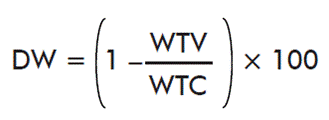
<body><![CDATA[<P   ><font face="Verdana, Arial, Helvetica, sans-serif" size="2">The onset of any      event that could be associated to the administration of the immunogen was      monitored through clinical observation and palpation and recorded. These included      clinical signs and prostration, inflammatory reactions at the injection site,      appreciable changes in respiratory rate or any other event [21].</font></P >   <FONT color="#EB008B">        <P   ><font color="#211E1F" size="2" face="Verdana, Arial, Helvetica, sans-serif"><B>Effect      of the immunization with Gavac&reg; on the reproductive capacity of ticks      </b></font></P >   <FONT color="#211E1F">        <P   ><font size="2" face="Verdana, Arial, Helvetica, sans-serif">The teleogines naturally      occurring on the animals were collected at 56 days of the experiment. The      following parameters were calculated: weight of engorged ticks, weight of      the eggs, reproductive efficiency index and percentage of hatching. Ticks      were placed at 28 &ordm;C, 80 % relative humidity and a 12-h light:darkness      photoperiod for egg laying and hatching. Reproductive efficiency index was      determined as the weight of the egg mass (g)/weight of ticks (g) &times; 100.      Hatching was determined by counting the eggs and larvae [22]. The efficacy      of the vaccine was estimated by the following formulas [23]:</font></P >       <P   ><font size="2" face="Verdana, Arial, Helvetica, sans-serif">- Effects of immunization      in the weight of ticks: </font></P >       <P align="center"   ><font size="2" face="Verdana, Arial, Helvetica, sans-serif"><img src="/img/revistas/bta/v35n1/fr0103118.gif" width="329" height="120">      </font></P >       
<P   ><font size="2" face="Verdana, Arial, Helvetica, sans-serif">where WTV is the      mean weight of ticks on the immunized cattle and WTC is the mean weight of      ticks on control cattle. </font></P >       <P   >&nbsp;</P >       <P   > </P >       <P   ><font size="2" face="Verdana, Arial, Helvetica, sans-serif">- Impact on oviposition:      </font></P >       <P align="center"   ><font size="2" face="Verdana, Arial, Helvetica, sans-serif"><img src="/img/revistas/bta/v35n1/fr0203118.gif" width="320" height="114"></font></P >       
]]></body>
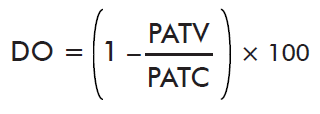
<body><![CDATA[<P   >&nbsp;</P >       <P   ><font size="2" face="Verdana, Arial, Helvetica, sans-serif">where PATV is the      mean weight of eggs laid by ticks on the immunized cattle and PACT is the      mean weight of eggs laid by ticks on control cattle. </font></P >       <P   >&nbsp;</P >       <P   > </P >       <P   ><font size="2" face="Verdana, Arial, Helvetica, sans-serif">- Effect on reproductive      efficiency index: </font></P >       <P align="center"   ><font size="2" face="Verdana, Arial, Helvetica, sans-serif"><img src="/img/revistas/bta/v35n1/fr0303118.gif" width="313" height="115">      </font></P >       
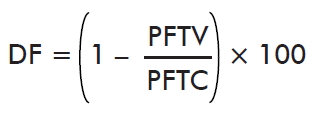
<P   ><font size="2" face="Verdana, Arial, Helvetica, sans-serif">where PFTV is the      mean efficiency index of the immunized group and PFTC is the mean efficiency      index of the control group. Reproductive efficiency index is determined as      the total weight of eggs mass (g) over the total weight of ticks (g) (%).      </font></P >       <P   >&nbsp;</P >       <P   > </P >       <P   ><font size="2" face="Verdana, Arial, Helvetica, sans-serif">- Effect on Hatching:      </font></P >       ]]></body>
<body><![CDATA[<P align="center"   ><img src="/img/revistas/bta/v35n1/fr0403118.gif" width="322" height="108"></P >       
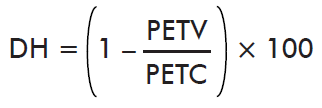
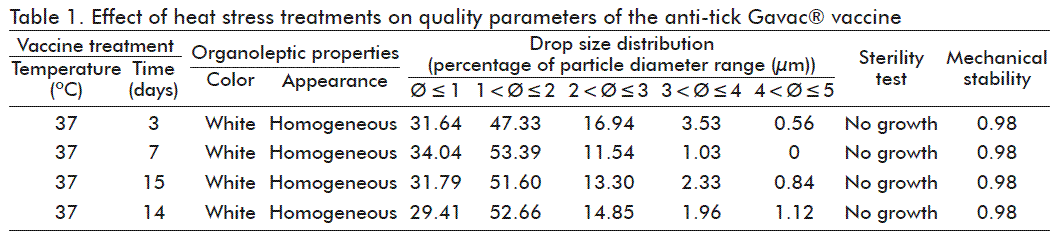
<P   ><font size="2" face="Verdana, Arial, Helvetica, sans-serif">where PETV is the      mean hatching by ticks collected on the immunized cattle and PETC is the mean      hatching by ticks collected on control cattle. </font></P >       <P   > </P >       <P   ><font size="2" face="Verdana, Arial, Helvetica, sans-serif"><B>Statistical analysis      </b></font></P >       <P   ><font size="2" face="Verdana, Arial, Helvetica, sans-serif">Analysis of variance      (ANOVA single factor) was used to compare the anti-Bm86 antibody titers and      the reproductive parameters of ticks among groups. Turkey&rsquo;s test was      applied for post hoc comparisons (&alpha; = 0.05). Statistical processing      was performed with the GraphPad Prism program version 6.0 (GraphPad software;      La Jolla, USA). </font></P >       <P   >&nbsp;</P >       <P   > </P >       <P   ><font size="3"><b><font color="#000000" face="Verdana, Arial, Helvetica, sans-serif">RESULTS      </font></b></font></P >   <FONT size="+1" color="#000000">        <P   ><font size="2" color="#211E1F" face="Verdana, Arial, Helvetica, sans-serif"><B>Effect      of heat stress on the organoleptic properties of Gavac&reg; </b></font></P >   <FONT size="+1" color="#211E1F">        <P   ><font size="2" face="Verdana, Arial, Helvetica, sans-serif">No physical changes      were detected in Gavac&reg; emulsions when the open bottles were kept at 4      &ordm;C or 37 &ordm;C up to 14 days. No alterations were found in the appearance,      consistency, color, smell, aggregates formation, sedimentation of the formulation.      No separation in water/oil phases was observed. The Hu/Ho ratio mean was higher      than 0.9 for all groups (<a href="/img/revistas/bta/v35n1/t0103118.gif">Table      1</a>). </font></P >       
]]></body>
<body><![CDATA[<P   ><font size="2" face="Verdana, Arial, Helvetica, sans-serif"><B>Drop size distribution      </b></font></P >       <P   ><font size="2" face="Verdana, Arial, Helvetica, sans-serif">Gavac&reg; bottles      kept at different temperatures (4 &ordm;C or 37 &ordm;C) for 3, 7 and 14 days      maintained the same droplet size distribution. No emulsion breakage occurred      and there was no formation of larger droplets since the 100 % of the drops      were below 5 ?m in diameter in all the samples analyzed (<a href="/img/revistas/bta/v35n1/t0103118.gif">Table      1</a>). </font></P >       
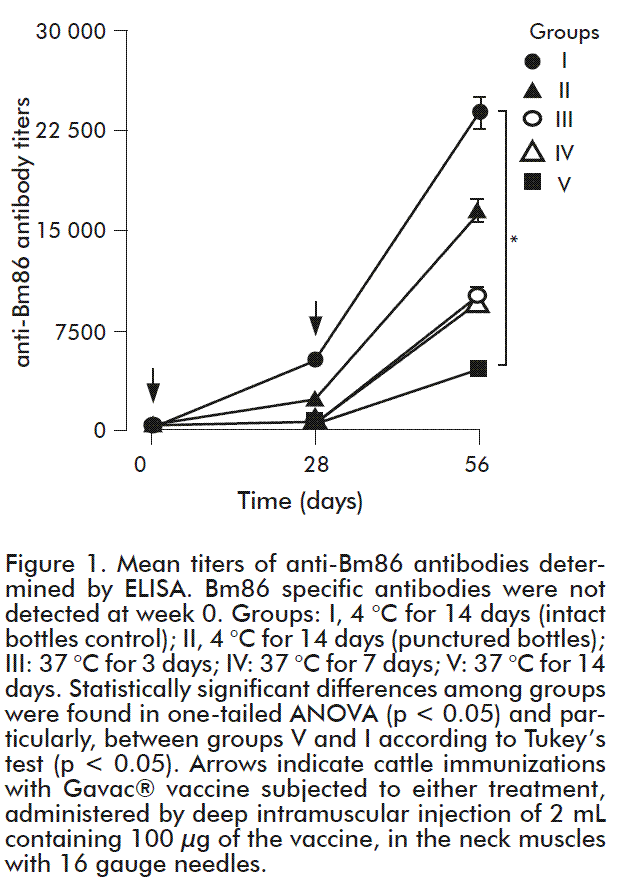
<P   ><font size="2" face="Verdana, Arial, Helvetica, sans-serif"><B>Sterility test      </b></font></P >       <P   ><font size="2" face="Verdana, Arial, Helvetica, sans-serif">No microorganism      growth was observed in any of the vaccine bottles included in the study during      the 14 days of the experiment. </font></P >       <P   ><font size="2" face="Verdana, Arial, Helvetica, sans-serif"><B>Effect of heat      stress on the immunogenicity of Gavac&reg; in cattle </b></font></P >       <P   ><font size="2" face="Verdana, Arial, Helvetica, sans-serif">The influence of      heat stress on the immunogenicity of Gavac&reg; was evaluated by measuring      the anti-Bm86 antibodies titers elicited in the serum of the immunized animals.      A specific antibody response was detected in all experimental groups 28 days      after the first injection. No statistically significant differences were found      among groups, with mean titers ranging from 1: 4759 to 1: 17 467 (<a href="/img/revistas/bta/v35n1/f0103118.gif">Figure      1</a>). The anti-Bm86 titers increased after the second dose in all groups      and statistically significant differences were found among them (p &lt; 0.05).      In particular, the mean antibody titer for group V (1:5,435) was more than      five times lower than in the control group I (1:28 353) (p &lt; 0.05).The      differences among the rest of the groups were not statistically significant.</font></P >       
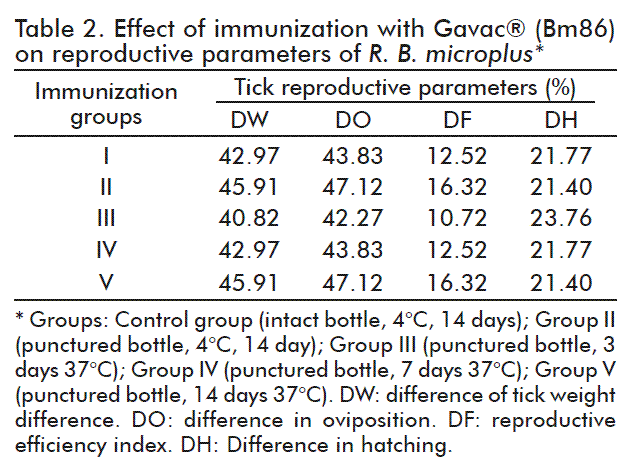
<P   ><font size="2" face="Verdana, Arial, Helvetica, sans-serif"><B>Effect of vaccination      on the reproductive parameters of ticks </b></font></P >       <P   ><font size="2" face="Verdana, Arial, Helvetica, sans-serif">A significant affectation      in the reproductive parameters of ticks (weight of ticks, weight of eggs,      reproductive efficiency index and hatching percentage) as compared to control      animals was documented at day 56 of the experiment, regardless of the temperatures      and incubation times tested (<a href="/img/revistas/bta/v35n1/t0203118.gif">Table      2</a>). The observed reductions in these parameters were similar for all treatment      groups. </font></P >       
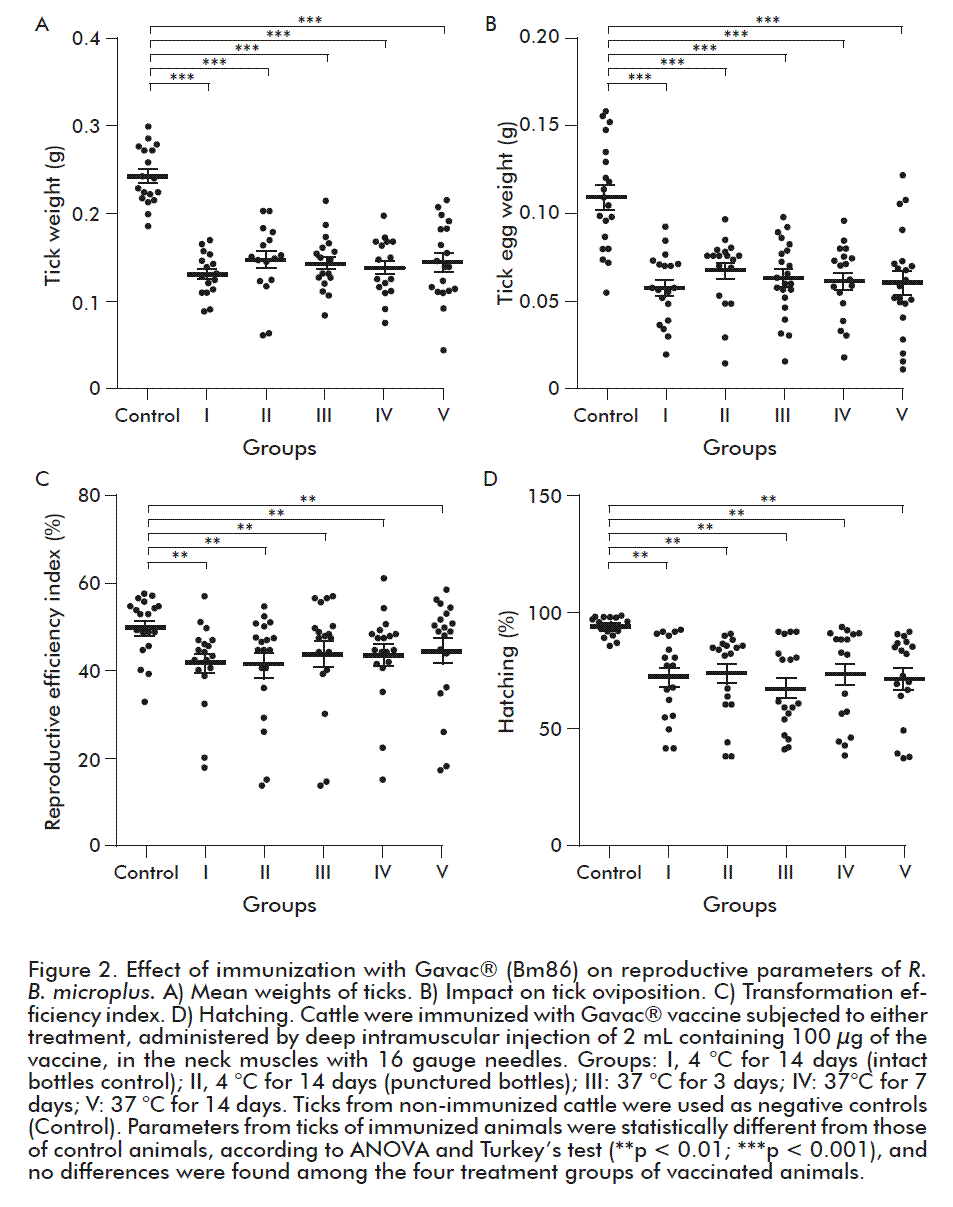
<P   ><font size="2" face="Verdana, Arial, Helvetica, sans-serif">The weights of engorged      ticks and eggs were significantly lower in all groups as compared to non-immunized      controls (p &lt; 0.0001). No differences among vaccinated groups (p &gt; 0.05)      were detected. The reproductive efficiency index and hatching percentages      were also similar among all vaccinated groups (<a href="/img/revistas/bta/v35n1/f0203118.gif">Figure      2</a>) and differed significantly (p &lt; 0.01) from non-vaccinated controls.      </font></P >       
<P   >&nbsp;</P >       ]]></body>
<body><![CDATA[<P   > </P >   <FONT size="+1" color="#000000">        <P   ><b><font size="3" face="Verdana, Arial, Helvetica, sans-serif">DISCUSSION </font></b></P >       <P   ><font size="2" color="#211E1F" face="Verdana, Arial, Helvetica, sans-serif">Vaccines      are capable of inducing a protective and durable immune response in animals,      but often some mild side effects such as local reactions, fever and general      symptoms are observed as a consequence of the associated immune inflammatory      response [24-26]. Vaccines can be very susceptible to environmental conditions.      In particular, temperature changes significantly affect the integrity of this      type of product during storage, transportation and handling. This issue is      particularly sensitive for live-attenuated vaccines [27, 28].</font></P >   <FONT size="+1" color="#211E1F">        <P   ><font size="2" face="Verdana, Arial, Helvetica, sans-serif">The recombinant subunit      vaccines could mitigate these problems. Generally, the purified recombinant      proteins are very stable when subjected to temperature changes for short periods      of time. Additionally, oil based adjuvants tend to increase the stability      of protein antigens [29, 30]. </font></P >       <P   ><font size="2" face="Verdana, Arial, Helvetica, sans-serif">Among all the methods      available today for the control of cattle tick, vaccination with recombinant      Bm86-based vaccines has been the most effective and environmentally friendly      [9-11, 15, 31-36]. The simultaneous immunization of large groups of animals      in a rural setting allows the use of multi-dose vials. It is therefore important      to study the stability of the vaccine doses remaining in punctured vials under      increased temperature conditions. Based on these results, it is proposed that      remaining vaccine doses in multidose vials after a vaccination event could      be preserved for a single temperature cycle at 4 &ordm;C for up to 7 days,      and administered immediately after in a new vaccination event. It is not recommended      by no means to subject the vaccine vial to subsequent temperature cycles,      since protein stability cannot be guaranteed at all. It is of outmost importance      that all vaccine handling should be carried out following the standard good      handling practices, to guarantee the consistency and efficacy of results.      Moreover, it is strongly advised to follow the manufacturer's recommendations      for the safe and efficacious use of Gavac&reg; vaccine, and the use proposed      in this work could be only limited to vaccine losses representing half the      doses contained in the vial. </font></P >       <P   ><font size="2" face="Verdana, Arial, Helvetica, sans-serif">The stability of      vaccines has been associated with the resistance to light-mediated physical      degradation, temperature changes during storage and transportation, and the      time elapsed from manufacture. Maintaining drop size between the established      parameters preserves the emulsion stability [37]. Small droplet sizes allow      a more efficient diffusion of the antigen when injected in the animal, reaching      more quickly the systemic lymphatic tissues and, thus, triggering the immune      response of the animal more effectively [37]. </font></P >       <P   ><font size="2" face="Verdana, Arial, Helvetica, sans-serif">In this study, the      stability of Gavac&reg; after 14 days of heat stress at 37 &ordm;C in open      multi-dose vials was assessed. First of all, no separation of the aqueous      and oil phases was observed after this incubation period. Second, the droplet      size distribution remained within the criteria of quality and stability of      the emulsion. Third, no microorganism growth or changes in the organoleptic      properties of the immunogen were detected. All these results indicated that      the physicochemical properties of the emulsion were preserved. </font></P >       <P   ><font size="2" face="Verdana, Arial, Helvetica, sans-serif">Next, the immunogenicity      of the vaccine preparations subjected to heat stress was assessed in cattle      through a biphasic immunization schedule (immunization on weeks 0 and 4).      The results of the antibody titers after two inoculations demonstrated that      the vaccine preserved near full potency after 7 days at 37 &ordm;C. A reduction      in the antibody titers was observed after 14 days of incubation a 37 &ordm;C.      This outcome was inferred though remaining to be demonstrated, since it is      well known that increased temperatures favored both, protease mediated and      independent degradation of protein antigens [38]. Although no changes were      observed in the emulsion in vials incubated at 37 &ordm;C for 14 days, this      may affect the structure and the functional properties of the protein, particularly      its capacity to elicit antibody responses against conformational epitopes.      However, taking into account that antibody titers equal or above 1:640 are      considered protective [13, 15], even animals from Group V (37 &ordm;C for      14 days) can be regarded as protected from cattle tick infestation. </font></P >       <P   ><font size="2" face="Verdana, Arial, Helvetica, sans-serif">The kinetics of the      antibody responses and the titers observed for the rest of the groups were      quite similar to those reported in previous studies with this immunogen [15,      23, 35, 39-43]. All animals showed a detectable antibody response right after      prime immunization and developed an anamnestic response characterized by increased      antibody levels, similar to those previously described [13, 15, 23, 31, 39,      41-44]. </font></P >       <P   ><font size="2" face="Verdana, Arial, Helvetica, sans-serif">No local or systemic      adverse events were documented in immunized animals, despite the thermal stress      treatments applied to the product. In this sense, results were similar to      those described for the standard vaccine administration procedure, in which      the Bm86 antigen has been demonstrated to be safe both, during the days around      the time of immunization and after six months, when the administration site      was examined by necropsy [23, 38]. </font></P >       ]]></body>
<body><![CDATA[<P   ><font size="2" face="Verdana, Arial, Helvetica, sans-serif">Up to our knowledge,      this is the first integral study of the sterility, stability and immunogenicity      of a veterinary vaccine in open multi-dose vials subjected to thermal stress.      Other studies on the thermal stability of veterinary vaccines have been conducted      in closed vials. For instance, post-formulation modifications were seen in      seven proteins tested during storage of 1 week at 37 &deg;C in vaccines formulated      in the oil adjuvant Montanide ISA 720, and these modifications had a negative      impact in their immunogenicity [45]. In contrast, an experimental recombinant      vaccine against classical swine fever, formulated in Montanide 888 was stable      and conserved its immunogenicity after 1 week at 37 &deg;C[46]. </font></P >       <P   ><font size="2" face="Verdana, Arial, Helvetica, sans-serif">Overall, our studies      provide useful information on the relative stability of veterinary vaccines      during its manipulation under field conditions and at endpoint application.      Noteworthy, this is informative and manageable, but does not substitute the      conditions and recommendations made by manufacturers for optimal temperature      conditions to obtain best results during vaccine transport, handling and administration      to animals. In the specific case of Gavac&reg;, manufacturers recommend that      the product should be kept at 4 &ordm;C during storage and transportation.      From the results shown in this study, it can be concluded that vials in use      can be kept at temperatures up to 37 &ordm;C for one week without substantial      loss of its immunogenicity and keeping its safety profile, under certified      management procedures. </font></P >       <P   ><font size="2" face="Verdana, Arial, Helvetica, sans-serif">Despite the absence      of recommendations or classifications by regulatory agencies for veterinary      vaccines attending to their thermal susceptibility, equivalent criteria have      been somewhat inherited from recommendations in place for human vaccines.      Specifically, this has been the case for recommendations made by the American      Animal Hospital Association, the accrediting body for companion animal hospitals      in the United States and Canada. It recommends to follow standard procedures      as established by manufacturers for multidose vials in terms of number of      punctures and handling [47]. Moreover, this organization also recommends to      endorse the Vaccine Storage and Handling Toolkit issued by the US Centers      for Disease Control and Prevention (CDC) [48], where it is clearly stated      that temperature fluctuation during transportation or storage can irreversibly      affect the potency of vaccines. </font></P >       <P   ><font size="2" face="Verdana, Arial, Helvetica, sans-serif">Additionally, as      the case for vaccines approved for human use, WHO has classified them in four      groups according to their thermal stability: high stability (30 days at 37      &deg;C); medium stability (14 days at 37 &deg;C), moderate stability (7 days      at 37 &deg;C) and least stable (2 days at 37&deg;C) [49]. According to this      classification Gavac&reg; can be classified as a medium stability vaccine,      although more prolonged incubation times are yet to be studied. Nevertheless,      as discussed before, our experiments were carried out with punctured vials;      a situation that better resembles the real situation in the field for a veterinary      vaccine, much more stressing than in the usual accelerated stability studies      in the lab. </font></P >       <P   ><font size="2" face="Verdana, Arial, Helvetica, sans-serif">WHO policy for the      use of multi-dose vaccines in humans recommends that multi-dose vials should      be discarded at the end of the immunization session, or within six hours of      opening, unless the vaccine meets the following criteria: 1) The vaccine is      currently prequalified by WHO, 2) The vaccine is approved for use for up to      28 days after opening the vial; 3). The expiry date of the vaccine has not      passed and 4) The vaccine vial has been and will continue to be stored at      WHO or manufacturer recommended temperatures, and the vaccine has not been      damaged by freezing [50]. These recommendations are supported by previous      data on the use of multi-dose vaccines or other injectable drugs [51, 52].</font></P >       <P   ><font size="2" face="Verdana, Arial, Helvetica, sans-serif">Overall, the knowledge      derived from this work is of practical importance for the implementation of      vaccination campaigns in the field, mainly during endpoint application, further      supporting a more efficient use by practical means of multi-dose vials as      an effective cost-containment measure. </font></P >       <P   >&nbsp;</P >       <P   > </P >       <P   ><b><font size="3" color="#000000" face="Verdana, Arial, Helvetica, sans-serif">CONCLUSIONS      </font></b></P >   <FONT size="+1" color="#000000">        <P   ><font size="2" color="#211E1F" face="Verdana, Arial, Helvetica, sans-serif">In      summary, animals immunized with Gavac&reg; vaccine doses remaining in multidose      vials showed no adverse reactions and developed anti-Bm86 antibody titers      equivalent to those immunized with control vaccine, when the vaccine was experimentally      subjected to 37 &ordm;C for a week. The antibody response retains its ability      to experimentally reduce the weight and to impair the reproductive capacity      of ticks. This allows to exceptionally store the doses remaining in multidose      vials at 4 &ordm;C for up to 7 days after heat stress during a vaccination      campaign. In this way, all doses within multidose vials containing the Gavac&reg;      vaccine can be optimally used, when they are handled and managed under certified      practices for cattle vaccination at endpoint applications, and when manufacturer's      standard recommendations of discarding the remaining content could lead to      considerable losses. </font></P >       ]]></body>
<body><![CDATA[<P   >&nbsp;</P >   <FONT size="+1" color="#211E1F"><FONT size="+1" color="#000000">        <P   > </P >       <P   ><font size="2" face="Verdana, Arial, Helvetica, sans-serif"><b><font size="3">CONFLICTS      OF INTEREST STATEMENT </font></b></font></P >       <P   ><font size="2" color="#211E1F" face="Verdana, Arial, Helvetica, sans-serif">The      authors declare that there are no conflicts of interest. </font></P >       <P   >&nbsp;</P >   <FONT size="+1" color="#211E1F"><FONT size="+1" color="#000000">        <P   > </P >       <P   ><b><font size="3" face="Verdana, Arial, Helvetica, sans-serif">REFERENCES </font></b></P >       <!-- ref --><P   ><font size="2" color="#211E1F" face="Verdana, Arial, Helvetica, sans-serif">1.      Casas E, Trigueros A, Ch&aacute;vez A, Tang J, Ruiz F. Tratamiento y control      de Garrapata <I>Boophilus microplus</I>, a trav&eacute;s de la combinaci&oacute;n      de fluazur&oacute;n/ fipronilpouron, en bovinos de tr&oacute;pico. Pucallpa,      Per&uacute;: Lima: Facultad de Medicina veterinaria, Universidad Nacional      de San Marcos; 2009.     </font></P >   <FONT size="+1" color="#211E1F">        <P   ><font size="2" face="Verdana, Arial, Helvetica, sans-serif">2. FAO. Tick and      Tick Borne Diseases Control: A practical field manual. 2da Ed. Rome: FAO-UNDP;      1984. </font></P >       ]]></body>
<body><![CDATA[<P   ><font size="2" face="Verdana, Arial, Helvetica, sans-serif">3. Rojas M. Nosoparasitosis      de los rumiantes peruanos. 2da Ed. Lima: Martegraf; 2004. </font></P >       <P   ><font size="2" face="Verdana, Arial, Helvetica, sans-serif">4. Urquhart GM, Armour      J, Duncan JL, Dunn AM, Jenningsf W. Parasitolog&iacute;a veterinaria. 2da      Ed. Zaragoza: Acribia; 2001. </font></P >       <!-- ref --><P   ><font face="Verdana, Arial, Helvetica, sans-serif" size="2">5. Nari A, Eddi CS.      Control de la resistencia a los antiparasitarios a la luz de los conocimientos      actuales. 2002 [cited 2018 Feb 18]. Available from: <a href="http://www.produccion-animal.com.ar" target="_blank">http://www.produccion-animal.com.ar</a>      </font></P >   </font></font></font></font></font></font></font></font></font></font></font></font></font></font></font></font></font></font></font></font></font></font></font></font></font></font></font></font></font></font></font></font></font></font></font></font></font></font></font></font></font></font></font></font></font></font></font></font></font></font></font></font></font></font></font></font></font></font></font></font></font></font></font></font></font></font></font></font></font></font></font></font>        <!-- ref --><p><font face="Verdana, Arial, Helvetica, sans-serif" size="2">6. Su&aacute;rez      Pedroso M, Mellor LM, Valdez M, Souza RM, Camargo AJR, Vargas NC, <i>et al</i>.      Control de las infestaciones de la garrapata Boophilus microplus en la ganader&iacute;a      Cubana y en regiones de latinoam&eacute;rica con la aplicaci&oacute;n del      inmun&oacute;geno Gavac&reg; dentro de un programa de lucha integral. 2007      [cited 2018 Feb 18]. Available from: <a href="http://www.corpoica.org.co/redectopar.asp" target="_blank">http://www.corpoica.org.co/redectopar.asp</a>      </font><!-- ref --><p><font face="Verdana, Arial, Helvetica, sans-serif" size="2">7. Garc&iacute;a      A, Barral M. M&eacute;todos de control de las garrapatas. Ovis. 1999;65:1-9.          </font></p>       <!-- ref --><p><font face="Verdana, Arial, Helvetica, sans-serif" size="2">8. Gough JM,      Kemp DH. Localization of a low abundance membrane protein (Bm86) on the gut      cells of the cattle tick <i>Boophilus microplus</i> by immunogold labeling.      J Parasitol. 1993;79(6):900-7.     </font></p>       <!-- ref --><p><font face="Verdana, Arial, Helvetica, sans-serif" size="2">9. Rand KN, Moore      T, Sriskantha A, Spring K, Tellam R, Willadsen P, <i>et al</i>. Cloning and      expression of a protective antigen from the cattle tick Boophilus microplus.      Proc Natl Acad Sci U S A. 1989;86(24):9657-61.     </font></p>       ]]></body>
<body><![CDATA[<!-- ref --><p><font face="Verdana, Arial, Helvetica, sans-serif" size="2">10. Willadsen      P, Riding GA, McKenna RV, Kemp DH, Tellam RL, Nielsen JN, <i>et al</i>. Immunologic      control of a parasitic arthropod. Identification of a protective antigen from      Boophilus microplus. J Immunol. 1989;143(4):1346-51.     </font></p>       <!-- ref --><p><font face="Verdana, Arial, Helvetica, sans-serif" size="2">11. Rodriguez      M, Rubiera R, Penichet M, Montesinos R, Cremata J, Falcon V, <i>et al</i>.      High level expression of the <i>B. microplus</i> Bm86 antigen in the yeast      Pichia pastoris forming highly immunogenic particles for cattle. J Biotechnol.      1994;33(2):135-46.     </font></p>       <!-- ref --><p><font face="Verdana, Arial, Helvetica, sans-serif" size="2">12. Valle MR,      Mendez L, Valdez M, Redondo M, Espinosa CM, Vargas M, <i>et al</i>. Integrated      control of <i>Boophilus microplus</i> ticks in Cuba based on vaccination with      the anti-tick vaccine Gavac. Exp Appl Acarol. 2004;34(3-4):375-82.     </font></p>       <!-- ref --><p><font face="Verdana, Arial, Helvetica, sans-serif" size="2">13. Vargas M,      Montero C, Sanchez D, Perez D, Valdes M, Alfonso A, <i>et al</i>. Two initial      vaccinations with the Bm86-based Gavacplus vaccine against <i>Rhipicephalus</i>      (<i>Boophilus</i>) <i>microplus</i> induce similar reproductive suppression      to three initial vaccinations under production conditions. BMC Vet Res. 2010;6:43.          </font></p>       <!-- ref --><p><font face="Verdana, Arial, Helvetica, sans-serif" size="2">14. Boue O, Redondo      M, Montero C, Rodriguez M, de la Fuente J. Reproductive and safety assessment      of vaccination with Gavac against the cattle tick (<i>Boophilus microplus</i>).      Theriogenology. 1999;51(8):1547-54.     </font></p>       ]]></body>
<body><![CDATA[<!-- ref --><p><font size="2" face="Verdana, Arial, Helvetica, sans-serif">15. de la Fuente      J, Rodriguez M, Redondo M, Montero C, Garcia-Garcia JC, Mendez L, <i>et al</i>.      Field studies and cost-effectiveness analysis of vaccination with Gavac against      the cattle tick <i>Boophilus microplus</i>. Vaccine. 1998;16(4):366-73.    </font></p>       <!-- ref --><p><font size="2" face="Verdana, Arial, Helvetica, sans-serif">16. Suarez M,      Rubi J, P&eacute;rez D, Cordova V, Salazar Y, Vielma A, <i>et al</i>. High      impact and effectiveness of Gavac&#153; vaccine in the national program for      control of bovine ticks <i>Rhipicephalus microplus</i> in Venezuela. Livestock      Sci. 2016;187:48-52.    </font></p>       <!-- ref --><p><font size="2" face="Verdana, Arial, Helvetica, sans-serif">17. Botello AR,      Botello AL, Borroto CN, Su&aacute;rez M, P&eacute;rez DA, Rodr&iacute;guez      YV, <i>et al</i>. Control de garrapatas <i>Riphicephalus</i> (<i>Boophilus</i>)      <i>microplus</i> en bovinos con el inmun&oacute;geno Herber biogar. Rev Electr&oacute;n      Vet. 2011;12(5):1-10.    </font></p>       <!-- ref --><p><font size="2" face="Verdana, Arial, Helvetica, sans-serif">18. European      Medicines Agency. Committee for Medicinal Products for Veterinary Use. Guideline      on data requirements to support in-use stability claims for veterinary vaccines.      EMA/CVMP/IWP/250147/2008. 2010 Mar 15 [cited 2018 Feb 18]. Available from:      <a href="https://www.ema.europa.eu/documents/scientific-guideline/guideline-datarequirements-support-use-stability-claimsveterinary-vaccines_en.pdf" target="_blank">https://www.ema.europa.eu/documents/scientific-guideline/guideline-datarequirements-support-use-stability-claimsveterinary-vaccines_en.pdf</a>.    </font></p>       <p><font size="2" face="Verdana, Arial, Helvetica, sans-serif">19. Enr&iacute;quez      A, Canales M, Ramos E, Dandie H, Bou&eacute; O, Soto A, <i>et al</i>. Production      of a recombinant vaccine against Boophilus microplus. In: de la Fuente J,      editor. Recombinant vaccines for the control of cattle tick. La Habana: Elfos      Scientiae; 1995. p. 79-103.</font></p>       <!-- ref --><p><font face="Verdana, Arial, Helvetica, sans-serif" size="2">20. Triguero      A, Blanco R, Machado H, Rodriguez M, de La Fuente J. Development of enzyme      linked immunosorbent assays to measure Bm86 antigen of <i>Boophilus microplus</i>      (cattle tick) and to detect anti- Bm86 antibodies in serum samples. Biotechnol      Tech. 1999;13(2):119-25.     </font></p>       <!-- ref --><p><font face="Verdana, Arial, Helvetica, sans-serif" size="2">21. European      Medicines Agency, EMA. VICH Topic GL44. Step 7. Guideline on target animal      safety for veterinary live and inactived vaccines. London: EMA; 2009.    </font></p>       <!-- ref --><p><font face="Verdana, Arial, Helvetica, sans-serif" size="2">22. Bennett GF.      Oviposition of <i>Boophilus microplus </i>(Canestrini) (Acarida: Ixodidae).      I. Influence of tick size on egg production. Acarologia. 1974;16(1):52-61.          </font></p>       <!-- ref --><p><font face="Verdana, Arial, Helvetica, sans-serif" size="2">23. Miller R,      Estrada-Pena A, Almazan C, Allen A, Jory L, Yeater K, <i>et al</i>. Exploring      the use of an anti-tick vaccine as a tool for the integrated eradication of      the cattle fever tick, <i>Rhipicephalus</i> (<i>Boophilus</i>) <i>annulatus</i>.      Vaccine. 2012;30(38):5682-7.     </font></p>       <!-- ref --><p><font face="Verdana, Arial, Helvetica, sans-serif" size="2">24. Baldrick      P. Dose site reactions and related findings after vaccine administration in      safety studies. J Appl Toxicol. 2016;36(8):980-90.     </font></p>       <!-- ref --><p><font face="Verdana, Arial, Helvetica, sans-serif" size="2">25. Lewis DJ,      Lythgoe MP. Application of 'Systems Vaccinology' to evaluate inflammation      and reactogenicity of adjuvanted preventative vaccines. J Immunol Res. 2015;2015:909406.          </font></p>       <!-- ref --><p><font face="Verdana, Arial, Helvetica, sans-serif" size="2">26. Stassijns      J, Bollaerts K, Baay M, Verstraeten T. A systematic review and meta-analysis      on the safety of newly adjuvanted vaccines among children. Vaccine. 2016;34(6):714-22.          </font></p>       <!-- ref --><p><font face="Verdana, Arial, Helvetica, sans-serif" size="2">27. Karp CL,      Lans D, Esparza J, Edson EB, Owen KE, Wilson CB, <i>et al</i>. Evaluating      the value proposition for improving vaccine thermostability to increase vaccine      impact in low and middle-income countries. Vaccine. 2015;33(30):3471-9.     </font></p>       <!-- ref --><p><font face="Verdana, Arial, Helvetica, sans-serif" size="2">28. Purssell      E. Reviewing the importance of the cold chain in the distribution of vaccines.      Br J Community Nurs. 2015;20(10):481-6.     </font></p>       <!-- ref --><p><font face="Verdana, Arial, Helvetica, sans-serif" size="2">29. Singh M,      O'Hagan DT. Recent advances in veterinary vaccine adjuvants. Int J Parasitol.      2003;33(5-6):469-78.     </font></p>       <!-- ref --><p><font face="Verdana, Arial, Helvetica, sans-serif" size="2">30. Spickler      AR, Roth JA. Adjuvants in veterinary vaccines: modes of action and adverse      effects. J Vet Intern Med. 2003;17(3):273-81.     </font></p>       <!-- ref --><p><font face="Verdana, Arial, Helvetica, sans-serif" size="2">31. Almazan C,      Lagunes R, Villar M, Canales M, Rosario-Cruz R, Jongejan F, <i>et al</i>.      Identification and characterization of <i>Rhipicephalus</i> (<i>Boophilus</i>)      <i>microplus</i> candidate protective antigens for the control of cattle tick      infestations. Parasitol Res. 2010;106(2):471-9.     </font></p>       <!-- ref --><p><font face="Verdana, Arial, Helvetica, sans-serif" size="2">32. Cunha RC,      Andreotti R, Leite FP. <i>Rhipicephalus</i> (<i>Boophilus</i>) <i>microplus</i>:      expression and characterization of Bm86-CG in <i>Pichia pastoris</i>. Rev      Bras Parasitol Vet. 2011;20(2):103-10.     </font></p>       <!-- ref --><p><font face="Verdana, Arial, Helvetica, sans-serif" size="2">33. de la Fuente      J, Almazan C, Canales M, Perez de la Lastra JM, Kocan KM, Willadsen P. A ten-year      review of commercial vaccine performance for control of tick infestations      on cattle. Anim Health Res Rev. 2007;8(1):23-8.     </font></p>       <!-- ref --><p><font face="Verdana, Arial, Helvetica, sans-serif" size="2">34. de la Fuente      J, Kocan KM. Advances in the identification and characterization of protective      antigens for recombinant vaccines against tick infestations. Expert Rev Vaccines.      2003;2(4):583-93.     </font></p>       <!-- ref --><p><font face="Verdana, Arial, Helvetica, sans-serif" size="2">35. de Vos S,      Zeinstra L, Taoufik O, Willadsen P, Jongejan F. Evidence for the utility of      the Bm86 antigen from <i>Boophilus microplus</i> in vaccination against other      tick species. Exp Appl Acarol. 2001;25(3):245-61.     </font></p>       <!-- ref --><p><font face="Verdana, Arial, Helvetica, sans-serif" size="2">36. Rodriguez-Valle      M, Taoufik A, Valdes M, Montero C, Ibrahin H, Hassan SM, <i>et al</i>. Efficacy      of <i>Rhipicephalus</i> (<i>Boophilus</i>) <i>microplus</i> Bm86 against <i>Hyalomma      dromedarii</i> and <i>Amblyomma cajennense</i> tick infestations in camels      and cattle. Vaccine. 2012;30(23):3453-8.     </font></p>       <!-- ref --><p><font face="Verdana, Arial, Helvetica, sans-serif" size="2">37. Gerdts V.      Adjuvants for veterinary vaccines--types and modes of action. Berl Munch Tierarztl      Wochenschr. 2015;128(11-12):456-63.     </font></p>       <!-- ref --><p><font face="Verdana, Arial, Helvetica, sans-serif" size="2">38. Kumar B,      Murugan K, Ray DD, Ghosh S. Efficacy of rBm86 against <i>Rhipicephalus</i>      (<i>Boophilus</i>) <i>microplus</i> (IVRI-I line) and <i>Hyalomma anatolicum</i>      anatolicum (IVRI-II line) infestations on bovine calves. Parasitol Res. 2012;111(2):629-35.          </font></p>       <p><font face="Verdana, Arial, Helvetica, sans-serif" size="2">39. Cobon G,      Hungerford J, Woodrow M, Smith D, Willadsen P. Vaccination against <i>Boophilus      microplus</i>. The Australian field experience. In: de la Fuente J, editor.      Recombinant vaccines for the control of cattle tick. La Habana: Elfos Scientiae;      1995. p. 163-7. </font></p>       <!-- ref --><p><font face="Verdana, Arial, Helvetica, sans-serif" size="2">40. de la Fuente      J, Rodriguez M, Montero C, Redondo M, Garcia-Garcia JC, Mendez L, <i>et al</i>.      Vaccination against ticks (<i>Boophilus</i> spp.): the experience with the      Bm86-based vaccine Gavac. Genet Anal. Eng. 1999;15(3-5):143-8.    </font></p>       ]]></body>
<body><![CDATA[<!-- ref --><p><font face="Verdana, Arial, Helvetica, sans-serif" size="2">41. Fragoso H,      Rad PH, Ortiz M, Rodriguez M, Redondo M, Herrera L, <i>et al</i>. Protection      against <i>Boophilus annulatus</i> infestations in cattle vaccinated with      the <i>B. microplus</i> Bm86-containing vaccine Gavac. Vaccine. 1998;16(20):1990-2.          </font></p>       <!-- ref --><p><font face="Verdana, Arial, Helvetica, sans-serif" size="2">42. Canales M,      Almazan C, Naranjo V, Jongejan F, de la Fuente J. Vaccination with recombinant      <i>Boophilus annulatus</i> Bm86 ortholog protein, Ba86, protects cattle against      <i>B. annulatus</i> and <i>B. microplus</i> infestations. BMC Biotechnol.      2009;9:29.     </font></p>       <!-- ref --><p><font face="Verdana, Arial, Helvetica, sans-serif" size="2">43. Garcia-Garcia      JC, Montero C, Redondo M, Vargas M, Canales M, Boue O, <i>et al</i>. Control      of ticks resistant to immunization with Bm86 in cattle vaccinated with the      recombinant antigen Bm95 isolated from the cattle tick, <i>Boophilus microplus</i>.      Vaccine. 2000;18(21):2275-87.     </font></p>       <!-- ref --><p><font face="Verdana, Arial, Helvetica, sans-serif" size="2">44. Andreotti      R. Performance of two Bm86 antigen vaccine formulation against tick using      crossbreed bovines in stall test. Rev Brasileira Parasitol Vet. 2006;15(3):97-100.    </font>    <br>   </p>   <FONT size="+1" color="#000000"><FONT size="+1"><FONT size="+1" color="#211E1F"><FONT size="+1" color="#000000"><FONT size="+1" color="#211E1F"><FONT size="+1"><FONT size="+1"><FONT size="+1"><FONT size="+1"><FONT size="+1"><FONT size="+1"><FONT size="+1"><FONT size="+1"><FONT size="+1"><FONT size="+1"><FONT size="+1"><FONT size="+1"><FONT size="+1"><FONT size="+1"><FONT size="+1"><FONT size="+1"><FONT size="+1"><FONT size="+1"><FONT size="+1"><FONT size="+1"><FONT size="+1"><FONT size="+1"><FONT size="+1"><FONT size="+1"><FONT size="+1"><FONT size="+1"><FONT size="+1"><FONT size="+1"><FONT size="+1"><FONT size="+1"><FONT size="+1" color="#000000"><FONT size="+1" color="#211E1F"><FONT size="+1"><FONT size="+1"><FONT size="+1"><FONT size="+1"><FONT size="+1"><FONT size="+1"><FONT size="+1"><FONT size="+1" color="#000000"><FONT size="+1" color="#211E1F"><FONT size="+1" color="#000000"><FONT size="+1" color="#211E1F"><FONT size="+1" color="#000000"><FONT size="+1" color="#211E1F"><FONT size="+1"><FONT size="+1"><FONT size="+1"><FONT size="+1"><FONT size="+1"><FONT size="+1"><FONT size="+1"><FONT size="+1"><FONT size="+1"><FONT size="+1"><FONT color="#EB008B"><FONT color="#211E1F"><FONT size="+1" color="#000000"><FONT size="+1" color="#211E1F"><FONT size="+1" color="#000000"><FONT size="+1" color="#211E1F"><FONT size="+1" color="#000000"><FONT size="+1" color="#211E1F"><FONT size="+1" color="#000000"><FONT size="+1" color="#211E1F"><FONT size="+1" color="#000000"><FONT size="+1" color="#211E1F"><FONT color="#0000FF"><FONT color="#211E1F"><FONT color="#0000FF"><FONT color="#211E1F">       <!-- ref --><P   ><font size="2" face="Verdana, Arial, Helvetica, sans-serif">45. Miles AP, McClellan      HA, Rausch KM, Zhu D, Whitmore MD, Singh S, <i>et al</i>. Montanide&reg; ISA      720 vaccines: quality control of emulsions, stability of formulated antigens,      and comparative immunogenicity of vaccine formulations. Vaccine. 2005;23(19):2530-9.          </font></P >       <!-- ref --><P   ><font size="2" face="Verdana, Arial, Helvetica, sans-serif">46. Barrera M, Sanchez      O, Prieto Y, Castell S, Naranjo P, Rodriguez MP, <i>et al</i>. Thermal stress      treatment does not affect the stability and protective capacity of goat milk      derived E2-marker vaccine formulation against CSFV. Vet Immunol Immunopathol.      2009;127(3-4):325-31.     </font></P >       <!-- ref --><P   ><font size="2" face="Verdana, Arial, Helvetica, sans-serif">47. American Animal      Hospital Association. AAHA canine vaccination guidelines. 2017 [cited 2018      Jan 18]. Available from: <A href="https://www.aaha.org/guidelines/canine_vaccination_guidelines/cdc_vaccine_storage_handling.aspx" target="_blank">      <FONT color="#0000FF">https://www.aaha.org/guidelines/canine_vaccination_guidelines/cdc_vaccine_storage_handling.aspx</font></A>      </font></P >   <FONT color="#0000FF"><FONT color="#211E1F">        <!-- ref --><P   ><font size="2" face="Verdana, Arial, Helvetica, sans-serif">48. U.S. Department      of Health and Human Services, Center for Disease Control and Prevention. Vaccine      storage &amp; handling toolkit. Atlanta: Center for Disease Control and Prevention;      2018 [cited 2018 Feb 15]. Available from: <A href="https://www.cdc.gov/vaccines/hcp/admin/storage/toolkit/storagehandling-toolkit.pdf%20" target="_blank">      <FONT color="#0000FF">https://www.cdc.gov/vaccines/hcp/admin/storage/toolkit/storagehandling-toolkit.pdf</font></A>      </font></P >   <FONT color="#0000FF"><FONT color="#211E1F">        <!-- ref --><P   ><font size="2" face="Verdana, Arial, Helvetica, sans-serif">49. World Health      Organization. Temperature sensitivity of vaccines. Geneva: Department of Immunization,      Vaccines and Biologicals, World Health Organization; 2006.    </font></P >       <!-- ref --><P   ><font size="2" face="Verdana, Arial, Helvetica, sans-serif">50. World Health      Organization. WHO policy statement: multi-dose vial policy (MDVP): handling      of multi-dose vaccine vials after opening. Geneva: World Health Organization;      2014.     </font></P >       <!-- ref --><P   ><font size="2" face="Verdana, Arial, Helvetica, sans-serif">51. Sheth NK, Post      GT, Wisniewski TR, Uttech BV. Multidose vials versus single-dose vials: a      study in sterility and cost-effectiveness. J Clin Microbiol. 1983;17(2):377-9.    </font></P >       <!-- ref --><P   ><font size="2" face="Verdana, Arial, Helvetica, sans-serif">52. Christensen EA,      Mordhorst CH, Jepsen OB. Assessment of risk of microbial contamination by      use of multidose containers of injectable products. J Hosp Infect. 1992;20(4):301-4.          </font></P >       <P   >&nbsp;</P >       <P   > </P >       <P   ><font size="2" face="Verdana, Arial, Helvetica, sans-serif">Received in November,      2017.     <br>     Accepted in March, 2018.</font></P >       <P   >&nbsp;</P >   <FONT size="+1"><FONT size="+1">        <P   > </P >   <FONT size="+1" color="#000000">        <P   ><i><font size="2" color="#211E1F" face="Verdana, Arial, Helvetica, sans-serif">Milagros      Vargas-Hern&aacute;ndez</font></i><font size="2" color="#211E1F" face="Verdana, Arial, Helvetica, sans-serif">.      Departamento de Biotecnolog&iacute;a Animal, Direcci&oacute;n de Investigaciones      Agropecuarias, Centro de Ingenier&iacute;a Gen&eacute;tica y Biotecnolog&iacute;a,      CIGB. Ave. 31 e/ 158 y 190, Cubanac&aacute;n, Playa, La Habana, CP 11600,      Cuba. E-mail: <A href="mailto:milagros.vargas@cigb.edu.cu"> <FONT color="#0000FF">milagros.vargas@cigb.edu.cu</font></A><FONT color="#0000FF">.      </font></font></P >   </font></font></font></font></font></font></font></font></font></font></font></font></font></font></font></font></font></font></font></font></font></font></font></font></font></font></font></font></font></font></font></font></font></font></font></font></font></font></font></font></font></font></font></font></font></font></font></font></font></font></font></font></font></font></font></font></font></font></font></font></font></font></font></font></font></font></font></font></font></font></font></font></font></font></font></font></font></font></font></font></font></font></font></DIV >     ]]></body>
<body><![CDATA[ ]]></body><back>
<ref-list>
<ref id="B1">
<label>1</label><nlm-citation citation-type="book">
<person-group person-group-type="author">
<name>
<surname><![CDATA[Casas]]></surname>
<given-names><![CDATA[E]]></given-names>
</name>
<name>
<surname><![CDATA[Trigueros]]></surname>
<given-names><![CDATA[A]]></given-names>
</name>
<name>
<surname><![CDATA[Chávez]]></surname>
<given-names><![CDATA[A]]></given-names>
</name>
<name>
<surname><![CDATA[Tang]]></surname>
<given-names><![CDATA[J]]></given-names>
</name>
<name>
<surname><![CDATA[Ruiz]]></surname>
<given-names><![CDATA[F]]></given-names>
</name>
</person-group>
<source><![CDATA[Tratamiento y control de Garrapata Boophilus microplus, a través de la combinación de fluazurón/ fipronilpouron, en bovinos de trópico]]></source>
<year>2009</year>
<publisher-loc><![CDATA[Pucallpa, Perú ]]></publisher-loc>
<publisher-name><![CDATA[Lima: Facultad de Medicina veterinaria, Universidad Nacional de San Marcos]]></publisher-name>
</nlm-citation>
</ref>
<ref id="B2">
<label>2</label><nlm-citation citation-type="book">
<collab>FAO</collab>
<source><![CDATA[Tick and Tick Borne Diseases Control: A practical field manual]]></source>
<year>1984</year>
<edition>2</edition>
<publisher-loc><![CDATA[Rome ]]></publisher-loc>
<publisher-name><![CDATA[FAO-UNDP]]></publisher-name>
</nlm-citation>
</ref>
<ref id="B3">
<label>3</label><nlm-citation citation-type="book">
<person-group person-group-type="author">
<name>
<surname><![CDATA[Rojas]]></surname>
<given-names><![CDATA[M]]></given-names>
</name>
</person-group>
<source><![CDATA[Nosoparasitosis de los rumiantes peruanos]]></source>
<year>2004</year>
<edition>2</edition>
<publisher-loc><![CDATA[Lima ]]></publisher-loc>
<publisher-name><![CDATA[Martegraf]]></publisher-name>
</nlm-citation>
</ref>
<ref id="B4">
<label>4</label><nlm-citation citation-type="book">
<person-group person-group-type="author">
<name>
<surname><![CDATA[Urquhart]]></surname>
<given-names><![CDATA[GM]]></given-names>
</name>
<name>
<surname><![CDATA[Armour]]></surname>
<given-names><![CDATA[J]]></given-names>
</name>
<name>
<surname><![CDATA[Duncan]]></surname>
<given-names><![CDATA[JL]]></given-names>
</name>
<name>
<surname><![CDATA[Dunn]]></surname>
<given-names><![CDATA[AM]]></given-names>
</name>
<name>
<surname><![CDATA[Jenningsf]]></surname>
<given-names><![CDATA[W]]></given-names>
</name>
</person-group>
<source><![CDATA[Parasitología veterinaria]]></source>
<year>2001</year>
<edition>2</edition>
<publisher-loc><![CDATA[Zaragoza ]]></publisher-loc>
<publisher-name><![CDATA[Acribia]]></publisher-name>
</nlm-citation>
</ref>
<ref id="B5">
<label>5</label><nlm-citation citation-type="">
<person-group person-group-type="author">
<name>
<surname><![CDATA[Nari]]></surname>
<given-names><![CDATA[A]]></given-names>
</name>
<name>
<surname><![CDATA[Eddi]]></surname>
<given-names><![CDATA[CS]]></given-names>
</name>
</person-group>
<source><![CDATA[Control de la resistencia a los antiparasitarios a la luz de los conocimientos actuales]]></source>
<year>2002</year>
</nlm-citation>
</ref>
<ref id="B6">
<label>6</label><nlm-citation citation-type="">
<person-group person-group-type="author">
<name>
<surname><![CDATA[Suárez Pedroso]]></surname>
<given-names><![CDATA[M]]></given-names>
</name>
<name>
<surname><![CDATA[Mellor]]></surname>
<given-names><![CDATA[LM]]></given-names>
</name>
<name>
<surname><![CDATA[Valdez]]></surname>
<given-names><![CDATA[M]]></given-names>
</name>
<name>
<surname><![CDATA[Souza]]></surname>
<given-names><![CDATA[RM]]></given-names>
</name>
<name>
<surname><![CDATA[Camargo]]></surname>
<given-names><![CDATA[AJR]]></given-names>
</name>
<name>
<surname><![CDATA[Vargas]]></surname>
<given-names><![CDATA[NC]]></given-names>
</name>
</person-group>
<source><![CDATA[Control de las infestaciones de la garrapata Boophilus microplus en la ganadería Cubana y en regiones de latinoamérica con la aplicación del inmunógeno Gavac® dentro de un programa de lucha integral]]></source>
<year>2007</year>
</nlm-citation>
</ref>
<ref id="B7">
<label>7</label><nlm-citation citation-type="journal">
<person-group person-group-type="author">
<name>
<surname><![CDATA[García]]></surname>
<given-names><![CDATA[A]]></given-names>
</name>
<name>
<surname><![CDATA[Barral]]></surname>
<given-names><![CDATA[M]]></given-names>
</name>
</person-group>
<article-title xml:lang="es"><![CDATA[Métodos de control de las garrapatas]]></article-title>
<source><![CDATA[Ovis]]></source>
<year>1999</year>
<volume>65</volume>
<page-range>1-9</page-range></nlm-citation>
</ref>
<ref id="B8">
<label>8</label><nlm-citation citation-type="journal">
<person-group person-group-type="author">
<name>
<surname><![CDATA[Gough]]></surname>
<given-names><![CDATA[JM]]></given-names>
</name>
<name>
<surname><![CDATA[Kemp]]></surname>
<given-names><![CDATA[DH]]></given-names>
</name>
</person-group>
<article-title xml:lang="en"><![CDATA[Localization of a low abundance membrane protein (Bm86) on the gut cells of the cattle tick Boophilus microplus by immunogold labeling]]></article-title>
<source><![CDATA[J Parasitol]]></source>
<year>1993</year>
<volume>79</volume>
<numero>6</numero>
<issue>6</issue>
<page-range>900-7</page-range></nlm-citation>
</ref>
<ref id="B9">
<label>9</label><nlm-citation citation-type="journal">
<person-group person-group-type="author">
<name>
<surname><![CDATA[Rand]]></surname>
<given-names><![CDATA[KN]]></given-names>
</name>
<name>
<surname><![CDATA[Moore]]></surname>
<given-names><![CDATA[T]]></given-names>
</name>
<name>
<surname><![CDATA[Sriskantha]]></surname>
<given-names><![CDATA[A]]></given-names>
</name>
<name>
<surname><![CDATA[Spring]]></surname>
<given-names><![CDATA[K]]></given-names>
</name>
<name>
<surname><![CDATA[Tellam]]></surname>
<given-names><![CDATA[R]]></given-names>
</name>
<name>
<surname><![CDATA[Willadsen]]></surname>
<given-names><![CDATA[P]]></given-names>
</name>
</person-group>
<article-title xml:lang="en"><![CDATA[Cloning and expression of a protective antigen from the cattle tick Boophilus microplus]]></article-title>
<source><![CDATA[Proc Natl Acad Sci U S A]]></source>
<year>1989</year>
<volume>86</volume>
<numero>24</numero>
<issue>24</issue>
<page-range>9657-61</page-range></nlm-citation>
</ref>
<ref id="B10">
<label>10</label><nlm-citation citation-type="journal">
<person-group person-group-type="author">
<name>
<surname><![CDATA[Willadsen]]></surname>
<given-names><![CDATA[P]]></given-names>
</name>
<name>
<surname><![CDATA[Riding]]></surname>
<given-names><![CDATA[GA]]></given-names>
</name>
<name>
<surname><![CDATA[McKenna]]></surname>
<given-names><![CDATA[RV]]></given-names>
</name>
<name>
<surname><![CDATA[Kemp]]></surname>
<given-names><![CDATA[DH]]></given-names>
</name>
<name>
<surname><![CDATA[Tellam]]></surname>
<given-names><![CDATA[RL]]></given-names>
</name>
<name>
<surname><![CDATA[Nielsen]]></surname>
<given-names><![CDATA[JN]]></given-names>
</name>
</person-group>
<article-title xml:lang="en"><![CDATA[Immunologic control of a parasitic arthropod. Identification of a protective antigen from Boophilus microplus]]></article-title>
<source><![CDATA[J Immunol]]></source>
<year>1989</year>
<volume>143</volume>
<numero>4</numero>
<issue>4</issue>
<page-range>1346-51</page-range></nlm-citation>
</ref>
<ref id="B11">
<label>11</label><nlm-citation citation-type="journal">
<person-group person-group-type="author">
<name>
<surname><![CDATA[Rodriguez]]></surname>
<given-names><![CDATA[M]]></given-names>
</name>
<name>
<surname><![CDATA[Rubiera]]></surname>
<given-names><![CDATA[R]]></given-names>
</name>
<name>
<surname><![CDATA[Penichet]]></surname>
<given-names><![CDATA[M]]></given-names>
</name>
<name>
<surname><![CDATA[Montesinos]]></surname>
<given-names><![CDATA[R]]></given-names>
</name>
<name>
<surname><![CDATA[Cremata]]></surname>
<given-names><![CDATA[J]]></given-names>
</name>
<name>
<surname><![CDATA[Falcon]]></surname>
<given-names><![CDATA[V]]></given-names>
</name>
</person-group>
<article-title xml:lang="en"><![CDATA[High level expression of the B. microplus Bm86 antigen in the yeast Pichia pastoris forming highly immunogenic particles for cattle]]></article-title>
<source><![CDATA[J Biotechnol]]></source>
<year>1994</year>
<volume>33</volume>
<numero>2</numero>
<issue>2</issue>
<page-range>135-46</page-range></nlm-citation>
</ref>
<ref id="B12">
<label>12</label><nlm-citation citation-type="journal">
<person-group person-group-type="author">
<name>
<surname><![CDATA[Valle]]></surname>
<given-names><![CDATA[MR]]></given-names>
</name>
<name>
<surname><![CDATA[Mendez]]></surname>
<given-names><![CDATA[L]]></given-names>
</name>
<name>
<surname><![CDATA[Valdez]]></surname>
<given-names><![CDATA[M]]></given-names>
</name>
<name>
<surname><![CDATA[Redondo]]></surname>
<given-names><![CDATA[M]]></given-names>
</name>
<name>
<surname><![CDATA[Espinosa]]></surname>
<given-names><![CDATA[CM]]></given-names>
</name>
<name>
<surname><![CDATA[Vargas]]></surname>
<given-names><![CDATA[M]]></given-names>
</name>
</person-group>
<article-title xml:lang="en"><![CDATA[Integrated control of Boophilus microplus ticks in Cuba based on vaccination with the anti-tick vaccine Gavac]]></article-title>
<source><![CDATA[Exp Appl Acarol]]></source>
<year>2004</year>
<volume>34</volume>
<numero>3</numero>
<issue>3</issue>
<page-range>4):375-82</page-range></nlm-citation>
</ref>
<ref id="B13">
<label>13</label><nlm-citation citation-type="journal">
<person-group person-group-type="author">
<name>
<surname><![CDATA[Vargas]]></surname>
<given-names><![CDATA[M]]></given-names>
</name>
<name>
<surname><![CDATA[Montero]]></surname>
<given-names><![CDATA[C]]></given-names>
</name>
<name>
<surname><![CDATA[Sanchez]]></surname>
<given-names><![CDATA[D]]></given-names>
</name>
<name>
<surname><![CDATA[Perez]]></surname>
<given-names><![CDATA[D]]></given-names>
</name>
<name>
<surname><![CDATA[Valdes]]></surname>
<given-names><![CDATA[M]]></given-names>
</name>
<name>
<surname><![CDATA[Alfonso]]></surname>
<given-names><![CDATA[A]]></given-names>
</name>
</person-group>
<article-title xml:lang="en"><![CDATA[Two initial vaccinations with the Bm86-based Gavacplus vaccine against Rhipicephalus (Boophilus) microplus induce similar reproductive suppression to three initial vaccinations under production conditions]]></article-title>
<source><![CDATA[BMC Vet Res]]></source>
<year>2010</year>
<volume>6</volume>
<page-range>43</page-range></nlm-citation>
</ref>
<ref id="B14">
<label>14</label><nlm-citation citation-type="journal">
<person-group person-group-type="author">
<name>
<surname><![CDATA[Boue]]></surname>
<given-names><![CDATA[O]]></given-names>
</name>
<name>
<surname><![CDATA[Redondo]]></surname>
<given-names><![CDATA[M]]></given-names>
</name>
<name>
<surname><![CDATA[Montero]]></surname>
<given-names><![CDATA[C]]></given-names>
</name>
<name>
<surname><![CDATA[Rodriguez]]></surname>
<given-names><![CDATA[M]]></given-names>
</name>
<name>
<surname><![CDATA[de la Fuente]]></surname>
<given-names><![CDATA[J]]></given-names>
</name>
</person-group>
<article-title xml:lang="en"><![CDATA[Reproductive and safety assessment of vaccination with Gavac against the cattle tick (Boophilus microplus)]]></article-title>
<source><![CDATA[Theriogenology]]></source>
<year>1999</year>
<volume>51</volume>
<numero>8</numero>
<issue>8</issue>
<page-range>1547-54</page-range></nlm-citation>
</ref>
<ref id="B15">
<label>15</label><nlm-citation citation-type="journal">
<person-group person-group-type="author">
<name>
<surname><![CDATA[de la Fuente]]></surname>
<given-names><![CDATA[J]]></given-names>
</name>
<name>
<surname><![CDATA[Rodriguez]]></surname>
<given-names><![CDATA[M]]></given-names>
</name>
<name>
<surname><![CDATA[Redondo]]></surname>
<given-names><![CDATA[M]]></given-names>
</name>
<name>
<surname><![CDATA[Montero]]></surname>
<given-names><![CDATA[C]]></given-names>
</name>
<name>
<surname><![CDATA[Garcia-Garcia]]></surname>
<given-names><![CDATA[JC]]></given-names>
</name>
<name>
<surname><![CDATA[Mendez]]></surname>
<given-names><![CDATA[L]]></given-names>
</name>
</person-group>
<article-title xml:lang="en"><![CDATA[Field studies and cost-effectiveness analysis of vaccination with Gavac against the cattle tick Boophilus microplus]]></article-title>
<source><![CDATA[Vaccine]]></source>
<year>1998</year>
<volume>16</volume>
<numero>4</numero>
<issue>4</issue>
<page-range>366-73</page-range></nlm-citation>
</ref>
<ref id="B16">
<label>16</label><nlm-citation citation-type="journal">
<person-group person-group-type="author">
<name>
<surname><![CDATA[Suarez]]></surname>
<given-names><![CDATA[M]]></given-names>
</name>
<name>
<surname><![CDATA[Rubi]]></surname>
<given-names><![CDATA[J]]></given-names>
</name>
<name>
<surname><![CDATA[Pérez]]></surname>
<given-names><![CDATA[D]]></given-names>
</name>
<name>
<surname><![CDATA[Cordova]]></surname>
<given-names><![CDATA[V]]></given-names>
</name>
<name>
<surname><![CDATA[Salazar]]></surname>
<given-names><![CDATA[Y]]></given-names>
</name>
<name>
<surname><![CDATA[Vielma]]></surname>
<given-names><![CDATA[A]]></given-names>
</name>
</person-group>
<article-title xml:lang="en"><![CDATA[High impact and effectiveness of Gavac&#153; vaccine in the national program for control of bovine ticks Rhipicephalus microplus in Venezuela]]></article-title>
<source><![CDATA[Livestock Sci]]></source>
<year>2016</year>
<volume>187</volume>
<page-range>48-52</page-range></nlm-citation>
</ref>
<ref id="B17">
<label>17</label><nlm-citation citation-type="journal">
<person-group person-group-type="author">
<name>
<surname><![CDATA[Botello]]></surname>
<given-names><![CDATA[AR]]></given-names>
</name>
<name>
<surname><![CDATA[Botello]]></surname>
<given-names><![CDATA[AL]]></given-names>
</name>
<name>
<surname><![CDATA[Borroto]]></surname>
<given-names><![CDATA[CN]]></given-names>
</name>
<name>
<surname><![CDATA[Suárez]]></surname>
<given-names><![CDATA[M]]></given-names>
</name>
<name>
<surname><![CDATA[Pérez]]></surname>
<given-names><![CDATA[DA]]></given-names>
</name>
<name>
<surname><![CDATA[Rodríguez]]></surname>
<given-names><![CDATA[YV]]></given-names>
</name>
</person-group>
<article-title xml:lang="es"><![CDATA[Control de garrapatas Riphicephalus (Boophilus) microplus en bovinos con el inmunógeno Herber biogar]]></article-title>
<source><![CDATA[Rev Electrón Vet]]></source>
<year>2011</year>
<volume>12</volume>
<numero>5</numero>
<issue>5</issue>
<page-range>1-10</page-range></nlm-citation>
</ref>
<ref id="B18">
<label>18</label><nlm-citation citation-type="">
<collab>European Medicines Agency. Committee for Medicinal Products for Veterinary Use</collab>
<source><![CDATA[Guideline on data requirements to support in-use stability claims for veterinary vaccines. EMA/CVMP/IWP/250147/2008]]></source>
<year>2010</year>
<month> M</month>
<day>ar</day>
</nlm-citation>
</ref>
<ref id="B19">
<label>19</label><nlm-citation citation-type="book">
<person-group person-group-type="author">
<name>
<surname><![CDATA[Enríquez]]></surname>
<given-names><![CDATA[A]]></given-names>
</name>
<name>
<surname><![CDATA[Canales]]></surname>
<given-names><![CDATA[M]]></given-names>
</name>
<name>
<surname><![CDATA[Ramos]]></surname>
<given-names><![CDATA[E]]></given-names>
</name>
<name>
<surname><![CDATA[Dandie]]></surname>
<given-names><![CDATA[H]]></given-names>
</name>
<name>
<surname><![CDATA[Boué]]></surname>
<given-names><![CDATA[O]]></given-names>
</name>
<name>
<surname><![CDATA[Soto]]></surname>
<given-names><![CDATA[A]]></given-names>
</name>
</person-group>
<article-title xml:lang="en"><![CDATA[Production of a recombinant vaccine against Boophilus microplus]]></article-title>
<person-group person-group-type="editor">
<name>
<surname><![CDATA[de la Fuente]]></surname>
<given-names><![CDATA[J]]></given-names>
</name>
</person-group>
<source><![CDATA[Recombinant vaccines for the control of cattle tick]]></source>
<year>1995</year>
<page-range>79-103</page-range><publisher-loc><![CDATA[La Habana ]]></publisher-loc>
<publisher-name><![CDATA[Elfos Scientiae]]></publisher-name>
</nlm-citation>
</ref>
<ref id="B20">
<label>20</label><nlm-citation citation-type="journal">
<person-group person-group-type="author">
<name>
<surname><![CDATA[Triguero]]></surname>
<given-names><![CDATA[A]]></given-names>
</name>
<name>
<surname><![CDATA[Blanco]]></surname>
<given-names><![CDATA[R]]></given-names>
</name>
<name>
<surname><![CDATA[Machado]]></surname>
<given-names><![CDATA[H]]></given-names>
</name>
<name>
<surname><![CDATA[Rodriguez]]></surname>
<given-names><![CDATA[M]]></given-names>
</name>
<name>
<surname><![CDATA[de La Fuente]]></surname>
<given-names><![CDATA[J]]></given-names>
</name>
</person-group>
<article-title xml:lang="en"><![CDATA[Development of enzyme linked immunosorbent assays to measure Bm86 antigen of Boophilus microplus (cattle tick) and to detect anti- Bm86 antibodies in serum samples]]></article-title>
<source><![CDATA[Biotechnol Tech]]></source>
<year>1999</year>
<volume>13</volume>
<numero>2</numero>
<issue>2</issue>
<page-range>119-25</page-range></nlm-citation>
</ref>
<ref id="B21">
<label>21</label><nlm-citation citation-type="book">
<collab>European Medicines Agency, EMA</collab>
<source><![CDATA[VICH Topic GL44. Step 7. Guideline on target animal safety for veterinary live and inactived vaccines]]></source>
<year>2009</year>
<publisher-loc><![CDATA[London ]]></publisher-loc>
<publisher-name><![CDATA[EMA]]></publisher-name>
</nlm-citation>
</ref>
<ref id="B22">
<label>22</label><nlm-citation citation-type="journal">
<person-group person-group-type="author">
<name>
<surname><![CDATA[Bennett]]></surname>
<given-names><![CDATA[GF]]></given-names>
</name>
</person-group>
<article-title xml:lang="en"><![CDATA[Oviposition of Boophilus microplus (Canestrini) (Acarida: Ixodidae). I. Influence of tick size on egg production]]></article-title>
<source><![CDATA[Acarologia]]></source>
<year>1974</year>
<volume>16</volume>
<numero>1</numero>
<issue>1</issue>
<page-range>52-61</page-range></nlm-citation>
</ref>
<ref id="B23">
<label>23</label><nlm-citation citation-type="journal">
<person-group person-group-type="author">
<name>
<surname><![CDATA[Miller]]></surname>
<given-names><![CDATA[R]]></given-names>
</name>
<name>
<surname><![CDATA[Estrada-Pena]]></surname>
<given-names><![CDATA[A]]></given-names>
</name>
<name>
<surname><![CDATA[Almazan]]></surname>
<given-names><![CDATA[C]]></given-names>
</name>
<name>
<surname><![CDATA[Allen]]></surname>
<given-names><![CDATA[A]]></given-names>
</name>
<name>
<surname><![CDATA[Jory]]></surname>
<given-names><![CDATA[L]]></given-names>
</name>
<name>
<surname><![CDATA[Yeater]]></surname>
<given-names><![CDATA[K]]></given-names>
</name>
</person-group>
<article-title xml:lang="en"><![CDATA[Exploring the use of an anti-tick vaccine as a tool for the integrated eradication of the cattle fever tick, Rhipicephalus (Boophilus) annulatus]]></article-title>
<source><![CDATA[Vaccine]]></source>
<year>2012</year>
<volume>30</volume>
<numero>38</numero>
<issue>38</issue>
<page-range>5682-7</page-range></nlm-citation>
</ref>
<ref id="B24">
<label>24</label><nlm-citation citation-type="journal">
<person-group person-group-type="author">
<name>
<surname><![CDATA[Baldrick]]></surname>
<given-names><![CDATA[P]]></given-names>
</name>
</person-group>
<article-title xml:lang="en"><![CDATA[Dose site reactions and related findings after vaccine administration in safety studies]]></article-title>
<source><![CDATA[J Appl Toxicol]]></source>
<year>2016</year>
<volume>36</volume>
<numero>8</numero>
<issue>8</issue>
<page-range>980-90</page-range></nlm-citation>
</ref>
<ref id="B25">
<label>25</label><nlm-citation citation-type="journal">
<person-group person-group-type="author">
<name>
<surname><![CDATA[Lewis]]></surname>
<given-names><![CDATA[DJ]]></given-names>
</name>
<name>
<surname><![CDATA[Lythgoe]]></surname>
<given-names><![CDATA[MP]]></given-names>
</name>
</person-group>
<article-title xml:lang="en"><![CDATA[Application of 'Systems Vaccinology' to evaluate inflammation and reactogenicity of adjuvanted preventative vaccines]]></article-title>
<source><![CDATA[J Immunol Res]]></source>
<year>2015</year>
<volume>2015</volume>
<page-range>909406</page-range></nlm-citation>
</ref>
<ref id="B26">
<label>26</label><nlm-citation citation-type="journal">
<person-group person-group-type="author">
<name>
<surname><![CDATA[Stassijns]]></surname>
<given-names><![CDATA[J]]></given-names>
</name>
<name>
<surname><![CDATA[Bollaerts]]></surname>
<given-names><![CDATA[K]]></given-names>
</name>
<name>
<surname><![CDATA[Baay]]></surname>
<given-names><![CDATA[M]]></given-names>
</name>
<name>
<surname><![CDATA[Verstraeten]]></surname>
<given-names><![CDATA[T]]></given-names>
</name>
</person-group>
<article-title xml:lang="en"><![CDATA[A systematic review and meta-analysis on the safety of newly adjuvanted vaccines among children]]></article-title>
<source><![CDATA[Vaccine]]></source>
<year>2016</year>
<volume>34</volume>
<numero>6</numero>
<issue>6</issue>
<page-range>714-22</page-range></nlm-citation>
</ref>
<ref id="B27">
<label>27</label><nlm-citation citation-type="journal">
<person-group person-group-type="author">
<name>
<surname><![CDATA[Karp]]></surname>
<given-names><![CDATA[CL]]></given-names>
</name>
<name>
<surname><![CDATA[Lans]]></surname>
<given-names><![CDATA[D]]></given-names>
</name>
<name>
<surname><![CDATA[Esparza]]></surname>
<given-names><![CDATA[J]]></given-names>
</name>
<name>
<surname><![CDATA[Edson]]></surname>
<given-names><![CDATA[EB]]></given-names>
</name>
<name>
<surname><![CDATA[Owen]]></surname>
<given-names><![CDATA[KE]]></given-names>
</name>
<name>
<surname><![CDATA[Wilson]]></surname>
<given-names><![CDATA[CB]]></given-names>
</name>
</person-group>
<article-title xml:lang="en"><![CDATA[Evaluating the value proposition for improving vaccine thermostability to increase vaccine impact in low and middle-income countries]]></article-title>
<source><![CDATA[Vaccine]]></source>
<year>2015</year>
<volume>33</volume>
<numero>30</numero>
<issue>30</issue>
<page-range>3471-9</page-range></nlm-citation>
</ref>
<ref id="B28">
<label>28</label><nlm-citation citation-type="journal">
<person-group person-group-type="author">
<name>
<surname><![CDATA[Purssell]]></surname>
<given-names><![CDATA[E]]></given-names>
</name>
</person-group>
<article-title xml:lang="en"><![CDATA[Reviewing the importance of the cold chain in the distribution of vaccines]]></article-title>
<source><![CDATA[Br J Community Nurs]]></source>
<year>2015</year>
<volume>20</volume>
<numero>10</numero>
<issue>10</issue>
<page-range>481-6</page-range></nlm-citation>
</ref>
<ref id="B29">
<label>29</label><nlm-citation citation-type="journal">
<person-group person-group-type="author">
<name>
<surname><![CDATA[Singh]]></surname>
<given-names><![CDATA[M]]></given-names>
</name>
<name>
<surname><![CDATA[O'Hagan]]></surname>
<given-names><![CDATA[DT]]></given-names>
</name>
</person-group>
<article-title xml:lang="en"><![CDATA[Recent advances in veterinary vaccine adjuvants]]></article-title>
<source><![CDATA[Int J Parasitol]]></source>
<year>2003</year>
<volume>33</volume>
<numero>5</numero>
<issue>5</issue>
<page-range>6):469-78</page-range></nlm-citation>
</ref>
<ref id="B30">
<label>30</label><nlm-citation citation-type="journal">
<person-group person-group-type="author">
<name>
<surname><![CDATA[Spickler]]></surname>
<given-names><![CDATA[AR]]></given-names>
</name>
<name>
<surname><![CDATA[Roth]]></surname>
<given-names><![CDATA[JA]]></given-names>
</name>
</person-group>
<article-title xml:lang="en"><![CDATA[Adjuvants in veterinary vaccines: modes of action and adverse effects]]></article-title>
<source><![CDATA[J Vet Intern Med]]></source>
<year>2003</year>
<volume>17</volume>
<numero>3</numero>
<issue>3</issue>
<page-range>273-81</page-range></nlm-citation>
</ref>
<ref id="B31">
<label>31</label><nlm-citation citation-type="journal">
<person-group person-group-type="author">
<name>
<surname><![CDATA[Almazan]]></surname>
<given-names><![CDATA[C]]></given-names>
</name>
<name>
<surname><![CDATA[Lagunes]]></surname>
<given-names><![CDATA[R]]></given-names>
</name>
<name>
<surname><![CDATA[Villar]]></surname>
<given-names><![CDATA[M]]></given-names>
</name>
<name>
<surname><![CDATA[Canales]]></surname>
<given-names><![CDATA[M]]></given-names>
</name>
<name>
<surname><![CDATA[Rosario-Cruz]]></surname>
<given-names><![CDATA[R]]></given-names>
</name>
<name>
<surname><![CDATA[Jongejan]]></surname>
<given-names><![CDATA[F]]></given-names>
</name>
</person-group>
<article-title xml:lang="en"><![CDATA[Identification and characterization of Rhipicephalus (Boophilus) microplus candidate protective antigens for the control of cattle tick infestations]]></article-title>
<source><![CDATA[Parasitol Res]]></source>
<year>2010</year>
<volume>106</volume>
<numero>2</numero>
<issue>2</issue>
<page-range>471-9</page-range></nlm-citation>
</ref>
<ref id="B32">
<label>32</label><nlm-citation citation-type="journal">
<person-group person-group-type="author">
<name>
<surname><![CDATA[Cunha]]></surname>
<given-names><![CDATA[RC]]></given-names>
</name>
<name>
<surname><![CDATA[Andreotti]]></surname>
<given-names><![CDATA[R]]></given-names>
</name>
<name>
<surname><![CDATA[Leite]]></surname>
<given-names><![CDATA[FP]]></given-names>
</name>
</person-group>
<article-title xml:lang="en"><![CDATA[Rhipicephalus (Boophilus) microplus: expression and characterization of Bm86-CG in Pichia pastoris]]></article-title>
<source><![CDATA[Rev Bras Parasitol Vet]]></source>
<year>2011</year>
<volume>20</volume>
<numero>2</numero>
<issue>2</issue>
<page-range>103-10</page-range></nlm-citation>
</ref>
<ref id="B33">
<label>33</label><nlm-citation citation-type="journal">
<person-group person-group-type="author">
<name>
<surname><![CDATA[de la Fuente]]></surname>
<given-names><![CDATA[J]]></given-names>
</name>
<name>
<surname><![CDATA[Almazan]]></surname>
<given-names><![CDATA[C]]></given-names>
</name>
<name>
<surname><![CDATA[Canales]]></surname>
<given-names><![CDATA[M]]></given-names>
</name>
<name>
<surname><![CDATA[Perez de la Lastra]]></surname>
<given-names><![CDATA[JM]]></given-names>
</name>
<name>
<surname><![CDATA[Kocan]]></surname>
<given-names><![CDATA[KM]]></given-names>
</name>
<name>
<surname><![CDATA[Willadsen]]></surname>
<given-names><![CDATA[P]]></given-names>
</name>
</person-group>
<article-title xml:lang="en"><![CDATA[A ten-year review of commercial vaccine performance for control of tick infestations on cattle]]></article-title>
<source><![CDATA[Anim Health Res Rev]]></source>
<year>2007</year>
<volume>8</volume>
<numero>1</numero>
<issue>1</issue>
<page-range>23-8</page-range></nlm-citation>
</ref>
<ref id="B34">
<label>34</label><nlm-citation citation-type="journal">
<person-group person-group-type="author">
<name>
<surname><![CDATA[de la Fuente]]></surname>
<given-names><![CDATA[J]]></given-names>
</name>
<name>
<surname><![CDATA[Kocan]]></surname>
<given-names><![CDATA[KM]]></given-names>
</name>
</person-group>
<article-title xml:lang="en"><![CDATA[Advances in the identification and characterization of protective antigens for recombinant vaccines against tick infestations]]></article-title>
<source><![CDATA[Expert Rev Vaccines]]></source>
<year>2003</year>
<volume>2</volume>
<numero>4</numero>
<issue>4</issue>
<page-range>583-93</page-range></nlm-citation>
</ref>
<ref id="B35">
<label>35</label><nlm-citation citation-type="journal">
<person-group person-group-type="author">
<name>
<surname><![CDATA[de Vos]]></surname>
<given-names><![CDATA[S]]></given-names>
</name>
<name>
<surname><![CDATA[Zeinstra]]></surname>
<given-names><![CDATA[L]]></given-names>
</name>
<name>
<surname><![CDATA[Taoufik]]></surname>
<given-names><![CDATA[O]]></given-names>
</name>
<name>
<surname><![CDATA[Willadsen]]></surname>
<given-names><![CDATA[P]]></given-names>
</name>
<name>
<surname><![CDATA[Jongejan]]></surname>
<given-names><![CDATA[F]]></given-names>
</name>
</person-group>
<article-title xml:lang="en"><![CDATA[Evidence for the utility of the Bm86 antigen from Boophilus microplus in vaccination against other tick species]]></article-title>
<source><![CDATA[Exp Appl Acarol]]></source>
<year>2001</year>
<volume>25</volume>
<numero>3</numero>
<issue>3</issue>
<page-range>245-61</page-range></nlm-citation>
</ref>
<ref id="B36">
<label>36</label><nlm-citation citation-type="journal">
<person-group person-group-type="author">
<name>
<surname><![CDATA[Rodriguez-Valle]]></surname>
<given-names><![CDATA[M]]></given-names>
</name>
<name>
<surname><![CDATA[Taoufik]]></surname>
<given-names><![CDATA[A]]></given-names>
</name>
<name>
<surname><![CDATA[Valdes]]></surname>
<given-names><![CDATA[M]]></given-names>
</name>
<name>
<surname><![CDATA[Montero]]></surname>
<given-names><![CDATA[C]]></given-names>
</name>
<name>
<surname><![CDATA[Ibrahin]]></surname>
<given-names><![CDATA[H]]></given-names>
</name>
<name>
<surname><![CDATA[Hassan]]></surname>
<given-names><![CDATA[SM]]></given-names>
</name>
</person-group>
<article-title xml:lang="en"><![CDATA[Efficacy of Rhipicephalus (Boophilus) microplus Bm86 against Hyalomma dromedarii and Amblyomma cajennense tick infestations in camels and cattle]]></article-title>
<source><![CDATA[Vaccine]]></source>
<year>2012</year>
<volume>30</volume>
<numero>23</numero>
<issue>23</issue>
<page-range>3453-8</page-range></nlm-citation>
</ref>
<ref id="B37">
<label>37</label><nlm-citation citation-type="journal">
<person-group person-group-type="author">
<name>
<surname><![CDATA[Gerdts]]></surname>
<given-names><![CDATA[V]]></given-names>
</name>
</person-group>
<article-title xml:lang="en"><![CDATA[Adjuvants for veterinary vaccines--types and modes of action]]></article-title>
<source><![CDATA[Berl Munch Tierarztl Wochenschr]]></source>
<year>2015</year>
<volume>128</volume>
<numero>11</numero>
<issue>11</issue>
<page-range>12):456-63</page-range></nlm-citation>
</ref>
<ref id="B38">
<label>38</label><nlm-citation citation-type="journal">
<person-group person-group-type="author">
<name>
<surname><![CDATA[Kumar]]></surname>
<given-names><![CDATA[B]]></given-names>
</name>
<name>
<surname><![CDATA[Murugan]]></surname>
<given-names><![CDATA[K]]></given-names>
</name>
<name>
<surname><![CDATA[Ray]]></surname>
<given-names><![CDATA[DD]]></given-names>
</name>
<name>
<surname><![CDATA[Ghosh]]></surname>
<given-names><![CDATA[S]]></given-names>
</name>
</person-group>
<article-title xml:lang="en"><![CDATA[Efficacy of rBm86 against Rhipicephalus (Boophilus) microplus (IVRI-I line) and Hyalomma anatolicum anatolicum (IVRI-II line) infestations on bovine calves]]></article-title>
<source><![CDATA[Parasitol Res]]></source>
<year>2012</year>
<volume>111</volume>
<numero>2</numero>
<issue>2</issue>
<page-range>629-35</page-range></nlm-citation>
</ref>
<ref id="B39">
<label>39</label><nlm-citation citation-type="book">
<person-group person-group-type="author">
<name>
<surname><![CDATA[Cobon]]></surname>
<given-names><![CDATA[G]]></given-names>
</name>
<name>
<surname><![CDATA[Hungerford]]></surname>
<given-names><![CDATA[J]]></given-names>
</name>
<name>
<surname><![CDATA[Woodrow]]></surname>
<given-names><![CDATA[M]]></given-names>
</name>
<name>
<surname><![CDATA[Smith]]></surname>
<given-names><![CDATA[D]]></given-names>
</name>
<name>
<surname><![CDATA[Willadsen]]></surname>
<given-names><![CDATA[P]]></given-names>
</name>
</person-group>
<article-title xml:lang="en"><![CDATA[Vaccination against Boophilus microplus. The Australian field experience]]></article-title>
<person-group person-group-type="editor">
<name>
<surname><![CDATA[de la Fuente]]></surname>
<given-names><![CDATA[J]]></given-names>
</name>
</person-group>
<source><![CDATA[Recombinant vaccines for the control of cattle tick]]></source>
<year>1995</year>
<page-range>163-7</page-range><publisher-loc><![CDATA[La Habana ]]></publisher-loc>
<publisher-name><![CDATA[Elfos Scientiae]]></publisher-name>
</nlm-citation>
</ref>
<ref id="B40">
<label>40</label><nlm-citation citation-type="journal">
<person-group person-group-type="author">
<name>
<surname><![CDATA[de la Fuente]]></surname>
<given-names><![CDATA[J]]></given-names>
</name>
<name>
<surname><![CDATA[Rodriguez]]></surname>
<given-names><![CDATA[M]]></given-names>
</name>
<name>
<surname><![CDATA[Montero]]></surname>
<given-names><![CDATA[C]]></given-names>
</name>
<name>
<surname><![CDATA[Redondo]]></surname>
<given-names><![CDATA[M]]></given-names>
</name>
<name>
<surname><![CDATA[Garcia-Garcia]]></surname>
<given-names><![CDATA[JC]]></given-names>
</name>
<name>
<surname><![CDATA[Mendez]]></surname>
<given-names><![CDATA[L]]></given-names>
</name>
</person-group>
<article-title xml:lang="en"><![CDATA[Vaccination against ticks (Boophilus spp.): the experience with the Bm86-based vaccine Gavac]]></article-title>
<source><![CDATA[Genet Anal Eng]]></source>
<year>1999</year>
<volume>15</volume>
<numero>3</numero>
<issue>3</issue>
<page-range>5):143-8</page-range></nlm-citation>
</ref>
<ref id="B41">
<label>41</label><nlm-citation citation-type="journal">
<person-group person-group-type="author">
<name>
<surname><![CDATA[Fragoso]]></surname>
<given-names><![CDATA[H]]></given-names>
</name>
<name>
<surname><![CDATA[Rad]]></surname>
<given-names><![CDATA[PH]]></given-names>
</name>
<name>
<surname><![CDATA[Ortiz]]></surname>
<given-names><![CDATA[M]]></given-names>
</name>
<name>
<surname><![CDATA[Rodriguez]]></surname>
<given-names><![CDATA[M]]></given-names>
</name>
<name>
<surname><![CDATA[Redondo]]></surname>
<given-names><![CDATA[M]]></given-names>
</name>
<name>
<surname><![CDATA[Herrera]]></surname>
<given-names><![CDATA[L]]></given-names>
</name>
</person-group>
<article-title xml:lang="en"><![CDATA[Protection against Boophilus annulatus infestations in cattle vaccinated with the B. microplus Bm86-containing vaccine Gavac]]></article-title>
<source><![CDATA[Vaccine]]></source>
<year>1998</year>
<volume>16</volume>
<numero>20</numero>
<issue>20</issue>
<page-range>1990-2</page-range></nlm-citation>
</ref>
<ref id="B42">
<label>42</label><nlm-citation citation-type="journal">
<person-group person-group-type="author">
<name>
<surname><![CDATA[Canales]]></surname>
<given-names><![CDATA[M]]></given-names>
</name>
<name>
<surname><![CDATA[Almazan]]></surname>
<given-names><![CDATA[C]]></given-names>
</name>
<name>
<surname><![CDATA[Naranjo]]></surname>
<given-names><![CDATA[V]]></given-names>
</name>
<name>
<surname><![CDATA[Jongejan]]></surname>
<given-names><![CDATA[F]]></given-names>
</name>
<name>
<surname><![CDATA[de la Fuente]]></surname>
<given-names><![CDATA[J]]></given-names>
</name>
</person-group>
<article-title xml:lang="en"><![CDATA[Vaccination with recombinant Boophilus annulatus Bm86 ortholog protein, Ba86, protects cattle against B. annulatus and B. microplus infestations]]></article-title>
<source><![CDATA[BMC Biotechnol]]></source>
<year>2009</year>
<volume>9</volume>
<page-range>29</page-range></nlm-citation>
</ref>
<ref id="B43">
<label>43</label><nlm-citation citation-type="journal">
<person-group person-group-type="author">
<name>
<surname><![CDATA[Garcia-Garcia]]></surname>
<given-names><![CDATA[JC]]></given-names>
</name>
<name>
<surname><![CDATA[Montero]]></surname>
<given-names><![CDATA[C]]></given-names>
</name>
<name>
<surname><![CDATA[Redondo]]></surname>
<given-names><![CDATA[M]]></given-names>
</name>
<name>
<surname><![CDATA[Vargas]]></surname>
<given-names><![CDATA[M]]></given-names>
</name>
<name>
<surname><![CDATA[Canales]]></surname>
<given-names><![CDATA[M]]></given-names>
</name>
<name>
<surname><![CDATA[Boue]]></surname>
<given-names><![CDATA[O]]></given-names>
</name>
</person-group>
<article-title xml:lang="en"><![CDATA[Control of ticks resistant to immunization with Bm86 in cattle vaccinated with the recombinant antigen Bm95 isolated from the cattle tick, Boophilus microplus]]></article-title>
<source><![CDATA[Vaccine]]></source>
<year>2000</year>
<volume>18</volume>
<numero>21</numero>
<issue>21</issue>
<page-range>2275-87</page-range></nlm-citation>
</ref>
<ref id="B44">
<label>44</label><nlm-citation citation-type="journal">
<person-group person-group-type="author">
<name>
<surname><![CDATA[Andreotti]]></surname>
<given-names><![CDATA[R]]></given-names>
</name>
</person-group>
<article-title xml:lang="en"><![CDATA[Performance of two Bm86 antigen vaccine formulation against tick using crossbreed bovines in stall test]]></article-title>
<source><![CDATA[Rev Brasileira Parasitol Vet]]></source>
<year>2006</year>
<volume>15</volume>
<numero>3</numero>
<issue>3</issue>
<page-range>97-100</page-range></nlm-citation>
</ref>
<ref id="B45">
<label>45</label><nlm-citation citation-type="journal">
<person-group person-group-type="author">
<name>
<surname><![CDATA[Miles]]></surname>
<given-names><![CDATA[AP]]></given-names>
</name>
<name>
<surname><![CDATA[McClellan]]></surname>
<given-names><![CDATA[HA]]></given-names>
</name>
<name>
<surname><![CDATA[Rausch]]></surname>
<given-names><![CDATA[KM]]></given-names>
</name>
<name>
<surname><![CDATA[Zhu]]></surname>
<given-names><![CDATA[D]]></given-names>
</name>
<name>
<surname><![CDATA[Whitmore]]></surname>
<given-names><![CDATA[MD]]></given-names>
</name>
<name>
<surname><![CDATA[Singh]]></surname>
<given-names><![CDATA[S]]></given-names>
</name>
</person-group>
<article-title xml:lang="en"><![CDATA[Montanide® ISA 720 vaccines: quality control of emulsions, stability of formulated antigens, and comparative immunogenicity of vaccine formulations]]></article-title>
<source><![CDATA[Vaccine]]></source>
<year>2005</year>
<volume>23</volume>
<numero>19</numero>
<issue>19</issue>
<page-range>2530-9</page-range></nlm-citation>
</ref>
<ref id="B46">
<label>46</label><nlm-citation citation-type="journal">
<person-group person-group-type="author">
<name>
<surname><![CDATA[Barrera]]></surname>
<given-names><![CDATA[M]]></given-names>
</name>
<name>
<surname><![CDATA[Sanchez]]></surname>
<given-names><![CDATA[O]]></given-names>
</name>
<name>
<surname><![CDATA[Prieto]]></surname>
<given-names><![CDATA[Y]]></given-names>
</name>
<name>
<surname><![CDATA[Castell]]></surname>
<given-names><![CDATA[S]]></given-names>
</name>
<name>
<surname><![CDATA[Naranjo]]></surname>
<given-names><![CDATA[P]]></given-names>
</name>
<name>
<surname><![CDATA[Rodriguez]]></surname>
<given-names><![CDATA[MP]]></given-names>
</name>
</person-group>
<article-title xml:lang="en"><![CDATA[Thermal stress treatment does not affect the stability and protective capacity of goat milk derived E2-marker vaccine formulation against CSFV]]></article-title>
<source><![CDATA[Vet Immunol Immunopathol]]></source>
<year>2009</year>
<volume>127</volume>
<numero>3</numero>
<issue>3</issue>
<page-range>4):325-31</page-range></nlm-citation>
</ref>
<ref id="B47">
<label>47</label><nlm-citation citation-type="">
<collab>American Animal Hospital Association</collab>
<source><![CDATA[AAHA canine vaccination guidelines]]></source>
<year>2017</year>
<month>20</month>
<day>18</day>
</nlm-citation>
</ref>
<ref id="B48">
<label>48</label><nlm-citation citation-type="book">
<collab>U.S. Department of Health and Human Services, Center for Disease Control and Prevention</collab>
<source><![CDATA[Vaccine storage & handling toolkit]]></source>
<year>2018</year>
<publisher-loc><![CDATA[Atlanta ]]></publisher-loc>
<publisher-name><![CDATA[Center for Disease Control and Prevention]]></publisher-name>
</nlm-citation>
</ref>
<ref id="B49">
<label>49</label><nlm-citation citation-type="book">
<collab>World Health Organization</collab>
<source><![CDATA[Temperature sensitivity of vaccines]]></source>
<year>2006</year>
<publisher-loc><![CDATA[Geneva ]]></publisher-loc>
<publisher-name><![CDATA[Department of Immunization, Vaccines and Biologicals, World Health Organization]]></publisher-name>
</nlm-citation>
</ref>
<ref id="B50">
<label>50</label><nlm-citation citation-type="book">
<collab>World Health Organization</collab>
<source><![CDATA[WHO policy statement: multi-dose vial policy (MDVP): handling of multi-dose vaccine vials after opening]]></source>
<year>2014</year>
<publisher-loc><![CDATA[Geneva ]]></publisher-loc>
<publisher-name><![CDATA[World Health Organization]]></publisher-name>
</nlm-citation>
</ref>
<ref id="B51">
<label>51</label><nlm-citation citation-type="journal">
<person-group person-group-type="author">
<name>
<surname><![CDATA[Sheth]]></surname>
<given-names><![CDATA[NK]]></given-names>
</name>
<name>
<surname><![CDATA[Post]]></surname>
<given-names><![CDATA[GT]]></given-names>
</name>
<name>
<surname><![CDATA[Wisniewski]]></surname>
<given-names><![CDATA[TR]]></given-names>
</name>
<name>
<surname><![CDATA[Uttech]]></surname>
<given-names><![CDATA[BV]]></given-names>
</name>
</person-group>
<article-title xml:lang="en"><![CDATA[Multidose vials versus single-dose vials: a study in sterility and cost-effectiveness]]></article-title>
<source><![CDATA[J Clin Microbiol]]></source>
<year>1983</year>
<volume>17</volume>
<numero>2</numero>
<issue>2</issue>
<page-range>377-9</page-range></nlm-citation>
</ref>
<ref id="B52">
<label>52</label><nlm-citation citation-type="journal">
<person-group person-group-type="author">
<name>
<surname><![CDATA[Christensen]]></surname>
<given-names><![CDATA[EA]]></given-names>
</name>
<name>
<surname><![CDATA[Mordhorst]]></surname>
<given-names><![CDATA[CH]]></given-names>
</name>
<name>
<surname><![CDATA[Jepsen]]></surname>
<given-names><![CDATA[OB]]></given-names>
</name>
</person-group>
<article-title xml:lang="en"><![CDATA[Assessment of risk of microbial contamination by use of multidose containers of injectable products]]></article-title>
<source><![CDATA[J Hosp Infect]]></source>
<year>1992</year>
<volume>20</volume>
<numero>4</numero>
<issue>4</issue>
<page-range>301-4</page-range></nlm-citation>
</ref>
</ref-list>
</back>
</article>