<?xml version="1.0" encoding="ISO-8859-1"?><article xmlns:mml="http://www.w3.org/1998/Math/MathML" xmlns:xlink="http://www.w3.org/1999/xlink" xmlns:xsi="http://www.w3.org/2001/XMLSchema-instance">
<front>
<journal-meta>
<journal-id>1027-2852</journal-id>
<journal-title><![CDATA[Biotecnología Aplicada]]></journal-title>
<abbrev-journal-title><![CDATA[Biotecnol Apl]]></abbrev-journal-title>
<issn>1027-2852</issn>
<publisher>
<publisher-name><![CDATA[Editorial Elfos Scientiae]]></publisher-name>
</publisher>
</journal-meta>
<article-meta>
<article-id>S1027-28522018000100005</article-id>
<title-group>
<article-title xml:lang="en"><![CDATA[A modified variant of human Interleukin-15 as a novel antigen for active immunotherapy in rheumatoid arthritis]]></article-title>
<article-title xml:lang="es"><![CDATA[Una variante modificada de la interleucina-15 humana como antígeno novedoso para la inmunoterapia activa en la artritis reumatoide]]></article-title>
</title-group>
<contrib-group>
<contrib contrib-type="author">
<name>
<surname><![CDATA[Rodríguez]]></surname>
<given-names><![CDATA[Yunier]]></given-names>
</name>
<xref ref-type="aff" rid="A01"/>
</contrib>
<contrib contrib-type="author">
<name>
<surname><![CDATA[Santos]]></surname>
<given-names><![CDATA[Alicia]]></given-names>
</name>
<xref ref-type="aff" rid="A01"/>
</contrib>
<contrib contrib-type="author">
<name>
<surname><![CDATA[Morera]]></surname>
<given-names><![CDATA[Yanelys]]></given-names>
</name>
<xref ref-type="aff" rid="A01"/>
</contrib>
<contrib contrib-type="author">
<name>
<surname><![CDATA[Gerónimo]]></surname>
<given-names><![CDATA[Haydee]]></given-names>
</name>
<xref ref-type="aff" rid="A02"/>
</contrib>
<contrib contrib-type="author">
<name>
<surname><![CDATA[Castro]]></surname>
<given-names><![CDATA[Jorge]]></given-names>
</name>
<xref ref-type="aff" rid="A03"/>
</contrib>
<contrib contrib-type="author">
<name>
<surname><![CDATA[Martínez]]></surname>
<given-names><![CDATA[Rafael]]></given-names>
</name>
<xref ref-type="aff" rid="A03"/>
</contrib>
<contrib contrib-type="author">
<name>
<surname><![CDATA[Puente]]></surname>
<given-names><![CDATA[Pedro]]></given-names>
</name>
<xref ref-type="aff" rid="A03"/>
</contrib>
<contrib contrib-type="author">
<name>
<surname><![CDATA[Arrieta]]></surname>
<given-names><![CDATA[Celia A]]></given-names>
</name>
<xref ref-type="aff" rid="A01"/>
</contrib>
<contrib contrib-type="author">
<name>
<surname><![CDATA[Silva]]></surname>
<given-names><![CDATA[Ricardo]]></given-names>
</name>
<xref ref-type="aff" rid="A04"/>
</contrib>
<contrib contrib-type="author">
<name>
<surname><![CDATA[Moro]]></surname>
<given-names><![CDATA[Alejandro]]></given-names>
</name>
<xref ref-type="aff" rid="A01"/>
</contrib>
<contrib contrib-type="author">
<name>
<surname><![CDATA[Perea]]></surname>
<given-names><![CDATA[Silvio E]]></given-names>
</name>
<xref ref-type="aff" rid="A01"/>
</contrib>
<contrib contrib-type="author">
<name>
<surname><![CDATA[Martínez]]></surname>
<given-names><![CDATA[Klaudia]]></given-names>
</name>
<xref ref-type="aff" rid="A01"/>
</contrib>
<contrib contrib-type="author">
<name>
<surname><![CDATA[Ramos]]></surname>
<given-names><![CDATA[Yassel]]></given-names>
</name>
<xref ref-type="aff" rid="A05"/>
</contrib>
<contrib contrib-type="author">
<name>
<surname><![CDATA[Besada]]></surname>
<given-names><![CDATA[Vladimir]]></given-names>
</name>
<xref ref-type="aff" rid="A05"/>
</contrib>
<contrib contrib-type="author">
<name>
<surname><![CDATA[Llopiz]]></surname>
<given-names><![CDATA[Alexey]]></given-names>
</name>
<xref ref-type="aff" rid="A05"/>
</contrib>
<contrib contrib-type="author">
<name>
<surname><![CDATA[Hardy]]></surname>
<given-names><![CDATA[Eugenio]]></given-names>
</name>
<xref ref-type="aff" rid="A05"/>
</contrib>
<contrib contrib-type="author">
<name>
<surname><![CDATA[Vázquez]]></surname>
<given-names><![CDATA[Mariela]]></given-names>
</name>
<xref ref-type="aff" rid="A06"/>
</contrib>
<contrib contrib-type="author">
<name>
<surname><![CDATA[Guillén]]></surname>
<given-names><![CDATA[Gerardo E]]></given-names>
</name>
<xref ref-type="aff" rid="A07"/>
</contrib>
</contrib-group>
<aff id="A02">
<institution><![CDATA[,Centro de Ingeniería Genética y Biotecnología, CIGB Departamento de Control de la Calidad ]]></institution>
<addr-line><![CDATA[La Habana ]]></addr-line>
<country>Cuba</country>
</aff>
<aff id="A03">
<institution><![CDATA[,Centro de Ingeniería Genética y Biotecnología, CIGB Bioterio ]]></institution>
<addr-line><![CDATA[La Habana ]]></addr-line>
<country>Cuba</country>
</aff>
<aff id="A04">
<institution><![CDATA[,Centro de Ingeniería Genética y Biotecnología, CIGB Grupo de Desarrollo de Negocios ]]></institution>
<addr-line><![CDATA[La Habana ]]></addr-line>
<country>Cuba</country>
</aff>
<aff id="A05">
<institution><![CDATA[,Centro de Ingeniería Genética y Biotecnología, CIGB Dirección de Investigaciones Biomédicas Departamento de Quimica-Física]]></institution>
<addr-line><![CDATA[La Habana ]]></addr-line>
<country>Cuba</country>
</aff>
<aff id="A06">
<institution><![CDATA[,Centro de Ingeniería Genética y Biotecnología, CIGB Departamento de Patentes ]]></institution>
<addr-line><![CDATA[La Habana ]]></addr-line>
<country>Cuba</country>
</aff>
<aff id="A07">
<institution><![CDATA[,Centro de Ingeniería Genética y Biotecnología, CIGB Dirección de Investigaciones Biomédicas Departamento de Vacunas]]></institution>
<addr-line><![CDATA[La Habana ]]></addr-line>
<country>Cuba</country>
</aff>
<aff id="A01">
<institution><![CDATA[,Centro de Ingeniería Genética y Biotecnología, CIGB Departamento de Farmacéuticos ]]></institution>
<addr-line><![CDATA[La Habana ]]></addr-line>
<country>Cuba</country>
</aff>
<pub-date pub-type="pub">
<day>00</day>
<month>03</month>
<year>2018</year>
</pub-date>
<pub-date pub-type="epub">
<day>00</day>
<month>03</month>
<year>2018</year>
</pub-date>
<volume>35</volume>
<numero>1</numero>
<fpage>1501</fpage>
<lpage>1503</lpage>
<copyright-statement/>
<copyright-year/>
<self-uri xlink:href="http://scielo.sld.cu/scielo.php?script=sci_arttext&amp;pid=S1027-28522018000100005&amp;lng=en&amp;nrm=iso"></self-uri><self-uri xlink:href="http://scielo.sld.cu/scielo.php?script=sci_abstract&amp;pid=S1027-28522018000100005&amp;lng=en&amp;nrm=iso"></self-uri><self-uri xlink:href="http://scielo.sld.cu/scielo.php?script=sci_pdf&amp;pid=S1027-28522018000100005&amp;lng=en&amp;nrm=iso"></self-uri><kwd-group>
<kwd lng="en"><![CDATA[IL-15]]></kwd>
<kwd lng="en"><![CDATA[immunization]]></kwd>
<kwd lng="en"><![CDATA[rheumatoid arthritis]]></kwd>
<kwd lng="en"><![CDATA[neutralizing antibodies]]></kwd>
<kwd lng="en"><![CDATA[non-human primates]]></kwd>
<kwd lng="es"><![CDATA[IL-15]]></kwd>
<kwd lng="es"><![CDATA[inmunización]]></kwd>
<kwd lng="es"><![CDATA[artritis reumatoide]]></kwd>
<kwd lng="es"><![CDATA[anticuerpos neutralizantes]]></kwd>
<kwd lng="es"><![CDATA[primates no humanos]]></kwd>
</kwd-group>
</article-meta>
</front><body><![CDATA[ <DIV class="Part"   >        <P align="right"   ><font size="2" color="#000000" face="Verdana, Arial, Helvetica, sans-serif"><b>REPORT      </b> </font></P >       <P   >&nbsp;</P >   <FONT size="+1" color="#000000">        <P   > </P >   <FONT size="+1">       <P   ><font size="4" color="#211E1F" face="Verdana, Arial, Helvetica, sans-serif"><B>A      modified variant of human Interleukin-15 as a novel antigen for active immunotherapy      in rheumatoid arthritis </b></font></P >       <P   >&nbsp;</P >   <FONT size="+1" color="#211E1F"><B>        <P   ></P >   </B> <FONT size="+1" color="#000000">       <P   ><font size="3" color="#211E1F" face="Verdana, Arial, Helvetica, sans-serif"><B>Una      variante modificada de la interleucina-15 humana como ant&iacute;geno novedoso      para la inmunoterapia activa en la artritis reumatoide </b></font></P >       <P   >&nbsp;</P >       <P   >&nbsp;</P >   <FONT size="+1" color="#211E1F">       ]]></body>
<body><![CDATA[<P   > </P >       <P   ></P >   <FONT size="+1" color="#000000">       <P   ><b><font size="2" color="#211E1F" face="Verdana, Arial, Helvetica, sans-serif">Yunier      Rodr&iacute;guez<sup>1</sup>, Alicia Santos<sup>1</sup>, Yanelys Morera<sup>1</sup>,      Haydee Ger&oacute;nimo<sup>2</sup>, Jorge Castro<sup>3</sup>, Rafael Mart&iacute;nez<sup>3</sup>,      Pedro Puente<sup>3</sup>, Celia A Arrieta<sup>1</sup>, Ricardo Silva<sup>4</sup>,      Alejandro Moro<sup>1</sup>, Silvio E Perea<sup>1</sup>, Klaudia Mart&iacute;nez<sup>1</sup>,      Yassel Ramos<sup>5</sup>, Vladimir Besada<sup>5</sup>, Alexey Llopiz<sup>5</sup>,      Eugenio Hardy<sup>5</sup>, Mariela V&aacute;zquez<sup>6</sup>, Gerardo E Guill&eacute;n<sup>7</sup>      </font></b><font size="2" color="#211E1F" face="Verdana, Arial, Helvetica, sans-serif"></font></P >   <FONT size="+1" color="#211E1F"><FONT size="+1"><FONT size="+1"><FONT size="+1"><FONT size="+1"><FONT size="+1"><FONT size="+1"><FONT size="+1"><FONT size="+1"><FONT size="+1"><FONT size="+1"><FONT size="+1"><FONT size="+1"><FONT size="+1"><FONT size="+1"><FONT size="+1"><FONT size="+1"><FONT size="+1"><FONT size="+1"><FONT size="+1"><FONT size="+1"><FONT size="+1"><FONT size="+1"><FONT size="+1"><FONT size="+1"><FONT size="+1"><FONT size="+1"><FONT size="+1"><FONT size="+1"><FONT size="+1"><FONT size="+1"><FONT size="+1"><FONT size="+1"><FONT size="+1"><FONT size="+1"><FONT size="+1">        <P   > </P >   <FONT size="+1" color="#000000">        <P   ><font size="2" color="#211E1F" face="Verdana, Arial, Helvetica, sans-serif"><sup>1</sup>      Departamento de Farmac&eacute;uticos, Centro de Ingenier&iacute;a Gen&eacute;tica      y Biotecnolog&iacute;a, CIGB. Ave. 31 entre 158 y 190, Cubanac&aacute;n, Playa,      CP 11600, La Habana, Cuba.     <br>     </font><font size="2" face="Verdana, Arial, Helvetica, sans-serif"><sup>2</sup>      Departamento de Control de la Calidad, CIGB, La Habana, Cuba.     <br>     </font><font size="2" face="Verdana, Arial, Helvetica, sans-serif"><sup>3</sup>      Bioterio, CIGB, La Habana, Cuba.     <br>     </font><font size="2" face="Verdana, Arial, Helvetica, sans-serif"><sup>4</sup>      Grupo de Desarrollo de Negocios, CIGB, La Habana, Cuba.     <br>     </font><font size="2" face="Verdana, Arial, Helvetica, sans-serif"><sup>5</sup>      Departamento de Quimica-F&iacute;sica, Direcci&oacute;n de Investigaciones      Biom&eacute;dicas, CIGB, La Habana, Cuba.     <br>     </font><font size="2" face="Verdana, Arial, Helvetica, sans-serif"><sup>6</sup>      Departamento de Patentes, CIGB, La Habana, Cuba.     ]]></body>
<body><![CDATA[<br>     </font><font size="2" face="Verdana, Arial, Helvetica, sans-serif"><sup>7</sup>      Departamento de Vacunas, Direcci&oacute;n de Investigaciones Biom&eacute;dicas,      CIGB, La Habana, Cuba. </font></P >   <FONT size="+1" color="#211E1F"><FONT size="+1"><FONT size="+1"><FONT size="+1"><FONT size="+1"><FONT size="+1"><FONT size="+1"><FONT size="+1"><FONT size="+1"><FONT size="+1"><FONT size="+1"><FONT size="+1">        <P   >&nbsp;</P >       <P   >&nbsp;</P >   </font></font></font></font></font></font></font></font></font></font></font></font></font></font></font></font></font></font></font></font></font></font></font></font></font></font></font></font></font></font></font></font></font></font></font></font></font></font></font></font></font></font></font></font></font></font></font></font></font></font></font></font></font></font></font>    <hr>   <FONT size="+1" color="#000000"><FONT size="+1"><FONT size="+1" color="#211E1F"><FONT size="+1" color="#000000"><FONT size="+1" color="#211E1F"><FONT size="+1" color="#000000"><FONT size="+1" color="#211E1F"><FONT size="+1"><FONT size="+1"><FONT size="+1"><FONT size="+1"><FONT size="+1"><FONT size="+1"><FONT size="+1"><FONT size="+1"><FONT size="+1"><FONT size="+1"><FONT size="+1"><FONT size="+1"><FONT size="+1"><FONT size="+1"><FONT size="+1"><FONT size="+1"><FONT size="+1"><FONT size="+1"><FONT size="+1"><FONT size="+1"><FONT size="+1"><FONT size="+1"><FONT size="+1"><FONT size="+1"><FONT size="+1"><FONT size="+1"><FONT size="+1"><FONT size="+1"><FONT size="+1"><FONT size="+1"><FONT size="+1"><FONT size="+1"><FONT size="+1"><FONT size="+1"><FONT size="+1"><FONT size="+1" color="#000000"><FONT size="+1" color="#211E1F"><FONT size="+1"><FONT size="+1"><FONT size="+1"><FONT size="+1"><FONT size="+1"><FONT size="+1"><FONT size="+1"><FONT size="+1"><FONT size="+1"><FONT size="+1"><FONT size="+1">        <P   ><b><font face="Verdana, Arial, Helvetica, sans-serif" size="2">ABSTRACT </font></b></P >   <FONT size="+1"><FONT size="+1">        <P   ><font face="Verdana, Arial, Helvetica, sans-serif" size="2">Interleukin (IL)-15      is a pro-inflammatory cytokine that plays a crucial role in the pathogenesis      of rheumatoid arthritis (RA), a chronic inflammatory disease for which there      is no effective therapy. In this report, we describe a novel vaccine based      on active immunization with modified human IL-15 for the treatment of RA and      others diseases related with IL-15 overexpression. The IL-15 obtained in <I>E.      coli </I>exhibits a conformation of the disulfide bridges different to the      one described for the native cytokine, which may favor the development of      an immune response against this antigen. The results show that immunization      with modified human IL-15 generates specific polyclonal antibodies against      the cytokine in non-human primates, which suggests a rupture of B cells tolerance      as consequence of immunization. These antibodies inhibited the biological      activity of native IL-15 without affecting the human IL-2-induced proliferation      of CTLL-2 cells, demonstrating the specificity of the antibodies by autologous      IL-15. Additionally, we show that vaccination induces a regulated response      of antibodies that neutralize the biological activity of simian IL-15, when      aluminum hydroxide was used as adjuvant. The present work also provides the      first safety elements of the anti-IL-15 vaccine in <I>Macaca fascicularis      </I>monkeys, an animal model in which IL-15 shares a 97 % homology to the      human molecule. This work received the Annual Award of the Cuban Academy of      Sciences for the year 2017. </font></P >       <P   ><font face="Verdana, Arial, Helvetica, sans-serif" size="2"><I><b>Keywords:</b>      </I>IL-15, immunization, rheumatoid arthritis, neutralizing antibodies, non-human      primates. </font></P >   </font></font></font></font></font></font></font></font></font></font></font></font></font></font></font></font></font></font></font></font></font></font></font></font></font></font></font></font></font></font></font></font></font></font></font></font></font></font></font></font></font></font></font></font></font></font></font></font></font></font></font></font></font></font></font></font></font>   <hr>   <FONT size="+1" color="#000000"><FONT size="+1"><FONT size="+1" color="#211E1F"><FONT size="+1" color="#000000"><FONT size="+1" color="#211E1F"><FONT size="+1" color="#000000"><FONT size="+1" color="#211E1F"><FONT size="+1"><FONT size="+1"><FONT size="+1"><FONT size="+1"><FONT size="+1"><FONT size="+1"><FONT size="+1"><FONT size="+1"><FONT size="+1"><FONT size="+1"><FONT size="+1"><FONT size="+1"><FONT size="+1"><FONT size="+1"><FONT size="+1"><FONT size="+1"><FONT size="+1"><FONT size="+1"><FONT size="+1"><FONT size="+1"><FONT size="+1"><FONT size="+1"><FONT size="+1"><FONT size="+1"><FONT size="+1"><FONT size="+1"><FONT size="+1"><FONT size="+1"><FONT size="+1"><FONT size="+1"><FONT size="+1"><FONT size="+1"><FONT size="+1"><FONT size="+1"><FONT size="+1"><FONT size="+1" color="#000000"><FONT size="+1" color="#211E1F"><FONT size="+1"><FONT size="+1"><FONT size="+1"><FONT size="+1"><FONT size="+1"><FONT size="+1"><FONT size="+1"><FONT size="+1"><FONT size="+1"><FONT size="+1"><FONT size="+1"><FONT size="+1"><FONT size="+1">        <P   ><font face="Verdana, Arial, Helvetica, sans-serif" size="2"><b>RESUMEN </b></font></P >       <P   ><font face="Verdana, Arial, Helvetica, sans-serif" size="2">La Interleucina-15      (IL-15) es una citocina pro-inflamatoria que desempe&ntilde;a un papel crucial      en la patog&eacute;nesis de la artritis reumatoide (AR), enfermedad inflamatoria      cr&oacute;nica para la cual no existe una terapia efectiva. En este reporte,      describimos una nueva vacuna basada en la inmunizaci&oacute;n activa con la      IL-15 humana modificada para el tratamiento de la AR y otras enfermedades      relacionadas con la sobreexpresi&oacute;n de la IL-15. La IL-15 obtenida en      <I>E. coli </I>exhibe una conformaci&oacute;n de los puentes disulfuro diferente      a la descrita para la citocina nativa, lo que puede favorecer el desarrollo      de una respuesta inmune contra este ant&iacute;geno. Los resultados muestran      que la inmunizaci&oacute;n con la IL-15 humana modificada genera anticuerpos      policlonales espec&iacute;ficos contra la citocina en primates no humanos,      lo que sugiere una ruptura de la tolerancia a las c&eacute;lulas B como consecuencia      de la inmunizaci&oacute;n. Estos anticuerpos inhiben la actividad biol&oacute;gica      de la IL-15 nativa, sin afectar la proliferaci&oacute;n de c&eacute;lulas      CTLL-2 inducida por la IL-2 humana, demostrando la especificidad de los anticuerpos      por la IL-15 aut&oacute;loga. Adem&aacute;s, demostramos que la vacunaci&oacute;n      induce una respuesta regulada de anticuerpos que neutralizan la actividad      biol&oacute;gica de la IL-15 de simio, cuando se emplea el hidr&oacute;xido      de aluminio como adyuvante. El trabajo aporta, adem&aacute;s, los primeros      elementos de seguridad de la vacuna anti-IL-15 en monos <I>Macaca fascicularis</I>,      un modelo animal en el que la IL-15 comparte una homolog&iacute;a del 97 %      con la mol&eacute;cula humana. Este trabajo mereci&oacute; el Premio Anual      de la Academia de Ciencias de Cuba en el a&ntilde;o 2017. </font></P >       <P   ><font face="Verdana, Arial, Helvetica, sans-serif" size="2"><I><b>Palabras clave:      </b></I>IL-15, inmunizaci&oacute;n, artritis reumatoide, anticuerpos neutralizantes,      primates no humanos.</font></P >   </font></font></font></font></font></font></font></font></font></font></font></font></font></font></font></font></font></font></font></font></font></font></font></font></font></font></font></font></font></font></font></font></font></font></font></font></font></font></font></font></font></font></font></font></font></font></font></font></font></font></font></font></font></font></font></font></font>   <hr>   <font face="Verdana, Arial, Helvetica, sans-serif" size="2"> </font><FONT size="+1" color="#000000"><FONT size="+1"><FONT size="+1" color="#211E1F"><FONT size="+1" color="#000000"><FONT size="+1" color="#211E1F"><FONT size="+1" color="#000000"><FONT size="+1" color="#211E1F"><FONT size="+1"><FONT size="+1"><FONT size="+1"><FONT size="+1"><FONT size="+1"><FONT size="+1"><FONT size="+1"><FONT size="+1"><FONT size="+1"><FONT size="+1"><FONT size="+1"><FONT size="+1"><FONT size="+1"><FONT size="+1"><FONT size="+1"><FONT size="+1"><FONT size="+1"><FONT size="+1"><FONT size="+1"><FONT size="+1"><FONT size="+1"><FONT size="+1"><FONT size="+1"><FONT size="+1"><FONT size="+1"><FONT size="+1"><FONT size="+1"><FONT size="+1"><FONT size="+1"><FONT size="+1"><FONT size="+1"><FONT size="+1"><FONT size="+1"><FONT size="+1"><FONT size="+1"><FONT size="+1" color="#000000"><FONT size="+1" color="#211E1F"><FONT size="+1"><FONT size="+1"><FONT size="+1"><FONT size="+1"><FONT size="+1"><FONT size="+1"><FONT size="+1"><FONT size="+1"><FONT size="+1"><FONT size="+1"><FONT size="+1"><FONT size="+1"><FONT size="+1">       <P   >&nbsp;</P >       ]]></body>
<body><![CDATA[<P   >&nbsp;</P >       <P   ><font face="Verdana, Arial, Helvetica, sans-serif" size="3"><b>INTRODUCTION</b></font><font face="Verdana, Arial, Helvetica, sans-serif" size="2">      </font></P >       <P   ><font face="Verdana, Arial, Helvetica, sans-serif" size="2">Rheumatoid arthritis      (RA) is a chronic inflammatory disease that affects about 1 % of the world      population [1]. This disorder presents an imbalance in the production of anti-inflammatory      and pro-inflammatory cytokines, the latter being found at high levels in the      synovial fluid and the serum of patients. Experimental evidence has shown      that many of these cytokines are involved in the pathogenesis and development      of the disease, including TNF-&alpha;; a cytokine validated in clinical practice      [2]. Although, the use of TNF-&alpha; antagonists has resulted in a great      clinical benefit, it is described that 50 % of patients do not respond to      treatment [3]; hence still requiring to develop new therapeutic strategies.      </font></P >       <P   ><font face="Verdana, Arial, Helvetica, sans-serif" size="2">In this scenario,      interleukin (IL)-15 a pro-inflammatory cytokine that plays a crucial role      in the pathogenesis of RA, could provide a therapeutic target to at least      ameliorate the disease. Previous studies have described elevated levels of      IL-15 in the synovial fluid and in the serum of patients with RA. It is also      known that this cytokine participates in the development of an inflammatory      response through the induction of TNF-&alpha;, promoting the attraction of      autoreactive T cells to synovial fluid [4]. On the basis of these antecedents,      our group has directed its investigations towards the development of new therapeutic      strategies to inhibit the inflammatory activity of IL-15. </font></P >       <P   ><font face="Verdana, Arial, Helvetica, sans-serif" size="2">In 2012, our group      received the Annual Award of the Cuban National Academy of Sciences for the      identification of a synthetic peptide that inhibits the biological effects      of IL-15, by blocking the interaction of this cytokine with its specific receptor.      This research strategy focused on a novel therapeutic candidate based on a      modified variant of the IL-15 protein, as an antigen for active immunotherapy.      In this work, we further expanded the concept of a modified human IL- 15 as      therapeutic molecule for RA, by inducing a neutralizing antibodies response      against native IL-15. A modified variant of human IL-15 was obtained, which      exhibits a different localization of the intramolecular disulfide bridges      with respect to the native cytokine. We demonstrated that the immunization      with this modified human IL-15 molecule induces neutralizing antibodies in      non-human primates; suggesting that the vaccination is capable to disrupt      B-cells tolerance. This work received the Annual Award of the Cuban Academy      of Sciences for the year 2017. </font></P >       <P   >&nbsp;</P >       <P   ><font face="Verdana, Arial, Helvetica, sans-serif" size="2"><b><font size="3">RESULTS      AND DISCUSSION </font> </b> </font></P >       <P   ><font face="Verdana, Arial, Helvetica, sans-serif" size="2"><b>Obtention and      characterization of modified human IL-15 </b></font></P >       <P   ><font face="Verdana, Arial, Helvetica, sans-serif" size="2">hIL-15 was expressed      in <I>Escherichia coli </I>and purified to 95 % of purity [5]. The molecule      was characterized by mass spectrometry, showing that the disulfide bridges      in the purified protein was formed between the contiguous cysteines (Cys35-Cys42      and Cys85-Cys88), which differ from those described for the native protein      (Cys35-Cys85 and Cys42-Cys88) [6]. These results confirmed that the purified      hIL-15, previously described by Santos <I>et al</I>. [5], was structurally      modified with respect to the native protein. Taking into account this characteristic,      the purified hIL-15 was denominated as modified human IL-15 (mhIL-15). </font></P >   <FONT size="+1"><FONT size="+1"><FONT size="+1"><FONT size="+1"><FONT size="+1"><FONT size="+1"><FONT size="+1"><FONT size="+1"><FONT size="+1"><FONT size="+1"><FONT size="+1"><FONT size="+1"><FONT size="+1"><FONT size="+1"><FONT size="+1"><FONT size="+1">        <P   ><font face="Verdana, Arial, Helvetica, sans-serif" size="2">This study was the      first report on the obtention of a modified variant of hIL-15 with a disulfide      bridges pattern different from those described for the native cytokine. This      feature favors the exposure of subdominant or cryptic epitopes, making possible      to </font><font face="Verdana, Arial, Helvetica, sans-serif" size="2">generate      an effective antibody response against the autologous protein, and thereby,      providing a strategy to try to break immune tolerance. </font></P >       ]]></body>
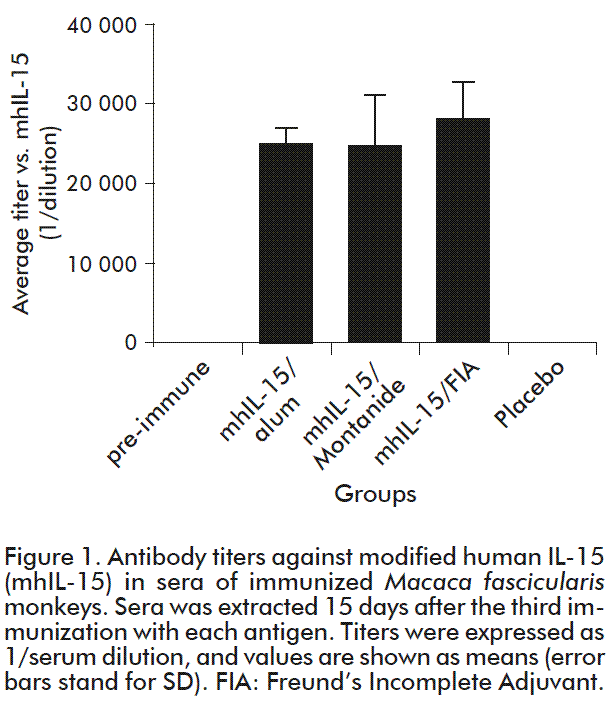
<body><![CDATA[<P   ><font face="Verdana, Arial, Helvetica, sans-serif" size="2"><b>Immunization with      mhIL-15 induces a neutralizing antibodies response in non-human primates </b></font></P >       <P   ><font face="Verdana, Arial, Helvetica, sans-serif" size="2">The immunogenic capacity      of mhIL-15 was evaluated in <I>Macaca fascicularis </I>monkeys using aluminum      hydroxide (alum), Montanide ISA-51 or Freund&rsquo;s Incomplete Adjuvant (FIA)      [7]. Anti-IL-15 antibody titers were greater than 1/20 000 in all immunized      groups (<a href="/img/revistas/bta/v35n1/f0105118.gif">Figure 1</a>).      The highest titers were obtained in the group immunized with mhIL-15 formulated      in FIA. These results demonstrated, for the first time, the break of immune      tolerance to a self-cytokine molecule and the generation of a specific antibody      response against IL-15. This was relevant, considering the high level of homology      between human and macaque IL-15, sharing up to 97 % of its amino acid sequence.      </font></P >       
<P   ><font face="Verdana, Arial, Helvetica, sans-serif" size="2">The neutralizing      capacity of sera was evaluated using a CTLL-2 cell proliferation assay [8].      We demonstrated that sera from immunized animals inhibited the biological      activity of native IL-15 by decreasing the IL-15-induced proliferation of      CTLL-2 cells. The highest neutralizing effect was obtained in the animals      immunized with the mhIL-15 protein formulated in Alum (<a href="/img/revistas/bta/v35n1/f0205118.gif">Figure      2</a>). This also supported the selection of this adjuvant for active immunotherapy      with mhIL-15. These results demonstrated, for the first time, the use of the      IL-15 as antigen for a therapeutic vaccine to generate polyclonal neutralizing      antibodies against autologous hIL-15 [7]. </font></P >       
<P   ><font face="Verdana, Arial, Helvetica, sans-serif" size="2"><b>Characterization      of the anti-IL-15 antibody response induced by mhIL-15 formulated in alum      </b> </font></P >       <P   ><font face="Verdana, Arial, Helvetica, sans-serif" size="2">The selected formulation      of the mhIL-15 adjuvanted with Alum was further used to establish the timespan      of the antibody response. Results showed that neutralizing antibody titers      generated by immunization had a half-life of approximately 3 months. Noteworthy,      the antibody response recovered to a similar extent of that achieved in previous      immunizations before the administration of a boosting dose [7]. These results      indicated that regulation of the antibody response is controlled by vaccination      and also suggests that the generation of memory B cells, which are activated      in response to a new immunization. This is a very relevant concept since this      could imply that vaccination with this immunogen would allow the manipulation      of the immune response, by generating a transient therapeutic effect mediated      by the antibody response against the endogenous hIL-15, without other undesired      side effects due to uncontrolled autoimmune responses. This is of paramount      importance in diseases such as RA which are characterized by periods of uncontrolled      immune activation which lead to relapses and remission [9]. </font></P >       <P   ><font face="Verdana, Arial, Helvetica, sans-serif" size="2">In order to know      the specificity of the antibody neutralizing activity, the effect of sera      from immunized animals on the IL-2-induced proliferation of CTLL-2 cells was      evaluated. These cells proliferate in response to IL-2 or IL-15, two cytokines      that share the &beta; and &gamma; subunits of their trimeric receptors [10,      11]. It was shown that sera from animals immunized with mhIL-15 did not affect      the proliferation induced by IL-2 [7], demonstrating that the neutralizing      effect of sera is specific for IL-15. </font></P >       <P   ><font face="Verdana, Arial, Helvetica, sans-serif" size="2"><b>Effect of vaccination      on IL-15 dependent cells and simian IL-15 biological activity </b></font></P >       <P   ><font face="Verdana, Arial, Helvetica, sans-serif" size="2">In order to elucidate      the possible safety issues of vaccination with mhIL-15 formulated in alum,      IL-15-dependent immune cell populations were studied. In this case, the number      of CD56+ NK cells and CD8+ T cells was determined by flow cytometry in samples      corresponding to 10 months after the fourth immunization and 15 days past      the fifth inoculation [7]. Additionally, there was no variation detected on      body weight, corporal temperature or cardiac and respiratory rates immunized      vs. non-immunized monkeys (placebo group). There were also no changes in the      main blood biochemical parameters. All these results support the use of the      mhIL-15 formulated in Alum to generate a regulated, specific and safe anti-IL-15      antibody response in <I>M. fascicularis </I>monkeys. </font></P >   <FONT size="+1"><FONT size="+1"><FONT size="+1"><FONT size="+1">        <P   ><font face="Verdana, Arial, Helvetica, sans-serif" size="2">Additionally, the      simian IL-15 (siIL-15) was obtained [12], in order to evaluate the effect      of immune sera on the activity of siIL-15 in IL-15-dependent cell lines. It      was demonstrated that, despite the high sequence homology in the amino acid      sequence between hIL-15 and siIL-15, sera from monkeys immunized with mhIL-15      were able to neutralize the biological activity of siIL-15 in the CTLL-2 and      Kit225 cells [12]. </font></P >       <P   ><font face="Verdana, Arial, Helvetica, sans-serif" size="2">These results suggest      that the antibodies generated by immunization with mhIL-15 effectively recognize      epitopes that are conserved within the sequence of IL-15 of both species,      and proves the usefulness of <I>M. fascicularis </I>as robust species for      the proof of concept of anti-IL-15 vaccines. This could foster the elucidation      of the clinical potential of this cytokine in humans, due to the high homology      of the protein between both species. Other species, such as rodents, are not      adequate for the evaluation of this therapeutic strategy due to protein sequence      divergence. This statement is supported by results published by our group      where we demonstrated that sera from mice immunized with mhIL-15 do not neutralize      murine IL-15 [8], a cytokine that shares only 73 % of amino acid identity      with the human IL-15. Therefore, the demonstration of the usefulness of this      monkey species for the pre-clinical characterization of the anti- IL-15 vaccine      is another novel aspect of this work. </font></P >       ]]></body>
<body><![CDATA[<P   >&nbsp;</P >       <P   > </P >       <P   ><b><font face="Verdana, Arial, Helvetica, sans-serif" size="3">RELEVANCE OF THE      STUDY </font></b></P >       <P   ><font face="Verdana, Arial, Helvetica, sans-serif" size="2">This work provided      the first report on the obtention of a structurally modified hIL-15, as antigen      for a therapeutic vaccine, which was able to induce a regulated response of      specific and neutralizing antibodies against autologous IL-15 in <I>M. fascicularis      </I></font><font face="Verdana, Arial, Helvetica, sans-serif" size="2">monkeys.      This strategy has advantages over current therapeutic strategies using similar      molecules (monoclonal antibodies) in that it requires a lower frequency of      injections, a lower dose, a transient regulated response and the absence of      anti-drug response, and significantly, is able to break the immune tolerance      against the endogenous molecule. Taking into account the inflammatory activity      of IL-15 in some autoimmune diseases, the strategy presented in this work      could be applied to the treatment of patients with RA, psoriasis, multiple      sclerosis and inflammatory bowel disease. </font></P >       <P   >&nbsp;</P >       <P   > </P >       <P   ><font size="3"><b><font face="Verdana, Arial, Helvetica, sans-serif">ACKNOWLEDGEMENTS      </font></b></font></P >       <P   ><font face="Verdana, Arial, Helvetica, sans-serif" size="2">We thank to the following      specialists from the CIGB for their contribution to this work: Joel Ferrero,      Jos&eacute; Garc&iacute;a, Gerardo Garc&iacute;a, Yaima Mart&iacute;nez, Armando      Alexey Rodr&iacute;guez, Sonia Gonz&aacute;lez, Karelia Cosme, Lizet Aldana,      Sara Aymer, Roc&iacute;o Garateix, Dayana Labrada, Alberto Tamayo, Maribel      Mendoza, Joaqu&iacute;n Gonz&aacute;lez, Freya Freyre, Yahima Chac&oacute;n,      Victoria Mar&iacute;a Lugo, Jos&eacute; &Aacute;ngel Silva, Regla Estrada,      Mar&iacute;a de los A. Fern&aacute;ndez, Isela M. Garc&iacute;a, Maydee N&uacute;&ntilde;ez,      Yanet Garc&iacute;a, Caridad Gonz&aacute;lez, Mar&iacute;a de Jes&uacute;s      Leal, Blanca R Mendoza and Julio Alfonso. This work was supported by the CIGB.      </font></P >       <P   >&nbsp;</P >       <P   > </P >   <FONT size="+1" color="#000000">        ]]></body>
<body><![CDATA[<P   ><b><font face="Verdana, Arial, Helvetica, sans-serif" size="3">CONFLICTS OF INTEREST      STATEMENTS </font></b></P >       <P   ><font size="2" color="#211E1F" face="Verdana, Arial, Helvetica, sans-serif">The      authors declare that there are no conflicts of interest. </font></P >       <P   >&nbsp;</P >   <FONT size="+1" color="#211E1F">        <P   > </P >       <P   ><font size="3"><b><font face="Verdana, Arial, Helvetica, sans-serif">REFERENCES      </font></b></font></P >       <!-- ref --><P   ><font size="2" face="Verdana, Arial, Helvetica, sans-serif">1. Wollheim FA. Approaches      to rheumatoid arthritis in 2000. Curr Opin Rheumatol. 2001;13(3):193-201.          </font></P >   <FONT size="+1">        <P   ><font face="Verdana, Arial, Helvetica, sans-serif" size="2">2. Raza K, Falciani      F, Curnow SJ, Ross EJ, Lee CY, Akbar AN, <i>et al</i>. Early rheumatoid arthritis      is characterized by a distinct and transient synovial fluid cytokine profile      of T cell and stromal cell origin. Arthritis Res Ther. 2005;7(4):R784-95.      </font></P >       <!-- ref --><P   ><font face="Verdana, Arial, Helvetica, sans-serif" size="2">3. Cohen SB, Cohen      MD, Cush JJ, Fleischmann RM, Mease PJ, Schiff MH, <I>et al</I>. Unresolved      issues in identifying and overcoming inadequate response in rheumatoid arthritis:      weighing the evidence. J Rheumatol Suppl. 2008;81:4-30; quiz 1-4.     </font></P >       ]]></body>
<body><![CDATA[<!-- ref --><P   ><font face="Verdana, Arial, Helvetica, sans-serif" size="2">4. Christodoulou      C, Choy EH. Joint inflammation and cytokine inhibition in rheumatoid arthritis.      Clin Exp Med. 2006;6(1):13-9.     </font></P >       <!-- ref --><P   ><font face="Verdana, Arial, Helvetica, sans-serif" size="2">5. Santos A, Morera      Y, Ara&ntilde;a M, Ferrero J, Moro A, Garc&iacute;a J, <I>et al</I>. Obtaining      biologically active IL-15 in <I>Escherichia coli</I>. Biotecnol Apl. 2000;17(4):221-4.          </font></P >       <!-- ref --><P   ><font face="Verdana, Arial, Helvetica, sans-serif" size="2">6. Pettit DK, Bonnert      TP, Eisenman J, Srinivasan S, Paxton R, Beers C, <I>et al</I>. Structure-function      studies of interleukin 15 using site-specific mutagenesis, polyethylene glycol      conjugation, and homology modeling. J Biol Chem. 1997;272(4):2312-8.     </font></P >       <!-- ref --><P   ><font face="Verdana, Arial, Helvetica, sans-serif" size="2">7. Rodriguez-Alvarez      Y, Morera-Diaz Y, Geronimo-Perez H, Castro-Velazco J, Martinez-Castillo R,      Puente-Perez P, <I>et al</I>. Active immunization with human interleukin-15      induces neutralizing antibodies in non-human primates. BMC Immunol. 2016;17(1):30.          </font></P >       <!-- ref --><P   ><font face="Verdana, Arial, Helvetica, sans-serif" size="2">8. Rodr&iacute;guez      Y, Ger&oacute;nimo H, Garay H, Castro J, Garc&iacute;a G, Santos A. Application      of a colorimetric CTLL-2 cell proliferation assay for the evaluation of IL-15      antagonists. Biotecnol Apl. 2014;31:291-6.     </font></P >       ]]></body>
<body><![CDATA[<!-- ref --><P   ><font face="Verdana, Arial, Helvetica, sans-serif" size="2">9. McInnes IB, Schett      G. The pathogenesis of rheumatoid arthritis. N Engl J Med. 2011;365(23):2205-19.          </font></P >       <!-- ref --><P   ><font face="Verdana, Arial, Helvetica, sans-serif" size="2">10. Burton JD, Bamford      RN, Peters C, Grant AJ, Kurys G, Goldman CK, <I>et al</I>. A lymphokine, provisionally      designated interleukin T and produced by a human adult T-cell leukemia line,      stimulates T-cell proliferation and the induction of lymphokine-activated      killer cells. Proc Natl Acad Sci USA. 1994;91(11):4935-9.     </font></P >       <!-- ref --><P   ><font face="Verdana, Arial, Helvetica, sans-serif" size="2">11. Grabstein KH,      Eisenman J, Shanebeck K, Rauch C, Srinivasan S, Fung V, <I>et al</I>. Cloning      of a T cell growth factor that interacts with the beta chain of the interleukin-2      receptor. Science. 1994;264(5161):965-8.     </font></P >       <!-- ref --><P   ><font face="Verdana, Arial, Helvetica, sans-serif" size="2">12. Rodriguez-Alvarez      Y, Martinez-Cordovez K, Llopiz-Arzuaga A, Ramos-Gomez Y, Besada-Perez V, Garcia-Lines      D, <I>et al</I>. Obtention and characterization of the recombinant simian      Interleukin-15 in <I>Escherichia coli </I>for the preclinical assessment of      an IL-15-based therapeutic vaccine. Prep Biochem Biotechnol. 2017;47(9):889-900.          </font></P >       <P   >&nbsp;</P >       <P   ><font face="Verdana, Arial, Helvetica, sans-serif" size="2"><i>Yunier Rodr&iacute;guez</i>.      Departamento de Farmac&eacute;uticos, Centro de Ingenier&iacute;a Gen&eacute;tica      y Biotecnolog&iacute;a, CIGB Ave. 31 entre 158 y 190, Cubanac&aacute;n, Playa,      CP 11600, La Habana, Cuba. E-mail: <a href="mailto:yunier.rodriguez@cigb.edu.cu">yunier.rodriguez@cigb.edu.cu</a>.</font></P >   </font></font></font></font></font></font></font></font></font></font></font></font></font></font></font></font></font></font></font></font></font></font></font></font></font></font></font></font></font></font></font></font></font></font></font></font></font></font></font></font></font></font></font></font></font></font></font></font></font></font></font></font></font></font></font></font></font></font></font></font></font></font></font></font></font></font></font></font></font></font></font></font></font></font></font></font></font></font></font></font></DIV >     ]]></body>
<body><![CDATA[ ]]></body><back>
<ref-list>
<ref id="B1">
<label>1</label><nlm-citation citation-type="journal">
<person-group person-group-type="author">
<name>
<surname><![CDATA[Wollheim]]></surname>
<given-names><![CDATA[FA]]></given-names>
</name>
</person-group>
<article-title xml:lang="en"><![CDATA[Approaches to rheumatoid arthritis in 2000]]></article-title>
<source><![CDATA[Curr Opin Rheumatol]]></source>
<year>2001</year>
<volume>13</volume>
<numero>3</numero>
<issue>3</issue>
<page-range>193-201</page-range></nlm-citation>
</ref>
<ref id="B2">
<label>2</label><nlm-citation citation-type="journal">
<person-group person-group-type="author">
<name>
<surname><![CDATA[Raza]]></surname>
<given-names><![CDATA[K]]></given-names>
</name>
<name>
<surname><![CDATA[Falciani]]></surname>
<given-names><![CDATA[F]]></given-names>
</name>
<name>
<surname><![CDATA[Curnow]]></surname>
<given-names><![CDATA[SJ]]></given-names>
</name>
<name>
<surname><![CDATA[Ross]]></surname>
<given-names><![CDATA[EJ]]></given-names>
</name>
<name>
<surname><![CDATA[Lee]]></surname>
<given-names><![CDATA[CY]]></given-names>
</name>
<name>
<surname><![CDATA[Akbar]]></surname>
<given-names><![CDATA[AN]]></given-names>
</name>
</person-group>
<article-title xml:lang="en"><![CDATA[Early rheumatoid arthritis is characterized by a distinct and transient synovial fluid cytokine profile of T cell and stromal cell origin]]></article-title>
<source><![CDATA[Arthritis Res Ther]]></source>
<year>2005</year>
<volume>7</volume>
<numero>4</numero>
<issue>4</issue>
<page-range>784-95</page-range></nlm-citation>
</ref>
<ref id="B3">
<label>3</label><nlm-citation citation-type="journal">
<person-group person-group-type="author">
<name>
<surname><![CDATA[Cohen]]></surname>
<given-names><![CDATA[SB]]></given-names>
</name>
<name>
<surname><![CDATA[Cohen]]></surname>
<given-names><![CDATA[MD]]></given-names>
</name>
<name>
<surname><![CDATA[Cush]]></surname>
<given-names><![CDATA[JJ]]></given-names>
</name>
<name>
<surname><![CDATA[Fleischmann]]></surname>
<given-names><![CDATA[RM]]></given-names>
</name>
<name>
<surname><![CDATA[Mease]]></surname>
<given-names><![CDATA[PJ]]></given-names>
</name>
<name>
<surname><![CDATA[Schiff]]></surname>
<given-names><![CDATA[MH]]></given-names>
</name>
</person-group>
<article-title xml:lang="en"><![CDATA[Unresolved issues in identifying and overcoming inadequate response in rheumatoid arthritis: weighing the evidence]]></article-title>
<source><![CDATA[J Rheumatol Suppl]]></source>
<year>2008</year>
<volume>81</volume>
<page-range>4-30; quiz 1-4</page-range></nlm-citation>
</ref>
<ref id="B4">
<label>4</label><nlm-citation citation-type="journal">
<person-group person-group-type="author">
<name>
<surname><![CDATA[Christodoulou]]></surname>
<given-names><![CDATA[C]]></given-names>
</name>
<name>
<surname><![CDATA[Choy]]></surname>
<given-names><![CDATA[EH]]></given-names>
</name>
</person-group>
<article-title xml:lang="en"><![CDATA[Joint inflammation and cytokine inhibition in rheumatoid arthritis]]></article-title>
<source><![CDATA[Clin Exp Med]]></source>
<year>2006</year>
<volume>6</volume>
<numero>1</numero>
<issue>1</issue>
<page-range>13-9</page-range></nlm-citation>
</ref>
<ref id="B5">
<label>5</label><nlm-citation citation-type="journal">
<person-group person-group-type="author">
<name>
<surname><![CDATA[Santos]]></surname>
<given-names><![CDATA[A]]></given-names>
</name>
<name>
<surname><![CDATA[Morera]]></surname>
<given-names><![CDATA[Y]]></given-names>
</name>
<name>
<surname><![CDATA[Araña]]></surname>
<given-names><![CDATA[M]]></given-names>
</name>
<name>
<surname><![CDATA[Ferrero]]></surname>
<given-names><![CDATA[J]]></given-names>
</name>
<name>
<surname><![CDATA[Moro]]></surname>
<given-names><![CDATA[A]]></given-names>
</name>
<name>
<surname><![CDATA[García]]></surname>
<given-names><![CDATA[J]]></given-names>
</name>
</person-group>
<article-title xml:lang="en"><![CDATA[Obtaining biologically active IL-15 in Escherichia coli]]></article-title>
<source><![CDATA[Biotecnol Apl]]></source>
<year>2000</year>
<volume>17</volume>
<numero>4</numero>
<issue>4</issue>
<page-range>221-4</page-range></nlm-citation>
</ref>
<ref id="B6">
<label>6</label><nlm-citation citation-type="journal">
<person-group person-group-type="author">
<name>
<surname><![CDATA[Pettit]]></surname>
<given-names><![CDATA[DK]]></given-names>
</name>
<name>
<surname><![CDATA[Bonnert]]></surname>
<given-names><![CDATA[TP]]></given-names>
</name>
<name>
<surname><![CDATA[Eisenman]]></surname>
<given-names><![CDATA[J]]></given-names>
</name>
<name>
<surname><![CDATA[Srinivasan]]></surname>
<given-names><![CDATA[S]]></given-names>
</name>
<name>
<surname><![CDATA[Paxton]]></surname>
<given-names><![CDATA[R]]></given-names>
</name>
<name>
<surname><![CDATA[Beers]]></surname>
<given-names><![CDATA[C]]></given-names>
</name>
</person-group>
<article-title xml:lang="en"><![CDATA[Structure-function studies of interleukin 15 using site-specific mutagenesis, polyethylene glycol conjugation, and homology modeling]]></article-title>
<source><![CDATA[J Biol Chem]]></source>
<year>1997</year>
<volume>272</volume>
<numero>4</numero>
<issue>4</issue>
<page-range>2312-8</page-range></nlm-citation>
</ref>
<ref id="B7">
<label>7</label><nlm-citation citation-type="journal">
<person-group person-group-type="author">
<name>
<surname><![CDATA[Rodriguez-Alvarez]]></surname>
<given-names><![CDATA[Y]]></given-names>
</name>
<name>
<surname><![CDATA[Morera-Diaz]]></surname>
<given-names><![CDATA[Y]]></given-names>
</name>
<name>
<surname><![CDATA[Geronimo-Perez]]></surname>
<given-names><![CDATA[H]]></given-names>
</name>
<name>
<surname><![CDATA[Castro-Velazco]]></surname>
<given-names><![CDATA[J]]></given-names>
</name>
<name>
<surname><![CDATA[Martinez-Castillo]]></surname>
<given-names><![CDATA[R]]></given-names>
</name>
<name>
<surname><![CDATA[Puente-Perez]]></surname>
<given-names><![CDATA[P]]></given-names>
</name>
</person-group>
<article-title xml:lang="en"><![CDATA[Active immunization with human interleukin-15 induces neutralizing antibodies in non-human primates]]></article-title>
<source><![CDATA[BMC Immunol]]></source>
<year>2016</year>
<volume>17</volume>
<numero>1</numero>
<issue>1</issue>
<page-range>30</page-range></nlm-citation>
</ref>
<ref id="B8">
<label>8</label><nlm-citation citation-type="journal">
<person-group person-group-type="author">
<name>
<surname><![CDATA[Rodríguez]]></surname>
<given-names><![CDATA[Y]]></given-names>
</name>
<name>
<surname><![CDATA[Gerónimo]]></surname>
<given-names><![CDATA[H]]></given-names>
</name>
<name>
<surname><![CDATA[Garay]]></surname>
<given-names><![CDATA[H]]></given-names>
</name>
<name>
<surname><![CDATA[Castro]]></surname>
<given-names><![CDATA[J]]></given-names>
</name>
<name>
<surname><![CDATA[García]]></surname>
<given-names><![CDATA[G]]></given-names>
</name>
<name>
<surname><![CDATA[Santos]]></surname>
<given-names><![CDATA[A]]></given-names>
</name>
</person-group>
<article-title xml:lang="en"><![CDATA[Application of a colorimetric CTLL-2 cell proliferation assay for the evaluation of IL-15 antagonists]]></article-title>
<source><![CDATA[Biotecnol Apl]]></source>
<year>2014</year>
<volume>31</volume>
<page-range>291-6</page-range></nlm-citation>
</ref>
<ref id="B9">
<label>9</label><nlm-citation citation-type="journal">
<person-group person-group-type="author">
<name>
<surname><![CDATA[McInnes]]></surname>
<given-names><![CDATA[IB]]></given-names>
</name>
<name>
<surname><![CDATA[Schett]]></surname>
<given-names><![CDATA[G]]></given-names>
</name>
</person-group>
<article-title xml:lang="en"><![CDATA[The pathogenesis of rheumatoid arthritis]]></article-title>
<source><![CDATA[N Engl J Med]]></source>
<year>2011</year>
<volume>365</volume>
<numero>23</numero>
<issue>23</issue>
<page-range>2205-19</page-range></nlm-citation>
</ref>
<ref id="B10">
<label>10</label><nlm-citation citation-type="journal">
<person-group person-group-type="author">
<name>
<surname><![CDATA[Burton]]></surname>
<given-names><![CDATA[JD]]></given-names>
</name>
<name>
<surname><![CDATA[Bamford]]></surname>
<given-names><![CDATA[RN]]></given-names>
</name>
<name>
<surname><![CDATA[Peters]]></surname>
<given-names><![CDATA[C]]></given-names>
</name>
<name>
<surname><![CDATA[Grant]]></surname>
<given-names><![CDATA[AJ]]></given-names>
</name>
<name>
<surname><![CDATA[Kurys]]></surname>
<given-names><![CDATA[G]]></given-names>
</name>
<name>
<surname><![CDATA[Goldman]]></surname>
<given-names><![CDATA[CK]]></given-names>
</name>
</person-group>
<article-title xml:lang="en"><![CDATA[A lymphokine, provisionally designated interleukin T and produced by a human adult T-cell leukemia line, stimulates T-cell proliferation and the induction of lymphokine-activated killer cells]]></article-title>
<source><![CDATA[Proc Natl Acad Sci USA]]></source>
<year>1994</year>
<volume>91</volume>
<numero>11</numero>
<issue>11</issue>
<page-range>4935-9</page-range></nlm-citation>
</ref>
<ref id="B11">
<label>11</label><nlm-citation citation-type="journal">
<person-group person-group-type="author">
<name>
<surname><![CDATA[Grabstein]]></surname>
<given-names><![CDATA[KH]]></given-names>
</name>
<name>
<surname><![CDATA[Eisenman]]></surname>
<given-names><![CDATA[J]]></given-names>
</name>
<name>
<surname><![CDATA[Shanebeck]]></surname>
<given-names><![CDATA[K]]></given-names>
</name>
<name>
<surname><![CDATA[Rauch]]></surname>
<given-names><![CDATA[C]]></given-names>
</name>
<name>
<surname><![CDATA[Srinivasan]]></surname>
<given-names><![CDATA[S]]></given-names>
</name>
<name>
<surname><![CDATA[Fung]]></surname>
<given-names><![CDATA[V]]></given-names>
</name>
</person-group>
<article-title xml:lang="en"><![CDATA[Cloning of a T cell growth factor that interacts with the beta chain of the interleukin-2 receptor]]></article-title>
<source><![CDATA[Science]]></source>
<year>1994</year>
<volume>264</volume>
<numero>5161</numero>
<issue>5161</issue>
<page-range>965-8</page-range></nlm-citation>
</ref>
<ref id="B12">
<label>12</label><nlm-citation citation-type="journal">
<person-group person-group-type="author">
<name>
<surname><![CDATA[Rodriguez-Alvarez]]></surname>
<given-names><![CDATA[Y]]></given-names>
</name>
<name>
<surname><![CDATA[Martinez-Cordovez]]></surname>
<given-names><![CDATA[K]]></given-names>
</name>
<name>
<surname><![CDATA[Llopiz-Arzuaga]]></surname>
<given-names><![CDATA[A]]></given-names>
</name>
<name>
<surname><![CDATA[Ramos-Gomez]]></surname>
<given-names><![CDATA[Y]]></given-names>
</name>
<name>
<surname><![CDATA[Besada-Perez]]></surname>
<given-names><![CDATA[V]]></given-names>
</name>
<name>
<surname><![CDATA[Garcia-Lines]]></surname>
<given-names><![CDATA[D]]></given-names>
</name>
</person-group>
<article-title xml:lang="en"><![CDATA[Obtention and characterization of the recombinant simian Interleukin-15 in Escherichia coli for the preclinical assessment of an IL-15-based therapeutic vaccine]]></article-title>
<source><![CDATA[Prep Biochem Biotechnol]]></source>
<year>2017</year>
<volume>47</volume>
<numero>9</numero>
<issue>9</issue>
<page-range>889-900</page-range></nlm-citation>
</ref>
</ref-list>
</back>
</article>