<?xml version="1.0" encoding="ISO-8859-1"?><article xmlns:mml="http://www.w3.org/1998/Math/MathML" xmlns:xlink="http://www.w3.org/1999/xlink" xmlns:xsi="http://www.w3.org/2001/XMLSchema-instance">
<front>
<journal-meta>
<journal-id>1027-2852</journal-id>
<journal-title><![CDATA[Biotecnología Aplicada]]></journal-title>
<abbrev-journal-title><![CDATA[Biotecnol Apl]]></abbrev-journal-title>
<issn>1027-2852</issn>
<publisher>
<publisher-name><![CDATA[Editorial Elfos Scientiae]]></publisher-name>
</publisher>
</journal-meta>
<article-meta>
<article-id>S1027-28522018000200001</article-id>
<title-group>
<article-title xml:lang="en"><![CDATA[Present and future of CRISPR/Cas systems in Biotechnology]]></article-title>
<article-title xml:lang="es"><![CDATA[Presente y futuro de los Sistemas CRISPR/Cas en Biotecnología]]></article-title>
</title-group>
<contrib-group>
<contrib contrib-type="author">
<name>
<surname><![CDATA[Viedma]]></surname>
<given-names><![CDATA[Inmaculada]]></given-names>
</name>
<xref ref-type="aff" rid="A01"/>
</contrib>
</contrib-group>
<aff id="A01">
<institution><![CDATA[,Universidad Católica de Murcia Facultad de Enfermería ]]></institution>
<addr-line><![CDATA[ ]]></addr-line>
<country>España</country>
</aff>
<pub-date pub-type="pub">
<day>00</day>
<month>06</month>
<year>2018</year>
</pub-date>
<pub-date pub-type="epub">
<day>00</day>
<month>06</month>
<year>2018</year>
</pub-date>
<volume>35</volume>
<numero>2</numero>
<fpage>2101</fpage>
<lpage>2107</lpage>
<copyright-statement/>
<copyright-year/>
<self-uri xlink:href="http://scielo.sld.cu/scielo.php?script=sci_arttext&amp;pid=S1027-28522018000200001&amp;lng=en&amp;nrm=iso"></self-uri><self-uri xlink:href="http://scielo.sld.cu/scielo.php?script=sci_abstract&amp;pid=S1027-28522018000200001&amp;lng=en&amp;nrm=iso"></self-uri><self-uri xlink:href="http://scielo.sld.cu/scielo.php?script=sci_pdf&amp;pid=S1027-28522018000200001&amp;lng=en&amp;nrm=iso"></self-uri><kwd-group>
<kwd lng="en"><![CDATA[CRISPR/Cas]]></kwd>
<kwd lng="en"><![CDATA[biotechnology]]></kwd>
<kwd lng="en"><![CDATA[genetic engineering]]></kwd>
<kwd lng="en"><![CDATA[gene therapy]]></kwd>
<kwd lng="en"><![CDATA[molecular biology]]></kwd>
<kwd lng="en"><![CDATA[genetic expression]]></kwd>
<kwd lng="en"><![CDATA[bioethics]]></kwd>
<kwd lng="es"><![CDATA[CRISPR-Cas]]></kwd>
<kwd lng="es"><![CDATA[biotecnología]]></kwd>
<kwd lng="es"><![CDATA[ingeniería genética]]></kwd>
<kwd lng="es"><![CDATA[terapia génica]]></kwd>
<kwd lng="es"><![CDATA[biología molecular]]></kwd>
<kwd lng="es"><![CDATA[expresión génica]]></kwd>
<kwd lng="es"><![CDATA[bioética]]></kwd>
</kwd-group>
</article-meta>
</front><body><![CDATA[ <DIV class="Part"   >        <P align="right"   ><font size="2" color="#211E1F" face="Verdana, Arial, Helvetica, sans-serif"><B>REVIEW      </b></font></P >       <P   >&nbsp;</P >   <FONT size="+1" color="#211E1F"><B>        <P   > </P >       <P   ><font size="4" face="Verdana, Arial, Helvetica, sans-serif">Present and future      of CRISPR/Cas systems in Biotechnology </font></P >       <P   >&nbsp;</P >       <P   ></P >   </B> <FONT size="+1" color="#000000">       <P   ><font size="3" color="#211E1F" face="Verdana, Arial, Helvetica, sans-serif"><B>Presente      y futuro de los Sistemas CRISPR/Cas en Biotecnolog&iacute;a</B> </font></P >       <P   >&nbsp;</P >       <P   >&nbsp;</P >   <FONT size="+1" color="#211E1F"><FONT size="+1" color="#000000">        ]]></body>
<body><![CDATA[<P   > </P >       <P   ><b><font size="2" color="#211E1F" face="Verdana, Arial, Helvetica, sans-serif">Inmaculada      Viedma </font></b></P >   <FONT size="+1" color="#211E1F">        <P   ><font size="2" face="Verdana, Arial, Helvetica, sans-serif">Facultad de Enfermer&iacute;a      de la Universidad Cat&oacute;lica de Murcia, Espa&ntilde;a.</font></P >       <P   >&nbsp;</P >       <P   >&nbsp;</P >   <FONT size="+1"> </font></font></font></font></font></font>   <hr>   <FONT size="+1" color="#211E1F"><FONT size="+1" color="#000000"><FONT size="+1" color="#211E1F"><FONT size="+1" color="#000000"><FONT size="+1" color="#211E1F"><FONT size="+1">       <P   > </P >       <P   > </P >       <P   ><font size="2" color="#000000" face="Verdana, Arial, Helvetica, sans-serif"><B>ABSTRACT      </b></font></P >   <FONT size="+1" color="#000000">        <P   ><font size="2" face="Verdana, Arial, Helvetica, sans-serif"><FONT color="#211E1F">CRISPR      (Clustered Regularly Interspaced Short Palindromic Repeats), along with the      Cas endonuclease genes, form the CRISPR/Cas system. These systems were discovered      as a defense mechanism in the Bacteria and Archaea domains, in which DNA from      a pathogen, such as a bacteriophage, is incorporated between repeated palindromic      sequences and later transcribed into an RNA known as crRNA. Upon subsequent      infection s with the same pathogen, the crRNA coupled with Cas targets the      transcribed foreign RNA sequences and silences them. The endonucleolytic activity      and sequence specificity of the CRISPR/Cas system have been harnessed in genetic      engineering to activate or repress genes, to induce point mutations, and to      alter sequences through homologous recombination. CRISPR/Cas has also been      used to evaluate cellular physiology through the simultaneous activation or      repression of various genes. In this article, it is reviewed the history and      mechanism of action of the CRISPR-Cas system, its potential applications in      cell and gene therapy, and the bioethical implications of the latter. </font></font></P >   <FONT size="+1" color="#211E1F">        <P   ><font size="2" face="Verdana, Arial, Helvetica, sans-serif"><I><b>Keywords:</b>      </I>CRISPR/Cas, biotechnology, genetic engineering, gene therapy, molecular      biology, genetic expression, bioethics. </font></P >   </font></font></font></font></font></font></font></font>    <hr>   <FONT size="+1" color="#211E1F"><FONT size="+1" color="#000000"><FONT size="+1" color="#211E1F"><FONT size="+1" color="#000000"><FONT size="+1" color="#211E1F"><FONT size="+1"><FONT size="+1" color="#000000"><FONT size="+1" color="#211E1F">       ]]></body>
<body><![CDATA[<P   > </P >       <P   ><font size="2" face="Verdana, Arial, Helvetica, sans-serif"><B>RESUMEN </b></font></P >       <P   ><font size="2" face="Verdana, Arial, Helvetica, sans-serif">Las secuencias CRISPR      (Repeticiones Palindr&oacute;micas Cortas y Regularmente Espaciadas y Agrupadas)      junto con los genes que codifican para las endonucleasas Cas, forman los llamados      sistemas CRISPR/Cas. Los CRISPR se descubrieron como un sistema presente en      los Dominios Bacteria y Archaea que les confiere inmunidad frente a pat&oacute;genos.      Cuando un organismo pat&oacute;geno infecta a una bacteria ocurre una inserci&oacute;n,      en las agrupaciones CRISPR del hospedero, de nuevos espaciadores procedentes      del genoma del virus y esta integraci&oacute;n confiere inmunidad espec&iacute;fica      frente al invasor. Gracias a su capacidad de reconocimiento de secuencias      espec&iacute;ficas y a su actividad endonucleasa, el sistema CRISPR/Cas se      ha utilizado en ingenier&iacute;a gen&eacute;tica con el fin de activar o      reprimir la expresi&oacute;n de determinados genes. Este art&iacute;culo recoge      la situaci&oacute;n actual de estas t&eacute;cnicas, las opciones de futuro      que ofrecen y la valoraci&oacute;n desde el punto de vista de la bio&eacute;tica      de las posibles aplicaciones terap&eacute;uticas. </font></P >       <P   ><font size="2" face="Verdana, Arial, Helvetica, sans-serif"><I><b>Palabras clave:</b>      </I>CRISPR-Cas, biotecnolog&iacute;a, ingenier&iacute;a gen&eacute;tica, terapia      g&eacute;nica, biolog&iacute;a molecular, expresi&oacute;n g&eacute;nica,      bio&eacute;tica. </font></P >   </font></font></font></font></font></font></font></font>    <hr>   <FONT size="+1" color="#211E1F"><FONT size="+1" color="#000000"><FONT size="+1" color="#211E1F"><FONT size="+1" color="#000000"><FONT size="+1" color="#211E1F"><FONT size="+1"><FONT size="+1" color="#000000"><FONT size="+1" color="#211E1F">        <P   >&nbsp;</P >       <P   >&nbsp;</P >       <P   > </P >       <P   ><font size="3" face="Verdana, Arial, Helvetica, sans-serif"><B>INTRODUCTION </b></font></P >       <P   ><font size="2" face="Verdana, Arial, Helvetica, sans-serif">&ldquo;Gene editing&rdquo;      is a recently coined term that refers to a genetic engineering technique in      which a DNA fragment is inserted, deleted or replaced in the genome of a target      cell by using nucleolytic enzymes, otherwise known as nucleases. These nucleases      are used to introduce double-stranded breaks (DSB) at specific locations in      the genome, </font><font size="2" face="Verdana, Arial, Helvetica, sans-serif">and      the resulting DSB are then repaired either by non-homologous end joining (NHEJ)      or homology-directed repair (HDR), resulting in controlled modifications (editing).      </font></P >       <P   ><font size="2" face="Verdana, Arial, Helvetica, sans-serif">Two nuclease systems      had previously been used for this purpose: </font></P >       ]]></body>
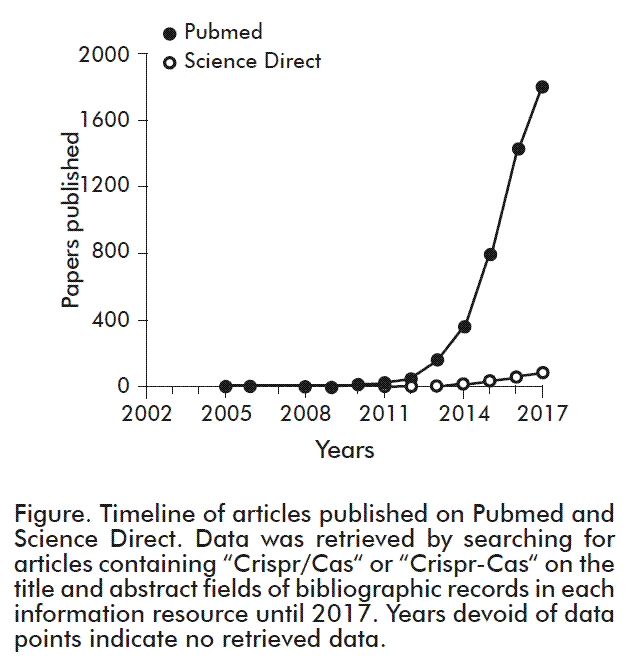
<body><![CDATA[<P   ><font size="2" face="Verdana, Arial, Helvetica, sans-serif">- Zinc-finger nucleases      (ZF nucleases), engineered by fusing DNA-binding zinc-finger domains to the      catalytic domain of the <I>Fok </I>I restriction endonuclease [1]. </font></P >       <P   ><font size="2" face="Verdana, Arial, Helvetica, sans-serif">- Transcription Activator-Like      Effector-based Nucleases (TALENs), based on fusions of the catalytic domain      of the <I>Fok </I>I restriction endonuclease to a sequence-specific DNA binding      domain [2]. </font></P >       <P   ><font size="2" face="Verdana, Arial, Helvetica, sans-serif">These systems, however,      were labor-intensive and expensive. For instance, developing a zinc-finger      nuclease required 4-5 years of work at an approximate cost of 30.00 &euro;,      while the use of TALENs requires 3-4 months of preparatory work, at a cost      of some 10 000 &euro;. Thus, the advent of CRISPR/Cas systems, which only      require 2-3 weeks of work at a cost of 20-30 &euro;, represented a giant leap      forward for the gene editing community, as illustrated by the rapid growth      in the number of publications using this technique since its initial description      (<a href="/img/revistas/bta/v35n2/f0101218.gif">Figure</a>). Therefore,      this review is aimed to describe the history and mechanism of action of the      CRISPR/Cas system, its potential applications in cell and gene therapy, and      the bioethical implications of the latter. </font></P >       
<P   >&nbsp;</P >       <P   > </P >   <FONT size="+1" color="#000000">        <P   ><font size="3" color="#211E1F" face="Verdana, Arial, Helvetica, sans-serif"><B>DISCOVERY      OF CRISPR/Cas </b></font></P >   <FONT size="+1" color="#211E1F">        <P   ><font size="2" face="Verdana, Arial, Helvetica, sans-serif">In 1987, Ishino <I>et      al</I>. [3] described the existence of clusters of repeated sequences within      the genome of <I>Escherichia coli</I>. Further research led to the description      of similar clusters in the genomes of <I>Shigella dysenteriae </I>and <I>Samonella      enterritidis </I>[4], and this finding was later repeated in many different      microorganisms. Tandem 30 to 34 bp long repeats interspersed by non-repetitive      35 to 39 bp sequences were found in the archaeal species <I>Haloferax mediterranei      </I>[5,6], and were first denominated Short Regularly Spaced Repeats (SRSR)      [7]. SRSR were found to be present in almost half of all bacterial genomes      and practically all archaeal genomes sequenced at that moment. In 2002 Jansen      and Mojica jointly agree to denote these clusters by the acronym CRISPR (Clustered      Regularly Interspaced Short Palindromic Repeats) [8]. </font></P >   <FONT size="+1">        <P   ><font size="2" face="Verdana, Arial, Helvetica, sans-serif">Although the role      of these sequences was unknown at the time, it had been determined that the      entire locus was transcribed as a precursor pre-crRNA which upon further processing      yielded smaller fragments denoted as crRNA [9]. </font></P >       <P   ><font size="2" face="Verdana, Arial, Helvetica, sans-serif">Concurrently with      all this work, Jansen <I>et al</I>. described in 2002 four genes associated      with CRISPR clusters, which they denominated <I>cas</I>, for CRISPR-associated      [8]. These genes were found to code for nucleases. A thorough biochemical,      structural and functional characterization of these proteins followed, performed      by a group under the leadership of Jennifer A. Doudna. Their work determined      that <I>cas </I>genes were indeed part of the CRISPR system, and assigned      putative roles to the gene products of individual <I>cas </I>members [10].      </font></P >       <P   ><font size="2" face="Verdana, Arial, Helvetica, sans-serif">In 2005, Mojica [11]      and Pourcel [12] independently discovered that the spacers of the CRISPR clusters      were homologous to DNA sequences from bacteriophages, foreign chromosomal      fragments and non-transmissible plasmids. They cleverly observed that bacteria      bearing these spacers could not be infected by bacteriophages carrying homologous      sequences, leading to the deduction that CRISPR/Cas systems probably constituted      an adaptive defense system in bacteria and archaea against the introduction      of foreign DNA. Bolotin found a conserved sequence adjacent to the protospacer      that acted as a leader [13], which was later denominated PAM (Protospacer      Adjacent Motif). The PAM sequence is known to play an important role in the      operation of several CRISPR/Cas systems [14]. </font></P >       ]]></body>
<body><![CDATA[<P   ><font size="2" face="Verdana, Arial, Helvetica, sans-serif">Further advancement      in our knowledge of the system was made possible by the team of Emmanuelle      Charpentier, which identified small RNAs, denominated tracrRNA, which were      found to be necessary for the generation of crRNA in CRISPR/Cas systems [15].      </font></P >       <P   >&nbsp;</P >       <P   > </P >       <P   ><font size="3" face="Verdana, Arial, Helvetica, sans-serif"><B>MECHANISM OF ACTION      OF CRISPR/Cas SYSTEMS</B></font></P >   <FONT size="+1">        <P   ><font size="2" face="Verdana, Arial, Helvetica, sans-serif">The nomenclature      used to classify CRISPR/Cas systems, which is based on the degree of sequence      similarity and architectural organization of CRISPR/Cas loci, groups them      into three (I, II and III) types [16] and several subtypes (denoted by a letter)      according to the presence of specific proteins. A total of 10 <I>cas </I>genes      have been described. Each CRISPR/Cas type contains two universally distributed      <I>cas1 </I>and <I>cas2 </I>genes (although their universality is controversial)      and a specific <I>cas </I>gene: type I clusters have <I>cas3</I>, type II      clusters have <I>cas9</I>, and type III clusters have <I>cas10</I>. The remaining      <I>cas </I>genes (4 to 8) are present on at least two types. </font></P >   <FONT size="+1">        <P   ><font size="2" face="Verdana, Arial, Helvetica, sans-serif">As mentioned above,      the spacer sequences are homologous to DNA sequences of viral origin and to      other genetic elements that may potentially invade the host organism. These      spacer sequences are currently known as protospacers [9, 10]. It has been      shown that microorganisms bearing protospacers homologous to a sequence present      on an infectious agent cannot be further infected by that agent [11], leading      to the hypothesis that CRISPR operated as an adaptive defense system of microorganisms      against invading DNA elements [11, 12]. </font></P >       <P   ><font size="2" face="Verdana, Arial, Helvetica, sans-serif">CRISPR/Cas systems      have so far been found in the <I>Bacteria </I>and <I>Archaea </I>domains.      The active acquisition of immunity against a specific bacteriophage was first      demonstrated in 2007, in experiments on <I>Streptococcus thermophilus</I>.      There was detected the insertion into the CRISPR cluster of the host of new      spacers derived from an infecting bacteriophage, which showed that the bacteria      carrying the modified CRISPR cluster were resistant to subsequent infections      with the same bacteriophage [17]. </font></P >       <P   ><font size="2" face="Verdana, Arial, Helvetica, sans-serif">Although the exact      mechanism of action of CRISPR/Cas system changes depending on the specific      CRISPR/Cas type or subtype, a common operating model can still be discerned,      consisting of three stages: <I>acquisition</I>, <I>expression </I>and <I>interference</I>.      During the acquisition stage, the system incorporates spacers derived from      an invading genetic element that will later serve to target that element for      interference. For this purpose, the cas proteins scan the invading DNA, looking      for a short nucleotide motif denominated PAM, and cut out an adjacent fragment.      This fragment is usually integrated into the location closest to the leader      sequence of the CRISPR cluster of the host. </font></P >       <P   ><font size="2" face="Verdana, Arial, Helvetica, sans-serif">Next comes the <I>expression      </I>stage, when the RNA sequences encoded into the CRISPR clusters are transcribed      and the gene products of the <I>cas </I>genes are expressed. The CRISPR locus      is transcribed beginning from the leader sequence, forming a pre-crRNA that      will be further processed to yield crRNA molecules [18], which will serve      as guides during the next stage. </font></P >       <P   ><font size="2" face="Verdana, Arial, Helvetica, sans-serif">In the third stage,      <I>interference</I>, the crRNA is used as a guide to let the Cas proteins      bind specifically to the invading DNA and degrade it. </font></P >       ]]></body>
<body><![CDATA[<P   >&nbsp;</P >       <P   > </P >       <P   ><font size="3" face="Verdana, Arial, Helvetica, sans-serif"><B>APPLICATIONS OF      CRISPR/Cas SYSTEMS</b></font></P >   <FONT size="+1">        <P   ><font size="2" face="Verdana, Arial, Helvetica, sans-serif">Although practical      applications exist of several different CRISPR/Cas systems, the CRISPR/Cas9      pair has received by far the most use owing to several advantages. We will      therefore center our explanation on this particular example. </font></P >   <FONT size="+1">        <P   ><font size="2" face="Verdana, Arial, Helvetica, sans-serif"><B>Components and      operation mode </b></font></P >       <P   ><font size="2" face="Verdana, Arial, Helvetica, sans-serif">The CRISPR/Cas9 system      employs two components: </font></P >       <P   ><font size="2" face="Verdana, Arial, Helvetica, sans-serif">1. The Cas9 enzyme.      This nuclease has a bilobular structure where one lobule, denominated REC      (for recognition) binds the target and the other, denominated NUC (for nuclease)      produces a double-stranded break [19]. The NUC lobule in turn exhibits two      structural domains denominated RuvC and HNH based on homologies to structural      domains from previously known nucleases, and a PAM recognition domain denoted      PI. </font></P >       <P   ><font size="2" face="Verdana, Arial, Helvetica, sans-serif">2. A duplex RNA formed      by a crRNA and a crRNA-transactivating tracrRNA, known under the more general      term of guide RNA. The crRNA binds via base pairing to its target on the DNA      or protospacer along a homology stretch of 20 nucleotides. The tracrRNA molecule      is necessary for the binding of Cas9 to the guide RNA and to maintain the      latter in a conformation adequate for the interaction between the crRNA and      its target. Its presence, thus, is absolutely required for the operation of      this genomic editing technique [20]. </font></P >       <P   ><font size="2" face="Verdana, Arial, Helvetica, sans-serif">The crRNA/tracrRNA      hybrid can be formed as a duplex between independent molecules, as found naturally,      or as a single-molecule chimaera formed by joining both molecules using a      stem and loop. In the latter case it is known as a sgRNA (single guide RNA).      This sgRNA exhibits all the essential characteristics of a guide RNA, such      as the presence of a 20 nucleotide sequence at its 5&acute; end that hybridizes      to the protospacer in the DNA, and a double-stranded structure in its 3&acute;      end facilitating the binding between the sgRNA and Cas9 [20, 21]. </font></P >       <P   ><font size="2" face="Verdana, Arial, Helvetica, sans-serif">The PAM sequence      is not part, structurally speaking, of the CRISPR/Cas tool, but plays an essential      role in the process. PAM sequences consist of a series of nucleotides residing      at the 3&acute; region of the target DNA strand that do not bind the sgRNA.      The presence of this motif is essential for the recognition by Cas9 of its      cleavage site, as Cas9 cleavage is a two-part process in which the endonuclease,      together with its associated sgRNA, first recognizes PAM to form a Cas9-DNA      complex, and only then the DNA strands are melted and the Cas9 complex starts      scanning for its target sequence [22]. PAM recognition takes place, as mentioned      above, through the PI domain of Cas9, i.e. is not mediated by sgRNA. The exact      composition of PAM sequences varies according to the organism from which the      specific Cas9 nuclease is isolated, enabling the independent and simultaneous      modification of several sites of the locus of a cell. </font></P >       ]]></body>
<body><![CDATA[<P   ><font size="2" face="Verdana, Arial, Helvetica, sans-serif"><B>Construction of      the CRISPR/Cas system and its introduction into the target cell </b></font></P >       <P   ><font size="2" face="Verdana, Arial, Helvetica, sans-serif">The oligonucleotide      sequences coding for both components of the tool only have to be inserted      in DNA form. Both components, Cas9 and the sgRNA, are usually contained within      a single expression vector, although they can be present in separate vectors.      Most frequently, they are introduced into a single vector [23]. </font></P >       <P   ><font size="2" face="Verdana, Arial, Helvetica, sans-serif">In 2015, Sakuma and      Yamamoto demonstrated that it was possible to modify the delivery vector so      as to code simultaneously for seven separate sgRNAs, obtaining a CRISPR/Cas      construct that, upon introduction into the target cell, expressed a nuclease      active simultaneously against seven different targets. In other words, the      tool can be modified to code for as many different target specificities as      sgRNA molecules are coded by the delivery vector [24]. </font></P >       <P   ><font size="2" face="Verdana, Arial, Helvetica, sans-serif">Once the delivery      construct has been obtained, it is necessary to choose an optimal delivery      method. The most common options are biochemical, physical or virus-mediated      transfection [25-27]. </font></P >       <P   ><font size="2" face="Verdana, Arial, Helvetica, sans-serif"><B>Applications of      CRISPR/Cas in genome editing </b></font></P >       <P   ><font size="2" face="Verdana, Arial, Helvetica, sans-serif">From 2011 on, awareness      of the potential biotechnological applications of the CRISPR/Cas systems began      to spread. The three main components of type II CRISPR systems (Cas9, crRNA      and tracrRNA) had already been characterized, and a frantic race took place      between different research groups that were trying to turn these systems into      a genome-editing nuclease whose sequence specificity was dictated by the presence      of a guide RNA. </font></P >       <P   ><font size="2" face="Verdana, Arial, Helvetica, sans-serif">In 2012, Jennifer      A Doudna and Emmanuelle Charpentier (who in 2015 were granted the Princess      of Asturias award for Technical and Scientific Research to honor their work      on developing the CRISPR/Cas system as a gene editing tool) joined forces      to dissect, through <I>in vitro </I>experiments, which elements of Type II      CRISPR/Cas systems were absolutely required for the sequence-specific cleavage      of DNA sequences. They found that only three elements (Cas9, a guide crRNA      and a tracrRNA that pairs with the CRISPR segment of the crRNA, or a single      chimeric sgRNA) were necessary to generate double-stranded breaks in DNA fragments      containing a sequence complementary to the spacer contained within the crRNA.      These two researchers were the first to publicly and explicitly acknowledge,      in a paper published in Science, the potential application of this system      for genome editing. Thus CRISPR/Cas as a gene-editing tool was born [27].      </font></P >       <P   ><font size="2" face="Verdana, Arial, Helvetica, sans-serif">This powerful tool,      which will undoubtedly transform radically the medical landscape of the 21th      century, can be used for different purposes: </font></P >       <P   ><font size="2" face="Verdana, Arial, Helvetica, sans-serif"><B><I>Gene disruption      </I></b></font></P >       <P   ><font size="2" face="Verdana, Arial, Helvetica, sans-serif">CRISPR/Cas9 can be      used to disrupt genes by generating insertions or deletions. For this purpose,      a double-stranded break (DSB) is generated by Cas9 at the target site, which      is then spontaneously repaired by the DNA repair system present in almost      all cell types [28]. This repair machinery uses either homology-directed repair      (HDR) or non-homologous end joining (NHEJ), depending on whether a repairing      template is available or not. </font></P >       ]]></body>
<body><![CDATA[<P   ><font size="2" face="Verdana, Arial, Helvetica, sans-serif">If no template is      available and the cellular repair system therefore uses NHEJ, random nucleotide      additions or eliminations may take place at the ends of the fragments to be      joined which may, if the target site happens to reside in a protein-coding      sequence, alter the reading frame of this coding sequence. Such an alteration      changes the amino acid sequence of the resulting gene product and usually      leads to the premature insertion of a stop codon, generating a loss-of-function      mutation. These mutations are random and irreversible. </font></P >       <P   ><font size="2" face="Verdana, Arial, Helvetica, sans-serif">On the other hand,      if the objective of the experiment is to repair or modify in a specific way      a nucleotide sequence, it is necessary to force the cellular machinery to      follow the HDR pathway by providing a repair template containing the desired      change. This is usually achieved by co-transfecting a single-stranded oligonucleotide      with the template sequence together with the plasmid(s) coding for Cas9 and      the sgRNA. In the template, the region containing the nucleotide changes to      be introduced at the DSB site must be flanked by stretches homologous to the      sequences sur-rounding the site in the endogenous DNA [29]. </font></P >       <P   ><font size="2" face="Verdana, Arial, Helvetica, sans-serif">The efficiency of      HDR is not very high, which has prompted a number of research groups to work      on the optimization of this technique, either by synchronizing the cell cycle      of the culture to be able to perform the transfections at the cell cycle stage      at which HDR is most active, or by jamming the components of the NHEJ machinery      either via inhibitor compounds or by genetic engineering. Still, it should      be noted that even in a best-case scenario the cleavage efficiency of Cas9      is much higher than the efficiency of HDR, and therefore there will always      be a significant fraction of repaired DSB that will have undergone NHEJ. Therefore,      the presence of the desired modification must always be verified experimentally      after using HDR [30]. </font></P >       <P   ><font size="2" face="Verdana, Arial, Helvetica, sans-serif"><B><I>Inversions      and translocations </I></b></font></P >       <P   ><font size="2" face="Verdana, Arial, Helvetica, sans-serif">The ability to generate      directed chromosomal translocations, which CRISPR/Cas9 provides, is useful      for the study of certain diseases. In this application, two sgRNAs are designed      that can be used to generate DSB in two loci sitting in non-homologous chromosomes,      followed by NHEJ repair. This process can be performed <I>in vivo</I>. </font></P >       <P   ><font size="2" face="Verdana, Arial, Helvetica, sans-serif">In the case of inversions      the same procedure is followed, but choosing two sgRNAs that simply target      two different loci in the same chromosome. The expected result, in this case,      is an inversion of the fragment flanked by the target sites [31]. </font></P >       <P   ><font size="2" face="Verdana, Arial, Helvetica, sans-serif">Unfortunately, the      repair of two DSB to generate a chromosomal translocation is a rather inefficient      process that takes place at frequencies of ~10<sup>&ndash;3</sup>. A procedure      has therefore been developed whereas the cells bearing HDR-generated translocations      are selected by introducing an antibiotic resistance marker flanked by two      LoxP sites, and these in turn are flanked by sequences complementary to the      generated fragments that the technique intends to join. Thus, cells in which      the translocation has taken place bear the antibiotic resistance marker and      can be adequately selected, eliminating the marker later by Cre-mediated site-specific      recombination [32]. </font></P >   <FONT size="+1"><FONT size="+1"><FONT size="+1">        <P   ><font size="2" face="Verdana, Arial, Helvetica, sans-serif"><B><I>Regulation      of gene expression (activator-repressor) </I></b></font></P >       <P   ><font size="2" face="Verdana, Arial, Helvetica, sans-serif">CRISPR/Cas9 can also      be harnessed to either activate or repress gene expression (techniques known      respectively as CRISPRa and CRISPRi). These procedures employ a mutated Cas9      with inactive nuclease domains whose target binding specificity remains unaltered      (dead Cas9, or dCas9) [33], which is fused to different effector domains.      If transcriptional activation is sought, these domains will be transcriptional      activator domains. If, on the other hand, the objective is transcriptional      repression, there are two options. One is the use of dCas9 by itself, which      will produce a knockdown, or if a stronger repressor effect is desired, dCas9      can be fused to transcriptional silencing do-mains, which will result in a      transcriptional knockout. In order to ensure the success of the procedure,      the sgRNA to be used must target a site as close as possible to the promoter      of the gene of interest, to facilitate the operation of any transcriptional      activators or silencers fused to dCas9. Unlike the use of CRISPR/ Cas to repair      or disrupt genes, this application (transcriptional modulation) does not result      in definitive or permanent changes in the transfected cell, as it does not      change the sequence of the gene whose regulation is sought. </font></P >       <P   ><font size="2" face="Verdana, Arial, Helvetica, sans-serif"><B><I>Sequence-specific      chromosome imaging </I></b></font></P >       ]]></body>
<body><![CDATA[<P   ><font size="2" face="Verdana, Arial, Helvetica, sans-serif">In this application,      dCas9 is fused to a fluorescent protein (EGFP, for instance) and a sgRNA that      targets the fusion protein to the desired chromosomal location. The physical      location of the targeted loci can then be visualized by fluorescence microscopy      [34]. </font></P >       <P   ><font size="2" face="Verdana, Arial, Helvetica, sans-serif"><B><I>DNA methylation      and demethylation </I></b></font></P >       <P   ><font size="2" face="Verdana, Arial, Helvetica, sans-serif">Methylation is one      of the mechanisms employed by mammals to control gene expression. A CRISPR/      Cas system has been recently developed that enables the selective <I>in vivo</I>      methylation or demethylation of specific sites on the genome of the transfected      cell. It employs a fusion of dCas9 with the Tet1 or Dnmt3a enzyme domains      to demethylate or methylate, respectively, the target DNA site [35]. </font></P >       <P   ><font size="2" face="Verdana, Arial, Helvetica, sans-serif"><B><I>Development      of cellular models </I></b></font></P >       <P   ><font size="2" face="Verdana, Arial, Helvetica, sans-serif">The generation of      mutant clones or knockouts through classical homologous recombination-based      techniques has produced through the years a sizable number of very useful      isogenic cell lines where the only difference between the parental and mutant      lines is a minimal, defined mutation, enabling the study of the function of      the disrupted or modified gene. These procedures, however, are highly demanding      technically, expensive and labor-intensive, and have always constituted a      bottleneck for the generation of isogenic cell lines. </font></P >       <P   ><font size="2" face="Verdana, Arial, Helvetica, sans-serif">This situation has      changed with the advent of CRISPR/Cas technologies, which enable the generation      of isogenic human cell lines for comparative genomics purposes in a fast,      cheap and relatively simple manner. Likewise, the ability to perform knock-ins      of mutant alleles by HDR has enabled the research community to easily test      the effects of any identified disease-associated mutations in isogenic backgrounds      [36]. </font></P >       <P   ><font size="2" face="Verdana, Arial, Helvetica, sans-serif"><B><I>Genetic screening      </I></b></font></P >       <P   ><font size="2" face="Verdana, Arial, Helvetica, sans-serif">Before CRISPR/Cas      was available, loss-of-function (LOF) and gain-of-function (GOF) screenings      were performed with RNAi-based libraries of repressed genes and cDNA-based      libraries of overexpressed genes. This situation had a number of disadvantages      (RNAi generates incomplete knockdowns (false negatives) in a significant proportion      of cases and has a relatively high rate of off-target effects, generating      false positives). All these have been minimized through the use of CRISPR/Cas.      The system currently most used for this purpose employs pooled lentiviral      CRISPR libraries, consisting of a heterogeneous population of lentiviral transfer      vectors, each containing a single sgRNA directed to a single gene of the organism      under study [36]. </font></P >       <P   ><font size="2" face="Verdana, Arial, Helvetica, sans-serif">In cancer research      CRISPRa has been used to identify genes that constitute positive or negative      regulators of the proliferation of malignant cells, and also to dissect which      genes, when overexpressed, may produce a phenotype of resistance to a specific      anticancer drug [37]. </font></P >       <P   ><font size="2" face="Verdana, Arial, Helvetica, sans-serif">Some laboratories      have used these techniques to model colon cancer [38]. </font></P >       ]]></body>
<body><![CDATA[<P   ><font size="2" face="Verdana, Arial, Helvetica, sans-serif"><B><I>Disease models      </I></b></font></P >       <P   ><font size="2" face="Verdana, Arial, Helvetica, sans-serif">Animal models of      some human diseases have been developed, such as: pig models of Parkinson&rsquo;s      disease [39], primate models for Duchenne&rsquo;s muscular dystrophy [40],      immunodeficiency in mice and zebra fish [41, 42], and for cardiovascular diseases      [43]. </font></P >       <P   ><font size="2" face="Verdana, Arial, Helvetica, sans-serif"><B><I>Human gene      therapy </I></b></font></P >       <P   ><font size="2" face="Verdana, Arial, Helvetica, sans-serif">Despite the latest      attempts for application and the most restrictive ones, gene therapy approaches      have been reported. For instance, the treatment of a patient with lung cancer      [44], as well as the approval in USA of using CRISPR/Cas to treat cancer patients      requiring the infusion of T-cells [45]. </font></P >       <P   ><font size="2" face="Verdana, Arial, Helvetica, sans-serif">One of the latest      achievements of the application of CRISPR/Cas technology to gene therapy was      the excision of an HIV-1 provirus in animal models [46]. </font></P >       <P   ><font size="2" face="Verdana, Arial, Helvetica, sans-serif">The Izpisua&rsquo;s      group has used a CRISPR &ldquo;scalpel&rdquo; to edit the MYBPC3 gene in human      embryos to avoid mosaicism. When one of the two copies of this gene is mutated,      it may cause hypertrophic cardiomyopathy, a disorder that can produce sudden      death and heart failure [47]. </font></P >       <P   ><font size="2" face="Verdana, Arial, Helvetica, sans-serif"><B><I>Limitations,      problems and inconveniences remaining unsolved </I></b></font></P >       <P   ><font size="2" face="Verdana, Arial, Helvetica, sans-serif">One of the most concerning      limitations of the CRISPR/Cas technology is the relatively high rate, in some      cases, of non-point mutations and undesired chromosomal translocations stemming      from the induction of DSBs on sites unrelated to the intended target, also      known as off-target effects [48]. While this relative lack of specificity      may pose an evolutionary advantage within the biological context in which      the system evolved (enabling the defense against invading hypervariable plasmid      or viral DNA) it hinders considerably the application of the technique for      genome modifications, especially in a clinical setting. The number of off-targets      varies depending on the number and position of mismatches on the off-target      site, and the influence of epigenetic variations among different cell types      cannot be discarded as a source of further variation in this respect [49].      </font></P >       <P   ><font size="2" face="Verdana, Arial, Helvetica, sans-serif">This problem is being      tackled using several different approaches (<a href="/img/revistas/bta/v35n2/t0101218.gif">Table</a>).      </font></P >       
<P   ><font size="2" face="Verdana, Arial, Helvetica, sans-serif"><B><I>Potential future      applications of CRISPR/Cas technologies </I></b></font></P >       ]]></body>
<body><![CDATA[<P   ><font size="2" face="Verdana, Arial, Helvetica, sans-serif">The advent of this      technique has opened up many different future possibilities within every field      of genetic engineering. </font></P >       <P   ><font size="2" face="Verdana, Arial, Helvetica, sans-serif">However, it is in      the field of medicine where this system has raised most expectations, owing      to its many potential applications. In disorders with an underlying genetic      cause or genetic risk factors, repair mechanisms induced by Cas9 might be      harnessed to, ideally, eliminate undesired mutations. For instance, the therapy      of disorders caused by the presence of invasive genomes or dominant negative      mutations might be approached through CRISPR/Cas-mediated gene disruption.      The ability of Cas9 and Cas9-based protein fusions to effect transcriptional      activation or repression could also be harnessed to repress the transcription      of oncogenes or viral receptors in the host cells or to activate the transcription      of tumor-suppressor or globin genes [58]. </font></P >       <P   ><font size="2" face="Verdana, Arial, Helvetica, sans-serif">Another field of      knowledge that stands to benefit greatly from the application of CRISPR/Cas      technologies is the biotechnological industry. There, CRISPR/Cas can be used      to implement or modify new biosynthetic or catabolic routes in production      strains so as to increase the yields of relevant processes (manufacturing      of biofuels, biomaterials, etc). The technology can also be applied to crop      improvement, an application with obvious implications for the food industry-      and even to the development and production of drugs and/or cosmetics by living      organisms. In practice, CRIPR/Cas technologies are being used in almost all      fields of the biotechnological industry. </font></P >       <P   >&nbsp;</P >       <P   > </P >       <P   ><font size="3" face="Verdana, Arial, Helvetica, sans-serif"><B>ETHICAL IMPLICATIONS      OF THE APPLICATION OF CRISPR/Cas SYSTEMS </b></font></P >   <FONT size="+1"><B>        <P   ><font size="2" face="Verdana, Arial, Helvetica, sans-serif">Pre-existing guidelines      and moratoria regarding new genetic modification techniques </font></P >   </B>        <P   ><font size="2" face="Verdana, Arial, Helvetica, sans-serif">From its very beginnings,      genetic engineering has attracted the attention of bioethicists, who have      argued about and discussed its procedures and, especially, its applications.      The first reaction of the scientific world once the first genetic engineering      procedures were developed (RNA-to-DNA transcription using reverse transcriptase,      in vitro recombination using restriction endonucleases, plasmid and phage      vectors, etc.) was one of caution and prevention. Even before any risks had      been properly assessed, potentially dangerous experiments were temporarily      proscribed in July 1974, in what became known as the Berg moratorium. The      signees to this moratorium asked for the temporary suspension of specific      types of experiments, the organization of an international meeting to discuss      the safety issues thought to be associated with the new genetic recombination      techniques, and the implementation of a regulatory body under the management      of an important scientific organization. </font></P >   <FONT size="+1">        <P   ><font size="2" face="Verdana, Arial, Helvetica, sans-serif">This declaration,      which found quick worldwide acceptance, led to a February 1975 meeting in      Asilomar under the title of &ldquo;International Conference on Recombinant      DNA&rdquo; that gathered scientists from all over the world. After considerable      discussion, the meeting produced a regulatory project containing the then-new      concept of <I>biological containment</I>. </font></P >       <P   ><font size="2" face="Verdana, Arial, Helvetica, sans-serif">In July 1976 the      National Institutes of Health (NIH) issued a very restrictive set of regulations      pertaining recombinant DNA that found worldwide resonance. The main objective      of these regulations, which stemmed from the Asilomar conference, was to prevent      the escape of recombinant organisms from the laboratory. </font></P >       ]]></body>
<body><![CDATA[<P   ><font size="2" face="Verdana, Arial, Helvetica, sans-serif">A different milestone      with similarly important bioethical implications regarding the right to privacy      and the manipulation of human genes was the sequencing, years later, of the      human genome [59]. Member countries of the European Union, aware of the importance      of paying respect to the human being as a person and as a member of the human      species, and of the need to guarantee human dignity, prepared and signed the      Oviedo Convention [60] </font></P >       <P   ><font size="2" face="Verdana, Arial, Helvetica, sans-serif">(<I>Convention for      the Protection of Human Rights and Dignity of the Human Being with regard      to the Application of Biology and Medicine</I>). This project in turn led      UNESCO to publicly state its position on this matter, resulting in the Universal      Declaration on the Human Genome and Human Rights [61] (UNESCO, Paris, November      11, 1997). </font></P >       <P   ><font size="2" face="Verdana, Arial, Helvetica, sans-serif"><B>Ethical dilemmas      created by the CRISPR/Cas system </b></font></P >       <P   ><font size="2" face="Verdana, Arial, Helvetica, sans-serif">There is no shortage      of ethical dilemmas created by the application of CRISPR/Cas systems, going      from their use in plants to be used for human nutrition to the development      of transgenic insects to fight malaria [62], with a myriad application in      both basic research and medicine in between. </font></P >       <P   ><font size="2" face="Verdana, Arial, Helvetica, sans-serif">Concerns among the      scientific community about the ethical implications of CRISPR/Cas technologies,      which had already been growing, peaked with their application, by a research      group at the Sun-Yat-Sen University in Guangzhou, China, to edit the HBB gene      coding for the &beta;-chain of hemoglobin in pre-implanted human embryos [63].      Actually, this research team used nonviable embryos, with three pronuclei      that cannot be implanted. The Chinese scientists found that CRISPR/Cas could      be used to edit the HBB gene, but the efficiency of HDR-based repair was low,      and the embryos where the genetic modification was successful exhibited numerous      malformations. Also, there were errors in the excision process, and the endogenous      HDB gene from hemoglobin, which is an HBB homologue, competed with the provided      exogenous repair template, producing a number of adverse mutations. The Chinese      team concluded: &ldquo;<I>Taken together, our work highlights the pressing      need to further improve the fidelity and specificity of the CRISPR/Cas9 platform,      a prerequisite for any clinical applications of CRSIPR/Cas9-mediated editing</I>&rdquo;      [63]. </font></P >       <P   ><font size="2" face="Verdana, Arial, Helvetica, sans-serif">Before the paper      detailing their work was published (it was rejected both by Science and Nature),      two groups of scientists wrote editorials to Nature [64] and Science [65]      expressing their concerns about this research. The group behind the editorial      signed by Lanphier requested a moratorium on the edition of the human germ      line, based on the high risks and relatively low benefits afforded by hereditary      genetic modifications. Genome editing research done in animals has shown that      it is possible to activate or inactivate genes on an embryo; a process that      is actually simpler than germ line edition, as it modifies the DNA sequence      of only specific groups of cells, not of the entire individual. The exact      effects of embryonic gene modification procedures are difficult to predict,      and often become evident only after birth, in many cases, only a long time      afterwards. </font></P >       <P   ><font size="2" face="Verdana, Arial, Helvetica, sans-serif">Fifteen European      countries have enacted currently standing regulations forbidding the modification      of the germ line, and the Recombinant DNA Advisory Committee from NIH has      explicitly stated that it &ldquo;<I>will not entertain proposals for germ      line alteration</I>&rdquo;. </font></P >       <P   ><font size="2" face="Verdana, Arial, Helvetica, sans-serif">In December 2015,      Jennifer Doudna, a researcher at the University of California in Berkeley      and one of the pioneers of the CRISPR/Cas9 technology, declared that &ldquo;we      do not yet know enough about the capabilities and limits of the new technologies,      especially when it comes to creating heritable mutations &hellip; human-germ      line editing for the purposes of creating genome-modified humans should not      proceed at this time, partly because of the unknown social consequences, but      also because the technology and our knowledge of the human genome are simply      not ready to do so safely&rdquo; [66]. Shortly thereafter, an international      meeting took place, sponsored by the National Academy of Sciences of the USA,      the National Academy of Medicine, the British Royal Society and the Chinese      Academy of Sciences, to discuss the scientific and social implications of      genome editing. The meeting made a call for a careful and prudent approach      to research on heritable modifications of the human genome [67]. While acknowledging      the potential of this research for the future eradication of genetic diseases      and the improvement of human capabilities, it also declared that available      technologies are still far below the standard required to do so with reasonable      guarantees of success and safety. It was argued, however, that using germ      cells or human embryos for basic and preclinical laboratory research was acceptable      as long as the results were not intended for implantation. Not all attendants      agreed though, and dissenting voices have been heard since. </font></P >       <P   ><font size="2" face="Verdana, Arial, Helvetica, sans-serif">In the United Kingdom,      the Human Fertilisation and Embryology Authority (HFEA) has already approved      experiments of embryonic gene editing as long as they use leftover embryos      from <I>in vitro </I>fertilization procedures (February 2016) [68]. </font></P >       <P   ><font size="2" face="Verdana, Arial, Helvetica, sans-serif">On August 2, 2017,      the researchers Shoukhrat Mitalipov, Juan Carlos Izpis&uacute;a and Jin-Soo      Kim performed the first experiments using CRISPR/Cas-based gene editing of      human embryos in the USA, under the supervision of a bioethics committee assembled      by the National Academy of Sciences of the USA [69]. Although this research      goes </font><font size="2" face="Verdana, Arial, Helvetica, sans-serif">against      the agreements signed in Oviedo by 29 countries, including Spain, it should      be noted that neither the USA, nor China or the United Kingdom are among the      signees. </font></P >       ]]></body>
<body><![CDATA[<P   ><font size="2" face="Verdana, Arial, Helvetica, sans-serif">Ethical considerations      regarding these procedures have polarized deeply the bioethics community,      pitting those who think that all kinds of manipulation of the human embryo      are immoral against those who see no reason for any ban. In the end, the positions      of those adopting a more conciliatory approach (those who see no reason for      an absolute prohibition, but demand that all human beings, even in the embryo      stage, be treated with the utmost consideration and respect, therefore requesting      prudence and assurances regarding the safety and efficacy of gene editing      procedures) will prevail [70]. </font></P >       <P   >&nbsp;</P >       <P   ><font size="2" face="Verdana, Arial, Helvetica, sans-serif"><B><font size="3">CONCLUSIONS      </font></b></font></P >       <P   ><font size="2" face="Verdana, Arial, Helvetica, sans-serif">Although only a few      years have passed since the discovery of the CRISPR/Cas system and its application      in genetic engineering, this system is quickly becoming the premier tools      for gene modification, enabling not only the quick and efficient implementation      of genetic edits at the genomic level, but the specific and simultaneous modification      of several genetic loci. </font></P >       <P   ><font size="2" face="Verdana, Arial, Helvetica, sans-serif">This system enables      the introduction of point mutations, changes of larger sequences stretches      by homologous recombination, the activation or repression of specific genes,      the typing of bacterial strains, and the development of animal models for      human diseases. There is virtually no end in sight for the number of future      applications of this system, spanning fields as diverse as crop development,      microbiological research, the food industry, drug development, and therapeutic      applications in medicine. </font></P >       <P   ><font size="2" face="Verdana, Arial, Helvetica, sans-serif">While the versatility      of the system provides a glimmer of hope regarding long-intractable problems,      a healthy dose of realism must be used, considering that the application and      development of CRISPR/ Cas technologies is still on its infancy, and that      its most transcendent applications require considerable improvement of their      efficacy and safety. Only when the benefits can be safely estimated to compensate      for any potential hazards (as is the rule for any re-search on human beings)      will we be able to leave behind basic research to enter the realm of therapeutic      applications. </font></P >       <P   >&nbsp;</P >       <P   ><font size="3" face="Verdana, Arial, Helvetica, sans-serif"><b>REFERENCES </b></font></P >       <!-- ref --><P   ><font size="2" face="Verdana, Arial, Helvetica, sans-serif">1. Silva G, Poirot      L, Galetto R, Smith J, Montoya G, Duchateau P, <I>et al</I>. Meganucleases      and other tools for targeted genome engineering: perspectives and challenges      for gene therapy. Curr Gene Ther. 2011;11(1):11-27.     </font></P >   <FONT size="+1">        ]]></body>
<body><![CDATA[<!-- ref --><P   ><font size="2" face="Verdana, Arial, Helvetica, sans-serif">2. Jankele R, Svoboda      P. TAL effectors: tools for DNA targeting. Brief Funct Genomics. 2014;13(5):409-19.          </font></P >       <!-- ref --><P   ><font size="2" face="Verdana, Arial, Helvetica, sans-serif">3. Ishino Y, Shinagawa      H, Makino K, Amemura M, Nakata A. Nucleotide sequence of the <I>iap </I>gene,      responsible for alkaline phosphatase isozyme conversion in <I>Escherichia      coli</I>, and identification of the gene product. J Bacteriol. 1987;169(12):5429-33.          </font></P >       <!-- ref --><P   ><font size="2" face="Verdana, Arial, Helvetica, sans-serif">4. Nakata A, Amemura      M, Makino K. Unusual nucleotide arrangement with repeated sequences in the      <I>Escherichia coli </I>K-12 chromosome. J Bacteriol. 1989;171(6):3553-6.          </font></P >       <!-- ref --><P   ><font size="2" face="Verdana, Arial, Helvetica, sans-serif">5. Mojica FJ, Juez      G, Rodriguez-Valera F. Transcription at different salinities of <I>Haloferax      mediterranei </I>sequences adjacent to partially modified <I>Pst</I>I sites.      Mol Microbiol. 1993;9(3):613-21.     </font></P >       <!-- ref --><P   ><font size="2" face="Verdana, Arial, Helvetica, sans-serif">6. Mojica FJ, Ferrer      C, Juez G, Rodriguez- Valera F. Long stretches of short tandem repeats are      present in the largest replicons of the <I>Archaea Haloferax mediterranei      </I>and <I>Haloferax volcanii </I>and could be involved in replicon partitioning.      Mol Microbiol. 1995;17(1):85-93.     </font></P >       ]]></body>
<body><![CDATA[<!-- ref --><P   ><font size="2" face="Verdana, Arial, Helvetica, sans-serif">7. Mojica FJ, Diez-Villasenor      C, Soria E, Juez G. Biological significance of a family of regularly spaced      repeats in the genomes of <I>Archaea</I>, <I>Bacteria </I>and mitochondria.      Mol Microbiol. 2000;36(1):244-6.     </font></P >       <!-- ref --><P   ><font size="2" face="Verdana, Arial, Helvetica, sans-serif">8. Jansen R, Embden      JD, Gaastra W, Schouls LM. Identification of genes that are associated with      DNA repeats in prokaryotes. Mol Microbiol. 2002;43(6):1565-75.     </font></P >       <!-- ref --><P   ><font size="2" face="Verdana, Arial, Helvetica, sans-serif">9. Tang TH, Bachellerie      JP, Rozhdestvensky T, Bortolin ML, Huber H, Drungowski M, <I>et al</I>. Identification      of 86 candidates for small non-messenger RNAs from the archaeon Archaeoglobus      fulgidus. Proc Natl Acad Sci U S A. 2002;99(11):7536-41.     </font></P >       <!-- ref --><P   ><font size="2" face="Verdana, Arial, Helvetica, sans-serif">10. Jiang F, Doudna      JA. The structural biology of CRISPR-Cas systems. Curr Opin Struct Biol. 2015;30:100-11.          </font></P >       <!-- ref --><P   ><font size="2" face="Verdana, Arial, Helvetica, sans-serif">11. Mojica FJ, Diez-Villasenor      C, Garcia-Martinez J, Soria E. Intervening sequences of regularly spaced prokaryotic      repeats derive from foreign genetic elements. J Mol Evol. 2005;60(2):174-82.          </font></P >       ]]></body>
<body><![CDATA[<P   ><font size="2" face="Verdana, Arial, Helvetica, sans-serif">12. Pourcel C, Salvignol      G, Vergnaud G. CRISPR elements in <I>Yersinia pestis </I>acquire new repeats      by preferential uptake of bacteriophage DNA, and provide additional tools      for evolutionary studies. Microbiology. 2005;151(Pt 3):653-63. </font></P >       <P   ><font size="2" face="Verdana, Arial, Helvetica, sans-serif">13. Bolotin A, Quinquis      B, Sorokin A, Ehrlich SD. Clustered regularly interspaced short palindrome      repeats (CRISPRs) have spacers of extrachromosomal origin. Microbiology. 2005;151(Pt      8):2551-61. </font></P >       <P   ><font size="2" face="Verdana, Arial, Helvetica, sans-serif">14. Mojica FJM, Garret      RA. Discovery and Seminal Developments in the CRISPR Field. In: Barrangou      R, van der Oost J, eds. CRISPR-Cas Systems RNA-Mediated Adaptative. Immunity      in <I>Bacteria </I>and <I>Archaea</I>. Dordrecht: Springer; 2013. p. 299.      </font></P >       <!-- ref --><P   ><font size="2" face="Verdana, Arial, Helvetica, sans-serif">15. Deltcheva E,      Chylinski K, Sharma CM, Gonzales K, Chao Y, Pirzada ZA, <I>et al</I>. CRISPR      RNA maturation by trans-encoded small RNA and host factor RNase III. Nature.      2011;471(7340):602-7.     </font></P >       <!-- ref --><P   ><font size="2" face="Verdana, Arial, Helvetica, sans-serif">16. Makarova KS,      Haft DH, Barrangou R, Brouns SJ, Charpentier E, Horvath P, <I>et al</I>. Evolution      and classification of the CRISPR-Cas systems. Nat Rev Microbiol. 2011;9(6):467-77.          </font></P >       <!-- ref --><P   ><font size="2" face="Verdana, Arial, Helvetica, sans-serif">17. Barrangou R,      Fremaux C, Deveau H, Richards M, Boyaval P, Moineau S, <I>et al</I>. CRISPR      provides acquired resistance against viruses in prokaryotes. Science. 2007;315(5819):1709-12.          </font></P >       <!-- ref --><P   ><font size="2" face="Verdana, Arial, Helvetica, sans-serif">18. Brouns SJ, Jore      MM, Lundgren M, Westra ER, Slijkhuis RJ, Snijders AP, <I>et al</I>. Small      CRISPR RNAs guide antiviral defense in prokaryotes. Science. 2008;321(5891):960-4.          </font></P >       <!-- ref --><P   ><font size="2" face="Verdana, Arial, Helvetica, sans-serif">19. Nishimasu H,      Ran FA, Hsu PD, Konermann S, Shehata SI, Dohmae N, <I>et al</I>. Crystal structure      of Cas9 in complex with guide RNA and target DNA. Cell. 2014;156(5):935-49.          </font></P >       <!-- ref --><P   ><font size="2" face="Verdana, Arial, Helvetica, sans-serif">20. Jinek M, Chylinski      K, Fonfara I, Hauer M, Doudna JA, Charpentier E. A programmable dual-RNA-guided      DNA endonuclease in adaptive bacterial im-munity. Science. 2012;337(6096):816-21.          </font></P >       <!-- ref --><P   ><font size="2" face="Verdana, Arial, Helvetica, sans-serif">21. Doudna JA, Charpentier      E. Genome editing. The new frontier of genome engineering with CRISPR-Cas9.      Science. 2014;346(6213):1258096.     </font></P >       <!-- ref --><P   ><font size="2" face="Verdana, Arial, Helvetica, sans-serif">22. ternberg SH,      Redding S, Jinek M, Greene EC, Doudna JA. DNA interrogation by the CRISPR      RNA-guided endonuclease Cas9. Nature. 2014;507(7490):62-7.     </font></P >       <!-- ref --><P   ><font size="2" face="Verdana, Arial, Helvetica, sans-serif">23. Shao Y, Guan      Y, Wang L, Qiu Z, Liu M, Chen Y, <i>et al</i>. CRISPR/Cas-mediated genome      editing in the rat via direct injection of one-cell embryos. Nat Protoc. 2014;9(10):2493-512.          </font></P >       <P   ><font size="2" face="Verdana, Arial, Helvetica, sans-serif">24. Sakuma T, Yamamoto      T. CRISPR/Cas9: The Leading Edge of Genome Editing Technology. In: T. Yamamoto,      ed. Targeted Genome editing using site-specific nucleases. Tokyo: Springer.      2015. p. 205. </font></P >       <!-- ref --><P   ><font size="2" face="Verdana, Arial, Helvetica, sans-serif">25. Holkers M, Maggio      I, Henriques SF, Janssen JM, Cathomen T, Goncalves MA. Adenoviral vector DNA      for accurate genome editing with engineered nucleases. Nat Methods. 2014;11(10):1051-7.          </font></P >       <P   ><font size="2" face="Verdana, Arial, Helvetica, sans-serif">26. Kabadi AM, Ousterout      DG, Hilton IB, Gersbach CA. Multiplex CRISPR/ Cas9-based genome engineering      from a single lentiviral vector. Nucleic Acids Res. 2014;42(19):e147. </font></P >       <!-- ref --><P   ><font size="2" face="Verdana, Arial, Helvetica, sans-serif">27. Abrahimi P, Chang      WG, Kluger MS, Qyang Y, Tellides G, Saltzman WM, <I>et al</I>. Efficient gene      disruption in cultured primary human endothelial cells by CRISPR/ Cas9. Circ      Res. 2015;117(2):121-8.     </font></P >       <!-- ref --><P   ><font size="2" face="Verdana, Arial, Helvetica, sans-serif">28. Sander JD, Joung      JK. CRISPR-Cas systems for editing, regulating and targeting genomes. Nat      Biotechnol. 2014;32(4):347-55.     </font></P >       <!-- ref --><P   ><font size="2" face="Verdana, Arial, Helvetica, sans-serif">29. Gratz SJ, Cummings      AM, Nguyen JN, Hamm DC, Donohue LK, Harrison MM, <i>et al</i>. Genome engineering      of <I>Drosophila </I>with the CRISPR RNA-guided Cas9 nuclease. Genetics. 2013;194(4):1029-35.          </font></P >       <P   ><font size="2" face="Verdana, Arial, Helvetica, sans-serif">30. Addgene: CRISPR/Cas9      Guide [Internet]. Addgene.org. 2017 [cited 2017 Sept 24]. Available from:      <A href="https://www.addgene.org/crispr/guide/" target="_blank"> <FONT color="#0000FF">https://www.addgene.org/crispr/guide/</font></A>      </font></P >   <FONT color="#0000FF">        <!-- ref --><P   ><font color="#211E1F" size="2" face="Verdana, Arial, Helvetica, sans-serif">31.      Dow LE. Modeling disease <I>in vivo </I>with CRISPR/Cas9. Trends Mol Med.      2015;21(10):609-21.     </font></P >   <FONT color="#211E1F">        <!-- ref --><P   ><font size="2" face="Verdana, Arial, Helvetica, sans-serif">32. Vanoli F, Jasin      M. Generation of chromosomal translocations that lead to conditional fusion      protein expression using CRISPR-Cas9 and homology-directed repair. Methods.      2017;121-122:138-45.     </font></P >       <!-- ref --><P   ><font size="2" face="Verdana, Arial, Helvetica, sans-serif">33. Evers B, Jastrzebski      K, Heijmans JP, Grernrum W, Beijersbergen RL, Bernards R. CRISPR knockout      screening outperforms shRNA and CRISPRi in identifying essential genes. Nat      Biotechnol. 2016;34(6):631-3.     </font></P >       <!-- ref --><P   ><font size="2" face="Verdana, Arial, Helvetica, sans-serif">34. Ma H, Tu LC,      Naseri A, Huisman M, Zhang S, Grunwald D, <I>et al</I>. Multiplexed labeling      of genomic loci with dCas9 and engineered sgRNAs using CRISPRainbow. Nat Biotechnol.      2016;34(5):528-30.     </font></P >       ]]></body>
<body><![CDATA[<!-- ref --><P   ><font size="2" face="Verdana, Arial, Helvetica, sans-serif">35. Liu XS, Wu H,      Ji X, Stelzer Y, Wu X, Czauderna S, <I>et al</I>. Editing DNA methylation      in the mammalian genome. Cell. 2016;167(1):233-47 e17.     </font></P >       <!-- ref --><P   ><font size="2" face="Verdana, Arial, Helvetica, sans-serif">36. Fellmann C, Gowen      BG, Lin PC, Doudna JA, Corn JE. Cornerstones of CRISPR-Cas in drug discovery      and therapy. Nat Rev Drug Discov. 2017;16(2):89-100.     </font></P >       <!-- ref --><P   ><font size="2" face="Verdana, Arial, Helvetica, sans-serif">37. Luo J. CRISPR/Cas9:      From Genome engineering to cancer drug discovery. Trends Cancer. 2016;2(6):313-24.          </font></P >       <P   ><font size="2" face="Verdana, Arial, Helvetica, sans-serif">38. Dow LE, Fisher      J, O&rsquo;Rourke KP, Muley A, Kastenhuber ER, Livshits G, <I>et al</I>. Inducible      <I>in vivo </I>genome editing with CRISPR-Cas9. Nat Biotechnol. 2015;33(4):390-4.      </font></P >       <!-- ref --><P   ><font size="2" face="Verdana, Arial, Helvetica, sans-serif">39. Wang X, Cao C,      Huang J, Yao J, Hai T, Zheng Q, <I>et al</I>. One-step generation of triple      gene-targeted pigs using CRISPR/Cas9 system. Sci Rep. 2016;6:20620.     </font></P >       <!-- ref --><P   ><font size="2" face="Verdana, Arial, Helvetica, sans-serif">40. Chen Y, Zheng      Y, Kang Y, Yang W, Niu Y, Guo X, <I>et al</I>. Functional disruption of the      dystrophin gene in rhesus monkey using CRISPR/Cas9. Hum Mol Genet. 2015;24(13):3764-74.          </font></P >       <!-- ref --><P   ><font size="2" face="Verdana, Arial, Helvetica, sans-serif">41. Zhou J, Shen      B, Zhang W, Wang J, Yang J, Chen L, <I>et al</I>. One-step generation of different      immunodeficient mice with multiple gene modifications by CRISPR/ Cas9 mediated      genome engineering. Int J Biochem Cell Biol. 2014;46:49-55.     </font></P >       <!-- ref --><P   ><font size="2" face="Verdana, Arial, Helvetica, sans-serif">42. Pazhakh V, Clark      S, Keightley MC, Lieschke GJ. A GCSFR/CSF3R zebrafish mutant models the persistent      basal neutrophil deficiency of severe congenital neutropenia. Sci Rep. 2017;7:44455.          </font></P >       <!-- ref --><P   ><font size="2" face="Verdana, Arial, Helvetica, sans-serif">43. Strong A, Musunuru      K. Genome editing in cardiovascular diseases. Nat Rev Cardiol. 2017;14(1):11-20.          </font></P >       <!-- ref --><P   ><font size="2" face="Verdana, Arial, Helvetica, sans-serif">44. Cyranoski D.      CRISPR gene-editing tested in a person for the first time. Nature. 2016;539(7630):479.          </font></P >       <P   ><font size="2" face="Verdana, Arial, Helvetica, sans-serif">45. Reardon S. First      CRISPR clinical trial gets green light from US panel. Nature. 2016. doi: 10.1038/nature.2016.20137.      </font></P >       ]]></body>
<body><![CDATA[<!-- ref --><P   ><font size="2" face="Verdana, Arial, Helvetica, sans-serif">46. Yin C, Zhang      T, Qu X, Zhang Y, Putatunda R, Xiao X, <I>et al</I>. In Vivo Excision of HIV-1      Provirus by saCas9 and Multiplex Single-Guide RNAs in Animal Models. Mol Ther.      2017;25(5):1168-86.     </font></P >       <!-- ref --><P   ><font size="2" face="Verdana, Arial, Helvetica, sans-serif">47. Ma H, Marti-Gutierrez      N, Park SW, Wu J, Lee Y, Suzuki K, <I>et al</I>. Correction of a pathogenic      gene mutation in human embryos. Nature. 2017;548(7668):413-9.     </font></P >       <!-- ref --><P   ><font size="2" face="Verdana, Arial, Helvetica, sans-serif">48. Cho SW, Kim S,      Kim Y, Kweon J, Kim HS, Bae S, <I>et al</I>. Analysis of off-target effects      of CRISPR/Cas-derived RNA-guided endonucleases and nickases. Genome Res. 2014;24(1):132-41.          </font></P >       <!-- ref --><P   ><font size="2" face="Verdana, Arial, Helvetica, sans-serif">49. Ma Y, Zhang L,      Huang X. Genome modification by CRISPR/Cas9. FEBS J. 2014;281(23):5186-93.          </font></P >       <!-- ref --><P   ><font size="2" face="Verdana, Arial, Helvetica, sans-serif">50. Kim H, Kim JS.      A guide to genome engineering with programmable nucleases. Nat Rev Genet.      2014;15(5):321-34.     </font></P >       ]]></body>
<body><![CDATA[<!-- ref --><P   ><font size="2" face="Verdana, Arial, Helvetica, sans-serif">51. Hsu PD, Scott      DA, Weinstein JA, Ran FA, Konermann S, Agarwala V, <I>et al</I>. DNA targeting      specificity of RNA-guided Cas9 nucleases. Nat Biotechnol. 2013;31(9):827-32.          </font></P >       <!-- ref --><P   ><font size="2" face="Verdana, Arial, Helvetica, sans-serif">52. Fu Y, Sander      JD, Reyon D, Cascio VM, Joung JK. Improving CRISPR-Cas nuclease specificity      using truncated guide RNAs. Nat Biotechnol. 2014;32(3):279-84.     </font></P >       <P   ><font size="2" face="Verdana, Arial, Helvetica, sans-serif">53. Li K, Wang G,      Andersen T, Zhou P, Pu WT. Optimization of genome engineering approaches with      the CRISPR/Cas9 system. PLoS One. 2014;9(8):e105779. </font></P >       <P   ><font size="2" face="Verdana, Arial, Helvetica, sans-serif">54. Cong L, Zhang      F. Genome Engineering Using CRISPR-Cas9 System. In: Pruett- Miller SM. Chromosomal      Mutagenesis, Methods in Molecular Biology. New York: Springer; 2015. p. 197-217.      </font></P >       <!-- ref --><P   ><font size="2" face="Verdana, Arial, Helvetica, sans-serif">55. Ran FA, Hsu PD,      Lin CY, Gootenberg JS, Konermann S, Trevino AE, <I>et al</I>. Double nicking      by RNA-guided CRISPR Cas9 for enhanced genome editing specificity. Cell. 2013;154(6):1380-9.          </font></P >       <!-- ref --><P   ><font size="2" face="Verdana, Arial, Helvetica, sans-serif">56. Guilinger JP,      Thompson DB, Liu DR. Fusion of catalytically inactive Cas9 to <I>Fok</I>I      nuclease improves the specificity of genome modification. Nat Biotechnol.      2014;32(6):577-82.     </font></P >       ]]></body>
<body><![CDATA[<!-- ref --><P   ><font size="2" face="Verdana, Arial, Helvetica, sans-serif">57. Kleinstiver BP,      Pattanayak V, Prew MS, Tsai SQ, Nguyen NT, Zheng Z, <I>et al</I>. High-fidelity      CRISPR-Cas9 nucleases with no detectable genome-wide off-target effects. Nature.      2016;529(7587):490-5.     </font></P >       <!-- ref --><P   ><font size="2" face="Verdana, Arial, Helvetica, sans-serif">58. Mali P, Esvelt      KM, Church GM. Cas9 as a versatile tool for engineering biology. Nat Methods.      2013;10(10):957-63.     </font></P >       <!-- ref --><P   ><font size="2" face="Verdana, Arial, Helvetica, sans-serif">59. Viedma, I. Proyecto      Genoma Humano. Implicaciones &eacute;ticas. Persona y bio&eacute;tica. 2002;6(17):73-84.          </font></P >       <!-- ref --><P   ><font size="2" face="Verdana, Arial, Helvetica, sans-serif">60. Convenio Europeo      sobre los derechos humanos y la biomedicina: Convenio para la protecci&oacute;n      de los derechos humanos y la dignidad del ser humano con respecto a las aplicaciones      de la Biolog&iacute;a y la Medicina. Convenio de Oviedo. Bolet&iacute;n Oficial      de Estado. 14 de abril de 1997.     </font></P >       <P   ><font size="2" face="Verdana, Arial, Helvetica, sans-serif">61. Declaraci&oacute;n      Universal sobre el Genoma Humano y los Derechos Humanos. UNESCO, Par&iacute;s,      11 de Noviembre de 1997. </font></P >       <P   ><font size="2" face="Verdana, Arial, Helvetica, sans-serif">62. Gantz VM, Jasinskiene      N, Tatarenkova O, Fazekas A, Macias VM, Bier E, <I>et al</I>. Highly efficient      Cas9-mediated gene drive for population modification of the malaria vector      mosquito <i>Anopheles stephensi</i>. Proc Natl Acad Sci U S A. 2015;112(49):E6736-43.      </font></P >       ]]></body>
<body><![CDATA[<!-- ref --><P   ><font size="2" face="Verdana, Arial, Helvetica, sans-serif">63. Liang P, Xu Y,      Zhang X, Ding C, Huang R, Zhang Z, <I>et al</I>. CRISPR/Cas9-mediated gene      editing in human tripronuclear zygotes. Protein Cell. 2015;6(5):363-72.     </font></P >       <P   ><font size="2" face="Verdana, Arial, Helvetica, sans-serif">64. Lanphier E, Urnov      F, Haecker SE, Werner M, Smolenski J. Don&rsquo;t edit the human germ line.      Nature. 2015;519(7544):410-1. </font></P >       <!-- ref --><P   ><font size="2" face="Verdana, Arial, Helvetica, sans-serif">65. Baltimore D,      Berg P, Botchan M, Carroll D, Charo RA, Church G, <I>et al</I>. Biotechnology.      A prudent path forward for genomic engineering and germline gene modification.      Science. 2015;348(6230):36-8.     </font></P >       <P   ><font size="2" face="Verdana, Arial, Helvetica, sans-serif">66. Doudna J. Perspective:      Embryo editing needs scrutiny. Nature. 2015;528(7580):S6. </font></P >       <!-- ref --><P   ><font size="2" face="Verdana, Arial, Helvetica, sans-serif">67. </font><font size="+1" color="#211E1F"><font size="+1" color="#000000"><font size="+1" color="#211E1F"><font size="+1" color="#000000"><font size="+1" color="#211E1F"><font size="+1"><font size="+1" color="#000000"><font size="+1" color="#211E1F"><font size="+1" color="#000000"><font size="+1" color="#211E1F"><font size="+1"><font size="+1"><font size="+1"><font size="+1"><font size="+1"><font size="+1"><font size="+1"><font size="+1"><font size="+1"><font size="+1"><font size="+1"><font color="#0000FF"><font color="#211E1F"><font size="2" face="Verdana, Arial, Helvetica, sans-serif">Belluz      J. </font></font></font></font></font></font></font></font></font></font></font></font></font></font></font></font></font></font></font></font></font></font></font></font><font size="2" face="Verdana, Arial, Helvetica, sans-serif">Why      scientists are calling for caution on a powerful new gene-editing technology.      Vox Science &amp; Health. 2015 December 3. [cited 2017 Sept 24]. Available      from: <A href="http://www.vox.com/2015/12/3/9845230/crispr-gene-editing-caution" target="_blank">      <FONT color="#0000FF">http://www.vox.com/2015/12/3/9845230/crispr-gene-editing-caution</font></A>      </font></P >   <FONT color="#0000FF">        <!-- ref --><P   ><font color="#211E1F" size="2" face="Verdana, Arial, Helvetica, sans-serif">68.      Licence Committee HFEA. The Human Fertilisation and Embryology Authority (HFEA).      2016 Feb. Available from: <A href="https://www.hfea.gov.uk/about-us/our-committees-and-panels/scientific-and-clinical-advances-advisory-committee-scaac/" target="_blank">      <FONT color="#0000FF">https://www.hfea.gov.uk/about-us/our-committees-and-panels/scientific-and-clinical-advances-advisory-committee-scaac/</font></A>      </font></P >   <FONT color="#211E1F"><FONT color="#0000FF">        <P   ><font color="#211E1F" size="2" face="Verdana, Arial, Helvetica, sans-serif">69.      National Academies of Sciences, Engineering, and Medicine. Human Genome Editing:      Science, Ethics, and Governance. Washington, DC. 2017. </font></P >   <FONT color="#211E1F">        <P   ><font size="2" face="Verdana, Arial, Helvetica, sans-serif">70. Bueren JA, Gracia      D. Terapia g&eacute;nica en l&iacute;nea germinal: Aspectos cient&iacute;ficos      y &eacute;ticos. In: Ayuso C, Dal-R&eacute; R, Palau F. &Eacute;tica de la      investigaci&oacute;n de las enfermedades raras. Madrid: Ed. Ergon; 2016. p.      147-62. </font></P >       ]]></body>
<body><![CDATA[<P   > </P >       <P   >&nbsp;</P >       <P   >&nbsp;</P >       <P   ><font size="2" face="Verdana, Arial, Helvetica, sans-serif">Received in May,      2017.     <br>     </font><font size="2" face="Verdana, Arial, Helvetica, sans-serif">Accepted      in November, 2017.</font></P >       <P   ><FONT size="+1"><FONT size="+1"></font></font></P >   <FONT size="+1"><FONT size="+1">        <P   ></P >       <P   > </P >       <P   >&nbsp; </P >   </font></font></font></font></font></font></font></font></font></font></font></font></font></font></font></font></font></font></font></font></font></font></font></font></font></font></font></font></font>        <p   ><font size="2" color="#211E1F" face="Verdana, Arial, Helvetica, sans-serif"><i>Inmaculada      Viedma</i></font><font face="Verdana, Arial, Helvetica, sans-serif" size="2">.      Facultad de Enfermer&iacute;a de la Universidad Cat&oacute;lica de Murcia,      Espa&ntilde;a. E-mail: <A href="mailto:iviedma@ucam.edu"> <FONT color="#0000FF">iviedma@ucam.edu</font></A>.</font></p > </DIV >     ]]></body>
<body><![CDATA[ ]]></body><back>
<ref-list>
<ref id="B1">
<label>1</label><nlm-citation citation-type="journal">
<person-group person-group-type="author">
<name>
<surname><![CDATA[Silva]]></surname>
<given-names><![CDATA[G]]></given-names>
</name>
<name>
<surname><![CDATA[Poirot]]></surname>
<given-names><![CDATA[L]]></given-names>
</name>
<name>
<surname><![CDATA[Galetto]]></surname>
<given-names><![CDATA[R]]></given-names>
</name>
<name>
<surname><![CDATA[Smith]]></surname>
<given-names><![CDATA[J]]></given-names>
</name>
<name>
<surname><![CDATA[Montoya]]></surname>
<given-names><![CDATA[G]]></given-names>
</name>
<name>
<surname><![CDATA[Duchateau]]></surname>
<given-names><![CDATA[P]]></given-names>
</name>
</person-group>
<article-title xml:lang="en"><![CDATA[Meganucleases and other tools for targeted genome engineering: perspectives and challenges for gene therapy]]></article-title>
<source><![CDATA[Curr Gene Ther]]></source>
<year>2011</year>
<volume>11</volume>
<numero>1</numero>
<issue>1</issue>
<page-range>11-27</page-range></nlm-citation>
</ref>
<ref id="B2">
<label>2</label><nlm-citation citation-type="journal">
<person-group person-group-type="author">
<name>
<surname><![CDATA[Jankele]]></surname>
<given-names><![CDATA[R]]></given-names>
</name>
<name>
<surname><![CDATA[Svoboda]]></surname>
<given-names><![CDATA[P]]></given-names>
</name>
</person-group>
<article-title xml:lang="en"><![CDATA[TAL effectors: tools for DNA targeting]]></article-title>
<source><![CDATA[Brief Funct Genomics]]></source>
<year>2014</year>
<volume>13</volume>
<numero>5</numero>
<issue>5</issue>
<page-range>409-19</page-range></nlm-citation>
</ref>
<ref id="B3">
<label>3</label><nlm-citation citation-type="journal">
<person-group person-group-type="author">
<name>
<surname><![CDATA[Ishino]]></surname>
<given-names><![CDATA[Y]]></given-names>
</name>
<name>
<surname><![CDATA[Shinagawa]]></surname>
<given-names><![CDATA[H]]></given-names>
</name>
<name>
<surname><![CDATA[Makino]]></surname>
<given-names><![CDATA[K]]></given-names>
</name>
<name>
<surname><![CDATA[Amemura]]></surname>
<given-names><![CDATA[M]]></given-names>
</name>
<name>
<surname><![CDATA[Nakata]]></surname>
<given-names><![CDATA[A]]></given-names>
</name>
</person-group>
<article-title xml:lang="en"><![CDATA[Nucleotide sequence of the iap gene, responsible for alkaline phosphatase isozyme conversion in Escherichia coli, and identification of the gene product]]></article-title>
<source><![CDATA[J Bacteriol]]></source>
<year>1987</year>
<volume>169</volume>
<numero>12</numero>
<issue>12</issue>
<page-range>5429-33</page-range></nlm-citation>
</ref>
<ref id="B4">
<label>4</label><nlm-citation citation-type="journal">
<person-group person-group-type="author">
<name>
<surname><![CDATA[Nakata]]></surname>
<given-names><![CDATA[A]]></given-names>
</name>
<name>
<surname><![CDATA[Amemura]]></surname>
<given-names><![CDATA[M]]></given-names>
</name>
<name>
<surname><![CDATA[Makino]]></surname>
<given-names><![CDATA[K]]></given-names>
</name>
</person-group>
<article-title xml:lang="en"><![CDATA[Unusual nucleotide arrangement with repeated sequences in the Escherichia coli K-12 chromosome]]></article-title>
<source><![CDATA[J Bacteriol]]></source>
<year>1989</year>
<volume>171</volume>
<numero>6</numero>
<issue>6</issue>
<page-range>3553-6</page-range></nlm-citation>
</ref>
<ref id="B5">
<label>5</label><nlm-citation citation-type="journal">
<person-group person-group-type="author">
<name>
<surname><![CDATA[Mojica]]></surname>
<given-names><![CDATA[FJ]]></given-names>
</name>
<name>
<surname><![CDATA[Juez]]></surname>
<given-names><![CDATA[G]]></given-names>
</name>
<name>
<surname><![CDATA[Rodriguez-Valera]]></surname>
<given-names><![CDATA[F]]></given-names>
</name>
</person-group>
<article-title xml:lang="en"><![CDATA[Transcription at different salinities of Haloferax mediterranei sequences adjacent to partially modified PstI sites]]></article-title>
<source><![CDATA[Mol Microbiol]]></source>
<year>1993</year>
<volume>9</volume>
<numero>3</numero>
<issue>3</issue>
<page-range>613-21</page-range></nlm-citation>
</ref>
<ref id="B6">
<label>6</label><nlm-citation citation-type="journal">
<person-group person-group-type="author">
<name>
<surname><![CDATA[Mojica]]></surname>
<given-names><![CDATA[FJ]]></given-names>
</name>
<name>
<surname><![CDATA[Ferrer]]></surname>
<given-names><![CDATA[C]]></given-names>
</name>
<name>
<surname><![CDATA[Juez]]></surname>
<given-names><![CDATA[G]]></given-names>
</name>
<name>
<surname><![CDATA[Rodriguez- Valera]]></surname>
<given-names><![CDATA[F]]></given-names>
</name>
</person-group>
<article-title xml:lang="en"><![CDATA[Long stretches of short tandem repeats are present in the largest replicons of the Archaea Haloferax mediterranei and Haloferax volcanii and could be involved in replicon partitioning]]></article-title>
<source><![CDATA[Mol Microbiol]]></source>
<year>1995</year>
<volume>17</volume>
<numero>1</numero>
<issue>1</issue>
<page-range>85-93</page-range></nlm-citation>
</ref>
<ref id="B7">
<label>7</label><nlm-citation citation-type="journal">
<person-group person-group-type="author">
<name>
<surname><![CDATA[Mojica]]></surname>
<given-names><![CDATA[FJ]]></given-names>
</name>
<name>
<surname><![CDATA[Diez-Villasenor]]></surname>
<given-names><![CDATA[C]]></given-names>
</name>
<name>
<surname><![CDATA[Soria]]></surname>
<given-names><![CDATA[E]]></given-names>
</name>
<name>
<surname><![CDATA[Juez]]></surname>
<given-names><![CDATA[G]]></given-names>
</name>
</person-group>
<article-title xml:lang="en"><![CDATA[Biological significance of a family of regularly spaced repeats in the genomes of Archaea, Bacteria and mitochondria]]></article-title>
<source><![CDATA[Mol Microbiol]]></source>
<year>2000</year>
<volume>36</volume>
<numero>1</numero>
<issue>1</issue>
<page-range>244-6</page-range></nlm-citation>
</ref>
<ref id="B8">
<label>8</label><nlm-citation citation-type="journal">
<person-group person-group-type="author">
<name>
<surname><![CDATA[Jansen]]></surname>
<given-names><![CDATA[R]]></given-names>
</name>
<name>
<surname><![CDATA[Embden]]></surname>
<given-names><![CDATA[JD]]></given-names>
</name>
<name>
<surname><![CDATA[Gaastra]]></surname>
<given-names><![CDATA[W]]></given-names>
</name>
<name>
<surname><![CDATA[Schouls]]></surname>
<given-names><![CDATA[LM]]></given-names>
</name>
</person-group>
<article-title xml:lang="en"><![CDATA[Identification of genes that are associated with DNA repeats in prokaryotes]]></article-title>
<source><![CDATA[Mol Microbiol]]></source>
<year>2002</year>
<volume>43</volume>
<numero>6</numero>
<issue>6</issue>
<page-range>1565-75</page-range></nlm-citation>
</ref>
<ref id="B9">
<label>9</label><nlm-citation citation-type="journal">
<person-group person-group-type="author">
<name>
<surname><![CDATA[Tang]]></surname>
<given-names><![CDATA[TH]]></given-names>
</name>
<name>
<surname><![CDATA[Bachellerie]]></surname>
<given-names><![CDATA[JP]]></given-names>
</name>
<name>
<surname><![CDATA[Rozhdestvensky]]></surname>
<given-names><![CDATA[T]]></given-names>
</name>
<name>
<surname><![CDATA[Bortolin]]></surname>
<given-names><![CDATA[ML]]></given-names>
</name>
<name>
<surname><![CDATA[Huber]]></surname>
<given-names><![CDATA[H]]></given-names>
</name>
<name>
<surname><![CDATA[Drungowski]]></surname>
<given-names><![CDATA[M]]></given-names>
</name>
</person-group>
<article-title xml:lang="en"><![CDATA[Identification of 86 candidates for small non-messenger RNAs from the archaeon Archaeoglobus fulgidus]]></article-title>
<source><![CDATA[Proc Natl Acad Sci U S A]]></source>
<year>2002</year>
<volume>99</volume>
<numero>11</numero>
<issue>11</issue>
<page-range>7536-41</page-range></nlm-citation>
</ref>
<ref id="B10">
<label>10</label><nlm-citation citation-type="journal">
<person-group person-group-type="author">
<name>
<surname><![CDATA[Jiang]]></surname>
<given-names><![CDATA[F]]></given-names>
</name>
<name>
<surname><![CDATA[Doudna]]></surname>
<given-names><![CDATA[JA]]></given-names>
</name>
</person-group>
<article-title xml:lang="en"><![CDATA[The structural biology of CRISPR-Cas systems]]></article-title>
<source><![CDATA[Curr Opin Struct Biol]]></source>
<year>2015</year>
<volume>30</volume>
<page-range>100-11</page-range></nlm-citation>
</ref>
<ref id="B11">
<label>11</label><nlm-citation citation-type="journal">
<person-group person-group-type="author">
<name>
<surname><![CDATA[Mojica]]></surname>
<given-names><![CDATA[FJ]]></given-names>
</name>
<name>
<surname><![CDATA[Diez-Villasenor]]></surname>
<given-names><![CDATA[C]]></given-names>
</name>
<name>
<surname><![CDATA[Garcia-Martinez]]></surname>
<given-names><![CDATA[J]]></given-names>
</name>
<name>
<surname><![CDATA[Soria]]></surname>
<given-names><![CDATA[E]]></given-names>
</name>
</person-group>
<article-title xml:lang="en"><![CDATA[Intervening sequences of regularly spaced prokaryotic repeats derive from foreign genetic elements]]></article-title>
<source><![CDATA[J Mol Evol]]></source>
<year>2005</year>
<volume>60</volume>
<numero>2</numero>
<issue>2</issue>
<page-range>174-82</page-range></nlm-citation>
</ref>
<ref id="B12">
<label>12</label><nlm-citation citation-type="journal">
<person-group person-group-type="author">
<name>
<surname><![CDATA[Pourcel]]></surname>
<given-names><![CDATA[C]]></given-names>
</name>
<name>
<surname><![CDATA[Salvignol]]></surname>
<given-names><![CDATA[G]]></given-names>
</name>
<name>
<surname><![CDATA[Vergnaud]]></surname>
<given-names><![CDATA[G]]></given-names>
</name>
</person-group>
<article-title xml:lang="en"><![CDATA[CRISPR elements in Yersinia pestis acquire new repeats by preferential uptake of bacteriophage DNA, and provide additional tools for evolutionary studies]]></article-title>
<source><![CDATA[Microbiology]]></source>
<year>2005</year>
<volume>151</volume>
<numero>653 Pt 3</numero>
<issue>653 Pt 3</issue>
<page-range>63</page-range></nlm-citation>
</ref>
<ref id="B13">
<label>13</label><nlm-citation citation-type="journal">
<person-group person-group-type="author">
<name>
<surname><![CDATA[Bolotin]]></surname>
<given-names><![CDATA[A]]></given-names>
</name>
<name>
<surname><![CDATA[Quinquis]]></surname>
<given-names><![CDATA[B]]></given-names>
</name>
<name>
<surname><![CDATA[Sorokin]]></surname>
<given-names><![CDATA[A]]></given-names>
</name>
<name>
<surname><![CDATA[Ehrlich]]></surname>
<given-names><![CDATA[SD]]></given-names>
</name>
</person-group>
<article-title xml:lang="en"><![CDATA[Clustered regularly interspaced short palindrome repeats (CRISPRs) have spacers of extrachromosomal origin]]></article-title>
<source><![CDATA[Microbiology]]></source>
<year>2005</year>
<volume>151</volume>
<numero>2551 Pt 8</numero>
<issue>2551 Pt 8</issue>
<page-range>61</page-range></nlm-citation>
</ref>
<ref id="B14">
<label>14</label><nlm-citation citation-type="book">
<person-group person-group-type="author">
<name>
<surname><![CDATA[Mojica]]></surname>
<given-names><![CDATA[FJM]]></given-names>
</name>
<name>
<surname><![CDATA[Garret]]></surname>
<given-names><![CDATA[RA]]></given-names>
</name>
</person-group>
<article-title xml:lang="en"><![CDATA[Discovery and Seminal Developments in the CRISPR Field]]></article-title>
<person-group person-group-type="editor">
<name>
<surname><![CDATA[Barrangou]]></surname>
<given-names><![CDATA[R]]></given-names>
</name>
<name>
<surname><![CDATA[van der Oost]]></surname>
<given-names><![CDATA[J]]></given-names>
</name>
</person-group>
<source><![CDATA[CRISPR-Cas Systems RNA-Mediated Adaptative. Immunity in Bacteria and Archaea]]></source>
<year>2013</year>
<page-range>299</page-range><publisher-loc><![CDATA[Dordrecht ]]></publisher-loc>
<publisher-name><![CDATA[Springer]]></publisher-name>
</nlm-citation>
</ref>
<ref id="B15">
<label>15</label><nlm-citation citation-type="journal">
<person-group person-group-type="author">
<name>
<surname><![CDATA[Deltcheva]]></surname>
<given-names><![CDATA[E]]></given-names>
</name>
<name>
<surname><![CDATA[Chylinski]]></surname>
<given-names><![CDATA[K]]></given-names>
</name>
<name>
<surname><![CDATA[Sharma]]></surname>
<given-names><![CDATA[CM]]></given-names>
</name>
<name>
<surname><![CDATA[Gonzales]]></surname>
<given-names><![CDATA[K]]></given-names>
</name>
<name>
<surname><![CDATA[Chao]]></surname>
<given-names><![CDATA[Y]]></given-names>
</name>
<name>
<surname><![CDATA[Pirzada]]></surname>
<given-names><![CDATA[ZA]]></given-names>
</name>
</person-group>
<article-title xml:lang="en"><![CDATA[CRISPR RNA maturation by trans-encoded small RNA and host factor RNase III]]></article-title>
<source><![CDATA[Nature]]></source>
<year>2011</year>
<volume>471</volume>
<numero>7340</numero>
<issue>7340</issue>
<page-range>602-7</page-range></nlm-citation>
</ref>
<ref id="B16">
<label>16</label><nlm-citation citation-type="journal">
<person-group person-group-type="author">
<name>
<surname><![CDATA[Makarova]]></surname>
<given-names><![CDATA[KS]]></given-names>
</name>
<name>
<surname><![CDATA[Haft]]></surname>
<given-names><![CDATA[DH]]></given-names>
</name>
<name>
<surname><![CDATA[Barrangou]]></surname>
<given-names><![CDATA[R]]></given-names>
</name>
<name>
<surname><![CDATA[Brouns]]></surname>
<given-names><![CDATA[SJ]]></given-names>
</name>
<name>
<surname><![CDATA[Charpentier]]></surname>
<given-names><![CDATA[E]]></given-names>
</name>
<name>
<surname><![CDATA[Horvath]]></surname>
<given-names><![CDATA[P]]></given-names>
</name>
</person-group>
<article-title xml:lang="en"><![CDATA[Evolution and classification of the CRISPR-Cas systems]]></article-title>
<source><![CDATA[Nat Rev Microbiol]]></source>
<year>2011</year>
<volume>9</volume>
<numero>6</numero>
<issue>6</issue>
<page-range>467-77</page-range></nlm-citation>
</ref>
<ref id="B17">
<label>17</label><nlm-citation citation-type="journal">
<person-group person-group-type="author">
<name>
<surname><![CDATA[Barrangou]]></surname>
<given-names><![CDATA[R]]></given-names>
</name>
<name>
<surname><![CDATA[Fremaux]]></surname>
<given-names><![CDATA[C]]></given-names>
</name>
<name>
<surname><![CDATA[Deveau]]></surname>
<given-names><![CDATA[H]]></given-names>
</name>
<name>
<surname><![CDATA[Richards]]></surname>
<given-names><![CDATA[M]]></given-names>
</name>
<name>
<surname><![CDATA[Boyaval]]></surname>
<given-names><![CDATA[P]]></given-names>
</name>
<name>
<surname><![CDATA[Moineau]]></surname>
<given-names><![CDATA[S]]></given-names>
</name>
</person-group>
<article-title xml:lang="en"><![CDATA[CRISPR provides acquired resistance against viruses in prokaryotes]]></article-title>
<source><![CDATA[Science]]></source>
<year>2007</year>
<volume>315</volume>
<numero>5819</numero>
<issue>5819</issue>
<page-range>1709-12</page-range></nlm-citation>
</ref>
<ref id="B18">
<label>18</label><nlm-citation citation-type="journal">
<person-group person-group-type="author">
<name>
<surname><![CDATA[Brouns]]></surname>
<given-names><![CDATA[SJ]]></given-names>
</name>
<name>
<surname><![CDATA[Jore]]></surname>
<given-names><![CDATA[MM]]></given-names>
</name>
<name>
<surname><![CDATA[Lundgren]]></surname>
<given-names><![CDATA[M]]></given-names>
</name>
<name>
<surname><![CDATA[Westra]]></surname>
<given-names><![CDATA[ER]]></given-names>
</name>
<name>
<surname><![CDATA[Slijkhuis]]></surname>
<given-names><![CDATA[RJ]]></given-names>
</name>
<name>
<surname><![CDATA[Snijders]]></surname>
<given-names><![CDATA[AP]]></given-names>
</name>
</person-group>
<article-title xml:lang="en"><![CDATA[Small CRISPR RNAs guide antiviral defense in prokaryotes]]></article-title>
<source><![CDATA[Science]]></source>
<year>2008</year>
<volume>321</volume>
<numero>5891</numero>
<issue>5891</issue>
<page-range>960-4</page-range></nlm-citation>
</ref>
<ref id="B19">
<label>19</label><nlm-citation citation-type="journal">
<person-group person-group-type="author">
<name>
<surname><![CDATA[Nishimasu]]></surname>
<given-names><![CDATA[H]]></given-names>
</name>
<name>
<surname><![CDATA[Ran]]></surname>
<given-names><![CDATA[FA]]></given-names>
</name>
<name>
<surname><![CDATA[Hsu]]></surname>
<given-names><![CDATA[PD]]></given-names>
</name>
<name>
<surname><![CDATA[Konermann]]></surname>
<given-names><![CDATA[S]]></given-names>
</name>
<name>
<surname><![CDATA[Shehata]]></surname>
<given-names><![CDATA[SI]]></given-names>
</name>
<name>
<surname><![CDATA[Dohmae]]></surname>
<given-names><![CDATA[N]]></given-names>
</name>
</person-group>
<article-title xml:lang="en"><![CDATA[Crystal structure of Cas9 in complex with guide RNA and target DNA]]></article-title>
<source><![CDATA[Cell]]></source>
<year>2014</year>
<volume>156</volume>
<numero>5</numero>
<issue>5</issue>
<page-range>935-49</page-range></nlm-citation>
</ref>
<ref id="B20">
<label>20</label><nlm-citation citation-type="journal">
<person-group person-group-type="author">
<name>
<surname><![CDATA[Jinek]]></surname>
<given-names><![CDATA[M]]></given-names>
</name>
<name>
<surname><![CDATA[Chylinski]]></surname>
<given-names><![CDATA[K]]></given-names>
</name>
<name>
<surname><![CDATA[Fonfara]]></surname>
<given-names><![CDATA[I]]></given-names>
</name>
<name>
<surname><![CDATA[Hauer]]></surname>
<given-names><![CDATA[M]]></given-names>
</name>
<name>
<surname><![CDATA[Doudna]]></surname>
<given-names><![CDATA[JA]]></given-names>
</name>
<name>
<surname><![CDATA[Charpentier]]></surname>
<given-names><![CDATA[E]]></given-names>
</name>
</person-group>
<article-title xml:lang="en"><![CDATA[A programmable dual-RNA-guided DNA endonuclease in adaptive bacterial im-munity]]></article-title>
<source><![CDATA[Science]]></source>
<year>2012</year>
<volume>337</volume>
<numero>6096</numero>
<issue>6096</issue>
<page-range>816-21</page-range></nlm-citation>
</ref>
<ref id="B21">
<label>21</label><nlm-citation citation-type="journal">
<person-group person-group-type="author">
<name>
<surname><![CDATA[Doudna]]></surname>
<given-names><![CDATA[JA]]></given-names>
</name>
<name>
<surname><![CDATA[Charpentier]]></surname>
<given-names><![CDATA[E]]></given-names>
</name>
</person-group>
<article-title xml:lang="en"><![CDATA[Genome editing. The new frontier of genome engineering with CRISPR-Cas9]]></article-title>
<source><![CDATA[Science]]></source>
<year>2014</year>
<volume>346</volume>
<numero>6213</numero>
<issue>6213</issue>
<page-range>1258096</page-range></nlm-citation>
</ref>
<ref id="B22">
<label>22</label><nlm-citation citation-type="journal">
<person-group person-group-type="author">
<name>
<surname><![CDATA[ternberg]]></surname>
<given-names><![CDATA[SH]]></given-names>
</name>
<name>
<surname><![CDATA[Redding]]></surname>
<given-names><![CDATA[S]]></given-names>
</name>
<name>
<surname><![CDATA[Jinek]]></surname>
<given-names><![CDATA[M]]></given-names>
</name>
<name>
<surname><![CDATA[Greene]]></surname>
<given-names><![CDATA[EC]]></given-names>
</name>
<name>
<surname><![CDATA[Doudna]]></surname>
<given-names><![CDATA[JA]]></given-names>
</name>
</person-group>
<article-title xml:lang="en"><![CDATA[DNA interrogation by the CRISPR RNA-guided endonuclease Cas9]]></article-title>
<source><![CDATA[Nature]]></source>
<year>2014</year>
<volume>507</volume>
<numero>7490</numero>
<issue>7490</issue>
<page-range>62-7</page-range></nlm-citation>
</ref>
<ref id="B23">
<label>23</label><nlm-citation citation-type="journal">
<person-group person-group-type="author">
<name>
<surname><![CDATA[Shao]]></surname>
<given-names><![CDATA[Y]]></given-names>
</name>
<name>
<surname><![CDATA[Guan]]></surname>
<given-names><![CDATA[Y]]></given-names>
</name>
<name>
<surname><![CDATA[Wang]]></surname>
<given-names><![CDATA[L]]></given-names>
</name>
<name>
<surname><![CDATA[Qiu]]></surname>
<given-names><![CDATA[Z]]></given-names>
</name>
<name>
<surname><![CDATA[Liu]]></surname>
<given-names><![CDATA[M]]></given-names>
</name>
<name>
<surname><![CDATA[Chen]]></surname>
<given-names><![CDATA[Y]]></given-names>
</name>
</person-group>
<article-title xml:lang="en"><![CDATA[CRISPR/Cas-mediated genome editing in the rat via direct injection of one-cell embryos]]></article-title>
<source><![CDATA[Nat Protoc]]></source>
<year>2014</year>
<volume>9</volume>
<numero>10</numero>
<issue>10</issue>
<page-range>2493-512</page-range></nlm-citation>
</ref>
<ref id="B24">
<label>24</label><nlm-citation citation-type="book">
<person-group person-group-type="author">
<name>
<surname><![CDATA[Sakuma]]></surname>
<given-names><![CDATA[T]]></given-names>
</name>
<name>
<surname><![CDATA[Yamamoto]]></surname>
<given-names><![CDATA[T]]></given-names>
</name>
</person-group>
<article-title xml:lang="en"><![CDATA[CRISPR/Cas9: The Leading Edge of Genome Editing Technology]]></article-title>
<source><![CDATA[Yamamoto, ed. Targeted Genome editing using site-specific nucleases]]></source>
<year>2015</year>
<page-range>205</page-range><publisher-loc><![CDATA[Tokyo ]]></publisher-loc>
<publisher-name><![CDATA[Springer]]></publisher-name>
</nlm-citation>
</ref>
<ref id="B25">
<label>25</label><nlm-citation citation-type="journal">
<person-group person-group-type="author">
<name>
<surname><![CDATA[Holkers]]></surname>
<given-names><![CDATA[M]]></given-names>
</name>
<name>
<surname><![CDATA[Maggio]]></surname>
<given-names><![CDATA[I]]></given-names>
</name>
<name>
<surname><![CDATA[Henriques]]></surname>
<given-names><![CDATA[SF]]></given-names>
</name>
<name>
<surname><![CDATA[Janssen]]></surname>
<given-names><![CDATA[JM]]></given-names>
</name>
<name>
<surname><![CDATA[Cathomen]]></surname>
<given-names><![CDATA[T]]></given-names>
</name>
<name>
<surname><![CDATA[Goncalves]]></surname>
<given-names><![CDATA[MA]]></given-names>
</name>
</person-group>
<article-title xml:lang="en"><![CDATA[Adenoviral vector DNA for accurate genome editing with engineered nucleases]]></article-title>
<source><![CDATA[Nat Methods]]></source>
<year>2014</year>
<volume>11</volume>
<numero>10</numero>
<issue>10</issue>
<page-range>1051-7</page-range></nlm-citation>
</ref>
<ref id="B26">
<label>26</label><nlm-citation citation-type="journal">
<person-group person-group-type="author">
<name>
<surname><![CDATA[Kabadi]]></surname>
<given-names><![CDATA[AM]]></given-names>
</name>
<name>
<surname><![CDATA[Ousterout]]></surname>
<given-names><![CDATA[DG]]></given-names>
</name>
<name>
<surname><![CDATA[Hilton]]></surname>
<given-names><![CDATA[IB]]></given-names>
</name>
<name>
<surname><![CDATA[Gersbach]]></surname>
<given-names><![CDATA[CA]]></given-names>
</name>
</person-group>
<article-title xml:lang="en"><![CDATA[Multiplex CRISPR/ Cas9-based genome engineering from a single lentiviral vector]]></article-title>
<source><![CDATA[Nucleic Acids Res]]></source>
<year>2014</year>
<volume>42</volume>
<numero>19</numero>
<issue>19</issue>
<page-range>147</page-range></nlm-citation>
</ref>
<ref id="B27">
<label>27</label><nlm-citation citation-type="journal">
<person-group person-group-type="author">
<name>
<surname><![CDATA[Abrahimi]]></surname>
<given-names><![CDATA[P]]></given-names>
</name>
<name>
<surname><![CDATA[Chang]]></surname>
<given-names><![CDATA[WG]]></given-names>
</name>
<name>
<surname><![CDATA[Kluger]]></surname>
<given-names><![CDATA[MS]]></given-names>
</name>
<name>
<surname><![CDATA[Qyang]]></surname>
<given-names><![CDATA[Y]]></given-names>
</name>
<name>
<surname><![CDATA[Tellides]]></surname>
<given-names><![CDATA[G]]></given-names>
</name>
<name>
<surname><![CDATA[Saltzman]]></surname>
<given-names><![CDATA[WM]]></given-names>
</name>
</person-group>
<article-title xml:lang="en"><![CDATA[Efficient gene disruption in cultured primary human endothelial cells by CRISPR/ Cas9]]></article-title>
<source><![CDATA[Circ Res]]></source>
<year>2015</year>
<volume>117</volume>
<numero>2</numero>
<issue>2</issue>
<page-range>121-8</page-range></nlm-citation>
</ref>
<ref id="B28">
<label>28</label><nlm-citation citation-type="journal">
<person-group person-group-type="author">
<name>
<surname><![CDATA[Sander]]></surname>
<given-names><![CDATA[JD]]></given-names>
</name>
<name>
<surname><![CDATA[Joung]]></surname>
<given-names><![CDATA[JK]]></given-names>
</name>
</person-group>
<article-title xml:lang="en"><![CDATA[CRISPR-Cas systems for editing, regulating and targeting genomes]]></article-title>
<source><![CDATA[Nat Biotechnol]]></source>
<year>2014</year>
<volume>32</volume>
<numero>4</numero>
<issue>4</issue>
<page-range>347-55</page-range></nlm-citation>
</ref>
<ref id="B29">
<label>29</label><nlm-citation citation-type="journal">
<person-group person-group-type="author">
<name>
<surname><![CDATA[Gratz]]></surname>
<given-names><![CDATA[SJ]]></given-names>
</name>
<name>
<surname><![CDATA[Cummings]]></surname>
<given-names><![CDATA[AM]]></given-names>
</name>
<name>
<surname><![CDATA[Nguyen]]></surname>
<given-names><![CDATA[JN]]></given-names>
</name>
<name>
<surname><![CDATA[Hamm]]></surname>
<given-names><![CDATA[DC]]></given-names>
</name>
<name>
<surname><![CDATA[Donohue]]></surname>
<given-names><![CDATA[LK]]></given-names>
</name>
<name>
<surname><![CDATA[Harrison]]></surname>
<given-names><![CDATA[MM]]></given-names>
</name>
</person-group>
<article-title xml:lang="en"><![CDATA[Genome engineering of Drosophila with the CRISPR RNA-guided Cas9 nuclease]]></article-title>
<source><![CDATA[Genetics]]></source>
<year>2013</year>
<volume>194</volume>
<numero>4</numero>
<issue>4</issue>
<page-range>1029-35</page-range></nlm-citation>
</ref>
<ref id="B30">
<label>30</label><nlm-citation citation-type="book">
<collab>Addgene</collab>
<source><![CDATA[CRISPR/Cas9 Guide]]></source>
<year>2017</year>
<publisher-loc><![CDATA[Watertown ]]></publisher-loc>
<publisher-name><![CDATA[Addgene]]></publisher-name>
</nlm-citation>
</ref>
<ref id="B31">
<label>31</label><nlm-citation citation-type="journal">
<person-group person-group-type="author">
<name>
<surname><![CDATA[Dow]]></surname>
<given-names><![CDATA[LE]]></given-names>
</name>
</person-group>
<article-title xml:lang="en"><![CDATA[Modeling disease in vivo with CRISPR/Cas9]]></article-title>
<source><![CDATA[Trends Mol Med]]></source>
<year>2015</year>
<volume>21</volume>
<numero>10</numero>
<issue>10</issue>
<page-range>609-21</page-range></nlm-citation>
</ref>
<ref id="B32">
<label>32</label><nlm-citation citation-type="journal">
<person-group person-group-type="author">
<name>
<surname><![CDATA[Vanoli]]></surname>
<given-names><![CDATA[F]]></given-names>
</name>
<name>
<surname><![CDATA[Jasin]]></surname>
<given-names><![CDATA[M]]></given-names>
</name>
</person-group>
<article-title xml:lang="en"><![CDATA[Generation of chromosomal translocations that lead to conditional fusion protein expression using CRISPR-Cas9 and homology-directed repair]]></article-title>
<source><![CDATA[Methods]]></source>
<year>2017</year>
<volume>121</volume>
<page-range>122:138-45</page-range></nlm-citation>
</ref>
<ref id="B33">
<label>33</label><nlm-citation citation-type="journal">
<person-group person-group-type="author">
<name>
<surname><![CDATA[Evers]]></surname>
<given-names><![CDATA[B]]></given-names>
</name>
<name>
<surname><![CDATA[Jastrzebski]]></surname>
<given-names><![CDATA[K]]></given-names>
</name>
<name>
<surname><![CDATA[Heijmans]]></surname>
<given-names><![CDATA[JP]]></given-names>
</name>
<name>
<surname><![CDATA[Grernrum]]></surname>
<given-names><![CDATA[W]]></given-names>
</name>
<name>
<surname><![CDATA[Beijersbergen]]></surname>
<given-names><![CDATA[RL]]></given-names>
</name>
<name>
<surname><![CDATA[Bernards]]></surname>
<given-names><![CDATA[R]]></given-names>
</name>
</person-group>
<article-title xml:lang="en"><![CDATA[CRISPR knockout screening outperforms shRNA and CRISPRi in identifying essential genes]]></article-title>
<source><![CDATA[Nat Biotechnol]]></source>
<year>2016</year>
<volume>34</volume>
<numero>6</numero>
<issue>6</issue>
<page-range>631-3</page-range></nlm-citation>
</ref>
<ref id="B34">
<label>34</label><nlm-citation citation-type="journal">
<person-group person-group-type="author">
<name>
<surname><![CDATA[Ma]]></surname>
<given-names><![CDATA[H]]></given-names>
</name>
<name>
<surname><![CDATA[Tu]]></surname>
<given-names><![CDATA[LC]]></given-names>
</name>
<name>
<surname><![CDATA[Naseri]]></surname>
<given-names><![CDATA[A]]></given-names>
</name>
<name>
<surname><![CDATA[Huisman]]></surname>
<given-names><![CDATA[M]]></given-names>
</name>
<name>
<surname><![CDATA[Zhang]]></surname>
<given-names><![CDATA[S]]></given-names>
</name>
<name>
<surname><![CDATA[Grunwald]]></surname>
<given-names><![CDATA[D]]></given-names>
</name>
</person-group>
<article-title xml:lang="en"><![CDATA[Multiplexed labeling of genomic loci with dCas9 and engineered sgRNAs using CRISPRainbow]]></article-title>
<source><![CDATA[Nat Biotechnol]]></source>
<year>2016</year>
<volume>34</volume>
<numero>5</numero>
<issue>5</issue>
<page-range>528-30</page-range></nlm-citation>
</ref>
<ref id="B35">
<label>35</label><nlm-citation citation-type="journal">
<person-group person-group-type="author">
<name>
<surname><![CDATA[Liu]]></surname>
<given-names><![CDATA[XS]]></given-names>
</name>
<name>
<surname><![CDATA[Wu]]></surname>
<given-names><![CDATA[H]]></given-names>
</name>
<name>
<surname><![CDATA[Ji]]></surname>
<given-names><![CDATA[X]]></given-names>
</name>
<name>
<surname><![CDATA[Stelzer]]></surname>
<given-names><![CDATA[Y]]></given-names>
</name>
<name>
<surname><![CDATA[Wu]]></surname>
<given-names><![CDATA[X]]></given-names>
</name>
<name>
<surname><![CDATA[Czauderna]]></surname>
<given-names><![CDATA[S]]></given-names>
</name>
</person-group>
<article-title xml:lang="en"><![CDATA[Editing DNA methylation in the mammalian genome]]></article-title>
<source><![CDATA[Cell]]></source>
<year>2016</year>
<volume>167</volume>
<numero>1</numero>
<issue>1</issue>
<page-range>233-47 e17</page-range></nlm-citation>
</ref>
<ref id="B36">
<label>36</label><nlm-citation citation-type="journal">
<person-group person-group-type="author">
<name>
<surname><![CDATA[Fellmann]]></surname>
<given-names><![CDATA[C]]></given-names>
</name>
<name>
<surname><![CDATA[Gowen]]></surname>
<given-names><![CDATA[BG]]></given-names>
</name>
<name>
<surname><![CDATA[Lin]]></surname>
<given-names><![CDATA[PC]]></given-names>
</name>
<name>
<surname><![CDATA[Doudna]]></surname>
<given-names><![CDATA[JA]]></given-names>
</name>
<name>
<surname><![CDATA[Corn]]></surname>
<given-names><![CDATA[JE]]></given-names>
</name>
</person-group>
<article-title xml:lang="en"><![CDATA[Cornerstones of CRISPR-Cas in drug discovery and therapy]]></article-title>
<source><![CDATA[Nat Rev Drug Discov]]></source>
<year>2017</year>
<volume>16</volume>
<numero>2</numero>
<issue>2</issue>
<page-range>89-100</page-range></nlm-citation>
</ref>
<ref id="B37">
<label>37</label><nlm-citation citation-type="journal">
<person-group person-group-type="author">
<name>
<surname><![CDATA[Luo]]></surname>
<given-names><![CDATA[J]]></given-names>
</name>
</person-group>
<article-title xml:lang="en"><![CDATA[CRISPR/Cas9: From Genome engineering to cancer drug discovery]]></article-title>
<source><![CDATA[Trends Cancer]]></source>
<year>2016</year>
<volume>2</volume>
<numero>6</numero>
<issue>6</issue>
<page-range>313-24</page-range></nlm-citation>
</ref>
<ref id="B38">
<label>38</label><nlm-citation citation-type="journal">
<person-group person-group-type="author">
<name>
<surname><![CDATA[Dow]]></surname>
<given-names><![CDATA[LE]]></given-names>
</name>
<name>
<surname><![CDATA[Fisher]]></surname>
<given-names><![CDATA[J]]></given-names>
</name>
<name>
<surname><![CDATA[O'Rourke]]></surname>
<given-names><![CDATA[KP]]></given-names>
</name>
<name>
<surname><![CDATA[Muley]]></surname>
<given-names><![CDATA[A]]></given-names>
</name>
<name>
<surname><![CDATA[Kastenhuber]]></surname>
<given-names><![CDATA[ER]]></given-names>
</name>
<name>
<surname><![CDATA[Livshits]]></surname>
<given-names><![CDATA[G]]></given-names>
</name>
</person-group>
<article-title xml:lang="en"><![CDATA[Inducible in vivo genome editing with CRISPR-Cas9]]></article-title>
<source><![CDATA[Nat Biotechnol]]></source>
<year>2015</year>
<volume>33</volume>
<numero>4</numero>
<issue>4</issue>
<page-range>390-4</page-range></nlm-citation>
</ref>
<ref id="B39">
<label>39</label><nlm-citation citation-type="journal">
<person-group person-group-type="author">
<name>
<surname><![CDATA[Wang]]></surname>
<given-names><![CDATA[X]]></given-names>
</name>
<name>
<surname><![CDATA[Cao]]></surname>
<given-names><![CDATA[C]]></given-names>
</name>
<name>
<surname><![CDATA[Huang]]></surname>
<given-names><![CDATA[J]]></given-names>
</name>
<name>
<surname><![CDATA[Yao]]></surname>
<given-names><![CDATA[J]]></given-names>
</name>
<name>
<surname><![CDATA[Hai]]></surname>
<given-names><![CDATA[T]]></given-names>
</name>
<name>
<surname><![CDATA[Zheng]]></surname>
<given-names><![CDATA[Q]]></given-names>
</name>
</person-group>
<article-title xml:lang="en"><![CDATA[One-step generation of triple gene-targeted pigs using CRISPR/Cas9 system]]></article-title>
<source><![CDATA[Sci Rep]]></source>
<year>2016</year>
<volume>6</volume>
<page-range>20620</page-range></nlm-citation>
</ref>
<ref id="B40">
<label>40</label><nlm-citation citation-type="journal">
<person-group person-group-type="author">
<name>
<surname><![CDATA[Chen]]></surname>
<given-names><![CDATA[Y]]></given-names>
</name>
<name>
<surname><![CDATA[Zheng]]></surname>
<given-names><![CDATA[Y]]></given-names>
</name>
<name>
<surname><![CDATA[Kang]]></surname>
<given-names><![CDATA[Y]]></given-names>
</name>
<name>
<surname><![CDATA[Yang]]></surname>
<given-names><![CDATA[W]]></given-names>
</name>
<name>
<surname><![CDATA[Niu]]></surname>
<given-names><![CDATA[Y]]></given-names>
</name>
<name>
<surname><![CDATA[Guo]]></surname>
<given-names><![CDATA[X]]></given-names>
</name>
</person-group>
<article-title xml:lang="en"><![CDATA[Functional disruption of the dystrophin gene in rhesus monkey using CRISPR/Cas9]]></article-title>
<source><![CDATA[Hum Mol Genet]]></source>
<year>2015</year>
<volume>24</volume>
<numero>13</numero>
<issue>13</issue>
<page-range>3764-74</page-range></nlm-citation>
</ref>
<ref id="B41">
<label>41</label><nlm-citation citation-type="journal">
<person-group person-group-type="author">
<name>
<surname><![CDATA[Zhou]]></surname>
<given-names><![CDATA[J]]></given-names>
</name>
<name>
<surname><![CDATA[Shen]]></surname>
<given-names><![CDATA[B]]></given-names>
</name>
<name>
<surname><![CDATA[Zhang]]></surname>
<given-names><![CDATA[W]]></given-names>
</name>
<name>
<surname><![CDATA[Wang]]></surname>
<given-names><![CDATA[J]]></given-names>
</name>
<name>
<surname><![CDATA[Yang]]></surname>
<given-names><![CDATA[J]]></given-names>
</name>
<name>
<surname><![CDATA[Chen]]></surname>
<given-names><![CDATA[L]]></given-names>
</name>
</person-group>
<article-title xml:lang="en"><![CDATA[One-step generation of different immunodeficient mice with multiple gene modifications by CRISPR/ Cas9 mediated genome engineering]]></article-title>
<source><![CDATA[Int J Biochem Cell Biol]]></source>
<year>2014</year>
<volume>46</volume>
<page-range>49-55</page-range></nlm-citation>
</ref>
<ref id="B42">
<label>42</label><nlm-citation citation-type="journal">
<person-group person-group-type="author">
<name>
<surname><![CDATA[Pazhakh]]></surname>
<given-names><![CDATA[V]]></given-names>
</name>
<name>
<surname><![CDATA[Clark]]></surname>
<given-names><![CDATA[S]]></given-names>
</name>
<name>
<surname><![CDATA[Keightley]]></surname>
<given-names><![CDATA[MC]]></given-names>
</name>
<name>
<surname><![CDATA[Lieschke]]></surname>
<given-names><![CDATA[GJ]]></given-names>
</name>
</person-group>
<article-title xml:lang="en"><![CDATA[A GCSFR/CSF3R zebrafish mutant models the persistent basal neutrophil deficiency of severe congenital neutropenia]]></article-title>
<source><![CDATA[Sci Rep]]></source>
<year>2017</year>
<volume>7</volume>
<page-range>44455</page-range></nlm-citation>
</ref>
<ref id="B43">
<label>43</label><nlm-citation citation-type="journal">
<person-group person-group-type="author">
<name>
<surname><![CDATA[Strong]]></surname>
<given-names><![CDATA[A]]></given-names>
</name>
<name>
<surname><![CDATA[Musunuru]]></surname>
<given-names><![CDATA[K]]></given-names>
</name>
</person-group>
<article-title xml:lang="en"><![CDATA[Genome editing in cardiovascular diseases]]></article-title>
<source><![CDATA[Nat Rev Cardiol]]></source>
<year>2017</year>
<volume>14</volume>
<numero>1</numero>
<issue>1</issue>
<page-range>11-20</page-range></nlm-citation>
</ref>
<ref id="B44">
<label>44</label><nlm-citation citation-type="journal">
<person-group person-group-type="author">
<name>
<surname><![CDATA[Cyranoski]]></surname>
<given-names><![CDATA[D]]></given-names>
</name>
</person-group>
<article-title xml:lang="en"><![CDATA[CRISPR gene-editing tested in a person for the first time]]></article-title>
<source><![CDATA[Nature]]></source>
<year>2016</year>
<volume>539</volume>
<numero>7630</numero>
<issue>7630</issue>
<page-range>479</page-range></nlm-citation>
</ref>
<ref id="B45">
<label>45</label><nlm-citation citation-type="journal">
<person-group person-group-type="author">
<name>
<surname><![CDATA[Reardon]]></surname>
<given-names><![CDATA[S]]></given-names>
</name>
</person-group>
<article-title xml:lang="en"><![CDATA[First CRISPR clinical trial gets green light from US panel]]></article-title>
<source><![CDATA[Nature]]></source>
<year>2016</year>
</nlm-citation>
</ref>
<ref id="B46">
<label>46</label><nlm-citation citation-type="journal">
<person-group person-group-type="author">
<name>
<surname><![CDATA[Yin]]></surname>
<given-names><![CDATA[C]]></given-names>
</name>
<name>
<surname><![CDATA[Zhang]]></surname>
<given-names><![CDATA[T]]></given-names>
</name>
<name>
<surname><![CDATA[Qu]]></surname>
<given-names><![CDATA[X]]></given-names>
</name>
<name>
<surname><![CDATA[Zhang]]></surname>
<given-names><![CDATA[Y]]></given-names>
</name>
<name>
<surname><![CDATA[Putatunda]]></surname>
<given-names><![CDATA[R]]></given-names>
</name>
<name>
<surname><![CDATA[Xiao]]></surname>
<given-names><![CDATA[X]]></given-names>
</name>
</person-group>
<article-title xml:lang="en"><![CDATA[In Vivo Excision of HIV-1 Provirus by saCas9 and Multiplex Single-Guide RNAs in Animal Models]]></article-title>
<source><![CDATA[Mol Ther]]></source>
<year>2017</year>
<volume>25</volume>
<numero>5</numero>
<issue>5</issue>
<page-range>1168-86</page-range></nlm-citation>
</ref>
<ref id="B47">
<label>47</label><nlm-citation citation-type="journal">
<person-group person-group-type="author">
<name>
<surname><![CDATA[Ma]]></surname>
<given-names><![CDATA[H]]></given-names>
</name>
<name>
<surname><![CDATA[Marti-Gutierrez]]></surname>
<given-names><![CDATA[N]]></given-names>
</name>
<name>
<surname><![CDATA[Park]]></surname>
<given-names><![CDATA[SW]]></given-names>
</name>
<name>
<surname><![CDATA[Wu]]></surname>
<given-names><![CDATA[J]]></given-names>
</name>
<name>
<surname><![CDATA[Lee]]></surname>
<given-names><![CDATA[Y]]></given-names>
</name>
<name>
<surname><![CDATA[Suzuki]]></surname>
<given-names><![CDATA[K]]></given-names>
</name>
</person-group>
<article-title xml:lang="en"><![CDATA[Correction of a pathogenic gene mutation in human embryos]]></article-title>
<source><![CDATA[Nature]]></source>
<year>2017</year>
<volume>548</volume>
<numero>7668</numero>
<issue>7668</issue>
<page-range>413-9</page-range></nlm-citation>
</ref>
<ref id="B48">
<label>48</label><nlm-citation citation-type="journal">
<person-group person-group-type="author">
<name>
<surname><![CDATA[Cho]]></surname>
<given-names><![CDATA[SW]]></given-names>
</name>
<name>
<surname><![CDATA[Kim]]></surname>
<given-names><![CDATA[S]]></given-names>
</name>
<name>
<surname><![CDATA[Kim]]></surname>
<given-names><![CDATA[Y]]></given-names>
</name>
<name>
<surname><![CDATA[Kweon]]></surname>
<given-names><![CDATA[J]]></given-names>
</name>
<name>
<surname><![CDATA[Kim]]></surname>
<given-names><![CDATA[HS]]></given-names>
</name>
<name>
<surname><![CDATA[Bae]]></surname>
<given-names><![CDATA[S]]></given-names>
</name>
</person-group>
<article-title xml:lang="en"><![CDATA[Analysis of off-target effects of CRISPR/Cas-derived RNA-guided endonucleases and nickases]]></article-title>
<source><![CDATA[Genome Res]]></source>
<year>2014</year>
<volume>24</volume>
<numero>1</numero>
<issue>1</issue>
<page-range>132-41</page-range></nlm-citation>
</ref>
<ref id="B49">
<label>49</label><nlm-citation citation-type="journal">
<person-group person-group-type="author">
<name>
<surname><![CDATA[Ma]]></surname>
<given-names><![CDATA[Y]]></given-names>
</name>
<name>
<surname><![CDATA[Zhang]]></surname>
<given-names><![CDATA[L]]></given-names>
</name>
<name>
<surname><![CDATA[Huang]]></surname>
<given-names><![CDATA[X]]></given-names>
</name>
</person-group>
<article-title xml:lang="en"><![CDATA[Genome modification by CRISPR/Cas9]]></article-title>
<source><![CDATA[FEBS J]]></source>
<year>2014</year>
<volume>281</volume>
<numero>23</numero>
<issue>23</issue>
<page-range>5186-93</page-range></nlm-citation>
</ref>
<ref id="B50">
<label>50</label><nlm-citation citation-type="journal">
<person-group person-group-type="author">
<name>
<surname><![CDATA[Kim]]></surname>
<given-names><![CDATA[H]]></given-names>
</name>
<name>
<surname><![CDATA[Kim]]></surname>
<given-names><![CDATA[JS]]></given-names>
</name>
</person-group>
<article-title xml:lang="en"><![CDATA[A guide to genome engineering with programmable nucleases]]></article-title>
<source><![CDATA[Nat Rev Genet]]></source>
<year>2014</year>
<volume>15</volume>
<numero>5</numero>
<issue>5</issue>
<page-range>321-34</page-range></nlm-citation>
</ref>
<ref id="B51">
<label>51</label><nlm-citation citation-type="journal">
<person-group person-group-type="author">
<name>
<surname><![CDATA[Hsu]]></surname>
<given-names><![CDATA[PD]]></given-names>
</name>
<name>
<surname><![CDATA[Scott]]></surname>
<given-names><![CDATA[DA]]></given-names>
</name>
<name>
<surname><![CDATA[Weinstein]]></surname>
<given-names><![CDATA[JA]]></given-names>
</name>
<name>
<surname><![CDATA[Ran]]></surname>
<given-names><![CDATA[FA]]></given-names>
</name>
<name>
<surname><![CDATA[Konermann]]></surname>
<given-names><![CDATA[S]]></given-names>
</name>
<name>
<surname><![CDATA[Agarwala]]></surname>
<given-names><![CDATA[V]]></given-names>
</name>
</person-group>
<article-title xml:lang="en"><![CDATA[DNA targeting specificity of RNA-guided Cas9 nucleases]]></article-title>
<source><![CDATA[Nat Biotechnol]]></source>
<year>2013</year>
<volume>31</volume>
<numero>9</numero>
<issue>9</issue>
<page-range>827-32</page-range></nlm-citation>
</ref>
<ref id="B52">
<label>52</label><nlm-citation citation-type="journal">
<person-group person-group-type="author">
<name>
<surname><![CDATA[Fu]]></surname>
<given-names><![CDATA[Y]]></given-names>
</name>
<name>
<surname><![CDATA[Sander]]></surname>
<given-names><![CDATA[JD]]></given-names>
</name>
<name>
<surname><![CDATA[Reyon]]></surname>
<given-names><![CDATA[D]]></given-names>
</name>
<name>
<surname><![CDATA[Cascio]]></surname>
<given-names><![CDATA[VM]]></given-names>
</name>
<name>
<surname><![CDATA[Joung]]></surname>
<given-names><![CDATA[JK]]></given-names>
</name>
</person-group>
<article-title xml:lang="en"><![CDATA[Improving CRISPR-Cas nuclease specificity using truncated guide RNAs]]></article-title>
<source><![CDATA[Nat Biotechnol]]></source>
<year>2014</year>
<volume>32</volume>
<numero>3</numero>
<issue>3</issue>
<page-range>279-84</page-range></nlm-citation>
</ref>
<ref id="B53">
<label>53</label><nlm-citation citation-type="journal">
<person-group person-group-type="author">
<name>
<surname><![CDATA[Li]]></surname>
<given-names><![CDATA[K]]></given-names>
</name>
<name>
<surname><![CDATA[Wang]]></surname>
<given-names><![CDATA[G]]></given-names>
</name>
<name>
<surname><![CDATA[Andersen]]></surname>
<given-names><![CDATA[T]]></given-names>
</name>
<name>
<surname><![CDATA[Zhou]]></surname>
<given-names><![CDATA[P]]></given-names>
</name>
<name>
<surname><![CDATA[Pu]]></surname>
<given-names><![CDATA[WT]]></given-names>
</name>
</person-group>
<article-title xml:lang="en"><![CDATA[Optimization of genome engineering approaches with the CRISPR/Cas9 system]]></article-title>
<source><![CDATA[PLoS One]]></source>
<year>2014</year>
<volume>9</volume>
<numero>8</numero>
<issue>8</issue>
<page-range>105779</page-range></nlm-citation>
</ref>
<ref id="B54">
<label>54</label><nlm-citation citation-type="book">
<person-group person-group-type="author">
<name>
<surname><![CDATA[Cong]]></surname>
<given-names><![CDATA[L]]></given-names>
</name>
<name>
<surname><![CDATA[Zhang]]></surname>
<given-names><![CDATA[F]]></given-names>
</name>
</person-group>
<article-title xml:lang="en"><![CDATA[Genome Engineering Using CRISPR-Cas9 System]]></article-title>
<person-group person-group-type="editor">
<name>
<surname><![CDATA[Pruett- Miller]]></surname>
<given-names><![CDATA[SM]]></given-names>
</name>
</person-group>
<source><![CDATA[Chromosomal Mutagenesis, Methods in Molecular Biology]]></source>
<year>2015</year>
<page-range>197-217</page-range><publisher-loc><![CDATA[New York ]]></publisher-loc>
<publisher-name><![CDATA[Springer]]></publisher-name>
</nlm-citation>
</ref>
<ref id="B55">
<label>55</label><nlm-citation citation-type="journal">
<person-group person-group-type="author">
<name>
<surname><![CDATA[Ran]]></surname>
<given-names><![CDATA[FA]]></given-names>
</name>
<name>
<surname><![CDATA[Hsu]]></surname>
<given-names><![CDATA[PD]]></given-names>
</name>
<name>
<surname><![CDATA[Lin]]></surname>
<given-names><![CDATA[CY]]></given-names>
</name>
<name>
<surname><![CDATA[Gootenberg]]></surname>
<given-names><![CDATA[JS]]></given-names>
</name>
<name>
<surname><![CDATA[Konermann]]></surname>
<given-names><![CDATA[S]]></given-names>
</name>
<name>
<surname><![CDATA[Trevino]]></surname>
<given-names><![CDATA[AE]]></given-names>
</name>
</person-group>
<article-title xml:lang="en"><![CDATA[Double nicking by RNA-guided CRISPR Cas9 for enhanced genome editing specificity]]></article-title>
<source><![CDATA[Cell]]></source>
<year>2013</year>
<volume>154</volume>
<numero>6</numero>
<issue>6</issue>
<page-range>1380-9</page-range></nlm-citation>
</ref>
<ref id="B56">
<label>56</label><nlm-citation citation-type="journal">
<person-group person-group-type="author">
<name>
<surname><![CDATA[Guilinger]]></surname>
<given-names><![CDATA[JP]]></given-names>
</name>
<name>
<surname><![CDATA[Thompson]]></surname>
<given-names><![CDATA[DB]]></given-names>
</name>
<name>
<surname><![CDATA[Liu]]></surname>
<given-names><![CDATA[DR]]></given-names>
</name>
</person-group>
<article-title xml:lang="en"><![CDATA[Fusion of catalytically inactive Cas9 to FokI nuclease improves the specificity of genome modification]]></article-title>
<source><![CDATA[Nat Biotechnol]]></source>
<year>2014</year>
<volume>32</volume>
<numero>6</numero>
<issue>6</issue>
<page-range>577-82</page-range></nlm-citation>
</ref>
<ref id="B57">
<label>57</label><nlm-citation citation-type="journal">
<person-group person-group-type="author">
<name>
<surname><![CDATA[Kleinstiver]]></surname>
<given-names><![CDATA[BP]]></given-names>
</name>
<name>
<surname><![CDATA[Pattanayak]]></surname>
<given-names><![CDATA[V]]></given-names>
</name>
<name>
<surname><![CDATA[Prew]]></surname>
<given-names><![CDATA[MS]]></given-names>
</name>
<name>
<surname><![CDATA[Tsai]]></surname>
<given-names><![CDATA[SQ]]></given-names>
</name>
<name>
<surname><![CDATA[Nguyen]]></surname>
<given-names><![CDATA[NT]]></given-names>
</name>
<name>
<surname><![CDATA[Zheng]]></surname>
<given-names><![CDATA[Z]]></given-names>
</name>
</person-group>
<article-title xml:lang="en"><![CDATA[High-fidelity CRISPR-Cas9 nucleases with no detectable genome-wide off-target effects]]></article-title>
<source><![CDATA[Nature]]></source>
<year>2016</year>
<volume>529</volume>
<numero>7587</numero>
<issue>7587</issue>
<page-range>490-5</page-range></nlm-citation>
</ref>
<ref id="B58">
<label>58</label><nlm-citation citation-type="journal">
<person-group person-group-type="author">
<name>
<surname><![CDATA[Mali]]></surname>
<given-names><![CDATA[P]]></given-names>
</name>
<name>
<surname><![CDATA[Esvelt]]></surname>
<given-names><![CDATA[KM]]></given-names>
</name>
<name>
<surname><![CDATA[Church]]></surname>
<given-names><![CDATA[GM]]></given-names>
</name>
</person-group>
<article-title xml:lang="en"><![CDATA[Cas9 as a versatile tool for engineering biology]]></article-title>
<source><![CDATA[Nat Methods]]></source>
<year>2013</year>
<volume>10</volume>
<numero>10</numero>
<issue>10</issue>
<page-range>957-63</page-range></nlm-citation>
</ref>
<ref id="B59">
<label>59</label><nlm-citation citation-type="journal">
<person-group person-group-type="author">
<name>
<surname><![CDATA[Viedma]]></surname>
<given-names><![CDATA[I]]></given-names>
</name>
</person-group>
<article-title xml:lang="es"><![CDATA[Proyecto Genoma Humano. Implicaciones éticas]]></article-title>
<source><![CDATA[Persona y bioética]]></source>
<year>2002</year>
<volume>6</volume>
<numero>17</numero>
<issue>17</issue>
<page-range>73-84</page-range></nlm-citation>
</ref>
<ref id="B60">
<label>60</label><nlm-citation citation-type="journal">
<collab>Convenio Europeo sobre los derechos humanos y la biomedicina</collab>
<article-title xml:lang="es"><![CDATA[Convenio para la protección de los derechos humanos y la dignidad del ser humano con respecto a las aplicaciones de la Biología y la Medicina. Convenio de Oviedo]]></article-title>
<source><![CDATA[Boletín Oficial de Estado]]></source>
<year>14 d</year>
<month>e </month>
<day>ab</day>
</nlm-citation>
</ref>
<ref id="B61">
<label>61</label><nlm-citation citation-type="book">
<source><![CDATA[Declaración Universal sobre el Genoma Humano y los Derechos Humanos]]></source>
<year>11 d</year>
<month>e </month>
<day>No</day>
<publisher-loc><![CDATA[París ]]></publisher-loc>
<publisher-name><![CDATA[UNESCO]]></publisher-name>
</nlm-citation>
</ref>
<ref id="B62">
<label>62</label><nlm-citation citation-type="journal">
<person-group person-group-type="author">
<name>
<surname><![CDATA[Gantz]]></surname>
<given-names><![CDATA[VM]]></given-names>
</name>
<name>
<surname><![CDATA[Jasinskiene]]></surname>
<given-names><![CDATA[N]]></given-names>
</name>
<name>
<surname><![CDATA[Tatarenkova]]></surname>
<given-names><![CDATA[O]]></given-names>
</name>
<name>
<surname><![CDATA[Fazekas]]></surname>
<given-names><![CDATA[A]]></given-names>
</name>
<name>
<surname><![CDATA[Macias]]></surname>
<given-names><![CDATA[VM]]></given-names>
</name>
<name>
<surname><![CDATA[Bier]]></surname>
<given-names><![CDATA[E]]></given-names>
</name>
</person-group>
<article-title xml:lang="en"><![CDATA[Highly efficient Cas9-mediated gene drive for population modification of the malaria vector mosquito Anopheles stephensi]]></article-title>
<source><![CDATA[Proc Natl Acad Sci U S A]]></source>
<year>2015</year>
<volume>112</volume>
<numero>49</numero>
<issue>49</issue>
<page-range>6736-43</page-range></nlm-citation>
</ref>
<ref id="B63">
<label>63</label><nlm-citation citation-type="journal">
<person-group person-group-type="author">
<name>
<surname><![CDATA[Liang]]></surname>
<given-names><![CDATA[P]]></given-names>
</name>
<name>
<surname><![CDATA[Xu]]></surname>
<given-names><![CDATA[Y]]></given-names>
</name>
<name>
<surname><![CDATA[Zhang]]></surname>
<given-names><![CDATA[X]]></given-names>
</name>
<name>
<surname><![CDATA[Ding]]></surname>
<given-names><![CDATA[C]]></given-names>
</name>
<name>
<surname><![CDATA[Huang]]></surname>
<given-names><![CDATA[R]]></given-names>
</name>
<name>
<surname><![CDATA[Zhang]]></surname>
<given-names><![CDATA[Z]]></given-names>
</name>
</person-group>
<article-title xml:lang="en"><![CDATA[CRISPR/Cas9-mediated gene editing in human tripronuclear zygotes]]></article-title>
<source><![CDATA[Protein Cell]]></source>
<year>2015</year>
<volume>6</volume>
<numero>5</numero>
<issue>5</issue>
<page-range>363-72</page-range></nlm-citation>
</ref>
<ref id="B64">
<label>64</label><nlm-citation citation-type="journal">
<person-group person-group-type="author">
<name>
<surname><![CDATA[Lanphier]]></surname>
<given-names><![CDATA[E]]></given-names>
</name>
<name>
<surname><![CDATA[Urnov]]></surname>
<given-names><![CDATA[F]]></given-names>
</name>
<name>
<surname><![CDATA[Haecker]]></surname>
<given-names><![CDATA[SE]]></given-names>
</name>
<name>
<surname><![CDATA[Werner]]></surname>
<given-names><![CDATA[M]]></given-names>
</name>
<name>
<surname><![CDATA[Smolenski]]></surname>
<given-names><![CDATA[J]]></given-names>
</name>
</person-group>
<article-title xml:lang="en"><![CDATA[Don't edit the human germ line]]></article-title>
<source><![CDATA[Nature]]></source>
<year>2015</year>
<volume>519</volume>
<numero>7544</numero>
<issue>7544</issue>
<page-range>410-1</page-range></nlm-citation>
</ref>
<ref id="B65">
<label>65</label><nlm-citation citation-type="journal">
<person-group person-group-type="author">
<name>
<surname><![CDATA[Baltimore]]></surname>
<given-names><![CDATA[D]]></given-names>
</name>
<name>
<surname><![CDATA[Berg]]></surname>
<given-names><![CDATA[P]]></given-names>
</name>
<name>
<surname><![CDATA[Botchan]]></surname>
<given-names><![CDATA[M]]></given-names>
</name>
<name>
<surname><![CDATA[Carroll]]></surname>
<given-names><![CDATA[D]]></given-names>
</name>
<name>
<surname><![CDATA[Charo]]></surname>
<given-names><![CDATA[RA]]></given-names>
</name>
<name>
<surname><![CDATA[Church]]></surname>
<given-names><![CDATA[G]]></given-names>
</name>
</person-group>
<article-title xml:lang="en"><![CDATA[Biotechnology. A prudent path forward for genomic engineering and germline gene modification]]></article-title>
<source><![CDATA[Science]]></source>
<year>2015</year>
<volume>348</volume>
<numero>6230</numero>
<issue>6230</issue>
<page-range>36-8</page-range></nlm-citation>
</ref>
<ref id="B66">
<label>66</label><nlm-citation citation-type="journal">
<person-group person-group-type="author">
<name>
<surname><![CDATA[Doudna]]></surname>
<given-names><![CDATA[J]]></given-names>
</name>
</person-group>
<article-title xml:lang="en"><![CDATA[Perspective: Embryo editing needs scrutiny]]></article-title>
<source><![CDATA[Nature]]></source>
<year>2015</year>
<volume>528</volume>
<numero>7580</numero>
<issue>7580</issue>
<page-range>6</page-range></nlm-citation>
</ref>
<ref id="B67">
<label>67</label><nlm-citation citation-type="journal">
<person-group person-group-type="author">
<name>
<surname><![CDATA[Belluz]]></surname>
<given-names><![CDATA[J]]></given-names>
</name>
</person-group>
<article-title xml:lang="en"><![CDATA[Why scientists are calling for caution on a powerful new gene-editing technology]]></article-title>
<source><![CDATA[Vox Science & Health]]></source>
<year>2015</year>
<month> D</month>
<day>ec</day>
</nlm-citation>
</ref>
<ref id="B68">
<label>68</label><nlm-citation citation-type="">
<collab>Licence Committee HFEA</collab>
<source><![CDATA[The Human Fertilisation and Embryology Authority (HFEA)]]></source>
<year>2016</year>
<month> F</month>
<day>eb</day>
</nlm-citation>
</ref>
<ref id="B69">
<label>69</label><nlm-citation citation-type="book">
<collab>National Academies of Sciences, Engineering, and Medicine. Human Genome Editing</collab>
<source><![CDATA[Science, Ethics, and Governance]]></source>
<year>2017</year>
<publisher-loc><![CDATA[Washington, DC ]]></publisher-loc>
<publisher-name><![CDATA[National Academies of Sciences, Engineering, and Medicine. Human Genome Editing]]></publisher-name>
</nlm-citation>
</ref>
<ref id="B70">
<label>70</label><nlm-citation citation-type="book">
<person-group person-group-type="author">
<name>
<surname><![CDATA[Bueren]]></surname>
<given-names><![CDATA[JA]]></given-names>
</name>
<name>
<surname><![CDATA[Gracia]]></surname>
<given-names><![CDATA[D]]></given-names>
</name>
</person-group>
<article-title xml:lang="es"><![CDATA[Terapia génica en línea germinal: Aspectos científicos y éticos]]></article-title>
<person-group person-group-type="editor">
<name>
<surname><![CDATA[Ayuso]]></surname>
<given-names><![CDATA[C]]></given-names>
</name>
<name>
<surname><![CDATA[Dal-Ré]]></surname>
<given-names><![CDATA[R]]></given-names>
</name>
<name>
<surname><![CDATA[Palau]]></surname>
<given-names><![CDATA[F]]></given-names>
</name>
</person-group>
<source><![CDATA[Ética de la investigación de las enfermedades raras]]></source>
<year>2016</year>
<page-range>147-62</page-range><publisher-loc><![CDATA[Madrid ]]></publisher-loc>
<publisher-name><![CDATA[Ed. Ergon]]></publisher-name>
</nlm-citation>
</ref>
</ref-list>
</back>
</article>