<?xml version="1.0" encoding="ISO-8859-1"?><article xmlns:mml="http://www.w3.org/1998/Math/MathML" xmlns:xlink="http://www.w3.org/1999/xlink" xmlns:xsi="http://www.w3.org/2001/XMLSchema-instance">
<front>
<journal-meta>
<journal-id>1027-2852</journal-id>
<journal-title><![CDATA[Biotecnología Aplicada]]></journal-title>
<abbrev-journal-title><![CDATA[Biotecnol Apl]]></abbrev-journal-title>
<issn>1027-2852</issn>
<publisher>
<publisher-name><![CDATA[Editorial Elfos Scientiae]]></publisher-name>
</publisher>
</journal-meta>
<article-meta>
<article-id>S1027-28522018000200002</article-id>
<title-group>
<article-title xml:lang="en"><![CDATA[Analysis of genetic polymorphism in wild Nicotiana species and Cuban cultivated tobacco (Solanaceae) through AFLP]]></article-title>
<article-title xml:lang="es"><![CDATA[Análisis de polimorfismo genético en especies salvajes de Nicotiana y tabaco cultivado en Cuba mediante AFLP]]></article-title>
</title-group>
<contrib-group>
<contrib contrib-type="author">
<name>
<surname><![CDATA[Domínguez]]></surname>
<given-names><![CDATA[Yoannis]]></given-names>
</name>
<xref ref-type="aff" rid="A01"/>
</contrib>
<contrib contrib-type="author">
<name>
<surname><![CDATA[Peréz-Álvarez]]></surname>
<given-names><![CDATA[Sandra]]></given-names>
</name>
<xref ref-type="aff" rid="A02"/>
</contrib>
<contrib contrib-type="author">
<name>
<surname><![CDATA[Magallanes-Tapia]]></surname>
<given-names><![CDATA[Marco A]]></given-names>
</name>
<xref ref-type="aff" rid="A02"/>
</contrib>
<contrib contrib-type="author">
<name>
<surname><![CDATA[Chávez-Medina]]></surname>
<given-names><![CDATA[Jesús Alicia]]></given-names>
</name>
<xref ref-type="aff" rid="A02"/>
</contrib>
<contrib contrib-type="author">
<name>
<surname><![CDATA[Héctor-Ardisana]]></surname>
<given-names><![CDATA[Eduardo F]]></given-names>
</name>
<xref ref-type="aff" rid="A03"/>
</contrib>
</contrib-group>
<aff id="A01">
<institution><![CDATA[,Universidad Agraria de La Habana Fructuoso Rodríguez Pérez  ]]></institution>
<addr-line><![CDATA[San José de las Lajas ]]></addr-line>
<country>Cuba</country>
</aff>
<aff id="A03">
<institution><![CDATA[,Universidad Técnica de Manabí Facultad de Ingeniería Agronómica ]]></institution>
<addr-line><![CDATA[ ]]></addr-line>
<country>Ecuador</country>
</aff>
<aff id="A02">
<institution><![CDATA[,Instituto Politécnico Nacional, CIIDIR-IPN Unidad Sinaloa Departamento de Biotecnología Agrícola]]></institution>
<addr-line><![CDATA[ ]]></addr-line>
<country>México</country>
</aff>
<pub-date pub-type="pub">
<day>00</day>
<month>06</month>
<year>2018</year>
</pub-date>
<pub-date pub-type="epub">
<day>00</day>
<month>06</month>
<year>2018</year>
</pub-date>
<volume>35</volume>
<numero>2</numero>
<fpage>2201</fpage>
<lpage>2205</lpage>
<copyright-statement/>
<copyright-year/>
<self-uri xlink:href="http://scielo.sld.cu/scielo.php?script=sci_arttext&amp;pid=S1027-28522018000200002&amp;lng=en&amp;nrm=iso"></self-uri><self-uri xlink:href="http://scielo.sld.cu/scielo.php?script=sci_abstract&amp;pid=S1027-28522018000200002&amp;lng=en&amp;nrm=iso"></self-uri><self-uri xlink:href="http://scielo.sld.cu/scielo.php?script=sci_pdf&amp;pid=S1027-28522018000200002&amp;lng=en&amp;nrm=iso"></self-uri><kwd-group>
<kwd lng="en"><![CDATA[Genetic diversity]]></kwd>
<kwd lng="en"><![CDATA[molecular markers]]></kwd>
<kwd lng="en"><![CDATA[Nicotiana]]></kwd>
<kwd lng="en"><![CDATA[polymorphism]]></kwd>
<kwd lng="en"><![CDATA[tobacco]]></kwd>
<kwd lng="es"><![CDATA[Diversidad genética]]></kwd>
<kwd lng="es"><![CDATA[marcadores moleculares]]></kwd>
<kwd lng="es"><![CDATA[Nicotiana]]></kwd>
<kwd lng="es"><![CDATA[polimorfismo]]></kwd>
<kwd lng="es"><![CDATA[tabaco]]></kwd>
</kwd-group>
</article-meta>
</front><body><![CDATA[ <DIV class="Part"   >        <P align="right"   ><font size="2" color="#000000" face="Verdana, Arial, Helvetica, sans-serif"><b>RESEARCH</b>      </font></P >       <P   >&nbsp;</P >   <FONT size="+1" color="#000000">        <P   > </P >       <P   ><b><font size="4" face="Verdana, Arial, Helvetica, sans-serif">Analysis of genetic      polymorphism in wild <i>Nicotiana</i> species and Cuban cultivated tobacco      (Solanaceae) through AFLP</font></b></P >       <P   >&nbsp;</P >       <P   ><font size="3" face="Verdana, Arial, Helvetica, sans-serif"><b>An&aacute;lisis      de polimorfismo gen&eacute;tico en especies salvajes de <i>Nicotiana</i> y      tabaco cultivado en Cuba mediante AFLP</b></font></P >       <P   >&nbsp;</P >       <P   >&nbsp;</P >       <P   ></P >       ]]></body>
<body><![CDATA[<P   ><b><font size="2" face="Verdana, Arial, Helvetica, sans-serif">Yoannis Dom&iacute;nguez<sup>1</sup>,      Sandra Per&eacute;z-&Aacute;lvarez<sup>2</sup>, Marco A Magallanes-Tapia<sup>2</sup>,      Jes&uacute;s Alicia Ch&aacute;vez-Medina<sup>2</sup>, Eduardo F H&eacute;ctor-Ardisana<sup>3</sup></font></b></P >       <P   > </P >       <P   > </P >       <P   ><font size="2" face="Verdana, Arial, Helvetica, sans-serif"><sup>1</sup> Universidad      Agraria de La Habana Fructuoso Rodr&iacute;guez P&eacute;rez. Km 23 1/2 Autopista      Nacional, San Jos&eacute; de las Lajas, CP 32700, Mayabeque, Cuba.</font></P >       <P   ><font size="2" face="Verdana, Arial, Helvetica, sans-serif"><sup>2</sup> Departamento      de Biotecnolog&iacute;a Agr&iacute;cola, Unidad Sinaloa, Instituto Polit&eacute;cnico      Nacional, CIIDIR-IPN. Blvd. Juan de Dios B&aacute;tiz Paredes No 250. Guasave,      Sinaloa, CP 81101, M&eacute;xico.</font></P >       <P   ><font size="2" face="Verdana, Arial, Helvetica, sans-serif"><sup>3</sup> Facultad      de Ingenier&iacute;a Agron&oacute;mica, Universidad T&eacute;cnica de Manab&iacute;,      Portoviejo, CP EC130105, Ecuador.</font></P >       <P   >&nbsp;</P >       <P   >&nbsp;</P >       <P   ></P >   </font>    <hr>   <FONT size="+1" color="#000000">       <P   ><font size="2" face="Verdana, Arial, Helvetica, sans-serif"><b>ABSTRACT</b></font></P >       ]]></body>
<body><![CDATA[<P   ><font size="2" face="Verdana, Arial, Helvetica, sans-serif">Wild <i>Nicotiana</i>      species are commonly used in tobacco&rsquo;s breeding programs to obtain cultivars      of enhanced productivity, and to improve its tolerance or resistance to diseases      or different types of stress. In Cuba, tobacco production is one of the main      sources of economic income and during the last decades several new tobacco      varieties have been generated, being essential to study their genetic background      for better crop management. In this work,the genetic polymorphism of four      Cuban varieties of <i>Nicotiana tabacum</i> L. and six wild species used in      Cubantobacco breeding programs were assessed through AFLP analysis. Polymorphic      profiles were obtained with four selective primers combinations (<i>Eco</i>R      I/<i>Mse</i> I) among the studied accessions. A total of 203 polymorphic bands      (57.79 %) were used for cluster analysis (UPGMA) based on genetic similarity      and genetic distance matrices. A common group was detected, comprising all      the cultivated varieties that showed high genetic similarity (0.87446-0.93920)      according to the Nei and Li&rsquo;s distance measure, whereas wild species      showed the highest genetic diversity. It was also possible to identify some      bands shared among cultivated accession as specific markers for the analyzed      Cuban cultivated tobacco. Our results indicate that AFLP analysis effectively      detects the genetic diversity at levels enough to differentiate wild species      of Nicotiana from Cuban varieties of <i>N. tabacum</i>, even though a narrow      genetic diversity was present in Cuban varieties. All the accessions were      distinguished through AFLP analysis.</font></P >       <P   ><font size="2" face="Verdana, Arial, Helvetica, sans-serif"><i><b>Keywords</b></i>:      Genetic diversity, molecular markers, Nicotiana, polymorphism, tobacco.</font></P >   </font>    <hr>   <FONT size="+1" color="#000000">       <P   > </P >       <P   ><b><font size="2" face="Verdana, Arial, Helvetica, sans-serif">RESUMEN </font></b></P >       <P   ><font size="2" face="Verdana, Arial, Helvetica, sans-serif">Las especies salvajes      de <i>Nicotiana</i> se utilizan com&uacute;nmente en los programas de mejoramiento      gen&eacute;tico, para obtener cultivares con nuevas caracter&iacute;sticas      que lleven al incremento de la productividad, y a la tolerancia o resistencia      a enfermedades o a diferentes tipos de estr&eacute;s. En Cuba, la producci&oacute;n      de tabaco es una de las principales fuentes de ingreso econ&oacute;mico, de      ah&iacute; que en la pasada d&eacute;cada se obtuvieran nuevas variedades      del cultivo. En este estudio se analiz&oacute; el polimorfismo gen&eacute;tico      de cuatro variedades cubanas de <i>Nicotiana tabacum</i> L. y seis especies      salvajes mediante AFLP, dichas variedades empleadas en los programas de mejoramiento      gen&eacute;tico. Se utilizaron cuatro combinaciones selectivas de cebadores      (<i>Eco</i>R I/<i>Mse</i> I) (<i>Eco</i>R I: E-ACT combinado con <i>Mse</i>      I: M-CAC; M-CAG, M-CTC y M-CAT) para generar los perfiles polim&oacute;rficos      entre los genotipos estudiados. Se obtuvo un total de 203 bandas polim&oacute;rficas      (57.79 %), suficientes para el an&aacute;lisis de cl&uacute;ster (UPGMA) basado      en similitudes gen&eacute;ticas y matrices de distancias gen&eacute;ticas.      Esto permiti&oacute; la distinci&oacute;n de un grupo com&uacute;n que comprende      todas las variedades analizadas, los que mostraron una alta similitud gen&eacute;tica      (0.87446-0.93920) mediante la medida de distancia de Nei y Li, mientras las      especies salvajes mostraron la m&aacute;s alta diversidad gen&eacute;tica.      Tambi&eacute;n fue posible identificar algunas bandas similares como marcadores      espec&iacute;ficos para las variedades cultivadas de tabaco cubano analizadas.      Nuestros estudios indican que existe suficiente diversidad gen&eacute;tica      entre las variedades cubanas de N. tabacum estudiadas y las especies salvajes      como para diferenciarlas, y que, a su vez, la diversidad gen&eacute;tica entre      las variedades cubanas es estrecha. El an&aacute;lisis mediante AFLP permiti&oacute;      distinguir a todos los genotipos estudiados.</font></P >       <P   ><font size="2" face="Verdana, Arial, Helvetica, sans-serif"><i><b>Palabras clave</b></i>:      Diversidad gen&eacute;tica, marcadores moleculares, Nicotiana, polimorfismo,      tabaco.</font></P >   </font>    <hr>   <FONT size="+1" color="#000000">       <P   >&nbsp;</P >       <P   >&nbsp;</P >       <P   ></P >       <P   ></P >       ]]></body>
<body><![CDATA[<P   ><font size="3"><b><font face="Verdana, Arial, Helvetica, sans-serif">INTRODUCTION</font></b></font></P >       <P   ><font size="2" face="Verdana, Arial, Helvetica, sans-serif">The genus <I>Nicotiana      </I>L. is the fifth largest genus within Solanaceae, including up to 75 species      [1], but only two of them are cultivated (<I>Nicotiana tabacum </I>L. and      <I>Nicotiana rustica </I>L.) which are commonly known as tobacco [2]. It is      known that in the early evolution of a genus, related species share close      genetic affinity and gene exchanges are frequent. Chromosome number in <I>Nicotiana      </I>is very variable; according to Goodspeed [3], the basic chromosome number      is <I>n </I>= 6, but further studies have revealed variations from <I>n </I>=      9 to n = 32, with some species regarded as amphidiploids or polyploids (<I>n      </I>= 24) which arose from interspecific hybridization (allopolyploidy). And      this is the case of <I>N. tabacum </I>and its varieties. In fact, genetic      relationships have been found for <I>Nicotiana </I>species [4, 5], demonstrating      that genetic processes and geographic isolation have driven important changes      in genome organization and divergence in nuclear DNA sequences, which resulted      in the evolution and diversification of the genus. </font></P >   <FONT size="+1">        <P   ><font size="2" face="Verdana, Arial, Helvetica, sans-serif">Particularly, Cuban      tobacco is famous worldwide and almost the whole production is exported as      cigars [6], with large plantations in the country and being an economically      relevant crop. This has fostered the development of new varieties and hybrids      in an attempt to minimize the damage caused by diseases, environmental stress      and to increase production yields [7, 8]. The main varieties of tobacco grown      in Cuba are Corojo and Criollo, although some new hybrids have been introduced      due to its resistance to some typical tobacco diseases as the blue mold, with      Habana-92, Habana 2000 and Burley Habana 13 (BH-13) among them [9, 10]. </font></P >       <P   ><font size="2" face="Verdana, Arial, Helvetica, sans-serif">Due to the importance      of tobacco for Cuban economy, some studies had focused on the analysis of      genetic diversity and relationships among <I>Nicotiana </I>germplasm based      on isozymes variation [4] and randomly amplified polymorphic DNA (RAPD) analysis      [5]. However, Cuban cultivated varieties remain to be studied. According to      Julio <I>et al</I>. [11], the few cultivars resistant to tobacco&rsquo;s diseases      are consistent with the low genetic diversity found within <I>N. tabacum</I>.      On the other hand, several studies have described genetic diversity among      wild and cultivated <I>Nicotiana </I>[12] or just among cultivars [13, 14]      using amplified fragment length polymorphism (AFLP) and randomly amplified      polymorphic DNA (RAPD), but just a poor sampling of Cuban varieties have been      included in such studies. </font></P >       <P   ><font size="2" face="Verdana, Arial, Helvetica, sans-serif">It is of general      knowledge that <I>N. tabacum </I>varieties have low genetic diversity [12-14].      Therefore, a better knowing of the available germplasm of Cuban tobacco will      contribute to its preservation. This will also aid for better planning of      Cuban tobacco breeding programs, especially to select the most appropriate      parental genetic background able to provide the most advantageous genetic      properties of cultivated varieties and wild species. Hence, this work was      aimed to analyze the genetic polymorphism in plants of six wild <I>Nicotiana      </I>species and in four cultivated varieties of <I>N. tabacum </I>germplasm      used for tobacco breeding in Cuba. The cultivated varieties are among the      most cultivated ones. Their germplasms were screened through amplified fragment      length polymorphism (AFLP) analysis. </font></P >       <P   >&nbsp;</P >       <P   > </P >       <P   ><b><font size="3" face="Verdana, Arial, Helvetica, sans-serif">MATERIALS AND      METHODS </font></b></P >       <P   ><font size="2" face="Verdana, Arial, Helvetica, sans-serif"><b>Plant material      and DNA extraction</b></font></P >       <P   ><font size="2" face="Verdana, Arial, Helvetica, sans-serif">Six wild species      of <I>Nicotiana </I>and four Cuban varieties of <I>N. tabacum </I>(Habana      2000, Corojo 99, Criollo 98, Burley Habana 13) were studied (<a href="/img/revistas/bta/v35n2/t0102218.gif">Table      1</a>). Plant material was provided by the Tobacco Research Institute (IIT;      Havana, Cuba). Samples of 5 g of fresh leaves from each species and variety      were processed and the respective total genomic DNA was extracted by the CTAB      method [15], being further purified as described by Ausubel <I>et al</I>.      [16]. The integrity and quality of the DNA obtained was verified by electrophoresis      in 1.8 % agarose gels. </font></P >       
]]></body>
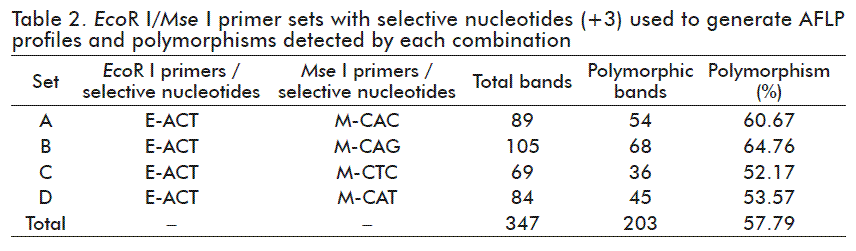
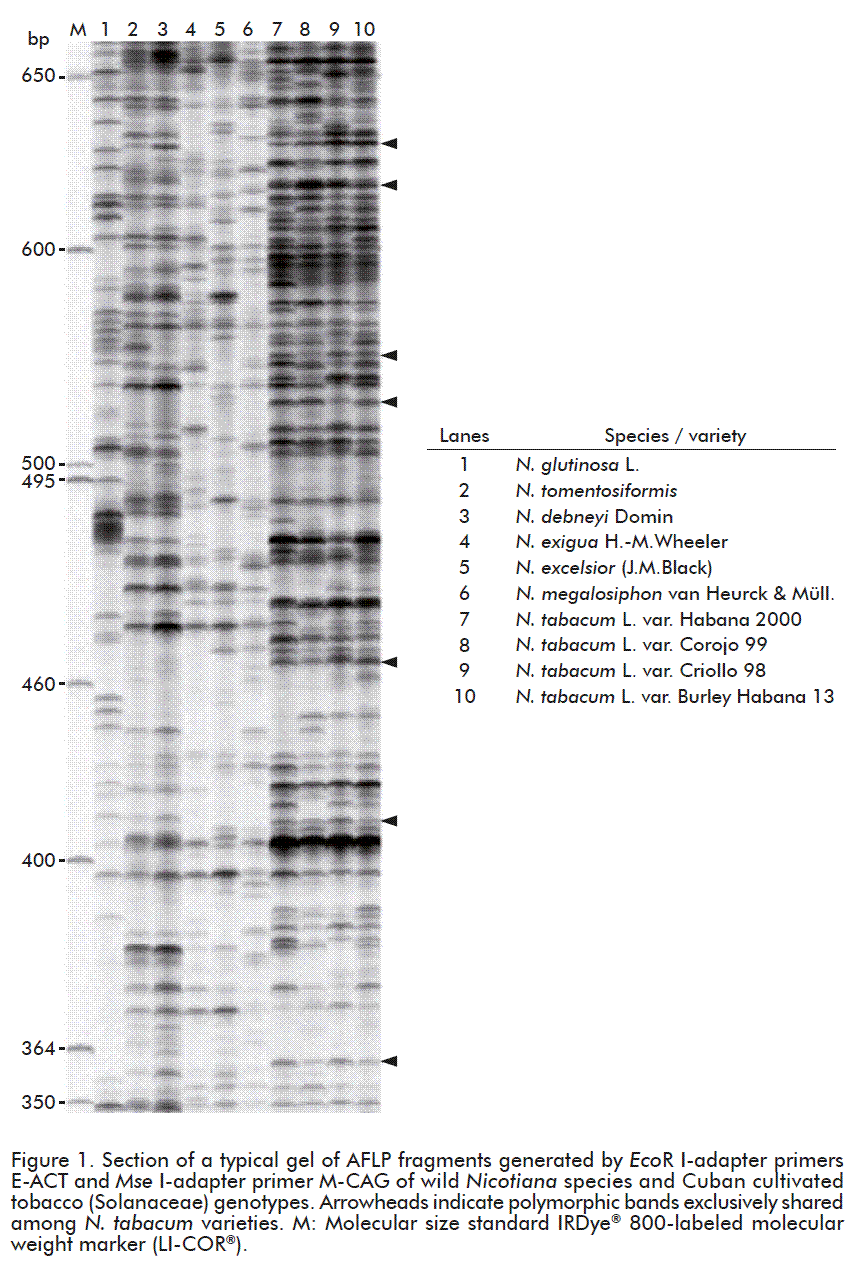
<body><![CDATA[<P   ><font size="2" face="Verdana, Arial, Helvetica, sans-serif"><b>AFLP analysis</b></font></P >       <P   ><font size="2" face="Verdana, Arial, Helvetica, sans-serif">AFLP analysis was      done following the standard procedure described by Vos [17] and using the      IRDye&reg; Fluorescent AFLP Kit&reg; for large plant genome analysis (LI-COR&reg;      Biosciences, USA) as recommended by the manufacturer. High-quality DNA was      digested with a pair of restriction enzymes (<I>Eco</I>R I/<I>Mse </I>I) and      then ligated to adapters. The assembled fragments were pre-amplified with      non-selective primers <I>Eco</I>R I (5&acute;-GACTGCGTACCAATTCA-3&acute;)      and <I>Mse </I>I (5&acute;- GATGAGTCCTGAGTAAC-3&acute;). Subsequently, four      selective primer sets chosen to generate the AFLP profiles: <I>Eco</I>RI +      ACT/<I>Mse </I>I + CAC (E-ACT/M-CAC); <I>Eco</I>R I + ACT/<I>Mse </I>I + CAG      (E-ACT/M-CAG); <I>Eco</I>R I + ACT/<I>Mse </I>I + CTC (E-ACT/M-CTC); <I>Eco</I>RI      + ACT/<I>Mse </I>I + CAT (E-ACT/M-CAT) with <I>Eco</I>R I fluorescent labeled      primers. Amplification products were separated in 6.5 % polyacrylamide gels      using IRDye&reg; 800-labeled molecular weight marker (LI-COR&reg;) as a size      standard (50-700 bp). Band patterns were detected using a LI-COR&reg; DNA      Analyzer model 4200 and photographed with SAGAMX (LI-COR&reg;). </font></P >   <FONT size="+1"><FONT size="+1"><FONT size="+1"><FONT size="+1"><FONT size="+1"><FONT size="+1"><FONT size="+1"><FONT size="+1"><FONT size="+1"><FONT size="+1"><FONT size="+1"><FONT size="+1"><FONT size="+1"><FONT size="+1"><FONT size="+1">        <P   ><font size="2" face="Verdana, Arial, Helvetica, sans-serif"><b>Data analysis</b></font></P >       <P   ><font size="2" face="Verdana, Arial, Helvetica, sans-serif">The patterns of the      amplified fragments were analyzed and scored as discrete characters states      (presence/absence of bands: +/&ndash;) with the software SAGAMX (LI-COR&reg;)      to produce a binary matrix from primary data. A matrix of genetic similarity      was calculated using the metric of Nei and Li [18]. Additionally, a matrix      of genetic distances [19] was generated by the Simple Matching coefficient      [20] between genotypes based on the number of shared bands, and further subjected      to cluster analysis in FreeTree [21]. A dendrogram was constructed based on      the un-weighted pair-group method with arithmetic averages (UPGMA). For the      validation of particular branches, bootstrap analysis </font><font size="2" face="Verdana, Arial, Helvetica, sans-serif">[22]      was carried out using 1000 replicates. </font></P >   <FONT size="+1"><FONT size="+1"><FONT size="+1"><FONT size="+1"><FONT size="+1">        <P   >&nbsp;</P >       <P   > </P >       <P   ><b><font size="3" face="Verdana, Arial, Helvetica, sans-serif">RESULTS </font></b></P >       <P   ><font size="2" face="Verdana, Arial, Helvetica, sans-serif">AFLP profiles revealed      a large number of bands per primer combination which gave fragments of different      size within the range of 200-700 bp. A total of 347 amplification bands were      obtained for the whole set of primers, of which 57.79 % were polymorphic (203).      High levels of polymorphisms were also detected for each primer pair separately      (<a href="/img/revistas/bta/v35n2/t0202218.gif">Table 2</a>). The maximum number of polymorphic fragments      (68 bands, 64.76 %) was amplified by the primer pair E-ACT/M-CAG (<a href="/img/revistas/bta/v35n2/f0102218.gif">Figure      1</a>) whereas the minimum (36, 52.17 %) was obtained with the pair E-ACT/M-CTC.      Since all primer pair&rsquo;s amplifications resulted in more than 50 % polymorphisms,      these results demonstrated the usefulness of these sets for diversity analysis      in <I>Nicotiana </I>spp. </font></P >       
<P   ><font size="2" face="Verdana, Arial, Helvetica, sans-serif">Several fragments      obtained by each primer combination were shared exclusively among <I>N. tabacum      </I>accessions (<a href="/img/revistas/bta/v35n2/f0102218.gif">Figure 1</a>); therefore, they were      identified as species&rsquo; specific markers. </font></P >       
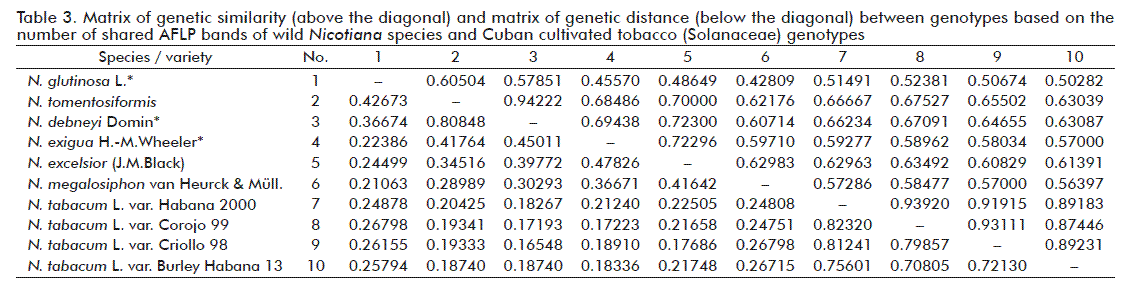
<P   ><font size="2" face="Verdana, Arial, Helvetica, sans-serif">Based on the 203      polymorphic fragments, pairwise comparison among the ten accessions studied      revealed genetic similarities from 0.42809 to 0.94222; whereas genetic distance      ranged from 0.16548 to 0.82320 (<a href="/img/revistas/bta/v35n2/t0302218.gif">Table 3</a>). </font></P >       
]]></body>
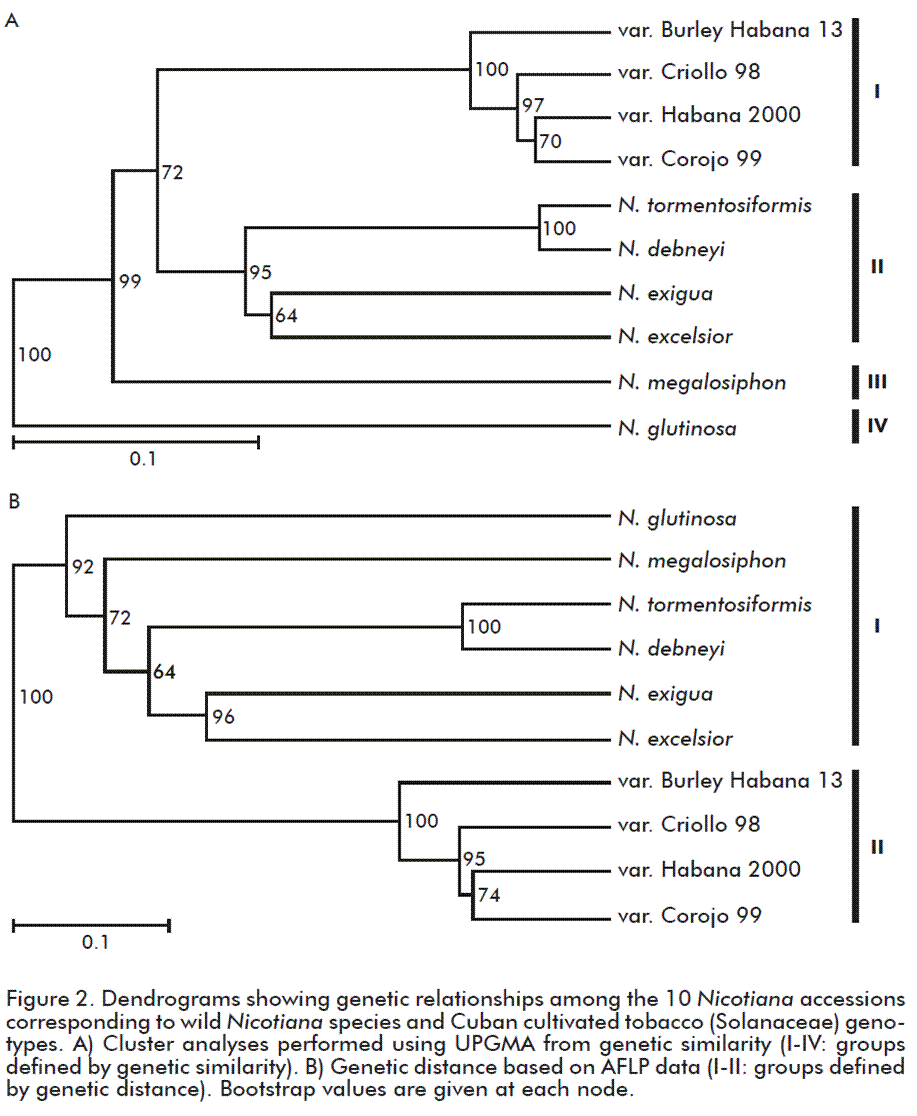
<body><![CDATA[<P   ><font size="2" face="Verdana, Arial, Helvetica, sans-serif">The results of cluster      analyses varied according to the measure used. Based on genetic similarity,      all accessions were grouped into four main groups (<a href="/img/revistas/bta/v35n2/f0202218.gif">Figure      2 A</a>). Attending to genetic distance analysis, accessions were separated      into two main groups (<a href="/img/revistas/bta/v35n2/f0202218.gif">Figure 2 B</a>). Nevertheless,      all cultivars of <I>N. tabacum </I>remained separated from wild species since      they were clearly grouped together with maximum bootstrap support in both      analyses, regardless the measure used for cluster analysis (<a href="/img/revistas/bta/v35n2/f0202218.gif">Figure      2</a>). On the other hand, the greatest differences were observed among wild      species, their grouping patterns are in disagreement with their geographic      origin or phylogenetic relationships previously described. </font></P >       
<P   >&nbsp;</P >       <P   > </P >       <P   ><b><font size="3" face="Verdana, Arial, Helvetica, sans-serif">DISCUSSION </font></b></P >       <P   ><font size="2" face="Verdana, Arial, Helvetica, sans-serif">The results concern      the reliability of the four primer combinations used for assessing genetic      diversity in the genus <I>Nicotiana </I>since all sets provided sufficient      number of polymorphic fragments (&gt; 50 %) to differentiate among studied      accessions (<a href="/img/revistas/bta/v35n2/t0202218.gif">Table 2</a>). Similar results were previously      obtained with other combinations of <I>Eco</I>R I/<I>Mse </I>I primers, which      found higher levels of polymorphism in <I>Nicotiana </I>than those obtained      with other molecular markers such as Sequence-Specific Amplification Polymorphism      (SSAP) [23] and RAPD [24]. </font></P >       
<P   ><font size="2" face="Verdana, Arial, Helvetica, sans-serif">The highest diversity      rates were found among wild species of <I>Nicotiana </I>(<a href="/img/revistas/bta/v35n2/t0302218.gif">Table      3</a>) which is consistent with previous interspecific AFLP variation, as      reported by Ren <I>et al</I>. [12]. As suggested by Mehrotra and Goyal [25],      nuclear DNA in <I>Nicotiana </I>has experienced several reorganizations during      the evolution and diversification of the genus, supporting the high levels      of polymorphism observed among wild species. Phylogenetic reconstructions      based on plastid and nuclear DNA data have established that the genus <I>Nicotiana      </I>is monophyletic and supports the understanding of species relationships      and patterns of divergence according to geographical distribution [1, 26,      27]. Besides, in this study it was not possible to recognize a congruent pattern      between genetic diversity as revealed by AFLP and geographic origin of the      analyzed species. <I>N. megalosiphon </I>showed genetic affinity with <I>N.      glutinosa </I>meanwhile <I>N. tomentosiformis </I>showed affinity with other      Australian species (<a href="/img/revistas/bta/v35n2/f0202218.gif">Figure 2</a>). Most of the presumed      relationships between diploid and polyploidy <I>Nicotiana </I>species have      been confirmed using molecular cytogenetics and mapping of repetitive DNA      [28, 29]. The basic chromosome number of the genus is <I>n </I>= 6, but more      than 30 species (including the entire Australian section <I>Suaveolentes</I>)      are allopolyploids, although some species in section <I>Suaveolentes </I>show      secondary chromosome number reductions in the range of 32 to 48 [3; 27], such      as some of the species from this section analyzed (<a href="/img/revistas/bta/v35n2/t0102218.gif">Table      1</a>). </font></P >       
<P   ><font size="2" face="Verdana, Arial, Helvetica, sans-serif">Regarding <I>N. tabacum</I>,      it is known that about 77 % of the genome is made up of repetitive DNA sequences      [30] which are regarded as responsible for most variations among cultivars.      The high genetic similarity observed among cultivated accessions (0.87446-0.93920,      <a href="/img/revistas/bta/v35n2/t0302218.gif">Table 3</a>) may be related to inbreeding in Cuban      tobacco germplasm, due to the aim of maintaining the desired agronomic and      quality traits during breeding programs. Some studies have pointed out low      levels of genetic diversity among <I>Nicotiana </I>species [31], mainly on      cultivated plants. Zhang <I>et al</I>. [24] selected 28 accessions with similar      agronomic characteristics for an AFLP study. They used 14 selective primers      to screen against all 28 accessions and it resulted in 154 polymorphic fragments      with an average of 15.4 (27.45 %) per primer pair. They also found that high      similarity measures revealed by AFLP in cultivars, which shares gene pools,      were linked to morphological similarities. Such low genetic diversity detected      by AFLP is common among cultivated plants as reported for acid lime [32],      soybean [33] and others. </font></P >       
<P   ><font size="2" face="Verdana, Arial, Helvetica, sans-serif">Regarding the cultivated      varieties, the presence of amplification fragments of similar size shared      exclusively among the four cultivated accessions (<a href="/img/revistas/bta/v35n2/f0102218.gif">Figure      1</a>) may be useful as species&rsquo; specific markers. They also might be      related to inbreeding processes induced by the use of a limited gene pool      in Cuban tobacco germplasm. </font></P >       
<P   ><font size="2" face="Verdana, Arial, Helvetica, sans-serif">Specifically for      the AFLP analysis, it is highly efficiently compared to morphological analyses      and other molecular markers since it covers the entire genome [34]. Other      groups had used it to study genetic polymorphism in tobacco as we implemented      it. For instance, Ren and Timko [12] recommended five combinations, because      they were suitable to detect genetic polymorphism between cultivars (46 lines      of <I>N. tabacum</I>) and seven wild species (<I>N. sylvestris</I>, <I>N.      tomentosiformis</I>, <I>N. otophora</I>, <I>N. glutinosa</I>, <I>N. suaveolens</I>,      <I>N. rustica</I>, and <I>N. longiflora</I>). These authors recommended the      use of the combinations E-ACT + M-CAG and E-ACT + M-CAC which were able to      detect the highest percentage of polymorphism in the genotypes evaluated.      Denduangboripant <I>et al</I>. [35] reported a similar outcome; the highest      percentage of polymorphism (87 %) found among 19 tobacco cultivars by using      the combination E-ACT + M-CAG. This precedent, together with these results      showing the maximum number of polymorphic fragments with the E-ACT + M-CAG      combination, lead us to propose that these AFLP markers could be converted      into Sequence Characterized Amplified Region (SCAR), specific locus markers,      prior confirmation that they can be used for the identification of cultivars      and the studied species. SCAR markers are simpler and less expensive to use      for cultivar identification studies than AFLP markers. </font></P >       <P   ><font size="2" face="Verdana, Arial, Helvetica, sans-serif">On the other hand,      the lowest percentage of polymorphism was obtained with the E-ACT + M-CTC      combination, in agreement with reports by Zhang <I>et al</I>. [24] on the      obtention of just monomorphic amplification products using this combination.      Dadras <I>et al</I>. [36] also used AFLP markers to analyze 50 <I>N. tabacum      </I>genotypes with 21 primer combinations, and high polymorphic rates varying      from 52.63 to 92.59 % were found, demonstrating that the AFLP technique can      be a powerful and valuable tool in the breeding program of <I>N. tabacum</I>.      Overall, these findings indicate that AFLP analysis effectively detects the      genetic diversity enough to differentiate wild species of <I>Nicotiana </I>from      Cuban varieties of <I>N. tabacum</I>. Moreover, they also remark the usefulness      of AFLP for studying the polymorphism of tobacco genome. </font></P >       ]]></body>
<body><![CDATA[<P   ><font size="2" face="Verdana, Arial, Helvetica, sans-serif">Apart from the narrow      genetic diversity present in Cuban varieties, all accessions were identified      by the AFLP analysis. The reduced genetic diversity of the Cuban varieties      represents an important knowledge for further research on cultivar identification      through the utilization of molecular markers. It also emphasizes on the need      to focus on breeding programs improvement by introducing more diverse cultivated      tobacco or using desirable traits found in wild species for cultivated plants.</font></P >       <P   >&nbsp;</P >       <P   > </P >       <P   ><b><font size="3" face="Verdana, Arial, Helvetica, sans-serif">ACKNOWLEDGEMENTS      </font></b></P >       <P   ><font size="2" face="Verdana, Arial, Helvetica, sans-serif">We thank Yosvanis      Acanda Artiga and Humberto Garc&iacute;a Cruz for providing samples of Cuban      tobacco germplasm bank. We are also grateful to Katia Gil-Vega from CINVESTAV      (Mexico) and Miriam Isidr&oacute;n P&eacute;rez from the Agrarian University      of Havana (Cuba) for their assistance with the analyses, and Vitor Fernandes      Oliveira de Miranda (Brazil) for comments on the early manuscript. </font></P >       <P   >&nbsp;</P >       <P   > </P >       <P   ><font size="3"><b><font face="Verdana, Arial, Helvetica, sans-serif">CONFLICTS      OF INTEREST STATEMENT </font></b></font></P >       <P   ><font size="2" face="Verdana, Arial, Helvetica, sans-serif">The authors declare      that there are no conflicts of interest. </font></P >       <P   >&nbsp;</P >       ]]></body>
<body><![CDATA[<P   > </P >       <P   ><b><font size="3" face="Verdana, Arial, Helvetica, sans-serif">REFERENCES </font></b></P >       <!-- ref --><P   ><font size="2" face="Verdana, Arial, Helvetica, sans-serif">1. Clarkson JJ, Knapp      S, Garcia VF, Olmstead RG, Leitch AR, Chase MW. Phylogenetic relationships      in <i>Nicotiana</i> (Solanaceae) inferred from multiple plastid DNA regions.      Mol Phylogenet Evol. 2004;33(1):75-90.    </font></P >       <!-- ref --><P   ><font size="2" face="Verdana, Arial, Helvetica, sans-serif">2. Gerstel DU. Evolutionary      problems in some polyploid crop plants. Hereditas. 1966;2:481-504.    </font></P >       <!-- ref --><P   ><font size="2" face="Verdana, Arial, Helvetica, sans-serif">3. Goodspeed TH.      The genus <i>Nicotiana</i>. Chronica Botanica. 1954;16:1-536.    </font></P >       <!-- ref --><P   ><font size="2" face="Verdana, Arial, Helvetica, sans-serif">4. Vald&eacute;s      M, Gonz&aacute;lez C, Lara RM, Rom&aacute;n MI, Hern&aacute;ndez Y, Hern&aacute;ndez      RM, Cabrera M, <i>et al</i>. Diversidad gen&eacute;tica de especies silvestres      del g&eacute;nero Nicotiana I: caracterizaci&oacute;n mediante marcadores      bioqu&iacute;micos. Rev Protecci&oacute;n Veg. 2010;25:88-97.    </font></P >       ]]></body>
<body><![CDATA[<!-- ref --><P   ><font size="2" face="Verdana, Arial, Helvetica, sans-serif">5. Vald&eacute;s      M, Hern&aacute;ndez Y, V&aacute;zquez A, Pi&ntilde;ero D, Gonz&aacute;lez      L. Diversidad gen&eacute;tica de especies silvestres del g&eacute;nero Nicotiana      II: caracterizaci&oacute;n molecular mediante marcadores RAPD. Rev Protecci&oacute;n      Veg. 2010;25:166-73.    </font></P >       <!-- ref --><P   ><font size="2" face="Verdana, Arial, Helvetica, sans-serif">6. P&eacute;rez S,      Cabezas D, Dom&iacute;nguez Y, Coto O, Garc&iacute;a H. Evaluaci&oacute;n      gen&oacute;mica de los genes<i> pr1</i> y <i>tctp</i> en especies y variedades      detabaco (<i>Nicotiana tabacum</i> L.). Rev Protecci&oacute;n Veg. 2011;26:164-9.    </font></P >       <P   ><font size="2" face="Verdana, Arial, Helvetica, sans-serif">7. Garc&iacute;a      V, Santana N, Garc&iacute;a H, Mena E. &lsquo;Corojo 2006&rsquo;: nueva variedad      cubana de tabaco negro (<i>Nicotiana tabacum</i> L.). Cult Trop. 2013;34(2):45.</font></P >       <P   ><font size="2" face="Verdana, Arial, Helvetica, sans-serif">8. Garc&iacute;a      V, Santana N, Mena E. &lsquo;Burley Pinar 2010&rsquo;: primer cultivar cubano      de tabaco Burley resistente al marchitamiento por Fusarium (<i>Fusarium oxysporum</i>)      y a otras enfermedades de importancia en el cultivo. Cult Trop. 2015;36(2):91.</font></P >       <P   ><font size="2" face="Verdana, Arial, Helvetica, sans-serif">9. Garc&iacute;a      H, Garc&iacute;a V, Pino LA, Espino E. &lsquo;Burley Habana-13&rsquo; primera      variedad comercial obtenida en Cuba por cultivo de anteras con resistencia      al moho azul (<i>Peronospora tabacina</i>), pata prieta (<i>Phytophtora parasitica</i>)      y al virus del mosaico del tabaco (VMT). Cubatabaco. 1999;1:49-54.</font></P >       <!-- ref --><P   ><font size="2" face="Verdana, Arial, Helvetica, sans-serif">10. Espino E. Resultados      de los experimentos de regionalizaci&oacute;n de variedades (2001-2002). Cubatabaco.      2003;4:61-76.    </font></P >       <!-- ref --><P   ><font size="2" face="Verdana, Arial, Helvetica, sans-serif">11. Julio E, Verrier      JL, Dorlhac de Borne F. Development of SCAR markers linked tothree disease      resistances based on AFLP within <i>Nicotiana tabacum </i>L. Theor Appl Genet.      2006;112(2):335-46.    </font></P >       <!-- ref --><P   ><font size="2" face="Verdana, Arial, Helvetica, sans-serif">12. Ren N, Timko      MP. AFLP analysis of genetic polymorphism and evolutionary relationships among      cultivated and wild <i>Nicotiana</i> species. Genome. 2001;44(4):559-71.    </font></P >       <!-- ref --><P   ><font size="2" face="Verdana, Arial, Helvetica, sans-serif">13. Zhang HY, Liu      XZ, Li TS, Yang YM. Genetic diversity among flue-cured tobacco (<i>Nicotiana      tabacum</i> L.) revealed by amplified fragment length polymorphism. Bot Stud.      2006;47:223-9.    </font></P >       <!-- ref --><P   ><font size="2" face="Verdana, Arial, Helvetica, sans-serif">14. Sarala K, Rao      RVS. Genetic diversity in Indian FCV and burley tobacco cultivars. J Genet      2008;87(2):159-63.    </font></P >       <!-- ref --><P   ><font size="2" face="Verdana, Arial, Helvetica, sans-serif">15. Doyle JJ, Doyle      JL. A rapid DNA isolation procedure for small quantities of fresh leaf tissue.      Phytochem Bull. 1987;19:11-5.    </font></P >       <P   ><font size="2" face="Verdana, Arial, Helvetica, sans-serif">16. Ausubel FM, Brent      R, Kingston RE, Moore DD, Seidman JG, Smith JA, <i>et al</i>. Short protocols      in molecular biology: a compendium of methods from Current Protocols in Molecular      Biology. 5th ed. New York, NY, USA: Wiley; 2002. p. 250.</font></P >       ]]></body>
<body><![CDATA[<!-- ref --><P   ><font size="2" face="Verdana, Arial, Helvetica, sans-serif">17. Vos P, Hogers      R, Bleeker M, Reijans M, Lee TVD, Hornes M, <i>et al</i>. AFLP: a new technique      for DNA fingerprinting. Nucleic Acids Res. 1995;23:4407-14.    </font></P >       <!-- ref --><P   ><font size="2" face="Verdana, Arial, Helvetica, sans-serif">18. Nei M, Li WH.      Mathematical model for studying genetic variation in terms of restriction      endonucleases. Proc Natl Acad Sci USA.1979;76:5269-73.    </font></P >       <!-- ref --><P   ><font size="2" face="Verdana, Arial, Helvetica, sans-serif">19. Sokal RR. Principles      and practices of numerical taxonomy. Taxon. 1963;2(5):190-9.    </font></P >       <P   ><font size="2" face="Verdana, Arial, Helvetica, sans-serif">20. Skroch P, Tivang      J, Nienhuis J. Analysis of genetic relationships using RAPD markerdata. In:      The American Society for Horticultural Science and American Genetic Association,      editors. Applications of RAPD technology to plant breeding. Joint plant breeding      symposia series. Minneapolis: Crop Science Society of America; 1992. p. 26-30.</font></P >       <!-- ref --><P   ><font size="2" face="Verdana, Arial, Helvetica, sans-serif">21. Hampl V, Pavl&iacute;cek      J, Flegr J. Construction and bootstrap analysis of DNA fingerprinting-based      phylogenetic trees with the freeware program FreeTree: application to trichomonad      parasites. Int J Syst Evol Micr. 2001;51:731-5.    </font></P >       <!-- ref --><P   ><font size="2" face="Verdana, Arial, Helvetica, sans-serif">22. Felsenstein J.      Confidence Limits on Phylogenies: An Approach Using the Bootstrap. Evolution.      1985;39(4):783-91.    </font></P >       <!-- ref --><P   ><font size="2" face="Verdana, Arial, Helvetica, sans-serif">23. Petit M, Lim      KY, Julio E, Poncet C, Dorlhacde Borne F, Kovarik A, <i>et al</i>. Differential      impact of retrotransposon populations on the genome of allotetraploid tobacco      (<i>Nicotiana tabacum</i>). Mol Genet Genomics. 2007;278(1):1-15.    </font></P >       <!-- ref --><P   ><font size="2" face="Verdana, Arial, Helvetica, sans-serif">24. Zhang HY, Liu      XZ, He CS, Yang YM. Genetic diversity among flue-cured tobacco cultivars based      on RAPD and AFLP markers. Braz Arch Biol Techn. 2008;51:1097-1101.    </font></P >       <!-- ref --><P   ><font size="2" face="Verdana, Arial, Helvetica, sans-serif">25. Mehrotra S, Goyal      V. Repetitive sequences in plant nuclear DNA: types, distribution, evolution      and function. Genomics Proteomics Bioinformatics. 2014;12(4):164-71.    </font></P >       <!-- ref --><P   ><font size="2" face="Verdana, Arial, Helvetica, sans-serif">26. Chase MW, Knapp      S, Cox AV, ClarksonJJ, Butsko Y, Joseph J, <i>et al</i>. Molecular systematics,      GISH and the origin of hybridtaxa in <i>Nicotiana</i> (Solanaceae). Ann Bot.      2003;92(1):107-27.    </font></P >       <!-- ref --><P   ><font size="2" face="Verdana, Arial, Helvetica, sans-serif">27. Knapp S, Chase      MW, Clarkson JJ. Nomenclatural changes and a new sectional classification      in <i>Nicotiana</i> (Solanaceae). Taxon. 2004;53:73-82.    </font></P >       <!-- ref --><P   ><font size="2" face="Verdana, Arial, Helvetica, sans-serif">28. Lim KY, Matyasek      R, Kovarik A, FulnecekJ, Leitch AR. Molecular cytogenetics and tandem repeat      sequence evolution in the allopolyploid <i>Nicotiana rustica</i> compared      with diploid progenitors <i>N. paniculata</i> and <i>N. undulata</i>. Cytogenet      Genome Res. 2005;109(1-3):298-309.    </font></P >       <!-- ref --><P   ><font size="2" face="Verdana, Arial, Helvetica, sans-serif">29. Lim KY, Kovarik      A, Maty&aacute;&ccedil;ek R, Chase MW, Knapp S, McCarthy E, <i>et al</i>.      Comparative genomics and repetitive sequence divergence in the species of      diploid <i>Nicotiana</i> section Alatae. Plant J. 2006;48:907-19.    </font></P >       <!-- ref --><P   ><font size="2" face="Verdana, Arial, Helvetica, sans-serif">30. Renny-Byfield      S, Chester M, Kovarik A, Le Comber SC, Grandbastien MA, Deloger M, <i>et al</i>.      Next generation sequencing reveals genome downsizing in allotetraploid <i>Nicotiana      tabacum</i>, predominantly through the elimination of paternally derived repetitive      DNAs. Mol Biol Evol. 2011;28(10):</font><font size="2" face="Verdana, Arial, Helvetica, sans-serif">2843-54.    </font></P >       <P   ><font size="2" face="Verdana, Arial, Helvetica, sans-serif">31. Darvishzadeh      R, Gholizadeh S, Hatami-Maleki H, Abdollahi B, Bernousi I. Study on genetic      diversity among Iranian water pipe&rsquo;s tobacco (<i>Nicotiana</i> spp.)      varieties by using simple sequence repeat markers. Bulgarian J Agr Sci. 2013;19(3):557-62.</font></P >       <P   ><font size="2" face="Verdana, Arial, Helvetica, sans-serif">32. Al-Sadi AM, Al-Moqbali      HS, Al-Yahyai RA, Al-Said FA. AFLP data suggest a potential role for the low      genetic diversity of acid lime (<i>Citrus auriantifolia</i> Swingle) in Oman      in the outbreak of witches&rsquo; broom disease of lime. Euphytica. 2012;188:285-97.</font></P >       <!-- ref --><P   ><font size="2" face="Verdana, Arial, Helvetica, sans-serif">33. Kondetti P, Jawali      N, Apte SK, Shitole MG. Comparative study of genetic diversity in Indian soybean      (<i>Glycine max</i> L. Merr.) by AP-PCR and AFLP. Ann Biol Res. 2012;3:3825-37.    </font></P >       <!-- ref --><P   ><font size="2" face="Verdana, Arial, Helvetica, sans-serif">34. Zhang Z, van      Parijs FR, Xiao B. The status of AFLP in the genomics era and a pipeline for      converting AFLPs into single-locus markers. Mol Breeding. 2014;34:1245-60.    </font></P >       <!-- ref --><P   ><font size="2" face="Verdana, Arial, Helvetica, sans-serif">35. Denduangboripant      J, Piteekan T, Nantharat M. Genetic polymorphism between tobacco cultivar-groups      revealed by amplified fragment length polymorphism analysis. J Agri Sci. 2010;2:41-8.    </font></P >       <!-- ref --><P   ><font size="2" face="Verdana, Arial, Helvetica, sans-serif">36. Dadras AR, Sabouri      H, Nejad GM, Sabouri A, Shoai-Deylami M. Association analysis, genetic diversity      and structure analysis of tobacco based on AFLP markers. Mol Biol Rep. 2014;41(5):3317-29.    </font></P >       <P   >&nbsp;</P >       <P   >&nbsp;</P >       <P   ></P >       ]]></body>
<body><![CDATA[<P   ><font size="2" face="Verdana, Arial, Helvetica, sans-serif">Received in March,      2018.    <br>     </font><font size="2" face="Verdana, Arial, Helvetica, sans-serif">Accepted      in June, 2018.</font></P >       <P   >&nbsp;</P >       <P   >&nbsp;</P >       <P   ></P >       <P   ><font size="2" face="Verdana, Arial, Helvetica, sans-serif"><i>Sandra Per&eacute;z-&Aacute;lvarez</i>.      Departamento de Biotecnolog&iacute;a Agr&iacute;cola, Unidad Sinaloa, Instituto      Polit&eacute;cnico Nacional, CIIDIR-IPN. Blvd. Juan de Dios B&aacute;tiz Paredes      No 250. Guasave, Sinaloa, CP 81101, M&eacute;xico. E-mail: <A href="mailto:perezalvarezsandra2015@gmail.com">      perezalvarezsandra2015@gmail.com</A>.</font></P >   </font></font></font></font></font></font></font></font></font></font></font></font></font></font></font></font></font></font></font></font></font></font></DIV >      ]]></body><back>
<ref-list>
<ref id="B1">
<label>1</label><nlm-citation citation-type="journal">
<person-group person-group-type="author">
<name>
<surname><![CDATA[Clarkson]]></surname>
<given-names><![CDATA[JJ]]></given-names>
</name>
<name>
<surname><![CDATA[Knapp]]></surname>
<given-names><![CDATA[S]]></given-names>
</name>
<name>
<surname><![CDATA[Garcia]]></surname>
<given-names><![CDATA[VF]]></given-names>
</name>
<name>
<surname><![CDATA[Olmstead]]></surname>
<given-names><![CDATA[RG]]></given-names>
</name>
<name>
<surname><![CDATA[Leitch]]></surname>
<given-names><![CDATA[AR]]></given-names>
</name>
<name>
<surname><![CDATA[Chase]]></surname>
<given-names><![CDATA[MW]]></given-names>
</name>
</person-group>
<article-title xml:lang="en"><![CDATA[Phylogenetic relationships in Nicotiana (Solanaceae) inferred from multiple plastid DNA regions]]></article-title>
<source><![CDATA[Mol Phylogenet Evol]]></source>
<year>2004</year>
<volume>33</volume>
<numero>1</numero>
<issue>1</issue>
<page-range>75-90</page-range></nlm-citation>
</ref>
<ref id="B2">
<label>2</label><nlm-citation citation-type="journal">
<person-group person-group-type="author">
<name>
<surname><![CDATA[Gerstel]]></surname>
<given-names><![CDATA[DU]]></given-names>
</name>
</person-group>
<article-title xml:lang="en"><![CDATA[Evolutionary problems in some polyploid crop plants]]></article-title>
<source><![CDATA[Hereditas]]></source>
<year>1966</year>
<volume>2</volume>
<page-range>481-504</page-range></nlm-citation>
</ref>
<ref id="B3">
<label>3</label><nlm-citation citation-type="journal">
<person-group person-group-type="author">
<name>
<surname><![CDATA[Goodspeed]]></surname>
<given-names><![CDATA[TH]]></given-names>
</name>
</person-group>
<article-title xml:lang="en"><![CDATA[The genus Nicotiana]]></article-title>
<source><![CDATA[Chronica Botanica]]></source>
<year>1954</year>
<volume>16</volume>
<page-range>1-536</page-range></nlm-citation>
</ref>
<ref id="B4">
<label>4</label><nlm-citation citation-type="journal">
<person-group person-group-type="author">
<name>
<surname><![CDATA[Valdés]]></surname>
<given-names><![CDATA[M]]></given-names>
</name>
<name>
<surname><![CDATA[González]]></surname>
<given-names><![CDATA[C]]></given-names>
</name>
<name>
<surname><![CDATA[Lara]]></surname>
<given-names><![CDATA[RM]]></given-names>
</name>
<name>
<surname><![CDATA[Román]]></surname>
<given-names><![CDATA[MI]]></given-names>
</name>
<name>
<surname><![CDATA[Hernández]]></surname>
<given-names><![CDATA[Y]]></given-names>
</name>
<name>
<surname><![CDATA[Hernández]]></surname>
<given-names><![CDATA[RM]]></given-names>
</name>
<name>
<surname><![CDATA[Cabrera]]></surname>
<given-names><![CDATA[M]]></given-names>
</name>
</person-group>
<article-title xml:lang="es"><![CDATA[Diversidad genética de especies silvestres del género Nicotiana I: caracterización mediante marcadores bioquímicos]]></article-title>
<source><![CDATA[Rev Protección Veg]]></source>
<year>2010</year>
<volume>25</volume>
<page-range>88-97</page-range></nlm-citation>
</ref>
<ref id="B5">
<label>5</label><nlm-citation citation-type="journal">
<person-group person-group-type="author">
<name>
<surname><![CDATA[Valdés]]></surname>
<given-names><![CDATA[M]]></given-names>
</name>
<name>
<surname><![CDATA[Hernández]]></surname>
<given-names><![CDATA[Y]]></given-names>
</name>
<name>
<surname><![CDATA[Vázquez]]></surname>
<given-names><![CDATA[A]]></given-names>
</name>
<name>
<surname><![CDATA[Piñero]]></surname>
<given-names><![CDATA[D]]></given-names>
</name>
<name>
<surname><![CDATA[González]]></surname>
<given-names><![CDATA[L]]></given-names>
</name>
</person-group>
<article-title xml:lang="es"><![CDATA[Diversidad genética de especies silvestres del género Nicotiana II: caracterización molecular mediante marcadores RAPD]]></article-title>
<source><![CDATA[Rev Protección Veg]]></source>
<year>2010</year>
<volume>25</volume>
<page-range>166-73</page-range></nlm-citation>
</ref>
<ref id="B6">
<label>6</label><nlm-citation citation-type="journal">
<person-group person-group-type="author">
<name>
<surname><![CDATA[Pérez]]></surname>
<given-names><![CDATA[S]]></given-names>
</name>
<name>
<surname><![CDATA[Cabezas]]></surname>
<given-names><![CDATA[D]]></given-names>
</name>
<name>
<surname><![CDATA[Domínguez]]></surname>
<given-names><![CDATA[Y]]></given-names>
</name>
<name>
<surname><![CDATA[Coto]]></surname>
<given-names><![CDATA[O]]></given-names>
</name>
<name>
<surname><![CDATA[García]]></surname>
<given-names><![CDATA[H]]></given-names>
</name>
</person-group>
<article-title xml:lang="es"><![CDATA[Evaluación genómica de los genes pr1 y tctp en especies y variedades detabaco (Nicotiana tabacum L.)]]></article-title>
<source><![CDATA[Rev Protección Veg]]></source>
<year>2011</year>
<volume>26</volume>
<page-range>164-9</page-range></nlm-citation>
</ref>
<ref id="B7">
<label>7</label><nlm-citation citation-type="journal">
<person-group person-group-type="author">
<name>
<surname><![CDATA[García]]></surname>
<given-names><![CDATA[V]]></given-names>
</name>
<name>
<surname><![CDATA[Santana]]></surname>
<given-names><![CDATA[N]]></given-names>
</name>
<name>
<surname><![CDATA[García]]></surname>
<given-names><![CDATA[H]]></given-names>
</name>
<name>
<surname><![CDATA[Mena]]></surname>
<given-names><![CDATA[E]]></given-names>
</name>
</person-group>
<article-title xml:lang="es"><![CDATA['Corojo 2006': nueva variedad cubana de tabaco negro (Nicotiana tabacum L)]]></article-title>
<source><![CDATA[Cult Trop]]></source>
<year>2013</year>
<volume>34</volume>
<numero>2</numero>
<issue>2</issue>
<page-range>45</page-range></nlm-citation>
</ref>
<ref id="B8">
<label>8</label><nlm-citation citation-type="journal">
<person-group person-group-type="author">
<name>
<surname><![CDATA[García]]></surname>
<given-names><![CDATA[V]]></given-names>
</name>
<name>
<surname><![CDATA[Santana]]></surname>
<given-names><![CDATA[N]]></given-names>
</name>
<name>
<surname><![CDATA[Mena]]></surname>
<given-names><![CDATA[E]]></given-names>
</name>
</person-group>
<article-title xml:lang="es"><![CDATA['Burley Pinar 2010': primer cultivar cubano de tabaco Burley resistente al marchitamiento por Fusarium (Fusarium oxysporum) y a otras enfermedades de importancia en el cultivo]]></article-title>
<source><![CDATA[Cult Trop]]></source>
<year>2015</year>
<volume>36</volume>
<numero>2</numero>
<issue>2</issue>
<page-range>91</page-range></nlm-citation>
</ref>
<ref id="B9">
<label>9</label><nlm-citation citation-type="journal">
<person-group person-group-type="author">
<name>
<surname><![CDATA[García]]></surname>
<given-names><![CDATA[H]]></given-names>
</name>
<name>
<surname><![CDATA[García]]></surname>
<given-names><![CDATA[V]]></given-names>
</name>
<name>
<surname><![CDATA[Pino]]></surname>
<given-names><![CDATA[LA]]></given-names>
</name>
<name>
<surname><![CDATA[Espino]]></surname>
<given-names><![CDATA[E]]></given-names>
</name>
</person-group>
<article-title xml:lang="es"><![CDATA['Burley Habana-Jr' primera variedad comercial obtenida en Cuba por cultivo de anteras con resistencia al moho azul (Peronospora tabacina), pata prieta (Phytophtora parasitica) y al virus del mosaico del tabaco (VMT)]]></article-title>
<source><![CDATA[Cubatabaco]]></source>
<year>1999</year>
<volume>1</volume>
<page-range>49-54</page-range></nlm-citation>
</ref>
<ref id="B10">
<label>10</label><nlm-citation citation-type="journal">
<person-group person-group-type="author">
<name>
<surname><![CDATA[Espino]]></surname>
<given-names><![CDATA[E]]></given-names>
</name>
</person-group>
<article-title xml:lang="es"><![CDATA[Resultados de los experimentos de regionalización de variedades (2001-2002)]]></article-title>
<source><![CDATA[Cubatabaco]]></source>
<year>2003</year>
<volume>4</volume>
<page-range>61-76</page-range></nlm-citation>
</ref>
<ref id="B11">
<label>11</label><nlm-citation citation-type="journal">
<person-group person-group-type="author">
<name>
<surname><![CDATA[Julio]]></surname>
<given-names><![CDATA[E]]></given-names>
</name>
<name>
<surname><![CDATA[Verrier]]></surname>
<given-names><![CDATA[JL]]></given-names>
</name>
<name>
<surname><![CDATA[Dorlhac de Borne]]></surname>
<given-names><![CDATA[F]]></given-names>
</name>
</person-group>
<article-title xml:lang="en"><![CDATA[Development of SCAR markers linked tothree disease resistances based on AFLP within Nicotiana tabacum L]]></article-title>
<source><![CDATA[Theor Appl Genet]]></source>
<year>2006</year>
<volume>112</volume>
<numero>2</numero>
<issue>2</issue>
<page-range>335-46</page-range></nlm-citation>
</ref>
<ref id="B12">
<label>12</label><nlm-citation citation-type="journal">
<person-group person-group-type="author">
<name>
<surname><![CDATA[Ren]]></surname>
<given-names><![CDATA[N]]></given-names>
</name>
<name>
<surname><![CDATA[Timko]]></surname>
<given-names><![CDATA[MP]]></given-names>
</name>
</person-group>
<article-title xml:lang="en"><![CDATA[AFLP analysis of genetic polymorphism and evolutionary relationships among cultivated and wild Nicotiana species]]></article-title>
<source><![CDATA[Genome]]></source>
<year>2001</year>
<volume>44</volume>
<numero>4</numero>
<issue>4</issue>
<page-range>559-71</page-range></nlm-citation>
</ref>
<ref id="B13">
<label>13</label><nlm-citation citation-type="journal">
<person-group person-group-type="author">
<name>
<surname><![CDATA[Zhang]]></surname>
<given-names><![CDATA[HY]]></given-names>
</name>
<name>
<surname><![CDATA[Liu]]></surname>
<given-names><![CDATA[XZ]]></given-names>
</name>
<name>
<surname><![CDATA[Li]]></surname>
<given-names><![CDATA[TS]]></given-names>
</name>
<name>
<surname><![CDATA[Yang]]></surname>
<given-names><![CDATA[YM]]></given-names>
</name>
</person-group>
<article-title xml:lang="en"><![CDATA[Genetic diversity among flue-cured tobacco (Nicotiana tabacum L.) revealed by amplified fragment length polymorphism]]></article-title>
<source><![CDATA[Bot Stud]]></source>
<year>2006</year>
<volume>47</volume>
<page-range>223-9</page-range></nlm-citation>
</ref>
<ref id="B14">
<label>14</label><nlm-citation citation-type="journal">
<person-group person-group-type="author">
<name>
<surname><![CDATA[Sarala]]></surname>
<given-names><![CDATA[K]]></given-names>
</name>
<name>
<surname><![CDATA[Rao]]></surname>
<given-names><![CDATA[RVS]]></given-names>
</name>
</person-group>
<article-title xml:lang="en"><![CDATA[Genetic diversity in Indian FCV and burley tobacco cultivars]]></article-title>
<source><![CDATA[J Genet]]></source>
<year>2008</year>
<volume>87</volume>
<numero>2</numero>
<issue>2</issue>
<page-range>159-63</page-range></nlm-citation>
</ref>
<ref id="B15">
<label>15</label><nlm-citation citation-type="journal">
<person-group person-group-type="author">
<name>
<surname><![CDATA[Doyle]]></surname>
<given-names><![CDATA[JJ]]></given-names>
</name>
<name>
<surname><![CDATA[Doyle]]></surname>
<given-names><![CDATA[JL]]></given-names>
</name>
</person-group>
<article-title xml:lang="en"><![CDATA[A rapid DNA isolation procedure for small quantities of fresh leaf tissue]]></article-title>
<source><![CDATA[Phytochem Bull]]></source>
<year>1987</year>
<volume>19</volume>
<page-range>11-5</page-range></nlm-citation>
</ref>
<ref id="B16">
<label>16</label><nlm-citation citation-type="book">
<person-group person-group-type="author">
<name>
<surname><![CDATA[Ausubel]]></surname>
<given-names><![CDATA[FM]]></given-names>
</name>
<name>
<surname><![CDATA[Brent]]></surname>
<given-names><![CDATA[R]]></given-names>
</name>
<name>
<surname><![CDATA[Kingston]]></surname>
<given-names><![CDATA[RE]]></given-names>
</name>
<name>
<surname><![CDATA[Moore]]></surname>
<given-names><![CDATA[DD]]></given-names>
</name>
<name>
<surname><![CDATA[Seidman]]></surname>
<given-names><![CDATA[JG]]></given-names>
</name>
<name>
<surname><![CDATA[Smith]]></surname>
<given-names><![CDATA[JA]]></given-names>
</name>
</person-group>
<source><![CDATA[Short protocols in molecular biology: a compendium of methods from Current Protocols in Molecular Biology]]></source>
<year>2002</year>
<edition>5</edition>
<publisher-loc><![CDATA[New York, NY, USA ]]></publisher-loc>
<publisher-name><![CDATA[Wiley]]></publisher-name>
</nlm-citation>
</ref>
<ref id="B17">
<label>17</label><nlm-citation citation-type="journal">
<person-group person-group-type="author">
<name>
<surname><![CDATA[Vos]]></surname>
<given-names><![CDATA[P]]></given-names>
</name>
<name>
<surname><![CDATA[Hogers]]></surname>
<given-names><![CDATA[R]]></given-names>
</name>
<name>
<surname><![CDATA[Bleeker]]></surname>
<given-names><![CDATA[M]]></given-names>
</name>
<name>
<surname><![CDATA[Reijans]]></surname>
<given-names><![CDATA[M]]></given-names>
</name>
<name>
<surname><![CDATA[Lee]]></surname>
<given-names><![CDATA[TVD]]></given-names>
</name>
<name>
<surname><![CDATA[Hornes]]></surname>
<given-names><![CDATA[M]]></given-names>
</name>
</person-group>
<article-title xml:lang="en"><![CDATA[AFLP: a new technique for DNA fingerprinting]]></article-title>
<source><![CDATA[Nucleic Acids Res]]></source>
<year>1995</year>
<volume>23</volume>
<page-range>4407-14</page-range></nlm-citation>
</ref>
<ref id="B18">
<label>18</label><nlm-citation citation-type="journal">
<person-group person-group-type="author">
<name>
<surname><![CDATA[Nei]]></surname>
<given-names><![CDATA[M]]></given-names>
</name>
<name>
<surname><![CDATA[Li]]></surname>
<given-names><![CDATA[WH]]></given-names>
</name>
</person-group>
<article-title xml:lang="en"><![CDATA[Mathematical model for studying genetic variation in terms of restriction endonucleases]]></article-title>
<source><![CDATA[Proc Natl Acad Sci USA]]></source>
<year>1979</year>
<volume>76</volume>
<page-range>5269-73</page-range></nlm-citation>
</ref>
<ref id="B19">
<label>19</label><nlm-citation citation-type="journal">
<person-group person-group-type="author">
<name>
<surname><![CDATA[Sokal]]></surname>
<given-names><![CDATA[RR]]></given-names>
</name>
</person-group>
<article-title xml:lang="en"><![CDATA[Principles and practices of numerical taxonomy]]></article-title>
<source><![CDATA[Taxon]]></source>
<year>1963</year>
<volume>2</volume>
<numero>5</numero>
<issue>5</issue>
<page-range>190-9</page-range></nlm-citation>
</ref>
<ref id="B20">
<label>20</label><nlm-citation citation-type="book">
<person-group person-group-type="author">
<name>
<surname><![CDATA[Skroch]]></surname>
<given-names><![CDATA[P]]></given-names>
</name>
<name>
<surname><![CDATA[Tivang]]></surname>
<given-names><![CDATA[J]]></given-names>
</name>
<name>
<surname><![CDATA[Nienhuis]]></surname>
<given-names><![CDATA[J]]></given-names>
</name>
</person-group>
<article-title xml:lang="en"><![CDATA[Analysis of genetic relationships using RAPD markerdata]]></article-title>
<collab>The American Society for Horticultural Science and American Genetic Association</collab>
<source><![CDATA[Applications of RAPD technology to plant breeding. Joint plant breeding symposia series]]></source>
<year>1992</year>
<page-range>26-30</page-range><publisher-loc><![CDATA[Minneapolis ]]></publisher-loc>
<publisher-name><![CDATA[Crop Science Society of America]]></publisher-name>
</nlm-citation>
</ref>
<ref id="B21">
<label>21</label><nlm-citation citation-type="journal">
<person-group person-group-type="author">
<name>
<surname><![CDATA[Hampl]]></surname>
<given-names><![CDATA[V]]></given-names>
</name>
<name>
<surname><![CDATA[Pavlícek]]></surname>
<given-names><![CDATA[J]]></given-names>
</name>
<name>
<surname><![CDATA[Flegr]]></surname>
<given-names><![CDATA[J]]></given-names>
</name>
</person-group>
<article-title xml:lang="en"><![CDATA[Construction and bootstrap analysis of DNA fingerprinting-based phylogenetic trees with the freeware program FreeTree: application to trichomonad parasites]]></article-title>
<source><![CDATA[Int J Syst Evol Micr]]></source>
<year>2001</year>
<volume>51</volume>
<page-range>731-5</page-range></nlm-citation>
</ref>
<ref id="B22">
<label>22</label><nlm-citation citation-type="journal">
<person-group person-group-type="author">
<name>
<surname><![CDATA[Felsenstein]]></surname>
<given-names><![CDATA[J]]></given-names>
</name>
</person-group>
<article-title xml:lang="en"><![CDATA[Confidence Limits on Phylogenies: An Approach Using the Bootstrap]]></article-title>
<source><![CDATA[Evolution]]></source>
<year>1985</year>
<volume>39</volume>
<numero>4</numero>
<issue>4</issue>
<page-range>783-91</page-range></nlm-citation>
</ref>
<ref id="B23">
<label>23</label><nlm-citation citation-type="journal">
<person-group person-group-type="author">
<name>
<surname><![CDATA[Petit]]></surname>
<given-names><![CDATA[M]]></given-names>
</name>
<name>
<surname><![CDATA[Lim]]></surname>
<given-names><![CDATA[KY]]></given-names>
</name>
<name>
<surname><![CDATA[Julio]]></surname>
<given-names><![CDATA[E]]></given-names>
</name>
<name>
<surname><![CDATA[Poncet]]></surname>
<given-names><![CDATA[C]]></given-names>
</name>
<name>
<surname><![CDATA[Dorlhacde Borne]]></surname>
<given-names><![CDATA[F]]></given-names>
</name>
<name>
<surname><![CDATA[Kovarik]]></surname>
<given-names><![CDATA[A]]></given-names>
</name>
</person-group>
<article-title xml:lang="en"><![CDATA[Differential impact of retrotransposon populations on the genome of allotetraploid tobacco (Nicotiana tabacum)]]></article-title>
<source><![CDATA[Mol Genet Genomics]]></source>
<year>2007</year>
<volume>278</volume>
<numero>1</numero>
<issue>1</issue>
<page-range>1-15</page-range></nlm-citation>
</ref>
<ref id="B24">
<label>24</label><nlm-citation citation-type="journal">
<person-group person-group-type="author">
<name>
<surname><![CDATA[Zhang]]></surname>
<given-names><![CDATA[HY]]></given-names>
</name>
<name>
<surname><![CDATA[Liu]]></surname>
<given-names><![CDATA[XZ]]></given-names>
</name>
<name>
<surname><![CDATA[He]]></surname>
<given-names><![CDATA[CS]]></given-names>
</name>
<name>
<surname><![CDATA[Yang]]></surname>
<given-names><![CDATA[YM]]></given-names>
</name>
</person-group>
<article-title xml:lang="en"><![CDATA[Genetic diversity among flue-cured tobacco cultivars based on RAPD and AFLP markers]]></article-title>
<source><![CDATA[Braz Arch Biol Techn]]></source>
<year>2008</year>
<volume>51</volume>
<page-range>1097-1101</page-range></nlm-citation>
</ref>
<ref id="B25">
<label>25</label><nlm-citation citation-type="journal">
<person-group person-group-type="author">
<name>
<surname><![CDATA[Mehrotra]]></surname>
<given-names><![CDATA[S]]></given-names>
</name>
<name>
<surname><![CDATA[Goyal]]></surname>
<given-names><![CDATA[V]]></given-names>
</name>
</person-group>
<article-title xml:lang="en"><![CDATA[Repetitive sequences in plant nuclear DNA: types, distribution, evolution and function]]></article-title>
<source><![CDATA[Genomics Proteomics Bioinformatics]]></source>
<year>2014</year>
<volume>12</volume>
<numero>4</numero>
<issue>4</issue>
<page-range>164-71</page-range></nlm-citation>
</ref>
<ref id="B26">
<label>26</label><nlm-citation citation-type="journal">
<person-group person-group-type="author">
<name>
<surname><![CDATA[Chase]]></surname>
<given-names><![CDATA[MW]]></given-names>
</name>
<name>
<surname><![CDATA[Knapp]]></surname>
<given-names><![CDATA[S]]></given-names>
</name>
<name>
<surname><![CDATA[Cox]]></surname>
<given-names><![CDATA[AV]]></given-names>
</name>
<name>
<surname><![CDATA[Clarkson]]></surname>
<given-names><![CDATA[JJ]]></given-names>
</name>
<name>
<surname><![CDATA[Butsko]]></surname>
<given-names><![CDATA[Y]]></given-names>
</name>
<name>
<surname><![CDATA[Joseph]]></surname>
<given-names><![CDATA[J]]></given-names>
</name>
</person-group>
<article-title xml:lang="en"><![CDATA[Molecular systematics, GISH and the origin of hybridtaxa in Nicotiana (Solanaceae)]]></article-title>
<source><![CDATA[Ann Bot]]></source>
<year>2003</year>
<volume>92</volume>
<numero>1</numero>
<issue>1</issue>
<page-range>107-27</page-range></nlm-citation>
</ref>
<ref id="B27">
<label>27</label><nlm-citation citation-type="journal">
<person-group person-group-type="author">
<name>
<surname><![CDATA[Knapp]]></surname>
<given-names><![CDATA[S]]></given-names>
</name>
<name>
<surname><![CDATA[Chase]]></surname>
<given-names><![CDATA[MW]]></given-names>
</name>
<name>
<surname><![CDATA[Clarkson]]></surname>
<given-names><![CDATA[JJ]]></given-names>
</name>
</person-group>
<article-title xml:lang="en"><![CDATA[Nomenclatural changes and a new sectional classification in Nicotiana (Solanaceae)]]></article-title>
<source><![CDATA[Taxon]]></source>
<year>2004</year>
<volume>53</volume>
<page-range>73-82</page-range></nlm-citation>
</ref>
<ref id="B28">
<label>28</label><nlm-citation citation-type="journal">
<person-group person-group-type="author">
<name>
<surname><![CDATA[Lim]]></surname>
<given-names><![CDATA[KY]]></given-names>
</name>
<name>
<surname><![CDATA[Matyasek]]></surname>
<given-names><![CDATA[R]]></given-names>
</name>
<name>
<surname><![CDATA[Kovarik]]></surname>
<given-names><![CDATA[A]]></given-names>
</name>
<name>
<surname><![CDATA[Fulnecek]]></surname>
<given-names><![CDATA[J]]></given-names>
</name>
<name>
<surname><![CDATA[Leitch]]></surname>
<given-names><![CDATA[AR]]></given-names>
</name>
</person-group>
<article-title xml:lang="en"><![CDATA[Molecular cytogenetics and tandem repeat sequence evolution in the allopolyploid Nicotiana rustica compared with diploid progenitors N. paniculata and N. undulata]]></article-title>
<source><![CDATA[Cytogenet Genome Res]]></source>
<year>2005</year>
<volume>109</volume>
<numero>1</numero>
<issue>1</issue>
<page-range>3):298-309</page-range></nlm-citation>
</ref>
<ref id="B29">
<label>29</label><nlm-citation citation-type="journal">
<person-group person-group-type="author">
<name>
<surname><![CDATA[Lim]]></surname>
<given-names><![CDATA[KY]]></given-names>
</name>
<name>
<surname><![CDATA[Kovarik]]></surname>
<given-names><![CDATA[A]]></given-names>
</name>
<name>
<surname><![CDATA[Matyáçek]]></surname>
<given-names><![CDATA[R]]></given-names>
</name>
<name>
<surname><![CDATA[Chase]]></surname>
<given-names><![CDATA[MW]]></given-names>
</name>
<name>
<surname><![CDATA[Knapp]]></surname>
<given-names><![CDATA[S]]></given-names>
</name>
<name>
<surname><![CDATA[McCarthy]]></surname>
<given-names><![CDATA[E]]></given-names>
</name>
</person-group>
<article-title xml:lang="en"><![CDATA[Comparative genomics and repetitive sequence divergence in the species of diploid Nicotiana section Alatae]]></article-title>
<source><![CDATA[Plant J]]></source>
<year>2006</year>
<volume>48</volume>
<page-range>907-19</page-range></nlm-citation>
</ref>
<ref id="B30">
<label>30</label><nlm-citation citation-type="journal">
<person-group person-group-type="author">
<name>
<surname><![CDATA[Renny-Byfield]]></surname>
<given-names><![CDATA[S]]></given-names>
</name>
<name>
<surname><![CDATA[Chester]]></surname>
<given-names><![CDATA[M]]></given-names>
</name>
<name>
<surname><![CDATA[Kovarik]]></surname>
<given-names><![CDATA[A]]></given-names>
</name>
<name>
<surname><![CDATA[Le Comber]]></surname>
<given-names><![CDATA[SC]]></given-names>
</name>
<name>
<surname><![CDATA[Grandbastien]]></surname>
<given-names><![CDATA[MA]]></given-names>
</name>
<name>
<surname><![CDATA[Deloger]]></surname>
<given-names><![CDATA[M]]></given-names>
</name>
</person-group>
<article-title xml:lang="es"><![CDATA[Next generation sequencing reveals genome downsizing in allotetraploid Nicotiana tabacum, predominantly through the elimination of paternally derived repetitive DNAs]]></article-title>
<source><![CDATA[Mol Biol Evol]]></source>
<year>2011</year>
<volume>28</volume>
<numero>10</numero>
<issue>10</issue>
<page-range>2843-54</page-range></nlm-citation>
</ref>
<ref id="B31">
<label>31</label><nlm-citation citation-type="journal">
<person-group person-group-type="author">
<name>
<surname><![CDATA[Darvishzadeh]]></surname>
<given-names><![CDATA[R]]></given-names>
</name>
<name>
<surname><![CDATA[Gholizadeh]]></surname>
<given-names><![CDATA[S]]></given-names>
</name>
<name>
<surname><![CDATA[Hatami-Maleki]]></surname>
<given-names><![CDATA[H]]></given-names>
</name>
<name>
<surname><![CDATA[Abdollahi]]></surname>
<given-names><![CDATA[B]]></given-names>
</name>
<name>
<surname><![CDATA[Bernousi]]></surname>
<given-names><![CDATA[I]]></given-names>
</name>
</person-group>
<article-title xml:lang="en"><![CDATA[Study on genetic diversity among Iranian water pipe's tobacco (Nicotiana spp.) varieties by using simple sequence repeat markers]]></article-title>
<source><![CDATA[Bulgarian J Agr Sci]]></source>
<year>2013</year>
<volume>19</volume>
<numero>3</numero>
<issue>3</issue>
<page-range>557-62</page-range></nlm-citation>
</ref>
<ref id="B32">
<label>32</label><nlm-citation citation-type="journal">
<person-group person-group-type="author">
<name>
<surname><![CDATA[Al-Sadi]]></surname>
<given-names><![CDATA[AM]]></given-names>
</name>
<name>
<surname><![CDATA[Al-Moqbali]]></surname>
<given-names><![CDATA[HS]]></given-names>
</name>
<name>
<surname><![CDATA[Al-Yahyai]]></surname>
<given-names><![CDATA[RA]]></given-names>
</name>
<name>
<surname><![CDATA[Al-Said]]></surname>
<given-names><![CDATA[FA]]></given-names>
</name>
</person-group>
<article-title xml:lang="en"><![CDATA[AFLP data suggest a potential role for the low genetic diversity of acid lime (Citrus auriantifolia Swingle) in Oman in the outbreak of witches' broom disease of lime]]></article-title>
<source><![CDATA[Euphytica]]></source>
<year>2012</year>
<volume>188</volume>
<page-range>285-97</page-range></nlm-citation>
</ref>
<ref id="B33">
<label>33</label><nlm-citation citation-type="journal">
<person-group person-group-type="author">
<name>
<surname><![CDATA[Kondetti]]></surname>
<given-names><![CDATA[P]]></given-names>
</name>
<name>
<surname><![CDATA[Jawali]]></surname>
<given-names><![CDATA[N]]></given-names>
</name>
<name>
<surname><![CDATA[Apte]]></surname>
<given-names><![CDATA[SK]]></given-names>
</name>
<name>
<surname><![CDATA[Shitole]]></surname>
<given-names><![CDATA[MG]]></given-names>
</name>
</person-group>
<article-title xml:lang="en"><![CDATA[Comparative study of genetic diversity in Indian soybean (Glycine max L. Merr.) by AP-PCR and AFLP]]></article-title>
<source><![CDATA[Ann Biol Res]]></source>
<year>2012</year>
<volume>3</volume>
<page-range>3825-37</page-range></nlm-citation>
</ref>
<ref id="B34">
<label>34</label><nlm-citation citation-type="journal">
<person-group person-group-type="author">
<name>
<surname><![CDATA[Zhang]]></surname>
<given-names><![CDATA[Z]]></given-names>
</name>
<name>
<surname><![CDATA[van Parijs]]></surname>
<given-names><![CDATA[FR]]></given-names>
</name>
<name>
<surname><![CDATA[Xiao]]></surname>
<given-names><![CDATA[B]]></given-names>
</name>
</person-group>
<article-title xml:lang="en"><![CDATA[The status of AFLP in the genomics era and a pipeline for converting AFLPs into single-locus markers]]></article-title>
<source><![CDATA[Mol Breeding]]></source>
<year>2014</year>
<volume>34</volume>
<page-range>1245-60</page-range></nlm-citation>
</ref>
<ref id="B35">
<label>35</label><nlm-citation citation-type="journal">
<person-group person-group-type="author">
<name>
<surname><![CDATA[Denduangboripant]]></surname>
<given-names><![CDATA[J]]></given-names>
</name>
<name>
<surname><![CDATA[Piteekan]]></surname>
<given-names><![CDATA[T]]></given-names>
</name>
<name>
<surname><![CDATA[Nantharat]]></surname>
<given-names><![CDATA[M]]></given-names>
</name>
</person-group>
<article-title xml:lang="en"><![CDATA[Genetic polymorphism between tobacco cultivar-groups revealed by amplified fragment length polymorphism analysis]]></article-title>
<source><![CDATA[J Agri Sci]]></source>
<year>2010</year>
<volume>2</volume>
<page-range>41-8</page-range></nlm-citation>
</ref>
<ref id="B36">
<label>36</label><nlm-citation citation-type="journal">
<person-group person-group-type="author">
<name>
<surname><![CDATA[Dadras]]></surname>
<given-names><![CDATA[AR]]></given-names>
</name>
<name>
<surname><![CDATA[Sabouri]]></surname>
<given-names><![CDATA[H]]></given-names>
</name>
<name>
<surname><![CDATA[Nejad]]></surname>
<given-names><![CDATA[GM]]></given-names>
</name>
<name>
<surname><![CDATA[Sabouri]]></surname>
<given-names><![CDATA[A]]></given-names>
</name>
<name>
<surname><![CDATA[Shoai-Deylami]]></surname>
<given-names><![CDATA[M]]></given-names>
</name>
</person-group>
<article-title xml:lang="en"><![CDATA[Association analysis, genetic diversity and structure analysis of tobacco based on AFLP markers]]></article-title>
<source><![CDATA[Mol Biol Rep]]></source>
<year>2014</year>
<volume>41</volume>
<numero>5</numero>
<issue>5</issue>
<page-range>3317-29</page-range></nlm-citation>
</ref>
</ref-list>
</back>
</article>