<?xml version="1.0" encoding="ISO-8859-1"?><article xmlns:mml="http://www.w3.org/1998/Math/MathML" xmlns:xlink="http://www.w3.org/1999/xlink" xmlns:xsi="http://www.w3.org/2001/XMLSchema-instance">
<front>
<journal-meta>
<journal-id>1027-2852</journal-id>
<journal-title><![CDATA[Biotecnología Aplicada]]></journal-title>
<abbrev-journal-title><![CDATA[Biotecnol Apl]]></abbrev-journal-title>
<issn>1027-2852</issn>
<publisher>
<publisher-name><![CDATA[Editorial Elfos Scientiae]]></publisher-name>
</publisher>
</journal-meta>
<article-meta>
<article-id>S1027-28522018000200003</article-id>
<title-group>
<article-title xml:lang="en"><![CDATA[Influence of plant growth promoting bacteria in seed yields of super-elite sweet potato (Ipomoea batatas Lam) in the field]]></article-title>
<article-title xml:lang="es"><![CDATA[Influencia de bacterias promotoras de crecimiento vegetal en rendimiento de semilla super-elite de batata (Ipomoea batatas Lam.) cultivada en campo]]></article-title>
</title-group>
<contrib-group>
<contrib contrib-type="author">
<name>
<surname><![CDATA[Pérez-Pazos]]></surname>
<given-names><![CDATA[Jazmín V]]></given-names>
</name>
<xref ref-type="aff" rid="A01"/>
</contrib>
<contrib contrib-type="author">
<name>
<surname><![CDATA[Sánchez-López]]></surname>
<given-names><![CDATA[Diana B]]></given-names>
</name>
<xref ref-type="aff" rid="A01"/>
</contrib>
</contrib-group>
<aff id="A01">
<institution><![CDATA[,Corporación Colombiana de Investigación Agropecuaria - Agrosavia Centro de Investigación Turipaná ]]></institution>
<addr-line><![CDATA[ ]]></addr-line>
<country>Colombia</country>
</aff>
<pub-date pub-type="pub">
<day>00</day>
<month>06</month>
<year>2018</year>
</pub-date>
<pub-date pub-type="epub">
<day>00</day>
<month>06</month>
<year>2018</year>
</pub-date>
<volume>35</volume>
<numero>2</numero>
<fpage>2211</fpage>
<lpage>2216</lpage>
<copyright-statement/>
<copyright-year/>
<self-uri xlink:href="http://scielo.sld.cu/scielo.php?script=sci_arttext&amp;pid=S1027-28522018000200003&amp;lng=en&amp;nrm=iso"></self-uri><self-uri xlink:href="http://scielo.sld.cu/scielo.php?script=sci_abstract&amp;pid=S1027-28522018000200003&amp;lng=en&amp;nrm=iso"></self-uri><self-uri xlink:href="http://scielo.sld.cu/scielo.php?script=sci_pdf&amp;pid=S1027-28522018000200003&amp;lng=en&amp;nrm=iso"></self-uri><kwd-group>
<kwd lng="en"><![CDATA[PGPR]]></kwd>
<kwd lng="en"><![CDATA[nitrogen fertilization]]></kwd>
<kwd lng="en"><![CDATA[Azotobacter vinelandii]]></kwd>
<kwd lng="en"><![CDATA[Azospirillum lipoferum]]></kwd>
<kwd lng="en"><![CDATA[sweet potato]]></kwd>
<kwd lng="es"><![CDATA[PGPR]]></kwd>
<kwd lng="es"><![CDATA[fertilización nitrogenada]]></kwd>
<kwd lng="es"><![CDATA[Azotobacter vinelandii]]></kwd>
<kwd lng="es"><![CDATA[Azospirillum lipoferum]]></kwd>
<kwd lng="es"><![CDATA[camote]]></kwd>
</kwd-group>
</article-meta>
</front><body><![CDATA[ <DIV class="Part"   >        <P align="right"   ><font size="2" color="#000000" face="Verdana, Arial, Helvetica, sans-serif"><b>RESEARCH      </b></font></P >       <P align="right"   >&nbsp;</P >   <FONT size="+1" color="#000000">        <P   > </P >       <P   > </P >   <FONT size="+1">       <P   ><font size="4" color="#211E1F" face="Verdana, Arial, Helvetica, sans-serif"><B>Influence      of plant growth promoting bacteria in seed yields of super-elite sweet potato      (<I>Ipomoea batatas </I>Lam) in the field </b></font></P >       <P   >&nbsp;</P >   <FONT size="+1" color="#211E1F"><B>        <P   > </P >       <P   ></P >   </B> <FONT size="+1" color="#000000">       <P   ><font size="3" color="#211E1F" face="Verdana, Arial, Helvetica, sans-serif"><B>Influencia      de bacterias promotoras de crecimiento vegetal en rendimiento de semilla super-elite      de batata (<I>Ipomoea batatas </I>Lam.) cultivada en campo </b></font></P >       ]]></body>
<body><![CDATA[<P   >&nbsp;</P >       <P   >&nbsp;</P >   <FONT size="+1" color="#211E1F">       <P   ></P >   <FONT size="+1" color="#000000">       <P   ><b><font size="2" color="#211E1F" face="Verdana, Arial, Helvetica, sans-serif">Jazm&iacute;n      V P&eacute;rez-Pazos, Diana B S&aacute;nchez-L&oacute;pez </font></b><font size="2" color="#211E1F" face="Verdana, Arial, Helvetica, sans-serif"></font></P >   <FONT size="+1" color="#211E1F">        <P   ><font size="2" face="Verdana, Arial, Helvetica, sans-serif">Corporaci&oacute;n      Colombiana de Investigaci&oacute;n Agropecuaria &ndash; Agrosavia. Centro      de Investigaci&oacute;n Turipan&aacute; &ndash; Km 13 V&iacute;a Monter&iacute;a      - Ceret&eacute;, C&oacute;rdoba, Colombia.</font></P >   <FONT size="+1">        <P   ><font size="2" face="Verdana, Arial, Helvetica, sans-serif">Orcid: 0000000218898248,      0000000197154097.</font></P >       <P   >&nbsp;</P >       <P   >&nbsp;</P >       <P   > </P >   <B> </B></font></font></font></font></font></font></font></font>   <hr>   <FONT size="+1" color="#000000"><FONT size="+1"><FONT size="+1" color="#211E1F"><FONT size="+1" color="#000000"><FONT size="+1" color="#211E1F"><FONT size="+1" color="#000000"><FONT size="+1" color="#211E1F"><FONT size="+1"><B>       <P   ><font size="2" face="Verdana, Arial, Helvetica, sans-serif">ABSTRACT </font></P >   </B>        ]]></body>
<body><![CDATA[<P   ><font size="2" face="Verdana, Arial, Helvetica, sans-serif">Incorporating microorganisms      into plant culture systems has been a strategy for increased yields and to      decrease the use and environmental impact of chemical fertilization. One of      the main crops of the Colombian Caribbean is the sweet potato, due to its      high fiber, mineral, vitamin and antioxidant contents, making it highly demanded      worldwide, and leading to the search for better cultivating conditions. The      purpose of this study was to determine the response in field performance of      super-elite sweet potato vegetative seeds to the inoculation of microorgan-isms      mixed with nitrogen fertilization (NF) in doses of 50 and 75 %. Field experiments      were carried out in two areas of the Colombian Caribbean using the 3&times;2      factorial design, where each treatment consisted of 3 plots of 36 m<sup>2</sup>.      Results show that for the area of Sabanas Colinadas the inoculation of the      combination of <I>Azotobacter chroococcum</I>-IBCR19, <I>Azospirillum lipoferum</I>-IBSC7      and 75 % NF, produced higher yields (14.5 ton/ha), with a significant increase      of 32 %, compared to the treatment with no inoculation and 100% NF. For the      Montes de Mar&iacute;a area the highest yield (15.3 ton/ha) was obtained with      the inoculation of <I>Azotobacter vinelandii</I>-IBCB10 and 75 % NF, showing      an increase of 21 % compared to the treatment having no inoculation and 100      % NF. In both areas, field yields increased with inoculation and there was      a 25 % reduction of NF. These results demonstrate the increased potential      of using microorganisms in sweet potato production systems of the Colombian      Caribbean. </font></P >   <FONT size="+1"><FONT size="+1">        <P   ><font size="2" face="Verdana, Arial, Helvetica, sans-serif"><B><I>Keywords:</I></b>      PGPR, nitrogen fertilization, <I>Azotobacter vinelandii</I>, <I>Azospirillum      lipoferum</I>, sweet potato. </font></P >   </font></font></font></font></font></font></font></font></font></font>    <hr>   <FONT size="+1" color="#000000"><FONT size="+1"><FONT size="+1" color="#211E1F"><FONT size="+1" color="#000000"><FONT size="+1" color="#211E1F"><FONT size="+1" color="#000000"><FONT size="+1" color="#211E1F"><FONT size="+1"><FONT size="+1"><FONT size="+1">       <P   > </P >       <P   ><font size="2" face="Verdana, Arial, Helvetica, sans-serif"><B>RESUMEN </b></font></P >       <P   ><font size="2" face="Verdana, Arial, Helvetica, sans-serif">La incorporaci&oacute;n      de microorganismos a sistemas de cultivo se ha convertido en estrategia para      incrementar los rendimientos de cultivo y disminuir los vol&uacute;menes de      fertilizaci&oacute;n qu&iacute;mica. Uno de los cultivos de importancia en      el Caribe Colombiano es la Batata que, por su alto contenido de fibra, minerales,      vitaminas y antioxidantes, se ha convertido en un producto altamente apetecido      internacionalmente, demandando la b&uacute;squeda de mejores condiciones para      su cultivo. El objetivo de esta investigaci&oacute;n fue determinar la respuesta      de rendimiento en campo de semilla super-elite de batata a la inoculaci&oacute;n      de microorganismos en mezcla con fertilizaci&oacute;n nitrogenada (NF) en      dosis de 50 y 75 %. En dos zonas del Caribe Colombiano se establecieron experimentos      en campo con un arreglo factorial 3&times;2, cada tratamiento consta de 3      parcelas de 36 m<sup>2</sup>. Como resultados se obtuvo que para la zona de      Sabanas Colinadas con la inoculaci&oacute;n de la mezcla de <I>Azotobacter      chroococcum</I>-IBCR19, <I>Azospirillum lipoferum</I>-IBSC7 y 75 %NF se obtienen      el mayor valor de rendimiento (14.5 ton/ha) y presenta un incremento significativo      de </font><font size="2" face="Verdana, Arial, Helvetica, sans-serif">32 %      respecto a tratamiento sin inocular con 100 % NF. Para la zona de Montes de      Mar&iacute;a el mayor valor de rendimiento (15.3 ton/ha) se obtiene con la      inoculaci&oacute;n de <I>Azotobacter vinelandii</I>-IBCB10 y 75 % NF y se      presenta un incremento del 21 % respecto al tratamiento sin inoculaci&oacute;n      al 100 % NF. En las dos zonas se logr&oacute; el incremento del rendimiento      en campo con la inoculaci&oacute;n y una reducci&oacute;n del 25 % de NF,      resultados que demuestran el potencial de los microorganismos en el sistema      de cultivo de batata en el Caribe Colombiano.</font></P >   <FONT size="+1"><FONT size="+1">        <P   ><font size="2" face="Verdana, Arial, Helvetica, sans-serif"><B><I>Palabras clave:</I></B>      PGPR, fertilizaci&oacute;n nitrogenada, <I>Azotobacter vinelandii</I>, <I>Azospirillum      lipoferum</I>, camote. </font></P >   </font></font></font></font></font></font></font></font></font></font></font></font>    <hr>       <p>&nbsp;</p>    <p><FONT size="+1" color="#000000"><FONT size="+1"><FONT size="+1" color="#211E1F"><FONT size="+1" color="#000000"><FONT size="+1" color="#211E1F"><FONT size="+1" color="#000000"><FONT size="+1" color="#211E1F"><FONT size="+1"><FONT size="+1"><FONT size="+1"><FONT size="+1"><FONT size="+1">   </font></font></font></font></font></font></font></font></font></font></font></font></p><FONT size="+1" color="#000000"><FONT size="+1"><FONT size="+1" color="#211E1F"><FONT size="+1" color="#000000"><FONT size="+1" color="#211E1F"><FONT size="+1" color="#000000"><FONT size="+1" color="#211E1F"><FONT size="+1"><FONT size="+1"><FONT size="+1"><FONT size="+1"><FONT size="+1">       <P   > </P >       <P   ><b><font size="3" face="Verdana, Arial, Helvetica, sans-serif">INTRODUCTION </font></b></P >       ]]></body>
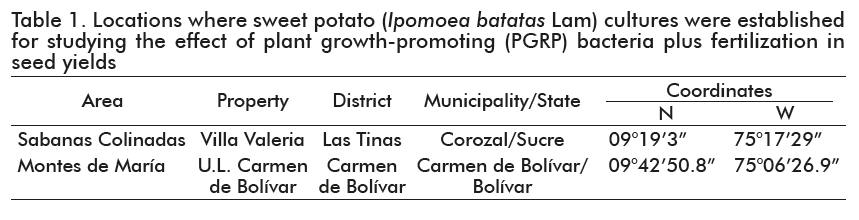
<body><![CDATA[<P   ><font size="2" face="Verdana, Arial, Helvetica, sans-serif">Sweet potatoes hold      third place of preference in root and tuber crops worldwide, only surpassed      by potatoes and cassava. The importance of this crop lies in that its tuberous      root is considered to be a nutritional alternative when used as a fresh produce      for human feeding [1] and forage for animal feeding, it is also a source of      starch, alcohols, and compounds of added value, such as vitamins and antioxidants      [2-4]. Because of its adaptability, sweet potatoes tolerate extreme conditions,      and when it reaches its maximum coverage, the use of fungicides and herbicides      is relatively low. Sweet potatoes are currently considered a promising crop      for increasing agricultural productivity and contributing to the economic      development of the country. </font></P >       <P   ><font size="2" face="Verdana, Arial, Helvetica, sans-serif">The Colombian Caribbean      area is appropriate for growing sweet potatoes, and the Turipan&aacute; Research      Center of the Colombian Agricultural Research Corporation (AGROSAVIA) works      in the validation of technologies for the agronomical management of this crop.      Seed production, as well as the establishment, nutrition and maintenance of      the crop, are some of the factors assessed for improving yields. In nutrition,      within the biotechnological field, research is aimed towards the search for      plant growth promoting microorganisms, as an alternative to the use of chemical      fertilizers [5]. </font></P >       <P   ><font size="2" face="Verdana, Arial, Helvetica, sans-serif">The benefits of plant      growth promoters (PGPR) are well supported [6-11]; however, there are limitations      in the use of biofertilizers since this technology is unable to compete with      chemical fertilizers [10]. This new approach is to evaluate the use of these      microorganisms to reduce chemical fertilizers, and they are then scaled-up      in the field to obtain results that can be extrapolated to a commercial level.      </font></P >       <P   ><font size="2" face="Verdana, Arial, Helvetica, sans-serif">Vegetative seeds      that are mainly formed by apical and pre-apical buds, are used to establish      sweet potatoes in the field, but some plant health problems related to this      type of propagation have been reported [12]. The use of super-elite vegetative      seeds obtained from plants grown in vitro, can guarantee the health of the      crops, as well as increasing viability, uniformity and the consistency of      field yields [13]. Greenhouse reports of the increase of parameters such as      height and radicular weight have been described in super-elite vegetative      seeds of sweet potatoes inoculated with microorganisms [5], but they have      not yet been evaluated in the field. </font></P >       <P   ><font size="2" face="Verdana, Arial, Helvetica, sans-serif">With all this in      mind, this study was aimed to determine the resulting crop yields under field      conditions of the super-elite vegetative seed of sweet potato, in response      to the inoculation of PGPR microorganisms combined with reduced nitrogen fertilization      (NF) at 50 and 75 % of that used in two Colombian Caribbean agricultural areas.      </font></P >       <P   >&nbsp;</P >       <P   ><font size="2" face="Verdana, Arial, Helvetica, sans-serif"><B><font size="3">MATERIALS      AND METHODS </font></b></font></P >   <B>        <P   ><font size="2" face="Verdana, Arial, Helvetica, sans-serif">Location of experiments      </font></P >   </B>        <P   ><font size="2" face="Verdana, Arial, Helvetica, sans-serif">Two locations in      two areas of the Colombian Caribbean were chosen for this study. These were      the area of Sabanas Colinadas and that of Montes de Mar&iacute;a; details      of each area are shown in <a href="/img/revistas/bta/v35n2/t0103218.gif">table 1</a>. </font></P >       
<P   ><font size="2" face="Verdana, Arial, Helvetica, sans-serif"><B>Microorganisms      </b></font></P >       ]]></body>
<body><![CDATA[<P   ><font size="2" face="Verdana, Arial, Helvetica, sans-serif">Strains were provided      by the Microorganism Germplasm Bank-AGROSAVIA of the Turipan&aacute; Research      Center, obtained from the research work reported by P&eacute;rez-Pazos [5].      Two strains were chosen for each area: Sabanas Colinadas Strain 1 was <I>Azotobacter      chroococcum</I>-IBCR19 and Strain 2 <I>Azospirillum lipoferum</I>-IBSC7, and      for Montes de Mar&iacute;a area Strain 1 was <I>Azotobacter vinelandii-</I>IBCB10      and Strain 2 <I>Azotobacter vinelandii-</I>IBCB15. These bacterial strains      were chosen based on their previously demonstrated PGPR properties <I>in vitro</I>,      specifically for the production of total indoles, phosphorus solubilization      and growth stimulation parameters on <I>Ipomoea batatas </I>seedlings under      greenhouse conditions [5]. </font></P >       <P   ><font size="2" face="Verdana, Arial, Helvetica, sans-serif"><B>Fertilization      </b></font></P >       <P   ><font size="2" face="Verdana, Arial, Helvetica, sans-serif">Urea, di-ammonium      phosphate (DAP), and potassium chloride were used for fertilization. Fertilizer      dosages are shown in <a href="/img/revistas/bta/v35n2/t0203218.gif">table 2</a>; they were calculated      according to the fertilization requirements of sweet potatoes plants [14]      and the chemical conditions of the soil in each area (<a href="/img/revistas/bta/v35n2/t0203218.gif">Table      2</a>). </font></P >       
<P   ><font size="2" face="Verdana, Arial, Helvetica, sans-serif"><B>Plant material      </b></font></P >       <P   ><font size="2" face="Verdana, Arial, Helvetica, sans-serif">Super-elite vegetative      seeds of the accession number 15020063 from the germplasm bank of AGROSAVIA,      were chosen as the plant material (<a href="/img/revistas/bta/v35n2/f0103218.gif">Figure 1A</a>).      The seeds were produced in vitro according to the micropropagation protocol      established in the Biotechnology Laboratory of the Turipan&aacute; Research      Center. The hardening of the super-elite seed was performed through two phases      in a greenhouse (<a href="/img/revistas/bta/v35n2/f0103218.gif">Figure 1B</a>). The first phase started      at sowing time until the third week. The plants remained under the sunlight      at a luminosity of 24-27 klumen/m<sup>2</sup>, with photoperiods of light/dark,      of 12/12 hours, at 28-34 &deg;C and a relative humidity of 80-95 %. Foggers      blue base sprayers were used for irrigation, which worked at 40 psi with a      discharge flow of 32 L/h, at intervals of 3 to 12 min and a frequency of 3      to 12 s. The second phase was carried out as of the third to the sixth week.      The plants remained at a luminosity of 63-72 klumen/m<sup>2</sup>, the temperature      was at 34-38 &deg;C and relative humidity of 60-80 %. Irrigation took place      at intervals of 5 to 30 min and the frequency was of 5 to 20 s. Starting on      the second week of hardening, the applications of fungicides and foliar fertilizations      were carried out once a week. When the material reached the sixth week, it      was considered to be suitable for sowing in field (<a href="/img/revistas/bta/v35n2/f0103218.gif">Figure      1C</a>). Constant irrigation in the afternoon was required, starting at sowing      and for a period of 8 days. </font></P >   <FONT size="+1"><FONT size="+1"><FONT size="+1"><FONT size="+1">        
<P   ><font size="2" face="Verdana, Arial, Helvetica, sans-serif"><B>Inoculation of      microorganisms and fertilization </b></font></P >       <P   ><font size="2" face="Verdana, Arial, Helvetica, sans-serif">The inoculation of      microorganisms was made while using nitrogen fertilization (NF). The NF was      applied in two fractions, the first one was of 30 % at 20 days after sowing,      and the second of 70 % at 35-40 days after sowing. At fertilization and inoculation,      the plants had well developed leaves and longitudinal growth, represented      in the coverage of 40-60 %. The inoculation of microorganisms was carried      out directly in the soil at the foot of the plant with 10 mL of the bacterial      suspension having a cellular concentration of 1 &times; 10<sup><sup>8</sup></sup>      cfu/mL in the Luria Bertani medium (peptone 10.0 g/L, yeast extract 5.0 g/L,      sodium chloride 5.0 g/L; pH 7.0 &plusmn; 2). Chemical fertilization was applied      to the soil at each side of the plant at a distance of 5 cm from the stem.      At the Sabanas Colinadas location where phosphorus and potassium were required,      they were added at the time of sowing. </font></P >   <FONT size="+1"><FONT size="+1">        <P   ><font size="2" face="Verdana, Arial, Helvetica, sans-serif"><B>Experimental design      </b></font></P >       <P   ><font size="2" face="Verdana, Arial, Helvetica, sans-serif">In order to evaluate      the effect of strains of microorganisms and NF, a complete random block design      with a 3&times;2 factorial design was established. This corresponded to three      strains per zone (strain 1, strain 2 and a combination of the strains) and      two levels of nitrogen fertilization (50 and 75 %), for a total of six treatments.      </font></P >       <P   ><font size="2" face="Verdana, Arial, Helvetica, sans-serif">Three replicates      were made for each one of the treatments. The field was distributed in experimental      plots of 36 m<sup>2</sup> (5 rows that were 1-m wide and 7.2-m long). The      sowing distance between plants was of 0.4 m for a total of 90 plants per plot.      The response variable established was the total yield of tuberous roots after      the development of the crop for 210 days. The best treatments resulting from      the factorial analysis were compared to a treatment without the inoculation      of microorganisms, having 100 % NF, in order to observe the presence of any      significant differences. </font></P >   <FONT size="+1"><FONT size="+1">        ]]></body>
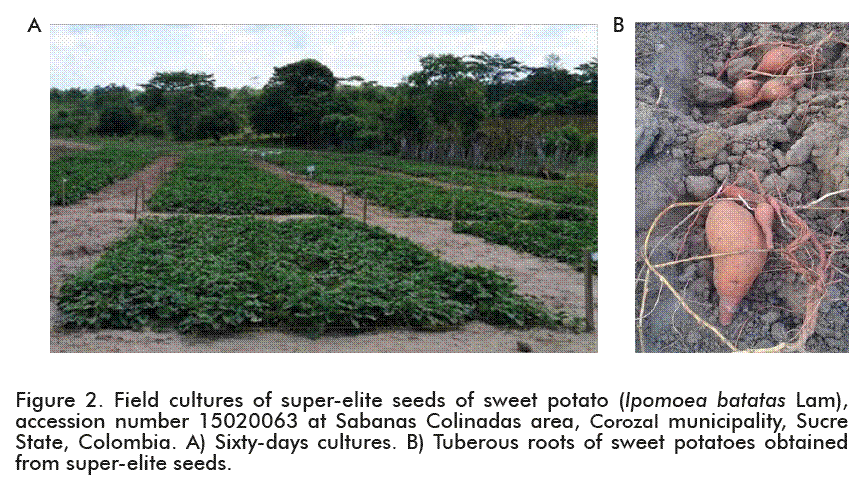
<body><![CDATA[<P   ><font size="2" face="Verdana, Arial, Helvetica, sans-serif"><B>Statistical analysis      </b></font></P >       <P   ><font size="2" face="Verdana, Arial, Helvetica, sans-serif">The yields were analyzed      using a multifactorial analysis of variance using the 3&times;2 factorial      arrangement, to determine the effect of the inoculation of microorganisms      and NF in the field. The best treatments resulting from the factorial analysis      were compared with the treatment without the inoculation having 100 % NF,      using a one-way factorial analysis. Means were compared using the Tukey test      with the 95 % confidence level. The analyses were made using the statistical      software SAS v. 9.2. </font></P >       <P   >&nbsp;</P >       <P   ><font size="2" face="Verdana, Arial, Helvetica, sans-serif"><B><font size="3">RESULTS      AND DISCUSSION </font> </b></font></P >   <B>        <P   ><font size="2" face="Verdana, Arial, Helvetica, sans-serif">Sweet potato yields      under the influence of PGPR bacteria and nitrogen fertilization in the area      of Sabanas Colinadas </font></P >   </B>        <P   ><font size="2" face="Verdana, Arial, Helvetica, sans-serif">The percentage of      survival of the super-elite seed was of 98 %, at eight days after sowing,      reaching 100 % coverage at 60 days after sowing (<a href="/img/revistas/bta/v35n2/f0203218.gif">Figure      2A</a>). This indicates the low proportion of mortality of the seed, making      this super-elite seed a promising material for sweet potato cultivation. Using      the super-elite seed we obtained the tuberous roots under the normal tillage      conditions used for sweet potatoes from the conventional seed (<a href="/img/revistas/bta/v35n2/f0203218.gif">Figure      2B</a>). </font></P >       
<P   ><font size="2" face="Verdana, Arial, Helvetica, sans-serif">The multifactorial      analysis of variance of yields, obtained 210 days after sowing, indicates      that of the independent factors, only nitrogen fertilization (NF) had a statistically      significant effect (p = 0.003), on the response variable. The interaction      of the bacterial strain and NF showed a significant effect (p = 0.036) on      the yield of the tuberous sweet potato roots with a 95 % confidence level.      </font></P >       <P   ><font size="2" face="Verdana, Arial, Helvetica, sans-serif">It must be highlighted      that the soils of Sabanas Colinadas are sandy and have low organic matter      (1.49 %) and nutrients (<a href="/img/revistas/bta/v35n2/t0203218.gif">Table 2</a>), and therefore,      the independent effect of fertilization on yields is probably related to changes      of the nutritional conditions for the plant in this type of soil. The application      of bacterial strains was only significant in the interaction with NF, indicating      that in soils with nutritional deficiencies the bacterial strains depend on      the avail-ability of nutrients in the soil, which is a condition that possibly      affects its effect as a growth stimulator. Similar results were reported by      Singh [11], who evaluated sweet potato yields with treatments submitted to      fertilization combined with <I>Azotobacter</I>, where it was found that with      the combined application of organic and inorganic (NPK) fertilization and      biofertilizers there was a significant improvement in plant growth, yield      and quality parameters, demonstrating the interactive advantage of the use      of inorganic NPK sources combined with biofertilizers, compared to the independent      action of each factor. </font></P >       
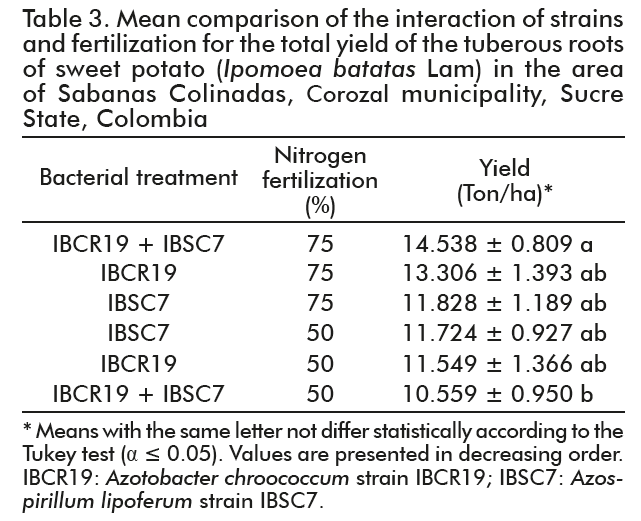
<P   ><font size="2" face="Verdana, Arial, Helvetica, sans-serif">Mean comparisons      were used to determine the effect of the interactions of all factors (<a href="/img/revistas/bta/v35n2/t0303218.gif">Table      3</a>). Results indicated that the effect of the inoculation of microorganisms,      both individually and combined, generated greater yields when they were applied      with 75 % NF. Although there were no significant differences between the strains      inoculated at that fertilization level, the highest yields were obtained with      the inoculation of the mixture, surpassing the treatment with each of the      strains IBCR19 and IBSC7 at nearly 10 and 22 % respectively, and showing a      statistically significant increase of 38 % compared to the treatment with      50 % NF that combined the inoculation of the mixture of bacterial strains      (<a href="/img/revistas/bta/v35n2/t0303218.gif">Table 3</a>). </font></P >       
<P   ><font size="2" face="Verdana, Arial, Helvetica, sans-serif">Results show that      in soils such as those of Sabanas Colinadas, the increase in the level of      fertilization from 50 to 75 %, favors the effect of the <I>A.chroococcum </I>and      <I>A. lipoferum </I>bacterial strains in yields. Based on these results it      can be inferred that the nutritional quality of the soil affects the establishment      of the strains and the biological activity they offer under optimum concentrations.      Similar results were found by Sharma [15], who evaluated the application of      <I>Azospirillum </I>and <I>Azotobacter </I>in four levels of nitrogen and      found that the application of <I>Azospirillum </I>with the maximum nitrogen      level gave the maximum yield of <I>Brassica oleracea</I>. Also, Aswani <I>et      al</I>. [16], who studied the effect of four levels of nitrogen and two sources      of biofertilizers <I>Azotobacter </I>and <I>Azosprillium </I>on the yield      and quality of onion bulbs (<I>Allium cepa </I>L.) observed that the combination      of the high nitrogen fertilizer concentrations potentiated the beneficial      effect of the microorganisms evaluated. </font></P >       ]]></body>
<body><![CDATA[<P   ><font size="2" face="Verdana, Arial, Helvetica, sans-serif">In order to validate      the effect of the inoculation of microorganisms on the yield of sweet potato      root tubers we compared, through a factorial design, the treatments showing      the best results, with a treatment of the complete level of NF (100 %) without      inoculating the microorganisms. The results obtained are shown in <a href="/img/revistas/bta/v35n2/f0303218.gif">figure      3</a>. </font></P >       
<P   ><font size="2" face="Verdana, Arial, Helvetica, sans-serif">The inoculation of      the IBCR19 strain using 75 % NF did not differ significantly from the treatment      without inoculation having 100 % NF, although the average yield of the tuberous      roots of sweet potatoes increased in 21 % (<a href="/img/revistas/bta/v35n2/f0303218.gif">Figure 3</a>).      In relation to the inoculation of the combination of strains IBCR19 + IBSC7      + 75 % NF there was a significant increase (&alpha; &le; 0.05) of 32 % in      the average yield of the tuberous roots of sweet potatoes, of about 3.5 ton/ha      compared to the 100 % NF treatment without the inoculation of microorganisms.      In general terms, these results suggest that the use of microorganisms not      only makes it possible to increase sweet potato yields, but also to substitute      25 % of the NF in the case of tuberous roots of sweet potatoes in the area      of Sabanas Colinadas of the Columbian Caribbean, reaching significant yields      with the combination of the <I>A. chrococcum</I>-IBCR19 and <I>A. lipoferum</I>-      IBSC7 microorganisms. </font></P >       
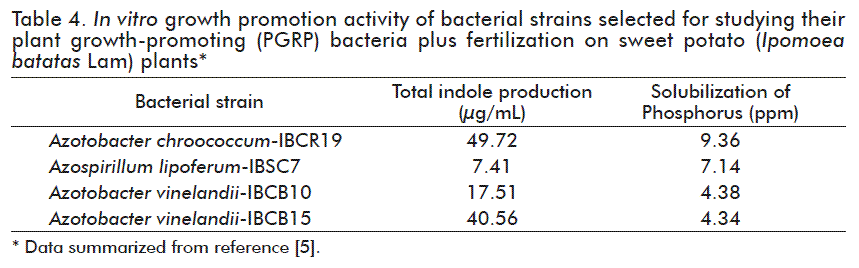
<P   ><font size="2" face="Verdana, Arial, Helvetica, sans-serif">Regarding the use      of these two microorganisms, some reports on sweet potato cultivation in the      field showed increases in yields when inoculating a combination of microorganisms      with fertilization. Yasmin <I>et al</I>. [6], reached yields of 16.72 ton/ha      with the inoculation of <I>Azospirillum </I>and 33 kg of N/ha. Also, Singh      [11] reported that the combination of inorganic fertilization with the inoculation      of <i>Azotobacter</i> significantly increased the weight of sweet potato tubercles      compared to the treatment without the inoculation. These two bacterial strains      show growth promotion characteristics, evidenced in the production of indoles      and the solubilization of phosphorus <I>in vitro </I>(<a href="/img/revistas/bta/v35n2/t0403218.gif">Table      4</a>) [5]. These characteristics enable the interaction of these bacteria      with the plant. The bacteria benefit from many compounds exudated by the plant,      and the plant also benefits from the phytohormones, as well as from the transformation      processes of compounds that are made available to them [7, 17]. Therefore,      the incorporation of </font><font size="2" face="Verdana, Arial, Helvetica, sans-serif">the      bacterial strains <I>A. chrococcum</I>-IBCR19 and <I>A. lipoferum</I>-IBSC7      combined with 75 % NF in potato production systems, favor the growth of the      plant that is finally reflected in the increase in yields of the tuberous      roots. </font></P >       
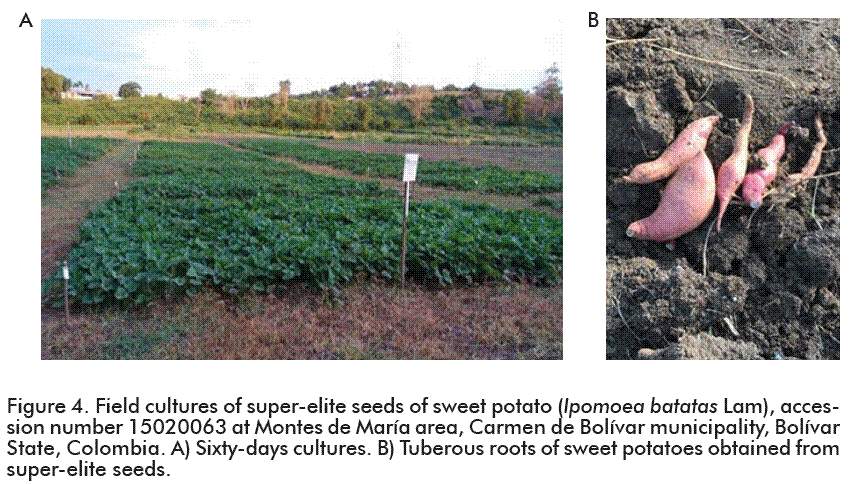
<P   ><font size="2" face="Verdana, Arial, Helvetica, sans-serif"><B>Sweet potato yields      under the influence of bacteria and nitrogen fertilization in the area of      Montes de Mar&iacute;a </b></font></P >       <P   ><font size="2" face="Verdana, Arial, Helvetica, sans-serif">Mortality in the      field of the super-elite seed was of 8 %, at eight days after sowing and reached      100 % coverage at 60 days after sowing (<a href="/img/revistas/bta/v35n2/f0403218.gif">Figure 4A</a>).      This indicates that the seed had a high percentage of survival, thereby confirming      the possibility of the use of this super-elite seed for sowing in the field.      The tuberous roots obtained from the super-elite seed were equal to the normal      ones obtained from the conventional seed (<a href="/img/revistas/bta/v35n2/f0403218.gif">Figure 4B</a>).      </font></P >       
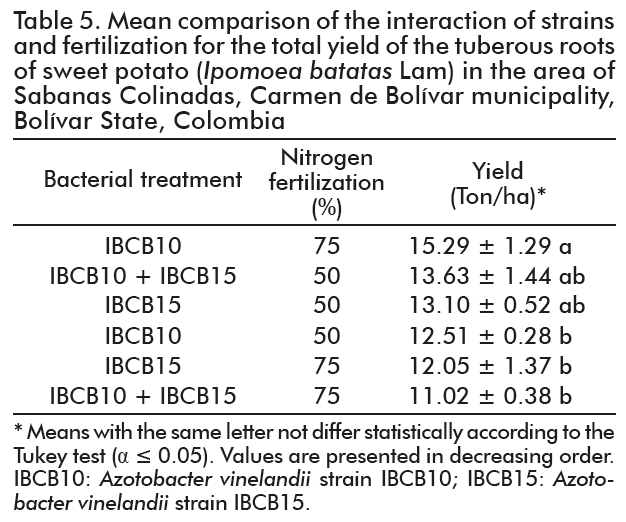
<P   ><font size="2" face="Verdana, Arial, Helvetica, sans-serif">The multifactorial      analysis of variance of yields indicate that in contrast to the Sabanas Colinadas      area, in Montes de Mar&iacute;a the individual strains showed significant      differences (p = 0.0352) in the response variable. The interaction of the      strain and NF was statistically significant with a confidence level of 95      %. </font></P >       <P   ><font size="2" face="Verdana, Arial, Helvetica, sans-serif">Results suggest that      the yields of sweet potatoes in the area of Carmen de Bol&iacute;var depend      both on the bacterial inoculation and on the level of fertilization. Similar      results were obtained for the Colinadas area in this study and the reports      of other authors [15, 16]. This confirms that the incorporation of efficient      microorganisms with NF is a possible alternative for improving the nutritional      conditions of the crop and increasing the yields of sweet potatoes in the      Columbian Caribbean. Means were compared to determine the effect of the interaction      of the factors (<a href="/img/revistas/bta/v35n2/t0503218.gif">Table 5</a>). </font></P >       
<P   ><font size="2" face="Verdana, Arial, Helvetica, sans-serif">The highest average      yield in the field was reached when the sweet potato crop was inoculated with      the IBCB10 strain using 75 % NF, which significantly surpassed (&alpha; &le;      0.05) the rest of the combinations with 75 % NF (<a href="/img/revistas/bta/v35n2/t0503218.gif">Table      5</a>). Considering that the strains used for this area belong to the same      species, the effect of the IBCB10 strain is significantly potentiated with      the inclusion of 75 % NF, compared to 50 % NF in contrast to the IBCB15 strain.      These results are probably related to the production capacity of the phytohormones      of the <I>A. vinelandii</I>-IBCB10 strain, as shown in <a href="/img/revistas/bta/v35n2/t0403218.gif">table      4</a>. The IAA has an important impact on root development by elongating the      primary roots, stimulating density and the length of the root hairs, which      increase the total adsorption surface of the roots [18, 19]. All these factors      are probably favoring the absorption capacity of the nutrients of plants inoculated      with this microorganism [20-22]. Therefore, the 75 % NF level may be considered      in this case the optimum nutrient concentration, enabling the establishment      of the bacterial strain and the growth of the crop, shown by the increase      in sweet potato yield. </font></P >       
<P   ><font size="2" face="Verdana, Arial, Helvetica, sans-serif">It was shown that      using 50 % NF with the inoculation of the combination of strains, yields did      not differ significantly from the treatment with the highest average value      (<a href="/img/revistas/bta/v35n2/t0503218.gif">Table 5</a>). This suggests that for the reduction      of up to 50 % NF in the Montes de Mar&iacute;a soils, the IBCB10 and IBCB15      can offer good yields. The area of Montes de Mar&iacute;a has clay soils.      This type of soil is characterized by an intermediate natural fertility, shown      by its content in organic matter and nutrients (<a href="/img/revistas/bta/v35n2/t0203218.gif">Table      2</a>). In this type of soil 50 % NF would probably be appropriate for establishing      the strains and for their biological activity, in contrast with 75 % NF, where      the yields were lower. These results contrast with those obtained by other      studies [15, 16], where the increase in fertilization favors the effect of      the inoculation of microorganisms. These facts indicate that in the Montes      de Mar&iacute;a soils, the activity of the bacterial strains are probably      influenced by other factors, in addition to the mineral composition of the      soil, the organic matter and even the microbial flora, which has not yet been      characterized. </font></P >       
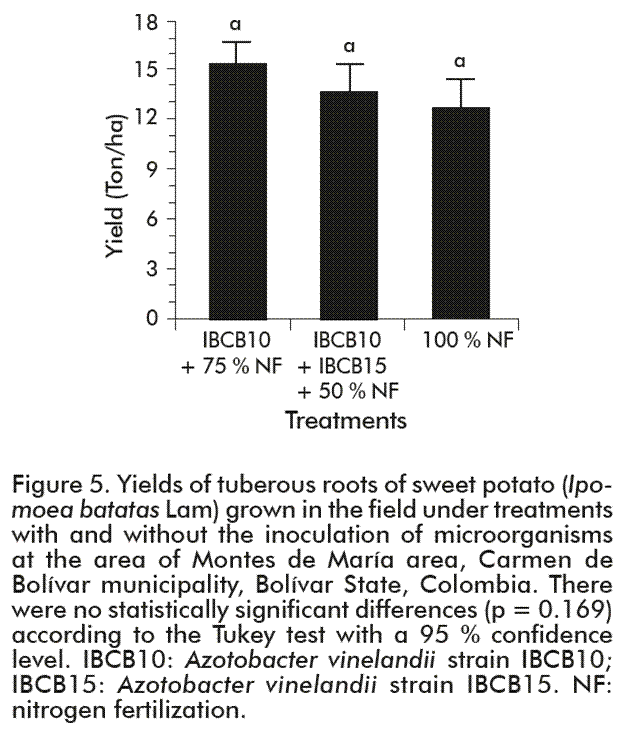
<P   ><font size="2" face="Verdana, Arial, Helvetica, sans-serif">To validate the results      obtained in the treatments with the inoculation of microorganisms where the      highest average yields are obtained, a comparison was made with the treatment      having 100 % NF without inoculation. The results are shown in <a href="/img/revistas/bta/v35n2/f0503218.gif">Figure      5</a>. </font></P >       
]]></body>
<body><![CDATA[<P   ><font size="2" face="Verdana, Arial, Helvetica, sans-serif">No statistically      significant differences were observed between the treatments inoculated with      microorganisms, IBCB10 + 75 % NF and the combination at 50 % NF compared to      the treatment without any inoculation at 100 % NF. This demonstrates that      the inoculation and reduction of the NF does not negatively affect the yields      of tuberous roots. On the contrary, with the inoculation of microorganisms      we obtained increases of up to 21 % in the average yields of tuberous roots      with the inoculation of the IBCB10 strain and 75 % NF observed in 2.7 ton/ha      and 8 % with the treatment of the combination at 50 % NF. This confirms the      potential use of microorganisms to favor yields of the tuberous roots of sweet      potato and the decrease of NF in the cultivation of sweet potatoes in the      area of Montes de Mar&iacute;a of the Colombian Caribbean (<a href="/img/revistas/bta/v35n2/f0503218.gif">Figure      5</a>). </font></P >       
<P   ><font size="2" face="Verdana, Arial, Helvetica, sans-serif">Concerning the yield      of sweet potatoes and as reported by FAOSTAT [23], in the year 2016 there      were 8.6 million hectares cultivated in the world, with a total production      of 105.2 million tons. The contribution to these statistics by South America      corresponds to an area of 107 149 hectares (1.2 %) with a total production      of 1.4 million tons (11.5 %), having an average yield of 13.58 tons/ha. In      Colombia, sweet potato is an emerging crop. In 2008 the area sowed was of      5 hectares, with a production of 25 tons (5 tons/ha) in the Colombian Caribbean      (C&oacute;rdoba) [24]. In this study the area of Sabanas Colinadas (Sucre)      produced a maximum average yield of 14.5 tons/ha, and for the area of Montes      de Mar&iacute;a (Bol&iacute;var) it was of 15.3 tons/ ha. These values are      higher than those generally reported for </font><font size="2" face="Verdana, Arial, Helvetica, sans-serif">the      Colombian Caribbean, and within the range reported for South America, showing      a positive balance for this area of the Colombian Caribbean. </font></P >       <P   >&nbsp;</P >       <P   > </P >       <P   ><b><font size="3" face="Verdana, Arial, Helvetica, sans-serif">CONCLUSIONS</font></b><font size="2" face="Verdana, Arial, Helvetica, sans-serif">      </font></P >       <P   ><font size="2" face="Verdana, Arial, Helvetica, sans-serif">The use of super-elite      vegetative seeds, defined as cuttings obtained from plants that have been      produced by <I>in vitr</I>o propagation, showed over 90 % viability in the      field, generating high quality plants free from phytopathogens and with viable      tuberous roots. The yields in the field were uniform and consistent. These      facts show that the super-elite seed is of a good potential for the field      cultivation of sweet potatoes. </font></P >       <P   ><font size="2" face="Verdana, Arial, Helvetica, sans-serif">In the soils of Sabanas      Colinadas, 75 % NF and the inoculation of the combination of <I>A. chroococcum</I>-IBCR19      and <I>A. lipoferum</I>-IBSC7 bacteria, provides the highest yields (14.5      ton/ha). In the area of Montes de Mar&iacute;a, the highest yields (15.3 ton/ha)      were obtained with the inoculation of the <I>A. vinelandii</I>-IBCB10 bacterium      and 75 % nitrogen fertilization, but for a reduction in nitrogen fertilization      of 50 %, the combination of strains can reach yields of 13.63 tons/ ha, which      does not differ statistically from the best treatment. </font></P >       <P   >&nbsp;</P >       <P   > </P >       <P   ><b><font size="3" face="Verdana, Arial, Helvetica, sans-serif">ACKNOWLEDGEMENTS      </font></b></P >       ]]></body>
<body><![CDATA[<P   ><font size="2" face="Verdana, Arial, Helvetica, sans-serif">We acknowledge the      collaboration of the Ministry of Agriculture and Rural Development of Colombia,      the Agricultural Microbiology Laboratory, and the Biotechnology Laboratory      of the Turipan&aacute; Research Center, of the Colombian Corporation of Agricultural      Research (AGROSAVIA). </font></P >       <P   >&nbsp;</P >       <P   > </P >       <P   ><b><font size="3" face="Verdana, Arial, Helvetica, sans-serif">CONFLICTS OF INTEREST      STATEMENT </font></b></P >       <P   ><font size="2" face="Verdana, Arial, Helvetica, sans-serif">The authors declare      that there are no conflicts of interest. </font></P >       <P   >&nbsp;</P >   <FONT size="+1" color="#000000">        <P   ><font size="3" face="Verdana, Arial, Helvetica, sans-serif"><b>REFERENCES </b></font></P >       <P   > </P >   <FONT size="+1">        <!-- ref --><P   ><font size="2" color="#211E1F" face="Verdana, Arial, Helvetica, sans-serif">1.      Bovell-Benjamin, AC. Sweet potato: a review of its past, present, and future      role in human nutrition. Adv Food Nutr Res. 2007;52:1-59.     </font></P >   <FONT size="+1" color="#211E1F">        ]]></body>
<body><![CDATA[<!-- ref --><P   ><font size="2" face="Verdana, Arial, Helvetica, sans-serif">2. Mohanraj R, Sivasankar      S. Sweet Potato (<I>Ipomoea batatas </I>[L.] Lam)-A valuable medicinal food:      A review. J Med Food. 2014;17(7):733-41.     </font></P >       <!-- ref --><P   ><font size="2" face="Verdana, Arial, Helvetica, sans-serif">3. Pradhan DMP, Archana      M, James G, Chakrabarti SK, Vimala B, Naskar SK, <I>et al</I>. High starch,      beta carotene and anthocyanin rich sweet potato: ascent to future food and      nutrition security in coastal and backward areas. Int J Trop Agric. 2015;33(2):397-400.          </font></P >       <!-- ref --><P   ><font size="2" face="Verdana, Arial, Helvetica, sans-serif">4. Tanaka M, Ishiguro      K, Oki T, Okuno S. Functional components in sweetpotato and their genetic      improvement. Breed Sci. 2017;67(1):52-61.     </font></P >       <!-- ref --><P   ><font size="2" face="Verdana, Arial, Helvetica, sans-serif">5. P&eacute;rez-Pazos      JV, S&aacute;nchez-L&oacute;pez DB. Caracterizaci&oacute;n y efecto de <I>Azotobacter</I>,      <I>Azospirillum </I>y <I>Pseudomonas </I>asociadas a <I>Ipomoea batatas</I>      del Caribe Colombiano. Rev Colomb Biotecnol. 2017;19(2):39-50.     </font></P >       <!-- ref --><P   ><font size="2" face="Verdana, Arial, Helvetica, sans-serif">6. Yasmin F, Othman      R, Sijam K, Saad, MS. Effect of PGPR inoculation on growth and yield of sweetpotato.      J Biol Sci. 2007;(2):421-4.     </font></P >       ]]></body>
<body><![CDATA[<!-- ref --><P   ><font size="2" face="Verdana, Arial, Helvetica, sans-serif">7. Dawwam G E, Elbeltagy      A, Emara, H M, Abbas I H, Hassan M M. Beneficial effect of plant growth promoting      bacteria isolated from the roots of potato plant. Ann Agr Sci. 2013;58(2):195-201.          </font></P >       <P   ><font size="2" face="Verdana, Arial, Helvetica, sans-serif">8. Bashan Y, de-Bashan      LE, Prabhu SR, Hernandez JP. Advances in plant growth-promoting bacterial      inoculant technology: formulations and practical perspectives (1998&ndash;2013).      Plant Soil. 2014;378(1- 2):1-33. </font></P >       <P   ><font size="2" face="Verdana, Arial, Helvetica, sans-serif">9. Glick BR. Introduction      to plant growth-promoting bacteria. In: Beneficial plant-bacterial interactions.      Dordrecht: Springer International Publishing; 2015. p. 1-28. </font></P >       <P   ><font size="2" face="Verdana, Arial, Helvetica, sans-serif">10. Vejan P, Abdullah      R, Khadiran T, Ismail S, Nasrulhaq Boyce A. Role of plant growth promoting      rhizobacteria in agricultural sustainability&mdash; a review. Molecules. 2016;21(5):573.      </font></P >       <P   ><font size="2" face="Verdana, Arial, Helvetica, sans-serif">11. Singh J. Effect      of organic and inorganic sources of NPK and bio-fertilizer on growth, yield      and quality of sweet potato (<I>Ipomoea batatas </I>Lam.). [Master Thesis]      Master of Science in Agriculture (Horticulture). Department of Horticulture      S.K.N. College of Agriculture, Jobner Sri Karan Narendra Agriculture University.      2017. </font></P >       <!-- ref --><P   ><font size="2" face="Verdana, Arial, Helvetica, sans-serif">12. Barba M, Czosnek      H, Hadidi A. Historical perspective, development and applications of next-generation      sequencing in plant virology. Viruses. 2014;6(1):106-36.     </font></P >       <!-- ref --><P   ><font size="2" face="Verdana, Arial, Helvetica, sans-serif">13. Roy PK, Kabir      MH. <I>In vitro </I>mass propagation of sugarcane (<I>Saccharum officinarum      </I>L.) var. Isd 32 through shoot tips and folded leaves culture. Biotechnology.2007;6(4):588-92.          </font></P >       ]]></body>
<body><![CDATA[<!-- ref --><P   ><font size="2" face="Verdana, Arial, Helvetica, sans-serif">14. Folquer F. La      batata (camote): estudio de la planta y su producci&oacute;n comercial Buenos      Aires: Editorial Hemisferio Sur; 1978.     </font></P >       <!-- ref --><P   ><font size="2" face="Verdana, Arial, Helvetica, sans-serif">15. Sharma SK. Effect      of <I>Azospirillum</I>, <I>Azotobacter </I>and nitrogen on growth and yield      of cabbage (<I>Brassica oleracea </I>var capitata). Indian J Agr Sci. 2002.72(9):555-7.          </font></P >       <!-- ref --><P   ><font size="2" face="Verdana, Arial, Helvetica, sans-serif">16. Aswani G, Paliwal      R, Sarolia DK. Effect of nitrogen and bio-fertilizer on yield and quality      of rabi onion (<I>Allium cepa </I>L.) Cv. Puna Red Agric Sci Digest. 2005;25(2):124-6.          </font></P >       <!-- ref --><P   ><font size="2" face="Verdana, Arial, Helvetica, sans-serif">17. Nihorimbere V,      Ongena M, Smargiassi M, Thonart P. Beneficial effect of the rhizosphere microbial      community for plant growth and health. Biotechnol Agron Soc Envir. 2011;15(2):327-37.          </font></P >       <!-- ref --><P   ><font size="2" face="Verdana, Arial, Helvetica, sans-serif">18. Bucio J, Cueva      J, Cantero EV, Becerra C, Rodr&iacute;guez R., Rodr&iacute;guez L. <I>Bacillus      megaterium </I>modifica la arquitectura de la ra&iacute;z de <I>Arabidopsis      </I>independientemente de auxinas y etileno. Biol&oacute;gicas. 2013;11(1):1-8.          </font></P >       ]]></body>
<body><![CDATA[<!-- ref --><P   ><font size="2" face="Verdana, Arial, Helvetica, sans-serif">19. Lara C. Bacterias      nativas con potencial en la producci&oacute;n de &aacute;cido indo ac&eacute;tico      para mejorar los pastos. Zootec Trop. 2014;29(2):187-94.     </font></P >       <!-- ref --><P   ><font size="2" face="Verdana, Arial, Helvetica, sans-serif">20. Ahmad F, Ahmad      I, &amp; Khan M S. Screening of free-living rhizospheric bacteria for their      multiple plant growth promoting activities. Microbiol Res. 2008;163(2):173-81.          </font></P >       <!-- ref --><P   ><font size="2" face="Verdana, Arial, Helvetica, sans-serif">21. Hayat R, Ali      S, Amara U, Khalid R, Ahmed I. Soil beneficial bacteria and their role in      plant growth promotion: a review. Ann Microbiol. 2010;60(4):579-98.     </font></P >       <!-- ref --><P   ><font size="2" face="Verdana, Arial, Helvetica, sans-serif">22. Saharan BS, Nehra      V. Plant growth promoting rhizobacteria: a critical review. Life Sci Med Res.      2007;21(1):1-30.     </font></P >       <P   ><font size="2" face="Verdana, Arial, Helvetica, sans-serif">23. FAOSTAT. Statistics      Division. Food and Agriculture Organization of the United Nations. 1. Viale      delle Terme di Caracalla, Rome, Italy. 2017 [cited 2017 Dec 18]. Available      from: <A href="http://www.fao.org/faostat/en/#data/QC" target="_blank"> <FONT color="#0000FF">http://www.fao.org/faostat/en/#data/QC</font></A>      </font></P >   <FONT color="#0000FF">        <P   ><font color="#211E1F" size="2" face="Verdana, Arial, Helvetica, sans-serif">24.      AGRONET. Red de Informaci&oacute;n y Comunicaci&oacute;n del Sector Agropecuario      Colombiano. Bogot&aacute;: Ministerio de Agricultura y desarrollo rural. 2017      [cited 2017 Dec 18]. Available from: <A href="http://www.agronet.gov.co/estadistica/Paginas/default.aspx" target="_blank">      <FONT color="#0000FF">http://www.agronet.gov.co/estadistica/Paginas/default.aspx</font></A>      </font></P >   <FONT color="#211E1F"><FONT color="#0000FF">        ]]></body>
<body><![CDATA[<P   > </P >       <P   > </P >       <P   >&nbsp;</P >       <P   ><font size="2" color="#211E1F" face="Verdana, Arial, Helvetica, sans-serif">Received      in January, 2018. </font><font size="2" face="Verdana, Arial, Helvetica, sans-serif" color="#000000">    <br>     Accepted in June, 2018. </font></P >   <FONT size="+1" color="#211E1F">        <P   >&nbsp;</P >       <P   > </P >   <FONT size="+1" color="#0000FF">        <P   ><i><font size="2" color="#211E1F" face="Verdana, Arial, Helvetica, sans-serif">Diana      B S&aacute;nchez-L&oacute;pez</font></i><font size="2" color="#211E1F" face="Verdana, Arial, Helvetica, sans-serif">.      Corporaci&oacute;n Colombiana de Investigaci&oacute;n Agropecuaria &ndash;      Agrosavia. Centro de Investigaci&oacute;n Turipan&aacute; &ndash; Km 13 V&iacute;a      Monter&iacute;a - Ceret&eacute;, C&oacute;rdoba, Colombia. E-mail: <A href="mailto:dbsanchez@agrosavia.co">      <FONT color="#0000FF">dbsanchez@agrosavia.co</font></A><FONT color="#0000FF">.</font></font></P >   </font></font></font></font></font></font></font></font></font></font></font></font></font></font></font></font></font></font></font></font></font></font></font></font></font></font></font></font></DIV >      ]]></body><back>
<ref-list>
<ref id="B1">
<label>1</label><nlm-citation citation-type="journal">
<person-group person-group-type="author">
<name>
<surname><![CDATA[Bovell-Benjamin]]></surname>
<given-names><![CDATA[AC]]></given-names>
</name>
</person-group>
<article-title xml:lang="en"><![CDATA[Sweet potato: a review of its past, present, and future role in human nutrition]]></article-title>
<source><![CDATA[Adv Food Nutr Res]]></source>
<year>2007</year>
<volume>52</volume>
<page-range>1-59</page-range></nlm-citation>
</ref>
<ref id="B2">
<label>2</label><nlm-citation citation-type="journal">
<person-group person-group-type="author">
<name>
<surname><![CDATA[Mohanraj]]></surname>
<given-names><![CDATA[R]]></given-names>
</name>
<name>
<surname><![CDATA[Sivasankar]]></surname>
<given-names><![CDATA[S]]></given-names>
</name>
</person-group>
<article-title xml:lang="es"><![CDATA[Sweet Potato (Ipomoea batatas (L.) Lam)-A valuable medicinal food: A review]]></article-title>
<source><![CDATA[J Med Food]]></source>
<year>2014</year>
<volume>17</volume>
<numero>7</numero>
<issue>7</issue>
<page-range>733-41</page-range></nlm-citation>
</ref>
<ref id="B3">
<label>3</label><nlm-citation citation-type="journal">
<person-group person-group-type="author">
<name>
<surname><![CDATA[Pradhan]]></surname>
<given-names><![CDATA[DMP]]></given-names>
</name>
<name>
<surname><![CDATA[Archana]]></surname>
<given-names><![CDATA[M]]></given-names>
</name>
<name>
<surname><![CDATA[James]]></surname>
<given-names><![CDATA[G]]></given-names>
</name>
<name>
<surname><![CDATA[Chakrabarti]]></surname>
<given-names><![CDATA[SK]]></given-names>
</name>
<name>
<surname><![CDATA[Vimala]]></surname>
<given-names><![CDATA[B]]></given-names>
</name>
<name>
<surname><![CDATA[Naskar]]></surname>
<given-names><![CDATA[SK]]></given-names>
</name>
</person-group>
<article-title xml:lang="en"><![CDATA[High starch, beta carotene and anthocyanin rich sweet potato: ascent to future food and nutrition security in coastal and backward areas]]></article-title>
<source><![CDATA[Int J Trop Agric]]></source>
<year>2015</year>
<volume>33</volume>
<numero>2</numero>
<issue>2</issue>
<page-range>397-400</page-range></nlm-citation>
</ref>
<ref id="B4">
<label>4</label><nlm-citation citation-type="journal">
<person-group person-group-type="author">
<name>
<surname><![CDATA[Tanaka]]></surname>
<given-names><![CDATA[M]]></given-names>
</name>
<name>
<surname><![CDATA[Ishiguro]]></surname>
<given-names><![CDATA[K]]></given-names>
</name>
<name>
<surname><![CDATA[Oki]]></surname>
<given-names><![CDATA[T]]></given-names>
</name>
<name>
<surname><![CDATA[Okuno]]></surname>
<given-names><![CDATA[S]]></given-names>
</name>
</person-group>
<article-title xml:lang="en"><![CDATA[Functional components in sweetpotato and their genetic improvement]]></article-title>
<source><![CDATA[Breed Sci]]></source>
<year>2017</year>
<volume>67</volume>
<numero>1</numero>
<issue>1</issue>
<page-range>52-61</page-range></nlm-citation>
</ref>
<ref id="B5">
<label>5</label><nlm-citation citation-type="journal">
<person-group person-group-type="author">
<name>
<surname><![CDATA[Pérez-Pazos]]></surname>
<given-names><![CDATA[JV]]></given-names>
</name>
<name>
<surname><![CDATA[Sánchez-López]]></surname>
<given-names><![CDATA[DB]]></given-names>
</name>
</person-group>
<article-title xml:lang="en"><![CDATA[Caracterización y efecto de Azotobacter, Azospirillum y Pseudomonas asociadas a Ipomoea batatas del Caribe Colombiano]]></article-title>
<source><![CDATA[Rev Colomb Biotecnol]]></source>
<year>2017</year>
<volume>19</volume>
<numero>2</numero>
<issue>2</issue>
<page-range>39-50</page-range></nlm-citation>
</ref>
<ref id="B6">
<label>6</label><nlm-citation citation-type="journal">
<person-group person-group-type="author">
<name>
<surname><![CDATA[Yasmin]]></surname>
<given-names><![CDATA[F]]></given-names>
</name>
<name>
<surname><![CDATA[Othman]]></surname>
<given-names><![CDATA[R]]></given-names>
</name>
<name>
<surname><![CDATA[Sijam]]></surname>
<given-names><![CDATA[K]]></given-names>
</name>
<name>
<surname><![CDATA[Saad]]></surname>
<given-names><![CDATA[MS]]></given-names>
</name>
</person-group>
<article-title xml:lang="en"><![CDATA[Effect of PGPR inoculation on growth and yield of sweetpotato]]></article-title>
<source><![CDATA[J Biol Sci]]></source>
<year>2007</year>
<numero>2</numero>
<issue>2</issue>
<page-range>421-4</page-range></nlm-citation>
</ref>
<ref id="B7">
<label>7</label><nlm-citation citation-type="journal">
<person-group person-group-type="author">
<name>
<surname><![CDATA[Dawwam]]></surname>
<given-names><![CDATA[GE]]></given-names>
</name>
<name>
<surname><![CDATA[Elbeltagy]]></surname>
<given-names><![CDATA[A]]></given-names>
</name>
<name>
<surname><![CDATA[Emara]]></surname>
<given-names><![CDATA[HM]]></given-names>
</name>
<name>
<surname><![CDATA[Abbas]]></surname>
<given-names><![CDATA[IH]]></given-names>
</name>
<name>
<surname><![CDATA[Hassan]]></surname>
<given-names><![CDATA[MM]]></given-names>
</name>
</person-group>
<article-title xml:lang="en"><![CDATA[Beneficial effect of plant growth promoting bacteria isolated from the roots of potato plant]]></article-title>
<source><![CDATA[Ann Agr Sci]]></source>
<year>2013</year>
<volume>58</volume>
<numero>2</numero>
<issue>2</issue>
<page-range>195-201</page-range></nlm-citation>
</ref>
<ref id="B8">
<label>8</label><nlm-citation citation-type="journal">
<person-group person-group-type="author">
<name>
<surname><![CDATA[Bashan]]></surname>
<given-names><![CDATA[Y]]></given-names>
</name>
<name>
<surname><![CDATA[de-Bashan]]></surname>
<given-names><![CDATA[LE]]></given-names>
</name>
<name>
<surname><![CDATA[Prabhu]]></surname>
<given-names><![CDATA[SR]]></given-names>
</name>
<name>
<surname><![CDATA[Hernandez]]></surname>
<given-names><![CDATA[JP]]></given-names>
</name>
</person-group>
<article-title xml:lang="en"><![CDATA[Advances in plant growth-promoting bacterial inoculant technology: formulations and practical perspectives (1998-2013)]]></article-title>
<source><![CDATA[Plant Soil]]></source>
<year>2014</year>
<volume>378</volume>
<numero>1</numero>
<issue>1</issue>
<page-range>2):1-33</page-range></nlm-citation>
</ref>
<ref id="B9">
<label>9</label><nlm-citation citation-type="book">
<person-group person-group-type="author">
<name>
<surname><![CDATA[Glick]]></surname>
<given-names><![CDATA[BR]]></given-names>
</name>
</person-group>
<article-title xml:lang="en"><![CDATA[Introduction to plant growth-promoting bacteria]]></article-title>
<source><![CDATA[Beneficial plant-bacterial interactions]]></source>
<year>2014</year>
<page-range>1-</page-range><publisher-loc><![CDATA[Dordrecht ]]></publisher-loc>
<publisher-name><![CDATA[Springer International Publishing]]></publisher-name>
</nlm-citation>
</ref>
<ref id="B10">
<label>10</label><nlm-citation citation-type="journal">
<person-group person-group-type="author">
<name>
<surname><![CDATA[Vejan]]></surname>
<given-names><![CDATA[P]]></given-names>
</name>
<name>
<surname><![CDATA[Abdullah]]></surname>
<given-names><![CDATA[R]]></given-names>
</name>
<name>
<surname><![CDATA[Khadiran]]></surname>
<given-names><![CDATA[T]]></given-names>
</name>
<name>
<surname><![CDATA[Ismail]]></surname>
<given-names><![CDATA[S]]></given-names>
</name>
<name>
<surname><![CDATA[Nasrulhaq Boyce]]></surname>
<given-names><![CDATA[A]]></given-names>
</name>
</person-group>
<article-title xml:lang="en"><![CDATA[Role of plant growth promoting rhizobacteria in agricultural sustainability- a review]]></article-title>
<source><![CDATA[Molecules]]></source>
<year>2016</year>
<volume>21</volume>
<numero>5</numero>
<issue>5</issue>
<page-range>573</page-range></nlm-citation>
</ref>
<ref id="B11">
<label>11</label><nlm-citation citation-type="book">
<person-group person-group-type="author">
<name>
<surname><![CDATA[Singh]]></surname>
<given-names><![CDATA[J]]></given-names>
</name>
</person-group>
<source><![CDATA[Effect of organic and inorganic sources of NPK and bio-fertilizer on growth, yield and quality of sweet potato (Ipomoea batatas Lam.). (Master Thesis) Master of Science in Agriculture (Horticulture)]]></source>
<year>2017</year>
<publisher-loc><![CDATA[Jaipur ]]></publisher-loc>
<publisher-name><![CDATA[Department of Horticulture S.K.N. College of Agriculture, Jobner Sri Karan Narendra Agriculture University]]></publisher-name>
</nlm-citation>
</ref>
<ref id="B12">
<label>12</label><nlm-citation citation-type="journal">
<person-group person-group-type="author">
<name>
<surname><![CDATA[Barba]]></surname>
<given-names><![CDATA[M]]></given-names>
</name>
<name>
<surname><![CDATA[Czosnek]]></surname>
<given-names><![CDATA[H]]></given-names>
</name>
<name>
<surname><![CDATA[Hadidi]]></surname>
<given-names><![CDATA[A]]></given-names>
</name>
</person-group>
<article-title xml:lang="en"><![CDATA[Historical perspective, development and applications of next-generation sequencing in plant virology]]></article-title>
<source><![CDATA[Viruses]]></source>
<year>2014</year>
<volume>6</volume>
<numero>1</numero>
<issue>1</issue>
<page-range>106-36</page-range></nlm-citation>
</ref>
<ref id="B13">
<label>13</label><nlm-citation citation-type="journal">
<person-group person-group-type="author">
<name>
<surname><![CDATA[Roy]]></surname>
<given-names><![CDATA[PK]]></given-names>
</name>
<name>
<surname><![CDATA[Kabir]]></surname>
<given-names><![CDATA[MH]]></given-names>
</name>
</person-group>
<article-title xml:lang="en"><![CDATA[In vitro mass propagation of sugarcane (Saccharum officinarum L.) var. Isd 32 through shoot tips and folded leaves culture]]></article-title>
<source><![CDATA[Biotechnology]]></source>
<year>2007</year>
<volume>6</volume>
<numero>4</numero>
<issue>4</issue>
<page-range>588-92</page-range></nlm-citation>
</ref>
<ref id="B14">
<label>14</label><nlm-citation citation-type="book">
<person-group person-group-type="author">
<name>
<surname><![CDATA[Folquer]]></surname>
<given-names><![CDATA[F]]></given-names>
</name>
</person-group>
<source><![CDATA[en]]></source>
<year>1978</year>
<publisher-loc><![CDATA[La batata (camote) ]]></publisher-loc>
<publisher-name><![CDATA[estudio de la planta y su producción comercial Buenos Aires: Editorial Hemisferio Sur]]></publisher-name>
</nlm-citation>
</ref>
<ref id="B15">
<label>15</label><nlm-citation citation-type="journal">
<person-group person-group-type="author">
<name>
<surname><![CDATA[Sharma]]></surname>
<given-names><![CDATA[SK]]></given-names>
</name>
</person-group>
<article-title xml:lang="en"><![CDATA[Effect of Azospirillum, Azotobacter and nitrogen on growth and yield of cabbage (Brassica oleracea var capitata)]]></article-title>
<source><![CDATA[Indian J Agr Sci]]></source>
<year>2002</year>
<volume>72</volume>
<numero>9</numero>
<issue>9</issue>
<page-range>555-7</page-range></nlm-citation>
</ref>
<ref id="B16">
<label>16</label><nlm-citation citation-type="journal">
<person-group person-group-type="author">
<name>
<surname><![CDATA[Aswani]]></surname>
<given-names><![CDATA[G]]></given-names>
</name>
<name>
<surname><![CDATA[Paliwal]]></surname>
<given-names><![CDATA[R]]></given-names>
</name>
<name>
<surname><![CDATA[Sarolia]]></surname>
<given-names><![CDATA[DK]]></given-names>
</name>
</person-group>
<article-title xml:lang="en"><![CDATA[Effect of nitrogen and bio-fertilizer on yield and quality of rabi onion (Allium cepa L.) Cv]]></article-title>
<source><![CDATA[Puna Red Agric Sci Digest]]></source>
<year>2005</year>
<volume>25</volume>
<numero>2</numero>
<issue>2</issue>
<page-range>124-6</page-range></nlm-citation>
</ref>
<ref id="B17">
<label>17</label><nlm-citation citation-type="journal">
<person-group person-group-type="author">
<name>
<surname><![CDATA[Nihorimbere]]></surname>
<given-names><![CDATA[V]]></given-names>
</name>
<name>
<surname><![CDATA[Ongena]]></surname>
<given-names><![CDATA[M]]></given-names>
</name>
<name>
<surname><![CDATA[Smargiassi]]></surname>
<given-names><![CDATA[M]]></given-names>
</name>
<name>
<surname><![CDATA[Thonart]]></surname>
<given-names><![CDATA[P]]></given-names>
</name>
</person-group>
<article-title xml:lang="en"><![CDATA[Beneficial effect of the rhizosphere microbial community for plant growth and health]]></article-title>
<source><![CDATA[Biotechnol Agron Soc Envir]]></source>
<year>2011</year>
<volume>15</volume>
<numero>2</numero>
<issue>2</issue>
<page-range>327-37</page-range></nlm-citation>
</ref>
<ref id="B18">
<label>18</label><nlm-citation citation-type="journal">
<person-group person-group-type="author">
<name>
<surname><![CDATA[Bucio]]></surname>
<given-names><![CDATA[J]]></given-names>
</name>
<name>
<surname><![CDATA[Cueva]]></surname>
<given-names><![CDATA[J]]></given-names>
</name>
<name>
<surname><![CDATA[Cantero]]></surname>
<given-names><![CDATA[EV]]></given-names>
</name>
<name>
<surname><![CDATA[Becerra]]></surname>
<given-names><![CDATA[C]]></given-names>
</name>
<name>
<surname><![CDATA[Rodríguez]]></surname>
<given-names><![CDATA[R]]></given-names>
</name>
<name>
<surname><![CDATA[Rodríguez]]></surname>
<given-names><![CDATA[L]]></given-names>
</name>
</person-group>
<article-title xml:lang="es"><![CDATA[Bacillus megaterium modifica la arquitectura de la raíz de Arabidopsis independientemente de auxinas y etileno]]></article-title>
<source><![CDATA[Biológicas]]></source>
<year>2013</year>
<volume>11</volume>
<numero>1</numero>
<issue>1</issue>
<page-range>1-8</page-range></nlm-citation>
</ref>
<ref id="B19">
<label>19</label><nlm-citation citation-type="journal">
<person-group person-group-type="author">
<name>
<surname><![CDATA[Lara]]></surname>
<given-names><![CDATA[C]]></given-names>
</name>
</person-group>
<article-title xml:lang="es"><![CDATA[Bacterias nativas con potencial en la producción de ácido indo acético para mejorar los pastos]]></article-title>
<source><![CDATA[Zootec Trop]]></source>
<year>2014</year>
<volume>29</volume>
<numero>2</numero>
<issue>2</issue>
<page-range>187-94</page-range></nlm-citation>
</ref>
<ref id="B20">
<label>20</label><nlm-citation citation-type="journal">
<person-group person-group-type="author">
<name>
<surname><![CDATA[Ahmad]]></surname>
<given-names><![CDATA[F]]></given-names>
</name>
<name>
<surname><![CDATA[Ahmad]]></surname>
<given-names><![CDATA[I]]></given-names>
</name>
<name>
<surname><![CDATA[& Khan M]]></surname>
<given-names><![CDATA[S]]></given-names>
</name>
</person-group>
<article-title xml:lang="en"><![CDATA[Screening of free-living rhizospheric bacteria for their multiple plant growth promoting activities]]></article-title>
<source><![CDATA[Microbiol Res]]></source>
<year>2008</year>
<volume>163</volume>
<numero>2</numero>
<issue>2</issue>
<page-range>173-81</page-range></nlm-citation>
</ref>
<ref id="B21">
<label>21</label><nlm-citation citation-type="journal">
<person-group person-group-type="author">
<name>
<surname><![CDATA[Hayat]]></surname>
<given-names><![CDATA[R]]></given-names>
</name>
<name>
<surname><![CDATA[Ali]]></surname>
<given-names><![CDATA[S]]></given-names>
</name>
<name>
<surname><![CDATA[Amara]]></surname>
<given-names><![CDATA[U]]></given-names>
</name>
<name>
<surname><![CDATA[Khalid]]></surname>
<given-names><![CDATA[R]]></given-names>
</name>
<name>
<surname><![CDATA[Ahmed]]></surname>
<given-names><![CDATA[I]]></given-names>
</name>
</person-group>
<article-title xml:lang="en"><![CDATA[Soil beneficial bacteria and their role in plant growth promotion: a review]]></article-title>
<source><![CDATA[Ann Microbiol]]></source>
<year>2010</year>
<volume>60</volume>
<numero>4</numero>
<issue>4</issue>
<page-range>579-98</page-range></nlm-citation>
</ref>
<ref id="B22">
<label>22</label><nlm-citation citation-type="journal">
<person-group person-group-type="author">
<name>
<surname><![CDATA[Saharan]]></surname>
<given-names><![CDATA[BS]]></given-names>
</name>
<name>
<surname><![CDATA[Nehra]]></surname>
<given-names><![CDATA[V]]></given-names>
</name>
</person-group>
<article-title xml:lang="en"><![CDATA[Plant growth promoting rhizobacteria: a critical review]]></article-title>
<source><![CDATA[Life Sci Med Res]]></source>
<year>2007</year>
<volume>21</volume>
<numero>1</numero>
<issue>1</issue>
<page-range>1-30</page-range></nlm-citation>
</ref>
<ref id="B23">
<label>23</label><nlm-citation citation-type="book">
<collab>FAO</collab>
<source><![CDATA[FAOSTAT]]></source>
<year>2017</year>
<month>20</month>
<day>17</day>
<publisher-loc><![CDATA[Rome ]]></publisher-loc>
<publisher-name><![CDATA[Statistics Division. Food and Agriculture Organization of the United Nations]]></publisher-name>
</nlm-citation>
</ref>
<ref id="B24">
<label>24</label><nlm-citation citation-type="book">
<collab>Ministerio de Agricultura y desarrollo rural</collab>
<source><![CDATA[AGRONET. Red de Información y Comunicación del Sector Agropecuario Colombiano]]></source>
<year>2017</year>
<publisher-loc><![CDATA[Bogotá ]]></publisher-loc>
<publisher-name><![CDATA[Ministerio de Agricultura y desarrollo rural]]></publisher-name>
</nlm-citation>
</ref>
</ref-list>
</back>
</article>