<?xml version="1.0" encoding="ISO-8859-1"?><article xmlns:mml="http://www.w3.org/1998/Math/MathML" xmlns:xlink="http://www.w3.org/1999/xlink" xmlns:xsi="http://www.w3.org/2001/XMLSchema-instance">
<front>
<journal-meta>
<journal-id>1027-2852</journal-id>
<journal-title><![CDATA[Biotecnología Aplicada]]></journal-title>
<abbrev-journal-title><![CDATA[Biotecnol Apl]]></abbrev-journal-title>
<issn>1027-2852</issn>
<publisher>
<publisher-name><![CDATA[Editorial Elfos Scientiae]]></publisher-name>
</publisher>
</journal-meta>
<article-meta>
<article-id>S1027-28522018000300002</article-id>
<title-group>
<article-title xml:lang="en"><![CDATA[Single dose toxicity non-clinical evaluation of the anti-meningococcal vaccine VA-MENGOC-BC® in Sprague Dawley rats to extend its shelf-life to 36 months]]></article-title>
<article-title xml:lang="es"><![CDATA[Toxicidad por dosis única de la vacuna antimeningocóccica VA-MENGOC-BC® en ratas Sprague Dawley para extender su vida útil en anaquel hasta 36 meses]]></article-title>
</title-group>
<contrib-group>
<contrib contrib-type="author">
<name>
<surname><![CDATA[Oliva-Hernández]]></surname>
<given-names><![CDATA[Reynaldo]]></given-names>
</name>
<xref ref-type="aff" rid="A01"/>
</contrib>
<contrib contrib-type="author">
<name>
<surname><![CDATA[Fariñas-Medina]]></surname>
<given-names><![CDATA[Mildrey]]></given-names>
</name>
<xref ref-type="aff" rid="A01"/>
</contrib>
<contrib contrib-type="author">
<name>
<surname><![CDATA[Hernández-Salazar]]></surname>
<given-names><![CDATA[Tamara]]></given-names>
</name>
<xref ref-type="aff" rid="A01"/>
</contrib>
<contrib contrib-type="author">
<name>
<surname><![CDATA[Infante-Bourzac]]></surname>
<given-names><![CDATA[Juan F]]></given-names>
</name>
<xref ref-type="aff" rid="A01"/>
</contrib>
<contrib contrib-type="author">
<name>
<surname><![CDATA[Núñez-Martínez]]></surname>
<given-names><![CDATA[Darcy]]></given-names>
</name>
<xref ref-type="aff" rid="A01"/>
</contrib>
<contrib contrib-type="author">
<name>
<surname><![CDATA[Quintero-Pérez]]></surname>
<given-names><![CDATA[Alex]]></given-names>
</name>
<xref ref-type="aff" rid="A01"/>
</contrib>
<contrib contrib-type="author">
<name>
<surname><![CDATA[Sierra-González]]></surname>
<given-names><![CDATA[Gustavo]]></given-names>
</name>
<xref ref-type="aff" rid="A01"/>
</contrib>
</contrib-group>
<aff id="A01">
<institution><![CDATA[,Instituto Finlay de Vacunas Dirección de Investigaciones Departamento de Modelos Animales y Toxicología Experimental]]></institution>
<addr-line><![CDATA[La Habana ]]></addr-line>
<country>Cuba</country>
</aff>
<pub-date pub-type="pub">
<day>00</day>
<month>09</month>
<year>2018</year>
</pub-date>
<pub-date pub-type="epub">
<day>00</day>
<month>09</month>
<year>2018</year>
</pub-date>
<volume>35</volume>
<numero>3</numero>
<fpage>3211</fpage>
<lpage>3215</lpage>
<copyright-statement/>
<copyright-year/>
<self-uri xlink:href="http://scielo.sld.cu/scielo.php?script=sci_arttext&amp;pid=S1027-28522018000300002&amp;lng=en&amp;nrm=iso"></self-uri><self-uri xlink:href="http://scielo.sld.cu/scielo.php?script=sci_abstract&amp;pid=S1027-28522018000300002&amp;lng=en&amp;nrm=iso"></self-uri><self-uri xlink:href="http://scielo.sld.cu/scielo.php?script=sci_pdf&amp;pid=S1027-28522018000300002&amp;lng=en&amp;nrm=iso"></self-uri><kwd-group>
<kwd lng="en"><![CDATA[vaccine toxicity]]></kwd>
<kwd lng="en"><![CDATA[VA-MENGOC-BC®]]></kwd>
<kwd lng="en"><![CDATA[single dose]]></kwd>
<kwd lng="en"><![CDATA[Sprague Dawley rats]]></kwd>
<kwd lng="es"><![CDATA[toxicidad vacunal]]></kwd>
<kwd lng="es"><![CDATA[VA-MENGOC-BC®]]></kwd>
<kwd lng="es"><![CDATA[vacunación]]></kwd>
<kwd lng="es"><![CDATA[dosis única]]></kwd>
<kwd lng="es"><![CDATA[ratas Sprague Dawley]]></kwd>
</kwd-group>
</article-meta>
</front><body><![CDATA[ <div align="right">       <p><font face="Verdana, Arial, Helvetica, sans-serif" size="2"><b>RESEARCH </b></font></p>       <p>&nbsp;</p> </div>     <p><font face="Verdana, Arial, Helvetica, sans-serif" size="4"><b>Single dose    toxicity non-clinical evaluation of the anti-meningococcal vaccine VA-MENGOC-BC&reg;    in Sprague Dawley rats to extend its shelf-life to 36 months</b></font></p>     <p>&nbsp;</p>     <p><font face="Verdana, Arial, Helvetica, sans-serif" size="3"><b>Toxicidad por    dosis &uacute;nica de la vacuna antimeningoc&oacute;ccica VA-MENGOC-BC&reg;    en ratas Sprague Dawley para extender su vida &uacute;til en anaquel hasta 36    meses</b></font></p>     <p>&nbsp;</p>     <p>&nbsp;</p>     <p><font face="Verdana, Arial, Helvetica, sans-serif" size="2">    <br>   <b>Reynaldo Oliva-Hern&aacute;ndez, Mildrey Fari&ntilde;as-Medina, Tamara Hern&aacute;ndez-Salazar,    Juan F Infante-Bourzac, Darcy N&uacute;&ntilde;ez-Mart&iacute;nez, Alex Quintero-P&eacute;rez,    Gustavo Sierra-Gonz&aacute;lez</b></font></p>     ]]></body>
<body><![CDATA[<p><font face="Verdana, Arial, Helvetica, sans-serif" size="2">Departamento de    Modelos Animales y Toxicolog&iacute;a Experimental, Direcci&oacute;n de Investigaciones,    Instituto Finlay de Vacunas. Avenida 21, No. 19810 e/ 198 y 200, Reparto Atabey,    Playa, La Habana, Cuba.</font></p>     <p>&nbsp;</p>     <p>&nbsp;</p> <hr> <font face="Verdana, Arial, Helvetica, sans-serif" size="2"><b>ABSTRACT</b></font>     <p><font face="Verdana, Arial, Helvetica, sans-serif" size="2">VA-MENGOC-BC&reg;    is a safe and effective vaccine for the prevention of meningococcal meningitis    against serogroups B and C. It has demonstrated good stability over time without    losing its quality required as a product for up to two years. But stability    studies have shown that the useful shelf-life of this product could be extended    to three years. Therefore, this work was aimed to evaluate the possible toxic    potential of VA-MENGOC-BC&reg;, in a single dose study conducted in Sprague    Dawley rats. Batches of VA-MENGOC-BC&reg; kept at a controlled temperature of    4 to 8 &deg; C for 24 and 36 months were administered to animals. The experimental    design included the daily observation of animals, the assessment of water and    food consumption, thermometry, muscle volume and body weight. Animals were necropsied    for anatomopathological studies, seeking for evidences of possible adverse effects    after immunization. No symptoms of toxicity or deaths were observed during the    study. No differences of toxicological interest were found among the experimental    groups in terms of body weight, water and food consumption. No le-sions of diagnostic    value were observed in anatomopathologic analyses. At the site of inoculation,    granulomatous processes as mediated by macrophage activation were found, which    are characteristic of vaccines adjuvanted with aluminum hydroxide. These results    indicated that the shelf-life of the VA-MENGOC-BC&reg; vaccine can be extended    from 24 to 36 months, due to the lack of local adverse or systemic toxic effects    in the assayed animal model.</font></p>     <p><font face="Verdana, Arial, Helvetica, sans-serif" size="2"><b><i>Keywords</i>:</b>    vaccine toxicity, VA-MENGOC-BC&reg;, single dose, Sprague Dawley rats.</font></p> <hr> <font face="Verdana, Arial, Helvetica, sans-serif" size="2"><b>RESUMEN</b></font>     <p><font face="Verdana, Arial, Helvetica, sans-serif" size="2">VA-MENGOC-BC&reg;    es una vacuna segura y eficaz en la prevenci&oacute;n de la meningitis meningoc&oacute;ccica    causada por los serogrupos B y C. La misma ha demostrado buena estabilidad en    el tiempo sin perder su calidad exigida como producto, al ser almacenada en    anaquel hasta dos a&ntilde;os. Sin embargo, estudios de estabilidad han mostrado    que el tiempo de vida &uacute;til pudiera ser extendido hasta tres a&ntilde;os.    Con este prop&oacute;sito, se evalu&oacute; el posible potencial t&oacute;xico    del producto en un estudio de dosis &uacute;nica en ratas Sprague Dawley. Se    emple&oacute; lotes de VA-MENGOC-BC&reg; mantenidos en temperatura controlada    de 4 a 8 &ordm;C durante 24 y 36 meses. El dise&ntilde;o experimental contempl&oacute;    la observaci&oacute;n diaria de los animales, las evaluaciones del consumo de    agua y alimento, termometr&iacute;a, volumen muscular y peso corporal. Los animales    fueron sometidos a necropsia para estudios anatomopatol&oacute;gicos, en busca    de posibles efectos adversos tras la inmunizaci&oacute;n. No se observaron s&iacute;ntomas    de toxicidad ni muertes durante el estudio. Tampoco se encontraron diferencias    de inter&eacute;s toxicol&oacute;gico entre los grupos experimentales en cuanto    al peso corporal, el consumo de agua y de alimentos. En los an&aacute;lisis    anatomopatol&oacute;gicos, se observaron procesos granulomatosos de tipo macrof&aacute;gicos,    los que son caracter&iacute;sticos de las vacunas adyuvadas con hidr&oacute;xido    de aluminio. Estos resultados indicaron que la vida &uacute;til de la vacuna    VA-MENGOC-BC&reg; almacenada en anaquel pudiera ser extendida de 24 a 36 meses,    ya que no se evidenciaron efectos adversos locales ni sist&eacute;micos de tipo    t&oacute;xico en los animales vacunados.</font></p>     <p><font face="Verdana, Arial, Helvetica, sans-serif" size="2"><i><b>Palabras    clave</b></i><b>:</b> toxicidad vacunal, VA-MENGOC-BC&reg;, vacunaci&oacute;n,    dosis &uacute;nica, ratas Sprague Dawley.</font></p> <hr>     <p>&nbsp;</p>     <p>&nbsp;</p>     <p><font face="Verdana, Arial, Helvetica, sans-serif" size="3"><b>INTRODUCTION</b></font><font face="Verdana, Arial, Helvetica, sans-serif" size="2">    ]]></body>
<body><![CDATA[<br>   </font></p>     <p><font face="Verdana, Arial, Helvetica, sans-serif" size="2"><i>Neisseria meningitidis</i>    is the causative agent of meningococal meningitis in children [1]. This is a    Gram-negative bacterium that colonizes the respiratory tract asymptomatically,    with five main disease-causing serogroups: A, C, Y, W135, and B [1].</font></p>     <p><font face="Verdana, Arial, Helvetica, sans-serif" size="2">The incidence and    geographic distribution of the disease and the causative serogroups constantly    change, with a global increased prevalence coincident with endemism of the disease.    For instance, there is a socalled 'meningitis belt' in Africa, with several    countries in Asia and South America where there is a significant incidence of    the disease. The World Health Organization (WHO) has alerted on the latent risk    for major epidemics in some of those countries [2-4].</font></p>     <p><font face="Verdana, Arial, Helvetica, sans-serif" size="2">In this setting,    vaccination has been used to prevent infections and to control outbreaks. One    of the vaccines available is VA-MENGOC-BC&reg; [5], registered by the Finlay    Institute for the effective immunization against N. meningitidis serogroups    B and C. This vaccine has shown positive results in studies of preclinical toxicology,    stability and clinical evaluation, been administered in humans for more than    25 years. This supported its sanitary registration with a shelf-life of two    years. </font></p>     <p><font face="Verdana, Arial, Helvetica, sans-serif" size="2">The VA-MENGOC-BC&reg;    vaccine is routinely checked for physicochemical composition and stability characterizations,    despite the lack of preclinical toxicological studies in animal models which    could evidence the absence of vaccine toxicity upon its storage for several    months at 4-8 &ordm;C under controlled conditions. Furthermore, there is no    regulation enforcing the need for toxicological testing of vaccine products    once produced following GMP and certified for a given shelf-life time. </font></p>     <p><font face="Verdana, Arial, Helvetica, sans-serif" size="2">Therefore, in order    to evaluate any possible toxic event derived from the extension of the shelf-life    from its approved 24 months period to 36 months, a single-dose toxicity study    was conducted in mice, further complemented by vaccine safety analyses through    physico-chemical and stability characterizations.</font></p>     <p>&nbsp;</p>     <p><font face="Verdana, Arial, Helvetica, sans-serif" size="3"><b>MATERIALS AND    METHODS</b></font><font face="Verdana, Arial, Helvetica, sans-serif" size="2">    <br>   </font></p>     <p><font face="Verdana, Arial, Helvetica, sans-serif" size="2"><b>Experimental    design and animals </b>    ]]></body>
<body><![CDATA[<br>   </font></p>     <p><font face="Verdana, Arial, Helvetica, sans-serif" size="2">The study was designed    following the recommendations and guidelines issued by the WHO for the evaluation    of vaccines [4, 6]. Sprague Dawley (SD) rats of both sexes, 6-8 weeks old and    weighing 198-210 g were used, as supplied by the National Center for the Production    of Laboratory Animals (CENPALAB, Cuba) accompanied by their certificates of    sanitary quality and zootechnics. The animal model was chosen based on its relevance    for toxicological studies against meningitis [7, 8] and VA-MENGOC-BC&reg; preclinical    safety [9].    <br>   </font></p>     <p><font face="Verdana, Arial, Helvetica, sans-serif" size="2"><b>Treatment groups,    route of administration and dose </b>    <br>   </font></p>     <p><font face="Verdana, Arial, Helvetica, sans-serif" size="2">Three experimental    groups of 10 animals of both sexes each were assayed. A control group received    phosphate-buffered saline (PBS) as placebo and the other two groups were vaccinated    with a single dose of VA-MENGOC-BC&reg; stored at 4 to 8 &deg;C for either 24    or 36 months (Lots 0021 and 9001-Y, respectively). The vaccine was administered    intramuscularly (i.m.) to each animal, in a total volume of 0.2 mL (0.1 mL on    each leg) [10], on the posterior middle region of the inner side of each thigh.    The dose was established by extrapolating the allometric and weight proportions    between men and the animal model used as equivalent to the vaccine dosage administered    in humans guaranteeing a safety margin. The 0.2 mL volume was the maximum specified    for the species by i.m. route [11]. Animals were vaccinated and single daily    determinations were made in the following 14 days attending to: animal weight,    water and food consumption and body temperature. Muscle volume increase at the    inoculation site was also measured during the first 72 h. Animals were euthanized    on day 14 for anatomopathological studies, to seek for any possible variation    in the normal physiology of organs, systems and premises related to the administered    product.    <br>   </font></p>     <p><font face="Verdana, Arial, Helvetica, sans-serif" size="2"><b>Housing conditions    </b>    <br>   </font></p>     <p><font face="Verdana, Arial, Helvetica, sans-serif" size="2">Animals were housed    on polycarbonate T4 type boxes (floor area: 1800 cm<sup>2</sup>) (Tecniplast,    Italy), distributed in five animals of the same sex per box and they were individually    identified by ear puncture [12]. Boxes contained bagasse bedding of shredded    sugar cane as supplied by CENPALAB (Cuba), previously sterilized in autoclave    for 25 min at 121 &deg;C and changed twice a week. Animals were provided with    specialized rat feed (ALYco&reg;; supplied and certified by CENPALAB, Cuba)    and acidulated drinking water (pH 2.7-3.0) <i>ad libitum</i>. Boxes were kept    under controlled conditions at 22 &plusmn; 2 &deg;C, relative humidity of 60    &plusmn; 5 % and a light/dark cycle of 12/12 h.</font></p>     ]]></body>
<body><![CDATA[<p><font face="Verdana, Arial, Helvetica, sans-serif" size="2"><b>Observations,    clinical symptoms and body weight </b>    <br>   </font></p>     <p><font face="Verdana, Arial, Helvetica, sans-serif" size="2">The animals were    observed every 12 h since vaccine administration. The inoculation site was closely    inspected, and special attention was paid to the appearance or manifestations    of lameness, piloerection, prostration, involuntary movements, ataxia, salivation,    tearing, excitement, incoordination or any other symptom. </font></p>     <p><font face="Verdana, Arial, Helvetica, sans-serif" size="2">The animals were    weighed just before the inoculation and subsequently at weekly intervals (7    and 14 days post-inoculation). Data was recorded individually, together with    data regarding the group, sex and treatments received.</font></p>     <p><font face="Verdana, Arial, Helvetica, sans-serif" size="2"><b>Water and food    consumption </b></font></p>     <p><font face="Verdana, Arial, Helvetica, sans-serif" size="2">These parameters    were evaluated at the start of the study and every two days. Water consumption    was measured per group of animals as the difference between the initial water    volume placed in the box and the remaining volume at the time of collection.    An initial volume of 750 mL of water was provided per box, measured with a 1000-mL    graduated glass cylinder (Thomas Scientific, USA). Mean daily consumption per    animal was calculated dividing the difference of water volume between the number    of animals in the box and the period from the previous data collection.     <br>   Similarly, mean daily food consumption per animal was calculated, providing    500 g of ALYco&reg; rat feed per box and measuring the different after the established    period. The remaining feed was weighed with a technical scale (Sartorius, Germany).    <br>   </font></p>     <p><font face="Verdana, Arial, Helvetica, sans-serif" size="2"><b>Thermometry    and muscular diameter </b>    <br>   </font></p>     ]]></body>
<body><![CDATA[<p><font face="Verdana, Arial, Helvetica, sans-serif" size="2">Body temperature    was measured intra-rectally for 1 to 2 min with the aid of a clinical mercury    thermometer according to standard procedures. Determinations were made on 0,    8, 24, 48 and 72 h post-inoculation and properly recorded. </font></p>     <p><font face="Verdana, Arial, Helvetica, sans-serif" size="2">Muscle diameter    was assessed with a digital caliper with LCD display (MasterCraf, USA) by two    trained technicians, one restraining the animal and the other making the measurement.    Briefly, the middle region of the thigh muscle was taken as reference, followed    by placing the caliper external jaws on the inner and outer faces of the biceps    femoral muscle. Then, the caliper was fitted without pressure and readings were    made. Measures were taken and recorded 0, 8, 24, 48 and 72 h post-inoculation.</font></p>     <p><font face="Verdana, Arial, Helvetica, sans-serif" size="2"><b>Experimental    endpoint euthanasia and ethics </b></font></p>     <p><font face="Verdana, Arial, Helvetica, sans-serif" size="2">Animals were euthanized    by administering 100 mg sodium thiopental per kg of body weight by i.v. route    as overdose, following the Canadian Council on Animal Care guidelines [13],    the recommendations for euthanasia of the American Veterinary Medical Association    [14]. The procedure was administered as endpoint according to the experimental    design of the study, complying with Morton's recommendations on the humanitarian    endpoint [15]. All the techniques and procedures for animal handling and experimentation    were approved by the Institutional Committee for the Care and Use of Laboratory    Animals (CICUAL) at the Finlay Institute of Vaccines.</font></p>     <p><font face="Verdana, Arial, Helvetica, sans-serif" size="2"><b>Anatomopathological    studies </b></font></p>     <p><font face="Verdana, Arial, Helvetica, sans-serif" size="2">Once euthanized    the animals on day 14 post-inoculation, they were immediately subjected to anatomopathological    studies comprising the macroscopic inspection of all the organs and the vaccine    inoculation site. Samples were taken from all the anatomic locations where alterations    were detected.</font></p>     <p><font face="Verdana, Arial, Helvetica, sans-serif" size="2">Tissue samples    were processed by fixation in 10 % formaldehyde neutralized with calcium carbonate    for the first 24 h. Then, fixative concentration was reduced to 4 % until its    embedding in paraffin. Sections of 4-6 &mu;m thickness were taken with the aid    of a Histolide 2000 microtome (Leica Biosystems, Germany), and their direction    and number were according to WHO recommendations for the evaluation of toxic    products [4, 6]. Tissue slices were stained with an hematoxilin-eosin mix and    subjected to microscopic observations with conventional Leyca and Olympus microscopes    (DMLB and CH-2, models respectively; Olympus, Japan).</font></p>     <p><font face="Verdana, Arial, Helvetica, sans-serif" size="2"><b>Statistical    analysis </b></font></p>     <p><font face="Verdana, Arial, Helvetica, sans-serif" size="2">The animals' variables    subjected to statistical interpretation were: body weight, mean water and food    consumption, body temperature, muscular diameter and histopathological findings.    Data was expressed as central tendency values with dispersion (means plus/ less    standard deviation, lower and upper values). Statistical differences were set    for p &le; 0.05.</font></p>     <p><font face="Verdana, Arial, Helvetica, sans-serif" size="2">Normality assumptions    (Kolmogorov-Smirnov and Shapiro-Wilk tests) and homogeneity of variances (Levene    test) were verified for each sex. When satisfied, a parametric analysis of variance    (ANOVA) was applied. If they did not meet these criteria, the nonparametric    alternative was used (Kruskal Wallis test). When necessary, paired comparisons    were made in consecutive time intervals, using the paired t-test or the Wilcoxon    test depending on the fulfillment of the approximation assumption for a normal    distribution. For those cases showing global differences between groups, the    LSD multiple comparison test or the Dunn's test were applied, according to compliance    with distributional assumptions. Data resulting from the histopathological study    were analyzed through the construction of the cross-classification tables, with    the associated independence test (Fisher's exact test).</font></p>     ]]></body>
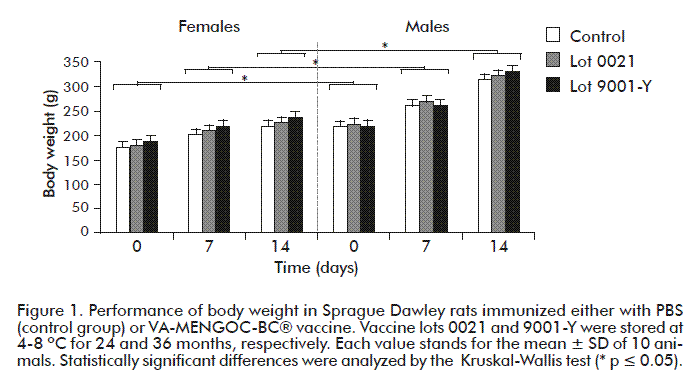
<body><![CDATA[<p>&nbsp;</p>     <p><font face="Verdana, Arial, Helvetica, sans-serif" size="3"><b>RESULTS AND    DISCUSSION </b></font></p>     <p><font face="Verdana, Arial, Helvetica, sans-serif" size="2">The rat species    is the animal model of choice for non-clinical vaccine toxicity evaluations,    and the Sprague-Dawley strain has been widely used due to its high sensitivity    [10, 16, 17]. It is also a non-isogenic strain, therefore providing a heterogeneous    response equivalent to that achieved in humans. Particularly the SD rat model    is regarded as relevant for the evaluation of the intrinsic toxicity and that    associated to the immune response of vaccine products against <i>N. meningitidis</i>.    These are the reasons why it was selected to test the toxicity of the VA-MENGOC-BC&reg;    vaccine intended to extend its shelf-life from 24 to 36 months.</font></p>     <p><font face="Verdana, Arial, Helvetica, sans-serif" size="2"><b>Observations,    clinical symptoms and body weight </b></font></p>     <p><font face="Verdana, Arial, Helvetica, sans-serif" size="2">During the study,    no clinical symptoms were shown and not any animal died. All the animals gained    weight during the 14 days post-inoculation (<a href="/img/revistas/bta/v35n3/f0102318.gif">Figure    1</a>), with no significant differences detected between treatments as compared    to the control group (p &ge; 0.05). Male rats gained weight faster than females    (p &le; 0.05), and weight gain curves were in agreement with those previously    observed in other experiments, run in our facilities or even reported in the    scientific literature [9, 12-16].</font></p>     
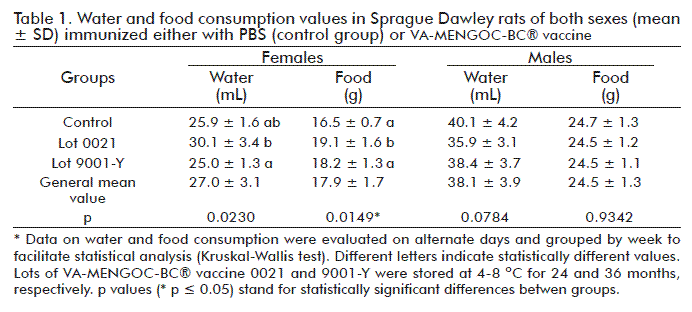
<p><font face="Verdana, Arial, Helvetica, sans-serif" size="2"><b>Water and food    consumption </b></font></p>     <p><font face="Verdana, Arial, Helvetica, sans-serif" size="2">Water and food    consumption were similar among evaluated groups (p &ge; 0.05), either receiving    treatments or placebo. Males consumed more water and food than females (24.5    g of food and 38.1 mL of water for males vs. 17.9 g and 27 mL females) (<a href="/img/revistas/bta/v35n3/t0102318.gif">Table    1</a>). Mean values were as reported in the literature and consistent with historical    records for SD rats in our facilities [7-9, 18, 19]. Nevertheless, significant    differences (p &le; 0.05) were observed in female rats for water consumption    between groups immunized with VA-MENGOC-BC&reg; lots 0021 and 9001-Y (stored    at 4 to 8 &deg;C for either 24 or 36 months, respectively), and for food consumption    between the group receiving lot 0021 and the placebo group. In both cases, consumption    was higher in females from the group receiving the vaccine lot 0021. However,    these differences were irrelevant from the physiological and toxicological points    of view, due to the similarity of weight gain among all the groups and the absence    of clinical symptoms. At the same time, the differences seen in female animals    immunized with vaccine lot 0021 could be related with a mild fever detected    on them at 8 h post-inoculation.</font></p>     
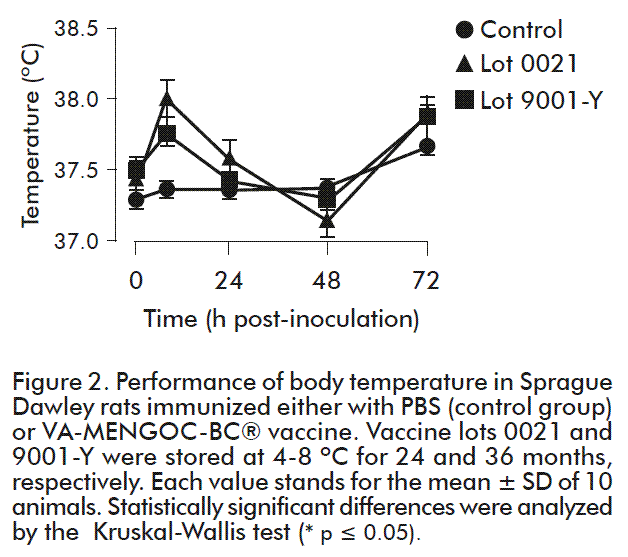
<p><font face="Verdana, Arial, Helvetica, sans-serif" size="2"><b>Thermometry    and muscular diameter</b></font></p>     <p><font face="Verdana, Arial, Helvetica, sans-serif" size="2">The physiological    range of body temperature reported for the rat species is 37.5 &plusmn; 0.5    &ordm;C [20]. As shown in <a href="/img/revistas/bta/v35n3/f0202318.gif">figure    2</a>, during the first 8 h there was a slight increase in the mean body temperature    in female rats vaccinated with either vaccine lot. Despite average ranges were    below 38 &ordm;C, significant differences were found in female rats between    for the group receiving the vaccine lot 0021 (37.97 &ordm;C) as compared to    placebo (37.43 &ordm;C). In that vaccine group, four out of ten animals had    a mild fever (38.1-38.5 &ordm;C), at 8 h post inoculation, which was transient    and subsequently disappeared. This could be related to the increased water and    food consumption seen in these animals from 8 to 24 h post-inoculation, to recover    from the lower consumption rate experimented during the first 8 h when mild    fever occurred. Moreover, these parameters were measured every two days. In    fact, such effects are well documented in the literature as related to febrile    states [21]. Female rats receiving vaccine lot 9001-Y (36 months) showed no    significant differences in respect to females of the other two groups. Temperature    values at 24, 48 and 72 h post-inoculation were similar (p &ge; 0.05) within    physiological ranges.</font></p>     
<p><font face="Verdana, Arial, Helvetica, sans-serif" size="2">During the experiment,    all the experimental temperature evaluations made on male animals showed mean    temperature values similar among groups (p &ge; 0.05).</font></p>     ]]></body>
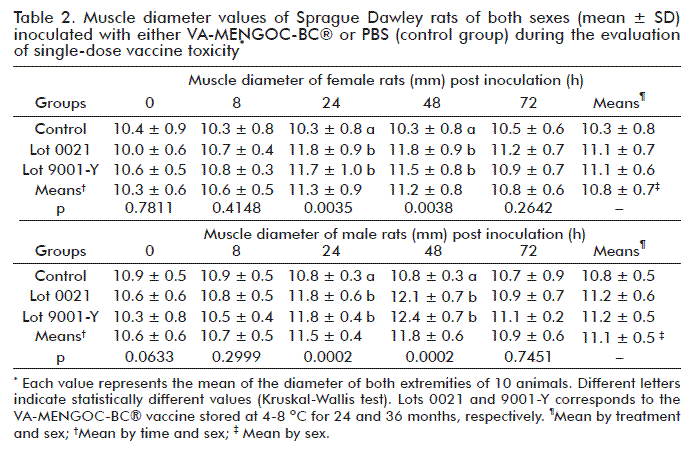
<body><![CDATA[<p><font face="Verdana, Arial, Helvetica, sans-serif" size="2">Importantly, body    temperature is determinant for reactogenicity evaluations of vaccine products    during clinical trials. In those studies, expected and unexpected adverse events    are closely monitored, including: fever, headache, pain at the vaccine administration    site, redness, abdominal pain, vomiting and diarrhea, among others [22, 23].    In this sense, thermometry assessment in preclinical toxicological studies can    contribute to predict the potential reactogenicity in humans of a given vaccine.    Considering this, the results obtained were regarded as satisfactory, with no    fever detected in vaccine animals after 8 h post-inoculation, and in agreement    with all the other evaluations as evidencing the low reactogenicity of the vaccine    tested. They also extended the safety profile of the VA-MENGOC-BC&reg; vaccine.</font></p>     <p><font face="Verdana, Arial, Helvetica, sans-serif" size="2">Additionally, the    assessment of muscular diameter helps to determine the occurrence of any inflammatory    process at the vaccine administration site [24]. This parameter showed significant    differences (p &le; 0.05) in vaccinated animals as compared to the control group    at 24 and 48 h, with no significant differences detected between vaccine groups    (<a href="/img/revistas/bta/v35n3/t0202318.gif">Table 2</a>). Such an effect    was as expected in vaccinated animals due to the aluminum hydroxide present    in the formulation as vaccine adjuvant, together with the effect of the immune    response against vaccine antigens [13, 25]. Furthermore, muscle diameter peaked    at 24 h post-inoculation, with a progression to normal values from 48 h onwards.    These was indicative and complemented the low reactogenicity profile of the    vaccine, together with the lack of lameness, pain or any other gait dysfunction.</font></p>     
<p><font face="Verdana, Arial, Helvetica, sans-serif" size="2"><b>Anatomopathological    studies </b></font></p>     <p><font face="Verdana, Arial, Helvetica, sans-serif" size="2">During necropsies,    macroscopic observations were detected at the inoculation site in vaccinated    animals. They were consistent with granulomatous processes in both vaccinated    groups (<a href="/img/revistas/bta/v35n3/t0302318.gif">Table 3</a>; <a href="/img/revistas/bta/v35n3/f0302318.gif">Figure    3</a>). This type of processes has been consistently reported in animals inoculated    with vaccine products containing aluminum phosphate or hydroxide as adjuvant    [7, 9, 25]. Moreover, adenitis was present in the popliteal and deep inguinal    lymph nodes, possibly related to the immune response activated by the immunogens    through the efferent lymph circulation to those ganglia [26]. These effects    have been previously reported [7, 9, 25]. No other alterations or macroscopic    lesions were found in other organs or organs systems in the animals.</font></p>     
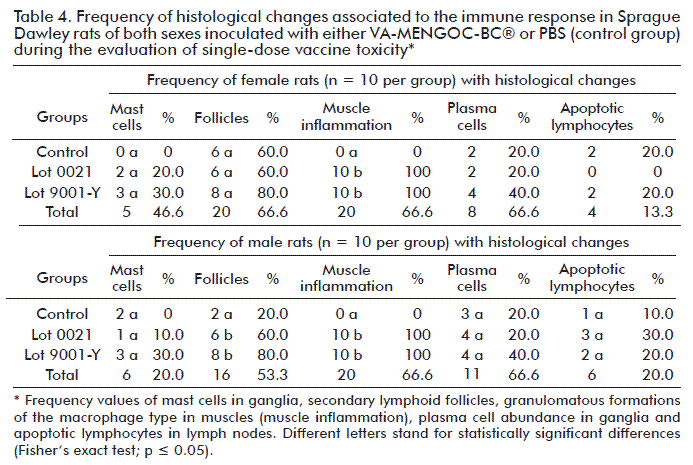
<p><font face="Verdana, Arial, Helvetica, sans-serif" size="2">The diagnosed microscopic    lesions identified as possible granulomatous processes at the inoculation site    were further verified microscopically. Significant differences were found as    compared to the inoculation site in the control group (p &le; 0.05; <a href="/img/revistas/bta/v35n3/t0402318.gif">Table    4</a>). These findings were consistent with observations in similar previous    studies carried out in this species and when administering aluminum hydroxide-containing    vaccines as VA-MENGOC-BC&reg; [9, 25]. Moreover, the findings in the efferent    regional lymph nodes corresponding to the vaccine inoculation site have been    regarded as unspecific by other research groups [9, 26]. Despite such considerations,    and attending to the significant differences (p &le; 0.05) observed in vaccinated    male rats as compared to the control group in the number of secondary lymphoid    follicles in ganglia, it was considered that this effect was related to immunological    response against the vaccine.</font></p>     
<p>&nbsp;</p>     <p><font face="Verdana, Arial, Helvetica, sans-serif" size="2"><font size="3"><b>CONCLUSIONS</b></font></font></p>     <p><font face="Verdana, Arial, Helvetica, sans-serif" size="2">In summary, the    VA-MENGOC-BC&reg; vaccine stored at 4-8 &deg;C for 36 months showed a similar    safety profile in SD rats as that of the vaccine stored for 24 months under    the same conditions. Neither local nor systemic adverse toxic effects were detected    when a single dose of the vaccine was i.m. administered. This indicates that    the vaccine stored for 36 months can be considered as potentially non-toxic    and supports the possible extension of VA-MENGOC-BC&reg; vaccine shelf life    up to 36 months under these storage conditions.</font></p>     <p>&nbsp;</p>     <p><font face="Verdana, Arial, Helvetica, sans-serif" size="2"><b><font size="3">REFERENCES</font></b></font></p>     ]]></body>
<body><![CDATA[<!-- ref --><p><font face="Verdana, Arial, Helvetica, sans-serif" size="2">1. Batista RS,    Gomes AP, Dutra Gazineo JL, Balbino Miguel PS, Santana LA, Oliveira L, <i>et    al</i>. Meningococcal disease, a clinical and epidemiological review. Asian    Pac J Trop Med. 2017;10(11):1019-29.    </font></p>     <!-- ref --><p><font face="Verdana, Arial, Helvetica, sans-serif" size="2">2. World Health    Organization. Epidemic meningitis control in countries of the African meningitis    belt, 2017. Weekly Epidemiological Record. 2018;93(14):173-84.    </font></p>     <!-- ref --><p><font face="Verdana, Arial, Helvetica, sans-serif" size="2">3. World Health    organization. WHO Meeting Report. Developing a new generation RDTs for Meningitis    Geneva, 9 March 2018. Geneva: WHO; 2018.     </font></p>     <!-- ref --><p><font face="Verdana, Arial, Helvetica, sans-serif" size="2">4. WHO. Situation    update on meningitis C epidemic risk. Geneva: WHO; 2018.     </font></p>     <!-- ref --><p><font face="Verdana, Arial, Helvetica, sans-serif" size="2">5. Ochoa RF, Men&eacute;ndez    J. Prevenci&oacute;n de la enfermedad meningoc&oacute;cica. La Habana: Ediciones    Finlay; 2010.     </font></p>     ]]></body>
<body><![CDATA[<!-- ref --><p><font face="Verdana, Arial, Helvetica, sans-serif" size="2">6. WHO. Guidelines    on the nonclinical evaluation of vaccine adjuvants and adjuvanted vaccines Annex    2. WHO Technical Report Series. 2013;(987):1-56.     </font></p>     <!-- ref --><p><font face="Verdana, Arial, Helvetica, sans-serif" size="2">7. N&uacute;&ntilde;ez    JF, Herrera L, Infante JF, Gonz&aacute;lez P, P&eacute;rez V, Argamasilla M,    <i>et al</i>. Estudio de toxicidad por dosis &uacute;nica y tolerancia local    de una vacuna antimeningoc&oacute;cica tipo B en ratas Sprague Dawley. Vaccimonitor.    2006;15(2):9-14.     </font></p>     <!-- ref --><p><font face="Verdana, Arial, Helvetica, sans-serif" size="2">8. Fari&ntilde;as    M, Arencibia DF, D&iacute;as D, Infante JF, Vald&eacute;s Y, Hern&aacute;ndez    T, <i>et al</i>. Estudio de toxicidad por dosis &uacute;nica de la vacuna antimeningoc&oacute;ccica    ACW135 en ratas Sprague Dawley. Retel. 2011;(35):23-42.     </font></p>     <!-- ref --><p><font face="Verdana, Arial, Helvetica, sans-serif" size="2">9. Infante Bourzac    JF. Estudio de inocuidad e inmunogenicidad protectog&eacute;nica de la vacuna    antimeningoc&oacute;cica VA-MENGOC-BC en modelos murinos. [Tesis Doctoral].    La Habana: Instituto Finlay, Universidad Agraria de La Habana; 2000.     </font></p>     <!-- ref --><p><font face="Verdana, Arial, Helvetica, sans-serif" size="2">10. Verdier F.    Non-clinical vaccine safety assessment. Toxicology. 2002;174(1):37-43.     </font></p>     ]]></body>
<body><![CDATA[<!-- ref --><p><font face="Verdana, Arial, Helvetica, sans-serif" size="2">11. WHO. Guidelines    on the nonclinical evaluation of vaccine adjuvants and adjuvanted vaccines.    Annex 1. WHO Technical Report Series. 2013;(927):1-36.     </font></p>     <!-- ref --><p><font face="Verdana, Arial, Helvetica, sans-serif" size="2">12. Lawson T. LATG    training manual: laboratory animal technologist. Memphis: America Association    for Laboratory Animal Science; 2000.    </font></p>     <!-- ref --><p><font face="Verdana, Arial, Helvetica, sans-serif" size="2">13. Committee for    the Update of the Guide for the Care and Use of Laboratory Animals. Guide for    the care and use of laboratory animals. Washington: The National Academies Press;    2011.     </font></p>     <!-- ref --><p><font face="Verdana, Arial, Helvetica, sans-serif" size="2">14. American Veterinary    Medical Association. AVMA Guides for euthanasia of animals. Schaumburg: American    Veterinary Medical Association; 2013.     </font></p>     <p><font face="Verdana, Arial, Helvetica, sans-serif" size="2">15. Morton DB.    Humane endpoints in animal experimentation for biomedical research: Ethical,    legal and practical aspects. In: Hendriksen CFM, Morton DB, eds. Humane Endpoints    in Animal Experimentation for Biomedical Research. London: Royal Society of    Medicine Press; 1999. p. 5-12. </font></p>     <!-- ref --><p><font face="Verdana, Arial, Helvetica, sans-serif" size="2">16. Fari&ntilde;as    M, Oliva R, Infante JF, Valdez Y, Nu&ntilde;ez D, Valmaceda T, <i>et al</i>.    Ensayo piloto de inmunogenicidad y toxicidad precl&iacute;nica de la vacuna    Salmonella typhi conjugada en ratas Sprague Dawley. Retel. 2014;(44):17-34.        </font></p>     <!-- ref --><p><font face="Verdana, Arial, Helvetica, sans-serif" size="2">17. Lopez Y, Pastor    M, Infante JF, Diaz D, Oliva R, Fernandez S, <i>et al</i>. Repeated dose toxicity    study of <i>Vibrio cholerae</i>-loaded gastro-resistant microparticles. J Microencapsul.    2014;31(1):86-92.     </font></p>     <!-- ref --><p><font face="Verdana, Arial, Helvetica, sans-serif" size="2">18. Charles River    Laboratories Inc. SAS Sprague Dawley Rat Details; 2018 [cited 2018 March 27].    Available from: <a href="https://www.criver.com/products-services/find-model/sas-sprague-dawley-rat?region=3616" target="_blank">https://www.criver.com/products-services/find-model/sas-sprague-dawley-rat?region=3616</a>    </font><!-- ref --><p><font face="Verdana, Arial, Helvetica, sans-serif" size="2">19. Taconic Biosciences.    Sprague Dawley&reg; Rat Model. 2018 [cited 2018 March 27]. Available from: <a href="https://www.taconic.com/pdfs/sprague-dawley-rat.pdf" target="_blank">https://www.taconic.com/pdfs/sprague-dawley-rat.pdf</a>.    </font></p>     <p><font face="Verdana, Arial, Helvetica, sans-serif" size="2">20. Olfert ED,    Cross BM, McWilliam AA, editors. Guide to the care and use of experimental animals.    Canadian Council on Animal Care. 2nd ed. Ottawa: Bradda Printing Services; 1993.    </font></p>     <!-- ref --><p><font face="Verdana, Arial, Helvetica, sans-serif" size="2">21. Escobar AL.    Fever in children: a critical view of caring practices. Av Enferm. 2017;35(3):333-44.    </font></p>     <!-- ref --><p><font face="Verdana, Arial, Helvetica, sans-serif" size="2">22. Ochoa RF, Bar&oacute;    IM, Men&eacute;ndez J, Triana T, Mirabal M, Armesto M, <i>et al</i>. Reactogenicidad    e inmunogenicidad de una nueva vacuna de toxoide tet&aacute;nico y dift&eacute;rico    con concentraci&oacute;n reducida en adolescentes cubanos. VacciMonitor. 2006;15(2):13-7.        </font></p>     <!-- ref --><p><font face="Verdana, Arial, Helvetica, sans-serif" size="2">23. Garc&iacute;a    HM, Thompson R, Valera R, Fando R, Fumane J, Mirabal M, <i>et al</i>. A single    dose of live-attenuated 638 <i>Vibrio cholerae</i> oral vaccine is safe and    immunogenic in adult volunteers in Mozambique. VacciMonitor. 2011;20(3):1-8.        </font></p>     <!-- ref --><p><font face="Verdana, Arial, Helvetica, sans-serif" size="2">24. Fari&ntilde;as    M, Oliva R, Hern&aacute;ndez T, Hern&aacute;ndez M, Nu&ntilde;ez D, Quintero    A. Study of reactogenicity of pertussis component adjuved to aluminum hydroxide    and aluminum phosphate in Sprague Dawley rats. Avances en Biotecnolog&iacute;a    Moderna. 2017;S7-P11.     </font></p>     <!-- ref --><p><font face="Verdana, Arial, Helvetica, sans-serif" size="2">25. Bacardi D,    Cosme K, Aldana L, Merino N, Su&aacute;rez J, Mosqueda O, <i>et al</i>. Preclinical    safety testing of the Quimi-Hib&reg; vaccine adjuvanted with aluminum phosphate    during product development. Biotecnol Apl. 2013;30(2):118-24.     </font></p>     <!-- ref --><p><font face="Verdana, Arial, Helvetica, sans-serif" size="2">26. Ahrendt M,    Hammerschmidt SI, Pabst O, Pabst R, Bode U. Stromal cells confer lymph node-specific    properties by shaping a unique microenvironment influencing local immune responses.    J Immunol. 2008;181(3):1898-907.    </font></p>     <p>&nbsp;</p>     ]]></body>
<body><![CDATA[<p>&nbsp;</p>     <p><font face="Verdana, Arial, Helvetica, sans-serif" size="2">Received in May,    2018.     <br>   Accepted in August, 2018.</font></p>     <p>&nbsp;</p>     <p>&nbsp;</p>     <p><font face="Verdana, Arial, Helvetica, sans-serif" size="2"><i>Reynaldo Oliva-Hern&aacute;ndez</i>.    Departamento de Modelos Animales y Toxicolog&iacute;a Experimental, Direcci&oacute;n    de Investigaciones, Instituto Finlay de Vacunas. Avenida 21, No. 19810 e/ 198    y 200, Reparto Atabey, Playa, La Habana, Cuba. E-mail: <a href="mailto:roh@finlay.edu.cu">roh@finlay.edu.cu</a>;<a href="mailto:reyolivacuba@gmail.com">    reyolivacuba@gmail.com</a>.    <br>   </font></p>      ]]></body><back>
<ref-list>
<ref id="B1">
<label>1</label><nlm-citation citation-type="journal">
<person-group person-group-type="author">
<name>
<surname><![CDATA[Batista]]></surname>
<given-names><![CDATA[RS]]></given-names>
</name>
<name>
<surname><![CDATA[Gomes]]></surname>
<given-names><![CDATA[AP]]></given-names>
</name>
<name>
<surname><![CDATA[Dutra Gazineo]]></surname>
<given-names><![CDATA[JL]]></given-names>
</name>
<name>
<surname><![CDATA[Balbino Miguel]]></surname>
<given-names><![CDATA[PS]]></given-names>
</name>
<name>
<surname><![CDATA[Santana]]></surname>
<given-names><![CDATA[LA]]></given-names>
</name>
<name>
<surname><![CDATA[Oliveira]]></surname>
<given-names><![CDATA[L]]></given-names>
</name>
</person-group>
<article-title xml:lang="en"><![CDATA[Meningococcal disease, a clinical and epidemiological review]]></article-title>
<source><![CDATA[Asian Pac J Trop Med]]></source>
<year>2017</year>
<volume>10</volume>
<numero>11</numero>
<issue>11</issue>
<page-range>1019-29</page-range></nlm-citation>
</ref>
<ref id="B2">
<label>2</label><nlm-citation citation-type="journal">
<collab>World Health Organization</collab>
<article-title xml:lang="en"><![CDATA[Epidemic meningitis control in countries of the African meningitis belt, 2017]]></article-title>
<source><![CDATA[Weekly Epidemiological Record]]></source>
<year>2018</year>
<volume>93</volume>
<numero>14</numero>
<issue>14</issue>
<page-range>173-84</page-range></nlm-citation>
</ref>
<ref id="B3">
<label>3</label><nlm-citation citation-type="book">
<collab>World Health organization</collab>
<source><![CDATA[WHO Meeting Report. Developing a new generation RDTs for Meningitis Geneva, 9 March 2018]]></source>
<year>2018</year>
<publisher-loc><![CDATA[Geneva ]]></publisher-loc>
<publisher-name><![CDATA[WHO]]></publisher-name>
</nlm-citation>
</ref>
<ref id="B4">
<label>4</label><nlm-citation citation-type="book">
<collab>WHO</collab>
<source><![CDATA[Situation update on meningitis C epidemic risk]]></source>
<year>2018</year>
<publisher-loc><![CDATA[Geneva ]]></publisher-loc>
<publisher-name><![CDATA[WHO]]></publisher-name>
</nlm-citation>
</ref>
<ref id="B5">
<label>5</label><nlm-citation citation-type="book">
<person-group person-group-type="author">
<name>
<surname><![CDATA[Ochoa]]></surname>
<given-names><![CDATA[RF]]></given-names>
</name>
<name>
<surname><![CDATA[Menéndez]]></surname>
<given-names><![CDATA[J]]></given-names>
</name>
</person-group>
<source><![CDATA[Prevención de la enfermedad meningocócica]]></source>
<year>2010</year>
<publisher-loc><![CDATA[La Habana ]]></publisher-loc>
<publisher-name><![CDATA[Ediciones Finlay]]></publisher-name>
</nlm-citation>
</ref>
<ref id="B6">
<label>6</label><nlm-citation citation-type="journal">
<collab>WHO</collab>
<article-title xml:lang="en"><![CDATA[Guidelines on the nonclinical evaluation of vaccine adjuvants and adjuvanted vaccines Annex 2]]></article-title>
<source><![CDATA[WHO Technical Report Series]]></source>
<year>2013</year>
<numero>987</numero>
<issue>987</issue>
<page-range>1-56</page-range></nlm-citation>
</ref>
<ref id="B7">
<label>7</label><nlm-citation citation-type="journal">
<person-group person-group-type="author">
<name>
<surname><![CDATA[Núñez]]></surname>
<given-names><![CDATA[JF]]></given-names>
</name>
<name>
<surname><![CDATA[Herrera]]></surname>
<given-names><![CDATA[L]]></given-names>
</name>
<name>
<surname><![CDATA[Infante]]></surname>
<given-names><![CDATA[JF]]></given-names>
</name>
<name>
<surname><![CDATA[González]]></surname>
<given-names><![CDATA[P]]></given-names>
</name>
<name>
<surname><![CDATA[Pérez]]></surname>
<given-names><![CDATA[V]]></given-names>
</name>
<name>
<surname><![CDATA[Argamasilla]]></surname>
<given-names><![CDATA[M]]></given-names>
</name>
</person-group>
<article-title xml:lang="es"><![CDATA[Estudio de toxicidad por dosis única y tolerancia local de una vacuna antimeningocócica tipo B en ratas Sprague Dawley]]></article-title>
<source><![CDATA[Vaccimonitor]]></source>
<year>2006</year>
<volume>15</volume>
<numero>2</numero>
<issue>2</issue>
<page-range>9-14</page-range></nlm-citation>
</ref>
<ref id="B8">
<label>8</label><nlm-citation citation-type="journal">
<person-group person-group-type="author">
<name>
<surname><![CDATA[Fariñas]]></surname>
<given-names><![CDATA[M]]></given-names>
</name>
<name>
<surname><![CDATA[Arencibia]]></surname>
<given-names><![CDATA[DF]]></given-names>
</name>
<name>
<surname><![CDATA[Días]]></surname>
<given-names><![CDATA[D]]></given-names>
</name>
<name>
<surname><![CDATA[Infante]]></surname>
<given-names><![CDATA[JF]]></given-names>
</name>
<name>
<surname><![CDATA[Valdés]]></surname>
<given-names><![CDATA[Y]]></given-names>
</name>
<name>
<surname><![CDATA[Hernández]]></surname>
<given-names><![CDATA[T]]></given-names>
</name>
</person-group>
<article-title xml:lang="es"><![CDATA[Estudio de toxicidad por dosis única de la vacuna antimeningocóccica ACW135 en ratas Sprague Dawley]]></article-title>
<source><![CDATA[Retel]]></source>
<year>2011</year>
<numero>35</numero>
<issue>35</issue>
<page-range>23-42</page-range></nlm-citation>
</ref>
<ref id="B9">
<label>9</label><nlm-citation citation-type="book">
<person-group person-group-type="author">
<name>
<surname><![CDATA[Infante Bourzac]]></surname>
<given-names><![CDATA[JF]]></given-names>
</name>
</person-group>
<source><![CDATA[Estudio de inocuidad e inmunogenicidad protectogénica de la vacuna antimeningocócica VA-MENGOC-BC en modelos murinos. (Tesis Doctoral)]]></source>
<year>2000</year>
<publisher-loc><![CDATA[La Habana ]]></publisher-loc>
<publisher-name><![CDATA[Instituto Finlay, Universidad Agraria de La Habana]]></publisher-name>
</nlm-citation>
</ref>
<ref id="B10">
<label>10</label><nlm-citation citation-type="journal">
<person-group person-group-type="author">
<name>
<surname><![CDATA[Verdier]]></surname>
<given-names><![CDATA[F]]></given-names>
</name>
</person-group>
<article-title xml:lang="en"><![CDATA[Non-clinical vaccine safety assessment]]></article-title>
<source><![CDATA[Toxicology]]></source>
<year>2002</year>
<volume>174</volume>
<numero>1</numero>
<issue>1</issue>
<page-range>37-43</page-range></nlm-citation>
</ref>
<ref id="B11">
<label>11</label><nlm-citation citation-type="journal">
<collab>WHO</collab>
<article-title xml:lang="en"><![CDATA[Guidelines on the nonclinical evaluation of vaccine adjuvants and adjuvanted vaccines. Annex 1]]></article-title>
<source><![CDATA[WHO Technical Report Series]]></source>
<year>2013</year>
<numero>927</numero>
<issue>927</issue>
<page-range>1-36</page-range></nlm-citation>
</ref>
<ref id="B12">
<label>12</label><nlm-citation citation-type="book">
<person-group person-group-type="author">
<name>
<surname><![CDATA[Lawson]]></surname>
<given-names><![CDATA[T]]></given-names>
</name>
</person-group>
<source><![CDATA[LATG training manual: laboratory animal technologist]]></source>
<year>2000</year>
<publisher-loc><![CDATA[Memphis ]]></publisher-loc>
<publisher-name><![CDATA[America Association for Laboratory Animal Science]]></publisher-name>
</nlm-citation>
</ref>
<ref id="B13">
<label>13</label><nlm-citation citation-type="book">
<collab>Committee for the Update of the Guide for the Care and Use of Laboratory Animals</collab>
<source><![CDATA[Guide for the care and use of laboratory animals]]></source>
<year>2011</year>
<publisher-loc><![CDATA[Washington ]]></publisher-loc>
<publisher-name><![CDATA[The National Academies Press]]></publisher-name>
</nlm-citation>
</ref>
<ref id="B14">
<label>14</label><nlm-citation citation-type="book">
<collab>American Veterinary Medical Association</collab>
<source><![CDATA[AVMA Guides for euthanasia of animals]]></source>
<year>2013</year>
<publisher-loc><![CDATA[Schaumburg ]]></publisher-loc>
<publisher-name><![CDATA[American Veterinary Medical Association]]></publisher-name>
</nlm-citation>
</ref>
<ref id="B15">
<label>15</label><nlm-citation citation-type="book">
<person-group person-group-type="author">
<name>
<surname><![CDATA[Morton]]></surname>
<given-names><![CDATA[DB]]></given-names>
</name>
</person-group>
<article-title xml:lang="en"><![CDATA[Humane endpoints in animal experimentation for biomedical research: Ethical, legal and practical aspects]]></article-title>
<person-group person-group-type="editor">
<name>
<surname><![CDATA[Hendriksen]]></surname>
<given-names><![CDATA[CFM]]></given-names>
</name>
<name>
<surname><![CDATA[Morton]]></surname>
<given-names><![CDATA[DB]]></given-names>
</name>
</person-group>
<source><![CDATA[Humane Endpoints in Animal Experimentation for Biomedical Research]]></source>
<year>1999</year>
<page-range>5-12</page-range><publisher-loc><![CDATA[London ]]></publisher-loc>
<publisher-name><![CDATA[Royal Society of Medicine Press]]></publisher-name>
</nlm-citation>
</ref>
<ref id="B16">
<label>16</label><nlm-citation citation-type="journal">
<person-group person-group-type="author">
<name>
<surname><![CDATA[Fariñas]]></surname>
<given-names><![CDATA[M]]></given-names>
</name>
<name>
<surname><![CDATA[Oliva]]></surname>
<given-names><![CDATA[R]]></given-names>
</name>
<name>
<surname><![CDATA[Infante]]></surname>
<given-names><![CDATA[JF]]></given-names>
</name>
<name>
<surname><![CDATA[Valdez]]></surname>
<given-names><![CDATA[Y]]></given-names>
</name>
<name>
<surname><![CDATA[Nuñez]]></surname>
<given-names><![CDATA[D]]></given-names>
</name>
<name>
<surname><![CDATA[Valmaceda]]></surname>
<given-names><![CDATA[T]]></given-names>
</name>
</person-group>
<article-title xml:lang="es"><![CDATA[Ensayo piloto de inmunogenicidad y toxicidad preclínica de la vacuna Salmonella typhi conjugada en ratas Sprague Dawley]]></article-title>
<source><![CDATA[Retel]]></source>
<year>2014</year>
<numero>44</numero>
<issue>44</issue>
<page-range>17-34</page-range></nlm-citation>
</ref>
<ref id="B17">
<label>17</label><nlm-citation citation-type="journal">
<person-group person-group-type="author">
<name>
<surname><![CDATA[Lopez]]></surname>
<given-names><![CDATA[Y]]></given-names>
</name>
<name>
<surname><![CDATA[Pastor]]></surname>
<given-names><![CDATA[M]]></given-names>
</name>
<name>
<surname><![CDATA[Infante]]></surname>
<given-names><![CDATA[JF]]></given-names>
</name>
<name>
<surname><![CDATA[Diaz]]></surname>
<given-names><![CDATA[D]]></given-names>
</name>
<name>
<surname><![CDATA[Oliva]]></surname>
<given-names><![CDATA[R]]></given-names>
</name>
<name>
<surname><![CDATA[Fernandez]]></surname>
<given-names><![CDATA[S]]></given-names>
</name>
</person-group>
<article-title xml:lang="en"><![CDATA[Repeated dose toxicity study of Vibrio cholerae-loaded gastro-resistant microparticles]]></article-title>
<source><![CDATA[J Microencapsul]]></source>
<year>2014</year>
<volume>31</volume>
<numero>1</numero>
<issue>1</issue>
<page-range>86-92</page-range></nlm-citation>
</ref>
<ref id="B18">
<label>18</label><nlm-citation citation-type="">
<collab>Charles River Laboratories Inc.</collab>
<source><![CDATA[SAS Sprague Dawley Rat Details]]></source>
<year>2018</year>
</nlm-citation>
</ref>
<ref id="B19">
<label>19</label><nlm-citation citation-type="">
<collab>Taconic Biosciences</collab>
<source><![CDATA[Sprague Dawley® Rat Model]]></source>
<year>2018</year>
</nlm-citation>
</ref>
<ref id="B20">
<label>20</label><nlm-citation citation-type="book">
<person-group person-group-type="author">
<name>
<surname><![CDATA[Olfert]]></surname>
<given-names><![CDATA[ED]]></given-names>
</name>
<name>
<surname><![CDATA[Cross]]></surname>
<given-names><![CDATA[BM]]></given-names>
</name>
<name>
<surname><![CDATA[McWilliam]]></surname>
<given-names><![CDATA[AA]]></given-names>
</name>
</person-group>
<source><![CDATA[Guide to the care and use of experimental animals. Canadian Council on Animal Care]]></source>
<year>1993</year>
<edition>2</edition>
<publisher-loc><![CDATA[Ottawa ]]></publisher-loc>
<publisher-name><![CDATA[Bradda Printing Services]]></publisher-name>
</nlm-citation>
</ref>
<ref id="B21">
<label>21</label><nlm-citation citation-type="journal">
<person-group person-group-type="author">
<name>
<surname><![CDATA[Escobar]]></surname>
<given-names><![CDATA[AL]]></given-names>
</name>
</person-group>
<article-title xml:lang="en"><![CDATA[Fever in children: a critical view of caring practices]]></article-title>
<source><![CDATA[Av Enferm]]></source>
<year>2017</year>
<volume>35</volume>
<numero>3</numero>
<issue>3</issue>
<page-range>333-44</page-range></nlm-citation>
</ref>
<ref id="B22">
<label>22</label><nlm-citation citation-type="journal">
<person-group person-group-type="author">
<name>
<surname><![CDATA[Ochoa]]></surname>
<given-names><![CDATA[RF]]></given-names>
</name>
<name>
<surname><![CDATA[Baró]]></surname>
<given-names><![CDATA[IM]]></given-names>
</name>
<name>
<surname><![CDATA[Menéndez]]></surname>
<given-names><![CDATA[J]]></given-names>
</name>
<name>
<surname><![CDATA[Triana]]></surname>
<given-names><![CDATA[T]]></given-names>
</name>
<name>
<surname><![CDATA[Mirabal]]></surname>
<given-names><![CDATA[M]]></given-names>
</name>
<name>
<surname><![CDATA[Armesto]]></surname>
<given-names><![CDATA[M]]></given-names>
</name>
</person-group>
<article-title xml:lang="es"><![CDATA[Reactogenicidad e inmunogenicidad de una nueva vacuna de toxoide tetánico y diftérico con concentración reducida en adolescentes cubanos]]></article-title>
<source><![CDATA[VacciMonitor]]></source>
<year>2006</year>
<volume>15</volume>
<numero>2</numero>
<issue>2</issue>
<page-range>13-7</page-range></nlm-citation>
</ref>
<ref id="B23">
<label>23</label><nlm-citation citation-type="journal">
<person-group person-group-type="author">
<name>
<surname><![CDATA[García]]></surname>
<given-names><![CDATA[HM]]></given-names>
</name>
<name>
<surname><![CDATA[Thompson]]></surname>
<given-names><![CDATA[R]]></given-names>
</name>
<name>
<surname><![CDATA[Valera]]></surname>
<given-names><![CDATA[R]]></given-names>
</name>
<name>
<surname><![CDATA[Fando]]></surname>
<given-names><![CDATA[R]]></given-names>
</name>
<name>
<surname><![CDATA[Fumane]]></surname>
<given-names><![CDATA[J]]></given-names>
</name>
<name>
<surname><![CDATA[Mirabal]]></surname>
<given-names><![CDATA[M]]></given-names>
</name>
</person-group>
<article-title xml:lang="en"><![CDATA[A single dose of live-attenuated 638 Vibrio cholerae oral vaccine is safe and immunogenic in adult volunteers in Mozambique]]></article-title>
<source><![CDATA[VacciMonitor]]></source>
<year>2011</year>
<volume>20</volume>
<numero>3</numero>
<issue>3</issue>
<page-range>1-8</page-range></nlm-citation>
</ref>
<ref id="B24">
<label>24</label><nlm-citation citation-type="journal">
<person-group person-group-type="author">
<name>
<surname><![CDATA[Fariñas]]></surname>
<given-names><![CDATA[M]]></given-names>
</name>
<name>
<surname><![CDATA[Oliva]]></surname>
<given-names><![CDATA[R]]></given-names>
</name>
<name>
<surname><![CDATA[Hernández]]></surname>
<given-names><![CDATA[T]]></given-names>
</name>
<name>
<surname><![CDATA[Hernández]]></surname>
<given-names><![CDATA[M]]></given-names>
</name>
<name>
<surname><![CDATA[Nuñez]]></surname>
<given-names><![CDATA[D]]></given-names>
</name>
<name>
<surname><![CDATA[Quintero]]></surname>
<given-names><![CDATA[A]]></given-names>
</name>
</person-group>
<article-title xml:lang="en"><![CDATA[Study of reactogenicity of pertussis component adjuved to aluminum hydroxide and aluminum phosphate in Sprague Dawley rats]]></article-title>
<source><![CDATA[Avances en Biotecnología Moderna]]></source>
<year>2017</year>
<page-range>S7-P11</page-range></nlm-citation>
</ref>
<ref id="B25">
<label>25</label><nlm-citation citation-type="journal">
<person-group person-group-type="author">
<name>
<surname><![CDATA[Bacardi]]></surname>
<given-names><![CDATA[D]]></given-names>
</name>
<name>
<surname><![CDATA[Cosme]]></surname>
<given-names><![CDATA[K]]></given-names>
</name>
<name>
<surname><![CDATA[Aldana]]></surname>
<given-names><![CDATA[L]]></given-names>
</name>
<name>
<surname><![CDATA[Merino]]></surname>
<given-names><![CDATA[N]]></given-names>
</name>
<name>
<surname><![CDATA[Suárez]]></surname>
<given-names><![CDATA[J]]></given-names>
</name>
<name>
<surname><![CDATA[Mosqueda]]></surname>
<given-names><![CDATA[O]]></given-names>
</name>
</person-group>
<article-title xml:lang="en"><![CDATA[Preclinical safety testing of the Quimi-Hib® vaccine adjuvanted with aluminum phosphate during product development]]></article-title>
<source><![CDATA[Biotecnol Apl]]></source>
<year>2013</year>
<volume>30</volume>
<numero>2</numero>
<issue>2</issue>
<page-range>118-24</page-range></nlm-citation>
</ref>
<ref id="B26">
<label>26</label><nlm-citation citation-type="journal">
<person-group person-group-type="author">
<name>
<surname><![CDATA[Ahrendt]]></surname>
<given-names><![CDATA[M]]></given-names>
</name>
<name>
<surname><![CDATA[Hammerschmidt]]></surname>
<given-names><![CDATA[SI]]></given-names>
</name>
<name>
<surname><![CDATA[Pabst]]></surname>
<given-names><![CDATA[O]]></given-names>
</name>
<name>
<surname><![CDATA[Pabst]]></surname>
<given-names><![CDATA[R]]></given-names>
</name>
<name>
<surname><![CDATA[Bode]]></surname>
<given-names><![CDATA[U]]></given-names>
</name>
</person-group>
<article-title xml:lang="en"><![CDATA[Stromal cells confer lymph node-specific properties by shaping a unique microenvironment influencing local immune responses]]></article-title>
<source><![CDATA[J Immunol]]></source>
<year>2008</year>
<volume>181</volume>
<numero>3</numero>
<issue>3</issue>
<page-range>1898-907</page-range></nlm-citation>
</ref>
</ref-list>
</back>
</article>