<?xml version="1.0" encoding="ISO-8859-1"?><article xmlns:mml="http://www.w3.org/1998/Math/MathML" xmlns:xlink="http://www.w3.org/1999/xlink" xmlns:xsi="http://www.w3.org/2001/XMLSchema-instance">
<front>
<journal-meta>
<journal-id>1027-2852</journal-id>
<journal-title><![CDATA[Biotecnología Aplicada]]></journal-title>
<abbrev-journal-title><![CDATA[Biotecnol Apl]]></abbrev-journal-title>
<issn>1027-2852</issn>
<publisher>
<publisher-name><![CDATA[Editorial Elfos Scientiae]]></publisher-name>
</publisher>
</journal-meta>
<article-meta>
<article-id>S1027-28522018000300003</article-id>
<title-group>
<article-title xml:lang="en"><![CDATA[Effect of temperature on the analytical performance of the UMELISA® TIR NEONATAL assay for newborn screening of cystic fibrosis]]></article-title>
<article-title xml:lang="es"><![CDATA[Efecto de la temperatura sobre el desempeño analítico del ensayo UMELISA® TIR NEONATAL para la pesquisa neonatal de la fibrosis quística]]></article-title>
</title-group>
<contrib-group>
<contrib contrib-type="author">
<name>
<surname><![CDATA[Castells-Martínez]]></surname>
<given-names><![CDATA[Elisa M]]></given-names>
</name>
<xref ref-type="aff" rid="A01"/>
</contrib>
<contrib contrib-type="author">
<name>
<surname><![CDATA[Frómeta]]></surname>
<given-names><![CDATA[Amarilys]]></given-names>
</name>
<xref ref-type="aff" rid="A01"/>
</contrib>
<contrib contrib-type="author">
<name>
<surname><![CDATA[Pérez]]></surname>
<given-names><![CDATA[Pedro L]]></given-names>
</name>
<xref ref-type="aff" rid="A01"/>
</contrib>
<contrib contrib-type="author">
<name>
<surname><![CDATA[Martín]]></surname>
<given-names><![CDATA[Odalys]]></given-names>
</name>
<xref ref-type="aff" rid="A01"/>
</contrib>
<contrib contrib-type="author">
<name>
<surname><![CDATA[del Río]]></surname>
<given-names><![CDATA[Lesley]]></given-names>
</name>
<xref ref-type="aff" rid="A01"/>
</contrib>
<contrib contrib-type="author">
<name>
<surname><![CDATA[Espinosa]]></surname>
<given-names><![CDATA[Maryeris]]></given-names>
</name>
<xref ref-type="aff" rid="A01"/>
</contrib>
<contrib contrib-type="author">
<name>
<surname><![CDATA[Almira]]></surname>
<given-names><![CDATA[Claudia]]></given-names>
</name>
<xref ref-type="aff" rid="A01"/>
</contrib>
<contrib contrib-type="author">
<name>
<surname><![CDATA[Núñez]]></surname>
<given-names><![CDATA[Zoe]]></given-names>
</name>
<xref ref-type="aff" rid="A01"/>
</contrib>
<contrib contrib-type="author">
<name>
<surname><![CDATA[González-Reyes]]></surname>
<given-names><![CDATA[Ernesto C]]></given-names>
</name>
<xref ref-type="aff" rid="A02"/>
</contrib>
</contrib-group>
<aff id="A02">
<institution><![CDATA[,GK Pharmaceuticals CMO  ]]></institution>
<addr-line><![CDATA[Manatí ]]></addr-line>
<country>Puerto Rico</country>
</aff>
<aff id="A01">
<institution><![CDATA[,Immunoassay Center Neonatal Screening Laboratory ]]></institution>
<addr-line><![CDATA[Havana ]]></addr-line>
<country>Cuba</country>
</aff>
<pub-date pub-type="pub">
<day>00</day>
<month>09</month>
<year>2018</year>
</pub-date>
<pub-date pub-type="epub">
<day>00</day>
<month>09</month>
<year>2018</year>
</pub-date>
<volume>35</volume>
<numero>3</numero>
<fpage>3301</fpage>
<lpage>3304</lpage>
<copyright-statement/>
<copyright-year/>
<self-uri xlink:href="http://scielo.sld.cu/scielo.php?script=sci_arttext&amp;pid=S1027-28522018000300003&amp;lng=en&amp;nrm=iso"></self-uri><self-uri xlink:href="http://scielo.sld.cu/scielo.php?script=sci_abstract&amp;pid=S1027-28522018000300003&amp;lng=en&amp;nrm=iso"></self-uri><self-uri xlink:href="http://scielo.sld.cu/scielo.php?script=sci_pdf&amp;pid=S1027-28522018000300003&amp;lng=en&amp;nrm=iso"></self-uri><kwd-group>
<kwd lng="en"><![CDATA[UMELISA® TIR NEONATAL]]></kwd>
<kwd lng="en"><![CDATA[temperature]]></kwd>
<kwd lng="en"><![CDATA[recovery percentage]]></kwd>
<kwd lng="en"><![CDATA[stability]]></kwd>
<kwd lng="es"><![CDATA[UMELISA® TIR NEONATAL]]></kwd>
<kwd lng="es"><![CDATA[temperatura]]></kwd>
<kwd lng="es"><![CDATA[porciento de recuperación]]></kwd>
<kwd lng="es"><![CDATA[estabilidad]]></kwd>
</kwd-group>
</article-meta>
</front><body><![CDATA[ <div align="right">       <p><font size="2" face="Verdana, Arial, Helvetica, sans-serif"> <b>TECHNIQUE      </b></font></p>       <p align="left"><font size="2" face="Verdana, Arial, Helvetica, sans-serif">    <br>     <b><font size="4">Effect of temperature on the analytical performance of the      UMELISA&reg; TIR NEONATAL assay for newborn screening of cystic fibrosis</font></b></font></p> </div>     <p>&nbsp;</p>     <p><font size="3" face="Verdana, Arial, Helvetica, sans-serif"><b>Efecto de la    temperatura sobre el desempe&ntilde;o anal&iacute;tico del ensayo UMELISA&reg;    TIR NEONATAL para la pesquisa neonatal de la fibrosis qu&iacute;stica</b></font></p>     <p>&nbsp;</p>     <p>&nbsp;</p>     <p><font size="2" face="Verdana, Arial, Helvetica, sans-serif"><b>Elisa M Castells-Mart&iacute;nez<sup>1</sup>,    Amarilys Fr&oacute;meta<sup>1</sup>, Pedro L P&eacute;rez<sup>1</sup>, Odalys    Mart&iacute;n<sup>1</sup>, Lesley del R&iacute;o<sup>1</sup>, Maryeris Espinosa<sup>1</sup>,    Claudia Almira<sup>1</sup>, Zoe N&uacute;&ntilde;ez<sup>1</sup>, Ernesto C Gonz&aacute;lez-Reyes<sup>2</sup></b></font></p>     <p><font size="2" face="Verdana, Arial, Helvetica, sans-serif"><sup>1</sup> Neonatal    Screening Laboratory, Immunoassay Center.25th Ave and 134 Street, Cubanac&aacute;n,    Playa, CP 6653, Havana, Cuba.    ]]></body>
<body><![CDATA[<br>   <sup>2</sup> R&amp;D Director. GK Pharmaceuticals CMO. Barrio Coto Norte Carr.    #2 Km 45.7, Manat&iacute;, PR 00674, Puerto Rico.</font></p>     <p>&nbsp;</p>     <p>&nbsp;</p> <hr> <font size="2" face="Verdana, Arial, Helvetica, sans-serif"><b>ABSTRACT</b></font>      <p><font size="2" face="Verdana, Arial, Helvetica, sans-serif">UMELISA&reg; TIR    NEONATAL is a kit developed to quantify immunoreactive trypsin in newborns'    dry blood spots on filter paper. Reagents were stored at -20, 23 and 37 &deg;C    for 2, 4, 6, 8, 14 and 20 days. The mean of the fluorescence values of the calibrators,    the recovery percentage (%R) and the concentration of the assay control were    calculated. The kit showed different behaviors at each temperature studied,    obtaining %R higher than 80 %, when it was stored at -20 &ordm;C. For 37 &deg;C    it was not possible to exceed 6 days of the test due to a decrease in %R. For    23 &deg;C, at 14 days a decrease in %R was observed, but still permissible as    described in the specifications of the assay. Temperature directly influences    the analytical performance of the UMELISA&reg; TIR Neonatal. The kit can be    exposed to a temperature of -20 &plusmn; 2&ordm;C for 20 days and at a temperature    of 23 &plusmn; 2 &ordm;C, for 14 days without affecting its functional characteristics    but it cannot be stored at a temperature of 37 &plusmn; 2 &ordm;C for more than    4 days, since its optimum quality parameters are affected. It was demonstrated    that the quality parameters of the UMELISA&reg; TIR NEONATAL are affected according    to their storage conditions.</font></p>     <p><font size="2" face="Verdana, Arial, Helvetica, sans-serif"><i><b>Keywords</b></i><b>:</b>    UMELISA&reg; TIR NEONATAL, temperature, recovery percentage, stability.</font></p> <hr> <font size="2" face="Verdana, Arial, Helvetica, sans-serif"><b>RESUMEN</b></font>     <p><font size="2" face="Verdana, Arial, Helvetica, sans-serif">El UMELISA&reg;    TIR NEONATAL es un diagnosticador desarrollado para cuantificar tripsina inmunorreactiva    en manchas de sangre seca sobre papel de filtro de reci&eacute;n nacidos. Los    reactivos se almacenaron a -20, 23 y 37 &ordm;C durante 2, 4, 6, 8, 14 y 20    d&iacute;as. Se calcul&oacute; la media de los valores de fluorescencia de los    calibradores, el porcentaje de recuperaci&oacute;n (%R) y la concentraci&oacute;n    del control del ensayo. El diagnosticador mostr&oacute; comportamientos diferentes    en cada temperatura estudiada, obteni&eacute;ndose %R superiores al 80 %, para    el almacenamiento a -20 &ordm;C. Para 37 &ordm;C no fue posible sobrepasar los    6 d&iacute;as de la prueba debido a una disminuci&oacute;n en el %R. Para 23    &ordm;C, a los 14 d&iacute;as se observ&oacute; una disminuci&oacute;n del %R,    pero a&uacute;n permisible seg&uacute;n lo descrito en las especificaciones    del ensayo. La temperatura influye directamente sobre el desempe&ntilde;o anal&iacute;tico    del UMELISA&reg; TIR NEONATAL. El estuche de reactivos puedes ser almacenado    a una temperatura de -20 &plusmn; 2 &ordm;C durante 20 d&iacute;as ya una temperatura    de 23 &plusmn; 2 &ordm;C, durante 14 d&iacute;as sin que se afecten sus caracter&iacute;sticas    funcionales, pero no puede ser almacenado a una temperatura de 37 &plusmn; 2    &ordm;C por m&aacute;s de 4 d&iacute;as ya que los par&aacute;metros &oacute;ptimos    de calidad se ven afectados. Se demostr&oacute; que los par&aacute;metros de    calidad del UMELISA&reg; TIR NEONATAL, se afectan seg&uacute;n sus condiciones    de almacenamiento.</font></p>     <p><font size="2" face="Verdana, Arial, Helvetica, sans-serif"><i><b>Palabras    clave</b></i><b>:</b> UMELISA&reg; TIR NEONATAL, temperatura, porciento de recuperaci&oacute;n,    estabilidad.</font></p> <hr>     <p>&nbsp;</p>     <p>&nbsp;</p>     <p><font size="2" face="Verdana, Arial, Helvetica, sans-serif"><b><font size="3">INTRODUCTION</font></b></font></p>     ]]></body>
<body><![CDATA[<p><font size="2" face="Verdana, Arial, Helvetica, sans-serif">Cystic fibrosis    (CF) is one of the most common autosomal recessive disorders in the Caucasian    populations, affecting approximately 1 in 3000 newborns [1-4]. Early identification    of CF through newborn screening (NBS) is associated with improvements in the    nutritional, respiratory, gastrointestinal and cognitive function, as well as    in the overall survival of patients suffering from the disease [5-8].</font></p>     <p><font size="2" face="Verdana, Arial, Helvetica, sans-serif">In 1979, the development    of a test to measure immuno-reactive trypsinogen (IRT) in dried blood spots    made feasible universal NBS for CF. It also provided laboratories with a potential    screening test to identify infants with CF in the first weeks of life, often    before they presented clinical signs [9].</font></p>     <p><font size="2" face="Verdana, Arial, Helvetica, sans-serif">The UMELISA&reg;    TIR NEONATAL is a kit of reagents developed by the Immunoassay Center (CIE,    acronym in spanish) for quantification of IRT in newborns' dry blood spots on    filter paper, which is inserted in the platform of Ultra Micro Analytic techniques    (SUMA, acronym in spanish) and ultramicroELISA tests (UMELISA&reg;) developed    in Cuba in the 1980's of the past century. These tests combine the high sensitivity    of current microELISA assays, with the use of ultramicro volumes of samples    and reagents [10].</font></p>     <p><font size="2" face="Verdana, Arial, Helvetica, sans-serif">Stored biopharmaceuticals    products change as they age, but they are considered stable as long as their    characteristics remain within the manufacturers' specifications [11]. The shelf    life of each product, the number of days that a product remains stable under    the recommended storage conditions, is estimated by performing stability tests.    Temperature is the most common acceleration factor used for chemical, pharmaceutical    and biological products, since its relationship with the degradation rate is    characterized by the Arrhenius equation [11]. For more than 30 years, researchers    have studied the relationship between temperature and marker stability for many    of the congenital disorders that are detected in dried blood spots on filter    paper, including IRT [12-16]. </font></p>     <p><font size="2" face="Verdana, Arial, Helvetica, sans-serif">Therefore, taking    into account the importance of knowing the influence of storage conditions on    the stability of the components of this reagent kit, the aim of this work was    to evaluate its quality parameters and functional characteristics when it was    subjected to different storage temperatures.</font></p>     <p>&nbsp;</p>     <p><font size="3" face="Verdana, Arial, Helvetica, sans-serif"><b>MATERIALS AND    METHODS</b></font></p>     <p><font size="2" face="Verdana, Arial, Helvetica, sans-serif"><b>Chemicals</b></font></p>     <p><font size="2" face="Verdana, Arial, Helvetica, sans-serif">All reagents were    of analytical grade and solutions were prepared in distilled water. Human trypsin    was from Athens Research (USA). Tris, NaN<sub>3</sub>, NaCl, Na<sub>2</sub>HPO<sub>4</sub>,    KCl, KH<sub>2</sub>PO<sub>4</sub>, diethanolamine, MgCl<sub>2</sub>, ZnCl<sub>2</sub>    and sucrose were purchased from Merck (Germany). Bovine serum albumin (BSA)    and alkaline phosphatase were from Roche (Germany). HCl, Tween 20, glutaraldehyde,    4-methylumbelliferyl phosphate were from Sigma (USA). </font></p>     <p><font size="2" face="Verdana, Arial, Helvetica, sans-serif"><b>Equipment and    accessories</b></font></p>     ]]></body>
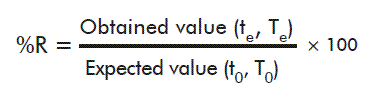
<body><![CDATA[<p><font size="2" face="Verdana, Arial, Helvetica, sans-serif">SUMA technology    was used. The system is manufactured by the Immunoassay Center, Havana, Cuba,    and includes instrumentation and reagents. Equipment comprises a fully computerized    spectro-fluorimeter-photometer for the automatic reading, quantification, validation    and interpretation of the results (PR-621) and a plate washer (MW-2001). The    reagents are cased in kits in quantities enough for 288 ultra-microtests (10    &mu;L volumes of samples and reagents) [10].</font></p>     <p><font size="2" face="Verdana, Arial, Helvetica, sans-serif"><b>UMELISA&reg;    TIR NEONATAL reagents</b></font></p>     <p><font size="2" face="Verdana, Arial, Helvetica, sans-serif">The UMELISA&reg;    TIR NEONATAL is a heterogeneous 'sandwich type' immunoenzymatic assay for the    determination of IRT in dried blood samples on filter paper. It uses as solid    phase strips coated with anti-IRT monoclonal antibodies which were obtained    in the CIE and are highly specific for IRT. Calibrators and control were prepared    from washed hemolyzed erythrocytes and IRT-free plasma, adjusting the hematocrit    to 55 % and spotted on Whatman 903 filter paper cards. A 1 mg/mL IRT solution    (1 mg of IRT dissolved in 1 ml of 2 mM HCl) was used. The calibrators and control    presented concentrations between 0-500 ng/mL and were prepared by gravimetric    method. To prepare the conjugate, anti-IRT monoclonal antibodies were covalently    bound to phosphatase alkaline by a reaction with glutaraldehyde in one step,    according to the procedure described by Avrameas. The preparation of all these    reagents has been previously described [17].</font></p>     <p><font size="2" face="Verdana, Arial, Helvetica, sans-serif"><b>UMELISA&reg;    TIR NEONATAL technical procedure</b></font></p>     <p><font size="2" face="Verdana, Arial, Helvetica, sans-serif">For the measurement    of IRT concentrations, 3 mm blood discs of standards, controls and samples were    punched out of the filter paper and placed into each well of the elution microplates,    followed by the addition of 70 &mu;L of the diluted anti-IRT Mab-alkaline phosphatase    conjugate in 0.05 mol/L Tris buffer, pH 8.0 containing 0.15 mol/L NaCl, 3 mmol/L    NaN<sub>3</sub>, 2.9 mmol/L MgCl<sub>2</sub>, 2.5 mmol/L ZnCl<sub>2</sub>, 0.75    mol/L BSA and 1.1 mmol/L Tween 20. After the elution step in a humid chamber    at room temperature for 16-18 h, 10 &mu;L of eluate were transferred into the    well of the reaction opaque polyestirene ultramicroplates coated with the specific    anti-IRT Mabs. The immunological reaction occurred for 2 h room temperature    in a humid chamber and then, the plates were washed six times with 0.37 mol/L    Tris-HCl solution, pH 8.0 containing 3.76 mol/L NaCl, 1.1 mmol/L Tween 20 and    76.9 mmol/L NaN<sub>3</sub>. The fluorogenic reaction was performed by adding    10 &mu;L of the substrate solution, pH 9.6 containing 5.07 mM 4-methylumbelliferil    phosphate, 0.92 mol/L diethanolamine-HCl, 0.7 mmol/L MgCl<sub>2</sub> and 7    mmol/L NaN<sub>3</sub>. The ultramicroplates remained at room temperature in    a humid chamber for 30 min. Finally, the fluorescence was automatically measured    in the fluorimeter-photometer reader. Automatic validation and interpretation    of the results were done using a specific-assay software [17].</font></p>     <p><font size="2" face="Verdana, Arial, Helvetica, sans-serif"><b>Protocol to    evaluate the effect of temperature on the performance of UMELISA&reg; TIR NEONATAL</b></font></p>     <p><font size="2" face="Verdana, Arial, Helvetica, sans-serif">Eighteen cases    of the same batch were evaluated to determine the effect of storage conditions    on the performance of the quality parameters and functional characteristics    of the UMELISA&reg; TIR NEONATAL. Six of these cases were stored at -20 &plusmn;    2 &ordm;C; another six were stored at 23 &plusmn; 2 &ordm;C and the remaining    ones at 37 &plusmn; 2 &ordm;C. The times selected for the study were: initial    time, 2, 4, 6, 8, 14 and 20 days, taking as control the results of the stored    kits of reagents at the temperature indicated in the external container (from    2 to 8 &ordm;C). The assay was performed following the recommended user's instructions    and it was evaluated according to the criteria established for the UMELISA&reg;    TIR NEONATAL. </font></p>     <p><font size="2" face="Verdana, Arial, Helvetica, sans-serif">For every time    evaluated, the average of the fluorescence values and the recovery percentage    (%R) for every calibrator was determined, using the following formula:</font>  </p>     <p align="center"><img src="/img/revistas/bta/v35n3/fr0103318.gif" width="383" height="97"></p>     
<p><font size="2" face="Verdana, Arial, Helvetica, sans-serif">Where t<sub>e</sub>    and T<sub>e</sub> stand for time and temperature under evaluation, and t0 and    T0 are the values of these parameters at the start of the experiment and 2-8    &ordm;C, respectively. </font></p>     ]]></body>
<body><![CDATA[<p><font size="2" face="Verdana, Arial, Helvetica, sans-serif">IRT concentration    values (ng/mL) of the assay's control for every time and temperature under study    were quantified. The control calibration curve evaluated at the initial time    was taken as reference. The relative accuracy percentage (%RA) was calculated    by the following formula:</font></p>     <p align="center"><img src="/img/revistas/bta/v35n3/fr0203318.gif" width="530" height="76"></p>     

<p><font size="2" face="Verdana, Arial, Helvetica, sans-serif">Data were processed    using Microsoft Excel 2003 (Microsoft Corporation, USA).</font></p>     <p>&nbsp;</p>     <p><font size="3" face="Verdana, Arial, Helvetica, sans-serif"><b>RESULTS</b></font></p>     <p><font size="2" face="Verdana, Arial, Helvetica, sans-serif">It was previously    demonstrated that the UMELISA&reg; TIR NEONATAL is stable for twelve months    stored at 2-8 &ordm;C. Instead, there was the need to test its performance when    the kits and reagents could be subjected to different temperature conditions    during transportation and storage. Therefore, it was considered useful to evaluate    the shelf stability of this reagent kit at different storage conditions. Three    storage temperatures were studied: -20 &plusmn; 2 &ordm;C, 23 &plusmn; 2 &ordm;C    and 37 &plusmn; 2 &ordm;C. Results showing the behav-ior of the calibration    curve for each case were as described below.</font></p>     <p><font size="2" face="Verdana, Arial, Helvetica, sans-serif"><b>Assay performance    stored at -20 &plusmn; 2 &ordm;C </b></font></p>     <p><font size="2" face="Verdana, Arial, Helvetica, sans-serif">The %R of the fluorescence    obtained for each calibrator was obtained for the UMELISA&reg; TIR NEONATAL    stored at -20 &plusmn; 2 &ordm;C during the study (<a href="/img/revistas/bta/v35n3/t0103318.gif">Table    1</a>). This variable, defined as the error (%) between the observed or obtained    value and the actual or expected value, was in the range 80-120 % for all the    points of the curve during the 20 days of the study. This is the accepted range    for this type of assay [18]. Hence, this demonstrates that UMELISA&reg; TIR    NEONATAL retain its quality parameters and functional properties when exposed    to storage conditions of -20 &plusmn; 2 &deg;C for up to 20 days.</font></p>     
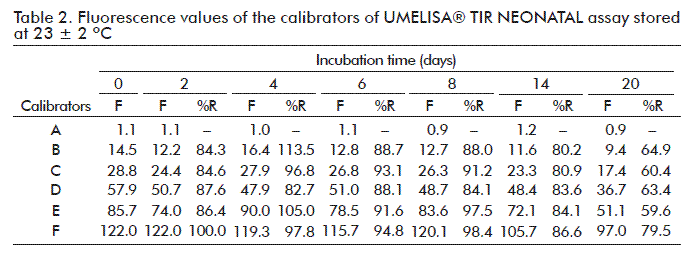
<p><font size="2" face="Verdana, Arial, Helvetica, sans-serif"><b>Assay performance    stored at 23 &plusmn; 2 &ordm;C </b></font></p>     <p><font size="2" face="Verdana, Arial, Helvetica, sans-serif">Taking into consideration    the reagent kits stored at room temperature (<a href="/img/revistas/bta/v35n3/t0203318.gif">Table 2</a>),    it was shown that the %R for every calibrator were within the permissible range    for this type of tests until day 14 at 23 &plusmn; 2 &ordm;C. In the test carried    out on day 20, values of %R below 80 % were obtained for all the points of the    calibration curve, demonstrating the negative effect of these storage conditions    on the adequate performance of the UMELISA&reg; TIR NEONATAL. </font></p>     
]]></body>
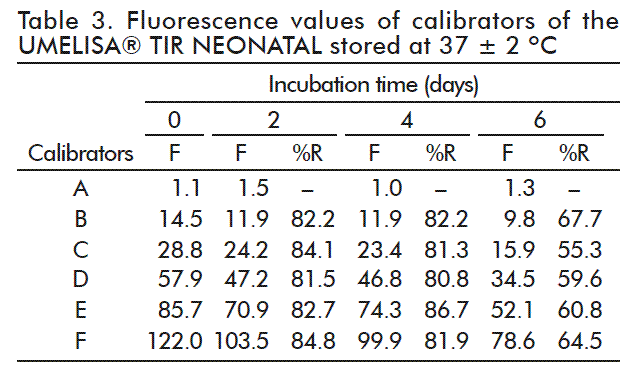
<body><![CDATA[<p><font size="2" face="Verdana, Arial, Helvetica, sans-serif"><b>Assay performance    stored at 37 &plusmn; 2 &ordm;C </b></font></p>     <p><font size="2" face="Verdana, Arial, Helvetica, sans-serif">Similar as for    the test temperature 23 &plusmn; 2 &ordm;C, the analytical performance of this    reagent kit was affected at 37 &plusmn; 2 &ordm;C during the assayed period.    In fact, there was a significant decrease in fluorescence values of each calibrator    as compared to the values obtained at the start of the test (<a href="/img/revistas/bta/v35n3/t0303318.gif">Table    3</a>).</font></p>     
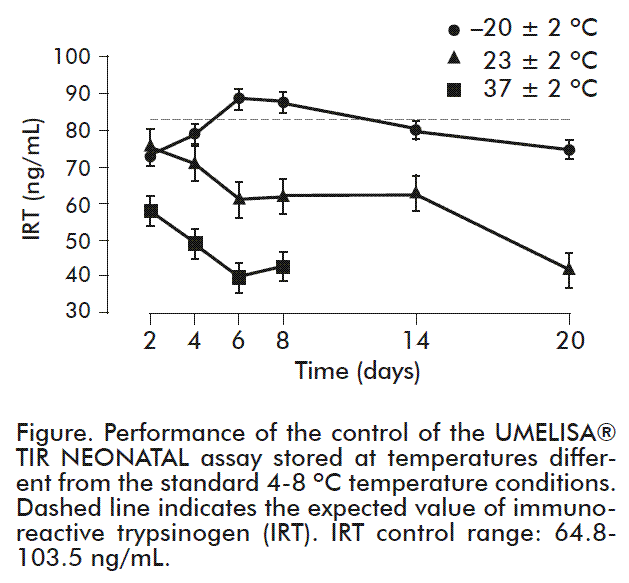
<p><font size="2" face="Verdana, Arial, Helvetica, sans-serif"><b>Control of the    assay </b></font></p>     <p><font size="2" face="Verdana, Arial, Helvetica, sans-serif">To demonstrate    the accuracy of the method, the control of the assay was evaluated in all the    storage temperatures studied. The stability of an analyte is commonly taken    as the time in which a change of 20 % of its concentration occurs in respect    with the original concentration [19]. The behavior of the control of the assay    in respect to the expected concentration when stored at either -20 &plusmn;    2 &deg;C, 23 &plusmn; 2 &deg;C and 37 &plusmn; 2 &deg;C, respectively, are shown    in the <a href="/img/revistas/bta/v35n3/f0103318.gif">figure</a>. </font></p>     
<p><font size="2" face="Verdana, Arial, Helvetica, sans-serif">The expected value    of control was 84.20 ng/mL. The average concentration obtained when the UMELISA&reg;    TIR NEONATAL was experimentally stored at -20 &deg;C was 80.02 &plusmn; 6.34    ng/mL. Notably, the %RA was within the established range during the whole study.    </font></p>     <p><font size="2" face="Verdana, Arial, Helvetica, sans-serif">The behavior was    different when evaluating temperatures of 23 &plusmn; 2 &ordm;C and 37 &plusmn;    2 &ordm;C. In both cases, an important drop in the IRT values is observed when    the reagent kits are stored for more than four days at room temperature and    two days at 37 &ordm;C. The mean concentration values obtained in these cases    were 61.77 &plusmn; 11.56 ng/mL and 46.83 &plusmn; 8.12 ng/mL, respectively.    Correspondingly, the %RA calculated for these conditions were outside the limits    established for this type of test (Range &plusmn; 20 %).</font></p>     <p>&nbsp;</p>     <p><font face="Verdana, Arial, Helvetica, sans-serif" size="3"><b>DISCUSSION</b></font></p>     <p><font size="2" face="Verdana, Arial, Helvetica, sans-serif">Good storage practices    for biological materials is an essential component of any laboratory. Biological    samples often degrade over time when stored at room temperature, but some samples    may also lose integrity at low temperatures if subjected to multiple freeze-thaw    cycles. The best storage temperature for a given biological sample or reagent    often varies according to the type of biological material, the solution in which    it is suspended, the intended use of the sample and the time it will be stored.    The most common storage temperatures are room temperature (20-23 &ordm;C), refrigeration    (2-8 &ordm;C), freezing, deep freezing and cryogenic freezer storage. </font></p>     <p><font size="2" face="Verdana, Arial, Helvetica, sans-serif">Shelf life is commonly    estimated using two types of stability tests: real-time stability tests and    accelerated stability tests. In the former, a product is stored at recommended    storage conditions and monitored until it fails the specification. On the contrary,    in accelerated stability tests a product is stored under highly stressing conditions    (temperature, humidity, pH). In both, degradation at the recommended storage    conditions can be predicted using known relationships between the acceleration    factor and the degradation rate. </font></p>     ]]></body>
<body><![CDATA[<p><font size="2" face="Verdana, Arial, Helvetica, sans-serif">The assessment    of shelf life has evolved from examining the data and making an educated guess    through plotting to the application of rigorous physical-chemical laws and statistical    techniques. Regulators now insist that adequate stability testing should be    conducted to provide evidence on the performance of a drug or a biopharmaceutical    product at different environmental conditions and to establish the recommended    storage conditions and shelf life [20-22]. Recently, Tsong reviewed the latest    approaches to statistical modeling of stability tests [23] and ICH has published    some guidelines for advanced testing design and data analysis [24-25]. </font></p>     <p><font size="2" face="Verdana, Arial, Helvetica, sans-serif">Temperature should    be tested taking into account the nature of the product and the recommended    storage temperature. The selected temperatures should stimulate relatively fast    degradation and quick testing but not enough as to destroy the fundamental properties    of the product. In fact, it is not reasonable to test any product at very high    temperatures for a very short period of time. Under those conditions, the mechanisms    of degradation may be very different than those occurring at the recommended    storage temperature. It is more advisable to choose the adjacent levels adequately    so that degradation trends could be larger than experimental variability. Moreover,    the chose levels depend on the nature of the product and its analytical accuracy,    but other practical implications may be considered. For instance, testing should    be performed at time intervals encompassing the target stability at each elevated    temperature [11].</font></p>     <p><font size="2" face="Verdana, Arial, Helvetica, sans-serif">The low stability    of IRT in dried blood spots on filter paper associated with temperature has    been previously reported [26, 27]. According to the results obtained in our    study, it was proven that storage -20 &plusmn; 2 &ordm;C did not affected the    stability of IRT during evaluation time, obtaining values of %R and %RA within    the ranges established for this type of assay. These were in agreement with    reports by Li <i>et al</i>. [16]. In the case of the temperature of 23 &plusmn;    2 &ordm;C, although the quality parameters and the functional characteristics    of the calibration curve remained within the established ranges for 14 days,    the accuracy of the test control was affected from day 6, showing values of    %RA above 20 %. In a similar study conducted in Wisconsin, it was reported that    the concentration of IRT in dried blood samples stored at room temperature for    24 h decreased by 2 % [28]. </font></p>     <p><font size="2" face="Verdana, Arial, Helvetica, sans-serif">Regarding the storage    temperature of 37 &plusmn; 2 &ordm;C, a sudden drop in the fluorescence values    of each calibrator is observed from the second day after the beginning of the    test. Concentration of the assay control is also affected. Since degradation    of a biological product is usually defined in terms of loss of activity or performance,    this is considered to be degrading when any characteristic of interest decreases    (for instance, potency or performance).</font></p>     <p><font size="2" face="Verdana, Arial, Helvetica, sans-serif">Degradation usually    follows a specific pattern depending on the kinetics of the chemical reaction.    The degradation rate depends on the conditions where the chemical reaction takes    place. Products degrade faster when subjected to acceleration factors such as    temperature, humidity, pH and radiation. Temperature is probably the most common    acceleration factor used for testing chemical, pharmaceutical and biological    products. This is related to its association to the degradation rate, which    relationship is well characterized by the Arrhenius equation [11]. In respect    to IRT, there are evidences on a 40 % decrease of the concentration of this    analyte in just one week in a dried blood sample stored at 27 &deg;C and 80    % humidity [28]. </font></p>     <p><font size="2" face="Verdana, Arial, Helvetica, sans-serif">Here were found    negative effects on the on the stability of dried blood calibrators and control    of the UMELISA&reg; TIR NEONATAL during storage at 23 &plusmn; 2 &ordm;C and    37 &plusmn; 2 &ordm;C. These could lead to a decreased accuracy of the method,    since lower fluorescence values of the calibrators can lead to the overestimation    of the samples evaluated, leading to the subsequent increase in the false positive    results of the test.</font></p>     <p><font size="2" face="Verdana, Arial, Helvetica, sans-serif">Remarkably, it    is very important to comprehend the susceptibility of markers in dried blood    to degradation, when exposed to stressing temperature and humidity conditions,    in order to maintain the integrity of the sample for high quality measurements.    In this line, it is recommended that assay calibrators and control should receive    maximum protection against potential degradation caused by their storage conditions    and transport environments.</font></p>     <p>&nbsp;</p>     <p><font size="2" face="Verdana, Arial, Helvetica, sans-serif"><b><font size="3">CONCLUSIONS    </font> </b></font></p>     <p><font size="2" face="Verdana, Arial, Helvetica, sans-serif">According to the    results obtained in this study, the quality parameters of the UMELISA&reg; TIR    NEONATAL are affected according to their storage conditions. It was demonstrated    that the temperature directly influences the analytical performance of the UMELISA&reg;    TIR NEONATAL. It was also shown that the kit can be exposed to a temperature    of -20 &plusmn; 2 &ordm;C for 20 days and a temperature of 23 &plusmn; 2 &ordm;C,    for 14 days, without affecting its performance. Noteworthy, it is not advised    to store kit components at 37 &plusmn; 2 &ordm;C for more than 4 days, since    its optimum quality parameters are affected.</font></p>     ]]></body>
<body><![CDATA[<p>&nbsp;</p>     <p><font size="3" face="Verdana, Arial, Helvetica, sans-serif"><b>REFERENCES</b></font></p>     <!-- ref --><p><font size="2" face="Verdana, Arial, Helvetica, sans-serif">1. Parad RB, Comeau    AM. Newbornscreening for cystic fibrosis. Pediatr Ann. 2003;32(8):528-35.    </font></p>     <p><font size="2" face="Verdana, Arial, Helvetica, sans-serif">2. Sontag MK, Hammond    KB, Zielenski J, Wagener JS, Accurso FJ. Two-tiered immunoreactive trypsinogen-based    newborn screening for cystic fibrosis in Colorado: screening efficacy and diagnostic    outcomes. J Pediatr. 2005;147(3 Suppl):S83-8.</font></p>     <!-- ref --><p><font size="2" face="Verdana, Arial, Helvetica, sans-serif">3. Riordan JR,    Rommens JM, Kerem B, AlonN, Rozmahel R, Grzelczak Z, <i>et al</i>. Identification    of the cystic fibrosis gene: cloning and characterization of complementary DNA.    Science. 1989;245(4922):1066-73.    </font></p>     <!-- ref --><p><font size="2" face="Verdana, Arial, Helvetica, sans-serif">4. Massie RJ, Curnow    L, Glazner J, Armstrong DS, Francis I. Lessons learned from 20 years of newborn    screening for cystic fibrosis. Med J Aust. 2012;196(1):67-70.    </font></p>     <!-- ref --><p><font size="2" face="Verdana, Arial, Helvetica, sans-serif">5. Dijk FN, Fitzgerald    DA. The impact of newborn screening and earlier intervention on the clinical    course of cystic fibrosis. Paediatr Respir Rev. 2012;13(4):220-5.     </font></p>     <!-- ref --><p><font size="2" face="Verdana, Arial, Helvetica, sans-serif">6. Farrell PM,    Kosorok MR, Laxova A, Shen G, Koscik RE, Bruns WT, <i>et al</i>. Nutritional    benefits of neonatal screening for cystic fibrosis. Wisconsin Cystic Fibrosis    Neonatal Screening Study Group. N Engl J Med. 1997;337(14):963-9.     </font></p>     <!-- ref --><p><font size="2" face="Verdana, Arial, Helvetica, sans-serif">7. Grosse SD, Rosenfeld    M, Devine OJ, Lai HJ, Farrell PM. Potential impact of newborn screening for    cystic fibrosis on child survival: a systematic review and analysis. J Pediatr.    2006;149(3):362-6.     </font></p>     <!-- ref --><p><font size="2" face="Verdana, Arial, Helvetica, sans-serif">8. VanDevanter    DR, Pasta DJ, Konstan MW. Improvements in lung function and height among cohorts    of 6-year-olds with cystic fibrosis from 1994 to 2012. J Pediatr. 2014;165(6):1091-7    e2.     </font></p>     <!-- ref --><p><font size="2" face="Verdana, Arial, Helvetica, sans-serif">9. Crossley JR,    Elliott RB, Smith PA. Dried-blood spot screening for cystic fibrosis in the    newborn. Lancet. 1979;1(8114):472-4.     </font></p>     <p><font size="2" face="Verdana, Arial, Helvetica, sans-serif">10. Gonz&aacute;lez    EC, Castells EM, Fr&oacute;meta A, Arteaga AL, Del R&iacute;o L, Tejeda Y, <i>et    al</i>. SUMA technology and newborn screening tests for inherited metabolic    diseases in Cuba: An Overview of the First 30 Years. J Inborn Errors Metab Screen.    2016;4:1-9. </font></p>     ]]></body>
<body><![CDATA[<!-- ref --><p><font size="2" face="Verdana, Arial, Helvetica, sans-serif">11. Magari RT.    Assessing shelf life using real-time and accelerated stability tests. BioPharm    Int. 2003;16 (11):36-48.     </font></p>     <!-- ref --><p><font size="2" face="Verdana, Arial, Helvetica, sans-serif">12. Levy HL, Simmons    JR, MacCready RA. Stability of amino acids and galactose in the newborn screening    filter paper blood specimen. J Pediatr. 1985;107(5):757-60.     </font></p>     <!-- ref --><p><font size="2" face="Verdana, Arial, Helvetica, sans-serif">13. Waite KV, Maberly    GF, Eastman CJ. Storage conditions and stability of thyrotropin and thyroid    hormones on filter paper. Clin Chem. 1987;33(6):853-5.     </font></p>     <p><font size="2" face="Verdana, Arial, Helvetica, sans-serif">14. Zytkovicz TH,    Eaton RB, Foley TP, Lister BC, Rojas DA, Schwerier ME. Instability of enzymes,    antibodies, and other analytes in dried blood spots - is the major problem heat    or humidity. In: Therell BL, Aldis BG, editors. Proceeding of the Eleventh National    Symposium on Neonatal Screening; Sept. 12-16, 1995; Corpus Christi, Texas. Washington,    DC: ASTPHLD; 1995. p. 293-5. </font></p>     <!-- ref --><p><font size="2" face="Verdana, Arial, Helvetica, sans-serif">15. Freer DE. Observations    on heat/humidity denaturation of enzymes in filter-paper blood spots from newborns.    Clin Chem. 2005;51(6):1060-2.     </font></p>     <!-- ref --><p><font size="2" face="Verdana, Arial, Helvetica, sans-serif">16. Li L, Zhou    Y, Bell CJ, Earley MC, Hannon WH, Mei JV. Development and characterization of    dried blood spot materials for the measurement of immunoreactive trypsinogen.    J Med Screen. 2006;13(2):79-84.     </font></p>     <!-- ref --><p><font size="2" face="Verdana, Arial, Helvetica, sans-serif">17. Castells Martinez    EM, Gonzalez EC, Tejeda Y, Frometa A, Martin O, Espinosa M, <i>et al</i>. An    Enzyme Immunoassay for Determining Immunoreactive Trypsinogen (IRT) in Dried    Blood Spots on Filter Paper Using an Ultra-Microanalytical System. Appl Biochem    Biotechnol. 2018;186(4):1034-46.    </font></p>     <!-- ref --><p><font size="2" face="Verdana, Arial, Helvetica, sans-serif">18. Ochoa R, Mart&iacute;nez    JC, Ferriol X, Garc&iacute;a AM, Estrada E, Blanco R, et al. Principios y procedimientos    para la validaci&oacute;n de inmunoensayos cuantitativos empleados para evaluar    la inmunogenicidad de vacunas. Vaccimonitor. 1999;8(10):9-13.    </font></p>     <!-- ref --><p><font size="2" face="Verdana, Arial, Helvetica, sans-serif">19. Fr&oacute;meta-Su&aacute;rez    A, Marrero-Gonz&aacute;lez N, Gonz&aacute;lez-Reyes EC, Lugo-Vallejo E, Fern&aacute;ndez-    Fern&aacute;ndez L, Dom&eacute;nech- Mylnikova MB. Estudio comparativo de los    tres papeles de filtro en los ensayos UMELISA para el tamizaje neonatal de hipotiroidismo    cong&eacute;nito y fenilcetonuria. Rev Biomed. 2002;13(4):241-7.     </font></p>     <!-- ref --><p><font size="2" face="Verdana, Arial, Helvetica, sans-serif">20. FDA. Guidelines    for submitting documentations for the stability of human drugs and biologics.    Rockville (MD): Food and Drug Administration; 1987.     </font></p>     <!-- ref --><p><font size="2" face="Verdana, Arial, Helvetica, sans-serif">21. ICH. Stability    testing for new drug substances and products, Q1A(R). Geneva: International    Conference on Harmonisation of Technical Requirements for Registration of Pharmaceuticals    for Human Use; 1994.     </font></p>     <!-- ref --><p><font size="2" face="Verdana, Arial, Helvetica, sans-serif">22. ICH. Stability    testing for new drug substances and products, Q1A(R2). Geneva: International    Conference on Harmonisation of Technical Requirements for Registration of Pharmaceuticals    for Human Use; 2003.     </font></p>     <!-- ref --><p><font size="2" face="Verdana, Arial, Helvetica, sans-serif">23. Tsong Y. Recent    issues in stability testing. J Biopharm Stat. 2003;13(3):7-9.     </font></p>     <!-- ref --><p><font size="2" face="Verdana, Arial, Helvetica, sans-serif">24. ICH. Stability    data evaluation, Q1E. Geneva: International Conference on Harmonisation of Technical    Requirements for Registration of Pharmaceuticals for Human Use; 2003.     </font></p>     <!-- ref --><p><font size="2" face="Verdana, Arial, Helvetica, sans-serif">25. ICH. Bracketing    and matrixing designs for stability testing of new drug substances and products.    Q1D. Geneva: International Conference on Harmonisation of Technical Requirements    for Registration of Pharmaceuticals for Human Use; 2003.     </font></p>     <!-- ref --><p><font size="2" face="Verdana, Arial, Helvetica, sans-serif">26. Cabrini G,    Pederzini F, Perobelli L, Mastella G. An evaluation of an enzyme immunoassay    method for immunoreactive trypsin in dried blood spots. Clin Biochem. 1990;23(3):213-9.        </font></p>     <!-- ref --><p><font size="2" face="Verdana, Arial, Helvetica, sans-serif">27. Dhondt JL,    Farriaux JP. What do immunoreactive trypsin assays measure? Screening. 1994;3(1):33-8.        </font></p>     <p><font size="2" face="Verdana, Arial, Helvetica, sans-serif">28. Kloosterboer    M, Hoffman G, Rock M, Gershan W, Laxova A, Li Z, <i>et al</i>. Clarification    of laboratory and clinical variables that influence cystic fibrosis newborn    screening with initial analysis of immunoreactive trypsinogen. Pediatrics. 2009;123(2):e338-46.    </font></p>     <p>&nbsp;</p>     <p>&nbsp;</p>     <p><font size="2" face="Verdana, Arial, Helvetica, sans-serif">Received in July,    2018.     <br>   Accepted in September, 2018.</font></p>     <p>&nbsp;</p>     <p>&nbsp;</p>     ]]></body>
<body><![CDATA[<p><font face="Verdana, Arial, Helvetica, sans-serif" size="2"><i>Elisa M Castells-Mart&iacute;nez</i>.    Neonatal Screening Laboratory, Immunoassay Center. 25th Ave and 134 Street,    Cubanac&aacute;n, Playa, CP 6653, Havana, Cuba. E-mail: <a href="mailto:elisa.castells@cie.cu">elisa.castells@cie.cu</a>.</font></p>      ]]></body><back>
<ref-list>
<ref id="B1">
<label>1</label><nlm-citation citation-type="journal">
<person-group person-group-type="author">
<name>
<surname><![CDATA[Parad]]></surname>
<given-names><![CDATA[RB]]></given-names>
</name>
<name>
<surname><![CDATA[Comeau]]></surname>
<given-names><![CDATA[AM]]></given-names>
</name>
</person-group>
<article-title xml:lang="en"><![CDATA[Newborn screening for cystic fibrosis]]></article-title>
<source><![CDATA[Pediatr Ann]]></source>
<year>2003</year>
<volume>32</volume>
<numero>8</numero>
<issue>8</issue>
<page-range>528-35</page-range></nlm-citation>
</ref>
<ref id="B2">
<label>2</label><nlm-citation citation-type="journal">
<person-group person-group-type="author">
<name>
<surname><![CDATA[Sontag]]></surname>
<given-names><![CDATA[MK]]></given-names>
</name>
<name>
<surname><![CDATA[Hammond]]></surname>
<given-names><![CDATA[KB]]></given-names>
</name>
<name>
<surname><![CDATA[Zielenski]]></surname>
<given-names><![CDATA[J]]></given-names>
</name>
<name>
<surname><![CDATA[Wagener]]></surname>
<given-names><![CDATA[JS]]></given-names>
</name>
<name>
<surname><![CDATA[Accurso]]></surname>
<given-names><![CDATA[FJ]]></given-names>
</name>
</person-group>
<article-title xml:lang="en"><![CDATA[Two-tiered immunoreactive trypsinogen-based newborn screening for cystic fibrosis in Colorado: screening efficacy and diagnostic outcomes]]></article-title>
<source><![CDATA[J Pediatr]]></source>
<year>2005</year>
<volume>147</volume>
<numero>3S83</numero>
<issue>3S83</issue>
<page-range>8</page-range></nlm-citation>
</ref>
<ref id="B3">
<label>3</label><nlm-citation citation-type="journal">
<person-group person-group-type="author">
<name>
<surname><![CDATA[Riordan]]></surname>
<given-names><![CDATA[JR]]></given-names>
</name>
<name>
<surname><![CDATA[Rommens]]></surname>
<given-names><![CDATA[JM]]></given-names>
</name>
<name>
<surname><![CDATA[Kerem]]></surname>
<given-names><![CDATA[B]]></given-names>
</name>
<name>
<surname><![CDATA[Alon]]></surname>
<given-names><![CDATA[N]]></given-names>
</name>
<name>
<surname><![CDATA[Rozmahel]]></surname>
<given-names><![CDATA[R]]></given-names>
</name>
<name>
<surname><![CDATA[Grzelczak]]></surname>
<given-names><![CDATA[Z]]></given-names>
</name>
</person-group>
<article-title xml:lang="en"><![CDATA[Identification of the cystic fibrosis gene: cloning and characterization of complementary DNA]]></article-title>
<source><![CDATA[Science]]></source>
<year>1989</year>
<volume>245</volume>
<numero>4922</numero>
<issue>4922</issue>
<page-range>1066-73</page-range></nlm-citation>
</ref>
<ref id="B4">
<label>4</label><nlm-citation citation-type="journal">
<person-group person-group-type="author">
<name>
<surname><![CDATA[Massie]]></surname>
<given-names><![CDATA[RJ]]></given-names>
</name>
<name>
<surname><![CDATA[Curnow]]></surname>
<given-names><![CDATA[L]]></given-names>
</name>
<name>
<surname><![CDATA[Glazner]]></surname>
<given-names><![CDATA[J]]></given-names>
</name>
<name>
<surname><![CDATA[Armstrong]]></surname>
<given-names><![CDATA[DS]]></given-names>
</name>
<name>
<surname><![CDATA[Francis]]></surname>
<given-names><![CDATA[I]]></given-names>
</name>
</person-group>
<article-title xml:lang="en"><![CDATA[Lessons learned from 20 years of newborn screening for cystic fibrosis]]></article-title>
<source><![CDATA[Med J Aust]]></source>
<year>2012</year>
<volume>196</volume>
<numero>1</numero>
<issue>1</issue>
<page-range>67-70</page-range></nlm-citation>
</ref>
<ref id="B5">
<label>5</label><nlm-citation citation-type="journal">
<person-group person-group-type="author">
<name>
<surname><![CDATA[Dijk]]></surname>
<given-names><![CDATA[FN]]></given-names>
</name>
<name>
<surname><![CDATA[Fitzgerald]]></surname>
<given-names><![CDATA[DA]]></given-names>
</name>
</person-group>
<article-title xml:lang="en"><![CDATA[The impact of newborn screening and earlier intervention on the clinical course of cystic fibrosis]]></article-title>
<source><![CDATA[Paediatr Respir Rev]]></source>
<year>2012</year>
<volume>13</volume>
<numero>4</numero>
<issue>4</issue>
<page-range>220-5</page-range></nlm-citation>
</ref>
<ref id="B6">
<label>6</label><nlm-citation citation-type="journal">
<person-group person-group-type="author">
<name>
<surname><![CDATA[Farrell]]></surname>
<given-names><![CDATA[PM]]></given-names>
</name>
<name>
<surname><![CDATA[Kosorok]]></surname>
<given-names><![CDATA[MR]]></given-names>
</name>
<name>
<surname><![CDATA[Laxova]]></surname>
<given-names><![CDATA[A]]></given-names>
</name>
<name>
<surname><![CDATA[Shen]]></surname>
<given-names><![CDATA[G]]></given-names>
</name>
<name>
<surname><![CDATA[Koscik]]></surname>
<given-names><![CDATA[RE]]></given-names>
</name>
<name>
<surname><![CDATA[Bruns]]></surname>
<given-names><![CDATA[WT]]></given-names>
</name>
</person-group>
<article-title xml:lang="en"><![CDATA[Nutritional benefits of neonatal screening for cystic fibrosis. Wisconsin Cystic Fibrosis Neonatal Screening Study Group]]></article-title>
<source><![CDATA[N Engl J Med]]></source>
<year>1997</year>
<volume>337</volume>
<numero>14</numero>
<issue>14</issue>
<page-range>963-9</page-range></nlm-citation>
</ref>
<ref id="B7">
<label>7</label><nlm-citation citation-type="journal">
<person-group person-group-type="author">
<name>
<surname><![CDATA[Grosse]]></surname>
<given-names><![CDATA[SD]]></given-names>
</name>
<name>
<surname><![CDATA[Rosenfeld]]></surname>
<given-names><![CDATA[M]]></given-names>
</name>
<name>
<surname><![CDATA[Devine]]></surname>
<given-names><![CDATA[OJ]]></given-names>
</name>
<name>
<surname><![CDATA[Lai]]></surname>
<given-names><![CDATA[HJ]]></given-names>
</name>
<name>
<surname><![CDATA[Farrell]]></surname>
<given-names><![CDATA[PM]]></given-names>
</name>
</person-group>
<article-title xml:lang="en"><![CDATA[Potential impact of newborn screening for cystic fibrosis on child survival: a systematic review and analysis]]></article-title>
<source><![CDATA[J Pediatr]]></source>
<year>2006</year>
<volume>149</volume>
<numero>3</numero>
<issue>3</issue>
<page-range>362-6</page-range></nlm-citation>
</ref>
<ref id="B8">
<label>8</label><nlm-citation citation-type="journal">
<person-group person-group-type="author">
<name>
<surname><![CDATA[VanDevanter]]></surname>
<given-names><![CDATA[DR]]></given-names>
</name>
<name>
<surname><![CDATA[Pasta]]></surname>
<given-names><![CDATA[DJ]]></given-names>
</name>
<name>
<surname><![CDATA[Konstan]]></surname>
<given-names><![CDATA[MW]]></given-names>
</name>
</person-group>
<article-title xml:lang="en"><![CDATA[Improvements in lung function and height among cohorts of 6-year-olds with cystic fibrosis from 1994 to 2012]]></article-title>
<source><![CDATA[J Pediatr]]></source>
<year>2014</year>
<volume>165</volume>
<numero>6</numero>
<issue>6</issue>
<page-range>1091-7 e2</page-range></nlm-citation>
</ref>
<ref id="B9">
<label>9</label><nlm-citation citation-type="journal">
<person-group person-group-type="author">
<name>
<surname><![CDATA[Crossley]]></surname>
<given-names><![CDATA[JR]]></given-names>
</name>
<name>
<surname><![CDATA[Elliott]]></surname>
<given-names><![CDATA[RB]]></given-names>
</name>
<name>
<surname><![CDATA[Smith]]></surname>
<given-names><![CDATA[PA]]></given-names>
</name>
</person-group>
<article-title xml:lang="en"><![CDATA[Dried-blood spot screening for cystic fibrosis in the newborn]]></article-title>
<source><![CDATA[Lancet]]></source>
<year>1979</year>
<volume>1</volume>
<numero>8114</numero>
<issue>8114</issue>
<page-range>472-4</page-range></nlm-citation>
</ref>
<ref id="B10">
<label>10</label><nlm-citation citation-type="journal">
<person-group person-group-type="author">
<name>
<surname><![CDATA[González]]></surname>
<given-names><![CDATA[EC]]></given-names>
</name>
<name>
<surname><![CDATA[Castells]]></surname>
<given-names><![CDATA[EM]]></given-names>
</name>
<name>
<surname><![CDATA[Frómeta]]></surname>
<given-names><![CDATA[A]]></given-names>
</name>
<name>
<surname><![CDATA[Arteaga]]></surname>
<given-names><![CDATA[AL]]></given-names>
</name>
<name>
<surname><![CDATA[Del Río]]></surname>
<given-names><![CDATA[L]]></given-names>
</name>
<name>
<surname><![CDATA[Tejeda]]></surname>
<given-names><![CDATA[Y]]></given-names>
</name>
</person-group>
<article-title xml:lang="en"><![CDATA[SUMA technology and newborn screening tests for inherited metabolic diseases in Cuba: An Overview of the First 30 Years]]></article-title>
<source><![CDATA[J Inborn Errors Metab Screen]]></source>
<year>2016</year>
<volume>4</volume>
<numero>^s1</numero>
<issue>^s1</issue>
<supplement>1</supplement>
<page-range>1-9</page-range></nlm-citation>
</ref>
<ref id="B11">
<label>11</label><nlm-citation citation-type="journal">
<person-group person-group-type="author">
<name>
<surname><![CDATA[Magari]]></surname>
<given-names><![CDATA[RT]]></given-names>
</name>
</person-group>
<article-title xml:lang="en"><![CDATA[Assessing shelf life using real-time and accelerated stability tests]]></article-title>
<source><![CDATA[BioPharm Int]]></source>
<year>2003</year>
<volume>16</volume>
<numero>11</numero>
<issue>11</issue>
<page-range>36-48</page-range></nlm-citation>
</ref>
<ref id="B12">
<label>12</label><nlm-citation citation-type="journal">
<person-group person-group-type="author">
<name>
<surname><![CDATA[Levy]]></surname>
<given-names><![CDATA[HL]]></given-names>
</name>
<name>
<surname><![CDATA[Simmons]]></surname>
<given-names><![CDATA[JR]]></given-names>
</name>
<name>
<surname><![CDATA[MacCready]]></surname>
<given-names><![CDATA[RA]]></given-names>
</name>
</person-group>
<article-title xml:lang="en"><![CDATA[Stability of amino acids and galactose in the newborn screening filter paper blood specimen]]></article-title>
<source><![CDATA[J Pediatr]]></source>
<year>1985</year>
<volume>107</volume>
<numero>5</numero>
<issue>5</issue>
<page-range>757-60</page-range></nlm-citation>
</ref>
<ref id="B13">
<label>13</label><nlm-citation citation-type="journal">
<person-group person-group-type="author">
<name>
<surname><![CDATA[Waite]]></surname>
<given-names><![CDATA[KV]]></given-names>
</name>
<name>
<surname><![CDATA[Maberly]]></surname>
<given-names><![CDATA[GF]]></given-names>
</name>
<name>
<surname><![CDATA[Eastman]]></surname>
<given-names><![CDATA[CJ]]></given-names>
</name>
</person-group>
<article-title xml:lang="en"><![CDATA[Storage conditions and stability of thyrotropin and thyroid hormones on filter paper]]></article-title>
<source><![CDATA[Clin Chem]]></source>
<year>1987</year>
<volume>33</volume>
<numero>6</numero>
<issue>6</issue>
<page-range>853-5</page-range></nlm-citation>
</ref>
<ref id="B14">
<label>14</label><nlm-citation citation-type="book">
<person-group person-group-type="author">
<name>
<surname><![CDATA[Zytkovicz]]></surname>
<given-names><![CDATA[TH]]></given-names>
</name>
<name>
<surname><![CDATA[Eaton]]></surname>
<given-names><![CDATA[RB]]></given-names>
</name>
<name>
<surname><![CDATA[Foley]]></surname>
<given-names><![CDATA[TP]]></given-names>
</name>
<name>
<surname><![CDATA[Lister]]></surname>
<given-names><![CDATA[BC]]></given-names>
</name>
<name>
<surname><![CDATA[Rojas]]></surname>
<given-names><![CDATA[DA]]></given-names>
</name>
<name>
<surname><![CDATA[Schwerier]]></surname>
<given-names><![CDATA[ME]]></given-names>
</name>
</person-group>
<article-title xml:lang="en"><![CDATA[Instability of enzymes, antibodies, and other analytes in dried blood spots - is the major problem heat or humidity]]></article-title>
<person-group person-group-type="editor">
<name>
<surname><![CDATA[Therell]]></surname>
<given-names><![CDATA[BL]]></given-names>
</name>
<name>
<surname><![CDATA[Aldis]]></surname>
<given-names><![CDATA[BG]]></given-names>
</name>
</person-group>
<source><![CDATA[Proceeding of the Eleventh National Symposium on Neonatal Screening; Sept. 12-16, 1995; Corpus Christi, Texas]]></source>
<year>1995</year>
<page-range>293-5</page-range><publisher-loc><![CDATA[Washington, DC ]]></publisher-loc>
<publisher-name><![CDATA[ASTPHLD]]></publisher-name>
</nlm-citation>
</ref>
<ref id="B15">
<label>15</label><nlm-citation citation-type="journal">
<person-group person-group-type="author">
<name>
<surname><![CDATA[Freer]]></surname>
<given-names><![CDATA[DE]]></given-names>
</name>
</person-group>
<article-title xml:lang="en"><![CDATA[Observations on heat/humidity denaturation of enzymes in filter-paper blood spots from newborns]]></article-title>
<source><![CDATA[Clin Chem]]></source>
<year>2005</year>
<volume>51</volume>
<numero>6</numero>
<issue>6</issue>
<page-range>1060-2</page-range></nlm-citation>
</ref>
<ref id="B16">
<label>16</label><nlm-citation citation-type="journal">
<person-group person-group-type="author">
<name>
<surname><![CDATA[Li]]></surname>
<given-names><![CDATA[L]]></given-names>
</name>
<name>
<surname><![CDATA[Zhou]]></surname>
<given-names><![CDATA[Y]]></given-names>
</name>
<name>
<surname><![CDATA[Bell]]></surname>
<given-names><![CDATA[CJ]]></given-names>
</name>
<name>
<surname><![CDATA[Earley]]></surname>
<given-names><![CDATA[MC]]></given-names>
</name>
<name>
<surname><![CDATA[Hannon]]></surname>
<given-names><![CDATA[WH]]></given-names>
</name>
<name>
<surname><![CDATA[Mei]]></surname>
<given-names><![CDATA[JV]]></given-names>
</name>
</person-group>
<article-title xml:lang="en"><![CDATA[Development and characterization of dried blood spot materials for the measurement of immunoreactive trypsinogen]]></article-title>
<source><![CDATA[J Med Screen]]></source>
<year>2006</year>
<volume>13</volume>
<numero>2</numero>
<issue>2</issue>
<page-range>79-84</page-range></nlm-citation>
</ref>
<ref id="B17">
<label>17</label><nlm-citation citation-type="journal">
<person-group person-group-type="author">
<name>
<surname><![CDATA[Castells Martinez]]></surname>
<given-names><![CDATA[EM]]></given-names>
</name>
<name>
<surname><![CDATA[Gonzalez]]></surname>
<given-names><![CDATA[EC]]></given-names>
</name>
<name>
<surname><![CDATA[Tejeda]]></surname>
<given-names><![CDATA[Y]]></given-names>
</name>
<name>
<surname><![CDATA[Frometa]]></surname>
<given-names><![CDATA[A]]></given-names>
</name>
<name>
<surname><![CDATA[Martin]]></surname>
<given-names><![CDATA[O]]></given-names>
</name>
<name>
<surname><![CDATA[Espinosa]]></surname>
<given-names><![CDATA[M]]></given-names>
</name>
</person-group>
<article-title xml:lang="en"><![CDATA[An Enzyme Immunoassay for Determining Immunoreactive Trypsinogen (IRT) in Dried Blood Spots on Filter Paper Using an Ultra-Microanalytical System]]></article-title>
<source><![CDATA[Appl Biochem Biotechnol]]></source>
<year>2018</year>
<volume>186</volume>
<numero>4</numero>
<issue>4</issue>
<page-range>1034-46</page-range></nlm-citation>
</ref>
<ref id="B18">
<label>18</label><nlm-citation citation-type="journal">
<person-group person-group-type="author">
<name>
<surname><![CDATA[Ochoa]]></surname>
<given-names><![CDATA[R]]></given-names>
</name>
<name>
<surname><![CDATA[Martínez]]></surname>
<given-names><![CDATA[JC]]></given-names>
</name>
<name>
<surname><![CDATA[Ferriol]]></surname>
<given-names><![CDATA[X]]></given-names>
</name>
<name>
<surname><![CDATA[García]]></surname>
<given-names><![CDATA[AM]]></given-names>
</name>
<name>
<surname><![CDATA[Estrada]]></surname>
<given-names><![CDATA[E]]></given-names>
</name>
<name>
<surname><![CDATA[Blanco]]></surname>
<given-names><![CDATA[R]]></given-names>
</name>
</person-group>
<article-title xml:lang="es"><![CDATA[Principios y procedimientos para la validación de inmunoensayos cuantitativos empleados para evaluar la inmunogenicidad de vacunas]]></article-title>
<source><![CDATA[Vaccimonitor]]></source>
<year>1999</year>
<volume>8</volume>
<numero>10</numero>
<issue>10</issue>
<page-range>9-13</page-range></nlm-citation>
</ref>
<ref id="B19">
<label>19</label><nlm-citation citation-type="journal">
<person-group person-group-type="author">
<name>
<surname><![CDATA[Frómeta-Suárez]]></surname>
<given-names><![CDATA[A]]></given-names>
</name>
<name>
<surname><![CDATA[Marrero-González]]></surname>
<given-names><![CDATA[N]]></given-names>
</name>
<name>
<surname><![CDATA[González-Reyes]]></surname>
<given-names><![CDATA[EC]]></given-names>
</name>
<name>
<surname><![CDATA[Lugo-Vallejo]]></surname>
<given-names><![CDATA[E]]></given-names>
</name>
<name>
<surname><![CDATA[Fernández- Fernández]]></surname>
<given-names><![CDATA[L]]></given-names>
</name>
<name>
<surname><![CDATA[Doménech- Mylnikova]]></surname>
<given-names><![CDATA[MB]]></given-names>
</name>
</person-group>
<article-title xml:lang="es"><![CDATA[Estudio comparativo de los tres papeles de filtro en los ensayos UMELISA para el tamizaje neonatal de hipotiroidismo congénito y fenilcetonuria]]></article-title>
<source><![CDATA[Rev Biomed]]></source>
<year>2002</year>
<volume>13</volume>
<numero>4</numero>
<issue>4</issue>
<page-range>241-7</page-range></nlm-citation>
</ref>
<ref id="B20">
<label>20</label><nlm-citation citation-type="book">
<collab>FDA</collab>
<source><![CDATA[Guidelines for submitting documentations for the stability of human drugs and biologics]]></source>
<year>1987</year>
<publisher-loc><![CDATA[Rockville (MD) ]]></publisher-loc>
<publisher-name><![CDATA[Food and Drug Administration]]></publisher-name>
</nlm-citation>
</ref>
<ref id="B21">
<label>21</label><nlm-citation citation-type="book">
<collab>ICH</collab>
<source><![CDATA[Stability testing for new drug substances and products, Q1A(R)]]></source>
<year>1994</year>
<publisher-loc><![CDATA[Geneva ]]></publisher-loc>
<publisher-name><![CDATA[International Conference on Harmonisation of Technical Requirements for Registration of Pharmaceuticals for Human Use]]></publisher-name>
</nlm-citation>
</ref>
<ref id="B22">
<label>22</label><nlm-citation citation-type="book">
<collab>ICH</collab>
<source><![CDATA[Stability testing for new drug substances and products, Q1A(R2)]]></source>
<year>2003</year>
<publisher-loc><![CDATA[Geneva ]]></publisher-loc>
<publisher-name><![CDATA[International Conference on Harmonisation of Technical Requirements for Registration of Pharmaceuticals for Human Use]]></publisher-name>
</nlm-citation>
</ref>
<ref id="B23">
<label>23</label><nlm-citation citation-type="journal">
<person-group person-group-type="author">
<name>
<surname><![CDATA[Tsong]]></surname>
<given-names><![CDATA[Y]]></given-names>
</name>
</person-group>
<article-title xml:lang="en"><![CDATA[Recent issues in stability testing]]></article-title>
<source><![CDATA[J Biopharm Stat]]></source>
<year>2003</year>
<volume>13</volume>
<numero>3</numero>
<issue>3</issue>
<page-range>7-9</page-range></nlm-citation>
</ref>
<ref id="B24">
<label>24</label><nlm-citation citation-type="book">
<collab>ICH</collab>
<source><![CDATA[Stability data evaluation, Q1E]]></source>
<year>2003</year>
<publisher-loc><![CDATA[Geneva ]]></publisher-loc>
<publisher-name><![CDATA[International Conference on Harmonisation of Technical Requirements for Registration of Pharmaceuticals for Human Use]]></publisher-name>
</nlm-citation>
</ref>
<ref id="B25">
<label>25</label><nlm-citation citation-type="book">
<collab>ICH</collab>
<source><![CDATA[Bracketing and matrixing designs for stability testing of new drug substances and products. Q1D]]></source>
<year>2003</year>
<publisher-loc><![CDATA[Geneva ]]></publisher-loc>
<publisher-name><![CDATA[International Conference on Harmonisation of Technical Requirements for Registration of Pharmaceuticals for Human Use]]></publisher-name>
</nlm-citation>
</ref>
<ref id="B26">
<label>26</label><nlm-citation citation-type="journal">
<person-group person-group-type="author">
<name>
<surname><![CDATA[Cabrini]]></surname>
<given-names><![CDATA[G]]></given-names>
</name>
<name>
<surname><![CDATA[Pederzini]]></surname>
<given-names><![CDATA[F]]></given-names>
</name>
<name>
<surname><![CDATA[Perobelli]]></surname>
<given-names><![CDATA[L]]></given-names>
</name>
<name>
<surname><![CDATA[Mastella]]></surname>
<given-names><![CDATA[G]]></given-names>
</name>
</person-group>
<article-title xml:lang="en"><![CDATA[An evaluation of an enzyme immunoassay method for immunoreactive trypsin in dried blood spots]]></article-title>
<source><![CDATA[Clin Biochem]]></source>
<year>1990</year>
<volume>23</volume>
<numero>3</numero>
<issue>3</issue>
<page-range>213-9</page-range></nlm-citation>
</ref>
<ref id="B27">
<label>27</label><nlm-citation citation-type="journal">
<person-group person-group-type="author">
<name>
<surname><![CDATA[Dhondt]]></surname>
<given-names><![CDATA[JL]]></given-names>
</name>
<name>
<surname><![CDATA[Farriaux]]></surname>
<given-names><![CDATA[JP]]></given-names>
</name>
</person-group>
<article-title xml:lang="en"><![CDATA[What do immunoreactive trypsin assays measure?]]></article-title>
<source><![CDATA[Screening]]></source>
<year>1994</year>
<volume>3</volume>
<numero>1</numero>
<issue>1</issue>
<page-range>33-8</page-range></nlm-citation>
</ref>
<ref id="B28">
<label>28</label><nlm-citation citation-type="journal">
<person-group person-group-type="author">
<name>
<surname><![CDATA[Kloosterboer]]></surname>
<given-names><![CDATA[M]]></given-names>
</name>
<name>
<surname><![CDATA[Hoffman]]></surname>
<given-names><![CDATA[G]]></given-names>
</name>
<name>
<surname><![CDATA[Rock]]></surname>
<given-names><![CDATA[M]]></given-names>
</name>
<name>
<surname><![CDATA[Gershan]]></surname>
<given-names><![CDATA[W]]></given-names>
</name>
<name>
<surname><![CDATA[Laxova]]></surname>
<given-names><![CDATA[A]]></given-names>
</name>
<name>
<surname><![CDATA[Li]]></surname>
<given-names><![CDATA[Z]]></given-names>
</name>
</person-group>
<article-title xml:lang="en"><![CDATA[Clarification of laboratory and clinical variables that influence cystic fibrosis newborn screening with initial analysis of immunoreactive trypsinogen]]></article-title>
<source><![CDATA[Pediatrics]]></source>
<year>2009</year>
<volume>123</volume>
<numero>2</numero>
<issue>2</issue>
<page-range>338-46</page-range></nlm-citation>
</ref>
</ref-list>
</back>
</article>