<?xml version="1.0" encoding="ISO-8859-1"?><article xmlns:mml="http://www.w3.org/1998/Math/MathML" xmlns:xlink="http://www.w3.org/1999/xlink" xmlns:xsi="http://www.w3.org/2001/XMLSchema-instance">
<front>
<journal-meta>
<journal-id>1028-4796</journal-id>
<journal-title><![CDATA[Revista Cubana de Plantas Medicinales]]></journal-title>
<abbrev-journal-title><![CDATA[Rev Cubana Plant Med]]></abbrev-journal-title>
<issn>1028-4796</issn>
<publisher>
<publisher-name><![CDATA[ECIMED]]></publisher-name>
</publisher>
</journal-meta>
<article-meta>
<article-id>S1028-47962008000400003</article-id>
<title-group>
<article-title xml:lang="es"><![CDATA[Actividad de extractos de orégano y tomillo frente a microorganismos asociados con otitis externa]]></article-title>
<article-title xml:lang="en"><![CDATA[Extracts from oregano and thyme against external otitis-associated microorganisms]]></article-title>
</title-group>
<contrib-group>
<contrib contrib-type="author">
<name>
<surname><![CDATA[de Souza Prestes]]></surname>
<given-names><![CDATA[Luciana]]></given-names>
</name>
<xref ref-type="aff" rid="A01"/>
</contrib>
<contrib contrib-type="author">
<name>
<surname><![CDATA[Frascolla]]></surname>
<given-names><![CDATA[Ricardo]]></given-names>
</name>
<xref ref-type="aff" rid="A01"/>
</contrib>
<contrib contrib-type="author">
<name>
<surname><![CDATA[Santin]]></surname>
<given-names><![CDATA[Rosema]]></given-names>
</name>
<xref ref-type="aff" rid="A01"/>
</contrib>
<contrib contrib-type="author">
<name>
<surname><![CDATA[Ziemann dos Santos]]></surname>
<given-names><![CDATA[Marco Aurelio]]></given-names>
</name>
<xref ref-type="aff" rid="A01"/>
</contrib>
<contrib contrib-type="author">
<name>
<surname><![CDATA[Costa Schram]]></surname>
<given-names><![CDATA[Renata]]></given-names>
</name>
<xref ref-type="aff" rid="A01"/>
</contrib>
<contrib contrib-type="author">
<name>
<surname><![CDATA[Alves Rodrigues]]></surname>
<given-names><![CDATA[Maria Regina]]></given-names>
</name>
<xref ref-type="aff" rid="A02"/>
</contrib>
<contrib contrib-type="author">
<name>
<surname><![CDATA[Damé Schuch]]></surname>
<given-names><![CDATA[Luiz Filipe]]></given-names>
</name>
<xref ref-type="aff" rid="A01"/>
</contrib>
<contrib contrib-type="author">
<name>
<surname><![CDATA[Araújo Meireles]]></surname>
<given-names><![CDATA[Mario Carlos]]></given-names>
</name>
<xref ref-type="aff" rid="A01"/>
</contrib>
</contrib-group>
<aff id="A02">
<institution><![CDATA[,Departamento de Química Orgánica Instituto de Química y Geociencias. UFPel.]]></institution>
<addr-line><![CDATA[Pelotas RS]]></addr-line>
<country>Brasil</country>
</aff>
<aff id="A01">
<institution><![CDATA[,Departamento de Veterinaria Preventiva Faculdad de Veterinaria Universidad Federal de Pelotas]]></institution>
<addr-line><![CDATA[Pelotas RS]]></addr-line>
<country>Brasil</country>
</aff>
<pub-date pub-type="pub">
<day>00</day>
<month>12</month>
<year>2008</year>
</pub-date>
<pub-date pub-type="epub">
<day>00</day>
<month>12</month>
<year>2008</year>
</pub-date>
<volume>13</volume>
<numero>4</numero>
<fpage>0</fpage>
<lpage>0</lpage>
<copyright-statement/>
<copyright-year/>
<self-uri xlink:href="http://scielo.sld.cu/scielo.php?script=sci_arttext&amp;pid=S1028-47962008000400003&amp;lng=en&amp;nrm=iso"></self-uri><self-uri xlink:href="http://scielo.sld.cu/scielo.php?script=sci_abstract&amp;pid=S1028-47962008000400003&amp;lng=en&amp;nrm=iso"></self-uri><self-uri xlink:href="http://scielo.sld.cu/scielo.php?script=sci_pdf&amp;pid=S1028-47962008000400003&amp;lng=en&amp;nrm=iso"></self-uri><abstract abstract-type="short" xml:lang="es"><p><![CDATA[INTRODUCCIÓN: la utilización de plantas con fines medicinales para el tratamiento de enfermedades ha ocurrido a lo largo de la historia de la humanidad. La enfermedad más comúnmente diagnosticada en perros es la otitis externa y, por lo tanto, es grande su importancia clínica. OBJETIVO: evaluar la actividad antimicrobiana in vitro de 3 tipos de extractos de las plantas Origanum vulgare L. (orégano) y Thymus vulgaris L. (tomillo), un aceite, una tintura y una decocción, frente a microorganismos asociados con esa enfermedad. MÉTODOS: la evaluación de los extractos fue realizada a través de microdiluciones en caldo frente a aislados de Malassezia pachydermatis, Pseudomonas aeruginosa (ATCC 10145) y Staphylococcus aureus (ATCC 12600). Se realizó un análisis por cromatografía de los aceites para comparación de sus constituyentes. RESULTADOS: los aceites presentaron concentración inhibitoria mínima menor frente a los microorganismos, pero los extractos que presentaron mejor rendimiento fueron las tinturas. CONCLUSIONES: los 2 tipos de extractos pueden ser una alternativa para el tratamiento de la otitis externa de los perros.]]></p></abstract>
<abstract abstract-type="short" xml:lang="en"><p><![CDATA[INTRODUCTION: the use of plants for medicinal purposes to treat diseases has been seen throughout the history of mankind. The most common diagnosed disease in dogs is external otitis, and therefore, the clinical importance of this illness is great. OBJETIVE: to evaluate the in vitro antimicrobial activity of 3 types of extracts from Origanum vulgare L. (oregano) and Thymus vulgaris L. (thyme) in the form of an oil, a tincture and a decoction against otitis-associated microorganisms. METHODS: the evaluation of these extracts was performed through microditulion in broth against Malassezia pachydermatis, Pseudomonas aeruginosa (ATCC 10145) y Staphylococcus aureus (ATCC 12600) isolates. The oil components were compared by chromatography technique. RESULTS: the oils presented with a lower minimum inhibitory concentration against microorganisms, but the best performance extracts were tinctures. CONCLUSIONS: these two types of extracts may be an alternative for the treatment of external otitis in dogs.]]></p></abstract>
<kwd-group>
<kwd lng="es"><![CDATA[Origanum vulgare L.]]></kwd>
<kwd lng="es"><![CDATA[Thymus vulgaris L.]]></kwd>
<kwd lng="es"><![CDATA[aceite esencial]]></kwd>
<kwd lng="es"><![CDATA[tintura]]></kwd>
<kwd lng="es"><![CDATA[otitis externa]]></kwd>
<kwd lng="en"><![CDATA[Origanum vulgare L.]]></kwd>
<kwd lng="en"><![CDATA[Thymus vulgaris]]></kwd>
<kwd lng="en"><![CDATA[essential oil]]></kwd>
<kwd lng="en"><![CDATA[tincture]]></kwd>
<kwd lng="en"><![CDATA[external otitis]]></kwd>
</kwd-group>
</article-meta>
</front><body><![CDATA[ <div align="right">       <p><font face="Verdana" size="2"><B>ART&Iacute;CULO ORIGINAL</B> </font> </p>       <p>&nbsp;</p>       <p align="left">&nbsp;</p> </div>     <P>      <P><font face="Verdana" size="4"><b>Actividad de extractos de or&eacute;gano y    tomillo<I> </I>frente<I> </I>a microorganismos asociados con otitis externa    </b></font>     <P>     <P><font face="Verdana" size="3"><b>Extracts from oregano and thyme against external    otitis-associated microorganisms </b></font>     <P>     <P>     ]]></body>
<body><![CDATA[<P><font face="Verdana" size="2"><b>Luciana de Souza Prestes<SUP>I</SUP>, Ricardo    Frascolla<SUP>II</SUP>, Rosema Santin<SUP>III</SUP>, Marco Aurelio Ziemann dos    Santos<SUP>IV</SUP>; Renata Costa Schram<SUP>V</SUP>, Maria Regina Alves Rodrigues<SUP>VI</SUP>,    Luiz Filipe Dam&eacute; Schuch<SUP>VII</SUP>, Mario Carlos Ara&uacute;jo Meireles</b></font><b><font face="Verdana" size="2"><SUP>VII</SUP></font></b>      <P><font face="Verdana" size="2"><sup>I </sup>M&aacute;ster en Ciencias. Departamento    de Veterinaria Preventiva, Facultad de Veterinaria, Universidad Federal de Pelotas    (UFPel). Pelotas, RS, Brasil.    <br>   <sup>II</sup> Practicante del Laboratorio de Bacteriolog&iacute;a. Departamento    de Veterinaria Preventiva, Facultad de Veterinaria, Universidad Federal de Pelotas    (UFPel). Pelotas, RS, Brasil.     <br>   <sup>I</sup>II Practicante del Laboratorio de Micolog&iacute;a. Departamento    de Veterinaria Preventiva, Facultad de Veterinaria. UFPel. Pelotas, RS, Brasil.        <br>   <sup>IV</sup> T&eacute;cnico en Cromatograf&iacute;a. Departamento de Qu&iacute;mica    Org&aacute;nica, Instituto de Qu&iacute;mica e Geociencias. UFPel. Pelotas,    RS, Brasil.    <br>   <sup>V </sup>M&eacute;dica Veterinaria. Departamento de Veterinaria Preventiva.    Facultad de Veterinaria. UFPel. Pelotas, RS, Brasil.    <br>   <sup>VI</sup> Departamento de Qu&iacute;mica Org&aacute;nica, Instituto de Qu&iacute;mica    y Geociencias. UFPel. Pelotas, RS, Brasil, responsable por los an&aacute;lisis    de los resultados de la cromatograf&iacute;a.     <br>   <sup>VII</sup> Departamento de Veterinaria Preventiva. Facultad de Veterinaria,    UFPel. Pelotas, RS, Brasil.    <br>   </font>     <P>     ]]></body>
<body><![CDATA[<P> <hr size="1" noshade>     <P><font face="Verdana" size="2"><B>RESUMEN     <br>       <br>   </B></font><B> </B> <B>     <P>  </B>      <P><font face="Verdana" size="2"><B>INTRODUCCI&Oacute;N</b>: la utilizaci&oacute;n    de plantas con fines medicinales para el tratamiento de enfermedades ha ocurrido    a lo largo de la historia de la humanidad. La enfermedad m&aacute;s com&uacute;nmente    diagnosticada en perros es la otitis externa y, por lo tanto, es grande su importancia    cl&iacute;nica. <B>    <br>   OBJETIVO</B>: evaluar la actividad antimicrobiana <I>in vitro </I>de 3 tipos    de extractos de las plantas <I>Origanum vulgare </I>L. (or&eacute;gano) y <I>Thymus    vulgaris </I>L. (tomillo), un aceite, una tintura y una decocci&oacute;n, frente    a microorganismos asociados con esa enfermedad. <B>    <br>   M&Eacute;TODOS</B>: la evaluaci&oacute;n de los extractos fue realizada a trav&eacute;s    de microdiluciones en caldo frente a aislados de <I>Malassezia pachydermatis,    Pseudomonas aeruginosa </I>(ATCC 10145) y <I>Staphylococcus aureus </I>(ATCC    12600). Se realiz&oacute; un an&aacute;lisis por cromatograf&iacute;a de los    aceites para comparaci&oacute;n de sus constituyentes. <B>    <br>   RESULTADOS</B>: los aceites presentaron concentraci&oacute;n inhibitoria m&iacute;nima    menor frente a los microorganismos, pero los extractos que presentaron mejor    rendimiento fueron las tinturas. <B>    <br>   CONCLUSIONES</B>: los 2 tipos de extractos pueden ser una alternativa para el    tratamiento de la otitis externa de los perros. </font>      ]]></body>
<body><![CDATA[<P>      <P><font face="Verdana" size="2"><B>Palabras clave</B>: <I>Origanum vulgare</I>    L., <I>Thymus vulgaris</I> L., aceite esencial, tintura, otitis externa. </font> <hr size="1" noshade>     <P>      <P> <font face="Verdana" size="2"><B>ABSTRACT    <br>     <br> </B></font>     <P><font face="Verdana" size="2"><b>INTRODUCTION</b></font><b><font face="Verdana" size="2">:    </font></b><font face="Verdana" size="2">the use of plants for medicinal purposes    to treat diseases has been seen throughout the history of mankind. The most    common diagnosed disease in dogs is external otitis, and therefore, the clinical    importance of this illness is great. <b>    <br>   OBJETIVE</b>: to evaluate the in vitro antimicrobial activity of 3 types of    extracts from <I>Origanum vulgare L</I>. (oregano) and <I>Thymus vulgaris L.</I>    (thyme) in the form of an oil, a tincture and a decoction against otitis-associated    microorganisms.<b>    <br>   METHODS</b>: the evaluation of these extracts was performed through microditulion    in broth against <I>Malassezia pachydermatis, Pseudomonas aeruginosa </I>(ATCC    10145) y <I>Staphylococcus aureus </I>(ATCC 12600) isolates. The oil components    were compared by chromatography technique.    <br>   <b>RESULTS</b>: the oils presented with a lower minimum inhibitory concentration    against microorganisms, but the best performance extracts were tinctures. <b>CONCLUSIONS</b>:    these two types of extracts may be an alternative for the treatment of external    otitis in dogs. </font>      ]]></body>
<body><![CDATA[<P>      <P><font face="Verdana" size="2"><B>Key words</B>: <I>Origanum vulgare</I> L.,    <I>Thymus vulgaris, </I> essential oil, tincture, external otitis </font> <hr size="1" noshade>     <p>&nbsp;</p>     <p>&nbsp;</p>     <p><font face="Verdana" size="2"><B><font size="3">INTRODUCCI&Oacute;N</font></B>    </font></p>     <P>      <P><font face="Verdana" size="2"><I>Origanum vulgare </I>L. y <I>Thymus vulgaris</I>    L. son plantas distribuidas en &aacute;reas del mediterr&aacute;neo y Asia,    ambas pertenecen a la familia Lamiaceae.<SUP>1,2</SUP> Presentan diversas actividades    biol&oacute;gicas con acci&oacute;n antis&eacute;ptica, expectorante, carminativa    y antiespasm&oacute;dica relacionadas con el contenido en timol y carvacrol,    que constituyen 40 a 50 % del aceite esencial utilizado como antis&eacute;ptico,    saborizante y antioxidante.<SUP>3-5</SUP> Comparados con el fenol, el timol    y el carvacrol presentan mayor actividad antibacteriana y fungicida, pero menos    toxicidad.<SUP>6</SUP> La otitis externa en animales de compa&ntilde;&iacute;a    es la enfermedad m&aacute;s com&uacute;nmente diagnosticada en perros y por    lo tanto, es de gran importancia en cl&iacute;nica.<SUP>7,8</SUP> <I>Malassezia    pachydermatis </I>se encuentra en otitis externa como agente que se perpet&uacute;a,    facilitada por la utilizaci&oacute;n excesiva de antibacterianos que eliminan    bacterias comensales competidoras.<SUP>9</SUP> </font>     <P><font face="Verdana" size="2">El objetivo de este trabajo fue evaluar <I>in    vitro </I>la actividad antimicrobiana del or&eacute;gano frente a los microorganismos    <I>Malassezia pachydermatis, Staphylococcus aureus </I>y<I> Pseudomonas aeruginosa    </I>y determinar la concentraci&oacute;n inhibitoria m&iacute;nima (CIM). </font>     <P>     <P><font face="Verdana" size="2"><B><font size="3">M&Eacute;TODOS</font></B> </font>     ]]></body>
<body><![CDATA[<P>      <P><font face="Verdana" size="2"><I>Origen de las plantas</I>:<B> </B><I>O. vulgare</I>    fue obtenido de fuente comercial (Quimer Comercial Ltda., lote n&#186; 001,    a&ntilde;o 2001), previamente seco y con respectivo laudo agron&oacute;mico    y bot&aacute;nico. <I>T. vulgaris </I>fue colectado de huerta de plantas medicinales,    en un asentamiento de reforma agraria (Cooperativa de Producci&oacute;n Agropecuaria    Vista Alegre-COPAVA), municipio de Piratini (4587E, 6070N). Las hojas fueron    secadas al aire libre, protegidas del sol y de la lluvia. Un esp&eacute;cimen    fue identificado por la doctora Leila Mac&iacute;as del Herbario Pel del Instituto    de Biolog&iacute;a de la Universidad Federal de Pelotas (Voucher PEL 24.586).    </font>     <P><font face="Verdana" size="2"><I>Extracci&oacute;n del aceite esencial</I>:<B>    </B>la extracci&oacute;n fue realizada por arrastre de vapor utilizando un <I>clevenger</I>    modificado de acuerdo con la farmacopea brasilera.<SUP>10</SUP> R&aacute;pidamente,    100 g de cada planta fueron colocados en un bal&oacute;n de vidrio con 500 mL    de agua destilada est&eacute;ril y sometidas al aparato durante aproximadamente    4 h. Los aceites esenciales fueron extra&iacute;dos de una &uacute;nica vez,    guardados en frasco &aacute;mbar est&eacute;ril hasta la realizaci&oacute;n    de los an&aacute;lisis por cromatograf&iacute;a y los an&aacute;lisis </font>    <font face="Verdana" size="2"><I>in vitro. </I></font>      <P><font face="Verdana" size="2"><I>Cromatograf&iacute;a</i>: los an&aacute;lisis    por cromatograf&iacute;a de los aceites fueron realizados por cromatograf&iacute;a    gaseosa acoplada a espectrometr&iacute;a de masa (CG/EM) en el Laboratorio de    Fitoqu&iacute;mica del Instituto de Qu&iacute;mica Org&aacute;nica de la Universidad    Federal de Pelotas. Se utiliz&oacute; un cromat&oacute;grafo (GC/FID Shimadzu    Mod. 17 A columna capilar con 5 % difenil/95 % dimethylsiloxano) con el objetivo    de comparar los constituyentes principales, timol y carvacrol, de las 2 plantas.    </font>     <P><font face="Verdana" size="2"><I>Preparaci&oacute;n de las tinturas</I>: las    tinturas de las plantas fueron preparadas utilizando 100 g de planta seca para    1 L de alcohol de cereales a 70 gl. Las plantas permanecieron en maceraci&oacute;n    durante 15 d en frasco &aacute;mbar con agitaci&oacute;n diaria.<SUP>10 </SUP>    Despu&eacute;s, las tinturas fueron filtradas, el volumen de alcohol restituido    y conservadas en frasco &aacute;mbar hasta su utilizaci&oacute;n. Para la evaluaci&oacute;n    antimicrobiana el alcohol fue extra&iacute;do utiliz&aacute;ndose un evaporador    rotatorio a 55 <SUP>o</SUP>C bajo 600 nm/hg de presi&oacute;n negativa. El volumen    inicial fue repuesto con agua destilada est&eacute;ril y se utiliz&oacute; antes    de transcurrir 24 h. </font>      <P>      <P><font face="Verdana" size="2"><I>Preparaci&oacute;n de las decocciones</I>:<B>    </B>fueron preparadas momentos antes de su utilizaci&oacute;n por causa de la    posibilidad de degradaci&oacute;n del extracto, se utiliz&oacute; 1 parte de    planta para 10 de agua destilada est&eacute;ril mantenida en ebullici&oacute;n    durante 10 min.<SUP>6,10</SUP> </font>     <P><font face="Verdana" size="2"><I>Microorganismos</I>:<B> </B>las cepas de referencia    de <I>Pseudomonas aeruginosa</I> (ATCC 10145) y <I>Staphylococcus aureus </I>(ATCC    12600) fueron cedidas por la Fundaci&oacute;n Oswaldo Cruz-FIOCRUZ). Los aislados    de <I>Malassezia pachydermatis </I>fueron obtenidos, en el Laboratorio de Micolog&iacute;a    de la Facultad de Veterinaria-UFPel, a trav&eacute;s de colecta de material    del meato ac&uacute;stico externo de perros con otitis externa cl&iacute;nica.    </font>     <P><font face="Verdana" size="2">La determinaci&oacute;n<B> </B>de la susceptibilidad    de microorganismos frente a los extractos fue realizada por microdiluci&oacute;n    en caldo, modificado por <I>Nascente</I><SUP>11</SUP> para las levaduras, en    microt&eacute;cnica. El crecimiento microbiano fue evaluado por turbaci&oacute;n    y la concentraci&oacute;n inhibitoria m&iacute;nima (CIM) era la mayor diluci&oacute;n    donde no hubo turbaci&oacute;n visible expresa en porcentaje de extracto.<SUP>12,13    </SUP></font>     <P>     ]]></body>
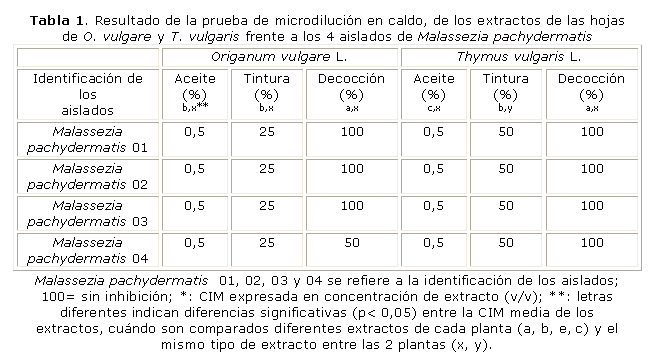
<body><![CDATA[<P><font face="Verdana" size="2"><B><font size="3">RESULTADOS</font></B> </font>     <P>      <P><font face="Verdana" size="2">Los an&aacute;lisis de la cromatograf&iacute;a    mostraron diferencias entre los constituyentes de las plantas. El aceite de    <I>T. vulgaris </I>present&oacute; 7 picos compatibles con los patrones utilizados    (mirceno, p-cimeno, 1,8 cineol, linalol, 4-terpineol, <font face="Symbol">a</font>-terpineol    y timol). Fueron observados, por lo menos, otros 17 constituyentes no caracterizados,    muchos de los cuales en cantidades mayores que el contenido de timol. En relaci&oacute;n    a <I>O. vulgare</I>, se identificaron 10 constituyentes relacionados a los padrones    (<font face="Symbol">a</font>-terpineno, p-cimeno, limoneno, <font face="Symbol">g</font>-terpineno,    terpinoleno, linalol, 4-terpineol, <font face="Symbol">a</font>-terpineol, timol    y carvacrol), la relaci&oacute;n timol:carvacrol result&oacute; pr&oacute;xima    a 1:1. El pico de 4-terpineol se present&oacute; muy semejante al de los constituyentes    principales. </font>      <P><font face="Verdana" size="2">Los resultados de CIM para los extractos de las    plantas evaluados aparecen en la <a href="/img/revistas/pla/v13n4/t0103408.gif">tabla 1</a>. A pesar    de que los constituyentes de las 2 plantas son diferentes, la CIM del or&eacute;gano    y del tomillo fue semejante para las 4 muestras de <I>M. pachydermatis</I> (0,5    %). </font>     
<P>     <P>      <P><font face="Verdana" size="2">En relaci&oacute;n con las tinturas, la planta    que mostr&oacute; mejor resultado fue el or&eacute;gano con CIM media de 25    %. La CIM de la decocci&oacute;n de or&eacute;gano fue de 50 %, la decocci&oacute;n    de tomillo no present&oacute; inhibici&oacute;n de los aislados de <I>M. pachydermatis.</I>    Frente a las bacterias el mejor resultado fue el de los aceites y frente a <I>P.    aeruginosa </I>la CIM del aceite de or&eacute;gano fue 12 % y frente a <I>S.    aureus</I> fue 1,56 %; la CIM del aceite de tomillo fue 5 % para <I>P. aeruginosa</I>    y de 1,25 % para <I>S. aureus </I>(<a href="/img/revistas/pla/v13n4/t0203408.gif">tabla 2</a>). </font>     
<P>     <P><font face="Verdana" size="2"><B><font size="3">DISCUSI&Oacute;N</font></B>    </font>     <P>      ]]></body>
<body><![CDATA[<P><font face="Verdana" size="2">La variaci&oacute;n en la constituci&oacute;n    del aceite esencial ha llevado a la tentativa de clasificar esas plantas en    diferentes quimiotipos de acuerdo con el constituyente principal.<SUP>14</SUP>    Esta variaci&oacute;n depende de la variedad de or&eacute;gano, de la altitud,    sazonalidad y otras caracter&iacute;sticas agron&oacute;micas.<SUP>15,16</SUP>    </font>     <P><font face="Verdana" size="2"><I>Hammer </I>y otros<SUP>17</SUP> utilizaron    aceites comerciales y obtuvieron una CIM de 2,0 % para <I>P. aeruginosa</I>    y para <I>S. aureus</I> 0,12 %; para el aceite de tomillo la CIM fue &gt; 2,0    % para <I>P. aeruginosa</I> y para <I>S. aureus</I> 0,25 %. Sin embargo, no    se encontraron otros trabajos que utilizaron la misma metodolog&iacute;a para    mejor compararlos. </font>     <P><font face="Verdana" size="2">Todos los extractos y tinturas inhibieron el    crecimiento de los hongos y de las bacterias, el extracto de aceite mostr&oacute;    el mejor resultado, pero el rendimiento obtenido con esta forma farmac&eacute;utica    es mucho menor por gramo de planta en relaci&oacute;n con las otras formas de    extracci&oacute;n. </font>     <P>     <P><font face="Verdana" size="2"><B><font size="3">REFERENCIAS BIBLIOGR&Aacute;FICAS</font></B>    </font>     <P>      <!-- ref --><P><font face="Verdana" size="2">1. Ken HWY. Drogas de origen vegetal - Mejorana.    En: Tratado de Farmacognosia, M&eacute;xico DF: Editoral Atlante; 1951. p. 938.    </font>      <!-- ref --><P><font face="Verdana" size="2">2. Badi HN, Yazdani D, Ali SM, Nazari F. Effects    of spacing and harvesting time o herbage yield and quality/quantity of oil in    thyme, <I>Thymus vulgaris </I>L. Ind Crops Prod. 2004;19:231-6. </font>     <!-- ref --><P><font face="Verdana" size="2">3. Siatis NG, Kimbaris AC, Pappas CS, Tarantilis    PA, Daferera DJ, Polissiou MG. Rapid Method for Simultaneous Quantitative Determination    of Four Major Essential Oil Components from Oregano (<I>Oreganum</I> sp.) and    Thyme (<I>Thymus</I> sp.) Using FT-Raman Spectroscopy. J Agric Food Chem. 2005;    53:202-6. </font>     <!-- ref --><P><font face="Verdana" size="2">4. Daferera DJ, Ziogas BN; Polissiou MG. CG-MS    Analysis of essential oils from some Greek aromatic plants and their fungitoxity    on <I>Penicillium digitatum</I>. J Agric Food Chem. 2000; 48:2576-81. </font>     <!-- ref --><P><font face="Verdana" size="2">5. Guill&eacute;n MD, Manzanos MJ. Study of the    composition of the different parts of a Spanish <I>Thymus vulgaris</I> L plant.    Food Chem. 1998;63(3):373-83. </font>     <!-- ref --><P><font face="Verdana" size="2">6. Sim&otilde;es CMO, Schenkel EP, Gosmnn G,    Mello JCP, Mentz LA, Petrovick PR. Farmacognosia: da Planta ao Medicamento.    Ed. da UFRGS/ed. da UFSC, Porto Alegre, RS/Florian&oacute;polis, SC, 2004; p.    1002. </font>     <!-- ref --><P><font face="Verdana" size="2">7. Crespo MJ, Abarca ML., Caba&ntilde;es FJ.    Occurrence of <I>Malassezia</I> spp. in the external ear canals of dogs and    cats with and without otitis external<B>. </B>M&eacute;d Mycol. 2002; 40:115-21.    </font>     <!-- ref --><P><font face="Verdana" size="2">8. Plant JD, Rosenkrantz WS, Griffin EC. Factors    associated with and prevalence of high <I>Malassezia pachydermatis</I> numbers    on dog skin. JAVMA. 1992;201(6):879-82. </font>     <!-- ref --><P><font face="Verdana" size="2">9. Lobell R, Wiengarten A; Simmons R. Um novo    agente para o tratamento da otite canina. A Hora Veterin&aacute;ria. 1995;88:29-33.    </font>     <!-- ref --><P><font face="Verdana" size="2">10. ANVISA. Farmacop&eacute;ia Brasileira. 4ta.    ed., v.1. Sao Paulo: Ed. Atheneu; 1988. </font>      <!-- ref --><P><font face="Verdana" size="2">11. Nascente PS. <I>Malassezia pachydermatis</I>    em c&atilde;es e gatos: estudo da freq&uuml;&ecirc;ncia e avalia&ccedil;&atilde;o    da sensibilidade aos antif&uacute;ngicos cetoconazol, fluconazol e itraconazol.    Pelotas-RS, Disserta&ccedil;&atilde;o [Mestrado em Veterin&aacute;ria] _ Programa    de P&oacute;s-gradua&ccedil;&atilde;o em Veterin&aacute;ria, Universidade Federal    de Pelotas; 2001. p. 84. </font>     <!-- ref --><P><font face="Verdana" size="2">12. Lambert RJW, Skandamis PN, Coote PJ; Nychas    GJE. A study of the minimum inhibitory concentration and mode of action of oregano    essential oil, thymol and carvacrol. J Appl Microbiol. 2001; 91:453-62. </font>     <!-- ref --><P><font face="Verdana" size="2">13. Manohar V, Ingram C, Gray J, Talpur NA, Echard    BW, Bagchi D. Antifungal activities of origanum oil against <I>Candida albicans</I>.    Mol Cell Biochem. 2001; 228:111-7. </font>     <!-- ref --><P><font face="Verdana" size="2">14. Skoula M, Gotsiou P, Naxakis G, Johnson CB.    A chemosystematic investigation on the mono- and sesquiterpenoids in the genus    <I>Origanum</I> (Labiatae). Phytochem. 1999; 52:649-57. </font>     <!-- ref --><P><font face="Verdana" size="2">15. Mockute D, Bernotiene G, Judzentiene A. The    &acirc;-ocimene chemotype of essential oils of the inflorescences and the leaves    with stems from <I>Origanum vulgare </I>ssp<I>. vulgare</I> growing wild in    Lithuania. Biochem System Ecol. 2003; 31:269-78. </font>     <!-- ref --><P><font face="Verdana" size="2">16. Kofidis G, Bosabalidis AM, Moustakas M. Contemporary    Seasonal and Altitudinal Variations of Leaf Structural Features in Oregano (<I>Origanum    vulgare </I>L.). Ann Bot. 2003; 92:635-45. </font>      <!-- ref --><P><font face="Verdana" size="2">17. Hammer KA, Carson CF, Riley TV. Antimicrobial    activity of essential oils and other plant extracts. J Appl Microbiol. 1999;86:985-90.    </font>     <P>     <P>     <P><font face="Verdana" size="2">Recibido: 8 de agosto de 2008.     <br>   Aprobado: 10 de octubre de 2008. </font>     <P>     <P>     <P><font face="Verdana" size="2">M. C. <I>Luciana de Souza</I>. Departamento de    Veterinaria Preventiva, Faculdad de Veterinaria, Universidad Federal de Pelotas    (UFPel). Campus universitario s/n, CEP 96010900, Pelotas,RS, Brasil. Correo    electr&oacute;nico: <U><FONT  COLOR="#0000ff"><a href="mailto:lprestes.mv@hotmail.com">lprestes.mv@hotmail.com</a></FONT></U>    </font>      ]]></body>
<body><![CDATA[<P>      ]]></body><back>
<ref-list>
<ref id="B1">
<label>1</label><nlm-citation citation-type="book">
<person-group person-group-type="author">
<name>
<surname><![CDATA[Ken]]></surname>
<given-names><![CDATA[HWY]]></given-names>
</name>
</person-group>
<article-title xml:lang="es"><![CDATA[Drogas de origen vegetal: Mejorana]]></article-title>
<source><![CDATA[Tratado de Farmacognosia]]></source>
<year>1951</year>
<page-range>938</page-range><publisher-loc><![CDATA[México^eDF DF]]></publisher-loc>
<publisher-name><![CDATA[Editoral Atlante]]></publisher-name>
</nlm-citation>
</ref>
<ref id="B2">
<label>2</label><nlm-citation citation-type="journal">
<person-group person-group-type="author">
<name>
<surname><![CDATA[Badi]]></surname>
<given-names><![CDATA[HN]]></given-names>
</name>
<name>
<surname><![CDATA[Yazdani]]></surname>
<given-names><![CDATA[D]]></given-names>
</name>
<name>
<surname><![CDATA[Ali]]></surname>
<given-names><![CDATA[SM]]></given-names>
</name>
<name>
<surname><![CDATA[Nazari]]></surname>
<given-names><![CDATA[F]]></given-names>
</name>
</person-group>
<article-title xml:lang="en"><![CDATA[Effects of spacing and harvesting time o herbage yield and quality/quantity of oil in thyme, Thymus vulgaris L]]></article-title>
<source><![CDATA[Ind Crops Prod]]></source>
<year>2004</year>
<volume>19</volume>
<page-range>231-6</page-range></nlm-citation>
</ref>
<ref id="B3">
<label>3</label><nlm-citation citation-type="journal">
<person-group person-group-type="author">
<name>
<surname><![CDATA[Siatis]]></surname>
<given-names><![CDATA[NG]]></given-names>
</name>
<name>
<surname><![CDATA[Kimbaris]]></surname>
<given-names><![CDATA[AC]]></given-names>
</name>
<name>
<surname><![CDATA[Pappas]]></surname>
<given-names><![CDATA[CS]]></given-names>
</name>
<name>
<surname><![CDATA[Tarantilis]]></surname>
<given-names><![CDATA[PA]]></given-names>
</name>
<name>
<surname><![CDATA[Daferera]]></surname>
<given-names><![CDATA[DJ]]></given-names>
</name>
<name>
<surname><![CDATA[Polissiou]]></surname>
<given-names><![CDATA[MG]]></given-names>
</name>
</person-group>
<article-title xml:lang="en"><![CDATA[Rapid Method for Simultaneous Quantitative Determination of Four Major Essential Oil Components from Oregano (Oreganum sp.) and Thyme (Thymus sp.) Using FT-Raman Spectroscopy]]></article-title>
<source><![CDATA[J Agric Food Chem]]></source>
<year>2005</year>
<volume>53</volume>
<page-range>202-6</page-range></nlm-citation>
</ref>
<ref id="B4">
<label>4</label><nlm-citation citation-type="journal">
<person-group person-group-type="author">
<name>
<surname><![CDATA[Daferera]]></surname>
<given-names><![CDATA[DJ]]></given-names>
</name>
<name>
<surname><![CDATA[Ziogas]]></surname>
<given-names><![CDATA[BN]]></given-names>
</name>
<name>
<surname><![CDATA[Polissiou]]></surname>
<given-names><![CDATA[MG]]></given-names>
</name>
</person-group>
<article-title xml:lang="en"><![CDATA[CG-MS Analysis of essential oils from some Greek aromatic plants and their fungitoxity on Penicillium digitatum]]></article-title>
<source><![CDATA[J Agric Food Chem]]></source>
<year>2000</year>
<volume>48</volume>
<page-range>2576-81</page-range></nlm-citation>
</ref>
<ref id="B5">
<label>5</label><nlm-citation citation-type="journal">
<person-group person-group-type="author">
<name>
<surname><![CDATA[Guillén]]></surname>
<given-names><![CDATA[MD]]></given-names>
</name>
<name>
<surname><![CDATA[Manzanos]]></surname>
<given-names><![CDATA[MJ]]></given-names>
</name>
</person-group>
<article-title xml:lang="en"><![CDATA[Study of the composition of the different parts of a Spanish Thymus vulgaris L plant]]></article-title>
<source><![CDATA[Food Chem]]></source>
<year>1998</year>
<volume>63</volume>
<numero>3</numero>
<issue>3</issue>
<page-range>373-83</page-range></nlm-citation>
</ref>
<ref id="B6">
<label>6</label><nlm-citation citation-type="book">
<person-group person-group-type="author">
<name>
<surname><![CDATA[Simões]]></surname>
<given-names><![CDATA[CMO]]></given-names>
</name>
<name>
<surname><![CDATA[Schenkel]]></surname>
<given-names><![CDATA[EP]]></given-names>
</name>
<name>
<surname><![CDATA[Gosmnn]]></surname>
<given-names><![CDATA[G]]></given-names>
</name>
<name>
<surname><![CDATA[Mello]]></surname>
<given-names><![CDATA[JCP]]></given-names>
</name>
<name>
<surname><![CDATA[Mentz]]></surname>
<given-names><![CDATA[LA]]></given-names>
</name>
<name>
<surname><![CDATA[Petrovick]]></surname>
<given-names><![CDATA[PR]]></given-names>
</name>
</person-group>
<source><![CDATA[Farmacognosia: da Planta ao Medicamento]]></source>
<year>2004</year>
<page-range>1002</page-range><publisher-loc><![CDATA[Porto Alegre^eRS/Florianópolis, SC RS/Florianópolis, SC]]></publisher-loc>
<publisher-name><![CDATA[Ed. da UFRGS/ed. da UFSC]]></publisher-name>
</nlm-citation>
</ref>
<ref id="B7">
<label>7</label><nlm-citation citation-type="journal">
<person-group person-group-type="author">
<name>
<surname><![CDATA[Crespo]]></surname>
<given-names><![CDATA[MJ]]></given-names>
</name>
</person-group>
<article-title xml:lang="en"><![CDATA[Occurrence of Malassezia spp: in the external ear canals of dogs and cats with and without otitis external]]></article-title>
<source><![CDATA[Méd Mycol]]></source>
<year>2002</year>
<volume>40</volume>
<page-range>115-21</page-range></nlm-citation>
</ref>
<ref id="B8">
<label>8</label><nlm-citation citation-type="journal">
<person-group person-group-type="author">
<name>
<surname><![CDATA[Plant]]></surname>
<given-names><![CDATA[JD]]></given-names>
</name>
<name>
<surname><![CDATA[Rosenkrantz]]></surname>
<given-names><![CDATA[WS]]></given-names>
</name>
<name>
<surname><![CDATA[Griffin]]></surname>
<given-names><![CDATA[EC]]></given-names>
</name>
</person-group>
<article-title xml:lang="en"><![CDATA[Factors associated with and prevalence of high Malassezia pachydermatis numbers on dog skin]]></article-title>
<source><![CDATA[JAVMA]]></source>
<year>1992</year>
<volume>201</volume>
<numero>6</numero>
<issue>6</issue>
<page-range>879-82</page-range></nlm-citation>
</ref>
<ref id="B9">
<label>9</label><nlm-citation citation-type="journal">
<person-group person-group-type="author">
<name>
<surname><![CDATA[Lobell]]></surname>
<given-names><![CDATA[R]]></given-names>
</name>
<name>
<surname><![CDATA[Wiengarten]]></surname>
<given-names><![CDATA[A]]></given-names>
</name>
<name>
<surname><![CDATA[Simmons]]></surname>
<given-names><![CDATA[R]]></given-names>
</name>
</person-group>
<article-title xml:lang="pt"><![CDATA[Um novo agente para o tratamento da otite canina]]></article-title>
<source><![CDATA[A Hora Veterinária]]></source>
<year>1995</year>
<volume>88</volume>
<page-range>29-33</page-range></nlm-citation>
</ref>
<ref id="B10">
<label>10</label><nlm-citation citation-type="book">
<collab>ANVISA</collab>
<source><![CDATA[Farmacopéia Brasileira]]></source>
<year>1988</year>
<edition>4ta</edition>
<publisher-loc><![CDATA[Sao Paulo ]]></publisher-loc>
<publisher-name><![CDATA[Ed. Atheneu]]></publisher-name>
</nlm-citation>
</ref>
<ref id="B11">
<label>11</label><nlm-citation citation-type="confpro">
<person-group person-group-type="author">
<name>
<surname><![CDATA[Nascente]]></surname>
<given-names><![CDATA[PS]]></given-names>
</name>
</person-group>
<source><![CDATA[Malassezia pachydermatis em cães e gatos: estudo da freqüência e avaliação da sensibilidade aos antifúngicos cetoconazol, fluconazol e itraconazol]]></source>
<year></year>
<conf-name><![CDATA[ Dissertação Mestrado em Veterinária_ Programa de Pós-graduação em Veterinária]]></conf-name>
<conf-date>2001</conf-date>
<conf-loc> </conf-loc>
</nlm-citation>
</ref>
<ref id="B12">
<label>12</label><nlm-citation citation-type="journal">
<person-group person-group-type="author">
<name>
<surname><![CDATA[Lambert]]></surname>
<given-names><![CDATA[RJW]]></given-names>
</name>
<name>
<surname><![CDATA[Skandamis]]></surname>
<given-names><![CDATA[PN]]></given-names>
</name>
<name>
<surname><![CDATA[Coote]]></surname>
<given-names><![CDATA[PJ]]></given-names>
</name>
<name>
<surname><![CDATA[Nychas]]></surname>
<given-names><![CDATA[GJE]]></given-names>
</name>
</person-group>
<article-title xml:lang="en"><![CDATA[A study of the minimum inhibitory concentration and mode of action of oregano essential oil, thymol and carvacrol]]></article-title>
<source><![CDATA[J Appl Microbiol]]></source>
<year>2001</year>
<volume>91</volume>
<page-range>453-62</page-range></nlm-citation>
</ref>
<ref id="B13">
<label>13</label><nlm-citation citation-type="journal">
<person-group person-group-type="author">
<name>
<surname><![CDATA[Manohar]]></surname>
<given-names><![CDATA[V]]></given-names>
</name>
<name>
<surname><![CDATA[Ingram]]></surname>
<given-names><![CDATA[C]]></given-names>
</name>
<name>
<surname><![CDATA[Gray]]></surname>
<given-names><![CDATA[J]]></given-names>
</name>
<name>
<surname><![CDATA[Talpur]]></surname>
<given-names><![CDATA[NA]]></given-names>
</name>
<name>
<surname><![CDATA[Echard]]></surname>
<given-names><![CDATA[BW]]></given-names>
</name>
<name>
<surname><![CDATA[Bagchi]]></surname>
<given-names><![CDATA[D]]></given-names>
</name>
</person-group>
<article-title xml:lang="en"><![CDATA[Antifungal activities of origanum oil against Candida albicans]]></article-title>
<source><![CDATA[Mol Cell Biochem]]></source>
<year>2001</year>
<volume>228</volume>
<page-range>111-7</page-range></nlm-citation>
</ref>
<ref id="B14">
<label>14</label><nlm-citation citation-type="journal">
<person-group person-group-type="author">
<name>
<surname><![CDATA[Skoula]]></surname>
<given-names><![CDATA[M]]></given-names>
</name>
<name>
<surname><![CDATA[Gotsiou]]></surname>
<given-names><![CDATA[P]]></given-names>
</name>
<name>
<surname><![CDATA[Naxakis]]></surname>
<given-names><![CDATA[G]]></given-names>
</name>
<name>
<surname><![CDATA[Johnson]]></surname>
<given-names><![CDATA[CB]]></given-names>
</name>
</person-group>
<article-title xml:lang="en"><![CDATA[A chemosystematic investigation on the mono- and sesquiterpenoids in the genus Origanum (Labiatae)]]></article-title>
<source><![CDATA[Phytochem]]></source>
<year>1999</year>
<volume>52</volume>
<page-range>649-57</page-range></nlm-citation>
</ref>
<ref id="B15">
<label>15</label><nlm-citation citation-type="journal">
<person-group person-group-type="author">
<name>
<surname><![CDATA[Mockute]]></surname>
<given-names><![CDATA[D]]></given-names>
</name>
<name>
<surname><![CDATA[Bernotiene]]></surname>
<given-names><![CDATA[G]]></given-names>
</name>
<name>
<surname><![CDATA[Judzentiene]]></surname>
<given-names><![CDATA[A]]></given-names>
</name>
</person-group>
<article-title xml:lang="en"><![CDATA[The â-ocimene chemotype of essential oils of the inflorescences and the leaves with stems from Origanum vulgare ssp. vulgare growing wild in Lithuania]]></article-title>
<source><![CDATA[Biochem System Ecol]]></source>
<year>2003</year>
<volume>31</volume>
<page-range>269-78</page-range></nlm-citation>
</ref>
<ref id="B16">
<label>16</label><nlm-citation citation-type="journal">
<person-group person-group-type="author">
<name>
<surname><![CDATA[Kofidis]]></surname>
<given-names><![CDATA[G]]></given-names>
</name>
<name>
<surname><![CDATA[Bosabalidis]]></surname>
<given-names><![CDATA[AM]]></given-names>
</name>
<name>
<surname><![CDATA[Moustakas]]></surname>
<given-names><![CDATA[M]]></given-names>
</name>
</person-group>
<article-title xml:lang="en"><![CDATA[Contemporary Seasonal and Altitudinal Variations of Leaf Structural Features in Oregano (Origanum vulgare L.)]]></article-title>
<source><![CDATA[Ann Bot]]></source>
<year>2003</year>
<volume>92</volume>
<page-range>635-45</page-range></nlm-citation>
</ref>
<ref id="B17">
<label>17</label><nlm-citation citation-type="journal">
<person-group person-group-type="author">
<name>
<surname><![CDATA[Hammer]]></surname>
<given-names><![CDATA[KA]]></given-names>
</name>
<name>
<surname><![CDATA[Carson]]></surname>
<given-names><![CDATA[CF]]></given-names>
</name>
<name>
<surname><![CDATA[Riley]]></surname>
<given-names><![CDATA[TV]]></given-names>
</name>
</person-group>
<article-title xml:lang="en"><![CDATA[Antimicrobial activity of essential oils and other plant extracts]]></article-title>
<source><![CDATA[J Appl Microbiol]]></source>
<year>1999</year>
<volume>86</volume>
<page-range>985-90</page-range></nlm-citation>
</ref>
</ref-list>
</back>
</article>