<?xml version="1.0" encoding="ISO-8859-1"?><article xmlns:mml="http://www.w3.org/1998/Math/MathML" xmlns:xlink="http://www.w3.org/1999/xlink" xmlns:xsi="http://www.w3.org/2001/XMLSchema-instance">
<front>
<journal-meta>
<journal-id>1028-4796</journal-id>
<journal-title><![CDATA[Revista Cubana de Plantas Medicinales]]></journal-title>
<abbrev-journal-title><![CDATA[Rev Cubana Plant Med]]></abbrev-journal-title>
<issn>1028-4796</issn>
<publisher>
<publisher-name><![CDATA[ECIMED]]></publisher-name>
</publisher>
</journal-meta>
<article-meta>
<article-id>S1028-47962011000200003</article-id>
<title-group>
<article-title xml:lang="es"><![CDATA[Composición química volátil del aceite esencial de Eryngium foetidum L. colombiano y determinación de su actividad antioxidante]]></article-title>
<article-title xml:lang="en"><![CDATA[Volatile chemical composition of the essential oil from colombian Eryngium foetidum L. and determination of its antioxidant activity]]></article-title>
</title-group>
<contrib-group>
<contrib contrib-type="author">
<name>
<surname><![CDATA[Jaramillo]]></surname>
<given-names><![CDATA[Beatriz E]]></given-names>
</name>
<xref ref-type="aff" rid="A01"/>
</contrib>
<contrib contrib-type="author">
<name>
<surname><![CDATA[Duarte]]></surname>
<given-names><![CDATA[Edisson]]></given-names>
</name>
<xref ref-type="aff" rid="A01"/>
</contrib>
<contrib contrib-type="author">
<name>
<surname><![CDATA[Martelo]]></surname>
<given-names><![CDATA[Irina]]></given-names>
</name>
<xref ref-type="aff" rid="A01"/>
</contrib>
</contrib-group>
<aff id="A01">
<institution><![CDATA[,Facultad de Ciencias Exactas y Naturales Universidad de Cartagena ]]></institution>
<addr-line><![CDATA[Cartagena ]]></addr-line>
<country>Colombia</country>
</aff>
<pub-date pub-type="pub">
<day>00</day>
<month>06</month>
<year>2011</year>
</pub-date>
<pub-date pub-type="epub">
<day>00</day>
<month>06</month>
<year>2011</year>
</pub-date>
<volume>16</volume>
<numero>2</numero>
<fpage>140</fpage>
<lpage>150</lpage>
<copyright-statement/>
<copyright-year/>
<self-uri xlink:href="http://scielo.sld.cu/scielo.php?script=sci_arttext&amp;pid=S1028-47962011000200003&amp;lng=en&amp;nrm=iso"></self-uri><self-uri xlink:href="http://scielo.sld.cu/scielo.php?script=sci_abstract&amp;pid=S1028-47962011000200003&amp;lng=en&amp;nrm=iso"></self-uri><self-uri xlink:href="http://scielo.sld.cu/scielo.php?script=sci_pdf&amp;pid=S1028-47962011000200003&amp;lng=en&amp;nrm=iso"></self-uri><abstract abstract-type="short" xml:lang="es"><p><![CDATA[Introducción: el culantro (Eryngium foetidum L., Apiaceae) es una hierba nativa de América tropical y las Antillas. Es usada en diferentes recetas de comida típicas del Caribe, Latinoamérica y el lejano oriente. Estudios indican que esta planta es rica en calcio, hierro, caroteno, y riboflavina; sus hojas son utilizadas como saborizantes y condimentos de algunos alimentos. Su aplicación medicinal incluye su uso como té para la gripe, diabetes, el estreñimiento y la fiebre. Se usa comúnmente en salsas como estimulante del apetito. Especies de E. foetidum de varios países han mostrado una composición variable de su aceite esencial, sobre todo, en sus hojas. Objetivo: establecer la composición química volátil del aceite esencial obtenido de hojas y tallos frescos de E. foetidum y evaluar su actividad antioxidante. Métodos: el aceite esencial fue aislado usando la técnica de hidrodestilación. La composición química volátil se determinó mediante cromatografía de gases acoplada a detectores de ionización en llama (GC-FID) y espectrometría de masas (GC-MS). La actividad antioxidante fue determinada mediante el ensayo de decoloración del radical DPPH. (2,2-difenil-1-picril hidracilo). Resultados: el aceite esencial de las hojas de E. foetidum presentó un alto porcentaje de aldehídos alifáticos (E-2-dodecenal, 5-dodeceno, tetradecanal, tetradecenal) y aromáticos (2,4,6-trimetilbenzaldehído, 3,4,5-trimetilfenol). La actividad antioxidante se expresó como porcentaje de inhibición del radical DPPH. (89,39 %). Conclusiones: en el aceite esencial de E. foetidum colombiano predominaron compuestos aldehídos alifáticos y aromáticos. El resultado del ensayo de DPPH. mostró que el aceite esencial posee una capacidad antioxidante alta, esto lo hace una fuente importante de antioxidantes naturales.]]></p></abstract>
<abstract abstract-type="short" xml:lang="en"><p><![CDATA[Introduction: culantro (Eryngium foetidum L., Apiaceae) is a herb native to Tropical America and the West Indies. Although widely used in dishes throughout the Caribbean, Latin America, and the Far East. The herb is reportedly rich in calcium, iron, carotene, and riboflavin and its harvested leaves are widely used as a food flavoring and seasoning herb for meat and many other foods. Their medicinal values include its use as a tea for flu, diabetes, constipation, and fevers. One of its most popular uses is in chutneys as an appetite stimulant. Species of E. foetidum from several countries have shown a variable composition of its essential oil, particularly, in their leaves. Objective: to establish the volatile chemical composition of the essential oil obtained from fresh leaves and stems of E. foetidum and to evaluate its antioxidant activity. Methods: the essential oil was isolated by hydrodistillation. The volatile chemical composition was analyzed by Gas Chromatography coupled to flame ionization detector (GC-FID) and Mass Spectrometry (GC-MS). The antioxidant activity was determined using the test radical DPPH decoloration. (2,2-diphenyl-1-picryl hidrazyl). Results: the essential oil from E. foetidum showed a high percentage of aliphatic aldehydes (E-2-dodecenal, 5-dodecene, tetradecanal, tetradecenal) and aromatic (2,3,5-trimethylbenzaldehyde, trimethylphenol). The antioxidant activity was expressed as percentage inhibition of DPPH. radical (89.39 %). Conclusions: in the essential oil from Colombian E. foetidum predominant aliphatic aldehydes and aromatic compounds. The DPPH test showed that AE has antioxidant capacity, this makes it an important source of natural antioxidants.]]></p></abstract>
<kwd-group>
<kwd lng="es"><![CDATA[Eryngium foetidum L]]></kwd>
<kwd lng="es"><![CDATA[aceite esencial]]></kwd>
<kwd lng="es"><![CDATA[Apiaceae]]></kwd>
<kwd lng="es"><![CDATA[cromatografía de gases]]></kwd>
<kwd lng="es"><![CDATA[antioxidantes naturales]]></kwd>
<kwd lng="en"><![CDATA[Eryngium foetidum L]]></kwd>
<kwd lng="en"><![CDATA[essential oils]]></kwd>
<kwd lng="en"><![CDATA[Apiaceae]]></kwd>
<kwd lng="en"><![CDATA[gas]]></kwd>
<kwd lng="en"><![CDATA[chromatography]]></kwd>
<kwd lng="en"><![CDATA[natural antioxidant]]></kwd>
</kwd-group>
</article-meta>
</front><body><![CDATA[ <div align="right">       <p><font face="Verdana" size="2"><B>ART&Iacute;CULO ORIGINAL </B></font></p>       <p>&nbsp; </p> </div>     <P>      <P><font size="4"><b><font face="Verdana">Composici&oacute;n qu&iacute;mica vol&aacute;til    del aceite esencial de <I>Eryngium foetidum </I>L. colombiano y determinaci&oacute;n    de su actividad antioxidante</font></b></font>      <P>      <P><font size="3"><b><font face="Verdana">Volatile chemical composition of the    essential oil from colombian <I>Eryngium foetidum </I>L. and determination of    its antioxidant activity</font></b></font>     <P>     <P>      <P><b><font face="Verdana" size="2">Beatriz E. Jaramillo,<SUP>I</SUP> Edisson    Duarte,<SUP>II</SUP> Irina Martelo</font><font face="Verdana" size="2"><SUP>III    </SUP></font></b><font face="Verdana" size="2"><SUP></SUP></font>      ]]></body>
<body><![CDATA[<P><font face="Verdana" size="2"><SUP>I </sup>Doctora en Qu&iacute;mica. Grupo    de Investigaciones Agroqu&iacute;micas, Programa de Qu&iacute;mica, Facultad    de Ciencias Exactas y Naturales. Universidad de Cartagena. Campus de Zaragocilla.    Cartagena, Colombia.    <br>   </font><font face="Verdana" size="2"><SUP>II</SUP> M&aacute;ster en Ciencias    Ambientales. Grupo de Investigaciones Agroqu&iacute;micas, Programa de Qu&iacute;mica,    Facultad de Ciencias Exactas y Naturales. Universidad de Cartagena. Campus de    Zaragocilla. Cartagena, Colombia.    <br>   </font><font face="Verdana" size="2"><SUP>III</SUP> Qu&iacute;mica. Grupo de    Investigaciones Agroqu&iacute;micas, Programa de Qu&iacute;mica, Facultad de    Ciencias Exactas y Naturales. Universidad de Cartagena. Campus de Zaragocilla.    Cartagena, Colombia. </font>     <P>     <P>  <hr size="1" noshade> <font face="Verdana" size="2"><B>RESUMEN</B></font>     <p><font face="Verdana" size="2"><B>Introducci&oacute;n</b>: el culantro (<I>Eryngium    foetidum </I>L., Apiaceae) es una hierba nativa de Am&eacute;rica tropical y    las Antillas. Es usada en diferentes recetas de comida t&iacute;picas del Caribe,    Latinoam&eacute;rica y el lejano oriente. Estudios indican que esta planta es    rica en calcio, hierro, caroteno, y riboflavina; sus hojas son utilizadas como    saborizantes y condimentos de algunos alimentos. Su aplicaci&oacute;n medicinal    incluye su uso como t&eacute; para la gripe, diabetes, el estre&ntilde;imiento    y la fiebre. Se usa com&uacute;nmente en salsas como estimulante del apetito.    Especies de <I>E. foetidum </I>de varios pa&iacute;ses han mostrado una composici&oacute;n    variable de su aceite esencial, sobre todo, en sus hojas. <B>    <br>   Objetivo</B>: establecer la composici&oacute;n qu&iacute;mica vol&aacute;til    del aceite esencial obtenido de hojas y tallos frescos de <I>E. foetidum</I>    y evaluar su actividad antioxidante.<B>     <br>   M&eacute;todos</B>: el aceite esencial fue aislado usando la t&eacute;cnica    de hidrodestilaci&oacute;n. La composici&oacute;n qu&iacute;mica vol&aacute;til    se determin&oacute; mediante cromatograf&iacute;a de gases acoplada a detectores    de ionizaci&oacute;n en llama (GC-FID) y espectrometr&iacute;a de masas (GC-MS).    La actividad antioxidante fue determinada mediante el ensayo de decoloraci&oacute;n    del radical DPPH<SUP>. </SUP>(2,2-difenil-1-picril hidracilo). <B>    <br>   Resultados</B>: el aceite esencial de las hojas de <I>E. foetidum</I> present&oacute;    un alto porcentaje de aldeh&iacute;dos alif&aacute;ticos (E-2-dodecenal, 5-dodeceno,    tetradecanal, tetradecenal) y arom&aacute;ticos (2,4,6-trimetilbenzaldeh&iacute;do,    3,4,5-trimetilfenol). La actividad antioxidante se expres&oacute; como porcentaje    de inhibici&oacute;n del radical DPPH<SUP>. </SUP>(89,39 %). <B>    <br>   Conclusiones</B>: en el aceite esencial de <I>E. foetidum </I>colombiano predominaron    compuestos aldeh&iacute;dos alif&aacute;ticos y arom&aacute;ticos. El resultado    del ensayo de DPPH<SUP>. </SUP>mostr&oacute; que el aceite esencial posee una    capacidad antioxidante alta, esto lo hace una fuente importante de antioxidantes  naturales.</font></p>     ]]></body>
<body><![CDATA[<P><font face="Verdana" size="2"><B>Palabras clave</B>: <I>Eryngium foetidum</I>    L., aceite esencial, Apiaceae<I>, </I>cromatograf&iacute;a de gases, antioxidantes    naturales.</font>  <hr size="1" noshade> <b><font face="Verdana" size="2">ABSTRACT</font></b><font face="Verdana" size="2">  </font>      <P><font face="Verdana" size="2"><b>Introduction</b>: culantro (<I>Eryngium foetidum    </I>L., Apiaceae) is a herb native to Tropical America and the West Indies.    Although widely used in dishes throughout the Caribbean, Latin America, and    the Far East. The herb is reportedly rich in calcium, iron, carotene, and riboflavin    and its harvested leaves are widely used as a food flavoring and seasoning herb    for meat and many other foods. Their medicinal values include its use as a tea    for flu, diabetes, constipation, and fevers. One of its most popular uses is    in chutneys as an appetite stimulant. Species of <I>E. foetidum </I>from several    countries have shown a variable composition of its essential oil, particularly,    in their leaves. <b>    <br>   Objective</b>: to establish the volatile chemical composition of the essential    oil obtained from fresh leaves and stems of <I>E. foetidum </I>and to evaluate    its antioxidant activity. <b>    <br>   Methods</b>: the essential oil was isolated by hydrodistillation. The volatile    chemical composition was analyzed by Gas Chromatography coupled to flame ionization    detector (GC-FID) and Mass Spectrometry (GC-MS). The antioxidant activity was    determined using the test radical DPPH decoloration. (2,2-diphenyl-1-picryl    hidrazyl). <b>    <br>   Results</b>: the essential oil from <I>E. foetidum </I>showed a high percentage    of aliphatic aldehydes (E-2-dodecenal, 5-dodecene, tetradecanal, tetradecenal)    and aromatic (2,3,5-trimethylbenzaldehyde, trimethylphenol). The antioxidant    activity was expressed as percentage inhibition of DPPH<SUP>. </SUP>radical    (89.39 %). <b>    <br>   Conclusions</b>: in the essential oil from Colombian <I>E. foetidum </I>predominant    aliphatic aldehydes and aromatic compounds. The DPPH test showed that AE has    antioxidant capacity, this makes it an important source of natural antioxidants.</font>      <P><font face="Verdana" size="2"><b>Key words</b>: <I>Eryngium foetidum </I>L<I>.,    </I>essential oils, Apiaceae, gas, chromatography, natural antioxidant. </font>  <hr size="1" noshade>     <p>&nbsp;</p>     <P>      <P><font face="Verdana" size="2"><B><font size="3">INTRODUCCI&Oacute;N</font></B></font>      ]]></body>
<body><![CDATA[<P><font face="Verdana" size="2"><I>Eryngium foetidum</I> L, conocida popularmente    como culantro, coriander, chicoria, culantro de coyote, culantr&oacute;n, culantro    de sabana, cilantr&oacute;n y cimarr&oacute;n, pertenece a la familia Apiaceae;    es una hierba perenne, fuertemente arom&aacute;tica de hasta 60 cm de altura.    La planta es empleada como febr&iacute;fugo, emenagogo, aperitivo, antiescorb&uacute;tico,    antirreum&aacute;tico, antis&eacute;ptico, antiem&eacute;tico, carminativo y    en el tratamiento de la gripe, dolor de cabeza, hemorragias, dolor de est&oacute;mago,    convulsiones, diarreas, malaria, tos y espasmos.<SUP>1-3</SUP> </font>     <P><font face="Verdana" size="2">Diversas investigaciones realizadas con esta    hierba, indican que el extracto acuoso presenta actividad antipir&eacute;tica,    efecto anticonvulsionante y actividad anticonceptiva en ratas y ratones,<SUP>3    </SUP>la decocci&oacute;n de las hojas, administrada por v&iacute;a oral, present&oacute;    actividad antiinflamatoria en ratas, el extracto metan&oacute;lico present&oacute;    actividad antioxidante <I>in vitro</I> y presenta actividad antihelm&iacute;ntica    frente a <I>S. stercoralis</I>.<SUP>4-6 </SUP> </font>     <P><font face="Verdana" size="2">En los sistemas vivos existen m&uacute;ltiples    reacciones de &oacute;xido-reducci&oacute;n indispensables para la vida, sin    embargo, la oxidaci&oacute;n puede ser tambi&eacute;n una fuente de enfermedades,    cuando se pierde el equilibrio entre los oxidantes y antioxidantes, lo cual    se conoce como estr&eacute;s oxidativo, que puede causar da&ntilde;os a biomol&eacute;culas    como los l&iacute;pidos, las prote&iacute;nas, el ADN, entre otras.<SUP>7-11    </SUP>El descubrimiento de ciertas sustancias antioxidantes en especies vegetales    en las cuales se ignoraba su presencia, incrementar&iacute;a su valor y podr&iacute;a    convertirlos en fuentes viables para obtener estos compuestos.<SUP>12-14 </SUP>Entre    las sustancias qu&iacute;micas presentes en las plantas con amplia aplicaci&oacute;n,    figuran los aceites esenciales (AEs), constituidos por una mezcla compleja de    metabolitos secundarios vol&aacute;tiles con propiedades medicinales, como,    actividad antimicrobiana, antigenot&oacute;xica y de inhibici&oacute;n del crecimiento    celular tumoral.<SUP>15-18</SUP> Los aceites esenciales son de gran utilidad    en diversas ramas de la industria de las cuales se mencionan: fragancias, aromas    y sabores, como biorreguladores en agroqu&iacute;mica, pinturas, textiles, empaques    pl&aacute;sticos y en la farmacolog&iacute;a, entre otras.<SUP>12,19,20 </SUP>    </font>     <P><font face="Verdana" size="2">Estudios realizados han se&ntilde;alado que muchos    de los AEs tienen marcada actividad antioxidante,<SUP>21-24</SUP> por lo que    muchas ramas de la industria, que usan antioxidantes en sus procesos, se han    interesado en ellos; pero no todos los compuestos presentes en los aceites esenciales    son responsables de esta actividad, ni necesariamente son compuestos mayoritarios,    por lo que se hace necesario detectar e identificar los minoritarios, aun si    se encuentran en concentraciones muy bajas, la t&eacute;cnica anal&iacute;tica    m&aacute;s usada para este fin es la cromatograf&iacute;a de gases acoplada    a un espectr&oacute;metro de masas (GC MS).<SUP>25,26 </SUP> </font>     <P><font face="Verdana" size="2">En el presente trabajo, se obtuvo el aceite esencial    de la planta arom&aacute;tica de culantro (<I>Eryngium foetidum</I> L.), recolectada    en el municipio de Mar&iacute;a La Baja del Departamento de Bol&iacute;var,    Colombia y se estudi&oacute; su composici&oacute;n qu&iacute;mica vol&aacute;til    y su actividad antioxidante.</font>     <P>      <P>      <P><font face="Verdana" size="3"><B>M&Eacute;TODOS </B></font>      <P><font face="Verdana" size="2"><I>Material vegetal</I></font>      <P><font face="Verdana" size="2">Las plantas de <I>E. foetidum</I> fueron recolectadas    en el &aacute;rea rural del municipio de Mar&iacute;a la Baja, Bol&iacute;var    (Colombia). Solo se usaron hojas y tallos frescos en las extracciones. La identificaci&oacute;n    taxon&oacute;mica de las plantas se llev&oacute; a cabo en el Instituto de de    Biolog&iacute;a de la Facultad de Ciencias Exactas y Naturales, de la Universidad    de Antioquia (Medell&iacute;n-Colombia). Los pliegos testigo de cada planta    quedaron depositados como muestra permanente en el Herbario Universidad de Antioquia    (HUA) (N<SUP>o </SUP>HUA 167357), clasificada por el Dr. Francisco J. Rold&aacute;n    Palacios. </font>     ]]></body>
<body><![CDATA[<P>      <P><font face="Verdana" size="2"><I>Extracciones</I></font>      <P><font face="Verdana" size="2">La extracci&oacute;n del AE de culantro (<I>Eryngium    foetidum</I> L.), se llev&oacute; a cabo empleando un equipo de destilaci&oacute;n    tipo clevenger con reservorio de destilaci&oacute;n Dean Stark, seg&uacute;n    el procedimiento descrito por <I>Stashenko</I> y otros.<SUP>23,25</SUP> Las    hojas y tallos de <I>E. foetidum</I> se cortaron finamente, 500 g del material    vegetal se sumergieron en agua en un bal&oacute;n de 3 L y se sometieron a ebullici&oacute;n;    la duraci&oacute;n de la hidrodestilaci&oacute;n fue de 3 h, luego el aceite    esencial se separ&oacute; del agua por decantaci&oacute;n y fue secado con Na<SUB>2</SUB>SO<SUB>4</SUB>.    Una al&iacute;cuota del aceite (30 &#181;L) se diluy&oacute; en 1 mL de diclorometano    para el an&aacute;lisis cromatogr&aacute;fico.<SUP>23,25,26</SUP> </font>     <P>      <P><font face="Verdana" size="2"><I>Proceso cromatogr&aacute;fico.</I></font>      <P><font face="Verdana" size="2">Los aceites esenciales se analizaron en un cromat&oacute;grafo    Agilent Technologies 7890&#170; Network GC acoplado a un detector selectivo    de masas (MSD) Agilent Technologies 5975 inert GC MS system, equipado con un    puerto de inyecci&oacute;n <I>split/splitless</I> (230 &#186;C, relaci&oacute;n    de <I>split</I> 20:1). </font>     <P><font face="Verdana" size="2">Para la separaci&oacute;n de las mezclas se utiliz&oacute;    una columna capilar HP 5MS de 30 m x 0,25 mm d.i. x 0,25 &#181;m df, con fase    estacionaria de 5 % fenil-poli (metilsiloxano). La temperatura inicial del horno    fue de 50 &#186;C por 2 min y luego sigui&oacute; a una rata de 5 &#186;C/min    hasta 250 &#186;C y 5 min a esa temperatura, el tiempo de la corrida fue de    47 min. El gas de arrastre utilizado fue el helio, con una presi&oacute;n de    entrada en la cabeza de la columna de 12,667 psi a una velocidad de 1,172 mL/min.    Para la identificaci&oacute;n de los compuestos se usaron algunos terpenos est&aacute;ndar,    analizados bajo las mismas condiciones instrumentales que las muestras, espectros    de masas e &iacute;ndices de retenci&oacute;n de<I> Kov&aacute;ts</I> de componentes,    que se compararon con los reportados en la literatura.<SUP>27-29 </SUP> </font>     <P>      <P><font face="Verdana" size="2"><I>Determinaci&oacute;n de la actividad antioxidante    in vitro.</I></font>      <P><font face="Verdana" size="2">Para determinar la capacidad antioxidante del    aceite esencial de <I>E. foetidum</I> a trav&eacute;s del ensayo de decoloraci&oacute;n    del radical estable DPPH<SUP><font size="1">&#149;</font> </SUP>(1,1-difenil-2-picril-hidracilo)    descrito por <I>Scherer</I>,<SUP>30</SUP> fue evaluado el rango de concentraciones    de DPPH<SUP><font size="1">&#149;</font> </SUP>a utilizar, se realizaron ensayos    preliminares utilizando como sustancia patr&oacute;n el &aacute;cido asc&oacute;rbico.    </font>      ]]></body>
<body><![CDATA[<P><font face="Verdana" size="2">Se tomaron al&iacute;cuotas (0,71; 0,57; 0,43;    0,28 y 0,14 mL) de una soluci&oacute;n metan&oacute;lica de DPPH<SUP>. </SUP>1,37    mM a las cuales se adicion&oacute; metanol, para obtener concentraciones de    0,25; 0,20; 0,15, 0,10 y 0,05 mM, respectivamente. La reacci&oacute;n se realiz&oacute;    empleando 3,9 mL de estas soluciones de DPPH<SUP><font size="1">&#149;</font>    </SUP>y adicionando 0,1 mL de aceite esencial, los cuales se sometieron a un    per&iacute;odo de incubaci&oacute;n en la oscuridad durante 90 min, luego se    ley&oacute; la absorbancia a 517 nm en un espectrofot&oacute;metro UV-VIS. La    actividad antioxidante se expres&oacute; como porcentaje de inhibici&oacute;n,    la cual corresponde a la cantidad de radical DPPH<SUP><font size="1">&#149;</font>    </SUP>neutralizado por el aceite esencial, de acuerdo con la ecuaci&oacute;n    siguiente:<SUP>30,31</SUP> </font>      <P><font face="Verdana" size="2"><img src="/img/revistas/pla/v16n2/fo0103211.gif" width="244" height="50"></font>      
<P>      <P><font face="Verdana" size="2">Del mismo modo, se calcul&oacute; el porcentaje    de DPPH<SUP><font size="1">&#149;</font></SUP> remanente:</font>      <P><img src="/img/revistas/pla/v16n2/fo0203211.gif" width="244" height="55">      
<P>     <P>      <P><font face="Verdana" size="2">Donde: Abs0 es la absorbancia del blanco (soluci&oacute;n    metan&oacute;lica de DPPH<font size="1">&#149;</font>) y Abs1 es la absorbancia    de la muestra. La medida de la actividad antioxidante se realiz&oacute; por    triplicado. </font>      <P>      <P>      ]]></body>
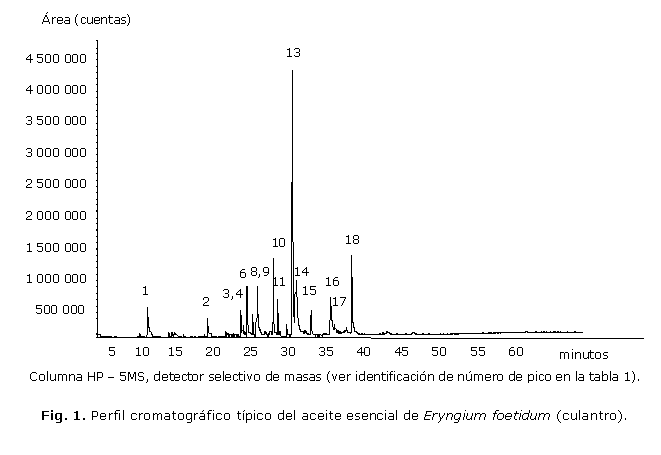
<body><![CDATA[<P><font face="Verdana" size="3"><B>RESULTADOS </B></font>      <P><font face="Verdana" size="2">El rendimiento de aceite esencial obtenido de    las hojas frescas de <I>E. foetidum</I> fue de 0,2 %. En la <a href="/img/revistas/pla/v16n2/f0103211.gif">figura    1</a> se muestra el perfil cromatogr&aacute;fico t&iacute;pico de los metabolitos    secundarios vol&aacute;tiles presentes en el aceite esencial de <I>E. foetidum</I>.</font>      
<P>      <P><font face="Verdana" size="2">En la <a href="/img/revistas/pla/v16n2/t0103211.gif">tabla</a> se muestran    los compuestos mayoritarios encontrados en el AE de <I>E. foetidum</I>, estos    fueron el 2-dodecen-1-al (43,96 %), 5-dodeceno (30,15 %), tetradecanal (5,28    %), tetradecenal (5,41 %), 3,4,5-trimetilfenol (3,08 %) y 2,4,6-trimetilbenzaldeh&iacute;do    (2,24 %).</font>      
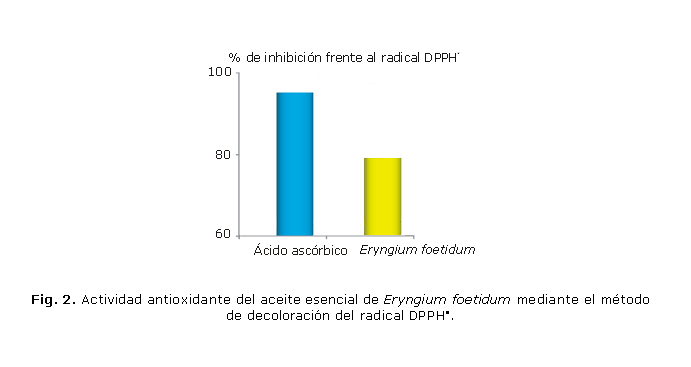
<P>      <P><font face="Verdana" size="2">Si bien es cierto que existen diversos m&eacute;todos    para evaluar la actividad antioxidante, sea <I>in vivo</I> o <I>in Vitro</I>,    el m&eacute;todo de decoloraci&oacute;n del radical DPPH<SUP><font size="1">&#149;</font></SUP>    permite tener una idea aproximada de lo que ocurre en situaciones complejas    <I>in vivo</I>. En la <a href="/img/revistas/pla/v16n2/f0203211.gif">figura 2</a> se muestra la actividad    antioxidante del &aacute;cido asc&oacute;rbico (sustancia antioxidante utilizada    como referencia) <I>vs.</I> la actividad antioxidante del aceite esencial de    <I>E. foetidum</I> cuyo porcentaje de inhibici&oacute;n frente al radical DPPH<SUP><font size="1">&#149;</font></SUP>    result&oacute; de 96,4 y 80,39 %, respectivamente. </font>      
<P>      <P>      <P><font face="Verdana" size="3"><B>DISCUSI&Oacute;N </B></font>      <P><font face="Verdana" size="2">Se identificaron 17 componentes en concentraciones    relativas superiores a 0,2 % en el aceite esencial de <I>E. foetidum</I> colombiano.    Este se caracteriz&oacute; por los altos porcentajes de aldeh&iacute;dos arom&aacute;ticos    y lineales: 2,4,6-trimetilbenzaldeh&iacute;do, nonanal, decanal, decenal, undecanal,    dodecanal, tridecenal, tetradecenal. La comparaci&oacute;n con los aceites de    otras localidades muestran que la composici&oacute;n var&iacute;a seg&uacute;n    el origen geogr&aacute;fico de la planta. Por ejemplo, el 2-dodecenal, el principal    componente (43,96 %) del AE de <I>E. foetidum</I> colombiano, ya se ha informado    como principal constituyente de los aceites procedentes de Vietnam (45,5 %),<SUP>32</SUP>    Malasia (59,7 %),<SUP>33</SUP> Venezuela (27,5 %)<SUP>34</SUP> y Per&uacute;    (61,8 %).<SUP>35</SUP> Pero solo como componente menor en los aceites obtenidos    en Cuba<SUP>36</SUP> y Taiw&aacute;n.<SUP>37</SUP> Mientras el 2,3,6-trimetilbenzaldeh&iacute;do    ha sido reportado como componente mayoritario en el AE de <I>E. foetidum</I>    obtenido en S. Tom&eacute;,<SUP>6</SUP> Por el contrario, su is&oacute;mero    de posici&oacute;n, el 2,4,5&#173;trimetilbenzaldeh&iacute;do estuvo presente    como constituyente mayoritario (20,5 %) en el aceite obtenido en Cuba.<SUP>36</SUP>    El aceite esencial de las hojas de <I>E. foetidum</I> present&oacute;, en general,    buena capacidad antioxidante, los resultados dan un soporte acorde con el uso    de <I>E. foetidum</I> en la medicina y cocina tradicional de Colombia y de otros    pa&iacute;ses latinoamericanos; esto permitir&aacute; proponerla como una fuente    natural con un alto uso potencial en la industria farmac&eacute;utica y de alimentos,    adem&aacute;s porque se han encontrado reportes de que posee tambi&eacute;n    propiedades antiinflamatorias.<SUP>38</SUP> Si bien los metabolitos antioxidantes    en plantas son estudiados principalmente sobre la base de sus estructuras polifen&oacute;licas,    existe literatura en la cual se refiere que tambi&eacute;n se halla actividad    antioxidante en los aceites esenciales cuyos componentes principalmente son    terpenos y terpenoides.<SUP>39-42</SUP> </font>      ]]></body>
<body><![CDATA[<P>      <P>      <P><font face="Verdana" size="3"><B>AGRADECIMIENTOS</B></font>      <P><font face="Verdana" size="2">A la Universidad de Cartagena por la financiaci&oacute;n    de este proyecto. A Maritza Villalobos B, QF, por su valiosa colaboraci&oacute;n    en el desarrollo de esta investigaci&oacute;n. </font>     <P>      <P>      <P><font face="Verdana" size="3"><B>REFERENCIAS BIBLIOGR&Aacute;FICAS </B></font>      <!-- ref --><P><font face="Verdana" size="2">1. Robert A, De Filipps S, Maina L, Crepin J.    Medicinal Plants of the Guianas. Washington DC: Smithsonian Institution; 1994.    p.384. </font>    <!-- ref --><P><font face="Verdana" size="2">2. Gupta MP. Doscientas setenta plantas medicinales    iberoamericanas. B&oacute;gota, Colombia: Talleres de Editorial Presencia; 1995.    p. 320-1. </font>    <!-- ref --><P><font face="Verdana" size="2">3. Simon OR. Singh N. Demonstration of anticonvulsant    properties of an aqueous extract of Spirit Weed (<I>Eryngium foetidum</I> L.).    West Indian Med. 1986;35(2):121-5. </font>    <!-- ref --><P><font face="Verdana" size="2">4. Quignard ELJ. Screening of plants found in    Amazonas state for lethality towards brine shrimp. Acta Amaz&oacute;nica. 2003;33(1):93-104.    </font>    <!-- ref --><P><font face="Verdana" size="2">5. Cavin A, Dyatmyko W, Hostettmann K. Screening    of Indonesian plants for antifungal and free radical scavenging activities.    Pharmaceutical Biol. 1999;37:260-8. </font>    <!-- ref --><P><font face="Verdana" size="2">6. Martins AP. Essential oil composition of <I>Eryngium    foetidum</I> from S. Tome e Principe. J Essent Oil Res. 2003;15:93-5. </font>    <!-- ref --><P><font face="Verdana" size="2">7. Halliwell B. Free radicals, proteins and DNA:    oxidative damage versus redox regulation. Biochemical Society Transactions.    1996;24:1023-7. </font>    <!-- ref --><P><font face="Verdana" size="2">8. Halliwell B, Gutteridge JM. The definition    and measurement of antioxidants in biological systems. Free Radic Biol Med.    1995;18:125-6. </font>    <!-- ref --><P><font face="Verdana" size="2">9. Halliwell B, Gutteridge JM. Free Radicals    in Biology and Medicine. Oxford: Clarendon Press; 1989. p. 543. </font>    <!-- ref --><P><font face="Verdana" size="2">10. Perkins MJ. Radical Chemistry. New York:    Ellis Horwood; 1994. p.182. </font>    <!-- ref --><P><font face="Verdana" size="2">11. Ahmad S. Oxidative stress and antioxidant    defenses in biology. New York: Chapman &amp; Hall; 1995. p. 511. </font>    <!-- ref --><P><font face="Verdana" size="2">12. Bandoni A. Los Recursos Vegetales Arom&aacute;ticos    en Latinoam&eacute;rica. CYTED. La Plata (Argentina): Editorial de la Universidad    de La Plata; 2000. p. 410. </font>    <!-- ref --><P><font face="Verdana" size="2">13. Antonio J, Mel&eacute;ndez-Mart&iacute;nez    PD, Fraser PM. Accumulation of health promoting phytochemicals in wild relatives    of tomato and their contribution to in vitro antioxidant activity. Phytochemistry.    2010;71:1104-14. </font>    <!-- ref --><P><font face="Verdana" size="2">14. Dini I, Tenore GC, Dini A. Antioxidant compound    contents and antioxidant activity before and after cooking in sweet and bitter    <I>Chenopodium quinoa</I> seeds. LWT &#173;Food Science and Technology. 2010;43(3):447-51.    </font>    <!-- ref --><P><font face="Verdana" size="2">15. Vila R, Santana AI, P&eacute;rez-Ros&eacute;s    R. Composition and biological activity of the essential oil from leaves of <I>Plinia    cerrocampanensis</I>, a new source of &aacute;&#173;bisabolol. Bioresource Technology.    2010;101(7):2510-4. </font>    <!-- ref --><P><font face="Verdana" size="2">16. Yang FL. Diatomaceous earth enhances the    toxicity of garlic, <I>Allium sativum</I>, essential oil against stored-product    pests. J Stored Products Research. 2010;46(2):118-23. </font>    <!-- ref --><P><font face="Verdana" size="2">17. Ahmadi F, Sadeghi S, Modarresi M, Abiri R,    Mikaeli A. Chemical composition, <I>in vitro</I> anti-microbial, antifungal    and antioxidant activities of the essential oil and methanolic extract of <I>Hymenocrater    longiflorus</I> Benth., of Iran. Food Chemical Toxicology. 2010;48(5):1137-44.    </font>    <!-- ref --><P><font face="Verdana" size="2">18. Bakkali F, Averbeck S, Averbeck D, Idaomar    M. Biological effects of essential oilsA review. Food Chemical Toxicology. 2008;46(2):446-75.    </font>    <!-- ref --><P><font face="Verdana" size="2">19. Varona S, Mart&iacute;n A, Cocero MJ. Formulation    of a natural biocide based on lavandin essential oil by emulsification using    modified starches. Chemical Engineering and Processing: Process Intensification.    2009;48(6):1121-8. </font>    <!-- ref --><P><font face="Verdana" size="2">20. Gamal MS. Environmentally friendly pesticides:    Essential oil-based w/o/w multiple emulsions for anti-fungal formulations. Industrial    Crops Products. 2010;31(1):99-106. </font>    <!-- ref --><P><font face="Verdana" size="2">21.Guimar&atilde;es R, Sousa MJ, Ferreira I.    Contribution of essential oils and phenolics to the antioxidant properties of    aromatic plants. Industrial Crops Products. 2010;32(2):152-6. </font>    <!-- ref --><P><font face="Verdana" size="2">22. Puertas MA, Hillebrand S, Stashenko E, Winterhalter    P. <I>In vitro</I> radical scavenging activity of essential oils from Columbian    plants and fractions from oregano (<I>Origanum vulgare </I>L.) essential oil.    Flavour Fragr J. 2002;17:380-4. </font>    <!-- ref --><P><font face="Verdana" size="2">23.Stashenko E, Jaramillo B, Mart&iacute;nez    J. Comparison of different extraction methods for the analysis of volatile secondary    metabolites of <I>Lippia alba</I> (Mill.) N. E. Brown, grown in Colombia, and    evaluation of its <I>in vitro</I> antioxidant activity. J Chromatogr A. 2004;1025:93-103.    </font>    <!-- ref --><P><font face="Verdana" size="2">24. Tiziana M, Damien HJ, Deans SG, Fiquereido    AC, Barroso JG, Ruberto G. Antimicrobial and antioxidant properties of some    commercial essential oils. Flavour Fragr J. 1998;13:235-44. </font>    <!-- ref --><P><font face="Verdana" size="2">25. Stashenko EE, Jaramillo BE, Mart&iacute;nez    JR. Analysis of volatile secondary metabolites from Colombian <I>Xylopia aromatica</I>    (Lamarck) by different extractive and headspace methods and gas chromatography.    J Chromatogr A. 2004;1025:105-13. </font>    <!-- ref --><P><font face="Verdana" size="2">26. Mehdi Jalali-Heravi, Hadi Parastar, Hassan    Sereshti. Towards obtaining more information from gas chromatographymass spectrometric    data of essential oils: An overview of mean field independent component analysis.    J Chromatogr A. 2010;1217(29):4850-61. </font>    <!-- ref --><P><font face="Verdana" size="2">27. Davies NW. Gas chromatography retention indices    of monoterpenos and sesquiterpenes on methyl silicone and carbowax 20M phases.    J Chromatogr A. 1990;503:1-24. </font>    <!-- ref --><P><font face="Verdana" size="2">28. Adams RP. Identification of essential oil    components by gas chromatography/mass spectrometry. Carol Stream (Illinois):    Allured Publishing Corporation; 1995. p. 469 </font>    <!-- ref --><P><font face="Verdana" size="2">29. Joulain D, K&ouml;nig W. The atlas of spectral    data of sesquiterpene hydrocarbons. Hamburg: E.B.-Verlag; 1998. p. 658. </font>    <!-- ref --><P><font face="Verdana" size="2">30. Scherer R, Teixeira H. Antioxidant activity    index (AAI) by the 2,2-diphenyl-1&#173;picrylhydrazyl method. Food Chemistry.    2008;112:654-8. </font>    <!-- ref --><P><font face="Verdana" size="2">31. Molyneux, P. The use of the stable free radical    diphenylpicrilhydracyl (DPPH) for estimating antioxidant activity. J Science    Technol. 2004;26(2):211-9. </font>    <!-- ref --><P><font face="Verdana" size="2">32. Leclercq PA. Composition of the essential    oil of <I>Eryngium foetidum</I> L. from Vietnam. J Essential Oil Research. 1992;4:423-4.    </font>    <!-- ref --><P><font face="Verdana" size="2">33. Wong KC, Feng MC, Sam TW, Tan GL. Composition    of the essential oil of <I>Eryngium foetidum</I> L. leaves and roots. J Essent    Oil Res. 1994;6:369-74. </font>    <!-- ref --><P><font face="Verdana" size="2">34. Cardozo E, Rubio M, Rojas LB, Usubillaga    A. Composition of the essential oil from the leaves of Eryngium foetidum L.    from the Venezuelan Andes. J Essent Oil Res. 2004;16(1):33-4. </font>    <!-- ref --><P><font face="Verdana" size="2">35. Banout, J. Effect of solar drying on the    composition of essential oil of sacha culantro (<I>Eryngium foetidum</I> l.)    grown in the peruvian Amazon. J Food Process Engineering. 2010;33(1):83-103.    </font>    <!-- ref --><P><font face="Verdana" size="2">36. Pino JA, Rosado A, Fuentes V. Composition    of the leaf oil of <I>Eryngium foetidum</I> L. from Cuba. J Essential Oil Research.    1997;9:467-8. </font>    <!-- ref --><P><font face="Verdana" size="2">37. Yeh PH. Essential oils. XVI. Oil of <I>Eryngium    foetidum</I>. J Chin Chem Soc. (Taipei) 1974;21:139-147. </font>    <!-- ref --><P><font face="Verdana" size="2">38. Garcia Gimenez MD. Topical antiinflammatory    activity of phytosterols isolated from <I>Eryngium foetidum</I> on chronic and    acute inflammation models. Phitotherapy Research. 1999;13(1):78-80. </font>    <!-- ref --><P><font face="Verdana" size="2">39. Chanwitheesuk A, Teerawutgulrag A, Rakariyatham    N. Screening of antioxidant activity and antioxidant compounds of some edible    plants of Thailand. Food Chemistry. 2005;92:491-7. </font>    <!-- ref --><P><font face="Verdana" size="2">40. Sarikurkcu C, Arisoy K, Tepe B, Cakir A,    Abali G, Mete E. Studies on the antioxidant activity of essential oil and different    solvent extracts of <I>Vitex agnus castus</I> L. fruits from Turkey. Food Chem    Toxicol. 2009;47(10):2479-83. </font>    <!-- ref --><P><font face="Verdana" size="2">41. Foti M, Ingold KU. Mechanism of inhibition    of lipid peroxidation by &atilde;-terpinene, an unusual and potentially useful    hydrocarbon antioxidant. J Agric Food Chem. 2003;51:2758-65. </font>    <!-- ref --><P><font face="Verdana" size="2">42. Choi HS, Song HS, Ukeda H, Sawamura M. Radical-scavenging    activities of citrus essential oils and their components: detection using 1,1-diphenyl-2&#173;picrylhydrazyl.    J Agric Food Chem. 2000;48:4156-61. </font>    <P>     ]]></body>
<body><![CDATA[<P>      <P>      <P><font face="Verdana" size="2">Recibido: 5 de septiembre de 2010.     <br>   Aprobado: 10 de enero de 2011. </font>     <P>     <P>      <P><font face="Verdana" size="2"><I>Beatriz E. Jaramillo</I>. Programa de Qu&iacute;mica,    Campus de Zaragocilla, Universidad de Cartagena. Colombia. Telefax: 57-5-6698180.    Correo electr&oacute;nico: <U><a href="mailto:beatrizjaramilloc@yahoo.com">beatrizjaramilloc@yahoo.com</a></U>    </font>       ]]></body><back>
<ref-list>
<ref id="B1">
<label>1</label><nlm-citation citation-type="book">
<person-group person-group-type="author">
<name>
<surname><![CDATA[Robert]]></surname>
<given-names><![CDATA[A]]></given-names>
</name>
<name>
<surname><![CDATA[De Filipps]]></surname>
<given-names><![CDATA[S]]></given-names>
</name>
<name>
<surname><![CDATA[Maina]]></surname>
<given-names><![CDATA[L]]></given-names>
</name>
<name>
<surname><![CDATA[Crepin]]></surname>
<given-names><![CDATA[J]]></given-names>
</name>
</person-group>
<source><![CDATA[Medicinal Plants of the Guianas]]></source>
<year>1994</year>
<page-range>384</page-range><publisher-loc><![CDATA[Washington^eDC DC]]></publisher-loc>
<publisher-name><![CDATA[Smithsonian Institution]]></publisher-name>
</nlm-citation>
</ref>
<ref id="B2">
<label>2</label><nlm-citation citation-type="book">
<person-group person-group-type="author">
<name>
<surname><![CDATA[Gupta]]></surname>
<given-names><![CDATA[MP]]></given-names>
</name>
</person-group>
<source><![CDATA[Doscientas setenta plantas medicinales iberoamericanas]]></source>
<year>1995</year>
<page-range>320-1</page-range><publisher-loc><![CDATA[Bógota ]]></publisher-loc>
<publisher-name><![CDATA[Talleres de Editorial Presencia]]></publisher-name>
</nlm-citation>
</ref>
<ref id="B3">
<label>3</label><nlm-citation citation-type="journal">
<person-group person-group-type="author">
<name>
<surname><![CDATA[Simon]]></surname>
<given-names><![CDATA[OR]]></given-names>
</name>
<name>
<surname><![CDATA[Singh]]></surname>
<given-names><![CDATA[N]]></given-names>
</name>
</person-group>
<article-title xml:lang="es"><![CDATA[: Demonstration of anticonvulsant properties of an aqueous extract of Spirit Weed (Eryngium foetidum L]]></article-title>
<source><![CDATA[).West Indian Med.]]></source>
<year>1986</year>
<volume>35</volume>
<numero>2</numero>
<issue>2</issue>
<page-range>121-5</page-range></nlm-citation>
</ref>
<ref id="B4">
<label>4</label><nlm-citation citation-type="journal">
<person-group person-group-type="author">
<name>
<surname><![CDATA[Quignard]]></surname>
<given-names><![CDATA[ELJ]]></given-names>
</name>
</person-group>
<article-title xml:lang="en"><![CDATA[Screening of plants found in Amazonas state for lethality towards brine shrimp]]></article-title>
<source><![CDATA[Acta Amazónica.]]></source>
<year>2003</year>
<volume>33</volume>
<numero>1</numero>
<issue>1</issue>
<page-range>93-104</page-range></nlm-citation>
</ref>
<ref id="B5">
<label>5</label><nlm-citation citation-type="journal">
<person-group person-group-type="author">
<name>
<surname><![CDATA[Cavin]]></surname>
<given-names><![CDATA[A]]></given-names>
</name>
<name>
<surname><![CDATA[Dyatmyko]]></surname>
<given-names><![CDATA[W]]></given-names>
</name>
<name>
<surname><![CDATA[Hostettmann]]></surname>
<given-names><![CDATA[K]]></given-names>
</name>
</person-group>
<article-title xml:lang="en"><![CDATA[Screening of Indonesian plants for antifungal and free radical scavenging activities]]></article-title>
<source><![CDATA[Pharmaceutical Biol.]]></source>
<year>1999</year>
<volume>37</volume>
<page-range>260-8</page-range></nlm-citation>
</ref>
<ref id="B6">
<label>6</label><nlm-citation citation-type="journal">
<person-group person-group-type="author">
<name>
<surname><![CDATA[Martins]]></surname>
<given-names><![CDATA[AP]]></given-names>
</name>
</person-group>
<article-title xml:lang="en"><![CDATA[Essential oil composition of Eryngium foetidum from S: Tome e Principe]]></article-title>
<source><![CDATA[J Essent Oil Res.]]></source>
<year>2003</year>
<volume>15</volume>
<page-range>93-5</page-range></nlm-citation>
</ref>
<ref id="B7">
<label>7</label><nlm-citation citation-type="journal">
<person-group person-group-type="author">
<name>
<surname><![CDATA[Halliwell]]></surname>
<given-names><![CDATA[B]]></given-names>
</name>
</person-group>
<article-title xml:lang="en"><![CDATA[Free radicals, proteins and DNA: oxidative damage versus redox regulation]]></article-title>
<source><![CDATA[Biochemical Society Transactions.]]></source>
<year>1996</year>
<volume>24</volume>
<page-range>1023-7</page-range></nlm-citation>
</ref>
<ref id="B8">
<label>8</label><nlm-citation citation-type="journal">
<person-group person-group-type="author">
<name>
<surname><![CDATA[Halliwell]]></surname>
<given-names><![CDATA[B]]></given-names>
</name>
<name>
<surname><![CDATA[Gutteridge]]></surname>
<given-names><![CDATA[JM]]></given-names>
</name>
</person-group>
<article-title xml:lang="en"><![CDATA[The definition and measurement of antioxidants in biological systems]]></article-title>
<source><![CDATA[Free Radic Biol Med.]]></source>
<year>1995</year>
<volume>18</volume>
<page-range>125-6</page-range></nlm-citation>
</ref>
<ref id="B9">
<label>9</label><nlm-citation citation-type="book">
<person-group person-group-type="author">
<name>
<surname><![CDATA[Halliwell]]></surname>
<given-names><![CDATA[B]]></given-names>
</name>
<name>
<surname><![CDATA[Gutteridge]]></surname>
<given-names><![CDATA[JM]]></given-names>
</name>
</person-group>
<source><![CDATA[Free Radicals in Biology and Medicine]]></source>
<year>1989</year>
<page-range>543</page-range><publisher-loc><![CDATA[Oxford ]]></publisher-loc>
<publisher-name><![CDATA[Clarendon Press]]></publisher-name>
</nlm-citation>
</ref>
<ref id="B10">
<label>10</label><nlm-citation citation-type="book">
<person-group person-group-type="author">
<name>
<surname><![CDATA[Perkins]]></surname>
<given-names><![CDATA[MJ]]></given-names>
</name>
</person-group>
<source><![CDATA[Radical Chemistry]]></source>
<year>1994</year>
<page-range>182</page-range><publisher-loc><![CDATA[New York ]]></publisher-loc>
<publisher-name><![CDATA[Ellis Horwood]]></publisher-name>
</nlm-citation>
</ref>
<ref id="B11">
<label>11</label><nlm-citation citation-type="book">
<person-group person-group-type="author">
<name>
<surname><![CDATA[Ahmad]]></surname>
<given-names><![CDATA[S]]></given-names>
</name>
</person-group>
<source><![CDATA[Oxidative stress and antioxidant defenses in biology]]></source>
<year>1995</year>
<page-range>511</page-range><publisher-loc><![CDATA[New York ]]></publisher-loc>
<publisher-name><![CDATA[Chapman & Hall]]></publisher-name>
</nlm-citation>
</ref>
<ref id="B12">
<label>12</label><nlm-citation citation-type="book">
<person-group person-group-type="author">
<name>
<surname><![CDATA[Bandoni]]></surname>
<given-names><![CDATA[A]]></given-names>
</name>
</person-group>
<source><![CDATA[Los Recursos Vegetales Aromáticos en Latinoamérica]]></source>
<year>2000</year>
<page-range>410</page-range><publisher-loc><![CDATA[La Plata ]]></publisher-loc>
<publisher-name><![CDATA[CYTEDEditorial de la Universidad de La Plata]]></publisher-name>
</nlm-citation>
</ref>
<ref id="B13">
<label>13</label><nlm-citation citation-type="journal">
<person-group person-group-type="author">
<name>
<surname><![CDATA[Antonio]]></surname>
<given-names><![CDATA[J]]></given-names>
</name>
<name>
<surname><![CDATA[Meléndez-Martínez]]></surname>
<given-names><![CDATA[PD]]></given-names>
</name>
<name>
<surname><![CDATA[Fraser]]></surname>
<given-names><![CDATA[PM]]></given-names>
</name>
</person-group>
<article-title xml:lang="en"><![CDATA[Accumulation of health promoting phytochemicals in wild relatives of tomato and their contribution to in vitro antioxidant activity]]></article-title>
<source><![CDATA[Phytochemistry.]]></source>
<year>2010</year>
<volume>71</volume>
<page-range>1104-14</page-range></nlm-citation>
</ref>
<ref id="B14">
<label>14</label><nlm-citation citation-type="journal">
<person-group person-group-type="author">
<name>
<surname><![CDATA[Dini]]></surname>
<given-names><![CDATA[I]]></given-names>
</name>
<name>
<surname><![CDATA[Tenore]]></surname>
<given-names><![CDATA[GC]]></given-names>
</name>
<name>
<surname><![CDATA[Dini]]></surname>
<given-names><![CDATA[A]]></given-names>
</name>
</person-group>
<article-title xml:lang="en"><![CDATA[Antioxidant compound contents and antioxidant activity before and after cooking in sweet and bitter Chenopodium quinoa seeds]]></article-title>
<source><![CDATA[LWT ­Food Science and Technology.]]></source>
<year>2010</year>
<volume>43</volume>
<numero>3</numero>
<issue>3</issue>
<page-range>447-51</page-range></nlm-citation>
</ref>
<ref id="B15">
<label>15</label><nlm-citation citation-type="journal">
<person-group person-group-type="author">
<name>
<surname><![CDATA[Vila]]></surname>
<given-names><![CDATA[R]]></given-names>
</name>
<name>
<surname><![CDATA[Santana]]></surname>
<given-names><![CDATA[AI]]></given-names>
</name>
<name>
<surname><![CDATA[Pérez-Rosés]]></surname>
<given-names><![CDATA[R]]></given-names>
</name>
</person-group>
<article-title xml:lang="en"><![CDATA[Composition and biological activity of the essential oil from leaves of Plinia cerrocampanensis, a new source of á­bisabolol]]></article-title>
<source><![CDATA[Bioresource Technology.]]></source>
<year>2010</year>
<volume>101</volume>
<numero>7</numero>
<issue>7</issue>
<page-range>2510-4</page-range></nlm-citation>
</ref>
<ref id="B16">
<label>16</label><nlm-citation citation-type="journal">
<person-group person-group-type="author">
<name>
<surname><![CDATA[Yang]]></surname>
<given-names><![CDATA[FL]]></given-names>
</name>
</person-group>
<article-title xml:lang="en"><![CDATA[Diatomaceous earth enhances the toxicity of garlic, Allium sativum, essential oil against stored-product pests]]></article-title>
<source><![CDATA[J Stored Products Research.]]></source>
<year>2010</year>
<volume>46</volume>
<numero>2</numero>
<issue>2</issue>
<page-range>118-23</page-range></nlm-citation>
</ref>
<ref id="B17">
<label>17</label><nlm-citation citation-type="journal">
<person-group person-group-type="author">
<name>
<surname><![CDATA[Ahmadi]]></surname>
<given-names><![CDATA[F]]></given-names>
</name>
<name>
<surname><![CDATA[Sadeghi]]></surname>
<given-names><![CDATA[S]]></given-names>
</name>
<name>
<surname><![CDATA[Modarresi]]></surname>
<given-names><![CDATA[M]]></given-names>
</name>
<name>
<surname><![CDATA[Abiri]]></surname>
<given-names><![CDATA[R]]></given-names>
</name>
<name>
<surname><![CDATA[Mikaeli]]></surname>
<given-names><![CDATA[A]]></given-names>
</name>
</person-group>
<article-title xml:lang="en"><![CDATA[Chemical composition, in vitro anti-microbial, antifungal and antioxidant activities of the essential oil and methanolic extract of Hymenocrater longiflorus Benth: , of Iran]]></article-title>
<source><![CDATA[Food Chemical Toxicology.]]></source>
<year>2010</year>
<volume>48</volume>
<numero>5</numero>
<issue>5</issue>
<page-range>1137-44</page-range></nlm-citation>
</ref>
<ref id="B18">
<label>18</label><nlm-citation citation-type="journal">
<person-group person-group-type="author">
<name>
<surname><![CDATA[Bakkali]]></surname>
<given-names><![CDATA[F]]></given-names>
</name>
<name>
<surname><![CDATA[Averbeck]]></surname>
<given-names><![CDATA[S]]></given-names>
</name>
<name>
<surname><![CDATA[Averbeck]]></surname>
<given-names><![CDATA[D]]></given-names>
</name>
<name>
<surname><![CDATA[Idaomar]]></surname>
<given-names><![CDATA[M]]></given-names>
</name>
</person-group>
<article-title xml:lang="en"><![CDATA[Biological effects of essential oilsA review]]></article-title>
<source><![CDATA[Food Chemical Toxicology.]]></source>
<year>2008</year>
<volume>46</volume>
<numero>2</numero>
<issue>2</issue>
<page-range>446-75</page-range></nlm-citation>
</ref>
<ref id="B19">
<label>19</label><nlm-citation citation-type="journal">
<person-group person-group-type="author">
<name>
<surname><![CDATA[Varona]]></surname>
<given-names><![CDATA[S]]></given-names>
</name>
<name>
<surname><![CDATA[Martín]]></surname>
<given-names><![CDATA[A]]></given-names>
</name>
<name>
<surname><![CDATA[Cocero]]></surname>
<given-names><![CDATA[MJ]]></given-names>
</name>
</person-group>
<article-title xml:lang="en"><![CDATA[Formulation of a natural biocide based on lavandin essential oil by emulsification using modified starches.Chemical Engineering and Processing: Process]]></article-title>
<source><![CDATA[Intensification]]></source>
<year>2009</year>
<volume>48</volume>
<numero>6</numero>
<issue>6</issue>
<page-range>1121-8</page-range></nlm-citation>
</ref>
<ref id="B20">
<label>20</label><nlm-citation citation-type="journal">
<person-group person-group-type="author">
<name>
<surname><![CDATA[Gamal]]></surname>
<given-names><![CDATA[MS]]></given-names>
</name>
</person-group>
<article-title xml:lang="en"><![CDATA[Environmentally friendly pesticides: Essential oil-based w/o/w multiple emulsions for anti-fungal formulations]]></article-title>
<source><![CDATA[Industrial Crops Products.]]></source>
<year>2010</year>
<volume>31</volume>
<numero>1</numero>
<issue>1</issue>
<page-range>99-106</page-range></nlm-citation>
</ref>
<ref id="B21">
<label>21</label><nlm-citation citation-type="journal">
<person-group person-group-type="author">
<name>
<surname><![CDATA[Guimarães]]></surname>
<given-names><![CDATA[R]]></given-names>
</name>
<name>
<surname><![CDATA[Sousa]]></surname>
<given-names><![CDATA[MJ]]></given-names>
</name>
<name>
<surname><![CDATA[Ferreira]]></surname>
<given-names><![CDATA[I]]></given-names>
</name>
</person-group>
<article-title xml:lang="en"><![CDATA[Contribution of essential oils and phenolics to the antioxidant properties of aromatic plants]]></article-title>
<source><![CDATA[Industrial Crops Products.]]></source>
<year>2010</year>
<volume>32</volume>
<numero>2</numero>
<issue>2</issue>
<page-range>152-6</page-range></nlm-citation>
</ref>
<ref id="B22">
<label>22</label><nlm-citation citation-type="journal">
<person-group person-group-type="author">
<name>
<surname><![CDATA[Puertas]]></surname>
<given-names><![CDATA[MA]]></given-names>
</name>
<name>
<surname><![CDATA[Hillebrand]]></surname>
<given-names><![CDATA[S]]></given-names>
</name>
<name>
<surname><![CDATA[Stashenko]]></surname>
<given-names><![CDATA[E]]></given-names>
</name>
<name>
<surname><![CDATA[Winterhalter]]></surname>
<given-names><![CDATA[P]]></given-names>
</name>
</person-group>
<article-title xml:lang="en"><![CDATA[In vitro radical scavenging activity of essential oils from Columbian plants and fractions from oregano (Origanum vulgare L: ) essential oil]]></article-title>
<source><![CDATA[Flavour Fragr J.]]></source>
<year>2002</year>
<volume>17</volume>
<page-range>380-4</page-range></nlm-citation>
</ref>
<ref id="B23">
<label>23</label><nlm-citation citation-type="journal">
<person-group person-group-type="author">
<name>
<surname><![CDATA[Stashenko]]></surname>
<given-names><![CDATA[E]]></given-names>
</name>
<name>
<surname><![CDATA[Jaramillo]]></surname>
<given-names><![CDATA[B]]></given-names>
</name>
<name>
<surname><![CDATA[Martínez]]></surname>
<given-names><![CDATA[J]]></given-names>
</name>
</person-group>
<article-title xml:lang="en"><![CDATA[Comparison of different extraction methods for the analysis of volatile secondary metabolites of Lippia alba (Mill.) N. E. Brown, grown in Colombia, and evaluation of its in vitro antioxidant activity]]></article-title>
<source><![CDATA[J Chromatogr A]]></source>
<year>2004</year>
<volume>1025</volume>
<page-range>93-103</page-range></nlm-citation>
</ref>
<ref id="B24">
<label>24</label><nlm-citation citation-type="journal">
<person-group person-group-type="author">
<name>
<surname><![CDATA[Tiziana]]></surname>
<given-names><![CDATA[M]]></given-names>
</name>
<name>
<surname><![CDATA[Damien]]></surname>
<given-names><![CDATA[HJ]]></given-names>
</name>
<name>
<surname><![CDATA[Deans]]></surname>
<given-names><![CDATA[SG]]></given-names>
</name>
<name>
<surname><![CDATA[Fiquereido]]></surname>
<given-names><![CDATA[AC]]></given-names>
</name>
<name>
<surname><![CDATA[Barroso]]></surname>
<given-names><![CDATA[JG]]></given-names>
</name>
<name>
<surname><![CDATA[Ruberto]]></surname>
<given-names><![CDATA[G]]></given-names>
</name>
</person-group>
<article-title xml:lang="en"><![CDATA[Antimicrobial and antioxidant properties of some commercial essential oils]]></article-title>
<source><![CDATA[Flavour Fragr J.]]></source>
<year>1998</year>
<volume>13</volume>
<page-range>235-44</page-range></nlm-citation>
</ref>
<ref id="B25">
<label>25</label><nlm-citation citation-type="journal">
<person-group person-group-type="author">
<name>
<surname><![CDATA[Stashenko]]></surname>
<given-names><![CDATA[EE]]></given-names>
</name>
<name>
<surname><![CDATA[Jaramillo]]></surname>
<given-names><![CDATA[BE]]></given-names>
</name>
<name>
<surname><![CDATA[Martínez]]></surname>
<given-names><![CDATA[JR]]></given-names>
</name>
</person-group>
<article-title xml:lang="en"><![CDATA[Analysis of volatile secondary metabolites from Colombian Xylopia aromatica (Lamarck) by different extractive and headspace methods and gas chromatography]]></article-title>
<source><![CDATA[J Chromatogr A.]]></source>
<year>2004</year>
<volume>1025</volume>
<page-range>105-13</page-range></nlm-citation>
</ref>
<ref id="B26">
<label>26</label><nlm-citation citation-type="journal">
<person-group person-group-type="author">
<name>
<surname><![CDATA[Mehdi]]></surname>
<given-names><![CDATA[Jalali-Heravi]]></given-names>
</name>
<name>
<surname><![CDATA[Hadi]]></surname>
<given-names><![CDATA[Parastar]]></given-names>
</name>
<name>
<surname><![CDATA[Hassan]]></surname>
<given-names><![CDATA[Sereshti]]></given-names>
</name>
</person-group>
<article-title xml:lang="en"><![CDATA[Towards obtaining more information from gas chromatographymass spectrometric data of essential oils: An overview of mean field independent component analysis]]></article-title>
<source><![CDATA[J Chromatogr A.]]></source>
<year>2010</year>
<volume>1217</volume>
<numero>29</numero>
<issue>29</issue>
<page-range>4850-61</page-range></nlm-citation>
</ref>
<ref id="B27">
<label>27</label><nlm-citation citation-type="journal">
<person-group person-group-type="author">
<name>
<surname><![CDATA[Davies]]></surname>
<given-names><![CDATA[NW]]></given-names>
</name>
</person-group>
<article-title xml:lang="en"><![CDATA[Gas chromatography retention indices of monoterpenos and sesquiterpenes on methyl silicone and carbowax 20M phases]]></article-title>
<source><![CDATA[J Chromatogr A.]]></source>
<year>1990</year>
<volume>503</volume>
<page-range>1-24</page-range></nlm-citation>
</ref>
<ref id="B28">
<label>28</label><nlm-citation citation-type="book">
<person-group person-group-type="author">
<name>
<surname><![CDATA[Adams]]></surname>
<given-names><![CDATA[RP]]></given-names>
</name>
</person-group>
<source><![CDATA[Identification of essential oil components by gas chromatography/mass spectrometry. Carol Stream]]></source>
<year>1995</year>
<page-range>469</page-range><publisher-loc><![CDATA[Illinois ]]></publisher-loc>
<publisher-name><![CDATA[Allured Publishing Corporation]]></publisher-name>
</nlm-citation>
</ref>
<ref id="B29">
<label>29</label><nlm-citation citation-type="book">
<person-group person-group-type="author">
<name>
<surname><![CDATA[Joulain]]></surname>
<given-names><![CDATA[D]]></given-names>
</name>
<name>
<surname><![CDATA[König]]></surname>
<given-names><![CDATA[W]]></given-names>
</name>
</person-group>
<source><![CDATA[The atlas of spectral data of sesquiterpene hydrocarbons]]></source>
<year>1998</year>
<page-range>658</page-range><publisher-loc><![CDATA[Hamburg ]]></publisher-loc>
<publisher-name><![CDATA[E.B.-Verlag]]></publisher-name>
</nlm-citation>
</ref>
<ref id="B30">
<label>30</label><nlm-citation citation-type="journal">
<person-group person-group-type="author">
<name>
<surname><![CDATA[Scherer]]></surname>
<given-names><![CDATA[R]]></given-names>
</name>
<name>
<surname><![CDATA[Teixeira]]></surname>
<given-names><![CDATA[H]]></given-names>
</name>
</person-group>
<article-title xml:lang="en"><![CDATA[Antioxidant activity index (AAI) by the 2,2-diphenyl-1­picrylhydrazyl method]]></article-title>
<source><![CDATA[Food Chemistry.]]></source>
<year>2008</year>
<volume>112</volume>
<page-range>654-8</page-range></nlm-citation>
</ref>
<ref id="B31">
<label>31</label><nlm-citation citation-type="journal">
<person-group person-group-type="author">
<name>
<surname><![CDATA[Molyneux]]></surname>
<given-names><![CDATA[P]]></given-names>
</name>
</person-group>
<article-title xml:lang="en"><![CDATA[The use of the stable free radical diphenylpicrilhydracyl (DPPH) for estimating antioxidant activity]]></article-title>
<source><![CDATA[J Science Technol.]]></source>
<year>2004</year>
<volume>26</volume>
<numero>2</numero>
<issue>2</issue>
<page-range>211-9</page-range></nlm-citation>
</ref>
<ref id="B32">
<label>32</label><nlm-citation citation-type="journal">
<person-group person-group-type="author">
<name>
<surname><![CDATA[Leclercq]]></surname>
<given-names><![CDATA[PA]]></given-names>
</name>
</person-group>
<article-title xml:lang="en"><![CDATA[Composition of the essential oil of Eryngium foetidum L: from Vietnam]]></article-title>
<source><![CDATA[J Essential Oil Research.]]></source>
<year>1992</year>
<volume>4</volume>
<page-range>423-4</page-range></nlm-citation>
</ref>
<ref id="B33">
<label>33</label><nlm-citation citation-type="journal">
<person-group person-group-type="author">
<name>
<surname><![CDATA[Wong]]></surname>
<given-names><![CDATA[KC]]></given-names>
</name>
<name>
<surname><![CDATA[Feng]]></surname>
<given-names><![CDATA[MC]]></given-names>
</name>
<name>
<surname><![CDATA[Sam]]></surname>
<given-names><![CDATA[TW]]></given-names>
</name>
<name>
<surname><![CDATA[Tan]]></surname>
<given-names><![CDATA[GL]]></given-names>
</name>
</person-group>
<article-title xml:lang="en"><![CDATA[Composition of the essential oil of Eryngium foetidum L: leaves and roots]]></article-title>
<source><![CDATA[J Essent Oil Res.]]></source>
<year>1994</year>
<volume>6</volume>
<page-range>369-74</page-range></nlm-citation>
</ref>
<ref id="B34">
<label>34</label><nlm-citation citation-type="journal">
<person-group person-group-type="author">
<name>
<surname><![CDATA[Cardozo]]></surname>
<given-names><![CDATA[E]]></given-names>
</name>
<name>
<surname><![CDATA[Rubio]]></surname>
<given-names><![CDATA[M]]></given-names>
</name>
<name>
<surname><![CDATA[Rojas]]></surname>
<given-names><![CDATA[LB]]></given-names>
</name>
<name>
<surname><![CDATA[Usubillaga]]></surname>
<given-names><![CDATA[A]]></given-names>
</name>
</person-group>
<article-title xml:lang="en"><![CDATA[Composition of the essential oil from the leaves of Eryngium foetidum L: from the Venezuelan Andes]]></article-title>
<source><![CDATA[J Essent Oil Res.]]></source>
<year>2004</year>
<volume>16</volume>
<numero>1</numero>
<issue>1</issue>
<page-range>33-4</page-range></nlm-citation>
</ref>
<ref id="B35">
<label>35</label><nlm-citation citation-type="journal">
<person-group person-group-type="author">
<name>
<surname><![CDATA[Banout]]></surname>
<given-names><![CDATA[J]]></given-names>
</name>
</person-group>
<article-title xml:lang="en"><![CDATA[Effect of solar drying on the composition of essential oil of sacha culantro (Eryngium foetidum l: ) grown in the peruvian Amazon]]></article-title>
<source><![CDATA[J Food Process Engineering.]]></source>
<year>2010</year>
<volume>33</volume>
<numero>1</numero>
<issue>1</issue>
<page-range>83-103</page-range></nlm-citation>
</ref>
<ref id="B36">
<label>36</label><nlm-citation citation-type="journal">
<person-group person-group-type="author">
<name>
<surname><![CDATA[Pino]]></surname>
<given-names><![CDATA[JA]]></given-names>
</name>
<name>
<surname><![CDATA[Rosado]]></surname>
<given-names><![CDATA[A]]></given-names>
</name>
<name>
<surname><![CDATA[Fuentes]]></surname>
<given-names><![CDATA[V]]></given-names>
</name>
</person-group>
<article-title xml:lang="en"><![CDATA[Composition of the leaf oil of Eryngium foetidum L: from Cuba]]></article-title>
<source><![CDATA[J Essential Oil Research.]]></source>
<year>1997</year>
<volume>9</volume>
<page-range>467-8</page-range></nlm-citation>
</ref>
<ref id="B37">
<label>37</label><nlm-citation citation-type="journal">
<person-group person-group-type="author">
<name>
<surname><![CDATA[Yeh]]></surname>
<given-names><![CDATA[PH]]></given-names>
</name>
</person-group>
<article-title xml:lang="en"><![CDATA[Essential oils. XVI. Oil of Eryngium foetidum]]></article-title>
<source><![CDATA[J Chin Chem Soc. (Taipei)]]></source>
<year>1974</year>
<volume>21</volume>
<page-range>139-147</page-range></nlm-citation>
</ref>
<ref id="B38">
<label>38</label><nlm-citation citation-type="journal">
<person-group person-group-type="author">
<name>
<surname><![CDATA[Garcia Gimenez]]></surname>
<given-names><![CDATA[MD]]></given-names>
</name>
</person-group>
<article-title xml:lang="en"><![CDATA[Topical antiinflammatory activity of phytosterols isolated from Eryngium foetidum on chronic and acute inflammation models]]></article-title>
<source><![CDATA[Phitotherapy Research.]]></source>
<year>1999</year>
<volume>13</volume>
<numero>1</numero>
<issue>1</issue>
<page-range>78-80</page-range></nlm-citation>
</ref>
<ref id="B39">
<label>39</label><nlm-citation citation-type="journal">
<person-group person-group-type="author">
<name>
<surname><![CDATA[Chanwitheesuk]]></surname>
<given-names><![CDATA[A]]></given-names>
</name>
<name>
<surname><![CDATA[Teerawutgulrag]]></surname>
<given-names><![CDATA[A]]></given-names>
</name>
<name>
<surname><![CDATA[Rakariyatham]]></surname>
<given-names><![CDATA[N]]></given-names>
</name>
</person-group>
<article-title xml:lang="en"><![CDATA[Screening of antioxidant activity and antioxidant compounds of some edible plants of Thailand]]></article-title>
<source><![CDATA[Food Chemistry.]]></source>
<year>2005</year>
<volume>92</volume>
<page-range>491-7</page-range></nlm-citation>
</ref>
<ref id="B40">
<label>40</label><nlm-citation citation-type="journal">
<person-group person-group-type="author">
<name>
<surname><![CDATA[Sarikurkcu]]></surname>
<given-names><![CDATA[C]]></given-names>
</name>
<name>
<surname><![CDATA[Arisoy]]></surname>
<given-names><![CDATA[K]]></given-names>
</name>
<name>
<surname><![CDATA[Tepe]]></surname>
<given-names><![CDATA[B]]></given-names>
</name>
<name>
<surname><![CDATA[Cakir]]></surname>
<given-names><![CDATA[A]]></given-names>
</name>
<name>
<surname><![CDATA[Abali]]></surname>
<given-names><![CDATA[G]]></given-names>
</name>
<name>
<surname><![CDATA[Mete]]></surname>
<given-names><![CDATA[E]]></given-names>
</name>
</person-group>
<article-title xml:lang="en"><![CDATA[Studies on the antioxidant activity of essential oil and different solvent extracts of Vitex agnus castus L: fruits from Turkey]]></article-title>
<source><![CDATA[Food Chem Toxicol.]]></source>
<year>2009</year>
<volume>47</volume>
<numero>10</numero>
<issue>10</issue>
<page-range>2479-83</page-range></nlm-citation>
</ref>
<ref id="B41">
<label>41</label><nlm-citation citation-type="journal">
<person-group person-group-type="author">
<name>
<surname><![CDATA[Foti]]></surname>
<given-names><![CDATA[M]]></given-names>
</name>
<name>
<surname><![CDATA[Ingold]]></surname>
<given-names><![CDATA[KU]]></given-names>
</name>
</person-group>
<article-title xml:lang="en"><![CDATA[Mechanism of inhibition of lipid peroxidation by ã-terpinene, an unusual and potentially useful hydrocarbon antioxidant]]></article-title>
<source><![CDATA[J Agric Food Chem.]]></source>
<year>2003</year>
<volume>51</volume>
<page-range>2758-65</page-range></nlm-citation>
</ref>
<ref id="B42">
<label>42</label><nlm-citation citation-type="journal">
<person-group person-group-type="author">
<name>
<surname><![CDATA[Choi]]></surname>
<given-names><![CDATA[HS]]></given-names>
</name>
<name>
<surname><![CDATA[Song]]></surname>
<given-names><![CDATA[HS]]></given-names>
</name>
<name>
<surname><![CDATA[Ukeda]]></surname>
<given-names><![CDATA[H]]></given-names>
</name>
<name>
<surname><![CDATA[Sawamura]]></surname>
<given-names><![CDATA[M]]></given-names>
</name>
</person-group>
<article-title xml:lang="en"><![CDATA[Radical-scavenging activities of citrus essential oils and their components: detection using 1,1-diphenyl-2­picrylhydrazyl]]></article-title>
<source><![CDATA[J Agric Food Chem.]]></source>
<year>2000</year>
<volume>48</volume>
<page-range>4156-61</page-range></nlm-citation>
</ref>
</ref-list>
</back>
</article>